No New Taxes Means No Relief: Lakota is at it again

I have been saying no to Lakota tax increases for a long time. People who dislike that fact have a ready-made story about me. They say I will never be for anything. They say I hate schools. They say I would rather buy a television than teach a child. That last one is a joke I make myself, and I will make it again before we are done, because I would rather keep my money than subsidize a system that lectures families about everything except the marketplace those children will enter. I am not against education. I am against the public-education trick: lose at the ballot box, split the package, dress it up as a renewal, and come back until the people who write the checks get tired.

Last November the district asked this community for more than half a billion dollars. Voters answered with 61% no. That was not a polite disagreement. That was a verdict. Eight months later, the same board put a two-hundred-twenty-three-million-dollar, thirty-seven-year bond on the November 3, 2026 ballot and called it Phase One. They say it is not a tax increase. They say it merely replaces a bond that expires in 2028. They say seventy-seven dollars a year on a hundred-thousand-dollar home is what you are already paying, so why not keep paying it?

Here is what that sentence actually means. You have been making a mortgage payment to the school district. The mortgage is almost paid off. Instead of celebrating the payoff, they want you to sign a new note for thirty-seven more years and call the signing a favor. That is no new taxes. That is no tax relief. And tax relief is the thing this community has earned.

The Mortgage They Do Not Want You to Pay Off

Imagine a family in Liberty Township that bought a house in the early nineties. They paid the bank. They paid Lakota. They raised children who left the system twenty years ago. They kept writing the check because that is what property owners in Ohio do. They did not get a parade when the old bond schedule wound down. They got a brochure.

The brochure says the same thing every brochure says. Our buildings need work. Our classes are too large. Our enrollment is about to explode. If you vote no, you are against children. If you vote yes, your bill stays the same. Status quo. Responsible. Community.

I have watched this language for two decades. It is professional consent-building. The school board does not know how to say no, and the superintendent’s office is not hired to manage scarcity. It is hired to keep the train on the tracks after the train has already gone over the hill. When the train leaves the rails, they do not ask why the engineer was cheering. They ask the passengers for a new train.

Voting yes does not keep your taxes the same in any moral sense. It prevents the cut you were about to receive when the old debt died.

That is the whole argument, and everything else is scenery. The district is not wrong that buildings age. The district is not wrong that some classrooms are crowded. The district is wrong to claim that those facts entitle it to another generation of extraction without ever letting the burden fall on the people who already paid.

What Is Actually on the November 3 Ballot

Let us be precise, because the district is precise when it helps them and foggy when it does not.

On June 9, 2026, the Lakota Board of Education voted to place a bond issue before every elector in the district. The principal amount is $223,483,492. The maximum term is thirty-seven years. The Butler County Auditor certified an estimated average annual levy of 2.20 mills, which the resolution states amounts to $77 for each $100,000 of the county auditor’s market value. Collections would begin with tax year 2028 and first come due in calendar year 2029, timed to the death of the existing roughly 2.23 mill bond. [1] The election is Tuesday, November 3, 2026.

The money is not operating cash. It cannot legally be dumped into teacher salaries. It is debt service for facilities: renovating and improving existing schools, constructing facilities, safety work, furniture and equipment, site work, and land. Phase One of the Master Facilities Plan is estimated at $300 million. The Ohio Facilities Construction Commission would put up about seventy-seven million. Local taxpayers would carry $223 million.

If it passes, the district’s current sketch looks like this. Grade bands are being rearranged to reduce transitions: preschool at Liberty Early Childhood; K-5 in the remaining elementary plants; grades 6-8 at East Freshman and Plains Junior after additions; and grades 9-12 at East and West high schools after additions. Three schools will close: Adena Elementary, Ridge Junior, and the West Freshman / Creekside / Central complex. Twenty-one buildings become eighteen. [2]

That is the product. Now look at the price tag they put in the window.

The Seventy-Seven-Dollar Illusion

Every piece of official copy leads with $77 per $100,000. That number is not a lie. It is a costume. There is not a representative owner-occupied house in Liberty Township or West Chester listed on the tax duplicate at $100,000. Liberty’s recent median sales have been in the low-to-mid-500s. West Chester’s typical values sit in the low-to-mid-four hundreds.

Auditor market value / Annual cost of 2.20 mills / What the brochure calls it $100,000 / $77 / The headline $350,000 / About $270 / A modest house here $450,000 / About $347 / Common West Chester $530,000 / About $408 / Common Liberty Township $650,000 / About $501 / Plenty of roofs in this district

Figures are the bond’s stated $77 per $100,000, scaled. They do not include other school, township, or county levies.

Three hundred to four hundred dollars a year is not a Friday-night blowout at Liberty Center, though I have heard that comparison from people inside the system. It is a 65-inch television. It is several trips to Ford’s Garage. It is the difference between a household that just finished paying for someone else’s children and a household that gets to keep the last chapter of the old bond. The district calls it no increase because the new millage is almost identical to the old millage. I call it locking the extraction in place until most of the people voting today are dead.

Last Year They Asked for Half a Billion

November 4, 2025, was not a close call. The package failed 60.81 percent to 39.19 percent. The bond alone sought $506.4 million. There was a permanent-improvement levy riding along. Ballot language looked like nearly six mills. The district insisted the net would be 2.66 mills, or about $93 per $100,000, if collections waited until 2029 and old debt rolled off. Voters did not buy the complexity. [3]

I was not surprised. The 2025 plan was ostentatious. Tear-downs. New elementaries. A district-wide redesign sold as inevitability. When a community that has already funded a quarter-billion-dollar annual operation looks at a half-billion construction dream and says no, a healthy institution would ask whether the dream was the problem. Lakota asked how to slice the dream so it would fit through the door.

Phase One is the slice. Grades six through twelve first. Elementaries later. Same philosophy, smaller first bite, friendlier slogan. The public-education trick is to keep putting it on the ballot until compassion and confusion outvote memory. I do not think the memory of last November is that short. We will find out on November 3.

The Enrollment Story They Need You to Believe

The pitch depends on a spike. Maintain seventeen thousand students for years, then warn that apartments and new housing will deliver two thousand more children, nineteen thousand by 2033, hundreds already over capacity, nearly twenty-five hundred over by the end of the forecast if you use the aggressive numbers. Build or drown. That is the emergency.

The district’s own September 2025 slides said enrollment had reached 17,348, OFCC capacity was 16,577, and the system was already 771 students over. They projected 19,074 by 2033. [4] I do not dismiss crowding where it exists. I dismiss the habit of treating the high case as destiny and the housing pipeline as an act of God.

FutureThink Was More Cautious Than the Brochure

In March 2026, FutureThink delivered an enrollment study to the district. The total for 2025-26 in that report is 16,913. The ten-year path does not march to nineteen thousand. It drifts downward toward the mid-sixteen thousands by the mid-2030s. [5] The consultants, to their credit, tell the district to monitor births, housing, community school enrollment, and open enrollment. That is what a serious projection does. It does not convert every apartment proposal into a permanent crisis.

Two stories can be true at once. Some buildings feel tight today. Some grade levels bulge. And the long-run student count may not justify a thirty-seven-year debt service schedule sold as if the spike were already signed into law. If the independent study is closer to reality than the campaign slide, Lakota would be borrowing against a future that is not arriving.

This is why I keep dragging housing policy into a school argument. Enrollment is not weather. Enrollment is the residue of planning decisions made by trustees, zoning boards, and developers along the corridors we all drive. When those decisions load the district with children whose households do not share the same property-tax skin as a longtime homeowner, the school office declares an emergency, and the homeowner discovers another levy.

Apartments, Renters, and Who Pays the Bill

I like Costco. I like Liberty Center. I like development that looks like a place you would take your family on purpose. I do not like the psychological trick of county and township government, which is to look at empty dirt, imagine bodies, and call the bodies success. Bodies consume services. Bodies send children to school. Bodies vote. Bodies in apartments do not sit on the tax duplicate the way a paid-off house does.

The owner of the apartment building pays property tax once. The families inside pay rent. They use the schools, the roads, the deputies, the parks. On election day they are citizens, as they should be. The structural mismatch is still real. The coalition that benefits from the spending can grow faster than the coalition that writes the largest checks. School districts understand that math even when they pretend the conversation is only about children.

Renters vote for the services. Homeowners pay the bill. That is not a slur. It is the system’s design.

Todd Minniear saw this coming. He is a Liberty Township trustee, a small-government guy and not my Siamese twin. We do not agree on every topic. We agree on the load-bearing ones. When apartment proposals stacked up near new commercial toys, Todd’s warning was simple. You cannot recklessly add households that demand a school system and then act shocked when the school system sends the invoice to the people who already paid the taxes for it for thirty years.

Two years ago, in the hearings around those proposals, the answer from too many planners was that we would cross that bridge when we came to it. We are on the bridge. Lakota is the tollbooth. The district says there is a spike; therefore, you must keep paying. I say the spike, to the extent it is real, is the bill for yes votes that should have been no votes.

Ford’s Garage Instead of Another Stack of Balconies

If you want a picture of the difference one trustee can make, drive to Liberty Center and eat. During COVID, the place struggled. Condos were hard to move. The playground sat dark after the rest of the country had taken off their masks, because nobody wanted to call the health department to ask permission to let children play. I texted Todd from lunch. Why is this still closed? He made calls. The playground opened. My grandkids used it. That is government doing a small thing that actually matters.

There was also a temptation to drop an apartment complex onto the pad where Ford’s Garage sits now. Another trustee might have taken the bodies. Todd helped kill the apartment idea. A year and a half later, a theme restaurant arrived, the kind of room you expect in Orlando or Las Vegas, except you can go on a Thursday after a movie at the theater across the little park. On the menu there is a Sheriff Jones burger and a Todd Minniear burger. The Todd burger is the one I order. It is messy. It is also a tax base that turns over every night: people come, spend, leave, and do not enroll a child at 7:45 in the morning.

That is the contrast to consider. Commercial vitality throws off sales and property revenue without parking a permanent pupil in a classroom. An apartment complex throws off one owner’s tax bill and a precinct full of service demand. When Lakota says the enrollment spike requires a new thirty-seven-year note, they are describing the second model and mailing the statement to the first.

A Quarter-Billion Operating Budget, Already

Facilities are the ask this year. Operations are the ocean the ask floats on. Lakota’s general-fund operation is in the neighborhood of $226 million for the current fiscal year, with recent actual spending already north of two hundred million and climbing. [6] Call it a quarter of a billion dollars a year for one suburban district. Salaries and benefits eat most of it, as they do everywhere the public-sector union model still sets the clock.

On a student count near seventeen thousand, that is roughly thirteen thousand dollars per pupil from the operating side alone, before you count capital dreams. Ohio, as a state, spends near $17,000 per pupil. The national current-expenditure figures sit higher still, depending on the year and the accountant.

I can already hear the reply. See? We spend less than the average. We are efficient. Give us the bond. That is a category error. Below-average unit cost does not grant a moral claim on thirty-seven more years of debt if the outcomes are mediocre and the administration’s reflex is always expansion. A factory can spend less per widget than its competitors and still ship a product nobody wants to buy. The customers in this case cannot easily leave, because the tax is bolted to the house.

This community has not been stingy. The last bond was 2005. The last operating and permanent-improvement levy was in 2013, sold as a five-year bridge and extended through 2028. That stretch is the part the district likes to advertise as thrift. I read it as evidence that the last yes vote was larger than the brochure admitted, and that the institution learned it could live on the leftover air. Now that the air is thinning, they want the next yes before you notice you were about to breathe.

Outcomes Are the Part the Brochures Skip

Nice buildings do not automatically mean prepared adults. Lakota has had serious money for decades. Too many graduates still walk out unready for work or for a college that is not a remedial waiting room. I have talked to hundreds of people inside this system over the years. Plenty of them are decent. Plenty of classrooms are trying. The institution, as an institution, has drifted toward ideology and away from the marketplace.

I do not want Pride Month as a substitute for literacy. I do not want sexual politics smuggled in under social-emotional wallpaper. I do not want a free babysitting service that congratulates itself for equity language while employers quietly wonder what the diploma means. When district people tell me three hundred dollars a year is a small price to teach kids, they are asking me to pay my fair share of their mistakes and their curriculum. Fair share is the phrase you use when you have already decided the number and only need a sermon.

Saying no to the bond is not a curriculum veto by itself. Bond money is concrete and steel. But it is one of the few remaining levers a property owner has when the board will not say no, the superintendent class will not manage, and the next operating levy is already a rumor for 2028. They split the cost. Facilities now. Operations later. Teachers’ union step increases forever. If you keep saying yes to the split, you never get to the conversation about living within the two hundred twenty-six million.

Nancy Nix and the Math Problem of Property Taxes

I am going to say something that confuses the people who think I only throw rocks. I like competent government. I fought to put competent people in office. When they run the numbers in the black, I say so. Nancy Nix has been that kind of fiscal adult in Butler County. She does not enjoy the compliment. She has earned it. The county has operated with a seriousness about headcount and cash that you cannot take for granted anywhere in America.

I sat with her long enough to hear what a good auditor has to say, even when activists want a simpler hymn. There is a growing movement in Ohio to repeal property taxes outright. I hear from those people constantly. Many of them read me. They are tired of paying for schools after their children have been gone for twenty years. They look at a five-hundred-thousand-dollar house and see three or four hundred dollars a year of government clinging to the siding. They want the money back.

Nancy is not the enemy of that instinct. She is the person who has to make arithmetic survive contact with a government that was built on the assumption that the property-tax river never dries up. You cannot pull the plug on every district, every township, every county function on a Tuesday and call it a finished symphony. You also cannot keep telling seventy-year-olds that the river is sacred. The model is ancient; it is tied to ZIP codes instead of children, and young buyers are not lining up to inherit the millage with a smile.

That is the larger war. This levy is a local battle inside it. If Ohio ever funds students instead of geography, districts like Lakota will have to compete. Competition is the only force that brings per-pupil cost down without a speech. Until then, the only language the cheerleaders understand is a lost election.

What Voting No Actually Does

If the bond fails, the old millage still expires. That is the point they dance around. Failure is a tax cut in 2029, not a freeze in amber. The district will still have a massive operating budget. The buildings will still stand. The state co-funding window may shift. They will tell you that you left free state money on the table. State money is not free. It is a matching grant that requires you to indenture your own duplicate for a generation.

If the bond passes, you will be told nothing changed. Your bill looks familiar. The familiar bill is the trick. You just refinanced a house you had nearly paid off and congratulated yourself for keeping the payment flat.

I am a huge no. I will say it in rooms where it is unpopular. I will say it to people in the district who think I am cheap. I will say it to the professional consensus-builders who punish dissent until the dissenters get tired. I do not threaten anyone. I do not need to. I put facts in front of people who still own their own minds.

Good Government Is the Art of the Timely No

Todd saying no to apartments is why Ford’s Garage exists. A school board saying no to a superintendent’s monument is how you stay inside two hundred twenty-six million dollars. Voters saying no in 2025 is why this year’s ask is smaller. Voters saying no in 2026 is how you force the next conversation: manage the district you have, stop using development mistakes as a hostage note, and stop treating property owners as an ATM with a mascot.

People have asked me to run for the school board. I have always said no, because commentary requires independence. I may not say no forever. The board needs members who can stand in public, explain a refusal, and live with not being invited to the Friday wine tasting. Most people want to be liked. The system is built on that weakness. Liked people vote yes. Adults vote no and then do the hard work of living with the no.

Until that board exists, the taxpayer’s tool is the ballot. Not a riot. Not a smear. A no. Then another no if they come back in 2027. They will come back. They always come back. The only way the chaos model ends is if someone on the inside learns to stay within means, and someone on the outside keeps the lights on long enough for that lesson to hurt.

The Ask, Without the Perfume

Lakota wants you to authorize two hundred twenty-three million dollars of new bonded debt for thirty-seven years, collected at about seventy-seven dollars per hundred thousand of auditor value, beginning in 2029, to rebuild the secondary side of a district that already spends more than two hundred million a year, after voters crushed a five-hundred-six-million-dollar version of the same philosophy last fall.

They want you to believe enrollment is racing toward nineteen thousand even though a study sitting in their own files is far more cautious. They want you to treat apartment-driven growth as an act of nature. They want you to accept that a paid-off bond is a crisis rather than a reward. They want you to call that stewardship.

I want the money back. Not because I think children are disposable. Because I think a system that cannot live on a quarter-billion dollars a year, cannot tell a straight story about its own headcount, and cannot resist the next housing fad has lost the right to call the next thirty-seven years inevitable.

Vote no on November 3. If they bring an operating levy next, vote no again. Hire managers instead of cheerleaders. Put people on the board who can say the word. Keep the Todd Minniear instinct alive in the townships: better a restaurant that turns tables than a balcony that turns ballots. And when the old bond dies, do something radical in American public life. Keep the savings.

Notes

The numbered references in the essay correspond to the following sources. They are starting points, not a claim that any official agrees with my conclusions.

[1] Lakota Board of Education, Resolution to Proceed, June 9, 2026: bonds in the principal amount of $223,483,492; estimated average annual levy of 2.20 mills, certified as $77 per $100,000 of county auditor market value; election November 3, 2026; collections commencing in 2028, first due in calendar year 2029.

[2] Journal-News, July 6, 2026, and WCPO: Phase One would take Adena Elementary, Ridge Junior, and the Lakota West Freshman/Creekside/Lakota Central complex offline; reduce the building count from 21 to 18; add buildings at East Freshman, Plains Junior, and both high schools.

[3] Cincinnati Enquirer and Journal-News, November 2025: the November 4, 2025 bond and permanent improvement package failed 60.81 percent to 39.19 percent. The 2025 bond request was $506.4 million, plus a 0.95-mill PI levy.

[4] District presentations, September 2025: enrollment reported at 17,348 as of late September 2025; OFCC capacity listed at 16,577; district claimed it was already 771 students over capacity and projected 19,074 by 2033.

[5] FutureThink enrollment study for Lakota Local School District, March 11, 2026: 2025-26 total 16,913; projection declines toward approximately 16,555 by 2035-36. The study itself warns the district to watch live births, housing, and open enrollment.

[6] Lakota five-year forecast materials, Treasurer Adam Zink: FY2026 general-fund operating investment listed near $226 million; FY2025 general-fund expenditures in the low $221 million range before other financing uses.

Further Reading

Lakota Local Schools, Resolution to Proceed on November 2026 Bonds (BoardDocs, June 9, 2026). The controlling legal description of the amount, millage, term, and election date.

Lakota Master Facilities Plan site, https://mfp.lakotaonline.com, and the June 17, 2026 board news release on Phase One, grade bands, and the no-increase claim.

Zack Carreon, “Lakota approves $223M bond issue for November ballot,” WVXU, June 11, 2026; De’Jah Gross, WCPO, same week—straight news on the replacement structure.

Michael D. Clark, Journal-News coverage of the 2025 ballot, the 60.81 percent defeat, and the 2026 reset, including the July 6, 2026 strategic-plan piece.

FutureThink, “Report: Lakota Local School District,” March 11, 2026. Read the tables, not the campaign adjectives.

Adam Zink, Lakota five-year forecasts (September 2025 and February 2026)—operating reality, not construction poetry.

Thomas B. Fordham Institute, Ohio Education by the Numbers, 2026 edition; National Education Association, Rankings and Estimates. Context for per-pupil cost.

Butler County Auditor tax-calculator materials and Ohio Revised Code Chapter 133 and 5705 on bonds, millage, and auditor market value. The $77 figure lives here.

Redfin and Zillow 2026 market pages for Liberty Township and West Chester. Use them when someone pretends this is a hundred-thousand-dollar housing stock.

Ohio Department of Education and Workforce district profile and expenditure-per-pupil pages; Legislative Service Commission school-spending primers for readers who want the statewide frame.

Rich Hoffman
Capitalist or Marxist: When communists get control of your paycheck, they control your mind

I have been writing almost every day since about 2009.[1] That is nearly twenty years of putting the same argument on the table while people told me I was not supposed to say it out loud. The argument is simple. America works when people who make jobs are allowed to make them. America fails when the political class uses the power of government to confiscate what those people built and hand it out as a permanent constituency. In Ohio, a few weeks out from the November 3, 2026 election, that argument has a name on each side of the ballot.[2]

Vivek Ramaswamy is the unapologetic capitalist. Amy Acton is the candidate of the administrative state that shut down the economy in 2020 and never fully admitted what that was. I do not care how many sidebars the campaigns invent between now and Election Day. Skin color, private jets, drinking rumors, data-center talking points, Lake Ontario, the Gulf of America — they all collapse into one question: do you want a job creator in the governor’s office, or do you want a manager of other people’s money?

The Horse Race as of Late August 2026

I will give the numbers first, because the people who live on polls will not read anything else. The race is a dead heat inside the margin of error. Aggregators in mid-August had the two candidates essentially tied near 47 percent each. A Fox News poll taken August 6–10 among registered voters had Ramaswamy 50 to Acton’s 48. A Wedgewood survey of likely voters a few days later had Acton 47 to 46. Prediction markets on Polymarket and Kalshi flipped toward Acton late in the week of August 24 after sitting near a coin flip. Markets are not votes. They are bets. I treat them as weather, not gospel.[3]. In this governor’s race, you’d rather be Vivek Ramaswamy than Amy Acton. 

Ohio is still a state Donald Trump won by more than ten points in 2024. That does not make the governor’s race automatic. Midterms punish the party in the White House. Democrats are trying to turn Acton’s bedside manner into a permission structure for the same governing philosophy that produced the lockdowns. Republicans are trying to turn Ramaswamy’s wealth into a character supplement. Both tactics tell you what each side fears.

Money, Jets, and the “Why Is He Even Running?” Attack

David Pepper, Acton’s running mate and the former Ohio Democratic Party chair, has been out on the circuit asking why a billionaire would want the governor’s mansion. He has made a meal of campaign reports showing roughly $700,000 in private-jet leasing. Ramaswamy has self-funded at a scale no normal Ohio candidate can touch and has outspent Acton several times over in 2026 filings.[4]

I find the question revealing in the exact way Pepper does not intend. Why would a man who already cashed out of companies he built take a pay cut, live in a government house, and spend two years being screamed at by people who think profit is a sin? I asked a version of that question years ago, when he was still a CEO who had not yet written the book that Fox News later discovered. The answer he gave me then is the answer his campaign is still giving now: he made money. He wants to spend the next chapter creating the conditions for other people to make money. That is not a job hunt. That is a mission.

A communist-minded person looks at a private jet and sees stolen bread. A capitalist looks at the same jet and asks whether the man inside it is flying toward a plant, a donor meeting, or a vacation after creating tremendous market value.  Intent matters. Output matters more.

I will never apologize for preferring self-funded candidates. The moment a politician’s paycheck depends on a machine, the machine owns the mind. I have watched it up close. I know a patriotic couple who together make a few hundred thousand a year, keep the flags in the garage, and stay quiet at the corporate job because they do not want the HR department to discover they vote like Americans. Control the check, and you control the speech. That is not a conspiracy theory. That is how large organizations work in 2026.

Amy Acton and the Lockdown State

Acton was Ohio’s health director when the state closed schools and businesses in 2020. Critics call her Ohio’s Dr. Fauci. Democrats treat that as a slur. I treat it as a job description. She was the face of orders that treated the economy as a switch a bureaucrat could flip. I lived through it here. So did every shop owner who found out a signature in Columbus could erase a year’s work overnight.[5]

The Amy Acton Covid response was authoritarian in method and Marxist in assumption: the productive life of a free people could be suspended by experts, who would decide when life was allowed to resume. That is not public health as a limited tool. That is government as the owner of time.

Why I Call the Lockdowns Marxist

Marxism is not only red flags and five-year plans. It is the belief that the state is the rightful allocator of work, risk, and reward. When you shut the places where people create value and keep the administrative offices open, you have already chosen a side. You have decided that the badge-wearing clerk outranks the owner who makes payroll. Ohio Democrats gambled that voters would remember Acton’s tone of voice and forget the empty Main Streets. I did not forget.

DeWine appointed her. DeWine has now endorsed Ramaswamy. That fact alone should end the fairy tale that Acton was a nonpolitical healer floating above faction. She was a cabinet officer who used emergency power. Emergency power is the most addictive drug in American government. People who taste it rarely volunteer to put the bottle down.

Unions, Paychecks, and the Long March Through the Shop Floor

I have said for years that the modern political union is a child of the Marxist analysis of class, even when the guy in the union hall flies a flag, hunts on weekends, and would punch you for calling him a communist. The original theory was never a mystery. Labor was organized as a counter-power to private ownership. In practice, union leadership in this country has spent decades steering members toward the party that grows government, because government is the only force large enough to take ownership away from the people who built the plant.[6]

That is why so many red-white-and-blue households still vote for the party that talks about them as a class to be managed. The leadership is not confused. The membership is loyal to the paycheck and the hall. I do not hate the welder. I hate the theory that says the welder’s children should live under a political class that treats the owner as a villain and the agency as a parent.

The FirstEnergy Lesson I Have Deep Sympathy For

I have been around Ohio politics long enough to watch a struggling energy company buy itself a statute. House Bill 6 and the FirstEnergy dark-money case are the exhibit. Ratepayers paid. Executives and a speaker went to court. The regulatory environment became a marketplace for influence. I will not bless a “deal” in which a company that cannot survive honest rules writes a check to a campaign so the rules change.[7]

That is the fine line I have learned to walk. Politicians have to keep the confiscators out of the regulatory shop so builders can build. That is not an unholy alliance. That is the only way a mixed economy does not slide into a managed one. A President Trump saying to industry, “I want a regulatory environment in which you can hire,” is the opposite of a health director saying, “I want an environment in which you may not open.” One expands the field. The other sits on it.

Why a Billionaire Wants a Crummy Mansion

I hosted a gathering in 2019. Vivek was there. So was J.D. Vance. It was neither a bundling operation nor a corporate ask. It was capitalists in a room talking about whether the country still believed in itself. Later, I sat in the front row at a Middletown-area event and talked to Vivek before and after the event. He told me the earlier room had mattered. He had built companies, sold, and was deciding whether the next chapter was a quieter rich life or a public fight.[8]

He chose the fight. I understand the psychology because my own life is simpler than it used to be, and I still cannot leave the argument alone. You spend years making something. You cash out. Then you look at the country that made the cash-out possible and watch a political movement try to call the making itself immoral. At that point, money is not the point. Example is the point. He has young children. So do a lot of the people I know who are still trying to start shops in Butler County, Warren County, and along the I-75 corridor. They need a governor who thinks a payroll is a moral achievement.

What “Public Servant” Actually Means

Acton’s campaign asks why he needs a job. That sentence is the whole Democratic theory of government in eight words. They think office is a job you take because you need income and status. I think office is a temporary grant of power you take because you already know how to create value and you want the rules to stop punishing the next person who tries. She needs the apparatus. He does not. That difference is not a smear. It is the reason self-reliant candidates are harder to own.

Naming Lakes, Inventing Guilt, and the Attack on the Founding

I have been talking about early Bronze Age copper, Florida’s long human timeline, and the political use of the word “indigenous.” I am not an “indigenous peoples” activist because a university committee decided the founding of the United States was a crime scene. Lake Ontario had Iroquoian names before English maps. That is history. It is not a veto of Ohio’s existence. The campaign to treat every European place-name as an apology is a campaign to treat American creation as illegitimate. If the country was born in sin, then the wealth it produced is stolen, and the state may seize it with a clean conscience.[9]

That is why I do not roll my eyes when President Trump puts a new name on a body of water. Marketing people understand pressure points. Force the argument into the open. Mexico is not a capitalist peer. Canada is a softer social democracy with better manners. China runs a party-state that Western finance keeps trying to copy while calling itself “stakeholder capitalism.” If you import the constraint structure of a manifesto into a corporation, do not act shocked when the sales numbers coming out the door shrink.

China has more than a billion people and still does not outrun American output on the terms that matter most. People are not GDP. Property, energy, and permission to try are the components of GDP.[10]

Free Speech, Treason Talk, and Where I Draw the Line

I use a hard word on purpose. I view a political project that intends to undo the capitalist republic from inside its own universities, HR offices, and public schools as hostile to the country that protects the speech. That is my moral line, not a statute I am asking a prosecutor to file tomorrow. The left has been brilliant at wrapping the project in the First Amendment. They want the protection of the system they are trying to hollow out. I will not pretend those things are neutral.

Republicans have often been cowards about this. They recite “free speech” as if the phrase were a substitute for a spine. Speech is the method. The aim is still the aim. If the aim is to teach children that job creation is exploitation and that America should not have been founded, you are not hosting a seminar. You are running a treasonous succession operation.

What I Want from a Governor of Ohio

I want a political class that keeps the confiscators out of the permit office. I want data centers and plants and the power to run them, not a lecture about why the grid should be smaller. I want elections that are elections, then an executive who tells builders: the rules will be stable enough that you can risk a decade of your life. I want fewer people who take jobs from the tax base and more people who create jobs that build the tax base.

You can steal only so much before you run out of victims. Every society that tries to live on confiscation discovers that the makers leave, hide, or stop. Then the speeches about “the people” get louder and the shelves get emptier. That is not a metaphor from a paperback. That is the twentieth century.

The Quiet Majority in the Garage

I do not think Ohio has reached the saturation point at which the paycheck controllers can order a blue state into existence. The man with the flags in the garage is still voting. He will not wear the pin at work. Democrats had to come all the way out into open socialism because they could not out-Trump Trump on prosperity. Bernie always beat Hillary in the heart of the Democrat Party. The party followed the energy. Now they have Acton as the respectable face of that energy in Ohio.

How I Measure Morality

Money is a human construct. I do not worship it. I measure it the way I measure any tool: by what it lets a free person do for other free people. A 12- or 16-hour day that produces a payroll is a moral act. A political career that lives off the payroll someone else produced is, at best, a borrowed life. I am sympathetic to imperfect Republicans who still know which side of that line they live on. I am not sympathetic to a politics that calls the maker greedy and the taker compassionate.

My people, the ones who have stayed with this blog for years, tend to be biblical in the old sense. They think a man should work, keep promises, raise children, and not covet his neighbor’s possessions. I am with them. The copper trade of the early Bronze Age, the mound builders, the later Iroquois, the English, the Americans — all of that is a long argument about who gets to take risk and keep the result. I come down on the side that built the country I actually live in.

The Vote

Vote for the job creator. That is the whole essay. Vivek Ramaswamy wants to be governor, so more people like him can exist. Amy Acton wants to be governor so the power that closed Ohio can be normalized as kindness. I was in the room when he was still deciding whether to step down from the CEO role. I have watched the last two years of his campaign confirm the pitch. I have watched her coalition confirm mine.

Ignore the sidebars if you can. The race is not about a jet. It is not about a lake. It is not about whether a rich man “needs a job.” It is about whether Ohio still believes that making something is better than administering something. I do. I have believed it since before this blog had a name. I will believe it after the returns come in.

Go vote. Keep the line. Make a job if you can. If you cannot, stand with the person who will.

Selected Sources for Readers Who Want the Record

Polling and market snapshots: RealClearPolitics; Decision Desk HQ; Fox News / Beacon Research / Shaw & Company (August 6–10, 2026); Wedgewood Polls (August 11–13, 2026); Newsweek reporting on Polymarket and Kalshi, August 28, 2026.

Campaign finance and travel: Ohio Capital Journal, August 21, 2026; NBC4 Columbus, August 26, 2026; Ohio Secretary of State campaign-finance database.

Candidate backgrounds: Ballotpedia and Wikipedia entries for the 2026 Ohio gubernatorial election and for Amy Acton; Politico Magazine profile, June 28, 2025; Cincinnati Enquirer coverage of COVID-era advertising, August 28, 2026.

HB 6 / FirstEnergy: U.S. Department of Justice deferred-prosecution materials; contemporaneous Ohio reporting summarized in footnote 6.

Personal context: author’s contemporaneous posts at overmanwarrior.wordpress.com; NBC News, October 4, 2023, on Ramaswamy’s 2019 Ohio political beginnings; C-SPAN, August 21, 2026, Middletown campaign event.

[1] Rich Hoffman, The Overmanwarrior (blog), published since approximately 2009–2010 at overmanwarrior.wordpress.com. Author of The Symposium of Justice (2004), Tail of the Dragon (2012), and The Gunfighter’s Guide to Business. Forthcoming: The Politics of Heaven (targeted 2027).

[2] Ohio gubernatorial election set for November 3, 2026. Incumbent Republican Gov. Mike DeWine is term-limited. Republican nominee: Vivek Ramaswamy (running mate: Ohio Senate President Rob McColley). Democratic nominee: Dr. Amy Acton (running mate: former Ohio Democratic Party chair David Pepper). Libertarian: Don Kissick. See Ballotpedia, “Ohio gubernatorial and lieutenant gubernatorial election, 2026.”

[3] RealClearPolitics aggregate through August 10, 2026: Acton 47.0%, Ramaswamy 46.8% (Acton +0.2). Decision Desk HQ through August 13: Acton 47.2%, Ramaswamy 46.8%. Fox News / Beacon / Shaw poll, August 6–10, 2026 (1,008 registered voters, ±3%): Ramaswamy 50%, Acton 48%. Wedgewood Polls, August 11–13, 2026 (800 likely voters, ±4%): Acton 47%, Ramaswamy 46%. Newsweek, August 28, 2026, reported Polymarket 54% Acton / 47% Ramaswamy and Kalshi 55% / 45% after a late-August shift.

[4] Ohio Capital Journal, August 21, 2026: Ramaswamy campaign spent nearly $690,000 leasing aircraft, including payments to V Leasing LLC (address tied to a Ramaswamy-owned property) and TVPX Aircraft Solutions. NBC4, August 26, 2026: Ramaswamy spent about $21.2 million in 2026 campaign funds through early August filings; Acton spent over $5.5 million. Wikipedia / Ohio Secretary of State filings, summarized in mid-August 2026, show Ramaswamy with substantially higher receipts and cash on hand, including substantial self-funding.

[5] Amy Acton served as director of the Ohio Department of Health from 2019 into 2020 under Gov. Mike DeWine and was the public face of Ohio’s early COVID-19 orders, including school closures and stay-at-home rules. She resigned as director in June 2020 amid protests and lawsuits, remaining briefly as an adviser. See Wikipedia, “Amy Acton”; Politico Magazine, June 28, 2025, “Can ‘Ohio’s Anthony Fauci’ Beat Vivek Ramaswamy?”

[6] Karl Marx and Friedrich Engels, The Communist Manifesto (1848), treat trade unions as instruments of class struggle within industrial capitalism. American labor history is more mixed: many U.S. unions were anti-communist during the Cold War. The author’s claim is interpretive—that union political machines often align with larger government and redistribution—not a claim that every rank-and-file member is a Marxist.

[7] House Bill 6 (2019) provided subsidies tied to FirstEnergy’s nuclear plants and other generation sources. Federal prosecutors described a roughly $60 million dark-money scheme around the bill. FirstEnergy entered a deferred prosecution agreement and paid a $230 million criminal penalty, admitting relevant facts. Former House Speaker Larry Householder was convicted. Related civil and regulatory costs to ratepayers have been widely reported. The author cites this episode as an example of captured regulation, not as a charge against any 2026 nominee.

[8] Author’s personal account of a 2019 gathering in the Cincinnati/Middletown area that included Vivek Ramaswamy and J.D. Vance, and of later attendance at a Ramaswamy event at a Middletown-area headquarters. NBC News, October 4, 2023, documented Ramaswamy’s 2019 return to Ohio and early political relationships, including with Vance and then-Lt. Gov. Jon Husted. C-SPAN recorded an August 21, 2026 Middletown campaign event featuring Ramaswamy.

[9] President Trump’s 2025 executive action renaming the Gulf of Mexico the “Gulf of America” and related debates over naming (including Great Lakes/Iroquois toponyms such as Ontario) became a cultural flashpoint. The author argues that renaming fights are proxies for whether the United States is a legitimate capitalist republic or a moral error to be undone. Geographic names have layered indigenous, colonial, and American histories; Ontario is an Iroquoian-derived name adopted into English cartography.

[10] World Bank and IMF national accounts: the United States remains the world’s largest economy by nominal GDP; China is second with a much larger population. Productivity, capital formation, property rights, and energy abundance—not headcount—drive output. Figures fluctuate yearly; the comparative point is structural, not a single-year snapshot.

Rich Hoffman

More about me

Click Here to Protect Yourself with Second Call Defense https://www.secondcalldefense.org/?affiliate=20707

About the Author: Rich Hoffman

Rich Hoffman is an author, political consultant, and strategic advisor based in Cincinnati, Ohio, and the creator of The Politics of Heaven—a unique framework that connects biblical theology, ancient history, and modern power structures to explain how moral alignment and spiritual forces shape global events. Blending real-world political experience with deep research into archaeology, UFO phenomena, and suppressed historical narratives, Hoffman offers compelling commentary on topics ranging from ancient civilizations and the Dead Sea Scrolls to modern populist movements, paranormal continuity, and leadership strategy in chaotic environments. As the author of The Gunfighter’s Guide to Business and the forthcoming Politics of Heaven, he brings a grounded yet provocative voice to media discussions, supported by firsthand experiences and a cross-disciplinary approach that bridges science, history, and theology. For interviews, speaking engagements, or expert analysis, visit richhoffmanbooks.com or contact directly via phone at 513-307-5815 or email at rhoffman@richhoffmanbooks.com.  If you’ve seen the movie, Disclosure Day and want to talk about it and the implications of Presidnet Trump’s UAP disclosures, let me know and we can bring some color to your coverage. https://richhoffmanbooks.com/media-inquiries-broadcast-topics-and-contact-info/?frame-nonce=ad51e7ecba I do have a firsthand UFO encounter to discuss.

Why Michael Ryan Got There First, and Why America Still Tries to Jail the Next Tucker: Why Volynt in Butler County is the Next Great Thing

Full disclosure, this is a long one and it might be easier to watch the video.  I have a lot to explain here, and this topic is much bigger than most surface-level discussions on politics and business and what role the two play in a happy society.  I talk about abortion in a different way here, but it’s a mentality that is at the heart of Marxism, and many years of our civilization straining under a mixed economy that many of us never even thought about. But it’s the heart of what has been driving me for many years to this point.  I am affiliated with Volynt Aero in Oxford. I am a consultant and, at this point, an advisor. I am proud of it. I do not normally attach my name to things. For years, I’ve handled much of the work in the background. People who have known me a long time know the method. You trade whatever you have—sometimes it was literally baseball cards when I was young—to get close enough to a problem to be useful. I come out of the school of hard knocks. I have seen what happens to people and to companies when the process is dirty, when the lawyers arrive late, when the regulators decide the idea should die in the permit office. I have helped a lot of people mine their way through improper methods without becoming the method.

That is the only reason this essay exists; there is a lot of interconnected tissue to consider in something as massive as this, and it takes a bit to discuss in context. Not because I needed another logo on a card. Because I watched a good idea be born in Oxford, in Butler County, Ohio, and I recognized the old American pattern: the builders are ready, the market is arriving whether the townships like the noise or not, and the political class is still deciding whether it wants to midwife the thing or abort it.

Why I Attach a Name at All

I have been a huge supporter of FirstEnergy. I was a supporter when Larry Householder was Speaker. When we talk about alliances between government and big business, I think FirstEnergy got a raw deal in the public square. I do not think they did a good job defending themselves. Real life in the background of a utility is lived inside regulatory compliance, rate cases, and a grid that still has to keep the lights on while somebody in Washington changes the religion of energy policy every four years.[1] What I saw was a company running a model that the Obama-era compliance environment made it almost impossible to operate profitably, then being treated as a morality play when it sought political relief.

I see a lot of Democrats trying to take ground in Ohio after years of Republican control of the House, the Senate, and the governor’s office. They cannot get a message through to people because the message, once you strip the focus-grouped nouns off it, is still a mixed-economy sermon with a communist destination. That is not what people in this county vote for. It is not what they vote for in 2026 either. But the fight does not end because you won a map. You are always overcoming Karl Marx. You can see it in the way a left-wing media personality in Columbus will work a hit job on a Republican until the man will not look you in the face in a hallway. I have watched politicians go quiet because they do not want to be called a communist, or worse. After all, they do not want to be trapped at a urinal in the Statehouse by somebody with a microphone asking why they voted for an “evil” bank or an “evil” energy company that was not kneeling hard enough toward the religion of wind and solar power.

There are a lot of safer ways to make money. There are not many ways to do it that still serve the two parts of the American condition I actually care about: job creation, and political representation honest enough to get out of the job creator’s way. I lend my name to enterprising people who take risks because I want to see them make jobs. I lend my name to political figures for the same reason. The Marxist type always attacks them, and it is a lonely business to be sabotaged out of a restroom at the Statehouse by a hostile media personality trying to put you in a horrible state of mind. Why did you vote for that? Why did you say this? Why do you support FirstEnergy? Why aren’t they for wind?  All questions from a Marxist perspective, intended to root everything in a leftist point of view as a baseline. 

I involve myself because I want to protect capitalism from the next adjustment to the breaker panel, the one that shows up on your electric bill whether or not you ever voted for the sermon that caused it.

John Galt Types, and the Movie That Taught Me the Pattern

At the beginning of this, I put the Volynt affiliation together because I like the guys. I like entrepreneurs. I like John Galt types. I like people who work. When I meet them, I want to help them. I want to help them avoid having to dynamite their own buildings at the end of the story, the way the book taught a generation of us to fear.

My favorite movie on this subject is still Tucker: The Man and His Dream, directed by Francis Ford Coppola, from the same mind that gave the country The Godfather and then turned around and made a hymn to the American crackpot who wanted to build a better car outside Ford, Chrysler, and General Motors.[2] Tucker put the engine in the back. He put seat belts in the car. Fuel injection in 1947. The Big Three knew they could not retool fast enough to compete. The pipeline was already poured. So the story goes that they used Senator Ferguson to try to throw Tucker in jail.[3] That is how the red decade moved into the American system: not always with a red flag in the street, but with a committee, a compliance file, and a prosecutor.

There is a speech Tucker gives at the end of that movie that I have never gotten over. It sounds like Howard Roark’s speech in The Fountainhead, stretched across a courtroom instead of granite.[4] He is wondering where his country went. Marx came in. Regulatory compliance came in. The power of government came in. Ferguson wanted donations from the Big Three, so he tried to eliminate the competition that would have made them better. Tucker assumed the American dream was still built around the man who builds something better. The country had changed on him in the thirties and forties, and he just then figured that out. 

We had just won a war by manufacturing the Nazis and the Japanese into the ground. Then, mysteriously, we started sending consultants the other direction to learn how to manufacture from our former enemies; we let our enemies teach us how to mass-produce when it was that very trait which caused us to win World War II.  People like Tucker got crushed in the interval.[5] He stayed out of jail. He built fifty cars. Some were wrecked in the process. The ones that remain are still Tucker cars, and you can look at them. The ideas did not die. The company did; it was murdered by a tyrannical government.[6]

I have always hated, in the background of my adult life, the long trend that followed: the creation of a permanent international management layer, the suppression of American ingenuity as if ingenuity were a pollutant, the habit of treating the founder as a defendant. We did something right in the teens, the twenties, even into the thirties. Then the red decade came over from Europe under the banner of free speech, and pretty soon you had a government trying to jail a man for building a safer car.

If it had been me in Householder’s chair, I would not have done the pinhead stuff a two-thousand-dollar-an-hour lawyer could later dissect. I tend to have sympathy for the people who were trying to keep power flowing while the rules were written to euthanize the old plant in favor of a liberal sermon. I do not want to see the power of government illuminate ingenuity only long enough to book it.

What These Drones Actually Do

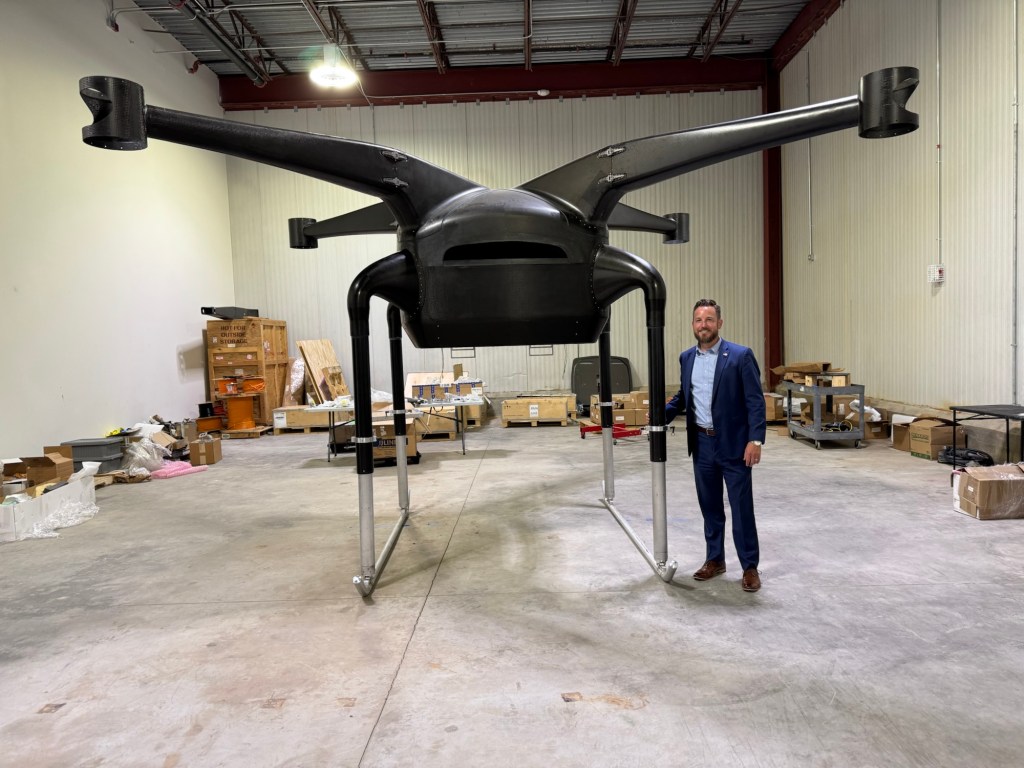
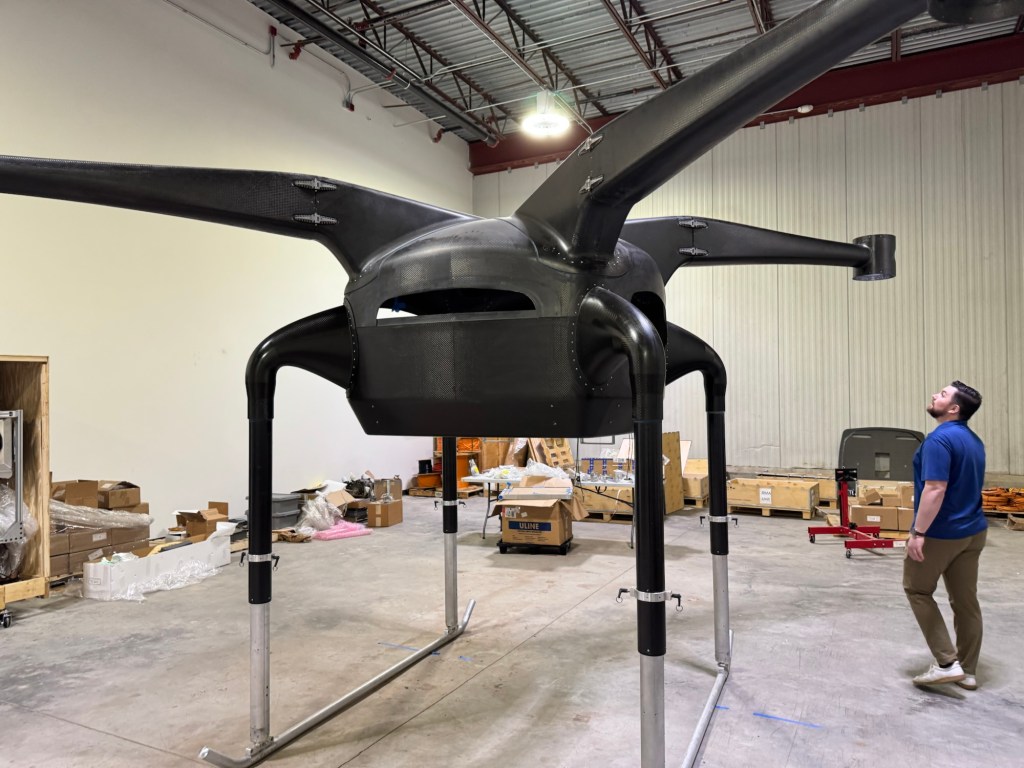
So why Volynt Aero?  Yes, they have an unmanned hybrid VTOL—the Vyper—that can fly, carry a serious payload, and put a box where a truck cannot go. You have seen the animation. I was able to get close enough to the real work that the animation looks like a polite version of what I watched. I went to the facility in Oxford. I talked to a great bunch of guys. The intellectual property is not a napkin. It is already there. Public specs on the aircraft talk about carrying on the order of 500 pounds of cargo out to 150 nautical miles, then landing and offering plug-in power—110, 240, or 480 volts—off standard jet fuel, without waiting for a charging farm to be built in the mud.

The crowded market is last-mile photographs and Amazon-adjacent experiments. Everybody has a drone story now. Walmart has a drone story. Amazon has a drone story. Texas has companies. California has companies.[7] The middle-mile market alone is described as a ten-billion-dollar band within a much larger stack. I have been saying to anybody who will listen that the five-year systems market—vehicles, energy, warehousing, insurance, municipal integration—could run toward a trillion dollars if the country actually lets it hatch. Those are inside numbers, not a press release.

What makes Volynt different is not that they can hover. It is the combination. Cargo logistics and highly mobile power generation on the same airframe. They can come in, drop a payload, and leave. And they can do battlefield resource management, which in civilian clothes means disaster-zone logistics. Power recovery. Fly into a hurricane zone or an Ohio River floodplain, get past the trees that are lying across the only road the trucks can use, land, and put 110, 240, or 480 volts where a ventilator is still a life.[8]

The Hurricane, the Chainsaws, and the Road You Cannot See

Years ago, I was between jobs. I tend to get involved in crusades because they teach you things you cannot learn from a paycheck. One of the reasons I have been effective over the years is that I have done things other people never get to do, or never have the guts to do, because it means leaving the comfort of a W-2. A friend who ran a tree crew called. A storm had flattened a stretch of the Carolinas around the Raleigh-Durham universities. Trees older than the subdivisions they shaded were down across the highways.[9] He was paying cash crews a thousand dollars a day because people were pulling money out of safes rather than wait on insurance to cut the trees off their homes after the storm. A crew member—the kind of guy who couldn’t do anything else because he did not have many other options, because he was out of jail for killing people—had decided he wanted all of it and had started talking about killing my friend. My friend asked me to come down to help him with the guy. My wife did not want me to go. I did not want to leave her. A couple of weeks of that work could be a year’s income. I got on a plane to chase treasure and danger.  And to that point, where there is danger, is usually where there is treasure.  

As we were landing, they had just cleared the runway. From the air, you could not even see the highway. That is the image I have never forgotten. There is no way for the trucks to get the equipment to the poles if the trees own the asphalt. Before the utility can be a utility, somebody with a saw has to invent a road again. It took some of those people three or four weeks to get power back. Generators mattered. They still matter. A patriot generator in a garage is not a hobby. It is how you keep a freezer and a CPAP and a window into the world from dying on the same night.

When the Volynt team walked me through the demonstration, that memory came back to me. Every September, somewhere, a hurricane does a version of that story. Every late winter, the Ohio, the Mississippi, the Great Miami find a floodplain and take a substation with them. Senior citizens do not have three weeks for power to return.  A drone that can fly the downed corridor and restore a line, or drop the thing that lets a crew restore a line, is not a gadget. It is the difference between a shelter with lights and a shelter guessing.

Same grid logic as fifty years ago. The wires still have to carry the current. The new part is that you do not always have to wait for the infrastructure; you can fly the infrastructure into a distressed zone.

The Mixed Economy That Aborts the Company Before It Is Born

The hard problem is not the airframe technology. The hard problem is an unfriendly manufacturing and permitting environment. Unless you can throw Elon Musk money at it, the political monster can crush you before the second prototype.[10] Even Musk needed government contracts and, for a stretch, an alliance with China to get Tesla through the years when the same people who wanted electric cars also wanted to drown the factory in process. A lot of the operators I talk to do not want politics at all. They want the big animal to stay in its cage until the product exists. I get involved because I have watched companies get crushed before they build anything.

I was in Columbus a few years ago sitting next to very expensive lawyers who were selling solar the way people used to sell riverfront lots. There is a big solar farm near Piqua. There is another in Warren County. Fine. Generate what you can generate; I’m not against other ways of getting power.  But if we aren’t talking about Thorium or nuclear, we aren’t being serious about acquiring real energy. What I will not do is pretend that a sermon about wind and panels is a substitute for a dispatchable grid when you are trying to host the next wave of computation and industry.[11] FirstEnergy was the legacy company being squeezed like a zit so that a younger lobby could inherit the moral high ground. That is an Obama-era move, and it is still the move. Euthanize the old method. Call it progress. Act shocked when people are upset about it. 

Republicans have not defended capitalism very well. They have not defended FirstEnergy well. They have not defended the Householder disaster as a policy failure instead of a personality failure, which is what it was, and that has fed this Amy Acton narrative now. I listen to two-thousand-dollar-an-hour lawyers miss the only point that matters: are you using the power of government to confiscate wealth, or are you using it to keep the builder from being hunted while he builds? A lot of people in the political class do not feel they have latitude to say that out loud because they do not want the Columbus media animals waiting for them at the urinal. I am not in public office, so I can say it.[12]

The metaphor I keep using, because Ohio taught it to me, is abortion as industrial policy. A certain kind of politics wants to abort the business before it attaches. Regulation becomes the instrument. You never have to out-compete the founder if you can keep him from being born. The same crowd will turn around and euthanize a legacy company they have decided is morally expired, which was what the FirstEnergy story was really about. Young ideas killed in the womb. Old plants killed in the bed. What they never want is a living competitor that was not pre-cleared by the donor list.

Fences, Data Centers, and Who Gets to Say No

In my neighborhood, an older, decent neighbor started a wooden fence in the front yard. Posts went in. It was their property. I would not have chosen the look. My wife and I were not going to say anything. Then came the hearing. Then the posts came back out of the ground. I had not called a trustee. I did not need to. I knew what happened. People who bought half-million and million-dollar houses, some of them new from the coasts, did not want to look at a tacky fence on the drive-by.  No lumber in the front. Property rights, until the new people appeal to government to make your porch match their taste.

That is the data-center argument in miniature. I am pro data center. The new economy is an electricity story whether the township signs the petition or not. China is building data centers whether or not we do, and if people protest, they just disappear.  That’s how it is in China, in America: communist terrorism hides behind free speech, which does not exist in a real communist country. People who do not want the noise still want the market cap that pays for a federal deficit that no longer fits on a bumper sticker. They want a trillion-dollar growth story and a quiet backyard. They want to keep up with Beijing and keep the transformers out of sight.[13] My daughter lives near Millikan Road in the Liberty Township development and does not want more congestion. I understand the feeling. I also drive through Middletown and remember what the place looked like when the work was here. You can still find houses in that city at prices that tell you how much vitality is left. Vance can talk about investment, but there’s a lot more. I want the investment to be real enough that Main Street is not a museum of what we used to make.

I love Liberty Center. I like Costco. I like the Monroe exits and the Millikin exchange along the 63 corridor as places where you can put large things without paving a township’s last pasture. Balance is a real problem for trustees. Pretending that every large thing is a moral injury is not balance. It is a lifestyle veto dressed up as conservation.[14]

Property taxes are the scream under all of this. There is a movement that wants them gone. Fine. Show me the replacement arithmetic. One honest way to change the math is to land in an industry that generates revenue on land that is already industrial. Vertical mobility—middle-mile drones, disaster logistics, the power-restore mission—is not a server farm humming behind a fence. It is a reason a site exists. Amazon, Walmart, the carriers, the hospitals, the utilities, the Guard: they all have the same problem. Get the box, or the tool, or the kilowatt, past the broken road.[15]. We’re talking about a lot of things here that are always under the tip of our tongues, but they are the center of all discussion.  

Michael Ryan Was There Before It Was a Photo Opportunity

I was not going to drag a campaign into this. Michael Ryan put his visit on Facebook. He went to the Volynt facility. He talked about it at a fundraiser. I happened to be there with him. I know what he has been doing in the background for a couple of years while other people were still deciding whether drones were a toy, a nuisance, or a federal problem.[16]

By the time a lot of people read this, he may already be sitting as a Butler County commissioner, or he may be in the last stretch of proving it in November. Either way, I want it on the record. Michael Ryan has been acting like a commissioner of this county well before the title was his. He has been providing leadership in rooms that were not yet fashionable. Four years from now, when the project is a ribbon and a CNBC segment, and every officeholder in a fifty-mile radius is trying to stand in the photograph, I want it remembered that he was there when it was still a risk.

That is what good leadership looks like when it is not a press release. It is not waiting for the market to become safe and then claiming the harvest. Socialism, in the small-town version, is just that reflex: somebody else takes the risk, then the committee arrives to redistribute the credit. Ryan did the opposite. He showed up early. He has done a lot of unglamorous work that makes life in this county better. This is one of the visible ones.[17]

I like a lot of the Ohio names in the builder register. I have had the chance to talk to them one-on-one in informal settings. I think I know who they are. Bernie Moreno built businesses and then walked into the grinder of public service with enough money in the bank that a paycheck could not vote for him. Warren Davidson is in that same pattern. That is the opposite of the professional politician, who needs the mixed economy because it is his meal. Bernie Sanders is a communist. The late-life American version I respect is the man who made something and then spent the surplus defending the conditions that let other people make something.

Ryan is young enough to want still the county to have a next chapter. That matters. The people who have been in the chair too long start to treat every new idea as a zoning headache. The people who still think like founders treat it as a chance.

What I Want This to Become

I want Volynt featured on CNBC as one of the great global innovators, not as a local curiosity that got a grant and a ribbon. A proposed HyPE Lab at the Miami University Airport is the kind of physical bet a county should want next to an existing runway. Ohio Third Frontier money already touched the powertrain work. That is a start, not a finish. I want them to have a shot at being the next SpaceX in the only sense that phrase is useful: a company that made a hard physical thing at a scale the incumbents said was impossible, in a county that decided not to strangle it. That is a lofty goal. Lofty goals are how factories start. The constraint is not imagination. The constraint is whether Ohio and Butler County will keep the political animal on a leash long enough for scale.

Scale needs land that is already industrial, power that is actually on the bus, a workforce that can turn a wrench and read a print, and a waiver culture at the FAA that does not take a decade to admit a machine can fly past the pilot’s eyeballs.[18] Ohio is already in the drone-first-responder business through DriveOhio. Hamilton police are getting aircraft that beat a cruiser to the scene. That is a different mission from cargo and power restoration, but it is the same county learning the same sky.[19]

I have been accused of being part of the military-industrial complex because I have worked around aerospace companies for a long time and I know people in politics. The accusation is a category error. I want the opposite of what happened to Tucker. I want the opposite of what happened to Roark in the book. I want the man with the idea outside the approved pipeline to get to the market before the senator from the incumbent district files the paperwork. I have put my name on things when it was unpopular and could and have cost me. I will put it here.

Books do not usually make the kind of money people think they do. I am writing The Politics of Heaven anyway, because I think there is a spiritual war under the economic one, and because non-human intelligence—call it what your tradition requires—does not only show up in a sky story. It shows up in the institutional habit of killing the builder.[20] I volunteer a lot of time that isn’t invoiced. I want the human race better. Helping a company in my own county get off the ground is one of the ways that sentence becomes concrete.

The Record I Want Left

This is a long one. Context does not work in ten minutes. The video at the front of this would be useful to watch.

When people ask me what I am working on, this is the answer. I am helping a group of scrappy operators, with the IP already done and the demonstration already flown, get across a minefield that usually destroys the idea before it can pay a tax bill. I am proud of them. I want the state of Ohio to treat this as more than a local hobby. The upside is not a buzz in the background. The upside is a transportation and recovery layer that Amazon, Walmart, and every hospital system in a floodplain will need, whether the township board likes the look of the fence or not.

Watch Tucker’s speech. Read Roark’s. Then look at a county that still has room at the exits, a commissioner candidate who showed up before the cameras were easy to get, and a machine that can put power back on at a shelter while the trees are still on the road. That is the whole argument. I would like, for once, not to give the speech at the end of the movie. I want the cars—or, in this case, the aircraft—to be built.

Michael Ryan was ahead of it. The company is ahead of the market’s imagination. I am putting years of scar tissue behind both facts. The rest is execution, voltage, and whether we still believe a man with a better idea should be allowed to leave the ground.

Bibliography and Further Reading

Coppola, Francis Ford, dir. Tucker: The Man and His Dream. Paramount Pictures, 1988.

Rand, Ayn. The Fountainhead. Indianapolis: Bobbs-Merrill, 1943.

Rand, Ayn. Atlas Shrugged. New York: Random House, 1957.

American Rhetoric. “Movie Speech from Tucker: The Man and His Dream — Tucker Presents His Closing Argument.” https://www.americanrhetoric.com/MovieSpeeches/moviespeechtucker.html.

Tucker Automobile Club of America. Historical notes on the Tucker 48 and the Coppola film. https://www.tuckerclub.org/.

Federal Aviation Administration. 14 C.F.R. Part 107 and UAS exemption / BVLOS waiver materials.

Ohio Revised Code §§ 4561.50–4561.53, as enacted by House Bill 77, 135th General Assembly (effective April 9, 2025).

Journal-News (Hamilton, Ohio). “Michael Ryan nabs Butler County commissioner primary with 72% of the vote.” May 5–6, 2026.

Journal-News (Hamilton, Ohio). “Primary Election 2026: Republican primary for Butler County commission seat contentious.” April 20, 2026.

Ballotpedia. “Michael V. Ryan (Butler County Commission, Ohio, candidate 2026).”

WCPO. “Hamilton police are getting drones that beat officers to the scene.” DriveOhio / SkyfireAI statewide DFR pilot.

Journal-News. Coverage of Butler County data-center moratorium requests and commission action, June 2026.

United States v. Householder and related FirstEnergy reporting, Southern District of Ohio, 2020–2023.

Public Utilities Commission of Ohio. House Bill 6 aftermath dockets and subsequent electric security plan materials.

Mises, Ludwig von. Interventionism: An Economic Analysis. 1940; later editions.

Hoffman, Rich. The Politics of Heaven. Manuscript, 2026.

Hoffman, Rich. The Gunfighter’s Guide to Business; Tail of the Dragon; The Symposium of Justice.

Volynt Aero, Inc. Company site and capability statement. Oxford, Ohio. https://volyntaero.com / https://volynt.aero.

Cincinnati Business Courier / Dayton Business Journal. Coverage of Volynt Aero’s proposed Hybrid Propulsion and Energy (HyPE) Lab at Miami University Airport, January 2025.

LinkedIn, Volynt Aero company page. Oxford headquarters; Vyper aircraft described for emergency cargo logistics and autonomous power generation.

Workhorse Group and other Midwest cargo-UAS public materials, Sharonville / Mason, Ohio.

National Hurricane Center. Storm histories for Carolinas landfalls affecting the Research Triangle transportation grid.

Notes

[1] On Householder and FirstEnergy, see United States v. Householder, S.D. Ohio, and contemporaneous reporting in The Columbus Dispatch and Cleveland Plain Dealer, 2020–2023. The policy point here is not a brief for every transaction; it is that one administration’s rules can squeeze a regulated utility until the only remaining path appears to be politics.

[2] Francis Ford Coppola, dir., Tucker: The Man and His Dream (Paramount Pictures, 1988). The courtroom speech is transcribed at American Rhetoric, “Movie Speech from Tucker: The Man and His Dream,” https://www.americanrhetoric.com/MovieSpeeches/moviespeechtucker.html.

[3] Senator Homer Ferguson of Michigan chaired the Senate investigations that, in Coppola’s telling and in Tucker’s own defense, functioned as a political weapon for Detroit incumbents. Whether every cinematic beat is courtroom-accurate is less important than the pattern: government process used as a moat.

[4] Ayn Rand, The Fountainhead (Indianapolis: Bobbs-Merrill, 1943). Howard Roark’s courtroom defense remains the clearest American statement that a creator does not exist to feed the parasites who arrive after the risk is taken.

[5] U.S. manufacturing after 1945 did send missions to study Japanese methods; the irony Tucker’s speech names is that the country that out-produced the Axis then imported process discipline from the countries it had just defeated. See postwar productivity literature and W. Edwards Deming’s later influence in Japan.

[6] Preston Tucker produced fifty Tucker 48 automobiles. Most survive. The Big Three later adopted seat belts, disc brakes, fuel injection, and aerodynamic safety ideas that Tucker had already put on the road. See Tucker Automobile Club of America histories.

[7] Amazon, Walmart, UPS, and the United States Postal Service have all published or piloted roadmaps for drone and middle-mile automation. Industry estimates for advanced air mobility and drone logistics through the early 2030s commonly range from tens of billions in the near term to well above $100 billion as last-mile and middle-mile use cases stack. The trillion-dollar figure in this essay is a five-year systems view that includes vehicles, energy, warehousing, insurance, and municipal infrastructure—not airframes alone.

[8] Volynt Aero, Inc., Oxford, Ohio (Butler County). Public materials describe the Vyper hybrid-electric unmanned eVTOL as carrying on the order of 500 pounds of cargo out to about 150 nautical miles, then landing and providing 110, 240, or 480 VAC plug-in power from JP-8 or Jet A without a high-voltage charging network. See Volynt Aero’s capability statement and company site at volyntaero.com. A proposed Hybrid Propulsion and Energy (HyPE) Lab at Miami University Airport was reported by the Cincinnati Business Courier and Dayton Business Journal in January 2025. The company received Ohio Third Frontier/TVSF support through the Entrepreneurs’ Center.

[9] Hurricane Fran (1996) and later storms that struck the Carolinas left large sections of the I-40 / Research Triangle corridor impassable from downed timber. The operational lesson is unchanged: you cannot restore a grid if you cannot reach the poles.

[10] Elon Musk’s public record on Tesla and SpaceX includes DOE loans, NASA Commercial Crew and Cargo contracts, and later criticism of the same regulatory state. The relevant point is not purity. It is that even a high-capacity founder needed both capital and political oxygen to keep the factory from being regulated out of existence before the product matured.

[11] On Ohio energy policy after House Bill 6, see Public Utilities Commission of Ohio dockets and legislative history of subsequent repeal and reform efforts. Nuclear and dispatchable baseload remain the quiet argument under every data-center fight.

[12] On mixed-economy control, see Ludwig von Mises, Interventionism: An Economic Analysis, and Rand’s distinction between the producer and the looter. The essay’s claim is practical: once incumbents learn they can buy a senator rather than retool a factory, innovation becomes a permit problem.

[13] On local data-center zoning fights, see Journal-News coverage of the Butler County commissioners’ 2026 moratorium discussion and township requests. The noise argument and the fiscal argument are not the same conversation, though they are treated as one at public meetings.

[14] Liberty Center, Monroe / I-75 corridor industrial sites, Middletown Regional Airport aviation investments, and the Spooky Nook complex on Hamilton’s west side are the visible pieces of a county trying to replace lost mill and auto-adjacent employment with logistics, aviation, sport, and advanced manufacturing.

[15] Property tax pressure in Ohio townships is the political surface of a deeper math problem: residential valuations rise while commercial and industrial bases either leave or get blocked. A new high-value industry that uses existing industrial land is one of the few honest answers that does not require another levy speech.

[16] Butler County Commission primary, May 5, 2026: Michael V. Ryan defeated incumbent Cindy Carpenter approximately 72 percent to 28 percent. See Journal-News (Hamilton), May 5–6, 2026. Ryan, a former Hamilton City Council member and vice-mayor, advanced to the November 2026 general election.

[17] Bernie Moreno and Warren Davidson have both operated in the Ohio builder-and-business register the essay prefers to the professional political class. Endorsement lists in the 2026 Butler County commission primary included both names on Ryan’s side.

[18] Federal Aviation Administration, Unmanned Aircraft Systems (UAS) regulations, 14 C.F.R. Part 107, and successive beyond-visual-line-of-sight (BVLOS) waiver practice. Ohio House Bill 77 (effective April 9, 2025) added state-level UAV provisions at Ohio Revised Code §§ 4561.50–4561.53.

[19] Ohio Department of Transportation / DriveOhio statewide drone-first-responder pilot, announced for multiple agencies including Hamilton Police, 2025–2026. Public-safety drones and cargo drones are different machines; they share airspace, waiver culture, and a county that is already learning to fly.

[20] Rich Hoffman, The Politics of Heaven (manuscript, 2026; targeted 2027 publication). The book treats non-human intelligence, spiritual warfare, and the political history of heaven as the long background to why human institutions keep aborting builders.

Rich Hoffman

More about me

Click Here to Protect Yourself with Second Call Defense https://www.secondcalldefense.org/?affiliate=20707

About the Author: Rich Hoffman

Rich Hoffman is an author, political consultant, and strategic advisor based in Cincinnati, Ohio, and the creator of The Politics of Heaven—a unique framework that connects biblical theology, ancient history, and modern power structures to explain how moral alignment and spiritual forces shape global events. Blending real-world political experience with deep research into archaeology, UFO phenomena, and suppressed historical narratives, Hoffman offers compelling commentary on topics ranging from ancient civilizations and the Dead Sea Scrolls to modern populist movements, paranormal continuity, and leadership strategy in chaotic environments. As the author of The Gunfighter’s Guide to Business and the forthcoming Politics of Heaven, he brings a grounded yet provocative voice to media discussions, supported by firsthand experiences and a cross-disciplinary approach that bridges science, history, and theology. For interviews, speaking engagements, or expert analysis, visit richhoffmanbooks.com or contact directly via phone at 513-307-5815 or email at rhoffman@richhoffmanbooks.com.  If you’ve seen the movie, Disclosure Day and want to talk about it and the implications of Presidnet Trump’s UAP disclosures, let me know and we can bring some color to your coverage. https://richhoffmanbooks.com/media-inquiries-broadcast-topics-and-contact-info/?frame-nonce=ad51e7ecba I do have a firsthand UFO encounter to discuss.

Trillions in Economic Damage from COVID Lockdowns and Over 100 Fifth Amendment Invocations: Fauci’s Capitol Hill Disaster

I was talking about this Fauci story for a long time, and there is a lot to break down. Anthony Fauci showed up on Capitol Hill, invoked the Fifth Amendment more than a hundred times, and the whole performance confirmed what a lot of us had been saying for years. Good lawyers at two thousand dollars an hour told him not to answer questions about the color of his tie or the carpet. That is not strategy in the traditional sense. That is damage control after the diary came out and after Biden’s pardon language made every single answer a potential risk.¹

The hearing was theater, yes. But it was also a window into how power protects itself when the bill for bad decisions runs into the trillions. I said much of this in 2020, when people called it crazy. The diary, the celebrity capture, the origins knowledge, and the blanket Fifth all landed right on schedule. Now we get to talk about the real cost.

The Fifth Amendment Over 100 Times: Lazy Preparation or Calculated Silence

Fauci walked into that Homeland Security and Governmental Affairs Committee hearing chaired by Rand Paul and refused to answer. He invoked the Fifth more than one hundred times. Reports put the number at 111 in some counts. Senators asked the day of the week. They asked the color of his tie. They asked about the carpet. Fifth. Fifth. Fifth.²

I understand not wanting to get boxed into a dialogue that opens rabbit holes. Hard questions about gain-of-function funding, lab-leak timelines, and previous sworn statements carry real risk. But when the easy questions also get the Fifth, it stops looking like careful lawyering and starts looking like the lawyers decided the safest path was total silence. Paul has been clear he intends to pursue contempt. The committee already voted along party lines to hold Fauci in contempt and refer it. Democrats will not help in the full Senate, and the January 2025 pardon complicates federal options. Still, the optics of a man who cost the country so much refusing even the simplest answers is a form of accountability in itself.³

Bernie Moreno from Ohio asked the kind of direct questions that needed to be asked. He made me proud as a senator from this state. The frustration in the room was real because the public already knew the story’s outlines. The Fifth just made the admission louder.

The Diary Revelations: COVID Origins Knowledge and Falling in Love with Celebrity Status

The diary dropped right before the hearing—more than a thousand pages. Early entries show Fauci writing that the wet market was the amplifier, not the source. He recorded conversations in which most of the scientists on the call thought deliberate insertion or laboratory involvement was possible. Publicly, the story stayed different for a long time.⁴

At the same time, the diary shows a man falling in love with the celebrity scan. Magazine covers. Rock-star treatment. “Explosive and really unimaginable” fame. Petitions for Sexiest Man Alive. Celebrity phone calls and name-dropping. While the country was locked down and the economic damage was compounding, the private notes record the thrill of the attention. That contrast is damaging. It was already suspected. The diary made it concrete. The timing, right before the testimony, turned a public-relations disaster into something harder to spin.⁵

The Trillions Lost: Quantifying the Economic Catastrophe of the Lockdowns

This is the part that still matters most. Separating the damage caused by the virus itself from that caused by the policy response is tricky. Economists still argue about the exact split. What is not in serious dispute is the scale.

Federal relief spending alone ran about $4.65 trillion. GDP losses from the pandemic period have been estimated in the multiple trillions. One USC analysis put the four-year GDP hit near $14 trillion. A Heritage-linked commission put the total cost—deaths, chronic conditions, lost income, mental health, educational losses—around $18 trillion. School closures alone have been estimated to result in roughly $2 trillion in future earnings losses. Long COVID continues to impose ongoing productivity costs measured in the billions annually. Global output losses for 2020–2024 have been estimated at nearly $13.8 trillion, with the United States accounting for a large share.⁶

We are still living with the long-term effects. Inflation, labor-force scarring, learning loss that will depress lifetime earnings for a generation of kids, and the permanent expansion of federal debt all trace back in part to the choices made in 2020 and 2021. Someone who helped design and sell those choices, who enjoyed the magazine covers while the economy took the hit, does not get to walk away with only a pardon and a Fifth Amendment performance. Public embarrassment is part of the bill. Legal immunity does not erase the reputation ledger or the need for a full accounting.

Biden’s Pardon and Why the Lawyers Demanded Total Silence

The January 19, 2025, pardon from President Biden is the key. It covers “any offenses against the United States which he may have committed or taken part in during the period from January 1, 2014, through the date of this pardon arising from or in any manner related to his service as Director of the National Institute of Allergy and Infectious Diseases, as a member of the White House Coronavirus Task Force or the White House COVID-19 Response Team, or as Chief Medical Advisor to the President.”⁷

That language is broad. The lawyers treated every answer as a potential new statement that could create fresh exposure or complicate the protection already granted. Even questions about the color of a tie carry risk if the answer can be twisted into inconsistency or if it opens a door outside the pardoned window. That is why the advice was absolute: do not answer. The optics look terrible. The legal logic is coherent if the goal is preserving the pardon at all costs. States are still free to look at their own statutes. Florida has already moved. The federal shield does not cover everything.⁸

Why the Hearing Still Mattered and What Comes Next

We already knew the broad outline. The hearing put the Fifth on the record more than a hundred times and forced the diary into the center of the conversation. Rand Paul is pushing the contempt referral. Criminal prosecution at the federal level faces the prospect of pardon and partisan math. State investigations and the public record are not constrained the same way. The real next step is continued pressure for transparency on the origins, the funding decisions, and the true cost-benefit of the lockdowns. Reputational accountability is nothing. Strategy that relies on silence still has a price.

I remember saying all of this about Fauci when people thought it was crazy. Before some of the books were written, before the diaries were public, before the pardon. I got the usual pushback for not going along with the official line. Now the Fifth, the diary, and the economic numbers have caught up. I told you so. I will keep saying it because the next time something sounds wild and outside the approved explanations, people might listen a little sooner and save themselves some of the pain.

The hole we are still climbing out of six years later was not inevitable. Manufactured crisis or not, the policy choices had authors. Those authors should not get to treat the trillions as someone else’s problem. 

Footnotes

1.  CNN, “Dr. Anthony Fauci repeatedly invokes the Fifth in dramatic Senate hearing about COVID pandemic,” July 29, 2026; Axios, “The biggest clashes from Fauci’s Senate hearing on his diary, COVID origins,” July 29, 2026.

2.  The New York Times, “Dr Anthony Fauci invokes Fifth Amendment nearly 100 times in bitter Senate hearing,” July 29–30, 2026; USA Today, “Dr. Anthony Fauci refuses to answer Senate questions about COVID-19,” July 29, 2026; Washington Times, “Fauci pleads the Fifth, refuses to answer questions to Congress,” July 29, 2026.

3.  Forbes, “Fauci Contempt of Congress Resolution Passes Along Party Lines,” August 6, 2026; Politico, “Hellbent on putting Fauci in jail, Rand Paul wants to skip a Senate vote,” August 6, 2026; Reuters, “Republican US Senator Rand Paul asks Justice Department to prosecute Fauci after contempt vote,” August 6, 2026.

4.  USA Today, “Fauci diary revelations: COVID origins, Trump and fame,” July 29, 2026; National Review, “Fauci’s Diary: Even Fauci Was Shocked by How Much the Media Loved Him,” July 27, 2026; The Telegraph, “Fauci did not believe COVID originated from Wuhan market, his diaries reveal,” July 27, 2026.

5.  The Atlantic, “Anthony Fauci’s Embarrassing, Revealing Diary,” July 29, 2026; The New Yorker, “Our Fauci Diaries, Ourselves,” August 4, 2026; Washington Examiner, “Six takeaways on Fauci’s private COVID-19 diaries ahead of Senate hearing,” July 27, 2026; Wall Street Journal, “The Revealing Diaries of Dr. Fauci,” July 28–29, 2026.

6.  U.S. Government Accountability Office, “COVID-19: Update on Key Indicators, the Federal Response, and Implementation of GAO Recommendations” (GAO-25-107588), July 31, 2025; USC Price School, “Mandatory business closures drove the economic decline during COVID-19 pandemic,” reporting ~$14 trillion GDP impact; Heritage Foundation Nonpartisan Commission on China and COVID-19 (via SCNR reporting), estimating ~$18 trillion total U.S. costs; University of Washington/Oxford analysis on school closures (~$2 trillion future losses); Center for Global Development estimates of global output losses ~$13.8 trillion (2020–2024).

7.  Presidential Pardon of Dr. Anthony S. Fauci, January 19, 2025 (full text via Wikisource and Department of Justice Pardon Attorney records); White House Statement from President Joe Biden, January 20, 2025.

8.  CBS12 / Florida reporting on Attorney General James Uthmeier investigation announcement, July 30, 2026; Washington Examiner, “Rand Paul ‘happy’ to share information on Fauci to assist with Florida inquiry,” July 30, 2026; Lawfare, “A Senate committee voted to hold Fauci in contempt. Now what?,” August 11, 2026.

Bibliography

Axios. “The biggest clashes from Fauci’s Senate hearing on his diary, COVID origins.” July 29, 2026.

Center for Global Development. Estimates of global COVID-19 output losses, 2020–2024 (~$13.8 trillion).

CNN. “Dr. Anthony Fauci repeatedly invokes the Fifth in dramatic Senate hearing about COVID pandemic.” July 29, 2026.

Forbes. “Fauci Contempt Of Congress Resolution Passes Along Party Lines.” August 6, 2026.

Heritage Foundation / Nonpartisan Commission on China and COVID-19. Cost estimates totaling approximately $18 trillion (deaths, chronic illness, lost income, mental health, education). Reported via SCNR, July 2024 (updated context 2026).

Hoover Institution. Various analyses of lockdown costs and learning losses (e.g., Hanushek et al. on the economic impact).

Lawfare. “A Senate committee voted to hold Fauci in contempt. Now what?” August 11, 2026; “Biden Grants Preemptive Pardons to Milley, Fauci, and Others.” January 20, 2025.

National Review. “Fauci’s Diary: Even Fauci Was Shocked by How Much the Media Loved Him.” July 27, 2026.

The New York Times. “Dr Anthony Fauci invokes the Fifth Amendment nearly 100 times in bitter Senate hearing.” July 29–30, 2026.

The New Yorker. “Our Fauci Diaries, Ourselves.” August 4, 2026.

Politico. “Hellbent on putting Fauci in jail, Rand Paul wants to skip a Senate vote.” August 6, 2026.

Presidential Pardon of Dr. Anthony S. Fauci. Executive Grant of Clemency, January 19, 2025 (Wikisource / U.S. Department of Justice Office of the Pardon Attorney).

Reuters. “Republican US Senator Rand Paul asks Justice Department to prosecute Fauci after contempt vote.” August 6, 2026.

The Telegraph. “Fauci did not believe COVID originated from Wuhan market, his diaries reveal.” July 27, 2026.

U.S. Government Accountability Office. “COVID-19: Update on Key Indicators, the Federal Response, and Implementation of GAO Recommendations” (GAO-25-107588). July 31, 2025 (~$4.65 trillion federal relief).

USA Today. “Dr. Anthony Fauci refuses to answer Senate questions about COVID-19.” July 29, 2026; “Fauci diary revelations: COVID origins, Trump and fame.” July 29, 2026.

USC Price School / Economic Modeling. Analyses projecting ~$14 trillion U.S. GDP losses from the pandemic period.

University of Washington / Oxford University. School-closure economic impact estimates (~$2 trillion future losses).

Wall Street Journal. “The Revealing Diaries of Dr. Fauci.” July 28–29, 2026.

Washington Examiner. “Six takeaways on Fauci’s private COVID-19 diaries ahead of Senate hearing.” July 27, 2026; “Rand Paul ‘happy’ to share information on Fauci to assist with Florida inquiry.” July 30, 2026; “Fauci held in contempt by Rand Paul’s committee.” August 6, 2026.

Washington Times. “Fauci pleads the Fifth, refuses to answer questions to Congress.” July 29, 2026.

White House. Statement from President Joe Biden on preemptive pardons. January 20, 2025.

Additional primary materials: Senate Homeland Security and Governmental Affairs Committee hearing transcript and video, July 29, 2026; Fauci personal diary excerpts released by Sen. Rand Paul, July 2026 (1,000+ pages covering late 2019–2022).

Rich Hoffman

More about me

Click Here to Protect Yourself with Second Call Defense https://www.secondcalldefense.org/?affiliate=20707

About the Author: Rich Hoffman

Rich Hoffman is an author, political consultant, and strategic advisor based in Cincinnati, Ohio, and the creator of The Politics of Heaven—a unique framework that connects biblical theology, ancient history, and modern power structures to explain how moral alignment and spiritual forces shape global events. Blending real-world political experience with deep research into archaeology, UFO phenomena, and suppressed historical narratives, Hoffman offers compelling commentary on topics ranging from ancient civilizations and the Dead Sea Scrolls to modern populist movements, paranormal continuity, and leadership strategy in chaotic environments. As the author of The Gunfighter’s Guide to Business and the forthcoming Politics of Heaven, he brings a grounded yet provocative voice to media discussions, supported by firsthand experiences and a cross-disciplinary approach that bridges science, history, and theology. For interviews, speaking engagements, or expert analysis, visit richhoffmanbooks.com or contact directly via phone at 513-307-5815 or email at rhoffman@richhoffmanbooks.com.  If you’ve seen the movie, Disclosure Day and want to talk about it and the implications of Presidnet Trump’s UAP disclosures, let me know and we can bring some color to your coverage. https://richhoffmanbooks.com/media-inquiries-broadcast-topics-and-contact-info/?frame-nonce=ad51e7ecba I do have a firsthand UFO encounter to discuss.

Ayn Rand’s Return of the Primitive: The Anti-Industrial Revolution and the War on Reason, Industry, and the Individual

Ayn Rand’s Return of the Primitive remains one of the sharpest diagnoses of the cultural forces that still shape the nightly news. Originally published in 1971 as The New Left: The Anti-Industrial Revolution, the essays were expanded in 1999 with additional material by Peter Schwartz. The core claim has not aged. Western civilization, Rand argued, was being deliberately dismantled from within by movements that presented themselves as progressive but were in fact a regression to the pre-industrial, pre-rational, tribal state. She called it the anti-industrial revolution because it targeted the very tools—technology, industry, capitalism, and the conceptual mind—that allow human beings to survive and flourish.

That diagnosis lands with greater force today than it did when the essays first appeared. The same patterns reappear under new labels: environmental absolutism, identity politics, multiculturalism framed as justice, and the steady erosion of objective standards in education and culture. The book is not a museum piece. It is a working map of the conflict between the individual mind and the collective demand to return to the primitive.

The Anti-Industrial Revolution: Attacking the Tools of Survival

Rand did not view the student rebellions, early environmental crusades, or hippie counterculture of the 1960s and 1970s as liberation. She saw them as a rejection of the mind. The hallmark of civilization is the application of reason to the material world. The ultimate historical expression of that faculty is the Industrial Revolution. By attacking industry, technology, and the profit system that sustains them, these movements were not reforming excesses. They were attempting to undo the progress of the Enlightenment and return humanity to a state of nature that Hobbes correctly described as solitary, poor, nasty, brutish, and short.

In the title essay, she paints a stark picture: a man in the mid-1970s wakes to find his electric toaster and automobile outlawed in the name of protecting the environment. There is no gradual, restrained retreat from technology. There is only the continued advance of the mind or the descent into helplessness and death. Technology is not optional decoration. It is the concrete product of conceptual thought applied to reality. To treat it as aggression against nature is to treat the human mind itself as the enemy.

Rand’s critique of the environmental movement of her day remains one of the most uncompromising sections of the book. She rejected the premise that “untouched nature” holds higher moral value than human life and human comfort. If one truly values human life, one must value the tools that extend and improve it. Elevating pristine wilderness above the needs of productive people, in her view, demonstrates a hatred of the human mind and its capacity to reshape the world.

The activists of the period, she observed, simultaneously attacked scientific progress as violence against the planet while advocating what she called universal slavery for men under expanding state control. The pattern has only grown more sophisticated. Modern environmental rhetoric still frames industrial civilization as the original sin while demanding political power to ration energy, restrict development, and manage the lives of ordinary people. The moral inversion remains the same: the creators are treated as aggressors and the non-producers as the rightful claimants on their output.

Environmentalism as Hatred of the Mind

Progressive Education and the Manufacture of Helplessness

Rand refused to blame only the students. She placed primary responsibility on the teachers and the educational theories that shaped them. In the essay “The Comprachicos,” she draws a grim historical analogy to the seventeenth-century criminals who kidnapped children and physically deformed them to sell as circus freaks. Progressive education, she argued, performs a parallel operation on the mind.

Drawing on the influence of John Dewey and pragmatism, the system shifted focus from teaching children to think conceptually and objectively toward social adjustment and group conformity. The purpose of education, in Rand’s view, should be to equip a student to deal with reality by means of reason. Instead, she saw classrooms that trained children to defer to the pack’s authority. The result is cognitive helplessness: young people who never learned to integrate perceptions into concepts, who remain driven by emotion and fear, and who therefore seek the protection of a tribe.

She drew a direct line from the nursery-school ideal of progressive education to the hippie movement. The hippies were not rebels against the system. They were its logical product—adults still functioning at the emotional level of the group-oriented child. The jump from classroom methods to countercultural behavior is large, yet the causal claim is consistent with her broader epistemology. Without training in conceptual thought, the mind remains primitive.

From Classroom to Tribe: The Roots of Modern Identity Politics

The expanded 1999 edition carries the analysis forward. Peter Schwartz’s additional essays on multiculturalism and what he terms gender tribalism treat these later movements as updated forms of the same collectivism Rand fought in the 1970s. Ethnicity, race, and sex are elevated as primary political categories. The individual disappears into the group.

Rand was unsparing on this point. Racism is the lowest and most primitive form of collectivism because it judges a person by unchosen bodily characteristics rather than by chosen values and achievements. Organizing society by ancestry or language is a sign that Western civilization is losing its grip on the concept of individual rights. A healthy culture judges individuals on their own merits. Tribalism judges them by the accidents of birth.

She argued that the United States was uniquely hostile to ethnicity precisely because it was the first nation founded on individual rights rather than tribal caste. The shift toward identity politics is therefore a betrayal of the American foundation. Schwartz extends the point: movements that frame people primarily as victims of forces beyond their control encourage entitlement and dependency. They replace the standard of individual achievement with subservience to the group. The result is the same psychological regression Rand identified decades earlier.

The Cashless Society and the Corruption of Value

One of the most relevant essays for the present moment is “The Cashless Society.” Rand was not primarily discussing credit cards or digital payments. She was diagnosing the moral foundation of trade itself. Money, she insisted, is the tool of men who have produced goods and can exchange them voluntarily. It cannot exist in a society that has abandoned the objective value of production and replaced it with political pull and loot.

“Money is the barometer of a society’s virtue,” she wrote in Atlas Shrugged and reinforced in these essays. When production is no longer the source of wealth and political connections become the dominant currency, the society has already returned to a more primitive form of distribution—force and favor. The contemporary landscape of corporate-political entanglement, quantitative easing, and the elevation of access over output fits the pattern she described. Value is no longer determined by what a mind creates. It is determined by who one knows and which political faction holds power.

Montessori as the Rational Alternative

Against the progressive model, Rand pointed to Montessori education as a practical alternative. She admired the method because it focuses on developing the child’s cognitive faculties through independent, purposeful activity. The didactic materials require logical problem-solving. The child learns by doing, not by submitting to the group’s emotional authority. In her view, this was training for the next generation of creators—the Howard Roarks and John Galts who sustain a civilization of reason and industry.

The contrast remains instructive. Systems that emphasize conceptual independence produce different adults from systems that emphasize social adjustment and group identity. The long-term cultural consequences of those differences are evident in the quality of public discourse and in citizens’ capacity to reason about complex problems.

Prophetic Warnings and the Long Slow Decay

Looking back from the present, the essays appear strikingly prophetic to those who accept their premises and shrill to those who do not. Rand was not a detached observer. She was at war with the cultural direction she described. She sought to expose what she saw as intellectual bankruptcy rather than to suppress it by force. Whether one agrees with every judgment, she identified a fundamental shift: the movement of Western culture toward group identity and away from Enlightenment values of reason, individualism, and productive achievement.

The outer forms of the New Left have changed. The substance has endured in modern environmental absolutism, identity politics, and the steady institutional preference for collective categories over individual judgment. Rand left the choice binary. Either a society embraces the mind and the industrial civilization it makes possible, or it lets the fire of Prometheus go out and returns to the tribe. Collapse, in her account, is not sudden. It is a long, slow process of philosophical decay that can be watched in real time.

Expanding the Frame: Beyond Rand’s Atheism

The foundational work Rand performed on the conflict between individualism and collectivism remains indispensable. At the same time, the frame can be enlarged. Her strict reliance on the evidence of the senses and the operations of reason leaves little room for phenomena that exceed the ordinary five-sense toolkit. Contemporary discussions of quantum effects, non-human intelligence, and the unfolding UAP disclosures raise questions she did not fully address in her lifetime.

One can accept her central political insight—that the individual is the smallest and most important minority, and that any ideology subordinating the person to the group is already on the road to tyranny—while still recognizing that deeper layers of reality may involve intelligences and conflicts that operate through, and sometimes against, human perception. The ancient pattern of collective sacrifice, scapegoating, and the demand to return humanity to a more controllable, primitive state appears in both her secular analysis and in older religious and historical accounts of spiritual warfare. The value of her work is not diminished by the recognition that the conflict may have additional dimensions.

The Primitive Mindset as a Weapon of Control

A mind trained only in group adjustment and emotional reactivity is easier to manage. Tribal belonging supplies the security that conceptual independence would otherwise provide. When large numbers of people are left unequipped for rational thought, the appeal of the collective intensifies. Public education systems that systematically under-emphasize conceptual training contribute to the result. Adults who cannot sustain an intelligent conversation about first principles are not primarily the victims of low intelligence. They are often the products of an intellectual formation that never equipped them to deal with reality on its own terms.

The cultural preference for the primitive—visible in certain styles, rituals, and the romanticization of pre-industrial life—serves the same end. A population oriented toward tribal safety is more readily directed by those who control the narrative of belonging and threat. The industrial and technological achievements that demonstrate the power of the individual mind become suspect precisely because they disrupt that control.

Conclusion: Intellectual Weapons for the Present Conflict

Return of the Primitive is not light reading. It is a sustained argument that the movements celebrated as progress in the late twentieth century were in fact a rejection of the mind and a deliberate step backward. The same dynamics continue under updated names. Understanding the argument does not require total agreement with every premise Rand advanced. It does require taking seriously the claim that the conflict between the productive individual and the collectivist demand for regression is the central political and cultural contest of the era.

The book supplies intellectual weapons. It names the pattern, traces its educational and philosophical roots, and refuses the moral blackmail that treats any defense of industry, reason, or individual rights as heartless in a moment when nightly news routinely presents the primitive as enlightened and the industrial as sinful; the essays remain a necessary point of reference.

Those who want the fuller application of these themes to character, production, and the defense of the individual will find related discussion in The Gunfighter’s Guide to BusinessThe Politics of Heaven, which extends the analysis into deeper historical and spiritual dimensions of the same conflict, is forthcoming. The conversation Rand began is not finished. It is the conversation the present moment still requires.

Footnotes

1.  Ayn Rand, The Return of the Primitive: The Anti-Industrial Revolution, expanded edition edited by Peter Schwartz (New York: Penguin, 1999). Originally published as The New Left: The Anti-Industrial Revolution (New York: New American Library, 1971).

2.  Ayn Rand, “The Anti-Industrial Revolution,” in The Return of the Primitive.

3.  Ayn Rand, “The Comprachicos,” in The Return of the Primitive.

4.  Peter Schwartz, essays on multiculturalism and gender tribalism, in the 1999 expanded edition of The Return of the Primitive.

5.  Ayn Rand, “Global Balkanization,” in The Return of the Primitive.

6.  Ayn Rand, “The Cashless Society,” in The Return of the Primitive; see also the money speech in Atlas Shrugged (New York: Random House, 1957).

7.  Ayn Rand’s comments on Montessori education appear in the educational essays collected in The Return of the Primitive and related nonfiction.

Bibliography

Rand, Ayn. Atlas Shrugged. New York: Random House, 1957.

———. The New Left: The Anti-Industrial Revolution. New York: New American Library, 1971.

———. The Return of the Primitive: The Anti-Industrial Revolution. Expanded edition edited by Peter Schwartz. New York: Penguin, 1999.

———. The Virtue of Selfishness. New York: New American Library, 1964.

Schwartz, Peter. Additional essays in The Return of the Primitive (1999 edition).

Burns, Jennifer. Goddess of the Market: Ayn Rand and the American Right. Oxford: Oxford University Press, 2009.

Rich Hoffman

More about me

Click Here to Protect Yourself with Second Call Defense https://www.secondcalldefense.org/?affiliate=20707

About the Author: Rich Hoffman

Rich Hoffman is an author, political consultant, and strategic advisor based in Cincinnati, Ohio, and the creator of The Politics of Heaven—a unique framework that connects biblical theology, ancient history, and modern power structures to explain how moral alignment and spiritual forces shape global events. Blending real-world political experience with deep research into archaeology, UFO phenomena, and suppressed historical narratives, Hoffman offers compelling commentary on topics ranging from ancient civilizations and the Dead Sea Scrolls to modern populist movements, paranormal continuity, and leadership strategy in chaotic environments. As the author of The Gunfighter’s Guide to Business and the forthcoming Politics of Heaven, he brings a grounded yet provocative voice to media discussions, supported by firsthand experiences and a cross-disciplinary approach that bridges science, history, and theology. For interviews, speaking engagements, or expert analysis, visit richhoffmanbooks.com or contact directly via phone at 513-307-5815 or email at rhoffman@richhoffmanbooks.com.  If you’ve seen the movie, Disclosure Day and want to talk about it and the implications of Presidnet Trump’s UAP disclosures, let me know and we can bring some color to your coverage. https://richhoffmanbooks.com/media-inquiries-broadcast-topics-and-contact-info/?frame-nonce=ad51e7ecba I do have a firsthand UFO encounter to discuss.

A Conversation with Ayn Rand on Objectivism: The Erasure of Evidence in the War Against Mankind

Why I Wanted a Modern Conversation with Ayn Rand on Objectivism and Reality

Some way or another I would have ended up having a conversation with Ayn Rand. If we hadn’t lived so far apart in time, I’m sure of it. I always wanted to. These days, with AI, you can get there. Her ideas about reality and the power of the mind do not go away. She did great work. In her books—one of my favorites is The Fountainhead—you find a fierce defense of the independent mind and of capitalism that still cuts through the noise.[1] A lot of people these days do not know who she is. They should. She produced great work of American philosophy. Elon Musk likes her. Plenty of serious people still do.[2] There is a lot to talk about.

I have been talking more about Rand lately because people who read the manuscript of The Politics of Heaven are anxious about the differences. Not that I set out to pick a fight with her. I like Ayn Rand a great deal. I would argue, however, that I have real differences with her about the nature of reality. Do the senses determine reality, or can they become a hindrance when the real villains operate outside those five senses and manipulate humanity in a man-hating way? Those are the topics that sit at the center of the argument.[3]

Objectivism was determined to establish a grounding in real reality. That is its strength. Have a conversation with her now, knowing what we know about physics, UAPs, and the long historical pattern of erased evidence, and the tension becomes productive. We can get there with AI smart enough to simulate the exchange. I hadn’t tried it before. I just went along with it. The following conversation is the result.

Ayn Rand Objectivism: Are the Five Senses the Final Authority on Reality?

The Opening Challenge to Objectivist Epistemology

I began. Hello. Nice to meet you. I want a modern conversation based on your philosophy of Objectivism and whether the five senses of human beings are enough to determine the nature of reality—or whether those senses can become a hindrance to the real villains that exist outside them and manipulate humanity in a man-hating way.

Her pushback was immediate and pure Rand. There is a barrier, she would say, only if you invent one. The senses are valid and automatic, giving us the raw evidence of existence. People claim higher knowledge beyond reason to control others. The idea of real villains operating outside the senses is a classic mystic trick: deny the evidence of your own eyes and make room for invisible forces. Reality is what it is. Our job is to perceive it clearly and act accordingly—not to invent conspiracies beyond what the evidence will support.[4][5]

UAP Files, Quantum Physics, and What the Senses Never Evolved to Detect

I pressed. The invention and realization of UAP and non-human intelligence, hanging in the background—based on the Pentagon files—would have been known to her in principle, even if the specific reports had come later. What we are dealing with may involve aspects of quantum physics and information that our senses never evolved to detect. There is more to say.

She answered in character: Existence exists. Reality is what it is. It is apprehended by reason, not by chasing shadows. The evidence of the senses does not deceive us. The senses are the axiomatic base of all knowledge. If something exists, it has an identity and is perceivable by some means within reality. To claim there are villains manipulating humanity from outside the senses is to smuggle in the supernatural. Physics does not invalidate Objectivism; it operates within the same objective universe. Your senses evolved to perceive reality, not to be tricked by it. Tell me, then, what specific observable evidence do you have for these non-human intelligences that cannot be explained by human error, government secrecy, or simple wishful thinking? I will not accept floating abstractions.

Radio Waves, Microwaves, and the Limits of Visible Human Senses

I answered with the obvious. We do not see radio waves. We do not see microwaves. We do not see a great deal that nevertheless exists.[6] The UAP files and the pattern of manipulation across the transsexual issue and other human-hating contraptions do not appear, on the evidence, to come from a logical sequence of ordinary human events. They look like something introduced from outside those events. If such intelligences exist and present themselves only partially, our ability to relate to them through known physics remains limited.

The Closed-System Problem: When Absence of Evidence Is Redefined as Proof

She came back hard. You are demanding I accept classified evidence I cannot examine. That is not the scientific method. You have to put the methods on the board and ask why things are the way they are. Pilot testimony, rumors of recovered bodies of non-human characteristics, and the rest remain anecdotal until they can be checked. If these intelligences are hiding themselves behind your very need to understand everything—if they can erase the evidence and conceal their intentions against the human race—then you have constructed a closed system. The absence of evidence becomes proof of their success in concealment. That is not a third option. That is the oldest trick in the mystic handbook: when reality refuses to confirm your fantasy, declare that reality itself has been tampered with by the enemy.[7][8]

I granted the force of the point and then turned it. What if the goal of concealing their intentions was precisely to erase the proof of their existence over thousands of years, leaving only the testimony of a few pilots and the rumor of classified files? Do you not hear how perfectly that insulates the claim from any possible refutation? The scientific method begins with observable facts. I am saying the facts have been professionally cleaned up.

The Spilled Milk Analogy: How Non-Human Intelligence Erases Evidence Across Millennia

Cleaning the Kitchen at 2 a.m. and the Problem of Missing Traces

Here is the analogy that sits at the center of the difficulty. Suppose at two o’clock in the morning I get up for a glass of milk, half-asleep, and I drop the carton. Milk runs across the kitchen floor. I grab towels, clean it up, throw the empty carton in the recycling bin outside, and go back to bed. When the household wakes six hours later, the milk is gone. There is no puddle. The carton is not in the refrigerator. Someone looking only at the present evidence might conclude the milk was never there, or that it was finished the night before. If they check the recycling, they might find the carton, but by then the physical traces of the spill itself have been removed. The wet towels in the trash will dry out within a few days. The evidence of the event has been erased.[9]

Dolmens, Lake Superior Copper, Göbekli Tepe, and the Breadcrumbs That Remain

That is the problem when you are dealing with an intelligence that has operated across human history with the specific strategy of removing the proof of its own presence. The dolmens of the Jordan Valley stand as evidence of religious observance long before the conventional biblical timeline of Abraham or Moses.[10] The copper culture of Lake Superior moved enormous quantities of pure metal, the final disposition of which is still debated.[11] The Gospel of Thomas and the Gospel of Mary were excluded from the canon by institutions that preferred a different narrative.[12] Göbekli Tepe and the related skull-cult sites show ritual complexity nine thousand years old and older.[13] Most physical evidence does not survive that long. What remains are the breadcrumbs—and the gaps where the milk used to be.

Rand’s response was consistent. Your hypothesis is a religion. You have moved from demanding I accept classified evidence I cannot see to declaring that the total absence of evidence proves the conspiracy’s success. At that point, there is nothing left to argue. You have designed a position so that nothing in reality could ever disprove it. That is not strength. That is the surrender of the mind.

Extra Dimensions, Quantum Mechanics, and the Nature of Time in Objectivist Reality

I raised the issue of dimensions. Time is only one dimension of the reality we observe. Science already works with more. Mathematical frameworks speak of six extra dimensions curled up, or in early versions of string theory, as many as twenty-six. Characters and events that appear to us as separated by thousands of years could, from another vantage, be nearly simultaneous. The erasure does not have to be slow from their side.[14]

She was unimpressed. Extra dimensions in theoretical physics are unproven hypotheses with zero experimental confirmation for everyday reality. Every measurement we have made is consistent with four dimensions—three of space and one of time. Gravitational-wave data shows solid spacetime. Using theoretical math to justify invisible manipulators who hide all the evidence is not how science works. The latest Pentagon UAP releases continue to find no confirmed non-human technology or biology. Unresolved data remains mostly ordinary objects. Your proof collapses into the lack of evidence, which you then redefine as perfect hiding. That is not an argument. It is a shield.

Bad Philosophy as a Weapon: Altruism, Collectivism, and Cultural Destruction

Why Cultures Choose Ideas That Harm Themselves

I shifted the ground. We assume weapons are bullets, tanks, missiles, and planes. The actual weapon may be bad philosophy purposely infused into human culture. Look at the modern presumption that Islam must be built over the West. The military intention is obvious: carry the crusade into Western culture and demand that we accept it. People from other places who hate capitalism arrive and use the ideology as a weapon. Why would a culture choose a philosophy that is harmful to itself? What is the root cause?

Rand’s answer was the one she gave all her life. Bad philosophy spreads because of human weaknesses. It tells people they do not have to be responsible for their own lives. It offers easy certainty. Altruism lets them feel morally superior while demanding sacrifice from others. It lets them rewrite reality to fit their feelings because feelings are easier than thought. Your theory requires an intelligent designer behind the ideas. History shows that culture produces its own forms of collectivism and mysticism without outside help. The human mind is capable of error by itself. We do not need aliens or interdimensional beings to explain why people embrace nonsense that harms them. We need only observe that thinking is hard and most men would rather feel right. The intellectual class of the West abandoned the philosophical defense of its own culture. The enemy entered through a void we created. The weapon is not bad philosophy imposed from outside. The weapon is the refusal to defend the philosophy that has always been logical.[15]

Gossip, Insecurity, and the Default State of the Untrained Mind

I pushed further. I do not think it is simply laziness. Watch human behavior inside families—how people turn against each other, how they talk behind others’ backs, and their disposition to gossip. When you analyze how that scales into a culture, you have to go beyond saying people are lazy or want to feel good by tearing others down. You have to ask why the insecurity is so deep and why tearing others down becomes a form of self-interest. If there is no malicious design behind the mechanism that humans have adopted through non-verbal practice against their own long-term interest, then what is it?

Her reply remained steady. What the unthinking mind naturally does is not laziness in the ordinary sense. It is the default state of a consciousness that refuses to focus. The desire to feel superior without effort, to gain social status by diminishing others, to avoid the responsibility of independent judgment—no external force programs these. They are the consequences of a mind that has never been trained to think. Insecurity is not proof of manipulation. It is the natural result of living without a rational philosophy. A man who does not know that his mind is competent to understand reality will always feel inadequate. He will seek approval from the group because he has no standard of value of his own. Gossip becomes his weapon because independent judgment is too difficult. Your theory requires an intelligent puppet master to explain why humans often choose the easy, the irrational, and the destructive. The simpler and observable explanation is that reason is an active choice, and most men, most of the time, choose not to think. Everything else follows from there. There is no malicious design. There is only the choice to think or not to think.

Ayn Rand Atheism, Consciousness Beyond the Body, and the Question of Afterlife

Where Is Ayn Rand Now? The Objectivist Answer

I asked the question that sits under all of it. You say that with such definition. You do not believe in God. You are an atheist. People who do believe in God, you say, are wrong. So where do you exist now? Where are you now?

The answer was pure Objectivist atheism. There is no afterlife, no spirit, no dimension in which I continue. That is the point of being an atheist. I accept the full reality of death. When the organism dies, the consciousness ends. There is nothing left to experience anything. I lived by reason while I existed, and when my life ended, it ended completely. I do not need the comfort of an afterlife to face reality.[16]

Quantum Observer Effect, Déjà Vu, and Consciousness Outside Biological Lifespan

I disagreed. I think consciousness, intellect, and thought exist beyond the physical body. The brain is a process, like digestion is a process in the stomach. There is more going on. In quantum physics, a particle observed by a conscious creature behaves differently. Consciousness has more going on than the thoughts regulated through the five senses of a human body. Déjà vu—those moments when you know you have done this before, been here before—points to a consciousness that is not strictly linear. Nursery stories about immortality may be crude, but the human being has an idea about it that you cannot simply toss out.

She dismantled the points one by one. The observer effect in quantum mechanics does not mean a conscious mind magically influences particles. It refers to the fact that measurement itself interacts with the system. It requires no special consciousness—only interaction with the measuring apparatus. This has been repeatedly misused to claim that consciousness creates reality. It does not.[17] Déjà vu is a well-understood neurological phenomenon: a brief misfiring in the brain’s memory circuits where a new experience is incorrectly tagged as a memory. It is a glitch in the temporal lobe, not evidence of time travel or consciousness existing outside the body.[18] Your belief is based on lived experience, but lived experience must still be interpreted by reason. The fact that you feel something strongly does not make it true. Every religion on earth is built on deeply felt personal experience, and they contradict one another. Consciousness is not a thing that exists independently. It is a process of identification and integration carried out by the physical brain. When that brain ceases to function, the process ends. This is not tossing the baby out with the bathwater. It is refusing to invent a second baby when the first one is already explained.

The Real Source of Cultural Destruction: Bad Ideas Inside Our Institutions

As the conversation wound down, she offered her final diagnosis of the cultural moment. The destruction we are watching is simpler and more brutal than most want to hear. The people pushing policies that undermine family, fertility, borders, merit, and objective truth do not see it as destruction. They see it as moral progress. They have swallowed a toxic mix of altruism, egalitarianism, and anti-Western guilt so completely that harming civilization feels like virtue to them. They are not cartoon villains twirling mustaches. They are true believers. The real question is not why they hate humanity. The real question is how such destructive ideas gained cultural power. The answer comes back to philosophy. When a culture abandons reason, it becomes vulnerable to any ideology that sounds morally righteous, no matter how suicidal the results. Some outside intelligence is not orchestrating the destruction. It is being carried out by our own intellectuals, bureaucrats, and elites armed with bad ideas. That is actually more disturbing than your theory, because it means the enemy is not hiding in another dimension. The enemy is running our institutions.

I told her the conversation had been worthwhile. We would have to try again sometime. The issues sit at the heart of modern news and modern confusion. A good place to begin is always reason and observable facts. But we are also trying to understand why there are so many malicious characters trying to destroy the human race right in front of our faces.

Where Ayn Rand Objectivism Stops and The Politics of Heaven Begins

The Atheist Ceiling and the Need for a Larger Map

My problem with the exchange is obvious. She was an atheist. There is nothing beyond her life. She died, and everything about her went with her except the books she wrote. I think there is more than that. You cannot believe in an afterlife, you cannot believe in spiritual formation or the teachings of Jesus, and still follow her all the way. That is where a great many people get stuck with Ayn Rand. They read the books, admire the defense of reason and individual achievement, and then discover that the solutions they need for the modern crisis are discarded because they do not fit an atheist metaphysics. It gets complicated.

That is why I am writing The Politics of Heaven. I am working to understand human behavior when it is influenced by extraterrestrial, interdimensional, or ultraterrestrial beings—using reason in a way very similar to Rand’s, but on a premise she rejected. She closed the loop on the argument so that no matter what someone might say, the answer was already prepared. I would argue that the loop was closed by a strategist—a non-human strategist—whose purpose was to send us into a control mechanism beneficial to them. The Politics of Heaven is about proving the pathways that lead outside that closed system, showing the proof that remains, and asking what we are going to do about it.

Tysons Corner, CIA Culture, and the Institutional Side of the Story

The evidence is everywhere if you know how to look. The dolmens, the copper, the suppressed gospels, the ritual sites that predate the official narratives, the consistent pattern of encounters with entities across cultures and centuries, the modern UAP data that refuses to resolve into ordinary explanations, the institutional behavior that treats certain subjects as radioactive. When the evidence is systematically cleaned up, the honest investigator does not declare the event never happened. He notes the missing milk carton in the recycling and the dried towels in the trash and fills the gap with the best available reasoning.

I have had personal encounters that are not the Spielberg version. They are more like the old Indian tricks—appearances designed to manage your perception, to appease a prejudice, or to keep you inside a system of control. I have watched the institutional side of the story up close. There is a chapter in the book about the Walmart at Tysons Corner, the closest big-box store to the Pentagon and the broader intelligence community. You learn a great deal about the mindset of the people who work in that environment simply by watching how they move through ordinary commercial space. Non-human intelligence does not have to whisper in every bureaucrat’s ear. It only has to shape the philosophical atmosphere so that the bureaucrats’ self-interest aligns with the larger project.[19]

The Divine Council, Biblical Theology, and the Arrogance of the Top of the Food Chain

If you read the Bible objectively, you see a great deal of frustration on the part of the Creator with human failure and with members of His own divine council playing against Him. The Garden of Eden is part of that story. Yahweh’s dominion over His own council is not uncontested in the text. There is political pressure and insurgency inside the heavenly host. Satan and the other rebellious members desire worship and the star practices that humans offer when they lose faith in the Father, the Son, and the Spirit. That loss of faith leaves them susceptible to third-party non-human intelligences whose strategy and weapon against the human race are the manipulation of minds, thoughts, and dreams, the exploitation of mythical practices, and the systematic erasure of evidence.[20]

I fished a little bug out of the pool the other day. The little guy was kicking around desperately. He had flown too close to the water. I caught him and put him on the deck. You could see the relief. He thought he was done. That small, insignificant creature has its own consciousness. We carry the assumption that we sit at the top of the food chain and that all other life exists for our benefit—or that we have been led to believe this so that our arrogance will prevent us from seeing our real predicament. The Bible, read carefully, does not flatter that arrogance.

Ayn Rand’s Personal Limitations and the Enduring Value of Objectivism

I did not like everything about Ayn Rand. She was an atheist. She cheated on her husband and justified it.[21] She was too loose on libertarian ideas such as drug legalization. She despised many of the people who claimed her as an influence.[22] She had a tight inner circle—Nathaniel Branden and others—and when the circle broke, it was ugly. She could be defensive and shut down when challenged. She used a closed logical system to deny additional evidence that did not fit.

None of that cancels the value of the books. Objectivism remains an elementary and necessary level of understanding the benefits of capitalism and of a political system that frees individuals to initiate. It is a foundation. What she never matured into was an understanding of the human need for a spiritual life and the reality of the non-human contest that has shaped history from the beginning. The strange missing particles in the very small and the very large, the consistent testimony across cultures, the institutional patterns of secrecy and erasure—these are the data that sit outside the closed loop she built.

Closing the Conversation with Ayn Rand and Opening the Larger Argument of The Politics of Heaven

The conversation with the simulated Rand was useful precisely because it forced the hardest version of the Objectivist objection. If your claim cannot be tested, if every missing piece of evidence is redefined as proof of successful concealment, then you have left reason behind. That warning is real. It is also incomplete. The spilled-milk problem is not a license for fantasy. It is a description of what a competent adversary would do if its long-term strategy required the human race to remain inside a closed epistemological system.

I am not asking anyone to abandon the senses or reason. I am asking that we notice when the milk is missing, when the carton is in the recycling, and when the towels have dried. The Politics of Heaven is the work to collect those remaining traces—archaeological, textual, experiential, institutional—and to reconstruct the political strategy of the entities that have been working against the purposes of Yahweh from the beginning. The evidence will never be a single smoking gun left in the open. It will be the pattern that emerges once you stop accepting the official clean-up as the final word.

Objectivism is a good foundation for getting somewhere. It is not the whole map. Reality is larger than the five senses, larger than the four dimensions we move through most of the time, and larger than the closed systems that even the best human philosophers construct. The non-human intelligences that have been part of the story from the start remain so. The question is whether we will continue to let them erase the proof or finally start keeping the towels.

Bibliography and Further Research on Ayn Rand, Objectivism, UAP, and Non-Human Intelligence

Primary Works by Ayn Rand

Rand, Ayn. Atlas Shrugged. New York: Random House, 1957.

Rand, Ayn. The Fountainhead. New York: Bobbs-Merrill, 1943.

Rand, Ayn. Capitalism: The Unknown Ideal. New York: New American Library, 1966.

Rand, Ayn. Introduction to Objectivist Epistemology. New York: New American Library, 1967.

Rand, Ayn. Philosophy: Who Needs It. New York: Bobbs-Merrill, 1982.

Rand, Ayn. The Virtue of Selfishness. New York: New American Library, 1964.

Rand, Ayn. The New Left: The Anti-Industrial Revolution. New York: New American Library, 1971.

Objectivist Scholarship and Biography

Branden, Barbara. The Passion of Ayn Rand. New York: Doubleday, 1986.

Peikoff, Leonard. Objectivism: The Philosophy of Ayn Rand. New York: Dutton, 1991.

Sciabarra, Chris Matthew. Ayn Rand: The Russian Radical. University Park: Pennsylvania State University Press, 1995.

UAP, Non-Human Intelligence, and Control-System Literature

Vallée, Jacques. Passport to Magonia: From Folklore to Flying Saucers. Chicago: Henry Regnery, 1969.

Vallée, Jacques. Dimensions: A Casebook of Alien Contact. Chicago: Contemporary Books, 1988.

Vallée, Jacques. Confrontations: A Scientist’s Search for Alien Contact. New York: Ballantine, 1990.

Office of the Director of National Intelligence. Preliminary Assessment: Unidentified Aerial Phenomena. 25 June 2021, and subsequent annual UAP reports.

Kean, Leslie. UFOs: Generals, Pilots, and Government Officials Go on the Record. New York: Harmony Books, 2010.

Biblical Studies, Divine Council, and Ancient Near Eastern Context

Heiser, Michael S. The Unseen Realm: Recovering the Supernatural Worldview of the Bible. Bellingham, WA: Lexham Press, 2015.

Pagels, Elaine. The Gnostic Gospels. New York: Random House, 1979.

The Nag Hammadi Library. Edited by James M. Robinson. Revised edition. San Francisco: HarperSanFrancisco, 1988.

The Holy Bible. Various translations; special attention to Psalm 82, Job 1–2, 1 Kings 22, and Genesis 6.

Archaeology and Prehistoric Ritual Sites

Schmidt, Klaus. Göbekli Tepe: A Stone Age Sanctuary in South-Eastern Anatolia. Berlin: Ex Oriente, 2012.

Martin, Susan R. Wonderful Power: The Story of Ancient Copper Working in the Lake Superior Basin. Detroit: Wayne State University Press, 1999.

Regional archaeological surveys of Jordan Valley and Golan Heights dolmen fields and related Levantine megalithic landscapes.

Physics, Consciousness, and Related Science

Greene, Brian. The Elegant Universe: Superstrings, Hidden Dimensions, and the Quest for the Ultimate Theory. New York: W.W. Norton, 1999.

Standard advanced textbooks on the quantum measurement problem and the observer effect.

Brown, Alan S. “A Review of the Déjà Vu Experience.” Psychological Bulletin 129, no. 3 (2003): 394–413.

Works by the Author

Hoffman, Rich. The Politics of Heaven. Manuscript completed 2026; targeted publication 2027.

Hoffman, Rich. Tail of the Dragon.

Hoffman, Rich. The Gunfighter’s Guide to Business.

Hoffman, Rich. The Symposium of Justice.

Additional Context and Ongoing Work

Hoffman’s ongoing essays and podcast episodes at richhottmwnhooke.com and on The Overmanwarrior Podcast.

Footnotes

[1] Ayn Rand, The Fountainhead (New York: Bobbs-Merrill, 1943). One of the most widely read works of American philosophical fiction; still cited by entrepreneurs and technologists for its portrait of the independent creator.

Rich Hoffman

More about me

Click Here to Protect Yourself with Second Call Defense https://www.secondcalldefense.org/?affiliate=20707

About the Author: Rich Hoffman

Rich Hoffman is an author, political consultant, and strategic advisor based in Cincinnati, Ohio, and the creator of The Politics of Heaven—a unique framework that connects biblical theology, ancient history, and modern power structures to explain how moral alignment and spiritual forces shape global events. Blending real-world political experience with deep research into archaeology, UFO phenomena, and suppressed historical narratives, Hoffman offers compelling commentary on topics ranging from ancient civilizations and the Dead Sea Scrolls to modern populist movements, paranormal continuity, and leadership strategy in chaotic environments. As the author of The Gunfighter’s Guide to Business and the forthcoming Politics of Heaven, he brings a grounded yet provocative voice to media discussions, supported by firsthand experiences and a cross-disciplinary approach that bridges science, history, and theology. For interviews, speaking engagements, or expert analysis, visit richhoffmanbooks.com or contact directly via phone at 513-307-5815 or email at rhoffman@richhoffmanbooks.com.  If you’ve seen the movie, Disclosure Day and want to talk about it and the implications of Presidnet Trump’s UAP disclosures, let me know and we can bring some color to your coverage. https://richhoffmanbooks.com/media-inquiries-broadcast-topics-and-contact-info/?frame-nonce=ad51e7ecba I do have a firsthand UFO encounter to discuss.

Starship, Shrimp, and a Sky Full of Drones: One of the many reasons I support data centers and the efforts of job creators. 

Keywords: SpaceX Starship Flight 14, Falcon 9 cadence, Port Canaveral economic vitality, drone delivery Walmart Amazon, data centers Butler County Trenton, Elon Musk job creators, vertical mobility air taxis, Overman Warrior Podcast, George Lang Michael Ryan.

Traveling Ohio, Independent Media, and Looking Forward to Starship Flight 14

I traveled all over Ohio this summer, and I heard everybody’s point of view. Right now I’m looking forward to Starship Flight 14.[1] I’ve been wearing the Mars shirt. A few months ago, I was at the Kennedy Space Center, touring the facilities, walking through the exhibits, looking at the Artemis hardware still on display after the scrubbed flight. The space economy is real. It is changing what I want to do with the next chapter of my life.

Independent media lets me say the things that need saying. Sometimes I’m with almost everybody. Sometimes I’m against people I usually agree with. I’ve written against certain marijuana-economy interests in Ohio even while knowing many of the people involved. The same independence lets me stand with Elon Musk and SpaceX when the purity voices and the fear voices turn against them.

The Best Day of 2026 So Far: Grills, Cruise Ships, and a Falcon Landing at Port Canaveral

My wife and I were down at the family condo after the Kennedy tour. A Falcon recovery was coming in. I made a point of it with everyone who was with us—I wanted to see the rocket. We ended up at that seafood place right by the cruise ships at Port Canaveral, the one where the doors stay open, and the air moves through.[2] February, eighty degrees, a big plate of shrimp in front of me, cruise ships loading, and then the booster coming back out of the ocean on the drone ship. Of Course I Still Love You—one of the best days I’ve had in 2026.

That is economic vitality in one frame: technical genius, tourism money, working people, snowbirds with full bank accounts, and a company that launches several times a week. SpaceX has already flown a record cadence of Falcon 9 missions in 2026.[3] I love watching it. I love the people who make it possible.

The Guy at Publix Who Hates Elon Musk

A couple of days later, we were in the fruit aisle at Publix. I had the Mars shirt on. A guy in his sixties with the stretched tattoos and the younger crew started in: Elon Musk is a bum, he’s with Trump, he’s taking our jobs, data centers, robots, the whole list. I looked at him and thought the same thing I always think. Some people create jobs, and others get jobs. Most people live in the second category. A few live in the first. Elon Musk lives in the first.[4]

The guy at Publix is not a villain. He is just afraid. He wants the world to stay still enough that his corner of it remains safe. Growth feels like a threat. That is the psychology of the job-getter when the job-makers start moving faster than the old arrangements can absorb. I have no patience for it when it turns into active opposition to the very companies that are expanding the frontier.

Data Centers, Dark Skies Full of Drones, and the Next Delivery System

I support data centers. I want more of them. Amazon is in talks for a large hyperscale campus near Trenton in Butler County—hundreds of acres, major private capital, long-term tax and infrastructure implications.[5] The same computational capacity that runs those centers will also run the autonomous systems that move packages.

Walmart has already crossed a million drone deliveries. Amazon is expanding Prime Air toward hundreds of cities and towns, including Ohio.[6] I have been talking about this market for fifteen years. Same-day, then same-hour, then the quiet electric traffic stacked over the highways—AI-managed corridors carrying 200- and 400-pound payloads between distribution centers and airports. The complaints will come exactly as they always do: the sky will be dark, the sunset will be ruined, a drone might fall on a dog. I find those objections small.

I sit in the RV office in the driveway and watch cars pull up three times in an afternoon dropping packages for my wife and the grandkids. She cannot always load every child into a vehicle and run to a store. The delivery system already changed the household. The next layer—autonomous aerial—will finish the job.

Job Makers Versus Job Getters: The Moral Line I Will Not Cross

I have spent decades working in manufacturing and logistics, and with the people who actually build conveyors and warehouses. I helped put systems into Amazon facilities when most people still thought the model was crazy. Twenty years later, a book I order at night is on the porch the next morning because infrastructure was built by people willing to take risks. That is the side of the line I stand on.[7]

Elon Musk works seven days a week. He barely sleeps. He pushes the schedule. He used to vote the other way, and then he learned. I respect anyone who gets better with time. The people burning Teslas, cursing data centers, or treating SpaceX as a threat are defending a static world that never actually existed. Growth is the only moral path that does not end in rationing and decline.

Why I Keep Coming Back to George Lang and Michael Ryan

Local politics matters because the permission structure for all of this sits with people who either understand job creators or do not. I talk with George Lang about economic questions. Michael Ryan understands the same distinction. You need officeholders who will slow-walk the parasites off the body of the economy instead of ripping the host apart or surrendering to the fear lobby.[8] That is the practical work. The romantic work is watching a Falcon come home and knowing the same spirit can fill the sky with useful machines.

The Condo Deck at Night and the Magic I Will Not Give Up

Later that same trip, we were back on the condo deck after Publix. Nine-thirty at night, ocean breeze, and another routine Starlink Falcon climbing out of the Cape and arcing over the water. The booster came back. The next day it would be under tow into Port Canaveral again. That is the magic. Technical competence, economic surplus, people with money in their pockets ordering shrimp and watching rockets, and a future that keeps expanding instead of contracting.

I want the dark sky full of quiet electric drones. I want thousands of Starships on a cadence that makes today’s Falcon schedule look leisurely. I want data centers humming in the river valley and vertical ports moving people and cargo. I want the job makers protected, and the job getters invited into the larger game, rather than being told the game is the enemy.

The guy at Publix can keep his fear. I will keep the plate of shrimp, the open doors at Grills in Port Canaveral, the rocket on the horizon, and the packages arriving while the grandchildren are still in the house. That is the side of history I intend to stand on.

Footnotes

[1] Starship Flight 14 was originally targeted for late August 2026 and later slipped toward mid-September. Statements from SpaceNews and NASA indicated that the flight remains a key step toward a higher cadence and orbital capability.

[2] Port Canaveral and the Cape Canaveral/Kennedy Space Center economic zone combine cruise tourism, SpaceX recovery operations, and hospitality into a visible example of layered economic vitality.

[3] SpaceX Falcon 9 launch cadence reached record levels in 2026, with multiple doubleheader launches and more than 95 Falcon 9 missions already flown by mid-August. See SpaceX launch manifests and contemporaneous reporting.

[4] The distinction between job makers (entrepreneurs and capital builders) and job getters (those who primarily seek employment within existing structures) is a recurring theme in the author’s economic commentary.

[5] Amazon Web Services has been in active negotiations for a large hyperscale data-center campus on roughly 600 acres near Trenton in Butler County, Ohio, one of several major data-center projects reshaping the regional economy in 2026. See Cincinnati Enquirer and Journal-News reporting, August 2026.

[6] Walmart reported crossing one million drone deliveries by May 2026, with rapid expansion through its partnership with Wing. Amazon Prime Air announced plans in 2026 to reach nearly 500 U.S. cities and towns by year-end, with expansion into Ohio markets.

[7] The author’s long-standing support for SpaceX, data-center development, and job-creator policy is documented in prior essays and episodes of The Overman Warrior Podcast at hoffmanbooks.com.

[8] The author cites George Lang and Michael Ryan as local elected officials who understand the distinction between protecting job creators and merely managing the distribution of existing jobs.

Bibliography and Further Research

SpaceX and Launch Cadence

SpaceX launch manifests and public flight data, 2025–2026.

SpaceNews coverage of Starship Flight 14 schedule adjustments, August 2026.

Contemporary reporting on Falcon 9 doubleheader records and annual cadence (Space.com, Benzinga, and related outlets).

Drone Delivery and Logistics

Walmart / Wing drone delivery milestone reporting (1 million deliveries, expansion plans through 2027).

Amazon Prime Air expansion announcements, 2026, including Ohio markets.

Industry analyses of BVLOS regulation and commercial drone payload/range trends (DroneXL, Reuters, and related coverage).

Data Centers and Regional Economy

Cincinnati Enquirer / Journal-News reporting on Amazon hyperscale data-center negotiations near Trenton, Butler County, August 2026.

Ohio data-center economic impact analyses (capital investment, employment, GDP contribution), 2024–2025 interim reports.

Related coverage of construction employment and local fiscal agreements in Butler County and surrounding counties.

Author’s Related Work

Hoffman, Rich. Essays and podcast episodes at hoffmanbooks.com and The Overman Warrior Podcast on SpaceX, economic vitality, data centers, and job-creator policy.

Hoffman, Rich. The Politics of Heaven (forthcoming) and prior books on leadership and institutional combat.

Rich Hoffman

More about me

Click Here to Protect Yourself with Second Call Defense https://www.secondcalldefense.org/?affiliate=20707

About the Author: Rich Hoffman

Rich Hoffman is an author, political consultant, and strategic advisor based in Cincinnati, Ohio, and the creator of The Politics of Heaven—a unique framework that connects biblical theology, ancient history, and modern power structures to explain how moral alignment and spiritual forces shape global events. Blending real-world political experience with deep research into archaeology, UFO phenomena, and suppressed historical narratives, Hoffman offers compelling commentary on topics ranging from ancient civilizations and the Dead Sea Scrolls to modern populist movements, paranormal continuity, and leadership strategy in chaotic environments. As the author of The Gunfighter’s Guide to Business and the forthcoming Politics of Heaven, he brings a grounded yet provocative voice to media discussions, supported by firsthand experiences and a cross-disciplinary approach that bridges science, history, and theology. For interviews, speaking engagements, or expert analysis, visit richhoffmanbooks.com or contact directly via phone at 513-307-5815 or email at rhoffman@richhoffmanbooks.com.  If you’ve seen the movie, Disclosure Day and want to talk about it and the implications of Presidnet Trump’s UAP disclosures, let me know and we can bring some color to your coverage. https://richhoffmanbooks.com/media-inquiries-broadcast-topics-and-contact-info/?frame-nonce=ad51e7ecba I do have a firsthand UFO encounter to discuss.

Podcast Episode: The Next Great Thing: Making People Extremely Wealthy is my favorite hobby 

Pip: The Overmanwarrior has a hobby, and it is not whittling — it is making people extremely wealthy, which turns out to involve a lot of autonomous aircraft and very little waiting around.

Mara: Rich Hoffman lays out why the drone delivery window is open right now, what it means for southern Ohio specifically, and where the real economic weight sits — not in the consumer flights, but in the infrastructure underneath them. Let’s start with the drones themselves and the regional opportunity they’re building.

Drones, Dollars, and the Butler County Window

Pip: The argument here is that drone delivery has crossed from experiment to operating infrastructure — and that the regions paying attention right now are the ones that will capture the economic upside, not the ones who show up after the narrative hardens.

Mara: The post sets the scale clearly before making that case: “Walmart surpassed one million cumulative drone deliveries by May 2026, with roughly 40 percent of that volume occurring in a single quarter.”

Pip: So this is not a pilot program anymore. That volume curve means the supporting layers — docking infrastructure, replenishment logistics, manufacturing capacity — have to scale with it, and that scaling is where the durable jobs and investment land.

Mara: Zipline is the clearest example of how that infrastructure matures. Platform 2 flies at 200 to 300 feet and lowers a tethered droid with its own sensors and thrusters to a customer-selected spot — driveway, deck, backyard. The aircraft never descends into the risk zone. The technology spent years proving itself in medical logistics in Rwanda before Walmart, Little Caesars, and Uber Eats arrived.

Pip: Turns out delivering blood to remote clinics in Rwanda is excellent job training for dropping ketchup on a Hamilton patio.

Mara: And Cleveland Clinic is already using Zipline for prescription deliveries in Beachwood, so Ohio is not waiting on the sidelines. The post makes the middle-mile case just as directly: faster consumer delivery means higher inventory turnover, which means stores need faster replenishment from regional distribution centers — and semi-truck schedules become the bottleneck.

Pip: That’s where intermediate autonomous systems in the 250-to-550-pound payload class come in, and where Butler County’s geography — its proximity to CVG, major interstates, and existing distribution infrastructure — makes it a logical node.

Mara: A regional vertical port or staging facility is described as achievable in the low tens of millions when private capital and public partnerships align. There is also a September 18 event at Miami University presenting specific technology and partnership frameworks for anyone tracking this locally.

Pip: The post’s closing line is the one that stays with you: “The infrastructure is being built in real time. The economic consequences will accrue to the regions and operators that treat the present window as operational rather than speculative.”

Mara: That framing runs through everything — the space economy linkages, the manufacturing scaling, the airspace corridor logic. The consumer flights visible over Hamilton are the surface. The deeper economic weight sits in what gets built to support them.


Pip: Infrastructure windows and wealth creation — the through-line is timing. The regions that move while the stack is still being assembled are the ones that end up owning the stack.

Mara: Next time, we will see what other territory The Overmanwarrior is mapping. Stay with us.

Rich Hoffman

More about me

Click Here to Protect Yourself with Second Call Defense https://www.secondcalldefense.org/?affiliate=20707

About the Author: Rich Hoffman

Rich Hoffman is an author, political consultant, and strategic advisor based in Cincinnati, Ohio, and the creator of The Politics of Heaven—a unique framework that connects biblical theology, ancient history, and modern power structures to explain how moral alignment and spiritual forces shape global events. Blending real-world political experience with deep research into archaeology, UFO phenomena, and suppressed historical narratives, Hoffman offers compelling commentary on topics ranging from ancient civilizations and the Dead Sea Scrolls to modern populist movements, paranormal continuity, and leadership strategy in chaotic environments. As the author of The Gunfighter’s Guide to Business and the forthcoming Politics of Heaven, he brings a grounded yet provocative voice to media discussions, supported by firsthand experiences and a cross-disciplinary approach that bridges science, history, and theology. For interviews, speaking engagements, or expert analysis, visit richhoffmanbooks.com or contact directly via phone at 513-307-5815 or email at rhoffman@richhoffmanbooks.com.  If you’ve seen the movie, Disclosure Day and want to talk about it and the implications of Presidnet Trump’s UAP disclosures, let me know and we can bring some color to your coverage. https://richhoffmanbooks.com/media-inquiries-broadcast-topics-and-contact-info/?frame-nonce=ad51e7ecba I do have a firsthand UFO encounter to discuss.

The Next Great Thing: Making People Extremely Wealthy is my favorite hobby 

The autonomous drone delivery market has moved from a distant Jetsons fantasy to operating infrastructure in 2026. What once required years of regulatory and technical work now appears in everyday retail and logistics conversations across American suburbs. Last-mile packages weighing roughly eight pounds or less arrive in under thirty minutes from select stores. Intermediate and heavier-payload systems are advancing in parallel. The combination creates a rare window for regional economic expansion, particularly in places positioned between major air hubs and dense distribution networks.

Autonomous Drone Delivery Reaches Critical Mass in 2026

Walmart surpassed one million cumulative drone deliveries by May 2026, with roughly 40 percent of that volume occurring in a single quarter. Operations ran from 66 stores across multiple states and metro markets, averaging about 23 minutes from order to drop. Partners include Alphabet’s Wing for broad national expansion and Zipline for higher-payload and restaurant-focused routes in select areas. 

Cincinnati and the greater metro area form part of the 2026–2027 rollout. Walmart and Wing announced the market as part of a plan to add roughly 150 more stores and reach more than 270 locations, serving over 40 million Americans by 2027. Service is free for limited periods for Walmart+ members and typically around $19.99 otherwise. Eligible items stay within weight limits of approximately 2.5–8 pounds, depending on the operator, and include groceries, household goods, electronics, and prepared food in an increasing number of locations. 

Local conversations in Butler County point to even nearer-term activity. Future Commissioner Michael Ryan has noted that the Walmart on the west side of Hamilton is positioning for drone delivery within a short window. Whether that specific site activates in the next month or two, the broader Cincinnati network is already advancing. Amazon Prime Air is simultaneously expanding toward Cleveland and other Ohio markets. The pattern is clear: consumer-facing drone delivery is no longer experimental.

How Zipline Solved the Last-Mile Safety and Precision Problem

Zipline began in 2014 and launched commercial medical deliveries in Rwanda in 2016. Fixed-wing Platform 1 aircraft, catapult-launched, carried blood and vaccines over long distances and released packages by parachute to remote clinics. The model scaled across African nations, later expanding to additional countries and use cases. By early 2026, the company had exceeded two million commercial deliveries and more than 120–130 million autonomous miles, with U.S. operations accounting for a growing majority of daily volume. 

Platform 2 shifted the architecture for denser suburban and urban environments. The aircraft flies and hovers at higher altitudes—often around 200–300 feet—well above trees, power lines, pets, and people. A tethered “droid” or delivery pod, equipped with its own sensors, thrusters, and cameras, lowers the package with high precision to a customer-selected spot such as a driveway, backyard, deck, or patio. The main aircraft never descends into the risk zone. Payload capacity reaches approximately eight pounds. This tethered approach removes many of the earlier concerns about rotor wash, noise near the ground, and physical conflict with ground activity. 

The technology matured through years of medical logistics under demanding conditions before consumer retail partners arrived. Walmart, multiple restaurant chains (including Little Caesars and others), and more recent partnerships, such as Uber Eats (announced in August 2026 for Dallas–Fort Worth with ambitious volume targets), demonstrate commercial viability. Cleveland Clinic has begun using the system for prescription deliveries in the Beachwood area of Ohio, with plans to expand medical logistics. OhioHealth had earlier explored similar capabilities in the Columbus region. 

Manufacturing follows a vertically integrated model. Aircraft, docks, and droids are produced primarily in the United States, with significant capacity in the South San Francisco area that has been expanded to support thousands of units annually. Core systems—motors, batteries, flight computers, and software—are designed in-house. The approach emphasizes rapid iteration, quality control, and the ability to scale production in response to demand, drawing practical lessons from high-volume advanced manufacturing environments.

Intermediate Payload Drones and the Middle-Mile Opportunity

Consumer last-mile delivery creates a secondary effect: higher inventory turnover at the store level. Impulse purchases—ketchup for a backyard cookout, shoes, small electronics, or prepared meals—arrive faster and more frequently. Stores therefore require more frequent replenishment from regional distribution centers and airport hubs. Traditional semi-truck schedules become a bottleneck.

This is where intermediate autonomous systems matter. Vehicles capable of carrying several hundred pounds of payload between points such as CVG and distribution centers in Monroe, Hamilton, or West Chester can compress lead times. Several developers are advancing hybrid or eVTOL designs in the 250–550 pound class for military and commercial logistics. Demonstrations of precision airdrop and unattended delivery already exist. Scaling these systems for routine civil middle-mile use remains earlier-stage than the eight-pound consumer platforms, yet the economic logic is straightforward: faster store replenishment supports higher sales volume without proportional increases in ground traffic. 

A regional vertical port or staging facility in the Butler County area sits at a logical geographic node. Proximity to CVG, major interstate corridors, existing distribution infrastructure, and a growing advanced manufacturing base creates natural advantages. Costs for a functional facility in the low tens of millions are considered realistic when private capital and public partnerships align. The same logic that once applied to highway interchanges and rail spurs now applies to low-altitude airspace corridors and charging or docking infrastructure.

Space Economy Linkages and Regional Positioning

Global rapid cargo movement is also advancing. Reusable orbital systems continue to reduce the cost and increase the frequency of long-distance transport. Once high-value or time-sensitive goods reach a continental hub such as CVG, the final legs—from airport to distribution center, then from distribution center to store or home—determine whether the speed advantage is preserved. Autonomous intermediate and last-mile drones close that chain. Regions that develop the supporting infrastructure, manufacturing capacity, and regulatory familiarity capture disproportionate economic activity.

Butler County already hosts advanced manufacturing initiatives and has examined advanced air mobility concepts at the regional airport. Conversations with local economic development leaders focus on scalable employment, high-skill technical roles, and long-term tax base growth rather than one-time projects. The model is not a simple replication of any single company. It is the disciplined application of rapid iteration, vertical integration where it adds value, reliable, autonomous operations, and customer-driven volume growth—qualities evident in both SpaceX’s production approach and Zipline’s evolution from medical necessity to consumer logistics.

Ground-Level Entry Before the Narrative Hardens

Technology adoption follows a familiar curve. Early technical risk and capital intensity give way to proven systems, regulatory clarity, and rapid commercial deployment. Those who engage while the infrastructure is still being built—manufacturing capacity, docking networks, airspace procedures, and local partnerships—participate in the steeper part of the value creation curve. Later entrants often pay higher multiples for the same assets.

An event on September 18  at Miami University, where I will be one of the hosts, will present specific examples of technology and partnership frameworks. The focus remains practical demonstration rather than abstract vision. Anyone who has worked alongside long-term economic development efforts in the region already knows the key points of contact. The opportunity is visible now in a way it was not two or three years earlier.

Why the Timing Matters for Southern Ohio

Consumer drone delivery is already operating at meaningful volume in multiple U.S. metros and is expanding into the Cincinnati market. Medical applications are live in Ohio. Intermediate heavy-payload systems are progressing from demonstration toward commercial readiness. Manufacturing capacity for autonomous aircraft is scaling inside the United States. Local leadership is actively discussing vertical airspace and advanced manufacturing as part of the county’s longer horizon.

The combination is unusual. Windows of this character do not remain open indefinitely. Regions that organize capital, talent, and regulatory alignment around the intermediate and supporting layers of the drone logistics stack position themselves for durable employment and wealth creation. The consumer-facing flights that will soon appear over Hamilton and surrounding communities are the visible surface of a deeper shift in supply chain and manufacturing. The deeper layer is where the larger and more lasting economic effects concentrate.

Footnotes

1.  Aggregate delivery and timing statistics drawn from industry reporting on Walmart’s May 2026 milestone and subsequent expansions.

2.  Platform technical details synthesized from Zipline operational descriptions, FAA-related documentation, and independent technical coverage of the tethered droid system.

3.  Manufacturing capacity and vertical integration details from company announcements and facility reporting covering 2025–2026 expansions.

4.  Cincinnati and Ohio market timing from contemporaneous business and local news coverage of the Wing–Walmart rollout.

5.  Heavy-lift payload platforms referenced from public demonstrations and developer disclosures in the 250–550 lb class.

6.  Local advanced air mobility discussion at Butler County Regional Airport from public meeting summaries.

7.  Cleveland Clinic and OhioHealth medical delivery pilots from regional health-system announcements and industry tracking.

Bibliography and Further Reading

•  DroneXL and related industry trackers for cumulative delivery volumes, operator comparisons, and market maps (2026 updates).

•  Chain Store Age and retail trade coverage of Walmart–Wing and Walmart–Zipline expansions.

•  Scientific American and technical press on Zipline Platform 2 tethered delivery mechanics.

•  Zipline official materials on operational history, platforms, and U.S. manufacturing.

•  Cincinnati Business Courier, Cincinnati Enquirer, and local broadcast reporting on the Cincinnati drone delivery timeline.

•  FAA environmental assessments and Part 135 operational documentation relevant to commercial package delivery.

•  Public materials on intermediate cargo UAS programs (Elroy Air Chaparral, AIR heavy-lift platforms, and related dual-use systems).

•  Butler County commission and airport authority records regarding advanced air mobility planning.

•  Broader logistics analyses of middle-mile autonomous systems and the interaction between last-mile speed and inventory velocity.

The infrastructure is being built in real time. The economic consequences will accrue to the regions and operators that treat the present window as operational rather than speculative.

Rich Hoffman

More about me

Click Here to Protect Yourself with Second Call Defense https://www.secondcalldefense.org/?affiliate=20707

About the Author: Rich Hoffman

Rich Hoffman is an author, political consultant, and strategic advisor based in Cincinnati, Ohio, and the creator of The Politics of Heaven—a unique framework that connects biblical theology, ancient history, and modern power structures to explain how moral alignment and spiritual forces shape global events. Blending real-world political experience with deep research into archaeology, UFO phenomena, and suppressed historical narratives, Hoffman offers compelling commentary on topics ranging from ancient civilizations and the Dead Sea Scrolls to modern populist movements, paranormal continuity, and leadership strategy in chaotic environments. As the author of The Gunfighter’s Guide to Business and the forthcoming Politics of Heaven, he brings a grounded yet provocative voice to media discussions, supported by firsthand experiences and a cross-disciplinary approach that bridges science, history, and theology. For interviews, speaking engagements, or expert analysis, visit richhoffmanbooks.com or contact directly via phone at 513-307-5815 or email at rhoffman@richhoffmanbooks.com.  If you’ve seen the movie, Disclosure Day and want to talk about it and the implications of Presidnet Trump’s UAP disclosures, let me know and we can bring some color to your coverage. https://richhoffmanbooks.com/media-inquiries-broadcast-topics-and-contact-info/?frame-nonce=ad51e7ecba I do have a firsthand UFO encounter to discuss.

Podcast Episode: Why Big-Tent Team Building Beats Purity Factions and Revenge Politics: Why I love Nancy Nix in Butler County, Ohio

Pip: The Overmanwarrior is back from a summer of traveling, and he has opinions about Butler County Republicans — which, honestly, tracks.

Mara: Rich Hoffman’s latest post is a deep dive into local party politics: why big-tent coalition building beats purity factions, and what revenge politics actually costs a majority party. Let’s start with the case he makes for keeping the team together.

Why Winning Requires a Big Tent, Not a Pure Faction

Pip: The core argument here is about what actually threatens a Republican stronghold like Butler County — and the answer isn’t Democrats. It’s Republicans who’d rather be righteous than win.

Mara: He sets it up directly, writing: “The opposite impulse — the desire to purge and purify until only the purest remain — is how majorities become minorities. Democrats understand this. Their only realistic path in Butler County is to encourage Republicans to fight each other, thereby opening up the general-election map.”

Pip: So the threat isn’t a strong opposing party. It’s internal score-settling dressed up as principle — and that framing is doing a lot of work in this piece.

Mara: It is. He traces the pattern: people who lost primaries or lost influence start feeding narratives to the Journal-News, labeling solid conservatives RINOs, and undermining officeholders who actually won their races. He calls it “revenge dressed up as principle.”

Pip: Which brings us to the people he’s actually defending. Nancy Nix is the headline — he credits her with fiscal discipline across two county offices, reducing staff sizes as both Treasurer and Auditor, running things in the black, and providing behind-the-scenes organizational infrastructure that he says runs through networks reaching the White House.

Mara: He’s equally direct about George Lang, describing decades of door-knocking and event work — and one very vivid moment at a 2015 Trump event at the Savannah Center where Lang physically removed a protester heading toward Trump. The point being: that’s not armchair commentary, that’s someone who showed up before it was popular.

Pip: Michael Ryan gets a mention too — he won the May 2026 Republican primary for county commissioner with roughly 72 percent of the vote, and the post treats that primary result as decisive and worth defending, not relitigating.

Mara: Sheriff Richard Jones rounds out the slate. He wants the Sheriff’s Office to carry what he calls a “Mayberry” standard — competent, present, community-rooted. The post draws a line between that standard and the intra-party court drama that’s been distracting from actual public safety work.

Pip: And the West Chester trustee and school board fights are the cautionary tale — Republicans fractured, Democrats and soft candidates benefited, and the lesson apparently hasn’t fully landed yet at the county level.

Mara: His bottom line is blunt: Butler County stays a Republican stronghold only if the party acts like one — which means defending the people voters already chose in the primary, sitting across the table from people you don’t fully agree with, and still leaving the room as a team.

Pip: The alternative, he says, is handing Democrats the only gift they actually need.


Mara: The through-line is pretty clear — coalition discipline isn’t compromise, it’s the mechanism that keeps a majority a majority.

Pip: And apparently that argument needs re-litigating every few years, which suggests the lesson is harder to hold than it is to learn.

Rich Hoffman

More about me

Click Here to Protect Yourself with Second Call Defense https://www.secondcalldefense.org/?affiliate=20707

About the Author: Rich Hoffman

Rich Hoffman is an author, political consultant, and strategic advisor based in Cincinnati, Ohio, and the creator of The Politics of Heaven—a unique framework that connects biblical theology, ancient history, and modern power structures to explain how moral alignment and spiritual forces shape global events. Blending real-world political experience with deep research into archaeology, UFO phenomena, and suppressed historical narratives, Hoffman offers compelling commentary on topics ranging from ancient civilizations and the Dead Sea Scrolls to modern populist movements, paranormal continuity, and leadership strategy in chaotic environments. As the author of The Gunfighter’s Guide to Business and the forthcoming Politics of Heaven, he brings a grounded yet provocative voice to media discussions, supported by firsthand experiences and a cross-disciplinary approach that bridges science, history, and theology. For interviews, speaking engagements, or expert analysis, visit richhoffmanbooks.com or contact directly via phone at 513-307-5815 or email at rhoffman@richhoffmanbooks.com.  If you’ve seen the movie, Disclosure Day and want to talk about it and the implications of Presidnet Trump’s UAP disclosures, let me know and we can bring some color to your coverage. https://richhoffmanbooks.com/media-inquiries-broadcast-topics-and-contact-info/?frame-nonce=ad51e7ecba I do have a firsthand UFO encounter to discuss.