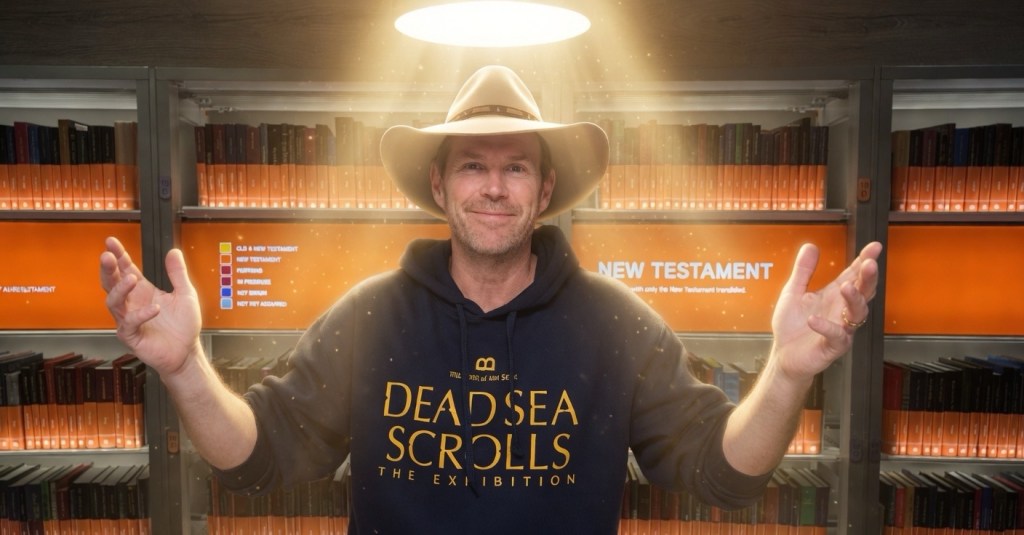
I have loved the work I did for around about twenty-five years and I passed up a lot of opportunities do do that work. The financial opportunity cost was enormous. That is not a slogan. That is a long marriage to a craft, a lot of people counted on me to keep them in a job and it was not good for me, for a long time, several years. It was a really tough period and I didn’t talk about it much, but I did a lot of work that nobody will ever know about to make a lot of people’s lives just a little better. Then 2026 arrived, and one of the best things I have done in this decade, maybe in my adult life, was not a deal and not a title. It was a birthday. My wife and I went to the Museum of the Bible in Washington to see Dead Sea Scrolls: The Exhibition. I wear the hoodie from that day the way some men wear a championship jacket. The shirt is cloth. The day is not.
In the gift shop outside the exhibit, I bought a replica clay jar, the kind of vessel the Qumran caves used to keep parchment alive through empires. [1] It was about twenty dollars. I spent far more than that in the gift shop. I like the twenty-dollar thing most. I put it on my desk at work so that every conference call had a reminder of a century before Christ sitting next to the phone. When I finally got free of that place, I left so fast I abandoned the jar. A friend kept it safe. It took about two months to get it back. I missed the jar more than I missed the job. That sentence tells you what I value. The people who took over the company paid me a lot of money to leave, and I couldn’t get out fast enough. And as I predicted, they are quickly running the place I spent a large part of my life running into the ground, which is a shame.
THE BIRTHDAY I ACTUALLY WANTED
If you can do anything you want on your birthday and you choose an exhibit of old skin and ink, you are telling the truth about your interior life. I am a member of the Museum of the Bible. I like the building. I like the traveling shows even more. This one was the only thing I wanted.
The museum sits at 400 Fourth Street SW, a short walk from Federal Center, in that southwest quadrant where the Capitol complex, the Mall museums, and the old Department of Education neighborhood all lean on each other. [2] We parked in a garage, came up, and ate sausage-and-egg McMuffins at the McDonald’s down the road. I took a picture of my wife. We have been married thirty-eight years. You think you know a face. I have never seen her happier than that morning. The joy was all over her. It has become my favorite picture of her.
People who only know me from videos think they know what fills a man. A lot of the country is spiritually vacant, and they tune in to get a little ballast. Here is the ballast. If I could design a heaven, it would look like that day on a loop: time, the Bible, the cases, the reading, the thinking. I would be happy forever. Nothing I have bought with a title has come close.
THE EXHIBIT THAT WAS THE REAL THING
Dead Sea Scrolls: The Exhibition opened at the museum on November 22, 2025, in partnership with the Israel Antiquities Authority and Running Subway. Curators: Navit Popovich-Geller, Risa Levitt, and Joe Uziel. Floor 5. Official run through September 7, 2026. East Coast stop. [3]
They rotated the fragments in three phases so the skin could rest and so visitors would not see the same eight pieces all year.
First rotation, November 2025 into February 2026: 4Q7 Genesis, 11Q10 Targum Job, 4Q83 Psalms, Astronomical Enoch, Barkhi Nafshi, War Scroll material, an eschatological commentary, Temple Scroll. [3]
Second rotation, February through May 2026: fragments of the Great Psalms Scroll, Numbers, Lamentations, Community Rule, apocryphal psalms, Tohorot, non-canonical psalms, Book of the Giants. [3]
Third rotation, May through September 2026: Isaiah, Tobit, phylacteries, Birth of Noah, Jubilees, communal ceremony, Community Rule, Damascus Document. [3]
We hit Phase Two. I am glad we did. I stood in front of text copied when Rome was still a rumor in Judah and the Hebrew Bible was still held in a living community’s hands. You can read about Qumran in a chair. It is another thing to see the letter-forms under museum glass and realize the narrative did not begin in a nineteenth-century print shop.
That matters. The scrolls are the great twentieth-century confirmation that the biblical text is not a late pious invention. They are a Second Temple Jewish library, biblical and sectarian, hidden in jars in the caves above the Dead Sea and found again beginning in 1947. [4] They do not make a man holy by themselves. They make a liar work harder.
I know the museum’s early years included purchased “Dead Sea Scroll” fragments that testing later showed were fakes. The museum said so and pulled them. [5] This show is not that drawer. This is Israel Antiquities Authority material from the national collection, the real library on tour. Christianity Today called it the real deal. [6] They were right.
THE JAR THAT WAS NEVER THE POINT AND BECAME THE POINT
The original scroll jars are tall, lid-tight, local clay. They are why the texts survived weather, war, and time. [1] The replica I bought is a scale souvenir. It came with a copy of a scroll like the ones on display. I put the whole little shrine on the desk.
I kept fortune-cookie slips in it.
That needs explaining.
THE LUNCHES WHILE THE BUILDING CHANGED HANDS
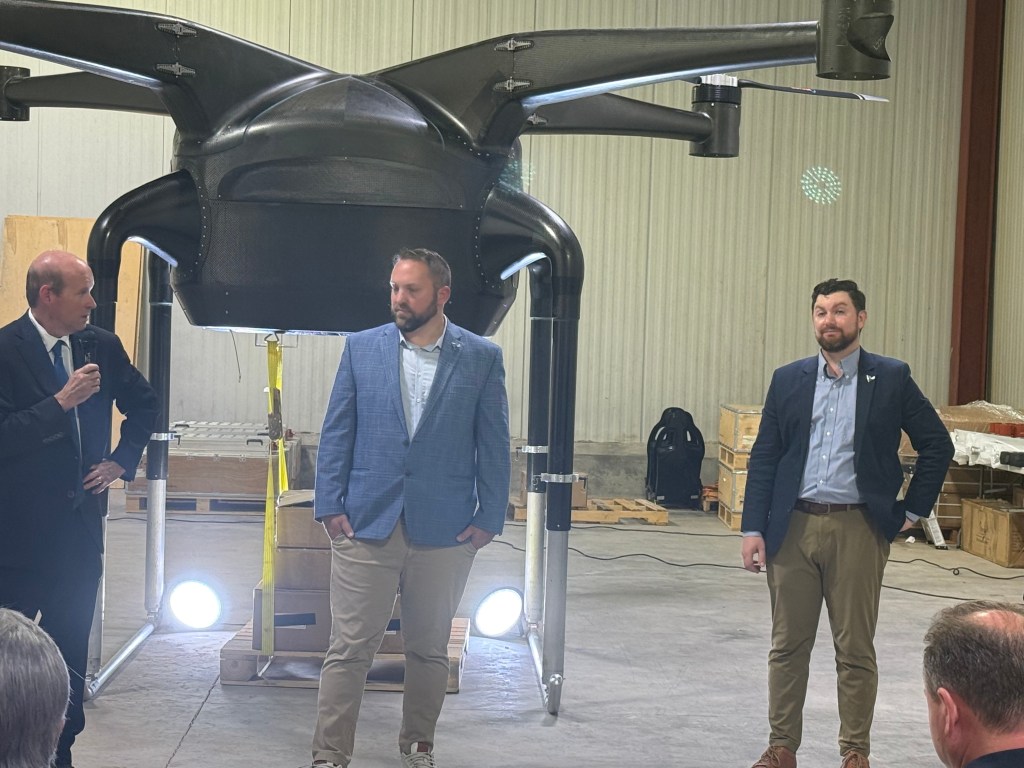
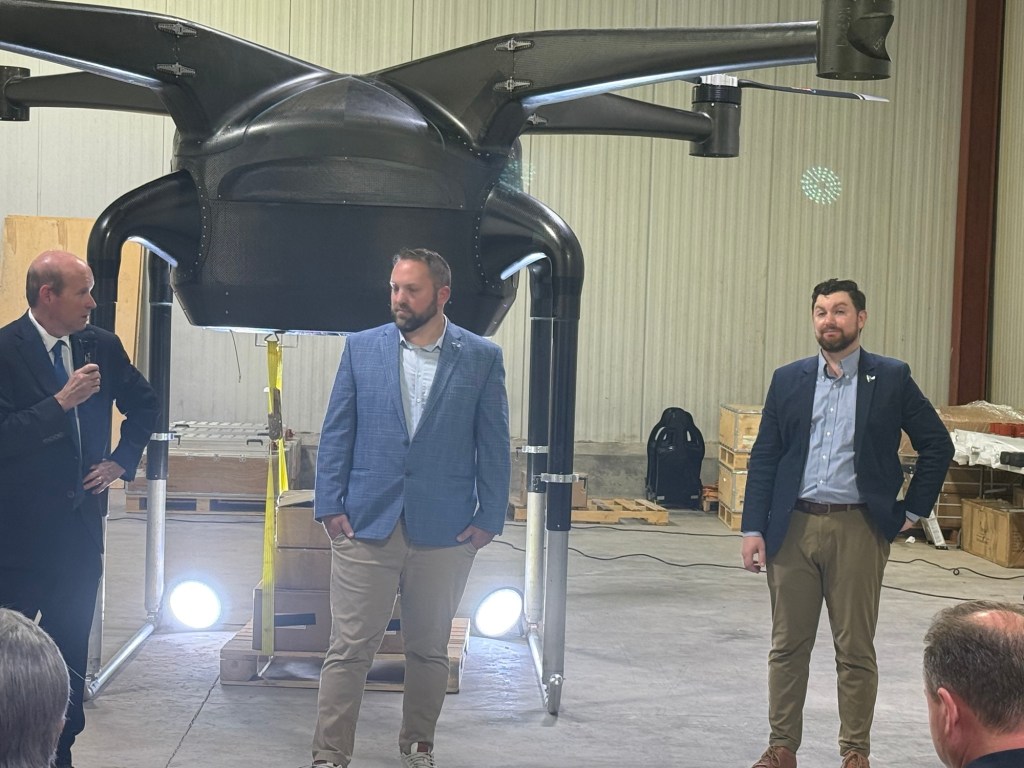
CTL-Aerospace is a Butler County composites and aerospace shop with a long OEM life, the kind of midwestern plant that actually makes the parts. In September 2025, it filed Chapter 11 in the United States Bankruptcy Court for the Southern District of Ohio, Western Division, Case No. 1:25-bk-12226, Judge Beth A. Buchanan. [7] The company’s own first-day declaration described raw-material quality shocks, a 2024 loss on still-strong sales, and a lender fight with Wells Fargo that turned into a cash choke. [8]. The company never recovered from challenges caused initially by the COVID lockdowns. I worked real hard to save the company from an acquisition and I’m very bitter about the time I wasted on it, but I felt obligated to a lot of people which was not to my benefit. It was very insulting, as hard as I worked, to watch these new people coming into the management system and assume they could just erase me, which of course they haven’t been. A lot of people have been contaccting me wanting a job wherever I end up landing and wanting to know what’s going on with me, which doesn’t have a quick and easy answer. I Poured a lot of myself into something that was not in my control and I owe myself some time to dust off the negativitive experience. I traditionally list my work experience as a writer and consultants. Both take a lot of experience to do. And when you get a chance to learn new things, out of the box, you do all you can. It takes a lot of experience to be a good writer. That is always my first priority.
What followed is the new modern American ritual. Advisors. Debtor-in-possession money. An auction under section 363. A sale of substantially all assets free and clear. The docket names the buyer’s side as an affiliate of Davidson Kempner: DK OF VI Trading Subsidiary LP, designee DK CTL Aerospace Opco LLC. The sale hearing record sits in January 2026. The DK deal closed in March 2026. And followed a typical story these days among a lot of companies that don’t get talked about enough in CNBC financial discussions. [9][10]. Yes, I hate Amy Acton for what she did to the state of Ohio under the COVID lockdowns. And I haven’t talked about it much, but because I spent so much time there, I have to tell that story 50 times a week, because everyone wants to know what happened, especially since I was on the executive leadership end of it. And it comes up a lot because we launched Vivek Ramaswamy’s run for governor there, and people want to know what happened.
I kept things running as long as I could, but I witnessed a massive failure in the infrastructure smaller businesses use to stay running. And there are lots of parasites who look to target wounded companies for their profit, just like pirates in the days of old, only in a very modern context. Government made it possible for these pirates to make a lot of money off wounded companies. There’s a lot more to the story, but that’s a good starting point. Much of this is in the public record, and I wasn’t happy about any of it. You loan your name to these things, and lots of other people make your life difficult, and you stick around to take care of people you consider friends, when the smart money would have said goodbye a long time ago. Instead of getting upset, I spent my time going to places like The Museum of the Bible. I have some great and horrific stories to tell. Things nobody will believe.
I lived the floor version. Executive management had a habit of going out for Chinese. We were in a tough stretch. A takeover is a weather system. Consultants and funding people move through a plant like they already own everything when you spend years building everything they are taking. You can feel the Monopoly problem in your bones: you are still on the board, but you do not hold the properties, and every roll of the dice is a mortgage you cannot pay. I call that parasite logic because that is how it feels when people who did not build the thing arrive to manage the thing and treat the builders as furniture. I’m talking about this now because I would put all those fortunes in my Dead Sea Scrolls jar for safekeeping during this really hard period, and now that I have it back, it reminds me of these last several years. And I did a presentation at my new place this past week, which went well. And I have a chance to build everything from scratch again, which is about a ten-year plan. But it’s good to get going on something positive again instead of trying to defend employees from a takeover of the business they counted on to put food on their table. When we talk about the economy and Trump expanding jobs, nobody ever talks about these kinds of things which destroy many thousands of jobs every month in America, and it’s what I would consider the biggest job killer in the world, an open attack against America through finance. For many decades, we were able to protect the business from these kinds of elements, but it takes smart people to protect the finance side of things, and COVID conditions broke a lot of cracks that many companies already saw at a critical time.
The court file is the court file; we wanted employees to keep their jobs. My desk was my desk. During those lunches I kept the fortunes and dropped them in the jar. It was a private joke with history among those who went to lunch with me then. The oldest surviving copies of Scripture in a twenty-dollar pot, stuffed with cheap paper predictions, sitting in an office while a seventy-year industrial story got run through a Cincinnati docket. I could have done something else several years ago, but I couldn’t let everyone down who counted on me for their jobs. For my own personal interest, until I took the step shown in the video displayed here for a new opportunity built from the ground up, I was very bitter about it all.
What was good for me was to leave. And I found myself doing everything for everyone else. That made going to the Museum of the Bible a very personal, positive thing for me, as I was seeing massive failures all around me from so many people. Eventually, I will write a book about all this, name names, and tell the whole story. Right now, I’m too angry for it. For a lot of legal reasons, I just put my effort into better things for the future, things I could have direct control over. And I say all that knowing that there are a lot of people who want a new job with me. I have been building something that didn’t already have jobs made for it, which takes a lot more work and more time. That’s why I don’t have a new home for you, yet. But I won’t forget. I plan to build something that is at least 10 times more valuable. That’s how I prefer to work against those who did a lot of bad things.
WHY I LEFT LIKE THE ROAD RUNNER
I cleaned the office out. Books gone. Ready. I still could not stand to be apart from the jar, so it stayed on the desk until the last day. Then the last day came, and I did not make a farewell tour. I did not go room to room to say goodbye. I left like a cartoon puff of dust in a Looney Tunes episode of Road Runner.
A man across the hall belched and farted all day, which disgusted me. I would never hire a person like that for anything, yet there he was, inserted disrespectfully against me. That sentence is not decoration. Some characters are the atmosphere of a declining shop. He was disgusting to be near. The minute I could put distance between my lungs and that hallway, I did. I moved so fast I betrayed the one object I had meant to carry out in my hands.
Halfway down the road, I felt it. Incomplete. The phone and the computer were replaceable. The jar was not, because it held the day with my wife, the Phase Two case, the confirmation that the old book is old in the right way, and the little paper fortunes from the last honest lunches where in it. I had left my treasure in a building I found repulsive, so much so I don’t even drive down I-75 anymore in that part of town so I don’t have to look at the building. I probably won’t again for decades.
A friend picked it up and kept it exactly as I had left it. I have it back now, much to my relief. I feel finished and ready to do something else.
WHAT I LOOKED AT ALL DAY
Every call, every meeting, I looked at that jar and thought of her face at McDonald’s and the dim room where a fragment of a book still spoke. People think a man like me is fueled by argument. Argument is downstream. The fuel is contact with the source.
The feed has a spiritual vacancy. People come to a voice because they want to be filled. I cannot fill them with a hoodie. I can tell them what filled me. I chose, on a day I could have chosen anything, to stand in front of Qumran. I bought the cheapest true thing in the shop and put it where my work-eye would hit it. When the work turned into a court-supervised transfer to a fund, I still wanted the jar more than the chair.
That is not just nostalgia; it’s the kind of values and priorities that build the kind of value in a company that others want to steal because they can’t make it on their own.
THE SCROLLS AND THE POLITICS OF HEAVEN
I have been writing toward a book I call The Politics of Heaven. The phrase sounds misty until you have seen the evidence that the text survived empires in clay. Power is always trying to own the story. Jars on a cliff are what the story does when power is coming, just as the Romans did when they were plotting the destruction of the Jews. The intellectual rebels of Qumran stayed in the desert to get a jump on their planned retreat, to preserve themselves. I stayed around until the very last minute, even though I had lots of opportunities to do other, much more profitable things. It feels good now to be able to go down that road, instead of trying to hold everything together just long enough to save people’s jobs.
The Community Rule and the Damascus Document in those rotations are not tourist wallpaper. They are a sect’s attempt to live under a holy order while history went feral. [3][4] Psalms in the second rotation is the prayerbook of a people who had already learned that governments are weather. I looked at that material and felt the same thing I feel when I write: the old book is not a hobby. It is the deepest available account of how heaven and earth argue.
I do not thump people with it. I live next to it. My Dead Sea Scrolls hoodie is a souvenir of living next to it for a day that worked.
WHAT THE JAR ACCUSES ME OF, KINDLY
I felt as if I had betrayed it by leaving it. That is a strange sentence about fired clay. It is accurate. We betray what we love when we let urgency become panic. I was right to leave the hallway. I wanted to be away from those people so badly that I left behind the one object that proved I had a life outside the hallway.
Getting it back did not restore a career. It restored a ranking. The job was a long love. The jar is a truer one, because it points past the job to the day, the wife, the text, and the stubborn fact that some things are dear. Of course the experience has been very jarring to think about. I have a lot of information that is very valuable because of it. It will make an excellent book, the first third of one that I’ll write talking about all this. But, it needs a good last half to be the kind of book I like to write, which is a story that is unfolding right now. These are the dangers of modern business and its something that a lot of people can’t wait ten years for, because now its a problem. And pretty much nobody bothers to untangle the mess. But, I feel like I can talk about it more now that I have my Jar back. Its one of those incomplete things that has been bothering me a lot for a few months. The stories I will tell of these months will make great writing content, that a lot of people will never believe. And of course, I won’t hold anything back.
If you see me in the Museum of the Bible shirt, that is why. I do not get tired of it. I do not get tired of the little Dead Sea Scroll Jar. I got it back from people who were careful with it, and I will not park it again on a desk I might have to flee when the Romans come to destroy Jerusalem again, or corporate raiders come to steal all the treasure that hard work builds.
FOOTNOTES
[1] Qumran scroll jars: cylindrical, lidded storage pottery associated with the cave finds of 1947–1956. Israel Antiquities Authority / Library of Congress exhibit notes on Qumran pottery; World History Encyclopedia image and description of Dead Sea Scrolls jars. Gift-shop replicas commonly include a small clay pot and a printed scroll insert; museum retail varies by exhibit.
[2] Museum of the Bible, 400 Fourth Street SW, Washington, DC 20024. Near Federal Center SW Metro. The building sits south of the National Mall museum cluster; the Lyndon Baines Johnson Department of Education Building is at 400 Maryland Avenue SW, in the same southwest federal pocket.
[3] Museum of the Bible, “Dead Sea Scrolls: The Exhibition,” November 22, 2025–September 7, 2026, partnership with the Israel Antiquities Authority and Running Subway. Official rotation lists as published by the museum newsroom, October 1, 2025, and the exhibit page.
[4] Discovery and corpus: eleven caves near Qumran, 1947–1956; biblical manuscripts plus sectarian works (Community Rule, War Scroll, Damascus Document, Enoch traditions, and others). Standard introductions: Vermes; VanderKam; Collins.
[5] In 2018, the Museum of the Bible announced that five of its then-owned “Dead Sea Scroll” fragments showed characteristics inconsistent with ancient origin and removed them from display. That episode concerns purchased fragments in the museum’s own early collection, not the 2025–2026 IAA loan show.
[6] Gordon Govier, “New Dead Sea Scrolls Exhibit Is the Real Deal,” Christianity Today, April 8, 2026.
[7] In re CTL-Aerospace, Inc., Case No. 1:25-bk-12226, United States Bankruptcy Court for the Southern District of Ohio, Western Division (Cincinnati), Judge Beth A. Buchanan, petition filed September 8, 2025. Debtor address in the petition header: 5616 Spellmire Drive, Cincinnati, Ohio 45246, Butler County.
[8] Declaration of President and COO, in support of the Chapter 11 petition and first-day motions, September 8, 2025 (Doc. 9 and related first-day papers). Public summaries: Stretto / chapter11cases write-up of the filing, September 2025.
[9] Docket items in 1:25-bk-12226 include the bidding-procedures motion (Doc. 90, October 9, 2025), sale papers, declaration of Geoffrey Frankel in support of sale to DK CTL Aerospace Opco LLC as designee of DK OF VI Trading Subsidiary LP (January 19, 2026), and the January 20, 2026 sale hearing activity. Later docket entries include a March 23, 2026 stipulation involving DK CTL Aerospace Opco LLC.
[10] Capstone Partners, “Capstone Partners Advised CTL Aerospace, Inc. on its Sale to Davidson Kempner in Chapter 11 Bankruptcy,” posted June 10, 2026, stating the section 363 sale to a DK affiliate closed in March 2026. Capstone describes its Special Situations and Financial Advisory Services work after the September 2025 filing. Pre-petition turnaround work with Focus Management Group is described in contemporary filing summaries. Davidson Kempner is a global investment firm; the buyer vehicle on the docket is the DK-named Opco / trading-subsidiary chain above. I am describing the public control change. My language about parasites is how a fund-and-consultant weather system feels to a builder on the floor.
BIBLIOGRAPHY AND FURTHER READING
Museum of the Bible. “The Dead Sea Scrolls Exhibition with the Oldest Biblical Texts Arrives at Museum of the Bible in November 2025.” Newsroom, October 1, 2025.
Museum of the Bible. Exhibit page: Dead Sea Scrolls: The Exhibition. museumofthebible.org/exhibits/dead-sea-scrolls-the-exhibition.
Museum of the Bible. Plan Your Visit; address and parking notes.
Washington.org. Museum of the Bible listing; Dead Sea Scrolls event page.
Govier, Gordon. “New Dead Sea Scrolls Exhibit Is the Real Deal.” Christianity Today, April 8, 2026.
Arlington Catholic Herald. “Ancient Biblical texts make a rare appearance at the Museum of the Bible.” December 2025.
Washington Stand. Coverage of Museum of the Bible Capitol Hill outreach on the scrolls, February 2026.
Israel Antiquities Authority. National Treasures / Qumran publications and conservation notes on rotating exhibition of fragments.
Vermes, Geza. The Complete Dead Sea Scrolls in English. Penguin, revised editions.
VanderKam, James C. The Dead Sea Scrolls Today. Eerdmans.
VanderKam, James C., and Peter Flint. The Meaning of the Dead Sea Scrolls. HarperSanFrancisco.
Collins, John J. The Dead Sea Scrolls: A Biography. Princeton University Press.
Schiffman, Lawrence H. Reclaiming the Dead Sea Scrolls. Doubleday / Yale.
García Martínez, Florentino. The Dead Sea Scrolls Translated.
Wise, Michael, Martin Abegg Jr., and Edward Cook. The Dead Sea Scrolls: A New Translation.
Cross, Frank Moore. The Ancient Library of Qumran.
de Vaux, Roland. Archaeology and the Dead Sea Scrolls.
Magness, Jodi. The Archaeology of Qumran and the Dead Sea Scrolls.
Lim, Timothy H. The Dead Sea Scrolls: A Very Short Introduction. Oxford.
Tov, Emanuel. Textual Criticism of the Hebrew Bible. On why the Qumran biblical manuscripts matter for the history of the text.
Ulrich, Eugene. The Dead Sea Scrolls and the Origins of the Bible.
Charlesworth, James H., ed. The Dead Sea Scrolls. Princeton / Westminster John Knox volumes.
“Community Rule” (Serekh ha-Yahad) and “Damascus Document.” In the editions above.
1 Enoch and related Qumran Enochic material; Book of Giants fragments. See Nickelsburg and VanderKam on 1 Enoch.
Yadin, Yigael. The Temple Scroll.
Jubilees. James C. VanderKam translation.
The Holy Bible. Psalms, Isaiah, Genesis, Numbers, Lamentations; read next to the Qumran witnesses listed in the rotation notes.
Hoffman, Rich. The Gunfighter’s Guide to Business. Liberty Hill, 2021.
Hoffman, Rich. The Symposium of Justice. 2004.
Hoffman, Rich. Tail of the Dragon. 2012.
Hoffman, Rich. The Politics of Heaven. Manuscript.
In re CTL-Aerospace, Inc., No. 1:25-bk-12226 (Bankr. S.D. Ohio). Petition, declaration, Doc. 90 bidding procedures, sale motions, Frankel declaration, sale orders, DK CTL Aerospace Opco LLC papers. PACER/court docket.
Capstone Partners transaction notice, June 10, 2026.
Stretto / chapter11cases.com. “Ohio Aerospace Manufacturer CTL-Aerospace Files Chapter 11.” September 2025.
Butler County development notes listing CTL among regional aerospace suppliers.
Riveron. Public descriptions of bankruptcy, fiduciary, and turnaround practice. I include the firm here because that consultant class is the air a Chapter 11 plant breathes; readers should use the CTL docket itself for who was retained in this specific case.
Wells Fargo as prepetition secured lender, per the first-day declaration summaries.
11 U.S.C. § 363. Sale of assets in Chapter 11.
On Museum of the Bible provenance controversies (for contrast with the IAA loan): 2018 reporting on forged fragments; Hobby Lobby / Green family civil penalty and repatriation coverage from 2017–2021. Frommer’s and major-wire summaries.
Library of Congress / IAA. “Scrolls from the Dead Sea” historical exhibit notes on jars and Cave 4.
World History Encyclopedia. Dead Sea Scrolls jars.
Rich Hoffman
More about me
Click Here to Protect Yourself with Second Call Defense https://www.secondcalldefense.org/?affiliate=20707
About the Author: Rich Hoffman
Rich Hoffman is an author, political consultant, and strategic advisor based in Cincinnati, Ohio, and the creator of The Politics of Heaven—a unique framework that connects biblical theology, ancient history, and modern power structures to explain how moral alignment and spiritual forces shape global events. Blending real-world political experience with deep research into archaeology, UFO phenomena, and suppressed historical narratives, Hoffman offers compelling commentary on topics ranging from ancient civilizations and the Dead Sea Scrolls to modern populist movements, paranormal continuity, and leadership strategy in chaotic environments. As the author of The Gunfighter’s Guide to Business and the forthcoming Politics of Heaven, he brings a grounded yet provocative voice to media discussions, supported by firsthand experiences and a cross-disciplinary approach that bridges science, history, and theology. For interviews, speaking engagements, or expert analysis, visit richhoffmanbooks.com or contact directly via phone at 513-307-5815 or email at rhoffman@richhoffmanbooks.com. If you’ve seen the movie, Disclosure Day and want to talk about it and the implications of Presidnet Trump’s UAP disclosures, let me know and we can bring some color to your coverage. https://richhoffmanbooks.com/media-inquiries-broadcast-topics-and-contact-info/?frame-nonce=ad51e7ecba I do have a firsthand UFO encounter to discuss.