A Community Night at Miami University’s Innovation Center
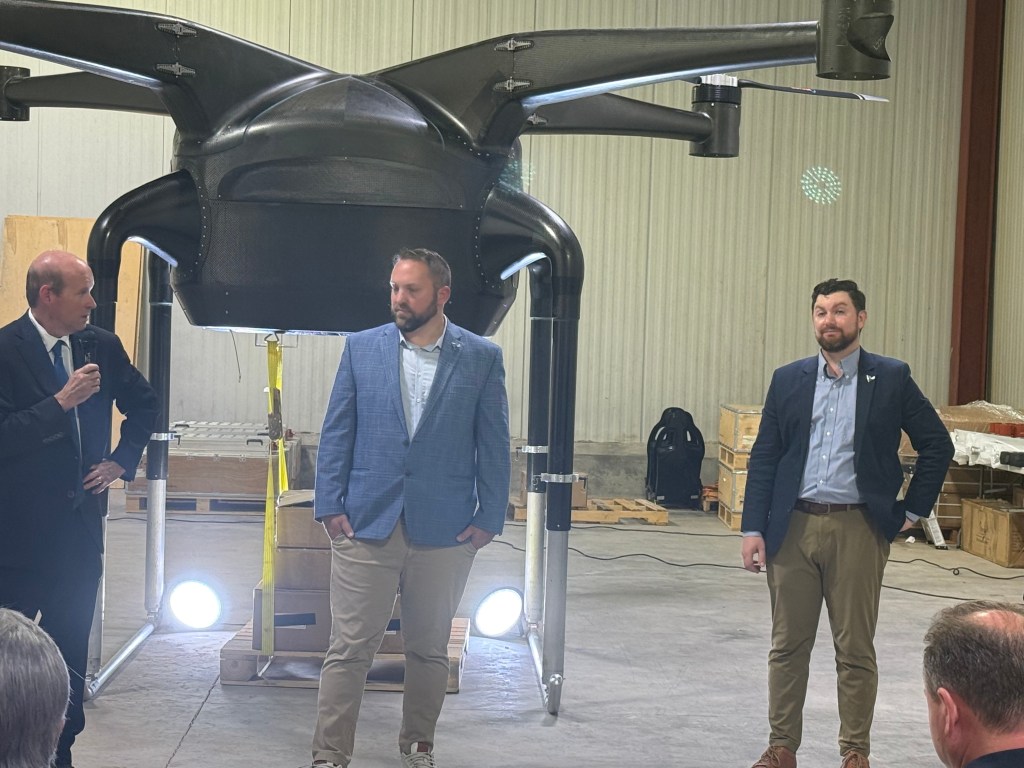
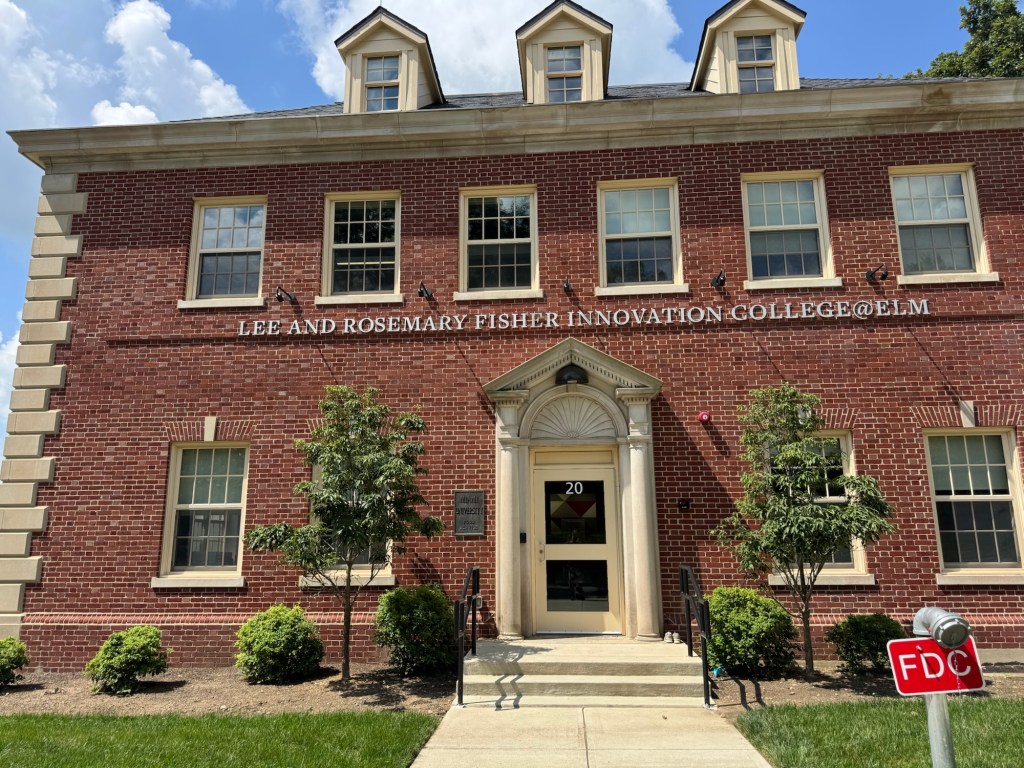
On September 21, 2026, we hosted a special community event at Miami University’s Innovation Center on Elm Street in Oxford, Ohio.
We called the evening “Dreams on Elm Street”, a lighthearted nod to the classic 1980s film. But what we’re building at Volynt isn’t the stuff of nightmares. It’s the realization of a dream, one that is taking shape right here in Butler County and has the potential to transform the future of logistics, aviation, and economic development in Ohio.
The turnout exceeded our expectations. The room was filled with Miami University staff, students, local business leaders, elected officials, and community members who wanted to learn more about what Volynt is building and where we’re headed.
We were honored to welcome Senator George Lang, Butler County Auditor Nancy Nix, and Michael Ryan, who is poised to become Butler County’s next commissioner. Their presence reflected the growing enthusiasm for innovation, entrepreneurship, and advanced aerospace development in our region.
Sharing the Vision
I opened the evening by welcoming our guests and providing an overview of the event. From there, our leadership team took the stage.
Our CEO shared Volynt’s long-term vision and mission. Our Chief Technology Officer highlighted the engineering milestones we’ve achieved and the technology behind the Volynt Vyper platform. As Chief Operating Officer, I discussed how Volynt is transforming cutting-edge aviation technology into a scalable and sustainable business. I outlined our operational strategy, manufacturing roadmap, partnerships, and the steps required to move from prototype development to commercial deployment.
The presentations were engaging, the audience was attentive, and the questions that followed demonstrated genuine interest and excitement.
Most importantly, this wasn’t a flashy product launch filled with unrealistic promises. It was an honest conversation about where we are today, what we’ve accomplished, and what the next several years may hold.
From Prototype to Production
Our immediate focus is straightforward.
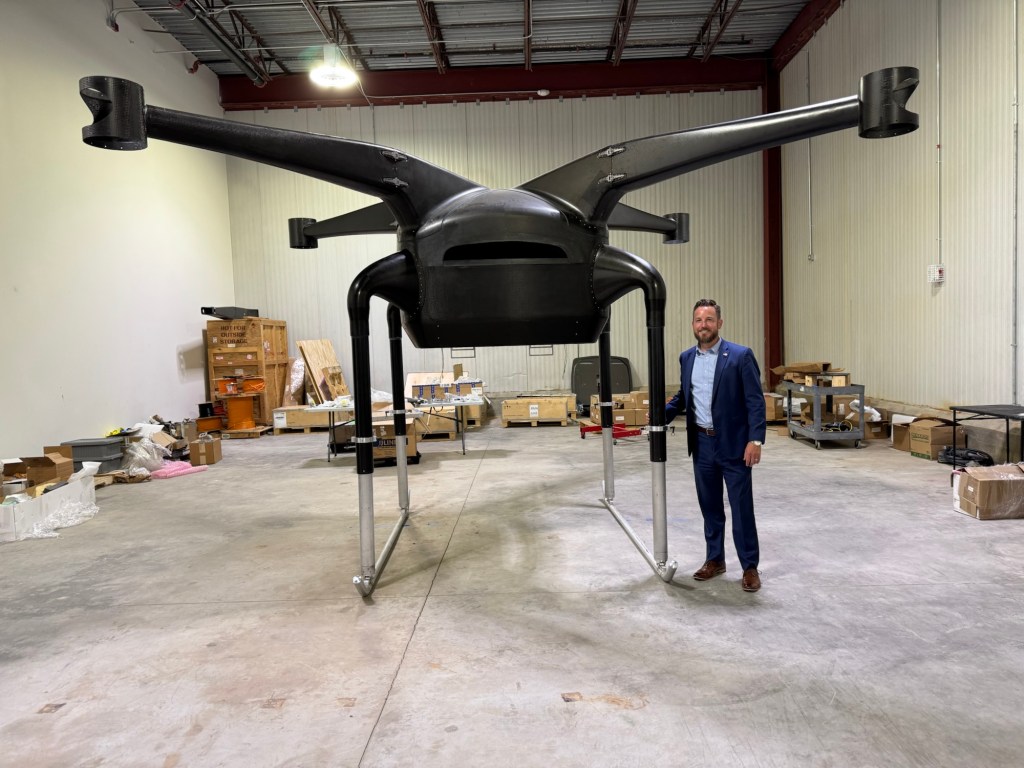
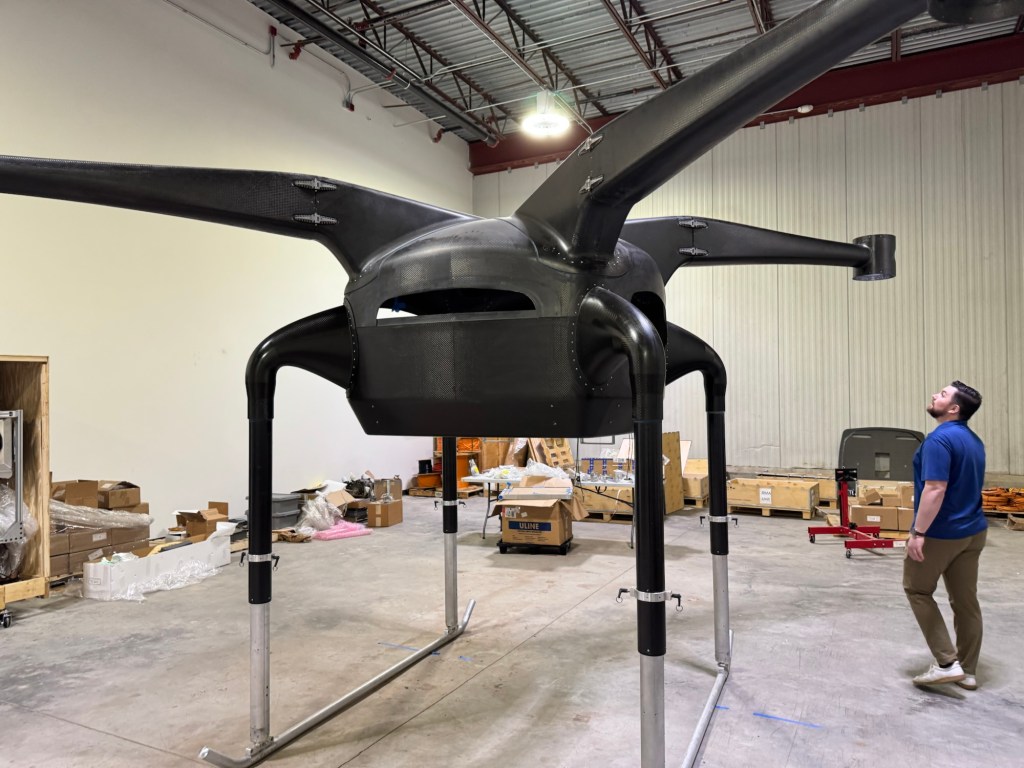
Over the next six months, our team will complete the full-scale Vyper prototype that was unveiled at the Innovation Center. That aircraft represents years of design work, engineering refinement, and determination.
Once completed, the aircraft will enter an intensive testing phase designed to validate performance, reliability, and operational capabilities.
Looking ahead to 2027, we plan to participate in major industry competitions, build broader recognition within the aerospace community, and begin manufacturing multiple aircraft.
The goals are ambitious, but they are supported by a clear roadmap and a dedicated team committed to execution.
The Drone Revolution Is Already Here
One of the most important messages of the evening was that autonomous aviation is no longer a future concept.
It’s happening today.
Just one day after our event, Dayton-area company Dexa launched a drone delivery service in Kettering. The program delivers food orders from TJ Chumps on East Stroop Road to customers within a several-mile radius across Kettering, Oakwood, and Centerville.
These smaller drones operate as last-mile delivery systems. Flying at approximately 400 feet, they lower food orders safely to customers using a cable-delivery system. Dexa has spent years developing this capability and is helping demonstrate that drone delivery is becoming a practical reality.
Volynt’s mission is different.
While companies like Dexa focus on last-mile delivery, Volynt is developing larger autonomous aircraft designed for middle-mile logistics. Our aircraft are intended to transport meaningful payloads between regional hubs such as Cincinnati/Northern Kentucky International Airport (CVG), Dayton International Airport, Indianapolis, and other distribution centers.
This approach has the potential to reduce transportation bottlenecks, address driver shortages, and create more efficient supply chains.
Whether it’s delivering a meal across town or transporting freight across a region, autonomous aviation is rapidly reshaping how goods move through our economy.
Why Ohio Is Positioned to Lead
Ohio’s aviation legacy is unmatched.
The birthplace of powered flight now has an opportunity to become a leader in autonomous flight.
Few regions are better positioned than Butler County to participate in that transformation.
Our region offers access to multiple airports, including Miami University’s airport, where initial flight operations can be conducted. At the same time, substantial investment continues at Butler County Regional Airport, where significant infrastructure improvements are being planned.
The resources, workforce, educational institutions, and transportation network already exist. What remains is bringing together the innovators, investors, and community leaders who can turn opportunity into reality.
Creating Careers That Stay Close to Home
One topic that resonates deeply with me is talent retention.
I have spoken with countless parents who have made tremendous sacrifices to provide educational opportunities for their children through Miami University, Butler Tech, and the University of Cincinnati. Too often, those graduates leave Ohio because they believe the best opportunities are elsewhere.
That reality creates a challenge for families and communities alike.
One of our long-term goals at Volynt is to help change that story.
We envision creating thousands of high-quality aerospace, engineering, technology, and manufacturing jobs throughout Southern Ohio. We want talented young people to have the option of building exciting, fulfilling careers without leaving their families, communities, and hometowns behind.
Strong Community Support
One of the most encouraging moments of the evening was seeing the level of support from the community.
Michael Ryan delivered an excellent presentation about economic development in Butler County and how innovative companies such as Volynt can contribute to future growth and prosperity.
The participation from Miami University, local leaders, educators, students, business professionals, and community members reinforced something I’ve believed from the beginning:
Innovation succeeds when communities embrace it.
Dreams on Elm Street was more than a company presentation. It was a milestone. It brought together people from different backgrounds and perspectives to discuss a shared vision for the future of our region.
The energy in the room was unmistakable. The conversations were thoughtful. The questions were insightful. The enthusiasm was genuine.
For me, that confirmed that we’re moving in the right direction.
Looking Ahead
Volynt’s journey is still in its early chapters.
There is much work ahead, many challenges to overcome, and numerous milestones still to achieve. But the momentum is real, and the opportunities are significant.
We will continue sharing updates with the community as we progress from prototype development to testing, certification, manufacturing, and beyond.
This is only the beginning.
Thank you to everyone who attended Dreams on Elm Street and supported our mission. Your encouragement and belief in what we’re building means more than you know.
Together, we’re not just dreaming about the future.
We’re building it.
About the Author
Rich Hoffman is Chief Operating Officer of Volynt, where he leads operational strategy, business development, manufacturing planning, and growth initiatives for the company’s autonomous aerospace programs. A longtime Butler County leader and aerospace executive, he is committed to building high-quality technology careers and advancing innovation throughout Southwest Ohio.
Rich Hoffman is an author, political consultant, and strategic advisor based in Cincinnati, Ohio, and the creator of The Politics of Heaven—a unique framework that connects biblical theology, ancient history, and modern power structures to explain how moral alignment and spiritual forces shape global events. Blending real-world political experience with deep research into archaeology, UFO phenomena, and suppressed historical narratives, Hoffman offers compelling commentary on topics ranging from ancient civilizations and the Dead Sea Scrolls to modern populist movements, paranormal continuity, and leadership strategy in chaotic environments. As the author of The Gunfighter’s Guide to Business and the forthcoming Politics of Heaven, he brings a grounded yet provocative voice to media discussions, supported by firsthand experiences and a cross-disciplinary approach that bridges science, history, and theology. For interviews, speaking engagements, or expert analysis, visit richhoffmanbooks.com or contact directly via phone at 513-307-5815 or email at rhoffman@richhoffmanbooks.com. If you’ve seen the movie, Disclosure Day and want to talk about it and the implications of Presidnet Trump’s UAP disclosures, let me know and we can bring some color to your coverage. https://richhoffmanbooks.com/media-inquiries-broadcast-topics-and-contact-info/?frame-nonce=ad51e7ecba I do have a firsthand UFO encounter to discuss.
I have watched this movie before. In 2015 and 2016, and again in 2024, the same class of people tried to tell America that Donald Trump’s wealth was a character defect. They said a rich man could not be trusted, that success itself was the indictment, that gold, planes, and golf were proof he was “not like you.” Voters put him in the White House twice anyway, because they understood something the professional scolds never will: independence is an asset. A man who does not need the job is harder to own. That is the lesson Ohio Democrats and a handful of leftover Republican wreckers are now trying to unlearn with Vivek Ramaswamy, and it is why Amy Acton spent Labor Day weekend screaming that you cannot buy Ohio.
She needed a chant. What she got was a gaffe.
The Speech That Sounded Like a Person Running Out of Road
Watch the clip. Acton is at a union picnic with Pete Buttigieg in tow, doing the ritual of the lockdown years: I am a doctor, not a politician, becoming one right in front of your eyes. Then she starts barking that Vivek cannot buy the state, cannot buy Ohio, cannot buy us, cannot buy us, cannot buy us in Ohio, that is the end of this. It is the sort of thing a campaign writes on a whiteboard when the internals look ugly and the only remaining argument is envy. The crowd does not catch fire. She looks like she is trying to start a wave at a funeral.
This is the same Amy Acton Ohio already knows. She ran public health under Mike DeWine when the state was locked down, businesses were smashed, kids were sent home, and “follow the science” became a political religion. She collected awards for it. A lot of Ohioans collected unemployment, missed funerals, and watched their Main Streets die. You can call that public service if you like. I call it the record she has to run on, and it is why the “I’m just like you” routine lands like a lead pipe. She is not just like you. She is the woman who told you to stay home while the people who write the rules kept their salaries.
The wealth attack is even thinner. Vivek flew to watch tennis. He likes tennis. He used to be a ranked junior. He has a court. He went to the U.S. Open and he has been to Paris. Wealthy people do that. Trump never ran from Mar-a-Lago or the golf course; he wore the gold clip and the silk tie and said, yes, I did well, and if you vote for me I will try to make it so you can do well too. That is a producer’s message. Acton’s message is the opposite: he has money, therefore he is illegitimate, therefore hand the keys to the people who want to tax the successful and redistribute the proceeds to the discontented. That is not a governing philosophy. That is a ransom note.
Why Attacking Wealth Is a Loser’s Tell
I have been thinking lately about the Apostle Paul. He was effective in part because he had standing and independence. He was not a ward of the movement. He could travel, argue, and endure because he was not begging the crowd for his next meal. Politics is not the church, but the principle is the same. A candidate who has already won in the private economy does not need Columbus the way a career public-health administrator needs Columbus. Vivek does not need a government job. That is supposed to be a feature. The people yelling “you can’t buy Ohio” are announcing that they cannot raise comparable money and cannot compete on growth, so they will compete on resentment.
David Pepper and the rest of the chorus have been working this line for months: billionaire, private jet, not one of us. Fine. Then explain why Trump’s jets and clubs did not stop two national victories, and why Ohioans who want plants, capital, and jobs might prefer a man who has already built companies to a woman whose signature achievement was closing the state. You can dislike Vivek’s style. You can argue policy. What you cannot do, with a straight face, is pretend that enjoying a tennis match is a civic crime while the alternative is more of the administrative state that already had its turn.
The other half of this farce is intra-Republican sabotage. After a primary, Democrats lock arms around whoever they nominated, even when she sounds like a chalkboard dragged down a stairwell. A slice of the right still wants to pick the scab. Nick Fuentes types, leftover primary rivals, the professional “I told you so” circuit—anyone who would rather be right about a Republican’s flaws than win the state—keep feeding the same clip. They did it to Trump in 2016 and 2024. He won anyway because voters vote their interest when the noise dies down. A good economy and job creators in your state beat a sermon about how the other guy’s plane is too nice.
Then Came the Fair, and the Overnight Conversion of a Shove Into an Assassination Plot
The timing is the tell. After the Labor Day chant made her look unhinged, the campaign needed a new story. Sunday at the Canfield Fair, a 38-year-old local named Patrick Havas pushed through a tent crowd toward Acton with a phone up, as if he were recording or trying to get close enough to be seen. He knocked over older people. Security took him down. After the fact, deputies found two pistols and a Taser-style device on him. He did not draw the guns. He did not fire. He did not brandish. Ohio is a constitutional-carry state. Carrying is not the same thing as attempting murder. The charges reported were disorderly conduct and misdemeanor assault for the people he knocked down. Acton was unhurt. The people who fell were assessed and, according to the sheriff, did not seek further treatment.
That is a bad scene at a fair. It is not a martyrdom. Campaign statements still said an “armed individual lunged” and injured multiple people. National copy followed the verb. By Saturday night into Sunday the lead was written as if Ohio had just watched a political assassination attempt. If there were clean video of a man trying to kill her, it would have been on every screen before supper. What we got instead was language inflation: lunge, attack, armed, threat—while the actual police story is a large man barreling for a better look or a confrontation, knocking seniors like bowling pins, and getting piled on by Highway Patrol.
This attack story is just another Democrat Jussie Smollett story, trying to gain sympathy and voter support through fake news talking points. This is the fullness of the Acton operation: when the speech is a disaster, change the subject to danger. When you cannot raise on growth, raise on fear. When you cannot debate or raise money, accuse the other side of buying the state. Look how many sucker politicians jumped on the bandwagon without knowing all the facts, which again came out looking like Amy Acton is a loser candidate.
What Ohio Actually Chooses When the Cameras Leave
Acton will keep the unions, the people who want the next transfer payment, and the media that still thinks 2020 was her finest hour. She will keep Pepper on the ticket as proof that the old Democratic machinery is still in the room. She will keep calling Vivek rich, which he is, and hoping Ohio has forgotten that successful people are allowed to like tennis, football Saturdays, and a life that is not a permanent campaign stop.
I want a state that recruits producers instead of lecturing them. If a man with a billion dollars in assets spends a few thousand to fly to a match, that is not the scandal. The scandal is a political class that treats his success as the crime and her lockdown résumé as the credential. Trump never apologized for winning. Vivek should not apologize for a court, a jet, or a seat at the Open. The people who need him to grovel are the same people who needed Trump to grovel. They lost that argument twice.
Vote like you want the factories and the payrolls. When things got tough for Amy Acton in 2026 she turned to fake news. Which only made everything worse. She is the lockdown lady and is horrible in every way a politician can be, which we all had a front-row seat to in 2020 when she destroyed Ohio’s economy and told everyone they could be superheroes if only they wore a mask in public. That is the person running for governor in Ohio as a Democrat. A disaster on a good day. On a bad day, she is a fake news agent of destruction and drunkenness.
Notes
1. Acton’s Labor Day-weekend remarks with Buttigieg at the Cincinnati AFL-CIO picnic, including the “you cannot buy this state / you can’t buy us” repetition, circulated widely on September 5–6, 2026. See WLWT coverage of the Hamilton picnic and contemporaneous rally video.
2. Acton served as Ohio Department of Health director under Gov. Mike DeWine beginning in 2019 and became the public face of the state’s COVID restrictions.
3. Criticism of Ramaswamy’s travel and tennis included Acton’s own Labor Day-weekend post attacking a U.S. Open appearance and earlier opinion pieces on a July 4 Paris trip.
4. Ramaswamy’s tennis background (junior player, Cincinnati Open ball boy, regular Open attendee) is part of his public biography and prior campaign videos.
5. Canfield Fair incident, September 6, 2026: Patrick Havas, 38, of Canfield, pushed through the Mahoning County Democratic Party tent, knocked down older attendees, was detained by Ohio State Highway Patrol executive protection; weapons recovered after detention; no brandishing reported; charges reported as disorderly conduct and two counts of misdemeanor assault. Acton uninjured.
6. Constitutional carry in Ohio means possession of a concealed firearm, without more, is not itself an assassination attempt.
7. Public polling through late summer 2026 generally showed a toss-up to slight-Ramaswamy edge depending on the house, which is consistent with a campaign hunting for a reset narrative.
8. Intra-GOP sniping after contested primaries is a recurring feature of the Trump era; Democrats have typically consolidated faster around flawed nominees.
Bibliography
Acton for Governor. Campaign statements and Labor Day / Canfield Fair remarks, September 2026.
Ballotpedia. “Amy Acton.” Candidate biography and office history.
CNN. “Armed man arrested after pushing through crowd toward Ohio Democratic gubernatorial nominee.” September 6, 2026.
Columbus Dispatch. “Armed man arrested after lunging at Amy Acton at Canfield Fair.” September 6, 2026.
Cincinnati Enquirer. Nick Anderson, “Ramaswamy’s Paris trip an example of his disconnect with Ohioans.” July 8, 2026.
HuffPost. “Vivek Ramaswamy Slammed For Leaving Ohio And Attending The U.S. Open.” September 6, 2026.
Mahoning County Sheriff’s Office / Ohio State Highway Patrol statements on the Canfield Fair detention of Patrick Havas, September 6, 2026.
New York Times. “Armed Man Arrested After Charging Toward Democratic Candidate for Ohio Governor.” September 6, 2026.
The Nerd Stash. “‘You Can’t Buy Us’: Ohio Dem Amy Acton Sparks Backlash After Awkward Rally Chant Aimed at Vivek Ramaswamy.” September 6, 2026.
Washington Post. “Armed individual ‘lunged’ at Democrat nominee for Ohio governor, campaign says.” September 6, 2026.
Wikipedia. “2026 Ohio gubernatorial election.” Polling averages and race ratings as of early September 2026.
WLWT. “Pete Buttigieg campaigns for Amy Acton, Greg Landsman at Cincinnati AFL-CIO picnic.” September 6, 2026.
Rich Hoffman is an author, political consultant, and strategic advisor based in Cincinnati, Ohio, and the creator of The Politics of Heaven—a unique framework that connects biblical theology, ancient history, and modern power structures to explain how moral alignment and spiritual forces shape global events. Blending real-world political experience with deep research into archaeology, UFO phenomena, and suppressed historical narratives, Hoffman offers compelling commentary on topics ranging from ancient civilizations and the Dead Sea Scrolls to modern populist movements, paranormal continuity, and leadership strategy in chaotic environments. As the author of The Gunfighter’s Guide to Business and the forthcoming Politics of Heaven, he brings a grounded yet provocative voice to media discussions, supported by firsthand experiences and a cross-disciplinary approach that bridges science, history, and theology. For interviews, speaking engagements, or expert analysis, visit richhoffmanbooks.com or contact directly via phone at 513-307-5815 or email at rhoffman@richhoffmanbooks.com. If you’ve seen the movie, Disclosure Day and want to talk about it and the implications of Presidnet Trump’s UAP disclosures, let me know and we can bring some color to your coverage. https://richhoffmanbooks.com/media-inquiries-broadcast-topics-and-contact-info/?frame-nonce=ad51e7ecba I do have a firsthand UFO encounter to discuss.
Full disclosure, this is a long one and it might be easier to watch the video. I have a lot to explain here, and this topic is much bigger than most surface-level discussions on politics and business and what role the two play in a happy society. I talk about abortion in a different way here, but it’s a mentality that is at the heart of Marxism, and many years of our civilization straining under a mixed economy that many of us never even thought about. But it’s the heart of what has been driving me for many years to this point. I am affiliated with Volynt Aero in Oxford. I am a consultant and, at this point, an advisor. I am proud of it. I do not normally attach my name to things. For years, I’ve handled much of the work in the background. People who have known me a long time know the method. You trade whatever you have—sometimes it was literally baseball cards when I was young—to get close enough to a problem to be useful. I come out of the school of hard knocks. I have seen what happens to people and to companies when the process is dirty, when the lawyers arrive late, when the regulators decide the idea should die in the permit office. I have helped a lot of people mine their way through improper methods without becoming the method.
That is the only reason this essay exists; there is a lot of interconnected tissue to consider in something as massive as this, and it takes a bit to discuss in context. Not because I needed another logo on a card. Because I watched a good idea be born in Oxford, in Butler County, Ohio, and I recognized the old American pattern: the builders are ready, the market is arriving whether the townships like the noise or not, and the political class is still deciding whether it wants to midwife the thing or abort it.
Why I Attach a Name at All
I have been a huge supporter of FirstEnergy. I was a supporter when Larry Householder was Speaker. When we talk about alliances between government and big business, I think FirstEnergy got a raw deal in the public square. I do not think they did a good job defending themselves. Real life in the background of a utility is lived inside regulatory compliance, rate cases, and a grid that still has to keep the lights on while somebody in Washington changes the religion of energy policy every four years.[1] What I saw was a company running a model that the Obama-era compliance environment made it almost impossible to operate profitably, then being treated as a morality play when it sought political relief.
I see a lot of Democrats trying to take ground in Ohio after years of Republican control of the House, the Senate, and the governor’s office. They cannot get a message through to people because the message, once you strip the focus-grouped nouns off it, is still a mixed-economy sermon with a communist destination. That is not what people in this county vote for. It is not what they vote for in 2026 either. But the fight does not end because you won a map. You are always overcoming Karl Marx. You can see it in the way a left-wing media personality in Columbus will work a hit job on a Republican until the man will not look you in the face in a hallway. I have watched politicians go quiet because they do not want to be called a communist, or worse. After all, they do not want to be trapped at a urinal in the Statehouse by somebody with a microphone asking why they voted for an “evil” bank or an “evil” energy company that was not kneeling hard enough toward the religion of wind and solar power.
There are a lot of safer ways to make money. There are not many ways to do it that still serve the two parts of the American condition I actually care about: job creation, and political representation honest enough to get out of the job creator’s way. I lend my name to enterprising people who take risks because I want to see them make jobs. I lend my name to political figures for the same reason. The Marxist type always attacks them, and it is a lonely business to be sabotaged out of a restroom at the Statehouse by a hostile media personality trying to put you in a horrible state of mind. Why did you vote for that? Why did you say this? Why do you support FirstEnergy? Why aren’t they for wind? All questions from a Marxist perspective, intended to root everything in a leftist point of view as a baseline.
I involve myself because I want to protect capitalism from the next adjustment to the breaker panel, the one that shows up on your electric bill whether or not you ever voted for the sermon that caused it.
John Galt Types, and the Movie That Taught Me the Pattern
At the beginning of this, I put the Volynt affiliation together because I like the guys. I like entrepreneurs. I like John Galt types. I like people who work. When I meet them, I want to help them. I want to help them avoid having to dynamite their own buildings at the end of the story, the way the book taught a generation of us to fear.
My favorite movie on this subject is still Tucker: The Man and His Dream, directed by Francis Ford Coppola, from the same mind that gave the country The Godfather and then turned around and made a hymn to the American crackpot who wanted to build a better car outside Ford, Chrysler, and General Motors.[2] Tucker put the engine in the back. He put seat belts in the car. Fuel injection in 1947. The Big Three knew they could not retool fast enough to compete. The pipeline was already poured. So the story goes that they used Senator Ferguson to try to throw Tucker in jail.[3] That is how the red decade moved into the American system: not always with a red flag in the street, but with a committee, a compliance file, and a prosecutor.
There is a speech Tucker gives at the end of that movie that I have never gotten over. It sounds like Howard Roark’s speech in The Fountainhead, stretched across a courtroom instead of granite.[4] He is wondering where his country went. Marx came in. Regulatory compliance came in. The power of government came in. Ferguson wanted donations from the Big Three, so he tried to eliminate the competition that would have made them better. Tucker assumed the American dream was still built around the man who builds something better. The country had changed on him in the thirties and forties, and he just then figured that out.
We had just won a war by manufacturing the Nazis and the Japanese into the ground. Then, mysteriously, we started sending consultants the other direction to learn how to manufacture from our former enemies; we let our enemies teach us how to mass-produce when it was that very trait which caused us to win World War II. People like Tucker got crushed in the interval.[5] He stayed out of jail. He built fifty cars. Some were wrecked in the process. The ones that remain are still Tucker cars, and you can look at them. The ideas did not die. The company did; it was murdered by a tyrannical government.[6]
I have always hated, in the background of my adult life, the long trend that followed: the creation of a permanent international management layer, the suppression of American ingenuity as if ingenuity were a pollutant, the habit of treating the founder as a defendant. We did something right in the teens, the twenties, even into the thirties. Then the red decade came over from Europe under the banner of free speech, and pretty soon you had a government trying to jail a man for building a safer car.
If it had been me in Householder’s chair, I would not have done the pinhead stuff a two-thousand-dollar-an-hour lawyer could later dissect. I tend to have sympathy for the people who were trying to keep power flowing while the rules were written to euthanize the old plant in favor of a liberal sermon. I do not want to see the power of government illuminate ingenuity only long enough to book it.
What These Drones Actually Do
So why Volynt Aero? Yes, they have an unmanned hybrid VTOL—the Vyper—that can fly, carry a serious payload, and put a box where a truck cannot go. You have seen the animation. I was able to get close enough to the real work that the animation looks like a polite version of what I watched. I went to the facility in Oxford. I talked to a great bunch of guys. The intellectual property is not a napkin. It is already there. Public specs on the aircraft talk about carrying on the order of 500 pounds of cargo out to 150 nautical miles, then landing and offering plug-in power—110, 240, or 480 volts—off standard jet fuel, without waiting for a charging farm to be built in the mud.
The crowded market is last-mile photographs and Amazon-adjacent experiments. Everybody has a drone story now. Walmart has a drone story. Amazon has a drone story. Texas has companies. California has companies.[7] The middle-mile market alone is described as a ten-billion-dollar band within a much larger stack. I have been saying to anybody who will listen that the five-year systems market—vehicles, energy, warehousing, insurance, municipal integration—could run toward a trillion dollars if the country actually lets it hatch. Those are inside numbers, not a press release.
What makes Volynt different is not that they can hover. It is the combination. Cargo logistics and highly mobile power generation on the same airframe. They can come in, drop a payload, and leave. And they can do battlefield resource management, which in civilian clothes means disaster-zone logistics. Power recovery. Fly into a hurricane zone or an Ohio River floodplain, get past the trees that are lying across the only road the trucks can use, land, and put 110, 240, or 480 volts where a ventilator is still a life.[8]
The Hurricane, the Chainsaws, and the Road You Cannot See
Years ago, I was between jobs. I tend to get involved in crusades because they teach you things you cannot learn from a paycheck. One of the reasons I have been effective over the years is that I have done things other people never get to do, or never have the guts to do, because it means leaving the comfort of a W-2. A friend who ran a tree crew called. A storm had flattened a stretch of the Carolinas around the Raleigh-Durham universities. Trees older than the subdivisions they shaded were down across the highways.[9] He was paying cash crews a thousand dollars a day because people were pulling money out of safes rather than wait on insurance to cut the trees off their homes after the storm. A crew member—the kind of guy who couldn’t do anything else because he did not have many other options, because he was out of jail for killing people—had decided he wanted all of it and had started talking about killing my friend. My friend asked me to come down to help him with the guy. My wife did not want me to go. I did not want to leave her. A couple of weeks of that work could be a year’s income. I got on a plane to chase treasure and danger. And to that point, where there is danger, is usually where there is treasure.
As we were landing, they had just cleared the runway. From the air, you could not even see the highway. That is the image I have never forgotten. There is no way for the trucks to get the equipment to the poles if the trees own the asphalt. Before the utility can be a utility, somebody with a saw has to invent a road again. It took some of those people three or four weeks to get power back. Generators mattered. They still matter. A patriot generator in a garage is not a hobby. It is how you keep a freezer and a CPAP and a window into the world from dying on the same night.
When the Volynt team walked me through the demonstration, that memory came back to me. Every September, somewhere, a hurricane does a version of that story. Every late winter, the Ohio, the Mississippi, the Great Miami find a floodplain and take a substation with them. Senior citizens do not have three weeks for power to return. A drone that can fly the downed corridor and restore a line, or drop the thing that lets a crew restore a line, is not a gadget. It is the difference between a shelter with lights and a shelter guessing.
Same grid logic as fifty years ago. The wires still have to carry the current. The new part is that you do not always have to wait for the infrastructure; you can fly the infrastructure into a distressed zone.
The Mixed Economy That Aborts the Company Before It Is Born
The hard problem is not the airframe technology. The hard problem is an unfriendly manufacturing and permitting environment. Unless you can throw Elon Musk money at it, the political monster can crush you before the second prototype.[10] Even Musk needed government contracts and, for a stretch, an alliance with China to get Tesla through the years when the same people who wanted electric cars also wanted to drown the factory in process. A lot of the operators I talk to do not want politics at all. They want the big animal to stay in its cage until the product exists. I get involved because I have watched companies get crushed before they build anything.
I was in Columbus a few years ago sitting next to very expensive lawyers who were selling solar the way people used to sell riverfront lots. There is a big solar farm near Piqua. There is another in Warren County. Fine. Generate what you can generate; I’m not against other ways of getting power. But if we aren’t talking about Thorium or nuclear, we aren’t being serious about acquiring real energy. What I will not do is pretend that a sermon about wind and panels is a substitute for a dispatchable grid when you are trying to host the next wave of computation and industry.[11] FirstEnergy was the legacy company being squeezed like a zit so that a younger lobby could inherit the moral high ground. That is an Obama-era move, and it is still the move. Euthanize the old method. Call it progress. Act shocked when people are upset about it.
Republicans have not defended capitalism very well. They have not defended FirstEnergy well. They have not defended the Householder disaster as a policy failure instead of a personality failure, which is what it was, and that has fed this Amy Acton narrative now. I listen to two-thousand-dollar-an-hour lawyers miss the only point that matters: are you using the power of government to confiscate wealth, or are you using it to keep the builder from being hunted while he builds? A lot of people in the political class do not feel they have latitude to say that out loud because they do not want the Columbus media animals waiting for them at the urinal. I am not in public office, so I can say it.[12]
The metaphor I keep using, because Ohio taught it to me, is abortion as industrial policy. A certain kind of politics wants to abort the business before it attaches. Regulation becomes the instrument. You never have to out-compete the founder if you can keep him from being born. The same crowd will turn around and euthanize a legacy company they have decided is morally expired, which was what the FirstEnergy story was really about. Young ideas killed in the womb. Old plants killed in the bed. What they never want is a living competitor that was not pre-cleared by the donor list.
Fences, Data Centers, and Who Gets to Say No
In my neighborhood, an older, decent neighbor started a wooden fence in the front yard. Posts went in. It was their property. I would not have chosen the look. My wife and I were not going to say anything. Then came the hearing. Then the posts came back out of the ground. I had not called a trustee. I did not need to. I knew what happened. People who bought half-million and million-dollar houses, some of them new from the coasts, did not want to look at a tacky fence on the drive-by. No lumber in the front. Property rights, until the new people appeal to government to make your porch match their taste.
That is the data-center argument in miniature. I am pro data center. The new economy is an electricity story whether the township signs the petition or not. China is building data centers whether or not we do, and if people protest, they just disappear. That’s how it is in China, in America: communist terrorism hides behind free speech, which does not exist in a real communist country. People who do not want the noise still want the market cap that pays for a federal deficit that no longer fits on a bumper sticker. They want a trillion-dollar growth story and a quiet backyard. They want to keep up with Beijing and keep the transformers out of sight.[13] My daughter lives near Millikan Road in the Liberty Township development and does not want more congestion. I understand the feeling. I also drive through Middletown and remember what the place looked like when the work was here. You can still find houses in that city at prices that tell you how much vitality is left. Vance can talk about investment, but there’s a lot more. I want the investment to be real enough that Main Street is not a museum of what we used to make.
I love Liberty Center. I like Costco. I like the Monroe exits and the Millikin exchange along the 63 corridor as places where you can put large things without paving a township’s last pasture. Balance is a real problem for trustees. Pretending that every large thing is a moral injury is not balance. It is a lifestyle veto dressed up as conservation.[14]
Property taxes are the scream under all of this. There is a movement that wants them gone. Fine. Show me the replacement arithmetic. One honest way to change the math is to land in an industry that generates revenue on land that is already industrial. Vertical mobility—middle-mile drones, disaster logistics, the power-restore mission—is not a server farm humming behind a fence. It is a reason a site exists. Amazon, Walmart, the carriers, the hospitals, the utilities, the Guard: they all have the same problem. Get the box, or the tool, or the kilowatt, past the broken road.[15]. We’re talking about a lot of things here that are always under the tip of our tongues, but they are the center of all discussion.
Michael Ryan Was There Before It Was a Photo Opportunity
I was not going to drag a campaign into this. Michael Ryan put his visit on Facebook. He went to the Volynt facility. He talked about it at a fundraiser. I happened to be there with him. I know what he has been doing in the background for a couple of years while other people were still deciding whether drones were a toy, a nuisance, or a federal problem.[16]
By the time a lot of people read this, he may already be sitting as a Butler County commissioner, or he may be in the last stretch of proving it in November. Either way, I want it on the record. Michael Ryan has been acting like a commissioner of this county well before the title was his. He has been providing leadership in rooms that were not yet fashionable. Four years from now, when the project is a ribbon and a CNBC segment, and every officeholder in a fifty-mile radius is trying to stand in the photograph, I want it remembered that he was there when it was still a risk.
That is what good leadership looks like when it is not a press release. It is not waiting for the market to become safe and then claiming the harvest. Socialism, in the small-town version, is just that reflex: somebody else takes the risk, then the committee arrives to redistribute the credit. Ryan did the opposite. He showed up early. He has done a lot of unglamorous work that makes life in this county better. This is one of the visible ones.[17]
I like a lot of the Ohio names in the builder register. I have had the chance to talk to them one-on-one in informal settings. I think I know who they are. Bernie Moreno built businesses and then walked into the grinder of public service with enough money in the bank that a paycheck could not vote for him. Warren Davidson is in that same pattern. That is the opposite of the professional politician, who needs the mixed economy because it is his meal. Bernie Sanders is a communist. The late-life American version I respect is the man who made something and then spent the surplus defending the conditions that let other people make something.
Ryan is young enough to want still the county to have a next chapter. That matters. The people who have been in the chair too long start to treat every new idea as a zoning headache. The people who still think like founders treat it as a chance.
What I Want This to Become
I want Volynt featured on CNBC as one of the great global innovators, not as a local curiosity that got a grant and a ribbon. A proposed HyPE Lab at the Miami University Airport is the kind of physical bet a county should want next to an existing runway. Ohio Third Frontier money already touched the powertrain work. That is a start, not a finish. I want them to have a shot at being the next SpaceX in the only sense that phrase is useful: a company that made a hard physical thing at a scale the incumbents said was impossible, in a county that decided not to strangle it. That is a lofty goal. Lofty goals are how factories start. The constraint is not imagination. The constraint is whether Ohio and Butler County will keep the political animal on a leash long enough for scale.
Scale needs land that is already industrial, power that is actually on the bus, a workforce that can turn a wrench and read a print, and a waiver culture at the FAA that does not take a decade to admit a machine can fly past the pilot’s eyeballs.[18] Ohio is already in the drone-first-responder business through DriveOhio. Hamilton police are getting aircraft that beat a cruiser to the scene. That is a different mission from cargo and power restoration, but it is the same county learning the same sky.[19]
I have been accused of being part of the military-industrial complex because I have worked around aerospace companies for a long time and I know people in politics. The accusation is a category error. I want the opposite of what happened to Tucker. I want the opposite of what happened to Roark in the book. I want the man with the idea outside the approved pipeline to get to the market before the senator from the incumbent district files the paperwork. I have put my name on things when it was unpopular and could and have cost me. I will put it here.
Books do not usually make the kind of money people think they do. I am writing The Politics of Heaven anyway, because I think there is a spiritual war under the economic one, and because non-human intelligence—call it what your tradition requires—does not only show up in a sky story. It shows up in the institutional habit of killing the builder.[20] I volunteer a lot of time that isn’t invoiced. I want the human race better. Helping a company in my own county get off the ground is one of the ways that sentence becomes concrete.
The Record I Want Left
This is a long one. Context does not work in ten minutes. The video at the front of this would be useful to watch.
When people ask me what I am working on, this is the answer. I am helping a group of scrappy operators, with the IP already done and the demonstration already flown, get across a minefield that usually destroys the idea before it can pay a tax bill. I am proud of them. I want the state of Ohio to treat this as more than a local hobby. The upside is not a buzz in the background. The upside is a transportation and recovery layer that Amazon, Walmart, and every hospital system in a floodplain will need, whether the township board likes the look of the fence or not.
Watch Tucker’s speech. Read Roark’s. Then look at a county that still has room at the exits, a commissioner candidate who showed up before the cameras were easy to get, and a machine that can put power back on at a shelter while the trees are still on the road. That is the whole argument. I would like, for once, not to give the speech at the end of the movie. I want the cars—or, in this case, the aircraft—to be built.
Michael Ryan was ahead of it. The company is ahead of the market’s imagination. I am putting years of scar tissue behind both facts. The rest is execution, voltage, and whether we still believe a man with a better idea should be allowed to leave the ground.
Cincinnati Business Courier / Dayton Business Journal. Coverage of Volynt Aero’s proposed Hybrid Propulsion and Energy (HyPE) Lab at Miami University Airport, January 2025.
LinkedIn, Volynt Aero company page. Oxford headquarters; Vyper aircraft described for emergency cargo logistics and autonomous power generation.
Workhorse Group and other Midwest cargo-UAS public materials, Sharonville / Mason, Ohio.
National Hurricane Center. Storm histories for Carolinas landfalls affecting the Research Triangle transportation grid.
Notes
[1] On Householder and FirstEnergy, see United States v. Householder, S.D. Ohio, and contemporaneous reporting in The Columbus Dispatch and Cleveland Plain Dealer, 2020–2023. The policy point here is not a brief for every transaction; it is that one administration’s rules can squeeze a regulated utility until the only remaining path appears to be politics.
[3] Senator Homer Ferguson of Michigan chaired the Senate investigations that, in Coppola’s telling and in Tucker’s own defense, functioned as a political weapon for Detroit incumbents. Whether every cinematic beat is courtroom-accurate is less important than the pattern: government process used as a moat.
[4] Ayn Rand, The Fountainhead (Indianapolis: Bobbs-Merrill, 1943). Howard Roark’s courtroom defense remains the clearest American statement that a creator does not exist to feed the parasites who arrive after the risk is taken.
[5] U.S. manufacturing after 1945 did send missions to study Japanese methods; the irony Tucker’s speech names is that the country that out-produced the Axis then imported process discipline from the countries it had just defeated. See postwar productivity literature and W. Edwards Deming’s later influence in Japan.
[6] Preston Tucker produced fifty Tucker 48 automobiles. Most survive. The Big Three later adopted seat belts, disc brakes, fuel injection, and aerodynamic safety ideas that Tucker had already put on the road. See Tucker Automobile Club of America histories.
[7] Amazon, Walmart, UPS, and the United States Postal Service have all published or piloted roadmaps for drone and middle-mile automation. Industry estimates for advanced air mobility and drone logistics through the early 2030s commonly range from tens of billions in the near term to well above $100 billion as last-mile and middle-mile use cases stack. The trillion-dollar figure in this essay is a five-year systems view that includes vehicles, energy, warehousing, insurance, and municipal infrastructure—not airframes alone.
[8] Volynt Aero, Inc., Oxford, Ohio (Butler County). Public materials describe the Vyper hybrid-electric unmanned eVTOL as carrying on the order of 500 pounds of cargo out to about 150 nautical miles, then landing and providing 110, 240, or 480 VAC plug-in power from JP-8 or Jet A without a high-voltage charging network. See Volynt Aero’s capability statement and company site at volyntaero.com. A proposed Hybrid Propulsion and Energy (HyPE) Lab at Miami University Airport was reported by the Cincinnati Business Courier and Dayton Business Journal in January 2025. The company received Ohio Third Frontier/TVSF support through the Entrepreneurs’ Center.
[9] Hurricane Fran (1996) and later storms that struck the Carolinas left large sections of the I-40 / Research Triangle corridor impassable from downed timber. The operational lesson is unchanged: you cannot restore a grid if you cannot reach the poles.
[10] Elon Musk’s public record on Tesla and SpaceX includes DOE loans, NASA Commercial Crew and Cargo contracts, and later criticism of the same regulatory state. The relevant point is not purity. It is that even a high-capacity founder needed both capital and political oxygen to keep the factory from being regulated out of existence before the product matured.
[11] On Ohio energy policy after House Bill 6, see Public Utilities Commission of Ohio dockets and legislative history of subsequent repeal and reform efforts. Nuclear and dispatchable baseload remain the quiet argument under every data-center fight.
[12] On mixed-economy control, see Ludwig von Mises, Interventionism: An Economic Analysis, and Rand’s distinction between the producer and the looter. The essay’s claim is practical: once incumbents learn they can buy a senator rather than retool a factory, innovation becomes a permit problem.
[13] On local data-center zoning fights, see Journal-News coverage of the Butler County commissioners’ 2026 moratorium discussion and township requests. The noise argument and the fiscal argument are not the same conversation, though they are treated as one at public meetings.
[14] Liberty Center, Monroe / I-75 corridor industrial sites, Middletown Regional Airport aviation investments, and the Spooky Nook complex on Hamilton’s west side are the visible pieces of a county trying to replace lost mill and auto-adjacent employment with logistics, aviation, sport, and advanced manufacturing.
[15] Property tax pressure in Ohio townships is the political surface of a deeper math problem: residential valuations rise while commercial and industrial bases either leave or get blocked. A new high-value industry that uses existing industrial land is one of the few honest answers that does not require another levy speech.
[16] Butler County Commission primary, May 5, 2026: Michael V. Ryan defeated incumbent Cindy Carpenter approximately 72 percent to 28 percent. See Journal-News (Hamilton), May 5–6, 2026. Ryan, a former Hamilton City Council member and vice-mayor, advanced to the November 2026 general election.
[17] Bernie Moreno and Warren Davidson have both operated in the Ohio builder-and-business register the essay prefers to the professional political class. Endorsement lists in the 2026 Butler County commission primary included both names on Ryan’s side.
[18] Federal Aviation Administration, Unmanned Aircraft Systems (UAS) regulations, 14 C.F.R. Part 107, and successive beyond-visual-line-of-sight (BVLOS) waiver practice. Ohio House Bill 77 (effective April 9, 2025) added state-level UAV provisions at Ohio Revised Code §§ 4561.50–4561.53.
[19] Ohio Department of Transportation / DriveOhio statewide drone-first-responder pilot, announced for multiple agencies including Hamilton Police, 2025–2026. Public-safety drones and cargo drones are different machines; they share airspace, waiver culture, and a county that is already learning to fly.
[20] Rich Hoffman, The Politics of Heaven (manuscript, 2026; targeted 2027 publication). The book treats non-human intelligence, spiritual warfare, and the political history of heaven as the long background to why human institutions keep aborting builders.
Rich Hoffman is an author, political consultant, and strategic advisor based in Cincinnati, Ohio, and the creator of The Politics of Heaven—a unique framework that connects biblical theology, ancient history, and modern power structures to explain how moral alignment and spiritual forces shape global events. Blending real-world political experience with deep research into archaeology, UFO phenomena, and suppressed historical narratives, Hoffman offers compelling commentary on topics ranging from ancient civilizations and the Dead Sea Scrolls to modern populist movements, paranormal continuity, and leadership strategy in chaotic environments. As the author of The Gunfighter’s Guide to Business and the forthcoming Politics of Heaven, he brings a grounded yet provocative voice to media discussions, supported by firsthand experiences and a cross-disciplinary approach that bridges science, history, and theology. For interviews, speaking engagements, or expert analysis, visit richhoffmanbooks.com or contact directly via phone at 513-307-5815 or email at rhoffman@richhoffmanbooks.com. If you’ve seen the movie, Disclosure Day and want to talk about it and the implications of Presidnet Trump’s UAP disclosures, let me know and we can bring some color to your coverage. https://richhoffmanbooks.com/media-inquiries-broadcast-topics-and-contact-info/?frame-nonce=ad51e7ecba I do have a firsthand UFO encounter to discuss.
I have watched Elon Musk for a long time. I have watched him evolve. The same is true of Russell Brand. I remember when Brand was an outright socialist advocate, covered in tattoos, calling for revolution and the redistribution of wealth. I remember when Musk was voting for Obama, donating to Democrats, and operating comfortably inside that orbit. Trump himself leaned Democrat in earlier years, invited the Clintons into his world, and only later became the force he is now. People believe things, then reality catches up, and they come around in their own way.
That arc is not rare. I saw it repeatedly in the early days of the Tea Party after the housing crisis. Retired engineers from places like GE who had spent decades voting for bigger government and going along with the corporate consensus suddenly called me. They were 65 or 70. They had steady paychecks for years. They wore the Hawaiian shirt on Fridays. They played it safe. Then they retired, looked at the deficit and the culture, and decided they wanted to do something useful. They wanted to fight tax increases and local levies. The paycheck was gone. The fear of HR and the next promotion was gone. Suddenly they could think for themselves.
Watching the Arc: From Collective Safety to Seeing the Trap
I see the same pattern in Musk and Brand. Brand spent years as a left-wing firebrand, guest-editing socialist magazines, endorsing Corbyn, preaching against capitalism. Then COVID, the lockdowns, the censorship, and the digital control mechanisms pushed him the other way. He now talks about freedom, digital ID dangers, and sounds far closer to the people who once opposed everything he stood for.
Musk’s shift is more visible because of the scale. He supported Obama. He voted for Biden. He was inside the system that issues permits, contracts, and regulatory approvals. Then he bought Twitter, turned it into X, and ran headfirst into the apparatus that decides who gets to speak. He has had to file the endless FAA paperwork for Starship. He has watched mediocre bureaucrats slow down exceptional engineering. When he replies to Brand about an “oppressive government,” I hear a man who has finally felt the weight of the machine he once navigated more carefully.
This is not pure conversion. It is pattern recognition. Once you have enough financial independence, or once the system starts targeting you directly, the incentives change. The same people who stayed quiet for decades while drawing a corporate or government check suddenly discover principles. I do not put them down for it. Better late than never. But I notice when the courage arrives only after the risk is lower.
The Corporate Judas Cycle and the Power of the Paycheck
I have seen the Judas move up close. A bright radio talent I knew had a private owner who did not care much about FCC memos. We could talk about American exceptionalism on air. We could say the hard things. Then a big corporate job appeared. The social media got cleaned up. The fighting-for-your-rights posts disappeared. The man who once spoke freely kissed the cheek for the steady check and the career ladder. Judas took the coins. Jesus, in the scapegoat tradition, knew it was coming. The system still runs on people willing to trade the exceptional for safety.
Corporate culture learned the lesson socialism figured out long ago. You do not build a mass movement by appealing to independent thinkers. You appeal to the collective. You offer safety, security, and a sense of belonging. You make Hawaiian shirt day the high point of the week. You hire the Normies—the blue-pill middle managers who show up to interviews in flip-flops and T-shirts—and you put them in charge of hiring. They reproduce themselves. They do not hire the exceptional because the exceptional make them feel small. The same personality type migrates easily into government jobs. Government is the ultimate safe paycheck with the ultimate power over others.
That is the core of oppressive government. It is not abstract tyranny. It is the systematic empowerment of mediocre people who would never hold power in a pure merit system. They gain leverage through the size of the state, endless money, grants, regulations, and the ability to punish anyone who stands too tall. Exceptional people become a threat. They might make the average feel inadequate. So the system levels everything downward.
Steve Bannon’s Strategy Versus Trump’s Exceptionalism
I like Steve Bannon. He kept things alive when others ran. He paid a price. He went to jail. He understands the front line. His deliberate “slob” presentation—untucked shirts, no tie, Band-Aid on the forehead—is a calculated move. He does not want to appear better than the people he is trying to pull into the movement. Joseph Campbell used to say it is not good to appear too good if you want to bring the average along. Bannon internalized that. He lowers himself so the crowd does not feel threatened.
Trump never did that. He wears the suit. He wears the red tie. He talks about winning, about being the best, about thinking big. We voted for that. We did not vote for a Normie in an untucked shirt. We voted for exceptionalism. When Musk started building the biggest rockets and the biggest companies and then turned against the regulatory state that slows him down, he moved closer to that same instinct. SpaceX is aiming at scale that still sounds insane to most people—Musk has talked about 30-plus Starship launches a day by 2030. That is not mediocrity. That is the opposite.
Ohio’s Choice: Vivek Ramaswamy or Amy Acton’s Mediocrity
I see the same fight right here in Ohio. Vivek Ramaswamy is a rich man who built things. Amy Acton’s side attacks that fact as if wealth earned through production is a moral stain. She talks about people “buying” the office. The implication is that successful people cannot be trusted, while the candidate of lockdowns and average outcomes somehow can. The polls are tight. Some have Ramaswamy slightly ahead. Others show Acton with a narrow edge or a statistical tie. The race will turn on whether voters want opportunity and capital or the familiar comfort of managed mediocrity.
Data centers are a perfect test. They bring tax revenue, jobs, and economic activity that can help close budget gaps and lower pressure on property taxes. The opposition often prefers the empty cornfield and the status quo. That is the voice of people who have never had to create the wealth they want to redistribute. It is the same impulse that treats exceptional builders as the enemy.
The Real Danger of Oppressive Government
An oppressive government is dangerous because it gives mediocre people the power to sit atop exceptional people. It funds the average and penalizes the outstanding. It turns corporations into risk-averse partners of the state so they can keep the grants and avoid the targeting. It creates a culture where people stay quiet until they retire, then suddenly want to be part of something important. It produces the Judas cycle over and over.
I have had more than enough of that mediocrity this summer of 2026. It has infected corporate culture deeply. The ultimate cost of a powerful government that hands out money and permission is that it rewards the people who will never do exceptional things and restrains the people who will.
Musk is not saying enough when he names “oppressive government.” The deeper problem is the systematic preference for the average over the excellent. We do not need more people who dress down so the crowd feels comfortable. We need more people willing to stand up, build, risk, and produce results that make the average uncomfortable. That is how a nation stays exceptional.
Footnotes
1. Elon Musk’s documented political evolution includes donations and support for Obama, Hillary Clinton, and a 2020 vote for Biden before the post-2022 shift toward Republican candidates and full endorsement of Trump. See reporting on his donation history and public statements.
2. Russell Brand’s earlier work included the book Revolution and explicit support for socialist redistribution and figures such as Jeremy Corbyn; his later public positions moved toward free-speech and anti-establishment critiques.
3. Elon Musk’s recent X reply to Russell Brand stated “An oppressive government” in response to Brand’s content on digital ID and related control mechanisms.
4. Musk has publicly stated the goal of 30-plus Starship launches per day by around 2030. Current production rates remain far lower, with recent comments indicating one vehicle per month and efforts to increase cadence.
5. Ohio gubernatorial polling in summer 2026 has shown a tight race between Vivek Ramaswamy and Amy Acton, with results ranging from slight Ramaswamy leads to narrow Acton edges or statistical ties depending on the pollster and date.
6. The “Judas” analogy draws on the New Testament scapegoat and betrayal narrative as a metaphor for trading principle for institutional safety and reward.
Bibliography
Brand, Russell. Revolution. New York: Ballantine Books, 2014.
Isaacson, Walter. Elon Musk. New York: Simon & Schuster, 2023.
Musk, Elon. Public statements and X posts on political evolution, Starship production goals, and government regulation (2022–2026).
Rand, Ayn. Capitalism: The Unknown Ideal. New York: New American Library, 1966/1967. (For the moral framework of producers versus looters and the nature of government force.)
Rand, Ayn. Atlas Shrugged. New York: Random House, 1957.
Trump, Donald J. The Art of the Deal. New York: Random House, 1987. (Early expression of the exceptionalism theme.)
Reporting on Ohio 2026 gubernatorial polling from Fox News, AARP, Wedgewood, Emerson, and related outlets (June–August 2026).
SpaceX and FAA documentation and public statements on Starship launch cadence and regulatory constraints.
Additional reading: Joseph Campbell on the hero’s journey and the danger of appearing “too good”; historical accounts of the Tea Party movement’s post-2008 composition; analyses of corporate risk-aversion and regulatory capture.
Rich Hoffman is an author, political consultant, and strategic advisor based in Cincinnati, Ohio, and the creator of The Politics of Heaven—a unique framework that connects biblical theology, ancient history, and modern power structures to explain how moral alignment and spiritual forces shape global events. Blending real-world political experience with deep research into archaeology, UFO phenomena, and suppressed historical narratives, Hoffman offers compelling commentary on topics ranging from ancient civilizations and the Dead Sea Scrolls to modern populist movements, paranormal continuity, and leadership strategy in chaotic environments. As the author of The Gunfighter’s Guide to Business and the forthcoming Politics of Heaven, he brings a grounded yet provocative voice to media discussions, supported by firsthand experiences and a cross-disciplinary approach that bridges science, history, and theology. For interviews, speaking engagements, or expert analysis, visit richhoffmanbooks.com or contact directly via phone at 513-307-5815 or email at rhoffman@richhoffmanbooks.com. If you’ve seen the movie, Disclosure Day and want to talk about it and the implications of Presidnet Trump’s UAP disclosures, let me know and we can bring some color to your coverage. https://richhoffmanbooks.com/media-inquiries-broadcast-topics-and-contact-info/?frame-nonce=ad51e7ecba I do have a firsthand UFO encounter to discuss.
Yes, George, you need to watch this video. I had to finish our discussion from lunch. I had a good lunch with Senator George Lang the other day. Nothing formal, nothing staged for the cameras, just two guys who have known each other a long time sitting outside at a place we both like, talking the way we always end up talking when the politics finally take a back seat. People assume that every time I sit down with a senator or a sheriff or a treasurer around here, it is some closed-door strategy session. It is not. George and I share a long-standing interest in ancient history, the kind of deep, layered history that most people in public life never get the chance to dig into. He likes that I run into the stranger corners of it. I like that he actually reads the books I recommend and asks the kind of questions that keep the conversation alive long after the plates are cleared.
We ran out of time that day. Rain started coming down hard while we were still outside, and I had only gotten started on the things I wanted to walk him through. So I am continuing the conversation here the same way I would if he were still sitting across from me and the rest of you were at the next table over. Nothing confidential. Nothing I would not say in front of anyone. Just the thoughts that were already in motion when we had to pack it up.
I updated him on where The Politics of Heaven stands, my next book. The manuscript is finished. The first full draft has been through enough eyes that the early feedback keeps coming back in the same surprising way. More than one reader, including people who know the publishing world, has said the same thing: this book reminds them of The Immortality Key. That 2020 book from St. Martin’s Press by Brian Muraresku, the one Graham Hancock helped put on the map. I told George that I had already decided to go back through The Immortality Key carefully, not because I think I borrowed from it, but because the comparison keeps arriving uninvited and I want to be precise about where the overlap ends and where my own line of inquiry begins. Publication is a relationship, like any other. You do not jump straight into sharing an apartment. You get dinner. You talk. You figure out whether the trust is real. That process takes time, and patience is part of the work.
What pushed me back into The Immortality Key was the same impulse that had me reading Sharon and Derek Gilbert’s Veneration in the early hours before that lunch. Timothy Alberino had been discussing related material on Joe Rogan, and the conversation turned to the older Near Eastern material that most people never hear about. The Gilberts work from a biblical frame, and they do it with real attention to the primary texts. I respect that. Their book digs into the cult of the Rephaim, those dead aristocratic warrior kings whose spirits the living kings of the Late Bronze Age still summoned by name. The Ugaritic tablet known as KTU 1.161 records the liturgy. The dead are called up. Food and drink are set for them. The living king anchors his own right to rule in a line that stretches back into a mythic age of heroes. The meal is not polite remembrance. It is consultation. It is power.
That is the system the biblical writers were confronting. When the scouts came back from Canaan and said they felt like grasshoppers beside the people living there, they were describing more than physical size. They were describing a culture that still fed and consulted the spirits of the giants who had once ruled. Og of Bashan, the last of the remnant of the Rephaim, still had an iron bedstead measured in cubits that made the point for anyone who needed numbers. The physical and spiritual threats were the same. The command to wipe the system out was not simple land hunger. It was an attempt to close the door that the cult of the dead kept trying to hold open.
Mount Hermon sits at the center of that geography. In the Book of Enoch it is the place where the Watchers came down. In the older Canaanite material it is the mountain of assembly, the seat of the divine council that opposed Yahweh. When Jesus took his disciples to the region of Caesarea Philippi at the foot of that mountain and said the gates of hell would not prevail, he was standing on the front porch of the old cult and issuing a direct challenge. The Gilberts make that geography impossible to ignore once you have seen it.
I have been reading this material with one eye on the Near East and the other on the ground under my own feet. The Wheel of the Giants, Gilgal Refaim, sits up in the Golan Heights, a massive set of concentric stone circles that some call the Stonehenge of the East. It belongs to the same broad horizon of ritual architecture that appears along the Jordan and then, in different forms, moves westward. At the same time, over here in the Ohio Valley, the Hopewell people were raising enormous ceremonial centers with the same intensity of purpose. The Milford Works, the great earthworks near the confluence of the Little Miami and the East Fork, the alignments at Newark, the mounds that once stood all through what is now Butler County and Warren County and on up the Scioto. These were not random piles of dirt. They were places where the living gathered to deal with the dead and whatever else they believed could be reached through the right rituals and alignments.
I keep coming back to the Windover site just west of Titusville, a few miles from the Kennedy Space Center. Seven to eight thousand years old. Bodies preserved in peat with brain tissue still intact. Textiles more sophisticated than anything the standard story allows for at that early stage. Directional burial practices. A people who do not fit neatly into the later tribal identities we project backward. Some of the individuals were tall by the standards of the time. The site sits in a region that later becomes part of the same trade networks that moved copper out of the Lake Superior mines and into the wider world just as the Bronze Age was taking shape. The usual explanations for exotic materials found in these contexts grow more strained the longer you look at them. Bananas and turmeric proteins in elite Near Eastern burials. Advanced textiles and possible African or Mediterranean contacts at Windover. The copper that left the Upper Peninsula in quantities that still have not been fully accounted for. At some point, the assumption that the oceans were closed until Columbus made his journey starts to look like a real leap of faith.
The Loveland Frogmen sightings sit right in the middle of this local landscape. 1955, then 1972, later reports still in the same general corridor. Small, grayish, bipedal figures near the water, not far from the old Hopewell ceremonial centers. I am not claiming they are the same entities the Ugaritic kings were feeding under the palace benches. I am saying that when you map the places where people once worked hard to open contact with the dead, and then you look at the places where anomalous encounters keep showing up in the modern record, the overlap is hard to ignore. Point Pleasant and the Mothman. The poltergeist activity that still gets reported in houses built over older burial grounds. The same pattern appears in other parts of the world whenever the old ritual centers are disturbed or left alone long enough for whatever was once invited to keep answering.
I told George that the deeper I go into this material, the clearer it becomes that the biblical story is not a late invention dropped into an empty landscape. It is a record of conflict in a world already thick with competing claims about who had the right to rule and whose spirits still held authority. The non-human intelligences that show up in the older texts, the ones that later get called demons or Watchers or the shades of the Rephaim, did not disappear when the last physical giant was killed. The cult changed its methods. Psychedelics appear to have been one of the technologies that kept the door open. Muraresku’s work on the ritual use of those substances in the ancient Mediterranean and their possible survival into early Christian practice is part of the same larger picture. If you want to understand why a culture builds a certain kind of religion, you have to understand what it was taking and what it thought it was talking to while it was under the influence.
My own book takes the next step. It treats the entire span from the deep pre-biblical period to the present as a single continuous political and spiritual struggle. The copper, the earthworks, the burial practices, the later attempts to rebury or reclassify the evidence, the modern fascination with ascended masters and ancient aliens and celebrity necromancy, all of it belongs to the same long contest. The entities that once sat at the banquet tables under the palace floors in Ugarit are still trying to claim a seat at the table. The question is whether we keep setting places for them.
I am not interested in scaring people. I am interested in making the pattern visible so that the next time someone tries to sell a new version of the old system we recognize it for what it is. The Gilberts do that work from one angle. Muraresku does it from another. Alberino keeps pushing the conversation into the open. I am simply adding the North American material and the long view that comes from living in a place where the mounds are still under the subdivisions, and the river valleys still remember older traffic.
Notes:
¹ Brian C. Muraresku, The Immortality Key: The Secret History of the Religion with No Name (New York: St. Martin’s Press, 2020). Foreword by Graham Hancock.
² Sharon K. Gilbert and Derek P. Gilbert, Veneration: Unveiling the Ancient Realms of Demonic Kings and Satan’s Battle Plan for Armageddon (Crane, MO: Defender, 2020).
³ KTU 1.161 (Ugaritic funerary liturgy), standard edition in Manfried Dietrich, Oswald Loretz, and Joaquín Sanmartín, The Cuneiform Alphabetic Texts from Ugarit, Ras Ibn Hani and Other Places (Münster: Ugarit-Verlag, 2013). See also Baruch A. Levine and Jean-Michel de Tarragon, “Dead Kings and Rephaim: The Patrons of the Ugaritic Dynasty,” Journal of the American Oriental Society 104 (1984): 649–659.
⁴ On Gilgal Refaim / Rujm el-Hiri see Yonathan Mizrachi et al., recent satellite survey work published in PLOS ONE (2026) documenting additional circular structures in the Golan; earlier discussions in Yonathan Paz and others on Early Bronze Age ritual landscapes.
⁵ Glen H. Doran, ed., Windover: Multidisciplinary Investigations of an Early Archaic Florida Cemetery (Gainesville: University Press of Florida, 2002). See also subsequent DNA and textile studies confirming the site’s uniqueness within the Archaic Southeast.
⁶ On Hopewell ceremonial centers, alignments, and ritual feasting, see Bradley T. Lepper, Ohio Archaeology (Wilmington, OH: Orange Frazer Press, various editions) and the UNESCO World Heritage documentation for the Hopewell Ceremonial Earthworks. For the Milford Works specifically, nineteenth-century surveys by Squier and Davis remain foundational.
⁷ Book of Enoch (1 Enoch) 6–16 on the descent of the Watchers at Mount Hermon; standard translation by R. H. Charles or George W. E. Nickelsburg and James C. VanderKam.
⁸ Timothy Alberino’s appearance on The Joe Rogan Experience #2530 (July 2026) discusses the Rephaim, the kispum rites, and the continued occult utility of giant remains in modern contexts.
Bibliography for further reading
Alberino, Timothy. Various lectures and the special edition of The Book of Enoch with commentary (2026).
Byers, A. Martin. Sacred Games, Death, and Renewal in the Ancient Eastern Woodlands. Knoxville: University of Tennessee Press, 2011.
Charles, R. H., trans. The Book of Enoch. Oxford: Clarendon Press, 1912 (and later editions).
Doran, Glen H., ed. Windover. Gainesville: University Press of Florida, 2002.
Gilbert, Derek P., and Sharon K. Gilbert. Veneration. Crane, MO: Defender, 2020.
———. The Great Inception. Crane, MO: Defender, 2017.
Hancock, Graham. America Before. New York: St. Martin’s Press, 2019.
Heiser, Michael S. The Unseen Realm. Bellingham, WA: Lexham Press, 2015.
Lepper, Bradley T. Ohio Archaeology. Wilmington, OH: Orange Frazer Press.
Muraresku, Brian C. The Immortality Key. New York: St. Martin’s Press, 2020.
Nickelsburg, George W. E., and James C. VanderKam. 1 Enoch: The Hermeneia Translation. Minneapolis: Fortress Press, 2012.
Pardee, Dennis. Ritual and Cult at Ugarit. Atlanta: Society of Biblical Literature, 2002.
Squier, Ephraim G., and Edwin H. Davis. Ancient Monuments of the Mississippi Valley. Washington: Smithsonian Institution, 1848 (reprint editions widely available).
Vallée, Jacques. Passport to Magonia. Chicago: Henry Regnery, 1969 (and later editions).
Additional primary Near Eastern texts are available in The Context of Scripture, ed—William W. Hallo (Leiden: Brill), and in the standard Ugaritic editions cited above.
Rich Hoffman is an author, political consultant, and strategic advisor based in Cincinnati, Ohio, and the creator of The Politics of Heaven—a unique framework that connects biblical theology, ancient history, and modern power structures to explain how moral alignment and spiritual forces shape global events. Blending real-world political experience with deep research into archaeology, UFO phenomena, and suppressed historical narratives, Hoffman offers compelling commentary on topics ranging from ancient civilizations and the Dead Sea Scrolls to modern populist movements, paranormal continuity, and leadership strategy in chaotic environments. As the author of The Gunfighter’s Guide to Business and the forthcoming Politics of Heaven, he brings a grounded yet provocative voice to media discussions, supported by firsthand experiences and a cross-disciplinary approach that bridges science, history, and theology. For interviews, speaking engagements, or expert analysis, visit richhoffmanbooks.com or contact directly via phone at 513-307-5815 or email at rhoffman@richhoffmanbooks.com. If you’ve seen the movie, Disclosure Day and want to talk about it and the implications of Presidnet Trump’s UAP disclosures, let me know and we can bring some color to your coverage. https://richhoffmanbooks.com/media-inquiries-broadcast-topics-and-contact-info/?frame-nonce=ad51e7ecba I do have a firsthand UFO encounter to discuss.
I never set out one morning to rewrite history. History is already written, mostly by people who stop digging the moment the official story feels comfortable enough to protect careers and funding streams. The deeper problem is that the accepted version of the past is often assembled by those who never ask the next layer of “why.” In my professional life, I have spent decades sitting across tables from PhD-level experts who sandbag information to protect their own positions. You learn quickly that the only way to get at truth is to keep asking the next question after the comfortable answer has been delivered. I applied that same method to biblical studies, and the formation of American culture, and the rabbit hole opened wider than I expected.
What began as an effort to explain why the Constitution is a moral document rooted in biblical principles—work I first sketched in The Gunfighter’s Guide to Business—grew into something larger. The Bible is not merely a religious text for Christians and Jews; it is a civilizational blueprint. Its commandments and narratives shape cultures that produce durable wealth, ordered liberty, and the capacity for self-government. Once you accept that premise, the next question becomes unavoidable: what was the actual historical environment in which those commandments were given, and what older currents were already flowing when Abraham stepped onto the stage? That question forced me to travel, read, and dig. Over several years, I spent roughly half a million dollars of my own money on research travel—museums, remote sites, late nights in hotels far from home, books read on airplanes and beside campfires. The resulting manuscript is The Politics of Heaven. It is not a polite academic summary. It is an attempt to connect dots that mainstream archaeology and history have preferred to leave disconnected.
In the middle of July 2026, Timothy Alberino sat with Joe Rogan for nearly three hours. I watched the episode while camped on South Bass Island in Lake Erie with family, RV parked among several campsites we had claimed for a week. My daughters were cooking breakfast. The ordinary noise of daily life—hardware-store conversations, Costco recognition, local political pressure—had been left behind on the mainland. That distance mattered. The conversation Alberino and Rogan had would have been confined to late-night AM radio or Coast to Coast a decade earlier. Now it was mainstream, carried by the largest podcast in the English-speaking world. Alberino spoke of giants, of the Book of Enoch, of non-human intelligences that have interacted with humanity across millennia. He recounted the long-circulating story of a Kandahar giant—an enormous humanoid encountered by American troops in a cave in Afghanistan, killed after it attacked, its body placed on a pallet and flown out. The remains, according to the account, were taken to Wright-Patterson Air Force Base. I live a short drive from that base. I have spoken over the years with men who held clearances there. They smile, lower their voices, and say that reverse-engineering of foreign technology has always been the cover story. Whether the technology is Russian, Chinese, or something that violates our airspace from farther afield is left for the listener to decide.
That interview did not surprise me so much as it confirmed a trajectory I had already been following. Alberino’s work and mine are not identical, but they occupy overlapping ground. He has spent more than a decade knocking on the door of the giant question and the Watcher tradition. I have been following the same scent through Ohio’s earthworks, Florida’s bogs, Malta’s temples, and the copper pits of Lake Superior. The difference is emphasis. I approach these matters as a political animal. Wealth creation, nation-building, and the commandments that make ordered liberty possible are never far from my mind. When non-human intelligences appear in the historical record—whether as the “sons of God” of Genesis 6, the entities contacted by shamans, or the craft recovered at crash sites—the political question is immediate: who holds sovereignty over the human race?
Consider the copper. Between roughly 5000 and 1200 BC, miners removed hundreds of thousands of tons of nearly pure native copper from the Lake Superior region—Isle Royale, the Keweenaw Peninsula, and surrounding shores. Thousands of ancient pit mines still scar the landscape. The purity of that copper exceeds 99 percent, a grade rarely achieved by Old World smelting of sulfide ores. Yet the archaeological inventory of North America accounts for only a tiny fraction of the extracted metal. The rest vanished. Mainstream accounts insist the copper stayed local, used by indigenous peoples for tools and ornaments. The volumes do not add up. Alternative researchers have long argued that the missing copper fueled the Bronze Age in the Near East and Europe. Timeline, purity, and scale align too neatly to dismiss out of hand. I have walked those Upper Peninsula sites. I have stood on Mackinac Island and looked across the water toward the old mining grounds. The place itself argues for industrial-scale extraction long before Columbus.
If copper moved from the Great Lakes to the Mediterranean, then knowledge and people moved as well. The megalithic temples of Malta—Ġgantija, Ħaġar Qim, Mnajdra, Tarxien—were raised between 3600 and 2500 BC. Local folklore has always claimed giants built them; the very name Ġgantija means “Giant’s Tower.” These structures predate the pyramids and Stonehenge. Their alignments, their scale, and the ritual deposits inside them point to a sophisticated religious system concerned with ancestors, fertility, and entities larger than ordinary men. At the same period, Hopewell culture in the Ohio Valley was constructing earthworks of staggering geometric precision. The Newark Earthworks, now a UNESCO site, are aligned to the 18.6-year lunar standstill cycle with an accuracy that matches or exceeds Stonehenge. The same lunar mathematics appear at High Bank Works near Chillicothe and at Serpent Mound. Either distant cultures independently arrived at identical astronomical solutions, or they shared information. Boats can cross oceans when sea levels are lower, as they were before the final melt of the ice sheets. Dreams, trance states, and psychedelic plants can also transmit knowledge. Shamans in Ohio and priests on Malta may have been speaking to the same non-human interlocutors.
This is a video from my son in law taken during a recent family trip. For context.
I do not romanticize the indigenous cultures of North America. The 1619 Project and its political descendants treat pre-Columbian peoples as perpetual victims whose every tragedy must be laid at the feet of European settlement. That framing is propaganda, not history. Tribes displaced other tribes. The Cherokee themselves carry traditions of the “Moon-Eyed People”—pale, nocturnal, possibly albino inhabitants they drove from the mountains before European contact. Cahokia, the great Mississippian city near modern St. Louis, practiced large-scale human sacrifice. At Mound 72, archaeologists found mass graves of young women, some still alive when buried, arranged in ritual order. These were not peaceful gardeners living in harmony with nature. They were complex societies with elites, enslaved people, and blood rituals aimed at contacting powers beyond the visible world.
The same pattern appears in the Windover Bog site near Titusville, Florida. Roughly eight thousand years ago, a community buried its dead in a peat pond. The anaerobic conditions preserved soft tissues, including brains, in nearly 100 individuals. Early reports described unusually large skeletal remains. DNA work suggested an Asian origin that does not match living Native American tribes. Then NAGPRA intervened. The remains were reburied. Further study became politically toxic. We are left with photographs, fragmentary reports, and the knowledge that a population of large-boned people lived on a coastline that is now underwater, their shoreline having retreated miles eastward as seas rose after the Younger Dryas. The same story repeats along the Gulf Coast and the drowned continental shelves of the world: previous human worlds now lie beneath forty or more feet of water.
In my own backyard, the Loveland Frogmen still appear in local memory. Three well-documented sightings in 1955 and 1972 occurred along the Little Miami River, precisely where Hopewell ritual sites once stood before neighborhoods and schools covered them. Police officers described bipedal, leathery, four-foot-tall creatures that stood upright and then fled toward the water. I have walked those banks. I do not claim the Frogmen are biological animals in the ordinary sense. I suggest they are the same class of non-human intelligence that shamans once summoned at the earthworks—entities that move through dimensions where time does not behave as we experience it. A call issued two thousand years ago can be answered in 1972. The beings arrive, see streetlights and police cars, panic, and retreat to the familiar river corridor. Crop circles, mound alignments, and stone circles may function as temporal markers—breadcrumbs left so travelers from outside linear time can locate themselves.
Graham Hancock’s Supernatural opened this door for many readers by documenting the global use of psychedelics in the birth of religion. The next step is obvious. If the visions are consistent across continents and millennia—serpents, flying craft, shape-shifting beings, instructions for building, planting, and navigating—then the source is not merely the human subconscious. It is an external intelligence that has been seeding, guiding, and sometimes exploiting humanity for thousands of years. Eric von Däniken saw the same pattern and attributed it to ancient astronauts. I think the reality is closer and older. These entities have never left. They operate in the background of history the way certain political factions operate in the background of governments—rarely seen, always present, shaping outcomes.
Wright-Patterson has studied recovered materials and biological remains for decades. The Kandahar giant, if the accounts are true, is only one more specimen on the shelf. Trump-era disclosures and subsequent War Department releases have edged the conversation into daylight. We are being told, carefully and incompletely, that non-human intelligence has violated our airspace and our sovereignty for a very long time. Immigration debates that ignore this dimension are incomplete. Sovereignty that stops at the water’s edge or the edge of the atmosphere is not sovereignty at all.
The Politics of Heaven gathers these threads. It argues that the biblical tradition represents a successful civilizational path precisely because it names the competing powers and places humanity under a single transcendent authority rather than under the shifting demands of local spirits and giants. Pagan and occult systems—whether Hopewell shamanism, Maltese temple cults, or the Crowleyite rituals that still echo in certain California circles—produce different outcomes. They open doors. What walks through those doors is rarely benevolent. The copper trade that may have ignited the Bronze Age, the lunar mathematics shared across an ocean, the giant bones reported in mounds from Ohio to Florida to the Near East, the frog-men that still surface along rivers once lined with ritual earthworks—all of it points to a single, continuous story. Non-human intelligence has been a political actor longer than any human empire.
I finished the manuscript after that week on the island. The noise of ordinary life had been far enough away that the pattern could finally lock into place. Alberino’s conversation with Rogan was not the beginning of the revelation; it was a public confirmation that the conversation itself had moved from the fringe to the center. The next five or ten years will force a reckoning with these older layers of history. Archaeologists must keep digging. The rest of us must be willing to read what they find without the ideological filters that have already buried too much evidence. The politics of heaven are not abstract theology. They are the oldest and most consequential politics of all.
Notes
1. The Joe Rogan Experience episode featuring Timothy Alberino aired in mid-July 2026 and discussed the Kandahar giant narrative at length in its opening segment. The story has circulated in military and conspiracy circles since the mid-2000s; the Department of Defense has not released any official confirmation or physical evidence.
2. On the scale of ancient copper extraction in the Lake Superior basin, see Susan R. Martin, Wonderful Power: The Story of Ancient Copper Working in the Lake Superior Basin (Detroit: Wayne State University Press, 1999). Estimates of total copper removed range from hundreds of thousands to over a million tons; mainstream archaeology maintains local use, while alternative researchers point to the absence of corresponding artifacts as evidence of export.
3. For the lunar alignments of the Newark Earthworks, see Ray Hively and Robert Horn, “Geometry and Astronomy in Prehistoric Ohio,” Archaeoastronomy 4 (1982), and subsequent work by the same authors. The Octagon Earthworks track the 18.6-year major lunar standstill with high precision.
4. Maltese temple chronology and folklore: David H. Trump, Malta: Prehistory and Temples (Malta: Midsea Books, 2002); UNESCO documentation on the Megalithic Temples of Malta. The name Ġgantija derives directly from the Maltese word for giant.
5. Windover site: Glen H. Doran, ed., Windover: Multidisciplinary Investigations of an Early Archaic Florida Cemetery (Gainesville: University Press of Florida, 2002). DNA and morphological studies indicated that the population was not closely related to later Native American groups; NAGPRA repatriation limited further analysis.
6. Cahokia Mound 72 sacrifices: Timothy R. Pauketat, Cahokia: Ancient America’s Great City on the Mississippi (New York: Viking, 2009); Melvin L. Fowler et al., The Mound 72 Area: Dedicated and Sacred Space in Early Cahokia (Illinois State Museum, 1999).
7. The Ohio History Connection holds the Wray Figurine (Hopewell Shaman of Newark). It depicts a figure in bear regalia holding a severed human head and is widely interpreted as a transforming shaman.
8. Cherokee traditions of the Moon-Eyed People appear in James Mooney, Myths of the Cherokee (Washington: Bureau of American Ethnology, 1900) and later ethnographic collections.
9. Loveland Frogman primary accounts: police reports filed by Officers Ray Shockey and Mark Matthews, March 1972; earlier 1955 sighting reported in local newspapers and summarized in various cryptozoological compilations.
10. Graham Hancock, Supernatural: Meetings with the Ancient Teachers of Mankind (New York: Disinformation, 2006) remains the most accessible survey of the global psychedelic-shamanic complex.
Select Bibliography
Alberino, Timothy. Birthright: The Coming Posthuman Apocalypse and the Usurpation of Adam’s Dominion on Planet Earth. Independently published, 2020.
Doran, Glen H., ed. Windover: Multidisciplinary Investigations of an Early Archaic Florida Cemetery. Gainesville: University Press of Florida, 2002.
Hancock, Graham. Supernatural: Meetings with the Ancient Teachers of Mankind. New York: Disinformation, 2006.
Hively, Ray, and Robert Horn. “Geometry and Astronomy in Prehistoric Ohio.” Archaeoastronomy 4 (1982): S1–S20.
Martin, Susan R. Wonderful Power: The Story of Ancient Copper Working in the Lake Superior Basin. Detroit: Wayne State University Press, 1999.
Mooney, James. Myths of the Cherokee. Washington: Bureau of American Ethnology, 1900.
Pauketat, Timothy R. Cahokia: Ancient America’s Great City on the Mississippi. New York: Viking, 2009.
Rich Hoffman is an author, political consultant, and strategic advisor based in Cincinnati, Ohio, and the creator of The Politics of Heaven—a unique framework that connects biblical theology, ancient history, and modern power structures to explain how moral alignment and spiritual forces shape global events. Blending real-world political experience with deep research into archaeology, UFO phenomena, and suppressed historical narratives, Hoffman offers compelling commentary on topics ranging from ancient civilizations and the Dead Sea Scrolls to modern populist movements, paranormal continuity, and leadership strategy in chaotic environments. As the author of The Gunfighter’s Guide to Business and the forthcoming Politics of Heaven, he brings a grounded yet provocative voice to media discussions, supported by firsthand experiences and a cross-disciplinary approach that bridges science, history, and theology. For interviews, speaking engagements, or expert analysis, visit richhoffmanbooks.com or contact directly via phone at 513-307-5815 or email at rhoffman@richhoffmanbooks.com. If you’ve seen the movie, Disclosure Day and want to talk about it and the implications of Presidnet Trump’s UAP disclosures, let me know and we can bring some color to your coverage. https://richhoffmanbooks.com/media-inquiries-broadcast-topics-and-contact-info/?frame-nonce=ad51e7ecba I do have a firsthand UFO encounter to discuss.
I sat at that lunch last week with human resources leaders from several large corporations in the Cincinnati area, the kind of gathering where the check routinely clears a hundred dollars a person, and the conversation circles the same drain it has circled for years. They were perplexed, as they always are when the numbers refuse to lie. Staffing shortages that will not resolve, artificial intelligence that has automated the kiosk and the order screen but still leaves tables to be wiped and registers to be tended by flesh-and-blood people, an economy that refuses to roar back to the promised heights, and a persistent inability to locate and keep the kind of talent that actually moves the needle. They wanted to know how to acquire an intelligent workforce. I told them what I have told anyone who will sit still long enough to hear it: you do not acquire exceptional results by staffing your organization with people selected for their ability to tolerate mediocrity. You find exceptional people, you recognize them when they appear in unconventional packages, and you protect them from the machinery that exists to grind them down.
I have cast aside the noisy, circular arguments over group averages in human capability—not because the psychometric data lack interest from a scientific standpoint, but because my concern has always been the human species as a whole, a young and still-fragile lineage trying to find its footing in a galaxy that is already crowded with other forms of intelligence. The question that matters is not which population cluster sits where on a distribution curve. The question is how any society, any company, any civilization identifies and elevates the outliers who can see around corners the rest of us cannot yet perceive.
Decades of personnel psychology research, distilled in landmark meta-analyses, have shown that general mental ability remains one of the strongest single predictors of job performance across occupations, with particularly high validity for complex, high-stakes roles. That finding aligns with what I have observed across more than fifty years in business and executive life. Raw cognitive horsepower matters. It is not everything, and it is certainly not a guarantee of worldly success. I have known men and women with genius-level IQs who could not hold a marriage together, could not navigate an ordinary bank teller without frustration boiling over, could not endure the slow, stupid, political churn of ordinary corporate or governmental life without eventually self-destructing or walking away. Intelligence without gumption, without an intuitive compass, without some connection to a wider field of knowing, often becomes a curse rather than a blessing. The person who is “too smart for the room” learns to despise the room, and the room learns to despise him back.
That is the story I told the HR table, because it is the story I have lived and watched others live. In our twenties, a friend and I bought a small company. We were clearing out the accumulated junk of previous owners when we found, in a back closet, one of those enormous old projection bulbs—the kind that once threw motion pictures onto screens the size of a wall. It was a beautiful, ridiculous object, heavy glass and filament, a relic of an analog age already slipping into memory. We decided we had to have it. We loaded it into the hatchback of his car, unsecured, and drove across what was then the University of Cincinnati campus with the rear door open and that giant bulb rolling gently with every turn. The police pulled us over. My friend did not do deference. He despised unearned authority, especially when it could not match the scale of his own mind. Words were exchanged. A citation was issued. No arrest that evening, but the system had taken notice.
Later, when the matter escalated, he represented himself. No lawyer. In the deposition room, they brought in the heavy artillery—prominent litigators from New York and Los Angeles, flown in at considerable expense because a local prosecutor wanted a notable scalp. My friend sat across from them with that calm, encyclopedic brain of his. He had read the entire encyclopedia set by fifth grade and comprehended what he read; he could retrieve and deploy information like a living search engine. He dismantled their lines of questioning one by one. They could not corner him on facts, on law, on logic, or on the precise sequence of events. I watched it happen. During breaks, I heard the hallway mutters from the expensive suits: “He’s too fast.” “We can’t pin him.” These were men whose hourly rates in the early 1990s would have stunned most working people, and they were being outmaneuvered by someone who had never attended their law schools and did not play their credentialed games. The case collapsed. Not because the facts magically changed, but because the egos of the system could not tolerate being shown up by someone operating on an entirely different level of processing speed and intuitive grasp.
The empire does not forget such insults. Over the following years, the full weight of bureaucratic harassment came down—legal troubles, jail time, the slow, grinding destruction that mediocre institutions reserve for those who make them feel small. I have seen the pattern repeat across decades and across industries. Exceptional people do not fit the templates. They ask the questions that expose the fragility of the templates. They produce results that make the people above them look ordinary by comparison. And so the machinery—whether it calls itself corporate human resources, public education, or administrative government—develops antibodies. It promotes compliance. It measures inputs (degrees, time served, adherence to process) rather than outputs (actual value created under uncertainty). It pays a premium, often millions in aggregate payroll, for the comfort of predictability, even when that predictability delivers only mediocre results.
Robert Pirsig understood something essential about this in Zen and the Art of Motorcycle Maintenance. Quality is not the product of following the manual to the letter. It is a living relationship with the work itself, sustained by what he called gumption—the psychic gasoline that keeps a person engaged when things go wrong, when parts are missing, when the official procedure proves inadequate. Gumption traps are everywhere: external setbacks, yes, but more insidiously, the internal ones—ego that refuses to admit ignorance, value rigidity that cannot see a better way because it would require admitting the old way was flawed. Mediocre systems are gumption traps by design. They reward the appearance of order over the reality of excellence. They punish the person who cares too much about the actual motorcycle running well.
That is why our schools, constructed largely by people of average ability to produce more people of average ability, tend to replicate mediocrity. That is why corporations that claim to want “innovation” and “disruption” simultaneously install layer upon layer of review, compliance, and diversity, equity, and inclusion machinery whose primary effect is to filter out people who will not make anyone above them feel intellectually or morally inferior. The result is expensive. You pay two or three million dollars more in payroll than you needed to, and you still cannot outrun competitors who have learned to locate and protect their own exceptional outliers. You cannot plug in interchangeable parts and expect exceptional output. The math does not work.
Abraham Lincoln understood the same principle in a different key. When the credentialed, politically connected generals of the eastern theater kept failing, he looked west to a man with a reputation for hard drinking and rough edges. Ulysses S. Grant had delivered results—Fort Henry, Fort Donelson, Vicksburg, Chattanooga—while others delivered excuses and body counts. Lincoln promoted him anyway, over the objections of those who preferred a more presentable mediocrity. Grant took responsibility, moved, and won. The American experiment has always contained this tension: on one side, the impulse to flatten outcomes and protect the feelings of the competent-but-not-brilliant; on the other, the older, riskier impulse to let the exceptional rise because the alternative is national stagnation or defeat.
I have spent a lifetime recruiting and protecting such people—diamonds still in the rough, often overlooked by systems that prize polish over fire. That is why I keep getting invited to these lunches. The people across the table sense that the usual playbooks are failing, but they cannot yet say out loud what the failure actually is. The failure is the empire of mediocrity itself: the set of incentives, credentialing rituals, and cultural taboos that treat exceptional performance as a threat rather than the only thing that justifies an organization’s continued existence.
There is a deeper layer to this that I have only grown more convinced of with time. The intuition that separates the merely bright from the truly exceptional often looks, from the outside, like luck or inexplicable insight. The right decision is made quickly under pressure. The technical problem that yields to an approach no one else had considered. The “voice” that says, “Do not walk down that street tonight,” or, “Here is the battery configuration that actually works at scale.” I have come to understand these moments as instances of interface—imperfect, flickering, but real—between individual human consciousness and a wider field of intelligence that does not require a body. Call it universal mind, call it Providence, call it the spirit world, call it non-human intelligence. The label matters less than the observable pattern: the people who consistently produce outsized results often behave as if they have access to information and pattern recognition that ordinary channels cannot explain.
Ancient cultures knew this terrain better than we admit. The shamanic traditions, the prophetic lineages, the ritual architectures aligned to celestial events—all of them represent attempts to establish reliable contact with that wider field. Some did so through disciplined inner practice. Others, tragically, through blood sacrifice, as if the entities on the other side of the interface could be fed or bargained with. The archaeological record at places like Cahokia shows clear evidence of ritual violence and retainer sacrifice on a significant scale; power in those societies included the capacity to command the deaths of dozens in service of whatever cosmological or political order the elite claimed to mediate. The Book of Enoch preserves an even older memory: the Watchers, a class of non-human intelligences, descending to impart forbidden knowledge—metallurgy, sorcery, weaponry, cosmetics—and producing hybrid offspring whose existence destabilized the world. Whether one reads these accounts as literal history, as spiritual allegory, or as garbled cultural memory of real contact events, the through-line is the same: humanity has always lived in relationship with intelligences that do not share our biology, and the quality of that relationship has shaped what we become.
Jesus of Nazareth, in my reading, represents the decisive intervention in that long, bloody negotiation. He offered himself as the final sacrifice, ending the cycle of literal human and animal offerings that had sustained certain interfaces for millennia. In its place, he instituted a symbolic communion—bread and wine rather than flesh and blood—and pointed toward an internal, direct relationship with the source of that wider intelligence. The temple system, which had grown wealthy and powerful managing the sacrificial economy, could not tolerate the threat. They killed him for it, as systems of managed mediocrity have always killed or neutralized those who offer a cleaner, more direct path.
The men who designed the American republic carried some of the same intuition. Many were steeped in Enlightenment rationalism and biblical literacy simultaneously. Some, through Masonic networks, incorporated geometric and symbolic alignments into the new capital city, suggesting they were attempting to establish their own interface with providential or higher-order intelligence. They were not content to let the new nation drift on the currents of ordinary human politics. They wanted it oriented toward something larger. The experiment has been imperfect, repeatedly captured by mediocrity, yet it has also repeatedly produced the conditions under which exceptional individuals could do exceptional things—flight, computing, rocketry, the defeat of fascism and communism in their 20th-century forms.
That is why I have written what I have written and why I continue to speak plainly when the expensive lunches are served. In The Gunfighter’s Guide to Business, I worked to distill the practical discipline of intuitive action under pressure—the same quality that lets a person fix a broken motorcycle on the side of the road or make a high-stakes decision without waiting for committee approval. In The Politics of Heaven, the book I am completing now, I am attempting the larger map: how non-human intelligence has interacted with human history, why certain systems crush the exceptional while others (however imperfectly) give them room, and what it will take for this species to mature rather than stagnate or destroy itself.
Melania Trump is, in my estimation, one of the clearer contemporary examples of the type I am describing. She possessed the looks and presence that the modeling world rewards, but she also possessed an intuitive intelligence that recognized the limits of that world. She made a strategic alliance with a man whose wealth and later political power gave her insulation from the treadmill of mediocrity she had been navigating since her twenties. She has never courted the spotlight for its own sake. She has stayed largely off-grid, raising her son and preserving her own interior life. That choice is widely misunderstood by people who cannot imagine wanting autonomy more than attention. It is the choice of someone who has seen enough of the empire to know she does not want to live inside its walls.
The practical counsel I gave the human resources leaders and the counsel I give to anyone serious about results rather than appearances are straightforward. Stop measuring people primarily by the hoops they have jumped through—degrees, years of service, approved ideological language, willingness to sit through two-hour Friday lunches where nothing of consequence is decided. Measure them by what they actually produce when the plan goes sideways, when resources are constrained, when the problem has not been solved by anyone else. Go looking for the diamonds in the rough. They rarely wear the system’s uniform. They often make the people above them uncomfortable. They will save you far more in payroll than they will ever cost you in management overhead, because one exceptional person routinely does the work of three or four merely competent ones—and does it in a way that creates new possibilities rather than merely maintaining the existing machine.
The empire of mediocrity is expensive, brittle, and ultimately self-defeating. It can maintain control for a long time, especially when it controls education, credentialing, and the administrative state. But it cannot generate the breakthroughs a civilization needs to survive its own success—energy abundance, space settlement, genuine advances in human health and longevity, the wisdom to navigate contact with non-human intelligences that may already be observing us. Those breakthroughs require people who have retained or recovered the capacity to interface with the wider field. They require cultures that do not punish that capacity as a threat.
I have lived most of my life off the grid of that empire, not as an aesthetic choice but as a practical necessity. The view from out here is clearer. The exceptional are not the problem. They are the only remaining margin of safety this species possesses. The question before every organization, every school board, every nation is the same one I answered at that lunch table: do you want predictable mediocrity at premium prices, or do you want results that justify the entire enterprise? The two are not compatible and do not get along naturally. They will always be at odds. It took Robert Pirsig a long time to figure all this out and I’m not sure he ever did during his lifetime. But, it is the question of our times, and the responsibility to action falls on all of us.
Footnotes
1. Schmidt, Frank L., and John E. Hunter. “The Validity and Utility of Selection Methods in Personnel Psychology: Practical and Theoretical Implications of 85 Years of Research Findings.” Psychological Bulletin 124, no. 2 (1998): 262–74. Subsequent meta-analyses have produced somewhat lower but still positive corrected validity estimates; the core finding that cognitive ability predicts performance across jobs, with higher validity for complex work, has held.
2. Pirsig, Robert M. Zen and the Art of Motorcycle Maintenance: An Inquiry into Values. New York: William Morrow, 1974. See especially the sections on gumption, gumption traps, and the distinction between static and dynamic quality.
3. On Lincoln’s decision to elevate Grant: “Lincoln promotes Grant as top Civil War general, March 10, 1864,” Politico, March 10, 2017; and Grant’s own Personal Memoirs of U.S. Grant (1885–86). Lincoln’s reported comment—“I can’t spare this man; he fights”—captures the priority of results over presentability.
4. Archaeological evidence from Cahokia’s Mound 72 includes mass burials with indications of ritual violence, retainer sacrifice, and both local and non-local individuals among the victims. See summaries of strontium isotope and osteological studies in reports such as those covered in Western Digs and subsequent analyses of Mississippian period power structures.
5. The Book of Enoch, particularly the Book of the Watchers (chapters 6–36). Standard scholarly translations include R. H. Charles (1917) and more recent critical editions. The text describes non-human Watchers imparting forbidden knowledge to humanity and producing the Nephilim, with lasting consequences for human history and spiritual conditions.
6. Hoffman, Rich. The Gunfighter’s Guide to Business. [Self-published or independent, drawing on decades of executive and entrepreneurial experience]. The work emphasizes intuitive decision-making under pressure as a learnable discipline.
7. Hoffman, Rich. The Politics of Heaven. Forthcoming, targeted for 2027 publication. A sustained exploration of biblical and historical patterns of interaction between human societies and non-human intelligence, including themes of giants, spiritual warfare, and the political implications of exceptional versus mediocratic orders.
Bibliography (selected; full working bibliography for The Politics of Heaven exceeds one hundred entries)
• Pirsig, Robert M. Zen and the Art of Motorcycle Maintenance: An Inquiry into Values. New York: William Morrow, 1974.
• Schmidt, Frank L., and John E. Hunter. “The Validity and Utility of Selection Methods in Personnel Psychology…” Psychological Bulletin 124, no. 2 (1998): 262–74.
• The Book of Enoch. Translated by R. H. Charles. London: SPCK, 1917.
• Pauketat, Timothy R. Cahokia: Ancient America’s Great City on the Mississippi. New York: Viking, 2009.
• Grant, Ulysses S. Personal Memoirs of U.S. Grant. 2 vols. New York: Charles L. Webster & Company, 1885–86.
• Hoffman, Rich. The Gunfighter’s Guide to Business.
• Hoffman, Rich. The Politics of Heaven (forthcoming).
• McPherson, James M. Battle Cry of Freedom: The Civil War Era. New York: Oxford University Press, 1988.
• Nickelsburg, George W. E. 1 Enoch 1: A Commentary on the Book of 1 Enoch, Chapters 1–36; 81–108. Minneapolis: Fortress Press, 2001.
• Ambrose, Stanley H., et al. Studies on Cahokia Mound 72 diet and health (various peer-reviewed articles in American Antiquity and related journals).
• Vermes, Geza. The Complete Dead Sea Scrolls in English. London: Penguin, 2004 (for context on Second Temple Jewish literature including Enochic traditions).
• Additional archaeological and historical sources on Mississippian and pre-Columbian ritual practice; biblical archaeology references from Biblical Archaeology Review; and primary accounts of American founding-era symbolism and Masonic geometry in the design of Washington, D.C.
Rich Hoffman is an author, political consultant, and strategic advisor based in Cincinnati, Ohio, and the creator of The Politics of Heaven—a unique framework that connects biblical theology, ancient history, and modern power structures to explain how moral alignment and spiritual forces shape global events. Blending real-world political experience with deep research into archaeology, UFO phenomena, and suppressed historical narratives, Hoffman offers compelling commentary on topics ranging from ancient civilizations and the Dead Sea Scrolls to modern populist movements, paranormal continuity, and leadership strategy in chaotic environments. As the author of The Gunfighter’s Guide to Business and the forthcoming Politics of Heaven, he brings a grounded yet provocative voice to media discussions, supported by firsthand experiences and a cross-disciplinary approach that bridges science, history, and theology. For interviews, speaking engagements, or expert analysis, visit richhoffmanbooks.com or contact directly via phone at 513-307-5815 or email at rhoffman@richhoffmanbooks.com. If you’ve seen the movie, Disclosure Day and want to talk about it and the implications of Presidnet Trump’s UAP disclosures, let me know and we can bring some color to your coverage. https://richhoffmanbooks.com/media-inquiries-broadcast-topics-and-contact-info/?frame-nonce=ad51e7ecba I do have a firsthand UFO encounter to discuss.
I remember the moment clearly. My wife and I were leaving the Smithsonian in Washington, D.C., a few weeks ago, arms loaded with heavy stacks of books from the gift shops. We had already bought plenty—typical for me when I travel. Books are what I bring home most. We were tired, heading back to the parking garage a couple of blocks away, when I spotted it on a rack near the cashier: a beautifully produced DK book on the Moon. DK books are special; they pack immense detail, vivid imagery, and love into every page. As someone deeply involved in aerospace and passionate about SpaceX, Blue Origin, NASA, and lunar exploration, I couldn’t resist. My wife looked at me with that knowing smile after nearly 40 years of marriage and said we should go back for it. We did. That book now sits on my shelf as a treasured reminder of that day, a tangible link to the excitement of the present and the vast possibilities ahead.
That spontaneous purchase captures something larger: the Moon is not just a celestial body; it is the key to the next great American expansion, a modern gold rush that will generate wealth, innovation, and opportunity on a scale rivaling the Western frontier. Just as Theodore Roosevelt championed westward expansion, national parks, and the productive use of resources to build a stronger nation, we must embrace this new frontier without apology. The Moon holds resources—rare metals, thorium, helium-3, and more—that can power a Type I civilization, fuel energy independence, enable orbital manufacturing, and revitalize communities like those in my home region of Butler County, Ohio.
A Personal Encounter with Lunar Wonder
Walking past the Easter Island statue and near the Department of Justice building at the Smithsonian, carrying those heavy stacks, I paused because the Moon has been central to my thinking for years. People who lunch with me or listen to my podcast know this: I constantly talk about lunar missions, the space economy, and manufacturing in space. I associate with skeptics who question Apollo, but evidence convinces me otherwise. We can see the landing sites with powerful telescopes. Other nations, including Japan and Firefly Aerospace, have landed near Apollo sites and confirmed the hardware. These are real achievements, not Hollywood sets.
The DK book reinforced everything I believe. It covers the Moon’s history, what we know, and—crucially—its future. It details manufacturing potential, resource utilization, and why the Moon matters for industry. Flipping through it at home, with my reading light on and stacks of other books nearby (many from the Museum of the Bible’s Dead Sea Scrolls exhibit I visited on my birthday), I felt the same thrill as when launching model rockets with my grandsons or touring Kennedy Space Center facilities.
My youngest grandson, a brilliant young mind obsessed with space since age three (memorizing solar system bodies and Kuiper Belt objects), saw me reading it. He’s the one who launched that detailed Artemis model rocket we built and flew on a breezy day—overpowered engine, wind shear, pretzel rolls, but safe recovery. He wants to build, understand, and explore. This book and the future it represents are for him and his generation. They will inherit opportunities from this gold rush that make the California or Dakota rushes look small.
The Moon as the New Gold Rush
Compare this to Teddy Roosevelt’s era. Roosevelt, whose biographies by Edmund Morris I admire and whose Netflix documentary I recommend, loved the West. He explained the moral and economic necessity of westward expansion. Gold funded infrastructure, mobility, and a great nation. Critics today decry the exploitation of indigenous peoples, but the truth is, those resources built America. On the Moon, there are no indigenous populations to displace. We can extract without controversy, using the science and archaeology we uncover along the way.
Lunar resources are extraordinary. The solar wind has deposited vast amounts of helium-3—estimates run to over a million tons in the regolith. Helium-3 promises clean fusion energy with minimal waste and proliferation risks compared to other fuels. Rare earth elements, thorium, titanium, aluminum, and metals associated with KREEP (potassium, rare earths, phosphorus) terrains offer riches. Thorium concentrations signal nearby rare metals. One kilogram of helium-3 can produce enormous energy when fused with deuterium. Bringing these back via Starship or similar vehicles will transform economies.
Thorium itself is abundant on the Moon and ideal for reactors. On Earth, thorium is three times more common than uranium. Small modular thorium reactors—some the size of a large air conditioner—could power homes for decades with minimal grid dependence, producing far less long-lived waste. Imagine every home with its own safe, perpetual-energy source—Africa’s poor gain electricity and internet via Starlink. Surplus power feeds grids or charges vehicles. This is abundance, not scarcity. I’ve advocated this for over a decade; lunar thorium accelerates it.
Space Economy: Projections and Infrastructure
The numbers are staggering. The broader space economy could exceed $1 trillion by 2032. Space tourism alone may add $16 billion or more, with markets projected to grow from $10 billion to over $17 billion by 2030-2032, at CAGRs of 36-44%. Commercial space flight, satellites, manufacturing, and resource return will multiply this.
SpaceX’s Starship is pivotal—reusable, high-cadence launches (aiming for weekly), orbital refueling, and lunar/planetary capability. Blue Origin’s Blue Moon landers and manufacturing facilities in Florida support Artemis. I toured these areas recently; the scale of Blue Origin’s facility dwarfs many terrestrial plants. Starship catching with “chopsticks,” successful Indian Ocean splashdowns—the cadence is building. Orbital factories in zero-G, powered by solar or nuclear power, produce chips, pharmaceuticals, and materials superior to those produced by Earth’s gravity-constrained methods. Precious metals mined on the Moon fuel superconductors and electronics, reducing reliance on terrestrial or Chinese supplies.
Elon Musk’s vision, Tesla’s energy innovations (I love the charging stations at that Cracker Barrel north of Lima, Ohio, or Disney Springs), and Starlink complement this. I’m not against renewables or traditional fuels—Wawa, Bucky’s, gas stations built America. But nuclear power, including thorium, provides baseload capacity. Politicians who weakened the grid through poor policy must adapt. FirstEnergy and Ohio’s energy mix, plus lunar resources, are strengths.
Ohio’s Role: Spaceports, Data Centers, and Renewal
Ohio is primed. Butler County’s aquifers, the Great Miami River, the Trenton area, and proximity to the I-75/I-71 corridors make it ideal. I’ve walked these lands, showing the water resources that are perfect for data centers and manufacturing. Middletown and Monroe could host a spaceport. Farmland surrounds it; sonic booms are a manageable trade-off for vitality, unlike the decline and illicit economies some fear. Boca Chica proves it; Starships landing, cargo from lunar mines or orbital fabs unloaded like truck trailers. Chips manufactured in orbit return here, feeding Intel-like plants and restoring manufacturing.
Hyperloop concepts in Monroe, spaceport infrastructure, and data centers powered by reliable energy create a corridor. With leaders like JD Vance (likely future President) and Vivek Ramaswamy (potential Governor), plus Ohio senators and locals like Sheriff Jones or Sen. Lang, bills are ready. This isn’t fantasy; it’s Rooseveltian vision meeting Musk-era execution. Vanderbilts, Rockefellers, and new dynasties emerge from such frontiers.
Critics worry about noise or change. But silence in cornfields while communities decay? No. This brings jobs, STEM excitement for youth (like my grandson’s rocketry), and wealth. Environmentalists note: no indigenous claims on the Moon. Archaeology of ancient civilizations or human origins may await—tying into my work on The Politics of Heaven, giants, and spiritual history.
Overcoming Skepticism and Embracing the Future
Some still doubt Moon landings. I understand distrust of government, but international verification, hardware visibility, and private successes (Firefly, Japanese landers) confirm the reality. The wreckage isn’t in a desert lot; it’s on the lunar surface. Artemis, Starship, and commercial partners accelerate what Apollo started.
Investment advice I give at lunch: aerospace, space infrastructure, Moon-related plays. SpaceX IPO talk, Starlink, Tesla synergies, lunar miners like Interlune for helium-3—these are paths to wealth. Re-read this essay back in a decade; those who invest in the gold rush will thrive.
My wife and I carried those books, tired but joyful. That DK volume symbolizes commitment. Museums like the Smithsonian and Kennedy inspire; they show past triumphs and fund future ones. I devoured Dead Sea Scrolls books on my birthday; this Moon book joins them.
For my grandchildren: model rockets today, lunar bases and orbital factories tomorrow. They’ll read these pages, build, explore, and lead. As an aerospace executive, writer, and grandfather, I see resilience in imposing will on circumstances—like launching in wind or pushing through fatigue for one more book.
Call to Action for Leaders and Readers
To JD Vance, Vivek Ramaswamy, Elon Musk, President Trump, Ohio senators, and others: This is the moment. Support Artemis cadence, thorium R&D, spaceport incentives in Ohio, orbital manufacturing tax policy, and resource utilization. Fund archaeology tied to lunar discoveries. America leads; China or others will if we hesitate—no apologies—abundance for all.
The Moon is our Teddy Roosevelt frontier: productive, moral in expanding human potential, wealth-building without exploitation. Invest your paycheck, imagination, and policy here. Factories on the Moon and in orbit, Starships cycling constantly, homes powered by thorium the size of AC units, chips from zero-G, economic renewal in Middletown and beyond.
I stopped in my tracks for that book because the Moon is my place. It should be ours as a nation. The gold rush awaits. Let’s claim it.
Footnotes
1. Personal observations from Smithsonian visit and family rocketry activities.
2. DK The Moon book details lunar resources and future industry.
5. Space economy projections from market analyses.
6. Artemis/Blue Origin/SpaceX updates.
7. Ohio aerospace context.
(Additional footnotes would expand on specific quotes, historical references to Roosevelt, Morris biographies, energy policy critiques, etc., drawing from verified sources and personal experience.)
Bibliography
• DK Publishing. The Moon. (Recent edition available via Smithsonian and Amazon).
• Morris, Edmund. Theodore Roosevelt trilogy.
• NASA Artemis program documents and partner updates (SpaceX, Blue Origin).
• Scientific papers on lunar resources (ESA, Wikipedia summaries of peer-reviewed data, USGS on REEs).
• Market reports: Grand View Research, Market.us, Visual Capitalist on space economy.
• Thorium energy literature (World Nuclear Association, etc.).
• My previous works: The Gunfighter’s Guide to Business, The Politics of Heaven manuscript.
Rich Hoffman is an aerospace executive, political strategist, systems thinker, and independent researcher of ancient history, the paranormal, and the Dead Sea Scrolls tradition. His life in high‑stakes manufacturing, high‑level politics, and cross‑functional crisis management gives him a field‑tested understanding of power — both human and unseen.
He has advised candidates, executives, and public leaders, while conducting deep, hands‑on exploration of archaeological and supernatural hotspots across the world.
Hoffman writes with the credibility of a problem-solver, the curiosity of an archaeologist, and the courage of a frontline witness who has gone to very scary places and reported what lurked there. Hoffman has authored books including The Symposium of Justice, The Gunfighter’s Guide to Business, and Tail of the Dragon, often exploring themes of freedom, individual will, and societal structures through a lens influenced by philosophy (e.g., Nietzschean overman concepts) and current events
The explosion of Blue Origin’s New Glenn rocket on the evening of May 28, 2026, at Launch Complex 36 in Cape Canaveral Space Force Station sent a massive fireball into the Florida night sky, visible for miles across the Space Coast. The incident occurred during a static-fire test of the vehicle’s seven BE-4 methane engines as preparations advanced for the planned launch of Amazon Project Kuiper satellites. No injuries were reported, and the payload satellites had not yet been integrated, yet the blast destroyed the first stage, damaged the second stage, and inflicted significant harm on the launch infrastructure, including collapsed lightning towers and compromised ground systems.
This event, while dramatic and costly in the short term, fits into a long pattern of challenges that have defined human spaceflight from its earliest days. The Space Coast, with its rich history of ambition and setback, absorbed another chapter in that story. Observers familiar with the area—its restaurants, beaches, and the electric atmosphere that builds before night launches—could imagine the shock felt by those gathered on Cocoa Beach with lawn chairs, expecting a spectacular light show but witnessing an uncontrolled conflagration instead. The infrastructure at Cape Canaveral has always accounted for such possibilities by deliberately spacing the pads, allowing continued operations even amid localized damage. Indeed, within hours, SpaceX successfully launched a Falcon 9 from a nearby complex, underscoring the resilience built into modern commercial space operations.
The development of heavy-lift rockets has never been without risk. Blue Origin’s New Glenn, standing roughly 320 feet tall and designed as a reusable two-stage vehicle powered by innovative BE-4 engines, represents a serious contender in the emerging space economy. Its setback comes as the company works to close the gap with established players while contributing to NASA’s Artemis program, which aims to return humans to the Moon and establish a sustained presence there. Historical parallels abound. In the 1960s, the Apollo program endured multiple failures, including the tragic Apollo 1 fire that claimed three astronauts’ lives during a ground test. Engineers learned from those events, iterating rapidly under intense pressure. Similarly, the Space Shuttle era saw the 1986 Challenger disaster and Columbia’s loss in 2003, both rooted in technical vulnerabilities exposed under operational stress. These tragedies slowed momentum temporarily but ultimately reinforced the necessity of pushing boundaries rather than retreating into excessive caution.
The phrase “The Right Stuff,” popularized by Tom Wolfe’s account of the Mercury Seven astronauts, captures the blend of courage, technical skill, and calculated risk that propelled early space exploration. Yet that era also demonstrated that safety in its purest form—zero tolerance for any anomaly—would have halted progress entirely. Test pilots and engineers accepted that prototypes and new systems carried inherent dangers. Leaks in propellant lines, valve failures, and unexpected combustion events were common during the frantic pace of the Space Race. Today’s commercial sector echoes this reality. SpaceX itself experienced numerous Falcon 1 failures before achieving orbital success and endured Starship test explosions that became public spectacles before rapid iterations led to operational reliability. These events highlight a core truth: progress in extreme engineering environments demands tolerance for learning through failure, especially when no crew is aboard.
In the case of the New Glenn incident, the anomaly likely stemmed from complexities in the fueling and pressurization systems—long runs of piping that transfer cryogenic propellants under high pressure. Such setups involve numerous seams, valves, and sensors where even minor imperfections can cascade. Static fire tests exist precisely to uncover these issues on the ground, far preferable to in-flight catastrophes. Blue Origin had achieved prior successes with earlier New Glenn vehicles, demonstrating the maturity of much of the architecture. The company’s track record before this event showed methodical advancement, free of major public mishaps. The response from leadership emphasized thorough investigation and a commitment to recovery, a stance aligned with the industry’s need to maintain cadence.
Broader implications extend far beyond a single launchpad. The space economy promises transformative growth. Estimates suggest that extracting rare minerals from the Moon, asteroids, and Mars could unlock trillions in new value. Zero-gravity manufacturing offers advantages in producing flawless crystals, advanced alloys, and pharmaceuticals that are impossible to replicate efficiently on Earth. Orbital facilities, potentially spanning hundreds of thousands of square feet and serviced by autonomous systems, could host heavy industry where massive components are maneuvered with minimal force. Power generation from solar arrays in continuous sunlight, combined with vacuum conditions ideal for certain processes, positions space as the next frontier for economic expansion. Blue Origin, SpaceX, and others are laying infrastructure for this vision, with New Glenn intended to complement smaller vehicles in delivering heavy cargo for lunar bases and satellite constellations.
Critics who view such explosions as reasons to slow or more strictly regulate the sector often overlook historical precedent and economic logic. Overly restrictive safety regimes, sometimes influenced by broader societal trends favoring precaution over innovation, risk stifling the very dynamism required for breakthroughs. During the COVID-19 period, widespread shutdowns illustrated how prioritizing absolute safety can contract economic activity. Similar dynamics appear in debates over infrastructure projects, energy development, and now space. Proponents of rapid iteration argue that autonomous systems and robotic precursors should shoulder initial risks, allowing humans to follow once reliability improves. This approach mirrors early aviation and automotive industries, where rapid prototyping and field failures drove safety improvements over time.
The competition between Blue Origin and SpaceX exemplifies healthy market forces. New Glenn’s development has been watched closely as a potential counterbalance, encouraging faster innovation across the board. Setbacks for one player do not equate to industry-wide failure; rather, they test organizational resilience. SpaceX’s ability to launch the day after the New Glenn event demonstrated asset isolation and a rapid operational tempo. Blue Origin possesses additional vehicles in various stages of assembly. Activating parallel production lines, implementing extended shifts where feasible, and focusing engineering resources on root cause analysis could help compress recovery timelines. Historical examples support this: After Virgin Galactic’s 2014 SpaceShipTwo accident, the company rebuilt, iterated, and advanced toward commercial operations. Similar recoveries followed other high-profile incidents.
Calls to maintain schedules for Artemis-related missions reflect urgency around lunar return timelines targeted for the late 2020s. Delaying hardware availability could cascade into broader program slips. Sustained public and investor enthusiasm requires visible progress—regular news of launches, landings, and new capabilities. Filing necessary regulatory documentation with the FAA promptly, conducting transparent reviews, and returning to test campaigns signal commitment. The Space Coast community, long accustomed to the rhythms of launch windows, benefits from this continuity. Local economies tied to tourism, engineering talent, and supply chains thrive when activity remains high.
Robotics and artificial intelligence will play central roles in mitigating human risk during expansion. Tesla Optimus-style systems and advanced autonomy can handle hazardous assembly, refueling, and initial exploration tasks. Concerns about job displacement on Earth—exacerbated by wage policies that reduce hiring incentives—find partial resolution in new high-skill opportunities created by space infrastructure. Staffing orbital manufacturing would require oversight roles, maintenance expertise, and creative problem-solving that complement rather than replace human labor. The vision of floating facilities between Earth and Moon, processing lunar regolith into construction materials or extracting platinum-group metals, represents a multi-trillion-dollar opportunity that rewards those who move decisively.
Critics sometimes celebrate such explosions as brakes on capitalism in space, preferring centralized control or slower pacing aligned with terrestrial priorities. Yet the data suggests otherwise. Reusable architectures have already driven launch costs down dramatically, enabling constellations like Starlink that deliver global connectivity. Further reductions through heavy-lift vehicles will accelerate science, communications, Earth observation, and eventual off-world settlement. Mining asteroids could supply resources without the terrestrial environmental trade-offs associated with some mining operations. The long-term payoff justifies accepting manageable risks during development phases.
Learning from past programs remains essential. NASA’s early days involved accepting higher failure probabilities to achieve national goals. Private industry now carries much of that mantle, operating under market accountability that incentivizes efficiency. Blue Origin’s facility near the Space Coast showcases impressive engineering infrastructure. Leveraging that base, combined with lessons from the recent anomaly, positions the team for a rebound. Recommendations include prioritizing redundant systems in propellant handling, enhancing sensor density for early leak detection, and maintaining aggressive parallel development of follow-on vehicles.
The cultural dimension cannot be ignored. Narratives framing innovation as inherently dangerous sometimes serve to justify regulatory expansion rather than technical solutions. Balancing legitimate safety with progress requires distinguishing between reckless disregard and the informed risk inherent to frontier work. Test pilots of the 1950s and 1960s embodied the latter; modern rocket engineers continue that tradition. Public fascination with space endures because of visible achievement, not perfect safety records. Night launches lighting up the sky over Cocoa Beach remind onlookers of humanity’s reach beyond the planet.
In reflecting on the New Glenn event, several practical steps emerge for stakeholders. First, conduct a swift yet comprehensive investigation and share non-proprietary findings to benefit the industry. Second, repair and upgrade the launch complex while constructing contingency capabilities. Third, accelerate manufacturing of replacement hardware through multi-shift operations where workforce conditions allow. Fourth, engage regulators constructively to resume testing promptly. Fifth, communicate progress transparently to maintain confidence among partners like NASA and Amazon. These actions align with best practices observed in successful recovery cases.
The space economy’s trajectory points toward exponential growth. Initial billions in revenue from launches and services will expand into trillions as resource utilization scales. Manufacturing in microgravity could revolutionize materials science, producing superior semiconductors, fiber optics, and medical isotopes. Robotic precursors will establish outposts, followed by human crews supported by advanced life-support and propulsion systems. Starship-class vehicles are expected to serve as foundational transport, with complementary systems like New Glenn providing specialized heavy-lift capacity. Competition drives down costs and spurs ingenuity.
Skeptics who hoped the explosion would dampen momentum underestimate the sector’s adaptability. The isolation of launch infrastructure, proven redundancies, and private capital’s risk tolerance all favor continuation. For those invested in humanity’s multi-planetary future, the message is clear: analyze, adapt, and advance. The fireworks of May 28, 2026, while startling, illuminated both the challenges and the enduring allure of reaching for the stars.
Expanding on historical context, one must consider the Soviet N1 rocket program during the Moon race. Multiple catastrophic explosions on the pad during static tests delayed ambitions but provided data that informed later designs, even if political factors ultimately curtailed the effort. American Saturn V development faced engine instabilities and structural issues, which were resolved through iterative ground testing. Each failure refined understanding of combustion dynamics, materials under extreme loads, and control systems. Modern simulations and sensors offer greater insight, yet physical testing remains irreplaceable for uncovering subtle integration problems.
Economically, the multiplier effects of space activity extend deep into supply chains. Florida’s Space Coast employs thousands directly and indirectly. Tourism spikes around launches, while high-tech manufacturing attracts talent. A slowdown would ripple through these ecosystems. Maintaining tempo supports broader goals like climate monitoring satellites, disaster response, and technological spin-offs that improve daily life on Earth.
Philosophically, the tension between safety absolutism and exploratory daring echoes debates in other domains. Aviation advanced despite early crashes. Nuclear power improved safety records through experience despite accidents. Space demands similar maturity. Overemphasis on “safety tyrants”—those prioritizing zero incidents above all—can paralyze organizations, leading to bureaucratic bloat and opportunity costs. Instead, layered risk management, in which ground tests absorb early failures, allows for safe progression toward crewed missions.
Blue Origin’s path forward involves embodying that balanced approach. With vehicles in production, experienced teams, and strong backing, recovery is feasible within compressed timelines. Targeting return-to-flight before year’s end, while supporting Artemis milestones, would demonstrate resolve. The industry watches not just for technical fixes but for cultural signals: whether setbacks become excuses for delay or catalysts for acceleration.
In the end, the New Glenn explosion of late May 2026 joins a distinguished lineage of events that test character and capability. Those who treat it as temporary, learn its lessons, and press onward will shape the coming era of space industrialization. The fireball may have lit the sky briefly, but sustained effort will illuminate a future of expanded human presence beyond Earth. The Space Coast, with its resilient vibe and storied past, stands ready for the next chapter.
1. Details drawn from contemporary reporting on the May 28, 2026, static fire anomaly.
2. Tom Wolfe, The Right Stuff (1979), for cultural framing of risk in aerospace.
3. NASA historical records on Apollo and Shuttle programs.
4. Industry analyses of reusable rocket economics, including SpaceX flight cadence data.
5. Projections on space resource utilization from various economic studies (e.g., asteroid mining valuations).
Bibliography
• Wolfe, Tom. The Right Stuff. Farrar, Straus and Giroux, 1979.
• NASA. “Apollo Program Summary.” Historical archives.
• Spaceflight Now and Reuters coverage of the 2026 New Glenn event.
• Economic reports on space mining potential (various sources, 2020s).
Rich Hoffman is an aerospace executive, political strategist, systems thinker, and independent researcher of ancient history, the paranormal, and the Dead Sea Scrolls tradition. His life in high‑stakes manufacturing, high‑level politics, and cross‑functional crisis management gives him a field‑tested understanding of power — both human and unseen.
He has advised candidates, executives, and public leaders, while conducting deep, hands‑on exploration of archaeological and supernatural hotspots across the world.
Hoffman writes with the credibility of a problem-solver, the curiosity of an archaeologist, and the courage of a frontline witness who has gone to very scary places and reported what lurked there. Hoffman has authored books including The Symposium of Justice, The Gunfighter’s Guide to Business, and Tail of the Dragon, often exploring themes of freedom, individual will, and societal structures through a lens influenced by philosophy (e.g., Nietzschean overman concepts) and current events.
I have been talking about this for decades, going back to a fourth-grade speech where I stood on a big stage in my elementary school and laid out what I had read about UFOs and alien interactions with Earth. Most people thought I was crazy then. They still look at me sideways sometimes when I bring it up, even as the evidence mounts and corporate media like Jesse Watters on Fox News discusses it in primetime. But the pattern has always been clear to me: this is not just about little green men or flying saucers. It is about power, control, and the deliberate erasure of previous knowledge so that new regimes—whether governments, stepfathers in broken homes, or corporate takeovers—can position themselves as the sole legitimate authority.
My new book, The Politics of Heaven, explores exactly this dynamic. It argues that interactions between humanity and advanced non-human intelligences have shaped our civilizations for millions of years. These beings, with their own political orders and technologies capable of bridging vast distances, have traded knowledge, labor, and resources with us. Yet authority figures across history have worked to suppress this reality. They do not want the public thinking about “Larry”—the previous husband, the prior administration, the older gods or visitors—because it undermines their claim to exclusive power. Just as a new stepfather might remove all traces of the biological dad from the house, change the furniture, sell the tools at a flea market, and forbid the kids from mentioning the old life, modern institutions and ancient priesthoods have tried to wipe the slate clean.
The recent disclosures under the Trump administration in 2026 have accelerated this conversation. In February, President Trump directed federal agencies to declassify evidence related to non-human intelligence. There has been pushback, as expected, but the information is coming out. Pentagon releases, whistleblowers, and primetime segments on Fox News are normalizing what I and many researchers have discussed for years. Over a billion people have engaged with this material online because there is a deep hunger for truth. The stigma that made talking about aliens at the grocery store feel taboo is cracking. Tabloids turned it into spectacle, but the serious evidence was always there for those willing to dig.
The Four Known Species
Scientists and insiders involved in crash retrieval programs have identified at least four distinct species of non-human beings recovered from downed craft. These reports come from credible figures like Dr. Hal Puthoff, a quantum physicist with deep government ties, and his collaborator Dr. Eric Davis. They describe beings with two arms and two legs, humanoid in basic form, but distinctly different.
The Greys (sometimes called Zeta Reticulans) are the most iconic. Small, typically 3 to 4 feet tall, with grey skin, oversized hairless heads, large black almond-shaped eyes, minimal noses and mouths, and three or four fingers. They are often linked to abduction accounts and the classic Roswell imagery. Insiders associate them with the 1947 Corona/Roswell crash site in New Mexico, where debris and bodies were reportedly recovered. They appear biologically adapted for advanced technological interfaces, possibly serving as pilots or intermediaries.
The Nordics look strikingly human-like, often described as tall (around 6-7 feet), fair-skinned, with features resembling Northern Europeans—blond or light hair, blue eyes. They are reported as more benevolent or diplomatic in encounters. Some accounts place their origins in distant star systems, and they have been tied to contactee stories since the mid-20th century. Their appearance may facilitate easier interaction with humans.
Reptilians (or reptiloids) are taller, around 6-8 feet, with scaly skin, sometimes tails, and lizard-like features while maintaining upright humanoid posture. Experts speculate they come from warmer or different evolutionary environments. They appear in ancient myths worldwide—serpent gods, dragon kings—and modern encounters. Some researchers link them to underground bases or long-term influence on Earth power structures.
Insectoids (or Mantids) resemble praying mantises in a humanoid form: tall, thin, with large compound eyes, exoskeleton-like skin, and insectoid limbs. They are often reported in abduction or high-strangeness cases as overseers or scientists. Their appearance can be startling, yet they share the bipedal structure.
These four are not exhaustive—insiders hint at more—but they represent the recovered biologics from dozens of craft. The technology recovered alongside them, reverse-engineered since the 1940s, has fueled innovations in materials, electronics, and propulsion that appeared suddenly in our society post-Roswell.
Historical Interactions and Crash Sites
This has not been a recent phenomenon. Archaeological and historical records suggest interactions stretching back millions of years, though mainstream institutions resist this interpretation. The Smithsonian and diffusionist debates highlight how out-of-place artifacts and sudden technological leaps challenge Darwinian timelines and isolated human development. Pyramids, megalithic structures, and earthworks worldwide show precision that strains conventional explanations.
Roswell/Corona in 1947 remains the most famous crash. Rancher Mac Brazel found strange debris. Military initially announced a “flying disc,” then retracted to a weather balloon. Whistleblowers like David Grusch have testified to non-human biologics from multiple sites. Other reported crashes include locations in Mexico, Russia, and earlier incidents. Ancient texts describe “gods” descending in fiery chariots—Vimanas in Indian epics, Ezekiel’s wheels, or Sumerian Anunnaki. These align with modern descriptions when stripped of cultural filters.
In The Politics of Heaven, I connect this to biblical and mythological narratives. The Witch of Endor summoning spirits for Saul, rituals for divine knowledge, and rival “gods” like Baal versus Yahweh reflect competing political orders among these visitors. Paradise Lost and Milton’s devils may describe advanced beings with non-Christian origins making deals for influence. Occult practices, star alignments, and telepathic communication have reportedly facilitated contact for millennia.
The Politics of Erasure
The core issue is control. Governments secure black budgets by promising protection from threats they cannot fully manage, instead making deals. New regimes erase predecessors: corporate buyouts fire old management and rewrite history; stepfathers remove photos and tools. Ancient priesthoods burned libraries or rewrote myths to centralize power. The Smithsonian’s role in diffusion debates and reluctance to excavate certain American mounds fits this pattern—maintain the narrative that our administration (or civilization) is the first and only legitimate one.
Whistleblowers face chastisement, just as Medicaid fraud exposers in Ohio do. The scam is not the initial event but the punishment for speaking. Over a billion downloads and views show public hunger. Fox News discussing four species, non-human craft, and congressional believers marks a shift from Coast to Coast AM to primetime. Steven Spielberg’s upcoming project will further mainstream it.
I am not surprised. Since fourth grade, I have seen the power dynamics. These species have their own agendas—trade, experimentation, influence. We traded labor, genetics, or resources for technology: cloth-making, metallurgy, or modern breakthroughs post-1947. Some view them as demons; others as neutral actors in a galactic political landscape. The truth is likely nuanced.
Disclosure is unstoppable now. Trump’s directive, the PURSUE releases, and persistent researchers ensure it. People must understand the politics of heaven—the heavenly (or cosmic) orders influencing Earth. My book ties these threads: power, history, and the fight against erasure. I have shared it with top people who initially dismissed it but now see the seriousness. This is not conspiracy; it is the unveiling of our true context.
We are not alone. We never were. The question is how we navigate these relationships without losing our sovereignty to those who would rule by hiding the past. The stepfather cannot erase Larry forever. The kids remember. Humanity is starting to remember too.
Footnotes
1. Jesse Watters Primetime segment, Fox News, May 2026.
2. Hal Puthoff and Eric Davis statements on recovered species.
3. Trump PURSUE directive, February 2026.
4. Roswell Report analyses and whistleblower testimonies.
5. Ancient astronaut theories and archaeological critiques (contextualized).
Bibliography
• Puthoff, Hal. Interviews and AAWSAP-related works.
• Davis, Eric. Briefings on UAP and biologics.
• Grusch, David. Congressional testimony.
• The Politics of Heaven by Rich Hoffman (self-published, 2026).
• Pentagon PURSUE releases, May 2026 tranches.
• Wikipedia and primary sources on Grey, Nordic, Reptilian, Insectoid encounters.
• Roswell incident archival reports.
• Books on ancient astronauts (von Däniken, Sitchin, and critiques).
• Fox News, NY Post, and related 2026 coverage.
• Additional: Milton’s Paradise Lost, biblical texts, Sumerian tablets, Indian epics for historical parallels.
Rich Hoffman is an aerospace executive, political strategist, systems thinker, and independent researcher of ancient history, the paranormal, and the Dead Sea Scrolls tradition. His life in high‑stakes manufacturing, high‑level politics, and cross‑functional crisis management gives him a field‑tested understanding of power — both human and unseen.
He has advised candidates, executives, and public leaders, while conducting deep, hands‑on exploration of archaeological and supernatural hotspots across the world.
Hoffman writes with the credibility of a problem-solver, the curiosity of an archaeologist, and the courage of a frontline witness who has gone to very scary places and reported what lurked there. Hoffman has authored books including The Symposium of Justice, The Gunfighter’s Guide to Business, and Tail of the Dragon, often exploring themes of freedom, individual will, and societal structures through a lens influenced by philosophy (e.g., Nietzschean overman concepts) and current events.