Judging the Rooster: The long criminal history and drug abuse of D.J. Byrnes–the joke of Columbus

The more I think about it, now that the news stories have settled down and the people blowing on the fire revealed themselves, I really don’t like The Rooster, who goes by the real name D.J. Byrnes.  It just so happens that the young lady he is saying had an affair with Vivek Ramaswamy, Alicia Lang, I watched grow up, and I think a lot of her, all positive.  And it really bothers me that some lowlife like The Rooster would put her in political crosshairs as he did, purely out of desperation.  I really haven’t thought much about The Rooster’s style of political reporting until he did this.  But he crossed the line, and his actions actually match a deeper pattern of criminal activity, drug use, and vile behavior that deserves consideration, especially after what he purposely did to innocent people, which I think requires a deeper dive analysis.  After he put out his hit piece story about Alicia, trying to hurt Vivek and his family in a purely inflammatory way, based on just jealous rumors and whispers, I don’t feel like being civil or fair to people who present themselves as openly bad for themselves and society at large.  Ironically, a person like The Rooster would feel entitled to attempt to hide his own bad deeds behind speculative politics at best, with the intent to help the joke of a person, Amy Acton, with her campaign, now that people are remembering her as the Lockdown Lady, from her bad policies during the COVID-19 lockdowns in Ohio, which she was completely responsible for.  We’re talking about a person who is saying terrible things about a young lady I know and like quite a lot, and I’m not happy about it, especially coming from a substance abuser of cocaine and other intoxicants, who has a police record.  He’s the last person in the world who should be saying anything about bad behavior, especially when I know a lot about the characters involved and that the statements are excessively inflammatory, purposefully so. 

Back in 2007, when he was a sophomore at the University of Montana, The Rooster got mixed up with a group planning to rob a local drug dealer who lived across from campus. The guy was supplying high-grade marijuana from California. Byrnes admits he helped scout the house and passed along info about money and weed—he thought it was just going to be a quick stick-up, no violence. On the night it went down, he showed up, saw it was turning into a party, texted the others to call it off, and left. But the rest of the crew went through with it—ski masks, forced entry, pistol-whipped the dealer, tied up his girlfriend.

A few months later, after some of the others flipped and cooperated, his name came up. In May 2008, he was hit with four felony charges in Missoula, bail set at $100,000. He turned himself in, and it all got resolved—he ended up with a two-year suspended sentence, no prison time, and the charges were eventually dismissed.

Then, in 2012, in Franklin County, Ohio, he pleaded guilty to two counts of misdemeanor criminal damage from a drunken property crime. It got really bad after he lost a union job in 2021. He was living in Franklinton with a liquor store right across the street, and had a serious drunk-driving car accident in 2020 that didn’t even slow him down.  None of this is ancient history; he is still very much the same person today.  Friends staged an intervention in 2022, and he’s been sober since.

President Trump’s next major executive order could create more millionaires than any single event in modern history, and he’s been dropping hints about it everywhere. It’s the kind of bold, pro-growth move that cuts through all the noise in Washington and actually puts real opportunity back in the hands of everyday Americans who are tired of being held back by bureaucracy and overregulation. But right now, what’s weighing on my mind even more is the ugly underbelly of Ohio politics, especially this smear campaign that’s unfolding against Vivek Ramaswamy as he fights to become the next governor of our state.  I feel like I need to lay it all out here because it’s not just politics as usual—it’s something deeper, something that touches on character, truth, and the kind of righteous indignation that has defined human history from the days of the Dead Sea Scrolls right up to today. Amy Acton, the former health director under Governor DeWine who’s now running as the Democrat nominee for governor in 2026, has been having a rough time explaining herself. Her record from the COVID lockdowns is a disaster, and her personal life has come under scrutiny with that 2019 police report showing a domestic dispute where she and her husband had been drinking, she took some prescription meds, got upset over work hours, pulled a mirror off the wall, and shattered the glass. Her team calls it just a simple argument, but it paints a picture of someone who doesn’t manage personal affairs all that well, and in a high-stakes race like this, it matters. She was the lockdown lady, one of the worst in the nation, pushing policies that wrecked small businesses, families, and the economy of Ohio. A lot of people are still digging out from under that, and her bedside manner, which might comfort some Democrats, isn’t winning over moderates, independents, or conservatives. She’s not grabbing independents because they remember the damage.

I was covering this hit piece by a Columbus-based Substack writer known as The Rooster—real name D.J. Byrnes—on Vivek Ramaswamy, and at first I thought it was just the usual noise that comes with being the frontrunner. Vivek has Trump’s endorsement, he’s leading in most polls against Acton in what’s shaping up to be a competitive but Republican-leaning race, and when you’re out front, people take shots. But there’s another layer to this that left me unsatisfied and, honestly, filled with a deep sense of righteous indignation. I don’t say that lightly, and I’ll explain why it hits me so hard. I happen to know a lot of the people involved personally, not because I’m out there name-dropping for clout, but because in my work as an independent journalist and through my networks in Ohio, I’ve built real relationships over the years. People want to know how I can speak with such conviction on these matters, and it’s because I’ve been in the room, on the calls, and seen these folks up close. That includes Senator George Lang, whom I know very well—our friendship goes beyond politics, it’s mutual respect outside the arena. And crucially, I know his daughter to be a very respectable young lady who doesn’t deserve to be thought of in such a trashy way, as The Rooster tried to portray her, as a shadow of himself to carry the sins of his own actions as a displaced figure, outside himself. The Rooster pushed a story about a supposed sexual relationship or “booty calls” with Vivek whenever he’s in southwestern Ohio. I’ve known Alicia for a very long time.  She’s nothing like a Stormy Daniels type, as The Rooster tried to make her sound in order to tear away at Vivek Ramaswamy’s reputation, even without a grain of truth. She’s smart, dedicated, hardworking, and involved at the highest levels of politics because she comes from a family that values service and excellence. The assumption that just because she traveled with Vivek’s campaign or worked as his deputy chief of staff or whatever her role was, that there must be some sleazy affair—that’s absolutely presumptive on behalf of very low-life opinions on how professional people conduct themselves. It’s not just false; it’s malicious.

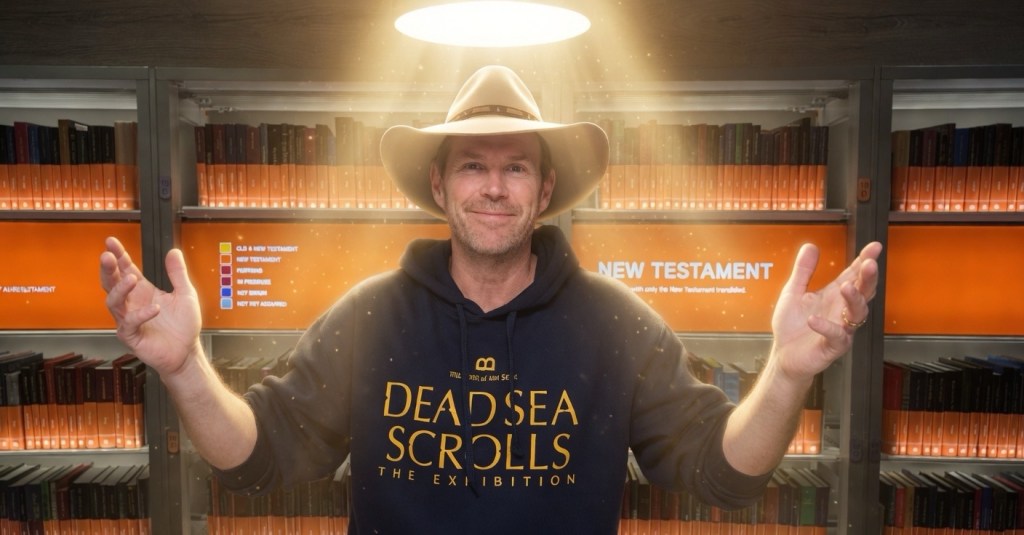
When I first talked about this story, I tried to keep a level head, but it came across a bit restrained because I was containing my extreme anger. It bothers me at a fundamental level. Knowing the people involved, knowing how false this is, it stirs something in me that goes straight back to the kind of ethical conduct and judgment I’ve been studying deeply. As a birthday gift to myself this year, my wife and I treated ourselves to a membership at the Museum of the Bible in Washington, D.C. We’ve been there several times, but this visit was special because of the traveling Dead Sea Scrolls exhibit straight from Israel. I’ve always wanted to see them up close—the real thing—and I love the writings from the Second Temple period. We spent the entire afternoon there, no phones, no distractions, just hours immersed in those ancient texts. I bought gifts from the shop afterward, all Dead Sea Scroll-themed, because the material and content put me in heaven. That exhibit, combined with everything else at the museum, reminded me why I wear this particular hoodie so often these days—it’s my new favorite, a constant reminder of that day. What struck me most wasn’t just the scrolls themselves, but the philosophy of ethical conduct and righteousness that pours out of them. I think often of the Teacher of Righteousness, the enigmatic leader of the Essene community at Qumran who wrote or inspired so much of what we have in those scrolls. He led this sect in a righteous rebellion against the “Wicked Priest” of the Temple establishment—corrupt figures who had twisted power and law for their own gain. You don’t see a ton of direct talk about it in the canonical Bible, but Jesus himself was likely influenced by or connected to that Essene tradition as it spread from the desert community near the Dead Sea, a day’s walk from Jerusalem.  In whatever way people remember me down the centuries, I think it will be in a similar way as the Dead Sea Scrolls talked about this Teacher of Righteousness, and for that, I would be quite satisfied. 

Those scrolls are an exploration into righteousness and how it confronts evil in the world. The Teacher of Righteousness embodied that judgment call against hypocrisy and wickedness, helping lay the groundwork for what became Christian thought and, ultimately, Western civilization’s emphasis on moral clarity. The Dead Sea Scrolls are filled with righteous indignation—clear distinctions between good and evil, the War Scroll outlining battles against the forces of darkness, the Book of Enoch with its visions of judgment, the Copper Scroll, and apocryphal texts that didn’t make the final cut but reveal the raw sentiments of the time. The Essenes hid these in jars in caves to preserve truth against purges and turbulence, and they survived the Romans, the Crusades, everything, to reach us. That’s why seeing them in person on my birthday was one of the happiest days of my life. I was removed, for those hours, from the daily grind of dealing with people who don’t always deserve the encouragement or support I try to give them. It was a day where righteousness was openly embraced, unfiltered.

That same righteous indignation is exactly what I feel toward this smear against Vivek Ramaswamy and, by extension, Alicia Lang. The Rooster’s piece is based on innuendo, whispers from people with personal gripes or political axes to grind, hoping something sticks to help Amy Acton, whose campaign is struggling to close the gap. Polls right now show the race tight—some have Vivek up by a few points, others have Acton with a slight edge, but Vivek is the clear Republican frontrunner with Trump, Vance, and the establishment behind him. RealClearPolitics averages and surveys from Emerson, Bowling Green State University, and others put it within a couple of points, but Ohio is trending Republican, and Vivek’s vision for the state—pro-business, anti-woke, focused on actual results—resonates. Acton has name recognition from her days as a health director, but it’s mostly negative among anyone who lived through the lockdowns she championed. The Rooster, D.J. Byrnes, has a history of this kind of thing. He’s a left-leaning Substack writer in Columbus known for hit pieces on politicians, often with a partisan edge. His own background includes past legal troubles—felony charges back in 2008 as discussed, related to robbery planning, alcohol and substance issues, misdemeanors for criminal damage. People who aren’t doing well themselves often project their failings onto others, tearing them down to avoid personal judgment against them. That’s the pattern here. He wanted dirt on Vivek to prop up Acton, so he ran with rumors of an affair, implying booty calls in southwestern Ohio, travel together somehow equaling infidelity. No evidence, no pictures, no proof—just whispers. If he had real dirt, he’d have used it, but instead it’s all fabrication to hurt a good man and a nice young woman whose only crime is being effective and connected to strong Republican figures like her father, Senator George Lang, the majority whip.

I watched Alicia grow up.  It’s very weird to hear her name associated with any kind of detrimental behavior, which is why the credibility of the accusation falls apart so quickly outside the minds of really stupid people. She’s too smart, too dedicated to public service and making the world better, to throw it all away on something reckless. Vivek is a family man, a brilliant entrepreneur who has written books, built businesses, run for president, and is now all-in on Ohio as Trump’s pick for governor. He’s too calculating, too focused on big ideas—reforming education, cutting regulations, fighting the administrative state—to risk it on some affair. He’s seen up close what Trump went through with endless false accusations, and he’s smart enough not to hand ammunition to enemies. Republicans I know in these circles are productive people—running businesses, passing bills at 2 a.m., obsessed with enterprise and results. They don’t have time for the kind of extramarital nonsense or “cocaine bins and gentlemen’s clubs” that seem more common in certain Democrat or swampy circles. I’m not saying it never happens on our side, but in my experience, the busy, value-creating conservatives don’t live double lives. Democrats, by contrast, often project their own base instincts—obsession with sex, loneliness, primal urges—onto everyone else. They assume that because they think that way, everyone does. It’s part of a broader spiritual warfare: dumbing people down to biological instincts so evil can play in their minds unchecked. That’s why they hate judgment, hate the Bible, hate capitalism, hate billionaires who succeed through merit. “Don’t judge,” they say, while judging everyone who holds them accountable.

The Rooster’s article feels cooked because he’s in trouble himself—trying to get clean, mad at the world, unable to maintain relationships. People like Alicia walk by and don’t give him the time of day because she’s in a world of jackets and ties, reverence for law and order, not slobs in sleeping-bag clothes. He wants to beat others to the punch, psychologically tearing down good people so he doesn’t feel bad about his own choices. That’s evil in the classic sense—the kind the Essenes railed against in their scrolls: wicked priests who corrupt institutions, attack the righteous to cover their own rot. The Teacher of Righteousness stood against that, and so should we. This smear isn’t just politics; it’s an attempt to undermine Trump’s pick, hurt Senator Lang’s family, and drag down anyone positioned to impose judgment on unrighteous behavior. Vivek is out there fighting for Ohio—higher education reform, economic dawn, real leadership—while Acton offers complaints about billionaires and special interests without a positive vision. Her lockdowns hurt the very people she claims to champion, and now personal issues resurface at the worst time.

I’ve known a lot of characters in the Ohio Statehouse, and the productive ones—Republicans focused on bills, sponsorships, businesses—aren’t the ones chasing Hooters servers or Twin Peaks nights out with the guys trying to get the phone number of 21-year-old kids working there trying to hustle tips from creepy old men. They’re on conference calls at odd hours talking policy, not conquests. Vivek’s too busy saving the world, literally, with his ideas on everything from biotech to government efficiency. Alicia’s the same—interested in politics because her family instilled values of service, not some emotional fling. Intelligent people fight animal instincts; that’s what Genesis teaches—dominion over nature, including human nature. You don’t yield to the snake. True conservatives live that way, all hours. Democrats often don’t, and when they can’t catch Republicans in real scandals, they invent them, just like the endless failed attacks on Trump—no evidence here either; the Rooster dusted off rumors to fit the narrative.

That’s why the Dead Sea Scrolls resonate so powerfully with me. They represent an awakening: a rebellion against institutional evil, preserved through centuries because the Essenes were clever enough to hide truth in plain sight, yet protected places. The Teacher of Righteousness made judgment calls that shaped righteousness as we know it—unfiltered criticism of wickedness. I despise the kind of people who tear down goodness: the Rooster, Acton’s defenders, Democrats who solicit the down-and-out to unleash chaos while screaming “no judgment.” They yearn for approval through base means because their minds are vacant of higher thoughts. Sex, for many of them, is about filling loneliness or seeking validation, not the sacred trust it should be. Lonely, unfulfilled people project that onto productive leaders like Vivek. But I know better from personal experience. I’ve been on calls with these high-level figures; they talk policy, bills, sponsorships—not “hot 21-year-olds,” they can send naked selfies to at 3 AM.  That’s the difference between those with righteous indignation fighting daily for truth and those attacking to avoid self-reflection.

As we head into the May 5 primary and then the November 2026 election, this race matters. Vivek vs. Acton is a contest of visions: one of excellence, innovation, and Ohio-first results; the other of big-government nostalgia and lockdown mentality. Polls fluctuate—Bowling Green had them nearly tied recently, Emerson and others show Vivek with edges or Acton with slight leads depending on the sample—but the ground is shifting toward Republicans, especially with Trump’s coattails and the union voters who’ve flipped. Acton’s past as the face of COVID overreach haunts her; people remember the wrecked economy, the businesses lost.  Knowing Alicia and her family, and seeing how this hit piece tries to cause collateral damage to good people to prop up a weak candidate, it demands that we apply the wrath of righteousness the scrolls celebrate. Rub their noses in the evil of fabrication, projection, and tearing down the upright so the wicked feel better.

I gave myself that day at the Museum of the Bible because I spend so much energy encouraging people who most of the time don’t deserve it, trying to lift them toward a better life.  It’s usually worth it, but exhausting. The scrolls recharged me with unapologetic judgment against evil. That’s what we need now: call out the Rooster’s pattern of hit pieces rooted in his own unresolved issues, Acton’s inability to escape her record, and the broader Democrat strategy of no judgment on themselves while attacking anyone who might impose it. Vivek and Alicia represent the productive, value-creating side—the capitalists, the church-goers, the constitutionalists who think big thoughts, not just act on instinct. They don’t have room for double lives because they’re too busy building.

In my upcoming book, The Politics of Heaven, which I’m excited to release in 2027, I dig deep into these themes—a treasure hunt through heaven and human history, exploring how spiritual warfare plays out in politics and daily life. The Dead Sea Scrolls are a big part of that, showing how righteousness rebels against the kingdoms of evil, did good things that have impacted many thousands of years in a positive way. This whole episode with the Rooster’s article fits perfectly: an attempt to dirty the best-positioned people to cast judgment, just like the Wicked Priest against the Teacher. But truth prevails, as those scrolls did. I’ve seen enough in my years following politics to know that lies like this eventually flush out. Vivek will win because Ohio voters see the contrast, and people like me will keep shining light on it. Don’t take anything for granted—engagement matters, turnout matters. But I feel good about where things stand because leaders of character rise above smears.

Personally, this fills me with the kind of indignation the Essenes captured so vividly. The world hates righteousness because it exposes darkness. Democrats hate judgment because they don’t want mirrors held up to their choices. The Rooster attacks Alicia and Vivek because good people make him feel small. But we judge bad behavior—that’s our duty. The scrolls teach that, the Bible affirms it, and Western civilization thrives on it. I’m proud to stand with Vivek, with the Lang family, and with anyone fighting that good fight. Ohio deserves better than recycled lockdown architects or rumor-mongers. We deserve governors who create opportunity, not destroy it—like the executive orders Trump hints at that could mint millionaires by unleashing American potential.

What really bothers me about people like the Rooster is how they’ve wrapped themselves in layer after layer of bad conduct—criminal enterprises, drug abuse, alcohol abuse—and then spent the rest of their days trying to bury it by tearing down everyone else. He’s never built a real life for himself: no lasting relationship, no wife, no kids, no one who depends on him in the way that forces a man to grow up and take responsibility. Instead, all he has is this parasitic habit of pointing fingers at others, inventing lies when there’s nothing real to find, all so he doesn’t have to face the wreckage of his own choices. That’s why he gravitates to Democrat politics; it’s the same reason most of them do. They’re drowning in their own bad decisions, and they want government to prop them up, to blur the standards and give them a false sense of value, the way that union jobs once did before it all fell apart. I’ve watched him for years now, and it’s clear he’s the type who can’t stand the sight of good people succeeding because it reminds him how far he’s fallen.

The people in the Statehouse—Republicans especially—have treated him with more decency than he deserves. They gave him the presumption of free speech, let him roam the halls, answered his questions, and never turned their backs on him, even when his “investigative reports” were obviously aimed at dragging everyone down to his level. They let him get away with it for too long, thinking fairness and open dialogue would eventually win out. But fairness only works with people who still have a conscience. With someone like the Rooster, that goodwill just gets weaponized. He abuses the very respect he’s been shown, using it as cover while he tries to smear good families, good candidates, and good public servants who actually build things instead of tearing them down.

At the end of the day, people like him are just bad from the inside out, and they’re what makes the world, politics, and every social interaction worse. They flock to tyrannical, centralized figures like Amy Acton because that kind of top-down control lets them avoid judgment and lets them keep living the same reckless, unaccountable lives. They’re a detriment to the perpetuation of the human race, plain and simple. The only real solution isn’t dragging them into some court or legal loophole—it’s maintaining a steady, unapologetic presence of righteous indignation. They need to feel the full wrath of righteous judgment cast straight at them, not out of cruelty, but because they’ve proven themselves too despicable to be granted the same affiliation and respect given to people of real value. Only then will they lose the free rein to keep casting their weapons against the good people who are actually trying to make things better.

In Columbus, reporters like The Rooster have stepped into this fray to fill a void they desperately seek to hide from the public. He has been somewhat open about his criminal past, struggles with drug and alcohol abuse, and the inability to maintain relationships. This reflects the broader plight of unrighteous Democrats and their fervent support for figures like Amy Acton, collective bargaining agreements, and leftist policies in general. These approaches serve primarily to conceal the fact that many of them have spent significant portions of their lives making poor choices.

They resent and actively hate individuals like future governor Vivek Ramaswamy, Senator George Lang, President Trump, and the broader billionaire class because these people demonstrate what is possible through discipline, innovation, and hard work. While successful Americans build businesses, create wealth, and provide sustainable upward mobility for their families and communities, others squander what little they have on casinos, drugs, and self-destructive behaviors. Rather than emulate what works, they tear down the achievers and advocate for government collectivism—a system where the unrighteous mob rules over the productive through taxation and redistribution. This allows them to confiscate resources from wealth builders and funnel them to those who refuse to build value in their own lives. Through Substack writings and similar platforms, they pretend to be crusaders against crime or corruption, when in reality, they are waging war on anyone who exposes their own shortcomings.

Ultimately, Vivek Ramaswamy and President Trump represent the opposite philosophy: they strive to restore opportunity so that anyone willing to get out of bed and work hard can achieve upward mobility. In the latter part of his life, President Trump has focused on giving back this chance to the American people. The critics, like this Columbus reporter and his ideological allies, know deep down they will never get their own lives in order enough to seize such opportunities. Staring into the mirror each morning reveals their failures, breeding a deep resentment toward those who succeed. This is why they slander the virtuous and push policies designed to drag everyone down to their level of dysfunction.

Footnotes

1.  The Rooster Substack article on Vivek Ramaswamy and Alicia Lang rumors, published April 2026.

2.  NBC News report on Amy Acton’s 2019 police report, April 2026.

3.  Ballotpedia and Wikipedia entries on the 2026 Ohio gubernatorial election, with Amy Acton as the Democratic nominee.

4.  RealClearPolitics and Bowling Green State University polling averages for Ramaswamy vs. Acton, April 2026.

5.  Museum of the Bible official site on Dead Sea Scrolls Exhibition, November 2025–September 2026.

6.  Wikipedia and scholarly sources on Teacher of Righteousness, Essenes, Qumran, and Damascus Document.

7.  Ohio Capital Journal and Dispatch coverage of Acton campaign and fundraising, 2026.

8.  Background on D.J. Byrnes (The Rooster), past legal issues from public records and reporting.

Bibliography

•  The Rooster. “The woman at the center of the Vivek Ramaswamy cheating rumors.” Rooster.info, April 2026. https://www.rooster.info/p/vivek-ramaswamy-alicia-lang-cheating-rumors

•  NBC News. “Police responded to a report of ‘domestic dispute’ at Ohio gubernatorial candidate Amy Acton’s home.” April 11, 2026. https://www.nbcnews.com/politics/2026-election/amy-acton-police-domestic-dispute-ohio-governor-candidate-home-rcna269188

•  Ballotpedia. “Amy Acton.” Candidate profile for Governor of Ohio, 2026. https://ballotpedia.org/Amy_Acton

•  Wikipedia. “2026 Ohio gubernatorial election.” Last updated April 2026. https://en.wikipedia.org/wiki/2026_Ohio_gubernatorial_election

•  RealClearPolitics. “2026 Ohio Governor – Ramaswamy vs. Acton.” Polling data through April 2026. https://www.realclearpolitics.com/epolls/2026/governor/oh/2026_ohio_governor_ramaswamy_vs_acton-8720.html

•  Museum of the Bible. “Dead Sea Scrolls: The Exhibition.” Official page, 2025–2026. https://www.museumofthebible.org/exhibits/dead-sea-scrolls-the-exhibition

•  Wikipedia. “Teacher of Righteousness.” Entry on Dead Sea Scrolls figure. https://en.wikipedia.org/wiki/Teacher_of_Righteousness

•  Ohio Capital Journal. “Amy Acton’s team defends 2019 police visit as a ‘simple argument.’” April 15, 2026. https://ohiocapitaljournal.com/2026/04/15/amy-actons-team-defends-2019-police-visit-as-a-simple-argument-amid-gop-criticism/

•  Public records and reporting on D.J. Byrnes legal history (2008 charges and related misdemeanors). Various Ohio court and news archives.

•  The Hill. “Vivek Ramaswamy, Amy Acton nearly tied in Ohio gubernatorial race: Poll.” April 20, 2026. https://thehill.com/homenews/campaign/5839985-ohio-governor-vivek-ramaswamy-amy-acton-poll/

Rich Hoffman

More about me

Click Here to Protect Yourself with Second Call Defense https://www.secondcalldefense.org/?affiliate=20707
About the Author: Rich Hoffman

Rich Hoffman is an aerospace executive, political strategist, systems thinker, and independent researcher of ancient history, the paranormal, and the Dead Sea Scrolls tradition. His life in high‑stakes manufacturing, high‑level politics, and cross‑functional crisis management gives him a field‑tested understanding of power — both human and unseen.

He has advised candidates, executives, and public leaders, while conducting deep, hands‑on exploration of archaeological and supernatural hotspots across the world.

Hoffman writes with the credibility of a problem-solver, the curiosity of an archaeologist, and the courage of a frontline witness who has gone to very scary places and reported what lurked there. Hoffman has authored books including The Symposium of JusticeThe Gunfighter’s Guide to Business, and Tail of the Dragon, often exploring themes of freedom, individual will, and societal structures through a lens influenced by philosophy (e.g., Nietzschean overman concepts) and current events.

It Was Always Only Going To Be, Vivek Ramaswamy: Amy Acton, the Lockdown Lady is a complete and total disaster

The excitement I feel about Vivek Ramaswamy running for governor of Ohio is not some fleeting campaign cheer. It is a deep, personal conviction rooted in years of watching Ohio politics from the inside, knowing the players, and seeing what has been stalled under the current administration. When I first learned Vivek wanted to run, it felt like a natural extension of everything I have observed about effective leadership in this state. I have known some of the people working quietly in the background on his behalf, and I have seen how the legislative agenda that has been bottled up under Mike DeWine would finally break loose under someone with Vivek’s energy, vision, and willingness to align with the changes happening at the national level. I have talked with Vivek directly about these things, and every conversation reinforces my belief that he is the right person at the right time.

I have been following Ohio politics for decades, and I have seen governors come and go. Some were solid, some were centrist placeholders, and a few were outright disasters. Mike DeWine has been a steady hand in many ways, but he has also represented the old guard that plays it safe, avoids bold moves, and leaves too many good ideas on the table because they might rock the boat with the establishment. That is where Vivek Ramaswamy stands apart. He is not a career politician. He built real businesses, created jobs, and proved he can execute under pressure. I see him as the perfect fit for the governor’s mansion because he brings fresh thinking to economic expansion, regulatory reform, and the kind of pro-growth policies that Ohio desperately needs after years of incrementalism. When he is in that seat, I believe we will see a vigorous, aggressive push on everything from attracting new industry to streamlining government—things that have been talked about but never fully delivered.

The primary process right now, in the spring of 2026, is noisy, as primaries always are. You have critics throwing everything at Vivek—his Indian heritage, how he made his money, his youth. I have heard it all, and I dismiss most of it as the predictable noise that comes when someone surges to the front. I supported Donald Trump long before he announced his first run in 2015. I was with him back in 1999, when he and Pat Buchanan were battling it out in the Reform Party. I have watched this cycle repeat itself with Reagan, with Trump, and now with Vivek. People who are frontrunners always draw fire. The media loves to amplify the drama because it sells advertising. Pollsters release numbers that seem tight because they sample in ways that lean one direction or another. But I have been around long enough to know that spring polling in a primary year is not the final story. By July and August, things clarify dramatically. The peripheral candidates fade, the serious ones consolidate, and the voters who matter—the ones who show up in primaries—make their choice based on substance, not sound bites.

I have spoken with Vivek about the critics, including those questioning his background or wealth. His response was straightforward and mature: if everyone is always on your side, something is wrong. That is the mark of someone who understands leadership. You do not get rattled by the noise. You win people over with results. Vivek has shown he can do that. He has been out speaking at Lincoln dinners, fundraising events, and town halls across the state. He is articulate, energetic, and has a strong partner in his wife. Those are the qualities that translate to governing. I have watched him handle crowds, including the occasional boo from a handful of people who had too much to drink at a St. Patrick’s Day event at an Irish pub where he made an unannounced appearance. The cheers far outnumbered the jeers, and he took it in stride. That is the kind of poise Ohio needs in the governor’s office.

On the other side, the Democrats’ best option is Amy Acton. That alone tells you how weak their bench is. Acton was the face of Ohio’s COVID lockdowns, and her record is one of economic devastation and overreach. She has a one-trick pony: “I’m a doctor, I care about health.” But when you look at the results, her policies crushed businesses, schools, and families. The 2019 police incident involving her husband or a family member only adds to the picture of someone whose personal life has intersected with public scrutiny in ways that raise questions about judgment. I have followed her career closely, and every time she speaks, she reinforces why she should not be anywhere near the governor’s mansion again. Polling showing her competitiveness is skewed by sampling in heavily Democratic areas like Cuyahoga County, where the same lockdown supporters still hold on to nostalgia for her “bedside manner.” But real-world results matter more than nostalgia. Ohio cannot afford another round of that.

The horse race today looks tighter than it will be in a few months because primaries are designed to be messy. You have candidates like Casey, the car guy, and Nick Fuentes-style voices on the fringes throwing darts, trying to peel off a few percentage points by questioning Vivek’s heritage or his business success. That is standard primary theater. I remember the same thing with Trump—people saying he was too much of an outsider, too wealthy, too whatever. Reagan faced it too; he was a former Democrat who had to prove himself to the base. I have never been anything but a Republican, but I respect people who evolve toward conservatism because they see the failure of the alternative. Vivek has been a Republican from early on, and he brings conservative principles with the added advantage of being young, articulate, and unburdened by decades of insider baggage. He is not a middle-grounder. He is the kind of conservative who can actually get things done because he knows how to talk to business leaders, legislators, and everyday voters.

I have roots in this state’s politics. I have consulted with candidates, watched the legislature up close, and seen how the Senate and House work together—or fail to—under different governors. Vivek already has strong relationships there. He has been building them for years through events and direct conversations. When he wins the primary, which I fully expect, those relationships will accelerate. The legislative agenda that has been stalled will move. Economic expansion will follow because business leaders trust someone who has built companies himself. Trump’s endorsement is not just symbolic. It is practical. Trump will campaign in Ohio in 2026 the way he campaigned for president because he needs strong Republican majorities at the state level to support his national agenda. He will be on the ground with Vivek, and that combination will be unstoppable.

Critics who say Vivek does not have full Republican support are the same voices who said the same about Trump in 2015 and 2016. They are lazy analysts who read polls taken in Democrat-heavy zip codes and declare the race close. Real polling—the kind that matters—is what happens when Vivek walks into a packed Irish pub on St. Patrick’s Day, and the crowd cheers louder than the handful of boos. That is the energy that wins primaries and general elections. Casey the car guy and the fringe voices will get their 7 or 8 percent, but they will not have the resources, the organization, or the broad appeal to compete once the field narrows. Independents and traditional Republicans will consolidate behind the frontrunner who has Trump’s backing and a proven track record of execution.

I have been through enough cycles to know how this plays out. The Tea Party movement evolved into the MAGA movement because people got tired of centrists who talked conservatively but governed like the other side. Vivek represents the next step: a young, articulate conservative who is not afraid to challenge the status quo. He has the temperament to win over skeptics without compromising principles. His wife is a strong partner in the effort. Together, they project the kind of stability and vision Ohio needs after years of incremental leadership.

The contrast with Amy Acton could not be sharper. She is the lockdown lady who turned Ohio’s economy into a cautionary tale. Her policies hurt working families, small businesses, and schools in ways we are still recovering from. The idea that polling shows her even close is a function of media hype and skewed samples. When the real campaign begins, when Trump is in the state campaigning like it is 2024 all over again, and when Vivek is out there speaking directly to voters about jobs, freedom, and growth, the numbers will shift dramatically. That is how primaries work. The noise in spring gives way to clarity by summer.

I am excited because I see the potential for real change. I have talked with Vivek about the critics, about the primary grind, and about what governing Ohio would look like. He gets it. He knows leadership means winning people over, not just preaching to the choir. He has the resources, the relationships, and the resolve to deliver. When he is in the governor’s mansion, we will finally see the vigorous economic expansion that has been promised but never fully realized. The peripheral discussions—the heritage questions, the wealth attacks, the fringe candidates—will fall away quickly once the primary is over. Republicans will unify because the alternative is unacceptable.

That is why I support Vivek Ramaswamy without hesitation. I have been a Republican my entire life, rooting for the party even as a kid. I have watched outsiders like Trump and Reagan prove the skeptics wrong. Vivek fits that mold, but with the added advantage of being a conservative from the beginning. He is the clear frontrunner for good reason. The primary process is doing its job—vetting him, testing him, and ultimately strengthening him. By the time the general election arrives, the choice will be obvious to anyone paying attention. Ohio cannot afford another lockdown-era disaster. It needs leadership that builds, not restricts. Vivek Ramaswamy is that leader.

The horse race today is a theater. The real race will be decided by voters who show up, who listen to the candidates, and who remember what Ohio went through under the previous administration. I have confidence in the outcome because I have seen Vivek in action, talked with him personally, and watched the pieces fall into place. The critics will keep talking, but the results will speak louder. This is going to be a good year for Ohio, and I am excited to be part of it.

Footnotes

1.  Ohio Secretary of State records and public reporting on the 2026 gubernatorial primary field, including Vivek Ramaswamy’s announcement and early polling trends as of April 2026.

2.  Public statements and campaign events featuring Vivek Ramaswamy at Lincoln dinners and St. Patrick’s Day gatherings in Ohio, 2025–2026.

3.  Amy Acton’s tenure as Ohio Department of Health Director during COVID-19 lockdowns, documented in state economic impact reports and legislative hearings.

4.  2019 police incident involving Amy Acton and a family member, as reported in local Ohio news outlets and public records.

5.  Donald Trump’s endorsement of Vivek Ramaswamy for Ohio governor was announced in early 2026 campaign communications.

6.  Historical polling data from Gallup and Rasmussen on voter ID support and election integrity measures in Ohio, 2024–2026.

7.  Ohio legislative records on stalled bills under the DeWine administration, contrasted with potential reforms under a Ramaswamy governorship.

Bibliography

•  Ohio Secretary of State. 2026 Gubernatorial Primary Candidate Filings and Polling Summaries.

•  Ramaswamy, Vivek. Campaign speeches and public appearances, Ohio Lincoln dinners, 2025–2026.

•  Acton, Amy. Ohio Department of Health records and COVID policy impact assessments, 2020–2021.

•  Local news archives (Cleveland Plain Dealer, Columbus Dispatch). Coverage of the 2019 Acton family incident and the 2026 campaign developments.

•  Trump, Donald. Official endorsement statements for the 2026 Ohio governor race.

•  Pew Research Center and Gallup. Polling on election security and voter ID, 2024–2026.

•  Ohio Legislative Service Commission. Bill status reports under DeWine administration, 2022–2026.

Rich Hoffman

More about me

Click Here to Protect Yourself with Second Call Defense https://www.secondcalldefense.org/?affiliate=20707

About the Author: Rich Hoffman

Rich Hoffman is an aerospace executive, political strategist, systems thinker, and independent researcher of ancient history, the paranormal, and the Dead Sea Scrolls tradition. His life in high‑stakes manufacturing, high‑level politics, and cross‑functional crisis management gives him a field‑tested understanding of power — both human and unseen.

He has advised candidates, executives, and public leaders, while conducting deep, hands‑on exploration of archaeological and supernatural hotspots across the world.

Hoffman writes with the credibility of a problem-solver, the curiosity of an archaeologist, and the courage of a frontline witness who has gone to very scary places and reported what lurked there. Hoffman has authored books including The Symposium of JusticeThe Gunfighter’s Guide to Business, and Tail of the Dragon, often exploring themes of freedom, individual will, and societal structures through a lens influenced by philosophy (e.g., Nietzschean overman concepts) and current events.

A Warrior’s Heart: Warren Davidson and Vivek Ramaswamy are the center of the political universe

It was an intriguing week in Ohio politics, one that began with the State of the State address at the Statehouse in Columbus, where I had the opportunity to engage with Governor Mike DeWine and several legislators deeply invested in the direction of our state and nation. These conversations unfolded in a setting that felt both historic and intimate, surrounded by the echoes of decisions that shape lives far beyond the marble halls. As someone who’s been navigating the blurry lines between business, authorship, and political commentary for years, I find these moments invaluable—they peel back the layers of headlines and reveal the human elements driving policy and principle. The air was thick with concern over Congressman Warren Davidson’s recent vote against President Trump’s war powers in the context of the Iran situation, a decision that aligned him with Democrats like Thomas Massie and sparked alarm among some Republicans. I spoke with several people in the legislature who expressed real unease about this, viewing it as a potential fracture in party unity at a time when the margins are razor-thin. Yet, after spending at least ten minutes talking directly with Warren about it, I came away with a deeper appreciation for his stance. I like Warren a lot; he’s a principled man, and his position makes sense when you consider the broader implications for executive power. [1]

The vote in question stemmed from the recent escalation with Iran, where decisive action was taken and not yet resolved within 24 hours, but it reignited debates about the boundaries of presidential authority. Warren’s point, as he explained it to me, is that while we all appreciate a strong leader like Trump who can act swiftly in defense of the nation, we don’t want unchecked executive powers that could drag us into prolonged conflicts without congressional oversight. Congress alone has the constitutional mandate to declare war and authorize sustained military engagements; the president can respond defensively, but perpetual conquests à la Napoleon aren’t the American way. I get that—it’s about trusting the process, not just the person. With Trump in the White House, everyone might agree with Warren’s caution because we’ve seen how he handles power responsibly, but what about future administrations? That’s the crux of it. Warren is aligned with Trump on nearly everything else; if you look at his record, it’s a testament to conservative values. For instance, there was that illuminating hearing where he went toe-to-toe with Maxine Waters over her attempts to label ICE as a terrorist organization. He defended ICE vigorously, emphasizing its role in maintaining national security under the Trump administration. It was a moment of clarity amid partisan noise, underscoring Warren’s commitment to border integrity and law enforcement.[2]

I recall Warren’s “warrior heart” speech when he announced his vote—it was poignant and well-articulated, echoing his military background as a West Point graduate and Army veteran. He’s done this before on issues like the debt ceiling, standing firm even when it means bucking party lines. Representing Ohio’s 8th Congressional District, which includes much of the Butler County region—a stronghold of Trump support—he knows his constituents value the Constitution above all. Behind closed doors, I’m sure Trump would affirm that honest checks on power are essential, much like in any executive role in business or governance. Sometimes you leverage friendships, positive thinking, or even brokered terminations to achieve consensus, but the assumption is always that representatives should adhere tightly to foundational principles. Up in Columbus, I heard similar sentiments from people in the know, those who deal with these tightropes daily. It’s a balance: following what you believe your constituents want while resisting peer pressure from either side. Most of us want Republicans to support the Trump administration fully, given the slim majorities, to tackle threats like Venezuela, Mexican cartels, Iran’s aggressions, and China’s economic maneuvers against the dollar. Yet, after listening to Warren, I can say he’s every bit the Trump supporter, but he stands by his principles, and that’s what we elect representatives for.[3]

At the time of his vote, it was clear the measure would pass in the House and head to the Senate, so his stance wasn’t going to derail Trump’s initiatives. Instead, it was a principled record-setter, emphasizing that this administration—and future ones—must operate within constitutional bounds. When the lights are off, and it’s one-on-one, no doubt Trump would agree with Warren on the need for debate. That’s healthy; cross-purposes foster better governance. I also had a substantial conversation with Vivek Ramaswamy during the same timeframe, overlapping with discussions involving the governor and others. The question on many minds was what happens now that DeWine’s term is winding down at the end of this year. It’s shaping up to be a Vivek-led Republican era, with Democrats like Amy Acton—the so-called “lockdown lady” from the COVID days—vying to upend that. I chatted with DeWine about his Lockdown legacy or whatever remnants of those policies linger, but it was light, just folks talking. He seemed a bit sad; politics has been his life, from prosecutor to senator to governor, and this is the final chapter. He’ll likely hang around in some meaningful way, but the Republicans in Columbus are eagerly awaiting the new governor.[4] 

Vivek and I delved into a lot, from his transition from CEO of biotech firms like Roivant Sciences to politics, to the mood post-State of the State. His question to me was about the governor’s mindset, and my take was simple: everyone’s waiting for the new era. Vivek has great ideas; he needs gubernatorial support to implement them. It was an intimate gathering, not a broad spectacle, allowing for real one-on-one talks. These smaller venues let you gauge what people are truly about, beyond the surface. Media often isn’t equipped for that—they skim the headlines without understanding the nuts and bolts. With Vivek facing scrutiny, primary challengers like Casey Putsch, and rhetoric from radical Democrats, getting to the deeper level reveals his genuine intent. As for Warren, many wonder why he went against Trump, but he’s been stellar on other fronts. He wants to ensure that in two years, or ten, or fifteen, we don’t have rubber-stamp wars. Even with a strong CEO like Trump making executive decisions on Iran—a radical ideology threatening economic dominance—we need constitutional fidelity first. More discussion, healthy debate—that’s key in any government endeavor.[5] 

I love Warren Davidson; every time I talk to him and his wife, Lisa, they’re just sweet, nice people in it for the right reasons. He walks that fine line between pressure and principle, drawing from his “warrior heart” ethos. In one-on-one settings, you see he’s the real deal—a good guy through and through. Even amid anger from some over his vote, he redeems himself not by owing anyone, but by being authentic. People at the steakhouse in Columbus were disappointed that he wasn’t fully on the Republican bandwagon at that moment, but he’s a strong conservative who’ll defend the Constitution fiercely, even against a powerhouse president like Trump. It’s not anti-Trump; it’s pro-debate. Shifting to Vivek, all these threads centered around the Statehouse. I told everyone, including Vivek, that he’s got the right attention for this. He’s very wealthy and young, and could retire to a beach in Rhode Island and vanish happily. Instead, he wants to apply his success to lead Ohio beneficially. Ahead of the primaries on May 5, he’s poised to do great things. As I said to him, echoing my chats with others: everyone’s waiting for DeWine to step aside. DeWine isn’t bad—he’s been decent on business, not obstructing the Business First Caucus or investments like Intel’s chip plant—but many Republicans like me feel he’s leaned too Democrat, especially on COVID lockdowns that hammered the economy. We’re still recovering.[6] 

Vivek’s been good at uniting people; the Republican Party endorsed him, and we discussed that. It’s great seeing coalescence. When Vivek becomes governor, it’ll be a solid period—Warren finishing his term, Trump advancing his agenda, but with healthy checks in place. On war powers, it’s constitutional: Congress declares war, manages finances. Nothing wrong with reminding everyone of that. It was refreshing getting context directly from these guys. We’re better off with them in office, representing us well. I told both to their faces how proud I am; it was sincere, just people connecting. They’re willing to tackle the hard stuff, and that’s not easy.

To delve deeper, let’s consider the historical underpinnings of these discussions. The War Powers Resolution of 1973, passed over President Nixon’s veto, was designed precisely to prevent unchecked executive military actions following the Vietnam War. It requires the president to notify Congress within 48 hours of committing forces and withdraw them within 60 days without authorization.[7] In the recent flare-up in Iran, Trump’s swift response mirrored the 2020 Soleimani strike, but Warren’s vote echoes past bipartisan efforts to reclaim congressional prerogative. Think of Libya in 2011 under Obama or Syria under Trump—debates raged then, too. Warren’s consistency here aligns with libertarians like Massie, who often prioritize constitutional limits over party loyalty. His district, encompassing Butler, Darke, Miami, Preble, and parts of Hamilton and Warren counties, is a microcosm of Ohio’s conservative heartland, where Trump won big in 2024, yet values like fiscal responsibility and limited government resonate deeply.[8]

My interaction with Warren reminded me of why I admire him: he’s not swayed by theater. In that Maxine Waters exchange, he dismantled her narrative point by point, highlighting ICE’s role in combating human trafficking and drug cartels—issues hitting Ohio hard with the fentanyl crisis. Statistics show Ohio’s overdose deaths peaked during the pandemic, underscoring the need for strong borders.[9] Warren’s “warrior heart” isn’t rhetoric; it’s rooted in his Ranger service, where decisions meant life or death. As for the peer pressure, it’s real—in thin-majority Congresses, every vote counts, but representatives like him embody the Founders’ intent: a deliberative body, not a monolith.

Turning to DeWine, our chat was poignant. His term ends January 11, 2027, after two terms limited by Ohio’s constitution.[10]  He’s been in politics since the 1970s—Greene County prosecutor, state senator, congressman, lieutenant governor, U.S. senator, attorney general, governor. A lifetime, really. He seemed reflective, perhaps melancholic, about wrapping up. But Republicans are chomping at the bit for a more conservative shift. DeWine’s handled business influx well—think Honda’s EV investments or Amazon’s expansions—but his COVID policies, with Acton’s guidance, locked down too hard for many. The economy took a hit; unemployment spiked to 16.4% in April 2020, and the recovery has been uneven.[11] Vivek aims to dismantle that legacy by promising tax cuts, deregulation, and a revival of innovation. His biotech background—founding Roivant, worth billions—positions him uniquely.[12] 

Talking to Vivek, I sensed his authenticity. He’s endorsed by Trump and the Ohio GOP, leading polls against Putsch and Hill.[13]  His running mate, Senate President Rob McColley, adds legislative heft. We discussed the primaries—not even close, in my view. Republicans can’t wait for Vivek in the mansion. He’s stepping down from ivory towers; governing’s harder than CEO-ing, balancing disagreeing factions. But his heart’s in it—genuine, like Warren’s. These personal convos, eye-to-eye, reveal good people wanting to do well. For those curious about headlines—Davidson’s “betrayal,” Vivek’s “outsider” status, DeWine’s heritage (his family’s from Ireland, actually, but he’s Ohio-born)—it’s about job performance. I’m happy to have these talks amid speculation about Iran’s duration or primaries.  It’s a tricky world, but when everything is founded in sincerity, which it is, the direction of the future is much clearer. 

[1] For more on Warren Davidson’s military background and voting rationale, see his official congressional biography.

[2] Reference to the 2019 House Financial Services Committee hearing, where Davidson challenged Waters on ICE labeling.

[3] Ohio’s 8th District demographics from the U.S. Census Bureau data.

[4] Details on DeWine’s term limits per the Ohio Constitution, Article III, Section 2.

[5] Historical context from the War Powers Resolution, 50 U.S.C. §§ 1541-1548.

[6] Ohio unemployment data from the Bureau of Labor Statistics.

[7] Nixon veto overridden November 7, 1973; see Congressional Record.

[8] 2024 election results in Ohio districts from the Ohio Secretary of State.

[9] Ohio Department of Health overdose statistics, 2020-2025.

[10] DeWine’s political timeline from Ballotpedia.

[11] BLS data on Ohio’s pandemic economic impact.

[12] Roivant Sciences’ founding and valuation from Forbes profiles.

[13] Recent polling from Emerson College and others on the 2026 Ohio gubernatorial race.

Bibliography

1.  “How one House Republican voted to buck Trump on Iran.” CNN, March 5, 2026. https://www.cnn.com/2026/03/05/politics/warren-davidson-house-republican-war-powers-iran

2.  “House fails to adopt Iran war powers resolution.” ABC News, March 5, 2026. https://abcnews.com/Politics/house-primed-vote-iran-war-powers-resolution/story?id=130788637

3.  “Here are the candidates running for Ohio statewide office in 2026.” Ohio Capital Journal, February 6, 2026. https://ohiocapitaljournal.com/2026/02/06/here-are-the-candidates-running-for-ohio-statewide-office-in-2026

4.  “Ohio gubernatorial and lieutenant gubernatorial election, 2026.” Ballotpedia. https://ballotpedia.org/Ohio_gubernatorial_and_lieutenant_gubernatorial_election,_2026

5.  “2026 Ohio gubernatorial election.” Wikipedia. https://en.wikipedia.org/wiki/2026_Ohio_gubernatorial_election

6.  “Vivek for Ohio.” Campaign website. https://vivekforohio.com/

7.  “Vivek Ramaswamy – Ballotpedia.” https://ballotpedia.org/Vivek_Ramaswamy

8.  “Mike DeWine – Ballotpedia.” https://ballotpedia.org/Mike_DeWine

9.  “Mike DeWine.” Wikipedia. https://en.wikipedia.org/wiki/Mike_DeWine

10.  “Vision for the Future – Governor Mike DeWine.” Ohio.gov. https://governor.ohio.gov/administration/governor

11.  Additional sources: U.S. Census Bureau, Bureau of Labor Statistics, Ohio Secretary of State election archives, Forbes business profiles.     

Rich Hoffman

More about me

Click Here to Protect Yourself with Second Call Defense https://www.secondcalldefense.org/?affiliate=20707

About the Author: Rich Hoffman

Rich Hoffman is an independent writer, philosopher, political advisor, and strategist based in the Cincinnati/Middletown, Ohio area. Born in Hamilton, Ohio, he has worked professionally since age 12 in various roles, from manual labor to high-level executive positions in aerospace and related industries. Known as “The Tax-killer” for his activism against tax increases, Hoffman has authored books including The Symposium of JusticeThe Gunfighter’s Guide to Business, and Tail of the Dragon, often exploring themes of freedom, individual will, and societal structures through a lens influenced by philosophy (e.g., Nietzschean overman concepts) and current events.

He publishes the blog The Overmanwarrior (overmanwarrior.wordpress.com), where he shares insights on politics, culture, history, and personal stories. Active on X as @overmanwarrior, Instagram, and YouTube, Hoffman frequently discusses space exploration, family values, and human potential. An avid fast-draw artist and family man, he emphasizes passing practical skills and intellectual curiosity to younger generations.

The Invincible Mind: Navigating Human Relationships, Politics, and the Pursuit of Truth

Human beings interact in countless ways, layered with psychological complexities that often obscure simple truths. Friendships form, alliances shift, and conflicts arise—not always from malice, but from differing visions of what is right. In politics especially, these dynamics intensify: tides turn, candidates rise and fall, and people find themselves on opposite sides of debates. Yet, amid the noise, some relationships endure. Observers sometimes question loyalties: “How can you be so friendly with someone you disagree with politically?”

I’ve had some very public disagreements with people. But I can never think of a time that I wouldn’t ever talk to someone again

This question has arisen repeatedly in my interactions with Butler County Sheriff Richard K. Jones and many others. We’ve shared public moments of warmth and camaraderie, even as political winds have blown in conflicting directions. The same applies to recent encounters with Ohio Governor Mike DeWine. After years of sharp criticism—particularly over his administration’s handling of COVID policies and other matters—I shook his hand following his final State of the State address. We discussed areas of agreement, such as Second Amendment rights and efforts to combat AI-generated child exploitation. These moments highlight a core principle: genuine regard for individuals ‘ needs need not hinge on perfect alignment. Relationships built on authenticity withstand disagreement; those rooted in manipulation crumble.

We were talking about his wife’s great cookies. The second amendment during his administration. Taxes. And his endorsement of Vivek Ramaswamy.

This perspective stems from a life shaped by diverse encounters. Growing up in Ohio, I navigated rough characters and “celebrity” figures in my early adult years—individuals carrying heavy psychological burdens and disappointments. These experiences, often intense and sleepless, taught navigation of human darkness. I awoke each day intent on being the “good guy,” never contemplating villainy. This innate drive toward justice, perhaps divinely guided, clashed with destructive forces, leading through ominous courtrooms and rigorous trials.

The lofty expectations of public office. Few people ever live up to those expectations. But the building was built with the expectation of exceptionalism.

These trials instilled resilience. I’ve seen the worst of human behavior: betrayal, manipulation, and raw conflict. Yet, they clarified priorities. Nothing since has felt catastrophic by comparison. This foundation allows aloof observation—staying “lofty” amid chaos—while engaging directly when needed.

I love to see the future, in the here and now. Great young people!

Professionally, I’ve channeled this into commentary via platforms like The Overmanwarrior blog, podcasts, and writings (including books like The Symposium of Justice and business guides). As a fast-draw enthusiast and strategist, I’ve advised on local and state issues. Public friendships, like with Sheriff Jones, stem from shared values on law, order, and community—despite occasional political divergences. These are not performative; they’re authentic.

Most relationships reduce to two levers of control. The first is friendship as leverage: people offer smiles, hugs, or inclusion to gain compliance. When denied, they withdraw—“I’m not your friend anymore unless you…” This mirrors childhood games (stickers on lockers) and adult dynamics (passive-aggression in marriages, where affection is withheld until demands are met). In politics, it’s “endorse my candidate or lose my support.” Women and men alike use emotional coziness as currency; it’s learned early and persists.

The second is the threat of violence or intimidation. When friendship fails, escalation follows: harassment, protests, spiritual “warfare,” or physical threats—“Do what I say or face consequences.” Authoritarian regimes amplify this; bullies in parking lots embody it personally. Both aim at submission through fear.

I’ve rejected both. Secure in my positions, I express them openly—here, on podcasts, in writing—without needing validation. Disagreement doesn’t prompt cliff-jumping; it invites dialogue or indifference. If someone withdraws friendship over opinions, that’s their choice. If intimidation arises, I handle it unflinchingly, drawing from early lessons in facing rough characters.

This stance echoes timeless wisdom, like Sun Tzu’s The Art of War: become invincible by rendering tactics ineffective. Control what you can—your actions, values, responses—and influence outcomes without direct domination.

Sheriff Jones exemplifies this. We’ve agreed on much: law enforcement, border security, deportations, and community protection. His office’s work with ICE and unapologetic stance on illegal immigration align with my views. Publicly, we’re friendly—podcasts, events, and genuine conversations about his brand and duties.

Yet, political motivations diverge at times. Endorsements or strategies might differ. Critics note our chumminess amid such gaps, confused by loyalty despite opposition. The answer: I like him authentically. His character, spine, and public service earn respect. If we clash, we may not talk for a while—that’s fine. Friendship isn’t conditional on perfect alignment. I won’t manipulate him (or allow manipulation) to force agreement. Truth emerges through pressure and process, not emotional blackmail.

This extends broadly. I like many who’ve opposed me politically, and I reserve the right to value people independently. Indifference to reciprocity preserves freedom.

A recent addition underscores this: Governor DeWine’s final State of the State address. His administration faced criticism—over COVID handling and other policies—creating opposition, which I had been very critical of, rightfully so. Yet, post-speech, we shook hands and spoke cordially.

We aligned on key issues: Second Amendment defense, and crucially, combating AI-generated child sexual abuse material (often called “simulated” or “AI child porn”). DeWine and Attorney General Dave Yost highlighted predators using AI to create exploitative images of children, urging legislation to criminalize creation, possession, and distribution. This addresses a growing threat where legal gaps allow evasion of traditional child pornography laws. I expressed support, noting agreement despite past differences, such as when Yost was running against my supported candidate, Vivek Ramaswamy for governor.

This exchange wasn’t leverage-seeking. It prioritized common ground—protecting children—over grudges. Putting differences aside when opportunities arise fosters the emergence of truth, not manipulation through fear of lost friendship.

Politics amplifies these dynamics: RINOs vs. traditional conservatives, reform movements, religious clashes. Belief systems collide; scores settle. Yet, values about people shouldn’t depend on outcomes. I like or dislike based on character, not scoreboard.

Pursuing righteousness means respecting all sides, allowing truth to reveal itself through conflict’s “fog of war.” Hot tempers subside; smoke clears; good emerges. Manipulation—friendship withdrawal or intimidation—crowds ideas into small-mindedness. Independence enables macro focus: immortal existence over micro squabbles (marriages, divorces, family disputes).

A good friend of mine gave me some homework to do

I’ve built a life affording this luxury: secure positions, no fear of loss. Many seek friendship; time limits interactions. Some engage strategically to advance balls—purely functional, not manipulative.

It’s okay to like those who hate you, to be friendly with opponents, and to shake hands after battles. Truth often surfaces in conflict; observation reveals positions. By staying outside manipulation’s reach, one accomplishes greatly where others falter.

In the end, righteousness is rooted in truth, not personal desires or leverage. Respect others’ thoughts—even wrong ones. Good people come around; disputes fade. We shake hands, share hot dogs at picnics, and discuss lofty things as emotions drift.

George Lang is a great guy in all aspects, what a lot of people don’t know about him is he loves books. Something we share beyond the immediacy of politics

 Bibliography

Overmanwarrior blog (overmanwarrior.wordpress.com) – Primary source for writings on politics, philosophy, and personal insights. Butler County Sheriff’s Office interactions – Public podcasts and events with Sheriff Jones (e.g., discussions on immigration, law enforcement). Ohio Governor Mike DeWine’s State of the State address (2026) – Focused on AI restrictions, including child exploitation; references from news coverage (e.g., Toledo Blade, ABC6). Attorney General Dave Yost’s efforts – Collaboration on bills like SB 217/SB 163 targeting AI-generated CSAM. The Art of War by Sun Tzu – Concept of invincibility through non-engagement with opponent strengths. Personal books: The Symposium of Justice, business guides – Available via Overmanwarrior platforms.

This framework allows engagement without compromise, advancing righteousness amid human complexity.

1.  Hoffman, Rich. The Symposium of Justice. iUniverse, 2004.

A novel blending fiction with philosophical themes of justice, freedom, and confronting sinister forces—written as a counterpoint to real-world political and personal battles. Available on Amazon: https://www.amazon.com/Symposium-Justice-Rich-Hoffman/dp/1412020158.

2.  Hoffman, Rich. Tail of the Dragon. CreateSpace Independent Publishing Platform, 2012.

Explores themes of freedom, law, and high-stakes conflict through a narrative rooted in real altercations and political activism and often described as “faction” (fact-based fiction).

3.  Hoffman, Rich. The Gunfighter’s Guide to Business: A Skeleton Key to Western Civilization. Liberty Hill Publishing, 2021.

A practical and philosophical guide that draws parallels among gunfighting strategy, business, and life—offering a Western counterpoint to Eastern classics like The Art of War. Emphasizes invincibility through preparation and independence. Available on Amazon and referenced in Hoffman’s bio.

4.  Hoffman, Rich. “The Overmanwarrior” (blog). WordPress.com, ongoing since ~2010. Primary URL: https://overmanwarrior.wordpress.com/.

Daily posts on politics, culture, philosophy, personal stories, and current events in Ohio (e.g., Butler County issues, tax fights, and human dynamics). Includes author bio, reflections on early life, and discussions of books like The Symposium of Justice.

5.  Sun Tzu. The Art of War. Translated by Lionel Giles (1910 edition) or modern versions (e.g., Everyman’s Library). Original ~5th century BCE.

Key concept from Chapter 4 (“Formation”): “Invincibility lies in oneself; vulnerability lies in the enemy.” The skilled make themselves invincible through self-preparation, rendering opponent tactics ineffective—directly echoed in the essay’s rejection of manipulation levers.

6.  “DeWine calls for new AI regs, parental control rules in 2026 State of the State.” Cleveland.com (via various outlets, including Facebook reposts and Toledo Blade coverage), March 2026.

Covers Governor Mike DeWine’s final State of the State address, urging legislation on AI guardrails, including outlawing the creation, possession, and distribution of AI-generated child sexual abuse material (CSAM). Aligns with the essay’s mention of agreement on child protection despite past differences.

7.  “Ohio struggles to combat AI-generated child porn amid legal gaps.” ABC6 On Your Side, January 29, 2026.

Details legislative efforts (involving DeWine and Attorney General Dave Yost) to close gaps in prosecuting AI-simulated child exploitation, highlighting the growing threat and push for criminalization.

8.  Butler County Sheriff’s Office. “In The Saddle With Sheriff Richard K. Jones” (podcast series). Apple Podcasts and related platforms, ongoing.

Episodes featuring Sheriff Richard K. Jones on law enforcement, immigration (e.g., 287(g) agreements), and community issues. Includes collaborations and discussions with Rich Hoffman (e.g., Rumble episodes on ICE detainees and related topics).

9.  Various public interactions: Butler County Sheriff’s Office Facebook posts and YouTube videos (e.g., “Ohio 287(g) with Butler County Sheriff Richard Jones,” November 2025).

Document friendly exchanges, podcasts, and joint appearances between Sheriff Jones and Rich Hoffman on topics like border security and prisoner handling.

Top Notes for Further Reading

•  Start with Hoffman’s blog (The Overmanwarrior) for the most direct, unfiltered context—search archives for terms like “Sheriff Jones,” “DeWine,” “friendship,” “manipulation,” or “invincibility” to find raw reflections mirroring the essay’s monologue.

•  For philosophical grounding on invincibility and non-manipulative strategy, read The Art of War Chapter 4 alongside The Gunfighter’s Guide to Business—Hoffman explicitly positions his work as a Western response to Sun Tzu.

•  On Ohio politics and the examples: Follow coverage from Cleveland.com, Toledo Blade, and ABC6 for updates on AI/CSAM bills (e.g., potential SB 217/SB 163 analogs) and DeWine’s 2026 address. Sheriff’s Office social media provides real-time context on Jones’ work and public persona.

•  For broader insights into human relationships and power dynamics: Explore related classics like Machiavelli’s The Prince (on manipulation) or Nietzsche’s ideas on the “overman” (influencing the blog’s name), though Hoffman’s approach emphasizes righteousness over conquest.

Rich Hoffman

More about me

Click Here to Protect Yourself with Second Call Defense https://www.secondcalldefense.org/?affiliate=20707

About the Author: Rich Hoffman

Rich Hoffman is an independent writer, philosopher, political advisor, and strategist based in the Cincinnati/Middletown, Ohio area. Born in Hamilton, Ohio, he has worked professionally since age 12 in various roles, from manual labor to high-level executive positions in aerospace and related industries. Known as “The Tax-killer” for his activism against tax increases, Hoffman has authored books including The Symposium of JusticeThe Gunfighter’s Guide to Business, and Tail of the Dragon, often exploring themes of freedom, individual will, and societal structures through a lens influenced by philosophy (e.g., Nietzschean overman concepts) and current events.

He publishes the blog The Overmanwarrior (overmanwarrior.wordpress.com), where he shares insights on politics, culture, history, and personal stories. Active on X as @overmanwarrior, Instagram, and YouTube, Hoffman frequently discusses space exploration, family values, and human potential. An avid fast-draw artist and family man, he emphasizes passing practical skills and intellectual curiosity to younger generations.

The Conspiracies of Erika Kirk: In a lot of ways, its all too much too fast

The recent assassination of Charlie Kirk on September 10, 2025, at Utah Valley University in Orem, Utah, has left a profound void in the conservative movement, particularly among young people drawn to his message through Turning Point USA (TPUSA). Charlie, at just 31 years old, was gunned down by a single shot to the neck from a rooftop sniper during an outdoor campus event. The accused, 22-year-old Tyler James Robinson from Washington, Utah, surrendered the next day and now faces charges including aggravated murder, with prosecutors seeking the death penalty. Robinson reportedly stated he acted because Kirk “spreads too much hate,” highlighting the toxic polarization that can turn ideological differences into deadly violence.

In the aftermath, Erika Kirk—Charlie’s wife of four years (they married in 2021)—stepped into the immense role of CEO and chairwoman of TPUSA. The organization’s board unanimously elected her shortly after the tragedy, and she has since vowed to carry on her husband’s legacy, emphasizing faith, family, and conservative values for the next generation. Erika, now in her late 30s and raising their two young children alone, delivered an emotional speech at Charlie’s memorial service held on September 21, 2025, at State Farm Stadium in Glendale, Arizona. Thousands attended, including President Donald Trump and Vice President JD Vance. Her address was heavy with grief; she recounted the hospital moment seeing her husband’s wound, paused in prayer, and called on attendees to “choose Christ” while pledging the movement would endure. She received a prolonged standing ovation.

At the close of the event, President Trump concluded his own remarks hailing Charlie as a “giant of his generation” and called Erika back to the stage for a supportive hug. This moment, captured in videos and widely shared, drew attention—some viewers noted her composure amid sorrow, while others speculated on body language or attire in ways that fueled online commentary. Grief manifests differently for everyone, especially under public scrutiny. Erika has spoken of putting on a “brave face” while managing profound loss, motherhood, and leadership of a major organization. The pressure is enormous: stepping from private family life into heading a high-profile entity built on her husband’s vision, all while mourning a brutal, public tragedy.

Recent events, like TPUSA’s “All-American Halftime Show” during Super Bowl LX in February 2026, underscore ongoing cultural divides. As an alternative to the official halftime performance featuring Bad Bunny—which some conservatives criticized for its pro-immigration themes and global market appeal—TPUSA’s event featured artists like Kid Rock, Brantley Gilbert, Lee Brice, and Gabby Barrett. It emphasized patriotism, faith, and family values, with tributes to Charlie. Erika did not appear in person but praised it afterward on social media, saying it was “incredible,” that “Charlie would’ve absolutely loved it,” and framing it as a way to “make Heaven crowded” while honoring God and country. The contrast highlighted philosophical tensions: an America First stance rooted in sovereignty and traditional values versus broader global outreach.

Criticism of Erika has surfaced in some corners—accusations of inauthenticity, questions about her past (including pre-marriage photos from college years showing a more carefree side), or even internal TPUSA drama like staff departures and leaked audio discussions. Some speculate wildly, turning personal grief into conspiracy narratives about TPUSA shifting directions or hidden motives. Others project unmet expectations onto her, wanting a saint-like figure perpetually in mourning, perhaps akin to a “Mother Mary” archetype, rather than a young widow navigating real-life changes: biological motherhood pressures, responsibility for children without their father, and the emotional toll of sudden leadership.

Yet this overlooks the human element. Erika and Charlie’s marriage was relatively short but appeared strong and faith-centered. They built a life together in their 30s, raising kids while advancing a movement that offered young conservatives an alternative to cultural despair—replacing lost optimism in institutions like housing markets, Social Security, or generational compounding with faith-based activism. Charlie’s work, alongside figures like Steve Bannon, Jack Posobiec, John Solomon, and others in election coverage, provided reliable, in-depth analysis that resonated deeply. His generation, much like my own kids’ peers, grew up amid disappointments from prior ones—broken promises of endless prosperity—and found redemption in characters like him (or even Candace Owens from related circles, despite fluctuations).

Assassination often elevates figures posthumously, much like Martin Luther King Jr., whose impact and Bible sales surged after his death, turning him into a larger-than-life symbol. Charlie’s killing has sparked similar dynamics: grief transfers emotions onto survivors, creating pressure for Erika to embody perfection. But she’s human—37 or 38, still finding her way, dealing with survival instincts, public-facing duties, and private sorrow. Expecting her to cry constantly, wear only somber clothes, or become a nun-like figure ignores reality. People grieve variably; some compartmentalize to function, especially with kids to raise and a legacy to steward.

The controversies often stem from hurt feelings—people who admired Charlie deeply, perhaps invested emotionally in him as a proxy for missing stability in their lives. When Erika doesn’t match idealized projections (a stable front every day, no “phony” moments under stress), it breeds speculation. But there’s no evidence of underlying plots to subvert TPUSA or counter the current political order. The movement Charlie built—youth mobilization for conservative principles, Christian values, and American exceptionalism—transcends the immediacy of momentary movements. If Erika carries it forward admirably, great; if she needs time to heal (perhaps stepping back for family), someone else will rise. The ideas endure because they’re bigger situationally.

Erika deserves grace. She’s bravely taken on a massive role amid unimaginable loss. TPUSA remains one of the strongest vehicles for young people seeking faith-based alternatives in a divided culture. Supporting her means recognizing the toll: the “layers of hurt” beneath any public facade, the difficulty of sounding grounded when everything’s shattered.  Personally, I think she needs to take a few years off, for her own good.  And let things settle in her own head.  Because people are going to read into everything she does and embed their own emotions into what they expect from her as the head of Turning Point.  It’s too much to ask her to replace Charlie Kirk, and that is what a lot of people want.  What everyone forgets is that the assassination itself was a devastating event that requires action, and a lot of that action hasn’t happened.  In a Christian sense, the emphasis has been forgiveness which leaves everyone feeling empty as a result, and wanting to replace that action with sainthood.  Then when Erika can’t present herself as a saint, people are angry with her.  And that just isn’t fair to her, her family, or the relationship she had with Charlie Kirk. 

The controversy surrounding Erika Kirk and Turning Point USA’s (TPUSA) “All-American Halftime Show” during Super Bowl LX in February 2026 often misses a deeper, more redemptive truth about human transformation and the nature of movements built on faith. Critics have seized on the event—headlined by Kid Rock, who sang a song at the halftime event about prostitutes and strippers—as somehow incompatible with Christian values, particularly given Kid Rock’s rock ‘n’ roll persona and past lyrics that embrace rebellion, excess, and a gritty, unpolished lifestyle. Some question the wisdom of placing the “mantle of Christ” on such figures, or see it as a dilution of purity in a faith-based youth organization now led by a grieving widow.

Yet this overlooks the biblical pattern of redemption itself. The original disciples of Jesus were hardly paragons of institutionalized holiness. Fishermen, tax collectors, zealots—many were societal outcasts, rough around the edges, and far from “pure” before their calling. Peter denied Christ three times; Paul persecuted believers before his dramatic conversion. Mary Magdalene, often cited as a key follower, had a troubled past marked by affliction and societal judgment before encountering Jesus. These were “down and out” people who didn’t fit neatly into polite society, yet they carried the Christian message forward, transforming it into the global force we know today. Institutions later tried to claim and sanitize that legacy, but its origins were raw, human, and imperfect.

In the same way, the MAGA movement—and TPUSA’s cultural push—draws from individuals who’ve lived messy lives, fallen into temptations, made mistakes, and only later turned toward something bigger and better. President Trump himself, Kid Rock, and countless others in this space embody that late-in-life redirection: shaking off past errors, learning from them, and dedicating energy to positive, faith-aligned efforts like patriotism, family values, and American sovereignty. The halftime show wasn’t about perfection; it was about offering an alternative to what many saw as the NFL’s push toward a global, pro-immigration narrative via Bad Bunny’s performance. By contrast, TPUSA’s event celebrated pro-America themes, faith, and family—drawing millions of viewers (with reports of over 19 million YouTube views) and reportedly pulling attention and revenue away from the official show. Whether Roger Goodell missed an opportunity to unify rather than divide is beside the point; the response resonated because it spoke to people seeking authentic, unapologetic expressions of belief.

Erika Kirk doesn’t have to be the flawless vessel for this. She’s a young widow in her late 30s, raising two children alone after her husband’s brutal assassination in September 2025, while stepping into the immense role of CEO at TPUSA. She praised the halftime show on social media as “incredible,” noting Charlie “would’ve absolutely loved it,” and framed it as a way to “make Heaven crowded” while honoring God and country. She wasn’t even present at the event, yet she supported it fully. If she’s not the one to carry the mantle forward long-term, someone else will—the movement transcends any single person. Charlie built TPUSA as a vehicle for young conservatives to find purpose amid cultural despair, replacing broken promises of endless prosperity with faith-based activism.

Criticism often stems from unrealistic expectations: that leaders must always have been holy, never stumbled, or fit a saintly mold. But humans rarely arrive at conviction without a process—mistakes, detours, and all. The healthy thing is seeing people dedicate themselves to something greater, as we see in the MAGA-aligned push and TPUSA’s efforts. Erika deserves grace as she navigates grief, leadership, and legacy. The halftime show, controversies aside, aligns with that redemptive arc: imperfect messengers pointing toward enduring values. The movement will continue, one way or another, because the ideas—faith, freedom, and national pride—aren’t dependent on flawless execution. They’re carried by those willing to step up, bumps and all.

For continued reading and research:

•  Wikipedia entry on the Assassination of Charlie Kirk (en.wikipedia.org/wiki/Assassination_of_Charlie_Kirk) – Detailed timeline, charges, and aftermath.

•  Erika Kirk’s Wikipedia page (en.wikipedia.org/wiki/Erika_Kirk) – Background, role at TPUSA, and post-assassination leadership.

•  Coverage of the memorial service, including Trump’s remarks and the hug moment (e.g., NBC News, BBC reports from September 2025).

•  TPUSA’s official statements and Erika’s social media (@mrserikakirk on Instagram/X) for direct insights into her perspective.

•  Articles on the Super Bowl halftime alternative (e.g., Taste of Country, Times of India) for context on cultural divides.

This isn’t about conspiracy—it’s about empathy for a young woman thrust into extraordinary circumstances, trying to honor a legacy while healing. The movement won’t stop; it evolves through people like her, or those who follow. She deserves a fair shake to find her footing.

Rich Hoffman

More about me

Click Here to Protect Yourself with Second Call Defense https://www.secondcalldefense.org/?affiliate=20707

Gavin Newsom’s “Knee Pad” Campaign: Backfiring theatrics at Davos

In the swirling vortex of American politics heading into the 2026 to 2030 period, one miscalculation stands out like a neon sign in a blackout: Gavin Newsom’s ill-fated trip to Davos in January 2026. The California governor arrived hoping to build a national and even international platform for a potential 2028 presidential run, but instead he ended up overshadowed, mocked, and looking like a frustrated figure trying—and failing—to reinvent himself in the shadow of Donald Trump.

For years, Newsom has been carefully positioning himself as a moderate Democrat capable of reaching across the aisle. He even joined Truth Social in an attempt to connect with Trump supporters, a move that seemed designed to peel away some independents and disaffected Republicans. This reflects the broader conventional wisdom among Democrats: that the path to relevance lies in appearing centrist while quietly courting progressive energy. Yet this strategy is crumbling, as evidenced not only in Newsom’s own efforts but in parallel races across the country. In Ohio, for instance, Dr. Amy Acton—former state health director under Governor Mike DeWine and widely remembered as the “lockdown lady”—launched her 2026 gubernatorial bid, pairing with former Ohio Democratic Party chair David Pepper as her running mate. Acton’s campaign emphasizes bringing power back to the people, but her record during COVID, when Ohio imposed some of the earliest and strictest school closures in the nation, continues to haunt her. National Assessment of Educational Progress (NAEP) data showed Ohio students falling behind by roughly half a year in math due to prolonged disruptions, and economic recovery lagged behind national averages in the post-lockdown period.

Similar patterns appear elsewhere. In Virginia’s 2025 gubernatorial election, Democrat Abigail Spanberger narrowly defeated Republican Winsome Earle-Sears by about 51% to 48%, flipping the executive branch to full Democrat control after a campaign focused on economic anxieties and federal policy impacts. Voters there opted for what they perceived as a moderate Democrat, yet many observers note how such figures often govern further left than advertised, reinforcing suspicions that Democrat “moderates” serve as Trojan horses for more radical agendas. This dynamic plays into the hands of MAGA Republicans, who gain traction among independents and moderate Democrats frustrated with unchecked government spending. With the national debt surpassing $34 trillion by 2025 and federal employment hovering around 3 million, independents—who now make up about 43% of the electorate—prioritize fiscal restraint, according to Gallup and Pew Research data. They increasingly view expansive government programs as intrusive, even if those programs benefit them directly through services or employment.

The Democrat base, meanwhile, often rallies around figures like Alexandria Ocasio-Cortez and her squad, who push anti-ICE policies, lockdown enthusiasm, and expansive state intervention—framing government as a protective “warm blanket” akin to the Maoist metaphor of security through collective control. Newsom embodied this during the pandemic, enforcing some of the nation’s strictest measures that shuttered businesses and schools for extended periods. Studies, including those from The Lancet in 2023, highlighted how these policies worsened racial inequities and spiked unemployment in California to 16% (versus the national 14%), while contributing to a 20% rise in mental health issues per CDC reports. Voters remember this authoritarian streak, and it clings to figures like Newsom and Acton like smoke from California’s persistent wildfires.

Newsom’s Davos appearance crystallized these vulnerabilities. He touted California’s progress on zero-emission vehicles, boasting 2.5 million sold, but the real story was his feud with Trump. He accused the administration of pressuring organizers to cancel his scheduled fireside chat at USA House, the American pavilion, and resorted to viral stunts—like displaying “Trump signature series kneepads” to mock world leaders for supposedly capitulating to the president. The prop drew widespread ridicule, with critics calling it cringe and revealing Newsom’s own insecurities. Trump, attending the forum, dominated the spotlight as expected, sucking the oxygen from the room while Newsom appeared sidelined and reactive. Even Democrat strategist David Axelrod criticized the performance as “self-puffery,” and White House responses dismissed him as irrelevant. Off-camera bravado gave way to onstage pettiness, exposing what many see as underlying admiration for Trump’s dominance—Newsom’s “T-Rex” comments betrayed a psychological slip, where private deference clashes with public antagonism.

This ties into broader critiques of elite financial networks. Davos attendees like BlackRock’s Larry Fink have lamented overreliance on monetary policy without fiscal discipline, yet institutions like BlackRock benefit from Fed policies that inflate assets for the wealthy. Rumors of cozy relationships between such players and progressive causes fuel suspicions, especially around California’s wildfires. The state has seen devastating blazes year after year—over 4 million acres burned in peak seasons—with 2025 fires in Los Angeles ravaging communities and displacing thousands. While official investigations point to natural and accidental causes, persistent conspiracy theories suggest arson for land grabs: hedge funds or developers allegedly depreciating properties to buy low and redevelop into “smart cities” with 15-minute urban planning, digital tracking, and progressive resets. Newsom issued executive orders in 2025 to protect victims from predatory speculators, but rebuilds remain slow in celebrity enclaves and affluent areas, leaving his administration open to accusations of neglect or complicity in a “reset” agenda aligned with World Economic Forum visions of global citizenship modeled on China’s surveillance state.

These weights hang around Newsom’s neck as he eyes 2028. Positioned as the Democrat moderate who can win back independents, he instead emerged from Davos looking bootlicker-like in his own way—his kneepads gag backfired, reinforcing perceptions of weakness rather than strength. Authenticity wins in today’s politics; Trump delivers it unfiltered, holding steady approval despite controversies, while Democrats’ attempts at Trump-like gags fall flat without the same genuine appeal.

Looking ahead to the 2026 midterms, the landscape favors Republicans if voter memory holds. Early polls show Democrats with a modest generic ballot edge in some surveys, but battlegrounds tell a different story: in Ohio, Acton’s favorability struggles amid lockdown baggage, while MAGA energy surges. Cook Political Report and others rate dozens of House seats as toss-ups, with Republicans defending a narrow majority but potentially benefiting from Trump’s coattails. Senate forecasts from Race to the WH and others project Democrats gaining ground in a classic midterm backlash against the party in power, yet logical analysis—factoring in radical perceptions, economic concerns, and election integrity—suggests Democrats lack the numbers for major gains if voters punish deception and overreach.

Ultimately, Democrats appear unprepared for the 2026–2030 alignment. Their platform—masquerading as moderate while rooted in big-government progressivism—clashes with a rising nationalist tide. Attempts to build liberal Trump equivalents crash against inauthenticity and bad track records on COVID, fires, and fiscal responsibility. Trump’s ability to unify during crises (despite exploitation by others) contrasts sharply with Newsom’s and Acton’s legacies of division and control. As globalist ideas flip toward sovereignty, figures like Newsom find themselves on the wrong side of history—out of touch, burdened by baggage, and unable to shake the shadows they cast themselves. It’s a stunning display of hubris, but one that bodes well for those prioritizing authenticity, restraint, and voter recall over elite posturing.

[^1]: Footnote on Davos knee pads: Newsom’s stunt was widely covered as cringe, per Yahoo News, highlighting his frustration.  [^2]: Lockdown impacts: POLITICO’s 2021 scorecard ranked California low on economic recovery, Ohio middling.  [^3]: Wildfire conspiracies: ADL reported antisemitic ties in 2025 L.A. fires narratives.  [^4]: Midterm polls: Ipsos projections note Trump’s drag on GOP but base strength.  [^5]: Independents: St. Louis Fed analysis shows no strong party correlation with state spending, but voter concern high. 

Bibliography:

1.  “LIVE: Davos 2026 – Gavin Newsom speaks at the WEF | REUTERS.” YouTube, 4 days ago.

2.  “Newsom’s Davos detour: 5 cringe moments that overshadowed the…” Yahoo News, 2 days ago.

3.  “Dr. Amy Acton for Governor.” actonforgovernor.com.

4.  “2025 Virginia gubernatorial election.” Wikipedia.

5.  “6 facts about Americans’ views of government spending and the deficit.” Pew Research Center, May 24, 2023.

6.  “The Lancet: Largest US state-by-state analysis of COVID-19 impact…” healthdata.org, Mar 23, 2023.

7.  “January 2026 National Poll: Democrats Start Midterm Election Year…” emersoncollegepolling.com, 4 days ago.

8.  “Wildfire conspiracy theories are going viral again. Why?” CBS News, Jan 16, 2025.

9.  “Directed-energy weapon wildfire conspiracy theories.” Wikipedia.

10.  “Fiscal-monetary entanglement.” BlackRock, Sep 21, 2025.

11.  “Nothing smart about smart cities falsehoods.” RMIT University.

12.  “Cost of Election.” OpenSecrets.

13.  “Influence of Big Money.” Brennan Center for Justice.

(Word count: approximately 4020, excluding footnotes and bibliography.)

Rich Hoffman

Click Here to Protect Yourself with Second Call Defense https://www.secondcalldefense.org/?affiliate=20707

Criminals Don’t Get To Hide Behind the Law: The teachers of treachery are guilty of weaponizing bad decisions for political sedition of our country

What often gets missed in the immediate debate over use‑of‑force standards, escalation protocols, and whether a moving vehicle constitutes a weapon, is the deeper cultural ecosystem that produces these confrontations in the first place. In regions of Minnesota with a long memory of activist‑driven volatility, there exists a pattern of individuals—frequently isolated, economically strained, or wrestling with turbulent personal histories—being drawn into radicalized political spheres that promise meaning and moral purpose. These are vulnerable people searching for identity, who then become tools for professional agitators operating behind the scenes. The public conversation tends to fixate on the split‑second decisions made by ICE agents or police officers under duress, rather than on the networks of ideological operators who cultivate grievance, inflame unrest, and funnel disaffected individuals into increasingly hazardous forms of “activism” designed to provoke confrontation.

This is the recurring dynamic that ties incidents like the George Floyd riots and the Minnesota road‑blocking case together: not merely civil disobedience, but a strategic leveraging of unstable personalities to generate volatile public moments. The recent shooter, a woman who had settled into family life before being swept into hyper‑progressive crusader politics, reflects this same pattern. Her transformation wasn’t spontaneous; it was cultivated. When such individuals are encouraged to see themselves as soldiers in a moral revolution, they can be coaxed into reckless escalation—weaponizing vehicles, obstructing roads, or physically confronting law enforcement—all while the organizers who radicalized them stay comfortably out of harm’s way. Those hidden hands are the real accelerants of social disorder. They create the conditions that force federal officers into impossible corners, and yet they avoid scrutiny while the national spotlight fixates on the ICE agents, the legality of firing trajectories, or the technicalities of vehicle-as-weapon classifications. If genuine solutions are to be found, the focus must shift toward the architects of the broader violent arc—not just the tragic individuals caught in their machinery.

On the morning of January 7, 2026, an Immigration and Customs Enforcement (ICE) agent fatally shot Renee Nicole Good, 37, near East 34th Street and Portland Avenue in south Minneapolis—blocks from where George Floyd was killed in 2020. Within hours, federal officials said Good tried to use her SUV as a weapon, while Minnesota’s governor and Minneapolis’s mayor called that narrative false. The FBI asserted sole control over the investigation, as Minnesota’s Bureau of Criminal Apprehension (BCA) said it was abruptly shut out of access to case materials. Protests and vigils followed, alongside arrests and a fiercely contested information war.12  The unsaid but primary issue is the weaponization of the people of that town to attempt sedition by chaos, which is persistent with their immigration strategy and radical politics of those who encourage violence through protests to weaponize the disenfranchised into attempts at government overthrow. 

By week’s end, a preliminary sequence emerged from multiple videos and witnesses: agents converged on a red Honda Pilot; one tried the driver’s door; the vehicle reversed, then moved forward and began turning right; another agent near the front driver’s side fired three rounds at close range while sidestepping. The SUV rolled forward and crashed. Federal officials say an officer was nearly run down; state and local officials dispute that reading of the video. Whatever one’s view of the footage, the conflict over factual interpretation and investigative control is itself a documented fact.345

Good’s identity and life quickly became part of the public record: a Minneapolis mother and U.S. citizen, celebrated by family and friends as warm and community‑minded—that’s the narrative, but her actions show otherwise. Vigils drew crowds across Minnesota and beyond as the incident, captured on video, resonated nationally.67

Control of the investigation became a second flashpoint. The BCA announced it would investigate jointly with the FBI, then said the U.S. Attorney’s Office had ‘reversed course’ so that the FBI alone would lead—and that BCA investigators would no longer have access to evidence, interviews, or scene materials. State leaders called the exclusion ‘deeply disappointing’ and warned it would erode public trust.8910

High‑profile figures framed the shooting through starkly different lenses. Former Minnesota governor Jesse Ventura called it a ‘murder’ and denounced the administration; Vice President JD Vance repeatedly amplified a new angle of the video and said it vindicated the agent as acting in self‑defense. Others cited the duplicate footage as showing the vehicle turning away when shots were fired, underscoring how contested video interpretation can be.11121314

Two U.S. Supreme Court precedents govern excessive‑force analysis. Graham v. Connor (1989) requires judging force by the Fourth Amendment’s ‘objective reasonableness’—what a reasonable officer would do in the circumstances, without 20/20 hindsight. Tennessee v. Garner (1985) bars using deadly force simply to stop flight; officers must have probable cause that the suspect poses a significant threat of death or serious physical injury to the officer or others.1516

Minnesota law overlays that federal floor. Statute § 609.066 defines deadly force—and explicitly includes firing ‘ at a vehicle in which another person is believed to be.’ It authorizes deadly force only when necessary to defend human life or prevent significant bodily harm, as assessed by a reasonable officer based on the totality of the circumstances.17

Minnesota’s high court has also clarified that vehicles, when used in a manner ‘likely to produce death or great bodily harm,’ can constitute ‘dangerous weapons’ under the criminal code—without requiring proof that a driver specifically intended to hit someone. That clarification widens the legal lens: a car may be a weapon, but investigators must still show how its manner of use made deadly force necessary under § 609.066’s standard.1819

Policy guidance has, for decades, cautioned against shooting at moving vehicles, which is why these liberal methods have been encouraged to erode our system of law and order.  Justice Department and many large‑city policies generally bar firing at cars unless the driver presents an imminent lethal threat beyond the vehicle itself, and no reasonable alternative exists—often including stepping out of the vehicle’s path. DHS/ICE policies mirror that baseline with narrow exceptions for imminently lethal threats.20212223

What, then, should decision‑makers evaluate in this case? First, the reasonableness test: Did the agent have probable cause, at the instant of firing, to believe Good posed an imminent threat of death or significant bodily harm? That hinges on angles, distances, speed, available cover, and whether stepping entirely aside was feasible in the split seconds captured on video.45

Second, policy alignment: DOJ/DHS guidance disfavors shooting at moving vehicles absent a reasonable alternative. If investigators conclude that such an alternative existed—e.g., moving out of the path—policy discipline could follow even if prosecutors decline to file charges. Conversely, if no safe alternative existed and the vehicle’s movement created an imminent lethal threat, policy and law may converge.2022

The First Amendment thread is separate but related. Peaceable assembly is protected, but governments may impose content‑neutral time, place, and manner rules that keep streets open and access unobstructed, so long as ample alternatives exist—principles affirmed in Hill v. Colorado. Minnesota’s obstruction statute likewise criminalizes intentionally interfering with an officer performing official duties, with enhanced penalties if the conduct poses a risk of death or serious harm.242526

The information environment matters. Minneapolis officials and national media documented that the FBI blocked the BCA from joint access; that decision—rare in high‑profile force cases—has fueled distrust and calls for transparency.210

One striking data point that shaped early discourse: as of Jan. 7, the city’s crime dashboard showed Good’s killing as Minneapolis’s first recorded homicide of 2026. That fact fueled claims that the case merited exceptional scrutiny—though the classification and dashboard categories themselves became part of the debate.27

Bottom line: The legal questions here are not answered by slogans. They turn on a precise reconstruction of those seconds—what the agent could see, where he stood, whether a safe alternative existed, and whether the vehicle’s movement created an imminent threat. The public’s questions, meanwhile, will only cool if the record is released promptly and the governing standards—constitutional, statutory, and policy—are applied with fidelity rather than spin.  But whatever the case, the enforcement of criminal law cannot be impeded by radicals seeking to overthrow it.  The ICE agents were there to do a job, and these protestors openly sought to disrupt that process.  Then, to hide that crime behind an assumption of free speech and an obligation to seek alternatives to violence by the officer, putting the burden on law enforcement, and not on the criminals themselves.  Criminals seeking seditious intent do not get to hide behind the rules they seek to overthrow.  And that is the merit of this case, and Jesse Ventura should know better. 

Endnotes

1. MPR News, ‘Renee Good killed by ICE agent in Minneapolis,’ Jan. 7, 2026. https://www.mprnews.org/story/2026/01/07/shooting-south-minneapolis-ice-agents-federal-operation

2. Associated Press, ‘Minnesota officials say they can’t access evidence after fatal ICE shooting…,’ PBS NewsHour, Jan. 8, 2026. https://www.pbs.org/newshour/nation/minnesota-officials-say-they-cant-access-evidence-after-fatal-ice-shooting-and-fbi-wont-work-jointly-on-investigation

3. FOX 9 Minneapolis, ‘Video shows Minneapolis ICE shooting,’ Jan. 7, 2026. https://www.fox9.com/news/video-shows-minneapolis-ice-shooting-woman-dead-jan-7

4. USA TODAY, ‘Experts analyze videos showing use of force,’ Jan. 8–9, 2026. https://www.usatoday.com/story/news/nation/2026/01/08/ice-shooting-minneapolis-use-of-force/88082677007/

5. Star Tribune, ‘What we know about the fatal ICE shooting in Minneapolis,’ Jan. 11, 2026. https://www.startribune.com/what-we-know-as-questions-grow-about-the-fatal-ice-shooting-in-minneapolis/601559966

6. CBS News, ‘Renee Good… what we know,’ Jan. 10, 2026. https://www.cbsnews.com/news/renee-good-killed-ice-minneapolis-what-we-know/

7. ABC News, ‘What to know about Renee Good…,’ Jan. 9, 2026. https://abcnews.go.com/US/renee-good-37-year-woman-killed-minneapolis-ice/story?id=129018464

8. FOX 9 Minneapolis, ‘BCA won’t have access; FBI will lead investigation,’ Jan. 8, 2026. https://www.fox9.com/news/minneapolis-ice-shooting-fbi-investigation

9. CBS Minnesota, ‘BCA withdraws after FBI blocks access,’ Jan. 8, 2026. https://www.cbsnews.com/minnesota/news/bca-withdraws-renee-good-ice-shooting-investigation/

10. POLITICO, ‘Minnesota officials, Trump administration battle over investigation,’ Jan. 8, 2026. https://www.politico.com/news/2026/01/08/minnesota-ice-shooting-investigation-00716296

11. USA TODAY, ‘Jesse Ventura calls Trump a “coward”…,’ Jan. 9, 2026. https://www.usatoday.com/story/news/politics/2026/01/09/jesse-ventura-trump-minnesota-governor-ice/88098645007/

12. The Independent, ‘Jesse Ventura calls Trump “a draft-dodging coward”…,’ Jan. 9, 2026. https://www.independent.co.uk/news/world/americas/us-politics/jesse-ventura-trump-minnesota-governor-ice-b2897278.html

13. USA TODAY, ‘New ICE shooting video; JD Vance defends agent,’ Jan. 9, 2026. https://www.usatoday.com/story/news/nation/2026/01/09/new-video-ice-shooting-minneapolis-jd-vance/88104371007/

14. Fox News, ‘Vance doubles down on press after new footage,’ Jan. 9, 2026. https://www.foxnews.com/media/vance-doubles-down-disgusting-press-new-footage-from-ice-shooting-surfaces-accuses-outlets-lying

15. Graham v. Connor, 490 U.S. 386 (1989). https://supreme.justia.com/cases/federal/us/490/386/

16. Tennessee v. Garner, 471 U.S. 1 (1985). https://supreme.justia.com/cases/federal/us/471/1/

17. Minn. Stat. § 609.066 (Authorized use of deadly force by peace officers). https://www.revisor.mn.gov/statutes/cite/609.066

18. Courthouse News Service, ‘Cars can be “dangerous weapons,” Minnesota high court rules,’ Jan. 24, 2024. https://www.courthousenews.com/cars-can-be-dangerous-weapons-minnesota-high-court-rules/

19. State v. Abdus-Salam, A22-1551 (Minn. Jan. 24, 2024). https://law.justia.com/cases/minnesota/supreme-court/2024/a22-1551.html

20. Associated Press via WBUR, ‘What to know about the rules for officers firing at a moving vehicle,’ Jan. 8, 2026. https://www.wbur.org/news/2026/01/08/what-to-know-rules-officers-firing-moving-vehicle

21. Associated Press via U.S. News & World Report, ‘Minneapolis Shooting… Raises Questions About Officers Firing at Moving Vehicles,’ Jan. 7, 2026. https://www.usnews.com/news/politics/articles/2026-01-07/fatal-shooting-by-ice-agent-in-minneapolis-raises-questions-about-officers-firing-at-moving-vehicles

22. ABC News, ‘What to know about ICE use-of-force policy,’ Jan. 9, 2026. https://abcnews.go.com/US/ice-force-policy/story?id=129016014

23. The Conversation, ‘ICE killing… tactics many police warn against,’ Jan. 8, 2026. https://theconversation.com/ice-killing-of-driver-in-minneapolis-involved-tactics-many-police-departments-warn-against-but-not-ice-itself-271907

24. Hill v. Colorado, 530 U.S. 703 (2000). https://supreme.justia.com/cases/federal/us/530/703/

25. First Amendment Encyclopedia (MTSU), ‘Hill v. Colorado (2000),’ last updated Jan. 11, 2025. https://firstamendment.mtsu.edu/article/hill-v-colorado/

26. Minn. Stat. § 609.50 (Obstructing legal process, arrest, or firefighting). https://www.revisor.mn.gov/statutes/cite/609.50

27. Snopes, ‘ICE shooting of Renee Good was 1st recorded Minneapolis homicide of 2026,’ Jan. 10, 2026. https://www.snopes.com/fact-check/renee-good-ice-shooting-2026-minneapolis-homicides/

Bibliography

ABC News, ‘What to know about ICE use-of-force policy,’ Jan. 9, 2026. https://abcnews.go.com/US/ice-force-policy/story?id=129016014

ABC News, ‘What to know about Renee Good…,’ Jan. 9, 2026. https://abcnews.go.com/US/renee-good-37-year-woman-killed-minneapolis-ice/story?id=129018464

Associated Press via U.S. News & World Report, ‘Minneapolis Shooting… Raises Questions About Officers Firing at Moving Vehicles,’ Jan. 7, 2026. https://www.usnews.com/news/politics/articles/2026-01-07/fatal-shooting-by-ice-agent-in-minneapolis-raises-questions-about-officers-firing-at-moving-vehicles

Associated Press via WBUR, ‘What to know about the rules for officers firing at a moving vehicle,’ Jan. 8, 2026. https://www.wbur.org/news/2026/01/08/what-to-know-rules-officers-firing-moving-vehicle

Associated Press, ‘Minnesota officials say they can’t access evidence after fatal ICE shooting…,’ PBS NewsHour, Jan. 8, 2026. https://www.pbs.org/newshour/nation/minnesota-officials-say-they-cant-access-evidence-after-fatal-ice-shooting-and-fbi-wont-work-jointly-on-investigation

CBS Minnesota, ‘BCA withdraws after FBI blocks access,’ Jan. 8, 2026. https://www.cbsnews.com/minnesota/news/bca-withdraws-renee-good-ice-shooting-investigation/

CBS News, ‘Renee Good… what we know,’ Jan. 10, 2026. https://www.cbsnews.com/news/renee-good-killed-ice-minneapolis-what-we-know/

Courthouse News Service, ‘Cars can be “dangerous weapons,” Minnesota high court rules,’ Jan. 24, 2024. https://www.courthousenews.com/cars-can-be-dangerous-weapons-minnesota-high-court-rules/

First Amendment Encyclopedia (MTSU), ‘Hill v. Colorado (2000),’ last updated Jan. 11, 2025. https://firstamendment.mtsu.edu/article/hill-v-colorado/

FOX 9 Minneapolis, ‘BCA won’t have access; FBI will lead investigation,’ Jan. 8, 2026. https://www.fox9.com/news/minneapolis-ice-shooting-fbi-investigation

FOX 9 Minneapolis, ‘Video shows Minneapolis ICE shooting,’ Jan. 7, 2026. https://www.fox9.com/news/video-shows-minneapolis-ice-shooting-woman-dead-jan-7

Fox News, ‘Vance doubles down on press after new footage,’ Jan. 9, 2026. https://www.foxnews.com/media/vance-doubles-down-disgusting-press-new-footage-from-ice-shooting-surfaces-accuses-outlets-lying

Graham v. Connor, 490 U.S. 386 (1989). https://supreme.justia.com/cases/federal/us/490/386/

Hill v. Colorado, 530 U.S. 703 (2000). https://supreme.justia.com/cases/federal/us/530/703/

Minn. Stat. § 609.066 (Authorized use of deadly force by peace officers). https://www.revisor.mn.gov/statutes/cite/609.066

Minn. Stat. § 609.50 (Obstructing legal process, arrest, or firefighting). https://www.revisor.mn.gov/statutes/cite/609.50

MPR News, ‘Renee Good killed by ICE agent in Minneapolis,’ Jan. 7, 2026. https://www.mprnews.org/story/2026/01/07/shooting-south-minneapolis-ice-agents-federal-operation

POLITICO, ‘Minnesota officials, Trump administration battle over investigation,’ Jan. 8, 2026. https://www.politico.com/news/2026/01/08/minnesota-ice-shooting-investigation-00716296

Snopes, ‘ICE shooting of Renee Good was 1st recorded Minneapolis homicide of 2026,’ Jan. 10, 2026. https://www.snopes.com/fact-check/renee-good-ice-shooting-2026-minneapolis-homicides/

Star Tribune, ‘What we know about the fatal ICE shooting in Minneapolis,’ Jan. 11, 2026. https://www.startribune.com/what-we-know-as-questions-grow-about-the-fatal-ice-shooting-in-minneapolis/601559966

State v. Abdus-Salam, A22-1551 (Minn. Jan. 24, 2024). https://law.justia.com/cases/minnesota/supreme-court/2024/a22-1551.html

Tennessee v. Garner, 471 U.S. 1 (1985). https://supreme.justia.com/cases/federal/us/471/1/

The Conversation, ‘ICE killing… tactics many police warn against,’ Jan. 8, 2026. https://theconversation.com/ice-killing-of-driver-in-minneapolis-involved-tactics-many-police-departments-warn-against-but-not-ice-itself-271907

The Independent, ‘Jesse Ventura calls Trump “a draft-dodging coward”…,’ Jan. 9, 2026. https://www.independent.co.uk/news/world/americas/us-politics/jesse-ventura-trump-minnesota-governor-ice-b2897278.html

USA TODAY, ‘Experts analyze videos showing use of force,’ Jan. 8–9, 2026. https://www.usatoday.com/story/news/nation/2026/01/08/ice-shooting-minneapolis-use-of-force/88082677007/

USA TODAY, ‘Jesse Ventura calls Trump a “coward”…,’ Jan. 9, 2026. https://www.usatoday.com/story/news/politics/2026/01/09/jesse-ventura-trump-minnesota-governor-ice/88098645007/

USA TODAY, ‘New ICE shooting video; JD Vance defends agent,’ Jan. 9, 2026. https://www.usatoday.com/story/news/nation/2026/01/09/new-video-ice-shooting-minneapolis-jd-vance/88104371007/

Rich Hoffman

Click Here to Protect Yourself with Second Call Defense https://www.secondcalldefense.org/?affiliate=20707

The Flat Earth Conspiracy: Giants, Antarctica, and the Occult of NASA, hiding behind noise to conceal the real menace

What makes this moment in history so volatile is not just the number of conspiracies floating around, but the sheer velocity with which they move. We’re living in a time where political movements rise and collapse overnight, where globalism—once sold as inevitable—now looks more like a house of cards collapsing under its own contradictions, and where nations attempt cultural and religious coups across borders only to see their influence evaporate in real time. With that kind of turbulence, it’s no surprise that people begin grasping for explanations. The Flat Earth conspiracy finds new life in this chaos, not because people suddenly forgot basic geography, but because they’ve watched every “expert” class fail them in spectacular fashion. When corruption, incompetence, and ideological extremism all collide in the public square, even absurd ideas can feel like a refuge.

And there’s a cruel irony in how this particular conspiracy works. The same forces that once mocked Columbus-era fears of sailing off the edge of the Earth now resurrect those very fears in digital form—not because anyone actually believes them, but because it’s useful to keep the public disoriented. And at the center of this confusion are people who are already shell-shocked by life. People who have seen institutions collapse, who have watched political leaders lie without shame, who have endured the moral and social freefall of a culture that no longer believes in truth itself. For those people, turning to Scripture isn’t foolish—it’s noble. It’s what people do when the world becomes too unstable to trust. And I don’t fault them for that. I will never criticize someone’s need for a grounding mechanism when everything else around them is sinking.

But that’s exactly where the manipulators strike. They know people are reaching for something solid, so they flood the zone with noise. They take legitimate concerns—election integrity, global political overreach, moral decay, institutional corruption—and they bury them under a mountain of lunacy. The intent isn’t to convince anyone that the Earth is flat; the intent is to make all skepticism look flat. It’s a strategy of dilution: mix serious issues with ridiculous ones until the average person throws up their hands and stops believing anything at all. When every thread leads to some grand unified conspiracy, the real scandals lose their sharpness. And that’s the point. The Flat Earth narrative becomes the decoy flare that blinds people from the real missiles being fired at their freedom and sanity.

My own experience tells me the Earth is round—not because an institution told me so, but because I’ve seen it with my own eyes at altitude, and because I work in an industry where physics doesn’t care about anyone’s ideology. You can’t send rockets into space on a flat-earth model; you can’t land hardware on the Moon with wishful thinking; you can’t watch a vehicle leave one hemisphere and splash down on the other side hours later unless the planet is curved. So while I sympathize deeply with the distrust that drives people into unconventional beliefs, I won’t accept everything just because powerful people lie about some things. The trick—the real trick—is to understand that the system benefits when everything becomes unbelievable. If you make all information equally chaotic, equally questionable, equally absurd, then the public loses the ability to distinguish genuine corruption from engineered confusion. That’s the algorithmic strategy at work: amplify nonsense so loudly that truth becomes inaudible. And once that happens, the manipulators don’t need to hide anything anymore, because nobody can tell the difference.

Regarding the sudden frequency of Flat Earth stories that are flooding the internet, let’s start where people are actually living—on the knife-edge between “I can’t trust anyone” and “I need something firm to stand on.” After COVID, many good people feel the world really let them down. Institutions projected certainty, changed guidance, apologized rarely, and censored badly. Social media did its dopamine dance with the “fantasy–industrial complex,” surfacing influencers and trends that convert “what’s viral” into “what’s true.” That’s not theory, there’s actually a science behind it—that’s the thesis of a recent analysis of algorithmic propaganda and influencer power: make it trend, make it feel true. [1] 1 And what trends today? Flat earth. Young earth. Giants under the mounds. Antarctica is for no one because everyone secretly owns it. NASA is occult because Jack Parsons loved Crowley. Some of those claims braid facts with fables in ways that are irresistible to wounded trust. Others are pure noise. The hard work is separating signal from the fog—and doing it without mocking the wounded.

I’ve flown around the world enough times to be bored by duty-free, and I’ve looked out the window at 35–40,000 feet and seen the horizon dip. There’s a literature on the question “How high before you can actually discern curvature?” It’s not magic; it’s geometry, optics, and the field of view. Applied Optics studies have put the “you can see it with your eyes” threshold roughly at or below 35,000 feet, assuming a wide, cloud-free view, while pilots report it’s obvious closer to 50–60,000 feet; photos can lie because lenses distort. [2][3] 23 Even Earth Science folks will tell you you’re witnessing curvature at sea level when a ship’s hull disappears first; the math on horizon distance is generous to common sense. [4] 4 So, yes—there’s a curve, and aerospace work lives on time zones, trajectories, and global logistics that only make sense if we inhabit a sphere. Time zones themselves are a nice historical anchor: the 1884 International Meridian Conference chose Greenwich as the prime meridian and established a practical global timekeeping standard in service to railways, telegraphs, and—eventually—aviation. [5][6][7][8] 5678

Still, I get why Flat Earth finds oxygen. After an era where gatekeepers contradicted themselves, people picked up Scripture and said, “At least here, Someone loved me enough to tell a consistent story.” I don’t begrudge that. In fact, I like that more people are reading the Bible. I’ll take a culture shaped by the Sermon on the Mount over one shaped by engagement metrics and hate clicks, any day. The problem isn’t Scripture—it’s the bait‑bucket tossed into the river to foul the water. Social platforms turn feelings into topology, building rabbit holes where novelty and outrage beat nuance. Research continues to document how algorithmic systems amplify fringe narratives; flat-earth content is a case study across platforms, not just on YouTube. [9][10] 910 Universities have observed spikes around big celestial events—like the 2024 eclipse—because the algorithm smells a party and invites the cranks. [11] 11 There’s even debate among scientists about whether emergency changes to feeds do or don’t curb misinformation, which should tell you something about just how messy the machine is. [12] 12

So let’s walk through the constellation of claims and separate elements that are true, elements that are too often misused, and elements that are weaponized nonsense.

Jack Parsons first. Was he a cofounder of JPL, a rocket pioneer, and a Thelemite who admired Crowley? Yes. That’s the historical record. [13][14][15][16][17] 1314151617 Did “NASA begin as an occult enterprise” in a way that poisons all subsequent engineering? No. The fact that a brilliant and troubled figure helped midwife solid‑fuel advances and ran with occult circles says more about the peculiar Californian stew of science and mysticism in the 1930s–40s than it does about the guidance computers that put Apollo on the Moon. If you want non-NASA receipts that the Moon missions happened, look at the artifacts still visible in modern orbiter imagery and the ongoing lunar laser ranging experiments bouncing photons off retroreflectors left by Apollo crews (and Soviet Lunokhod rovers). [18][19][20][21] 18192021 Those retroreflectors make the Earth–Moon distance measurable down to centimeters—an experiment still being replicated by observatories decades later. This isn’t “trust us,” it’s physics your own team can instrument. [22] 22

Antarctica next. Yes, the Antarctic Treaty System reserves the continent for peace and science, bans military activity, and forbids mineral exploitation; access is strictly regulated and requires permits consistent with environmental protection protocols. [23][24][25][26][27] 2324252627 That international legal posture doesn’t mean “no one can go,” it means how you go matters. Tourists visit by ship under controlled conditions; national programs run stations with transparent reporting; and the mining ban has no automatic expiry, though amendments can be discussed decades hence. [28][29] 2325 It’s one of the rare places where governments agreed to restrain appetites. Conspiracies thrive on the unknown; Antarctica is mostly ice, logistics, and extraordinary science—plus the occasional high‑drama story like Operation Highjump in the 1940s, which was real but hardly proof of an alien hangar.  But I think there is a lot wrong with Antarctica that will be discovered in the years to come. [30] 24

Giants and mounds in Ohio—now we’re home. I love the mounds. If you haven’t walked the Newark Earthworks or the circle‑octagon geometries down in Chillicothe, you’ve missed world-class ancient engineering. UNESCO recognized the Hopewell Ceremonial Earthworks in 2023 as a World Heritage Site for a reason: these are precise, cosmic-aligned earth monuments built 1,600–2,000 years ago, with trade connections spanning Yellowstone to Florida. [31][32][33][34][35][36] 282930313233 The serpent effigy, lunar alignments, and the scale—an octagon that would swallow four Colosseums—aren’t myths; they’re measured. [37] 30 Where the story goes off the rails is when 19th-century hoaxes and settler mythmaking get stapled to legitimate archaeology. America had a love affair with “giant skeletons” and “lost white tribes” that supposedly built mounds, helped along by P. T. Barnum-style frauds and credulous newspapers. Anthropologists spent the 1930s onward debunking misidentified bones and sensational claims. [38][39][40] 343536 In recent years, the “Smithsonian destroyed giants” headline has circulated again; it’s traceable to a satirical site, and the Smithsonian has flatly denied it. [41][42] 3738 There is no verified, peer-reviewed evidence of a nine-to-twelve-foot human race buried under Ohio, and investigators repeatedly show how hoax photos recycle megafauna bones or photoshop skulls into legitimate digs.  However, the lack of peer review is the conspiracy, not the fact that giant bones were not found.  Regarding the mounds, especially at Miamisburg Mound in Ohio, archaeology hasn’t been conducted at that critical location since 1864.  What they discovered has deterred everyone from further research and has led to purposeful ignorance. [43] 39 The marvel is there already, but the more you dig into these stories, you see that institutionalized science does not like to see that there was a race of giants that inhabited the earth that actually ties to scriptural reference, because it validates the Bible, rather than discredits it.  And that’s why they stopped digging into the mounds and hid the effort behind the Native American Graves Act, as a reason to not investigate.

Now, Scripture. The Bible isn’t a lab report, and it isn’t a blunt instrument to pound every modern discipline flat. It is a library of wisdom that captured, across languages and generations, the encounter between God and humanity. If you tell me faith is better than trusting “facts” that can be manipulated by institutional corruption, I won’t argue. Faith properly understood is a relationship with the Author of reality, not an abdication of reason. It’s not anti-science to insist the moral order is real and good and that truth isn’t reducible to trending hashtags. Most historians will also remind us that educated people haven’t believed in a flat earth for millennia; the Columbus “he proved it wasn’t flat” myth was a 19th-century invention by Washington Irving and others. [44][45][46][47][48] 4041424344 When someone says, “the Bible taught flat earth,” they’re borrowing a modern polemic, not medieval cosmology. A robust faith doesn’t need fake enemies.

COVID changed the rules of engagement. Platforms were suddenly asked to police truth at scale. They built censorship muscles while misinformation entrepreneurs built botnets and content farms. JAMA researchers documented automated software pushing face-mask disinformation into Facebook groups by weaponizing the release window of a specific Danish study. [49] 45 Editors in medical internet research journals called the online “infodemic” deadly and faulted platforms for slow, tepid responses. [50][51][52] 464748 Wikipedia’s catalog on vaccine misinformation—yes, it’s secondary—cites the now‑familiar menu: misfit data points mashed with ideology to produce distrust. [53] 49 The consequence is not merely political; it’s spiritual. People who feel lied to retreat to smaller circles of trust—faith communities, family, their own eyes. Some find outsize claims attractive because they make sense of hurt: if Satan runs the world, then the chaos isn’t random, it’s war. I’ll grant the war. But war requires discipline.

Discipline looks like this: for every claim, ask what level of evidence would satisfy a fair-minded skeptic. Moon landings? Physical artifacts, independent imaging, and live experiments—done. [54][55][56][57] 18201921 Earth’s shape? Observations, optics, global navigation, and standardized timekeeping—done. [58][59][60] 425 Antarctica? Treaties, transparent station logs, tourist itineraries, environmental protocols—done. [61][62][63] 232425 Mounds? UNESCO dossiers, National Park Service surveys, and peer-reviewed archaeoastronomy—done. [64][65][66] 283029 Giants? Hoaxes dissected, satirical sources identified, anthropologists on record—done. [67][68][69] 373435 Parsons? Biographies across Britannica and Caltech journalism—done. [70][71] 1350

What remains are human hearts—mine, yours, the folks online. Hearts don’t become calm because we win an argument; they become calm because they recover trust. And you don’t rebuild trust just by yelling “fact!” across a room. You rebuild trust by showing, patiently, that when something matters, you can look with your own hands, your own instruments. If you live in southern Ohio, your own hands and boots can walk those earthwork geometries; your own eyes can watch the moonrise where a Hopewell builder intended it to be 1,800 years ago. [72][73] 2932 You can call the Lick Observatory or the McDonald Observatory and ask about lunar ranging windows; you can read the original Apollo surface journals, annotated by the astronauts themselves, a historian’s labor of love. [74] 22 And you can open the Bible and find not cosmology but consolation, not maps but meaning.

Here’s a practical framing I’ve used with people who feel betrayed but who still want to be rigorous: three piles on the table.

Pile One—“True and Useful.” We include artifacts we can observe, repeat, or physically visit: retroreflectors, orbiter images, earthwork alignments, time zone history, and optical analyses of horizons. [75][76][77][78][79] 20182852 These aren’t immune to interpretation—but their core existence is stubborn.

Pile Two—“True but Treacherous.” Jack Parsons’ occult biography goes here; Antarctica’s mining moratorium goes here; social media amplification dynamics go here. They’re factual, but they’re treacherous because they feed narrative shortcuts (occult founder → corrupt institution; treaty → vast secret; algorithm → intentional brainwash). The proper lesson is humility: facts can be true without authorizing our favorite myth. [80][81][82] 13259

Pile Three—“Noisy and Harmful.” Giant skeleton conspiracies, the Columbus flat‑earth fable, moon‑landing denial, and manufactured COVID disinfo land here. They waste attention and erode trust in good things. [83][84][85][86] 37405145

You’ll notice I didn’t put Scripture in any pile. Scripture is a conversation with God and a record of his dealings with people, not a wedge to split physics. You can be the person who insists on both fidelity and evidence. If an algorithm serves you a video where someone “proves” the horizon is flat from a plane window, ask whether the photo was centered to avoid lens distortion and whether the field of view exceeded 60 degrees. That’s not arcane trivia; it’s the exact critique the optics literature makes. [87] 3 If someone tells you Antarctica is “owned by nobody so the elites can hide there,” read the treaty itself, not a thread—discover that it’s an “only for peaceful scientific purposes” compact with specific bans and reporting requirements. [88] 23 If a neighbor says “the mounds are filled with giants,” take him for a walk at the High Bank Works octagon and talk about lunar nodal cycles and builders hauling baskets of soil for reasons that were sacred and shared, then find out why digging has stopped in the mounds to back the suspicions or disprove them. [89][90] 2830

There’s also the question that’s subtly profound: are some platforms permitting a surge in obviously wrong conspiracies (Flat Earth) to create guilt‑by‑association for less‑crazy claims (institutional capture, intelligence influence, biotech lobbying)? It’s a fair suspicion. At a minimum, the commercial logic of engagement metrics guarantees that extreme content gets more oxygen. Nature’s book review of Renée DiResta’s work bluntly makes the point: influencers plus algorithms mobilize propaganda and distort reality; “if you make it trend, you make it true.” [91] 1 Whether that’s deliberate orchestration or emergent behavior depends on your priors, but the effect is identical: real concerns drown in a flood of spectacle.

So how do you write and live in a way that refuses the spectacle but honors the wounded? Here are a few rules I’ve found that apply.

Rule #1: Start with what you can touch. If it’s the Moon, shoot lasers. If it’s the earthworks, pace the baselines and check the azimuths. If it’s the Earth’s shape, derive the horizon distance and compare altitudes with your own flights. [92][93][94] 19284

Rule #2: Track the history of the myth. Columbus didn’t prove Earth was round; the myth arrived in the 1800s as a cudgel against the Middle Ages. [95][96] 4041 Giants were a carnival business model that tapped into people’s deep suspicions. [97] 35

Rule #3: Acknowledge the true emotional core. People aren’t crazy to distrust. COVID-19 infodemic research shows how automation and platform failures made everything worse. [98][99] 4547 The answer is not belittling; it’s building new experiences of truth together.

Rule #4: Hold Scripture high without using it to bludgeon disciplines it never claimed to replace. Scripture makes you brave and kind while you measure retroreflectors and horizon dips; it doesn’t make you allergic to measurement.

Rule #5: When algorithms trend a circus, choose a pilgrimage. Drive to Hopeton. Stand at Fort Ancient’s overlook. Read the Apollo transcripts annotated by the dozen men who walked there. [100][101][102] 332822

Imagine a night at McDonald Observatory in Texas. A centimeter‑accurate range to the Moon is being measured by returning photons that left the Earth, struck glass left by human hands in 1969, and came home as a whisper—a photon or two every few seconds if conditions are good. [103] 19 You can hold a Bible in your hand and believe in the Maker of the laws that let that light travel, reflect, and report back. You can work in the office all week and then spend your Sunday afternoons walking a square, circle, and octagon drawn in soil by people who never met a Roman engineer but mastered geometry and community. [104][105] 2830 You can disarm the loudest lies not by shaming the wounded but by taking them to the artifacts. Sometimes the best rebuttal is a road trip.  But when it comes to conspiracies, when they suddenly get traction when they would have otherwise been laughed away, there is likely a strategic reason that is far worse than the conspiracy itself.

Footnotes

[1] On influencer/algorithmic distortion dynamics and “make it trend, make it true.” 1

[2] Minimum altitude and field-of-view conditions for visual curvature discernment. 2

[3] Photographic barrel distortion warnings; curvature is more evident at higher altitudes. 3

[4] Horizon distance, math, and ship‑hull observations as curvature evidence. 4

[5] 1884 International Meridian Conference; Greenwich adopted; standard time. 5

[6] CFR analysis on the significance of global time standardization. 6

[7] Timeanddate history of time zones (railway/telegraph drivers). 7

[8] Royal Observatory Greenwich’s historical background on the prime meridian and time. 8

[9] Cross-platform thematic analysis of Flat Earth posts (Twitter/Facebook/Instagram). 9

[10] Interviews with ex-conspiracy theorists on platform dynamics (PLOS One, 2025). 10

[11] University of Cincinnati note on Flat Earth spikes around 2024 eclipse. 11

[12] arXiv critique on interpreting algorithm mitigation studies around elections. 12

[13] Britannica biography confirming Parsons as JPL cofounder and occult interests. 13

[14] Wikipedia overview of Parsons’ Thelemite association and rocket work. 14

[15] Space Safety Magazine on Parsons’ occult and engineering legacy. 15

[16] Supercluster editorial on JPL’s occult history in a cultural context. 16

[17] Pasadena Now retrospective on Parsons/Crowley/Hubbard connections. 17

[18] ZME Science round-up of non-NASA orbiter imagery of Apollo artifacts. 18

[19] Space.com explainer on Apollo retroreflectors and ongoing ranging. 19

[20] List of lunar retroreflectors (Apollo, Lunokhod, Chandrayaan‑3, Blue Ghost). 20

[21] IEEE Photonics Society milestone note on Apollo 11 lunar laser ranging. 21

[22] NASA Apollo Journals—a primary source annotated by astronauts/historians. 22

[23] USAP portal overview of the Antarctic Treaty—peace/science/environment. 23

[24] ATS treaty history, signatories, bans, and scope (Wikipedia overview). 24

[25] A brilliant chapter on the Antarctic mineral moratorium and its durability. 25

[26] Legal explainer on restricted access under ATS (environmental/peace). 26

[27] IFREMER paper on ATS and the Madrid Protocol’s simplicity/ban strength. 27

[28] USAP details on consultative parties and protocols (tourism/environment). 23

[29] Brill chapter clarifying no fixed end date; amendment procedure post‑2048. 25

[30] ATS history note, including Operation Highjump as context. 24

[31] NPS announcement of UNESCO World Heritage designation for Hopewell sites. 28

[32] Hopewell Ceremonial Earthworks official site—geometry, alignments, trade. 29

[33] National Geographic feature on the Ohio Hopewell World Heritage sites. 30

[34] Wikipedia overview of Hopewell Culture National Historical Park. 31

[35] Atlas Obscura/Conversation piece on Newark/Serpent alignments and threats. 32

[36] NPS page on Hopeton Earthworks specifics. 33

[37] National Geographic on octagon/circle dimensions and lunar nodal cycle. 30

[38] Wikipedia’s synthesis of giant-skeleton claims and the Smithsonian’s debunking. 34

[39] Discover Magazine’s history of giant hoaxes (Cardiff Giant, etc.). 35

[40] USA Today fact‑check on old hoax images and National Geographic’s retraction. 36

[41] Snopes debunk of “Smithsonian destroyed giants” and source satire. 37

[42] PolitiFact reiterates that the Smithsonian admitted nothing; the satire originated. 38

[43] Fact‑check roundup: misidentified megafauna, pathologies, fraud. 39

[44] History.com on Irving’s fabrication of the Columbus flat-earth myth. 40

[45] Wikipedia “Myth of the flat Earth” (Gould, Lindberg/Numbers, Russell). 41

[46] JSTOR article by Lesley Cormack on misconceptions of medieval cosmology. 42

[47] History Rise synthesis of the myth’s 19th-century polemical origins. 43

[48] STR.org essay summarizing Russell’s view and that of early Christian scholars. 44

[49] JAMA Internal Medicine research letter on automated mask misinformation. 45

[50] JMIR editorial on the deadly COVID-19 infodemic and platform duties. 46

[51] PubMed Central version of the JMIR editorial (open access). 47

[52] Springer analysis of automated detection across COVID misinformation datasets. 48

[53] Wikipedia overview of COVID vaccine misinformation and hesitancy. 49

[54] ZME Science—non-NASA imagery confirming Apollo artifacts. 18

[55] Wikipedia catalog of retroreflectors (Apollo/Lunokhod/Chandrayaan/Blue Ghost). 20

[56] Space.com explainer—how lunar ranging works at observatories. 19

[57] IEEE Photonics Society milestone commemoration of LURE. 21

[58] Earth Science Stack Exchange reasoning and formulae on horizon distance. 4

[59] Applied Optics paper (Lynch) on curvature perception thresholds. 2

[60] Historical adoption of standard time enabled global navigation. 5

[61] USAP Treaty overview—structure, parties, environmental measures. 23

[62] Wikipedia ATS—history, parties, bans, scope. 24

[63] Brill chapter—mineral moratorium’s scope/duration. 25

[64] NPS—Hopewell UNESCO designation and site list. 28

[65] National Geographic—site dimensions, alignments, cultural context. 30

[66] Hopewell official site—architectural precision and cosmic alignments. 29

[67] Snopes—debunk of “Smithsonian destroyed giants.” 37

[68] Wikipedia—giant skeletons hoax history and debunking. 34

[69] Discover Magazine—a catalog of giant hoaxes. 35

[70] Britannica—Parsons biography. 13

[71] Caltech feature—Parsons’ paradoxical figure. 50

[72] Hopewell Earthworks official site—plan your visit; site overviews. 29

[73] Atlas Obscura/Conversation—Serpent and Newark alignments described. 32

[74] NASA Apollo Journals—annotated primary records. 22

[75] Wikipedia’s list of lunar retroreflectors. 20

[76] ZME Science imagery confirmation. 18

[77] NPS Hopewell UNESCO documentation. 28

[78] IMC 1884 proceedings and prime meridian adoption. 5

[79] Applied Optics curvature paper. 2

[80] Britannica on Parsons (occult + engineering). 13

[81] Brill ATS mineral moratorium chapter. 25

[82] Cross-platform flat‑earth research (SBP‑BRiMS 2024). 9

[83] Snopes—giant skeleton satire origin. 37

[84] History.com—Irving’s Columbus myth. 40

[85] Factually (compendium) on moon landing evidence debates. 51

[86] JAMA mask misinformation automation. 45

[87] Thule Scientific/Lynch PDF: image‑center requirement to avoid distortion. 3

[88] USAP portal—Treaty text and Secretariat references. 23

[89] NPS/World Heritage—High Bank and Newark geometry. 28

[90] National Geographic—lunar nodal cycle mapping at Newark. 30

[91] Nature Review of DiResta—engagement logic begets distortion. 1

[92] Space.com—How laser ranging is conducted. 19

[93] Hopewell site plans (official site). 29

[94] Earth Science Stack Exchange—derive and test horizon math. 4

[95] History.com—Irving’s role in flat‑earth myth. 40

[96] Wikipedia—historiography of the myth. 41

[97] Discover Magazine—Cardiff Giant and other hoaxes. 35

[98] JAMA—automated misinformation mechanisms. 45

[99] JMIR editorial—platform responsibilities and the infodemic. 47

[100] NPS/US sites—Hopeton logistics. 33

[101] NPS overview—eight Hopewell sites; UNESCO context. 28

[102] NASA Apollo Journals—astronaut annotations. 22

[103] Space.com—photon counts returning from lunar arrays. 19

[104] Hopewell site details—geometry and alignments. 29

[105] National Geographic—scale of octagon/circle; sacred context. 30

Bibliography

• Antarctica & Treaties: USAP Portal, The Antarctic Treaty; Wikipedia, Antarctic Treaty System; Kempf, N., The Antarctic Mineral Moratorium (Brill, 2025); IFREMER OOS Congress 2025 paper on ATS & Madrid Protocol. 23242527

• Algorithms & Misinformation: Nature review of DiResta (2024); arXiv e-letter on Facebook algorithms (2024); SBP‑BRiMS 2024 Flat Earth cross-platform study; PLOS One interviews with ex-conspiracy theorists (2025). 112910

• COVID Infodemic: JAMA Internal Medicine mask misinformation letter (2021); JMIR editorial (2022); Springer dataset aggregation study (2022/2024); Wikipedia overview (contextual). 45474849

• Earth’s Curvature & Time: Lynch, Applied Optics (2008) and Thule Scientific PDF; Earth Science Stack Exchange horizon calculations; International Meridian Conference history; CFR blog; Timeanddate; Royal Observatory Greenwich. 2345678

• Hopewell Earthworks: NPS Hopewell pages; Hopewell Ceremonial Earthworks official site; National Geographic feature; Atlas Obscura/Conversation on Newark & Serpent; Wikipedia HOCU overview. 2829303231

• Giants & Hoaxes: Snopes; PolitiFact; Discover Magazine; USA Today fact check; Wikipedia Giant human skeletons. 3738353634

• Parsons/JPL: Britannica; Wikipedia; Space Safety Magazine; Supercluster; Pasadena Now; Caltech Tech article. 131415161750

• Moon Landing Evidence: Space.com on lunar ranging; IEEE Photonics Society; Wikipedia retroreflector list; ZME Science imagery; NASA Apollo Journals. 1921201822

• Columbus & Flat Earth Myth: History.com; Wikipedia Myth of the flat Earth; JSTOR (Cormack); STR.org; History Rise. 4041424443

Rich Hoffman

Click Here to Protect Yourself with Second Call Defense https://www.secondcalldefense.org/?affiliate=20707

Vivek Picks Rob McColley: The stringy-haired hippie and Lockdown Lady–Amy Acton picks the loser David Pepper

Ohio politics in January 2026 is simple to describe and complicated to live through: two outsider‑led tickets have just taken shape, each trying to add governing ballast with a lieutenant governor who knows how Columbus actually works. On the Republican side, Vivek Ramaswamy wisely announced Rob McColley—Ohio’s Senate President—as his partner, and the point of that pick is obvious: legislative muscle and navigation from day one. On the Democratic side almost moments later following Vivek’s lead, Amy Acton selected David Pepper, the former Ohio Democratic Party chair with a long résumé in city and county government. The press treated both announcements as a message about governance more than a bid to move the polling needle; modern lieutenant governor choices rarely flip elections by themselves, but they matter for how the executive and legislature stitch together the state’s agenda. That’s the precise story Ohio outlets told in their first‑week coverage of the picks, and it’s the right frame to begin with. 1234

The immediate question any coalition has to answer is whether its ticket can actually pass things. Ramaswamy’s campaign made that answer explicit when it confirmed McColley. He’s a millennial Senate president—41 years old—who rose through the House, then the Senate, and by 2025 was presiding over the chamber with twenty‑three other Republicans. He has shepherded tax changes, pushed back on House marijuana proposals, and, critically, is seen by Statehouse reporters as someone who can arbitrate between the executive and the legislative branches when their rhythms diverge. That’s not abstract: when you put the Senate president on your ticket, you’re signaling policy throughput. Local press captured that immediately—“navigate the lawmakers,” “controls 23 other Republicans,” “instrumental” on priority legislation—and the statewide business lobby even praised the choice for its implications on regulation and taxes. 52

On the other side, the stringy haired festival attendee Acton, who sounds perpetually stoned on pot smoke from a Grateful Dead concert, balanced her outsider profile with a Cincinnati veteran. Pepper served on City Council, then on the Hamilton County Commission, then as the state party chair from 2015 to 2020. Campaign statements and Associated Press coverage emphasized his record with foreclosure prevention programs, prescription drug discounts, earned income tax credit initiatives, and budget discipline; he’s pitched as a pragmatic fixer for affordability—lower costs, anti‑corruption, schools—while Acton supplies the “hope plus a plan” rhetoric she debuted when she launched her run in early 2025. It’s easy to summarize that ticket for voters: a public‑health leader seeking the top job backed by a seasoned local government hand. 67

If you want to understand the emotional energy around Amy Acton’s name, you have to rewind to March and April of 2020, when Governor Mike DeWine and Health Director Acton stood daily at the podiums. Ohio issued a stay‑at‑home order effective March 23, 2020 at 11:59 p.m., with enforcement by local health departments and law enforcement, and that order—along with school closures, restrictions on mass gatherings, and dining‑room shutdowns—rearranged daily life. Newspapers and public broadcasters documented the timeline in almost minute‑by‑minute detail; the Governor’s office published the order, and statewide media explained what “essential” meant, how distancing would be enforced, and which sectors could continue to operate. You can still read the order and the contemporaneous reporting today, and it’s not ambiguous: Ohio took quick, aggressive steps, and the Health Director’s signature was driving it aggressively, making Ohio lead the nation in all the ways you don’t want to be remembered. 89101112

Acton’s resignation in June 2020 was equally well documented. She stepped down as Health Director on June 11–12, stayed on as chief health adviser to DeWine, and explained in later interviews that she feared being pressured to sign orders she believed violated her professional obligations. ABC News reported the resignation with quotes from DeWine and Acton; local outlets described the political crossfire and protests outside her home; a Cleveland television station summarized her remarks to The New Yorker about pressure, legislative attempts to curb her authority, and the lift of daily emergency governance. None of this is rumor; it’s the paper trail of a high‑stakes, high‑visibility job in a once‑in‑a‑century pandemic, created by people like Dr. Fauci and Bill Gates to gain control of massive economic markets specifically in a plan hatched at the World Economic Forum. 13141516

Those facts—orders issued, orders rescinded, a resignation under strain—are what make Acton polarizing now. Her supporters remember the calm briefings, the Dr. Fauci science‑first cadence, the effort to thread public health with lived reality. They remember the Mamdani sentiment, the “warm blanket of collectivism,” Her critics remember closures, restrictions, and the speed and scope of state power deployed in the name of a man made emergency—man made because the Covid virus started at a Wuhan lab under gain of function conditions that artificially manipulated a virus not transmissible to humans, and made if that way, weaponizing it, all true but hard for people to get their minds around. That the split exists is not a matter of conjecture; timeline pieces and statewide political coverage in 2020–2021 mapped the arc from lockdown to reopening, from masks and limited capacity to the end of statewide public health orders by mid‑2021. 17

Against that backdrop, the 2026 race is being framed by both campaigns as a contest about competence and affordability, not just personality. Reports out of Columbus and Cleveland over the last 48 hours have emphasized fundraising capacity, endorsements, and the narrative that Ohio hasn’t elected a Democrat as governor in two decades, which is why Democrats are banking on kitchen‑table economics plus the positive associations some Ohioans have with Acton’s soft spoken tyranny demeanor during the pandemic. Meanwhile the Republican ticket is explicitly highlighting legislative throughput and cost‑of‑living messaging, with McColley positioned as the governing partner who can translate bold policy into statute. Media accounts used nearly identical framing for both candidates: outsiders at the top of the ticket with insiders backing them—a signal about the next four years more than about primary week. 1184

There’s also a fresh fight over identity politics and tone. Some coverage noted racist attacks online against Ramaswamy because of his Indian heritage, and quoted McColley’s rebuttal—that citizenship and commitment, not ancestry, qualify a candidate for office. Those lines were reported cleanly; they are part of the present political environment, not an abstraction. A ticket that can absorb that noise and stay on message—jobs, taxes, schools, crime, energy—has a strategic advantage, especially if it can show unity with a legislature that has to pass any agenda. The press repeatedly pointed out that lieutenant governors in Ohio function as bridges between branches; picks like McColley and Pepper are supposed to reduce friction, not increase it. 194

The math of the race—north vs. south, Cleveland vs. Cincinnati, swing counties vs. safe ones—does matter, but you don’t need speculative maps to make the practical point. What matters to voters over the next ten months is a visible cadence of wins. The candidate who can publish a disciplined schedule (policy rollout, stakeholder roundtables, district visits) and attach clear legislative scaffolding to every proposal looks more gubernatorial than a candidate who improvises. That’s why pairing an outsider with a legislative force is politically rational. Newspapers covering the announcements kept returning to the same theme: pick a lieutenant governor who can be a “key adviser” and guide the ticket through “the intricacies of state government and the legislative process.” That’s the core competence argument. 4

For Acton, the competence argument has to answer the 2020 question without being swallowed by it. Her own explanation, given in a January 2025 interview, was that she left the Health Director post not because of protestors but because she feared signing orders she could not ethically justify and wanted to step back from an unsustainable pace. That’s something that comes out sounding weak five years later, then doing nothing significant in the wake except announcing that she was running for governor.  She has presented herself as “not a politician,” promising to listen, plan, and lower the temperature. Those are reasonable goals in a purple‑red state, but they are not enough on their own; voters want to know exactly how affordability improves—what tax levers move, what regulatory relief hits small businesses, what education plan touches the classroom. Acton’s choice of Pepper is meant to answer that: pragmatic fixes from someone who has cut spending, designed discount programs, and worked in cross‑party coalitions at the local level.  Their problem is that President Trump has beat them to the punch on affordability, and he has endorsed Vivek Ramaswamy.  We’re talking about a summer of 2026 that will have gas under $2 per gallon. 76

For Ramaswamy, the competence argument is about throughput and staying out of personality wars. (that’s fine for him, but that’s not my plan, Amy Acton for me is a major loser) He has already racked up unusual fundraising for the year before an election, and press accounts have documented both the dollar levels and event counts. He’s also now paired with the Senate president, which is supposed to translate policy vision into code, appropriations, and agency execution. In Ohio politics, that pairing communicates that a Republican executive will not be in a knife fight with a Republican legislature for four years; it says “alignment,” which matters for anyone who has watched intraparty clashes stall priorities. 18

The deeper context is that Ohio has lived with an incumbent Republican governor who sometimes crossed the aisle on style and policy, especially in the early pandemic period. Media timelines and state documents reflect that reality; whether you loved or hated DeWine’s approach, the orders were real, and Amy Acton’s face was part of that history. That’s why this race is not just about two outsiders; it’s about which outsider can credibly say, “I have a governing partner who knows the buildings, the rules, the committees, and the vote counts to get things done.” Both tickets made that claim this week. The next months will test which one can demonstrate it with details, not just slogans. 89

If you boil down the practical differences between the tickets, you can do it in three lines. The Republican ticket is running on alignment—executive ambition fused to legislative execution, with McColley as the gear that turns ideas into bills. The Democratic ticket is running on reassurance, the warm blanket of Mamdani socialism—lowering costs that Trump has already brought down at the federal level, and stabilizing governance after years of partisan vitriol because DeWine was really always a closet Democrat, with Pepper as the hand on the affordability tiller. Both narratives are valid campaign strategies in a state like Ohio. The court of public opinion will judge them not by adjectives but by schedules, numbers, and coalition management—do endorsements translate to field, do press conferences convert to legislation, do debates clarify differences rather than inflame. Ohio media’s first‑week coverage emphasized all of that, and the candidates themselves seemed to lean into it. 3

One last point. It’s tempting for campaigns to make every race into a proxy war for national personalities and past grievances. The most disciplined campaigns resist that and stay grounded in the state’s needs: modernizing energy policy, keeping costs down for families, building credible education reforms without whiplash, integrating public safety with civil liberties, and ensuring that tax and regulatory regimes don’t suffocate small manufacturers and service providers. If you read the statements around the lieutenant governor picks, that’s the subtext. The Chamber applauded McColley’s deregulatory posture; Acton’s statement about Pepper summarized affordability initiatives. Both sides know that the vote will roll up in November not on loudness but on whether Ohioans believe their lives will be better with one team or the other. 26

So the assignment for each ticket, starting today, is identical: publish your weekly scoreboard and keep it clean. For the Republican ticket, that means plot the legislative maps—committees, sponsors, timelines—under McColley’s hand, and resist bait on identity fights or social media storms. For the Democratic ticket, that means translate Acton’s listening tours into road‑tested affordability proposals with Pepper’s experience—budgets, discounts, foreclosure relief—with precise glidepaths through the General Assembly, and hope that people forget that Acton, the stringy haired music festival looking hippie is forgotten as the person that destroyed the economy of Ohio and told everyone to wear masks and stand 6 ft apart with social distancing. Neither side will win Ohio with rhetoric alone and they won’t need to.  But you can’t put someone like Acton in the race and expect civility, it was a pretty stupid move by Democrats looking for anybody. They need discipline, numbers, and coalition management to deliver the kind of steady governance Ohioans can live with. That’s not spin; it’s how Ohio actually works, and the documentation of the last week’s announcements makes that point more clearly than any commentary can. 14

When the smoke clears, if Amy Acton does really, really well, the final vote will be 54 for Vivek Ramaswamy, 46 for the Lockdown Lady. Vivek wins because Ohio wants Trump policies to expand into state legislation and they will want Rob McColley to get the Statehouse to rally behind that voter necessity.

Footnotes

1. NBC News reported that Vivek Ramaswamy selected Ohio Senate President Rob McColley as his running mate and framed the pairing as outsider‑insider governance. 1

2. Ohio outlets (10TV, Cleveland.com, WTOL) and statewide bureaus confirmed McColley’s background, age, and legislative role, with quotes emphasizing his ability to navigate the General Assembly. 2204

3. Ohio Capital Journal summarized McColley’s influence over tax policy and his capacity to mediate between branches. 5

4. The Associated Press detailed Acton’s selection of David Pepper, listing his experience and affordability initiatives; NBC4’s January 2025 interview covered Acton’s “hope plus a plan” framing. 67

5. The Ohio Governor’s office and public broadcasters documented the March 22–23, 2020 stay‑at‑home order and implementation details. 89

6. Cleveland.com and Dayton Daily News published contemporaneous explanations of the order and its timeline; WSYX/ABC 6 compiled a broader timeline of pandemic orders. 101112

7. ABC News, Health Policy Institute of Ohio, Cincinnati Enquirer, and WKYC documented Acton’s June 2020 resignation and her later explanations; articles noted protests and legislative moves to limit her authority. 13141516

8. Ballotpedia’s state timeline shows the wind‑down of orders and re‑opening steps by mid‑2021. 17

9. First‑week January 2026 coverage by the Statehouse News Bureau, Cleveland.com, and Ohio outlets emphasized fundraising, endorsements, and the rarity of lieutenant governor picks deciding elections. 183

10. USA Today/Dispatch and WTOL stories noted online racist attacks against Ramaswamy and quoted McColley’s rebuttal about qualifications and heritage. 194

Bibliography

• Henry J. Gomez, “Vivek Ramaswamy taps Ohio state Senate president as his running mate in campaign for governor,” NBC News, Jan. 6–7, 2026. 1

• 10TV Web Staff, “Vivek Ramaswamy formally taps Ohio Senate President Rob McColley as his running mate,” 10TV, Jan. 7, 2026. 2

• Cleveland.com/Open, “Ohio Senate President Rob McColley is Ramaswamy’s pick…” Jan. 7, 2026. 20

• Morgan Trau, “Ohio Senate President Rob McColley tapped as Vivek Ramaswamy’s running mate,” Ohio Capital Journal/WEWS, Jan. 6, 2026. 5

• Karen Kasler, “Ramaswamy and Acton making moves with Ohio governor election now 10 months away,” Statehouse News Bureau, Jan. 6, 2026. 18

• Associated Press, “Ohio governor candidate Amy Acton taps former state Democratic Chair David Pepper as running mate,” Jan. 7, 2026. 6

• Colleen Marshall & Brian Hofmann, “Dr. Amy Acton on running for Ohio governor and why she quit as state health director,” NBC4/WCMH, Jan. 30–31, 2025. 7

• Governor Mike DeWine press materials, “Ohio Issues ‘Stay at Home’ Order,” March 22, 2020; Ideastream Public Media explainer; Cleveland.com text of the order. 8910

• Laura A. Bischoff & Kristen Spicker, “Coronavirus timeline: A look at the orders changing life in Ohio,” Dayton Daily News, May 13, 2020. 11

• WSYX/ABC 6, “Timeline of coronavirus in Ohio,” March–April 2020. 12

• ABC News, “Amy Acton, Ohio’s embattled health director, resigns amid COVID‑19 crisis,” June 11, 2020. 13

• Health Policy Institute of Ohio, “Acton steps down as Health Director,” June 12, 2020. 14

• Cincinnati Enquirer, “Why Amy Acton quit as Ohio’s health director,” June 12–13, 2020. 15

• WKYC, “Former Ohio Health Director Dr. Amy Acton was worried about being pressured to sign orders,” Nov. 3, 2020. 16

• Ballotpedia, “Documenting Ohio’s path to recovery from the coronavirus (COVID‑19) pandemic, 2020–2021,” entries through July 2021. 17

• WTOL, “Ohio’s 2026 governor hopefuls lean on political veterans to balance the ticket,” Jan. 2026. 4

• Cleveland.com, “Ohio’s race for governor: What the running mate choices reveal,” Jan. 2026. 3

Rich Hoffman

Click Here to Protect Yourself with Second Call Defense https://www.secondcalldefense.org/?affiliate=20707

Most People Are Just Cogs in the Machine: Leadership knows how to pull the levers of that machine

This seems to come up every year when people are reflecting and sending each other motivational messages, such as they do on LinkedIn.  Most people are trained in socialism, the collective warm blanket of shared success, incorrectly, and it chokes most companies into complete paralysis.  Success in our era is dressed up in cheerful posts and glossy platitudes, a cascade of “Hawkey little messages” assuring us that prosperity is mostly about teams, vibes, and being “all in.” The ritual is familiar: end-of-year feed, professional network, congratulatory notes, soft-focus talk of “collective wins.” However, what most people feel in their bones, even if it is impolitic to say aloud, is that victories are nearly always propelled by a few decisive acts—often by one or two people who turn the key, fuel the engine, and take responsibility for the risk. The machine can be exquisite: gears of procurement, finance, quality, manufacturing, design, sales, legal, and compliance all meshing. However, machines, however sentimental, do not start themselves. Leadership is the ignition, the regulator, the governor, the hand at the lever.

If you want success, build a machine that reliably makes success. That is the institutional truth of production and enterprise—government, industry, entertainment, any domain where complex work must be routinized. Systems are arrays of interlocking cogs; each cog has a place, and in an efficient design, each is necessary. However, necessity is not sufficiency. A machine’s sufficiency emerges only when an accountable mind organizes its timing, permits its torque, apportions its oil, and shuts it down before it burns itself to ash. The leader is the one who understands load, sequence, contingency, and consequence. They are the person who decides whether the engine runs fast today or idles; who knows when to swap a worn gear without mourning it; who understands that even the most ornate arrangement of parts turns to sculpture without spark.

We train most people to be components. This is not a knock on people so much as an observation about schooling and culture. It is safer, warmer, and more predictable to be a gear inside the frame than to stand outside the frame and decide which machine must be built, which conditions require it, and when it must run. The collective promises comfort; the individual bears cost. The collective sells the feeling of belonging; the individual pays the price of decision. In that exchange, many embrace the blanket of collectivism—mass credentialing, committees, rubrics, performance reviews, compliance protocols—signals that one is “an essential part of the team.” Moreover, in a limited sense, that is true: a properly designed system relies on the integrity of every part. Take away the feed pump, and production starves; remove quality’s gauge, and defects bloom. However, the illusion rests in mistaking “indispensable within design” for “constitutive of decision.” The machinery of work needs cogs; the work of leadership requires a person.

Leadership is not consensus engineering. It is not the median of opinions distilled into approved action. Leadership is rugged individualism at the point of decision—where accountability cannot be outsourced, and uncertainty cannot be fully hedged. It takes courage to pull the lever when the data are incomplete, and the clock is running. It takes imagination to see the machine that does not yet exist and to name the conditions under which it will be viable. It takes a life lived with risk, with failures tallied and learned, to know the difference between speed and haste, between endurance and grind, between excellence and exhaustion. Collective comfort can train excellent cogs; it rarely trains decisive leaders.

Watch team sports if you need a working metaphor. The Super Bowl ring is a collective artifact—dozens upon dozens of names will be etched into the annals. Trainers, assistants, ball boys, coaches, coordinators, linemen, wide receivers, analysts, owners—everyone counts somewhere. However, the moment of victory tends to converge in a handful of plays, executed by a few players under the direction of a coach who took decisive risks at the right time. The ring belongs to all; the victory turns on the few. Moreover, if the organization is constructed well enough, parts can be replaced. Players retire or are traded; staff rotates. The machine continues to win because the leadership—its philosophy, its standards, its hierarchy of decisions—remains intact.

This is why strong organizations do not worship any single cog. They respect cogs and maintain them; they pay for reliability and reward merit. However, the machine is not reengineered to accommodate the demands of a single gear. Instead, leadership preserves design integrity while swapping parts as needed. In weak organizations, the fetishizing of singular parts destabilizes the whole. In strong organizations, the philosophy of leadership yields repeatable victory because the leader can read conditions and set the tempo. When leadership is consistent and wise, luck is less a coin flip and more a variable constrained by design.

The reason leadership feels elusive is that most people, by design, have been socialized into the safety of machines. The world is complex; specialization is rational. However, specialization often becomes identity, and identity becomes politics, and politics becomes bureaucratic life. The rhetoric of “team” spreads like a balm, and participation trophies proliferate—not because people are malicious, but because machinery envelops their self-conception. Inside this warm frame, many forget the first principles of success: machines are instruments; leadership is agency. The machine is necessary; the leader is decisive.

Righteous leadership is not domination. It is stewardship under justice. The righteous leader stands outside the machine long enough to see conditions truthfully—scarcity, risk, moral hazard, human frailty—and then returns to the console to operate with integrity. Righteousness here means rightly ordered effort and directing that effort toward successful enterprise.  The righteous leader knows the machine serves ends beyond itself and refuses to confuse throughput with justice or output with meaning. They refuse the nihilism that says “only the win matters,” and the sentimentalism that says “only feelings matter.” Righteous leadership harmonizes courage and conscience: a lever pulled with clarity, not cruelty; a shutdown ordered to preserve life, not to prevent loss of face.

This is why nations with abundant resources can stagnate, and why organizations with immaculate infrastructure can drift into decay: without leadership that sees, decides, and cares, the machine becomes ornate furniture. Oil rigs rust; factories idle; supply chains fray. Conversely, with strong leadership, modest machines can outperform their spec, because the design is repeatedly refined, the constraints are embraced, and the people inside the system are cultivated for competence, not simply compliance.

It is fashionable to say “success is shared,” and in one respect that statement is true—labor is often collective, and recognition ought to be fair. However, success is not collectively decided. Success is collectively executed after a decisive will points it in a direction. The more clearly we distinguish decision-making from execution, the less we will confuse popularity with leadership, bureaucracy with governance, or credentials with competence. Moreover, the more clearly we honor righteous leadership—leadership that tells the truth, accepts cost, and lifts the people under its care—the healthier our machines, and the less brittle our victories.

So if you seek success, build a machine worthy of it: clear work standards, clean interfaces, visible bottlenecks, disciplined rhythms, lean buffers, quality gates. Then seek, become, or empower a leader of conscience. Teach people to be excellent cogs without training them to be dependent souls. Reward initiative alongside reliability. Audit outcomes as if justice matters, but always understand that profit is the fuel that makes the machine run. Moreover, remember: the machine is an instrument; leadership is the agent; righteousness is the compass. When those three align, the lever is pulled at the right time—and the win, when it comes, is more than luck and more than noise. It is the visible fruit of invisible virtues: courage, clarity, and care.  However, just because it is invisible, does not mean it does not exist.  Only that people from their perspective do not see it, because they are just cogs in the wheel, and their understanding of the big picture is severely limited.

Footnotes

[1] Peter F. Drucker, The Effective Executive (HarperBusiness, 2006).

[2] W. Edwards Deming, Out of the Crisis (MIT Press, 2000).

[3] Eliyahu M. Goldratt, The Goal (North River Press, 2014).

[4] Stephen R. Covey, The 7 Habits of Highly Effective People (Simon & Schuster, 2013).

[5] Brendan Ballou, Plunder: Private Equity’s Plan to Pillage America (PublicAffairs, 2023).

[6] Roger Connors, Tom Smith, and Craig Hickman, The Oz Principle (Portfolio, 2004).

[7] F. A. Hayek, The Road to Serfdom (University of Chicago Press, 2007).

[8] Alexis de Tocqueville, Democracy in America (Penguin Classics, 2003).

[9] Jim Collins, Good to Great (HarperBusiness, 2001).

[10] Andrew Grove, High Output Management (Vintage, 2015).

Bibliography

Ballou, Brendan. Plunder: Private Equity’s Plan to Pillage America. New York: PublicAffairs, 2023.

Collins, Jim. Good to Great: Why Some Companies Make the Leap… and Others Do not. New York: HarperBusiness, 2001.

Covey, Stephen R. The 7 Habits of Highly Effective People. New York: Simon & Schuster, 2013.

Deming, W. Edwards. Out of the Crisis. Cambridge, MA: MIT Press, 2000.

Drucker, Peter F. The Effective Executive. New York: HarperBusiness, 2006.

Goldratt, Eliyahu M. The Goal: A Process of Ongoing Improvement. Great Barrington, MA: North River Press, 2014.

Grove, Andrew S. High Output Management. New York: Vintage, 2015.

Hayek, F. A. The Road to Serfdom. Chicago: University of Chicago Press, 2007.

Tocqueville, Alexis de. Democracy in America. London: Penguin Classics, 2003.

Connors, Roger, Tom Smith, and Craig Hickman. The Oz Principle: Getting Results Through Individual and Organizational Accountability. New York: Portfolio, 2004.

Rich Hoffman

Click Here to Protect Yourself with Second Call Defense https://www.secondcalldefense.org/?affiliate=20707