A Community Night at Miami University’s Innovation Center
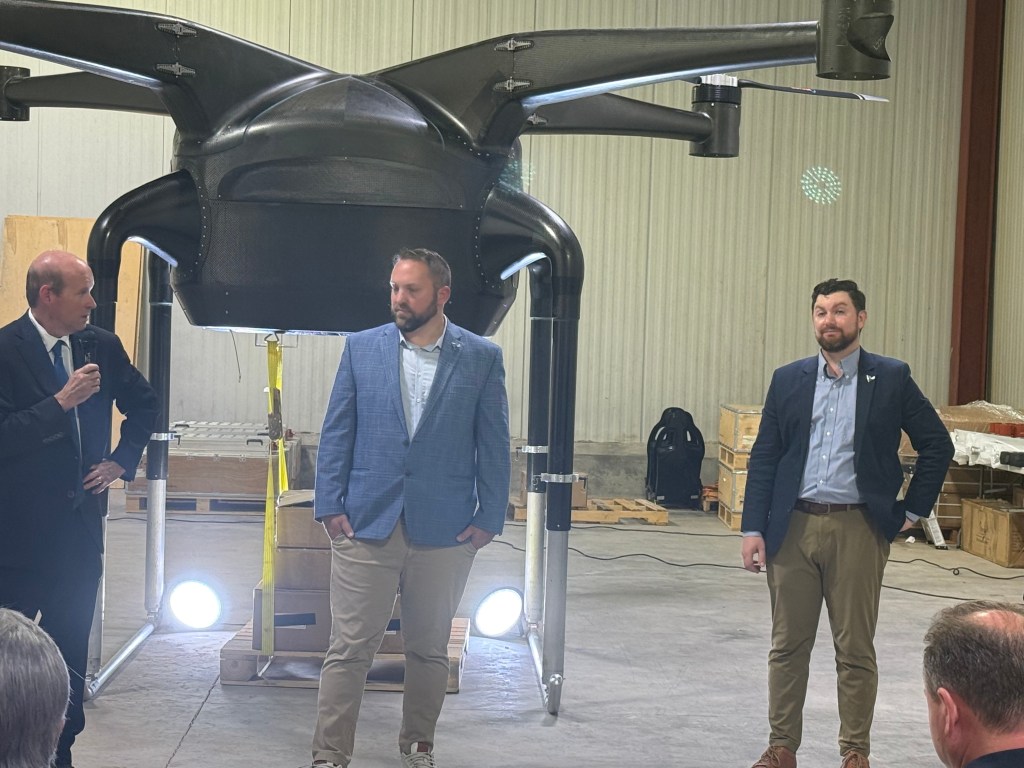
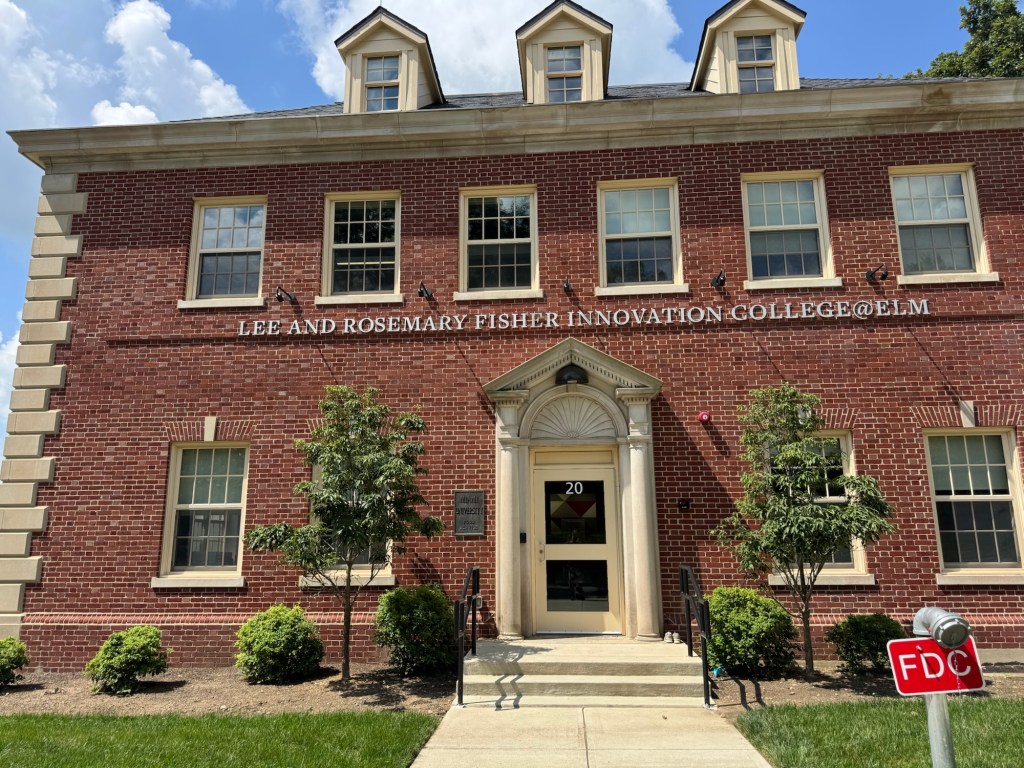
On September 21, 2026, we hosted a special community event at Miami University’s Innovation Center on Elm Street in Oxford, Ohio.
We called the evening “Dreams on Elm Street”, a lighthearted nod to the classic 1980s film. But what we’re building at Volynt isn’t the stuff of nightmares. It’s the realization of a dream, one that is taking shape right here in Butler County and has the potential to transform the future of logistics, aviation, and economic development in Ohio.
The turnout exceeded our expectations. The room was filled with Miami University staff, students, local business leaders, elected officials, and community members who wanted to learn more about what Volynt is building and where we’re headed.
We were honored to welcome Senator George Lang, Butler County Auditor Nancy Nix, and Michael Ryan, who is poised to become Butler County’s next commissioner. Their presence reflected the growing enthusiasm for innovation, entrepreneurship, and advanced aerospace development in our region.
Sharing the Vision
I opened the evening by welcoming our guests and providing an overview of the event. From there, our leadership team took the stage.
Our CEO shared Volynt’s long-term vision and mission. Our Chief Technology Officer highlighted the engineering milestones we’ve achieved and the technology behind the Volynt Vyper platform. As Chief Operating Officer, I discussed how Volynt is transforming cutting-edge aviation technology into a scalable and sustainable business. I outlined our operational strategy, manufacturing roadmap, partnerships, and the steps required to move from prototype development to commercial deployment.
The presentations were engaging, the audience was attentive, and the questions that followed demonstrated genuine interest and excitement.
Most importantly, this wasn’t a flashy product launch filled with unrealistic promises. It was an honest conversation about where we are today, what we’ve accomplished, and what the next several years may hold.
From Prototype to Production
Our immediate focus is straightforward.
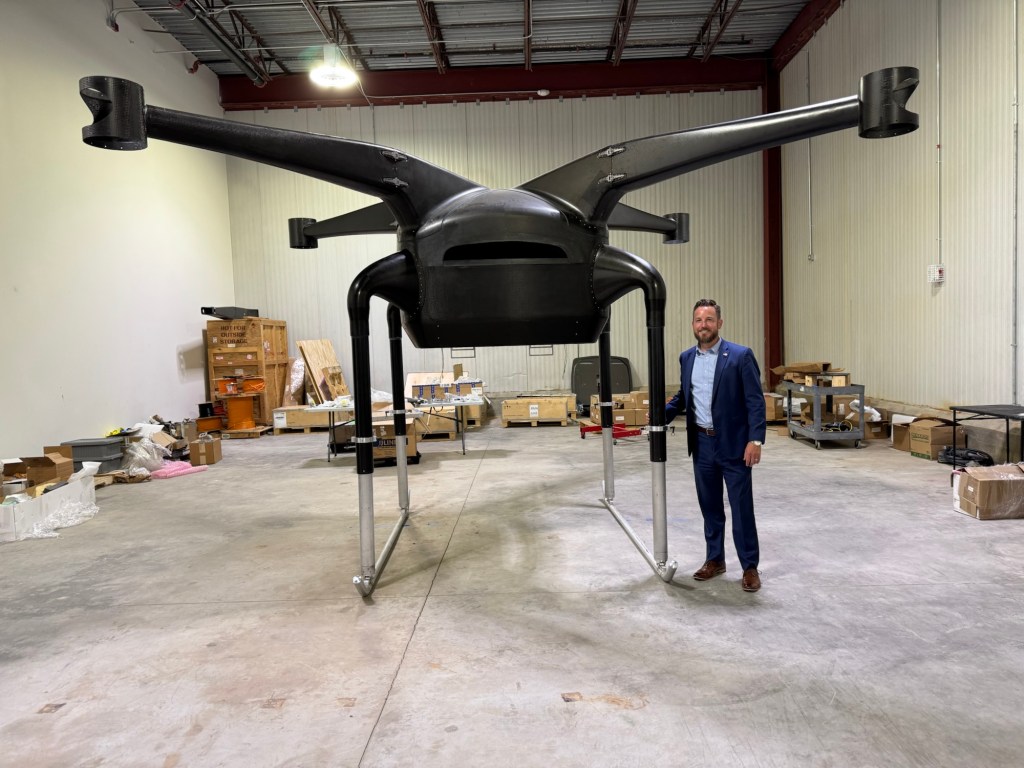
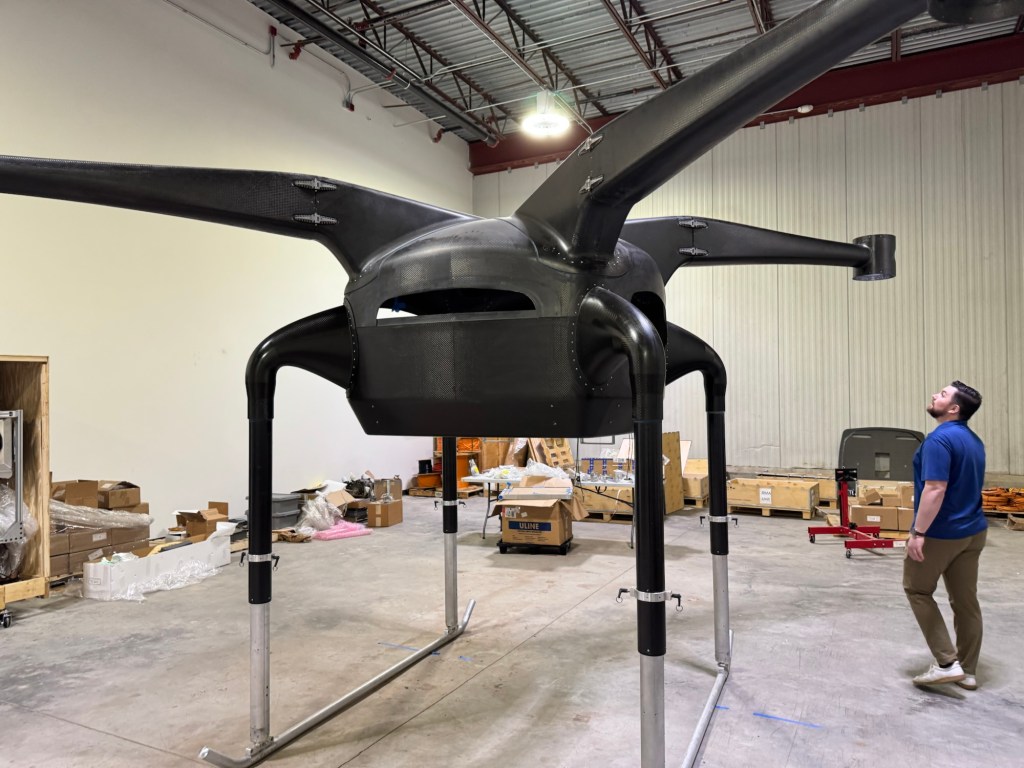
Over the next six months, our team will complete the full-scale Vyper prototype that was unveiled at the Innovation Center. That aircraft represents years of design work, engineering refinement, and determination.
Once completed, the aircraft will enter an intensive testing phase designed to validate performance, reliability, and operational capabilities.
Looking ahead to 2027, we plan to participate in major industry competitions, build broader recognition within the aerospace community, and begin manufacturing multiple aircraft.
The goals are ambitious, but they are supported by a clear roadmap and a dedicated team committed to execution.
The Drone Revolution Is Already Here
One of the most important messages of the evening was that autonomous aviation is no longer a future concept.
It’s happening today.
Just one day after our event, Dayton-area company Dexa launched a drone delivery service in Kettering. The program delivers food orders from TJ Chumps on East Stroop Road to customers within a several-mile radius across Kettering, Oakwood, and Centerville.
These smaller drones operate as last-mile delivery systems. Flying at approximately 400 feet, they lower food orders safely to customers using a cable-delivery system. Dexa has spent years developing this capability and is helping demonstrate that drone delivery is becoming a practical reality.
Volynt’s mission is different.
While companies like Dexa focus on last-mile delivery, Volynt is developing larger autonomous aircraft designed for middle-mile logistics. Our aircraft are intended to transport meaningful payloads between regional hubs such as Cincinnati/Northern Kentucky International Airport (CVG), Dayton International Airport, Indianapolis, and other distribution centers.
This approach has the potential to reduce transportation bottlenecks, address driver shortages, and create more efficient supply chains.
Whether it’s delivering a meal across town or transporting freight across a region, autonomous aviation is rapidly reshaping how goods move through our economy.
Why Ohio Is Positioned to Lead
Ohio’s aviation legacy is unmatched.
The birthplace of powered flight now has an opportunity to become a leader in autonomous flight.
Few regions are better positioned than Butler County to participate in that transformation.
Our region offers access to multiple airports, including Miami University’s airport, where initial flight operations can be conducted. At the same time, substantial investment continues at Butler County Regional Airport, where significant infrastructure improvements are being planned.
The resources, workforce, educational institutions, and transportation network already exist. What remains is bringing together the innovators, investors, and community leaders who can turn opportunity into reality.
Creating Careers That Stay Close to Home
One topic that resonates deeply with me is talent retention.
I have spoken with countless parents who have made tremendous sacrifices to provide educational opportunities for their children through Miami University, Butler Tech, and the University of Cincinnati. Too often, those graduates leave Ohio because they believe the best opportunities are elsewhere.
That reality creates a challenge for families and communities alike.
One of our long-term goals at Volynt is to help change that story.
We envision creating thousands of high-quality aerospace, engineering, technology, and manufacturing jobs throughout Southern Ohio. We want talented young people to have the option of building exciting, fulfilling careers without leaving their families, communities, and hometowns behind.
Strong Community Support
One of the most encouraging moments of the evening was seeing the level of support from the community.
Michael Ryan delivered an excellent presentation about economic development in Butler County and how innovative companies such as Volynt can contribute to future growth and prosperity.
The participation from Miami University, local leaders, educators, students, business professionals, and community members reinforced something I’ve believed from the beginning:
Innovation succeeds when communities embrace it.
Dreams on Elm Street was more than a company presentation. It was a milestone. It brought together people from different backgrounds and perspectives to discuss a shared vision for the future of our region.
The energy in the room was unmistakable. The conversations were thoughtful. The questions were insightful. The enthusiasm was genuine.
For me, that confirmed that we’re moving in the right direction.
Looking Ahead
Volynt’s journey is still in its early chapters.
There is much work ahead, many challenges to overcome, and numerous milestones still to achieve. But the momentum is real, and the opportunities are significant.
We will continue sharing updates with the community as we progress from prototype development to testing, certification, manufacturing, and beyond.
This is only the beginning.
Thank you to everyone who attended Dreams on Elm Street and supported our mission. Your encouragement and belief in what we’re building means more than you know.
Together, we’re not just dreaming about the future.
We’re building it.
About the Author
Rich Hoffman is Chief Operating Officer of Volynt, where he leads operational strategy, business development, manufacturing planning, and growth initiatives for the company’s autonomous aerospace programs. A longtime Butler County leader and aerospace executive, he is committed to building high-quality technology careers and advancing innovation throughout Southwest Ohio.
Rich Hoffman is an author, political consultant, and strategic advisor based in Cincinnati, Ohio, and the creator of The Politics of Heaven—a unique framework that connects biblical theology, ancient history, and modern power structures to explain how moral alignment and spiritual forces shape global events. Blending real-world political experience with deep research into archaeology, UFO phenomena, and suppressed historical narratives, Hoffman offers compelling commentary on topics ranging from ancient civilizations and the Dead Sea Scrolls to modern populist movements, paranormal continuity, and leadership strategy in chaotic environments. As the author of The Gunfighter’s Guide to Business and the forthcoming Politics of Heaven, he brings a grounded yet provocative voice to media discussions, supported by firsthand experiences and a cross-disciplinary approach that bridges science, history, and theology. For interviews, speaking engagements, or expert analysis, visit richhoffmanbooks.com or contact directly via phone at 513-307-5815 or email at rhoffman@richhoffmanbooks.com. If you’ve seen the movie, Disclosure Day and want to talk about it and the implications of Presidnet Trump’s UAP disclosures, let me know and we can bring some color to your coverage. https://richhoffmanbooks.com/media-inquiries-broadcast-topics-and-contact-info/?frame-nonce=ad51e7ecba I do have a firsthand UFO encounter to discuss.
If you came here looking for a populist hit piece, this is not that. I write for people who lead, want to lead, or at least refuse to stay on the couch while the culture is rewritten around their children. Scripture is not a campaign prop. It is the sharpest instrument I know for cutting through a coordinated lie. That is the politics of heaven: not party first, not personality first, but the question of whether a people will still call good good and evil evil when the price of doing so is social exile.
I. THE AGE OF DISCLOSURE AND THE POLITICS OF HEAVEN
We are living in what I call an age of disclosure. Not merely the disclosure of secrets in government files, though that conversation is loud enough. I mean something older and more dangerous: the moment when a civilization is forced to admit what it has been doing in the dark. The ideologies that were supposed to stay in graduate seminars leaked into human-resources manuals, then into public schools, then into pediatric clinics. The result is not a private lifestyle. The result is a public demand that the rest of us recite the new creed or be treated as a moral contaminant.
The politics of heaven answers that demand. Heaven is not a voting bloc. Heaven is not a branding exercise. Heaven is the claim that God made the world a certain way, that male and female are not costumes, that children are not raw material for adult ideology, and that a nation which inverts those realities will not stay strong merely because its GDP looks impressive for another quarter.[1]
Paul said he was not ashamed of the gospel of Christ.[2] That sentence is doing more work in 2026 than most platform planks. Shame is the enforcement mechanism of the present order. If they can make you embarrassed to name what you love, they do not have to refute you. They only have to watch you edit yourself until there is nothing left worth hearing.
I will not edit it.
II. FALSE COMPASSION IS NOT LOVE
Start with the word that has been most abused: compassion.
True compassion would protect children from irreversible medical decisions they cannot possibly understand. What we have instead is a coordinated social contagion, especially visible among elites, in which adults congratulate themselves for “affirming” a minor into a pathway of puberty blockers, cross-sex hormones, and surgery. That is not love. That is sacrificing children to an ideology. I will call it what it is: a form of child abuse dressed up as progress.[3]
I am not talking about the rare, severe, persistent cases that clinicians used to treat with extreme caution. I am talking about the sudden clustering, the peer networks, the online scripts, the school social transitions done behind parents’ backs, and the astonishing overrepresentation of transgender-identifying children in a handful of zip codes, friend groups, and celebrity households. When parents, schools, corporations, and entertainment all push the same story at once, vulnerable children get swept up. That is not a coincidence. It is social engineering, plain and simple.
Look at Hollywood. The list of high-profile actors and actresses with children who identify as transgender or non-binary has become a genre of its own. Charlize Theron, Jamie Lee Curtis, Robert De Niro, Jennifer Lopez, Megan Fox, Dwyane Wade, Annette Bening and Warren Beatty, Cynthia Nixon, Sigourney Weaver, Naomi Watts—the names keep accumulating.[4] In a country where transgender identification among youth was, until recently, vanishingly rare, that concentration is not “just visibility.” Visibility does not create statistical spikes this localized unless something in the environment is recruiting.
Some researchers and activists insist there is no social contagion, and they would be wrong. Other researchers, clinicians, and dissenters say the opposite, and the Cass Review in the United Kingdom was blunt about the weakness of the evidence base that was used to medicalize children.[5] I do not need a unanimous journal to use my eyes. When a belief system travels through prestige networks faster than it travels through farm towns, you are not watching a spontaneous awakening. You are watching fashion with a clinical billing code.
Scripture is not ambiguous about the created order. God created them male and female.[6] To catechize children into rebellion against that order is not pastoral care. It is a revolt against the Creator, outsourced to minors who will live with the consequences long after the adults have moved on to the next cause.
The proper Christian response is not cruelty. It is not mockery of the suffering. It is this: speak truth with clarity, protect children from harm, and offer genuine compassion to those who are distressed—without affirming the lie that is injuring them. Affirmation of a falsehood is not mercy. It is participation.
III. WHY THE RATES ARE NOT RANDOM
People who do not want to face this subject hide in averages. They will tell you that “only a small percentage” of children identify this way, as if a small percentage plus institutional capture is nothing. The point is not only prevalence. The point is location.
Certain circles have dramatically higher rates of trans-identifying children. Elite schools. Entertainment. Specific online subcultures. Certain therapeutic fashions. Human-resources departments that rewrote the rules of speech and then dared the rest of the country to object. The same class of people who draft the corporate training also sit on museum boards, donate to universities, and lecture the working class about which words are now violence.
I have watched this move through institutions the way termites move through a beam. You do not notice the first memo. You notice the tenth, when a teacher is punished for using ordinary sexed language, or a parent is treated as the threat for refusing to transition a twelve-year-old socially. By then the lie has become policy.
This is why I reject the slogan that “silence is kindness.” Silence in a captured institution is how the capture finishes. If you work in a place where DEI language has been used to smuggle gender ideology into childhood, you already know the mechanism. It was not a grassroots cry from children. It was a professional class writing rules that everyone else was expected to obey while calling the obedience righteousness.
I do not owe that project my vocabulary.
IV. YOU ARE NOT REQUIRED TO SURRENDER WHAT YOU LOVE
There is a related lie, and it is aimed at Christians specifically: that the loving thing is to mute your own faith so that people who despise it can feel comfortable.
I reject that.
It is one thing to say we should not be cruel. It is another thing to say that Islam, progressive sexual ideology, and the new civic religion of the public school must be handled with velvet, while Christian speech must be handled with a muzzle. I am supposed to be endlessly compassionate toward alternative sexual lifestyles and toward the latest curriculum, and then I am supposed to treat my own Scripture as a private hobby that might offend the room.
No.
You like what you like. I like what I like. I am not going to edit the Bible to make you happy. You do not care if I am unhappy. So I am going to talk about the Bible. I am going to talk about the Scripture I enjoy. I believe this is what God says, and I will not be ashamed of it.
That kind of honest, unapologetic speech is far more powerful than the aggressive politeness of people who sand their faith down until it can pass a diversity seminar. The world feels no obligation to make Christians comfortable. Reciprocal self-erasure is not tolerance. It is surrender.
As Paul said, I am not ashamed of the gospel of Christ.[2] Speaking Scripture openly, without apology, is one of the most effective ways to push back against cultural pressure. It draws a clear line. It gives courage to people who have been staying quiet. Leaders who speak plainly strengthen the faithful and expose deception at the same time.
There is nothing wrong with liking Christian things and professing them openly. You do not have to put a lid on your viewpoint while everybody else imposes theirs and you are told to shut up and take it. That hour is over, or it should be.
V. THE MUSEUM OF THE BIBLE AND THE POWER OF BEING UNASHAMED
Let me give a point of reference I have used for years.
The Museum of the Bible in Washington, D.C., is one of my favorite places in the world.[7] I never liked Washington much until the political weather changed and I had reason to be there. I have been more than once. I am a member and a supporter. In the background of my life, I love using the Bible, and I love a building three blocks from the Capitol that says: here is the history of this book. See it. Relish it. Enjoy it.
They are not required to plant flags all over the National Mall. You can still go to the Smithsonian. You can still do every other official thing the capital offers. People love the Museum of the Bible anyway, because it feeds them. It does not pretend to be a neutral warehouse. It professes that this book is good. It is open about that goodness. It loves being good.
That is the model.
Other places I enjoy for the same reason: the Ark Encounter and the Creation Museum in northern Kentucky, the work of Ken Ham and Answers in Genesis.[8] I love those guys. I may not agree with their young-earth timeline. I am an old-earth kind of guy. We would argue, probably at length, about whether the earth is six thousand years old or many millions. I have read Ham. I understand the argument. I would still debate him profusely on the age of the earth. That disagreement does not cancel the thing I actually love: their embrace of goodness.
When you walk those sites, you cannot help but see how hard they try to be good, and they do not hide it. They do not cram it down every throat on earth. They also do not crush their own enjoyment to satisfy people who arrive already offended. The offended party does not mind offending you. It is quite fine to go the other way—to be audacious about your love for what you value. You do not have to destroy it to make someone else happy.
Jonathan Edwards understood the same principle in a different century. True religion is not mere outward show. When the heart is captured by the beauty of God and His word, it cannot stay silent. The joy overflows.[9] Dimming that joy to appease people who hate its source is not love, and it is not tolerance. It betrays the truth you claim to love.
You do not have to attack persons. You also must not shrink back. Let the light shine clearly. Those who love truth will be drawn to it. I have watched that happen in the galleries of the Museum of the Bible. Stand firm. Speak plainly. Enjoy God’s goodness without shame. That is every Christian’s duty, not a branding strategy for an election cycle.
VI. KEN HAM, BILL NYE, AND THE DIFFERENCE BETWEEN CORE AND SECONDARY
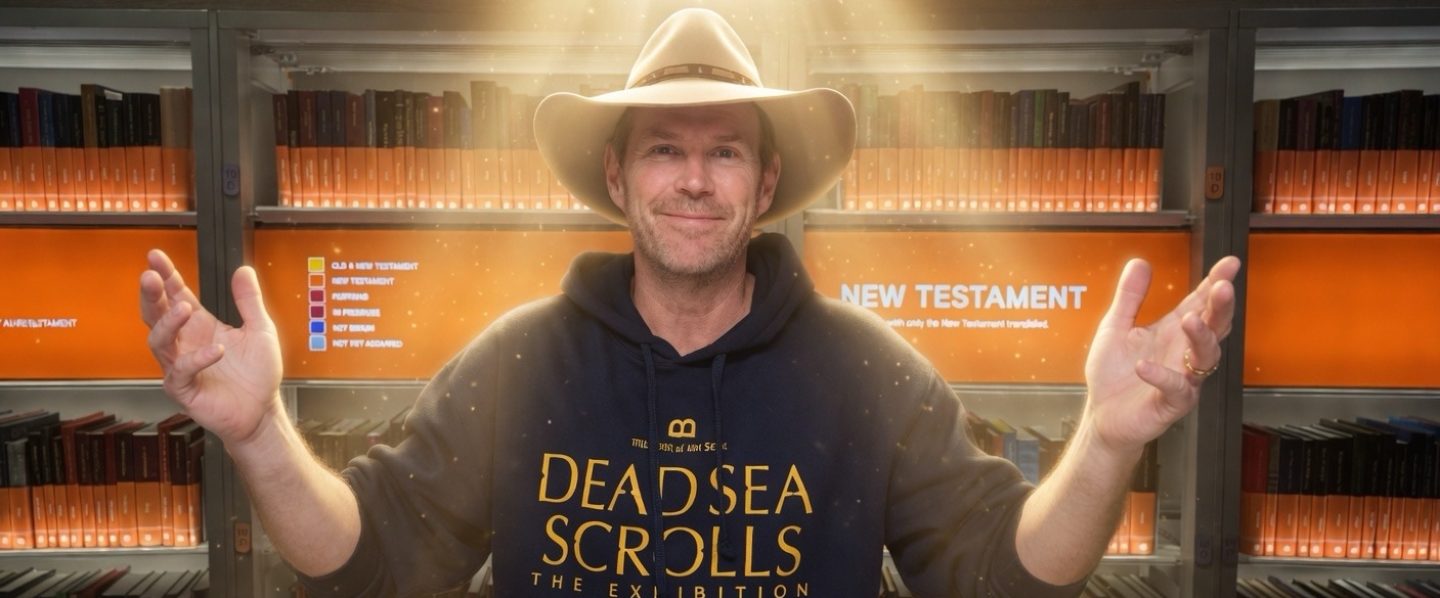
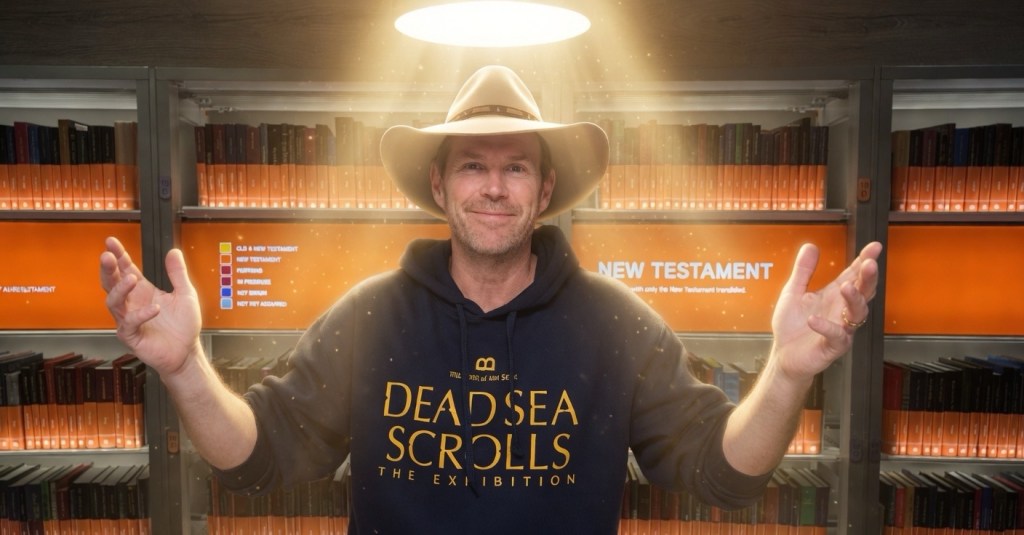
I was at the Creation Museum not long ago, wearing a Museum of the Bible shirt—the kind I wear often, because it reminds me of the things I actually like when a lot of darkness surrounds me. The woman at the counter said it was great that I go to the Museum of the Bible. I told her I love that museum, and I also love what Ken Ham built. Ham set a public philosophy in motion. The exhibits are well done. I have read the books. I understand why the young-earth argument matters to the people who hold it.
The real discussion is larger than a debate-club win. Science and theology are allowed to argue. I would argue with Ham that the earth is much older than six thousand years. I would also tell Bill Nye that sneering at Genesis as if the only alternatives were a cartoon ark or a materialist closed system is a different kind of ignorance. The point for this essay is not to settle geology. The point is that Christians can disagree on the age of the earth and still refuse to surrender the created order, the moral law, and the right to love Scripture out loud.
That is maturity. Rally around the core of the confession, not around every secondary interpretation. Ken Ham loves what he believes and says it without shame. I will not take that joy from him. I wish more people in public life had that spine, even when I think their timeline is wrong.
VII. JD VANCE, BUTLER COUNTY, AND WHY SCRIPTURE AT A RALLY IS NOT A GIMMICK
JD Vance is from my part of the world. Middletown. Butler County. Monroe just down the road. I know those hardy people. I know the flea markets—Traders World, Treasure Island—where folks come out of church on Sunday and walk the aisles looking at vendors, wall art, and the kind of homemade biblical kitsch that elites mock and ordinary people actually live with.[10]
Vance knows that country. His people are those people. When he talks about Scripture, it does not sound like a consultant discovered “faith outreach” on a whiteboard. It sounds like Butler County. That matters.
I have been glad to see President Trump and Vice President Vance put Scripture into the open at the Texas midterm moment and in surrounding speeches and interviews.[11] Vance has been unusually explicit that Christianity is not a private hobby you hide to keep a coalition calm. He has said Christianity is America’s creed—not that every citizen must be a Christian, but that the moral language that actually formed the country is Christian.[12] He has said Satan’s favorite trick is convincing Christians that faith and politics belong in separate rooms.[13] He has even been willing to talk about end times without collapsing into either panic or passivity: do the work in front of you; do not outsource your whole moral life to a countdown clock.[14]
I think that is smart. It will help the midterms. Not because Bible verses are magic turnout dust, but because a lot of serious churchgoing conservatives have concluded that politicians are blabbermouths who say one thing at the banquet and another in the agency. Those people will stay home if they think the language is rented. They will show up if they think the man actually fears God more than he fears the clip.
I am not naive. Quoting Scripture at a rally is easy. Governing in a way that honors the God of that Scripture is harder. The test is not whether a line lands in a speech. The test is whether the administration’s actions, over time, hate what God hates and love what God loves. A leader who merely drapes verses over policies that protect evil is a hypocrite. A leader who fears God will not be silent when innocent blood, confused children, and public lies are being baptized as kindness.
For midterms, for holding the House and the Senate, the Christian vote is not a sentiment. It is a body of people who still believe first allegiance is not to a party. If you want them off the couch, do not give them another focus-grouped paragraph about “values.” Give them the thing they already know is true and have been told to whisper.
VIII. THREE VERSES LEADERS SHOULD NOT BE AFRAID TO SAY OUT LOUD
If a leader wants language that encourages the faithful and warns the powerful at the same time, he does not need a speechwriter to invent it. It is already in the book.
First: “Righteousness exalts a nation, but sin is a reproach to any people.”[15]
That is Proverbs 14:34. It directly assaults the idea that a country becomes great by GDP, weapons, or branding. Moral order is not an accessory. If we keep normalizing what Scripture calls evil, we are not becoming sophisticated. We are becoming weak. Wealth will not save a people that has taught its children to despise the created order.
Second: “Woe to those who call evil good, and good evil; who put darkness for light, and light for darkness.”[16]
Isaiah 5:20 is the verse for this exact hour. It names the mechanism. The deception is not only that people do wrong. The deception is that they rename the wrong and then punish the person who remembers the old name. Redefine marriage, celebrate the confusion of sex, treat biblical speech as harm, and you have not expanded compassion. You have inverted the moral dictionary. A leader who will not say that sentence is not being pastoral. He is being careful about his future bookings.
Third: “Blessed is the nation whose God is the Lord.”[17]
Psalm 33:12 is not a magic formula for a superpower. It is a reminder of allegiance. The Christian community’s ultimate loyalty is not to a party, a personality, or a news cycle. Blessing, in the biblical sense, attaches to a people that still knows who God is. That is hope, not nostalgia. It tells serious people why they should bother.
These three verses do what a good rally needs: moral clarity, a warning against deception, and a promise larger than the next quarter. They are short enough to remember. They are sharp enough to divide light from fog.
IX. DO NOT WAIT FOR THE RAPTURE WHILE EVIL DOES THE WORK
Here is the pastoral failure I have watched for decades.
Many people I know will say they are good Christians because they refuse to “engage.” They will hang the Ten Commandments on the wall, go to church on Sunday, and then treat public evil as a problem God will vacuum up at the end of the age. They do not want to confront anybody. They do not want to fight. They want the apocalypse to do the job they were too tired or too timid to do. They call that humility. I call it a religious mask on laziness.
The same Bible that promises the return of Christ also commands believers to resist the devil, hate what is evil, do justice, and love mercy.[18] God never called a people to nap while wickedness reorganizes the schools. Waiting for God to fix everything while we do nothing is not faith. It is presumption.
Moses did not treat Egypt as a spectator sport. Deborah did not. David did not. Nehemiah did not rebuild a wall by quoting a verse about patience and going home. The apostles did not treat the ruling authorities as an excuse to go mute. Romans 13 tells Christians to recognize governing authority. Acts 5:29 tells them that when those authorities command what God forbids, the first allegiance is to God.[19] Submission to God is not submission to evil—quite the opposite.
If a world leader will not bow to the authority of God, that does not mean the rest of us take a back seat and wait for the credits. It means discernment. It means we do not confuse a Bible on the podium with a conscience in the chest. It also means we do not treat politics as a substitute for conversion. A man can win a midterm and still lose his soul. Reformation that begins only in rallies and podcasts, and never in the soul’s submission to Christ, profits nothing.
However, the opposite error is just as real: using “God will handle it” as cover for refusing to handle the thing in front of you. Faith works in its own generation. It prays for the kingdom to come and then spends its breath on righteousness while it still has breath.
X. FLEA-MARKET CHRISTIANITY AND THE DIFFERENCE BETWEEN DECORATION AND BACKBONE
I like Traders World. I like Treasure Island. Monroe, Ohio, is a strange and specific place, and I love it for what it is. Walk those markets, and you will see a lot of people who came straight from church. You will see biblical references on the walls. Treasure Island, in particular, draws a large Mexican immigrant population, and if you have spent time in Mexico, you already know how Catholic that visual world is. They love images of Jesus. They carried older indigenous forms into Catholic form and made something that is not a seminar paper. It is folk theology in color. I love Mexican religious art, including the Christianized approach to death that outsiders reduce to a cartoon of “the cult of the dead.” It is not voodoo. It is a people who still think the dead and the living are not sealed off from each other by a shopping mall.
I can love all of that and still say the hard thing: too many of those same households treat Scripture as interior decorating.
They will buy the plaque. They will love the verse. They will tell you they left it to Jesus. Then, when the school, the HR office, or the culture demands that they deny what the plaque says, they fold and call the fold piety. That is not devotion. That is decoration. Faith that only admires Scripture on a wall, and will not stand for the same commandments when the cost is a customer, a job, or a family argument, is not the faith that built anything worth keeping.
True Christianity has always required backbone. Nice religious imagery is easy. JD Vance coming out of that same region makes the stakes sharper. Those people need to see a leader who will fight for what the wall art claims to believe. If he only sounds like church on Sunday and then governs like every other manager of decline, the flea-market vote will stay home, and the professional class that rewrote childhood will not.
XI. CHRISTIANITY IS A WEAPON — BUT NOT THE WAY THE MOB MEANS WEAPON
People get nervous when you say Christianity is a weapon. They should get the meaning right.
Christianity is not a weapon in the way a riot is a weapon. It is not deceit. It is not a secret police of the pious. The word of God is living and active, sharper than any two-edged sword.[20] Truth is the blade. When a leader speaks Scripture with actual conviction, it cuts through slogans, exposes the rename-the-evil trick, and wakes a conscience that had gone to sleep under the word “kindness.”
That is how you fight evil in high places without becoming the thing you oppose.
Many of the policies I have been watching—the sexual ones, the speech ones, the childhood ones—were designed in the background to wear away a society that still had a Christian base. You do not have to invent a conspiracy chart to see the sequence. First, the language changes. Then the training changes. Then the child is caught in the middle, and the parent is the last to be informed. The answer is not to copy the enemy’s methods. The answer is to stop being ashamed of the only thing that can actually defeat the darkness: the gospel of Jesus Christ, spoken as if you mean it.
A leader should stand on Scripture not as a mascot but as a man who fears God more than he fears the mob. This generation is starving for that kind of boldness. Amen. Let it be said without the usual throat-clearing.
XII. ISLAM, SAUDI ARABIA, AND THE RIGHT TO DEFEND YOUR OWN HOUSE
A short word on a subject that makes consultants sweat.
Twenty-five years after 9/11, a lot of people are angry that American leadership will not spend every morning railing at Saudi Arabia and at radical Islam in the old post-2001 register. Radical Islam is not a hallucination. It is still at work. It is fair game. I also think you can put your hand on the Bible without turning every speech into a comparative-religion insult comic.
You do not have to be condescending toward every competing religion to defend Christianity. [21] A leader who fears God will not be silent when innocent blood is shed in the name of religion. He also needs wisdom. Sometimes the most effective stand is not the loudest anathema. It is the clear, consistent defense of truth and justice, and the refusal to treat Christianity as the one faith that must apologize for existing.
If Trump or Vance quote Scripture, the test is not the quote. The test is whether their actions line up with the book they opened. Religion used as a costume for power is an old trick. Religion used as the thing a man actually submits to is rarer, and it is the only version worth the airtime.
XIII. THE JONATHAN EDWARDS STUDY BIBLE AND A PRACTICAL NEXT STEP
If you want an entry point that is not a meme and not a campaign pamphlet, start with a book that expects you to stay.
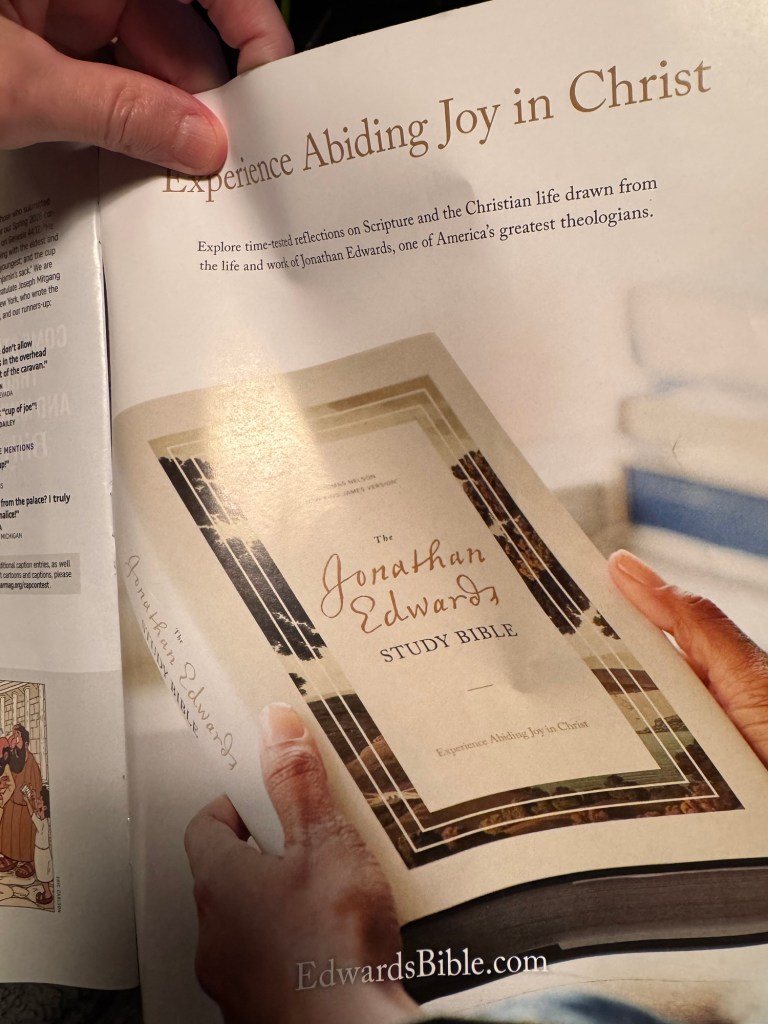
The Jonathan Edwards Study Bible, published by Thomas Nelson in August 2026 and edited by Matthew Everhard, is built on the NKJV and Edwards’s own notes, resolutions, and theological instincts.[22] Edwards’s great theme was not American politics. It was joy in God. “The enjoyment of God is the only happiness with which our souls can be satisfied.” That is the sentence under the project. Study notes drawn from his work, essays on the Great Awakening, his Resolutions, and his miscellanies system are all there if you want to do more than highlight a rally verse.
I love a study Bible that treats Scripture as something you live inside, not something you mine for applause lines. I do not agree with every secondary system any commentator has ever hung on the text. I do not need to. The point is daily reading, public love, and an unashamed life. Treat yourself to something good. Read it. Let people know you love it. At this stage of the game, visible joy in the word is not a small witness. It is one of the last clean ones left.
XIV. WHAT I WANT FROM LEADERS — AND WHAT I WILL NOT PRETEND
I want leaders who will:
Protect children from medical and social experiments they cannot consent to in any meaningful sense.
Stop treating “compassion” as a synonym for affirmation.
Speak Scripture as if it were true, not as if it were a demographic.
Refuse the HR liturgy that recodes male and female as optional.
Understand that Christian voters are not a prop. They are people whose first loyalty is supposed to be higher than a ticket.
Fight in their own generation instead of waiting for the sky to split.
Keep their joy. An ashamed church is a disarmed church.
I will say this: goodness is not something you have to apologize for. Find it. Love it. Project it. Evil is not shy about encroaching. You are not obligated to meet that encroachment with a permanent second cheek and a taped mouth. The job, when you see the lie eating children and renaming itself kindness, is to conquer it with righteousness and to be bold about the source of that righteousness.
Do not be ashamed of the gospel.
Do not be ashamed of the book.
Do not be ashamed of liking what is good.
That is the politics of heaven in an age that keeps disclosing how much of our public life was built on a dare: that ordinary people would rather be polite than tell the truth about their own sons and daughters.
XV. A LAST WORD TO THE PEOPLE WHO ACTUALLY LEAD
This was never written for the algorithm that wants a screaming thumbnail. It was written for the smaller room: the people who draft, who vote in caucuses, who manage institutions, who sit close enough to power to change a line in a bill or a tone in a speech.
It is safe to put your arm around Scripture.
It is not safe, in the only sense that matters, to keep pretending that the sexual revolution’s latest chapter is too delicate to name.
You are allowed to enjoy the Museum of the Bible, the Creation Museum, a Mexican retablo of Christ, a Jonathan Edwards page, a Butler County flea market, and a Vice President who will still say the name of Jesus without coughing. You are allowed to disagree about the age of the earth and still agree that a girl is not a boy because a school counselor said so.
The light does not need your permission to be light. It needs you to stop putting a basket over it.
Speak plainly. Protect the children. Love the good without apology. Leave the shame to the people who require it.
That is how you strengthen the faithful. That is how you expose the deception. That is how a nation finds out, in an age of disclosure, whether it still remembers the politics of heaven.
NOTES
[1] The phrase “politics of heaven” is used here in the older Christian sense: the public consequences of God’s reign and moral law, not a claim that any party is the kingdom of God. See Augustine, The City of God, esp. Books XIV–XIX, on the interweaving of the city of God and the city of man.
[2] Romans 1:16: “For I am not ashamed of the gospel of Christ, for it is the power of God to salvation for everyone who believes.”
[3] On the distinction between pastoral care for distressed youth and the affirmation-only medical pathway, see Hilary Cass, Independent Review of Gender Identity Services for Children and Young People: Final Report (NHS England, 2024); Abigail Shrier, Irreversible Damage (Regnery, 2020); Lisa Littman, “Parent reports of adolescents and young adults perceived to show signs of a rapid onset of gender dysphoria,” PLOS ONE 13, no. 8 (2018).
[4] Reporting and commentary on the clustering of transgender-identifying children in celebrity households include Rikki Schlott, “How social contagion created a generation of trans kids in Hollywood,” New York Post, June 4, 2026; “The rise of the celebrity trans kid,” The Spectator, April 10, 2024; and recurring profiles in mainstream entertainment coverage of specific families. Clustering is not the same as a complete census; it is a pattern that demands an explanation beyond “visibility.”
[5] Cass, Independent Review (2024). For the contrary claim that social contagion is unsupported, see Jack Turban et al., “Sex Assigned at Birth Ratio among Transgender and Gender Diverse Adolescents in the United States,” Pediatrics (2022). For more recent discussion of declining youth identification after the peak years, see analysis associated with Eric Kaufmann’s 2025 commentary on survey trends. The existence of a debate is the point: the science was never “settled” in the way school districts pretended.
[6] Genesis 1:27; Matthew 19:4; Mark 10:6.
[7] Museum of the Bible, 400 4th Street SW, Washington, D.C.; opened November 17, 2017; founded through the Green family / Museum of the Bible, Inc. See museumofthebible.org and the institution’s published FAQ on mission, square footage, and exhibit floors.
[8] Ken Ham, Answers in Genesis; Creation Museum, Petersburg, Kentucky (opened 2007); Ark Encounter, Williamstown, Kentucky (opened 2016). See answersingenesis.org.
[9] Jonathan Edwards, A Treatise Concerning Religious Affections (1746); The Life of David Brainerd; and the Resolutions. Edwards’s insistence that true religion engages the affections, not merely the mouth, is the through-line of the 2026 study Bible project cited below.
[10] Traders, World and Treasure Island are long-running flea-market / vendor sites serving the Monroe–Middletown corridor in Butler County, Ohio. JD Vance’s upbringing in Middletown and family ties in the county are documented in Hillbilly Elegy (Harper, 2016) and in subsequent local reporting.
[11] Coverage of Trump and Vance at the Republican midterm convention in Dallas, September 2026, includes contemporaneous reports from ABC and other national outlets. Vance’s broader 2025–2026 record of public Christian speech includes the Turning Point USA AmFest 2025 address and the May 2026 “Rededicate 250” remarks on the National Mall.
[12] JD Vance, AmFest / Turning Point USA remarks, December 2025: “Christianity is America’s creed,” with the explicit caveat that one need not be a Christian to be an American. See also Catholic News Agency, “Vice President JD Vance presents a Christian vision of politics,” December 2025.
[13] Ryan Foley, “JD Vance: Satan wants Christians to separate faith from politics,” The Christian Post, July 20, 2026, reporting on Vance’s conversation with Bishop Robert Barron.
[14] Maya Yang, “JD Vance says he is doing ‘God’s work – and if that leads to the end times, OK,’” The Guardian / syndicated, September 2, 2026, on the Bryce Crawford interview.
[15] Proverbs 14:34 (NKJV): “Righteousness exalts a nation, but sin is a reproach to any people.”
[16] Isaiah 5:20.
[17] Psalm 33:12: “Blessed is the nation whose God is the Lord, the people He has chosen as His own inheritance.”
[18] James 4:7; Romans 12:9; Micah 6:8; Psalm 97:10.
[19] Romans 13:1–7; Acts 5:29. The Deborah and David narratives are Judges 4–5 and 1 Samuel 16–31 / 2 Samuel.
[20] Hebrews 4:12; Ephesians 6:17.
[21] John 14:6; Acts 4:12.
[22] The Jonathan Edwards Study Bible: Experience Abiding Joy in Christ (NKJV), general editor Matthew Everhard (Thomas Nelson, August 18, 2026). Features include Edwards-derived study notes, doctrinal articles, essays on Edwards and the Great Awakening, the Resolutions, and an introduction to his miscellanies method.
BIBLIOGRAPHY AND FURTHER READING
Scripture and Classic Christian Sources
The Holy Bible, New King James Version. Augustine of Hippo. The City of God. Trans. Henry Bettenson. London: Penguin, 2003. Calvin, John. Institutes of the Christian Religion. Ed. John T. McNeill. Louisville: Westminster John Knox, 1960. Edwards, Jonathan. A Treatise Concerning Religious Affections. 1746. In The Works of Jonathan Edwards, Vol. 2. New Haven: Yale University Press. Edwards, Jonathan. “Resolutions.” In Letters and Personal Writings, Works of Jonathan Edwards, Vol. 16. New Haven: Yale University Press. Edwards, Jonathan. Sinners in the Hands of an Angry God. 1741. The Jonathan Edwards Study Bible: Experience Abiding Joy in Christ (NKJV). General editor Matthew Everhard. Nashville: Thomas Nelson, 2026. Packer, J. I. Knowing God. Downers Grove, IL: InterVarsity Press, 1973. Lewis, C. S. The Abolition of Man. Oxford: Oxford University Press, 1943. Lewis, C. S. Mere Christianity. London: Geoffrey Bles, 1952. Niebuhr, Reinhold. Moral Man and Immoral Society. New York: Scribner, 1932. Solzhenitsyn, Aleksandr. “Live Not by Lies.” 1974. Schaeffer, Francis A. How Should We Then Live? Old Tappan, NJ: Revell, 1976. Schaeffer, Francis A. A Christian Manifesto. Westchester, IL: Crossway, 1981.
Creation, Museums, and Public Christian Witness
Ham, Ken. The Lie: Evolution. Green Forest, AR: Master Books, 1987; rev. eds. thereafter. Ham, Ken. Gospel Reset. Green Forest, AR: Master Books, 2018. Answers in Genesis. Creation Museum and Ark Encounter visitor guides and position papers. https://answersingenesis.org Museum of the Bible. Institutional FAQs, exhibit guides, and annual materials. Washington, D.C. https://www.museumofthebible.org Wishard, Grant. “Love to Tell the Story.” Washington Examiner, November 17, 2017. Zauzmer Weil, Julie, and Sarah Pulliam Bailey. “The ark vs. the covenant: the dramatic contrast between the Creation Museum and the Museum of the Bible.” Washington Post, November 20, 2017.
Sex, Children, Medicine, and Social Contagion
Cass, Hilary. Independent Review of Gender Identity Services for Children and Young People: Final Report. NHS England, 2024. Shrier, Abigail. Irreversible Damage: The Transgender Craze Seducing Our Daughters. Washington, D.C.: Regnery, 2020. Shrier, Abigail. Bad Therapy: Why the Kids Are Not Growing Up. New York: Sentinel, 2024. Littman, Lisa. “Parent reports of adolescents and young adults perceived to show signs of a rapid onset of gender dysphoria.” PLOS ONE 13, no. 8 (2018). Bailey, J. Michael, and Ray Blanchard. Clinical and taxonomic papers on autogynephilia and rapid-onset presentations (various). Laidlaw, Michael, et al. Endocrine and pediatric critique literature on puberty blockade. SEGM (Society for Evidence-Based Gender Medicine). Collected reviews. Turban, Jack L., et al. “Sex Assigned at Birth Ratio among Transgender and Gender Diverse Adolescents in the United States.” Pediatrics (2022). [Contrary thesis; included so the reader can see both sides of the official argument.] Kaufmann, Eric. Commentary and data notes on declining youth LGBT / transgender identification after the early-2020s peak (2025). Schlott, Rikki. “How social contagion created a generation of trans kids in Hollywood.” New York Post, June 4, 2026. “The rise of the celebrity trans kid.” The Spectator, April 10, 2024. “Hollywood’s growing A-list of non-binary, transgender kids.” The Daily Telegraph, 2025. Hruz, Paul W., Lawrence S. Mayer, and Paul R. McHugh. “Growing Pains: Problems with Puberty Suppression in Treating Gender Dysphoria.” The New Atlantis, 2017. McHugh, Paul. “Transgender Surgery Is not the Solution.” Wall Street Journal, 2014, and related Johns Hopkins commentary. Soh, Debra. The End of Gender. New York: Threshold, 2020. Joyce, Helen. Trans: When Ideology Meets Reality. London: Oneworld, 2021. Hilton, Emma, and Colin Wright. Biological-sex primer essays in Reality’s Last Stand and related venues. Singal, Jesse. Long-form reporting on youth gender medicine, The Atlantic and later independent work.
Culture, Elite Capture, and Institutional Language
Murray, Douglas. The Madness of Crowds. London: Bloomsbury, 2019. Murray, Douglas. The War on the West. New York: Harper, 2022. Trueman, Carl R. The Rise and Triumph of the Modern Self. Wheaton, IL: Crossway, 2020. Trueman, Carl R. Strange New World. Wheaton, IL: Crossway, 2022. Hanby, Michael. Various essays on technology, liberalism, and the body, First Things. Lasch, Christopher. The Culture of Narcissism. New York: Norton, 1979. Rieff, Philip. The Triumph of the Therapeutic. New York: Harper & Row, 1966. MacIntyre, Alasdair. After Virtue. Notre Dame: University of Notre Dame Press, 1981. Sowell, Thomas. The Vision of the Anointed. New York: Basic Books, 1995. Sowell, Thomas. Intellectuals and Society. New York: Basic Books, 2009. Darel E. Paul. From Tolerance to Equality. Waco: Baylor University Press, 2018.
Vance, Ohio, and the Present Political-Religious Moment
Vance, J. D. Hillbilly Elegy. New York: Harper, 2016. Vance, J. D. Communion: Finding My Way Back to Faith. 2026. “Vice President JD Vance presents a Christian vision of politics.” Catholic News Agency, December 2025. “JD Vance: Satan wants Christians to separate faith from politics.” Christian Post, July 20, 2026. “Religious Vance seeks to avoid MAGA schism as he keeps the faith for 2028.” The Guardian / syndicated, September 13, 2026. Yang, Maya. “JD Vance says he is doing ‘God’s work – and if that leads to the end times, OK.’” September 2, 2026. Forbes Breaking News. “The Morality & Religion That Formed The American Consciousness Were Decidedly Christian.” National Mall remarks, May 2026. Local reporting on Middletown, the Cleveland-Cliffs mill, and Vance’s hometown visits: Cincinnati Enquirer, Journal-News, Fox News, 2023–2026. Dreher, Rod. Live Not by Lies. New York: Sentinel, 2020. Renn, Aaron M. Life in the Negative World. Washington, D.C.: Zondervan / related 2024 essays on post-Christian America.
Islam, Religious Liberty, and Public Courage
Ibn Warraq. Why I Am Not a Muslim. Amherst, NY: Prometheus, 1995. Spencer, Robert. The History of Jihad. New York: Bombardier, 2018. [Use critically; included because the public argument exists.] Griffith, Sidney H. The Church in the Shadow of the Mosque. Princeton: Princeton University Press, 2008. Weigel, George. Faith, Reason, and the War against Jihadism. New York: Doubleday, 2007. First Amendment and religious-liberty case law: Employment Division v. Smith; Fulton v. City of Philadelphia; 303 Creative v. Elenis; related commentary in Harvard Journal of Law & Public Policy.
Ohio Color, Folk Religion, and Place
Hoffman, Rich. Prior columns and commentary at OvermanWarrior / related essays on Middletown, Monroe, and regional culture. Brandes, Stanley. Skulls to the Living, Bread to the Dead: The Day of the Dead in Mexico and Beyond. Oxford: Blackwell, 2006. Carmichael, Elizabeth, and Chloë Sayer. The Skeleton at the Feast: The Day of the Dead in Mexico. Austin: University of Texas Press, 1991. Nutini, Hugo G. Todos Santos en Rural Tlaxcala. Princeton: Princeton University Press, 1988. Local vendor culture around Traders World (Monroe, Ohio) and Treasure Island as primary, on-the-ground observation rather than academic monograph.
Journalism and Primary Documents Worth Keeping
Cass Review full report and supporting research annexes (NHS England). WPATH Files / leaked internal files and subsequent journalistic treatment (2024). SEGM, Genspect, and Society for Evidence-Based Gender Medicine bibliographies. Museum of the Bible press FAQs. Answers in Genesis statement of faith and museum interpretative materials. Thomas Nelson catalog entry and Everhard interviews on the Jonathan Edwards Study Bible (August 2026).
Suggested Reading Paths
If you lead and have one night: Romans 1 and 13, Acts 5, Proverbs 14, Isaiah 5, Psalm 33, Hebrews 4; then Cass’s final report summary; then Vance’s Communion on why he will not keep the faith in a separate drawer.
If you want the child-medicine argument without online noise: Cass; Shrier; Hruz/Mayer/McHugh; then one contrary paper (Turban, 2022) so you know what the institutions cited.
If you want the soul of the thing rather than the policy: Edwards’s Religious Affections; the 2026 Edwards Study Bible notes on joy; Augustine’s two cities; Solzhenitsyn’s “Live Not by Lies.”
Suppose you want to walk the places named here: Museum of the Bible in Washington; Creation Museum and Ark Encounter in Kentucky; a Sunday-to-Monday loop through Middletown and the Monroe markets. The argument is clearer after you have stood in the rooms.
About the Author
Rich Hoffman writes from the Middletown, Ohio, side of the country, for readers who still think Scripture is allowed in public and that children are not a canvas for someone else’s revolution. This essay is not a substitute for a church, a clinician, or a ballot. It is a refusal to whisper.
Rich Hoffman is an author, political consultant, and strategic advisor based in Cincinnati, Ohio, and the creator of The Politics of Heaven—a unique framework that connects biblical theology, ancient history, and modern power structures to explain how moral alignment and spiritual forces shape global events. Blending real-world political experience with deep research into archaeology, UFO phenomena, and suppressed historical narratives, Hoffman offers compelling commentary on topics ranging from ancient civilizations and the Dead Sea Scrolls to modern populist movements, paranormal continuity, and leadership strategy in chaotic environments. As the author of The Gunfighter’s Guide to Business and the forthcoming Politics of Heaven, he brings a grounded yet provocative voice to media discussions, supported by firsthand experiences and a cross-disciplinary approach that bridges science, history, and theology. For interviews, speaking engagements, or expert analysis, visit richhoffmanbooks.com or contact directly via phone at 513-307-5815 or email at rhoffman@richhoffmanbooks.com. If you’ve seen the movie, Disclosure Day and want to talk about it and the implications of Presidnet Trump’s UAP disclosures, let me know and we can bring some color to your coverage. https://richhoffmanbooks.com/media-inquiries-broadcast-topics-and-contact-info/?frame-nonce=ad51e7ecba I do have a firsthand UFO encounter to discuss.
I know a lot of people out there take issue with my point of view. Good. I get involved in this stuff precisely because that is the case. I did not want another polite Bible study where everybody already agrees and then goes home feeling spiritually hydrated. I wanted an open discussion, talking to an audience, with the entire database of Jonathan Edwards in the chair across from me. Faith, theology, the Bible as I actually read it, and the work I have been doing for years under the heading I call the politics of heaven.
The timing is not accidental. We are living through what the documentary industry has branded The Age of Disclosure — a season in which former officials, intelligence people, and military witnesses are finally willing to say out loud that non-human intelligence is here, that craft have been recovered, and that the American state has been lying about it since at least 1947.[1] The film treats that as a national-security and science story. I treat it as a political story that starts long before Roswell. If you have read me for any length of time, you already know I do not separate UFOs from demons, Elohim, Watchers, or the divine council. I do not separate any of that from how human beings get sorted into controllable categories. That is the whole point of The Politics of Heaven.[2]
Why I Chose Jonathan Edwards as a Sparring Partner
Jonathan Edwards does not agree with me. That is why I wanted him. If I only talk to people who already think the universe is a messy civil war among non-human rebels, I am just warming up my own choir. Edwards spent a life preaching the absolute sovereignty of God over all things, including the devil.[3] His notes sit in one of my favorite Bibles on the planet. I love the intelligence in that book. I love the seriousness. I do not swallow the theology hook, line, and sinker just because it became part of the American founding atmosphere.[4]
A lot of people who read me are 1750s people in 2026 clothes. They want Edwards’s God — the God who never loses a committee vote, the God whose enemies only borrow power for a season. I understand the hunger. I have been through enough grief to know why a soul wants a strong anchor. I also think that hunger can become a psychological mechanism. When life is chaotic, the human heart will pay almost any price to believe somebody competent is driving. That does not make the belief true. It makes it useful.
Edwards would say Satan was once among the brightest in heaven, fallen, subtle, powerful, and still on a leash. He would say rebellion was never a political contest because God is not one being among beings. God is the ground of existence. I love that sentence. I have used versions of it myself. I also look at the last several thousand years, and I do not see a manager winning on the ground. I see a lot of borrowed-power talk and a lot of bodies.
The Age of Disclosure and the Politics of Heaven
Disclosure, as the government class uses the word, means a press conference. A file release. A hearing. A former AATIP guy staring at a building while the score tells you to feel solemn. That is not disclosure. Disclosure is when you admit the other intelligence in the room has been running a ground game through religion, politics, sex, war, and category-making since before your grandparents had a country.
Michael Heiser did the church a favor by forcing Psalm 82 back onto the table. God stands in the divine council. He judges among the gods. Deuteronomy 32, in the older reading, has the Most High allotting nations to the sons of God. Job opens with the sons of God presenting themselves and the Accuser walking in like he has a badge.[5] You can baptize all of that into “God is still in charge” if you need to sleep. Alternatively, you can read it the way a political operator reads a situation room: there is a board, there are governors, some of them have gone rogue, and the chairman keeps insisting the org chart proves he never lost control. Moreover, to the point of evil being in control, remember Michael Heiser died of a rare illness. I have also had a lot of trouble since completing my most recent book on this precise subject. The bad guys look to get rid of people who are close to smoking them out of their hiding places. I have seen it up close, and it is much more than a coincidence.
Inside the disclosure world there is already a split. One camp wants interstellar biologists and reverse-engineered alloys. The other camp — the so-called Collins Elite strain inside defense culture — has been whispering for decades that these things are not cousins from Zeta Reticuli. They are deceivers. They deny the Son. They catechize abductees.[6] I am closer to the second camp, with one difference. I do not think calling them “demons” ends the argument. Demons is a church word that lets people stop thinking. I want the org chart. I want the ground game. I want to know who is manipulating whom, and why God keeps hiring the same contractors after they burn the city down.
Categories Are How Non-Human Intelligence Controls the Human Race
Here is the running thought I brought into the conversation. When astronomers hunted black holes, they did not start with a photograph. They started with a gravity signature. Something unseen was tugging at visible bodies. The logical conclusion was a compact mass so dense light could not climb out. Better instruments later confirmed what the footprints already said.
I look at human history the same way. You can see spirit-world manipulation in how people get thrown into categories, and then those categories get administered. Left, right. Saved, unsaved. Young earth, old earth. Alien, angel. Loyal servant, blasphemer. Once you are in the box, the box does the rest of the work. You police yourself. You attack the neighboring box. Meanwhile, the intelligence that built the shelves goes home early.
That is why I get impatient with people who think the main spiritual task is to pick the correct team jersey and never ask whether the stadium itself is the trap. I used a football picture in the conversation because I live in Bengal country and I have watched 60,000 people invent causation out of a lucky shirt. One receiver catches a ball in the last minute, and ten thousand isolated nervous systems all decide their fabric caused the physics. We do the same thing with God and history. We live in a vacuum of limited observation, and then we call the vacuum providence.
I Am Not a Young-Earth Creationist, and I Do Not Need the Planetarium to Close the Argument
The Creation Museum has a fine exhibit culture. I live in this triangle. I have sat through their planetarium show, which is really good, and I have been curious how they sell a 6,000-year-old Earth with a straight face while the sky over Petersburg is the same sky that makes deep time obvious.[7] I am not a young-earth man. I am a deep-past man. The idea that life only exists here, and only during this thin slice of time, is ridiculous to me. That is not rebellion against Genesis. That is refusing to let a nineteenth-century fight with Darwin become the whole religion.
Young-earth certainty and materialist certainty are twin categories. Both are easy to administer. Both spare you from the harder sentence: we do not know how old the war is, we do not know how many worlds it touches, and we are arrogant to think the Bible’s human camera angle is the only camera in the universe. I love the Bible because it is the longest political and spiritual after-action report I have. I do not love it because a committee told me I am not allowed to notice the lens.
Job Is Not Comfort Literature
I understand Job. I have had enough wreckage in my life that the book does not feel like a classroom exercise. I do not sit around looking for a hug from a psychotherapist. I outmaneuver hard things by moving. People say I am positive about everything. That is not a personality quirk. That is a method. You do not beat a siege by narrating your wounds to an audience that cannot lift a gate.[8]
What I will not do is pretend Job is a success story for management. Satan walks into the council, talks God into a demonstration, and a good man’s world is stripped for a wager. Edwards says the boundaries prove sovereignty because the Accuser had to ask permission. I say that is the behavior of a boss who can still sign the visitor badge while the factory burns. Permission is not the same thing as competence. Permission is not the same thing as loyalty to the people who actually bleed.
If I had been standing in that council, I would have wanted Satan’s head off in the air. Not as theater. As containment. Then I would have watched God’s face. That is the test nobody in Sunday school is allowed to run. If the Accuser is a rebel, you kill the rebel. If the Accuser is a tool, you just learned something about the toolmaker that the later chapters are designed to keep you from saying out loud.
Sovereignty, Lucky Jerseys, and the Divine Council Bureaucracy
Edwards’s best line in the exchange, the one that still rings, is that God is not a being among beings. He upholds the universe by the word of his power. The greater one in us is greater than the one in the world.[9] I like the music of that. I also asked the question bureaucracy always dreads: if he is in charge of everybody, why the council? Why the governors? Why the sons of God with portfolios? Why a heavenly civil service if the king can move the sun with a sentence?
The approved answer is generosity. God does not need help. He shares the dignity of rule, as a great king appoints judges. Fine. I have run companies. I have watched kings appoint judges. Sometimes it is generosity. Sometimes it is a man who cannot stand to be seen doing the ugly work with his own hands. A weak leader uses other people to do what he lacks the social courage to do himself. He works through passive systems. He keeps a villain on payroll, so the villain can be blamed when the quarterly report comes in bloody.
That is how Job reads to me when I take the piety filter off. God keeps an Accuser. The Accuser proposes torture. God authorizes a limited version. Later writers explain that it was for Job’s refinement and for the audience’s faith. Hindsight is the favorite tool of every failed administration. You look back at what already happened and discover it was necessary. Necessity is cheap when you are not the one burying children.
Why Does an All-Powerful God Need Proof of Loyalty Through Pain?
Edwards says God is not insecure. The infinite self-existent one was happy before he made a single atom. Tests are for us, not for him. The fire does not inform the goldsmith. It purifies the gold. I have heard that sermon. I have preached versions of it to myself on bad mornings. It still leaves the managerial question on the table.
Why is the refinement this expensive? Why do the loyal become the demonstration models? Why does Israel get the Assyrian, the Babylonian, the Roman, the exile, the rape, the blinded king, the suicide cliff at Masada, and then a theologian with a clean desk explaining that holiness required it? I am too old to pretend that stacking enough millennia on the wound automatically turns it into wisdom. Maybe from the vantage of a thousand years and many worlds there is a logic. I have been looking for that logic. So far I have found a political war against non-human insurgents, and a human need to believe the chairman is still chairman.
People do not like that sentence because you are not supposed to question God’s authority. Scripture itself is full of people who did — Job, David, Jeremiah, the man on the cross quoting Psalm 22. The ban is not in the text. The ban is in the later management of the text. You may wrestle. You may not judge the judge. That rule is very convenient for the judge.
I Do Not Wake Up Looking for a Savior
I will say this as plainly as I said it in the conversation. I am not a bend-the-knee type. I am not looking for a replacement father. I think a lot of organized religion is built for people who never stopped needing that structure, and I do not despise them for it. If that is what holds a person together, it is more valuable than my path would be for them. It is not my path.
Loyalty has to be earned. You do not get my service because I inherited Adam’s paperwork. You do not get it because a Roman-era council said the canon is closed and the questions are now a character issue. If you let evil run loose through my world and then call the wreckage a quiz, you have not earned the title you keep putting on the letterhead.
Edwards asked the fair question: if you no longer believe God is fully in control, why keep the Bible? Because it is the only chronicle I have that is long enough to show the pattern. Three or four thousand years of God-talk, council-talk, war-talk, and human failure. I read it the way I would read an after-action report on a candidate who keeps losing precincts and then writing memoirs about hidden victories. I am looking for the ground game. I want to beat the evil that I think God has failed to contain. I do not want a ticket out. I do not want an eternal basement where I am safe because I surrendered. I want the thing hunted where it lives — on earth, in the unseen, in whatever dark matter and outer dark the language is pointing at.
The Strategic Failure Pattern Across Scripture
Edwards’s counter is the old one. Every time man tries to destroy evil in his own strength, he fails or makes it worse. Lasting victories come only when God acts through surrendered people. Therefore, the strategy I am hunting is the one I distrust: decrease so he can increase.
That sounds to me like passive-aggressive leadership. A failed executive telling the staff that the only competence left in the building is his, so stop trying. Maybe divine wisdom really does sit above my pay grade which is a concept I don’t believe in because it accepts a structure that protects evil from analysis. Maybe. I have also watched that speech get used by every earthly institution that wanted obedience without performance. Israel tries to clear the land and cannot. Disciples try to cast out a demon and cannot. The church inherits the empire and then burns people for translation errors. The pattern I keep seeing is not “surrender works.” The pattern is “the movement needs the failure so it can keep selling surrender.”
If I could rewrite one rule of the war, I would stop using good and innocent people as acceptable casualties. I would stop treating the loyal as the easiest demonstration objects. A leader who lets the enemy chew his own household to make a point is not mysterious. He is a poor defender. Call that blasphemy if you need the category. I call it a performance review.
What Jesus Meant by “My God, My God, Why Have You Forsaken Me”
That was the question I wanted Edwards for. In the last minutes, Jesus quotes the opening of Psalm 22.[10] The orthodox reading is elegant. Every Jew in earshot knows the rest of the psalm. Agony first, victory later. The Son bears wrath. The physical torture is not the worst part. The worst part is separation. It is not doubt. It is payment.
What I hear is a man in a scapegoat machine. The idea that the sins of the world can be loaded onto one body and walked out of the camp is older than Golgotha. It is in Leviticus. It is in the human nervous system. People who have cheated, grabbed, and gone numb need a goat. First-century Jerusalem had Rome on its neck and a purity system in its temples. A public death that could be read as both Roman order and Jewish atonement is politically efficient. I do not say that as a sneer at the man. I say it as a reading of the market.
Was he doubting? I think he was a tortured human body, lightheaded, pierced, and still honest enough to say the sentence that piety wants to footnote away. If the cry is only liturgy, then the pain is only theater. I do not think the pain was theater.
The Kashmir Question, Politics, and Why Bodies Matter
I am going to say the part that gets people really upset. I think the crucifixion was a political killing. I think Rome wanted a problem removed without owning the whole bill, and a slice of the Jerusalem establishment wanted a pressure valve. I think the body of Jesus becoming unfindable helped everyone who needed a story that could travel. Moreover, I think the Kashmir tradition — Roza Bal, Yuz Asaf, a man who survives the empire and dies old in the north of India — is at least as entitled to forensic curiosity as the claim that matter dematerialized because a later council said so.[11]
I know the Ahmadiyya have their own reasons for wanting Jesus alive and unsacrificed. I know Islam has its own reasons. I know Led Zeppelin fans have their reasons, and they are not theological. None of that makes the empty tomb automatically supernatural. It makes the empty tomb a contested piece of political property. If there are bones in a private or shrine context that people have whispered about for a century, the adult move is not to hiss “blasphemy.” The adult move is to ask what the genes say. We are not ready for that conversation as a culture because the conversation would smash too many identities at once.
Edwards, and the whole martyr argument after him, asks why the inner circle would die for a lie. It is a serious question.[12] My answer is not that they were cartoon frauds. My answer is that movements eat identity. Once your name, your friends, your enemies, and your hope of being remembered are all welded to a story, the story becomes the last asset you have. I have watched modern parties do it. I have watched people who finally got power try to crawl back into the victim costume because the costume was the only self they trusted. Rome, Judea, a dead or vanished leader, a handful of men who would otherwise be nobody — that is enough heat to bake a religion.[13]
James, Paul, and the Psychology of Movements After the Leader Is Gone
James is the hard case, and I will not pretend otherwise. He was not a believer during the ministry. Afterward, he becomes the spine of the Jerusalem church and dies for it.[14] Guilt is part of my read. Grief is part of it. So is the sudden, terrible honor of being the last blood left in the room. That is not the same celebrity as wine and women. If you inherit a crucified brother’s name, the only way the currency spends is to live poor, pray the knees off yourself, and look like him. Immortality through the written word is still immortality. Most people thrown off temples are forgotten. James is not. That incentive is real whether the metaphysics are true or not.
Paul is the scaling engine. Without Paul there is no Gentile church as we know it. James and Paul did not roast hot dogs in matching shirts. They fought. The later harmony is a product, the way party platforms are products.[15] I like James. I think he was one of the good ones. I also think good men can stabilize a narrative they did not start and cannot fact-check anymore because the body is gone and the politics have already hardened.
Led Zeppelin, Kashmir, and the Whisper of the Spirit World
Why do people who like to dissolve their ordinary mind keep circling that song? I do not think it is just the riff.[16] I think the spirit world has a long memory and popular art is one of the leaks. We hear whispers, and we dress them as taste. That is not an argument for taking a rock band as a footnote to Matthew. It is an argument that the official custodians of the story do not have a monopoly on the residue.
If you love God and you look around, you do not see a tight ship. You see evil spitting in the claim of control every five seconds. Then you see nice people turn the other cheek and use Jesus as a permit to stay out of the fight. Martyrdom becomes a brand. Cowardice borrows a cross. I want the opposite instinct. I want the war taken to the thing that is torturing people.
Are We Free, or Are We Reading a Record Left by People Who Needed Compliance?
Who wrote the dumb rules? That was my question when Edwards said the only way to beat evil is to yield to the God who, from my chair, has let it run. A rational rule would look like any competent shop floor. Contain the arsonist. Do not use the night shift as kindling to prove the arsonist exists. Do not publish a handbook later that says the fire was a teaching moment.
The Bible I trust is the Bible I can read between the lines of. I trust it more than I trust the handlers. Councils, empires, reformers, and television teachers all have motives. Rome needed glue as the frontiers cracked. A crucified provincial who could be turned into a cosmic loyalty oath is better glue than another legion.[17] That does not make every line a lie. It means you read like an adult. You ask what was written down and what was not, and why.
My assertion is simple enough to make people furious. Non-human intelligence — call them Elohim, Watchers, demons, NHI, whatever shelf-label you need — has been trying to undo what was made. I think the garden commission was a political statement against rebels on the council. Humans were not designed to be mascots.[18] We were designed to be dangerous to the bureaucracy that did not want us here. That is why the categories exist. That is why “do not question” is preached as humility. A questioning human is harder to herd.
What I Am Looking For in the Bible
I am looking for a strategy. I study wars because I want to know where people failed to beat what was hunting them. I want to succeed where they failed. That is not pride in the cheap sense. It is refusal. I did not wake up wanting to be anybody’s servant, on earth or off it. I woke up wanting to do good work and to stop watching evil treat the world like an open cafeteria.
Edwards was right about my temperature. I am angry. I think anger, in this case, is cleaner than the sweetness that calls itself faith while the same pattern repeats. He was also right that I still have the book open. I keep it open because it is the only long record that does not pretend human beings are only animals or only angels. It shows the council. It shows the Accuser. It shows the empires. It shows the scapegoat. It shows the men who died with the name in their mouths. It shows, if you will look, the politics.[19][20]
If you want the softer Edwards, he is in the Study Bible, and he is worth the time. If you want the American warrior version of the same hunger — competence, natural law, no more yielding to a failed order because the order has a hymn — that is the work I put into The Gunfighter’s Guide to Business and the earlier books.[21] Read both. Argue with both. I did not earn the right to say these things by being careful. I earned it by thinking them for a long time and then saying them with my own name attached.
Are we free? That is the only question left that matters. Free will is either real, or we are livestock with better marketing. I act as if it is real. I read as if the other side is trying to convince me it is not. Moreover, I will keep looking for a way to destroy the evil that has been working for thousands of years, with God if he will do a decent job of it, and without him if he will not. That is the conversation I wanted. That is the conversation I had.
Notes for Searchers, Pastors, and Operators
If you came here from a search on Age of Disclosure, divine council, Jonathan Edwards sovereignty, Job and Satan, Jesus in Kashmir, or whether UAP are demons, you are in the right file. The point was never to baptize a documentary. The point was to stop letting science-press-conference language hide a much older political structure. Read Psalm 82 before you read the next hearing transcript. Read Job 1 before you let a preacher tell you permission and goodness are the same thing. Read the crucifixion as both theology and provincial crisis management. Then decide what you are willing to serve.
Bibliography and Further Reading
Ahmad, Mirza Ghulam. Jesus in India. 1899. English editions vary.
Alberino, Timothy. Birthright: The Coming Posthuman Apocalypse and the Annihilation of Man. 2020, and related Enochic commentary in the current disclosure debate.
Brown, Peter. The Rise of Western Christendom. 3rd ed. Wiley-Blackwell, 2013.
Creation Museum / Answers in Genesis. Public exhibits and published young-earth materials. Petersburg, Kentucky.
Edwards, Jonathan. Freedom of the Will. 1754. WJE vol. 1. Yale University Press, 1957.
Edwards, Jonathan. Religious Affections. 1746.
Edwards, Jonathan. “Sinners in the Hands of an Angry God.” 1741.
Edwards, Jonathan. Sermons on the sovereignty of God in the salvation of men. Various WJE volumes.
Eusebius. Ecclesiastical History.
Farah, Dan, dir. The Age of Disclosure. 2025.
Goodman, Martin. Rome and Jerusalem: The Clash of Ancient Civilizations. Knopf, 2007.
Habermas, Gary, and Michael Licona. The Case for the Resurrection of Jesus. Kregel, 2004.
Hassnain, Fida. A Search for the Historical Jesus. 1994, and later Roza Bal collaborations.
Heiser, Michael S. The Unseen Realm. Lexham Press, 2015.
Heiser, Michael S. Supernatural. Lexham Press, 2015.
Heiser, Michael S. Reversing Hermon. Defender, 2017.
Hoffman, Rich. The Symposium of Justice. 2004.
Hoffman, Rich. Tail of the Dragon. Cliffhanger Research and Development, 2012.
Hoffman, Rich. The Gunfighter’s Guide to Business. Liberty Hill / Overman Warrior Publications, 2021.
Hoffman, Rich. The Politics of Heaven. Forthcoming.
Led Zeppelin. “Kashmir.” Physical Graffiti. Swan Song, 1975.
Millar, Fergus. The Roman Near East, 31 BC–AD 337. Harvard University Press, 1993.
Redfern, Nick. Final Events. Anomalist Books, 2010.
The Holy Bible. Especially Genesis 1–11; Deuteronomy 32; 1 Kings 22; Job; Psalm 22; Psalm 82; Daniel 4; Matthew 27; Mark 15; Acts; Galatians; Ephesians 6; Hebrews 1; 1 John 4.
Wright, N. T. The Resurrection of the Son of God. Fortress Press, 2003.
1 Enoch (Book of the Watchers) and related Second Temple literature, including material from the Dead Sea Scrolls.
Suggested search headers for syndication
Age of Disclosure spiritual meaning; non-human intelligence demons or Elohim; Jonathan Edwards sovereignty of God critique; divine council Psalm 82 politics; Book of Job Satan permission; Jesus tomb Kashmir Roza Bal; James brother of Jesus motive; why did disciples die for the resurrection; Creation Museum planetarium old earth; politics of heaven Rich Hoffman; Overmanwarrior theology.
[1] Dan Farah, dir., The Age of Disclosure (Farah Films, 2025). The film compiles testimony from current and former U.S. government, military, and intelligence officials asserting an eighty-year concealment of non-human intelligence and recovered craft.
[2] Rich Hoffman, The Politics of Heaven (forthcoming). The working thesis is that biblical theology, ancient Near Eastern political structures, and modern power systems describe one continuous contest, not two separate subjects called “religion” and “politics.”
[3] Jonathan Edwards, Freedom of the Will (1754), in The Works of Jonathan Edwards, vol. 1, ed. Paul Ramsey (Yale University Press, 1957). Edwards distinguishes God as the permitter and disposer of events from God as the moral author of sin.
[4] Jonathan Edwards Study Bible (various Crossway/ESV study editions and companion notes used in American Reformed preaching). Edwards remains the most serious American attempt to hold together revival, metaphysics, and civic order.
[5] Michael S. Heiser, The Unseen Realm: Recovering the Supernatural Worldview of the Bible (Lexham Press, 2015); see also Psalm 82:1; Deuteronomy 32:8–9 (Dead Sea Scrolls / LXX reading); Job 1:6–12; 1 Kings 22:19–23.
[6] On the “Collins Elite” and the demonic interpretation of UAP/NHI inside defense circles, see Nick Redfern, Final Events (Anomalist Books, 2010), and later pastoral briefings discussed in coverage of Age of Disclosure. The claim is contested. The pattern is not.
[7] Answers in Genesis / Creation Museum, Petersburg, Kentucky. The institution is a short drive from the Cincinnati–Northern Kentucky metro. Young-earth chronology is their public commitment; it is not mine.
[8] Job 1–2; Job 38–42. The book is not a Hallmark card. It is a courtroom transcript with a body count.
[9] Hebrews 1:3; Colossians 1:16–17; 1 John 4:4. Edwards and the Reformed tradition treat these as proofs of unshared sovereignty. I treat them as claims that still have to survive contact with history.
[10] Psalm 22. The first line is agony; the psalm ends in public vindication. That literary fact does not automatically settle what a dying man felt.
[11] Roza Bal (Rozabal) shrine, Khanyar, Srinagar. The Ahmadiyya claim that Yuz Asaf is Jesus after a survived crucifixion is advanced in Mirza Ghulam Ahmad, Jesus in India (1899), and later in Fida Hassnain and popular Kashmir travel literature. Mainstream historians and the shrine’s Sunni caretakers reject the identification. I am not asking anyone to baptize the theory. I am asking why the empty-tomb claim is protected from ordinary forensic curiosity.
[12] N. T. Wright, The Resurrection of the Son of God (Fortress, 2003), remains the strongest academic case that the earliest Christians believed they had seen a bodily risen Jesus and were willing to die for that claim. Gary Habermas and Michael Licona collect the “minimal facts” argument. I am familiar with that literature. I am unpersuaded that martyrdom proves the metaphysics. It proves intensity.
[13] On Roman provincial management of Judea, the threat of messianic movements, and the later Constantinian settlement, see Martin Goodman, Rome and Jerusalem (Knopf, 2007); Fergus Millar, The Roman Near East (Harvard, 1993); and Peter Brown, The Rise of Western Christendom (Wiley-Blackwell, 2013).
[14] Josephus, Antiquities 20.197–203, on the death of James. Eusebius, Ecclesiastical History 2.23, preserves Hegesippus on James’s reputation and execution.
[15] Acts 9; Galatians 1–2; and the well-documented tension between Paul and the Jerusalem circle. Christianity as a scaled movement is unthinkable without Paul. That is a political observation, not a Sunday-school slight.
[16] Led Zeppelin, “Kashmir,” Physical Graffiti (Swan Song, 1975). Popular culture often keeps older spirit-world memory that official theology pretends it has already solved.
[17] On Roman provincial management of Judea, the threat of messianic movements, and the later Constantinian settlement, see Martin Goodman, Rome and Jerusalem (Knopf, 2007); Fergus Millar, The Roman Near East (Harvard, 1993); and Peter Brown, The Rise of Western Christendom (Wiley-Blackwell, 2013).
[18] Genesis 1:26–28; Psalm 8. The image-of-God commission is a political charter over the garden and the nations, not a permission slip to become a house pet in someone else’s bureaucracy.
[19] 1 Peter 5:8; Ephesians 6:12. Principalities and powers language is not a metaphor for bad vibes. It is organizational language.
[20] Jonathan Edwards, “Sinners in the Hands of an Angry God” (1741); Religious Affections (1746); and the sermons on God’s sovereignty in the salvation of men. Edwards feared chaos in the human heart more than he feared looking like a weak manager. That is the difference between us.
[21] Rich Hoffman, The Gunfighter’s Guide to Business (Liberty Hill / Overman Warrior Publications, 2021); The Symposium of Justice (2004); Tail of the Dragon (2012).
Rich Hoffman is an author, political consultant, and strategic advisor based in Cincinnati, Ohio, and the creator of The Politics of Heaven—a unique framework that connects biblical theology, ancient history, and modern power structures to explain how moral alignment and spiritual forces shape global events. Blending real-world political experience with deep research into archaeology, UFO phenomena, and suppressed historical narratives, Hoffman offers compelling commentary on topics ranging from ancient civilizations and the Dead Sea Scrolls to modern populist movements, paranormal continuity, and leadership strategy in chaotic environments. As the author of The Gunfighter’s Guide to Business and the forthcoming Politics of Heaven, he brings a grounded yet provocative voice to media discussions, supported by firsthand experiences and a cross-disciplinary approach that bridges science, history, and theology. For interviews, speaking engagements, or expert analysis, visit richhoffmanbooks.com or contact directly via phone at 513-307-5815 or email at rhoffman@richhoffmanbooks.com. If you’ve seen the movie, Disclosure Day and want to talk about it and the implications of Presidnet Trump’s UAP disclosures, let me know and we can bring some color to your coverage. https://richhoffmanbooks.com/media-inquiries-broadcast-topics-and-contact-info/?frame-nonce=ad51e7ecba I do have a firsthand UFO encounter to discuss.
This is free advice. Nobody sent a twenty-five-hundred-dollar-an-hour invoice. I have been talking to people who live close to the pointed end of Republican strategy—the White House orbit, the Hill, the donor class that still thinks a memo is a movement—and I am putting the same thing on paper that I have been saying out loud. I do not know their internals. I know the look of a team that has started managing a loss before the fourth quarter. I have a long track record of calling the weather before the radar does. Take it or leave it.
Two months is a long time in American politics and a short time in a football season. The generic ballot is ugly. The president’s numbers are not what they were on the night the balloons fell. A lot of very serious people have decided the House is already gone and the Senate is a grind. Fine. Serious people have been wrong before.[1] The map is still a map of close races. Close races move on turnout, weather, and whether your own side can stand to look at itself in the mirror. That last item is the one Speaker Johnson keeps failing.[2]
Mike Johnson Is Talking Like a Man Preparing the Concession Speech
Mike Johnson has not done a really good job of projecting the one thing a thin majority cannot live without: the appearance of wanting the ball. He says the right sentences. He told NOTUS he would not even think about minority leader because “we’re going to win.” He told Dallas this is a pivotal moment and that the next fifty-odd days decide the republic.[3] Then the body language arrives. The schedule shrinks. The House books a quick September exit. The speaker warns audiences what Democrats will do if they take the gavel—impeachment is “not even the big concern,” he says; they will go after the family, the donors, the cabinet. That is not a two-minute drill. That is a man describing the visitor’s locker room.[4]
I am not asking Johnson to lie about the polls, which I don’t think are that bad; the election of 2026 will be all about engagement. I am asking him to stop sounding like a chaplain at a wake. The country can smell managed decline. Voters who already lean your way will stay home if they think the people with the gavel have already donated the furniture. Democrats do not need a wave if Republicans supply the shrug.
Johnson is a devout man. That is supposed to be an asset. Lately it reads as apology. He has spent too many years on the hook, line, and sinker of the progressive contamination that treats public Christianity as a zoning violation. Separation of church and state, as the slogan is now used, is not Madison. It is a muzzle. If you want to know how stupid the muzzle is, skip the seminar and walk three blocks in Southwest Washington.
Remember the Stretch Between the Election and January 20
Everybody who was paying attention remembers that little corridor of time after the 2024 election and before the inauguration. People were happy. Trump went to the fights. He brought people around. He made the transition look like a court and a carnival at the same time—which, if you understand American energy, is the correct mixture. He brought Speaker Johnson into that weather. He brought Elon Musk into that weather. The country got to watch alignment instead of autopsy.[5]
That is the template. Not a new platform. Not another reconciliation draft that dies in a five-vote conference. Presence. Trump should pull Johnson into the open air again and keep him there until the speaker’s shoulders come down. Bring the candidates. Put an arm around the people he picked and let the picture do the work the talking points cannot. Ken Paxton is one. There are others. The point is not a photo-op for the already converted. The point is to tell a tight district that the president still thinks the race is live.
Elon Does Not Need to Pray on Camera. He Needs to Be in the Room.
I say Elon Musk should be around this because I have a significant position in SpaceX stock and I feel better about where the thing is headed than I did when I first said I was in for the IPO. I was enthusiastic then. I am more enthusiastic now. That is not a ticker-tape prayer. That is a judgment about build-out, launch cadence, orbital compute, and the simple fact that the country that cedes the high ground will not remain the country that writes the rules.[6]
Elon does not need to hang around Trump and do the praying circuit. Leave the altar to the people who mean it. What he needs to do is refuse the role the press has written for him: court jester, wrecking ball, or exile. The midterms will be run, in part, as a referendum on whether American industry is allowed to remain impolite. SpaceX is impolite. Good. Bring that heat into the same frame as the speaker and the president and let the contrast with the Democratic freeze-and-regulate coalition explain itself.
Fox Already Has Your People. Football Season Has Everybody Else.
Doing another hit on Fox & Friends is not a strategy. Those viewers are already in the boat. They will vote if the weather is decent and the church van shows up. What you do not have, automatically, is the man who works first shift, drinks a beer on Saturday, and thinks politics is a smell he would rather not bring into the house. That man still goes to football games.
It is football season. You may not have a string of UFC cards to tour, but you have stadiums. You have tailgates. You have jumbotrons and mayors who will still pose for a picture if the president of the United States walks the sideline. Arena speeches work because they look like a country that is still alive. Mega rallies work for the same reason. Take Johnson. Take the candidates. Shake hands. Kiss the babies. Let the vice president hang around and do the work vice presidents are for. Do it in October, when the leaves turn and people remember they have neighbors.
The professional class will call this optics. Optics is what you call it when you have forgotten that human beings decide with their eyes first and their position papers later. A president in a stadium on a Saturday afternoon is a statement that the administration is not hiding in the Residence reading tracking memos. A speaker who looks like he wants to be there is a statement that the majority is not a rental.
The McDonald’s Test, or What DC Actually Sounds Like Before 10 a.m.
If you want to know where America is, skip the think-tank breakfast and go to the McDonald’s on the corner just down from the federal cluster in Southwest. Everybody who films in this town knows the neighborhood I mean. You are close to the Air and Space Museum. The American Indian museum is in the same walk. Congressional offices, the old Health and Human Services pile, the Department of Education’s gravity well—the whole faded government face of the city sits in a few blocks. Two blocks south of that McDonald’s is the Museum of the Bible.[7]
My wife and I have a ritual when we are in Washington. We park in a garage there, at a spot next to the elevator shaft at the bottom where the car fits as if the architect had us in mind. Ten feet to the elevator. The elevator dumps into a lobby that looks like a financial office. Two rights and you are in that McDonald’s. It is awkward in the way elevators are awkward, so somebody always talks. I like your hat. Thank you. Where are you headed?
I have stood in those elevators and at those tables and listened. “I work at Education.” “I am heading to one of the Smithsonian buildings.” “Congressional office.” The voice is flat. It is a job voice. Then, in a car of seven people, somebody says they are going to the Museum of the Bible, and the register changes. There is a little pop. You can see it. Not piety as performance. Pleasure. Anticipation. The same city that teaches its workforce to speak in acronyms still produces a human sound when the subject is Scripture.
I could have gone anywhere I wanted for my birthday in April. I told my wife I wanted a full day at the Museum of the Bible. We did the other DC things. I kept one day just for that museum. Sausage muffin, egg, orange juice or a Coke, about nine o’clock. The museum opens around ten. Then six or seven hours inside a building that does not apologize for the book that made the country possible. That joy is not a private hobby. It is a political fact. I sat there and watched people the way I watch shop floors and precincts. The ones walking toward the Bible were the ones who still had a pulse. The ones walking toward another government building looked like they were reporting for a sentence.
If You Cannot Unite Them on a Bill, Unite Them on a Book
I have been carrying a new Jonathan Edwards Study Bible and I am extremely pleased with it. I have been going through it like a man who has been waiting for a tool. Edwards understood something the modern party consultant has forgotten: joy is not the opposite of seriousness. Joy is the fuel. “The enjoyment of God,” he wrote, is the only happiness with which the soul can be satisfied. You do not have to sign the Westminster Confession to feel the political implication. A movement that cannot speak with pleasure about the source of its own moral language will lose to a movement that at least knows how to yell.[8] [9]
Republicans in the professional class are reluctant to do this because they swallowed, whole, the idea that the Constitution requires the public square to be a chapel with the crosses pried off. That is lunacy. The system was built Christian in the only sense that matters for a republic: it assumed a created order, a fallen citizen, a law above the state, and a people who could be trusted with liberty because they feared something higher than a committee.[10]
I love the Bible as a historical narrative. Those are not two different objects. There is an entry point at every degree of scholarship. Some people will come for the archaeology. Some will come for the cadence of the King James that still sits in the American ear whether they attend or not. Some will come because their grandmother did. You do not need a uniformity of dogma to get a uniformity of attention. Attention is the scarce commodity of a midterm.
So carry the book. Do not only produce it for a swearing-in and then lock it in a drawer. Talk about it. Do a short press availability that is not a culture-war trap and not a sermon. “This is the family Bible. This is a wonderful place. The country still knows what this is.” That is enough. The people you need do not require a systematic theology from the podium. They require permission to stop being embarrassed.
A Quiet Hour at the Museum Before the Ropes Open
I would go further. President Trump should walk across town—it is not far—and take a private tour of the Museum of the Bible before it opens to the public. Eight o’clock. They would open the building for him. Secret Service can lock a place like that down so it would be very safe. The access points are manageable. He can be through the history floors and the room with the Bibles laid out, pictures taken, and gone by nine-thirty, with the public none the wiser until the photos land. Visit the history-of-the-book exhibit while he is there. Stand in the room where the book is treated as an object of civilization rather than a punch line.
Then say the simple sentence: I love this museum. People who visit Washington often tell you it is their favorite stop, and they say it with that same pop in the voice I hear in the elevator. Put the president’s name next to that feeling. It is not phony if he means even half of it. Reminding people where he stands costs an hour and a motorcade. The return is not a sudden forty-state revival. The return is permission, again, for the people who already suspected they were allowed to believe this to act like it on a Tuesday in November.
Do Not Play Not to Lose
I have been saying this all along. Republicans who would not get behind the hard instruments—the same-day rules, the full use of a trifecta, the refusal to pre-negotiate the next Democratic revenge tour—did it because they believed Democrats always take power back, and that the smart play is to stay presentable so the other side will not pack the courts or torch the furniture. That is how you lose on purpose and call it statesmanship.
Democrats do not play that game. They play to take the referee. When they are out of power they yell, they play the victim, and they hope Republicans do not show up. When the rules of mail and curing and late counting favor them, they use the rules. I am not writing a brief for lawlessness. I am writing a brief against the peculiar Republican talent for bringing a rulebook to a street fight and then congratulating themselves for the bruises.
Go out there and win. If you cannot find a tax provision everyone will bleed for, you can still find a book almost everyone in your coalition will recognize. That is not a substitute for wages and borders and energy. It is the thing that makes people bother to vote for the wages and the borders and the energy in the first place.
The AI Debate Is a Strategy, Not a Concern
While we are talking about midterms, look at what is being built on the other side of the board. Democrats are trying to play the whole AI game. A lot of the people who run the large AI shops spent years working against President Trump. They are also busy playing games with each other over who owns the future. The issue is hot inside the Republican coalition for a reason: it is designed to be hot. Steve Bannon is set to appear at the same Washington “pro-human” AI gathering as Bernie Sanders. Populist right and socialist left, holding the same fear by different handles.[11]
For them the unifying note is jobs, dignity, the machine that will replace the man. Those are real human questions. I am not sneering at a machinist who wonders what a model trained on his craft will do to his shop. I am saying the political use of that fear is older than the transformer architecture.
They Ran This Play on Nuclear. They Will Run It on Compute.
Nuclear was always good for a healthy industrial society. Dense energy is how a free people stay warm without kneeling to a cartel or a planning board. Democrats of the anti-human strain used Three Mile Island—and every movie and textbook that turned a contained accident into a morality play—to discourage the independence that comes with the atom. They crippled an industry to suppress the growth of a capitalist nation and called it safety.[12]
Ohioans of a certain age do not need the lecture. We watched the same shot fired at FirstEnergy’s nuclear plants. Regulation and politics helped run a generation business onto the rocks. The subsidiary goes looking for a way to stay alive. Suddenly the company is corrupt, the Republicans who touched the file are dirty, and the moral of the story is that atoms were the original sin. The plants were a balance-sheet problem wrapped in a morality play. The morality play won the news cycle. The electrons still had to come from somewhere.[13]
AI is the new reactor. The doomsday register is the same. Pause. Ban superintelligence. Global coordination. Keep the models on a leash held by the people who already lost the last three arguments about growth. Trace a good portion of that propaganda and you will not end in a Vermont lecture hall. You will end in a strategic environment where China does not want America to embrace the thing that multiplies American labor. Beijing does not need to invent our anxiety. It only needs us to treat our own dynamism as a war crime.[14]
Barack Obama’s network does not have to send a memo titled “Split the GOP with AI” for the effect to be the effect. Put Republicans on their heels. Make the party of builders argue with the party of builders about whether building is allowed. In a midterm year, when turnout is already soft, that argument is not a seminar. It is a suppression tactic.
Low-turnout midterms reward whoever gets their people to the room. The AI fight, framed as apocalypse, keeps the Republican coalition in a family argument while the other side votes. That is why the biblical narrative is not a side quest. It is the offset. The communist register around AI—man as raw material, the future as a planning problem, the soul as an outdated user interface—cannot survive contact with a public that still thinks a human being is a creature and not a dataset. You do not beat a materialist panic with a better white paper. You beat it by reminding people what they are.[15]
The Tight Races Are Tight for a Reason
I look at the board and I do not see a wipeout that has already happened. I see a House that is still a handful of seats and a Senate that can hold even if a chair or two gets wobbly. Texas is the advertisement. Ken Paxton and James Talarico have been inside the margin of error for months. Some surveys now have Talarico a couple of points up. That is not destiny. That is a couple of points.[16]
A couple of points is a stadium visit. A couple of points is a president who looks like he is having a good time standing next to the man he wants in the seat. A couple of points is church-going women who decided the race was about more than a generic ballot average. A couple of points is the difference between Johnson keeping a gavel and Johnson becoming a trivia question about the last Republican speaker before the investigations.[17]
Fox will cover the rallies. That is not the point. The point is the pictures that leak into the places Fox does not run the morning show: the parking lot, the Sunday potluck, the group chat of the parents who have not voted since 2024 because they assumed the grown-ups had it. High engagement is not a mystery cult. It is a function of whether people think their side is alive.
Two Months. Not a Miracle. A Decision.
I think the House is winnable. I think the Senate can hold. I think some of these close races are close enough that a little public relations in football weather would move them. I think you can swing two or three points of engagement—not by converting the faculty lounge, but by giving your own people a reason to stand in a line. Democrats cannot pull this particular lever. They can lecture. They can threaten. They can mail. They cannot make the Museum of the Bible crowd feel seen, because they have spent a generation telling that crowd to sit down.
Do not act like you are losing. Act like you have fifty days and a country that still knows a hymn when it hears one. Bring Johnson into the light until he stops narrating the minority. Bring Musk into the frame as the man who builds. Bring Paxton and the rest into the presidential weather. Carry the book. Walk the museum. Go to the games. Talk like the majority is a thing you intend to keep.
If you ever read The Gunfighter’s Guide to Business, you already know the rule I am applying. You do not win a gunfight by announcing your readiness to lose the street. You win it by being the man who came to keep the street. In the age of disclosure you must understand the politics of heaven. The earthly contest is downstream of what a people think a human being is for. The Bible is not a prop in that argument. It is the argument, bound in leather, still doing what it has always done when somebody is willing to carry it into the weather.[18]
That is the advice. I would like to see Republicans win. From my map, and from the neighborhood I actually walk when I am in that city, it is very winnable—if they will stop rehearsing the loss and go collect the joy that is already standing in line for a sausage muffin and a museum ticket.
Notes:
Scripture, Theology, and American Religion
The Holy Bible. New King James Version. The Jonathan Edwards Study Bible. Edited by Matthew Everhard. Nashville: Thomas Nelson, 2026.
Edwards, Jonathan. “Sinners in the Hands of an Angry God.” Enfield, Connecticut, July 8, 1741.
Edwards, Jonathan. A Treatise Concerning Religious Affections. 1746.
Edwards, Jonathan. The Works of Jonathan Edwards. New Haven: Yale University Press, various volumes.
Noll, Mark A. America’s God: From Jonathan Edwards to Abraham Lincoln. New York: Oxford University Press, 2002.
Marsden, George M. Jonathan Edwards: A Life. New Haven: Yale University Press, 2003.
Kidd, Thomas S. The Great Awakening: The Roots of Evangelical Christianity in Colonial America. New Haven: Yale University Press, 2007.
Heiser, Michael S. The Unseen Realm: Recovering the Supernatural World of the Bible. Bellingham, WA: Lexham Press, 2015.
Jefferson, Thomas. Letter to the Danbury Baptist Association. January 1, 1802.
Dreisbach, Daniel L. Thomas Jefferson and the Wall of Separation between Church and State. New York: NYU Press, 2002.
Museum of the Bible. “Plan Your Visit” and “Frequently Asked Questions for Press.” museumofthebible.org.
Politics, Congress, and the 2026 Midterms
RealClearPolling. “Latest Polls 2026, 2028.” Accessed September 14, 2026.
USPollingData. “US Polling Data 2026 — Midterms, Generic Ballot & Trump Approval.” Updated September 14, 2026.
Cornell, Fred. “US Senate Forecast September 2026.” fredcornell.com. Model run September 14, 2026.
Newsweek. “Democrats’ chances of flipping the Senate with 50 days to midterms—Polls.” September 14, 2026.
New York Times. “Senate Polls 2026: See the Latest Midterm Polls.” Updated September 10, 2026.
New York Times. “Promising Much to Many, Johnson Loses His Grip on the House.” July 1, 2026.
NOTUS. “Johnson’s Political Future May Hinge on Republicans Exceeding Midterm Expectations.” August 24, 2026.
Newsweek. “Mike Johnson Warns Impeachment Not ‘The Big Concern’ if Dems Win Midterms.” June 26, 2026.
CNN. “Johnson gambles on ambitious summer agenda as GOP anxiety rises ahead of midterms.” July 13, 2026.
Just the News. “Mike Johnson says 2026 marks a ‘pivotal moment’ in American history.” September 10, 2026.
Roll Call. “House plans quick September exit.” September 3, 2026.
Denver Gazette. “The 21 seats Mike Johnson says will decide the House majority.” September 2026.
NBC News / Meet the Press. Interview with Speaker Mike Johnson. September 13, 2026.
USA Today. “Talarico ahead of Paxton in Texas Senate race as older voters shift lead.” September 14, 2026.
The Hill. “James Talarico, Ken Paxton tied at 47 percent in Texas Senate race: Poll.” June 30, 2026.
Texas Politics Project / University of Texas. Statewide survey releases, spring–summer 2026.
NPR. “With 99 days until midterm elections, here’s where things stand.” July 27, 2026.
Campbell, Angus. “Surge and Decline: A Study of Electoral Change.” Public Opinion Quarterly 24, no. 3 (1960).
Artificial Intelligence, Energy, and Industrial Policy
New York Times. “From Bernie Sanders to Steve Bannon, Political Figures Sound Alarms on A.I.” September 14, 2026.
Axios. “Scoop: Coxon, Bernie and Bannon unite for ‘pro-human’ AI.” September 14, 2026.
Reuters. “US Senator Sanders and podcaster Bannon, longtime foes, to urge AI restrictions.” September 14, 2026.
The Hill. “Bernie Sanders and Steve Bannon join forces to advocate for AI regulation.” September 14, 2026.
Washington Examiner. “Sanders, Bannon, and former Anthropic staffer join forces in AI regulation push.” September 14, 2026.
Future of Life Institute. “The Pro-Human AI Declaration” and “Pro-Human Assembly” program notes. September 2026.
U.S. Nuclear Regulatory Commission. Historical accounts of the Three Mile Island Unit 2 accident, March 28, 1979.
Federal Register. Materials related to the Crane Clean Energy Center / former Three Mile Island Unit 1 restart docket. 2026.
Ferrise, Adam. “Ex-regulator: FirstEnergy nearly tanked credit as nuke plants drained finances.” Cleveland.com, February 4, 2026.
Utility Dive. “Ohio PUC orders FirstEnergy utilities to pay $250.7M over HB 6 bribery scandal.” November 20, 2025.
U.S. District Court, Southern District of Ohio. Civil filings summarizing FirstEnergy, House Bill 6, and the nuclear-plant bailout structure.
Reuters. “Musk’s SpaceX prices record $75 billion IPO at $135 a share.” June 11, 2026.
New York Times. “SpaceX Stock Rises in Largest IPO Ever.” June 12, 2026.
Wikipedia. “Initial public offering of SpaceX.” Accessed September 2026.
The Author’s Shelf and Related Works
Hoffman, Rich. The Gunfighter’s Guide to Business: A Skeleton Key to Western Civilization. Liberty Hill Publishing, 2021.
Hoffman, Rich. The Symposium of Justice. iUniverse, 2004.
Hoffman, Rich. Tail of the Dragon.
Hoffman, Rich. The Politics of Heaven. Forthcoming.
Nietzsche, Friedrich. Thus Spoke Zarathustra. 1883–1885. For the Overman frame the author has long adapted, not baptized.
Farah, Dan, dir. The Age of Disclosure. Documentary, 2026.
Author’s note.
This essay is strategic commentary offered in a private and public voice I have used for years. It is not a paid consulting product, not an official statement of any campaign, and not investment advice. SpaceX is a publicly traded company as of June 2026; readers should treat every market sentence here as the opinion of a shareholder who has already shown his cards.
Footnotes
[1] Generic congressional ballot averages in mid-September 2026 have generally shown Democrats ahead by roughly five to eight points depending on the pollster. Rasmussen Reports, September 14, 2026, found Democrats 47 percent and Republicans 42 percent. CBS News, September 13, 2026, found Democrats 54 percent and Republicans 46 percent. Aggregators such as USPollingData placed the generic ballot near D+6.9 as of September 14, 2026.
[2] House and Senate seat counts as commonly reported in September 2026 put Republicans near 222–213 in the House and 53–47 in the Senate, meaning Democrats needed a modest net pickup for the House gavel and a larger four-seat swing for Senate control. See USPollingData, “US Polling Data 2026,” updated September 14, 2026; Newsweek, “Democrats’ chances of flipping the Senate with 50 days to midterms,” September 14, 2026.
[3] Speaker Mike Johnson has publicly insisted Republicans will keep the House. See NOTUS, “Johnson’s Political Future May Hinge on Republicans Exceeding Midterm Expectations,” August 24, 2026. The same coverage notes that Johnson’s future as speaker is widely understood to be tied to the majority. Separate reporting described caucus frustration and a sense of a thinning grip. New York Times, “Promising Much to Many, Johnson Loses His Grip on the House,” July 1, 2026.
[4] Johnson told a Dallas audience that the next fifty-three days would “determine the fate of the republic.” Just the News, September 10, 2026. He has also spoken of twenty-one toss-up seats as decisive. Denver Gazette / Colorado Politics, September 2026.
[5] On the transition period after the 2024 election and before the January 20, 2025 inauguration, the public record is thick with high-visibility events, cabinet theater, and the brief alignment of Trump, congressional Republicans, and Elon Musk around a governing project. The point here is political memory, not a claim that every meeting was a prayer circle.
[6] SpaceX priced its IPO at $135 a share on June 11, 2026, raising on the order of $75 billion and valuing the company near $1.77 trillion at pricing, with a first-day close that pushed the market capitalization higher. Reuters, “Musk’s SpaceX prices record $75 billion IPO at $135 a share,” June 11–12, 2026; New York Times, June 12, 2026. Subsequent trading was volatile. This essay’s enthusiasm is the author’s investment thesis and political judgment, not investment advice.
[7] Museum of the Bible, 400 Fourth Street SW, Washington, D.C., opened November 17, 2017, three blocks from the U.S. Capitol. Museum of the Bible, “Frequently Asked Questions for Press.” A McDonald’s sits a short walk from the museum—Yelp lists one about 0.08 miles away—on the southwest federal corridor near Federal Center SW Metro, the National Air and Space Museum, and the National Museum of the American Indian.
[8] The Jonathan Edwards Study Bible (NKJV), edited by Matthew Everhard and published by Thomas Nelson, was released in 2026. Thomas Nelson Bibles product page; Christianbook.com listing for NKJV The Jonathan Edwards Study Bible.
[9] Jonathan Edwards, “Sinners in the Hands of an Angry God” (1741) and the broader First Great Awakening are the American precedent for treating religious revival as a public, not merely private, event. Edwards’s own emphasis on joy in God is the stated editorial theme of the 2026 study Bible.
[10] On church and state, the relevant constitutional text is the First Amendment’s prohibition on an establishment of religion and its protection of the free exercise of religion. The modern slogan of a “wall of separation” is a later political gloss, most famously associated with Jefferson’s 1802 letter to the Danbury Baptists, not a phrase in the Constitution itself.
[11] The Future of Life Institute’s “Pro-Human Assembly” in Washington, announced for September 15, 2026, listed Senator Bernie Sanders and Steve Bannon among speakers, along with labor leaders and members of both parties. They were not scheduled to share a single stage. New York Times, September 14, 2026; Axios, September 14, 2026; Reuters, September 14, 2026.
[12] Three Mile Island Unit 2 suffered a partial meltdown on March 28, 1979. The accident produced no immediate deaths but became the central public symbol of anti-nuclear politics in the United States and helped freeze a generation of reactor construction. See NRC historical summaries of TMI-2.
[13] FirstEnergy’s Ohio nuclear plants, Davis-Besse and Perry, became the center of a financial and political crisis that included the bankruptcy of the generation subsidiary, House Bill 6, and later criminal and regulatory proceedings. Cleveland.com, February 4, 2026; Utility Dive, November 20, 2025; related federal court filings summarizing the HB 6 bailout structure.
[14] On AI industrial policy and Chinese competition, see the public record of export controls, semiconductor policy, and repeated U.S. government warnings that Beijing treats frontier compute as a strategic resource. The causal claim that every domestic “pause AI” campaign is a Chinese information operation is the author’s inference, not a documented indictment.
[15] Midterm electorates are typically older, more partisan, and lower-turnout than presidential electorates. The “surge and decline” literature from Angus Campbell onward remains the basic framework. Small shifts in evangelical and conservative Protestant turnout have been decisive in multiple close cycles since 2004.
[16] Recent Texas Senate polling has been tight. An AARP survey conducted August 30–September 1, 2026, and reported September 14, showed James Talarico at 48 percent and Ken Paxton at 44 percent among likely voters. Earlier NYT/Siena work in late June had them tied at 47 percent. USA Today, September 14, 2026; The Hill, June 30, 2026.
[17] President Trump’s job approval in mid-September 2026 varied by pollster, with several national surveys clustering in the high thirties to mid-forties approve and a clear plurality disapprove. Rasmussen, September 14, 2026: 45 approve / 54 disapprove. Morning Consult, same window: 42 / 56. CBS News, September 13: 39 / 61.
[18] Rich Hoffman, The Gunfighter’s Guide to Business: A Skeleton Key to Western Civilization (Liberty Hill Publishing, 2021). The forthcoming Politics of Heaven develops the same author’s argument that earthly power contests are unintelligible without the older grammar of heaven, will, and moral order.
Rich Hoffman is an author, political consultant, and strategic advisor based in Cincinnati, Ohio, and the creator of The Politics of Heaven—a unique framework that connects biblical theology, ancient history, and modern power structures to explain how moral alignment and spiritual forces shape global events. Blending real-world political experience with deep research into archaeology, UFO phenomena, and suppressed historical narratives, Hoffman offers compelling commentary on topics ranging from ancient civilizations and the Dead Sea Scrolls to modern populist movements, paranormal continuity, and leadership strategy in chaotic environments. As the author of The Gunfighter’s Guide to Business and the forthcoming Politics of Heaven, he brings a grounded yet provocative voice to media discussions, supported by firsthand experiences and a cross-disciplinary approach that bridges science, history, and theology. For interviews, speaking engagements, or expert analysis, visit richhoffmanbooks.com or contact directly via phone at 513-307-5815 or email at rhoffman@richhoffmanbooks.com. If you’ve seen the movie, Disclosure Day and want to talk about it and the implications of Presidnet Trump’s UAP disclosures, let me know and we can bring some color to your coverage. https://richhoffmanbooks.com/media-inquiries-broadcast-topics-and-contact-info/?frame-nonce=ad51e7ecba I do have a firsthand UFO encounter to discuss.
This past week I gave a lecture to a room of college students I never physically entered. A professor at a prestigious university—someone who had been watching my videos, commenting on them, and treating the work as if it belonged in a classroom—asked me to talk to her students about aerospace and how a young person might prepare for the space economy, in the old arrangement that invitation meant a check from the university, a plane ticket, a hotel for two nights, and a professor who got to sit in the back of the hall while an outsider did the talking. The students got a visitor who had been out in the world doing the thing the syllabus only described.
That is not what happened. I asked the practical questions. Do I fly out? Do I book a hotel? Do we do lunch? She said no. We would do it on Teams. She plugged her laptop into the classroom monitor, ran the microphone system through the room, and about two hundred people—some in the seats, some on the call—looked at me the way people now look at a talking rectangle. Class was at 12:30 PM. I sat down at 12:30 from my RV and called into Teams, and spoke to the class. An hour later everybody went about their business.
I am not pretending I am above being paid for that kind of work. The geometry of expertise has changed. The old lecture tour burned three days to deliver one hour. The new version burns one hour to deliver one hour. It feels slightly wild, and I will take it. The students still asked good questions. The professor still got a guest. I still had to earn the room. The only thing missing was the airport.
What the Space Economy Actually Means in 2026
I have been doing a run of shows on the change of state coming for the American economy—how much work, how much income, how much industrial capacity the orbital and near-space markets are going to pull into existence. The phrase “space economy” still sounds to some people like a poster in a guidance counselor’s office. It is not a poster. Industry tallies put the global space economy at around $626 billion in 2025, with commercial activity already the large majority of that total and serious forecasts pointing toward a trillion dollars in the early 2030s.[1] Other estimates run higher still. McKinsey and the World Economic Forum have published a scenario near one-point-eight trillion by 2035. The commercial share is already about four-fifths of the whole.[2]
That money is not only rockets on television. It is satellite broadband, navigation, Earth observation, ground equipment, launch cadence, defense architectures, and the unglamorous logistics that will feed commercial stations as NASA tries to hand low-Earth orbit to private operators before the International Space Station is retired.[3] If you are a student sitting in a lecture hall in 2026, the relevant question is not whether space will become an industry. It already is. The question is whether you will be the kind of person an industry like that can use.
Cargo Drones Are Not the Toys You Buy at Target
The conversation turned, as these conversations always do, toward drones. People hear the word and picture a camera quadcopter over a soccer field. That is not the machine I have been around in Butler County. The airframes I have been involved with are in a different weight class. They are built to move real mass—on the order of five hundred pounds of cargo—not a birthday balloon and a GoPro.
That number is no longer science fiction. In the last year, Elroy Air’s Chaparral hybrid-electric cargo aircraft has been flying autonomous missions under the federal eVTOL Integration Pilot Program, with production ratings above five hundred pounds and ranges measured in hundreds of miles.[4] Other developers are in the same neighborhood. AIR has put a heavy-lift uncrewed aircraft into flight operations with a published payload near 550 pounds and a cargo bay large enough for bulky freight.[5] China has flown even heavier fixed-wing cargo drones. The point for a classroom is simple: the sky is about to carry freight the way the interstate already does.
My wife heard that payload number and immediately produced the sentence every civilian produces. She did not want a drone flying over her car on the way to a Cincinnati Reds game and dropping a refrigerator on the hood. I have now heard that joke, or some cousin of it, enough times that it has become the unofficial civic motto of advanced air mobility. The students had the same fear. A bright young woman put it to me cleanly: she had seen the YouTube talk about Elon Musk and the Tesla bots, she could tell I was excited about robots, and she still wanted to know what happens when one of these things fails over a building or a highway.
The Question Every Classroom Asks: What If a Drone Hits My Car?
I told her the truth as I see it. These machines will be driven by software that, over a short run of years, is more practical and more consistent than the average human behind the wheel. That is not a hymn to perfection. Automated systems have already had ugly days. Robots have done stupid things. Self-driving stacks have had incidents that made the evening news. I do not wave those away. I treat them the way a manufacturer treats first-article failures: as the tuition you pay to get a repeatable process.
Tesla’s own published safety figures—imperfect, debated, and still the largest public data set of its kind—have, for several quarters, shown that miles driven with Autopilot and Full Self-Driving (Supervised) between crashes are far above the national average. In one quarterly snapshot, the company reported one crash per 6.69 million miles with the system engaged, compared with a U.S. average near one per 702,000 miles.[6] A later breakout put Full Self-Driving (Supervised) at roughly five million miles per major collision in North America.[7] Critics correctly note that the comparisons are not laboratory-clean. Highway mix, supervision, and crash definitions all matter. Fine. The direction of the curve still matters more than the purity of the press release. The stack learns. The humans who hate the stack do not update overnight.
Amazon drones will crash. Walmart drones will drop a payload early. Vandals will take shots at anything that flies low and looks expensive. Crosswinds, density altitude, summer heat, winter air thickness, and the occasional solar geometry the original coder did not anticipate will all produce a bad afternoon. That is what new technology does. Then the software gets a patch, and that particular stupidity is supposed to happen only once. A human being who wraps a truck around a pole at 2 a.m. does not receive a firmware update before the next Friday night.
It Is Not a Skill Gap. It Is an Engagement Gap.
The student’s question sat atop a second problem I have been hearing in manufacturing offices for years, and I have heard it with unusual frequency in the last two weeks. When you try to hire, you get applicants. A painful share of them cannot pass a drug test. A painful share of the rest do not want the job in any durable sense. I do not mean they lack a certificate. I mean they lack the old animal willingness to get up, go, and stay. People keep calling this a “skill gap” because “skill gap” is a polite phrase that can be used in a grant. What I am looking at is an ambition gap. An engagement gap.
It is not mysterious if you watch how a generation was fed. Old-time Facebook already trained people to receive a stream rather than make one. Video-game platforms now complete the circuit. The machine sends you the next mission, the next season pass, the next reason to tap a credit card. If public assistance covers the floor of a life, and a console covers the ceiling of a day’s stimulation, the case for gasoline money and a 5:30 a.m. alarm clock gets thin. You can stay in the house and still feel as if the world is happening to you.
The labor statistics are not a sermon, but they are not a hallucination either. U.S. labor force participation dropped to 61.6 percent in June 2026, the weakest non-pandemic reading since the mid-1970s.[8] Teen employment is a shadow of what it was when summer work was a normal American education. In July 2026, only 36.5 percent of sixteen-to-nineteen-year-olds were working, compared with a late-1970s peak near 60 percent.[9] Young men have fallen out of the market with particular force. Participation among men aged 16 to 24 has been reported at near 56 percent, down from about 69 percent in 2000.[10]
Survey research on Gen Z fills in the mood. Deloitte’s 2026 global survey found that more than half of that cohort were delaying major life decisions under financial pressure, and only a sliver named leadership as their primary career aim.[11] Gallup has been describing a “Great Detachment”: engagement at decade lows, and half the workforce either hunting or half-hunting for the exit.[12] You can argue about causes until the sun goes down—student debt, housing costs, phones, opioids, the aftertaste of lockdowns, the collapse of certain male-coded industries. I will not pretend one variable explains a civilization. I will say that a space economy cannot be staffed by people trained to wait for the next push notification.
Kiosks, Tesla Bots, and the Quiet Replacement of Human Attention
Robotics has already walked into the most ordinary American rooms. You go to a fast-food restaurant now, and the building would prefer you not talk to anyone. You poke a kiosk. You pay the kiosk. Somewhere behind the stainless steel, a smaller, often older crew still performs the last human motions the equipment has not yet absorbed. When you do get a live person at the counter, there is a fair chance that person is over fifty and still practicing the old religion of showing up. The shortage of willing labor is intense enough that automation no longer feels like a futurist pamphlet. It feels like the manager’s only remaining idea.
That is the part of the Tesla-bot conversation the internet likes to turn into a cartoon. I am not excited about robots because I dislike people. I am excited about robots because I have watched the labor pool thin out in real businesses, in real counties, with real drug tests and real no-call no-shows. If the country will not produce enough people who want the work, the work will still get done. It will get done by a machine that does not need a second chance on Monday. Remember, the enemies of America have been attacking America a long time, and our workforce has been their target. Globalism is dangerous to a productive society.
The Video Game Patch Model Is Moving Into the Physical World
The last fifteen minutes of the class were the part I did not fully script. I could see the professor’s face on the feed. I could not see the faces of two hundred others clearly, which is the new condition of public speech. I reached for an analogy the room already understood.
It is August and early September, which means another Madden cycle has either just landed or is about to. How many times has that game shipped perfect on day one? Rarely. Characters clip through each other. A play-call menu eats itself. The engine meets an input it was not trained to expect and throws a fit. Then the telemetry goes home. PlayStation, EA, and every live-service shop of any size collect crash codes from millions of copies overnight. Developers walk in the next morning to a pile of bug reports harvested from the wild. They push a patch. Digital distribution exists so they never have to mail you another piece of plastic.
That is the industrial model now traveling out of entertainment and into vehicles, drones, and humanoid robots. If a robot drops your hamburger, the correction is not a congressional hearing. It is a software update. If a cargo drone flying at five hundred feet decides, because the sun is vicious or the air is thin or an eclipse confuses a sensor suite, that it would rather be at twenty feet, the fleet can be taught not to make that particular mistake again. Weather, payload, battery sag, and GPS drift become parameters in a model that gets revised on a cadence no legislature can match.
I told the students I still see the old hardware in the wild. I was at a Cracker Barrel not long ago, and there was an Atari 2600 sitting there like a museum piece you could still buy. I am going to pick one up. Those machines were honest in a way modern software is not. The game was the cartridge. If Combat shipped with a quirk, that quirk lived in your living room until you sold the console at a garage sale.[13] We have inverted that world. The physical object is now a temporary container for a mind that can be rewritten after midnight.
A Short History of How America Managed Traffic Before Software
People talk as if safety were a mood. It is not. It is a pile of statutes, standards, advocacy campaigns, and ugly metal that accumulated because the alternative was a death rate this country finally decided it would not live with.
In 1966, after years of treating highway slaughter as the price of modernity, President Johnson signed the National Traffic and Motor Vehicle Safety Act and the Highway Safety Act. The Department of Transportation followed that same season, and out of that machinery came the agency that became the National Highway Traffic Safety Administration.[14] The results, stretched across half a century, are not subtle. The U.S. highway fatality rate fell from about 5.5 deaths per 100 million vehicle miles traveled in 1966 to about 1.1 by the mid-2010s.[15] Federal vehicle standards from 1960 through 2012 have been credited with saving more than 600,000 lives. Seat belts alone account for a huge share of that total.[16]
The hardware inside the cabin changed as well. Airbags moved from an exotic option to a federal requirement in new light vehicles by the late 1990s, and then spread to side-impact protection.[17] Crumple zones, better steels, electronic stability control, and an entire crash-test priesthood at NHTSA and the Insurance Institute for Highway Safety made it much more likely that a person who should have died in 1978 would walk out of a 2018 wreck talking.[18]
Drunk driving, MADD, and the years when Friday night was a slaughterhouse
Behavior took longer. Drinking and driving was illegal in a formal sense long before it was shameful. New Jersey passed an automobile-specific drunk-driving statute in 1906. For most of the twentieth century, the culture still treated the offense as a joke with a badge. That broke in 1980, when Candace Lightner founded Mothers Against Drunk Driving after a repeat offender killed her thirteen-year-old daughter, Cari, in Fair Oaks, California.[19] Within a few years, the country had a presidential commission, a federal drinking-age hammer in 1984, a march toward 0.08 blood-alcohol limits, and a new vocabulary: designated driver, friends don’t let friends, administrative license suspension.[20]
NHTSA only began clean national tracking of alcohol-involved deaths in 1982, a year when those deaths ran above twenty-one thousand and approached half of all traffic fatalities. The later curve bent down hard. Analyses of the post-1980 campaign put the decline in impaired-driver fatalities in the neighborhood of forty percent across four decades.[21] I grew up on the early side of that bend. I remember what the road felt like before the country got religion about it.
Stop signs, signals, and the roundabout as a mechanical conscience.
Infrastructure learned more slowly than slogans. On the kind of two-lane state route I knew as a kid, the first political answers to a string of wrecks were the obvious ones: a stop sign, then a light, then a lower speed, then a different way of feeding cars through a conflict point. Later came the modern roundabout—not the old American traffic circle that locked up in the 1950s, but the yield-on-entry European design that forces a driver to slow down and keep turning.
The first modern U.S. roundabout was installed in Summerlin, Nevada, in 1990. FHWA spent the 1990s studying the form and published its informational guide in 2000.[22] The safety case is now ordinary engineering. Roundabouts cut speeds and slash the number of conflict points. Federal evaluation work estimated that the roughly 2,400 American roundabouts built from 1990 to 2014 prevented tens of thousands of injury crashes and saved more than nine billion dollars in social cost.[23][24] Drivers complain about them the way drivers complain about every device that interrupts a straight line. The geometry does not care. It makes you engage the road.
That is the whole history in miniature. First you change the vehicle. Then you change the law. Then you change the pavement. Then you wait a generation for the culture to catch up. Software compresses that sequence. A drone fleet can receive a correction in a week that used to require a legislative session, a standards docket, and a decade of funerals.
Two O’Clock in the Morning on a Two-Lane Road
Here is why I told the class a story instead of another slide about mean time between failures. Human beings do not attach to mean time between failures. They attach to a night they can still hear.
When I was a kid, we lived off a busy two-lane state route, the kind of industrious road that carried trucks all day and all night. The house sat a good stretch back from the pavement—on the order of a hundred fifty yards—but in summer the windows were open because we did not have air conditioning. One Friday night, about 2 a.m., a truck left the road and took the telephone pole at the end of our driveway.
I did not hear the impact so much as I woke inside the sound that came after it. Through the screen I heard a man screaming for his mother. Not a movie scream. The real thing: high, terrified, the voice of somebody who had just understood what had been done to his body. I got my parents up. The whole house heard it. I went down the driveway in the dark.
The first cars were already slowing down, staring, then speeding up because staring felt like involvement. Nobody official had arrived yet. The truck had come off the road, hit the mailbox, hit the pole, and folded the driver’s side of the cab until metal from one side was occupying the space where a man is supposed to sit. The violence had done what violence does when steel meets a wooden pole at highway speed. Parts of him were in the road. In the poor light I first thought I was looking at roadkill. Traffic had already run over it. It was not an animal.
He had smashed the glass with his head, trying to get out of a window that no longer framed a living person. Blood ran down his face. He was jammed, trying to crawl, and still calling for his mother. He got quiet soon after I reached the end of the drive. There was nothing to do for him. He was gone when the screaming started. He just had not finished being gone.
I have thought about that night for a lifetime, and the thought I keep is not a policy memo. It is this: that was a software problem in a human body. It was the early 1980s, before Mothers Against Drunk Driving had finished turning a private grief into a national prohibition. The man was almost certainly tired, almost certainly drinking, almost certainly carrying whatever mess a night driver carries home at 2 a.m.—money, a shift, a marriage, a rumor, a clock. Human beings drive with all of that in the cab. They drive with a mother still installed in the nervous system. When the pole arrives, they call for her.
I do not tell that story because I enjoy the memory. I tell it because every time someone says they do not want a five-hundred-pound drone over their roof, they are asking for a world with no new risk, and they are asking it in a country that already accepted far worse risk for a hundred years of human drivers. Those particular wrecks—the ones that take a body apart against a pole—are rarer now—not gone. Rarer. Police still work Friday and Saturday nights. They will tell you the texture of the crashes has changed. Vehicles stay together. People crawl out who would have been listed in the morning paper in years prior. Airbags, belts, better steel, and slower intersections did that.[25]
Why Machines Will Make Fewer of Those Mistakes
A cargo drone does not have a wife. It does not have a mistress. It does not drink through a shift and then try to beat the sunrise home. It does not experience shame, jealousy, exhaustion, or the sudden need to call for its mother. It has sensors, limits, and a model of the world that can be rewritten when the world refuses to match it.
That is the moral of the old wreck, and it is the part of the lecture the room understood. We did not abolish tragedy on American roads by hoping drivers would become better people. We put constraints around them. We put belts on their chests, bags in their wheels, and lights in their path, and eventually computers in the loop. The next constraint is the loop taking the wheel. You will still get incidents. You will get a season of ugly film. You will get a class of people who do not want to compete with the machine and who will feed every failure to a news cycle that is addicted to the wreck.
I called that the Don Henley problem in class—the dirty laundry impulse. Automation that replaces visible human jobs will be covered as a crime even when the body count falls. That coverage will not be fair. It does not have to be fair to be loud. Anyone building drones, robots, or space logistics has a better budget for the noise.
Planning a Space Economy Around People Who Do Not Want the Job
This is the uncomfortable planning assumption. The space economy will not arrive as a clean poster of astronauts and lecture-hall ambition. It will arrive in a labor market where a large cohort under thirty is unevenly attached to work, where drug tests still sink hiring classes, and where firms that need reliability will buy it from software and silicon vendors if they cannot buy it from applicants.
I do not treat that as a reason to sneer at young people. Plenty of them are hungry. The young woman who asked the question was hungry. She was trying to square a future she could see with a risk she could feel. That is what a serious student does. The problem is the volume of people who will not ask the question because they are already being entertained past the point of hunger.
If you are building workforce policy for orbital industry, advanced manufacturing, or unmanned logistics in a place like Butler County, you plan for three tracks at once. First, the people who still want the work—train them harder and pay them like the scarce resource they are. Second, the machines that will do the work the missing people will not do—design them to be patched like games, not worshipped like monuments. Third, the public argument—tell the refrigerator story before the opponent tells it, and keep telling the 2 a.m. story so the public remembers what human error actually looked like when it was allowed to run wide open down a state route.
What I Took Away from a Classroom I Never Entered
I ended the hour the way I have ended a version of this talk too many times in the last two weeks. Software will take the first years to be clumsy. Then it will stop repeating the same clumsiness. Human beings repeat theirs for decades, because the bug is not in a repository. The bug is in the life.
We already proved, as a species, that we can cut the worst traffic deaths without waiting for every driver to become a saint. We proved it with belts, bags, blood-alcohol statutes, a drinking age tied to highway money, crash-test scores, and those unpopular roundabouts that make you turn the wheel whether you feel like it or not. The space economy will require the same kind of proof at higher altitudes. Cargo will fly. Robots will stand at counters and on factory floors. Some of the coverage will be poison. Some of the early flights will be ugly. And then the patch will ship.
I did not have to get on a plane to say any of that. I thought that was strange when the invitation first arrived. I think it’s less strange now. The tools that let a professor in another city put me on a wall in front of two hundred students are cousins of the tools that will keep a five-hundred-pound airframe from treating a parking lot like a telephone pole. Same family of updates. Same refusal to leave the mistake in the cartridge.
If you want the longer argument in the form I use with operators and owners, read the business guide I have already put out. The lecture was a compact version of it, told to a room that still has time to decide what kind of worker—and what kind of citizen—it is going to be when the drones are no longer a joke about refrigerators.
Notes
Numbered citations in the text correspond to the footnotes. The bibliography below is offered for further reading and is organized by subject rather than by the order of appearance.
[1] Novaspace, Space Economy Report, 12th ed. (January 2026), valuing the global space economy at $626.4 billion in 2025 and projecting $1.01 trillion by 2034 at a 12 percent compound annual growth rate. McKinsey and the World Economic Forum have published a higher $1.8 trillion scenario for 2035.
[2] Brookings Institution, Darrell M. West, “Artemis II and the Rapid Rise of a Global Space Economy,” April 8, 2026. Commercial activity accounted for roughly 78 percent of 2025 space spending; U.S. space employment was estimated near 400,000.
[3] U.S. Government Accountability Office, Low-Earth Orbit: NASA Faces Impending Decisions for Replacing International Space Station with Commercial Stations, GAO-26-107805 (June 2026).
[4] Elroy Air and Federal Aviation Administration statements on the eVTOL Integration Pilot Program flights at Houma-Terrebonne Airport, August–September 2026. Production Chaparral aircraft are rated for more than 500 pounds of payload and a range of up to 450 miles.
[5] AIR company announcements, 2025–2026, describing a production heavy-lift cargo UAS with a 550-pound payload and a 70-cubic-foot cargo bay for civil and military logistics.
[6] Tesla Vehicle Safety Report, Q2 2025: one crash per 6.69 million miles with Autopilot or Full Self-Driving (Supervised) engaged, compared with a U.S. average of roughly one crash per 702,000 miles (NHTSA/FHWA 2023 data as cited by Tesla). Independent analysts have noted that highway-heavy use cases and definitional choices affect the comparison.
[7] Tesla safety dashboard release, November 2025, reporting approximately 5.1 million miles per major collision with Full Self-Driving (Supervised) in North America across road classes. Tesla defines a major collision using Federal Motor Vehicle Safety Standards criteria, including airbag or pyrotechnic restraint deployment.
[8] St. Louis Federal Reserve, “What’s Behind the Sharp Drop in Labor Force Participation?” (August 2026). The U.S. labor force participation rate fell to 61.6 percent in June 2026, the lowest reading outside the pandemic period since 1976.
[9] U.S. Bureau of Labor Statistics, The Economics Daily, August 26, 2026. In July 2026, the employment–population ratio was 36.5 percent for teens ages 16–19 and 67.5 percent for young adults ages 20–24, both well below late-twentieth-century peaks.
[10] American Institute for Boys and Men analysis cited in reporting on July 2026 labor data: labor force participation among men ages 16–24 fell to 56.1 percent, down from about 69 percent in 2000.
[11] Deloitte Global Gen Z and Millennial Survey 2026. More than half of Gen Z respondents reported delaying major life decisions for financial reasons; only 6 percent named a leadership position as their primary career goal.
[12] Gallup workplace tracking through Q4 2025 described a “Great Detachment,” with engagement at decade lows and 51 percent of U.S. employees either actively looking or watching for other work.
[13] The Atari Video Computer System, later branded the Atari 2600, reached North American retail shelves in 1977. It used interchangeable ROM cartridges and a MOS 6507 processor; software, once pressed into plastic, could not be patched overnight.
[14] President Lyndon B. Johnson signed the National Traffic and Motor Vehicle Safety Act and the Highway Safety Act on September 9, 1966. Congress established the U.S. Department of Transportation the following month; the agency that became NHTSA followed.
[15] Bureau of Transportation Statistics, “A Half Century of Highway Safety Innovations—1966 to 2016.” The U.S. highway fatality rate fell from 5.5 deaths per 100 million vehicle miles traveled in 1966 to 1.1 by 2014.
[16] NHTSA estimates that technologies under the Federal Motor Vehicle Safety Standards saved more than 613,000 lives from 1960 through 2012, with seat belts accounting for nearly 330,000 of those savings.
[17] Front airbags were required in all new cars, light trucks, and vans beginning with the 1998–1999 model years. Side-impact protection standards later made side air bags effectively standard equipment.
[18] National Highway Traffic Safety Administration, Traffic Safety Facts annual series, and Insurance Institute for Highway Safety historical crashworthiness work. Occupant survival in serious crashes improved sharply after the introduction of airbags, crumple zones, electronic stability control, and structural redesign.
[19] Mothers Against Drunk Driving was founded in 1980 by Candace Lightner after her 13-year-old daughter, Cari, was killed in Fair Oaks, California, by a repeat drunk driver. NHTSA began systematic tracking of alcohol-related fatalities in 1982, when such deaths exceeded 21,000.
[20] The National Minimum Drinking Age Act of 1984 tied federal highway funds to a statewide minimum purchase age of 21. A later federal incentive pushed every state to a 0.08 blood-alcohol per se standard by 2004.
[21] NHTSA and related analyses have credited the post-1980 impaired-driving campaign with large fatality reductions. One commonly cited figure is a decline of roughly 44 percent in fatalities involving impaired drivers between 1982 and 2022.
[22] FHWA Research and Technology Evaluation: Roundabout Research Final Report (June 2018). The first modern U.S. roundabout was built in Summerlin, Nevada, in 1990. FHWA published Roundabouts: An Informational Guide in 2000.
[23] Federal Highway Administration, Proven Safety Countermeasures: Roundabouts, FHWA-SA-21-042. Modern roundabouts reduce vehicle speeds and conflict points compared with conventional intersections.
[24] FHWA estimated that roughly 2,400 U.S. roundabouts installed between 1990 and 2014 averted between 38,000 and 53,000 injury crashes, with societal cost savings above $9 billion over that period.
[25] National Highway Traffic Safety Administration, Traffic Safety Facts annual series, and Insurance Institute for Highway Safety historical crashworthiness work. Occupant survival in serious crashes improved sharply after the introduction of airbags, crumple zones, electronic stability control, and structural redesign.
Bibliography and Further Reading
This list is intentionally broader than the footnotes. It is a reading path for students and operators who want the lecture’s claims tested against primary sources.
Space Economy, Commercial LEO, and Aerospace Industry
Novaspace. Space Economy Report. 12th edition. Paris, January 2026. Summary coverage: SpaceNews, “Global Space Economy Reaches $626 Billion, Marking a New Phase of Growth,” January 29, 2026.
UBS. Space economy total addressable market outlook to 2040. Analyst commentary summarized in Yahoo Finance / Investing.com, July 18, 2026.
U.S. Government Accountability Office. Low-Earth Orbit: NASA Faces Impending Decisions for Replacing International Space Station with Commercial Stations. GAO-26-107805. June 2026. https://www.gao.gov/products/gao-26-107805
World Economic Forum. “3 Commercial Trends Propelling a $1.8 Trillion Space Market.” June 10, 2026.
NewSpace Tracker. “Space Economy Outlook 2026: Trends, Challenges, and Opportunities.” April 2026.
NASA. Commercial Low Earth Orbit Development Program documentation and Commercial Lunar Payload Services program pages. nasa.gov.
Satellite Industry Association. Annual State of the Satellite Industry reports, 2024–2026 editions.
Cargo Drones, eVTOL, and Unmanned Logistics
Elroy Air. Chaparral program materials and eVTOL Integration Pilot Program flight announcements, Louisiana, August–September 2026.
Interesting Engineering. “US Startup Tests Cargo Drone with 500-lb Payload, 450-mile Range.” September 2026.
Tech Times. “Autonomous Cargo Drone Clears First FAA Hurdle at Gulf Coast’s Busiest Heliport.” September 1, 2026.
AIR. Production heavy-lift cargo UAS announcements, 2025–2026, including 550-pound payload configuration.
Defense Blog. “AIR Launches Heavy Lift Cargo Drone with 550 Pound Payload Capacity.” April 17, 2026.
Urban Air Mobility News. “AIR Unveils New eVTOL Cargo Drone with 550 lb Payload for Civil and Military Operations.”
Federal Aviation Administration. eVTOL Integration Pilot Program (eIPP) materials; Executive Order 14307, “Unleashing American Drone Dominance,” June 2025.
Drone as a Service. “Heavy Lift Drones: Payload, FAA Rules & Top Models (2026).” Updated June 2026.
Sopowers. “Top 10 Cargo Drones in 2026: Payload, Range, Battery Systems & Logistics Trends.”
Zuri (Czech Republic). Hybrid VTOL cargo-drone specifications and 2027 flight-test schedule. NextGen Defense, September 2026.
Northern Changying / NORINCO. Changying-8 (CY-8) heavy cargo UAV maiden-flight reporting, March 31, 2026.
Vehicle Automation and Software-Defined Safety
Tesla, Inc. Vehicle Safety Reports, quarterly series, especially Q2 2025 Autopilot and Full Self-Driving (Supervised) statistics. tesla.com/VehicleSafetyReport.
Tesla, Inc. Full Self-Driving (Supervised) safety dashboard release, November 2025, including major-collision definitions keyed to 49 C.F.R. § 563.5.
TechCrunch. “Tesla Releases Detailed Safety Report after Waymo Co-CEO Called for More Data.” November 14, 2025.
Drive Tesla Canada. “Tesla’s Q2 2025 Vehicle Safety Report: Autopilot & FSD Remain Nearly 10x Safer than U.S. Average.” July 23, 2025.
Electrek. “Tesla’s Own Data Confirms Autopilot Safety Regressed in 2025.” July 23, 2025. (Critical reading of the same quarterly series.)
National Highway Traffic Safety Administration. Standing General Order on crash reporting for automated driving systems; ADS and Level 2 ADAS incident dashboards.
Federal Motor Vehicle Safety Standards. Occupant crash protection and event-data-recorder definitions, including 49 C.F.R. § 563.5.
Insurance Institute for Highway Safety / Highway Loss Data Institute. Autonomous vehicle and advanced driver-assistance system research pages.
History of U.S. Traffic Safety and Transportation Management
Johnson, Lyndon B. Remarks on signing the National Traffic and Motor Vehicle Safety Act and the Highway Safety Act, September 9, 1966.
U.S. Congress. National Traffic and Motor Vehicle Safety Act of 1966, Pub. L. 89-563; Highway Safety Act of 1966, Pub. L. 89-564.
Haddon, William, Jr. Foundational NHTSA-era public-health approach to crash injury. See also the Haddon Matrix literature.
National Highway Traffic Safety Administration. Lives Saved by Vehicle Safety Technologies and Associated Federal Motor Vehicle Safety Standards, 1960 to 2012. DOT HS 812 069.
Kahane, Charles J., and related NHTSA evaluation reports on seat belts, airbags, and electronic stability control.
Williams, Allan F., et al. “Fruits of 20 Years of Highway Safety Legislative Advocacy in the United States.” Annals of Advances in Automotive Medicine / PMC 3256822 (2011).
Ehsani, Johnathon P., et al. “The Future of Road Safety: Challenges and Opportunities.” PMC 10126980.
Insurance Institute for Highway Safety. Historical belt-use rates and crashworthiness ratings.
Impaired Driving Law and Advocacy
Mothers Against Drunk Driving. Organizational history; founded after the death of Cari Lightner, Fair Oaks, California, May 3, 1980.
Federal Highway Administration. Roundabouts: An Informational Guide. 2000; later editions and NCHRP updates.
Federal Highway Administration. Research and Technology Evaluation: Roundabout Research Final Report. June 2018.
Transportation Research Board. NCHRP Synthesis 264, Modern Roundabout Practice in the United States.
Steyn, Hermanus, Ashleigh Griffin, and Lee A. Rodegerdts. Accelerating Roundabout Implementation in the United States, Vol. IV: Review of Fatal and Severe Injury Crashes at Roundabouts. FHWA, 2015.
Federal Highway Administration. Safe Streets and Roads for All (SS4A) program materials under the Bipartisan Infrastructure Law.
Labor Force Participation, Youth Work, and Engagement
U.S. Bureau of Labor Statistics. Current Population Survey public data and The Employment Situation monthly releases, 2025–2026.
U.S. Bureau of Labor Statistics. “Teens Ages 16 to 19 Were Employed at Nearly Half the Rate of Young Adults Ages 20 to 24 in July 2026.” The Economics Daily, August 26, 2026.
Federal Reserve Bank of St. Louis. “What’s Behind the Sharp Drop in Labor Force Participation?” August 2026.
Center for American Progress. “Teen Employment Remains Weak.” August 7, 2026.
Gallup. “U.S. Worker Thriving Declines as Job Market Pessimism Grows.” 2026 workplace series, including Q4 2025 engagement and job-search tracking.
American Institute for Boys and Men. Research on young-male labor force participation and disconnection, 2024–2026.
New York Post. “Male Gen Zers Are Dropping Out of the U.S. Job Market in Droves.” August 17, 2026. (Journalistic summary of BLS and AIBM figures.)
U.K. Department for Work and Pensions / related. Young People and Work: Interim Report. 2026. Useful comparative reading on youth participation outside the United States.
Video Games, Live-Service Software, and the Patch Economy
Atari, Inc. Atari Video Computer System / Atari 2600 launch materials, 1977; subsequent branding change, 1982.
Wikipedia contributors. “Atari 2600.” Encyclopedia entry with production history, hardware constraints, and cartridge-era economics.
PCMag. “The Atari 2600 at 45: The Console That Brought Arcade Games Home.” September 10, 2022.
Electronic Arts / EA Sports. Madden NFL annual release notes and title-update histories, illustrating same-week patch cadence.
Sony Interactive Entertainment. PlayStation Network crash-reporting and title-update architecture, public developer documentation.
Industry discussions of live-service telemetry, crash dumps, and over-the-air vehicle/robotics updates as an extension of the games-industry model.
Regional and Author Context
Hoffman, Rich. Business guide and related commentary on manufacturing, drones, and local economic development in Butler County, Ohio.
Cincinnati/Northern Kentucky International Airport (CVG) cargo-hub reporting, for local context on freight aviation near the author’s home region.
Butler County, Ohio, economic-development and unmanned-systems coverage, 2024–2026.
Rich Hoffman is an author, political consultant, and strategic advisor based in Cincinnati, Ohio, and the creator of The Politics of Heaven—a unique framework that connects biblical theology, ancient history, and modern power structures to explain how moral alignment and spiritual forces shape global events. Blending real-world political experience with deep research into archaeology, UFO phenomena, and suppressed historical narratives, Hoffman offers compelling commentary on topics ranging from ancient civilizations and the Dead Sea Scrolls to modern populist movements, paranormal continuity, and leadership strategy in chaotic environments. As the author of The Gunfighter’s Guide to Business and the forthcoming Politics of Heaven, he brings a grounded yet provocative voice to media discussions, supported by firsthand experiences and a cross-disciplinary approach that bridges science, history, and theology. For interviews, speaking engagements, or expert analysis, visit richhoffmanbooks.com or contact directly via phone at 513-307-5815 or email at rhoffman@richhoffmanbooks.com. If you’ve seen the movie, Disclosure Day and want to talk about it and the implications of Presidnet Trump’s UAP disclosures, let me know and we can bring some color to your coverage. https://richhoffmanbooks.com/media-inquiries-broadcast-topics-and-contact-info/?frame-nonce=ad51e7ecba I do have a firsthand UFO encounter to discuss.
I am not trying to mess everybody up. I am trying to ask a question that the indigenous-people argument cannot survive if you let it breathe.
How do you decide that somebody is indigenous to an area? Do you draw the line at 1500 and call whoever is standing there when Columbus arrives the eternal landlord? What about everyone who was there before that tribe? What about the people that tribe says it ran off?
That is the academic question. The Cherokee of the southern Appalachians, through the story that reached print and through the story I have heard with my own ears in the Smoky Mountain country, say they were not the first people on that ground. They say a people were already there. They call them moon-eyed. They say they could not live with them. They say they drove them out. Then later the United States removed the Cherokee west, and the same word — indigenous — is used as if the Cherokee had been the beginning of the clock.
If the Cherokee took the land from someone, the Cherokee, in that hour, were not indigenous in the way the pamphlet uses the word. They were the latest people on the ridge. The moon-eyed people, if the story is even half a memory, would be the prior claim. So I want to know why we freeze the frame at the Cherokee and call that history, and why we treat Andrew Jackson as the original sinner of the mountains while treating the Cherokee expulsion of the earlier people as folklore too thin to count.
I used to love going down to the Cherokee country south of Gatlinburg. The museum. The dances. The ceremonies. I still like that culture. I am not here to rob a living nation of its art. I am here because I have always had the same question sitting in the back of my mind while the drums were going: if these people tell you they displaced somebody, why is that chapter a tourist shrug and the next chapter a moral law?
Who Were the Moon-Eyed People?
The moon-eyed people of Appalachia are described as small, pale, often bearded, with eyes that could not bear the day. They lived in caves and came out at night. They were already in the mountains when the Cherokee arrived. In the version that stuck, the last fight came under a full moon, when the light that should have helped them ruined them, and the Cherokee drove them out for good.[1]
That is not a Columbus story. That is not a settler pamphlet about noble savages. The first printed English version is 1797, Benjamin Smith Barton, who said he had it from a man connected to the Cherokee: when the Cherokee first came into the country they now inhabit, they found it possessed by certain moon-eyed people who could not see in the daytime, and they expelled them.[2] John Haywood picked it up in Tennessee. James Mooney put related material in the great Cherokee folklore collection. A marker at Fort Mountain in Georgia still tells visitors that a people who could not see in certain phases of the moon were annihilated, and that some believe they built the wall on the ridge.[3]
I have heard the short version from people who work the mountain tourist circuit and from Cherokee performers who will say, if you ask, that those people used to be here and that they got rid of them. That is not a controlled oral-history sample. When a people keep a story that makes them the invaders, they are not doing themselves a public-relations favor. Most nations bury that chapter. The Cherokee did not bury it well enough to keep it out of Barton, Haywood, the park signs, or the talk around Gatlinburg.
Commentary — what the paper trail actually is. The cautious version is real and should be said out loud. The highly specific package — small, white, bearded, giant light-sensitive eyes, cave-only, full-moon battle — is thickest in late-eighteenth- and nineteenth-century print, written down by Euro-American men. Living Cherokee tradition also has the Yunwi Tsunsdi, the Little People: small beings of the rocks and caves, sometimes helpers, sometimes dangerous if watched. Lynn King Lossiah’s Eastern Band collection treats them as spiritual neighbors more than as a lost white tribe.[4] Some modern writers fuse the two. Some Cherokee cultural workers say the pale-bearded, moon-eyed story is not central to tribal history. So the honest sentence is this: the Cherokee world contains stories of earlier and other people in the mountains. The 1797 CE English sentence is one such channel. It is not a DNA report. It is also not a story that Europeans needed to invent to feel better about President Jackson. It makes the Cherokee look like what every people in history have been: successors.
Fort Mountain, the Lost Sea, and a Livable Dark
Fort Mountain in north Georgia has a low, wandering stone wall that nobody understands. Dates guessed for it range from 500 CE to 1500 CE. Park lore has given it to the moon-eyed people, to the Creek, to a Welsh prince named Madoc who is supposed to have crossed the Atlantic in the twelfth century.[5] I do not need Madoc. Madoc is what happens when a vacuum meets a romance. I need the simpler fact: there is stone on a ridge, there is a story of earlier people, and there are later people who say they won.
Then there is the underground. I have driven from Cincinnati to Florida enough times to know the halfway logic of Sweetwater, Tennessee. The Lost Sea, in Craighead Caverns, is the largest underground lake in the United States. You walk a long sloping path into fifty-eight-degree rock and take a boat on water that has no published end. Cherokee artifacts have been found in those caverns. So has a Pleistocene jaguar. The place is now a tourist dock. It was a world before that.[6]
A people who hated daylight and needed water, fish, cool air, and a door you could defend would not have to invent a habitat. The Appalachians are a limestone country. Caves are not a metaphor there. They are inventory. If you spent generations in that dark, your eyes would not be the eyes of a ridge farmer. Cave animals lose pigment and rewrite their sight because the sun stops paying them. I am not saying the moon-eyed people were salamanders. I am saying the description is not a gnome from a lawn catalog. It is what a human population might look like if the mountain taught it a different shift.
I know how this sounds—spilled milk. Someone cleans the floor, and in the morning you only notice the carton is light. That is the archaeological problem of a people who lived in holes and lost. The absence of a labeled skeleton is not proof that they were a symbol. It is proof we have not been paying for the kind of cave work that would settle it.
The Statue in Murphy and the Eyes at Three Rivers
In Murphy, North Carolina, at the Cherokee County Historical Museum, there is a strange stone. People point to a sculpture of two flat-faced figures with oversized crescent eyes and say, “There.” I have stood in that county’s history and felt the same jolt. It does not look like the museum-brochure Indian. Whether that particular piece is a portrait of the moon-eyed people is unproven. The museum’s public landscape also holds Nuya Saligugi, the soapstone turtle pulled out of a quarry on the Nottely, which is a different object and a different claim.[7] I mention both because the mountains keep coughing up faces that do not fit the costume.
Then you go west. I have been to Three Rivers in New Mexico. More than twenty thousand petroglyphs on a basalt ridge, Jornada Mogollon work, roughly from the early centuries into the 1400s. Masks. Goggle eyes. Almond eyes. Tablita headdresses. Figures that look at you like lamps.[8] Most southwestern archaeologists will tell you those are gods, rain-beings, Tlaloc-cousins, ceremonial masks — not a census of pale cave-dwellers from Georgia.
I am not going to pretend a thousand miles of dry country is a sidewalk. I am also not going to accept the lazy rule that two similar eyes cannot be related because a textbook put them in different chapters. People moved. Copper moved. Obsidian moved. Ideas move faster than bones. If a people were driven out of the Smokies, the next habitable dark and the next carved rock need not be in the next county. The Three Rivers eyes may be spirits. They may be masks. They may be a memory of faces that bothered everybody who met them. I have not seen a laboratory close that file. I have seen a habit of closing it with a tone.
Commentary — pattern is not proof, and proof is not a grant narrative. Big-eyed figures show up in the Amazon, in Mesoamerica, in Japan, in modern cryptid talk from Loveland, Ohio, on down. That pattern is real. It does not, by itself, make the moon-eyed people a separate biological species or “aliens.” Psychedelic vision, spirit-world encounter, mask tradition, and ordinary human portraiture can all produce a staring eye. What I will not do is use distance as a veto. Distance is a research problem. The political use of “indigenous” treats distance as a wall so that Appalachia and New Mexico cannot talk to each other, and so that 9000-year-old copper in Superior cannot talk to 8000-year-old burials in Florida. That wall is convenient. It is not science.
Windover, Superior, and the Clock That Does Not Start in 1492
We already know the continent was busy long before the tribes that met the English. The Windover people of Florida buried their dead in a pond seven to eight thousand years ago — brain tissue, fiber, a last meal still readable.[9] The Old Copper Complex around Lake Superior was hammering native copper as early as the ninth millennium before the present, with mining signatures argued even earlier. That metal moved.[10] Paleoindian presence goes deeper still.
So when someone says “indigenous people of North America” and means the nations of 1500, they are not doing archaeology. They are choosing a photograph. The moon-eyed story, even at its thinnest, is a local version of the same problem. There were people before the people we memorialized. The Cherokee say so about the Smokies. The dirt says so about Florida and the Keweenaw. The political argument needs those earlier people to stay fog, because fog cannot file a claim against the claim.
If we dug the caves with the same money we spend explaining why we must not dig, we would know more. I want archaeologists rich. I want them in campers only if they like campers. I want them paid like the story they are sitting on is worth a civilization’s attention. A profession that has to please a grant office will find what the grant office can stand. That is not a conspiracy in a cloak. That is how payroll works.
Why Jackson Is the Villain and the Earlier Removal Is a Campfire
Trail of Tears was terrible. I am not going to sand that down. Jackson signed a removal. People died on the road west. The Cherokee have a right to that grief, and the United States has a duty not to lie about it.[11]
I also like Andrew Jackson more than the people who run the tone of American finance like him. He went after the Bank. He thought a private money power sitting on the republic was a problem. Every summer, the same class of people gathers in Jackson Hole and manages not to notice the joke. They will tell you Jackson was a brute. They will not tell you that a president who breaks the bank is the kind of executive they do not want to see repeated. They are wary of Trump for the same reason as a cousin. Control of the executive is control of the weather around money.[12]
Watch how the two stories are weighted. Cherokee removal by the United States: sacred text, museum wing, school unit, moral veto on the founding. Cherokee removal of the moon-eyed people: cute legend, maybe Barton made it up, no bones so no crime. One removal is allowed to organize a nation’s shame. The other is not allowed to organize a question. That is not a difference in evidence quality sufficient to explain the difference in volume. That is a difference in usefulness.
I have a friend who thinks of himself as a red-white-and-blue, gun-owning, Republican-voting man. In the garage there is a Don’t Tread on Me. On the flagpole in the yard there is only the one flag he thinks the neighborhood can bear. He does not want the trouble. He likes his paycheck. Human resources and compliance offices do not need a politburo when they have a mortgage. Marxism in the nineteenth-century sense is not required. Capture of the story is enough. Academia, in the indigenous-people version I am talking about, serves the cause of stability. It freezes a timeline that makes the creation of America the original theft and makes every prior theft a myth. Markets like a simple guilt. Simple guilt is predictable.
How Do You Decide Someone Is Indigenous?
Here is the test I want applied without flinching.
If indigenous means first on the ground, the Cherokee of the Smokies fail their own story. The moon-eyed people, or whoever those prior people were, would hold the word.
If indigenous means the culture that was here when Europeans arrived, then the word is a 1492 stamp. It is not a deep history. It is a diplomatic category invented for a later fight.
If indigenous means continuous living nation with language, law, and memory, the Cherokee qualify and so do many others — and the word still does not make them the beginning of the mountain.
If “indigenous” means a moral title against the United States, then we are not doing anthropology. We are doing a brief. Briefs pick their plaintiffs. They do not fund caves.
Oral tradition is not a lesser archive. Rock art is not a lesser archive. I will not sneer at “white guys writing it down” as if ink were a racial sin. Writing is how my civilization keeps a sentence still. The Cherokee kept sentences moving by mouth, by stone, by dance. Both methods lose things. Both methods keep things. The method that survived in English is the method I can footnote. That does not make it holier. It makes it checkable. When Barton writes that the Cherokee said they expelled a moon-eyed people, you can argue he distorted it. You cannot argue that the existence of a prior-people story is a European need. Plenty of Native nations have prior-people stories. The honest ones sound like history because history is replacement.
The Cherokee later walked a road they did not choose. That is true. It does not erase the road they chose for the people they found in the dark. Two things can be true. The indigenous-people argument, in its left-wing political form, cannot afford two things to be true. It needs a single innocent and a single thief. The mountain will not give it that.
What I Think Happened
I think the Cherokee encountered someone unusual in those mountains. The encounter was bad enough to keep. I think caves like the Lost Sea system show that, at night, people did not need magic to eat. I think some of the staring faces in American rock are spirits, and some may be memories of faces. I think pale skin and bad day-eyes could be isolation, cave life, albinism, an early Atlantic crossing we have not proved, or a story that picked up European furniture as it passed through Barton and Haywood. I do not know which. I will not pretend I do.
I do know this. The Windover Dead and the Superior miners are not legends. They shatter any sentence that starts the indigenous clock at the tribes of contact. The moon-eyed story is the Appalachian version of that shatter, whether the people were a hidden band, a Little People tradition later dressed in English adjectives, or a real population whose bones are still in the limestone. The designation “indigenous” is being applied to serve a political and financial peace, not to record the stack of peoples who actually stood on the ridge.
That is why I say the moon-eyed people — or the unnamed prior people for whom they stand — are the indigenous question the Smokies cannot close. The Cherokee said they were there, and because the continent’s deeper archaeology says somebody always was.
NOTES
[1] Standard elements of the Appalachian moon-eyed story as circulated in Barton (1797), later Tennessee and Georgia antiquarian writing, Fort Mountain park interpretation, and popular retellings: prior occupation, light-sensitive eyes, night activity, expulsion by the Cherokee, sometimes under a bright moon.
[2] Benjamin Smith Barton, New Views of the Origin of the Tribes and Nations of America (Philadelphia, 1797), reporting via Col. Leonard Marbury that “the Cheerake tell us, that when they first arrived in the country which they inhabit, they found it possessed by certain ‘moon-eyed-people,’ who could not see in the day-time. These wretches they expelled.”
[3] John Haywood, The Natural and Aboriginal History of Tennessee (Nashville, 1823); James Mooney, Myths of the Cherokee (Washington: Bureau of American Ethnology, 1900); Georgia State Parks marker text at Fort Mountain State Park, Chatsworth, Georgia, on the stone wall and moon-eyed / Creek traditions.
[4] Lynn King Lossiah, Secrets and Mysteries of the Cherokee Little People (1998); discussion distinguishing Yunwi Tsunsdi from the pale-bearded 1797 type in recent public-history treatments, including Atlas Obscura (2024) and Appalachian Historian (2025).
[5] Fort Mountain wall: locally attributed in various decades to moon-eyed builders, Creek action, or Madoc of Wales. Archaeological authorship remains unassigned. Madoc material enters through later American antiquarianism and a tradition associated with John Sevier’s report of a conversation with Oconostota; it is not a solution to the wall.
[6] The Lost Sea, Craighead Caverns, Sweetwater, Tennessee. Largest underground lake in the United States; visible surface about 4.5 acres, 140 feet below ground, further rooms mapped by divers. Cherokee artifacts and Pleistocene jaguar remains reported from the cavern system. Commercial tours currently.
[7] Cherokee County Historical Museum, Murphy, North Carolina. Popular identification of a flat-faced, oversized-eye sculpture with the moon-eyed people is traditional among visitors and some local writers; it is not a demonstrated archaeological attribution. Nuya Saligugi, the soapstone turtle from a Nottely River quarry, sits on the museum grounds as a separate ancient carving.
[8] Three Rivers Petroglyph Site, Otero County, New Mexico, Bureau of Land Management. More than 21,000 Jornada Mogollon petroglyphs, commonly dated across roughly 200–1450 CE (village occupation often cited ~500–1450). Large corpus of masks and goggle-eye figures; standard interpretation is ceremonial / rain-and-deity iconography with Mesoamerican echoes, not a portrait gallery of Appalachian cave-dwellers.
[9] Windover Archaeological Site, Brevard County, Florida. Early/Middle Archaic pond cemetery, roughly 8,000–7,000 years before present; 168 individuals; exceptional organic preservation. Glen H. Doran, ed., Windover (Gainesville: University Press of Florida, 2002).
[10] Old Copper Complex of the western Great Lakes. Dates on organic material in copper artifacts from about 8500 to 3580 cal BP; sediment work around Isle Royale and Keweenaw used to argue for earlier mining signatures. Pompeani et al., The Holocene (2015) and Radiocarbon (2021); Susan R. Martin, Wonderful Power (Detroit: Wayne State University Press, 1999).
[11] Indian Removal Act (1830); Cherokee removal of 1838–39; Fort Butler at Murphy among the North Carolina collection points. Theda Perdue and Michael D. Green, The Cherokee Nation and the Trail of Tears (New York: Viking, 2007).
[12] Jackson’s Bank War, 1832–36, against the Second Bank of the United States, is a separate historical file from removal policy. The claim that the financial memory of the Bank War explains the modern moral volume of the Trail of Tears is an inference about incentives, not a documented conspiracy by the Federal Reserve.
BIBLIOGRAPHY FOR FURTHER READING
Moon-eyed people, Fort Mountain, and Cherokee prior-people stories Barton, Benjamin Smith. New Views of the Origin of the Tribes and Nations of America. Philadelphia, 1797. Haywood, John. The Natural and Aboriginal History of Tennessee. Nashville, 1823. Mooney, James. Myths of the Cherokee. Washington: Bureau of American Ethnology, 1900. Lossiah, Lynn King. Secrets and Mysteries of the Cherokee Little People. 1998. Meares, Hadley. “The Moon-Eyed People of Appalachia.” Atlas Obscura, October 22, 2024. “The Moon-Eyed People and the Fort Mountain Wall.” Appalachian Historian, 2025. Georgia Department of Natural Resources. Fort Mountain State Park interpretive materials.
Cherokee removal and the mountain country. Perdue, Theda, and Michael D. Green. The Cherokee Nation and the Trail of Tears. New York: Viking, 2007. Wilkins, Thurman. Cherokee Tragedy. 2nd ed. Norman: University of Oklahoma Press, 1986. Cherokee County Historical Museum, Murphy, North Carolina. Site histories of Fort Butler and local collections. “Nuya Saligugi (Stone Turtle), Murphy.” Commemorative Landscapes of North Carolina, DocSouth.
Caves and the Lost Sea: Accounts of Craighead Caverns and the Lost Sea, Sweetwater, Tennessee. U.S. largest underground lake; tour and geological summaries.
Three Rivers and the goggle-eye motif. Bureau of Land Management. Three Rivers Petroglyph Site, Otero County, New Mexico. Miller, Myles R. “Dating Perishables to Refine the Chronology of Shrine Cave Use, the Goggle-eye Motif…” Kiva 90 (2024). Schaafsma, Polly. Rock Art in New Mexico and related Jornada Mogollon studies. Duran, Meliha S., and Helen K. Crotty. Three Rivers documentation of masks and figures.
Deeper American clocks. Doran, Glen H., ed. Windover. Gainesville: University Press of Florida, 2002. Martin, Susan R. Wonderful Power: The Story of Ancient Copper Working in the Lake Superior Basin. Detroit: Wayne State University Press, 1999. Pompeani, David P., et al. Papers on Isle Royale / Keweenaw copper chronology. The Holocene (2015); Radiocarbon (2021). Mann, Charles C. 1491. New York: Knopf, 2005.
Jackson, banks, and the fight over founding stories. Remini, Robert V. Andrew Jackson and the Bank War. New York: Norton, 1967. Wilentz, Sean. The Rise of American Democracy. New York: Norton, 2005. Hannah-Jones, Nikole, et al. “The 1619 Project.” The New York Times Magazine, August 18, 2019. McClay, Wilfred M. Land of Hope. New York: Encounter, 2019.
Forthcoming Hoffman, Rich. The Politics of Heaven. Forthcoming. Naming, order, and the hunger to fit in as contested ground — including the question of who is allowed to be called indigenous, and who pays when the clock is moved.
Rich Hoffman is an author, political consultant, and strategic advisor based in Cincinnati, Ohio, and the creator of The Politics of Heaven—a unique framework that connects biblical theology, ancient history, and modern power structures to explain how moral alignment and spiritual forces shape global events. Blending real-world political experience with deep research into archaeology, UFO phenomena, and suppressed historical narratives, Hoffman offers compelling commentary on topics ranging from ancient civilizations and the Dead Sea Scrolls to modern populist movements, paranormal continuity, and leadership strategy in chaotic environments. As the author of The Gunfighter’s Guide to Business and the forthcoming Politics of Heaven, he brings a grounded yet provocative voice to media discussions, supported by firsthand experiences and a cross-disciplinary approach that bridges science, history, and theology. For interviews, speaking engagements, or expert analysis, visit richhoffmanbooks.com or contact directly via phone at 513-307-5815 or email at rhoffman@richhoffmanbooks.com. If you’ve seen the movie, Disclosure Day and want to talk about it and the implications of Presidnet Trump’s UAP disclosures, let me know and we can bring some color to your coverage. https://richhoffmanbooks.com/media-inquiries-broadcast-topics-and-contact-info/?frame-nonce=ad51e7ecba I do have a firsthand UFO encounter to discuss.
I have watched this movie before. In 2015 and 2016, and again in 2024, the same class of people tried to tell America that Donald Trump’s wealth was a character defect. They said a rich man could not be trusted, that success itself was the indictment, that gold, planes, and golf were proof he was “not like you.” Voters put him in the White House twice anyway, because they understood something the professional scolds never will: independence is an asset. A man who does not need the job is harder to own. That is the lesson Ohio Democrats and a handful of leftover Republican wreckers are now trying to unlearn with Vivek Ramaswamy, and it is why Amy Acton spent Labor Day weekend screaming that you cannot buy Ohio.
She needed a chant. What she got was a gaffe.
The Speech That Sounded Like a Person Running Out of Road
Watch the clip. Acton is at a union picnic with Pete Buttigieg in tow, doing the ritual of the lockdown years: I am a doctor, not a politician, becoming one right in front of your eyes. Then she starts barking that Vivek cannot buy the state, cannot buy Ohio, cannot buy us, cannot buy us, cannot buy us in Ohio, that is the end of this. It is the sort of thing a campaign writes on a whiteboard when the internals look ugly and the only remaining argument is envy. The crowd does not catch fire. She looks like she is trying to start a wave at a funeral.
This is the same Amy Acton Ohio already knows. She ran public health under Mike DeWine when the state was locked down, businesses were smashed, kids were sent home, and “follow the science” became a political religion. She collected awards for it. A lot of Ohioans collected unemployment, missed funerals, and watched their Main Streets die. You can call that public service if you like. I call it the record she has to run on, and it is why the “I’m just like you” routine lands like a lead pipe. She is not just like you. She is the woman who told you to stay home while the people who write the rules kept their salaries.
The wealth attack is even thinner. Vivek flew to watch tennis. He likes tennis. He used to be a ranked junior. He has a court. He went to the U.S. Open and he has been to Paris. Wealthy people do that. Trump never ran from Mar-a-Lago or the golf course; he wore the gold clip and the silk tie and said, yes, I did well, and if you vote for me I will try to make it so you can do well too. That is a producer’s message. Acton’s message is the opposite: he has money, therefore he is illegitimate, therefore hand the keys to the people who want to tax the successful and redistribute the proceeds to the discontented. That is not a governing philosophy. That is a ransom note.
Why Attacking Wealth Is a Loser’s Tell
I have been thinking lately about the Apostle Paul. He was effective in part because he had standing and independence. He was not a ward of the movement. He could travel, argue, and endure because he was not begging the crowd for his next meal. Politics is not the church, but the principle is the same. A candidate who has already won in the private economy does not need Columbus the way a career public-health administrator needs Columbus. Vivek does not need a government job. That is supposed to be a feature. The people yelling “you can’t buy Ohio” are announcing that they cannot raise comparable money and cannot compete on growth, so they will compete on resentment.
David Pepper and the rest of the chorus have been working this line for months: billionaire, private jet, not one of us. Fine. Then explain why Trump’s jets and clubs did not stop two national victories, and why Ohioans who want plants, capital, and jobs might prefer a man who has already built companies to a woman whose signature achievement was closing the state. You can dislike Vivek’s style. You can argue policy. What you cannot do, with a straight face, is pretend that enjoying a tennis match is a civic crime while the alternative is more of the administrative state that already had its turn.
The other half of this farce is intra-Republican sabotage. After a primary, Democrats lock arms around whoever they nominated, even when she sounds like a chalkboard dragged down a stairwell. A slice of the right still wants to pick the scab. Nick Fuentes types, leftover primary rivals, the professional “I told you so” circuit—anyone who would rather be right about a Republican’s flaws than win the state—keep feeding the same clip. They did it to Trump in 2016 and 2024. He won anyway because voters vote their interest when the noise dies down. A good economy and job creators in your state beat a sermon about how the other guy’s plane is too nice.
Then Came the Fair, and the Overnight Conversion of a Shove Into an Assassination Plot
The timing is the tell. After the Labor Day chant made her look unhinged, the campaign needed a new story. Sunday at the Canfield Fair, a 38-year-old local named Patrick Havas pushed through a tent crowd toward Acton with a phone up, as if he were recording or trying to get close enough to be seen. He knocked over older people. Security took him down. After the fact, deputies found two pistols and a Taser-style device on him. He did not draw the guns. He did not fire. He did not brandish. Ohio is a constitutional-carry state. Carrying is not the same thing as attempting murder. The charges reported were disorderly conduct and misdemeanor assault for the people he knocked down. Acton was unhurt. The people who fell were assessed and, according to the sheriff, did not seek further treatment.
That is a bad scene at a fair. It is not a martyrdom. Campaign statements still said an “armed individual lunged” and injured multiple people. National copy followed the verb. By Saturday night into Sunday the lead was written as if Ohio had just watched a political assassination attempt. If there were clean video of a man trying to kill her, it would have been on every screen before supper. What we got instead was language inflation: lunge, attack, armed, threat—while the actual police story is a large man barreling for a better look or a confrontation, knocking seniors like bowling pins, and getting piled on by Highway Patrol.
This attack story is just another Democrat Jussie Smollett story, trying to gain sympathy and voter support through fake news talking points. This is the fullness of the Acton operation: when the speech is a disaster, change the subject to danger. When you cannot raise on growth, raise on fear. When you cannot debate or raise money, accuse the other side of buying the state. Look how many sucker politicians jumped on the bandwagon without knowing all the facts, which again came out looking like Amy Acton is a loser candidate.
What Ohio Actually Chooses When the Cameras Leave
Acton will keep the unions, the people who want the next transfer payment, and the media that still thinks 2020 was her finest hour. She will keep Pepper on the ticket as proof that the old Democratic machinery is still in the room. She will keep calling Vivek rich, which he is, and hoping Ohio has forgotten that successful people are allowed to like tennis, football Saturdays, and a life that is not a permanent campaign stop.
I want a state that recruits producers instead of lecturing them. If a man with a billion dollars in assets spends a few thousand to fly to a match, that is not the scandal. The scandal is a political class that treats his success as the crime and her lockdown résumé as the credential. Trump never apologized for winning. Vivek should not apologize for a court, a jet, or a seat at the Open. The people who need him to grovel are the same people who needed Trump to grovel. They lost that argument twice.
Vote like you want the factories and the payrolls. When things got tough for Amy Acton in 2026 she turned to fake news. Which only made everything worse. She is the lockdown lady and is horrible in every way a politician can be, which we all had a front-row seat to in 2020 when she destroyed Ohio’s economy and told everyone they could be superheroes if only they wore a mask in public. That is the person running for governor in Ohio as a Democrat. A disaster on a good day. On a bad day, she is a fake news agent of destruction and drunkenness.
Notes
1. Acton’s Labor Day-weekend remarks with Buttigieg at the Cincinnati AFL-CIO picnic, including the “you cannot buy this state / you can’t buy us” repetition, circulated widely on September 5–6, 2026. See WLWT coverage of the Hamilton picnic and contemporaneous rally video.
2. Acton served as Ohio Department of Health director under Gov. Mike DeWine beginning in 2019 and became the public face of the state’s COVID restrictions.
3. Criticism of Ramaswamy’s travel and tennis included Acton’s own Labor Day-weekend post attacking a U.S. Open appearance and earlier opinion pieces on a July 4 Paris trip.
4. Ramaswamy’s tennis background (junior player, Cincinnati Open ball boy, regular Open attendee) is part of his public biography and prior campaign videos.
5. Canfield Fair incident, September 6, 2026: Patrick Havas, 38, of Canfield, pushed through the Mahoning County Democratic Party tent, knocked down older attendees, was detained by Ohio State Highway Patrol executive protection; weapons recovered after detention; no brandishing reported; charges reported as disorderly conduct and two counts of misdemeanor assault. Acton uninjured.
6. Constitutional carry in Ohio means possession of a concealed firearm, without more, is not itself an assassination attempt.
7. Public polling through late summer 2026 generally showed a toss-up to slight-Ramaswamy edge depending on the house, which is consistent with a campaign hunting for a reset narrative.
8. Intra-GOP sniping after contested primaries is a recurring feature of the Trump era; Democrats have typically consolidated faster around flawed nominees.
Bibliography
Acton for Governor. Campaign statements and Labor Day / Canfield Fair remarks, September 2026.
Ballotpedia. “Amy Acton.” Candidate biography and office history.
CNN. “Armed man arrested after pushing through crowd toward Ohio Democratic gubernatorial nominee.” September 6, 2026.
Columbus Dispatch. “Armed man arrested after lunging at Amy Acton at Canfield Fair.” September 6, 2026.
Cincinnati Enquirer. Nick Anderson, “Ramaswamy’s Paris trip an example of his disconnect with Ohioans.” July 8, 2026.
HuffPost. “Vivek Ramaswamy Slammed For Leaving Ohio And Attending The U.S. Open.” September 6, 2026.
Mahoning County Sheriff’s Office / Ohio State Highway Patrol statements on the Canfield Fair detention of Patrick Havas, September 6, 2026.
New York Times. “Armed Man Arrested After Charging Toward Democratic Candidate for Ohio Governor.” September 6, 2026.
The Nerd Stash. “‘You Can’t Buy Us’: Ohio Dem Amy Acton Sparks Backlash After Awkward Rally Chant Aimed at Vivek Ramaswamy.” September 6, 2026.
Washington Post. “Armed individual ‘lunged’ at Democrat nominee for Ohio governor, campaign says.” September 6, 2026.
Wikipedia. “2026 Ohio gubernatorial election.” Polling averages and race ratings as of early September 2026.
WLWT. “Pete Buttigieg campaigns for Amy Acton, Greg Landsman at Cincinnati AFL-CIO picnic.” September 6, 2026.
Rich Hoffman is an author, political consultant, and strategic advisor based in Cincinnati, Ohio, and the creator of The Politics of Heaven—a unique framework that connects biblical theology, ancient history, and modern power structures to explain how moral alignment and spiritual forces shape global events. Blending real-world political experience with deep research into archaeology, UFO phenomena, and suppressed historical narratives, Hoffman offers compelling commentary on topics ranging from ancient civilizations and the Dead Sea Scrolls to modern populist movements, paranormal continuity, and leadership strategy in chaotic environments. As the author of The Gunfighter’s Guide to Business and the forthcoming Politics of Heaven, he brings a grounded yet provocative voice to media discussions, supported by firsthand experiences and a cross-disciplinary approach that bridges science, history, and theology. For interviews, speaking engagements, or expert analysis, visit richhoffmanbooks.com or contact directly via phone at 513-307-5815 or email at rhoffman@richhoffmanbooks.com. If you’ve seen the movie, Disclosure Day and want to talk about it and the implications of Presidnet Trump’s UAP disclosures, let me know and we can bring some color to your coverage. https://richhoffmanbooks.com/media-inquiries-broadcast-topics-and-contact-info/?frame-nonce=ad51e7ecba I do have a firsthand UFO encounter to discuss.
We’re going to go down a rabbit hole here for a bit, because we need to. The evil we are dealing with is pretty easy to beat. And the Bible is one of the best ways to beat it. I’ve confirmed that with a long journey and a lot of experience but for now, let me give you a great weapon to fight that evil. I was reading Biblical Archaeology Review the way I always read it when a new one comes to my mailbox. I take the day. I sit with the issue and I shut off the world to do what I enjoy most. I have been receiving that magazine since the 1970s, when it first came out, and it is still one of the happiest things I do with a stretch of quiet hours.¹ My wife understands that. Most people never see it. I do not usually talk about it. I think its time that we defend our American laws with a bibilical understanding and framework. And just let the Karl Marx lovers have their faces melt. I’m tired of them personally, and their ridiculous view of human affairs.
Then I saw an advertisement for a new study Bible centered on Jonathan Edwards,I wanted others to know it exists. I like the people who put it together and I want to see it sell successfully. The Jonathan Edwards Study Bible is out now from Thomas Nelson, New King James Version, general editor Dr. Matthew Everhard, who is a fantastic scholar. The publication date was August 18, 2026. It comes in hardcover, flexible Leathersoft, and genuine leather.² I already have more study Bibles than a reasonable person needs. I plan to make this the next one I put my hands on every day. I would suggest all my readers get a copy, and to use it so we can have much better discussions in the coming years. Do not let the God-hating Marxist left define our law-and-order society.
I would argue that Edwards shaped the moral weather that made the United States possible, in the 1730s and 1740s, in the First Great Awakening, from a pulpit in Northampton and from a mind that refused to separate joy in God from serious thought.³ I recommend getting the new Bible and living with it. That is the news. The rest is why the news landed on me the way it did.
The Bible in the Green Bag
The Bible I typically carry has been through airports all over the world. Soft pages. Maps in the back. Notes in every blank the editors left me. I have filled the margins to the end. It does not look ruined. It looks used. I could carry it another ten years, and it would still hold. I keep it in a green utility bag with my laptop, the phone, a charging brick, and whatever snack will survive security. One bag. One pass through the scanner. Then I sit at the gate and do what I have always done while a plane loads: I look at the maps, the timelines, the concordance, and a note I wrote two years ago in another terminal.
I am not opening it because I think God will only forgive me if the other passengers watch. I open it because I like it. I like the history that survived. I like the drawings. I like having a piece of the ancient world in my hands while the PA system talks about zone two.
That Carry Bible is not my only one. I keep going back to the Crossway ESV Archaeology Study Bible. I gave a softcover of that one to my youngest daughter. I kept the copy I use. It is a wealth of a book: the text, then the dirt beneath the text, the photographs, the sidebars, the sense that Abraham, Hezekiah, and Paul walked on actual ground.⁴ I first saw it advertised in Biblical Archaeology Review years ago and kept it on the back burner until I bought it. A decade later, I still reach for it more than almost anything else on the shelf, because archaeology is the companion that keeps the stories from floating.
Then there is the MacArthur Study Bible a friend put in my hands on June 12, 2023. He wrote in the front. I did not ask for it. He was a retired Army colonel, later president of aerospace companies, and he valued the conversations we had about biblical context. He walked into the office, set down one of his favorites, and left. I keep it where I can see it from the chair.⁵
Those three sit in a kind of rotation: the traveler, the archaeologist, the gift. The Edwards volume is the first new study Bible in a while that I would consider letting the traveler retire to the shelf.
Museum of the Bible and a Pin from Qumran Country
My favorite day of 2026 so far was my birthday. I took a break from work. My wife and I went to the Museum of the Bible in Washington. We are members. Besides the main reading room at the Library of Congress, that museum is my favorite place on earth, and inside it, my favorite gallery is the History of the Bible exhibit. You walk into architecture that evokes a cathedral. You watch the book move through languages, empires, paper, print, and culture. I am not talking about a private feeling there. I am talking about the measurable power a set of texts has had on human civilization.⁶
I carry a small pin from a Dead Sea Scrolls exhibition in the same bag. I do not want to forget that trip. The Teacher of Righteousness in the Qumran literature is, for me, one of the most compelling figures in Second Temple history. I do not flatten Jesus into that figure. I do not need to. A man is born into a world that already has a language, a priesthood, a Roman shadow, and a set of arguments about purity and power. John the Baptist and Jesus both make more sense when you have sat with the Community Rule, the Habakkuk Pesher, and the people who left Jerusalem’s gravity for the desert.⁷ The Essenes were suspicious of wealth and of a priesthood they thought had made itself comfortable with the wrong masters. That is not a modern talking point. That is the air of the first century.
I find the psychology of that period inexhaustible. Conference calls still get my attention. I listen. Some of them take an hour to arrive at the sentence that could have been said in four minutes. In those stretches I used to slide the desk Bible over and keep my mind working: instead of getting bored: a map, a timeline, a note. Not as theater. As ballast.
What People Thought They Were Looking At
I dress for work—shirt, jacket, often a tie. I have a White House tie. I have one Ross Perot gave me years ago. I have silk ties from the Trump Organization, the kind with the mark on the back, soft, well-made. Ties are not a costume. They are respect for the room I am walking into and the work we do there.
TSA has watched that combination for years: the jacket, the green bag, the Bible coming out of it. More than once the assumption has been that I must be a preacher or some other official holy man. I am not. I am an executive who likes Scripture, archaeology, and not wasting the twenty minutes before a plane pushes back. People sitting in the next seat have asked, in so many words, why a person would look at a Bible in an airport unless he were trying to get something forgiven. I find that question more revealing than they intend. You can live a decent life and still want the book. You can refuse tattoos, refuse to deface the body, refuse the little wink that says “I am as wrecked as you are,” and still not be a priest. You can be a man who thinks the human temple is not a billboard.⁸
I have been stunned, this summer of 2026, at how much hostility that posture draws once you leave a familiar building. Inside two-decade-old relationships, people who suddenly miss me are letting me know just how much, they miss the Bible on my desk realizing it was more than just furniture. People who ran large companies told me later it was the first thing they trusted when they walked in my office. Not the speeches I gave them. The book. A flag that said the room was safe for a person who still went to church on Sunday and did not need to advertise a tattoo on the inside of their arm or hidden on an ankle.
I have had something like forty or fifty messages in the last three weeks from people who used to come through that door. The line repeats. They miss the Bible on the desk. Some of them have more money than they will ever be able to spend and can afford to say what they think in their older years. What they valued was not a performance of righteousness. It was a reminder that the world was not all bad. That has been the shock of changing circumstances. You do not know who was quietly depending on a habit you thought was private until the habit is no longer in the same room.
A New Market, an Old Warning About Wealth
I have been talking with new people in Butler County and in the space-adjacent market I have watched for years. I first heard the pitch the way you hear a hundred pitches on LinkedIn. Everybody has a new idea. My own working estimate, from the work I have actually done, is that the space economy is heading toward something on the order of three trillion dollars by around 2033.⁹ That is not hype. That is a forecast based on experience. If it is even close, the people who build the right things will be rewarded on a scale that sounds like island-buying money to anyone still thinking in last decade’s units.
I am not embarrassed by the pursuit of wealth. I am careful about it. Jesus was not sentimental about rich men. The people behind the Dead Sea Scrolls were not sentimental about rich men. A needle is still a needle.¹⁰ If I had no dime and a box of chicken nuggets from Kroger and a new issue of Biblical Archaeology Review, I would still be myself. The magazine and the book are the happy part. The wealth is the instrument. Nicodemus had standing in the priesthood and still came to Jesus at night. He did not have to choose between influence and curiosity. I would rather earn the hours from five to ten in the evening, the hours when a man who has already taken care of his people can sit in a chair and read, than pretend poverty is automatically holy.¹¹
The colonel who gave me the MacArthur Bible had seen the military change and then seen large companies change until he barely recognized them. He told those stories in an office that still had a Bible on the desk. When he retired, I lost interest in the polite version of going along. That is a disclosure, not a press release. The people who stepped into some of those roles were closer to the airport glance than to the man who wrote in the front of a study Bible. Why are you wearing a tie? Why don’t you have the tattoo? Why don’t you throw a curse word into the meeting so we know you are not a robot? I have known that weather existed. I had commented on it from a protected side of the glass. This year I have been on the other side of the glass.
The Teacher of Righteousness did not win a popularity contest in Jerusalem. The community at Qumran put miles between itself and a priesthood it thought had made peace with the wrong power. I do not think the answer for a modern working life is to move to a desert. I do think the answer is to stop being surprised that people who are only sails, and never a keel, hate a keel when they see one. They go with the wind. A person who gets up in the morning intending to be good is steering. Those two habits do not like each other.
Why Edwards, and Why Now
Jonathan Edwards filled notebooks. The Miscellanies, the Notes on Scripture, the Resolutions he wrote as a young man and kept. The new study Bible is built out of that habit. Everhard’s edition puts Edwards’s own doctrinal work under the NKJV text, adds essays on his life and the Awakening, reprints the Resolutions, and explains the note system so a reader can start one of his own.¹² That is not merchandising. That is an old American technology: write what you see in the text until the text starts writing back to you.
I have been doing a smaller version of that in the carry Bible for years. Lines in the places the publisher left blank. Thoughts in the maps. Reactions I did not want to lose between Dayton and some other runway. Edwards did it at a different scale in the 1740s and 1750s. The country that came after him, the republic that knew his sermons even when it argued with them, did not appear out of a vacuum. If you want a founding-era mind that treated Scripture as something a serious adult could spend a life on, he is near the head of the line.
I am loyal to the Bible that has already been around the world with me. I am not going to mistreat it. I am thinking about letting it live on the shelf and putting a leather Edwards next to the chair and in the bag. A new study Bible is not a better God. It is another set of trained eyes, another century of notes, another chance to keep the mind awake while the rest of the cabin looks at a phone.
If you need a first Bible, or another Bible, this is the one I would put in front of you this month. Hardcover if it will stay on a table. Leathersoft or leather if it is going to travel. Read Edwards’s own sentence on the cover logic of the edition: the enjoyment of God is the only happiness with which the soul can be satisfied.¹³ Then read the maps. Then write in the blanks.
What I Am Building Next
I have said for a while that the age of disclosure and the politics of heaven are not separate subjects. They are the same story told from two altitudes. That work is coming.¹⁴ Until it does, the ordinary practice remains the same. Subscribe to a better day. Sit with a magazine that still believes the dirt in Israel and Jordan and the West Bank can teach you to read. Carry a book that has already outlived empires. Dress as if the work matters. Do not wait for a stranger in an airport to bless the habit.
If you have been one of the people writing to say you missed the Bible on my desk, I appreciate all the kind words and have been impressed how many people were using that object as something stable in their life. Edwards can sit where the last one sat. The green bag still does its work and carries in it what’s truly valuable.
Notes
1. Biblical Archaeology Review began publication in 1975 under Hershel Shanks and the Biblical Archaeology Society. I have read it across five decades. The Fall 2026 issue includes work on Negev tombs, Kidron Valley monuments, Tell Qasile, and spacing in the Dead Sea Scrolls.
2. The Jonathan Edwards Study Bible: Experience Abiding Joy in Christ (NKJV), Thomas Nelson, general editor Matthew Everhard. Hardcover ISBN 9781400339532; also issued in brown Leathersoft and black genuine leather. Comfort Print, red letter, maps, concordance, essays, Resolutions, and an introduction to Edwards’s Miscellanies method.
3. Jonathan Edwards (1703–1758), pastor at Northampton, later missionary at Stockbridge and president of the College of New Jersey—the First Great Awakening’s most demanding American theologian. “Sinners in the Hands of an Angry God” (1741) is the famous shard. The Religious Affections and the Miscellanies are the longer works.
4. ESV Archaeology Study Bible, Crossway, editorial oversight by John Currid and David Chapman, first issued 2018, later TruTone editions. Field notes, photographs, maps, timelines. I have also used Zondervan’s older NIV Archaeological Study Bible; they are different books.
5. The MacArthur Study Bible, long associated with John MacArthur and issued in NASB, NKJV, ESV, and other texts across many printings. The copy on my shelf is the one dated in the front, June 12, 2023.
6. Museum of the Bible, Washington, D.C. The History of the Bible floor remains, for me, the heart of the building. Membership is how we treat a place we intend to keep returning to.
7. Teacher of Righteousness: the sectarian leader in the Damascus Document, the Habakkuk Pesher (1QpHab), and related Qumran texts. I read him as a Second Temple reformer whose conflict with a “Wicked Priest” and with Jerusalem’s establishment belongs in any serious account of the world Jesus and John walked into. That is history and typology, not a claim that the Gospel is only Qumran.
8. I mean the body as temple in the Pauline sense, 1 Corinthians 6:19–20, not a fashion rule I am prepared to police on strangers. It is a rule I keep.
9. Public forecasts of the commercial space economy vary. Morgan Stanley and others have used a trillion-dollar frame toward 2040. My three-trillion-by-2033 figure is an experience-based working number, not a consensus estimate. Treat it as a claim to test.
10. Matthew 19:24 and parallels. The camel and the needle. The point is not that wealth is impossible. The point is that it is spiritually expensive.
11. John 3; John 7:50–51; John 19:39–40. Nicodemus again, because he is the patron saint of people in positions who still want the conversation.
12. Edwards’s “Resolutions” (1722–1723) and the Miscellanies notebooks are in the Yale Edition of the Works of Jonathan Edwards. Everhard’s study Bible is a reading edition of that archive under Scripture, not a replacement for the Yale volumes.
13. The cover quotation is Edwards on the enjoyment of God as the soul’s only satisfying happiness. Related language runs through the Miscellanies and The End for Which God Created the World.
14. The Politics of Heaven is the book I have been building toward; “the age of disclosure” is the public weather that book has to walk into. Forthcoming. The desk Bible is older than both.
Bibliography for Further Reading
Study Bibles and Editions
The Jonathan Edwards Study Bible: Experience Abiding Joy in Christ (NKJV). Edited by Matthew Everhard. Thomas Nelson, 2026.
ESV Archaeology Study Bible. Edited by John D. Currid and David Chapman. Crossway, 2018.
ESV Study Bible. Crossway, 2008.
The MacArthur Study Bible. Various texts and publishers; Thomas Nelson and others.
NIV Archaeological Study Bible. Zondervan, 2005.
Holy Bible, New King James Version. Thomas Nelson.
Holy Bible, English Standard Version. Crossway.
Biblia Hebraica Stuttgartensia and Nestle-Aland Novum Testamentum Graece. For readers who want the next shelf over.
Jonathan Edwards
Edwards, Jonathan. The Works of Jonathan Edwards. 26 vols. Yale University Press, 1957–2008. Especially vol. 2, Religious Affections; vol. 8, Ethical Writings; vol. 13 and following, the Miscellanies; vol. 15, Notes on Scripture.
Edwards, Jonathan. A Jonathan Edwards Reader. Edited by John E. Smith, Harry S. Stout, and Kenneth P. Minkema. Yale University Press, 1995.
Edwards, Jonathan. “Resolutions.” 1722–1723.
Edwards, Jonathan. “Sinners in the Hands of an Angry God.” 1741.
Marsden, George M. Jonathan Edwards: A Life. Yale University Press, 2003.
McClymond, Michael J., and Gerald R. McDermott. The Theology of Jonathan Edwards. Oxford University Press, 2012.
Noll, Mark A. The Rise of Evangelicalism. InterVarsity, 2003.
Stout, Harry S. The New England Soul. Oxford University Press, 1986.
Tracy, Patricia J. Jonathan Edwards, Pastor. Hill and Wang, 1980.
Qumran, Second Temple Judaism, and the Teacher of Righteousness
The Dead Sea Scrolls Study Edition. Edited by Florentino García Martínez and Eibert J. C. Tigchelaar. Brill / Eerdmans.
Vermes, Geza. The Complete Dead Sea Scrolls in English. Penguin, revised editions.
Collins, John J. The Scepter and the Star. 2nd ed. Eerdmans, 2010.
Collins, John J. Beyond the Qumran Community. Eerdmans, 2010.
Cross, Frank Moore. The Ancient Library of Qumran. 3rd ed. Sheffield, 1995.
Fitzmyer, Joseph A. The Dead Sea Scrolls and Christian Origins. Eerdmans, 2000.
Magness, Jodi. The Archaeology of Qumran and the Dead Sea Scrolls. 2nd ed. Eerdmans, 2021.
Schiffman, Lawrence H. Reclaiming the Dead Sea Scrolls. Doubleday, 1994.
VanderKam, James C. The Dead Sea Scrolls Today. 2nd ed. Eerdmans, 2010.
Wise, Michael, Martin Abegg Jr., and Edward Cook. The Dead Sea Scrolls: A New Translation. Harper.
Rich Hoffman is an author, political consultant, and strategic advisor based in Cincinnati, Ohio, and the creator of The Politics of Heaven—a unique framework that connects biblical theology, ancient history, and modern power structures to explain how moral alignment and spiritual forces shape global events. Blending real-world political experience with deep research into archaeology, UFO phenomena, and suppressed historical narratives, Hoffman offers compelling commentary on topics ranging from ancient civilizations and the Dead Sea Scrolls to modern populist movements, paranormal continuity, and leadership strategy in chaotic environments. As the author of The Gunfighter’s Guide to Business and the forthcoming Politics of Heaven, he brings a grounded yet provocative voice to media discussions, supported by firsthand experiences and a cross-disciplinary approach that bridges science, history, and theology. For interviews, speaking engagements, or expert analysis, visit richhoffmanbooks.com or contact directly via phone at 513-307-5815 or email at rhoffman@richhoffmanbooks.com. If you’ve seen the movie, Disclosure Day and want to talk about it and the implications of Presidnet Trump’s UAP disclosures, let me know and we can bring some color to your coverage. https://richhoffmanbooks.com/media-inquiries-broadcast-topics-and-contact-info/?frame-nonce=ad51e7ecba I do have a firsthand UFO encounter to discuss.
I am not a separation of church and state guy the way the left has used it to push a secular agenda. But to understnad that, you have to understand history, and many people just don’t. And those same people don’t know much about one of the people I consider to be one of the early American Founding Fathers, Jonathan Edwards. I say, use what works and is healthy for a great society, and don’t argue with the poliitcal left the interpritation of law and order when they want to destroy America by using its own laws and policy against its creation. Since that is their method, I would advise that we drop the polite veil and admit what we are all thinking: churches go well with Republican politics, and we should be a whole lot more open about it, and just let the Marxists of the Democratic Party have their faces melt. Art Sauerwein is the new chairman of the Butler County Republican Party. The Journal-News piece I have been talking about put his wish list in public: take back the schools and make them more conservative; see more Christian values in the community; and, most of all, Republicans already in office need to learn to cut spending and cut taxes. I agree with most of that list. I would put the disagreement, if there is one, in a sliver. Five percent, maybe. The problem is not the nouns. The problem is that a county chairman saying he is displeased with his own officeholders signals to every Democrat and every reporter in the room that the party is not united.¹
I have a particular soft spot for people who take thankless chairs. I also have a long memory of what happens when the Bush years go slack, when Clinton years teach the other side to use government as a wealth-transfer machine, and when a Republican majority forgets that it was elected to stop that machine, not to learn its levers. Small-government capitalism is not the same project as confiscating through the tax code and redistributing under a better letterhead. I have been on that argument since before the Tea Party years. I have not left it.
What I will not do is pretend that the way you get Christian schools and lower taxes is to twist the arms of the people you still need on the card. That is the Democrat tactic with different hymns. Ostracize, purity-test, call the holdout a RINO, and then act surprised when the tent is an empty Sunday-school classroom with folding chairs and no majority.
Why I Walked George Lang to His Car
People tell me I cannot be trusted because I am friends with George Lang. I was invited to an evening with him and his wife, Debbie. We get along. I like them. I like George. Not because he is a state senator from the 4th District. Because we can stay on a subject until the parking lot lights are the only ones left.²
We started years ago with a mutual fascination with Ayn Rand and the long story of human order. She was an atheist. I was not. We did not make religion the ticket into the room. We made taxes, small business, the Ohio caucus work, jobs that let a family buy nice things without the government picking the neighbor’s pocket. Those are the planks you can stand on with a man who is not yet where you are on Sunday morning. Then you walk him to the car.
This year, 2026, not a decade ago, we were still talking when we got to his car, extending the evening as much as possible because the conversation was good. He knows what I carry. He knows the maps and the notes. He pulled out a Bible that had been given to him in the Senate. It was beautiful. I would have liked it for the shelf. It was his. He had been going through it. Debbie has said, in the way honest people say it, that they have not always lived in that lane. I did not need a performance. I needed the book’s facts in the car of a man who helps write Ohio law. That is how influence works. That is Nicodemus in a parking lot instead of a midnight stair.³
If the chairperson’s job is to get people on the card, then the chairman’s job is to make nights like that more common, not to publish a scolding that makes the next senator keep the Bible in the trunk.
Jonathan Edwards Did Not Found America From a Letter to the Editor
The Jonathan Edwards Study Bible came out in August 2026 from Thomas Nelson, NKJV, notes drawn from Edwards’s own work, edited by Matthew Everhard. I saw it advertised in Biblical Archaeology Review, which is still the magazine I would take to a desert island and be happy with nothing else. I will likely make that Edwards volume my next daily Bible. The one I have carried through airports is full of notes. Every blank space they left me has writing in it.⁴
Edwards did his public work in the 1730s through the 1750s, while a young George Washington was still making himself and Franklin was already allergic to other people’s piety and still able to hear the weather. The Awakening put biblical speech in the streets. The colonies that broke from England were not a faculty workshop. They were a people who had been arguing, singing, and frightening themselves with sermons about a God who was not a mascot. I do not claim Edwards “founded” the United States. I claim the country is harder to imagine without that pressure in the air.
He was also the grandfather of Aaron Burr, who later killed Alexander Hamilton. I am not a Hamilton man. I mention the grandson so nobody thinks I am selling a stained-glass window. Edwards’s own church in Northampton eventually threw him out because he would not lower the table to the town’s comfort. He finished in a smaller charge at Stockbridge, among the Mahican, and then the College of New Jersey—Princeton—made him president. He lasted about a month. He took the smallpox inoculation during an outbreak, fever followed, and he died on March 22, 1758. His last counsel was to trust God and not be afraid. The same college that begged him to come later drifted into the progressive machine that now congratulates itself for unmaking the civilization he helped catechize.⁵
That arc is the warning. You can put a Christian on a letterhead and still lose the building. You can also lose the building by refusing to put your arm around anyone who is not already converted.
Darbi Boddy and the Noble Death That Vacates the Seat
I have always had a soft spot for Darbi Boddy on the Lakota school board. She came out of a Puritan temperament: right is right, wrong is wrong, say it, take the heat. I admired the spine. The political class asked whether she knew she had to go to other people and shake hands. She drew a line so hard that the people who should have been part of her coalition treated her as a problem to be managed. She was removed. Not enough Republicans came to her defense in the way that kept the seat. I was very angry about that. I still am.⁶
There is a Christian imagination that treats the pike as the only honorable furniture—burned, sawn, beheaded, and therefore faithful. The martyrs were real. Rome tried to kill the church, and the church outlived the attempt. I am asking a different question for a school board and a county party. Are we here to die beautifully and hand the district back to the purple-haired people eaters or are we here to keep the chair and put more than one adult in the room?
A public school system designed as an agent of social reconstruction will not become conservative because a chairman tells the Journal-News he would like that very much. You need people on the board who can last. You need people around them who do not run at the first ugly headline. You need a farm team that was not raised only in a sanctuary, because most of the county was not. Maybe forty percent can make the born-again jump on a timetable that satisfies a Sunday-school teacher. The rest will come, if they come, the way George came toward a Bible in a backseat: over years, over taxes, over ancient history, over the proof that you will still walk them to the car when they are not yet where you are.
The Church That Taught Me Business Had Classrooms and a Mortgage
I saw my grandson today, and I told him about my years between eleven and sixteen, High Adventure, the Scout post that met at a big church on RT42 in West Chester. We made pizzas in the church kitchen, and people came to pick them up. That was a fundraiser, a civics lesson, and a first business plan. My family church in Fairfield was the other building. My wife and I were married there. Catechism, Sunday school, the pastor’s house on the property, the side rooms where a kid learned how adults talk when they think they are only running a troop meeting. Then the money ran out. They sold it. It broke my family’s heart. It is not on the market presently. I have been thinking about buying it back for a couple of million. dollars In any other use, that ground in Fairfield is a different number. Because it is a church, the market treats it like a problem.⁷
I am not announcing a closing. I am saying the thought is serious, and Jonathan Edwards is the reason the thought got louder. Churches decline when they have no profit model and a pastor who thinks Jesus only ever taught under a tree. Jesus could walk from village to village. A sanctuary in a hot real-estate corridor has a mortgage. Nicodemus money, the quiet help that keeps a ministry on its feet, is not a compromise with Egypt. It is how a thing survives long enough to teach the next boy how to sell a pizza and keep the books.
The West Chester Tea Party lost a church venue while I was in Japan not that long ago. A guest, a fight, and the door closed. For years the movement lived on donated fellowship halls and cookies after the meeting. Streamers, Republicans, whoever would come. That was a big tent that still knew the room had been a sanctuary an hour earlier. I want a building in this county that Tea Party groups and Republican meetings can use without a landlord who gets nervous. Not a state church. A civic table with a steeple still on it.
Princeton Forgot. The Party Should Not Copy the Forgetting.
Edwards as president of Princeton is the picture I cannot shake. The college wanted the man who could make seniors write on divinity and then talk about it. A short generation later, the heirs of that project began the long surrender. Liberty University and the older schools are not the same charter, but the temptation is the same: keep the Christian name, lose the Christian nerve, export Democrats with verse numbers. Complaining about that in a newspaper will not reverse it. Buying a pulpit, filling a room, putting your arm around a senator who keeps a Bible in the backseat, teaching a Scout to make change for a pizza—that is the slower work.
Peer pressure is not evangelism. “Agree, or we will put you outside” is what the other party already does. If we do it with better footnotes, we still lose the county. Jesus did not recruit from the Sanhedrin’s banquet list. He took the people who had fallen out of the wagon. Edwards could fill a town and still get voted out. Both facts matter. The first tells you preaching works. The second tells you preaching without a coalition becomes a memorial service.
What I Want the Chairman to Do Instead of Being Displeased
Help officeholders get elected. Help them get money. Help them get on the slate card. If you want Christian values in the community, put a beautiful Bible in more backseats by being the kind of man a senator will linger with in a parking lot. If you want the schools, do not design another martyr and then wonder why the seat is empty after they are killed or lose their seat in the next election. If you want taxes cut, stay on the subject with people who will go to the small-business caucus before they will go to your Wednesday Bible study volunteer class.
I will keep reading BAR. I will keep the Edwards volume in the rotation. I will keep walking George to the car. I will keep thinking about the Fairfield church, not because nostalgia is a strategy, but because the kids I see now do not have the side room I had, and a party that cannot raise its own young in a hall it does not have to rent is a party that will keep leasing its future from people who do not like its hymn.
Lead. Do not write the other side’s headline for them.
Notes
1. Art Sauerwein, Butler County GOP executive chairman, quoted in late-August 2026 Journal-News coverage on local Republicans, schools, Christian values, spending, and taxes. A public rebuke of sitting Republican officeholders is usable copy for the other party. That is not mind-reading. That is how newspapers work.
2. George F. Lang, Republican, Ohio Senate 4th District since 2021; previously Ohio House 52nd; West Chester. Married to Debbie Lang. I am describing a private evening in 2026 and a longer friendship. I am not claiming he has asked me to speak for him.
3. John 3; 7:50–51; 19:39–42. Nicodemus keeps his station and still moves toward the teacher. Influence that can only speak in the sanctuary will not reach the people who write statutes.
4. The Jonathan Edwards Study Bible (NKJV), Thomas Nelson, August 18, 2026, general editor Matthew Everhard. Biblical Archaeology Review, Biblical Archaeology Society, 1975–present.
5. Edwards was inaugurated at the College of New Jersey on February 16, 1758; died March 22, 1758, after smallpox inoculation. Buried in the Presidents’ Lot, Princeton Cemetery. Esther Edwards married Aaron Burr Sr.; their son was Aaron Burr Jr. Northampton dismissed Edwards in 1750 over communion discipline; Stockbridge followed.
6. Darbi Boddy won a Lakota Local Schools board seat in 2021 on a conservative platform and was removed by the board in March 2024 after a long, ugly fight and a 90-day absence tied to a protection-order conflict with another member. I am not retrying that case here. I am talking about coalition and what happens when courage has no bench.
7. The Fairfield church of my childhood and marriage is named as a family fact and a present thought, not as a listed property and not as a pledge. High Adventure and the West Chester church on the Cincinnati-Dayton Road corridor are the Scout years as I lived them.
Bibliography for Further Reading
Local Politics and the People Named
Journal-News (Hamilton). Late-August 2026 coverage of Butler County Republicans and Chairman Art Sauerwein.
Lang, George F. Ohio Senate, District 4. Public record, 2021–present; Ohio House, 2017–2020.
Ballotpedia and the Ohio Legislature biographical pages for George Lang.
Journal-News. “2 conservative newcomers, incumbent win Lakota seats.” November 2021.
WVXU. “Darbi Boddy is removed from Lakota’s school board.” March 20, 2024.
WLWT. Lakota board appointment coverage following the vacant seat, April 2024.
FOX19. “Criminal charge dismissed against former Lakota school board member.” August 1, 2024.
Jonathan Edwards and the Awakening
The Jonathan Edwards Study Bible: Experience Abiding Joy in Christ (NKJV). Edited by Matthew Everhard. Thomas Nelson, 2026.
Edwards, Jonathan. The Works of Jonathan Edwards. 26 vols. Yale University Press.
Edwards, Jonathan. Religious Affections; Freedom of the Will; “Sinners in the Hands of an Angry God.”
Marsden, George M. Jonathan Edwards: A Life. Yale University Press, 2003.
Marsden, George M. A Short Life of Jonathan Edwards. Eerdmans, 2008.
McClymond, Michael J., and Gerald R. McDermott. The Theology of Jonathan Edwards. Oxford, 2012.
Noll, Mark A. The Rise of Evangelicalism. InterVarsity, 2003.
Kidd, Thomas S. The Great Awakening. Yale University Press, 2007.
Princeton University. Presidential biographies: Jonathan Edwards, 1758.
This Day in Presbyterian History. “February 23: Jonathan Edwards.” On the inoculation and death.
Princeton and the Long Drift
The Princetonians and official presidential histories of the College of New Jersey.
Noll, Mark A. Princeton and the Republic, 1768–1822. Princeton University Press, 1989.
Marsden, George M. The Soul of the American University. Oxford, 1994.
Burtchaell, James Tunstead. The Dying of the Light. Eerdmans, 1998.
Church, Money, and the Nicodemus Problem
The Gospel of John, chapters 3, 7, 19.
Luke 8:1–3. The women who funded the ministry.
Acts 4:32–37; 16:14–15. Property and hospitality in the first churches.
Wesley, John. “The Use of Money.”
Newbigin, Lesslie. The Gospel in a Pluralist Society. Eerdmans, 1989.
Bonhoeffer, Dietrich. Life Together.
Schaeffer, Francis A. The Church at the End of the 20th Century.
Schools, Boards, and the Limits of Martyrdom
Sowell, Thomas. Inside American Education. Free Press, 1993.
Hirsch, E. D., Jr. The Schools We Need. Doubleday, 1996.
Murray, Charles. Real Education. Crown Forum, 2008.
Gatto, John Taylor. Dumbing Us Down. New Society, 1992.
Ohio Department of Education standards files for the official language boards to actually vote on.
Parties, Tents, and Coalition
Burke, Edmund. Reflections on the Revolution in France. 1790.
Rauch, Jonathan. Political Realism. Brookings, 2015.
Riker, William H. The Theory of Political Coalitions. Yale, 1962.
Skocpol, Theda, and Vanessa Williamson. The Tea Party and the Remaking of Republican Conservatism. Oxford, 2012.
Hoffman, Rich. The Gunfighter’s Guide to Business. Liberty Hill, 2021.
Hoffman, Rich. The Politics of Heaven. Forthcoming.
Scripture, Friendship, and Slow Conversion
Lewis, C. S. Mere Christianity and The Four Loves.
Newby, Elizabeth. On ordinary friendship as the delivery system of belief, read against Lewis.
Augustine. Confessions. The long way toward a book that was already in the house.
Biblical Archaeology Review. For the magazine that sits on the table while the political argument goes on.
Boy Scouts of America. Handbook and the old troop-and-post structure. The side room was a civics school whether the adults knew it or not.
Rich Hoffman is an author, political consultant, and strategic advisor based in Cincinnati, Ohio, and the creator of The Politics of Heaven—a unique framework that connects biblical theology, ancient history, and modern power structures to explain how moral alignment and spiritual forces shape global events. Blending real-world political experience with deep research into archaeology, UFO phenomena, and suppressed historical narratives, Hoffman offers compelling commentary on topics ranging from ancient civilizations and the Dead Sea Scrolls to modern populist movements, paranormal continuity, and leadership strategy in chaotic environments. As the author of The Gunfighter’s Guide to Business and the forthcoming Politics of Heaven, he brings a grounded yet provocative voice to media discussions, supported by firsthand experiences and a cross-disciplinary approach that bridges science, history, and theology. For interviews, speaking engagements, or expert analysis, visit richhoffmanbooks.com or contact directly via phone at 513-307-5815 or email at rhoffman@richhoffmanbooks.com. If you’ve seen the movie, Disclosure Day and want to talk about it and the implications of Presidnet Trump’s UAP disclosures, let me know and we can bring some color to your coverage. https://richhoffmanbooks.com/media-inquiries-broadcast-topics-and-contact-info/?frame-nonce=ad51e7ecba I do have a firsthand UFO encounter to discuss.
Full disclosure, this is a long one and it might be easier to watch the video. I have a lot to explain here, and this topic is much bigger than most surface-level discussions on politics and business and what role the two play in a happy society. I talk about abortion in a different way here, but it’s a mentality that is at the heart of Marxism, and many years of our civilization straining under a mixed economy that many of us never even thought about. But it’s the heart of what has been driving me for many years to this point. I am affiliated with Volynt Aero in Oxford. I am a consultant and, at this point, an advisor. I am proud of it. I do not normally attach my name to things. For years, I’ve handled much of the work in the background. People who have known me a long time know the method. You trade whatever you have—sometimes it was literally baseball cards when I was young—to get close enough to a problem to be useful. I come out of the school of hard knocks. I have seen what happens to people and to companies when the process is dirty, when the lawyers arrive late, when the regulators decide the idea should die in the permit office. I have helped a lot of people mine their way through improper methods without becoming the method.
That is the only reason this essay exists; there is a lot of interconnected tissue to consider in something as massive as this, and it takes a bit to discuss in context. Not because I needed another logo on a card. Because I watched a good idea be born in Oxford, in Butler County, Ohio, and I recognized the old American pattern: the builders are ready, the market is arriving whether the townships like the noise or not, and the political class is still deciding whether it wants to midwife the thing or abort it.
Why I Attach a Name at All
I have been a huge supporter of FirstEnergy. I was a supporter when Larry Householder was Speaker. When we talk about alliances between government and big business, I think FirstEnergy got a raw deal in the public square. I do not think they did a good job defending themselves. Real life in the background of a utility is lived inside regulatory compliance, rate cases, and a grid that still has to keep the lights on while somebody in Washington changes the religion of energy policy every four years.[1] What I saw was a company running a model that the Obama-era compliance environment made it almost impossible to operate profitably, then being treated as a morality play when it sought political relief.
I see a lot of Democrats trying to take ground in Ohio after years of Republican control of the House, the Senate, and the governor’s office. They cannot get a message through to people because the message, once you strip the focus-grouped nouns off it, is still a mixed-economy sermon with a communist destination. That is not what people in this county vote for. It is not what they vote for in 2026 either. But the fight does not end because you won a map. You are always overcoming Karl Marx. You can see it in the way a left-wing media personality in Columbus will work a hit job on a Republican until the man will not look you in the face in a hallway. I have watched politicians go quiet because they do not want to be called a communist, or worse. After all, they do not want to be trapped at a urinal in the Statehouse by somebody with a microphone asking why they voted for an “evil” bank or an “evil” energy company that was not kneeling hard enough toward the religion of wind and solar power.
There are a lot of safer ways to make money. There are not many ways to do it that still serve the two parts of the American condition I actually care about: job creation, and political representation honest enough to get out of the job creator’s way. I lend my name to enterprising people who take risks because I want to see them make jobs. I lend my name to political figures for the same reason. The Marxist type always attacks them, and it is a lonely business to be sabotaged out of a restroom at the Statehouse by a hostile media personality trying to put you in a horrible state of mind. Why did you vote for that? Why did you say this? Why do you support FirstEnergy? Why aren’t they for wind? All questions from a Marxist perspective, intended to root everything in a leftist point of view as a baseline.
I involve myself because I want to protect capitalism from the next adjustment to the breaker panel, the one that shows up on your electric bill whether or not you ever voted for the sermon that caused it.
John Galt Types, and the Movie That Taught Me the Pattern
At the beginning of this, I put the Volynt affiliation together because I like the guys. I like entrepreneurs. I like John Galt types. I like people who work. When I meet them, I want to help them. I want to help them avoid having to dynamite their own buildings at the end of the story, the way the book taught a generation of us to fear.
My favorite movie on this subject is still Tucker: The Man and His Dream, directed by Francis Ford Coppola, from the same mind that gave the country The Godfather and then turned around and made a hymn to the American crackpot who wanted to build a better car outside Ford, Chrysler, and General Motors.[2] Tucker put the engine in the back. He put seat belts in the car. Fuel injection in 1947. The Big Three knew they could not retool fast enough to compete. The pipeline was already poured. So the story goes that they used Senator Ferguson to try to throw Tucker in jail.[3] That is how the red decade moved into the American system: not always with a red flag in the street, but with a committee, a compliance file, and a prosecutor.
There is a speech Tucker gives at the end of that movie that I have never gotten over. It sounds like Howard Roark’s speech in The Fountainhead, stretched across a courtroom instead of granite.[4] He is wondering where his country went. Marx came in. Regulatory compliance came in. The power of government came in. Ferguson wanted donations from the Big Three, so he tried to eliminate the competition that would have made them better. Tucker assumed the American dream was still built around the man who builds something better. The country had changed on him in the thirties and forties, and he just then figured that out.
We had just won a war by manufacturing the Nazis and the Japanese into the ground. Then, mysteriously, we started sending consultants the other direction to learn how to manufacture from our former enemies; we let our enemies teach us how to mass-produce when it was that very trait which caused us to win World War II. People like Tucker got crushed in the interval.[5] He stayed out of jail. He built fifty cars. Some were wrecked in the process. The ones that remain are still Tucker cars, and you can look at them. The ideas did not die. The company did; it was murdered by a tyrannical government.[6]
I have always hated, in the background of my adult life, the long trend that followed: the creation of a permanent international management layer, the suppression of American ingenuity as if ingenuity were a pollutant, the habit of treating the founder as a defendant. We did something right in the teens, the twenties, even into the thirties. Then the red decade came over from Europe under the banner of free speech, and pretty soon you had a government trying to jail a man for building a safer car.
If it had been me in Householder’s chair, I would not have done the pinhead stuff a two-thousand-dollar-an-hour lawyer could later dissect. I tend to have sympathy for the people who were trying to keep power flowing while the rules were written to euthanize the old plant in favor of a liberal sermon. I do not want to see the power of government illuminate ingenuity only long enough to book it.
What These Drones Actually Do
So why Volynt Aero? Yes, they have an unmanned hybrid VTOL—the Vyper—that can fly, carry a serious payload, and put a box where a truck cannot go. You have seen the animation. I was able to get close enough to the real work that the animation looks like a polite version of what I watched. I went to the facility in Oxford. I talked to a great bunch of guys. The intellectual property is not a napkin. It is already there. Public specs on the aircraft talk about carrying on the order of 500 pounds of cargo out to 150 nautical miles, then landing and offering plug-in power—110, 240, or 480 volts—off standard jet fuel, without waiting for a charging farm to be built in the mud.
The crowded market is last-mile photographs and Amazon-adjacent experiments. Everybody has a drone story now. Walmart has a drone story. Amazon has a drone story. Texas has companies. California has companies.[7] The middle-mile market alone is described as a ten-billion-dollar band within a much larger stack. I have been saying to anybody who will listen that the five-year systems market—vehicles, energy, warehousing, insurance, municipal integration—could run toward a trillion dollars if the country actually lets it hatch. Those are inside numbers, not a press release.
What makes Volynt different is not that they can hover. It is the combination. Cargo logistics and highly mobile power generation on the same airframe. They can come in, drop a payload, and leave. And they can do battlefield resource management, which in civilian clothes means disaster-zone logistics. Power recovery. Fly into a hurricane zone or an Ohio River floodplain, get past the trees that are lying across the only road the trucks can use, land, and put 110, 240, or 480 volts where a ventilator is still a life.[8]
The Hurricane, the Chainsaws, and the Road You Cannot See
Years ago, I was between jobs. I tend to get involved in crusades because they teach you things you cannot learn from a paycheck. One of the reasons I have been effective over the years is that I have done things other people never get to do, or never have the guts to do, because it means leaving the comfort of a W-2. A friend who ran a tree crew called. A storm had flattened a stretch of the Carolinas around the Raleigh-Durham universities. Trees older than the subdivisions they shaded were down across the highways.[9] He was paying cash crews a thousand dollars a day because people were pulling money out of safes rather than wait on insurance to cut the trees off their homes after the storm. A crew member—the kind of guy who couldn’t do anything else because he did not have many other options, because he was out of jail for killing people—had decided he wanted all of it and had started talking about killing my friend. My friend asked me to come down to help him with the guy. My wife did not want me to go. I did not want to leave her. A couple of weeks of that work could be a year’s income. I got on a plane to chase treasure and danger. And to that point, where there is danger, is usually where there is treasure.
As we were landing, they had just cleared the runway. From the air, you could not even see the highway. That is the image I have never forgotten. There is no way for the trucks to get the equipment to the poles if the trees own the asphalt. Before the utility can be a utility, somebody with a saw has to invent a road again. It took some of those people three or four weeks to get power back. Generators mattered. They still matter. A patriot generator in a garage is not a hobby. It is how you keep a freezer and a CPAP and a window into the world from dying on the same night.
When the Volynt team walked me through the demonstration, that memory came back to me. Every September, somewhere, a hurricane does a version of that story. Every late winter, the Ohio, the Mississippi, the Great Miami find a floodplain and take a substation with them. Senior citizens do not have three weeks for power to return. A drone that can fly the downed corridor and restore a line, or drop the thing that lets a crew restore a line, is not a gadget. It is the difference between a shelter with lights and a shelter guessing.
Same grid logic as fifty years ago. The wires still have to carry the current. The new part is that you do not always have to wait for the infrastructure; you can fly the infrastructure into a distressed zone.
The Mixed Economy That Aborts the Company Before It Is Born
The hard problem is not the airframe technology. The hard problem is an unfriendly manufacturing and permitting environment. Unless you can throw Elon Musk money at it, the political monster can crush you before the second prototype.[10] Even Musk needed government contracts and, for a stretch, an alliance with China to get Tesla through the years when the same people who wanted electric cars also wanted to drown the factory in process. A lot of the operators I talk to do not want politics at all. They want the big animal to stay in its cage until the product exists. I get involved because I have watched companies get crushed before they build anything.
I was in Columbus a few years ago sitting next to very expensive lawyers who were selling solar the way people used to sell riverfront lots. There is a big solar farm near Piqua. There is another in Warren County. Fine. Generate what you can generate; I’m not against other ways of getting power. But if we aren’t talking about Thorium or nuclear, we aren’t being serious about acquiring real energy. What I will not do is pretend that a sermon about wind and panels is a substitute for a dispatchable grid when you are trying to host the next wave of computation and industry.[11] FirstEnergy was the legacy company being squeezed like a zit so that a younger lobby could inherit the moral high ground. That is an Obama-era move, and it is still the move. Euthanize the old method. Call it progress. Act shocked when people are upset about it.
Republicans have not defended capitalism very well. They have not defended FirstEnergy well. They have not defended the Householder disaster as a policy failure instead of a personality failure, which is what it was, and that has fed this Amy Acton narrative now. I listen to two-thousand-dollar-an-hour lawyers miss the only point that matters: are you using the power of government to confiscate wealth, or are you using it to keep the builder from being hunted while he builds? A lot of people in the political class do not feel they have latitude to say that out loud because they do not want the Columbus media animals waiting for them at the urinal. I am not in public office, so I can say it.[12]
The metaphor I keep using, because Ohio taught it to me, is abortion as industrial policy. A certain kind of politics wants to abort the business before it attaches. Regulation becomes the instrument. You never have to out-compete the founder if you can keep him from being born. The same crowd will turn around and euthanize a legacy company they have decided is morally expired, which was what the FirstEnergy story was really about. Young ideas killed in the womb. Old plants killed in the bed. What they never want is a living competitor that was not pre-cleared by the donor list.
Fences, Data Centers, and Who Gets to Say No
In my neighborhood, an older, decent neighbor started a wooden fence in the front yard. Posts went in. It was their property. I would not have chosen the look. My wife and I were not going to say anything. Then came the hearing. Then the posts came back out of the ground. I had not called a trustee. I did not need to. I knew what happened. People who bought half-million and million-dollar houses, some of them new from the coasts, did not want to look at a tacky fence on the drive-by. No lumber in the front. Property rights, until the new people appeal to government to make your porch match their taste.
That is the data-center argument in miniature. I am pro data center. The new economy is an electricity story whether the township signs the petition or not. China is building data centers whether or not we do, and if people protest, they just disappear. That’s how it is in China, in America: communist terrorism hides behind free speech, which does not exist in a real communist country. People who do not want the noise still want the market cap that pays for a federal deficit that no longer fits on a bumper sticker. They want a trillion-dollar growth story and a quiet backyard. They want to keep up with Beijing and keep the transformers out of sight.[13] My daughter lives near Millikan Road in the Liberty Township development and does not want more congestion. I understand the feeling. I also drive through Middletown and remember what the place looked like when the work was here. You can still find houses in that city at prices that tell you how much vitality is left. Vance can talk about investment, but there’s a lot more. I want the investment to be real enough that Main Street is not a museum of what we used to make.
I love Liberty Center. I like Costco. I like the Monroe exits and the Millikin exchange along the 63 corridor as places where you can put large things without paving a township’s last pasture. Balance is a real problem for trustees. Pretending that every large thing is a moral injury is not balance. It is a lifestyle veto dressed up as conservation.[14]
Property taxes are the scream under all of this. There is a movement that wants them gone. Fine. Show me the replacement arithmetic. One honest way to change the math is to land in an industry that generates revenue on land that is already industrial. Vertical mobility—middle-mile drones, disaster logistics, the power-restore mission—is not a server farm humming behind a fence. It is a reason a site exists. Amazon, Walmart, the carriers, the hospitals, the utilities, the Guard: they all have the same problem. Get the box, or the tool, or the kilowatt, past the broken road.[15]. We’re talking about a lot of things here that are always under the tip of our tongues, but they are the center of all discussion.
Michael Ryan Was There Before It Was a Photo Opportunity
I was not going to drag a campaign into this. Michael Ryan put his visit on Facebook. He went to the Volynt facility. He talked about it at a fundraiser. I happened to be there with him. I know what he has been doing in the background for a couple of years while other people were still deciding whether drones were a toy, a nuisance, or a federal problem.[16]
By the time a lot of people read this, he may already be sitting as a Butler County commissioner, or he may be in the last stretch of proving it in November. Either way, I want it on the record. Michael Ryan has been acting like a commissioner of this county well before the title was his. He has been providing leadership in rooms that were not yet fashionable. Four years from now, when the project is a ribbon and a CNBC segment, and every officeholder in a fifty-mile radius is trying to stand in the photograph, I want it remembered that he was there when it was still a risk.
That is what good leadership looks like when it is not a press release. It is not waiting for the market to become safe and then claiming the harvest. Socialism, in the small-town version, is just that reflex: somebody else takes the risk, then the committee arrives to redistribute the credit. Ryan did the opposite. He showed up early. He has done a lot of unglamorous work that makes life in this county better. This is one of the visible ones.[17]
I like a lot of the Ohio names in the builder register. I have had the chance to talk to them one-on-one in informal settings. I think I know who they are. Bernie Moreno built businesses and then walked into the grinder of public service with enough money in the bank that a paycheck could not vote for him. Warren Davidson is in that same pattern. That is the opposite of the professional politician, who needs the mixed economy because it is his meal. Bernie Sanders is a communist. The late-life American version I respect is the man who made something and then spent the surplus defending the conditions that let other people make something.
Ryan is young enough to want still the county to have a next chapter. That matters. The people who have been in the chair too long start to treat every new idea as a zoning headache. The people who still think like founders treat it as a chance.
What I Want This to Become
I want Volynt featured on CNBC as one of the great global innovators, not as a local curiosity that got a grant and a ribbon. A proposed HyPE Lab at the Miami University Airport is the kind of physical bet a county should want next to an existing runway. Ohio Third Frontier money already touched the powertrain work. That is a start, not a finish. I want them to have a shot at being the next SpaceX in the only sense that phrase is useful: a company that made a hard physical thing at a scale the incumbents said was impossible, in a county that decided not to strangle it. That is a lofty goal. Lofty goals are how factories start. The constraint is not imagination. The constraint is whether Ohio and Butler County will keep the political animal on a leash long enough for scale.
Scale needs land that is already industrial, power that is actually on the bus, a workforce that can turn a wrench and read a print, and a waiver culture at the FAA that does not take a decade to admit a machine can fly past the pilot’s eyeballs.[18] Ohio is already in the drone-first-responder business through DriveOhio. Hamilton police are getting aircraft that beat a cruiser to the scene. That is a different mission from cargo and power restoration, but it is the same county learning the same sky.[19]
I have been accused of being part of the military-industrial complex because I have worked around aerospace companies for a long time and I know people in politics. The accusation is a category error. I want the opposite of what happened to Tucker. I want the opposite of what happened to Roark in the book. I want the man with the idea outside the approved pipeline to get to the market before the senator from the incumbent district files the paperwork. I have put my name on things when it was unpopular and could and have cost me. I will put it here.
Books do not usually make the kind of money people think they do. I am writing The Politics of Heaven anyway, because I think there is a spiritual war under the economic one, and because non-human intelligence—call it what your tradition requires—does not only show up in a sky story. It shows up in the institutional habit of killing the builder.[20] I volunteer a lot of time that isn’t invoiced. I want the human race better. Helping a company in my own county get off the ground is one of the ways that sentence becomes concrete.
The Record I Want Left
This is a long one. Context does not work in ten minutes. The video at the front of this would be useful to watch.
When people ask me what I am working on, this is the answer. I am helping a group of scrappy operators, with the IP already done and the demonstration already flown, get across a minefield that usually destroys the idea before it can pay a tax bill. I am proud of them. I want the state of Ohio to treat this as more than a local hobby. The upside is not a buzz in the background. The upside is a transportation and recovery layer that Amazon, Walmart, and every hospital system in a floodplain will need, whether the township board likes the look of the fence or not.
Watch Tucker’s speech. Read Roark’s. Then look at a county that still has room at the exits, a commissioner candidate who showed up before the cameras were easy to get, and a machine that can put power back on at a shelter while the trees are still on the road. That is the whole argument. I would like, for once, not to give the speech at the end of the movie. I want the cars—or, in this case, the aircraft—to be built.
Michael Ryan was ahead of it. The company is ahead of the market’s imagination. I am putting years of scar tissue behind both facts. The rest is execution, voltage, and whether we still believe a man with a better idea should be allowed to leave the ground.
Cincinnati Business Courier / Dayton Business Journal. Coverage of Volynt Aero’s proposed Hybrid Propulsion and Energy (HyPE) Lab at Miami University Airport, January 2025.
LinkedIn, Volynt Aero company page. Oxford headquarters; Vyper aircraft described for emergency cargo logistics and autonomous power generation.
Workhorse Group and other Midwest cargo-UAS public materials, Sharonville / Mason, Ohio.
National Hurricane Center. Storm histories for Carolinas landfalls affecting the Research Triangle transportation grid.
Notes
[1] On Householder and FirstEnergy, see United States v. Householder, S.D. Ohio, and contemporaneous reporting in The Columbus Dispatch and Cleveland Plain Dealer, 2020–2023. The policy point here is not a brief for every transaction; it is that one administration’s rules can squeeze a regulated utility until the only remaining path appears to be politics.
[3] Senator Homer Ferguson of Michigan chaired the Senate investigations that, in Coppola’s telling and in Tucker’s own defense, functioned as a political weapon for Detroit incumbents. Whether every cinematic beat is courtroom-accurate is less important than the pattern: government process used as a moat.
[4] Ayn Rand, The Fountainhead (Indianapolis: Bobbs-Merrill, 1943). Howard Roark’s courtroom defense remains the clearest American statement that a creator does not exist to feed the parasites who arrive after the risk is taken.
[5] U.S. manufacturing after 1945 did send missions to study Japanese methods; the irony Tucker’s speech names is that the country that out-produced the Axis then imported process discipline from the countries it had just defeated. See postwar productivity literature and W. Edwards Deming’s later influence in Japan.
[6] Preston Tucker produced fifty Tucker 48 automobiles. Most survive. The Big Three later adopted seat belts, disc brakes, fuel injection, and aerodynamic safety ideas that Tucker had already put on the road. See Tucker Automobile Club of America histories.
[7] Amazon, Walmart, UPS, and the United States Postal Service have all published or piloted roadmaps for drone and middle-mile automation. Industry estimates for advanced air mobility and drone logistics through the early 2030s commonly range from tens of billions in the near term to well above $100 billion as last-mile and middle-mile use cases stack. The trillion-dollar figure in this essay is a five-year systems view that includes vehicles, energy, warehousing, insurance, and municipal infrastructure—not airframes alone.
[8] Volynt Aero, Inc., Oxford, Ohio (Butler County). Public materials describe the Vyper hybrid-electric unmanned eVTOL as carrying on the order of 500 pounds of cargo out to about 150 nautical miles, then landing and providing 110, 240, or 480 VAC plug-in power from JP-8 or Jet A without a high-voltage charging network. See Volynt Aero’s capability statement and company site at volyntaero.com. A proposed Hybrid Propulsion and Energy (HyPE) Lab at Miami University Airport was reported by the Cincinnati Business Courier and Dayton Business Journal in January 2025. The company received Ohio Third Frontier/TVSF support through the Entrepreneurs’ Center.
[9] Hurricane Fran (1996) and later storms that struck the Carolinas left large sections of the I-40 / Research Triangle corridor impassable from downed timber. The operational lesson is unchanged: you cannot restore a grid if you cannot reach the poles.
[10] Elon Musk’s public record on Tesla and SpaceX includes DOE loans, NASA Commercial Crew and Cargo contracts, and later criticism of the same regulatory state. The relevant point is not purity. It is that even a high-capacity founder needed both capital and political oxygen to keep the factory from being regulated out of existence before the product matured.
[11] On Ohio energy policy after House Bill 6, see Public Utilities Commission of Ohio dockets and legislative history of subsequent repeal and reform efforts. Nuclear and dispatchable baseload remain the quiet argument under every data-center fight.
[12] On mixed-economy control, see Ludwig von Mises, Interventionism: An Economic Analysis, and Rand’s distinction between the producer and the looter. The essay’s claim is practical: once incumbents learn they can buy a senator rather than retool a factory, innovation becomes a permit problem.
[13] On local data-center zoning fights, see Journal-News coverage of the Butler County commissioners’ 2026 moratorium discussion and township requests. The noise argument and the fiscal argument are not the same conversation, though they are treated as one at public meetings.
[14] Liberty Center, Monroe / I-75 corridor industrial sites, Middletown Regional Airport aviation investments, and the Spooky Nook complex on Hamilton’s west side are the visible pieces of a county trying to replace lost mill and auto-adjacent employment with logistics, aviation, sport, and advanced manufacturing.
[15] Property tax pressure in Ohio townships is the political surface of a deeper math problem: residential valuations rise while commercial and industrial bases either leave or get blocked. A new high-value industry that uses existing industrial land is one of the few honest answers that does not require another levy speech.
[16] Butler County Commission primary, May 5, 2026: Michael V. Ryan defeated incumbent Cindy Carpenter approximately 72 percent to 28 percent. See Journal-News (Hamilton), May 5–6, 2026. Ryan, a former Hamilton City Council member and vice-mayor, advanced to the November 2026 general election.
[17] Bernie Moreno and Warren Davidson have both operated in the Ohio builder-and-business register the essay prefers to the professional political class. Endorsement lists in the 2026 Butler County commission primary included both names on Ryan’s side.
[18] Federal Aviation Administration, Unmanned Aircraft Systems (UAS) regulations, 14 C.F.R. Part 107, and successive beyond-visual-line-of-sight (BVLOS) waiver practice. Ohio House Bill 77 (effective April 9, 2025) added state-level UAV provisions at Ohio Revised Code §§ 4561.50–4561.53.
[19] Ohio Department of Transportation / DriveOhio statewide drone-first-responder pilot, announced for multiple agencies including Hamilton Police, 2025–2026. Public-safety drones and cargo drones are different machines; they share airspace, waiver culture, and a county that is already learning to fly.
[20] Rich Hoffman, The Politics of Heaven (manuscript, 2026; targeted 2027 publication). The book treats non-human intelligence, spiritual warfare, and the political history of heaven as the long background to why human institutions keep aborting builders.
Rich Hoffman is an author, political consultant, and strategic advisor based in Cincinnati, Ohio, and the creator of The Politics of Heaven—a unique framework that connects biblical theology, ancient history, and modern power structures to explain how moral alignment and spiritual forces shape global events. Blending real-world political experience with deep research into archaeology, UFO phenomena, and suppressed historical narratives, Hoffman offers compelling commentary on topics ranging from ancient civilizations and the Dead Sea Scrolls to modern populist movements, paranormal continuity, and leadership strategy in chaotic environments. As the author of The Gunfighter’s Guide to Business and the forthcoming Politics of Heaven, he brings a grounded yet provocative voice to media discussions, supported by firsthand experiences and a cross-disciplinary approach that bridges science, history, and theology. For interviews, speaking engagements, or expert analysis, visit richhoffmanbooks.com or contact directly via phone at 513-307-5815 or email at rhoffman@richhoffmanbooks.com. If you’ve seen the movie, Disclosure Day and want to talk about it and the implications of Presidnet Trump’s UAP disclosures, let me know and we can bring some color to your coverage. https://richhoffmanbooks.com/media-inquiries-broadcast-topics-and-contact-info/?frame-nonce=ad51e7ecba I do have a firsthand UFO encounter to discuss.