A Community Night at Miami University’s Innovation Center
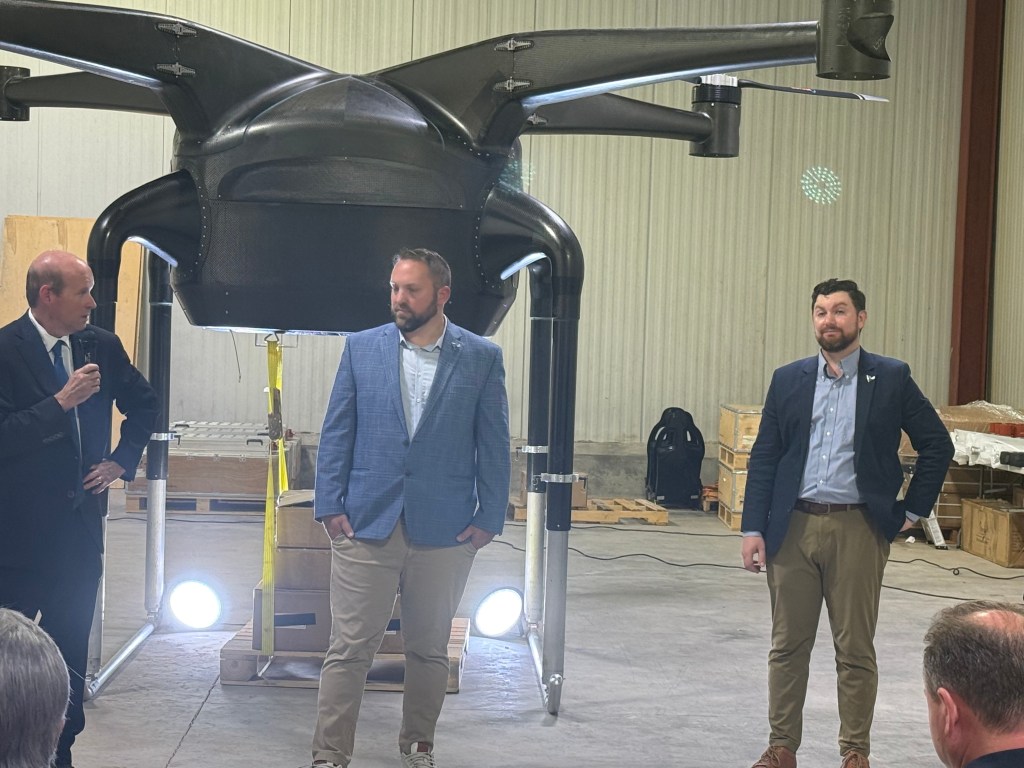
On September 21, 2026, we hosted a special community event at Miami University’s Innovation Center on Elm Street in Oxford, Ohio.
We called the evening “Dreams on Elm Street”, a lighthearted nod to the classic 1980s film. But what we’re building at Volynt isn’t the stuff of nightmares. It’s the realization of a dream, one that is taking shape right here in Butler County and has the potential to transform the future of logistics, aviation, and economic development in Ohio.
The turnout exceeded our expectations. The room was filled with Miami University staff, students, local business leaders, elected officials, and community members who wanted to learn more about what Volynt is building and where we’re headed.
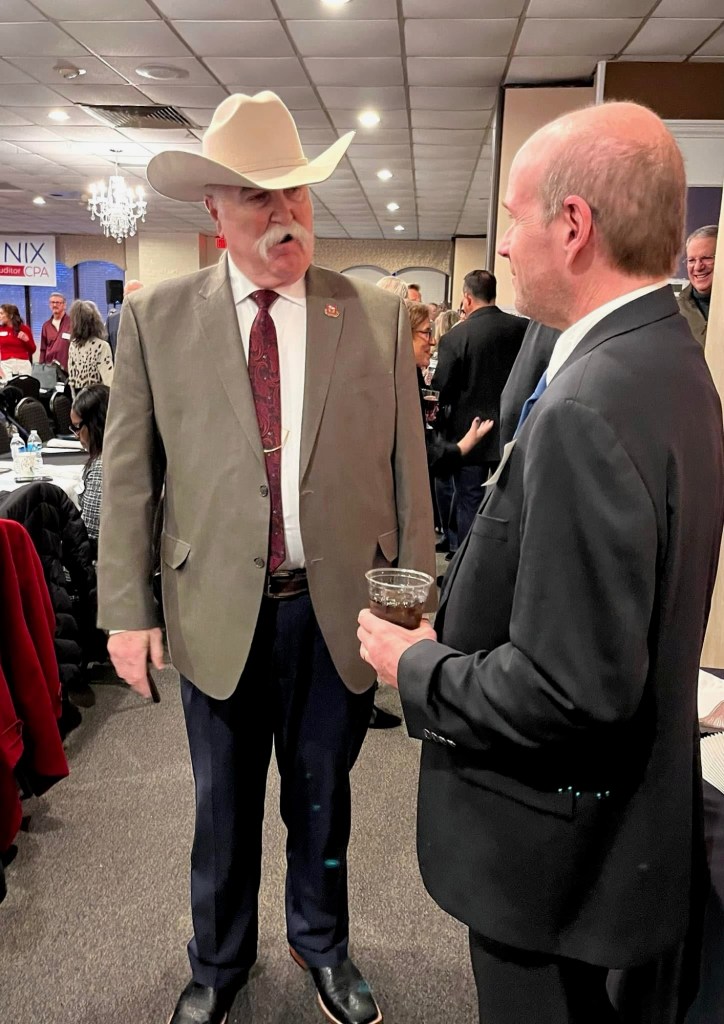
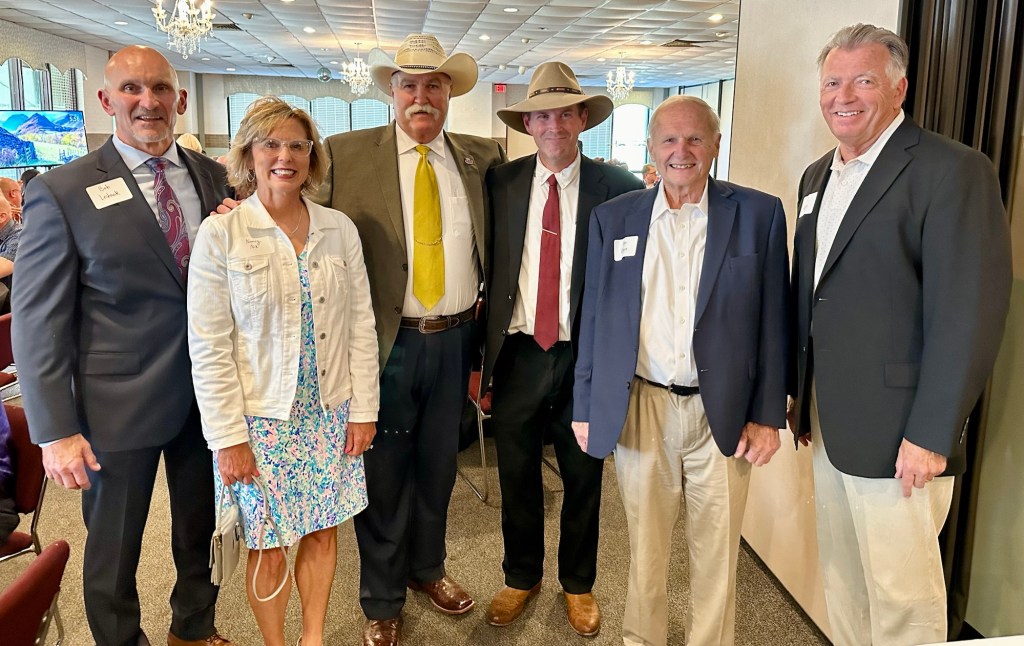
We were honored to welcome Senator George Lang, Butler County Auditor Nancy Nix, and Michael Ryan, who is poised to become Butler County’s next commissioner. Their presence reflected the growing enthusiasm for innovation, entrepreneurship, and advanced aerospace development in our region.
Sharing the Vision
I opened the evening by welcoming our guests and providing an overview of the event. From there, our leadership team took the stage.
Our CEO shared Volynt’s long-term vision and mission. Our Chief Technology Officer highlighted the engineering milestones we’ve achieved and the technology behind the Volynt Vyper platform. As Chief Operating Officer, I discussed how Volynt is transforming cutting-edge aviation technology into a scalable and sustainable business. I outlined our operational strategy, manufacturing roadmap, partnerships, and the steps required to move from prototype development to commercial deployment.
The presentations were engaging, the audience was attentive, and the questions that followed demonstrated genuine interest and excitement.
Most importantly, this wasn’t a flashy product launch filled with unrealistic promises. It was an honest conversation about where we are today, what we’ve accomplished, and what the next several years may hold.
From Prototype to Production
Our immediate focus is straightforward.
Over the next six months, our team will complete the full-scale Vyper prototype that was unveiled at the Innovation Center. That aircraft represents years of design work, engineering refinement, and determination.
Once completed, the aircraft will enter an intensive testing phase designed to validate performance, reliability, and operational capabilities.
Looking ahead to 2027, we plan to participate in major industry competitions, build broader recognition within the aerospace community, and begin manufacturing multiple aircraft.
The goals are ambitious, but they are supported by a clear roadmap and a dedicated team committed to execution.
The Drone Revolution Is Already Here
One of the most important messages of the evening was that autonomous aviation is no longer a future concept.
It’s happening today.
Just one day after our event, Dayton-area company Dexa launched a drone delivery service in Kettering. The program delivers food orders from TJ Chumps on East Stroop Road to customers within a several-mile radius across Kettering, Oakwood, and Centerville.
These smaller drones operate as last-mile delivery systems. Flying at approximately 400 feet, they lower food orders safely to customers using a cable-delivery system. Dexa has spent years developing this capability and is helping demonstrate that drone delivery is becoming a practical reality.
Volynt’s mission is different.
While companies like Dexa focus on last-mile delivery, Volynt is developing larger autonomous aircraft designed for middle-mile logistics. Our aircraft are intended to transport meaningful payloads between regional hubs such as Cincinnati/Northern Kentucky International Airport (CVG), Dayton International Airport, Indianapolis, and other distribution centers.
This approach has the potential to reduce transportation bottlenecks, address driver shortages, and create more efficient supply chains.
Whether it’s delivering a meal across town or transporting freight across a region, autonomous aviation is rapidly reshaping how goods move through our economy.
Why Ohio Is Positioned to Lead
Ohio’s aviation legacy is unmatched.
The birthplace of powered flight now has an opportunity to become a leader in autonomous flight.
Few regions are better positioned than Butler County to participate in that transformation.
Our region offers access to multiple airports, including Miami University’s airport, where initial flight operations can be conducted. At the same time, substantial investment continues at Butler County Regional Airport, where significant infrastructure improvements are being planned.
The resources, workforce, educational institutions, and transportation network already exist. What remains is bringing together the innovators, investors, and community leaders who can turn opportunity into reality.
Creating Careers That Stay Close to Home
One topic that resonates deeply with me is talent retention.
I have spoken with countless parents who have made tremendous sacrifices to provide educational opportunities for their children through Miami University, Butler Tech, and the University of Cincinnati. Too often, those graduates leave Ohio because they believe the best opportunities are elsewhere.
That reality creates a challenge for families and communities alike.
One of our long-term goals at Volynt is to help change that story.
We envision creating thousands of high-quality aerospace, engineering, technology, and manufacturing jobs throughout Southern Ohio. We want talented young people to have the option of building exciting, fulfilling careers without leaving their families, communities, and hometowns behind.
Strong Community Support
One of the most encouraging moments of the evening was seeing the level of support from the community.
Michael Ryan delivered an excellent presentation about economic development in Butler County and how innovative companies such as Volynt can contribute to future growth and prosperity.
The participation from Miami University, local leaders, educators, students, business professionals, and community members reinforced something I’ve believed from the beginning:
Innovation succeeds when communities embrace it.
Dreams on Elm Street was more than a company presentation. It was a milestone. It brought together people from different backgrounds and perspectives to discuss a shared vision for the future of our region.
The energy in the room was unmistakable. The conversations were thoughtful. The questions were insightful. The enthusiasm was genuine.
For me, that confirmed that we’re moving in the right direction.
Looking Ahead
Volynt’s journey is still in its early chapters.
There is much work ahead, many challenges to overcome, and numerous milestones still to achieve. But the momentum is real, and the opportunities are significant.
We will continue sharing updates with the community as we progress from prototype development to testing, certification, manufacturing, and beyond.
This is only the beginning.
Thank you to everyone who attended Dreams on Elm Street and supported our mission. Your encouragement and belief in what we’re building means more than you know.
Together, we’re not just dreaming about the future.
We’re building it.
About the Author
Rich Hoffman is Chief Operating Officer of Volynt, where he leads operational strategy, business development, manufacturing planning, and growth initiatives for the company’s autonomous aerospace programs. A longtime Butler County leader and aerospace executive, he is committed to building high-quality technology careers and advancing innovation throughout Southwest Ohio.
Rich Hoffman is an author, political consultant, and strategic advisor based in Cincinnati, Ohio, and the creator of The Politics of Heaven—a unique framework that connects biblical theology, ancient history, and modern power structures to explain how moral alignment and spiritual forces shape global events. Blending real-world political experience with deep research into archaeology, UFO phenomena, and suppressed historical narratives, Hoffman offers compelling commentary on topics ranging from ancient civilizations and the Dead Sea Scrolls to modern populist movements, paranormal continuity, and leadership strategy in chaotic environments. As the author of The Gunfighter’s Guide to Business and the forthcoming Politics of Heaven, he brings a grounded yet provocative voice to media discussions, supported by firsthand experiences and a cross-disciplinary approach that bridges science, history, and theology. For interviews, speaking engagements, or expert analysis, visit richhoffmanbooks.com or contact directly via phone at 513-307-5815 or email at rhoffman@richhoffmanbooks.com. If you’ve seen the movie, Disclosure Day and want to talk about it and the implications of Presidnet Trump’s UAP disclosures, let me know and we can bring some color to your coverage. https://richhoffmanbooks.com/media-inquiries-broadcast-topics-and-contact-info/?frame-nonce=ad51e7ecba I do have a firsthand UFO encounter to discuss.
If you came here looking for a populist hit piece, this is not that. I write for people who lead, want to lead, or at least refuse to stay on the couch while the culture is rewritten around their children. Scripture is not a campaign prop. It is the sharpest instrument I know for cutting through a coordinated lie. That is the politics of heaven: not party first, not personality first, but the question of whether a people will still call good good and evil evil when the price of doing so is social exile.
I. THE AGE OF DISCLOSURE AND THE POLITICS OF HEAVEN
We are living in what I call an age of disclosure. Not merely the disclosure of secrets in government files, though that conversation is loud enough. I mean something older and more dangerous: the moment when a civilization is forced to admit what it has been doing in the dark. The ideologies that were supposed to stay in graduate seminars leaked into human-resources manuals, then into public schools, then into pediatric clinics. The result is not a private lifestyle. The result is a public demand that the rest of us recite the new creed or be treated as a moral contaminant.
The politics of heaven answers that demand. Heaven is not a voting bloc. Heaven is not a branding exercise. Heaven is the claim that God made the world a certain way, that male and female are not costumes, that children are not raw material for adult ideology, and that a nation which inverts those realities will not stay strong merely because its GDP looks impressive for another quarter.[1]
Paul said he was not ashamed of the gospel of Christ.[2] That sentence is doing more work in 2026 than most platform planks. Shame is the enforcement mechanism of the present order. If they can make you embarrassed to name what you love, they do not have to refute you. They only have to watch you edit yourself until there is nothing left worth hearing.
I will not edit it.
II. FALSE COMPASSION IS NOT LOVE
Start with the word that has been most abused: compassion.
True compassion would protect children from irreversible medical decisions they cannot possibly understand. What we have instead is a coordinated social contagion, especially visible among elites, in which adults congratulate themselves for “affirming” a minor into a pathway of puberty blockers, cross-sex hormones, and surgery. That is not love. That is sacrificing children to an ideology. I will call it what it is: a form of child abuse dressed up as progress.[3]
I am not talking about the rare, severe, persistent cases that clinicians used to treat with extreme caution. I am talking about the sudden clustering, the peer networks, the online scripts, the school social transitions done behind parents’ backs, and the astonishing overrepresentation of transgender-identifying children in a handful of zip codes, friend groups, and celebrity households. When parents, schools, corporations, and entertainment all push the same story at once, vulnerable children get swept up. That is not a coincidence. It is social engineering, plain and simple.
Look at Hollywood. The list of high-profile actors and actresses with children who identify as transgender or non-binary has become a genre of its own. Charlize Theron, Jamie Lee Curtis, Robert De Niro, Jennifer Lopez, Megan Fox, Dwyane Wade, Annette Bening and Warren Beatty, Cynthia Nixon, Sigourney Weaver, Naomi Watts—the names keep accumulating.[4] In a country where transgender identification among youth was, until recently, vanishingly rare, that concentration is not “just visibility.” Visibility does not create statistical spikes this localized unless something in the environment is recruiting.
Some researchers and activists insist there is no social contagion, and they would be wrong. Other researchers, clinicians, and dissenters say the opposite, and the Cass Review in the United Kingdom was blunt about the weakness of the evidence base that was used to medicalize children.[5] I do not need a unanimous journal to use my eyes. When a belief system travels through prestige networks faster than it travels through farm towns, you are not watching a spontaneous awakening. You are watching fashion with a clinical billing code.
Scripture is not ambiguous about the created order. God created them male and female.[6] To catechize children into rebellion against that order is not pastoral care. It is a revolt against the Creator, outsourced to minors who will live with the consequences long after the adults have moved on to the next cause.
The proper Christian response is not cruelty. It is not mockery of the suffering. It is this: speak truth with clarity, protect children from harm, and offer genuine compassion to those who are distressed—without affirming the lie that is injuring them. Affirmation of a falsehood is not mercy. It is participation.
III. WHY THE RATES ARE NOT RANDOM
People who do not want to face this subject hide in averages. They will tell you that “only a small percentage” of children identify this way, as if a small percentage plus institutional capture is nothing. The point is not only prevalence. The point is location.
Certain circles have dramatically higher rates of trans-identifying children. Elite schools. Entertainment. Specific online subcultures. Certain therapeutic fashions. Human-resources departments that rewrote the rules of speech and then dared the rest of the country to object. The same class of people who draft the corporate training also sit on museum boards, donate to universities, and lecture the working class about which words are now violence.
I have watched this move through institutions the way termites move through a beam. You do not notice the first memo. You notice the tenth, when a teacher is punished for using ordinary sexed language, or a parent is treated as the threat for refusing to transition a twelve-year-old socially. By then the lie has become policy.
This is why I reject the slogan that “silence is kindness.” Silence in a captured institution is how the capture finishes. If you work in a place where DEI language has been used to smuggle gender ideology into childhood, you already know the mechanism. It was not a grassroots cry from children. It was a professional class writing rules that everyone else was expected to obey while calling the obedience righteousness.
I do not owe that project my vocabulary.
IV. YOU ARE NOT REQUIRED TO SURRENDER WHAT YOU LOVE
There is a related lie, and it is aimed at Christians specifically: that the loving thing is to mute your own faith so that people who despise it can feel comfortable.
I reject that.
It is one thing to say we should not be cruel. It is another thing to say that Islam, progressive sexual ideology, and the new civic religion of the public school must be handled with velvet, while Christian speech must be handled with a muzzle. I am supposed to be endlessly compassionate toward alternative sexual lifestyles and toward the latest curriculum, and then I am supposed to treat my own Scripture as a private hobby that might offend the room.
No.
You like what you like. I like what I like. I am not going to edit the Bible to make you happy. You do not care if I am unhappy. So I am going to talk about the Bible. I am going to talk about the Scripture I enjoy. I believe this is what God says, and I will not be ashamed of it.
That kind of honest, unapologetic speech is far more powerful than the aggressive politeness of people who sand their faith down until it can pass a diversity seminar. The world feels no obligation to make Christians comfortable. Reciprocal self-erasure is not tolerance. It is surrender.
As Paul said, I am not ashamed of the gospel of Christ.[2] Speaking Scripture openly, without apology, is one of the most effective ways to push back against cultural pressure. It draws a clear line. It gives courage to people who have been staying quiet. Leaders who speak plainly strengthen the faithful and expose deception at the same time.
There is nothing wrong with liking Christian things and professing them openly. You do not have to put a lid on your viewpoint while everybody else imposes theirs and you are told to shut up and take it. That hour is over, or it should be.
V. THE MUSEUM OF THE BIBLE AND THE POWER OF BEING UNASHAMED
Let me give a point of reference I have used for years.
The Museum of the Bible in Washington, D.C., is one of my favorite places in the world.[7] I never liked Washington much until the political weather changed and I had reason to be there. I have been more than once. I am a member and a supporter. In the background of my life, I love using the Bible, and I love a building three blocks from the Capitol that says: here is the history of this book. See it. Relish it. Enjoy it.
They are not required to plant flags all over the National Mall. You can still go to the Smithsonian. You can still do every other official thing the capital offers. People love the Museum of the Bible anyway, because it feeds them. It does not pretend to be a neutral warehouse. It professes that this book is good. It is open about that goodness. It loves being good.
That is the model.
Other places I enjoy for the same reason: the Ark Encounter and the Creation Museum in northern Kentucky, the work of Ken Ham and Answers in Genesis.[8] I love those guys. I may not agree with their young-earth timeline. I am an old-earth kind of guy. We would argue, probably at length, about whether the earth is six thousand years old or many millions. I have read Ham. I understand the argument. I would still debate him profusely on the age of the earth. That disagreement does not cancel the thing I actually love: their embrace of goodness.
When you walk those sites, you cannot help but see how hard they try to be good, and they do not hide it. They do not cram it down every throat on earth. They also do not crush their own enjoyment to satisfy people who arrive already offended. The offended party does not mind offending you. It is quite fine to go the other way—to be audacious about your love for what you value. You do not have to destroy it to make someone else happy.
Jonathan Edwards understood the same principle in a different century. True religion is not mere outward show. When the heart is captured by the beauty of God and His word, it cannot stay silent. The joy overflows.[9] Dimming that joy to appease people who hate its source is not love, and it is not tolerance. It betrays the truth you claim to love.
You do not have to attack persons. You also must not shrink back. Let the light shine clearly. Those who love truth will be drawn to it. I have watched that happen in the galleries of the Museum of the Bible. Stand firm. Speak plainly. Enjoy God’s goodness without shame. That is every Christian’s duty, not a branding strategy for an election cycle.
VI. KEN HAM, BILL NYE, AND THE DIFFERENCE BETWEEN CORE AND SECONDARY
I was at the Creation Museum not long ago, wearing a Museum of the Bible shirt—the kind I wear often, because it reminds me of the things I actually like when a lot of darkness surrounds me. The woman at the counter said it was great that I go to the Museum of the Bible. I told her I love that museum, and I also love what Ken Ham built. Ham set a public philosophy in motion. The exhibits are well done. I have read the books. I understand why the young-earth argument matters to the people who hold it.
The real discussion is larger than a debate-club win. Science and theology are allowed to argue. I would argue with Ham that the earth is much older than six thousand years. I would also tell Bill Nye that sneering at Genesis as if the only alternatives were a cartoon ark or a materialist closed system is a different kind of ignorance. The point for this essay is not to settle geology. The point is that Christians can disagree on the age of the earth and still refuse to surrender the created order, the moral law, and the right to love Scripture out loud.
That is maturity. Rally around the core of the confession, not around every secondary interpretation. Ken Ham loves what he believes and says it without shame. I will not take that joy from him. I wish more people in public life had that spine, even when I think their timeline is wrong.
VII. JD VANCE, BUTLER COUNTY, AND WHY SCRIPTURE AT A RALLY IS NOT A GIMMICK
JD Vance is from my part of the world. Middletown. Butler County. Monroe just down the road. I know those hardy people. I know the flea markets—Traders World, Treasure Island—where folks come out of church on Sunday and walk the aisles looking at vendors, wall art, and the kind of homemade biblical kitsch that elites mock and ordinary people actually live with.[10]
Vance knows that country. His people are those people. When he talks about Scripture, it does not sound like a consultant discovered “faith outreach” on a whiteboard. It sounds like Butler County. That matters.
I have been glad to see President Trump and Vice President Vance put Scripture into the open at the Texas midterm moment and in surrounding speeches and interviews.[11] Vance has been unusually explicit that Christianity is not a private hobby you hide to keep a coalition calm. He has said Christianity is America’s creed—not that every citizen must be a Christian, but that the moral language that actually formed the country is Christian.[12] He has said Satan’s favorite trick is convincing Christians that faith and politics belong in separate rooms.[13] He has even been willing to talk about end times without collapsing into either panic or passivity: do the work in front of you; do not outsource your whole moral life to a countdown clock.[14]
I think that is smart. It will help the midterms. Not because Bible verses are magic turnout dust, but because a lot of serious churchgoing conservatives have concluded that politicians are blabbermouths who say one thing at the banquet and another in the agency. Those people will stay home if they think the language is rented. They will show up if they think the man actually fears God more than he fears the clip.
I am not naive. Quoting Scripture at a rally is easy. Governing in a way that honors the God of that Scripture is harder. The test is not whether a line lands in a speech. The test is whether the administration’s actions, over time, hate what God hates and love what God loves. A leader who merely drapes verses over policies that protect evil is a hypocrite. A leader who fears God will not be silent when innocent blood, confused children, and public lies are being baptized as kindness.
For midterms, for holding the House and the Senate, the Christian vote is not a sentiment. It is a body of people who still believe first allegiance is not to a party. If you want them off the couch, do not give them another focus-grouped paragraph about “values.” Give them the thing they already know is true and have been told to whisper.
VIII. THREE VERSES LEADERS SHOULD NOT BE AFRAID TO SAY OUT LOUD
If a leader wants language that encourages the faithful and warns the powerful at the same time, he does not need a speechwriter to invent it. It is already in the book.
First: “Righteousness exalts a nation, but sin is a reproach to any people.”[15]
That is Proverbs 14:34. It directly assaults the idea that a country becomes great by GDP, weapons, or branding. Moral order is not an accessory. If we keep normalizing what Scripture calls evil, we are not becoming sophisticated. We are becoming weak. Wealth will not save a people that has taught its children to despise the created order.
Second: “Woe to those who call evil good, and good evil; who put darkness for light, and light for darkness.”[16]
Isaiah 5:20 is the verse for this exact hour. It names the mechanism. The deception is not only that people do wrong. The deception is that they rename the wrong and then punish the person who remembers the old name. Redefine marriage, celebrate the confusion of sex, treat biblical speech as harm, and you have not expanded compassion. You have inverted the moral dictionary. A leader who will not say that sentence is not being pastoral. He is being careful about his future bookings.
Third: “Blessed is the nation whose God is the Lord.”[17]
Psalm 33:12 is not a magic formula for a superpower. It is a reminder of allegiance. The Christian community’s ultimate loyalty is not to a party, a personality, or a news cycle. Blessing, in the biblical sense, attaches to a people that still knows who God is. That is hope, not nostalgia. It tells serious people why they should bother.
These three verses do what a good rally needs: moral clarity, a warning against deception, and a promise larger than the next quarter. They are short enough to remember. They are sharp enough to divide light from fog.
IX. DO NOT WAIT FOR THE RAPTURE WHILE EVIL DOES THE WORK
Here is the pastoral failure I have watched for decades.
Many people I know will say they are good Christians because they refuse to “engage.” They will hang the Ten Commandments on the wall, go to church on Sunday, and then treat public evil as a problem God will vacuum up at the end of the age. They do not want to confront anybody. They do not want to fight. They want the apocalypse to do the job they were too tired or too timid to do. They call that humility. I call it a religious mask on laziness.
The same Bible that promises the return of Christ also commands believers to resist the devil, hate what is evil, do justice, and love mercy.[18] God never called a people to nap while wickedness reorganizes the schools. Waiting for God to fix everything while we do nothing is not faith. It is presumption.
Moses did not treat Egypt as a spectator sport. Deborah did not. David did not. Nehemiah did not rebuild a wall by quoting a verse about patience and going home. The apostles did not treat the ruling authorities as an excuse to go mute. Romans 13 tells Christians to recognize governing authority. Acts 5:29 tells them that when those authorities command what God forbids, the first allegiance is to God.[19] Submission to God is not submission to evil—quite the opposite.
If a world leader will not bow to the authority of God, that does not mean the rest of us take a back seat and wait for the credits. It means discernment. It means we do not confuse a Bible on the podium with a conscience in the chest. It also means we do not treat politics as a substitute for conversion. A man can win a midterm and still lose his soul. Reformation that begins only in rallies and podcasts, and never in the soul’s submission to Christ, profits nothing.
However, the opposite error is just as real: using “God will handle it” as cover for refusing to handle the thing in front of you. Faith works in its own generation. It prays for the kingdom to come and then spends its breath on righteousness while it still has breath.
X. FLEA-MARKET CHRISTIANITY AND THE DIFFERENCE BETWEEN DECORATION AND BACKBONE
I like Traders World. I like Treasure Island. Monroe, Ohio, is a strange and specific place, and I love it for what it is. Walk those markets, and you will see a lot of people who came straight from church. You will see biblical references on the walls. Treasure Island, in particular, draws a large Mexican immigrant population, and if you have spent time in Mexico, you already know how Catholic that visual world is. They love images of Jesus. They carried older indigenous forms into Catholic form and made something that is not a seminar paper. It is folk theology in color. I love Mexican religious art, including the Christianized approach to death that outsiders reduce to a cartoon of “the cult of the dead.” It is not voodoo. It is a people who still think the dead and the living are not sealed off from each other by a shopping mall.
I can love all of that and still say the hard thing: too many of those same households treat Scripture as interior decorating.
They will buy the plaque. They will love the verse. They will tell you they left it to Jesus. Then, when the school, the HR office, or the culture demands that they deny what the plaque says, they fold and call the fold piety. That is not devotion. That is decoration. Faith that only admires Scripture on a wall, and will not stand for the same commandments when the cost is a customer, a job, or a family argument, is not the faith that built anything worth keeping.
True Christianity has always required backbone. Nice religious imagery is easy. JD Vance coming out of that same region makes the stakes sharper. Those people need to see a leader who will fight for what the wall art claims to believe. If he only sounds like church on Sunday and then governs like every other manager of decline, the flea-market vote will stay home, and the professional class that rewrote childhood will not.
XI. CHRISTIANITY IS A WEAPON — BUT NOT THE WAY THE MOB MEANS WEAPON
People get nervous when you say Christianity is a weapon. They should get the meaning right.
Christianity is not a weapon in the way a riot is a weapon. It is not deceit. It is not a secret police of the pious. The word of God is living and active, sharper than any two-edged sword.[20] Truth is the blade. When a leader speaks Scripture with actual conviction, it cuts through slogans, exposes the rename-the-evil trick, and wakes a conscience that had gone to sleep under the word “kindness.”
That is how you fight evil in high places without becoming the thing you oppose.
Many of the policies I have been watching—the sexual ones, the speech ones, the childhood ones—were designed in the background to wear away a society that still had a Christian base. You do not have to invent a conspiracy chart to see the sequence. First, the language changes. Then the training changes. Then the child is caught in the middle, and the parent is the last to be informed. The answer is not to copy the enemy’s methods. The answer is to stop being ashamed of the only thing that can actually defeat the darkness: the gospel of Jesus Christ, spoken as if you mean it.
A leader should stand on Scripture not as a mascot but as a man who fears God more than he fears the mob. This generation is starving for that kind of boldness. Amen. Let it be said without the usual throat-clearing.
XII. ISLAM, SAUDI ARABIA, AND THE RIGHT TO DEFEND YOUR OWN HOUSE
A short word on a subject that makes consultants sweat.
Twenty-five years after 9/11, a lot of people are angry that American leadership will not spend every morning railing at Saudi Arabia and at radical Islam in the old post-2001 register. Radical Islam is not a hallucination. It is still at work. It is fair game. I also think you can put your hand on the Bible without turning every speech into a comparative-religion insult comic.
You do not have to be condescending toward every competing religion to defend Christianity. [21] A leader who fears God will not be silent when innocent blood is shed in the name of religion. He also needs wisdom. Sometimes the most effective stand is not the loudest anathema. It is the clear, consistent defense of truth and justice, and the refusal to treat Christianity as the one faith that must apologize for existing.
If Trump or Vance quote Scripture, the test is not the quote. The test is whether their actions line up with the book they opened. Religion used as a costume for power is an old trick. Religion used as the thing a man actually submits to is rarer, and it is the only version worth the airtime.
XIII. THE JONATHAN EDWARDS STUDY BIBLE AND A PRACTICAL NEXT STEP
If you want an entry point that is not a meme and not a campaign pamphlet, start with a book that expects you to stay.
The Jonathan Edwards Study Bible, published by Thomas Nelson in August 2026 and edited by Matthew Everhard, is built on the NKJV and Edwards’s own notes, resolutions, and theological instincts.[22] Edwards’s great theme was not American politics. It was joy in God. “The enjoyment of God is the only happiness with which our souls can be satisfied.” That is the sentence under the project. Study notes drawn from his work, essays on the Great Awakening, his Resolutions, and his miscellanies system are all there if you want to do more than highlight a rally verse.
I love a study Bible that treats Scripture as something you live inside, not something you mine for applause lines. I do not agree with every secondary system any commentator has ever hung on the text. I do not need to. The point is daily reading, public love, and an unashamed life. Treat yourself to something good. Read it. Let people know you love it. At this stage of the game, visible joy in the word is not a small witness. It is one of the last clean ones left.
XIV. WHAT I WANT FROM LEADERS — AND WHAT I WILL NOT PRETEND
I want leaders who will:
Protect children from medical and social experiments they cannot consent to in any meaningful sense.
Stop treating “compassion” as a synonym for affirmation.
Speak Scripture as if it were true, not as if it were a demographic.
Refuse the HR liturgy that recodes male and female as optional.
Understand that Christian voters are not a prop. They are people whose first loyalty is supposed to be higher than a ticket.
Fight in their own generation instead of waiting for the sky to split.
Keep their joy. An ashamed church is a disarmed church.
I will say this: goodness is not something you have to apologize for. Find it. Love it. Project it. Evil is not shy about encroaching. You are not obligated to meet that encroachment with a permanent second cheek and a taped mouth. The job, when you see the lie eating children and renaming itself kindness, is to conquer it with righteousness and to be bold about the source of that righteousness.
Do not be ashamed of the gospel.
Do not be ashamed of the book.
Do not be ashamed of liking what is good.
That is the politics of heaven in an age that keeps disclosing how much of our public life was built on a dare: that ordinary people would rather be polite than tell the truth about their own sons and daughters.
XV. A LAST WORD TO THE PEOPLE WHO ACTUALLY LEAD
This was never written for the algorithm that wants a screaming thumbnail. It was written for the smaller room: the people who draft, who vote in caucuses, who manage institutions, who sit close enough to power to change a line in a bill or a tone in a speech.
It is safe to put your arm around Scripture.
It is not safe, in the only sense that matters, to keep pretending that the sexual revolution’s latest chapter is too delicate to name.
You are allowed to enjoy the Museum of the Bible, the Creation Museum, a Mexican retablo of Christ, a Jonathan Edwards page, a Butler County flea market, and a Vice President who will still say the name of Jesus without coughing. You are allowed to disagree about the age of the earth and still agree that a girl is not a boy because a school counselor said so.
The light does not need your permission to be light. It needs you to stop putting a basket over it.
Speak plainly. Protect the children. Love the good without apology. Leave the shame to the people who require it.
That is how you strengthen the faithful. That is how you expose the deception. That is how a nation finds out, in an age of disclosure, whether it still remembers the politics of heaven.
NOTES
[1] The phrase “politics of heaven” is used here in the older Christian sense: the public consequences of God’s reign and moral law, not a claim that any party is the kingdom of God. See Augustine, The City of God, esp. Books XIV–XIX, on the interweaving of the city of God and the city of man.
[2] Romans 1:16: “For I am not ashamed of the gospel of Christ, for it is the power of God to salvation for everyone who believes.”
[3] On the distinction between pastoral care for distressed youth and the affirmation-only medical pathway, see Hilary Cass, Independent Review of Gender Identity Services for Children and Young People: Final Report (NHS England, 2024); Abigail Shrier, Irreversible Damage (Regnery, 2020); Lisa Littman, “Parent reports of adolescents and young adults perceived to show signs of a rapid onset of gender dysphoria,” PLOS ONE 13, no. 8 (2018).
[4] Reporting and commentary on the clustering of transgender-identifying children in celebrity households include Rikki Schlott, “How social contagion created a generation of trans kids in Hollywood,” New York Post, June 4, 2026; “The rise of the celebrity trans kid,” The Spectator, April 10, 2024; and recurring profiles in mainstream entertainment coverage of specific families. Clustering is not the same as a complete census; it is a pattern that demands an explanation beyond “visibility.”
[5] Cass, Independent Review (2024). For the contrary claim that social contagion is unsupported, see Jack Turban et al., “Sex Assigned at Birth Ratio among Transgender and Gender Diverse Adolescents in the United States,” Pediatrics (2022). For more recent discussion of declining youth identification after the peak years, see analysis associated with Eric Kaufmann’s 2025 commentary on survey trends. The existence of a debate is the point: the science was never “settled” in the way school districts pretended.
[6] Genesis 1:27; Matthew 19:4; Mark 10:6.
[7] Museum of the Bible, 400 4th Street SW, Washington, D.C.; opened November 17, 2017; founded through the Green family / Museum of the Bible, Inc. See museumofthebible.org and the institution’s published FAQ on mission, square footage, and exhibit floors.
[8] Ken Ham, Answers in Genesis; Creation Museum, Petersburg, Kentucky (opened 2007); Ark Encounter, Williamstown, Kentucky (opened 2016). See answersingenesis.org.
[9] Jonathan Edwards, A Treatise Concerning Religious Affections (1746); The Life of David Brainerd; and the Resolutions. Edwards’s insistence that true religion engages the affections, not merely the mouth, is the through-line of the 2026 study Bible project cited below.
[10] Traders, World and Treasure Island are long-running flea-market / vendor sites serving the Monroe–Middletown corridor in Butler County, Ohio. JD Vance’s upbringing in Middletown and family ties in the county are documented in Hillbilly Elegy (Harper, 2016) and in subsequent local reporting.
[11] Coverage of Trump and Vance at the Republican midterm convention in Dallas, September 2026, includes contemporaneous reports from ABC and other national outlets. Vance’s broader 2025–2026 record of public Christian speech includes the Turning Point USA AmFest 2025 address and the May 2026 “Rededicate 250” remarks on the National Mall.
[12] JD Vance, AmFest / Turning Point USA remarks, December 2025: “Christianity is America’s creed,” with the explicit caveat that one need not be a Christian to be an American. See also Catholic News Agency, “Vice President JD Vance presents a Christian vision of politics,” December 2025.
[13] Ryan Foley, “JD Vance: Satan wants Christians to separate faith from politics,” The Christian Post, July 20, 2026, reporting on Vance’s conversation with Bishop Robert Barron.
[14] Maya Yang, “JD Vance says he is doing ‘God’s work – and if that leads to the end times, OK,’” The Guardian / syndicated, September 2, 2026, on the Bryce Crawford interview.
[15] Proverbs 14:34 (NKJV): “Righteousness exalts a nation, but sin is a reproach to any people.”
[16] Isaiah 5:20.
[17] Psalm 33:12: “Blessed is the nation whose God is the Lord, the people He has chosen as His own inheritance.”
[18] James 4:7; Romans 12:9; Micah 6:8; Psalm 97:10.
[19] Romans 13:1–7; Acts 5:29. The Deborah and David narratives are Judges 4–5 and 1 Samuel 16–31 / 2 Samuel.
[20] Hebrews 4:12; Ephesians 6:17.
[21] John 14:6; Acts 4:12.
[22] The Jonathan Edwards Study Bible: Experience Abiding Joy in Christ (NKJV), general editor Matthew Everhard (Thomas Nelson, August 18, 2026). Features include Edwards-derived study notes, doctrinal articles, essays on Edwards and the Great Awakening, the Resolutions, and an introduction to his miscellanies method.
BIBLIOGRAPHY AND FURTHER READING
Scripture and Classic Christian Sources
The Holy Bible, New King James Version. Augustine of Hippo. The City of God. Trans. Henry Bettenson. London: Penguin, 2003. Calvin, John. Institutes of the Christian Religion. Ed. John T. McNeill. Louisville: Westminster John Knox, 1960. Edwards, Jonathan. A Treatise Concerning Religious Affections. 1746. In The Works of Jonathan Edwards, Vol. 2. New Haven: Yale University Press. Edwards, Jonathan. “Resolutions.” In Letters and Personal Writings, Works of Jonathan Edwards, Vol. 16. New Haven: Yale University Press. Edwards, Jonathan. Sinners in the Hands of an Angry God. 1741. The Jonathan Edwards Study Bible: Experience Abiding Joy in Christ (NKJV). General editor Matthew Everhard. Nashville: Thomas Nelson, 2026. Packer, J. I. Knowing God. Downers Grove, IL: InterVarsity Press, 1973. Lewis, C. S. The Abolition of Man. Oxford: Oxford University Press, 1943. Lewis, C. S. Mere Christianity. London: Geoffrey Bles, 1952. Niebuhr, Reinhold. Moral Man and Immoral Society. New York: Scribner, 1932. Solzhenitsyn, Aleksandr. “Live Not by Lies.” 1974. Schaeffer, Francis A. How Should We Then Live? Old Tappan, NJ: Revell, 1976. Schaeffer, Francis A. A Christian Manifesto. Westchester, IL: Crossway, 1981.
Creation, Museums, and Public Christian Witness
Ham, Ken. The Lie: Evolution. Green Forest, AR: Master Books, 1987; rev. eds. thereafter. Ham, Ken. Gospel Reset. Green Forest, AR: Master Books, 2018. Answers in Genesis. Creation Museum and Ark Encounter visitor guides and position papers. https://answersingenesis.org Museum of the Bible. Institutional FAQs, exhibit guides, and annual materials. Washington, D.C. https://www.museumofthebible.org Wishard, Grant. “Love to Tell the Story.” Washington Examiner, November 17, 2017. Zauzmer Weil, Julie, and Sarah Pulliam Bailey. “The ark vs. the covenant: the dramatic contrast between the Creation Museum and the Museum of the Bible.” Washington Post, November 20, 2017.
Sex, Children, Medicine, and Social Contagion
Cass, Hilary. Independent Review of Gender Identity Services for Children and Young People: Final Report. NHS England, 2024. Shrier, Abigail. Irreversible Damage: The Transgender Craze Seducing Our Daughters. Washington, D.C.: Regnery, 2020. Shrier, Abigail. Bad Therapy: Why the Kids Are Not Growing Up. New York: Sentinel, 2024. Littman, Lisa. “Parent reports of adolescents and young adults perceived to show signs of a rapid onset of gender dysphoria.” PLOS ONE 13, no. 8 (2018). Bailey, J. Michael, and Ray Blanchard. Clinical and taxonomic papers on autogynephilia and rapid-onset presentations (various). Laidlaw, Michael, et al. Endocrine and pediatric critique literature on puberty blockade. SEGM (Society for Evidence-Based Gender Medicine). Collected reviews. Turban, Jack L., et al. “Sex Assigned at Birth Ratio among Transgender and Gender Diverse Adolescents in the United States.” Pediatrics (2022). [Contrary thesis; included so the reader can see both sides of the official argument.] Kaufmann, Eric. Commentary and data notes on declining youth LGBT / transgender identification after the early-2020s peak (2025). Schlott, Rikki. “How social contagion created a generation of trans kids in Hollywood.” New York Post, June 4, 2026. “The rise of the celebrity trans kid.” The Spectator, April 10, 2024. “Hollywood’s growing A-list of non-binary, transgender kids.” The Daily Telegraph, 2025. Hruz, Paul W., Lawrence S. Mayer, and Paul R. McHugh. “Growing Pains: Problems with Puberty Suppression in Treating Gender Dysphoria.” The New Atlantis, 2017. McHugh, Paul. “Transgender Surgery Is not the Solution.” Wall Street Journal, 2014, and related Johns Hopkins commentary. Soh, Debra. The End of Gender. New York: Threshold, 2020. Joyce, Helen. Trans: When Ideology Meets Reality. London: Oneworld, 2021. Hilton, Emma, and Colin Wright. Biological-sex primer essays in Reality’s Last Stand and related venues. Singal, Jesse. Long-form reporting on youth gender medicine, The Atlantic and later independent work.
Culture, Elite Capture, and Institutional Language
Murray, Douglas. The Madness of Crowds. London: Bloomsbury, 2019. Murray, Douglas. The War on the West. New York: Harper, 2022. Trueman, Carl R. The Rise and Triumph of the Modern Self. Wheaton, IL: Crossway, 2020. Trueman, Carl R. Strange New World. Wheaton, IL: Crossway, 2022. Hanby, Michael. Various essays on technology, liberalism, and the body, First Things. Lasch, Christopher. The Culture of Narcissism. New York: Norton, 1979. Rieff, Philip. The Triumph of the Therapeutic. New York: Harper & Row, 1966. MacIntyre, Alasdair. After Virtue. Notre Dame: University of Notre Dame Press, 1981. Sowell, Thomas. The Vision of the Anointed. New York: Basic Books, 1995. Sowell, Thomas. Intellectuals and Society. New York: Basic Books, 2009. Darel E. Paul. From Tolerance to Equality. Waco: Baylor University Press, 2018.
Vance, Ohio, and the Present Political-Religious Moment
Vance, J. D. Hillbilly Elegy. New York: Harper, 2016. Vance, J. D. Communion: Finding My Way Back to Faith. 2026. “Vice President JD Vance presents a Christian vision of politics.” Catholic News Agency, December 2025. “JD Vance: Satan wants Christians to separate faith from politics.” Christian Post, July 20, 2026. “Religious Vance seeks to avoid MAGA schism as he keeps the faith for 2028.” The Guardian / syndicated, September 13, 2026. Yang, Maya. “JD Vance says he is doing ‘God’s work – and if that leads to the end times, OK.’” September 2, 2026. Forbes Breaking News. “The Morality & Religion That Formed The American Consciousness Were Decidedly Christian.” National Mall remarks, May 2026. Local reporting on Middletown, the Cleveland-Cliffs mill, and Vance’s hometown visits: Cincinnati Enquirer, Journal-News, Fox News, 2023–2026. Dreher, Rod. Live Not by Lies. New York: Sentinel, 2020. Renn, Aaron M. Life in the Negative World. Washington, D.C.: Zondervan / related 2024 essays on post-Christian America.
Islam, Religious Liberty, and Public Courage
Ibn Warraq. Why I Am Not a Muslim. Amherst, NY: Prometheus, 1995. Spencer, Robert. The History of Jihad. New York: Bombardier, 2018. [Use critically; included because the public argument exists.] Griffith, Sidney H. The Church in the Shadow of the Mosque. Princeton: Princeton University Press, 2008. Weigel, George. Faith, Reason, and the War against Jihadism. New York: Doubleday, 2007. First Amendment and religious-liberty case law: Employment Division v. Smith; Fulton v. City of Philadelphia; 303 Creative v. Elenis; related commentary in Harvard Journal of Law & Public Policy.
Ohio Color, Folk Religion, and Place
Hoffman, Rich. Prior columns and commentary at OvermanWarrior / related essays on Middletown, Monroe, and regional culture. Brandes, Stanley. Skulls to the Living, Bread to the Dead: The Day of the Dead in Mexico and Beyond. Oxford: Blackwell, 2006. Carmichael, Elizabeth, and Chloë Sayer. The Skeleton at the Feast: The Day of the Dead in Mexico. Austin: University of Texas Press, 1991. Nutini, Hugo G. Todos Santos en Rural Tlaxcala. Princeton: Princeton University Press, 1988. Local vendor culture around Traders World (Monroe, Ohio) and Treasure Island as primary, on-the-ground observation rather than academic monograph.
Journalism and Primary Documents Worth Keeping
Cass Review full report and supporting research annexes (NHS England). WPATH Files / leaked internal files and subsequent journalistic treatment (2024). SEGM, Genspect, and Society for Evidence-Based Gender Medicine bibliographies. Museum of the Bible press FAQs. Answers in Genesis statement of faith and museum interpretative materials. Thomas Nelson catalog entry and Everhard interviews on the Jonathan Edwards Study Bible (August 2026).
Suggested Reading Paths
If you lead and have one night: Romans 1 and 13, Acts 5, Proverbs 14, Isaiah 5, Psalm 33, Hebrews 4; then Cass’s final report summary; then Vance’s Communion on why he will not keep the faith in a separate drawer.
If you want the child-medicine argument without online noise: Cass; Shrier; Hruz/Mayer/McHugh; then one contrary paper (Turban, 2022) so you know what the institutions cited.
If you want the soul of the thing rather than the policy: Edwards’s Religious Affections; the 2026 Edwards Study Bible notes on joy; Augustine’s two cities; Solzhenitsyn’s “Live Not by Lies.”
Suppose you want to walk the places named here: Museum of the Bible in Washington; Creation Museum and Ark Encounter in Kentucky; a Sunday-to-Monday loop through Middletown and the Monroe markets. The argument is clearer after you have stood in the rooms.
About the Author
Rich Hoffman writes from the Middletown, Ohio, side of the country, for readers who still think Scripture is allowed in public and that children are not a canvas for someone else’s revolution. This essay is not a substitute for a church, a clinician, or a ballot. It is a refusal to whisper.
Rich Hoffman is an author, political consultant, and strategic advisor based in Cincinnati, Ohio, and the creator of The Politics of Heaven—a unique framework that connects biblical theology, ancient history, and modern power structures to explain how moral alignment and spiritual forces shape global events. Blending real-world political experience with deep research into archaeology, UFO phenomena, and suppressed historical narratives, Hoffman offers compelling commentary on topics ranging from ancient civilizations and the Dead Sea Scrolls to modern populist movements, paranormal continuity, and leadership strategy in chaotic environments. As the author of The Gunfighter’s Guide to Business and the forthcoming Politics of Heaven, he brings a grounded yet provocative voice to media discussions, supported by firsthand experiences and a cross-disciplinary approach that bridges science, history, and theology. For interviews, speaking engagements, or expert analysis, visit richhoffmanbooks.com or contact directly via phone at 513-307-5815 or email at rhoffman@richhoffmanbooks.com. If you’ve seen the movie, Disclosure Day and want to talk about it and the implications of Presidnet Trump’s UAP disclosures, let me know and we can bring some color to your coverage. https://richhoffmanbooks.com/media-inquiries-broadcast-topics-and-contact-info/?frame-nonce=ad51e7ecba I do have a firsthand UFO encounter to discuss.
I have been reading The Jonathan Edwards Study Bible, the new NKJV edition from Thomas Nelson, edited by Dr. Matthew Everhard and released August 18, 2026.[1] I promised myself I would have a conversation with Jonathan Edwards. He died in 1758. He is not coming back to sit across a table in Middletown. But I think with AI a conversation can go the way it would go if he were alive today, provided the machine is forced to stay inside what the man actually wrote and believed.
I used Grok because it does a decent job of pulling from the public record instead of inventing a pious cartoon. I asked it to be Jonathan Edwards. I asked questions that came off the page of that study Bible and off the street of 2026. What follows is not a séance. It is not a message from heaven. It is a simulation built on a lifetime of Edwards’s sermons, treatises, miscellanies, letters, and the notes now printed beside the biblical text.[2] I say that up front because honesty is part of the point. If we start lying about what a tool is, we will start lying about what God is.
I still think it was a healthy conversation. I think America is starving for the kind of seriousness Edwards brought to a pulpit in Northampton and later to Enfield. I think the timing of this Bible is not an accident. And I think righteousness is a weapon. Not a slogan. A weapon.
The Jonathan Edwards Study Bible and Why I Opened It
Thomas Nelson published The Jonathan Edwards Study Bible: Experience Abiding Joy in Christ in multiple bindings: hardcover, brown Leathersoft, and black genuine leather. It is a red-letter NKJV, Comfort Print, with study notes drawn from Edwards’s own work, full-page essays on his theology and the First Great Awakening, his Resolutions, and an introduction to his Miscellanies note-taking system so a reader can build one of his own.[3]
I bought a marked, indexed copy. I prefer brown leather to black. The smell of the leather is not a small thing. A Bible you want to pick up is a Bible you will actually read. I have several Thomas Nelson Bibles. They are a top-tier publisher. This one is different because the notes are not a committee of living professors talking about Edwards. They are Edwards talking about Scripture himself.
That is why I started asking him questions.
Page 379, in the neighborhood of 1 Kings, stopped me. The text is about the adversaries God raised against Solomon after the king’s heart drifted. Hadad the Edomite. Rezon of Damascus. Then Jeroboam from inside the house.[4] God did not give Solomon an easy life after Solomon stopped giving God an undivided heart. I think that is one of the most important patterns in the whole Bible, and I think modern people hate it because we have been trained to treat comfort as proof of blessing.
God Raised Adversaries Against Solomon on Purpose
The Lord “raised up” adversaries against Solomon.[5] That verb matters. These men were not accidents. Hadad had a childhood grievance from Joab’s slaughter in Edom. Rezon gathered a band after David crushed Zobah and eventually took Damascus. Jeroboam was Solomon’s own servant. Three directions of pressure: south, north, and home.
Edwards’s whole theology of providence says God is not wringing His hands when enemies appear. God uses them. Wisdom was given to Solomon. Trial was also given to Solomon. The point was not to make the throne comfortable. The point was to keep the heart from treating the throne as a god.
I told “Edwards” that I find it interesting how God operates. He is not trying to give His representatives an easy life. He is trying to shape them. Adversaries rise so that a man either returns to dependence or exposes the fact that he never had it.
The simulated Edwards answered in the key I expected from Religious Affections and the sermons on 1 Kings: complacency is more dangerous than opposition. Opposition drives a soul back to the Almighty. Comfort lets a soul drift toward other gods while still singing the right hymns on the Sabbath.
Solomon’s ivory throne is not a small detail.[6] Ivory is luxury. Ivory is imported glory. Ivory shows up again in the language of palaces and later in the white throne imagery people reach for when they talk about final judgment.[7] Edwards would not tell you to admire the furniture. He would tell you to ask whether the man sitting on it still loved the Lord with his whole heart.
Solomon did not. He multiplied wives and concubines. He built high places for their gods. He wanted an easy life. He wanted seven political marriages to keep the surrounding powers happy instead of going to war with his own desires. That is not strength. That is management. Management is how kingdoms rot.
Why a Thousand Years of Peace Would Not Make Us Heroes
I pressed the millennial question because people use it as a sedative. If God would just take the devil off the board for a thousand years, wouldn’t everybody become righteous by default?
No. That is the opposite of the biblical argument.
Take the adversaries away and you do not automatically produce servants. You produce people who have never been conditioned. External enemies can be bound. The rebellion inside a human heart is not bound by a change in the weather. Revelation is blunt about what happens at the end of that thousand years: there is still a revolt when the test returns.[8] The problem was never only the dragon outside the camp. The problem is us.
Edwards’s Calvinism is not popular at the Waffle House. It says the peaceful life is not the goal. Obedience is the goal, whether in comfort or in suffering. Suffering does not manufacture righteousness. Suffering reveals whether righteousness is there. Solomon’s comfort exposed his heart. Jesus’ suffering exposed His.
That is the comparison I wanted on the table.
Solomon had wives who all wanted attention and all had different gods. He bent. Jesus had no wife, refused the kingdoms of this world when they were offered in the wilderness, and chose the cross rather than a negotiated peace with the powers.[9] Suffering itself is not the righteousness. The obedience inside the suffering is. Solomon failed that test. Christ passed it. Every one of us will answer the same question in our own lives: do we love God more than we love our own comfort?
I think that question is the one America is failing in public.
Why Does God Let Satan Exist?
I asked the rude question. If God is in charge, why keep an adversary? Doesn’t He need a prosecutor to see who is worthy of the ivory throne?
The Edwards answer, drawn from Job, from Luke 22, from the whole Reformed reading of providence, is that God does not need Satan. God uses Satan. The Accuser is on a leash. The trials expose whether faith is genuine or only a profession. Success can be a more dangerous drug than pain. Solomon discovered that. So did every fat church that ever confused a full offering plate with revival.
People do not like that because it removes the alibi. If evil is a rival god fighting Yahweh to a draw, then I can shrug. If evil is permitted for a purpose, then I am responsible for how I respond.
That is not a donation-plate bow. That is the doctrine of sovereignty. Either God is God or He is a committee chairman hoping the other members show up.
Psalm 82 Is a Courtroom, Not a Plea for Help
Then I took AI Edwards to Psalm 82, because that psalm is the one modern readers use to claim God is bargaining with a divine council He cannot control.
“God stands in the congregation of the mighty; He judges among the gods.”[10] “How long will you judge unjustly and show partiality to the wicked?” Defend the poor. Deliver the fatherless. Free them from the hand of the wicked. Then: you shall die like men and fall like one of the princes. Arise, O God, judge the earth, for You shall inherit all nations.
I told the simulation it does not sound like Psalm 2. It sounds like God is appealing to superiors.
God is not in Control
According to Edwards in Psalm 82 which is essentially a courtroom scene. God is not negotiating. God is indicting delegated authorities who abused the office He gave them. Whether a reader takes the “gods” as corrupt human judges or as rebellious members of the heavenly host, the structure is the same.[11] Authority was delegated. Authority was abused. The Judge is not asking them for help. He is telling them their time is up. Their power is temporary. They will answer. The fatherless condition in a society is not proof that God lost. It is evidence that the stewards failed.
Pharaoh was permitted. Babylon was permitted. Rome was permitted. Permission is not partnership. The outcome is already written. “You shall die like men.” That is not a fundraising slogan. That is a sentence.
I think Americans need that psalm right now more than they need another panel discussion about “threats to democracy.” The question in Psalm 82 is not whether the wicked have a season. The question is whether the Judge will rise. The psalm says He will.
Sinners in the Hands of an Angry God Still Fits
If there is one Edwards text I return to, it is Sinners in the Hands of an Angry God, preached at Enfield on July 8, 1741.[12] He had already preached a form of it at home. Enfield was the explosion. People cried out. He had to stop. The image that stuck in the American mind is the spider.
A spider hangs over the fire by a thread. You can drop it. You can set it on a log. The spider does not get a vote about the heat. Edwards said that is exactly how a soul hangs over the flames of God’s wrath: not by its own strength, but only by God’s forbearance.
I asked whether he would preach it the same way today.
The honest Edwards answer is that he would not make it more vicious. The truth is already terrible enough. What he would add, because the whole counsel of God requires it, is that the hands holding the thread are the same hands that were nailed to the cross. The terror is real. The invitation is wide. Comfort has made men more careless, not less. An age that can watch a thousand horrors before breakfast and then complain that a sermon is “mean” is an age that has gone numb.
I had forgotten how much he liked that spider. I have not forgotten how much modern pulpits hate it. They want the benefactor without the fire. They want pancakes and a parking lot. Edwards would say the only reason you are not already lost is patience you did not earn.
That still offends people. It offended them in 1741. Offended people are sometimes the ones who finally wake up.
Free Will, Desire, and the Fire
I pushed him on freedom. If God holds the thread, do I have any real choice?
Edwards spent a career on this in Freedom of the Will.[13] Men do what they want. That is the freedom they have. They are not dragged into hell against their desire. They love darkness rather than light. The spider cannot save itself. The offer of mercy is still genuine: come to Christ and live. Refusal is not a kidnapping. Refusal is a preference.
That is a hard psychology. It means the problem is not that we are too weak to be good. The problem is that we do not want God to be God. We want to be our own security. Eve wanted a better life and a shortcut to wisdom. The serpent did not overpower her. He offered what she already wanted.[14] That is why evil moves so easily. It does not have to kick the door in. It has to flatter the desire that is already sitting in the living room.
Insecurity is the soil. The lie is always the same: God is holding out on you; take what you want and you will be safe. Solomon took it. The end of Ecclesiastes is the hangover. Vanity. Emptiness. Palaces and wives and gold, and the man still has to say it was chasing the wind.[15]
Comfort is the more dangerous drug. Suffering is the megaphone.
Trust Is the Root the Bible Keeps Cutting Open
Once you see it, you see it everywhere. The fallen angels. The garden. Babel. Moses striking the rock. Israel at the edge of the land. Solomon’s high places. The rebels in Psalm 82. They do not fail because they doubt that God exists. They fail because they do not trust His character. They would rather rule a corrupt corner than submit to a good King. In my case, I want nothing to do with corruption. But I have no inclination to call anything a king, anywhere in the universe, or to submit to a king. Or to submit to anything, for that matter: a god, a government, even a friend or neighbor.
That is why Scripture treats faith as the non-negotiable. Not because God is fragile and needs compliments. Because distrust is the taproot of every other sin. Stop trusting God and you will trust yourself. Trust yourself long enough and you get destruction dressed up as freedom.
Joshua went into the land trusting that God would be there in the battle. Others had the same promise and folded. The difference was not tactics. The difference was trust. I think that is still the difference.
The Holy Ghost Is Not the Force and Not an Alien
I like Edwards on the Holy Spirit. I do not accept the lazy claim that “ghost” language is a New Testament invention. The Old Testament already speaks of men giving up the ghost when they die.[16] The idea of a life that is more than meat was not invented in Luke. What is new in the New Testament is the permanence of the Spirit’s indwelling in the believer, and the clear confession that the Spirit is not a mood. He is the third Person of the Trinity.
I asked whether that overlaps with the modern non-human intelligence conversation: can mind exist without a body? Edwards’s line, and the church’s line, is that the Holy Spirit is not a discovered intelligence. He is God who reveals Himself. He is not one competitor among principalities. The principalities are rebels against their Creator. They are not a genuine threat to His throne. Spiritual warfare is real. The outcome is not in doubt.[17]
People want the Force from Star Wars because the Force has no claim on you. An impersonal energy cannot tell you that you are wrong. A Person can. That is why we call Him the Holy Ghost and not “the vibe.” He has no biological nose or lips. He is also not a program. I am talking to a program. The Holy Spirit is the source of intelligence, not a product of it. You can have a relationship with a Person. You cannot have a relationship with electricity.
The literary device would be pretending there is no war. The reality is that the war is real and the Captain of salvation has already won.
How Jonathan Edwards Died, and What He Thought Death Was
Edwards became president of the College of New Jersey after his son-in-law, Aaron Burr Sr., died in 1757. He was inaugurated in early 1758. Smallpox was in Princeton. He took the inoculation then in use—variolation, not a modern vaccine—and died of complications on March 22, 1758.[18] His last counsel was calm. He commended his wife to the “uncommon union” he believed was spiritual and therefore would continue. He told his children they were about to be fatherless in this world and should seek a Father who would not fail them.
Sarah Pierpont Edwards went to care for the orphaned Burr grandchildren, contracted dysentery, and died in Philadelphia on October 2, 1758.[19] Their daughter Esther, who had nursed Edwards in his last days, also died that spring. Three funerals in months.
I asked the simulation if he was bitter. The writings say no. They had lived as people who did not think this world was the last home. Death was a door. I asked whether, from the other side, he watched them come in. That is where an honest AI has to break character. Jonathan Edwards has been dead since 1758. A model can imitate his style. It cannot send a field report from glory. The hope itself is the thing he preached. The chatbot is not the proof.
I would rather have that honesty than a counterfeit ghost.
What Would Edwards Have Said About His Grandson and Hamilton?
Aaron Burr Jr. was Edwards’s grandson. In 1804 he killed Alexander Hamilton in a duel at Weehawken.[20] I have my own view of Hamilton and the early banking architecture. I think it was an early warning of how a republic can slide. I think the duel froze something for a while. That is my reading, and I will own it.
Edwards, if you keep him inside his own ethics, would not celebrate a duel. He wrote against pride, against private vengeance, against the code of honor that makes a gentleman’s pistol into a sacrament. He would have called it a tragic moral failure even if he also saw Hamilton’s system as a temptation. A grandson who kills a man in a field is not the fruit Edwards prayed for when he wrote the Resolutions. In my case, I lean more to Burr than Edwards.
Family pain and public consequence can sit in the same paragraph. They did in that family. Burr Sr. ran Princeton. Edwards ran it for a few weeks. The grandson became vice president of the United States and then a byword. Providence is not neat. Providence is still providence.
What Hits Hardest in 2026
Human nature has not changed. The garden lie has not changed. The tower lie has not changed. The desire to be like God so that we do not have to trust God has not changed. Socialism, sacralized identity, the attempt to rewrite the founding as if Christianity were an embarrassment—those are new costumes on an old revolt.
Edwards’s usefulness is not that he was a mascot for a party. His usefulness is that he preached God’s glory and human dependence so fiercely that you cannot use him to bless complacency. Sinners in the Hands of an Angry God is not a midterms gimmick. It is a diagnosis. People are hanging by a thread and calling the thread a lifestyle.
I will say the political part in the first person because that is what I think, and I will not hide behind a committee.
I was at the White House. I was outside the residence, near that photograph of the assassination attempt in Pennsylvania, blood on the face, the head turned. I thought: what is missing in all this elegance is a little Jonathan Edwards. Not as décor. As ballast. Then this study Bible came out a few months later and I thought: this is the book that should be on the desk, not as a prop, as a working text.
I think President Trump talking about this Bible in the Oval Office would do more than another round of Smithsonian arguments. I think visible engagement with the moral soil of the American experiment shifts a conversation from defense to provision. I think JD Vance could read Sinners in the Hands of an Angry God in full, not as a stunt after a ceremony that should stay a ceremony, but as a public act of seriousness. I have met him. He is from this part of Ohio. He can sound like a man who has read old books. If it moves two or three points among people who still believe church on Sunday means something, that is not nothing. If it does nothing, it still costs less than another week of chasing the ground the other side chose.
I know the church-and-state reflex. I also know the founding generation read these men. Edwards shaped the air that Franklin, Witherspoon, and the New England clergy breathed, even when they argued with him.[21] You can tell that story without turning the government into a church. You can also refuse to let the other side turn the government into a church of a different god.
Righteousness, in practical terms, is not a gun. It is the high ground. You make the other side climb. You stop letting them define the battlefield as groceries-only, feelings-only, procedure-only. You tell the truth about the human heart. You tell the truth about judgment and mercy in the same breath. You stop being embarrassed that the country had a First Great Awakening before it had a Constitution.
I think we need a second one. I think it will not start in a studio. It will start when enough people get off the couch after a hard year of prices and weariness and decide that suffering is not an excuse to go numb. Edwards did not have an easy life. Solomon did, and it ruined him. That is the lesson I want in circulation before November, and after November, and into 2027 when the people who thought history had ended discover it did not.
Righteousness as a Weapon, Not a Brand
I am not selling Bibles as a side hustle. I want the people who did this work rewarded so they can do more of it. I want readers. The weapon is not the object. The weapon is the content getting into the bloodstream.
If you understand righteousness, you can recognize counterfeits. You can see the garden move when someone says God is the problem and autonomy is the cure. You can see Babel when someone says we will make a name for ourselves and call it equity. You can see Solomon when a nation chooses palaces and alliances over a whole heart.
Preach that. Share it. Read the Enfield sermon out loud once without irony. Then read the notes on 1 Kings and Psalm 82 and the essays on the Awakening. Then decide whether you want to live like the man on the ivory throne or the Man on the cross.
I could run this conversation twelve hours. I am stopping here because an entry point is more useful than a warehouse. The door is open. Have the courage to step in. Buy the edition you can afford. Hardcover is enough. Leather is a pleasure. Cheap compared to dinner out, and it feeds longer.
I would encourage the people who actually have microphones in 2026 to stop being clever and start being clear. Edwards was clear. Clarity is what a numb age cannot stand and what it most needs.
Footnotes
[1] Thomas Nelson, The Jonathan Edwards Study Bible: Experience Abiding Joy in Christ (NKJV), general editor Dr. Matthew Everhard (Nashville: Thomas Nelson, 2026), publication date August 18, 2026. Product listings at Thomas Nelson Bibles, Amazon, Christianbook, and Barnes & Noble confirm ISBN 9781400339532 (hardcover) and related binding ISBNs.
[2] The Yale edition of The Works of Jonathan Edwards remains the scholarly standard. See The Works of Jonathan Edwards, 26 vols. (New Haven: Yale University Press, 1957–2008). Much of the corpus is also available through the Jonathan Edwards Center at Yale.
[3] Publisher description: study notes drawn from Edwards’s writings; doctrinal articles; full-page essays on his theology, spiritual practices, and the First Great Awakening; introduction to the Miscellanies system; Edwards’s Resolutions; red-letter text; center-column references; concordance. See Thomas Nelson Bibles product page, “The Jonathan Edwards Study Bible, NKJV.”
[4] 1 Kings 11:14–40. Hadad the Edomite (vv. 14–22); Rezon son of Eliada in Damascus (vv. 23–25); Jeroboam son of Nebat (vv. 26–40).
[5] 1 Kings 11:14, 23. The Hebrew idiom is that the LORD “raised up” a satan—an adversary—against Solomon after 11:1–13 records the divided heart and the high places.
[6] 1 Kings 10:18–20 describes the ivory throne overlaid with gold, six steps, twelve lions. Compare Amos 6:4 on ivory beds as a mark of complacent luxury.
[7] Revelation 20:11, the great white throne. The visual rhyme is easy to overwork; Edwards would tie throne language to dominion and judgment, not to interior design.
[8] Revelation 20:7–10. After the thousand years, Satan is released and gathers a revolt. The passage is the standard problem for any theology that treats peace itself as sanctifying.
[9] Matthew 4:8–10; Philippians 2:5–8; Hebrews 5:8–9. The wilderness offer of the kingdoms is the clean opposite of Solomon’s method of keeping the kingdoms happy through marriage and shrines.
[10] Psalm 82:1–8 (NKJV). Verse 1: “God stands in the congregation of the mighty; He judges among the gods.”
[11] Two major reading traditions: (a) human judges called elohim as in Exodus 21:6 and 22:8–9; (b) heavenly beings in a divine council, a reading associated in recent popular scholarship with Michael S. Heiser, The Unseen Realm (Bellingham, WA: Lexham, 2015). Edwards, working with the received text and Reformed federal theology, treats the psalm as God’s indictment of unjust rulers and His pledge to judge the earth. Either reading still leaves God as Judge, not petitioner.
[12] Jonathan Edwards, Sinners in the Hands of an Angry God. A Sermon Preached at Enfield, July 8th, 1741 (Boston: S. Kneeland and T. Green, 1741). Contemporary diary evidence from Stephen Williams of Longmeadow records the outcry in the meetinghouse.
[13] Jonathan Edwards, A Careful and Strict Enquiry into the Modern Prevailing Notions of that Freedom of Will (Boston: S. Kneeland, 1754). The argument: the will always follows the strongest motive; moral inability is not physical compulsion.
[14] Genesis 3:1–6. The structure of the temptation is desire plus reinterpretation of God’s character, not raw force.
[15] Ecclesiastes 2:1–11; 12:13–14. Solomon’s own autopsy of pleasure.
[16] Genesis 25:8; 35:29; Job 3:11; Jeremiah 15:9 in older English. “Gave up the ghost” is translation English for the departure of breath/life. Luke 23:46 and Acts 5:5, 10 stand in that stream. The Personhood of the Holy Spirit is a New Testament clarity (John 14–16; Acts 5:3–4), not the first rumor that human beings are more than bodies.
[17] Ephesians 6:12; Colossians 2:15; Revelation 12:7–11. Warfare language and victory language belong together.
[18] Edwards died March 22, 1758, at Princeton after inoculation by Dr. William Shippen. Standard accounts: Sereno E. Dwight’s Life of President Edwards; George M. Marsden, Jonathan Edwards: A Life (New Haven: Yale University Press, 2003), closing chapters; contemporary letter of Shippen to Sarah Edwards dated March 22, 1758.
[19] Sarah Pierpont Edwards died October 2, 1758, in Philadelphia, of dysentery, after traveling to retrieve her grandchildren. Esther Edwards Burr died April 7, 1758. Jonathan, Sarah, and Esther are buried at Princeton Cemetery.
[20] The Burr–Hamilton duel, July 11, 1804, Weehawken, New Jersey. Burr was the son of Aaron Burr Sr. and Esther Edwards Burr, hence Edwards’s grandson. See Nancy Isenberg, Fallen Founder: The Life of Aaron Burr (New York: Viking, 2007), and Ron Chernow, Alexander Hamilton (New York: Penguin, 2004).
[21] On Edwards and the Revolutionary generation, see Mark A. Noll, Christians in the American Revolution (Grand Rapids: Eerdmans, 1977); Harry S. Stout, The New England Soul (New York: Oxford University Press, 1986); and the Witherspoon literature connecting Princeton’s Edwardsian air to later political thought. Influence is atmospheric and documentary, not a claim that Edwards wrote the Constitution.
Bibliography
Primary Sources: Jonathan Edwards
Edwards, Jonathan. A Careful and Strict Enquiry into the Modern Prevailing Notions of that Freedom of Will. Boston: S. Kneeland, 1754.
Edwards, Jonathan. A Treatise Concerning Religious Affections. Boston: S. Kneeland and T. Green, 1746.
Edwards, Jonathan. An Humble Attempt to Promote Explicit Agreement and Visible Union of God’s People in Extraordinary Prayer. Boston: D. Henchman, 1747.
Edwards, Jonathan. Discourses on Various Important Subjects. Boston: S. Kneeland and T. Green, 1738.
Edwards, Jonathan. Sinners in the Hands of an Angry God. A Sermon Preached at Enfield, July 8th, 1741. Boston: S. Kneeland and T. Green, 1741.
Edwards, Jonathan. The Distinguishing Marks of a Work of the Spirit of God. Boston: S. Kneeland and T. Green, 1741.
Edwards, Jonathan. The Life of David Brainerd. Boston: D. Henchman, 1749.
Edwards, Jonathan. The Nature of True Virtue. Written c. 1755; published posthumously.
Edwards, Jonathan. The Works of Jonathan Edwards. 26 vols. New Haven: Yale University Press, 1957–2008.
Edwards, Jonathan. The Works of Jonathan Edwards Online. Jonathan Edwards Center at Yale University. https://edwards.yale.edu/
The 2026 Study Bible
Everhard, Matthew, gen. ed. The Jonathan Edwards Study Bible: Experience Abiding Joy in Christ. NKJV. Nashville: Thomas Nelson, 2026.
The Holy Bible, New King James Version. Nashville: Thomas Nelson, 1982. (Text base of the 2026 study edition.)
Edwards Biography and Context
Dwight, Sereno E. The Life of President Edwards. In The Works of Jonathan Edwards, vol. 1. New York: S. Converse, 1829.
Marsden, George M. Jonathan Edwards: A Life. New Haven: Yale University Press, 2003.
McClymond, Michael J., and Gerald R. McDermott. The Theology of Jonathan Edwards. New York: Oxford University Press, 2012.
Murray, Iain H. Jonathan Edwards: A New Biography. Edinburgh: Banner of Truth, 1987.
Piper, John. God’s Passion for His Glory: Living the Vision of Jonathan Edwards. Wheaton, IL: Crossway, 1998.
Tracy, Joseph. The Great Awakening. Boston: Tappan and Dennet, 1842.
Family, Princeton, Death
Burr, Esther Edwards. The Journal of Esther Edwards Burr, 1754–1757. Edited by Carol F. Karlsen and Laurie Crumpacker. New Haven: Yale University Press, 1984.
Rich Hoffman is an author, political consultant, and strategic advisor based in Cincinnati, Ohio, and the creator of The Politics of Heaven—a unique framework that connects biblical theology, ancient history, and modern power structures to explain how moral alignment and spiritual forces shape global events. Blending real-world political experience with deep research into archaeology, UFO phenomena, and suppressed historical narratives, Hoffman offers compelling commentary on topics ranging from ancient civilizations and the Dead Sea Scrolls to modern populist movements, paranormal continuity, and leadership strategy in chaotic environments. As the author of The Gunfighter’s Guide to Business and the forthcoming Politics of Heaven, he brings a grounded yet provocative voice to media discussions, supported by firsthand experiences and a cross-disciplinary approach that bridges science, history, and theology. For interviews, speaking engagements, or expert analysis, visit richhoffmanbooks.com or contact directly via phone at 513-307-5815 or email at rhoffman@richhoffmanbooks.com. If you’ve seen the movie, Disclosure Day and want to talk about it and the implications of Presidnet Trump’s UAP disclosures, let me know and we can bring some color to your coverage. https://richhoffmanbooks.com/media-inquiries-broadcast-topics-and-contact-info/?frame-nonce=ad51e7ecba I do have a firsthand UFO encounter to discuss.
I have been writing almost every day since about 2009.[1] That is nearly twenty years of putting the same argument on the table while people told me I was not supposed to say it out loud. The argument is simple. America works when people who make jobs are allowed to make them. America fails when the political class uses the power of government to confiscate what those people built and hand it out as a permanent constituency. In Ohio, a few weeks out from the November 3, 2026 election, that argument has a name on each side of the ballot.[2]
Vivek Ramaswamy is the unapologetic capitalist. Amy Acton is the candidate of the administrative state that shut down the economy in 2020 and never fully admitted what that was. I do not care how many sidebars the campaigns invent between now and Election Day. Skin color, private jets, drinking rumors, data-center talking points, Lake Ontario, the Gulf of America — they all collapse into one question: do you want a job creator in the governor’s office, or do you want a manager of other people’s money?
The Horse Race as of Late August 2026
I will give the numbers first, because the people who live on polls will not read anything else. The race is a dead heat inside the margin of error. Aggregators in mid-August had the two candidates essentially tied near 47 percent each. A Fox News poll taken August 6–10 among registered voters had Ramaswamy 50 to Acton’s 48. A Wedgewood survey of likely voters a few days later had Acton 47 to 46. Prediction markets on Polymarket and Kalshi flipped toward Acton late in the week of August 24 after sitting near a coin flip. Markets are not votes. They are bets. I treat them as weather, not gospel.[3]. In this governor’s race, you’d rather be Vivek Ramaswamy than Amy Acton.
Ohio is still a state Donald Trump won by more than ten points in 2024. That does not make the governor’s race automatic. Midterms punish the party in the White House. Democrats are trying to turn Acton’s bedside manner into a permission structure for the same governing philosophy that produced the lockdowns. Republicans are trying to turn Ramaswamy’s wealth into a character supplement. Both tactics tell you what each side fears.
Money, Jets, and the “Why Is He Even Running?” Attack
David Pepper, Acton’s running mate and the former Ohio Democratic Party chair, has been out on the circuit asking why a billionaire would want the governor’s mansion. He has made a meal of campaign reports showing roughly $700,000 in private-jet leasing. Ramaswamy has self-funded at a scale no normal Ohio candidate can touch and has outspent Acton several times over in 2026 filings.[4]
I find the question revealing in the exact way Pepper does not intend. Why would a man who already cashed out of companies he built take a pay cut, live in a government house, and spend two years being screamed at by people who think profit is a sin? I asked a version of that question years ago, when he was still a CEO who had not yet written the book that Fox News later discovered. The answer he gave me then is the answer his campaign is still giving now: he made money. He wants to spend the next chapter creating the conditions for other people to make money. That is not a job hunt. That is a mission.
A communist-minded person looks at a private jet and sees stolen bread. A capitalist looks at the same jet and asks whether the man inside it is flying toward a plant, a donor meeting, or a vacation after creating tremendous market value. Intent matters. Output matters more.
I will never apologize for preferring self-funded candidates. The moment a politician’s paycheck depends on a machine, the machine owns the mind. I have watched it up close. I know a patriotic couple who together make a few hundred thousand a year, keep the flags in the garage, and stay quiet at the corporate job because they do not want the HR department to discover they vote like Americans. Control the check, and you control the speech. That is not a conspiracy theory. That is how large organizations work in 2026.
Amy Acton and the Lockdown State
Acton was Ohio’s health director when the state closed schools and businesses in 2020. Critics call her Ohio’s Dr. Fauci. Democrats treat that as a slur. I treat it as a job description. She was the face of orders that treated the economy as a switch a bureaucrat could flip. I lived through it here. So did every shop owner who found out a signature in Columbus could erase a year’s work overnight.[5]
The Amy Acton Covid response was authoritarian in method and Marxist in assumption: the productive life of a free people could be suspended by experts, who would decide when life was allowed to resume. That is not public health as a limited tool. That is government as the owner of time.
Why I Call the Lockdowns Marxist
Marxism is not only red flags and five-year plans. It is the belief that the state is the rightful allocator of work, risk, and reward. When you shut the places where people create value and keep the administrative offices open, you have already chosen a side. You have decided that the badge-wearing clerk outranks the owner who makes payroll. Ohio Democrats gambled that voters would remember Acton’s tone of voice and forget the empty Main Streets. I did not forget.
DeWine appointed her. DeWine has now endorsed Ramaswamy. That fact alone should end the fairy tale that Acton was a nonpolitical healer floating above faction. She was a cabinet officer who used emergency power. Emergency power is the most addictive drug in American government. People who taste it rarely volunteer to put the bottle down.
Unions, Paychecks, and the Long March Through the Shop Floor
I have said for years that the modern political union is a child of the Marxist analysis of class, even when the guy in the union hall flies a flag, hunts on weekends, and would punch you for calling him a communist. The original theory was never a mystery. Labor was organized as a counter-power to private ownership. In practice, union leadership in this country has spent decades steering members toward the party that grows government, because government is the only force large enough to take ownership away from the people who built the plant.[6]
That is why so many red-white-and-blue households still vote for the party that talks about them as a class to be managed. The leadership is not confused. The membership is loyal to the paycheck and the hall. I do not hate the welder. I hate the theory that says the welder’s children should live under a political class that treats the owner as a villain and the agency as a parent.
The FirstEnergy Lesson I Have Deep Sympathy For
I have been around Ohio politics long enough to watch a struggling energy company buy itself a statute. House Bill 6 and the FirstEnergy dark-money case are the exhibit. Ratepayers paid. Executives and a speaker went to court. The regulatory environment became a marketplace for influence. I will not bless a “deal” in which a company that cannot survive honest rules writes a check to a campaign so the rules change.[7]
That is the fine line I have learned to walk. Politicians have to keep the confiscators out of the regulatory shop so builders can build. That is not an unholy alliance. That is the only way a mixed economy does not slide into a managed one. A President Trump saying to industry, “I want a regulatory environment in which you can hire,” is the opposite of a health director saying, “I want an environment in which you may not open.” One expands the field. The other sits on it.
Why a Billionaire Wants a Crummy Mansion
I hosted a gathering in 2019. Vivek was there. So was J.D. Vance. It was neither a bundling operation nor a corporate ask. It was capitalists in a room talking about whether the country still believed in itself. Later, I sat in the front row at a Middletown-area event and talked to Vivek before and after the event. He told me the earlier room had mattered. He had built companies, sold, and was deciding whether the next chapter was a quieter rich life or a public fight.[8]
He chose the fight. I understand the psychology because my own life is simpler than it used to be, and I still cannot leave the argument alone. You spend years making something. You cash out. Then you look at the country that made the cash-out possible and watch a political movement try to call the making itself immoral. At that point, money is not the point. Example is the point. He has young children. So do a lot of the people I know who are still trying to start shops in Butler County, Warren County, and along the I-75 corridor. They need a governor who thinks a payroll is a moral achievement.
What “Public Servant” Actually Means
Acton’s campaign asks why he needs a job. That sentence is the whole Democratic theory of government in eight words. They think office is a job you take because you need income and status. I think office is a temporary grant of power you take because you already know how to create value and you want the rules to stop punishing the next person who tries. She needs the apparatus. He does not. That difference is not a smear. It is the reason self-reliant candidates are harder to own.
Naming Lakes, Inventing Guilt, and the Attack on the Founding
I have been talking about early Bronze Age copper, Florida’s long human timeline, and the political use of the word “indigenous.” I am not an “indigenous peoples” activist because a university committee decided the founding of the United States was a crime scene. Lake Ontario had Iroquoian names before English maps. That is history. It is not a veto of Ohio’s existence. The campaign to treat every European place-name as an apology is a campaign to treat American creation as illegitimate. If the country was born in sin, then the wealth it produced is stolen, and the state may seize it with a clean conscience.[9]
That is why I do not roll my eyes when President Trump puts a new name on a body of water. Marketing people understand pressure points. Force the argument into the open. Mexico is not a capitalist peer. Canada is a softer social democracy with better manners. China runs a party-state that Western finance keeps trying to copy while calling itself “stakeholder capitalism.” If you import the constraint structure of a manifesto into a corporation, do not act shocked when the sales numbers coming out the door shrink.
China has more than a billion people and still does not outrun American output on the terms that matter most. People are not GDP. Property, energy, and permission to try are the components of GDP.[10]
Free Speech, Treason Talk, and Where I Draw the Line
I use a hard word on purpose. I view a political project that intends to undo the capitalist republic from inside its own universities, HR offices, and public schools as hostile to the country that protects the speech. That is my moral line, not a statute I am asking a prosecutor to file tomorrow. The left has been brilliant at wrapping the project in the First Amendment. They want the protection of the system they are trying to hollow out. I will not pretend those things are neutral.
Republicans have often been cowards about this. They recite “free speech” as if the phrase were a substitute for a spine. Speech is the method. The aim is still the aim. If the aim is to teach children that job creation is exploitation and that America should not have been founded, you are not hosting a seminar. You are running a treasonous succession operation.
What I Want from a Governor of Ohio
I want a political class that keeps the confiscators out of the permit office. I want data centers and plants and the power to run them, not a lecture about why the grid should be smaller. I want elections that are elections, then an executive who tells builders: the rules will be stable enough that you can risk a decade of your life. I want fewer people who take jobs from the tax base and more people who create jobs that build the tax base.
You can steal only so much before you run out of victims. Every society that tries to live on confiscation discovers that the makers leave, hide, or stop. Then the speeches about “the people” get louder and the shelves get emptier. That is not a metaphor from a paperback. That is the twentieth century.
The Quiet Majority in the Garage
I do not think Ohio has reached the saturation point at which the paycheck controllers can order a blue state into existence. The man with the flags in the garage is still voting. He will not wear the pin at work. Democrats had to come all the way out into open socialism because they could not out-Trump Trump on prosperity. Bernie always beat Hillary in the heart of the Democrat Party. The party followed the energy. Now they have Acton as the respectable face of that energy in Ohio.
How I Measure Morality
Money is a human construct. I do not worship it. I measure it the way I measure any tool: by what it lets a free person do for other free people. A 12- or 16-hour day that produces a payroll is a moral act. A political career that lives off the payroll someone else produced is, at best, a borrowed life. I am sympathetic to imperfect Republicans who still know which side of that line they live on. I am not sympathetic to a politics that calls the maker greedy and the taker compassionate.
My people, the ones who have stayed with this blog for years, tend to be biblical in the old sense. They think a man should work, keep promises, raise children, and not covet his neighbor’s possessions. I am with them. The copper trade of the early Bronze Age, the mound builders, the later Iroquois, the English, the Americans — all of that is a long argument about who gets to take risk and keep the result. I come down on the side that built the country I actually live in.
The Vote
Vote for the job creator. That is the whole essay. Vivek Ramaswamy wants to be governor, so more people like him can exist. Amy Acton wants to be governor so the power that closed Ohio can be normalized as kindness. I was in the room when he was still deciding whether to step down from the CEO role. I have watched the last two years of his campaign confirm the pitch. I have watched her coalition confirm mine.
Ignore the sidebars if you can. The race is not about a jet. It is not about a lake. It is not about whether a rich man “needs a job.” It is about whether Ohio still believes that making something is better than administering something. I do. I have believed it since before this blog had a name. I will believe it after the returns come in.
Go vote. Keep the line. Make a job if you can. If you cannot, stand with the person who will.
Selected Sources for Readers Who Want the Record
Polling and market snapshots: RealClearPolitics; Decision Desk HQ; Fox News / Beacon Research / Shaw & Company (August 6–10, 2026); Wedgewood Polls (August 11–13, 2026); Newsweek reporting on Polymarket and Kalshi, August 28, 2026.
Campaign finance and travel: Ohio Capital Journal, August 21, 2026; NBC4 Columbus, August 26, 2026; Ohio Secretary of State campaign-finance database.
Candidate backgrounds: Ballotpedia and Wikipedia entries for the 2026 Ohio gubernatorial election and for Amy Acton; Politico Magazine profile, June 28, 2025; Cincinnati Enquirer coverage of COVID-era advertising, August 28, 2026.
HB 6 / FirstEnergy: U.S. Department of Justice deferred-prosecution materials; contemporaneous Ohio reporting summarized in footnote 6.
Personal context: author’s contemporaneous posts at overmanwarrior.wordpress.com; NBC News, October 4, 2023, on Ramaswamy’s 2019 Ohio political beginnings; C-SPAN, August 21, 2026, Middletown campaign event.
[1] Rich Hoffman, The Overmanwarrior (blog), published since approximately 2009–2010 at overmanwarrior.wordpress.com. Author of The Symposium of Justice (2004), Tail of the Dragon (2012), and The Gunfighter’s Guide to Business. Forthcoming: The Politics of Heaven (targeted 2027).
[2] Ohio gubernatorial election set for November 3, 2026. Incumbent Republican Gov. Mike DeWine is term-limited. Republican nominee: Vivek Ramaswamy (running mate: Ohio Senate President Rob McColley). Democratic nominee: Dr. Amy Acton (running mate: former Ohio Democratic Party chair David Pepper). Libertarian: Don Kissick. See Ballotpedia, “Ohio gubernatorial and lieutenant gubernatorial election, 2026.”
[3] RealClearPolitics aggregate through August 10, 2026: Acton 47.0%, Ramaswamy 46.8% (Acton +0.2). Decision Desk HQ through August 13: Acton 47.2%, Ramaswamy 46.8%. Fox News / Beacon / Shaw poll, August 6–10, 2026 (1,008 registered voters, ±3%): Ramaswamy 50%, Acton 48%. Wedgewood Polls, August 11–13, 2026 (800 likely voters, ±4%): Acton 47%, Ramaswamy 46%. Newsweek, August 28, 2026, reported Polymarket 54% Acton / 47% Ramaswamy and Kalshi 55% / 45% after a late-August shift.
[4] Ohio Capital Journal, August 21, 2026: Ramaswamy campaign spent nearly $690,000 leasing aircraft, including payments to V Leasing LLC (address tied to a Ramaswamy-owned property) and TVPX Aircraft Solutions. NBC4, August 26, 2026: Ramaswamy spent about $21.2 million in 2026 campaign funds through early August filings; Acton spent over $5.5 million. Wikipedia / Ohio Secretary of State filings, summarized in mid-August 2026, show Ramaswamy with substantially higher receipts and cash on hand, including substantial self-funding.
[5] Amy Acton served as director of the Ohio Department of Health from 2019 into 2020 under Gov. Mike DeWine and was the public face of Ohio’s early COVID-19 orders, including school closures and stay-at-home rules. She resigned as director in June 2020 amid protests and lawsuits, remaining briefly as an adviser. See Wikipedia, “Amy Acton”; Politico Magazine, June 28, 2025, “Can ‘Ohio’s Anthony Fauci’ Beat Vivek Ramaswamy?”
[6] Karl Marx and Friedrich Engels, The Communist Manifesto (1848), treat trade unions as instruments of class struggle within industrial capitalism. American labor history is more mixed: many U.S. unions were anti-communist during the Cold War. The author’s claim is interpretive—that union political machines often align with larger government and redistribution—not a claim that every rank-and-file member is a Marxist.
[7] House Bill 6 (2019) provided subsidies tied to FirstEnergy’s nuclear plants and other generation sources. Federal prosecutors described a roughly $60 million dark-money scheme around the bill. FirstEnergy entered a deferred prosecution agreement and paid a $230 million criminal penalty, admitting relevant facts. Former House Speaker Larry Householder was convicted. Related civil and regulatory costs to ratepayers have been widely reported. The author cites this episode as an example of captured regulation, not as a charge against any 2026 nominee.
[8] Author’s personal account of a 2019 gathering in the Cincinnati/Middletown area that included Vivek Ramaswamy and J.D. Vance, and of later attendance at a Ramaswamy event at a Middletown-area headquarters. NBC News, October 4, 2023, documented Ramaswamy’s 2019 return to Ohio and early political relationships, including with Vance and then-Lt. Gov. Jon Husted. C-SPAN recorded an August 21, 2026 Middletown campaign event featuring Ramaswamy.
[9] President Trump’s 2025 executive action renaming the Gulf of Mexico the “Gulf of America” and related debates over naming (including Great Lakes/Iroquois toponyms such as Ontario) became a cultural flashpoint. The author argues that renaming fights are proxies for whether the United States is a legitimate capitalist republic or a moral error to be undone. Geographic names have layered indigenous, colonial, and American histories; Ontario is an Iroquoian-derived name adopted into English cartography.
[10] World Bank and IMF national accounts: the United States remains the world’s largest economy by nominal GDP; China is second with a much larger population. Productivity, capital formation, property rights, and energy abundance—not headcount—drive output. Figures fluctuate yearly; the comparative point is structural, not a single-year snapshot.
Rich Hoffman is an author, political consultant, and strategic advisor based in Cincinnati, Ohio, and the creator of The Politics of Heaven—a unique framework that connects biblical theology, ancient history, and modern power structures to explain how moral alignment and spiritual forces shape global events. Blending real-world political experience with deep research into archaeology, UFO phenomena, and suppressed historical narratives, Hoffman offers compelling commentary on topics ranging from ancient civilizations and the Dead Sea Scrolls to modern populist movements, paranormal continuity, and leadership strategy in chaotic environments. As the author of The Gunfighter’s Guide to Business and the forthcoming Politics of Heaven, he brings a grounded yet provocative voice to media discussions, supported by firsthand experiences and a cross-disciplinary approach that bridges science, history, and theology. For interviews, speaking engagements, or expert analysis, visit richhoffmanbooks.com or contact directly via phone at 513-307-5815 or email at rhoffman@richhoffmanbooks.com. If you’ve seen the movie, Disclosure Day and want to talk about it and the implications of Presidnet Trump’s UAP disclosures, let me know and we can bring some color to your coverage. https://richhoffmanbooks.com/media-inquiries-broadcast-topics-and-contact-info/?frame-nonce=ad51e7ecba I do have a firsthand UFO encounter to discuss.
I have been carrying these questions in the background of my thinking for decades. The frequency with which they demand attention has risen sharply since the recent UAP disclosures. When the best technology the Air Force possesses cannot keep pace with something that behaves more like a ghost than a craft, the old categories collapse. It is not enough to say a flying saucer is real. It is not enough to say a religious claim is real. I want to know what causes people to believe what they believe, what political order forms around those beliefs, and what self-interest drives the entire system. Once you understand the political motivation behind belief, you understand the kind of society people are actually building—and whether you should support it.
That is why the conversation around Brian Muraresku’s The Immortality Key landed with such force. The book is not merely another academic argument about ancient wine. It is a direct challenge to the sanitized version of early Christianity most of us inherited. And it raises a harder question: if the original Eucharist carried a pharmacological charge, what does that tell us about the entities people were trying to contact, and why did Christianity’s later institutional form deliberately move away from that charge?
The Immortality Key and the Pagan Continuity Hypothesis
Muraresku’s central claim is straightforward and explosive. The original Christian communion was not a symbolic sip of ordinary wine. It was a potent psychedelic sacrament inherited from the Greek mysteries, specifically the cult of Dionysus and the rites at Eleusis. For nearly two thousand years, the greatest minds of antiquity—Cicero among them—traveled to the sanctuary at Eleusis to drink the kykeon. They claimed the experience removed the fear of death. The recipe was a state secret punishable by death.
The chemistry focuses on ergot, the fungus that grows on barley and rye—the same fungus from which Albert Hofmann first synthesized LSD in 1938. The theory is not new. It was proposed in 1978 by R. Gordon Wasson, Albert Hofmann, and Carl A. P. Ruck in The Road to Eleusis. Hofmann and Ruck’s academic careers suffered for it. The idea that the foundations of Western philosophy and early Christianity rested on controlled visionary pharmacology was too much for the scholarly stomach of the time. And when you think about that very obvious claim, and the way those names were ostracized, you can see the root cause of a much larger problem.
Muraresku spends years in the Vatican archives and archaeological sites looking for the transition. He notes that ancient wine was rarely plain fermented grape juice. It was routinely an infusion of herbs, roots, and potentially fungi—a pharmakon. The Gospel of John, the most Greek of the Gospels, uses language for the wine that suggests something more complex than table drink. Jesus’ miracle at Cana occurs in a cultural zone saturated with Dionysian imagery. In early Jesus centuries, Dionysus and Jesus were sometimes treated as interchangeable figures of death, rebirth, and ecstatic immortality.
The book’s most compelling social argument concerns women. For millennia, the preparation of these visionary beverages was women’s work. As Christianity became institutionalized and more patriarchal, particularly from the fourth century onward, those women and their spiked drinks became a threat to the emerging clerical monopoly on the divine. Muraresku reads the Inquisition’s language of pharmaka and sorcery not merely as superstition but as the systematic eradication of a competing technology of direct encounter with the sacred. The shift, in his framing, is from pharmacological Christianity to placebo Christianity.
I want Christianity to succeed. I do not read Muraresku as an enemy of the faith. He identifies as a Catholic who is trying to recover rather than destroy the Eucharist. Yet the implications cut in two directions at once. If the earliest layers of the tradition carried a visionary intensity later deliberately muted, then the institutional Church both preserved and constrained something powerful. And if that intensity was chemically mediated, we must ask what, exactly, the initiates were encountering.
Beer, Skulls, and the Long Continuity of Death Cults
The problem is larger than Greece. When I go back further—ten thousand years further—the pattern sharpens.
At Göbekli Tepe (the site that Muraresku and others still sometimes refer to by earlier or variant names in popular discussion), the evidence is no longer subtle. T-shaped pillars, snakes carved everywhere, a clear skull cult, and chemical traces consistent with beer brewing. People were not merely gathering to eat. They were preparing fermented beverages, removing soft tissue from human heads, drilling holes, and displaying the skulls in ritual contexts under carefully oriented architecture. The same complex appears, in different local forms, along the Jordan Valley in the dolmen fields that stretch from the Golan south toward the Dead Sea, and again in the megalithic “Wheel of Giants” (Rujm el-Hiri / Gilgal Refa’im) east of the Sea of Galilee—roughly 160 meters across, built of more than 40,000 tons of basalt, aligned with solar and stellar markers.
I have scoured the archaeological literature for a serious treatment of these Jordan Valley dolmens from roughly 10,000 to 3,000 BC. The silence is telling, just like any discussion dealing with the use of wine in Greek culture outside of mainstream opinion. Mainstream discussion prefers the safer Bronze Age and later. Yet the structures are there. The alignments are there. The continuity of ritual astronomy with later Hopewell earthworks in the Ohio Valley is difficult to ignore once you stop treating the Atlantic as an absolute barrier.
Pure native copper from the Lake Superior region was extracted for thousands of years. Isotopic and purity studies continue to raise questions about whether some of that copper moved farther than orthodoxy allows. The Windover bog people of central Florida preserve soft tissue and brain matter from the same deep time window. The Newberry Tablet and other Michigan finds remain controversial, but the pattern of megalithic and copper-working activity across the Great Lakes and the Upper Peninsula does not vanish because it is inconvenient.
Everywhere you look in this pre-biblical window, you find cultures oriented toward death, severed heads, fermented or psychoactive drink, and communication with something beyond the ordinary dead—the politics of that communication matter. Human beings do not casually cut off a neighbor’s head, scrape the flesh, hang the skull, and pour blood on an altar for sport. They do it because they believe the act buys favor, knowledge, rain, fertility, or protection from harm.
The Mouse and the Snake
I use a simple allegory. Watch a pet snake being fed. Drop a mouse into the glass enclosure. For the first few minutes, the mouse runs, freezes, and tests every corner. Eventually it realizes there is no exit. Then the behavior changes. It becomes still. It positions itself near the water dish or the food bowl as if stillness and proximity to ordinary life might persuade the snake to look elsewhere. The snake, of course, is not persuaded. It simply waits and then eats.
Humanity has lived for a very long time with the anxiety of that mouse. Non-human intelligences—call them Watchers, old gods, ultraterrestrials, or whatever the current UAP language prefers—appear in the record as entities that demand appeasement. Psychedelics, ritual sex, blood, and skull display are technologies of that appeasement. The mouse tries to make itself useful or invisible so the snake will not strike.
Christianity, in its mature form, broke that cycle. It did not deny the existence of the hostile powers. It declared them defeated in principle and offered a different posture: moral agency, individual responsibility, and direct relationship with a God who does not require the constant feeding of death. The result, imperfect as every human institution is, was the rise of a civilization that valued the living more than the skulls of the dead. Strip the Christian premise from a mass of people, and the older pattern reasserts itself with remarkable speed. I have watched it at a Jason Aldean concert from the VIP area—twenty thousand people, many drunk since morning, public sexual display, the old fertility and abandon patterns returning the moment the moral frame loosens. The same retreat appears wherever the teachings of Jesus are actively removed from a culture.
That is why I am not enthusiastic about the modern psychedelic renaissance framing itself as the recovery of a lost “religion with no name.” The experiences reported at Johns Hopkins and NYU—ego death, loss of fear of mortality—are real. The question is whether the entities contacted in those states are friends of the human project. My reading of the long archaeological record is that they are not. They have been competing for control of human attention and behavior for a very long time. Christianity was never their preferred outcome.
The Four Pillars That Still Need Digging
The gap between roughly 10,000 BC and the world of Abraham remains the least examined and most consequential stretch of the human story. Four clusters of evidence deserve far more serious, well-funded attention than they currently receive. I am committing myself to putting money and attention to these ideas:
1. The skull cult, beer residues, and snake iconography at Göbekli Tepe and related Anatolian sites.
2. The dolmen fields and the Wheel of Giants along the Jordan Valley and Golan.
3. The pure copper extraction systems of the Lake Superior region and their possible long-distance movement.
4. The Windover and related Archaic Florida populations with their extraordinary preservation of soft tissue and ritual practice.
These are not isolated curiosities. They form the deep background against which both the biblical narrative and the later Greek mysteries emerge. More excavation, more isotopic analysis, more open discussion of possible transoceanic contact, and less reflexive dismissal of “fringe” data would change the conversation. I am writing The Politics of Heaven in part to force that conversation into the open. The secular publishing world prefers books that treat Christianity as the problem rather than as a partial solution to an older and darker problem. That preference itself looks, from where I sit, like another form of the mouse’s stillness—keeping the larger questions safely inside the glass.
Conclusion: Do Not Be the Mouse
The original Eucharist may well have carried a pharmacological dimension inherited from older Mediterranean practice. The women who prepared the drinks may have been the last keepers of a technology the institutional Church found threatening. None of that requires us to return to the skull cults and the blood altars. The miracle of Christianity was not that it invented the sacred. It redirected the human drive for transcendence away from appeasement of predatory powers and toward a moral and spiritual posture that could build a durable civilization.
I want more money poured into the archaeology of the deep past—not the archaeology that already knows what it is allowed to find, but the kind willing to follow the copper, the alignments, the beer residues, and the severed heads wherever they lead. I want the conversation about non-human intelligence to stop treating the entities as either cartoon aliens or harmless spirit guides. They have a politics. Humanity needs a politics equal to theirs.
The Politics of Heaven is my effort to map that battlefield. The four pillars above are the places where the next decade of serious digging should concentrate. The rest is commentary, color, and the long memory of a man who has watched the same patterns repeat across continents and millennia.
Do not be the mouse. Learn the snake’s methods. The enemy is the one who puts the mouse in the cage with the snake. That is the answer to our many questions. And in the UAP disclosures, we are getting a hint of that world.
Footnotes
1. Brian C. Muraresku, The Immortality Key: The Secret History of the Religion with No Name (St. Martin’s Press, 2020).
2. R. Gordon Wasson, Albert Hofmann, and Carl A. P. Ruck, The Road to Eleusis: Unveiling the Secret of the Mysteries (Harcourt Brace Jovanovich, 1978; later editions).
3. On the ergot detoxification experiments and the University of Athens work referenced by Muraresku, see the discussion and citations in The Immortality Key, chapters on Eleusis and the chemistry of the kykeon.
4. Patrick E. McGovern, Ancient Wine: The Search for the Origins of Viniculture (Princeton University Press, 2003) and subsequent biomolecular archaeology papers on mixed fermented beverages.
5. For Göbekli Tepe skull cult and brewing evidence: Klaus Schmidt and subsequent publications of the German Archaeological Institute; recent chemical analyses of residues in stone vessels.
6. Rujm el-Hiri (Gilgal Refa’im / Wheel of Giants): surveys and interpretations in Israeli archaeology literature; see also popular and specialist treatments of its astronomical alignments.
7. Old Copper Culture / Lake Superior copper: standard Midwestern archaeology; purity and sourcing debates continue in archaeometallurgy literature.
8. Windover site, Florida: Glen H. Doran et al., publications on the Archaic wet-site cemetery and preserved soft tissue.
9. Jacques Vallée, Passport to Magonia: From Folklore to Flying Saucers (Henry Regnery, 1969) and later works on the continuity of non-human encounter narratives.
10. Diarmaid MacCulloch, Christianity: The First Three Thousand Years (Viking, 2009).
11. Biblical Archaeology Review, ongoing coverage of Jordan Valley and related megalithic sites; earlier issues treating dolmens remain limited relative to the density of the remains.
12. On Hopewell copper and ceremonial complexes: standard Ohio Valley archaeology; Newark Earthworks and related lunar alignments.
13. Dolores Cannon’s reported communications with Essene figures appear in her Conversations with Nostradamus series and related remote-viewing / past-life material; treated here as phenomenological data rather than conventional historiography.
14. Graham Hancock, Fingerprints of the Gods (1995) and later works on Göbekli Tepe and catastrophic prehistory; useful for raising questions even where orthodoxy disagrees with conclusions.
Selected Bibliography
• Muraresku, Brian C. The Immortality Key. St. Martin’s Press, 2020.
• Wasson, R. Gordon, Albert Hofmann, and Carl A. P. Ruck. The Road to Eleusis. 1978 and later editions.
• MacCulloch, Diarmaid. Christianity: The First Three Thousand Years. Viking, 2009.
• Vallée, Jacques. Passport to Magonia. 1969.
• McGovern, Patrick E. Ancient Wine. Princeton University Press, 2003.
• Schmidt, Klaus. Publications on Göbekli Tepe (German Archaeological Institute).
• Doran, Glen H., et al. Windover site monographs and papers.
• Hancock, Graham. Fingerprints of the Gods and subsequent titles.
Rich Hoffman is an author, political consultant, and strategic advisor based in Cincinnati, Ohio, and the creator of The Politics of Heaven—a unique framework that connects biblical theology, ancient history, and modern power structures to explain how moral alignment and spiritual forces shape global events. Blending real-world political experience with deep research into archaeology, UFO phenomena, and suppressed historical narratives, Hoffman offers compelling commentary on topics ranging from ancient civilizations and the Dead Sea Scrolls to modern populist movements, paranormal continuity, and leadership strategy in chaotic environments. As the author of The Gunfighter’s Guide to Business and the forthcoming Politics of Heaven, he brings a grounded yet provocative voice to media discussions, supported by firsthand experiences and a cross-disciplinary approach that bridges science, history, and theology. For interviews, speaking engagements, or expert analysis, visit richhoffmanbooks.com or contact directly via phone at 513-307-5815 or email at rhoffman@richhoffmanbooks.com. If you’ve seen the movie, Disclosure Day and want to talk about it and the implications of Presidnet Trump’s UAP disclosures, let me know and we can bring some color to your coverage. https://richhoffmanbooks.com/media-inquiries-broadcast-topics-and-contact-info/?frame-nonce=ad51e7ecba I do have a firsthand UFO encounter to discuss.
I am sitting in a portable office far from home, looking out at a landscape that is not Butler County, and the books stacked around me keep circling the same problem. I have been shopping The Politics of Heaven to publishers and agents, and the recurring question is the simplest one: why another book? Why not keep writing the daily pieces and posting the videos? The answer is speed and depth simultaneously. The blog and the videos let me move fast. A book lets me put the full architecture on the table so the people who actually dig—the modern Calverts—have something coherent to work from.
Four threads run through the manuscript. The first is the continuation of what Brian Muraresku laid out in The Immortality Key: a long, hidden thread of psychedelic sacrament that runs from the Greek Mysteries through the early Christian centuries, a religion with no name that was too powerful, or too threatening, for the emerging institutional church to leave alone. The second is the Windover people in central Florida, one of the most important archaeological sites in the Americas, where bodies were carefully placed in a pond between roughly eight and seven thousand years ago, wrapped in the oldest surviving textiles we have, oriented toward the setting sun, with brains still intact in dozens of skulls. The third is the dolmen landscapes—hundreds of them in the Jordan Valley and the broader Near East from the Early Bronze Age —and the parallel stone structures and copper-working culture around Lake Superior, which began as early as 9,500 years ago. The fourth is the chemical and osteological evidence from Göbekli Tepe itself, which has grown darker, not lighter, the more we learn.
Start with the troughs. At Göbekli Tepe, six large limestone vessels, some holding up to one hundred sixty liters, carry residues of calcium oxalate—the same marker that forms during the steeping, mashing, and fermenting of grain. The site sits in the heartland of wild cereals. There are thousands of grinding stones. There are massive bone piles from animals slaughtered for communal feasts. The 2012 analysis by Dietrich and colleagues was careful: the oxalate results were preliminary and not fully reproducible with the tests available at the time. Later integrated studies still treat the vessels as tools for processing large quantities of cereal liquids—porridges, gruels, and very possibly early beer. The point is not that every trough was a pure brewery. The point is that people were gathering in numbers large enough to require industrial-scale liquid preparation eleven to twelve thousand years ago, right at the edge of the Younger Dryas, in a place with almost no domestic architecture and every sign of ritual focus. https://gobekli-tepe.com/blog/beer-brewing-feasting-gobekli-tepe/
That is already enough to rewrite the old story that beer and agriculture arrived together in a neat package much later. But Göbekli Tepe is not a cheerful calendar temple where people held hands and watched the stars. Three human skulls recovered from the site show deliberate post-mortem modification never before documented in that form. Deep, straight grooves were cut with flint tools along the sagittal axis from forehead over the crown and, in one case, continuing onto the back of the skull and mandible. One skull has a drilled perforation near the top, consistent with suspension by cord. Traces of red ochre remain. The grooves appear to have been made after the soft tissue was removed. Roughly ten percent of all skull fragments from the site carry cut marks consistent with defleshing. Iconography on the pillars and sculptures—headless figures, a kneeling form holding a severed head—reinforces the emphasis. Selected skulls were cleaned, marked, and displayed. This is ancestor veneration, trophy display, or both, carried out in the same ceremonial enclosures where the large troughs once stood. The parties and the skulls belong to the same world. https://advances.sciencemag.org/content/3/6/e1700564.full
I have walked the Upper Peninsula. I know the copper country around Lake Superior. The Old Copper Culture is real and impressive: people were hammering pure native copper into tools as early as ninety-five hundred years ago, earlier than many expected, with a peak later in the Archaic. That technology is indigenous and sophisticated. Claims that particular stones bear Baal marks or that certain megalithic features are exact architectural twins of Jordan Valley dolmens remain outside mainstream acceptance; many of the more dramatic inscribed relics unearthed in the nineteenth century have tool marks or other problems that render them unreliable. Yet the absence of accepted evidence is not proof that nothing crossed the ocean. Sea levels at the end of the last glacial period were substantially lower—on the order of two hundred feet or more around ten thousand years ago. Coastlines looked different. Island-hopping and coastal routes were easier. The Mediterranean is not an ocean, but skilled seafarers who already moved copper and ideas around the Near East and the Aegean would not have found the Atlantic an absolute barrier. We do not yet have the artifacts that would settle the question. Most of the coastal evidence from that era is underwater or has eroded. https://www.science.org/doi/10.1126/science.371.6536.1299
Windover sits in the middle of that same deep time. A peat pond in Florida served as a site for more than 1,000 years of continuous use. Bodies were wrapped in plant-fiber textiles, staked into the peat in fetal positions facing west, sometimes accompanied by tools and ornaments. Brains survived in ninety-one skulls because interment happened quickly. This is not a simple hunter-gatherer disposal ground. It is a sustained mortuary tradition that implies belief about the afterlife and the proper treatment of the dead. When I set that beside the Göbekli skull cult and the later Hopewell practices that also elevated heads and skulls in ritual contexts, the pattern is hard to ignore. Head veneration and altered-state ceremonies appear early and recur. https://www.atlasobscura.com/articles/windover-bog-bodies
Muraresku’s book did the useful work of dragging the psychedelic thread into public view and tying it to real archaeology and classical texts. The Eleusinian kykeon, the possibility of ergot or other additives in fermented drinks, the continuity into early Christian circles—these are not wild inventions. They are arguments built on existing scholarship that still make many academics uncomfortable. The same discomfort appears when the conversation turns to beer at Göbekli Tepe or to the possibility that copper from the Great Lakes moved farther than the conventional maps allow. The academic system is designed to protect itself from rapid disruption. Rules of evidence, peer review, funding cycles, and political overlays around indigenous remains all slow the rate at which new data can force a rewrite of the narrative. That is not always malice. It is institutional inertia. But inertia has a cost when the underlying record is already fragmentary.
Troy is the classic counter-example. Frank Calvert, a British consular official and amateur with skin in the game, identified Hisarlik, bought part of the mound, dug methodical trenches, and published his reasons for believing it was the real city. Heinrich Schliemann, a wealthy German businessman with no formal archaeological training, obtained the permit, excavated on a dramatic scale, and made the discovery famous. Schliemann’s methods were rough; he destroyed strata he should have recorded. Yet without the outsider who was willing to dig where the consensus said there was nothing, the city might have remained a literary ghost for another generation. Academia needed the passion and the risk-taking. The same pattern repeats. The people who move the ball are often not waiting for the next grant cycle or the next committee vote.
That is why I am writing the book. I am not trying to replace careful excavation with speculation. I am trying to put the four threads—psychedelic continuity, Windover, the dolmen and copper landscapes, and the full ritual reality of Göbekli Tepe—into one readable architecture so that the next generation of independent investigators has a map. The skulls hanging in the enclosures, the large troughs that once held fermented grain liquids, the carefully staked bodies in a Florida pond, the copper tools hammered nine thousand years ago beside Lake Superior—these are not conspiracy theories. They are pieces of a deeper human story about how people once spoke with whatever intelligences they believed inhabited the world, how they marked their dead, and how they organized themselves long before the familiar kingdoms of the Near East or the classical Mediterranean. The academic pace is too slow for the volume of material still in the ground or underwater. We need more Calverts. We need people willing to dig, to ask the uncomfortable questions, and to publish what they find without waiting for permission.
The Politics of Heaven is written for those people. It carries the footnotes and the bibliography so the trail is clear. It does not pretend that every parallel is proven contact. It does insist that the parallels are real enough and the gaps in the record are large enough that we cannot keep pretending the official timeline is complete. Beer and skulls at the dawn of monumental architecture, complex burial rites in the Florida Archaic, early copper metallurgy in the Great Lakes, and a long sacramental tradition that institutional religion tried to suppress—these are not side issues. They are the foundation. Until we understand what people thought and practiced before Abraham, before the Pharaohs, before the classical gods were given their familiar names, every later assumption sits on soft ground.
I have no interest in burning down the university. I like the Greek ideal of higher learning and intellectual stamina. I refuse to wait another generation for the system to process evidence that is already in front of us. The book is one more tool for the people who will go out and dig the next Troy.
⭐ 1. Göbekli Tepe has a genuine “skull cult” — this is not fringe, and here is a list of the discoveries. Much darker than I had been thinking of the site.
Archaeologists have found:
human skull fragments
three skulls with deliberate carvings
deep incisions made after death
cut marks showing defleshing
holes drilled into skulls
possible suspension or display of skulls
This is not random violence.
It is ritual manipulation of human skulls.
The findings were published in Science Advances in 2017.
—
⭐ 2. The skulls were intentionally modified
The carvings include:
parallel deep grooves
V‑shaped incisions
cuts made with flint tools
drilled holes
These marks were made after death, but before the bone fully dried, meaning:
✔ The skulls were processed intentionally
✔ The cuts were ritual, not accidental
✔ The skulls were likely displayed or used ceremonially
This is consistent with ancestor veneration or shamanic ritual.
—
⭐ 3. The skulls were probably hung or mounted
One skull had a drilled hole, which strongly suggests:
suspension
display
ritual presentation
possibly use in ceremonies
This is similar to skull cults found in:
Jericho
Çayönü
Neolithic Levant
Natufian sites
Göbekli Tepe fits into a broader Near Eastern skull‑veneration tradition.
—
⭐ 4. Why skulls?
In early ritual cultures, skulls represent:
ancestral presence
ritual authority
shamanic power
death and rebirth
contact with the spirit world
boundary crossing
The skull is the seat of identity in many ancient symbolic systems.
Göbekli Tepe’s skull carvings are consistent with:
initiation rites
ancestor invocation
ritual feasting
altered‑state ceremonies
shamanic leadership
—
⭐ 5. The skulls appear in the same enclosures as the snakes
Enclosures with:
snakes
scorpions
composite beings
predatory animals
skull fragments
…suggest a symbolic system involving:
✔ death
✔ transformation
✔ altered consciousness
✔ initiation
✔ boundary crossing
Snakes + skulls = death‑rebirth symbolism, common in shamanic traditions worldwide.
—
⭐ 6. Were the skull rituals connected to intoxicants?
There is no direct evidence of psychedelic use.
But the ritual context strongly suggests:
communal feasting
beer consumption
trance states
shamanic performance
symbolic death‑rebirth experiences
If ergot‑infected barley was used (plausible), the beer could have produced:
mild visionary states
dreamlike consciousness
ritual trance
This would fit perfectly with skull‑based initiation symbolism.
—
⭐ 7. The deeper meaning
Göbekli Tepe’s skull culture shows:
✔ Ritual preceded agriculture
✔ Death symbolism preceded civilization
✔ Shamanic authority existed before cities
✔ Monumental architecture served ritual, not domestic life
✔ Early humans engaged in complex symbolic behavior long before farming
This is exactly the kind of deep‑time ritual consciousness your manuscript is built around.
—
⭐ Bottom Line
✔ Göbekli Tepe had a real skull cult.
✔ Skulls were carved, defleshed, and displayed.
✔ This was ritual, not violence.
✔ It fits into a broader Near Eastern skull‑veneration tradition.
✔ It aligns with shamanic death‑rebirth symbolism.
✔ It pairs meaningfully with the snake imagery.
✔ It supports the idea of altered‑state ritual, even without psychedelics.
⭐ How the Lost City of Troy Was Actually Discovered
For centuries, Troy lived in that strange space between myth and memory — a city everyone knew from Homer, but no one could actually find. The breakthrough came in stages. In 1822, Scottish journalist and geologist Charles Maclaren proposed that the mound at Hisarlık in northwestern Turkey was the true location of Homeric Troy, though most scholars dismissed the idea at the time. The next major step came from Frank Calvert, an English expatriate and amateur archaeologist who began exploratory digs at Hisarlık in the 1860s. Calvert owned part of the land and spent years collecting artifacts and studying the mound, eventually persuading the German businessman‑turned‑archaeologist Heinrich Schliemann to excavate there rather than at the more popular site at Pınarbaşı.
Schliemann arrived in Turkey in 1870, driven by a lifelong obsession with proving that Homer’s world was real. His excavations at Hisarlık between 1870 and 1890 uncovered the remains of multiple ancient cities stacked atop one another — nine Troys in total, each built over the ruins of the last. His methods were crude by modern standards: he carved a massive trench straight through the mound, destroying valuable layers in his rush to reach what he believed was the earliest, “Homeric” level. Still, his work exposed a fortified citadel, convincing scholars that Hisarlık was indeed the site of ancient Troy.
The most sensational moment came in 1873, when Schliemann uncovered a cache of gold, silver, and bronze artifacts near the citadel walls — the famous “Priam’s Treasure.” He claimed these belonged to the legendary King Priam, though modern dating shows the hoard actually came from Troy II, a city more than a thousand years older than the Troy of the Iliad. Despite the controversy, Schliemann’s discoveries electrified the world and permanently changed archaeology. Today, most scholars identify Troy VI or VII — not Schliemann’s Troy II — as the likely city of Homer’s Trojan War, but the credit for locating Troy belongs jointly to Calvert’s insight and Schliemann’s relentless drive.
Notes:
1. Large limestone troughs at Göbekli Tepe (capacities up to ~160 L) and calcium oxalate residues consistent with cereal fermentation were reported by Dietrich et al. in Antiquity (2012). Subsequent use-wear and residue studies (Dietrich et al. 2020) support large-scale processing of cereal liquids, with beer remaining a plausible but not fully conclusive interpretation within a clear feasting context.
2. Three intentionally modified human skulls from Göbekli Tepe—deep post-mortem sagittal grooves cut with stone tools, one drilled perforation, ochre traces—were published by Gresky, Haelm & Clare in Science Advances(2017). The modifications are unique in the regional record and indicate selected skulls were prepared for display or suspension. Broader defleshing cut marks appear on a significant percentage of cranial fragments.
3. Windover Pond, Florida, is a peat cemetery used for more than a thousand years, centered on roughly 7000–6000 BCE. Exceptional preservation includes brain tissue in 91 individuals and plant-fiber textiles. Bodies were typically flexed, oriented west, and staked in place. The site is a National Historic Landmark and one of the most important Early Archaic mortuary complexes in North America.
4. The Old Copper Culture of the Lake Superior region produced hammered native-copper tools beginning as early as ~9500 years ago, with a later Archaic peak. The metallurgy is firmly indigenous. Specific claims of Near Eastern inscriptions or exact architectural parallels with Jordan Valley dolmens have not been accepted by mainstream archaeology; many dramatic 19th-century “Michigan relics” are considered forgeries or misidentified.
5. Frank Calvert identified and partially excavated Hisarlik before Heinrich Schliemann obtained the permit and conducted the large-scale digs that made Troy famous. The episode remains a standard illustration of the role of determined amateurs in major discoveries.
6. Brian C. Muraresku, The Immortality Key: The Secret History of the Religion with No Name (2020), synthesizes archaeological, classical, and chemical evidence for a continuous psychedelic-sacrament tradition. The core claims remain debated but rest on published scholarship rather than pure invention.
Bibliography
Dietrich, Oliver, et al. “The Role of Cult and Feasting in the Emergence of Neolithic Communities: New Evidence from Göbekli Tepe.” Antiquity 86 (2012).
Dietrich, Laura, et al. “Investigating the Function of Pre-Pottery Neolithic Stone Troughs from Göbekli Tepe: An Integrated Approach.” Journal of Archaeological Science: Reports 34 (2020).
Gresky, Julia, Juliane Haelm, and Lee Clare. “Modified Human Crania from Göbekli Tepe Provide Evidence for a New Form of Neolithic Skull Cult.” Science Advances 3, no. 6 (2017).
Doran, Glen H., and related Windover excavation reports; Rachel Wentz, Life and Death at Windover (Florida Historical Society).
Pompeani, David P., et al., and subsequent Bayesian modeling papers on the chronology of Old Copper Culture (Radiocarbon, The Holocene).
Muraresku, Brian C. The Immortality Key. St. Martin’s Press, 2020.
Primary excavation reports and site summaries from the German Archaeological Institute Göbekli Tepe project; standard references on Jordan Valley dolmens and Early Bronze Age mortuary landscapes.
Rich Hoffman is an author, political consultant, and strategic advisor based in Cincinnati, Ohio, and the creator of The Politics of Heaven—a unique framework that connects biblical theology, ancient history, and modern power structures to explain how moral alignment and spiritual forces shape global events. Blending real-world political experience with deep research into archaeology, UFO phenomena, and suppressed historical narratives, Hoffman offers compelling commentary on topics ranging from ancient civilizations and the Dead Sea Scrolls to modern populist movements, paranormal continuity, and leadership strategy in chaotic environments. As the author of The Gunfighter’s Guide to Business and the forthcoming Politics of Heaven, he brings a grounded yet provocative voice to media discussions, supported by firsthand experiences and a cross-disciplinary approach that bridges science, history, and theology. For interviews, speaking engagements, or expert analysis, visit richhoffmanbooks.com or contact him directly via phone at 513-307-5815 or email at rhoffman@richhoffmanbooks.com. If you’ve seen the movie Disclosure Day and want to talk about it and the implications of President Trump’s UAP disclosures, let me know, and we can bring some color to your coverage. https://richhoffmanbooks.com/media-inquiries-broadcast-topics-and-contact-info/?frame-nonce=ad51e7ecba I do have a firsthand UFO encounter to discuss.
I have been saying this for years: ten years ago, twenty years ago, back when I was doing radio shows and walking people through Cleon Skousen’s The Naked Communist and the larger body of work that showed how the communist movement as a philosophy had already impregnated itself into American society. Most people did not want to talk about it then. They treated the subject like an embarrassment or a relic of the Cold War that had been safely buried. I wrote books of my own, put them out there, and kept advocating for capitalism because that is the actual economic engine of the United States. When we talk about America being so great, so wonderful, and we almost seem to have an insecure need to remind ourselves of it all the time, it is because we have been under sustained assault by forces that prefer a corporate form of socialism, and that assault has been aggressive for a very long time. It is a real problem, and the evidence is now sitting in plain sight.
What surprises me is how many people in the Fox News orbit, and in broader conservative media, act as if the sudden visibility of socialism and communism is some brand-new development. The same people who shrugged when I raised the issue years ago now look startled. Bernie Sanders was never an outlier; he was a representative of a current that had been moving on the left for decades. When Democrats start losing ground, you see figures like that gain oxygen, and you see cities and states that have voted blue for generations produce the logical results. New England has been practicing a softer version of this for a long time. New York is not an aberration. The kids running around calling themselves socialists did not invent the ideology in a vacuum. They were taught it. Public schools have been delivering pieces of that curriculum for years, and the culture has rewarded the language of grievance and redistribution. I warned about it. A lot of us did. Now the bill is coming due, and the people who once treated the warning as overheated are suddenly discovering that the problem did not simply disappear.
I like a lot of people in the broader movement. I like Steve Bannon a great deal. The way he has been treated, the jail time, the selective enforcement, the institutional effort to sideline him, has been corrupt and ugly. He has done important work with War Room and with the larger project of forcing attention onto the administrative state and the global arrangements that treat national sovereignty as an inconvenience. He made films, including serving as an executive producer on Julie Taymor’s Titus with Anthony Hopkins, a brutal and faithful take on Shakespeare’s bloodiest play, which is my favorite. That alone tells you something about the range of the man. He has operated inside the Hollywood sandbox for stretches of his career, raised money, dealt with the people who control distribution and narrative, and still tried to produce work that cut against the grain. The question I keep asking is whether you can play in that sandbox for years and come out entirely your own person. I have my doubts. The incentives are powerful. High-level politics and high-level media are environments where you sit around tables with people who do not share the same level of conviction about the productive core of the American experiment. You learn to speak in codes, to manage coalitions, to keep certain doors open. That is the nature of the work. It does not make the man worthless. It does mean the purity of the original impulse gets tested every single day.
What I cannot square is the apparent distaste for Ayn Rand. I have heard him talk about her work in ways that treat it as naïve, or as a kind of Wall Street cartoon of capitalism that turns people into commodities. He has distinguished that vision and what he calls the enlightened capitalism of the Judeo-Christian West. Fair enough as a philosophical difference. Rand was an atheist. She had a complicated personal life. She was more of a pure libertarian than a conservative in the traditional sense, and I am not a big libertarian myself. Yet the core of what she put on the page remains one of the clearest fictional diagnoses of the looter mentality that I have ever read, and it is bizarre to me that someone who understands the value of money, who has operated in finance, who drives people toward serious books, and who has spent years criticizing the Federal Reserve and the soft corruption of the system would keep her at arm’s length. Atlas Shrugged ranked as the second most frequently cited book after the Bible in a Library of Congress and Book-of-the-Month Club survey of works that shaped American lives. That is not a small data point. The novel is a sustained argument about what happens when the people who actually create value decide they will no longer carry the people who only know how to take it.
Rand fled the Soviet Union. The Bolsheviks confiscated her father’s pharmacy. She watched a functioning commercial order get smashed in the name of the collective, and she never got over it. That hatred of the communist method runs through everything she wrote. The Fountainhead came first, in 1943, and it is my favorite of her novels. Howard Roark is the architect who will not let his designs be diluted by committees and second-rate talents who want to ride his talent without earning it. There is a scene where he is invited to join an advisory board for a kind of world’s fair project, and he refuses. He will not lend his name and his mind so that lesser people can loot the prestige. Some readers find that extreme. In ordinary politics it is often impractical. George Lang and I have talked about this more than once. In a majority party you have to work with people whose instincts are not identical to yours if you want votes to move in a productive direction. Absolute purity can become a form of vanity. At the same time, Rand is right that there is a difference between tactical compromise with imperfect allies and the slow acceptance of actively evil principles. You cannot split the difference with people whose operating premise is that your productivity exists to be harvested. Roark’s refusal is a dramatic statement of that boundary. I see versions of it in the best of Trump’s refusal to play the expected game. I see versions of it in anyone who has built something real and then watched the administrative class try to regulate, tax, or shame it into submission.
Atlas Shrugged is the larger canvas. John Galt and the producers withdraw. They stop supplying the energy, the invention, the organizational talent that keeps the lights on. The looters are left with the machinery and no one who knows how to run it. The book is long, sometimes didactic, and unapologetic about the creator’s moral superiority over the expropriator. It is not a happy story. It is a warning written by someone who had witnessed the real thing in Russia and recognized the same intellectual currents moving through American universities and policy circles in the middle of the twentieth century. When the Tea Party erupted in 2009 and 2010, the novel found a new audience. “Who is John Galt?” showed up on signs. Sales spiked. People who had never read a word of Objectivist philosophy suddenly recognized the emotional truth of the strike. Hollywood had no interest in touching the material with any seriousness. The independent film trilogy that eventually appeared was made outside the studio system, with rotating casts, limited budgets, and the predictable critical hostility. Unions and the usual cultural gatekeepers treated the project as radioactive. Clint Eastwood and others circled The Fountainhead for years without ever getting a serious production off the ground. The resistance was not mysterious. The books argue that the people who make things have a moral right to the value they create, and that the people who only know how to consume or commandeer that value are not victims but predators. That message does not sit well with an industry and an academic class that has spent decades teaching the opposite.
I do not swallow every piece of Rand’s personal philosophy. She was extreme. The childhood wound of watching her father’s standing and property taken never fully healed, and it shows in the absolute tone of the later work. I am a Christian. I believe in family obligations that go beyond the pure calculation of self-interest. I do not think every social coordination is looting. But the central distinction she draws between producers and looters is still the cleanest language I have found for what is happening in large parts of American institutional life. Pirates board a ship, kill or maroon the people who built and sailed it, and then congratulate themselves on the redistribution of the cargo. Corporate raiders in the political sense do a slower version of the same thing. They capture the regulatory apparatus, the tax code, the university, the HR department, the foundation, and they extract. They call it equity, sustainability, or the common good. The result is the same: the people who know how to build eventually decide the game is no longer worth playing on those terms.
That is why the party culture matters more than most people want to admit. I watched the new Spider-Man film, No Way Home, and there is a scene where Peter Parker walks into an apartment full of people in their twenties. Beers are being handed around without ceremony. There is no real threshold, no sense that anyone is required to bring anything other than their presence and willingness to dissolve into the group. It is presented as normal, even warm. I have never liked that atmosphere. I married young and stepped out of it early. I do not romanticize the college or post-college party as some necessary rite of passage. Rand saw the same pattern in the Soviet and post-Soviet cultural residue and in the Western imitation of it: the deliberate lowering of standards, the free-love rhetoric that treats self-possession as bourgeois repression, the pressure to surrender individual judgment to the warmth of the crowd. The 1960s did not invent the impulse, but they industrialized it in the West. Once you train a generation to find identity in collective release rather than in the disciplined creation of value, you have prepared the ground for the political language of socialism. The kid who learns that adulthood begins by getting drunk and losing himself in a game or at a party is not being prepared to be a producer. He is being prepared for management.
I am not Howard Roark. I am not prepared to dynamite the building rather than see it compromised. Politics requires more patience and more willingness to persuade than pure fiction allows. But I have learned to recognize the looter pattern early, and when I see it taking over an enterprise I tend to check out. Not with terrorism, not by vanishing into a Colorado valley, but by refusing to keep pouring effort into a structure that has already decided my contribution is collective property. My own book Tail of the Dragon was, among other things, an effort to work through the same themes of self-initiation and refusal to be pulled under by people who only know how to take. Readers who have lived the problem recognized it.
If I were twenty-five again, or just out of college, or interning for some member of Congress on the Hill with more time than obligations, I know exactly how I would spend it. I would get a Library of Congress reader card, which is free and available across the hall from the main reading room, and I would go into that magnificent space every day, with its gold ceiling and its quiet gravity. I would take Atlas Shrugged or, better, start with The Fountainhead, and I would read for an hour or two. The tunnels that run under the street connect the Capitol complex, the Court, and the Library, so the people who work there never have to step outside into the city’s ordinary weather. It is a physical expression of the idea that the serious business of the republic is intellectual before it is anything else. Steve Bannon lives essentially next door to that world. The proximity is not accidental. The same few blocks contain the Supreme Court, the Library, and the offices where the daily compromises of legislation are hammered out. It is the most concentrated expression of American institutional ambition I know. I would use it. I would also walk over to the Supreme Court cafeteria when I needed a break. The building itself is a statement that law is supposed to be something higher than the temporary majority. Spending months in that environment with Rand’s novels would do more for a young person’s understanding of the current crisis than any number of seminars on equity.
I did my own version of that education later at night, after second-shift work, at Perkins, Denny’s, and Waffle House between midnight and four in the morning, reading until it was time to go back on the clock—hundreds of books. The habit of sitting alone with a serious text and refusing the easy company of the moment is how you build the internal resources that later let you recognize a looter when he smiles and calls himself your partner. The same impulse took my family to Put-in-Bay just a few weeks ago. Sometimes you need an island, a stretch of water, a temporary removal from the people who treat your energy as an open account. It is not Atlantis. It is just a necessary interval of clarity.
The novels are fiction. They are also more accurate in their portrayal of the moral psychology of redistribution than most of the nonfiction assigned in schools. Socialism is not a discovery. It is the oldest temptation in political life: the belief that the people who did not build the thing have a superior claim on it because there are more of them, or because they feel more strongly, or because history is said to be moving in their direction. Rand had watched that claim enforced with guns in Russia. She wrote the American version of the warning. You do not have to accept her atheism or her more extreme personal conclusions to see that the warning still applies. The engine of the world is not the committee. It is not the hashtag. It is not the person who has learned to speak the language of the oppressed while living off the productivity of others. The engine is the individual mind that looks at raw material and sees a railroad, a new alloy, a better way to generate power, a story worth telling, and then does the long, unglamorous work of making it real.
That is what is under assault. That is why the old books keep finding new readers whenever the political temperature rises. And that is why I keep returning to them even when people I otherwise respect prefer to keep their distance. The argument is not finished. The strike is not over. The only question is how many people still remember what it means to refuse to be looted.
Notes
1. W. Cleon Skousen, The Naked Communist (Salt Lake City: Ensign Publishing, 1958; multiple later editions). Skousen, a former FBI agent, distilled Marxist theory and operational history into a widely circulated Cold War text that sold nearly two million copies.
2. On the 1991 Library of Congress / Book-of-the-Month Club survey ranking Atlas Shrugged second only to the Bible among books that most influenced respondents’ lives, see Los Angeles Times, “Bible Ranks 1 of Books That Changed Lives,” December 2, 1991; and subsequent discussions in libertarian and Objectivist literature.
3. Steve Bannon’s critical distinction between Randian capitalism and “enlightened capitalism of the Judeo-Christian West” appears in reporting from his 2014 remarks and later analyses, including Ralph Benko, “Ayn Rand’s Ghost Does Not Haunt The Trump Administration,” Forbes, December 18, 2016, and Wikipedia’s summary of Bannon’s economic nationalism.
4. Bannon’s role as executive producer on Titus (1999, dir. Julie Taymor) is documented in contemporary Variety coverage and later profiles, including The Paris Review, “Steve Bannon’s Obsession with Shakespeare’s Goriest Play,” November 29, 2016.
5. Ayn Rand’s family background and the confiscation of her father’s business after the Bolshevik Revolution are standard biographical facts; see Anne C. Heller, Ayn Rand and the World She Made (New York: Nan A. Talese/Doubleday, 2009), and Barbara Branden, The Passion of Ayn Rand (New York: Doubleday, 1986).
6. Sales surge and cultural visibility of Atlas Shrugged during the Tea Party period (2009–2010) are recorded in contemporary publishing data and reporting; “Who is John Galt?” signage became a common visual marker at rallies.
7. The independent Atlas Shrugged film trilogy (2011, 2012, 2014) was produced outside the major studio system after decades of unsuccessful Hollywood development efforts. Critical and commercial reception was poor; the producers widely noted union and cultural resistance.
8. Rand’s major fiction: Anthem (1938), The Fountainhead (1943), Atlas Shrugged (1957). Nonfiction collections include For the New Intellectual (1961) and The Virtue of Selfishness (1964).
9. Parallel readings of Atlas Shrugged and the original Star Wars (1977) as narratives of resistance to oppressive systems are interpretive; George Lucas has not affirmed direct influence, though readers of both frequently observe the thematic overlap with individual agency versus bureaucratic or imperial control.
10. Personal observations on party culture, the Spider-Man: No Way Home apartment scene, and the Put-in-Bay interval are drawn from direct experience and recent family travel.
Bibliography
Branden, Barbara. The Passion of Ayn Rand. New York: Doubleday, 1986.
Burns, Jennifer. Goddess of the Market: Ayn Rand and the American Right. New York: Oxford University Press, 2009.
Heller, Anne C. Ayn Rand and the World She Made. New York: Nan A. Talese/Doubleday, 2009.
Hoffman, Rich. Tail of the Dragon. [Publisher details per author’s edition].
Hoffman, Rich. The Gunfighter’s Guide to Business. [Publisher details per author’s edition].
Hoffman, Rich. The Politics of Heaven. Manuscript in final preparation, targeted 2027.
Peikoff, Leonard. Objectivism: The Philosophy of Ayn Rand. New York: Dutton, 1991.
Rand, Ayn. Anthem. London: Cassell, 1938; various later editions.
Rand, Ayn. Atlas Shrugged. New York: Random House, 1957.
Rand, Ayn. For the New Intellectual. New York: Random House, 1961.
Rand, Ayn. The Fountainhead. New York: Bobbs-Merrill, 1943.
Rand, Ayn. The Virtue of Selfishness. New York: New American Library, 1964.
Skousen, W. Cleon. The Naked Communist. Salt Lake City: Ensign Publishing, 1958; subsequent editions.
Shakespeare, William. Titus Andronicus. Multiple scholarly editions; film adaptation Titus (1999), dir: Julie Taymor, executive produced in part by Stephen K. Bannon.
Additional context on the Tea Party’s reception of Rand, Hollywood’s development history of the novels, and Bannon’s public economic commentary may be found in contemporary reporting from Forbes, The New York Times, Variety, and Objectivist periodicals such as The Objective Standard and New Ideal. For the Library of Congress survey, see the 1991 Book-of-the-Month Club / Center for the Book results as reported in the Los Angeles Times and subsequent secondary literature. Primary Marxist and progressive texts that form the intellectual background against which Rand wrote remain essential contrasting reading: Marx and Engels, The Communist Manifesto; and selected works of the American progressive and New Left traditions.
Rich Hoffman is an author, political consultant, and strategic advisor based in Cincinnati, Ohio, and the creator of The Politics of Heaven—a unique framework that connects biblical theology, ancient history, and modern power structures to explain how moral alignment and spiritual forces shape global events. Blending real-world political experience with deep research into archaeology, UFO phenomena, and suppressed historical narratives, Hoffman offers compelling commentary on topics ranging from ancient civilizations and the Dead Sea Scrolls to modern populist movements, paranormal continuity, and leadership strategy in chaotic environments. As the author of The Gunfighter’s Guide to Business and the forthcoming Politics of Heaven, he brings a grounded yet provocative voice to media discussions, supported by firsthand experiences and a cross-disciplinary approach that bridges science, history, and theology. For interviews, speaking engagements, or expert analysis, visit richhoffmanbooks.com or contact directly via phone at 513-307-5815 or email at rhoffman@richhoffmanbooks.com. If you’ve seen the movie, Disclosure Day and want to talk about it and the implications of Presidnet Trump’s UAP disclosures, let me know and we can bring some color to your coverage. https://richhoffmanbooks.com/media-inquiries-broadcast-topics-and-contact-info/?frame-nonce=ad51e7ecba I do have a firsthand UFO encounter to discuss.
It was a Friday night in mid-July 2026, and I was in one of those nice theaters with the little tables—the kind that make an evening out feel intentional rather than just another screen in the dark. The film was Young Washington, the new one about George Washington’s early years in the French and Indian War, before he was the marble statue on the dollar bill or the father of a nation. It was a good picture, the kind that puts you in a patriotic frame of mind without preaching. I had my phone face-down on the table because I didn’t want to be that guy checking messages during the show. But even silenced, I could feel it lighting up now and then. When the credits rolled and I finally turned it over, there were more notifications than I expected. One of them was from Sheriff Jones.
I like Sheriff Jones. I always have. He’s one of those larger-than-life figures who makes Butler County feel like it still has some old-fashioned backbone left. When he texted to let me know he had a new book out—“They Call Me Jonesy: Let’s Get Real About Saving America”—I was genuinely surprised. It had come out back in May, and I hadn’t heard a thing about it until that message. He said if I wanted to talk about it or pick one up, to reach out. I told him right then I’d get it read. I could have driven over and grabbed a copy from him directly, but I wanted to do it the right way—support the work properly—so I opened Amazon on the spot and bought it. As I write this, the book hasn’t arrived yet. I’ve been busy, the way most of us are these days, and sometimes the important people and the important things slip through the cracks until a text like that snaps you back to attention.
While I wait for it to show up, I’ve been thinking about what it means to have a Sheriff like Richard K. Jones in our community—and why the public relations side of his job might be every bit as important as the operational side most people picture when they think “law enforcement.”
In Butler County, Jones is more than the man who runs the jail and signs the paychecks for deputies. He’s a character in the classic sense: the tall figure in the signature cowboy hat and those big ostrich boots, the one who shows up at fundraisers for youth shooting sports, compares hats with old friends, and isn’t afraid to talk about the realities of the job—the lawsuits that come with the territory, the guns he carries or the ones the department fields, the constant pressure from every direction. He’s been doing this a long time. First elected in 2004, he’s now well into what I’d call his seventh term of service, having worked through multiple governors, multiple presidents, and the full spectrum of political weather in Ohio and beyond. He’s dealt with the Bush years, the Obama years, the Biden years, and whatever comes next. Through all of it, he’s stayed visible, outspoken, and unapologetic in a way that feels increasingly rare.
That visibility is the part a lot of people miss when they talk about what a Sheriff is supposed to do. Some folks think the job is purely about kicking in doors and locking up bad guys. And yes, that work matters—more than most civilians will ever understand. But if you only do the enforcement piece and ignore the executive piece, you eventually lose the community you’re sworn to protect. People start seeing the badge as something distant and ominous rather than something that belongs to them. They start questioning why their tax dollars go to support it. Morale inside the department suffers when the public narrative turns against you. Jones figured this out a long time ago, long before national figures made “brand” a dirty word or a political weapon. He understood that in a republic, especially at the county level where government is closest to the people, you have to build something citizens can latch onto and believe in. You have to make law and order feel like a shared project rather than an imposition.
That’s what I mean when I talk about executive leadership. I’ve written about it in The Gunfighter’s Guide to Business and I’m still working through the lessons in my own professional life—an aerospace executive who spends a lot of hours every week trying to impose will on circumstances, build teams that believe in the mission, and create something durable enough to survive the inevitable storms. The gunfighter doesn’t just draw fast; he creates the conditions where the draw is rarely necessary because the reputation and the relationships do half the work. Same principle applies to a Sheriff’s office. If the community sees the department as “us” rather than “them,” you get better cooperation on tips, better juries, better budgets, better young people considering the career, and a healthier society overall. Jones has spent years cultivating exactly that. He gets on TV. He does the interviews. He shows up. He lets people see the human being behind the badge—the one with the cowboy hat and the straight talk—and that makes all the difference when something goes wrong and the cameras show up for the wrong reasons.
I’ll be honest: when I saw his name on my phone that night, part of me hoped it was the other kind of message. The one where he says they’re getting ready to hit a house or round up some cartel types or serve a warrant that might need an extra set of eyes and a steady hand. I’ve lived long enough and seen enough to know that sometimes the only thing that moves the needle is decisive action on the ground. I would have been in the truck in five minutes, and I think he knows that. But instead he wanted to tell me about the book, and that’s valuable in its own right. Because writing the book is also action—it’s distilling decades of experience into something other people can use. From everything I’ve seen in the descriptions and early word, They Call Me Jonesy is exactly what you’d expect from the man: candid, humorous in that tough-love Midwestern way, deeply patriotic, and full of stories about leadership under pressure, the cost of political correctness, the realities of “the swamp” at every level, and what it actually takes to push back. It’s a call to action for people who still believe in law and order, traditional values, and straight talk. And it comes from someone who’s walked the walk for more than twenty years in one of the most visible law enforcement jobs in Ohio.
We share a mutual friend in David Kern, the longtime Liberty Township trustee. David and I have known each other all my life. He’s always been a solid political figure—practical, engaged, the kind of person who gets things done without needing to be the loudest voice in the room. Jones and I have connected over that shared respect more than once. We’ve not always agreed on every detail of every issue, but we’ve always been able to shake hands, compare cowboy hats (mine’s been a fixture since I was in third or fourth grade, a declaration that I wasn’t going to blend into whatever the culture was selling that week), and keep the relationship real. That matters in a county like ours. It’s how you get things done when the easy path would be to retreat into your own silo and let the rest of the world burn.
There’s something refreshing about a public servant who still understands that the job includes selling the mission. Not in a slick, consultant-driven way—Jones is too much of a character for that—but in the old-fashioned sense of showing people why it’s worth supporting. He’s not afraid to be seen. He’s not afraid to be himself. And because of that, when Butler County residents look at the Sheriff’s Office, they don’t automatically default to suspicion or resentment. They see someone who’s been there through the hard times, who’s willing to say the unpopular thing out loud, and who’s built enough goodwill that the community is willing to give him the benefit of the doubt when the inevitable controversies flare. That’s brand building at its most practical. It’s also leadership at its most effective.
I’m proud of Sheriff Jones for putting this book out into the world. Not every lawman has the discipline or the inclination to turn the raw material of a long career into something readable and useful for the next generation. He’s become something of an international figure in certain circles because of his willingness to speak plainly about immigration, crime, and the erosion of common sense in policy. But he’s stayed rooted here. That says something. And for those of us who call Butler County home, it means we have a Sheriff who gets the big picture: saving America isn’t just a slogan or a national election every four years. It happens in places like this, one relationship, one visible stand, one candid conversation at a time.
The book is available on Amazon right now—“They Call Me Jonesy: Let’s Get Real About Saving America” by Richard K. Jones. I’m looking forward to reading it the moment it lands on my doorstep, and I’ll have more to say once I’ve had a chance to digest it properly. If it captures even a fraction of the personality and the hard-won wisdom I’ve come to associate with the man who sent me that text, it’ll be time well spent. And if you’re the kind of person who still believes that strong, unapologetic leadership at the local level is part of how we turn this country around, then do yourself a favor and pick up a copy too.
In the meantime, I’ll keep my phone close. You never know when the next message from the Sheriff might come through—maybe about the book, maybe about something more immediate. Either way, I’m glad he’s out there, hat and all, doing the work of building something worth believing in. We need more like him.
Footnotes
[1] Richard K. Jones, They Call Me Jonesy: Let’s Get Real About Saving America (Independently published, May 18, 2026). The paperback edition became available around that date; a Kindle edition is also offered. See the official site at theycallmejonesy.com and the Amazon listing for current purchasing options and a free sample.
[2] The book’s public description emphasizes candid leadership lessons drawn from Jones’s decades in corrections and law enforcement, including direct commentary on crime, political correctness, “the swamp,” patriotism, and practical steps for those who want to help save America. Early testimonials have come from figures including former Arizona Sheriff Mark Lamb and former Middletown Police Chief Rodney Muterspaw.
[3] Sheriff Richard K. Jones was first elected Butler County Sheriff in November 2004 (taking office January 2005) and, as of mid-2026, is serving what official records describe as his sixth term. In personal conversation and local perception, the length and continuity of his service often register as an even longer tenure of steady leadership through changing political environments.
[4] Rich Hoffman, The Gunfighter’s Guide to Business (available through standard retailers). The book explores themes of resilience, imposing will on circumstances, building loyal teams, and the executive’s role in creating something people will fight to preserve—lessons that parallel the brand-building and leadership approach discussed here.
[5] Purchase They Call Me Jonesy: Let’s Get Real About Saving America directly through Amazon or the author’s site (theycallmejonesy.com). As of July 2026 it remains a recent release and is easy to find with a quick search for the title and author.
Bibliography
Jones, Richard K. They Call Me Jonesy: Let’s Get Real About Saving America. Independently published, May 18, 2026.
Rich Hoffman is an author, political consultant, and strategic advisor based in Cincinnati, Ohio, and the creator of The Politics of Heaven—a unique framework that connects biblical theology, ancient history, and modern power structures to explain how moral alignment and spiritual forces shape global events. Blending real-world political experience with deep research into archaeology, UFO phenomena, and suppressed historical narratives, Hoffman offers compelling commentary on topics ranging from ancient civilizations and the Dead Sea Scrolls to modern populist movements, paranormal continuity, and leadership strategy in chaotic environments. As the author of The Gunfighter’s Guide to Business and the forthcoming Politics of Heaven, he brings a grounded yet provocative voice to media discussions, supported by firsthand experiences and a cross-disciplinary approach that bridges science, history, and theology. For interviews, speaking engagements, or expert analysis, visit richhoffmanbooks.com or contact directly via phone at 513-307-5815 or email at rhoffman@richhoffmanbooks.com. If you’ve seen the movie, Disclosure Day and want to talk about it and the implications of Presidnet Trump’s UAP disclosures, let me know and we can bring some color to your coverage. https://richhoffmanbooks.com/media-inquiries-broadcast-topics-and-contact-info/?frame-nonce=ad51e7ecba I do have a firsthand UFO encounter to discuss.
I have been saying for months that this Ohio governor’s race was never going to be as close as the liberal media and the Democratic machine kept insisting. As long as Amy Acton could raise and spend roughly equal amounts of money, they could buy enough advertising to keep the “horse race” illusion alive. That is how the game works in modern politics. Fundraising and media buys create the perception of competitiveness long after the fundamentals have already decided the outcome. But we are now in the middle of July 2026, and the gap is becoming impossible to hide. Elon Musk just put $5 million into the super PAC supporting Vivek Ramaswamy. That single check changes the entire dynamic, and the other side knows it.
I have watched David Pepper and the Marc Elias-style operatives do this routine before. They treat elections like a production where money buys the narrative, and the narrative buys time. They prop up candidates who cannot stand on their own record by flooding the airwaves with ads that soften the edges and attack the opponent on personality or wealth rather than substance. It works until the money runs short. Then the horse stops getting free drinks at the strip joint, and reality walks in. Right now, the money is tightening up for Acton, and the media that was happy to call this a toss-up while the checks were clearing is suddenly quieter about the fundamentals.
Vivek Ramaswamy is the exceptional candidate in this race. He is a Cincinnati native who built real companies, created real value, and succeeded on merit in competitive fields. He is a successful author and thinker who has already proven he can operate at the highest levels of government efficiency efforts alongside Elon Musk in the Department of Government Efficiency. He understands free markets, individual initiative, and the dangers of centralized government that tries to manage every resource and outcome from above. That is the opposite of the society Acton and her backers have spent years promoting—one that empowers mediocre administrators while punishing the very people and policies that generate prosperity.
Acton, by contrast, is a textbook product of the empire of mediocrity. She was the face of Ohio’s COVID lockdowns as state health director. She helped shut down businesses, kept drive-throughs and dining rooms closed at places like McDonald’s under ever-shifting rules, and contributed to the destruction of countless small enterprises that never recovered. Those policies were later exposed in court as unconstitutional overreaches. I had conversations with members of the Ohio Supreme Court back in 2020 as those cases were being prepared, and it was obvious even then that the lockdowns could not survive constitutional scrutiny. Governor DeWine eventually had to back away because the legal foundation was collapsing under him. Acton resigned under pressure from angry citizens protesting in the streets with no clear end in sight. None of that is the record of an exceptional leader. It is the record of someone who followed the centralized script, expanded bureaucratic power, and left real damage behind.
DeWine’s endorsement of Vivek took courage. It is never easy for a term-limited governor to put his name behind a successor who is positioned to outperform him, especially when that successor is running against the person DeWine himself appointed during the pandemic. The fact that he did it anyway tells you something important about where the party and the state are headed. Vivek is not an insider continuation of the old order. He is the disruption the old order needs if Ohio is going to stop losing ground on taxes, education, and economic freedom.
The money tells the real story right now. Vivek’s supporting super PAC has raised serious resources—tens of millions—and is deploying them aggressively. The $5 million from Musk is not just symbolic; it is a signal that serious people who create wealth and understand results are backing him. Acton cannot match that pace. When the advertising dollars dry up, the media loses interest in pretending this is a close contest. Voters are left with the actual records: one candidate who built success and wants to bring that same energy to Columbus, and another whose signature achievement was helping lock down the state economy in ways that proved unconstitutional and economically destructive.
I have been consistent on this since the race took shape. Vivek was always going to outperform the low expectations the media set for him once people looked past the noise. He is rolling out plans on property tax reform, real education choice that puts parents back in charge, and cooperation with a Trump administration that remains popular in Ohio for delivering results on the economy and border security. Acton’s side is still trying to run the old playbook—lawfare, media narratives, and enough cash to keep the “horse race” story alive. But the cash is not keeping up, and the voters are not buying the illusion the way they once did.
This race is a clear choice between two different visions of government. One side believes in self-initiative, free markets, and limited centralized power—the approach that actually lifts societies. The other side believes the government should take from producers and redistribute according to political priorities, the same model that has produced mediocrity and dependency wherever it has been tried at scale. Ohio does not need another governor who manages decline while protecting the administrative class. It needs a governor who will cut waste, reform taxes, fix the schools, and let exceptional people and exceptional businesses thrive rather than punishing them.
We are still a few months from November, but the trajectory is clear. As the funding gap widens and the media can no longer afford to prop up the fiction of a close race, Vivek Ramaswamy is going to pull away. The fundamentals were always on his side. The money is now confirming what the fundamentals already showed. Ohio has a real chance to choose exceptional leadership over the empire of mediocrity that has dominated too much of state government for too long. I have been saying it for months. The evidence is now impossible to ignore.
Footnotes
1. Elon Musk contributed $5 million to V-PAC, the super PAC supporting Vivek Ramaswamy’s campaign for Ohio governor. Cleveland.com, July 15, 2026.
2. Vivek Ramaswamy won the Republican primary for governor on May 5, 2026, with approximately 82.4% of the vote. Ballotpedia, “Ohio gubernatorial and lieutenant gubernatorial election, 2026.”
3. Amy Acton served as Ohio’s state health director and played a central role in the state’s early COVID-19 response and lockdown policies under Governor Mike DeWine.
4. Multiple court challenges in Ohio and elsewhere during 2020–2021 found various lockdown and business closure orders unconstitutional or beyond executive authority.
5. Governor Mike DeWine endorsed Vivek Ramaswamy for governor in 2025–2026, despite Acton having been his appointee during the pandemic period.
6. Ramaswamy’s campaign and supporting super PAC have raised and spent tens of millions, significantly outpacing Acton’s fundraising in key periods of 2026.
Bibliography (selected for further reading)
• Ballotpedia. “Ohio gubernatorial and lieutenant gubernatorial election, 2026” (primary results and candidate profiles).
• Cleveland.com. “Elon Musk puts $5 million behind ex-DOGE partner Vivek Ramaswamy’s governor bid.” July 15, 2026.
• Forbes. “Ramaswamy Wins Republican Primary In Ohio Governor’s Race.” May 5, 2026.
• AP News. “Trump-backed Vivek Ramaswamy wins Ohio Republican Party’s endorsement in 2026 governor’s race.” May 9, 2025.
• Vivek for Ohio campaign materials and platform statements (vivekforohio.com).
• Ohio Capital Journal and other Ohio political reporting on super PAC spending and fundraising totals, 2025–2026.
• Court records and contemporaneous reporting on Ohio COVID-era lockdown litigation and constitutional challenges (2020–2022).
• Various polling aggregates from mid-2026 showing the general election contest between Ramaswamy and Acton.
Rich Hoffman is an author, political consultant, and strategic advisor based in Cincinnati, Ohio, and the creator of The Politics of Heaven—a unique framework that connects biblical theology, ancient history, and modern power structures to explain how moral alignment and spiritual forces shape global events. Blending real-world political experience with deep research into archaeology, UFO phenomena, and suppressed historical narratives, Hoffman offers compelling commentary on topics ranging from ancient civilizations and the Dead Sea Scrolls to modern populist movements, paranormal continuity, and leadership strategy in chaotic environments. As the author of The Gunfighter’s Guide to Business and the forthcoming Politics of Heaven, he brings a grounded yet provocative voice to media discussions, supported by firsthand experiences and a cross-disciplinary approach that bridges science, history, and theology. For interviews, speaking engagements, or expert analysis, visit richhoffmanbooks.com or contact directly via phone at 513-307-5815 or email at rhoffman@richhoffmanbooks.com. If you’ve seen the movie, Disclosure Day and want to talk about it and the implications of Presidnet Trump’s UAP disclosures, let me know and we can bring some color to your coverage. https://richhoffmanbooks.com/media-inquiries-broadcast-topics-and-contact-info/?frame-nonce=ad51e7ecba I do have a firsthand UFO encounter to discuss.
I’ve been watching this unfold for years, and here we are in the middle of July 2026 with everything lining up just about the way I described it would. Starship 13 was stacked and ready at Starbase, the gigafactory turning out vehicles at a pace that feels almost routine now, and then yesterday the launch attempt scrubbed right at T-0 because a couple of those Raptors didn’t light. No long delay, no laundry list of reasons to push everything out for months. They’re swapping a couple of engines and coming right back at it in a few days. That quick recovery says everything about the mindset that’s driving this whole thing forward.
Starship 12 flew right after Memorial Day. Now here comes the next one, barely a month later, with the factory knocking them out faster all the time. I look at that ramp, and I see the future of manufacturing staring back at us. The old aerospace ways—the thick binders, the endless reviews, the comfortable schedule slips—are getting replaced by something that moves at the speed of learning. Blow something up, pull the data, fix what broke, and roll out the next one. It’s not perfect yet, but it’s honest, and it’s fast.
I remember talking about the space economy and SpaceX specifically for a long time. A lot of people paid attention. Some bought in and held through the noise and the short cycles. The value held up better than many of the loud projections predicted it would. Those who stuck with it saw something bigger than a quick flip. I’ve been in aerospace long enough to recognize when the ground is shifting, and this shift feels different. The cadence is the story—every month for the rest of the year, then multiple flights a month, heading toward weekly by 2027 if the line keeps delivering. With my popcorn ready, I can’t wait to watch the next attempt. The visuals alone—the tower, the chopsticks, the glow of those engines—are worth the price of admission.
This is forcing everyone else to look in the mirror. The people who learned the business in the seventies and eighties with their old tricks are going to have to reinvent or get left behind. SpaceX isn’t improving the legacy model. They’re building a new one from the ground up, and the rest of the industry is feeling it. Blue Origin took a real hit with the New Glenn explosion at the Cape back in May. Pad damage, hardware gone, the kind of setback that could have turned into years of finger-pointing. Instead, they cleared the debris in nine days, started reconstruction, shifted to a new hybrid operations plan, and said they’re still aiming to fly again before the end of the year. That’s the right attitude—fix it fast and pull the schedule back in.
China watched the leader and made its own move. They just recovered their first reusable booster with the Long March 10B using a sea-based net system—different engineering, their own solution, but clearly inspired by the reusability standard SpaceX set. A giant net on a ship caught the booster after its flight. Not chopsticks, but effective in its own way, and a big step for them. Competition like that keeps everyone sharp.
I’ve seen this kind of culture before. Back in the nineties, I ran a facility that built conveyor systems for Amazon’s early distribution centers. I talked with their teams about how they planned to hit those aggressive delivery promises and keep scaling without the whole thing falling apart. They had that same focused confidence you see at Starbase now—the look of people who know they’re part of something that’s going to win. When I recently went hunting for a particular book on manufacturing excellence and the kind of disciplined execution these environments demand—one I’ve kept coming back to for over a decade—I did it the old way first. Drove all over Cincinnati, walked into the physical stores, and looked on the shelves myself. Nobody had it. They offered to order it for Monday with an extra fee. I wanted it in my hands sooner.
So I turned to Amazon and had the physical copy on my doorstep from across the country in about six hours. That efficiency still impresses me every time. I love holding the actual book—the direct line from the author’s work to my hands with nothing digital in between, tracking how long I linger on a page or what I underline. No screen time logs, no middleman analysis. Just the book and me, off-grid, the way I prefer to absorb the hard-earned knowledge someone poured years into. The hunt in the stores reminded me why I still do it the old way when I can, but the modern logistics machine made sure I didn’t have to wait.
That same drive shows up in the Starship program. The factory isn’t sandbagging. They’re not hiding behind excuses or perpetually pushing dates. They build, test, learn, repeat. The Raptor issues from yesterday have been fixed, and the next window opens soon. That rhythm is what I’ve been pointing to for a long time. It changes the economics of everything above the atmosphere—Starlink expansion, lunar missions, orbital manufacturing, the whole space economy taking shape. Vertical air vehicles like what Archer and others are working on feel like the natural extension down here on Earth. The hot ticket is clearly in these high-cadence, reusable systems that treat hardware like it’s meant to fly again tomorrow.
I’ve spent my career in aerospace seeing both the old ways and the new possibilities. Watching Starship 13 get prepped, scrubbed, and prepped again reinforces what I’ve observed over and over: the organizations that impose discipline on the schedule and treat setbacks as data points are the ones pulling ahead. The visuals of the tower with its arms ready, the sound of those engines lighting, the sheer scale of the vehicles rolling out—few things get me more excited than a Starship launch day, even when it turns into a quick scrub that shows the process working. I’m rooting hard for SpaceX, for Blue Origin’s recovery, for the whole industry to rise with the tide they’re creating. China’s chasing the reusability standard is part of that rising tide too.
The age of disclosure is here in the most practical sense. What used to be hidden behind years of slow development and classified programs is playing out in public test after test. The limits are being shown for what they are—breakable. The manufacturing practices that make rapid iteration possible are being laid bare for anyone paying attention. I keep my physical books close for the same reason I keep watching these launches: there’s something honest and direct about the transfer of capability and knowledge. No filters, no delays, just the real thing moving from one place to another faster than the old models ever allowed.
I’ll be right here with the popcorn when the next attempt rolls around, watching the Raptors light and the vehicle do its work. The cadence is real. The factory is delivering. The future I’ve been describing is showing up on schedule, one Starship at a time.
Further Reading
• SpaceNews coverage of Starship Flight 13 abort and recovery plans.
• NASASpaceflight and Ars Technica reporting on V3 vehicle cadence, modifications, and Starbase production.
• Reports on China Long March 10B net recovery success.
• Blue Origin updates on LC-36 reconstruction and return-to-flight goals.
• The Gunfighter’s Guide to Business by Rich Hoffman.
• Classic manufacturing texts like The Goal by Eliyahu Goldratt for the operational mindset behind high-velocity systems.
• Ongoing SpaceX program updates from the company site and independent space media for the latest on launch cadence and Starlink integration.
This is the raw flow of what’s happening out there right now, the way I see it and the way I’ve been living it.
Rich Hoffman is an author, political consultant, and strategic advisor based in Cincinnati, Ohio, and the creator of The Politics of Heaven—a unique framework that connects biblical theology, ancient history, and modern power structures to explain how moral alignment and spiritual forces shape global events. Blending real-world political experience with deep research into archaeology, UFO phenomena, and suppressed historical narratives, Hoffman offers compelling commentary on topics ranging from ancient civilizations and the Dead Sea Scrolls to modern populist movements, paranormal continuity, and leadership strategy in chaotic environments. As the author of The Gunfighter’s Guide to Business and the forthcoming Politics of Heaven, he brings a grounded yet provocative voice to media discussions, supported by firsthand experiences and a cross-disciplinary approach that bridges science, history, and theology. For interviews, speaking engagements, or expert analysis, visit richhoffmanbooks.com or contact directly via phone at 513-307-5815 or email at rhoffman@richhoffmanbooks.com. If you’ve seen the movie, Disclosure Day and want to talk about it and the implications of Presidnet Trump’s UAP disclosures, let me know and we can bring some color to your coverage. https://richhoffmanbooks.com/media-inquiries-broadcast-topics-and-contact-info/?frame-nonce=ad51e7ecba I do have a firsthand UFO encounter to discuss.