

The fascination with human history, particularly its deepest archaeological and anthropological layers, often begins in childhood curiosity and persists as a lifelong pursuit. For many, including those drawn to the remnants of ancient civilizations, the pull toward uncovering what lies beneath the surface—literally and figuratively—stems from an innate sense that the official narratives taught in schools and textbooks are incomplete. These narratives, built incrementally on prior assumptions by scholars who prefer orderly progression over disruption, have long dominated our understanding of the past. Yet, as access to information expands online and discoveries emerge, the time has come to question the narrow timeline we assign to human achievement. Civilizations like the Romans, often seen as ancient, appear in this light as relatively recent inheritors of far older knowledge, layering their societies atop foundations laid millennia earlier.
This reevaluation finds a compelling voice in David Flynn’s work, particularly in his book Temple at the Center of Time: Newton’s Bible Codex Finally Deciphered and the Year 2012. Published around 2008, the book initially struck many as speculative or fringe. Flynn drew on patterns in geography, history, and biblical prophecy, suggesting that pivotal events and locations are connected in time and space to the Temple Mount in Jerusalem. He built on Isaac Newton’s own pursuits of ancient wisdom, or prisca sapientia, tracing how distances from the Temple Mount to global sites encode prophetic timelines. For Flynn, the Temple Mount served as a literal and symbolic center, where measurements of space and time intersect, hinting at a predestined framework governing human affairs. While mainstream academia dismissed such ideas as pseudoscience, Flynn’s approach—combining scriptural proficiency, geometric analysis, and historical events—revealed connections that challenge the linear view of progress.
Flynn’s earlier work, Cydonia: The Secret Chronicles of Mars, explored apparent artificial structures on Mars (like the “Face on Mars”) and their potential ties to ancient earthly mysteries, including ley lines and occult knowledge passed through mystery schools. His untimely death in 2012, from what some describe as mysterious circumstances common among researchers in these fields, cut short further exploration, but his ideas have gained renewed attention through figures like Timothy Alberino. Alberino, an explorer and author focused on biblical narratives intersecting with alternative history, UFO phenomena, and megalithic sites, has highlighted Flynn’s contributions as foundational, emphasizing a theological lens on discovery that pairs scripture with archaeology.
These themes resonate deeply when considering sacred stones and central markers that anchor cities and cultures. The London Stone, a block of oolitic limestone (likely from the Cotswolds or similar Jurassic sources) embedded in Cannon Street, London, exemplifies this mystery. First recorded around 1100 CE, its origins remain debated—possibly Roman, perhaps a milestone used to measure distances in Roman Britain, akin to Rome’s Milliarium Aureum. Legends tie it to Brutus of Troy, the mythical founder of Britain, or pre-Roman Druidic significance, with folklore warning that London’s fate is linked to the stone’s preservation. People walk past it daily without realizing its potential antiquity, predating Roman occupation and possibly connecting to Neolithic or earlier peoples. Cities built around such markers suggest intentional placement, as if ancient builders recognized inherent geographic or cosmic importance.
A parallel exists in Paris with the Point Zéro des Routes de France, a bronze marker set into the pavement in the forecourt of Notre-Dame Cathedral. Established formally in the 18th century (with roots earlier), it serves as the official origin for measuring all road distances across France—“Paris 250 km” means from this spot. The city’s street grid spirals outward from here, symbolizing Paris as the nation’s heart. Why Notre-Dame? The cathedral itself overlays older sites, and the marker’s placement evokes questions of erasure—attempts to burn Notre-Dame or destroy historical records, much like the Library of Alexandria’s loss, conceal deeper layers. These points hint at a pattern: humans gravitate toward specific locations for measurement and reverence, perhaps echoing ancient knowledge of earth’s geometry.
This pattern extends to monumental earthworks aligned with celestial bodies that track time and cosmic cycles. In Britain, sites like Stonehenge—its massive sarsen stones forming precise alignments to solstices and lunar standstills—demonstrate sophisticated astronomy predating written history. Circular ditches, henges, and stone circles obsess over stellar orientations, suggesting a culture chronicling seasons, harvests, and perhaps metaphysical events. David R. Abram’s Aerial Atlas of Ancient Britain captures these from above, revealing Neolithic tombs, Iron Age hillforts, and alignments across landscapes, many of which share constructs with global counterparts—circular forms, ditches, and star-oriented placements.
In North America, particularly the Ohio Valley and Miami Valley near Middletown, similar earthworks abound. The Hopewell culture (circa 100 BCE–500 CE) constructed vast geometric enclosures—circles, squares, octagons—often aligned to lunar cycles (e.g., the 18.6-year standstill at Newark Earthworks’ Octagon) or solar events. Serpent Mound in Ohio aligns with solstices and possibly the Milky Way’s “Path of Souls,” a motif in indigenous cosmologies linking earth to afterlife journeys. Adena mounds (earlier, circa 1000–200 BCE) and Hopewell sites feature precise geometry, trade networks spanning continents, and astronomical observatories. These predate European arrival by millennia, challenging notions of “primitive” hunter-gatherers. Nearby, the Miami Valley hosts mounds echoing these patterns, with alignments suggesting cosmic clocks for ritual and seasonal life.
A groundbreaking North American site is the Windover Bog in Florida, discovered during development in the 1980s. Dating to 6990–8120 years ago (over 3,500 years before Egypt’s pyramids), it yielded 167+ burials in a peat pond, preserved remarkably due to anaerobic conditions. Bodies were placed on left sides, heads west, faces north, often fetal, staked to prevent floating—indicating directional symbolism and care. Most strikingly, 91 skulls contained preserved brain tissue (shrunken but with cellular structure and DNA recoverable), the oldest known human brain preservation. This suggests rapid burial (within 48 hours post-mortem) and sophisticated rituals, perhaps tied to beliefs in body preservation for dimensional or spiritual continuity. Far from primitive, Windover reveals an organized society with advanced mortuary practices, challenging shallow historical timelines.
These sites—London Stone, Point Zéro, Stonehenge, Ohio earthworks, Windover—point to a global reverence for specific places: stones, mounds, alignments marking time, space, and perhaps destiny. Why bury with heads west? Why align to stars? Why build temples on threshing floors (as with Solomon’s Temple on the site Abraham nearly sacrificed Isaac)? Flynn posits these as entry points or measurements in a cosmic grid, possibly from ancient visitors or lost knowledge, tied to biblical hints of pre-flood civilizations and migrations (e.g., Egyptian ties to Atlantis via Plato). The Bible, as a preserved chronicle amid lost libraries, offers context—books like Judges establishing moral foundations for governance, echoed in modern gestures like beautiful study Bibles gifted to legislators (as shared in conversations with figures like Senator George Lang, a pro-business advocate who values ancient history alongside capitalism).
This raises profound questions: Is free will illusory if events align with predestined patterns? Horoscopes, zodiacs, and fate tied to birth location persist because ancient knowledge intuited cosmic influences. Temples, stones, and mounds chronicle timelines across generations, measuring planetary proximities and earthly geometry. Contested sites like the Temple Mount—proximity to Mecca’s Black Stone—underscore not mere religion but fundamental roles in time-space measurement.
The Windover people, with their preserved brains and oriented burials, key this reevaluation. They hint at sophisticated understanding predating “civilized” history, urging us to extend timelines backward. Romans inherited; Greeks contemplated Atlantis; Egyptians migrated from fallen ties. We must reverse-engineer ancient thinking with math and logic, applying it to mounds, stones, and alignments worldwide.
Flynn knocked on genius’s door by connecting dots others dismissed. As evidence accumulates—new digs, reexaminations—his questions gain traction. A healthier future demands honest reckoning with this past: not dismissing speculation but embracing patterns in remnants. Archaeology, anthropology, and theology together illuminate what survives erosion, guiding productive fulfillment of fate. Magnificent understandings await, if we dig deeper and contemplate openly.
Bibliography and Further Reading (footnotes-style references drawn from sources):
1. Flynn, David. Temple at the Center of Time: Newton’s Bible Codex Finally Deciphered and the Year 2012. Official Disclosure, 2008. (Core text on Temple Mount measurements and prophetic timelines.)
2. Flynn, David E. Cydonia: The Secret Chronicles of Mars. (Explores Mars-Earth connections and ancient knowledge.)
3. Abram, David R. Aerial Atlas of Ancient Britain. Thames & Hudson, 2022. (Visual documentation of British prehistoric sites and alignments.)
4. Doran, G.H. et al. “Anatomical, cellular and molecular analysis of 8000-yr-old human brain tissue from the Windover archaeological site.” Nature, 1986. (Scientific paper on Windover preservation.)
5. Wikipedia and Historic UK entries on London Stone (various dates). (Overview of history and myths.)
6. Atlas Obscura and related sources on Paris Point Zéro. (Details on the marker and its significance.)
7. Ohio History Connection and NPS resources on Hopewell Ceremonial Earthworks/Newark Earthworks. (Astronomical alignments in Ohio mounds.)
8. Alberino, Timothy. Various works and interviews referencing Flynn (e.g., Birthright and podcasts). (Modern continuation of alternative history themes.)
Rich Hoffman
More about me
Click Here to Protect Yourself with Second Call Defense https://www.secondcalldefense.org/?affiliate=20707
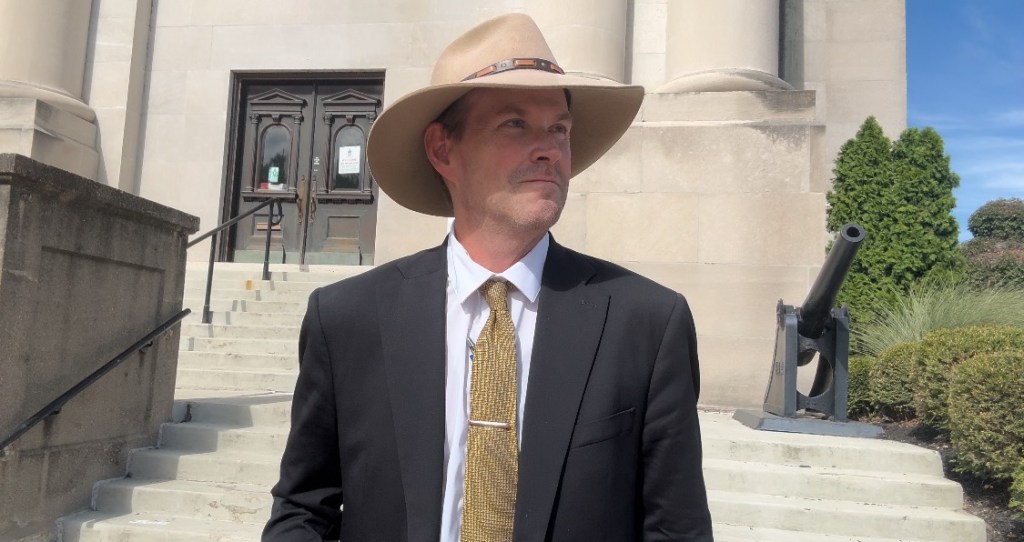
About the Author: Rich Hoffman
Rich Hoffman is an independent writer, philosopher, political advisor, and strategist based in the Cincinnati/Middletown, Ohio area. Born in Hamilton, Ohio, he has worked professionally since age 12 in various roles, from manual labor to high-level executive positions in aerospace and related industries. Known as “The Tax-killer” for his activism against tax increases, Hoffman has authored books including The Symposium of Justice, The Gunfighter’s Guide to Business, and Tail of the Dragon, often exploring themes of freedom, individual will, and societal structures through a lens influenced by philosophy (e.g., Nietzschean overman concepts) and current events.
He publishes the blog The Overmanwarrior (overmanwarrior.wordpress.com), where he shares insights on politics, culture, history, and personal stories. Active on X as @overmanwarrior, Instagram, and YouTube, Hoffman frequently discusses space exploration, family values, and human potential. An avid fast-draw artist and family man, he emphasizes passing practical skills and intellectual curiosity to younger generations.


The timeline key: ” power was given unto him to continue forty and two months.”
LikeLike