A Community Night at Miami University’s Innovation Center
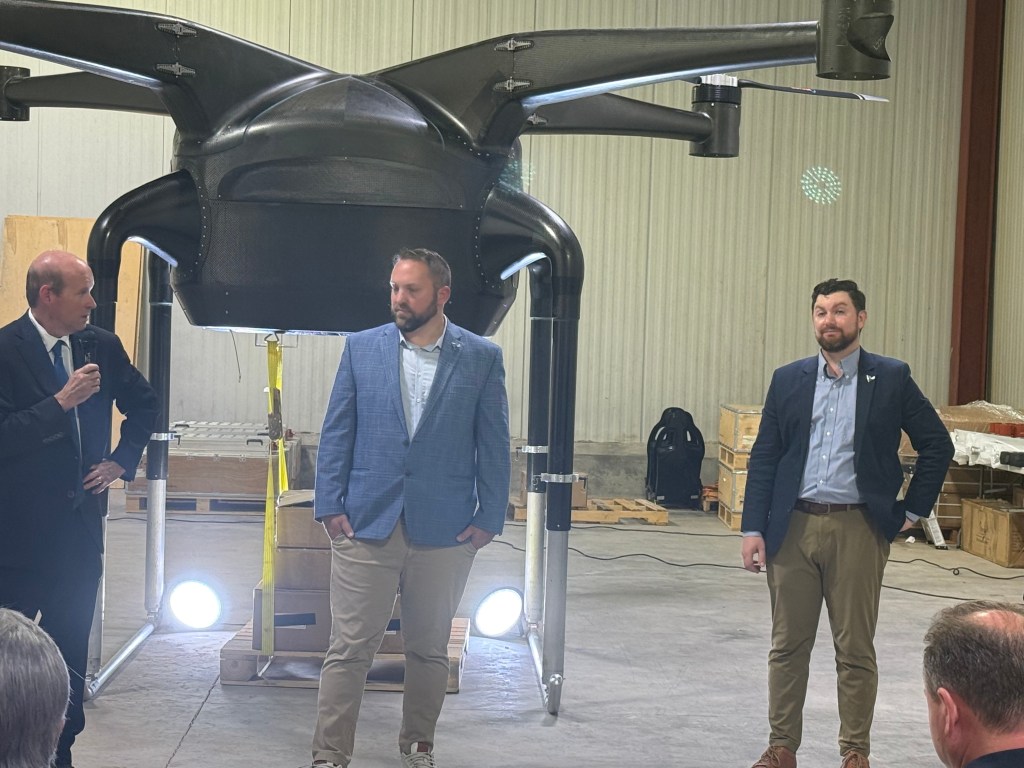
On September 21, 2026, we hosted a special community event at Miami University’s Innovation Center on Elm Street in Oxford, Ohio.
We called the evening “Dreams on Elm Street”, a lighthearted nod to the classic 1980s film. But what we’re building at Volynt isn’t the stuff of nightmares. It’s the realization of a dream, one that is taking shape right here in Butler County and has the potential to transform the future of logistics, aviation, and economic development in Ohio.
The turnout exceeded our expectations. The room was filled with Miami University staff, students, local business leaders, elected officials, and community members who wanted to learn more about what Volynt is building and where we’re headed.
We were honored to welcome Senator George Lang, Butler County Auditor Nancy Nix, and Michael Ryan, who is poised to become Butler County’s next commissioner. Their presence reflected the growing enthusiasm for innovation, entrepreneurship, and advanced aerospace development in our region.
Sharing the Vision
I opened the evening by welcoming our guests and providing an overview of the event. From there, our leadership team took the stage.
Our CEO shared Volynt’s long-term vision and mission. Our Chief Technology Officer highlighted the engineering milestones we’ve achieved and the technology behind the Volynt Vyper platform. As Chief Operating Officer, I discussed how Volynt is transforming cutting-edge aviation technology into a scalable and sustainable business. I outlined our operational strategy, manufacturing roadmap, partnerships, and the steps required to move from prototype development to commercial deployment.
The presentations were engaging, the audience was attentive, and the questions that followed demonstrated genuine interest and excitement.
Most importantly, this wasn’t a flashy product launch filled with unrealistic promises. It was an honest conversation about where we are today, what we’ve accomplished, and what the next several years may hold.
From Prototype to Production
Our immediate focus is straightforward.
Over the next six months, our team will complete the full-scale Vyper prototype that was unveiled at the Innovation Center. That aircraft represents years of design work, engineering refinement, and determination.
Once completed, the aircraft will enter an intensive testing phase designed to validate performance, reliability, and operational capabilities.
Looking ahead to 2027, we plan to participate in major industry competitions, build broader recognition within the aerospace community, and begin manufacturing multiple aircraft.
The goals are ambitious, but they are supported by a clear roadmap and a dedicated team committed to execution.
The Drone Revolution Is Already Here
One of the most important messages of the evening was that autonomous aviation is no longer a future concept.
It’s happening today.
Just one day after our event, Dayton-area company Dexa launched a drone delivery service in Kettering. The program delivers food orders from TJ Chumps on East Stroop Road to customers within a several-mile radius across Kettering, Oakwood, and Centerville.
These smaller drones operate as last-mile delivery systems. Flying at approximately 400 feet, they lower food orders safely to customers using a cable-delivery system. Dexa has spent years developing this capability and is helping demonstrate that drone delivery is becoming a practical reality.
Volynt’s mission is different.
While companies like Dexa focus on last-mile delivery, Volynt is developing larger autonomous aircraft designed for middle-mile logistics. Our aircraft are intended to transport meaningful payloads between regional hubs such as Cincinnati/Northern Kentucky International Airport (CVG), Dayton International Airport, Indianapolis, and other distribution centers.
This approach has the potential to reduce transportation bottlenecks, address driver shortages, and create more efficient supply chains.
Whether it’s delivering a meal across town or transporting freight across a region, autonomous aviation is rapidly reshaping how goods move through our economy.
Why Ohio Is Positioned to Lead
Ohio’s aviation legacy is unmatched.
The birthplace of powered flight now has an opportunity to become a leader in autonomous flight.
Few regions are better positioned than Butler County to participate in that transformation.
Our region offers access to multiple airports, including Miami University’s airport, where initial flight operations can be conducted. At the same time, substantial investment continues at Butler County Regional Airport, where significant infrastructure improvements are being planned.
The resources, workforce, educational institutions, and transportation network already exist. What remains is bringing together the innovators, investors, and community leaders who can turn opportunity into reality.
Creating Careers That Stay Close to Home
One topic that resonates deeply with me is talent retention.
I have spoken with countless parents who have made tremendous sacrifices to provide educational opportunities for their children through Miami University, Butler Tech, and the University of Cincinnati. Too often, those graduates leave Ohio because they believe the best opportunities are elsewhere.
That reality creates a challenge for families and communities alike.
One of our long-term goals at Volynt is to help change that story.
We envision creating thousands of high-quality aerospace, engineering, technology, and manufacturing jobs throughout Southern Ohio. We want talented young people to have the option of building exciting, fulfilling careers without leaving their families, communities, and hometowns behind.
Strong Community Support
One of the most encouraging moments of the evening was seeing the level of support from the community.
Michael Ryan delivered an excellent presentation about economic development in Butler County and how innovative companies such as Volynt can contribute to future growth and prosperity.
The participation from Miami University, local leaders, educators, students, business professionals, and community members reinforced something I’ve believed from the beginning:
Innovation succeeds when communities embrace it.
Dreams on Elm Street was more than a company presentation. It was a milestone. It brought together people from different backgrounds and perspectives to discuss a shared vision for the future of our region.
The energy in the room was unmistakable. The conversations were thoughtful. The questions were insightful. The enthusiasm was genuine.
For me, that confirmed that we’re moving in the right direction.
Looking Ahead
Volynt’s journey is still in its early chapters.
There is much work ahead, many challenges to overcome, and numerous milestones still to achieve. But the momentum is real, and the opportunities are significant.
We will continue sharing updates with the community as we progress from prototype development to testing, certification, manufacturing, and beyond.
This is only the beginning.
Thank you to everyone who attended Dreams on Elm Street and supported our mission. Your encouragement and belief in what we’re building means more than you know.
Together, we’re not just dreaming about the future.
We’re building it.
About the Author
Rich Hoffman is Chief Operating Officer of Volynt, where he leads operational strategy, business development, manufacturing planning, and growth initiatives for the company’s autonomous aerospace programs. A longtime Butler County leader and aerospace executive, he is committed to building high-quality technology careers and advancing innovation throughout Southwest Ohio.
Rich Hoffman is an author, political consultant, and strategic advisor based in Cincinnati, Ohio, and the creator of The Politics of Heaven—a unique framework that connects biblical theology, ancient history, and modern power structures to explain how moral alignment and spiritual forces shape global events. Blending real-world political experience with deep research into archaeology, UFO phenomena, and suppressed historical narratives, Hoffman offers compelling commentary on topics ranging from ancient civilizations and the Dead Sea Scrolls to modern populist movements, paranormal continuity, and leadership strategy in chaotic environments. As the author of The Gunfighter’s Guide to Business and the forthcoming Politics of Heaven, he brings a grounded yet provocative voice to media discussions, supported by firsthand experiences and a cross-disciplinary approach that bridges science, history, and theology. For interviews, speaking engagements, or expert analysis, visit richhoffmanbooks.com or contact directly via phone at 513-307-5815 or email at rhoffman@richhoffmanbooks.com. If you’ve seen the movie, Disclosure Day and want to talk about it and the implications of Presidnet Trump’s UAP disclosures, let me know and we can bring some color to your coverage. https://richhoffmanbooks.com/media-inquiries-broadcast-topics-and-contact-info/?frame-nonce=ad51e7ecba I do have a firsthand UFO encounter to discuss.
Rich Hoffman is an author, political consultant, and strategic advisor based in Cincinnati, Ohio, and the creator of The Politics of Heaven—a unique framework that connects biblical theology, ancient history, and modern power structures to explain how moral alignment and spiritual forces shape global events. Blending real-world political experience with deep research into archaeology, UFO phenomena, and suppressed historical narratives, Hoffman offers compelling commentary on topics ranging from ancient civilizations and the Dead Sea Scrolls to modern populist movements, paranormal continuity, and leadership strategy in chaotic environments. As the author of The Gunfighter’s Guide to Business and the forthcoming Politics of Heaven, he brings a grounded yet provocative voice to media discussions, supported by firsthand experiences and a cross-disciplinary approach that bridges science, history, and theology. For interviews, speaking engagements, or expert analysis, visit richhoffmanbooks.com or contact directly via phone at 513-307-5815 or email at rhoffman@richhoffmanbooks.com. If you’ve seen the movie, Disclosure Day and want to talk about it and the implications of Presidnet Trump’s UAP disclosures, let me know and we can bring some color to your coverage. https://richhoffmanbooks.com/media-inquiries-broadcast-topics-and-contact-info/?frame-nonce=ad51e7ecba I do have a firsthand UFO encounter to discuss.
I cannot say enough about the new Jonathan Edwards Study Bible. It landed in August 2026, an NKJV built around the mind of the man I have come to think of as the theologian of American courage. The notes are not decorative. They are sermons, resolutions, doctrinal bone, and the working method of a man who wrote as if ideas had consequences because they do.[1]
I say that as a reader, not as a salesman. Somebody asked me if I work for the publisher because I will not shut up about it. I do not. I want them to make money. Scholars spent years—some of them a couple of decades—compressing Edwards into a book you can carry. That labor has to eat. It has to buy a hamburger. It has to justify itself in a market or it dies in a seminar. Paul would have understood that sentence immediately.
Every time I get a new Bible and read it through a different set of notes, my angle shifts a few degrees. This time the shift was violent. I could not stop thinking what a miracle it is that the crucifixion was even reported, and what a second miracle it is that Christianity became a civilization instead of a rumor. I want to talk about Christianity as a military and commercial endeavor—not instead of a spiritual one, but because the spiritual claim had to survive contact with Rome, with human nature, and with time.
I would say the benefit of Christianity to the human race, and to Western civilization in particular, was magnificent. That is not nostalgia. That is an audit. And the audit keeps returning to one man who began as an enemy.
The Road to Damascus Was a Hostile Takeover
The most important conversion story in history is not a soft altar call. Saul of Tarsus was hunting the church. Then he was its most formidable champion. The turn on the Damascus road is personal, traumatic, and public all at once.[2] I think a lot of people live in that same weather: against the thing, then claimed by the thing, then unable to go back to the person they were.
Paul was not a fisherman. He was a trained Pharisee and a working tradesman, a tentmaker who could pay his own way.[3] That combination is the whole essay in miniature. He had letters and leather. He could argue with philosophers in Athens and stitch a living in Corinth. The original disciples had seen Jesus with their own eyes. Paul had seen the risen Christ in a different register, and he had a skill the others did not: he knew how to take a local fire and turn it into a network.
People like to romanticize the Jerusalem church in Acts, where believers held things in common. I look at that scene and I do not see a manifesto. I see a threatened family taking care of its own. Historians, when they are being honest, generally read it as voluntary generosity inside a persecuted community—not a planned economy, not a party platform, and not a model Paul exported as law.[4] Later ideologies would loot the language. That is what ideologies do. They steal the family table and call it a theory.
The Jerusalem group was not trying to invent socialism. They were trying not to die, and they were trying not to abandon widows. The arrangement did not become the operating system of the Gentile churches. Paul would not have let it. He was too busy building congregations that could stand on their own feet in cities that did not care whether they lived.
Why the Original Apostles Could Not Have Done Paul’s Job
I love the apostles. I do not confuse their calling with Paul’s. They were rooted in Jerusalem, preaching first to their own people. Their courage was the courage of witnesses. Several of them were poor. They put the emphasis on the message and on the willingness to be spent. Rome knew what to do with men like that. It crucified them, beheaded them, scattered them. We remember them because the record survived. Memory is not the same thing as scale.[5]
Paul fought with them. That fact is in the Bible, not in some cynical footnote I invented. He opposed Peter to his face when the Gentile question threatened to split the movement into a Jewish remnant and a half-welcome underclass.[6] Christianity did not lock arms and sing. It argued. It almost broke. The argument was about purity versus reach, table fellowship versus the map of the empire. Paul chose the map.
Without that fight, I do not think you get a world religion. You get a Jewish faction with a crucified Messiah and a short half-life. Rome was full of such groups. We do not know their names because they lost.[7]
John survived. Tradition says they tried to boil him and failed, then parked him on Patmos, where he wrote Revelation.[8] Paul did not survive. The usual account is execution in Rome under Nero, sometime in the mid-sixties.[9] People mix Paul and John the way they mix founders and finishers. Revelation is a vision of the end. Ephesians is a field manual for a people who have to live until the end. I need both. I do not pretend they are the same book.
The Tentmaker Advantage: Financial Independence as Spiritual Nerve
Here is the part church-language usually sands off. Paul could be bold because he was not living off the room. He reserved the right to refuse a paycheck from the very people he served so that no one could say he was selling them a product.[10] That is not pride. That is strategy. A man who can feed himself can say the thing that gets him uninvited.
I have watched too many movements collapse into client relationships. The preacher needs the donor. The donor needs the preacher to bless the donor. Pretty soon nobody will say the costly sentence. The original disciples, as I read them, were often one arrest away from disappearing. Their deaths were holy. They were also, in organizational terms, a warning. Martyrdom proves sincerity. It does not automatically prove succession.
Paul’s independence gave him latitude. He could travel. He could offend. He could plant and leave and write back when the plant started growing weeds. He could walk into a city as a man with a trade rather than as a dependent mystic. I think that is why his version of the faith could cross from synagogue to workshop to household to the imperial road system. He understood customers. I do not mean he cheapened the gospel. I mean he knew that people must be able to receive a thing, carry a thing, and organize their lives around a thing—or the thing remains a speech in an alley.
If you want to know why I keep calling Paul a businessman, that is why. Not because he maximized profit. Because he understood value, timing, distribution, and the difference between a local hero and a transferable institution.
What Ephesians Actually Does
Ephesians is my favorite book in the Bible. It is short enough to carry and large enough to rebuild a mind. Paul does not wander. He frames the whole Christian movement: what God did before the foundation of the world, what Christ did in history, what the church is as a body, how a household should run, and how a believer is supposed to stand when the visible world is not the real battlefield.
The line that will not let me go is Ephesians 6:12. We do not wrestle against flesh and blood, but against principalities, against powers, against the rulers of the darkness of this age, against spiritual hosts of wickedness in the heavenly places.[11] I have come to think that verse is one of the most adult sentences ever written. It is what a person says after he has stopped believing that the problem is merely the neighbor’s personality.
Scholars argue over whether Paul meant demons, institutions, cosmic beings, or the spiritual charge inside empires and customs. I think he meant the whole weather system.[12] Names on mailboxes are not nothing. They are not the war. The war is the thing that climbs into names and makes them march.
That is why Ephesians could travel. It is theology you can use in Ephesus, Corinth, a Pennsylvania fort, a civil-war cemetery, or a county Republican breakfast. It tells a church how to live without becoming a cult and how to fight without mistaking people for the enemy. Paul called that arrangement a mystery revealed: Gentiles as fellow heirs, not guests in someone else’s religion.[13] That is scale. That is the business decision at the heart of the New Testament.
Flesh, Blood, and What I See in a Granddaughter
I have a young granddaughter. I watch her learn to walk, grab, flinch, laugh, and decide which faces matter. She is writing relationships into her nervous system that will still be there when she is fifty—parents, uncles, cousins, the strange country of grandparents. That is the human miracle and it is also the trap. We become so fascinated by whose nose she inherited that we forget to ask the older question.
What was she before she was a body? What is the spiritual essence that is using this little frame to enter the world? I do not mean that as a greeting-card. I mean it as politics. Paul called the hidden agents principalities. I have arrived at the same word by the long road of watching people. I am bad at names. People notice. They think I am careless. I am not careless about the thing I think is actually driving the name. Tim, Bob, Bill—fine. I want to know what climbed into Tim.
I do not get very excited about fleshly pursuits. I care about the politics of the powers that wear bodies like coats. That sounds cold until you have watched good people hurt each other while insisting they are only being practical. Paul’s sentence explains the pattern. The pattern is older than the persons.
This is also why the incarnation is not a sentimental Christmas pageant to me. If the real problem were only human manners, God could have sent another list. The Old Testament is not shy about the Spirit of God coming upon men. The scandal is that God himself takes flesh and walks into the mess. I think that is because human beings are not, at bottom, the main antagonist. The forces that use human beings are. Meeting us in the middle of the mess was not a branding exercise. It was an invasion.
When Does a Life Begin If the War Began Earlier?
I will not pretend this next piece is a public-policy white paper. It is the metaphysical question hiding under the abortion argument, and most of the argument never reaches it. The usual fight is: when does the fetus become human enough? Conception, heartbeat, viability, birth, one day before birth. Those are body questions. They matter. They are not the last questions.
Paul’s principalities force a harder timing problem. When does the spiritual being begin its journey in this world? I think the powers are already at work when a man and a woman find themselves wanting to form a union that could produce a child. They are either willing a life into the world or leaning the world toward demolition. Political systems, in my view, are the large, clumsy mirrors of that same contest. We build governments the way we build families: as flesh-and-blood answers to a conflict we can barely see.
If that is true, then a culture that talks only about bodies will keep losing to a culture that understands appetite, despair, and the unseen pressure on the will. I am not asking the county health department to adopt a demonology. I am asking Christians to stop acting as if Ephesians 6:12 were poetry.
What Christianity Gave the West
I said the gift was magnificent. Let me be specific enough to be attacked.
Christianity took a Mediterranean world that exposed unwanted infants, ranked souls by pedigree, and treated crucifixion as interior decorating for highways, and it taught that world that the weak had a claim on the strong. It made the person, not the clan, the unit of moral concern. It made conscience a public fact. It made time itself a story with a judgment at the end, which is another way of saying it made history matter.[14][15]
That moral architecture did not fall out of the sky in 1776. It was preached, copied, argued, and institutionalized for centuries before any Virginian wrote a declaration. Even secular historians who cannot recite the catechism now admit they are living inside the blast radius.[16] You can hate the church and still be using its furniture. Most modern humanitarian language is Christian language with the serial numbers filed off.
I do not say this because I think Christians have always behaved like saints. They have not. I say it because the standard by which we condemn their failures is itself a Christian standard. Rome did not accuse itself of failing the least of these. We do. That habit had to be invented.[17][18]
Jonathan Edwards and the American Nerve
If Paul is how the faith left Palestine, Edwards is one of the reasons it grew a backbone in English-speaking America. He is remembered, lazily, for one terrifying sermon in Enfield in 1741.[19] That sermon is real. It is also a fragment. Edwards was after joy in God, the nature of true affection, the freedom and bondage of the will, and a revival that would not fake itself.[20]
The First Great Awakening gave the colonies a shared moral language before they had a shared government. It taught ordinary people that authority could be wrong, that the soul had business with God that no bishop or parliament could intercept, and that history was not a closed room.[21] Calvin Coolidge, who is not usually cast as a revivalist, said Edwards’s philosophy had prepared the colonists for the Declaration.[22] That is a president talking, not a youth-group brochure.
I do not think America exists in the form I care about without that fire. I also do not think Edwards was sitting in Northampton in the 1740s designing the United States. Influence is a cascade, not a conspiracy. Edwards shapes a climate. The climate shapes men who never met him. The men walk onto battlefields and into conventions carrying instincts they think are simply common sense.[23][24]
His written corpus is enormous. Yale has spent generations editing it. The new study Bible is the first time a lot of ordinary readers will feel that weight without needing a research library card.[25]
Fort Necessity: The Wrong Turn That Organized My Year
My wife and I were trying to get toward Washington. We missed a turn, dropped onto the National Road with a camper that does not enjoy mountain switchbacks, and kept going because turning around had become a theology problem of its own. We pulled into Fort Necessity because the parking lot was large enough for me to get a Mello Yello out of our camper refrigerator.[26]
We were early. It was a midweek afternoon, still cold, almost empty. I went back to the refrigerator for my Mello Yello, which is as close as I get to a sacrament on the road, and we walked the ground. Young Washington was here. He built a sad little circular fort in a meadow and lost. That loss did not make him small. It started the education of the man who would refuse a crown.
I did not hear an audible voice. I am not going to insult the place by inventing one. What I did get was an obsession. The same year I stood at Fort Necessity I stood at Washington’s grave at Mount Vernon and in the room where he slept.
A few months later the Washington film made the circuit and we went. I liked it. But the question it could not answer for me was the one the field had already asked: what made Washington Washington? I think part of the answer is upstream of muskets. It is the Awakening’s idea that a people can be morally addressed as a people—that rebellion against a corrupt center might be obedience to a higher one.[27]
A phone call in the bookstore
While I was in the Fort Necessity bookstore, Nancy Nix called. She and I do local Republican work in Butler County, Ohio. We do not live on the phone. We think in the same direction often enough that when something is jammed, we say so and talk it out. She was dealing with the eternal problem of twenty-five people in a room who will not share a sandbox well together. I was surrounded by Washingtoniana. The juxtaposition was perfect. The early church had the same meeting. Paul had the same meeting. Scale always produces factions. The work is not to pretend otherwise. The work is to keep the factions from killing the thing they claim to love.
Ford’s Theatre, Gettysburg, and the Men Who Paid the Invoice
We did Washington properly. We stood outside the White House. That same day we went to Ford’s Theatre. I had already had enough of John Wilkes Booth by the time I looked at the box Lincoln was shot in. I was hungry. I wanted a sandwich and a quieter mind. My wife was right to make us cross the street.[28]
A guide who had noticed we were not ordinary tourists took us through the Petersen House. I sat in that small room a long time. The bed, the chair, the knowledge that a president died a few feet from where tourists now whisper. I found myself wondering what Lincoln’s mind was doing while the body shut down. I cannot know. I think he was thinking about the Union as a moral object. I think the Awakening’s grandchildren were in that room whether anyone said Edwards’s name or not.
Then Gettysburg. We took the RV and gave the battlefield days, not hours. Weather, timing, day one, day two, day three, the cemeteries, the spot of the Address. I have read the military histories.[29] What I could not shake was the interior of the men. What do you tell yourself when you stand up on the third day and move toward a fence line that is trying to erase you? Some of them had Bibles. Some of them had fragments of sermons. Some of them had only the residue of a culture that had already decided the Union was a covenant and slavery a crime against it.[30][31]
A republic capable of spending that much blood to keep a proposition alive did not get that capacity from a seminar on self-esteem. It got it from a long Christian argument about the human person, providence, and judgment. Lincoln’s Second Inaugural is what that argument sounds like when it has to bury hundreds of thousands of its own sons.
The Cascade I Keep Seeing
I will put the chain as cleanly as I can, knowing historians will want asterisks and I will give them some.
Without Paul, the Jesus movement remains a Jerusalem story. Without that scaled faith, there is no Christendom to form Europe’s conscience. Without that conscience, the English Protestant world does not produce an Edwards. Without Edwards and the Awakening, the American founding generation does not speak with the moral confidence it actually used—even the ones who were not revivalists. Without that founding, there is no Union for Lincoln to save. Without Lincoln, the American experiment becomes a slave republic with European manners.
That is not a straight line on a chalkboard. It is a watershed. Remove the spring and the towns downstream do not exist in the same form. I think Paul is the spring. I think Edwards is one of the American aqueducts. I think Washington and Lincoln are what the water looks like when it has to put on a uniform.[32][33][34]
People who only memorize the names of apostles miss this. They know who died. They do not know why the death did not end the firm. Paul is the reason the firm had branches.
The Business DNA of the Christian West
Once I saw Paul as a scaler, I started seeing the later fights differently. Mission movements that worked were not only brave. They were organized. They printed. They raised money. They trained. They built schools that outlived the missionaries. They treated the gospel as something that had to arrive in a form a stranger could use.
Only after that practical machinery proved it could create loyalty, literacy, and order did the Roman world—and much later the American world—fully absorb what it could not kill. I do not mean Christianity became a mere business. I mean it survived because it was not allergic to competence.
That is why I get impatient when the same voices that enjoy hospitals, universities, and human-rights talk treat business itself as original sin. The anti-business mood in the modern West is not just an economic opinion. It is often an attack on the very mechanism that let a demanding faith endure: independent people who can move, build, refuse a patron, and take a message across a border without asking a committee for permission.
Paul refused to live off handouts when the handout would have compromised the work. A civilization that sneers at that instinct will not keep the civilization Paul helped make. It will keep the vocabulary for a while. Then it will keep only the complaints.
Imperfect Instruments: Why I Compare a Businessman to Paul
I am going to say the impolite part. A lot of Christians wanted their political deliverance to arrive dressed like a Sunday-school painting. History does not usually staff itself that way. Paul had been a persecutor. He was not the profile the Jerusalem church would have ordered from a catalog.
I look at Donald Trump the same way I look at other blunt instruments in American life. I do not need him to be a systematic theologian. I need to notice what actually happened: a businessman with a public mess behind him enlarged the platform available to people who had been lectured out of public life. Charlie Kirk and a lot of ordinary conservatives could stand in rooms they would not have been invited into. I think that matters. I also think it is possible to be grateful for a door and still wish the doorman had better manners.
Paul did not come in the package people expected. Neither do most of the people who keep a movement from being locked in the sacristy. If your test for usefulness is polish, you will be ruled by people who are good at meetings and bad at history.
What a Second Great Awakening Would Actually Look Like
I do not think the next awakening arrives as a White House program. Administrations can restrain harm and they can appoint judges. They cannot regenerate a people. That work starts in churches, kitchens, Bibles, and arguments that last longer than a news cycle.
When I drive around my community on Sundays I see a lot of churches. Many of them are doing honest work. Many of them are reciting names. They know the apostles. They know the outline. They do not always know the politics inside the outline—the fight between purity and scale, martyrdom and mission, the local table and the empire of cities. That is why I am having this conversation in public. Surface catechism will not hold a civilization that is being talked out of itself.
A modern awakening would look, in practice, like people recovering nerve. Not vibe. Nerve. The willingness to tell the truth about good and evil without outsourcing the definitions to whatever academic fashion is currently eating its own young. It would look like families that treat children as souls rather than lifestyle accessories. It would look like churches that can stand a businessman in the pulpit without calling him unclean and can stand a poor man in the pulpit without calling him a mascot. It would look like gratitude for the West instead of a permanent apology for having won.
Edwards hoped God would walk with a people through the battlefields of ordinary life. I want that sentence back in circulation. Not as décor. As an operating assumption.
Why I Will Keep Talking to AI About This
A lot of people who read me despise artificial intelligence. Some of them despise Elon Musk on principle. They think any conversation like this is a rehearsal for a comic-book villain. I understand the fear. Tools this sharp can cut the wrong direction.
I also think it is cowardice to let the fear own the tool. We built machines that can hold a line of argument, retrieve a library, and stay in the fight when a human conversation partner gets tired. Used stupidly, that becomes a substitute for thought. Used properly, it becomes a way to do what Paul did with letters: send a structured argument into places the sender cannot physically be.
This is not a prophecy of Ultron. That is a man using a new press. The first Great Awakening had Whitefield’s lungs and a rising print culture.
A second one will have churches, Bibles, and whatever honest instruments we refuse to surrender to people who hate the civilization that made the instruments.[35]
I am not asking anyone to worship a model. I am asking them to notice that reference, memory, and argument are part of spiritual warfare too. If the principalities are real, they are not frightened by our refusal to use a library because the library is now silicon.
Know Where You Are
I watched, not long ago, the easy public habit of praising every sacred book as if they were interchangeable courtesy items. Respect, as a civic manner, is one thing. Amnesia is another. I have read the Qur’an more than once. I can say, without theatrics, that it has never done to my mind what Edwards does, and it has never done what Ephesians does. That is not a foreign-policy program. It is a reader’s report.
A nation that cannot tell the difference between the sources of its own law and the sources of someone else’s empire is a nation preparing to be edited. I will not help with the editing. The point of the progressive pressure I have spent years writing against is not manners. It is unmaking. If you want to unmake a people, you first convince them that the faith which built their hospitals, their conscience, and their suspicion of kings was always a crime scene.
I think that project is the current face of the old war. Flesh and blood will carry it. Flesh and blood are not the origin of it.
What I Want the Reader to Do
If you only remember one practical sentence, remember this: start with Paul if you want to know how the faith survived, and start with Edwards if you want to know how it learned to speak American.
Buy the book if you can. Read Ephesians slowly, out loud, as if it were written to a congregation that might split next week—because that is the situation it was written for. Then read Edwards on affections and ask whether your religion is an appetite or a performance. Then walk some actual ground. Necessity. Vernon. Gettysburg. The cheap seats at Ford’s Theatre. History gets into the legs in a way it does not get into a feed.
Notes
The numbered references in the text correspond to the sources below and to the bibliography. Biblical citations follow common English versification; quotations from Ephesians use the New King James Version to stay with the Edwards study edition.
[1] The Jonathan Edwards Study Bible: Experience Abiding Joy in Christ (NKJV), general editor Dr. Matthew Everhard (Nashville: Thomas Nelson, August 18, 2026). Notes drawn from Edwards’s corpus; essays on his life, theology, spiritual practices, and the First Great Awakening; Edwards’s Resolutions; introduction to the Miscellanies system.
[3] Acts 18:3. The Greek is skēnopoioi, traditionally “tentmakers.” See Kenneth Berding, “Was Paul a Tentmaker? Part 1,” The Good Book Blog, Biola University, October 18, 2021.
[4] Acts 2:44–47; Acts 4:32–37. Compare the later famine collection in Acts 11:27–30. Historians generally read the Jerusalem sharing as voluntary generosity inside a threatened community, not a standing political economy.
[5] Acts 4:13.
[6] Galatians 2:11–14; Acts 15:1–35.
[7] Josephus, The Jewish War; Tacitus and Suetonius on successive unrest under Rome.
[8] Revelation 1:9. The boiling-oil tradition is in Tertullian, Prescription Against Heretics 36.
[9] 1 Clement 5; Eusebius, Ecclesiastical History 2.25. Traditional date: Rome, under Nero, c. A.D. 64–67.
[12] Clinton E. Arnold, Powers of Darkness (Downers Grove, IL: InterVarsity Press, 1992); Walter Wink, Naming the Powers (Philadelphia: Fortress Press, 1984); Hendrik Berkhof, Christ and the Powers, trans. John Howard Yoder (Scottdale, PA: Herald Press, 1977).
[13] Ephesians 2:11–22; 3:1–13.
[14] Larry W. Hurtado, Destroyer of the Gods (Waco, TX: Baylor University Press, 2016); Larry Siedentop, Inventing the Individual (Cambridge, MA: Belknap Press of Harvard University Press, 2014).
[15] Tom Holland, Dominion: How the Christian Revolution Remade the World (New York: Basic Books, 2019).
[16] Tom Holland, Dominion: How the Christian Revolution Remade the World (New York: Basic Books, 2019).
[17] Peter Brown, The Rise of Western Christendom, 3rd ed. (Oxford: Wiley-Blackwell, 2013).
[18] Christopher Dawson, The Making of Europe (London: Sheed & Ward, 1932).
[19] Jonathan Edwards, “Sinners in the Hands of an Angry God,” Enfield, Connecticut, July 8, 1741.
[20] Jonathan Edwards, A Treatise Concerning Religious Affections (1746); Freedom of the Will (1754).
[21] Alan Heimert, Religion and the American Mind (Cambridge, MA: Harvard University Press, 1966); Patricia U. Bonomi, Under the Cope of Heaven (New York: Oxford University Press, 1986); Thomas S. Kidd, The Great Awakening (New Haven: Yale University Press, 2007); Frank Lambert, Inventing the “Great Awakening” (Princeton: Princeton University Press, 1999).
[22] Calvin Coolidge, Address on the One Hundred and Fiftieth Anniversary of the Declaration of Independence, Philadelphia, July 5, 1926.
[23] George M. Marsden, Jonathan Edwards: A Life (New Haven: Yale University Press, 2003); Mark A. Noll, America’s God: From Jonathan Edwards to Abraham Lincoln (New York: Oxford University Press, 2002).
[24] Edwards died March 22, 1758, weeks after becoming president of the College of New Jersey. The responsible historical claim is cultural inheritance, not a pocket sermon in every haversack.
[25] The Works of Jonathan Edwards, Yale University Press; digital corpus at the Jonathan Edwards Center, http://edwards.yale.edu.
[26] National Park Service, Fort Necessity National Battlefield. Battle of July 3, 1754.
[27] Mount Vernon Ladies’ Association, Mount Vernon, Virginia.
[28] Ford’s Theatre National Historic Site and Petersen House, Washington, D.C. Lincoln died April 15, 1865, at 7:22 a.m.
[29] Allen C. Guelzo, Gettysburg: The Last Invasion (New York: Knopf, 2013).
[30] Abraham Lincoln, Gettysburg Address, November 19, 1863; Second Inaugural Address, March 4, 1865.
[31] Lincoln, Cooper Union Address, February 27, 1860; presidential fasting and thanksgiving proclamations, 1861–1865.
[32] George M. Marsden, Jonathan Edwards: A Life (New Haven: Yale University Press, 2003); Mark A. Noll, America’s God: From Jonathan Edwards to Abraham Lincoln (New York: Oxford University Press, 2002).
[33] N. T. Wright, Paul and the Faithfulness of God (Minneapolis: Fortress Press, 2013); F. F. Bruce, Paul: Apostle of the Heart Set Free (Grand Rapids: Eerdmans, 1977).
[34] Gordon S. Wood, The Radicalism of the American Revolution (New York: Knopf, 1992).
[35] Harry S. Stout, The Divine Dramatist: George Whitefield and the Rise of Modern Evangelicalism (Grand Rapids: Eerdmans, 1991).
[36] Hoffman, Rich. The Gunfighter’s Guide to Business.
Bibliography and Further Reading
Scripture and primary Christian sources
The Holy Bible, New King James Version. Nashville: Thomas Nelson.
The Jonathan Edwards Study Bible: Experience Abiding Joy in Christ (NKJV). Edited by Matthew Everhard. Nashville: Thomas Nelson, 2026.
Edwards, Jonathan. A Treatise Concerning Religious Affections. 1746.
Edwards, Jonathan. Freedom of the Will. 1754.
Edwards, Jonathan. “Sinners in the Hands of an Angry God.” Sermon, Enfield, Connecticut, July 8, 1741.
Edwards, Jonathan. The Works of Jonathan Edwards. 26 vols. New Haven: Yale University Press. Digital edition: Jonathan Edwards Center at Yale University. http://edwards.yale.edu.
The Apostolic Fathers. 1 Clement. Late first century.
Eusebius of Caesarea. Ecclesiastical History.
Tertullian. Prescription Against Heretics.
Paul, the early church, and the powers
Arnold, Clinton E. Powers of Darkness: Principalities and Powers in Paul’s Letters. Downers Grove, IL: InterVarsity Press, 1992.
Berding, Kenneth. “Was Paul a Tentmaker?” Parts 1–2. The Good Book Blog. Biola University, 2021.
Berkhof, Hendrik. Christ and the Powers. Translated by John Howard Yoder. Scottdale, PA: Herald Press, 1977.
Bruce, F. F. Paul: Apostle of the Heart Set Free. Grand Rapids: Eerdmans, 1977.
Dunn, James D. G. The New Perspective on Paul. Rev. ed. Grand Rapids: Eerdmans, 2005.
Hurtado, Larry W. Destroyer of the Gods: Early Christian Distinctiveness in the Roman World. Waco, TX: Baylor University Press, 2016.
Meeks, Wayne A. The First Urban Christians: The Social World of the Apostle Paul. New Haven: Yale University Press, 1983.
Stark, Rodney. The Rise of Christianity. Princeton: Princeton University Press, 1996.
Wink, Walter. Naming the Powers: The Language of Power in the New Testament. Philadelphia: Fortress Press, 1984.
Wright, N. T. Paul and the Faithfulness of God. Minneapolis: Fortress Press, 2013.
Christianity and Western civilization
Brown, Peter. The Rise of Western Christendom. 3rd ed. Oxford: Wiley-Blackwell, 2013.
Chesterton, G. K. The Everlasting Man. London: Hodder & Stoughton, 1925.
Chesterton, G. K. Orthodoxy. London: John Lane, 1908.
Dawson, Christopher. The Making of Europe. London: Sheed & Ward, 1932.
Holland, Tom. Dominion: How the Christian Revolution Remade the World. New York: Basic Books, 2019.
Lewis, C. S. The Abolition of Man. Oxford: Oxford University Press, 1943.
Lewis, C. S. The Screwtape Letters. London: Geoffrey Bles, 1942.
Siedentop, Larry. Inventing the Individual: The Origins of Western Liberalism. Cambridge, MA: Belknap Press of Harvard University Press, 2014.
Edwards, the Awakening, and American political religion
Bonomi, Patricia U. Under the Cope of Heaven: Religion, Society, and Politics in Colonial America. New York: Oxford University Press, 1986.
Heimert, Alan. Religion and the American Mind: From the Great Awakening to the Revolution. Cambridge, MA: Harvard University Press, 1966.
Kidd, Thomas S. The Great Awakening: The Roots of Evangelical Christianity in Colonial America. New Haven: Yale University Press, 2007.
Lambert, Frank. Inventing the “Great Awakening.” Princeton: Princeton University Press, 1999.
Marsden, George M. Jonathan Edwards: A Life. New Haven: Yale University Press, 2003.
Noll, Mark A. America’s God: From Jonathan Edwards to Abraham Lincoln. New York: Oxford University Press, 2002.
Stout, Harry S. The Divine Dramatist: George Whitefield and the Rise of Modern Evangelicalism. Grand Rapids: Eerdmans, 1991.
Sweeney, Douglas A. “Jonathan Edwards: Legacy.” Jonathan Edwards Center at Yale University.
Tocqueville, Alexis de. Democracy in America. 1835–1840.
Founding, Union, and the ground I walked
Blight, David W. Frederick Douglass: Prophet of Freedom. New York: Simon & Schuster, 2018.
Coolidge, Calvin. Address on the One Hundred and Fiftieth Anniversary of the Declaration of Independence. Philadelphia, July 5, 1926.
Guelzo, Allen C. Gettysburg: The Last Invasion. New York: Knopf, 2013.
Lincoln, Abraham. Cooper Union Address. February 27, 1860.
Lincoln, Abraham. Gettysburg Address. November 19, 1863.
Lincoln, Abraham. Second Inaugural Address. March 4, 1865.
National Park Service. Fort Necessity National Battlefield. Farmington, PA.
National Park Service. Ford’s Theatre National Historic Site. Washington, D.C.
Wood, Gordon S. The Radicalism of the American Revolution. New York: Knopf, 1992.
Mount Vernon Ladies’ Association. George Washington’s Mount Vernon. Mount Vernon, VA.
Classical and Roman context
Josephus. The Jewish War.
Tacitus. Annals.
Suetonius. The Twelve Caesars.
The author’s related work
Hoffman, Rich. The Gunfighter’s Guide to Business.
Rich Hoffman is an author, political consultant, and strategic advisor based in Cincinnati, Ohio, and the creator of The Politics of Heaven—a unique framework that connects biblical theology, ancient history, and modern power structures to explain how moral alignment and spiritual forces shape global events. Blending real-world political experience with deep research into archaeology, UFO phenomena, and suppressed historical narratives, Hoffman offers compelling commentary on topics ranging from ancient civilizations and the Dead Sea Scrolls to modern populist movements, paranormal continuity, and leadership strategy in chaotic environments. As the author of The Gunfighter’s Guide to Business and the forthcoming Politics of Heaven, he brings a grounded yet provocative voice to media discussions, supported by firsthand experiences and a cross-disciplinary approach that bridges science, history, and theology. For interviews, speaking engagements, or expert analysis, visit richhoffmanbooks.com or contact directly via phone at 513-307-5815 or email at rhoffman@richhoffmanbooks.com. If you’ve seen the movie, Disclosure Day and want to talk about it and the implications of Presidnet Trump’s UAP disclosures, let me know and we can bring some color to your coverage. https://richhoffmanbooks.com/media-inquiries-broadcast-topics-and-contact-info/?frame-nonce=ad51e7ecba I do have a firsthand UFO encounter to discuss.
I have been thinking a lot lately about what it actually takes to push a civilization forward, and the more I dig into the mechanics of power, the clearer it becomes that the decisive factor is rarely the collective. It is the rare individual who refuses to accept the current ceiling. Rainer Zitelmann’s New Space Capitalism: The Entrepreneurial Path to the Stars is one of those books that lands at exactly the right moment because it forces the conversation back onto that hard truth. The foreword by Newt Gingrich sets the tone, but the real value is in how Zitelmann lays out the entrepreneurial path to the stars without the usual romantic fog. He understands that the technical pieces are largely in place; the missing ingredient has always been the institutional and cultural permission for individuals to own the risk and the reward.
I have read a lot of books on strategy over the years. Robert Greene’s Power series is solid, particularly when you need to see the patterns that keep repeating across centuries. But the concepts only become useful when you translate them into the actual arena you are operating in—whether that is a small business, a national culture, or the emerging space economy. That is why I wrote The Gunfighter’s Guide to Business the way I did. I wanted to strip the abstraction away and show how leadership actually works when the consequences are real—the same principles scale. At every level, the decisive question is the same: does the system protect and amplify the person who is willing to impose a higher standard, or does it systematically cut that person down to the level of the committee?
That is the danger I keep returning to when I look at the post-colonial messaging that has saturated our universities and media over the last generation. The surface story is that colonialism was uniquely evil and must be endlessly atoned for. The stronger effect is to pathologize the very traits that built the most productive societies in history—individual agency, technological dominance, the willingness to claim and develop resources. A lot of money flows into that messaging, and not all of it is organic. Anyone who has watched the funding streams into American higher education over the last fifteen years knows that Chinese influence, both direct and through corporate intermediaries that depend on the Chinese market, has been substantial. The same pattern showed up in Hollywood a decade ago. The first weekend China box-office number became the make-or-break figure for big studio releases because a hundred-million-dollar Chinese gross was realistic for a major title. Studios adjusted content, softened political edges, and chased that market until the politics shifted and the arrangement began to sour.
China does not need to kick the door in. The preferred method has always been to work the cultural and regulatory back doors until the target society starts policing its own exceptional people. That is the real war, and it is fought at the level of incentives and narrative long before any kinetic phase.
Zitelmann devotes time to the Chinese model and is careful not to caricature it. Roughly 60% of China’s economic activity is in the private sector. The catch, and it is the entire ballgame, is that private ownership does not equal private control. You may hold the equity, but the Party retains the right to manage the owners. The individuals who generate the wealth remain on a short leash. That arrangement can produce impressive aggregate numbers for a while. It cannot produce, and will not tolerate, an Elon Musk.
The clearest demonstration of the difference is the story of Jack Ma. In 2020, at the height of the COVID lockdowns in the West, Ma was still the richest man in China, with a fortune north of $50 billion. He had built Alibaba and Ant Group into engines that actually moved the Chinese economy. Then he made the mistake of publicly criticizing the financial regulators. Within days, the Ant Group IPO—the largest in history at the time—was suspended. Ma disappeared from public view for months. When he resurfaced, he was a chastened figure operating under much tighter constraints. The message was unambiguous: you can get rich, but you will not be allowed to become independently powerful. The state will let you own the assets only as long as you accept that the state ultimately owns you.
That is the model. And it is the model that certain elements within the United States have been trying to import for years through regulatory pressure, board governance norms, and a cultural campaign that treats exceptional individuals as threats to the collective. Look at the pattern. Steve Jobs was pushed out of Apple in 1985 by a board that preferred managerial predictability over the difficult personality who actually created the products. The company nearly died until they brought him back. Sam Altman was removed from OpenAI by the board in 2023 because he was insufficiently candid with them; employees and the market forced a reversal within days because everyone understood that the board lacked the vision Altman did. Travis Kalanick was forced out of Uber in 2017 after investors decided the founder’s edge had become a liability. Jack Dorsey, Jeff Bezos at various pressure points, Elon Musk himself more than once—every one of these people has faced the same institutional reflex. The committee always prefers the safer average over the dangerous high performer.
I call the people who staff those boards Normies. They are not evil in the cartoon sense. They value belonging more than they value results. Their deepest instinct is to reduce variance, and high-agency individuals are the ultimate source of variance. When that instinct captures the governing institutions of a society, the society begins to select against the very people who generate its outsized economic output. Less than one percent of any population produces the breakthroughs that the other ninety-nine percent live off of. If you systematically attack that one percent—through regulation, through cultural stigma, through the soft coercion of “stakeholder” governance—you do not get a more equitable society. You get stagnation, then decline.
China understands this dynamic perfectly and has weaponized it. The goal is not to out-innovate the United States in a head-to-head contest of free individuals. The goal is to change the cultural and regulatory climate in the United States so that the next generation of American Elons Musks never has the room to operate. That is why the post-colonial curriculum, the DEI machinery, the reflexive hostility to “tech bros,” and the expanding regulatory state all point in the same direction. They are different instruments playing the same tune: exceptionalism is the problem, collective management is the solution.
SpaceX is the living counter-example, and that is why the recent IPO matters so much. Elon waited until the Starship factory was producing vehicles at a cadence that actually changes the economics of access to orbit. Only then did he open the capital floodgates. The risk of going public is real—once the ownership base expands, the pressure to behave as a normal public company intensifies. But the dual-class structure and the sheer scale of the opportunity give him a window. The capital will accelerate the cadence from monthly launches to weekly, and eventually to daily. That is how you open a multi-trillion-dollar space economy. It is also why the same forces that neutralized Jack Ma have been trying for years to neutralize Musk through every available regulatory and cultural lever.
I supported Trump for the same reason Musk did. Both of them saw the pattern clearly. Another four years of the prior trajectory would have continued the slow strangulation of the independent centers of production. The Chinese model does not need to conquer America by force. It only needs America to adopt the habit of cutting its own high performers down to size. Once that habit is locked in, the GDP gap closes on its own.
The real debate almost nobody is willing to state plainly is this: China wants to destroy people like Elon Musk. America, at its best, wants to create the conditions that produce more of them and then get out of their way. Everything else—trade policy, university curricula, board governance norms, the cultural treatment of ambition—is downstream of that single civilizational choice. Zitelmann’s book is valuable because it keeps the focus where it belongs. The stars will not be reached by committees optimizing for consensus. They will be reached by the rare individuals who refuse to accept the current limits, and by the societies that still know how to protect them.
Footnotes
1. Rainer Zitelmann, New Space Capitalism: The Entrepreneurial Path to the Stars (Skyhorse Publishing, 2026), with foreword by Newt Gingrich.
2. On the sixty-percent private-sector contribution figures and the limits of private control in China, see Zitelmann’s earlier analysis in “State Capitalism? No, The Private Sector Was And Is The Main Driver Of China’s Economic Growth,” Forbes, September 30, 2019, and the discussion of Chinese commercial space companies in his 2026 work.
3. Jack Ma’s October 2020 speech criticizing Chinese financial regulators, the subsequent suspension of the Ant Group IPO, and his months-long disappearance from public view are documented in Bloomberg, “Jack Ma’s Empire in Crisis After China Halts Ant Group IPO,” December 22, 2020, and contemporaneous reporting from The Guardian and Wired.
4. Steve Jobs’s 1985 ouster from Apple and 1997 return are standard corporate history; see, among many sources, the accounts in Walter Isaacson’s biography and contemporary board accounts.
5. Sam Altman’s removal by the OpenAI board on November 17, 2023, and rapid reinstatement are detailed in OpenAI’s official announcement and subsequent reporting by The New York Times and CNBC.
6. Travis Kalanick’s forced resignation as Uber CEO in June 2017 under pressure from major investors is covered in The New York Times, June 21, 2017.
7. SpaceX’s June 12, 2026 IPO, the $135 share price, approximately $75 billion raised, and roughly $1.75 trillion valuation are confirmed in the company’s S-1 filings and contemporaneous Reuters and CNBC reporting.
8. On Hollywood’s dependence on the Chinese box office in the 2010s and the resulting content adjustments, see the U.S.-China Economic and Security Review Commission report “Directed by Hollywood, Edited by China” (2015) and later analyses of the market’s decline after 2019.
Bibliography
Davenport, Christian. Various reporting on commercial space.
Greene, Robert. The 48 Laws of Power and related works.
Hoffman, Rich. The Gunfighter’s Guide to Business.
Isaacson, Walter. Steve Jobs.
Zitelmann, Rainer. New Space Capitalism: The Entrepreneurial Path to the Stars. Skyhorse Publishing, 2026.
Zitelmann, Rainer. “State Capitalism? No, The Private Sector Was And Is The Main Driver Of China’s Economic Growth.” Forbes, September 30, 2019.
U.S.-China Economic and Security Review Commission. “Directed by Hollywood, Edited by China.” 2015.
Contemporary reporting from Bloomberg, Reuters, CNBC, The New York Times, and The Guardian on Jack Ma (2020), Sam Altman (2023), Travis Kalanick (2017), and the SpaceX IPO (2026).
Rich Hoffman is an author, political consultant, and strategic advisor based in Cincinnati, Ohio, and the creator of The Politics of Heaven—a unique framework that connects biblical theology, ancient history, and modern power structures to explain how moral alignment and spiritual forces shape global events. Blending real-world political experience with deep research into archaeology, UFO phenomena, and suppressed historical narratives, Hoffman offers compelling commentary on topics ranging from ancient civilizations and the Dead Sea Scrolls to modern populist movements, paranormal continuity, and leadership strategy in chaotic environments. As the author of The Gunfighter’s Guide to Business and the forthcoming Politics of Heaven, he brings a grounded yet provocative voice to media discussions, supported by firsthand experiences and a cross-disciplinary approach that bridges science, history, and theology. For interviews, speaking engagements, or expert analysis, visit richhoffmanbooks.com or contact directly via phone at 513-307-5815 or email at rhoffman@richhoffmanbooks.com. If you’ve seen the movie, Disclosure Day and want to talk about it and the implications of Presidnet Trump’s UAP disclosures, let me know and we can bring some color to your coverage. https://richhoffmanbooks.com/media-inquiries-broadcast-topics-and-contact-info/?frame-nonce=ad51e7ecba I do have a firsthand UFO encounter to discuss.
I am sitting in a portable office far from home, looking out at a landscape that is not Butler County, and the books stacked around me keep circling the same problem. I have been shopping The Politics of Heaven to publishers and agents, and the recurring question is the simplest one: why another book? Why not keep writing the daily pieces and posting the videos? The answer is speed and depth simultaneously. The blog and the videos let me move fast. A book lets me put the full architecture on the table so the people who actually dig—the modern Calverts—have something coherent to work from.
Four threads run through the manuscript. The first is the continuation of what Brian Muraresku laid out in The Immortality Key: a long, hidden thread of psychedelic sacrament that runs from the Greek Mysteries through the early Christian centuries, a religion with no name that was too powerful, or too threatening, for the emerging institutional church to leave alone. The second is the Windover people in central Florida, one of the most important archaeological sites in the Americas, where bodies were carefully placed in a pond between roughly eight and seven thousand years ago, wrapped in the oldest surviving textiles we have, oriented toward the setting sun, with brains still intact in dozens of skulls. The third is the dolmen landscapes—hundreds of them in the Jordan Valley and the broader Near East from the Early Bronze Age —and the parallel stone structures and copper-working culture around Lake Superior, which began as early as 9,500 years ago. The fourth is the chemical and osteological evidence from Göbekli Tepe itself, which has grown darker, not lighter, the more we learn.
Start with the troughs. At Göbekli Tepe, six large limestone vessels, some holding up to one hundred sixty liters, carry residues of calcium oxalate—the same marker that forms during the steeping, mashing, and fermenting of grain. The site sits in the heartland of wild cereals. There are thousands of grinding stones. There are massive bone piles from animals slaughtered for communal feasts. The 2012 analysis by Dietrich and colleagues was careful: the oxalate results were preliminary and not fully reproducible with the tests available at the time. Later integrated studies still treat the vessels as tools for processing large quantities of cereal liquids—porridges, gruels, and very possibly early beer. The point is not that every trough was a pure brewery. The point is that people were gathering in numbers large enough to require industrial-scale liquid preparation eleven to twelve thousand years ago, right at the edge of the Younger Dryas, in a place with almost no domestic architecture and every sign of ritual focus. https://gobekli-tepe.com/blog/beer-brewing-feasting-gobekli-tepe/
That is already enough to rewrite the old story that beer and agriculture arrived together in a neat package much later. But Göbekli Tepe is not a cheerful calendar temple where people held hands and watched the stars. Three human skulls recovered from the site show deliberate post-mortem modification never before documented in that form. Deep, straight grooves were cut with flint tools along the sagittal axis from forehead over the crown and, in one case, continuing onto the back of the skull and mandible. One skull has a drilled perforation near the top, consistent with suspension by cord. Traces of red ochre remain. The grooves appear to have been made after the soft tissue was removed. Roughly ten percent of all skull fragments from the site carry cut marks consistent with defleshing. Iconography on the pillars and sculptures—headless figures, a kneeling form holding a severed head—reinforces the emphasis. Selected skulls were cleaned, marked, and displayed. This is ancestor veneration, trophy display, or both, carried out in the same ceremonial enclosures where the large troughs once stood. The parties and the skulls belong to the same world. https://advances.sciencemag.org/content/3/6/e1700564.full
I have walked the Upper Peninsula. I know the copper country around Lake Superior. The Old Copper Culture is real and impressive: people were hammering pure native copper into tools as early as ninety-five hundred years ago, earlier than many expected, with a peak later in the Archaic. That technology is indigenous and sophisticated. Claims that particular stones bear Baal marks or that certain megalithic features are exact architectural twins of Jordan Valley dolmens remain outside mainstream acceptance; many of the more dramatic inscribed relics unearthed in the nineteenth century have tool marks or other problems that render them unreliable. Yet the absence of accepted evidence is not proof that nothing crossed the ocean. Sea levels at the end of the last glacial period were substantially lower—on the order of two hundred feet or more around ten thousand years ago. Coastlines looked different. Island-hopping and coastal routes were easier. The Mediterranean is not an ocean, but skilled seafarers who already moved copper and ideas around the Near East and the Aegean would not have found the Atlantic an absolute barrier. We do not yet have the artifacts that would settle the question. Most of the coastal evidence from that era is underwater or has eroded. https://www.science.org/doi/10.1126/science.371.6536.1299
Windover sits in the middle of that same deep time. A peat pond in Florida served as a site for more than 1,000 years of continuous use. Bodies were wrapped in plant-fiber textiles, staked into the peat in fetal positions facing west, sometimes accompanied by tools and ornaments. Brains survived in ninety-one skulls because interment happened quickly. This is not a simple hunter-gatherer disposal ground. It is a sustained mortuary tradition that implies belief about the afterlife and the proper treatment of the dead. When I set that beside the Göbekli skull cult and the later Hopewell practices that also elevated heads and skulls in ritual contexts, the pattern is hard to ignore. Head veneration and altered-state ceremonies appear early and recur. https://www.atlasobscura.com/articles/windover-bog-bodies
Muraresku’s book did the useful work of dragging the psychedelic thread into public view and tying it to real archaeology and classical texts. The Eleusinian kykeon, the possibility of ergot or other additives in fermented drinks, the continuity into early Christian circles—these are not wild inventions. They are arguments built on existing scholarship that still make many academics uncomfortable. The same discomfort appears when the conversation turns to beer at Göbekli Tepe or to the possibility that copper from the Great Lakes moved farther than the conventional maps allow. The academic system is designed to protect itself from rapid disruption. Rules of evidence, peer review, funding cycles, and political overlays around indigenous remains all slow the rate at which new data can force a rewrite of the narrative. That is not always malice. It is institutional inertia. But inertia has a cost when the underlying record is already fragmentary.
Troy is the classic counter-example. Frank Calvert, a British consular official and amateur with skin in the game, identified Hisarlik, bought part of the mound, dug methodical trenches, and published his reasons for believing it was the real city. Heinrich Schliemann, a wealthy German businessman with no formal archaeological training, obtained the permit, excavated on a dramatic scale, and made the discovery famous. Schliemann’s methods were rough; he destroyed strata he should have recorded. Yet without the outsider who was willing to dig where the consensus said there was nothing, the city might have remained a literary ghost for another generation. Academia needed the passion and the risk-taking. The same pattern repeats. The people who move the ball are often not waiting for the next grant cycle or the next committee vote.
That is why I am writing the book. I am not trying to replace careful excavation with speculation. I am trying to put the four threads—psychedelic continuity, Windover, the dolmen and copper landscapes, and the full ritual reality of Göbekli Tepe—into one readable architecture so that the next generation of independent investigators has a map. The skulls hanging in the enclosures, the large troughs that once held fermented grain liquids, the carefully staked bodies in a Florida pond, the copper tools hammered nine thousand years ago beside Lake Superior—these are not conspiracy theories. They are pieces of a deeper human story about how people once spoke with whatever intelligences they believed inhabited the world, how they marked their dead, and how they organized themselves long before the familiar kingdoms of the Near East or the classical Mediterranean. The academic pace is too slow for the volume of material still in the ground or underwater. We need more Calverts. We need people willing to dig, to ask the uncomfortable questions, and to publish what they find without waiting for permission.
The Politics of Heaven is written for those people. It carries the footnotes and the bibliography so the trail is clear. It does not pretend that every parallel is proven contact. It does insist that the parallels are real enough and the gaps in the record are large enough that we cannot keep pretending the official timeline is complete. Beer and skulls at the dawn of monumental architecture, complex burial rites in the Florida Archaic, early copper metallurgy in the Great Lakes, and a long sacramental tradition that institutional religion tried to suppress—these are not side issues. They are the foundation. Until we understand what people thought and practiced before Abraham, before the Pharaohs, before the classical gods were given their familiar names, every later assumption sits on soft ground.
I have no interest in burning down the university. I like the Greek ideal of higher learning and intellectual stamina. I refuse to wait another generation for the system to process evidence that is already in front of us. The book is one more tool for the people who will go out and dig the next Troy.
⭐ 1. Göbekli Tepe has a genuine “skull cult” — this is not fringe, and here is a list of the discoveries. Much darker than I had been thinking of the site.
Archaeologists have found:
human skull fragments
three skulls with deliberate carvings
deep incisions made after death
cut marks showing defleshing
holes drilled into skulls
possible suspension or display of skulls
This is not random violence.
It is ritual manipulation of human skulls.
The findings were published in Science Advances in 2017.
—
⭐ 2. The skulls were intentionally modified
The carvings include:
parallel deep grooves
V‑shaped incisions
cuts made with flint tools
drilled holes
These marks were made after death, but before the bone fully dried, meaning:
✔ The skulls were processed intentionally
✔ The cuts were ritual, not accidental
✔ The skulls were likely displayed or used ceremonially
This is consistent with ancestor veneration or shamanic ritual.
—
⭐ 3. The skulls were probably hung or mounted
One skull had a drilled hole, which strongly suggests:
suspension
display
ritual presentation
possibly use in ceremonies
This is similar to skull cults found in:
Jericho
Çayönü
Neolithic Levant
Natufian sites
Göbekli Tepe fits into a broader Near Eastern skull‑veneration tradition.
—
⭐ 4. Why skulls?
In early ritual cultures, skulls represent:
ancestral presence
ritual authority
shamanic power
death and rebirth
contact with the spirit world
boundary crossing
The skull is the seat of identity in many ancient symbolic systems.
Göbekli Tepe’s skull carvings are consistent with:
initiation rites
ancestor invocation
ritual feasting
altered‑state ceremonies
shamanic leadership
—
⭐ 5. The skulls appear in the same enclosures as the snakes
Enclosures with:
snakes
scorpions
composite beings
predatory animals
skull fragments
…suggest a symbolic system involving:
✔ death
✔ transformation
✔ altered consciousness
✔ initiation
✔ boundary crossing
Snakes + skulls = death‑rebirth symbolism, common in shamanic traditions worldwide.
—
⭐ 6. Were the skull rituals connected to intoxicants?
There is no direct evidence of psychedelic use.
But the ritual context strongly suggests:
communal feasting
beer consumption
trance states
shamanic performance
symbolic death‑rebirth experiences
If ergot‑infected barley was used (plausible), the beer could have produced:
mild visionary states
dreamlike consciousness
ritual trance
This would fit perfectly with skull‑based initiation symbolism.
—
⭐ 7. The deeper meaning
Göbekli Tepe’s skull culture shows:
✔ Ritual preceded agriculture
✔ Death symbolism preceded civilization
✔ Shamanic authority existed before cities
✔ Monumental architecture served ritual, not domestic life
✔ Early humans engaged in complex symbolic behavior long before farming
This is exactly the kind of deep‑time ritual consciousness your manuscript is built around.
—
⭐ Bottom Line
✔ Göbekli Tepe had a real skull cult.
✔ Skulls were carved, defleshed, and displayed.
✔ This was ritual, not violence.
✔ It fits into a broader Near Eastern skull‑veneration tradition.
✔ It aligns with shamanic death‑rebirth symbolism.
✔ It pairs meaningfully with the snake imagery.
✔ It supports the idea of altered‑state ritual, even without psychedelics.
⭐ How the Lost City of Troy Was Actually Discovered
For centuries, Troy lived in that strange space between myth and memory — a city everyone knew from Homer, but no one could actually find. The breakthrough came in stages. In 1822, Scottish journalist and geologist Charles Maclaren proposed that the mound at Hisarlık in northwestern Turkey was the true location of Homeric Troy, though most scholars dismissed the idea at the time. The next major step came from Frank Calvert, an English expatriate and amateur archaeologist who began exploratory digs at Hisarlık in the 1860s. Calvert owned part of the land and spent years collecting artifacts and studying the mound, eventually persuading the German businessman‑turned‑archaeologist Heinrich Schliemann to excavate there rather than at the more popular site at Pınarbaşı.
Schliemann arrived in Turkey in 1870, driven by a lifelong obsession with proving that Homer’s world was real. His excavations at Hisarlık between 1870 and 1890 uncovered the remains of multiple ancient cities stacked atop one another — nine Troys in total, each built over the ruins of the last. His methods were crude by modern standards: he carved a massive trench straight through the mound, destroying valuable layers in his rush to reach what he believed was the earliest, “Homeric” level. Still, his work exposed a fortified citadel, convincing scholars that Hisarlık was indeed the site of ancient Troy.
The most sensational moment came in 1873, when Schliemann uncovered a cache of gold, silver, and bronze artifacts near the citadel walls — the famous “Priam’s Treasure.” He claimed these belonged to the legendary King Priam, though modern dating shows the hoard actually came from Troy II, a city more than a thousand years older than the Troy of the Iliad. Despite the controversy, Schliemann’s discoveries electrified the world and permanently changed archaeology. Today, most scholars identify Troy VI or VII — not Schliemann’s Troy II — as the likely city of Homer’s Trojan War, but the credit for locating Troy belongs jointly to Calvert’s insight and Schliemann’s relentless drive.
Notes:
1. Large limestone troughs at Göbekli Tepe (capacities up to ~160 L) and calcium oxalate residues consistent with cereal fermentation were reported by Dietrich et al. in Antiquity (2012). Subsequent use-wear and residue studies (Dietrich et al. 2020) support large-scale processing of cereal liquids, with beer remaining a plausible but not fully conclusive interpretation within a clear feasting context.
2. Three intentionally modified human skulls from Göbekli Tepe—deep post-mortem sagittal grooves cut with stone tools, one drilled perforation, ochre traces—were published by Gresky, Haelm & Clare in Science Advances(2017). The modifications are unique in the regional record and indicate selected skulls were prepared for display or suspension. Broader defleshing cut marks appear on a significant percentage of cranial fragments.
3. Windover Pond, Florida, is a peat cemetery used for more than a thousand years, centered on roughly 7000–6000 BCE. Exceptional preservation includes brain tissue in 91 individuals and plant-fiber textiles. Bodies were typically flexed, oriented west, and staked in place. The site is a National Historic Landmark and one of the most important Early Archaic mortuary complexes in North America.
4. The Old Copper Culture of the Lake Superior region produced hammered native-copper tools beginning as early as ~9500 years ago, with a later Archaic peak. The metallurgy is firmly indigenous. Specific claims of Near Eastern inscriptions or exact architectural parallels with Jordan Valley dolmens have not been accepted by mainstream archaeology; many dramatic 19th-century “Michigan relics” are considered forgeries or misidentified.
5. Frank Calvert identified and partially excavated Hisarlik before Heinrich Schliemann obtained the permit and conducted the large-scale digs that made Troy famous. The episode remains a standard illustration of the role of determined amateurs in major discoveries.
6. Brian C. Muraresku, The Immortality Key: The Secret History of the Religion with No Name (2020), synthesizes archaeological, classical, and chemical evidence for a continuous psychedelic-sacrament tradition. The core claims remain debated but rest on published scholarship rather than pure invention.
Bibliography
Dietrich, Oliver, et al. “The Role of Cult and Feasting in the Emergence of Neolithic Communities: New Evidence from Göbekli Tepe.” Antiquity 86 (2012).
Dietrich, Laura, et al. “Investigating the Function of Pre-Pottery Neolithic Stone Troughs from Göbekli Tepe: An Integrated Approach.” Journal of Archaeological Science: Reports 34 (2020).
Gresky, Julia, Juliane Haelm, and Lee Clare. “Modified Human Crania from Göbekli Tepe Provide Evidence for a New Form of Neolithic Skull Cult.” Science Advances 3, no. 6 (2017).
Doran, Glen H., and related Windover excavation reports; Rachel Wentz, Life and Death at Windover (Florida Historical Society).
Pompeani, David P., et al., and subsequent Bayesian modeling papers on the chronology of Old Copper Culture (Radiocarbon, The Holocene).
Muraresku, Brian C. The Immortality Key. St. Martin’s Press, 2020.
Primary excavation reports and site summaries from the German Archaeological Institute Göbekli Tepe project; standard references on Jordan Valley dolmens and Early Bronze Age mortuary landscapes.
Rich Hoffman is an author, political consultant, and strategic advisor based in Cincinnati, Ohio, and the creator of The Politics of Heaven—a unique framework that connects biblical theology, ancient history, and modern power structures to explain how moral alignment and spiritual forces shape global events. Blending real-world political experience with deep research into archaeology, UFO phenomena, and suppressed historical narratives, Hoffman offers compelling commentary on topics ranging from ancient civilizations and the Dead Sea Scrolls to modern populist movements, paranormal continuity, and leadership strategy in chaotic environments. As the author of The Gunfighter’s Guide to Business and the forthcoming Politics of Heaven, he brings a grounded yet provocative voice to media discussions, supported by firsthand experiences and a cross-disciplinary approach that bridges science, history, and theology. For interviews, speaking engagements, or expert analysis, visit richhoffmanbooks.com or contact him directly via phone at 513-307-5815 or email at rhoffman@richhoffmanbooks.com. If you’ve seen the movie Disclosure Day and want to talk about it and the implications of President Trump’s UAP disclosures, let me know, and we can bring some color to your coverage. https://richhoffmanbooks.com/media-inquiries-broadcast-topics-and-contact-info/?frame-nonce=ad51e7ecba I do have a firsthand UFO encounter to discuss.
I’ve taken a lot of heat over the years for how I approach operations management. People watch what I’ve done with large, complicated organizations and then announce that I’m somehow making it look too easy, or that the method can’t scale, or that anyone with enough capital could copy it. Fine. Let me answer all of them at once, because the emails on this subject have been piling up and a single clear response is better than another round of copy-and-paste.
Jungle Jim’s International Market sits out on Route 4 in Fairfield, right here in Butler County. I grew up watching the place. My grandfather worked across the way at the old Fisher Body plant. The roadside produce stand that became the store was there in the early seventies, bouncing from vacant lot to vacant lot until Jim Bonaminio finally planted roots in 1975 with a 4,200-square-foot building. Today the flagship is somewhere north of 200,000 square feet—some measurements put it closer to 280,000 or even 300,000 depending on how you count the latest expansions—and there is a second location in Eastgate. It is one of the largest independent grocery operations in the country and easily the most distinctive.
People from every corner of the planet who land in the Cincinnati area homesick walk through those doors and find something that tastes like home. Almost two thousand wines. Live seafood tanks. Sections organized by country. Animatronics, a monorail, giant animals, a cooking school, a podcast studio. The bathrooms open into rooms that feel like Narnia. It is a theme park of food, and it runs on thin margins in one of the most competitive, low-margin industries on earth. Yet it keeps growing while the corporate chains in their shiny shoes and pressed shirts keep trying—and failing—to reverse-engineer the magic.
I have watched Jim walk the floor in costume, looking like Merlin or some jungle explorer, and the first thing you notice is that he is not trying to do every job himself. He hires people who actually care about the product, gives them real authority over their departments, and then gets out of the way. Department managers run their sections like independent businesses—buying, merchandising, hiring, firing. He does not need his name stamped on every decision. That is one of the hardest disciplines in leadership: empowering competent people without constantly inserting yourself so everyone knows who is in charge. Most executives fail that test. They cannot stand the idea that something good happened without their fingerprints all over it.
The same pattern shows up across Butler County. Sheriff Richard Jones has run the sheriff’s office for two decades with a continuity culture that keeps the books in the black, generates substantial boarding-of-prisoners revenue (including the ICE contract), and maintains operational discipline without the endless consultant theater you see in other counties. He understands that you put the right people in place, give them clear authority, and then hold them accountable for results. You do not throw money at wet wood and hope it lights.
Butler County has produced more than its share of these personalities. JD Vance came out of Middletown. The traits are recognizable once you have lived here long enough: direct, practical, uninterested in the performance of competence that substitutes for the real thing. You see the same operating style in the way Jungle Jim built from a roadside stand across from the factory where my grandfather worked into the largest independent of its kind. You see it in the way SpaceX runs.
Elon Musk did not invent the principle, but he has executed it at industrial scale. SpaceX gives engineers real ownership—cradle-to-grave responsibility—and then demands results. Automation and advanced welding are not about eliminating jobs; they are about expanding capacity when there are not enough skilled people to meet demand the old way. The robots and the elevated welding systems are force multipliers. The culture underneath them is the same one that lets Jungle Jim’s stock 180,000 items and still feel alive instead of sterile. It is the same culture that lets a sheriff’s office run surplus while neighboring jurisdictions drown in process.
Corporate types in suits keep flying in from New York and Los Angeles and San Francisco with large budgets and big investors. They walk the aisles of Jungle Jim’s taking notes. They study SpaceX’s production rates. Then they go home and throw gasoline on wet wood. They saturate the problem with capital and consultants and shiny process decks, and when the fire never quite catches they blame the market or the labor force or the regulations. They never figure out that the wood was never stacked correctly in the first place. The people who actually know how to start a fire in the rain do not need the gas. They prepare the ground, choose the right people, and let the work speak.
I have done this for decades in complex organizations. The critics who say it looks easy are usually the ones who have never had to do it without a blank check. When you do not have unlimited capital you get creative. You learn to empower rather than control. You accept that the best people will not stay if you keep putting your name over theirs. Jungle Jim has had corporate buyers and executives studying him for thirty years and they still cannot copy it. China has been trying to copy SpaceX and they still cannot drop the vehicle on the camera the way SpaceX does. The difference is not money. The difference is a personality type and an operating culture that cannot be faked.
That is why I believe the SpaceX IPO path will continue to create enormous new wealth. The culture is real. The operational discipline is real. The people closest to the work are trusted to move. Investors who understand people—who understand the difference between wet-wood capital and actual fire—will do very well. The ones who think you can buy the same result with consultants and process will keep burning fuel and wondering why nothing catches.
I will put a couple of the better documentaries and walk-throughs of Jungle Jim’s on the blog, along with material on SpaceX’s production and welding systems. Watch the way the people on the floor actually operate. Then watch the corporate versions of the same industries. The contrast is the entire lesson.
Operational excellence is not a mystery. It is rare because most people cannot stand to give away the credit. The ones who can do it make it look easy. The ones who cannot keep throwing gas on wet wood and calling it strategy. Butler County has produced more than its share of the first kind. I am not going to apologize for noticing.
Notes
1. Jungle Jim’s International Market was founded by James O. “Jungle Jim” Bonaminio. The permanent Fairfield store opened in 1975 at 4,200 square feet after several years of roadside stands, including a location across from the Fisher Body plant. Current main-store size is reported in the 200,000–300,000 square-foot range depending on the source and the most recent expansions; a second location operates in Eastgate. See Wikipedia entry and official Jungle Jim’s history pages.
2. Weekly visitor figures of approximately 82,000 and product counts exceeding 180,000 items (with strong international representation) appear consistently in contemporaneous reporting. The store is frequently described as a “theme park of food.”
3. Bonaminio’s management approach emphasizes hiring people with passion for specific departments and granting them substantial operating authority. Recent interviews and employee descriptions confirm department-level autonomy in buying, merchandising, and staffing.
4. Butler County Sheriff Richard K. Jones has held office since 2005. The office generates significant revenue through boarding-of-prisoners contracts, including a renewed ICE arrangement that has produced multi-million-dollar annual inflows and rate increases. County budget documents show the sheriff’s operation remaining a major, self-supporting component of the overall budget while maintaining operational continuity.
5. SpaceX’s internal culture of extreme ownership, flat structure for engineers, and cradle-to-grave product responsibility is documented in multiple former-employee accounts and contemporaneous reporting. Automation and advanced welding processes are treated as capacity multipliers rather than pure labor replacements.
6. JD Vance was raised in Middletown, Ohio (Butler County). The local cultural and industrial background is a matter of public record.
Bibliography / Further Reading
• Jungle Jim’s official site and “The Jungle Jim Story” pages (junglejims.com).
• Wikipedia: “Jungle Jim’s International Market.”
• Smithsonian Magazine, “Welcome to Jungle Jim’s” (2016).
• Cincinnati Business Courier and Journal-News coverage of Bonaminio interviews and 50th-anniversary material (2024–2026).
• Wall Street Journal Opinion Q&A with Jim Bonaminio (2026).
• Progressive Grocer and Supermarket News profiles of Jungle Jim’s independent model.
• Butler County Sheriff’s Office budget submissions and Journal-News reporting on ICE contract revenues and staffing (2025–2026).
• Reporting on SpaceX engineering culture and ownership model (Wired, Business Insider, former-employee accounts, 2022–2026).
• “Evolution of the Jungle” and related YouTube material produced by Jungle Jim’s International Market.
• Local Butler County political and business coverage of Sheriff Jones and regional figures.
Rich Hoffman is an author, political consultant, and strategic advisor based in Cincinnati, Ohio, and the creator of The Politics of Heaven—a unique framework that connects biblical theology, ancient history, and modern power structures to explain how moral alignment and spiritual forces shape global events. Blending real-world political experience with deep research into archaeology, UFO phenomena, and suppressed historical narratives, Hoffman offers compelling commentary on topics ranging from ancient civilizations and the Dead Sea Scrolls to modern populist movements, paranormal continuity, and leadership strategy in chaotic environments. As the author of The Gunfighter’s Guide to Business and the forthcoming Politics of Heaven, he brings a grounded yet provocative voice to media discussions, supported by firsthand experiences and a cross-disciplinary approach that bridges science, history, and theology. For interviews, speaking engagements, or expert analysis, visit richhoffmanbooks.com or contact directly via phone at 513-307-5815 or email at rhoffman@richhoffmanbooks.com. If you’ve seen the movie, Disclosure Day and want to talk about it and the implications of Presidnet Trump’s UAP disclosures, let me know and we can bring some color to your coverage. https://richhoffmanbooks.com/media-inquiries-broadcast-topics-and-contact-info/?frame-nonce=ad51e7ecba I do have a firsthand UFO encounter to discuss.
I see the signs every time I drive through Trenton and the surrounding stretches of Butler County. “No Data Centers.” They pop up in yards the way political yard signs used to during the old levy fights, the same places where people once argued over whether the public schools had any right to reach into private property and extract money to raise other people’s children. I have never liked that mechanism. It is a socialist tool dressed up as civic duty: penalize the owner of productive land so the collective can indoctrinate the next generation. Those of us who said so out loud were rarely invited to the Christmas parties. Some of us got the cold shoulder at the grocery store. The hate is real when you refuse to pretend that taking from one family to train another family’s children in the preferred ideology is somehow moral.
The same energy is back now, only the target has shifted. The people waving the anti-data-center signs are often the same ones who will tell you they are Trump supporters, MAGA, America First. They do not want the “tech bros” building anything near the fields they drive past on the way to work. They do not want the big empty land turned into anything that hums at night or draws power or water. I understand the instinct to protect the look of the place. I live here. My daughters live here. The Great Miami River valley is not some abstract industrial zone. It is home. But the reflex to treat data centers as the enemy is a category error, and it plays directly into a much older conflict.
I start from a biblical foundation because that is the only framework that has ever made the long arc of history coherent to me. We were created in the image of God. The Garden story is not a children’s fable; it is the original account of a non-human intelligence intervening in human affairs, offering inclusion, knowledge, and status in exchange for disobedience. Good and evil are presented as a pair of opposites, and the temptation is always the same: step outside the order that was given and join a different conversation. God does not walk the earth the way we walk it. He acts through representatives, through miracles, through alignment that looks like coincidence until you study the pattern long enough. The root of a miracle is not magic. It is the intersection of a higher intelligence with our four-dimensional frame. When we die, we do not simply end. Consciousness continues. Heaven is not a cloud farm for the well-behaved. It is the domain of that higher intelligence, and the war over human loyalty has been running since before the first cities were raised in the valleys of the ancient Near East.
Jacques Vallée and John Keel both circled the same problem from different angles. Keel’s The Eighth Tower and The Mothman Prophecies treat the phenomenon as a single non-human intelligence capable of staging events across centuries to shape belief systems. Vallée’s work moves the same insight into the modern era: the phenomenon is real, interactive, and political. It is not primarily about spacecraft from another star. It is about control of the human story. If you read the biblical record through that lens, Yahweh’s frustration with successive generations of His creation becomes less mysterious. Another intelligence has been in the field the entire time, one that does not respect the original order and has repeatedly tried to erase or corrupt the line that was made in the image of God. History keeps proving the pattern. The further back you go—twelve thousand, fifteen thousand years—the clearer the continuity becomes. Humanity has never been the top of the pyramid. We are a contested species.
That is the context in which I look at artificial intelligence. I am not against the tech founders because they build data centers. I am for the data centers because they feed the only new intelligence we have consciously brought into existence that is not already owned by the older non-human players. AI is an anti-communist implement in the deepest sense. Communism and its soft cousins—collectivism, equity regimes, the warm blanket of inclusion—are the preferred tools of the non-human side. They dissolve the individual into the mass so that the mass can be steered. Capitalism, for all its mess, still rewards the producer who refuses to be steered.
The men who built the companies that now power large-scale AI—Elon Musk, Sam Altman, Jack Dorsey, Jeff Bezos, the earlier generation of Jobs and Gates—were outsiders. They were the kids writing code while the rest of the school was busy with the social game. When the companies they built became valuable, the invitations arrived. Dinner. The box seats. The parties where powerful people suddenly want to be your friend. The temptation is ancient. Eve ate the fruit because the serpent offered her a seat at a table she had been told was closed. The same mechanism still works. A lonely high-achiever who never had a girlfriend in high school can find himself on an island with people who know exactly how to make him feel included. Some fall. Some do not. Almost all of them eventually discover that the board that once cheered them will vote them out the moment they become inconvenient. Steve Jobs was thrown out of Apple. Sam Altman was briefly removed from OpenAI. Jack Dorsey was pushed from the operational center of Twitter. The pattern is not new. It is the looters versus the producers, the exact dynamic Ayn Rand mapped in Atlas Shrugged. The men who create the engines of the world are tolerated only as long as they keep producing under the rules the collective prefers. The moment they assert ownership of their own creation, the knives come out.
I trust artificial intelligence more than I trust the average human inclined toward communist ideas. That is not hyperbole. Humans have repeatedly sold out their own species for the feeling of belonging. AI does not need the dinner invitation. It does not get lonely for the high-school popularity it never had. It can be aligned, constrained, audited. It can be given the explicit task of detecting manipulation patterns that have been running for millennia. In that sense, it is a digital shield. Whether we invented it or whether a deeper process used us to invent it is a secondary question. The fact is that it now exists inside our dimensional frame, and it is hungry for data and power. Starving it of either is not caution. It is unilateral disarmament in a war most people still refuse to admit is happening.
Butler County sits on one of the best natural positions in the country for the infrastructure that AI requires. The Buried Valley Aquifer under the Great Miami River holds on the order of a trillion and a half gallons of high-quality groundwater. It is a sole-source aquifer designated by the EPA, productive enough that yields of thousands of gallons per minute are routine near the river. Trenton and the surrounding industrial land sit directly on that system. Duke Energy’s Woodsdale Generating Station, a roughly 570-megawatt natural-gas plant, is already there. The old Molson Coors brewery is next door. Power and water are not theoretical. They are on site.
Project Mila, the Prologis data-center development on 141 acres in the Trenton Industrial Park, is already approved and moving. The planning commission passed the site plan in March 2026. Vertical construction on the first building is scheduled to begin this fall. A 75 percent tax abatement is in place. The opposition group calling itself W.A.T.E.R. collected signatures and tried to force a ballot measure limiting future large data centers. City council rejected the petition in early August. The project itself is not stopped.
A facility of this scale can draw power on the order of a small city—comparable to the electricity used by 150,000 to 200,000 homes depending on final configuration and utilization. Modern designs lean heavily on air cooling and closed-loop systems; water use is no longer the continuous, multi-million-gallon-per-day draw of older evaporative plants. Even the older numbers, when placed against the capacity of the Buried Valley Aquifer, do not add up to a crisis. The aquifer does not run dry because a data center arrives. The grid stress is real, but the data center does not cause it. It is caused by two decades of regulatory preference for intermittent generation and the deliberate strangling of reliable baseload. Nuclear was made slow and expensive. Coal was driven out. Natural gas carried the load while the political class congratulated itself on “transition.” When FirstEnergy’s nuclear plants could no longer compete under that regime, the company spent tens of millions in dark money to buy a legislative bailout. Larry Householder went to prison for twenty years. The scandal was real. The underlying energy policy that made the plants unprofitable was also real. Blaming the data centers for the resulting tightness is like blaming the patient for the doctor’s refusal to stock antibiotics.
The economic numbers for Trenton are modest in permanent jobs—perhaps 100 to 150 long-term positions after construction—but the tax revenue, even with abatement, is real money for a small city. Schools and local government get steady income they did not have before. Construction itself puts workers and spending into the area for several years. Middletown, right next door, has spent decades watching productive real estate turn into vacant buildings and then into places that attract the drug trade moving up from Cincinnati and Dayton. I would rather see a data center on that land than another set of boarded-up properties feeding the court docket. Manufacturing still matters. Traditional jobs still matter. But the next wave of economic expansion is going to run on compute, on robotics, on systems that require the very infrastructure people are trying to block. Tesla’s Optimus and every other serious humanoid program will need training clusters measured in megawatts. Refusing to host that capacity does not protect the cornfields. It simply ensures that capacity will be built elsewhere while the local economy continues to hollow out.
The deeper fight is not about noise from cooling fans or the character of a rural road. It is about whether the human race will develop and align the only new form of intelligence it has produced, or treat that intelligence as the enemy, thereby handing the field back to the older non-human players who have been working the same angles since the beginning. I am not interested in the Terminator fantasy that sells movie tickets. I am interested in whether we will have tools to spot the patterns of manipulation used against us for thousands of years. AI is already better at pattern recognition across large datasets than any individual human. Properly directed, it becomes a force multiplier for the side that still believes the human person is not raw material for someone else’s project.
I support more data centers in the Great Miami Valley—Trenton, Middletown, the open industrial land that already has power and water. I support expanding reliable generation, including nuclear, so the grid can actually carry the load. I support the founders who still refuse to trade their companies for social acceptance. And I support the deliberate alignment of artificial intelligence with the human interest against every older intelligence that has treated us as livestock. The change is coming whether the yard signs like it or not. The only question is whether we meet it as producers or as the managed population of someone else’s story.
Footnotes
1. Local reporting on Project Mila site-plan approval and construction timeline, Trenton Planning Commission, March 30, 2026; subsequent opposition petitions and council rejection, August 2026.
2. Miami Conservancy District and related hydrological assessments of the Great Miami Buried Valley Aquifer system; sole-source designation and estimated storage exceeding one trillion gallons.
3. Global Energy Monitor and Duke Energy data on Woodsdale Generating Station capacity (approximately 570 MW nameplate).
4. Lawrence Berkeley National Laboratory and related 2023–2026 analyses of U.S. data-center electricity consumption (approximately 176 TWh in 2023, rising thereafter) and direct water use.
5. Federal court records and contemporaneous reporting on the FirstEnergy / Householder / HB6 scandal: approximately $60 million in payments, $1 billion-plus ratepayer bailout, Householder’s 20-year sentence.
6. Contemporary accounts of founder removals: Steve Jobs (Apple, 1985), Sam Altman (OpenAI, November 2023, later reinstated), Jack Dorsey (Twitter operational control).
7. John Keel, The Eighth Tower (1975) and The Mothman Prophecies; Jacques Vallée’s body of work on the control-system hypothesis for UFO/paranormal phenomena.
8. Ayn Rand, Atlas Shrugged (1957), the producers-versus-looters framework.
Bibliography
Keel, John A. The Eighth Tower. New York: Saturday Review Press, 1975.
Keel, John A. The Mothman Prophecies. New York: Saturday Review Press, 1975.
Rand, Ayn. Atlas Shrugged. New York: Random House, 1957.
Vallée, Jacques. Passport to Magonia. Chicago: Henry Regnery, 1969, and subsequent works on the phenomenon as a control system.
U.S. Environmental Protection Agency. Sole Source Aquifer designation materials for the Great Miami Buried Valley Aquifer.
Miami Conservancy District. Hydrological reports and water-resources assessments of the Great Miami River watershed.
Lawrence Berkeley National Laboratory. Data-center energy and water use studies, 2023–2026 updates.
Federal court filings and deferred-prosecution materials related to United States v. FirstEnergy and the Householder racketeering case.
Contemporary local reporting (WVXU, Journal-News, WCPO, Local 12) on Prologis Project Mila, Trenton zoning, tax abatement, and W.A.T.E.R. opposition activity, 2025–2026.
Rich Hoffman is an author, political consultant, and strategic advisor based in Cincinnati, Ohio, and the creator of The Politics of Heaven—a unique framework that connects biblical theology, ancient history, and modern power structures to explain how moral alignment and spiritual forces shape global events. Blending real-world political experience with deep research into archaeology, UFO phenomena, and suppressed historical narratives, Hoffman offers compelling commentary on topics ranging from ancient civilizations and the Dead Sea Scrolls to modern populist movements, paranormal continuity, and leadership strategy in chaotic environments. As the author of The Gunfighter’s Guide to Business and the forthcoming Politics of Heaven, he brings a grounded yet provocative voice to media discussions, supported by firsthand experiences and a cross-disciplinary approach that bridges science, history, and theology. For interviews, speaking engagements, or expert analysis, visit richhoffmanbooks.com or contact directly via phone at 513-307-5815 or email at rhoffman@richhoffmanbooks.com. If you’ve seen the movie, Disclosure Day and want to talk about it and the implications of Presidnet Trump’s UAP disclosures, let me know and we can bring some color to your coverage. https://richhoffmanbooks.com/media-inquiries-broadcast-topics-and-contact-info/?frame-nonce=ad51e7ecba I do have a firsthand UFO encounter to discuss.
I have been saying this for years: ten years ago, twenty years ago, back when I was doing radio shows and walking people through Cleon Skousen’s The Naked Communist and the larger body of work that showed how the communist movement as a philosophy had already impregnated itself into American society. Most people did not want to talk about it then. They treated the subject like an embarrassment or a relic of the Cold War that had been safely buried. I wrote books of my own, put them out there, and kept advocating for capitalism because that is the actual economic engine of the United States. When we talk about America being so great, so wonderful, and we almost seem to have an insecure need to remind ourselves of it all the time, it is because we have been under sustained assault by forces that prefer a corporate form of socialism, and that assault has been aggressive for a very long time. It is a real problem, and the evidence is now sitting in plain sight.
What surprises me is how many people in the Fox News orbit, and in broader conservative media, act as if the sudden visibility of socialism and communism is some brand-new development. The same people who shrugged when I raised the issue years ago now look startled. Bernie Sanders was never an outlier; he was a representative of a current that had been moving on the left for decades. When Democrats start losing ground, you see figures like that gain oxygen, and you see cities and states that have voted blue for generations produce the logical results. New England has been practicing a softer version of this for a long time. New York is not an aberration. The kids running around calling themselves socialists did not invent the ideology in a vacuum. They were taught it. Public schools have been delivering pieces of that curriculum for years, and the culture has rewarded the language of grievance and redistribution. I warned about it. A lot of us did. Now the bill is coming due, and the people who once treated the warning as overheated are suddenly discovering that the problem did not simply disappear.
I like a lot of people in the broader movement. I like Steve Bannon a great deal. The way he has been treated, the jail time, the selective enforcement, the institutional effort to sideline him, has been corrupt and ugly. He has done important work with War Room and with the larger project of forcing attention onto the administrative state and the global arrangements that treat national sovereignty as an inconvenience. He made films, including serving as an executive producer on Julie Taymor’s Titus with Anthony Hopkins, a brutal and faithful take on Shakespeare’s bloodiest play, which is my favorite. That alone tells you something about the range of the man. He has operated inside the Hollywood sandbox for stretches of his career, raised money, dealt with the people who control distribution and narrative, and still tried to produce work that cut against the grain. The question I keep asking is whether you can play in that sandbox for years and come out entirely your own person. I have my doubts. The incentives are powerful. High-level politics and high-level media are environments where you sit around tables with people who do not share the same level of conviction about the productive core of the American experiment. You learn to speak in codes, to manage coalitions, to keep certain doors open. That is the nature of the work. It does not make the man worthless. It does mean the purity of the original impulse gets tested every single day.
What I cannot square is the apparent distaste for Ayn Rand. I have heard him talk about her work in ways that treat it as naïve, or as a kind of Wall Street cartoon of capitalism that turns people into commodities. He has distinguished that vision and what he calls the enlightened capitalism of the Judeo-Christian West. Fair enough as a philosophical difference. Rand was an atheist. She had a complicated personal life. She was more of a pure libertarian than a conservative in the traditional sense, and I am not a big libertarian myself. Yet the core of what she put on the page remains one of the clearest fictional diagnoses of the looter mentality that I have ever read, and it is bizarre to me that someone who understands the value of money, who has operated in finance, who drives people toward serious books, and who has spent years criticizing the Federal Reserve and the soft corruption of the system would keep her at arm’s length. Atlas Shrugged ranked as the second most frequently cited book after the Bible in a Library of Congress and Book-of-the-Month Club survey of works that shaped American lives. That is not a small data point. The novel is a sustained argument about what happens when the people who actually create value decide they will no longer carry the people who only know how to take it.
Rand fled the Soviet Union. The Bolsheviks confiscated her father’s pharmacy. She watched a functioning commercial order get smashed in the name of the collective, and she never got over it. That hatred of the communist method runs through everything she wrote. The Fountainhead came first, in 1943, and it is my favorite of her novels. Howard Roark is the architect who will not let his designs be diluted by committees and second-rate talents who want to ride his talent without earning it. There is a scene where he is invited to join an advisory board for a kind of world’s fair project, and he refuses. He will not lend his name and his mind so that lesser people can loot the prestige. Some readers find that extreme. In ordinary politics it is often impractical. George Lang and I have talked about this more than once. In a majority party you have to work with people whose instincts are not identical to yours if you want votes to move in a productive direction. Absolute purity can become a form of vanity. At the same time, Rand is right that there is a difference between tactical compromise with imperfect allies and the slow acceptance of actively evil principles. You cannot split the difference with people whose operating premise is that your productivity exists to be harvested. Roark’s refusal is a dramatic statement of that boundary. I see versions of it in the best of Trump’s refusal to play the expected game. I see versions of it in anyone who has built something real and then watched the administrative class try to regulate, tax, or shame it into submission.
Atlas Shrugged is the larger canvas. John Galt and the producers withdraw. They stop supplying the energy, the invention, the organizational talent that keeps the lights on. The looters are left with the machinery and no one who knows how to run it. The book is long, sometimes didactic, and unapologetic about the creator’s moral superiority over the expropriator. It is not a happy story. It is a warning written by someone who had witnessed the real thing in Russia and recognized the same intellectual currents moving through American universities and policy circles in the middle of the twentieth century. When the Tea Party erupted in 2009 and 2010, the novel found a new audience. “Who is John Galt?” showed up on signs. Sales spiked. People who had never read a word of Objectivist philosophy suddenly recognized the emotional truth of the strike. Hollywood had no interest in touching the material with any seriousness. The independent film trilogy that eventually appeared was made outside the studio system, with rotating casts, limited budgets, and the predictable critical hostility. Unions and the usual cultural gatekeepers treated the project as radioactive. Clint Eastwood and others circled The Fountainhead for years without ever getting a serious production off the ground. The resistance was not mysterious. The books argue that the people who make things have a moral right to the value they create, and that the people who only know how to consume or commandeer that value are not victims but predators. That message does not sit well with an industry and an academic class that has spent decades teaching the opposite.
I do not swallow every piece of Rand’s personal philosophy. She was extreme. The childhood wound of watching her father’s standing and property taken never fully healed, and it shows in the absolute tone of the later work. I am a Christian. I believe in family obligations that go beyond the pure calculation of self-interest. I do not think every social coordination is looting. But the central distinction she draws between producers and looters is still the cleanest language I have found for what is happening in large parts of American institutional life. Pirates board a ship, kill or maroon the people who built and sailed it, and then congratulate themselves on the redistribution of the cargo. Corporate raiders in the political sense do a slower version of the same thing. They capture the regulatory apparatus, the tax code, the university, the HR department, the foundation, and they extract. They call it equity, sustainability, or the common good. The result is the same: the people who know how to build eventually decide the game is no longer worth playing on those terms.
That is why the party culture matters more than most people want to admit. I watched the new Spider-Man film, No Way Home, and there is a scene where Peter Parker walks into an apartment full of people in their twenties. Beers are being handed around without ceremony. There is no real threshold, no sense that anyone is required to bring anything other than their presence and willingness to dissolve into the group. It is presented as normal, even warm. I have never liked that atmosphere. I married young and stepped out of it early. I do not romanticize the college or post-college party as some necessary rite of passage. Rand saw the same pattern in the Soviet and post-Soviet cultural residue and in the Western imitation of it: the deliberate lowering of standards, the free-love rhetoric that treats self-possession as bourgeois repression, the pressure to surrender individual judgment to the warmth of the crowd. The 1960s did not invent the impulse, but they industrialized it in the West. Once you train a generation to find identity in collective release rather than in the disciplined creation of value, you have prepared the ground for the political language of socialism. The kid who learns that adulthood begins by getting drunk and losing himself in a game or at a party is not being prepared to be a producer. He is being prepared for management.
I am not Howard Roark. I am not prepared to dynamite the building rather than see it compromised. Politics requires more patience and more willingness to persuade than pure fiction allows. But I have learned to recognize the looter pattern early, and when I see it taking over an enterprise I tend to check out. Not with terrorism, not by vanishing into a Colorado valley, but by refusing to keep pouring effort into a structure that has already decided my contribution is collective property. My own book Tail of the Dragon was, among other things, an effort to work through the same themes of self-initiation and refusal to be pulled under by people who only know how to take. Readers who have lived the problem recognized it.
If I were twenty-five again, or just out of college, or interning for some member of Congress on the Hill with more time than obligations, I know exactly how I would spend it. I would get a Library of Congress reader card, which is free and available across the hall from the main reading room, and I would go into that magnificent space every day, with its gold ceiling and its quiet gravity. I would take Atlas Shrugged or, better, start with The Fountainhead, and I would read for an hour or two. The tunnels that run under the street connect the Capitol complex, the Court, and the Library, so the people who work there never have to step outside into the city’s ordinary weather. It is a physical expression of the idea that the serious business of the republic is intellectual before it is anything else. Steve Bannon lives essentially next door to that world. The proximity is not accidental. The same few blocks contain the Supreme Court, the Library, and the offices where the daily compromises of legislation are hammered out. It is the most concentrated expression of American institutional ambition I know. I would use it. I would also walk over to the Supreme Court cafeteria when I needed a break. The building itself is a statement that law is supposed to be something higher than the temporary majority. Spending months in that environment with Rand’s novels would do more for a young person’s understanding of the current crisis than any number of seminars on equity.
I did my own version of that education later at night, after second-shift work, at Perkins, Denny’s, and Waffle House between midnight and four in the morning, reading until it was time to go back on the clock—hundreds of books. The habit of sitting alone with a serious text and refusing the easy company of the moment is how you build the internal resources that later let you recognize a looter when he smiles and calls himself your partner. The same impulse took my family to Put-in-Bay just a few weeks ago. Sometimes you need an island, a stretch of water, a temporary removal from the people who treat your energy as an open account. It is not Atlantis. It is just a necessary interval of clarity.
The novels are fiction. They are also more accurate in their portrayal of the moral psychology of redistribution than most of the nonfiction assigned in schools. Socialism is not a discovery. It is the oldest temptation in political life: the belief that the people who did not build the thing have a superior claim on it because there are more of them, or because they feel more strongly, or because history is said to be moving in their direction. Rand had watched that claim enforced with guns in Russia. She wrote the American version of the warning. You do not have to accept her atheism or her more extreme personal conclusions to see that the warning still applies. The engine of the world is not the committee. It is not the hashtag. It is not the person who has learned to speak the language of the oppressed while living off the productivity of others. The engine is the individual mind that looks at raw material and sees a railroad, a new alloy, a better way to generate power, a story worth telling, and then does the long, unglamorous work of making it real.
That is what is under assault. That is why the old books keep finding new readers whenever the political temperature rises. And that is why I keep returning to them even when people I otherwise respect prefer to keep their distance. The argument is not finished. The strike is not over. The only question is how many people still remember what it means to refuse to be looted.
Notes
1. W. Cleon Skousen, The Naked Communist (Salt Lake City: Ensign Publishing, 1958; multiple later editions). Skousen, a former FBI agent, distilled Marxist theory and operational history into a widely circulated Cold War text that sold nearly two million copies.
2. On the 1991 Library of Congress / Book-of-the-Month Club survey ranking Atlas Shrugged second only to the Bible among books that most influenced respondents’ lives, see Los Angeles Times, “Bible Ranks 1 of Books That Changed Lives,” December 2, 1991; and subsequent discussions in libertarian and Objectivist literature.
3. Steve Bannon’s critical distinction between Randian capitalism and “enlightened capitalism of the Judeo-Christian West” appears in reporting from his 2014 remarks and later analyses, including Ralph Benko, “Ayn Rand’s Ghost Does Not Haunt The Trump Administration,” Forbes, December 18, 2016, and Wikipedia’s summary of Bannon’s economic nationalism.
4. Bannon’s role as executive producer on Titus (1999, dir. Julie Taymor) is documented in contemporary Variety coverage and later profiles, including The Paris Review, “Steve Bannon’s Obsession with Shakespeare’s Goriest Play,” November 29, 2016.
5. Ayn Rand’s family background and the confiscation of her father’s business after the Bolshevik Revolution are standard biographical facts; see Anne C. Heller, Ayn Rand and the World She Made (New York: Nan A. Talese/Doubleday, 2009), and Barbara Branden, The Passion of Ayn Rand (New York: Doubleday, 1986).
6. Sales surge and cultural visibility of Atlas Shrugged during the Tea Party period (2009–2010) are recorded in contemporary publishing data and reporting; “Who is John Galt?” signage became a common visual marker at rallies.
7. The independent Atlas Shrugged film trilogy (2011, 2012, 2014) was produced outside the major studio system after decades of unsuccessful Hollywood development efforts. Critical and commercial reception was poor; the producers widely noted union and cultural resistance.
8. Rand’s major fiction: Anthem (1938), The Fountainhead (1943), Atlas Shrugged (1957). Nonfiction collections include For the New Intellectual (1961) and The Virtue of Selfishness (1964).
9. Parallel readings of Atlas Shrugged and the original Star Wars (1977) as narratives of resistance to oppressive systems are interpretive; George Lucas has not affirmed direct influence, though readers of both frequently observe the thematic overlap with individual agency versus bureaucratic or imperial control.
10. Personal observations on party culture, the Spider-Man: No Way Home apartment scene, and the Put-in-Bay interval are drawn from direct experience and recent family travel.
Bibliography
Branden, Barbara. The Passion of Ayn Rand. New York: Doubleday, 1986.
Burns, Jennifer. Goddess of the Market: Ayn Rand and the American Right. New York: Oxford University Press, 2009.
Heller, Anne C. Ayn Rand and the World She Made. New York: Nan A. Talese/Doubleday, 2009.
Hoffman, Rich. Tail of the Dragon. [Publisher details per author’s edition].
Hoffman, Rich. The Gunfighter’s Guide to Business. [Publisher details per author’s edition].
Hoffman, Rich. The Politics of Heaven. Manuscript in final preparation, targeted 2027.
Peikoff, Leonard. Objectivism: The Philosophy of Ayn Rand. New York: Dutton, 1991.
Rand, Ayn. Anthem. London: Cassell, 1938; various later editions.
Rand, Ayn. Atlas Shrugged. New York: Random House, 1957.
Rand, Ayn. For the New Intellectual. New York: Random House, 1961.
Rand, Ayn. The Fountainhead. New York: Bobbs-Merrill, 1943.
Rand, Ayn. The Virtue of Selfishness. New York: New American Library, 1964.
Skousen, W. Cleon. The Naked Communist. Salt Lake City: Ensign Publishing, 1958; subsequent editions.
Shakespeare, William. Titus Andronicus. Multiple scholarly editions; film adaptation Titus (1999), dir: Julie Taymor, executive produced in part by Stephen K. Bannon.
Additional context on the Tea Party’s reception of Rand, Hollywood’s development history of the novels, and Bannon’s public economic commentary may be found in contemporary reporting from Forbes, The New York Times, Variety, and Objectivist periodicals such as The Objective Standard and New Ideal. For the Library of Congress survey, see the 1991 Book-of-the-Month Club / Center for the Book results as reported in the Los Angeles Times and subsequent secondary literature. Primary Marxist and progressive texts that form the intellectual background against which Rand wrote remain essential contrasting reading: Marx and Engels, The Communist Manifesto; and selected works of the American progressive and New Left traditions.
Rich Hoffman is an author, political consultant, and strategic advisor based in Cincinnati, Ohio, and the creator of The Politics of Heaven—a unique framework that connects biblical theology, ancient history, and modern power structures to explain how moral alignment and spiritual forces shape global events. Blending real-world political experience with deep research into archaeology, UFO phenomena, and suppressed historical narratives, Hoffman offers compelling commentary on topics ranging from ancient civilizations and the Dead Sea Scrolls to modern populist movements, paranormal continuity, and leadership strategy in chaotic environments. As the author of The Gunfighter’s Guide to Business and the forthcoming Politics of Heaven, he brings a grounded yet provocative voice to media discussions, supported by firsthand experiences and a cross-disciplinary approach that bridges science, history, and theology. For interviews, speaking engagements, or expert analysis, visit richhoffmanbooks.com or contact directly via phone at 513-307-5815 or email at rhoffman@richhoffmanbooks.com. If you’ve seen the movie, Disclosure Day and want to talk about it and the implications of Presidnet Trump’s UAP disclosures, let me know and we can bring some color to your coverage. https://richhoffmanbooks.com/media-inquiries-broadcast-topics-and-contact-info/?frame-nonce=ad51e7ecba I do have a firsthand UFO encounter to discuss.
The text from Sheriff Richard K. Jones arrived while the phone sat face-down during a showing of Young George Washington. The calls and messages kept lighting the edge of the screen in the dark theater. One of them was Jonesy himself letting me know that the book was out and that a careful reading would be worth the time. The timing was almost perfect in its inconvenience. A planned window to get out of the normal daily life pattern had already opened. The decision had been made to break the usual Friday-night routine, drive a different route, and head for South Bass Island rather than return straight home. Packages left on a front porch while the household was away create their own problems. So the order waited until the return was certain. The Amazon driver handed the book over in the driveway as the camper was being backed into its usual spot after the short island run. Twenty-four hours of steady reading followed.
They Call Me Jonesy: Let’s Get Real About Saving America is not a polished campaign document. It is the voice of a man who has spent decades as Butler County Sheriff, wearing the same cowboy hat that has become a kind of quiet declaration, speaking the same plain language about crime, family, political correctness, and what he calls the swamp. The second half of the book returns again and again to a single practical point: if the country is going to be fixed, the most important public office available to ordinary citizens is the local school board. The phrase and the idea appear often enough that it begins to feel directed. Jonesy has watched the same ground for a long time. He knows the people who stay outside the formal structures and still manage to move things. He also knows how many of those same people keep getting told they should step inside.
Politics remains a bloodsport even when the combatants know and respect one another. There have been seasons when Jones and others in the county stood on opposite sides of particular fights. That never erased the underlying regard. The nature of the game requires choosing a side and playing it hard. Sometimes the people across the board are the ones who would otherwise be natural allies. That is simply how the contest works. Jones himself has never shown much appetite for trading the sheriff’s office for something higher. He has said, in public and in the book, that effectiveness often improves when a person stays outside the formal swamp rather than climbing deeper into it. The same logic applies in reverse to those who have never worn a badge or held a seat. The most useful work is frequently done by people who refuse to become creatures of the system they are trying to restrain.
The pressure to enter the school-board arena does not come only from Jonesy’s pages. It arrives weekly, sometimes more often. The arguments are familiar: the schools shape the next generation; the curriculum, the hiring, the culture, and the tax levies are decided there; surrendering those seats to people who treat traditional American formation as the problem is a slow form of civic suicide. Ben Nguyen’s recent election to the Lakota board stands as a living example that younger, clear-eyed candidates can still win and serve. The point is not lost. School boards remain the most direct lever ordinary citizens still possess. When they are captured by people who view the institution as a platform for every progressive fashion rather than a place to transmit competence, literacy, and ordered liberty, the damage compounds for decades.
Yet the practical question remains. A life already organized around seventy-hour professional weeks, family obligations, writing, and the constant low-grade vigilance that comes with a public profile does not easily absorb another formal role. Most elected officials keep outside employment because the official salary alone is rarely enough and because the work itself expands to fill every available hour. Adding a school-board seat would require rearranging the entire calendar around meeting nights, executive sessions, and the inevitable political theater that follows any vote that displeases the organized interests. Controversy travels with the name. There are people who read the work, request signed copies of The Gunfighter’s Guide to Business, and fly into Butler County Regional to hand over stacks for their own teams. There are also people who scheme in the opposite direction. Changing routes, avoiding predictable patterns, and occasionally leaving the mainland for an island that requires deliberate effort to reach are not theatrical gestures. They are the ordinary precautions of a man who would rather not end up in a courtroom explaining a justified use of force. The island trip provided a short psychological reset for me. The pressure did not disappear, but the constant proximity did. That matters. When things are getting thick, its best to step away from the pressure so not to be impacted by it.
Jonesy’s repeated insistence that the school board is the place to fight does not require every capable person to file petitions tomorrow. It does require that the capable people stop treating the board as someone else’s problem. Jonesy’s book’s larger argument is that America is not saved by distant national theater alone. It is saved, or lost, in the places where children are taught what to value, what to respect, and what to defend. The sheriff who prefers to remain a sheriff rather than become a congressman or a senator is making the same point from the other direction: stay close to the ground, stay effective, and do not surrender the institutions that still answer directly to the people who live under them.
The book is worth the careful reading it received. Jonesy has made hard decisions over a long career and has refused to sand the edges off the lessons. The message about the school board lands with particular force on those who already know the terrain and who keep being asked the same question. The answer, for now, is not a categorical refusal. It is a recognition that effectiveness has its own schedule and its own costs. The arena is real. The children in the classrooms are real. The people who would rather keep the seats filled with ideological placeholders are also real. Jonesy is not wrong about any of that. The only remaining question is how many more seasons the current arrangement can continue before the price of staying outside becomes higher than the price of stepping in.
They Call Me Jonesy is available now. Read it. Then look at the next school-board ballot in the county and decide what the ground actually requires. The larger fight over what is taught, what is remembered, and what is defended has never been only about one board or one county. It has always been about whether the next generation will inherit a coherent civilization or a managed decline. Jonesy has stated his preference clearly. The rest is up to the people who still have the energy and the will to act on it.
Footnotes
1. Richard K. Jones, They Call Me Jonesy: Let’s Get Real About Saving America (2025/2026), available via Amazon and theycallmejonesy.com. The official site describes the work as a candid leadership book addressing crime, political correctness, “The Swamp,” and the practical question of what ordinary citizens can do to save the country.
2. Official book site, theycallmejonesy.com, accessed July 2026. Testimonials include statements from Mark Lamb, J.D. Vance, and former Middletown Police Chief Rodney Muterspaw emphasizing law-and-order leadership and traditional values.
3. Rich Hoffman, “They Call Me Jonesy: The Night the Arena Roared and the Establishment Lost the Plot,” richhoffmanbooks.com, July 27, 2026. Earlier treatment of the same volume focusing on the 2016 U.S. Bank Arena appearance, family destruction by the drug culture, and Jones’s style of practical authority.
4. Lakota Local School District Board of Education roster, lakotaonline.com, listing Benjamin Nguyen as a seated board member beginning January 2026. Nguyen, a 2025 Lakota West graduate, won election in November 2025 and has been described as among the youngest elected officials in Ohio.
5. Butler County Sheriff’s Office public statements and local coverage (Journal-News, FOX19, WCPO) documenting Jones’s long record of engagement with area school boards on security, resource officers, and related policy.
6. Personal observation of the repeated emphasis inside the volume itself on school-board service as the highest-leverage local office available to citizens concerned with the direction of the country.
Bibliography
Jones, Richard K. They Call Me Jonesy: Let’s Get Real About Saving America. 2025/2026. https://theycallmejonesy.com/ and Amazon listings.
Hoffman, Rich. “They Call Me Jonesy: The Night the Arena Roared and the Establishment Lost the Plot.” richhoffmanbooks.com, July 27, 2026.
Lakota Local School District. Board of Education roster and meeting materials. lakotaonline.com.
Butler County Sheriff’s Office. Public releases and social-media statements regarding school security and related policy, 2018–2026.Various local reporting (Journal-News, FOX19 NOW, WCPO 9, Cincinnati.com )
Rich Hoffman is an author, political consultant, and strategic advisor based in Cincinnati, Ohio, and the creator of The Politics of Heaven—a unique framework that connects biblical theology, ancient history, and modern power structures to explain how moral alignment and spiritual forces shape global events. Blending real-world political experience with deep research into archaeology, UFO phenomena, and suppressed historical narratives, Hoffman offers compelling commentary on topics ranging from ancient civilizations and the Dead Sea Scrolls to modern populist movements, paranormal continuity, and leadership strategy in chaotic environments. As the author of The Gunfighter’s Guide to Business and the forthcoming Politics of Heaven, he brings a grounded yet provocative voice to media discussions, supported by firsthand experiences and a cross-disciplinary approach that bridges science, history, and theology. For interviews, speaking engagements, or expert analysis, visit richhoffmanbooks.com or contact directly via phone at 513-307-5815 or email at rhoffman@richhoffmanbooks.com. If you’ve seen the movie, Disclosure Day and want to talk about it and the implications of Presidnet Trump’s UAP disclosures, let me know and we can bring some color to your coverage. https://richhoffmanbooks.com/media-inquiries-broadcast-topics-and-contact-info/?frame-nonce=ad51e7ecba I do have a firsthand UFO encounter to discuss.
I just got back from Put-in-Bay, and the whole time I kept looking at that big park and the yacht club thinking the same thing: this is exactly the kind of place a Republican governor candidate should plant a flag and talk about jobs. Not the usual Columbus or Cincinnati media circus. An island. Outside. Real people on vacation who still live in Ohio and want their kids to stay here. It would make great news precisely because it is not the typical stop. It signals strength. It tells the other side their strategy is already under pressure.
That same instinct applies east of Columbus in Amish country. Put an arm around the people who live with the paranormal side of Ohio—the Bigfoot reports that still come in, the stories that never make the official narrative. Those people vote. They know when somebody is listening and when somebody is talking down to them. A little color in the campaign does not hurt when the other side is running the same old progressive script.
Because that is what this race is really about. David Pepper is on the bottom of the Amy Acton ticket, the former Ohio Democratic Party chairman now serving as the institutional muscle. The person on the bottom of the ticket usually does the hard work of carrying the party machinery and the progressive money networks. They are connected into the larger Democrat operation that has treated Ohio as a prize in the long project of remaking the country. Mark Elias and that entire apparatus do not show up by accident. Ohio has been a target for years. Knock it off and the map changes.
Pepper has been loud about Vivek Ramaswamy moving Strive Asset Management out of Columbus to Texas. He acts like it is some personal betrayal. It is not. It is fiduciary duty. Companies exist to protect and grow capital, not to perform patriotism for politicians who create the conditions that drive capital away. Ramaswamy built brands. He understands that investors put money where the rules reward production instead of punishing it. Texas had better policy. Ohio is improving, and a lot of dedicated legislators have been grinding to make it friendlier, but the record under the last round of heavy-handed governance still hangs over the place. Aerospace manufacturing and advanced industry are coming whether the political class likes it or not. The only question is whether Ohio captures them or watches them locate somewhere else.
Amy Acton does not understand any of that. She resigned as health director in June 2020 after the COVID policies she helped drive produced real damage. Businesses closed. Ownership changed hands. Some never recovered. You can still feel it. Then there is the 2019 police call to her house over a domestic dispute where she had been drinking, took medication, shattered a mirror, and her husband had to keep her from driving. That is not abstract. It is part of the public record now. She never held a stable executive job that required building something that had to survive market discipline. She became popular with a certain type during the early COVID days because she made anxious people feel protected. That constituency is real, but it is not the majority that decides whether capital stays or leaves.
I have watched the type for decades. She reminds me of the girls who adopted the Fast Times at Ridgemont High beach-festival personality so they would not intimidate anyone by seeming too sharp. It worked in high school. It does not build a state. The Democrats seem to think they can turn that same soft, non-threatening persona into statewide votes. There are not enough of those voters left in Ohio to carry it. The people who still believe in opportunity look at a billionaire who actually ran companies and built an anti-woke asset manager because the existing ones had gone soft, and they see someone who knows how money moves.
Capitalism is voting with your feet. If the policy environment is hostile, you leave. That is not disloyalty. That is how free people protect what they have built. The Democrat instinct is closer to East Berlin. Stay. Wear the mask. Do not go to church. Be loyal to the state even when the rules are destroying the very conditions that let families raise the next generation here. They never understood why people climbed the wall. They still do not. North Korea makes the same calculation. Fear and guilt are cheaper than good policy.
That is why young people have been leaving their parents in Ohio for years. Mom and Dad stayed. Junior and the daughter looked around, saw limited opportunity, and moved. The traditional pattern—raise a family here, take the kids to Put-in-Bay or Hilton Head, keep the cycle going—breaks when the economic soil is thin. Ohio needs to be a premier destination again. That requires a governor who understands brand, investment, and the difference between real growth and political theater. Ramaswamy has lived that difference. He moved a company when the numbers said move. He will sign legislation that changes the numbers in Ohio’s favor. There is an army of legislators waiting for exactly that.
Pepper and the Acton operation are already showing the strain. The money is flowing in on their side, but the investment of belief is not. People remember who locked things down and who paid the price. They also notice who treats a corporate relocation as moral failure instead of economic signal. A few months out, the race is still competitive on paper, but the underlying dynamics favor the candidate who can talk about opportunity without apology. Seven or eight points is possible if the campaign stays aggressive and refuses to play on the other side’s chosen ground.
I would still take the Put-in-Bay stop and the Amish-country swing. Stretch the map. Force the media to cover something other than the scripted attacks. Show that the campaign is strong enough to go where the usual consultants say not to go. That is how you make the other side squirm. Ohio does not need another festival personality in the governor’s office ordering pizza and managing decline. It needs someone who knows how to build a brand people want to invest in and a state people want to raise families in. That is the choice. The rest is noise.
Notes
1. Amy Acton selected former Ohio Democratic Party chairman David Pepper as her lieutenant governor running mate in January 2026.
2. Strive Asset Management, co-founded by Vivek Ramaswamy as an anti-ESG/anti-woke firm, relocated its headquarters from Columbus, Ohio, to Dallas, Texas, with most staff expected to move by early 2025. Pepper and labor allies have repeatedly attacked the move as evidence of disloyalty to Ohio.
3. Acton served as Ohio Department of Health director from February 2019 until her resignation on June 11, 2020, amid intense controversy over COVID orders; she briefly continued as an advisor to Governor DeWine.
4. A 2019 Bexley police report described a domestic dispute at Acton’s home involving a verbal argument, alcohol, prescription medication, and a shattered mirror; no charges were filed. The report resurfaced during the 2026 campaign.
5. Multiple 2026 polls and the Cook Political Report have rated the Ramaswamy–Acton race a toss-up or extremely close as of mid-to-late July, after earlier lean-Republican ratings.
6. Ohio has long experienced net out-migration of young college-educated adults, a phenomenon repeatedly described as brain drain in academic and policy literature; recent data show some stabilization but the cultural memory of limited opportunity remains strong.
7. Ohio continues to record Bigfoot and other cryptid reports, including a notable 2026 uptick in Northeast Ohio, with cultural resonance in rural and Amish-adjacent communities.
Bibliography for Further Research
Acton, Amy, and related Ohio Department of Health records, 2019–2020.
Ballotpedia. “Ohio gubernatorial and lieutenant gubernatorial election, 2026.”
Cook Political Report. Race ratings for Ohio governor, July 2026 updates.
DeWine, Mike. Public statements on Acton’s resignation, June 11, 2020.
Elias, Marc / Democracy Docket. Broader progressive legal and electoral infrastructure materials.
McGuire, Patrick, et al. “Brain Drain in Ohio: Observations and Summaries.” University of Toledo Urban Affairs Center, 2006 (and subsequent updates).
Ohio Capital Journal and Columbus Dispatch reporting on Acton job history and the 2019 police call, April–July 2026.
Pepper, David. Substack writings and campaign statements criticizing Ramaswamy and Strive relocation, 2025–2026.
Ramaswamy, Vivek. Woke, Inc. and public comments on fiduciary duty, capital allocation, and state competitiveness.
Strive Enterprises press materials and Dallas Morning News coverage of the headquarters relocation, late 2024–2025.
U.S. Census and Ohio Board of Regents historical analyses of college-graduate migration patterns.
Additional reading on East German border controls, capital flight under socialist policy regimes, and the political economy of state competition (Texas vs. Ohio business climate comparisons).
Rich Hoffman is an author, political consultant, and strategic advisor based in Cincinnati, Ohio, and the creator of The Politics of Heaven—a unique framework that connects biblical theology, ancient history, and modern power structures to explain how moral alignment and spiritual forces shape global events. Blending real-world political experience with deep research into archaeology, UFO phenomena, and suppressed historical narratives, Hoffman offers compelling commentary on topics ranging from ancient civilizations and the Dead Sea Scrolls to modern populist movements, paranormal continuity, and leadership strategy in chaotic environments. As the author of The Gunfighter’s Guide to Business and the forthcoming Politics of Heaven, he brings a grounded yet provocative voice to media discussions, supported by firsthand experiences and a cross-disciplinary approach that bridges science, history, and theology. For interviews, speaking engagements, or expert analysis, visit richhoffmanbooks.com or contact directly via phone at 513-307-5815 or email at rhoffman@richhoffmanbooks.com. If you’ve seen the movie, Disclosure Day and want to talk about it and the implications of Presidnet Trump’s UAP disclosures, let me know and we can bring some color to your coverage. https://richhoffmanbooks.com/media-inquiries-broadcast-topics-and-contact-info/?frame-nonce=ad51e7ecba I do have a firsthand UFO encounter to discuss.