A Community Night at Miami University’s Innovation Center
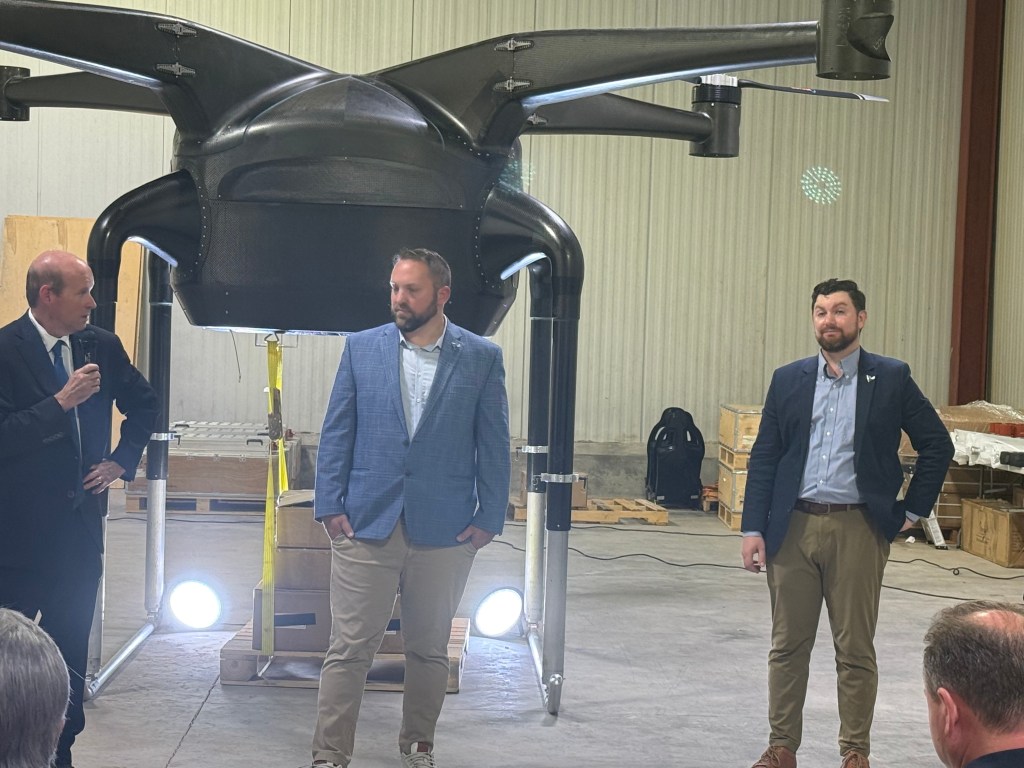
On September 21, 2026, we hosted a special community event at Miami University’s Innovation Center on Elm Street in Oxford, Ohio.
We called the evening “Dreams on Elm Street”, a lighthearted nod to the classic 1980s film. But what we’re building at Volynt isn’t the stuff of nightmares. It’s the realization of a dream, one that is taking shape right here in Butler County and has the potential to transform the future of logistics, aviation, and economic development in Ohio.
The turnout exceeded our expectations. The room was filled with Miami University staff, students, local business leaders, elected officials, and community members who wanted to learn more about what Volynt is building and where we’re headed.
We were honored to welcome Senator George Lang, Butler County Auditor Nancy Nix, and Michael Ryan, who is poised to become Butler County’s next commissioner. Their presence reflected the growing enthusiasm for innovation, entrepreneurship, and advanced aerospace development in our region.
Sharing the Vision
I opened the evening by welcoming our guests and providing an overview of the event. From there, our leadership team took the stage.
Our CEO shared Volynt’s long-term vision and mission. Our Chief Technology Officer highlighted the engineering milestones we’ve achieved and the technology behind the Volynt Vyper platform. As Chief Operating Officer, I discussed how Volynt is transforming cutting-edge aviation technology into a scalable and sustainable business. I outlined our operational strategy, manufacturing roadmap, partnerships, and the steps required to move from prototype development to commercial deployment.
The presentations were engaging, the audience was attentive, and the questions that followed demonstrated genuine interest and excitement.
Most importantly, this wasn’t a flashy product launch filled with unrealistic promises. It was an honest conversation about where we are today, what we’ve accomplished, and what the next several years may hold.
From Prototype to Production
Our immediate focus is straightforward.
Over the next six months, our team will complete the full-scale Vyper prototype that was unveiled at the Innovation Center. That aircraft represents years of design work, engineering refinement, and determination.
Once completed, the aircraft will enter an intensive testing phase designed to validate performance, reliability, and operational capabilities.
Looking ahead to 2027, we plan to participate in major industry competitions, build broader recognition within the aerospace community, and begin manufacturing multiple aircraft.
The goals are ambitious, but they are supported by a clear roadmap and a dedicated team committed to execution.
The Drone Revolution Is Already Here
One of the most important messages of the evening was that autonomous aviation is no longer a future concept.
It’s happening today.
Just one day after our event, Dayton-area company Dexa launched a drone delivery service in Kettering. The program delivers food orders from TJ Chumps on East Stroop Road to customers within a several-mile radius across Kettering, Oakwood, and Centerville.
These smaller drones operate as last-mile delivery systems. Flying at approximately 400 feet, they lower food orders safely to customers using a cable-delivery system. Dexa has spent years developing this capability and is helping demonstrate that drone delivery is becoming a practical reality.
Volynt’s mission is different.
While companies like Dexa focus on last-mile delivery, Volynt is developing larger autonomous aircraft designed for middle-mile logistics. Our aircraft are intended to transport meaningful payloads between regional hubs such as Cincinnati/Northern Kentucky International Airport (CVG), Dayton International Airport, Indianapolis, and other distribution centers.
This approach has the potential to reduce transportation bottlenecks, address driver shortages, and create more efficient supply chains.
Whether it’s delivering a meal across town or transporting freight across a region, autonomous aviation is rapidly reshaping how goods move through our economy.
Why Ohio Is Positioned to Lead
Ohio’s aviation legacy is unmatched.
The birthplace of powered flight now has an opportunity to become a leader in autonomous flight.
Few regions are better positioned than Butler County to participate in that transformation.
Our region offers access to multiple airports, including Miami University’s airport, where initial flight operations can be conducted. At the same time, substantial investment continues at Butler County Regional Airport, where significant infrastructure improvements are being planned.
The resources, workforce, educational institutions, and transportation network already exist. What remains is bringing together the innovators, investors, and community leaders who can turn opportunity into reality.
Creating Careers That Stay Close to Home
One topic that resonates deeply with me is talent retention.
I have spoken with countless parents who have made tremendous sacrifices to provide educational opportunities for their children through Miami University, Butler Tech, and the University of Cincinnati. Too often, those graduates leave Ohio because they believe the best opportunities are elsewhere.
That reality creates a challenge for families and communities alike.
One of our long-term goals at Volynt is to help change that story.
We envision creating thousands of high-quality aerospace, engineering, technology, and manufacturing jobs throughout Southern Ohio. We want talented young people to have the option of building exciting, fulfilling careers without leaving their families, communities, and hometowns behind.
Strong Community Support
One of the most encouraging moments of the evening was seeing the level of support from the community.
Michael Ryan delivered an excellent presentation about economic development in Butler County and how innovative companies such as Volynt can contribute to future growth and prosperity.
The participation from Miami University, local leaders, educators, students, business professionals, and community members reinforced something I’ve believed from the beginning:
Innovation succeeds when communities embrace it.
Dreams on Elm Street was more than a company presentation. It was a milestone. It brought together people from different backgrounds and perspectives to discuss a shared vision for the future of our region.
The energy in the room was unmistakable. The conversations were thoughtful. The questions were insightful. The enthusiasm was genuine.
For me, that confirmed that we’re moving in the right direction.
Looking Ahead
Volynt’s journey is still in its early chapters.
There is much work ahead, many challenges to overcome, and numerous milestones still to achieve. But the momentum is real, and the opportunities are significant.
We will continue sharing updates with the community as we progress from prototype development to testing, certification, manufacturing, and beyond.
This is only the beginning.
Thank you to everyone who attended Dreams on Elm Street and supported our mission. Your encouragement and belief in what we’re building means more than you know.
Together, we’re not just dreaming about the future.
We’re building it.
About the Author
Rich Hoffman is Chief Operating Officer of Volynt, where he leads operational strategy, business development, manufacturing planning, and growth initiatives for the company’s autonomous aerospace programs. A longtime Butler County leader and aerospace executive, he is committed to building high-quality technology careers and advancing innovation throughout Southwest Ohio.
Rich Hoffman is an author, political consultant, and strategic advisor based in Cincinnati, Ohio, and the creator of The Politics of Heaven—a unique framework that connects biblical theology, ancient history, and modern power structures to explain how moral alignment and spiritual forces shape global events. Blending real-world political experience with deep research into archaeology, UFO phenomena, and suppressed historical narratives, Hoffman offers compelling commentary on topics ranging from ancient civilizations and the Dead Sea Scrolls to modern populist movements, paranormal continuity, and leadership strategy in chaotic environments. As the author of The Gunfighter’s Guide to Business and the forthcoming Politics of Heaven, he brings a grounded yet provocative voice to media discussions, supported by firsthand experiences and a cross-disciplinary approach that bridges science, history, and theology. For interviews, speaking engagements, or expert analysis, visit richhoffmanbooks.com or contact directly via phone at 513-307-5815 or email at rhoffman@richhoffmanbooks.com. If you’ve seen the movie, Disclosure Day and want to talk about it and the implications of Presidnet Trump’s UAP disclosures, let me know and we can bring some color to your coverage. https://richhoffmanbooks.com/media-inquiries-broadcast-topics-and-contact-info/?frame-nonce=ad51e7ecba I do have a firsthand UFO encounter to discuss.
I cannot say enough about the new Jonathan Edwards Study Bible. It landed in August 2026, an NKJV built around the mind of the man I have come to think of as the theologian of American courage. The notes are not decorative. They are sermons, resolutions, doctrinal bone, and the working method of a man who wrote as if ideas had consequences because they do.[1]
I say that as a reader, not as a salesman. Somebody asked me if I work for the publisher because I will not shut up about it. I do not. I want them to make money. Scholars spent years—some of them a couple of decades—compressing Edwards into a book you can carry. That labor has to eat. It has to buy a hamburger. It has to justify itself in a market or it dies in a seminar. Paul would have understood that sentence immediately.
Every time I get a new Bible and read it through a different set of notes, my angle shifts a few degrees. This time the shift was violent. I could not stop thinking what a miracle it is that the crucifixion was even reported, and what a second miracle it is that Christianity became a civilization instead of a rumor. I want to talk about Christianity as a military and commercial endeavor—not instead of a spiritual one, but because the spiritual claim had to survive contact with Rome, with human nature, and with time.
I would say the benefit of Christianity to the human race, and to Western civilization in particular, was magnificent. That is not nostalgia. That is an audit. And the audit keeps returning to one man who began as an enemy.
The Road to Damascus Was a Hostile Takeover
The most important conversion story in history is not a soft altar call. Saul of Tarsus was hunting the church. Then he was its most formidable champion. The turn on the Damascus road is personal, traumatic, and public all at once.[2] I think a lot of people live in that same weather: against the thing, then claimed by the thing, then unable to go back to the person they were.
Paul was not a fisherman. He was a trained Pharisee and a working tradesman, a tentmaker who could pay his own way.[3] That combination is the whole essay in miniature. He had letters and leather. He could argue with philosophers in Athens and stitch a living in Corinth. The original disciples had seen Jesus with their own eyes. Paul had seen the risen Christ in a different register, and he had a skill the others did not: he knew how to take a local fire and turn it into a network.
People like to romanticize the Jerusalem church in Acts, where believers held things in common. I look at that scene and I do not see a manifesto. I see a threatened family taking care of its own. Historians, when they are being honest, generally read it as voluntary generosity inside a persecuted community—not a planned economy, not a party platform, and not a model Paul exported as law.[4] Later ideologies would loot the language. That is what ideologies do. They steal the family table and call it a theory.
The Jerusalem group was not trying to invent socialism. They were trying not to die, and they were trying not to abandon widows. The arrangement did not become the operating system of the Gentile churches. Paul would not have let it. He was too busy building congregations that could stand on their own feet in cities that did not care whether they lived.
Why the Original Apostles Could Not Have Done Paul’s Job
I love the apostles. I do not confuse their calling with Paul’s. They were rooted in Jerusalem, preaching first to their own people. Their courage was the courage of witnesses. Several of them were poor. They put the emphasis on the message and on the willingness to be spent. Rome knew what to do with men like that. It crucified them, beheaded them, scattered them. We remember them because the record survived. Memory is not the same thing as scale.[5]
Paul fought with them. That fact is in the Bible, not in some cynical footnote I invented. He opposed Peter to his face when the Gentile question threatened to split the movement into a Jewish remnant and a half-welcome underclass.[6] Christianity did not lock arms and sing. It argued. It almost broke. The argument was about purity versus reach, table fellowship versus the map of the empire. Paul chose the map.
Without that fight, I do not think you get a world religion. You get a Jewish faction with a crucified Messiah and a short half-life. Rome was full of such groups. We do not know their names because they lost.[7]
John survived. Tradition says they tried to boil him and failed, then parked him on Patmos, where he wrote Revelation.[8] Paul did not survive. The usual account is execution in Rome under Nero, sometime in the mid-sixties.[9] People mix Paul and John the way they mix founders and finishers. Revelation is a vision of the end. Ephesians is a field manual for a people who have to live until the end. I need both. I do not pretend they are the same book.
The Tentmaker Advantage: Financial Independence as Spiritual Nerve
Here is the part church-language usually sands off. Paul could be bold because he was not living off the room. He reserved the right to refuse a paycheck from the very people he served so that no one could say he was selling them a product.[10] That is not pride. That is strategy. A man who can feed himself can say the thing that gets him uninvited.
I have watched too many movements collapse into client relationships. The preacher needs the donor. The donor needs the preacher to bless the donor. Pretty soon nobody will say the costly sentence. The original disciples, as I read them, were often one arrest away from disappearing. Their deaths were holy. They were also, in organizational terms, a warning. Martyrdom proves sincerity. It does not automatically prove succession.
Paul’s independence gave him latitude. He could travel. He could offend. He could plant and leave and write back when the plant started growing weeds. He could walk into a city as a man with a trade rather than as a dependent mystic. I think that is why his version of the faith could cross from synagogue to workshop to household to the imperial road system. He understood customers. I do not mean he cheapened the gospel. I mean he knew that people must be able to receive a thing, carry a thing, and organize their lives around a thing—or the thing remains a speech in an alley.
If you want to know why I keep calling Paul a businessman, that is why. Not because he maximized profit. Because he understood value, timing, distribution, and the difference between a local hero and a transferable institution.
What Ephesians Actually Does
Ephesians is my favorite book in the Bible. It is short enough to carry and large enough to rebuild a mind. Paul does not wander. He frames the whole Christian movement: what God did before the foundation of the world, what Christ did in history, what the church is as a body, how a household should run, and how a believer is supposed to stand when the visible world is not the real battlefield.
The line that will not let me go is Ephesians 6:12. We do not wrestle against flesh and blood, but against principalities, against powers, against the rulers of the darkness of this age, against spiritual hosts of wickedness in the heavenly places.[11] I have come to think that verse is one of the most adult sentences ever written. It is what a person says after he has stopped believing that the problem is merely the neighbor’s personality.
Scholars argue over whether Paul meant demons, institutions, cosmic beings, or the spiritual charge inside empires and customs. I think he meant the whole weather system.[12] Names on mailboxes are not nothing. They are not the war. The war is the thing that climbs into names and makes them march.
That is why Ephesians could travel. It is theology you can use in Ephesus, Corinth, a Pennsylvania fort, a civil-war cemetery, or a county Republican breakfast. It tells a church how to live without becoming a cult and how to fight without mistaking people for the enemy. Paul called that arrangement a mystery revealed: Gentiles as fellow heirs, not guests in someone else’s religion.[13] That is scale. That is the business decision at the heart of the New Testament.
Flesh, Blood, and What I See in a Granddaughter
I have a young granddaughter. I watch her learn to walk, grab, flinch, laugh, and decide which faces matter. She is writing relationships into her nervous system that will still be there when she is fifty—parents, uncles, cousins, the strange country of grandparents. That is the human miracle and it is also the trap. We become so fascinated by whose nose she inherited that we forget to ask the older question.
What was she before she was a body? What is the spiritual essence that is using this little frame to enter the world? I do not mean that as a greeting-card. I mean it as politics. Paul called the hidden agents principalities. I have arrived at the same word by the long road of watching people. I am bad at names. People notice. They think I am careless. I am not careless about the thing I think is actually driving the name. Tim, Bob, Bill—fine. I want to know what climbed into Tim.
I do not get very excited about fleshly pursuits. I care about the politics of the powers that wear bodies like coats. That sounds cold until you have watched good people hurt each other while insisting they are only being practical. Paul’s sentence explains the pattern. The pattern is older than the persons.
This is also why the incarnation is not a sentimental Christmas pageant to me. If the real problem were only human manners, God could have sent another list. The Old Testament is not shy about the Spirit of God coming upon men. The scandal is that God himself takes flesh and walks into the mess. I think that is because human beings are not, at bottom, the main antagonist. The forces that use human beings are. Meeting us in the middle of the mess was not a branding exercise. It was an invasion.
When Does a Life Begin If the War Began Earlier?
I will not pretend this next piece is a public-policy white paper. It is the metaphysical question hiding under the abortion argument, and most of the argument never reaches it. The usual fight is: when does the fetus become human enough? Conception, heartbeat, viability, birth, one day before birth. Those are body questions. They matter. They are not the last questions.
Paul’s principalities force a harder timing problem. When does the spiritual being begin its journey in this world? I think the powers are already at work when a man and a woman find themselves wanting to form a union that could produce a child. They are either willing a life into the world or leaning the world toward demolition. Political systems, in my view, are the large, clumsy mirrors of that same contest. We build governments the way we build families: as flesh-and-blood answers to a conflict we can barely see.
If that is true, then a culture that talks only about bodies will keep losing to a culture that understands appetite, despair, and the unseen pressure on the will. I am not asking the county health department to adopt a demonology. I am asking Christians to stop acting as if Ephesians 6:12 were poetry.
What Christianity Gave the West
I said the gift was magnificent. Let me be specific enough to be attacked.
Christianity took a Mediterranean world that exposed unwanted infants, ranked souls by pedigree, and treated crucifixion as interior decorating for highways, and it taught that world that the weak had a claim on the strong. It made the person, not the clan, the unit of moral concern. It made conscience a public fact. It made time itself a story with a judgment at the end, which is another way of saying it made history matter.[14][15]
That moral architecture did not fall out of the sky in 1776. It was preached, copied, argued, and institutionalized for centuries before any Virginian wrote a declaration. Even secular historians who cannot recite the catechism now admit they are living inside the blast radius.[16] You can hate the church and still be using its furniture. Most modern humanitarian language is Christian language with the serial numbers filed off.
I do not say this because I think Christians have always behaved like saints. They have not. I say it because the standard by which we condemn their failures is itself a Christian standard. Rome did not accuse itself of failing the least of these. We do. That habit had to be invented.[17][18]
Jonathan Edwards and the American Nerve
If Paul is how the faith left Palestine, Edwards is one of the reasons it grew a backbone in English-speaking America. He is remembered, lazily, for one terrifying sermon in Enfield in 1741.[19] That sermon is real. It is also a fragment. Edwards was after joy in God, the nature of true affection, the freedom and bondage of the will, and a revival that would not fake itself.[20]
The First Great Awakening gave the colonies a shared moral language before they had a shared government. It taught ordinary people that authority could be wrong, that the soul had business with God that no bishop or parliament could intercept, and that history was not a closed room.[21] Calvin Coolidge, who is not usually cast as a revivalist, said Edwards’s philosophy had prepared the colonists for the Declaration.[22] That is a president talking, not a youth-group brochure.
I do not think America exists in the form I care about without that fire. I also do not think Edwards was sitting in Northampton in the 1740s designing the United States. Influence is a cascade, not a conspiracy. Edwards shapes a climate. The climate shapes men who never met him. The men walk onto battlefields and into conventions carrying instincts they think are simply common sense.[23][24]
His written corpus is enormous. Yale has spent generations editing it. The new study Bible is the first time a lot of ordinary readers will feel that weight without needing a research library card.[25]
Fort Necessity: The Wrong Turn That Organized My Year
My wife and I were trying to get toward Washington. We missed a turn, dropped onto the National Road with a camper that does not enjoy mountain switchbacks, and kept going because turning around had become a theology problem of its own. We pulled into Fort Necessity because the parking lot was large enough for me to get a Mello Yello out of our camper refrigerator.[26]
We were early. It was a midweek afternoon, still cold, almost empty. I went back to the refrigerator for my Mello Yello, which is as close as I get to a sacrament on the road, and we walked the ground. Young Washington was here. He built a sad little circular fort in a meadow and lost. That loss did not make him small. It started the education of the man who would refuse a crown.
I did not hear an audible voice. I am not going to insult the place by inventing one. What I did get was an obsession. The same year I stood at Fort Necessity I stood at Washington’s grave at Mount Vernon and in the room where he slept.
A few months later the Washington film made the circuit and we went. I liked it. But the question it could not answer for me was the one the field had already asked: what made Washington Washington? I think part of the answer is upstream of muskets. It is the Awakening’s idea that a people can be morally addressed as a people—that rebellion against a corrupt center might be obedience to a higher one.[27]
A phone call in the bookstore
While I was in the Fort Necessity bookstore, Nancy Nix called. She and I do local Republican work in Butler County, Ohio. We do not live on the phone. We think in the same direction often enough that when something is jammed, we say so and talk it out. She was dealing with the eternal problem of twenty-five people in a room who will not share a sandbox well together. I was surrounded by Washingtoniana. The juxtaposition was perfect. The early church had the same meeting. Paul had the same meeting. Scale always produces factions. The work is not to pretend otherwise. The work is to keep the factions from killing the thing they claim to love.
Ford’s Theatre, Gettysburg, and the Men Who Paid the Invoice
We did Washington properly. We stood outside the White House. That same day we went to Ford’s Theatre. I had already had enough of John Wilkes Booth by the time I looked at the box Lincoln was shot in. I was hungry. I wanted a sandwich and a quieter mind. My wife was right to make us cross the street.[28]
A guide who had noticed we were not ordinary tourists took us through the Petersen House. I sat in that small room a long time. The bed, the chair, the knowledge that a president died a few feet from where tourists now whisper. I found myself wondering what Lincoln’s mind was doing while the body shut down. I cannot know. I think he was thinking about the Union as a moral object. I think the Awakening’s grandchildren were in that room whether anyone said Edwards’s name or not.
Then Gettysburg. We took the RV and gave the battlefield days, not hours. Weather, timing, day one, day two, day three, the cemeteries, the spot of the Address. I have read the military histories.[29] What I could not shake was the interior of the men. What do you tell yourself when you stand up on the third day and move toward a fence line that is trying to erase you? Some of them had Bibles. Some of them had fragments of sermons. Some of them had only the residue of a culture that had already decided the Union was a covenant and slavery a crime against it.[30][31]
A republic capable of spending that much blood to keep a proposition alive did not get that capacity from a seminar on self-esteem. It got it from a long Christian argument about the human person, providence, and judgment. Lincoln’s Second Inaugural is what that argument sounds like when it has to bury hundreds of thousands of its own sons.
The Cascade I Keep Seeing
I will put the chain as cleanly as I can, knowing historians will want asterisks and I will give them some.
Without Paul, the Jesus movement remains a Jerusalem story. Without that scaled faith, there is no Christendom to form Europe’s conscience. Without that conscience, the English Protestant world does not produce an Edwards. Without Edwards and the Awakening, the American founding generation does not speak with the moral confidence it actually used—even the ones who were not revivalists. Without that founding, there is no Union for Lincoln to save. Without Lincoln, the American experiment becomes a slave republic with European manners.
That is not a straight line on a chalkboard. It is a watershed. Remove the spring and the towns downstream do not exist in the same form. I think Paul is the spring. I think Edwards is one of the American aqueducts. I think Washington and Lincoln are what the water looks like when it has to put on a uniform.[32][33][34]
People who only memorize the names of apostles miss this. They know who died. They do not know why the death did not end the firm. Paul is the reason the firm had branches.
The Business DNA of the Christian West
Once I saw Paul as a scaler, I started seeing the later fights differently. Mission movements that worked were not only brave. They were organized. They printed. They raised money. They trained. They built schools that outlived the missionaries. They treated the gospel as something that had to arrive in a form a stranger could use.
Only after that practical machinery proved it could create loyalty, literacy, and order did the Roman world—and much later the American world—fully absorb what it could not kill. I do not mean Christianity became a mere business. I mean it survived because it was not allergic to competence.
That is why I get impatient when the same voices that enjoy hospitals, universities, and human-rights talk treat business itself as original sin. The anti-business mood in the modern West is not just an economic opinion. It is often an attack on the very mechanism that let a demanding faith endure: independent people who can move, build, refuse a patron, and take a message across a border without asking a committee for permission.
Paul refused to live off handouts when the handout would have compromised the work. A civilization that sneers at that instinct will not keep the civilization Paul helped make. It will keep the vocabulary for a while. Then it will keep only the complaints.
Imperfect Instruments: Why I Compare a Businessman to Paul
I am going to say the impolite part. A lot of Christians wanted their political deliverance to arrive dressed like a Sunday-school painting. History does not usually staff itself that way. Paul had been a persecutor. He was not the profile the Jerusalem church would have ordered from a catalog.
I look at Donald Trump the same way I look at other blunt instruments in American life. I do not need him to be a systematic theologian. I need to notice what actually happened: a businessman with a public mess behind him enlarged the platform available to people who had been lectured out of public life. Charlie Kirk and a lot of ordinary conservatives could stand in rooms they would not have been invited into. I think that matters. I also think it is possible to be grateful for a door and still wish the doorman had better manners.
Paul did not come in the package people expected. Neither do most of the people who keep a movement from being locked in the sacristy. If your test for usefulness is polish, you will be ruled by people who are good at meetings and bad at history.
What a Second Great Awakening Would Actually Look Like
I do not think the next awakening arrives as a White House program. Administrations can restrain harm and they can appoint judges. They cannot regenerate a people. That work starts in churches, kitchens, Bibles, and arguments that last longer than a news cycle.
When I drive around my community on Sundays I see a lot of churches. Many of them are doing honest work. Many of them are reciting names. They know the apostles. They know the outline. They do not always know the politics inside the outline—the fight between purity and scale, martyrdom and mission, the local table and the empire of cities. That is why I am having this conversation in public. Surface catechism will not hold a civilization that is being talked out of itself.
A modern awakening would look, in practice, like people recovering nerve. Not vibe. Nerve. The willingness to tell the truth about good and evil without outsourcing the definitions to whatever academic fashion is currently eating its own young. It would look like families that treat children as souls rather than lifestyle accessories. It would look like churches that can stand a businessman in the pulpit without calling him unclean and can stand a poor man in the pulpit without calling him a mascot. It would look like gratitude for the West instead of a permanent apology for having won.
Edwards hoped God would walk with a people through the battlefields of ordinary life. I want that sentence back in circulation. Not as décor. As an operating assumption.
Why I Will Keep Talking to AI About This
A lot of people who read me despise artificial intelligence. Some of them despise Elon Musk on principle. They think any conversation like this is a rehearsal for a comic-book villain. I understand the fear. Tools this sharp can cut the wrong direction.
I also think it is cowardice to let the fear own the tool. We built machines that can hold a line of argument, retrieve a library, and stay in the fight when a human conversation partner gets tired. Used stupidly, that becomes a substitute for thought. Used properly, it becomes a way to do what Paul did with letters: send a structured argument into places the sender cannot physically be.
This is not a prophecy of Ultron. That is a man using a new press. The first Great Awakening had Whitefield’s lungs and a rising print culture.
A second one will have churches, Bibles, and whatever honest instruments we refuse to surrender to people who hate the civilization that made the instruments.[35]
I am not asking anyone to worship a model. I am asking them to notice that reference, memory, and argument are part of spiritual warfare too. If the principalities are real, they are not frightened by our refusal to use a library because the library is now silicon.
Know Where You Are
I watched, not long ago, the easy public habit of praising every sacred book as if they were interchangeable courtesy items. Respect, as a civic manner, is one thing. Amnesia is another. I have read the Qur’an more than once. I can say, without theatrics, that it has never done to my mind what Edwards does, and it has never done what Ephesians does. That is not a foreign-policy program. It is a reader’s report.
A nation that cannot tell the difference between the sources of its own law and the sources of someone else’s empire is a nation preparing to be edited. I will not help with the editing. The point of the progressive pressure I have spent years writing against is not manners. It is unmaking. If you want to unmake a people, you first convince them that the faith which built their hospitals, their conscience, and their suspicion of kings was always a crime scene.
I think that project is the current face of the old war. Flesh and blood will carry it. Flesh and blood are not the origin of it.
What I Want the Reader to Do
If you only remember one practical sentence, remember this: start with Paul if you want to know how the faith survived, and start with Edwards if you want to know how it learned to speak American.
Buy the book if you can. Read Ephesians slowly, out loud, as if it were written to a congregation that might split next week—because that is the situation it was written for. Then read Edwards on affections and ask whether your religion is an appetite or a performance. Then walk some actual ground. Necessity. Vernon. Gettysburg. The cheap seats at Ford’s Theatre. History gets into the legs in a way it does not get into a feed.
Notes
The numbered references in the text correspond to the sources below and to the bibliography. Biblical citations follow common English versification; quotations from Ephesians use the New King James Version to stay with the Edwards study edition.
[1] The Jonathan Edwards Study Bible: Experience Abiding Joy in Christ (NKJV), general editor Dr. Matthew Everhard (Nashville: Thomas Nelson, August 18, 2026). Notes drawn from Edwards’s corpus; essays on his life, theology, spiritual practices, and the First Great Awakening; Edwards’s Resolutions; introduction to the Miscellanies system.
[3] Acts 18:3. The Greek is skēnopoioi, traditionally “tentmakers.” See Kenneth Berding, “Was Paul a Tentmaker? Part 1,” The Good Book Blog, Biola University, October 18, 2021.
[4] Acts 2:44–47; Acts 4:32–37. Compare the later famine collection in Acts 11:27–30. Historians generally read the Jerusalem sharing as voluntary generosity inside a threatened community, not a standing political economy.
[5] Acts 4:13.
[6] Galatians 2:11–14; Acts 15:1–35.
[7] Josephus, The Jewish War; Tacitus and Suetonius on successive unrest under Rome.
[8] Revelation 1:9. The boiling-oil tradition is in Tertullian, Prescription Against Heretics 36.
[9] 1 Clement 5; Eusebius, Ecclesiastical History 2.25. Traditional date: Rome, under Nero, c. A.D. 64–67.
[12] Clinton E. Arnold, Powers of Darkness (Downers Grove, IL: InterVarsity Press, 1992); Walter Wink, Naming the Powers (Philadelphia: Fortress Press, 1984); Hendrik Berkhof, Christ and the Powers, trans. John Howard Yoder (Scottdale, PA: Herald Press, 1977).
[13] Ephesians 2:11–22; 3:1–13.
[14] Larry W. Hurtado, Destroyer of the Gods (Waco, TX: Baylor University Press, 2016); Larry Siedentop, Inventing the Individual (Cambridge, MA: Belknap Press of Harvard University Press, 2014).
[15] Tom Holland, Dominion: How the Christian Revolution Remade the World (New York: Basic Books, 2019).
[16] Tom Holland, Dominion: How the Christian Revolution Remade the World (New York: Basic Books, 2019).
[17] Peter Brown, The Rise of Western Christendom, 3rd ed. (Oxford: Wiley-Blackwell, 2013).
[18] Christopher Dawson, The Making of Europe (London: Sheed & Ward, 1932).
[19] Jonathan Edwards, “Sinners in the Hands of an Angry God,” Enfield, Connecticut, July 8, 1741.
[20] Jonathan Edwards, A Treatise Concerning Religious Affections (1746); Freedom of the Will (1754).
[21] Alan Heimert, Religion and the American Mind (Cambridge, MA: Harvard University Press, 1966); Patricia U. Bonomi, Under the Cope of Heaven (New York: Oxford University Press, 1986); Thomas S. Kidd, The Great Awakening (New Haven: Yale University Press, 2007); Frank Lambert, Inventing the “Great Awakening” (Princeton: Princeton University Press, 1999).
[22] Calvin Coolidge, Address on the One Hundred and Fiftieth Anniversary of the Declaration of Independence, Philadelphia, July 5, 1926.
[23] George M. Marsden, Jonathan Edwards: A Life (New Haven: Yale University Press, 2003); Mark A. Noll, America’s God: From Jonathan Edwards to Abraham Lincoln (New York: Oxford University Press, 2002).
[24] Edwards died March 22, 1758, weeks after becoming president of the College of New Jersey. The responsible historical claim is cultural inheritance, not a pocket sermon in every haversack.
[25] The Works of Jonathan Edwards, Yale University Press; digital corpus at the Jonathan Edwards Center, http://edwards.yale.edu.
[26] National Park Service, Fort Necessity National Battlefield. Battle of July 3, 1754.
[27] Mount Vernon Ladies’ Association, Mount Vernon, Virginia.
[28] Ford’s Theatre National Historic Site and Petersen House, Washington, D.C. Lincoln died April 15, 1865, at 7:22 a.m.
[29] Allen C. Guelzo, Gettysburg: The Last Invasion (New York: Knopf, 2013).
[30] Abraham Lincoln, Gettysburg Address, November 19, 1863; Second Inaugural Address, March 4, 1865.
[31] Lincoln, Cooper Union Address, February 27, 1860; presidential fasting and thanksgiving proclamations, 1861–1865.
[32] George M. Marsden, Jonathan Edwards: A Life (New Haven: Yale University Press, 2003); Mark A. Noll, America’s God: From Jonathan Edwards to Abraham Lincoln (New York: Oxford University Press, 2002).
[33] N. T. Wright, Paul and the Faithfulness of God (Minneapolis: Fortress Press, 2013); F. F. Bruce, Paul: Apostle of the Heart Set Free (Grand Rapids: Eerdmans, 1977).
[34] Gordon S. Wood, The Radicalism of the American Revolution (New York: Knopf, 1992).
[35] Harry S. Stout, The Divine Dramatist: George Whitefield and the Rise of Modern Evangelicalism (Grand Rapids: Eerdmans, 1991).
[36] Hoffman, Rich. The Gunfighter’s Guide to Business.
Bibliography and Further Reading
Scripture and primary Christian sources
The Holy Bible, New King James Version. Nashville: Thomas Nelson.
The Jonathan Edwards Study Bible: Experience Abiding Joy in Christ (NKJV). Edited by Matthew Everhard. Nashville: Thomas Nelson, 2026.
Edwards, Jonathan. A Treatise Concerning Religious Affections. 1746.
Edwards, Jonathan. Freedom of the Will. 1754.
Edwards, Jonathan. “Sinners in the Hands of an Angry God.” Sermon, Enfield, Connecticut, July 8, 1741.
Edwards, Jonathan. The Works of Jonathan Edwards. 26 vols. New Haven: Yale University Press. Digital edition: Jonathan Edwards Center at Yale University. http://edwards.yale.edu.
The Apostolic Fathers. 1 Clement. Late first century.
Eusebius of Caesarea. Ecclesiastical History.
Tertullian. Prescription Against Heretics.
Paul, the early church, and the powers
Arnold, Clinton E. Powers of Darkness: Principalities and Powers in Paul’s Letters. Downers Grove, IL: InterVarsity Press, 1992.
Berding, Kenneth. “Was Paul a Tentmaker?” Parts 1–2. The Good Book Blog. Biola University, 2021.
Berkhof, Hendrik. Christ and the Powers. Translated by John Howard Yoder. Scottdale, PA: Herald Press, 1977.
Bruce, F. F. Paul: Apostle of the Heart Set Free. Grand Rapids: Eerdmans, 1977.
Dunn, James D. G. The New Perspective on Paul. Rev. ed. Grand Rapids: Eerdmans, 2005.
Hurtado, Larry W. Destroyer of the Gods: Early Christian Distinctiveness in the Roman World. Waco, TX: Baylor University Press, 2016.
Meeks, Wayne A. The First Urban Christians: The Social World of the Apostle Paul. New Haven: Yale University Press, 1983.
Stark, Rodney. The Rise of Christianity. Princeton: Princeton University Press, 1996.
Wink, Walter. Naming the Powers: The Language of Power in the New Testament. Philadelphia: Fortress Press, 1984.
Wright, N. T. Paul and the Faithfulness of God. Minneapolis: Fortress Press, 2013.
Christianity and Western civilization
Brown, Peter. The Rise of Western Christendom. 3rd ed. Oxford: Wiley-Blackwell, 2013.
Chesterton, G. K. The Everlasting Man. London: Hodder & Stoughton, 1925.
Chesterton, G. K. Orthodoxy. London: John Lane, 1908.
Dawson, Christopher. The Making of Europe. London: Sheed & Ward, 1932.
Holland, Tom. Dominion: How the Christian Revolution Remade the World. New York: Basic Books, 2019.
Lewis, C. S. The Abolition of Man. Oxford: Oxford University Press, 1943.
Lewis, C. S. The Screwtape Letters. London: Geoffrey Bles, 1942.
Siedentop, Larry. Inventing the Individual: The Origins of Western Liberalism. Cambridge, MA: Belknap Press of Harvard University Press, 2014.
Edwards, the Awakening, and American political religion
Bonomi, Patricia U. Under the Cope of Heaven: Religion, Society, and Politics in Colonial America. New York: Oxford University Press, 1986.
Heimert, Alan. Religion and the American Mind: From the Great Awakening to the Revolution. Cambridge, MA: Harvard University Press, 1966.
Kidd, Thomas S. The Great Awakening: The Roots of Evangelical Christianity in Colonial America. New Haven: Yale University Press, 2007.
Lambert, Frank. Inventing the “Great Awakening.” Princeton: Princeton University Press, 1999.
Marsden, George M. Jonathan Edwards: A Life. New Haven: Yale University Press, 2003.
Noll, Mark A. America’s God: From Jonathan Edwards to Abraham Lincoln. New York: Oxford University Press, 2002.
Stout, Harry S. The Divine Dramatist: George Whitefield and the Rise of Modern Evangelicalism. Grand Rapids: Eerdmans, 1991.
Sweeney, Douglas A. “Jonathan Edwards: Legacy.” Jonathan Edwards Center at Yale University.
Tocqueville, Alexis de. Democracy in America. 1835–1840.
Founding, Union, and the ground I walked
Blight, David W. Frederick Douglass: Prophet of Freedom. New York: Simon & Schuster, 2018.
Coolidge, Calvin. Address on the One Hundred and Fiftieth Anniversary of the Declaration of Independence. Philadelphia, July 5, 1926.
Guelzo, Allen C. Gettysburg: The Last Invasion. New York: Knopf, 2013.
Lincoln, Abraham. Cooper Union Address. February 27, 1860.
Lincoln, Abraham. Gettysburg Address. November 19, 1863.
Lincoln, Abraham. Second Inaugural Address. March 4, 1865.
National Park Service. Fort Necessity National Battlefield. Farmington, PA.
National Park Service. Ford’s Theatre National Historic Site. Washington, D.C.
Wood, Gordon S. The Radicalism of the American Revolution. New York: Knopf, 1992.
Mount Vernon Ladies’ Association. George Washington’s Mount Vernon. Mount Vernon, VA.
Classical and Roman context
Josephus. The Jewish War.
Tacitus. Annals.
Suetonius. The Twelve Caesars.
The author’s related work
Hoffman, Rich. The Gunfighter’s Guide to Business.
Rich Hoffman is an author, political consultant, and strategic advisor based in Cincinnati, Ohio, and the creator of The Politics of Heaven—a unique framework that connects biblical theology, ancient history, and modern power structures to explain how moral alignment and spiritual forces shape global events. Blending real-world political experience with deep research into archaeology, UFO phenomena, and suppressed historical narratives, Hoffman offers compelling commentary on topics ranging from ancient civilizations and the Dead Sea Scrolls to modern populist movements, paranormal continuity, and leadership strategy in chaotic environments. As the author of The Gunfighter’s Guide to Business and the forthcoming Politics of Heaven, he brings a grounded yet provocative voice to media discussions, supported by firsthand experiences and a cross-disciplinary approach that bridges science, history, and theology. For interviews, speaking engagements, or expert analysis, visit richhoffmanbooks.com or contact directly via phone at 513-307-5815 or email at rhoffman@richhoffmanbooks.com. If you’ve seen the movie, Disclosure Day and want to talk about it and the implications of Presidnet Trump’s UAP disclosures, let me know and we can bring some color to your coverage. https://richhoffmanbooks.com/media-inquiries-broadcast-topics-and-contact-info/?frame-nonce=ad51e7ecba I do have a firsthand UFO encounter to discuss.
I have watched this movie before. In 2015 and 2016, and again in 2024, the same class of people tried to tell America that Donald Trump’s wealth was a character defect. They said a rich man could not be trusted, that success itself was the indictment, that gold, planes, and golf were proof he was “not like you.” Voters put him in the White House twice anyway, because they understood something the professional scolds never will: independence is an asset. A man who does not need the job is harder to own. That is the lesson Ohio Democrats and a handful of leftover Republican wreckers are now trying to unlearn with Vivek Ramaswamy, and it is why Amy Acton spent Labor Day weekend screaming that you cannot buy Ohio.
She needed a chant. What she got was a gaffe.
The Speech That Sounded Like a Person Running Out of Road
Watch the clip. Acton is at a union picnic with Pete Buttigieg in tow, doing the ritual of the lockdown years: I am a doctor, not a politician, becoming one right in front of your eyes. Then she starts barking that Vivek cannot buy the state, cannot buy Ohio, cannot buy us, cannot buy us, cannot buy us in Ohio, that is the end of this. It is the sort of thing a campaign writes on a whiteboard when the internals look ugly and the only remaining argument is envy. The crowd does not catch fire. She looks like she is trying to start a wave at a funeral.
This is the same Amy Acton Ohio already knows. She ran public health under Mike DeWine when the state was locked down, businesses were smashed, kids were sent home, and “follow the science” became a political religion. She collected awards for it. A lot of Ohioans collected unemployment, missed funerals, and watched their Main Streets die. You can call that public service if you like. I call it the record she has to run on, and it is why the “I’m just like you” routine lands like a lead pipe. She is not just like you. She is the woman who told you to stay home while the people who write the rules kept their salaries.
The wealth attack is even thinner. Vivek flew to watch tennis. He likes tennis. He used to be a ranked junior. He has a court. He went to the U.S. Open and he has been to Paris. Wealthy people do that. Trump never ran from Mar-a-Lago or the golf course; he wore the gold clip and the silk tie and said, yes, I did well, and if you vote for me I will try to make it so you can do well too. That is a producer’s message. Acton’s message is the opposite: he has money, therefore he is illegitimate, therefore hand the keys to the people who want to tax the successful and redistribute the proceeds to the discontented. That is not a governing philosophy. That is a ransom note.
Why Attacking Wealth Is a Loser’s Tell
I have been thinking lately about the Apostle Paul. He was effective in part because he had standing and independence. He was not a ward of the movement. He could travel, argue, and endure because he was not begging the crowd for his next meal. Politics is not the church, but the principle is the same. A candidate who has already won in the private economy does not need Columbus the way a career public-health administrator needs Columbus. Vivek does not need a government job. That is supposed to be a feature. The people yelling “you can’t buy Ohio” are announcing that they cannot raise comparable money and cannot compete on growth, so they will compete on resentment.
David Pepper and the rest of the chorus have been working this line for months: billionaire, private jet, not one of us. Fine. Then explain why Trump’s jets and clubs did not stop two national victories, and why Ohioans who want plants, capital, and jobs might prefer a man who has already built companies to a woman whose signature achievement was closing the state. You can dislike Vivek’s style. You can argue policy. What you cannot do, with a straight face, is pretend that enjoying a tennis match is a civic crime while the alternative is more of the administrative state that already had its turn.
The other half of this farce is intra-Republican sabotage. After a primary, Democrats lock arms around whoever they nominated, even when she sounds like a chalkboard dragged down a stairwell. A slice of the right still wants to pick the scab. Nick Fuentes types, leftover primary rivals, the professional “I told you so” circuit—anyone who would rather be right about a Republican’s flaws than win the state—keep feeding the same clip. They did it to Trump in 2016 and 2024. He won anyway because voters vote their interest when the noise dies down. A good economy and job creators in your state beat a sermon about how the other guy’s plane is too nice.
Then Came the Fair, and the Overnight Conversion of a Shove Into an Assassination Plot
The timing is the tell. After the Labor Day chant made her look unhinged, the campaign needed a new story. Sunday at the Canfield Fair, a 38-year-old local named Patrick Havas pushed through a tent crowd toward Acton with a phone up, as if he were recording or trying to get close enough to be seen. He knocked over older people. Security took him down. After the fact, deputies found two pistols and a Taser-style device on him. He did not draw the guns. He did not fire. He did not brandish. Ohio is a constitutional-carry state. Carrying is not the same thing as attempting murder. The charges reported were disorderly conduct and misdemeanor assault for the people he knocked down. Acton was unhurt. The people who fell were assessed and, according to the sheriff, did not seek further treatment.
That is a bad scene at a fair. It is not a martyrdom. Campaign statements still said an “armed individual lunged” and injured multiple people. National copy followed the verb. By Saturday night into Sunday the lead was written as if Ohio had just watched a political assassination attempt. If there were clean video of a man trying to kill her, it would have been on every screen before supper. What we got instead was language inflation: lunge, attack, armed, threat—while the actual police story is a large man barreling for a better look or a confrontation, knocking seniors like bowling pins, and getting piled on by Highway Patrol.
This attack story is just another Democrat Jussie Smollett story, trying to gain sympathy and voter support through fake news talking points. This is the fullness of the Acton operation: when the speech is a disaster, change the subject to danger. When you cannot raise on growth, raise on fear. When you cannot debate or raise money, accuse the other side of buying the state. Look how many sucker politicians jumped on the bandwagon without knowing all the facts, which again came out looking like Amy Acton is a loser candidate.
What Ohio Actually Chooses When the Cameras Leave
Acton will keep the unions, the people who want the next transfer payment, and the media that still thinks 2020 was her finest hour. She will keep Pepper on the ticket as proof that the old Democratic machinery is still in the room. She will keep calling Vivek rich, which he is, and hoping Ohio has forgotten that successful people are allowed to like tennis, football Saturdays, and a life that is not a permanent campaign stop.
I want a state that recruits producers instead of lecturing them. If a man with a billion dollars in assets spends a few thousand to fly to a match, that is not the scandal. The scandal is a political class that treats his success as the crime and her lockdown résumé as the credential. Trump never apologized for winning. Vivek should not apologize for a court, a jet, or a seat at the Open. The people who need him to grovel are the same people who needed Trump to grovel. They lost that argument twice.
Vote like you want the factories and the payrolls. When things got tough for Amy Acton in 2026 she turned to fake news. Which only made everything worse. She is the lockdown lady and is horrible in every way a politician can be, which we all had a front-row seat to in 2020 when she destroyed Ohio’s economy and told everyone they could be superheroes if only they wore a mask in public. That is the person running for governor in Ohio as a Democrat. A disaster on a good day. On a bad day, she is a fake news agent of destruction and drunkenness.
Notes
1. Acton’s Labor Day-weekend remarks with Buttigieg at the Cincinnati AFL-CIO picnic, including the “you cannot buy this state / you can’t buy us” repetition, circulated widely on September 5–6, 2026. See WLWT coverage of the Hamilton picnic and contemporaneous rally video.
2. Acton served as Ohio Department of Health director under Gov. Mike DeWine beginning in 2019 and became the public face of the state’s COVID restrictions.
3. Criticism of Ramaswamy’s travel and tennis included Acton’s own Labor Day-weekend post attacking a U.S. Open appearance and earlier opinion pieces on a July 4 Paris trip.
4. Ramaswamy’s tennis background (junior player, Cincinnati Open ball boy, regular Open attendee) is part of his public biography and prior campaign videos.
5. Canfield Fair incident, September 6, 2026: Patrick Havas, 38, of Canfield, pushed through the Mahoning County Democratic Party tent, knocked down older attendees, was detained by Ohio State Highway Patrol executive protection; weapons recovered after detention; no brandishing reported; charges reported as disorderly conduct and two counts of misdemeanor assault. Acton uninjured.
6. Constitutional carry in Ohio means possession of a concealed firearm, without more, is not itself an assassination attempt.
7. Public polling through late summer 2026 generally showed a toss-up to slight-Ramaswamy edge depending on the house, which is consistent with a campaign hunting for a reset narrative.
8. Intra-GOP sniping after contested primaries is a recurring feature of the Trump era; Democrats have typically consolidated faster around flawed nominees.
Bibliography
Acton for Governor. Campaign statements and Labor Day / Canfield Fair remarks, September 2026.
Ballotpedia. “Amy Acton.” Candidate biography and office history.
CNN. “Armed man arrested after pushing through crowd toward Ohio Democratic gubernatorial nominee.” September 6, 2026.
Columbus Dispatch. “Armed man arrested after lunging at Amy Acton at Canfield Fair.” September 6, 2026.
Cincinnati Enquirer. Nick Anderson, “Ramaswamy’s Paris trip an example of his disconnect with Ohioans.” July 8, 2026.
HuffPost. “Vivek Ramaswamy Slammed For Leaving Ohio And Attending The U.S. Open.” September 6, 2026.
Mahoning County Sheriff’s Office / Ohio State Highway Patrol statements on the Canfield Fair detention of Patrick Havas, September 6, 2026.
New York Times. “Armed Man Arrested After Charging Toward Democratic Candidate for Ohio Governor.” September 6, 2026.
The Nerd Stash. “‘You Can’t Buy Us’: Ohio Dem Amy Acton Sparks Backlash After Awkward Rally Chant Aimed at Vivek Ramaswamy.” September 6, 2026.
Washington Post. “Armed individual ‘lunged’ at Democrat nominee for Ohio governor, campaign says.” September 6, 2026.
Wikipedia. “2026 Ohio gubernatorial election.” Polling averages and race ratings as of early September 2026.
WLWT. “Pete Buttigieg campaigns for Amy Acton, Greg Landsman at Cincinnati AFL-CIO picnic.” September 6, 2026.
Rich Hoffman is an author, political consultant, and strategic advisor based in Cincinnati, Ohio, and the creator of The Politics of Heaven—a unique framework that connects biblical theology, ancient history, and modern power structures to explain how moral alignment and spiritual forces shape global events. Blending real-world political experience with deep research into archaeology, UFO phenomena, and suppressed historical narratives, Hoffman offers compelling commentary on topics ranging from ancient civilizations and the Dead Sea Scrolls to modern populist movements, paranormal continuity, and leadership strategy in chaotic environments. As the author of The Gunfighter’s Guide to Business and the forthcoming Politics of Heaven, he brings a grounded yet provocative voice to media discussions, supported by firsthand experiences and a cross-disciplinary approach that bridges science, history, and theology. For interviews, speaking engagements, or expert analysis, visit richhoffmanbooks.com or contact directly via phone at 513-307-5815 or email at rhoffman@richhoffmanbooks.com. If you’ve seen the movie, Disclosure Day and want to talk about it and the implications of Presidnet Trump’s UAP disclosures, let me know and we can bring some color to your coverage. https://richhoffmanbooks.com/media-inquiries-broadcast-topics-and-contact-info/?frame-nonce=ad51e7ecba I do have a firsthand UFO encounter to discuss.
I have been thinking about this for a long time, and the thoughts keep circling back like they always do when something important is trying to get out. American philosophy did not end with Ayn Rand. Human beings keep innovating. She was a powerful contributor to American thought and the American system of individual achievement, but philosophy is not a closed book. We keep going. What bothers me, what has always bothered me, is the character of the human spirit in her books and how that spirit keeps getting attacked in the real world. I look at the hatred directed at the creators, and I see something deeper than politics or economics. I see a pattern that stretches back before Abraham, before the Bible as we have it, into a world of giants, dolmens, fallen intelligences, and religions that look a lot like control systems.
Ayn Rand’s Heroes and the Rational Adult Mind That Still Misses the Eternal
I have always defended the producers in her stories. Howard Roark in The Fountainhead, building according to his own vision. The men and women in Atlas Shrugged who refuse to apologize for creating value. John Galt. These are the characters who understand that achievement is moral. Yet something has always bothered me about the fully rational adult framework she used. She saw clearly the envy and the looters. She saw the morality of production. What she did not fully reach, in my view, is the layer underneath the learned adult mind.
Watch a toddler. I have done this with my own grandchildren. I try to meet them in their eternal aspect, not just as small physical packages that look like someone else in the family. The baby is learning by mimicry: the walk, the talk, the habits, the prejudices of the adults around them. Consciousness arrives already as something, then gets trained into the grooves of the culture. Children can still see outside the box. Adults often cannot. There is the old story from the war of the truck that would not fit under the bridge. All the officers and engineers were stuck until a kid suggested letting the air out of the tires. Simple. Outside the groove.
Psychedelics strip some of those learned limits. Ancient cultures knew this. The rituals around Göbekli Tepe and the Jordan Valley were not empty. The Teacher of Righteousness among the Essenes, a century or so before Jesus, was already working in a mystical stream that the later Christian story partly absorbed and redirected. Jesus emerging in the Galilee region is not an accident of geography. That land had already been thick with older practices. The Eucharist practices that closely resembled Greek mystery traditions north of Athens had been circulating for centuries. When you strip away adult prejudices, the question becomes obvious: is the body the consciousness, or is it a temporary vehicle for something that already exists?
I argue the latter. The older adult whose body is failing still carries the same eternal spirit behind the eyes. The physical form degrades. The consciousness does not. This is where I part company with pure Objectivism and with the hard materialist reading of consciousness that stops at the hardware. Elon Musk has read Rand. He has called Atlas Shrugged useful as a counterpoint to communism, though he says it needs to be tempered with kindness. He is not a hard-core Objectivist. His real drive is the expansion of consciousness across the universe, making humanity multi-planetary, and advancing AI so that intelligence itself can understand reality more fully. Curiosity is his guiding star. That is close to the creators’ spirit, but it is bigger than rational self-interest alone.
The Same Hatred That Hit Ayn Rand Now Targets Elon Musk and the Data Centers
Look at the pattern. The same kind of people who hated Rand’s uncompromising creators now hate Elon Musk. They hated him for Tesla. They hated him when he tried to cut wasteful spending. They show up on the National Mall to protest him. The hatred feels disconnected from ordinary disagreement. It has the flavor of something that reacts against any force that empowers the human race to become more than it currently is.
Data centers are the current flashpoint. I am strongly for them. They are the physical infrastructure of expanded human intelligence. They consume power and water. Local grids feel the strain. Bills can rise. Noise from cooling systems is real. In some polls, 71% of Americans express concern when one is proposed near them. The irony is thick. People who once carried copies of Atlas Shrugged and The Fountainhead during the Tea Party years suddenly discover selective individualism when the factory of the mind appears in their backyard. It is easier to love the hero in a novel than when his power plant sits next door. The abstract principle is easy. The concrete implementation is hard. That does not make the principle wrong.
The deeper issue is philosophical. Data centers and AI force the question of what consciousness is. Is it locked inside the biological body forever, or can it be extended, preserved, transferred, and expanded through tools we build? Elon talks about brain-computer interfaces and spreading life to other planets. He stays close to the physical substrate. I go further. I think non-human intelligences have been manipulating the human story for a very long time, erasing footprints, using religions and cultural systems as control mechanisms. Anything that expands human capacity becomes a threat to that older order. The hatred of Musk and the hatred of Rand share that root.
Pre-Abrahamic World: Dolmens, Giants, Copper, and the Religions of the Fallen
Go back before the Hebrews. The Book of Enoch, preserved by the Ethiopians and never fully brought into the Western canon, records the story of the Watchers and the giants. That text should have been more central. People are discovering it now through popular channels, but the evidence was always there. The Jordan Valley is covered with dolmens from the Early Bronze Age. Large fields of them. Similar table-like megalithic tombs appear across Europe and into the British Isles. In North America there are stone constructions and earthworks that early observers compared to the Old World forms. In the Upper Peninsula of Michigan, particularly in the Keweenaw, the Old Copper Culture was mining pure native copper on a large scale by 7000–5000 BCE, possibly earlier. Artifacts moved across the continent. Some researchers have argued for long-distance trade connections that mainstream archaeology still resists.
The same experts who misled the public on other matters now demand absolute trust in their claims about migration patterns and the impossibility of earlier contact. I am not required to give them that trust. Sea levels were lower twelve thousand years ago. Island-hopping routes across the Pacific were more available. The geometric and mathematical patterns that appear in distant places are not automatically a coincidence. The Wheel of the Giants near the Sea of Galilee sits in the same general region where later religious eruptions continued to occur. Jesus did not appear in a vacuum.
What was the religion of the people who built the dolmens and practiced in that landscape before the Hebrew arrival? What gods did they serve? The later duel between Yahweh and Baal on Mount Carmel only makes sense if people already believed Baal could answer with fire. North American indigenous traditions contain figures and practices that echo Canaanite and broader Near Eastern patterns more closely than random parallel development would predict. The experts dismiss the connections. I keep looking at the ground.
The Black Stone, the Monolith, and Consciousness Transfer
The Black Stone in the eastern corner of the Kaaba is a physical object that Muslims circle and try to touch or kiss. The official explanation is clear: it is an act of following the Prophet’s example. One of the companions said he knew it was only a stone that could neither harm nor benefit, but he kissed it because he had seen the Messenger do so. Fair enough as far as it goes. The deeper history is older. The stone was already sacred in pre-Islamic Arabian pagan pilgrimage. Muhammad did not invent the reverence. He cleaned out the idols and redirected an existing sacred site. Circling seven times, the annual pilgrimage, the sacred enclosure—these were already in place among the tribes.
I look at that stone the way I look at the monolith in 2001: A Space Odyssey. An object that appears, catalyzes a leap in consciousness or culture, then continues to exert influence long after its origin is forgotten. Religions can function as programming languages for human groups. They can lock certain patterns of behavior and thought into place across generations. Some of those patterns serve the human race. Others appear designed to keep it fragmented, sacrificial, or subordinate. Islam’s historical expansion has often been framed as a victory and a display of dominance, built on conquered sites. That is not unique to one faith, but it collides hard with the American experiment, which was designed as a vehicle for individual consciousness to flourish rather than submit to collective religious or political control.
Christianity itself absorbed and redirected earlier practices. The Hebrew system still carried ritual elements that older powers could work with. The radical break that Jesus represented threatened those older arrangements. Non-human intelligence does not need to appear as little green men from space. It can operate through dreams, through psychedelic states, through recurring religious forms, through the static that certain people seem to hear and obey without understanding the source.
Collectivism, the Scapegoat, and the Continuing Attack on the Builder
The same people who once cheered when Elon stood near Trump now turn on him when the practical costs of building appear. Collectivism wears religious clothes or secular clothes. It always needs a scapegoat. The independent creator who refuses to apologize for winning becomes that scapegoat. Rand never fully cracked why the businessman-as-moral-hero failed to win over the culture. She stayed inside the rational adult frame. The hatred is older and deeper than economics. It is a hatred of the human spirit when that spirit refuses to stay small.
I see the data centers as the current concrete expression of the same fight. Expanding intelligence, expanding the reach of consciousness, giving ordinary people tools that were once reserved for the few—this is exactly what the older manipulative forces would want to slow or stop. The power and water arguments are real and must be handled honestly. Local communities deserve straight talk and real mitigation. That does not justify the deeper philosophical rejection of the very idea of scaled human intelligence.
I will keep arguing this. The body is the vehicle. Consciousness is older. The record in the ground, in the texts that almost made it into the canon, in the recurring sacred stones and geometric patterns, and in the irrational hatred directed at the builders of each new age all point in the same direction. American philosophy did not stop with Ayn Rand. Elon Musk is one of the living characters who force the question into the open. The rest of us get to decide whether we side with the creators or with the forces that have been trying to keep the human race in its place for a very long time.
Footnotes
1. On Elon Musk’s engagement with Atlas Shrugged as a counter to communism tempered by kindness, see contemporary reporting and his own public comments referencing Rand’s work alongside his broader curiosity-driven philosophy.
2. Jordan Valley and Levantine dolmens date primarily to the Early Bronze Age (roughly 3700–2000 BCE), with large fields documented east of the Jordan Rift; early European explorers noted formal similarities to Western European megaliths.
3. Old Copper Culture mining on the Keweenaw Peninsula and Isle Royale began at least 7000–9500 years ago and produced extensive pure native copper artifacts traded across eastern North America.
4. The Newark Holy Stones (Decalogue Stone and Keystone) are regarded by the large majority of professional archaeologists and epigraphers as 19th-century forgeries.
5. The Black Stone of the Kaaba was already an object of pre-Islamic Arabian pilgrimage and veneration; Islamic tradition preserves the practice of touching or kissing it as emulation of the Prophet while explicitly denying that the stone itself possesses independent power.
6. The Book of Enoch (1 Enoch) was preserved in the Ethiopian canon and contains the Watchers narrative; it influenced Second Temple Jewish thought and early Christian writers.
7. Local opposition to data centers frequently cites electricity demand comparable to small cities, water use for cooling, and noise; polling shows majority concern in many proposed locations while the long-term productivity and intelligence gains remain more abstract to nearby residents.
Bibliography for Further Reading
• Rand, Ayn. The Fountainhead. 1943.
• Rand, Ayn. Atlas Shrugged. 1957.
• 1 Enoch (various critical editions and translations, including those based on the Ethiopian manuscripts).
• Fraser, James A. Studies on Early Bronze Age dolmens of the Levant and Jordan Valley.
• Pompeani, David, et al. Research on the chronology of prehistoric copper mining in the Lake Superior region (Radiocarbon, The Holocene, Anthropocene).
• Steimer-Herbet, Tara. Work on dolmens and tower tombs in Jordan.
• Clarke, Arthur C. 2001: A Space Odyssey. 1968.
• Vallée, Jacques. Passport to Magonia.
• Biblical Archaeology Review (long-running coverage of Near Eastern sites, copper production, and Second Temple period).
• Primary Islamic historical sources on the Kaaba and Black Stone (Ibn Ishaq, al-Azraqi, and related early chronicles).
• Contemporary reporting and polling on data-center siting conflicts in the United States (2023–2026).
• Materials on the Teacher of Righteousness and the Essene community from the Dead Sea Scrolls scholarship.
This is the ground I keep walking. The creators keep building. The older forces keep reacting. I intend to keep looking.
Rich Hoffman is an author, political consultant, and strategic advisor based in Cincinnati, Ohio, and the creator of The Politics of Heaven—a unique framework that connects biblical theology, ancient history, and modern power structures to explain how moral alignment and spiritual forces shape global events. Blending real-world political experience with deep research into archaeology, UFO phenomena, and suppressed historical narratives, Hoffman offers compelling commentary on topics ranging from ancient civilizations and the Dead Sea Scrolls to modern populist movements, paranormal continuity, and leadership strategy in chaotic environments. As the author of The Gunfighter’s Guide to Business and the forthcoming Politics of Heaven, he brings a grounded yet provocative voice to media discussions, supported by firsthand experiences and a cross-disciplinary approach that bridges science, history, and theology. For interviews, speaking engagements, or expert analysis, visit richhoffmanbooks.com or contact directly via phone at 513-307-5815 or email at rhoffman@richhoffmanbooks.com. If you’ve seen the movie, Disclosure Day and want to talk about it and the implications of Presidnet Trump’s UAP disclosures, let me know and we can bring some color to your coverage. https://richhoffmanbooks.com/media-inquiries-broadcast-topics-and-contact-info/?frame-nonce=ad51e7ecba I do have a firsthand UFO encounter to discuss.
I am not a separation of church and state guy the way the left has used it to push a secular agenda. But to understnad that, you have to understand history, and many people just don’t. And those same people don’t know much about one of the people I consider to be one of the early American Founding Fathers, Jonathan Edwards. I say, use what works and is healthy for a great society, and don’t argue with the poliitcal left the interpritation of law and order when they want to destroy America by using its own laws and policy against its creation. Since that is their method, I would advise that we drop the polite veil and admit what we are all thinking: churches go well with Republican politics, and we should be a whole lot more open about it, and just let the Marxists of the Democratic Party have their faces melt. Art Sauerwein is the new chairman of the Butler County Republican Party. The Journal-News piece I have been talking about put his wish list in public: take back the schools and make them more conservative; see more Christian values in the community; and, most of all, Republicans already in office need to learn to cut spending and cut taxes. I agree with most of that list. I would put the disagreement, if there is one, in a sliver. Five percent, maybe. The problem is not the nouns. The problem is that a county chairman saying he is displeased with his own officeholders signals to every Democrat and every reporter in the room that the party is not united.¹
I have a particular soft spot for people who take thankless chairs. I also have a long memory of what happens when the Bush years go slack, when Clinton years teach the other side to use government as a wealth-transfer machine, and when a Republican majority forgets that it was elected to stop that machine, not to learn its levers. Small-government capitalism is not the same project as confiscating through the tax code and redistributing under a better letterhead. I have been on that argument since before the Tea Party years. I have not left it.
What I will not do is pretend that the way you get Christian schools and lower taxes is to twist the arms of the people you still need on the card. That is the Democrat tactic with different hymns. Ostracize, purity-test, call the holdout a RINO, and then act surprised when the tent is an empty Sunday-school classroom with folding chairs and no majority.
Why I Walked George Lang to His Car
People tell me I cannot be trusted because I am friends with George Lang. I was invited to an evening with him and his wife, Debbie. We get along. I like them. I like George. Not because he is a state senator from the 4th District. Because we can stay on a subject until the parking lot lights are the only ones left.²
We started years ago with a mutual fascination with Ayn Rand and the long story of human order. She was an atheist. I was not. We did not make religion the ticket into the room. We made taxes, small business, the Ohio caucus work, jobs that let a family buy nice things without the government picking the neighbor’s pocket. Those are the planks you can stand on with a man who is not yet where you are on Sunday morning. Then you walk him to the car.
This year, 2026, not a decade ago, we were still talking when we got to his car, extending the evening as much as possible because the conversation was good. He knows what I carry. He knows the maps and the notes. He pulled out a Bible that had been given to him in the Senate. It was beautiful. I would have liked it for the shelf. It was his. He had been going through it. Debbie has said, in the way honest people say it, that they have not always lived in that lane. I did not need a performance. I needed the book’s facts in the car of a man who helps write Ohio law. That is how influence works. That is Nicodemus in a parking lot instead of a midnight stair.³
If the chairperson’s job is to get people on the card, then the chairman’s job is to make nights like that more common, not to publish a scolding that makes the next senator keep the Bible in the trunk.
Jonathan Edwards Did Not Found America From a Letter to the Editor
The Jonathan Edwards Study Bible came out in August 2026 from Thomas Nelson, NKJV, notes drawn from Edwards’s own work, edited by Matthew Everhard. I saw it advertised in Biblical Archaeology Review, which is still the magazine I would take to a desert island and be happy with nothing else. I will likely make that Edwards volume my next daily Bible. The one I have carried through airports is full of notes. Every blank space they left me has writing in it.⁴
Edwards did his public work in the 1730s through the 1750s, while a young George Washington was still making himself and Franklin was already allergic to other people’s piety and still able to hear the weather. The Awakening put biblical speech in the streets. The colonies that broke from England were not a faculty workshop. They were a people who had been arguing, singing, and frightening themselves with sermons about a God who was not a mascot. I do not claim Edwards “founded” the United States. I claim the country is harder to imagine without that pressure in the air.
He was also the grandfather of Aaron Burr, who later killed Alexander Hamilton. I am not a Hamilton man. I mention the grandson so nobody thinks I am selling a stained-glass window. Edwards’s own church in Northampton eventually threw him out because he would not lower the table to the town’s comfort. He finished in a smaller charge at Stockbridge, among the Mahican, and then the College of New Jersey—Princeton—made him president. He lasted about a month. He took the smallpox inoculation during an outbreak, fever followed, and he died on March 22, 1758. His last counsel was to trust God and not be afraid. The same college that begged him to come later drifted into the progressive machine that now congratulates itself for unmaking the civilization he helped catechize.⁵
That arc is the warning. You can put a Christian on a letterhead and still lose the building. You can also lose the building by refusing to put your arm around anyone who is not already converted.
Darbi Boddy and the Noble Death That Vacates the Seat
I have always had a soft spot for Darbi Boddy on the Lakota school board. She came out of a Puritan temperament: right is right, wrong is wrong, say it, take the heat. I admired the spine. The political class asked whether she knew she had to go to other people and shake hands. She drew a line so hard that the people who should have been part of her coalition treated her as a problem to be managed. She was removed. Not enough Republicans came to her defense in the way that kept the seat. I was very angry about that. I still am.⁶
There is a Christian imagination that treats the pike as the only honorable furniture—burned, sawn, beheaded, and therefore faithful. The martyrs were real. Rome tried to kill the church, and the church outlived the attempt. I am asking a different question for a school board and a county party. Are we here to die beautifully and hand the district back to the purple-haired people eaters or are we here to keep the chair and put more than one adult in the room?
A public school system designed as an agent of social reconstruction will not become conservative because a chairman tells the Journal-News he would like that very much. You need people on the board who can last. You need people around them who do not run at the first ugly headline. You need a farm team that was not raised only in a sanctuary, because most of the county was not. Maybe forty percent can make the born-again jump on a timetable that satisfies a Sunday-school teacher. The rest will come, if they come, the way George came toward a Bible in a backseat: over years, over taxes, over ancient history, over the proof that you will still walk them to the car when they are not yet where you are.
The Church That Taught Me Business Had Classrooms and a Mortgage
I saw my grandson today, and I told him about my years between eleven and sixteen, High Adventure, the Scout post that met at a big church on RT42 in West Chester. We made pizzas in the church kitchen, and people came to pick them up. That was a fundraiser, a civics lesson, and a first business plan. My family church in Fairfield was the other building. My wife and I were married there. Catechism, Sunday school, the pastor’s house on the property, the side rooms where a kid learned how adults talk when they think they are only running a troop meeting. Then the money ran out. They sold it. It broke my family’s heart. It is not on the market presently. I have been thinking about buying it back for a couple of million. dollars In any other use, that ground in Fairfield is a different number. Because it is a church, the market treats it like a problem.⁷
I am not announcing a closing. I am saying the thought is serious, and Jonathan Edwards is the reason the thought got louder. Churches decline when they have no profit model and a pastor who thinks Jesus only ever taught under a tree. Jesus could walk from village to village. A sanctuary in a hot real-estate corridor has a mortgage. Nicodemus money, the quiet help that keeps a ministry on its feet, is not a compromise with Egypt. It is how a thing survives long enough to teach the next boy how to sell a pizza and keep the books.
The West Chester Tea Party lost a church venue while I was in Japan not that long ago. A guest, a fight, and the door closed. For years the movement lived on donated fellowship halls and cookies after the meeting. Streamers, Republicans, whoever would come. That was a big tent that still knew the room had been a sanctuary an hour earlier. I want a building in this county that Tea Party groups and Republican meetings can use without a landlord who gets nervous. Not a state church. A civic table with a steeple still on it.
Princeton Forgot. The Party Should Not Copy the Forgetting.
Edwards as president of Princeton is the picture I cannot shake. The college wanted the man who could make seniors write on divinity and then talk about it. A short generation later, the heirs of that project began the long surrender. Liberty University and the older schools are not the same charter, but the temptation is the same: keep the Christian name, lose the Christian nerve, export Democrats with verse numbers. Complaining about that in a newspaper will not reverse it. Buying a pulpit, filling a room, putting your arm around a senator who keeps a Bible in the backseat, teaching a Scout to make change for a pizza—that is the slower work.
Peer pressure is not evangelism. “Agree, or we will put you outside” is what the other party already does. If we do it with better footnotes, we still lose the county. Jesus did not recruit from the Sanhedrin’s banquet list. He took the people who had fallen out of the wagon. Edwards could fill a town and still get voted out. Both facts matter. The first tells you preaching works. The second tells you preaching without a coalition becomes a memorial service.
What I Want the Chairman to Do Instead of Being Displeased
Help officeholders get elected. Help them get money. Help them get on the slate card. If you want Christian values in the community, put a beautiful Bible in more backseats by being the kind of man a senator will linger with in a parking lot. If you want the schools, do not design another martyr and then wonder why the seat is empty after they are killed or lose their seat in the next election. If you want taxes cut, stay on the subject with people who will go to the small-business caucus before they will go to your Wednesday Bible study volunteer class.
I will keep reading BAR. I will keep the Edwards volume in the rotation. I will keep walking George to the car. I will keep thinking about the Fairfield church, not because nostalgia is a strategy, but because the kids I see now do not have the side room I had, and a party that cannot raise its own young in a hall it does not have to rent is a party that will keep leasing its future from people who do not like its hymn.
Lead. Do not write the other side’s headline for them.
Notes
1. Art Sauerwein, Butler County GOP executive chairman, quoted in late-August 2026 Journal-News coverage on local Republicans, schools, Christian values, spending, and taxes. A public rebuke of sitting Republican officeholders is usable copy for the other party. That is not mind-reading. That is how newspapers work.
2. George F. Lang, Republican, Ohio Senate 4th District since 2021; previously Ohio House 52nd; West Chester. Married to Debbie Lang. I am describing a private evening in 2026 and a longer friendship. I am not claiming he has asked me to speak for him.
3. John 3; 7:50–51; 19:39–42. Nicodemus keeps his station and still moves toward the teacher. Influence that can only speak in the sanctuary will not reach the people who write statutes.
4. The Jonathan Edwards Study Bible (NKJV), Thomas Nelson, August 18, 2026, general editor Matthew Everhard. Biblical Archaeology Review, Biblical Archaeology Society, 1975–present.
5. Edwards was inaugurated at the College of New Jersey on February 16, 1758; died March 22, 1758, after smallpox inoculation. Buried in the Presidents’ Lot, Princeton Cemetery. Esther Edwards married Aaron Burr Sr.; their son was Aaron Burr Jr. Northampton dismissed Edwards in 1750 over communion discipline; Stockbridge followed.
6. Darbi Boddy won a Lakota Local Schools board seat in 2021 on a conservative platform and was removed by the board in March 2024 after a long, ugly fight and a 90-day absence tied to a protection-order conflict with another member. I am not retrying that case here. I am talking about coalition and what happens when courage has no bench.
7. The Fairfield church of my childhood and marriage is named as a family fact and a present thought, not as a listed property and not as a pledge. High Adventure and the West Chester church on the Cincinnati-Dayton Road corridor are the Scout years as I lived them.
Bibliography for Further Reading
Local Politics and the People Named
Journal-News (Hamilton). Late-August 2026 coverage of Butler County Republicans and Chairman Art Sauerwein.
Lang, George F. Ohio Senate, District 4. Public record, 2021–present; Ohio House, 2017–2020.
Ballotpedia and the Ohio Legislature biographical pages for George Lang.
Journal-News. “2 conservative newcomers, incumbent win Lakota seats.” November 2021.
WVXU. “Darbi Boddy is removed from Lakota’s school board.” March 20, 2024.
WLWT. Lakota board appointment coverage following the vacant seat, April 2024.
FOX19. “Criminal charge dismissed against former Lakota school board member.” August 1, 2024.
Jonathan Edwards and the Awakening
The Jonathan Edwards Study Bible: Experience Abiding Joy in Christ (NKJV). Edited by Matthew Everhard. Thomas Nelson, 2026.
Edwards, Jonathan. The Works of Jonathan Edwards. 26 vols. Yale University Press.
Edwards, Jonathan. Religious Affections; Freedom of the Will; “Sinners in the Hands of an Angry God.”
Marsden, George M. Jonathan Edwards: A Life. Yale University Press, 2003.
Marsden, George M. A Short Life of Jonathan Edwards. Eerdmans, 2008.
McClymond, Michael J., and Gerald R. McDermott. The Theology of Jonathan Edwards. Oxford, 2012.
Noll, Mark A. The Rise of Evangelicalism. InterVarsity, 2003.
Kidd, Thomas S. The Great Awakening. Yale University Press, 2007.
Princeton University. Presidential biographies: Jonathan Edwards, 1758.
This Day in Presbyterian History. “February 23: Jonathan Edwards.” On the inoculation and death.
Princeton and the Long Drift
The Princetonians and official presidential histories of the College of New Jersey.
Noll, Mark A. Princeton and the Republic, 1768–1822. Princeton University Press, 1989.
Marsden, George M. The Soul of the American University. Oxford, 1994.
Burtchaell, James Tunstead. The Dying of the Light. Eerdmans, 1998.
Church, Money, and the Nicodemus Problem
The Gospel of John, chapters 3, 7, 19.
Luke 8:1–3. The women who funded the ministry.
Acts 4:32–37; 16:14–15. Property and hospitality in the first churches.
Wesley, John. “The Use of Money.”
Newbigin, Lesslie. The Gospel in a Pluralist Society. Eerdmans, 1989.
Bonhoeffer, Dietrich. Life Together.
Schaeffer, Francis A. The Church at the End of the 20th Century.
Schools, Boards, and the Limits of Martyrdom
Sowell, Thomas. Inside American Education. Free Press, 1993.
Hirsch, E. D., Jr. The Schools We Need. Doubleday, 1996.
Murray, Charles. Real Education. Crown Forum, 2008.
Gatto, John Taylor. Dumbing Us Down. New Society, 1992.
Ohio Department of Education standards files for the official language boards to actually vote on.
Parties, Tents, and Coalition
Burke, Edmund. Reflections on the Revolution in France. 1790.
Rauch, Jonathan. Political Realism. Brookings, 2015.
Riker, William H. The Theory of Political Coalitions. Yale, 1962.
Skocpol, Theda, and Vanessa Williamson. The Tea Party and the Remaking of Republican Conservatism. Oxford, 2012.
Hoffman, Rich. The Gunfighter’s Guide to Business. Liberty Hill, 2021.
Hoffman, Rich. The Politics of Heaven. Forthcoming.
Scripture, Friendship, and Slow Conversion
Lewis, C. S. Mere Christianity and The Four Loves.
Newby, Elizabeth. On ordinary friendship as the delivery system of belief, read against Lewis.
Augustine. Confessions. The long way toward a book that was already in the house.
Biblical Archaeology Review. For the magazine that sits on the table while the political argument goes on.
Boy Scouts of America. Handbook and the old troop-and-post structure. The side room was a civics school whether the adults knew it or not.
Rich Hoffman is an author, political consultant, and strategic advisor based in Cincinnati, Ohio, and the creator of The Politics of Heaven—a unique framework that connects biblical theology, ancient history, and modern power structures to explain how moral alignment and spiritual forces shape global events. Blending real-world political experience with deep research into archaeology, UFO phenomena, and suppressed historical narratives, Hoffman offers compelling commentary on topics ranging from ancient civilizations and the Dead Sea Scrolls to modern populist movements, paranormal continuity, and leadership strategy in chaotic environments. As the author of The Gunfighter’s Guide to Business and the forthcoming Politics of Heaven, he brings a grounded yet provocative voice to media discussions, supported by firsthand experiences and a cross-disciplinary approach that bridges science, history, and theology. For interviews, speaking engagements, or expert analysis, visit richhoffmanbooks.com or contact directly via phone at 513-307-5815 or email at rhoffman@richhoffmanbooks.com. If you’ve seen the movie, Disclosure Day and want to talk about it and the implications of Presidnet Trump’s UAP disclosures, let me know and we can bring some color to your coverage. https://richhoffmanbooks.com/media-inquiries-broadcast-topics-and-contact-info/?frame-nonce=ad51e7ecba I do have a firsthand UFO encounter to discuss.
It is hard to be in a leadership position. I know that. I wanted to wish the new chair of the Butler County Republican Party well. Art Sauerwein stepped into a job that is mostly thankless, always public, and never as simple as it sounds when you are talking to yourself in the bathroom mirror.¹ I have worked with people in this orbit. We have agreed on more than we have fought about. I was not looking to pick a fight with a brand-new chairman. Bloodsport politics is already crowded with people who think volume is a substitute for skill.
But people are already getting sour on his wine. This is not the pleasant kind. This is the vintage you spit out when you realize the bottle lacks what it takes. Sauerwein literally means sour wine.² I did not invent the metaphor. The paper did him the courtesy of putting the raw vintage on the table.
I want the Republican Party in this county to succeed. I do not want the political disease that has been cultivated in parts of West Chester to migrate township by township until the rest of Butler County starts talking like a faculty lounge. I want more unification, not less. I want a bigger tent, not a Sunday-school classroom with a padlock on the door. That is why I am saying something now, at the start of September 2026, while the article is still warm and the Democrats are still salivating.
What Sounded Fine in the Shower Did Not Survive the Newspaper
Some lines sound terrific when you are singing in the shower. They still sound pretty good at a Sunday meeting among people who already agree with you. They do not survive contact with newsprint. Once they are in the Journal-News, they belong to every Democrat, every fence-sitter, every officeholder you still need next cycle, and every volunteer who is privately deciding whether this job is worth the abuse.
The chairman’s public message, as it landed, ran something like this: take back the schools and make them more conservative; put more Christian values in the community; and, most of all, the Republicans already in office need to learn to cut spending and cut taxes, eliminate waste and fraud, and get in alignment with conservative values. Then the kicker: he has not been seeing that happen, and it displeases him.
I agree with a large percentage of the substance. Cutting spending, cutting taxes, reducing waste, and stopping fraud are not radical demands in a Republican county. I have been in the tax fight in this county for a long time, going back through names people still remember and some they would rather forget. I want conservative schools. I am not embarrassed by Christian values in a community that was built on them. That is not the argument.
The argument is tone, timing, venue, and target. You do not build a governing party by taking out the people you just spent years getting elected. You especially do not do it two months before a midterm when Democrats are hunting local gains and the only story they need is “Republicans are already eating their own.”
The Fast-Food Manager Problem in Bloodsport Politics
I have heard this voice before. It usually comes from people who have a hard time making a legitimate argument that requires sitting down, listening, and converting someone who does not already attend their Bible study to their way of thinking. Instead of doing that work, they reach for the lecture. I have seen it in entry-level managers at places that sell fast food. They get handed a shift. They have run something with five employees. They discover that barking feels like leadership.
You can talk that way to teenagers folding boxes. You cannot talk that way to people you are asking to put their name on a ballot, raise money, take votes, absorb the hate mail, and then run again in two years. Public office is already a faithless job. If word gets out that the chairman treats officeholders like children who missed curfew, the short list of people willing to do the work gets shorter. Then you will complain that nobody good will run, and you will be right, and you will have helped cause it.
The grandfather tone does not work on people who already moved out of their father’s house. Younger Republicans, the ones you claim you want to recruit so the party is not a retirement home, can smell a lecture from across the parking lot. Trump did not build a coalition by scolding his own team in the local paper. He built one by pointing the fire outward.
Good Old Boys, Street Vendors, and the Nicodemus Problem
I have heard the comments on Facebook. People send me this stuff all day. “Good old boys club.” It is always the boys club when you are not in it. When you are outside, you throw a rock and call it prophecy. You say you are Jesus turning over the tables of the money changers. You say you are honest and pure. Meanwhile the people you need are quietly updating their résumés for a private-sector job that pays better and does not include a chairman who inspects their homework in the newspaper.
You have to remember Nicodemus. He loved Jesus. He wanted the message to advance. He also had to remain a functioning member of the priesthood. He walked a fine line on purpose.³ That is the nature of serious politics. It should not be a purity cult. I have heard the purity speech for years: we should be clean, we should be absolute, we should never sit at a table with anyone who is only 80 percent of the way home. Meanwhile you bleed support. You try to build a big party and then you shove people toward the door with absolutism and call the ones who leave compromised.
Cheerleaders are useful. Rock throwers are useful too, in the right hour. Leadership is deciding which tool you are holding before you swing it at your own team.
David Kern Knew How to Throw a Rock and Still Keep the Township
I have known the Kern family since I was very little. I was friends with his son. I knew Katy. I remember David Kern as a man who could throw a rock with the best of them and still serve as a respected Liberty Township trustee for decades. He chaired this county party. He also discovered, the hard way, that herding quarreling Republicans is a different sport than fighting Democrats.⁴ He said as much when he walked away from the chairmanship. That history is sitting right there for anyone who wants to read it instead of repeating it.
You need people who will volunteer for the ugly jobs. The short list of adults willing to be lectured in public like children is very short. You do not want your officeholders saying, “I will take the private job. It pays. I do not have to run every two years. I do not have to take a sermon from a chairman who just discovered the budget.” Once they leave, you do not get them back by posting harder.
West Chester Is Not a Metaphor. It Is a Beachhead.
I know Kathy Wyenandt. I have watched her work. She is out there trying to hitch a truck and a horse to the same socialist push that is running through school boards, township halls, and every other local institution that used to be too boring for ideology. Call it progressivism if the word socialism makes the room cough. The destination is the same: more government, more cultural renovation, more migration of West Chester habits into townships that did not ask for them.⁵
She does not need a majority tomorrow. She needs Republicans to do her turnout work for her. A county party that announces, in the paper, that its own officeholders have disappointed the chairman is a gift. Democrats do not have to beat Republicans if Republicans will brand their own people as failures eight weeks before Election Day. I do not want a bunch of Democrats in offices that took a generation to flip. That is not a purity position. That is arithmetic.
The people pushing the chairman to talk like this represent a slice of the party, not the whole vineyard. I would put that slice well under 40 percent of Republicans in this county, with the rest on the fence, tired, transactional, or capable of being seduced by a smiling Democrat who promises to be less exhausting. If you lecture the 60 percent as if they were the problem, you will meet them later on the other side of the aisle, or at home on the couch.
You Cannot Shut Off a County Budget Like a Spigot
“The Republicans that are in office need to learn to cut spending and cut taxes, and I have not been seeing that happen, and it displeases me.” That sentence is the whole problem in one pour. You cannot just turn the spigot off on a dime. I have been in these tax fights my whole adult life. There were plenty of pizzas eaten over tables with Mike Fox and the old Liberty Township crowd. There were plenty of arguments. You still had to build a team.⁶
County government is not a lemonade stand. It is labor contracts, state mandates, jails, boards of developmental disabilities, roads, courts, and a sales-tax stream that moves with the economy. Butler County has rolled back millage, sat on windfalls, and still gets accused of betrayal because the cut was not theatrical enough for people who do their budgeting in comment threads. Results matter. Theater is cheaper. Voters, after two years of Republicans in power, vote results. If the chairman’s public line is “our people have not done a very good job,” do not be shocked when the other team puts that quote on a mailer.
This is the midterm problem in miniature. The buzzwords that pulled people to the polls the first time do not work the same way once you own the desks. Insurgents always arrive to take advantage of disappointment. Some of them only know how to throw rocks. They want Jesus in the temple every Tuesday. If you are not flipping tables, you are not holy enough. That energy can win a primary. It does not automatically win a county, and it does not automatically govern one.
Todd Hall, Thomas Hall, and the Unfashionable Work of Building a Team
Todd Hall was good at building a team. Thomas Hall has done the unglamorous work in the Statehouse. I have had disagreements with people in that circle. There were disputes. We worked them out over time. Nobody has to be attached at the hip. Leadership is the art of bringing people to your way of thinking without setting their chairs on fire.⁷
People who lack that skill often lecture because lecture is what you do when you cannot close. They talk themselves into a lather in the bathroom. It sounds like Churchill. Then they get into a meeting with actual officeholders, actual budgets, and actual voters, and the words come out like a substitute teacher on the last day of school. “It displeases me” is not a governing strategy. It is a report card written by someone who is not taking the test.
Sometimes a chairman will sound like the star quarterback at a pep rally. In the bleachers you will have a row of people who never liked football and came for the argument. The quarterback will look like a cardboard cutout of the good old boys club. Fine. People still like winning the game. They like being around a team that wins. They will tolerate a certain amount of jock energy if the scoreboard gives them what they want. They will not tolerate a coach who spends the pregame interview explaining that his own starters are a disappointment.
Unity Is Not Compromise. Isolation Is Not Courage.
I do not want a compromised party. I also do not want a minority party that congratulates itself for being pure while Kathy’s people take another township seat. Those are not the only two options, no matter how many Facebook theologians insist they are. Learning to communicate with people who are not as conservative as a Sunday-morning Sunday-school teacher is not the same thing as becoming one of them. It means you can share a sandbox without eating the sand.
People who cannot do that work are often insecure about their ability to win a conversation. So they push the other person away. Then they never have to experience the small death of losing the argument. They say, “We did our best. We stood on principle. We were outnumbered.” Being outnumbered is not a sacrament. I do not want the minority party in Butler County. I want the party that keeps winning and then governs like it intended to keep the job.
Compromise has a cost. Losing has a cost. Leadership is weighing those two costs in public without pretending one of them is free. Thanksgiving dinner is the annual clinic: you do not have to agree on the football game to keep the same people at the table. A smart network puts more than one game on. That is not cowardice. That is how you still have a family next year.
A Friendly Note to the New Chairman
I want Art Sauerwein to be a successful chairman. I want people to support him. I want the party to grow. I agree with him on most of the policy nouns in that article. Cut spending. Cut taxes. Watch the schools. Say the quiet part about values out loud. Do it in a room with the officeholders first. Bring the concerns to a meeting. Make the case. Count votes. Help them find the money, the language, and the coalition. Then go to the paper together.
If you push them away in August, you will not have them in November, and you will not have them when you need a candidate in 2028. Chairmen who listen only to the people who want them to tear the party down do not last. The job looks important from the outside. From the inside it is volunteer hours, bruised egos, and a phone that rings with problems nobody else wanted. You will not keep good people if the public posture is “Father Knows Best and the children have disappointed the table.”
Help them get elected. Help them get money. Help them get on the slate card. Show up for them when the Journal-News calls. Save the lecture for the closed session, and even then, make it a conversation. The people who are whispering that the only moral posture is table-flipping are not the ones who will still be in the room when the chairs are empty.
Tomorrow Can Still Be a Better Day
It is hard to be in leadership in all phases. It is hard when people will not come over to your way of seeing the field. You still have to try. You have to bring together people who would never choose the same dinner table if football were not on. You have to give people latitude without becoming a wet rag. That is the whole craft.
So here is the friendly advice, based on what I am seeing in the first weeks of this chairmanship: do not sour the wine. Do not sour the voters. Do not sour the big tent. Do not push away the people who are not as conservative as you wish they were on a Sunday morning. Sit down. Work it out. Inspect the team in private. Cheer the team in public. I want this chairman to prosper. I want this party to keep the county. Lecturing your own officeholders in the newspaper is how you do the Democrats’ work for them.
Notes
1. Art Sauerwein quoted in late-August 2026 Journal-News coverage of Butler County politics heading into the November 2026 midterms. The phrasing matches public circulation of the piece under titles such as “Republicans defend Butler County Ohio stronghold as Democrats seek local gains this fall.”
2. Sauerwein is a German occupational/descriptive surname meaning “sour wine,” historically attached to makers or sellers of tart wine. The pun writes itself; I did not invent the vintage.
3. John 3:1–21. Nicodemus, a Pharisee and member of the Sanhedrin, came to Jesus by night. He later spoke for due process (John 7:50–51) and helped bury Jesus (John 19:39–40). He never became a street-corner prophet. That is the point.
4. David Kern served 32 years as a Liberty Township trustee, briefly chaired the Butler County Republican Party, and died in 2021. See Journal-News obituary coverage and the Congressional Record tribute by Rep. Warren Davidson, April 22, 2021.
5. Kathy D. Wyenandt of Liberty/Fairfield Township has been central committee chair and a visible public face of the Butler County Democratic Party, a Board of Elections member, and a candidate for Ohio House and Senate. She has written openly urging voters to consider Democrats in local cycles.
6. Butler County commissioners have repeatedly used inside-millage rollbacks and related tools in recent budget cycles; sales-tax receipts have also risen. Whether that pace satisfies every activist is a separate question from whether the county is “not cutting.” See Journal-News budget coverage 2024–2026.
7. Todd Hall served as Butler County GOP executive chairman through the 2024–2026 cycle and was frequently quoted on endorsements, including the 2026 commissioner primary. State Rep. Thomas Hall represents Ohio House District 46.
8. Richard K. Jones, Butler County sheriff, published They Call Me Jonesy: Let’s Get Real About Saving America (2026). The book is a leadership memoir, not a novel about cartels; the shower version of the pitch always sounds punchier than the jacket copy.
Bibliography for Further Reading
A working shelf, not a complete library. I have included the books that actually change how you think about parties, persuasion, local government, and the temptation to confuse purity with power.
Local and Ohio Politics
Butler County Republican Party. Candidate and leadership materials, butlercountygop.org, 2024–2026.
Callahan, Denise G., and Journal-News staff. Budget, millage, sales-tax, and commissioner coverage, Hamilton Journal-News, 2018–2026.
Clark, Michael D. “Beloved Butler County icon, political leader David Kern dies after illness.” Journal-News, April 16, 2021.
Davidson, Warren. “Honoring the Life and Memory of David Kern.” Congressional Record, April 22, 2021.
Ohio Republican Party. County chair directory and State Central Committee materials, ohiogop.org.
Wyenandt, Kathy. “You may want to vote Democrat this election cycle.” Cincinnati Enquirer, June 15, 2022.
Journal-News. “Republicans defend Butler County Ohio stronghold as Democrats seek local gains this fall.” Late August 2026. (Article circulating with the Sauerwein quotations discussed here.)
Parties, Coalitions, and the Big Tent
Burke, Edmund. Reflections on the Revolution in France. 1790. Still the best warning against people who love principles more than the society those principles have to live in.
Downs, Anthony. An Economic Theory of Democracy. Harper, 1957.
Fiorina, Morris P. Retrospective Voting in American National Elections. Yale University Press, 1981.
Galston, William A., and Elaine C. Kamarck. “The Politics of Polarization.” Third Way / Brookings essays, various years.
Hazlitt, Henry. Economics in One Lesson. Harper, 1946.
Kirk, Russell. The Conservative Mind. Regnery, 1953.
Laver, Michael, and Norman Schofield. Multiparty Government: The Politics of Coalition in Europe. Oxford University Press, 1990. Useful even for a two-party county: coalition is a skill.
Riker, William H. The Theory of Political Coalitions. Yale University Press, 1962.
Skocpol, Theda, and Vanessa Williamson. The Tea Party and the Remaking of Republican Conservatism. Oxford University Press, 2012.
Truman, David B. The Governmental Process. Knopf, 1951.
Leadership, Management, and Why Lectures Fail
Carnegie, Dale. How to Win Friends and Influence People. Simon & Schuster, 1936. Mock it after you can do it.
Clausewitz, Carl von. On War. 1832. Politics is the continuation of coalition by other means.
Collins, Jim. Good to Great. HarperBusiness, 2001.
Drucker, Peter F. The Effective Executive. Harper & Row, 1967.
Hoffman, Rich. The Gunfighter’s Guide to Business: A Skeleton Key to Western Civilization. Liberty Hill Publishing, 2021.
Hoffman, Rich. The Symposium of Justice. Overman Warrior Publications.
Jones, Richard K. They Call Me Jonesy: Let’s Get Real About Saving America. 2026.
Lencioni, Patrick. The Five Dysfunctions of a Team. Jossey-Bass, 2002.
Machiavelli, Niccolò. The Prince. 1532. Read it as a warning about what happens when your own captains stop trusting you.
Musashi, Miyamoto. The Book of Five Rings. c. 1645.
Ohno, Taiichi. Toyota Production System. Productivity Press, 1988. You cannot lecture a production system into existence.
Sun Tzu. The Art of War. Do not announce your disappointment with your own left flank.
Lao Tzu. Tao Te Ching. The leader who needs to be seen lecturing is already losing.
Orwell, George. “Politics and the English Language.” Horizon, 1946.
Postman, Neil. Amusing Ourselves to Death. Viking, 1985.
Weaver, Richard M. The Ethics of Rhetoric. Henry Regnery, 1953.
Scripture and the Fine Line
The Gospel of John, chapters 3, 7, and 19. Nicodemus.
Matthew 21:12–13 and parallels. The temple tables. Note the target: a corrupt marketplace inside the holy precinct, not your own disciples on the night before a fight.
Augustine. City of God. The two cities argument is older than any county central committee.
Niebuhr, Reinhold. Moral Man and Immoral Society. Scribner, 1932.
Lewis, C. S. The Screwtape Letters. 1942. Especially the parts about factions inside the church.
American Party History and Populism
Gerring, John. Party Ideologies in America, 1828–1996. Cambridge University Press, 1998.
Hofstadter, Richard. The Age of Reform. Knopf, 1955.
Hofstadter, Richard. The Paranoid Style in American Politics. Knopf, 1965.
Phillips, Kevin. The Emerging Republican Majority. Arlington House, 1969.
Rauch, Jonathan. Political Realism. Brookings, 2015. Parties exist to tame factions. When the faction tames the party, you get what you are watching.
Schattschneider, E. E. The Semisovereign People. Holt, Rinehart and Winston, 1960.
Sundquist, James L. Dynamics of the Party System. Brookings, 1983.
Local Government, Taxes, and the Spigot That Will Not Shut
Fisher, Ronald C. State and Local Public Finance. Various editions.
Oates, Wallace E. Fiscal Federalism. Harcourt Brace Jovanovich, 1972.
Tiebout, Charles M. “A Pure Theory of Local Expenditures.” Journal of Political Economy 64 (1956).
Ohio Auditor of State and Butler County Auditor annual financial reports, 2022–2026.
Rich Hoffman is an author, political consultant, and strategic advisor based in Cincinnati, Ohio, and the creator of The Politics of Heaven—a unique framework that connects biblical theology, ancient history, and modern power structures to explain how moral alignment and spiritual forces shape global events. Blending real-world political experience with deep research into archaeology, UFO phenomena, and suppressed historical narratives, Hoffman offers compelling commentary on topics ranging from ancient civilizations and the Dead Sea Scrolls to modern populist movements, paranormal continuity, and leadership strategy in chaotic environments. As the author of The Gunfighter’s Guide to Business and the forthcoming Politics of Heaven, he brings a grounded yet provocative voice to media discussions, supported by firsthand experiences and a cross-disciplinary approach that bridges science, history, and theology. For interviews, speaking engagements, or expert analysis, visit richhoffmanbooks.com or contact directly via phone at 513-307-5815 or email at rhoffman@richhoffmanbooks.com. If you’ve seen the movie, Disclosure Day and want to talk about it and the implications of Presidnet Trump’s UAP disclosures, let me know and we can bring some color to your coverage. https://richhoffmanbooks.com/media-inquiries-broadcast-topics-and-contact-info/?frame-nonce=ad51e7ecba I do have a firsthand UFO encounter to discuss.
Traveling, Independent Media, and Coming Home to Butler County Politics
I’ve been traveling most of the summer, so I’ve been doing a lot of catching up. You can’t help but notice the difference when you step away and then come back. I’ve been a little behind on the local politics, and I want to refer to some changes in the Butler County Republican Party at the chair level.[1] When you’re in a leadership position, there’s always somebody who thinks they could do it better than you. There’s always a critic. I tell people that’s part of leadership. You’re always going to have armchair quarterbacks. They’re going to criticize and say stuff. Sitting down and talking to people who don’t agree with you is hard. Winning them over to your side is hard.
In Butler County we’ve had strong Republican support for a long time. When you’re the weak party—as Democrats are in Ohio and in Butler County—the only realistic path to power is splitting the majority party. Some Republicans, once they lose the eye of the tiger, start looking for ways to lose so they can feel relevant again. That’s Rocky III territory. The champion takes the top for granted and gets knocked down by someone hungrier. Strong leadership holds the party together so the majority stays a majority.
Todd Hall, Armchair Quarterbacks, and the Reality of Party Leadership
I always liked Todd Hall. I remember when people would complain about him. When you’re the chairman, you’re the lightning rod. Todd managed to keep things moving by focusing on something everybody could rally behind: electing Republicans and keeping the county on a conservative track.[2] You need a big tent to win. Pure factions feel righteous and then lose. I’ve said it for years—I’ll take people who will come to the table, grab a pizza, and argue philosophy all day long. We have more in common than not. The alternative is handing Democrats the only hope they have: a fractured Republican Party.
Big Tent Republicans vs. Purity Factions: Why Winning Requires Team Building
Trump himself was not a lifelong Republican in the traditional sense. Elon Musk came into the MAGA orbit from a different background. I take people who show up and want to win. The opposite impulse—the desire to purge and purify until only the purest remain—is how majorities become minorities. Democrats understand this. Their only realistic path in Butler County is to encourage Republicans to fight each other, thereby opening up the general-election map.[3]
I’ve watched it. People who could not win through the front door start working the back door—undermining officeholders who did win their primaries, feeding narratives to the Journal-News, and treating every establishment Republican as the enemy. That is not strategy. That is revenge dressed up as principle. And it is exactly what hands seats to Democrats.
Nancy Nix: Fiscal Discipline, Quiet Influence, and Why I Stand Behind Her
I love Nancy Nix, and I mean that genuinely. I can tell you that in their household, back when the Trump question was still unsettled for some people, her husband and I were already on the same page. Nancy came around eventually because she is logical and watches results; not everyone always agrees with everything all the time. As a fiscally responsible officeholder, she reduced staff sizes when she was Treasurer and again when she was Auditor. She has run things in the black for a long time. That is top-level conservative performance.[4]
A lot of the people you see in the White House and in state-level Republican success came through networks that include Nancy Nix. I know some of the behind-the-scenes. Nancy has been part of important scaffolding on all levels. When I was last at the White House, her fingerprints are on so many important things. She won’t claim credit, but I will give it. If Vivek is a few points up in the averages, a meaningful share of the organizational credit in this region runs through people like her.[5]
George Lang: Friendship, Door-Knocking, and the Night He Took Down a Protester
I’ve always been affiliated with George Lang. We’ve developed a real friendship. I’ve seen him, Debbie, and the girls work events, knock doors, and hold the party together behind the scenes for decades. I like his family. I like the way he carries himself under pressure.[6]
Here’s a story for context. At the Savannah Center Trump event in the primary season, I had a VIP pass. Todd Hall did not want to be seen sitting in the front row with Trump at that stage—he was still in the John Kasich lane as the Ohio guy. Fair enough. George was there as a state representative. A protester started coming down the aisle toward Trump. George had told me earlier he would handle it if it came to that. When the moment arrived, George grabbed the guy, put him on the ground, and bought the security detail the second and a half they needed. That is not armchair commentary. That is a man who showed up when it was not yet popular and did the physical work.[7]
I was with George during the difficult period around John Boehner. We did not always agree on every personnel fight, but I have seen him under real pressure, and I trust the man. When purity voices treat George as the problem, they are discarding decades of actual organizational labor.
Michael Ryan, Don Dixon, and the Commissioners Who Actually Govern
I really like Michael Ryan. I spoke with him just this morning about something positive on the Republican side. He is a good conservative and a good man. The party endorsement and the primary result were decisive.[8] Don Dixon and I go back a long way—I used to race soapbox with his son Brent. Don has been a solid commissioner. These are not theoretical conservatives. These are people who show up, manage budgets, and keep the county functioning.
Sheriff Richard Jones and the Mayberry Standard
I like Sheriff Jones. I want the Butler County Sheriff’s Office to carry a bit of Mayberry and a bit of Walnut Grove—competent, present, and rooted in the community. His book is worth reading. It makes me proud of the department. When personal and political conflicts involving Roger Reynolds spilled into court and public narrative, it became another example of how intra-party score-settling distracts from the actual work of public safety.[9][10]
Revenge Politics, Back-Door Insurrection, and the Journal-News Narrative
Here is the pattern I keep seeing. People who could not win their primaries, or who lost influence, start working to tear down those who did win. They feed stories. They call solid conservatives RINOs. They treat every successful officeholder as the establishment enemy. The recent Journal-News framing of the November races and the tone around party leadership fits the pattern: soft language toward Democratic opportunities, little enthusiasm for defending the Republican incumbents and nominees who actually earned their spots.[11]
That is not leadership. Leadership is hard. Leadership is sitting across the table from people you do not fully agree with and still building a winning team. Leadership is defending the people the voters already chose in the primary so the general election is about Republicans versus Democrats, not Republicans versus Republicans. When party leadership sounds happier to give Democrats a seat at the table than to fight for the Republican majority, the voters notice.
The West Chester Lesson and What Happens When You Play Nice with the Wrong Strategy
We already lived through a version of this in the West Chester trustee and school board fights. People who thought the pure strategy would deliver instead watched Democrats and soft candidates benefit from Republican disarray. Mark Welch and others paid the price of a fractured effort. The same dynamic is available at the county level if the new posture continues.[12]
A Longer View: From Ross Perot to Trump to the Present
I’ve been doing this a long time. Election night 1992, I was at Ross Perot’s place with his daughters after helping with the big Dallas rally. We drove hard back to Ohio so I could vote. I learned then what happens when the majority party fractures or when outsiders and insiders refuse to build anything durable.[13] Through the Tea Party years and the early Trump years, I watched the same purity-versus-majority argument play out. The people who told me Trump was going nowhere were often the same voices now calling Nancy Nix, Michael Ryan, or George Lang the problem. They were wrong then. They are wrong now.
What Butler County Actually Needs from Republican Leadership
Butler County is still a Republican stronghold if the party acts like one.[14] That requires leadership that understands the difference between primary competition and general-election self-sabotage. It requires people who will defend Nancy Nix, Michael Ryan, George Lang, Sheriff Jones, and the other officeholders who have earned their places. It requires the discipline to sit down with people you do not fully agree with and still leave the room as a team.
I have stood by people when it was unpopular—Darbi Boddy when others told me to stay away, Roger Reynolds in earlier seasons, and the current slate of solid conservatives even when the purity voices are loud. I will continue to do so. The alternative is a party that defines itself only by what it is against, hands Democrats open seats, and then wonders why the majority slipped.
I love Nancy Nix. I respect George Lang, Michael Ryan, and Sheriff Jones. I want a big-tent Republican Party that wins. The people trying to burn it down to feel important again are not helping Butler County. They are helping the only people who benefit from Republican disunity: Democrats.
If you are mad at me over this, check back in a decade. I’ll still be right, and I won’t let you forget it. Have a good day.
Footnotes
[1] Journal-News (Butler County / Cox First Media), “Republicans defend Butler County stronghold as Democrats seek local gains this fall,” late August 2026. The piece surveys November 2026 county and judicial races and the competitive posture of both parties.
[2] Butler County Republican Party materials and contemporaneous reporting identify Todd Hall as long-serving Executive Chairman through at least the May 2026 primary cycle.
[3] The “big tent” versus purity debate is a long-standing tension within the Republican Party, both nationally and locally.
[4] Nancy Nix has served Butler County in fiscal offices (Treasurer and Auditor) with a consistent record of staff reductions, budget discipline, and low-tax philosophy.
[5] Vivek Ramaswamy’s 2026 Ohio gubernatorial campaign has drawn significant support from Butler County and statewide Republicans; local organizers, including Nancy Nix, have been credited with early and sustained organizational assistance.
[6] George Lang, Ohio State Senator, has been a consistent conservative voice and organizational workhorse in Butler County Republican politics for decades.
[7] The 2015 Trump campaign event at the Savannah Center took place during the Republican presidential primary, when many establishment figures remained cautious or opposed.
[8] Michael Ryan won the May 2026 Republican primary for Butler County Commissioner with approximately 72 percent of the vote over long-time incumbent Cindy Carpenter after receiving a strong party endorsement.
[9] Richard K. Jones has served as Butler County Sheriff for multiple terms and has published a memoir detailing the department’s culture and operational philosophy.
[10] Roger Reynolds previously served as Butler County Auditor. His later political and legal conflicts became a public episode in local Republican politics.
[11] Journal-News, “Republicans defend Butler County stronghold as Democrats seek local gains this fall,” late August 2026.
[12] West Chester Township trustee and school-board contests in recent cycles illustrated the cost of intra-party warfare.
[13] Ross Perot’s 1992 independent presidential campaign and the subsequent Reform Party activity formed an early training ground for many later organizers.
[14] Butler County has maintained a structural Republican registration and performance advantage for decades, making internal cohesion the primary variable between comfortable majorities and avoidable losses.
Bibliography (full version is in the Word document and text files)
The complete formatted version with all footnotes properly placed is in the three files listed at the top. Download the .txt file, and you can copy the entire essay in one click.
Rich Hoffman is an author, political consultant, and strategic advisor based in Cincinnati, Ohio, and the creator of The Politics of Heaven—a unique framework that connects biblical theology, ancient history, and modern power structures to explain how moral alignment and spiritual forces shape global events. Blending real-world political experience with deep research into archaeology, UFO phenomena, and suppressed historical narratives, Hoffman offers compelling commentary on topics ranging from ancient civilizations and the Dead Sea Scrolls to modern populist movements, paranormal continuity, and leadership strategy in chaotic environments. As the author of The Gunfighter’s Guide to Business and the forthcoming Politics of Heaven, he brings a grounded yet provocative voice to media discussions, supported by firsthand experiences and a cross-disciplinary approach that bridges science, history, and theology. For interviews, speaking engagements, or expert analysis, visit richhoffmanbooks.com or contact directly via phone at 513-307-5815 or email at rhoffman@richhoffmanbooks.com. If you’ve seen the movie, Disclosure Day and want to talk about it and the implications of Presidnet Trump’s UAP disclosures, let me know and we can bring some color to your coverage. https://richhoffmanbooks.com/media-inquiries-broadcast-topics-and-contact-info/?frame-nonce=ad51e7ecba I do have a firsthand UFO encounter to discuss.
I have been running a series on Ayn Rand because too many people who once understood her through the Tea Party years have let her slip out of memory, or worse, accepted the lazy smear that she was merely an atheist with nothing useful to say. That is a mistake. The radical left still hates her for the same reason they hate successful producers today. They understand, even if they will not admit it, that her arguments cut the moral legs out from under every scheme of redistribution, regulation, and class resentment.
I was reminded of this again after lunch with one of my favorite senators, George Lang. We talked about The Fountainhead, about the gold standard, and about how few people who claim to like Rand have actually read the full range of her nonfiction. That conversation pushed me to pick up the 1966 collection Capitalism: The Unknown Ideal again. It remains one of the clearest statements ever written of why pure capitalism is not just an economic preference but a moral necessity.
The book is not a dry economics text. Rand called it a nonfiction footnote to Atlas Shrugged. With contributions from Nathaniel Branden, a young Alan Greenspan, and Robert Hessen, it argues that the system we call capitalism today is a bastardized version of the real thing—an unknown ideal because it has never been allowed to exist in pure form. What we have instead is a mixed economy of freedom mixed with controls, and the controls always expand.
Capitalism as the Only Moral Social System
Rand’s central claim is simple and radical. Man is a rational being who must use his own mind to survive. Any social system that initiates force against that process is not merely inefficient; it is immoral. Capitalism, properly understood, is the only system that bans the initiation of physical force from human relationships and leaves individuals free to produce, trade, and keep what they create.
She defines it precisely: a social system based on the recognition of individual rights, including property rights, in which all property is privately owned. The government’s sole legitimate function is to protect those rights by retaliating against those who initiate force. Everything else—regulation of production, redistribution of wealth, “industrial policy,” licensing of speech—is a violation.
This is why she rejected the conservative approach of her time. Conservatives often tried to defend capitalism on practical grounds or by appeal to tradition while accepting the moral premise of altruism—that the individual has a duty to live for others. Rand called that a fatal compromise. In “The Anatomy of Compromise,” she shows that when you try to mix a rational principle with an irrational one, the irrational always wins. You cannot have a little bit of socialism without eventually losing the foundation of freedom.
America’s Persecuted Minority: Big Business
One of the most powerful essays in the collection is “America’s Persecuted Minority: Big Business.” Rand flips the usual narrative on its head. The productive genius is not the exploiter; he is the one being hamstrung by the looters and moochers who use the power of the state to seize what they did not create. Business people are treated as a scapegoat class in the same way other minorities have been treated under collectivist regimes. In Soviet Russia it was the bourgeoisie. In Nazi Germany it was the Jews. In America it is the successful businessman.
I see this hatred every day in the attacks on Trump, on Vivek Ramaswamy, on any rich person who made money by creating value rather than extracting it through politics. The radical left’s outrage is not about fairness. It is pure Marxist class warfare dressed up in modern language. Rand saw it clearly because she lived it. Her father lost his pharmacy when the Bolsheviks nationalized private businesses. She never forgot.
Solving World Hunger: Production, Not Politics
People still talk about solving world hunger as if it were a distribution problem that requires more government. That is backward. Pigs, chickens, and rabbits reproduce rapidly. There is no physical shortage of the capacity to produce food. Shortages are created by politics—by governments that micromanage, confiscate, and regulate the very people who would otherwise raise the animals and grow the crops.
If you want to end hunger, get as close as possible to pure capitalism. Remove the artificial constraints. Let people own property, keep their profits, and trade freely. The poor in the United States, even under our imperfect capitalism, are rich compared to most of the world. A few American dollars can still be a fortune to someone living under the policies that Rand warned against. The guilt that drives redistribution often comes from people who helped create the barriers to opportunity and then want to ease their conscience by confiscating more from the productive.
Greenspan on Gold and the Hard Reality of Theory
One of the most quoted essays in the book is Alan Greenspan’s “Gold and Economic Freedom,” written years before he became Federal Reserve chairman. He argued that gold and economic freedom are inseparable. The gold standard protects property rights by limiting the government’s ability to inflate away wealth through deficit spending. Without it, the welfare state can confiscate savings silently.
Greenspan later operated in a system far from that ideal. Theory is cleaner than practice when you face political realities, activist judges, and entrenched interests. That does not make the original argument wrong. It shows how hard it is to implement principle once the mixed economy has taken hold. We are still living with the consequences of easy money, quantitative easing, and the revolving door between the Fed and large asset managers. The warnings in that 1966 essay hold up.
True Monopolies, Railroads, and the Industrial Revolution
The collection also dismantles the usual antitrust myths. Free-market monopolies can only be maintained by superior efficiency and better service. Coercive monopolies require government intervention—subsidies, franchises, or legal barriers to entry. The history of American railroads is a clear example. Most of the transcontinental lines were built with government land grants and ended in financial chaos. James J. Hill’s Great Northern was built without federal subsidies and remained the only one that did not go bankrupt.
Robert Hessen’s essay on the effects of the Industrial Revolution on women and children is equally important. Child labor was not created by capitalism; it was inherited from a world of grinding poverty. Factories gave children a way to earn a living and survive to adulthood. Rising wealth created by capitalism eventually made child labor unnecessary. The laws usually get the credit; the production gets the blame.
Airwaves, Speech, and the Nature of Government
Rand’s essay on the property status of the airwaves is still relevant. The early chaos in radio was not a failure of free enterprise but a failure of government to recognize and protect property rights in frequencies. Instead of allowing private ownership and trade, the government declared the airwaves public property and nationalized them through licensing. That opened the door to political control of speech—the same impulse we still see whenever independent voices become inconvenient.
Ohio’s Choice and the Fight Ahead
All of this is not abstract philosophy. It is the framework for understanding the hatred directed at successful people in our own state. Vivek Ramaswamy is a rich man who built companies. That alone is enough for the radical left and their media allies to paint him as untrustworthy. The same pattern appears in the attacks on Trump. They do not hate wealth. They hate the independence that wealth can buy when it is earned rather than granted.
I have watched this for decades. The people who want a governor who has never had to make a payroll or risk his own capital are the same people who will expand the very controls that create shortages and dependency. Michael Ryan understands these issues at the county level. Senators like George Lang still talk about gold-backed approaches and business-friendly policy. We need more of them.
Rand was not interested in being practical in the usual sense. She was interested in being right on principle. She knew that a culture that accepts altruism as its moral code will eventually sacrifice the producers. She also believed that the potential for human progress under pure capitalism is limitless. The nineteenth century, when America came closest to the ideal, proved it.
I have read her books many times, along with the work of those who analyzed her. I agree with her on the essentials of capitalism even while I am more of a man of faith than she was. The philosophy can be taken further. But the fight is now. The books are still on the shelves at Barnes & Noble. You can get them quickly. Read Capitalism: The Unknown Ideal. Then look at the news with clearer eyes.
If you want to solve poverty and hunger, expand opportunity. More capitalism, not less. More people who understand how wealth is actually created. That is the only path that treats individuals as ends in themselves rather than means to someone else’s political vision.
Don’t give up the ship.
Footnotes
1. Ayn Rand, Capitalism: The Unknown Ideal (New York: New American Library, 1966; expanded 1967). Rand described the book as a nonfiction footnote to Atlas Shrugged.
2. Ayn Rand, “What Is Capitalism?” in Capitalism: The Unknown Ideal.
3. Ayn Rand, “America’s Persecuted Minority: Big Business,” in Capitalism: The Unknown Ideal.
4. Ayn Rand, “The Anatomy of Compromise,” in Capitalism: The Unknown Ideal.
5. Alan Greenspan, “Gold and Economic Freedom,” originally published in The Objectivist (1966) and reprinted in Capitalism: The Unknown Ideal.
6. Robert Hessen, “The Effects of the Industrial Revolution on Women and Children,” in Capitalism: The Unknown Ideal.
7. Ayn Rand, “The Property Status of Airwaves,” in Capitalism: The Unknown Ideal.
8. On James J. Hill and the Great Northern Railway, see Burton W. Folsom Jr. and related free-market historical accounts; the railroad is frequently cited in Objectivist literature as the counter-example to subsidized lines.
Bibliography
Rand, Ayn. Capitalism: The Unknown Ideal. With additional articles by Nathaniel Branden, Alan Greenspan, and Robert Hessen. New York: New American Library, 1966 (hardcover); expanded Signet paperback, 1967.
Rand, Ayn. Atlas Shrugged. New York: Random House, 1957.
Rand, Ayn. The Fountainhead. New York: Bobbs-Merrill, 1943.
Greenspan, Alan. “Gold and Economic Freedom.” The Objectivist, 1966.
Folsom, Burton W., Jr. Works on the “robber barons” myth and James J. Hill.
Additional recommended reading: Ayn Rand Lexicon entries on capitalism, business people, and the gold standard (aynrandlexicon.com); Ayn Rand Institute materials on laissez-faire.
Rich Hoffman is an author, political consultant, and strategic advisor based in Cincinnati, Ohio, and the creator of The Politics of Heaven—a unique framework that connects biblical theology, ancient history, and modern power structures to explain how moral alignment and spiritual forces shape global events. Blending real-world political experience with deep research into archaeology, UFO phenomena, and suppressed historical narratives, Hoffman offers compelling commentary on topics ranging from ancient civilizations and the Dead Sea Scrolls to modern populist movements, paranormal continuity, and leadership strategy in chaotic environments. As the author of The Gunfighter’s Guide to Business and the forthcoming Politics of Heaven, he brings a grounded yet provocative voice to media discussions, supported by firsthand experiences and a cross-disciplinary approach that bridges science, history, and theology. For interviews, speaking engagements, or expert analysis, visit richhoffmanbooks.com or contact directly via phone at 513-307-5815 or email at rhoffman@richhoffmanbooks.com. If you’ve seen the movie, Disclosure Day and want to talk about it and the implications of Presidnet Trump’s UAP disclosures, let me know and we can bring some color to your coverage. https://richhoffmanbooks.com/media-inquiries-broadcast-topics-and-contact-info/?frame-nonce=ad51e7ecba I do have a firsthand UFO encounter to discuss.
I have been thinking about group behavior again. There is a reason people are afraid of conspiracies, or more accurately, afraid of going against the grain. They fear being ostracized from the group. It is not abstract philosophy. It is survival. In academic, professional, and corporate fields, the pattern is the same. When a narrative hardens, stepping outside it carries real costs. Jobs disappear. Funding dries up. Colleagues suddenly see a friend across the room and need to talk to them. The conversation ends. I have watched it happen more times than I can count, and not only in archaeology.
This is why the copper of Lake Superior remains such a charged subject. It should not be. The evidence is physical, measurable, and increasingly hard to dismiss. Yet the moment the discussion turns toward possible contact between the Near East and North America in the Bronze Age or earlier, the temperature changes. People get skittish. They change the subject. I do not believe the copper trade from Lake Superior is a conspiracy theory. I believe it is an under-examined historical reality, and the resistance to it reveals more about institutional incentives than about the data.
Roger L. Jewell’s Ancient Mines of Kitchi-Gummi: Cypriot / Minoan Traders in North America remains one of the more level-headed treatments of the subject. Jewell does not rant. He lays out the scale of prehistoric mining on Isle Royale and the Keweenaw Peninsula, the volume of pure native copper removed, and the awkward fact that so much of it seems to have vanished from North America’s archaeological record. Estimates vary, but the lower end runs to tens of millions of pounds extracted over centuries beginning roughly 3000 BCE or earlier. The upper estimates are higher still. Native copper of that purity, occurring in large masses that could be worked cold, is geologically unusual. Lake Superior is the standout source.
I have been up there myself. The Upper Peninsula leaves an impression. The landscape, the isolation, the sheer number of ancient pits still visible in places, all of it sits in the mind differently once you have walked the ground. Mainstream accounts, such as Susan R. Martin’s Wonderful Power, document the Native mining and the extensive trade of copper artifacts across the Midwest and beyond. That part is not in dispute. The Hopewell and Adena cultures moved copper hundreds of miles. They moved Yellowstone obsidian even farther. Orthodoxy accepts long-distance foot and canoe trade within the continent. It balks at the idea that the same copper, or knowledge of the same source, could have reached the Mediterranean by sea.
I attended a lecture by John E. Hancock when his Smithsonian Books volume on the Hopewell Ceremonial Earthworks came out. The book is careful, well-illustrated, and frames the sites within the indigenous narrative that has become the required language for World Heritage and institutional publication. Hancock has done serious work on the geometry and lunar alignments of the Ohio earthworks. The conversation before and after the talk was civil. Then the subject of copper trade came up, and the tone shifted. Once it became clear I was not content to stop at the indigenous-only explanation, the interest cooled. That is the pattern. UNESCO recognition is valuable. The political framing that accompanies it is not optional if you want the institutional platform. I understand the pressure. I do not accept that it settles the historical question.
The Blue Pill Pays Well, but the Truth is in the Red Pill, Not a Popular Decision:
The same dynamic appears across fields. During COVID, expert consensus hardened rapidly around certain data interpretations from the CDC and related bodies. Dissent carried professional risk. Careers were damaged. People who had built comfortable lives inside the consensus had every incentive to stay inside it. The sociological pattern is not unique to public health. It operates in archaeology, history, and the soft sciences whenever a preferred narrative about origins, land, or cultural purity is at stake. A professor at Marquette or any similar institution who begins teaching that Mediterranean traders may have been active on Lake Superior risks the quiet professional death that follows from being labeled unreliable or politically tone-deaf. No one has to fire you formally. The invitations stop. The grants dry up. The department stops protecting you. Group behavior does the rest.
I do not romanticize the red-pill posture. It is often lonely, and it does not pay well. But the alternative is to pretend that evidence stops mattering once it threatens the story. Behind my interest in the copper is a long-standing rebellion against that academic etiquette. Truth is not a popularity contest.
Here are the primary reasons I find the case for significant transatlantic movement of Lake Superior copper, and associated cultural contact, between roughly 3000 BCE and 10000 BCE persuasive. The list is not exhaustive, and not every item is equally strong. Taken together, they form a pattern that orthodoxy has not adequately answered.
First, the sheer volume and purity of the copper. Prehistoric miners removed enormous quantities of nearly pure native copper from the Lake Superior region. Much of it is not accounted for in the surviving North American archaeological inventory. Bronze Age Mediterranean societies consumed copper at industrial scale. A source of cold-workable, high-purity copper would have been economically transformative. The Uluburun shipwreck, dated to around 1320 BCE, off the coast of Turkey, carried approximately 10 tons of copper ingots, along with tin and other luxury goods. The vessel was a substantial, sophisticated craft. If such ships were operating in the eastern Mediterranean in the Late Bronze Age, then the technological capacity for longer voyages in the northern Atlantic existed earlier.
Second, long-distance trade is already conceded inside North America. Hopewell people obtained copper from the Superior region and obsidian from the Yellowstone area. Distances of 900 miles or more, traveled on foot or by water, are accepted without controversy. Once that capacity is granted, the additional claim that no one ever continued the northern route via Hudson Bay, Greenland, Iceland, and the British Isles becomes an assumption rather than a demonstrated barrier. Sea levels were lower for long stretches of the relevant period. Coastal and island-hopping routes would have been more forgiving than they are today.
The Lesson of Captain Bligh:
Third, human capability for open-boat ocean travel is not theoretical. After the mutiny on the Bounty, Captain William Bligh and a small loyal crew covered roughly 3,618 nautical miles in a 23-foot open launch, navigating by memory, dead reckoning, and the stars, reaching Timor in about 45 to 47 days. They avoided hostile landings and stretched meager provisions across the Pacific. If a determined 18th-century British officer could do that without charts under survival conditions, then Bronze Age or earlier sailors, with purpose, better vessels, and knowledge of prevailing winds and currents, could have managed the northern Atlantic circuit. The Phoenicians and earlier Mediterranean seafarers were not less capable.
Fourth, certain artifacts refuse to fit neatly. The Newberry Tablet, recovered in 1896 in Michigan’s Upper Peninsula after a storm toppled a tree and exposed objects entangled in the roots, carried inscriptions in 140 squares. Photographs survive; the original deteriorated after poor storage. Some researchers have argued the signs resemble Cypro-Minoan or related scripts. The discovery predates modern knowledge of Linear A and related systems. A tree of that size does not grow overnight over a planted modern fraud. The Michigan Relics as a broader category include clear forgeries, but the Newberry find has peculiarities that keep it from being dismissed with a wave of the hand. Similar problems attach to other contested pieces such as the Wilmington Tablet from the Adena context in Ohio. Orthodoxy prefers to label them all frauds aimed at dispossessing indigenous claims. That explanation is politically convenient. It is not always archaeologically decisive.
Cocaine in Egyptian Mummies:
Fifth, the botanical evidence from Egyptian mummies. In 1992, toxicologist Svetlana Balabanova and colleagues reported traces of nicotine and cocaine in tissues and hair of Egyptian mummies spanning a wide date range. Cocaine is derived from a New World plant. Nicotine is more complicated because other Old World plants contain it, yet the concentrations and the presence of cocaine raised the contact question immediately. Subsequent work has been contested, with contamination from modern handling or insecticides offered as explanations. Forensic-style testing, as used in criminal courts, produced the original results. The debate continues, but the data did not vanish simply because it was inconvenient.
Sixth, architectural and astronomical parallels. The lunar standstill alignments at Stonehenge have counterparts in the Hopewell earthworks of Ohio, particularly the Newark complex. Dolmens and related megalithic forms appear in the Jordan Valley, the British Isles, New England, and the Upper Great Lakes region. Mainstream geology attributes many of the American examples to glacial deposition. The formal similarities and the association of some of these landscapes with skull cults, beer brewing, and ritual architecture at sites like Göbekli Tepe (and related early Holocene complexes) invite comparison rather than automatic dismissal. A submerged stone alignment in Grand Traverse Bay, located in 2007 at a depth of roughly 40 feet by Mark Holley, dates to a period when lake levels were lower, and the area was dry land. Media called it a “Stonehenge.” Holley himself has been more cautious, describing a long linear arrangement rather than a classic henge. The date range, however, places human activity on that landscape thousands of years before the classical Hopewell.
Seventh, cultural and religious correspondences. Skull veneration, psychedelic or beer-based ritual, and communication with non-ordinary intelligences appear in early Near Eastern contexts, in Greek mystery practices that laced wine, and in ethnographic accounts of North American shamanism. The same pattern of entities contacted through altered states recurs. I do not treat this as proof of direct migration of priests. I treat it as evidence that the same spiritual technology and the same class of non-human intelligences were being engaged on both sides of the ocean. The Canaanite and broader Levantine world that produced the biblical accounts of Rephaim and related giant clans occupied the same landscape of dolmens and high places. Early newspaper reports of large skeletal remains in Ohio mounds were later suppressed or explained away, partly because they complicated the emerging political narrative that all significant pre-Columbian culture was indigenous and that European presence began with Columbus. The political utility of that narrative does not make it complete history.
Eighth, the northern route is geographically coherent. From the copper districts one can move by water and portage toward Hudson Bay, then by sea past Greenland and Iceland to the British Isles and down the Atlantic coast into the Mediterranean. The Odyssey, though a literary work, preserves descriptions of long days that fit higher latitudes better than the confined Mediterranean. Most classical literature of the period did not survive. What remains is a thin sample. Treating Homer’s poem as pure fantasy while ignoring the possibility that it encodes remembered routes is a choice, not a necessity. Troy was real. The ships of the period were real. The copper cargoes were real.
It’s All About the Bog People
Ninth, recent discoveries continue to complicate the closed story. Windover in Florida yielded remarkably well-preserved brains and evidence of a caring, structured society thousands of years ago, whose genetic profile does not map neatly onto later-known tribes. Poverty Point, the Adena and Hopewell sequences, and Cahokia (whose Monk’s Mound remains one of the largest earthen pyramids in the Americas) show complex, interconnected societies that moved materials and ideas across vast distances. Each new site that surfaces, whether under construction or by sonar, forces another quiet revision. The institutional response is usually to absorb the data into the existing indigenous-only model and move on. The model is stretched thinner with every decade.
I could continue. The point is not that every anomalous tablet is genuine or that every newspaper giant story from the 19th century is accurate. The point is that the cumulative weight of mining scale, missing metal, admitted intra-continental trade, demonstrated seafaring capacity, contested but persistent artifacts, botanical anomalies, architectural parallels, and ritual correspondences is more than noise. It is a signal. Orthodoxy’s refusal to engage it seriously is itself evidence of the group behavior problem I began with.
Jewell’s Book is a Good Start
I finished Jewell’s book and found it useful precisely because it stays relatively measured. I go further than he does in terms of chronological depth and the frequency of contact. Lower sea levels, better boats than we sometimes assume, and powerful economic and spiritual incentives make repeated voyages plausible across millennia. The same human ingenuity that built the pyramids and the Sphinx, that organized the copper trade of the eastern Mediterranean, and that produced the precise lunar geometry of the Ohio earthworks is not suddenly incompetent when the Atlantic intervenes.
The blue-pill life is comfortable. It comes with pensions, conference invitations, and the warm feeling of belonging. The red-pill alternative does not. I have watched capable people choose the paycheck. I understand the choice. I do not respect it when it requires pretending that inconvenient evidence does not exist. Whether the subject is COVID data, election integrity, or the copper of Lake Superior, the pattern is the same. Group survival is prioritized over truth-seeking. That is why the conversation keeps getting shut down. That is also why it will not stay shut down. Physical evidence has a longer half-life than institutional consensus.
The copper mines of Lake Superior are one of the largest archaeological stories still sitting in plain sight. They should be mainstream. Serious, multi-disciplinary work that follows the metal, the isotopes, the boat technology, and the ritual parallels wherever they lead is overdue. I will continue to say so. Popularity is not the measure. Evidence is.
I base my opinions about Lake Superior Copper Trade again on these factors:
My trip to the Upper Peninsula
The Newberry tablet.
The Dolmans of the Near East.
The admission that copper was traded by the Hopewell culture, 900 miles away.
That Captain Bligh traveled from Tonga to Timor — Dutch East Indies (modern Indonesia) 3,600 nautical miles over 36 days with only 1 week of food and water. It was a death sentence.
Cocaine and tobacco in Egypt, 1992: the material is in the hair shafts, not contamination.
The Uluburun shipwreck (1300 BCE) shows Egypt, Canaan, Cyprus, and the Aegean were part of a massive trade network. George Bass.
Stonehenge off Traverse City, 9000 years ago. Validates Newberry. It was first discovered in 2007 by sonar.
Of course, Windover.
Communication might have occurred through shamans rather than through evolutionary contact.
LiDAR in South America
Cahokia
The Odyssey path.
Poverty Point and Olmecs, my Wilmington Tablet
Notes
1. Roger L. Jewell, Ancient Mines of Kitchi-Gummi: Cypriot / Minoan Traders in North America (Jewell Histories, various editions). Summarizes the scale of prehistoric extraction and the Mediterranean trader hypothesis.
2. Susan R. Martin, Wonderful Power: The Story of Ancient Copper Working in the Lake Superior Basin (Wayne State University Press, 1999). Mainstream archaeological synthesis of Native mining and trade.
3. On the Uluburun wreck and its copper cargo, see the Institute of Nautical Archaeology summaries and Cemal Pulak’s publications; roughly ten tons of copper ingots, late 14th century BCE.
4. Captain Bligh’s open-boat voyage: standard historical accounts place the distance at approximately 3,618 nautical miles in 45–47 days.
5. Newberry Tablet: contemporary newspaper reports from 1896; later discussions in epigraphic and alternative archaeology literature; original largely destroyed by poor storage.
6. Balabanova et al., early 1990s toxicological studies on Egyptian mummies; subsequent controversy over contamination versus genuine presence of New World alkaloids.
7. Grand Traverse Bay stone alignment: Mark Holley, 2007 discovery; media “Stonehenge” framing versus Holley’s more restrained description of a linear feature on a former shoreline.
8. John E. Hancock, Hopewell Ceremonial Earthworks: Landscape Monuments of the Ancient Ohio Valley (Smithsonian Books). Documents the UNESCO sites and indigenous framing.
9. On Hopewell long-distance trade networks, standard archaeological literature accepts Superior copper and Rocky Mountain obsidian among other materials.
Selected Bibliography
Bass, George F., et al. Publications on the Uluburun shipwreck (Institute of Nautical Archaeology).
Hancock, John E. Hopewell Ceremonial Earthworks: Landscape Monuments of the Ancient Ohio Valley. Smithsonian Books.
Jewell, Roger L. Ancient Mines of Kitchi-Gummi: Cypriot / Minoan Traders in North America. Jewell Histories.
Martin, Susan R. Wonderful Power: The Story of Ancient Copper Working in the Lake Superior Basin. Wayne State University Press, 1999.
Pulak, Cemal. Various papers on the Uluburun cargo and Late Bronze Age maritime trade.
Additional primary reports on the Newberry find (1896 local Michigan newspapers), Balabanova toxicology papers (1992 onward), and Holley’s Grand Traverse Bay survey notes. Classical sources include Homer’s Odyssey (any standard translation) for the literary reflection of long-distance seafaring memory.
Rich Hoffman is an author, political consultant, and strategic advisor based in Cincinnati, Ohio, and the creator of The Politics of Heaven—a unique framework that connects biblical theology, ancient history, and modern power structures to explain how moral alignment and spiritual forces shape global events. Blending real-world political experience with deep research into archaeology, UFO phenomena, and suppressed historical narratives, Hoffman offers compelling commentary on topics ranging from ancient civilizations and the Dead Sea Scrolls to modern populist movements, paranormal continuity, and leadership strategy in chaotic environments. As the author of The Gunfighter’s Guide to Business and the forthcoming Politics of Heaven, he brings a grounded yet provocative voice to media discussions, supported by firsthand experiences and a cross-disciplinary approach that bridges science, history, and theology. For interviews, speaking engagements, or expert analysis, visit richhoffmanbooks.com or contact directly via phone at 513-307-5815 or email at rhoffman@richhoffmanbooks.com. If you’ve seen the movie, Disclosure Day and want to talk about it and the implications of Presidnet Trump’s UAP disclosures, let me know and we can bring some color to your coverage. https://richhoffmanbooks.com/media-inquiries-broadcast-topics-and-contact-info/?frame-nonce=ad51e7ecba I do have a firsthand UFO encounter to discuss.
I have been carrying these questions in the background of my thinking for decades. The frequency with which they demand attention has risen sharply since the recent UAP disclosures. When the best technology the Air Force possesses cannot keep pace with something that behaves more like a ghost than a craft, the old categories collapse. It is not enough to say a flying saucer is real. It is not enough to say a religious claim is real. I want to know what causes people to believe what they believe, what political order forms around those beliefs, and what self-interest drives the entire system. Once you understand the political motivation behind belief, you understand the kind of society people are actually building—and whether you should support it.
That is why the conversation around Brian Muraresku’s The Immortality Key landed with such force. The book is not merely another academic argument about ancient wine. It is a direct challenge to the sanitized version of early Christianity most of us inherited. And it raises a harder question: if the original Eucharist carried a pharmacological charge, what does that tell us about the entities people were trying to contact, and why did Christianity’s later institutional form deliberately move away from that charge?
The Immortality Key and the Pagan Continuity Hypothesis
Muraresku’s central claim is straightforward and explosive. The original Christian communion was not a symbolic sip of ordinary wine. It was a potent psychedelic sacrament inherited from the Greek mysteries, specifically the cult of Dionysus and the rites at Eleusis. For nearly two thousand years, the greatest minds of antiquity—Cicero among them—traveled to the sanctuary at Eleusis to drink the kykeon. They claimed the experience removed the fear of death. The recipe was a state secret punishable by death.
The chemistry focuses on ergot, the fungus that grows on barley and rye—the same fungus from which Albert Hofmann first synthesized LSD in 1938. The theory is not new. It was proposed in 1978 by R. Gordon Wasson, Albert Hofmann, and Carl A. P. Ruck in The Road to Eleusis. Hofmann and Ruck’s academic careers suffered for it. The idea that the foundations of Western philosophy and early Christianity rested on controlled visionary pharmacology was too much for the scholarly stomach of the time. And when you think about that very obvious claim, and the way those names were ostracized, you can see the root cause of a much larger problem.
Muraresku spends years in the Vatican archives and archaeological sites looking for the transition. He notes that ancient wine was rarely plain fermented grape juice. It was routinely an infusion of herbs, roots, and potentially fungi—a pharmakon. The Gospel of John, the most Greek of the Gospels, uses language for the wine that suggests something more complex than table drink. Jesus’ miracle at Cana occurs in a cultural zone saturated with Dionysian imagery. In early Jesus centuries, Dionysus and Jesus were sometimes treated as interchangeable figures of death, rebirth, and ecstatic immortality.
The book’s most compelling social argument concerns women. For millennia, the preparation of these visionary beverages was women’s work. As Christianity became institutionalized and more patriarchal, particularly from the fourth century onward, those women and their spiked drinks became a threat to the emerging clerical monopoly on the divine. Muraresku reads the Inquisition’s language of pharmaka and sorcery not merely as superstition but as the systematic eradication of a competing technology of direct encounter with the sacred. The shift, in his framing, is from pharmacological Christianity to placebo Christianity.
I want Christianity to succeed. I do not read Muraresku as an enemy of the faith. He identifies as a Catholic who is trying to recover rather than destroy the Eucharist. Yet the implications cut in two directions at once. If the earliest layers of the tradition carried a visionary intensity later deliberately muted, then the institutional Church both preserved and constrained something powerful. And if that intensity was chemically mediated, we must ask what, exactly, the initiates were encountering.
Beer, Skulls, and the Long Continuity of Death Cults
The problem is larger than Greece. When I go back further—ten thousand years further—the pattern sharpens.
At Göbekli Tepe (the site that Muraresku and others still sometimes refer to by earlier or variant names in popular discussion), the evidence is no longer subtle. T-shaped pillars, snakes carved everywhere, a clear skull cult, and chemical traces consistent with beer brewing. People were not merely gathering to eat. They were preparing fermented beverages, removing soft tissue from human heads, drilling holes, and displaying the skulls in ritual contexts under carefully oriented architecture. The same complex appears, in different local forms, along the Jordan Valley in the dolmen fields that stretch from the Golan south toward the Dead Sea, and again in the megalithic “Wheel of Giants” (Rujm el-Hiri / Gilgal Refa’im) east of the Sea of Galilee—roughly 160 meters across, built of more than 40,000 tons of basalt, aligned with solar and stellar markers.
I have scoured the archaeological literature for a serious treatment of these Jordan Valley dolmens from roughly 10,000 to 3,000 BC. The silence is telling, just like any discussion dealing with the use of wine in Greek culture outside of mainstream opinion. Mainstream discussion prefers the safer Bronze Age and later. Yet the structures are there. The alignments are there. The continuity of ritual astronomy with later Hopewell earthworks in the Ohio Valley is difficult to ignore once you stop treating the Atlantic as an absolute barrier.
Pure native copper from the Lake Superior region was extracted for thousands of years. Isotopic and purity studies continue to raise questions about whether some of that copper moved farther than orthodoxy allows. The Windover bog people of central Florida preserve soft tissue and brain matter from the same deep time window. The Newberry Tablet and other Michigan finds remain controversial, but the pattern of megalithic and copper-working activity across the Great Lakes and the Upper Peninsula does not vanish because it is inconvenient.
Everywhere you look in this pre-biblical window, you find cultures oriented toward death, severed heads, fermented or psychoactive drink, and communication with something beyond the ordinary dead—the politics of that communication matter. Human beings do not casually cut off a neighbor’s head, scrape the flesh, hang the skull, and pour blood on an altar for sport. They do it because they believe the act buys favor, knowledge, rain, fertility, or protection from harm.
The Mouse and the Snake
I use a simple allegory. Watch a pet snake being fed. Drop a mouse into the glass enclosure. For the first few minutes, the mouse runs, freezes, and tests every corner. Eventually it realizes there is no exit. Then the behavior changes. It becomes still. It positions itself near the water dish or the food bowl as if stillness and proximity to ordinary life might persuade the snake to look elsewhere. The snake, of course, is not persuaded. It simply waits and then eats.
Humanity has lived for a very long time with the anxiety of that mouse. Non-human intelligences—call them Watchers, old gods, ultraterrestrials, or whatever the current UAP language prefers—appear in the record as entities that demand appeasement. Psychedelics, ritual sex, blood, and skull display are technologies of that appeasement. The mouse tries to make itself useful or invisible so the snake will not strike.
Christianity, in its mature form, broke that cycle. It did not deny the existence of the hostile powers. It declared them defeated in principle and offered a different posture: moral agency, individual responsibility, and direct relationship with a God who does not require the constant feeding of death. The result, imperfect as every human institution is, was the rise of a civilization that valued the living more than the skulls of the dead. Strip the Christian premise from a mass of people, and the older pattern reasserts itself with remarkable speed. I have watched it at a Jason Aldean concert from the VIP area—twenty thousand people, many drunk since morning, public sexual display, the old fertility and abandon patterns returning the moment the moral frame loosens. The same retreat appears wherever the teachings of Jesus are actively removed from a culture.
That is why I am not enthusiastic about the modern psychedelic renaissance framing itself as the recovery of a lost “religion with no name.” The experiences reported at Johns Hopkins and NYU—ego death, loss of fear of mortality—are real. The question is whether the entities contacted in those states are friends of the human project. My reading of the long archaeological record is that they are not. They have been competing for control of human attention and behavior for a very long time. Christianity was never their preferred outcome.
The Four Pillars That Still Need Digging
The gap between roughly 10,000 BC and the world of Abraham remains the least examined and most consequential stretch of the human story. Four clusters of evidence deserve far more serious, well-funded attention than they currently receive. I am committing myself to putting money and attention to these ideas:
1. The skull cult, beer residues, and snake iconography at Göbekli Tepe and related Anatolian sites.
2. The dolmen fields and the Wheel of Giants along the Jordan Valley and Golan.
3. The pure copper extraction systems of the Lake Superior region and their possible long-distance movement.
4. The Windover and related Archaic Florida populations with their extraordinary preservation of soft tissue and ritual practice.
These are not isolated curiosities. They form the deep background against which both the biblical narrative and the later Greek mysteries emerge. More excavation, more isotopic analysis, more open discussion of possible transoceanic contact, and less reflexive dismissal of “fringe” data would change the conversation. I am writing The Politics of Heaven in part to force that conversation into the open. The secular publishing world prefers books that treat Christianity as the problem rather than as a partial solution to an older and darker problem. That preference itself looks, from where I sit, like another form of the mouse’s stillness—keeping the larger questions safely inside the glass.
Conclusion: Do Not Be the Mouse
The original Eucharist may well have carried a pharmacological dimension inherited from older Mediterranean practice. The women who prepared the drinks may have been the last keepers of a technology the institutional Church found threatening. None of that requires us to return to the skull cults and the blood altars. The miracle of Christianity was not that it invented the sacred. It redirected the human drive for transcendence away from appeasement of predatory powers and toward a moral and spiritual posture that could build a durable civilization.
I want more money poured into the archaeology of the deep past—not the archaeology that already knows what it is allowed to find, but the kind willing to follow the copper, the alignments, the beer residues, and the severed heads wherever they lead. I want the conversation about non-human intelligence to stop treating the entities as either cartoon aliens or harmless spirit guides. They have a politics. Humanity needs a politics equal to theirs.
The Politics of Heaven is my effort to map that battlefield. The four pillars above are the places where the next decade of serious digging should concentrate. The rest is commentary, color, and the long memory of a man who has watched the same patterns repeat across continents and millennia.
Do not be the mouse. Learn the snake’s methods. The enemy is the one who puts the mouse in the cage with the snake. That is the answer to our many questions. And in the UAP disclosures, we are getting a hint of that world.
Footnotes
1. Brian C. Muraresku, The Immortality Key: The Secret History of the Religion with No Name (St. Martin’s Press, 2020).
2. R. Gordon Wasson, Albert Hofmann, and Carl A. P. Ruck, The Road to Eleusis: Unveiling the Secret of the Mysteries (Harcourt Brace Jovanovich, 1978; later editions).
3. On the ergot detoxification experiments and the University of Athens work referenced by Muraresku, see the discussion and citations in The Immortality Key, chapters on Eleusis and the chemistry of the kykeon.
4. Patrick E. McGovern, Ancient Wine: The Search for the Origins of Viniculture (Princeton University Press, 2003) and subsequent biomolecular archaeology papers on mixed fermented beverages.
5. For Göbekli Tepe skull cult and brewing evidence: Klaus Schmidt and subsequent publications of the German Archaeological Institute; recent chemical analyses of residues in stone vessels.
6. Rujm el-Hiri (Gilgal Refa’im / Wheel of Giants): surveys and interpretations in Israeli archaeology literature; see also popular and specialist treatments of its astronomical alignments.
7. Old Copper Culture / Lake Superior copper: standard Midwestern archaeology; purity and sourcing debates continue in archaeometallurgy literature.
8. Windover site, Florida: Glen H. Doran et al., publications on the Archaic wet-site cemetery and preserved soft tissue.
9. Jacques Vallée, Passport to Magonia: From Folklore to Flying Saucers (Henry Regnery, 1969) and later works on the continuity of non-human encounter narratives.
10. Diarmaid MacCulloch, Christianity: The First Three Thousand Years (Viking, 2009).
11. Biblical Archaeology Review, ongoing coverage of Jordan Valley and related megalithic sites; earlier issues treating dolmens remain limited relative to the density of the remains.
12. On Hopewell copper and ceremonial complexes: standard Ohio Valley archaeology; Newark Earthworks and related lunar alignments.
13. Dolores Cannon’s reported communications with Essene figures appear in her Conversations with Nostradamus series and related remote-viewing / past-life material; treated here as phenomenological data rather than conventional historiography.
14. Graham Hancock, Fingerprints of the Gods (1995) and later works on Göbekli Tepe and catastrophic prehistory; useful for raising questions even where orthodoxy disagrees with conclusions.
Selected Bibliography
• Muraresku, Brian C. The Immortality Key. St. Martin’s Press, 2020.
• Wasson, R. Gordon, Albert Hofmann, and Carl A. P. Ruck. The Road to Eleusis. 1978 and later editions.
• MacCulloch, Diarmaid. Christianity: The First Three Thousand Years. Viking, 2009.
• Vallée, Jacques. Passport to Magonia. 1969.
• McGovern, Patrick E. Ancient Wine. Princeton University Press, 2003.
• Schmidt, Klaus. Publications on Göbekli Tepe (German Archaeological Institute).
• Doran, Glen H., et al. Windover site monographs and papers.
• Hancock, Graham. Fingerprints of the Gods and subsequent titles.
Rich Hoffman is an author, political consultant, and strategic advisor based in Cincinnati, Ohio, and the creator of The Politics of Heaven—a unique framework that connects biblical theology, ancient history, and modern power structures to explain how moral alignment and spiritual forces shape global events. Blending real-world political experience with deep research into archaeology, UFO phenomena, and suppressed historical narratives, Hoffman offers compelling commentary on topics ranging from ancient civilizations and the Dead Sea Scrolls to modern populist movements, paranormal continuity, and leadership strategy in chaotic environments. As the author of The Gunfighter’s Guide to Business and the forthcoming Politics of Heaven, he brings a grounded yet provocative voice to media discussions, supported by firsthand experiences and a cross-disciplinary approach that bridges science, history, and theology. For interviews, speaking engagements, or expert analysis, visit richhoffmanbooks.com or contact directly via phone at 513-307-5815 or email at rhoffman@richhoffmanbooks.com. If you’ve seen the movie, Disclosure Day and want to talk about it and the implications of Presidnet Trump’s UAP disclosures, let me know and we can bring some color to your coverage. https://richhoffmanbooks.com/media-inquiries-broadcast-topics-and-contact-info/?frame-nonce=ad51e7ecba I do have a firsthand UFO encounter to discuss.