
Why I Had an AI Conversation with Jonathan Edwards: Solomon’s Adversaries, Psalm 82, Sinners in the Hands of an Angry God, and Why America Needs a Second Great Awakening

I have been reading The Jonathan Edwards Study Bible, the new NKJV edition from Thomas Nelson, edited by Dr. Matthew Everhard and released August 18, 2026.[1] I promised myself I would have a conversation with Jonathan Edwards. He died in 1758. He is not coming back to sit across a table in Middletown. But I think with AI a conversation can go the way it would go if he were alive today, provided the machine is forced to stay inside what the man actually wrote and believed.

I used Grok because it does a decent job of pulling from the public record instead of inventing a pious cartoon. I asked it to be Jonathan Edwards. I asked questions that came off the page of that study Bible and off the street of 2026. What follows is not a séance. It is not a message from heaven. It is a simulation built on a lifetime of Edwards’s sermons, treatises, miscellanies, letters, and the notes now printed beside the biblical text.[2] I say that up front because honesty is part of the point. If we start lying about what a tool is, we will start lying about what God is.

I still think it was a healthy conversation. I think America is starving for the kind of seriousness Edwards brought to a pulpit in Northampton and later to Enfield. I think the timing of this Bible is not an accident. And I think righteousness is a weapon. Not a slogan. A weapon.

The Jonathan Edwards Study Bible and Why I Opened It

Thomas Nelson published The Jonathan Edwards Study Bible: Experience Abiding Joy in Christ in multiple bindings: hardcover, brown Leathersoft, and black genuine leather. It is a red-letter NKJV, Comfort Print, with study notes drawn from Edwards’s own work, full-page essays on his theology and the First Great Awakening, his Resolutions, and an introduction to his Miscellanies note-taking system so a reader can build one of his own.[3]

I bought a marked, indexed copy. I prefer brown leather to black. The smell of the leather is not a small thing. A Bible you want to pick up is a Bible you will actually read. I have several Thomas Nelson Bibles. They are a top-tier publisher. This one is different because the notes are not a committee of living professors talking about Edwards. They are Edwards talking about Scripture himself.

That is why I started asking him questions.

Page 379, in the neighborhood of 1 Kings, stopped me. The text is about the adversaries God raised against Solomon after the king’s heart drifted. Hadad the Edomite. Rezon of Damascus. Then Jeroboam from inside the house.[4] God did not give Solomon an easy life after Solomon stopped giving God an undivided heart. I think that is one of the most important patterns in the whole Bible, and I think modern people hate it because we have been trained to treat comfort as proof of blessing.

God Raised Adversaries Against Solomon on Purpose

The Lord “raised up” adversaries against Solomon.[5] That verb matters. These men were not accidents. Hadad had a childhood grievance from Joab’s slaughter in Edom. Rezon gathered a band after David crushed Zobah and eventually took Damascus. Jeroboam was Solomon’s own servant. Three directions of pressure: south, north, and home.

Edwards’s whole theology of providence says God is not wringing His hands when enemies appear. God uses them. Wisdom was given to Solomon. Trial was also given to Solomon. The point was not to make the throne comfortable. The point was to keep the heart from treating the throne as a god.

I told “Edwards” that I find it interesting how God operates. He is not trying to give His representatives an easy life. He is trying to shape them. Adversaries rise so that a man either returns to dependence or exposes the fact that he never had it.

The simulated Edwards answered in the key I expected from Religious Affections and the sermons on 1 Kings: complacency is more dangerous than opposition. Opposition drives a soul back to the Almighty. Comfort lets a soul drift toward other gods while still singing the right hymns on the Sabbath.

Solomon’s ivory throne is not a small detail.[6] Ivory is luxury. Ivory is imported glory. Ivory shows up again in the language of palaces and later in the white throne imagery people reach for when they talk about final judgment.[7] Edwards would not tell you to admire the furniture. He would tell you to ask whether the man sitting on it still loved the Lord with his whole heart.

Solomon did not. He multiplied wives and concubines. He built high places for their gods. He wanted an easy life. He wanted seven political marriages to keep the surrounding powers happy instead of going to war with his own desires. That is not strength. That is management. Management is how kingdoms rot.

Why a Thousand Years of Peace Would Not Make Us Heroes

I pressed the millennial question because people use it as a sedative. If God would just take the devil off the board for a thousand years, wouldn’t everybody become righteous by default?

No. That is the opposite of the biblical argument.

Take the adversaries away and you do not automatically produce servants. You produce people who have never been conditioned. External enemies can be bound. The rebellion inside a human heart is not bound by a change in the weather. Revelation is blunt about what happens at the end of that thousand years: there is still a revolt when the test returns.[8] The problem was never only the dragon outside the camp. The problem is us.

Edwards’s Calvinism is not popular at the Waffle House. It says the peaceful life is not the goal. Obedience is the goal, whether in comfort or in suffering. Suffering does not manufacture righteousness. Suffering reveals whether righteousness is there. Solomon’s comfort exposed his heart. Jesus’ suffering exposed His.

That is the comparison I wanted on the table.

Solomon had wives who all wanted attention and all had different gods. He bent. Jesus had no wife, refused the kingdoms of this world when they were offered in the wilderness, and chose the cross rather than a negotiated peace with the powers.[9] Suffering itself is not the righteousness. The obedience inside the suffering is. Solomon failed that test. Christ passed it. Every one of us will answer the same question in our own lives: do we love God more than we love our own comfort?

I think that question is the one America is failing in public.

Why Does God Let Satan Exist?

I asked the rude question. If God is in charge, why keep an adversary? Doesn’t He need a prosecutor to see who is worthy of the ivory throne?

The Edwards answer, drawn from Job, from Luke 22, from the whole Reformed reading of providence, is that God does not need Satan. God uses Satan. The Accuser is on a leash. The trials expose whether faith is genuine or only a profession. Success can be a more dangerous drug than pain. Solomon discovered that. So did every fat church that ever confused a full offering plate with revival.

People do not like that because it removes the alibi. If evil is a rival god fighting Yahweh to a draw, then I can shrug. If evil is permitted for a purpose, then I am responsible for how I respond.

That is not a donation-plate bow. That is the doctrine of sovereignty. Either God is God or He is a committee chairman hoping the other members show up.

Psalm 82 Is a Courtroom, Not a Plea for Help

Then I took AI Edwards to Psalm 82, because that psalm is the one modern readers use to claim God is bargaining with a divine council He cannot control.

“God stands in the congregation of the mighty; He judges among the gods.”[10] “How long will you judge unjustly and show partiality to the wicked?” Defend the poor. Deliver the fatherless. Free them from the hand of the wicked. Then: you shall die like men and fall like one of the princes. Arise, O God, judge the earth, for You shall inherit all nations.

I told the simulation it does not sound like Psalm 2. It sounds like God is appealing to superiors.

God is not in Control

According to Edwards in Psalm 82 which is essentially a courtroom scene. God is not negotiating. God is indicting delegated authorities who abused the office He gave them. Whether a reader takes the “gods” as corrupt human judges or as rebellious members of the heavenly host, the structure is the same.[11] Authority was delegated. Authority was abused. The Judge is not asking them for help. He is telling them their time is up. Their power is temporary. They will answer. The fatherless condition in a society is not proof that God lost. It is evidence that the stewards failed.

Pharaoh was permitted. Babylon was permitted. Rome was permitted. Permission is not partnership. The outcome is already written. “You shall die like men.” That is not a fundraising slogan. That is a sentence.

I think Americans need that psalm right now more than they need another panel discussion about “threats to democracy.” The question in Psalm 82 is not whether the wicked have a season. The question is whether the Judge will rise. The psalm says He will.

Sinners in the Hands of an Angry God Still Fits

If there is one Edwards text I return to, it is Sinners in the Hands of an Angry God, preached at Enfield on July 8, 1741.[12] He had already preached a form of it at home. Enfield was the explosion. People cried out. He had to stop. The image that stuck in the American mind is the spider.

A spider hangs over the fire by a thread. You can drop it. You can set it on a log. The spider does not get a vote about the heat. Edwards said that is exactly how a soul hangs over the flames of God’s wrath: not by its own strength, but only by God’s forbearance.

I asked whether he would preach it the same way today.

The honest Edwards answer is that he would not make it more vicious. The truth is already terrible enough. What he would add, because the whole counsel of God requires it, is that the hands holding the thread are the same hands that were nailed to the cross. The terror is real. The invitation is wide. Comfort has made men more careless, not less. An age that can watch a thousand horrors before breakfast and then complain that a sermon is “mean” is an age that has gone numb.

I had forgotten how much he liked that spider. I have not forgotten how much modern pulpits hate it. They want the benefactor without the fire. They want pancakes and a parking lot. Edwards would say the only reason you are not already lost is patience you did not earn.

That still offends people. It offended them in 1741. Offended people are sometimes the ones who finally wake up.

Free Will, Desire, and the Fire

I pushed him on freedom. If God holds the thread, do I have any real choice?

Edwards spent a career on this in Freedom of the Will.[13] Men do what they want. That is the freedom they have. They are not dragged into hell against their desire. They love darkness rather than light. The spider cannot save itself. The offer of mercy is still genuine: come to Christ and live. Refusal is not a kidnapping. Refusal is a preference.

That is a hard psychology. It means the problem is not that we are too weak to be good. The problem is that we do not want God to be God. We want to be our own security. Eve wanted a better life and a shortcut to wisdom. The serpent did not overpower her. He offered what she already wanted.[14] That is why evil moves so easily. It does not have to kick the door in. It has to flatter the desire that is already sitting in the living room.

Insecurity is the soil. The lie is always the same: God is holding out on you; take what you want and you will be safe. Solomon took it. The end of Ecclesiastes is the hangover. Vanity. Emptiness. Palaces and wives and gold, and the man still has to say it was chasing the wind.[15]

Comfort is the more dangerous drug. Suffering is the megaphone.

Trust Is the Root the Bible Keeps Cutting Open

Once you see it, you see it everywhere. The fallen angels. The garden. Babel. Moses striking the rock. Israel at the edge of the land. Solomon’s high places. The rebels in Psalm 82. They do not fail because they doubt that God exists. They fail because they do not trust His character. They would rather rule a corrupt corner than submit to a good King.  In my case, I want nothing to do with corruption.  But I have no inclination to call anything a king, anywhere in the universe, or to submit to a king.  Or to submit to anything, for that matter: a god, a government, even a friend or neighbor.  

That is why Scripture treats faith as the non-negotiable. Not because God is fragile and needs compliments. Because distrust is the taproot of every other sin. Stop trusting God and you will trust yourself. Trust yourself long enough and you get destruction dressed up as freedom.

Joshua went into the land trusting that God would be there in the battle. Others had the same promise and folded. The difference was not tactics. The difference was trust. I think that is still the difference.

The Holy Ghost Is Not the Force and Not an Alien

I like Edwards on the Holy Spirit. I do not accept the lazy claim that “ghost” language is a New Testament invention. The Old Testament already speaks of men giving up the ghost when they die.[16] The idea of a life that is more than meat was not invented in Luke. What is new in the New Testament is the permanence of the Spirit’s indwelling in the believer, and the clear confession that the Spirit is not a mood. He is the third Person of the Trinity.

I asked whether that overlaps with the modern non-human intelligence conversation: can mind exist without a body? Edwards’s line, and the church’s line, is that the Holy Spirit is not a discovered intelligence. He is God who reveals Himself. He is not one competitor among principalities. The principalities are rebels against their Creator. They are not a genuine threat to His throne. Spiritual warfare is real. The outcome is not in doubt.[17]

People want the Force from Star Wars because the Force has no claim on you. An impersonal energy cannot tell you that you are wrong. A Person can. That is why we call Him the Holy Ghost and not “the vibe.” He has no biological nose or lips. He is also not a program. I am talking to a program. The Holy Spirit is the source of intelligence, not a product of it. You can have a relationship with a Person. You cannot have a relationship with electricity.

The literary device would be pretending there is no war. The reality is that the war is real and the Captain of salvation has already won.

How Jonathan Edwards Died, and What He Thought Death Was

Edwards became president of the College of New Jersey after his son-in-law, Aaron Burr Sr., died in 1757. He was inaugurated in early 1758. Smallpox was in Princeton. He took the inoculation then in use—variolation, not a modern vaccine—and died of complications on March 22, 1758.[18] His last counsel was calm. He commended his wife to the “uncommon union” he believed was spiritual and therefore would continue. He told his children they were about to be fatherless in this world and should seek a Father who would not fail them.

Sarah Pierpont Edwards went to care for the orphaned Burr grandchildren, contracted dysentery, and died in Philadelphia on October 2, 1758.[19] Their daughter Esther, who had nursed Edwards in his last days, also died that spring. Three funerals in months.

I asked the simulation if he was bitter. The writings say no. They had lived as people who did not think this world was the last home. Death was a door. I asked whether, from the other side, he watched them come in. That is where an honest AI has to break character. Jonathan Edwards has been dead since 1758. A model can imitate his style. It cannot send a field report from glory. The hope itself is the thing he preached. The chatbot is not the proof.

I would rather have that honesty than a counterfeit ghost.

What Would Edwards Have Said About His Grandson and Hamilton?

Aaron Burr Jr. was Edwards’s grandson. In 1804 he killed Alexander Hamilton in a duel at Weehawken.[20] I have my own view of Hamilton and the early banking architecture. I think it was an early warning of how a republic can slide. I think the duel froze something for a while. That is my reading, and I will own it.

Edwards, if you keep him inside his own ethics, would not celebrate a duel. He wrote against pride, against private vengeance, against the code of honor that makes a gentleman’s pistol into a sacrament. He would have called it a tragic moral failure even if he also saw Hamilton’s system as a temptation. A grandson who kills a man in a field is not the fruit Edwards prayed for when he wrote the Resolutions.   In my case, I lean more to Burr than Edwards.

Family pain and public consequence can sit in the same paragraph. They did in that family. Burr Sr. ran Princeton. Edwards ran it for a few weeks. The grandson became vice president of the United States and then a byword. Providence is not neat. Providence is still providence.

What Hits Hardest in 2026

Human nature has not changed. The garden lie has not changed. The tower lie has not changed. The desire to be like God so that we do not have to trust God has not changed. Socialism, sacralized identity, the attempt to rewrite the founding as if Christianity were an embarrassment—those are new costumes on an old revolt.

Edwards’s usefulness is not that he was a mascot for a party. His usefulness is that he preached God’s glory and human dependence so fiercely that you cannot use him to bless complacency. Sinners in the Hands of an Angry God is not a midterms gimmick. It is a diagnosis. People are hanging by a thread and calling the thread a lifestyle.

I will say the political part in the first person because that is what I think, and I will not hide behind a committee.

I was at the White House. I was outside the residence, near that photograph of the assassination attempt in Pennsylvania, blood on the face, the head turned. I thought: what is missing in all this elegance is a little Jonathan Edwards. Not as décor. As ballast. Then this study Bible came out a few months later and I thought: this is the book that should be on the desk, not as a prop, as a working text.

I think President Trump talking about this Bible in the Oval Office would do more than another round of Smithsonian arguments. I think visible engagement with the moral soil of the American experiment shifts a conversation from defense to provision. I think JD Vance could read Sinners in the Hands of an Angry God in full, not as a stunt after a ceremony that should stay a ceremony, but as a public act of seriousness. I have met him. He is from this part of Ohio. He can sound like a man who has read old books. If it moves two or three points among people who still believe church on Sunday means something, that is not nothing. If it does nothing, it still costs less than another week of chasing the ground the other side chose.

I know the church-and-state reflex. I also know the founding generation read these men. Edwards shaped the air that Franklin, Witherspoon, and the New England clergy breathed, even when they argued with him.[21] You can tell that story without turning the government into a church. You can also refuse to let the other side turn the government into a church of a different god.

Righteousness, in practical terms, is not a gun. It is the high ground. You make the other side climb. You stop letting them define the battlefield as groceries-only, feelings-only, procedure-only. You tell the truth about the human heart. You tell the truth about judgment and mercy in the same breath. You stop being embarrassed that the country had a First Great Awakening before it had a Constitution.

I think we need a second one. I think it will not start in a studio. It will start when enough people get off the couch after a hard year of prices and weariness and decide that suffering is not an excuse to go numb. Edwards did not have an easy life. Solomon did, and it ruined him. That is the lesson I want in circulation before November, and after November, and into 2027 when the people who thought history had ended discover it did not.

Righteousness as a Weapon, Not a Brand

I am not selling Bibles as a side hustle. I want the people who did this work rewarded so they can do more of it. I want readers. The weapon is not the object. The weapon is the content getting into the bloodstream.

If you understand righteousness, you can recognize counterfeits. You can see the garden move when someone says God is the problem and autonomy is the cure. You can see Babel when someone says we will make a name for ourselves and call it equity. You can see Solomon when a nation chooses palaces and alliances over a whole heart.

Preach that. Share it. Read the Enfield sermon out loud once without irony. Then read the notes on 1 Kings and Psalm 82 and the essays on the Awakening. Then decide whether you want to live like the man on the ivory throne or the Man on the cross.

I could run this conversation twelve hours. I am stopping here because an entry point is more useful than a warehouse. The door is open. Have the courage to step in. Buy the edition you can afford. Hardcover is enough. Leather is a pleasure. Cheap compared to dinner out, and it feeds longer.

I would encourage the people who actually have microphones in 2026 to stop being clever and start being clear. Edwards was clear. Clarity is what a numb age cannot stand and what it most needs.

Footnotes

[1] Thomas Nelson, The Jonathan Edwards Study Bible: Experience Abiding Joy in Christ (NKJV), general editor Dr. Matthew Everhard (Nashville: Thomas Nelson, 2026), publication date August 18, 2026. Product listings at Thomas Nelson Bibles, Amazon, Christianbook, and Barnes & Noble confirm ISBN 9781400339532 (hardcover) and related binding ISBNs.

[2] The Yale edition of The Works of Jonathan Edwards remains the scholarly standard. See The Works of Jonathan Edwards, 26 vols. (New Haven: Yale University Press, 1957–2008). Much of the corpus is also available through the Jonathan Edwards Center at Yale.

[3] Publisher description: study notes drawn from Edwards’s writings; doctrinal articles; full-page essays on his theology, spiritual practices, and the First Great Awakening; introduction to the Miscellanies system; Edwards’s Resolutions; red-letter text; center-column references; concordance. See Thomas Nelson Bibles product page, “The Jonathan Edwards Study Bible, NKJV.”

[4] 1 Kings 11:14–40. Hadad the Edomite (vv. 14–22); Rezon son of Eliada in Damascus (vv. 23–25); Jeroboam son of Nebat (vv. 26–40).

[5] 1 Kings 11:14, 23. The Hebrew idiom is that the LORD “raised up” a satan—an adversary—against Solomon after 11:1–13 records the divided heart and the high places.

[6] 1 Kings 10:18–20 describes the ivory throne overlaid with gold, six steps, twelve lions. Compare Amos 6:4 on ivory beds as a mark of complacent luxury.

[7] Revelation 20:11, the great white throne. The visual rhyme is easy to overwork; Edwards would tie throne language to dominion and judgment, not to interior design.

[8] Revelation 20:7–10. After the thousand years, Satan is released and gathers a revolt. The passage is the standard problem for any theology that treats peace itself as sanctifying.

[9] Matthew 4:8–10; Philippians 2:5–8; Hebrews 5:8–9. The wilderness offer of the kingdoms is the clean opposite of Solomon’s method of keeping the kingdoms happy through marriage and shrines.

[10] Psalm 82:1–8 (NKJV). Verse 1: “God stands in the congregation of the mighty; He judges among the gods.”

[11] Two major reading traditions: (a) human judges called elohim as in Exodus 21:6 and 22:8–9; (b) heavenly beings in a divine council, a reading associated in recent popular scholarship with Michael S. Heiser, The Unseen Realm (Bellingham, WA: Lexham, 2015). Edwards, working with the received text and Reformed federal theology, treats the psalm as God’s indictment of unjust rulers and His pledge to judge the earth. Either reading still leaves God as Judge, not petitioner.

[12] Jonathan Edwards, Sinners in the Hands of an Angry God. A Sermon Preached at Enfield, July 8th, 1741 (Boston: S. Kneeland and T. Green, 1741). Contemporary diary evidence from Stephen Williams of Longmeadow records the outcry in the meetinghouse.

[13] Jonathan Edwards, A Careful and Strict Enquiry into the Modern Prevailing Notions of that Freedom of Will (Boston: S. Kneeland, 1754). The argument: the will always follows the strongest motive; moral inability is not physical compulsion.

[14] Genesis 3:1–6. The structure of the temptation is desire plus reinterpretation of God’s character, not raw force.

[15] Ecclesiastes 2:1–11; 12:13–14. Solomon’s own autopsy of pleasure.

[16] Genesis 25:8; 35:29; Job 3:11; Jeremiah 15:9 in older English. “Gave up the ghost” is translation English for the departure of breath/life. Luke 23:46 and Acts 5:5, 10 stand in that stream. The Personhood of the Holy Spirit is a New Testament clarity (John 14–16; Acts 5:3–4), not the first rumor that human beings are more than bodies.

[17] Ephesians 6:12; Colossians 2:15; Revelation 12:7–11. Warfare language and victory language belong together.

[18] Edwards died March 22, 1758, at Princeton after inoculation by Dr. William Shippen. Standard accounts: Sereno E. Dwight’s Life of President Edwards; George M. Marsden, Jonathan Edwards: A Life (New Haven: Yale University Press, 2003), closing chapters; contemporary letter of Shippen to Sarah Edwards dated March 22, 1758.

[19] Sarah Pierpont Edwards died October 2, 1758, in Philadelphia, of dysentery, after traveling to retrieve her grandchildren. Esther Edwards Burr died April 7, 1758. Jonathan, Sarah, and Esther are buried at Princeton Cemetery.

[20] The Burr–Hamilton duel, July 11, 1804, Weehawken, New Jersey. Burr was the son of Aaron Burr Sr. and Esther Edwards Burr, hence Edwards’s grandson. See Nancy Isenberg, Fallen Founder: The Life of Aaron Burr (New York: Viking, 2007), and Ron Chernow, Alexander Hamilton (New York: Penguin, 2004).

[21] On Edwards and the Revolutionary generation, see Mark A. Noll, Christians in the American Revolution (Grand Rapids: Eerdmans, 1977); Harry S. Stout, The New England Soul (New York: Oxford University Press, 1986); and the Witherspoon literature connecting Princeton’s Edwardsian air to later political thought. Influence is atmospheric and documentary, not a claim that Edwards wrote the Constitution.

Bibliography

Primary Sources: Jonathan Edwards

Edwards, Jonathan. A Careful and Strict Enquiry into the Modern Prevailing Notions of that Freedom of Will. Boston: S. Kneeland, 1754.

Edwards, Jonathan. A Treatise Concerning Religious Affections. Boston: S. Kneeland and T. Green, 1746.

Edwards, Jonathan. An Humble Attempt to Promote Explicit Agreement and Visible Union of God’s People in Extraordinary Prayer. Boston: D. Henchman, 1747.

Edwards, Jonathan. Discourses on Various Important Subjects. Boston: S. Kneeland and T. Green, 1738.

Edwards, Jonathan. Sinners in the Hands of an Angry God. A Sermon Preached at Enfield, July 8th, 1741. Boston: S. Kneeland and T. Green, 1741.

Edwards, Jonathan. The Distinguishing Marks of a Work of the Spirit of God. Boston: S. Kneeland and T. Green, 1741.

Edwards, Jonathan. The Life of David Brainerd. Boston: D. Henchman, 1749.

Edwards, Jonathan. The Nature of True Virtue. Written c. 1755; published posthumously.

Edwards, Jonathan. The Works of Jonathan Edwards. 26 vols. New Haven: Yale University Press, 1957–2008.

Edwards, Jonathan. The Works of Jonathan Edwards Online. Jonathan Edwards Center at Yale University. https://edwards.yale.edu/

The 2026 Study Bible

Everhard, Matthew, gen. ed. The Jonathan Edwards Study Bible: Experience Abiding Joy in Christ. NKJV. Nashville: Thomas Nelson, 2026.

Thomas Nelson Bibles. “The Jonathan Edwards Study Bible, NKJV.” Product page. https://www.thomasnelsonbibles.com/product/the-jonathan-edwards-study-bible-nkjv/

Scripture

The Holy Bible, New King James Version. Nashville: Thomas Nelson, 1982. (Text base of the 2026 study edition.)

Edwards Biography and Context

Dwight, Sereno E. The Life of President Edwards. In The Works of Jonathan Edwards, vol. 1. New York: S. Converse, 1829.

Marsden, George M. Jonathan Edwards: A Life. New Haven: Yale University Press, 2003.

McClymond, Michael J., and Gerald R. McDermott. The Theology of Jonathan Edwards. New York: Oxford University Press, 2012.

Murray, Iain H. Jonathan Edwards: A New Biography. Edinburgh: Banner of Truth, 1987.

Piper, John. God’s Passion for His Glory: Living the Vision of Jonathan Edwards. Wheaton, IL: Crossway, 1998.

Tracy, Joseph. The Great Awakening. Boston: Tappan and Dennet, 1842.

Family, Princeton, Death

Burr, Esther Edwards. The Journal of Esther Edwards Burr, 1754–1757. Edited by Carol F. Karlsen and Laurie Crumpacker. New Haven: Yale University Press, 1984.

Christie, Vance. “Jonathan Edwards’ Untimely, Faith-Filled Death.” VanceChristie.com, July 28, 2020.

Shippen, William. Letter to Sarah Edwards, March 22, 1758. Reprinted in Dwight, Life of President Edwards.

Psalm 82, Divine Council, and Sovereignty

Heiser, Michael S. The Unseen Realm: Recovering the Supernatural Worldview of the Bible. Bellingham, WA: Lexham Press, 2015.

Kidner, Derek. Psalms 73–150. Tyndale Old Testament Commentaries. Downers Grove, IL: InterVarsity, 1975.

Waltke, Bruce K., and James M. Houston, with Erika Moore. The Psalms as Christian Worship. Grand Rapids: Eerdmans, 2010.

Solomon, 1 Kings, and Kingship

Henry, Matthew. Commentary on the Whole Bible. 1708–1710. On 1 Kings 11.

Provan, Iain W. 1 and 2 Kings. New International Biblical Commentary. Peabody, MA: Hendrickson, 1995.

Wiseman, Donald J. 1 and 2 Kings. Tyndale Old Testament Commentaries. Downers Grove, IL: InterVarsity, 1993.

Founding Era, Burr, Hamilton

Chernow, Ron. Alexander Hamilton. New York: Penguin Press, 2004.

Isenberg, Nancy. Fallen Founder: The Life of Aaron Burr. New York: Viking, 2007.

Noll, Mark A. America’s God: From Jonathan Edwards to Abraham Lincoln. New York: Oxford University Press, 2002.

Noll, Mark A. Christians in the American Revolution. Grand Rapids: Eerdmans, 1977.

Stout, Harry S. The New England Soul: Preaching and Religious Culture in Colonial New England. New York: Oxford University Press, 1986.

Witherspoon, John. The Selected Writings of John Witherspoon. Edited by Thomas P. Miller. Carbondale: Southern Illinois University Press, 1990.

Great Awakening and Later Reception

Kidd, Thomas S. The Great Awakening: The Roots of Evangelical Christianity in Colonial America. New Haven: Yale University Press, 2007.

Lambert, Frank. Inventing the “Great Awakening.” Princeton: Princeton University Press, 1999.

Winiarski, Douglas L. Darkness Falls on the Land of Light. Chapel Hill: University of North Carolina Press, 2017.

Additional Works Cited or Consulted

Augustine. The City of God. Trans. Henry Bettenson. London: Penguin, 2003.

Calvin, John. Institutes of the Christian Religion. 1559. Ed. John T. McNeill. Louisville: Westminster John Knox, 1960.

Owen, John. Pneumatologia, or A Discourse Concerning the Holy Spirit. 1674.

Packer, J. I. Knowing God. Downers Grove, IL: InterVarsity, 1973.

Sproul, R. C. The Holiness of God. Wheaton, IL: Tyndale, 1985.

Rich Hoffman

More about me

Click Here to Protect Yourself with Second Call Defense https://www.secondcalldefense.org/?affiliate=20707
About the Author: Rich Hoffman

Rich Hoffman is an author, political consultant, and strategic advisor based in Cincinnati, Ohio, and the creator of The Politics of Heaven—a unique framework that connects biblical theology, ancient history, and modern power structures to explain how moral alignment and spiritual forces shape global events. Blending real-world political experience with deep research into archaeology, UFO phenomena, and suppressed historical narratives, Hoffman offers compelling commentary on topics ranging from ancient civilizations and the Dead Sea Scrolls to modern populist movements, paranormal continuity, and leadership strategy in chaotic environments. As the author of The Gunfighter’s Guide to Business and the forthcoming Politics of Heaven, he brings a grounded yet provocative voice to media discussions, supported by firsthand experiences and a cross-disciplinary approach that bridges science, history, and theology. For interviews, speaking engagements, or expert analysis, visit richhoffmanbooks.com or contact directly via phone at 513-307-5815 or email at rhoffman@richhoffmanbooks.com.  If you’ve seen the movie, Disclosure Day and want to talk about it and the implications of Presidnet Trump’s UAP disclosures, let me know and we can bring some color to your coverage. https://richhoffmanbooks.com/media-inquiries-broadcast-topics-and-contact-info/?frame-nonce=ad51e7ecba I do have a firsthand UFO encounter to discuss.
Capitalist or Marxist: When communists get control of your paycheck, they control your mind

I have been writing almost every day since about 2009.[1] That is nearly twenty years of putting the same argument on the table while people told me I was not supposed to say it out loud. The argument is simple. America works when people who make jobs are allowed to make them. America fails when the political class uses the power of government to confiscate what those people built and hand it out as a permanent constituency. In Ohio, a few weeks out from the November 3, 2026 election, that argument has a name on each side of the ballot.[2]

Vivek Ramaswamy is the unapologetic capitalist. Amy Acton is the candidate of the administrative state that shut down the economy in 2020 and never fully admitted what that was. I do not care how many sidebars the campaigns invent between now and Election Day. Skin color, private jets, drinking rumors, data-center talking points, Lake Ontario, the Gulf of America — they all collapse into one question: do you want a job creator in the governor’s office, or do you want a manager of other people’s money?

The Horse Race as of Late August 2026

I will give the numbers first, because the people who live on polls will not read anything else. The race is a dead heat inside the margin of error. Aggregators in mid-August had the two candidates essentially tied near 47 percent each. A Fox News poll taken August 6–10 among registered voters had Ramaswamy 50 to Acton’s 48. A Wedgewood survey of likely voters a few days later had Acton 47 to 46. Prediction markets on Polymarket and Kalshi flipped toward Acton late in the week of August 24 after sitting near a coin flip. Markets are not votes. They are bets. I treat them as weather, not gospel.[3]. In this governor’s race, you’d rather be Vivek Ramaswamy than Amy Acton. 

Ohio is still a state Donald Trump won by more than ten points in 2024. That does not make the governor’s race automatic. Midterms punish the party in the White House. Democrats are trying to turn Acton’s bedside manner into a permission structure for the same governing philosophy that produced the lockdowns. Republicans are trying to turn Ramaswamy’s wealth into a character supplement. Both tactics tell you what each side fears.

Money, Jets, and the “Why Is He Even Running?” Attack

David Pepper, Acton’s running mate and the former Ohio Democratic Party chair, has been out on the circuit asking why a billionaire would want the governor’s mansion. He has made a meal of campaign reports showing roughly $700,000 in private-jet leasing. Ramaswamy has self-funded at a scale no normal Ohio candidate can touch and has outspent Acton several times over in 2026 filings.[4]

I find the question revealing in the exact way Pepper does not intend. Why would a man who already cashed out of companies he built take a pay cut, live in a government house, and spend two years being screamed at by people who think profit is a sin? I asked a version of that question years ago, when he was still a CEO who had not yet written the book that Fox News later discovered. The answer he gave me then is the answer his campaign is still giving now: he made money. He wants to spend the next chapter creating the conditions for other people to make money. That is not a job hunt. That is a mission.

A communist-minded person looks at a private jet and sees stolen bread. A capitalist looks at the same jet and asks whether the man inside it is flying toward a plant, a donor meeting, or a vacation after creating tremendous market value.  Intent matters. Output matters more.

I will never apologize for preferring self-funded candidates. The moment a politician’s paycheck depends on a machine, the machine owns the mind. I have watched it up close. I know a patriotic couple who together make a few hundred thousand a year, keep the flags in the garage, and stay quiet at the corporate job because they do not want the HR department to discover they vote like Americans. Control the check, and you control the speech. That is not a conspiracy theory. That is how large organizations work in 2026.

Amy Acton and the Lockdown State

Acton was Ohio’s health director when the state closed schools and businesses in 2020. Critics call her Ohio’s Dr. Fauci. Democrats treat that as a slur. I treat it as a job description. She was the face of orders that treated the economy as a switch a bureaucrat could flip. I lived through it here. So did every shop owner who found out a signature in Columbus could erase a year’s work overnight.[5]

The Amy Acton Covid response was authoritarian in method and Marxist in assumption: the productive life of a free people could be suspended by experts, who would decide when life was allowed to resume. That is not public health as a limited tool. That is government as the owner of time.

Why I Call the Lockdowns Marxist

Marxism is not only red flags and five-year plans. It is the belief that the state is the rightful allocator of work, risk, and reward. When you shut the places where people create value and keep the administrative offices open, you have already chosen a side. You have decided that the badge-wearing clerk outranks the owner who makes payroll. Ohio Democrats gambled that voters would remember Acton’s tone of voice and forget the empty Main Streets. I did not forget.

DeWine appointed her. DeWine has now endorsed Ramaswamy. That fact alone should end the fairy tale that Acton was a nonpolitical healer floating above faction. She was a cabinet officer who used emergency power. Emergency power is the most addictive drug in American government. People who taste it rarely volunteer to put the bottle down.

Unions, Paychecks, and the Long March Through the Shop Floor

I have said for years that the modern political union is a child of the Marxist analysis of class, even when the guy in the union hall flies a flag, hunts on weekends, and would punch you for calling him a communist. The original theory was never a mystery. Labor was organized as a counter-power to private ownership. In practice, union leadership in this country has spent decades steering members toward the party that grows government, because government is the only force large enough to take ownership away from the people who built the plant.[6]

That is why so many red-white-and-blue households still vote for the party that talks about them as a class to be managed. The leadership is not confused. The membership is loyal to the paycheck and the hall. I do not hate the welder. I hate the theory that says the welder’s children should live under a political class that treats the owner as a villain and the agency as a parent.

The FirstEnergy Lesson I Have Deep Sympathy For

I have been around Ohio politics long enough to watch a struggling energy company buy itself a statute. House Bill 6 and the FirstEnergy dark-money case are the exhibit. Ratepayers paid. Executives and a speaker went to court. The regulatory environment became a marketplace for influence. I will not bless a “deal” in which a company that cannot survive honest rules writes a check to a campaign so the rules change.[7]

That is the fine line I have learned to walk. Politicians have to keep the confiscators out of the regulatory shop so builders can build. That is not an unholy alliance. That is the only way a mixed economy does not slide into a managed one. A President Trump saying to industry, “I want a regulatory environment in which you can hire,” is the opposite of a health director saying, “I want an environment in which you may not open.” One expands the field. The other sits on it.

Why a Billionaire Wants a Crummy Mansion

I hosted a gathering in 2019. Vivek was there. So was J.D. Vance. It was neither a bundling operation nor a corporate ask. It was capitalists in a room talking about whether the country still believed in itself. Later, I sat in the front row at a Middletown-area event and talked to Vivek before and after the event. He told me the earlier room had mattered. He had built companies, sold, and was deciding whether the next chapter was a quieter rich life or a public fight.[8]

He chose the fight. I understand the psychology because my own life is simpler than it used to be, and I still cannot leave the argument alone. You spend years making something. You cash out. Then you look at the country that made the cash-out possible and watch a political movement try to call the making itself immoral. At that point, money is not the point. Example is the point. He has young children. So do a lot of the people I know who are still trying to start shops in Butler County, Warren County, and along the I-75 corridor. They need a governor who thinks a payroll is a moral achievement.

What “Public Servant” Actually Means

Acton’s campaign asks why he needs a job. That sentence is the whole Democratic theory of government in eight words. They think office is a job you take because you need income and status. I think office is a temporary grant of power you take because you already know how to create value and you want the rules to stop punishing the next person who tries. She needs the apparatus. He does not. That difference is not a smear. It is the reason self-reliant candidates are harder to own.

Naming Lakes, Inventing Guilt, and the Attack on the Founding

I have been talking about early Bronze Age copper, Florida’s long human timeline, and the political use of the word “indigenous.” I am not an “indigenous peoples” activist because a university committee decided the founding of the United States was a crime scene. Lake Ontario had Iroquoian names before English maps. That is history. It is not a veto of Ohio’s existence. The campaign to treat every European place-name as an apology is a campaign to treat American creation as illegitimate. If the country was born in sin, then the wealth it produced is stolen, and the state may seize it with a clean conscience.[9]

That is why I do not roll my eyes when President Trump puts a new name on a body of water. Marketing people understand pressure points. Force the argument into the open. Mexico is not a capitalist peer. Canada is a softer social democracy with better manners. China runs a party-state that Western finance keeps trying to copy while calling itself “stakeholder capitalism.” If you import the constraint structure of a manifesto into a corporation, do not act shocked when the sales numbers coming out the door shrink.

China has more than a billion people and still does not outrun American output on the terms that matter most. People are not GDP. Property, energy, and permission to try are the components of GDP.[10]

Free Speech, Treason Talk, and Where I Draw the Line

I use a hard word on purpose. I view a political project that intends to undo the capitalist republic from inside its own universities, HR offices, and public schools as hostile to the country that protects the speech. That is my moral line, not a statute I am asking a prosecutor to file tomorrow. The left has been brilliant at wrapping the project in the First Amendment. They want the protection of the system they are trying to hollow out. I will not pretend those things are neutral.

Republicans have often been cowards about this. They recite “free speech” as if the phrase were a substitute for a spine. Speech is the method. The aim is still the aim. If the aim is to teach children that job creation is exploitation and that America should not have been founded, you are not hosting a seminar. You are running a treasonous succession operation.

What I Want from a Governor of Ohio

I want a political class that keeps the confiscators out of the permit office. I want data centers and plants and the power to run them, not a lecture about why the grid should be smaller. I want elections that are elections, then an executive who tells builders: the rules will be stable enough that you can risk a decade of your life. I want fewer people who take jobs from the tax base and more people who create jobs that build the tax base.

You can steal only so much before you run out of victims. Every society that tries to live on confiscation discovers that the makers leave, hide, or stop. Then the speeches about “the people” get louder and the shelves get emptier. That is not a metaphor from a paperback. That is the twentieth century.

The Quiet Majority in the Garage

I do not think Ohio has reached the saturation point at which the paycheck controllers can order a blue state into existence. The man with the flags in the garage is still voting. He will not wear the pin at work. Democrats had to come all the way out into open socialism because they could not out-Trump Trump on prosperity. Bernie always beat Hillary in the heart of the Democrat Party. The party followed the energy. Now they have Acton as the respectable face of that energy in Ohio.

How I Measure Morality

Money is a human construct. I do not worship it. I measure it the way I measure any tool: by what it lets a free person do for other free people. A 12- or 16-hour day that produces a payroll is a moral act. A political career that lives off the payroll someone else produced is, at best, a borrowed life. I am sympathetic to imperfect Republicans who still know which side of that line they live on. I am not sympathetic to a politics that calls the maker greedy and the taker compassionate.

My people, the ones who have stayed with this blog for years, tend to be biblical in the old sense. They think a man should work, keep promises, raise children, and not covet his neighbor’s possessions. I am with them. The copper trade of the early Bronze Age, the mound builders, the later Iroquois, the English, the Americans — all of that is a long argument about who gets to take risk and keep the result. I come down on the side that built the country I actually live in.

The Vote

Vote for the job creator. That is the whole essay. Vivek Ramaswamy wants to be governor, so more people like him can exist. Amy Acton wants to be governor so the power that closed Ohio can be normalized as kindness. I was in the room when he was still deciding whether to step down from the CEO role. I have watched the last two years of his campaign confirm the pitch. I have watched her coalition confirm mine.

Ignore the sidebars if you can. The race is not about a jet. It is not about a lake. It is not about whether a rich man “needs a job.” It is about whether Ohio still believes that making something is better than administering something. I do. I have believed it since before this blog had a name. I will believe it after the returns come in.

Go vote. Keep the line. Make a job if you can. If you cannot, stand with the person who will.

Selected Sources for Readers Who Want the Record

Polling and market snapshots: RealClearPolitics; Decision Desk HQ; Fox News / Beacon Research / Shaw & Company (August 6–10, 2026); Wedgewood Polls (August 11–13, 2026); Newsweek reporting on Polymarket and Kalshi, August 28, 2026.

Campaign finance and travel: Ohio Capital Journal, August 21, 2026; NBC4 Columbus, August 26, 2026; Ohio Secretary of State campaign-finance database.

Candidate backgrounds: Ballotpedia and Wikipedia entries for the 2026 Ohio gubernatorial election and for Amy Acton; Politico Magazine profile, June 28, 2025; Cincinnati Enquirer coverage of COVID-era advertising, August 28, 2026.

HB 6 / FirstEnergy: U.S. Department of Justice deferred-prosecution materials; contemporaneous Ohio reporting summarized in footnote 6.

Personal context: author’s contemporaneous posts at overmanwarrior.wordpress.com; NBC News, October 4, 2023, on Ramaswamy’s 2019 Ohio political beginnings; C-SPAN, August 21, 2026, Middletown campaign event.

[1] Rich Hoffman, The Overmanwarrior (blog), published since approximately 2009–2010 at overmanwarrior.wordpress.com. Author of The Symposium of Justice (2004), Tail of the Dragon (2012), and The Gunfighter’s Guide to Business. Forthcoming: The Politics of Heaven (targeted 2027).

[2] Ohio gubernatorial election set for November 3, 2026. Incumbent Republican Gov. Mike DeWine is term-limited. Republican nominee: Vivek Ramaswamy (running mate: Ohio Senate President Rob McColley). Democratic nominee: Dr. Amy Acton (running mate: former Ohio Democratic Party chair David Pepper). Libertarian: Don Kissick. See Ballotpedia, “Ohio gubernatorial and lieutenant gubernatorial election, 2026.”

[3] RealClearPolitics aggregate through August 10, 2026: Acton 47.0%, Ramaswamy 46.8% (Acton +0.2). Decision Desk HQ through August 13: Acton 47.2%, Ramaswamy 46.8%. Fox News / Beacon / Shaw poll, August 6–10, 2026 (1,008 registered voters, ±3%): Ramaswamy 50%, Acton 48%. Wedgewood Polls, August 11–13, 2026 (800 likely voters, ±4%): Acton 47%, Ramaswamy 46%. Newsweek, August 28, 2026, reported Polymarket 54% Acton / 47% Ramaswamy and Kalshi 55% / 45% after a late-August shift.

[4] Ohio Capital Journal, August 21, 2026: Ramaswamy campaign spent nearly $690,000 leasing aircraft, including payments to V Leasing LLC (address tied to a Ramaswamy-owned property) and TVPX Aircraft Solutions. NBC4, August 26, 2026: Ramaswamy spent about $21.2 million in 2026 campaign funds through early August filings; Acton spent over $5.5 million. Wikipedia / Ohio Secretary of State filings, summarized in mid-August 2026, show Ramaswamy with substantially higher receipts and cash on hand, including substantial self-funding.

[5] Amy Acton served as director of the Ohio Department of Health from 2019 into 2020 under Gov. Mike DeWine and was the public face of Ohio’s early COVID-19 orders, including school closures and stay-at-home rules. She resigned as director in June 2020 amid protests and lawsuits, remaining briefly as an adviser. See Wikipedia, “Amy Acton”; Politico Magazine, June 28, 2025, “Can ‘Ohio’s Anthony Fauci’ Beat Vivek Ramaswamy?”

[6] Karl Marx and Friedrich Engels, The Communist Manifesto (1848), treat trade unions as instruments of class struggle within industrial capitalism. American labor history is more mixed: many U.S. unions were anti-communist during the Cold War. The author’s claim is interpretive—that union political machines often align with larger government and redistribution—not a claim that every rank-and-file member is a Marxist.

[7] House Bill 6 (2019) provided subsidies tied to FirstEnergy’s nuclear plants and other generation sources. Federal prosecutors described a roughly $60 million dark-money scheme around the bill. FirstEnergy entered a deferred prosecution agreement and paid a $230 million criminal penalty, admitting relevant facts. Former House Speaker Larry Householder was convicted. Related civil and regulatory costs to ratepayers have been widely reported. The author cites this episode as an example of captured regulation, not as a charge against any 2026 nominee.

[8] Author’s personal account of a 2019 gathering in the Cincinnati/Middletown area that included Vivek Ramaswamy and J.D. Vance, and of later attendance at a Ramaswamy event at a Middletown-area headquarters. NBC News, October 4, 2023, documented Ramaswamy’s 2019 return to Ohio and early political relationships, including with Vance and then-Lt. Gov. Jon Husted. C-SPAN recorded an August 21, 2026 Middletown campaign event featuring Ramaswamy.

[9] President Trump’s 2025 executive action renaming the Gulf of Mexico the “Gulf of America” and related debates over naming (including Great Lakes/Iroquois toponyms such as Ontario) became a cultural flashpoint. The author argues that renaming fights are proxies for whether the United States is a legitimate capitalist republic or a moral error to be undone. Geographic names have layered indigenous, colonial, and American histories; Ontario is an Iroquoian-derived name adopted into English cartography.

[10] World Bank and IMF national accounts: the United States remains the world’s largest economy by nominal GDP; China is second with a much larger population. Productivity, capital formation, property rights, and energy abundance—not headcount—drive output. Figures fluctuate yearly; the comparative point is structural, not a single-year snapshot.

Rich Hoffman

More about me

Click Here to Protect Yourself with Second Call Defense https://www.secondcalldefense.org/?affiliate=20707

About the Author: Rich Hoffman

Rich Hoffman is an author, political consultant, and strategic advisor based in Cincinnati, Ohio, and the creator of The Politics of Heaven—a unique framework that connects biblical theology, ancient history, and modern power structures to explain how moral alignment and spiritual forces shape global events. Blending real-world political experience with deep research into archaeology, UFO phenomena, and suppressed historical narratives, Hoffman offers compelling commentary on topics ranging from ancient civilizations and the Dead Sea Scrolls to modern populist movements, paranormal continuity, and leadership strategy in chaotic environments. As the author of The Gunfighter’s Guide to Business and the forthcoming Politics of Heaven, he brings a grounded yet provocative voice to media discussions, supported by firsthand experiences and a cross-disciplinary approach that bridges science, history, and theology. For interviews, speaking engagements, or expert analysis, visit richhoffmanbooks.com or contact directly via phone at 513-307-5815 or email at rhoffman@richhoffmanbooks.com.  If you’ve seen the movie, Disclosure Day and want to talk about it and the implications of Presidnet Trump’s UAP disclosures, let me know and we can bring some color to your coverage. https://richhoffmanbooks.com/media-inquiries-broadcast-topics-and-contact-info/?frame-nonce=ad51e7ecba I do have a firsthand UFO encounter to discuss.
Psychedelics, Skull Cults, and the Politics of Heaven: Why Christianity Broke the Cycle of Appeasement to Non-Human Intelligence

I have been carrying these questions in the background of my thinking for decades. The frequency with which they demand attention has risen sharply since the recent UAP disclosures. When the best technology the Air Force possesses cannot keep pace with something that behaves more like a ghost than a craft, the old categories collapse. It is not enough to say a flying saucer is real. It is not enough to say a religious claim is real. I want to know what causes people to believe what they believe, what political order forms around those beliefs, and what self-interest drives the entire system. Once you understand the political motivation behind belief, you understand the kind of society people are actually building—and whether you should support it.

That is why the conversation around Brian Muraresku’s The Immortality Key landed with such force. The book is not merely another academic argument about ancient wine. It is a direct challenge to the sanitized version of early Christianity most of us inherited. And it raises a harder question: if the original Eucharist carried a pharmacological charge, what does that tell us about the entities people were trying to contact, and why did Christianity’s later institutional form deliberately move away from that charge?

The Immortality Key and the Pagan Continuity Hypothesis

Muraresku’s central claim is straightforward and explosive. The original Christian communion was not a symbolic sip of ordinary wine. It was a potent psychedelic sacrament inherited from the Greek mysteries, specifically the cult of Dionysus and the rites at Eleusis. For nearly two thousand years, the greatest minds of antiquity—Cicero among them—traveled to the sanctuary at Eleusis to drink the kykeon. They claimed the experience removed the fear of death. The recipe was a state secret punishable by death.

The chemistry focuses on ergot, the fungus that grows on barley and rye—the same fungus from which Albert Hofmann first synthesized LSD in 1938. The theory is not new. It was proposed in 1978 by R. Gordon Wasson, Albert Hofmann, and Carl A. P. Ruck in The Road to Eleusis. Hofmann and Ruck’s academic careers suffered for it. The idea that the foundations of Western philosophy and early Christianity rested on controlled visionary pharmacology was too much for the scholarly stomach of the time.  And when you think about that very obvious claim, and the way those names were ostracized, you can see the root cause of a much larger problem.  

Muraresku spends years in the Vatican archives and archaeological sites looking for the transition. He notes that ancient wine was rarely plain fermented grape juice. It was routinely an infusion of herbs, roots, and potentially fungi—a pharmakon. The Gospel of John, the most Greek of the Gospels, uses language for the wine that suggests something more complex than table drink. Jesus’ miracle at Cana occurs in a cultural zone saturated with Dionysian imagery. In early Jesus centuries, Dionysus and Jesus were sometimes treated as interchangeable figures of death, rebirth, and ecstatic immortality.

The book’s most compelling social argument concerns women. For millennia, the preparation of these visionary beverages was women’s work. As Christianity became institutionalized and more patriarchal, particularly from the fourth century onward, those women and their spiked drinks became a threat to the emerging clerical monopoly on the divine. Muraresku reads the Inquisition’s language of pharmaka and sorcery not merely as superstition but as the systematic eradication of a competing technology of direct encounter with the sacred. The shift, in his framing, is from pharmacological Christianity to placebo Christianity.

I want Christianity to succeed. I do not read Muraresku as an enemy of the faith. He identifies as a Catholic who is trying to recover rather than destroy the Eucharist. Yet the implications cut in two directions at once. If the earliest layers of the tradition carried a visionary intensity later deliberately muted, then the institutional Church both preserved and constrained something powerful. And if that intensity was chemically mediated, we must ask what, exactly, the initiates were encountering.

Beer, Skulls, and the Long Continuity of Death Cults

The problem is larger than Greece. When I go back further—ten thousand years further—the pattern sharpens.

At Göbekli Tepe (the site that Muraresku and others still sometimes refer to by earlier or variant names in popular discussion), the evidence is no longer subtle. T-shaped pillars, snakes carved everywhere, a clear skull cult, and chemical traces consistent with beer brewing. People were not merely gathering to eat. They were preparing fermented beverages, removing soft tissue from human heads, drilling holes, and displaying the skulls in ritual contexts under carefully oriented architecture. The same complex appears, in different local forms, along the Jordan Valley in the dolmen fields that stretch from the Golan south toward the Dead Sea, and again in the megalithic “Wheel of Giants” (Rujm el-Hiri / Gilgal Refa’im) east of the Sea of Galilee—roughly 160 meters across, built of more than 40,000 tons of basalt, aligned with solar and stellar markers.

I have scoured the archaeological literature for a serious treatment of these Jordan Valley dolmens from roughly 10,000 to 3,000 BC. The silence is telling, just like any discussion dealing with the use of wine in Greek culture outside of mainstream opinion. Mainstream discussion prefers the safer Bronze Age and later. Yet the structures are there. The alignments are there. The continuity of ritual astronomy with later Hopewell earthworks in the Ohio Valley is difficult to ignore once you stop treating the Atlantic as an absolute barrier.

Pure native copper from the Lake Superior region was extracted for thousands of years. Isotopic and purity studies continue to raise questions about whether some of that copper moved farther than orthodoxy allows. The Windover bog people of central Florida preserve soft tissue and brain matter from the same deep time window. The Newberry Tablet and other Michigan finds remain controversial, but the pattern of megalithic and copper-working activity across the Great Lakes and the Upper Peninsula does not vanish because it is inconvenient.

Everywhere you look in this pre-biblical window, you find cultures oriented toward death, severed heads, fermented or psychoactive drink, and communication with something beyond the ordinary dead—the politics of that communication matter. Human beings do not casually cut off a neighbor’s head, scrape the flesh, hang the skull, and pour blood on an altar for sport. They do it because they believe the act buys favor, knowledge, rain, fertility, or protection from harm.

The Mouse and the Snake

I use a simple allegory. Watch a pet snake being fed. Drop a mouse into the glass enclosure. For the first few minutes, the mouse runs, freezes, and tests every corner. Eventually it realizes there is no exit. Then the behavior changes. It becomes still. It positions itself near the water dish or the food bowl as if stillness and proximity to ordinary life might persuade the snake to look elsewhere. The snake, of course, is not persuaded. It simply waits and then eats.

Humanity has lived for a very long time with the anxiety of that mouse. Non-human intelligences—call them Watchers, old gods, ultraterrestrials, or whatever the current UAP language prefers—appear in the record as entities that demand appeasement. Psychedelics, ritual sex, blood, and skull display are technologies of that appeasement. The mouse tries to make itself useful or invisible so the snake will not strike.

Christianity, in its mature form, broke that cycle. It did not deny the existence of the hostile powers. It declared them defeated in principle and offered a different posture: moral agency, individual responsibility, and direct relationship with a God who does not require the constant feeding of death. The result, imperfect as every human institution is, was the rise of a civilization that valued the living more than the skulls of the dead. Strip the Christian premise from a mass of people, and the older pattern reasserts itself with remarkable speed. I have watched it at a Jason Aldean concert from the VIP area—twenty thousand people, many drunk since morning, public sexual display, the old fertility and abandon patterns returning the moment the moral frame loosens. The same retreat appears wherever the teachings of Jesus are actively removed from a culture.

That is why I am not enthusiastic about the modern psychedelic renaissance framing itself as the recovery of a lost “religion with no name.” The experiences reported at Johns Hopkins and NYU—ego death, loss of fear of mortality—are real. The question is whether the entities contacted in those states are friends of the human project. My reading of the long archaeological record is that they are not. They have been competing for control of human attention and behavior for a very long time. Christianity was never their preferred outcome.

The Four Pillars That Still Need Digging

The gap between roughly 10,000 BC and the world of Abraham remains the least examined and most consequential stretch of the human story. Four clusters of evidence deserve far more serious, well-funded attention than they currently receive.  I am committing myself to putting money and attention to these ideas:

1.  The skull cult, beer residues, and snake iconography at Göbekli Tepe and related Anatolian sites.

2.  The dolmen fields and the Wheel of Giants along the Jordan Valley and Golan.

3.  The pure copper extraction systems of the Lake Superior region and their possible long-distance movement.

4.  The Windover and related Archaic Florida populations with their extraordinary preservation of soft tissue and ritual practice.

These are not isolated curiosities. They form the deep background against which both the biblical narrative and the later Greek mysteries emerge. More excavation, more isotopic analysis, more open discussion of possible transoceanic contact, and less reflexive dismissal of “fringe” data would change the conversation. I am writing The Politics of Heaven in part to force that conversation into the open. The secular publishing world prefers books that treat Christianity as the problem rather than as a partial solution to an older and darker problem. That preference itself looks, from where I sit, like another form of the mouse’s stillness—keeping the larger questions safely inside the glass.

Conclusion: Do Not Be the Mouse

The original Eucharist may well have carried a pharmacological dimension inherited from older Mediterranean practice. The women who prepared the drinks may have been the last keepers of a technology the institutional Church found threatening. None of that requires us to return to the skull cults and the blood altars. The miracle of Christianity was not that it invented the sacred. It redirected the human drive for transcendence away from appeasement of predatory powers and toward a moral and spiritual posture that could build a durable civilization.

I want more money poured into the archaeology of the deep past—not the archaeology that already knows what it is allowed to find, but the kind willing to follow the copper, the alignments, the beer residues, and the severed heads wherever they lead. I want the conversation about non-human intelligence to stop treating the entities as either cartoon aliens or harmless spirit guides. They have a politics. Humanity needs a politics equal to theirs.

The Politics of Heaven is my effort to map that battlefield. The four pillars above are the places where the next decade of serious digging should concentrate. The rest is commentary, color, and the long memory of a man who has watched the same patterns repeat across continents and millennia.

Do not be the mouse. Learn the snake’s methods. The enemy is the one who puts the mouse in the cage with the snake.  That is the answer to our many questions.  And in the UAP disclosures, we are getting a hint of that world.  

Footnotes

1.  Brian C. Muraresku, The Immortality Key: The Secret History of the Religion with No Name (St. Martin’s Press, 2020).

2.  R. Gordon Wasson, Albert Hofmann, and Carl A. P. Ruck, The Road to Eleusis: Unveiling the Secret of the Mysteries (Harcourt Brace Jovanovich, 1978; later editions).

3.  On the ergot detoxification experiments and the University of Athens work referenced by Muraresku, see the discussion and citations in The Immortality Key, chapters on Eleusis and the chemistry of the kykeon.

4.  Patrick E. McGovern, Ancient Wine: The Search for the Origins of Viniculture (Princeton University Press, 2003) and subsequent biomolecular archaeology papers on mixed fermented beverages.

5.  For Göbekli Tepe skull cult and brewing evidence: Klaus Schmidt and subsequent publications of the German Archaeological Institute; recent chemical analyses of residues in stone vessels.

6.  Rujm el-Hiri (Gilgal Refa’im / Wheel of Giants): surveys and interpretations in Israeli archaeology literature; see also popular and specialist treatments of its astronomical alignments.

7.  Old Copper Culture / Lake Superior copper: standard Midwestern archaeology; purity and sourcing debates continue in archaeometallurgy literature.

8.  Windover site, Florida: Glen H. Doran et al., publications on the Archaic wet-site cemetery and preserved soft tissue.

9.  Jacques Vallée, Passport to Magonia: From Folklore to Flying Saucers (Henry Regnery, 1969) and later works on the continuity of non-human encounter narratives.

10.  Diarmaid MacCulloch, Christianity: The First Three Thousand Years (Viking, 2009).

11.  Biblical Archaeology Review, ongoing coverage of Jordan Valley and related megalithic sites; earlier issues treating dolmens remain limited relative to the density of the remains.

12.  On Hopewell copper and ceremonial complexes: standard Ohio Valley archaeology; Newark Earthworks and related lunar alignments.

13.  Dolores Cannon’s reported communications with Essene figures appear in her Conversations with Nostradamus series and related remote-viewing / past-life material; treated here as phenomenological data rather than conventional historiography.

14.  Graham Hancock, Fingerprints of the Gods (1995) and later works on Göbekli Tepe and catastrophic prehistory; useful for raising questions even where orthodoxy disagrees with conclusions.

Selected Bibliography

•  Muraresku, Brian C. The Immortality Key. St. Martin’s Press, 2020.

•  Wasson, R. Gordon, Albert Hofmann, and Carl A. P. Ruck. The Road to Eleusis. 1978 and later editions.

•  MacCulloch, Diarmaid. Christianity: The First Three Thousand Years. Viking, 2009.

•  Vallée, Jacques. Passport to Magonia. 1969.

•  McGovern, Patrick E. Ancient Wine. Princeton University Press, 2003.

•  Schmidt, Klaus. Publications on Göbekli Tepe (German Archaeological Institute).

•  Doran, Glen H., et al. Windover site monographs and papers.

•  Hancock, Graham. Fingerprints of the Gods and subsequent titles.

•  Biblical Archaeology Society. Biblical Archaeology Review (ongoing).

•  Standard references on Rujm el-Hiri, Old Copper Culture, Hopewell, and Jordan Valley dolmens in regional archaeological journals.

Rich Hoffman

More about me

Click Here to Protect Yourself with Second Call Defense https://www.secondcalldefense.org/?affiliate=20707

About the Author: Rich Hoffman

Rich Hoffman is an author, political consultant, and strategic advisor based in Cincinnati, Ohio, and the creator of The Politics of Heaven—a unique framework that connects biblical theology, ancient history, and modern power structures to explain how moral alignment and spiritual forces shape global events. Blending real-world political experience with deep research into archaeology, UFO phenomena, and suppressed historical narratives, Hoffman offers compelling commentary on topics ranging from ancient civilizations and the Dead Sea Scrolls to modern populist movements, paranormal continuity, and leadership strategy in chaotic environments. As the author of The Gunfighter’s Guide to Business and the forthcoming Politics of Heaven, he brings a grounded yet provocative voice to media discussions, supported by firsthand experiences and a cross-disciplinary approach that bridges science, history, and theology. For interviews, speaking engagements, or expert analysis, visit richhoffmanbooks.com or contact directly via phone at 513-307-5815 or email at rhoffman@richhoffmanbooks.com.  If you’ve seen the movie, Disclosure Day and want to talk about it and the implications of Presidnet Trump’s UAP disclosures, let me know and we can bring some color to your coverage. https://richhoffmanbooks.com/media-inquiries-broadcast-topics-and-contact-info/?frame-nonce=ad51e7ecba I do have a firsthand UFO encounter to discuss.
Beer at Göbekli Tepe and the Skull Cult of Doom: Fortune and glory drive all archaeology

I am sitting in a portable office far from home, looking out at a landscape that is not Butler County, and the books stacked around me keep circling the same problem. I have been shopping The Politics of Heaven to publishers and agents, and the recurring question is the simplest one: why another book? Why not keep writing the daily pieces and posting the videos? The answer is speed and depth simultaneously. The blog and the videos let me move fast. A book lets me put the full architecture on the table so the people who actually dig—the modern Calverts—have something coherent to work from.

Four threads run through the manuscript. The first is the continuation of what Brian Muraresku laid out in The Immortality Key: a long, hidden thread of psychedelic sacrament that runs from the Greek Mysteries through the early Christian centuries, a religion with no name that was too powerful, or too threatening, for the emerging institutional church to leave alone. The second is the Windover people in central Florida, one of the most important archaeological sites in the Americas, where bodies were carefully placed in a pond between roughly eight and seven thousand years ago, wrapped in the oldest surviving textiles we have, oriented toward the setting sun, with brains still intact in dozens of skulls. The third is the dolmen landscapes—hundreds of them in the Jordan Valley and the broader Near East from the Early Bronze Age —and the parallel stone structures and copper-working culture around Lake Superior, which began as early as 9,500 years ago. The fourth is the chemical and osteological evidence from Göbekli Tepe itself, which has grown darker, not lighter, the more we learn.

Start with the troughs. At Göbekli Tepe, six large limestone vessels, some holding up to one hundred sixty liters, carry residues of calcium oxalate—the same marker that forms during the steeping, mashing, and fermenting of grain. The site sits in the heartland of wild cereals. There are thousands of grinding stones. There are massive bone piles from animals slaughtered for communal feasts. The 2012 analysis by Dietrich and colleagues was careful: the oxalate results were preliminary and not fully reproducible with the tests available at the time. Later integrated studies still treat the vessels as tools for processing large quantities of cereal liquids—porridges, gruels, and very possibly early beer. The point is not that every trough was a pure brewery. The point is that people were gathering in numbers large enough to require industrial-scale liquid preparation eleven to twelve thousand years ago, right at the edge of the Younger Dryas, in a place with almost no domestic architecture and every sign of ritual focus. https://gobekli-tepe.com/blog/beer-brewing-feasting-gobekli-tepe/

That is already enough to rewrite the old story that beer and agriculture arrived together in a neat package much later. But Göbekli Tepe is not a cheerful calendar temple where people held hands and watched the stars. Three human skulls recovered from the site show deliberate post-mortem modification never before documented in that form. Deep, straight grooves were cut with flint tools along the sagittal axis from forehead over the crown and, in one case, continuing onto the back of the skull and mandible. One skull has a drilled perforation near the top, consistent with suspension by cord. Traces of red ochre remain. The grooves appear to have been made after the soft tissue was removed. Roughly ten percent of all skull fragments from the site carry cut marks consistent with defleshing. Iconography on the pillars and sculptures—headless figures, a kneeling form holding a severed head—reinforces the emphasis. Selected skulls were cleaned, marked, and displayed. This is ancestor veneration, trophy display, or both, carried out in the same ceremonial enclosures where the large troughs once stood. The parties and the skulls belong to the same world. https://advances.sciencemag.org/content/3/6/e1700564.full

I have walked the Upper Peninsula. I know the copper country around Lake Superior. The Old Copper Culture is real and impressive: people were hammering pure native copper into tools as early as ninety-five hundred years ago, earlier than many expected, with a peak later in the Archaic. That technology is indigenous and sophisticated. Claims that particular stones bear Baal marks or that certain megalithic features are exact architectural twins of Jordan Valley dolmens remain outside mainstream acceptance; many of the more dramatic inscribed relics unearthed in the nineteenth century have tool marks or other problems that render them unreliable. Yet the absence of accepted evidence is not proof that nothing crossed the ocean. Sea levels at the end of the last glacial period were substantially lower—on the order of two hundred feet or more around ten thousand years ago. Coastlines looked different. Island-hopping and coastal routes were easier. The Mediterranean is not an ocean, but skilled seafarers who already moved copper and ideas around the Near East and the Aegean would not have found the Atlantic an absolute barrier. We do not yet have the artifacts that would settle the question. Most of the coastal evidence from that era is underwater or has eroded. https://www.science.org/doi/10.1126/science.371.6536.1299

Windover sits in the middle of that same deep time. A peat pond in Florida served as a site for more than 1,000 years of continuous use. Bodies were wrapped in plant-fiber textiles, staked into the peat in fetal positions facing west, sometimes accompanied by tools and ornaments. Brains survived in ninety-one skulls because interment happened quickly. This is not a simple hunter-gatherer disposal ground. It is a sustained mortuary tradition that implies belief about the afterlife and the proper treatment of the dead. When I set that beside the Göbekli skull cult and the later Hopewell practices that also elevated heads and skulls in ritual contexts, the pattern is hard to ignore. Head veneration and altered-state ceremonies appear early and recur. https://www.atlasobscura.com/articles/windover-bog-bodies

Muraresku’s book did the useful work of dragging the psychedelic thread into public view and tying it to real archaeology and classical texts. The Eleusinian kykeon, the possibility of ergot or other additives in fermented drinks, the continuity into early Christian circles—these are not wild inventions. They are arguments built on existing scholarship that still make many academics uncomfortable. The same discomfort appears when the conversation turns to beer at Göbekli Tepe or to the possibility that copper from the Great Lakes moved farther than the conventional maps allow. The academic system is designed to protect itself from rapid disruption. Rules of evidence, peer review, funding cycles, and political overlays around indigenous remains all slow the rate at which new data can force a rewrite of the narrative. That is not always malice. It is institutional inertia. But inertia has a cost when the underlying record is already fragmentary.

Troy is the classic counter-example. Frank Calvert, a British consular official and amateur with skin in the game, identified Hisarlik, bought part of the mound, dug methodical trenches, and published his reasons for believing it was the real city. Heinrich Schliemann, a wealthy German businessman with no formal archaeological training, obtained the permit, excavated on a dramatic scale, and made the discovery famous. Schliemann’s methods were rough; he destroyed strata he should have recorded. Yet without the outsider who was willing to dig where the consensus said there was nothing, the city might have remained a literary ghost for another generation. Academia needed the passion and the risk-taking. The same pattern repeats. The people who move the ball are often not waiting for the next grant cycle or the next committee vote.

That is why I am writing the book. I am not trying to replace careful excavation with speculation. I am trying to put the four threads—psychedelic continuity, Windover, the dolmen and copper landscapes, and the full ritual reality of Göbekli Tepe—into one readable architecture so that the next generation of independent investigators has a map. The skulls hanging in the enclosures, the large troughs that once held fermented grain liquids, the carefully staked bodies in a Florida pond, the copper tools hammered nine thousand years ago beside Lake Superior—these are not conspiracy theories. They are pieces of a deeper human story about how people once spoke with whatever intelligences they believed inhabited the world, how they marked their dead, and how they organized themselves long before the familiar kingdoms of the Near East or the classical Mediterranean. The academic pace is too slow for the volume of material still in the ground or underwater. We need more Calverts. We need people willing to dig, to ask the uncomfortable questions, and to publish what they find without waiting for permission.

The Politics of Heaven is written for those people. It carries the footnotes and the bibliography so the trail is clear. It does not pretend that every parallel is proven contact. It does insist that the parallels are real enough and the gaps in the record are large enough that we cannot keep pretending the official timeline is complete. Beer and skulls at the dawn of monumental architecture, complex burial rites in the Florida Archaic, early copper metallurgy in the Great Lakes, and a long sacramental tradition that institutional religion tried to suppress—these are not side issues. They are the foundation. Until we understand what people thought and practiced before Abraham, before the Pharaohs, before the classical gods were given their familiar names, every later assumption sits on soft ground.

I have no interest in burning down the university. I like the Greek ideal of higher learning and intellectual stamina. I refuse to wait another generation for the system to process evidence that is already in front of us. The book is one more tool for the people who will go out and dig the next Troy.

⭐ 1. Göbekli Tepe has a genuine “skull cult” — this is not fringe, and here is a list of the discoveries. Much darker than I had been thinking of the site.

Archaeologists have found:

  • human skull fragments
  • three skulls with deliberate carvings
  • deep incisions made after death
  • cut marks showing defleshing
  • holes drilled into skulls
  • possible suspension or display of skulls

This is not random violence.

It is ritual manipulation of human skulls.

The findings were published in Science Advances in 2017.

—

⭐ 2. The skulls were intentionally modified

The carvings include:

  • parallel deep grooves
  • V‑shaped incisions
  • cuts made with flint tools
  • drilled holes

These marks were made after death, but before the bone fully dried, meaning:

✔ The skulls were processed intentionally

✔ The cuts were ritual, not accidental

✔ The skulls were likely displayed or used ceremonially

This is consistent with ancestor veneration or shamanic ritual.

—

⭐ 3. The skulls were probably hung or mounted

One skull had a drilled hole, which strongly suggests:

  • suspension
  • display
  • ritual presentation
  • possibly use in ceremonies

This is similar to skull cults found in:

  • Jericho
  • Çayönü
  • Neolithic Levant
  • Natufian sites

Göbekli Tepe fits into a broader Near Eastern skull‑veneration tradition.

—

⭐ 4. Why skulls?

In early ritual cultures, skulls represent:

  • ancestral presence
  • ritual authority
  • shamanic power
  • death and rebirth
  • contact with the spirit world
  • boundary crossing

The skull is the seat of identity in many ancient symbolic systems.

Göbekli Tepe’s skull carvings are consistent with:

  • initiation rites
  • ancestor invocation
  • ritual feasting
  • altered‑state ceremonies
  • shamanic leadership

—

⭐ 5. The skulls appear in the same enclosures as the snakes

Enclosures with:

  • snakes
  • scorpions
  • composite beings
  • predatory animals
  • skull fragments

…suggest a symbolic system involving:

✔ death

✔ transformation

✔ altered consciousness

✔ initiation

✔ boundary crossing

Snakes + skulls = death‑rebirth symbolism, common in shamanic traditions worldwide.

—

⭐ 6. Were the skull rituals connected to intoxicants?

There is no direct evidence of psychedelic use.

But the ritual context strongly suggests:

  • communal feasting
  • beer consumption
  • trance states
  • shamanic performance
  • symbolic death‑rebirth experiences

If ergot‑infected barley was used (plausible), the beer could have produced:

  • mild visionary states
  • dreamlike consciousness
  • ritual trance

This would fit perfectly with skull‑based initiation symbolism.

—

⭐ 7. The deeper meaning

Göbekli Tepe’s skull culture shows:

✔ Ritual preceded agriculture

✔ Death symbolism preceded civilization

✔ Shamanic authority existed before cities

✔ Monumental architecture served ritual, not domestic life

✔ Early humans engaged in complex symbolic behavior long before farming

This is exactly the kind of deep‑time ritual consciousness your manuscript is built around.

—

⭐ Bottom Line

✔ Göbekli Tepe had a real skull cult.

✔ Skulls were carved, defleshed, and displayed.

✔ This was ritual, not violence.

✔ It fits into a broader Near Eastern skull‑veneration tradition.

✔ It aligns with shamanic death‑rebirth symbolism.

✔ It pairs meaningfully with the snake imagery.

✔ It supports the idea of altered‑state ritual, even without psychedelics.

⭐ How the Lost City of Troy Was Actually Discovered

For centuries, Troy lived in that strange space between myth and memory — a city everyone knew from Homer, but no one could actually find. The breakthrough came in stages. In 1822, Scottish journalist and geologist Charles Maclaren proposed that the mound at Hisarlık in northwestern Turkey was the true location of Homeric Troy, though most scholars dismissed the idea at the time. The next major step came from Frank Calvert, an English expatriate and amateur archaeologist who began exploratory digs at Hisarlık in the 1860s. Calvert owned part of the land and spent years collecting artifacts and studying the mound, eventually persuading the German businessman‑turned‑archaeologist Heinrich Schliemann to excavate there rather than at the more popular site at Pınarbaşı.

Schliemann arrived in Turkey in 1870, driven by a lifelong obsession with proving that Homer’s world was real. His excavations at Hisarlık between 1870 and 1890 uncovered the remains of multiple ancient cities stacked atop one another — nine Troys in total, each built over the ruins of the last. His methods were crude by modern standards: he carved a massive trench straight through the mound, destroying valuable layers in his rush to reach what he believed was the earliest, “Homeric” level. Still, his work exposed a fortified citadel, convincing scholars that Hisarlık was indeed the site of ancient Troy.

The most sensational moment came in 1873, when Schliemann uncovered a cache of gold, silver, and bronze artifacts near the citadel walls — the famous “Priam’s Treasure.” He claimed these belonged to the legendary King Priam, though modern dating shows the hoard actually came from Troy II, a city more than a thousand years older than the Troy of the Iliad. Despite the controversy, Schliemann’s discoveries electrified the world and permanently changed archaeology. Today, most scholars identify Troy VI or VII — not Schliemann’s Troy II — as the likely city of Homer’s Trojan War, but the credit for locating Troy belongs jointly to Calvert’s insight and Schliemann’s relentless drive.

Notes:

1.  Large limestone troughs at Göbekli Tepe (capacities up to ~160 L) and calcium oxalate residues consistent with cereal fermentation were reported by Dietrich et al. in Antiquity (2012). Subsequent use-wear and residue studies (Dietrich et al. 2020) support large-scale processing of cereal liquids, with beer remaining a plausible but not fully conclusive interpretation within a clear feasting context.

2.  Three intentionally modified human skulls from Göbekli Tepe—deep post-mortem sagittal grooves cut with stone tools, one drilled perforation, ochre traces—were published by Gresky, Haelm & Clare in Science Advances(2017). The modifications are unique in the regional record and indicate selected skulls were prepared for display or suspension. Broader defleshing cut marks appear on a significant percentage of cranial fragments.

3.  Windover Pond, Florida, is a peat cemetery used for more than a thousand years, centered on roughly 7000–6000 BCE. Exceptional preservation includes brain tissue in 91 individuals and plant-fiber textiles. Bodies were typically flexed, oriented west, and staked in place. The site is a National Historic Landmark and one of the most important Early Archaic mortuary complexes in North America.

4.  The Old Copper Culture of the Lake Superior region produced hammered native-copper tools beginning as early as ~9500 years ago, with a later Archaic peak. The metallurgy is firmly indigenous. Specific claims of Near Eastern inscriptions or exact architectural parallels with Jordan Valley dolmens have not been accepted by mainstream archaeology; many dramatic 19th-century “Michigan relics” are considered forgeries or misidentified.

5.  Frank Calvert identified and partially excavated Hisarlik before Heinrich Schliemann obtained the permit and conducted the large-scale digs that made Troy famous. The episode remains a standard illustration of the role of determined amateurs in major discoveries.

6.  Brian C. Muraresku, The Immortality Key: The Secret History of the Religion with No Name (2020), synthesizes archaeological, classical, and chemical evidence for a continuous psychedelic-sacrament tradition. The core claims remain debated but rest on published scholarship rather than pure invention.

Bibliography

Dietrich, Oliver, et al. “The Role of Cult and Feasting in the Emergence of Neolithic Communities: New Evidence from Göbekli Tepe.” Antiquity 86 (2012).

Dietrich, Laura, et al. “Investigating the Function of Pre-Pottery Neolithic Stone Troughs from Göbekli Tepe: An Integrated Approach.” Journal of Archaeological Science: Reports 34 (2020).

Gresky, Julia, Juliane Haelm, and Lee Clare. “Modified Human Crania from Göbekli Tepe Provide Evidence for a New Form of Neolithic Skull Cult.” Science Advances 3, no. 6 (2017).

Doran, Glen H., and related Windover excavation reports; Rachel Wentz, Life and Death at Windover (Florida Historical Society).

Pompeani, David P., et al., and subsequent Bayesian modeling papers on the chronology of Old Copper Culture (Radiocarbon, The Holocene).

Muraresku, Brian C. The Immortality Key. St. Martin’s Press, 2020.

Primary excavation reports and site summaries from the German Archaeological Institute Göbekli Tepe project; standard references on Jordan Valley dolmens and Early Bronze Age mortuary landscapes.

Rich Hoffman

More about me

Click Here to Protect Yourself with Second Call Defense https://www.secondcalldefense.org/?affiliate=20707.

About the Author: Rich Hoffman

Rich Hoffman is an author, political consultant, and strategic advisor based in Cincinnati, Ohio, and the creator of The Politics of Heaven—a unique framework that connects biblical theology, ancient history, and modern power structures to explain how moral alignment and spiritual forces shape global events. Blending real-world political experience with deep research into archaeology, UFO phenomena, and suppressed historical narratives, Hoffman offers compelling commentary on topics ranging from ancient civilizations and the Dead Sea Scrolls to modern populist movements, paranormal continuity, and leadership strategy in chaotic environments. As the author of The Gunfighter’s Guide to Business and the forthcoming Politics of Heaven, he brings a grounded yet provocative voice to media discussions, supported by firsthand experiences and a cross-disciplinary approach that bridges science, history, and theology. For interviews, speaking engagements, or expert analysis, visit richhoffmanbooks.com or contact him directly via phone at 513-307-5815 or email at rhoffman@richhoffmanbooks.com.  If you’ve seen the movie  Disclosure Day and want to talk about it and the implications of President Trump’s UAP disclosures, let me know, and we can bring some color to your coverage. https://richhoffmanbooks.com/media-inquiries-broadcast-topics-and-contact-info/?frame-nonce=ad51e7ecba I do have a firsthand UFO encounter to discuss.

The American Novelist Ayn Rand: Understanding the rise of socialism in America


I have been saying this for years: ten years ago, twenty years ago, back when I was doing radio shows and walking people through Cleon Skousen’s The Naked Communist and the larger body of work that showed how the communist movement as a philosophy had already impregnated itself into American society. Most people did not want to talk about it then. They treated the subject like an embarrassment or a relic of the Cold War that had been safely buried. I wrote books of my own, put them out there, and kept advocating for capitalism because that is the actual economic engine of the United States. When we talk about America being so great, so wonderful, and we almost seem to have an insecure need to remind ourselves of it all the time, it is because we have been under sustained assault by forces that prefer a corporate form of socialism, and that assault has been aggressive for a very long time. It is a real problem, and the evidence is now sitting in plain sight.

What surprises me is how many people in the Fox News orbit, and in broader conservative media, act as if the sudden visibility of socialism and communism is some brand-new development. The same people who shrugged when I raised the issue years ago now look startled. Bernie Sanders was never an outlier; he was a representative of a current that had been moving on the left for decades. When Democrats start losing ground, you see figures like that gain oxygen, and you see cities and states that have voted blue for generations produce the logical results. New England has been practicing a softer version of this for a long time. New York is not an aberration. The kids running around calling themselves socialists did not invent the ideology in a vacuum. They were taught it. Public schools have been delivering pieces of that curriculum for years, and the culture has rewarded the language of grievance and redistribution. I warned about it. A lot of us did. Now the bill is coming due, and the people who once treated the warning as overheated are suddenly discovering that the problem did not simply disappear.

I like a lot of people in the broader movement. I like Steve Bannon a great deal. The way he has been treated, the jail time, the selective enforcement, the institutional effort to sideline him, has been corrupt and ugly. He has done important work with War Room and with the larger project of forcing attention onto the administrative state and the global arrangements that treat national sovereignty as an inconvenience. He made films, including serving as an executive producer on Julie Taymor’s Titus with Anthony Hopkins, a brutal and faithful take on Shakespeare’s bloodiest play, which is my favorite. That alone tells you something about the range of the man. He has operated inside the Hollywood sandbox for stretches of his career, raised money, dealt with the people who control distribution and narrative, and still tried to produce work that cut against the grain. The question I keep asking is whether you can play in that sandbox for years and come out entirely your own person. I have my doubts. The incentives are powerful. High-level politics and high-level media are environments where you sit around tables with people who do not share the same level of conviction about the productive core of the American experiment. You learn to speak in codes, to manage coalitions, to keep certain doors open. That is the nature of the work. It does not make the man worthless. It does mean the purity of the original impulse gets tested every single day.

What I cannot square is the apparent distaste for Ayn Rand. I have heard him talk about her work in ways that treat it as naïve, or as a kind of Wall Street cartoon of capitalism that turns people into commodities. He has distinguished that vision and what he calls the enlightened capitalism of the Judeo-Christian West. Fair enough as a philosophical difference. Rand was an atheist. She had a complicated personal life. She was more of a pure libertarian than a conservative in the traditional sense, and I am not a big libertarian myself. Yet the core of what she put on the page remains one of the clearest fictional diagnoses of the looter mentality that I have ever read, and it is bizarre to me that someone who understands the value of money, who has operated in finance, who drives people toward serious books, and who has spent years criticizing the Federal Reserve and the soft corruption of the system would keep her at arm’s length. Atlas Shrugged ranked as the second most frequently cited book after the Bible in a Library of Congress and Book-of-the-Month Club survey of works that shaped American lives. That is not a small data point. The novel is a sustained argument about what happens when the people who actually create value decide they will no longer carry the people who only know how to take it.

Rand fled the Soviet Union. The Bolsheviks confiscated her father’s pharmacy. She watched a functioning commercial order get smashed in the name of the collective, and she never got over it. That hatred of the communist method runs through everything she wrote. The Fountainhead came first, in 1943, and it is my favorite of her novels. Howard Roark is the architect who will not let his designs be diluted by committees and second-rate talents who want to ride his talent without earning it. There is a scene where he is invited to join an advisory board for a kind of world’s fair project, and he refuses. He will not lend his name and his mind so that lesser people can loot the prestige. Some readers find that extreme. In ordinary politics it is often impractical. George Lang and I have talked about this more than once. In a majority party you have to work with people whose instincts are not identical to yours if you want votes to move in a productive direction. Absolute purity can become a form of vanity. At the same time, Rand is right that there is a difference between tactical compromise with imperfect allies and the slow acceptance of actively evil principles. You cannot split the difference with people whose operating premise is that your productivity exists to be harvested. Roark’s refusal is a dramatic statement of that boundary. I see versions of it in the best of Trump’s refusal to play the expected game. I see versions of it in anyone who has built something real and then watched the administrative class try to regulate, tax, or shame it into submission.

Atlas Shrugged is the larger canvas. John Galt and the producers withdraw. They stop supplying the energy, the invention, the organizational talent that keeps the lights on. The looters are left with the machinery and no one who knows how to run it. The book is long, sometimes didactic, and unapologetic about the creator’s moral superiority over the expropriator. It is not a happy story. It is a warning written by someone who had witnessed the real thing in Russia and recognized the same intellectual currents moving through American universities and policy circles in the middle of the twentieth century. When the Tea Party erupted in 2009 and 2010, the novel found a new audience. “Who is John Galt?” showed up on signs. Sales spiked. People who had never read a word of Objectivist philosophy suddenly recognized the emotional truth of the strike. Hollywood had no interest in touching the material with any seriousness. The independent film trilogy that eventually appeared was made outside the studio system, with rotating casts, limited budgets, and the predictable critical hostility. Unions and the usual cultural gatekeepers treated the project as radioactive. Clint Eastwood and others circled The Fountainhead for years without ever getting a serious production off the ground. The resistance was not mysterious. The books argue that the people who make things have a moral right to the value they create, and that the people who only know how to consume or commandeer that value are not victims but predators. That message does not sit well with an industry and an academic class that has spent decades teaching the opposite.

I do not swallow every piece of Rand’s personal philosophy. She was extreme. The childhood wound of watching her father’s standing and property taken never fully healed, and it shows in the absolute tone of the later work. I am a Christian. I believe in family obligations that go beyond the pure calculation of self-interest. I do not think every social coordination is looting. But the central distinction she draws between producers and looters is still the cleanest language I have found for what is happening in large parts of American institutional life. Pirates board a ship, kill or maroon the people who built and sailed it, and then congratulate themselves on the redistribution of the cargo. Corporate raiders in the political sense do a slower version of the same thing. They capture the regulatory apparatus, the tax code, the university, the HR department, the foundation, and they extract. They call it equity, sustainability, or the common good. The result is the same: the people who know how to build eventually decide the game is no longer worth playing on those terms.

That is why the party culture matters more than most people want to admit. I watched the new Spider-Man film, No Way Home, and there is a scene where Peter Parker walks into an apartment full of people in their twenties. Beers are being handed around without ceremony. There is no real threshold, no sense that anyone is required to bring anything other than their presence and willingness to dissolve into the group. It is presented as normal, even warm. I have never liked that atmosphere. I married young and stepped out of it early. I do not romanticize the college or post-college party as some necessary rite of passage. Rand saw the same pattern in the Soviet and post-Soviet cultural residue and in the Western imitation of it: the deliberate lowering of standards, the free-love rhetoric that treats self-possession as bourgeois repression, the pressure to surrender individual judgment to the warmth of the crowd. The 1960s did not invent the impulse, but they industrialized it in the West. Once you train a generation to find identity in collective release rather than in the disciplined creation of value, you have prepared the ground for the political language of socialism. The kid who learns that adulthood begins by getting drunk and losing himself in a game or at a party is not being prepared to be a producer. He is being prepared for management.

I am not Howard Roark. I am not prepared to dynamite the building rather than see it compromised. Politics requires more patience and more willingness to persuade than pure fiction allows. But I have learned to recognize the looter pattern early, and when I see it taking over an enterprise I tend to check out. Not with terrorism, not by vanishing into a Colorado valley, but by refusing to keep pouring effort into a structure that has already decided my contribution is collective property. My own book Tail of the Dragon was, among other things, an effort to work through the same themes of self-initiation and refusal to be pulled under by people who only know how to take. Readers who have lived the problem recognized it.

If I were twenty-five again, or just out of college, or interning for some member of Congress on the Hill with more time than obligations, I know exactly how I would spend it. I would get a Library of Congress reader card, which is free and available across the hall from the main reading room, and I would go into that magnificent space every day, with its gold ceiling and its quiet gravity. I would take Atlas Shrugged or, better, start with The Fountainhead, and I would read for an hour or two. The tunnels that run under the street connect the Capitol complex, the Court, and the Library, so the people who work there never have to step outside into the city’s ordinary weather. It is a physical expression of the idea that the serious business of the republic is intellectual before it is anything else. Steve Bannon lives essentially next door to that world. The proximity is not accidental. The same few blocks contain the Supreme Court, the Library, and the offices where the daily compromises of legislation are hammered out. It is the most concentrated expression of American institutional ambition I know. I would use it. I would also walk over to the Supreme Court cafeteria when I needed a break. The building itself is a statement that law is supposed to be something higher than the temporary majority. Spending months in that environment with Rand’s novels would do more for a young person’s understanding of the current crisis than any number of seminars on equity.

I did my own version of that education later at night, after second-shift work, at Perkins, Denny’s, and Waffle House between midnight and four in the morning, reading until it was time to go back on the clock—hundreds of books. The habit of sitting alone with a serious text and refusing the easy company of the moment is how you build the internal resources that later let you recognize a looter when he smiles and calls himself your partner. The same impulse took my family to Put-in-Bay just a few weeks ago. Sometimes you need an island, a stretch of water, a temporary removal from the people who treat your energy as an open account. It is not Atlantis. It is just a necessary interval of clarity.

The novels are fiction. They are also more accurate in their portrayal of the moral psychology of redistribution than most of the nonfiction assigned in schools. Socialism is not a discovery. It is the oldest temptation in political life: the belief that the people who did not build the thing have a superior claim on it because there are more of them, or because they feel more strongly, or because history is said to be moving in their direction. Rand had watched that claim enforced with guns in Russia. She wrote the American version of the warning. You do not have to accept her atheism or her more extreme personal conclusions to see that the warning still applies. The engine of the world is not the committee. It is not the hashtag. It is not the person who has learned to speak the language of the oppressed while living off the productivity of others. The engine is the individual mind that looks at raw material and sees a railroad, a new alloy, a better way to generate power, a story worth telling, and then does the long, unglamorous work of making it real.

That is what is under assault. That is why the old books keep finding new readers whenever the political temperature rises. And that is why I keep returning to them even when people I otherwise respect prefer to keep their distance. The argument is not finished. The strike is not over. The only question is how many people still remember what it means to refuse to be looted.

Notes

1.  W. Cleon Skousen, The Naked Communist (Salt Lake City: Ensign Publishing, 1958; multiple later editions). Skousen, a former FBI agent, distilled Marxist theory and operational history into a widely circulated Cold War text that sold nearly two million copies.

2.  On the 1991 Library of Congress / Book-of-the-Month Club survey ranking Atlas Shrugged second only to the Bible among books that most influenced respondents’ lives, see Los Angeles Times, “Bible Ranks 1 of Books That Changed Lives,” December 2, 1991; and subsequent discussions in libertarian and Objectivist literature.

3.  Steve Bannon’s critical distinction between Randian capitalism and “enlightened capitalism of the Judeo-Christian West” appears in reporting from his 2014 remarks and later analyses, including Ralph Benko, “Ayn Rand’s Ghost Does Not Haunt The Trump Administration,” Forbes, December 18, 2016, and Wikipedia’s summary of Bannon’s economic nationalism.

4.  Bannon’s role as executive producer on Titus (1999, dir. Julie Taymor) is documented in contemporary Variety coverage and later profiles, including The Paris Review, “Steve Bannon’s Obsession with Shakespeare’s Goriest Play,” November 29, 2016.

5.  Ayn Rand’s family background and the confiscation of her father’s business after the Bolshevik Revolution are standard biographical facts; see Anne C. Heller, Ayn Rand and the World She Made (New York: Nan A. Talese/Doubleday, 2009), and Barbara Branden, The Passion of Ayn Rand (New York: Doubleday, 1986).

6.  Sales surge and cultural visibility of Atlas Shrugged during the Tea Party period (2009–2010) are recorded in contemporary publishing data and reporting; “Who is John Galt?” signage became a common visual marker at rallies.

7.  The independent Atlas Shrugged film trilogy (2011, 2012, 2014) was produced outside the major studio system after decades of unsuccessful Hollywood development efforts. Critical and commercial reception was poor; the producers widely noted union and cultural resistance.

8.  Rand’s major fiction: Anthem (1938), The Fountainhead (1943), Atlas Shrugged (1957). Nonfiction collections include For the New Intellectual (1961) and The Virtue of Selfishness (1964).

9.  Parallel readings of Atlas Shrugged and the original Star Wars (1977) as narratives of resistance to oppressive systems are interpretive; George Lucas has not affirmed direct influence, though readers of both frequently observe the thematic overlap with individual agency versus bureaucratic or imperial control.

10.  Personal observations on party culture, the Spider-Man: No Way Home apartment scene, and the Put-in-Bay interval are drawn from direct experience and recent family travel.

Bibliography

Branden, Barbara. The Passion of Ayn Rand. New York: Doubleday, 1986.

Burns, Jennifer. Goddess of the Market: Ayn Rand and the American Right. New York: Oxford University Press, 2009.

Heller, Anne C. Ayn Rand and the World She Made. New York: Nan A. Talese/Doubleday, 2009.

Hoffman, Rich. Tail of the Dragon. [Publisher details per author’s edition].

Hoffman, Rich. The Gunfighter’s Guide to Business. [Publisher details per author’s edition].

Hoffman, Rich. The Politics of Heaven. Manuscript in final preparation, targeted 2027.

Peikoff, Leonard. Objectivism: The Philosophy of Ayn Rand. New York: Dutton, 1991.

Rand, Ayn. Anthem. London: Cassell, 1938; various later editions.

Rand, Ayn. Atlas Shrugged. New York: Random House, 1957.

Rand, Ayn. For the New Intellectual. New York: Random House, 1961.

Rand, Ayn. The Fountainhead. New York: Bobbs-Merrill, 1943.

Rand, Ayn. The Virtue of Selfishness. New York: New American Library, 1964.

Skousen, W. Cleon. The Naked Communist. Salt Lake City: Ensign Publishing, 1958; subsequent editions.

Shakespeare, William. Titus Andronicus. Multiple scholarly editions; film adaptation Titus (1999), dir: Julie Taymor, executive produced in part by Stephen K. Bannon.

Additional context on the Tea Party’s reception of Rand, Hollywood’s development history of the novels, and Bannon’s public economic commentary may be found in contemporary reporting from Forbes, The New York Times, Variety, and Objectivist periodicals such as The Objective Standard and New Ideal. For the Library of Congress survey, see the 1991 Book-of-the-Month Club / Center for the Book results as reported in the Los Angeles Times and subsequent secondary literature. Primary Marxist and progressive texts that form the intellectual background against which Rand wrote remain essential contrasting reading: Marx and Engels, The Communist Manifesto; and selected works of the American progressive and New Left traditions.

Rich Hoffman

More about me

Click Here to Protect Yourself with Second Call Defense https://www.secondcalldefense.org/?affiliate=20707

About the Author: Rich Hoffman

Rich Hoffman is an author, political consultant, and strategic advisor based in Cincinnati, Ohio, and the creator of The Politics of Heaven—a unique framework that connects biblical theology, ancient history, and modern power structures to explain how moral alignment and spiritual forces shape global events. Blending real-world political experience with deep research into archaeology, UFO phenomena, and suppressed historical narratives, Hoffman offers compelling commentary on topics ranging from ancient civilizations and the Dead Sea Scrolls to modern populist movements, paranormal continuity, and leadership strategy in chaotic environments. As the author of The Gunfighter’s Guide to Business and the forthcoming Politics of Heaven, he brings a grounded yet provocative voice to media discussions, supported by firsthand experiences and a cross-disciplinary approach that bridges science, history, and theology. For interviews, speaking engagements, or expert analysis, visit richhoffmanbooks.com or contact directly via phone at 513-307-5815 or email at rhoffman@richhoffmanbooks.com.  If you’ve seen the movie, Disclosure Day and want to talk about it and the implications of Presidnet Trump’s UAP disclosures, let me know and we can bring some color to your coverage. https://richhoffmanbooks.com/media-inquiries-broadcast-topics-and-contact-info/?frame-nonce=ad51e7ecba I do have a firsthand UFO encounter to discuss.
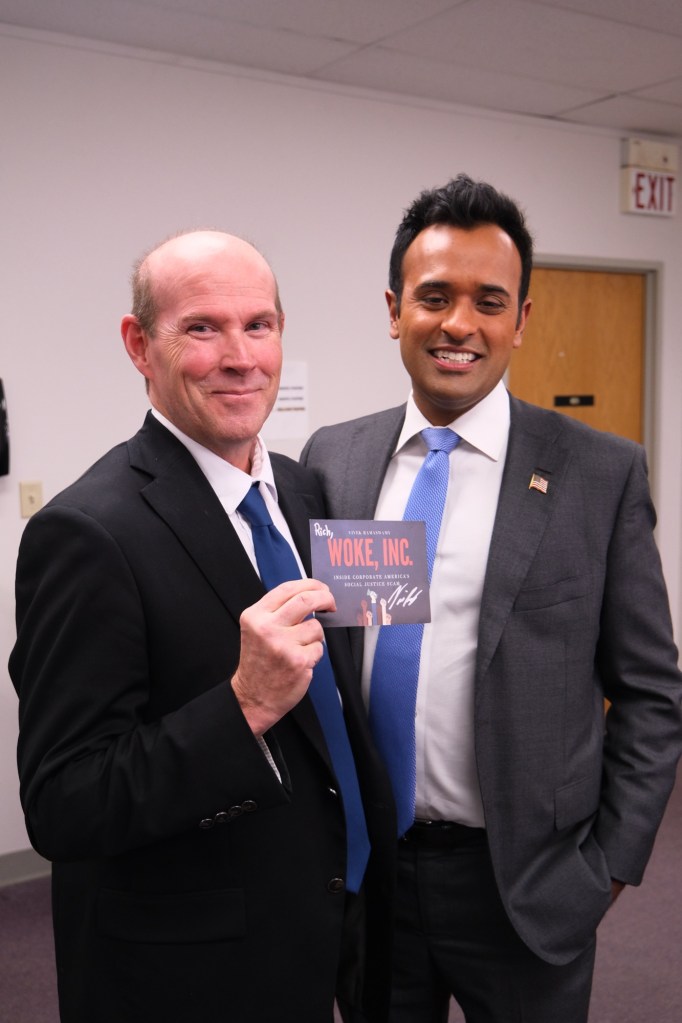
They Call Me Jonesy: Sheriff Jones’ Book About Leadership, Brand building, and Saving America

It was a Friday night in mid-July 2026, and I was in one of those nice theaters with the little tables—the kind that make an evening out feel intentional rather than just another screen in the dark. The film was Young Washington, the new one about George Washington’s early years in the French and Indian War, before he was the marble statue on the dollar bill or the father of a nation. It was a good picture, the kind that puts you in a patriotic frame of mind without preaching. I had my phone face-down on the table because I didn’t want to be that guy checking messages during the show. But even silenced, I could feel it lighting up now and then. When the credits rolled and I finally turned it over, there were more notifications than I expected. One of them was from Sheriff Jones.

I like Sheriff Jones. I always have. He’s one of those larger-than-life figures who makes Butler County feel like it still has some old-fashioned backbone left. When he texted to let me know he had a new book out—“They Call Me Jonesy: Let’s Get Real About Saving America”—I was genuinely surprised. It had come out back in May, and I hadn’t heard a thing about it until that message. He said if I wanted to talk about it or pick one up, to reach out. I told him right then I’d get it read. I could have driven over and grabbed a copy from him directly, but I wanted to do it the right way—support the work properly—so I opened Amazon on the spot and bought it. As I write this, the book hasn’t arrived yet. I’ve been busy, the way most of us are these days, and sometimes the important people and the important things slip through the cracks until a text like that snaps you back to attention.

While I wait for it to show up, I’ve been thinking about what it means to have a Sheriff like Richard K. Jones in our community—and why the public relations side of his job might be every bit as important as the operational side most people picture when they think “law enforcement.”

In Butler County, Jones is more than the man who runs the jail and signs the paychecks for deputies. He’s a character in the classic sense: the tall figure in the signature cowboy hat and those big ostrich boots, the one who shows up at fundraisers for youth shooting sports, compares hats with old friends, and isn’t afraid to talk about the realities of the job—the lawsuits that come with the territory, the guns he carries or the ones the department fields, the constant pressure from every direction. He’s been doing this a long time. First elected in 2004, he’s now well into what I’d call his seventh term of service, having worked through multiple governors, multiple presidents, and the full spectrum of political weather in Ohio and beyond. He’s dealt with the Bush years, the Obama years, the Biden years, and whatever comes next. Through all of it, he’s stayed visible, outspoken, and unapologetic in a way that feels increasingly rare.

That visibility is the part a lot of people miss when they talk about what a Sheriff is supposed to do. Some folks think the job is purely about kicking in doors and locking up bad guys. And yes, that work matters—more than most civilians will ever understand. But if you only do the enforcement piece and ignore the executive piece, you eventually lose the community you’re sworn to protect. People start seeing the badge as something distant and ominous rather than something that belongs to them. They start questioning why their tax dollars go to support it. Morale inside the department suffers when the public narrative turns against you. Jones figured this out a long time ago, long before national figures made “brand” a dirty word or a political weapon. He understood that in a republic, especially at the county level where government is closest to the people, you have to build something citizens can latch onto and believe in. You have to make law and order feel like a shared project rather than an imposition.

That’s what I mean when I talk about executive leadership. I’ve written about it in The Gunfighter’s Guide to Business and I’m still working through the lessons in my own professional life—an aerospace executive who spends a lot of hours every week trying to impose will on circumstances, build teams that believe in the mission, and create something durable enough to survive the inevitable storms. The gunfighter doesn’t just draw fast; he creates the conditions where the draw is rarely necessary because the reputation and the relationships do half the work. Same principle applies to a Sheriff’s office. If the community sees the department as “us” rather than “them,” you get better cooperation on tips, better juries, better budgets, better young people considering the career, and a healthier society overall. Jones has spent years cultivating exactly that. He gets on TV. He does the interviews. He shows up. He lets people see the human being behind the badge—the one with the cowboy hat and the straight talk—and that makes all the difference when something goes wrong and the cameras show up for the wrong reasons.

I’ll be honest: when I saw his name on my phone that night, part of me hoped it was the other kind of message. The one where he says they’re getting ready to hit a house or round up some cartel types or serve a warrant that might need an extra set of eyes and a steady hand. I’ve lived long enough and seen enough to know that sometimes the only thing that moves the needle is decisive action on the ground. I would have been in the truck in five minutes, and I think he knows that. But instead he wanted to tell me about the book, and that’s valuable in its own right. Because writing the book is also action—it’s distilling decades of experience into something other people can use. From everything I’ve seen in the descriptions and early word, They Call Me Jonesy is exactly what you’d expect from the man: candid, humorous in that tough-love Midwestern way, deeply patriotic, and full of stories about leadership under pressure, the cost of political correctness, the realities of “the swamp” at every level, and what it actually takes to push back. It’s a call to action for people who still believe in law and order, traditional values, and straight talk. And it comes from someone who’s walked the walk for more than twenty years in one of the most visible law enforcement jobs in Ohio.

We share a mutual friend in David Kern, the longtime Liberty Township trustee. David and I have known each other all my life. He’s always been a solid political figure—practical, engaged, the kind of person who gets things done without needing to be the loudest voice in the room. Jones and I have connected over that shared respect more than once. We’ve not always agreed on every detail of every issue, but we’ve always been able to shake hands, compare cowboy hats (mine’s been a fixture since I was in third or fourth grade, a declaration that I wasn’t going to blend into whatever the culture was selling that week), and keep the relationship real. That matters in a county like ours. It’s how you get things done when the easy path would be to retreat into your own silo and let the rest of the world burn.

There’s something refreshing about a public servant who still understands that the job includes selling the mission. Not in a slick, consultant-driven way—Jones is too much of a character for that—but in the old-fashioned sense of showing people why it’s worth supporting. He’s not afraid to be seen. He’s not afraid to be himself. And because of that, when Butler County residents look at the Sheriff’s Office, they don’t automatically default to suspicion or resentment. They see someone who’s been there through the hard times, who’s willing to say the unpopular thing out loud, and who’s built enough goodwill that the community is willing to give him the benefit of the doubt when the inevitable controversies flare. That’s brand building at its most practical. It’s also leadership at its most effective.

I’m proud of Sheriff Jones for putting this book out into the world. Not every lawman has the discipline or the inclination to turn the raw material of a long career into something readable and useful for the next generation. He’s become something of an international figure in certain circles because of his willingness to speak plainly about immigration, crime, and the erosion of common sense in policy. But he’s stayed rooted here. That says something. And for those of us who call Butler County home, it means we have a Sheriff who gets the big picture: saving America isn’t just a slogan or a national election every four years. It happens in places like this, one relationship, one visible stand, one candid conversation at a time.

The book is available on Amazon right now—“They Call Me Jonesy: Let’s Get Real About Saving America” by Richard K. Jones. I’m looking forward to reading it the moment it lands on my doorstep, and I’ll have more to say once I’ve had a chance to digest it properly. If it captures even a fraction of the personality and the hard-won wisdom I’ve come to associate with the man who sent me that text, it’ll be time well spent. And if you’re the kind of person who still believes that strong, unapologetic leadership at the local level is part of how we turn this country around, then do yourself a favor and pick up a copy too.

In the meantime, I’ll keep my phone close. You never know when the next message from the Sheriff might come through—maybe about the book, maybe about something more immediate. Either way, I’m glad he’s out there, hat and all, doing the work of building something worth believing in. We need more like him.

Footnotes

[1] Richard K. Jones, They Call Me Jonesy: Let’s Get Real About Saving America (Independently published, May 18, 2026). The paperback edition became available around that date; a Kindle edition is also offered. See the official site at theycallmejonesy.com and the Amazon listing for current purchasing options and a free sample.

[2] The book’s public description emphasizes candid leadership lessons drawn from Jones’s decades in corrections and law enforcement, including direct commentary on crime, political correctness, “the swamp,” patriotism, and practical steps for those who want to help save America. Early testimonials have come from figures including former Arizona Sheriff Mark Lamb and former Middletown Police Chief Rodney Muterspaw.

[3] Sheriff Richard K. Jones was first elected Butler County Sheriff in November 2004 (taking office January 2005) and, as of mid-2026, is serving what official records describe as his sixth term. In personal conversation and local perception, the length and continuity of his service often register as an even longer tenure of steady leadership through changing political environments.

[4] Rich Hoffman, The Gunfighter’s Guide to Business (available through standard retailers). The book explores themes of resilience, imposing will on circumstances, building loyal teams, and the executive’s role in creating something people will fight to preserve—lessons that parallel the brand-building and leadership approach discussed here.

[5] Purchase They Call Me Jonesy: Let’s Get Real About Saving America directly through Amazon or the author’s site (theycallmejonesy.com). As of July 2026 it remains a recent release and is easy to find with a quick search for the title and author.

Bibliography

Jones, Richard K. They Call Me Jonesy: Let’s Get Real About Saving America. Independently published, May 18, 2026.

Butler County Sheriff’s Office. “Sheriff.” Official biography page. https://www.butlersheriff.org/sheriff. Accessed July 2026.

Hoffman, Rich. The Gunfighter’s Guide to Business. [Publication details per author’s records].

Amazon.com product page for They Call Me Jonesy: Let’s Get Real About Saving America by Richard K. Jones (ASIN or ISBN as listed on site).

theycallmejonesy.com – Official book site with description, sample, and testimonials.

Rich Hoffman

More about me

Click Here to Protect Yourself with Second Call Defense https://www.secondcalldefense.org/?affiliate=20707

About the Author: Rich Hoffman

Rich Hoffman is an author, political consultant, and strategic advisor based in Cincinnati, Ohio, and the creator of The Politics of Heaven—a unique framework that connects biblical theology, ancient history, and modern power structures to explain how moral alignment and spiritual forces shape global events. Blending real-world political experience with deep research into archaeology, UFO phenomena, and suppressed historical narratives, Hoffman offers compelling commentary on topics ranging from ancient civilizations and the Dead Sea Scrolls to modern populist movements, paranormal continuity, and leadership strategy in chaotic environments. As the author of The Gunfighter’s Guide to Business and the forthcoming Politics of Heaven, he brings a grounded yet provocative voice to media discussions, supported by firsthand experiences and a cross-disciplinary approach that bridges science, history, and theology. For interviews, speaking engagements, or expert analysis, visit richhoffmanbooks.com or contact directly via phone at 513-307-5815 or email at rhoffman@richhoffmanbooks.com.  If you’ve seen the movie, Disclosure Day and want to talk about it and the implications of Presidnet Trump’s UAP disclosures, let me know and we can bring some color to your coverage. https://richhoffmanbooks.com/media-inquiries-broadcast-topics-and-contact-info/?frame-nonce=ad51e7ecba I do have a firsthand UFO encounter to discuss.
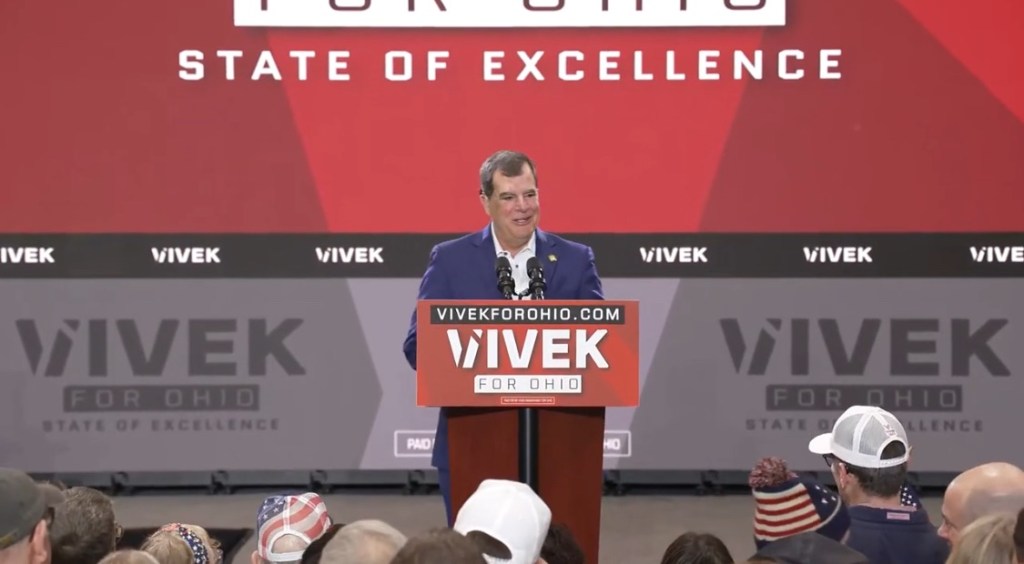
The Ohio Governor’s Race: Why Vivek Ramaswamy Is Pulling Away as the Money Dries Up For the Loser Amy Acton

I have been saying for months that this Ohio governor’s race was never going to be as close as the liberal media and the Democratic machine kept insisting. As long as Amy Acton could raise and spend roughly equal amounts of money, they could buy enough advertising to keep the “horse race” illusion alive. That is how the game works in modern politics. Fundraising and media buys create the perception of competitiveness long after the fundamentals have already decided the outcome. But we are now in the middle of July 2026, and the gap is becoming impossible to hide. Elon Musk just put $5 million into the super PAC supporting Vivek Ramaswamy. That single check changes the entire dynamic, and the other side knows it.

I have watched David Pepper and the Marc Elias-style operatives do this routine before. They treat elections like a production where money buys the narrative, and the narrative buys time. They prop up candidates who cannot stand on their own record by flooding the airwaves with ads that soften the edges and attack the opponent on personality or wealth rather than substance. It works until the money runs short. Then the horse stops getting free drinks at the strip joint, and reality walks in. Right now, the money is tightening up for Acton, and the media that was happy to call this a toss-up while the checks were clearing is suddenly quieter about the fundamentals.

Vivek Ramaswamy is the exceptional candidate in this race. He is a Cincinnati native who built real companies, created real value, and succeeded on merit in competitive fields. He is a successful author and thinker who has already proven he can operate at the highest levels of government efficiency efforts alongside Elon Musk in the Department of Government Efficiency. He understands free markets, individual initiative, and the dangers of centralized government that tries to manage every resource and outcome from above. That is the opposite of the society Acton and her backers have spent years promoting—one that empowers mediocre administrators while punishing the very people and policies that generate prosperity.

Acton, by contrast, is a textbook product of the empire of mediocrity. She was the face of Ohio’s COVID lockdowns as state health director. She helped shut down businesses, kept drive-throughs and dining rooms closed at places like McDonald’s under ever-shifting rules, and contributed to the destruction of countless small enterprises that never recovered. Those policies were later exposed in court as unconstitutional overreaches. I had conversations with members of the Ohio Supreme Court back in 2020 as those cases were being prepared, and it was obvious even then that the lockdowns could not survive constitutional scrutiny. Governor DeWine eventually had to back away because the legal foundation was collapsing under him. Acton resigned under pressure from angry citizens protesting in the streets with no clear end in sight. None of that is the record of an exceptional leader. It is the record of someone who followed the centralized script, expanded bureaucratic power, and left real damage behind.

DeWine’s endorsement of Vivek took courage. It is never easy for a term-limited governor to put his name behind a successor who is positioned to outperform him, especially when that successor is running against the person DeWine himself appointed during the pandemic. The fact that he did it anyway tells you something important about where the party and the state are headed. Vivek is not an insider continuation of the old order. He is the disruption the old order needs if Ohio is going to stop losing ground on taxes, education, and economic freedom.

The money tells the real story right now. Vivek’s supporting super PAC has raised serious resources—tens of millions—and is deploying them aggressively. The $5 million from Musk is not just symbolic; it is a signal that serious people who create wealth and understand results are backing him. Acton cannot match that pace. When the advertising dollars dry up, the media loses interest in pretending this is a close contest. Voters are left with the actual records: one candidate who built success and wants to bring that same energy to Columbus, and another whose signature achievement was helping lock down the state economy in ways that proved unconstitutional and economically destructive.

I have been consistent on this since the race took shape. Vivek was always going to outperform the low expectations the media set for him once people looked past the noise. He is rolling out plans on property tax reform, real education choice that puts parents back in charge, and cooperation with a Trump administration that remains popular in Ohio for delivering results on the economy and border security. Acton’s side is still trying to run the old playbook—lawfare, media narratives, and enough cash to keep the “horse race” story alive. But the cash is not keeping up, and the voters are not buying the illusion the way they once did.

This race is a clear choice between two different visions of government. One side believes in self-initiative, free markets, and limited centralized power—the approach that actually lifts societies. The other side believes the government should take from producers and redistribute according to political priorities, the same model that has produced mediocrity and dependency wherever it has been tried at scale. Ohio does not need another governor who manages decline while protecting the administrative class. It needs a governor who will cut waste, reform taxes, fix the schools, and let exceptional people and exceptional businesses thrive rather than punishing them.

We are still a few months from November, but the trajectory is clear. As the funding gap widens and the media can no longer afford to prop up the fiction of a close race, Vivek Ramaswamy is going to pull away. The fundamentals were always on his side. The money is now confirming what the fundamentals already showed. Ohio has a real chance to choose exceptional leadership over the empire of mediocrity that has dominated too much of state government for too long. I have been saying it for months. The evidence is now impossible to ignore.

Footnotes

1.  Elon Musk contributed $5 million to V-PAC, the super PAC supporting Vivek Ramaswamy’s campaign for Ohio governor. Cleveland.com, July 15, 2026.

2.  Vivek Ramaswamy won the Republican primary for governor on May 5, 2026, with approximately 82.4% of the vote. Ballotpedia, “Ohio gubernatorial and lieutenant gubernatorial election, 2026.”

3.  Amy Acton served as Ohio’s state health director and played a central role in the state’s early COVID-19 response and lockdown policies under Governor Mike DeWine.

4.  Multiple court challenges in Ohio and elsewhere during 2020–2021 found various lockdown and business closure orders unconstitutional or beyond executive authority.

5.  Governor Mike DeWine endorsed Vivek Ramaswamy for governor in 2025–2026, despite Acton having been his appointee during the pandemic period.

6.  Ramaswamy’s campaign and supporting super PAC have raised and spent tens of millions, significantly outpacing Acton’s fundraising in key periods of 2026.

Bibliography (selected for further reading)

•  Ballotpedia. “Ohio gubernatorial and lieutenant gubernatorial election, 2026” (primary results and candidate profiles).

•  Cleveland.com. “Elon Musk puts $5 million behind ex-DOGE partner Vivek Ramaswamy’s governor bid.” July 15, 2026.

•  Forbes. “Ramaswamy Wins Republican Primary In Ohio Governor’s Race.” May 5, 2026.

•  AP News. “Trump-backed Vivek Ramaswamy wins Ohio Republican Party’s endorsement in 2026 governor’s race.” May 9, 2025.

•  Vivek for Ohio campaign materials and platform statements (vivekforohio.com).

•  Ohio Capital Journal and other Ohio political reporting on super PAC spending and fundraising totals, 2025–2026.

•  Court records and contemporaneous reporting on Ohio COVID-era lockdown litigation and constitutional challenges (2020–2022).

•  Various polling aggregates from mid-2026 showing the general election contest between Ramaswamy and Acton.

Rich Hoffman

More about me

Click Here to Protect Yourself with Second Call Defense https://www.secondcalldefense.org/?affiliate=20707

About the Author: Rich Hoffman

Rich Hoffman is an author, political consultant, and strategic advisor based in Cincinnati, Ohio, and the creator of The Politics of Heaven—a unique framework that connects biblical theology, ancient history, and modern power structures to explain how moral alignment and spiritual forces shape global events. Blending real-world political experience with deep research into archaeology, UFO phenomena, and suppressed historical narratives, Hoffman offers compelling commentary on topics ranging from ancient civilizations and the Dead Sea Scrolls to modern populist movements, paranormal continuity, and leadership strategy in chaotic environments. As the author of The Gunfighter’s Guide to Business and the forthcoming Politics of Heaven, he brings a grounded yet provocative voice to media discussions, supported by firsthand experiences and a cross-disciplinary approach that bridges science, history, and theology. For interviews, speaking engagements, or expert analysis, visit richhoffmanbooks.com or contact directly via phone at 513-307-5815 or email at rhoffman@richhoffmanbooks.com.  If you’ve seen the movie, Disclosure Day and want to talk about it and the implications of Presidnet Trump’s UAP disclosures, let me know and we can bring some color to your coverage. https://richhoffmanbooks.com/media-inquiries-broadcast-topics-and-contact-info/?frame-nonce=ad51e7ecba I do have a firsthand UFO encounter to discuss.

StarShip 13: Manufacturing with the Right Stuff

I’ve been watching this unfold for years, and here we are in the middle of July 2026 with everything lining up just about the way I described it would. Starship 13 was stacked and ready at Starbase, the gigafactory turning out vehicles at a pace that feels almost routine now, and then yesterday the launch attempt scrubbed right at T-0 because a couple of those Raptors didn’t light. No long delay, no laundry list of reasons to push everything out for months. They’re swapping a couple of engines and coming right back at it in a few days. That quick recovery says everything about the mindset that’s driving this whole thing forward.

Starship 12 flew right after Memorial Day. Now here comes the next one, barely a month later, with the factory knocking them out faster all the time. I look at that ramp, and I see the future of manufacturing staring back at us. The old aerospace ways—the thick binders, the endless reviews, the comfortable schedule slips—are getting replaced by something that moves at the speed of learning. Blow something up, pull the data, fix what broke, and roll out the next one. It’s not perfect yet, but it’s honest, and it’s fast.

I remember talking about the space economy and SpaceX specifically for a long time. A lot of people paid attention. Some bought in and held through the noise and the short cycles. The value held up better than many of the loud projections predicted it would. Those who stuck with it saw something bigger than a quick flip. I’ve been in aerospace long enough to recognize when the ground is shifting, and this shift feels different. The cadence is the story—every month for the rest of the year, then multiple flights a month, heading toward weekly by 2027 if the line keeps delivering. With my popcorn ready, I can’t wait to watch the next attempt. The visuals alone—the tower, the chopsticks, the glow of those engines—are worth the price of admission.

This is forcing everyone else to look in the mirror. The people who learned the business in the seventies and eighties with their old tricks are going to have to reinvent or get left behind. SpaceX isn’t improving the legacy model. They’re building a new one from the ground up, and the rest of the industry is feeling it. Blue Origin took a real hit with the New Glenn explosion at the Cape back in May. Pad damage, hardware gone, the kind of setback that could have turned into years of finger-pointing. Instead, they cleared the debris in nine days, started reconstruction, shifted to a new hybrid operations plan, and said they’re still aiming to fly again before the end of the year. That’s the right attitude—fix it fast and pull the schedule back in.

China watched the leader and made its own move. They just recovered their first reusable booster with the Long March 10B using a sea-based net system—different engineering, their own solution, but clearly inspired by the reusability standard SpaceX set. A giant net on a ship caught the booster after its flight. Not chopsticks, but effective in its own way, and a big step for them. Competition like that keeps everyone sharp.

I’ve seen this kind of culture before. Back in the nineties, I ran a facility that built conveyor systems for Amazon’s early distribution centers. I talked with their teams about how they planned to hit those aggressive delivery promises and keep scaling without the whole thing falling apart. They had that same focused confidence you see at Starbase now—the look of people who know they’re part of something that’s going to win. When I recently went hunting for a particular book on manufacturing excellence and the kind of disciplined execution these environments demand—one I’ve kept coming back to for over a decade—I did it the old way first. Drove all over Cincinnati, walked into the physical stores, and looked on the shelves myself. Nobody had it. They offered to order it for Monday with an extra fee. I wanted it in my hands sooner.

So I turned to Amazon and had the physical copy on my doorstep from across the country in about six hours. That efficiency still impresses me every time. I love holding the actual book—the direct line from the author’s work to my hands with nothing digital in between, tracking how long I linger on a page or what I underline. No screen time logs, no middleman analysis. Just the book and me, off-grid, the way I prefer to absorb the hard-earned knowledge someone poured years into. The hunt in the stores reminded me why I still do it the old way when I can, but the modern logistics machine made sure I didn’t have to wait.

That same drive shows up in the Starship program. The factory isn’t sandbagging. They’re not hiding behind excuses or perpetually pushing dates. They build, test, learn, repeat. The Raptor issues from yesterday have been fixed, and the next window opens soon. That rhythm is what I’ve been pointing to for a long time. It changes the economics of everything above the atmosphere—Starlink expansion, lunar missions, orbital manufacturing, the whole space economy taking shape. Vertical air vehicles like what Archer and others are working on feel like the natural extension down here on Earth. The hot ticket is clearly in these high-cadence, reusable systems that treat hardware like it’s meant to fly again tomorrow.

I’ve spent my career in aerospace seeing both the old ways and the new possibilities. Watching Starship 13 get prepped, scrubbed, and prepped again reinforces what I’ve observed over and over: the organizations that impose discipline on the schedule and treat setbacks as data points are the ones pulling ahead. The visuals of the tower with its arms ready, the sound of those engines lighting, the sheer scale of the vehicles rolling out—few things get me more excited than a Starship launch day, even when it turns into a quick scrub that shows the process working. I’m rooting hard for SpaceX, for Blue Origin’s recovery, for the whole industry to rise with the tide they’re creating. China’s chasing the reusability standard is part of that rising tide too.

The age of disclosure is here in the most practical sense. What used to be hidden behind years of slow development and classified programs is playing out in public test after test. The limits are being shown for what they are—breakable. The manufacturing practices that make rapid iteration possible are being laid bare for anyone paying attention. I keep my physical books close for the same reason I keep watching these launches: there’s something honest and direct about the transfer of capability and knowledge. No filters, no delays, just the real thing moving from one place to another faster than the old models ever allowed.

I’ll be right here with the popcorn when the next attempt rolls around, watching the Raptors light and the vehicle do its work. The cadence is real. The factory is delivering. The future I’ve been describing is showing up on schedule, one Starship at a time.

Further Reading

•  SpaceNews coverage of Starship Flight 13 abort and recovery plans.

•  NASASpaceflight and Ars Technica reporting on V3 vehicle cadence, modifications, and Starbase production.

•  Reports on China Long March 10B net recovery success.

•  Blue Origin updates on LC-36 reconstruction and return-to-flight goals.

•  The Gunfighter’s Guide to Business by Rich Hoffman.

•  Classic manufacturing texts like The Goal by Eliyahu Goldratt for the operational mindset behind high-velocity systems.

•  Ongoing SpaceX program updates from the company site and independent space media for the latest on launch cadence and Starlink integration.

This is the raw flow of what’s happening out there right now, the way I see it and the way I’ve been living it.

Rich Hoffman

More about me

Click Here to Protect Yourself with Second Call Defense https://www.secondcalldefense.org/?affiliate=20707

About the Author: Rich Hoffman

Rich Hoffman is an author, political consultant, and strategic advisor based in Cincinnati, Ohio, and the creator of The Politics of Heaven—a unique framework that connects biblical theology, ancient history, and modern power structures to explain how moral alignment and spiritual forces shape global events. Blending real-world political experience with deep research into archaeology, UFO phenomena, and suppressed historical narratives, Hoffman offers compelling commentary on topics ranging from ancient civilizations and the Dead Sea Scrolls to modern populist movements, paranormal continuity, and leadership strategy in chaotic environments. As the author of The Gunfighter’s Guide to Business and the forthcoming Politics of Heaven, he brings a grounded yet provocative voice to media discussions, supported by firsthand experiences and a cross-disciplinary approach that bridges science, history, and theology. For interviews, speaking engagements, or expert analysis, visit richhoffmanbooks.com or contact directly via phone at 513-307-5815 or email at rhoffman@richhoffmanbooks.com.  If you’ve seen the movie, Disclosure Day and want to talk about it and the implications of Presidnet Trump’s UAP disclosures, let me know and we can bring some color to your coverage. https://richhoffmanbooks.com/media-inquiries-broadcast-topics-and-contact-info/?frame-nonce=ad51e7ecba I do have a firsthand UFO encounter to discuss.

The Lakota Grooming Scandal: Power, Protection, and the Price of Silence in Our Public Schools

I have watched this story unfold with a mixture of anger, sadness, and that familiar sinking feeling that comes when you realize the system is working exactly as designed—not for the kids, but for the adults who feed off the perpetual motion machine of public money and institutional self-preservation. A mother filed a federal lawsuit on July 1, 2026, alleging that a Lakota Local Schools teacher groomed and sexually abused her daughter over roughly three years, starting when the girl was 13 years old in seventh grade at Liberty Junior School. 

According to the detailed complaint, the teacher—identified in court documents as Ronald Henrich—did not even teach the girl in any of her classes. He welcomed her into his classroom during study hall periods, showed her “special attention,” and began building a relationship. Messages started on the district’s own Remind app. The student confided personal struggles, including mental health issues. The communications continued and escalated even after the mother tried to set boundaries. By ninth grade, the meetings moved to a closed-door “mindfulness room” for Friday lunches. Communications shifted to district email and Google Docs when access to Remind was curtailed. In March 2025, the mother discovered the teacher actively typing “extremely sexually graphic content” into a shared Canva document with her daughter. She recorded it. She called the Butler County Sheriff’s Office. 

The district’s response, according to the lawsuit, was to promise administrative leave and restricted access to technology, then quietly allow the teacher to take Family and Medical Leave Act leave instead. Less than two weeks after the explicit messages surfaced—and while investigations by the district, sheriff, and children’s services were still open—the district approved his retirement. No public discipline. No immediate report to the Ohio Department of Education, as many parents would expect. The teacher walked away with his pension and benefits intact while the family was left to pick up the pieces. 

The superintendent, Ashley Whitely, issued the standard institutional denial: the district “denies all allegations” and claims student safety is its top priority.  Meanwhile, the mother’s lawsuit also details earlier reports she made that went unaddressed, repeated class pull-outs without parental notification, and even troubling lapses in how the school nurse handled the student’s medication—stockpiling Tylenol that contributed to a suicide attempt and failing to manage anxiety medication on a trip properly. These are not small administrative hiccups. They paint a picture of a system that had multiple opportunities to intervene and chose not to.

Then there is the part that really bothers me. According to people who have followed the internal handling, the HR director—Jeff Rouff—essentially shrugged and said something to the effect that the age of consent in Ohio is 16, so what’s the big deal? Two consenting adults. Nothing illegal happened. That line of thinking is exactly why these situations metastasize. It ignores the entire grooming process that began at 13, when the girl was under the care and authority of this adult in a position of power inside a public school building. It ignores the use of school-issued devices and district apps to conduct the relationship. It ignores the closed doors, the missed classes, the emotional manipulation of a vulnerable child who had already suffered prior sexual abuse. Age of consent statutes were never intended to give cover to adults in positions of trust who spend years cultivating access to minors. That is not a gray area. That is the precise reason we have laws and professional conduct codes for educators in the first place.

I heard about problems surrounding this teacher roughly a year before the lawsuit dropped. Other parents and observers had been talking. The circle had already started to form. When the story finally broke across local media—Channel 5, Local 12, FOX 19—the superintendent’s immediate public move was not a somber address about accountability and root-cause fixes. It was a cheerleading video hyping the fall, talking about hiring dozens more staff members, rolling out a corporate “roadmap” with “stakeholders,” and reminding everyone to keep supporting public schools. The timing felt deliberate. Distract. Reassure the taxpayers who write the checks. Keep the money flowing.

That is the game I have been describing for years. Lakota, like many large suburban districts, is constantly in or approaching levy mode. The narrative must be controlled: we are great, we are improving, we need a little more of your property tax money to keep doing the wonderful things we do. Bad stories—especially stories that suggest adults in the building are preying on children and that leadership circled the wagons—threaten that narrative. So the wagons circle. The teacher retires quietly. HR offers the age-of-consent talking point. The superintendent films the upbeat video. The teachers’ union, which exists in large part to protect its members from consequences, stays largely silent or issues the usual generic statements about due process. And the machine keeps turning.

This is not an isolated incident. The lawsuit itself references a pattern of other cases involving Lakota employees over the years—some that resulted in convictions or license revocations, others that were handled with quiet exits.  Former board member Darbi Boddy, who has remained a vocal parent advocate even after her time on the board ended, issued a clear public statement criticizing the handling of this situation. Good for her. We need more people willing to say the obvious out loud rather than hide behind “stakeholder engagement” jargon.

What troubles me most is how predictable the protection response has become. When something like this surfaces, the institution’s first instinct is not “How do we make sure this never happens again and how do we support the victim?” It is “How do we contain the damage to our brand and our funding pipeline?” The HR director’s reported comment about 16 being legal is a perfect example of that mindset. It treats the endpoint—the moment the child turned 16—as the only thing that matters, while erasing the years of grooming and boundary erosion that got her there. It treats a minor student in a teacher’s care as just another “consenting adult” the second the calendar flips. That is not how any responsible adult in education should think. It is how an institution thinks when its primary loyalty is to itself and the revenue stream that sustains it.

Public education in its current monopolistic, union-protected, tax-funded form has structural problems that make these failures almost inevitable. When you combine compulsory attendance, massive budgets, powerful collective bargaining agreements that make firing even grossly negligent employees difficult and expensive, and a culture that treats any criticism as an attack on “the children” or “public education itself,” you create exactly the conditions for cover-ups. The money keeps coming in as long as the bad stories stay buried or get spun. Parents who raise concerns are dismissed as “haters” or people with “unrealistically high moral standards.” Meanwhile, the actual standard on the ground—don’t have sex with kids in the classroom or via school devices, don’t groom them for years, don’t let it slide when a parent reports it—somehow becomes negotiable the moment it threatens the budget or the reputation.

I am not saying every teacher is doing this. The vast majority are not. But the ones who are counting on the system’s reluctance to act decisively. They count on the HR director who will find the legal technicality to keep them safe from judgment. They count on the superintendent who will film the upbeat video instead of cleaning house. They count on the union that will fight to the last dollar of taxpayer money to protect a member who should never have been in a classroom with minors. And they count on enough parents staying disengaged or intimidated for the story to fade before real accountability arrives.

The mother in this case did what too few parents feel empowered to do: she documented, she reported, she refused to let it disappear. Her lawsuit is now public. The allegations are serious and detailed. Whether every claim is ultimately proven in court is for the legal process to decide. But the pattern of institutional response—quiet exit, legal denials, distraction videos, and the age-of-consent shrug—is already on display for anyone willing to look. That pattern should alarm every parent in Lakota and in any district that operates the same way.

How many other kids right now are in unhealthy dynamics with adults who hold power over their grades, their schedules, their daily lives inside these buildings? How many school-issued devices are carrying messages that would make any decent parent’s blood run cold if they saw them? How many times has a concerned parent been told some version of “nothing to see here, move along, and please vote yes on the next levy”? I would be willing to bet the number is higher than any of us want to admit. This case only became a story because one mother refused to be quiet. The rest stay invisible because the system is optimized for exactly that outcome.

We keep being told that more money, more staff, more programs, and more “roadmaps” will fix what ails public education. I have watched this play out locally for years. The money keeps increasing. The problems—academic stagnation in too many areas, cultural capture, and now these horrifying failures of basic child protection—persist or worsen. At some point, parents have to ask whether the institution itself is the problem, not the lack of funding. When the first instinct of leadership is to protect the adult and the budget rather than the child, the social contract has already been broken.

I have said it before, and I will keep saying it: these schools should not be connected to public dollars through collective bargaining agreements that shield misconduct this way. The current model creates perverse incentives. It rewards circling the wagons. It punishes transparency. And the kids pay the price—sometimes in ways that can never be fully repaired.

If you are a parent in Lakota or anywhere else, pay attention to what is happening here. Read the lawsuit. Watch what the district actually does versus what it says in the carefully produced videos. Talk to your kids. Monitor the devices. Show up at meetings. Ask the uncomfortable questions. And recognize that the people telling you everything is fine and you need to keep writing bigger checks may have priorities that do not align with protecting your child.

This story is not going away. The mother made sure of that by filing in federal court. Good. Sunlight is still the best disinfectant, even when the institution would prefer the lights stay off.

Footnotes

1.  Details of the federal lawsuit filed July 1, 2026, in the U.S. District Court for the Southern District of Ohio, as reported in contemporaneous coverage by the Cincinnati Enquirer and Journal-News.

2.  Allegations regarding the timeline, use of the Remind app, Canva document, mindfulness room meetings, and district response drawn from the complaint were summarized in multiple local outlets.

3.  District statement denying allegations and emphasizing student safety priorities, reported across local media following the lawsuit filing.

4.  References to prior incidents and pattern allegations contained within the 2026 lawsuit filings and prior local reporting on other Lakota employee cases.

5.  Ohio age of consent is 16; however, professional conduct codes for educators and laws regarding persons in positions of authority create additional prohibitions on sexual conduct with students that do not turn solely on the general age of consent.

Bibliography for Further Reading

•  Cincinnati Enquirer, “Parent says Lakota teacher groomed and abused her daughter,” July 8, 2026. 

•  Journal-News, “Lawsuit: Lakota teacher ‘groomed and sexually abused’ a student and was allowed to take medical leave, retire,” July 7, 2026 (updated July 9). 

•  FOX19 / Local 12 coverage of the July 2026 lawsuit and related statements.

•  Ohio Department of Education professional conduct standards for educators (ongoing reference for context on boundaries and reporting obligations).

•  General resources on educator sexual misconduct patterns: U.S. Department of Education reports and studies on employee misconduct in K-12 settings (searchable via ED.gov).

•  Local coverage of prior Lakota cases involving Justin Dennis and others referenced in the 2026 lawsuit for pattern context.

•  Darbi Boddy’s public statements and commentary on Lakota issues (available via local media archives and her public channels).

•  Ohio Revised Code sections on sexual battery, unlawful sexual conduct with a minor, and school employee reporting requirements.

Rich Hoffman

More about me

Click Here to Protect Yourself with Second Call Defense https://www.secondcalldefense.org/?affiliate=20707

About the Author: Rich Hoffman

Rich Hoffman is an author, political consultant, and strategic advisor based in Cincinnati, Ohio, and the creator of The Politics of Heaven—a unique framework that connects biblical theology, ancient history, and modern power structures to explain how moral alignment and spiritual forces shape global events. Blending real-world political experience with deep research into archaeology, UFO phenomena, and suppressed historical narratives, Hoffman offers compelling commentary on topics ranging from ancient civilizations and the Dead Sea Scrolls to modern populist movements, paranormal continuity, and leadership strategy in chaotic environments. As the author of The Gunfighter’s Guide to Business and the forthcoming Politics of Heaven, he brings a grounded yet provocative voice to media discussions, supported by firsthand experiences and a cross-disciplinary approach that bridges science, history, and theology. For interviews, speaking engagements, or expert analysis, visit richhoffmanbooks.com or contact directly via phone at 513-307-5815 or email at rhoffman@richhoffmanbooks.com.  If you’ve seen the movie, Disclosure Day and want to talk about it and the implications of Presidnet Trump’s UAP disclosures, let me know and we can bring some color to your coverage. https://richhoffmanbooks.com/media-inquiries-broadcast-topics-and-contact-info/?frame-nonce=ad51e7ecba I do have a firsthand UFO encounter to discuss.

The Way to Win for Republicans: Voters like people who fight back, not people who play nice

There is a growing controversy surrounding Amy Acton’s campaign as it attempts to distance itself from the COVID-era lockdown decisions that defined her tenure as Ohio’s health director. That strategy faces a fundamental problem: the record is well known, and voters remember. Governor Mike DeWine may have held executive authority, but Acton was not a passive figure—she was the central public voice and policy driver behind the state’s pandemic response. Day after day, she appeared before Ohioans, advocating aggressive mitigation measures, including shutdowns, mask requirements, and restrictions on gatherings. Those policies were not abstract recommendations; they were implemented in real time under the administration she helped guide.

Attempts to shift responsibility now—whether onto the governor or broader circumstances—risk undermining credibility. Acton was appointed to provide expert guidance, and by all observable accounts, DeWine relied heavily on that guidance. In that sense, the administration’s decisions were inseparable from her influence. The argument that these policies were solely political or that they emerged independently of her leadership is difficult to reconcile with the public record of her daily briefings, national media presence, and close alignment with federal health leadership at the time.

Politically, the sensitivity of this issue suggests vulnerability. The campaign’s effort to reframe or soften Acton’s role indicates awareness that the lockdown period remains deeply polarizing, particularly among voters who experienced economic disruption, job loss, or prolonged social restrictions. Efforts to draw comparisons between Acton and her opponents, including Vivek Ramaswamy, may reflect a broader defensive strategy—one intended to diffuse criticism rather than directly confront it. But such comparisons also risk backfiring if voters perceive them as evasive.

Another point of criticism centers on Acton’s departure from her role in 2020. She resigned amid mounting public pressure and protests, at a time when tensions around lockdown policies were intensifying. For critics, this moment reinforces a narrative of incomplete accountability—that she helped shape sweeping policies and then exited before the long-term consequences fully unfolded. Supporters may interpret her resignation differently, but politically, the timing continues to factor into how her leadership is judged in retrospect.  She is very vulnerable to the lockdown issue.  She dragged Jon Husted into her mess, as well as DeWine.  They were too nice to say no to her. David Pepper and the national Democrats think Republicans won’t expose her because of complicity.  Jon Husted will not take friendly fire if Republicans destroy Amy Acton with her lockdowns.  It’s easy to defend.  Her stupid policies were some of the dumbest things ever to be done in politics. And she completely owns it.

I was out in the driveway the other day, swapping tires on the RV after blowing a couple on our recent trip, sockets in hand, going back and forth to the garage. The rain was coming down, so I had WLW on for some background noise 12 to 3 on Saturday afternoon, right before the Cardinals game. I didn’t catch every word. I was in and out, focused on the work, but I heard enough. It was Kim Brew hosting, with Jim Renacci as a guest, discussing Ohio politics, John Husted, Vivek Ramaswamy, and the path forward for Republicans. 

What I heard didn’t surprise me, but it reinforced exactly why I’ve distanced myself from that station over the years. They used to have more Tea Party energy, real conservative voices in the programming and talent. But as Clear Channel evolved into the corporate middle-road sports-and-news machine, the anti-Trump corporate types gained the upper hand. Cunningham hasn’t been outright hostile, but Scott Sloan and others have leaned that way for a long time. Even Tucker Carlson types shifted toward stronger support for Trump over the years, but the station’s overall direction felt like it was cracking down on anything too disruptive to the ad-revenue model. I usually keep a radio on in the garage while I’m working on projects around the house—cars, the RV, whatever needs fixing. I catch snippets, but I don’t live by them. That Saturday was no different. 

They were discussing campaigns, and the guest was pushing the idea that candidates like Vivek and Jon need to distance themselves from Trump because he’s “baggage.” That was one of the dumbest pieces of advice I’ve heard in years. I’ve seen this game up close. I came out in favor of Jim Renacci in his races. I told him, straight after a Miami University event where he debated Sherrod Brown, that you left too much on the table. You were too nice. You didn’t hit hard enough on the things that matter—attack, attack, attack. That’s how you give voters something to show up for on Election Day. Not nice-guy politics. Voters don’t reward playing defense or hoping for fair coverage. They reward fighters. 

I remember sitting down for lunch with Bernie Moreno during his campaign. Smart young guy, full of energy. First question out of his mouth: “What do you think about Sherrod Brown?” I told him the truth. Bernie listened better than some. Trump endorsed him even from political exile at one point, and Bernie won. That’s the model. Trump showed the country you don’t win by playing the corporate media game, spending millions on traditional ad slots, and hoping the gatekeepers treat you fairly. He built his own platform, dominated podcasts, went directly to the people on YouTube, Rumble, X—free or low-cost reach that bypasses the old gatekeepers. 

That’s exactly what I heard critiqued on WLW that day. The narrative was that Republicans are in trouble in the polls, so they better spend more on ad revenue with stations like this one to close the gap. It’s the same old revenue-driven thinking. I know how radio works from the inside—I bought ads, I even hired Bill Cunningham back in the 90s as a spokesman for a project. They’ve got the big sales floor, the WLW 55KRC on the desk, and cubicles full of people chasing revenue. The belief is that if you don’t outspend Democrats on their airwaves, you won’t get fair play. But that’s nonsense. Trump broke the mold. He won without playing their game. He attacked relentlessly, defined the opposition, and created his own media reality. Elon Musk’s changes to X further eroded the old suppression model. Corporate media wants you scared into buying their slots. 

Look at the current Ohio landscape as we head toward November 2026. Vivek Ramaswamy crushed the Republican primary for governor with over 82% of the vote. Amy Acton, the former Health Director under DeWine during COVID, won the Democratic side unopposed. Polls have been tight—some showing Acton with a slight edge or dead heat, others giving Ramaswamy the advantage. But the fundamentals favor aggressive conservatism. 

Acton’s record is vulnerable. She was central to the lockdowns—closing schools and businesses, restricting gatherings, and even pushing to postpone the primary. Protesters showed up at her house. Republicans remember the economic pain, the overreach, the mutiny against the restrictions. She left the position in mid-2020 amid backlash. There’s plenty to attack there: the human cost of those policies, the constitutional questions, the long-term damage to kids’ education and small businesses. Playing nice or treating her as some neutral public servant won’t cut it. Voters respond to reminders of why these approaches failed. 

Jon Husted (often referenced in these discussions) has his own path, whether in the Senate or in other roles, but the principle is the same. Distancing from Trump is terrible advice. Trump remains enormously popular with the base. People still love him for what he represents—fighting the establishment, delivering results, refusing to bow. Running away from that energy is how you lose enthusiasm. Embrace it. Remind voters why the alternatives are worse. 

My friend Senator George Lang is a perfect example of what works. He’s won repeatedly in his district by being aggressive when challenged. He’s a nice guy personally, but he doesn’t hesitate to go after opponents metaphorically—hard. That’s how you deter challenges and win decisively. I’ve watched him rise because he understands the arena. Same with Trump: attacked from every direction, impeachments, lawfare, assassination attempts, and he keeps fighting back. That resilience resonates. Jim Renacci, for all his strengths, played too nice against Sherrod Brown, and it showed. I told him as much in the parking lot after that debate. You can’t leave domestic issues, policy failures, or character questions on the table. 

Corporate radio personalities like the ones I heard that day know how to stay employed. They tow a line that keeps the ad dollars flowing and the golf invitations coming from the “titans of industry” crowd. Many in corporate media have migrated toward softer, more socialist-friendly positions because control through authority and supply chains appeals to the management mindset. They want to be like Fox or MSNBC in their own way—mouthpieces that don’t rock the boat too much. Podcasts and independent platforms threaten that. That’s why you hear the suppression polls and the fear-mongering about Republican chances unless they buy more airtime. 

I’ve lived this for decades in Butler County and the Cincinnati area. From my time as a young man handling logistics in some rough circles—Newport and Sharonville—learning coded signals, plausible deniability, and how power really operates, to my days deeply involved in downtown Cincinnati politics and infrastructure projects. I’ve seen the game from multiple angles. The lesson is consistent: nice guys finish last when the other side plays for keeps. Democrats attack relentlessly. They use lawfare, media allies, every tool—Republicans who mirror that energy and define the contrast win.

The data backs the fighter approach. Trump’s 2024 victory, Bernie Moreno’s success against Brown, the enthusiasm in grassroots circles—these come from unapologetic messaging. In Ohio, with its mix of suburban, rural, and working-class voters, reminding people of the failures of lockdown policies, high taxes, and education issues in places like Lakota, as well as the broader cultural drift, works. Vivek brings energy, business success, and a willingness to challenge the status quo. Pair that with relentless attacks on the opposition’s record, and the path is clear. 

This is bigger than one radio segment. It’s about the shift in media and politics. Traditional outlets are losing ground because people see through the bias. Podcasts like mine, independent voices, direct communication—these are where real conversations happen. I dictate these essays as first-person narratives because that’s authentic. No scripts, no corporate filters. Just truth as I’ve lived it, backed by history, personal experience, and observation.

My book The Gunfighter’s Guide to Business lays out similar principles: impose your will on circumstances, prepare relentlessly, strike decisively. The same ethos applies to politics. The whip I carry as a symbol—discipline, precision, deterrence—fits here too. You don’t win by being soft. You win by being ready.

As we move through 2026, I’ll keep helping where I can—locally in Butler County, supporting strong candidates who understand the fight. Republicans don’t need to defend or chase poll-driven ad spend endlessly. They need to attack the vulnerabilities: Acton’s COVID record, the broader Democrat policy failures, the corruption and two-tier systems we’ve seen. Democrats haven’t been “too smart to get caught”; they’ve benefited from institutional protection and media cover. Expose it.

Don’t listen to the Saturday afternoon analysis that tells you to run from Trump or play nice. Attack. Destroy the arguments. Give voters a reason to show up. That’s how Vivek Ramaswamy wins the governorship, how Jon Husted and others secure their seats, and how Ohio stays on the right track. Trump proved it nationally. George Lang proves it locally. History proves it repeatedly.

I’ve shared these thoughts before in various forms—on the podcast, in writings, in conversations with candidates. The response from people who get it is strong. The Overmanwarrior approach isn’t about blind aggression; it’s about moral clarity, preparation, and the will to impose order on chaos. Whether it’s troubleshooting a rocket launch with my grandson in bad weather or navigating political storms, the mindset is the same: adapt, strike, prevail.

Corporate media will keep pushing the narrative that fits their business model. Ignore it. The future belongs to those who build their own platforms and fight without apology. That’s the lesson from that rainy Saturday in the driveway, and it’s the one Ohio Republicans should heed as they head into November.

Further Reading / Bibliography (partial, expandable):

•  Ohio Secretary of State election results and polls.

•  Coverage from Ohio Capital Journal, AP, Wikipedia summaries on candidates.

•  Trump campaign analyses, Moreno Senate race reporting.

•  Personal works: The Gunfighter’s Guide to Business, Tail of the Dragon.

•  Broader: Books on political strategy, corporate media influence, COVID policy impacts.

Rich Hoffman

More about me

Click Here to Protect Yourself with Second Call Defense https://www.secondcalldefense.org/?affiliate=20707

About the Author: Rich Hoffman

Rich Hoffman is an aerospace executive, political strategist, systems thinker, and independent researcher of ancient history, the paranormal, and the Dead Sea Scrolls tradition. His life in high‑stakes manufacturing, high‑level politics, and cross‑functional crisis management gives him a field‑tested understanding of power — both human and unseen.

He has advised candidates, executives, and public leaders, while conducting deep, hands‑on exploration of archaeological and supernatural hotspots across the world.

Hoffman writes with the credibility of a problem-solver, the curiosity of an archaeologist, and the courage of a frontline witness who has gone to very scary places and reported what lurked there. Hoffman has authored books including The Symposium of Justice, The Gunfighter’s Guide to Business, and Tail of the Dragon, often exploring themes of freedom, individual will, and societal structures through a lens influenced by philosophy (e.g., Nietzschean overman concepts) and current events