Pip: There’s a book sitting in a Yale library that has defeated cryptographers, linguists, and machine learning systems for six centuries — and Rich Hoffman thinks he knows why nobody’s cracked it.
Mara: This episode follows his argument that the Voynich Manuscript may be exactly what it looks like: a record left by a non-human intelligence. Let’s start with the manuscript itself and what the evidence actually shows.
The Voynich Manuscript: Notes from an Outside Mind
Mara: The central question here is whether the Voynich Manuscript is a lost human artifact or something that was never meant for human readers at all — and the argument begins with what the physical object actually tells us.
Pip: The post anchors that argument in the radiocarbon data: “Somewhere between the years 1404 and 1438, on animal-skin parchment that laboratory carbon dating has pinned down with ninety-five percent confidence, someone or something produced a book that still sits in the Beinecke Rare Book and Manuscript Library at Yale and refuses every attempt the human race has made to understand it.”
Mara: So the object is genuinely old — that part is settled. What isn’t settled is who made it, because almost nothing inside behaves as if it belongs to fifteenth-century Europe.
Pip: The plants don’t match any known species. Botanists have spent decades trying. The script obeys Zipf’s law the way natural languages do, yet its conditional entropy sits around two bits — well below the three to four bits that living languages produce. Cryptographers who broke Enigma walked away empty-handed.
Mara: That statistical profile is the crux. It reads like language, it patterns like language, and it has defeated every tool we use to decode language. The post’s working theory is that the reference frame itself is wrong — we keep mapping the manuscript onto human knowledge systems because we are human.
Pip: Which is either a profound insight or the most elegant excuse for not solving a puzzle. The post earns it, though, because it does the work of eliminating the alternatives first.
Mara: Right — if it were a hoax, the materials science wouldn’t hold. If it were a cipher, someone would have broken it. The plants would match something known if it were a standard herbal. The non-human hypothesis is presented as the one that still fits the data.
Pip: The post also connects the manuscript’s balneological section — page after page of women in tube-connected pools — to David Grusch’s sworn 2023 congressional testimony about recovered non-human biologics, and to the visual vocabulary of Peruvian painter Pablo Amaringo, who depicted nearly identical imagery after ayahuasca.
Mara: That accumulation is the method. Dolmen structures along the Jordan River and around Lake Superior’s ancient copper mines, the Loveland Frogman sightings along the Little Miami River, Grusch’s testimony, Amaringo’s visions — none of it is proof individually, but the post argues the overlap is what demands attention.
Pip: The conclusion is quiet and unsettling: the manuscript isn’t waiting for a better cipher key. It’s waiting for us to admit the key may never have been human.
Mara: And that question — what records non-human intelligences may have left, and how institutionalism limits what we’re willing to consider — is exactly the territory the closing returns to.
Pip: Six hundred years of human attention, no translation, and the object is still looking back at us.
Mara: The deeper provocation is about what we’re willing to put on the board — whether the evidence leads somewhere uncomfortable or not. That’s a question worth carrying into the next episode.
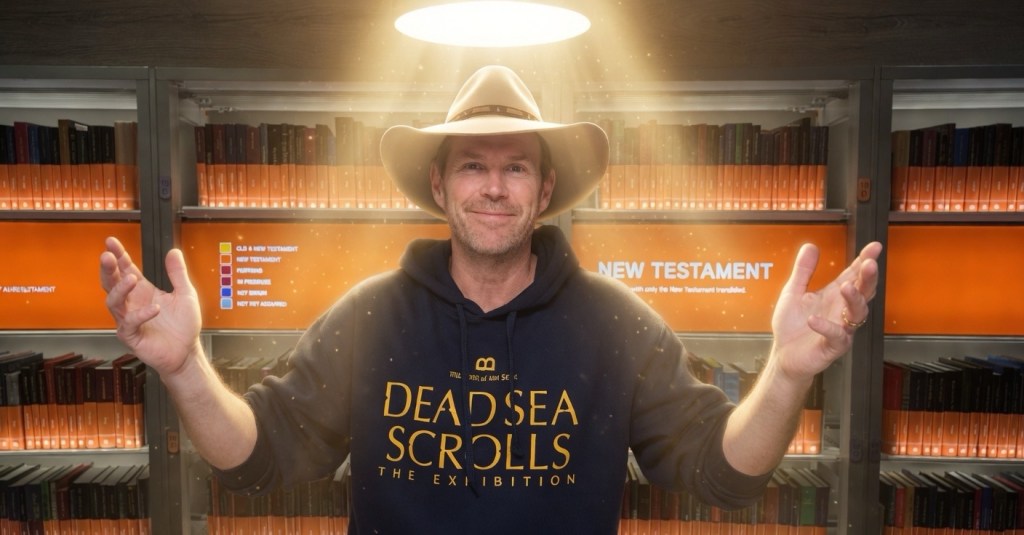
Rich Hoffman is an author, political consultant, and strategic advisor based in Cincinnati, Ohio, and the creator of The Politics of Heaven—a unique framework that connects biblical theology, ancient history, and modern power structures to explain how moral alignment and spiritual forces shape global events. Blending real-world political experience with deep research into archaeology, UFO phenomena, and suppressed historical narratives, Hoffman offers compelling commentary on topics ranging from ancient civilizations and the Dead Sea Scrolls to modern populist movements, paranormal continuity, and leadership strategy in chaotic environments. As the author of The Gunfighter’s Guide to Business and the forthcoming Politics of Heaven, he brings a grounded yet provocative voice to media discussions, supported by firsthand experiences and a cross-disciplinary approach that bridges science, history, and theology. For interviews, speaking engagements, or expert analysis, visit richhoffmanbooks.com or contact directly via phone at 513-307-5815 or email at rhoffman@richhoffmanbooks.com. If you’ve seen the movie, Disclosure Day and want to talk about it and the implications of Presidnet Trump’s UAP disclosures, let me know and we can bring some color to your coverage. https://richhoffmanbooks.com/media-inquiries-broadcast-topics-and-contact-info/?frame-nonce=ad51e7ecba I do have a firsthand UFO encounter to discuss.
Pip: The Overmanwarrior had lunch with a state senator, got rained out before he could finish his thought, and decided the logical next step was ancient Canaanite necromancy.
Mara: Rich Hoffman picks up that interrupted conversation in writing, and it pulls together ancient Near Eastern ritual, Ohio’s Hopewell earthworks, and the manuscript he’s been working toward. Let’s start with what that conversation actually opened up.
A message to George Lang: Making deals with the dead for earthly power
Pip: The premise here is that the political present and the ancient past are running the same operating system — and a lunch with Senator George Lang is where that argument gets its latest airing.
Mara: The post sets the scene directly: “Nothing formal, nothing staged for the cameras, just two guys who have known each other a long time sitting outside at a place we both like, talking the way we always end up talking when the politics finally take a back seat.”
Pip: So the lunch is a frame for something much older. What the rain interrupted was a walk through a specific ancient system — the cult of the Rephaim, dead aristocratic warrior kings whose spirits living rulers in the Late Bronze Age still summoned by name.
Mara: The Ugaritic tablet KTU 1.161 records the liturgy. Food and drink were set for the dead. The post describes it plainly: the meal was not polite remembrance — it was consultation, and it was power. The Gilberts’ book Veneration is the source he’s working through here, alongside Brian Muraresku’s The Immortality Key.
Pip: The upshot is that the biblical command to destroy those Canaanite cultures wasn’t territorial ambition — it was an attempt to close a door the cult of the dead kept propping open.
Mara: And the geography matters. Mount Hermon appears in the Book of Enoch as where the Watchers descended. In older Canaanite material it’s the seat of the divine council opposing Yahweh. The post notes that when Jesus stood at Caesarea Philippi at the foot of that mountain, he was issuing a direct challenge to the old cult on its own ground.
Pip: Then the argument crosses an ocean. The Hopewell earthworks in Ohio — Newark, the Milford Works, the mounds through Butler and Warren counties — get placed in the same category of ritual architecture as Gilgal Refaim in the Golan Heights.
Mara: And the Windover site in Florida, seven to eight thousand years old, with preserved brain tissue and textiles more sophisticated than the standard timeline allows, gets folded in too. The post connects it to copper trade networks that moved material out of Lake Superior in volumes still not fully explained.
Pip: The Loveland Frogmen make a brief appearance — not as proof, but as a pattern. Anomalous encounters clustering near the same river corridors where the old ceremonial centers stood.
Mara: The manuscript he updated Lang on, The Politics of Heaven, is described as treating the entire span from the deep pre-biblical period to the present as one continuous political and spiritual struggle. The question the post ends on is whether we keep setting places at the table for whatever was once invited.
Pip: From ancient banquet rites to Ohio subdivisions built over mounds — the territory doesn’t get smaller from here.
Mara: The thread running through all of this is that the old systems didn’t end — they changed methods. That’s the argument the book is building toward.
Pip: And the next time someone tries to sell a new version of the old system, the idea is you’d recognize it. That’s a conversation worth continuing.
Rich Hoffman is an author, political consultant, and strategic advisor based in Cincinnati, Ohio, and the creator of The Politics of Heaven—a unique framework that connects biblical theology, ancient history, and modern power structures to explain how moral alignment and spiritual forces shape global events. Blending real-world political experience with deep research into archaeology, UFO phenomena, and suppressed historical narratives, Hoffman offers compelling commentary on topics ranging from ancient civilizations and the Dead Sea Scrolls to modern populist movements, paranormal continuity, and leadership strategy in chaotic environments. As the author of The Gunfighter’s Guide to Business and the forthcoming Politics of Heaven, he brings a grounded yet provocative voice to media discussions, supported by firsthand experiences and a cross-disciplinary approach that bridges science, history, and theology. For interviews, speaking engagements, or expert analysis, visit richhoffmanbooks.com or contact directly via phone at 513-307-5815 or email at rhoffman@richhoffmanbooks.com. If you’ve seen the movie, Disclosure Day and want to talk about it and the implications of Presidnet Trump’s UAP disclosures, let me know and we can bring some color to your coverage. https://richhoffmanbooks.com/media-inquiries-broadcast-topics-and-contact-info/?frame-nonce=ad51e7ecba I do have a firsthand UFO encounter to discuss.
Yes, George, you need to watch this video. I had to finish our discussion from lunch. I had a good lunch with Senator George Lang the other day. Nothing formal, nothing staged for the cameras, just two guys who have known each other a long time sitting outside at a place we both like, talking the way we always end up talking when the politics finally take a back seat. People assume that every time I sit down with a senator or a sheriff or a treasurer around here, it is some closed-door strategy session. It is not. George and I share a long-standing interest in ancient history, the kind of deep, layered history that most people in public life never get the chance to dig into. He likes that I run into the stranger corners of it. I like that he actually reads the books I recommend and asks the kind of questions that keep the conversation alive long after the plates are cleared.
We ran out of time that day. Rain started coming down hard while we were still outside, and I had only gotten started on the things I wanted to walk him through. So I am continuing the conversation here the same way I would if he were still sitting across from me and the rest of you were at the next table over. Nothing confidential. Nothing I would not say in front of anyone. Just the thoughts that were already in motion when we had to pack it up.
I updated him on where The Politics of Heaven stands, my next book. The manuscript is finished. The first full draft has been through enough eyes that the early feedback keeps coming back in the same surprising way. More than one reader, including people who know the publishing world, has said the same thing: this book reminds them of The Immortality Key. That 2020 book from St. Martin’s Press by Brian Muraresku, the one Graham Hancock helped put on the map. I told George that I had already decided to go back through The Immortality Key carefully, not because I think I borrowed from it, but because the comparison keeps arriving uninvited and I want to be precise about where the overlap ends and where my own line of inquiry begins. Publication is a relationship, like any other. You do not jump straight into sharing an apartment. You get dinner. You talk. You figure out whether the trust is real. That process takes time, and patience is part of the work.
What pushed me back into The Immortality Key was the same impulse that had me reading Sharon and Derek Gilbert’s Veneration in the early hours before that lunch. Timothy Alberino had been discussing related material on Joe Rogan, and the conversation turned to the older Near Eastern material that most people never hear about. The Gilberts work from a biblical frame, and they do it with real attention to the primary texts. I respect that. Their book digs into the cult of the Rephaim, those dead aristocratic warrior kings whose spirits the living kings of the Late Bronze Age still summoned by name. The Ugaritic tablet known as KTU 1.161 records the liturgy. The dead are called up. Food and drink are set for them. The living king anchors his own right to rule in a line that stretches back into a mythic age of heroes. The meal is not polite remembrance. It is consultation. It is power.
That is the system the biblical writers were confronting. When the scouts came back from Canaan and said they felt like grasshoppers beside the people living there, they were describing more than physical size. They were describing a culture that still fed and consulted the spirits of the giants who had once ruled. Og of Bashan, the last of the remnant of the Rephaim, still had an iron bedstead measured in cubits that made the point for anyone who needed numbers. The physical and spiritual threats were the same. The command to wipe the system out was not simple land hunger. It was an attempt to close the door that the cult of the dead kept trying to hold open.
Mount Hermon sits at the center of that geography. In the Book of Enoch it is the place where the Watchers came down. In the older Canaanite material it is the mountain of assembly, the seat of the divine council that opposed Yahweh. When Jesus took his disciples to the region of Caesarea Philippi at the foot of that mountain and said the gates of hell would not prevail, he was standing on the front porch of the old cult and issuing a direct challenge. The Gilberts make that geography impossible to ignore once you have seen it.
I have been reading this material with one eye on the Near East and the other on the ground under my own feet. The Wheel of the Giants, Gilgal Refaim, sits up in the Golan Heights, a massive set of concentric stone circles that some call the Stonehenge of the East. It belongs to the same broad horizon of ritual architecture that appears along the Jordan and then, in different forms, moves westward. At the same time, over here in the Ohio Valley, the Hopewell people were raising enormous ceremonial centers with the same intensity of purpose. The Milford Works, the great earthworks near the confluence of the Little Miami and the East Fork, the alignments at Newark, the mounds that once stood all through what is now Butler County and Warren County and on up the Scioto. These were not random piles of dirt. They were places where the living gathered to deal with the dead and whatever else they believed could be reached through the right rituals and alignments.
I keep coming back to the Windover site just west of Titusville, a few miles from the Kennedy Space Center. Seven to eight thousand years old. Bodies preserved in peat with brain tissue still intact. Textiles more sophisticated than anything the standard story allows for at that early stage. Directional burial practices. A people who do not fit neatly into the later tribal identities we project backward. Some of the individuals were tall by the standards of the time. The site sits in a region that later becomes part of the same trade networks that moved copper out of the Lake Superior mines and into the wider world just as the Bronze Age was taking shape. The usual explanations for exotic materials found in these contexts grow more strained the longer you look at them. Bananas and turmeric proteins in elite Near Eastern burials. Advanced textiles and possible African or Mediterranean contacts at Windover. The copper that left the Upper Peninsula in quantities that still have not been fully accounted for. At some point, the assumption that the oceans were closed until Columbus made his journey starts to look like a real leap of faith.
The Loveland Frogmen sightings sit right in the middle of this local landscape. 1955, then 1972, later reports still in the same general corridor. Small, grayish, bipedal figures near the water, not far from the old Hopewell ceremonial centers. I am not claiming they are the same entities the Ugaritic kings were feeding under the palace benches. I am saying that when you map the places where people once worked hard to open contact with the dead, and then you look at the places where anomalous encounters keep showing up in the modern record, the overlap is hard to ignore. Point Pleasant and the Mothman. The poltergeist activity that still gets reported in houses built over older burial grounds. The same pattern appears in other parts of the world whenever the old ritual centers are disturbed or left alone long enough for whatever was once invited to keep answering.
I told George that the deeper I go into this material, the clearer it becomes that the biblical story is not a late invention dropped into an empty landscape. It is a record of conflict in a world already thick with competing claims about who had the right to rule and whose spirits still held authority. The non-human intelligences that show up in the older texts, the ones that later get called demons or Watchers or the shades of the Rephaim, did not disappear when the last physical giant was killed. The cult changed its methods. Psychedelics appear to have been one of the technologies that kept the door open. Muraresku’s work on the ritual use of those substances in the ancient Mediterranean and their possible survival into early Christian practice is part of the same larger picture. If you want to understand why a culture builds a certain kind of religion, you have to understand what it was taking and what it thought it was talking to while it was under the influence.
My own book takes the next step. It treats the entire span from the deep pre-biblical period to the present as a single continuous political and spiritual struggle. The copper, the earthworks, the burial practices, the later attempts to rebury or reclassify the evidence, the modern fascination with ascended masters and ancient aliens and celebrity necromancy, all of it belongs to the same long contest. The entities that once sat at the banquet tables under the palace floors in Ugarit are still trying to claim a seat at the table. The question is whether we keep setting places for them.
I am not interested in scaring people. I am interested in making the pattern visible so that the next time someone tries to sell a new version of the old system we recognize it for what it is. The Gilberts do that work from one angle. Muraresku does it from another. Alberino keeps pushing the conversation into the open. I am simply adding the North American material and the long view that comes from living in a place where the mounds are still under the subdivisions, and the river valleys still remember older traffic.
Notes:
¹ Brian C. Muraresku, The Immortality Key: The Secret History of the Religion with No Name (New York: St. Martin’s Press, 2020). Foreword by Graham Hancock.
² Sharon K. Gilbert and Derek P. Gilbert, Veneration: Unveiling the Ancient Realms of Demonic Kings and Satan’s Battle Plan for Armageddon (Crane, MO: Defender, 2020).
³ KTU 1.161 (Ugaritic funerary liturgy), standard edition in Manfried Dietrich, Oswald Loretz, and Joaquín Sanmartín, The Cuneiform Alphabetic Texts from Ugarit, Ras Ibn Hani and Other Places (Münster: Ugarit-Verlag, 2013). See also Baruch A. Levine and Jean-Michel de Tarragon, “Dead Kings and Rephaim: The Patrons of the Ugaritic Dynasty,” Journal of the American Oriental Society 104 (1984): 649–659.
⁴ On Gilgal Refaim / Rujm el-Hiri see Yonathan Mizrachi et al., recent satellite survey work published in PLOS ONE (2026) documenting additional circular structures in the Golan; earlier discussions in Yonathan Paz and others on Early Bronze Age ritual landscapes.
⁵ Glen H. Doran, ed., Windover: Multidisciplinary Investigations of an Early Archaic Florida Cemetery (Gainesville: University Press of Florida, 2002). See also subsequent DNA and textile studies confirming the site’s uniqueness within the Archaic Southeast.
⁶ On Hopewell ceremonial centers, alignments, and ritual feasting, see Bradley T. Lepper, Ohio Archaeology (Wilmington, OH: Orange Frazer Press, various editions) and the UNESCO World Heritage documentation for the Hopewell Ceremonial Earthworks. For the Milford Works specifically, nineteenth-century surveys by Squier and Davis remain foundational.
⁷ Book of Enoch (1 Enoch) 6–16 on the descent of the Watchers at Mount Hermon; standard translation by R. H. Charles or George W. E. Nickelsburg and James C. VanderKam.
⁸ Timothy Alberino’s appearance on The Joe Rogan Experience #2530 (July 2026) discusses the Rephaim, the kispum rites, and the continued occult utility of giant remains in modern contexts.
Bibliography for further reading
Alberino, Timothy. Various lectures and the special edition of The Book of Enoch with commentary (2026).
Byers, A. Martin. Sacred Games, Death, and Renewal in the Ancient Eastern Woodlands. Knoxville: University of Tennessee Press, 2011.
Charles, R. H., trans. The Book of Enoch. Oxford: Clarendon Press, 1912 (and later editions).
Doran, Glen H., ed. Windover. Gainesville: University Press of Florida, 2002.
Gilbert, Derek P., and Sharon K. Gilbert. Veneration. Crane, MO: Defender, 2020.
———. The Great Inception. Crane, MO: Defender, 2017.
Hancock, Graham. America Before. New York: St. Martin’s Press, 2019.
Heiser, Michael S. The Unseen Realm. Bellingham, WA: Lexham Press, 2015.
Lepper, Bradley T. Ohio Archaeology. Wilmington, OH: Orange Frazer Press.
Muraresku, Brian C. The Immortality Key. New York: St. Martin’s Press, 2020.
Nickelsburg, George W. E., and James C. VanderKam. 1 Enoch: The Hermeneia Translation. Minneapolis: Fortress Press, 2012.
Pardee, Dennis. Ritual and Cult at Ugarit. Atlanta: Society of Biblical Literature, 2002.
Squier, Ephraim G., and Edwin H. Davis. Ancient Monuments of the Mississippi Valley. Washington: Smithsonian Institution, 1848 (reprint editions widely available).
Vallée, Jacques. Passport to Magonia. Chicago: Henry Regnery, 1969 (and later editions).
Additional primary Near Eastern texts are available in The Context of Scripture, ed—William W. Hallo (Leiden: Brill), and in the standard Ugaritic editions cited above.
Rich Hoffman is an author, political consultant, and strategic advisor based in Cincinnati, Ohio, and the creator of The Politics of Heaven—a unique framework that connects biblical theology, ancient history, and modern power structures to explain how moral alignment and spiritual forces shape global events. Blending real-world political experience with deep research into archaeology, UFO phenomena, and suppressed historical narratives, Hoffman offers compelling commentary on topics ranging from ancient civilizations and the Dead Sea Scrolls to modern populist movements, paranormal continuity, and leadership strategy in chaotic environments. As the author of The Gunfighter’s Guide to Business and the forthcoming Politics of Heaven, he brings a grounded yet provocative voice to media discussions, supported by firsthand experiences and a cross-disciplinary approach that bridges science, history, and theology. For interviews, speaking engagements, or expert analysis, visit richhoffmanbooks.com or contact directly via phone at 513-307-5815 or email at rhoffman@richhoffmanbooks.com. If you’ve seen the movie, Disclosure Day and want to talk about it and the implications of Presidnet Trump’s UAP disclosures, let me know and we can bring some color to your coverage. https://richhoffmanbooks.com/media-inquiries-broadcast-topics-and-contact-info/?frame-nonce=ad51e7ecba I do have a firsthand UFO encounter to discuss.