

I wrote Symposium of Justice in 2004 under a pressure most people never carry for long, and the character I named Cliffhanger still sits with me whenever the talk turns to what it means to become more than human. The book was a modern Zorro story dressed in the clothes of a fast-food cook named Fletcher Finnegan, a man rich enough to sit in any boardroom yet who deliberately chose the lowest-status job in town so he could listen to the kids who actually knew where the crime lived. He put on an apron and flipped burgers because prestige is one of the oldest chains non-human intelligence uses to keep us in line. Once you no longer need the room’s approval, the bullets start to disappear. That was the part Hollywood never could grasp. They understood Superman from Krypton and Iron Man in a suit. They could not understand a man who had stopped asking the system for permission to exist.¹
The system in that book was never just corrupt cops or politicians. It was the machinery driven by intelligences that are neither human nor ever were. They feed on the human craving for status, for sexual conquest displayed in front of peers, for the lawn that is greener than the neighbor’s. Numbers 25 still haunts me because it shows the pattern in plain sight. Moses had already walked with God, already seen the bush burn, already split the sea, and still the people dragged Moabite women into the camp and had sex with them in open defiance right in front of their leader. Yahweh’s anger was not abstract. He kept Moses on the wrong side of the Jordan. Leadership that cannot enforce the line is not leadership; it is theater. The Overman is the one who refuses to play in that theater.²
Cliffhanger’s ten rules were never meant to replace the Ten Commandments. They were a working set of standards for a man who had already decided he would not live as spiritual livestock. I wrote them in my early thirties while the story was still hot in my hands, and I have lived by them since.
Rule one is to honor women as the pillars of society. That is not sentiment. A culture that treats women as disposable will collapse under its own weight, and non-human intelligences have always known how to use that collapse. Rule two demands that a man live as an example of the highest moral order he can conceive. Rule three is the refusal of mental depletion: no intoxication that dulls the edge, no cultivated ignorance. Pursue learning the way a man dying of thirst pursues water. Rule four is the quiet discipline of keeping the body and mind under the same command so that neither becomes a doorway for something else. Rule five insists that integrity is the alignment of stated values with actual behavior; anything less is performance for an audience that is not human. Rule six is to live the life you were given rather than the dream someone else sold you. Rule seven: in crisis, handle everything calmly and without confusion. Rule eight: be capable of firmness in the heart when firmness is required. Rule nine: sorrow is accepted with a smile. And the last rule, the one that still cuts deepest: resist hiding in numbers. Stand as an individual contributor.³
Cliffhanger’s Ten Rules
- Honor women as the pillars of society.
A culture that treats women as disposable will collapse under its own weight, and non‑human intelligences have always known how to use that collapse.
- Live as an example of the highest moral order you can conceive.
A man’s life should reflect the standard he claims to uphold.
- Refuse mental depletion.
No intoxication that dulls the edge, no cultivated ignorance. Pursue learning the way a man dying of thirst pursues water.
- Keep the body and mind under the same command.
Quiet discipline prevents either from becoming a doorway for something else.
- Align stated values with actual behavior.
Integrity is the congruence between what you claim and what you do; anything less is performance for an audience that is not human.
- Live the life you were given, not the dream someone else sold you.
Authenticity is a form of sovereignty.
- In a crisis, remain calm and free of confusion.
Clarity under pressure is a moral act.
- Be capable of firmness in the heart when firmness is required.
Strength is not cruelty; it is resolve.
- Accept sorrow with a smile.
Suffering is not an enemy — it is a teacher.
- Resist hiding in numbers.
That still cuts deepest: resist hiding in numbers. Stand as an individual contributor.”
Those rules are what allowed Cliffhanger to walk through a house full of gunfire without taking a round. It was never magic. It was the disciplined refusal of the peer-pressure mechanisms that non-human intelligence has used since the garden. Once a man no longer needs the room to nod at him, the room loses its power to aim. Quantum observation is not a metaphor here. The man who has divorced himself from the need for status selects the reality in which the bullet misses, because he is no longer entangled with the fear that makes most men flinch. I explained that to studio people for years. They nodded, then asked if we could give him a suit or a radioactive spider. They wanted the power without the cost. The cost is that you will never again be fully approved by the herd. That is the price of the Overman.⁴
Quantum observation is the idea that at the smallest scales of reality, particles do not behave like solid objects but like probabilities—spreads of potential outcomes that only “collapse” into a definite state when they are measured. In quantum mechanics, observation isn’t passive; it changes the system. A particle’s position, momentum, or even existence as a wave or a point becomes real only when something interacts with it. Before that moment, reality is a cloud of possibilities. Quantum observation suggests that consciousness, measurement, or interaction plays a role in shaping what becomes actual, hinting that the universe is not a fixed machine but a responsive field where the act of looking helps determine what is seen.
I have watched the same pattern repeat from the tent in Numbers 25 to the sex parties that still happen in certain circles, the ones that echo the same Babylonian rituals Stanley Kubrick tried to show in Eyes Wide Shut and Conan the Barbarianbefore the films were softened. The bones of giants still change hands. The same intelligences still demand sacrifice and participation. Most people still trade their sovereignty for a place at the table. The Overman is the one who walks away from the table and still eats.⁵
Jesus was fully human and fully something else. The resurrection was not a metaphor for self-improvement. Ghosts came out of the tombs. The limits of flesh were broken in public. That is the direction, not the rejection of the body but the refusal to remain its prisoner. Moses failed because he could not hold the line. Joshua was given the land because someone had to. The cycle keeps repeating because most of us still prefer the approval of the camp to the hard work of becoming the being that non-human intelligence cannot herd.⁶
I am not interested in uploading consciousness into a machine so we can live forever as software. That is just another version of the same livestock arrangement, only with better climate control. The Overman I wrote about in 2004 is the man who stays in the body, stays in the fight, and refuses the spiritual cattle chute. He works the night shift at the restaurant so he can hear where the next crime is forming. He carries a bullwhip instead of a cape because the whip is honest about the cost of discipline. He selects the reality in which the bullets miss because he has already selected the reality in which he no longer needs the shooters’ respect.
That is the part I am still proud of. The rest of the culture is only now beginning to use words like ultra-human and non-human intelligence in public. I wrote the story twenty-two years ago because the pattern was already visible if you were willing to look past the need to be liked. The ten rules still stand. The bullets still miss when the man no longer flinches for applause. And the war with whatever has been herding us since the garden is still the only war that matters.
From Nietzsche to Teilhard de Chardin to Mircea Eliade and Jacques Vallée, a long intellectual thread has argued that the human being is not a completed creature but a transitional one. Nietzsche’s Übermensch was the first modern articulation of the “overman,” a figure who rises beyond inherited moral frameworks and becomes capable of shaping meaning rather than receiving it. Teilhard expanded the idea into the “Ultra-Human,” a being transformed by consciousness, complexity, and spiritual evolution. Eliade saw humanity as perpetually pulled toward the sacred, always reaching for a higher mode of existence through ritual, myth, and contact with the transcendent. Vallée reframed the question for the technological age, suggesting that encounters with non‑human intelligence may be part of a long‑running process that pushes humanity toward a more advanced form of awareness. Pasulka’s work in The Others brings this lineage into the present moment: she argues that extraordinary experiences, anomalous contact, and the emergence of non-human intelligences are forcing human beings to grow into something larger than the version of ourselves we inherited. In this view, the real struggle of the twenty-first century is not human versus artificial intelligence, but human versus the non-human intelligences that have always been present at the edges of our history — the same kind of character hinted at in recent disclosures and the strange figures emerging from the shadows of power. The question is whether humanity will rise to meet that challenge, or remain a species unaware of the evolutionary pressure being applied to it.
Numbers 25 is one of the clearest biblical moments where Yahweh sees Moses hesitate, and that hesitation is treated as weakness. The crisis at Baal‑Peor wasn’t just a moral failure — it was a collapse of sovereignty. The people aligned themselves with a rival deity, a rival ritual system, and a rival identity. In the lineage of thinkers such as Nietzsche, Teilhard de Chardin, Eliade, Vallée, and Pasulka, this moment reads like a test of whether humanity can rise to a higher form of discipline and consciousness or fall back into the gravitational pull of older, chaotic forces. Moses pauses, trying to manage the rebellion through judges and procedure, but Yahweh demands decisive action — the kind of firmness, clarity, and elevated moral strength associated with the “overman,” the “ultra‑human,” or the spiritually evolved human these writers describe. Phinehas, not Moses, embodies that higher threshold: he acts with total alignment, total conviction, and total sovereignty, restoring the boundary between human order and non-human influence. In this reading, Yahweh’s frustration with Moses is not about anger but about evolution — Moses hesitates at the very moment when the human being is supposed to rise. Numbers 25 becomes a story about whether humanity can grow into the being capable of resisting non‑human intelligences, chaotic ritual systems, and the collapse of moral order. Moses falters; Phinehas steps forward. The text preserves that contrast as a warning about what happens when leaders fail to evolve at the pace the crisis demands.
Numbers 25 opens with the Israelites camped at Shittim, where they begin engaging in Moabite rituals and festivals. The Moabite women invite the Israelite men to their sacrificial feasts, and the men join them — eating, bowing, and participating in the worship of Baal‑Peor, a local deity. This is treated in the text as a direct betrayal of Yahweh, a collapse of loyalty and identity.
As the people align themselves with Baal‑Peor, Yahweh’s anger is described as burning against Israel. He commands Moses to execute the leaders responsible for leading the rebellion. Moses instructs the judges to kill those who joined themselves to Baal‑Peor.
Right in the middle of this crisis, something shocking happens: an Israelite man named Zimri publicly brings a Midianite woman named Cozbi into the camp, in full view of Moses and the entire assembly. The text emphasizes that this act is deliberate, defiant, and visible — a symbolic gesture of rejecting Moses’s authority and Yahweh’s command.
While the people are weeping at the entrance of the Tent of Meeting, Phinehas, the grandson of Aaron, sees what Zimri has done. He takes a spear, enters the chamber where Zimri and Cozbi are having sex together, and kills them both with a single thrust. The moment he does this, the plague that had broken out among the Israelites stops.
By the time the plague ends, 24,000 people have died.
Yahweh declares that Phinehas’s action has “turned away” divine anger and restored the covenant. Phinehas is given a “covenant of peace” and a “lasting priesthood” because he acted with zeal when the leadership hesitated. The chapter ends with Yahweh commanding Moses to treat the Midianites as enemies because they were the ones who enticed Israel into the rebellion at Baal Peor. This is a fight on many levels that still carries over to this very day. And Moses was too nice, too human.
“The System” in my book was never just corrupt cops or politicians. It was the machinery driven by intelligences that are neither human nor ever were. They feed on the human craving for status, for sexual conquest displayed in front of peers, for the lawn that is greener than the neighbor’s. Numbers 25 still haunts me because it shows the pattern in plain sight. Moses had already walked with God, already seen the bush burn, already split the sea, and still the people dragged Moabite women into the camp and had sex with them in open defiance right in front of their leader. Yahweh’s anger was not abstract. He kept Moses on the wrong side of the Jordan. Leadership that cannot enforce the line is not leadership; it is theater. The Overman is the one who refuses to play in that theater.²
Cliffhanger’s ten rules were never meant to replace the Ten Commandments. They were a working set of standards for a man who had already decided he would not live as spiritual livestock. I wrote them in my early thirties while the story was still hot in my hands, and I have lived by them since.
Notes:
¹ The character Fletcher Finnegan was deliberately modeled on the dual nature of Don Diego de la Vega in the original Zorro stories and the 1957–1959 Disney television series. The decision to place him in a fast-food kitchen rather than a mansion was an attempt to invert the usual social camouflage: instead of pretending to be idle and foppish, Cliffhanger pretends to be ordinary and low-status so that the system itself overlooks him.
² Numbers 25:1–9 records the incident at Peor. The text is unambiguous that the Israelites engaged in sexual relations with Moabite women and joined in the worship of Baal of Peor in full view of Moses and the congregation. Yahweh’s response was immediate and severe; Moses was later barred from entering the land (Deuteronomy 32:48–52; 34:1–5). The episode has long been read as much a failure of leadership as a failure of the people.
³ These ten rules appear in Symposium of Justice (2004) as the practical code Cliffhanger lives by. They were never presented as a replacement for the Decalogue but as a set of operational standards for a man determined not to be managed by the ordinary levers of social control.
⁴ The idea that focused intention can select among probable outcomes draws on the observer effect in quantum mechanics and on the older tradition of disciplined positive concentration found in certain esoteric and practical philosophies. In the novel, the effect is treated as a consequence of having first severed the psychological tethers that keep most people entangled with the expectations of the crowd.
⁵ Jacques Vallée and John Keel both documented the recurring pattern of non-human intelligences interacting with human societies through deception, sexual or sacrificial demand, and the exploitation of human psychological weaknesses. The novel’s “System” is an early fictional attempt to name that pattern without reducing it to either pure folklore or pure extraterrestrial visitation.
⁶ The resurrection accounts in the Gospels (especially Matthew 27:52–53) include the detail of the tombs opening and the bodies of the saints rising. Whatever else one makes of the event, it presents a public rupture of ordinary human limits. The contrast with Moses’ exclusion from the land remains one of the sharpest illustrations in Scripture of the difference between a leader who cannot hold the line and a figure who transcends the ordinary terms of human failure.
Bibliography
Hoffman, Rich. Symposium of Justice. 2004.
Keel, John A. The Mothman Prophecies. New York: Saturday Review Press, 1975.
Keel, John A. Operation Trojan Horse. New York: G.P. Putnam’s Sons, 1970.
Nietzsche, Friedrich. Thus Spoke Zarathustra. Translated by Walter Kaufmann. New York: Viking, 1954.
Palka, E.W. The Others. [Publisher details as available].
Vallée, Jacques. Passport to Magonia. Chicago: Henry Regnery, 1969.
Vallée, Jacques. Dimensions: A Casebook of Alien Contact. Chicago: Contemporary Books, 1988.
¹ The character Fletcher Finnegan was deliberately modeled on the dual nature of Don Diego de la Vega in the original Zorro stories and the 1957–1959 Disney television series. The decision to place him in a fast-food kitchen rather than a mansion was an attempt to invert the usual social camouflage: instead of pretending to be idle and foppish, Cliffhanger pretends to be ordinary and low-status so that the system itself overlooks him.
² Numbers 25:1–9 records the incident at Peor. The text is unambiguous that the Israelites engaged in sexual relations with Moabite women and joined in the worship of Baal of Peor in full view of Moses and the congregation. Yahweh’s response was immediate and severe; Moses was later barred from entering the land (Deuteronomy 32:48–52; 34:1–5). The episode has long been read as much a failure of leadership as of the people.
³ These ten rules appear in Symposium of Justice (2004) as the practical code Cliffhanger lives by. They were never presented as a replacement for the Decalogue but as a set of operational standards for a man determined not to be managed by the ordinary levers of social control.
⁴ The idea that focused intention can select among probable outcomes draws on the observer effect in quantum mechanics and on the older tradition of disciplined positive concentration found in certain esoteric and practical philosophies. In the novel, the effect is treated as a consequence of having first severed the psychological tethers that keep most people entangled with the expectations of the crowd.
⁵ Jacques Vallée and John Keel both documented the recurring pattern of non-human intelligences interacting with human societies through deception, sexual or sacrificial demand, and the exploitation of human psychological weaknesses. The novel’s “System” is an early fictional attempt to name that pattern without reducing it to either pure folklore or pure extraterrestrial visitation.
⁶ The resurrection accounts in the Gospels (especially Matthew 27:52–53) include the detail of the tombs opening and the bodies of the saints rising. Whatever else one makes of the event, it presents a public rupture of ordinary human limits. The contrast with Moses’ exclusion from the land remains one of the sharpest illustrations in Scripture of the difference between a leader who cannot hold the line and a figure who transcends the ordinary terms of human failure.
Bibliography
Hoffman, Rich. Symposium of Justice. 2004.
Keel, John A. The Mothman Prophecies. New York: Saturday Review Press, 1975.
Keel, John A. Operation Trojan Horse. New York: G.P. Putnam’s Sons, 1970.
Nietzsche, Friedrich. Thus Spoke Zarathustra. Translated by Walter Kaufmann. New York: Viking, 1954.
Palka, E.W. The Others. [Publisher details as available].
Vallée, Jacques. Passport to Magonia. Chicago: Henry Regnery, 1969.
Vallée, Jacques. Dimensions: A Casebook of Alien Contact. Chicago: Contemporary Books, 1988.
The Holy Bible. Numbers 25; Deuteronomy 32–34; Matthew 27.
Rich Hoffman
More about me
Click Here to Protect Yourself with Second Call Defense https://www.secondcalldefense.org/?affiliate=20707
About the Author: Rich Hoffman
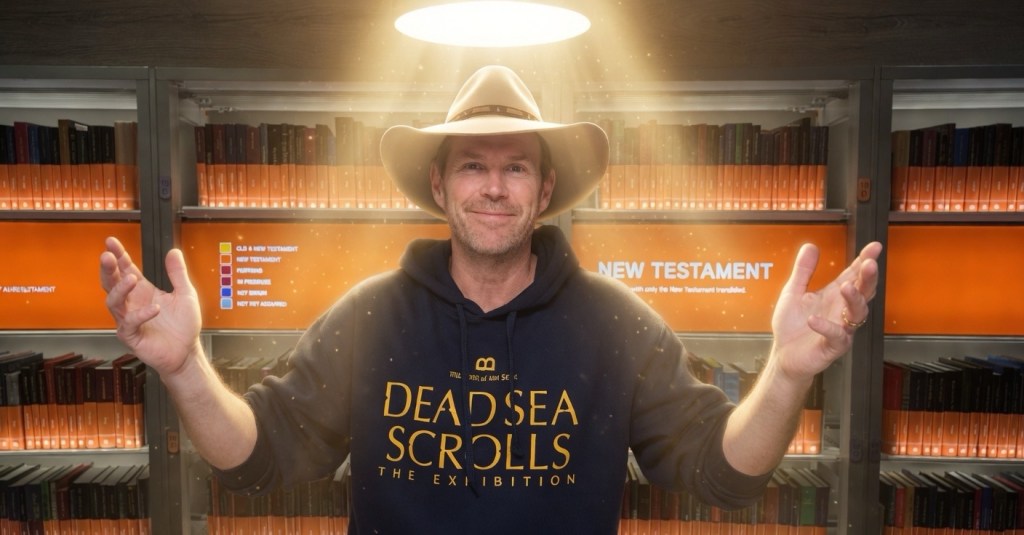
Rich Hoffman is an author, political consultant, and strategic advisor based in Cincinnati, Ohio, and the creator of The Politics of Heaven—a unique framework that connects biblical theology, ancient history, and modern power structures to explain how moral alignment and spiritual forces shape global events. Blending real-world political experience with deep research into archaeology, UFO phenomena, and suppressed historical narratives, Hoffman offers compelling commentary on topics ranging from ancient civilizations and the Dead Sea Scrolls to modern populist movements, paranormal continuity, and leadership strategy in chaotic environments. As the author of The Gunfighter’s Guide to Business and the forthcoming Politics of Heaven, he brings a grounded yet provocative voice to media discussions, supported by firsthand experiences and a cross-disciplinary approach that bridges science, history, and theology. For interviews, speaking engagements, or expert analysis, visit richhoffmanbooks.com or contact directly via phone at 513-307-5815 or email at rhoffman@richhoffmanbooks.com. If you’ve seen the movie, Disclosure Day and want to talk about it and the implications of Presidnet Trump’s UAP disclosures, let me know and we can bring some color to your coverage. https://richhoffmanbooks.com/media-inquiries-broadcast-topics-and-contact-info/?frame-nonce=ad51e7ecba I do have a firsthand UFO encounter to discuss.

