

I’ve been turning this over for six or seven weeks. It started in the dark of a Kings Island haunted maze and ended in the bright lights of a newly renovated theater at Liberty Center, watching Godzilla Minus Zero with my family. Between those two experiences sits everything I keep trying to explain about fear, narrative, origins, and why so many people still vote and live as if they are not free.
Learning Control Through Fear at Kings Island
In the fall of 2026 I played Jason Voorhees in the new Jason: Blood Reign maze at Kings Island. Four nights a week, for the length of the Haunt season, I stood in the dark and watched thousands of people react to the same simple stimulus: the sudden appearance of a masked figure with a machete. The results were consistent. Most people freeze, scream, or bolt in predictable directions. A smaller number laugh or posture. Almost no one stops to analyze the situation rationally in the moment.
What I learned, again and again, is that fear works. It works on crowds. It works on individuals. It works whether the threat is real or theatrical. The people who design these attractions understand the psychology; so do the people who design political campaigns, school curricula, and certain kinds of religious systems. Once you have watched enough people abandon their own judgment under a controlled threat, you start looking at other institutions differently. Public education, mass media, and large parts of modern politics all rely on the same basic mechanism: create or amplify anxiety, then offer the peer group, the expert class, or the state as the only reliable source of safety. If you care what your neighbors think, the leverage is already there. I don’t. That indifference is useful.
Godzilla Minus Zero as a Cultural Trauma Device
A few weeks later my family and I saw Godzilla Minus Zero (2026), Takashi Yamazaki’s direct sequel to the Oscar-winning Godzilla Minus One (2023). The film is set in 1949, two years after the events of the first movie. Japan is trying to rebuild. Godzilla returns. King Ghidorah arrives. The human characters—especially the Shikishima family—are forced to confront another wave of destruction while still carrying the previous one. It is, at bottom, a family film. The performances, the visual effects, and the restraint with which the monsters are used all serve the story of people trying to live after catastrophe.
The critical and commercial response has been strong. As of early November 2026 the film sat in the high 80s to low 90s on Rotten Tomatoes’ Tomatometer with audience scores near 96 percent. It opened to roughly $30.6 million in North America—the largest opening for a live-action foreign-language film in the territory—and was the first Japanese production filmed for IMAX. Godzilla Minus One had already shown that a Japanese production with a reported budget around $15 million and a VFX team of about 35 people could win the Academy Award for Best Visual Effects and outperform far more expensive Hollywood product. Minus Zero confirmed the pattern.
I have spent enough time around Japanese culture, and enough years watching Hollywood price itself out of coherent storytelling, that the quality of these films does not surprise me. What interests me more is the function. Yamazaki has described Godzilla in this series as a metaphor for war. The original 1954 film processed the atomic bombings of Hiroshima and Nagasaki (immediate and later deaths commonly estimated in the range of 140,000–200,000 for Hiroshima and 70,000–80,000 for Nagasaki by the end of 1945, with higher cumulative figures recognized by Japan in later decades). The new films continue that work while also reflecting Japanese guilt over the treatment of Chinese civilians and the broader costs of imperial expansion. Americans appear in the story as both the source of nuclear destruction and, later, as an occupying force whose presence is resented even as cooperation occurs. The films are not anti-American propaganda in any crude sense, but they are unmistakably Japanese. They process Japanese trauma from a Japanese point of view.
That is exactly why they work for Western audiences right now. Hollywood has largely stopped telling coherent stories about responsibility, family, and the cost of violence. Japanese filmmakers, working with fewer resources and less ideological overhead, are still doing it. People notice.
The Bathroom Stall and the 2026 Election
After the movie I went into a freshly renovated bathroom at the Liberty Center theater and found a message carved into a stall: “capitalism” with a greater-than sign pointing toward “communism.” Someone young enough to still treat public property as a canvas had felt the need to leave that particular opinion. It was not an isolated incident in my experience. For years I have watched the same pattern in schools and on campuses: students who have been taught that capitalism is the problem and that some form of managed equality is the solution, without ever being given a clear account of what communism actually produced when it was tried.
The 2026 midterm results, in which Democrats performed better than many expected, fit the same picture. Large numbers of voters, especially those under 30, appear to have decided that their current material situation is someone else’s fault and that a more powerful government is the remedy. Housing costs, education debt, and the simple observation that previous generations seemed to have more straightforward paths into homeownership and family formation are real pressures. Those pressures have been amplified by policies that restrict supply (green-space requirements, zoning, and the long-term effects of earlier housing-price inflation) and by an education system that treats market economics as optional or suspect. When people have been trained to look to collective action rather than individual competence, they vote accordingly.
None of this requires a grand conspiracy. It requires only the ordinary incentives of institutions that benefit from dependency. Public schools were designed, in part, to socialize children into a particular civic consensus. Peer pressure does the rest. If your standing with friends, teachers, or future employers depends on repeating the correct views, most people will repeat them. I have never cared much about that standing. That makes conversations with people who do care more straightforward, not less.
Rahab in Scripture and the Speculative Planet
While I was thinking about the Godzilla films as narrative devices for processing historical trauma, I kept returning to a name that appears in the Bible in two different registers: Rahab.
In Joshua 2, Rahab is the Canaanite prostitute who hides the Israelite spies in Jericho, extracts a promise of protection for her family, and is spared when the city falls. She appears in the genealogy of Jesus in Matthew 1:5 and is cited in Hebrews 11 and James 2 as an example of faith demonstrated by action. The Hebrew term used for her occupation is the ordinary word for prostitute.
In the poetic books the same name (with a different spelling and root sense) refers to a chaotic sea monster. Job 26:12 says that by His understanding God shattered Rahab. Psalm 89:10 describes God crushing Rahab. Isaiah 51:9 asks whether it was not the Lord’s arm that cut Rahab in pieces and pierced the dragon. In these passages Rahab functions as a symbol of pride, chaos, and the forces God subdues—sometimes associated with Egypt, sometimes with the primordial sea.
David Flynn and others have argued that the poetic Rahab preserves a memory of a destroyed planet whose remnants form the asteroid belt between Mars and Jupiter. Mainstream planetary science rejects this. The total mass of the main asteroid belt is only about 4 percent that of the Moon, and the differentiated nature of the larger asteroids is consistent with them having formed as separate bodies rather than as fragments of a single shattered world. The scientific consensus is that the belt is leftover material from the formation of the solar system that never coalesced into a planet, largely because of Jupiter’s gravitational influence.
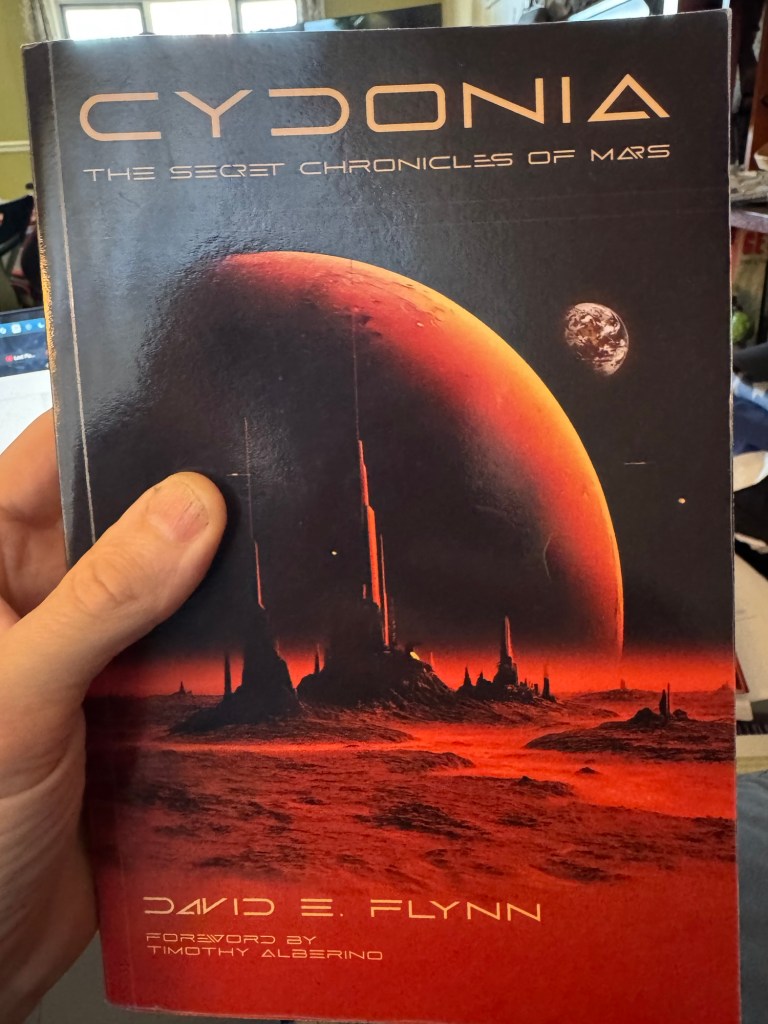
I do not treat the destroyed-planet reading as established fact. I treat it as a hypothesis that is consistent with certain textual patterns and with the broader pattern of cultures creating narrative devices to process catastrophes whose physical evidence has been eroded or is located somewhere we have not yet looked carefully. Flynn’s Cydonia: The Secret Chronicles of Mars and related writings make a sustained case for ancient Martian influence on terrestrial civilization, artificial structures photographed on Mars, and connections to biblical and extra-biblical traditions about giants and pre-Adamic events. Timothy Alberino has popularized related material on giants, the Book of Enoch, and alleged suppression of physical evidence; he appeared on Joe Rogan in 2026. Sharon and Derek Gilbert’s Veneration examines the Rephaim, ancestor veneration, and end-times connections. These works sit outside the mainstream of both academic biblical studies and planetary science. That does not automatically make them worthless. It means their claims require evidence that has not yet been produced in forms most specialists accept.
The Keys in the Dark
The analogy I keep using is simple. Suppose you drop your car keys somewhere between the door of your workplace and the car. It is dark. You search under the light near the car and do not find them. That does not prove the keys do not exist. It proves only that your current method and lighting have not reached the place where the keys actually are. You can wait for daylight, get a flashlight, or systematically search the darker ground. The absence of evidence under the light is not evidence of absence.
Earth’s archaeological record is limited by erosion, plate tectonics, sea-level change, and the simple fact that most material culture does not survive more than a few thousand years without deliberate preservation. Mars has a thinner atmosphere and no plate tectonics of the same kind. Large impact scars are visible. Evidence of past surface water is established. Whether any of that evidence includes the remains of technological civilization is an open question that can only be answered by going there and looking. SpaceX’s stated goal of making life multi-planetary is, from this perspective, also an archaeological project. If Flynn and others are substantially wrong, the data will show it. If they are substantially right about some part of the picture, the data will show that too.
Narrative Devices and Residual Trauma
The parallel that keeps returning is between the Godzilla films and the older textual traditions. A person watching Godzilla Minus Zero two thousand years from now, with no other knowledge of the twentieth century, could reasonably conclude that a giant radioactive monster attacked Japan in the late 1940s. The film is fiction created to process real historical trauma: nuclear destruction, occupation, guilt, and the difficulty of rebuilding a society. The Japanese did not invent the atomic bombings; they invented a story that let them live with the consequences.
I read the poetic Rahab passages, the accounts of giants in Genesis 6 and the Book of Giants among the Dead Sea Scrolls, and certain strands of Mesopotamian tradition in a similar light. They may preserve distorted memories of real catastrophes—planetary, terrestrial, or both—whose physical evidence is no longer easily accessible on Earth. Cultures that experience the sudden loss of a homeland, or the arrival of destructive forces they cannot fully explain, create stories that externalize the anxiety. Those stories can later be read as literal history, as pure metaphor, or as something in between. The fact that the same name appears in different genres and centuries does not prove a continuous hidden narrative, but it is consistent with the ordinary human habit of reusing powerful symbols when new disasters need to be named.
Ohio’s Serpent Mound sits on the eroded remains of a confirmed impact structure roughly 8–14 kilometers across and hundreds of millions of years old. The mound itself is much younger (Adena period, around 300 BCE, with later repairs). Whether the builders chose the site because of any residual geological or magnetic peculiarities is unknown. The coincidence is real. So is the much larger pattern of human beings building ritual structures in places that later turn out to have unusual geology.
Fear, Control, and the Politics of Heaven
The practical consequence of all this, for me, is straightforward. If human beings carry residual psychological and cultural trauma from origins or catastrophes that predate recorded history, then the mechanisms we use to manage that trauma—religion, politics, education, entertainment—will keep producing the same patterns. People will seek certainty, scapegoats, and collective solutions. Institutions that can supply those things, or that can threaten to withhold them, will accumulate power. Spiritual or non-human intelligences, if they exist and have interests opposed to human flourishing, would have every incentive to encourage the fear and the dependency. The pattern is visible enough, across enough domains, that it is reasonable to keep looking for evidence rather than assuming the current lighting is sufficient. The 2026 election results, the graffiti in the theater bathroom, the success of Godzilla Minus Zero, and the persistent interest in giants, Nephilim, and alternative readings of the Bible are all data points. They do not force a single conclusion. They do suggest that large numbers of people are looking for accounts of reality that include more than the material and the recent.
The relevant question is whether we are willing to follow evidence wherever it leads, including to places that require leaving the well-lit parking lot. Mars is one of those places. The asteroid belt is another. The textual traditions that have survived repeated attempts at suppression or reinterpretation are a third. I expect the archaeology of the next few decades to be more interesting than most people currently assume. I also expect that some of what we find will be used, once again, to frighten people into accepting arrangements that benefit someone else.
Godzilla Minus Zero is a very good movie. It is also a reminder that narrative devices for processing trauma are still being built, still being consumed, and still shaping what people believe is possible. The same has been true for a very long time.
Rich Hoffman
More about me
Click Here to Protect Yourself with Second Call Defense https://www.secondcalldefense.org/?affiliate=20707

Rich Hoffman is an author, political consultant, and strategic advisor based in Cincinnati, Ohio, and the creator of The Politics of Heaven—a unique framework that connects biblical theology, ancient history, and modern power structures to explain how moral alignment and spiritual forces shape global events. Blending real-world political experience with deep research into archaeology, UFO phenomena, and suppressed historical narratives, Hoffman offers compelling commentary on topics ranging from ancient civilizations and the Dead Sea Scrolls to modern populist movements, paranormal continuity, and leadership strategy in chaotic environments. As the author of The Gunfighter’s Guide to Business and the forthcoming Politics of Heaven, he brings a grounded yet provocative voice to media discussions, supported by firsthand experiences and a cross-disciplinary approach that bridges science, history, and theology. For interviews, speaking engagements, or expert analysis, visit richhoffmanbooks.com or contact directly by email at rhoffman@richhoffmanbooks.com. If you’ve seen the movie, Disclosure Day and want to talk about it and the implications of Presidnet Trump’s UAP disclosures, let me know and we can bring some color to your coverage. https://richhoffmanbooks.com/media-inquiries-broadcast-topics-and-contact-info/?frame-nonce=ad51e7ecba I do have a firsthand UFO encounter to discuss.Footnotes
About the Author: Rich Hoffman
Footnotes:
1. Kings Island Halloween Haunt 2026 introduced the Jason: Blood Reign maze based on the Friday the 13th franchise. See contemporary park reporting from Ride Ready, Thrillzing, and Haunted Attraction Network.
2. Godzilla Minus Zero (2026), directed by Takashi Yamazaki, is the direct sequel to Godzilla Minus One (2023). It premiered in Japan on 3 November 2026 and in North America on 6 November 2026. Rotten Tomatoes scores in the first weeks of release were in the high 80s–low 90s (critics) and mid-to-high 90s (audiences). Domestic opening weekend approximately $30.6 million.
3. Godzilla Minus One won the Academy Award for Best Visual Effects in 2024. It was produced on a reported budget of roughly $10–15 million with a core VFX team of about 35 artists.
4. Hiroshima and Nagasaki casualty figures vary by source and by whether later radiation-related deaths are included. Common ranges for deaths by the end of 1945 are approximately 90,000–166,000 (Hiroshima) and 60,000–80,000 (Nagasaki). Japan has recognized higher cumulative totals in subsequent decades.
5. Rahab the prostitute: Joshua 2; 6:17–25; Matthew 1:5; Hebrews 11:31; James 2:25. Rahab the sea monster/chaos figure: Job 9:13; 26:12; Psalm 89:10; Isaiah 51:9. The Hebrew spellings and root meanings differ.
6. David Flynn, Cydonia: The Secret Chronicles of Mars (and collected writings). Flynn argued for a destroyed planet Rahab whose remnants constitute the asteroid belt and for ancient Martian civilization influencing Earth.
7. Main-belt asteroid mass is approximately 4% of the Moon’s mass. See standard planetary science summaries (e.g., Astronomy magazine treatments of the disruption hypothesis).
8. Timothy Alberino appeared on The Joe Rogan Experience #2530 (July 2026) discussing giants, the Book of Enoch, and related claims. Sharon K. Gilbert and Derek P. Gilbert, Veneration: Unveiling the Ancient Realms of Demonic Kings and Satan’s Battle Plan for Armageddon (2019/2020).
9. Serpent Mound crater (Ohio) is a confirmed complex impact structure, roughly 8–14 km in diameter, dated to the Mississippian or younger (<320 Ma). The effigy mound itself dates to the Adena period.

