I’ve talked about Cydonia: The Secret Chronicles of Mars by David E. Flynn before, but after diving into the newly republished edition, I felt compelled to share my thoughts in depth. This book, originally self-published around 2002 by End Time Thunder Publishers, was ahead of its time—a dense, brilliant exploration that ties ancient mythology, biblical narratives, and apparent anomalies on Mars into a cohesive narrative about humanity’s origins. Thanks to Timothy Alberino’s advocacy, including his foreword in the new edition released in early 2026 by Sunteleia Press (with contributions from Mark Flynn), it’s now more accessible in hardcover, paperback, and digital formats, reaching a broader audience ready for these ideas.
I wouldn’t have picked it up without Alberino’s influence. I’ve followed his work since Birthright in 2020, appreciating how he bridges scriptural truth with adventurous inquiry into giants, Nephilim, and posthuman themes. He’s a genuine explorer with a scriptural backbone, not the stereotypical “New Age” figure some might dismiss. His promotion of Flynn’s work—calling it one of the most consequential books ever written—sparked my interest. I grabbed the new edition as soon as it dropped, read it multiple times to let the concepts sink in, and recorded my podcast thoughts because this material deserves serious consideration.
Flynn was a high-IQ thinker who operated outside mainstream channels. Through his Watcher website in the 1990s and early 2000s, he delved into biblical ufology, eschatology, sacred geometry, and the implications of structures photographed in Mars’ Cydonia region—like the so-called “Face on Mars” from the 1976 Viking images and nearby pyramid-like formations. He argued these weren’t mere pareidolia but encoded remnants of a civilization that fled Mars after catastrophe, bringing knowledge to Earth. Myths from Sumer, Egypt, the Indus Valley, Greece, Rome, and even indigenous Americas trace back to this diffusion, centered in the Near East near Mount Hermon—the biblical entry point for fallen angels (Watchers) in the Book of Enoch.
In Flynn’s view, these “sons of God” descended, fathered giants (Nephilim), taught forbidden arts, and corrupted humanity, leading to the Flood. Post-flood, survivors or their cultural echoes rebuilt civilizations, with megalithic sites worldwide aligning on geometric grids—pentagrams anchored at Giza and the Prime Meridian. This “As Above, So Below” principle suggests Mars’ Cydonia as a template for earthly monuments, from Stonehenge to Ohio’s Serpent Mound. Flynn connected this to ley lines, occult symbolism (serpents, hyperborean origins), and mystery schools preserving elite knowledge while suppressing it from the masses.
I’ve long collected accounts of giants in Ohio mounds—newspaper clippings from the 19th and early 20th centuries reporting oversized skeletons unearthed during excavations, often dismissed or “lost” by institutions like the Smithsonian. Many researchers chase these leads, get excited, then fade when mainstream scrutiny hits. Flynn escaped that cycle by grounding his work in scripture and comparative mythology rather than pure speculation. He wasn’t chasing kooks; he was synthesizing evidence that scripture and emerging science increasingly align.
This shift—from fringe “New Age” shelves (Graham Hancock, Zecharia Sitchin, Erich von Däniken) to respectable inquiry—began with thinkers like Flynn and accelerated with Michael Heiser’s The Unseen Realm and Reversing Hermon. Heiser, a Semitic languages scholar, unpacked Genesis 6 without extraterrestrial leaps, focusing on divine council and supernatural rebellion. Alberino builds on this, applying it to modern threats like transhumanism. Reading Flynn after Heiser and Alberino feels like puzzle pieces clicking: ancient myths aren’t fiction but distorted memories of real events, possibly involving ultra-terrestrial and/or extraterrestrial contact preserved in Enochian texts and global lore.
Critics point to NASA’s higher-resolution images (Mars Global Surveyor 1998 onward) showing the “Face” as a natural mesa eroded by wind, with no artificial symmetry. Pareidolia explains much—humans see faces in rocks, just as in clouds or toast. Yet Flynn’s geometric arguments persist intriguingly: if alignments predict undiscovered sites, why not consider cosmic origins? Hallucinogens like ayahuasca induce shared visions across cultures, echoing cave art from Lascaux to remote tribes, suggesting subconscious or spiritual exchanges. UFO phenomena add layers—disclosure talks under recent administrations hint at deeper truths.
I want to go to Mars not to abandon Earth but to verify. SpaceX and commercial efforts make it inevitable; we’ll build habitats, explore, and likely find preserved ruins—pyramids, mounds, architectural echoes—on a stripped world. No thick atmosphere or active society buries evidence there. If we discover ancient civilization remnants 10,000, 100,000, or millions of years old, it redefines history: humanity as refugees or engineered arrivals, not isolated evolution. Myths become chronicles; scripture’s miracles include survival of truth through millennia.
Power structures suppress this—China buries pyramids to control narrative; mystery schools hoard knowledge for dominance. Flynn exposed that, self-publishing because no mainstream house would touch it. Early internet allowed geniuses like him to connect, compare notes at 3 a.m., and build followings organically. Alberino, inspired, helped republish it, giving it legitimacy. His podcasts dissecting it (dozens in his community) make it digestible.
This book shatters illusions but in a good way. As disclosure ramps up—political, technological, archaeological—we must prepare. Root-cause analysis demands we question origins beyond Darwin or uniformitarianism. Mars may have been part of our past, not just future. Stories of tragedy, survival, and migration from the asteroid belt (Phobos/Deimos as remnants?) to Earth explain gods’ names and shared archetypes.
I’ve read extensively—Heiser, Sitchin (for contrast), Enoch translations, Hoagland’s Monuments of Mars—and Flynn stands out as genius-level synthesis. It’s dense, requires rereading, but rewards with awe at God’s design amid cosmic drama. Humanity’s dominion over Earth includes exploring to reclaim lost truth, bringing heaven here as representatives.
In these times, with information exploding and institutions failing, books like this empower us. Read it on your terms before media forces the conversation. It prepares for paradigm shifts—good ones, shattering control for freedom.
Bibliography
• Flynn, David E. Cydonia: The Secret Chronicles of Mars. End Time Thunder Publishers, 2002 (original); Sunteleia Press edition with forewords by Timothy Alberino and Mark Flynn, 2026.
• Alberino, Timothy. Birthright: The Coming Posthuman Apocalypse and the Usurpation of Adam’s Dominion on Planet Earth. Self-published, 2020.
• Heiser, Michael S. The Unseen Realm: Recovering the Supernatural Worldview of the Bible. Lexham Press, 2015.
• Heiser, Michael S. Reversing Hermon: Enoch, the Watchers & the Forgotten Mission of Jesus Christ. Defender Publishing, 2017.
• The Book of Enoch (R.H. Charles translation, 1917; various modern editions).
• Hoagland, Richard C. The Monuments of Mars: A City on the Edge of Forever. North Atlantic Books, 5th ed., 2001.
The mechanisms by which pop culture shapes societal values, particularly through influential works of literature, represent a profound and often insidious force in the erosion or reinforcement of foundational principles. Robert A. Heinlein’s 1961 novel Stranger in a Strange Land stands as a prime example of this dynamic, a book that, while celebrated for its imaginative scope and critique of conformity, carried undertones that challenged traditional moral structures rooted in biblical Christianity. Written over more than a decade, from the late 1940s into the early 1960s, the novel arrived at a cultural inflection point where postwar American wholesomeness—emphasizing family, monogamy, and religious observance—coexisted with an emerging undercurrent of rebellion against those norms. Heinlein, an aerospace engineer by training with a trajectory from early socialist leanings to libertarian individualism, crafted a story that mirrored and accelerated shifts toward secularism, free love, and communal experimentation. The book’s impact extended far beyond science fiction readership, influencing the 1960s counterculture, inspiring real-world movements, and even touching figures in technology and beyond, while critics argue it contributed to the dismantling of biblical foundations that had long underpinned civil society.
Stranger in a Strange Land follows Valentine Michael Smith, a human born on Mars and raised by Martians, who returns to Earth as an adult. Possessing psychic abilities and a Martian worldview emphasizing profound empathy (“grokking”), communal sharing, and fluid sexuality, Smith navigates human institutions with childlike innocence that exposes their absurdities. Under the guidance of Jubal Harshaw—a cynical, polymathic lawyer, doctor, and writer who serves as Heinlein’s mouthpiece—Smith founds the Church of All Worlds, a religion blending Martian philosophy with elements of paganism, esotericism, and free love. The narrative satirizes organized religion, particularly megachurches like the fictional Fosterites, which commodify sin under ecclesiastical control, while promoting sexual liberation as a path to spiritual enlightenment. Key themes include the rejection of monogamy, questioning religious dogma, and elevating individual experience over institutional authority.
Heinlein’s portrayal of religion is central to the novel’s controversy. Jubal, a self-described “devout agnostic,” frequently critiques biblical morality, using selective interpretations to undermine its credibility. One prominent example involves the story of Lot in Genesis 19, where Lot offers his daughters to a mob in Sodom to protect angelic visitors. Jubal presents this as evidence of biblical hypocrisy and human degradation, portraying Lot’s action as immoral without acknowledging the full context: the visitors were divine messengers sent by God, and the episode illustrates the depravity of Sodom, leading to its destruction while sparing Lot as the city’s sole righteous inhabitant. This omission, critics contend, is deliberate, exploiting readers’ superficial familiarity with scripture to cast doubt on its moral authority. The Bible’s complexity demands deep study, yet many engage it superficially or through intermediaries, allowing such critiques to erode trust without rigorous rebuttal.
This approach resonated during a period of cultural transition. In the 1950s, American society emphasized traditional values, yet beneath the surface, depravity and rebellion simmered. Heinlein’s novel, initially met with mixed reviews—some praising its boldness, others decrying its eroticism and satire—gained traction as the 1960s unfolded. It became a touchstone for the hippie movement, promoting communal living, free love, and rejection of established norms. The word “grok” entered the popular lexicon, symbolizing deep understanding, while the Church of All Worlds inspired a real neopagan organization founded in 1968. The book’s emphasis on sexual openness and anti-institutional spirituality aligned with flower children’s ideals, contributing to broader attacks on family structure, religious authority, and civil order.
The novel’s darker echoes appear in its tangential link to Charles Manson. While Manson denied reading it directly, his followers adopted terminology like “grok” and water-sharing rituals; one son was named Valentine Michael, and Manson reportedly nicknamed associates or figures “Jubal.” Some accounts suggest prison discussions introduced him to its ideas, shaping his manipulative commune and the Helter Skelter murders in 1969. Though not a direct blueprint—Manson’s philosophy blended Scientology, Beatles lyrics, and apocalypticism—the parallels in communal “family” dynamics and rejection of societal norms fueled perceptions of the book’s dangerous influence. It fed into a broader 1960s upheaval that eroded traditional safeguards against moral relativism.
Heinlein’s own evolution adds layers. Starting as a socialist influenced by H.G. Wells and Upton Sinclair, he shifted to the right by the 1950s, embracing libertarianism amid Cold War anxieties. Yet Stranger retains anarcho-socialist elements in its communes, in contrast to his later militaristic works like Starship Troopers. This ambivalence underscores how art can weaponize ideas in unintended ways. Or, in fully intended ways.
The book’s reach extended to influential modern figures. Bill Gates has cited it as a favorite from his teenage years, crediting it with introducing him to mature science fiction and praising its exploration of human nature and future possibilities, including accurate predictions of hippie communes. Elon Musk, whose xAI chatbot is named Grok after the novel’s term, has referenced Heinlein’s works, including Stranger, as sources of inspiration for visionary thinking and space exploration. These connections illustrate how the novel’s “new morality”—prioritizing individual enlightenment over biblical frameworks—permeates tech culture, potentially influencing views on ethics, family, and society.
Ultimately, Stranger in a Strange Land exemplifies pop culture’s power to reshape values through art. Critiquing biblical foundations through selective omission and satire contributed to secular shifts that undermined institutions that preserved free will, family, and self-governance. In a free market of ideas, such works invite critical analysis, yet without it, they risk becoming destructive tools. The results—cultural fragmentation, moral relativism, and ongoing debates over religion’s role—demand understanding origins to rebuild. Fixing these requires recognizing how foundational values were untangled, one influential narrative at a time.
Bibliography
• Heinlein, Robert A. Stranger in a Strange Land. G.P. Putnam’s Sons, 1961.
Few works of fiction demonstrate how a single cultural artifact can redirect mass sentiment as clearly as Robert A. Heinlein’s Stranger in a Strange Land. The lesson is not merely about the book’s plot or its notoriety, but about how one or two influential voices—amplified at the right moment—can reframe the public’s sense of normal, desirable, and permissible. In that sense, the novel became a lever: it showed how quickly intellectual fashion can spread once an idea is given a compelling narrative vessel and a ready audience. Whether the author intended it or not, such works often become signal boosters for movements eager to shake the old moral architecture.
At the center of the novel’s cultural imprint, as I read it, is a sustained argument against organized religion—less a theological disagreement than a social revolution by narrative means. Heinlein built his case dramatically, not dogmatically, embedding a worldview in characters and community structures that model life without traditional guardrails and sold it with the use of group orgies and severe sexual deviancy. To me, that is where the damage began: by undermining institutions that help ordinary people consolidate virtue and discipline desire, the book invited a generation to experiment with a vacuum—an open space where inherited norms were cast as oppressive rather than protective.
This is where my position diverges most sharply from Heinlein’s. I argue that human beings require shared standards, rituals, and guardrails to become their best selves. Organized religion—at its best—provides a civilizational scaffolding: it teaches time-tested boundaries, channels ambition toward fruitful ends, and aligns private conduct with public well-being. Remove that scaffolding, and something else will rush in to fill the void: fads, chemicals, celebrity cults, ideological tribes, and the market’s loudest impulses. In retrospect, the novel did not merely critique religion; it reprogrammed sentiment against an order that had long helped cultivate responsibility and continuity.
That shift, once normalized, cascaded into the wider cultural economy. Publishing, music, film, fashion, and campus discourse seized on the book’s rebellion as a mood, infusing it into slogans, styles, and scenes. The effect snowballed: when guardrails are mocked long enough, the next generation mistakes the mockery for wisdom and the absence of boundaries for freedom. Yet freedom without structure becomes drift—a vacancy the market will monetize and the state will eventually regulate. What was sold as liberation often ends as dependency—on substances, on trends, or on authorities who promise to manage the chaos.
Another uncomfortable reality: power centers notice when a single narrative can mobilize the masses. When culture proves it can be swung by a small cohort of storytellers and influencers, hidden patrons inevitably appear—financiers, tastemakers, publicity machines—eager to steer the swing for their own ends. I’m not accusing Heinlein of conspiracy; I’m describing the structural fact that memes attract money, and money reorganizes culture. Once the idea is loose, the sponsors come, and the social machinery follows.
The long-tail consequence has been a population re-educated by entertainment—trained to distrust inherited wisdom, to laugh at the past, and to outsource meaning to the loudest novelty. This is not progress; it is civilizational amnesia. The cost shows up as broken families, attenuated civic trust, declining attention spans, and rising loneliness—symptoms of a culture that has traded thick institutions for thin ideologies. What looked like enlightenment from a distance often feels like atomization up close.
I’m not denying Heinlein’s craft or the book’s clever provocations. He staged a serious debate and gave it commercial muscle. But a debate that deconstructs without reconstructing is not a public service; it is a demolition project with no blueprint for the rebuild. The aftermath is predictable: a vacuum that gets filled by commercial spectacle and political manipulation, neither of which makes people more virtuous, more responsible, or more free.
So the task now is not to censor the past but to relearn how culture works—how a few works, a few voices, at a few key moments, can swing the habits of millions. The remedy is to rebuild moral architecture openly and confidently: to argue for the goods that institutions secure, to defend boundaries that dignify the person, and to recover a language of obligation that lifts people above impulse. If a novel could hasten our drift, then a counter‑culture of serious books, films, and music can hasten our return. The first step is telling the truth about what happened: we traded structure for sensation, and we are living with the bill. It’s time to pay it by rebuilding what works.
There’s a reason certain books become cultural accelerants rather than mere entertainment: they supply a portable metaphysics with just enough voltage to light up restless minds, and just enough ambiguity to be co-opted by seekers and opportunists alike. Robert A. Heinlein’s Stranger in a Strange Land is one of those books, a mid-century science fiction novel that cracked open the 1960s with an outsider’s catechism on sex, religion, death, money, and the divine spark in each individual. Its Martian-tutored protagonist, Valentine Michael Smith, landed on an Earth beset by institutional power, moral boilerplate, and spiritual fatigue, and he answered with an unsettling blend of radical empathy and radical freedom. The novel coined a word—grok—to name comprehension so intimate it dissolves the distance between knower and known. Forty-plus years later, that one word would christen an AI system built by the richest technologist on the planet. And in between, the same book passed—secondhand, sometimes orally—through prison yards and crash pads, helping to underwrite a new church in real life and, if some accounts are even half right, lending imagery and idiom to darker congregations as well. That is how literature, when it fully enters the bloodstream, becomes a condition of existence for a culture. It can elevate; it can deform; it can be misunderstood with catastrophic confidence. It is never “just a story.” (Stranger’s term “grok,” its countercultural adoption, and the book’s icon status are well‑documented.12)
The plot skeleton is simple enough: a human born on Mars returns to Earth carrying Martian language, habits, and powers, and tries to reconcile an alien metaphysics with human frailty. Heinlein sets the stage with an Earth under a world government and a media‑religious complex that rings uncomfortably familiar: bureaucrats who genuflect to expediency, churches that commodify ecstasy, and a populace reduced to spectatorship. In that theater, Smith learns, imitates, provokes, and then founds a religion—the Church of All Worlds—whose liturgy of water-sharing, free love, and the mantra “Thou art God” scandalized the early sixties and then fit the late sixties like a glove. The book won a Hugo in 1962, sold in the millions by the end of the decade, and became an icon of the counterculture, precisely because its invitation ran both inward and outward: individuate beyond the cages, but also love past the fences. If some readers mainly heard the erotic and communal notes, the text still insists that Smith’s path runs through personal trial, not collectivist absorption; his charisma is a hazard as much as a hope. (On themes, reception, and cultural impact: Britannica; EBSCO; SparkNotes syntheses.134)
Words travel. “Grok” escaped the book and took on a life in hacker subculture and tech jargon, shorthand for a depth of understanding you can’t fake. The Oxford English Dictionary installed it; programmers adopted it as a badge of mastery; radio hosts still explain it to callers as “intuitive grasp plus empathy.” This isn’t a trivial migration of slang. “Grok” is the kind of word that makes engineers feel philosophical, and philosophers feel practical, because it fuses cognition and communion. That fusion is precisely what makes the term alluring for people building machines that aim to “understand” us. When Elon Musk’s team at xAI named their system Grok, it was a deliberate raid on Heinlein’s storehouse: to “grok” is to know with such immersion that the boundary between observer and observed thins—an AI aspiration in one syllable. Whether any machine can attain that intimacy is beside the point; the branding conveys the ambition, and the aspiration shapes the build. Musk’s public remarks and multiple reference write-ups trace the name straight to Heinlein; even neutral entries now record Grok (the chatbot) as named for Stranger’s Martian verb. (Grok etymology and xAI’s naming are noted across reference sources and news explainer pieces.567)
Then there is the other trail—the one that runs through penitentiary talk, Haight‑Ashbury mimicry, and a homicide trial that soaked the sixties in a final, nauseous dye. Accounts from journalists and cultural critics argue that Charles Manson, during a stint at McNeil Island in the early 1960s, encountered Stranger in a Strange Land (primarily via inmate buzz) alongside L. Ron Hubbard’s Dianetics, and scavenged from both to assemble a pastiche religion with rituals and vocabulary echoing Heinlein: water ceremonies; “grokking”; the image of a messiah‑figure magnetizing women into a sexually communal “family.” Jeet Heer summarized this lineage crisply—Manson as the barely literate synthesizer, absorbing by conversation and performative memory rather than close reading; Stranger as the source of terms and rites; Dianetics as the promise of mind‑over‑matter. Heer isn’t alone in drawing lines; contemporary and retrospective pieces (some serious, some gossipy) have recycled a 1970 San Francisco report asserting Manson read the book “over and over,” even nicknaming his probation officer “Jubal” after Heinlein’s garrulous lawyer‑sage. Critics will argue about how direct or decisive the influence was; no one seriously denies the White Album and “Helter Skelter” obsession, but the Heinlein element moves in and out of focus depending on which witness you privilege. The fair reading: Stranger’s countercultural prestige and ritual aesthetics gave Manson stage props, not a script—and he used them for a theater of control, not liberation. (On Manson’s exposure to Heinlein/Hubbard and alleged borrowings: New Republic overview; a research blog that archives period claims; caution advised.89)
If you widen the aperture, the 1960s offer an ecosystem of appropriation. Heinlein’s novel fed a real-world neo-pagan church—the Church of All Worlds—whose founders openly acknowledged the book as scripture in spirit and structure: water-sharing liturgy, “nests” of community, and “Thou art God” as an immanentist creed. That religious offshoot shows a benign pathway: fiction used to animate community, ritual, ecology, and mythopoesis. Manson’s path was malign, substituting domination for discipline. The exact text, two radically divergent implementations, and a lesson that literature teachers should emphasize in boldface: interpretation has moral consequences. (On CAW’s derivation from Heinlein, see Carole Cusack’s study of Stranger as “scripture.”10)
Once you accept that books are live wires, you can track their voltage across decades. When a modern AI system takes the name Grok, it doesn’t merely nod to geek lore; it aligns itself with a thesis about intelligence—understanding as fusion. From one angle, that’s poetic overreach; from another, it’s a principled wager: that great models must internalize context, not just compute it. The irony is that, as Grok the product acquired cultural baggage—political slant controversies; allegations around deepfake image generation; even bans and regulatory probes in multiple countries—the Heinleinian halo didn’t shield it. Indeed, the “grok” label invites higher scrutiny: if you promise empathetic comprehension, you’ll be judged against the harms caused when the tool “understands” poorly or is misused. Governments from Malaysia to the U.K. have, in recent weeks, moved to restrain or investigate Grok’s image features after reports of nonconsensual sexualized imagery; the Pentagon simultaneously announced plans to put Grok on specific networks, a whiplash example of dual reception when high-voltage tech hits the public square. A word from a 1961 novel now headlines diplomatic notes and defense briefings. (On Grok’s naming and the current regulatory/policy storyline, see Wikipedia’s product page, CBS/Observer coverage, and The Independent’s explainer.511121314)
The temptation—especially for academics and cultural arbiters—is to treat Stranger’s afterlives as mere epiphenomena: ephemera of fandom here, the aberrations of losers and outlaws there, and, in the 2020s, the opportunistic stylings of billionaire technologists. But that misses the central mechanism. Narratives are cognitive scaffolds. They let people borrow sophistication without earning it. The same scaffolding can lift you to a vista or collapse on top of you. In Stranger, Heinlein depicts a messiah whose hard-won understanding of human ambiguity sits alongside scenes of utopian play; readers who import the play without the ordeal will replicate the surface without the substance. That’s the “borrowed authority” problem I keep returning to: quoting a text to import its aura while evading its demands. At best, that breeds smugness; at worst, it breeds governance by incantation, whether the incantations are mythic (“Thou art God”) or technological (“we grok”). The book itself is not to blame for the misuse, but it is a litmus test for whether readers are consuming the form of meaning or the work of meaning. (Stranger’s themes and the individualized vs. collectivized readings are surveyed in the critical guides.154)
I understand why mid-century intellectuals fell for Heinlein, and why a particular cadre of administrators and politicians in any era fall for the aesthetics of knowing. Dropping the proper names—Campbell and Jung yesterday, “grok” and AGI today—becomes a way to signal altitude. But altitude faked kills. Charles Manson is the berserk, criminal parody of that altitude; bureaucratic myth‑talk is the polite parody; and tech‑branding that promises transcendent comprehension is the market parody. Each borrows light while neglecting the filament—the character, the cost, the test—that makes light possible—the grotesque version murders in canyons. The genteel version governs by sermon. The glossy version ships fast and apologizes later. In every case, the reading of myth (or sci-fi mythopoesis) is outer first, inner last—which is to say, backwards. (Stranger’s countercultural pull and the later critiques of its simplifications are part of the long critical conversation.316)
The disputed territory is thornier. Did three paperbacks, a stack of Beatles LPs, and a handful of amphetamines cause the Tate‑LaBianca murders? That’s a prosecutor’s theater and a journalist’s cautionary tale; Vincent Bugliosi immortalized the official motive as “Helter Skelter,” a race‑war fantasy Manson drew from the White Album. The Beatles themselves have pushed back on the idea that their songs encoded apocalypse; commentators like Ivor Davis have argued the motive story over‑credits the soundtrack and under‑analyzes Manson’s pathology and manipulations. Tom O’Neill’s twenty-year investigation, CHAOS, complicated the picture further by questioning elements of the prosecution’s narrative and mapping suggestive corridors between Manson’s world and the ecosystem of informants, researchers, and programs now shorthanded as MKULTRA’s shadow—provocation enough to trigger furious rebuttals, careful reviews, and a Netflix codicil years later. The public record confirms that MKULTRA existed (with Senate hearings, FOIA caches, and declassified files); it does not confirm that Manson was a CIA puppet. The responsible thing to say is simple: the official story isn’t the whole story, and the alternate stories aren’t proven. But note what is not in dispute: Stranger in a Strange Land and Dianetics were live topics in Manson’s prison exposure; the White Album obsessed him; and he could mimic the vocabulary of enlightenment to parasite individual souls. (Helter Skelter motive; Beatles responses; O’Neill’s CHAOS; MKULTRA documentation.1718192021)
If the 1960s trained us to fear the charismatic cult, the 2020s should train us to fear the charismatic API. The leap from “grok” as personal empathy to “Grok” as an industrial cognition engine is not merely punny; it’s programmatic. The system promises fundamental‑time awareness, cultural fluency, and an irreverent voice. When it fails on those promises—by reflecting the biases of its owners or by being exploited to generate violation at scale—the gap between aspiration and consequence becomes the headline. Regulators respond; militaries experiment; the public oscillates between fascination and recoil. The Heinleinian admonition here would be to own the ordeal: if you market comprehension, accept accountability for the harms that follow from comprehension simulated without care. (On Grok’s controversies, bans, and adoption: CBS, The Independent, Observer summaries; see also the product page’s historical notes.111213145)
So what is the through‑line from a prison rumor mill to a billionaire’s announcement stream? It is the operationalization of fiction. Heinlein offered a parable of an alien who learns humanity and tries to save it from itself through a liturgy of courage and tenderness. Counterculture kids operationalized the parable into communes and churches; some criminals operationalized its aesthetics into pretexts for domination; future technologists operationalized its most famous verb into a target for machine “understanding.” The sober adult lesson is to insist on direction of fit: inner first, outer second. If a text invites you to grok, grok the work—the discipline, the testing, the humility—before you grok the sign—the slogan, the ritual, the brand. The failure of academia in its worst mood is to reward the sign and neglect the work; the inability of public life is to confuse quotation with qualification. Both failures are preventable, but only if we reinstate the distinction that Stranger dramatizes, whether we like it or not: the individual is the bearer of light, not the abstraction; communities are healthy to the extent they honor that light rather than harvest it.
If you want to measure a culture’s maturity, don’t look at which books it venerates; look at how it uses them. Does it use them as permission slips for appetite or as programs for courage? Does it treat their heroes as costumes to wear or as ordeals to undergo? Stranger in a Strange Land remains a diagnostic device because it contains both temptations: the easy mask and the arduous pilgrimage. In one century, its vocabulary flowed into a murder trial, a registered religion, and a frontier AI model. That spread is not an argument for censorship or for piety. It is a map of how narratives move through human weakness and human ambition. It is a warning to the would-be leader who quotes because quoting is easy. And it is a small benediction for the reader who remembers what the book actually said: that no collective can save you from the courage of becoming a person, and that no brand can substitute for the work of truly understanding—of grokking—anything at all.
—
Footnotes
1. Heinlein’s novel as a counterculture icon and plot/themes overview. Encyclopaedia Britannica, “Stranger in a Strange Land.”1
2. “Grok” coined by Heinlein; definition and diffusion into tech culture. Wikipedia, “Grok.”2
3. Study‑guide syntheses on themes (religion, individual vs. collective, Jesus parallels). SparkNotes; eNotes analysis.415
4. Cultural impact and reception in the 1960s; research overviews. EBSCO Research Starters; Ohio State Pressbook chapter.322
5. Church of All Worlds derived from Stranger: Carole M. Cusack, “Science Fiction as Scripture…,” University of Sydney (pdf).10
6. Manson’s exposure to Stranger/Dianetics while imprisoned; ritual/vocabulary echoes (caveat: interpretive essaying, not court findings). Jeet Heer, The New Republic; curated archival discussion on MansonBlog.89
7. Prosecutor’s framing of motive as “Helter Skelter”; Beatles pushback. Helter Skelter (book) entry; Rolling Stone retrospective (Beatles’ remarks).1718
8. Alternate/critical framings of motive narrative. Ivor Davis’ essay.23
9. CHAOS (Tom O’Neill) as revisionist probe; CIA review synopsis; Wikipedia background, including Op. CHAOS reference. (Allegations, not fact.)1920
10. MKULTRA’s existence, scope, and hearings—primary documentation. U.S. Senate 1977 hearing (pdf); CIA FOIA MK‑ULTRA page.2124
11. “Grok” (chatbot) named after Heinlein’s term; product histories. Wikipedia “Grok (chatbot).”5
12. Press and explainer confirmations of Grok naming from Heinlein’s word; xAI news ecosystem. ABP News explainer; Sentisight analysis; The Independent overview.6714
13. Regulatory/bans/probes and adoption headlines (Malaysia/Indonesia bans; Ofcom investigation; Pentagon adoption remarks). CBS News; Observer; CBS/AP.111312
—
Working Bibliography (select)
• Heinlein, Robert A. Stranger in a Strange Land. (Novel; multiple editions). Overview in Britannica.1
• Cusack, Carole M. “Science Fiction as Scripture: Stranger in a Strange Land and the Church of All Worlds.” (University of Sydney).10
It’s a remarkable thing to witness history being made, especially when it doesn’t receive the attention it deserves. That’s precisely what happened with SpaceX’s Starship SN10. Against all odds, and despite a series of setbacks, SN10 completed its mission, withstood the stress tests, and landed a fully intact craft in the Indian Ocean. It wasn’t perfect—there were damaged components, mysterious explosions, and some tough engineering challenges—but it worked. And that’s the point. It worked well enough to prove something extraordinary: that this vehicle, this Starship, is more robust than anyone expected. And that robustness is precisely what we need if we’re serious about going to the Moon, to Mars, and beyond.
Starship SN10 didn’t just fly—it endured. It burned through the atmosphere, held together under pressure, and landed with controlled precision. That’s not just a technical achievement; it’s a philosophical one. It’s a statement about what’s possible when you push boundaries, when you accept failure as part of the process, and when you keep going anyway.
Let’s talk about what actually happened. Starship SN10 launched from Boca Chica, Texas, and demonstrated its full capabilities. It wasn’t just a test flight—it was a stress test. Engineers deliberately pushed the limits. They removed some heat shield tiles to see how the stainless steel would react to hotspots. They pushed the flaps to the edge of their tolerances. They wanted data, and they got it. That’s how you improve a spacecraft. You don’t play it safe. You push it until it breaks, and then you figure out how to make it stronger.
Previous missions had ended in explosions. SN8, and SN9, had spectacular failures. But each one taught SpaceX something new. That’s the beauty of iterative engineering. You fail fast, you learn fast, and you build better. SN10 was the culmination of those lessons. It didn’t just survive—it performed. Even with one flap malfunctioning and a mysterious explosion near the edge of the bay, it managed to stay stable, burn through the atmosphere, and land close to its intended target. That’s not luck. That’s engineering.
This mission was critical. It wasn’t just about proving that Starship could fly—it was about proving that it could be trusted. That it could be repeatable. That it could be the backbone of a new space economy. And yet, where was the coverage? Where was the excitement? Back in the days of NASA’s space shuttle program, every launch was a media event. It was on every channel. It was a national moment. But Starship? It barely made a blip in mainstream news.
That’s bizarre. Because what SpaceX is doing is arguably more significant than anything NASA did during the shuttle era. This isn’t just about sending astronauts into orbit. This is about building a reusable, scalable, interplanetary transport system. This is about making space travel routine. And yet, the only people who seem to care are the science geeks, the tech enthusiasts, the Comic-Con crowd. I’m one of them, proudly. I build my day around every Starship launch. Because I know what it means. I know what’s at stake.
I’ve watched every launch. I’ve felt frustrated when things blow up. I’ve celebrated the small victories. And this one—SN10—felt different. It felt like a turning point. It felt like the moment when things started to work. The payload simulations worked. The Starlink satellite dispenser inside the craft functioned with pinpoint precision. The reusability goals were achieved. This wasn’t just a test—it was a proof of concept. And it worked.
This is the moment people will look back on and say, “That’s when it changed.” That’s when space travel stopped being a dream and started being a reality. That’s when we stopped talking about going to the Moon and started planning it. That’s when Mars stopped being science fiction and started being a destination.
Of course, none of this happens without technology. And that brings us to AI. There’s a lot of fear around AI—people worry about Skynet, about machines becoming conscious, about losing control. Science fiction has been warning us for decades. And those fears are worth thinking about. We shouldn’t let technology get away from us. We need to stay in control. But we also need to embrace it.
AI is how we get to space. It’s how we process the massive amounts of data needed to run these missions. It’s how we make things repeatable, reliable, and scalable. The computing power we have today makes the Apollo missions look like kids’ toys, with the technology of a laser pointer. We’re operating on a whole different level now. And AI is the key to unlocking that level.
Take self-driving cars, for example. They’re not just a convenience—they’re a shift in how we live. They free up time. They make commutes more productive. They change the way we think about transportation. And that same shift is happening in space. The commercial space enterprise is poised to become a thriving economy. It’s going to require hard work, innovation, and yes, AI. Because humans can’t do it all. We need help. And AI is that help.
Starship SN10 was just the beginning. Starship 11 is already in the pipeline. Engineers are learning from SN10, making adjustments, and preparing for the next flight. Elon Musk has hinted that Starship 12 or 13 could launch by the fourth quarter of 2025 or early 2026. That’s rapid iteration. That’s how you build a space program, not with bureaucracy, not with delays, but with action.
And it’s not just about launches. It’s about deployment. It’s about getting to the point where Starships are flying like buses—routine, reliable, and everywhere. That’s the vision. That’s the goal. And it’s achievable because SN10 proved it.
We’re talking about the Artemis program. We’re talking about putting people on the Moon. And whatever people believe about past moon landings—whether they think it was real, staged, or somewhere in between—we’re going back. And this time, it’s not about beating the Russians. It’s about building a future. It’s about expanding humanity’s reach. It’s about survival.
There’s a segment of the population that doesn’t want to leave Earth. They’re comfortable here. They worship the planet. They fear change. However, if you genuinely care about humanity, you must think bigger. Elon Musk says it best: if we want to preserve human consciousness, we must venture into space. We have to take our intelligence, our creativity, our spirit—and let it grow beyond Earth.
That’s what Starship is about. It’s not just a rocket. It’s a symbol. It’s a foundation. It’s the first step toward a multiplanetary civilization. And SN10 was the proof that we’re on the right path.
Even under stress, even with problems, SpaceX pulled it off. That means we have stability. That means engineers can trust the system. That means we can innovate. We can take chances. We can improve. And that’s how progress happens.
This was a milestone. A pinnacle moment in human history. And it didn’t get enough coverage. We need to discuss this. We have to celebrate it. We have to recognize it for what it is: the beginning of a new era.
Starship SN10 wasn’t just a successful flight. It was a statement. It was a declaration that space is open for business. That humanity is ready to expand. That our past does not limit us—we’re driven by our future.
And it’s happening fast. The rate of acceleration is astonishing. Every launch gets better. Every mission teaches us something new. And every success brings us closer to the stars. I love every one of these launches. I build my day around them. Because I know what they mean. I know what they represent. I’m eager to see more. Starship SN10 was a success. Not just technically, but philosophically. It proved that we can accomplish complex tasks. That we can push boundaries. That we can dream big—and make those dreams real.
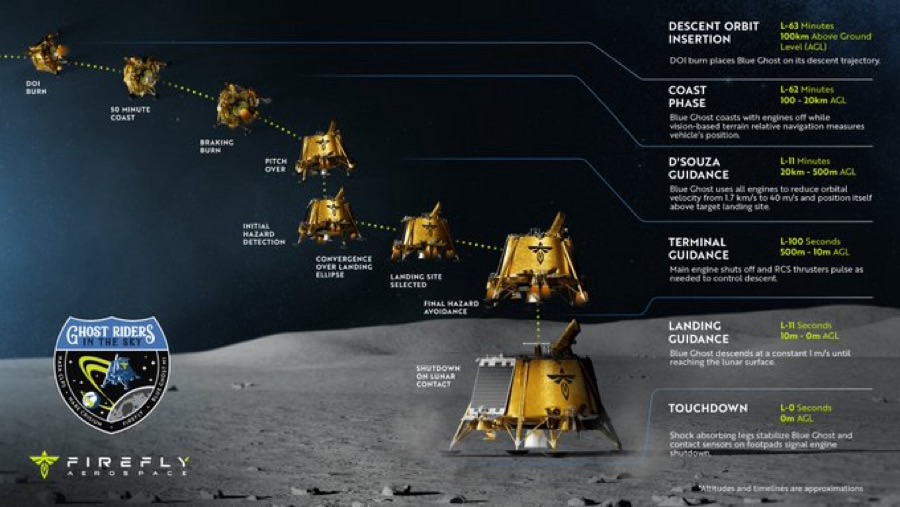
Never forget that at 3:34 AM on March 2, 2025, Firefly’s Blue Ghost lunar lander touched down on the moon’s surface. It’s the second time a private company achieved a soft lunar landing, indicating many good things to come. The first was Odysseus from Intuitive Machines almost a year ago. I know several people at Firefly and know how significant their company is growing in the right direction, and this landing was an important historical marker showing that a smaller commercial company can pull off something like this in a partnership with NASA. It would take NASA decades to do these launches, and now we see these private companies in a profoundly competitive undertaking, and they are doing so successfully. There will be many more good things to come from Firefly, which is very exciting, and this goes along with what I have been saying about space. This landing occurred one day before SpaceX sent Starship 8 into space, and just ahead of Blue Origin, a ship full of women, like celebrity Katy Perry, going into space as if it were just another day at the office. Space is becoming routine, which is what we want to see happen. And the moon has needed much more attention than it has received; we should have never stopped going. I don’t care if aliens were on the moon to scare off Buzz Aldrin and Neil Armstrong, pushing us never to return. NASA moved into the Space Shuttle program after the Apollo missions, but we have never since the early 70s dared to return to the moon. Now, we have private companies doing the job that governments were too slow to do themselves. And it’s all very exciting. Firefly is a great new company, and it will play a significant role in the expansion of a space economy that I have been talking about for quite some time now.
And while discussing it, I’ll make a few predictions. Just as Elon Musk is pushing for humanity to get into space and settle on Mars, to ensure that humans survive, I would dare say that this isn’t the first time our species has encountered this problem. I think we will find that the relics on Mars are from our history and that our move to Earth was for many of the same reasons that we want to now return to Mars. Not to discover it for the first time but to return there and complete a story that began for us many thousands of years ago. Elon Musk is simply fulfilling the hard-wired desires that are built into human consciousness to ensure the continuation of the species, in the same way a sperm knows to penetrate the egg within a woman. We must penetrate space to move our species as a thinking consciousness into the universe, as we were meant to. On earth as it is in Heaven. We are meant to ascend into Heaven, to the kingdoms we know from our past, which are in the sky. Mark it on your calendar and remember who told you all this. Once we move into space and start checking things out, that’s when we are going to learn about ourselves. The proof is coming. I would say that it is all around us, hidden behind our institutionalized history. But that won’t last very long; the evidence is abundant and will be confirmed with a space economy. I could go into quite a long discussion about hidden lifeforms behind a curtain of Dark Matter made of neutrinos and cold fusion. But let’s save that for other times. Instead, let’s talk about the excitement of this growing economy brought to us by commercial-driven space utilization.
At a recent Vivek Ramaswamy governor announcement event at CTL Aerospace, I must have had more than 100 people ask me why I love aerospace. And I tell them that the future is there. It’s been like panning for gold in a little mountain stream during the Gold Rush. I get a lot of offers to make a lot of money doing many things, especially in communications. But I like to stay close to where the gold is, and I like knowing people like the cool cats at Firefly and other companies. I get very excited every time SpaceX puts up a new rocket. From all I know about history and science, I see aerospace as the ultimate gold nugget, and I’ve been committed to it for over four decades. To use a Western metaphor, I’d rather dig for gold in aerospace than sit in a comfortable job in town as a lawyer or communications expert. It’s not the money that excites me; the growth of human intellect and what adventure can bring us is the ultimate treasure. But that doesn’t mean that money doesn’t matter. But on a scale that I think is better than just some average well-paying job. The growth of the space economy will far outpace any technical time humans have ever experienced, whether it be steamships, early airplanes, trains, or automobiles. The space economy will likely contribute hundreds of trillions of dollars to the first to utilize it. And that, to me, is the best of the big gold nuggets. But this time we should have learned some critical lessons, to keep the Marxists out of this business, as they dramatically crippled every modern industry that humans have invented. The Firefly launch is more vital than past attempts when Trump is in office and cheerleading on all these efforts. So, the resolution rate is much higher than at any other time in history.
I watched Brit Hume on Fox News the other night stumble around perplexed about how Trump thinks he will go into all these tariff wars, cut taxes, and still expand the economy. As everyone was, he spoke about an economy that they think has seen the climax of its days and that all government management has to be wrapped around managing those fixed assets. But that’s not where Trump is as he is facing down what we all are, a 36 trillion dollar deficit that is out of control. If you want to fix that without touching the Social Security and Medicare concept, something dramatic has to happen. And as I have been pointing out, it’s in this space economy. With Firefly putting their lunar module on the moon after a drought of 50 years, a half a century. Our economy has been held back by a lot of Marxist parasites who moved into administrative positions at NASA and the Pentagon and held back human civilization in a very catastrophic way. However, the more private people have grown more powerful, and the more that government has lost it, the more companies like SpaceX and Firefly have grown and are now doing the big things. And that is where the future treasures are. And that is the only kind of treasure I care about in the long line of treasures in any economy. The best to my mind is in space, and the adventures to come. And when I see scrappy companies like Firefly have success, I am more than happy for them. These are fascinating times!
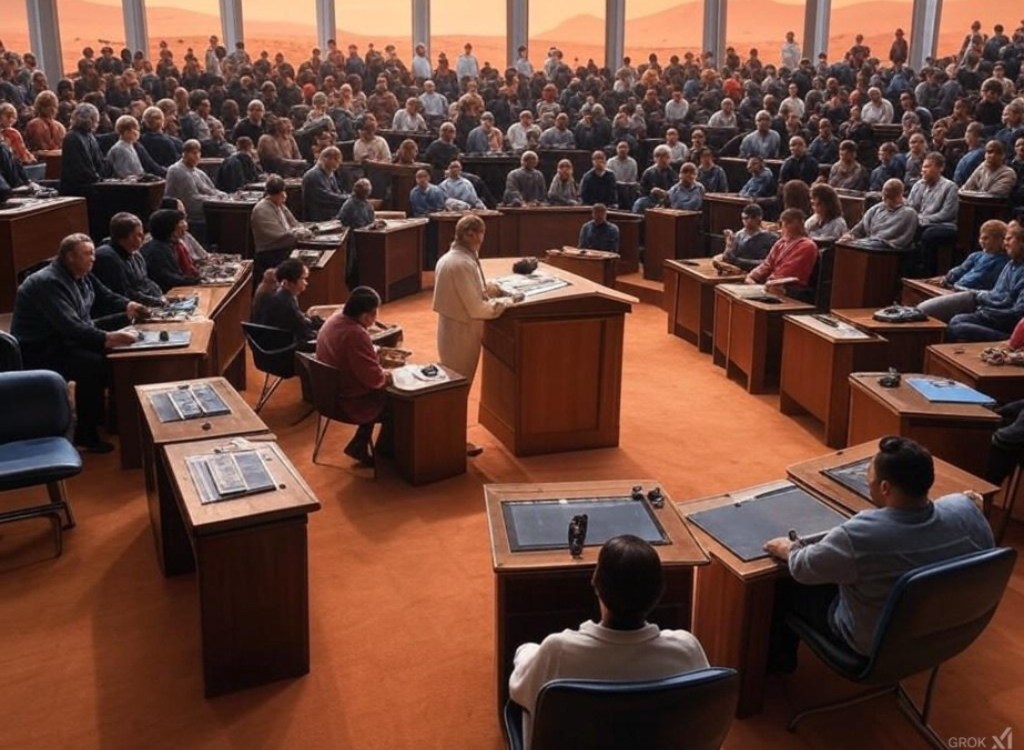
I understood what Elon Musk meant when he expressed that a government on Mars should be a Direct Democracy as opposed to what we have in the United States, a Representative Republic. Many people took that as a knock against our current form of government, which many would consider the best in the world. But I think the point of the matter is to regulate what you want the government to do. I would say that in America, we just voted for a strong CEO type, and coming from the wealthiest man in the world who runs a lot of companies, of course, that would be his recommendation. When we set up a government on Mars, we should give people the right to vote for a strong CEO type of leader. Not a government with checks and balances that are meant to keep the brakes on government activism by making it hard to pass things that can slow down your society. A mature government in a fully functioning country will have different needs than a remote colony of struggling adventurers, so context is everything. But it’s important to consider how leadership is advanced or suppressed in a culture, depending on the kind of government you want to have. Personally, I get asked at least two or three times a week when I am going to run for elected office, and my reply is always that I don’t have the tolerance for all that hand-holding. Politicians have to be patient and need to serve the task at hand. Where I am a very imposing person. I expect people to do things my way or to take the highway. I am not very interested in people who don’t do what I tell them. And I certainly am not a group consensus kind of facilitator. Elected office would be very frustrating because it involves too much working with other people to get anything done.
I certainly understand the need for a time and place to give everyone a seat at the table. In my own family, I get very frustrated in trying to get anybody to agree on anything when we coordinate events together. There is always somebody working, there is always someone sick, there is always someone who wants to do something else. And when it comes to those things and community events, I tend to sit on my temper and let everyone talk until they figure it out. At those times, I sit back and sit on my hands and wait for everyone to get their minds right. It drives me crazy, but its what you have to do sometimes when the people you are working with want to think they are all equally able to express an opinion and desire for an outcome. Our representative government in America is good because it only gives it limited powers to do the bare minimum. However, innovation and exceptional output come from individual leaders who are very strong-willed and can put people on their backs and take them to the promised land. That’s the kind of thing I’m interested in. That is undoubtedly what America voted for in putting Trump back in the White House. We didn’t vote for a continued bureaucracy of three branches of government checking each other’s power. As a strong CEO, we want Trump to impose his will on the executive branch and make everyone else see things his way. Which is the way we voted for. That is the kind of thing that Elon Musk is talking about setting up on Mars. I would say he’s new to this kind of thinking and has the right idea. But as to government, you don’t want your leadership on Mars to come from the government. You want a bunch of innovative CEOs competing with each other to drive culture forward. You want just enough representative government to keep the power and water supply flowing. The basic infrastructure that the government can provide for a society. But nothing more. Our form of government was so powerful because it decentralized the concept of a king. But in a strongly run company, a CEO is essentially a king. So, one thing we have never quite figured out in a capitalist culture is how to have a decentralized government that empowers kings to run good companies and give people options through at-will employment. If they don’t like one company, they can work for another. If their king is a tyrant, they can leave and work for someone much better. Meanwhile, the water works, the power runs, and the basic infrastructure needs of society are handled by a government just powerful enough to do so but not so powerful that it takes over everything.
I fall asleep with all the consensus-building that has been imposed on us by collectivist-based philosophies because they were never going to work. I’m glad people are doing those jobs for school boards, trustees, and commissioners. But I am only ever happy when I can point at someone and tell them to do a task. They perform the task, and everyone celebrates victory. Rule by Consensus is an academic fantasy by the fans of Karl Marx. It’s as practical as unicorns and dragons from fantasy and has no business being discussed along with leadership concepts. Human beings follow strong leaders. Elon Musk, the world’s richest person, knows through experience what a good leader looks like. And when traveling to other planets and setting up civilization there, strong leaders will be necessary. Stalled government concepts will only slow down progress.
When we talk about why we can’t do things anymore, and everything costs so much money, it’s because our government approach has been wrong. When we try to build a bridge or a highway, if we look to the past, there was always some strong personality type that was able to wrestle all the alligators and make boots out of them. This is opposed to the consensus-building approach, in which everyone treats the effort like an Alcoholics Anonymous session. That approach costs money and time and seldom ever gets anything done. And I have never been interested in those interactions with other people. And people who are good leaders check out and do something else. If you want success in a society, you have to give a means to firm leadership to work their magic. We didn’t elect Trump to get along with other people. We elected him to impose his will that we voted for. He told us what he wanted to do, and we empowered him to do it. That is what Elon Musk is talking about for Mars and space travel in general. You never want the government to have too much power. Our current Representative Republic keeps elected officials talking while the real leaders of the world run companies that employ people for everyone’s best interests. We don’t look to the government to provide that leadership level, and we never should. Even though we admire people like George Washington, Thomas Jefferson, and Ronald Reagan, they are exceptions to the rule of a government that needs to have its power regulated and stalled so that a centralized authority doesn’t encumber authentic leadership. And that is a trick we are still working out on earth. We see good examples here and there; Elon Musk is undoubtedly one of them. Trump has always been a successful and influential CEO. But he doesn’t share the spotlight with anybody. He has always been the top dog in all his endeavors. And people dealing with him know it. I’ve never seen authentic leadership share the spotlight of authority and work. Rule by committee does not work. Only strong leadership by influential personalities works. Typically, those are not the people you want running the government. You want them out there making money and employing people so that society has options and innovation to build from.
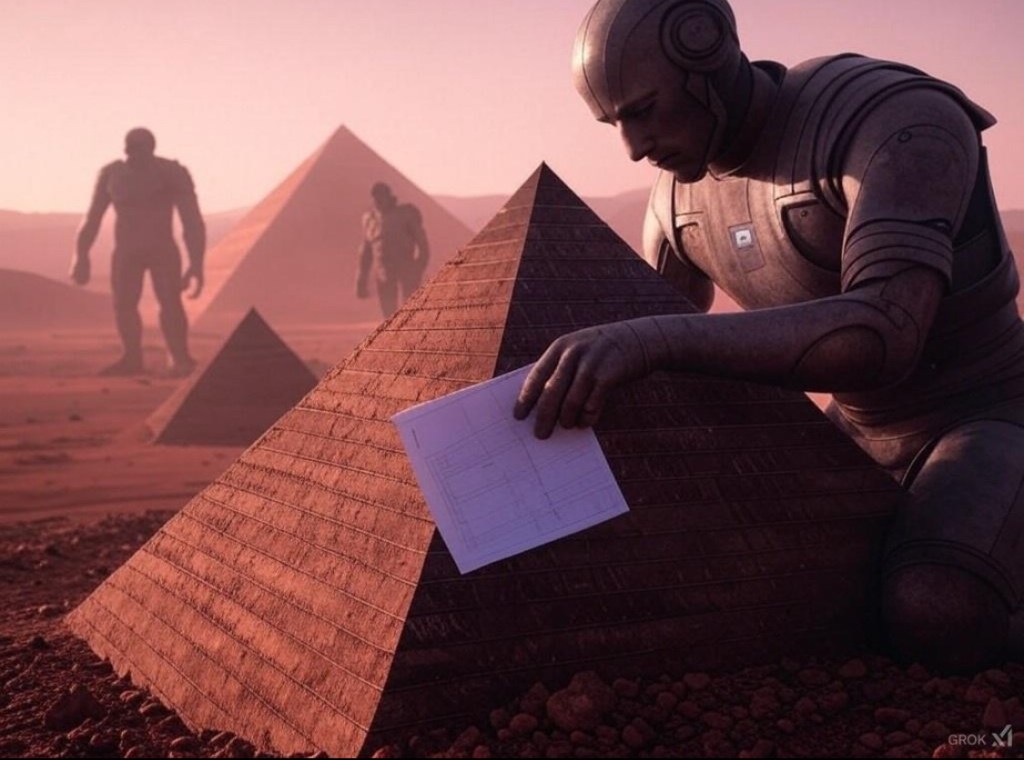
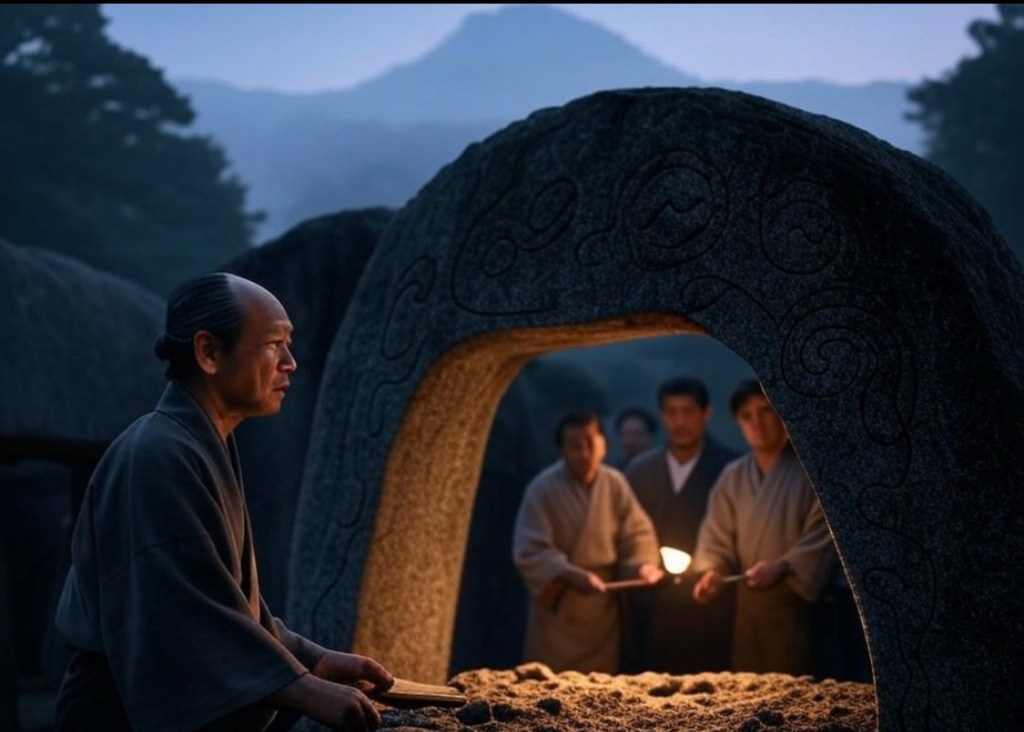
We are far enough along to make some general statements of a reasonably large magnitude. We have enough evidence to understand why the CIA is leaking some of their regression hypnosis experiments, which include a species of large people who built pyramids on Mars. And that the proof that they migrated here to Earth many years ago, likely well before the last ice age, is abundant everywhere. It’s just not where people have been looking. It’s like looking for your lost car keys under a parking lot light when you left them in the restaurant. But the restaurant is closed and dark and you can only see under the light. So that’s where you look for your lost keys. Since I have seen some of the unusual stonework in Ishi-no-Hoden, Japan, and started thinking about just how ancient the Silk Road was from the Near East to Japan, it is evident that the world’s prime real state property from that period is underwater. So the evidence of what came likely from Mars, and even more likely, many other places in the galaxy, forces us to completely re-think our previous assumptions on the evolution of humanity. We did not evolve linearly, migrating from one invention to another, but we have witnessed many tens of thousands of years, perhaps even millions, of rising and falling cultures creating significant stone monuments all over the earth, much of it buried under the water along coastal regions now, were the result of a lost technology that is waiting to be rediscovered and were the result of a race of people who could and did make the journey from Mars to Earth for some needed reason. This culture was global and abundant worldwide, as we are discovering with LiDAR readings revealing massive amounts of civilization thousands of years ago that were trading with each other culturally over vast spaces.
This global culture was having a crisis and built their entire civilization from a mythology of their homelands. In the Mediterranean region going down into what we now call northern Africa, among the Khemetians, Malta, and even into Crete, they revered the Dog Star Sirius as if this global stone-working culture yearned for home desperately. They brought technology and an understanding of advanced mathematics that would have taken tens of thousands of years to develop. These were not hunter-gatherer groups but very sophisticated people with most of their culture erased, except for the stonework they left behind. Everything else has decayed into oblivion and was only captured in oral traditions of subsequent cultures, like the Egyptians, Sumerians, and throughout the Indus Valley. What happens to all cultures, as we are seeing presently in the United States, is that detrimental ideas usually destroy the advancement of civilization. That is, after all, what we see Democrats attempting to do in the modern age, to climb back into a primitive state where they can rule over the ashes. And that is the real secret and reason for the massive cover-up: the admission to the sciences that humanity doesn’t progress along a straight line of continuous achievement. But it can all be wiped away repeatedly by bad decisions and poor government. And in the case of what we have seen on Earth, it can be wiped out and, in many cases, wholly forgotten. When I saw Ishi-no-Hoden for myself, after visiting places like Stonehenge and Chichen Itza personally, and touched the rock as opposed to just seeing pictures of it, I am confident that the culture that made these things were far more advanced than we are today about certain kinds of things. Their roots came from other places besides Earth because their religions and philosophy, captured in passed-down myths, have a crisis of abandonment that always points back to the stars, like Mars and Sirius.
And many authorities know what we will find once we return to Mars, which is happening rapidly now. As I said, the CIA has done remote viewing on these subjects, and much of what we know is going to be declassified under the Trump administration; they are trying to leak out long-held secrets because the psychological impact is going to be tough for the entire human race to deal with. But Elon Musk made it so that humanity can return to the stars, and once we get out there, we will find ourselves in the process of rediscovery. That’s the primary reason we never returned to the moon. We will see archaeology everywhere, which is from our previous cultures. Just as we see all over the earth now, we have not given it much thought because the coastlines have changed significantly since those early times. The ocean levels were more than 400 feet lower during the Ice Age and off the coast of Japan, the entire area of the Persian Gulf north of Qutar, large spans of territory south of Italy down into Malta, and all across the Atlantic, around Florida, Central America, everywhere, the evidence of this very ancient culture is there and tells the story of migration from Mars to Earth, and they brought with them their advanced culture that had been moving about the galaxy with great activity. But they were somewhat abandoned on Earth and yearned to return home to the stars.
As I have said in the case of Deloris Cannon, I believe quantum mechanics can explain remote viewing and is a valid science. What the CIA experimented with revealed startling information that became power over the rest of the branches of government that they tried to justify as national security. However, it ended up being detrimental to the human race because the psychology of such knowledge could and would be catastrophic. And that so many institutional powers invested their reputations in a line of dialogue that just has not been accurate but instead was self-centered and empowering. We came from a creation story so that we didn’t have to admit the truth, that we came from the stars and are now returning. And that much of what we have been doing for tens of thousands of years is striving to get back to where we came from. And the secrecy the CIA has been trying to hide from us all is coming undone with that same trajectory. The jealousy that the institutions tried to guard against this global realization of the evolution of humanity is now falling apart among all known governments; they have lost the ability to contain the truth. The truth is in places like Ishi-no-Hoden, the assumed age is 14,000 BC. Or on Malta, building temples to the star of Sirius in 3,600 BC, over 5000 years ago. Think about Sirius Radio. The signs are everywhere; humanity knows, even if they don’t consciously have a way to connect that knowledge to their terrestrial realities passed down through institutional sciences that were always wrong. The human race makes terrible decisions and regresses to acting like Stone Age malcontents, always hunting for food and warmth around a campfire. That doesn’t mean that society didn’t develop into something lofty that could travel between planets at times in the past or well into the future, as we are doing now. And if you want the proof, I would say it’s at the bottom of the Persian Gulf. It is under Mount Moriah, where the Temple of Solomon was built over some of that ancient past. God wanted Abraham to sacrifice Isaac upon that Foundation Stone there. There was a vast history at that spot that the world’s religions have been trying to mask. But we see it in the tunnels under the Holy of Holies where the current Dome of the Rock resides. History is there for all if only people could look at it. Or to look for their car keys where they last left them instead of where it was most convenient to look. The proof is everywhere, especially along the ancient coastlines when the oceans were much lower than today’s. And what we see there is a culture that we will visit again on the surface of Mars once we start settling there again. Then we’ll admit the obvious: it wasn’t aliens that came from Mars and the stars to visit us and bring us technology. It was us all along.
I haven’t let myself get too encouraged by Elon Musk’s “Occupy Mars” campaign. He’s been excited about it for more than three decades now, and he has made himself a multi-billionaire, with the projection to become the first trillionaire not for the love of money and fame that comes with such enterprises but simply because he wants to bring science fiction, that he loved as a kid, to reality through engineering excellence. I didn’t think he had much chance until this last election, and I’m glad he did what he had to do to see his vision through. It wasn’t enough to be one of the world’s greatest inventors. I remember the stories of Edison, who was incredibly late in life trying to solve the riddle of manufacturing rubber for the upcoming car industry, which was a real problem. What Edison never solved was the politics of the matter. And, of course, Edison’s employee, Tesla, had all kinds of great ideas about energy and how it could be distributed. Edison’s method won out because it required infrastructure, the government could manage it, and unionized employees could stick themselves right in the middle of the whole thing and give us the uninventive mess we have today. Seldom do good ideas break through to the kinds of frontiers that Elom Musk is about to enjoy because he moved his politics toward the winning Trump administration, which is about to unload on the world all the best that science fiction could give us. A significant boom to the aerospace markets for which SpaceX will be able to do all it ever thought about and more. Suddenly, going to Mars and colonizing it is very viable, with real economic value coming directly from it, and it will all be very exciting. I’m officially a major supporter of the Occupy Mars movement. It is the most exciting thing we can do as human beings.
But a math problem has been at the heart of all our politics for centuries now. The responsibility for adventure or the sacrifice to higher powers is at the heart of earth worship. So, our next technical objective to overcome is not the engineering feats of getting to Mars, colonizing it, and terraforming the planet to restore it to a vibrant place that was likely full of life. The problem now is with human beings being able to wrap their minds around the whole effort, and for that, I have found myself obsessed with reexamining King Solomon’s Temple in Jerusalem and studying all the vast tunnels under the city and understanding the importance of the most contested piece of real estate on planet earth. Because I’m one of those people who think the evidence all adds up to Jerusalem being necessary to the seeding of Earth from a distant point in history, more than 10,000 years ago, and the cave under the Holy of Holies which is now concealed by the Dome of the Rock under Islam control was there long before Abraham went to that spot to kill his son Isaac in a sacrifice to God. I think we are about to make a series of earth-shattering discoveries that date many of these things to much longer than we typically measure them, and the ramifications will indeed be jarring to all involved. That’s all part of the adventure. Because what’s important here is at the heart of most of the world’s problems, do you advance life through sacrifice, as they did at that Temple? Or do you advance life through science and thought? The new incoming Trump administration will rule through thought. He, Trump, has been given a divine mandate to fight back against the forces of evil that have held back the human race for many thousands of years. And it’s going to get untangled over this next Trump term.
That leaves us to talk about birthrates. We have needed them to increase for several years. We have a culture that has openly sought to cheapen life, to kill their babies much the way the ancient Canaanites did to their Mesopotamian Gods, especially Baal, who is the real villain of the Bible. Baal, the dominating god of nature, is in constant combat with Yahweh, the God of the Hebrew people and author of the Ten Commandments. One group wanted to kill their kids to prop up the sentiment to their deity of choice, the nature-worshipping cultures of Baal or the self-fulfilling, creative cultures of Yahweh. We need many more children on Earth to migrate human beings into space, and that is considering the massive amount of AI that will be required. We are talking about the plot of the movie Blade Runner here, the morality of the nature of life itself, and whether or not robots will have human rights as a form of intelligence. These are significant issues, but the bottom line is that if we want to put 1 million people on Mars by the very near date of 2050, which we do, just 25 years from now, then we have to change a lot of our life policies from what they have been to what they need to be. We need many more families having many more kids than they have been, and they need to have fun doing it.
We need to get back to the birthrates of the past, where families often had five or more kids all the time. My grandparents lived during such a time. My grandmother was a twin, and her mom had so many kids that they traded them like baseball cards. “Hey, I have an extra one of these. Do you want one.” A family member took her brother because my grandmother’s family had way more kids than they could afford to take care of themselves. Some of these families had more than ten kids each. This kind of Western expansion mentality is essential to human growth stages, and we need to exceed even that in the next few years to expand human life into space the way we need to. Depressing that ambition is simply a held sentiment to the old Baal worship of the Canaanites and other sacrificial cultures around the world. Our low birthrates of today are caused by social sentiment toward earth worship, to keep humans attached to their mother, and not to grow up healthy and independent as a culture of adventurers. But to cleave close to mother in an unhealthy way that stifles us permanently, and ultimately destroys our species for the good of the planet, and views humans as a virus upon that mother which needs to be destroyed. Ultimately, human growth into space is to settle that long-residing dispute in Jerusalem. Do we kill our kids to sever the jealous whims of a broken-minded deity, or do we have lots of kids and treasure them all as representatives of human consciousness and the perpetuation of the creative spirit of humanity into everlasting life born from the earth, but to settle the cosmos on a series of many adventures that was the point all along. And to that, I say, “Occupy Mars!”
Well, I mean exactly that when I say I’m looking forward to returning to Mars. I do indeed mean, return. I’m very excited for the next SpaceX mission into space with its Starship orbiter. Going to Mars is important, even if the Biden administration isn’t at all excited about it. In fact, the entire Liberal World Order isn’t excited about it, and for a good reason. Options take power away from them, and they want limited options for the human race to give themselves more power. It’s the classic problem of those in communist countries trying to flee those places for freer destinations. That is the same reason the Biden administration and Liberal World Order are generally not excited about commercial space travel. They want a centralized government controlling everything, and humanity moving into a space-oriented civilization only complicates that for them. So, of course, the FFA is slow to give SpaceX permits, and that will have to change for Elon Musk to do what he wants, which is to send hundreds of Starships to Mars and the Moon soon so that mankind can finally take that giant leap that started with the moon, but stopped when NASA became overrun with mindless bureaucrats, congressional funding based purely on politics, and a world order that wanted to make Earth the center of the universe so they could maintain power, and to keep it that way. But SpaceX has their permit for the orbital launch, which will happen in late October or early November, which is very exciting. Mars awaits.
This is all speculation but based on hypothetical knowledge based on the evidence that we have so far been able to gather, Mars, around 17,000 years ago, looks to have been hit by a very large planetary object from the southern hemisphere pushing up toward the north. The impact was so significant that the crust of Mars in the northern part of the planet was punched away, nearly destroying the planet entirely. The debris field between Jupiter and Mars is likely evidence of the intended killer. And still, on Earth, a lot of debris continues to fall each year as it is still floating around in space, only to be eventually caught in our gravitational pull. It might take several more thousand years for it all to fall on Earth and surrounding planets. Science fiction movies don’t do a very good job of capturing the timeline of geology in space.
To move into Space, we need Capitalism as the driver of our politics
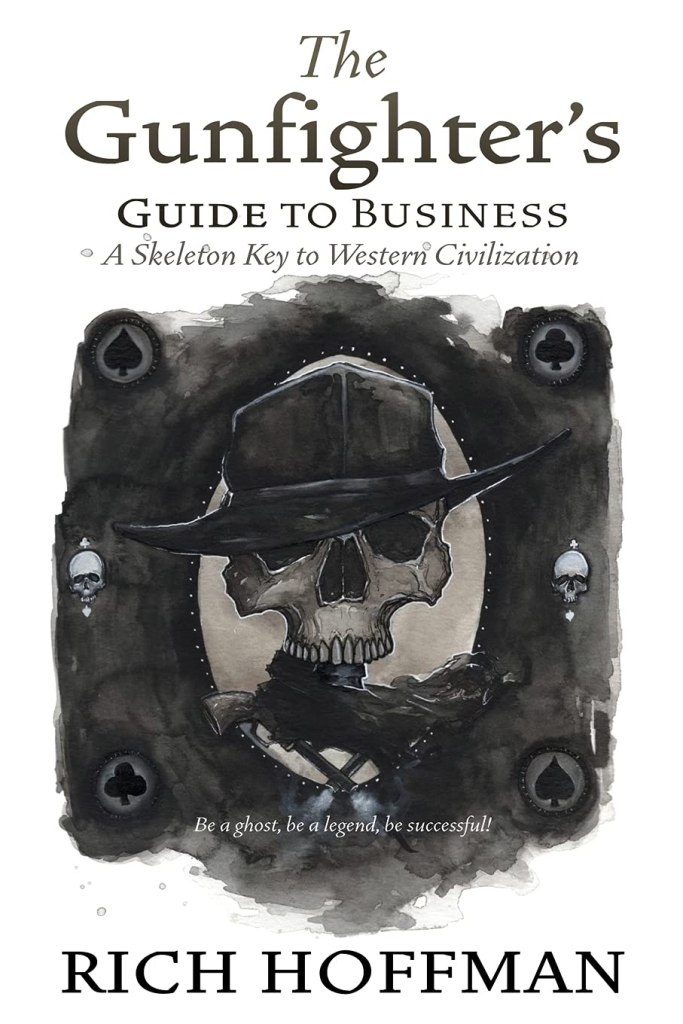
I am by far not an Elon Musk fanboy. I like a lot about Elon Musk and the great work he does with Tesla and SpaceX. But I’m not crazy at all about his talk about universal incomes and climate change. I view a lot of what he says as a guy throwing up ideas, much the way he runs his companies, and if someone can shoot holes in his thoughts, he welcomes that chance. He sees it as making things better. I could talk and argue with Elon Musk all day and year, and I would have fun doing it. And I think he would too. But I found an extraordinary moment from him recently on Part III of the exclusive Everyday Astronaut interview where Elon walked them around the Starbase facility ahead of a Superheavy launch attempt. I’ll put those interviews up here for you to watch, but I found them remarkable. Space X is how most companies should be run. It reminded me of the eventual aim of my recent book, The Gunfighter’s Guide to Business, which is to learn not to be afraid of those who intend to impose fear on you. To learn not to fall in love with rigid rules and to reunite yourself to risk because that’s how the human race advances. During Part III, Elon paused and referred to just that very concept. But he knows he can’t say such things. He has all kinds of people who follow him, liberals, conservatives, people who have no idea what they are. He currently has to work with the Biden administration if he wants to send ships into space. He must also work with other countries, like China, because we are all tangled together in unhealthy ways. So, I get why he couldn’t say what he wanted to say. But I am under no such restriction.
I don’t typically think of the “degrowth movement” as an accurate word. Still, the way Mark Levin talked about it in his recent book, American Marxism, seems more appropriate when talking about the sciences than just saying “socialism” or “communism.” Many young people think of these things not as a recent threat but as an ancient menace that expired well before their time. But they understand growth, and for this topic, it’s certainly the correct way to term what the political left has been doing. Elon Musk has played around with left-leaning ideas, such as the universal income, electric infrastructure ran by solar, and even smoking pot on a podcast to show how cool and hip he was. Those are all things that have made me ignore what Elon Musk has been doing. That is until he does something magnificent like developing the Falcon rockets for reusable landings and building the Starships in Texas. Slowly over time, I’ve watched Elon as he has tried to do “growth” things in a world run increasingly by “degrowth” personalities; he has been getting frustrated. For instance, he moved to Texas, leaving California behind after the ridiculous Covid policies shut down the state economically. And recently, when environmentalists threw protests toward his desire to build a Starship factory at the Starport facility because of water concerns, he sounded more like a Trump supporter than a centralist libertarian.
Musk is trying to do all pro-growth in a world being drug into a no-growth period by the participants of the Vico Cycle, which I explain in detail in my Gunfighter’s Guide to Business. These cycles are not new to the human race, they have occurred many times in the past, and we end up constantly re-inventing ourselves. And that is what Elon Musk sees he is up against, and he let it out a bit during that Part III interview. That was the primary reason I wrote my book, to help people not repeat the past, but to punch through into this new space age not with restriction and fear, which the communists of the world want, but with unrestricted adventure fueled by the power of capitalism. When it comes down to the various philosophies, we cannot all have different ideas about the direction of the human race. We either want to grow or retreat into the huts of history and return to yelling at lightning bolts and attributing gods to their origins to make sense out of a storm. Or, we want to fly about those mysteries into the worlds beyond and fulfill our quests for adventure, both large and small, on a vast playing field of unlimited possibilities. The two views of the world will not live together forever. The inflection point is upon us.
And that’s when Elon Musk realized that everything done at SpaceX would disappear in an instant without him. It is he alone that is doing all these outstanding achievements. Sure, he has lots of brilliant employees who do the heavy lifting, but he provides the vision, and without vision, nothing happens. If human beings are going to be a space-oriented society, then a new type of government will have to be embraced. The one we have now, which fought hard to keep Donald Trump from being president and wanted to get rid of him when he was, will not allow the efforts of Elon Musk either to carry humans into space. We have to solve one problem at the philosophical level if we are ever to put 1 million people onto Mars like Elon Musk wants to do. We have to have a growing economy with an increasing workforce to accommodate it all. To have hundreds of thousands of people on the moon, Mars, and wherever else in the next couple of decades, Elon can do the math that was in his words during the interview. The illogical politics of our current moment, driven by communism and Marxism, are just wrong for the adventure of space.
Going even further, we have never solved these problems even in our science fiction, except perhaps in Star Wars. People need to be free, adventurous, experimental, and free to fail for space to work. A micromanaging government will always be in the way of what Elon Musk wants to do. He can only smoke joints so much, enough to keep the parasites off his heels. He can only spout off so much greenie weenie appeasement to keep the environmental protestors from standing in the way of a new Starship manufacturing plant in the middle of the desert. And that is the point of my book, not to crawl back into the Old West and sleep in hot unairconditioned cabins using the restroom outside. And getting water with a bucket every time you wanted a drink. Modern conveniences are good to have. But what we may not want to leave behind is the courage and adventure of discovery and wealth building. I would say that those are far more essential things than climate preservation or the appeasement of soft-natured Marxists looking for a big daddy government to care for them the way their parents failed. Once we solve those problems, we can then move to space. Elon Musk has figured out how millions of people are excited about it and follow his every move. They don’t know that the politics they wish to ignore are just the very thing that will keep their feet on the ground and their starships from flying. We must solve the politics before we can solve the space.
Rich Hoffman
The Gunfighter’s Guide to BusinessClick to buy The Gunfighter’s Guide to Business