

Pip: Rich Hoffman spent the fall playing Jason Voorhees in a haunted maze, watching Godzilla sequels, and connecting it all to a destroyed planet mentioned in the Book of Job — which is either a unified theory of everything or the most interesting Tuesday in Cincinnati.
Mara: That’s actually a fair summary. This episode covers one extended piece by Rich Hoffman — fear as a control mechanism, ancient textual traditions, and what Godzilla has to do with Mars. Let’s start with the fear architecture underneath all of it.
Fear, Narrative, and the Machinery Behind Election Cycles
Pip: The question the post is really asking is why so many people keep voting and living as if they are not free — and the answer it proposes starts in a haunted house, not a think tank.
Mara: The setup is direct. After four nights a week inside the Jason: Blood Reign maze at Kings Island, the observation is: “Most people freeze, scream, or bolt in predictable directions. A smaller number laugh or posture. Almost no one stops to analyze the situation rationally in the moment.”
Pip: And the leap from haunted maze to political system is the whole argument — that the same mechanism running the scare actor runs the expert class. Create anxiety, then offer the peer group or the state as the only exit.
Mara: The 2026 midterm results are the concrete case. Voters under thirty, facing real pressures around housing costs and education debt, appear to have concluded that a more powerful government is the remedy. The post traces that back to an education system that, quote, “treats market economics as optional or suspect.”
Pip: The bathroom graffiti is where it gets almost too on the nose — someone carved “capitalism < communism” into a freshly renovated theater stall, which is either a data point or the world’s least efficient op-ed.
Mara: It’s treated as a data point. The argument is that peer pressure handles most of the ideological transmission — if your standing with teachers or future employers depends on repeating the correct views, most people will repeat them. No conspiracy required, just ordinary institutional incentives.
Pip: So the haunted maze is doing the same work as the school curriculum, just with better lighting design.
Mara: Godzilla Minus Zero carries the same logic into film. Takashi Yamazaki’s sequel opened to roughly $30.6 million domestically — the largest opening for a live-action foreign-language film in North America — and audience scores near 96 percent. The post’s argument is that Japanese filmmakers, working with fewer resources, are still telling coherent stories about responsibility and the cost of violence, while Hollywood has largely stopped.
Mara: The Rahab thread connects it to something older. In the poetic books — Job, Psalms, Isaiah — Rahab names a chaos monster God subdues. David Flynn and others have argued that name preserves a memory of a destroyed planet whose remnants now form the asteroid belt.
Pip: Mainstream planetary science puts the belt’s total mass at about four percent of the Moon’s — not exactly the wreckage of a world. But the post isn’t claiming established fact; it’s applying what it calls the keys-in-the-dark logic.
Mara: The analogy is precise: “Suppose you drop your car keys somewhere between the door of your workplace and the car. It is dark. You search under the light near the car and do not find them. That does not prove the keys do not exist.”
Pip: Which is a genuinely useful epistemological point, even if you’re not ready to book a flight to the asteroid belt.
Mara: Timothy Alberino’s work on giants and the Book of Enoch, Sharon and Derek Gilbert’s Veneration on the Rephaim, and Ohio’s Serpent Mound — sitting on a confirmed impact structure — all get pulled into the same frame: cultures building ritual meaning around places and events whose physical evidence is no longer easily readable.
Pip: The practical upshot is that if residual trauma from pre-recorded-history catastrophes shapes how institutions manage fear, then the 2026 results, the Godzilla box office, and the interest in Nephilim lore are all the same phenomenon wearing different clothes. That’s a wide net — and it’s cast deliberately.
Mara: The thread running through all of it is that fear is infrastructure — built, maintained, and used — whether the context is a haunted maze, an election, or a ancient text about a shattered sky.
Pip: And the suggestion is that the archaeology of the next few decades may be more interesting than most people currently assume — which, honestly, seems like the right note to end on.
Rich Hoffman
More about me
Click Here to Protect Yourself with Second Call Defense https://www.secondcalldefense.org/?affiliate=20707
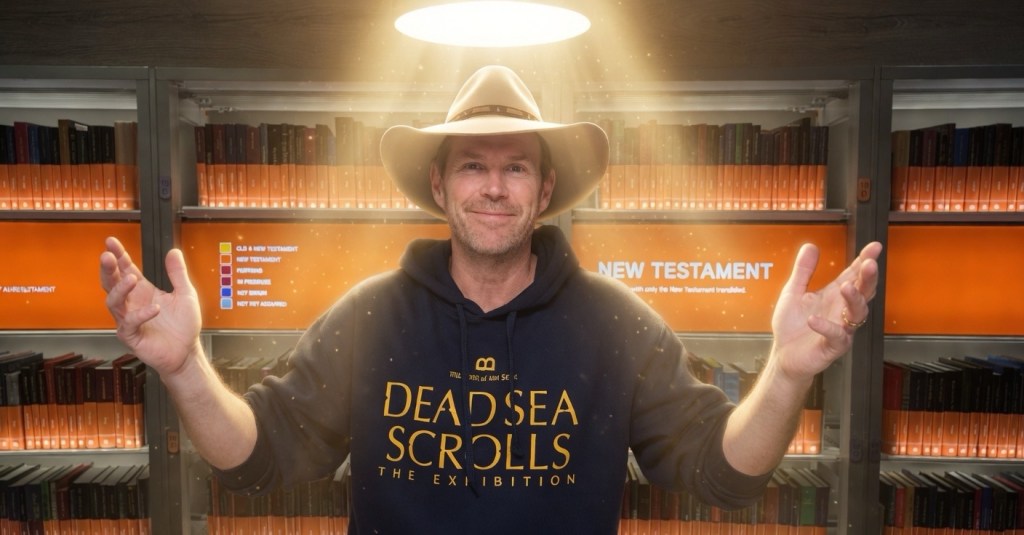
Rich Hoffman is an author, political consultant, and strategic advisor based in Cincinnati, Ohio, and the creator of The Politics of Heaven—a unique framework that connects biblical theology, ancient history, and modern power structures to explain how moral alignment and spiritual forces shape global events. Blending real-world political experience with deep research into archaeology, UFO phenomena, and suppressed historical narratives, Hoffman offers compelling commentary on topics ranging from ancient civilizations and the Dead Sea Scrolls to modern populist movements, paranormal continuity, and leadership strategy in chaotic environments. As the author of The Gunfighter’s Guide to Business and the forthcoming Politics of Heaven, he brings a grounded yet provocative voice to media discussions, supported by firsthand experiences and a cross-disciplinary approach that bridges science, history, and theology. For interviews, speaking engagements, or expert analysis, visit richhoffmanbooks.com or contact directly by email at rhoffman@richhoffmanbooks.com. If you’ve seen the movie, Disclosure Day and want to talk about it and the implications of Presidnet Trump’s UAP disclosures, let me know and we can bring some color to your coverage. https://richhoffmanbooks.com/media-inquiries-broadcast-topics-and-contact-info/?frame-nonce=ad51e7ecba I do have a firsthand UFO encounter to discuss.Footnotes

