
Podcast Episode: Politics, Health, And Fear

Pip: The Overmanwarrior is covering election eve in Ohio, the price of gas, ancient skull cults, and the case for owning a good ratchet — which is either a very broad week or a very honest one.

Mara: Rich Hoffman has been busy. This episode moves through Ohio campaign politics and what’s actually at stake on election day, into the economics of refinery capacity and healthcare costs, and then into the deeper question of how fear functions as a tool of social control. Let’s start with the race for Ohio governor.

Ohio on the Eve: Vivek, Turnout, and the Violence Question

Pip: The core tension in the election-eve post isn’t really about Vivek Ramaswamy versus Amy Acton. It’s about a quieter and more unsettling question: why should people who’ve lost faith in the ballot bother voting at all?

Mara: The post opens at Lori’s Roadhouse in West Chester after Ramaswamy’s final campaign stop, and the message from the stage was simple. As it’s put directly: “The encouragement from the stage was simple: go vote, and call your friends and neighbors to do the same.”

Pip: And then comes the harder conversation — the one that happened off-stage, with people between the cities who are not deeply interested in politics and whose question was: why go vote?

Mara: Right. The concern isn’t Republican turnout math, though that’s addressed too — the argument is that Republicans far outnumber Democrats in Ohio if they show up. The deeper worry is people who’ve already concluded the system is broken enough that violence feels more logical than voting.

Mara: The healthcare piece connects here — a Ramaswamy administration, it’s argued, could give Republicans a concrete governing story by applying SpaceX-style cost reduction to cancer treatment, making the ballot feel like it produces something tangible rather than just holding the line.

Pip: So the ask is: vote before you feel you have to do something worse. That’s a more honest get-out-the-vote message than most.

Mara: And the closing line lands the stakes plainly — voting is described as the most peaceful way to maintain representative government, and the alternative some people are already contemplating is treated as a real and present danger, not a rhetorical flourish.

Pip: The refinery question has the same structure underneath it — a constraint that policy created, and a cost ordinary people pay every time they fill up.

Herbie at the Pump: Refinery Constraints and the Cost of Protected Systems

Pip: Gas prices stay high even when crude supply isn’t the problem — so what is the actual bottleneck, and who built it?

Mara: The anchor here is Eliyahu Goldratt’s Theory of Constraints, applied directly to American fuel markets. The argument is stated plainly: “In American fuel markets right now, refining capacity is Herbie. We have enough crude. We do not have enough slack in the plants that process it, and the policy environment that created that condition has been running for decades.”

Pip: So the constraint isn’t geology — it’s the regulatory and capital environment that made building new refineries a losing bet for fifty years.

Mara: The numbers make that concrete. In 1982 the U.S. had 301 operable refineries. As of January 2026, roughly 130 remain. Capacity barely grew because the industry consolidated into fewer, larger plants. And utilization has been running above 93 percent, hitting over 95 percent for most of the summer of 2026 — the highest sustained rate since 1998. There’s almost no buffer left.

Pip: No slack in the system at all.

Mara: Which is why California illustrates the extreme case. Phillips 66 and Valero have both closed or are closing major West Coast plants — removing several hundred thousand barrels per day of capacity — because the regulatory stack made continued operation less profitable than shutting down. California regular was near $5.89 while the national average sat around $4.27.

Mara: The piece “Don’t Squander the SpaceX Gift” draws the same line into healthcare — hospitals billing $722 for an IV push on a medication billed separately, a cost-plus culture as entrenched in medicine as it once was in aerospace, and the argument that competitive models will eventually force the same reckoning that SpaceX forced on rockets.

Pip: The upshot is that the constraint in both cases was engineered by policy, which means it can be changed by policy — but only if someone’s willing to admit that’s what happened. That’s where the culture question comes in.

Fear as Software: Control, the Haunt, and the Politics of Heaven

Pip: This is the widest segment — it starts with Jason Voorhees at Kings Island and ends somewhere near ancient Canaanite skull cults, which is either a long walk or a very short one depending on your priors.

Mara: The post “The Politics of Fear” frames the whole project explicitly. It describes the argument as: “non-human intelligence — whether framed as demons, interdimensional entities, or residual ‘software’ written into human cognition — operates primarily through fear, peer pressure, and mythic narratives.”

Pip: So fear isn’t just an emotion — it’s a control mechanism, and the haunted house is a laboratory for watching it work in real time.

Mara: That’s the method. Working as Jason Voorhees in the Kings Island Blood Reign maze across roughly 22 operating nights gave a large sample of human behavior under controlled terror. The observation is that guests who knew exactly where Jason was still jumped — and that the bounded certainty of the scare itself provided relief from more diffuse everyday fears.

Pip: And the gendered responses under that pressure are treated as data, not anecdote — mapped onto older patterns of appeasement and status-seeking under conditions of uncertainty.

Mara: The companion piece, “Jason at Kings Island and the Rules of the Haunted House,” draws the political parallel directly: some guests, once they understood the rules protected them absolutely, became rambunctious and tested the boundary. The argument is that the same asymmetry operates when a group uses a host culture’s free-exercise rules as a shield while its own foundational norms don’t reciprocate those protections.

Pip: The rules can be used against the people who wrote them — and naming that asymmetry is treated as the necessary first move.

Mara: Then “The Tool Belt Life” comes at the same problem from the ground up. The administrative state, the argument goes, trains people to manage decline rather than fix things — and the correction starts with people who still know how to put a tool belt on. The happiest periods described are the ones spent in machine shops and gunsmithing bays, where the problem is visible and the feedback is immediate.

Pip: Calloused hands as a counter-narrative to institutional capture. The fear segment and the tool belt piece are making the same point from opposite ends — one about what controls people, one about what frees them.

Mara: And both connect back to the ballot. If you understand the mechanism — whether it’s a refinery bottleneck, a billing regime, or a social control system — you can address the actual constraint instead of yelling at the wrong variable.


Pip: The thread across all of this is the same: find the real bottleneck, name it honestly, and don’t let the rules be used to prevent you from doing that.

Mara: Whether it’s refinery capacity, cancer treatment costs, or the question of who shows up to vote — the argument is that the constraint was built, which means it can be dismantled. Next episode we’ll see what comes after election day.

Rich Hoffman

More about me

Click Here to Protect Yourself with Second Call Defense https://www.secondcalldefense.org/?affiliate=20707
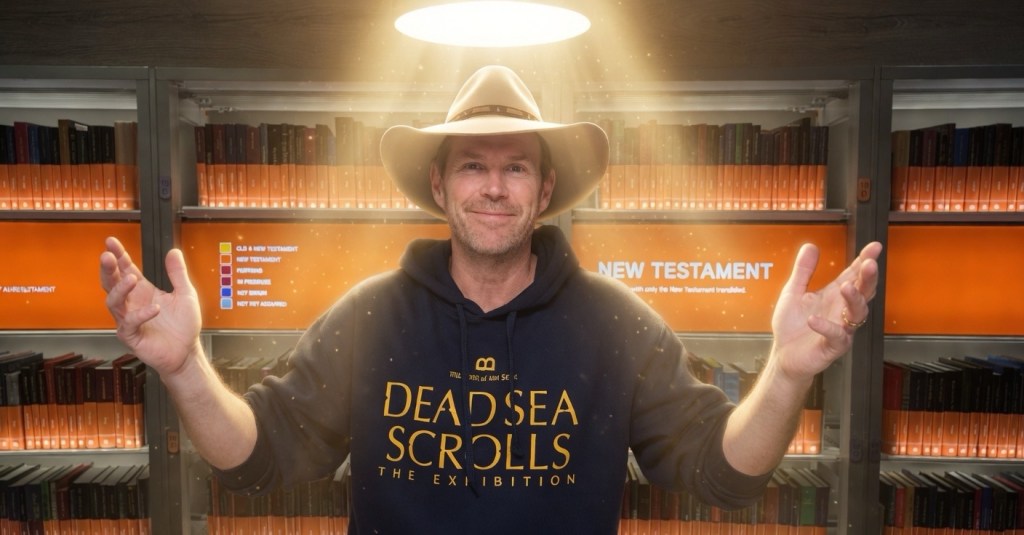
About the Author: Rich Hoffman

Rich Hoffman is an author, political consultant, and strategic advisor based in Cincinnati, Ohio, and the creator of The Politics of Heaven—a unique framework that connects biblical theology, ancient history, and modern power structures to explain how moral alignment and spiritual forces shape global events. Blending real-world political experience with deep research into archaeology, UFO phenomena, and suppressed historical narratives, Hoffman offers compelling commentary on topics ranging from ancient civilizations and the Dead Sea Scrolls to modern populist movements, paranormal continuity, and leadership strategy in chaotic environments. As the author of The Gunfighter’s Guide to Business and the forthcoming Politics of Heaven, he brings a grounded yet provocative voice to media discussions, supported by firsthand experiences and a cross-disciplinary approach that bridges science, history, and theology. For interviews, speaking engagements, or expert analysis, visit richhoffmanbooks.com or contact directly via phone at 513-307-5815 or email at rhoffman@richhoffmanbooks.com.  If you’ve seen the movie, Disclosure Day and want to talk about it and the implications of Presidnet Trump’s UAP disclosures, let me know and we can bring some color to your coverage. https://richhoffmanbooks.com/media-inquiries-broadcast-topics-and-contact-info/?frame-nonce=ad51e7ecba I do have a firsthand UFO encounter to discuss.

Vote Like Your Life Depends on It: Reflections from Vivek Ramaswamy’s Final Campaign Stop on the Eve of the 2026 Election

I just returned from Lori’s Roadhouse in West Chester, Ohio, after Vivek Ramaswamy’s last campaign stop before the election. A number of Ohio officeholders came out to speak alongside him. The speech was long—longer than ideal for people already heading out to vote—so I will condense the essence of what I heard and what I discussed with people there and afterward.[1]

Lori’s Roadhouse continues to do great things for these kinds of events. The place was packed with signs and energy in a way Amy Acton could never have matched. You will not see that kind of coverage on the news or on Fox, but the basics are clear. The encouragement from the stage was simple: go vote, and call your friends and neighbors to do the same. That is the message I am giving my readers and viewers right now.

I have watched Vivek grow into this role over the years. He was right when he noted in his speech that the campaign launched just a few miles from Lori’s Roadhouse—at the business I ran. I was proud he chose that location, and it was bittersweet to see the campaign season come full circle there. The owners are good people, and every event held there has been excellent. The crowd was energetic, and Vivek appeared in a way many people had not seen before.

The Numbers Game and Republican Advantage in Ohio

This election is a numbers game. If Republicans show up even moderately, they far outnumber Democrats in Ohio. That is why Democrats know they have to stretch every process. Amy Acton is a disaster; I have said so from the beginning. She is the lockdown lady, a horrible candidate who simply does not have the goods down the stretch.[2]

In the numbers, Vivek is well ahead in the places that matter. Acton is not performing well in the counties she needs to overcome him, and those counties will not deliver the numbers required on Election Day. From conversations with people who know the internals the media does not report, the race is well in hand for Republicans if turnout materializes. That also means strength for other races on the ticket.

It is much scarier for Democrats heading into this election than for Republicans. There are simply more Republicans. But if people sit on their hands, representation can still be lost. Do not take anything for granted.

Conversations That Reveal a Dangerous Frustration

The part that concerns me most is what I heard today from people who are not deeply interested in politics—people who live between the cities, who do not know many Democrats, do not want to work with them, and have no desire to break bread with them. Their question to me was: why go vote?

Voting is the most peaceful way to maintain representative government. Their illusion is that nothing will improve until people grab guns, take violence into the streets, and reclaim the country from radicals. George Soros and others have funded efforts that damage Western civilization; evil is at work.[3] But on this election eve in 2026, I believe the best way to maintain self-government is still to vote—not to turn to violence.

Most of the people I spoke with, especially those between the cities, think it has to come to violence before they get their country back. If Democrats thought January 6 was terrible, that was mild compared with what some of these people are thinking. I try to tell them that violence can be avoided by voting. Their response is often that it will be cheated anyway, so who cares.

What’s at Stake: Civility Over Violence

What is at stake is civility itself. If you want a civil society, go vote before you feel you have to grab the guns and take it back with bloodshed the way the Revolution once required. It is yours to hold; you simply have to get up and go. You have to do it at presidential-level turnout.

After the event at Lori’s Roadhouse and the conversations I had, the picture looks strong for Republicans in Ohio if people show up. Republicans way outnumber Democrats, but if you stay home, the other side will represent you because they are the ones voting. Voting is easy. Maintaining self-government through legislative means is far better than the alternatives.

I talked to more than one person today who alluded to having a shell full of ammunition ready to “take care of” the Marxists and communists. That is not a good sign. Giving up on self-rule through the ballot is not a good thing. The other side wants people of Western civilization to abandon peaceful means. Do not give that to them.

A Personal Call to Action

I am telling everyone who watches me, reads me, or listens to me: to maintain civility and protect Western civilization, just get up and go vote. Vote for Republicans, not Democrats. Vote down tax increases. Vote for Vivek Ramaswamy. Things will be much better in Ohio with him as governor, and better in the wider world.

I remember when I first saw the campaign signs—very techie—when he was putting up the art at my business for the rally that opened his governor’s race. I am happy to see it come full circle, and I will be happy to see him as governor of Ohio.

A few months ago I saw Vivek walk into a little restaurant with almost no security. We had a nice personal conversation, and few people reacted. At Lori’s Roadhouse it was governor-level security, a Secret Service-style entourage, and a posse that made it hard to get close. It was strange, but it is exciting. I think he is going to win—but only if people show up.

Do not leave it to other people to decide for you. Vote like your life depends on it, because in a lot of ways it does. We do not want a society that turns to violence in order to maintain self-government. Go vote for the 2026 election.

Footnotes

[1] The event was held at Lori’s Roadhouse in West Chester Township, Butler County, Ohio. Local coverage and posts confirmed the rally timing on the final day of campaigning.

[2] Public polling averages in late October and early November 2026 generally showed Amy Acton with a narrow lead (roughly 2–7 points depending on the pollster), though some surveys were tighter or showed Ramaswamy ahead. Ohio does not have formal party registration; affiliation is determined by primary ballot choice. Early-voting data showed Democrats returning a higher share of ballots than Republicans through late October, with unaffiliated voters forming a large bloc. The author’s assessment relies on claimed internal numbers and county-level expectations not reflected in the public averages.

[3] References to funding of progressive causes and election-related efforts by George Soros and associated networks appear widely in conservative commentary and investigative reporting on philanthropy and political spending.

Bibliography for Further Reading

Ramaswamy, Vivek. Woke, Inc.: Inside Corporate America’s Social Justice Scam. Center Street, 2021.

Ramaswamy, Vivek. Nation of Victims: Identity Politics, the Death of Merit, and the Path Back to Excellence. Center Street, 2022.

Ramaswamy, Vivek. Capitalist Punishment: How Wall Street Is Using Your Money to Create a Country You Didn’t Vote For. HarperCollins, 2023.

Ramaswamy, Vivek. Truths: The Future of America First. Simon & Schuster, 2024.

Hoffman, Rich. The Gunfighter’s Guide to Business. (Author’s work on leadership, individual responsibility, and practical strategy.)

Green, Donald P., and Alan S. Gerber. Get Out the Vote: How to Increase Voter Turnout. 4th ed. Brookings Institution Press, 2019.

Hill, David. American Voter Turnout: An Institutional Perspective. Westview Press, 2006.

Rolfe, Meredith. Voter Turnout: A Social Theory of Political Participation. Cambridge University Press, 2012.

Derber, Charles, et al. Turnout!: Mobilizing Voters in an Emergency. Routledge, 2020.

Levitsky, Steven, and Daniel Ziblatt. How Democracies Die. Crown, 2018.

Mayer, Jane. Dark Money: The Hidden History of the Billionaires Behind the Rise of the Radical Right. Doubleday, 2016.

Caplan, Bryan. The Myth of the Rational Voter: Why Democracies Choose Bad Policies. Princeton University Press, 2007.

Achen, Christopher H., and Larry M. Bartels. Democracy for Realists: Why Elections Do Not Produce Responsive Government. Princeton University Press, 2016.

Brennan, Jason. Against Democracy. Princeton University Press, 2016.

Tocqueville, Alexis de. Democracy in America. (Multiple editions; foundational on American civic habits and self-government.)

Madison, James, Alexander Hamilton, and John Jay. The Federalist Papers. (Especially essays on factions, republican government, and the dangers of majority tyranny.)

Locke, John. Second Treatise of Government. (On consent, property, and the right to alter or abolish government.)

Federalist Society publications and reports on election integrity and originalism, 2020–2026.

Heritage Foundation Election Integrity Project reports, 2024–2026.

Ohio Secretary of State voter registration and early-voting dashboards (2026 cycle data).

RealClearPolitics, Ballotpedia, and multi-state election trackers for the 2026 Ohio gubernatorial race (polling averages, candidate profiles, and historical context).

Local Ohio reporting from the Cincinnati Enquirer, Columbus Dispatch, and Butler County sources on campaign events and county-level dynamics.

Rich Hoffman

More about me

Click Here to Protect Yourself with Second Call Defense https://www.secondcalldefense.org/?affiliate=20707

About the Author: Rich Hoffman

Rich Hoffman is an author, political consultant, and strategic advisor based in Cincinnati, Ohio, and the creator of The Politics of Heaven—a unique framework that connects biblical theology, ancient history, and modern power structures to explain how moral alignment and spiritual forces shape global events. Blending real-world political experience with deep research into archaeology, UFO phenomena, and suppressed historical narratives, Hoffman offers compelling commentary on topics ranging from ancient civilizations and the Dead Sea Scrolls to modern populist movements, paranormal continuity, and leadership strategy in chaotic environments. As the author of The Gunfighter’s Guide to Business and the forthcoming Politics of Heaven, he brings a grounded yet provocative voice to media discussions, supported by firsthand experiences and a cross-disciplinary approach that bridges science, history, and theology. For interviews, speaking engagements, or expert analysis, visit richhoffmanbooks.com or contact directly via phone at 513-307-5815 or email at rhoffman@richhoffmanbooks.com.  If you’ve seen the movie, Disclosure Day and want to talk about it and the implications of Presidnet Trump’s UAP disclosures, let me know and we can bring some color to your coverage. https://richhoffmanbooks.com/media-inquiries-broadcast-topics-and-contact-info/?frame-nonce=ad51e7ecba I do have a firsthand UFO encounter to discuss.