I recently finished Rainer Zitelmann’s New Space Capitalism: The Entrepreneurial Path to the Stars, and I keep coming back to it the way you return to a tool that finally fits the job.¹ The book lays out, without apology, why private entrepreneurial energy is the only force capable of turning space from a government prestige project into an actual economy. It is timely in a way that feels almost engineered. SpaceX just put Starship Flight 13 into the Indian Ocean on July 24, soft splashdown, vehicle intact, heat shield looking better than anything we have seen before.² The ship floated. They got the data they needed. Flight 14 is already being talked about as the first attempt to catch the upper stage with the tower arms the same way they have been catching the boosters. That is not incremental progress. That is the difference between a science fair and an industrial process.
I have been telling people for years that you do not get rich having a job. You get a job so you can generate capital to invest. The job is the seed. The investment is the harvest. Space capitalism is simply that principle applied at planetary scale. The people still arguing for socialism or some managed industrial policy while this is happening are arguing from a world that no longer exists. China has spent years trying to close the gap by copying hardware and flooding the sector with state capital. They just managed their first controlled recovery of an orbital-class booster on a sea platform in July.³ That is real progress for them. It is also roughly where SpaceX was a decade ago. Meanwhile Falcon 9 boosters are routinely flying into the mid-thirties on the same airframe, with landing success rates above 98 percent across hundreds of attempts.⁴ SpaceX flew 165 orbital missions in 2025 alone and accounted for roughly half of all global launches and the overwhelming majority of mass to orbit.⁵ That is not a technology lead. That is a cultural lead.
The difference is not the Raptor engine or the stainless steel or the heat tiles. Those can be photographed, reverse-engineered, and eventually duplicated. The difference is the rate at which the organization turns failure into usable information and then into the next vehicle. SpaceX treats a destroyed Starship the way a good machine shop treats a bad casting: examine it, learn the exact failure mode, change the process, and build the next one faster. Legacy aerospace still largely operates on cost-plus contracts and risk-averse engineering cultures that treat every anomaly as a reason to add margin, add process, and add schedule. The result is that the customer pays more, the schedule slips, and the learning rate collapses. SpaceX inverted the incentive. They absorb the cost of the explosion so they can keep the learning curve steep. By Flight 13 the heat shield held, the engines relit for landing, and the vehicle came down where it was supposed to. That is what iterative capitalism looks like when the capital is allowed to take real risk.
I watch the documentaries SpaceX releases about the troubleshooting and I see the same pattern every time. A giant bicycle-chain style link on the tower fails to release. Someone drives through the night, pulls a spare from Cape Canaveral, hauls it to Boca Chica, and the schedule holds. That is not a process document. That is a producer culture. You cannot copy that with spies or with five-year plans. Communist systems excel at mass production of known designs once the design is frozen. They struggle when the design is still moving and the only people who can keep it moving are the ones who will crawl through broken glass at two in the morning because they own the outcome. Measure engagement by bodies in seats and you end up with four people bumping into each other for two days to produce what one highly engaged person finishes before lunch. SpaceX figured out how to recruit and keep the engaged ones. That is the real moat.
The same cultural gap explains why the space economy is going to generate most of its new wealth inside the United States rather than in China, Russia, or the European Union. Property rights, residual claimancy, and the ability to keep the upside of risk are not optional extras. They are the operating system. Zitelmann is clear on this point: without the ability to own, buy, sell, and profit from what is built off-world, private capital will never flood into the frontier the way it flooded into every previous frontier. Government programs can demonstrate capability. Only capitalism compounds it. That is why Starship production is being scaled toward rates that sound insane until you remember that the same people already turned Falcon 9 into a high-tempo airline. Musk has talked openly about the long-term goal of building ships at aircraft volumes. The Gigabay and the other production infrastructure at Starbase are not theater. They are the physical expression of a belief that the limiting factor is no longer physics but the rate at which you can turn steel and labor into reliable vehicles.⁶
I keep hearing the money managers on Wall Street talk as if they understand this because they read the same research notes everyone else reads. Most of them are still pricing SpaceX as if it is a conventional aerospace contractor with a flashy CEO. They are looking at the wrong variable. The variable that matters is the compounding of learning rate under a producer culture. Once the catch of both stages is routine and the vehicles are turning around in days rather than months, the cost curve drops into territory that changes every other industry that depends on mass to orbit. That is when the millionaires get made, and not just among the early employees. The people who understand that the real product is not the rocket but the industrial metabolism that builds and flies the rocket will do very well. The people who keep treating it as a government-adjacent science project will wonder why the returns never arrived.
Look back at why we stalled after Apollo and the pattern is obvious. Kennedy started it. Nixon finished the landings and then watched the program lose political oxygen. Reagan talked about the Strategic Defense Initiative and commercial space but never forced the institutional change. The Bushes treated it as a budget line. Obama treated it as a photo opportunity. Only under Trump did the commercial providers get the contracting environment that let fixed-price risk-sharing replace cost-plus stagnation. The conspiracy theories about why we never went back are mostly noise. The practical explanation is simpler and more damning: once the political class decided space was a discretionary prestige item rather than an industrial frontier, the producer culture was starved and the looter culture took over the process. Every time a new administration tried to restart the engine it discovered that the institutional memory of how to move fast had been replaced by the institutional memory of how to manage risk into paralysis.
That is the same dynamic we see today when people claim China will simply copy Starship and undercut the market. They can copy the geometry. They cannot copy the willingness to destroy vehicles in public so the next one is better. They cannot copy the high-engagement talent pool that treats a scrubbed launch as a personal failure rather than a bureaucratic delay. Two decades is an optimistic timeline for them to close that gap, and even then they will be chasing a target that is still accelerating. Sabotage through capital markets and media narratives is the more realistic short-term threat, which is why the ownership structures and the narrative discipline matter. The IPO that finally brought SpaceX public is not just a liquidity event. It is the moment the capital markets have to price a culture instead of a set of contracts. Get that price right and the rest of the space economy follows. Get it wrong and the same people who missed the internet will miss the orbital economy.⁷
I want more people to be capitalists rather than spectators. The path is not mysterious. Read the book. Watch the flight tests with the eyes of someone who understands that every successful landing is a data point on a learning curve that is still steep. Understand that the producers are the ones who stay late, drive the spare part across the state, and treat the schedule as a promise rather than a suggestion. The looters will always be waiting for someone else to finish the hard part so they can claim a share of the result. Space capitalism works because it keeps the residual claim with the people who actually do the work. That is why the wealth is going to concentrate where the culture of engagement is strongest. And that is why the next decade is going to look very different from the last one.
Footnotes:
¹ Rainer Zitelmann, New Space Capitalism: The Entrepreneurial Path to the Stars, with a contribution by Newt Gingrich (New York: Skyhorse Publishing, 2026). The book argues that secure property rights and entrepreneurial residual claimancy, not government programs, are the decisive conditions for turning space into a functioning economy.
² SpaceX, “Starship’s Thirteenth Flight Test,” July 24, 2026, https://www.spacex.com/launches/starship-flight-13. The vehicle executed a landing flip, landing burn, and soft splashdown, remaining intact in the Indian Ocean and providing the first clear views of an intact heat shield after reentry.
³ Reporting from CCTV, Reuters, and BBC, July 10, 2026. The Long March 10B first stage was recovered on an offshore platform using a net system, China’s first successful controlled recovery of an orbital-class booster.
⁴ Wikipedia, “List of Falcon 9 and Falcon Heavy launches,” data current through July 30, 2026. Falcon family boosters recorded 639 successful landings in 652 attempts (98.01 percent). Individual boosters have reached 36 flights.
⁵ BryceTech 2025 Global Space Launch Report, summarized in Via Satellite, April 10, 2026. SpaceX completed 165 orbital launches in 2025, approximately 51 percent of the global total, and launched roughly 85 percent of all satellites that year. U.S. providers overall accounted for nearly 60 percent of global launches.
⁶ Elon Musk statements and SpaceX production disclosures regarding the Gigabay facility at Starbase and long-term Starship production targets measured in hundreds to thousands of vehicles per year. See also SpaceNews and Teslarati coverage of high-rate launch site and manufacturing infrastructure, 2025–2026.
⁷ SpaceX IPO filings and contemporaneous reporting from CNBC, Reuters, and Bloomberg, June 2026. The offering priced at approximately $135 per share for a valuation in the $1.75–1.8 trillion range, the largest IPO in history by capital raised.
Bibliography
BryceTech. 2025 Global Space Launch Report. April 2026.
Musk, Elon. Public statements on X regarding Starship Flight 14 tower-catch plans and production scaling, July 2026.
Rich Hoffman is an author, political consultant, and strategic advisor based in Cincinnati, Ohio, and the creator of The Politics of Heaven—a unique framework that connects biblical theology, ancient history, and modern power structures to explain how moral alignment and spiritual forces shape global events. Blending real-world political experience with deep research into archaeology, UFO phenomena, and suppressed historical narratives, Hoffman offers compelling commentary on topics ranging from ancient civilizations and the Dead Sea Scrolls to modern populist movements, paranormal continuity, and leadership strategy in chaotic environments. As the author of The Gunfighter’s Guide to Business and the forthcoming Politics of Heaven, he brings a grounded yet provocative voice to media discussions, supported by firsthand experiences and a cross-disciplinary approach that bridges science, history, and theology. For interviews, speaking engagements, or expert analysis, visit richhoffmanbooks.com or contact directly via phone at 513-307-5815 or email at rhoffman@richhoffmanbooks.com. If you’ve seen the movie, Disclosure Day and want to talk about it and the implications of Presidnet Trump’s UAP disclosures, let me know and we can bring some color to your coverage. https://richhoffmanbooks.com/media-inquiries-broadcast-topics-and-contact-info/?frame-nonce=ad51e7ecba I do have a firsthand UFO encounter to discuss.
I spent some time this morning talking to artificial intelligence the way most people still talk to other people, and it reminded me why individuals matter more than the systems we keep building around them. I have been around executive tables long enough to watch compliance cultures slowly strangle the very people who could save those cultures. I have watched human resources departments become the protective membrane that keeps radical thinkers from ever reaching the decision-making surface. And I have watched the opposite happen at places like SpaceX, where one man with skin in the game keeps asking the question nobody else wants answered.
The concept is simple and deliberately rude. Elon Musk calls it the idiot index. It is the ratio of the finished cost of a component to the cost of the raw materials that go into it. If a piece of hardware costs a thousand dollars and the aluminum or the composites inside it cost a hundred, the index is ten. At that point Musk’s judgment is blunt: if the ratio is high, you are an idiot.¹ The number is not meant to be polite. It is meant to force the conversation past the comfortable layers of process, certification, and cost-plus padding that traditional aerospace has lived on for decades. When the index is high, the design is too complex, the manufacturing path is too inefficient, or both. The only acceptable response is to simplify until the number drops.
That mindset is why SpaceX keeps iterating the Raptor engine instead of freezing a design and protecting it. Raptor 1 was heavy and complicated. Raptor 2 shed mass and gained thrust. Raptor 3 is already cleaner still.² In a cost-plus culture the first version would have been declared good enough, the print would have been locked, and any engineer who kept asking why the part still cost so much relative to its materials would have been labeled non-compliant. At SpaceX the question is expected. The people writing the checks are the same people who refuse to fall in love with yesterday’s solution.
I have worked inside heavily regulated environments where that kind of questioning is career-limiting. The system rewards the person who can document that every box was checked more than the person who can prove the box itself was unnecessary. Cost-plus contracting makes the problem worse. When your profit is a percentage of the total cost, every inefficiency becomes an asset. The higher the idiot index, the thicker the invoice. SpaceX rejected that model early and forced itself into fixed-price discipline and extreme vertical integration. They make roughly eighty-five percent of the vehicle in-house precisely so they can keep driving those ratios down.³ The result is launch costs that have collapsed by an order of magnitude compared with the legacy industry. That is not incremental improvement. That is the difference between a protected priesthood and a competitive market.
The same pattern shows up outside aerospace. When Donald Trump took over the failed Wollman Rink renovation in Central Park, the city had already spent years and many millions producing nothing but excuses. He finished the job months ahead of schedule and hundreds of thousands under budget.⁴ The difference was not magic. It was the willingness of one individual with authority and reputation on the line to ignore the process that had already failed and simply get the work done. Compliant cultures hate that kind of person. They will tolerate the process forever before they will tolerate the man who makes the process look foolish.
I demonstrated the point this morning by talking to two different AI systems the same way I would talk to a sharp engineer who has no political future to protect. I asked about the idiot index, about why cultures that punish the question eventually stagnate, and about the American peculiarity of still producing people willing to write the check and then demand the answer. The systems answered without the emotional baggage that attaches itself to human careers. They did not defend the status quo because their next performance review depends on defending it. They simply processed the logic. That is useful. It is also a warning. When the only entity still willing to call something an idiot index is a machine, the human culture has already surrendered.
The deeper problem is cultural. In environments that prize compliance above results, the radical individual becomes a threat to be managed rather than an asset to be leveraged. Human resources departments evolve into immune systems that identify and neutralize the person who keeps asking why the ratio is still high. In China the same impulse is enforced more openly: non-compliant actors are simply removed. The American version is softer but often just as effective. We do not shoot the person who questions the process. We make the process so labyrinthine that the question never reaches the room where decisions are made. Over time the only people left at the table are the ones who have learned never to raise the index.
SpaceX remains an American outlier precisely because it still tolerates, and in fact requires, the person who will sit at the big table and ask which idiot approved the current design. That tolerance is rare and getting rarer. Most corporate cultures have decided that emotional safety and procedural compliance are higher goods than rapid improvement. The result is visible everywhere cost-plus thinking still dominates: slow iteration, protected mediocrity, and prices that never come down. When people complain about the cost of eggs or the fragility of supply chains, they are usually describing the downstream effects of idiot indexes that were never challenged.
Individuals still matter. Cultures that suppress them eventually discover they have nothing left but the process. The process does not innovate. It only documents. The age of useful artificial intelligence will only accelerate the contrast. Machines that never need a paycheck and never fear a performance review will keep asking the hard questions long after the humans have decided the questions are impolite. The companies and countries that still produce people willing to act on the answers will pull further ahead. The rest will keep measuring their compliance while the index stays high.
I find that reality clarifying. It is also why I keep returning to the same point: every culture, every company, every executive suite eventually has to decide whether it wants the comfort of the process or the results that only come when someone is still willing to call the process what it is.
¹ Walter Isaacson, Elon Musk (New York: Simon & Schuster, 2023), 284–285.
² SpaceX Raptor engine development history summarized in public statements by Elon Musk and technical reporting; see also Wikipedia entry “SpaceX Raptor” and associated primary sources.
³ Multiple industry analyses place SpaceX vertical integration near 85 percent of vehicle content; see Eric Berger reporting and SpaceX investor and technical presentations.
⁴ Contemporary New York Times and Time magazine coverage of the 1986 Wollman Rink reconstruction; confirmed in later retrospectives.
Bibliography
Isaacson, Walter. Elon Musk. New York: Simon & Schuster, 2023.
Berger, Eric. Liftoff: Elon Musk and the Desperate Early Days That Launched SpaceX. New York: William Morrow, 2021.
Musk, Elon. Public statements and interviews on manufacturing, cost structure, and the “idiot index,” 2010–2025.
NASA. Commercial Crew Program contract structures and fixed-price versus cost-plus analyses.
New York Times. Coverage of Wollman Rink reconstruction, June–November 1986.
Time. “End of the Six-Year Ice Follies,” November 1986.
Various technical papers and industry analyses on SpaceX vertical integration, Raptor engine evolution, and launch cost trajectories (Citi Research, London Economics, NASA NAFCOM comparisons).
Vance, Ashlee. Elon Musk: Tesla, SpaceX, and the Quest for a Fantastic Future. New York: Ecco, 2015 (updated editions).
Additional primary sources: SpaceX technical updates, FAA and NASA contracting data, and contemporary reporting on aerospace cost
Rich Hoffman is an author, political consultant, and strategic advisor based in Cincinnati, Ohio, and the creator of The Politics of Heaven—a unique framework that connects biblical theology, ancient history, and modern power structures to explain how moral alignment and spiritual forces shape global events. Blending real-world political experience with deep research into archaeology, UFO phenomena, and suppressed historical narratives, Hoffman offers compelling commentary on topics ranging from ancient civilizations and the Dead Sea Scrolls to modern populist movements, paranormal continuity, and leadership strategy in chaotic environments. As the author of The Gunfighter’s Guide to Business and the forthcoming Politics of Heaven, he brings a grounded yet provocative voice to media discussions, supported by firsthand experiences and a cross-disciplinary approach that bridges science, history, and theology. For interviews, speaking engagements, or expert analysis, visit richhoffmanbooks.com or contact directly via phone at 513-307-5815 or email at rhoffman@richhoffmanbooks.com. If you’ve seen the movie, Disclosure Day and want to talk about it and the implications of Presidnet Trump’s UAP disclosures, let me know and we can bring some color to your coverage. https://richhoffmanbooks.com/media-inquiries-broadcast-topics-and-contact-info/?frame-nonce=ad51e7ecba I do have a firsthand UFO encounter to discuss.
A year ago, when I was talking about electric vertical takeoff and landing aircraft, many people still treated the concept as something futuristic—a technology demonstration looking for a market. Today, that conversation has changed dramatically. What was once confined to engineering conferences, venture capital presentations, and aerospace trade journals has become one of the most heavily discussed growth sectors in aviation. From Farnborough to Oshkosh, from Orlando to Ohio, advanced air mobility is no longer a theory. It is becoming an industry. And if the momentum continues, the second half of this decade may be remembered as the period when aviation quietly reinvented itself.
One of the most interesting developments is how quickly public awareness has changed. Companies such as Joby Aviation have gone from introducing unfamiliar concepts to demonstrating actual aircraft and discussing commercial operations. At the Farnborough International Airshow, Joby presented a full-scale version of its electric air taxi and highlighted aircraft capabilities designed to move passengers over congested urban areas using quiet electric propulsion. The company has repeatedly emphasized short-range transportation between airports and population centers, a model that seeks to reduce travel times that are currently measured in hours down to minutes. 12
What struck me most during the evolution of this industry is how rapidly attention has shifted. Not long ago, many of these companies were aggressively seeking supporters, partners, and local advocates. Today, the demand is reversed. The advanced air mobility industry has become crowded with airports, municipalities, economic development groups, airlines, infrastructure developers, and investors looking for a position in what could become an entirely new transportation ecosystem. Joby’s appearance at Farnborough in both 2024 and 2026 highlights that transition, with the company showcasing not merely an aircraft but an emerging transportation network integrating airports, ridesharing, and urban movement. 13
The most practical examples may emerge in places such as Florida. Orlando has become one of the leading laboratories for advanced air mobility planning. Airport authorities and transportation officials have publicly discussed integrating air taxis into the region’s transportation infrastructure. The vision is straightforward: instead of spending forty-five minutes navigating traffic between Orlando International Airport, resort destinations, and surrounding transportation hubs, travelers could board an electric air taxi and complete the same trip in a fraction of the time. Officials in Florida have discussed the possibility of early operational services beginning as infrastructure and regulatory approvals mature. 45
For tourists, the implications are obvious. A traveler landing at Orlando International Airport could eventually bypass rental car counters, shuttle buses, and congested highways. Instead, passengers might walk to an adjacent vertiport and travel directly to a Disney resort, Universal destination, or nearby transportation hub. Similar concepts are being discussed for airport-to-cruise-port transport throughout Florida. While widespread deployment still depends on FAA certification, infrastructure construction, and operational testing, the direction is becoming increasingly clear. 56
What excites me even more is that the future of vertical aviation extends beyond passenger transportation. Many people still think of eVTOL aircraft solely as flying taxis. That is far too narrow a view. The real opportunity may lie in logistics, cargo movement, infrastructure inspection, emergency response, surveillance, medical transport, utility support, and autonomous delivery services. A pilot is not always necessary. In many cases, there may not even be a passenger. The same technologies that enable urban air taxis also enable an entirely new class of commercial aviation capable of moving goods, collecting data, supporting public safety, and connecting communities more efficiently than traditional ground transportation.
This is where Butler County, Ohio, becomes particularly interesting. The region already possesses a strong manufacturing heritage, aviation history, and technical workforce. Local discussions concerning aviation growth are increasingly focused on advanced aerial mobility, drones, and associated technologies. The potential opportunity is not simply attracting operators—it is attracting manufacturers, suppliers, software developers, maintenance providers, and logistics companies that will support the industry’s expansion. Aerospace clusters rarely emerge overnight, but they often begin with small groups of innovators pursuing opportunities before the broader market recognizes their significance.
Oxford, Ohio, provides a fascinating example. Emerging drone and autonomous aviation initiatives are beginning to appear in places that historically would not have been considered aerospace centers. As autonomous systems become more capable and more affordable, communities that combine technical talent, university resources, entrepreneurial energy, and available infrastructure are finding themselves positioned to participate in a rapidly growing sector.
The lesson from aerospace history is that major industrial shifts rarely announce themselves with certainty. The internet seemed experimental before it became indispensable. Smartphones appeared unnecessary before they became universal. Commercial aviation itself was considered impractical by many early critics. Advanced air mobility may follow a similar path.
At the same time, another revolution is occurring above the atmosphere.
Recent developments involving SpaceX and Starship demonstrate why so many people continue to underestimate the pace of aerospace innovation. SpaceX’s thirteenth Starship test flight successfully deployed twenty Starlink V3 satellites, completed key orbital mission objectives, performed an in-space engine relight, gathered significant heat-shield data during reentry, and achieved what the company described as its first intact soft splashdown of a Starship vehicle in the Indian Ocean. Although the Super Heavy booster experienced a harder-than-planned water landing due to engine relight issues, the overall mission represented one of the strongest demonstrations of Starship capability to date. 789
Critics continue to focus on failures, delays, and explosions. Yet that criticism often misses the central philosophy driving SpaceX’s success. The company embraces rapid iteration. Instead of spending decades attempting to predict every possible problem, SpaceX frequently builds hardware, tests hardware, discovers failures, and immediately incorporates lessons into the next version. That approach is uncomfortable to traditional aerospace organizations because failures occur publicly. Nevertheless, it has repeatedly produced results. Falcon 9 reusability was once mocked. Today it is routine. Booster landings were once viewed as science fiction. Today they occur regularly.
Starship appears to be following a similar trajectory.
The significance extends beyond rockets. The ultimate objective is not simply launching spacecraft. The objective is lowering the cost of access to space through reusability. Aviation became common because airplanes could fly repeatedly. Space transportation becomes economically transformative when something similar occurs beyond Earth’s atmosphere. Every successful Starship test flight moves SpaceX closer to creating a transportation system rather than a disposable launch vehicle. 78
In parallel, Starlink continues demonstrating why a growing space economy matters. High-speed internet connectivity is increasingly available in locations where traditional infrastructure struggles to provide service. Rural communities, travelers, remote businesses, and outdoor enthusiasts already understand the benefits. The deployment of next-generation Starlink satellites aboard Starship demonstrates how launch capability and communication infrastructure are becoming tightly integrated. 79
When viewed together, the stories of Joby Aviation and SpaceX reveal a broader pattern. One company is attempting to redefine movement within Earth’s atmosphere. The other is attempting to redefine movement beyond it. Both depend on new engineering approaches, aggressive testing, and long-term thinking. Both have attracted criticism. Both have experienced setbacks. Yet both continue advancing.
That is why I remain optimistic about aerospace.
The industry is entering one of the most fascinating periods since the early jet age. Electric air taxis are moving toward commercial deployment. Autonomous drones are creating entirely new business models. Regional communities such as Butler County have opportunities to participate in emerging aerospace ecosystems. Meanwhile, Starship continues pushing toward full reusability, higher launch cadence, and a dramatically larger space economy.
The future rarely arrives all at once. It arrives in increments that seem unimpressive until suddenly they become normal. A year ago, many people viewed air taxis as speculative. Today, airports are preparing infrastructure. A few years ago, reusable heavy-lift rockets seemed impossible. Today, Starship is deploying payloads and returning intact after flight.
The next chapter of aerospace is no longer a concept. It is under construction.
—
Footnotes
Joby Aviation exhibit and aircraft presentation at Farnborough International Airshow 2024. 12
Farnborough International Airshow 2026 Joby Future of Flight Experience. 3
Orlando advanced air mobility planning and airport integration activities. 45
Joby commercial service plans and FAA certification progress. 610
Rich Hoffman is an author, political consultant, and strategic advisor based in Cincinnati, Ohio, and the creator of The Politics of Heaven—a unique framework that connects biblical theology, ancient history, and modern power structures to explain how moral alignment and spiritual forces shape global events. Blending real-world political experience with deep research into archaeology, UFO phenomena, and suppressed historical narratives, Hoffman offers compelling commentary on topics ranging from ancient civilizations and the Dead Sea Scrolls to modern populist movements, paranormal continuity, and leadership strategy in chaotic environments. As the author of The Gunfighter’s Guide to Business and the forthcoming Politics of Heaven, he brings a grounded yet provocative voice to media discussions, supported by firsthand experiences and a cross-disciplinary approach that bridges science, history, and theology. For interviews, speaking engagements, or expert analysis, visit richhoffmanbooks.com or contact directly via phone at 513-307-5815 or email at rhoffman@richhoffmanbooks.com. If you’ve seen the movie, Disclosure Day and want to talk about it and the implications of Presidnet Trump’s UAP disclosures, let me know and we can bring some color to your coverage. https://richhoffmanbooks.com/media-inquiries-broadcast-topics-and-contact-info/?frame-nonce=ad51e7ecba I do have a firsthand UFO encounter to discuss.
I stood with my family at the Newark Earthworks recently, the Great Circle embracing us in its quiet immensity, and realized how perfectly the moment aligned with something I had waited decades to see. My grandson was there, wide-eyed as only a child can be in the presence of real mystery, and just days earlier, a remarkable new book had appeared on the visitor center shelves: John E. Hancock’s Hopewell Ceremonial Earthworks: Landscape Monuments of the Ancient Ohio Valley, published by Smithsonian Books.[^1]
The golf course that had long sat atop the Octagon and Circle was gone, the land being returned to public use as a proper park befitting a UNESCO World Heritage Site. In 2023, the Hopewell Ceremonial Earthworks—eight magnificent locations across southern Ohio—received that global recognition.[^2] These are not modest mounds. They are monumental works of landscape architecture whose geometric precision, astronomical alignments, and sheer coordinated effort rival the Pyramids or the Great Wall. The Newark complex alone required millions of hours of labor. The alignments track the Moon’s complex 18.6-year cycle, something that demands sustained, multi-generational observation. Yet for too long these places have been treated as local curiosities rather than one of the great architectural achievements of the ancient world.
Hancock, a retired professor of architecture from the University of Cincinnati, spent his later career studying these earthworks with an architect’s eye. His book is not a conspiracy volume. It is a beautifully produced, evidence-driven work that documents the sites, the advanced mathematics built into them, the trade networks that moved Lake Superior copper, Appalachian mica, and materials from even farther afield.[^3] The Old Copper Complex in the Great Lakes region dates back thousands of years before the Hopewell period, with native copper being cold-hammered into tools and traded across the continent.[^4] The book presents the facts without leaping into speculation, and it does so in a way that finally gives these places the serious treatment they deserve. I had been waiting forty years for someone to write exactly this book.
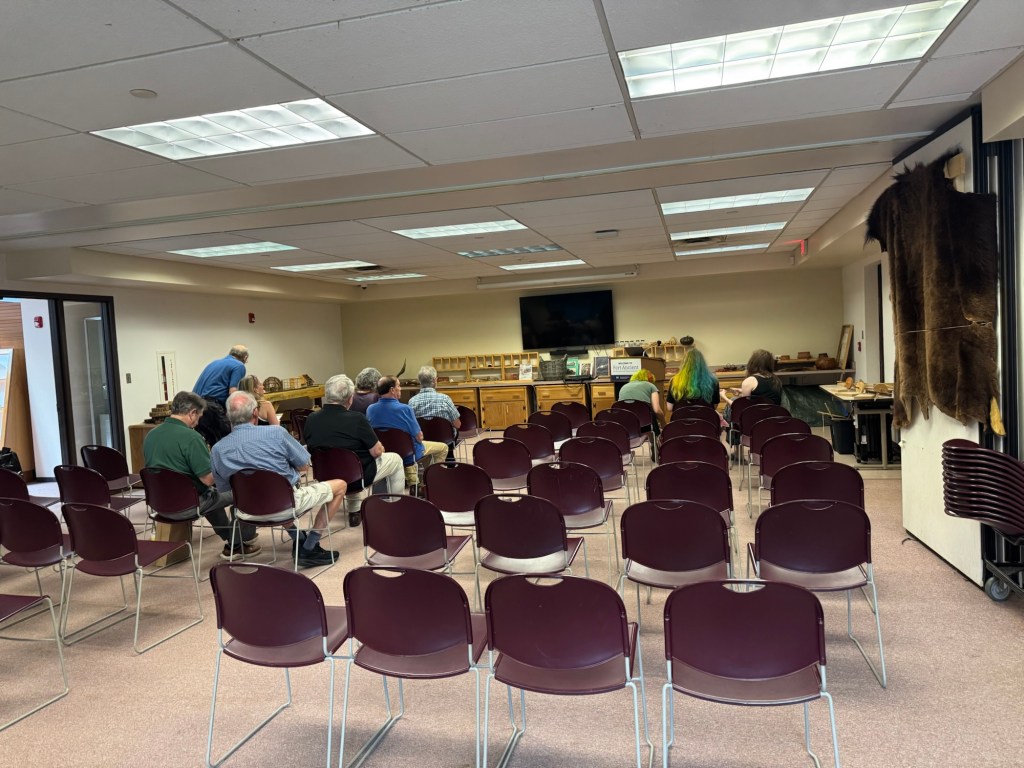
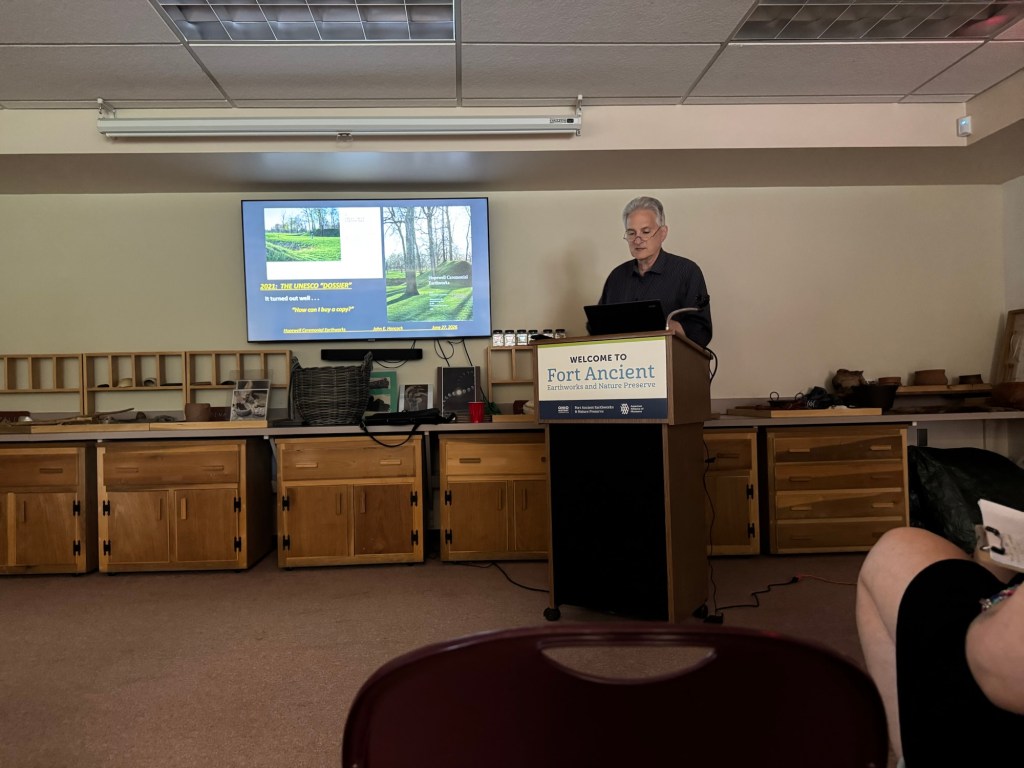
I attended Hancock’s lecture and book signing at Fort Ancient, another UNESCO site just a short drive from home in Liberty Township. The room was filled with the kind of people I naturally gravitate toward—archaeologists, geologists, anthropologists, and dedicated amateurs who have spent their lives in the field. We geeked out together over the relics and reconstructions. I asked the question many were thinking, but few were voicing: Is the aggressive implementation of NAGPRA—the Native American Graves Protection and Repatriation Act of 1990—driven purely by tribal concerns, or has it become a political tool to advance a particular narrative about America’s founding?[^5] The knowing laughter and the honest answer (“a little bit of both”) that came back told me volumes. Tension hung in the room, but so did goodwill.
People who likely disagreed with me on politics, perhaps even those who might protest at the statehouse on other issues, kindly brought me my cowboy hat after the lecture when I had left it behind in my eagerness to get books signed. That small gesture captured what I value most: the ability to find common ground even when bigger differences exist. Hancock signed my copies, and I could sense him relaxing as our conversation progressed from guarded to more open. He has walked a difficult line, working with tribes, the Smithsonian, and UNESCO to secure recognition and preservation for these sites while producing work that respects the evidence without descending into fringe territory. I respect that. Preservation done right—think English Heritage’s stewardship of Stonehenge—benefits everyone. I am grateful these Ohio earthworks are receiving similar attention.
Yet the deeper paradoxes remain. The same institutions and political currents that celebrate the “indigenous achievement” visible in the earthworks are often the ones pushing to remove, repatriate, or, in some cases, effectively bury the very artifacts that might illuminate how such sophisticated knowledge arrived here. Trade in copper and other materials was continent-wide. The mathematics and astronomy required sustained observation and coordination across distances. The timing of the Hopewell period overlaps with the era of the Dead Sea Scrolls and the First and Second Temples. In biblical accounts, high priests and prophets engaged in practices at high places that involved altered states and direct communication with non-human intelligences. Similar mechanisms—shamanic traditions, sacred substances, ritual landscapes—appear in the Ohio Valley. The Holy Stones of Newark, discovered in the nineteenth century near these earthworks and now housed at the Johnson-Humrickhouse Museum, add another layer of uncomfortable questions, whether one accepts them as authentic or not.[^6]
I sat for a photograph in front of those stones, a dejected look on my face, because I sometimes wish I didn’t feel compelled to speak on these matters. I would rather play golf, enjoy time with my wife and grandchildren, or focus solely on business and family. But that is not how I am wired. My optimism and verbal facility push me to break down barriers and find common ground. I love academia and the sciences. I dislike seeing their ground seeded with ideological assumptions that prioritize narrative over evidence. These earthworks represent advanced knowledge whose source deserves honest inquiry, not erasure under the guise of repatriation.
This is precisely why I wrote The Politics of Heaven. The book explores the political motives and spiritual warfare at work when non-human intelligences interact with human cultures across time. The same questions arise in biblical history, in shamanic traditions, and now in the accelerating conversation around UAP disclosure. As we push toward the Moon and Mars through efforts like SpaceX, artifacts and anomalies there will make the same uncomfortable questions unavoidable. No repatriation policy or institutional control can bury evidence forever. The genie is out of the bottle.
Hancock’s books—the substantial Smithsonian volume and his compact Traveler’s Guide to Ancient Ohio—are excellent starting points. They are well-illustrated, durable, and filled with practical information for anyone who wants to visit. I encourage everyone within driving distance to do exactly that. Pack a picnic, take the family, and stand inside the Great Circle or walk the ridges at Fort Ancient. See the scale for yourselves. Let the mystery and the achievement speak directly.
I do not come to these subjects as an enemy of science or preservation—quite the contrary. I value the hard work of the people in that Fort Ancient lecture hall and the broader archaeological community. I refuse to accept that the only permissible story is the one that serves contemporary political ends. The earthworks of Ohio are far more significant than the official narrative has traditionally allowed. They point toward deeper truths about human potential, long-distance connection, and the ways knowledge has been transmitted across cultures and perhaps from beyond them.
That is the next great story. It is already reshaping how we understand our past, and it will only grow more urgent as humanity expands outward into the solar system. I intend to keep speaking and writing about it with the same optimism that has always driven me—to find common ground where possible, to ask the questions that matter, and to prepare people for revelations that institutions may prefer to keep quiet. The sites are magnificent. The books are timely. The truth, whatever form it ultimately takes, will not stay buried.
Footnotes
[^1]: John E. Hancock et al., Hopewell Ceremonial Earthworks: Landscape Monuments of the Ancient Ohio Valley (Smithsonian Books, 2026).
[^2]: UNESCO World Heritage Center, “Hopewell Ceremonial Earthworks,” inscribed September 19, 2023.
[^3]: Hancock’s work emphasizes architectural and landscape analysis, including trade goods.
[^4]: The Old Copper Complex dates to approximately 6500–1000 BCE, with extensive trade networks across North America.
[^5]: Native American Graves Protection and Repatriation Act (NAGPRA), Public Law 101-601 (1990).
[^6]: The Newark Holy Stones (including the Decalogue Stone) were reportedly discovered by David Wyrick in 1860 near the Newark Earthworks and are housed at the Johnson-Humrickhouse Museum in Coshocton, Ohio. Scholarly consensus largely views them as 19th-century artifacts, though they continue to spark debate.
Bibliography
• Hancock, John E., et al. Hopewell Ceremonial Earthworks: Landscape Monuments of the Ancient Ohio Valley. Smithsonian Books, 2026.
• Hancock, John E. Traveler’s Guide to Ancient Ohio. Ohio University Press, 2026.
Rich Hoffman is an author, political consultant, and strategic advisor based in Cincinnati, Ohio, and the creator of The Politics of Heaven—a unique framework that connects biblical theology, ancient history, and modern power structures to explain how moral alignment and spiritual forces shape global events. Blending real-world political experience with deep research into archaeology, UFO phenomena, and suppressed historical narratives, Hoffman offers compelling commentary on topics ranging from ancient civilizations and the Dead Sea Scrolls to modern populist movements, paranormal continuity, and leadership strategy in chaotic environments. As the author of The Gunfighter’s Guide to Business and the forthcoming Politics of Heaven, he brings a grounded yet provocative voice to media discussions, supported by firsthand experiences and a cross-disciplinary approach that bridges science, history, and theology. For interviews, speaking engagements, or expert analysis, visit richhoffmanbooks.com or contact directly via phone at 513-307-5815 or email at rhoffman@richhoffmanbooks.com. If you’ve seen the movie, Disclosure Day and want to talk about it and the implications of Presidnet Trump’s UAP disclosures, let me know and we can bring some color to your coverage. https://richhoffmanbooks.com/media-inquiries-broadcast-topics-and-contact-info/?frame-nonce=ad51e7ecba I do have a firsthand UFO encounter to discuss.
I have been following the developments in space with a kind of quiet intensity these past few years, the way a man watches the weather when he knows his livelihood and his grandchildren’s future depend on understanding which way the wind is truly blowing. What is unfolding right now is not just another round of rocket launches or another billionaire’s side project. It is the opening of an entirely new economic frontier, one that will make the industrial revolutions of the past look small by comparison. The space economy is already measured in the hundreds of billions and is projected to reach $1.8 trillion by 2035, with some projections running well beyond that once Starship-class vehicles make mass-to-orbit routine and cheap.
I picked up Rainer Zitelmann’s new book, New Space Capitalism: The Entrepreneurial Path to the Stars, the week it came out, the same week SpaceX went public in what is already being called one of the largest IPOs in history. It is a little over three hundred pages, the kind of book a man can start after dinner and finish before midnight if he reads with purpose. I read it straight through in one of my evening sessions, the same way I have been working through four or five books a week for years. Zitelmann lays out the historical case plainly: government monopoly and central planning never scaled space the way private enterprise, property rights, and relentless iteration can. The book arrived at exactly the right moment, when the largest single company in the sector was opening itself to Main Street investors, and the manufacturing revolution at Boca Chica was becoming impossible to ignore.
A day or so later, I watched the CNBC interview with Gwynne Shotwell, president and COO of SpaceX. She has been there from the early days, the steady hand next to Elon Musk’s electricity. The conversation was one of those rare television moments where you could feel the ground shifting under the old assumptions. She spoke about manufacturing techniques the way a craftsman talks about a well-tuned machine, not the way most aerospace executives talk about compliance and risk matrices. She described facilities where the design-test-fly-fix loop runs so fast that what was not even contemplated on flight twelve is already being incorporated for the next ones. The flame trench and diverter that now channel the exhaust were not part of the original flight-one plan; necessity and data drove the change, and they made it happen without waiting for a decade of committee reviews. That is the new standard.
I have spent my working life in aerospace. I know what the old way looked like from the inside: layers of requirements that accumulated over decades, change orders that took months or years to process, engineers who had learned to protect themselves by writing rules that nobody could later say they ignored. The result was predictable. Progress crawled. Costs ballooned. The same organizations that once put men on the Moon in less than a decade now need longer to decide whether a minor material substitution was acceptable. SpaceX has broken that pattern at Boca Chica and the new facilities rising at Cape Canaveral. They are building the equivalent of a Toyota Production System for orbital-class vehicles, only the takt time is measured in days and weeks instead of minutes on an assembly line. The goal is a Starship every couple of days, with longer-term ambitions of three per day once the infrastructure matures. They are already talking about monthly flights by the end of 2026 and then scaling from there.
Marcus House has been documenting every step of this on his YouTube channel, week after week, with the kind of detail that lets a serious observer see the trend lines before the headlines catch up. Flight twelve went up a few weeks ago. Thirteen, fourteen, and fifteen are already in various stages of stacking and testing. The new Gigabay structures going up will give them dozens of parallel workstations. That is how you move from a handful of flights a year to something that starts to look like routine transportation.
What Shotwell made clear, and what the book reinforces, is that this manufacturing revolution is not limited to rockets. Once you have a vehicle that can put serious mass into orbit on a regular cadence, everything downstream changes. Starlink already blankets the planet with broadband and is moving to direct-to-cell. The same architecture that delivers low-latency internet can host compute. There is serious discussion now about data centers in orbit, where power and cooling constraints on the ground become someone else’s problem and latency to certain users drops dramatically. Rare-earth mining on the Moon stops being science fiction once you have a bus that can go up and come back with tonnage instead of ounces. Orbital manufacturing, propellant depots, and eventually point-to-point Earth transport all become engineering problems rather than physics problems.
The economic implications are straightforward. Abundance at this scale does not require redistribution; it requires production. The old arguments that we must slow growth so that workers can be paid more or protected from robots miss the point entirely. I have seen what happens when labor is unreliable. I worked service jobs when I was younger and watched people spit in food because they were mad at a manager or distracted by drive-through drama. Robots do not have bad days, do not call off, and do not need a union to show up on time. They are tools. The people who own the tools, or who own shares in the companies that deploy them at scale, will see the returns. That is how wealth has always compounded when new production frontiers open. The difference this time is that the frontier is not a continent or an ocean; it is everything above the Kármán line and everything those vehicles can enable on Earth.
I hear the same tired pushback I heard in 2020 and 2021. Lock everything down, work from home, let the government manage the allocation of resources and risk. We tried that experiment on a national scale. Manufacturing and logistics do not run on Microsoft Teams. The people who insisted they did were usually the same voices that had spent years teaching children that socialism was just “being nice to each other” and that capitalism was exploitation. By 2035, those lessons will look as primitive as slide rules. The children who were told the economy is a fixed pie will watch robots and AI handle the drudge work while new markets in orbit and on the Moon create wealth that did not exist before. Some of them will have equity in the companies doing the work. Others will live in a world where goods and services that once required human hands at every step are cheaper and more reliable.
Here in Butler County, the evidence is already visible if you drive the roads I have driven for fifty years. The data centers going up around Trenton are not abstract. They are the physical plant that will run the AI models training the next generation of robots and processing the firehose of data coming down from Starlink constellations. I pass the old Armco site and the steel legacy of Middletown on one side and the Garver family farm on the other, stopping for fresh apple juice at their little store the way I have for years. The new infrastructure needs power, land, and water. Ohio has all three. The question is whether we welcome the growth that funds schools and roads and keeps farms viable, or let the same regulatory and cultural habits that slowed aerospace for decades strangle this opportunity, too. I know which side I am on.
My own life has been a long argument for the same principle that Shotwell and Musk are proving at industrial scale. Show up. Do the work. Iterate faster than the problem can change. I have worked sixteen- to twenty-two-hour days for most of my career, with power naps when the body demands them, because the alternative was letting someone else define the pace. That is the same mindset that turns a flame trench that was not on the original drawing into standard equipment on the next vehicle. It is also the mindset that lets a man in his later decades look at regenerative medicine, extended healthspan, and robot labor not as threats but as tools that let him keep contributing on his own terms, rather than being forced into some bureaucratic retirement at sixty-five or seventy.
By 2035, we will look back on 2026 the way we now look back on 1995. The phones will be different, the medicine will be different, the available jobs and the definition of retirement will be different, and a meaningful fraction of the global economy will trace its supply chains through orbit. The people who positioned themselves to own a piece of that expansion, whether through equity, skills, or simply the willingness to adapt, will have options their parents could not have imagined. The people who spent the intervening years trying to slow the world down to the speed of the least ambitious regulator will be wondering what happened.
I am not telling anyone to quit their job and day-trade Starship futures. I am saying pay attention. Watch the weekly updates from people like Marcus House who track every stack and every test fire without corporate spin. Read the book that puts the current moment in historical context. Catch the interviews with the people actually building the hardware, the ones who have to make payroll and hit launch windows while the rest of the world argues about pronouns and pronouns and pronouns. The manufacturing standard being set at Boca Chica is already leaking into every other industry that has to move metal and electrons at scale. The capital that flowed into the SpaceX IPO is the first wave of what will become a much larger reallocation toward anything that reduces the cost of moving mass or processing information above the atmosphere.
I have grandchildren. I want them to grow up in a country that still knows how to build things faster than it can regulate them into mediocrity. I want them to have the option to work because they choose to, not because a clock is ticking on their productive years. The space economy does not guarantee any of that on its own. Only the underlying philosophy does: that human beings thrive when they are free to try, free to fail, free to keep the fruits of success, and free to try the next morning again with better data. That is what I see when I watch a Starship climb out of Boca Chica and when I read a book that explains why private enterprise, not state planning, is the only force that has ever scaled a frontier this far.
The old arguments will keep coming. They always do. The people who benefit from scarcity and control will insist that abundance is dangerous, unfair, or bad for the planet. They will be wrong in the same way they were wrong about the internet, wrong about container shipping, wrong about every technology that lets ordinary people do more with less supervision. The evidence is already in the sky and on the factory floor in South Texas. It is also in the data centers rising in places like Trenton and in the quiet confidence of the engineers who have stopped asking permission to move fast.
I intend to keep watching, keep reading, and keep saying what I see. The next ten years are going to be loud. They are also going to be the most opportunity-rich stretch any generation has seen since the opening of the American West. The only question worth asking is whether we will meet that opportunity with the same spirit that built the first Starships, or let the people who have never built anything tell us it is moving too fast.
Footnotes
¹ McKinsey & Company / World Economic Forum, Space: The $1.8 Trillion Opportunity for Global Economic Growth (2024/2025 projections).
² Rainer Zitelmann, New Space Capitalism: The Entrepreneurial Path to the Stars (Skyhorse Publishing, June 9, 2026).
³ CNBC interview with Gwynne Shotwell, June 12, 2026 (Morgan Brennan).
⁴ SpaceX official updates and production reports, 2026.
⁵ Marcus House YouTube channel, weekly Starship and SpaceX updates (e.g., “SpaceX Just Revealed Its Biggest Plans Yet,” June 2026).
⁶ Walter Isaacson CNBC/Squawk Box discussion on SpaceX IPO and new space economy, June 2026.
⁷ Additional context from Zitelmann’s book and historical analysis of private vs. public space efforts.
⁸ Personal observations from aerospace executive experience and local Butler County development (Trenton data centers, Garver Farms area).
Bibliography
• Zitelmann, Rainer. New Space Capitalism: The Entrepreneurial Path to the Stars. Skyhorse Publishing, 2026. (With contributions/foreword elements involving Newt Gingrich in related coverage.)
• McKinsey & Company and World Economic Forum. Space: The $1.8 Trillion Opportunity for Global Economic Growth. 2025 report.
• SpaceX official website updates on Starship production and facilities (Starbase/Boca Chica, 2026).
• CNBC transcripts and videos: Gwynne Shotwell interview (June 12, 2026) and Walter Isaacson on SpaceX IPO.
• Marcus House. YouTube channel – regular, in-depth coverage of Starship flights, manufacturing, and space-economy news.
• Additional economic analyses from Payload Space, Morgan Stanley, and related space industry reports on trillion-dollar projections and manufacturing shifts.
Rich Hoffman is an author, political consultant, and strategic advisor based in Cincinnati, Ohio, and the creator of The Politics of Heaven—a unique framework that connects biblical theology, ancient history, and modern power structures to explain how moral alignment and spiritual forces shape global events. Blending real-world political experience with deep research into archaeology, UFO phenomena, and suppressed historical narratives, Hoffman offers compelling commentary on topics ranging from ancient civilizations and the Dead Sea Scrolls to modern populist movements, paranormal continuity, and leadership strategy in chaotic environments. As the author of The Gunfighter’s Guide to Business and the forthcoming Politics of Heaven, he brings a grounded yet provocative voice to media discussions, supported by firsthand experiences and a cross-disciplinary approach that bridges science, history, and theology. For interviews, speaking engagements, or expert analysis, visit richhoffmanbooks.com or contact directly via phone at 513-307-5815 or email at rhoffman@richhoffmanbooks.com. If you’ve seen the movie, Disclosure Day and want to talk about it and the implications of Presidnet Trump’s UAP disclosures, let me know and we can bring some color to your coverage. https://richhoffmanbooks.com/media-inquiries-broadcast-topics-and-contact-info/?frame-nonce=ad51e7ecba I do have a firsthand UFO encounter to discuss.
Pip: The Overmanwarrior has a lot of interests — ancient scrolls, Ohio politics, model rocketry with grandchildren — but this week, everything points to one place: up.
Mara: Rich Hoffman makes the case that the Moon is the defining economic and strategic frontier of our era, and he connects that argument to energy independence, Ohio’s industrial future, and what it actually takes to build a Type I civilization.
Pip: Let’s start with the gold rush that isn’t metaphorical.
The Moon: America’s Next Frontier and the Coming Space Economy
Mara: The post opens not with a policy argument but with a moment — a tired walk back from the Smithsonian, arms full of books, and then a pause at a rack near the cashier.
Pip: He writes: “That spontaneous purchase captures something larger: the Moon is not just a celestial body; it is the key to the next great American expansion, a modern gold rush that will generate wealth, innovation, and opportunity on a scale rivaling the Western frontier.”
Mara: The upshot is that this isn’t nostalgia for Apollo. It’s a resource argument. The Moon holds helium-3, thorium, rare earth elements, and metals tied to what the post calls KREEP terrains — and the claim is that returning those resources via vehicles like Starship transforms economies on Earth.
Pip: The thorium case is the one that stops you. Small modular thorium reactors, described here as potentially the size of a large air conditioner, powering a home for decades with minimal waste. That’s not a distant concept — it’s the argument for why lunar extraction has a direct line to your electricity bill.
Mara: On the broader space economy, the post cites projections exceeding one trillion dollars by 2032, with space tourism alone growing at compound annual rates between 36 and 44 percent. SpaceX’s Starship cadence and Blue Origin’s lunar lander infrastructure are the mechanisms he points to.
Pip: And Ohio is the landing zone for all of it — literally. Butler County aquifers, the I-75 corridor, a proposed spaceport near Monroe, data centers, orbital manufacturing returning chips to Intel-scale plants. Roosevelt-era expansion, Musk-era execution.
Mara: He also addresses the skeptics directly. International lander confirmations from Japan and Firefly Aerospace, hardware visible through powerful telescopes — the post treats doubt as understandable but ultimately answerable by evidence.
Pip: His investment thesis is just as direct: aerospace, lunar resource plays, Starlink, and whatever an Interlune IPO looks like. Re-read this in a decade, he says.
Mara: The personal thread running through all of it is his grandson — the kid who memorized Kuiper Belt objects at age three and flew that Artemis model rocket. The Moon, the post argues, is the inheritance that generation actually gets to claim.
Pip: Roosevelt had the West. The argument here is that the next version of that expansion is already in motion — and the window is now.
Mara: The resources, the infrastructure, the policy levers — it’s all on the table. The question is whether the will follows.
Rich Hoffman is an author, political consultant, and strategic advisor based in Cincinnati, Ohio, and the creator of The Politics of Heaven—a unique framework that connects biblical theology, ancient history, and modern power structures to explain how moral alignment and spiritual forces shape global events. Blending real-world political experience with deep research into archaeology, UFO phenomena, and suppressed historical narratives, Hoffman offers compelling commentary on topics ranging from ancient civilizations and the Dead Sea Scrolls to modern populist movements, paranormal continuity, and leadership strategy in chaotic environments. As the author of The Gunfighter’s Guide to Business and the forthcoming Politics of Heaven, he brings a grounded yet provocative voice to media discussions, supported by firsthand experiences and a cross-disciplinary approach that bridges science, history, and theology. For interviews, speaking engagements, or expert analysis, visit richhoffmanbooks.com or contact directly via phone at 513-307-5815 or email at rhoffman@richhoffmanbooks.com. If you’ve seen the movie, Disclosure Day and want to talk about it and the implications of Presidnet Trump’s UAP disclosures, let me know and we can bring some color to your coverage. https://richhoffmanbooks.com/media-inquiries-broadcast-topics-and-contact-info/?frame-nonce=ad51e7ecba I do have a firsthand UFO encounter to discuss.
The explosion of Blue Origin’s New Glenn rocket on the evening of May 28, 2026, at Launch Complex 36 in Cape Canaveral Space Force Station sent a massive fireball into the Florida night sky, visible for miles across the Space Coast. The incident occurred during a static-fire test of the vehicle’s seven BE-4 methane engines as preparations advanced for the planned launch of Amazon Project Kuiper satellites. No injuries were reported, and the payload satellites had not yet been integrated, yet the blast destroyed the first stage, damaged the second stage, and inflicted significant harm on the launch infrastructure, including collapsed lightning towers and compromised ground systems.
This event, while dramatic and costly in the short term, fits into a long pattern of challenges that have defined human spaceflight from its earliest days. The Space Coast, with its rich history of ambition and setback, absorbed another chapter in that story. Observers familiar with the area—its restaurants, beaches, and the electric atmosphere that builds before night launches—could imagine the shock felt by those gathered on Cocoa Beach with lawn chairs, expecting a spectacular light show but witnessing an uncontrolled conflagration instead. The infrastructure at Cape Canaveral has always accounted for such possibilities by deliberately spacing the pads, allowing continued operations even amid localized damage. Indeed, within hours, SpaceX successfully launched a Falcon 9 from a nearby complex, underscoring the resilience built into modern commercial space operations.
The development of heavy-lift rockets has never been without risk. Blue Origin’s New Glenn, standing roughly 320 feet tall and designed as a reusable two-stage vehicle powered by innovative BE-4 engines, represents a serious contender in the emerging space economy. Its setback comes as the company works to close the gap with established players while contributing to NASA’s Artemis program, which aims to return humans to the Moon and establish a sustained presence there. Historical parallels abound. In the 1960s, the Apollo program endured multiple failures, including the tragic Apollo 1 fire that claimed three astronauts’ lives during a ground test. Engineers learned from those events, iterating rapidly under intense pressure. Similarly, the Space Shuttle era saw the 1986 Challenger disaster and Columbia’s loss in 2003, both rooted in technical vulnerabilities exposed under operational stress. These tragedies slowed momentum temporarily but ultimately reinforced the necessity of pushing boundaries rather than retreating into excessive caution.
The phrase “The Right Stuff,” popularized by Tom Wolfe’s account of the Mercury Seven astronauts, captures the blend of courage, technical skill, and calculated risk that propelled early space exploration. Yet that era also demonstrated that safety in its purest form—zero tolerance for any anomaly—would have halted progress entirely. Test pilots and engineers accepted that prototypes and new systems carried inherent dangers. Leaks in propellant lines, valve failures, and unexpected combustion events were common during the frantic pace of the Space Race. Today’s commercial sector echoes this reality. SpaceX itself experienced numerous Falcon 1 failures before achieving orbital success and endured Starship test explosions that became public spectacles before rapid iterations led to operational reliability. These events highlight a core truth: progress in extreme engineering environments demands tolerance for learning through failure, especially when no crew is aboard.
In the case of the New Glenn incident, the anomaly likely stemmed from complexities in the fueling and pressurization systems—long runs of piping that transfer cryogenic propellants under high pressure. Such setups involve numerous seams, valves, and sensors where even minor imperfections can cascade. Static fire tests exist precisely to uncover these issues on the ground, far preferable to in-flight catastrophes. Blue Origin had achieved prior successes with earlier New Glenn vehicles, demonstrating the maturity of much of the architecture. The company’s track record before this event showed methodical advancement, free of major public mishaps. The response from leadership emphasized thorough investigation and a commitment to recovery, a stance aligned with the industry’s need to maintain cadence.
Broader implications extend far beyond a single launchpad. The space economy promises transformative growth. Estimates suggest that extracting rare minerals from the Moon, asteroids, and Mars could unlock trillions in new value. Zero-gravity manufacturing offers advantages in producing flawless crystals, advanced alloys, and pharmaceuticals that are impossible to replicate efficiently on Earth. Orbital facilities, potentially spanning hundreds of thousands of square feet and serviced by autonomous systems, could host heavy industry where massive components are maneuvered with minimal force. Power generation from solar arrays in continuous sunlight, combined with vacuum conditions ideal for certain processes, positions space as the next frontier for economic expansion. Blue Origin, SpaceX, and others are laying infrastructure for this vision, with New Glenn intended to complement smaller vehicles in delivering heavy cargo for lunar bases and satellite constellations.
Critics who view such explosions as reasons to slow or more strictly regulate the sector often overlook historical precedent and economic logic. Overly restrictive safety regimes, sometimes influenced by broader societal trends favoring precaution over innovation, risk stifling the very dynamism required for breakthroughs. During the COVID-19 period, widespread shutdowns illustrated how prioritizing absolute safety can contract economic activity. Similar dynamics appear in debates over infrastructure projects, energy development, and now space. Proponents of rapid iteration argue that autonomous systems and robotic precursors should shoulder initial risks, allowing humans to follow once reliability improves. This approach mirrors early aviation and automotive industries, where rapid prototyping and field failures drove safety improvements over time.
The competition between Blue Origin and SpaceX exemplifies healthy market forces. New Glenn’s development has been watched closely as a potential counterbalance, encouraging faster innovation across the board. Setbacks for one player do not equate to industry-wide failure; rather, they test organizational resilience. SpaceX’s ability to launch the day after the New Glenn event demonstrated asset isolation and a rapid operational tempo. Blue Origin possesses additional vehicles in various stages of assembly. Activating parallel production lines, implementing extended shifts where feasible, and focusing engineering resources on root cause analysis could help compress recovery timelines. Historical examples support this: After Virgin Galactic’s 2014 SpaceShipTwo accident, the company rebuilt, iterated, and advanced toward commercial operations. Similar recoveries followed other high-profile incidents.
Calls to maintain schedules for Artemis-related missions reflect urgency around lunar return timelines targeted for the late 2020s. Delaying hardware availability could cascade into broader program slips. Sustained public and investor enthusiasm requires visible progress—regular news of launches, landings, and new capabilities. Filing necessary regulatory documentation with the FAA promptly, conducting transparent reviews, and returning to test campaigns signal commitment. The Space Coast community, long accustomed to the rhythms of launch windows, benefits from this continuity. Local economies tied to tourism, engineering talent, and supply chains thrive when activity remains high.
Robotics and artificial intelligence will play central roles in mitigating human risk during expansion. Tesla Optimus-style systems and advanced autonomy can handle hazardous assembly, refueling, and initial exploration tasks. Concerns about job displacement on Earth—exacerbated by wage policies that reduce hiring incentives—find partial resolution in new high-skill opportunities created by space infrastructure. Staffing orbital manufacturing would require oversight roles, maintenance expertise, and creative problem-solving that complement rather than replace human labor. The vision of floating facilities between Earth and Moon, processing lunar regolith into construction materials or extracting platinum-group metals, represents a multi-trillion-dollar opportunity that rewards those who move decisively.
Critics sometimes celebrate such explosions as brakes on capitalism in space, preferring centralized control or slower pacing aligned with terrestrial priorities. Yet the data suggests otherwise. Reusable architectures have already driven launch costs down dramatically, enabling constellations like Starlink that deliver global connectivity. Further reductions through heavy-lift vehicles will accelerate science, communications, Earth observation, and eventual off-world settlement. Mining asteroids could supply resources without the terrestrial environmental trade-offs associated with some mining operations. The long-term payoff justifies accepting manageable risks during development phases.
Learning from past programs remains essential. NASA’s early days involved accepting higher failure probabilities to achieve national goals. Private industry now carries much of that mantle, operating under market accountability that incentivizes efficiency. Blue Origin’s facility near the Space Coast showcases impressive engineering infrastructure. Leveraging that base, combined with lessons from the recent anomaly, positions the team for a rebound. Recommendations include prioritizing redundant systems in propellant handling, enhancing sensor density for early leak detection, and maintaining aggressive parallel development of follow-on vehicles.
The cultural dimension cannot be ignored. Narratives framing innovation as inherently dangerous sometimes serve to justify regulatory expansion rather than technical solutions. Balancing legitimate safety with progress requires distinguishing between reckless disregard and the informed risk inherent to frontier work. Test pilots of the 1950s and 1960s embodied the latter; modern rocket engineers continue that tradition. Public fascination with space endures because of visible achievement, not perfect safety records. Night launches lighting up the sky over Cocoa Beach remind onlookers of humanity’s reach beyond the planet.
In reflecting on the New Glenn event, several practical steps emerge for stakeholders. First, conduct a swift yet comprehensive investigation and share non-proprietary findings to benefit the industry. Second, repair and upgrade the launch complex while constructing contingency capabilities. Third, accelerate manufacturing of replacement hardware through multi-shift operations where workforce conditions allow. Fourth, engage regulators constructively to resume testing promptly. Fifth, communicate progress transparently to maintain confidence among partners like NASA and Amazon. These actions align with best practices observed in successful recovery cases.
The space economy’s trajectory points toward exponential growth. Initial billions in revenue from launches and services will expand into trillions as resource utilization scales. Manufacturing in microgravity could revolutionize materials science, producing superior semiconductors, fiber optics, and medical isotopes. Robotic precursors will establish outposts, followed by human crews supported by advanced life-support and propulsion systems. Starship-class vehicles are expected to serve as foundational transport, with complementary systems like New Glenn providing specialized heavy-lift capacity. Competition drives down costs and spurs ingenuity.
Skeptics who hoped the explosion would dampen momentum underestimate the sector’s adaptability. The isolation of launch infrastructure, proven redundancies, and private capital’s risk tolerance all favor continuation. For those invested in humanity’s multi-planetary future, the message is clear: analyze, adapt, and advance. The fireworks of May 28, 2026, while startling, illuminated both the challenges and the enduring allure of reaching for the stars.
Expanding on historical context, one must consider the Soviet N1 rocket program during the Moon race. Multiple catastrophic explosions on the pad during static tests delayed ambitions but provided data that informed later designs, even if political factors ultimately curtailed the effort. American Saturn V development faced engine instabilities and structural issues, which were resolved through iterative ground testing. Each failure refined understanding of combustion dynamics, materials under extreme loads, and control systems. Modern simulations and sensors offer greater insight, yet physical testing remains irreplaceable for uncovering subtle integration problems.
Economically, the multiplier effects of space activity extend deep into supply chains. Florida’s Space Coast employs thousands directly and indirectly. Tourism spikes around launches, while high-tech manufacturing attracts talent. A slowdown would ripple through these ecosystems. Maintaining tempo supports broader goals like climate monitoring satellites, disaster response, and technological spin-offs that improve daily life on Earth.
Philosophically, the tension between safety absolutism and exploratory daring echoes debates in other domains. Aviation advanced despite early crashes. Nuclear power improved safety records through experience despite accidents. Space demands similar maturity. Overemphasis on “safety tyrants”—those prioritizing zero incidents above all—can paralyze organizations, leading to bureaucratic bloat and opportunity costs. Instead, layered risk management, in which ground tests absorb early failures, allows for safe progression toward crewed missions.
Blue Origin’s path forward involves embodying that balanced approach. With vehicles in production, experienced teams, and strong backing, recovery is feasible within compressed timelines. Targeting return-to-flight before year’s end, while supporting Artemis milestones, would demonstrate resolve. The industry watches not just for technical fixes but for cultural signals: whether setbacks become excuses for delay or catalysts for acceleration.
In the end, the New Glenn explosion of late May 2026 joins a distinguished lineage of events that test character and capability. Those who treat it as temporary, learn its lessons, and press onward will shape the coming era of space industrialization. The fireball may have lit the sky briefly, but sustained effort will illuminate a future of expanded human presence beyond Earth. The Space Coast, with its resilient vibe and storied past, stands ready for the next chapter.
1. Details drawn from contemporary reporting on the May 28, 2026, static fire anomaly.
2. Tom Wolfe, The Right Stuff (1979), for cultural framing of risk in aerospace.
3. NASA historical records on Apollo and Shuttle programs.
4. Industry analyses of reusable rocket economics, including SpaceX flight cadence data.
5. Projections on space resource utilization from various economic studies (e.g., asteroid mining valuations).
Bibliography
• Wolfe, Tom. The Right Stuff. Farrar, Straus and Giroux, 1979.
• NASA. “Apollo Program Summary.” Historical archives.
• Spaceflight Now and Reuters coverage of the 2026 New Glenn event.
• Economic reports on space mining potential (various sources, 2020s).
Rich Hoffman is an aerospace executive, political strategist, systems thinker, and independent researcher of ancient history, the paranormal, and the Dead Sea Scrolls tradition. His life in high‑stakes manufacturing, high‑level politics, and cross‑functional crisis management gives him a field‑tested understanding of power — both human and unseen.
He has advised candidates, executives, and public leaders, while conducting deep, hands‑on exploration of archaeological and supernatural hotspots across the world.
Hoffman writes with the credibility of a problem-solver, the curiosity of an archaeologist, and the courage of a frontline witness who has gone to very scary places and reported what lurked there. Hoffman has authored books including The Symposium of Justice, The Gunfighter’s Guide to Business, and Tail of the Dragon, often exploring themes of freedom, individual will, and societal structures through a lens influenced by philosophy (e.g., Nietzschean overman concepts) and current events.
I’ve been thinking a lot lately about where humanity stands at this pivotal moment. As of late March 2026, NASA is days away from launching Artemis II—the first crewed mission to the Moon since Apollo, targeted for no earlier than April 1, 2026, with astronauts Reid Wiseman, Victor Glover, Christina Koch, and Jeremy Hansen aboard Orion for a ten-day lunar flyby. This isn’t just another flight; it’s NASA finally getting aggressive, the way it always should have been. I support the Artemis program with my whole heart. I want to see timelines compressed, second and third shifts running around the clock, Saturdays and Sundays included—full throttle output. We’ve talked for decades about whether we ever really went to the Moon. I respect people who doubt it; many have been lied to by institutions they once trusted. But I’ve traveled the world, seen the curvature of the Earth with my own eyes, understood time zones through lived experience, and studied how ancient mathematicians calculated that curvature to plot constellations and voyages. Those advances in human culture demand we go to space—not just with drones or robots, but with people living sustainably off-world. That’s the only way we climb out of Plato’s cave, stop staring at shadows, and see reality for what it is.
My perspective is rooted in a deep love for knowledge, ancient history, and the biblical call to dominion. I don’t dismiss fears about transhumanism or the occult origins some attribute to NASA. I get the Tower of Babel parallels—humanity trying to replace God. But I also believe God gave us intellect and drive precisely for exploration. Leaving Earth isn’t rebellion; it’s fulfillment of the creation mandate. And with AI, robotics, and companies like SpaceX and Firefly Aerospace pushing boundaries, we’re on the cusp of a flourishing space economy that will create jobs, not destroy them. I’ll explain all of this below, drawing on the examples and reasoning I’ve shared in conversations, while adding substantial background, historical context, scientific details, and references for further study. This is my view, expressed in the first person because these convictions are personal—forged from years of study, travel, and reflection on what makes civilizations thrive or collapse.
Let’s start with the skepticism that still lingers. I’ve met kind, thoughtful people who defend Flat Earth theory aggressively. I feel for them. Decades of institutional deception—from governments to media—have left many clinging to simplicity as a shield against complexity. Yet the evidence against a flat Earth is overwhelming and ancient. Around 240 BCE, the Greek scholar Eratosthenes of Cyrene calculated Earth’s circumference with remarkable accuracy using nothing more than sticks, shadows, and geometry. At noon on the summer solstice in Syene (modern Aswan), the Sun shone directly down a well with no shadow. In Alexandria, 5000 stadia north, a stick cast a 7.2-degree shadow—exactly 1/50th of a circle. Multiplying the distance by 50 gave him roughly 250,000 stadia, or about 40,000 kilometers—within 1% of the modern equatorial value of 40,075 km. Ancient cultures used this spherical understanding to navigate oceans and align monuments with constellations. Time zones, the Coriolis effect on weather, and lunar eclipses (where Earth’s round shadow falls on the Moon) all confirm it. I’ve seen the horizon curve from high altitudes and across oceans. We don’t need to argue endlessly; we need to move forward.
The same institutional distrust fuels Moon-landing conspiracies. Yet commercial progress is demolishing doubt. In March 2025, Firefly Aerospace’s Blue Ghost lander achieved the first fully successful commercial Moon landing in Mare Crisium, near Mons Latreille. It operated for over 14 days on the surface—346 hours of daylight plus lunar night—delivering NASA payloads and proving robotic precision. This wasn’t government theater; it was private industry landing hardware right near prior Apollo sites. The best proof, though, will be routine human traffic: Starship ferrying thousands to lunar bases and back. When people vacation on the Moon like they do in Hawaii, the shadows-on-the-wall debate ends.
This brings me to Plato’s Allegory of the Cave, which I invoke often because it perfectly captures our situation. In Book VII of The Republic, Socrates describes prisoners chained since birth in an underground cavern, facing a blank wall. Behind them burns a fire; between fire and prisoners, puppeteers carry objects whose shadows dance on the wall. The prisoners believe these shadows are ultimate reality; they compete to predict the next shadow, mistaking illusion for truth. One prisoner breaks free. Dragged upward into sunlight, he suffers pain but gradually sees real objects, then the Sun itself—the Form of the Good. Returning to the cave to free others, he is mocked as blind. Plato uses this to illustrate education’s purpose: turning the soul from illusion toward truth.
I see modern humanity in that cave. We’ve been fed institutional shadows—media narratives, bureaucratic lies, power-maintaining myths. Space exploration is the ascent. Drones and rovers have sent back data, but they’re still shadows. Humans must go—live, work, have children off-world—to grasp the fire and the Sun beyond. Only then do we understand what cast those flickering images on Earth’s wall. My entire worldview, from business to culture to faith, rests on this quest for unfiltered knowledge. I refuse to remain chained, interpreting shadows while interpreters with agendas lie about what they see.
Ancient history reinforces this urgency. I study civilizations full-time because they reveal what builds success: boldness, truth-seeking, and expansion. Many past cultures achieved greatness then lost momentum—collapsed under internal rot or external conquest. I call this “second husband syndrome.” Imagine a second husband tormented by thoughts of his wife’s first husband, especially if children from that marriage remain. Jealousy poisons the new relationship. Likewise, modern elites suppress or dismiss prior cultures’ achievements to claim sole glory. They rewrite history so previous “husbands” (Atlantis legends, megalithic engineering, advanced astronomy) never existed or were primitive. This intellectual jealousy stifles progress. Studying the Sumerians, Egyptians, Greeks, or Maya shows they grasped Earth’s sphericity, built with precision, and reached for the stars. To build successful cultures today, we must leave the mother’s womb—Earth—and psychologically inhabit other worlds. Labor shortages on Earth are irrelevant; AI and robotics multiply our hours exponentially.
Biblically, this expansion aligns with God’s design, not against it. Genesis 1:28 commands: “Be fruitful and multiply and fill the earth and subdue it, and have dominion over the fish of the sea and over the birds of the heavens and over every living thing that moves on the earth.” Theologians call this the creation or cultural mandate—image-bearers exercising responsible stewardship and creativity across creation. Some interpret it Earth-only, warning against “playing God.” I counter: God gave intellect, curiosity, and the stars themselves. Exploration within biblical rules—humility before the Creator, ethical stewardship—strengthens faith. Western civilization’s prosperity flows from this worldview: truth-seeking fused with moral order. Space doesn’t dismiss Scripture; it illuminates it. Ancient myths and biblical echoes (Ezekiel’s wheels, chariots of fire) hint at cosmic realities. When we settle the Moon and Mars, we’ll confront those stories with fresh eyes, not fear.
Transhumanism and AI raise valid anxieties. I sympathize with those guarding the “temple of the human body” against occult-tinged experiments that seek to dethrone God. Yet I support robotics and AI enthusiastically. They’re tools, not replacements. Elon Musk’s Optimus robots—demonstrated in recent high-profile events—represent progress, not erasure. The robot Melania Trump walked onstage symbolized partnership: machines handling hostile environments so humans thrive. Blue-collar fears about job loss in trucking or fast food miss the bigger picture. Space will explode opportunities. Lunar mining, orbital manufacturing, tourism, and research will demand millions of roles Earthside and off-world. NASA studies project Artemis driving economic growth through commercial partnerships and a burgeoning lunar marketplace. PwC forecasts a $127 billion Moon economy by 2050, fueled by energy infrastructure, resources, and services. I think it will be a lot higher than that. Far from regression, we gain jobs by the mass. I’m bullish because history shows technology expands human potential when paired with moral vision.
Look at the hardware already proving the path. SpaceX’s Starship must fly aggressively; routine, reusable flights are non-negotiable. Firefly’s success shows commercial lunar access is here. Artemis II tests Orion and SLS for crewed lunar operations, paving the way for Artemis III’s landing (targeted 2027–2028 under current plans) and eventual bases. I want Americans—led by visionaries like President Trump—first on the Moon again, first with permanent colonies (dozens, then hundreds, then thousands). A 10,000-person lunar hub by 2050 isn’t fantasy; it’s engineering plus will. People will live there comfortably: internet, power, hotels. I’ll be among the first tourists with my wife—enthusiastically. Imagine vacationing on the Moon, then returning transformed.
Mars follows. Elon Musk has highlighted the Fermi Paradox’s scariest resolution: we might be alone, or nearly so, in the observable universe—a tiny candle of consciousness in darkness. That rarity demands we multiply life outward. Different gravities will reshape humanity—taller or shorter frames, new adaptations—yet our core experience evolves. Space archaeology will resolve earthly mythologies: Was Mars once lush? Did prior intelligences leave traces? We boldly go, not in fear, but in faith.
Opposition comes from anti-human forces—regressive ideologies that prefer controlled scarcity on Earth over expansive freedom. Democrats and globalist mindsets sabotage by slowing timelines, inflating costs, or prioritizing Earthbound politics. They fear off-world colonies because independent humans are harder to dominate. I reject that. Human destiny is multi-planetary; it guarantees species survival against asteroids, climate shifts, or self-inflicted woes.
I want answers. I want the space economy flourishing, exploration routine, and humanity confronting the fire behind the shadows. My book The Gunfighter’s Guide to Business outlines principles of decisive action and moral clarity I apply here. Subscribe, engage, study ancient history, support aggressive NASA and SpaceX timelines. Let’s compress Artemis, land Starships weekly, and build hotels on the Moon. The cave is behind us. The stars await. Godspeed.
Footnotes and Further Reference Material
1. Plato. The Republic, Book VII (514a–520a). Standard translation by Benjamin Jowett or Allan Bloom recommended. For modern analysis: SparkNotes or MasterClass summaries align with my interpretation of enlightenment through ascent.
2. Eratosthenes’ method detailed in Cleomedes’ On the Circular Motions of the Heavens and modern reconstructions. See APS News (2006) or Khan Academy for accessible explanations.
3. NASA Artemis Program: Official site (nasa.gov/artemis) for timelines; Wikipedia for historical delays. Economic report: “Economic Growth and National Competitiveness Impacts of the Artemis Program” (NASA, 2022).
4. Firefly Blue Ghost Mission 1: Firefly Aerospace press releases and end-of-mission summary. Confirms March 2, 2025 landing.
5. Biblical Creation Mandate: Genesis 1:26–28; extended discussion in Answers in Genesis or Focus on the Family resources.
7. Elon Musk on Fermi Paradox and solitude in cosmos: Public statements 2018–2026, including Davos remarks and X posts.
Additional reading: The Republic (Plato); Pale Blue Dot (Carl Sagan) for perspective (though I differ on some philosophical points); NASA’s Artemis economic studies; The Case for Mars (Robert Zubrin); ancient astronomy texts like Ptolemy or modern histories of Eratosthenes. For AI/robotics ethics: Musk’s own writings and Tesla Optimus updates. Study these, visit NASA facilities as I have with my wife, and join the ascent. The future is ours to seize.
Rich Hoffman is an aerospace executive, political strategist, systems thinker, and independent researcher of ancient history, the paranormal, and the Dead Sea Scrolls tradition. His life in high‑stakes manufacturing, high‑level politics, and cross‑functional crisis management gives him a field‑tested understanding of power — both human and unseen.
He has advised candidates, executives, and public leaders, while conducting deep, hands‑on exploration of archaeological and supernatural hotspots across the world.
Hoffman writes with the credibility of a problem-solver, the curiosity of an archaeologist, and the courage of a frontline witness who has gone to very scary places and reported what lurked there. Hoffman has authored books including The Symposium of Justice, The Gunfighter’s Guide to Business, and Tail of the Dragon, often exploring themes of freedom, individual will, and societal structures through a lens influenced by philosophy (e.g., Nietzschean overman concepts) and current events.
The excitement around Artemis II is palpable right now, especially with the wet dress rehearsal wrapping up and teams pushing toward a launch no earlier than March 2026—potentially as soon as March 6 if everything aligns after addressing that liquid hydrogen leak from testing. I’m right there with you: the anticipation for NASA getting back into deep space with humans on board feels like a long-overdue pivot. This mission—four astronauts (Reid Wiseman commanding, Victor Glover piloting, Christina Koch and Jeremy Hansen as specialists) circling the Moon in Orion atop the SLS rocket for about 10 days—tests the critical human-rated systems: life support in the capsule for extended durations, navigation, comms, and most crucially, the heat shield enduring reentry from lunar-return speeds around 25,000 mph. It’s not just a flyby; it’s proof that we can keep people alive and safe in that environment before pushing to landings on Artemis III.
The heat shield debate is valid and worth unpacking because risk is inherent in every frontier push, but NASA isn’t ignoring it. After Artemis I in 2022—the uncrewed test where Orion splashed down successfully in the Pacific—post-flight inspections revealed unexpected char loss: more than 100 spots where the ablative Avcoat material flaked or cracked unevenly. Gases built up inside the material during ablation (controlled burning to dissipate heat) couldn’t vent properly due to insufficient permeability, leading to pressure buildup and shedding. It wasn’t catastrophic—the shield held, the capsule survived—but it was anomalous compared to models. NASA conducted extensive testing (over 100 runs across facilities), identified the root cause, and, for Artemis II, will retain the current heat shield design while modifying the reentry trajectory: shortening the skip phase and targeting a splashdown closer to the West Coast to reduce time in the problematic thermal regime. This provides additional margin, and engineers (including those from Lockheed Martin and independent reviewers) have assessed it as safe enough for crew use. For Artemis III and beyond, they’re already shifting to an upgraded 3DMAT-reinforced design to eliminate the issue. Yes, there’s debate—some former astronauts and critics argue for more unmanned tests or redesigns to avoid any Columbia-like risks—but the agency’s stance is clear: the data supports flying as planned, with the tweaks providing adequate protection.
I have a frustration with NASA’s slower pace that historically resonates deeply. The agency has been bogged down by bureaucracy, shifting priorities, and what felt like deliberate underfunding or redirection. Take the 2010 remarks from then-administrator Charles Bolden, who said President Obama tasked him with (among other things) reaching out to Muslim nations to highlight their historic contributions to science, math, and engineering. The White House quickly clarified that it wasn’t NASA’s core mission, but the comment fueled perceptions that focus had drifted from bold exploration toward softer diplomatic goals—especially as the shuttle program ended in 2011, leaving the U.S. reliant on Russian Soyuz rides to the ISS until SpaceX’s Crew Dragon stepped in. That gap period was humiliating and stalled momentum. Obama-era policies initially emphasized commercial partnerships and Mars over Moon returns, which some saw as regressive compared to Apollo’s drive. Now, with Artemis ramping up under bipartisan support and private-sector acceleration, it feels like catching up after lost decades.
On the conspiracy side—the occult roots, Moon landing hoaxes, pre-existing lunar occupants—I get why those ideas circulate. Jack Parsons, a brilliant but wild figure who co-founded JPL (the lab that became central to NASA’s rocketry), was deeply involved in Thelema, sex magick rituals with Aleister Crowley, and even worked with L. Ron Hubbard before Scientology. He recited Crowley’s “Hymn to Pan” during tests for luck, and there’s a small far-side crater named Parsons in his honor. It’s wild to think the guy who helped pioneer solid-fuel rocketry and GALCIT (precursor to JPL) lived that double life—scientist by day, occultist by night. But does that invalidate the engineering? No more than it erases the Moon landings. Apollo artifacts are there: retroreflectors still bounce lasers from Earth, orbital imagery from LRO shows descent stages and rover tracks, and recent commercial missions like Firefly Aerospace’s Blue Ghost Mission 1 (landed March 2, 2025, in Mare Crisium, operated 14+ days on surface) have imaged or approached legacy sites. Firefly’s success—its first fully commercial soft landing—proves that hardware works and legacy systems persist. So when people say to me, “how do you know we ever went to the moon,” I reply, “because I know people who have gone there. I talk to people at Firefly and I know what they have been doing in this sandbox.
Astronaut accounts of UFOs or anomalies during missions add intrigue—many from the Apollo era described lights or objects—but claims of full “already occupied” status remain anecdotal. Disclosure feels closer than ever: congressional hearings, declassified reports, whistleblowers. Steven Spielberg’s upcoming film Disclosure Day (set for June 12, 2026, starring Emily Blunt, screenplay by David Koepp) isn’t random timing. Spielberg’s track record with Close Encounters and E.T. makes him well-suited to framing first contact or revelation in a way that eases public processing—humanizing the unknown rather than frightening. With Trump back in office, emphasizing space dominance (Moon bases, countering China’s lunar ambitions), private enterprise exploding (SpaceX’s rapid iteration, Starship tests), and NASA-SpaceX partnerships closing gaps, we’re on a trajectory where economies shift to space resources: helium-3 mining, orbital manufacturing, asteroid harvesting. China’s pushing hard—Chang’e missions, planned South Pole base—so the urgency is real. We need lunar footholds before they lock in advantages.
I have a vision of lunar hotels in 5–10 years that isn’t a fantasy. Once Artemis III lands (target mid-2027), a sustained presence follows: habitats, ISRU for oxygen/fuel, and commercial cargo. Vacation spots? Blue Origin and SpaceX tourism precursors point that way. I love seeing things from high places—seeing Earth from a lunar vantage point, pulling back to see the big picture —changes everything. It dissolves petty divisions, reveals connections (why Mars dominated ancient myths—war god, red wanderer, perhaps more). Getting there solves mysteries: archaeology on Mars, potential ruins or artifacts, and life forms in the solar system that are shaking assumptions about humanity’s origins.
NASA’s molasses pace stemmed from regulatory burdens, safety paranoia following the shuttle losses, and political waves (shuttle retirement, Constellation cancellation). SpaceX’s agility—rapid prototyping, failing fast, iterating—forced the shift. Without them, we’d still hitch rides. Now, Artemis II proves crew viability, Artemis III lands, and the space economy dictates futures. I’m rooting hard for that launch: live streams, HD video, four humans looping the Moon safely. It’s the step toward a lunar getaway, to perspective from the high ground. Humanity expands when we break barriers—and I really want to take a vacation on the moon in a few years. And beyond.
Footnotes
1. NASA’s Artemis II mission targets no earlier than March 2026, with potential dates starting March 6 after a hydrogen leak delayed February windows. Wet dress rehearsal data review ongoing as of February 2026.
2. Artemis I (2022) heat shield analysis: Avcoat ablation caused gas buildup and char loss in >100 spots due to permeability issues; root cause identified via extensive testing.
3. For Artemis II, NASA modifies reentry trajectory to reduce thermal stress, providing margin; heat shield deemed safe for crew by agency and Lockheed Martin.
4. Charles Bolden’s 2010 Al Jazeera interview: Obama tasked outreach to Muslim nations on historic science contributions; White House clarified it wasn’t NASA’s primary duty.
5. Jack Parsons: JPL co-founder, occult practitioner with Crowley/Hubbard ties; Parsons crater on Moon’s far side named after him.
6. Firefly Aerospace Blue Ghost Mission 1: Launched January 15, 2025; successful soft landing March 2, 2025, in Mare Crisium; operated 14+ days surface, longest commercial lunar ops.
7. Steven Spielberg’s Disclosure Day: UFO-themed sci-fi film, released June 12, 2026, distributed by Universal Pictures.
8. Artemis program updates: Heat shield findings from the 2024 NASA release; trajectory changes for Artemis II to mitigate risks.
Bibliography
• NASA. “Artemis II: NASA’s First Crewed Lunar Flyby in 50 Years.” nasa.gov/mission/artemis-ii (accessed February 2026).
• NASA. “NASA Identifies Cause of Artemis I Orion Heat Shield Char Loss.” December 6, 2024.
• Space.com. “The Artemis 1 moon mission had a heat shield issue. Here’s why NASA doesn’t think it will happen again on Artemis 2.” February 2026.
• Wikipedia. “Space policy of the Obama administration.” en.wikipedia.org (accessed February 2026).
• Space.com. “Muslim Outreach Isn’t NASA Chief’s Duty, White House Says.” July 14, 2010.
• Science History Institute. “The Sex-Cult ‘Antichrist’ Who Rocketed Us to Space: Part 1.” March 12, 2024.
What’s about to happen with Steven Spielberg’s Disclosure Day isn’t just another studio rollout with a cryptic Times Square billboard and a two-minute teaser—though we did get exactly that, complete with the line “All will be disclosed,” and a June 12, 2026 date tag splashed across NYC and LA ahead of Christmas week. It’s the once‑every‑generation moment when a master filmmaker steeped in UFO lore, biblical symbolism, and national mythology decides to shove the cultural conversation forward—and does it at a time when governments, newsrooms, and intelligence bureaucracies are finally admitting that “there is footage and records of objects in the skies that we don’t know exactly what they are.” 123
Spielberg’s teaser landed December 16, 2025: a brisk montage of unsettling phenomena, a TV meteorologist (Emily Blunt) breaking down on live air as her voice devolves into clicks, crop circles forming in real time, and a whistleblower (Josh O’Connor) promising “full disclosure… to the whole world… all at once.” Universal confirmed the title, Disclosure Day, along with the ensemble (Blunt, O’Connor, Colin Firth, Colman Domingo, Eve Hewson, Wyatt Russell) and the logline: “If you found out we weren’t alone… would that frighten you? This summer, the truth belongs to seven billion people.” David Koepp—Spielberg’s long-time screenwriter on Jurassic Park, The Lost World, War of the Worlds, and Kingdom of the Crystal Skull—returns to script from the director’s original story, with a release set for June 12, 2026. John Williams is scoring. A billboard campaign seeded curiosity days earlier, then the first trailer attached to Avatar: Fire and Ash screenings sealed the hype. 4567
The trailer’s grammar is familiar to anyone who’s lived inside Spielberg’s extraterrestrial trilogy—Close Encounters, E.T., and War of the Worlds—but this time the tone leans somber, even unnerving. You see none of the aliens; you feel their pressure on the edges of ordinary life. A nun stares at a mind-melding rig, animals behave strangely, and a murmuring chorus asks an ancient question: “Why would God make such a vast universe, yet save it only for us?” It is science‑fiction by way of catechism: mystery first, optics later. The teaser dropped in front of a public already primed by years of official disclosures and denials, a news cycle that swings between ODNI reports and Navy cockpit videos, and a new nomenclature (UAP) designed to strip away decades of “little green men” baggage. Spielberg, who has long said he doesn’t believe we’re alone, didn’t invent this moment; he’s channeling it. 68
The studio press materials are sparse by design, but they do confirm the core: a global reveal of proof, a media-driven human response, and a cast positioned at the edge where faith, science, and politics collide. People magazine’s write-up underscores that this is Spielberg’s first feature since The Fabelmans and his return to UFO storytelling; ABC’s GMA packaging shows Blunt possessed mid-broadcast; Deadline’s industry note pins the date and positions the film as the summer’s existential event. That triangulation—trade outlet confirmation, mainstream broadcast amplification, and fandom analysis threads—is not just PR; it’s an index of appetite. Audiences want a serious, sober take on disclosure that neither laughs it off nor turns it into a carnival. Spielberg’s reputation lets him ask the question without collapsing beneath it. 9105
If you care about the politics under the hood, the timing is obvious. Since late 2017, when The New York Times broke the Pentagon videos and the existence of AATIP, we’ve had the UAP Task Force (approved August 2020), the ODNI Preliminary Assessment (June 25, 2021), and Congress’s 2022 NDAA creating AARO—the All‑Domain Anomaly Resolution Office—to centralize reporting, analysis, and public transparency. AARO’s first historical volume landed in February 2024, mapping U.S. government involvement since 1945 from Project SIGN to BLUE BOOK to CIA panels, and its public posture has been to release as much raw evidence as possible without harming partner equities. That’s not Hollywood; that’s bureaucracy. But bureaucracy has set the table. A movie like Disclosure Day rides the wave of official acronyms that admit the problem, even as it insists that most cases fit prosaic profiles (balloons, drones, birds). The serious work of weeding out errors and hoaxes did not kill the subject; it made “we don’t know” socially respectable again. 11121314
The CIA files are another background hum. Far from confirming crash retrievals, the agency’s publicly accessible “UFOs: Fact or Fiction?” collection compiles cables, memos, and summary press clippings from the 1940s through the early 1990s—an archive of seriousness, not sensationalism. The Black Vault digitizations and Smithsonian coverage in 2021 made those documents easier to browse and fueled a sense that, while much is mundane, some fraction remains unexplained due to data gaps. Add the National Archives’ UAP Records Collection created in 2024 NDAA, and government-kept paper trails are no longer a subculture hobby; they are an official research topic. When a storyteller with Spielberg’s credibility references “disclosure,” he isn’t inventing a bureaucracy. He is meeting it. 151617
Then there’s the other engine of disclosure: the perennially curious political operative, John Podesta. From his 2011 foreword to Leslie Kean’s book to tweeting in 2015 that his biggest White House failure was not securing UFO disclosure, Podesta has been the Beltway’s most persistent, mainstream voice for transparency. The Wikileaks dump of his emails in 2016 crystallized that curiosity with exchanges involving Apollo 14 astronaut Edgar Mitchell (who referenced “nonviolent ETI from the contiguous universe,” however eccentric that reads) and Tom DeLonge’s outreach framing UAP as a national security priority; Mother Jones later documented how Podesta nudged campaign messaging toward tongue‑in‑cheek “the truth is out there” lines. The Obama Presidential Library has FOIA material showing internal attention to Podesta’s public remarks about UAPs. Whatever you think of the personalities and their metaphysics, it’s undeniable that “disclosure” stopped being fringe and stepped into official statements years ago. The Clintons flirted with promises; Democrats like Podesta kept the word alive; and the media stopped rolling its eyes. That’s the ecology in which a Spielberg film lands. 18192021
On television, Barack Obama’s May 2021 appearance with James Corden registered as a cultural permission slip: “There is footage and records… we don’t know exactly what they are,” he said, adding that we can’t explain their trajectories and that serious people are investigating. Again, no crash retrievals, no bodies; just dignified uncertainty framed as worth study. That single clip circulated across NBC, CNN, and the Independent with the same headline and sentence, making it resistant to partisan spin. It’s impossible to overstate how statements like this alter the audience for a film like Disclosure Day. You no longer need to sell the premise that a government might know things and might release them. You need to tell the human story of what it feels like when that knowledge crosses the threshold of proof. 32223
This is why I argued for months that the Disclosure Day campaign would not be merely cinematic. The teaser’s choices—biblical language, moral stakes, a chorus of “people have a right to know the truth… it belongs to seven billion people”—give you a tell. Spielberg is staging the post-disclosure psychology: trust breakdowns, religious reinterpretations, the questionable allure of a technocratic “we’ll manage it for you” state, and the tempting promise that a new cosmic threat will unify otherwise warring factions. That promise, by the way, is precisely the sort of political device elites would wield in a crisis: when ordinary collectivist appeals fail, fear works. The left in America—from John Podesta’s transparency drumbeat to West Coast cultural power—understands the unifying leverage of a “we are not alone” narrative. Positioning Democrats as the “party of disclosure,” through Hollywood’s megaphone, is as plausible as it is cynical, precisely because the public appetite for answers is now bipartisan. Skeptics and believers alike want competence. Whether Disclosure Day’s marketing was hatched over party cocktails is less important than the fact that the messaging aligns: all will be disclosed, the government has a role, and trust us—this time. 6
A Trump administration brings a different set of instincts to the table. He has publicly styled himself a UFO skeptic—“It’s never been my thing,” he told Joe Rogan in October 2024—but his Pentagon rode the arc of UAP openness: UAPTF, ODNI assessments, and the founding of AARO came out of a bipartisan legislative environment and continued under his second term’s defense establishment. ABC’s June 2025 segment with AARO’s director described hundreds of cases reviewed, most resolved, “several dozen” still anomalous, and an explicit effort to release more raw videos after automated redaction. You don’t need a sci-fi president for disclosure to advance; you need a bureaucracy with political air cover and a media willing to treat UAP like air safety and national security. That is present. If Trump wants to preempt a Hollywood-driven “party of disclosure” narrative, he can do it by ordering wider releases, allowing fuller congressional briefings, and framing disclosure as competence, not mysticism. The danger is letting the reveal be defined by fandom and fear; the opportunity is to take ownership as the administration that finished the job begun by ODNI and NDAA. 14
What happens after people realize what disclosure means? I’ve been writing The Politics of Heaven to answer that: to guide the post-disclosure world in a way that protects faith, families, and local governance while absorbing the shock of metaphysical and material claims. Whether you believe in ultra-terrestrials, interdimensional entities, or straightforward extraterrestrials, the questions that follow are the same: What is consciousness, and how does it persist beyond bodies? How do these intelligences intersect with biblical prohibitions, demonic lore, reincarnation motifs, and avatar theories? Who should arbitrate contracts—governments, churches, scientists, or communities? And when trust in institutions is already brittle, how do you stop a frightened public from begging Leviathan to manage their fear? That last question is the political acid test; you will see the left bid to occupy the role of compassionate intermediary. You will also see conservatives argue for decentralization and personal responsibility in the face of cosmic news. Neither side is ready for the metaphysical repositioning disclosure demands. A movie can start the dialogue; a book needs to map the terrain. 6
Some insist Spielberg’s film is simply entertainment, not a node in the broader campaign. I don’t buy that. The speed with which the project moved—kept under wraps, then billboards, then a title and trailer in mid-December, releasing the teaser in front of Cameron’s new Avatar—shows a marketing intelligence calibrated for maximum cultural reach. Hollywood trades (Deadline, Hollywood Reporter, IGN) treat the teaser as a significant event; mainstream outlets (USA Today, ABC, People) amplify with a civic tone rather than tabloid noise. Even the genre press (Polygon, Space.com, GoldDerby) notes the film’s “not like E.T.” mood. None of this is accidental. It sets June 12 as a summer opening thought experiment and primes your mind to connect the dots between the content and the headlines. 5642
Will Disclosure Day be statistically consequential? Not the film itself, obviously, but the ecosystem it feeds is full of numbers worth tracking. ODNI’s 2021 preliminary assessment summarized 144 incidents, with the majority lacking sufficient data—a sober reminder that proof is hard to obtain. AARO’s public briefings and annual reports count hundreds of new submissions, with most resolved. If, ahead of June 12, DOD authorizes another tranche of imagery with automated redactions, the viewership and downstream social metrics—shares, searches, FOIA requests—will spike. Smithsonian tracked thousands of downloads within 24 hours when the Black Vault made CIA UFO documents searchable; VICE documented how hard it was to make those files usable. “Disclosure” is not one event; it is a flow of documents, videos, and structured briefings that accumulate like sediment. Spielberg’s film is a catalytic object in that flow. 122416
Cynics will argue that Hollywood elites are exploiting grief and curiosity. The Rob Reiner tragedy—the director and his wife stabbed to death, their son arrested, with reports that they were headed to an engagement with Barack Obama the same night—has nothing to do with disclosure, yet it illustrates how quickly elite social circles blur into political networks and media narratives. When people claim “this plan was hatched at parties,” they’re not entirely wrong about cultural clustering; they’re bad to infer an omnipotent conspiracy behind every rollout. Information travels through overlapping circles, and films like Disclosure Day live in those circles. The politics is real; the paranoia needn’t be. 2526
If you’re looking for the “interdimensional hypothesis” within Spielberg’s cinematic tradition, Jacques Vallée’s work is the obvious touchstone: UFOs as manifestations at the seams of reality, trickster-like phenomena that feel spiritual as much as technological. Disclosure Day’s teaser seems to flirt with that—not by name, but by making the human body the first receiver. A weather forecast becomes glossolalia; a nun becomes an antenna. It doesn’t matter whether the story lands on ET or ultra‑T; what matters is that the film recognizes that the primary battlefield is consciousness, not hardware. In that sense, Spielberg’s new movie may be his boldest: less “spaceship lands” and more “the mind cracks.” 6
So how should a president handle disclosure in the shadow of Spielberg? Don’t surrender the frame. If it’s Trump, publish what AARO can safely release, demonstrate chain‑of‑custody, and invite independent scientific review, not just classified briefings. Anchor the message in air safety, national security, and scientific humility. Avoid promising a “blue wave of unity” around fear; call for calm competence. And for the rest of us—families, pastors, scientists, local officials—prepare the language for what faith traditions already admit: there are powers and principalities beyond our ken, and discernment is a discipline, not a tweet. The task is not to panic or to hand your agency to distant institutions; it is to keep your soul intact while you learn new facts about the cosmos. Spielberg’s teaser asks the right question: Would proof frighten you? It will. But fear need not decide your politics or your religion. The truth belongs to seven billion people because freedom inspires it. 5
What I expect next: more billboards, a second trailer around Easter, almost certainly tie-ins that echo Arrival’s semiotic puzzles and Signs’ domestic dread—though the production notes suggest Spielberg is avoiding clones of those films and choosing a wider, global lens. Expect chatter about whether Disclosure Day lives in the Close Encounters universe; Koepp refused to confirm or deny. Expect breathless “is this real disclosure?” threads online and new FOIA campaigns piggybacking on the film’s marketing. Expect claims that Democrats will harness the momentum for the 2026 midterms, and counterclaims from the right that they’re weaponizing wonder for votes. Most of all, expect the usual: elites overpromising unity while ordinary people look for ways to protect their families and livelihoods. In that sense, Disclosure Day is not just a movie; it is a rehearsal. 6
The day after the teaser, outlets like Polygon, Parade, Dexerto, and Cinemablend rolled out explainer pieces with production stills, cast bios, and historical callbacks to Spielberg’s UFO filmography. Yahoo’s Space vertical contextualized the director’s lifelong fascination with meteors and Firelight. GoldDerby and IndieWire talked up the billboards as a clever marketing stroke. IGN emphasized the theological line. The coverage reads like a consensus: Spielberg is back in the UFO seat, and this one is bigger and darker. It makes sense to be excited—and it makes even more sense to be prepared for what happens after the lights come up and the credits roll. The film will end; the conversation won’t. 72728298304
Because disclosure, whatever shape it takes, will force every institution to tell the truth about its own limits. Intelligence agencies will confess how much of the archive is press clippings and hearsay; AARO will say how many reports are balloons and birds. Churches will revisit glossolalia and demons with new humility. Universities will expand consciousness studies beyond an evolutionary footnote. And Hollywood—which conditioned us to believe in aliens—will confess that it cannot resolve what theologians and physicists must debate. If the truth belongs to seven billion people, then seven billion people must learn how to live with it. Spielberg can start the conversation; your community must finish it. And here’s something to think about: there are 8.26 billion people in the world. Why are they saying “seven”? Are there a billion of those life forms that are not actually human? But are avatars from an interdimensional realm taking residence in a biological vehicle so that they can interact with the events of our time? Likely, that’s the point of the trailer: to spawn that kind of massive discussion with ground-shattering implications.
And here’s the hard counsel nobody wants to give: do not let disclosure be your gateway drug to technocratic control. The instinct to panic and hand the reins to whoever promises a plan is the oldest political seduction in the book. The left will speak the language of compassion and unity; the right will talk about the language of sovereignty and order. Both will be tempted to use the unknown to centralize power. Resist the temptation. Disclose widely, validate rigorously, and keep authority as close to the citizen as possible. The truth is large enough to hold your fear without outsourcing your dignity. Spielberg’s teaser got one thing perfectly correct: the truth belongs to seven billion people. The question is whether seven billion people will remember that their consciousness has a power the universe wants, and that they control their own fate much more than they ever thought possible. 5
Executive Summary: The Politics of Heaven and the Post-Disclosure Era
Now, let’s talk about The Politics of Heaven and why now, and why I am putting so much into it. The project was conceived before, and then written alongside, the production of Steven Spielberg’s Disclosure Day (teaser released December 16, 2025; U.S. theatrical set for June 12, 2026). It argues that (1) the public now lives in an environment of information abundance that is overturning religious, political, and scientific commonplaces; (2) a major cultural catalyst like Disclosure Day will force those assumptions into the open; and (3) the immediate need is a deep, rigorous, post‑disclosure framework—political, theological, and philosophical—beyond what a two‑hour film and follow‑on documentaries can provide. 12
The inflection point: information abundance and challenged assumptions.
Over the last decade, the combination of official UAP releases, FOIA archives, and mainstream acknowledgment has made “serious uncertainty” socially acceptable again. The CIA’s digitized UFO/UAP collections, the National Archives’ new UAP Records Collection (created by the 2024 NDAA), and ODNI/AARO reporting transformed curiosity into a public research agenda; that scaffolding existed before the Disclosure Day teaser, and it contextualizes it now. 34
• ODNI’s Preliminary Assessment (June 25, 2021) made pilot safety and national security the frame, not fringe;
• AARO (established by Congress in 2022) now issues historical reviews and annual updates that resolve most cases but leave several dozen anomalous, while investing in tools to release more raw evidence safely;
• Former President Barack Obama (May 18, 2021) explicitly affirmed that there is “footage and records of objects we don’t know exactly what they are.” 5678
From surface anthropology to deep comparative inquiry.
Classic comparative frameworks (e.g., James Frazer’s The Golden Bough and the early anthropology of religion) were built when information moved slowly, and travelers could “look at the surface and pick up artifacts.” A century of archaeology, psychology, and comparative religious study has since exposed layers those pioneers couldn’t observe, demanding more careful models of consciousness, symbol, and ritual. Today’s public can test those models instantly against real archives and sensor data; a global dialogue that once took lifetimes now unfolds in hours. 4
Consciousness, privacy, and the interdimensional debate.
The popularization of parallel‑worlds and entanglement-style ideas—sometimes via high-concept entertainment, sometimes via speculative science—has normalized conversations about nonlocal effects and mind–matter enigmas. Spielberg’s teaser leans into that terrain without naming it: the human body first, the revelation second. A possessed weather broadcast, mirrored actions, and religious imagery (“Why would He make such a vast universe…”) signal that the primary battlefield of disclosure is consciousness, not craft. That, in turn, reopens classical debates (angelic, demonic, ultra‑terrestrial) in a modern register. 92
Ideological frames that will compete to “own” disclosure.
• A left‑liberal/naturalist reading (which you argue Spielberg’s film may amplify) treats disclosure as an invitation to submit to nature’s deeper, animating order—often expressed in syncretic terms (Native cosmologies, Eastern metaphysics, ecological spirituality). The pitch: disclosure unifies, softens borders, and mandates communal management of anxiety. 2
• A conservative/sovereignty reading insists Genesis grants stewardship—“rule over nature” through ordered freedom—and worries that fear will be instrumentalized to expand central authority. The pitch: disclose widely, validate rigorously, do not trade agency for technocratic management.
• The state (irrespective of party) will tend to present itself as the trusted intermediary—a reflex strengthened by AARO’s mandate and ODNI’s safety language. The risk: turning existential wonder into administrative leverage. 56
Why The Politics of Heaven.
I started this book before Disclosure Day took shape because the collision I outline was inevitable: unprecedented access to information + mainstream validation + public mythologies = paradigm pressure. The book asks:
• What are the politics among non-human intelligences (altered terrestrials, angels/fallen angels, rebels against the Creator)?
• How do those politics interact with human sovereignty, law, worship, and culture?
• What happens when a society learns it is not alone, possibly not even alone in its locked bedrooms—and discovers that manipulation has been continuous across history?
• How do we protect families and faith while absorbing complex data about mind, matter, and presence?
The limits of cinema; the need for rigorous guidance.
A feature film can ignite the conversation; it cannot furnish the multi-level study (political theory, comparative religion, metaphysics, law, ethics, and security) that people will demand after the credits roll. Given the sudden spike in public legitimacy—from billboards announcing “All will be disclosed” to a trailer in front of Avatar—I anticipate a wave of documentaries and explainer shows. This book aims to be the serious handbook readers turn to when they realize the topic touches on Genesis and governance, not only on spectacle. 1011
—
Key Claims (with source pointers)
• Disclosure Day is confirmed as Spielberg’s UFO event film; title, cast, teaser, and June 12, 2026, release date are official. 12
• Mainstream outlets framed the teaser as a return to existential UFO themes, emphasizing the trailer’s religious, psychological, and global stakes. 1213
• Official U.S. channels (ODNI, AARO) shifted discourse by legitimizing UAPs as safety and security concerns; AARO continues a controlled transparency program. 56
• Archives (CIA FOIA; NARA’s UAP collection) broaden public access and keep post-disclosure inquiry tethered to documents, not rumor. 34
• Obama’s 2021 remarks normalized high-level acknowledgement: “footage and records” exist of objects whose behavior resists easy explanation. 8
—
What Readers Should Expect (and Why the Book Matters)
1. A surge of myth-making and fear-based politics.
Parties and media will compete to “frame” disclosure as either communal healing or controlled competence. Your guidance: disclose widely, decentralize interpretation, protect sovereignty. 5
2. Religious re‑reading under pressure.
Expect new homiletic and doctrinal work on angels/demons, possession, discernment, and cosmology. Provide guidance: restore biblical guardrails, engage comparative traditions seriously, and reject sentimental syncretism.
3. Law, security, and ethics.
Air safety, sensor policy, and data custodianship will dominate hearings; civil liberty questions (privacy, mind–machine interfaces, and conscience) will follow. Your guidance: keep civil protections strong, resist “emergency powers creep.”
4. Consciousness first, technology second.
The teaser’s grammar—and much of the historical record—suggest the human mind is the first theater. Your guidance: form communities of discernment, not fandoms of panic. 9
—
Footnotes & Selected Bibliography
Footnotes / Source list
1. “Disclosure Day trailer/title/release” — Deadline (Dec 16, 2025); Hollywood Reporter (Dec 16, 2025). 12
4. “ODNI Preliminary Assessment; UAPTF creation” — Wikipedia summary of ODNI report (citing ODNI, June 25, 2021); DoD release on UAPTF (Aug 14, 2020). 514
5. “AARO historical record & transparency posture” — AARO Historical Record Report Vol. 1 (Feb 2024); ABC News interview with AARO director (June 4, 2025). 67
6. “CIA FOIA ‘UFOs: Fact or Fiction?’; Black Vault / Smithsonian overview” — CIA Reading Room; Smithsonian (Jan 15, 2021). 153
8. “Obama 2021 remarks on James Corden” — NBC News (May 18, 2021). 8
Selected bibliography (for your appendix)
• Office of the Director of National Intelligence. Preliminary Assessment: Unidentified Aerial Phenomena. June 25, 2021. 5
• Department of Defense (UAPTF Establishment). Release, Aug 14, 2020. 14
• All‑Domain Anomaly Resolution Office (AARO). Report on the Historical Record of U.S. Government Involvement with UAP, Vol. I. Feb 2024 (DOPSR‑cleared). 6
• CIA FOIA Reading Room. UFOs: Fact or Fiction? 1940s–1990s collection. 15
• National Archives. Records Related to UAPs (RG 615). 4
• Deadline; Hollywood Reporter; IGN; Polygon; GoldDerby; IndieWire/Yahoo—industry and mainstream coverage of Disclosure Day teaser and release. 129121011