
Why Indiana Jones and the Temple of Doom Is My Favorite Movie: Adventure, Mythology, and Always Landing on Your Feet and the pursuit of Fortune and Glory (sharing a bit of my personal self for those who want to know)

I can hear the groans already.  “Oh, he’s talking about movies again.”  But this one is a bit different and I share some things here that people have been asking about.  I have a lot of new people in my life, and they are asking.  So, I’m addressing their questions in bulk.  People ask me all the time what my favorite movie is. I get the question often enough that I finally decided to answer it properly here. My favorite is Indiana Jones and the Temple of Doom. A lot of people are surprised by that. Many consider it the weakest of the original trilogy. I disagree. For me, it is the one that stuck with me the most, and the reasons go well beyond the surface thrills.
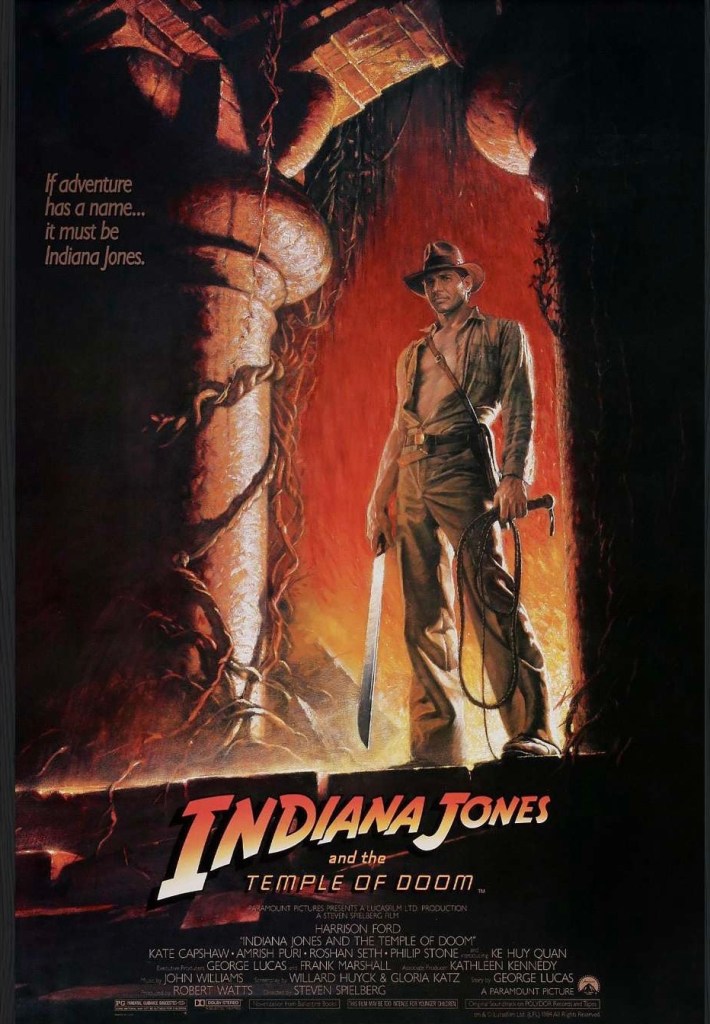
I grew up on adventure. My grandfather was old enough to have lived through the era of the great serials. I saw Zorro with the whip long before I ever saw Indiana Jones crack one. Saturday-morning serial energy was already in my blood. When Raiders of the Lost Ark came out, I thought it was wonderful—maybe the best pure adventure movie ever made. But Temple of Doom became personal.

Reading the Book Before the Movie in Hamilton, Ohio

When I was a kid, I used to go downtown to the shopping center in Hamilton, Ohio, with my mom and grandmother. On the bottom floor, there was a bookstore section. I went straight to the books every time. One day they got me the novelization of Indiana Jones and the Temple of Doom. I read it before I saw the movie. I read it the way I used to read the old adventure books—religiously, over and over. The character already lived in my head before the images did.

That early exposure mattered. George Lucas has always been steeped in mythology. The pursuit of the Grail, the knight who starts out chasing fortune and glory and ends up learning something harder—these patterns were in the water. I did not have the language for it at fourteen or fifteen, but I felt it.

The Night We Snuck Out in Morehead, Kentucky

The memory that sealed it for me happened the summer the movie was in theaters. I was fourteen or fifteen, part of a High Adventure Explorer Post. We were on a week-long trip heading toward whitewater rafting in West Virginia. We stopped to camp just outside Morehead, Kentucky. Hot summer night. The kind of heat that stays with you after dark.

We went into town for snacks, and I spotted the movie theater. Temple of Doom was playing. I grabbed a newspaper, checked the times, and saw the last show was at eleven. Back at camp, the plan was lights out early so we could get up for the next day’s adventure. Around eight or nine, everyone was settling in. Three of us waited, then slipped out.

We walked the two miles into town in the dark, hearts pounding, half-convinced we were going to get caught the whole way. We sat through the movie until about one in the morning. Then we walked the two miles back, still sweating, still listening for any sound that meant trouble. We snuck into our tents, drank some water from the canteen, ate a Slim Jim I had stashed, and tried to sleep. At seven, the camp woke up as if nothing had happened. Nobody said a word. We ate breakfast and headed out for the rafting and the rest of the week’s adventures. Later that summer I flew with my family to the Grand Canyon and all over California. The whole stretch felt like one long Indiana Jones sequence.

I have had many experiences since then. I am older now. I still cannot think of many moments that felt better than that night—walking back in the heat with the movie still running through my head, knowing we had gotten away with it, feeling completely alive. We had lived a small version of the thing we had just watched. Jump in. Trust yourself. Land on your feet.

Why Temple of Doom Hits Different

Raiders gives you the competent, almost invincible Indy. Temple of Doom puts him through the wringer. Poisoned, chased, plane crash, mountain landing, bugs, capture, the blood, the voodoo doll, the forced drinking, the near-sacrifice. They break him down further than in any of the other films. Then he comes out the other side, returns the stones, restores the village, and still walks away with the girl and the open road to the next adventure. “Fortune and glory” at the beginning. Something closer to responsibility and compassion by the end. He keeps the light touch the whole time. The movie never turns grim for its own sake. That balance is rare.

I raised my kids on it. I have raised grandkids on it. The soundtrack still gets played in the car. They know the cues. The film became a shared language in the family for the idea that you can take a beating and still come up swinging with a grin.

Mythology, Campbell, and Earned Freedom

Later I learned more about the deeper currents. Joseph Campbell’s work on the hero’s journey and the Grail legends shaped a generation of storytellers. George Lucas absorbed those patterns. The connection between the Indiana Jones films and older quest stories—Parzival, the wasteland, the knight who must learn before he can restore—is not forced. Temple of Doom functions as a modern version of the hero who starts selfish and ends up doing the right thing for people who cannot help themselves. The Last Crusade made the Grail explicit. Temple of Doom already had the emotional shape.

They also earned the right to make something this wild. After Raiders became a phenomenon, Lucas and Spielberg had the political capital in Hollywood to go darker, stranger, more unhinged—child slavery, Thuggee cult, heart-ripping, the whole fever-dream tone. A movie like that would have a much harder time getting made today. They used the freedom they had earned.

The Lesson That Stuck

For me, the core of it has always been simple. Indiana Jones trusts his ability to land on his feet no matter how bad the situation looks. Plane on fire. Poison. Traps. Brainwashing. Torture. He keeps moving. He keeps improvising. In the end, he is still the same man, only clearer. That attitude got into me early. Jump off the building if you have to. Figure out the landing on the way down. I have needed that more than once.

People who know me mostly through the political writing sometimes raise an eyebrow when I talk about movies. Movies are a shared language. Books are private. A film you both love gives you common ground in five minutes. When hundreds of new people start reading or listening and want to know a little more about the person behind the commentary, this is one of the cleaner ways to open the door. I do not normally spend this much time on personal stories. This one felt worth it.

Indiana Jones and the Temple of Doom is not the most polished film in the series. It is the one that feels most like actual life mixed with myth—messy, punishing, redemptive, and somehow still fun. I have carried its lessons through everything that came after that hot night in Morehead. Fortune and glory are great goals.  Landing on your feet and doing the right thing when it counts is better.

Footnotes

1.  The novelization of Indiana Jones and the Temple of Doom was written by James Kahn and published by Ballantine Books in 1984, timed with the film’s release.

2.  George Lucas has repeatedly acknowledged the influence of Joseph Campbell’s The Hero with a Thousand Faces and related mythological studies on his storytelling, particularly visible in the Star Wars films and carrying over into the adventure structures of the Indiana Jones series. The two later became acquainted; Campbell viewed the original Star Wars trilogy at Skywalker Ranch.

3.  Scholarly and critical readings have linked the Indiana Jones trilogy to Arthurian and Grail-quest patterns (including Chrétien de Troyes’ Perceval and Wolfram von Eschenbach’s Parzival), with Temple of Doom often discussed as a wasteland/otherworld episode and The Last Crusade making the Grail motif explicit.

4.  Howard Kazanjian served as executive producer on Raiders of the Lost Ark and producer on Return of the Jedi, and held a key production role at Lucasfilm during the period.

5.  Indiana Jones and the Temple of Doom (1984) was directed by Steven Spielberg from a story by George Lucas, screenplay by Willard Huyck and Gloria Katz. It is a prequel set in 1935.

Bibliography

Campbell, Joseph. The Hero with a Thousand Faces. Princeton: Princeton University Press, 1949 (and later editions).

Kahn, James. Indiana Jones and the Temple of Doom (novelization). New York: Ballantine Books, 1984.

Lucas, George, and various collaborators. Indiana Jones and the Temple of Doom. Directed by Steven Spielberg. Paramount Pictures, 1984.

Aronstein, Susan. Critical essays on Arthurian narrative patterns in the Indiana Jones trilogy (various academic publications).

Additional reading: Bill Moyers’ interviews with Joseph Campbell (The Power of Myth); production histories of the Indiana Jones films; Wolfram von Eschenbach’s Parzival for the classic Grail-knight arc that echoes in the franchise’s deeper structure.

Rich Hoffman

More about me

Click Here to Protect Yourself with Second Call Defense https://www.secondcalldefense.org/?affiliate=20707
About the Author: Rich Hoffman

Rich Hoffman is an author, political consultant, and strategic advisor based in Cincinnati, Ohio, and the creator of The Politics of Heaven—a unique framework that connects biblical theology, ancient history, and modern power structures to explain how moral alignment and spiritual forces shape global events. Blending real-world political experience with deep research into archaeology, UFO phenomena, and suppressed historical narratives, Hoffman offers compelling commentary on topics ranging from ancient civilizations and the Dead Sea Scrolls to modern populist movements, paranormal continuity, and leadership strategy in chaotic environments. As the author of The Gunfighter’s Guide to Business and the forthcoming Politics of Heaven, he brings a grounded yet provocative voice to media discussions, supported by firsthand experiences and a cross-disciplinary approach that bridges science, history, and theology. For interviews, speaking engagements, or expert analysis, visit richhoffmanbooks.com or contact directly via phone at 513-307-5815 or email at rhoffman@richhoffmanbooks.com.  If you’ve seen the movie, Disclosure Day and want to talk about it and the implications of Presidnet Trump’s UAP disclosures, let me know and we can bring some color to your coverage. https://richhoffmanbooks.com/media-inquiries-broadcast-topics-and-contact-info/?frame-nonce=ad51e7ecba I do have a firsthand UFO encounter to discuss.

Capitalism: The Unknown Ideal – Ayn Rand’s Moral Defense of the Only System Consistent with Human Nature, and Why It Still Matters in Ohio in 2026

I have been running a series on Ayn Rand because too many people who once understood her through the Tea Party years have let her slip out of memory, or worse, accepted the lazy smear that she was merely an atheist with nothing useful to say. That is a mistake. The radical left still hates her for the same reason they hate successful producers today. They understand, even if they will not admit it, that her arguments cut the moral legs out from under every scheme of redistribution, regulation, and class resentment.

I was reminded of this again after lunch with one of my favorite senators, George Lang. We talked about The Fountainhead, about the gold standard, and about how few people who claim to like Rand have actually read the full range of her nonfiction. That conversation pushed me to pick up the 1966 collection Capitalism: The Unknown Ideal again. It remains one of the clearest statements ever written of why pure capitalism is not just an economic preference but a moral necessity.

The book is not a dry economics text. Rand called it a nonfiction footnote to Atlas Shrugged. With contributions from Nathaniel Branden, a young Alan Greenspan, and Robert Hessen, it argues that the system we call capitalism today is a bastardized version of the real thing—an unknown ideal because it has never been allowed to exist in pure form. What we have instead is a mixed economy of freedom mixed with controls, and the controls always expand. 

Capitalism as the Only Moral Social System

Rand’s central claim is simple and radical. Man is a rational being who must use his own mind to survive. Any social system that initiates force against that process is not merely inefficient; it is immoral. Capitalism, properly understood, is the only system that bans the initiation of physical force from human relationships and leaves individuals free to produce, trade, and keep what they create.

She defines it precisely: a social system based on the recognition of individual rights, including property rights, in which all property is privately owned. The government’s sole legitimate function is to protect those rights by retaliating against those who initiate force. Everything else—regulation of production, redistribution of wealth, “industrial policy,” licensing of speech—is a violation. 

This is why she rejected the conservative approach of her time. Conservatives often tried to defend capitalism on practical grounds or by appeal to tradition while accepting the moral premise of altruism—that the individual has a duty to live for others. Rand called that a fatal compromise. In “The Anatomy of Compromise,” she shows that when you try to mix a rational principle with an irrational one, the irrational always wins. You cannot have a little bit of socialism without eventually losing the foundation of freedom. 

America’s Persecuted Minority: Big Business

One of the most powerful essays in the collection is “America’s Persecuted Minority: Big Business.” Rand flips the usual narrative on its head. The productive genius is not the exploiter; he is the one being hamstrung by the looters and moochers who use the power of the state to seize what they did not create. Business people are treated as a scapegoat class in the same way other minorities have been treated under collectivist regimes. In Soviet Russia it was the bourgeoisie. In Nazi Germany it was the Jews. In America it is the successful businessman. 

I see this hatred every day in the attacks on Trump, on Vivek Ramaswamy, on any rich person who made money by creating value rather than extracting it through politics. The radical left’s outrage is not about fairness. It is pure Marxist class warfare dressed up in modern language. Rand saw it clearly because she lived it. Her father lost his pharmacy when the Bolsheviks nationalized private businesses. She never forgot.

Solving World Hunger: Production, Not Politics

People still talk about solving world hunger as if it were a distribution problem that requires more government. That is backward. Pigs, chickens, and rabbits reproduce rapidly. There is no physical shortage of the capacity to produce food. Shortages are created by politics—by governments that micromanage, confiscate, and regulate the very people who would otherwise raise the animals and grow the crops.

If you want to end hunger, get as close as possible to pure capitalism. Remove the artificial constraints. Let people own property, keep their profits, and trade freely. The poor in the United States, even under our imperfect capitalism, are rich compared to most of the world. A few American dollars can still be a fortune to someone living under the policies that Rand warned against. The guilt that drives redistribution often comes from people who helped create the barriers to opportunity and then want to ease their conscience by confiscating more from the productive.

Greenspan on Gold and the Hard Reality of Theory

One of the most quoted essays in the book is Alan Greenspan’s “Gold and Economic Freedom,” written years before he became Federal Reserve chairman. He argued that gold and economic freedom are inseparable. The gold standard protects property rights by limiting the government’s ability to inflate away wealth through deficit spending. Without it, the welfare state can confiscate savings silently. 

Greenspan later operated in a system far from that ideal. Theory is cleaner than practice when you face political realities, activist judges, and entrenched interests. That does not make the original argument wrong. It shows how hard it is to implement principle once the mixed economy has taken hold. We are still living with the consequences of easy money, quantitative easing, and the revolving door between the Fed and large asset managers. The warnings in that 1966 essay hold up.

True Monopolies, Railroads, and the Industrial Revolution

The collection also dismantles the usual antitrust myths. Free-market monopolies can only be maintained by superior efficiency and better service. Coercive monopolies require government intervention—subsidies, franchises, or legal barriers to entry. The history of American railroads is a clear example. Most of the transcontinental lines were built with government land grants and ended in financial chaos. James J. Hill’s Great Northern was built without federal subsidies and remained the only one that did not go bankrupt. 

Robert Hessen’s essay on the effects of the Industrial Revolution on women and children is equally important. Child labor was not created by capitalism; it was inherited from a world of grinding poverty. Factories gave children a way to earn a living and survive to adulthood. Rising wealth created by capitalism eventually made child labor unnecessary. The laws usually get the credit; the production gets the blame. 

Airwaves, Speech, and the Nature of Government

Rand’s essay on the property status of the airwaves is still relevant. The early chaos in radio was not a failure of free enterprise but a failure of government to recognize and protect property rights in frequencies. Instead of allowing private ownership and trade, the government declared the airwaves public property and nationalized them through licensing. That opened the door to political control of speech—the same impulse we still see whenever independent voices become inconvenient. 

Ohio’s Choice and the Fight Ahead

All of this is not abstract philosophy. It is the framework for understanding the hatred directed at successful people in our own state. Vivek Ramaswamy is a rich man who built companies. That alone is enough for the radical left and their media allies to paint him as untrustworthy. The same pattern appears in the attacks on Trump. They do not hate wealth. They hate the independence that wealth can buy when it is earned rather than granted.

I have watched this for decades. The people who want a governor who has never had to make a payroll or risk his own capital are the same people who will expand the very controls that create shortages and dependency. Michael Ryan understands these issues at the county level. Senators like George Lang still talk about gold-backed approaches and business-friendly policy. We need more of them.

Rand was not interested in being practical in the usual sense. She was interested in being right on principle. She knew that a culture that accepts altruism as its moral code will eventually sacrifice the producers. She also believed that the potential for human progress under pure capitalism is limitless. The nineteenth century, when America came closest to the ideal, proved it.

I have read her books many times, along with the work of those who analyzed her. I agree with her on the essentials of capitalism even while I am more of a man of faith than she was. The philosophy can be taken further. But the fight is now. The books are still on the shelves at Barnes & Noble. You can get them quickly. Read Capitalism: The Unknown Ideal. Then look at the news with clearer eyes.

If you want to solve poverty and hunger, expand opportunity. More capitalism, not less. More people who understand how wealth is actually created. That is the only path that treats individuals as ends in themselves rather than means to someone else’s political vision.

Don’t give up the ship.

Footnotes

1.  Ayn Rand, Capitalism: The Unknown Ideal (New York: New American Library, 1966; expanded 1967). Rand described the book as a nonfiction footnote to Atlas Shrugged.

2.  Ayn Rand, “What Is Capitalism?” in Capitalism: The Unknown Ideal.

3.  Ayn Rand, “America’s Persecuted Minority: Big Business,” in Capitalism: The Unknown Ideal.

4.  Ayn Rand, “The Anatomy of Compromise,” in Capitalism: The Unknown Ideal.

5.  Alan Greenspan, “Gold and Economic Freedom,” originally published in The Objectivist (1966) and reprinted in Capitalism: The Unknown Ideal.

6.  Robert Hessen, “The Effects of the Industrial Revolution on Women and Children,” in Capitalism: The Unknown Ideal.

7.  Ayn Rand, “The Property Status of Airwaves,” in Capitalism: The Unknown Ideal.

8.  On James J. Hill and the Great Northern Railway, see Burton W. Folsom Jr. and related free-market historical accounts; the railroad is frequently cited in Objectivist literature as the counter-example to subsidized lines.

Bibliography

Rand, Ayn. Capitalism: The Unknown Ideal. With additional articles by Nathaniel Branden, Alan Greenspan, and Robert Hessen. New York: New American Library, 1966 (hardcover); expanded Signet paperback, 1967.

Rand, Ayn. Atlas Shrugged. New York: Random House, 1957.

Rand, Ayn. The Fountainhead. New York: Bobbs-Merrill, 1943.

Greenspan, Alan. “Gold and Economic Freedom.” The Objectivist, 1966.

Folsom, Burton W., Jr. Works on the “robber barons” myth and James J. Hill.

Additional recommended reading: Ayn Rand Lexicon entries on capitalism, business people, and the gold standard (aynrandlexicon.com); Ayn Rand Institute materials on laissez-faire.

Rich Hoffman

More about me

Click Here to Protect Yourself with Second Call Defense https://www.secondcalldefense.org/?affiliate=20707

About the Author: Rich Hoffman

Rich Hoffman is an author, political consultant, and strategic advisor based in Cincinnati, Ohio, and the creator of The Politics of Heaven—a unique framework that connects biblical theology, ancient history, and modern power structures to explain how moral alignment and spiritual forces shape global events. Blending real-world political experience with deep research into archaeology, UFO phenomena, and suppressed historical narratives, Hoffman offers compelling commentary on topics ranging from ancient civilizations and the Dead Sea Scrolls to modern populist movements, paranormal continuity, and leadership strategy in chaotic environments. As the author of The Gunfighter’s Guide to Business and the forthcoming Politics of Heaven, he brings a grounded yet provocative voice to media discussions, supported by firsthand experiences and a cross-disciplinary approach that bridges science, history, and theology. For interviews, speaking engagements, or expert analysis, visit richhoffmanbooks.com or contact directly via phone at 513-307-5815 or email at rhoffman@richhoffmanbooks.com.  If you’ve seen the movie, Disclosure Day and want to talk about it and the implications of Presidnet Trump’s UAP disclosures, let me know and we can bring some color to your coverage. https://richhoffmanbooks.com/media-inquiries-broadcast-topics-and-contact-info/?frame-nonce=ad51e7ecba I do have a firsthand UFO encounter to discuss.

From the Portable Office on the Road: Butler County Republican Leadership Change and the Call for Unity in the Fight Against Socialist Inroads

I have been traveling a lot this summer of 2026. My portable office goes with me. It is a rolling command post with a good chair, a refrigerator stocked with my favorite drinks, and windows that change the view almost every day. One day, the Tetons. Another day, the high country in Colorado or the open stretches of Utah and New Mexico. Just before recording some thoughts, I watched the ferry reverse into its slip, filming through the glass as the water churned. That is the life right now. I can work, read for hours, and still stay connected to home while the scenery shifts.

From that distance, the picture in Butler County comes into sharper focus. Politics is a bloodsport. Transitions happen. I checked in with some of my closest people back home and learned that Todd Hall is no longer chairman of the Butler County Republican Party. Art Sauerwein has taken the role. I always liked Todd. The job is genuinely thankless. It wears people out. Running a business on top of it, managing personalities, herding volunteers, and keeping the central committee pointed in one direction takes a small army and constant energy. I hope Art has a good run at it. The party needs steady hands.

Perspective from Distance Makes the Stakes Clearer

When you are removed from the daily handshakes and the same faces at every event, the larger pattern stands out. We have minor philosophical differences among ourselves. That is normal. What is not normal is letting those differences become the main event while outright socialists and radical Democrats keep pushing into local offices. I have watched it happen in places like West Chester.  It is the same impulse you see nationally with the more extreme progressive candidates. It does not matter if the fight is on Main Street or in the national headlines. The goal of those forces is the same: expand government, raise the cost of living through policy, and treat constitutional limits as optional.

I have said for years that we need a big tent. I mean it. That includes people who may lean a little softer on some issues as long as they will stand with us against tax increases, against socialist experiments in the schools, and for basic fiscal order. Sheriff Richard Jones has always struck me as a Gunsmoke Republican. That is the personality I want in the top law enforcement job. Even if he occasionally frustrates pure ideologues, I want him successful. The same goes for others I have known for decades.

Local Fiscal Reality Versus the Socialist Alternative

Butler County and much of Ohio under Republican stewardship have largely kept the books balanced. Surpluses have been more common than structural deficits. There has been resistance to the constant pressure to raise taxes. That is good government. It is the opposite of the model that turns every problem into a reason for bigger bureaucracy and higher burdens on working families. When I talk to people at campgrounds across the country, the pattern repeats. Many of them are Trump voters. They fly the flags. They are getting away from out-of-control local governments elsewhere. They recognize solid management when they see it. We have had a good run of it here. The job now is to protect it and expand it.

Personal Notes on the Players

I think highly of George Lang. I always have. Nancy Nix is often painted as a mainstreamer these days. I do not see her that way. I see her as a person who has done great work in the auditor’s office. Roger Reynolds has sympathizers, and I was one of them for a long time. I never understood the decision to go after Nancy Nix the way it happened. That kind of personal fight does not help the larger cause. When you are trying to win elections and keep socialists from taking seats, internal score-settling becomes a luxury we cannot afford.

The chairman’s role is not glamorous. Todd Hall held it for a long stretch after David Kern. He came in young and stayed through periods of real discord. Some people felt he did not have enough hours in the day. That is a fair observation about the demands of the job. Leadership at that level requires heavy delegation and constant recruitment of capable people. I hope Art Sauerwein understands that and builds the team accordingly. I wish him well. I will miss Todd in the role, but the work continues.

The Real Task Ahead

Trump observed years ago that people get so used to winning that they start losing to experience the thrill of winning again. That is a real danger. We cannot afford boredom or internal exhaustion. The fall elections and the offices that matter most require Republicans to lock arms. The goal is straightforward: more Republicans in office than Democrats, constitutional values protected, fiscal discipline maintained, and the Trump agenda advanced at the county level the same way it is being advanced nationally.

I will spend more time on the road this year and then settle in for the fourth quarter closer to home. The portable office has proven its value. I can read, think, write, and still stay plugged into Butler County. When I talk to people at those campgrounds, I get a clearer read on the national mood than I sometimes get in the middle of local factional fights. Most of them want government that works without constantly reaching into their pockets or experimenting with radical social theories on their children.

I hope everyone finds a way to shake hands at the picnics and fundraisers. Support the new chairman. Remember what we have in common is larger than what divides us. Keep the focus on winning. Do not get tired of it. The alternative is watching more socialists and their enablers take ground, one township and one school board at a time.

Footnotes

1.  Conversations with longtime Butler County Republican contacts, summer 2026, regarding the transition from Todd Hall to Dan Ferguson as party chairman.

2.  Public record of Todd Hall’s long tenure as Butler County Republican Party executive chairman, beginning in the mid-2010s following David Kern.

3.  Local election results and coverage of West Chester Township trustee races and related contests showing shifts in local control.

4.  Butler County and Ohio fiscal performance under Republican majorities: consistent emphasis on balanced budgets and resistance to routine tax increases, as reflected in county and state budget outcomes over recent cycles.

5.  Public statements and reporting on Roger Reynolds’ legal history, his attempt to reclaim the auditor’s office from Nancy Nix, and his later involvement in the county commissioner primary before withdrawing.

6.  Sheriff Richard K. Jones’ long record and public positioning as a traditional law-and-order Republican.

7.  Observations from campground conversations across multiple western and mountain states during summer 2026 travel regarding voter sentiment and local government dissatisfaction.

8.  C-SPAN and local reporting on 2026 Butler County Republican events, including candidate and leadership appearances.

Selected Bibliography for Further Reading

•  Journal-News (Hamilton/Butler County) coverage of Butler County Republican Party leadership, endorsements, and primary contests, 2024–2026.

•  Butler County Republican Party official materials and candidate endorsement lists.

•  Ohio Republican Party statements and State Central Committee updates, 2026.

•  Ballotpedia and Butler County Board of Elections records on local races, including West Chester Township trustees and county offices.

•  Reporting on Roger Reynolds’ conviction, appellate reversal, and subsequent legal efforts regarding the auditor’s office.

•  Public financial and budget summaries from Butler County and the State of Ohio illustrating fiscal trends under Republican control.

•  Contemporary accounts of Sheriff Richard Jones’ tenure and local political positioning.

•  Travel notes and personal observations compiled during summer 2026 from portable office locations across the western United States.

Rich Hoffman

More about me

Click Here to Protect Yourself with Second Call Defense https://www.secondcalldefense.org/?affiliate=20707

About the Author: Rich Hoffman

Rich Hoffman is an author, political consultant, and strategic advisor based in Cincinnati, Ohio, and the creator of The Politics of Heaven—a unique framework that connects biblical theology, ancient history, and modern power structures to explain how moral alignment and spiritual forces shape global events. Blending real-world political experience with deep research into archaeology, UFO phenomena, and suppressed historical narratives, Hoffman offers compelling commentary on topics ranging from ancient civilizations and the Dead Sea Scrolls to modern populist movements, paranormal continuity, and leadership strategy in chaotic environments. As the author of The Gunfighter’s Guide to Business and the forthcoming Politics of Heaven, he brings a grounded yet provocative voice to media discussions, supported by firsthand experiences and a cross-disciplinary approach that bridges science, history, and theology. For interviews, speaking engagements, or expert analysis, visit richhoffmanbooks.com or contact directly via phone at 513-307-5815 or email at rhoffman@richhoffmanbooks.com.  If you’ve seen the movie, Disclosure Day and want to talk about it and the implications of Presidnet Trump’s UAP disclosures, let me know and we can bring some color to your coverage. https://richhoffmanbooks.com/media-inquiries-broadcast-topics-and-contact-info/?frame-nonce=ad51e7ecba I do have a firsthand UFO encounter to discuss.