The Next Great Thing: Making People Extremely Wealthy is my favorite hobby 

The autonomous drone delivery market has moved from a distant Jetsons fantasy to operating infrastructure in 2026. What once required years of regulatory and technical work now appears in everyday retail and logistics conversations across American suburbs. Last-mile packages weighing roughly eight pounds or less arrive in under thirty minutes from select stores. Intermediate and heavier-payload systems are advancing in parallel. The combination creates a rare window for regional economic expansion, particularly in places positioned between major air hubs and dense distribution networks.

Autonomous Drone Delivery Reaches Critical Mass in 2026

Walmart surpassed one million cumulative drone deliveries by May 2026, with roughly 40 percent of that volume occurring in a single quarter. Operations ran from 66 stores across multiple states and metro markets, averaging about 23 minutes from order to drop. Partners include Alphabet’s Wing for broad national expansion and Zipline for higher-payload and restaurant-focused routes in select areas. 

Cincinnati and the greater metro area form part of the 2026–2027 rollout. Walmart and Wing announced the market as part of a plan to add roughly 150 more stores and reach more than 270 locations, serving over 40 million Americans by 2027. Service is free for limited periods for Walmart+ members and typically around $19.99 otherwise. Eligible items stay within weight limits of approximately 2.5–8 pounds, depending on the operator, and include groceries, household goods, electronics, and prepared food in an increasing number of locations. 

Local conversations in Butler County point to even nearer-term activity. Future Commissioner Michael Ryan has noted that the Walmart on the west side of Hamilton is positioning for drone delivery within a short window. Whether that specific site activates in the next month or two, the broader Cincinnati network is already advancing. Amazon Prime Air is simultaneously expanding toward Cleveland and other Ohio markets. The pattern is clear: consumer-facing drone delivery is no longer experimental.

How Zipline Solved the Last-Mile Safety and Precision Problem

Zipline began in 2014 and launched commercial medical deliveries in Rwanda in 2016. Fixed-wing Platform 1 aircraft, catapult-launched, carried blood and vaccines over long distances and released packages by parachute to remote clinics. The model scaled across African nations, later expanding to additional countries and use cases. By early 2026, the company had exceeded two million commercial deliveries and more than 120–130 million autonomous miles, with U.S. operations accounting for a growing majority of daily volume. 

Platform 2 shifted the architecture for denser suburban and urban environments. The aircraft flies and hovers at higher altitudes—often around 200–300 feet—well above trees, power lines, pets, and people. A tethered “droid” or delivery pod, equipped with its own sensors, thrusters, and cameras, lowers the package with high precision to a customer-selected spot such as a driveway, backyard, deck, or patio. The main aircraft never descends into the risk zone. Payload capacity reaches approximately eight pounds. This tethered approach removes many of the earlier concerns about rotor wash, noise near the ground, and physical conflict with ground activity. 

The technology matured through years of medical logistics under demanding conditions before consumer retail partners arrived. Walmart, multiple restaurant chains (including Little Caesars and others), and more recent partnerships, such as Uber Eats (announced in August 2026 for Dallas–Fort Worth with ambitious volume targets), demonstrate commercial viability. Cleveland Clinic has begun using the system for prescription deliveries in the Beachwood area of Ohio, with plans to expand medical logistics. OhioHealth had earlier explored similar capabilities in the Columbus region. 

Manufacturing follows a vertically integrated model. Aircraft, docks, and droids are produced primarily in the United States, with significant capacity in the South San Francisco area that has been expanded to support thousands of units annually. Core systems—motors, batteries, flight computers, and software—are designed in-house. The approach emphasizes rapid iteration, quality control, and the ability to scale production in response to demand, drawing practical lessons from high-volume advanced manufacturing environments.

Intermediate Payload Drones and the Middle-Mile Opportunity

Consumer last-mile delivery creates a secondary effect: higher inventory turnover at the store level. Impulse purchases—ketchup for a backyard cookout, shoes, small electronics, or prepared meals—arrive faster and more frequently. Stores therefore require more frequent replenishment from regional distribution centers and airport hubs. Traditional semi-truck schedules become a bottleneck.

This is where intermediate autonomous systems matter. Vehicles capable of carrying several hundred pounds of payload between points such as CVG and distribution centers in Monroe, Hamilton, or West Chester can compress lead times. Several developers are advancing hybrid or eVTOL designs in the 250–550 pound class for military and commercial logistics. Demonstrations of precision airdrop and unattended delivery already exist. Scaling these systems for routine civil middle-mile use remains earlier-stage than the eight-pound consumer platforms, yet the economic logic is straightforward: faster store replenishment supports higher sales volume without proportional increases in ground traffic. 

A regional vertical port or staging facility in the Butler County area sits at a logical geographic node. Proximity to CVG, major interstate corridors, existing distribution infrastructure, and a growing advanced manufacturing base creates natural advantages. Costs for a functional facility in the low tens of millions are considered realistic when private capital and public partnerships align. The same logic that once applied to highway interchanges and rail spurs now applies to low-altitude airspace corridors and charging or docking infrastructure.

Space Economy Linkages and Regional Positioning

Global rapid cargo movement is also advancing. Reusable orbital systems continue to reduce the cost and increase the frequency of long-distance transport. Once high-value or time-sensitive goods reach a continental hub such as CVG, the final legs—from airport to distribution center, then from distribution center to store or home—determine whether the speed advantage is preserved. Autonomous intermediate and last-mile drones close that chain. Regions that develop the supporting infrastructure, manufacturing capacity, and regulatory familiarity capture disproportionate economic activity.

Butler County already hosts advanced manufacturing initiatives and has examined advanced air mobility concepts at the regional airport. Conversations with local economic development leaders focus on scalable employment, high-skill technical roles, and long-term tax base growth rather than one-time projects. The model is not a simple replication of any single company. It is the disciplined application of rapid iteration, vertical integration where it adds value, reliable, autonomous operations, and customer-driven volume growth—qualities evident in both SpaceX’s production approach and Zipline’s evolution from medical necessity to consumer logistics.

Ground-Level Entry Before the Narrative Hardens

Technology adoption follows a familiar curve. Early technical risk and capital intensity give way to proven systems, regulatory clarity, and rapid commercial deployment. Those who engage while the infrastructure is still being built—manufacturing capacity, docking networks, airspace procedures, and local partnerships—participate in the steeper part of the value creation curve. Later entrants often pay higher multiples for the same assets.

An event on September 18  at Miami University, where I will be one of the hosts, will present specific examples of technology and partnership frameworks. The focus remains practical demonstration rather than abstract vision. Anyone who has worked alongside long-term economic development efforts in the region already knows the key points of contact. The opportunity is visible now in a way it was not two or three years earlier.

Why the Timing Matters for Southern Ohio

Consumer drone delivery is already operating at meaningful volume in multiple U.S. metros and is expanding into the Cincinnati market. Medical applications are live in Ohio. Intermediate heavy-payload systems are progressing from demonstration toward commercial readiness. Manufacturing capacity for autonomous aircraft is scaling inside the United States. Local leadership is actively discussing vertical airspace and advanced manufacturing as part of the county’s longer horizon.

The combination is unusual. Windows of this character do not remain open indefinitely. Regions that organize capital, talent, and regulatory alignment around the intermediate and supporting layers of the drone logistics stack position themselves for durable employment and wealth creation. The consumer-facing flights that will soon appear over Hamilton and surrounding communities are the visible surface of a deeper shift in supply chain and manufacturing. The deeper layer is where the larger and more lasting economic effects concentrate.

Footnotes

1.  Aggregate delivery and timing statistics drawn from industry reporting on Walmart’s May 2026 milestone and subsequent expansions.

2.  Platform technical details synthesized from Zipline operational descriptions, FAA-related documentation, and independent technical coverage of the tethered droid system.

3.  Manufacturing capacity and vertical integration details from company announcements and facility reporting covering 2025–2026 expansions.

4.  Cincinnati and Ohio market timing from contemporaneous business and local news coverage of the Wing–Walmart rollout.

5.  Heavy-lift payload platforms referenced from public demonstrations and developer disclosures in the 250–550 lb class.

6.  Local advanced air mobility discussion at Butler County Regional Airport from public meeting summaries.

7.  Cleveland Clinic and OhioHealth medical delivery pilots from regional health-system announcements and industry tracking.

Bibliography and Further Reading

•  DroneXL and related industry trackers for cumulative delivery volumes, operator comparisons, and market maps (2026 updates).

•  Chain Store Age and retail trade coverage of Walmart–Wing and Walmart–Zipline expansions.

•  Scientific American and technical press on Zipline Platform 2 tethered delivery mechanics.

•  Zipline official materials on operational history, platforms, and U.S. manufacturing.

•  Cincinnati Business Courier, Cincinnati Enquirer, and local broadcast reporting on the Cincinnati drone delivery timeline.

•  FAA environmental assessments and Part 135 operational documentation relevant to commercial package delivery.

•  Public materials on intermediate cargo UAS programs (Elroy Air Chaparral, AIR heavy-lift platforms, and related dual-use systems).

•  Butler County commission and airport authority records regarding advanced air mobility planning.

•  Broader logistics analyses of middle-mile autonomous systems and the interaction between last-mile speed and inventory velocity.

The infrastructure is being built in real time. The economic consequences will accrue to the regions and operators that treat the present window as operational rather than speculative.

Rich Hoffman

More about me

Click Here to Protect Yourself with Second Call Defense https://www.secondcalldefense.org/?affiliate=20707
About the Author: Rich Hoffman

Rich Hoffman is an author, political consultant, and strategic advisor based in Cincinnati, Ohio, and the creator of The Politics of Heaven—a unique framework that connects biblical theology, ancient history, and modern power structures to explain how moral alignment and spiritual forces shape global events. Blending real-world political experience with deep research into archaeology, UFO phenomena, and suppressed historical narratives, Hoffman offers compelling commentary on topics ranging from ancient civilizations and the Dead Sea Scrolls to modern populist movements, paranormal continuity, and leadership strategy in chaotic environments. As the author of The Gunfighter’s Guide to Business and the forthcoming Politics of Heaven, he brings a grounded yet provocative voice to media discussions, supported by firsthand experiences and a cross-disciplinary approach that bridges science, history, and theology. For interviews, speaking engagements, or expert analysis, visit richhoffmanbooks.com or contact directly via phone at 513-307-5815 or email at rhoffman@richhoffmanbooks.com.  If you’ve seen the movie, Disclosure Day and want to talk about it and the implications of Presidnet Trump’s UAP disclosures, let me know and we can bring some color to your coverage. https://richhoffmanbooks.com/media-inquiries-broadcast-topics-and-contact-info/?frame-nonce=ad51e7ecba I do have a firsthand UFO encounter to discuss.
From the Portable Office on the Road: Butler County Republican Leadership Change and the Call for Unity in the Fight Against Socialist Inroads

I have been traveling a lot this summer of 2026. My portable office goes with me. It is a rolling command post with a good chair, a refrigerator stocked with my favorite drinks, and windows that change the view almost every day. One day, the Tetons. Another day, the high country in Colorado or the open stretches of Utah and New Mexico. Just before recording some thoughts, I watched the ferry reverse into its slip, filming through the glass as the water churned. That is the life right now. I can work, read for hours, and still stay connected to home while the scenery shifts.

From that distance, the picture in Butler County comes into sharper focus. Politics is a bloodsport. Transitions happen. I checked in with some of my closest people back home and learned that Todd Hall is no longer chairman of the Butler County Republican Party. Art Sauerwein has taken the role. I always liked Todd. The job is genuinely thankless. It wears people out. Running a business on top of it, managing personalities, herding volunteers, and keeping the central committee pointed in one direction takes a small army and constant energy. I hope Art has a good run at it. The party needs steady hands.

Perspective from Distance Makes the Stakes Clearer

When you are removed from the daily handshakes and the same faces at every event, the larger pattern stands out. We have minor philosophical differences among ourselves. That is normal. What is not normal is letting those differences become the main event while outright socialists and radical Democrats keep pushing into local offices. I have watched it happen in places like West Chester.  It is the same impulse you see nationally with the more extreme progressive candidates. It does not matter if the fight is on Main Street or in the national headlines. The goal of those forces is the same: expand government, raise the cost of living through policy, and treat constitutional limits as optional.

I have said for years that we need a big tent. I mean it. That includes people who may lean a little softer on some issues as long as they will stand with us against tax increases, against socialist experiments in the schools, and for basic fiscal order. Sheriff Richard Jones has always struck me as a Gunsmoke Republican. That is the personality I want in the top law enforcement job. Even if he occasionally frustrates pure ideologues, I want him successful. The same goes for others I have known for decades.

Local Fiscal Reality Versus the Socialist Alternative

Butler County and much of Ohio under Republican stewardship have largely kept the books balanced. Surpluses have been more common than structural deficits. There has been resistance to the constant pressure to raise taxes. That is good government. It is the opposite of the model that turns every problem into a reason for bigger bureaucracy and higher burdens on working families. When I talk to people at campgrounds across the country, the pattern repeats. Many of them are Trump voters. They fly the flags. They are getting away from out-of-control local governments elsewhere. They recognize solid management when they see it. We have had a good run of it here. The job now is to protect it and expand it.

Personal Notes on the Players

I think highly of George Lang. I always have. Nancy Nix is often painted as a mainstreamer these days. I do not see her that way. I see her as a person who has done great work in the auditor’s office. Roger Reynolds has sympathizers, and I was one of them for a long time. I never understood the decision to go after Nancy Nix the way it happened. That kind of personal fight does not help the larger cause. When you are trying to win elections and keep socialists from taking seats, internal score-settling becomes a luxury we cannot afford.

The chairman’s role is not glamorous. Todd Hall held it for a long stretch after David Kern. He came in young and stayed through periods of real discord. Some people felt he did not have enough hours in the day. That is a fair observation about the demands of the job. Leadership at that level requires heavy delegation and constant recruitment of capable people. I hope Art Sauerwein understands that and builds the team accordingly. I wish him well. I will miss Todd in the role, but the work continues.

The Real Task Ahead

Trump observed years ago that people get so used to winning that they start losing to experience the thrill of winning again. That is a real danger. We cannot afford boredom or internal exhaustion. The fall elections and the offices that matter most require Republicans to lock arms. The goal is straightforward: more Republicans in office than Democrats, constitutional values protected, fiscal discipline maintained, and the Trump agenda advanced at the county level the same way it is being advanced nationally.

I will spend more time on the road this year and then settle in for the fourth quarter closer to home. The portable office has proven its value. I can read, think, write, and still stay plugged into Butler County. When I talk to people at those campgrounds, I get a clearer read on the national mood than I sometimes get in the middle of local factional fights. Most of them want government that works without constantly reaching into their pockets or experimenting with radical social theories on their children.

I hope everyone finds a way to shake hands at the picnics and fundraisers. Support the new chairman. Remember what we have in common is larger than what divides us. Keep the focus on winning. Do not get tired of it. The alternative is watching more socialists and their enablers take ground, one township and one school board at a time.

Footnotes

1.  Conversations with longtime Butler County Republican contacts, summer 2026, regarding the transition from Todd Hall to Dan Ferguson as party chairman.

2.  Public record of Todd Hall’s long tenure as Butler County Republican Party executive chairman, beginning in the mid-2010s following David Kern.

3.  Local election results and coverage of West Chester Township trustee races and related contests showing shifts in local control.

4.  Butler County and Ohio fiscal performance under Republican majorities: consistent emphasis on balanced budgets and resistance to routine tax increases, as reflected in county and state budget outcomes over recent cycles.

5.  Public statements and reporting on Roger Reynolds’ legal history, his attempt to reclaim the auditor’s office from Nancy Nix, and his later involvement in the county commissioner primary before withdrawing.

6.  Sheriff Richard K. Jones’ long record and public positioning as a traditional law-and-order Republican.

7.  Observations from campground conversations across multiple western and mountain states during summer 2026 travel regarding voter sentiment and local government dissatisfaction.

8.  C-SPAN and local reporting on 2026 Butler County Republican events, including candidate and leadership appearances.

Selected Bibliography for Further Reading

•  Journal-News (Hamilton/Butler County) coverage of Butler County Republican Party leadership, endorsements, and primary contests, 2024–2026.

•  Butler County Republican Party official materials and candidate endorsement lists.

•  Ohio Republican Party statements and State Central Committee updates, 2026.

•  Ballotpedia and Butler County Board of Elections records on local races, including West Chester Township trustees and county offices.

•  Reporting on Roger Reynolds’ conviction, appellate reversal, and subsequent legal efforts regarding the auditor’s office.

•  Public financial and budget summaries from Butler County and the State of Ohio illustrating fiscal trends under Republican control.

•  Contemporary accounts of Sheriff Richard Jones’ tenure and local political positioning.

•  Travel notes and personal observations compiled during summer 2026 from portable office locations across the western United States.

Rich Hoffman

More about me

Click Here to Protect Yourself with Second Call Defense https://www.secondcalldefense.org/?affiliate=20707

About the Author: Rich Hoffman

Rich Hoffman is an author, political consultant, and strategic advisor based in Cincinnati, Ohio, and the creator of The Politics of Heaven—a unique framework that connects biblical theology, ancient history, and modern power structures to explain how moral alignment and spiritual forces shape global events. Blending real-world political experience with deep research into archaeology, UFO phenomena, and suppressed historical narratives, Hoffman offers compelling commentary on topics ranging from ancient civilizations and the Dead Sea Scrolls to modern populist movements, paranormal continuity, and leadership strategy in chaotic environments. As the author of The Gunfighter’s Guide to Business and the forthcoming Politics of Heaven, he brings a grounded yet provocative voice to media discussions, supported by firsthand experiences and a cross-disciplinary approach that bridges science, history, and theology. For interviews, speaking engagements, or expert analysis, visit richhoffmanbooks.com or contact directly via phone at 513-307-5815 or email at rhoffman@richhoffmanbooks.com.  If you’ve seen the movie, Disclosure Day and want to talk about it and the implications of Presidnet Trump’s UAP disclosures, let me know and we can bring some color to your coverage. https://richhoffmanbooks.com/media-inquiries-broadcast-topics-and-contact-info/?frame-nonce=ad51e7ecba I do have a firsthand UFO encounter to discuss.
From Put-in-Bay Caves to Edison’s Milan Home: A Family Vacation That Reveals the Enduring Spark of American Curiosity

I have spent a good deal of time lately thinking about the ancient copper mines of Lake Superior and the strange, almost otherworldly geology that surrounds the Great Lakes. Those thoughts were still turning over in my mind when my family and I loaded the RV and headed for South Bass Island. People from California or Europe might look at a map of Ohio and wonder why anyone would choose an island in Lake Erie for a vacation. From where I sit, it is one of the finest places on earth. It is close enough that my wife and I can reach it without turning the trip into an ordeal, yet once you are on the island you feel properly away from the mainland and its noise. That distance matters to me more than it once did.

We took the ferry with the RV, set up camp, and let the grandchildren loose on golf carts. They had a tremendous time. My son-in-law captured a different angle of the same days on his YouTube channel—lighter, more focused on the pure family fun. I present information one way; he and my daughter present it another. The island itself offered exactly what I had hoped for: a short escape, some serious geology, and a chance to feed the particular curiosity I see in one of my grandsons.

Why South Bass Island and the Lake Erie Caves Called to Us

The geology of these islands is young by deep-time standards. Much of what you see was shaped by the last ice age, roughly 12,000 years ago, yet the underlying limestone and the cave systems hold older stories. I wanted the grandchildren to walk through those stories. Perry’s Cave is the most famous of them. During the War of 1812, men under Commodore Oliver Hazard Perry used the underground freshwater stream inside the cave while the fleet was based in the natural harbor at Put-in-Bay. The cave sits fifty-odd feet below the surface, stays a constant cool temperature, and still carries that quiet historical weight. 

A short distance away is Crystal Cave at Heineman’s Winery, recognized as the world’s largest geode. You descend into a single vast cavity lined with celestite crystals, some of them more than a foot long. The space is large enough to accommodate a small group of people comfortably. Standing inside it feels less like visiting a tourist attraction and more like stepping into a mineral cathedral formed over thousands of years after the ice retreated. My grandson, the one who already shows the restless, pattern-seeking intelligence that strongly reminds me of a young Thomas Edison, had been talking about the largest geode in the world. We made sure he saw it. 

Joe’s Bar sits near the little airport, close enough that people flying in on small planes can walk over for a hamburger or fries. They allow dogs on the outdoor side, which is why my granddaughter wanted to go. We were not there for the drinking crowd. We were there because it sits almost on the path between the campground and the caves, and because a place that welcomes the family dog while serving simple food has its own quiet usefulness. These small details are part of what makes the island work.

The Edison Parallel and the Decision to Stay Longer in Milan

I talk about Thomas Edison a good deal around that particular grandson. It is not that I want to turn him into a replica. I want him to see that there have always been alternatives to the standard path. After the rest of us headed home, my oldest daughter, her husband, and that grandson stayed on. They took the extra days to drive over to Milan, Ohio, and visit Edison’s boyhood home. The house is modest, brick, and sits in a quiet town that still carries the inventor’s name with a certain local pride.

I had recommended Edmund Morris’s biography of Edison years earlier. Morris structured the book in reverse, beginning near the end of Edison’s life—when the older man was still frantically trying to solve the problem of domestic rubber production with Henry Ford and others—and working backward to the boy in Milan. That structure stays with me. It shows a man who never stopped pushing against limits, even when he was five minutes from death. His mother had pulled him out of the public school system early because the ordinary classroom could not contain him. She homeschooled him, protected his oddities, and gave him room to become the person who would later file patents at a pace almost no one has matched. 

That decision by a mother in a small Ohio town still matters. The regulatory and educational environment today makes another Edison far less likely. My daughter understands this. Her husband understands it. They did not stay behind to force a legend on a child. They stayed to show him the actual house, the actual town, and the atmosphere that once allowed a singular mind to develop without being sanded down into a drone.

Local Newspapers, Mickey’s Gas Station, and the Voynich Manuscript

While they were in the Milan area, they stopped at one of the Mickey’s locations—a regional gas-station and market chain that still feels rooted in northern Ohio rather than corporate nowhere. At the counter, they picked up free local newspapers. One of them carried a feature on the Voynich Manuscript, the world’s most mysterious book. My daughter texted me photos of the pages and asked what I thought of it.

I had already written about the manuscript. My working view is that it may be the notebook of a non-human intelligence that somehow ended up in human hands—an idea that fits the larger pattern I explore in The Politics of Heaven. Whether that theory is ultimately correct or not, the fact that a free newspaper distributed at a gas station in Edison country would feature the Voynich at all tells you something about the residual curiosity that still lives in these communities. They are not merely selling fuel and snacks. They are still willing to put strange, difficult ideas in front of ordinary people who might take a copy home and actually read it. 

That same spirit shows up in the little free papers and local efforts you find on the islands themselves. People publish them because they love the place and want to keep a certain industrious, heritage-minded atmosphere alive. It is the opposite of the passive consumption that dominates so much of modern life.

Hardware-Store Towels, Uranus Fudge, and the Ordinary Magic of Ohio Stops

One afternoon we took the kids to a beach facing Kelley’s Island from South Base Island. It is one of the better swimming spots in the area, down past the memorial at the far end. No one had packed swimsuits or towels. The water was cold, as Lake Erie usually is. My wife climbed into a golf cart, drove to the little hardware-and-grocery store that serves much of the island, bought towels and extra clothes, and raced back so the children would not freeze on the return ride. The whole episode lasted maybe half an hour. It was pure small-town improvisation, and it worked.

On other trips, we stop at Shelton’s fireworks store in Richmond, Indiana, right across the state line. Across the street sits the Uranus Fudge Factory, a place that leans hard into adolescent humor in its name yet sells genuinely high-quality candy. This has been a candy year for the grandchildren. We have hit obscure sweet shops all over Ohio, and Uranus held its own. We also make the ritual stop at the McDonald’s in Eaton with the good playground, even though the kids are now mostly too old to play on it. They still like being there. On the way back, we often grab Chinese food from the little plaza near the Walmart. These are not glamorous destinations. They are simply places that have kept a certain American texture—part commerce, part joke, part genuine local pride.

What These Days Actually Mean

I did not plan the vacation as a lesson. I planned it as time away with the people I care about, on an island that still feels like itself. The geology, the caves, the geode, the Edison house, the free newspaper with the Voynich article, the hardware-store towels, and the slightly ridiculous fudge factory all belong to the same larger pattern. They are evidence that pockets of real curiosity and individual initiative still exist in ordinary American places.

The copper mines of Superior, the glacial history of the islands, the unexplained manuscript, and the boy who was protected from the standard school system all feed into the same set of questions I have been carrying for years. Those questions will appear in full in The Politics of Heaven. For now, it is enough to say that a family trip to Put-in-Bay and a side journey to Milan reminded me why I keep returning to these subjects. Intelligence and inventiveness do not come from committees or from systems designed to produce uniform results. They come from particular minds given room to develop, often in small towns that still value their own odd heritage.

I am glad my daughter and son-in-law captured their version of the days on video. I am glad the grandchildren got to stand inside the largest geode, walk through Perry’s Cave, and see the actual house where Edison began. And I am glad a free newspaper at a gas station still bothers to tell people about the world’s most mysterious book. These are small signs, but they are real. In a time when so much of the culture seems determined to flatten everything into the same safe shape, they are worth noticing.

If you ever find yourself near Lake Erie with a few free days, take the ferry. Walk the caves. Stand inside the geode. And if you are driving through northern Ohio, stop at a Mickey’s and pick up whatever free paper they are giving away that week. You never know what might be inside it.

Footnotes

1.  Guinness World Records recognizes Crystal Cave at Heineman’s Winery on South Bass Island as the largest geode, a single celestite cavity discovered in 1887 while digging a well.

2.  Historical accounts credit men under Commodore Oliver Hazard Perry with using the underground stream in Perry’s Cave for freshwater during the 1813 occupation of the island before the Battle of Lake Erie.

3.  Edmund Morris, Edison (New York: Random House, 2019). The biography is structured in reverse chronological order, beginning near the end of Edison’s life and moving backward to his boyhood in Milan, Ohio.

4.  The Voynich Manuscript, held at Yale’s Beinecke Rare Book & Manuscript Library, remains undeciphered. Fringe theories have long included non-human or extraterrestrial origin; the author’s own published view aligns with that line of speculation as part of a broader inquiry into non-human intelligence.

5.  Mickey’s is a regional convenience-store and gas-station chain headquartered in the Milan, Ohio area, known for community involvement and local character.

Selected Bibliography

Morris, Edmund. Edison. New York: Random House, 2019.

Heineman’s Winery and Crystal Cave historical materials, Put-in-Bay, Ohio.

Perry’s Cave Family Fun Center and related War of 1812 documentation.

National Park Service materials on Perry’s Victory and International Peace Memorial.

Voynich Manuscript facsimile and scholarly literature, Beinecke Rare Book & Manuscript Library, Yale University.

Local histories of South Bass Island, Kelleys Island, and the Lake Erie island archipelago.

Geology of the Great Lakes region and post-glacial cave formation studies.

Hoffman, Rich. The Gunfighter’s Guide to Business.

Hoffman, Rich. The Politics of Heaven (forthcoming).

The Gunfighter’s Guide: A skeleton key to Western Civilization (gunfighterguide.shop) 

Rich Hoffman

More about me

Click Here to Protect Yourself with Second Call Defense https://www.secondcalldefense.org/?affiliate=20707

About the Author: Rich Hoffman

Rich Hoffman is an author, political consultant, and strategic advisor based in Cincinnati, Ohio, and the creator of The Politics of Heaven—a unique framework that connects biblical theology, ancient history, and modern power structures to explain how moral alignment and spiritual forces shape global events. Blending real-world political experience with deep research into archaeology, UFO phenomena, and suppressed historical narratives, Hoffman offers compelling commentary on topics ranging from ancient civilizations and the Dead Sea Scrolls to modern populist movements, paranormal continuity, and leadership strategy in chaotic environments. As the author of The Gunfighter’s Guide to Business and the forthcoming Politics of Heaven, he brings a grounded yet provocative voice to media discussions, supported by firsthand experiences and a cross-disciplinary approach that bridges science, history, and theology. For interviews, speaking engagements, or expert analysis, visit richhoffmanbooks.com or contact directly via phone at 513-307-5815 or email at rhoffman@richhoffmanbooks.com.  If you’ve seen the movie, Disclosure Day and want to talk about it and the implications of Presidnet Trump’s UAP disclosures, let me know and we can bring some color to your coverage. https://richhoffmanbooks.com/media-inquiries-broadcast-topics-and-contact-info/?frame-nonce=ad51e7ecba I do have a firsthand UFO encounter to discuss.

After the Primary: The Quiet Discipline That Holds Local Politics Together

In the weeks following a hard-fought primary like the one we just witnessed in Butler County, Ohio, the atmosphere shifts noticeably. Yard signs disappear from lawns and intersections, the barrage of text messages and robocalls slows to a trickle, and former rivals find themselves sharing space at the same community events. For those of us who have spent years immersed in local party work—not as officeholders, but as volunteers, observers, strategists, and commentators—the true measure of success is not the drama of election night. It is the steady, often invisible labor that follows: rebuilding unity, channeling energy toward the general election, and recommitting to the unglamorous tasks that make self-government possible at the county level. 

I have watched these cycles unfold in Butler County for a long time. It is a place I know intimately, not through national headlines but through precinct meetings, central committee sessions, and the day-to-day effort of turning out voters in all kinds of weather. The 2026 Republican primary for county commissioner stands out, not because it was exceptionally bitter by historical standards, but because it offered a clear illustration of how functional parties operate. The Butler County Republican Party, under Executive Chairman Todd Hall, held an endorsement process that produced a strong 71% vote for challenger Michael Ryan at the pre-primary meeting. Incumbent Commissioner Cindy Carpenter, a long-serving public servant with her own record of accomplishment, ran without seeking the party’s formal endorsement and fell short in the May 5 primary, with Ryan securing approximately 72% of the vote to her 28%. In a heavily Republican county, that primary outcome effectively decided the seat, but the real story lies in what the process revealed about leadership, temperament, and organizational resilience. 

This was not chaos or machine-style imposition. It was a party mechanism functioning as intended. Primaries exist to force choices, even among candidates who broadly share a philosophical outlook. In deep-red counties like Butler, the spring contest is often where the substantive debate occurs. The party’s role is not to crown unopposed victors but to test candidates through transparent processes, consolidate support when possible, and then pivot the full organizational weight behind the nominee. What I observed here reinforced a conviction I have held for years: well-functioning local parties remain among the most effective tools for translating citizen energy into accountable governance.

My own role in these circles has been to work to amplify grassroots voices through platforms like my blog and commentary. What experience has taught me is that county-level party leadership is rarely about top-down command. It is mediation under pressure—navigating meetings where ambitions collide, volunteers grow weary, and donors press for results. Figures like Chairman Hall bring institutional memory that newer participants often overlook. They understand that endorsements derive legitimacy from process: votes cast by elected central committee members who answer to their precincts. A decisive majority, as occurred with Ryan’s 71% endorsement, gives the organization moral authority to call for unity afterward without pretending differences never existed.

Critics of the outcome, particularly those aligned with the incumbent, raised reasonable concerns rooted in experience versus renewal. Carpenter had served multiple terms, bringing continuity to county issues such as development, infrastructure, and fiscal management. Ryan, a former Hamilton city councilmember, embodied a generational shift and demonstrated strong grassroots appeal. Both sides presented legitimate visions. The endorsement vote did not suppress those arguments; it subjected them to public scrutiny during the primary. Voters rendered their verdict decisively. That is precisely how the system is designed to work. Absent such a mechanism, contests devolve into pure personality clashes or contests dominated solely by fundraising. With it, even a well-qualified incumbent has the opportunity to make their case directly to the electorate—as Carpenter did—while the party fulfills its role as aggregator and tester of support.

What remains largely invisible to outsiders is the volunteer economy that sustains these efforts. In Midwestern counties like Butler, the Republican organization depends on individuals who participate not for pay or prestige but because they view unstructured, celebrity-driven alternatives as inferior. These are precinct captains making calls after full workdays, sign teams braving cold mornings along highways, and committee members debating platform details that never reach cable news. The labor includes maintaining accurate voter data, training poll watchers, coordinating logistics for early voting, and managing relationships with statewide and national figures who sometimes treat local parties more as backdrops for appearances than as genuine partners. When a primary concludes, this infrastructure does not dissolve. It redirects. Unity after conflict is not erasure of disagreement; it is a deliberate choice to preserve capacity for the larger tasks ahead. 

I have witnessed the tangible costs when capable people disengage. In prior cycles, personal disappointments prompted some to step back or, worse, work against the organization. The consequences are measurable: reduced turnout, diluted messaging, and openings for opponents. Self-government demands institutions capable of outlasting individual ambitions or grievances. Political parties are imperfect—vulnerable to factionalism, inertia, and occasional self-dealing—but they perform essential functions: aggregating dispersed knowledge, distributing the workload, and creating accountability structures that independent efforts or ad hoc movements rarely replicate at scale. A single voice with a platform can shape opinion and hold leaders accountable. Converting that influence into sustained policy impact or electoral success requires a coordinated, disciplined organization.

This local reality stands in instructive contrast to national political dysfunction. In Washington and the broader media ecosystem, spectacle dominates: perpetual outrage, purity spirals, and the framing of every intra-party disagreement as existential treason. At the county level, practical governance imposes discipline. Commissioners must address real constituent concerns—road maintenance, zoning disputes, tax levies, and emergency services. Rhetoric collides with results on a shorter timeline. Butler County’s recent primary highlighted the importance of temperament alongside ideology. Party leadership maintained focus on process rather than inflammatory escalation. Post-primary statements emphasized forward momentum. Such quiet competence is more demanding than it appears and more valuable than fiery rhetoric in sustaining long-term effectiveness.

Gratitude is appropriate in this moment. It belongs to the central committee members who cast difficult votes based on their assessment of the county’s needs. To the volunteers who invested time in both campaigns and are now bridging divides. To Michael Ryan for waging a substantive race that resonated with voters. Institutional memory, carried by leaders who recall when Butler County was more competitive and the sustained effort required to build current strength, helps moderate impulses to dismantle structures after any single setback. People like Chairman Hall, who have been involved since the late 1990s, provide continuity that tempers short-term passions. 

None of this equates to demanding uncritical loyalty. Parties require ongoing scrutiny. Endorsement processes can and should evolve—perhaps with enhanced transparency, more structured candidate forums, and refined approaches to balancing incumbency advantages against fresh challenges. Yet the impulse to abandon or weaken the framework because one cycle produced disappointment undermines the very instrument needed for future contests. In an age of eroded public trust, competent local organizations help rebuild it precinct by precinct through consistent delivery and responsiveness.

The road ahead for Butler County follows a familiar and constructive pattern: consolidate support behind nominees, maximize turnout among the base, and communicate clearly on tangible priorities such as responsible growth, efficient services, and fiscal prudence. For those of us reflecting on the primary, the takeaways transcend this single race. Politics at its most effective is less poetry than prose—the patient discipline of meetings, voter lists, follow-up calls, and coalition maintenance. Leadership under pressure manifests not primarily in stirring speeches but in the capacity to accept defeat without bitterness, achieve victory without triumphalism, and realign all parties toward shared objectives.

This primary tested those qualities. Early indications suggest the organization met the challenge. That outcome merits recognition, not because the party or its processes are flawless, but because functional competence at the local level sustains self-government amid broader cultural noise. In an era that rewards disruption and performative outrage, preserving and improving these institutions—through honest critique, participation, and earned trust—remains a quiet but essential civic duty.

Expanding on these themes requires acknowledging the deeper historical and theoretical context that makes county parties vital. Alexis de Tocqueville, observing American democracy in the 1830s, famously noted the proliferation of voluntary associations as a distinguishing strength of the young republic. Political parties, at their best, represent one form of this associative life, mediating between the individual citizen and the scale of government. In a federal system, the county level serves as a crucial intermediary: close enough to constituents for accountability, yet structured enough to influence state and national outcomes. Butler County exemplifies this. Its Republican organization has helped maintain conservative governance on issues ranging from economic development in growing townships to prudent management of public resources. The primary process, while contentious, demonstrated the system’s capacity for self-correction without external imposition. 

Volunteer culture deserves particular emphasis. National campaigns and consultants often overlook the economics of local effort. In Butler, as elsewhere, much of the work relies on unpaid labor motivated by conviction rather than compensation. This creates both strengths and vulnerabilities. Commitment runs deep, but burnout is real. Effective leadership mitigates the latter through recognition, clear communication, and realistic expectations. Post-primary unity efforts succeed when they validate contributions from all sides rather than signaling that only the winner’s team mattered. Ryan’s campaign benefited from broad grassroots enthusiasm; integrating Carpenter’s supporters will strengthen the general election effort against the Democratic nominee.

Critics of party structures sometimes advocate for open primaries or non-partisan approaches, arguing that closed systems entrench insiders. There is merit in debating reforms. Yet evidence from political science suggests that strong parties correlate with more stable governance and higher accountability in legislative bodies. Duverger’s Law highlights how single-member district systems naturally favor two-party competition, with parties serving as gatekeepers that filter extreme or unserious candidates. Local organizations add granularity: they understand hyper-local dynamics—school levies, township trustees, zoning battles—that national or even statewide actors cannot. Dismissing them as obsolete ignores their role in countering the atomization of modern politics, where social media amplifies voices but rarely builds lasting coalitions. 

My perspective is shaped by years of commentary on these dynamics. I have celebrated victories, critiqued missteps, and urged higher standards. The 2026 primary reinforced that temperament matters profoundly. Victors who gloat or losers who withdraw permanently erode the shared capital necessary for future success. The measured tone from both campaigns and party leadership post-May 5 offers a model worth emulating. It acknowledges human ambition while subordinating it to institutional health.

Looking forward, Butler County faces familiar challenges: balancing growth with quality of life, controlling costs amid state and federal pressures, and maintaining trust in local institutions. The Republican nominee will benefit from the county’s partisan lean, but complacency is unwise. Effective parties treat every election as competitive, investing in voter contact and message discipline. National figures who visit during cycles would do well to invest more in these local structures rather than viewing them transactionally.

In the end, the quiet discipline of functional parties—endorsement processes that confer legitimacy, volunteer networks that deliver results, leadership that mediates rather than dictates—sustains the American experiment more reliably than episodic populism or institutional disdain. This primary was a reminder of that truth. Credit belongs to those who participated fully: candidates, committee members, volunteers, and voters. Their efforts, visible and invisible, keep self-government operational. Protecting that legacy, improving where needed, and recommitting after conflict represent the real work of politics. It is rarely glamorous, but it remains indispensable.

Footnotes

1.  Cincinnati Enquirer reporting on May 5, 2026, primary results.

2.  Journal-News coverage of endorsement and vote totals.

3.  Butler County Board of Elections data.

4.  Tocqueville, Democracy in America (1835/1840), discussion of associations.

5.  Duverger, Political Parties (1951), on party systems.

6.  Observations drawn from public statements by party leadership and candidates.

7.  Historical context from local coverage of prior cycles.

Bibliography / Suggested Reading

•  de Tocqueville, Alexis. Democracy in America. Translated by Henry Reeve. 1835/1840. (Especially Volume 1 on civil associations.)

•  Duverger, Maurice. Political Parties: Their Organization and Activity in the Modern State. 1951.

•  Putnam, Robert D. Bowling Alone: The Collapse and Revival of American Community. Simon & Schuster, 2000. (On social capital and local engagement.)

•  Aldrich, John H. Why Parties? A Second Look. University of Chicago Press, 2011.

•  Local coverage: Cincinnati Enquirer, Journal-News archives on Butler County elections.

•  Additional context from Ballotpedia entries on Ohio local races and party structures.

Rich Hoffman

More about me

Click Here to Protect Yourself with Second Call Defense https://www.secondcalldefense.org/?affiliate=20707

About the Author: Rich Hoffman

Rich Hoffman is an aerospace executive, political strategist, systems thinker, and independent researcher of ancient history, the paranormal, and the Dead Sea Scrolls tradition. His life in high‑stakes manufacturing, high‑level politics, and cross‑functional crisis management gives him a field‑tested understanding of power — both human and unseen.

He has advised candidates, executives, and public leaders, while conducting deep, hands‑on exploration of archaeological and supernatural hotspots across the world.

Hoffman writes with the credibility of a problem-solver, the curiosity of an archaeologist, and the courage of a frontline witness who has gone to very scary places and reported what lurked there. Hoffman has authored books including The Symposium of JusticeThe Gunfighter’s Guide to Business, and Tail of the Dragon, often exploring themes of freedom, individual will, and societal structures through a lens influenced by philosophy (e.g., Nietzschean overman concepts) and current events.

Bullwhips: Why they are associated with everything I do

I have been asked for years why whips appear in my videos, my sites, and my personal iconography. For those who have known me longest, the question usually comes with a knowing smile, as if recalling an old shared joke. For newer acquaintances—those who discover my work through a podcast appearance, a cultural commentary piece, or a passing mention in wider discourse—the question carries genuine curiosity, sometimes even mild bewilderment. They wonder what such an archaic object could mean in modern life. The answer is straightforward, yet layered: the whip has never represented bravado or a hunger for conflict. It has always stood for preparation, symbolism, discipline, and the quiet refusal to hand over one’s agency to fear.

My fascination began in childhood, not with rebellion or spectacle, but with stories of individuals who met intimidation with composure. I devoured classic adventure cinema and serialized tales—black-and-white films flickering on late-night television, Republic Pictures serials with their cliffhanger tension, Westerns where lone figures upheld a code amid chaos. Zorro, in particular, captured me. He moved with elegance and precision, masked not to evade accountability but to shoulder it fully. He confronted tyranny without mirroring its cruelty, using wit and skill as extensions of moral clarity. Those stories planted a seed: justice need not seek permission from the powerful; it could arise from personal conviction and disciplined action.

That abstract pull found concrete grounding in family history. My grandfather and great-grandfather were practical men who worked the land in rural Kentucky. Whips were tools for them—extensions of the hand for guiding livestock, clearing brush, or managing distance with precision. As a boy, I watched them with wide-eyed reverence. I remember the dry Kentucky air thick with the scent of earth and hay, the faint creak of leather, and then the sharp, clean crack that split the stillness. One vivid memory remains etched: my great-grandfather, calm as still water, snapping a fly clean off the weathered side of a shed without disturbing the wood. There was no anger in the motion, no theatrical flourish. Only years of practiced focus, an intimate understanding of leverage, timing, and the physics of energy traveling down a braided length. The whip became, in that moment, a lesson in mastery—not domination, but harmony with consequence. Every crack carried immediate feedback. Miss, and you knew it instantly. Succeed, and the satisfaction was private, earned.

Those early impressions shaped more than idle curiosity. As I entered adolescence, schoolyard realities tested abstract ideals. Environments where hierarchies formed through bluster and threat rather than merit were common. I learned quickly that fear functions as currency only when accepted. A bully’s power evaporates the moment their target refuses the transaction. One particular incident stands out—not for drama, but for the internal shift it produced. Cornered by a group testing boundaries, I felt the familiar spike of adrenaline. Yet instead of freezing or fleeing, something from those whip lessons and adventure tales clicked: respond with clarity, not escalation. I stood firm, voice steady, eyes level. The moment passed without violence, but the realization endured. Intimidation relies on your participation. Withdraw consent, and the dynamic collapses. That lesson traveled with me into adulthood, informing how I navigated professional pressures, public discourse, and personal challenges.

Martial arts deepened this foundation. I immersed myself in disciplines emphasizing structure, balance, footwork, timing, and above all, restraint. Years of training in systems rooted in traditional practice taught that true competence whispers rather than shouts. It waits, patient and prepared. I studied the transfer of force, the economy of motion, and the mental discipline required to remain centered amid chaos. Over time, these elements—family craft, cinematic archetypes, physical training—wove into a cohesive personal philosophy. It was never about inventing novelty or seeking attention. It was integration: taking timeless principles and applying them to contemporary existence.

Preparedness, I came to understand, is frequently misconstrued as paranoia or latent aggression. In truth, it cultivates calm. When you have tested your limits through deliberate practice, when you know your capabilities and accept your responsibilities, fear loses its primary lever. You cease knee-jerk emotional reactions and begin responding with reasoned presence. This mindset proved invaluable as I moved into public life. Speaking on cultural matters, challenging assumptions, or simply voicing independent thought invites pressure. Sometimes it arrives as social exclusion, professional repercussions, or relentless psychological framing. The tactic remains consistent: induce retreat without substantive engagement. Fear is efficient because it bypasses debate.

I decided early against living under that shadow. The choice was deliberate, not reckless. Discipline over anxiety. Preparation over denial. Personal responsibility over dependence on external validation or protection. The whip crystallized this decision. Learning it demands patience. The leather does not forgive haste or distraction. Its physics are unforgiving: energy builds along the taper, accelerating to supersonic speed at the tip. One slight error in wrist angle, grip, or follow-through, and the crack becomes a painful self-inflicted lesson. Progress requires ego surrender. Early attempts bring frustration—tangles, weak pops, bruised pride. Each failure teaches humility and attention. Success arrives only after hundreds of repetitions, when mind, body, and tool align in quiet competence.

Psychologically, the whip mirrors broader life patterns. It punishes emotional volatility. Swing in anger, and you lose control. Approach with calm focus, and precision follows. In public discourse, the parallel is striking. A flailing argument scatters energy uselessly. A single, well-timed point—delivered with clarity and restraint—cuts through noise like that supersonic tip. The whip rewards respect for its nature; so does effective communication. Over the years, this symbol has organically attached itself to my work. Friends referenced it with humor. Viewers inquired. Strangers requested demonstrations. “Can you do a trick?” became a common refrain. I often smiled and redirected, preferring substance over performance. Yet maturity brings a willingness to explain the root rather than minimize it.

The deeper essence has never been domination or threat. It centers on deterrence born of inner certainty, moral confidence, and psychological resilience. When others recognize that fear holds no sway, dynamics transform. Posture straightens. Conversations shift from coercion to exchange. Many potential conflicts dissipate before ignition because the foundation for intimidation has been removed. This principle extends beyond physical tools into speech, integrity, and cultural navigation. In an era of digital amplification—where outrage algorithms reward emotional reactivity, where institutional pressures frame dissent as deviance, where social mechanisms attempt to enforce conformity through shame cycles—the response remains consistent: remove fear from the equation. Reclaim agency. Force interactions back into the arena of reason and accountability. Those unable to operate there reveal their own limitations.

Philosophical traditions reinforced what experience taught. Miyamoto Musashi’s The Book of Five Rings spoke to detached clarity amid conflict, the warrior’s mind unclouded by emotion. Sun Tzu emphasized winning before battle through positioning and insight. Jigoro Kano’s judo principles highlighted using an opponent’s force against them while maintaining balance—much like channeling energy precisely through a whip rather than brute resistance. Joseph Campbell’s hero’s journey framed the personal quest: venturing into uncertainty, confronting shadows, returning transformed with hard-won wisdom. These were not abstract texts; they illuminated lived practice. The restrained guardian archetype—Zorro as a modern knight-errant, Fairbanks’ swashbucklers balancing flair with duty—echoed across time. Even historical reflections on justice outside rigid institutions, as explored by thinkers like E.P. Thompson, underscore that moral order sometimes requires personal readiness when systems falter.

At its core, the whip embodies self-control in an age prone to indulgence, responsibility amid widespread excuse-making, and preparedness against currents of denial. It is no relic of aggression but a tangible reminder that discipline precedes freedom. Courage, similarly, is cultivated long before any visible conflict. The hours of solitary practice, the ego-bruising repetitions, the quiet satisfaction of incremental mastery—these build the internal reservoir that sustains through storms.

I have worn many masks across decades: professional, public, private. Beneath them, the values remain constant—discipline, preparedness, restraint, resolve. Sharing this openly now feels right, not for performance or provocation, but for honesty. People today hunger for tangible examples of lived conviction. Abstract ideals fall short of witnessing how principles endure in practice. If articulating this path helps even one person loosen fear’s grip on their decisions, the candor serves a purpose. If it illustrates that justice and clarity begin with personal accountability, all the better.

Looking forward, the legacy I hope to leave transcends any single symbol. It is a quiet demonstration that ordinary individuals can cultivate extraordinary resilience. In daily life—facing workplace coercion, digital pile-ons, familial tensions, or cultural headwinds—the same mindset applies. Assess honestly. Prepare diligently. Respond with measured agency. Teach children through example that mastery arises from repetition and respect, not entitlement. Encourage friends to value inner calibration over external approval. The whip, for me, remains a private compass more than a public prop. Its crack echoes a simpler truth: you are capable of more than fear allows you to believe.

That realization, extended outward, fosters healthier discourse, stronger communities, and freer minds. It asks each of us to examine our own tools of self-mastery—whatever form they take—and wield them with care. In doing so, we honor the lineage of those who came before: the quiet practitioners, the storytellers, the guardians of principle. We pass forward not fear, but freedom earned through discipline.

This path is ongoing. I continue to practice, reflect, and integrate. The whip still rests in my hand from time to time, a tactile link to origins and aspirations. Its lessons endure: precision over power, calm over chaos, responsibility as the truest form of strength.

Bibliography & Further Reading / Viewing

Classic Film & Serial Influences

•  The Mark of Zorro (1920 silent version with Douglas Fairbanks; 1940 sound version with Tyrone Power)

•  Republic Pictures adventure serials (1930s–1940s, including Zorro-themed entries)

•  Douglas Fairbanks Sr. swashbuckler films

•  Don Q, Son of Zorro (1925)

Martial Philosophy & Discipline

•  Miyamoto Musashi, The Book of Five Rings

•  Sun Tzu, The Art of War

•  Jigoro Kano, writings and teachings on Judo discipline and philosophy

•  Dave Grossman, On Combat: The Psychology and Physiology of Deadly Conflict in War and in Peace (for mental preparedness frameworks)

•  Epictetus and Seneca, selected Stoic writings on controlling fear and the internal locus of control

Cultural Symbolism & Justice Archetypes

•  Joseph Campbell, The Hero with a Thousand Faces

•  Julius Evola, Revolt Against the Modern World (for traditional archetype context)

•  E. P. Thompson, Whigs and Hunters: The Origin of the Black Act (historical justice outside formal institutions)

Historical Tools & Craft

•  Ron Edwards, How to Make Whips

•  David Morgan, Whips and Whipping

•  Additional craft resources from traditional leatherwork and equestrian traditions

Image & Archive Sources

•  Library of Congress film stills and historical photography archives

•  Academy of Motion Picture Arts and Sciences photo and poster collections

•  Smithsonian Folkways and rural American material culture collections

•  Museum of Western Film History image archives

Rich Hoffman

More about me

Click Here to Protect Yourself with Second Call Defense https://www.secondcalldefense.org/?affiliate=20707

About the Author: Rich Hoffman

Rich Hoffman is an aerospace executive, political strategist, systems thinker, and independent researcher of ancient history, the paranormal, and the Dead Sea Scrolls tradition. His life in high‑stakes manufacturing, high‑level politics, and cross‑functional crisis management gives him a field‑tested understanding of power — both human and unseen.

He has advised candidates, executives, and public leaders, while conducting deep, hands‑on exploration of archaeological and supernatural hotspots across the world.

Hoffman writes with the credibility of a problem-solver, the curiosity of an archaeologist, and the courage of a frontline witness who has gone to very scary places and reported what lurked there. Hoffman has authored books including The Symposium of JusticeThe Gunfighter’s Guide to Business, and Tail of the Dragon, often exploring themes of freedom, individual will, and societal structures through a lens influenced by philosophy (e.g., Nietzschean overman concepts) and current events.

If You Aren’t a Good Person, Linkedln Can’t Hide It: The Affair of Andy Byron

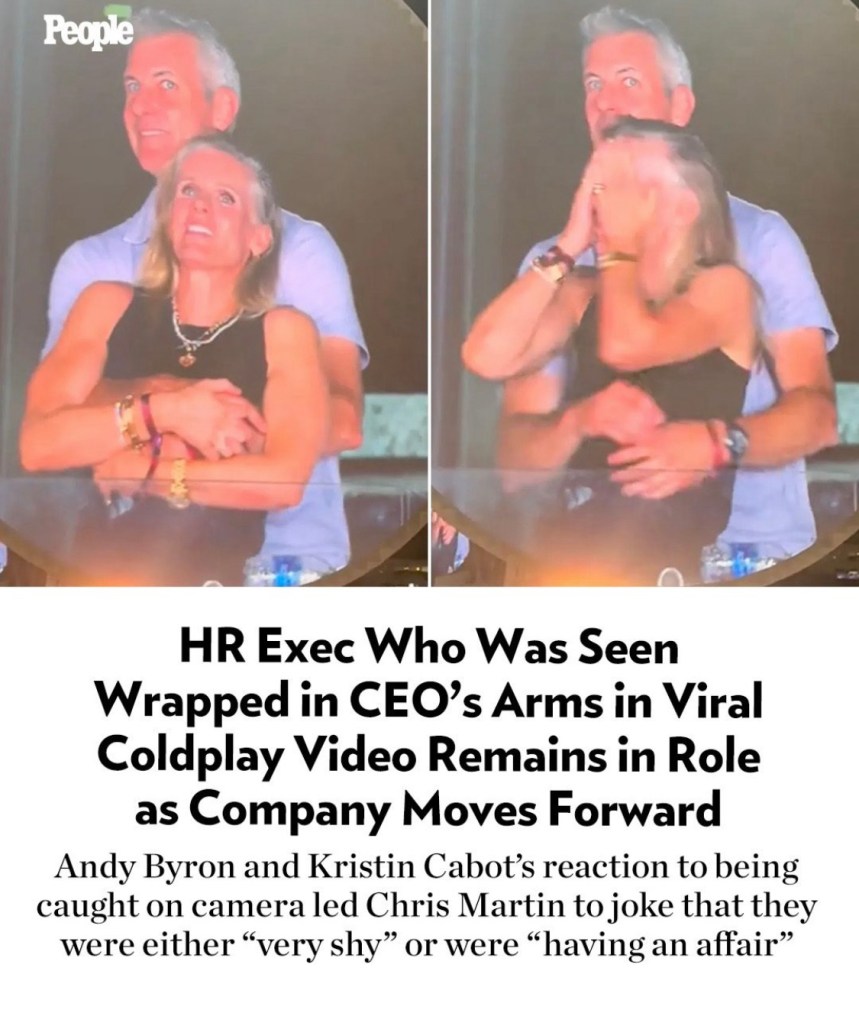
I think I have a little more hope for humanity after the very public reaction to Andy Byron getting caught at a Coldplay concert in Boston cheating on his wife with Kristin Cabot, the head of his human resources department.  It was the now-famous Kisscam embrace where the stadium was watching the jumbotron, and the camera panned to Andy, who promptly ducked out of sight.  Nothing says I love you like fleeing the public eye.  I mean, if you are going to have an affair, maybe he should have been more proud of it.  What kind of man did the boss of human resources think she was getting from a guy who would knowingly cheat on his wife with her, and even deny it in public when caught?  The whole incident was a multitude of bad that points to a multitude of worse.  However, a lot of good did come of it, as Byron was the CEO of Astronomer, an AI tech company with many billions of dollars.  After the public’s anger circulated the world, Astronomer dropped him as their CEO, which is undoubtedly a step in the right direction.  I mean, how can you make deals with people if they can’t trust you to at least be honorable to a person closest to you, as a wife?  What does it say about anybody if they can’t make one basic relationship at home work?  How are they supposed to create a culture among many employees if they can’t do it successfully?  I tend to be very skeptical of most people and the way they maintain their marriages.  I think people are too easily lax with the rules, and it shows a lot about their character when they do cheat.  I can’t imagine why a grown man with adult children would want to attend a musical concert.  But the public reaction to the affair was a pleasant surprise. 

Of course, kisscams all across the world started to make fun of the incident, as most people saw the way Andy Byron handled the whole situation as inherently evil.  It’s not a good idea to cheat on your wife.  But now you’re a billionaire and a successful person, maybe thinking of starting a new relationship to outpace the mistakes of a previous one.  That might appear to be a justifiable reason.  But with your head of human resources at your company?  Aren’t there other girls to cheat with if you are thinking of doing it?  And it looked like there were other people there from the office who knew of this affair because they were embarrassed too, once they were caught.  What does that say about everyone involved?  If you have to duck away from cameras, you are probably up to no good, and what’s worse is when someone does something anyway.  It reveals a lack of good judgment, which raises questions about why he was ever appointed as a CEO in the first place.  I know people go to a lot of trouble to look good on paper with their resumes and LinkedIn professional profiles, but they often fail to meet the expectations of reality, which is very common these days, especially in CEO positions.  Anybody who would go to a music concert as a middle-aged person with their head of human resources and openly flaunt an affair to the world, but acts like a coward when caught, is showing terrible judgment that fancy interviews and speeches can’t hide.  People are aware of this, and it highlights a deeper issue with individuals who run companies, as Andy Bryon did. 

When you are a compromised person, and let’s face it, we have a system that has been put in place in our employment culture where we put weak people in positions of power on purpose so that they fall very easily to every little woke rule, or letter from Larry Fink.  And CEOs like Andy Byron lecture the rest of the world toward progressive causes.  Much of what they do as leaders is cosmetic to cover up their lack of personal integrity.  They use their jobs to cover for their low moral conduct.  And nobody knows a person better than their family.  If things aren’t great in the bedroom and with your kids, we have a culture that has given the illusion that a job can replace those valiant efforts with a personal title of social respect.  And if you are cheating on your wife and kids with some other woman, especially one who is supposed to enforce a standard at the workplace against such actions, a level of hypocrisy has been revealed that clearly shows people have strong opinions about the matter.  And if people are outraged, that’s a good thing.  We often don’t get to see people like Andy Byron beyond news clips.  But behavior tells us far more about people, and that takes all the fancy talk you see on resumes and makes them much more real.  Nothing says I love you more than ducking for cover when trouble comes.  And nothing shows leadership more than violating all your company rules and showing everyone that you can’t even maintain a marriage.  So how can you lead a company, or even a department?  If you have such bad judgment on little things, then how can you guide billions of dollars of value to the proper place?  The answer is you can’t.

When Byron and his lover Kristin Cabot were caught, it was a classic male-to-female embrace from behind.  When a woman surrenders herself in such a passive way, it’s undoubtedly a mating response to further advancement, leading to sexual intercourse.  It’s an affirmation of safety, that the embrace of a man will make her feel secure with his arms around her, and she holding elements of his arms to show a willingness to be in the passive sexual role.  If the woman were doing the same to the man, it would be weird.  A larger male embracing a smaller female for sexual union by asserting safety and security to the recipient of sex is a classic signal that everyone understands.  But to affirm that it was all phony in an instant, that all the personal contact and pillow talk were as flimsy as Andy Byron himself, was something everyone also understood the moment he dodged the camera once he realized he was caught.  And she did too.  It was a fun affair as long as nobody knew about it.  Or that everyone at the office knew, but that they thought they could all conspire to keep it a secret from the world.  People don’t like that kind of behavior, and they let everyone know it in the aftermath.  And people were not understanding of Andy Byron.  They looked down on him, and that is a good thing.  That means people aren’t all out there cheating on each other at every turn.  That there are still a lot of people who think that their relationship to their families is still the most important one in their lives, and that if they aren’t successful there, they can’t be successful in other things.  Progressive, Democrat society would like to believe that job titles give people power that personal behavior can’t.  And no matter how we construct our culture to think that flawed people can be CEOs of big companies, the public has other opinions.  And if a man doesn’t dare to stand tall under fire, even when it’s just a camera pointed at him, how can he lead others in anything?  The answer is, he can’t.  Nobody can.  Flawed individuals create flawed companies and societies.  And people do expect leaders to be more than average and to stand tall under fire.  And to do the right things, even when it’s hard. 

Rich Hoffman

Click Here to Protect Yourself with Second Call Defense https://www.secondcalldefense.org/?affiliate=20707

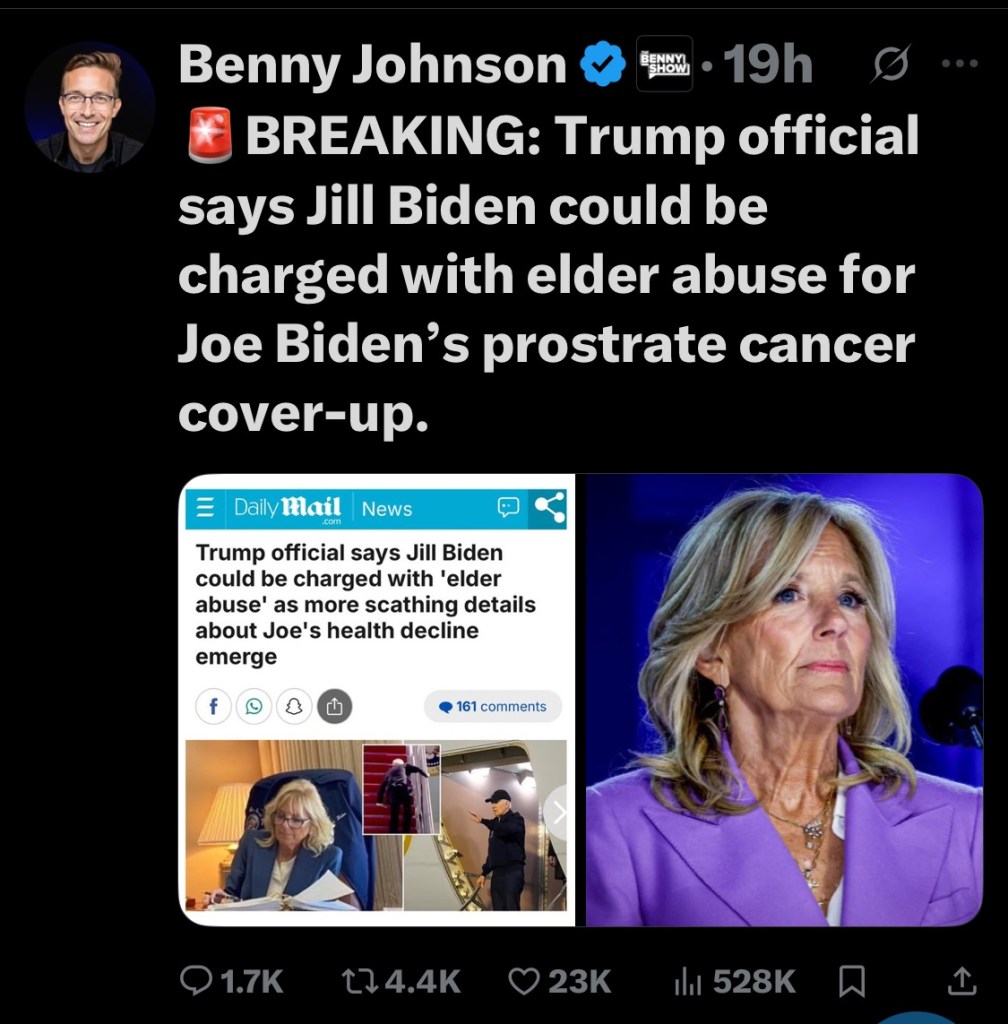
Joe Biden’s Presidency Was Illegal: They are using the cancer diagnosis to hide the crime behind sympathy

Just remember, when people say that my topics are too wild to be believed, because lately I have been talking a lot about Atlantis and the origins of ancient civilizations, remember that most of the time, if not every single time, I am right about the things I say.  There is a reason by choice that I do not write for significant publications and flaunt academic credentials as part of a byline.  That is because I don’t trust institutionalism because of what I understand psychologically about the people who make it up, and the limits it places on society.  And I sometimes pick some of those complex and wild topics to stretch my legs.  Because when the rubber hits the road, I am always there to say, “I told you so.”  And that was certainly the case when it came to the origins of COVID-19.  I would say I was the very first person out of all the media in the world to call it what we now know it was, which includes some of the wildest so-called “right-winged media” out there.  And I was among the first to call the election fraud of 2020 what it was, and I turned out to be right about everything.  I have covered many very controversial, far-reaching topics that seem insane at the time, but once the facts all come in, I turn out to be right.  So I am having a little fun with the Joe Biden topic after the tapes captured by Robert Hur made their way into the mainstream media.  I found it astonishing that news commentators like Laura Ingraham were shocked by what they heard, which was that Joe Biden was utterly unable to function in a mental capacity and was essentially a Weekend at Bernie’s presidency, propped up by handlers to appear to be in charge.  It was all a complete deception, and once those tapes hit the news cycle, they announced that he had a ten-year-old prostate cancer diagnosis, hoping to use compassion to get the former president off the front pages.  The Hur tapes bring up a much more catastrophic problem that few people can handle.  But I will.

She knew, among many who did

Joe Biden was illegally inserted and was never in command of the White House, leaving unelected personalities running his presidency completely in the background, and now many of those people have been caught.  Now, the good thing is that this break in trust is healthy for people to experience.  Society has been suckered by a group that we call “elites” who hold the power in our offices outside of elected representation.  And it’s a hard learned lesson that will forever change the Democrat Party.  I think they are destroyed forever, but we’ll see.  I don’t see them ever returning from the damage they have inflicted on themselves over these last five years, starting with the Covid cover-up, and ending with the truth about the Biden presidency.  They lied about everything, including his cancer diagnosis.  It’s possible they even lied to Biden himself to keep him smiling for the cameras and standing at a podium with a stick up his backside to keep him from falling over.  We are witnessing a grand deception on an epic scale that was massively illegal in the process, and people will never forget it.  So as we hear the stories of the media sacrificing themselves now hoping to win back trust, and the Jake Tapper’s of the world come out with their books and are getting raked over the coals for what they knew but didn’t say about the matter, and Jim Comey is getting embarrassed in public at book signings by an angry public, and he smiles and takes it, because he has no other option, remember who told you first about all these things……….I did. 

Trump may want to give Biden a pass, but the former president played right along with the plan, knowing the people behind it.

I run the blog because it gives me a chance to express trustworthy independent journalism, and because of how I live my life, it is free of outside influence.  I can afford to do things almost no other journalist in the world can do.  And that is a very valuable asset in a free speech environment.  And people ask me all the time why I do it.  Well, it’s for cases like this, the Joe Biden case, that I do what I do, even though many of the things I said were ridiculed extensively right out of the gate.  Just as the things I am speaking about, like Atlantis, might seem too wild to seriously consider.  When something is so far outside of a mainstream narrative, people have a hard time with it.  But when that state of disbelief is part of the crime, to use that nature against people to perpetuate a knowing deception on the world, we should all have a significant problem with that type of conduct.  And I certainly do, and that’s why I choose to produce the kind of media I do, in the form that I decided to do it.  And the sum of the whole Biden story is that everything Biden signed as president is invalidated because of this massive cover-up, which is the real reason that the cancer diagnosis came out when it did, to use sympathy to hide the crime.  These people have been caught in a major crime against the United States of America, which is all of us who are citizens of this country, and there is no forgiveness for that transgression.  All the people involved in the Biden cover-up committed a significant crime that must now be punished. 

I had to remind a few good friends I have in the media, who are very close to the White House, when the story broke over a mid-May weekend in 2025 that Biden’s cancer story was a ruse, and not to fall for it.  He’s an old man, and most men will eventually get prostate cancer of some kind.  There is no surprise by that diagnosis, so don’t go soft on Biden because he’s a dying man.  I’ve been warning for a long time that when the crapola hit the fan with Biden, they would try to use a funeral to take people’s minds away from the seriousness of the crime.  And that’s what they tried to do with the cancer diagnosis.  Don’t be a sucker and fall for it.  The real story is that everything Biden touched was illegal, including his nomination of a Supreme Court member in Ketanji Brown Jackson, the extremely liberal trainwreck that should be nowhere near a courtroom.  But it wasn’t Biden who picked her, but rather Barack Obama, and Alex Soros, along with his terrorist father, George Soros.  People we did not elect and had no legal right to the office of the Executive Branch. That means every bill signed was signed under illegal conditions and is invalid.  Everything that Biden had been doing for four years was unlawful.  And how do we know? We know they put him in place with election fraud.  And if that story is too wild for you, then now you have the proof that the people behind Biden lied about his health.  He had this cancer before he was elected president, and they lied about it to put him in office so they could essentially run him as a puppet in the background.  They rigged the entire process to get a compromised puppet in the White House so that they could steal that power away from voters.  Just let that sink in.  This is a bigger story than most anybody could wrap their minds around.  But there it is.  And the damage from this will never allow things to return to what they were before.  And a lot of people are in deep trouble for it.  Jake Tapper and Jim Comey are just the tip of the tip of the iceberg.  And the Democrat Party has hit that iceberg, and is sinking very fast. 

Rich Hoffman

Click Here to Protect Yourself with Second Call Defense https://www.secondcalldefense.org/?affiliate=20707

I’m Proud of Sheriff Jones: Its time to put an end of the drug cartels

I am proud of Sheriff Jones; I had a nice chance to talk to him at the Nancy Nix fundraiser as he had just returned from Washington, D.C., with a mission straight from Tom Homan, the border czar himself.  The Sheriff was told to make room in his jails because they would fill up quickly during March.  The Trump administration was done with Mexican drug cartels that were hiding in plain sight behind illegal immigration, and they were about to do what had been promised by Trump on the campaign trail.  They were going to be at least arrested and deported with what should be called, mass law enforcement.  The media will call them raids, and crackdowns.  But whatever anybody calls them, the illegal aliens, especially those hosting a criminal element, are toast.  And Sheriff Jones is more than ready to do his part in Butler County, Ohio.  He has been waiting his entire life for just this opportunity and a president willing to do what the law states: we must protect our borders from hostile people not committed to the American cause.  The only way to describe the previous immigration policy was a purposeful attack on our nation and the concept of a free people, with the hostilities of a criminal element seeking to overrun our legal system.  It wasn’t amicable, so the remedy must be more resilient.  Sheriff Jones warned us that the days to come would have a lot of stories of rounding up these villains and that people needed some context for the voluminous incidents that would be reported in the news during March, which was good news to my ears.  It couldn’t come soon enough.  One of the promises Trump had made during the campaign was the death penalty for cartel drug traffickers, which, to my mind, is too good for any of them.

Butler County has a very good police department.  This past year, I have been able to work with them a lot.  I served several weeks on a grand jury in 2024, where I met many of them and toured around the jail Sheriff Jones oversees, so I acquired an appreciation for what good law enforcement is and what it isn’t.  And I again was able to get to know some really good members of the Sheriff’s department at an event I was a part of organizing for Vivek Ramaswamy where they served as security.  Good guys, all of them.  They are excellent guys.  And tough guys too.  Which is what you want.  But when I saw Sheriff Jones, and we spent a little time catching up, I told him, and I meant it, that if he wants to deputize me to help round up all these punks, losers, despots, and crime-addicted lunatics hiding in illegal immigration, give me a call.  I would be more than happy to help.  I know the Butler County Sheriff’s Department has it all covered.  But I would enjoy the work and do it at the drop of a hat because let me explain something.  I hate drug dealers.  I hate drug use.  And I hate the drug cartels.  I hate them so much that I don’t think hate is a strong enough word.  Drug dealing, to me, is the deliberate poisoning of a person’s mind, which I consider one of the worst crimes.  What makes rape so terrible is it displays an intent to take away from a person their consent to sex and to display complete dominion over them, robbing them of the decision-making process.  Drugs do all that and more through a subterfuge of the intellectual process of thought. And for me, it all falls under the same category.  I feel so strongly about it that I don’t even like drinking at sports bars and social events.  If you aren’t protecting a mind, you are proposing that animal acts rule in society, non-thinking application of life energy.

As usual, Sheriff Jones is always a good talk. I’m all for him taking on the cartels with Trump

And as I said all that and more to Sheriff Jones, I was proud of him.  I like knowing that my local sheriff was called to Washington, D.C., to be a part of cleaning up national drug cartel violence.  I’ve known Sheriff Jones for years, and he doesn’t tell the stories of all the death hits on his life that the drug cartels have called for against him.  But there have been many.  More than many, and all of them, should be considered an act of war declared against any American citizen.  Remember when President Trump talked about the way he was going to apply to all law enforcement like Tom Homan and sheriffs like Jones, the need to punish these criminals.  And now they would be conducting that task over the next several weeks.  When drug cartels announce that they want to kill you, that’s not something to be taken lightly.  The thug mentality that was proposed should be considered hostile and purposeful.  They started it, and it’s our task to correct the behavior.  For too long, these horrible people in the drug cartels, neck tattoos and all, have been insisting that they exploit human weakness with drug use, knowing that their product was poison and that the result would be catastrophic to America as a nation.  They purposefully engaged in the destruction of innocence with a deliberate intent to destroy America as a country, and socialists around the world cheered the effort on with great enthusiasm.  Never forget that.

Jones was giving me a hard time because I didn’t have my hat this time.

Not to kiss and tell, which I don’t like to do, but I think in the case of Sheriff Jones, it is needed for context regarding what is about to happen.  The Sheriff and I were sitting together about 15 years ago at a political event.  I remember it well; it was in the barn for a Tea Party event that was going on at the Niederman Farm, and we were showing off a video I had done with Sheriff Jones talking about the problem of illegal immigration.  That was the same year many of us, myself included, were purposefully attacked through the IRS by Lois Lerner, and I was named as one of the targets along with my personal friend Justin Binik-Thomas.  Jones and I were trying to decide whether or not to use pictures of headless people who were decapitated along the border by the drug cartels.  Sheriff Jones encouraged me to use them because he thought it might wake people up.  They were nasty pictures that showed many innocent people killed in horrible ways.  Women were raped and had their bones ripped away from their bodies afterward, and they were awful to look at.  I was going to use them for my media platforms, and ultimately, I decided not to use them because I figured they’d be banned for their graphic content.  But we looked at hundreds of these pictures together while everyone else enjoyed a nice party atmosphere of hamburgers and hot dogs on a beautiful summer evening.  My wife and I had just returned from Mexico with a video from some rough, drug cartel-controlled areas, so I knew firsthand how bad the situation was.  And I know what Sheriff Jones wanted to do about it then, but Obama was in office, and his administration was encouraging drug cartel growth and not looking to punish it in any way.  So this isn’t a new thing.  But finally, I think we are going to see justice applied to the drug cartels.  And they have it coming, all they will receive and then some.  And Sheriff Jones is ready.  And if he needs help, I am more than willing.  I have hated the cartels for a long time and would be happy to see their destruction for good.  For our purposes, it’s the month of March that is only the beginning.

Rich Hoffman

Click Here to Protect Yourself with Second Call Defense https://www.secondcalldefense.org/?affiliate=20707

When Police Break the Law, They Have to be Punished: The J6 prisoners never should have spent one day in jail

I said it right after the event; everyone can look up all the videos and see what I wrote then.  I always said that the January 6th incident in 2021, when people were upset at election fraud and stormed the Capitol Building, had to happen.  I didn’t understand why everyone made such a big deal about it.  After all, there was a government that just stole an election to perform a coup against President Trump, and they thought they were going to get away with it like some backwoods third-world armpit of a country.  A certain percentage of the population needed to express their anger in some way, and in this case, it was by letting the government know that the people’s house was theirs and that they could take it back if they wanted to.  Now, there are all kinds of things wrong with that day, especially among the 26 FBI agents who spread out through the massive crowd around the Capitol to bait people to break the law so that they could call the whole thing an insurrection so that they could blame Trump for it and in the process, destroy his political life from then on.  When a massive crowd showed up to hear with some hope, Trump’s last speech to them ahead of certifying the election results, the FBI, in coordination with Nancy Pelosi and others, plotted with some bait to push these angry people into a collective action that they could use to club the MAGA movement over the head and deter any further protests against the government coup.  And some people broke windows and acted in a manner that I would never do.  And a few people died and got hurt.  But my attitude about it all then and now was, what did anybody expect to happen?  The government stole an election and took away a president people liked.  They were lucky that was all that happened, “they” being the government.

So it had to happen that Trump pardoned all the poor people who were thrown in jail for the last four years just over a government trying hard to stay in power through intimidation and force.  When the government breaks the law and controls how the law is interpreted, you cannot have a civil society if law enforcement doesn’t enforce the law but provokes themselves into breaking the law and uses the law to cover up their crimes, which was what happened on January 6th, 2021.  We have a Constitution that limits the power that government has, especially specified in the Fourth, Fifth, and Sixth Amendments, and the January 6th prisoners had all those rights violated unjustly.  Their due process was deliberately violated, and what was done to them was completely unforgivable.  Law enforcement should expect people to fight back if they violate the protections people have from an out-of-control government.  Democrats have been saying that Trump should have never released with a pardon most of the J6 prisoners because they assaulted police officers.  But when police officers break the law or the enemy captures your legal society, what are you supposed to do?  The plan by the government was to capture our legal system and then break laws by controlling the enforcement.  And they thought nothing of using the January 6th incident to put people in jail to send a message to the rest of the country that if they were thought to be involved, even remotely, in a plot against the corrupt government, they would have their rights taken away from them and would be jailed as a message to the rest of the world.  It was nasty stuff.

I would never do anything like the J6 protestors did.  I would fight it out in court.  As much as it is fun to fight back and even justified, I do much better with my mouth than any other method, and I would use it instead of violence.  I’ve been in enough of those things to know that my mouth is the best weapon against corrupt people who aren’t nearly as smart.  I had a lot of talks with people who wanted a lot more violence that day.  I even took serious steps to join the Proud Boys after the stolen election in 2020, so I know those guys pretty well.  It didn’t work out; I’m too cerebral to march around in a pack of volunteer ground troops. I wanted to join to help to lead them to good things.  Not to be just another face in the crowd.  So it didn’t come together, me joining the Proud Boys.  But that’s how it was after the election, and I had to explain to many people that the best way to club these people over the head is with lawfare of their own.  Trump understood that even if he knew what the government was doing was wrong, he had to follow the rules to later enforce the rules.  A lot of the reason things are working so well now is because Trump played by the rules, and the people elected him back to office.   We all had to thread the needle pretty well to get to this period because there were a lot of people who wanted open violence and another Civil War against the government, and I can say I did all I could to maintain peace during this challenging time.  But many people were ready to fight, so the government was lucky that all that happened was all that happened. 

Anybody in law enforcement has to understand that if they take orders from the bad guys, we don’t have a blank check society that is going to take it.  We give law enforcement the authority to be treated with respect.  But it’s on them if they lose that respect through improper behavior.  I can say this: I served this past year as a Forman of a Grand Jury, and we did a couple of cases where the police abused their authority in collecting evidence for an arrest.  I could see from the testimony that the police officers were frustrated with their investigation into a drug house.  They knew the criminals were dirty, so they pulled a couple of them over for an improperly functioning turn signal.  And in the process, they found all the drugs and evidence they needed to make the arrest.  Well, most of the members of the grand jury did not agree with me, and they moved not to indict because they didn’t like to see an abuse of authority by the cops to use a traffic stop to make a significant drug bust.  I was disappointed, but I understood their reasoning.  Respect for the law is the only way to keep our society functioning.  But when the bad guys capture your law and order society and attempt to hide crimes behind their control of the system, don’t expect people to put up with it.  And that was undoubtedly the plan behind J6.  I would say that the government was lucky they got away with not having more violence applied to them.  If law enforcement seeks to abuse the law, they should expect the public to get angry and respond.  We don’t expect to respect the law and authority no matter what.  However, we give away that privilege to law enforcement on a conditional basis, and that contract is to keep their powers limited by the Constitution.  Suppose they violate that contract, as they did over the stolen election in 2020? In that case, people will take action to restore those limited powers to the theater of expectation.  And the government should be happy that more people didn’t lash out than they did.  I would do it differently, but I understood their reasoning, like those grand jury members I mentioned.  And that is certainly the case with the J6 prisoners.  They should have never spent one day in jail.  Who is going to give them back their lives?  President Trump was very correct in getting them out of jail.  Because if he didn’t, our legal system would be much less effective if we let such an injustice loose to maintain a polite society.  No, we must do what’s right, even if things get a little pushy.  The J6 prisoners had every right in the world and an expectation to do what they did.  The government broke the law and used it to hide major, massive crimes.  And they are lucky that they are still around to have a legal discussion.  It could have been much worse.

Rich Hoffman

Click Here to Protect Yourself with Second Call Defense https://www.secondcalldefense.org/?affiliate=20707

They Tried to Kill Trump: Wearing the Armor of God for the fight of our times

I was watching the assassination attempt of President Trump live, and when I saw him go down to the floor as the Secret Service piled around him after he grabbed the side of his head, I thought that was it.  I admired Trump a lot as he got to his feet with bodies and hands trying to cover him from more gunfire that was coming from a nearby roof, where a young kid let off eight rounds toward Trump and the crowd at a Pennsylvania rally, killing innocent people while also striking Trump.  When Trump stood up with blood running down the side of his head and pumped his fist to the crowd, yelling, “Fight,” I thought he had about 15 seconds to live.  Because a bullet had hit him, and it wouldn’t take but a few seconds for him to bleed out.  At that moment, he knew he had been shot, and if it was the last thing on earth that he could do, he was telling the crowd to “Fight.”  I was very proud of Trump.  He didn’t have to be doing any of this.  He didn’t need all this trouble.  He’s one of the wealthiest people in the world; he didn’t need to be at that rally on a nice July day running for President.  But there he was, shot by some kid named Thomas Matthew Crooks just moments away from possibly his lights going out forever, and he was back on his feet telling the crowd to fight.  And my first thought was, “That is a man.  That’s what presidents should all look like.  And he has been great for America.”  As sad as that event was, because there were real casualties from the gunfire that hit innocent people behind Trump, I was thrilled to see that the bullet had just grazed Trump in the ear, about as close as possible without being lethal, and that Trump was going to live to fight another day. 

When she heard the news live, my wife was out getting gas and snacks at Kroger with my grandchildren.  The cashier and a customer discussed it as she stepped up to pay.  My wife lost it when she heard that Trump had been shot, and she essentially went into a conscious coma.  Crying because she had met Trump and dearly loves Trump, she came home to see if I knew what was happening and wanted me to do something about it.  Then my wife realized that she paid for the gas but never got it; she left again to go and get it, as she was still upset and staggering, looking for answers.  By the time she went back to get the gas, we knew then that the bullet didn’t kill Trump and that he was just grazed.  And he would live to fight on.  But it certainly provided context to the world we are living in, which is at war.  I’m honestly surprised that there haven’t been more assassination attempts against Trump, but this was a desperate attempt by a failing left political party.  The big question was how alone this kid was, and how much did a more significant plot play in the background to provoke such a person into action to go to that rally with an AR-15, climb onto the roof of a building outside the security parameter, and shoot at people knowing the ramifications for doing so would end his life, one way or the other.  The next thought I had was that the CIA was involved as tools of the deep state, just as they did with JFK, and that they had found a way to push this kid through psychological manipulation into taking a step they desired but couldn’t afford to do themselves.  The kid was killed, so we likely will never know, and there are a lot of creepy circumstances pointing to that thought process in the aftermath.  But for the moment, all that mattered was learning that Trump would live and be fine. 

After all they have thrown at Trump, and even the other day Biden made references to targeting Trump further as the election drew nearer, the ominous reality of just how bad things are came into sharp focus for many people.  As the events unfolded, Steve Bannon emailed from jail, where he and Peter Navarro were serving time by the crooked January 6th Commission who did not honor their Executive Immunity as White House staff.  Steve Bannon, before he had to report to jail on July 1st, predicted there would be assassination attempts against Trump, and he was right.  It’s been a while since people have seen one, but just remember it was recently that the Prime Minister of Japan was shot to death in a very similar way.  And Bolsonaro in Brazil was stabbed in public, obviously intending to kill him with assassination.  Around the world, where the communist infusion of global politics has gone hard at work to develop radical young kids like this Trump shooter to do their dirty work, this is a widespread problem.  It is much more common than people have been willing to admit to.  And now a purposeful attempt against Trump’s life had been discharged, and it terrified people to just how bad the situation is and has been.  They, being the organization of the Administrative State, have literally thrown everything they have at Trump and his immediate supporters like Bannon, jailing them, bankrupting them, prosecuting them in every way possible, and, of course, literally trying to kill them.  That kid in Pennsylvania killed people, and when he pulled the trigger to that rifle while lying on the roof, he meant to kill the President.  Why would a 20-year-old kid ever want to do such a thing? 

There is a lot to learn from all this, but the main thing is to admire Trump for the courage he showed while under fire.  And for the cool state of mind, he maintained while literal death was at his doorstep.  I am very proud that Trump is running for president.  That is the kind of attitude I expect from people in general, but especially from someone who wants to lead America.  As reports came from Trump himself on Truth Social minutes after this assassination attempt that he was going to be okay, and he acknowledged the members of the family of the Trump supporter who had been killed, I thought of the assassination of President Lincoln.  It’s always Democrats who are trying to kill Republicans.  When Democrats don’t get their way, they always seem to turn to violence.  And that was the case with this Trump assassination attempt, the ultimate form of election fraud.  The hate is very real, and our public schools breed this mentality of hate into our youth. we saw an example of their activity in the deadliest way that it can be presented.  And it showed in the aftermath an absolute evil working in the background.  I found it ironic that people quickly were turning to the Bible to explain what they were feeling, and they saw as a point of comfort the Ephesians quote from chapter 6 that I like so much on the Armour of God.  Yes, what happened to Trump is consistent with that Bible verse.  God does tend to protect those who are doing his work.   And Trump is, and he does enjoy a level of protection, and the hand of God was evident on this otherwise horrendous day, protected.  God saved Trump, and Trump dared to continue to fight for what was right with that armor of God.  And people had a wake-up call that was probably necessary, and very much needed.  God does work in mysterious ways to our eyes.  But on the big picture, everything is moving along as required.  And fighting for that future is very much our present concern regardless of the risks or consequences.

This is the 2024 election in a photo! What a cool dude!

Rich Hoffman

Click Here to Protect Yourself with Second Call Defense https://www.secondcalldefense.org/?affiliate=20707