

I can hear the groans already. “Oh, he’s talking about movies again.” But this one is a bit different and I share some things here that people have been asking about. I have a lot of new people in my life, and they are asking. So, I’m addressing their questions in bulk. People ask me all the time what my favorite movie is. I get the question often enough that I finally decided to answer it properly here. My favorite is Indiana Jones and the Temple of Doom. A lot of people are surprised by that. Many consider it the weakest of the original trilogy. I disagree. For me, it is the one that stuck with me the most, and the reasons go well beyond the surface thrills.
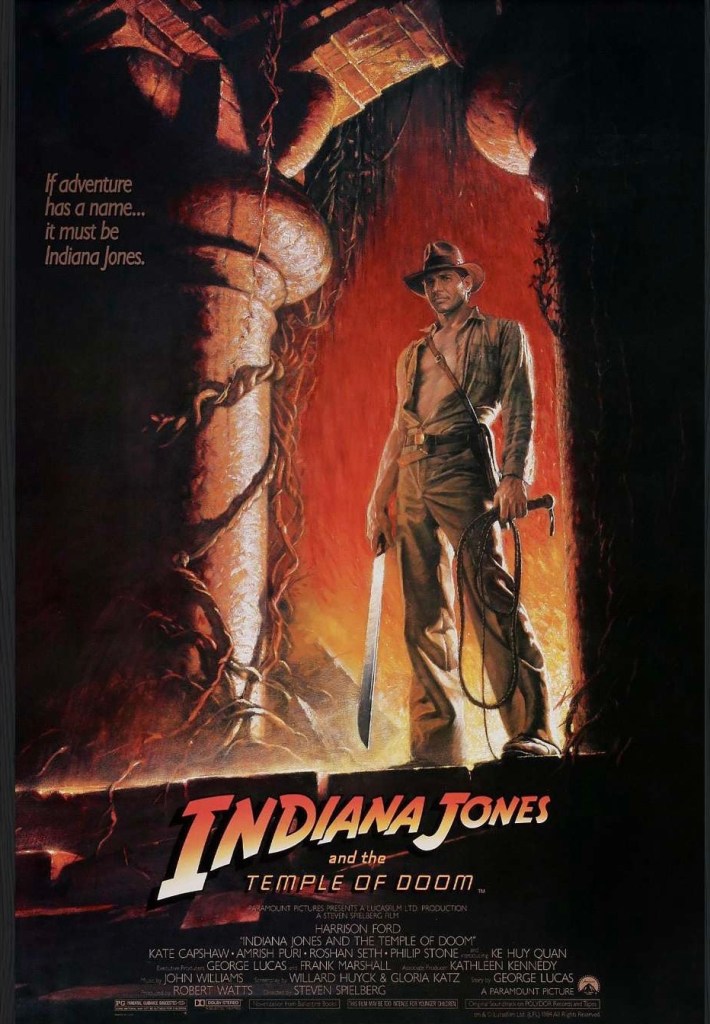
I grew up on adventure. My grandfather was old enough to have lived through the era of the great serials. I saw Zorro with the whip long before I ever saw Indiana Jones crack one. Saturday-morning serial energy was already in my blood. When Raiders of the Lost Ark came out, I thought it was wonderful—maybe the best pure adventure movie ever made. But Temple of Doom became personal.
Reading the Book Before the Movie in Hamilton, Ohio
When I was a kid, I used to go downtown to the shopping center in Hamilton, Ohio, with my mom and grandmother. On the bottom floor, there was a bookstore section. I went straight to the books every time. One day they got me the novelization of Indiana Jones and the Temple of Doom. I read it before I saw the movie. I read it the way I used to read the old adventure books—religiously, over and over. The character already lived in my head before the images did.
That early exposure mattered. George Lucas has always been steeped in mythology. The pursuit of the Grail, the knight who starts out chasing fortune and glory and ends up learning something harder—these patterns were in the water. I did not have the language for it at fourteen or fifteen, but I felt it.
The Night We Snuck Out in Morehead, Kentucky
The memory that sealed it for me happened the summer the movie was in theaters. I was fourteen or fifteen, part of a High Adventure Explorer Post. We were on a week-long trip heading toward whitewater rafting in West Virginia. We stopped to camp just outside Morehead, Kentucky. Hot summer night. The kind of heat that stays with you after dark.
We went into town for snacks, and I spotted the movie theater. Temple of Doom was playing. I grabbed a newspaper, checked the times, and saw the last show was at eleven. Back at camp, the plan was lights out early so we could get up for the next day’s adventure. Around eight or nine, everyone was settling in. Three of us waited, then slipped out.
We walked the two miles into town in the dark, hearts pounding, half-convinced we were going to get caught the whole way. We sat through the movie until about one in the morning. Then we walked the two miles back, still sweating, still listening for any sound that meant trouble. We snuck into our tents, drank some water from the canteen, ate a Slim Jim I had stashed, and tried to sleep. At seven, the camp woke up as if nothing had happened. Nobody said a word. We ate breakfast and headed out for the rafting and the rest of the week’s adventures. Later that summer I flew with my family to the Grand Canyon and all over California. The whole stretch felt like one long Indiana Jones sequence.
I have had many experiences since then. I am older now. I still cannot think of many moments that felt better than that night—walking back in the heat with the movie still running through my head, knowing we had gotten away with it, feeling completely alive. We had lived a small version of the thing we had just watched. Jump in. Trust yourself. Land on your feet.
Why Temple of Doom Hits Different
Raiders gives you the competent, almost invincible Indy. Temple of Doom puts him through the wringer. Poisoned, chased, plane crash, mountain landing, bugs, capture, the blood, the voodoo doll, the forced drinking, the near-sacrifice. They break him down further than in any of the other films. Then he comes out the other side, returns the stones, restores the village, and still walks away with the girl and the open road to the next adventure. “Fortune and glory” at the beginning. Something closer to responsibility and compassion by the end. He keeps the light touch the whole time. The movie never turns grim for its own sake. That balance is rare.
I raised my kids on it. I have raised grandkids on it. The soundtrack still gets played in the car. They know the cues. The film became a shared language in the family for the idea that you can take a beating and still come up swinging with a grin.
Mythology, Campbell, and Earned Freedom
Later I learned more about the deeper currents. Joseph Campbell’s work on the hero’s journey and the Grail legends shaped a generation of storytellers. George Lucas absorbed those patterns. The connection between the Indiana Jones films and older quest stories—Parzival, the wasteland, the knight who must learn before he can restore—is not forced. Temple of Doom functions as a modern version of the hero who starts selfish and ends up doing the right thing for people who cannot help themselves. The Last Crusade made the Grail explicit. Temple of Doom already had the emotional shape.
They also earned the right to make something this wild. After Raiders became a phenomenon, Lucas and Spielberg had the political capital in Hollywood to go darker, stranger, more unhinged—child slavery, Thuggee cult, heart-ripping, the whole fever-dream tone. A movie like that would have a much harder time getting made today. They used the freedom they had earned.
The Lesson That Stuck
For me, the core of it has always been simple. Indiana Jones trusts his ability to land on his feet no matter how bad the situation looks. Plane on fire. Poison. Traps. Brainwashing. Torture. He keeps moving. He keeps improvising. In the end, he is still the same man, only clearer. That attitude got into me early. Jump off the building if you have to. Figure out the landing on the way down. I have needed that more than once.
People who know me mostly through the political writing sometimes raise an eyebrow when I talk about movies. Movies are a shared language. Books are private. A film you both love gives you common ground in five minutes. When hundreds of new people start reading or listening and want to know a little more about the person behind the commentary, this is one of the cleaner ways to open the door. I do not normally spend this much time on personal stories. This one felt worth it.
Indiana Jones and the Temple of Doom is not the most polished film in the series. It is the one that feels most like actual life mixed with myth—messy, punishing, redemptive, and somehow still fun. I have carried its lessons through everything that came after that hot night in Morehead. Fortune and glory are great goals. Landing on your feet and doing the right thing when it counts is better.
Footnotes
1. The novelization of Indiana Jones and the Temple of Doom was written by James Kahn and published by Ballantine Books in 1984, timed with the film’s release.
2. George Lucas has repeatedly acknowledged the influence of Joseph Campbell’s The Hero with a Thousand Faces and related mythological studies on his storytelling, particularly visible in the Star Wars films and carrying over into the adventure structures of the Indiana Jones series. The two later became acquainted; Campbell viewed the original Star Wars trilogy at Skywalker Ranch.
3. Scholarly and critical readings have linked the Indiana Jones trilogy to Arthurian and Grail-quest patterns (including Chrétien de Troyes’ Perceval and Wolfram von Eschenbach’s Parzival), with Temple of Doom often discussed as a wasteland/otherworld episode and The Last Crusade making the Grail motif explicit.
4. Howard Kazanjian served as executive producer on Raiders of the Lost Ark and producer on Return of the Jedi, and held a key production role at Lucasfilm during the period.
5. Indiana Jones and the Temple of Doom (1984) was directed by Steven Spielberg from a story by George Lucas, screenplay by Willard Huyck and Gloria Katz. It is a prequel set in 1935.
Bibliography
Campbell, Joseph. The Hero with a Thousand Faces. Princeton: Princeton University Press, 1949 (and later editions).
Kahn, James. Indiana Jones and the Temple of Doom (novelization). New York: Ballantine Books, 1984.
Lucas, George, and various collaborators. Indiana Jones and the Temple of Doom. Directed by Steven Spielberg. Paramount Pictures, 1984.
Aronstein, Susan. Critical essays on Arthurian narrative patterns in the Indiana Jones trilogy (various academic publications).
Additional reading: Bill Moyers’ interviews with Joseph Campbell (The Power of Myth); production histories of the Indiana Jones films; Wolfram von Eschenbach’s Parzival for the classic Grail-knight arc that echoes in the franchise’s deeper structure.
Rich Hoffman
More about me
Click Here to Protect Yourself with Second Call Defense https://www.secondcalldefense.org/?affiliate=20707

About the Author: Rich Hoffman
Rich Hoffman is an author, political consultant, and strategic advisor based in Cincinnati, Ohio, and the creator of The Politics of Heaven—a unique framework that connects biblical theology, ancient history, and modern power structures to explain how moral alignment and spiritual forces shape global events. Blending real-world political experience with deep research into archaeology, UFO phenomena, and suppressed historical narratives, Hoffman offers compelling commentary on topics ranging from ancient civilizations and the Dead Sea Scrolls to modern populist movements, paranormal continuity, and leadership strategy in chaotic environments. As the author of The Gunfighter’s Guide to Business and the forthcoming Politics of Heaven, he brings a grounded yet provocative voice to media discussions, supported by firsthand experiences and a cross-disciplinary approach that bridges science, history, and theology. For interviews, speaking engagements, or expert analysis, visit richhoffmanbooks.com or contact directly via phone at 513-307-5815 or email at rhoffman@richhoffmanbooks.com. If you’ve seen the movie, Disclosure Day and want to talk about it and the implications of Presidnet Trump’s UAP disclosures, let me know and we can bring some color to your coverage. https://richhoffmanbooks.com/media-inquiries-broadcast-topics-and-contact-info/?frame-nonce=ad51e7ecba I do have a firsthand UFO encounter to discuss.

