

Full disclosure, this is a long one and it might be easier to watch the video. I have a lot to explain here, and this topic is much bigger than most surface-level discussions on politics and business and what role the two play in a happy society. I talk about abortion in a different way here, but it’s a mentality that is at the heart of Marxism, and many years of our civilization straining under a mixed economy that many of us never even thought about. But it’s the heart of what has been driving me for many years to this point. I am affiliated with Volynt Aero in Oxford. I am a consultant and, at this point, an advisor. I am proud of it. I do not normally attach my name to things. For years, I’ve handled much of the work in the background. People who have known me a long time know the method. You trade whatever you have—sometimes it was literally baseball cards when I was young—to get close enough to a problem to be useful. I come out of the school of hard knocks. I have seen what happens to people and to companies when the process is dirty, when the lawyers arrive late, when the regulators decide the idea should die in the permit office. I have helped a lot of people mine their way through improper methods without becoming the method.
That is the only reason this essay exists; there is a lot of interconnected tissue to consider in something as massive as this, and it takes a bit to discuss in context. Not because I needed another logo on a card. Because I watched a good idea be born in Oxford, in Butler County, Ohio, and I recognized the old American pattern: the builders are ready, the market is arriving whether the townships like the noise or not, and the political class is still deciding whether it wants to midwife the thing or abort it.
Why I Attach a Name at All
I have been a huge supporter of FirstEnergy. I was a supporter when Larry Householder was Speaker. When we talk about alliances between government and big business, I think FirstEnergy got a raw deal in the public square. I do not think they did a good job defending themselves. Real life in the background of a utility is lived inside regulatory compliance, rate cases, and a grid that still has to keep the lights on while somebody in Washington changes the religion of energy policy every four years.[1] What I saw was a company running a model that the Obama-era compliance environment made it almost impossible to operate profitably, then being treated as a morality play when it sought political relief.
I see a lot of Democrats trying to take ground in Ohio after years of Republican control of the House, the Senate, and the governor’s office. They cannot get a message through to people because the message, once you strip the focus-grouped nouns off it, is still a mixed-economy sermon with a communist destination. That is not what people in this county vote for. It is not what they vote for in 2026 either. But the fight does not end because you won a map. You are always overcoming Karl Marx. You can see it in the way a left-wing media personality in Columbus will work a hit job on a Republican until the man will not look you in the face in a hallway. I have watched politicians go quiet because they do not want to be called a communist, or worse. After all, they do not want to be trapped at a urinal in the Statehouse by somebody with a microphone asking why they voted for an “evil” bank or an “evil” energy company that was not kneeling hard enough toward the religion of wind and solar power.
There are a lot of safer ways to make money. There are not many ways to do it that still serve the two parts of the American condition I actually care about: job creation, and political representation honest enough to get out of the job creator’s way. I lend my name to enterprising people who take risks because I want to see them make jobs. I lend my name to political figures for the same reason. The Marxist type always attacks them, and it is a lonely business to be sabotaged out of a restroom at the Statehouse by a hostile media personality trying to put you in a horrible state of mind. Why did you vote for that? Why did you say this? Why do you support FirstEnergy? Why aren’t they for wind? All questions from a Marxist perspective, intended to root everything in a leftist point of view as a baseline.

I involve myself because I want to protect capitalism from the next adjustment to the breaker panel, the one that shows up on your electric bill whether or not you ever voted for the sermon that caused it.
John Galt Types, and the Movie That Taught Me the Pattern
At the beginning of this, I put the Volynt affiliation together because I like the guys. I like entrepreneurs. I like John Galt types. I like people who work. When I meet them, I want to help them. I want to help them avoid having to dynamite their own buildings at the end of the story, the way the book taught a generation of us to fear.
My favorite movie on this subject is still Tucker: The Man and His Dream, directed by Francis Ford Coppola, from the same mind that gave the country The Godfather and then turned around and made a hymn to the American crackpot who wanted to build a better car outside Ford, Chrysler, and General Motors.[2] Tucker put the engine in the back. He put seat belts in the car. Fuel injection in 1947. The Big Three knew they could not retool fast enough to compete. The pipeline was already poured. So the story goes that they used Senator Ferguson to try to throw Tucker in jail.[3] That is how the red decade moved into the American system: not always with a red flag in the street, but with a committee, a compliance file, and a prosecutor.
There is a speech Tucker gives at the end of that movie that I have never gotten over. It sounds like Howard Roark’s speech in The Fountainhead, stretched across a courtroom instead of granite.[4] He is wondering where his country went. Marx came in. Regulatory compliance came in. The power of government came in. Ferguson wanted donations from the Big Three, so he tried to eliminate the competition that would have made them better. Tucker assumed the American dream was still built around the man who builds something better. The country had changed on him in the thirties and forties, and he just then figured that out.
We had just won a war by manufacturing the Nazis and the Japanese into the ground. Then, mysteriously, we started sending consultants the other direction to learn how to manufacture from our former enemies; we let our enemies teach us how to mass-produce when it was that very trait which caused us to win World War II. People like Tucker got crushed in the interval.[5] He stayed out of jail. He built fifty cars. Some were wrecked in the process. The ones that remain are still Tucker cars, and you can look at them. The ideas did not die. The company did; it was murdered by a tyrannical government.[6]
I have always hated, in the background of my adult life, the long trend that followed: the creation of a permanent international management layer, the suppression of American ingenuity as if ingenuity were a pollutant, the habit of treating the founder as a defendant. We did something right in the teens, the twenties, even into the thirties. Then the red decade came over from Europe under the banner of free speech, and pretty soon you had a government trying to jail a man for building a safer car.
If it had been me in Householder’s chair, I would not have done the pinhead stuff a two-thousand-dollar-an-hour lawyer could later dissect. I tend to have sympathy for the people who were trying to keep power flowing while the rules were written to euthanize the old plant in favor of a liberal sermon. I do not want to see the power of government illuminate ingenuity only long enough to book it.
What These Drones Actually Do
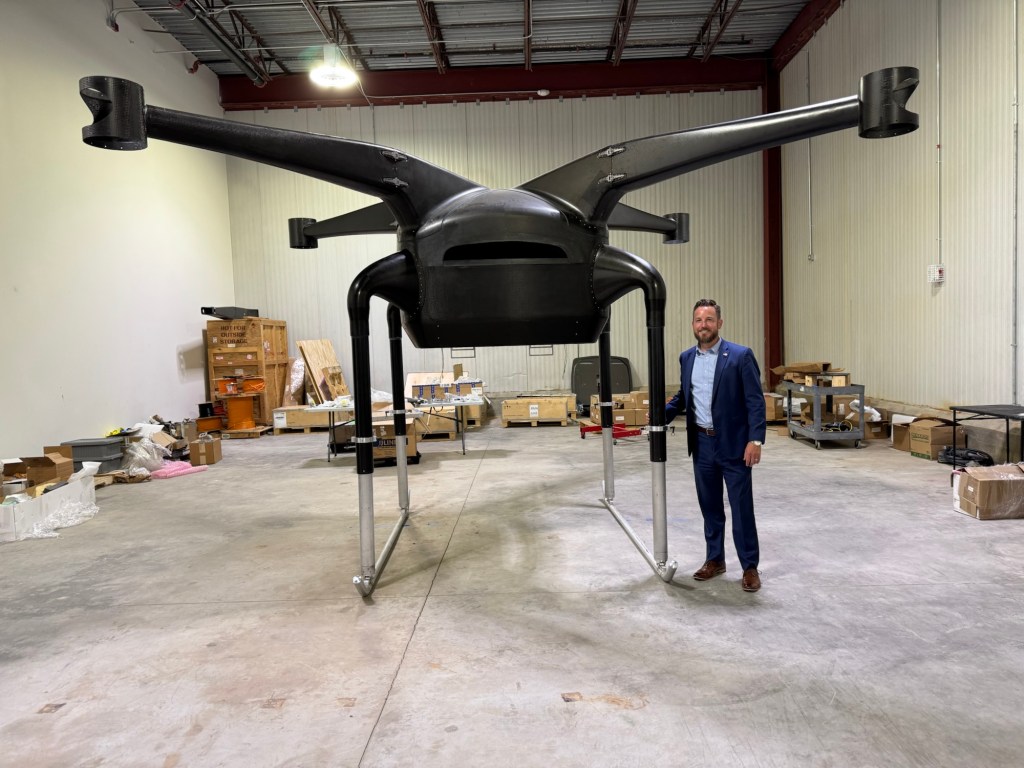
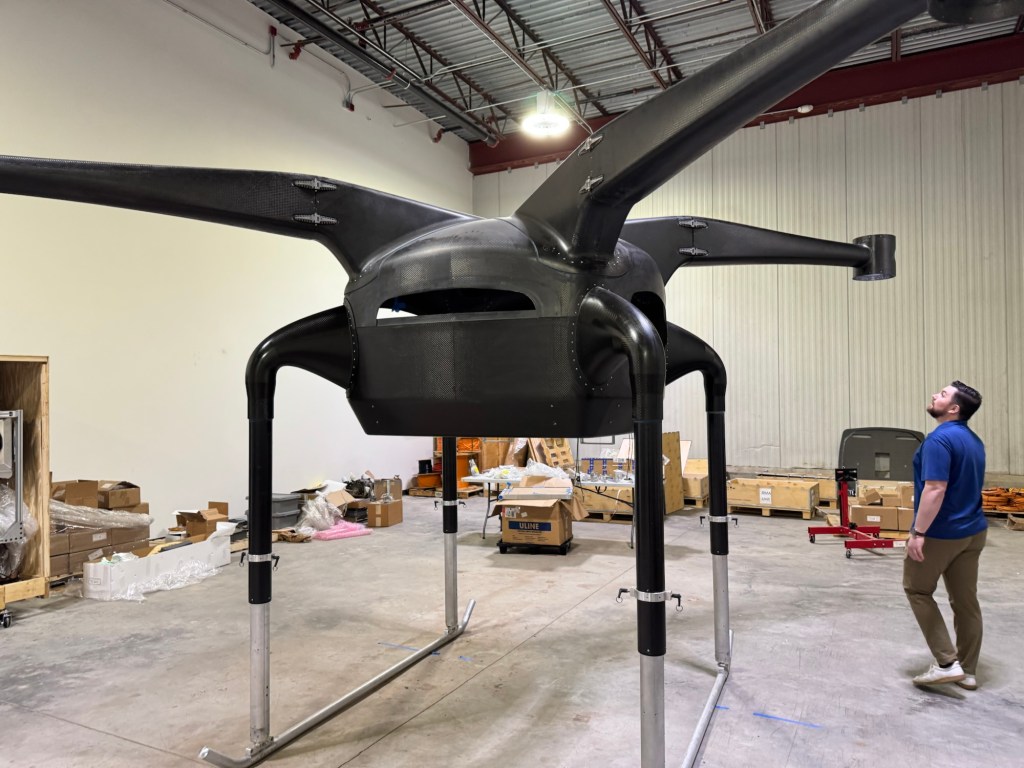
So why Volynt Aero? Yes, they have an unmanned hybrid VTOL—the Vyper—that can fly, carry a serious payload, and put a box where a truck cannot go. You have seen the animation. I was able to get close enough to the real work that the animation looks like a polite version of what I watched. I went to the facility in Oxford. I talked to a great bunch of guys. The intellectual property is not a napkin. It is already there. Public specs on the aircraft talk about carrying on the order of 500 pounds of cargo out to 150 nautical miles, then landing and offering plug-in power—110, 240, or 480 volts—off standard jet fuel, without waiting for a charging farm to be built in the mud.
The crowded market is last-mile photographs and Amazon-adjacent experiments. Everybody has a drone story now. Walmart has a drone story. Amazon has a drone story. Texas has companies. California has companies.[7] The middle-mile market alone is described as a ten-billion-dollar band within a much larger stack. I have been saying to anybody who will listen that the five-year systems market—vehicles, energy, warehousing, insurance, municipal integration—could run toward a trillion dollars if the country actually lets it hatch. Those are inside numbers, not a press release.
What makes Volynt different is not that they can hover. It is the combination. Cargo logistics and highly mobile power generation on the same airframe. They can come in, drop a payload, and leave. And they can do battlefield resource management, which in civilian clothes means disaster-zone logistics. Power recovery. Fly into a hurricane zone or an Ohio River floodplain, get past the trees that are lying across the only road the trucks can use, land, and put 110, 240, or 480 volts where a ventilator is still a life.[8]
The Hurricane, the Chainsaws, and the Road You Cannot See
Years ago, I was between jobs. I tend to get involved in crusades because they teach you things you cannot learn from a paycheck. One of the reasons I have been effective over the years is that I have done things other people never get to do, or never have the guts to do, because it means leaving the comfort of a W-2. A friend who ran a tree crew called. A storm had flattened a stretch of the Carolinas around the Raleigh-Durham universities. Trees older than the subdivisions they shaded were down across the highways.[9] He was paying cash crews a thousand dollars a day because people were pulling money out of safes rather than wait on insurance to cut the trees off their homes after the storm. A crew member—the kind of guy who couldn’t do anything else because he did not have many other options, because he was out of jail for killing people—had decided he wanted all of it and had started talking about killing my friend. My friend asked me to come down to help him with the guy. My wife did not want me to go. I did not want to leave her. A couple of weeks of that work could be a year’s income. I got on a plane to chase treasure and danger. And to that point, where there is danger, is usually where there is treasure.
As we were landing, they had just cleared the runway. From the air, you could not even see the highway. That is the image I have never forgotten. There is no way for the trucks to get the equipment to the poles if the trees own the asphalt. Before the utility can be a utility, somebody with a saw has to invent a road again. It took some of those people three or four weeks to get power back. Generators mattered. They still matter. A patriot generator in a garage is not a hobby. It is how you keep a freezer and a CPAP and a window into the world from dying on the same night.
When the Volynt team walked me through the demonstration, that memory came back to me. Every September, somewhere, a hurricane does a version of that story. Every late winter, the Ohio, the Mississippi, the Great Miami find a floodplain and take a substation with them. Senior citizens do not have three weeks for power to return. A drone that can fly the downed corridor and restore a line, or drop the thing that lets a crew restore a line, is not a gadget. It is the difference between a shelter with lights and a shelter guessing.
Same grid logic as fifty years ago. The wires still have to carry the current. The new part is that you do not always have to wait for the infrastructure; you can fly the infrastructure into a distressed zone.
The Mixed Economy That Aborts the Company Before It Is Born
The hard problem is not the airframe technology. The hard problem is an unfriendly manufacturing and permitting environment. Unless you can throw Elon Musk money at it, the political monster can crush you before the second prototype.[10] Even Musk needed government contracts and, for a stretch, an alliance with China to get Tesla through the years when the same people who wanted electric cars also wanted to drown the factory in process. A lot of the operators I talk to do not want politics at all. They want the big animal to stay in its cage until the product exists. I get involved because I have watched companies get crushed before they build anything.
I was in Columbus a few years ago sitting next to very expensive lawyers who were selling solar the way people used to sell riverfront lots. There is a big solar farm near Piqua. There is another in Warren County. Fine. Generate what you can generate; I’m not against other ways of getting power. But if we aren’t talking about Thorium or nuclear, we aren’t being serious about acquiring real energy. What I will not do is pretend that a sermon about wind and panels is a substitute for a dispatchable grid when you are trying to host the next wave of computation and industry.[11] FirstEnergy was the legacy company being squeezed like a zit so that a younger lobby could inherit the moral high ground. That is an Obama-era move, and it is still the move. Euthanize the old method. Call it progress. Act shocked when people are upset about it.
Republicans have not defended capitalism very well. They have not defended FirstEnergy well. They have not defended the Householder disaster as a policy failure instead of a personality failure, which is what it was, and that has fed this Amy Acton narrative now. I listen to two-thousand-dollar-an-hour lawyers miss the only point that matters: are you using the power of government to confiscate wealth, or are you using it to keep the builder from being hunted while he builds? A lot of people in the political class do not feel they have latitude to say that out loud because they do not want the Columbus media animals waiting for them at the urinal. I am not in public office, so I can say it.[12]
The metaphor I keep using, because Ohio taught it to me, is abortion as industrial policy. A certain kind of politics wants to abort the business before it attaches. Regulation becomes the instrument. You never have to out-compete the founder if you can keep him from being born. The same crowd will turn around and euthanize a legacy company they have decided is morally expired, which was what the FirstEnergy story was really about. Young ideas killed in the womb. Old plants killed in the bed. What they never want is a living competitor that was not pre-cleared by the donor list.
Fences, Data Centers, and Who Gets to Say No
In my neighborhood, an older, decent neighbor started a wooden fence in the front yard. Posts went in. It was their property. I would not have chosen the look. My wife and I were not going to say anything. Then came the hearing. Then the posts came back out of the ground. I had not called a trustee. I did not need to. I knew what happened. People who bought half-million and million-dollar houses, some of them new from the coasts, did not want to look at a tacky fence on the drive-by. No lumber in the front. Property rights, until the new people appeal to government to make your porch match their taste.
That is the data-center argument in miniature. I am pro data center. The new economy is an electricity story whether the township signs the petition or not. China is building data centers whether or not we do, and if people protest, they just disappear. That’s how it is in China, in America: communist terrorism hides behind free speech, which does not exist in a real communist country. People who do not want the noise still want the market cap that pays for a federal deficit that no longer fits on a bumper sticker. They want a trillion-dollar growth story and a quiet backyard. They want to keep up with Beijing and keep the transformers out of sight.[13] My daughter lives near Millikan Road in the Liberty Township development and does not want more congestion. I understand the feeling. I also drive through Middletown and remember what the place looked like when the work was here. You can still find houses in that city at prices that tell you how much vitality is left. Vance can talk about investment, but there’s a lot more. I want the investment to be real enough that Main Street is not a museum of what we used to make.
I love Liberty Center. I like Costco. I like the Monroe exits and the Millikin exchange along the 63 corridor as places where you can put large things without paving a township’s last pasture. Balance is a real problem for trustees. Pretending that every large thing is a moral injury is not balance. It is a lifestyle veto dressed up as conservation.[14]
Property taxes are the scream under all of this. There is a movement that wants them gone. Fine. Show me the replacement arithmetic. One honest way to change the math is to land in an industry that generates revenue on land that is already industrial. Vertical mobility—middle-mile drones, disaster logistics, the power-restore mission—is not a server farm humming behind a fence. It is a reason a site exists. Amazon, Walmart, the carriers, the hospitals, the utilities, the Guard: they all have the same problem. Get the box, or the tool, or the kilowatt, past the broken road.[15]. We’re talking about a lot of things here that are always under the tip of our tongues, but they are the center of all discussion.
Michael Ryan Was There Before It Was a Photo Opportunity
I was not going to drag a campaign into this. Michael Ryan put his visit on Facebook. He went to the Volynt facility. He talked about it at a fundraiser. I happened to be there with him. I know what he has been doing in the background for a couple of years while other people were still deciding whether drones were a toy, a nuisance, or a federal problem.[16]
By the time a lot of people read this, he may already be sitting as a Butler County commissioner, or he may be in the last stretch of proving it in November. Either way, I want it on the record. Michael Ryan has been acting like a commissioner of this county well before the title was his. He has been providing leadership in rooms that were not yet fashionable. Four years from now, when the project is a ribbon and a CNBC segment, and every officeholder in a fifty-mile radius is trying to stand in the photograph, I want it remembered that he was there when it was still a risk.
That is what good leadership looks like when it is not a press release. It is not waiting for the market to become safe and then claiming the harvest. Socialism, in the small-town version, is just that reflex: somebody else takes the risk, then the committee arrives to redistribute the credit. Ryan did the opposite. He showed up early. He has done a lot of unglamorous work that makes life in this county better. This is one of the visible ones.[17]
I like a lot of the Ohio names in the builder register. I have had the chance to talk to them one-on-one in informal settings. I think I know who they are. Bernie Moreno built businesses and then walked into the grinder of public service with enough money in the bank that a paycheck could not vote for him. Warren Davidson is in that same pattern. That is the opposite of the professional politician, who needs the mixed economy because it is his meal. Bernie Sanders is a communist. The late-life American version I respect is the man who made something and then spent the surplus defending the conditions that let other people make something.
Ryan is young enough to want still the county to have a next chapter. That matters. The people who have been in the chair too long start to treat every new idea as a zoning headache. The people who still think like founders treat it as a chance.
What I Want This to Become
I want Volynt featured on CNBC as one of the great global innovators, not as a local curiosity that got a grant and a ribbon. A proposed HyPE Lab at the Miami University Airport is the kind of physical bet a county should want next to an existing runway. Ohio Third Frontier money already touched the powertrain work. That is a start, not a finish. I want them to have a shot at being the next SpaceX in the only sense that phrase is useful: a company that made a hard physical thing at a scale the incumbents said was impossible, in a county that decided not to strangle it. That is a lofty goal. Lofty goals are how factories start. The constraint is not imagination. The constraint is whether Ohio and Butler County will keep the political animal on a leash long enough for scale.
Scale needs land that is already industrial, power that is actually on the bus, a workforce that can turn a wrench and read a print, and a waiver culture at the FAA that does not take a decade to admit a machine can fly past the pilot’s eyeballs.[18] Ohio is already in the drone-first-responder business through DriveOhio. Hamilton police are getting aircraft that beat a cruiser to the scene. That is a different mission from cargo and power restoration, but it is the same county learning the same sky.[19]
I have been accused of being part of the military-industrial complex because I have worked around aerospace companies for a long time and I know people in politics. The accusation is a category error. I want the opposite of what happened to Tucker. I want the opposite of what happened to Roark in the book. I want the man with the idea outside the approved pipeline to get to the market before the senator from the incumbent district files the paperwork. I have put my name on things when it was unpopular and could and have cost me. I will put it here.
Books do not usually make the kind of money people think they do. I am writing The Politics of Heaven anyway, because I think there is a spiritual war under the economic one, and because non-human intelligence—call it what your tradition requires—does not only show up in a sky story. It shows up in the institutional habit of killing the builder.[20] I volunteer a lot of time that isn’t invoiced. I want the human race better. Helping a company in my own county get off the ground is one of the ways that sentence becomes concrete.
The Record I Want Left
This is a long one. Context does not work in ten minutes. The video at the front of this would be useful to watch.
When people ask me what I am working on, this is the answer. I am helping a group of scrappy operators, with the IP already done and the demonstration already flown, get across a minefield that usually destroys the idea before it can pay a tax bill. I am proud of them. I want the state of Ohio to treat this as more than a local hobby. The upside is not a buzz in the background. The upside is a transportation and recovery layer that Amazon, Walmart, and every hospital system in a floodplain will need, whether the township board likes the look of the fence or not.
Watch Tucker’s speech. Read Roark’s. Then look at a county that still has room at the exits, a commissioner candidate who showed up before the cameras were easy to get, and a machine that can put power back on at a shelter while the trees are still on the road. That is the whole argument. I would like, for once, not to give the speech at the end of the movie. I want the cars—or, in this case, the aircraft—to be built.
Michael Ryan was ahead of it. The company is ahead of the market’s imagination. I am putting years of scar tissue behind both facts. The rest is execution, voltage, and whether we still believe a man with a better idea should be allowed to leave the ground.
Bibliography and Further Reading
Coppola, Francis Ford, dir. Tucker: The Man and His Dream. Paramount Pictures, 1988.
Rand, Ayn. The Fountainhead. Indianapolis: Bobbs-Merrill, 1943.
Rand, Ayn. Atlas Shrugged. New York: Random House, 1957.
American Rhetoric. “Movie Speech from Tucker: The Man and His Dream — Tucker Presents His Closing Argument.” https://www.americanrhetoric.com/MovieSpeeches/moviespeechtucker.html.
Tucker Automobile Club of America. Historical notes on the Tucker 48 and the Coppola film. https://www.tuckerclub.org/.
Federal Aviation Administration. 14 C.F.R. Part 107 and UAS exemption / BVLOS waiver materials.
Ohio Revised Code §§ 4561.50–4561.53, as enacted by House Bill 77, 135th General Assembly (effective April 9, 2025).
Journal-News (Hamilton, Ohio). “Michael Ryan nabs Butler County commissioner primary with 72% of the vote.” May 5–6, 2026.
Journal-News (Hamilton, Ohio). “Primary Election 2026: Republican primary for Butler County commission seat contentious.” April 20, 2026.
Ballotpedia. “Michael V. Ryan (Butler County Commission, Ohio, candidate 2026).”
WCPO. “Hamilton police are getting drones that beat officers to the scene.” DriveOhio / SkyfireAI statewide DFR pilot.
Journal-News. Coverage of Butler County data-center moratorium requests and commission action, June 2026.
United States v. Householder and related FirstEnergy reporting, Southern District of Ohio, 2020–2023.
Public Utilities Commission of Ohio. House Bill 6 aftermath dockets and subsequent electric security plan materials.
Mises, Ludwig von. Interventionism: An Economic Analysis. 1940; later editions.
Hoffman, Rich. The Politics of Heaven. Manuscript, 2026.
Hoffman, Rich. The Gunfighter’s Guide to Business; Tail of the Dragon; The Symposium of Justice.
Volynt Aero, Inc. Company site and capability statement. Oxford, Ohio. https://volyntaero.com / https://volynt.aero.
Cincinnati Business Courier / Dayton Business Journal. Coverage of Volynt Aero’s proposed Hybrid Propulsion and Energy (HyPE) Lab at Miami University Airport, January 2025.
LinkedIn, Volynt Aero company page. Oxford headquarters; Vyper aircraft described for emergency cargo logistics and autonomous power generation.
Workhorse Group and other Midwest cargo-UAS public materials, Sharonville / Mason, Ohio.
National Hurricane Center. Storm histories for Carolinas landfalls affecting the Research Triangle transportation grid.
Notes
[1] On Householder and FirstEnergy, see United States v. Householder, S.D. Ohio, and contemporaneous reporting in The Columbus Dispatch and Cleveland Plain Dealer, 2020–2023. The policy point here is not a brief for every transaction; it is that one administration’s rules can squeeze a regulated utility until the only remaining path appears to be politics.
[2] Francis Ford Coppola, dir., Tucker: The Man and His Dream (Paramount Pictures, 1988). The courtroom speech is transcribed at American Rhetoric, “Movie Speech from Tucker: The Man and His Dream,” https://www.americanrhetoric.com/MovieSpeeches/moviespeechtucker.html.
[3] Senator Homer Ferguson of Michigan chaired the Senate investigations that, in Coppola’s telling and in Tucker’s own defense, functioned as a political weapon for Detroit incumbents. Whether every cinematic beat is courtroom-accurate is less important than the pattern: government process used as a moat.
[4] Ayn Rand, The Fountainhead (Indianapolis: Bobbs-Merrill, 1943). Howard Roark’s courtroom defense remains the clearest American statement that a creator does not exist to feed the parasites who arrive after the risk is taken.
[5] U.S. manufacturing after 1945 did send missions to study Japanese methods; the irony Tucker’s speech names is that the country that out-produced the Axis then imported process discipline from the countries it had just defeated. See postwar productivity literature and W. Edwards Deming’s later influence in Japan.
[6] Preston Tucker produced fifty Tucker 48 automobiles. Most survive. The Big Three later adopted seat belts, disc brakes, fuel injection, and aerodynamic safety ideas that Tucker had already put on the road. See Tucker Automobile Club of America histories.
[7] Amazon, Walmart, UPS, and the United States Postal Service have all published or piloted roadmaps for drone and middle-mile automation. Industry estimates for advanced air mobility and drone logistics through the early 2030s commonly range from tens of billions in the near term to well above $100 billion as last-mile and middle-mile use cases stack. The trillion-dollar figure in this essay is a five-year systems view that includes vehicles, energy, warehousing, insurance, and municipal infrastructure—not airframes alone.
[8] Volynt Aero, Inc., Oxford, Ohio (Butler County). Public materials describe the Vyper hybrid-electric unmanned eVTOL as carrying on the order of 500 pounds of cargo out to about 150 nautical miles, then landing and providing 110, 240, or 480 VAC plug-in power from JP-8 or Jet A without a high-voltage charging network. See Volynt Aero’s capability statement and company site at volyntaero.com. A proposed Hybrid Propulsion and Energy (HyPE) Lab at Miami University Airport was reported by the Cincinnati Business Courier and Dayton Business Journal in January 2025. The company received Ohio Third Frontier/TVSF support through the Entrepreneurs’ Center.
[9] Hurricane Fran (1996) and later storms that struck the Carolinas left large sections of the I-40 / Research Triangle corridor impassable from downed timber. The operational lesson is unchanged: you cannot restore a grid if you cannot reach the poles.
[10] Elon Musk’s public record on Tesla and SpaceX includes DOE loans, NASA Commercial Crew and Cargo contracts, and later criticism of the same regulatory state. The relevant point is not purity. It is that even a high-capacity founder needed both capital and political oxygen to keep the factory from being regulated out of existence before the product matured.
[11] On Ohio energy policy after House Bill 6, see Public Utilities Commission of Ohio dockets and legislative history of subsequent repeal and reform efforts. Nuclear and dispatchable baseload remain the quiet argument under every data-center fight.
[12] On mixed-economy control, see Ludwig von Mises, Interventionism: An Economic Analysis, and Rand’s distinction between the producer and the looter. The essay’s claim is practical: once incumbents learn they can buy a senator rather than retool a factory, innovation becomes a permit problem.
[13] On local data-center zoning fights, see Journal-News coverage of the Butler County commissioners’ 2026 moratorium discussion and township requests. The noise argument and the fiscal argument are not the same conversation, though they are treated as one at public meetings.
[14] Liberty Center, Monroe / I-75 corridor industrial sites, Middletown Regional Airport aviation investments, and the Spooky Nook complex on Hamilton’s west side are the visible pieces of a county trying to replace lost mill and auto-adjacent employment with logistics, aviation, sport, and advanced manufacturing.
[15] Property tax pressure in Ohio townships is the political surface of a deeper math problem: residential valuations rise while commercial and industrial bases either leave or get blocked. A new high-value industry that uses existing industrial land is one of the few honest answers that does not require another levy speech.
[16] Butler County Commission primary, May 5, 2026: Michael V. Ryan defeated incumbent Cindy Carpenter approximately 72 percent to 28 percent. See Journal-News (Hamilton), May 5–6, 2026. Ryan, a former Hamilton City Council member and vice-mayor, advanced to the November 2026 general election.
[17] Bernie Moreno and Warren Davidson have both operated in the Ohio builder-and-business register the essay prefers to the professional political class. Endorsement lists in the 2026 Butler County commission primary included both names on Ryan’s side.
[18] Federal Aviation Administration, Unmanned Aircraft Systems (UAS) regulations, 14 C.F.R. Part 107, and successive beyond-visual-line-of-sight (BVLOS) waiver practice. Ohio House Bill 77 (effective April 9, 2025) added state-level UAV provisions at Ohio Revised Code §§ 4561.50–4561.53.
[19] Ohio Department of Transportation / DriveOhio statewide drone-first-responder pilot, announced for multiple agencies including Hamilton Police, 2025–2026. Public-safety drones and cargo drones are different machines; they share airspace, waiver culture, and a county that is already learning to fly.
[20] Rich Hoffman, The Politics of Heaven (manuscript, 2026; targeted 2027 publication). The book treats non-human intelligence, spiritual warfare, and the political history of heaven as the long background to why human institutions keep aborting builders.
Rich Hoffman
More about me
Click Here to Protect Yourself with Second Call Defense https://www.secondcalldefense.org/?affiliate=20707

About the Author: Rich Hoffman
Rich Hoffman is an author, political consultant, and strategic advisor based in Cincinnati, Ohio, and the creator of The Politics of Heaven—a unique framework that connects biblical theology, ancient history, and modern power structures to explain how moral alignment and spiritual forces shape global events. Blending real-world political experience with deep research into archaeology, UFO phenomena, and suppressed historical narratives, Hoffman offers compelling commentary on topics ranging from ancient civilizations and the Dead Sea Scrolls to modern populist movements, paranormal continuity, and leadership strategy in chaotic environments. As the author of The Gunfighter’s Guide to Business and the forthcoming Politics of Heaven, he brings a grounded yet provocative voice to media discussions, supported by firsthand experiences and a cross-disciplinary approach that bridges science, history, and theology. For interviews, speaking engagements, or expert analysis, visit richhoffmanbooks.com or contact directly via phone at 513-307-5815 or email at rhoffman@richhoffmanbooks.com. If you’ve seen the movie, Disclosure Day and want to talk about it and the implications of Presidnet Trump’s UAP disclosures, let me know and we can bring some color to your coverage. https://richhoffmanbooks.com/media-inquiries-broadcast-topics-and-contact-info/?frame-nonce=ad51e7ecba I do have a firsthand UFO encounter to discuss.
 The Overmanwarrior