This past week I gave a lecture to a room of college students I never physically entered. A professor at a prestigious university—someone who had been watching my videos, commenting on them, and treating the work as if it belonged in a classroom—asked me to talk to her students about aerospace and how a young person might prepare for the space economy, in the old arrangement that invitation meant a check from the university, a plane ticket, a hotel for two nights, and a professor who got to sit in the back of the hall while an outsider did the talking. The students got a visitor who had been out in the world doing the thing the syllabus only described.
That is not what happened. I asked the practical questions. Do I fly out? Do I book a hotel? Do we do lunch? She said no. We would do it on Teams. She plugged her laptop into the classroom monitor, ran the microphone system through the room, and about two hundred people—some in the seats, some on the call—looked at me the way people now look at a talking rectangle. Class was at 12:30 PM. I sat down at 12:30 from my RV and called into Teams, and spoke to the class. An hour later everybody went about their business.
I am not pretending I am above being paid for that kind of work. The geometry of expertise has changed. The old lecture tour burned three days to deliver one hour. The new version burns one hour to deliver one hour. It feels slightly wild, and I will take it. The students still asked good questions. The professor still got a guest. I still had to earn the room. The only thing missing was the airport.
What the Space Economy Actually Means in 2026
I have been doing a run of shows on the change of state coming for the American economy—how much work, how much income, how much industrial capacity the orbital and near-space markets are going to pull into existence. The phrase “space economy” still sounds to some people like a poster in a guidance counselor’s office. It is not a poster. Industry tallies put the global space economy at around $626 billion in 2025, with commercial activity already the large majority of that total and serious forecasts pointing toward a trillion dollars in the early 2030s.[1] Other estimates run higher still. McKinsey and the World Economic Forum have published a scenario near one-point-eight trillion by 2035. The commercial share is already about four-fifths of the whole.[2]
That money is not only rockets on television. It is satellite broadband, navigation, Earth observation, ground equipment, launch cadence, defense architectures, and the unglamorous logistics that will feed commercial stations as NASA tries to hand low-Earth orbit to private operators before the International Space Station is retired.[3] If you are a student sitting in a lecture hall in 2026, the relevant question is not whether space will become an industry. It already is. The question is whether you will be the kind of person an industry like that can use.
Cargo Drones Are Not the Toys You Buy at Target
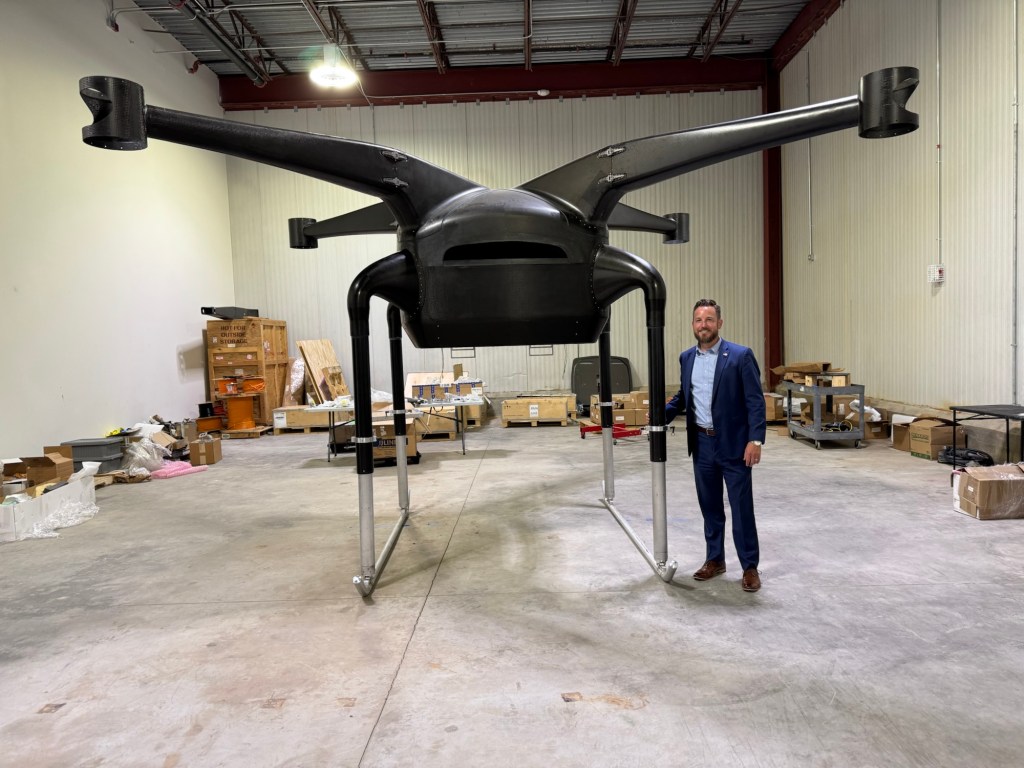
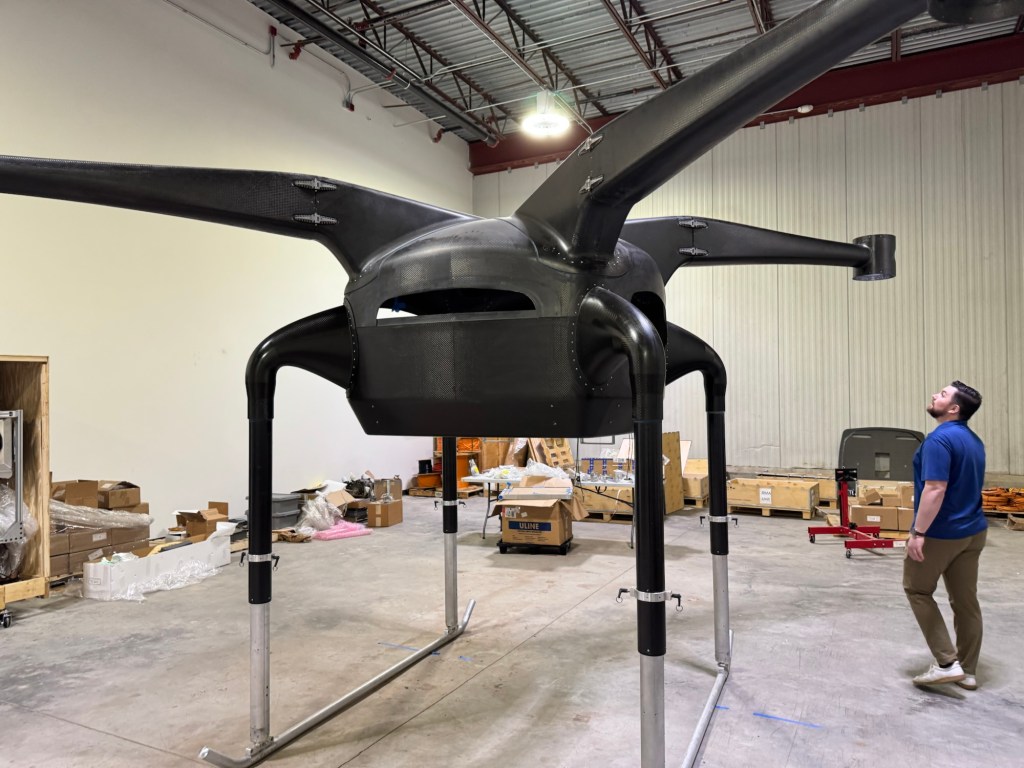
The conversation turned, as these conversations always do, toward drones. People hear the word and picture a camera quadcopter over a soccer field. That is not the machine I have been around in Butler County. The airframes I have been involved with are in a different weight class. They are built to move real mass—on the order of five hundred pounds of cargo—not a birthday balloon and a GoPro.
That number is no longer science fiction. In the last year, Elroy Air’s Chaparral hybrid-electric cargo aircraft has been flying autonomous missions under the federal eVTOL Integration Pilot Program, with production ratings above five hundred pounds and ranges measured in hundreds of miles.[4] Other developers are in the same neighborhood. AIR has put a heavy-lift uncrewed aircraft into flight operations with a published payload near 550 pounds and a cargo bay large enough for bulky freight.[5] China has flown even heavier fixed-wing cargo drones. The point for a classroom is simple: the sky is about to carry freight the way the interstate already does.
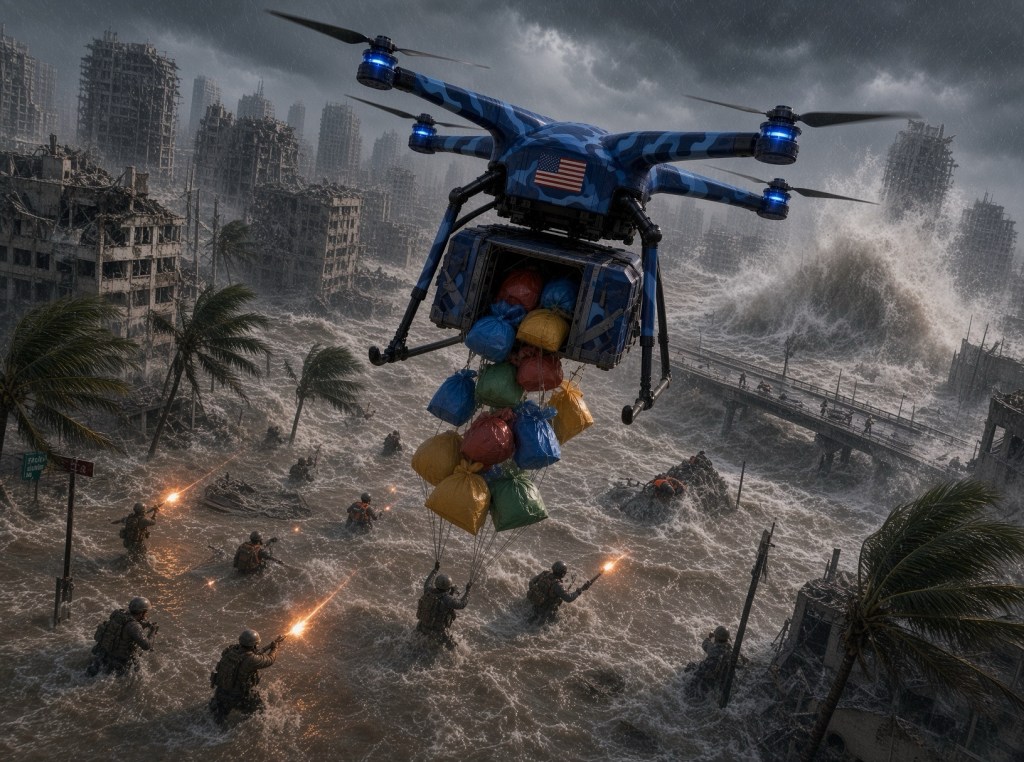
My wife heard that payload number and immediately produced the sentence every civilian produces. She did not want a drone flying over her car on the way to a Cincinnati Reds game and dropping a refrigerator on the hood. I have now heard that joke, or some cousin of it, enough times that it has become the unofficial civic motto of advanced air mobility. The students had the same fear. A bright young woman put it to me cleanly: she had seen the YouTube talk about Elon Musk and the Tesla bots, she could tell I was excited about robots, and she still wanted to know what happens when one of these things fails over a building or a highway.
The Question Every Classroom Asks: What If a Drone Hits My Car?
I told her the truth as I see it. These machines will be driven by software that, over a short run of years, is more practical and more consistent than the average human behind the wheel. That is not a hymn to perfection. Automated systems have already had ugly days. Robots have done stupid things. Self-driving stacks have had incidents that made the evening news. I do not wave those away. I treat them the way a manufacturer treats first-article failures: as the tuition you pay to get a repeatable process.
Tesla’s own published safety figures—imperfect, debated, and still the largest public data set of its kind—have, for several quarters, shown that miles driven with Autopilot and Full Self-Driving (Supervised) between crashes are far above the national average. In one quarterly snapshot, the company reported one crash per 6.69 million miles with the system engaged, compared with a U.S. average near one per 702,000 miles.[6] A later breakout put Full Self-Driving (Supervised) at roughly five million miles per major collision in North America.[7] Critics correctly note that the comparisons are not laboratory-clean. Highway mix, supervision, and crash definitions all matter. Fine. The direction of the curve still matters more than the purity of the press release. The stack learns. The humans who hate the stack do not update overnight.
Amazon drones will crash. Walmart drones will drop a payload early. Vandals will take shots at anything that flies low and looks expensive. Crosswinds, density altitude, summer heat, winter air thickness, and the occasional solar geometry the original coder did not anticipate will all produce a bad afternoon. That is what new technology does. Then the software gets a patch, and that particular stupidity is supposed to happen only once. A human being who wraps a truck around a pole at 2 a.m. does not receive a firmware update before the next Friday night.
It Is Not a Skill Gap. It Is an Engagement Gap.
The student’s question sat atop a second problem I have been hearing in manufacturing offices for years, and I have heard it with unusual frequency in the last two weeks. When you try to hire, you get applicants. A painful share of them cannot pass a drug test. A painful share of the rest do not want the job in any durable sense. I do not mean they lack a certificate. I mean they lack the old animal willingness to get up, go, and stay. People keep calling this a “skill gap” because “skill gap” is a polite phrase that can be used in a grant. What I am looking at is an ambition gap. An engagement gap.
It is not mysterious if you watch how a generation was fed. Old-time Facebook already trained people to receive a stream rather than make one. Video-game platforms now complete the circuit. The machine sends you the next mission, the next season pass, the next reason to tap a credit card. If public assistance covers the floor of a life, and a console covers the ceiling of a day’s stimulation, the case for gasoline money and a 5:30 a.m. alarm clock gets thin. You can stay in the house and still feel as if the world is happening to you.
The labor statistics are not a sermon, but they are not a hallucination either. U.S. labor force participation dropped to 61.6 percent in June 2026, the weakest non-pandemic reading since the mid-1970s.[8] Teen employment is a shadow of what it was when summer work was a normal American education. In July 2026, only 36.5 percent of sixteen-to-nineteen-year-olds were working, compared with a late-1970s peak near 60 percent.[9] Young men have fallen out of the market with particular force. Participation among men aged 16 to 24 has been reported at near 56 percent, down from about 69 percent in 2000.[10]
Survey research on Gen Z fills in the mood. Deloitte’s 2026 global survey found that more than half of that cohort were delaying major life decisions under financial pressure, and only a sliver named leadership as their primary career aim.[11] Gallup has been describing a “Great Detachment”: engagement at decade lows, and half the workforce either hunting or half-hunting for the exit.[12] You can argue about causes until the sun goes down—student debt, housing costs, phones, opioids, the aftertaste of lockdowns, the collapse of certain male-coded industries. I will not pretend one variable explains a civilization. I will say that a space economy cannot be staffed by people trained to wait for the next push notification.
Kiosks, Tesla Bots, and the Quiet Replacement of Human Attention
Robotics has already walked into the most ordinary American rooms. You go to a fast-food restaurant now, and the building would prefer you not talk to anyone. You poke a kiosk. You pay the kiosk. Somewhere behind the stainless steel, a smaller, often older crew still performs the last human motions the equipment has not yet absorbed. When you do get a live person at the counter, there is a fair chance that person is over fifty and still practicing the old religion of showing up. The shortage of willing labor is intense enough that automation no longer feels like a futurist pamphlet. It feels like the manager’s only remaining idea.
That is the part of the Tesla-bot conversation the internet likes to turn into a cartoon. I am not excited about robots because I dislike people. I am excited about robots because I have watched the labor pool thin out in real businesses, in real counties, with real drug tests and real no-call no-shows. If the country will not produce enough people who want the work, the work will still get done. It will get done by a machine that does not need a second chance on Monday. Remember, the enemies of America have been attacking America a long time, and our workforce has been their target. Globalism is dangerous to a productive society.
The Video Game Patch Model Is Moving Into the Physical World
The last fifteen minutes of the class were the part I did not fully script. I could see the professor’s face on the feed. I could not see the faces of two hundred others clearly, which is the new condition of public speech. I reached for an analogy the room already understood.
It is August and early September, which means another Madden cycle has either just landed or is about to. How many times has that game shipped perfect on day one? Rarely. Characters clip through each other. A play-call menu eats itself. The engine meets an input it was not trained to expect and throws a fit. Then the telemetry goes home. PlayStation, EA, and every live-service shop of any size collect crash codes from millions of copies overnight. Developers walk in the next morning to a pile of bug reports harvested from the wild. They push a patch. Digital distribution exists so they never have to mail you another piece of plastic.
That is the industrial model now traveling out of entertainment and into vehicles, drones, and humanoid robots. If a robot drops your hamburger, the correction is not a congressional hearing. It is a software update. If a cargo drone flying at five hundred feet decides, because the sun is vicious or the air is thin or an eclipse confuses a sensor suite, that it would rather be at twenty feet, the fleet can be taught not to make that particular mistake again. Weather, payload, battery sag, and GPS drift become parameters in a model that gets revised on a cadence no legislature can match.
I told the students I still see the old hardware in the wild. I was at a Cracker Barrel not long ago, and there was an Atari 2600 sitting there like a museum piece you could still buy. I am going to pick one up. Those machines were honest in a way modern software is not. The game was the cartridge. If Combat shipped with a quirk, that quirk lived in your living room until you sold the console at a garage sale.[13] We have inverted that world. The physical object is now a temporary container for a mind that can be rewritten after midnight.
A Short History of How America Managed Traffic Before Software
People talk as if safety were a mood. It is not. It is a pile of statutes, standards, advocacy campaigns, and ugly metal that accumulated because the alternative was a death rate this country finally decided it would not live with.
In 1966, after years of treating highway slaughter as the price of modernity, President Johnson signed the National Traffic and Motor Vehicle Safety Act and the Highway Safety Act. The Department of Transportation followed that same season, and out of that machinery came the agency that became the National Highway Traffic Safety Administration.[14] The results, stretched across half a century, are not subtle. The U.S. highway fatality rate fell from about 5.5 deaths per 100 million vehicle miles traveled in 1966 to about 1.1 by the mid-2010s.[15] Federal vehicle standards from 1960 through 2012 have been credited with saving more than 600,000 lives. Seat belts alone account for a huge share of that total.[16]
The hardware inside the cabin changed as well. Airbags moved from an exotic option to a federal requirement in new light vehicles by the late 1990s, and then spread to side-impact protection.[17] Crumple zones, better steels, electronic stability control, and an entire crash-test priesthood at NHTSA and the Insurance Institute for Highway Safety made it much more likely that a person who should have died in 1978 would walk out of a 2018 wreck talking.[18]
Drunk driving, MADD, and the years when Friday night was a slaughterhouse
Behavior took longer. Drinking and driving was illegal in a formal sense long before it was shameful. New Jersey passed an automobile-specific drunk-driving statute in 1906. For most of the twentieth century, the culture still treated the offense as a joke with a badge. That broke in 1980, when Candace Lightner founded Mothers Against Drunk Driving after a repeat offender killed her thirteen-year-old daughter, Cari, in Fair Oaks, California.[19] Within a few years, the country had a presidential commission, a federal drinking-age hammer in 1984, a march toward 0.08 blood-alcohol limits, and a new vocabulary: designated driver, friends don’t let friends, administrative license suspension.[20]
NHTSA only began clean national tracking of alcohol-involved deaths in 1982, a year when those deaths ran above twenty-one thousand and approached half of all traffic fatalities. The later curve bent down hard. Analyses of the post-1980 campaign put the decline in impaired-driver fatalities in the neighborhood of forty percent across four decades.[21] I grew up on the early side of that bend. I remember what the road felt like before the country got religion about it.
Stop signs, signals, and the roundabout as a mechanical conscience.
Infrastructure learned more slowly than slogans. On the kind of two-lane state route I knew as a kid, the first political answers to a string of wrecks were the obvious ones: a stop sign, then a light, then a lower speed, then a different way of feeding cars through a conflict point. Later came the modern roundabout—not the old American traffic circle that locked up in the 1950s, but the yield-on-entry European design that forces a driver to slow down and keep turning.
The first modern U.S. roundabout was installed in Summerlin, Nevada, in 1990. FHWA spent the 1990s studying the form and published its informational guide in 2000.[22] The safety case is now ordinary engineering. Roundabouts cut speeds and slash the number of conflict points. Federal evaluation work estimated that the roughly 2,400 American roundabouts built from 1990 to 2014 prevented tens of thousands of injury crashes and saved more than nine billion dollars in social cost.[23][24] Drivers complain about them the way drivers complain about every device that interrupts a straight line. The geometry does not care. It makes you engage the road.
That is the whole history in miniature. First you change the vehicle. Then you change the law. Then you change the pavement. Then you wait a generation for the culture to catch up. Software compresses that sequence. A drone fleet can receive a correction in a week that used to require a legislative session, a standards docket, and a decade of funerals.
Two O’Clock in the Morning on a Two-Lane Road
Here is why I told the class a story instead of another slide about mean time between failures. Human beings do not attach to mean time between failures. They attach to a night they can still hear.
When I was a kid, we lived off a busy two-lane state route, the kind of industrious road that carried trucks all day and all night. The house sat a good stretch back from the pavement—on the order of a hundred fifty yards—but in summer the windows were open because we did not have air conditioning. One Friday night, about 2 a.m., a truck left the road and took the telephone pole at the end of our driveway.
I did not hear the impact so much as I woke inside the sound that came after it. Through the screen I heard a man screaming for his mother. Not a movie scream. The real thing: high, terrified, the voice of somebody who had just understood what had been done to his body. I got my parents up. The whole house heard it. I went down the driveway in the dark.
The first cars were already slowing down, staring, then speeding up because staring felt like involvement. Nobody official had arrived yet. The truck had come off the road, hit the mailbox, hit the pole, and folded the driver’s side of the cab until metal from one side was occupying the space where a man is supposed to sit. The violence had done what violence does when steel meets a wooden pole at highway speed. Parts of him were in the road. In the poor light I first thought I was looking at roadkill. Traffic had already run over it. It was not an animal.
He had smashed the glass with his head, trying to get out of a window that no longer framed a living person. Blood ran down his face. He was jammed, trying to crawl, and still calling for his mother. He got quiet soon after I reached the end of the drive. There was nothing to do for him. He was gone when the screaming started. He just had not finished being gone.
I have thought about that night for a lifetime, and the thought I keep is not a policy memo. It is this: that was a software problem in a human body. It was the early 1980s, before Mothers Against Drunk Driving had finished turning a private grief into a national prohibition. The man was almost certainly tired, almost certainly drinking, almost certainly carrying whatever mess a night driver carries home at 2 a.m.—money, a shift, a marriage, a rumor, a clock. Human beings drive with all of that in the cab. They drive with a mother still installed in the nervous system. When the pole arrives, they call for her.
I do not tell that story because I enjoy the memory. I tell it because every time someone says they do not want a five-hundred-pound drone over their roof, they are asking for a world with no new risk, and they are asking it in a country that already accepted far worse risk for a hundred years of human drivers. Those particular wrecks—the ones that take a body apart against a pole—are rarer now—not gone. Rarer. Police still work Friday and Saturday nights. They will tell you the texture of the crashes has changed. Vehicles stay together. People crawl out who would have been listed in the morning paper in years prior. Airbags, belts, better steel, and slower intersections did that.[25]
Why Machines Will Make Fewer of Those Mistakes
A cargo drone does not have a wife. It does not have a mistress. It does not drink through a shift and then try to beat the sunrise home. It does not experience shame, jealousy, exhaustion, or the sudden need to call for its mother. It has sensors, limits, and a model of the world that can be rewritten when the world refuses to match it.
That is the moral of the old wreck, and it is the part of the lecture the room understood. We did not abolish tragedy on American roads by hoping drivers would become better people. We put constraints around them. We put belts on their chests, bags in their wheels, and lights in their path, and eventually computers in the loop. The next constraint is the loop taking the wheel. You will still get incidents. You will get a season of ugly film. You will get a class of people who do not want to compete with the machine and who will feed every failure to a news cycle that is addicted to the wreck.
I called that the Don Henley problem in class—the dirty laundry impulse. Automation that replaces visible human jobs will be covered as a crime even when the body count falls. That coverage will not be fair. It does not have to be fair to be loud. Anyone building drones, robots, or space logistics has a better budget for the noise.
Planning a Space Economy Around People Who Do Not Want the Job
This is the uncomfortable planning assumption. The space economy will not arrive as a clean poster of astronauts and lecture-hall ambition. It will arrive in a labor market where a large cohort under thirty is unevenly attached to work, where drug tests still sink hiring classes, and where firms that need reliability will buy it from software and silicon vendors if they cannot buy it from applicants.
I do not treat that as a reason to sneer at young people. Plenty of them are hungry. The young woman who asked the question was hungry. She was trying to square a future she could see with a risk she could feel. That is what a serious student does. The problem is the volume of people who will not ask the question because they are already being entertained past the point of hunger.
If you are building workforce policy for orbital industry, advanced manufacturing, or unmanned logistics in a place like Butler County, you plan for three tracks at once. First, the people who still want the work—train them harder and pay them like the scarce resource they are. Second, the machines that will do the work the missing people will not do—design them to be patched like games, not worshipped like monuments. Third, the public argument—tell the refrigerator story before the opponent tells it, and keep telling the 2 a.m. story so the public remembers what human error actually looked like when it was allowed to run wide open down a state route.
What I Took Away from a Classroom I Never Entered
I ended the hour the way I have ended a version of this talk too many times in the last two weeks. Software will take the first years to be clumsy. Then it will stop repeating the same clumsiness. Human beings repeat theirs for decades, because the bug is not in a repository. The bug is in the life.
We already proved, as a species, that we can cut the worst traffic deaths without waiting for every driver to become a saint. We proved it with belts, bags, blood-alcohol statutes, a drinking age tied to highway money, crash-test scores, and those unpopular roundabouts that make you turn the wheel whether you feel like it or not. The space economy will require the same kind of proof at higher altitudes. Cargo will fly. Robots will stand at counters and on factory floors. Some of the coverage will be poison. Some of the early flights will be ugly. And then the patch will ship.
I did not have to get on a plane to say any of that. I thought that was strange when the invitation first arrived. I think it’s less strange now. The tools that let a professor in another city put me on a wall in front of two hundred students are cousins of the tools that will keep a five-hundred-pound airframe from treating a parking lot like a telephone pole. Same family of updates. Same refusal to leave the mistake in the cartridge.
If you want the longer argument in the form I use with operators and owners, read the business guide I have already put out. The lecture was a compact version of it, told to a room that still has time to decide what kind of worker—and what kind of citizen—it is going to be when the drones are no longer a joke about refrigerators.
Notes
Numbered citations in the text correspond to the footnotes. The bibliography below is offered for further reading and is organized by subject rather than by the order of appearance.
[1] Novaspace, Space Economy Report, 12th ed. (January 2026), valuing the global space economy at $626.4 billion in 2025 and projecting $1.01 trillion by 2034 at a 12 percent compound annual growth rate. McKinsey and the World Economic Forum have published a higher $1.8 trillion scenario for 2035.
[2] Brookings Institution, Darrell M. West, “Artemis II and the Rapid Rise of a Global Space Economy,” April 8, 2026. Commercial activity accounted for roughly 78 percent of 2025 space spending; U.S. space employment was estimated near 400,000.
[3] U.S. Government Accountability Office, Low-Earth Orbit: NASA Faces Impending Decisions for Replacing International Space Station with Commercial Stations, GAO-26-107805 (June 2026).
[4] Elroy Air and Federal Aviation Administration statements on the eVTOL Integration Pilot Program flights at Houma-Terrebonne Airport, August–September 2026. Production Chaparral aircraft are rated for more than 500 pounds of payload and a range of up to 450 miles.
[5] AIR company announcements, 2025–2026, describing a production heavy-lift cargo UAS with a 550-pound payload and a 70-cubic-foot cargo bay for civil and military logistics.
[6] Tesla Vehicle Safety Report, Q2 2025: one crash per 6.69 million miles with Autopilot or Full Self-Driving (Supervised) engaged, compared with a U.S. average of roughly one crash per 702,000 miles (NHTSA/FHWA 2023 data as cited by Tesla). Independent analysts have noted that highway-heavy use cases and definitional choices affect the comparison.
[7] Tesla safety dashboard release, November 2025, reporting approximately 5.1 million miles per major collision with Full Self-Driving (Supervised) in North America across road classes. Tesla defines a major collision using Federal Motor Vehicle Safety Standards criteria, including airbag or pyrotechnic restraint deployment.
[8] St. Louis Federal Reserve, “What’s Behind the Sharp Drop in Labor Force Participation?” (August 2026). The U.S. labor force participation rate fell to 61.6 percent in June 2026, the lowest reading outside the pandemic period since 1976.
[9] U.S. Bureau of Labor Statistics, The Economics Daily, August 26, 2026. In July 2026, the employment–population ratio was 36.5 percent for teens ages 16–19 and 67.5 percent for young adults ages 20–24, both well below late-twentieth-century peaks.
[10] American Institute for Boys and Men analysis cited in reporting on July 2026 labor data: labor force participation among men ages 16–24 fell to 56.1 percent, down from about 69 percent in 2000.
[11] Deloitte Global Gen Z and Millennial Survey 2026. More than half of Gen Z respondents reported delaying major life decisions for financial reasons; only 6 percent named a leadership position as their primary career goal.
[12] Gallup workplace tracking through Q4 2025 described a “Great Detachment,” with engagement at decade lows and 51 percent of U.S. employees either actively looking or watching for other work.
[13] The Atari Video Computer System, later branded the Atari 2600, reached North American retail shelves in 1977. It used interchangeable ROM cartridges and a MOS 6507 processor; software, once pressed into plastic, could not be patched overnight.
[14] President Lyndon B. Johnson signed the National Traffic and Motor Vehicle Safety Act and the Highway Safety Act on September 9, 1966. Congress established the U.S. Department of Transportation the following month; the agency that became NHTSA followed.
[15] Bureau of Transportation Statistics, “A Half Century of Highway Safety Innovations—1966 to 2016.” The U.S. highway fatality rate fell from 5.5 deaths per 100 million vehicle miles traveled in 1966 to 1.1 by 2014.
[16] NHTSA estimates that technologies under the Federal Motor Vehicle Safety Standards saved more than 613,000 lives from 1960 through 2012, with seat belts accounting for nearly 330,000 of those savings.
[17] Front airbags were required in all new cars, light trucks, and vans beginning with the 1998–1999 model years. Side-impact protection standards later made side air bags effectively standard equipment.
[18] National Highway Traffic Safety Administration, Traffic Safety Facts annual series, and Insurance Institute for Highway Safety historical crashworthiness work. Occupant survival in serious crashes improved sharply after the introduction of airbags, crumple zones, electronic stability control, and structural redesign.
[19] Mothers Against Drunk Driving was founded in 1980 by Candace Lightner after her 13-year-old daughter, Cari, was killed in Fair Oaks, California, by a repeat drunk driver. NHTSA began systematic tracking of alcohol-related fatalities in 1982, when such deaths exceeded 21,000.
[20] The National Minimum Drinking Age Act of 1984 tied federal highway funds to a statewide minimum purchase age of 21. A later federal incentive pushed every state to a 0.08 blood-alcohol per se standard by 2004.
[21] NHTSA and related analyses have credited the post-1980 impaired-driving campaign with large fatality reductions. One commonly cited figure is a decline of roughly 44 percent in fatalities involving impaired drivers between 1982 and 2022.
[22] FHWA Research and Technology Evaluation: Roundabout Research Final Report (June 2018). The first modern U.S. roundabout was built in Summerlin, Nevada, in 1990. FHWA published Roundabouts: An Informational Guide in 2000.
[23] Federal Highway Administration, Proven Safety Countermeasures: Roundabouts, FHWA-SA-21-042. Modern roundabouts reduce vehicle speeds and conflict points compared with conventional intersections.
[24] FHWA estimated that roughly 2,400 U.S. roundabouts installed between 1990 and 2014 averted between 38,000 and 53,000 injury crashes, with societal cost savings above $9 billion over that period.
[25] National Highway Traffic Safety Administration, Traffic Safety Facts annual series, and Insurance Institute for Highway Safety historical crashworthiness work. Occupant survival in serious crashes improved sharply after the introduction of airbags, crumple zones, electronic stability control, and structural redesign.
Bibliography and Further Reading
This list is intentionally broader than the footnotes. It is a reading path for students and operators who want the lecture’s claims tested against primary sources.
Space Economy, Commercial LEO, and Aerospace Industry
Brookings Institution. West, Darrell M. “Artemis II and the Rapid Rise of a Global Space Economy.” April 8, 2026. https://www.brookings.edu/articles/artemis-ii-and-the-rapid-rise-of-a-global-space-economy/
McKinsey & Company. “From Moonshots to Markets: The $1.8 Trillion Space Economy.” April 2026. https://www.mckinsey.com/featured-insights/themes/from-moonshots-to-markets-the-1-point-8-trillion-dollar-space-economy
Novaspace. Space Economy Report. 12th edition. Paris, January 2026. Summary coverage: SpaceNews, “Global Space Economy Reaches $626 Billion, Marking a New Phase of Growth,” January 29, 2026.
Orbital Radar. “The Space Economy 2026: $626B, Heading for $1 Trillion.” March 2026. https://orbitalradar.com/space-economy
UBS. Space economy total addressable market outlook to 2040. Analyst commentary summarized in Yahoo Finance / Investing.com, July 18, 2026.
U.S. Government Accountability Office. Low-Earth Orbit: NASA Faces Impending Decisions for Replacing International Space Station with Commercial Stations. GAO-26-107805. June 2026. https://www.gao.gov/products/gao-26-107805
World Economic Forum. “3 Commercial Trends Propelling a $1.8 Trillion Space Market.” June 10, 2026.
NewSpace Tracker. “Space Economy Outlook 2026: Trends, Challenges, and Opportunities.” April 2026.
NASA. Commercial Low Earth Orbit Development Program documentation and Commercial Lunar Payload Services program pages. nasa.gov.
Satellite Industry Association. Annual State of the Satellite Industry reports, 2024–2026 editions.
Cargo Drones, eVTOL, and Unmanned Logistics
Elroy Air. Chaparral program materials and eVTOL Integration Pilot Program flight announcements, Louisiana, August–September 2026.
Interesting Engineering. “US Startup Tests Cargo Drone with 500-lb Payload, 450-mile Range.” September 2026.
Tech Times. “Autonomous Cargo Drone Clears First FAA Hurdle at Gulf Coast’s Busiest Heliport.” September 1, 2026.
AIR. Production heavy-lift cargo UAS announcements, 2025–2026, including 550-pound payload configuration.
Defense Blog. “AIR Launches Heavy Lift Cargo Drone with 550 Pound Payload Capacity.” April 17, 2026.
Urban Air Mobility News. “AIR Unveils New eVTOL Cargo Drone with 550 lb Payload for Civil and Military Operations.”
Federal Aviation Administration. eVTOL Integration Pilot Program (eIPP) materials; Executive Order 14307, “Unleashing American Drone Dominance,” June 2025.
Drone as a Service. “Heavy Lift Drones: Payload, FAA Rules & Top Models (2026).” Updated June 2026.
Sopowers. “Top 10 Cargo Drones in 2026: Payload, Range, Battery Systems & Logistics Trends.”
Zuri (Czech Republic). Hybrid VTOL cargo-drone specifications and 2027 flight-test schedule. NextGen Defense, September 2026.
Northern Changying / NORINCO. Changying-8 (CY-8) heavy cargo UAV maiden-flight reporting, March 31, 2026.
Vehicle Automation and Software-Defined Safety
Tesla, Inc. Vehicle Safety Reports, quarterly series, especially Q2 2025 Autopilot and Full Self-Driving (Supervised) statistics. tesla.com/VehicleSafetyReport.
Tesla, Inc. Full Self-Driving (Supervised) safety dashboard release, November 2025, including major-collision definitions keyed to 49 C.F.R. § 563.5.
TechCrunch. “Tesla Releases Detailed Safety Report after Waymo Co-CEO Called for More Data.” November 14, 2025.
Drive Tesla Canada. “Tesla’s Q2 2025 Vehicle Safety Report: Autopilot & FSD Remain Nearly 10x Safer than U.S. Average.” July 23, 2025.
Electrek. “Tesla’s Own Data Confirms Autopilot Safety Regressed in 2025.” July 23, 2025. (Critical reading of the same quarterly series.)
National Highway Traffic Safety Administration. Standing General Order on crash reporting for automated driving systems; ADS and Level 2 ADAS incident dashboards.
Federal Motor Vehicle Safety Standards. Occupant crash protection and event-data-recorder definitions, including 49 C.F.R. § 563.5.
Insurance Institute for Highway Safety / Highway Loss Data Institute. Autonomous vehicle and advanced driver-assistance system research pages.
History of U.S. Traffic Safety and Transportation Management
Johnson, Lyndon B. Remarks on signing the National Traffic and Motor Vehicle Safety Act and the Highway Safety Act, September 9, 1966.
U.S. Congress. National Traffic and Motor Vehicle Safety Act of 1966, Pub. L. 89-563; Highway Safety Act of 1966, Pub. L. 89-564.
Bureau of Transportation Statistics. “A Half Century of Highway Safety Innovations—1966 to 2016.” https://www.bts.gov/archive/publications/passenger_travel_2016/tables/half
Johns Hopkins Bloomberg School of Public Health. “A Brief History of Traffic Deaths in the U.S.” 2024. https://magazine.publichealth.jhu.edu/2024/brief-history-traffic-deaths-us
Haddon, William, Jr. Foundational NHTSA-era public-health approach to crash injury. See also the Haddon Matrix literature.
National Highway Traffic Safety Administration. Lives Saved by Vehicle Safety Technologies and Associated Federal Motor Vehicle Safety Standards, 1960 to 2012. DOT HS 812 069.
National Highway Traffic Safety Administration. Traffic Safety Facts annual compilations, alcohol-impaired driving chapters, 1982–present.
Kahane, Charles J., and related NHTSA evaluation reports on seat belts, airbags, and electronic stability control.
Williams, Allan F., et al. “Fruits of 20 Years of Highway Safety Legislative Advocacy in the United States.” Annals of Advances in Automotive Medicine / PMC 3256822 (2011).
Ehsani, Johnathon P., et al. “The Future of Road Safety: Challenges and Opportunities.” PMC 10126980.
Insurance Institute for Highway Safety. Historical belt-use rates and crashworthiness ratings.
Impaired Driving Law and Advocacy
Mothers Against Drunk Driving. Organizational history; founded after the death of Cari Lightner, Fair Oaks, California, May 3, 1980.
MADD. 25th anniversary historical pamphlet (archival). https://web.archive.org/web/20070213040405/http://www.madd.org/docs/25years.pdf
U.S. Congress. National Minimum Drinking Age Act of 1984, 23 U.S.C. § 158.
LegalClarity. “When Were DUI Laws Enacted? History and Evolution.” Updated 2026.
Fell, James C., and colleagues. Evaluations of minimum drinking-age laws and 0.08 BAC limits, NHTSA and peer-reviewed series.
National Institute on Alcohol Abuse and Alcoholism / NIH syntheses of impaired-driving fatality reductions after BAC and age reforms.
Roundabouts, Signals, and Roadway Engineering
Federal Highway Administration. Proven Safety Countermeasures: Roundabouts. FHWA-SA-21-042. 2021. https://rosap.ntl.bts.gov/view/dot/66809
Federal Highway Administration. Roundabouts: An Informational Guide. 2000; later editions and NCHRP updates.
Federal Highway Administration. Research and Technology Evaluation: Roundabout Research Final Report. June 2018.
Transportation Research Board. NCHRP Synthesis 264, Modern Roundabout Practice in the United States.
Steyn, Hermanus, Ashleigh Griffin, and Lee A. Rodegerdts. Accelerating Roundabout Implementation in the United States, Vol. IV: Review of Fatal and Severe Injury Crashes at Roundabouts. FHWA, 2015.
Federal Highway Administration. Safe Streets and Roads for All (SS4A) program materials under the Bipartisan Infrastructure Law.
Labor Force Participation, Youth Work, and Engagement
U.S. Bureau of Labor Statistics. Current Population Survey public data and The Employment Situation monthly releases, 2025–2026.
U.S. Bureau of Labor Statistics. “Teens Ages 16 to 19 Were Employed at Nearly Half the Rate of Young Adults Ages 20 to 24 in July 2026.” The Economics Daily, August 26, 2026.
Federal Reserve Bank of St. Louis. “What’s Behind the Sharp Drop in Labor Force Participation?” August 2026.
Center for American Progress. “Teen Employment Remains Weak.” August 7, 2026.
Deloitte. Global Gen Z and Millennial Survey 2026. https://www.deloitte.com/global/en/issues/work/genz-millennial-survey.html
Gallup. “U.S. Worker Thriving Declines as Job Market Pessimism Grows.” 2026 workplace series, including Q4 2025 engagement and job-search tracking.
American Institute for Boys and Men. Research on young-male labor force participation and disconnection, 2024–2026.
New York Post. “Male Gen Zers Are Dropping Out of the U.S. Job Market in Droves.” August 17, 2026. (Journalistic summary of BLS and AIBM figures.)
U.K. Department for Work and Pensions / related. Young People and Work: Interim Report. 2026. Useful comparative reading on youth participation outside the United States.
Video Games, Live-Service Software, and the Patch Economy
Atari, Inc. Atari Video Computer System / Atari 2600 launch materials, 1977; subsequent branding change, 1982.
Wikipedia contributors. “Atari 2600.” Encyclopedia entry with production history, hardware constraints, and cartridge-era economics.
PCMag. “The Atari 2600 at 45: The Console That Brought Arcade Games Home.” September 10, 2022.
Electronic Arts / EA Sports. Madden NFL annual release notes and title-update histories, illustrating same-week patch cadence.
Sony Interactive Entertainment. PlayStation Network crash-reporting and title-update architecture, public developer documentation.
Industry discussions of live-service telemetry, crash dumps, and over-the-air vehicle/robotics updates as an extension of the games-industry model.
Regional and Author Context
Hoffman, Rich. Business guide and related commentary on manufacturing, drones, and local economic development in Butler County, Ohio.
Cincinnati/Northern Kentucky International Airport (CVG) cargo-hub reporting, for local context on freight aviation near the author’s home region.
Butler County, Ohio, economic-development and unmanned-systems coverage, 2024–2026.
Rich Hoffman
More about me
Click Here to Protect Yourself with Second Call Defense https://www.secondcalldefense.org/?affiliate=20707

About the Author: Rich Hoffman
Rich Hoffman is an author, political consultant, and strategic advisor based in Cincinnati, Ohio, and the creator of The Politics of Heaven—a unique framework that connects biblical theology, ancient history, and modern power structures to explain how moral alignment and spiritual forces shape global events. Blending real-world political experience with deep research into archaeology, UFO phenomena, and suppressed historical narratives, Hoffman offers compelling commentary on topics ranging from ancient civilizations and the Dead Sea Scrolls to modern populist movements, paranormal continuity, and leadership strategy in chaotic environments. As the author of The Gunfighter’s Guide to Business and the forthcoming Politics of Heaven, he brings a grounded yet provocative voice to media discussions, supported by firsthand experiences and a cross-disciplinary approach that bridges science, history, and theology. For interviews, speaking engagements, or expert analysis, visit richhoffmanbooks.com or contact directly via phone at 513-307-5815 or email at rhoffman@richhoffmanbooks.com. If you’ve seen the movie, Disclosure Day and want to talk about it and the implications of Presidnet Trump’s UAP disclosures, let me know and we can bring some color to your coverage. https://richhoffmanbooks.com/media-inquiries-broadcast-topics-and-contact-info/?frame-nonce=ad51e7ecba I do have a firsthand UFO encounter to discuss.