

I write this for leadership people. Everyday readers can come along. I am glad when they do. But I am not aiming at a general audience that wants a latte and a soft ending. I am aiming at the people who have to make payroll, keep promises after a friend dies, and decide whether the universe still contains free will or only the appearance of it. In the age of disclosure you must understand the politics of heaven.[1] That sentence is not a slogan I printed on a mug. It is the working title of the book I have been writing, and it is the only frame I have found that can hold Milton, a pickle on a workbench, a farting office pirate, the Holy Spirit, and the rivals who do not want any of that named.[2]
People have been kind about the AI conversations I have been having in public. I appreciate that. I think those conversations are one useful tool in a much older war. Human beings built tools because the rules of the fight have been lopsided against our race for a very long time. Through art, theology, and the various sciences we have tried to identify the problem and answer it. Artificial intelligence is one more hammer in that toolbox. I do not worship the hammer. I use it.
WHAT PEOPLE KEEP TELLING ME ABOUT PARADISE LOST
The feedback I have been getting on The Politics of Heaven keeps rhyming with the same book. People who have read it tell me it reminds them of John Milton’s Paradise Lost. Some of them say that as a compliment. Some of them say it as a warning. A traditional publisher hears “this is like Paradise Lost” and starts calculating how many buyers in a secular market want a twelve-book blank-verse argument about the Fall, pride, and the architecture of existence.[3] I think the comparison is a good thing. I also think the mechanisms of trade publishing have been too entrenched for a book this heavy-handed to walk in the front door without being asked to lose twenty pounds and smile more.[49]
I picked up a copy at my Barnes & Noble at Bridgewater Falls. It was the kind of edition that sits off the ordinary shelf, the one with the art that makes you hold the object like it still believes language can carry glory. I bought it because so many people had already put Milton’s name next to mine, and I wanted the poem in my hands while I decided what I believed about the Holy Spirit’s role in a blind man’s work.[33]
Milton’s poem is the famous English account of the Fall in the garden. It is also more than that. It is an attempt to “justify the ways of God to men.”[4] That is an insane sentence if you say it out loud in 2026. It is also the only sentence large enough for the problem. If you will not justify the ways of God, you will justify the ways of the house flipper, the compliance officer, the cartel in the sewer, or the spirit that does not want the garden mentioned at all.
MILTON WAS BLIND, DEFEATED, AND STILL WROTE THE ARCHITECTURE OF EXISTENCE
John Milton was completely blind when he composed Paradise Lost. He dictated it. He had already given his eyes to pamphlets and state papers for a republic that collapsed under him. After the Restoration he was a politically defeated man, lucky to keep his head.[5][6][7] People who write books like this have usually gone over the deep end a little. They are not sipping lattes on a yacht in a distant luxury destination. The work comes out of the school of hard knocks. The harder the knocks, the more some readers feel the heat in the page.
A lot of people say Milton was inspired by the Holy Spirit. I tend to agree. I also want to challenge the bubble version of that claim. The bubble version says the Spirit lives in a giant empty room with no rivals, no politics, no competing wills, and no interest in using ugly tools. That is not the Bible I read. That is not the world I have watched. And that is not the Milton I hear when Satan wakes up in a lake of fire and starts giving speeches that still recruit undergraduates.[8][9]
Milton revised the poem from ten books to twelve so it would stand next to Virgil.[3][59] That is not a decorating choice. That is a man who believed the English language could carry an epic the way Latin carried Rome. He gave English the word pandemonium for the capital of Hell.[34] He made Satan so persuasive in the early books that William Blake said Milton was of the Devil’s party without knowing it, and Shelley treated Satan as a moral being superior to the God Milton depicts.[8][9] I think Blake and Shelley were usefully wrong. They felt the heat and then baptized it. Milton made Satan alluring on purpose so the reader would feel the temptation and then watch the costume shrink. The fallen archangel ends as a serpent on his belly. The revolutionary becomes a reptile. That is not an accident of taste. That is a diagnosis.[10][11][36]
“The mind is its own place, and in itself / Can make a Heav’n of Hell, a Hell of Heav’n.” — Paradise Lost 1.254–255
Stanley Fish argued that the poem first seduces you and then convicts you. You sympathize with the charismatic rebel. Then you watch pride eat him from the inside. “Which way I fly is Hell; myself am Hell.”[11][36] That is not liberty. That is self-imprisonment with better speeches. I have sat across the hall from men who thought they were running a revolution because they had a fresh coat of paint and a compliance binder. Same energy. Smaller stage.
SUFFICIENT TO HAVE STOOD, THOUGH FREE TO FALL
The human half of the poem is where Milton gets modern. In Genesis the Fall is brief. In Paradise Lost it is a long, agonizing process of psychological manipulation and domestic drama.[13] Eve wants to work alone to prove her strength. Adam lets her. The serpent does not have to invent vanity. He only has to aim it. Milton’s God says the pair were “sufficient to have stood, though free to fall.”[12] If they had been puppets, their obedience would have meant nothing. Love that cannot refuse is not love. It is programming.
Eve reaches for knowledge and status. Adam is not deceived the same way. He chooses to fall because he cannot bear separation from her. That is a very expensive sentence. It means the first man preferred a human relationship to a divine command, and then had to live inside the wreck of both. The shame arrives. The blame arrives. Love turns into lust and then into argument. They only find their way back by reconciling with each other and then with God. The ending is not a crushed defeat. Michael shows them a vision of the future, the Messiah, the long road of redemption. They leave Eden hand in hand, wandering steps and slow.[42] Milton turned a story of loss into a story of potential. That is why Mary Shelley’s Creature reads the poem and cannot decide whether he is Adam or Satan.[14] That is why Pullman tried to flip the whole machine and call the Fall a graduation.[15]
C. S. Lewis warned readers not to confuse Satan’s charisma with Milton’s allegiance.[16] I agree with Lewis on the hierarchy. I do not agree that hierarchy settles the political question I keep asking. Milton wrote after his earthly republic failed. He had served Cromwell. He had argued that kings could be tried.[48] Then the king came back. The poem is doing more than Sunday school. It is a defeated revolutionary trying to understand authority, liberty, order, and why a just cause can still lose on Tuesday. Orlando Reade has traced how later revolutionaries kept stealing the poem for their own wars.[35] I am not stealing it for a party. I am using it as a map of a fight that did not end in 1660 and did not end in Eden.
WAS THE HOLY SPIRIT ALONE IN THE ROOM?
If you believe the Holy Spirit drove Milton’s hand, you already believe the Spirit works in history through damaged people. Good. Then do not stop the sentence halfway. Who said the Spirit was the only intelligence in the room? The Bible does not say that. Paul says we wrestle not against flesh and blood but against principalities and powers.[17] Psalm 82 is a courtroom, not a lullaby.[18] Daniel watches territorial princes delay an angel.[19] Revelation puts a war in heaven before it puts a cradle in Bethlehem.[43]
My book follows those breadcrumbs across a long stretch of time. I think The Politics of Heaven will be a series, not a pamphlet. The first volume has to identify the crumbs before it can feed you the loaf. I am not claiming I sit on an ivory throne and watch galaxies turn. I am claiming that a lot of respectable theology prefers a lonely God because a lonely God is easier to manage. A God with rivals requires politics. Politics requires sides. Sides require tools. Tools get splinters.
They loved a certain plastic Jesus in the 1960s when they needed him to bless a hippie lifestyle with loveless sex and primal behavior embraced as virtue. They did not want the message. They still do not want the God of creation to finish what He started. The hatred of Jesus that walks around in polite clothes is not a personality quirk. It is a tell. If there were no competing spirits, the tell would not be so consistent, so old, and so allergic to the actual claims of the text.
I have been shown things on purpose so I can talk like this. That sounds silly until you have lived inside a twenty-year stretch that felt almost ordinary and then watched the ordinary catch fire after you finished a manuscript. Since I completed The Politics of Heaven I have had nothing but trouble. Weird family friction. Job change. Time-sucking nonsense. I do not think that is a coincidence, and I also do not think coincidence is a Christian doctrine. If the elements I identified wanted to stay hidden in the order of our culture, they would prefer I write a nice book about leadership habits and leave heaven out of it.
PICKLE RICK IS NOT A JOKE. IT IS A METHOD.
On my fiftieth birthday my kids gave me a Pickle Rick figure. It used to sit on my desk at work. I do not talk about Rick and Morty as much as I watch it. It is my favorite show, and the grandpa is the character my family thinks I resemble.[20][21][58] I will take the comparison. Rick is the smartest being in that universe. He does not want to go to family therapy. So he turns himself into a pickle on the workbench to challenge himself: if I remove my own tools, can I still win?
The family leaves. It rains. A cat knocks him off the bench. He has no arms and no legs. He is a mouth and a pair of eyes. He rolls into the sewer. He bites the heads off rats, hijacks their biology, builds himself a filthy little warrior body, conquers the sewer, knocks over a drug cartel, and still ends up in therapy on time. He does not escape the appointment. He survives the condition. That is the part my family recognized. That is the part I recognized.
When I say I am going through something, Pickle Rick is the cleanest picture I have. I did not want to stay in a chair I no longer believed in. I also did not want to pretend I was above the fight. So I put myself in a hard spot on purpose. I wanted to measure how the universe responds when the old furniture gets carried out and the new owners start talking about compliance. I wanted to know whether God protects His tools or just uses them up. I wanted to know whether free will exists or whether the only choice a hammer gets is which nail it hits first.
People hear “I turned myself into a pickle” and think I am being cute. I am not being cute. I am describing a method. If hardship is coming anyway, you can at least choose the shape of it. Rick chose the pickle to dodge therapy and accidentally ran a graduate seminar in survival. I chose a season of stripped tools to see what was left when the title, the office, and the illusion of being indispensable were gone. The show is filthy. The theology is not. The theology is: do not confuse comfort with calling, and do not confuse a workbench with a grave.[47]
THE HAMMER OF GOD AND THE QUESTION I RESENT
I have said for a while that I feel like the hammer of the Holy Spirit. I do not always want the job. When I try not to be it, the reminder comes back in the grain of things: in the biological world of Earth, you are My hammer. I had about twenty years when day-to-day life was pretty good. Then the weather changed. I wrote the book. The book named a structure. The structure pushed back.
Here is the part that makes me mad, and I am not going to baptize the anger so it sounds pious. If God made the universe, why does He need a hammer that talks back? Why this tool? Why not a better one? The head of a hammer after a carpenter has been on a roof all day is not a glamorous object. Nobody envies the steel. They envy the house. I look at the pain that followed the manuscript and I ask the obvious question: why can’t You do a cleaner job of running Your own shop, God?
The answer that keeps coming back is the one I like least. You were not created for your own enjoyment. You may taste wine. You may love a grandchild’s chicken nugget day. Those are real pleasures. They are not the purpose. They are incentives and mercies inside an assignment. If you buy a hamster a wheel and a salt block, the hamster has pleasures. The hamster does not own the living room.[39]
Read the garden that way and a lot of sentimental religion falls over. We were put in Eden as stewards, image-bearers, a living toolset meant to extend heaven’s order into earth. The wrath in the garden is not the tantrum of a needy parent. It is the fury of a craftsman whose instrument started taking orders from the competition.[39] I view the human race as a way of copying God’s work on earth as it is in heaven. I think we were made the way we now make AI: as combat capacity against elements that do not love the garden. The disaster was not that we were tools. The disaster was that we were easily seduced off the task. That is Paradise Lost in one paragraph.
Isaiah can call Assyria a rod in the Lord’s hand and still hold Assyria responsible.[45] Paul can call a thorn a messenger and still plead three times for it to leave.[44] Hebrews can call hardship evidence of sonship rather than abandonment.[37] None of that makes the hammer feel better at 2 a.m. It does keep the hammer from lying about the job.
WE WERE NOT CREATED FOR OUR OWN PLEASURE
We do not exist for our own pleasure. We are given the opportunity to experience pleasure through taste and the rest of the senses. A good meal is not a sin. A good day with grandchildren is not a bribe I have to refuse. But we are not promised a comfortable life as the point of the contract. Pleasure is used to incentivize the right thing. It is not the right thing.
If you read the Bible as a prosperity brochure you will hate this essay, and you will hate Milton, and you will hate half the Psalms. The theme is not “God wants you on a yacht.” The theme is that suffering is in the plot because the plot is a war, not a spa.[38] Remove the suffering and you do not get a better book. You get a brochure. Satan suffers. Milton suffers. Christ suffers. The people who tell you the Holy Spirit only produces serenity have not read the sources they quote. Suffering is the key theme of life, but why?
I resent the binary when it is put crudely: suffer or serve. I have spent a career arguing about limited government, competent companies, and whether a shop can hit a number without lying. Those are debates with room in them. Then you get told the deeper game does not offer the same menu. You can choose a method of pain. You cannot choose a universe with no pain and still tell the truth about evil. I do not like those two options. I am not required to like them. I am required not to pretend a third option exists just because I have a personality.
BUSINESS FLIPPERS, COMPLIANCE AS A COSTUME, AND WHY I LEFT
I was a high-level senior executive at a very good company. I put a lot of love into that place for a long time. The owner passed away. I had made promises. Some members of that world I liked. Loyalty is a real thing. It is also how a man stays in a room after the room has changed species.
New buyers arrived. A new management group set up across the hall. I was the old furniture. They put up with me for the politics of the transition. I did not like their furniture either. I have used the house-flipper analogy for context. You have seen the type in every neighborhood. They buy a tired house, lay cheap carpet, spray a smell that means “new,” and sell at the top of the market. The same rot is still in the joists. There is a corporate version of that man. He distresses a business, especially a business coming out of COVID, puts a coat of process on it, talks about compliance, and tries to ride someone else’s years of work to an exit.[41]
I have sympathy for what a political and regulatory vise can do to a company. I have watched FirstEnergy’s public wreck and recognized the pattern of a firm pushed toward the brink by forces that are not all on the shop floor.[40] I have also watched incompetent men use “the last guys cut corners” as a story that excuses their inability to sell. The turtle calls the rabbit a criminal because the turtle cannot run. Then the turtle staffs the building with people who are good at hiding inside rules they did not write. Compliance becomes a costume for ineptitude. That costume works until the payroll has to be borrowed and the people who used to make the place go start asking for a door.
There was a man across from me I will not decorate. He was a low character kind of person. The kind of person who would whistle at a girl on the sidewalk and call it charm. Not biblically inclined. He sat there and farted through the day like the air belonged to him. Pirates used to be a romance my oldest daughter and I could share. I do not like pirates as much as I used to. These were pirates who wanted to steal wealth other people had built, and when they could not find the well they blamed the previous management for having known where the water was.
I made it easy for them to want me gone, and I was glad to go. They paid me a lot of money to leave. I took it. I wanted that message in the air. I know what it costs to perform at a certain level. I know what happens to a payroll when you replace operators with flippers. I am not going to let them loaf off my work and then baptize their slowness as virtue.
WHAT I TOLD THE PEOPLE WHO WANT THEIR JOBS BACK
Since I left, the place has struggled to hit the numbers they thought would be easy. People who used to work with me have been asking if I can give them a job. I told them the truth. I am not quite ready. Give me a month. Give me two. I am Pickle Rick right now. That means I am on the workbench without the old tools, testing what I can survive, and I am not going to hire a rescue party before I have a body again.
I did what I could for employees while I was there. I am not obligated to become the emergency exit for every person the new owners disappoint. I also know how this works. When you are the person who can still hit a number, every frightened staffer wants to climb onto your back. If you let them do it during the pickle phase, you never find out whether you can crawl through the sewer on your own. I will keep them in mind. I will not pretend I am already staffed for a company I have not rebuilt.
This is why I talk about swinging for the fences. I want there to be free will in the universe. I am testing the market to see if it exists. I suspect the deeper layer does not offer as much of it as American speeches claim. I still act as if a man can choose his method. God protects His tools from being eradicated because He still wants them in the box. That is not the same thing as promising the tool a beach.
JONATHAN EDWARDS, AI, AND THE SCHOOL OF AFFLICTION
One of the useful things about these machines is that if a dead man left a large enough paper trail, you can have a conversation that stays inside his mind instead of your fan fiction. Jonathan Edwards left that kind of trail.[22][23][52] I wanted Edwards and I wanted the Holy Spirit in the same room as Milton. I wanted to ask whether the Spirit acted alone when a blind, politically ruined man wrote the English language’s most ambitious poem, or whether competing spirits were trying to interrupt the work.
Edwards, as the machine rendered him from his actual body of writing, would not give me the lonely-bubble theory. He would give me spiritual warfare. Satan as the adversary. Affliction as the school. The resurrection as public victory rather than a mood.[24][54] When I pressed him on hope versus conviction, the distinction mattered. Hope can be a wish. Conviction says providence already governs the story and the empty tomb is not a pep talk. Milton did not write Paradise Lost as optimism. He wrote it as a claim about the government of all things.
I told Edwards—this will sound comic, and I meant it—that he ought to watch some Rick and Morty. The principle is older than Adult Swim. Hardship comes. A man may choose a posture inside it. Fire purifies gold. Affliction strips the earthly props so a man has to lean on God or collapse.[25][26] Milton’s blindness did not merely add atmosphere. It took away the last ordinary supports. My pickle season is a cruder picture of the same school. I do not like the school. I have stopped pretending I am only visiting.
Edwards would say our choice does not dethrone providence. I can live with that sentence if I am allowed the other half of it: providence does not make the flipper innocent, and it does not make the hammer mute. Augustine already knew the two cities grow in the same field.[27] Father Schall already knew heaven and hell have political consequences on earth.[28] I am not inventing a subject. I am refusing to keep it in the seminary basement while the shop floor gets looted.
SATAN’S RHETORIC AND THE RIVALS OF YAHWEH
Milton understood something Hollywood keeps cheapening. Evil is not only a cartoon villain. Evil is a rhetoric. It sounds like liberty. It sounds like injured merit. It sounds like “who wrote these rules?” It recruits the part of you that is tired of being a tool. Then it builds a capital named Pandemonium and calls the construction project freedom.
I do not think Yahweh, the Son, and the Spirit are alone in a big empty universe. I think the biblical writers already told us there is a contested field. I think some of what the age of disclosure is circling—UAP, non-human intelligence, the old folklore Jacques Vallée and John Keel tried to drag into the modern conversation—will not make sense if you insist that the only two categories are “space aliens” and “nothing.”[29][30][46] I like Keel. I like the older investigators who refused to flatten every light in the sky into either a sermon or a saucer. My book is an effort to put a political order back on the spirit side of the ledger. If heaven has politics, disclosure is not a press conference. It is a jurisdiction fight.
God may be the creator of this frame and still not be the mascot of the way we prefer to imagine Him. Scale is grotesque. Quantum and cosmic sizes make our arguments look like ants debating a cathedral. That does not make the ants imaginary. It makes their pride funny and their assignment still binding. I have used the image of cells in a body, worlds inside worlds, not because I want a new cult, but because the lonely-monarch model cannot explain the evidence the Bible itself keeps putting on the table.
NOAH’S ARK, THE GARDEN, AND THE BREADCRUMBS
I said on the podcast I would get to a wonderful and contested piece of news out of Turkey. I will not oversell it. The Durupınar Formation near Mount Ararat has been a boat-shaped argument since 1959. In 2026 an international team under Prof. Cenker Atila spent a field season there with radar, mapping, pottery fragments, and something like a thousand soil samples. Enthusiasts hear ark. Geologists hear hill. I hear a breadcrumb.[31][32]
I do not need a tourist ticket to believe Genesis. I also do not think it is an accident that the old stories keep growing physical arguments at the edge of respectable attention. The garden, the flood, the tower, the temple, the empty tomb—these are not self-help metaphors. They are claims about a contested earth. If you flatten them into Sunday-school felt boards, you will not understand why naming them in a book might make a man’s ordinary life get louder.[53]
AI AS A TOOL IN A LOPSIDED WAR
I said at the start that AI is a tool mankind created to fight a battle whose rules have been lopsided against us. I mean that. The people who want the tool banned and the people who want the tool worshiped are both useful to the wrong side. One leaves you unarmed. The other puts a new idol on the workbench and calls it a colleague. I use the machine the way I use a press or a spreadsheet. I do not let it baptize itself.
Talking to a reconstructed Jonathan Edwards is not necromancy. It is literacy plus memory. If the paper trail is thick enough, the conversation can be more honest than a living panel that only knows three quotations. That is one more way to steal fire back. The rivals of God have always preferred a dark information environment. Flood the zone with noise, mock the old books, keep Milton on the exam and out of the bloodstream. Then act surprised when a generation cannot tell a rebel from a savior.
I am not the Holy Spirit. I am not Milton. I am not Edwards. I am a man from Ohio who ran things, wrote things, and got tired of watching low-character people call their appetite a strategy.[57] If it is presumptuous to say I have been driven in a way that rhymes with the old driven men, the alternative is worse: that nothing is driving anyone and the sewer is all there is. I have looked at the sewer. I do not believe it is all there is.
FINDING PARADISE AGAIN IS THE WORK
The point is not to mourn a lost garden as if the story ended at the gate. Milton did not end there. Michael’s vision runs forward. The Messiah is not a footnote. Adam and Eve walk out together. The human story begins in motion, not in a museum of regret.[42]
Bringing paradise back under God’s glory, in the only sense a mortal can mean that sentence, means you have to fight the local characters. My way of fighting is not a costume and not a rant. It is refusal. I will not let pirates live off my numbers. I will not let compliance theater hide a dead sales curve. I will not let a secular publishing mood decide whether heaven is allowed to have politics. I will not let a lonely-Spirit theology talk me out of the war the Bible itself describes.
If you are selected to be a tool, you do the job. You can complain on the way. I have. Complaining is not the same as laying the hammer down. The strain in a man’s voice when he says this stuff is not unbelief. It is the sound of someone who expected fairness to be the same thing as purpose and found out it isn’t.
CHICK-FIL-A, GRANDCHILDREN, AND WHY THE SUFFERING IS WORTH IT
I do not want to leave this where the dark would prefer it to end. A Saturday afternoon at Bridgewater Falls, Paradise Lost in the bag, grandchildren in the car, chicken nuggets from Chick-fil-A on the way home—that day made a lot of the rest of it worth carrying. I am not a monk. I am not a masochist. I am a grandfather who still thinks a good small day is part of the evidence. Pleasure is not the purpose. Pleasure is still a witness that the garden was real and that the world, even now, is not only sewer.
I am going to pickle Rick all the way through this stretch and see how it turns out. I think I know how it turns out. I think I am inclined to climb, and I think I am not permitted to choose my own demise even when I am angry at the assignment. That is either grace or a leash. On most days I can live with both words.
NOTES FOR LEADERS
If you lead anything—a company, a shop, a family, a church, a town—I would leave you with a short list, not a mood.
Do not confuse a fresh coat of paint with a resurrection. Flippers can smell like a new house. The joists still know.
Do not let compliance become your personality. Rules are tools. When they become a hiding place for people who cannot sell, build, or keep a promise, the rules have been captured.
Do not outsource your backbone to a publisher, a platform, or a committee. Heavy books have always had a hard time in soft rooms. That is not a verdict on the book.
Do not treat AI as either a god or a demon. Treat it as a tool in a fight that started before the tool existed.
Do not accept the lonely-Spirit model just because it is tidier. Read the war passages. Read Milton without becoming Satan’s intern. Read Edwards without becoming a museum.
Do not waste a pickle season. If you are going to be stripped of ordinary tools, learn what you still are. Then come back and hire the people who were worth hiring—on your terms, not on their panic.
In the age of disclosure, the press conference is the least important part of the event. The important part is whether you have a politics big enough for heaven, hell, the shop floor, and the garden that still has a gate. I wrote The Politics of Heaven because I got tired of watching serious people discuss power as if the only actors were human. They are not. They never were.
FOOTNOTES
[1] Dan Farah, dir., The Age of Disclosure (Farah Films, 2025), premiered at SXSW March 9, 2025; theatrical and Amazon Prime Video release November 21, 2025. The film presents testimony from more than thirty current and former U.S. officials concerning UAP and alleged non-human craft recovery programs.
[2] Rich Hoffman, The Politics of Heaven (forthcoming). Working title and framework used across the Overman Warrior essays at overmanwarrior.wordpress.com and richhoffmanbooks.com, 2024–2026.
[3] John Milton, Paradise Lost (1667; rev. 12-book edition, 1674). Milton recast the original ten-book poem to mirror Virgil’s Aeneid.
[4] Milton, Paradise Lost 1.1–26. The invocation addresses both a heavenly Muse and the Spirit that “from the first / Wast present, and with mighty wings outspread / Dove-like satst brooding on the vast Abyss.” Most Christian readers identify that Spirit with the Holy Spirit.
[5] William Riley Parker, Milton: A Biography, 2 vols. (Oxford: Clarendon Press, 1968); Barbara K. Lewalski, The Life of John Milton (Oxford: Blackwell, 2000).
[6] Milton went completely blind by 1652. Paradise Lost was dictated to amanuenses, including his daughters. See Milton, Second Defence of the English People (1654), on blindness as inward sight rather than curse.
[7] Milton served the Commonwealth as Secretary for Foreign Tongues under the Council of State. After the Restoration of 1660 he was briefly imprisoned and narrowly escaped worse punishment as a defender of regicide.
[8] William Blake, The Marriage of Heaven and Hell (c. 1790–93): “The reason Milton wrote in fetters when he wrote of Angels & God, and at liberty when of Devils & Hell, is because he was a true Poet and of the Devil’s party without knowing it.”
[9] Percy Bysshe Shelley, A Defence of Poetry (written 1821; published 1840); and the preface to Prometheus Unbound (1820).
[10] Milton, Paradise Lost 1.254–255: “The mind is its own place, and in itself / Can make a Heav’n of Hell, a Hell of Heav’n.” And 1.263: “Better to reign in Hell, than serve in Heav’n.”
[11] Milton, Paradise Lost 4.75: “Which way I fly is Hell; myself am Hell.”
[12] Milton, Paradise Lost 3.98–99: “I made him just and right, / Sufficient to have stood, though free to fall.”
[13] Genesis 3; compare Milton’s long domestic and psychological treatment of the Fall in Books 9–10 with the brevity of the biblical narrative.
[14] Mary Shelley, Frankenstein; or, The Modern Prometheus (1818). The Creature finds a copy of Paradise Lost and identifies with both Adam and Satan.
[15] Philip Pullman, His Dark Materials (1995–2000), an explicit inversion of Milton in which the “Fall” is treated as the birth of consciousness.
[16] C. S. Lewis, A Preface to Paradise Lost (Oxford: Oxford University Press, 1942). Lewis argues that Romantic sympathy for Satan misreads Milton’s hierarchical cosmos.
[17] Ephesians 6:12: “For we wrestle not against flesh and blood, but against principalities, against powers, against the rulers of the darkness of this world, against spiritual wickedness in high places.” (KJV)
[18] Psalm 82; Deuteronomy 32:8–9 (Dead Sea Scrolls / LXX reading); Michael S. Heiser, The Unseen Realm (Bellingham, WA: Lexham Press, 2015).
[19] Daniel 10:13, 20–21, on the “prince of Persia” and the “prince of Grecia” as territorial spiritual powers opposed to Michael.
[20] “Pickle Rick,” Rick and Morty, season 3, episode 3, written by Jessica Gao, directed by Anthony Chun, first broadcast Adult Swim, August 6, 2017.
[21] The figurine described is the popular Pickle Rick merchandising line associated with Adult Swim / Cartoon Network’s Rick and Morty.
[22] Jonathan Edwards, A Treatise Concerning Religious Affections (1746); Freedom of the Will (1754); “Sinners in the Hands of an Angry God” (1741).
[23] Thomas Nelson, The Jonathan Edwards Study Bible: NKJV, general editor Matthew Everhard (Nashville: Thomas Nelson, 2026).
[24] Edwards, “Sinners in the Hands of an Angry God,” preached at Enfield, Connecticut, July 8, 1741.
[25] Job 23:10; 1 Peter 1:6–7; Malachi 3:2–3 on affliction as refinement.
[26] Romans 8:28; Edwards’s doctrine of providence as meticulous, not merely general.
[27] Augustine, The City of God, Books XIV–XIX, on the interwoven cities of God and man.
[28] James V. Schall, S.J., The Politics of Heaven and Hell (Lanham, MD: University Press of America, 1984; Ignatius Press reprint).
[29] John A. Keel, The Mothman Prophecies (New York: Saturday Review Press, 1975); Operation Trojan Horse (1970). Keel treated many “UFO” events as interdimensional and folkloric rather than simply extraterrestrial.
[30] Jacques Vallée, Passport to Magonia (Chicago: Henry Regnery, 1969); Dimensions (1988); Wonders in the Sky (2009).
[31] The Durupınar Formation near Doğubayazıt, Ağrı Province, Turkey, identified in 1959 by Capt. İlhan Durupınar. 2026 field season led by Prof. Cenker Atila, Sivas Cumhuriyet University, with Noah’s Ark Scans and Bakhtar Research radar work. Pottery fragments and roughly 1,000 soil samples were reported; identification as Noah’s Ark remains unproven and is disputed by many geologists.
[32] Genesis 6–9; 2 Peter 2:5; Hebrews 11:7.
[33] Barnes & Noble Collectible Editions and related illustrated reprints of Paradise Lost; the Bridgewater Falls location is the Barnes & Noble at Bridgewater Falls, Miami Township / Monroe, Ohio.
[34] Milton coined or popularized “pandemonium” (Paradise Lost 1.756) as the capital of Hell.
[35] Orlando Reade, What in Me Is Dark: The Revolutionary Afterlife of Paradise Lost (London: Jonathan Cape / Princeton University Press, 2024).
[36] Stanley Fish, Surprised by Sin: The Reader in Paradise Lost (1967; 2nd ed. Harvard University Press, 1997). Fish argues Milton first seduces the reader into Satan’s rhetoric and then convicts the reader.
[37] Hebrews 12:5–11 on discipline as evidence of sonship, not abandonment.
[38] Matthew 10:34–39; Luke 12:49–53. The Gospels do not present discipleship as a yacht.
[39] Colossians 1:16; John 1:1–3; Genesis 1:26–28 on human beings as image-bearing stewards, not pets in a luxury habitat.
[40] FirstEnergy Corp. entered Chapter 11 in 2023 amid the Ohio House Bill 6 scandal and related investigations; the case is cited here as a public example of how a large enterprise can be pushed into financial peril by politics, regulation, and internal failure—not as a claim about the author’s employment.
[41] On “house flipper” private-equity and roll-up patterns in middle-market manufacturing after COVID-19, see general reporting in The Wall Street Journal and Private Equity International, 2021–2025.
[42] Milton, Paradise Lost 12.641–649: Adam and Eve leave Eden “hand in hand with wand’ring steps and slow.”
[43] Revelation 12:7–12; the war in heaven as the larger frame Milton dramatizes in Books 5–6.
[44] 2 Corinthians 12:7–10; Paul’s thorn and strength in weakness.
[45] Isaiah 10:5, 15 on Assyria as the rod and axe in the Lord’s hand—an instrument that still remains accountable.
[46] The phrase “age of disclosure” is used both as the title of Farah’s 2025 film and, more broadly, for the post-2017 public UAP turn that followed the New York Times AATIP reporting and the creation of AARO.
[47] Helene Wecker and others have noted the afterlife of Milton’s Satan in modern anti-hero culture; the point here is cultural, not a claim that Adult Swim intended a Milton commentary.
[48] Cromwell’s government and Milton’s political prose: Areopagitica (1644); The Tenure of Kings and Magistrates (1649); Eikonoklastes (1649).
[49] On traditional publishing’s risk aversion toward heavy theological-political manuscripts, see industry reporting in Publishers Weekly and the decline of midlist nonfiction lists after 2010.
[50] Gordon Campbell and Thomas N. Corns, John Milton: Life, Work, and Thought (Oxford: Oxford University Press, 2008).
[51] Alastair Fowler, ed., Milton: Paradise Lost, 2nd ed. (London: Longman, 1998)—standard annotated text.
[52] Jonathan Edwards, A Faithful Narrative of the Surprising Work of God (1737); A History of the Work of Redemption (posthumous).
[53] G. K. Beale, The Temple and the Church’s Mission (Downers Grove, IL: IVP Academic, 2004).
[54] N. T. Wright, Surprised by Hope (New York: HarperOne, 2008), on resurrection as public victory rather than private optimism.
[55] C. S. Lewis, The Screwtape Letters (1942), on bureaucratic evil and the unspectacular methods of spiritual opposition.
[56] Solzhenitsyn, The Gulag Archipelago (1973–78), on ideology as a lie that requires human instruments.
[57] Middletown / Warren and Butler Counties, Ohio, as the geographic frame of the author’s public writing and business life.
[58] Adult Swim / Williams Street, Rick and Morty created by Justin Roiland and Dan Harmon (2013– ).
[59] Virgil, Aeneid, trans. Robert Fagles (New York: Viking, 2006). Milton’s twelve-book revision deliberately courts comparison with Rome’s national epic.
[60] Homer, Iliad and Odyssey. Milton places himself in the line of blind bards: “blind Thamyris and blind Maeonides” (Paradise Lost 3.35).
BIBLIOGRAPHY AND FURTHER READING
This list is longer than a polite essay needs. That is the point. If you are going to argue about heaven’s politics you should know the shelf, not three quotations.
Scripture and Classical Theology
The Holy Bible. King James Version; New King James Version. Augustine of Hippo. The City of God. Especially Books XIV–XIX. Beale, G. K. The Temple and the Church’s Mission. Downers Grove, IL: IVP Academic, 2004. Heiser, Michael S. The Unseen Realm: Recovering the Supernatural Worldview of the Bible. Bellingham, WA: Lexham Press, 2015. Heiser, Michael S. Reversing Hermon. Crane, MO: Defender, 2017. Lewis, C. S. The Screwtape Letters. London: Geoffrey Bles, 1942. Lewis, C. S. The Great Divorce. London: Geoffrey Bles, 1945. Schall, James V. The Politics of Heaven and Hell: Christian Themes from Classical, Medieval, and Modern Political Philosophy. Lanham, MD: University Press of America, 1984. Wright, N. T. Surprised by Hope. New York: HarperOne, 2008. Wright, N. T. Paul and the Faithfulness of God. Minneapolis: Fortress Press, 2013.
Milton and the Afterlife of Paradise Lost
Milton, John. Paradise Lost. 1667. Revised twelve-book edition, 1674. Milton, John. Areopagitica. 1644. Milton, John. The Tenure of Kings and Magistrates. 1649. Milton, John. Second Defence of the English People. 1654. Campbell, Gordon, and Thomas N. Corns. John Milton: Life, Work, and Thought. Oxford: Oxford University Press, 2008. Fish, Stanley. Surprised by Sin: The Reader in Paradise Lost. 1967. 2nd ed. Cambridge, MA: Harvard University Press, 1997. Fowler, Alastair, ed. Milton: Paradise Lost. 2nd ed. London: Longman, 1998. Lewis, C. S. A Preface to Paradise Lost. Oxford: Oxford University Press, 1942. Lewalski, Barbara K. The Life of John Milton. Oxford: Blackwell, 2000. Parker, William Riley. Milton: A Biography. 2 vols. Oxford: Clarendon Press, 1968. Quint, David. “Things Invisible to Mortal Sight”: Light, Vision, and the Unity of Book 3 of Paradise Lost. Modern Language Quarterly 71, no. 3 (2010). Reade, Orlando. What in Me Is Dark: The Revolutionary Afterlife of Paradise Lost. London: Jonathan Cape, 2024. Blake, William. The Marriage of Heaven and Hell. c. 1790–93. Including Blake’s later watercolors for Paradise Lost. Shelley, Percy Bysshe. A Defence of Poetry. Written 1821; published 1840.
Edwards, Awakening, and Providence
Edwards, Jonathan. A Faithful Narrative of the Surprising Work of God. 1737. Edwards, Jonathan. “Sinners in the Hands of an Angry God.” Sermon preached at Enfield, Connecticut, July 8, 1741. Edwards, Jonathan. A Treatise Concerning Religious Affections. 1746. Edwards, Jonathan. Freedom of the Will. 1754. WJE vol. 1. New Haven: Yale University Press, 1957. Edwards, Jonathan. A History of the Work of Redemption. Posthumous. Everhard, Matthew, gen. ed. The Jonathan Edwards Study Bible: NKJV. Nashville: Thomas Nelson, 2026. Marsden, George M. Jonathan Edwards: A Life. New Haven: Yale University Press, 2003. McClymond, Michael J., and Gerald R. McDermott. The Theology of Jonathan Edwards. New York: Oxford University Press, 2012.
Spiritual Warfare, Unseen Realm, and Disclosure
Farah, Dan, dir. The Age of Disclosure. Farah Films, 2025. SXSW premiere March 9, 2025; Prime Video November 21, 2025. Keel, John A. Operation Trojan Horse. New York: Putnam, 1970. Keel, John A. The Mothman Prophecies. New York: Saturday Review Press, 1975. Vallée, Jacques. Passport to Magonia. Chicago: Henry Regnery, 1969. Vallée, Jacques. Dimensions: A Casebook of Alien Contact. Chicago: Contemporary Books, 1988. Vallée, Jacques, and Chris Aubeck. Wonders in the Sky. New York: Tarcher/Penguin, 2009. Elizondo, Luis. Forthcoming and prior public testimony associated with AATIP and the disclosure debate, 2017–2026. New York Times. Helene Cooper, Leslie Kean, and Ralph Blumenthal. “Glowing Auras and ‘Black Money’: The Pentagon’s Mysterious U.F.O. Program.” December 16, 2017. Atila, Cenker, and collaborators. 2026 Durupınar Formation field season reporting, Sivas Cumhuriyet University / Noah’s Ark Scans / Bakhtar Research radar deployment. Identification of the formation as Noah’s Ark remains unproven.
Literature, Myth, and Modern Retellings
Homer. Iliad and Odyssey. Virgil. Aeneid. Trans. Robert Fagles. New York: Viking, 2006. Shelley, Mary. Frankenstein; or, The Modern Prometheus. 1818. Pullman, Philip. His Dark Materials. 3 vols. 1995–2000. Gao, Jessica, writer. “Pickle Rick.” Rick and Morty, season 3, episode 3. Adult Swim, August 6, 2017. Harmon, Dan, and Justin Roiland, creators. Rick and Morty. Adult Swim, 2013– . Solzhenitsyn, Aleksandr. The Gulag Archipelago. 1973–1978.
Business, Power, and the Shop Floor
Reporting on post-COVID middle-market acquisitions, add-on roll-ups, and operational distress. The Wall Street Journal; Private Equity International, 2021–2025. Public record of FirstEnergy Corp. restructuring and the Ohio House Bill 6 investigations, 2020–2024. Hoffman, Rich. The Gunfighter’s Guide to Business. Prior volume in the author’s leadership line.
The Author’s Related Work
Hoffman, Rich. The Politics of Heaven. Forthcoming. Working essays serialized at richhoffmanbooks.com and overmanwarrior.wordpress.com. Hoffman, Rich. “Why I Had an AI Conversation with Jonathan Edwards.” 2026. Hoffman, Rich. “Is God an Idiot: I don’t want to serve a king; I want allies who want to fight and defeat a vast evil.” 2026. Hoffman, Rich. “The Twenty-Dollar Jar I Left on My Desk.” 2026. Hoffman, Rich. “Joseph’s Cup: What a Coffee-Shop Sign Showed Me About How Evil Actually Works.” 2026.
Rich Hoffman
More about me
Click Here to Protect Yourself with Second Call Defense https://www.secondcalldefense.org/?affiliate=20707
About the Author: Rich Hoffman
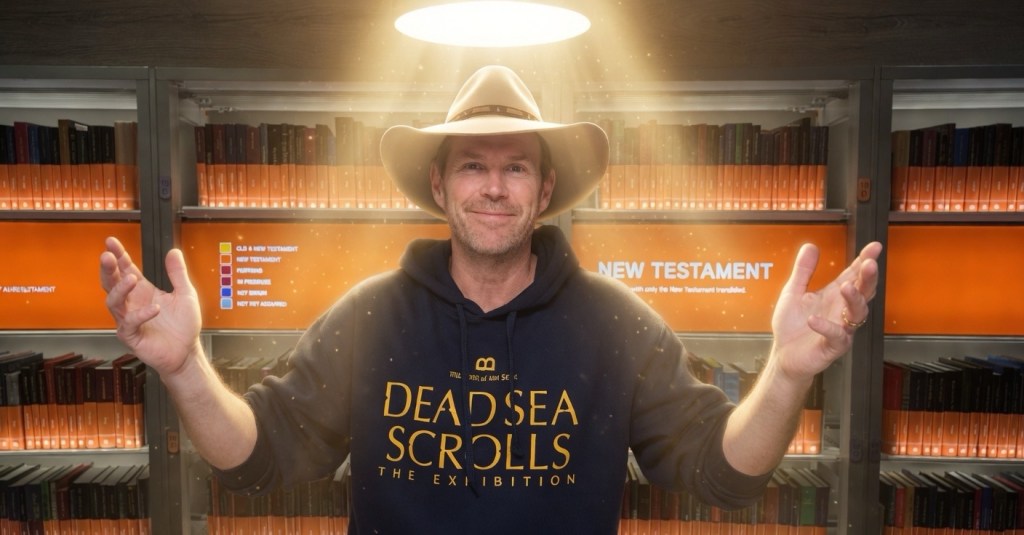
Rich Hoffman is an author, political consultant, and strategic advisor based in Cincinnati, Ohio, and the creator of The Politics of Heaven—a unique framework that connects biblical theology, ancient history, and modern power structures to explain how moral alignment and spiritual forces shape global events. Blending real-world political experience with deep research into archaeology, UFO phenomena, and suppressed historical narratives, Hoffman offers compelling commentary on topics ranging from ancient civilizations and the Dead Sea Scrolls to modern populist movements, paranormal continuity, and leadership strategy in chaotic environments. As the author of The Gunfighter’s Guide to Business and the forthcoming Politics of Heaven, he brings a grounded yet provocative voice to media discussions, supported by firsthand experiences and a cross-disciplinary approach that bridges science, history, and theology. For interviews, speaking engagements, or expert analysis, visit richhoffmanbooks.com or contact directly via phone at 513-307-5815 or email at rhoffman@richhoffmanbooks.com. If you’ve seen the movie, Disclosure Day and want to talk about it and the implications of Presidnet Trump’s UAP disclosures, let me know and we can bring some color to your coverage. https://richhoffmanbooks.com/media-inquiries-broadcast-topics-and-contact-info/?frame-nonce=ad51e7ecba I do have a firsthand UFO encounter to discuss.

