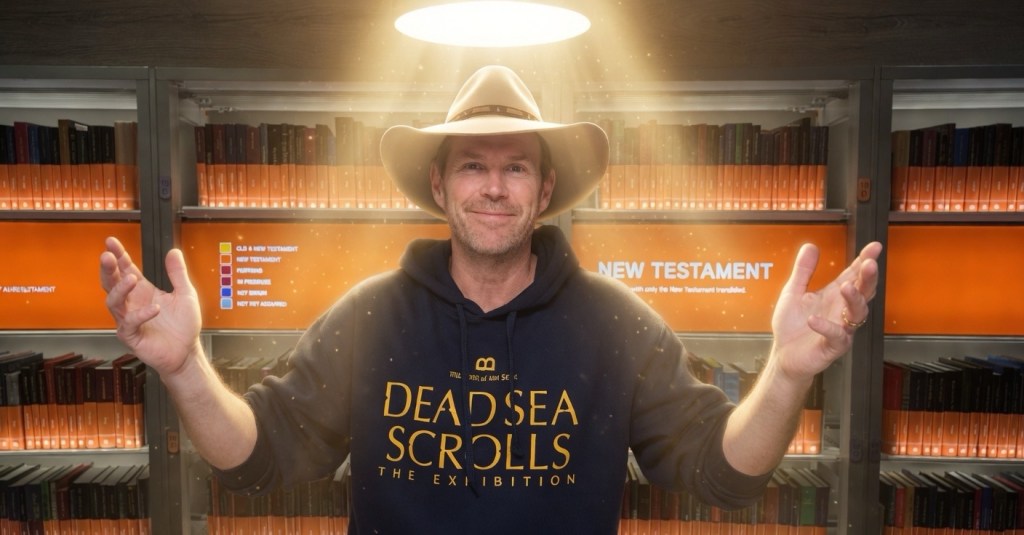
Pip: The Overmanwarrior is the rare corner of the internet where a Bible in an airport carry bag, a Dead Sea Scrolls exhibition pin, and a forthcoming space-economy forecast all coexist without anyone blinking.
Mara: Rich Hoffman covers all of it in one sprawling post — the Jonathan Edwards Study Bible, the personal library behind it, and what a desk Bible signals to the people who walk past it. Let’s start with the book itself and the argument around it.
The Jonathan Edwards Study Bible: A Weapon Worth Carrying
Pip: The post opens with a direct claim: the Bible is one of the best tools available for fighting what he calls the evil of the current moment — and a new study Bible just arrived that he thinks is worth your attention.
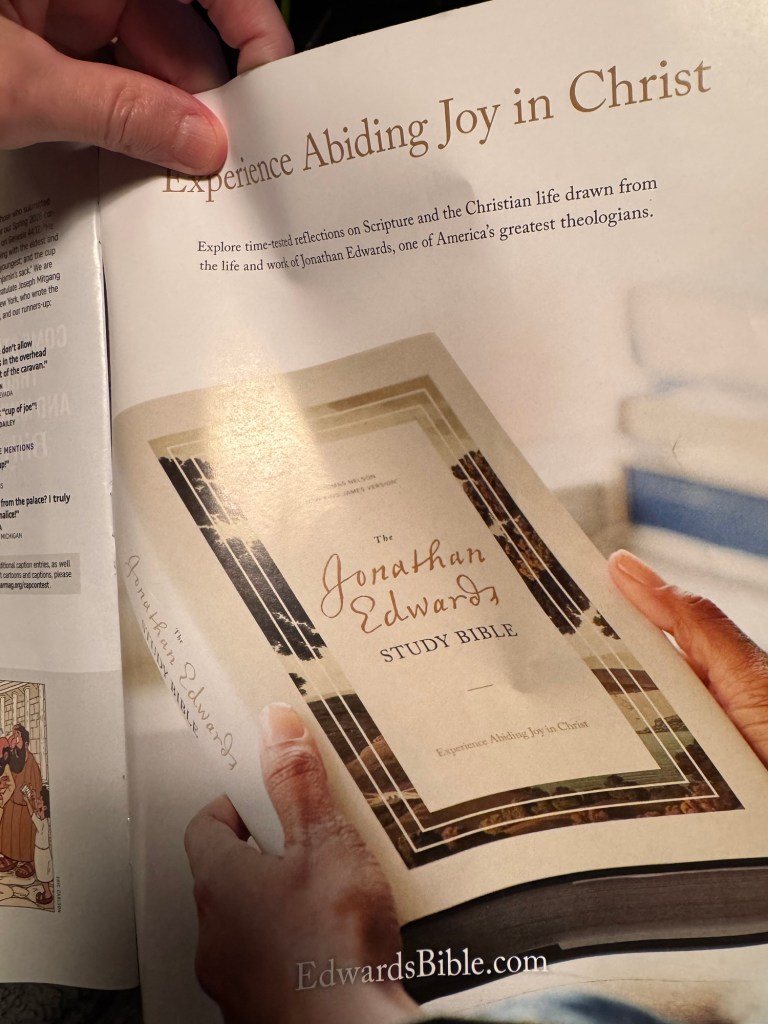
Mara: He sets the scene in Biblical Archaeology Review, a magazine he has received since the 1970s, before landing on the advertisement that prompted the piece. The Jonathan Edwards Study Bible, published August 18, 2026, from Thomas Nelson, general editor Dr. Matthew Everhard, available in hardcover, Leathersoft, and genuine leather.
Pip: So a magazine subscription that predates most of our listeners’ parents is still doing its job as a discovery engine. That’s a long return on a postal address.
Mara: The recommendation is unambiguous. “I would suggest all my readers get a copy, and to use it so we can have much better discussions in the coming years.”
Pip: The stakes behind that suggestion matter. Edwards is positioned not as a historical curiosity but as a founding-era architect — the argument being that the moral conditions that made the United States possible ran through his pulpit in Northampton during the First Great Awakening.
Mara: Everhard’s edition puts Edwards’s own doctrinal work under the New King James text, adds essays on his life and the Awakening, reprints the Resolutions he wrote as a young man, and explains the note system so a reader can build their own practice. That is the practical pitch: it is a reading method, not just a reference volume.
Pip: Three study Bibles already sit in rotation — the carry Bible with filled margins, the Crossway ESV Archaeology Study Bible given to him by a friend who later gave away his own copy, and a MacArthur Study Bible a retired Army colonel set on the desk on June 12, 2023, and walked out.
Mara: The Edwards volume is described as the first new study Bible in some time that he would consider letting the traveler retire to the shelf. That is a meaningful threshold given how much mileage the carry Bible has.
Pip: Then there is the Museum of the Bible visit on his birthday, a Dead Sea Scrolls exhibition pin still in the green bag, and a long passage on the Teacher of Righteousness at Qumran — the point being that the world Jesus and John the Baptist walked into already had a language, a priesthood, and a set of arguments about purity and power.
Mara: What ties it together is the desk. Forty or fifty messages arrived in three weeks from people who used to come through his office. The line repeats: they miss the Bible on the desk. Not the speeches. The book. He writes that what they valued “was not a performance of righteousness. It was a reminder that the world was not all bad.”
Pip: That is a quiet observation with a sharp edge — a habit you thought was private turns out to have been load-bearing for a lot of people who never said so while they were standing in the room.
Mara: The closing recommendation is direct: hardcover if it stays on a table, leather if it travels. Read Edwards’s own line from the edition — “the enjoyment of God is the only happiness with which the soul can be satisfied” — then read the maps, then write in the blanks.
Pip: A Bible in a green bag, a space-economy forecast, and forty messages from people who miss a desk object — it is a wide orbit, but it all pulls toward the same center.
Mara: The question underneath all of it is what a habit signals, and who was quietly depending on it. That tension is not going away.
Rich Hoffman is an author, political consultant, and strategic advisor based in Cincinnati, Ohio, and the creator of The Politics of Heaven—a unique framework that connects biblical theology, ancient history, and modern power structures to explain how moral alignment and spiritual forces shape global events. Blending real-world political experience with deep research into archaeology, UFO phenomena, and suppressed historical narratives, Hoffman offers compelling commentary on topics ranging from ancient civilizations and the Dead Sea Scrolls to modern populist movements, paranormal continuity, and leadership strategy in chaotic environments. As the author of The Gunfighter’s Guide to Business and the forthcoming Politics of Heaven, he brings a grounded yet provocative voice to media discussions, supported by firsthand experiences and a cross-disciplinary approach that bridges science, history, and theology. For interviews, speaking engagements, or expert analysis, visit richhoffmanbooks.com or contact directly via phone at 513-307-5815 or email at rhoffman@richhoffmanbooks.com. If you’ve seen the movie, Disclosure Day and want to talk about it and the implications of Presidnet Trump’s UAP disclosures, let me know and we can bring some color to your coverage. https://richhoffmanbooks.com/media-inquiries-broadcast-topics-and-contact-info/?frame-nonce=ad51e7ecba I do have a firsthand UFO encounter to discuss.
We’re going to go down a rabbit hole here for a bit, because we need to. The evil we are dealing with is pretty easy to beat. And the Bible is one of the best ways to beat it. I’ve confirmed that with a long journey and a lot of experience but for now, let me give you a great weapon to fight that evil. I was reading Biblical Archaeology Review the way I always read it when a new one comes to my mailbox. I take the day. I sit with the issue and I shut off the world to do what I enjoy most. I have been receiving that magazine since the 1970s, when it first came out, and it is still one of the happiest things I do with a stretch of quiet hours.¹ My wife understands that. Most people never see it. I do not usually talk about it. I think its time that we defend our American laws with a bibilical understanding and framework. And just let the Karl Marx lovers have their faces melt. I’m tired of them personally, and their ridiculous view of human affairs.
Then I saw an advertisement for a new study Bible centered on Jonathan Edwards,I wanted others to know it exists. I like the people who put it together and I want to see it sell successfully. The Jonathan Edwards Study Bible is out now from Thomas Nelson, New King James Version, general editor Dr. Matthew Everhard, who is a fantastic scholar. The publication date was August 18, 2026. It comes in hardcover, flexible Leathersoft, and genuine leather.² I already have more study Bibles than a reasonable person needs. I plan to make this the next one I put my hands on every day. I would suggest all my readers get a copy, and to use it so we can have much better discussions in the coming years. Do not let the God-hating Marxist left define our law-and-order society.
I would argue that Edwards shaped the moral weather that made the United States possible, in the 1730s and 1740s, in the First Great Awakening, from a pulpit in Northampton and from a mind that refused to separate joy in God from serious thought.³ I recommend getting the new Bible and living with it. That is the news. The rest is why the news landed on me the way it did.
The Bible in the Green Bag
The Bible I typically carry has been through airports all over the world. Soft pages. Maps in the back. Notes in every blank the editors left me. I have filled the margins to the end. It does not look ruined. It looks used. I could carry it another ten years, and it would still hold. I keep it in a green utility bag with my laptop, the phone, a charging brick, and whatever snack will survive security. One bag. One pass through the scanner. Then I sit at the gate and do what I have always done while a plane loads: I look at the maps, the timelines, the concordance, and a note I wrote two years ago in another terminal.
I am not opening it because I think God will only forgive me if the other passengers watch. I open it because I like it. I like the history that survived. I like the drawings. I like having a piece of the ancient world in my hands while the PA system talks about zone two.
That Carry Bible is not my only one. I keep going back to the Crossway ESV Archaeology Study Bible. I gave a softcover of that one to my youngest daughter. I kept the copy I use. It is a wealth of a book: the text, then the dirt beneath the text, the photographs, the sidebars, the sense that Abraham, Hezekiah, and Paul walked on actual ground.⁴ I first saw it advertised in Biblical Archaeology Review years ago and kept it on the back burner until I bought it. A decade later, I still reach for it more than almost anything else on the shelf, because archaeology is the companion that keeps the stories from floating.
Then there is the MacArthur Study Bible a friend put in my hands on June 12, 2023. He wrote in the front. I did not ask for it. He was a retired Army colonel, later president of aerospace companies, and he valued the conversations we had about biblical context. He walked into the office, set down one of his favorites, and left. I keep it where I can see it from the chair.⁵
Those three sit in a kind of rotation: the traveler, the archaeologist, the gift. The Edwards volume is the first new study Bible in a while that I would consider letting the traveler retire to the shelf.
Museum of the Bible and a Pin from Qumran Country
My favorite day of 2026 so far was my birthday. I took a break from work. My wife and I went to the Museum of the Bible in Washington. We are members. Besides the main reading room at the Library of Congress, that museum is my favorite place on earth, and inside it, my favorite gallery is the History of the Bible exhibit. You walk into architecture that evokes a cathedral. You watch the book move through languages, empires, paper, print, and culture. I am not talking about a private feeling there. I am talking about the measurable power a set of texts has had on human civilization.⁶
I carry a small pin from a Dead Sea Scrolls exhibition in the same bag. I do not want to forget that trip. The Teacher of Righteousness in the Qumran literature is, for me, one of the most compelling figures in Second Temple history. I do not flatten Jesus into that figure. I do not need to. A man is born into a world that already has a language, a priesthood, a Roman shadow, and a set of arguments about purity and power. John the Baptist and Jesus both make more sense when you have sat with the Community Rule, the Habakkuk Pesher, and the people who left Jerusalem’s gravity for the desert.⁷ The Essenes were suspicious of wealth and of a priesthood they thought had made itself comfortable with the wrong masters. That is not a modern talking point. That is the air of the first century.
I find the psychology of that period inexhaustible. Conference calls still get my attention. I listen. Some of them take an hour to arrive at the sentence that could have been said in four minutes. In those stretches I used to slide the desk Bible over and keep my mind working: instead of getting bored: a map, a timeline, a note. Not as theater. As ballast.
What People Thought They Were Looking At
I dress for work—shirt, jacket, often a tie. I have a White House tie. I have one Ross Perot gave me years ago. I have silk ties from the Trump Organization, the kind with the mark on the back, soft, well-made. Ties are not a costume. They are respect for the room I am walking into and the work we do there.
TSA has watched that combination for years: the jacket, the green bag, the Bible coming out of it. More than once the assumption has been that I must be a preacher or some other official holy man. I am not. I am an executive who likes Scripture, archaeology, and not wasting the twenty minutes before a plane pushes back. People sitting in the next seat have asked, in so many words, why a person would look at a Bible in an airport unless he were trying to get something forgiven. I find that question more revealing than they intend. You can live a decent life and still want the book. You can refuse tattoos, refuse to deface the body, refuse the little wink that says “I am as wrecked as you are,” and still not be a priest. You can be a man who thinks the human temple is not a billboard.⁸
I have been stunned, this summer of 2026, at how much hostility that posture draws once you leave a familiar building. Inside two-decade-old relationships, people who suddenly miss me are letting me know just how much, they miss the Bible on my desk realizing it was more than just furniture. People who ran large companies told me later it was the first thing they trusted when they walked in my office. Not the speeches I gave them. The book. A flag that said the room was safe for a person who still went to church on Sunday and did not need to advertise a tattoo on the inside of their arm or hidden on an ankle.
I have had something like forty or fifty messages in the last three weeks from people who used to come through that door. The line repeats. They miss the Bible on the desk. Some of them have more money than they will ever be able to spend and can afford to say what they think in their older years. What they valued was not a performance of righteousness. It was a reminder that the world was not all bad. That has been the shock of changing circumstances. You do not know who was quietly depending on a habit you thought was private until the habit is no longer in the same room.
A New Market, an Old Warning About Wealth
I have been talking with new people in Butler County and in the space-adjacent market I have watched for years. I first heard the pitch the way you hear a hundred pitches on LinkedIn. Everybody has a new idea. My own working estimate, from the work I have actually done, is that the space economy is heading toward something on the order of three trillion dollars by around 2033.⁹ That is not hype. That is a forecast based on experience. If it is even close, the people who build the right things will be rewarded on a scale that sounds like island-buying money to anyone still thinking in last decade’s units.
I am not embarrassed by the pursuit of wealth. I am careful about it. Jesus was not sentimental about rich men. The people behind the Dead Sea Scrolls were not sentimental about rich men. A needle is still a needle.¹⁰ If I had no dime and a box of chicken nuggets from Kroger and a new issue of Biblical Archaeology Review, I would still be myself. The magazine and the book are the happy part. The wealth is the instrument. Nicodemus had standing in the priesthood and still came to Jesus at night. He did not have to choose between influence and curiosity. I would rather earn the hours from five to ten in the evening, the hours when a man who has already taken care of his people can sit in a chair and read, than pretend poverty is automatically holy.¹¹
The colonel who gave me the MacArthur Bible had seen the military change and then seen large companies change until he barely recognized them. He told those stories in an office that still had a Bible on the desk. When he retired, I lost interest in the polite version of going along. That is a disclosure, not a press release. The people who stepped into some of those roles were closer to the airport glance than to the man who wrote in the front of a study Bible. Why are you wearing a tie? Why don’t you have the tattoo? Why don’t you throw a curse word into the meeting so we know you are not a robot? I have known that weather existed. I had commented on it from a protected side of the glass. This year I have been on the other side of the glass.
The Teacher of Righteousness did not win a popularity contest in Jerusalem. The community at Qumran put miles between itself and a priesthood it thought had made peace with the wrong power. I do not think the answer for a modern working life is to move to a desert. I do think the answer is to stop being surprised that people who are only sails, and never a keel, hate a keel when they see one. They go with the wind. A person who gets up in the morning intending to be good is steering. Those two habits do not like each other.
Why Edwards, and Why Now
Jonathan Edwards filled notebooks. The Miscellanies, the Notes on Scripture, the Resolutions he wrote as a young man and kept. The new study Bible is built out of that habit. Everhard’s edition puts Edwards’s own doctrinal work under the NKJV text, adds essays on his life and the Awakening, reprints the Resolutions, and explains the note system so a reader can start one of his own.¹² That is not merchandising. That is an old American technology: write what you see in the text until the text starts writing back to you.
I have been doing a smaller version of that in the carry Bible for years. Lines in the places the publisher left blank. Thoughts in the maps. Reactions I did not want to lose between Dayton and some other runway. Edwards did it at a different scale in the 1740s and 1750s. The country that came after him, the republic that knew his sermons even when it argued with them, did not appear out of a vacuum. If you want a founding-era mind that treated Scripture as something a serious adult could spend a life on, he is near the head of the line.
I am loyal to the Bible that has already been around the world with me. I am not going to mistreat it. I am thinking about letting it live on the shelf and putting a leather Edwards next to the chair and in the bag. A new study Bible is not a better God. It is another set of trained eyes, another century of notes, another chance to keep the mind awake while the rest of the cabin looks at a phone.
If you need a first Bible, or another Bible, this is the one I would put in front of you this month. Hardcover if it will stay on a table. Leathersoft or leather if it is going to travel. Read Edwards’s own sentence on the cover logic of the edition: the enjoyment of God is the only happiness with which the soul can be satisfied.¹³ Then read the maps. Then write in the blanks.
What I Am Building Next
I have said for a while that the age of disclosure and the politics of heaven are not separate subjects. They are the same story told from two altitudes. That work is coming.¹⁴ Until it does, the ordinary practice remains the same. Subscribe to a better day. Sit with a magazine that still believes the dirt in Israel and Jordan and the West Bank can teach you to read. Carry a book that has already outlived empires. Dress as if the work matters. Do not wait for a stranger in an airport to bless the habit.
If you have been one of the people writing to say you missed the Bible on my desk, I appreciate all the kind words and have been impressed how many people were using that object as something stable in their life. Edwards can sit where the last one sat. The green bag still does its work and carries in it what’s truly valuable.
Notes
1. Biblical Archaeology Review began publication in 1975 under Hershel Shanks and the Biblical Archaeology Society. I have read it across five decades. The Fall 2026 issue includes work on Negev tombs, Kidron Valley monuments, Tell Qasile, and spacing in the Dead Sea Scrolls.
2. The Jonathan Edwards Study Bible: Experience Abiding Joy in Christ (NKJV), Thomas Nelson, general editor Matthew Everhard. Hardcover ISBN 9781400339532; also issued in brown Leathersoft and black genuine leather. Comfort Print, red letter, maps, concordance, essays, Resolutions, and an introduction to Edwards’s Miscellanies method.
3. Jonathan Edwards (1703–1758), pastor at Northampton, later missionary at Stockbridge and president of the College of New Jersey—the First Great Awakening’s most demanding American theologian. “Sinners in the Hands of an Angry God” (1741) is the famous shard. The Religious Affections and the Miscellanies are the longer works.
4. ESV Archaeology Study Bible, Crossway, editorial oversight by John Currid and David Chapman, first issued 2018, later TruTone editions. Field notes, photographs, maps, timelines. I have also used Zondervan’s older NIV Archaeological Study Bible; they are different books.
5. The MacArthur Study Bible, long associated with John MacArthur and issued in NASB, NKJV, ESV, and other texts across many printings. The copy on my shelf is the one dated in the front, June 12, 2023.
6. Museum of the Bible, Washington, D.C. The History of the Bible floor remains, for me, the heart of the building. Membership is how we treat a place we intend to keep returning to.
7. Teacher of Righteousness: the sectarian leader in the Damascus Document, the Habakkuk Pesher (1QpHab), and related Qumran texts. I read him as a Second Temple reformer whose conflict with a “Wicked Priest” and with Jerusalem’s establishment belongs in any serious account of the world Jesus and John walked into. That is history and typology, not a claim that the Gospel is only Qumran.
8. I mean the body as temple in the Pauline sense, 1 Corinthians 6:19–20, not a fashion rule I am prepared to police on strangers. It is a rule I keep.
9. Public forecasts of the commercial space economy vary. Morgan Stanley and others have used a trillion-dollar frame toward 2040. My three-trillion-by-2033 figure is an experience-based working number, not a consensus estimate. Treat it as a claim to test.
10. Matthew 19:24 and parallels. The camel and the needle. The point is not that wealth is impossible. The point is that it is spiritually expensive.
11. John 3; John 7:50–51; John 19:39–40. Nicodemus again, because he is the patron saint of people in positions who still want the conversation.
12. Edwards’s “Resolutions” (1722–1723) and the Miscellanies notebooks are in the Yale Edition of the Works of Jonathan Edwards. Everhard’s study Bible is a reading edition of that archive under Scripture, not a replacement for the Yale volumes.
13. The cover quotation is Edwards on the enjoyment of God as the soul’s only satisfying happiness. Related language runs through the Miscellanies and The End for Which God Created the World.
14. The Politics of Heaven is the book I have been building toward; “the age of disclosure” is the public weather that book has to walk into. Forthcoming. The desk Bible is older than both.
Bibliography for Further Reading
Study Bibles and Editions
The Jonathan Edwards Study Bible: Experience Abiding Joy in Christ (NKJV). Edited by Matthew Everhard. Thomas Nelson, 2026.
ESV Archaeology Study Bible. Edited by John D. Currid and David Chapman. Crossway, 2018.
ESV Study Bible. Crossway, 2008.
The MacArthur Study Bible. Various texts and publishers; Thomas Nelson and others.
NIV Archaeological Study Bible. Zondervan, 2005.
Holy Bible, New King James Version. Thomas Nelson.
Holy Bible, English Standard Version. Crossway.
Biblia Hebraica Stuttgartensia and Nestle-Aland Novum Testamentum Graece. For readers who want the next shelf over.
Jonathan Edwards
Edwards, Jonathan. The Works of Jonathan Edwards. 26 vols. Yale University Press, 1957–2008. Especially vol. 2, Religious Affections; vol. 8, Ethical Writings; vol. 13 and following, the Miscellanies; vol. 15, Notes on Scripture.
Edwards, Jonathan. A Jonathan Edwards Reader. Edited by John E. Smith, Harry S. Stout, and Kenneth P. Minkema. Yale University Press, 1995.
Edwards, Jonathan. “Resolutions.” 1722–1723.
Edwards, Jonathan. “Sinners in the Hands of an Angry God.” 1741.
Marsden, George M. Jonathan Edwards: A Life. Yale University Press, 2003.
McClymond, Michael J., and Gerald R. McDermott. The Theology of Jonathan Edwards. Oxford University Press, 2012.
Noll, Mark A. The Rise of Evangelicalism. InterVarsity, 2003.
Stout, Harry S. The New England Soul. Oxford University Press, 1986.
Tracy, Patricia J. Jonathan Edwards, Pastor. Hill and Wang, 1980.
Qumran, Second Temple Judaism, and the Teacher of Righteousness
The Dead Sea Scrolls Study Edition. Edited by Florentino García Martínez and Eibert J. C. Tigchelaar. Brill / Eerdmans.
Vermes, Geza. The Complete Dead Sea Scrolls in English. Penguin, revised editions.
Collins, John J. The Scepter and the Star. 2nd ed. Eerdmans, 2010.
Collins, John J. Beyond the Qumran Community. Eerdmans, 2010.
Cross, Frank Moore. The Ancient Library of Qumran. 3rd ed. Sheffield, 1995.
Fitzmyer, Joseph A. The Dead Sea Scrolls and Christian Origins. Eerdmans, 2000.
Magness, Jodi. The Archaeology of Qumran and the Dead Sea Scrolls. 2nd ed. Eerdmans, 2021.
Schiffman, Lawrence H. Reclaiming the Dead Sea Scrolls. Doubleday, 1994.
VanderKam, James C. The Dead Sea Scrolls Today. 2nd ed. Eerdmans, 2010.
Wise, Michael, Martin Abegg Jr., and Edward Cook. The Dead Sea Scrolls: A New Translation. Harper.
Rich Hoffman is an author, political consultant, and strategic advisor based in Cincinnati, Ohio, and the creator of The Politics of Heaven—a unique framework that connects biblical theology, ancient history, and modern power structures to explain how moral alignment and spiritual forces shape global events. Blending real-world political experience with deep research into archaeology, UFO phenomena, and suppressed historical narratives, Hoffman offers compelling commentary on topics ranging from ancient civilizations and the Dead Sea Scrolls to modern populist movements, paranormal continuity, and leadership strategy in chaotic environments. As the author of The Gunfighter’s Guide to Business and the forthcoming Politics of Heaven, he brings a grounded yet provocative voice to media discussions, supported by firsthand experiences and a cross-disciplinary approach that bridges science, history, and theology. For interviews, speaking engagements, or expert analysis, visit richhoffmanbooks.com or contact directly via phone at 513-307-5815 or email at rhoffman@richhoffmanbooks.com. If you’ve seen the movie, Disclosure Day and want to talk about it and the implications of Presidnet Trump’s UAP disclosures, let me know and we can bring some color to your coverage. https://richhoffmanbooks.com/media-inquiries-broadcast-topics-and-contact-info/?frame-nonce=ad51e7ecba I do have a firsthand UFO encounter to discuss.