

I have been talking about this for years now, and the pattern keeps confirming itself. A few years ago, in 2022, it was Cochise County, Arizona, with Katie Hobbs as Secretary of State. Republican supervisors on the board delayed certifying the midterm results past the statutory deadline, citing concerns about the certification and accreditation of the voting machines. Hobbs, who was herself a candidate for governor against Kari Lake, sued the county to force the canvass. A judge ordered them to certify; they eventually did under threat, and later two supervisors were indicted for interference. Official accounts insist there was “no evidence of a count being incorrect,” yet the resistance itself, the attempted full hand-count that a court blocked, and the broader atmosphere of machine distrust revealed how thin the institutional trust had become.
We have seen the same dynamic in Fulton County, Georgia. In December 2025, an attorney for the county stood before the State Election Board and stated plainly that they did not dispute the failure to sign tabulator tapes covering roughly 315,000 early votes from the 2020 election—nearly all of the early in-person ballots. That directly violates the rules designed to create a verifiable chain of custody between voters and tabulated results. There have also been admissions and findings around double-scanned ballots, missing ballot images, and inconsistent batch tallies from the risk-limiting audit and recount. Officials and the Secretary of State call these clerical errors that did not change the outcome; Biden’s margin in Georgia was about 11,779 votes. Yet the volume of procedural failures is not trivial, and the late admission years later only feeds the original skepticism.
How They Thought They Would Get Away With It
This is what has always puzzled me. The Constitution and American society rest on a baseline of integrity—people raising their right hand and swearing to tell the whole truth, so help them, God. When that idea is hollowed out, the entire mechanism of voluntary cooperation collapses. Progressive globalism treated the removal of that integrity as a feature, not a bug. Without the sacred weight of the oath, testimony becomes just another tactical instrument. You can say whatever advances the narrative today and walk it back tomorrow as a “clerical error.” The goal was authority without the restraint of genuine accountability.
They preached using the power of government to reshape the individual and society, yet simultaneously pushed to defund the police. That is an obvious contradiction. If you dismantle the everyday instruments of law and order, how exactly do you intend to enforce the new authority you claim? You cannot have it both ways. Either the rules apply with consistent enforcement, or the system becomes pure power exercised by whoever controls the institutions at the moment. The progressive assumption seemed to be that once integrity was sufficiently degraded, and once enough people accepted that “the process” itself was the only legitimacy required, dissent could be managed through narrative, lawfare, and selective prosecution rather than persuasion.
Lawfare, Oaths, and the Targeting of Questioners
We saw that approach in practice. Efforts to put Trump in jail; the imprisonment of Peter Navarro for contempt of Congress related to the January 6 committee and election-related challenges; and the FBI seizure of Mike Lindell’s phone at a drive-through while he was under heavy scrutiny for questioning the machines and the results—these were not abstract debates. They showed what happens when you question the official story too persistently. At the same time, discussions continue about holding figures such as Anthony Fauci accountable for the pandemic response, yet the institutional machinery has been far more energetic in pursuing those who challenged 2020 election procedures than in applying the same standard universally.
The removal of the idea that an oath means something is central. When liberals treat the “so help me God” clause as optional theater, the entire structure of testimony and public record loses its force. That is why a candidate like Amy Acton can run for governor in Ohio with a campaign largely managed through public relations filters, raising tens of millions while avoiding direct, unscripted answers to difficult questions. The model is to control the information environment rather than submit to open scrutiny. In a system that still had robust integrity, that approach would be fatal. Once integrity is optional, it becomes a viable strategy.
The Voice of the People and the 2024 Contrast
People still went out and voted in large numbers in 2024. The red wave, though it could not be fully contained, showed that when voters have a clear channel and counting is sufficiently visible, the representative mechanism can still function. That is why calls to re-examine 2020—not as nostalgia, but as a demand that discrepancies be treated with the same seriousness as any other large-scale administrative failure—continue. Trump didn’t have to be drafted into that fight; he volunteered because the alternative was accepting a system in which the oath and the count are both flexible. It was never more complicated than that for those who still believe the mechanisms they were told were reliable should actually be reliable.
The progressive error was thinking that authority could be sustained after integrity had been systematically weakened. Without the cultural habit of telling the truth under oath, and without consistent law enforcement that does not depend on political convenience, the only remaining tools are narrative control and selective coercion. That is not a stable foundation for any society that claims to be constitutional. The admissions in places like Fulton County and the certification fights in Cochise County are not the whole story, but they clearly illustrate why so many people concluded the system had stopped treating integrity as non-negotiable.
Bibliography
• New York Times, “Republican-Controlled County in Arizona Holds Up Election Results,” November 28, 2022.
• Snopes, “Fulton County, Georgia, officials admitted ballot-handling errors during 2020 election,” December 2025 (citing State Election Board proceedings and county attorney Ann Brumbaugh’s statement).
• Atlanta News First and 11Alive reporting on the December 9, 2025, State Election Board hearing regarding unsigned tabulator tapes covering approximately 315,000 early votes.
• Associated Press and other contemporaneous coverage of Cochise County Board of Supervisors actions, Hobbs lawsuit, and subsequent judicial order to certify.
• Judicial Watch and reporting on the 2022 FBI warrant and seizure of Mike Lindell’s phone.
• Coverage of Peter Navarro’s conviction and imprisonment for contempt of Congress.
• Acton for Governor campaign finance announcements and contemporaneous polling.porting on the 2026 Ohio gubernatorial race.The record is public.
Rich Hoffman
More about me
Click Here to Protect Yourself with Second Call Defense https://www.secondcalldefense.org/?affiliate=20707
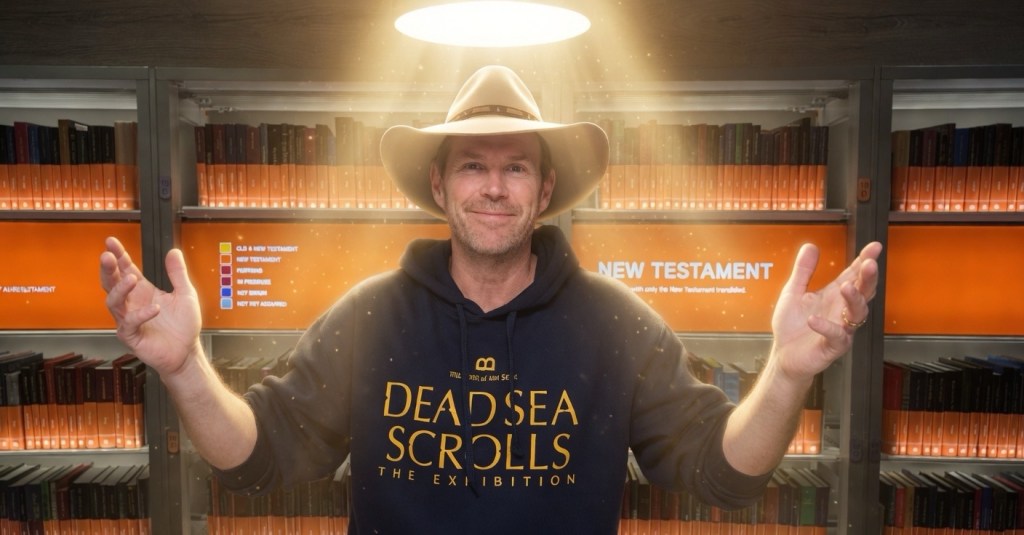
About the Author: Rich Hoffman
Rich Hoffman is an author, political consultant, and strategic advisor based in Cincinnati, Ohio, and the creator of The Politics of Heaven—a unique framework that connects biblical theology, ancient history, and modern power structures to explain how moral alignment and spiritual forces shape global events. Blending real-world political experience with deep research into archaeology, UFO phenomena, and suppressed historical narratives, Hoffman offers compelling commentary on topics ranging from ancient civilizations and the Dead Sea Scrolls to modern populist movements, paranormal continuity, and leadership strategy in chaotic environments. As the author of The Gunfighter’s Guide to Business and the forthcoming Politics of Heaven, he brings a grounded yet provocative voice to media discussions, supported by firsthand experiences and a cross-disciplinary approach that bridges science, history, and theology. For interviews, speaking engagements, or expert analysis, visit richhoffmanbooks.com or contact directly via phone at 513-307-5815 or email at rhoffman@richhoffmanbooks.com. If you’ve seen the movie, Disclosure Day and want to talk about it and the implications of Presidnet Trump’s UAP disclosures, let me know and we can bring some color to your coverage. https://richhoffmanbooks.com/media-inquiries-broadcast-topics-and-contact-info/?frame-nonce=ad51e7ecba I do have a firsthand UFO encounter to discuss.

