

Young people keep asking me what the 1980s were like. I work with a lot of them—teens, early twenties—and the question comes up often enough that my answer has become almost automatic. We had Bruce Willis in the Die Hard films. We had Arnold Schwarzenegger in the Terminator movies and Conan. Sylvester Stallone as Rambo. Clint Eastwood. Mel Gibson in Lethal Weapon. Strong, competent, decisive men who handled problems with their hands and their will. They were not perfect. They were not soft. For a while, they were the dominant image of what a man could be when the situation required it.
That image has been replaced. The replacement did not arrive by accident.
The Question Waller Asked
One of my favorite books has always been The Bridges of Madison County by Robert James Waller. I liked most of what he wrote. The novel was a bestseller aimed largely at middle-aged women, and it worked for reasons that went beyond the romance between Francesca Johnson and Robert Kincaid. Buried in the story is a sharper observation about how societies decide what is fashionable, what is respectable, and what is forbidden to say. Who decides that a rock band dyes their hair purple? Who decides that certain observations about human nature become unspeakable? Waller understood that these decisions are not purely democratic or purely market-driven. They emerge from deeper pressures—psychological, commercial, and, I would argue, spiritual.
The book captured something real about the human condition across time. People want safety. They want to belong. They want the comfort of shared opinion. The market and the culture give them that comfort until something stronger interrupts it. The question of who sets the terms of that comfort is the same question that runs through the story of the Fall.
What Thirty-Eight Years and Raising Daughters Taught Me
I have been married thirty-eight years. I have raised daughters and now have granddaughters. I have known a great many women over that span of time. The pattern I have observed isn’t flattering to anyone, and it isn’t politically acceptable. Women, on average, appear more readily influenced by appeals to safety and security than men. This is not a moral judgment. It is an observation about wiring. From early in puberty, many women learn that sexual interest can be traded for protection, status, resources, and social approval. The transaction is ancient. It is also effective until the physical appeal that underwrites it declines. After that point, the strategy that once worked becomes a source of helplessness, because the adult life has been organized around it.
This makes women, again on average, useful gateways for influences that want to reshape men. If you can move the women, a large share of the men will follow—not because the men have been logically persuaded, but because they want access to the woman. I have watched this in progressive circles for decades. Plenty of young men join causes they do not particularly believe in because the events draw women. They are not there for the ideology. They are there for the possibility of contact. The ideology is the price of admission.
The Concert, the Horror Film, and the Old Pattern
At Mötley Crüe shows years ago, women in the crowd would remove their panties and throw them on stage. That is not an isolated curiosity. It fits a longer pattern of appeasement and display that appears in both rock culture and horror. Jason Voorhees, the character I have portrayed in seasonal work, is pure threat, I will have a lot more to say on this in November. The response to pure threat is often some form of offering or submission. The same impulse shows up in older religious and cultic settings where women were used as the point of contact with the powerful or the dangerous. The offer of sex, or the display of sexual availability, functions as a bid for safety or favor. The behavior is not new. Only the stage lighting has changed.
Eve, Not Adam
The biblical account in Genesis is blunt. The serpent addresses the woman. She takes the fruit. She gives it to the man. The man follows. The text does not present this as a one-time historical accident. It presents a recurring pattern of how disruption enters the created order. Women, oriented toward safety and the continuity of the household, are approached with promises that the existing order is inadequate or oppressive. Men, oriented toward the woman, follow. The Book of Job shows the same adversary, permitted to test and disrupt. The pattern is not confined to one chapter.
I have said for years that the modern women’s movement, in its more radical forms, continued that pattern. It redefined the household as a site of oppression, encouraged women to treat marriage and motherhood as optional or secondary, and treated male strength as suspect. The result was not liberation in the abstract. It weakened the family unit that had previously limited the reach of outside influence. Families that stay intact are harder to redirect. Families that fracture become more dependent on external authorities—cultural, institutional, or ideological.
Sex as the Lever
Most men will adjust their public opinions if the adjustment improves their chances with a particular woman. They will listen to complaints about “toxic masculinity” even when their private experience contradicts the complaint. They will adopt the language of the moment because the alternative is exclusion from the bed or from the social circle that contains the women they want. This is not sophisticated ideology. It is biology overriding calculation. The same woman who publicly rejects strong, competent men will, in private, often respond to the man who smells like work, carries tools, and can keep the house functioning. The plumber or contractor who shows up competent and unapologetic isn’t a feminist ideal. For many women, he is a practical, physical preference. The public statement and the private response are not the same.
Young women I encounter—teens through their thirties—have absorbed the message that masculine competence is a problem. They describe it as toxic. They prefer the softer presentation. The boys around them adapt. They become less assertive, less willing to lead, more willing to defer. The adaptation is rational in the short term if the goal is female approval. It is destructive if the goal is a culture that can defend itself or raise the next generation without constant external management.
Who Sets the Fashion
Waller’s question remains useful. Who decided that strong men became the problem? The decision did not emerge from a careful study of outcomes. It emerged from institutions and cultural producers that treat the existing order as the obstacle. Alphabet and its subsidiaries are not neutral platforms. They are progressive enterprises with a consistent preference for rewriting sex roles, family structure, and the authority of traditional sources. The preference is not hidden. It shows up in hiring, content moderation, and the stories that get amplified. The effect is to make the older masculine ideal unfashionable and the newer, more compliant ideal mandatory.
The mechanism is efficient. It influences women through appeals to safety, status, and belonging. The men follow for access. The pattern spreads without requiring every participant to understand the larger direction. Most of the young women repeating the language about toxic masculinity do not experience themselves as agents of a larger project. They experience themselves as seeking approval and avoiding risk. The larger project does not require their conscious agreement.
The Pattern Continues
The same sequence appears across the biblical record and across later history. An appeal is made to the woman. The woman moves. The man follows. The household weakens. External authority expands. The language changes—safety, equality, progress—but the sequence is recognizable. Non-human intelligence, operating through human institutions and desires, does not need to invent new tools when the old ones still function. Sex remains a reliable lever. The desire for security remains a reliable entry point. Men remain willing to trade long-term strength for short-term access.
Young people asking about the 1980s are asking, without quite knowing it, why the men of those films are no longer the model. The answer is not that those men failed. The answer is that a sustained effort has been made to make their qualities unfashionable. The effort works because it routes through women and because men will adjust to keep the women. That is not a conspiracy theory. It is an observable pattern, recorded early and repeated often.
The question Waller raised still stands. Who decides these things? Look at who benefits when strong men are redefined as the problem and compliant men are redefined as the solution. The pattern is old. The stage is new. The result is the same.
Footnotes
1. Genesis 3:1–6 records the serpent’s approach to the woman, her decision, and the man’s subsequent participation. The sequence is presented without apology or modern reframing.
2. Job 1–2 shows the adversary operating with limited permission to disrupt a household and test loyalty. The text treats the activity as ongoing rather than resolved.
3. Robert James Waller, The Bridges of Madison County (1992). The novel’s commercial success among women did not prevent it from containing sharper observations about safety, conformity, and the costs of certain choices. Waller explored related themes in other works, including Slow Waltz in Cedar Bend.
4. The public rejection of “toxic masculinity” alongside private preferences for competent, physically capable men is a recurring observation in both evolutionary psychology literature and ordinary experience. See, for example, the documented sex differences in mate preferences for resources and protection on one side and youth and fertility on the other.
5. Cultural producers and technology platforms have documented preferences in content and personnel. These preferences are not secret; they are visible in public statements, hiring patterns, and amplification choices.
6. The seasonal portrayal of Jason Voorhees is offered only as a cultural reference point for threat and response, not as a literal religious claim.
Bibliography for Further Reading
• Waller, Robert James. The Bridges of Madison County. Warner Books, 1992.
• Waller, Robert James. Slow Waltz in Cedar Bend. Warner Books, 1993.
• The Book of Genesis, especially chapters 2–3.
• The Book of Job.
• Buss, David M. The Evolution of Desire: Strategies of Human Mating. Basic Books, revised edition.
• Sommers, Christina Hoff. Who Stole Feminism? How Women Have Betrayed Women. Simon & Schuster, 1994.
• Goldberg, Steven. The Inevitability of Patriarchy. William Morrow, 1973 (for an earlier, data-heavy treatment of sex differences in social organization).
• Farrell, Warren. The Myth of Male Power. Simon & Schuster, 1993.
• Critical treatments of second- and third-wave feminism that examine outcomes for family structure and male socialization.
• Works on spiritual conflict and non-human agency that treat the biblical record as a chronicle of recurring patterns rather than isolated ancient events. (Readers interested in the longer argument developed across my own writing will find related material in The Politics of Heaven.)
Rich Hoffman
More about me
Click Here to Protect Yourself with Second Call Defense https://www.secondcalldefense.org/?affiliate=20707
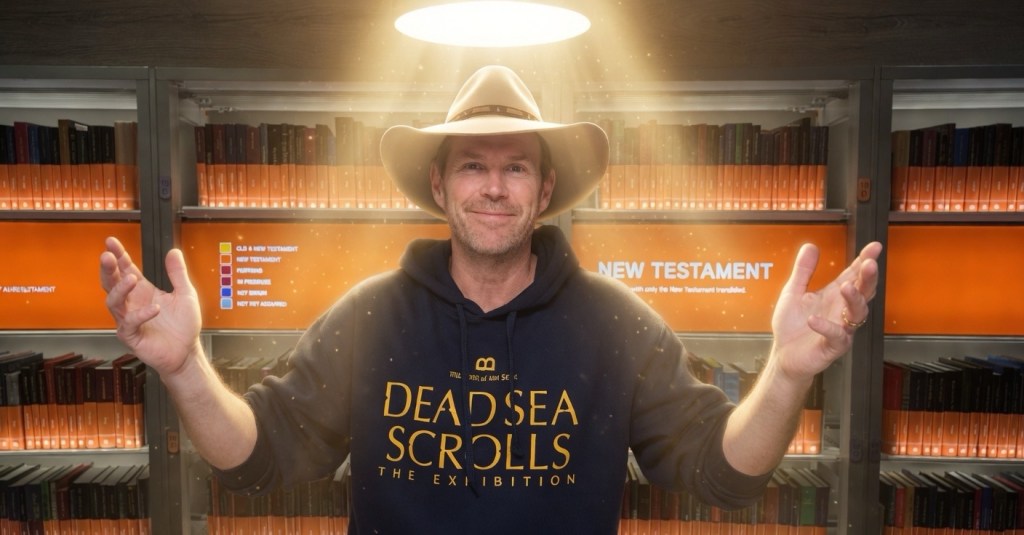
About the Author: Rich Hoffman
Rich Hoffman is an author, political consultant, and strategic advisor based in Cincinnati, Ohio, and the creator of The Politics of Heaven—a unique framework that connects biblical theology, ancient history, and modern power structures to explain how moral alignment and spiritual forces shape global events. Blending real-world political experience with deep research into archaeology, UFO phenomena, and suppressed historical narratives, Hoffman offers compelling commentary on topics ranging from ancient civilizations and the Dead Sea Scrolls to modern populist movements, paranormal continuity, and leadership strategy in chaotic environments. As the author of The Gunfighter’s Guide to Business and the forthcoming Politics of Heaven, he brings a grounded yet provocative voice to media discussions, supported by firsthand experiences and a cross-disciplinary approach that bridges science, history, and theology. For interviews, speaking engagements, or expert analysis, visit richhoffmanbooks.com or contact directly via phone at 513-307-5815 or email at rhoffman@richhoffmanbooks.com. If you’ve seen the movie, Disclosure Day and want to talk about it and the implications of Presidnet Trump’s UAP disclosures, let me know and we can bring some color to your coverage. https://richhoffmanbooks.com/media-inquiries-broadcast-topics-and-contact-info/?frame-nonce=ad51e7ecba I do have a firsthand UFO encounter to discuss.

