Pip: The Overmanwarrior is a show that refuses the easy road — no local gossip, no algorithm-friendly takes, just a man and a copper pit older than the pyramids’ reputation, asking whether the whole story of this continent needs to be rewritten.
Mara: Rich Hoffman’s recent work covers a lot of ground — Trump’s renaming of Lake Ontario, the deep prehistory of the Great Lakes, the Copper Scroll, and what the word “indigenous” is actually doing in a political argument. Let’s start with the lake, the copper, and why the naming fight is really about something much older.
Lake America and the Copper That Built the Ancient World
Pip: The segment opens with a provocation: Trump signed an executive order on August 27th renaming Lake Ontario as Lake America, and the argument here is that the outrage that followed is actually the point — that names are how institutions teach a public what to value and what to be ashamed of.
Mara: The post frames the whole project this way: “I am trying to encourage people to come down the rabbit hole and take whatever treasure they can carry back out.” That’s the method — not a seminar, not a grievance catalog, but a sustained question about what the naming fight is actually downstream of.
Pip: And what it’s downstream of, the argument goes, is an institutional habit of treating the founding of the United States as the continent’s original sin — where every pre-Columbian name becomes untouchable and every American assertion becomes an act of erasure.
Mara: Canada’s prime minister said the lake is called Ontario “today and forever.” New York’s governor said the state wouldn’t use the new name. The legal reality is narrow — Washington can rename what Washington prints, it cannot rename what Toronto says — but that gap is exactly why a name becomes a weapon.
Pip: The copper is where this gets genuinely interesting. The Old Copper Complex of the Upper Great Lakes — Isle Royale, the Keweenaw Peninsula — shows prehistoric pits worked by hunter-gatherers dating into the ninth millennium before the present. More than a thousand pits on Isle Royale alone. That is not a weekend hobby.
Mara: The post is careful here. Two things it calls firm: Archaic people of the Upper Great Lakes worked native copper very early, with some dates rivaling the oldest copper work in the Old World, and the metal is so pure it can be hammered without smelting. The leap — walking that copper across the Atlantic to Solomon’s Temple — is flagged as a leap that still needs isotope evidence.
Pip: Then there’s the Windover site in Florida — a pond cemetery near Titusville where a backhoe in 1982 pulled up human bone dating seven to eight thousand years before the present. Brain tissue. Woven fiber. A readable last meal. A civilization of burial custom standing on this peninsula while the Near East was still becoming Egypt.
Mara: The Moon-eyed people tradition rounds out the prehistory argument. Cherokee oral memory, as recorded by early settlers, described finding and displacing a pale, light-shy people already living in the southern Appalachians. The point isn’t to convict a ghost — it’s that if the Cherokee displaced someone, they were the latest people of that ridge, not the first.
Pip: Which is exactly the human story from the Levant to the Andes — and exactly what the political use of “indigenous” tries to freeze out of the frame. The Copper Scroll enters as a related question: not where did the Temple treasure go, but where did the metal economy that made such a list thinkable come from in the first place.
Mara: The post asks whether the ancient Near East’s enormous copper hunger has been fully inventoried. Timna and the Arabah are on the map; recent radiocarbon work has restored a tenth-century industrial peak there. Lake Superior is the name the textbooks treat as a category error. The argument is that asking the question is scholarship — treating the crossing as proven is not.
Pip: So “Lake America” is doing a lot of work for four syllables. It’s not cartography — it’s a forced discussion about whether the United States is allowed to name its own waters without first clearing the claim through a political story that starts in 1492 and ignores every copper pit that came before.
Mara: The post puts it plainly: the copper miners of Superior, the burial people of Windover, the builders on the dry bay floor — those are indigenous facts. The political slogan that uses “indigenous” to unmake the United States is, the argument goes, not a fact. It is a maneuver.
Pip: And if the question of who names a lake connects to who gets to name the country itself, then the next question is what other forces — beyond the political — might have an interest in keeping that shame in place.
Mara: The thread running through all of this is the same question applied at different scales — are we getting what we want from the story we’ve been handed, whether that story is about a lake, a copper pit, or a national identity?
Pip: Follow the copper. Follow the names. That’s the assignment — and something tells me the rabbit hole goes considerably deeper than the bottom of Lake Superior.
Rich Hoffman is an author, political consultant, and strategic advisor based in Cincinnati, Ohio, and the creator of The Politics of Heaven—a unique framework that connects biblical theology, ancient history, and modern power structures to explain how moral alignment and spiritual forces shape global events. Blending real-world political experience with deep research into archaeology, UFO phenomena, and suppressed historical narratives, Hoffman offers compelling commentary on topics ranging from ancient civilizations and the Dead Sea Scrolls to modern populist movements, paranormal continuity, and leadership strategy in chaotic environments. As the author of The Gunfighter’s Guide to Business and the forthcoming Politics of Heaven, he brings a grounded yet provocative voice to media discussions, supported by firsthand experiences and a cross-disciplinary approach that bridges science, history, and theology. For interviews, speaking engagements, or expert analysis, visit richhoffmanbooks.com or contact directly via phone at 513-307-5815 or email at rhoffman@richhoffmanbooks.com. If you’ve seen the movie, Disclosure Day and want to talk about it and the implications of Presidnet Trump’s UAP disclosures, let me know and we can bring some color to your coverage. https://richhoffmanbooks.com/media-inquiries-broadcast-topics-and-contact-info/?frame-nonce=ad51e7ecba I do have a firsthand UFO encounter to discuss.
I did not build this media form to talk about local personalities and small topics of no consequence. That is the easy road. Local talk gets hits. Local talk gets popular. I am not interested in it. I am interested in a format that lets a person go down a rabbit hole and stay there long enough to think a thought they would not have thought if the show had been engineered for an audience. Years ago, the question that started the whole habit was simple: Are we getting what we want from the education of children for the money we spend on it? The answer, then and now, was no. The same question can be asked of budgets, housing policy, the relationship between business and politics, and the names we place on large bodies of water. The method does not change. Ask the question at the level it deserves. Invite people along. Do not pander.
Anyone watching consistently knows the season we are in. Trump is in the White House. People are looking around at midterms, the price of gas, the word socialism used as if it were weather. I cover business and politics because that is where the American system is supposed to work, and because the relationship between the two is not what a civics textbook pretends it is. I enjoy the hard half of the map. You will not turn on a typical podcast and get the information nobody wants to handle in the way it should be handled. If I am not performing for more viewers, that is the approach. I am trying to encourage people to come down the rabbit hole and take whatever treasure they can carry back out.
President Trump, as a manager of the executive branch, expects people like me to fill in the blanks when he throws something controversial on the table. He renamed Lake Ontario. He called it Lake America.[1] I have said before that the emphasis was not cartography. The emphasis was provocation. Change the name. Force the discussion. What does the fight actually mean? I do not want to be the man whose entire contribution is a seminar on indigenous grievance. I also will not pretend the fight is about courtesy to a lake. The fight is about whether the United States is allowed to name its own waters without first kneeling to a political story about 1492.
Commentary — on the executive order itself: The August 27, 2026 order changes how the United States government refers to the lake. USGS electronic products were updated within hours. Canada’s prime minister, Mark Carney, answered that the lake is called Ontario “today and forever.” New York’s governor said the state would not use the new name. About half the surface sits on the Canadian side. The legal reality is narrower than the cultural explosion: Washington can rename what Washington prints. It cannot rename what Toronto says. That gap is exactly why a name becomes a weapon. If the gesture were only petty trade-war theater, it would have died in a news cycle. It did not, because names are how institutions catechize a public.
Are We Getting What We Want from the Names We Spend Our Authority On?
I wish academia were designed for American designs. I wish a lot of our institutions had not been captured long ago. The day Trump got on the plane after his first term, I describe that departure as exile because that is what it felt like to millions of people who watched a system treat their vote as a problem to be managed. I am not going to relitigate every precinct here. I am going to say what the naming fight is downstream of: an institutional habit of treating the creation of the United States as the original sin of the continent, and of treating every pre-Columbian name as a sacrament that cannot be touched.
My first real teacher in the long-form sense was Joseph Campbell. I have lived in those lectures. Campbell understood something our public schools will not admit out loud. A great deal of a human life is spent trying to locate a place in an order—am I toward the top of the pyramid or the bottom, boss or subordinate, the person who leads the meeting or the person who cuts the grass on the side of the road? Schools are bult to establish that sorting. They are much worse at asking whether the order itself is true.[2] The same instinct that makes a teenager measure himself by house, spouse, and income is the instinct that makes a grown population easy to herd. If you were an enemy of the human race—and I will argue, as I will argue in The Politics of Heaven, that there is a non-human intelligence, call it the spirit world, call it the counsel that set itself against God—you would not need a tank. You would need the human craving to fit in. You would use names. You would use the way a culture is taught to value things. You would make some words untouchable and other words shameful. Then you would watch decent people police each other in a destructive fashion.
That is why I do not treat the indigenous-people argument as a seminar in ethnography. Ethnography is welcome. Cultures are fascinating. Their stories, legends, and rituals offer a glimpse into another time, and there is still a great deal to learn. I want archaeologists extremely well funded, even rich. I want them in the dirt. I want to spend evenings with Biblical Archaeology Review and with site reports from the Upper Peninsula. What I will not do is let a political Smithsonian wrap a living tribal present around the entire deep past of the continent and then use that wrapping to undo the United States.
The Indigenous People Argument Is a Political Machine
The academic embrace I am talking about is not “study the Haudenosaunee.” Study them. Learn the language families. Read the longhouse constitution if that is your work. The embrace I mean is the 1619-shaped habit: Europe arrives, and the story of the continent becomes death, theft, and a fall from an innocent world.[3] You can hear the same structure in other theaters. I have read papers that treat the biblical conquest of Canaan as an original crime and the modern Jewish state as its sequel, as if Yahweh were a late ethnic mascot and the land had a single rightful pagan landlord. Pagan preference is not a conspiracy in the cheap sense. It is a religious preference with political teeth. Hollywood has been more honest about its Canaanite sympathies than universities have been about theirs.
If you are going to say “indigenous people of North America” and mean it as an academic sentence rather than a chant, you do not get to start the clock in 1492, or 1619, or even 1000 CE. You have to accommodate the Windover people of Florida. You have to accommodate the copper miners of Lake Superior. You have to accommodate the drowned stone lines in the Great Lakes. You have to accept that “the Indians Columbus met” were not a timeless essence. They were people who had already replaced other people, because that is what human beings do on every continent God made.
Windover: Florida, seven to eight thousand years ago
In a pond near Titusville, not far from where rockets now leave the coast, a housing-development backhoe in 1982 lifted human bone out of peat. The police were called. Then the dates came back. The Windover pond held the dead of an Archaic people who used that water as a cemetery for a thousand years. Something like 168 individuals. Brain tissue. Woven fiber. A last meal still readable in a woman’s gut. Seven to eight thousand years before the present.[4] That is not a footnote to 1492. That is a civilization of burial custom, craft, and landscape memory standing on this peninsula while the Near East was still learning the habits that would become Egypt and Canaan.
I do not want that site used as a club against living tribes, and I do not want living tribes used as a club against that site. I want the sentence said out loud: the people of Windover are part of the indigenous story of North America, and any politics that cannot find room for them is not a politics of the past. It is a politics of the present.
The Old Copper Complex: Lake Superior and the oldest metalworking on the continent
Lake Superior is one of the wonders of the world. I do not hide that. Put-in-Bay, Mackinac, the Upper Peninsula—I love the Great Lakes the way some people love mountains. Superior also contains one of the sharpest mysteries we have. The Keweenaw and Isle Royale hold native copper of a purity that still startles metallurgists. Prehistoric pits pock the trap rock. Hammerstones lie in the fill. Organic scraps caught in copper tools have been dated into the ninth millennium before the present. Sediment cores beside the old workings have been read as mining signatures even earlier. This is the Old Copper Complex: hunter-gatherers who learned to beat, float, and vein copper into points, knives, and ornaments long before the Mediterranean named a Bronze Age.[5]
Thousands of pits. Not a weekend hobby. Not a single village knocking a nugget into a bead. An industry measured in centuries.[6] And here is the part that detonates the pamphlet version of “indigenous people”: the pamphlet wants a single moral cast—timeless tribal nations, then Columbus. The copper will not sit still for that cast. The people who opened those pits are real indigenous people of this continent. Later nations of the Great Lakes are also real. They are not the same photograph. If genetics and archaeology cannot staple the miners of 7000 BCE to the specific tribes who met the French, then an honest academy says so. A political academy changes the subject.
Commentary — what is firm, and what is a leap? Two facts are no longer eccentric. First, Archaic people of the Upper Great Lakes worked native copper very early; some dates now rival the oldest copper work in the Old World. Second, the metal is so pure it can be hammered without the smelting regimes of Cyprus or Timna. The leap—and it is a leap—is to walk that copper across the Atlantic into Solomon’s Temple or the Copper Scroll. Isotope maps of Bronze Age Europe keep finding Cyprus, the Alps, Iberia, Wales, the Arabah. They have not found Keweenaw so far. My question is still the right kind of question: given the volume of metal the ancient Near East burned through, are we sure we have inventoried every source? Asking is scholarship. Treating the crossing as proven is not. The force of this argument does not require the crossing. It only requires that “indigenous” be a timeline, not a verdict.
Stone under Grand Traverse Bay
Off Traverse City, in about forty feet of water, there is a line of stone that should have ended the slogan version of prehistory by itself. Mark Holley was looking for a shipwreck and found an arrangement that the press, lazy as ever, called a Stonehenge. Holley does not like the word, and he is right not to. What he has is a long alignment on a lakebed that was dry when the lakes stood lower, with at least one boulder that some eyes read as a mastodon. Mastodons were gone from this country early. If that mark is a mark, the calendar drops into the same deep water as the copper pits.[7] Lake Huron has a cleaner case: a caribou drive-lane on a drowned hunting ground, dated to the same general world. The lakes keep the memory the textbooks compress.
When lake levels were lower, people walked landscapes we now boat over. When the English Channel was a valley, people walked to France.[8] We know migration at continental scale is not a fantasy; the first peopling of the Americas is itself a migration argument that still shifts every decade. The silly statement is not “people moved.” The silly statement is “nobody crossed open water until a Genoese sailor on a Spanish payroll made it official.” If you can keep a craft on water for forty days, you can cross an ocean. Genesis is not a Coast Guard manual, but it is a reminder that the ancient imagination did not think of the sea the way a modern tenure committee does.
The Moon-eyed people and the honesty of replacement
The Cherokee have a grievance against Andrew Jackson that American history already knows how to spell. Trail of Tears is not a rumor. Before that road west, though, Cherokee memory—or the memory settlers wrote down as Cherokee—said something else. When they came into the Smokies and the southern Appalachians, they found people already there. The printed versions call them moon-eyed: pale, light-shy, night-working, driven out when the moon was too bright for their eyes.[9] I am not asking a jury to convict a ghost. I am asking for a simple courtesy with the word “indigenous”. If the Cherokee displaced someone, then the Cherokee, in that hour, were not the first people of that ridge. They were the latest people of that ridge. That is not an insult. That is the human story from the Levant to the Andes. The political use of “indigenous” is an attempt to freeze one frame and call it eternity.
Lake Ontario was named from an Iroquoian language for the beauty of its waters. That is a good name. It is also a name that belongs to the people who happened to be in the neighborhood when the French and the English arrived.[10] They were not the copper miners of Superior. They were not the pond people of Windover. They were not a moral veto on the United States. Trump’s point in calling the water Lake America is not that Iroquoian speech never touched the shoreline. His point is that the lake is part of the American system and that the American system is allowed to say so.
What Lake America Is Actually For
Canada to the north and Mexico to the south are not mysterious to anyone who leaves their living room. The pressure on this country does not arrive only as an army. It arrives as policy language, corporate structure, United Nations furniture, and a habit of treating American particularity as an embarrassment. You see it when you get out of your comfort zone and talk to people who have memorized the indigenous-people argument the way an earlier generation memorized a catechism. The argument is doing work. The work is not respect. The work is to loosen the country’s name from the land.
So Trump changes the name. He did it with the Gulf.[11] He did it with the lake. He knows what happens next. People like me have to pick up the bone and worry about it. Museums will say he is contaminating their dialogue. Activists will say a lake is off-limits because an Iroquoian word was spoken over it four centuries ago. Fine. That reaction is the evidence. If the goal were respect for living nations, there are a hundred quieter instruments. The volume of the outrage is the tell. The goal, in the political use of the word, is to make the United States feel like a squatter in its own house.
I live in a state that still has to fight over Columbus. Columbus, Ohio, spends a remarkable amount of official energy trying to apologize for its very existence. I think that is a dumb way to run a civic conversation. Study every culture. Steal nothing sacred to a living people. Do not, as a substitute for thought, declare an entire European arrival illegitimate and then act surprised when the country loses the will to name a lake.
The Copper Scroll: Stop Asking Only Where It Went
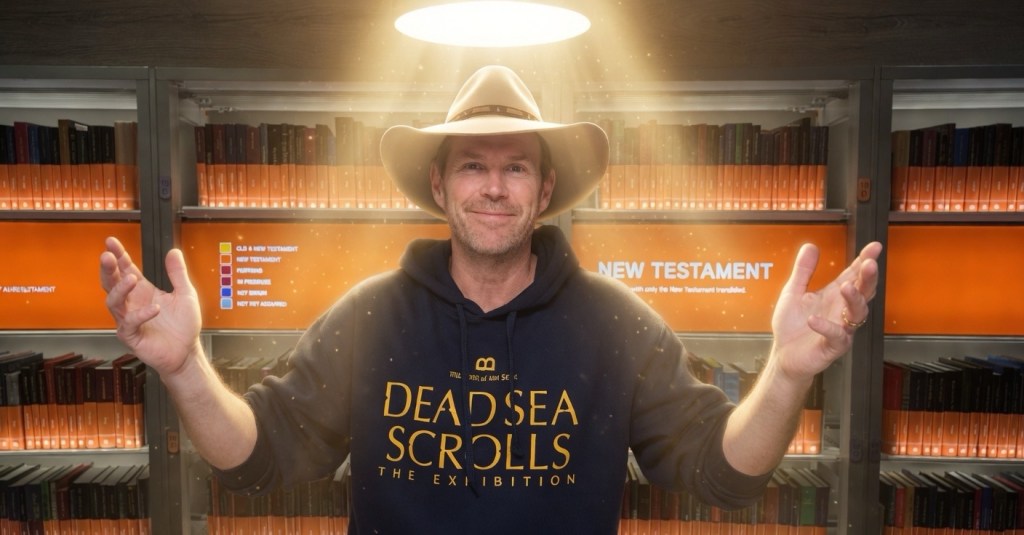
I love the Dead Sea Scrolls. If I were not already married, I would marry them. I do not even think of that period as very ancient. The men of Qumran look, to my eyes, like a reform party inside a tired establishment—less temple museum, more faction. Call the comparison reckless. I will live with it. The Essenes against the institutions of their day; a populist temper against a collaborationist temper; Greek and Roman state-theory pressing from the outside. The names change. The pattern does not.[12]
Among those texts is the one I cannot leave alone: the Copper Scroll. Hershel Shanks, who did as much as any American to bring the Scrolls to light, wrote the book I keep on my desk.[13] It is a treasure inventory beaten into metal so it would not rot. Gold. Silver. Vessels. Caches. A map with the patience of a bookkeeper and the nerves of a man who thinks the Temple is about to die. People have hunted the deposits for seventy years. The holes come up empty, or they come up as someone else’s cellar.
The question everyone asks is: where did the treasure go? That is a fair question. I want a different one sitting beside it: where did the metal economy that made such a list thinkable come from? Copper is the quiet member of the family. The Temple accounts shine with gold, but the older world runs on copper. Bronze is copper that learned a second metal. The floor, the fittings, and the industry behind a sanctuary are not gilding. They are tonnage.
Nelson Glueck pointed at Timna and the Arabah and said, Solomon. The next generation of archaeologists rolled their eyes and gave the shafts to New Kingdom Egypt and to Midian. Then the radiocarbon clocks were wound again, and the tenth century—the horizon of David and Solomon—came back into the slag heaps.[14] I am glad of that. Local ore matters. I do not need to steal Timna from the map to ask whether Timna is the whole map. The ancient Mediterranean and the Levant were hungry for metal for a very long time. Cyprus, Sinai, the Arabah, the Alps, later Spain: these are the names the textbooks allow. Lake Superior is the name they treat as a category error.
I am going to keep treating it as a question. Native copper you can pluck, and hammer is a different proposition from sulfide ore you must smelt in a desert with ten thousand trees. If there was a way to move Superior metal, there was a reason to try. People in the Ohio country walked hundreds of miles for obsidian. We do not call them insane. We call them traders. Stretch the same instinct across a colder ocean, in an age when the shelves were wider, and the boats were not as primitive as our pride requires, and you have a hypothesis. Hypotheses are what academies are for, when academies remember.
Commentary — the Copper Scroll’s date, and the temptation of a single pipeline. Almost every specialist dates the Copper Scroll to the first century CE, as a list of Temple or sectarian deposits hidden against Rome. It is not a Bronze Age shipping manifesto. I treat the scroll as proof that ancient people recorded metal the way a state records oil, and then he asks whether the earlier, much larger copper hunger of the third and second millennia had sources we have undercounted. That is a legitimate historical appetite. What does not follow is a closed circuit: Superior pit to Solomonic floor to Qumran roll to later Islamic treasuries financing 1948. Each arrow in that circuit needs its own evidence. The first arrow is the one archaeology can actually test—with isotopes, with wreck cargoes, with smelting slag. Until those tests speak, the circuit is a storyboard. Storyboards are how books begin. They are not how cases close.
I will treat the speculative part as speculation, not a sermon dressed as a lab report. I think some of the metal listed in later memory, and some of the metal that built earlier sanctuaries, is easier to explain if the Superior district is allowed onto the trade map. I think caches get found by the wrong people over centuries. I think private holdings are a perfectly ordinary grave for a public treasure. I have even said, in the talk that became this essay, that old metal can become seed money for later politics, including politics aimed at a Jewish state. That sentence will get me blocked from rooms I wasn’t already invited to. So be it. I would rather over-ask than pretend the copper only ever moved as far as a museum caption allowed.
Copper, Lightning, and What We Forgot How to Say about Power
The Temple stories are not shy. Glory fills the house. Fire answers a prophet. A presence is described as having weight.[15] Copper is a conductor. Gold is a conductor. If you were going to build a room in which a people expected God to arrive the way a storm arrives, you would not build it out of wool. I do not need a YouTube priest of “Egyptian lightbulbs” to notice that. I also do not need to turn Yahweh into a battery. The Bible’s own language is already more interesting than the gadget version. The point is that the builders were not decorating. They were making a place that could bear a presence. Metal was part of that theology, not an afterthought from the gift shop.
Plato’s orichalcum—copper with a second metal in it, a gleam the Greeks could not quite leave alone—belongs to the same family of memories.[16] Ayn Rand, who is not an archaeologist and did not mean to be, wrote a little book about a city that forgot electricity so completely that it had to reinvent the lamp and the word “I”. That is Anthem. I point people to it because it is a moral picture of technical amnesia, not because I think Atlantis filed a patent.[17] We have forgotten more than we know. That sentence is not a license to claim every glyph is a circuit diagram. It is a license to stay humble about the inventory.
Göbekli Tepe, Hopewell earthworks, British alignments, the drowned lines under our lakes: I do not stitch them into one empire. I notice that ritual landscapes rhyme more often than chance should allow, and I notice that people under intoxication and under prayer have always claimed they were not alone in the room.[18]. The Politics of Heaven is my effort to take that claim seriously as politics—not as mood, not as metaphor. If there are wills other than human wills, they will not confine themselves to Sunday school. They will show up in the naming of lakes.
What I Want from Academia, and What I Will Do Without It
I want American archaeology. Not a European import of Marx with better maps. Not a campus that treats Columbus as a contaminant and the United States as a mistake that can be renamed out of existence. I want papers. I want dates. I want some graduate student with a better spectrometer than my opinions to take the Superior question and either kill it or keep it alive on evidence. I will read the kill-shot if it is a real one. I will not accept a sneer in place of a date.
I cover politics and business and Iran and the rest of the board because that is the world in which these arguments cash out. Trump throws a ball. Commentators pick it up. Other shows lift a line while I am asleep at two in the morning. That is the only revenue I actually care about: the advance of the idea. Fortune and glory are enjoyable when you can get it. But, the real wage is that someone eating Fritos in a dark kitchen looks out the window and realizes the indigenous-people argument he was handed in school cannot survive contact with a copper pit that is older than the pyramids’ reputation.
My wife says I am blacklisted again. I am blacklisted everywhere, on everything, by everybody who needs the story to stay simple. I am used to it. This forum exists so that truth has a place to sit when the institutions are otherwise occupied.
The Name on the Water
Call it Lake America. Not because the Iroquois never saw it. Because the Iroquois were not the beginning of the story, and they are not the end of the American claim. The copper miners of Superior, the burial people of Windover, the builders who stacked stone on a dry bay floor—those are indigenous facts. The political slogan that uses “indigenous” to unmake the United States is not a fact. It is a maneuver.
Trump understood the maneuver well enough to answer it with a Sharpie and a map. He can do that from the Resolute Desk. The rest of the work is ours. Follow the copper. Follow the names. Follow the will that taught a nation to be ashamed of its own reflection in a lake. That will is not only human. And if we really want to say “indigenous people,” shouldn’t we point to the Moon-eyed people and give them the credit?
NOTES
[1] Donald J. Trump, Executive Order renaming Lake Ontario as Lake America for U.S. federal usage, signed August 27, 2026. Coverage: Reuters; BBC News; CNN Politics; New York Times, August 27–28, 2026. The order directs the Department of the Interior and the Board on Geographic Names to update the Geographic Names Information System within 30 days. It binds U.S. federal maps and communications; it does not bind Canada, New York State, or international bodies.
[2] Joseph Campbell, The Hero with a Thousand Faces (Princeton: Princeton University Press, 1949); The Power of Myth, with Bill Moyers (New York: Doubleday, 1988). Campbell’s recurring concern is not career-ladder ranking but the inner work of finding a vocation larger than the self—“follow your bliss”—against a society that sorts people into stations.
[3] 1619 Project, New York Times Magazine (August 2019), Nikole Hannah-Jones et al. The Project’s framing of 1619 as the nation’s “true founding” produced a large scholarly rebuttal literature (see the later bibliography). It is cited here as the type of academic-political narrative the speaker is arguing against, not as a monograph on Great Lakes prehistory.
[4] Windover Archaeological Site, Brevard County, Florida. National Historic Landmark. Radiocarbon dates on the pond burials cluster roughly 8,000–7,000 years before present (Early/Middle Archaic). At least 168 individuals were recovered, with exceptional preservation of brain tissue, textiles, and wooden artifacts. See Glen H. Doran, ed., Windover: Multidisciplinary Investigations of an Early Archaic Florida Cemetery (Gainesville: University Press of Florida, 2002).
[5] Old Copper Complex / Old Copper Culture of the western Great Lakes. Reliable dates on organic material embedded in copper artifacts run from roughly 8500 to 3580 cal BP; sediment-geochemistry work around Isle Royale and the Keweenaw Peninsula has been used to argue mining signatures as early as ~9500 years ago, with a peak often placed between ~7000 and 5000 cal BP. See Pompeani et al., Radiocarbon (2021); Pompeani et al., The Holocene (2015); Milwaukee Public Museum, Old Copper Culture collections.
[6] Isle Royale and Keweenaw native copper. The Lake Superior district contains the world’s largest concentration of native (nearly pure) copper. More than a thousand prehistoric pits have been recorded on Isle Royale alone. See National Park Service, “Archaeological History of Isle Royale and Ancient Copper Mining.”
[7] Grand Traverse Bay stone alignment, Lake Michigan, identified in 2007 by underwater archaeologist Mark Holley during sonar survey. Stones lie about 40 feet down. Popular press labeled the site “Michigan’s Stonehenge”; Holley has repeatedly objected to that label and described a long linear arrangement rather than a henge. A possible mastodon image on one boulder remains unverified by a broad scholarly consensus. A better-documented submerged hunting structure of similar age is the Drop 45 Drive Lane in Lake Huron.
[8] Post-glacial sea level and Doggerland. During the early Holocene the English Channel and much of the southern North Sea were dry or marshy land (Doggerland), allowing pedestrian movement between Britain and the Continent until progressive inundation through the Mesolithic. This is mainstream Quaternary geology. Transatlantic crossings in that same era are a separate, and far more contested, claim.
[9] Cherokee “moon-eyed people.” Early printed versions appear in Benjamin Smith Barton, New Views of the Origin of the Tribes and Nations of America (1797), reporting that the Cherokee said they found and expelled a “moon-eyed” people who could not see well by day. Later treatments include John Haywood (1823) and James Mooney, Myths of the Cherokee (1900). Modern Cherokee cultural authorities often treat the tale as minor or as settler-amplified folklore rather than a central tribal history. No archaeological culture has been securely identified with the legend.
[10] The name Ontario is widely derived from a Wendat (Huron) / Iroquoian form, often given as Ontari’io, commonly glossed “beautiful lake,” “great lake,” or “lake of shining waters.” European mapmakers used the name in the seventeenth century, well before Canadian Confederation (1867) or the Declaration of Independence (1776). See Canadian Prime Minister Mark Carney’s August 2026 statement and standard Great Lakes toponymy.
[11] Gulf of America: Trump proclamation renaming the Gulf of Mexico for U.S. federal usage in 2025, the immediate precedent for the 2026 Lake America order.
[12] Essenes and Qumran. The consensus that the Dead Sea Scrolls community was Essene remains the majority view, with vigorous dissent. Comparing them to a modern populist reform movement is analogy, not identity. The “RINO / tyrant” mapping in the source talk is rhetorical, not a claim that second-temple parties were American parties.
[13] Copper Scroll (3Q15), Cave 3, Qumran, discovered 1952. Two oxidized copper rolls, later cut into strips at Manchester (1955–56). The text lists dozens of hiding places and large quantities of gold, silver, and vessels—commonly read as a Temple-treasure inventory from the late Second Temple period, not a Bronze Age document. See Hershel Shanks, The Copper Scroll and the Search for the Temple Treasure (Washington, DC: Biblical Archaeology Society, 2007); Judah K. Lefkovits, The Copper Scroll—3Q15: A Reevaluation (Leiden: Brill, 2000); John M. Allegro, The Treasure of the Copper Scroll (1960).
[14] Timna Valley and Wadi Arabah copper. Nelson Glueck popularized “King Solomon’s Mines” in the 1930s–40s. Later work showed major Late Bronze Egyptian-Midianite activity; more recent radiocarbon work by Erez Ben-Yosef and colleagues has restored a significant 10th-century BCE (United Monarchy-era) industrial peak at Timna, with large slag heaps and evidence of export. Glueck’s romantic label outran the first generation of evidence; the newer dates put industrial copper back on the table for the Solomonic horizon—without requiring a Great Lakes source. Lead-isotope work on Bronze Age metal in Europe and the Near East has so far pointed to Cyprus, the Alps, Iberia, the British Isles, the Arabah, and other Old World sources, not to Keweenaw.
[15] Biblical theophanies associated with fire and storm: Exodus 19; 1 Kings 8 (the glory filling Solomon’s Temple); 1 Kings 18 (Elijah and the prophets of Baal); Ezekiel 1. Copper and gold are specified in the Tabernacle and Temple building accounts (Exodus 25–40; 1 Kings 6–7). Ancient recognition that metals conduct and gleam is not the same thing as a reconstructed electrical grid.
[16] Plato, Timaeus and Critias. Orichalcum is described as a metal second only to gold in the Atlantis story. A 2015 shipwreck off Gela, Sicily, yielded ingots some researchers identified as an alloy consistent with classical descriptions of orichalcum (primarily copper with zinc). That find, even if the alloy identification holds, does not locate Atlantis in the Azores or prove a Great Lakes connection.
[17] Ayn Rand, Anthem (1938). The novella imagines a collectivist future that has forgotten electricity and the word “I.” The “Anthem” YouTube adaptations mentioned in the source talk are fan and classroom dramatizations, not a Disney property.
[18] Hopewell Interaction Sphere (approx. 100 BCE–500 CE) is millennia later than the Old Copper peak and Göbekli Tepe (c. 9600–8000 BCE). Formal similarity of earthworks or ritual geometry across such distances in time is a prompt for research, not proof of a single whispering “spiritual entity” or a single people.
BIBLIOGRAPHY FOR FURTHER READING
Naming, the executive order, and the Great Lakes BBC News. “Trump Signs Order to Rename Lake Ontario as Lake America.” August 27, 2026. CNN Politics. “Trump Signs Executive Order to Change Lake Ontario to ‘Lake America.’” August 27, 2026. Reuters. “Trump Renames Lake Ontario as ‘Lake America’ amid Canada Trade War.” August 27, 2026. The New York Times. “Lake Ontario Didn’t Ask for Trump to Rename It.” August 27, 2026. Hough, Jack L. Geology of the Great Lakes. Urbana: University of Illinois Press, 1958. Vogel, Virgil J. Indian Names on Wisconsin’s Map. Madison: University of Wisconsin Press, 1991. White, Richard. The Middle Ground: Indians, Empires, and Republics in the Great Lakes Region, 1650–1815. Cambridge: Cambridge University Press, 1991.
Windover and the deep Archaic South Doran, Glen H., ed. Windover: Multidisciplinary Investigations of an Early Archaic Florida Cemetery. Gainesville: University Press of Florida, 2002. Doran, Glen H., and David N. Dickel. “Multidisciplinary Investigations at the Windover Site.” In Wet Site Archaeology, edited by Barbara A. Purdy. Caldwell, N.J.: Telford Press, 1988. Milanich, Jerald T. Archaeology of Precolumbian Florida. Gainesville: University Press of Florida, 1994. Purdy, Barbara A. The Art and Archaeology of Florida’s Wetlands. Boca Raton: CRC Press, 1991.
Old Copper Complex, Isle Royale, and Keweenaw Bebber, Michelle R., and Alastair J. M. Key. “Optimal Linear Estimation Modeling Supports Early Holocene Copper Tool Production in North America.” American Antiquity 87 (2022). Martin, Susan R. Wonderful Power: The Story of Ancient Copper Working in the Lake Superior Basin. Detroit: Wayne State University Press, 1999. Pleger, Thomas C., and James B. Stoltman. “The Archaic Tradition in Wisconsin.” In Archaic Societies, edited by Thomas E. Emerson et al. Albany: SUNY Press, 2009. Pompeani, David P., et al. “Copper Mining on Isle Royale 6500–5400 Years Ago Identified Using Sediment Geochemistry.” The Holocene 25 (2015). Pompeani, David P., et al. “On the Timing of the Old Copper Complex in North America.” Radiocarbon 63 (2021). Ritzenthaler, Robert E. “The Old Copper Culture of Wisconsin.” The Wisconsin Archeologist 38 (1957). National Park Service. “Archaeological History of Isle Royale and Ancient Copper Mining.” nps.gov. Milwaukee Public Museum. “Old Copper Culture.” mpm.edu.
Drowned landscapes of the Great Lakes Holley, Mark. Field reports and public notes on the Grand Traverse Bay alignment. Northwestern Michigan College. O’Shea, John M., and Guy A. Meadows. “Evidence for Early Hunters beneath the Great Lakes.” Proceedings of the National Academy of Sciences 106 (2009). O’Shea, John M., et al. “A 9,000-Year-Old Caribou Hunting Structure beneath Lake Huron.” Proceedings of the National Academy of Sciences 111 (2014). Lewis, C. F. M., and T. W. Anderson. Papers on post-glacial lake levels in the Huron and Michigan basins. Geological Survey of Canada.
Cherokee memory, Appalachia, and the moon-eyed people Barton, Benjamin Smith. New Views of the Origin of the Tribes and Nations of America. Philadelphia, 1797. Haywood, John. The Natural and Aboriginal History of Tennessee. Nashville, 1823. Mooney, James. Myths of the Cherokee. Washington: Bureau of American Ethnology, 1900. Mooney, James. Historical Sketch of the Cherokee. Chicago: Aldine, 1975 [1900]. Perdue, Theda, and Michael D. Green. The Cherokee Nation and the Trail of Tears. New York: Viking, 2007. Wilkins, Thurman. Cherokee Tragedy: The Ridge Family and the Decimation of a People. 2nd ed. Norman: University of Oklahoma Press, 1986.
Dead Sea Scrolls and the Copper Scroll Allegro, John M. The Treasure of the Copper Scroll. London: Routledge & Kegan Paul, 1960. Lefkovits, Judah K. The Copper Scroll—3Q15: A Reevaluation. Leiden: Brill, 2000. Puech, Émile. The Copper Scroll Revisited. Leiden: Brill, 2015. Shanks, Hershel. The Copper Scroll and the Search for the Temple Treasure. Washington, D.C.: Biblical Archaeology Society, 2007. Shanks, Hershel. The Mystery and Meaning of the Dead Sea Scrolls. New York: Random House, 1998. VanderKam, James C., and Peter Flint. The Meaning of the Dead Sea Scrolls. San Francisco: HarperSanFrancisco, 2002. Wise, Michael, Martin Abegg Jr., and Edward Cook. The Dead Sea Scrolls: A New Translation. San Francisco: HarperSanFrancisco, 2005.
Timna, Arabah, Solomon, and Near Eastern copper Ben-Yosef, Erez, et al. “A New Chronological Framework for Iron Age Copper Production at Timna.” Bulletin of the American Schools of Oriental Research 366 (2012). Glueck, Nelson. “On the Trail of King Solomon’s Mines.” National Geographic, February 1944. Levy, Thomas E., Russell B. Adams, and Mohammad Najjar. Studies of Iron Age copper production at Faynan / Wadi Arabah. Rothenberg, Beno. Timna: Valley of the Biblical Copper Mines. London: Thames and Hudson, 1972. Yahalom-Mack, Naama, et al. Lead-isotope sourcing studies of Levantine copper.
Bronze Age metal provenance — the brake on a quiet Atlantic pipeline Ling, Johan, et al. “Moving Metals II: Provenancing Scandinavian Bronze Age Artefacts by Lead Isotope and Elemental Analyses.” Journal of Archaeological Science 41 (2014). Melheim, Lene, et al. “Shifting Networks and Mixing Metals.” PLOS ONE (2021). Pernicka, Ernst. Foundational papers on lead-isotope provenancing in the Aegean and Balkans. Williams, R. Alan. Studies of Great Orme copper and Atlantic Bronze Age distribution. Hauptmann, Andreas. The Archaeometallurgy of Copper. Berlin: Springer, 2007.
Alternative and contested Atlantic theses — read with the grain, and against it Fell, Barry. America B.C. New York: Quadrangle, 1976. The book that made a generation of amateurs certain and a generation of epigraphers furious. Jett, Stephen C. Ancient Ocean Crossings: Reconsidering the Case for Contacts with the Pre-Columbian Americas. Tuscaloosa: University of Alabama Press, 2017. Kehoe, Alice Beck. Traveling Prehistoric Seas. Walnut Creek: Left Coast Press, 2016. McGhee, Robert. Critical essays on transoceanic contact claims; useful as a brake.
Temple, metal, and the language of presence The Holy Bible. Especially Exodus 19 and 25–40; 1 Kings 6–8 and 18; Ezekiel 1. Hurowitz, Victor Avigdor. I Have Built You an Exalted House. Sheffield: JSOT Press, 1992. Kitchen, Kenneth A. On the Reliability of the Old Testament. Grand Rapids: Eerdmans, 2003. Milgrom, Jacob. Leviticus. Anchor Bible. New York: Doubleday, 1991–2001. Van Seters, John. The Pentateuch: A Social-Science Commentary. Sheffield: Sheffield Academic Press, 1999. Read as the academy’s counter-voice.
Atlantis, orichalcum, and technical amnesia as literature Plato. Timaeus and Critias. Rand, Ayn. Anthem. 1938. Reports on the 2015 Gela wreck ingots and the orichalcum identification debate. Forsyth, Phyllis Young. Atlantis: The Making of Myth. Montreal: McGill-Queen’s University Press, 1980.
Campbell, order, and the inner politics of fitting in Campbell, Joseph. The Hero with a Thousand Faces. Princeton: Princeton University Press, 1949. Campbell, Joseph, with Bill Moyers. The Power of Myth. New York: Doubleday, 1988. Eliade, Mircea. The Sacred and the Profane. New York: Harcourt, 1959. Girard, René. Violence and the Sacred. Baltimore: Johns Hopkins University Press, 1977.
The political fight over founding stories Hannah-Jones, Nikole, et al. “The 1619 Project.” The New York Times Magazine, August 18, 2019. Wood, Gordon S., Sean Wilentz, James McPherson, Victoria Bynum, and James Oakes. Letter of objection to the 1619 Project. The New York Times, December 2019. McClay, Wilfred M. Land of Hope: An Invitation to the Great American Story. New York: Encounter, 2019. Gordon-Reed, Annette. The Hemingses of Monticello. New York: Norton, 2008. Allen, Danielle. Our Declaration. New York: Liveright, 2014.
Hopewell, Göbekli Tepe, and the problem of rhyme across millennia Byers, A. Martin. The Ohio Hopewell Episode. Akron: University of Akron Press, 2004. Carr, Christopher, and D. Troy Case, eds. Gathering Hopewell. New York: Springer, 2005. Schmidt, Klaus. Göbekli Tepe: A Stone Age Sanctuary in South-Eastern Anatolia. Berlin: Ex Oriente, 2012. Mann, Charles C. 1491: New Revelations of the Americas before Columbus. New York: Knopf, 2005.
Rich Hoffman is an author, political consultant, and strategic advisor based in Cincinnati, Ohio, and the creator of The Politics of Heaven—a unique framework that connects biblical theology, ancient history, and modern power structures to explain how moral alignment and spiritual forces shape global events. Blending real-world political experience with deep research into archaeology, UFO phenomena, and suppressed historical narratives, Hoffman offers compelling commentary on topics ranging from ancient civilizations and the Dead Sea Scrolls to modern populist movements, paranormal continuity, and leadership strategy in chaotic environments. As the author of The Gunfighter’s Guide to Business and the forthcoming Politics of Heaven, he brings a grounded yet provocative voice to media discussions, supported by firsthand experiences and a cross-disciplinary approach that bridges science, history, and theology. For interviews, speaking engagements, or expert analysis, visit richhoffmanbooks.com or contact directly via phone at 513-307-5815 or email at rhoffman@richhoffmanbooks.com. If you’ve seen the movie, Disclosure Day and want to talk about it and the implications of Presidnet Trump’s UAP disclosures, let me know and we can bring some color to your coverage. https://richhoffmanbooks.com/media-inquiries-broadcast-topics-and-contact-info/?frame-nonce=ad51e7ecba I do have a firsthand UFO encounter to discuss.


 The Overmanwarrior