

Pip: The Overmanwarrior is the rare corner of the internet where a business meeting leads directly to Ephesians, Augustine, and the Book of Enoch — and somehow that is the logical progression.
Mara: Rich Hoffman is doing something specific here: taking Paul’s language about principalities and powers and arguing it describes a political operation, not just a spiritual metaphor. Let’s start with what that actually means in practice.
Principalities and Powers: The War Behind the Room
Pip: The question at the center of this piece is whether evil has a structure — not a mood, not a vibe, but an actual operating method. The Ephesians 6:12 framework is the entry point, and the claim is that it belongs in political analysis, not just Sunday school.
Mara: The post grounds that claim in the Greek. The New Testament word behind “principalities” is archai — rulers, first things, authorities at the head of an order — almost always paired with exousiai, powers, the right to act. And then the post lands on this: “We wrestle not against flesh and blood. This is a political statement, not a religious one.”
Pip: So the sentence Paul wrote to a church in Ephesus is being read as a theory of power — who controls whom, through whom, toward what end. That reframing is doing a lot of work.
Mara: It is. And the post doesn’t stay abstract. The argument moves into personal testimony: two men, unrelated, encountered in separate business settings close together in time, running what reads as the same script. Same language, same pressure, same intent. The image used is a driver getting out of one car and into another — the vehicle changed, the driver did not.
Pip: Which is either a genuinely unsettling pattern recognition or the most theologically sophisticated way anyone has ever described a bad week of meetings.
Mara: The post is careful to flag that this is testimony, not a lab result. What it does argue is that vacant people — those who, as The Politics of Heaven puts it, have hollowed out the self through drink, painkillers, or the erasure of identity — are easier to occupy than people who know their own name. The susceptibility question, not a judgment on any individual.
Mara: The Book of Enoch enters here as more than a footnote. Jude quotes Enoch. Genesis 6 leaves the door open. Timothy Alberino’s work, including his conversation with Glenn Beck on episode 274 of Beck’s podcast, brought the Watchers narrative — hybridizing the human, rewriting the creature — to an audience well outside fringe forums. The post notes that this is no longer a subject easy to exile with a laugh track.
Pip: Augustine makes the case even older. In City of God, Book XV, he reports a molar found at Utica so large it could have been cut into a hundred ordinary teeth. Fifth-century field notes, not a modern osteology paper — but the point is that the tradition of a larger, older world runs through the canon, through Goliath, through Og’s bed, through “also after that” in Genesis 6:4.
Mara: And Job ties it back to the political frame. Job is described here as a courtroom text: Satan presents himself, asks permission to wreck a loyal servant, and the motive is explicitly to prove that worship is a transaction. The post draws the line directly — “Principalities do not need to win a show of hands if they can unmake the image they hate.”
Pip: The closing argument is that silence is a concession. The field isn’t quiet just because the water receded.
Mara: And that the tools — including AI, including this kind of writing — are neutral. The point, as the post puts it, is the heart behind the instrument.
Pip: What stays with me is the Job framing — evil as a long political project of erosion, not a horror-movie event.
Mara: That thread runs through everything here: the war is named so it can be engaged. More from The Overmanwarrior next time.
Rich Hoffman
More about me
Click Here to Protect Yourself with Second Call Defense https://www.secondcalldefense.org/?affiliate=20707
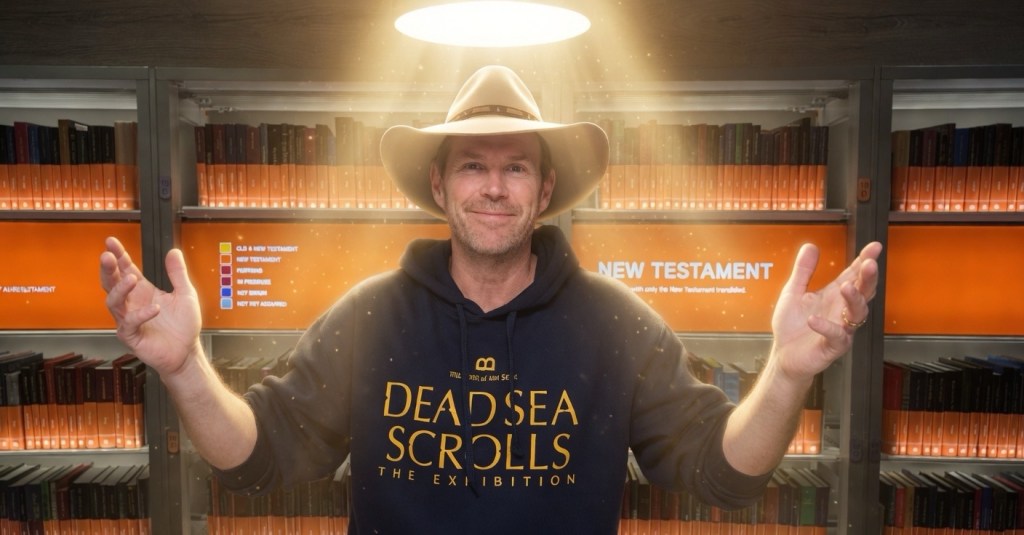
About the Author: Rich Hoffman
Rich Hoffman is an author, political consultant, and strategic advisor based in Cincinnati, Ohio, and the creator of The Politics of Heaven—a unique framework that connects biblical theology, ancient history, and modern power structures to explain how moral alignment and spiritual forces shape global events. Blending real-world political experience with deep research into archaeology, UFO phenomena, and suppressed historical narratives, Hoffman offers compelling commentary on topics ranging from ancient civilizations and the Dead Sea Scrolls to modern populist movements, paranormal continuity, and leadership strategy in chaotic environments. As the author of The Gunfighter’s Guide to Business and the forthcoming Politics of Heaven, he brings a grounded yet provocative voice to media discussions, supported by firsthand experiences and a cross-disciplinary approach that bridges science, history, and theology. For interviews, speaking engagements, or expert analysis, visit richhoffmanbooks.com or contact directly via phone at 513-307-5815 or email at rhoffman@richhoffmanbooks.com. If you’ve seen the movie, Disclosure Day and want to talk about it and the implications of Presidnet Trump’s UAP disclosures, let me know and we can bring some color to your coverage. https://richhoffmanbooks.com/media-inquiries-broadcast-topics-and-contact-info/?frame-nonce=ad51e7ecba I do have a firsthand UFO encounter to discuss.

