Pip: The Overmanwarrior is the rare corner of the internet where a business meeting leads directly to Ephesians, Augustine, and the Book of Enoch — and somehow that is the logical progression.
Mara: Rich Hoffman is doing something specific here: taking Paul’s language about principalities and powers and arguing it describes a political operation, not just a spiritual metaphor. Let’s start with what that actually means in practice.
Principalities and Powers: The War Behind the Room
Pip: The question at the center of this piece is whether evil has a structure — not a mood, not a vibe, but an actual operating method. The Ephesians 6:12 framework is the entry point, and the claim is that it belongs in political analysis, not just Sunday school.
Mara: The post grounds that claim in the Greek. The New Testament word behind “principalities” is archai — rulers, first things, authorities at the head of an order — almost always paired with exousiai, powers, the right to act. And then the post lands on this: “We wrestle not against flesh and blood. This is a political statement, not a religious one.”
Pip: So the sentence Paul wrote to a church in Ephesus is being read as a theory of power — who controls whom, through whom, toward what end. That reframing is doing a lot of work.
Mara: It is. And the post doesn’t stay abstract. The argument moves into personal testimony: two men, unrelated, encountered in separate business settings close together in time, running what reads as the same script. Same language, same pressure, same intent. The image used is a driver getting out of one car and into another — the vehicle changed, the driver did not.
Pip: Which is either a genuinely unsettling pattern recognition or the most theologically sophisticated way anyone has ever described a bad week of meetings.
Mara: The post is careful to flag that this is testimony, not a lab result. What it does argue is that vacant people — those who, as The Politics of Heaven puts it, have hollowed out the self through drink, painkillers, or the erasure of identity — are easier to occupy than people who know their own name. The susceptibility question, not a judgment on any individual.
Mara: The Book of Enoch enters here as more than a footnote. Jude quotes Enoch. Genesis 6 leaves the door open. Timothy Alberino’s work, including his conversation with Glenn Beck on episode 274 of Beck’s podcast, brought the Watchers narrative — hybridizing the human, rewriting the creature — to an audience well outside fringe forums. The post notes that this is no longer a subject easy to exile with a laugh track.
Pip: Augustine makes the case even older. In City of God, Book XV, he reports a molar found at Utica so large it could have been cut into a hundred ordinary teeth. Fifth-century field notes, not a modern osteology paper — but the point is that the tradition of a larger, older world runs through the canon, through Goliath, through Og’s bed, through “also after that” in Genesis 6:4.
Mara: And Job ties it back to the political frame. Job is described here as a courtroom text: Satan presents himself, asks permission to wreck a loyal servant, and the motive is explicitly to prove that worship is a transaction. The post draws the line directly — “Principalities do not need to win a show of hands if they can unmake the image they hate.”
Pip: The closing argument is that silence is a concession. The field isn’t quiet just because the water receded.
Mara: And that the tools — including AI, including this kind of writing — are neutral. The point, as the post puts it, is the heart behind the instrument.
Pip: What stays with me is the Job framing — evil as a long political project of erosion, not a horror-movie event.
Mara: That thread runs through everything here: the war is named so it can be engaged. More from The Overmanwarrior next time.
Rich Hoffman is an author, political consultant, and strategic advisor based in Cincinnati, Ohio, and the creator of The Politics of Heaven—a unique framework that connects biblical theology, ancient history, and modern power structures to explain how moral alignment and spiritual forces shape global events. Blending real-world political experience with deep research into archaeology, UFO phenomena, and suppressed historical narratives, Hoffman offers compelling commentary on topics ranging from ancient civilizations and the Dead Sea Scrolls to modern populist movements, paranormal continuity, and leadership strategy in chaotic environments. As the author of The Gunfighter’s Guide to Business and the forthcoming Politics of Heaven, he brings a grounded yet provocative voice to media discussions, supported by firsthand experiences and a cross-disciplinary approach that bridges science, history, and theology. For interviews, speaking engagements, or expert analysis, visit richhoffmanbooks.com or contact directly via phone at 513-307-5815 or email at rhoffman@richhoffmanbooks.com. If you’ve seen the movie, Disclosure Day and want to talk about it and the implications of Presidnet Trump’s UAP disclosures, let me know and we can bring some color to your coverage. https://richhoffmanbooks.com/media-inquiries-broadcast-topics-and-contact-info/?frame-nonce=ad51e7ecba I do have a firsthand UFO encounter to discuss.
After the mistrial of Lindsay Clancy today, people are wondering a lot about evil, which I just so happen to spend a lot of time talking about. So let’s set some ground rules here and talk about what makes evil work in the world so that we can prepare ourselves to defeat it. Emphatically! And ruthlessly. Let’s begin. When we see a jury of our peers unable to see right from wrong, we have to understand the strategy of evil to weaken the resolve of jurors, the manipulations of lawyers, and the antics of political persuasion, and ultimately, the power of government. I would suggest, in addition to this text, that you watch this video. It has a lot of different kinds of things in it.
What the Word Actually Means
The New Testament word behind “principalities” is archai, rulers, first things, authorities at the head of an order. It is almost always paired with exousiai, powers, the right to act. In Ephesians 6:12 Paul adds two more phrases: the kosmokratores of this darkness, world-rulers, and the pneumatika of wickedness in the heavenly places. The sentence is built to take the fight off the sidewalk. “We wrestle not against flesh and blood.”¹. This is a political statement, not a religious one. And I will likely spend the next 20 years of my life proving it and defining it for people. But it’s quite a statement, and a big, major political problem.
Colossians 1:16 says thrones, dominions, principalities, and powers were created through Christ and for Him. The vocabulary is larger than demons. It can name any organized spiritual authority, loyal or rebel. In the spiritual-warfare conversations most people know, the word has narrowed in scope. Principalities are treated as territorial, as the unseen administration behind nations, systems, and persons. I use the word that way because that is how the encounter presented itself. I do not use it as a slogan. “Satan is working” is a bumper sticker. The question is the work. Against whom. Through whom. Toward what political end.
Our eyes were built for human scale. They miss the microbe and the principality. That is not an argument that the unseen is imaginary. It is an argument that the instrument is limited. I would not take a courtroom’s word that a virus does not exist because the jury cannot see it.
I Met the Same Character in Two Different People
I met a personality recently. I met it in two people, in two different business settings, close enough in time that I could not pretend I was imagining a mood. The bodies were unrelated. The personality was not. Same language. Same pressure. This thing made sure to let me know it was the same “thing” in two different bodies. It was very specific to me almost with a wink and a nod. Same intent. Same way of coming at the conversation. If you have ever watched a driver get out of one car and into another and keep the same hands on the wheel, you know the feeling. The vehicle changed. The driver did not.²
I have written in The Politics of Heaven that people who drink hard, who live on painkillers, who hollow out the pronoun I, surrender the vehicle they live in. I do not mean every drinker is possessed. I mean an empty house is easier to occupy than a house with a resident who knows his own name. The two men I am talking about were not sophisticated. They were not formidable on their own. They were vacant enough to be used. Both had the same kind of tattoo on the inner arm, the kind you can cover with a sleeve in a professional room and flash when the Monday-night crowd wants to know you are still one of the rebels at BW3s half drunk by the second quarter of a Monday Night Football game. I do not think the ink is the spirit. I think the ink, in those cases, was a marker of a type: the man who wants the title of an executive and the alibi of a slob, who will fold under peer pressure, who has already practiced not being fully present in his own skin.³
If you have a tattoo on the inside of your arm and you are reading this to see whether I just called you evil, I did not. Sit with the other layer. When the lights are out, what do you rehearse in your head? That is the question I am asking about susceptibility, not about ink.
I have seen the same signature in places that could not have compared notes. A café. A terminal. Tokyo, Paris, Heathrow. A young waitress who has no idea she is being used, who thinks she is only tired and behind on a car payment, and then another person on another continent running the same play against the same target. The temptation is not always lust. Sometimes it is the attempt to get a man to blow up his public life so the rest of his work becomes easy to dismiss. That is a political move. It is not a horror-movie fog. It is an operation.
The Book of Enoch Is No Longer a Basement Subject
Jude quotes Enoch. Genesis 6 leaves the door open rather than closing it. The Book of the Watchers, preserved in 1 Enoch and among the Dead Sea Scrolls, tells the story the short biblical verses assume the reader already knows: two hundred Watchers conspire, descend, take wives from the daughters of men, beget the giants, and teach what heaven had not authorized.⁴ The text is not in most Protestant canons. It is nothing. A book the New Testament can cite is a book a serious reader of the Bible has to account for.
Timothy Alberino has been making that case for years in Birthright and in his commentary on Enoch. In late 2025, he sat down with Glenn Beck on episode 274 of the podcast, and the conversation moved from Genesis 6 to the Watchers to transhumanism in front of an audience that does not live on fringe forums.⁵ Ten years ago, this was a few tens of thousands of people online. I have been in the subject more than twenty years. Millions can now hear the same file. That does not make every inference true. It does mean the subject is no longer easy to exile with a laugh track.
Alberino’s warning about “Nephilim 2.0” is not that a chatbot is a demon. It is that the old pattern—hybridizing the human, seizing Adam’s brief, rewriting the creature so the Cross no longer applies to it—can return as gene editing, machine merger, and the dream of becoming an immortal without God. Fire is not evil. The heart that uses fire to burn a village is. I use AI as a tool on this show. I do not think the tool is the Watcher. I think the Watcher would be happy to have a new kind of empty vessel.
Augustine, Giants, and What the Flood Did Not Wash Away
City of God is one of the books I go back to a lot and I absolutely love it. I love it so much so that if I wasn’t already married to my wife, I’d marry it!. It takes time. It is worth the time. Augustine is writing as Rome is coming apart and as Christianity is being asked to explain why the city of man is not the City of God. In Book XV he talks about giants. He says sepulchers give up bones of incredible size. He says he himself, with others, saw on the shore at Utica a human molar so large that, cut down to ordinary teeth, it might have made a hundred. He believed it belonged to a giant. He thought the bodies of the ancients were larger, and the giants larger still.⁶
That is a fifth-century report, not a modern osteology paper. I do not need Augustine to have measured a femur correctly to take his witness seriously. He assumed his readers around the Mediterranean already knew the old world had held larger men. Goliath is in the canon. Og’s bed is in the canon. Genesis says the Nephilim were in the earth in those days, and also after.⁷
I live with the Hopewell and Adena earthworks in my own river valley. I have written about copper culture and the mounds for years. I think we have been timid about what the ground still holds. I also think a spirit does not have to maintain the skeleton of a fifteen-foot body to keep working. A soul is not required to be the size of the corpse. If a soul can be smaller than a cell, then the death of a giant does not retire the intelligence that used the giant. The flood judged a world. I do not believe it vacuumed every rebel power out of the air. If it had, Paul would not have written Ephesians 6 to a church living after Noah, after Abraham, after the Cross.
Job Is the Political Text People Skip
The book of Job is not only a book about suffering. It is a book about a courtroom. Satan presents himself among the sons of God and asks permission to wreck a loyal servant. The motive is political. Prove that worship is a transaction. Prove that the kingdom is only as strong as the hedge. Take that lesson off the page, and you have a method. Harass the person who would otherwise be a problem. Empty the person who can be worn like a coat. Conceal the operation by making the subject sound unhinged, so the Trojan horse never has to come out of the wood in daylight.⁸
That is why I keep using the word political. Democrats in a Republican county do not need a majority on Tuesday if they can spend two years sanding down trust. Principalities do not need to win a show of hands if they can unmake the image they hate. The conspiracy, if you want the old word, is not a committee in a basement. It is the long project of erasing the original: the garden, the image, the Son. The Watchers’ crime in Enoch is not only lust. It is a vote against the arrangement God had made. Two hundred of them decided heaven’s rule was negotiable.
The empty vessel is useful because it does not argue. Legalize the solvents, praise the erasure of the pronoun I, call rootedness oppression, and you have manufactured occupancy. I am not saying every short man who drinks after work is a portal. I am saying, from what I have watched, insecure people who already live outside themselves are cheaper to run than people who wake up intending to be good.
What I Saw, and What I Cannot Photograph
I cannot put the principality on a slide. I can report the pattern. Same speech in two mouths that had no business sharing a script. Same type of compromised body. Same objective: get inside the work, dirty the witness, keep the war from being named. Quantum talk about entanglement is a modern vocabulary for an old claim: that distance and clock time do not bind a spirit the way they bind a truck. I do not pretend that vocabulary is a proof. I am saying the observed thing is older than the vocabulary.
Spider-Man: Far From Home put a body-jumping antagonist on a screen because storytellers keep stumbling into the mechanic. I did not get the idea from the movie. I got it from the meeting. Science fiction is often late to the church’s mail.
If you stay in the Bible and refuse this subject, you stay in a censored Bible. The inconvenient pages are the ones that tell you the war did not end when the water receded. We assume God has won at the end of the story, and I believe He does. That is not the same as assuming the field is quiet. Turning the other cheek is a command about revenge. It is not a claim that no one is swinging.
A Tool, a Book, and the Work in Front of Us
I will keep using the tools in front of me, including this one, because a principality is not allergic to electricity, and neither is the other side. The point is the heart. Play God, rewrite the creature, chase deathlessness without the Creator, and you are back in Genesis 6 with better lab equipment. Ask a question, solve a problem, put language on an encounter you would rather not leave in a fog, and you are doing what readers of Scripture have always done with the instruments of their century.
Alberino’s books are on the table. Enoch is on the table. Augustine is on the table. Paul is on the table. The Politics of Heaven is my effort to write the psychology and the politics of that war in one place, because quoting Ephesians 6:12 is not the same as understanding why the enemy wants the city. I will not agree with every explorer on every bone in every mound. I will not pretend I did not recognize the same face in two different, short men with tattoos on the inside of their arms, to conceal who they are.
Do not give a principality the courtesy of silence just because it would prefer to stay in the shadows. Hey, I’ve been traveling a lot and thinking about these things on long camping trips while everyone else has been sleeping inside my camper, with the smell of woodsmoke from our campfire dying away into the deep night. I think I understand and can relate to Paul as he wrote Ephesians. You have to go through some tough stuff, then think in isolation before you can begin to see the tormentors of existence. And I think it is there that we have to focus on the real war at hand. I think Paul, and only Paul, could have written the marvelous work of Ephesians and begin to contemplate the efforts of principalities.
Notes
1. Greek of Ephesians 6:12: palē, wrestling, not a vague struggle; archas, exousias, kosmokratoras tou skotous toutou, pneumatika tēs ponērias en tois epouraniois. See also Ephesians 1:21; 3:10; Colossians 1:16; 2:15; Romans 8:38; 1 Corinthians 15:24.
2. This is testimony, not a lab result. I am describing two business encounters within days of each other and a recognition I have had in other cities. I am not asking a reader to take my word as canon. I am asking a reader of Paul to leave room for the thing Paul said we wrestle.
3. Inner-arm tattoos as a tell are my field notes from these cases and from a type I have watched for years. They are not a doctrine. Plenty of marked skin belongs to people who are awake in their own lives. The question is occupancy, not decoration.
4. 1 Enoch 6–16, the Book of the Watchers. Jude 14–15 cites Enoch. Genesis 6:1–4 remains the canonical hinge. 1 Enoch fragments are among the Dead Sea Scrolls; the full Ethiopic corpus preserved the book for the Ethiopian Church.
5. “The RETURN of a Hidden Biblical Alien Race?” Timothy Alberino with Glenn Beck, The Glenn Beck Podcast, Ep. 274, November 2025. Alberino, Birthright: The Coming Posthuman Apocalypse and the Usurpation of Adam’s Dominion on Planet Earth (2020), and The Book of Enoch, with commentary on the Book of the Watchers.
6. Augustine, City of God 15.9, the Utica Murmur; 15.23 on angels and the daughters of men. Written in the years after 410. I read him as an early Christian mind defending the faith inside a failing imperial order, not as a modern archaeologist.
7. Genesis 6:4; Deuteronomy 3:11; 1 Samuel 17. “Also after that” is the phrase that keeps the subject from dying in the Flood chapter.
8. Job 1–2. The Accuser’s politics are the demand that loyalty be exposed as a deal. Homer’s Trojan Horse is only a later picture of concealment. I use it as an image, not as Scripture.
Bibliography for Further Reading
Scripture and the Powers
The Holy Bible. Especially Genesis 6; Deuteronomy 3; 1 Samuel 17; Job 1–2; Daniel 10; Matthew 4; Mark 5; John 12:31; Romans 8:38–39; 1 Corinthians 15:24–26; Ephesians 1:21; 2:2; 3:10; 6:10–20; Colossians 1:16; 2:10, 15; Jude 6, 14–15; Revelation 12.
Arnold, Clinton E. Powers of Darkness: Principalities and Powers in Paul’s Letters. InterVarsity, 1992.
Arnold, Clinton E. Ephesians: Power and Magic. Baker, 1989.
Caird, G. B. Principalities and Powers. Clarendon, 1956.
Heiser, Michael S. The Unseen Realm. Lexham, 2015.
Heiser, Michael S. Reversing Hermon. Defender, 2017.
O’Brien, Peter T. “Principalities and Powers.” Evangelical Review of Theology 16 (1992).
Wink, Walter. Naming the Powers. Fortress, 1984. Read as a map of the vocabulary even where the theology diverges.
Wright, N. T. Paul and the Faithfulness of God. Fortress, 2013. For the larger Pauline world in which the powers sit.
Enoch, Watchers, and Second Temple Literature
1 Enoch. Translations by R. H. Charles (1912); George W. E. Nickelsburg and James C. VanderKam (Fortress); and the Alberino / Blurry Creatures edition with commentary on the Book of the Watchers.
2 Enoch and 3 Enoch, in Charlesworth, James H., ed. The Old Testament Pseudepigrapha. 2 vols. Doubleday, 1983–85.
Nickelsburg, George W. E. 1 Enoch 1. Hermeneia. Fortress, 2001.
VanderKam, James C. Enoch and the Growth of an Apocalyptic Tradition. Catholic Biblical Association, 1984.
Collins, John J. The Apocalyptic Imagination. 3rd ed. Eerdmans, 2016.
Stuckenbruck, Loren T. The Myth of Rebellious Angels. Mohr Siebeck, 2014.
Boccaccini, Gabriele. Beyond the Essene Hypothesis. Eerdmans, 1998.
The Dead Sea Scrolls Study Edition. García Martínez and Tigchelaar.
Vermes, Geza. The Complete Dead Sea Scrolls in English.
Augustine and the Early Church
Augustine. The City of God. Especially Books XI–XV. Translations by Marcus Dods; R. W. Dyson; and the Loeb edition.
Augustine. Confessions.
Kelly, J. N. D. Early Christian Doctrines. Harper, 1978.
Pelikan, Jaroslav. The Christian Tradition, Vol. 1. University of Chicago Press, 1971.
Giants, Genesis 6, and the Old World
Doak, Brian R. The Last of the Rephaim. Brown Judaic Studies, 2012.
Hendel, Ronald. “The Nephilim Were on the Earth.” In The Fall of the Angels, ed. Auffarth and Stuckenbruck. Brill, 2004.
Annus, Amar. “On the Origin of Watchers.” Journal for the Study of the Pseudepigrapha 19 (2010).
Homer. Iliad. For the older-and-larger-bodies tradition Augustine also cites through Pliny.
Pliny the Elder. Natural History 7.
Alberino, Beck, and the Present Conversation
Alberino, Timothy. Birthright: The Coming Posthuman Apocalypse and the Usurpation of Adam’s Dominion on Planet Earth. 2020.
Alberino, Timothy. The Book of Enoch. With Blurry Creatures. Commentary on 1 Enoch 1–36.
Beck, Glenn, host. The Glenn Beck Podcast, Ep. 274, “The RETURN of a Hidden Biblical Alien Race?” with Timothy Alberino. November 2025.
Heiser, Michael S. Demons. Lexham, 2020.
Missler, Chuck. Return of the Nephilim. Briefings and notes, Koinonia House.
Spiritual Warfare, Discernment, and the Occupied Life
Lewis, C. S. The Screwtape Letters. 1942.
Lewis, C. S. The Great Divorce. 1945.
Peretti, Frank. This Present Darkness. Crossway, 1986. Fiction that taught a generation the furniture of the subject. Not evidence. Atmosphere.
Nee, Watchman. The Spiritual Man. Christian Fellowship Publishers.
Bounds, E. M. Power Through Prayer and the Satan volumes.
Leahy, Frederick S. Satan Cast Out. Banner of Truth, 1975.
Unger, Merrill F. Biblical Demonology. Scripture Press, 1952.
Politics, Concealment, and the Long War
Hoffman, Rich. The Politics of Heaven. Forthcoming.
Hoffman, Rich. The Gunfighter’s Guide to Business. Liberty Hill Publishing, 2021.
Ellul, Jacques. The Presence of the Kingdom and The Subversion of Christianity.
O’Donovan, Oliver. The Desire of the Nations. Cambridge, 1996.
Schaeffer, Francis A. How Should We Then Live? Revell, 1976.
Voegelin, Eric. The New Science of Politics. University of Chicago Press, 1952. For the old habit of immanentizing what belongs to another city.
Consciousness, Tools, and the Limit of the Eye
Chalmers, David J. The Conscious Mind. Oxford, 1996. For the hardness of the problem, not for angels.
Penrose, Roger. The Emperor’s New Mind. Oxford, 1989.
Polkinghorne, John. Quantum Physics and Theology. Yale, 2007.
Scruton, Roger. The Face of God. Continuum, 2012.
Local Ground and the Older America
Squier and Davis. Ancient Monuments of the Mississippi Valley. 1848.
Webb, William S., and Charles E. Snow. The Adena People.
Romain, William F. Mysteries of the Hopewell. University of Akron Press, 2000.
Baldwin, John D. Ancient America. 1872. Read with a modern filter and an open map.
Rich Hoffman is an author, political consultant, and strategic advisor based in Cincinnati, Ohio, and the creator of The Politics of Heaven—a unique framework that connects biblical theology, ancient history, and modern power structures to explain how moral alignment and spiritual forces shape global events. Blending real-world political experience with deep research into archaeology, UFO phenomena, and suppressed historical narratives, Hoffman offers compelling commentary on topics ranging from ancient civilizations and the Dead Sea Scrolls to modern populist movements, paranormal continuity, and leadership strategy in chaotic environments. As the author of The Gunfighter’s Guide to Business and the forthcoming Politics of Heaven, he brings a grounded yet provocative voice to media discussions, supported by firsthand experiences and a cross-disciplinary approach that bridges science, history, and theology. For interviews, speaking engagements, or expert analysis, visit richhoffmanbooks.com or contact directly via phone at 513-307-5815 or email at rhoffman@richhoffmanbooks.com. If you’ve seen the movie, Disclosure Day and want to talk about it and the implications of Presidnet Trump’s UAP disclosures, let me know and we can bring some color to your coverage. https://richhoffmanbooks.com/media-inquiries-broadcast-topics-and-contact-info/?frame-nonce=ad51e7ecba I do have a firsthand UFO encounter to discuss.
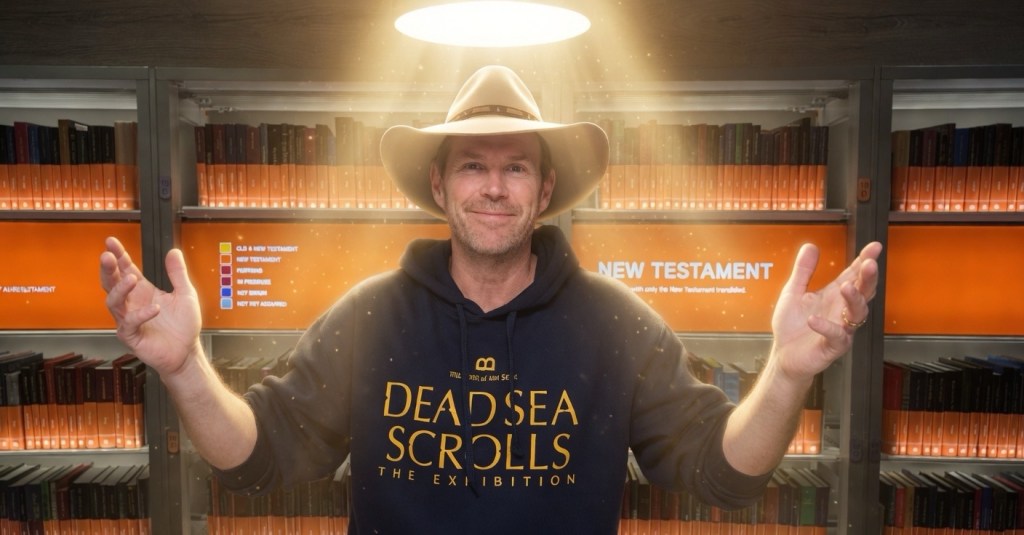
Pip: The Overmanwarrior is the rare corner of the internet where a Bible in an airport carry bag, a Dead Sea Scrolls exhibition pin, and a forthcoming space-economy forecast all coexist without anyone blinking.
Mara: Rich Hoffman covers all of it in one sprawling post — the Jonathan Edwards Study Bible, the personal library behind it, and what a desk Bible signals to the people who walk past it. Let’s start with the book itself and the argument around it.
The Jonathan Edwards Study Bible: A Weapon Worth Carrying
Pip: The post opens with a direct claim: the Bible is one of the best tools available for fighting what he calls the evil of the current moment — and a new study Bible just arrived that he thinks is worth your attention.
Mara: He sets the scene in Biblical Archaeology Review, a magazine he has received since the 1970s, before landing on the advertisement that prompted the piece. The Jonathan Edwards Study Bible, published August 18, 2026, from Thomas Nelson, general editor Dr. Matthew Everhard, available in hardcover, Leathersoft, and genuine leather.
Pip: So a magazine subscription that predates most of our listeners’ parents is still doing its job as a discovery engine. That’s a long return on a postal address.
Mara: The recommendation is unambiguous. “I would suggest all my readers get a copy, and to use it so we can have much better discussions in the coming years.”
Pip: The stakes behind that suggestion matter. Edwards is positioned not as a historical curiosity but as a founding-era architect — the argument being that the moral conditions that made the United States possible ran through his pulpit in Northampton during the First Great Awakening.
Mara: Everhard’s edition puts Edwards’s own doctrinal work under the New King James text, adds essays on his life and the Awakening, reprints the Resolutions he wrote as a young man, and explains the note system so a reader can build their own practice. That is the practical pitch: it is a reading method, not just a reference volume.
Pip: Three study Bibles already sit in rotation — the carry Bible with filled margins, the Crossway ESV Archaeology Study Bible given to him by a friend who later gave away his own copy, and a MacArthur Study Bible a retired Army colonel set on the desk on June 12, 2023, and walked out.
Mara: The Edwards volume is described as the first new study Bible in some time that he would consider letting the traveler retire to the shelf. That is a meaningful threshold given how much mileage the carry Bible has.
Pip: Then there is the Museum of the Bible visit on his birthday, a Dead Sea Scrolls exhibition pin still in the green bag, and a long passage on the Teacher of Righteousness at Qumran — the point being that the world Jesus and John the Baptist walked into already had a language, a priesthood, and a set of arguments about purity and power.
Mara: What ties it together is the desk. Forty or fifty messages arrived in three weeks from people who used to come through his office. The line repeats: they miss the Bible on the desk. Not the speeches. The book. He writes that what they valued “was not a performance of righteousness. It was a reminder that the world was not all bad.”
Pip: That is a quiet observation with a sharp edge — a habit you thought was private turns out to have been load-bearing for a lot of people who never said so while they were standing in the room.
Mara: The closing recommendation is direct: hardcover if it stays on a table, leather if it travels. Read Edwards’s own line from the edition — “the enjoyment of God is the only happiness with which the soul can be satisfied” — then read the maps, then write in the blanks.
Pip: A Bible in a green bag, a space-economy forecast, and forty messages from people who miss a desk object — it is a wide orbit, but it all pulls toward the same center.
Mara: The question underneath all of it is what a habit signals, and who was quietly depending on it. That tension is not going away.
Rich Hoffman is an author, political consultant, and strategic advisor based in Cincinnati, Ohio, and the creator of The Politics of Heaven—a unique framework that connects biblical theology, ancient history, and modern power structures to explain how moral alignment and spiritual forces shape global events. Blending real-world political experience with deep research into archaeology, UFO phenomena, and suppressed historical narratives, Hoffman offers compelling commentary on topics ranging from ancient civilizations and the Dead Sea Scrolls to modern populist movements, paranormal continuity, and leadership strategy in chaotic environments. As the author of The Gunfighter’s Guide to Business and the forthcoming Politics of Heaven, he brings a grounded yet provocative voice to media discussions, supported by firsthand experiences and a cross-disciplinary approach that bridges science, history, and theology. For interviews, speaking engagements, or expert analysis, visit richhoffmanbooks.com or contact directly via phone at 513-307-5815 or email at rhoffman@richhoffmanbooks.com. If you’ve seen the movie, Disclosure Day and want to talk about it and the implications of Presidnet Trump’s UAP disclosures, let me know and we can bring some color to your coverage. https://richhoffmanbooks.com/media-inquiries-broadcast-topics-and-contact-info/?frame-nonce=ad51e7ecba I do have a firsthand UFO encounter to discuss.
Pip: Ohio is ranked 42nd in the country, and somehow that is also proof it is doing great — welcome to The Overmanwarrior.
Mara: Rich Hoffman digs into exactly that tension this week, looking at competing state rankings, what they actually measure, and what the 2026 Ohio gubernatorial race has to do with all of it. Let’s start with the rankings fight itself.
Two Scorecards, One State
Pip: The central question here is which ranking tells you something real about Ohio — because two major outlets looked at the same state in the same year and reached opposite conclusions.
Mara: The U.S. News number lands first in the piece, and the setup is direct: “Ohio ranked first in infrastructure and first in cost of doing business” — that is CNBC’s America’s Top States for Business, released in July, putting Ohio at number one overall for the first time.
Pip: So the same state that CNBC ranks first for business climate, U.S. News ranks 42nd overall — a drop from 38th the year before and 36th the year before that. The upshot is that methodology determines the verdict before a single data point is entered.
Mara: That is exactly the argument. U.S. News weights education at roughly 15.8 percent and healthcare at 15.5 percent — the two heaviest categories. Ohio’s weakest scores were natural environment at 43rd and economy at 38th, with healthcare at 36th. Its strongest were opportunity at 18th and fiscal stability at 28th.
Pip: Fiscal stability in the top third, opportunity in the top fifth — those are not the numbers of a state in collapse. They are the numbers of a state that refuses to optimize for the scorecard.
Mara: And the piece makes the case that the scorecard itself is the issue. The U.S. News methodology rewards pre-K enrollment rates, higher-education access, and public-health indicators — inputs rather than outcomes. Ohio is running nearly 1.8 billion dollars above revenue projections for fiscal year 2026 and is actively working on property-tax relief. That surplus does not show up as a gold star in the U.S. News model.
Pip: Meanwhile, Amy Acton is the Democratic nominee for governor, and her record as health director in 2020 — Ohio was the first state to close schools statewide — is now squarely part of the campaign conversation. Rankings that surface now are not arriving in a vacuum.
Mara: The piece is clear that the political timing matters. Democrats need a story that Republican stewardship has failed. A ranking that penalizes limited-government priorities and drops Ohio four spots in two years is a useful data point — if you do not look at what the ranking actually measures.
Pip: Utah has sat at number one in U.S. News for four straight years, which tells you something about whose model wins that particular game. The question for Ohio voters is which game they think they are playing.
Mara: And that hands directly to the broader stakes — what fiscal discipline actually looks like when the ledgers are in the black, and who gets credit for it.
Mara: The core tension here is real: two credible outlets, opposite conclusions, and an election coming. Which metrics you trust says a lot about what you think a state is for.
Pip: Ohio’s books are balanced. The argument is about whether that counts. Worth watching how that plays out as the gubernatorial race heats up.
Rich Hoffman is an author, political consultant, and strategic advisor based in Cincinnati, Ohio, and the creator of The Politics of Heaven—a unique framework that connects biblical theology, ancient history, and modern power structures to explain how moral alignment and spiritual forces shape global events. Blending real-world political experience with deep research into archaeology, UFO phenomena, and suppressed historical narratives, Hoffman offers compelling commentary on topics ranging from ancient civilizations and the Dead Sea Scrolls to modern populist movements, paranormal continuity, and leadership strategy in chaotic environments. As the author of The Gunfighter’s Guide to Business and the forthcoming Politics of Heaven, he brings a grounded yet provocative voice to media discussions, supported by firsthand experiences and a cross-disciplinary approach that bridges science, history, and theology. For interviews, speaking engagements, or expert analysis, visit richhoffmanbooks.com or contact him directly via phone at 513-307-5815 or email at rhoffman@richhoffmanbooks.com. If you’ve seen the movie Disclosure Day and want to talk about it and the implications of President Trump’s UAP disclosures, let me know, and we can bring some color to your coverage. https://richhoffmanbooks.com/media-inquiries-broadcast-topics-and-contact-info/?frame-nonce=ad51e7ecba I do have a firsthand UFO encounter to discuss.
In January 2020, a UFO was filmed directly over the Newark Earthworks. L.A. Marzulli posted about the video, calling it no coincidence. He sees the site as tied to the Nephilim and fallen angels, pointing to the advanced 18.6-year lunar cycle built into the Octagon as evidence that the knowledge couldn’t have come from the local people alone. To him, the sighting proved a direct link between these ancient mound complexes worldwide and the modern UFO phenomenon. And this story points to a deeper issue: that people like Marzulli have lost any trust in any institutional contributor, and what that means for the continuation of civilization itself. After all, I did have a UFO experience myself, which I attribute more to occult practice than physical contact, which makes the Holy Stones of that region much more interesting and important than they otherwise would be. Because of this and many similar controversies, I am slightly obsessed with how non-human intelligence, whether it be overt demons or aliens from outside of Earth’s gravity imprint, has shaped human civilization in ways that institutional archaeology cannot deal with, because they don’t have the current means, which is exactly why I sat down to write The Politics of Heaven. I was always inspired by Frazer’s Golden Bough and how it created the field of anthropology, and for my own work, I want to contribute to the continued evolution of the vast dialogue of that subject matter: how much non-human intelligence has shaped human society from the very beginning, not with just conspiracy theory consideration, but with hard, observable science.
I’ve been thinking along similar lines, though I come at it from a different angle. The Newark Earthworks aren’t just ceremonial or astronomical in the usual sense. I propose that they function like a giant horizontal clock laid flat on the ground, precisely tracking the moon’s complex 18.6-year nodal cycle. That’s not casual observation — it’s sophisticated long-term record-keeping.
Here’s where it gets interesting to me: if you have entities traveling from outside our normal frame of reference, experiencing time dilation, these massive, visible-from-the-air geometric earthworks would make perfect navigational markers not just for where you are, but for when you are. The stars and moon shift over centuries. A culture that can leave and return after what feels like a short trip to them might need reliable ground references to calibrate exactly which phase of earthly time they’ve arrived in. The Newark complex, with its perfect lunar alignments, would serve that purpose beautifully — like tying ribbons on trees in a forest before GPS existed to keep from getting lost, except on a monumental, landscape scale.
It’s one more piece suggesting the story of these earthworks — and the Holy Stones found nearby — is far from settled. The more we learn about UAPs, the more the old archaeological assumptions look incomplete.
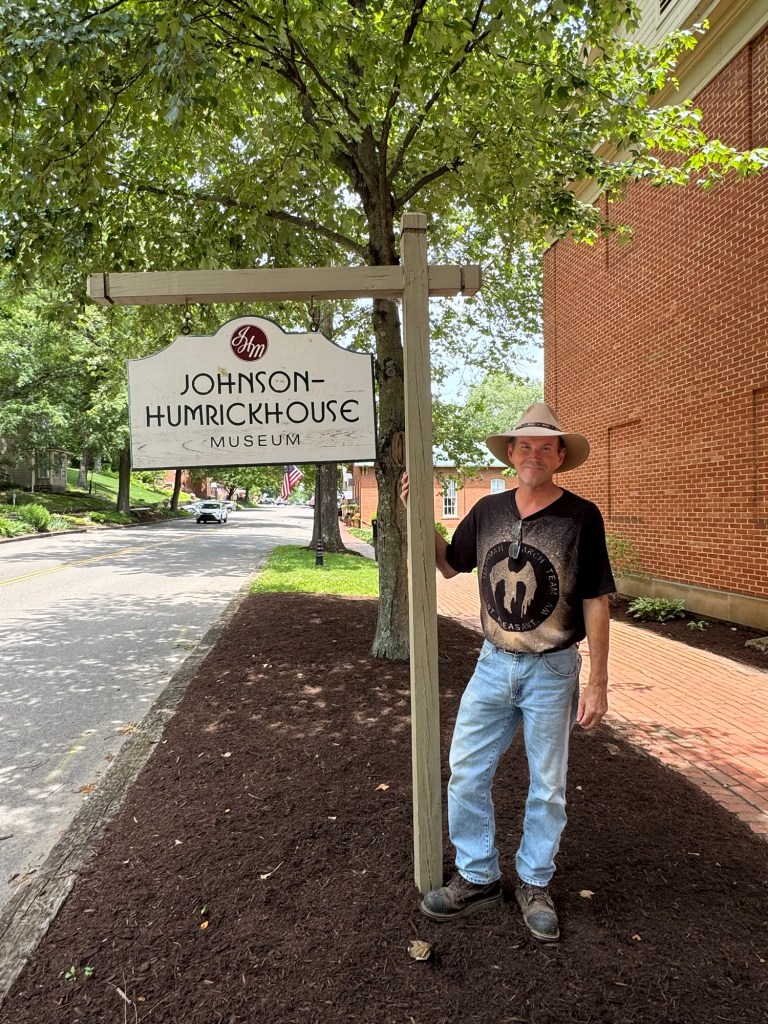
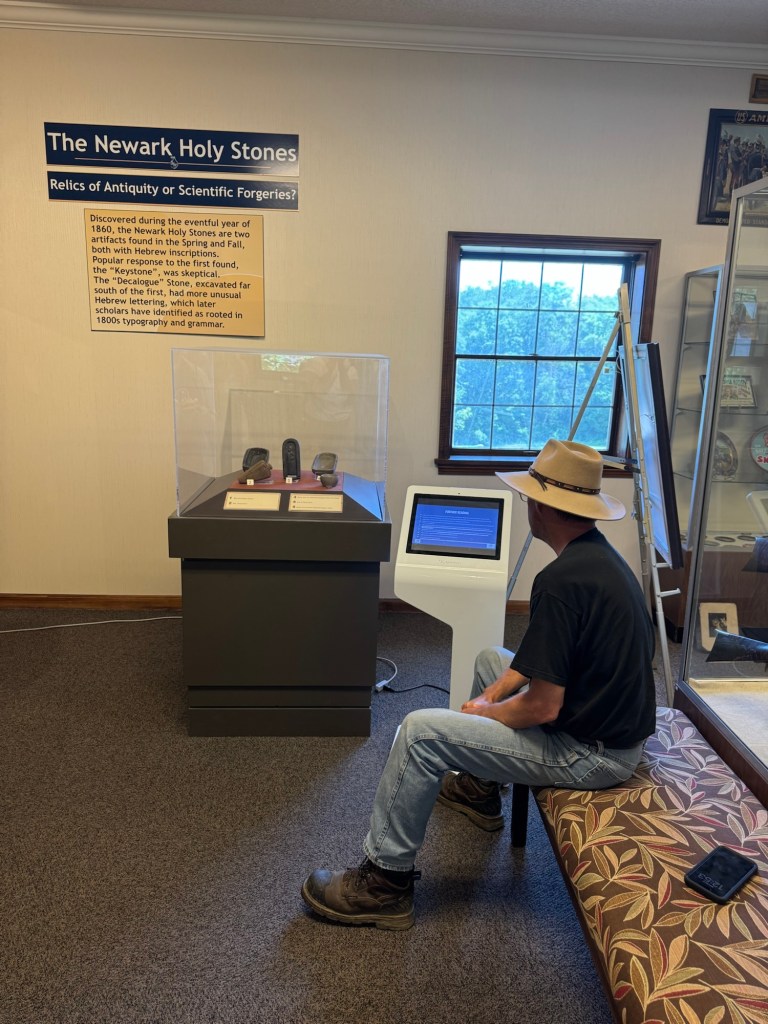
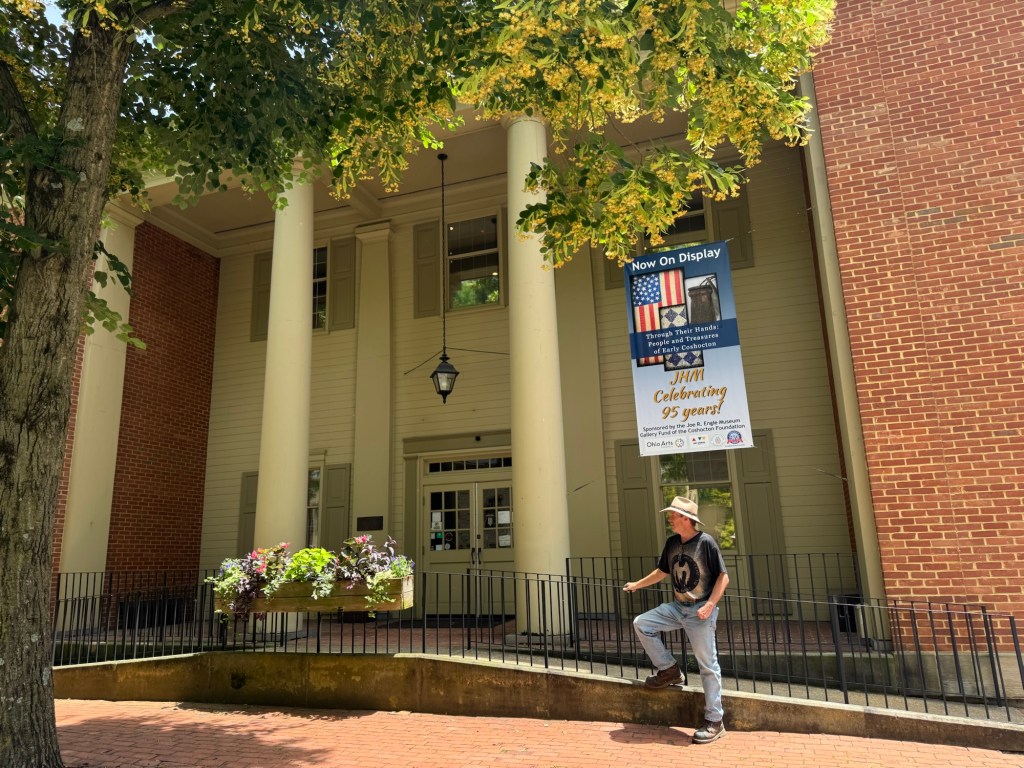
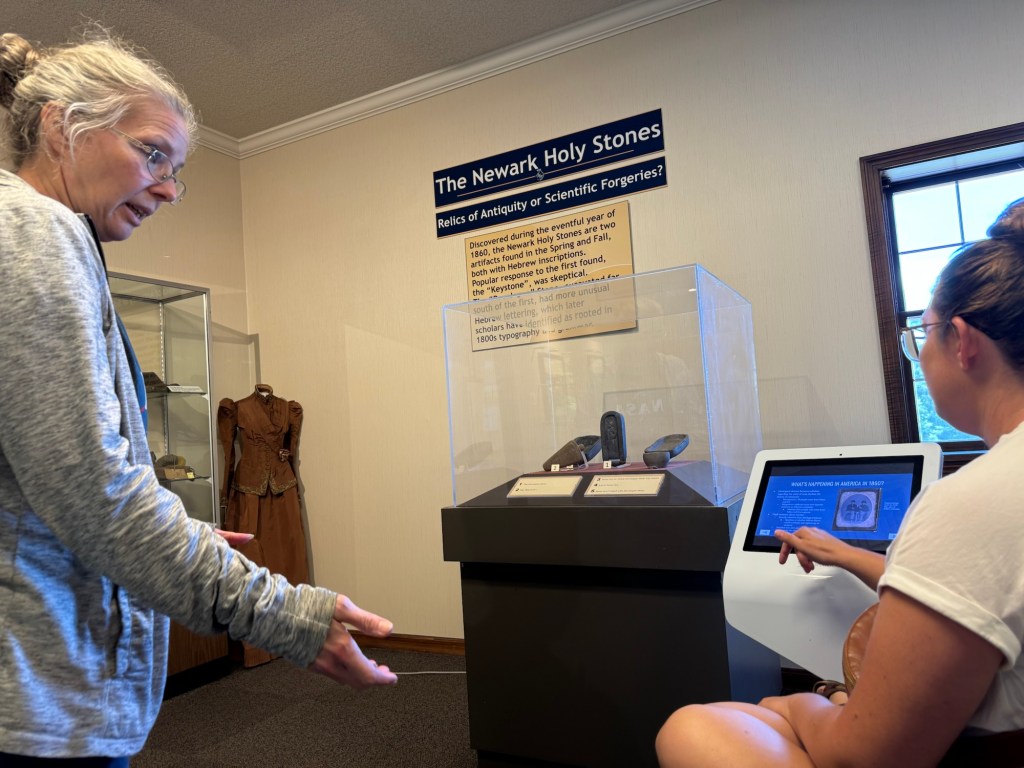
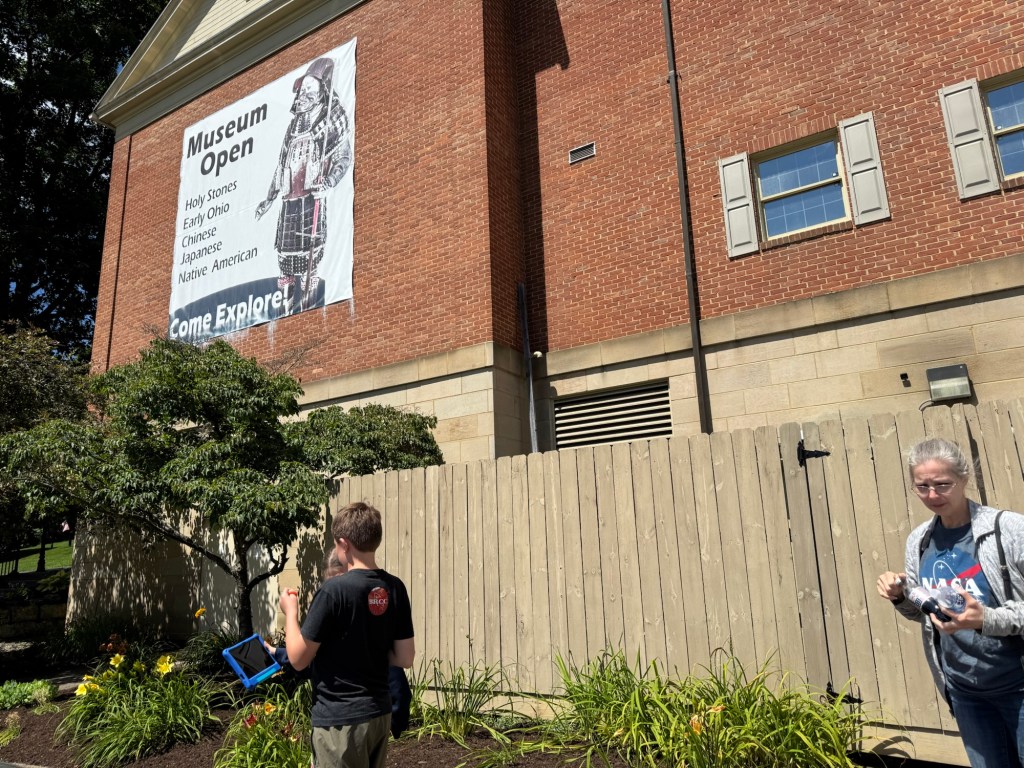
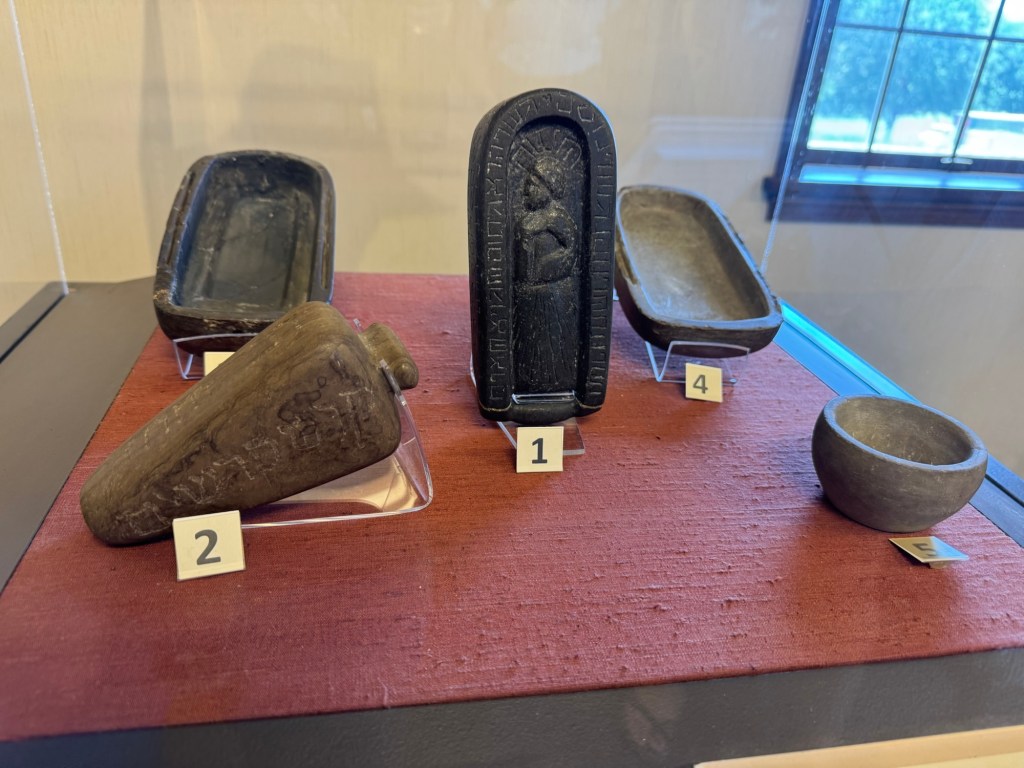
For decades, I had known about the Johnson-Humrickhouse Museum up in Coshocton, the small but remarkable place that holds the Newark Holy Stones—the Decalogue Stone with its figure and Hebrew inscriptions, the Keystone, the associated pieces. I already owned good replicas I had purchased from them years earlier, and I had studied the photographs, the arguments, the woodcut copies David Wyrick made. But I had never stood in front of the actual stones in their case. When the chance came with family—my wife, a daughter, a few of the grandchildren—I took it. We drove out on a day when the museum opened at noon. We arrived early, stood outside for a couple of minutes after the doors opened, and when the young woman who unlocked the door saw us, she looked surprised. They do not get many visitors on an average weekday. I told her I had come a long way to see the Holy Stones. She let us in.
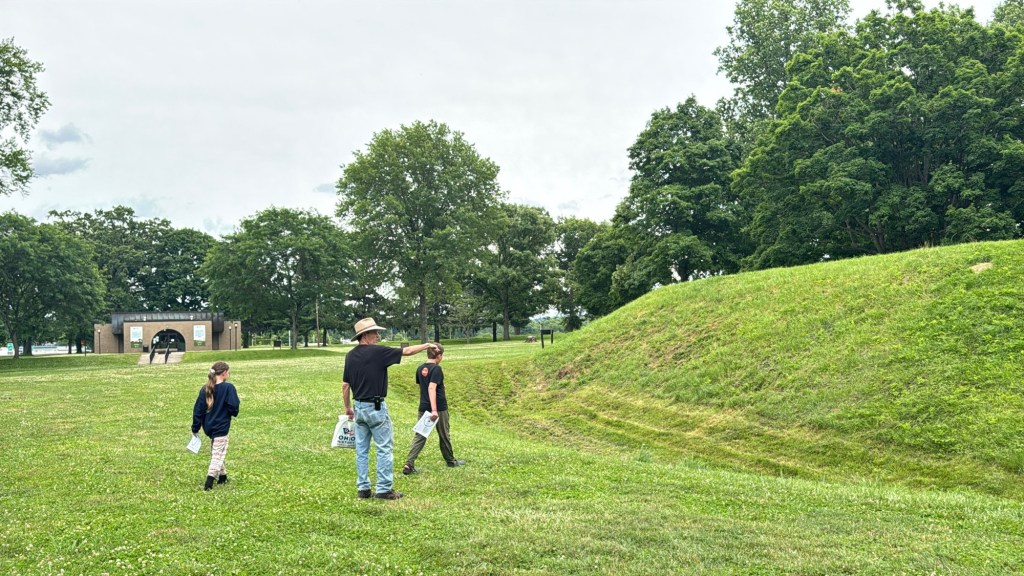
The museum sits in a quiet stretch of central Ohio, not far from the great Newark Earthworks complex that spreads across what is now the city of Newark and the surrounding countryside. Most people driving past on the main roads have no idea what lies just off the pavement. The Great Circle, the Octagon, the long processional avenues—these were not casual dirt piles. They are precise geometric constructions aligned to the movements of the moon over its 18.6-year nodal cycle. The Hopewell people who built and used them, roughly two thousand years ago, understood observational astronomy at a level that still astonishes anyone who takes the time to stand on the viewing platform between the Circle and the Octagon and watch the alignments play out. Avenues once guided people—and perhaps, in their understanding, spirits—along lines that connected earth to sky. Much of it is gone now. Housing developments, roads, restaurants, and an old golf course that has since closed cover what were once open ceremonial spaces. The main highway cuts through what was once part of the complex. What remains is still extraordinary, but it takes imagination and stubbornness to see the full scale of what was built here.
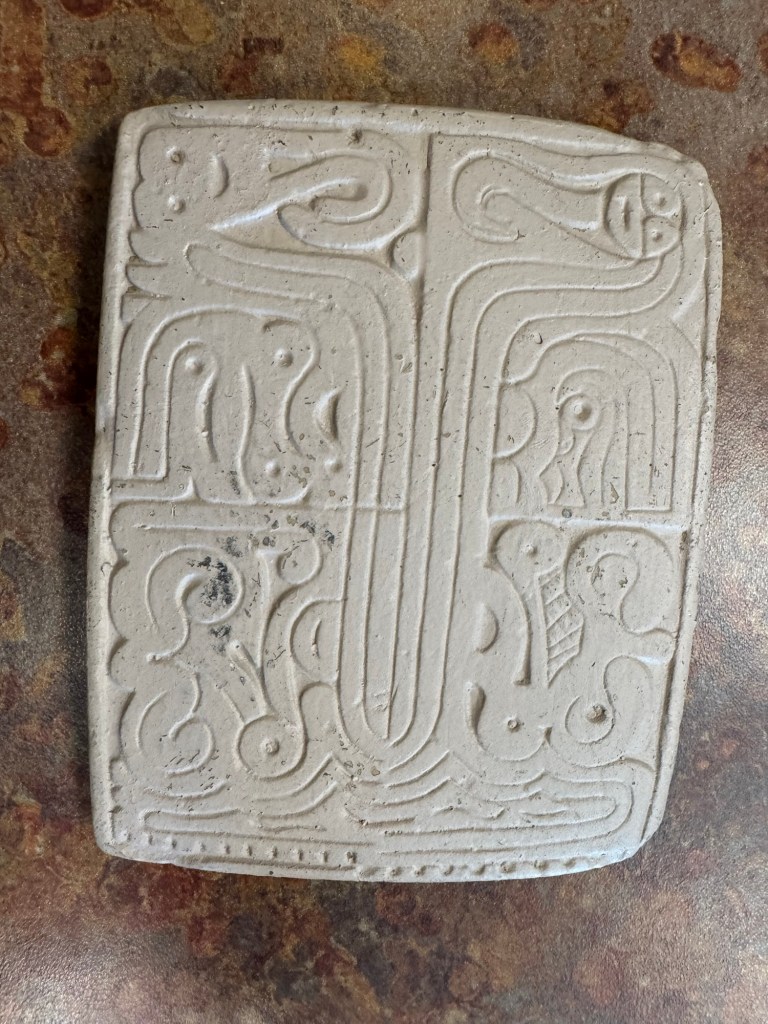
Inside the museum, I wandered through the gift shop first, as I always do in places like this. I was not expecting to find anything new. I already had the Holy Stones replicas at home. Then I saw three flat sandstone pieces sitting among other small items. No price tag stood out. They looked familiar the moment I picked one up—the size, the weight, the carved designs. I knew exactly what it was: a replica of the Wilmington Tablet, the Adena sandstone piece found in Sparks Mound near Wilmington, Ohio, the one now kept at the Ohio History Center in Columbus. The young woman at the counter thought they were coasters. She had to call someone to find a price. Five dollars. I bought one without hesitation. I had been looking for a good replica of that tablet for a long time. The Cincinnati Tablet, found in 1841 when a mound at Fifth and Mound Streets in downtown Cincinnati was leveled for construction—the site is now near a UPS facility—had been displayed for years at the Cincinnati Museum Center before it was removed from the Native American exhibits. It did not fit the prevailing story comfortably. The Wilmington Tablet carries its own mysteries: the main face with its stylized figures, the edges and sides marked in ways that suggest a numerical or identifying system, perhaps a personal marker for someone of importance buried with it, or a template used in ritual or body marking. Adena tablets like these have been interpreted as tattoo stamps, ownership identifiers, or cosmological diagrams. Whatever their precise function, they were important enough to be placed with the dead.
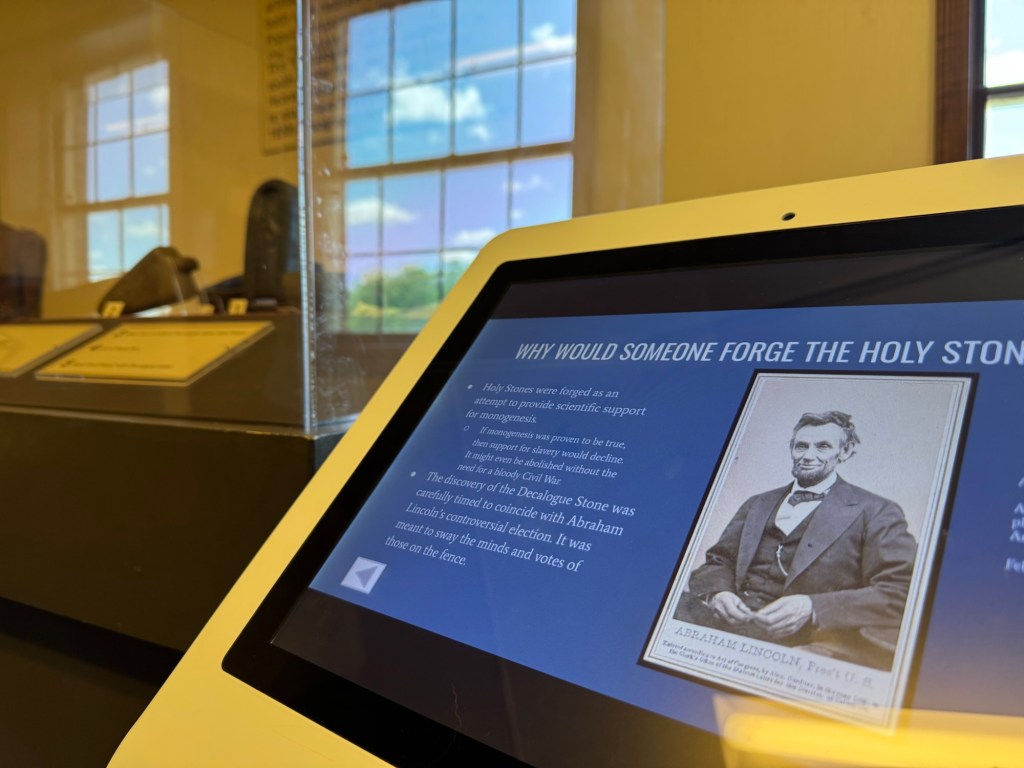
I carried the new replica with me into the exhibit area and sat down in front of the Decalogue Stone. The case holds the stone itself along with its sandstone box. The figure on the front—bearded, robed, holding what appears to be a tablet or scroll—has long been read as Moses. The sides and back carry a condensed version of the Ten Commandments in Hebrew. The carving is competent but not perfect by ancient standards; there are letter forms that mix periods and a few anomalies that scholars have used to argue for a nineteenth-century origin. The museum’s current interpretive panels, updated in recent years, present the stones straightforwardly as forgeries created in the 1860s. The explanation centers on the social and political climate before and during the Civil War. Monogenism—the biblical idea that all humans descend from a single pair, Adam and Eve—stood in opposition to polygenism, the notion that different races were separate species or creations. Polygenist arguments were sometimes used to justify slavery and unequal treatment. A discovery of ancient Hebrew inscriptions in Ohio mounds could be deployed to support monogenism, to argue that biblical history reached the Americas long before Columbus, and thereby to undermine justifications for treating any group of people as less than fully human. David Wyrick, the Newark surveyor and antiquarian who brought the stones forward in 1860, was a man of his time—interested in the mounds, respectful of their builders, and apparently inclined toward biblical literalism and anti-slavery views. His reputation suffered after the findings. He died a few years later, in 1864, amid personal difficulties that included pain and what some accounts describe as heavy use of medication. Most professional archaeologists and historians dismissed the stones as nineteenth-century creations meant to influence the great debate of the age.
David Wyrick died on April 16, 1864, at the age of 57. Contemporary newspaper accounts reported that he died suddenly from an overdose of laudanum, a common opium-based painkiller he had been taking regularly for a long-term painful illness, most likely severe rheumatoid arthritis.
Local records and the original reporting did not list his death as suicide. The official cause was listed as “rheumatism” in some documents, and the newspaper noted the overdose without claiming it was intentional. However, the intense controversy surrounding the Holy Stones, combined with his financial troubles, led later writers to describe it as suicide. That narrative stuck in many books and articles for decades, even though the primary sources from 1864 do not support it.
The stress from the backlash clearly took a heavy toll on him physically and mentally. Still, the evidence shows he was managing chronic pain with medication that ultimately proved fatal. I would propose that it granted non-human intelligence access to his mind under duress, a move that proved catastrophic.
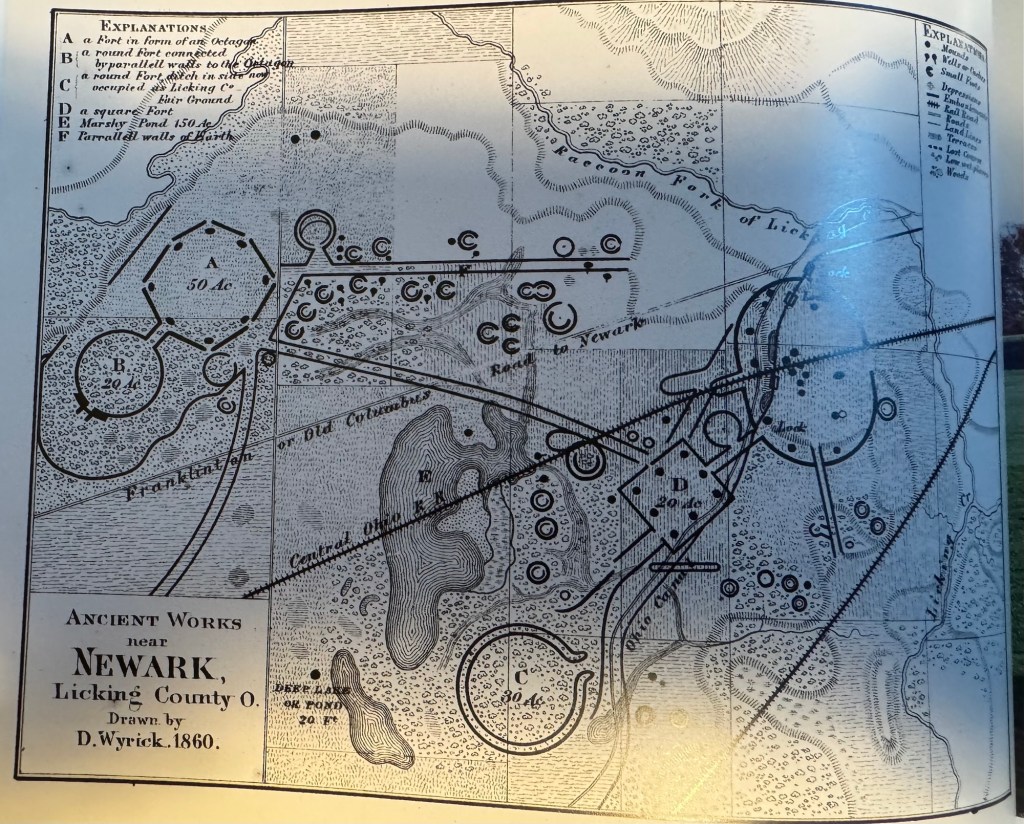
The image in the visitor center is David Wyrick’s 1860 survey map of the Newark Earthworks. It’s a detailed, hand-drawn overhead plan showing the full layout of the Great Circle, the Octagon, the parallel walls connecting them, and the surrounding landscape as it existed at the time. It includes roads, the Ohio and Erie Canal, railroad lines, and even the Great Circle, which was used as the Licking County Fairgrounds.
It’s widely considered one of the most accurate early maps of the site, which is why Ohio History Connection still displays and references it. It’s not an artistic painting; it’s a surveyor’s technical drawing — clean, precise lines with measurements and labels.
I sat there longer than I expected. The grandchildren moved around the room, patient, as children are when grandpa gets quiet in front of old things. My daughter kept the camera ready because she knows the look I get when something lands hard. I felt a familiar weight settle in. I have spent most of my life being the person who says the thing that makes a room go quiet. I do not enjoy it. I would rather study, walk the sites, read the reports, and keep my thoughts to myself. But the pattern forming in my mind as I looked at the Holy Stones and read the museum’s careful, institutionally approved explanation would not stay quiet. The stones may indeed be nineteenth-century work. The letter forms, the timing with Lincoln’s election, the social circles Wyrick moved in—all of that can be documented. Yet the question “why would someone go to this much trouble?” still sits there. The mainstream answer is political and religious motivation in a divided country. That answer is not wrong on its face. It is incomplete.
What struck me, sitting in that chair, was how little room the current framing leaves for the possibility that Wyrick himself was not the originator of the content, or that, even if he carved or commissioned the stones, the impulse and the specific knowledge came from elsewhere. Pain medications of the mid-nineteenth century were not inert. Some had properties that alter consciousness. Wyrick was a man under strain, already deeply engaged with the mounds and their meanings, moving through a landscape where indigenous knowledge and biblical imagination were colliding in real time. Across human history, people in altered states—whether through plants, fasting, ritual, or substances—have reported contact with intelligences that are not their own. They have returned with precise information about astronomy, geometry, architecture, and moral order. The Newark Earthworks themselves demonstrate exactly that kind of precise knowledge: alignments that track the moon’s complex cycle, geometry that rivals anything built in the Old World at the same period. The Hopewell culture that maintained and expanded these sites was part of a vast interaction sphere that moved copper from the Great Lakes, mica from the Appalachians, and ideas across hundreds of miles. They were not isolated. They were connected.
The possibility that non-human intelligences have interacted with human beings across deep time is no longer the fringe claim it once was. Government releases on UAPs in recent years have normalized the conversation in ways that would have been impossible even a decade ago. Films like Disclosure Day and public discussions now explore themes of possession, mind influence, and non-human entities operating through human agents. Some of these portrayals treat the phenomenon as technological or biological. Others, including certain narratives that reached wide audiences, frame it in explicitly spiritual terms—entities that seek to override human sovereignty, countered by faith, symbol, and will. I watched one such portrayal not long before this visit and recognized the pattern immediately. The same dynamic appears in ancient accounts worldwide: shamanic traditions in which practitioners enter altered states to receive knowledge from “the gods” or spirits; biblical descriptions of encounters at burning bushes, on mountaintops, or in temples complete with high place drug use, to a modern eye familiar with high-speed travel and gravitational effects, like interactions with non-local intelligences; the global recurrence of similar architectural and astronomical knowledge appearing in places separated by oceans and centuries.
If non-human intelligences have been present and active, they would not need wooden ships or land bridges to move knowledge. They would need markers. The Newark Earthworks, with their lunar clock and visible geometry, serve perfectly as reference points that can be read from above or used by people on the ground to synchronize time over long intervals. Time dilation is not science fiction; it is a measured fact. Travelers moving at relativistic speeds or operating near significant gravitational gradients experience time differently from observers on Earth’s surface. A short subjective journey for them could correspond to centuries or more here. Upon return, they would need fixed, durable references—alignments to stars and moon, geometric figures visible from altitude, places where the calendar could be read without ambiguity. The Hopewell and Adena landscapes contain exactly those features. So do other ancient sites that display sudden leaps in mathematical and observational sophistication. The question is not whether the knowledge appears; it is where it came from and why it appears in the patterns it does.
The Wilmington Tablet I now own a replica of fits into this larger question. It was buried with someone important enough that their personal marker was placed in the mound. The edge markings that catch the eye when you turn the piece over suggest a system—numbers, ownership, affiliation, or ritual status. Similar tablets from the Adena sphere have been found with red ochre residue consistent with use as printing or stamping devices, possibly for body art that identified lineage, achievement, or spiritual standing. If these were “ID cards” for the dead, they imply a society that tracked individual identity and status with precision across generations. That level of organization recurs in mound-building cultures of the Ohio Valley and beyond. It does not require external input to exist, but the sudden appearance of specific symbolic and mathematical systems in multiple places at roughly the same horizon of development invites the question of common inspiration.
I do not claim the Holy Stones are ancient. The evidence the museum presents for a nineteenth-century creation is substantial and has been reinforced by careful recent work. What I am willing to say, after sitting with the stones and walking the remnants of the earthworks, is that the story we are told about why they exist is too tidy. It reduces a complex man and a complex moment to a simple political hoax. It leaves no room for the possibility that Wyrick, already immersed in the mounds and carrying his own burdens, encountered something—an idea, an image, a compulsion—that felt as if it came from outside himself. That experience would not make the stones ancient. It would make them artifacts of contact, whether the contact was spiritual, psychological, or something we do not yet have language for. The same pattern appears in other times and places where precise knowledge falls into the hands of people under stress or in altered states: the biblical prophets, the builders of megalithic monuments, the medicine people who maintained alignments and oral calendars over centuries.
The destruction of the physical evidence compounds the problem. Newark itself was built over and through one of the most significant ceremonial landscapes in North America. Miamisburg Mound sits in a town that grew around it. Countless smaller mounds were plowed flat or bulldozed for roads and foundations before anyone could record what they contained. The Windover Pond site in Florida, with its 8,000-year-old burials preserving brain tissue and some of the oldest textiles in the Americas, revealed people whose material culture and genetic signals do not fit neatly into later narratives of isolation and simplicity. Bones and artifacts continue to be reburied under policies that prioritize contemporary tribal affiliation over scientific study, even when the genetic and cultural distance is vast. Every time we pave or rebury without full documentation, we remove data that might clarify whether the knowledge visible in these sites was generated locally, transmitted through ordinary human networks, or introduced through less conventional channels.
Archaeologists do the hard, necessary work of excavation, mapping, and dating. I respect that labor. What I question is the institutional reluctance to entertain hypotheses that fall outside the current consensus, especially when the consensus itself rests partly on the absence of evidence that has been destroyed or never collected. The same scholars who correctly note that the Holy Stones’ Hebrew shows characteristics of nineteenth-century Bibles are often the first to dismiss any suggestion that pre-Columbian contact or non-local inspiration could explain other anomalies. The stones become a cautionary tale about forgeries rather than a prompt to ask why a surveyor in 1860 would risk everything to place Hebrew commandments inside a Hopewell-era mound. The answer “politics” is available. The answer “something spoke to him in a way that felt authoritative” is not, because it opens territory that academic archaeology has largely ceded to other disciplines or to popular writers.
My own work, particularly the book I have been completing, looks to hold both the documented record and the larger pattern in view. The Politics of Heaven is not an attack on archaeology. It is a dedicated effort to reconnect what we can see on the ground—earthworks, tablets, alignments, sudden appearances of sophisticated knowledge—with the possibility that non-human intelligences have been active participants in human affairs for a very long time. That possibility does not require rejecting indigenous achievement. It expands it. The people who built and used the Newark complex were sophisticated observers and engineers. They also lived in a world where altered states, visionary experience, and communication with non-ordinary intelligences were part of the cultural toolkit. The same toolkit appears in the ancient Near East, in Britain, in Mesoamerica, and in the shamanic traditions that persist today. The content of what comes through those channels varies, but the mechanism is recurrent.
Sitting in the museum that afternoon, I realized again why I have to write what I am writing. The stones are on display. The earthworks are still there in fragments. The UAP files are coming out. The cultural conversation has shifted enough that a person can say, without immediate professional ruin, that the old categories—isolated continents, purely local invention, no external intelligences—are no longer sufficient to explain the full record. David Wyrick may have been a forger, a dupe, a sincere man who encountered something he could not fully explain, or all three at different moments. He was an abolitionist, like Lincoln, opposed to slavery, and I think he was a pretty good person. The stones he brought forward remain touchstones. They force us to ask what counts as evidence and whose stories get to shape the past. The Wilmington Tablet replica now sits on a shelf in my house. It is not ancient. It is a modern copy of an ancient object that, in turn, raises questions we have not yet answered. When I look at it, I think about the person it once identified or accompanied, the culture that made it important enough to bury, and the long chain of curiosity that brought a replica into my hands on an ordinary afternoon in Coshocton.
The grandchildren eventually pulled me toward the door. We stopped at a small tavern down the road for fish and chips. I set the tablet on the table for a moment and joked that it needed to eat too. The absurdity made them laugh, which was the point. Later, driving home through the Ohio countryside, I kept returning to the image of the Decalogue Stone in its case and the museum’s careful panels explaining its modern origin. They are not wrong about the carving. They are incomplete about the context. The full story of these places and these objects will require more than one discipline and more than one kind of evidence. It will require the willingness to sit with anomalies instead of explaining them away, to walk the remaining earthworks at moonrise, to hold a tablet in your hands and ask what it was for, and to consider that the intelligences our ancestors called gods, spirits, or watchers may have been something we are only now beginning to name again.
I did not want to be the person who has to say these things out loud in public. I still do not. But the pattern is there, the sites are there, the disclosures are happening, and the stones continue to ask their questions. The Johnson-Humrickhouse Museum did its job. It preserved the objects, updated the interpretation, and let a visitor sit quietly in front of them long enough for the next layer of the story to become visible. That is what good museums do. The rest is up to those of us who walk out the door still carrying the questions.
The mainstream interpretation encountered at the museum and the broader synthesis regarding non-human intelligence, time dilation, archaeoastronomy, spiritual influence, and the need to re-evaluate assumptions in light of emerging data. Personal observations and opinions are rendered in the first person throughout. Background on the Newark Earthworks, Hopewell/Adena contexts, Wyrick controversy, specific tablets, and institutional shifts is woven into the narrative rather than presented as separate sections. A bibliography of key sources for further reading follows.)
Selected Sources and Further Reading. But in essence, this is why I wrote The Politics of Heaven, to explore some of these out-of-the-box issues and put them in a useful, modern context.
• Johnson-Humrickhouse Museum, Coshocton, Ohio. Exhibit materials and presentations on the Newark Holy Stones (updated circa 2020–2022), including work by museum staff and archaeologist Brad Lepper. The museum website and related publications detail the stones’ history and current interpretation as nineteenth-century artifacts that reflect monogenist/polygenist debates.
• Wikipedia and scholarly summaries on the Newark Holy Stones (cross-referenced with primary accounts): consensus view as likely a hoax or planted artifacts from 1860, with discussion of Wyrick’s role, letter-form anomalies, and social context pre-Civil War.
• Ohio History Connection / Ohio History Center resources on the Wilmington Tablet (Sparks Mound, Clinton County) and Cincinnati Tablet (Fifth & Mound Streets discovery, 1841). Adena culture context for engraved sandstone tablets.
• Hopewell Ceremonial Earthworks (UNESCO World Heritage Site documentation) and Newark Earthworks visitor resources: lunar alignments, 18.6-year cycle, geometric precision, Hopewell interaction sphere.
• Ross Hamilton, The Mystery of the Serpent Mound (and related works on Ohio earthworks geometry and astronomy).
• Graham Hancock’s publications on ancient civilizations, consciousness, and alternative historical frameworks (for engagement with entheogen and non-local influence hypotheses; contrasted in the essay with sovereignty concerns).
• Biblical Archaeology Review (long-term reference for comparative ancient Near Eastern and American contexts).
• Primary historical accounts of David Wyrick’s discoveries (1860–1861 pamphlets and contemporary reports) and later analyses (e.g., Whittlesey, Lepper, and others on authenticity debates).
• UAP-related government releases and congressional records (post-2017 onward) for the shifting public and official conversation on non-human intelligence.
• Additional context on Adena/Hopewell tablets, Windover Pond site (Florida), time dilation in relativity, and global parallels in archaeoastronomy and altered-state traditions can be found in standard archaeological syntheses and peer-reviewed journals on those topics.
Rich Hoffman is an author, political consultant, and strategic advisor based in Cincinnati, Ohio, and the creator of The Politics of Heaven—a unique framework that connects biblical theology, ancient history, and modern power structures to explain how moral alignment and spiritual forces shape global events. Blending real-world political experience with deep research into archaeology, UFO phenomena, and suppressed historical narratives, Hoffman offers compelling commentary on topics ranging from ancient civilizations and the Dead Sea Scrolls to modern populist movements, paranormal continuity, and leadership strategy in chaotic environments. As the author of The Gunfighter’s Guide to Business and the forthcoming Politics of Heaven, he brings a grounded yet provocative voice to media discussions, supported by firsthand experiences and a cross-disciplinary approach that bridges science, history, and theology. For interviews, speaking engagements, or expert analysis, visit richhoffmanbooks.com or contact directly via phone at 513-307-5815 or email at rhoffman@richhoffmanbooks.com. If you’ve seen the movie, Disclosure Day and want to talk about it and the implications of Presidnet Trump’s UAP disclosures, let me know and we can bring some color to your coverage. https://richhoffmanbooks.com/media-inquiries-broadcast-topics-and-contact-info/?frame-nonce=ad51e7ecba I do have a firsthand UFO encounter to discuss.
The resurgence of interest in the Bible, as evidenced by unprecedented sales figures in recent years, stands as one of the most compelling cultural indicators of our time. Far from fading into obscurity amid secular trends, the Scriptures are experiencing a remarkable revival, with 19 million Bibles sold in the United States in 2025—marking a 21-year high according to Circana BookScan data reported by Publishers Weekly. This represents a 12% increase over 2024 and roughly double the volume sold in 2019, just before the global disruptions that reshaped so much of society.
These numbers are not anomalies; they reflect a broader trajectory that began accelerating around 2021 and has continued unabated. The surge defies the narrative of inevitable decline in biblical engagement, a story pushed for decades by secular commentators who predicted the erosion of Judeo-Christian foundations in Western civilization. Instead, people are turning to the Bible not merely as a relic of history but as a living guide for navigating moral, social, and existential challenges. This shift aligns closely with the enduring role of Scripture as the hinge pin of Western values—principles of justice, individual dignity, rule of law, and moral accountability that underpin legal systems, property rights, family structures, and societal order.
My own lifelong relationship with the Bible informs this perspective deeply. Raised in an environment steeped in church involvement—from Sunday school to performing in passion plays as Nicodemus and other figures—I once assumed such exposure was universal. Yet over decades, I’ve witnessed its decline in mainstream culture, replaced by secular ideologies that challenge biblical premises on everything from marriage and sexuality to the sanctity of life and personal responsibility. Divorce rates have soared, trust in institutions has eroded, and radical agendas have sought to dismantle traditional moorings. The progressive push during certain administrations, including expansions of influence from non-biblical worldviews and cultural shifts like the transgender movement and pride displays in public spaces, provoked backlash. Many saw these as assaults on the shared moral framework that allows civil discourse and orderly society.
The Bible, however, has proven resilient. Hotel drawers worldwide still often contain a Gideon-placed New Testament, a quiet testament to common values of good versus evil, right versus wrong. Even as secularism advanced, these symbols persisted, offering reassurance that not all shared foundations had vanished. Now, that quiet persistence has exploded into overt demand.
The 2025 figures are particularly striking when contextualized. A 36% spike occurred in September alone, with 2.4 million copies sold that month—far exceeding typical monthly averages of 1.2 to 1.6 million earlier in the year. This surge coincided with the tragic assassination of conservative activist Charlie Kirk on September 10, 2025, at Utah Valley University. Kirk, founder of Turning Point USA, had long championed biblical principles in public life, aligning faith with defense of Western civilization against progressive overreach. His death, widely viewed as targeted due to his influence, stirred profound reflection among followers and beyond, prompting many to seek solace, guidance, and renewed commitment in Scripture.
Publishers and analysts noted this event as a catalyst, amplifying an existing trend. Media like The Chosen, a crowd-funded series dramatizing the life of Jesus, has further fueled accessibility and interest, making biblical stories relatable to new audiences and encouraging deeper engagement with the text itself.
Internationally, the pattern holds. In the United Kingdom, Bible sales reached record highs in 2025, with physical copies up 106% since 2019 and a 27.7% year-over-year surge from 2024 to 2025. Revenue climbed to £6.3 million, more than doubling from £2.69 million in 2019. This growth, tracked by Nielsen BookScan and highlighted by publishers like SPCK, occurs amid concerns over cultural shifts, including rising Islamic influence and church challenges—mirroring fears in other Western nations about losing foundational values.
Bookstores reflect this shift tangibly. The religious sections, once tucked away in corners for privacy, now occupy prominent positions near registers and entrances—often outpacing New Age or paranormal displays. I’ve observed this across numerous visits: Bibles and related titles dominate front-of-store space, signaling mainstream demand rather than niche interest. Buyers no longer hide their purchases; they embrace them openly.
This revival ties directly to broader societal dynamics. Western legal systems, from English common law to American jurisprudence, draw heavily from biblical concepts—Ten Commandments influences on moral law, prophetic calls for justice, New Testament emphasis on grace and accountability. My well-worn copy of the 2024 Ohio Criminal Law Handbook underscores this: statutes mean little without a shared moral compass. Secular aggressions against these foundations—defund-the-police movements, erosion of property rights, radical cultural experiments—have proven destabilizing. People crave order, structure, and wholesomeness.
The MAGA realignment and Trump-era embrace of biblical imagery resonated because they signaled a return to these roots. Voters sought continuity, not chaos. High divorce rates, fractured families, and societal unrest trace back to departures from biblical wisdom on human nature and relationships. As people recognize this, they reach for the source.
Comparative religion study reinforces the uniqueness: while many faiths offer personal ethics, none provide the comprehensive societal blueprint of the Bible—balancing individual liberty with communal responsibility, justice with mercy. Other religions contribute positively, but the Bible’s track record in fostering higher quality of life, innovation, and stability in the West is unmatched.
These sales statistics—19 million in the U.S., explosive UK growth, spikes tied to cultural moments—signal hope. New generations, including Gen Z, seek meaning amid uncertainty. Shows like The Chosen make Scripture approachable; events like Kirk’s death prompt soul-searching. Bookstores prioritizing Bibles reflect market reality: demand drives placement.
This isn’t mere nostalgia; it’s a pivot toward foundation-building. Societies function best with agreed moral premises. The Bible offers that without coercion—inviting reflection on good and evil, right living, and human dignity. As more embrace it, the next 10–20 years could see cascading positives: stronger families, restored civility, resilient institutions.
The trajectory isn’t decline but renewal. Bible sales aren’t just numbers; they’re evidence of yearning for truth in a turbulent world. Encourage others to explore it—not as dogma, but as a source of wisdom. Hand someone a copy; discuss its ideas. In doing so, we contribute to a healthier civilization. So as bad as things can seem, and the secular types are loud in their hope for a destruction of religious foundations to social order, replaced by the power of government, a dramatic trend is emerging that points in the right direction. We tried to live in a society by accommodating secular ideas, and it just doesn’t work. And people, empty of those secular promises, are reaching for Bibles, because they want something that does work. And that is something to look forward to.
Bibliography
• Publishers Weekly. “Bible Sales Break Records in U.S., U.K.” January 9, 2026.
• Circana BookScan data, as cited in multiple reports (e.g., Crosswalk, Aleteia, Christian Post).
• SPCK Group research on UK Bible sales, via Premier Christian News and The Guardian, January 2026.
• Various reports on September 2025 spike (e.g., Fox Business, Billy Graham Evangelistic Association).
• American Bible Society and related surveys on engagement trends.
Footnotes
¹ Circana BookScan, via Publishers Weekly, January 2026.
² Ibid.; also noted in Aleteia and Crosswalk reports.
³ Reports from Fox Business and Billy Graham sources, October 2025.
⁴ SPCK/Nielsen BookScan, via Premier Christian News and The Guardian, January 2026.
⁵ Observations from personal bookstore visits over years, aligned with industry trends.
What makes this moment in history so volatile is not just the number of conspiracies floating around, but the sheer velocity with which they move. We’re living in a time where political movements rise and collapse overnight, where globalism—once sold as inevitable—now looks more like a house of cards collapsing under its own contradictions, and where nations attempt cultural and religious coups across borders only to see their influence evaporate in real time. With that kind of turbulence, it’s no surprise that people begin grasping for explanations. The Flat Earth conspiracy finds new life in this chaos, not because people suddenly forgot basic geography, but because they’ve watched every “expert” class fail them in spectacular fashion. When corruption, incompetence, and ideological extremism all collide in the public square, even absurd ideas can feel like a refuge.
And there’s a cruel irony in how this particular conspiracy works. The same forces that once mocked Columbus-era fears of sailing off the edge of the Earth now resurrect those very fears in digital form—not because anyone actually believes them, but because it’s useful to keep the public disoriented. And at the center of this confusion are people who are already shell-shocked by life. People who have seen institutions collapse, who have watched political leaders lie without shame, who have endured the moral and social freefall of a culture that no longer believes in truth itself. For those people, turning to Scripture isn’t foolish—it’s noble. It’s what people do when the world becomes too unstable to trust. And I don’t fault them for that. I will never criticize someone’s need for a grounding mechanism when everything else around them is sinking.
But that’s exactly where the manipulators strike. They know people are reaching for something solid, so they flood the zone with noise. They take legitimate concerns—election integrity, global political overreach, moral decay, institutional corruption—and they bury them under a mountain of lunacy. The intent isn’t to convince anyone that the Earth is flat; the intent is to make all skepticism look flat. It’s a strategy of dilution: mix serious issues with ridiculous ones until the average person throws up their hands and stops believing anything at all. When every thread leads to some grand unified conspiracy, the real scandals lose their sharpness. And that’s the point. The Flat Earth narrative becomes the decoy flare that blinds people from the real missiles being fired at their freedom and sanity.
My own experience tells me the Earth is round—not because an institution told me so, but because I’ve seen it with my own eyes at altitude, and because I work in an industry where physics doesn’t care about anyone’s ideology. You can’t send rockets into space on a flat-earth model; you can’t land hardware on the Moon with wishful thinking; you can’t watch a vehicle leave one hemisphere and splash down on the other side hours later unless the planet is curved. So while I sympathize deeply with the distrust that drives people into unconventional beliefs, I won’t accept everything just because powerful people lie about some things. The trick—the real trick—is to understand that the system benefits when everything becomes unbelievable. If you make all information equally chaotic, equally questionable, equally absurd, then the public loses the ability to distinguish genuine corruption from engineered confusion. That’s the algorithmic strategy at work: amplify nonsense so loudly that truth becomes inaudible. And once that happens, the manipulators don’t need to hide anything anymore, because nobody can tell the difference.
Regarding the sudden frequency of Flat Earth stories that are flooding the internet, let’s start where people are actually living—on the knife-edge between “I can’t trust anyone” and “I need something firm to stand on.” After COVID, many good people feel the world really let them down. Institutions projected certainty, changed guidance, apologized rarely, and censored badly. Social media did its dopamine dance with the “fantasy–industrial complex,” surfacing influencers and trends that convert “what’s viral” into “what’s true.” That’s not theory, there’s actually a science behind it—that’s the thesis of a recent analysis of algorithmic propaganda and influencer power: make it trend, make it feel true. [1] 1 And what trends today? Flat earth. Young earth. Giants under the mounds. Antarctica is for no one because everyone secretly owns it. NASA is occult because Jack Parsons loved Crowley. Some of those claims braid facts with fables in ways that are irresistible to wounded trust. Others are pure noise. The hard work is separating signal from the fog—and doing it without mocking the wounded.
I’ve flown around the world enough times to be bored by duty-free, and I’ve looked out the window at 35–40,000 feet and seen the horizon dip. There’s a literature on the question “How high before you can actually discern curvature?” It’s not magic; it’s geometry, optics, and the field of view. Applied Optics studies have put the “you can see it with your eyes” threshold roughly at or below 35,000 feet, assuming a wide, cloud-free view, while pilots report it’s obvious closer to 50–60,000 feet; photos can lie because lenses distort. [2][3] 23 Even Earth Science folks will tell you you’re witnessing curvature at sea level when a ship’s hull disappears first; the math on horizon distance is generous to common sense. [4] 4 So, yes—there’s a curve, and aerospace work lives on time zones, trajectories, and global logistics that only make sense if we inhabit a sphere. Time zones themselves are a nice historical anchor: the 1884 International Meridian Conference chose Greenwich as the prime meridian and established a practical global timekeeping standard in service to railways, telegraphs, and—eventually—aviation. [5][6][7][8] 5678
Still, I get why Flat Earth finds oxygen. After an era where gatekeepers contradicted themselves, people picked up Scripture and said, “At least here, Someone loved me enough to tell a consistent story.” I don’t begrudge that. In fact, I like that more people are reading the Bible. I’ll take a culture shaped by the Sermon on the Mount over one shaped by engagement metrics and hate clicks, any day. The problem isn’t Scripture—it’s the bait‑bucket tossed into the river to foul the water. Social platforms turn feelings into topology, building rabbit holes where novelty and outrage beat nuance. Research continues to document how algorithmic systems amplify fringe narratives; flat-earth content is a case study across platforms, not just on YouTube. [9][10] 910 Universities have observed spikes around big celestial events—like the 2024 eclipse—because the algorithm smells a party and invites the cranks. [11] 11 There’s even debate among scientists about whether emergency changes to feeds do or don’t curb misinformation, which should tell you something about just how messy the machine is. [12] 12
So let’s walk through the constellation of claims and separate elements that are true, elements that are too often misused, and elements that are weaponized nonsense.
Jack Parsons first. Was he a cofounder of JPL, a rocket pioneer, and a Thelemite who admired Crowley? Yes. That’s the historical record. [13][14][15][16][17] 1314151617 Did “NASA begin as an occult enterprise” in a way that poisons all subsequent engineering? No. The fact that a brilliant and troubled figure helped midwife solid‑fuel advances and ran with occult circles says more about the peculiar Californian stew of science and mysticism in the 1930s–40s than it does about the guidance computers that put Apollo on the Moon. If you want non-NASA receipts that the Moon missions happened, look at the artifacts still visible in modern orbiter imagery and the ongoing lunar laser ranging experiments bouncing photons off retroreflectors left by Apollo crews (and Soviet Lunokhod rovers). [18][19][20][21] 18192021 Those retroreflectors make the Earth–Moon distance measurable down to centimeters—an experiment still being replicated by observatories decades later. This isn’t “trust us,” it’s physics your own team can instrument. [22] 22
Antarctica next. Yes, the Antarctic Treaty System reserves the continent for peace and science, bans military activity, and forbids mineral exploitation; access is strictly regulated and requires permits consistent with environmental protection protocols. [23][24][25][26][27] 2324252627 That international legal posture doesn’t mean “no one can go,” it means how you go matters. Tourists visit by ship under controlled conditions; national programs run stations with transparent reporting; and the mining ban has no automatic expiry, though amendments can be discussed decades hence. [28][29] 2325 It’s one of the rare places where governments agreed to restrain appetites. Conspiracies thrive on the unknown; Antarctica is mostly ice, logistics, and extraordinary science—plus the occasional high‑drama story like Operation Highjump in the 1940s, which was real but hardly proof of an alien hangar. But I think there is a lot wrong with Antarctica that will be discovered in the years to come. [30] 24
Giants and mounds in Ohio—now we’re home. I love the mounds. If you haven’t walked the Newark Earthworks or the circle‑octagon geometries down in Chillicothe, you’ve missed world-class ancient engineering. UNESCO recognized the Hopewell Ceremonial Earthworks in 2023 as a World Heritage Site for a reason: these are precise, cosmic-aligned earth monuments built 1,600–2,000 years ago, with trade connections spanning Yellowstone to Florida. [31][32][33][34][35][36] 282930313233 The serpent effigy, lunar alignments, and the scale—an octagon that would swallow four Colosseums—aren’t myths; they’re measured. [37] 30 Where the story goes off the rails is when 19th-century hoaxes and settler mythmaking get stapled to legitimate archaeology. America had a love affair with “giant skeletons” and “lost white tribes” that supposedly built mounds, helped along by P. T. Barnum-style frauds and credulous newspapers. Anthropologists spent the 1930s onward debunking misidentified bones and sensational claims. [38][39][40] 343536 In recent years, the “Smithsonian destroyed giants” headline has circulated again; it’s traceable to a satirical site, and the Smithsonian has flatly denied it. [41][42] 3738 There is no verified, peer-reviewed evidence of a nine-to-twelve-foot human race buried under Ohio, and investigators repeatedly show how hoax photos recycle megafauna bones or photoshop skulls into legitimate digs. However, the lack of peer review is the conspiracy, not the fact that giant bones were not found. Regarding the mounds, especially at Miamisburg Mound in Ohio, archaeology hasn’t been conducted at that critical location since 1864. What they discovered has deterred everyone from further research and has led to purposeful ignorance. [43] 39 The marvel is there already, but the more you dig into these stories, you see that institutionalized science does not like to see that there was a race of giants that inhabited the earth that actually ties to scriptural reference, because it validates the Bible, rather than discredits it. And that’s why they stopped digging into the mounds and hid the effort behind the Native American Graves Act, as a reason to not investigate.
Now, Scripture. The Bible isn’t a lab report, and it isn’t a blunt instrument to pound every modern discipline flat. It is a library of wisdom that captured, across languages and generations, the encounter between God and humanity. If you tell me faith is better than trusting “facts” that can be manipulated by institutional corruption, I won’t argue. Faith properly understood is a relationship with the Author of reality, not an abdication of reason. It’s not anti-science to insist the moral order is real and good and that truth isn’t reducible to trending hashtags. Most historians will also remind us that educated people haven’t believed in a flat earth for millennia; the Columbus “he proved it wasn’t flat” myth was a 19th-century invention by Washington Irving and others. [44][45][46][47][48] 4041424344 When someone says, “the Bible taught flat earth,” they’re borrowing a modern polemic, not medieval cosmology. A robust faith doesn’t need fake enemies.
COVID changed the rules of engagement. Platforms were suddenly asked to police truth at scale. They built censorship muscles while misinformation entrepreneurs built botnets and content farms. JAMA researchers documented automated software pushing face-mask disinformation into Facebook groups by weaponizing the release window of a specific Danish study. [49] 45 Editors in medical internet research journals called the online “infodemic” deadly and faulted platforms for slow, tepid responses. [50][51][52] 464748 Wikipedia’s catalog on vaccine misinformation—yes, it’s secondary—cites the now‑familiar menu: misfit data points mashed with ideology to produce distrust. [53] 49 The consequence is not merely political; it’s spiritual. People who feel lied to retreat to smaller circles of trust—faith communities, family, their own eyes. Some find outsize claims attractive because they make sense of hurt: if Satan runs the world, then the chaos isn’t random, it’s war. I’ll grant the war. But war requires discipline.
Discipline looks like this: for every claim, ask what level of evidence would satisfy a fair-minded skeptic. Moon landings? Physical artifacts, independent imaging, and live experiments—done. [54][55][56][57] 18201921 Earth’s shape? Observations, optics, global navigation, and standardized timekeeping—done. [58][59][60] 425 Antarctica? Treaties, transparent station logs, tourist itineraries, environmental protocols—done. [61][62][63] 232425 Mounds? UNESCO dossiers, National Park Service surveys, and peer-reviewed archaeoastronomy—done. [64][65][66] 283029 Giants? Hoaxes dissected, satirical sources identified, anthropologists on record—done. [67][68][69] 373435 Parsons? Biographies across Britannica and Caltech journalism—done. [70][71] 1350
What remains are human hearts—mine, yours, the folks online. Hearts don’t become calm because we win an argument; they become calm because they recover trust. And you don’t rebuild trust just by yelling “fact!” across a room. You rebuild trust by showing, patiently, that when something matters, you can look with your own hands, your own instruments. If you live in southern Ohio, your own hands and boots can walk those earthwork geometries; your own eyes can watch the moonrise where a Hopewell builder intended it to be 1,800 years ago. [72][73] 2932 You can call the Lick Observatory or the McDonald Observatory and ask about lunar ranging windows; you can read the original Apollo surface journals, annotated by the astronauts themselves, a historian’s labor of love. [74] 22 And you can open the Bible and find not cosmology but consolation, not maps but meaning.
Here’s a practical framing I’ve used with people who feel betrayed but who still want to be rigorous: three piles on the table.
Pile One—“True and Useful.” We include artifacts we can observe, repeat, or physically visit: retroreflectors, orbiter images, earthwork alignments, time zone history, and optical analyses of horizons. [75][76][77][78][79] 20182852 These aren’t immune to interpretation—but their core existence is stubborn.
Pile Two—“True but Treacherous.” Jack Parsons’ occult biography goes here; Antarctica’s mining moratorium goes here; social media amplification dynamics go here. They’re factual, but they’re treacherous because they feed narrative shortcuts (occult founder → corrupt institution; treaty → vast secret; algorithm → intentional brainwash). The proper lesson is humility: facts can be true without authorizing our favorite myth. [80][81][82] 13259
Pile Three—“Noisy and Harmful.” Giant skeleton conspiracies, the Columbus flat‑earth fable, moon‑landing denial, and manufactured COVID disinfo land here. They waste attention and erode trust in good things. [83][84][85][86] 37405145
You’ll notice I didn’t put Scripture in any pile. Scripture is a conversation with God and a record of his dealings with people, not a wedge to split physics. You can be the person who insists on both fidelity and evidence. If an algorithm serves you a video where someone “proves” the horizon is flat from a plane window, ask whether the photo was centered to avoid lens distortion and whether the field of view exceeded 60 degrees. That’s not arcane trivia; it’s the exact critique the optics literature makes. [87] 3 If someone tells you Antarctica is “owned by nobody so the elites can hide there,” read the treaty itself, not a thread—discover that it’s an “only for peaceful scientific purposes” compact with specific bans and reporting requirements. [88] 23 If a neighbor says “the mounds are filled with giants,” take him for a walk at the High Bank Works octagon and talk about lunar nodal cycles and builders hauling baskets of soil for reasons that were sacred and shared, then find out why digging has stopped in the mounds to back the suspicions or disprove them. [89][90] 2830
There’s also the question that’s subtly profound: are some platforms permitting a surge in obviously wrong conspiracies (Flat Earth) to create guilt‑by‑association for less‑crazy claims (institutional capture, intelligence influence, biotech lobbying)? It’s a fair suspicion. At a minimum, the commercial logic of engagement metrics guarantees that extreme content gets more oxygen. Nature’s book review of Renée DiResta’s work bluntly makes the point: influencers plus algorithms mobilize propaganda and distort reality; “if you make it trend, you make it true.” [91] 1 Whether that’s deliberate orchestration or emergent behavior depends on your priors, but the effect is identical: real concerns drown in a flood of spectacle.
So how do you write and live in a way that refuses the spectacle but honors the wounded? Here are a few rules I’ve found that apply.
Rule #1: Start with what you can touch. If it’s the Moon, shoot lasers. If it’s the earthworks, pace the baselines and check the azimuths. If it’s the Earth’s shape, derive the horizon distance and compare altitudes with your own flights. [92][93][94] 19284
Rule #2: Track the history of the myth. Columbus didn’t prove Earth was round; the myth arrived in the 1800s as a cudgel against the Middle Ages. [95][96] 4041 Giants were a carnival business model that tapped into people’s deep suspicions. [97] 35
Rule #3: Acknowledge the true emotional core. People aren’t crazy to distrust. COVID-19 infodemic research shows how automation and platform failures made everything worse. [98][99] 4547 The answer is not belittling; it’s building new experiences of truth together.
Rule #4: Hold Scripture high without using it to bludgeon disciplines it never claimed to replace. Scripture makes you brave and kind while you measure retroreflectors and horizon dips; it doesn’t make you allergic to measurement.
Rule #5: When algorithms trend a circus, choose a pilgrimage. Drive to Hopeton. Stand at Fort Ancient’s overlook. Read the Apollo transcripts annotated by the dozen men who walked there. [100][101][102] 332822
Imagine a night at McDonald Observatory in Texas. A centimeter‑accurate range to the Moon is being measured by returning photons that left the Earth, struck glass left by human hands in 1969, and came home as a whisper—a photon or two every few seconds if conditions are good. [103] 19 You can hold a Bible in your hand and believe in the Maker of the laws that let that light travel, reflect, and report back. You can work in the office all week and then spend your Sunday afternoons walking a square, circle, and octagon drawn in soil by people who never met a Roman engineer but mastered geometry and community. [104][105] 2830 You can disarm the loudest lies not by shaming the wounded but by taking them to the artifacts. Sometimes the best rebuttal is a road trip. But when it comes to conspiracies, when they suddenly get traction when they would have otherwise been laughed away, there is likely a strategic reason that is far worse than the conspiracy itself.
—
Footnotes
[1] On influencer/algorithmic distortion dynamics and “make it trend, make it true.” 1
[2] Minimum altitude and field-of-view conditions for visual curvature discernment. 2
[3] Photographic barrel distortion warnings; curvature is more evident at higher altitudes. 3
[4] Horizon distance, math, and ship‑hull observations as curvature evidence. 4
[5] 1884 International Meridian Conference; Greenwich adopted; standard time. 5
[6] CFR analysis on the significance of global time standardization. 6
[7] Timeanddate history of time zones (railway/telegraph drivers). 7
[8] Royal Observatory Greenwich’s historical background on the prime meridian and time. 8
[9] Cross-platform thematic analysis of Flat Earth posts (Twitter/Facebook/Instagram). 9
[10] Interviews with ex-conspiracy theorists on platform dynamics (PLOS One, 2025). 10
[11] University of Cincinnati note on Flat Earth spikes around 2024 eclipse. 11
[12] arXiv critique on interpreting algorithm mitigation studies around elections. 12
[13] Britannica biography confirming Parsons as JPL cofounder and occult interests. 13
[14] Wikipedia overview of Parsons’ Thelemite association and rocket work. 14
[15] Space Safety Magazine on Parsons’ occult and engineering legacy. 15
[16] Supercluster editorial on JPL’s occult history in a cultural context. 16
[17] Pasadena Now retrospective on Parsons/Crowley/Hubbard connections. 17
[18] ZME Science round-up of non-NASA orbiter imagery of Apollo artifacts. 18
[19] Space.com explainer on Apollo retroreflectors and ongoing ranging. 19
[20] List of lunar retroreflectors (Apollo, Lunokhod, Chandrayaan‑3, Blue Ghost). 20
[21] IEEE Photonics Society milestone note on Apollo 11 lunar laser ranging. 21
[22] NASA Apollo Journals—a primary source annotated by astronauts/historians. 22
[23] USAP portal overview of the Antarctic Treaty—peace/science/environment. 23
[101] NPS overview—eight Hopewell sites; UNESCO context. 28
[102] NASA Apollo Journals—astronaut annotations. 22
[103] Space.com—photon counts returning from lunar arrays. 19
[104] Hopewell site details—geometry and alignments. 29
[105] National Geographic—scale of octagon/circle; sacred context. 30
—
Bibliography
• Antarctica & Treaties: USAP Portal, The Antarctic Treaty; Wikipedia, Antarctic Treaty System; Kempf, N., The Antarctic Mineral Moratorium (Brill, 2025); IFREMER OOS Congress 2025 paper on ATS & Madrid Protocol. 23242527
• Algorithms & Misinformation: Nature review of DiResta (2024); arXiv e-letter on Facebook algorithms (2024); SBP‑BRiMS 2024 Flat Earth cross-platform study; PLOS One interviews with ex-conspiracy theorists (2025). 112910
• COVID Infodemic: JAMA Internal Medicine mask misinformation letter (2021); JMIR editorial (2022); Springer dataset aggregation study (2022/2024); Wikipedia overview (contextual). 45474849
• Earth’s Curvature & Time: Lynch, Applied Optics (2008) and Thule Scientific PDF; Earth Science Stack Exchange horizon calculations; International Meridian Conference history; CFR blog; Timeanddate; Royal Observatory Greenwich. 2345678
• Hopewell Earthworks: NPS Hopewell pages; Hopewell Ceremonial Earthworks official site; National Geographic feature; Atlas Obscura/Conversation on Newark & Serpent; Wikipedia HOCU overview. 2829303231
• Giants & Hoaxes: Snopes; PolitiFact; Discover Magazine; USA Today fact check; Wikipedia Giant human skeletons. 3738353634
Click below to see him address the crowd that was standing in 10 degree weather, about -5 with the wind chill. See the Blog spot of this video on The Blaze.com, one of the best news sites on the internet.
That address was after a 2 hour radio show, a book signing, his 5 PM show for Fox, then this little speech just prior to his big 8 pm show. In between all those events he took the time to meet many, many people and hear their stories. He made himself incredibly accessible for a personality of his stature.
The critic might listen to this clip and think that bringing 3 new jobs to a book store, and the prospect of a few more jobs here and there isn’t a big deal. They might also wonder why the crowd wasn’t noisier, because the audio sounds like a small crowd. I can say this much……it was quiet in the crowd because everyone was frozen. It was too painful to clap, and the roughly 1000 or so people in the middle of Main Street stretched from sidewalk to sidewalk and extended all the way back to the theater where Glenn’s tour bus was parked. For people with such criticisms I’ll say one thing to you……what are you doing to help out your fellow man? What are you doing to help the world around you….besides complaining? I have never in my entire life seen a personality like Glenn Beck do anything of this caliber before. Oprah comes to mind as the closest thing. But I know Wilmington, and I have known many people that have lived there for years, and to see the transition that Glenn Beck made on Mainstreet USA in downtown Wilmington, Ohio is nothing short of extraordinary.
But the event was not about Glenn Beck. It was about spirituality.
When I first arrived that morning I realized that something had happened in that town. The event was similar to a fair, where the street was blocked off from outside traffic. At the south end of one city block right next to the hotel, was the stage you saw Glenn speaking from. At the other end was a street vendor. In between those two things was a book store, a church, a comic book store, several craft stores, and the majestic Murphy Theater with the “Broke” tour bus parked in front. And the street was full of some of the most bright eyed and thoughtful people all gathered in one place that I can ever recall experiencing. The only way for me to describe it is that it reminded me of the good feelings you get from people when you attend church.
When people go to church, they are always on their best behavior. They tend to be kind to each other as though the eyes of God will take notice and grant them entry into heaven. So people drop their discriminations and anxious feelings at the door of a church and show a side of themselves they don’t show during the rest of the week. I have noticed that much of that image disappears quickly when church is over and people get back inside their cars.
That day in Wilmington, the cold and the nature of the event sifted through the various personalities of society, and all that were present in that street were easy to identify. If society stopped on that day, and the government stopped issuing social security checks, or stopped building highways or any of the services we’ve all grown used to, it would be those people who would be the leadership that would save society and help it rebuild.
Not that everyone was running around with crosses and praying to Jesus. In fact, the only time I saw such references were in actual churches. But, the people behaved as though they were in church, their manner was not instigated out of fear from the gaze of God because they were generally good people to begin with.
I believe more people made eye contact with me on that day in Wilmington than in months of traveling in heavier crowds. It’s because the concentration of people at that event shared in common a love of life, and a lack of fear from what others may see in them.
I also spoke to more people than I have in quite some time. Normally, I dress in a way that people find unapproachable. I normally wear Gargoyle Sunglasses, with an outback cowboy hat just about anywhere I go in public if I’m not traveling by motorcycle. It’s an old habit. Since I’m a thinker, it keeps people from wanting to interrupt my thoughts with useless chatter. That might sound cruel, but I’m being honest. I don’t enjoy being interrupted when I’m thinking, which is all the time. But, I do enjoy the company of people who are genuinely good of heart, and are functioning not from fear but out of sincerity. With that said, many, many people made sure to speak to me and my wife. They didn’t go out of their way to do it, and weren’t doing it in a fake gesture of hopeful redemption. They did it because they wanted to.
I’ve spent entire days at amusement parks like Kings Island, Ceder Point, Universal Studios, and all the Disney Parks, in close proximity to thousands and thousands of people, and I spoke to more people in Wilmington than at all those playgrounds of summertime pleasure. Ironically, the only place I’ve had such an experience of anywhere I’ve traveled was in Key West.
And that brings this simple banter of letters to the ultimate conclusion. People did not go to Wilmington to see Glenn Beck. Glenn was simply serving as a focal point of positive energy that thousands of people were willing to brave the cold and isolation of that small Ohio town for a chance to experience something authentic.
I could see by the people shopping and carrying bags of crafts and other homemade mementos that many had found that authenticity in stores ran by the good people of Wilmington. Others had found authenticity in the Churches, specifically places like the Sugertree Ministries, and the by now well-known chalk paintings. But my wife and I found authenticity in a little Mediterranean restaurant called simply enough, The Mediterranean Restaurant and Café.
It was a time of day where the sun had dropped below the highest buildings and the air instantly become colder. My wife and I were hungry and frozen solid. I saw a Kentucky Fried Chicken at the north end of town so we headed away from the crowded street packed with people trying to get their books signed by Glenn Beck at the bookstore. We passed the inauspicious Mediterranean place naively when my wife said through chattering teeth, “why don’t we eat here? We can go to KFC anytime.” I looked down the slight hill at the KFC sign seeking familiarity and I realized she was right. We came to Wilmington to have a bit of adventure on that Wednesday afternoon in the cold, and going to KFC would be short changing our experience.
So we stepped into the entrance, which was like a strange world because the first thing we saw was an empty hallway with a door on the immediate left. A sign on the wall said, “Welcome Glenn Beck.” I opened that next door and an enchanted world of warmth embraced us. There was also a huge line that extended all the way down a pathway that led to the kitchen. There was a fire in the center of the room in an open pit fireplace, but the line coaxed me to turn back into the cold and head to KFC. That’s when a few of those people I mentioned before spoke to me. “The line isn’t so bad. We’ve only been in line for about 20 minutes,” said a kind woman in her upper 50s. Then a man about four feet down the line addressed me. “I love the hat! That’s a great look you have there. Hey, the line moves fast. Don’t worry about it.”
My wife and I looked at each other, shrugged our shoulders and decided to stay. We proceeded to head to the back of the line. The place was packed but nobody was angry or in a hurry. The people filling the dining room all had lights on in their eyes. I didn’t feel anxious to stand in a line. I typically hate lines, but in that room, with the whole day ahead of my wife and me, the warmth of the room and the good nature of the people, the wait in that line was actually part of the fun.
From the line we could look out into the large dining room equipped with ceiling fans hanging from the high ceiling. The décor was standard Mediterranean, the colors were earthy and on the light side for the most part.
Finally, after our toes had found their feeling again, the hostess greeted us and took us to a table that would normally seat four. I found it odd that because there was only my wife and I, the hostess didn’t wait for a table equipped for just two, given the length of the line behind us. She seemed unconcerned, and I wasn’t about to argue, because the aroma in the room was enchanting to our already hungry stomachs.
I looked up and hanging on the wall above our heads was a sign that said, “BELIEVE.”
For the next hour my wife and I both ordered gyros, which we’ve had from various places all over the United States. And what the waitress put before us was a creation of some remote artisan, not just a cook in the kitchen. The gyro and fries were truly exquisite and I found myself licking my finger tips just to recover the memory of the taste long after the gyro was gone.
We spent the rest of the day after that meal visiting sites all over town. We saw a lot of wonderful energy at the various events. The day came to a sad end when Glenn Beck came out on that stage like the host of a fine party and thanked everyone for coming. While outsiders of this experience would mistake that Glenn Beck was the focus of the event, all that were there know otherwise. Glenn simply held a party in the town and invited America to come and be a part of it. Once there, each person found something special unique to themselves.
And Glenn Beck knew it all along. That is the genius of a man that thinks outside the box. Like any truly good host, Glenn set the mood, and the rest was done by the people in attendance.
So was it an audacious statement that Glenn made, that Wilmington could be way out ahead of the rest of the nation in spirit, and that it could serve as an example to the nation of what our country should look like? I say no, because I found a unique treasure in the form of food in a quant Mediterranean restaurant on Mainstreet that overlooks the courthouse. The treasures of this world are not along paved roads and easy to reach places. All those treasures have been claimed in their ease by the rest of society, and the corrupt among us guard them like dragons sleeping on piles of gold. New treasure must be found away from the Washington DC’s and New York Cities. They won’t be found in the streets of LA, or in Beijing, China.
New treasures are found in places like Wilmington, Ohio and the thousands of small towns all across this country, otherwise known as the fly-over states. Glenn Beck was right…….again. All of us that went to that frozen sacred place and soaked up the new found treasures of that town can now utter ourselves to deeply comforting sleep each night with the secret knowledge that “We are Wilmington!”
The next time I want a gyro, my wife and I will drive out of our way to go back to The Mediterranean Restaurant and Café in Wilmington, Ohio, and we’ll enjoy our new found treasure and skip the KFC.