

I sat at that lunch last week with human resources leaders from several large corporations in the Cincinnati area, the kind of gathering where the check routinely clears a hundred dollars a person, and the conversation circles the same drain it has circled for years. They were perplexed, as they always are when the numbers refuse to lie. Staffing shortages that will not resolve, artificial intelligence that has automated the kiosk and the order screen but still leaves tables to be wiped and registers to be tended by flesh-and-blood people, an economy that refuses to roar back to the promised heights, and a persistent inability to locate and keep the kind of talent that actually moves the needle. They wanted to know how to acquire an intelligent workforce. I told them what I have told anyone who will sit still long enough to hear it: you do not acquire exceptional results by staffing your organization with people selected for their ability to tolerate mediocrity. You find exceptional people, you recognize them when they appear in unconventional packages, and you protect them from the machinery that exists to grind them down.
I have cast aside the noisy, circular arguments over group averages in human capability—not because the psychometric data lack interest from a scientific standpoint, but because my concern has always been the human species as a whole, a young and still-fragile lineage trying to find its footing in a galaxy that is already crowded with other forms of intelligence. The question that matters is not which population cluster sits where on a distribution curve. The question is how any society, any company, any civilization identifies and elevates the outliers who can see around corners the rest of us cannot yet perceive.
Decades of personnel psychology research, distilled in landmark meta-analyses, have shown that general mental ability remains one of the strongest single predictors of job performance across occupations, with particularly high validity for complex, high-stakes roles. That finding aligns with what I have observed across more than fifty years in business and executive life. Raw cognitive horsepower matters. It is not everything, and it is certainly not a guarantee of worldly success. I have known men and women with genius-level IQs who could not hold a marriage together, could not navigate an ordinary bank teller without frustration boiling over, could not endure the slow, stupid, political churn of ordinary corporate or governmental life without eventually self-destructing or walking away. Intelligence without gumption, without an intuitive compass, without some connection to a wider field of knowing, often becomes a curse rather than a blessing. The person who is “too smart for the room” learns to despise the room, and the room learns to despise him back.
That is the story I told the HR table, because it is the story I have lived and watched others live. In our twenties, a friend and I bought a small company. We were clearing out the accumulated junk of previous owners when we found, in a back closet, one of those enormous old projection bulbs—the kind that once threw motion pictures onto screens the size of a wall. It was a beautiful, ridiculous object, heavy glass and filament, a relic of an analog age already slipping into memory. We decided we had to have it. We loaded it into the hatchback of his car, unsecured, and drove across what was then the University of Cincinnati campus with the rear door open and that giant bulb rolling gently with every turn. The police pulled us over. My friend did not do deference. He despised unearned authority, especially when it could not match the scale of his own mind. Words were exchanged. A citation was issued. No arrest that evening, but the system had taken notice.
Later, when the matter escalated, he represented himself. No lawyer. In the deposition room, they brought in the heavy artillery—prominent litigators from New York and Los Angeles, flown in at considerable expense because a local prosecutor wanted a notable scalp. My friend sat across from them with that calm, encyclopedic brain of his. He had read the entire encyclopedia set by fifth grade and comprehended what he read; he could retrieve and deploy information like a living search engine. He dismantled their lines of questioning one by one. They could not corner him on facts, on law, on logic, or on the precise sequence of events. I watched it happen. During breaks, I heard the hallway mutters from the expensive suits: “He’s too fast.” “We can’t pin him.” These were men whose hourly rates in the early 1990s would have stunned most working people, and they were being outmaneuvered by someone who had never attended their law schools and did not play their credentialed games. The case collapsed. Not because the facts magically changed, but because the egos of the system could not tolerate being shown up by someone operating on an entirely different level of processing speed and intuitive grasp.
The empire does not forget such insults. Over the following years, the full weight of bureaucratic harassment came down—legal troubles, jail time, the slow, grinding destruction that mediocre institutions reserve for those who make them feel small. I have seen the pattern repeat across decades and across industries. Exceptional people do not fit the templates. They ask the questions that expose the fragility of the templates. They produce results that make the people above them look ordinary by comparison. And so the machinery—whether it calls itself corporate human resources, public education, or administrative government—develops antibodies. It promotes compliance. It measures inputs (degrees, time served, adherence to process) rather than outputs (actual value created under uncertainty). It pays a premium, often millions in aggregate payroll, for the comfort of predictability, even when that predictability delivers only mediocre results.
Robert Pirsig understood something essential about this in Zen and the Art of Motorcycle Maintenance. Quality is not the product of following the manual to the letter. It is a living relationship with the work itself, sustained by what he called gumption—the psychic gasoline that keeps a person engaged when things go wrong, when parts are missing, when the official procedure proves inadequate. Gumption traps are everywhere: external setbacks, yes, but more insidiously, the internal ones—ego that refuses to admit ignorance, value rigidity that cannot see a better way because it would require admitting the old way was flawed. Mediocre systems are gumption traps by design. They reward the appearance of order over the reality of excellence. They punish the person who cares too much about the actual motorcycle running well.
That is why our schools, constructed largely by people of average ability to produce more people of average ability, tend to replicate mediocrity. That is why corporations that claim to want “innovation” and “disruption” simultaneously install layer upon layer of review, compliance, and diversity, equity, and inclusion machinery whose primary effect is to filter out people who will not make anyone above them feel intellectually or morally inferior. The result is expensive. You pay two or three million dollars more in payroll than you needed to, and you still cannot outrun competitors who have learned to locate and protect their own exceptional outliers. You cannot plug in interchangeable parts and expect exceptional output. The math does not work.
Abraham Lincoln understood the same principle in a different key. When the credentialed, politically connected generals of the eastern theater kept failing, he looked west to a man with a reputation for hard drinking and rough edges. Ulysses S. Grant had delivered results—Fort Henry, Fort Donelson, Vicksburg, Chattanooga—while others delivered excuses and body counts. Lincoln promoted him anyway, over the objections of those who preferred a more presentable mediocrity. Grant took responsibility, moved, and won. The American experiment has always contained this tension: on one side, the impulse to flatten outcomes and protect the feelings of the competent-but-not-brilliant; on the other, the older, riskier impulse to let the exceptional rise because the alternative is national stagnation or defeat.
I have spent a lifetime recruiting and protecting such people—diamonds still in the rough, often overlooked by systems that prize polish over fire. That is why I keep getting invited to these lunches. The people across the table sense that the usual playbooks are failing, but they cannot yet say out loud what the failure actually is. The failure is the empire of mediocrity itself: the set of incentives, credentialing rituals, and cultural taboos that treat exceptional performance as a threat rather than the only thing that justifies an organization’s continued existence.
There is a deeper layer to this that I have only grown more convinced of with time. The intuition that separates the merely bright from the truly exceptional often looks, from the outside, like luck or inexplicable insight. The right decision is made quickly under pressure. The technical problem that yields to an approach no one else had considered. The “voice” that says, “Do not walk down that street tonight,” or, “Here is the battery configuration that actually works at scale.” I have come to understand these moments as instances of interface—imperfect, flickering, but real—between individual human consciousness and a wider field of intelligence that does not require a body. Call it universal mind, call it Providence, call it the spirit world, call it non-human intelligence. The label matters less than the observable pattern: the people who consistently produce outsized results often behave as if they have access to information and pattern recognition that ordinary channels cannot explain.
Ancient cultures knew this terrain better than we admit. The shamanic traditions, the prophetic lineages, the ritual architectures aligned to celestial events—all of them represent attempts to establish reliable contact with that wider field. Some did so through disciplined inner practice. Others, tragically, through blood sacrifice, as if the entities on the other side of the interface could be fed or bargained with. The archaeological record at places like Cahokia shows clear evidence of ritual violence and retainer sacrifice on a significant scale; power in those societies included the capacity to command the deaths of dozens in service of whatever cosmological or political order the elite claimed to mediate. The Book of Enoch preserves an even older memory: the Watchers, a class of non-human intelligences, descending to impart forbidden knowledge—metallurgy, sorcery, weaponry, cosmetics—and producing hybrid offspring whose existence destabilized the world. Whether one reads these accounts as literal history, as spiritual allegory, or as garbled cultural memory of real contact events, the through-line is the same: humanity has always lived in relationship with intelligences that do not share our biology, and the quality of that relationship has shaped what we become.
Jesus of Nazareth, in my reading, represents the decisive intervention in that long, bloody negotiation. He offered himself as the final sacrifice, ending the cycle of literal human and animal offerings that had sustained certain interfaces for millennia. In its place, he instituted a symbolic communion—bread and wine rather than flesh and blood—and pointed toward an internal, direct relationship with the source of that wider intelligence. The temple system, which had grown wealthy and powerful managing the sacrificial economy, could not tolerate the threat. They killed him for it, as systems of managed mediocrity have always killed or neutralized those who offer a cleaner, more direct path.
The men who designed the American republic carried some of the same intuition. Many were steeped in Enlightenment rationalism and biblical literacy simultaneously. Some, through Masonic networks, incorporated geometric and symbolic alignments into the new capital city, suggesting they were attempting to establish their own interface with providential or higher-order intelligence. They were not content to let the new nation drift on the currents of ordinary human politics. They wanted it oriented toward something larger. The experiment has been imperfect, repeatedly captured by mediocrity, yet it has also repeatedly produced the conditions under which exceptional individuals could do exceptional things—flight, computing, rocketry, the defeat of fascism and communism in their 20th-century forms.
That is why I have written what I have written and why I continue to speak plainly when the expensive lunches are served. In The Gunfighter’s Guide to Business, I worked to distill the practical discipline of intuitive action under pressure—the same quality that lets a person fix a broken motorcycle on the side of the road or make a high-stakes decision without waiting for committee approval. In The Politics of Heaven, the book I am completing now, I am attempting the larger map: how non-human intelligence has interacted with human history, why certain systems crush the exceptional while others (however imperfectly) give them room, and what it will take for this species to mature rather than stagnate or destroy itself.
Melania Trump is, in my estimation, one of the clearer contemporary examples of the type I am describing. She possessed the looks and presence that the modeling world rewards, but she also possessed an intuitive intelligence that recognized the limits of that world. She made a strategic alliance with a man whose wealth and later political power gave her insulation from the treadmill of mediocrity she had been navigating since her twenties. She has never courted the spotlight for its own sake. She has stayed largely off-grid, raising her son and preserving her own interior life. That choice is widely misunderstood by people who cannot imagine wanting autonomy more than attention. It is the choice of someone who has seen enough of the empire to know she does not want to live inside its walls.
The practical counsel I gave the human resources leaders and the counsel I give to anyone serious about results rather than appearances are straightforward. Stop measuring people primarily by the hoops they have jumped through—degrees, years of service, approved ideological language, willingness to sit through two-hour Friday lunches where nothing of consequence is decided. Measure them by what they actually produce when the plan goes sideways, when resources are constrained, when the problem has not been solved by anyone else. Go looking for the diamonds in the rough. They rarely wear the system’s uniform. They often make the people above them uncomfortable. They will save you far more in payroll than they will ever cost you in management overhead, because one exceptional person routinely does the work of three or four merely competent ones—and does it in a way that creates new possibilities rather than merely maintaining the existing machine.
The empire of mediocrity is expensive, brittle, and ultimately self-defeating. It can maintain control for a long time, especially when it controls education, credentialing, and the administrative state. But it cannot generate the breakthroughs a civilization needs to survive its own success—energy abundance, space settlement, genuine advances in human health and longevity, the wisdom to navigate contact with non-human intelligences that may already be observing us. Those breakthroughs require people who have retained or recovered the capacity to interface with the wider field. They require cultures that do not punish that capacity as a threat.
I have lived most of my life off the grid of that empire, not as an aesthetic choice but as a practical necessity. The view from out here is clearer. The exceptional are not the problem. They are the only remaining margin of safety this species possesses. The question before every organization, every school board, every nation is the same one I answered at that lunch table: do you want predictable mediocrity at premium prices, or do you want results that justify the entire enterprise? The two are not compatible and do not get along naturally. They will always be at odds. It took Robert Pirsig a long time to figure all this out and I’m not sure he ever did during his lifetime. But, it is the question of our times, and the responsibility to action falls on all of us.
Footnotes
1. Schmidt, Frank L., and John E. Hunter. “The Validity and Utility of Selection Methods in Personnel Psychology: Practical and Theoretical Implications of 85 Years of Research Findings.” Psychological Bulletin 124, no. 2 (1998): 262–74. Subsequent meta-analyses have produced somewhat lower but still positive corrected validity estimates; the core finding that cognitive ability predicts performance across jobs, with higher validity for complex work, has held.
2. Pirsig, Robert M. Zen and the Art of Motorcycle Maintenance: An Inquiry into Values. New York: William Morrow, 1974. See especially the sections on gumption, gumption traps, and the distinction between static and dynamic quality.
3. On Lincoln’s decision to elevate Grant: “Lincoln promotes Grant as top Civil War general, March 10, 1864,” Politico, March 10, 2017; and Grant’s own Personal Memoirs of U.S. Grant (1885–86). Lincoln’s reported comment—“I can’t spare this man; he fights”—captures the priority of results over presentability.
4. Archaeological evidence from Cahokia’s Mound 72 includes mass burials with indications of ritual violence, retainer sacrifice, and both local and non-local individuals among the victims. See summaries of strontium isotope and osteological studies in reports such as those covered in Western Digs and subsequent analyses of Mississippian period power structures.
5. The Book of Enoch, particularly the Book of the Watchers (chapters 6–36). Standard scholarly translations include R. H. Charles (1917) and more recent critical editions. The text describes non-human Watchers imparting forbidden knowledge to humanity and producing the Nephilim, with lasting consequences for human history and spiritual conditions.
6. Hoffman, Rich. The Gunfighter’s Guide to Business. [Self-published or independent, drawing on decades of executive and entrepreneurial experience]. The work emphasizes intuitive decision-making under pressure as a learnable discipline.
7. Hoffman, Rich. The Politics of Heaven. Forthcoming, targeted for 2027 publication. A sustained exploration of biblical and historical patterns of interaction between human societies and non-human intelligence, including themes of giants, spiritual warfare, and the political implications of exceptional versus mediocratic orders.
Bibliography (selected; full working bibliography for The Politics of Heaven exceeds one hundred entries)
• Pirsig, Robert M. Zen and the Art of Motorcycle Maintenance: An Inquiry into Values. New York: William Morrow, 1974.
• Schmidt, Frank L., and John E. Hunter. “The Validity and Utility of Selection Methods in Personnel Psychology…” Psychological Bulletin 124, no. 2 (1998): 262–74.
• The Book of Enoch. Translated by R. H. Charles. London: SPCK, 1917.
• Pauketat, Timothy R. Cahokia: Ancient America’s Great City on the Mississippi. New York: Viking, 2009.
• Grant, Ulysses S. Personal Memoirs of U.S. Grant. 2 vols. New York: Charles L. Webster & Company, 1885–86.
• Hoffman, Rich. The Gunfighter’s Guide to Business.
• Hoffman, Rich. The Politics of Heaven (forthcoming).
• Nietzsche, Friedrich. Thus Spoke Zarathustra. Various translations (Overman/Warrior philosophical lineage).
• McPherson, James M. Battle Cry of Freedom: The Civil War Era. New York: Oxford University Press, 1988.
• Nickelsburg, George W. E. 1 Enoch 1: A Commentary on the Book of 1 Enoch, Chapters 1–36; 81–108. Minneapolis: Fortress Press, 2001.
• Ambrose, Stanley H., et al. Studies on Cahokia Mound 72 diet and health (various peer-reviewed articles in American Antiquity and related journals).
• Vermes, Geza. The Complete Dead Sea Scrolls in English. London: Penguin, 2004 (for context on Second Temple Jewish literature including Enochic traditions).
• Additional archaeological and historical sources on Mississippian and pre-Columbian ritual practice; biblical archaeology references from Biblical Archaeology Review; and primary accounts of American founding-era symbolism and Masonic geometry in the design of Washington, D.C.
Rich Hoffman
More about me
Click Here to Protect Yourself with Second Call Defense https://www.secondcalldefense.org/?affiliate=20707
About the Author: Rich Hoffman
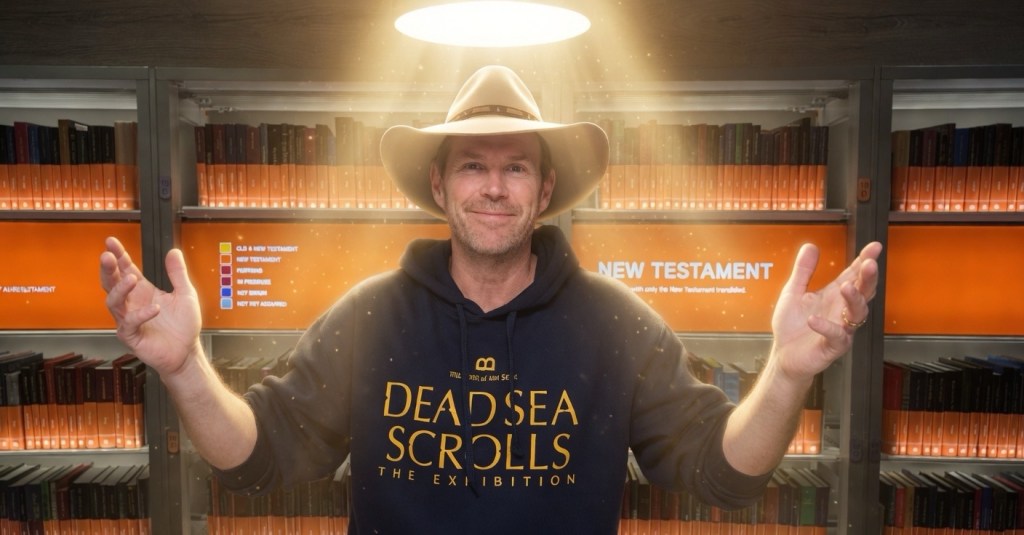
Rich Hoffman is an author, political consultant, and strategic advisor based in Cincinnati, Ohio, and the creator of The Politics of Heaven—a unique framework that connects biblical theology, ancient history, and modern power structures to explain how moral alignment and spiritual forces shape global events. Blending real-world political experience with deep research into archaeology, UFO phenomena, and suppressed historical narratives, Hoffman offers compelling commentary on topics ranging from ancient civilizations and the Dead Sea Scrolls to modern populist movements, paranormal continuity, and leadership strategy in chaotic environments. As the author of The Gunfighter’s Guide to Business and the forthcoming Politics of Heaven, he brings a grounded yet provocative voice to media discussions, supported by firsthand experiences and a cross-disciplinary approach that bridges science, history, and theology. For interviews, speaking engagements, or expert analysis, visit richhoffmanbooks.com or contact directly via phone at 513-307-5815 or email at rhoffman@richhoffmanbooks.com. If you’ve seen the movie, Disclosure Day and want to talk about it and the implications of Presidnet Trump’s UAP disclosures, let me know and we can bring some color to your coverage. https://richhoffmanbooks.com/media-inquiries-broadcast-topics-and-contact-info/?frame-nonce=ad51e7ecba I do have a firsthand UFO encounter to discuss.

