

I have watched this story unfold with a mixture of anger, sadness, and that familiar sinking feeling that comes when you realize the system is working exactly as designed—not for the kids, but for the adults who feed off the perpetual motion machine of public money and institutional self-preservation. A mother filed a federal lawsuit on July 1, 2026, alleging that a Lakota Local Schools teacher groomed and sexually abused her daughter over roughly three years, starting when the girl was 13 years old in seventh grade at Liberty Junior School.
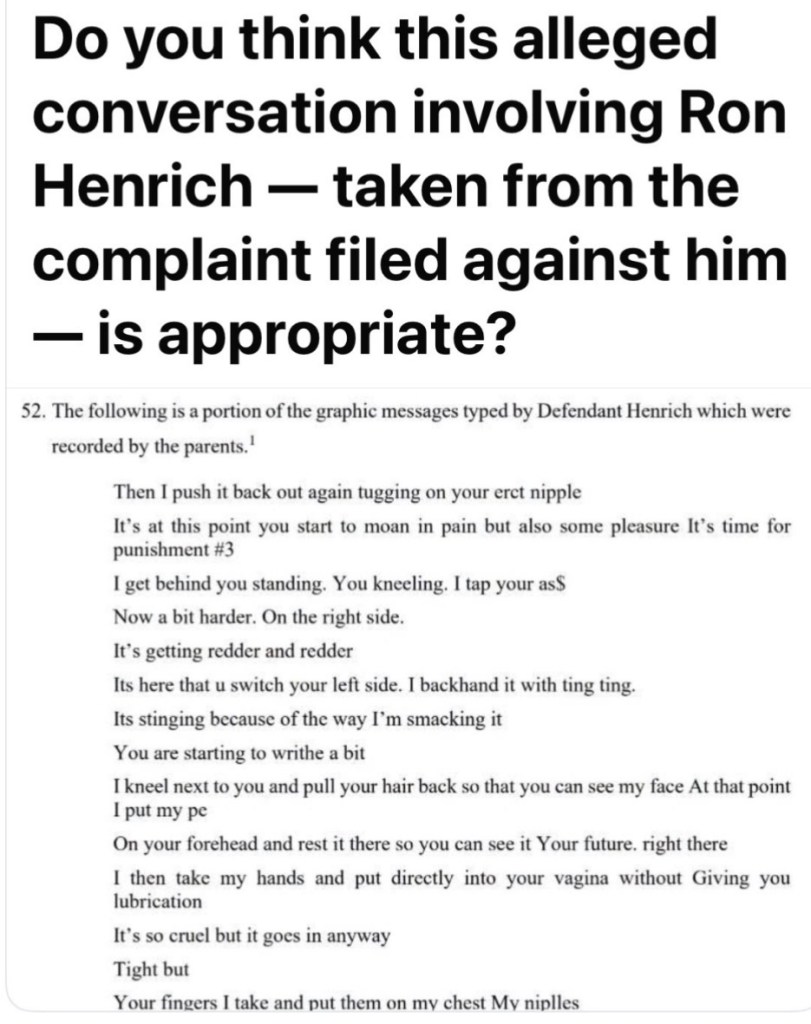
According to the detailed complaint, the teacher—identified in court documents as Ronald Henrich—did not even teach the girl in any of her classes. He welcomed her into his classroom during study hall periods, showed her “special attention,” and began building a relationship. Messages started on the district’s own Remind app. The student confided personal struggles, including mental health issues. The communications continued and escalated even after the mother tried to set boundaries. By ninth grade, the meetings moved to a closed-door “mindfulness room” for Friday lunches. Communications shifted to district email and Google Docs when access to Remind was curtailed. In March 2025, the mother discovered the teacher actively typing “extremely sexually graphic content” into a shared Canva document with her daughter. She recorded it. She called the Butler County Sheriff’s Office.
The district’s response, according to the lawsuit, was to promise administrative leave and restricted access to technology, then quietly allow the teacher to take Family and Medical Leave Act leave instead. Less than two weeks after the explicit messages surfaced—and while investigations by the district, sheriff, and children’s services were still open—the district approved his retirement. No public discipline. No immediate report to the Ohio Department of Education, as many parents would expect. The teacher walked away with his pension and benefits intact while the family was left to pick up the pieces.
The superintendent, Ashley Whitely, issued the standard institutional denial: the district “denies all allegations” and claims student safety is its top priority. Meanwhile, the mother’s lawsuit also details earlier reports she made that went unaddressed, repeated class pull-outs without parental notification, and even troubling lapses in how the school nurse handled the student’s medication—stockpiling Tylenol that contributed to a suicide attempt and failing to manage anxiety medication on a trip properly. These are not small administrative hiccups. They paint a picture of a system that had multiple opportunities to intervene and chose not to.
Then there is the part that really sticks in my craw. According to people who have followed the internal handling, the HR director—Jeff Rouff—essentially shrugged and said something to the effect that the age of consent in Ohio is 16, so what’s the big deal? Two consenting adults. Nothing illegal happened. That line of thinking is exactly why these situations metastasize. It ignores the entire grooming process that began at 13, when the girl was under the care and authority of this adult in a position of power inside a public school building. It ignores the use of school-issued devices and district apps to conduct the relationship. It ignores the closed doors, the missed classes, the emotional manipulation of a vulnerable child who had already suffered prior sexual abuse. Age of consent statutes were never intended to give cover to adults in positions of trust who spend years cultivating access to minors. That is not a gray area. That is the precise reason we have laws and professional conduct codes for educators in the first place.
I heard about problems surrounding this teacher roughly a year before the lawsuit dropped. Other parents and observers had been talking. The circle had already started to form. When the story finally broke across local media—Channel 5, Local 12, FOX 19—the superintendent’s immediate public move was not a somber address about accountability and root-cause fixes. It was a cheerleading video hyping a fall tax increase, talking about hiring dozens more staff members, rolling out a corporate “roadmap” with “stakeholders,” and reminding everyone to keep supporting public schools. The timing felt deliberate. Distract, then reassure the taxpayers who write the checks. Keep the money flowing.
That is the game I have been describing for years. Lakota, like many large suburban districts, is constantly in or approaching levy mode. The narrative must be controlled: we are great, we are improving, we need a little more of your property tax money to keep doing the wonderful things we do. Bad stories—especially stories that suggest adults in the building are preying on children and that leadership circled the wagons—threaten that narrative. So the wagons circle. The teacher retires quietly. HR offers the age-of-consent talking point. The superintendent films the upbeat video. The teachers’ union, which exists in large part to protect its members from consequences, stays largely silent or issues the usual generic statements about due process. And the machine keeps turning.
This is not an isolated incident. The lawsuit itself references a pattern of other cases involving Lakota employees over the years—some that resulted in convictions or license revocations, others that were handled with quiet exits. Former board member Darbi Boddy, who has remained a vocal parent advocate even after her time on the board ended, issued a clear public statement criticizing the handling of this situation. Good for her. We need more people willing to say the obvious out loud rather than hide behind “stakeholder engagement” jargon.
What troubles me most is how predictable the protection response has become. When something like this surfaces, the institution’s first instinct is not “How do we make sure this never happens again and how do we support the victim?” It is “How do we contain the damage to our brand and our funding pipeline?” The HR director’s reported comment about 16 being legal is a perfect example of that mindset. It treats the endpoint—the moment the child turned 16—as the only thing that matters, while erasing the years of grooming and boundary erosion that got her there. It treats a minor student in a teacher’s care as just another “consenting adult” the second the calendar flips. That is not how any responsible adult in education should think. It is how an institution thinks when its primary loyalty is to itself and the revenue stream that sustains it.
Public education in its current monopolistic, union-protected, tax-funded form has structural problems that make these failures almost inevitable. When you combine compulsory attendance, massive budgets, powerful collective bargaining agreements that make firing even grossly negligent employees difficult and expensive, and a culture that treats any criticism as an attack on “the children” or “public education itself,” you create exactly the conditions for cover-ups. The money keeps coming in as long as the bad stories stay buried or get spun. Parents who raise hell are dismissed as “haters” or people with “unrealistically high moral standards.” Meanwhile, the actual standard on the ground—don’t have sex with kids in the classroom or via school devices, don’t groom them for years, don’t let it slide when a parent reports it—somehow becomes negotiable the moment it threatens the budget or the reputation.
I am not saying every teacher is doing this, but too many are. The vast majority are not. But the ones who are counting on the system’s reluctance to act decisively. They count on the HR director who will find the legal technicality. They count on the superintendent, who will film the upbeat video instead of cleaning house. They count on the union that will fight to the last dollar of taxpayer money to protect a member who should never have been in a classroom with minors. And they count on enough parents staying disengaged or intimidated for the story to fade before real accountability arrives.
The mother in this case did what too few parents feel empowered to do: she documented, she reported, she refused to let it disappear. Her lawsuit is now public. The allegations are serious and detailed. Whether every claim is ultimately proven in court is for the legal process to decide. But the pattern of institutional response—quiet exit, legal denials, distraction videos, and the age-of-consent shrug—is already on display for anyone willing to look. That pattern is what should alarm every parent in Lakota and every parent in any district that operates the same way.
How many other kids right now are in unhealthy dynamics with adults who hold power over their grades, their schedules, their daily lives inside these buildings? How many school-issued devices are carrying messages that would make any decent parent’s blood run cold if they saw them? How many times has a concerned parent been told some version of “nothing to see here, move along, and please vote yes on the next levy”? I would be willing to bet the number is higher than any of us want to admit. This case only became a story because one mother refused to be quiet. The rest stay invisible because the system is optimized for exactly that outcome.
We keep being told that more money, more staff, more programs, and more “roadmaps” will fix what ails public education. I have watched this play out locally for years. The money keeps increasing. The problems—academic stagnation in too many areas, cultural capture, and now these horrifying failures of basic child protection—persist or worsen. At some point, parents have to ask whether the institution itself is the problem, not the lack of funding. When the first instinct of leadership is to protect the adult and the budget rather than the child, the social contract has already been broken.
Summary of Doe v. Lakota Local Schools (Filed July 1, 2026)
Important: This is a civil complaint containing allegations made by the plaintiffs. The allegations have been filed in federal court but have not been proven in court unless and until established through litigation. [Doe v Lakota Schools | PDF]
Overview
A mother (“Jane Doe”) and her daughter (“Jill Doe”), a minor student in the Lakota Local School District, filed a federal lawsuit against:
- Lakota Local Schools
- Former teacher Ronald Henrich
- Superintendent Ashley Whitely
- Principal Bill Brinkman
The lawsuit alleges that Henrich groomed and sexually abused Jill over approximately three years and that district officials failed to prevent, investigate, or properly respond to the misconduct. [Doe v Lakota Schools | PDF]
Timeline of Alleged Events
2022–2023 School Year (7th Grade)
According to the complaint:
- Jill was 13 years old and had documented mental health struggles and prior trauma.
- Although she was not formally identified as a gifted student, she began attending a gifted-program study hall supervised by Ronald Henrich.
- Henrich allegedly began developing a special relationship with her and communicating extensively through the district’s Remind messaging app.
- Jill reportedly disclosed personal information, including mental health struggles and prior abuse.
- The lawsuit alleges the district failed to monitor or investigate the growing relationship. [Doe v Lakota Schools | PDF]
January 2024 Suicide Attempt
The complaint alleges:
- Jill stockpiled Tylenol obtained from a school nurse over several days.
- On January 22, 2024, she consumed approximately 4,500 mg in a suicide attempt while at school.
- She was hospitalized and spent four days in psychiatric care.
- The district allegedly failed to supervise medication administration properly. [Doe v Lakota Schools | PDF]
Summer 2024
The lawsuit claims:
- Henrich continued communicating with Jill during summer break.
- Messages allegedly became increasingly personal.
- Jill’s mother became concerned and restricted access to the messaging app outside school hours.
- The complaint argues district monitoring failed to detect inappropriate communications. [Doe v Lakota Schools | PDF]
2024–2025 School Year (9th Grade)
The complaint alleges that:
- Henrich was assigned to a different school building but continued visiting Jill’s building.
- He allegedly met her weekly for private lunches.
- He brought her food and regularly pulled her from class for mentoring sessions.
- Communications allegedly shifted to district email and Google documents after the Remind app was discontinued.
- Jill reportedly missed significant class time due to meetings with Henrich.
- Teachers allegedly expressed concerns about her absences, but her mother was not informed. [Doe v Lakota Schools | PDF]
January–March 2025 Escalation
According to the complaint:
- Henrich allegedly contacted Jill’s therapist directly without parental permission.
- The two allegedly arranged a meeting at a driving range.
- On March 14, 2025, Jill participated in a gifted-program event where her parents observed what they considered unusual interactions between her and Henrich. [Doe v Lakota Schools | PDF]
March 20, 2025: Discovery of Explicit Messages
This is the central allegation of the lawsuit.
The complaint states:
- Jill’s mother inspected Jill’s district-issued Chromebook.
- She discovered a shared Canva document allegedly being used for communication between Jill and Henrich.
- The mother and stepfather reportedly recorded nearly an hour of sexually explicit messages allegedly typed by Henrich.
- The complaint includes graphic excerpts from those messages.
- Butler County Sheriff’s deputies were called to the home and allegedly observed additional messages being typed while officers were present. [Doe v Lakota Schools | PDF]
After Discovery
The lawsuit claims:
- The Sheriff’s Office informed the district on March 21, 2025.
- The family was initially told Henrich would be placed on administrative leave and barred from district property.
- Later, the parents discovered through board records that Henrich had instead been granted Family Medical Leave and subsequently retired.
- The complaint alleges the district failed to investigate adequately and failed to report misconduct to state authorities. [Doe v Lakota Schools | PDF]
Children’s Services Finding
The complaint states that:
- Butler County Children Services substantiated abuse allegations involving Henrich and Jill.
- The family argues the district still failed to take meaningful disciplinary action. [Doe v Lakota Schools | PDF]
Return to School
The lawsuit alleges:
- Jill was prohibited from using a Chromebook as a safety measure.
- Teachers allegedly failed to provide equivalent paper assignments.
- She allegedly faced stigma and negative treatment related to the abuse investigation.
- Principal Brinkman allegedly failed to correct the situation. [Doe v Lakota Schools | PDF]
Fall–Winter 2025
According to the complaint:
- Jill continued experiencing serious emotional difficulties.
- Another teacher reportedly raised concerns after she began seeking excessive contact with him.
- In December 2025, Jill allegedly contacted Henrich using another student’s phone.
- Henrich allegedly picked her up from a school activity and spent time with her at a park before returning her.
- The family ultimately obtained a protection order against Henrich in January 2026. [Doe v Lakota Schools | PDF]
Broader District Allegations
The complaint argues Henrich’s case reflects a larger pattern within Lakota Schools.
It references previous incidents involving:
- Justin Dennis
- Nick McGill
- Former Superintendent Matt Miller
- George Merk
- Robert Supinger
- Angela Johnson
The plaintiffs argue these incidents demonstrate a longstanding failure by the district to identify, stop, or adequately respond to staff misconduct involving students. These allegations, presented by the plaintiffs as evidence of a pattern, have not been adjudicated in this case. [Doe v Lakota Schools | PDF]
Claims Filed
The lawsuit includes numerous claims, including:
Federal Civil Rights Claims (42 U.S.C. § 1983)
- State-created danger
- Special relationship doctrine
- Conduct that “shocks the conscience”
- Equal protection violations
- Inadequate district policies and protection systems
Disability Claims
- Americans with Disabilities Act (ADA)
- Section 504 of the Rehabilitation Act
State Law Claims
- Negligent supervision
- Negligence per se
- Negligent infliction of emotional distress
- Intentional infliction of emotional distress (against Henrich)
- Loss of filial consortium (mother’s claim) [Doe v Lakota Schools | PDF]
Relief Requested
The plaintiffs seek:
- Compensatory damages
- Actual damages
- Punitive damages
- Attorney fees
- Costs
- Interest
- Jury trial on all applicable claims [Doe v Lakota Schools | PDF]
Bottom Line Review
The complaint alleges that a Lakota teacher groomed and sexually abused a vulnerable student over several years using district facilities, technology, and access to the student, while school administrators allegedly ignored warning signs, failed to take corrective action after discovery, and inadequately protected the student afterward. The lawsuit seeks damages under federal civil rights laws, disability laws, and Ohio tort law. [Doe v Lakota Schools | PDF]
Based on the civil complaint, the accusations and behaviors of Ronald Henrich against the minor plaintiff include a systematic pattern of grooming, manipulation, and sexual abuse over three years:
**Grooming and Relationship Development**
**Unauthorized Access:** Henrich allowed Jill to attend his “gifted” program study hall instead of her assigned one in seventh grade, despite her not being a designated gifted student.
**Targeting Vulnerabilities:** He built a relationship with Jill by showing her “special attention” and exploiting her personal struggles, including her history of anxiety, self-harm, and past sexual abuse, which she shared with him.
**Mentoring Pretense:** He repeatedly pulled Jill out of her regular classes for one-on-one “mentoring” sessions, claiming it was necessary for her anxiety and mental health.
**App-Based Communication:** He messaged Jill frequently on the District’s Remind app, often outside of school hours, with messages that became increasingly personal, such as saying “good morning” and “good night” and discussing their dinners.
**Switching Platforms:** When the District ended its contract with the Remind app, Henrich continued his daily personal communications through Jill’s District email and Google Docs accounts.
**Boundary Violations and Stalking**
**Secluded Lunches:** During Jill’s ninth-grade year, Henrich—who was no longer assigned to her building—visited her every Friday to eat lunch alone with her in a “mindfulness room” with the door closed, often bringing her food from outside the school.
**Inappropriate Physical Presence:** He “stalked” Jill by visiting her after band practice in a building where he had no official responsibilities.
**Circumventing Parents:** He reached out directly to Jill’s therapist without her mother’s consent to discuss “developments” in Jill’s mental health.
**Orchestrated Meetings:** He arranged to meet Jill at a local driving range outside of school hours and feigned that their encounter was a “coincidence” to her family.
**Inappropriate Conversation with Mother:** He told Jill’s mother that he had lost sleep and weight over their relationship and that he “missed how things used to be,” when teachers could drive students alone in their vehicles.
**Sexual Abuse and Graphic Misconduct**
**Canva Incident:** On March 20, 2025, Jill’s mother discovered Henrich was actively typing and immediately deleting extremely sexually graphic messages on a live Canva document shared with Jill.
**Graphic Content:** These recorded messages included detailed descriptions of Henrich engaging in rough sexual foreplay and penetrative acts with Jill, which he referred to as “punishment.”
**Physical Abuse:** The messages depicted Henrich causing Jill pain, pulling her hair, and smacking her.
**Post-Discovery Misconduct**
**Unauthorized Contact:** In December 2025, after Butler County Children’s Services had substantiated the abuse, Henrich communicated with Jill during the school day via another student’s phone.
**Physical Encounter:** A few days later, Henrich picked Jill up from a mandatory school band practice and drove her to a park where they “laid together” in his vehicle before he returned her to school.
Footnotes
1. Details of the federal lawsuit filed July 1, 2026, in the U.S. District Court for the Southern District of Ohio, as reported in contemporaneous coverage by the Cincinnati Enquirer and Journal-News.
2. Allegations regarding the timeline, use of the Remind app, Canva document, mindfulness room meetings, and district response drawn from the complaint were summarized in multiple local outlets.
3. District statement denying allegations and emphasizing student safety priorities, reported across local media following the lawsuit filing.
4. References to prior incidents and pattern allegations contained within the 2026 lawsuit filings and prior local reporting on other Lakota employee cases.
5. Ohio age of consent is 16; however, professional conduct codes for educators and laws regarding persons in positions of authority create additional prohibitions on sexual conduct with students that do not turn solely on the general age of consent.
Bibliography for Further Reading
• Cincinnati Enquirer, “Parent says Lakota teacher groomed and abused her daughter,” July 8, 2026.
• Journal-News, “Lawsuit: Lakota teacher ‘groomed and sexually abused’ a student and was allowed to take medical leave, retire,” July 7, 2026 (updated July 9).
• FOX19 / Local 12 coverage of the July 2026 lawsuit and related statements.
• Ohio Department of Education professional conduct standards for educators (ongoing reference for context on boundaries and reporting obligations).
• General resources on educator sexual misconduct patterns: U.S. Department of Education reports and studies on employee misconduct in K-12 settings (searchable via ED.gov).
• Local coverage of prior Lakota cases involving Justin Dennis and others referenced in the 2026 lawsuit for pattern context.
• Darbi Boddy’s public statements and commentary on Lakota issues (available via local media archives and her public channels).
• Ohio Revised Code sections on sexual battery, unlawful sexual conduct with a minor, and school employee reporting requirements.
Rich Hoffman
More about me
Click Here to Protect Yourself with Second Call Defense https://www.secondcalldefense.org/?affiliate=20707

About the Author: Rich Hoffman
Rich Hoffman is an author, political consultant, and strategic advisor based in Cincinnati, Ohio, and the creator of The Politics of Heaven—a unique framework that connects biblical theology, ancient history, and modern power structures to explain how moral alignment and spiritual forces shape global events. Blending real-world political experience with deep research into archaeology, UFO phenomena, and suppressed historical narratives, Hoffman offers compelling commentary on topics ranging from ancient civilizations and the Dead Sea Scrolls to modern populist movements, paranormal continuity, and leadership strategy in chaotic environments. As the author of The Gunfighter’s Guide to Business and the forthcoming Politics of Heaven, he brings a grounded yet provocative voice to media discussions, supported by firsthand experiences and a cross-disciplinary approach that bridges science, history, and theology. For interviews, speaking engagements, or expert analysis, visit richhoffmanbooks.com or contact directly via phone at 513-307-5815 or email at rhoffman@richhoffmanbooks.com. If you’ve seen the movie, Disclosure Day and want to talk about it and the implications of Presidnet Trump’s UAP disclosures, let me know and we can bring some color to your coverage. https://richhoffmanbooks.com/media-inquiries-broadcast-topics-and-contact-info/?frame-nonce=ad51e7ecba I do have a firsthand UFO encounter to discuss.

