

I have been watching Turkey for a long time. Not as a tourist with a lanyard. As a man who loves biblical archaeology, loves the people who actually put a trowel in the ground, and does not love the way the field gets fenced. Turkey is producing more ancient material right now than most Western newsrooms know how to hold. Mount Ararat sits on the edge of that pile. South of it, in Ağrı Province near Doğubayazıt, there is a boat-shaped ridge about 515 feet long that has looked like Noah’s Ark from the air since 1959.[1] For decades the respectable answer was simple: it is a rock. In 2026 that answer is finally being put under a drill bit. I do not need the lab to finish before I am allowed to talk. I need the paycheck question asked out loud, because that is usually the lock on the gate.
FOLLOW THE CHECK, THEN FOLLOW THE DIRT
I am a fan of biblical studies. I am a fan of changing the way archaeologists get paid. That is not a side remark. That is the argument.
I have seen the field raw. I love a lot of the people in it. I also know they are controlled, often dramatically, in what they can say if they want to be published, promoted, and invited back next season. If a result smells too biblical, the gatekeepers get a rash. If a government figures out that a mound can sell tickets, the rash clears up. That is not mysticism. That is payroll.[2]
I say the same thing when people talk conspiracy. Do not start with the archaeologist’s personality. Start with who signs the check. People tend to say what they are paid to be allowed to say. When the funding comes from institutions with strong academic gatekeeping, anything that looks like Genesis gets parked in the “folklore” lot. When the funding starts to look like tourism, the same site suddenly deserves radar, cores, and a press conference.[3]
I want fortune and glory for the diggers. I mean that. I want them rich from books and discoveries. I want them famous for being right. I do not want them turned into England.
ENGLAND IS THE WARNING LABEL
I know a good deal about England. I have a son-in-law who is a dual citizen. He married my daughter. He is an American citizen now. He still goes back and forth. I have been there. I have done business there. I like a lot of the people. I like the humor. Monty Python comes to mind. I like Stonehenge. I like a lot of English archaeology very much.[4]
I do not like the posture. A lot of that culture likes a keeper. They want a kindly authority to tell them the rules of the week. Americans, at their best, do not love rulers. The English appetite for a digital ID, a chip in the workflow, a “right to work” that runs through a central system, is the same appetite that makes a scholar wait for permission to say what the dirt already said.[5]
They tried to push a harder version of that during COVID. They have kept pushing digital verification around employment. The politics shifted in 2026. A national mandatory “BritCard” scheme got announced, diluted, and then, under a later Labour government, cancelled as a single national program. The digital right-to-work machinery did not vanish with the slogan. Employers still have to prove status. The paperwork just put on a nicer shirt.[6]
Here is why I drag England into an essay about a boat on a Turkish ridge. Managed economies love a workforce that kneels for a paycheck. Chinese-style social credit is the clean version of the dream: you work if the system says you may work. Archaeology already runs a softer version of that dream. Publish the approved story or starve. I do not want the dirt community to become that. The way you beat it is not always a march on the ministry. The way you beat it is a competitive model. Tourism. Books. Independent labs. Audiences that will pay to see the thing the committee would rather leave unnamed. Money that does not need the old permission slip.[7]
TURKEY LEARNED WHAT ROSWELL LEARNED
Turkey has spent years fighting a reputation problem that is not only about dirt. Radical politics. Security headlines. A country that Western travelers used to skip. Then Göbekli Tepe broke the spell.
Since UNESCO listed Göbekli Tepe in 2018, the site has drawn about 4.4 million visitors over eight years. Officials in Şanlıurfa are talking about a million visitors in 2026 alone. They are widening roads and walkways because the mound cannot hold the crowd on the old path. Stonehenge still beats it on raw annual fame, but Göbekli Tepe is no longer a specialist’s secret. It is an industry.[8]
That is the tell. The stones were always there. Klaus Schmidt and the German team made them famous. The Turkish state then learned what Roswell learned after the jobs left and the town became a husk: a mystery that draws a ticket line can feed a region that ideology starved. Cappadocia already knew it. Underground cities. Tunnels. Cave churches. The Derinkuyu complex alone is a tourist engine. Shipwrecks off the Turkish coast, the Uluburun wreck with its Bronze Age copper and tin, already proved that early sailors were not paddling toy boats.[9]
I have been saying the same thing about dolmens in the Jordan Valley, up past Mount Hermon, and on into the high country that touches Turkey. The landscape is not empty. It is stacked. 5,000 years ago, 10,000 years ago, this belt of the world was not a waiting room for Greece and Rome. We are only now being allowed to notice because noticing pays.[10]
THE RIDGE THAT WOULD NOT SHUT UP
Capt. İlhan Durupınar spotted the boat-shaped formation on a Turkish Air Force aerial photo in 1959. It sits roughly nineteen miles south of Mount Ararat, about 157 meters long, close to the 300 cubits in Genesis if you use a common cubit. Ron Wyatt made it famous in the 1980s. Drilling happened in 1988. Then the site went back to being a punchline. “Natural rock. Stop bothering us.”[11]
I have been to the idea of the boat even if I am writing this from Ohio. The Ark Encounter in Williamstown, Kentucky, is a wonderful exhibit. It is well done. It gives a body a scale the Sunday-school flannelgraph never could. A vessel in that class is not a canoe. I do not find it strange that a man in the deep past could build something that size. I find it strange that modern people think competence was invented in 1850.[12]
We are talking about a world before the Bronze Age as we usually teach it, or on the doorstep of it, depending which flood chronology you use. Five thousand years ago. Seven thousand. The Bible is catching a memory that is older than our textbooks are comfortable admitting. Most wood dies in that kind of time. Turkey is one of the few places where a large wooden thing, if it were mineralized or buried in the right muck, might still leave a chemical ghost.[13]
WHAT 2026 ACTUALLY PRODUCED
This is the part the internet is yelling about, so I am going to keep the facts tighter than the headlines.
In late June 2026, Prof. Dr. Cenker Atila of Sivas Cumhuriyet University opened a permitted field season at Durupınar with an international team of roughly twenty people from five countries. They worked about ninety days. They mapped the ridge in two and three dimensions. They ran ground-penetrating radar and electrical surveys. They collected something like a thousand soil samples from about 150 spots. They took cores and sent them to Ankara. They reported pottery fragments. They have not published a date on the pottery. Some stories said “possible pre-flood.” That is a hope sentence, not a lab sentence.[14]
The radar claims are the ones that moved the needle. The team and its partners reported angular anomalies, right-angle features, a corridor-like void running tens of meters along the long axis, layered shapes some of them are willing to call decks, and tunnel-like cavities a few meters down. Dr. Khosrow Bakhtar deployed BakhtarRadar, a system with a U.S. Air Force EarthRadar pedigree built to find tunnels and buried structure, not to decorate a creationist brochure. His public point was blunt: the old skeptic line that the ridge is just solid rock is the thing being tested.[15]
Soil chemistry is the second needle. Atila has said carbon levels inside the formation ran about 40 percent higher than samples taken outside it, with other differences in organic content, potassium, and pH that you would expect if something that used to be alive had rotted in place. That is not a hull. That is a smell. Smells are how you decide where to drill.[16]
Then the drill bit broke.
In September 2026, core drilling started for the first time since 1988. Noah’s Ark Scans and the university team reported that in one hole, four to five meters down, the bit hit a layer hard enough to shatter the tooling. They said petrified wood or highly mineralized wood is a possibility they want a third-party lab to test. They also said they intend to put a small drone into mapped voids. Winter lab work is supposed to cover organic content, mineralogy, microscopy. Atila has talked about a public scientific statement after the lab finishes. More seasons are already being planned for 2027.[17]
I want to be precise, because precision is how you keep from becoming the guy the gatekeepers are waiting to mock. Nobody has pulled a named plank with Noah’s chisel mark on it. The lead archaeologist has said the data increase the possibility day by day. Skeptics, including some creationists who prefer other ridges on Ararat itself, still call Durupınar a mudslide that learned a boat impression. IFLScience published a scold on September 25, 2026, two days before I am writing this, saying researchers have not found the Ark and that enthusiasts are flogging a dead horse. Fine. Let the horse’s bones go to Ankara. That is what a lab is for.[18]
PETRIFIED WOOD IS THE QUESTION THAT MATTERS THIS WINTER
If the cores come back as ordinary rock, the boat shape remains a boat shape and the tourism office still has a ridge. If the cores come back as petrified or worked wood in the right places, at the right depths, with the right angles sitting over them, then a lot of comfortable lectures have to be rewritten in public.
I think there is more truth in the old story than the modern faculty lounge can stand. I do not think Noah was the only man on earth who ever built a large hull. I think large boats were more common than the textbook allows, and that most of the wood is gone, which is why the textbook looks so clean. Turkey has already given us wrecks with bronze and copper that should have embarrassed the “they only hugged the coastline” sermon. A mineralized hull on a slope below Ararat would not be an insult to science. It would be science finally catching a memory the text never dropped.[19]
GÖBEKLİ TEPE WAS THE REHEARSAL
People who have heard me talk about Göbekli Tepe know why I keep putting it next to the Ark ridge. The official story of human beginnings liked a slow farmer who eventually got around to religion. Göbekli Tepe is a 12,000-year-old ritual machine with T-shaped pillars measured in tons, carved animals, and a construction culture that was not supposed to exist yet. The controversy never really died. It just got a ticket booth.[20]
Once Turkey understood that “zero point of history” sells rooms in Şanlıurfa, the Taş Tepeler landscape around it started getting roads. Karahantepe. The wider Neolithic belt. The same state that can be heavy-handed in other files became suddenly curious. That is not a conversion. That is an education by cash register. I would rather have a curious state than a silent one.[21]
The same pattern is sitting on Durupınar. The formation was always on the tongue. New instruments made it louder. Tourism made it speakable. If you want to stop the old suppression, you do not have to win a faculty vote. You make the silence expensive.
CAPPADOCIA, TUNNELS, AND THE SHIPS THEY SAID COULD NOT EXIST
Cappadocia’s underground cities still feel like a prank the earth played on a committee. Whole communities under the basalt. Storage. Churches. Air shafts. You can call it refuge architecture. You can call it a civilization that knew the surface was not always friendly. Either way, it is not a myth, because you can walk it.[22]
The wrecks off the Turkish coast do the same work for boats. Uluburun, dated to the late fourteenth century B.C., carried copper ingots, tin, glass, and a cargo list that looks like a trade network, not a fisherman’s accident. When people tell me early humans could not have built anything in Noah’s class, I point at the metal and ask them to explain the smaller miracle first.[23]
I am a proponent of the plain idea that people built boats bigger, earlier, and farther than the approved timeline. Wood vanishes. Stone lies. Metal sometimes survives. Chemistry sometimes remembers. Radar sometimes finds a right angle in a place the mudslide story did not budget for.
WHAT I THINK THE LAB WILL FORCE US TO SAY
I do not run Atila’s lab. I am not going to baptize a press release. I will say what I think, because that is the job of a man who writes under his own name.
I think a serious fraction of that ridge is going to come back as organic, mineralized, or both. I think “just a rock” is going to look sloppier in 2027 than it did in 1988. I think the pottery will turn out to be human presence on a landscape that already had a story, not a magic proof by itself. I think the right angles will keep the argument alive even if some of them resolve into geology. And I think the important civilizational fact will not be “we found the one boat.” It will be “large construction in that age was not an anomaly.”[24]
If the Bible only ever caught a hint of a much longer truth, that is still a hint with better staying power than most peer-reviewed fashions. Texts that survive five millennia are not accidents. They are technologies of memory. Archaeology at its best is the recovery of the hardware those memories were pointing at.[25]
FORTUNE AND GLORY, NOT A CHIP
I want archaeologists paid like people who found something. Not like clerks. Fortune and glory is not a cartoon line to me. It is the opposite of the English model I do not want exported into the dirt. If the only way you eat is to please the committee, you will not find an ark even if you are standing on the deck. If the public will buy the book, walk the ridge, and fund a lab that does not need a bishop or a dean to bless the result, the silence breaks.
That is also how you fight the larger politics. Centralized systems love a limited workforce. They love a chip. They love a right-to-work switch. Automation then arrives to finish the job the policy started, because a frightened labor pool and a permission culture do not compete well on a global stage. Tourism is crude. It is also one of the few forces that has repeatedly forced closed countries and closed faculties to open a gate they would rather keep locked.[26]
THE POLITICS OF HEAVEN IS NOT A SIDE HOBBY
I keep saying it because it is the frame, not the bumper sticker. In the age of disclosure you must understand the politics of heaven. A flood story is not only meteorology. A boat on a mountain is not only a tourist photo. If the old world had a rupture, and if memory of that rupture was stored in Genesis, then the fight over whether the ridge may be mentioned in polite company is not a geology quarrel. It is a jurisdiction quarrel. Who gets to say what the deep past contains. Who gets to keep the human race smaller than the text says we were.[27]
Disclosure, in the popular sense, is usually aimed at the sky. Fine. Start with the ground. Turkey is coughing up temples older than the agriculture story, cities under the rock, wrecks full of metal, and now a boat-shaped ridge with a broken drill bit and a carbon spike. The sky will still be there after the cores come back from Ankara.
NOTES FOR LEADERS
If you run a company, a church, a school, or a town, do not wait for a faculty to tell you when a fact has become respectable.
Do not sneer at tourism. Tourism is often the only leverage a buried truth gets.
Do not confuse a headline with a hull. Demand the lab. Then do not let the lab hide.
Do not pretend early people were stupid. That conceit is how modern managers excuse their own smallness.
Do not attack only the archaeologist. Ask who signed the check.
Do not copy England’s posture and call it seriousness. A culture that wants a keeper will always find a reason to leave the boat in the mud.
If you ever read my book The Gunfighter’s Guide to Business, you already know how I think about permission cultures. The dirt is the same fight with older dust.[28]
We will know more when Ankara speaks. I can live with waiting for chemistry. I cannot live with waiting for permission.
FOOTNOTES
[1] The Durupınar Formation is a boat-shaped landform near Doğubayazıt in Ağrı Province, eastern Türkiye, about 19 miles south of Mount Ararat / Ağrı Dağı. Length commonly given as 157 meters / 515 feet. Identified on aerial imagery in 1959 by Capt. İlhan Durupınar.
[2] On academic gatekeeping and the difficulty of publishing explicitly biblical interpretations in mainstream journals, see the long-running tension documented in biblical archaeology magazines and in critiques of “minimalist” versus “maximalist” schools. The paycheck point is the author’s operational claim, not a claim that every archaeologist is dishonest.
[3] Noah’s Ark Scans, the California-linked project working with Turkish partners at Durupınar, also operates paid site visits. Tourism and research are braided at the ridge the same way they are braided at Göbekli Tepe and Roswell.
[4] Stonehenge visitor figures commonly run in the low millions over multi-year counts; English Heritage has reported on the order of 1.5 million visits in strong years. The comparison in the essay is scale and brand, not a claim that Durupınar already matches that traffic.
[5] UK digital identity and right-to-work policy, 2025–2026: Prime Minister Keir Starmer announced a digital ID scheme on 26 September 2025, initially framed as mandatory for proving the right to work. The mandatory single-card version was later diluted. See House of Commons Library briefing CBP-10369.
[6] In July 2026 the subsequent Burnham Labour government cancelled the national Digital ID programme as proposed. Digital right-to-work checks through certified Digital Verification Services and the Home Office online service continued to expand, with a new code of practice associated with 1 October 2026. Cancellation of a branded national card is not the same thing as cancellation of digital employment control.
[7] The competitive-model argument is the author’s: centralized permission cultures lose to open ticket lines, independent publication, and labs that can be paid without a ministry’s blessing.
[8] Daily Sabah and Anadolu Agency, July 2026: Göbeklitepe drew 4,409,590 visitors in the eight years after UNESCO listing in July 2018. Şanlıurfa Tourism Development Association head Mehmet Kamil Türkmen cited more than 320,000 visitors in the first half of 2026 and a path toward roughly one million for the year. Roads and walkways were being expanded in summer 2026.
[9] Uluburun shipwreck, discovered off Kaş, Türkiye, in 1982; late Bronze Age cargo including copper and tin ingots. Cappadocia underground settlements, including Derinkuyu, are open archaeological-tourist sites under the Turkish Ministry of Culture and Tourism.
[10] Dolmen fields in the Jordan Valley and southern Levant, and the ritual/high-place landscape around Mount Hermon, are part of the author’s running map of pre-classical sacred geography. See also Michael S. Heiser, The Unseen Realm (2015), on the Hermon tradition.
[11] Durupınar research history: Wyatt expeditions in the 1980s; 1988 drilling; later ground-penetrating radar and soil work by associated teams in 2019, 2021, 2022, and 2024 before the 2026 university-led season.
[12] Ark Encounter, Williamstown, Kentucky, opened 2016 by Answers in Genesis. The wooden reconstruction is 510 feet long, built to a 51-centimeter cubit reading of Genesis 6:15.
[13] Genesis 6–9; 2 Peter 2:5; Hebrews 11:7. Chronologies differ. Ussher-style readings cluster the Flood in the third millennium B.C. Other conservative readings push earlier. The essay does not pretend those clocks agree. It insists the memory is older than Bronze Age textbooks.
[14] 2026 Durupınar season: Prof. Dr. Cenker Atila, Archaeology Department, Sivas Cumhuriyet University; fieldwork beginning late June 2026; about 20 participants from five countries; approximately 90 days; roughly 1,000 soil samples from about 150 locations; cores to Ankara; pottery fragments reported in late September 2026 without a published date. Rector Prof. Dr. Ahmet Şengönül publicly supported the project.
[15] August 2026 BakhtarRadar deployment by Dr. Khosrow Bakhtar, Bakhtar Research and Engineering, with Noah’s Ark Scans. Reported features have included angular structures to about six meters, a central corridor on the order of 70 meters, tunnel-like voids, and right-angle anomalies. These are geophysical interpretations pending physical confirmation.
[16] Atila, quoted in Arkeonews and university-linked reporting, August–September 2026: interior carbon about 40 percent higher than exterior samples; organic matter, potassium, and pH differences treated as leads, not as a completed identification of timber.
[17] Noah’s Ark Scans / GlobeNewswire, 23 September 2026: core drilling begun; bit shattered on a hard layer about 4–5 meters down in one interior hole; petrified or highly mineralized wood listed as a possibility for third-party testing; drone inspection of mapped voids planned; laboratory suite to include organic content, mineralogy, and microscopy; additional seasons planned for 2027.
[18] IFLScience, “No, Researchers Haven’t Found ‘Noah’s Ark’ Near Mount Ararat In Eastern Turkey,” 25 September 2026. The piece notes tour pricing associated with Noah’s Ark Scans and the long geologic counter-argument that Durupınar is a natural formation. Fair warning. Not a lab result.
[19] On early seafaring and large hulls, see the Uluburun corpus and the broader literature on prehistoric navigation in the eastern Mediterranean and Black Sea. The author’s claim is capacity, not a completed identification of Durupınar as the Genesis vessel.
[20] Klaus Schmidt, Göbekli Tepe: A Stone Age Sanctuary in South-Eastern Anatolia (exh. and site literature). Monumental T-pillars, 3–6 meters, enclosures dated to the Pre-Pottery Neolithic, roughly the 10th–9th millennium B.C.
[21] Taş Tepeler (“Stone Mounds”) is the Turkish umbrella for the wider Şanlıurfa Neolithic landscape, including Karahantepe. 2019 was declared the Year of Göbeklitepe by President Recep Tayyip Erdoğan.
[22] Derinkuyu Underground City and the wider Cappadocia tunnel-and-refuge systems. Ministry visitor figures during 2026 holiday periods put related Cappadocia sites in the tens of thousands per short window.
[23] Cemal Pulak and the Institute of Nautical Archaeology publications on Uluburun. Copper from Cyprus, tin likely from distant sources, a cargo that implies organized long-range exchange.
[24] Atila has said organic remains and carbon dating of those remains will decide whether “there really is a ship here.” That is the correct sentence. Radar is a map. Chemistry is a verdict.
[25] On Scripture as durable cultural memory rather than late fiction, see the maximalist stream in biblical archaeology and the author’s forthcoming The Politics of Heaven.
[26] The England comparison is analogical: permission-to-work systems and permission-to-publish systems both shrink the labor of truth. Automation then harvests the gap.
[27] Rich Hoffman, The Politics of Heaven (forthcoming). Working essays at richhoffmanbooks.com and overmanwarrior.wordpress.com.
[28] Rich Hoffman, The Gunfighter’s Guide to Business.
BIBLIOGRAPHY AND FURTHER READING
The Site and the 2026 Season
Atila, Cenker, and Sivas Cumhuriyet University communications on the 2026 Durupınar field season. Ağrı Province / Doğubayazıt. June–September 2026. Bakhtar, Khosrow. BakhtarRadar / EarthRadar deployment reports and August 18, 2026 GlobeNewswire release with Noah’s Ark Scans. Noah’s Ark Scans. “Core Drilling Begins at Durupinar Noah’s Ark Site, Drill Bit Shatters on Possible Layer of Petrified Wood.” GlobeNewswire, September 23, 2026. Arkeonews. “Radar Finds Right-Angled Anomalies Beneath Türkiye’s Famous ‘Noah’s Ark’ Formation.” August 29, 2026. Arkeonews. “Noah’s Ark Mystery Deepens as New Discoveries Emerge Near Mount Ararat.” September 23, 2026. Türkiye Today. “Possible pre-Flood pottery uncovered during Noah’s Ark search on Mount Agri.” September 24, 2026. Anatolian Archaeology. “Pottery Found at Türkiye’s Mysterious ‘Noah’s Ark’ Formation.” September 23, 2026. Ancientist. “Pottery Found During New Search at Türkiye’s ‘Noah’s Ark’ Formation.” September 23, 2026. Ancientist. “Radar Built to Find Military Tunnels Tests Turkey’s Noah’s Ark-Shaped Formation.” August 30, 2026. Living Passages. “Was Noah’s Ark Found at Durupinar? What the 2026 Scans Test.” Updated September 22, 2026. Ancient Content. “Drilling at Durupınar for the First Time Since 1988.” September 23, 2026. IFLScience. “No, Researchers Haven’t Found ‘Noah’s Ark’ Near Mount Ararat In Eastern Turkey.” September 25, 2026. Gadget Review. “Scientists Scanned the ‘Noah’s Ark’ Formation — and Found Impossible Right-Angle Structures.” September 2026.
Bible, Flood Memory, and the Boat
The Holy Bible. Genesis 6–9; 2 Peter 2:5; Hebrews 11:7. KJV / NKJV. Beale, G. K. The Temple and the Church’s Mission. Downers Grove, IL: IVP Academic, 2004. Heiser, Michael S. The Unseen Realm. Bellingham, WA: Lexham Press, 2015. Heiser, Michael S. Reversing Hermon. Crane, MO: Defender, 2017. Snelling, Andrew. Earth’s Catastrophic Past. Dallas: Institute for Creation Research, 2009. Whitcomb, John C., and Henry M. Morris. The Genesis Flood. Philadelphia: Presbyterian and Reformed, 1961. Ark Encounter / Answers in Genesis. Site literature, Williamstown, Kentucky.
Göbekli Tepe, Taş Tepeler, and Turkish Tourism
Schmidt, Klaus. Göbekli Tepe site reports and popular synthesis. Daily Sabah / Anadolu Agency. “Göbeklitepe draws 4.4M visitors in 8 years since UNESCO listing.” July 2026. Türkiye Today. “Gobeklitepe expands roads, visitor routes as annual traffic nears 1M.” August 2026. Anatolian Archaeology. “Göbeklitepe Expands Routes for Nearly One Million Visitors.” August 2026. UNESCO World Heritage Centre. Göbekli Tepe listing, 2018. Şanlıurfa Tourism Development Association public comments, 2026.
Ships, Metal, Caves, and the Older World
Bass, George F., and Cemal Pulak. Uluburun and Institute of Nautical Archaeology publications. Pulak, Cemal. Papers on the Uluburun copper and tin cargo. Ministry of Culture and Tourism of Türkiye. Cappadocia and Derinkuyu visitor materials. Joffe, Alexander H., and regional surveys on Levantine dolmens.
Paychecks, Permission Cultures, and Digital Control
House of Commons Library. “Digital ID in the UK.” CBP-10369. Updated 2026. The Immigration (Restrictions on Employment and Residential Accommodation) Regulations 2026, U.K. S.I. 2026/700. New York Times. “U.K. Retreats on Plan to Require ‘BritCard’ ID for Workers.” January 14, 2026. Data Use and Access Act 2025, U.K., Part 2, digital verification services.
Disclosure, Archaeology, and the Author’s Frame
Farah, Dan, dir. The Age of Disclosure. 2025. Keel, John A. The Mothman Prophecies. 1975. Vallée, Jacques. Passport to Magonia. 1969. Hoffman, Rich. The Gunfighter’s Guide to Businessusiness. Hoffman, Rich. The Politics of Heaven. Forthcoming. Hoffman, Rich. OvermanWarrior
Rich Hoffman
More about me
Click Here to Protect Yourself with Second Call Defense https://www.secondcalldefense.org/?affiliate=20707
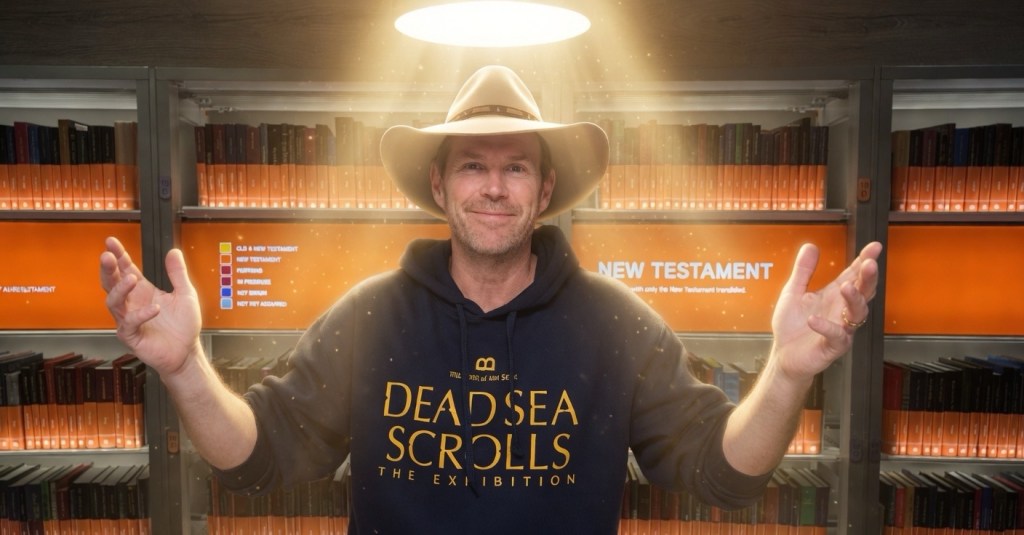
About the Author: Rich Hoffman
Rich Hoffman is an author, political consultant, and strategic advisor based in Cincinnati, Ohio, and the creator of The Politics of Heaven—a unique framework that connects biblical theology, ancient history, and modern power structures to explain how moral alignment and spiritual forces shape global events. Blending real-world political experience with deep research into archaeology, UFO phenomena, and suppressed historical narratives, Hoffman offers compelling commentary on topics ranging from ancient civilizations and the Dead Sea Scrolls to modern populist movements, paranormal continuity, and leadership strategy in chaotic environments. As the author of The Gunfighter’s Guide to Business and the forthcoming Politics of Heaven, he brings a grounded yet provocative voice to media discussions, supported by firsthand experiences and a cross-disciplinary approach that bridges science, history, and theology. For interviews, speaking engagements, or expert analysis, visit richhoffmanbooks.com or contact directly via phone at 513-307-5815 or email at rhoffman@richhoffmanbooks.com. If you’ve seen the movie, Disclosure Day and want to talk about it and the implications of Presidnet Trump’s UAP disclosures, let me know and we can bring some color to your coverage. https://richhoffmanbooks.com/media-inquiries-broadcast-topics-and-contact-info/?frame-nonce=ad51e7ecba I do have a firsthand UFO encounter to discuss.

