A Community Night at Miami University’s Innovation Center
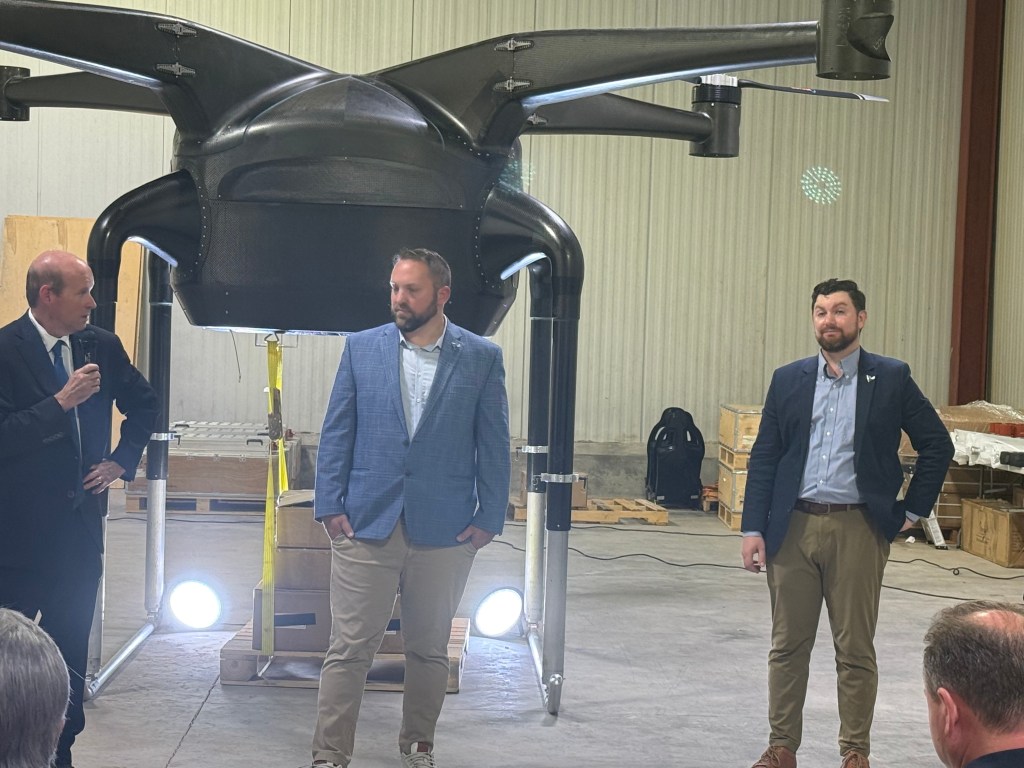
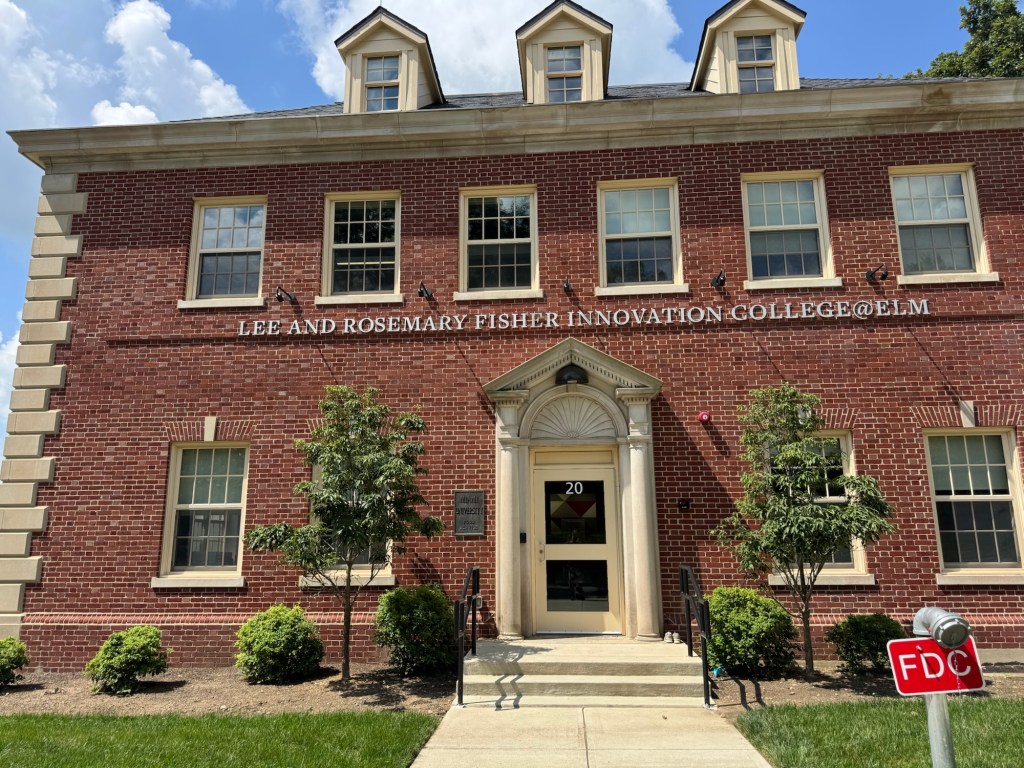
On September 21, 2026, we hosted a special community event at Miami University’s Innovation Center on Elm Street in Oxford, Ohio.
We called the evening “Dreams on Elm Street”, a lighthearted nod to the classic 1980s film. But what we’re building at Volynt isn’t the stuff of nightmares. It’s the realization of a dream, one that is taking shape right here in Butler County and has the potential to transform the future of logistics, aviation, and economic development in Ohio.
The turnout exceeded our expectations. The room was filled with Miami University staff, students, local business leaders, elected officials, and community members who wanted to learn more about what Volynt is building and where we’re headed.
We were honored to welcome Senator George Lang, Butler County Auditor Nancy Nix, and Michael Ryan, who is poised to become Butler County’s next commissioner. Their presence reflected the growing enthusiasm for innovation, entrepreneurship, and advanced aerospace development in our region.
Sharing the Vision
I opened the evening by welcoming our guests and providing an overview of the event. From there, our leadership team took the stage.
Our CEO shared Volynt’s long-term vision and mission. Our Chief Technology Officer highlighted the engineering milestones we’ve achieved and the technology behind the Volynt Vyper platform. As Chief Operating Officer, I discussed how Volynt is transforming cutting-edge aviation technology into a scalable and sustainable business. I outlined our operational strategy, manufacturing roadmap, partnerships, and the steps required to move from prototype development to commercial deployment.
The presentations were engaging, the audience was attentive, and the questions that followed demonstrated genuine interest and excitement.
Most importantly, this wasn’t a flashy product launch filled with unrealistic promises. It was an honest conversation about where we are today, what we’ve accomplished, and what the next several years may hold.
From Prototype to Production
Our immediate focus is straightforward.
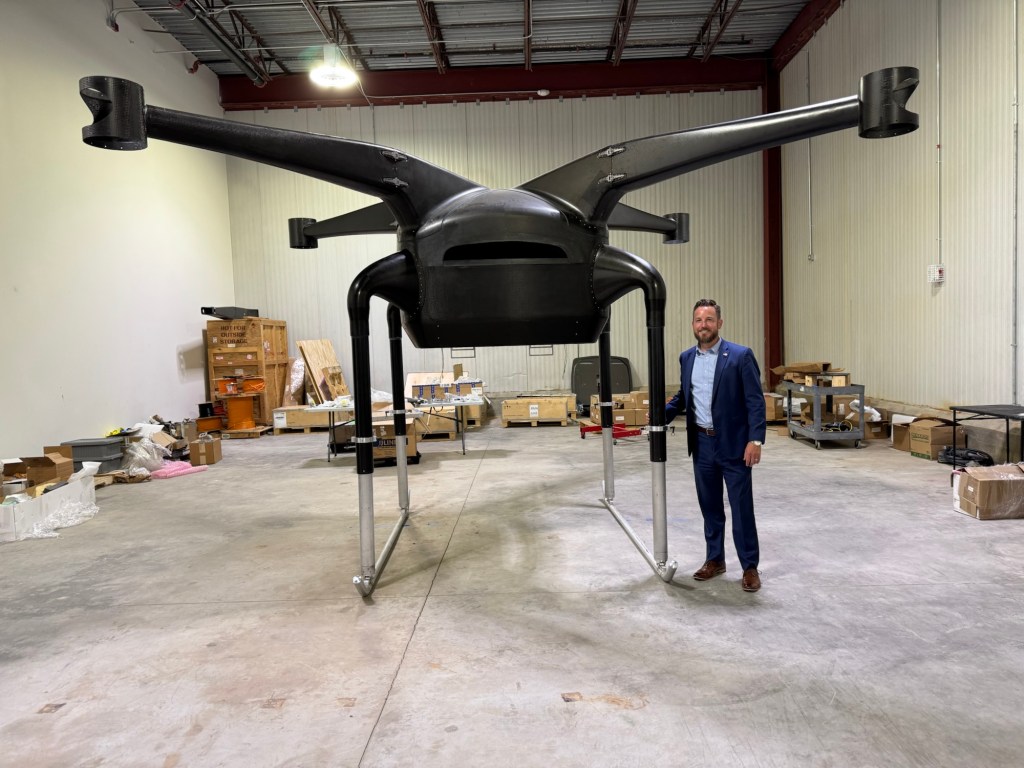
Over the next six months, our team will complete the full-scale Vyper prototype that was unveiled at the Innovation Center. That aircraft represents years of design work, engineering refinement, and determination.
Once completed, the aircraft will enter an intensive testing phase designed to validate performance, reliability, and operational capabilities.
Looking ahead to 2027, we plan to participate in major industry competitions, build broader recognition within the aerospace community, and begin manufacturing multiple aircraft.
The goals are ambitious, but they are supported by a clear roadmap and a dedicated team committed to execution.
The Drone Revolution Is Already Here
One of the most important messages of the evening was that autonomous aviation is no longer a future concept.
It’s happening today.
Just one day after our event, Dayton-area company Dexa launched a drone delivery service in Kettering. The program delivers food orders from TJ Chumps on East Stroop Road to customers within a several-mile radius across Kettering, Oakwood, and Centerville.
These smaller drones operate as last-mile delivery systems. Flying at approximately 400 feet, they lower food orders safely to customers using a cable-delivery system. Dexa has spent years developing this capability and is helping demonstrate that drone delivery is becoming a practical reality.
Volynt’s mission is different.
While companies like Dexa focus on last-mile delivery, Volynt is developing larger autonomous aircraft designed for middle-mile logistics. Our aircraft are intended to transport meaningful payloads between regional hubs such as Cincinnati/Northern Kentucky International Airport (CVG), Dayton International Airport, Indianapolis, and other distribution centers.
This approach has the potential to reduce transportation bottlenecks, address driver shortages, and create more efficient supply chains.
Whether it’s delivering a meal across town or transporting freight across a region, autonomous aviation is rapidly reshaping how goods move through our economy.
Why Ohio Is Positioned to Lead
Ohio’s aviation legacy is unmatched.
The birthplace of powered flight now has an opportunity to become a leader in autonomous flight.
Few regions are better positioned than Butler County to participate in that transformation.
Our region offers access to multiple airports, including Miami University’s airport, where initial flight operations can be conducted. At the same time, substantial investment continues at Butler County Regional Airport, where significant infrastructure improvements are being planned.
The resources, workforce, educational institutions, and transportation network already exist. What remains is bringing together the innovators, investors, and community leaders who can turn opportunity into reality.
Creating Careers That Stay Close to Home
One topic that resonates deeply with me is talent retention.
I have spoken with countless parents who have made tremendous sacrifices to provide educational opportunities for their children through Miami University, Butler Tech, and the University of Cincinnati. Too often, those graduates leave Ohio because they believe the best opportunities are elsewhere.
That reality creates a challenge for families and communities alike.
One of our long-term goals at Volynt is to help change that story.
We envision creating thousands of high-quality aerospace, engineering, technology, and manufacturing jobs throughout Southern Ohio. We want talented young people to have the option of building exciting, fulfilling careers without leaving their families, communities, and hometowns behind.
Strong Community Support
One of the most encouraging moments of the evening was seeing the level of support from the community.
Michael Ryan delivered an excellent presentation about economic development in Butler County and how innovative companies such as Volynt can contribute to future growth and prosperity.
The participation from Miami University, local leaders, educators, students, business professionals, and community members reinforced something I’ve believed from the beginning:
Innovation succeeds when communities embrace it.
Dreams on Elm Street was more than a company presentation. It was a milestone. It brought together people from different backgrounds and perspectives to discuss a shared vision for the future of our region.
The energy in the room was unmistakable. The conversations were thoughtful. The questions were insightful. The enthusiasm was genuine.
For me, that confirmed that we’re moving in the right direction.
Looking Ahead
Volynt’s journey is still in its early chapters.
There is much work ahead, many challenges to overcome, and numerous milestones still to achieve. But the momentum is real, and the opportunities are significant.
We will continue sharing updates with the community as we progress from prototype development to testing, certification, manufacturing, and beyond.
This is only the beginning.
Thank you to everyone who attended Dreams on Elm Street and supported our mission. Your encouragement and belief in what we’re building means more than you know.
Together, we’re not just dreaming about the future.
We’re building it.
About the Author
Rich Hoffman is Chief Operating Officer of Volynt, where he leads operational strategy, business development, manufacturing planning, and growth initiatives for the company’s autonomous aerospace programs. A longtime Butler County leader and aerospace executive, he is committed to building high-quality technology careers and advancing innovation throughout Southwest Ohio.
Rich Hoffman is an author, political consultant, and strategic advisor based in Cincinnati, Ohio, and the creator of The Politics of Heaven—a unique framework that connects biblical theology, ancient history, and modern power structures to explain how moral alignment and spiritual forces shape global events. Blending real-world political experience with deep research into archaeology, UFO phenomena, and suppressed historical narratives, Hoffman offers compelling commentary on topics ranging from ancient civilizations and the Dead Sea Scrolls to modern populist movements, paranormal continuity, and leadership strategy in chaotic environments. As the author of The Gunfighter’s Guide to Business and the forthcoming Politics of Heaven, he brings a grounded yet provocative voice to media discussions, supported by firsthand experiences and a cross-disciplinary approach that bridges science, history, and theology. For interviews, speaking engagements, or expert analysis, visit richhoffmanbooks.com or contact directly via phone at 513-307-5815 or email at rhoffman@richhoffmanbooks.com. If you’ve seen the movie, Disclosure Day and want to talk about it and the implications of Presidnet Trump’s UAP disclosures, let me know and we can bring some color to your coverage. https://richhoffmanbooks.com/media-inquiries-broadcast-topics-and-contact-info/?frame-nonce=ad51e7ecba I do have a firsthand UFO encounter to discuss.
Rich Hoffman is an author, political consultant, and strategic advisor based in Cincinnati, Ohio, and the creator of The Politics of Heaven—a unique framework that connects biblical theology, ancient history, and modern power structures to explain how moral alignment and spiritual forces shape global events. Blending real-world political experience with deep research into archaeology, UFO phenomena, and suppressed historical narratives, Hoffman offers compelling commentary on topics ranging from ancient civilizations and the Dead Sea Scrolls to modern populist movements, paranormal continuity, and leadership strategy in chaotic environments. As the author of The Gunfighter’s Guide to Business and the forthcoming Politics of Heaven, he brings a grounded yet provocative voice to media discussions, supported by firsthand experiences and a cross-disciplinary approach that bridges science, history, and theology. For interviews, speaking engagements, or expert analysis, visit richhoffmanbooks.com or contact directly via phone at 513-307-5815 or email at rhoffman@richhoffmanbooks.com. If you’ve seen the movie, Disclosure Day and want to talk about it and the implications of Presidnet Trump’s UAP disclosures, let me know and we can bring some color to your coverage. https://richhoffmanbooks.com/media-inquiries-broadcast-topics-and-contact-info/?frame-nonce=ad51e7ecba I do have a firsthand UFO encounter to discuss.
Every once in a while, life hands you one of those small, perfect weeks with family — the kind that doesn’t need a grand destination or a complicated itinerary to feel meaningful. Recently, we packed up the RV and took a short family trip to The Wilds in central Ohio. It wasn’t far from home, and it wasn’t meant to be anything elaborate. But it turned into exactly the kind of experience that reminds you why family time matters and why stepping away from the noise is sometimes the best thing you can do.
My daughter put together a fantastic video from the trip, capturing the highlights in a way only she can. A few of my grandkids are featured in it, running around, laughing, exploring, and just being kids. Watching them in that setting—surrounded by open sky, quiet water, and the wide, rolling landscape—reminded me how grounding these moments can be. We spend so much of our lives dealing with big issues, heavy conversations, and responsibilities that stack up day after day. But weeks like this show the other side of life, the part that keeps you centered.
If you’ve followed my writing for any length of time, you know I spend a lot of time talking about sovereignty, community, history, politics, and the deeper questions that shape our world. Those topics matter, and they deserve the attention we give them. But it’s just as important to share the lighter moments—the real life that happens between all the big ideas. This trip was a perfect example of that balance. It wasn’t a grand expedition; it was simply a family outing, close to home, filled with the kind of memories that last longer than most of the headlines we chase. As I have said, I have spent most of 2026 on the road like this. Sometimes it’s just my wife and I. Sometimes, like this, it’s family, some of our family. Sometimes it’s all my family. I like RV travel because it lets me take my office with me. I write books, I do consulting, and I can do all that work from anywhere in the world with a TEAMS call. I never know where I’m going to be, so that’s why I do all the videos these days from the kitchen in my RV. It has good power and a comfortable, studio-like setting. Sometimes the internet isn’t great at our campgrounds, but that can be solved with Starlink, which I’ll likely do next year.
The World of Everywhere and Anything
RV camping has a way of slowing everything down. There’s something about being on the road, even for a short distance, that shifts your mindset. You’re not rushing. You’re not checking your phone every five minutes. You’re not thinking about the next meeting or the next project. You’re just present. The video my daughter made captures that feeling beautifully — the simplicity, the quiet, the laughter, the sense of being together without distraction. It’s a glimpse into how we travel, unwind, and stay connected as a family.
The Wilds itself is a unique place. Wide open spaces, wildlife roaming in the distance, and a sense of calm that settles in as soon as you arrive. It’s the kind of environment that encourages reflection without forcing it. You breathe a little deeper. You listen a little more. You notice things you might overlook in the rush of everyday life. And when your kids and grandkids surround you, those moments become even more meaningful.
It was a short trip, but it was packed with fun and full of the kind of small joys that make life feel full. These are the moments that remind us that life isn’t just about the big battles or the big ideas — it’s also about the quiet weekends, the shared meals, the kids running around, and the chance to breathe for a minute. It’s about remembering that the world is bigger than our worries and that the people closest to us are the ones who make the journey worthwhile.
So I’m sharing this little slice of our life not because it’s dramatic or extraordinary, but because it’s real. It’s honest. It’s the kind of thing we all need more of. And I think you’ll enjoy seeing that side of our world — the family side, the simple side, the part that keeps everything else in perspective.
Rich Hoffman is an author, political consultant, and strategic advisor based in Cincinnati, Ohio, and the creator of The Politics of Heaven—a unique framework that connects biblical theology, ancient history, and modern power structures to explain how moral alignment and spiritual forces shape global events. Blending real-world political experience with deep research into archaeology, UFO phenomena, and suppressed historical narratives, Hoffman offers compelling commentary on topics ranging from ancient civilizations and the Dead Sea Scrolls to modern populist movements, paranormal continuity, and leadership strategy in chaotic environments. As the author of The Gunfighter’s Guide to Business and the forthcoming Politics of Heaven, he brings a grounded yet provocative voice to media discussions, supported by firsthand experiences and a cross-disciplinary approach that bridges science, history, and theology. For interviews, speaking engagements, or expert analysis, visit richhoffmanbooks.com or contact directly via phone at 513-307-5815 or email at rhoffman@richhoffmanbooks.com. If you’ve seen the movie, Disclosure Day and want to talk about it and the implications of Presidnet Trump’s UAP disclosures, let me know and we can bring some color to your coverage. https://richhoffmanbooks.com/media-inquiries-broadcast-topics-and-contact-info/?frame-nonce=ad51e7ecba I do have a firsthand UFO encounter to discuss.
For me, the standard is Jonathan Edwards on human government. The new Jonathan Edwards Study Bible arrived in August of 2026. I opened it on a hot afternoon after riding roller coasters at Kings Island with two of my grandchildren. That is not a cute detail. That is the point. Good government is supposed to protect ordinary life — grandchildren, county fairs, Sunday school, a sheriff who still thinks Butler County can look a little like Mayberry and a little like a serious modern county at the same time.
If Yale and Princeton were like they were during Jonathan Edwards’s time, I would likely have several PhDs by now, but over time, they have turned into globalist institutions, which I found repulsive when I was of college age. They have turned into anti-American insurgent places that ruin the minds of young people. But, Yale has preserved Edwards’s papers. The Study Bible puts his notes, essays, Resolutions, and miscellanies system next to the New King James text.[1][2] Everybody in this party who claims to care about order, virtue, and limited government should own a copy and actually read it. I am a small-government kind of person. I was Tea Party. I was Reform Party in the 1990s. I was talking about Donald Trump in 1999 when he was circling the Reform Party nomination against Pat Buchanan.[3] I have been in human communication and local politics for thirty years. I know what an intramural fight looks like. I also know what it costs voters.
What Jonathan Edwards Meant by Human Government
Good government as a moral order, not a branding exercise
Edwards believed that good government belongs to the highest moral order of a proper civilization.[4] I agree with him. That does not make me a big-government conservative. It makes me a person who thinks the point of the smaller government we do have is to be good — competent, restrained, honest, and aimed at the public good, not at the vanity of the people holding powerful positions.
You do not get into government to make a name for yourself. You get into government so that people have representatives. You want those representatives to be as good as possible. There is only one legitimate motivation: to make the thing good in the Edwards sense — an earthly office that still answers to a moral law it did not invent.
“The enjoyment of [God] is the only happiness with which our souls can be satisfied.”
— Jonathan Edwards, as featured in The Jonathan Edwards Study Bible (Thomas Nelson, 2026)
That sentence is about God. It is also a warning about politics. If your happiness is a title on a sample ballot, a headline, or the humiliation of a rival, you are already in the wrong temple. The party slate card exists so voters can find good candidates. It does not exist so that somebody can settle a score.
Romans 13 is not a revenge verse
Edwards read civil authority inside God’s moral government of the world.[5] Magistrates exist. They are not priests. They are not avengers of private grudges. They are supposed to keep the peace, punish actual wrongdoing, and leave room for the rest of life — family, work, church, property — to go on.
That is why I keep saying the same sentence to people who want to turn the Butler County Republican Party into a revenge shop: you do not do politics for revenge. You do not look to even scores even if you were bullied. You do not use the power of government, or the machinery of a party, to bully everybody else. If you cannot serve voters, you are not in it for the right reasons.
Why This Bible Arrived on Time
Kings Island, two grandchildren, and page 1176
I had a rare day with two of my grandchildren at Kings Island, late in the summer season. We rode the big coasters. It got hot. We came home for lunch and a cool-down. The box had been dropped at the house. I knew what it was. I sat down with that Bible for an hour while the kids recovered, and then we went back to the park to swim.
People can laugh at a grown man getting quiet over a study Bible. Fine. I have spent decades looking for a single object that holds theology, philosophy, and a usable picture of public life in one binding. This one does. There is an essay on human government that I keep pointing people to — in my copy it sits around page 1176 — and just over the next page there is another piece on the means of grace. The book is full of that mixture: doctrine with a spine, and a vision of what a people owe each other when they try to govern.
Edwards was thrown out of his own church
Edwards served the Northampton church for twenty-three years. He is the man of “Sinners in the Hands of an Angry God.”[6] By 1750 a majority of the congregation voted him out. He preached a farewell sermon and left.[7][8] He went to Stockbridge to teach and minister among Native Americans, a smaller work, after a public humiliation. Later he was respected enough to become president of the College of New Jersey — Princeton — and then he died. Yale keeps the papers. Princeton had the office. The church that made him famous also removed him.
He was not removed because he had become a thief. He was removed because he was more exacting than the politics of the room would bear. That is a lesson with teeth. Sometimes the righteous thing is to stay and fight. Sometimes the righteous thing is to step out of an equation you can no longer serve well, because the people have decided they do not want you. The question is never “What feeds my name?” The question is “What actually produces good government for the people in front of us?”
I Have Zero Tolerance for Bullies
I can already hear it: then why do you support Sheriff Jones? People call him rough. Some people call him a bully.
I have had no tolerance for bullies my entire life. I have gotten into fights over people being picked on, often. I do not care if the target is a man or a woman, big or small. I do not care which party the bully belongs to. I have no patience for personality types who use an office to get revenge on rivals.
That standard cuts in every direction. It cuts against Democrats who treat government as a punishment engine. It cuts against Republicans who treat a county central committee like a private army. It cuts against anyone who thinks the point of winning is to make the other guy miserable.
Sheriff Jones and I have not always been the best of friends. I still want him in the party. Those two sentences can both be true if you believe, with Edwards, that the office is larger than the grudge.
Sheriff Richard Jones Is My Guy
A big tent means you keep the sheriff
I like Sheriff Richard K. Jones.[9] I want Sheriff Jones in the Butler County Republican Party. I have said, more than once, that he sometimes sounds like he still has a Democrat nerve in him on a public-sector question. Good. I want a Republican Party big enough to pull people who left the other side. I want a party that can stand on a stage with him and not flinch.
He has been sheriff across multiple terms. I want him around for as long as he wants the job and the voters still give it to him. When he goes on international outlets and talks about immigration and the jail, I want him able to say he is a member of this county Republican Party. I do not want him pushed into independent exile because a faction could not share a room with him.
Seven years of silence, one parking lot, two hats
In 2011 Ohio went to war with itself over Senate Bill 5 and public-sector unions.[10] I was on one side of that fight. Sheriff Jones was not with the Tea Party types who got burned when the referendum turned. We were both on WLW in those years.[11] He was friendly with Willie. I was friendly with Doc Thompson. Doc got pushed off, went elsewhere, and later died after being hit by a train under circumstances people still talk about. Willie is still on the air. Jones is still on the air with him.
After that bill, Sheriff Jones and I did not talk for six or seven years. We would be at the same events and walk past each other. Then I took my family to Charleston, South Carolina, for a week. Charleston is a fine city. People treat it like one of the best places in the world. My daughters and I love pirate history; you cannot stand in that harbor without thinking of Blackbeard and of the Civil War forts. I liked it. I came home happier to see Butler County.
That is not a cheap patriotic line. You do not know what you have until you have walked a “better” place and realized your own county is just as good if not better in many ways, working farms, and a party that has actually produced national figures.[12] JD Vance came out of this ground. Vivek Ramaswamy has been in our orbit. Warren Davidson’s office in Washington has been a good shop. Bernie Moreno has been a serious addition.[13] Interns and staff I met this year in those offices were the kind of young people who make you think the farm system still works.
Jones and I walked out of an event toward the cars. He broke the ice. He liked my hat. I liked his hat. I liked his boots. I like his Andy Griffith picture of what a sheriff’s office should feel like. We started talking again. It took almost eight years.
The grand jury and the jail tour
I am not young. I am in my senior stretch of life, around sixty as of 2026. One of the best civic jobs I have ever held was foreman of a Butler County grand jury. It was not the money. It was the view.
People called me during that season to whisper about “corruption” in the sheriff’s office and the prosecutor’s office. That is what people do when they do not get the outcome they wanted, humans try to create political pull to get rid of people they don’t want to work with. I like our prosecutor’s office. I like Mary Swain a great deal.[14][15] I like the people who actually carry files upstairs to the prosecutors’ offices, which I was able to tour and I consider to be one of the finest places on earth.
The grand-jury room sits on the same floor as the clerk’s world. You take indictments up. You meet the assistants. You meet the deputies who work child-exploitation cases and drug cases. You get answers to questions you have had. And because a grand jury should understand what it is doing when it votes a true bill, Sheriff Jones gave me a tour of the jail. We talked. When his book came out he told me about it. I read it and reviewed it. I recommend it very highly.
That is the other side of the man some people only meet in a fight. If you cannot work with that, you probably do not have the temperament for coalition politics.
Nancy Nix Is the Benchmark
If Sheriff Jones is the law-and-order pillar I want inside the big Republican tent, Nancy Nix is the governing temperament I want the rest of the party to study.[16] I have said it until people are tired of hearing it. She pours hours into this party. She is good government from top to bottom. When she walks into a room, the room still works. That is a rare skill.
I liked Roger Reynolds for a long time. I was on his side until he turned his fight against Nancy Nix.[17] Clearing your name after a legal disaster is one thing. Using the wreckage to tear down a sitting officeholder who actually runs the shop is another. Parties are supposed to put a slate card in front of voters. They are not supposed to become instruments for a man who cares more about his name than about the taxpayers in the file.
George Lang and Debbie can sit down with almost anybody and not get moved off their mark. That is a Trump skill too: talk to the person across the table, find the deal, do not surrender the spine. I have asked George more than once whether Kathy Wyenandt (the area Democrat) can be pulled toward the party instead of left as a permanent foreign object working the community against itself. I would rather recruit than exile. Same rule as Jones. A bigger tent is not a mushier platform. It is a refusal to donate our own people to the other side because we enjoyed a feud.
What a County Party Is Actually For
Volunteers, yard signs, and jobs that do not pay
Most of the jobs that make a county party run do not pay. People do them because they love the idea of a slate card voters can trust. They stand at the county fair. They work a fundraiser. They put a name on a yard-sign list. When those people are disparaged in the paper, of course they get hurt. That does not make them fragile. It makes them human.
The job of party leadership is to keep that machine pointed at voters. A unified party that serves voters will beat a pure party that serves a clique. Purity spirals are how you lose townships you used to win in your sleep.
Butler County is a Republican county that still has to earn it
Most people in Butler County gravitate Republican. That is a blessing and a trap. It is hard to keep an identity when you win so often that winning starts to feel like weather. It is hard to remember that the point is still to make government good. Todd Hall, as chairman, understood a lot of that. I try to stay out of internal knives as much as I can, because I want the system to work and I want people to feel engaged.
Thomas Hall and Sheriff Jones had their differences on policy. They got through it. They use radio well. Once they were fine with each other, Jones and I were fine with each other, once again. That is how adults do it. You do not have to marry your coalition partners. You have to stop treating them like enemy combatants.
Trump changed the party. The county still has to govern.
Trump redefined what a Republican powerhouse looks like. The old country-club party cannot pretend he did not happen. He has also, over the years, become something closer to an evangelist of a certain American memory — Mount Rushmore more than permanent Washington. I have become a fan of Washington, D.C., in the years he has been back in the White House. The offices that represent this county have been worth visiting. The city is not the enemy. Drift is the enemy.
The next years will not be as easy as “were you for Trump after 2020.” Everybody had a simple test then. The tests now are messier: energy policy after the FirstEnergy mismanagement of the real message,[18] how statehouse fights land in a sheriff’s office, whether a township trustee race is a farm system or a grudge match, whether we run toward competent people or toward whoever promises to punish last year’s enemy.
A Personal Ledger I Had to Close
Latte Sipping Prostitutes, Lakota, and being left on the air
I am going to tell a story I almost left out, because good government requires that you put some things aside even when people wronged you.
Everybody around here remembers the meltdown on WLW when I called a class of Lakota levy politics what I thought it was. I said people were selling out children to a system that works like a taxpayer-funded babysitting service with a union attached. Democrats piled on. Some Republicans who had been with me went quiet or went woke on the spot. A donor-class press release landed on the Scott Sloan show while I was live. They confronted me on the air.
I got through the interview; it was very difficult. I did not fold. But a lot of people abandoned me when it would have cost them very little to stand there. Todd Hall was one of my people, and when it mattered most, he and many others left me hanging. It took years to get over that. I could have carried a grudge forever. I did not, because I wanted a Republican Party that could still win for the needs of the voters. I remember very well who stood with me and who didn’t, and when people wonder even now why I feel the way I do about certain people and not others, that memory usually gives an easy answer.
That is the whole method. You may feel one way in your chest. If the party is trying to build something voters can use, you park the personal file and work. You handle squabbles another way. You do not burn the machine to warm your pride.
I have a clean record on purpose
I sign my name to what I write. People have been looking me up for years trying to find dirt they could use against me. I have been married to the same person for a long time. I can say, as a man almost sixty, that there is not a woman who can step forward and say I bruised her or hurt her in some way that finds itself on a police report. If you don’t have a clean background, you can’t stand in front of a party and tell other people how to live. Even if you have your side of the story, just being in a story like that shows bad judgment, and it will cause people not to follow you as a leader. You have to be cleaner than clean if you want to hold big responsible seats.
If you want to be a Walmart greeter, you can often get a matter expunged and live a quiet life. If you want to be the head of a political party, or the person who starts busting heads and announcing that there is a new sheriff in town, you do not get that courtesy. Enemies come out. The past comes out. Paying someone to bury a file is not the same as righteousness. The internet keeps what the clerk seals.[19]
I am not interested in ruining people for sport. Plenty of men and women have made mistakes and then put out yard signs, joined a church, and tried to live a second chapter. Redemption is real. Leadership of a party is a different office. It has to be clean enough to survive daylight, because daylight will be applied.
Leadership, Todd Minniear, and the Problem of a Hidden Past
Todd Hall did a lot of unglamorous work in the background. Of course people complain about it, as they do everyone in a responsible seat, and they cling to the fantasy that they could do better if only they had more power. A lot of the people who have been running this thing are tired. They show up unpaid. They love the idea of good government even when the job does not love them back.
People have asked me about running for Liberty Township trustee and school board at Lakota; I get asked about it at least once a week for many years now. I like the trustees we have. I would not shove them aside for a title. People also asked Todd Minniear to step toward more leadership.[20] I have been a fan of that instinct. He has been a great trustee. He has the kind of energy a party uses when it needs a next chapter, and I was thinking of him as the Party Chairman once I knew that Todd Hall and others wanted a break. He and I had a good discussion not very long ago about Roger Reynolds; Todd was on one side of the discussion, and I was on the other. We didn’t argue about it, we instead put our focus on the things we shared in common.
If you are carrying material that political enemies can turn into a wrecking ball. I will not pretend that “nobody will notice” is a strategy. Democrats already collect this stuff and wait. Factional Republicans will use it too if the fight gets personal. That is not theory.
How to Have a Fight Without Becoming the Fight
A few rules:
1. Serve voters first. If a move does not make the ballot better, it is probably vanity.
2. Keep Sheriff Jones in the party. A Republican Party that exiles its own long-serving sheriff is not tough. It is insecure.
3. Treat Nancy Nix as a working model, not as a faction mascot. Rooms that light up when she enters are rooms that can still govern well, learn from her.
4. Recruit before you purge. Democrats who can live with limited government are more valuable than Republicans who only live to punish Republicans.
5. Do not use government, or party office, to even a private score. That is Edwards in one line.
6. If you want the chair, assume every sealed thing will be unsealed in public. Plan for that before you run, not after the first mailer.
7. Put grudges in a private drawer when the county needs a unified card. You can still be a man. You do not have to be a faction.
What Voters Actually Buy When They Buy a Party
Donors and church voters do not want the same conversation in the same hour. That is fine. The chairman’s job is to put them in enough of the same room that candidates can raise money without becoming a different species from the people who staff the polls. If you cannot do that, you do not have a party. You have a club.
I want GOP picnics that feel like a county still knows how to stand around a grill. I liked watching the energy when national operators came through Ross and people actually showed up. I want campfire competence. People do not have to agree on every shade of red. They can still agree that Sunday school is not a joke and that a sheriff’s office is not a think tank.
You can make a million dollars in a lot of businesses. You cannot easily build good government. It costs time, reputation, and the ability to absorb a newspaper hit without setting the headquarters on fire. People who pour themselves into this work deserve leaders who understand that cost.
Edwards lost Northampton and still did the next faithful job. That is available to anyone in this county who is about to lose a fight. It is also a warning to anyone who thinks winning a fight is the same thing as being right. We will all stand in a different dock than a central committee. That is the farewell sermon. It is a better political theory than most of what gets posted after a poorly run meeting.
The Need
Buy the Jonathan Edwards Study Bible. Read the government material. Read the farewell sermon. Then look at Butler County and ask a simple question: are we building a party voters can take pride in, or are we building a revenge path for people whose feelings got hurt?
I support Sheriff Richard Jones. I support a big-tent Republican Party that recruits instead of exiles. I support Nancy Nix as the working picture of countywide competence. I want new leadership that can stand daylight. I do not want scandals in the background of the people who hold the keys, and I do not want the keys used to punish rivals.
That is the Edwards form of Republican politics. It is also just adulthood. Butler County has given the country more than its share of serious people. We should act like it.
Bibliography and Further Reading
Jonathan Edwards and moral government
Edwards, Jonathan. A Farewell Sermon Preached at the First Precinct in Northampton. Boston: S. Kneeland, 1751. Reprinted in The Works of President Edwards and in modern sermon collections.
Edwards, Jonathan. “Sinners in the Hands of an Angry God.” Enfield, Connecticut, July 8, 1741. In The Works of Jonathan Edwards, vol. 22. New Haven: Yale University Press.
Edwards, Jonathan. The Nature of True Virtue. In The Works of Jonathan Edwards, vol. 8, Ethical Writings. New Haven: Yale University Press.
Everhard, Matthew, ed. The Jonathan Edwards Study Bible: Experience Abiding Joy in Christ (NKJV). Nashville: Thomas Nelson, 2026.
Jonathan Edwards Center at Yale University. The Works of Jonathan Edwards Online. http://edwards.yale.edu.
Scripture
The Holy Bible, New King James Version. Romans 13; 1 Timothy 2:1–2; 1 Peter 2:13–17; 2 Corinthians 1:14.
[2] Yale University’s Jonathan Edwards Center hosts The Works of Jonathan Edwards Online at http://edwards.yale.edu. Edwards himself was not president of Yale. He served as the third president of the College of New Jersey (now Princeton University) in 1758 and died shortly after taking office.
[3] The Reform Party presidential contest of 2000 included Patrick J. Buchanan and a brief exploratory effort by Donald J. Trump in 1999–2000. Trump later ran as a Republican and won the presidency in 2016 and 2024.
[4] Edwards’s most sustained treatment of government is not a single short “essay on human government” in the modern magazine sense. It is woven through his moral theology: God’s moral government of the world, the duty of magistrates, and the obligation of citizens. See especially “The Justice of God in the Damnation of Sinners”; sermons on Romans 13; and the dissertation The Nature of True Virtue. The Study Bible gathers related notes and essays beside the biblical text. Page references in this piece follow the author’s personal copy.
[5] Romans 13:1–7; 1 Timothy 2:1–2; 1 Peter 2:13–17. Edwards read civil authority as part of God’s moral government, not as a substitute for the church and not as a theater for private vengeance.
[6] Jonathan Edwards, “Sinners in the Hands of an Angry God,” preached at Enfield, Connecticut, July 8, 1741. Standard text in The Works of Jonathan Edwards, vol. 22, Sermons and Discourses, 1739–1742 (New Haven: Yale University Press).
[7] On June 22, 1750, after twenty-three years as pastor of the Northampton church, Edwards was dismissed following a congregational vote over qualifications for church membership (the “communion controversy”). He preached A Farewell Sermon on 2 Corinthians 1:14. He then served the Stockbridge mission among Native Americans before his Princeton appointment.
[8] Edwards, A Farewell Sermon (Boston: S. Kneeland, 1751). The sermon’s central claim is that pastor and people will meet again before Christ’s tribunal, where controversies and treatment of one another will be judged. That is the moral frame the author applies to party fights.
[9] Richard K. Jones, 45th Sheriff of Butler County, Ohio. Born Hamilton, Ohio, October 11, 1953. Elected sheriff in 2004; took office January 3, 2005; subsequently re-elected, including 2020 and 2024. Official biography: https://www.butlersheriff.org/sheriff.
[10] Ohio Senate Bill 5 (2011) restricted collective bargaining for public employees. It passed the General Assembly and was signed by Governor John Kasich, then repealed by statewide referendum (Issue 2) in November 2011. The fight split many Ohio Republicans from public-safety unions and local officials.
[11] WLW (700 AM), Cincinnati. Long-running talk hosts associated with this period include Doc Thompson and Willie. The Lakota schools controversy and on-air confrontations described here are from the author’s firsthand radio work, not from a single official transcript.
[12] Charleston Harbor, Fort Sumter, and the early-eighteenth-century pirate history of the Carolina coast (including Edward Teach, “Blackbeard”) are standard public history. The comparison to Butler County is the author’s travel observation.
[13] Vivek Ramaswamy (Ohio) and J.D. Vance (Middletown, Butler County) are the two most nationally visible political figures to come out of the modern Ohio / Butler County conservative pipeline. Vance is Vice President of the United States as of 2025. Rep. Warren Davidson represents Ohio’s 8th Congressional District. Bernie Moreno was elected U.S. Senator from Ohio in 2024.
[14] Mary L. Swain, Butler County Clerk of Courts. Michael T. Gmoser, Butler County Prosecuting Attorney. Both Republicans holding countywide office as of 2024–2026. See Ballotpedia, Butler County, Ohio, elections, 2024.
[15] Ohio grand juries are convened under the Ohio Revised Code and local court practice. Foreman service is a civic appointment. Descriptions of jail tours and floor layout are from the author’s service and are not a disclosure of secret grand-jury deliberations or votes.
[16] Nancy Nix, CPA, Butler County Auditor. Appointed February 2023 by the Butler County Republican Party Central Committee after the felony conviction and removal of Auditor Roger Reynolds; sworn in February 13, 2023; elected November 2024. Previously Butler County Treasurer for nearly sixteen years. Office: https://auditor.bcohio.gov.
[17] Roger Reynolds, former Butler County Auditor, was convicted in December 2022 of a felony count of unlawful interest in a public contract related to Lakota Local Schools and a golf-training facility. He was removed from office. In 2024 he unsuccessfully sought to oust Auditor Nancy Nix through Ohio Supreme Court action and a Board of Elections protest. See Journal-News coverage, 2023–2024.
[18] FirstEnergy / House Bill 6 is the shorthand for Ohio’s 2019 nuclear-and-coal subsidy scandal, which produced federal prosecutions and years of state-level fallout. Democrats and Republicans both own pieces of the policy environment that made Ohio’s generation politics toxic. The point in this essay is party discipline after a scandal, not a legal brief.
[19] On public records, expungement, and political research: Ohio sealing and expungement statutes do not erase every trace of a matter from news archives, court indexes, or opposition research files. Leadership of a county party is a public role. That is a practical warning, not a legal opinion.
[20] Todd Hall has served as Executive Chairman of the Butler County Republican Party. See butlercountygop.org. Todd Minniear ran for Liberty Township Trustee (at-large) in 2025. References here to party leadership conversations are the author’s personal political judgment, not an official party endorsement.
Rich Hoffman is an author, political consultant, and strategic advisor based in Cincinnati, Ohio, and the creator of The Politics of Heaven—a unique framework that connects biblical theology, ancient history, and modern power structures to explain how moral alignment and spiritual forces shape global events. Blending real-world political experience with deep research into archaeology, UFO phenomena, and suppressed historical narratives, Hoffman offers compelling commentary on topics ranging from ancient civilizations and the Dead Sea Scrolls to modern populist movements, paranormal continuity, and leadership strategy in chaotic environments. As the author of The Gunfighter’s Guide to Business and the forthcoming Politics of Heaven, he brings a grounded yet provocative voice to media discussions, supported by firsthand experiences and a cross-disciplinary approach that bridges science, history, and theology. For interviews, speaking engagements, or expert analysis, visit richhoffmanbooks.com or contact directly via phone at 513-307-5815 or email at rhoffman@richhoffmanbooks.com. If you’ve seen the movie, Disclosure Day and want to talk about it and the implications of Presidnet Trump’s UAP disclosures, let me know and we can bring some color to your coverage. https://richhoffmanbooks.com/media-inquiries-broadcast-topics-and-contact-info/?frame-nonce=ad51e7ecba I do have a firsthand UFO encounter to discuss.
I have watched this movie before. In 2015 and 2016, and again in 2024, the same class of people tried to tell America that Donald Trump’s wealth was a character defect. They said a rich man could not be trusted, that success itself was the indictment, that gold, planes, and golf were proof he was “not like you.” Voters put him in the White House twice anyway, because they understood something the professional scolds never will: independence is an asset. A man who does not need the job is harder to own. That is the lesson Ohio Democrats and a handful of leftover Republican wreckers are now trying to unlearn with Vivek Ramaswamy, and it is why Amy Acton spent Labor Day weekend screaming that you cannot buy Ohio.
She needed a chant. What she got was a gaffe.
The Speech That Sounded Like a Person Running Out of Road
Watch the clip. Acton is at a union picnic with Pete Buttigieg in tow, doing the ritual of the lockdown years: I am a doctor, not a politician, becoming one right in front of your eyes. Then she starts barking that Vivek cannot buy the state, cannot buy Ohio, cannot buy us, cannot buy us, cannot buy us in Ohio, that is the end of this. It is the sort of thing a campaign writes on a whiteboard when the internals look ugly and the only remaining argument is envy. The crowd does not catch fire. She looks like she is trying to start a wave at a funeral.
This is the same Amy Acton Ohio already knows. She ran public health under Mike DeWine when the state was locked down, businesses were smashed, kids were sent home, and “follow the science” became a political religion. She collected awards for it. A lot of Ohioans collected unemployment, missed funerals, and watched their Main Streets die. You can call that public service if you like. I call it the record she has to run on, and it is why the “I’m just like you” routine lands like a lead pipe. She is not just like you. She is the woman who told you to stay home while the people who write the rules kept their salaries.
The wealth attack is even thinner. Vivek flew to watch tennis. He likes tennis. He used to be a ranked junior. He has a court. He went to the U.S. Open and he has been to Paris. Wealthy people do that. Trump never ran from Mar-a-Lago or the golf course; he wore the gold clip and the silk tie and said, yes, I did well, and if you vote for me I will try to make it so you can do well too. That is a producer’s message. Acton’s message is the opposite: he has money, therefore he is illegitimate, therefore hand the keys to the people who want to tax the successful and redistribute the proceeds to the discontented. That is not a governing philosophy. That is a ransom note.
Why Attacking Wealth Is a Loser’s Tell
I have been thinking lately about the Apostle Paul. He was effective in part because he had standing and independence. He was not a ward of the movement. He could travel, argue, and endure because he was not begging the crowd for his next meal. Politics is not the church, but the principle is the same. A candidate who has already won in the private economy does not need Columbus the way a career public-health administrator needs Columbus. Vivek does not need a government job. That is supposed to be a feature. The people yelling “you can’t buy Ohio” are announcing that they cannot raise comparable money and cannot compete on growth, so they will compete on resentment.
David Pepper and the rest of the chorus have been working this line for months: billionaire, private jet, not one of us. Fine. Then explain why Trump’s jets and clubs did not stop two national victories, and why Ohioans who want plants, capital, and jobs might prefer a man who has already built companies to a woman whose signature achievement was closing the state. You can dislike Vivek’s style. You can argue policy. What you cannot do, with a straight face, is pretend that enjoying a tennis match is a civic crime while the alternative is more of the administrative state that already had its turn.
The other half of this farce is intra-Republican sabotage. After a primary, Democrats lock arms around whoever they nominated, even when she sounds like a chalkboard dragged down a stairwell. A slice of the right still wants to pick the scab. Nick Fuentes types, leftover primary rivals, the professional “I told you so” circuit—anyone who would rather be right about a Republican’s flaws than win the state—keep feeding the same clip. They did it to Trump in 2016 and 2024. He won anyway because voters vote their interest when the noise dies down. A good economy and job creators in your state beat a sermon about how the other guy’s plane is too nice.
Then Came the Fair, and the Overnight Conversion of a Shove Into an Assassination Plot
The timing is the tell. After the Labor Day chant made her look unhinged, the campaign needed a new story. Sunday at the Canfield Fair, a 38-year-old local named Patrick Havas pushed through a tent crowd toward Acton with a phone up, as if he were recording or trying to get close enough to be seen. He knocked over older people. Security took him down. After the fact, deputies found two pistols and a Taser-style device on him. He did not draw the guns. He did not fire. He did not brandish. Ohio is a constitutional-carry state. Carrying is not the same thing as attempting murder. The charges reported were disorderly conduct and misdemeanor assault for the people he knocked down. Acton was unhurt. The people who fell were assessed and, according to the sheriff, did not seek further treatment.
That is a bad scene at a fair. It is not a martyrdom. Campaign statements still said an “armed individual lunged” and injured multiple people. National copy followed the verb. By Saturday night into Sunday the lead was written as if Ohio had just watched a political assassination attempt. If there were clean video of a man trying to kill her, it would have been on every screen before supper. What we got instead was language inflation: lunge, attack, armed, threat—while the actual police story is a large man barreling for a better look or a confrontation, knocking seniors like bowling pins, and getting piled on by Highway Patrol.
This attack story is just another Democrat Jussie Smollett story, trying to gain sympathy and voter support through fake news talking points. This is the fullness of the Acton operation: when the speech is a disaster, change the subject to danger. When you cannot raise on growth, raise on fear. When you cannot debate or raise money, accuse the other side of buying the state. Look how many sucker politicians jumped on the bandwagon without knowing all the facts, which again came out looking like Amy Acton is a loser candidate.
What Ohio Actually Chooses When the Cameras Leave
Acton will keep the unions, the people who want the next transfer payment, and the media that still thinks 2020 was her finest hour. She will keep Pepper on the ticket as proof that the old Democratic machinery is still in the room. She will keep calling Vivek rich, which he is, and hoping Ohio has forgotten that successful people are allowed to like tennis, football Saturdays, and a life that is not a permanent campaign stop.
I want a state that recruits producers instead of lecturing them. If a man with a billion dollars in assets spends a few thousand to fly to a match, that is not the scandal. The scandal is a political class that treats his success as the crime and her lockdown résumé as the credential. Trump never apologized for winning. Vivek should not apologize for a court, a jet, or a seat at the Open. The people who need him to grovel are the same people who needed Trump to grovel. They lost that argument twice.
Vote like you want the factories and the payrolls. When things got tough for Amy Acton in 2026 she turned to fake news. Which only made everything worse. She is the lockdown lady and is horrible in every way a politician can be, which we all had a front-row seat to in 2020 when she destroyed Ohio’s economy and told everyone they could be superheroes if only they wore a mask in public. That is the person running for governor in Ohio as a Democrat. A disaster on a good day. On a bad day, she is a fake news agent of destruction and drunkenness.
Notes
1. Acton’s Labor Day-weekend remarks with Buttigieg at the Cincinnati AFL-CIO picnic, including the “you cannot buy this state / you can’t buy us” repetition, circulated widely on September 5–6, 2026. See WLWT coverage of the Hamilton picnic and contemporaneous rally video.
2. Acton served as Ohio Department of Health director under Gov. Mike DeWine beginning in 2019 and became the public face of the state’s COVID restrictions.
3. Criticism of Ramaswamy’s travel and tennis included Acton’s own Labor Day-weekend post attacking a U.S. Open appearance and earlier opinion pieces on a July 4 Paris trip.
4. Ramaswamy’s tennis background (junior player, Cincinnati Open ball boy, regular Open attendee) is part of his public biography and prior campaign videos.
5. Canfield Fair incident, September 6, 2026: Patrick Havas, 38, of Canfield, pushed through the Mahoning County Democratic Party tent, knocked down older attendees, was detained by Ohio State Highway Patrol executive protection; weapons recovered after detention; no brandishing reported; charges reported as disorderly conduct and two counts of misdemeanor assault. Acton uninjured.
6. Constitutional carry in Ohio means possession of a concealed firearm, without more, is not itself an assassination attempt.
7. Public polling through late summer 2026 generally showed a toss-up to slight-Ramaswamy edge depending on the house, which is consistent with a campaign hunting for a reset narrative.
8. Intra-GOP sniping after contested primaries is a recurring feature of the Trump era; Democrats have typically consolidated faster around flawed nominees.
Bibliography
Acton for Governor. Campaign statements and Labor Day / Canfield Fair remarks, September 2026.
Ballotpedia. “Amy Acton.” Candidate biography and office history.
CNN. “Armed man arrested after pushing through crowd toward Ohio Democratic gubernatorial nominee.” September 6, 2026.
Columbus Dispatch. “Armed man arrested after lunging at Amy Acton at Canfield Fair.” September 6, 2026.
Cincinnati Enquirer. Nick Anderson, “Ramaswamy’s Paris trip an example of his disconnect with Ohioans.” July 8, 2026.
HuffPost. “Vivek Ramaswamy Slammed For Leaving Ohio And Attending The U.S. Open.” September 6, 2026.
Mahoning County Sheriff’s Office / Ohio State Highway Patrol statements on the Canfield Fair detention of Patrick Havas, September 6, 2026.
New York Times. “Armed Man Arrested After Charging Toward Democratic Candidate for Ohio Governor.” September 6, 2026.
The Nerd Stash. “‘You Can’t Buy Us’: Ohio Dem Amy Acton Sparks Backlash After Awkward Rally Chant Aimed at Vivek Ramaswamy.” September 6, 2026.
Washington Post. “Armed individual ‘lunged’ at Democrat nominee for Ohio governor, campaign says.” September 6, 2026.
Wikipedia. “2026 Ohio gubernatorial election.” Polling averages and race ratings as of early September 2026.
WLWT. “Pete Buttigieg campaigns for Amy Acton, Greg Landsman at Cincinnati AFL-CIO picnic.” September 6, 2026.
Rich Hoffman is an author, political consultant, and strategic advisor based in Cincinnati, Ohio, and the creator of The Politics of Heaven—a unique framework that connects biblical theology, ancient history, and modern power structures to explain how moral alignment and spiritual forces shape global events. Blending real-world political experience with deep research into archaeology, UFO phenomena, and suppressed historical narratives, Hoffman offers compelling commentary on topics ranging from ancient civilizations and the Dead Sea Scrolls to modern populist movements, paranormal continuity, and leadership strategy in chaotic environments. As the author of The Gunfighter’s Guide to Business and the forthcoming Politics of Heaven, he brings a grounded yet provocative voice to media discussions, supported by firsthand experiences and a cross-disciplinary approach that bridges science, history, and theology. For interviews, speaking engagements, or expert analysis, visit richhoffmanbooks.com or contact directly via phone at 513-307-5815 or email at rhoffman@richhoffmanbooks.com. If you’ve seen the movie, Disclosure Day and want to talk about it and the implications of Presidnet Trump’s UAP disclosures, let me know and we can bring some color to your coverage. https://richhoffmanbooks.com/media-inquiries-broadcast-topics-and-contact-info/?frame-nonce=ad51e7ecba I do have a firsthand UFO encounter to discuss.
I am not a separation of church and state guy the way the left has used it to push a secular agenda. But to understnad that, you have to understand history, and many people just don’t. And those same people don’t know much about one of the people I consider to be one of the early American Founding Fathers, Jonathan Edwards. I say, use what works and is healthy for a great society, and don’t argue with the poliitcal left the interpritation of law and order when they want to destroy America by using its own laws and policy against its creation. Since that is their method, I would advise that we drop the polite veil and admit what we are all thinking: churches go well with Republican politics, and we should be a whole lot more open about it, and just let the Marxists of the Democratic Party have their faces melt. Art Sauerwein is the new chairman of the Butler County Republican Party. The Journal-News piece I have been talking about put his wish list in public: take back the schools and make them more conservative; see more Christian values in the community; and, most of all, Republicans already in office need to learn to cut spending and cut taxes. I agree with most of that list. I would put the disagreement, if there is one, in a sliver. Five percent, maybe. The problem is not the nouns. The problem is that a county chairman saying he is displeased with his own officeholders signals to every Democrat and every reporter in the room that the party is not united.¹
I have a particular soft spot for people who take thankless chairs. I also have a long memory of what happens when the Bush years go slack, when Clinton years teach the other side to use government as a wealth-transfer machine, and when a Republican majority forgets that it was elected to stop that machine, not to learn its levers. Small-government capitalism is not the same project as confiscating through the tax code and redistributing under a better letterhead. I have been on that argument since before the Tea Party years. I have not left it.
What I will not do is pretend that the way you get Christian schools and lower taxes is to twist the arms of the people you still need on the card. That is the Democrat tactic with different hymns. Ostracize, purity-test, call the holdout a RINO, and then act surprised when the tent is an empty Sunday-school classroom with folding chairs and no majority.
Why I Walked George Lang to His Car
People tell me I cannot be trusted because I am friends with George Lang. I was invited to an evening with him and his wife, Debbie. We get along. I like them. I like George. Not because he is a state senator from the 4th District. Because we can stay on a subject until the parking lot lights are the only ones left.²
We started years ago with a mutual fascination with Ayn Rand and the long story of human order. She was an atheist. I was not. We did not make religion the ticket into the room. We made taxes, small business, the Ohio caucus work, jobs that let a family buy nice things without the government picking the neighbor’s pocket. Those are the planks you can stand on with a man who is not yet where you are on Sunday morning. Then you walk him to the car.
This year, 2026, not a decade ago, we were still talking when we got to his car, extending the evening as much as possible because the conversation was good. He knows what I carry. He knows the maps and the notes. He pulled out a Bible that had been given to him in the Senate. It was beautiful. I would have liked it for the shelf. It was his. He had been going through it. Debbie has said, in the way honest people say it, that they have not always lived in that lane. I did not need a performance. I needed the book’s facts in the car of a man who helps write Ohio law. That is how influence works. That is Nicodemus in a parking lot instead of a midnight stair.³
If the chairperson’s job is to get people on the card, then the chairman’s job is to make nights like that more common, not to publish a scolding that makes the next senator keep the Bible in the trunk.
Jonathan Edwards Did Not Found America From a Letter to the Editor
The Jonathan Edwards Study Bible came out in August 2026 from Thomas Nelson, NKJV, notes drawn from Edwards’s own work, edited by Matthew Everhard. I saw it advertised in Biblical Archaeology Review, which is still the magazine I would take to a desert island and be happy with nothing else. I will likely make that Edwards volume my next daily Bible. The one I have carried through airports is full of notes. Every blank space they left me has writing in it.⁴
Edwards did his public work in the 1730s through the 1750s, while a young George Washington was still making himself and Franklin was already allergic to other people’s piety and still able to hear the weather. The Awakening put biblical speech in the streets. The colonies that broke from England were not a faculty workshop. They were a people who had been arguing, singing, and frightening themselves with sermons about a God who was not a mascot. I do not claim Edwards “founded” the United States. I claim the country is harder to imagine without that pressure in the air.
He was also the grandfather of Aaron Burr, who later killed Alexander Hamilton. I am not a Hamilton man. I mention the grandson so nobody thinks I am selling a stained-glass window. Edwards’s own church in Northampton eventually threw him out because he would not lower the table to the town’s comfort. He finished in a smaller charge at Stockbridge, among the Mahican, and then the College of New Jersey—Princeton—made him president. He lasted about a month. He took the smallpox inoculation during an outbreak, fever followed, and he died on March 22, 1758. His last counsel was to trust God and not be afraid. The same college that begged him to come later drifted into the progressive machine that now congratulates itself for unmaking the civilization he helped catechize.⁵
That arc is the warning. You can put a Christian on a letterhead and still lose the building. You can also lose the building by refusing to put your arm around anyone who is not already converted.
Darbi Boddy and the Noble Death That Vacates the Seat
I have always had a soft spot for Darbi Boddy on the Lakota school board. She came out of a Puritan temperament: right is right, wrong is wrong, say it, take the heat. I admired the spine. The political class asked whether she knew she had to go to other people and shake hands. She drew a line so hard that the people who should have been part of her coalition treated her as a problem to be managed. She was removed. Not enough Republicans came to her defense in the way that kept the seat. I was very angry about that. I still am.⁶
There is a Christian imagination that treats the pike as the only honorable furniture—burned, sawn, beheaded, and therefore faithful. The martyrs were real. Rome tried to kill the church, and the church outlived the attempt. I am asking a different question for a school board and a county party. Are we here to die beautifully and hand the district back to the purple-haired people eaters or are we here to keep the chair and put more than one adult in the room?
A public school system designed as an agent of social reconstruction will not become conservative because a chairman tells the Journal-News he would like that very much. You need people on the board who can last. You need people around them who do not run at the first ugly headline. You need a farm team that was not raised only in a sanctuary, because most of the county was not. Maybe forty percent can make the born-again jump on a timetable that satisfies a Sunday-school teacher. The rest will come, if they come, the way George came toward a Bible in a backseat: over years, over taxes, over ancient history, over the proof that you will still walk them to the car when they are not yet where you are.
The Church That Taught Me Business Had Classrooms and a Mortgage
I saw my grandson today, and I told him about my years between eleven and sixteen, High Adventure, the Scout post that met at a big church on RT42 in West Chester. We made pizzas in the church kitchen, and people came to pick them up. That was a fundraiser, a civics lesson, and a first business plan. My family church in Fairfield was the other building. My wife and I were married there. Catechism, Sunday school, the pastor’s house on the property, the side rooms where a kid learned how adults talk when they think they are only running a troop meeting. Then the money ran out. They sold it. It broke my family’s heart. It is not on the market presently. I have been thinking about buying it back for a couple of million. dollars In any other use, that ground in Fairfield is a different number. Because it is a church, the market treats it like a problem.⁷
I am not announcing a closing. I am saying the thought is serious, and Jonathan Edwards is the reason the thought got louder. Churches decline when they have no profit model and a pastor who thinks Jesus only ever taught under a tree. Jesus could walk from village to village. A sanctuary in a hot real-estate corridor has a mortgage. Nicodemus money, the quiet help that keeps a ministry on its feet, is not a compromise with Egypt. It is how a thing survives long enough to teach the next boy how to sell a pizza and keep the books.
The West Chester Tea Party lost a church venue while I was in Japan not that long ago. A guest, a fight, and the door closed. For years the movement lived on donated fellowship halls and cookies after the meeting. Streamers, Republicans, whoever would come. That was a big tent that still knew the room had been a sanctuary an hour earlier. I want a building in this county that Tea Party groups and Republican meetings can use without a landlord who gets nervous. Not a state church. A civic table with a steeple still on it.
Princeton Forgot. The Party Should Not Copy the Forgetting.
Edwards as president of Princeton is the picture I cannot shake. The college wanted the man who could make seniors write on divinity and then talk about it. A short generation later, the heirs of that project began the long surrender. Liberty University and the older schools are not the same charter, but the temptation is the same: keep the Christian name, lose the Christian nerve, export Democrats with verse numbers. Complaining about that in a newspaper will not reverse it. Buying a pulpit, filling a room, putting your arm around a senator who keeps a Bible in the backseat, teaching a Scout to make change for a pizza—that is the slower work.
Peer pressure is not evangelism. “Agree, or we will put you outside” is what the other party already does. If we do it with better footnotes, we still lose the county. Jesus did not recruit from the Sanhedrin’s banquet list. He took the people who had fallen out of the wagon. Edwards could fill a town and still get voted out. Both facts matter. The first tells you preaching works. The second tells you preaching without a coalition becomes a memorial service.
What I Want the Chairman to Do Instead of Being Displeased
Help officeholders get elected. Help them get money. Help them get on the slate card. If you want Christian values in the community, put a beautiful Bible in more backseats by being the kind of man a senator will linger with in a parking lot. If you want the schools, do not design another martyr and then wonder why the seat is empty after they are killed or lose their seat in the next election. If you want taxes cut, stay on the subject with people who will go to the small-business caucus before they will go to your Wednesday Bible study volunteer class.
I will keep reading BAR. I will keep the Edwards volume in the rotation. I will keep walking George to the car. I will keep thinking about the Fairfield church, not because nostalgia is a strategy, but because the kids I see now do not have the side room I had, and a party that cannot raise its own young in a hall it does not have to rent is a party that will keep leasing its future from people who do not like its hymn.
Lead. Do not write the other side’s headline for them.
Notes
1. Art Sauerwein, Butler County GOP executive chairman, quoted in late-August 2026 Journal-News coverage on local Republicans, schools, Christian values, spending, and taxes. A public rebuke of sitting Republican officeholders is usable copy for the other party. That is not mind-reading. That is how newspapers work.
2. George F. Lang, Republican, Ohio Senate 4th District since 2021; previously Ohio House 52nd; West Chester. Married to Debbie Lang. I am describing a private evening in 2026 and a longer friendship. I am not claiming he has asked me to speak for him.
3. John 3; 7:50–51; 19:39–42. Nicodemus keeps his station and still moves toward the teacher. Influence that can only speak in the sanctuary will not reach the people who write statutes.
4. The Jonathan Edwards Study Bible (NKJV), Thomas Nelson, August 18, 2026, general editor Matthew Everhard. Biblical Archaeology Review, Biblical Archaeology Society, 1975–present.
5. Edwards was inaugurated at the College of New Jersey on February 16, 1758; died March 22, 1758, after smallpox inoculation. Buried in the Presidents’ Lot, Princeton Cemetery. Esther Edwards married Aaron Burr Sr.; their son was Aaron Burr Jr. Northampton dismissed Edwards in 1750 over communion discipline; Stockbridge followed.
6. Darbi Boddy won a Lakota Local Schools board seat in 2021 on a conservative platform and was removed by the board in March 2024 after a long, ugly fight and a 90-day absence tied to a protection-order conflict with another member. I am not retrying that case here. I am talking about coalition and what happens when courage has no bench.
7. The Fairfield church of my childhood and marriage is named as a family fact and a present thought, not as a listed property and not as a pledge. High Adventure and the West Chester church on the Cincinnati-Dayton Road corridor are the Scout years as I lived them.
Bibliography for Further Reading
Local Politics and the People Named
Journal-News (Hamilton). Late-August 2026 coverage of Butler County Republicans and Chairman Art Sauerwein.
Lang, George F. Ohio Senate, District 4. Public record, 2021–present; Ohio House, 2017–2020.
Ballotpedia and the Ohio Legislature biographical pages for George Lang.
Journal-News. “2 conservative newcomers, incumbent win Lakota seats.” November 2021.
WVXU. “Darbi Boddy is removed from Lakota’s school board.” March 20, 2024.
WLWT. Lakota board appointment coverage following the vacant seat, April 2024.
FOX19. “Criminal charge dismissed against former Lakota school board member.” August 1, 2024.
Jonathan Edwards and the Awakening
The Jonathan Edwards Study Bible: Experience Abiding Joy in Christ (NKJV). Edited by Matthew Everhard. Thomas Nelson, 2026.
Edwards, Jonathan. The Works of Jonathan Edwards. 26 vols. Yale University Press.
Edwards, Jonathan. Religious Affections; Freedom of the Will; “Sinners in the Hands of an Angry God.”
Marsden, George M. Jonathan Edwards: A Life. Yale University Press, 2003.
Marsden, George M. A Short Life of Jonathan Edwards. Eerdmans, 2008.
McClymond, Michael J., and Gerald R. McDermott. The Theology of Jonathan Edwards. Oxford, 2012.
Noll, Mark A. The Rise of Evangelicalism. InterVarsity, 2003.
Kidd, Thomas S. The Great Awakening. Yale University Press, 2007.
Princeton University. Presidential biographies: Jonathan Edwards, 1758.
This Day in Presbyterian History. “February 23: Jonathan Edwards.” On the inoculation and death.
Princeton and the Long Drift
The Princetonians and official presidential histories of the College of New Jersey.
Noll, Mark A. Princeton and the Republic, 1768–1822. Princeton University Press, 1989.
Marsden, George M. The Soul of the American University. Oxford, 1994.
Burtchaell, James Tunstead. The Dying of the Light. Eerdmans, 1998.
Church, Money, and the Nicodemus Problem
The Gospel of John, chapters 3, 7, 19.
Luke 8:1–3. The women who funded the ministry.
Acts 4:32–37; 16:14–15. Property and hospitality in the first churches.
Wesley, John. “The Use of Money.”
Newbigin, Lesslie. The Gospel in a Pluralist Society. Eerdmans, 1989.
Bonhoeffer, Dietrich. Life Together.
Schaeffer, Francis A. The Church at the End of the 20th Century.
Schools, Boards, and the Limits of Martyrdom
Sowell, Thomas. Inside American Education. Free Press, 1993.
Hirsch, E. D., Jr. The Schools We Need. Doubleday, 1996.
Murray, Charles. Real Education. Crown Forum, 2008.
Gatto, John Taylor. Dumbing Us Down. New Society, 1992.
Ohio Department of Education standards files for the official language boards to actually vote on.
Parties, Tents, and Coalition
Burke, Edmund. Reflections on the Revolution in France. 1790.
Rauch, Jonathan. Political Realism. Brookings, 2015.
Riker, William H. The Theory of Political Coalitions. Yale, 1962.
Skocpol, Theda, and Vanessa Williamson. The Tea Party and the Remaking of Republican Conservatism. Oxford, 2012.
Hoffman, Rich. The Gunfighter’s Guide to Business. Liberty Hill, 2021.
Hoffman, Rich. The Politics of Heaven. Forthcoming.
Scripture, Friendship, and Slow Conversion
Lewis, C. S. Mere Christianity and The Four Loves.
Newby, Elizabeth. On ordinary friendship as the delivery system of belief, read against Lewis.
Augustine. Confessions. The long way toward a book that was already in the house.
Biblical Archaeology Review. For the magazine that sits on the table while the political argument goes on.
Boy Scouts of America. Handbook and the old troop-and-post structure. The side room was a civics school whether the adults knew it or not.
Rich Hoffman is an author, political consultant, and strategic advisor based in Cincinnati, Ohio, and the creator of The Politics of Heaven—a unique framework that connects biblical theology, ancient history, and modern power structures to explain how moral alignment and spiritual forces shape global events. Blending real-world political experience with deep research into archaeology, UFO phenomena, and suppressed historical narratives, Hoffman offers compelling commentary on topics ranging from ancient civilizations and the Dead Sea Scrolls to modern populist movements, paranormal continuity, and leadership strategy in chaotic environments. As the author of The Gunfighter’s Guide to Business and the forthcoming Politics of Heaven, he brings a grounded yet provocative voice to media discussions, supported by firsthand experiences and a cross-disciplinary approach that bridges science, history, and theology. For interviews, speaking engagements, or expert analysis, visit richhoffmanbooks.com or contact directly via phone at 513-307-5815 or email at rhoffman@richhoffmanbooks.com. If you’ve seen the movie, Disclosure Day and want to talk about it and the implications of Presidnet Trump’s UAP disclosures, let me know and we can bring some color to your coverage. https://richhoffmanbooks.com/media-inquiries-broadcast-topics-and-contact-info/?frame-nonce=ad51e7ecba I do have a firsthand UFO encounter to discuss.
I have been writing almost every day since about 2009.[1] That is nearly twenty years of putting the same argument on the table while people told me I was not supposed to say it out loud. The argument is simple. America works when people who make jobs are allowed to make them. America fails when the political class uses the power of government to confiscate what those people built and hand it out as a permanent constituency. In Ohio, a few weeks out from the November 3, 2026 election, that argument has a name on each side of the ballot.[2]
Vivek Ramaswamy is the unapologetic capitalist. Amy Acton is the candidate of the administrative state that shut down the economy in 2020 and never fully admitted what that was. I do not care how many sidebars the campaigns invent between now and Election Day. Skin color, private jets, drinking rumors, data-center talking points, Lake Ontario, the Gulf of America — they all collapse into one question: do you want a job creator in the governor’s office, or do you want a manager of other people’s money?
The Horse Race as of Late August 2026
I will give the numbers first, because the people who live on polls will not read anything else. The race is a dead heat inside the margin of error. Aggregators in mid-August had the two candidates essentially tied near 47 percent each. A Fox News poll taken August 6–10 among registered voters had Ramaswamy 50 to Acton’s 48. A Wedgewood survey of likely voters a few days later had Acton 47 to 46. Prediction markets on Polymarket and Kalshi flipped toward Acton late in the week of August 24 after sitting near a coin flip. Markets are not votes. They are bets. I treat them as weather, not gospel.[3]. In this governor’s race, you’d rather be Vivek Ramaswamy than Amy Acton.
Ohio is still a state Donald Trump won by more than ten points in 2024. That does not make the governor’s race automatic. Midterms punish the party in the White House. Democrats are trying to turn Acton’s bedside manner into a permission structure for the same governing philosophy that produced the lockdowns. Republicans are trying to turn Ramaswamy’s wealth into a character supplement. Both tactics tell you what each side fears.
Money, Jets, and the “Why Is He Even Running?” Attack
David Pepper, Acton’s running mate and the former Ohio Democratic Party chair, has been out on the circuit asking why a billionaire would want the governor’s mansion. He has made a meal of campaign reports showing roughly $700,000 in private-jet leasing. Ramaswamy has self-funded at a scale no normal Ohio candidate can touch and has outspent Acton several times over in 2026 filings.[4]
I find the question revealing in the exact way Pepper does not intend. Why would a man who already cashed out of companies he built take a pay cut, live in a government house, and spend two years being screamed at by people who think profit is a sin? I asked a version of that question years ago, when he was still a CEO who had not yet written the book that Fox News later discovered. The answer he gave me then is the answer his campaign is still giving now: he made money. He wants to spend the next chapter creating the conditions for other people to make money. That is not a job hunt. That is a mission.
A communist-minded person looks at a private jet and sees stolen bread. A capitalist looks at the same jet and asks whether the man inside it is flying toward a plant, a donor meeting, or a vacation after creating tremendous market value. Intent matters. Output matters more.
I will never apologize for preferring self-funded candidates. The moment a politician’s paycheck depends on a machine, the machine owns the mind. I have watched it up close. I know a patriotic couple who together make a few hundred thousand a year, keep the flags in the garage, and stay quiet at the corporate job because they do not want the HR department to discover they vote like Americans. Control the check, and you control the speech. That is not a conspiracy theory. That is how large organizations work in 2026.
Amy Acton and the Lockdown State
Acton was Ohio’s health director when the state closed schools and businesses in 2020. Critics call her Ohio’s Dr. Fauci. Democrats treat that as a slur. I treat it as a job description. She was the face of orders that treated the economy as a switch a bureaucrat could flip. I lived through it here. So did every shop owner who found out a signature in Columbus could erase a year’s work overnight.[5]
The Amy Acton Covid response was authoritarian in method and Marxist in assumption: the productive life of a free people could be suspended by experts, who would decide when life was allowed to resume. That is not public health as a limited tool. That is government as the owner of time.
Why I Call the Lockdowns Marxist
Marxism is not only red flags and five-year plans. It is the belief that the state is the rightful allocator of work, risk, and reward. When you shut the places where people create value and keep the administrative offices open, you have already chosen a side. You have decided that the badge-wearing clerk outranks the owner who makes payroll. Ohio Democrats gambled that voters would remember Acton’s tone of voice and forget the empty Main Streets. I did not forget.
DeWine appointed her. DeWine has now endorsed Ramaswamy. That fact alone should end the fairy tale that Acton was a nonpolitical healer floating above faction. She was a cabinet officer who used emergency power. Emergency power is the most addictive drug in American government. People who taste it rarely volunteer to put the bottle down.
Unions, Paychecks, and the Long March Through the Shop Floor
I have said for years that the modern political union is a child of the Marxist analysis of class, even when the guy in the union hall flies a flag, hunts on weekends, and would punch you for calling him a communist. The original theory was never a mystery. Labor was organized as a counter-power to private ownership. In practice, union leadership in this country has spent decades steering members toward the party that grows government, because government is the only force large enough to take ownership away from the people who built the plant.[6]
That is why so many red-white-and-blue households still vote for the party that talks about them as a class to be managed. The leadership is not confused. The membership is loyal to the paycheck and the hall. I do not hate the welder. I hate the theory that says the welder’s children should live under a political class that treats the owner as a villain and the agency as a parent.
The FirstEnergy Lesson I Have Deep Sympathy For
I have been around Ohio politics long enough to watch a struggling energy company buy itself a statute. House Bill 6 and the FirstEnergy dark-money case are the exhibit. Ratepayers paid. Executives and a speaker went to court. The regulatory environment became a marketplace for influence. I will not bless a “deal” in which a company that cannot survive honest rules writes a check to a campaign so the rules change.[7]
That is the fine line I have learned to walk. Politicians have to keep the confiscators out of the regulatory shop so builders can build. That is not an unholy alliance. That is the only way a mixed economy does not slide into a managed one. A President Trump saying to industry, “I want a regulatory environment in which you can hire,” is the opposite of a health director saying, “I want an environment in which you may not open.” One expands the field. The other sits on it.
Why a Billionaire Wants a Crummy Mansion
I hosted a gathering in 2019. Vivek was there. So was J.D. Vance. It was neither a bundling operation nor a corporate ask. It was capitalists in a room talking about whether the country still believed in itself. Later, I sat in the front row at a Middletown-area event and talked to Vivek before and after the event. He told me the earlier room had mattered. He had built companies, sold, and was deciding whether the next chapter was a quieter rich life or a public fight.[8]
He chose the fight. I understand the psychology because my own life is simpler than it used to be, and I still cannot leave the argument alone. You spend years making something. You cash out. Then you look at the country that made the cash-out possible and watch a political movement try to call the making itself immoral. At that point, money is not the point. Example is the point. He has young children. So do a lot of the people I know who are still trying to start shops in Butler County, Warren County, and along the I-75 corridor. They need a governor who thinks a payroll is a moral achievement.
What “Public Servant” Actually Means
Acton’s campaign asks why he needs a job. That sentence is the whole Democratic theory of government in eight words. They think office is a job you take because you need income and status. I think office is a temporary grant of power you take because you already know how to create value and you want the rules to stop punishing the next person who tries. She needs the apparatus. He does not. That difference is not a smear. It is the reason self-reliant candidates are harder to own.
Naming Lakes, Inventing Guilt, and the Attack on the Founding
I have been talking about early Bronze Age copper, Florida’s long human timeline, and the political use of the word “indigenous.” I am not an “indigenous peoples” activist because a university committee decided the founding of the United States was a crime scene. Lake Ontario had Iroquoian names before English maps. That is history. It is not a veto of Ohio’s existence. The campaign to treat every European place-name as an apology is a campaign to treat American creation as illegitimate. If the country was born in sin, then the wealth it produced is stolen, and the state may seize it with a clean conscience.[9]
That is why I do not roll my eyes when President Trump puts a new name on a body of water. Marketing people understand pressure points. Force the argument into the open. Mexico is not a capitalist peer. Canada is a softer social democracy with better manners. China runs a party-state that Western finance keeps trying to copy while calling itself “stakeholder capitalism.” If you import the constraint structure of a manifesto into a corporation, do not act shocked when the sales numbers coming out the door shrink.
China has more than a billion people and still does not outrun American output on the terms that matter most. People are not GDP. Property, energy, and permission to try are the components of GDP.[10]
Free Speech, Treason Talk, and Where I Draw the Line
I use a hard word on purpose. I view a political project that intends to undo the capitalist republic from inside its own universities, HR offices, and public schools as hostile to the country that protects the speech. That is my moral line, not a statute I am asking a prosecutor to file tomorrow. The left has been brilliant at wrapping the project in the First Amendment. They want the protection of the system they are trying to hollow out. I will not pretend those things are neutral.
Republicans have often been cowards about this. They recite “free speech” as if the phrase were a substitute for a spine. Speech is the method. The aim is still the aim. If the aim is to teach children that job creation is exploitation and that America should not have been founded, you are not hosting a seminar. You are running a treasonous succession operation.
What I Want from a Governor of Ohio
I want a political class that keeps the confiscators out of the permit office. I want data centers and plants and the power to run them, not a lecture about why the grid should be smaller. I want elections that are elections, then an executive who tells builders: the rules will be stable enough that you can risk a decade of your life. I want fewer people who take jobs from the tax base and more people who create jobs that build the tax base.
You can steal only so much before you run out of victims. Every society that tries to live on confiscation discovers that the makers leave, hide, or stop. Then the speeches about “the people” get louder and the shelves get emptier. That is not a metaphor from a paperback. That is the twentieth century.
The Quiet Majority in the Garage
I do not think Ohio has reached the saturation point at which the paycheck controllers can order a blue state into existence. The man with the flags in the garage is still voting. He will not wear the pin at work. Democrats had to come all the way out into open socialism because they could not out-Trump Trump on prosperity. Bernie always beat Hillary in the heart of the Democrat Party. The party followed the energy. Now they have Acton as the respectable face of that energy in Ohio.
How I Measure Morality
Money is a human construct. I do not worship it. I measure it the way I measure any tool: by what it lets a free person do for other free people. A 12- or 16-hour day that produces a payroll is a moral act. A political career that lives off the payroll someone else produced is, at best, a borrowed life. I am sympathetic to imperfect Republicans who still know which side of that line they live on. I am not sympathetic to a politics that calls the maker greedy and the taker compassionate.
My people, the ones who have stayed with this blog for years, tend to be biblical in the old sense. They think a man should work, keep promises, raise children, and not covet his neighbor’s possessions. I am with them. The copper trade of the early Bronze Age, the mound builders, the later Iroquois, the English, the Americans — all of that is a long argument about who gets to take risk and keep the result. I come down on the side that built the country I actually live in.
The Vote
Vote for the job creator. That is the whole essay. Vivek Ramaswamy wants to be governor, so more people like him can exist. Amy Acton wants to be governor so the power that closed Ohio can be normalized as kindness. I was in the room when he was still deciding whether to step down from the CEO role. I have watched the last two years of his campaign confirm the pitch. I have watched her coalition confirm mine.
Ignore the sidebars if you can. The race is not about a jet. It is not about a lake. It is not about whether a rich man “needs a job.” It is about whether Ohio still believes that making something is better than administering something. I do. I have believed it since before this blog had a name. I will believe it after the returns come in.
Go vote. Keep the line. Make a job if you can. If you cannot, stand with the person who will.
Selected Sources for Readers Who Want the Record
Polling and market snapshots: RealClearPolitics; Decision Desk HQ; Fox News / Beacon Research / Shaw & Company (August 6–10, 2026); Wedgewood Polls (August 11–13, 2026); Newsweek reporting on Polymarket and Kalshi, August 28, 2026.
Campaign finance and travel: Ohio Capital Journal, August 21, 2026; NBC4 Columbus, August 26, 2026; Ohio Secretary of State campaign-finance database.
Candidate backgrounds: Ballotpedia and Wikipedia entries for the 2026 Ohio gubernatorial election and for Amy Acton; Politico Magazine profile, June 28, 2025; Cincinnati Enquirer coverage of COVID-era advertising, August 28, 2026.
HB 6 / FirstEnergy: U.S. Department of Justice deferred-prosecution materials; contemporaneous Ohio reporting summarized in footnote 6.
Personal context: author’s contemporaneous posts at overmanwarrior.wordpress.com; NBC News, October 4, 2023, on Ramaswamy’s 2019 Ohio political beginnings; C-SPAN, August 21, 2026, Middletown campaign event.
[1] Rich Hoffman, The Overmanwarrior (blog), published since approximately 2009–2010 at overmanwarrior.wordpress.com. Author of The Symposium of Justice (2004), Tail of the Dragon (2012), and The Gunfighter’s Guide to Business. Forthcoming: The Politics of Heaven (targeted 2027).
[2] Ohio gubernatorial election set for November 3, 2026. Incumbent Republican Gov. Mike DeWine is term-limited. Republican nominee: Vivek Ramaswamy (running mate: Ohio Senate President Rob McColley). Democratic nominee: Dr. Amy Acton (running mate: former Ohio Democratic Party chair David Pepper). Libertarian: Don Kissick. See Ballotpedia, “Ohio gubernatorial and lieutenant gubernatorial election, 2026.”
[3] RealClearPolitics aggregate through August 10, 2026: Acton 47.0%, Ramaswamy 46.8% (Acton +0.2). Decision Desk HQ through August 13: Acton 47.2%, Ramaswamy 46.8%. Fox News / Beacon / Shaw poll, August 6–10, 2026 (1,008 registered voters, ±3%): Ramaswamy 50%, Acton 48%. Wedgewood Polls, August 11–13, 2026 (800 likely voters, ±4%): Acton 47%, Ramaswamy 46%. Newsweek, August 28, 2026, reported Polymarket 54% Acton / 47% Ramaswamy and Kalshi 55% / 45% after a late-August shift.
[4] Ohio Capital Journal, August 21, 2026: Ramaswamy campaign spent nearly $690,000 leasing aircraft, including payments to V Leasing LLC (address tied to a Ramaswamy-owned property) and TVPX Aircraft Solutions. NBC4, August 26, 2026: Ramaswamy spent about $21.2 million in 2026 campaign funds through early August filings; Acton spent over $5.5 million. Wikipedia / Ohio Secretary of State filings, summarized in mid-August 2026, show Ramaswamy with substantially higher receipts and cash on hand, including substantial self-funding.
[5] Amy Acton served as director of the Ohio Department of Health from 2019 into 2020 under Gov. Mike DeWine and was the public face of Ohio’s early COVID-19 orders, including school closures and stay-at-home rules. She resigned as director in June 2020 amid protests and lawsuits, remaining briefly as an adviser. See Wikipedia, “Amy Acton”; Politico Magazine, June 28, 2025, “Can ‘Ohio’s Anthony Fauci’ Beat Vivek Ramaswamy?”
[6] Karl Marx and Friedrich Engels, The Communist Manifesto (1848), treat trade unions as instruments of class struggle within industrial capitalism. American labor history is more mixed: many U.S. unions were anti-communist during the Cold War. The author’s claim is interpretive—that union political machines often align with larger government and redistribution—not a claim that every rank-and-file member is a Marxist.
[7] House Bill 6 (2019) provided subsidies tied to FirstEnergy’s nuclear plants and other generation sources. Federal prosecutors described a roughly $60 million dark-money scheme around the bill. FirstEnergy entered a deferred prosecution agreement and paid a $230 million criminal penalty, admitting relevant facts. Former House Speaker Larry Householder was convicted. Related civil and regulatory costs to ratepayers have been widely reported. The author cites this episode as an example of captured regulation, not as a charge against any 2026 nominee.
[8] Author’s personal account of a 2019 gathering in the Cincinnati/Middletown area that included Vivek Ramaswamy and J.D. Vance, and of later attendance at a Ramaswamy event at a Middletown-area headquarters. NBC News, October 4, 2023, documented Ramaswamy’s 2019 return to Ohio and early political relationships, including with Vance and then-Lt. Gov. Jon Husted. C-SPAN recorded an August 21, 2026 Middletown campaign event featuring Ramaswamy.
[9] President Trump’s 2025 executive action renaming the Gulf of Mexico the “Gulf of America” and related debates over naming (including Great Lakes/Iroquois toponyms such as Ontario) became a cultural flashpoint. The author argues that renaming fights are proxies for whether the United States is a legitimate capitalist republic or a moral error to be undone. Geographic names have layered indigenous, colonial, and American histories; Ontario is an Iroquoian-derived name adopted into English cartography.
[10] World Bank and IMF national accounts: the United States remains the world’s largest economy by nominal GDP; China is second with a much larger population. Productivity, capital formation, property rights, and energy abundance—not headcount—drive output. Figures fluctuate yearly; the comparative point is structural, not a single-year snapshot.
Rich Hoffman is an author, political consultant, and strategic advisor based in Cincinnati, Ohio, and the creator of The Politics of Heaven—a unique framework that connects biblical theology, ancient history, and modern power structures to explain how moral alignment and spiritual forces shape global events. Blending real-world political experience with deep research into archaeology, UFO phenomena, and suppressed historical narratives, Hoffman offers compelling commentary on topics ranging from ancient civilizations and the Dead Sea Scrolls to modern populist movements, paranormal continuity, and leadership strategy in chaotic environments. As the author of The Gunfighter’s Guide to Business and the forthcoming Politics of Heaven, he brings a grounded yet provocative voice to media discussions, supported by firsthand experiences and a cross-disciplinary approach that bridges science, history, and theology. For interviews, speaking engagements, or expert analysis, visit richhoffmanbooks.com or contact directly via phone at 513-307-5815 or email at rhoffman@richhoffmanbooks.com. If you’ve seen the movie, Disclosure Day and want to talk about it and the implications of Presidnet Trump’s UAP disclosures, let me know and we can bring some color to your coverage. https://richhoffmanbooks.com/media-inquiries-broadcast-topics-and-contact-info/?frame-nonce=ad51e7ecba I do have a firsthand UFO encounter to discuss.
Full disclosure, this is a long one and it might be easier to watch the video. I have a lot to explain here, and this topic is much bigger than most surface-level discussions on politics and business and what role the two play in a happy society. I talk about abortion in a different way here, but it’s a mentality that is at the heart of Marxism, and many years of our civilization straining under a mixed economy that many of us never even thought about. But it’s the heart of what has been driving me for many years to this point. I am affiliated with Volynt Aero in Oxford. I am a consultant and, at this point, an advisor. I am proud of it. I do not normally attach my name to things. For years, I’ve handled much of the work in the background. People who have known me a long time know the method. You trade whatever you have—sometimes it was literally baseball cards when I was young—to get close enough to a problem to be useful. I come out of the school of hard knocks. I have seen what happens to people and to companies when the process is dirty, when the lawyers arrive late, when the regulators decide the idea should die in the permit office. I have helped a lot of people mine their way through improper methods without becoming the method.
That is the only reason this essay exists; there is a lot of interconnected tissue to consider in something as massive as this, and it takes a bit to discuss in context. Not because I needed another logo on a card. Because I watched a good idea be born in Oxford, in Butler County, Ohio, and I recognized the old American pattern: the builders are ready, the market is arriving whether the townships like the noise or not, and the political class is still deciding whether it wants to midwife the thing or abort it.
Why I Attach a Name at All
I have been a huge supporter of FirstEnergy. I was a supporter when Larry Householder was Speaker. When we talk about alliances between government and big business, I think FirstEnergy got a raw deal in the public square. I do not think they did a good job defending themselves. Real life in the background of a utility is lived inside regulatory compliance, rate cases, and a grid that still has to keep the lights on while somebody in Washington changes the religion of energy policy every four years.[1] What I saw was a company running a model that the Obama-era compliance environment made it almost impossible to operate profitably, then being treated as a morality play when it sought political relief.
I see a lot of Democrats trying to take ground in Ohio after years of Republican control of the House, the Senate, and the governor’s office. They cannot get a message through to people because the message, once you strip the focus-grouped nouns off it, is still a mixed-economy sermon with a communist destination. That is not what people in this county vote for. It is not what they vote for in 2026 either. But the fight does not end because you won a map. You are always overcoming Karl Marx. You can see it in the way a left-wing media personality in Columbus will work a hit job on a Republican until the man will not look you in the face in a hallway. I have watched politicians go quiet because they do not want to be called a communist, or worse. After all, they do not want to be trapped at a urinal in the Statehouse by somebody with a microphone asking why they voted for an “evil” bank or an “evil” energy company that was not kneeling hard enough toward the religion of wind and solar power.
There are a lot of safer ways to make money. There are not many ways to do it that still serve the two parts of the American condition I actually care about: job creation, and political representation honest enough to get out of the job creator’s way. I lend my name to enterprising people who take risks because I want to see them make jobs. I lend my name to political figures for the same reason. The Marxist type always attacks them, and it is a lonely business to be sabotaged out of a restroom at the Statehouse by a hostile media personality trying to put you in a horrible state of mind. Why did you vote for that? Why did you say this? Why do you support FirstEnergy? Why aren’t they for wind? All questions from a Marxist perspective, intended to root everything in a leftist point of view as a baseline.
I involve myself because I want to protect capitalism from the next adjustment to the breaker panel, the one that shows up on your electric bill whether or not you ever voted for the sermon that caused it.
John Galt Types, and the Movie That Taught Me the Pattern
At the beginning of this, I put the Volynt affiliation together because I like the guys. I like entrepreneurs. I like John Galt types. I like people who work. When I meet them, I want to help them. I want to help them avoid having to dynamite their own buildings at the end of the story, the way the book taught a generation of us to fear.
My favorite movie on this subject is still Tucker: The Man and His Dream, directed by Francis Ford Coppola, from the same mind that gave the country The Godfather and then turned around and made a hymn to the American crackpot who wanted to build a better car outside Ford, Chrysler, and General Motors.[2] Tucker put the engine in the back. He put seat belts in the car. Fuel injection in 1947. The Big Three knew they could not retool fast enough to compete. The pipeline was already poured. So the story goes that they used Senator Ferguson to try to throw Tucker in jail.[3] That is how the red decade moved into the American system: not always with a red flag in the street, but with a committee, a compliance file, and a prosecutor.
There is a speech Tucker gives at the end of that movie that I have never gotten over. It sounds like Howard Roark’s speech in The Fountainhead, stretched across a courtroom instead of granite.[4] He is wondering where his country went. Marx came in. Regulatory compliance came in. The power of government came in. Ferguson wanted donations from the Big Three, so he tried to eliminate the competition that would have made them better. Tucker assumed the American dream was still built around the man who builds something better. The country had changed on him in the thirties and forties, and he just then figured that out.
We had just won a war by manufacturing the Nazis and the Japanese into the ground. Then, mysteriously, we started sending consultants the other direction to learn how to manufacture from our former enemies; we let our enemies teach us how to mass-produce when it was that very trait which caused us to win World War II. People like Tucker got crushed in the interval.[5] He stayed out of jail. He built fifty cars. Some were wrecked in the process. The ones that remain are still Tucker cars, and you can look at them. The ideas did not die. The company did; it was murdered by a tyrannical government.[6]
I have always hated, in the background of my adult life, the long trend that followed: the creation of a permanent international management layer, the suppression of American ingenuity as if ingenuity were a pollutant, the habit of treating the founder as a defendant. We did something right in the teens, the twenties, even into the thirties. Then the red decade came over from Europe under the banner of free speech, and pretty soon you had a government trying to jail a man for building a safer car.
If it had been me in Householder’s chair, I would not have done the pinhead stuff a two-thousand-dollar-an-hour lawyer could later dissect. I tend to have sympathy for the people who were trying to keep power flowing while the rules were written to euthanize the old plant in favor of a liberal sermon. I do not want to see the power of government illuminate ingenuity only long enough to book it.
What These Drones Actually Do
So why Volynt Aero? Yes, they have an unmanned hybrid VTOL—the Vyper—that can fly, carry a serious payload, and put a box where a truck cannot go. You have seen the animation. I was able to get close enough to the real work that the animation looks like a polite version of what I watched. I went to the facility in Oxford. I talked to a great bunch of guys. The intellectual property is not a napkin. It is already there. Public specs on the aircraft talk about carrying on the order of 500 pounds of cargo out to 150 nautical miles, then landing and offering plug-in power—110, 240, or 480 volts—off standard jet fuel, without waiting for a charging farm to be built in the mud.
The crowded market is last-mile photographs and Amazon-adjacent experiments. Everybody has a drone story now. Walmart has a drone story. Amazon has a drone story. Texas has companies. California has companies.[7] The middle-mile market alone is described as a ten-billion-dollar band within a much larger stack. I have been saying to anybody who will listen that the five-year systems market—vehicles, energy, warehousing, insurance, municipal integration—could run toward a trillion dollars if the country actually lets it hatch. Those are inside numbers, not a press release.
What makes Volynt different is not that they can hover. It is the combination. Cargo logistics and highly mobile power generation on the same airframe. They can come in, drop a payload, and leave. And they can do battlefield resource management, which in civilian clothes means disaster-zone logistics. Power recovery. Fly into a hurricane zone or an Ohio River floodplain, get past the trees that are lying across the only road the trucks can use, land, and put 110, 240, or 480 volts where a ventilator is still a life.[8]
The Hurricane, the Chainsaws, and the Road You Cannot See
Years ago, I was between jobs. I tend to get involved in crusades because they teach you things you cannot learn from a paycheck. One of the reasons I have been effective over the years is that I have done things other people never get to do, or never have the guts to do, because it means leaving the comfort of a W-2. A friend who ran a tree crew called. A storm had flattened a stretch of the Carolinas around the Raleigh-Durham universities. Trees older than the subdivisions they shaded were down across the highways.[9] He was paying cash crews a thousand dollars a day because people were pulling money out of safes rather than wait on insurance to cut the trees off their homes after the storm. A crew member—the kind of guy who couldn’t do anything else because he did not have many other options, because he was out of jail for killing people—had decided he wanted all of it and had started talking about killing my friend. My friend asked me to come down to help him with the guy. My wife did not want me to go. I did not want to leave her. A couple of weeks of that work could be a year’s income. I got on a plane to chase treasure and danger. And to that point, where there is danger, is usually where there is treasure.
As we were landing, they had just cleared the runway. From the air, you could not even see the highway. That is the image I have never forgotten. There is no way for the trucks to get the equipment to the poles if the trees own the asphalt. Before the utility can be a utility, somebody with a saw has to invent a road again. It took some of those people three or four weeks to get power back. Generators mattered. They still matter. A patriot generator in a garage is not a hobby. It is how you keep a freezer and a CPAP and a window into the world from dying on the same night.
When the Volynt team walked me through the demonstration, that memory came back to me. Every September, somewhere, a hurricane does a version of that story. Every late winter, the Ohio, the Mississippi, the Great Miami find a floodplain and take a substation with them. Senior citizens do not have three weeks for power to return. A drone that can fly the downed corridor and restore a line, or drop the thing that lets a crew restore a line, is not a gadget. It is the difference between a shelter with lights and a shelter guessing.
Same grid logic as fifty years ago. The wires still have to carry the current. The new part is that you do not always have to wait for the infrastructure; you can fly the infrastructure into a distressed zone.
The Mixed Economy That Aborts the Company Before It Is Born
The hard problem is not the airframe technology. The hard problem is an unfriendly manufacturing and permitting environment. Unless you can throw Elon Musk money at it, the political monster can crush you before the second prototype.[10] Even Musk needed government contracts and, for a stretch, an alliance with China to get Tesla through the years when the same people who wanted electric cars also wanted to drown the factory in process. A lot of the operators I talk to do not want politics at all. They want the big animal to stay in its cage until the product exists. I get involved because I have watched companies get crushed before they build anything.
I was in Columbus a few years ago sitting next to very expensive lawyers who were selling solar the way people used to sell riverfront lots. There is a big solar farm near Piqua. There is another in Warren County. Fine. Generate what you can generate; I’m not against other ways of getting power. But if we aren’t talking about Thorium or nuclear, we aren’t being serious about acquiring real energy. What I will not do is pretend that a sermon about wind and panels is a substitute for a dispatchable grid when you are trying to host the next wave of computation and industry.[11] FirstEnergy was the legacy company being squeezed like a zit so that a younger lobby could inherit the moral high ground. That is an Obama-era move, and it is still the move. Euthanize the old method. Call it progress. Act shocked when people are upset about it.
Republicans have not defended capitalism very well. They have not defended FirstEnergy well. They have not defended the Householder disaster as a policy failure instead of a personality failure, which is what it was, and that has fed this Amy Acton narrative now. I listen to two-thousand-dollar-an-hour lawyers miss the only point that matters: are you using the power of government to confiscate wealth, or are you using it to keep the builder from being hunted while he builds? A lot of people in the political class do not feel they have latitude to say that out loud because they do not want the Columbus media animals waiting for them at the urinal. I am not in public office, so I can say it.[12]
The metaphor I keep using, because Ohio taught it to me, is abortion as industrial policy. A certain kind of politics wants to abort the business before it attaches. Regulation becomes the instrument. You never have to out-compete the founder if you can keep him from being born. The same crowd will turn around and euthanize a legacy company they have decided is morally expired, which was what the FirstEnergy story was really about. Young ideas killed in the womb. Old plants killed in the bed. What they never want is a living competitor that was not pre-cleared by the donor list.
Fences, Data Centers, and Who Gets to Say No
In my neighborhood, an older, decent neighbor started a wooden fence in the front yard. Posts went in. It was their property. I would not have chosen the look. My wife and I were not going to say anything. Then came the hearing. Then the posts came back out of the ground. I had not called a trustee. I did not need to. I knew what happened. People who bought half-million and million-dollar houses, some of them new from the coasts, did not want to look at a tacky fence on the drive-by. No lumber in the front. Property rights, until the new people appeal to government to make your porch match their taste.
That is the data-center argument in miniature. I am pro data center. The new economy is an electricity story whether the township signs the petition or not. China is building data centers whether or not we do, and if people protest, they just disappear. That’s how it is in China, in America: communist terrorism hides behind free speech, which does not exist in a real communist country. People who do not want the noise still want the market cap that pays for a federal deficit that no longer fits on a bumper sticker. They want a trillion-dollar growth story and a quiet backyard. They want to keep up with Beijing and keep the transformers out of sight.[13] My daughter lives near Millikan Road in the Liberty Township development and does not want more congestion. I understand the feeling. I also drive through Middletown and remember what the place looked like when the work was here. You can still find houses in that city at prices that tell you how much vitality is left. Vance can talk about investment, but there’s a lot more. I want the investment to be real enough that Main Street is not a museum of what we used to make.
I love Liberty Center. I like Costco. I like the Monroe exits and the Millikin exchange along the 63 corridor as places where you can put large things without paving a township’s last pasture. Balance is a real problem for trustees. Pretending that every large thing is a moral injury is not balance. It is a lifestyle veto dressed up as conservation.[14]
Property taxes are the scream under all of this. There is a movement that wants them gone. Fine. Show me the replacement arithmetic. One honest way to change the math is to land in an industry that generates revenue on land that is already industrial. Vertical mobility—middle-mile drones, disaster logistics, the power-restore mission—is not a server farm humming behind a fence. It is a reason a site exists. Amazon, Walmart, the carriers, the hospitals, the utilities, the Guard: they all have the same problem. Get the box, or the tool, or the kilowatt, past the broken road.[15]. We’re talking about a lot of things here that are always under the tip of our tongues, but they are the center of all discussion.
Michael Ryan Was There Before It Was a Photo Opportunity
I was not going to drag a campaign into this. Michael Ryan put his visit on Facebook. He went to the Volynt facility. He talked about it at a fundraiser. I happened to be there with him. I know what he has been doing in the background for a couple of years while other people were still deciding whether drones were a toy, a nuisance, or a federal problem.[16]
By the time a lot of people read this, he may already be sitting as a Butler County commissioner, or he may be in the last stretch of proving it in November. Either way, I want it on the record. Michael Ryan has been acting like a commissioner of this county well before the title was his. He has been providing leadership in rooms that were not yet fashionable. Four years from now, when the project is a ribbon and a CNBC segment, and every officeholder in a fifty-mile radius is trying to stand in the photograph, I want it remembered that he was there when it was still a risk.
That is what good leadership looks like when it is not a press release. It is not waiting for the market to become safe and then claiming the harvest. Socialism, in the small-town version, is just that reflex: somebody else takes the risk, then the committee arrives to redistribute the credit. Ryan did the opposite. He showed up early. He has done a lot of unglamorous work that makes life in this county better. This is one of the visible ones.[17]
I like a lot of the Ohio names in the builder register. I have had the chance to talk to them one-on-one in informal settings. I think I know who they are. Bernie Moreno built businesses and then walked into the grinder of public service with enough money in the bank that a paycheck could not vote for him. Warren Davidson is in that same pattern. That is the opposite of the professional politician, who needs the mixed economy because it is his meal. Bernie Sanders is a communist. The late-life American version I respect is the man who made something and then spent the surplus defending the conditions that let other people make something.
Ryan is young enough to want still the county to have a next chapter. That matters. The people who have been in the chair too long start to treat every new idea as a zoning headache. The people who still think like founders treat it as a chance.
What I Want This to Become
I want Volynt featured on CNBC as one of the great global innovators, not as a local curiosity that got a grant and a ribbon. A proposed HyPE Lab at the Miami University Airport is the kind of physical bet a county should want next to an existing runway. Ohio Third Frontier money already touched the powertrain work. That is a start, not a finish. I want them to have a shot at being the next SpaceX in the only sense that phrase is useful: a company that made a hard physical thing at a scale the incumbents said was impossible, in a county that decided not to strangle it. That is a lofty goal. Lofty goals are how factories start. The constraint is not imagination. The constraint is whether Ohio and Butler County will keep the political animal on a leash long enough for scale.
Scale needs land that is already industrial, power that is actually on the bus, a workforce that can turn a wrench and read a print, and a waiver culture at the FAA that does not take a decade to admit a machine can fly past the pilot’s eyeballs.[18] Ohio is already in the drone-first-responder business through DriveOhio. Hamilton police are getting aircraft that beat a cruiser to the scene. That is a different mission from cargo and power restoration, but it is the same county learning the same sky.[19]
I have been accused of being part of the military-industrial complex because I have worked around aerospace companies for a long time and I know people in politics. The accusation is a category error. I want the opposite of what happened to Tucker. I want the opposite of what happened to Roark in the book. I want the man with the idea outside the approved pipeline to get to the market before the senator from the incumbent district files the paperwork. I have put my name on things when it was unpopular and could and have cost me. I will put it here.
Books do not usually make the kind of money people think they do. I am writing The Politics of Heaven anyway, because I think there is a spiritual war under the economic one, and because non-human intelligence—call it what your tradition requires—does not only show up in a sky story. It shows up in the institutional habit of killing the builder.[20] I volunteer a lot of time that isn’t invoiced. I want the human race better. Helping a company in my own county get off the ground is one of the ways that sentence becomes concrete.
The Record I Want Left
This is a long one. Context does not work in ten minutes. The video at the front of this would be useful to watch.
When people ask me what I am working on, this is the answer. I am helping a group of scrappy operators, with the IP already done and the demonstration already flown, get across a minefield that usually destroys the idea before it can pay a tax bill. I am proud of them. I want the state of Ohio to treat this as more than a local hobby. The upside is not a buzz in the background. The upside is a transportation and recovery layer that Amazon, Walmart, and every hospital system in a floodplain will need, whether the township board likes the look of the fence or not.
Watch Tucker’s speech. Read Roark’s. Then look at a county that still has room at the exits, a commissioner candidate who showed up before the cameras were easy to get, and a machine that can put power back on at a shelter while the trees are still on the road. That is the whole argument. I would like, for once, not to give the speech at the end of the movie. I want the cars—or, in this case, the aircraft—to be built.
Michael Ryan was ahead of it. The company is ahead of the market’s imagination. I am putting years of scar tissue behind both facts. The rest is execution, voltage, and whether we still believe a man with a better idea should be allowed to leave the ground.
Cincinnati Business Courier / Dayton Business Journal. Coverage of Volynt Aero’s proposed Hybrid Propulsion and Energy (HyPE) Lab at Miami University Airport, January 2025.
LinkedIn, Volynt Aero company page. Oxford headquarters; Vyper aircraft described for emergency cargo logistics and autonomous power generation.
Workhorse Group and other Midwest cargo-UAS public materials, Sharonville / Mason, Ohio.
National Hurricane Center. Storm histories for Carolinas landfalls affecting the Research Triangle transportation grid.
Notes
[1] On Householder and FirstEnergy, see United States v. Householder, S.D. Ohio, and contemporaneous reporting in The Columbus Dispatch and Cleveland Plain Dealer, 2020–2023. The policy point here is not a brief for every transaction; it is that one administration’s rules can squeeze a regulated utility until the only remaining path appears to be politics.
[3] Senator Homer Ferguson of Michigan chaired the Senate investigations that, in Coppola’s telling and in Tucker’s own defense, functioned as a political weapon for Detroit incumbents. Whether every cinematic beat is courtroom-accurate is less important than the pattern: government process used as a moat.
[4] Ayn Rand, The Fountainhead (Indianapolis: Bobbs-Merrill, 1943). Howard Roark’s courtroom defense remains the clearest American statement that a creator does not exist to feed the parasites who arrive after the risk is taken.
[5] U.S. manufacturing after 1945 did send missions to study Japanese methods; the irony Tucker’s speech names is that the country that out-produced the Axis then imported process discipline from the countries it had just defeated. See postwar productivity literature and W. Edwards Deming’s later influence in Japan.
[6] Preston Tucker produced fifty Tucker 48 automobiles. Most survive. The Big Three later adopted seat belts, disc brakes, fuel injection, and aerodynamic safety ideas that Tucker had already put on the road. See Tucker Automobile Club of America histories.
[7] Amazon, Walmart, UPS, and the United States Postal Service have all published or piloted roadmaps for drone and middle-mile automation. Industry estimates for advanced air mobility and drone logistics through the early 2030s commonly range from tens of billions in the near term to well above $100 billion as last-mile and middle-mile use cases stack. The trillion-dollar figure in this essay is a five-year systems view that includes vehicles, energy, warehousing, insurance, and municipal infrastructure—not airframes alone.
[8] Volynt Aero, Inc., Oxford, Ohio (Butler County). Public materials describe the Vyper hybrid-electric unmanned eVTOL as carrying on the order of 500 pounds of cargo out to about 150 nautical miles, then landing and providing 110, 240, or 480 VAC plug-in power from JP-8 or Jet A without a high-voltage charging network. See Volynt Aero’s capability statement and company site at volyntaero.com. A proposed Hybrid Propulsion and Energy (HyPE) Lab at Miami University Airport was reported by the Cincinnati Business Courier and Dayton Business Journal in January 2025. The company received Ohio Third Frontier/TVSF support through the Entrepreneurs’ Center.
[9] Hurricane Fran (1996) and later storms that struck the Carolinas left large sections of the I-40 / Research Triangle corridor impassable from downed timber. The operational lesson is unchanged: you cannot restore a grid if you cannot reach the poles.
[10] Elon Musk’s public record on Tesla and SpaceX includes DOE loans, NASA Commercial Crew and Cargo contracts, and later criticism of the same regulatory state. The relevant point is not purity. It is that even a high-capacity founder needed both capital and political oxygen to keep the factory from being regulated out of existence before the product matured.
[11] On Ohio energy policy after House Bill 6, see Public Utilities Commission of Ohio dockets and legislative history of subsequent repeal and reform efforts. Nuclear and dispatchable baseload remain the quiet argument under every data-center fight.
[12] On mixed-economy control, see Ludwig von Mises, Interventionism: An Economic Analysis, and Rand’s distinction between the producer and the looter. The essay’s claim is practical: once incumbents learn they can buy a senator rather than retool a factory, innovation becomes a permit problem.
[13] On local data-center zoning fights, see Journal-News coverage of the Butler County commissioners’ 2026 moratorium discussion and township requests. The noise argument and the fiscal argument are not the same conversation, though they are treated as one at public meetings.
[14] Liberty Center, Monroe / I-75 corridor industrial sites, Middletown Regional Airport aviation investments, and the Spooky Nook complex on Hamilton’s west side are the visible pieces of a county trying to replace lost mill and auto-adjacent employment with logistics, aviation, sport, and advanced manufacturing.
[15] Property tax pressure in Ohio townships is the political surface of a deeper math problem: residential valuations rise while commercial and industrial bases either leave or get blocked. A new high-value industry that uses existing industrial land is one of the few honest answers that does not require another levy speech.
[16] Butler County Commission primary, May 5, 2026: Michael V. Ryan defeated incumbent Cindy Carpenter approximately 72 percent to 28 percent. See Journal-News (Hamilton), May 5–6, 2026. Ryan, a former Hamilton City Council member and vice-mayor, advanced to the November 2026 general election.
[17] Bernie Moreno and Warren Davidson have both operated in the Ohio builder-and-business register the essay prefers to the professional political class. Endorsement lists in the 2026 Butler County commission primary included both names on Ryan’s side.
[18] Federal Aviation Administration, Unmanned Aircraft Systems (UAS) regulations, 14 C.F.R. Part 107, and successive beyond-visual-line-of-sight (BVLOS) waiver practice. Ohio House Bill 77 (effective April 9, 2025) added state-level UAV provisions at Ohio Revised Code §§ 4561.50–4561.53.
[19] Ohio Department of Transportation / DriveOhio statewide drone-first-responder pilot, announced for multiple agencies including Hamilton Police, 2025–2026. Public-safety drones and cargo drones are different machines; they share airspace, waiver culture, and a county that is already learning to fly.
[20] Rich Hoffman, The Politics of Heaven (manuscript, 2026; targeted 2027 publication). The book treats non-human intelligence, spiritual warfare, and the political history of heaven as the long background to why human institutions keep aborting builders.
Rich Hoffman is an author, political consultant, and strategic advisor based in Cincinnati, Ohio, and the creator of The Politics of Heaven—a unique framework that connects biblical theology, ancient history, and modern power structures to explain how moral alignment and spiritual forces shape global events. Blending real-world political experience with deep research into archaeology, UFO phenomena, and suppressed historical narratives, Hoffman offers compelling commentary on topics ranging from ancient civilizations and the Dead Sea Scrolls to modern populist movements, paranormal continuity, and leadership strategy in chaotic environments. As the author of The Gunfighter’s Guide to Business and the forthcoming Politics of Heaven, he brings a grounded yet provocative voice to media discussions, supported by firsthand experiences and a cross-disciplinary approach that bridges science, history, and theology. For interviews, speaking engagements, or expert analysis, visit richhoffmanbooks.com or contact directly via phone at 513-307-5815 or email at rhoffman@richhoffmanbooks.com. If you’ve seen the movie, Disclosure Day and want to talk about it and the implications of Presidnet Trump’s UAP disclosures, let me know and we can bring some color to your coverage. https://richhoffmanbooks.com/media-inquiries-broadcast-topics-and-contact-info/?frame-nonce=ad51e7ecba I do have a firsthand UFO encounter to discuss.
Traveling, Independent Media, and Coming Home to Butler County Politics
I’ve been traveling most of the summer, so I’ve been doing a lot of catching up. You can’t help but notice the difference when you step away and then come back. I’ve been a little behind on the local politics, and I want to refer to some changes in the Butler County Republican Party at the chair level.[1] When you’re in a leadership position, there’s always somebody who thinks they could do it better than you. There’s always a critic. I tell people that’s part of leadership. You’re always going to have armchair quarterbacks. They’re going to criticize and say stuff. Sitting down and talking to people who don’t agree with you is hard. Winning them over to your side is hard.
In Butler County we’ve had strong Republican support for a long time. When you’re the weak party—as Democrats are in Ohio and in Butler County—the only realistic path to power is splitting the majority party. Some Republicans, once they lose the eye of the tiger, start looking for ways to lose so they can feel relevant again. That’s Rocky III territory. The champion takes the top for granted and gets knocked down by someone hungrier. Strong leadership holds the party together so the majority stays a majority.
Todd Hall, Armchair Quarterbacks, and the Reality of Party Leadership
I always liked Todd Hall. I remember when people would complain about him. When you’re the chairman, you’re the lightning rod. Todd managed to keep things moving by focusing on something everybody could rally behind: electing Republicans and keeping the county on a conservative track.[2] You need a big tent to win. Pure factions feel righteous and then lose. I’ve said it for years—I’ll take people who will come to the table, grab a pizza, and argue philosophy all day long. We have more in common than not. The alternative is handing Democrats the only hope they have: a fractured Republican Party.
Big Tent Republicans vs. Purity Factions: Why Winning Requires Team Building
Trump himself was not a lifelong Republican in the traditional sense. Elon Musk came into the MAGA orbit from a different background. I take people who show up and want to win. The opposite impulse—the desire to purge and purify until only the purest remain—is how majorities become minorities. Democrats understand this. Their only realistic path in Butler County is to encourage Republicans to fight each other, thereby opening up the general-election map.[3]
I’ve watched it. People who could not win through the front door start working the back door—undermining officeholders who did win their primaries, feeding narratives to the Journal-News, and treating every establishment Republican as the enemy. That is not strategy. That is revenge dressed up as principle. And it is exactly what hands seats to Democrats.
Nancy Nix: Fiscal Discipline, Quiet Influence, and Why I Stand Behind Her
I love Nancy Nix, and I mean that genuinely. I can tell you that in their household, back when the Trump question was still unsettled for some people, her husband and I were already on the same page. Nancy came around eventually because she is logical and watches results; not everyone always agrees with everything all the time. As a fiscally responsible officeholder, she reduced staff sizes when she was Treasurer and again when she was Auditor. She has run things in the black for a long time. That is top-level conservative performance.[4]
A lot of the people you see in the White House and in state-level Republican success came through networks that include Nancy Nix. I know some of the behind-the-scenes. Nancy has been part of important scaffolding on all levels. When I was last at the White House, her fingerprints are on so many important things. She won’t claim credit, but I will give it. If Vivek is a few points up in the averages, a meaningful share of the organizational credit in this region runs through people like her.[5]
George Lang: Friendship, Door-Knocking, and the Night He Took Down a Protester
I’ve always been affiliated with George Lang. We’ve developed a real friendship. I’ve seen him, Debbie, and the girls work events, knock doors, and hold the party together behind the scenes for decades. I like his family. I like the way he carries himself under pressure.[6]
Here’s a story for context. At the Savannah Center Trump event in the primary season, I had a VIP pass. Todd Hall did not want to be seen sitting in the front row with Trump at that stage—he was still in the John Kasich lane as the Ohio guy. Fair enough. George was there as a state representative. A protester started coming down the aisle toward Trump. George had told me earlier he would handle it if it came to that. When the moment arrived, George grabbed the guy, put him on the ground, and bought the security detail the second and a half they needed. That is not armchair commentary. That is a man who showed up when it was not yet popular and did the physical work.[7]
I was with George during the difficult period around John Boehner. We did not always agree on every personnel fight, but I have seen him under real pressure, and I trust the man. When purity voices treat George as the problem, they are discarding decades of actual organizational labor.
Michael Ryan, Don Dixon, and the Commissioners Who Actually Govern
I really like Michael Ryan. I spoke with him just this morning about something positive on the Republican side. He is a good conservative and a good man. The party endorsement and the primary result were decisive.[8] Don Dixon and I go back a long way—I used to race soapbox with his son Brent. Don has been a solid commissioner. These are not theoretical conservatives. These are people who show up, manage budgets, and keep the county functioning.
Sheriff Richard Jones and the Mayberry Standard
I like Sheriff Jones. I want the Butler County Sheriff’s Office to carry a bit of Mayberry and a bit of Walnut Grove—competent, present, and rooted in the community. His book is worth reading. It makes me proud of the department. When personal and political conflicts involving Roger Reynolds spilled into court and public narrative, it became another example of how intra-party score-settling distracts from the actual work of public safety.[9][10]
Revenge Politics, Back-Door Insurrection, and the Journal-News Narrative
Here is the pattern I keep seeing. People who could not win their primaries, or who lost influence, start working to tear down those who did win. They feed stories. They call solid conservatives RINOs. They treat every successful officeholder as the establishment enemy. The recent Journal-News framing of the November races and the tone around party leadership fits the pattern: soft language toward Democratic opportunities, little enthusiasm for defending the Republican incumbents and nominees who actually earned their spots.[11]
That is not leadership. Leadership is hard. Leadership is sitting across the table from people you do not fully agree with and still building a winning team. Leadership is defending the people the voters already chose in the primary so the general election is about Republicans versus Democrats, not Republicans versus Republicans. When party leadership sounds happier to give Democrats a seat at the table than to fight for the Republican majority, the voters notice.
The West Chester Lesson and What Happens When You Play Nice with the Wrong Strategy
We already lived through a version of this in the West Chester trustee and school board fights. People who thought the pure strategy would deliver instead watched Democrats and soft candidates benefit from Republican disarray. Mark Welch and others paid the price of a fractured effort. The same dynamic is available at the county level if the new posture continues.[12]
A Longer View: From Ross Perot to Trump to the Present
I’ve been doing this a long time. Election night 1992, I was at Ross Perot’s place with his daughters after helping with the big Dallas rally. We drove hard back to Ohio so I could vote. I learned then what happens when the majority party fractures or when outsiders and insiders refuse to build anything durable.[13] Through the Tea Party years and the early Trump years, I watched the same purity-versus-majority argument play out. The people who told me Trump was going nowhere were often the same voices now calling Nancy Nix, Michael Ryan, or George Lang the problem. They were wrong then. They are wrong now.
What Butler County Actually Needs from Republican Leadership
Butler County is still a Republican stronghold if the party acts like one.[14] That requires leadership that understands the difference between primary competition and general-election self-sabotage. It requires people who will defend Nancy Nix, Michael Ryan, George Lang, Sheriff Jones, and the other officeholders who have earned their places. It requires the discipline to sit down with people you do not fully agree with and still leave the room as a team.
I have stood by people when it was unpopular—Darbi Boddy when others told me to stay away, Roger Reynolds in earlier seasons, and the current slate of solid conservatives even when the purity voices are loud. I will continue to do so. The alternative is a party that defines itself only by what it is against, hands Democrats open seats, and then wonders why the majority slipped.
I love Nancy Nix. I respect George Lang, Michael Ryan, and Sheriff Jones. I want a big-tent Republican Party that wins. The people trying to burn it down to feel important again are not helping Butler County. They are helping the only people who benefit from Republican disunity: Democrats.
If you are mad at me over this, check back in a decade. I’ll still be right, and I won’t let you forget it. Have a good day.
Footnotes
[1] Journal-News (Butler County / Cox First Media), “Republicans defend Butler County stronghold as Democrats seek local gains this fall,” late August 2026. The piece surveys November 2026 county and judicial races and the competitive posture of both parties.
[2] Butler County Republican Party materials and contemporaneous reporting identify Todd Hall as long-serving Executive Chairman through at least the May 2026 primary cycle.
[3] The “big tent” versus purity debate is a long-standing tension within the Republican Party, both nationally and locally.
[4] Nancy Nix has served Butler County in fiscal offices (Treasurer and Auditor) with a consistent record of staff reductions, budget discipline, and low-tax philosophy.
[5] Vivek Ramaswamy’s 2026 Ohio gubernatorial campaign has drawn significant support from Butler County and statewide Republicans; local organizers, including Nancy Nix, have been credited with early and sustained organizational assistance.
[6] George Lang, Ohio State Senator, has been a consistent conservative voice and organizational workhorse in Butler County Republican politics for decades.
[7] The 2015 Trump campaign event at the Savannah Center took place during the Republican presidential primary, when many establishment figures remained cautious or opposed.
[8] Michael Ryan won the May 2026 Republican primary for Butler County Commissioner with approximately 72 percent of the vote over long-time incumbent Cindy Carpenter after receiving a strong party endorsement.
[9] Richard K. Jones has served as Butler County Sheriff for multiple terms and has published a memoir detailing the department’s culture and operational philosophy.
[10] Roger Reynolds previously served as Butler County Auditor. His later political and legal conflicts became a public episode in local Republican politics.
[11] Journal-News, “Republicans defend Butler County stronghold as Democrats seek local gains this fall,” late August 2026.
[12] West Chester Township trustee and school-board contests in recent cycles illustrated the cost of intra-party warfare.
[13] Ross Perot’s 1992 independent presidential campaign and the subsequent Reform Party activity formed an early training ground for many later organizers.
[14] Butler County has maintained a structural Republican registration and performance advantage for decades, making internal cohesion the primary variable between comfortable majorities and avoidable losses.
Bibliography (full version is in the Word document and text files)
The complete formatted version with all footnotes properly placed is in the three files listed at the top. Download the .txt file, and you can copy the entire essay in one click.
Rich Hoffman is an author, political consultant, and strategic advisor based in Cincinnati, Ohio, and the creator of The Politics of Heaven—a unique framework that connects biblical theology, ancient history, and modern power structures to explain how moral alignment and spiritual forces shape global events. Blending real-world political experience with deep research into archaeology, UFO phenomena, and suppressed historical narratives, Hoffman offers compelling commentary on topics ranging from ancient civilizations and the Dead Sea Scrolls to modern populist movements, paranormal continuity, and leadership strategy in chaotic environments. As the author of The Gunfighter’s Guide to Business and the forthcoming Politics of Heaven, he brings a grounded yet provocative voice to media discussions, supported by firsthand experiences and a cross-disciplinary approach that bridges science, history, and theology. For interviews, speaking engagements, or expert analysis, visit richhoffmanbooks.com or contact directly via phone at 513-307-5815 or email at rhoffman@richhoffmanbooks.com. If you’ve seen the movie, Disclosure Day and want to talk about it and the implications of Presidnet Trump’s UAP disclosures, let me know and we can bring some color to your coverage. https://richhoffmanbooks.com/media-inquiries-broadcast-topics-and-contact-info/?frame-nonce=ad51e7ecba I do have a firsthand UFO encounter to discuss.
I watched the clips. I read the outrage. And I am not embarrassed by Senator Bernie Moreno. I am proud of him.
When the Columbus Dispatch and its liberal opinion machinery clutched their pearls over Moreno dropping F-bombs on Dr. Anthony Fauci during that July 29, 2026 Senate hearing, they revealed exactly who they serve. They do not serve the Ohioans who lost jobs, businesses, childhoods, and years of life to policies Fauci championed. They serve the narrative that still treats Fauci as a secular saint who must never face real anger, even after he pleaded the Fifth more than one hundred times.
The Hearing That Triggered the Dispatch’s Righteous Indignation
Moreno did not whisper. He asked Fauci, “Who the f*** do you think you were for doing that?” He was talking about the mask mandates, the school closures, the arrests of ordinary people—including a mother at an Ohio middle school football game—and the broader lockdown culture that Fauci’s guidance helped justify. Moreno told the hearing that the arrest of that woman was the moment he decided to sell his businesses and run for the Senate. Six years later, he sat across from the man he holds most responsible and refused to play nice.
He also asked whether Fauci felt he was “in deep s***” for showing up with a team of lawyers. Later, outside the hearing, when asked why Fauci took the Fifth so many times, Moreno answered without filter: because he’s a piece of s***.
The Columbus Dispatch opinion page, through Amelia Robinson, called this “deeper in the gutter than even Jim Jordan.” She compared it to childhood bullying, said it embarrassed Ohio, and wondered whether Senators Jon Husted, Sherrod Brown, Rob Portman, or Mike DeWine would ever sink so low. She defended Fauci’s record, framed the hearing as a “witch hunt,” and demanded apologies from the senators.
That is the liberal press in Ohio in miniature. They can lecture us about “decorum” while the economic and human wreckage of the policies they once cheered goes largely unexamined and unpunished.
The Real Bill: What COVID Lockdowns Cost Ohio and America
Are we supposed to be polite about this? Nationally, serious estimates of the total economic cost of COVID and the response range from roughly $14 trillion to $16 trillion and higher when you add lost output, premature deaths valued in economic terms, long-term health damage, mental health costs, and educational losses. One major analysis put the figure above $16 trillion—about 90 percent of a year’s U.S. GDP. Another put pure GDP losses on a path to $14 trillion over four years. A Heritage-linked commission later put the broader figure near $18 trillion.
In Ohio, the damage was concrete and brutal. The state’s unemployment rate exploded from the low single digits to a peak of 16.4 percent in April 2020—the highest on record in modern tracking. Ohio lost more than 800,000 jobs in that single month. Payroll employment collapsed by roughly 16 percent from February to April. Real GDP for the full year 2020 came in about 2.3 percent lower than 2019. The second-quarter contraction was far steeper—more than 10 percent on an annualized basis in some measures. Sectors like leisure and hospitality were gutted. Small businesses closed. Kids lost years of normal schooling and social development. Families were stressed to the breaking point.
I do not need a perfect spreadsheet to know the human cost in Butler County, across the Miami Valley, and throughout this state. People I know lost businesses. Kids I care about lost childhoods. The long-term damage to learning, mental health, and trust in institutions is still with us. And the same voices that now lecture Moreno about manners spent 2020 cheering the very policies that produced this wreckage.
Lab Origin, Gain-of-Function, and the Accountability Vacuum
We also know more than we did in 2020 about the likely origin. The virus almost certainly emerged from research-related activity in Wuhan. Gain-of-function work that made animal viruses more transmissible to humans was the context. Fauci and the public health establishment spent years downplaying or denying the lab-leak possibility while defending the research funding pathways. He has now repeatedly invoked the Fifth Amendment rather than answer questions under oath about what he knew, when he knew it, and how the messaging was shaped.
In a healthier republic, that combination—policy catastrophe plus origin questions plus stonewalling—would produce serious consequences. In the actual America of 2026, the man most associated with the response gets to plead the Fifth a hundred times while the Columbus Dispatch frets about a senator’s language.
Why Moreno’s Anger Is Not a Bug—It Is the Point
I voted for disruptors. I did not vote for people who would sit politely while the architects of the damage smile and take the Fifth. Moreno is doing exactly what a large share of Ohio voters sent him to do: refuse the script. The liberal press and the Democratic establishment prefer senators who speak in carefully measured tones that never threaten the permanent administrative class. That is why they prefer the old style. That is why they are so offended by Moreno.
Jon Husted is a different kind of politician—more institutional, more measured. I would still rather see him hold the other Ohio Senate seat than watch Sherrod Brown claw his way back. But I am not looking for two of the same. Moreno’s willingness to use the language of ordinary frustrated Americans is a feature. When the system refuses to accept real accountability, harsh language at a hearing is one of the few remaining pressure points. Public executions are no longer on the table. Perjury prosecutions seem unlikely. So voters get a senator who will at least look the man in the eye and say the quiet part out loud.
The same media complex that now scolds Moreno spent years treating dissent on lockdowns, school closures, and vaccine mandates as moral failure. They platformed the experts who got major things wrong and sidelined those who got them closer to right. Now they want the anger to stay within polite bounds. I reject that demand.
The Columbus Dispatch Is Not a Neutral Referee
Let’s drop the pretense. The Columbus Dispatch has long operated with a left-of-center editorial culture, even if its news pages sometimes maintain more balance. It broke a century-long pattern to endorse Hillary Clinton. Its opinion pages lean liberal on cultural and institutional questions. Amelia Robinson’s column is a piece of that tradition: defend the public-health establishment, pathologize Republican anger, and treat institutional “decorum” as the highest value even when the institutions failed spectacularly.
When the paper and its allies frame Moreno as the problem, they are protecting a status quo that inflicted real harm on Ohio and then largely escaped consequences. That is not neutrality. That is advocacy.
Looking Ahead in Ohio Politics
Amy Acton is the Democratic nominee for governor. She was the public face of Ohio’s early COVID response under DeWine. The same networks that once celebrated her now want to elevate her further while treating any residual anger at the policies of that era as vulgar. Meanwhile, Bernie Moreno sits in the Senate doing the opposite of playing patty-cake. I prefer the latter.
I want Jon Husted to hold his seat against Sherrod Brown’s comeback bid. Two strong Republicans in the Senate are better for Ohio than a return to the old Democratic hold. But I am under no illusion that measured institutionalists alone will deliver the accountability many of us still want. Moreno’s approach is the necessary corrective.
Final Word
I am not interested in lectures about Senate decorum from outlets that spent years amplifying the very policies that cost this country trillions and this state hundreds of thousands of jobs and years of normal life. Fauci invoked the Fifth Amendment more than 100 times. The economic damage is measured in the tens of trillions nationally, and there is real suffering in every Ohio county. The origin questions remain serious. In that context, a senator who refuses to soft-pedal his contempt is representing the people who hired him.
I am proud of Bernie Moreno. Keep it up.
Footnotes
1. Senate Homeland Security and Governmental Affairs Committee hearing, July 29, 2026; multiple contemporaneous reports of Moreno’s language and Fauci’s repeated invocation of the Fifth Amendment.
2. Amelia Robinson, “Bernie Moreno mortified Ohio with profane attack on Fauci,” Columbus Dispatch, July 31, 2026.
3. Ohio Department of Job and Family Services / BLS data: Ohio unemployment rate peaked at approximately 16.4–16.8 percent in April 2020; job losses exceeded 800,000 in that month alone.
5. National cost estimates: Cutler & Summers (~$16 trillion total including health losses); USC/related GDP-loss projections approaching $14 trillion; Heritage Nonpartisan Commission on China and COVID-19 (~$18 trillion broader estimate).
6. Lab-origin discussion and gain-of-function context: extensive public record from 2021–2026 congressional inquiries, intelligence assessments, and scientific literature.
7. Media bias assessments of the Columbus Dispatch: AllSides and Media Bias/Fact Check ratings placing it Left-Center to Lean Left on editorial/opinion content; historical endorsement shift in 2016.
Selected Bibliography for Further Reading
• Cutler, David M., and Lawrence H. Summers. “The COVID-19 Pandemic and the $16 Trillion Virus.” JAMA, 2020 (and subsequent updates/discussions).
• Ohio Department of Job and Family Services and U.S. Bureau of Labor Statistics. Monthly employment and unemployment releases, 2020.
• Ohio Development Services Agency / BEA data on state GDP, 2019–2021.
• Heritage Foundation Nonpartisan Commission on China and COVID-19. Report on economic and human costs (2024).
• Senate Homeland Security and Governmental Affairs Committee. Hearing record and transcripts, July 29, 2026.
• AllSides Media Bias ratings and Media Bias/Fact Check profiles of the Columbus Dispatch.
• Primary reporting from The Hill, Washington Examiner, Fox News, and local Ohio outlets on the Moreno-Fauci exchange.
• Additional reading on lab-origin hypotheses, gain-of-function research funding, and pandemic policy trade-offs available in the public congressional record and scientific literature from 2021 onward.
Rich Hoffman is an author, political consultant, and strategic advisor based in Cincinnati, Ohio, and the creator of The Politics of Heaven—a unique framework that connects biblical theology, ancient history, and modern power structures to explain how moral alignment and spiritual forces shape global events. Blending real-world political experience with deep research into archaeology, UFO phenomena, and suppressed historical narratives, Hoffman offers compelling commentary on topics ranging from ancient civilizations and the Dead Sea Scrolls to modern populist movements, paranormal continuity, and leadership strategy in chaotic environments. As the author of The Gunfighter’s Guide to Business and the forthcoming Politics of Heaven, he brings a grounded yet provocative voice to media discussions, supported by firsthand experiences and a cross-disciplinary approach that bridges science, history, and theology. For interviews, speaking engagements, or expert analysis, visit richhoffmanbooks.com or contact directly via phone at 513-307-5815 or email at rhoffman@richhoffmanbooks.com. If you’ve seen the movie, Disclosure Day and want to talk about it and the implications of Presidnet Trump’s UAP disclosures, let me know and we can bring some color to your coverage. https://richhoffmanbooks.com/media-inquiries-broadcast-topics-and-contact-info/?frame-nonce=ad51e7ecba I do have a firsthand UFO encounter to discuss.