I saw the U.S. News & World Report rankings circulating on X this week, and they put Ohio at 42nd overall for 2026, which puts us in the bottom ten and marks a drop from 38th last year and 36th the year before.¹ The categories they measure are education, healthcare, economy, infrastructure, opportunity, fiscal stability, natural environment, and crime and corrections. Ohio’s weakest spots were natural environment at 43rd and economy at 38th, with healthcare at 36th, crime and corrections at 37th, infrastructure at 31st, and education at 29th. The brighter spots were opportunity at 18th and fiscal stability at 28th.² Utah sat at number one for the fourth straight year.
The timing is not lost on me. We are months out from a midterm cycle and a gubernatorial race, with Democrats trying to claw back ground in a state they have not controlled for a long time. Amy Acton is the Democratic nominee, and the narrative machine is looking for any data point that can be spun into evidence that Republican stewardship has failed. Ohio has had Republican governors and legislative majorities for the better part of two decades. When the ledgers are in the black, and the business climate is competitive, the opposition looks for rankings that penalize issues Republicans tend not to prioritize as much as progressive outlets do.
That is exactly what this ranking does. Education and healthcare carry the heaviest weights in the U.S. News methodology—roughly 15.8 percent and 15.5 percent, respectively—while natural environment and crime and corrections carry less weight.³ The metrics lean toward things like pre-K enrollment rates, higher-education access, college debt levels, and certain public-health indicators. States that invest more in expanding the existing system and in measuring inputs rather than outcomes tend to score higher on those axes. Ohio spends in the mid-to-high teens of thousands per pupil, right around or slightly below the national average depending on the data set, and we are not pretending that simply increasing the size of the bureaucracy automatically produces better results.⁴ The ranking rewards the model that has produced years of mediocre performance and cultural experimentation in many places, and it docked Ohio for not matching that model closely enough.
Meanwhile, two months earlier, CNBC released its America’s Top States for Business ranking and put Ohio at number one for the first time.⁵ That study uses a different set of 138 metrics weighted toward infrastructure, cost of doing business, workforce, economy, and access to capital—the things companies actually look at when they decide where to put plants, headquarters, and capital. Ohio ranked first in infrastructure and first in cost of doing business. We have no corporate income tax, a competitive commercial activity tax structure, shovel-ready sites, abundant power capacity, and more than 140 million people within a day’s drive. Governor DeWine correctly called that ranking proof that Ohio is a strong place for jobs and opportunity. The contrast is instructive. One ranking measures outcomes that matter to employers and taxpayers who have to meet payroll. The other measures a set of progressive priorities and then acts surprised when a state that has refused to adopt the full progressive playbook scores lower.
I prefer the CNBC approach. Rankings are never gospel, and methodology is everything. Mortimer Zuckerman owns U.S. News and has long reflected the worldview of coastal media institutions that view Republican governance as inherently suspect.⁶ When a ranking heavily weights healthcare access metrics and education-system expansion while Ohio is running consistent budget surpluses—nearly $1.8 billion above projections in fiscal year 2026—and is actively working on property-tax relief, the political incentive is obvious.⁷ Democrats cannot move the ball in Ohio the way they want, so the media environment supplies stories about how the state is “falling behind.” Ohio is operating in the black. We dug out of the deficits of earlier Democratic administrations and have maintained strong credit ratings and a healthy rainy-day fund. That is not failure. That is competence.
Amy Acton’s record is part of the same conversation. As Ohio’s health director in early 2020, she became the public face of some of the strictest early lockdowns in the country. Ohio was the first to close schools statewide and to impose broad business and gathering restrictions when case numbers were still low.⁸ The economic and educational damage from those months is still visible in workforce participation, learning loss, and small-business attrition. DeWine has said the ultimate responsibility was his, but Acton signed the orders and was the visible advocate. That history is fair game in a gubernatorial campaign. Voters who lived through the shutdowns remember who was on television telling them their livelihoods and their children’s schooling had to stop. Ramaswamy’s campaign has made that point repeatedly, and for good reason.
I met with Senator George Lang a few hours before looking at these rankings. We talk about a lot of things that are not pure politics—economy, history, the practical realities of running a state that has to stay competitive. Ohio’s fiscal position is one of the shared points of agreement among people who actually have to balance books. Democrats prefer that the state spend more aggressively on programs that score well in rankings like U.S. News. When the state declines to do that and still delivers opportunity rankings in the top 20 and a number-one business climate ranking from a major national outlet, the response is to declare the state a failure. That tells you more about the scorers than about Ohio.
I have watched this pattern for years. Rankings that punish limited-government outcomes and reward expansion of public systems are not neutral measuring sticks. They are arguments dressed up as data. Ohio under sustained Republican leadership has produced a competitive business environment, budget surpluses, and a refusal to treat every progressive education or healthcare priority as mandatory. CNBC noticed. U.S. News did not. That gap is not a problem for Ohio. It is a problem for the people who keep insisting the only acceptable path is the one that produces higher scores on their preferred scorecard.
If the goal is to elect candidates who will reverse the fiscal discipline and reopen the spending spigots that progressive media outlets reward, then yes, this ranking is useful propaganda. If the goal is a state that can attract capital, keep taxes competitive, and avoid the deficits that once plagued it, then the CNBC ranking is the more relevant document.
Subscribe if you want more of this. The Gunfighter’s Guide to Business is still out there if you have not read it. Have a good day.
Footnotes
1. U.S. News & World Report, “Best States Rankings 2026,” released late July 2026; NBC4 Columbus coverage, August 10–11, 2026.
2. Official U.S. News Ohio profile and category rankings for 2026.
3. U.S. News Best States methodology page: Education 15.79%, Healthcare 15.51%, Economy 12.88%, Infrastructure 12.74%, Opportunity 12.20%, Fiscal Stability 12.19%, Natural Environment 9.69%, Crime & Corrections 9.01%. Weights derived from multi-year national surveys of what residents prioritize.
4. Thomas B. Fordham Institute, Ohio Education by the Numbers 2026; U.S. Census and NCES per-pupil expenditure data placing Ohio near the national average (approximately $16,300–$17,300 depending on exact definition and year).
5. CNBC, “America’s Top States for Business 2026,” July 9, 2026; Ohio ranked No. 1 overall, No. 1 infrastructure, No. 1 cost of doing business.
6. Ownership history: Mortimer Zuckerman acquired U.S. News & World Report in 1984; company remains privately held under his control.
7. Ohio Office of Budget and Management preliminary FY 2026 revenue report: General Revenue Fund tax receipts approximately $1.8 billion above estimates; multiple contemporaneous reports confirming surplus and ongoing property-tax relief measures.
8. Contemporary 2020 reporting and later campaign coverage of Acton’s tenure as Ohio Department of Health director, including school and business closure orders signed in her name.
Bibliography / Further Reading
• U.S. News & World Report Best States 2026 full rankings, methodology, and state profiles (usnews.com/news/best-states).
• CNBC America’s Top States for Business 2026 complete rankings and category scores.
• Ohio Office of Budget and Management FY 2026 revenue and budget documents.
• Thomas B. Fordham Institute, Ohio Education by the Numbers (2026 edition).
• Contemporary reporting on Amy Acton’s 2020 health orders and 2026 campaign (Associated Press, Columbus Dispatch, Ohio Capital Journal, and others).
• Historical ownership and editorial background of U.S. News & World Report (Wikipedia and company histories).
• Polling aggregates for the 2026 Ohio gubernatorial race (270toWin, Emerson, AARP, Fox, Siena, etc.).
Rich Hoffman is an author, political consultant, and strategic advisor based in Cincinnati, Ohio, and the creator of The Politics of Heaven—a unique framework that connects biblical theology, ancient history, and modern power structures to explain how moral alignment and spiritual forces shape global events. Blending real-world political experience with deep research into archaeology, UFO phenomena, and suppressed historical narratives, Hoffman offers compelling commentary on topics ranging from ancient civilizations and the Dead Sea Scrolls to modern populist movements, paranormal continuity, and leadership strategy in chaotic environments. As the author of The Gunfighter’s Guide to Business and the forthcoming Politics of Heaven, he brings a grounded yet provocative voice to media discussions, supported by firsthand experiences and a cross-disciplinary approach that bridges science, history, and theology. For interviews, speaking engagements, or expert analysis, visit richhoffmanbooks.com or contact directly via phone at 513-307-5815 or email at rhoffman@richhoffmanbooks.com. If you’ve seen the movie, Disclosure Day and want to talk about it and the implications of Presidnet Trump’s UAP disclosures, let me know and we can bring some color to your coverage. https://richhoffmanbooks.com/media-inquiries-broadcast-topics-and-contact-info/?frame-nonce=ad51e7ecba I do have a firsthand UFO encounter to discuss.
I’ve taken a lot of heat over the years for how I approach operations management. People watch what I’ve done with large, complicated organizations and then announce that I’m somehow making it look too easy, or that the method can’t scale, or that anyone with enough capital could copy it. Fine. Let me answer all of them at once, because the emails on this subject have been piling up and a single clear response is better than another round of copy-and-paste.
Jungle Jim’s International Market sits out on Route 4 in Fairfield, right here in Butler County. I grew up watching the place. My grandfather worked across the way at the old Fisher Body plant. The roadside produce stand that became the store was there in the early seventies, bouncing from vacant lot to vacant lot until Jim Bonaminio finally planted roots in 1975 with a 4,200-square-foot building. Today the flagship is somewhere north of 200,000 square feet—some measurements put it closer to 280,000 or even 300,000 depending on how you count the latest expansions—and there is a second location in Eastgate. It is one of the largest independent grocery operations in the country and easily the most distinctive.
People from every corner of the planet who land in the Cincinnati area homesick walk through those doors and find something that tastes like home. Almost two thousand wines. Live seafood tanks. Sections organized by country. Animatronics, a monorail, giant animals, a cooking school, a podcast studio. The bathrooms open into rooms that feel like Narnia. It is a theme park of food, and it runs on thin margins in one of the most competitive, low-margin industries on earth. Yet it keeps growing while the corporate chains in their shiny shoes and pressed shirts keep trying—and failing—to reverse-engineer the magic.
I have watched Jim walk the floor in costume, looking like Merlin or some jungle explorer, and the first thing you notice is that he is not trying to do every job himself. He hires people who actually care about the product, gives them real authority over their departments, and then gets out of the way. Department managers run their sections like independent businesses—buying, merchandising, hiring, firing. He does not need his name stamped on every decision. That is one of the hardest disciplines in leadership: empowering competent people without constantly inserting yourself so everyone knows who is in charge. Most executives fail that test. They cannot stand the idea that something good happened without their fingerprints all over it.
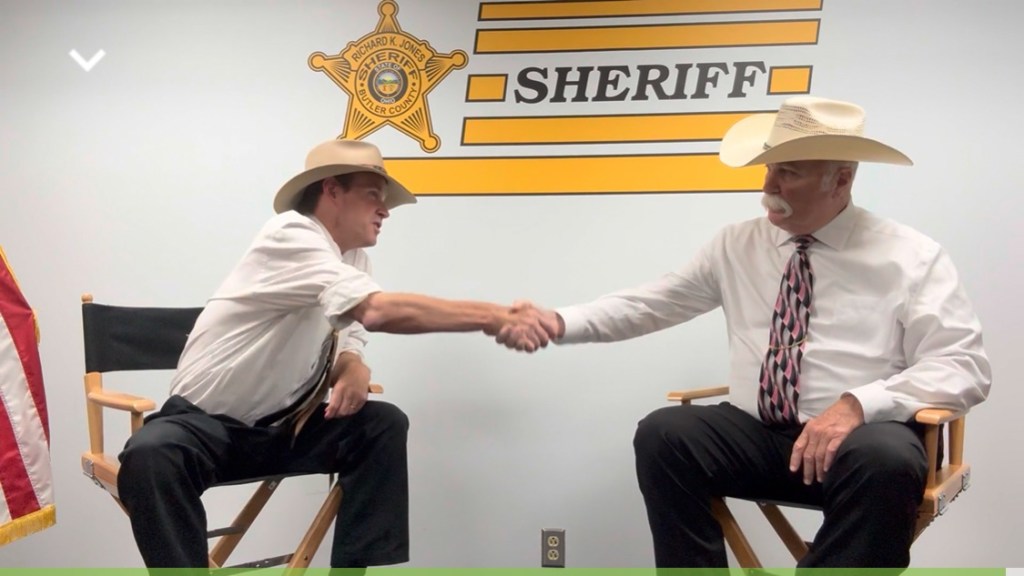
The same pattern shows up across Butler County. Sheriff Richard Jones has run the sheriff’s office for two decades with a continuity culture that keeps the books in the black, generates substantial boarding-of-prisoners revenue (including the ICE contract), and maintains operational discipline without the endless consultant theater you see in other counties. He understands that you put the right people in place, give them clear authority, and then hold them accountable for results. You do not throw money at wet wood and hope it lights.
Butler County has produced more than its share of these personalities. JD Vance came out of Middletown. The traits are recognizable once you have lived here long enough: direct, practical, uninterested in the performance of competence that substitutes for the real thing. You see the same operating style in the way Jungle Jim built from a roadside stand across from the factory where my grandfather worked into the largest independent of its kind. You see it in the way SpaceX runs.
Elon Musk did not invent the principle, but he has executed it at industrial scale. SpaceX gives engineers real ownership—cradle-to-grave responsibility—and then demands results. Automation and advanced welding are not about eliminating jobs; they are about expanding capacity when there are not enough skilled people to meet demand the old way. The robots and the elevated welding systems are force multipliers. The culture underneath them is the same one that lets Jungle Jim’s stock 180,000 items and still feel alive instead of sterile. It is the same culture that lets a sheriff’s office run surplus while neighboring jurisdictions drown in process.
Corporate types in suits keep flying in from New York and Los Angeles and San Francisco with large budgets and big investors. They walk the aisles of Jungle Jim’s taking notes. They study SpaceX’s production rates. Then they go home and throw gasoline on wet wood. They saturate the problem with capital and consultants and shiny process decks, and when the fire never quite catches they blame the market or the labor force or the regulations. They never figure out that the wood was never stacked correctly in the first place. The people who actually know how to start a fire in the rain do not need the gas. They prepare the ground, choose the right people, and let the work speak.
I have done this for decades in complex organizations. The critics who say it looks easy are usually the ones who have never had to do it without a blank check. When you do not have unlimited capital you get creative. You learn to empower rather than control. You accept that the best people will not stay if you keep putting your name over theirs. Jungle Jim has had corporate buyers and executives studying him for thirty years and they still cannot copy it. China has been trying to copy SpaceX and they still cannot drop the vehicle on the camera the way SpaceX does. The difference is not money. The difference is a personality type and an operating culture that cannot be faked.
That is why I believe the SpaceX IPO path will continue to create enormous new wealth. The culture is real. The operational discipline is real. The people closest to the work are trusted to move. Investors who understand people—who understand the difference between wet-wood capital and actual fire—will do very well. The ones who think you can buy the same result with consultants and process will keep burning fuel and wondering why nothing catches.
I will put a couple of the better documentaries and walk-throughs of Jungle Jim’s on the blog, along with material on SpaceX’s production and welding systems. Watch the way the people on the floor actually operate. Then watch the corporate versions of the same industries. The contrast is the entire lesson.
Operational excellence is not a mystery. It is rare because most people cannot stand to give away the credit. The ones who can do it make it look easy. The ones who cannot keep throwing gas on wet wood and calling it strategy. Butler County has produced more than its share of the first kind. I am not going to apologize for noticing.
Notes
1. Jungle Jim’s International Market was founded by James O. “Jungle Jim” Bonaminio. The permanent Fairfield store opened in 1975 at 4,200 square feet after several years of roadside stands, including a location across from the Fisher Body plant. Current main-store size is reported in the 200,000–300,000 square-foot range depending on the source and the most recent expansions; a second location operates in Eastgate. See Wikipedia entry and official Jungle Jim’s history pages.
2. Weekly visitor figures of approximately 82,000 and product counts exceeding 180,000 items (with strong international representation) appear consistently in contemporaneous reporting. The store is frequently described as a “theme park of food.”
3. Bonaminio’s management approach emphasizes hiring people with passion for specific departments and granting them substantial operating authority. Recent interviews and employee descriptions confirm department-level autonomy in buying, merchandising, and staffing.
4. Butler County Sheriff Richard K. Jones has held office since 2005. The office generates significant revenue through boarding-of-prisoners contracts, including a renewed ICE arrangement that has produced multi-million-dollar annual inflows and rate increases. County budget documents show the sheriff’s operation remaining a major, self-supporting component of the overall budget while maintaining operational continuity.
5. SpaceX’s internal culture of extreme ownership, flat structure for engineers, and cradle-to-grave product responsibility is documented in multiple former-employee accounts and contemporaneous reporting. Automation and advanced welding processes are treated as capacity multipliers rather than pure labor replacements.
6. JD Vance was raised in Middletown, Ohio (Butler County). The local cultural and industrial background is a matter of public record.
Bibliography / Further Reading
• Jungle Jim’s official site and “The Jungle Jim Story” pages (junglejims.com).
• Wikipedia: “Jungle Jim’s International Market.”
• Smithsonian Magazine, “Welcome to Jungle Jim’s” (2016).
• Cincinnati Business Courier and Journal-News coverage of Bonaminio interviews and 50th-anniversary material (2024–2026).
• Wall Street Journal Opinion Q&A with Jim Bonaminio (2026).
• Progressive Grocer and Supermarket News profiles of Jungle Jim’s independent model.
• Butler County Sheriff’s Office budget submissions and Journal-News reporting on ICE contract revenues and staffing (2025–2026).
• Reporting on SpaceX engineering culture and ownership model (Wired, Business Insider, former-employee accounts, 2022–2026).
• “Evolution of the Jungle” and related YouTube material produced by Jungle Jim’s International Market.
• Local Butler County political and business coverage of Sheriff Jones and regional figures.
Rich Hoffman is an author, political consultant, and strategic advisor based in Cincinnati, Ohio, and the creator of The Politics of Heaven—a unique framework that connects biblical theology, ancient history, and modern power structures to explain how moral alignment and spiritual forces shape global events. Blending real-world political experience with deep research into archaeology, UFO phenomena, and suppressed historical narratives, Hoffman offers compelling commentary on topics ranging from ancient civilizations and the Dead Sea Scrolls to modern populist movements, paranormal continuity, and leadership strategy in chaotic environments. As the author of The Gunfighter’s Guide to Business and the forthcoming Politics of Heaven, he brings a grounded yet provocative voice to media discussions, supported by firsthand experiences and a cross-disciplinary approach that bridges science, history, and theology. For interviews, speaking engagements, or expert analysis, visit richhoffmanbooks.com or contact directly via phone at 513-307-5815 or email at rhoffman@richhoffmanbooks.com. If you’ve seen the movie, Disclosure Day and want to talk about it and the implications of Presidnet Trump’s UAP disclosures, let me know and we can bring some color to your coverage. https://richhoffmanbooks.com/media-inquiries-broadcast-topics-and-contact-info/?frame-nonce=ad51e7ecba I do have a firsthand UFO encounter to discuss.
I was sitting upstairs in that restaurant on the boardwalk at Put-in-Bay, looking out over the water while the Teams calls kept coming in. The view pulls you in if you’ve been there. There’s the big central park, the U-shaped stretch of bars and shops wrapped around it, and then the thick forest of masts and hulls filling the harbor in front of it. From the second story you can pick out the bigger boats if you know who owns them. I had a bowl of shrimp and ice water in front of me and the restaurant’s Wi-Fi was solid enough that I could answer questions from people who wanted me on their advisory boards for twenty minutes at a stretch. Manufacturing people mostly. Plastic bottles one day, ship parts another. They all want to know the same basic things: how do you use capital, how do you hire the people who will build something the market actually needs, and how do you keep the whole machine from coming apart when the rules keep changing under your feet.
I told the woman who seated me I needed a quiet corner with good reception because I had a couple of these calls to get through before I could rejoin my family. She set me up where I could still see the bay. Between questions I kept glancing left at those boats and thinking about the men I know who keep them there. A slip and a vessel in that harbor is not a cheap hobby. You’re talking real money, the kind of money that used to stay inside a company so the owners could make payroll and renegotiate supply contracts when things got tight. A lot of those boats are paid for by people who once sat in the CFO chair of companies that no longer belong to the families who built them.
It put me in mind of an old bakery owner I used to deal with years ago when I was younger and still learning how the world actually worked. Transactions did not always go my way. When they didn’t, he would look at me with that half-amused, half-hard expression and say the line I have never forgotten: who owns the gold rules. It was a ruthless statement and a true one. I lived by it, learned from it, and used it for a long time. Gold meant control. Gold meant the ability to set terms. Gold meant you could decide who got paid and who got squeezed. In that older economy it was still possible for a privately held company to own its own gold, to keep its own books, and to weather a rough season without selling the whole enterprise to strangers.
That economy is gone. The currency changed. The Federal Reserve prints money at a scale that would have been unthinkable when I was dealing with that baker, and that printed money does not stay neutral. It floods into investment channels that then go looking for hard assets—companies, homes, anything that can absorb the excess liquidity and launder it into legitimate ownership. After the COVID disruption the process accelerated. Supply chains seized up. Costs for materials and labor jumped. Minimum-wage pressures and regulatory layers that had been building for years suddenly became impossible to absorb on the old margins. A lot of long-standing private companies found themselves carrying debt loads they never would have taken on in a tighter money environment, or they found their CFOs more interested in the lifestyle the easy capital could buy than in protecting the cash flow that kept the doors open.
I know seven different CFOs who keep boats in that same harbor at Put-in-Bay. They are not moral monsters. They are shortsighted in the particular way the new rules reward. When the money was flowing they took what the system offered. Some of them sold the companies out from under the owners who had built them. Others loaded the balance sheets with leverage that looked smart on paper until the interest rates and the inventory costs and the slower collections all hit at once. The blood in the water brought the sharks. Private equity and institutional capital showed up with the printed money and the patience to wait out the distressed sellers. The old privately held firms that had lasted decades suddenly could not hold. Bankruptcy or forced sale became the only remaining moves that preserved anything at all.
The numbers back up what I have been watching on the ground. Since 2000 the count of private-equity-backed companies in the United States has climbed from roughly two thousand to more than eleven thousand five hundred, and by late 2025 the figure was approaching thirteen thousand. Over the same stretch the number of publicly listed companies on the major exchanges fell by about thirty-five percent, from around seven thousand to roughly forty-five hundred. Private equity did not invent the pressures that hollowed out traditional ownership, but it has been the primary vehicle that absorbed the wreckage. Business bankruptcy filings, which dropped to historic lows in the immediate post-stimulus years, have been climbing steadily again. In the twelve months ending in mid-2025 they were up more than eleven percent year over year, with business filings themselves rising into the twenty-three to twenty-four thousand range. That is still below the peaks of earlier crises, yet the direction is unmistakable and the casualties are concentrated among the mid-sized and long-private firms that once formed the backbone of local manufacturing and distribution.
The people who call me for advice are trying to figure out how to survive inside this new arrangement. They still think in the old terms. They believe that if they can just get enough gold—enough capital, enough line of credit, enough valuation—they will be able to rule the way the bakery owner once ruled. I tell them the truth as I see it from that restaurant window. Gold is still useful, but knowledge has become the scarcer and more powerful resource. The man who understands how to turn knowledge into something the market will pay for can acquire gold whenever he needs it. The man who only knows how to hold gold, or how to extract it from someone else’s balance sheet, is playing a game that is already being rewritten around him.
A lot of the capital washing through these deals is not patient industrial capital. It is money that needs a home after the Federal Reserve expanded the money supply at rates that had not been seen in modern times. M2 grew by roughly forty percent in the two years after the pandemic began. That liquidity had to go somewhere. It went into private equity funds, into real-estate investment vehicles, into every channel that could convert paper claims into ownership of real productive assets. The result is a quiet transfer. Private ownership is not outlawed. It is simply made more expensive, more leveraged, and more vulnerable to the next policy shock until the original owners are forced to sell or fold. What replaces them is often a portfolio company whose ultimate decision-makers sit in New York or London or some other distant place and whose primary obligation is to the limited partners who supplied the capital, not to the community that once depended on the firm.
I do not pretend this is a conspiracy theory that requires secret handshakes. The mechanisms are public. Monetary policy that treats inflation as a temporary inconvenience while asset prices soar. Regulatory and wage policies that raise the fixed costs of running a small or mid-sized operation. A financial culture that rewards the extraction of value over the patient creation of it. And a political culture that has grown comfortable talking about “stakeholders” and “public interest” while the actual private owners who built the companies are being squeezed out. Whether you call the endpoint socialism or simply the financialization of everything, the practical effect is the same: fewer people who own the means of production in any meaningful sense, and more people who work for capital that answers to no local loyalty.
I keep taking the advisory calls because the people on the other end still need answers faster than the next book or the next documentary will deliver them. I tell them what I told the people on those Teams sessions while I watched the boats bob in the harbor. The old rule still has force, but the gold itself has changed. Knowledge that can be turned into products people actually want is the only form of capital that cannot be printed into existence by a central bank or diluted by the next round of leverage. The companies that survive the current slaughter will be the ones that treat knowledge as the real scarce resource and that refuse to let short-term extraction destroy the long-term ability to create value.
Private ownership of productive enterprises is not a nostalgic preference. It is the practical foundation of a free economy. When that foundation erodes far enough, the language of free markets remains but the substance is gone. I have watched enough of it happen in the last several years, including a long-standing company not far from my own house, to know the pattern is not accidental and not temporary. The people who still believe they can simply steal or leverage their way to the gold and then rule forever are the ones who have not yet noticed that the rules themselves have shifted under them. Knowledge compounds. Printed money does not. That difference is going to decide more than most of the current players seem to understand.
I give the advice away freely because the window for acting on it is already narrower than most people realize. The next decade will not look like the last one, and the companies that still answer to actual owners rather than to distant capital will be rarer still unless enough people decide that knowledge is the only gold worth owning.
Notes
1. Citizens Bank analysis drawing on industry data shows the private-equity-backed company count in the United States rising from approximately 2,000 in 2000 to more than 11,500 in recent years, a gain exceeding 400 percent, while the number of companies listed on the NYSE and NASDAQ fell from roughly 7,000 to about 4,500. PitchBook data for Q3 2025 places the number of U.S. PE-backed companies near 12,900.
2. Administrative Office of the U.S. Courts data show business bankruptcy filings rising from 18,926 in the year ending December 2023 to 23,107 in the year ending December 2024 (a 22 percent increase), with further elevation into 2025. Total bankruptcy filings for the twelve months ending June 2025 reached 542,529, an 11.5 percent increase over the prior period.
3. Federal Reserve data and analyses from the St. Louis Fed and other sources document the rapid expansion of M2 money supply during 2020–2022, with year-over-year growth rates exceeding 25 percent at peak and cumulative increases on the order of 40 percent from early 2020 levels, contributing to the inflationary and asset-price pressures that followed.
Bibliography
Citizens Bank. “The Public to Private Equity Pivot Continues.” Capital Markets & Advisory insights, December 2024.
PitchBook. Data on U.S. private-equity-backed company counts and holding periods, various releases through 2025–2026.
Administrative Office of the U.S. Courts. Bankruptcy Statistics, twelve-month periods ending 2023–2025.
Federal Reserve Bank of St. Louis. “The Rise and Fall of M2.” On the Economy, May 2023, and subsequent H.6 Money Stock Measures releases.
Davis, Steven J., et al. “The Economic Effects of Private Equity Buyouts.” NBER Working Paper 26371 (and related Chicago Booth / BFI versions).
McKinsey & Company. Global Private Markets Report 2026.
S&P Global Market Intelligence. Reports on private-equity portfolio company bankruptcies and corporate distress, 2024–2025.
U.S. Small Business Administration, Office of Advocacy. Frequently Asked Questions About Small Business, 2024–2025 editions, for context on the continuing dominance of small private firms even as mid-market ownership concentrates.
Rich Hoffman is an author, political consultant, and strategic advisor based in Cincinnati, Ohio, and the creator of The Politics of Heaven—a unique framework that connects biblical theology, ancient history, and modern power structures to explain how moral alignment and spiritual forces shape global events. Blending real-world political experience with deep research into archaeology, UFO phenomena, and suppressed historical narratives, Hoffman offers compelling commentary on topics ranging from ancient civilizations and the Dead Sea Scrolls to modern populist movements, paranormal continuity, and leadership strategy in chaotic environments. As the author of The Gunfighter’s Guide to Business and the forthcoming Politics of Heaven, he brings a grounded yet provocative voice to media discussions, supported by firsthand experiences and a cross-disciplinary approach that bridges science, history, and theology. For interviews, speaking engagements, or expert analysis, visit richhoffmanbooks.com or contact directly via phone at 513-307-5815 or email at rhoffman@richhoffmanbooks.com. If you’ve seen the movie, Disclosure Day and want to talk about it and the implications of Presidnet Trump’s UAP disclosures, let me know and we can bring some color to your coverage. https://richhoffmanbooks.com/media-inquiries-broadcast-topics-and-contact-info/?frame-nonce=ad51e7ecba I do have a firsthand UFO encounter to discuss.
I just got back from Put-in-Bay, and the whole time I kept looking at that big park and the yacht club thinking the same thing: this is exactly the kind of place a Republican governor candidate should plant a flag and talk about jobs. Not the usual Columbus or Cincinnati media circus. An island. Outside. Real people on vacation who still live in Ohio and want their kids to stay here. It would make great news precisely because it is not the typical stop. It signals strength. It tells the other side their strategy is already under pressure.
That same instinct applies east of Columbus in Amish country. Put an arm around the people who live with the paranormal side of Ohio—the Bigfoot reports that still come in, the stories that never make the official narrative. Those people vote. They know when somebody is listening and when somebody is talking down to them. A little color in the campaign does not hurt when the other side is running the same old progressive script.
Because that is what this race is really about. David Pepper is on the bottom of the Amy Acton ticket, the former Ohio Democratic Party chairman now serving as the institutional muscle. The person on the bottom of the ticket usually does the hard work of carrying the party machinery and the progressive money networks. They are connected into the larger Democrat operation that has treated Ohio as a prize in the long project of remaking the country. Mark Elias and that entire apparatus do not show up by accident. Ohio has been a target for years. Knock it off and the map changes.
Pepper has been loud about Vivek Ramaswamy moving Strive Asset Management out of Columbus to Texas. He acts like it is some personal betrayal. It is not. It is fiduciary duty. Companies exist to protect and grow capital, not to perform patriotism for politicians who create the conditions that drive capital away. Ramaswamy built brands. He understands that investors put money where the rules reward production instead of punishing it. Texas had better policy. Ohio is improving, and a lot of dedicated legislators have been grinding to make it friendlier, but the record under the last round of heavy-handed governance still hangs over the place. Aerospace manufacturing and advanced industry are coming whether the political class likes it or not. The only question is whether Ohio captures them or watches them locate somewhere else.
Amy Acton does not understand any of that. She resigned as health director in June 2020 after the COVID policies she helped drive produced real damage. Businesses closed. Ownership changed hands. Some never recovered. You can still feel it. Then there is the 2019 police call to her house over a domestic dispute where she had been drinking, took medication, shattered a mirror, and her husband had to keep her from driving. That is not abstract. It is part of the public record now. She never held a stable executive job that required building something that had to survive market discipline. She became popular with a certain type during the early COVID days because she made anxious people feel protected. That constituency is real, but it is not the majority that decides whether capital stays or leaves.
I have watched the type for decades. She reminds me of the girls who adopted the Fast Times at Ridgemont High beach-festival personality so they would not intimidate anyone by seeming too sharp. It worked in high school. It does not build a state. The Democrats seem to think they can turn that same soft, non-threatening persona into statewide votes. There are not enough of those voters left in Ohio to carry it. The people who still believe in opportunity look at a billionaire who actually ran companies and built an anti-woke asset manager because the existing ones had gone soft, and they see someone who knows how money moves.
Capitalism is voting with your feet. If the policy environment is hostile, you leave. That is not disloyalty. That is how free people protect what they have built. The Democrat instinct is closer to East Berlin. Stay. Wear the mask. Do not go to church. Be loyal to the state even when the rules are destroying the very conditions that let families raise the next generation here. They never understood why people climbed the wall. They still do not. North Korea makes the same calculation. Fear and guilt are cheaper than good policy.
That is why young people have been leaving their parents in Ohio for years. Mom and Dad stayed. Junior and the daughter looked around, saw limited opportunity, and moved. The traditional pattern—raise a family here, take the kids to Put-in-Bay or Hilton Head, keep the cycle going—breaks when the economic soil is thin. Ohio needs to be a premier destination again. That requires a governor who understands brand, investment, and the difference between real growth and political theater. Ramaswamy has lived that difference. He moved a company when the numbers said move. He will sign legislation that changes the numbers in Ohio’s favor. There is an army of legislators waiting for exactly that.
Pepper and the Acton operation are already showing the strain. The money is flowing in on their side, but the investment of belief is not. People remember who locked things down and who paid the price. They also notice who treats a corporate relocation as moral failure instead of economic signal. A few months out, the race is still competitive on paper, but the underlying dynamics favor the candidate who can talk about opportunity without apology. Seven or eight points is possible if the campaign stays aggressive and refuses to play on the other side’s chosen ground.
I would still take the Put-in-Bay stop and the Amish-country swing. Stretch the map. Force the media to cover something other than the scripted attacks. Show that the campaign is strong enough to go where the usual consultants say not to go. That is how you make the other side squirm. Ohio does not need another festival personality in the governor’s office ordering pizza and managing decline. It needs someone who knows how to build a brand people want to invest in and a state people want to raise families in. That is the choice. The rest is noise.
Notes
1. Amy Acton selected former Ohio Democratic Party chairman David Pepper as her lieutenant governor running mate in January 2026.
2. Strive Asset Management, co-founded by Vivek Ramaswamy as an anti-ESG/anti-woke firm, relocated its headquarters from Columbus, Ohio, to Dallas, Texas, with most staff expected to move by early 2025. Pepper and labor allies have repeatedly attacked the move as evidence of disloyalty to Ohio.
3. Acton served as Ohio Department of Health director from February 2019 until her resignation on June 11, 2020, amid intense controversy over COVID orders; she briefly continued as an advisor to Governor DeWine.
4. A 2019 Bexley police report described a domestic dispute at Acton’s home involving a verbal argument, alcohol, prescription medication, and a shattered mirror; no charges were filed. The report resurfaced during the 2026 campaign.
5. Multiple 2026 polls and the Cook Political Report have rated the Ramaswamy–Acton race a toss-up or extremely close as of mid-to-late July, after earlier lean-Republican ratings.
6. Ohio has long experienced net out-migration of young college-educated adults, a phenomenon repeatedly described as brain drain in academic and policy literature; recent data show some stabilization but the cultural memory of limited opportunity remains strong.
7. Ohio continues to record Bigfoot and other cryptid reports, including a notable 2026 uptick in Northeast Ohio, with cultural resonance in rural and Amish-adjacent communities.
Bibliography for Further Research
Acton, Amy, and related Ohio Department of Health records, 2019–2020.
Ballotpedia. “Ohio gubernatorial and lieutenant gubernatorial election, 2026.”
Cook Political Report. Race ratings for Ohio governor, July 2026 updates.
DeWine, Mike. Public statements on Acton’s resignation, June 11, 2020.
Elias, Marc / Democracy Docket. Broader progressive legal and electoral infrastructure materials.
McGuire, Patrick, et al. “Brain Drain in Ohio: Observations and Summaries.” University of Toledo Urban Affairs Center, 2006 (and subsequent updates).
Ohio Capital Journal and Columbus Dispatch reporting on Acton job history and the 2019 police call, April–July 2026.
Pepper, David. Substack writings and campaign statements criticizing Ramaswamy and Strive relocation, 2025–2026.
Ramaswamy, Vivek. Woke, Inc. and public comments on fiduciary duty, capital allocation, and state competitiveness.
Strive Enterprises press materials and Dallas Morning News coverage of the headquarters relocation, late 2024–2025.
U.S. Census and Ohio Board of Regents historical analyses of college-graduate migration patterns.
Additional reading on East German border controls, capital flight under socialist policy regimes, and the political economy of state competition (Texas vs. Ohio business climate comparisons).
Rich Hoffman is an author, political consultant, and strategic advisor based in Cincinnati, Ohio, and the creator of The Politics of Heaven—a unique framework that connects biblical theology, ancient history, and modern power structures to explain how moral alignment and spiritual forces shape global events. Blending real-world political experience with deep research into archaeology, UFO phenomena, and suppressed historical narratives, Hoffman offers compelling commentary on topics ranging from ancient civilizations and the Dead Sea Scrolls to modern populist movements, paranormal continuity, and leadership strategy in chaotic environments. As the author of The Gunfighter’s Guide to Business and the forthcoming Politics of Heaven, he brings a grounded yet provocative voice to media discussions, supported by firsthand experiences and a cross-disciplinary approach that bridges science, history, and theology. For interviews, speaking engagements, or expert analysis, visit richhoffmanbooks.com or contact directly via phone at 513-307-5815 or email at rhoffman@richhoffmanbooks.com. If you’ve seen the movie, Disclosure Day and want to talk about it and the implications of Presidnet Trump’s UAP disclosures, let me know and we can bring some color to your coverage. https://richhoffmanbooks.com/media-inquiries-broadcast-topics-and-contact-info/?frame-nonce=ad51e7ecba I do have a firsthand UFO encounter to discuss.
I have spent enough years around lawyers to recognize the type when I see it. They are not the Perry Mason figures of old television or the crusading heroes of public imagination. Most of them are people who did what their parents told them to do, scored high enough on the LSAT in their early twenties, ground through law school, and then settled into a comfortable professional life that rewards caution more than courage. By the time they reach their thirties and forties, they have the house, the spouse, often selected with family approval in mind, the country-club membership, and the afternoon golf game with the same judges they appear before in the morning. The workday for many of them effectively ends at noon. The rest of the afternoon is reserved for the social circuit that keeps the referrals flowing and the invitations coming. I read statutes and case law with a high level of comprehension, and I have found more than once that I can parse the language more clearly than the attorney sitting across the table who is already thinking about what time the tee time starts. That is not arrogance. It is observation.
This psychological profile explains a great deal about why election-fraud prosecutions rarely mature into serious courtroom contests even when the evidence is substantial. The legal profession is not staffed by people who wake up each morning eager to risk social exile, professional retaliation, or the loss of the comfortable rhythm they have built. A prosecutor who signs off on a high-profile election case knows that liberal advocacy groups will protest outside the office, that the state bar association will take a dim view of any action that appears to “undermine confidence” in the system, and that the judges who play golf with the defense bar will find procedural reasons to slow or stop the case. The same dynamic appears in other categories of crime that carry social discomfort. I have been on the prosecution side of cases involving the sexual exploitation of children. Even when the digital evidence is clear, and the devices are full of material that no jury would excuse, the institutional reluctance is palpable. Prosecutors calculate the cost in time, the likelihood that sympathy arguments will sway a jury, and the quiet knowledge that some of their own colleagues or family members consume large volumes of pornography and may not draw the brightest moral lines. The rational calculation becomes: is this particular case worth the disruption? Too often the answer is no. The same calculation is applied to election integrity.
After the 2020 election, more than sixty lawsuits were filed in multiple states. The overwhelming majority never reached a full evidentiary hearing on the core allegations. Courts dismissed them on standing, on the doctrine of laches—essentially that the challengers had waited too long—or on the ground that the claimed irregularities did not meet the high bar required to overturn certified results. In Wisconsin, the state supreme court, then controlled by conservatives, largely rejected key claims in Trump v. Biden on timing grounds. In Michigan, King v. Whitmer was dismissed, with the court finding the equal-protection theories too speculative. Arizona’s Ward v. Jackson ended with a finding that the plaintiffs had not met the evidentiary standard. The United States Supreme Court repeatedly declined to accelerate or take up these matters. The pattern repeated in subsequent cycles. Cases that might have forced a deeper examination of ballot handling, chain of custody, or voter roll integrity were steered into procedural dead ends. The lawyers on both sides understood the game. Those who wanted the status quo preserved had every incentive to keep the process slow, technical, and bloodless.
Mark Elias and the network of Democratic election lawyers who operate through vehicles such as Democracy Docket have been far more aggressive on their side of the ledger. They file early, they file often, and they treat every procedural opening as an opportunity to expand mail voting, limit signature verification, or block citizenship documentation requirements. Their success is not mysterious. They are playing offense while the other side is staffed by people who prefer not to be labeled extremists at the next bar association dinner. The SAFE Act—later reintroduced in expanded form as the SAVE America Act—has passed the House of Representatives more than once, including in 2025 and again in February 2026. It requires documentary proof of citizenship to register for federal elections. The Senate has refused to bring it to a floor vote, which would require 60 senators. The resistance is not rooted in complex constitutional theory. It is rooted in the knowledge that tightening the rules would reduce the margin of maneuver that certain political machines have come to rely upon.
This psychological profile explains a great deal about why election-fraud prosecutions rarely mature into serious courtroom contests even when the evidence is substantial. The legal profession is not staffed by people who wake up each morning eager to risk social exile, professional retaliation, or the loss of the comfortable rhythm they have built. A prosecutor who signs off on a high-profile election case knows that liberal advocacy groups will protest outside the office, that the state bar association will take a dim view of any action that appears to “undermine confidence” in the system, and that the judges who play golf with the defense bar will find procedural reasons to slow or stop the case. The same dynamic appears in other categories of crime that carry social discomfort. I have been on the prosecution side of cases involving the sexual exploitation of children. Even when the digital evidence is clear, and the devices are full of material that no jury would excuse, the institutional reluctance is palpable. Prosecutors calculate the cost in time, the likelihood that sympathy arguments will sway a jury, and the quiet knowledge that some of their own colleagues or family members consume large volumes of pornography and may not draw the brightest moral lines. The rational calculation becomes: is this particular case worth the disruption? Too often the answer is no. The same calculation is applied to election integrity.
After the 2020 election, more than sixty lawsuits were filed in multiple states. The overwhelming majority never reached a full evidentiary hearing on the core allegations. Courts dismissed them on standing, on the doctrine of laches—essentially that the challengers had waited too long—or on the ground that the claimed irregularities did not meet the high bar required to overturn certified results. In Wisconsin, the state supreme court, then controlled by conservatives, largely rejected key claims in Trump v. Biden on timing grounds. In Michigan, King v. Whitmer was dismissed, with the court finding the equal-protection theories too speculative. Arizona’s Ward v. Jackson ended with a finding that the plaintiffs had not met the evidentiary standard. The United States Supreme Court repeatedly declined to accelerate or take up these matters. The pattern repeated in subsequent cycles. Cases that might have forced a deeper examination of ballot handling, chain of custody, or voter roll integrity were steered into procedural dead ends. The lawyers on both sides understood the game. Those who wanted the status quo preserved had every incentive to keep the process slow, technical, and bloodless.
Democrats continue to advance policies that polling shows are deeply unpopular with the broader American public—expanded gender-transition interventions for minors, open hostility to traditional religious norms, and economic frameworks that treat private capital as the enemy. They do so with remarkable confidence. That confidence is rational only if they believe the electoral margins can be kept close enough, through administrative practices and legal delay, that the unpopularity never fully translates into permanent minority status. When the legal profession as a whole lacks the appetite to prosecute the mechanisms that keep those margins artificially narrow, the calculation holds. The media benefits from the permanent horse race. The donor class benefits from the permanent conflict. The lawyers benefit from the billable hours generated by endless preliminary motions. The only people who lose are the citizens who expect the rules to be enforced without regard to which party benefits.
I know prosecutors in Butler County and elsewhere who chose public service over the higher private-sector income precisely because they still believe the job is about more than billing and social navigation. They are the exceptions. The broader professional culture rewards the opposite temperament. The young lawyer who spent his twenties doing everything the family and the firm expected of him arrives in his forties with a quiet resentment that he has never been allowed to live an authentic life. That resentment rarely expresses itself as a sudden burst of moral courage in a courtroom. It expresses itself in safer rebellions—affairs, passive-aggressive litigation tactics, or simply the decision to treat every difficult case as someone else’s problem. By the time these men and women retire, they are often the most tedious company imaginable at a local restaurant, nursing a lifetime of compromises that never quite tasted as good as the brochure promised.
Election fraud continues not because the evidence is absent, but because the people whose job it is to act on that evidence have built lives that depend on never acting too forcefully. They are not villains in the cartoon sense. They are ordinary professionals who chose comfort over confrontation and then discovered that the system rewards exactly that choice. Until enough of them decide that the country club is less important than the integrity of the ballot box, the pattern will continue. The SAVE Act will keep stalling. The cases will keep dying on procedural grounds. And the public will keep being told that the absence of successful prosecutions proves the absence of the crime. That is the circular logic of a profession that has forgotten what it was supposed to protect.
Notes
1. On the volume and disposition of 2020 post-election litigation, see the compilation maintained by the Campaign Legal Center, “Results of Lawsuits Regarding the 2020 Elections,” and the analysis in “2020 Election Litigation: The Courts Held,” Judicature (Duke Law). More than sixty cases were filed; the large majority were dismissed or resolved against the challengers on standing, laches, or failure to meet evidentiary thresholds.
2. Trump v. Biden, 951 N.W.2d 568 (Wis. 2020): Wisconsin Supreme Court rejected key claims, applying laches to several and finding the indefinite-confinement challenge insufficiently particularized.
3. King v. Whitmer, No. 20-13134 (E.D. Mich. Dec. 7, 2020): District court dismissed, finding constitutional claims speculative and deviations from state law insufficient to establish an Elections Clause violation.
4. Ward v. Jackson, No. CV-20-0343 (Ariz. Super. Ct. Maricopa Cnty. Dec. 4, 2020), aff’d Arizona Supreme Court: Plaintiffs failed to meet the evidentiary standard for an election contest.
5. The Safeguard American Voter Eligibility (SAVE) Act and its successor, the SAVE America Act, passed the House in 2025 and again in February 2026; as of mid-2026, the Senate has not advanced the measure past the filibuster threshold. See congressional tracking for H.R. 22 (119th Congress) and related bills.
6. Mark Elias’s role in Democratic election litigation is documented through Democracy Docket filings and public statements; his firm and associated entities have been central to challenges against voter-ID and citizenship-documentation measures.
7. Heritage Foundation Election Fraud Database catalogs proven instances of fraud across jurisdictions; the existence of documented cases does not by itself resolve the separate question of prosecutorial and judicial willingness to treat systemic claims as criminal matters.
Select Bibliography
Campaign Legal Center. “Results of Lawsuits Regarding the 2020 Elections.” Updated compilation.
Hively, Ray, and Robert Horn’s materials on related institutional behavior are less directly applicable here; for election procedure, see the American Bar Association Standing Committee on Election Law’s litigation summaries instead.
Pauketat and other archaeological sources are irrelevant to this subject; for legal culture see instead:
Posner, Richard A. How Judges Think. Cambridge: Harvard University Press, 2008 (on institutional incentives).
Congressional Research Service and Ballotpedia case trackers for 2020–2024 election litigation outcomes.
U.S. Congress. H.R. 22, Safeguard American Voter Eligibility Act, 119th Congress, and subsequent SAVE America Act iterations.
Rich Hoffman is an author, political consultant, and strategic advisor based in Cincinnati, Ohio, and the creator of The Politics of Heaven—a unique framework that connects biblical theology, ancient history, and modern power structures to explain how moral alignment and spiritual forces shape global events. Blending real-world political experience with deep research into archaeology, UFO phenomena, and suppressed historical narratives, Hoffman offers compelling commentary on topics ranging from ancient civilizations and the Dead Sea Scrolls to modern populist movements, paranormal continuity, and leadership strategy in chaotic environments. As the author of The Gunfighter’s Guide to Business and the forthcoming Politics of Heaven, he brings a grounded yet provocative voice to media discussions, supported by firsthand experiences and a cross-disciplinary approach that bridges science, history, and theology. For interviews, speaking engagements, or expert analysis, visit richhoffmanbooks.com or contact directly via phone at 513-307-5815 or email at rhoffman@richhoffmanbooks.com. If you’ve seen the movie, Disclosure Day and want to talk about it and the implications of Presidnet Trump’s UAP disclosures, let me know and we can bring some color to your coverage. https://richhoffmanbooks.com/media-inquiries-broadcast-topics-and-contact-info/?frame-nonce=ad51e7ecba I do have a firsthand UFO encounter to discuss.
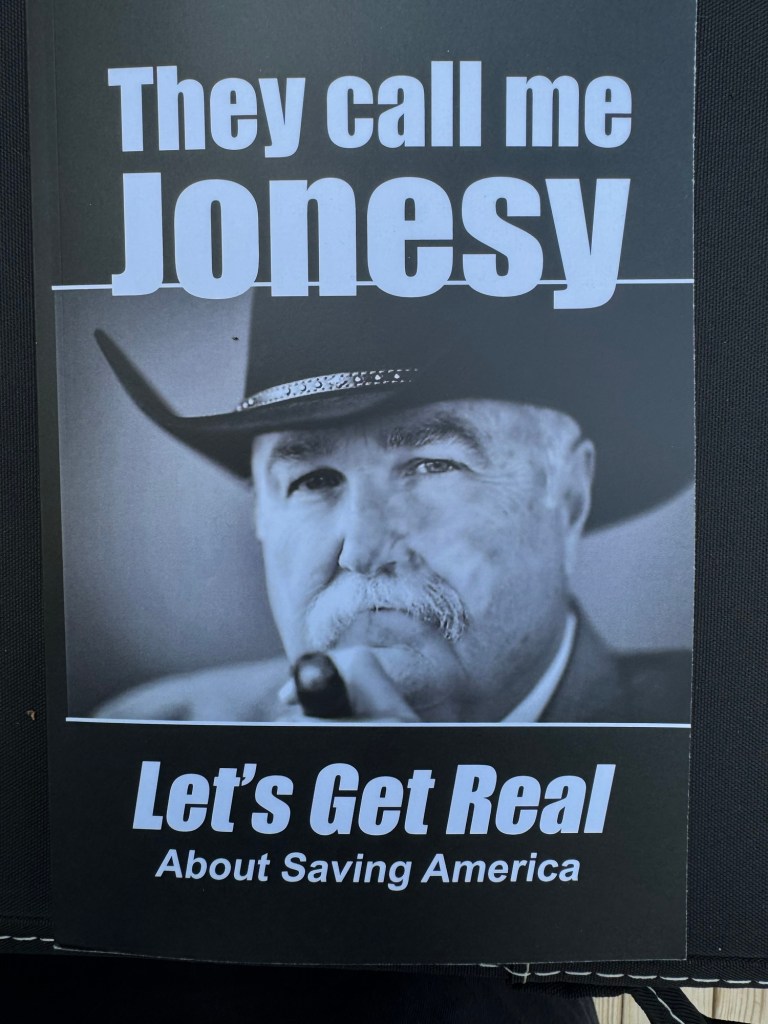
I first learned that Sheriff Richard K. Jones had put a book out when a few people in the county mentioned it in passing, and the moment I heard the title I knew I would read it. They Call Me Jonesy: Let’s Get Real About Saving America arrived on the front porch the day my family and I returned from being out of town at Put-in-Bay, in Ohio. I had ordered it so it would be waiting, because I had already promised myself and others that I would get through it promptly. After more than two decades of knowing the man, shaking his hand at events, watching him work a room in that cowboy hat of his, and hearing him on WLW or in national spots talking immigration and law and order, I still carried questions about how he became who he is, what shaped the priorities he brings to the office every morning, and how a man decides day to day what matters most when the badge is on. The book answered more of those questions than casual conversation ever could.
What struck me first is that this is not merely a campaign volume or a greatest-hits collection of media appearances. It reads like a man who has spent a lifetime speaking into microphones and cameras finally realizing that the voice does not last forever. There is a quiet urgency underneath the stories. He talks about the burial plot, about the friend at the funeral home who will one day see him prepared for the last service. He is only a little more than a decade older than I am, yet the public job ages a person in ways private life does not. Six terms as sheriff of Butler County, with the possibility of more, still brings the knowledge that one day the hat comes off for the last time. Writing the book becomes a way of leaving the voice behind so that the things he believes still matter after the daily briefings and the press conferences stop.
I have always liked the Gunsmoke in him. He admits the debt openly. The old black-and-white shows, the clear line between the man who upholds the law and the men who break it, the sense that a sheriff walks the street and talks to people and puts things right when he can. Andy Griffith is there too, the Mayberry instinct to put an arm around the troubled soul and try to set him back on the path. Those two shows formed a generation of men who believed law enforcement could be both firm and decent. Jonesy lives that combination more than most. He is black-and-white on the big questions. Drugs destroy families and communities; illegal immigration brings more of the same; the jail is full of people who made choices that wrecked their own lives and the lives of others. Yet the book reveals a softer edge than the public persona sometimes allows. He is a compassionate conservative in the older sense of the term. He wants the county to feel more like the place he grew up, where most of the kids he knew had parents who stayed married twenty or thirty years and worked through their troubles instead of walking away at the first hard stretch.
That observation about divorce rates is one of the strongest passages. He watched the numbers climb across his adult lifetime and saw the downstream damage in the jail, in the overdose calls, in the children who never had a stable home to push against. Stable families produce the work ethic and the self-control that keep a community from tipping into chaos. When the marriages fracture as a matter of course, the sheriff’s office ends up dealing with the wreckage. He does not present himself as a sociologist, but the pattern is plain to anyone who has spent decades answering the same kinds of calls. The data back the instinct. The sharp rise in divorce after the introduction of no-fault laws, the parallel growth in single-parent households, and the measurable links to higher rates of juvenile trouble, drug use, and later criminality are not left-wing inventions or right-wing inventions. They are simply what happened.
I share the same cultural memory. I grew up with Gunsmoke playing in the background at my grandparents’ place near Oxford, rabbit ears and all, the same black-and-white morality on the screen while the adults talked about the real world. The shows did not prepare a man for the full depth of certain modern evils. Pornography addiction of the kind that turns a phone into a nonstop delivery system, and the further slide into the sexual exploitation of children, sit outside the frame of those old stories. Jonesy is of an era when a teenager might sneak a look at a dirty magazine on a high shelf in an old bookstore hoping that the cashier wouldn’t catch them. The scale and the numbness of what exists now are harder for that generation to metabolize, not because the men lack courage, but because the evil itself is newer in its accessibility and its intensity. He is devastatingly clear on drugs. On the deeper sexual corruptions that have grown in the last thirty years, the book leaves the impression of a man who sees the damage and still struggles to find language adequate to the thing itself. That is not a failing of character. It is the honest limit of a worldview formed before the internet made every darkness instantly available.
His record on the drug side is long and consistent. The seizures, the public messaging, the refusal to treat overdose deaths as inevitable background noise, all of it tracks with the same black-and-white view. He has been equally consistent on illegal immigration, which is why the national media found him useful for color and why the comparisons to Joe Arpaio sometimes surface. Arpaio paid a political and legal price for enforcing the same principles under a different administration; the pardon that followed was a recognition that the prosecution had been selective. Jonesy has not faced that level of federal hostility, and Butler County is not Maricopa. The local political climate has allowed him to keep doing the work. I expect him to keep winning as long as he wants the job, and I hope that is for a good while yet. The county is better for his presence.
There is a section on the COVID years that brought back the tension of those days. He kept the office functioning, kept the messaging straightforward, and refused to let the panic dictate every decision. Leadership under that kind of pressure reveals the man. The same instinct shows up in the smaller habits. He likes the Waffle House on Main Street in Hamilton enough that they named an omelet after him. I understand the attraction. Walk in, sit at the counter, talk to the cooks and the waitresses and whoever else is there about the country and the county and what needs fixing. It is the modern version of the saloon without the whiskey, a place where a sheriff can still be a citizen among citizens. I took my granddaughter to a Waffle House on a trip toward Columbus for the same reason. The American flags and the unapologetic patriotism on the walls feel like home. Jonesy belongs in that atmosphere the same way he belongs in the cowboy hat.
The book is full of the personal details that never surface in a sound bite. Garfield High School. The long marriage. The children and grandchildren. The zoo trips. The quiet pride in having built a life that looks something like the ones he saw around him as a boy. He is not trying to present himself as a sophisticated theorist. He is trying to say that the old model still works if enough people insist on it. Strong families, clear laws, a sheriff who shows up every day ready to lock up the people who refuse to live by them, and a willingness to put an arm around the ones who might still be pulled back. That combination is rarer than it should be.
I have found myself on the opposite side of primary fights from time to time, the normal friction of people who share a party but not always a candidate. None of that changed the basic respect. The man has brought real public relations value to the office and to the county. When national outlets need a sheriff who will speak plainly about the border or the drug crisis, they know where to find him. Locally he has kept the department visible and the standards high. The book makes plain that the visibility is not an end in itself. It is a tool for keeping the public on the side of the people who have to make the hard calls at three in the morning.
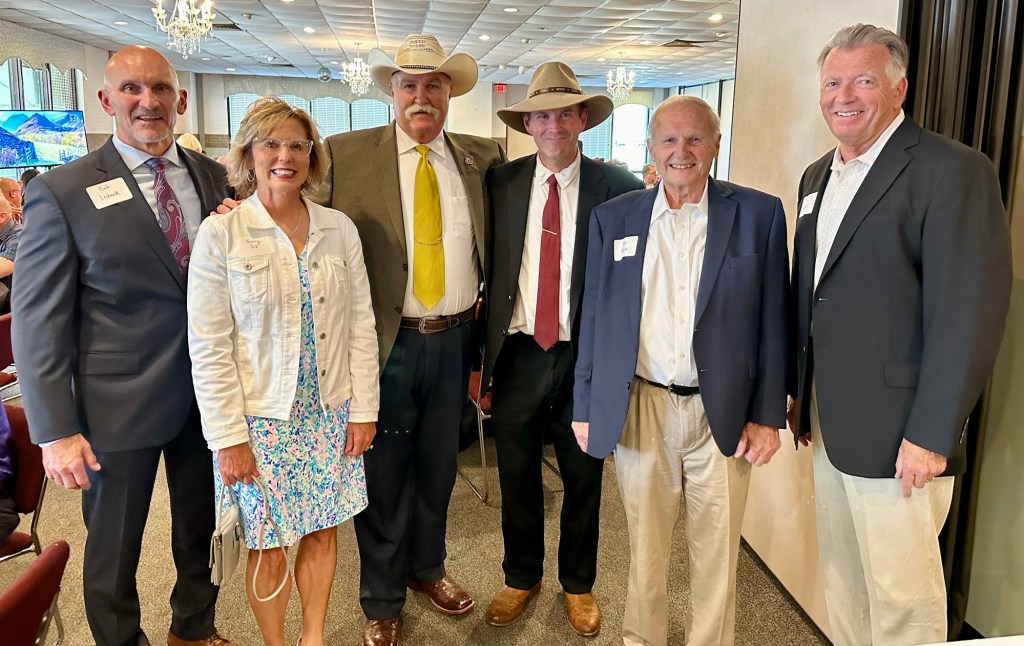
Some of my favorite people. And I never get tired of Sheriff Jones.
What lingers after the last page is the sense of a man measuring the distance between the county he inherited and the county he will leave. He wants the next generation of law enforcement and the next generation of citizens to remember that the job is still worth doing it the old way. The book is his attempt to make that memory portable. It is not perfect. No book written by a working sheriff in the middle of the job is going to be. It is honest in the places that matter. The love of the old shows, the sadness over the collapse of stable families, the daily refusal to treat drug dealers as unfortunate victims of circumstance, the recognition that the voice will one day go quiet, all of it lands cleanly.
If the goal is still to make the country better starting from the ground up, then more sheriffs who think like this would help. Fix the families and a large part of the downstream crime and addiction begins to shrink. Keep the border and the drug pipelines under pressure. Keep the local office present and accountable. Jonesy has practiced that combination for a long time in one midwestern county. The book lets the rest of the country see the method without the filter of a three-minute television hit. I finished it glad I had waited for the porch delivery, and gladder still that the man who wrote it is still on the job. Butler County has been better for it. The country would be better if more places had the same standard.
I will keep endorsing him for as many terms as he chooses to run. The hat still fits. The instincts are still sound. And the book ensures that even after the last term the voice remains available to anyone willing to listen. Which they should.
Notes
1. Richard K. Jones, They Call Me Jonesy: Let’s Get Real About Saving America (2026). Official description and author framing appear at theycallmejonesy.com and the Amazon listing for the title.
2. Biographical details drawn from the Butler County Sheriff’s Office official profile and contemporary reporting: born October 11, 1953, Hamilton, Ohio; military service 1973–1975; long career in Ohio corrections before becoming chief deputy and then sheriff in 2005; multiple reelections including the 2020 cycle that secured a fifth term.
3. Comparison to Joe Arpaio references the 2017 presidential pardon following the contempt conviction tied to immigration enforcement practices under the prior administration. See White House statement of August 25, 2017, and contemporaneous coverage.
4. Historical divorce and family-structure trends are well documented in Census and CDC data showing the post-1960s acceleration after no-fault divorce reforms, the rise in single-parent households, and correlated social outcomes. See also the long-term cultural commentary in works such as Charles Murray’s Coming Apart and the earlier observations of Daniel Patrick Moynihan.
5. Jones’s public commentary on immigration, fentanyl, and COVID-era policy is extensively recorded in local outlets (Journal-News, Local 12), national appearances, and the sheriff’s own podcast In the Saddle.
Bibliography for Further Reading
Arpaio, Joe, and Tom Fitton. Joe’s Law: America’s Toughest Sheriff Takes On Illegal Immigration, Drugs, and Everything Else That Threatens America. New York: AMACOM, 2008.
Murray, Charles. Coming Apart: The State of White America, 1960–2010. New York: Crown Forum, 2012.
Moynihan, Daniel Patrick. The Negro Family: The Case for National Action. Washington, D.C.: U.S. Department of Labor, 1965. (The original memorandum remains foundational for understanding family-structure effects on social outcomes.)
Putnam, Robert D. Our Kids: The American Dream in Crisis. New York: Simon & Schuster, 2015.
Sheriff Richard K. Jones. Official biography and news archive at butlersheriff.org.
U.S. Census Bureau and National Center for Health Statistics historical tables on marriage, divorce, and household composition, 1950–present.
Vance, J.D. Hillbilly Elegy: A Memoir of a Family and Culture in Crisis. New York: Harper, 2016. (Useful companion reading on the cultural and family pressures in the broader Ohio Valley region.)
Rich Hoffman is an author, political consultant, and strategic advisor based in Cincinnati, Ohio, and the creator of The Politics of Heaven—a unique framework that connects biblical theology, ancient history, and modern power structures to explain how moral alignment and spiritual forces shape global events. Blending real-world political experience with deep research into archaeology, UFO phenomena, and suppressed historical narratives, Hoffman offers compelling commentary on topics ranging from ancient civilizations and the Dead Sea Scrolls to modern populist movements, paranormal continuity, and leadership strategy in chaotic environments. As the author of The Gunfighter’s Guide to Business and the forthcoming Politics of Heaven, he brings a grounded yet provocative voice to media discussions, supported by firsthand experiences and a cross-disciplinary approach that bridges science, history, and theology. For interviews, speaking engagements, or expert analysis, visit richhoffmanbooks.com or contact directly via phone at 513-307-5815 or email at rhoffman@richhoffmanbooks.com. If you’ve seen the movie, Disclosure Day and want to talk about it and the implications of Presidnet Trump’s UAP disclosures, let me know and we can bring some color to your coverage. https://richhoffmanbooks.com/media-inquiries-broadcast-topics-and-contact-info/?frame-nonce=ad51e7ecba I do have a firsthand UFO encounter to discuss.
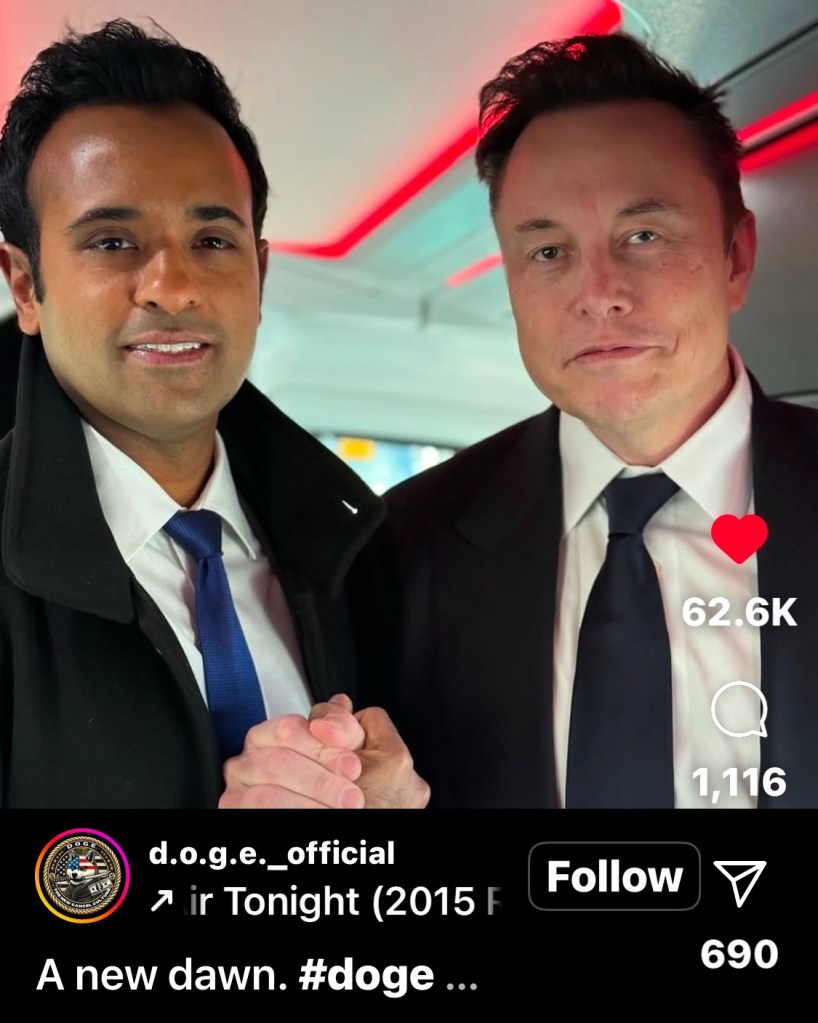
I have been saying for months that this Ohio governor’s race was never going to be as close as the liberal media and the Democratic machine kept insisting. As long as Amy Acton could raise and spend roughly equal amounts of money, they could buy enough advertising to keep the “horse race” illusion alive. That is how the game works in modern politics. Fundraising and media buys create the perception of competitiveness long after the fundamentals have already decided the outcome. But we are now in the middle of July 2026, and the gap is becoming impossible to hide. Elon Musk just put $5 million into the super PAC supporting Vivek Ramaswamy. That single check changes the entire dynamic, and the other side knows it.
I have watched David Pepper and the Marc Elias-style operatives do this routine before. They treat elections like a production where money buys the narrative, and the narrative buys time. They prop up candidates who cannot stand on their own record by flooding the airwaves with ads that soften the edges and attack the opponent on personality or wealth rather than substance. It works until the money runs short. Then the horse stops getting free drinks at the strip joint, and reality walks in. Right now, the money is tightening up for Acton, and the media that was happy to call this a toss-up while the checks were clearing is suddenly quieter about the fundamentals.
Vivek Ramaswamy is the exceptional candidate in this race. He is a Cincinnati native who built real companies, created real value, and succeeded on merit in competitive fields. He is a successful author and thinker who has already proven he can operate at the highest levels of government efficiency efforts alongside Elon Musk in the Department of Government Efficiency. He understands free markets, individual initiative, and the dangers of centralized government that tries to manage every resource and outcome from above. That is the opposite of the society Acton and her backers have spent years promoting—one that empowers mediocre administrators while punishing the very people and policies that generate prosperity.
Acton, by contrast, is a textbook product of the empire of mediocrity. She was the face of Ohio’s COVID lockdowns as state health director. She helped shut down businesses, kept drive-throughs and dining rooms closed at places like McDonald’s under ever-shifting rules, and contributed to the destruction of countless small enterprises that never recovered. Those policies were later exposed in court as unconstitutional overreaches. I had conversations with members of the Ohio Supreme Court back in 2020 as those cases were being prepared, and it was obvious even then that the lockdowns could not survive constitutional scrutiny. Governor DeWine eventually had to back away because the legal foundation was collapsing under him. Acton resigned under pressure from angry citizens protesting in the streets with no clear end in sight. None of that is the record of an exceptional leader. It is the record of someone who followed the centralized script, expanded bureaucratic power, and left real damage behind.
DeWine’s endorsement of Vivek took courage. It is never easy for a term-limited governor to put his name behind a successor who is positioned to outperform him, especially when that successor is running against the person DeWine himself appointed during the pandemic. The fact that he did it anyway tells you something important about where the party and the state are headed. Vivek is not an insider continuation of the old order. He is the disruption the old order needs if Ohio is going to stop losing ground on taxes, education, and economic freedom.
The money tells the real story right now. Vivek’s supporting super PAC has raised serious resources—tens of millions—and is deploying them aggressively. The $5 million from Musk is not just symbolic; it is a signal that serious people who create wealth and understand results are backing him. Acton cannot match that pace. When the advertising dollars dry up, the media loses interest in pretending this is a close contest. Voters are left with the actual records: one candidate who built success and wants to bring that same energy to Columbus, and another whose signature achievement was helping lock down the state economy in ways that proved unconstitutional and economically destructive.
I have been consistent on this since the race took shape. Vivek was always going to outperform the low expectations the media set for him once people looked past the noise. He is rolling out plans on property tax reform, real education choice that puts parents back in charge, and cooperation with a Trump administration that remains popular in Ohio for delivering results on the economy and border security. Acton’s side is still trying to run the old playbook—lawfare, media narratives, and enough cash to keep the “horse race” story alive. But the cash is not keeping up, and the voters are not buying the illusion the way they once did.
This race is a clear choice between two different visions of government. One side believes in self-initiative, free markets, and limited centralized power—the approach that actually lifts societies. The other side believes the government should take from producers and redistribute according to political priorities, the same model that has produced mediocrity and dependency wherever it has been tried at scale. Ohio does not need another governor who manages decline while protecting the administrative class. It needs a governor who will cut waste, reform taxes, fix the schools, and let exceptional people and exceptional businesses thrive rather than punishing them.
We are still a few months from November, but the trajectory is clear. As the funding gap widens and the media can no longer afford to prop up the fiction of a close race, Vivek Ramaswamy is going to pull away. The fundamentals were always on his side. The money is now confirming what the fundamentals already showed. Ohio has a real chance to choose exceptional leadership over the empire of mediocrity that has dominated too much of state government for too long. I have been saying it for months. The evidence is now impossible to ignore.
Footnotes
1. Elon Musk contributed $5 million to V-PAC, the super PAC supporting Vivek Ramaswamy’s campaign for Ohio governor. Cleveland.com, July 15, 2026.
2. Vivek Ramaswamy won the Republican primary for governor on May 5, 2026, with approximately 82.4% of the vote. Ballotpedia, “Ohio gubernatorial and lieutenant gubernatorial election, 2026.”
3. Amy Acton served as Ohio’s state health director and played a central role in the state’s early COVID-19 response and lockdown policies under Governor Mike DeWine.
4. Multiple court challenges in Ohio and elsewhere during 2020–2021 found various lockdown and business closure orders unconstitutional or beyond executive authority.
5. Governor Mike DeWine endorsed Vivek Ramaswamy for governor in 2025–2026, despite Acton having been his appointee during the pandemic period.
6. Ramaswamy’s campaign and supporting super PAC have raised and spent tens of millions, significantly outpacing Acton’s fundraising in key periods of 2026.
Bibliography (selected for further reading)
• Ballotpedia. “Ohio gubernatorial and lieutenant gubernatorial election, 2026” (primary results and candidate profiles).
• Cleveland.com. “Elon Musk puts $5 million behind ex-DOGE partner Vivek Ramaswamy’s governor bid.” July 15, 2026.
• Forbes. “Ramaswamy Wins Republican Primary In Ohio Governor’s Race.” May 5, 2026.
• AP News. “Trump-backed Vivek Ramaswamy wins Ohio Republican Party’s endorsement in 2026 governor’s race.” May 9, 2025.
• Vivek for Ohio campaign materials and platform statements (vivekforohio.com).
• Ohio Capital Journal and other Ohio political reporting on super PAC spending and fundraising totals, 2025–2026.
• Court records and contemporaneous reporting on Ohio COVID-era lockdown litigation and constitutional challenges (2020–2022).
• Various polling aggregates from mid-2026 showing the general election contest between Ramaswamy and Acton.
Rich Hoffman is an author, political consultant, and strategic advisor based in Cincinnati, Ohio, and the creator of The Politics of Heaven—a unique framework that connects biblical theology, ancient history, and modern power structures to explain how moral alignment and spiritual forces shape global events. Blending real-world political experience with deep research into archaeology, UFO phenomena, and suppressed historical narratives, Hoffman offers compelling commentary on topics ranging from ancient civilizations and the Dead Sea Scrolls to modern populist movements, paranormal continuity, and leadership strategy in chaotic environments. As the author of The Gunfighter’s Guide to Business and the forthcoming Politics of Heaven, he brings a grounded yet provocative voice to media discussions, supported by firsthand experiences and a cross-disciplinary approach that bridges science, history, and theology. For interviews, speaking engagements, or expert analysis, visit richhoffmanbooks.com or contact directly via phone at 513-307-5815 or email at rhoffman@richhoffmanbooks.com. If you’ve seen the movie, Disclosure Day and want to talk about it and the implications of Presidnet Trump’s UAP disclosures, let me know and we can bring some color to your coverage. https://richhoffmanbooks.com/media-inquiries-broadcast-topics-and-contact-info/?frame-nonce=ad51e7ecba I do have a firsthand UFO encounter to discuss.
I have watched this story unfold with a mixture of anger, sadness, and that familiar sinking feeling that comes when you realize the system is working exactly as designed—not for the kids, but for the adults who feed off the perpetual motion machine of public money and institutional self-preservation. A mother filed a federal lawsuit on July 1, 2026, alleging that a Lakota Local Schools teacher groomed and sexually abused her daughter over roughly three years, starting when the girl was 13 years old in seventh grade at Liberty Junior School.
According to the detailed complaint, the teacher—identified in court documents as Ronald Henrich—did not even teach the girl in any of her classes. He welcomed her into his classroom during study hall periods, showed her “special attention,” and began building a relationship. Messages started on the district’s own Remind app. The student confided personal struggles, including mental health issues. The communications continued and escalated even after the mother tried to set boundaries. By ninth grade, the meetings moved to a closed-door “mindfulness room” for Friday lunches. Communications shifted to district email and Google Docs when access to Remind was curtailed. In March 2025, the mother discovered the teacher actively typing “extremely sexually graphic content” into a shared Canva document with her daughter. She recorded it. She called the Butler County Sheriff’s Office.
The district’s response, according to the lawsuit, was to promise administrative leave and restricted access to technology, then quietly allow the teacher to take Family and Medical Leave Act leave instead. Less than two weeks after the explicit messages surfaced—and while investigations by the district, sheriff, and children’s services were still open—the district approved his retirement. No public discipline. No immediate report to the Ohio Department of Education, as many parents would expect. The teacher walked away with his pension and benefits intact while the family was left to pick up the pieces.
The superintendent, Ashley Whitely, issued the standard institutional denial: the district “denies all allegations” and claims student safety is its top priority. Meanwhile, the mother’s lawsuit also details earlier reports she made that went unaddressed, repeated class pull-outs without parental notification, and even troubling lapses in how the school nurse handled the student’s medication—stockpiling Tylenol that contributed to a suicide attempt and failing to manage anxiety medication on a trip properly. These are not small administrative hiccups. They paint a picture of a system that had multiple opportunities to intervene and chose not to.
Then there is the part that really bothers me. According to people who have followed the internal handling, the HR director—Jeff Rouff—essentially shrugged and said something to the effect that the age of consent in Ohio is 16, so what’s the big deal? Two consenting adults. Nothing illegal happened. That line of thinking is exactly why these situations metastasize. It ignores the entire grooming process that began at 13, when the girl was under the care and authority of this adult in a position of power inside a public school building. It ignores the use of school-issued devices and district apps to conduct the relationship. It ignores the closed doors, the missed classes, the emotional manipulation of a vulnerable child who had already suffered prior sexual abuse. Age of consent statutes were never intended to give cover to adults in positions of trust who spend years cultivating access to minors. That is not a gray area. That is the precise reason we have laws and professional conduct codes for educators in the first place.
I heard about problems surrounding this teacher roughly a year before the lawsuit dropped. Other parents and observers had been talking. The circle had already started to form. When the story finally broke across local media—Channel 5, Local 12, FOX 19—the superintendent’s immediate public move was not a somber address about accountability and root-cause fixes. It was a cheerleading video hyping the fall, talking about hiring dozens more staff members, rolling out a corporate “roadmap” with “stakeholders,” and reminding everyone to keep supporting public schools. The timing felt deliberate. Distract. Reassure the taxpayers who write the checks. Keep the money flowing.
That is the game I have been describing for years. Lakota, like many large suburban districts, is constantly in or approaching levy mode. The narrative must be controlled: we are great, we are improving, we need a little more of your property tax money to keep doing the wonderful things we do. Bad stories—especially stories that suggest adults in the building are preying on children and that leadership circled the wagons—threaten that narrative. So the wagons circle. The teacher retires quietly. HR offers the age-of-consent talking point. The superintendent films the upbeat video. The teachers’ union, which exists in large part to protect its members from consequences, stays largely silent or issues the usual generic statements about due process. And the machine keeps turning.
This is not an isolated incident. The lawsuit itself references a pattern of other cases involving Lakota employees over the years—some that resulted in convictions or license revocations, others that were handled with quiet exits. Former board member Darbi Boddy, who has remained a vocal parent advocate even after her time on the board ended, issued a clear public statement criticizing the handling of this situation. Good for her. We need more people willing to say the obvious out loud rather than hide behind “stakeholder engagement” jargon.
What troubles me most is how predictable the protection response has become. When something like this surfaces, the institution’s first instinct is not “How do we make sure this never happens again and how do we support the victim?” It is “How do we contain the damage to our brand and our funding pipeline?” The HR director’s reported comment about 16 being legal is a perfect example of that mindset. It treats the endpoint—the moment the child turned 16—as the only thing that matters, while erasing the years of grooming and boundary erosion that got her there. It treats a minor student in a teacher’s care as just another “consenting adult” the second the calendar flips. That is not how any responsible adult in education should think. It is how an institution thinks when its primary loyalty is to itself and the revenue stream that sustains it.
Public education in its current monopolistic, union-protected, tax-funded form has structural problems that make these failures almost inevitable. When you combine compulsory attendance, massive budgets, powerful collective bargaining agreements that make firing even grossly negligent employees difficult and expensive, and a culture that treats any criticism as an attack on “the children” or “public education itself,” you create exactly the conditions for cover-ups. The money keeps coming in as long as the bad stories stay buried or get spun. Parents who raise concerns are dismissed as “haters” or people with “unrealistically high moral standards.” Meanwhile, the actual standard on the ground—don’t have sex with kids in the classroom or via school devices, don’t groom them for years, don’t let it slide when a parent reports it—somehow becomes negotiable the moment it threatens the budget or the reputation.
I am not saying every teacher is doing this. The vast majority are not. But the ones who are counting on the system’s reluctance to act decisively. They count on the HR director who will find the legal technicality to keep them safe from judgment. They count on the superintendent who will film the upbeat video instead of cleaning house. They count on the union that will fight to the last dollar of taxpayer money to protect a member who should never have been in a classroom with minors. And they count on enough parents staying disengaged or intimidated for the story to fade before real accountability arrives.
The mother in this case did what too few parents feel empowered to do: she documented, she reported, she refused to let it disappear. Her lawsuit is now public. The allegations are serious and detailed. Whether every claim is ultimately proven in court is for the legal process to decide. But the pattern of institutional response—quiet exit, legal denials, distraction videos, and the age-of-consent shrug—is already on display for anyone willing to look. That pattern should alarm every parent in Lakota and in any district that operates the same way.
How many other kids right now are in unhealthy dynamics with adults who hold power over their grades, their schedules, their daily lives inside these buildings? How many school-issued devices are carrying messages that would make any decent parent’s blood run cold if they saw them? How many times has a concerned parent been told some version of “nothing to see here, move along, and please vote yes on the next levy”? I would be willing to bet the number is higher than any of us want to admit. This case only became a story because one mother refused to be quiet. The rest stay invisible because the system is optimized for exactly that outcome.
We keep being told that more money, more staff, more programs, and more “roadmaps” will fix what ails public education. I have watched this play out locally for years. The money keeps increasing. The problems—academic stagnation in too many areas, cultural capture, and now these horrifying failures of basic child protection—persist or worsen. At some point, parents have to ask whether the institution itself is the problem, not the lack of funding. When the first instinct of leadership is to protect the adult and the budget rather than the child, the social contract has already been broken.
I have said it before, and I will keep saying it: these schools should not be connected to public dollars through collective bargaining agreements that shield misconduct this way. The current model creates perverse incentives. It rewards circling the wagons. It punishes transparency. And the kids pay the price—sometimes in ways that can never be fully repaired.
If you are a parent in Lakota or anywhere else, pay attention to what is happening here. Read the lawsuit. Watch what the district actually does versus what it says in the carefully produced videos. Talk to your kids. Monitor the devices. Show up at meetings. Ask the uncomfortable questions. And recognize that the people telling you everything is fine and you need to keep writing bigger checks may have priorities that do not align with protecting your child.
This story is not going away. The mother made sure of that by filing in federal court. Good. Sunlight is still the best disinfectant, even when the institution would prefer the lights stay off.
Footnotes
1. Details of the federal lawsuit filed July 1, 2026, in the U.S. District Court for the Southern District of Ohio, as reported in contemporaneous coverage by the Cincinnati Enquirer and Journal-News.
2. Allegations regarding the timeline, use of the Remind app, Canva document, mindfulness room meetings, and district response drawn from the complaint were summarized in multiple local outlets.
3. District statement denying allegations and emphasizing student safety priorities, reported across local media following the lawsuit filing.
4. References to prior incidents and pattern allegations contained within the 2026 lawsuit filings and prior local reporting on other Lakota employee cases.
5. Ohio age of consent is 16; however, professional conduct codes for educators and laws regarding persons in positions of authority create additional prohibitions on sexual conduct with students that do not turn solely on the general age of consent.
Bibliography for Further Reading
• Cincinnati Enquirer, “Parent says Lakota teacher groomed and abused her daughter,” July 8, 2026.
• Journal-News, “Lawsuit: Lakota teacher ‘groomed and sexually abused’ a student and was allowed to take medical leave, retire,” July 7, 2026 (updated July 9).
• FOX19 / Local 12 coverage of the July 2026 lawsuit and related statements.
• Ohio Department of Education professional conduct standards for educators (ongoing reference for context on boundaries and reporting obligations).
• General resources on educator sexual misconduct patterns: U.S. Department of Education reports and studies on employee misconduct in K-12 settings (searchable via ED.gov).
• Local coverage of prior Lakota cases involving Justin Dennis and others referenced in the 2026 lawsuit for pattern context.
• Darbi Boddy’s public statements and commentary on Lakota issues (available via local media archives and her public channels).
• Ohio Revised Code sections on sexual battery, unlawful sexual conduct with a minor, and school employee reporting requirements.
Rich Hoffman is an author, political consultant, and strategic advisor based in Cincinnati, Ohio, and the creator of The Politics of Heaven—a unique framework that connects biblical theology, ancient history, and modern power structures to explain how moral alignment and spiritual forces shape global events. Blending real-world political experience with deep research into archaeology, UFO phenomena, and suppressed historical narratives, Hoffman offers compelling commentary on topics ranging from ancient civilizations and the Dead Sea Scrolls to modern populist movements, paranormal continuity, and leadership strategy in chaotic environments. As the author of The Gunfighter’s Guide to Business and the forthcoming Politics of Heaven, he brings a grounded yet provocative voice to media discussions, supported by firsthand experiences and a cross-disciplinary approach that bridges science, history, and theology. For interviews, speaking engagements, or expert analysis, visit richhoffmanbooks.com or contact directly via phone at 513-307-5815 or email at rhoffman@richhoffmanbooks.com. If you’ve seen the movie, Disclosure Day and want to talk about it and the implications of Presidnet Trump’s UAP disclosures, let me know and we can bring some color to your coverage. https://richhoffmanbooks.com/media-inquiries-broadcast-topics-and-contact-info/?frame-nonce=ad51e7ecba I do have a firsthand UFO encounter to discuss.
The lockdowns in Ohio during the COVID era pulled back the curtain on something many of us had sensed for years but hadn’t seen so clearly exposed: the dangers of unchecked corporate power when it collides with government emergency authority. My beautiful wife and I talked about this often during those uncertain months, watching how the rules seemed to bend one way for the big players and another for the families and small operators trying to hold things together in our community around Liberty Township and the Great Miami River valley. What started as measures to slow the spread of the virus quickly revealed deeper structural problems, where large corporations could absorb shocks, leverage connections, and even come out stronger on the other side, while independent businesses in places like Butler County and around Middletown faced closures, mounting debt, layoffs, and permanent scars that rippled through families, local tax bases, school levies, and the very idea of self-reliant American enterprise. We saw neighbors who had built lives through hard work and discipline suddenly staring at empty parking lots and “closed indefinitely” signs, wondering why the system that preached fairness seemed rigged toward scale and influence.
My wife has a way of cutting through the noise with clear-eyed observations born from years of raising our family and navigating real-world responsibilities together. She often noted how the lockdowns exposed the fragility of depending too heavily on distant corporate structures rather than local, accountable enterprise. We saw it in the way shutdown orders hit hardest on restaurants, retail shops, small manufacturers, service providers, and family-oriented spots like amusement venues and community gathering places that define so much of Ohio’s character. Large national chains with deep pockets, diversified revenue streams, sophisticated logistics, and teams dedicated to government relations could pivot to curbside or delivery models, secure Paycheck Protection Program funds with fewer hurdles in practice, lobby for favorable treatments, or weather the storm with cash reserves built from years of market dominance. Smaller independent operations, the ones run by neighbors who know their customers by name and pour personal savings and sweat equity into every decision, lacked those buffers. Supply chain disruptions hit them especially hard—big corporations with global reach and negotiating power could reroute shipments or stockpile inventory, but local suppliers and Main Street businesses absorbed the full force of delays, shortages, and skyrocketing costs that eroded margins already thinned by months of restricted operations.
In our conversations, my wife and I reflected on how this wasn’t mere bad luck or an unavoidable consequence of a novel virus. It was the predictable outcome of policy choices that favored entities with political access and financial scale over adaptability, personal responsibility, and community roots. We recalled stories from friends and local business owners—people we’ve known through years of involvement in Butler County events, schools, and youth activities—who had invested everything into their ventures only to watch restrictions drag on while corporate competitors maintained some form of continuity or found creative compliance paths. Data from the period bears this out: smaller establishments, particularly those with fewer than 50 employees, faced disproportionately high risks of temporary and permanent closures, especially in in-person sectors like hospitality and retail. Employment losses hit low-wage workers in these businesses hardest and persisted longer, creating a V-shaped recovery for some high-income or large-firm segments but a much more protracted struggle for the backbone of local economies.
The aftermath only amplified these imbalances and made the consolidation trend impossible to ignore. In sectors like entertainment and manufacturing, the cumulative pressure from lost revenue, uncertainty, and uneven recovery pushed waves of mergers and acquisitions that consolidated power into even larger entities. Cedar Fair’s flagship operations in Ohio, already contending with seasonal vulnerabilities, weather dependencies, and prolonged capacity limits from public health orders, became part of larger combinations that promised operational synergies, expanded geographic footprints, and improved access to capital markets for future investments. On paper, such deals highlight efficiency gains and resilience against future shocks, but in practice they often translate to fewer independent decision-makers attuned to local conditions, strategic choices driven by distant boards and quarterly metrics, and a gradual shift toward institutional ownership that prioritizes shareholder returns over the kind of patient, community-embedded stewardship that built iconic Ohio attractions.
Similar patterns unfolded across other key industries. Ohio’s manufacturing sector, vital to aerospace, automotive suppliers, and industrial production in areas like Middletown, saw accelerated M&A activity as smaller firms struggled with disrupted supply lines and labor shortages while larger players leveraged balance sheets and government programs to consolidate market share. Banking and healthcare followed suit, with regional players absorbed into bigger institutions better equipped to handle regulatory compliance costs and capital requirements heightened by the crisis. Media and retail consolidation further concentrated influence over information and consumer access. Private equity firms and asset managers, flush with capital, moved in on distressed or weakened assets, reshaping ownership landscapes in ways that often reduced local control and diversified economic decision-making. My wife would remark during our evening discussions how this shift erodes the distributed resilience that comes from many independent actors solving problems in their own backyards, replacing it with centralized systems more prone to single points of failure.
This growing concentration of corporate power carries profound dangers for economic mobility, innovation, and the broader culture of self-mastery. When a handful of large entities dominate supply chains, capital allocation, and policy influence, incentives naturally tilt toward preserving existing advantages rather than fostering the disruptive, bottom-up creativity that has always powered American progress. Entrepreneurial organizations and privately held family businesses operate with direct skin in the game—they adapt quickly because survival depends on it, rewarding discipline, foresight, and the willingness to impose order on chaos. Bureaucratic corporate giants, protected by layers of management, diversified risks, and access to Washington and Columbus corridors, more often prioritize compliance, risk aversion, and entrenchment. They shape regulations and emergency responses in ways that inadvertently—or sometimes deliberately—raise barriers for smaller entrants. During the lockdowns, this dynamic became visible in how “essential” classifications and aid distribution sometimes tracked lines of influence, leaving truly independent operators to navigate disproportionate burdens without equivalent advocacy.
Government support initiatives, meant as lifelines, frequently highlighted another layer of the problem. While in theory it provided necessary liquidity, implementation favored those with professional grant writers, established banking relationships, and lobbying sophistication. Many small businesses received delayed or insufficient help, only to face a cliff when programs wound down around 2021-2022, contributing to a later spike in exits. Broader economic analyses confirmed that small-firm survival and revenue recovery lagged in hard-hit sectors, even as some larger corporations reported record profits or made strategic acquisitions amid the turmoil. In Ohio, where survival rates for certain 2019 cohorts compared favorably to national averages thanks to the tenacity of local entrepreneurs, the pandemic still exposed vulnerabilities: a reliance on just-in-time global supply models and concentrated corporate customers left many suppliers exposed when big firms tightened belts or shifted priorities.
My wife captured the human dimension perfectly in our ongoing talks. This wasn’t merely an economic story; it touched the erosion of the cultural fabric that values individual agency, intergenerational knowledge transfer, family enterprise, and community strength over abstract efficiency metrics. We witnessed families in our area—friends from school events, shooting sports fundraisers, and church circles—weighing impossible choices between keeping the doors open and walking away to protect their households. Meanwhile, distant corporate boards and institutional investors calculated portfolio impacts and synergy targets with detachment. The long-term consequences for wealth creation and genuine mobility worry me deeply. Capital markets and private equity structures often reward financial engineering, scale, and short-term returns, but they can crowd out the patient, values-driven organizations that distribute opportunity more broadly and build lasting local wealth. Supply chain lessons from the era should have driven a renewed emphasis on redundancy and diversified ownership; instead, recovery frequently accelerated the very consolidation that heightens systemic risks.
In Ohio’s context—with its rich manufacturing heritage, agricultural foundations, aerospace strengths, and regional attractions like those tied to Cedar Fair—the dangers become especially clear. Over-reliance on a few dominant players leaves communities and the state exposed to future disruptions, whether from another health crisis, a regulatory shift, a trade conflict, or an economic downturn. When corporate power concentrates alongside expansive government emergency authority, the result is a form of soft centralization that undermines the dispersed decision-making and personal responsibility essential to a free and prosperous society. We’ve seen echoes of this in other areas of policy influence, where large interests shape outcomes on taxes, regulations, and incentives in ways that disadvantage smaller competitors. My wife and I have always emphasized to our daughters and grandchildren the importance of building resilience through direct experience—whether troubleshooting model rockets on windy days, learning mechanical skills, or understanding history and spiritual foundations that warn against over-centralized power.
The lockdowns served as a profound stress test for these principles. They revealed how fragile local economies become when corporate structures grow too dominant, lacking sufficient counterweights from competition, local ownership, and a cultural emphasis on self-reliance. Small businesses didn’t just suffer temporary revenue losses; many lost irreplaceable ground in a playing field tilted toward those positioned to endure or capitalize on the chaos. Rebuilding stronger requires more than recovery spending or new programs. It demands a cultural and policy renewal that actively prioritizes dispersed economic power, reduces barriers for independent enterprise, scrutinizes consolidation for its community costs, and reinforces the virtues of discipline and moral agency that have sustained families like ours through generations. My beautiful wife and I carry these observations forward daily, rooted in the conviction that real strength and enduring prosperity emerge from the ground up—from individuals and families imposing order, building legacies, and refusing to cede agency to distant powers—rather than from ever-larger corporate edifices that too often leave ordinary communities to shoulder the heaviest burdens when crises strike. This is the hard-earned lesson from Ohio’s experience, one we hope will inform wiser choices ahead to preserve the opportunities our children and grandchildren deserve.
Footnotes
1. Documentation of Ohio COVID business orders and recovery challenges (Ballotpedia, state reports).
2. Heterogeneous economic impacts from private sector data (Opportunity Insights).
3. Early Ohio small business closure and economic damage reports.
4. Cedar Fair/Six Flags merger details and post-pandemic industry context.
5. Ohio manufacturing and industrial M&A activity trends.
6. Studies on small vs. large firm exits, survival, and employment during/after the pandemic.
7. Analyses of essential business designations and policy influence.
8. JPMorgan Chase Institute, BLS, and state survival rate data.
9. Research on capacity restrictions, spillovers, and long-term business dynamics.
10. Broader patterns in consolidation, capital markets, and incentive effects.
Rich Hoffman is an author, political consultant, and strategic advisor based in Cincinnati, Ohio, and the creator of The Politics of Heaven—a unique framework that connects biblical theology, ancient history, and modern power structures to explain how moral alignment and spiritual forces shape global events. Blending real-world political experience with deep research into archaeology, UFO phenomena, and suppressed historical narratives, Hoffman offers compelling commentary on topics ranging from ancient civilizations and the Dead Sea Scrolls to modern populist movements, paranormal continuity, and leadership strategy in chaotic environments. As the author of The Gunfighter’s Guide to Business and the forthcoming Politics of Heaven, he brings a grounded yet provocative voice to media discussions, supported by firsthand experiences and a cross-disciplinary approach that bridges science, history, and theology. For interviews, speaking engagements, or expert analysis, visit richhoffmanbooks.com or contact directly via phone at 513-307-5815 or email at rhoffman@richhoffmanbooks.com. If you’ve seen the movie, Disclosure Day and want to talk about it and the implications of Presidnet Trump’s UAP disclosures, let me know and we can bring some color to your coverage. https://richhoffmanbooks.com/media-inquiries-broadcast-topics-and-contact-info/?frame-nonce=ad51e7ecba I do have a firsthand UFO encounter to discuss.
I had been telling stories about visiting The Wilds, that impressive safari park and conservation center affiliated with the Columbus Zoo out in the hills of Ohio. It is one of those places worth the drive no matter where you are in the state, a sprawling expanse of reclaimed land turned into something that feels close to the real thing—vast pastures under open sky, exotic animals moving with room to stretch their legs. They have rhinos and giraffes in good numbers, along with camels, zebras, cheetahs, and others, all managed with a light enough hand that the illusion of wild freedom holds up pretty well from the back of an open-air safari vehicle.¹
You climb aboard one of their customized tour buses or trucks—solid machines built for the terrain—and set out through a series of large paddocks. The gates are there for a reason. They control movement between sections so the animals do not mix in ways that would cause trouble, and the whole operation runs on a balance between giving the creatures space and keeping things workable for keepers, vets, and paying visitors who want the Serengeti experience without the actual risks of the real wild. Supplemental feeding stations and strategic placement of water to help keep the herds where the staff wants them for health, breeding programs, and viewing. It is wildlife management at a high level, about as good as you are going to get when you are dealing with dangerous and valuable animals on thousands of acres that used to be strip-mined ground.²
The compliant animals make it easy. The rhinos—those massive southern white rhinos—graze and wallow near the resources provided for them, powerful but predictable in their routines. The giraffes tower elegantly, moving between browse stations and open pasture in ways that fit the management plan. Camels shed their coats in season, zebras stay in loose groups, and the whole scene looks like freedom while functioning inside a carefully designed system of fences, gates, rotations, and incentives. It is not a cage, but it is not the true untamed wild either. It is managed pasture with the look of the wild, and most of the animals play their part without fuss.³
That is what made the ostrich stand out to me.
I noticed him early, standing apart from the clusters near the food and water. Tall, alert, head turning with that sharp, curious rhythm ostriches have. While the rhinos and giraffes and camels stayed close to what the keepers had laid out for them, this bird was watching the vehicle. As we moved from one paddock into the next, the gate system did its job—or tried to. The tour vehicle went through, the mechanism closed behind us, and there he was again on the other side. He had figured it out. He waited, timed his approach, slipped in close behind the bus or jeep as it passed, and crossed into the fresh section before the barrier fully secured. Now he was loose in new territory, running with a different group, exploring ground the plan had not assigned him that day.⁴
The reaction from the staff told the whole story. You could hear it in the radio chatter and see it in the quick deployment of groundskeepers in another vehicle. They had to go after him, work him back toward his proper paddock without stressing the other animals or ruining the tour for the people who had paid to see a smooth, wild-like experience. It was not the first time. The bird had made a habit of it. One fence, one gate at a time, and he had learned the vulnerability. He did not need the food station to stay content. He wanted novelty, new company, the chance to impose his own will on the layout the humans had built.⁵
I was rooting for him the whole time.
Here was an animal refusing the script. The other creatures accepted the pasture as given—the convenient food, the predictable safety, the lanes they were expected to occupy. The ostrich treated the whole setup as a puzzle to solve. He used the tour vehicle itself, the thing the keepers relied on to move visitors through their controlled world, as his ticket to the next field. He did not stay near the bowl. He risked the chase, the herding, the temporary disruption, because something in him wanted to see what was over there and who else was around. That kind of ambition is rare in a managed environment, and it is exactly what makes systems better when you let it play out instead of crushing it on sight.⁶
It struck me then, and has stayed with me since, how perfectly this mirrors what I have seen over decades in aerospace and manufacturing. We build our own versions of The Wilds every day. We lay out departments like paddocks, write procedures like fence lines, and place compensation, titles, benefits, and job security like feeding stations to keep people content and predictable. We install gates—approval chains, compliance checklists, annual audits, legacy safety rules—and we staff them with officers whose job is to make sure nothing slips through unplanned. Most people, like most animals in the park, adapt. They stay near the resources, do the expected work, and the machine runs smoothly enough from a distance. Visitors and shareholders see order and productivity.⁷
But then there are the rebels and learning the actual work from the ground up, often see the single-gate weaknesses first. They know which rules came from someone who retired twenty years ago and never got revisited. They spot the places where the process has become theater—compliance for the sake of compliance, documentation that protects no one and slows everything. When they point it out or, worse, quietly work around it to get the real job done, it can be deeply disconcerting to layers of management that have never turned a wrench or stood on a shop floor during a real problem. Knowledge from the ground threatens the illusion of total control. So the system often responds the same way the keepers responded to the ostrich: more rules, more oversight, more “training,” or direct pressure to get back in the assigned pasture.⁸
The cost of that approach is enormous and mostly invisible until you add it up. Direct spending on regulatory compliance labor alone runs into the hundreds of billions annually across American business, with manufacturing carrying a heavy share. Broader economic drag—capital and talent diverted from productive work into compliance bureaucracies, innovations delayed or abandoned because the approval path is too long, small and mid-sized firms crushed under burdens that larger players can absorb—pushes the true opportunity cost into the trillions over time. We lose competitiveness, we lose resilience, and we lose the very people who could have fixed the problems if we had listened instead of herding them back into line. It is not dramatic like a factory closing overnight. It is the slow erosion of capability, the quiet decision by talented hands-on people to stop trying or to leave for places that still value initiative.⁹
SpaceX has shown what happens when you refuse that model. Elon Musk walks into meetings and asks the questions most compliance cultures are designed to avoid: Who wrote this rule? Why did they write it? Does it still make sense, or is it just legacy that nobody wants to touch? A shocking number of requirements get deleted or radically simplified once you trace them back to their origin. The company builds, tests, fails in public view, learns fast, and iterates. Reusable rockets, vertical integration, rapid launch cadence—these did not come from following the old aerospace playbook of exhaustive upfront documentation and risk aversion at every step. They came from treating the rulebook as a starting point to be challenged, not a sacred pasture to remain inside.¹⁰ The results speak for themselves in cost per launch and flight rate. The ostrich approach, applied at scale, forces the entire system to get better.¹¹
I have always had a soft spot for the ostriches in any workforce. I advocate for them on purpose. The ones who will not stay in their lane, who figure out how to get behind the jeep and into the next field, are usually the same people who reveal where the real weaknesses are and who come up with fixes nobody on the compliance side would have imagined. Sometimes they bite you—disrupt schedules, question authority in uncomfortable ways, make the tour guides nervous. That is the price of having them. The alternative is a pasture full of well-fed, predictable animals that look impressive when the bus drives by but generate very little genuine progress or resilience. Their souls get crushed under the weight of never being allowed to test the fence, and the organization slowly loses the capacity to adapt when the real world stops cooperating with the plan.¹²
In my own years moving from hands-on roles into executive responsibility, I saw this pattern repeat across programs and companies. The people who had done the work with their own hands carried an instinctive understanding of what was theater and what was necessary. They were often the first to spot when a procedure had become detached from reality or when a new requirement was solving a problem that no longer existed. Management that lacked that grounding sometimes viewed them as threats to order rather than assets to be unleashed. The organizations that protected and empowered those voices moved faster and solved harder problems. The ones that prioritized perfect compliance and predictable behavior above all else eventually found themselves defending processes that nobody could explain anymore, while competitors who tolerated a little productive rebellion pulled ahead.¹³
The same dynamic shows up far beyond factories and boardrooms. Education systems that reward sitting still and repeating approved answers over curiosity and independent problem-solving. Government bureaucracies where the safest career move is to add another layer of review rather than remove an obsolete one. Cultural institutions that present curated narratives as the full range of choice. We all live inside versions of The Wilds at times—the illusion of open range while the fences, feeding stations, and gate protocols quietly shape what is possible. Most days it feels normal. Then something like that ostrich reminds you that the system only works as well as it does because enough creatures choose not to test the boundaries too hard.¹⁴
What I liked most about watching that bird work the tour was how it improved the keepers. They had to confront the limitation in their current gate setup. They had to think about whether single-point control was enough or whether double-gate airlock procedures, better behavioral enrichment, or adjusted resource placement would reduce the escapes without turning the place into a tighter prison. The ostrich was not just causing trouble; he was doing unpaid consulting work for the management team. He showed them where their assumptions about animal movement and motivation had gaps. A purely compliant population would never have forced that improvement. The rebel paid for his freedom by making the whole operation a little sharper.¹⁵
I left The Wilds that day still thinking about him. The rhinos were impressive in their size and presence. The giraffes were beautiful against the sky. The cheetahs carried that coiled power that makes you respect the food chain. All of them cool in their own ways, and all of them content to operate inside the lanes the humans had drawn. The ostrich was the one I kept coming back to—the non-compliant one, the rule-questioner, the creature willing to go where the keepers did not want him and to accept the temporary chase as the cost of exploration. He did not need the easy food to stay interested in life. He wanted new ground and new company, and he found a way to claim it using the very system designed to contain him.¹⁶
That is the quality I look for and try to protect in the people around me, whether in aerospace programs, manufacturing operations, or just everyday life. Give the ostriches some room. Listen when they show you the weakness in the single gate. Accept that a little productive chaos now and then is cheaper than the long-term stagnation of perfect compliance. The organizations and societies that figure this out keep their edge. The ones that treat every deviation as a threat to be chased back into the assigned pasture eventually discover that their well-managed animals have lost the capacity to handle real trouble when it arrives.¹⁷
I have no interest in living in a world where the only acceptable animals are the ones that stay near the bowl. I would rather deal with the occasional escape, the radio calls, the groundskeepers earning their pay, and the improvements that come from being forced to see the system through the eyes of someone who refuses to accept it as final. That ostrich at The Wilds was doing exactly what the best innovators and problem-solvers do everywhere else: he treated the fence not as an absolute limit but as a problem to be solved, and in doing so he made the entire managed landscape a little more honest and a little more capable.¹⁸
When people ask me now what my favorite animal was on that visit, I do not hesitate. The big ones were impressive. The compliant ones were easy on the eye and the schedule. But the ostrich—the tall, curious, gate-hacking rebel who would not stay in his lane and who spent half the tour where he was not supposed to be—was the one that mattered. He reminded me why I have always had more respect for the people who figure out how to get behind the jeep than for the ones who never leave the feeding station. Encourage that spirit where you find it. Protect it when the compliance officers come with their herding tools. The future does not belong to the perfectly pastured. It belongs to those willing to test the gate now and then, accept the chase, and show the rest of us what we missed by staying comfortable.¹⁹
This experience at The Wilds lingered in my mind long after I returned home, connecting to deeper patterns I have observed across my life and work. The managed illusion of freedom in those paddocks is not so different from the structures we encounter in corporate America, where layers of policy and oversight create the appearance of progress while often stifling the very innovation needed to survive. In aerospace, where I have spent much of my career, the contrast between traditional approaches and more agile ones is particularly stark. Legacy programs can become bogged down in requirements that originated decades ago, defended not because they remain relevant but because changing them would require admitting that the original rationale might no longer hold. Hands-on experience reveals these disconnects quickly, yet articulating them can mark you as difficult rather than valuable.²⁰
Consider the broader implications for American manufacturing. When compliance becomes the primary metric of success, resources flow toward documentation and auditing rather than research, development, or process refinement. Studies have documented how regulatory burdens disproportionately affect smaller firms, creating barriers to entry and expansion that favor incumbents who can afford dedicated compliance departments. The result is slower adoption of new technologies, reduced experimentation on the shop floor, and a workforce trained more in navigating bureaucracy than in solving novel problems. The ostrich in such an environment would be quickly reassigned or sidelined, and the whole system suffers for it.²¹
Elon Musk’s approach at SpaceX offers a compelling counterexample, one I have followed with great interest. By insisting on first-principles thinking—breaking down every assumption to its fundamentals and rebuilding only what proves necessary—the company has achieved breakthroughs that seemed impossible under conventional paradigms. Reusability was not just an engineering challenge; it was a direct challenge to the accepted economics of spaceflight, where expendable vehicles and massive cost-plus contracts had become the norm. Questioning those foundations required a culture that rewarded the kind of boundary-testing the ostrich exemplified. The payoff has been dramatic reductions in launch costs and an unprecedented cadence of operations, reshaping the industry.²²
In reflecting on these matters, I often draw parallels to larger questions of human agency and the systems that seek to channel or constrain it. The ostrich’s refusal to remain content within the provided pasture speaks to something fundamental in the created order: a drive toward exploration, adaptation, and the exercise of will that resists overly deterministic management. In my ongoing work exploring the Politics of Heaven and the deeper spiritual and historical currents shaping human affairs, such metaphors take on added resonance. Just as the keepers at The Wilds maintain an illusion of wildness for educational and conservation purposes, larger forces in society—whether economic, cultural, or institutional—often construct environments that prioritize predictability and control over the messy vitality of genuine freedom. Individuals who, like the ostrich, find ways to slip through the gates challenge those illusions and force reevaluation.²³
This is not to romanticize chaos or dismiss the need for structure. Successful wildlife management at The Wilds demonstrates that boundaries serve important functions: protecting animals, enabling breeding programs, ensuring visitor safety, and advancing conservation goals. Similarly, in business and society, rules around safety, quality, and ethics are essential. The problem arises when those rules multiply unchecked, when compliance officers outnumber innovators, or when the original purpose of a regulation fades from memory while its enforcement mechanisms grow ever more elaborate. The ostrich does not demand the removal of all fences; he demonstrates the value of testing them and adapting the system in response.²⁴
My own background has given me a particular vantage on this tension. Having worked my way up through various roles in industry, from tasks requiring direct physical engagement to overseeing complex programs, I have witnessed how domain knowledge from the “shop floor” often clashes with abstract managerial frameworks. Those who have turned wrenches understand intuitively where procedures add value and where they have become ritual. Encouraging such perspectives requires leadership willing to tolerate temporary disruption for long-term gain—much like the keepers who, instead of permanently punishing the ostrich, likely considered improvements to their gate protocols or enrichment strategies.²⁵
Culturally, the pattern repeats in media and entertainment, where narratives often reinforce managed expectations rather than celebrating the disruptive questioner. From my observations of shifts in popular music and storytelling over decades, there has been a movement away from themes of individual agency and moral courage toward more passive or hedonistic portrayals that keep audiences comfortably within prescribed emotional and ideological lanes. The ostrich disrupts that too, by refusing the easy feed of convention and seeking fresh territory.²⁷
Politically and economically, the stakes are high. Over-reliance on compliance culture contributes to the kinds of institutional failures I encountered during grand jury service, where layers of bureaucracy sometimes obscured accountability and human judgment. Challenging stupid rules is not rebellion for its own sake but a necessary corrective to systems that drift toward self-perpetuation at the expense of their intended purposes. In local Ohio contexts, from school levies to commissioner races, I have seen similar dynamics: entrenched approaches defended vigorously, while innovative voices advocating for accountability and efficiency are treated as threats to the established order.²⁸
Ultimately, the lesson from that lone ostrich at The Wilds is one of balance and appreciation. Systems need structure to function, but they thrive when they incorporate the energy of those who test the edges. In manufacturing, this means streamlining regulations that no longer serve their purpose and empowering frontline workers to propose and implement improvements. In broader society, it means fostering cultures that value inquiry and agency over rote obedience. As someone who has long championed self-mastery, resilience, and the imposition of individual will on challenging circumstances—symbolized in my own life by the whip as a tool of precision and discipline—I see the ostrich as a kindred spirit. He navigates the managed wild with determination and ingenuity, improving it in the process.²⁹
When I share this story, people often smile at the image of the bird sneaking through gates and evading keepers during the tour. But beneath the humor lies a serious point about human flourishing. We are not meant to be permanently pastured, content with provided resources and predictable routines. The drive to explore, to question, to innovate—even at the risk of temporary conflict with authority—is part of what makes progress possible, whether in conservation parks, factories, or the grander arenas of history and spirit. I prefer the company of ostriches, even if they occasionally complicate the tour. They keep things alive, force adaptation, and remind us that true freedom, however constrained by reality, involves the courage to move beyond the feeding station and into the next field.³⁰
So the next time you find yourself in a system that feels overly managed, remember the ostrich at The Wilds. Look for the single gate, time your move, and be willing to run when the keepers come calling. The disruption might just lead to better management for everyone involved. In my experience, it almost always does.
Footnotes
¹ Official descriptions of The Wilds as a 10,000+ acre conservation center with open-range safari experiences, emphasizing educational value and animal welfare. See The Wilds website resources on mission and operations.
² Details on reclaimed strip-mined land conversion, paddock management, and gate systems for species separation and rotational grazing in large wildlife parks.
³ Visitor accounts and park literature highlighting predictable behaviors of rhinos, giraffes, and other megafauna near supplemental feeding and water sources.
⁴ Observations of ostrich curiosity and vehicle-following behavior in safari settings, consistent with ethological studies of ratite intelligence and learning.
⁵ Reports from guides and staff on recurring challenges with individual animals exploiting procedural gaps during tours.
⁶ Analysis of problem-solving in captive animals and its implications for enrichment strategies in conservation management.
⁷ Corporate analogies drawn from organizational behavior literature on incentive structures and departmental silos.
⁸ Personal reflections informed by decades in aerospace, noting tensions between experiential knowledge and administrative layers.
⁹ Quantitative assessments of regulatory compliance burdens, including labor costs and opportunity losses in U.S. manufacturing sectors.
¹⁰ Public statements and case studies on SpaceX’s first-principles engineering methodology and requirement rationalization processes.
¹¹ Industry analyses of launch cost reductions and operational cadence improvements attributable to iterative, challenge-based approaches.
¹² Discussions of innovation cultures versus compliance-oriented management in business strategy texts.
¹³ Insights from program management experience in aerospace regarding the value of shop-floor perspectives.
¹⁴ Broader applications to educational and governmental institutions, drawing on critiques of bureaucratic inertia.
¹⁵ Principles of adaptive management in wildlife conservation, where outlier behaviors drive procedural improvements.
¹⁶ Comparative evaluation of animal temperaments in managed environments and their contributions to system dynamics.
¹⁷ Recommendations for fostering psychological safety and autonomy in high-performance teams.
¹⁸ Philosophical ties between individual agency and systemic resilience, informed by long-term observation.
¹⁹ Synthesis of the ostrich metaphor as applied to personal and professional philosophy of resilience and inquiry.
²⁰ Examination of legacy requirements in traditional aerospace programs versus agile methodologies.
²¹ Empirical studies on regulatory impacts on firm size, innovation rates, and market entry barriers.
²² Detailed accounts of reusable rocket development and associated regulatory and engineering challenges.
²³ Connections to explorations of power structures, agency, and historical patterns in spiritual and societal contexts.
²⁴ Balanced view of necessary boundaries versus over-regulation, with examples from safety and ethical standards.
²⁵ Reflections on career progression and the role of practical knowledge in leadership effectiveness.
²⁶ Applications to intergenerational knowledge transfer and character development through hands-on challenges.
²⁷ Cultural critiques of shifts in media narratives and their effects on perceptions of agency.
²⁸ Observations from civic engagement and public service experiences regarding institutional accountability.
²⁹ Integration with personal symbols of discipline, precision, and moral agency in navigating constraints.
³⁰ Concluding emphasis on the long-term benefits of embracing productive non-conformity for societal and organizational health.
Bibliography
The Wilds. Official website and publications on conservation, safari operations, and animal management (thewilds.org).
Trebbi, Francesco, et al. Research papers on the costs of regulatory compliance in the United States, including establishment-level data analyses (NBER and related).
National Association of Manufacturers. Multiple reports detailing per-employee and aggregate regulatory burdens on U.S. industry.
Musk, Elon, and SpaceX team. Interviews, presentations, and public documentation on engineering philosophy and operational innovations.
Christensen, Clayton M. The Innovator’s Dilemma: When New Technologies Cause Great Firms to Fail. Harvard Business Review Press.
Schumpeter, Joseph A. Capitalism, Socialism and Democracy. Harper & Brothers (on creative destruction).
Various ethology and conservation journals on ratite behavior, wildlife park management, and behavioral enrichment.
Hoffman, Rich. Prior essays and books including The Gunfighter’s Guide to Business and ongoing work on The Politics of Heaven, exploring agency, structures of power, and human systems.
Organizational psychology and management texts on compliance versus innovation cultures (e.g., works on psychological safety and adaptive leadership).
Visitor and video documentation of The Wilds experiences highlighting animal-vehicle interactions.
Government and think tank analyses of manufacturing competitiveness, opportunity costs, and regulatory reform needs.
Additional readings on free will, institutional critique, and historical patterns of rebellion against managed orders for deeper contextual understanding.
Rich Hoffman is an author, political consultant, and strategic advisor based in Cincinnati, Ohio, and the creator of The Politics of Heaven—a unique framework that connects biblical theology, ancient history, and modern power structures to explain how moral alignment and spiritual forces shape global events. Blending real-world political experience with deep research into archaeology, UFO phenomena, and suppressed historical narratives, Hoffman offers compelling commentary on topics ranging from ancient civilizations and the Dead Sea Scrolls to modern populist movements, paranormal continuity, and leadership strategy in chaotic environments. As the author of The Gunfighter’s Guide to Business and the forthcoming Politics of Heaven, he brings a grounded yet provocative voice to media discussions, supported by firsthand experiences and a cross-disciplinary approach that bridges science, history, and theology. For interviews, speaking engagements, or expert analysis, visit richhoffmanbooks.com or contact directly via phone at 513-307-5815 or email at rhoffman@richhoffmanbooks.com. If you’ve seen the movie, Disclosure Day and want to talk about it and the implications of Presidnet Trump’s UAP disclosures, let me know and we can bring some color to your coverage. https://richhoffmanbooks.com/media-inquiries-broadcast-topics-and-contact-info/?frame-nonce=ad51e7ecba I do have a firsthand UFO encounter to discuss.