

I have been saying no to Lakota tax increases for a long time. People who dislike that fact have a ready-made story about me. They say I will never be for anything. They say I hate schools. They say I would rather buy a television than teach a child. That last one is a joke I make myself, and I will make it again before we are done, because I would rather keep my money than subsidize a system that lectures families about everything except the marketplace those children will enter. I am not against education. I am against the public-education trick: lose at the ballot box, split the package, dress it up as a renewal, and come back until the people who write the checks get tired.
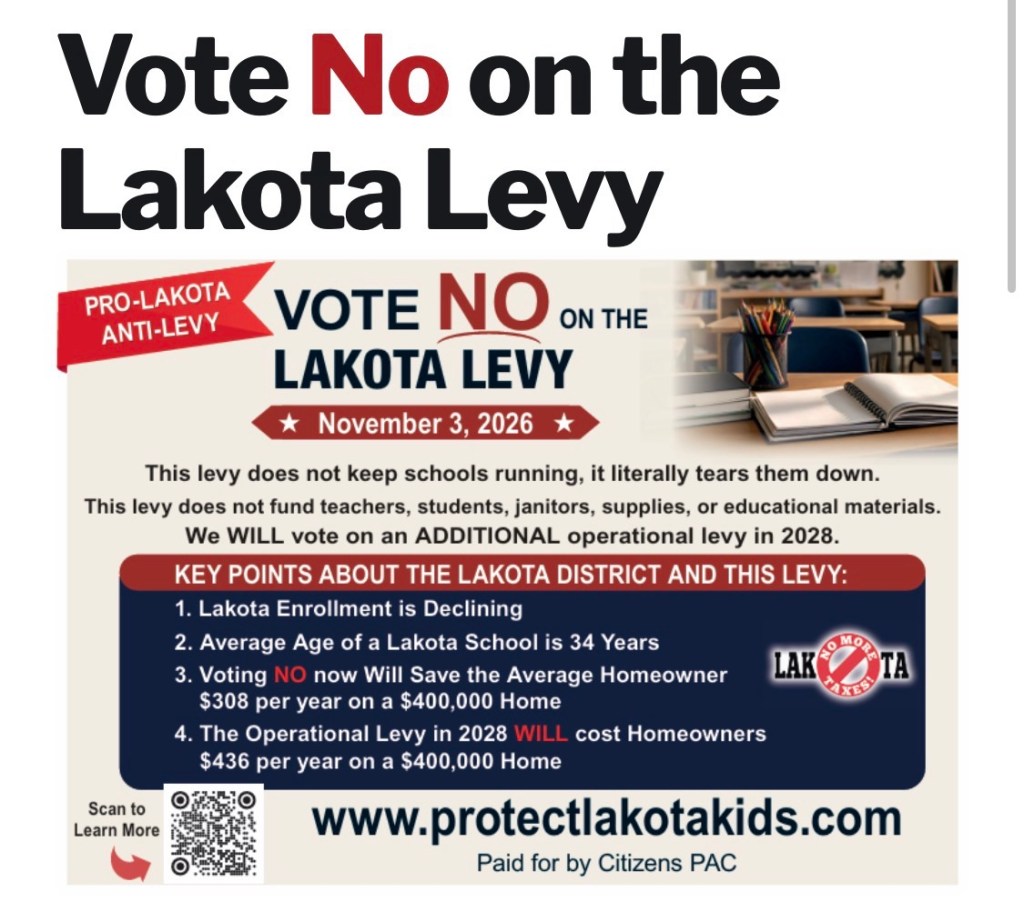
Last November the district asked this community for more than half a billion dollars. Voters answered with 61% no. That was not a polite disagreement. That was a verdict. Eight months later, the same board put a two-hundred-twenty-three-million-dollar, thirty-seven-year bond on the November 3, 2026 ballot and called it Phase One. They say it is not a tax increase. They say it merely replaces a bond that expires in 2028. They say seventy-seven dollars a year on a hundred-thousand-dollar home is what you are already paying, so why not keep paying it?
Here is what that sentence actually means. You have been making a mortgage payment to the school district. The mortgage is almost paid off. Instead of celebrating the payoff, they want you to sign a new note for thirty-seven more years and call the signing a favor. That is no new taxes. That is no tax relief. And tax relief is the thing this community has earned.
The Mortgage They Do Not Want You to Pay Off
Imagine a family in Liberty Township that bought a house in the early nineties. They paid the bank. They paid Lakota. They raised children who left the system twenty years ago. They kept writing the check because that is what property owners in Ohio do. They did not get a parade when the old bond schedule wound down. They got a brochure.
The brochure says the same thing every brochure says. Our buildings need work. Our classes are too large. Our enrollment is about to explode. If you vote no, you are against children. If you vote yes, your bill stays the same. Status quo. Responsible. Community.
I have watched this language for two decades. It is professional consent-building. The school board does not know how to say no, and the superintendent’s office is not hired to manage scarcity. It is hired to keep the train on the tracks after the train has already gone over the hill. When the train leaves the rails, they do not ask why the engineer was cheering. They ask the passengers for a new train.
Voting yes does not keep your taxes the same in any moral sense. It prevents the cut you were about to receive when the old debt died.
That is the whole argument, and everything else is scenery. The district is not wrong that buildings age. The district is not wrong that some classrooms are crowded. The district is wrong to claim that those facts entitle it to another generation of extraction without ever letting the burden fall on the people who already paid.
What Is Actually on the November 3 Ballot
Let us be precise, because the district is precise when it helps them and foggy when it does not.
On June 9, 2026, the Lakota Board of Education voted to place a bond issue before every elector in the district. The principal amount is $223,483,492. The maximum term is thirty-seven years. The Butler County Auditor certified an estimated average annual levy of 2.20 mills, which the resolution states amounts to $77 for each $100,000 of the county auditor’s market value. Collections would begin with tax year 2028 and first come due in calendar year 2029, timed to the death of the existing roughly 2.23 mill bond. [1] The election is Tuesday, November 3, 2026.
The money is not operating cash. It cannot legally be dumped into teacher salaries. It is debt service for facilities: renovating and improving existing schools, constructing facilities, safety work, furniture and equipment, site work, and land. Phase One of the Master Facilities Plan is estimated at $300 million. The Ohio Facilities Construction Commission would put up about seventy-seven million. Local taxpayers would carry $223 million.
If it passes, the district’s current sketch looks like this. Grade bands are being rearranged to reduce transitions: preschool at Liberty Early Childhood; K-5 in the remaining elementary plants; grades 6-8 at East Freshman and Plains Junior after additions; and grades 9-12 at East and West high schools after additions. Three schools will close: Adena Elementary, Ridge Junior, and the West Freshman / Creekside / Central complex. Twenty-one buildings become eighteen. [2]
That is the product. Now look at the price tag they put in the window.
The Seventy-Seven-Dollar Illusion
Every piece of official copy leads with $77 per $100,000. That number is not a lie. It is a costume. There is not a representative owner-occupied house in Liberty Township or West Chester listed on the tax duplicate at $100,000. Liberty’s recent median sales have been in the low-to-mid-500s. West Chester’s typical values sit in the low-to-mid-four hundreds.
Auditor market value / Annual cost of 2.20 mills / What the brochure calls it $100,000 / $77 / The headline $350,000 / About $270 / A modest house here $450,000 / About $347 / Common West Chester $530,000 / About $408 / Common Liberty Township $650,000 / About $501 / Plenty of roofs in this district
Figures are the bond’s stated $77 per $100,000, scaled. They do not include other school, township, or county levies.
Three hundred to four hundred dollars a year is not a Friday-night blowout at Liberty Center, though I have heard that comparison from people inside the system. It is a 65-inch television. It is several trips to Ford’s Garage. It is the difference between a household that just finished paying for someone else’s children and a household that gets to keep the last chapter of the old bond. The district calls it no increase because the new millage is almost identical to the old millage. I call it locking the extraction in place until most of the people voting today are dead.
Last Year They Asked for Half a Billion
November 4, 2025, was not a close call. The package failed 60.81 percent to 39.19 percent. The bond alone sought $506.4 million. There was a permanent-improvement levy riding along. Ballot language looked like nearly six mills. The district insisted the net would be 2.66 mills, or about $93 per $100,000, if collections waited until 2029 and old debt rolled off. Voters did not buy the complexity. [3]
I was not surprised. The 2025 plan was ostentatious. Tear-downs. New elementaries. A district-wide redesign sold as inevitability. When a community that has already funded a quarter-billion-dollar annual operation looks at a half-billion construction dream and says no, a healthy institution would ask whether the dream was the problem. Lakota asked how to slice the dream so it would fit through the door.
Phase One is the slice. Grades six through twelve first. Elementaries later. Same philosophy, smaller first bite, friendlier slogan. The public-education trick is to keep putting it on the ballot until compassion and confusion outvote memory. I do not think the memory of last November is that short. We will find out on November 3.
The Enrollment Story They Need You to Believe
The pitch depends on a spike. Maintain seventeen thousand students for years, then warn that apartments and new housing will deliver two thousand more children, nineteen thousand by 2033, hundreds already over capacity, nearly twenty-five hundred over by the end of the forecast if you use the aggressive numbers. Build or drown. That is the emergency.
The district’s own September 2025 slides said enrollment had reached 17,348, OFCC capacity was 16,577, and the system was already 771 students over. They projected 19,074 by 2033. [4] I do not dismiss crowding where it exists. I dismiss the habit of treating the high case as destiny and the housing pipeline as an act of God.
FutureThink Was More Cautious Than the Brochure
In March 2026, FutureThink delivered an enrollment study to the district. The total for 2025-26 in that report is 16,913. The ten-year path does not march to nineteen thousand. It drifts downward toward the mid-sixteen thousands by the mid-2030s. [5] The consultants, to their credit, tell the district to monitor births, housing, community school enrollment, and open enrollment. That is what a serious projection does. It does not convert every apartment proposal into a permanent crisis.
Two stories can be true at once. Some buildings feel tight today. Some grade levels bulge. And the long-run student count may not justify a thirty-seven-year debt service schedule sold as if the spike were already signed into law. If the independent study is closer to reality than the campaign slide, Lakota would be borrowing against a future that is not arriving.
This is why I keep dragging housing policy into a school argument. Enrollment is not weather. Enrollment is the residue of planning decisions made by trustees, zoning boards, and developers along the corridors we all drive. When those decisions load the district with children whose households do not share the same property-tax skin as a longtime homeowner, the school office declares an emergency, and the homeowner discovers another levy.
Apartments, Renters, and Who Pays the Bill
I like Costco. I like Liberty Center. I like development that looks like a place you would take your family on purpose. I do not like the psychological trick of county and township government, which is to look at empty dirt, imagine bodies, and call the bodies success. Bodies consume services. Bodies send children to school. Bodies vote. Bodies in apartments do not sit on the tax duplicate the way a paid-off house does.
The owner of the apartment building pays property tax once. The families inside pay rent. They use the schools, the roads, the deputies, the parks. On election day they are citizens, as they should be. The structural mismatch is still real. The coalition that benefits from the spending can grow faster than the coalition that writes the largest checks. School districts understand that math even when they pretend the conversation is only about children.
Renters vote for the services. Homeowners pay the bill. That is not a slur. It is the system’s design.
Todd Minniear saw this coming. He is a Liberty Township trustee, a small-government guy and not my Siamese twin. We do not agree on every topic. We agree on the load-bearing ones. When apartment proposals stacked up near new commercial toys, Todd’s warning was simple. You cannot recklessly add households that demand a school system and then act shocked when the school system sends the invoice to the people who already paid the taxes for it for thirty years.
Two years ago, in the hearings around those proposals, the answer from too many planners was that we would cross that bridge when we came to it. We are on the bridge. Lakota is the tollbooth. The district says there is a spike; therefore, you must keep paying. I say the spike, to the extent it is real, is the bill for yes votes that should have been no votes.
Ford’s Garage Instead of Another Stack of Balconies
If you want a picture of the difference one trustee can make, drive to Liberty Center and eat. During COVID, the place struggled. Condos were hard to move. The playground sat dark after the rest of the country had taken off their masks, because nobody wanted to call the health department to ask permission to let children play. I texted Todd from lunch. Why is this still closed? He made calls. The playground opened. My grandkids used it. That is government doing a small thing that actually matters.
There was also a temptation to drop an apartment complex onto the pad where Ford’s Garage sits now. Another trustee might have taken the bodies. Todd helped kill the apartment idea. A year and a half later, a theme restaurant arrived, the kind of room you expect in Orlando or Las Vegas, except you can go on a Thursday after a movie at the theater across the little park. On the menu there is a Sheriff Jones burger and a Todd Minniear burger. The Todd burger is the one I order. It is messy. It is also a tax base that turns over every night: people come, spend, leave, and do not enroll a child at 7:45 in the morning.
That is the contrast to consider. Commercial vitality throws off sales and property revenue without parking a permanent pupil in a classroom. An apartment complex throws off one owner’s tax bill and a precinct full of service demand. When Lakota says the enrollment spike requires a new thirty-seven-year note, they are describing the second model and mailing the statement to the first.
A Quarter-Billion Operating Budget, Already
Facilities are the ask this year. Operations are the ocean the ask floats on. Lakota’s general-fund operation is in the neighborhood of $226 million for the current fiscal year, with recent actual spending already north of two hundred million and climbing. [6] Call it a quarter of a billion dollars a year for one suburban district. Salaries and benefits eat most of it, as they do everywhere the public-sector union model still sets the clock.
On a student count near seventeen thousand, that is roughly thirteen thousand dollars per pupil from the operating side alone, before you count capital dreams. Ohio, as a state, spends near $17,000 per pupil. The national current-expenditure figures sit higher still, depending on the year and the accountant.
I can already hear the reply. See? We spend less than the average. We are efficient. Give us the bond. That is a category error. Below-average unit cost does not grant a moral claim on thirty-seven more years of debt if the outcomes are mediocre and the administration’s reflex is always expansion. A factory can spend less per widget than its competitors and still ship a product nobody wants to buy. The customers in this case cannot easily leave, because the tax is bolted to the house.
This community has not been stingy. The last bond was 2005. The last operating and permanent-improvement levy was in 2013, sold as a five-year bridge and extended through 2028. That stretch is the part the district likes to advertise as thrift. I read it as evidence that the last yes vote was larger than the brochure admitted, and that the institution learned it could live on the leftover air. Now that the air is thinning, they want the next yes before you notice you were about to breathe.
Outcomes Are the Part the Brochures Skip
Nice buildings do not automatically mean prepared adults. Lakota has had serious money for decades. Too many graduates still walk out unready for work or for a college that is not a remedial waiting room. I have talked to hundreds of people inside this system over the years. Plenty of them are decent. Plenty of classrooms are trying. The institution, as an institution, has drifted toward ideology and away from the marketplace.
I do not want Pride Month as a substitute for literacy. I do not want sexual politics smuggled in under social-emotional wallpaper. I do not want a free babysitting service that congratulates itself for equity language while employers quietly wonder what the diploma means. When district people tell me three hundred dollars a year is a small price to teach kids, they are asking me to pay my fair share of their mistakes and their curriculum. Fair share is the phrase you use when you have already decided the number and only need a sermon.
Saying no to the bond is not a curriculum veto by itself. Bond money is concrete and steel. But it is one of the few remaining levers a property owner has when the board will not say no, the superintendent class will not manage, and the next operating levy is already a rumor for 2028. They split the cost. Facilities now. Operations later. Teachers’ union step increases forever. If you keep saying yes to the split, you never get to the conversation about living within the two hundred twenty-six million.
Nancy Nix and the Math Problem of Property Taxes
I am going to say something that confuses the people who think I only throw rocks. I like competent government. I fought to put competent people in office. When they run the numbers in the black, I say so. Nancy Nix has been that kind of fiscal adult in Butler County. She does not enjoy the compliment. She has earned it. The county has operated with a seriousness about headcount and cash that you cannot take for granted anywhere in America.
I sat with her long enough to hear what a good auditor has to say, even when activists want a simpler hymn. There is a growing movement in Ohio to repeal property taxes outright. I hear from those people constantly. Many of them read me. They are tired of paying for schools after their children have been gone for twenty years. They look at a five-hundred-thousand-dollar house and see three or four hundred dollars a year of government clinging to the siding. They want the money back.
Nancy is not the enemy of that instinct. She is the person who has to make arithmetic survive contact with a government that was built on the assumption that the property-tax river never dries up. You cannot pull the plug on every district, every township, every county function on a Tuesday and call it a finished symphony. You also cannot keep telling seventy-year-olds that the river is sacred. The model is ancient; it is tied to ZIP codes instead of children, and young buyers are not lining up to inherit the millage with a smile.
That is the larger war. This levy is a local battle inside it. If Ohio ever funds students instead of geography, districts like Lakota will have to compete. Competition is the only force that brings per-pupil cost down without a speech. Until then, the only language the cheerleaders understand is a lost election.
What Voting No Actually Does
If the bond fails, the old millage still expires. That is the point they dance around. Failure is a tax cut in 2029, not a freeze in amber. The district will still have a massive operating budget. The buildings will still stand. The state co-funding window may shift. They will tell you that you left free state money on the table. State money is not free. It is a matching grant that requires you to indenture your own duplicate for a generation.
If the bond passes, you will be told nothing changed. Your bill looks familiar. The familiar bill is the trick. You just refinanced a house you had nearly paid off and congratulated yourself for keeping the payment flat.
I am a huge no. I will say it in rooms where it is unpopular. I will say it to people in the district who think I am cheap. I will say it to the professional consensus-builders who punish dissent until the dissenters get tired. I do not threaten anyone. I do not need to. I put facts in front of people who still own their own minds.
Good Government Is the Art of the Timely No
Todd saying no to apartments is why Ford’s Garage exists. A school board saying no to a superintendent’s monument is how you stay inside two hundred twenty-six million dollars. Voters saying no in 2025 is why this year’s ask is smaller. Voters saying no in 2026 is how you force the next conversation: manage the district you have, stop using development mistakes as a hostage note, and stop treating property owners as an ATM with a mascot.
People have asked me to run for the school board. I have always said no, because commentary requires independence. I may not say no forever. The board needs members who can stand in public, explain a refusal, and live with not being invited to the Friday wine tasting. Most people want to be liked. The system is built on that weakness. Liked people vote yes. Adults vote no and then do the hard work of living with the no.
Until that board exists, the taxpayer’s tool is the ballot. Not a riot. Not a smear. A no. Then another no if they come back in 2027. They will come back. They always come back. The only way the chaos model ends is if someone on the inside learns to stay within means, and someone on the outside keeps the lights on long enough for that lesson to hurt.
The Ask, Without the Perfume
Lakota wants you to authorize two hundred twenty-three million dollars of new bonded debt for thirty-seven years, collected at about seventy-seven dollars per hundred thousand of auditor value, beginning in 2029, to rebuild the secondary side of a district that already spends more than two hundred million a year, after voters crushed a five-hundred-six-million-dollar version of the same philosophy last fall.
They want you to believe enrollment is racing toward nineteen thousand even though a study sitting in their own files is far more cautious. They want you to treat apartment-driven growth as an act of nature. They want you to accept that a paid-off bond is a crisis rather than a reward. They want you to call that stewardship.
I want the money back. Not because I think children are disposable. Because I think a system that cannot live on a quarter-billion dollars a year, cannot tell a straight story about its own headcount, and cannot resist the next housing fad has lost the right to call the next thirty-seven years inevitable.
Vote no on November 3. If they bring an operating levy next, vote no again. Hire managers instead of cheerleaders. Put people on the board who can say the word. Keep the Todd Minniear instinct alive in the townships: better a restaurant that turns tables than a balcony that turns ballots. And when the old bond dies, do something radical in American public life. Keep the savings.
Notes
The numbered references in the essay correspond to the following sources. They are starting points, not a claim that any official agrees with my conclusions.
[1] Lakota Board of Education, Resolution to Proceed, June 9, 2026: bonds in the principal amount of $223,483,492; estimated average annual levy of 2.20 mills, certified as $77 per $100,000 of county auditor market value; election November 3, 2026; collections commencing in 2028, first due in calendar year 2029.
[2] Journal-News, July 6, 2026, and WCPO: Phase One would take Adena Elementary, Ridge Junior, and the Lakota West Freshman/Creekside/Lakota Central complex offline; reduce the building count from 21 to 18; add buildings at East Freshman, Plains Junior, and both high schools.
[3] Cincinnati Enquirer and Journal-News, November 2025: the November 4, 2025 bond and permanent improvement package failed 60.81 percent to 39.19 percent. The 2025 bond request was $506.4 million, plus a 0.95-mill PI levy.
[4] District presentations, September 2025: enrollment reported at 17,348 as of late September 2025; OFCC capacity listed at 16,577; district claimed it was already 771 students over capacity and projected 19,074 by 2033.
[5] FutureThink enrollment study for Lakota Local School District, March 11, 2026: 2025-26 total 16,913; projection declines toward approximately 16,555 by 2035-36. The study itself warns the district to watch live births, housing, and open enrollment.
[6] Lakota five-year forecast materials, Treasurer Adam Zink: FY2026 general-fund operating investment listed near $226 million; FY2025 general-fund expenditures in the low $221 million range before other financing uses.
Further Reading
Lakota Local Schools, Resolution to Proceed on November 2026 Bonds (BoardDocs, June 9, 2026). The controlling legal description of the amount, millage, term, and election date.
Lakota Master Facilities Plan site, https://mfp.lakotaonline.com, and the June 17, 2026 board news release on Phase One, grade bands, and the no-increase claim.
Zack Carreon, “Lakota approves $223M bond issue for November ballot,” WVXU, June 11, 2026; De’Jah Gross, WCPO, same week—straight news on the replacement structure.
Michael D. Clark, Journal-News coverage of the 2025 ballot, the 60.81 percent defeat, and the 2026 reset, including the July 6, 2026 strategic-plan piece.
FutureThink, “Report: Lakota Local School District,” March 11, 2026. Read the tables, not the campaign adjectives.
Adam Zink, Lakota five-year forecasts (September 2025 and February 2026)—operating reality, not construction poetry.
Thomas B. Fordham Institute, Ohio Education by the Numbers, 2026 edition; National Education Association, Rankings and Estimates. Context for per-pupil cost.
Butler County Auditor tax-calculator materials and Ohio Revised Code Chapter 133 and 5705 on bonds, millage, and auditor market value. The $77 figure lives here.
Redfin and Zillow 2026 market pages for Liberty Township and West Chester. Use them when someone pretends this is a hundred-thousand-dollar housing stock.
Ohio Department of Education and Workforce district profile and expenditure-per-pupil pages; Legislative Service Commission school-spending primers for readers who want the statewide frame.
Rich Hoffman

