Taxes Have Consequences: A Century of Mistakes, Human Nature, and the Path Forward

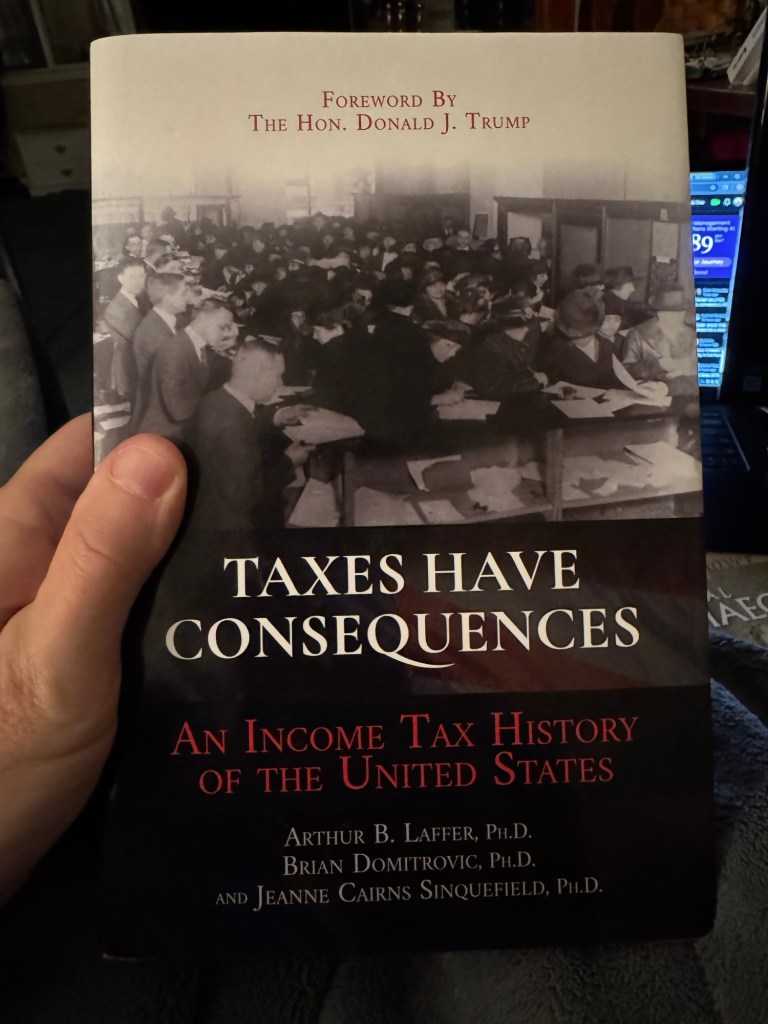
I’ve been catching a lot of heat lately for talking about socialism on my podcast, but honestly, I don’t see why it should be controversial at all. The pushback tells me everything I need to know: a whole lot of people have built their entire lives around government paychecks, public-sector benefits, and the steady drip of tax revenue that keeps the whole machine humming. They get defensive because the conversation about taxes hits too close to home. When you point out that the income tax proposal of 1913 was a colossal mistake—one that’s strangled growth, rewarded bureaucrats, and penalized the very risk-takers who drive real prosperity—you’re not just debating policy. You’re challenging the foundation of how they pay their mortgages and fund their retirements. And the data, especially from that outstanding book Taxes Have Consequences: An Income Tax History of the United States by Arthur B. Laffer, Brian Domitrovic, and Jeanne Cairns Sinquefield, backs me up every step of the way. 

Let me take you back to 1913. That single year changed everything. The 16th Amendment was ratified on February 3, giving Congress the power to lay and collect taxes on incomes “from whatever source derived, without apportionment among the several States.” Just months later, the Revenue Act of 1913 imposed a 1 percent tax on incomes above $3,000 (about $90,000 in today’s dollars) with a top rate of 7 percent on incomes over $500,000. It affected maybe 1 to 3 percent of the population at first, and early revenue was tiny—only about $28 million in 1914.  At the same time, the Federal Reserve Act was signed on December 23, creating a centralized banking system that promised stability but, in my view, locked in the same progressive-era thinking that favored administrative control over free markets. Both moves came during the Wilson administration, a time when socialist ideas were swirling globally, and centralized power looked like the future to some. Tariffs and excise taxes had kept federal revenue under 3 percent of GDP before 1913; after the amendment, the door was wide open. By the post-war era, federal receipts stabilized around 17-18 percent of GDP, no matter how high the rates climbed—a pattern economists call Hauser’s Law.  The pie didn’t grow faster just because the government took a bigger slice; people and capital adjusted.

What Taxes Have Consequences lays out so clearly—and what a century of statistics confirms—is that the top marginal income tax rate has been the single biggest determinant of economic fate, tax revenue from the wealthy, and even outcomes for lower earners. The authors divide the income-tax era into five periods of tax cuts and explosive growth and four periods of high rates and stagnation. When rates were slashed—as in the 1920s under Treasury Secretary Andrew Mellon (top rate down to 25 percent), the 1960s Kennedy cuts, the 1980s Reagan revolution, the 1990s, and briefly under President Trump’s 2017 reforms—the economy roared. Investment flooded in, jobs multiplied, and the rich actually paid a larger share of total revenue because the tax base expanded dramatically. In the 1920s, for example, real GDP nearly doubled, unemployment plummeted, and revenues from the top brackets rose even as rates fell. The same pattern repeated in the 1980s: top rates dropped from 70 percent to 28 percent, the top 1 percent’s share of income taxes climbed from about 25 percent to over 37 percent by the late 1990s, and real per-capita GDP growth accelerated. 

Contrast that with the high-rate eras. The late 1910s, the 1930s, the 1940s-1950s, and especially the 1970s saw top rates reach 77 percent during World War I, 94 percent during World War II, and remain north of 90 percent for decades afterward. The book makes a compelling case that the 1932 tax hikes—pushing the top rate to 63 percent amid the Depression—actually deepened the crisis. Revenue from the rich collapsed, investment dried up, and the economy stayed mired until wartime spending and later rate reductions kicked in. During the 1970s stagflation, 70 percent-plus top rates coincided with sluggish growth, high unemployment, and inflation that hammered everyone, especially the working class. Lower earners suffered precisely because the rich weren’t investing or expanding businesses when the government was confiscating the upside. The Laffer Curve isn’t a theory; it’s observable history. Push rates too high, and you cross into the prohibitive range, where behavior changes: less work, less risk, more avoidance, and ultimately, less revenue. 

I’ve seen this play out in real time with people I talk to. Just the other day, I was explaining basic economics to some younger folks who were upset they weren’t making enough money. Their lifestyles told the story—video games, complaints, minimal effort. I told them straight: this is a free country. You have twenty-four hours every day. If you’re only pulling in $20,000 a year, maximize the hours. Get a second job, learn a skill, take a risk. Once you get a little capital, that engine starts turning faster. Money makes money, but you have to earn the first bit through productive behavior. The progressive tax system we’ve had since 1913 punishes exactly that ambition. Why grind harder if the government is going to take 37 percent—or more when you add state taxes—just because you succeeded? The book spends chapters on this psychological reality: high earners respond to incentives. They hire lawyers, accountants, and lobbyists. They structure investments to minimize liability. They move. And who can blame them?

Look at the migration numbers today. IRS data from 2022-2023 shows high-tax states hemorrhaging wealth and people. California lost $11.9 billion in adjusted gross income from net out-migration; New York lost $9.9 billion; Illinois lost $6 billion. Meanwhile, no-income-tax states cleaned up: Florida gained $20.6 billion in AGI, Texas $5.5 billion, South Carolina and North Carolina billions more. High earners—those making $200,000 and up—drove most of the shift. Florida’s net gain came disproportionately from wealthy movers, whose average incomes were far higher than those of those leaving. This isn’t random; it’s rational human behavior. People vote with their feet when the “fair share” rhetoric turns into confiscation. The same dynamic happened after California and New York jacked up top rates: businesses and talent fled to Texas and Florida, starving the high-tax states of the very revenue they claimed the rich owed them. 

And don’t get me started on the people who lecture us about “fair share” while enriching themselves in public office. Nancy Pelosi comes to mind immediately. She entered Congress in 1987 with a few hundred thousand in stocks; today her family’s net worth is estimated at north of $280 million, with massive gains from timely trades in tech and other sectors while she sat on committees with insider knowledge. Critics have hammered her for years over this, yet no charges stick because the rules somehow allow it. The rest of us pay accountants to navigate a tax code thicker than a phone book while members of Congress trade on information the public doesn’t have. That’s not wealth creation through risk and ingenuity; that’s parasitic behavior enabled by the very system that claims to soak the rich. The book details how, throughout history, the wealthy have found ways around punitive rates—through capital flight, tax shelters, and reduced effort. Congress critters have a faster, easier on-ramp. 

This brings me to the real heart of the problem: the administrative state and the public-sector workforce that depends on confiscated wealth. I was in Washington, D.C., recently, and the parking garages told the story better than any chart. At 8 a.m., they’re packed—government workers streaming in. By noon? Empty. Half-day culture, cushy benefits, pay scales that often run 20-25 percent above comparable private-sector jobs when you factor in pensions and job security. Federal data show the pay gap persists; total compensation for many federal roles exceeds that of private-sector equivalents, especially at mid- to senior levels. Meanwhile, private-sector risk-takers—the ones who actually grow the economy—get penalized. We’re not funding productive infrastructure or national defense with all this revenue; we’re propping up a class of paper-pushers who enjoy lives the average taxpayer can only dream of. Democrats love to create these jobs and fund them with “progressive” taxes, then act shocked when the rich use every legal tool to protect what they’ve earned. It’s human nature. People who work hard, innovate, and build don’t willingly hand over the fruits of their labor to subsidize easy government gigs. The 1913 experiment assumed otherwise, and a century of data proves it wrong. 

The book hammers this point with statistical precision. When top rates are low, the rich bring capital out of hiding, invest it, hire workers, and expand the tax base. When rates are high, they shelter, defer, or produce less. The result? Less overall growth, which hurts everyone. Real per-capita GDP growth averaged around 2 percent across eras, but the booms under low-rate policies lifted lower incomes far more effectively. Poverty fell faster, wages rose, and government actually collected more from the top 1 percent—not because of higher rates, but because of a bigger, more dynamic economy. In 2022, the top 1 percent (incomes above roughly $663,000) earned about 21 percent of income but paid 40 percent of all federal income taxes—an effective rate around 26 percent after deductions. That share has risen over the decades as rates have come down and growth has accelerated. The progressive myth that “the rich get richer and everyone else suffers” ignores how the system actually works. Once you have capital, you can leverage it—but you earned that first pile by outworking and out-risking everyone else. Penalizing success doesn’t create fairness; it creates stagnation. 

President Trump understood this during his first term, and especially in the interregnum before his second term. His tax policies—cutting corporate rates, lowering individual brackets, doubling the standard deduction—aligned with everything we’ve learned since 1913. The 2017 Tax Cuts and Jobs Act delivered exactly the results Taxes Have Consequences predicts: strong GDP growth, record-low unemployment (especially for minorities and low-wage workers), and higher revenue from the top brackets. The rich got richer in absolute terms, but so did everyone else, and the government’s slice of the larger pie increased. That’s the opposite of the socialist collective model, which assumes we can perpetually extract from producers to fund a utopia. Centralized banking and progressive taxation were sold as stabilizers, but they became tools for an administrative state that grows regardless of economic reality. The Federal Reserve’s money creation, paired with endless deficit spending, has only amplified the damage—debt now exceeds GDP, and interest payments alone rival major budget items.

I’m not saying there should be no taxes. A consumption-based system—sales taxes on what people actually use, transaction fees tied to real economic activity—would align incentives far better. Fund highways and services through the people who use them. Let growth compound without the drag of income confiscation. The book shows that broad-based, low-rate systems maximize revenue while minimizing distortion. We’ve tried the Marxist-inspired “from each according to ability, to each according to need” approach for over a century, and it has delivered exactly what human psychology predicts: avoidance, resentment, and slower progress. Younger generations especially need to hear this. Stop waiting for the system to hand you enough; the system was never designed to reward complaints or video-game marathons. Get out there, create value, take risks. The engine only accelerates once you’re in motion.

The backlash I get for saying these things proves the point. People whose livelihoods depend on the status quo—government employees, public-sector unions, politicians who promise “free stuff” funded by someone else’s ingenuity—don’t want the conversation. But facts don’t care about feelings. We have a century of statistics now. The 1913 experiment failed. It fed a monster of debt, bureaucracy, and distorted incentives that neither party has fully dismantled. President Trump’s approach pointed the way forward, and the next decade must be about rethinking the entire process. Repeal or radically simplify the income tax. Reconsider the Federal Reserve’s role in enabling endless spending. Align policy with human nature: reward risk, protect what people earn, and stop pretending government workers deserve 30 percent more compensation for half-day effort while the private sector carries the load.

This isn’t some fringe, scandalous idea. It’s an observable reality documented in Taxes Have Consequences across hundreds of pages of data, charts, and historical analysis. The rich don’t pay their “fair share” under high rates because they’re not stupid—they adjust. The economy doesn’t grow when ambition is taxed into oblivion. And society doesn’t thrive when we build it on the backs of parasites who show up at 8 a.m. and vanish by lunch, all paid for by confiscated wealth. At their core, human beings do not want to slave away so others can live easily. That truth has never changed, and no amount of political spin or election-year rhetoric can repeal it.

As we head into the 2030s, the discussion will only intensify. People are done subsidizing inefficiency. The genie is out of the bottle. If you’ve followed my work, you know I’ve been saying this for years. Subscribe to my blog and business updates—I think you’ll love the deeper dives into these ideas and practical ways to protect and grow what you earn in a world that still rewards the ambitious. The progressive tax experiment of 1913 was a gamble based on flawed psychology and socialist dreams. A century later, we have the receipts. It’s time to learn the lesson and move on.

Footnotes

1.  Laffer, Arthur B., Domitrovic, Brian, and Sinquefield, Jeanne Cairns. Taxes Have Consequences: An Income Tax History of the United States. Post Hill Press, 2022.

2.  U.S. National Archives. “16th Amendment to the U.S. Constitution.”

3.  Revenue Act of 1913 historical summaries, IRS and congressional records.

4.  Federal Reserve Act of 1913 documentation.

5.  FRED Economic Data, Federal Receipts as Percent of GDP (historical series).

6.  Tax Foundation and IRS Statistics of Income reports on top 1% tax contributions.

7.  IRS migration data 2022-2023, state AGI flows.

8.  Congressional financial disclosures and OpenSecrets analyses on member wealth.

9.  Bureau of Labor Statistics and Federal Salary Council reports on public vs. private compensation.

10.  Laffer Center summaries and book excerpts on specific historical periods.

Bibliography

•  Laffer, Arthur B., et al. Taxes Have Consequences. Post Hill Press, 2022.

•  U.S. Internal Revenue Service. Statistics of Income historical reports (1913-present).

•  Tax Foundation. Various reports on historical tax rates, migration, and economic growth.

•  Federal Reserve Bank of St. Louis (FRED). Federal Receipts as % of GDP.

•  Congressional Budget Office and Tax Policy Center data on effective tax rates and income shares.

•  OpenSecrets.org and Quiver Quantitative congressional wealth tracking.

•  Bureau of Economic Analysis and BLS employment and payroll data.

This essay reflects exactly what I’ve been saying and living: free markets, personal responsibility, and an honest look at a century of bad policy. The evidence is overwhelming. Now it’s time to act on it.

Rich Hoffman

More about me

Click Here to Protect Yourself with Second Call Defense https://www.secondcalldefense.org/?affiliate=20707

About the Author: Rich Hoffman

Rich Hoffman is an aerospace executive, political strategist, systems thinker, and independent researcher of ancient history, the paranormal, and the Dead Sea Scrolls tradition. His life in high‑stakes manufacturing, high‑level politics, and cross‑functional crisis management gives him a field‑tested understanding of power — both human and unseen.

He has advised candidates, executives, and public leaders, while conducting deep, hands‑on exploration of archaeological and supernatural hotspots across the world.

Hoffman writes with the credibility of a problem-solver, the curiosity of an archaeologist, and the courage of a frontline witness who has gone to very scary places and reported what lurked there. Hoffman has authored books including The Symposium of JusticeThe Gunfighter’s Guide to Business, and Tail of the Dragon, often exploring themes of freedom, individual will, and societal structures through a lens influenced by philosophy (e.g., Nietzschean overman concepts) and current events.

Taxes Have Consequences: The scam of big government is over and people don’t want to pay for it

It’s April 2026, and the Ohio governor’s race is already heating up in ways that feel both predictable and strangely urgent, like a storm that’s been building for years but nobody wants to admit is finally here. Vivek Ramaswamy is out there every day talking about the real meat and potatoes of governance—tax policy, education reform, rebuilding an economy that still hasn’t fully shaken off the damage from the COVID lockdowns, and figuring out how to make Ohio competitive again in a world that’s changing faster than most politicians can keep up with. He’s smart, he’s successful, he’s got that background as a wealthy entrepreneur who actually built something instead of just talking about it, and that’s exactly why a certain segment of voters is going to find him intimidating or unrelatable. Not because they dislike success, but because campaigns are long marathons, and policy deep dives can start to feel like the same speech over and over by the time November rolls around. People get bored. They tune out. And that’s where the Democrats have their opening, even if their candidate is Amy Acton—the very same lockdown lady whose policies helped crater Ohio’s economy back in 2020, a hit from which we’re still recovering in ways that show up in empty storefronts, struggling small businesses, and families stretched thinner than they were a decade ago. 

Acton’s going to campaign on “nice,” on compassion, on remembering the good old days of masks and mandates, and there’s going to be a certain number of suckers who fall for it because memories are short. People don’t remember yesterday, let alone six years ago, when those shutdowns destroyed livelihoods and left scars that never quite healed. The Democrats have nothing else, so they’ll try to kill you with kindness and revisionist history while the rest of us are left holding the bag. Vivek knows this. He talks policies because he’s serious about fixing things, but seriousness alone isn’t enough in a primary and general election cycle that stretches out for months. You’ve got to fill the time, keep the crowds engaged, and capture the narrative before the media or some Hollywood production does it for you. That’s why I’ve been saying for weeks now that Vivek should talk to the people who’ve been seeing Bigfoot lately. Yeah, you read that right—Bigfoot. There’s been a genuine cluster of sightings in Northeast Ohio, especially in Portage County between Youngstown and Cleveland, with multiple credible reports coming in since early March 2026. Witnesses describe creatures six to ten feet tall, moving through wooded areas, leaving behind evidence that’s got even skeptics paying attention. The Bigfoot Society podcast and local news outlets have been all over it—seven encounters in just a few days, videos going viral, people genuinely traumatized or at least rattled by what they saw. 

Ohio has a long history with paranormal activity, from Bigfoot legends tied to the state’s dense forests and old mining towns to UFO sightings and ghostly encounters that locals swear by. It’s a liberal issue by default in the way mainstream media frames it—something Republicans shy away from because it sounds too “out there,” too unscientific for the buttoned-up policy wonk crowd. But that’s exactly why Vivek should lean into it. Trump understood this instinctively. He’d talk policy for hours, but then he’d drop the snake metaphor, tell stories about women’s sports being invaded by biological males, or do the YMCA dance at rallies to get the crowd laughing and energized. Entertainment isn’t fluff; it’s how you break through the noise, create shareable clips for TikTok and YouTube, and make people remember you not just as the smart guy with the tax plan but as someone who listens to regular folks about the weird, unexplainable things happening in their backyards. Those Bigfoot witnesses in the Youngstown-Cleveland corridor? They’re active voters in swing areas that could decide the race. Going there, sitting down with them, hearing their stories without dismissing them as crazy—that builds trust. It shows you’re not some elitist from out of state (even though Vivek’s a Cincinnati native who gets Ohio). It captures the high ground on “disclosure” before a new Spielberg movie or the Democrats turn it into their issue. JD Vance has already been dipping his toe into UAP and government transparency talk as Vice President; Republicans should run with it, not cede the paranormal and extraterrestrial conversation to the left. Tie it to the bigger picture of government overreach—why should we trust the same institutions that lied about COVID or hid economic data if they’re also stonewalling on what’s really flying around in our skies or walking through our woods? Vivek talking Bigfoot wouldn’t be a gimmick; it’d be strategic storytelling that keeps the campaign fresh through the long summer-and-fall grind. 

And let’s be clear: this isn’t about abandoning the serious stuff. The meat and potatoes still matter most. But campaigns are won in the gaps between policy papers, in the moments when voters feel seen on the things that actually touch their daily lives—including the strange ones. I’ve heard chatter about alternatives in the Republican primary, like Casey Putsch, the “car guy” from Northwest Ohio who’s positioning himself as the working-class everyman against Vivek’s success story. Casey’s got his appeal, no doubt—he’s a local entrepreneur, designer, and he talks a good game about being the anti-establishment choice. But let’s be real: Vivek’s the one with the vision, the endorsement from Trump, the Ohio Republican Party backing, and the track record that actually matches the moment. Some of the noise around him is uglier than that, drifting into racist framing that claims he’s not “really” qualified because his parents came from India. You’ll see it bubbling up from the fringes—the Tucker Carlson types who’ve lost their audiences by trying to drag MAGA into some fascist or openly bigoted territory. It’s nonsense. Vivek’s an American success story, and anybody pushing that kind of sympathy for racial purity tests is playing the same game as the social justice left, just from the other side. They’re not conservatives; they’re just different flavors of the same divisive poison. Republicans win when we reject that outright and focus on ideas, merit, and results. Vivek gets that. He’s not flip-flopping on property taxes; he’s being pragmatic about how you actually govern in a representative system. 

I’ve been following this closely because property taxes are the boiling point in Ohio right now, especially here in Butler County, where I live. Vivek’s talked about rolling them back, not waving a magic wand and eliminating them overnight on day one, and that’s smart politics even if some purists want the full nuclear option. Why? Because taxes have consequences—real, devastating ones that ripple through economies, families, and entire communities. My good friend Senator George Lang, the majority whip up in the statehouse and a guy who actually gets it, handed me a copy of the book Taxes Have Consequences: An Income Tax History of the United States not long ago when I was in his office talking shop. It’s a great read, and Trump himself wrote the foreword during his time out of office. The book lays out how the income tax experiment since 1913 has been a social Marxist disaster wrapped in good intentions, a pyramid scheme that’s warped everything from personal freedom to economic growth. Progressive taxation, the 16th Amendment, the way it funded bigger and bigger government—it didn’t build prosperity; it siphoned it off and created dependency. And property taxes? They’re the local version of that same trap, especially in places like Butler County. 

Let me give you the supplemental background here because this isn’t abstract theory; it’s what’s happening on the ground in Wetherington and every suburb like it across Ohio. Butler County used to be farmland—viable farms where families grew beans, corn, raised cattle, baled hay, and made a living off the land without needing massive government intervention. Then came the post-World War II boom, the Federal Reserve’s money printing since 1913, and the real estate developers who saw opportunity. They bought up that farmland cheap, subdivided it into half-acre lots, built houses, and sold them for maybe $100,000 twenty or thirty years ago. Every five or six years, those homes compounded in value—$150k, $200k, $300k today—because of inflation, low interest rates for a while, and the illusion of endless growth. Homeowners felt rich on paper. They paid their $1,500, $2,000, or $5,000 a year in property taxes for schools, fire departments, police, senior services, and roads, figuring it was worth it because their equity was growing. But it was a pyramid scheme all along. Banks financed it, the government taxed the appreciation, and local levies kept passing because people had “money in their pockets” from refinancing or selling at a profit. 

Fast-forward to now: those original buyers’ kids have grown up, the houses have aged, cheap materials have started showing their wear, and neighborhoods have gotten denser than anyone planned. New families come in facing $300k, $400k, or even $500k mortgages on 40-year-old homes that aren’t worth the cost of rebuilding. Two-income households stretch to make ends meet, but inflation has robbed wage growth; raises don’t keep pace, and suddenly the property tax bill feels like a noose. Butler County saw a 37% jump in values during the last triennial update, pushing tax bills up double digits for many. Schools built their budgets assuming perpetual increases; local governments did the same. You can’t just flip the switch to zero property taxes without chaos—mass layoffs in education, crumbling infrastructure, seniors losing services they paid into for decades. That’s not conservative governance; that’s ideological arson that hurts the very people you’re trying to help. Vivek gets this. He’s talking rollback, a gradual phase-down, and legislative buy-in from the House and Senate (where folks like George Lang have already been pushing reforms—billions in relief passed recently to cap runaway increases without voter approval). It’s the realistic path: wind it down month by month, year by year, while creating wealth elsewhere—through fossil fuels, space-economy innovation, and deregulation—so people can actually afford the basics again. Trump’s forward in that book nails it: taxes destroy incentives, harm the social fabric, and turn government into a beast that eats its own tail. Ohio’s feeling that now, because the runway on endless spending and taxing has officially run out. 

People are fed up. They see the size of government and get nothing good back. Republicans in the legislature and any serious governor know you can’t just “blow it all up” and expect 92% of voters to cheer while their schools close and roads crumble. You build coalitions. You explain the consequences. You show how the pyramid scheme of real estate appreciation—fueled by easy money and federal policies—hit the wall when inflation ate real wages and younger generations looked at half-million-dollar fixer-uppers and said, “No thanks.” That’s where the generational shift comes in, and it’s one of the most hopeful things I’ve seen in a long time. Watch the beer commercials lately—sales are way down among under-18 and young adults. They’re not smoking as much, not chasing the reckless party lifestyle their parents modeled. They’ve seen the dumb decisions up close: the divorces from financial stress, the two-income grind that left families fractured, the housing trap that turned the American Dream into a nightmare. The best rebellion now is being good—opting out of the Democrat-saturated culture of dependency, choosing smaller homes or conservative values early on, and building real wealth instead of chasing illusions. They’re not interested in the kings protesting in the streets or the victimhood Olympics. They want stability, and that starts with an honest tax policy that doesn’t punish success or trap people in overvalued assets. Vivek’s plan aligns with that future. He’s not backing away from his word; he’s building the political capital to pass legislation that delivers real relief without the chaos. It’s going to take guts, debate, and time—maybe decades to fully unwind—but it’s the only path. Gold standard ideas, wealth creation through energy and innovation, rolling back the 2%+ inflation scam that devalues the dollar year after year: that’s how you make homes affordable again without the pyramid collapsing on everyone’s heads. 

Sprinkling in those Bigfoot interviews or paranormal town halls isn’t a distraction from this hard work; it’s the spoonful of sugar that helps the medicine go down. People are sick of heavy government lectures. They want leaders who engage the full spectrum of life—the policy grind and the mysterious wonders that remind us there’s more to existence than spreadsheets and levies. Ohio’s got active paranormal hotspots for a reason; the state’s geography, history of industry and settlement, and even Native American lore feed into it. Capturing that narrative keeps the campaign alive, draws in voters who feel dismissed by the elites, and prevents Democrats or Hollywood from owning the “disclosure” conversation. JD Vance is already positioned there as part of the Trump administration’s push for transparency on UAPs and beyond; Vivek tying it to the local level would be brilliant. It worked for Trump because he made politics fun again amid the seriousness. It’ll work here too.

Taxes have consequences, as that book makes crystal clear. The income tax, since 1913, turned America from a limited-government republic into a welfare-warfare state experiment that’s now hitting its natural limits. Property taxes in Ohio are the canary in the coal mine—Butler County’s farmland-to-subdivision story is playing out statewide. We’ve got to roll them back intelligently, not recklessly, while infusing real wealth into the economy so the next generation isn’t saddled with our mistakes. Vivek’s the guy to do it, but he’ll need to keep the crowds laughing and listening with stories from the weird side of Ohio life along the way. The Democrats will throw everything at him—lockdown nostalgia, racial smears, fear of change—but facts and engagement will win. Ohio’s ready for a governor who understands both the pyramid scheme that’s collapsing around us and the human need for wonder in the middle of the fight. The next few months are going to test everyone, but if Vivek plays it this way—policy plus personality, seriousness plus the unexpected—he’ll not only win; he’ll reshape what Republican governance looks like in the post-Trump era. And that’s a future worth voting for, Bigfoot sightings and all.

Footnotes

[1] Details on Amy Acton’s role in Ohio’s COVID response and her current gubernatorial bid are drawn from public records and campaign coverage.

[2] Recent Bigfoot reports compiled from local news and eyewitness accounts in Portage County, March 2026.

[3] Property tax reform legislation supported by Sen. George Lang, Ohio Senate records, 2025 sessions.

[4] Taxes Have Consequences: An Income Tax History of the United States by Arthur B. Laffer et al., with foreword by Donald J. Trump—core analysis of 1913 income tax impacts.

[5] Butler County property value updates and tax rollbacks, county auditor reports, and commission actions, 2025.

[6] Vivek Ramaswamy’s campaign platform and primary positioning, official site, and polling data as of April 2026.

[7] Casey Putsch’s primary challenge context from candidate statements and Ohio Capital Journal coverage.

[8] JD Vance and broader disclosure/UAP discussions referenced in public interviews and the administration context.

Bibliography

Laffer, Arthur B., et al. Taxes Have Consequences: An Income Tax History of the United States. (Foreword by Donald J. Trump). Post Hill Press, recent edition.

Ohio Senate Records. “Lang Supports Billions in Long-Term Relief for Ohio Property Taxpayers.” November 2025.

WKYC and NewsNation. Reports on Northeast Ohio Bigfoot sightings, March 2026.

Ballotpedia and Signal Ohio. “Ohio Gubernatorial Election 2026” candidate profiles.

Butler County Auditor’s Office. Property tax billing and valuation updates, 2023–2026.

Ramaswamy Campaign Site (vivekforohio.com). Platform documents, April 2026.

Ohio Capital Journal. Coverage of primary challengers and tax reform debates, 2025–2026.

Trump, Donald J. Foreword to Taxes Have Consequences. As referenced in Sen. George Lang’s distribution and public commentary.

Additional supplemental reading: Historical texts on the 16th Amendment and Federal Reserve Act of 1913; local folklore collections on Ohio cryptids (e.g., Bigfoot in the Midwest).

Rich Hoffman

More about me

Click Here to Protect Yourself with Second Call Defense https://www.secondcalldefense.org/?affiliate=20707

About the Author: Rich Hoffman

Rich Hoffman is an aerospace executive, political strategist, systems thinker, and independent researcher of ancient history, the paranormal, and the Dead Sea Scrolls tradition. His life in high‑stakes manufacturing, high‑level politics, and cross‑functional crisis management gives him a field‑tested understanding of power — both human and unseen.

He has advised candidates, executives, and public leaders, while conducting deep, hands‑on exploration of archaeological and supernatural hotspots across the world.

Hoffman writes with the credibility of a problem-solver, the curiosity of an archaeologist, and the courage of a frontline witness who has gone to very scary places and reported what lurked there. Hoffman has authored books including The Symposium of JusticeThe Gunfighter’s Guide to Business, and Tail of the Dragon, often exploring themes of freedom, individual will, and societal structures through a lens influenced by philosophy (e.g., Nietzschean overman concepts) and current events.

‘Taxes Have Consequences’: The path forward in Ohio regarding property tax destruction

I’ve been thinking a lot about the upcoming 2026 Ohio gubernatorial race, and there are always a certain number of suckers who are going to fall for the polished narratives coming from the other side. They won’t remember yesterday, let alone six years ago, when the lockdowns crushed Ohio’s economy in ways we’re still feeling today. Amy Acton, the former health director who became the face of those restrictive policies during the COVID era, is running for governor as a Democrat. She’s going to go out there and talk nice, sounding reasonable and compassionate, and a chunk of voters—especially those who don’t follow politics closely or have short memories—are going to buy it. That’s the danger. The meat and potatoes of any campaign are the economy, taxes, jobs, and everyday affordability, but the left has its playbook: when policies fail, they pivot to personal attacks, calling opponents Nazis or extremists because they have little else substantive to offer. Timing matters too. Vivek Ramaswamy is a wealthy, successful entrepreneur with a background in business and biotech that many admire, but some voters struggle to relate to that level of achievement. Others might get bored during the long campaign stretch from now in April 2026 through the November election. Months of stops repeating the same policy points can wear thin without something to keep people engaged.

That’s where I see a real opportunity for Vivek to stand out. Republicans have historically been uncomfortable with topics outside strict policy—paranormal stuff, cryptozoology, disclosure on unexplained phenomena. By default, those areas get ceded to liberals who love to explore the mysterious. But Trump showed how to fluff up speeches with entertaining content: the snake metaphor, stories about men’s and women’s sports, even dancing to YMCA to get the crowd laughing and connected. There’s plenty in Ohio to do the same. We’ve had a surge of Bigfoot sightings recently, especially in the northeast around Youngstown, Portage County, and areas between Akron and there. People are reporting large, hairy figures—eight to ten feet tall—moving through the woods, accompanied by grunts, musty odors, footprints, and even pets shaking in fear. It started clustering in early March 2026, with multiple reports in just a few days near Mantua Center and Garrettsville. These aren’t fringe stories; they’ve made local news, gone viral on social media, and drawn attention from Bigfoot enthusiasts across the state. Ohio already has a reputation for this kind of activity—Hocking Hills calls itself the Bigfoot capital with festivals, and the state ranks high in sightings historically. Vivek should talk to the people who experienced these encounters. Listen to their stories without mocking them. It would make fantastic clips for TikTok and YouTube—human, relatable, showing a candidate who engages real Ohioans on what’s on their minds, even the unusual. You don’t have to believe in Bigfoot to show attention to folks who feel traumatized or excited by what they saw. Those rural and small-town areas near Youngstown include voters who might otherwise lean toward Acton’s camp. Meeting them where they are and hearing them out could freshly capture the narrative and beat Democrats to the punch on engaging the paranormal, just as JD Vance or others could on UFO disclosure. Spielberg-style wonder isn’t owned by one side; Republicans should run with it and make it part of showing government can connect with everyday wonder and curiosity again.

The serious policy side can’t be ignored, of course. Property taxes have become a flashpoint in Ohio, and Vivek has talked about rollbacks or even bolder moves toward zero income taxes. Some critics accuse him of flip-flopping or softening his stance, but that’s not accurate from what I’ve seen and heard. He’s building support with legislators who understand the real-world constraints. My good friend Senator George Lang, the majority whip at the Ohio Statehouse, handed me a powerful book that puts all this in perspective: Taxes Have Consequences: An Income Tax History of the United States by Arthur B. Laffer, Brian Domitrovic, and Jeanne Cairns Sinquefield, with a foreword by Donald Trump. It’s essentially a roadmap for the tax policies we need moving forward, especially as we navigate the next few years under a Trump-influenced administration where Vivek could play a key role in Ohio. The book traces the devastating experiment of the federal income tax since the 16th Amendment in 1913. What started as a small levy on the wealthy quickly became a tool for social engineering and revenue extraction with Marxist and socialist fingerprints all over it. High tax rates have repeatedly stifled growth, innovation, and prosperity, while cuts—like those under Kennedy, Reagan, and Trump—unleashed economic booms that lifted average incomes and helped lower earners the most. The Laffer Curve, which Art Laffer famously illustrated, shows that beyond a certain point, higher rates actually reduce revenue because they discourage work, investment, and risk-taking. The book details how the top marginal rate has dictated America’s economic fate for over a century: sky-high rates in the 1930s contributed to the prolongation of the Great Depression, while post-war cuts and the 1980s reforms correlated with surges in GDP, jobs, and opportunity.

Trump’s foreword ties it directly to his own policies, emphasizing how lowering rates and simplifying the code boosted the economy before external shocks hit. This isn’t abstract theory—it’s history with data. The authors show how taxes harm not just the economy but the social atmosphere: they distort behavior, punish success, and create dependency. For Christians or anyone with a moral framework, it’s a reminder that stewardship and honest labor thrive under systems that reward productivity rather than penalize it. Ohio sits right in the thick of similar challenges at the state and local levels with property taxes. People are fed up. They’ve watched home values compound for decades through a kind of pyramid scheme fueled by easy money, Federal Reserve policies since 1913, and development that turned farmland into subdivisions. Twenty years ago, a house might sell for $100,000; through repeated appreciation—$150k, $200k, $300k or more—owners felt wealthy on paper. They passed school, fire, and police levies, and senior services, without much pain because equity gains masked the bite. But that runway has ended. Homes built with cheaper materials and packed closer together have topped out in what buyers are willing to pay, especially with dual-income families stretched thin by inflation that has eroded the dollar’s value. Young people look at half-million-dollar mortgages and say, “No thanks.” They’re opting out—less drinking, less reckless behavior, rejecting the lifestyles they saw drain their parents. Beer sales are down among the young; the new rebellion is living cleaner, smaller, and smarter.

The result is a brick wall. Property tax revenue, which funds over 60% of local school budgets in Ohio (billions annually), faces revolt. Voters reject new levies because they can’t afford the inflated bills anymore. Developers and builders know the game: buy cheap farmland, subdivide, sell high, watch values rise on cheap credit and inflation. But when appreciation stalls and inflation erodes real wages, the tax burden feels like robbery without corresponding services. Schools built assumptions around perpetual growth that never materialized in the long term. Fire departments, roads, and senior programs—all tied to this model—are vulnerable if the faucet turns off abruptly. That’s why a sudden, total rollback or constitutional abolition of property taxes sounds appealing to the 7-8% who want to burn it all down, but it’s not practical for winning elections or governing. A full cutoff would cause chaos: mass layoffs in education, larger classes, program cuts, potential school closures in some districts, and pressure to spike income or sales taxes elsewhere to backfill—sometimes dramatically. Legislators know this. Republicans in the House and Senate, including those Vivek would work with, recognize you can’t just flip a switch without grinding infrastructure to a halt. The state isn’t ready for an all-out divorce from local funding mechanisms that maintain roads, schools, and services.

Instead, the smart path is a deliberate wind-down: roll back rates gradually, reform assessment practices, cap growth tied to inflation rather than unchecked reappraisals, diversify with income taxes or other sources where feasible, and pair it with broader economic growth that puts more money in people’s pockets. Vivek’s background in wealth management and business creation, along with a high-level understanding of capital flows, uniquely equips him for this. He gets how taxes have consequences—not just revenue numbers but behavioral shifts, investment decisions, and social health. Critics framing his Indian immigrant parents as somehow disqualifying are drifting into nonsense that has no place in conservatism. That racial or ethnic attack echoes left-wing identity politics or worse—Hitler’s socialist Nazi tactics of division, not American conservatism rooted in individual merit, opportunity, and e pluribus unum. Nick Fuentes-style shock jockery or drifting toward Tucker Carlson’s more isolationist edges risks alienating the broader MAGA coalition that values wins over purity spirals. Real conservatism builds coalitions around shared principles: lower taxes, strong borders, economic freedom, and cultural sanity. Vivek embodies success through innovation and hard work; attacking that because of heritage is lunacy and plays into the left’s divide-and-conquer game. He’s not flipping on taxes—he’s being pragmatic, courting legislators who see the addiction to government programs built up over decades. Schools, in particular, expanded on the assumption of endless property tax growth from rising values. Abrupt cuts without transition would hurt the very families we want to help.

The book Taxes Have Consequences articulates this history brilliantly. It shows how the income tax, sold as temporary and fair in 1913, ballooned into a tool that funded expansive government and distorted the economy. Periods of low rates saw flourishing: the Roaring Twenties, post-WWII boom, Reagan era, and Trump’s pre-COVID surge. High rates correlated with stagnation or decline. Socially, it fostered resentment, underground economies, and a pyramid-like reliance on growth that eventually hits limits—just like Ohio’s property tax model. Inflation from fiat money printing since the Fed’s creation compounds it, making each dollar buy less while nominal home values create illusory wealth that taxes then erode. To fix it long-term, we need more than tweaks: sound money policies (gold-standard elements or currency competition), wealth creation through energy independence, fossil fuels, a manufacturing resurgence, and, yes, emerging sectors like the space economy that could infuse real value. Young people turning away from vice and toward responsibility is a positive cultural shift; they won’t sustain the old tax-and-spend model. Parents cashing out to condos leave fewer buyers for inflated homes. The market will constrain until costs come down or real incomes rise.

Vivek Ramaswamy has the best tax policy vision and rollback ability in the conversation right now because he understands these dynamics at scale. He’ll need guts, debate, and collaboration with the legislature—including voices like Senator Lang—to implement gradual relief without collapse. Sprinkling in fun engagements like visiting Bigfoot witnesses in the Youngstown area would lighten the heavy load. People are sick of government size and intrusion; they haven’t gotten value for their taxes and are ready for change. But winning popular support means meeting voters where they are—on pocketbook pain and on the human stories that make life interesting. Amy Acton will try to memory-hole her role in economic destruction and paint herself as the caring alternative, relying on short attention spans and Nazi-style smears when pressed on substance. A certain number will fall for it. But Vivek can counter by staying substantive on taxes while adding entertainment and genuine curiosity that Trump mastered. Go to those rural spots, listen to the sighting stories, and turn them into engaging content. It captures attention in a media-saturated world and shows Republicans aren’t stuffy on everything.

This race is about more than one election. It’s a microcosm of the national struggle: can we unwind the tax addiction built since 1913 without chaos, restore economic vitality, and reconnect with the American spirit that includes wonder, hard work, and skepticism of overreach? Ohio’s brick wall on property values and taxes reflects the national pyramid scheme hitting limits. Vivek, with his policy depth and ability to engage broadly, is positioned to lead that grind-it-down process—month by month, bill by bill, with the courage to debate and the wisdom to avoid abrupt pain that loses voters. Critics who want instant demolition ignore how representative government works: you persuade the majority who still want some services but resent the cost and inefficiency. The book from Laffer and team provides the intellectual ammunition, showing tax cuts as the proven path to prosperity rather than punishment.

As we head through these months of campaigning, the contrast will sharpen. Acton’s side will offer more government band-aids—tax credits, debt relief—without addressing root causes like inflation and dependency. Vivek can offer a real rollback grounded in history, paired with cultural engagement that makes politics fun again. Bigfoot might seem trivial next to billion-dollar budgets, but ignoring what captures people’s imagination cedes ground. Trump proved metaphors, stories, and showmanship win hearts while policy wins minds. Ohio has the ingredients: frustrated taxpayers tired of the endless levy cycle, a new generation rejecting decline, and pockets of genuine mystery that remind us life holds more than spreadsheets. Listening to those Bigfoot witnesses in the northeast wouldn’t cost anything but time and respect—it could humanize the campaign and pull in independents who see a candidate willing to engage their world.

Ultimately, taxes do have consequences, as the book details across a century of evidence. They shape economies, families, and societies. Ohio’s reliance on property taxes, tied to the same inflationary home-value game that national policy enabled, has reached its limit. People aren’t supporting endless spending anymore; they’re tapped out. Gradual reform, economic growth to create real wealth, and cultural reconnection are the way forward. Vivek understands this at a level that pure politicians often don’t, thanks to his private-sector success. Paired with pragmatic legislators who know you can’t flip the switch overnight without pain, he can deliver relief that sticks. The suckers who forget Acton’s past or fall for nice talk will always exist, but a campaign that mixes meat-and-potatoes tax reform with engaging, memorable moments can reach the rest. It’s going to take hard work, but it’s doable. Ohio’s best days can still lie ahead if we learn from tax history since 1913 and apply those lessons boldly but wisely.

Footnotes

1.  Details on Amy Acton’s 2026 gubernatorial campaign, including her background as Ohio’s former health director during COVID lockdowns and current platform on affordability, drawn from campaign announcements and coverage in early 2026.

2.  Reports of the March 2026 Bigfoot “flap” in northeast Ohio, with multiple sightings in Portage County near Mantua, Garrettsville, and extending toward Youngstown/Trumbull areas, including descriptions of 8-10 foot figures, footprints, and pet reactions; see local news and Bigfoot Society accounts.

3.  Vivek Ramaswamy’s positions on property tax rollbacks, zero income tax ambitions, and campaign strategy in the 2026 Ohio race, including primary dynamics and legislative pragmatism.

4.  Analysis of Ohio property tax funding for schools (over 60% of local revenue in many districts) and risks of abrupt repeal, including potential service cuts or alternative tax spikes.

5.  Historical context from Taxes Have Consequences on U.S. income tax since 1913, Laffer Curve effects, and correlations between tax rates and economic outcomes across administrations.

6.  Ohio-specific property tax reforms in 2025-2026 legislation (e.g., HB 186 capping growth) and ongoing levy struggles amid voter resistance.

Bibliography

•  Laffer, Arthur B., Brian Domitrovic, and Jeanne Cairns Sinquefield. Taxes Have Consequences: An Income Tax History of the United States. Post Hill Press, 2022. (With foreword by Donald J. Trump.)

•  Hoffman, Rich. The Gunfighter’s Guide to Business: A Skeleton Key to Western Civilization. Self-published, 2021 (expanded editions via Overmanwarrior.com).

•  Council on Foreign Relations or Tax Foundation reports on state property tax structures (general reference for the Ohio context).

•  Local coverage: Cleveland19, WKBN, New York Post, Fox News, in March 2026, Ohio Bigfoot sightings.

•  Ohio Capital Journal, Signal Ohio, Columbus Dispatch, and AP News for 2026 gubernatorial race updates on Ramaswamy, Acton, and tax issues.

•  Policy Matters Ohio and Tax Foundation analyses on property tax repeal impacts on schools and local services (2025-2026).

•  Further reading: Laffer Center materials on supply-side economics; historical works on the 16th Amendment and Federal Reserve; Bigfoot Field Researchers Organization (BFRO), Ohio reports for cryptid context.

These provide solid entry points for exploring the tax history, campaign dynamics, and cultural elements discussed. Dig in, think critically, and let’s continue pushing for better policy and engagement in Ohio and beyond.

Rich Hoffman

More about me

Click Here to Protect Yourself with Second Call Defense https://www.secondcalldefense.org/?affiliate=20707

About the Author: Rich Hoffman

Rich Hoffman is an aerospace executive, political strategist, systems thinker, and independent researcher of ancient history, the paranormal, and the Dead Sea Scrolls tradition. His life in high‑stakes manufacturing, high‑level politics, and cross‑functional crisis management gives him a field‑tested understanding of power — both human and unseen.

He has advised candidates, executives, and public leaders, while conducting deep, hands‑on exploration of archaeological and supernatural hotspots across the world.

Hoffman writes with the credibility of a problem-solver, the curiosity of an archaeologist, and the courage of a frontline witness who has gone to very scary places and reported what lurked there. Hoffman has authored books including The Symposium of JusticeThe Gunfighter’s Guide to Business, and Tail of the Dragon, often exploring themes of freedom, individual will, and societal structures through a lens influenced by philosophy (e.g., Nietzschean overman concepts) and current events.

The End of the Socialist Experiment: People are tired of high property taxes to fund Democrat dreams

The governor of New York, Kathy Hochul, recently stood up at a forum and essentially begged the wealthy who have fled her state to return and keep paying the bills that fund her vision of big government. She said something along the lines of, ” Go down to Palm Beach, see who you can bring back home, because our tax base has been eroded. She admitted that New York is now in direct competition with other states that impose a lighter tax burden on corporations and individuals, and that Wall Street businesses are looking to Texas instead of staying captive in Manhattan. This is the same Kathy Hochul who, just a couple of years earlier, had told political opponents to jump on a bus and head down to Florida, where they belong, if they didn’t represent New York values. Now she’s pleading for those same people—and their money—to return so she can keep the generous social programs afloat. It’s a stunning reversal that proves exactly what I have been saying for four decades: liberal policies, built on endless taxation, endless spending, and the assumption that people will stay put and keep writing checks, are collapsing under their own weight. The free market is working exactly as it should, and people are voting with their feet. 

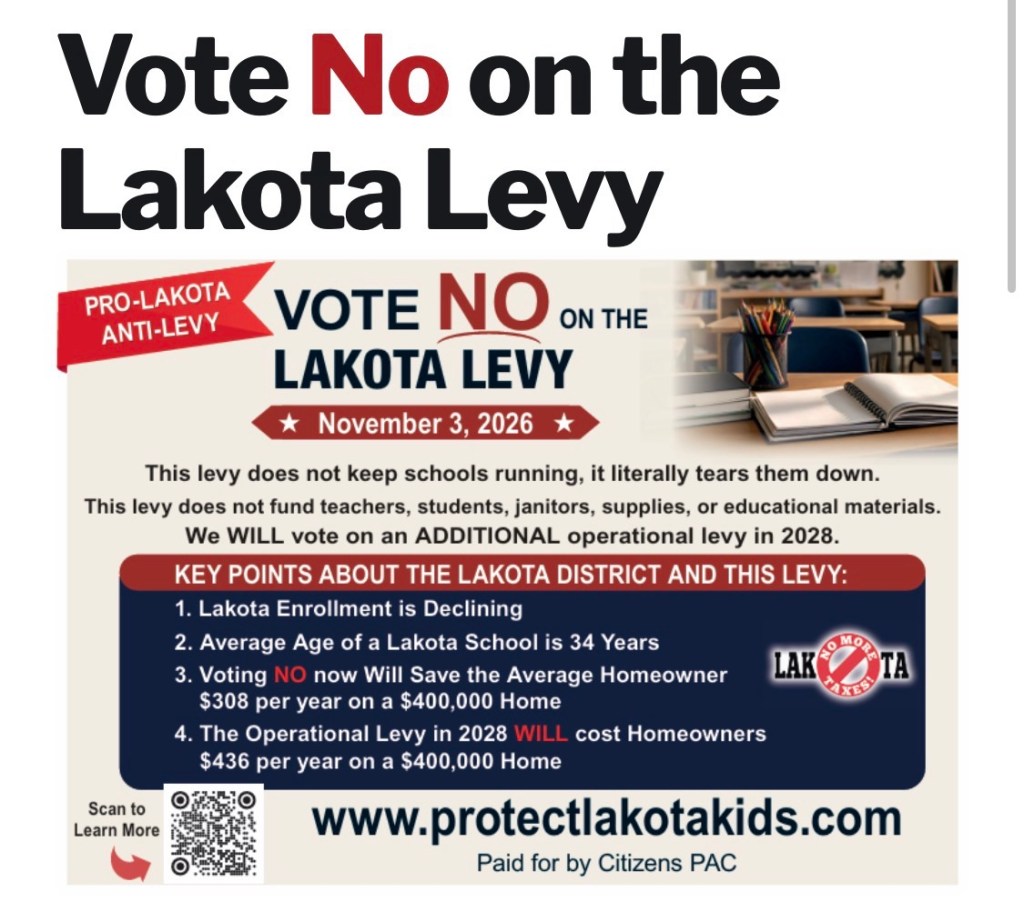
I was recently talking with folks in my local community here in Butler County, Ohio, about the Lakota Local School District, and the conversation crystallized everything happening on the national stage. Lakota had put a massive $506 million bond issue and levy on the ballot in November 2025—one of the largest school funding requests in Ohio history—tied to a master facilities plan that would demolish and rebuild buildings, supposedly to accommodate growth and modernize things. The district discussed reducing the number of buildings from 21 to 16, improving safety, and freeing up money for students. But voters saw through it. The levy was rejected by a decisive 61 to 39 percent margin. Even with promises that the actual net tax increase would be phased in later and capped at something like $93 per hundred thousand dollars of appraised value, thanks to debt roll-offs and state matching funds, people said no. They were tired of the trajectory. They didn’t want more property taxes funding a system that keeps growing its administration, its facilities wish list, and its social agenda while the real value delivered to families keeps getting questioned. This isn’t just a local story. It’s the same story playing out in New York, in California, and in every high-tax, high-spending blue state or district where the easy-money days of the past have finally run out. 

For decades, people tolerated these large social programs and bloated public education budgets because the economy seemed to be working in their favor. Compound interest in savings accounts was real. Home values kept climbing year after year, creating paper wealth that let families cash out when the kids grew up—sell the house, pocket half a million or more, and move into something smaller while still feeling ahead of the game. Property taxes felt like a tolerable price to pay for nice communities, decent schools that acted as reliable babysitters during work hours, and the social approval that came with supporting “the kids.” You could afford to be a little generous at the next neighborhood gathering or school board meeting because your net worth was rising faster than the tax bill. But that scheme is over. Inflation has eroded real returns. Interest rates have fluctuated wildly. Home appreciation isn’t the guaranteed golden ticket it once was for everyone. People are looking at their tax bills, looking at what their money is actually buying in public schools, and saying enough. The taxation trajectory that propped up liberalism for generations is now pointing downward, and the people who built their political power on it are panicking.

Look at what Hochul and her fellow Democrats are confronting. New York has been bleeding residents and businesses for years. Domestic migration data from the U.S. Census show New York losing hundreds of thousands of people, net, to lower-tax states like Florida and Texas. California is in the same boat, with net losses exceeding 200,000 annually in recent cycles. Florida alone has gained hundreds of thousands of domestic migrants, and Texas even more. These aren’t just retirees heading south for the weather. They are working families, entrepreneurs, corporations, and high-net-worth individuals who have had it with sky-high income taxes, property taxes, regulatory burdens, and the cultural policies that come attached. New York’s per-pupil spending is among the highest in the nation—often topping $30,000 per student—yet educational outcomes measured by national assessments like NAEP remain middling at best. Florida and Texas spend far less per pupil, around 12,000 to 14,000, and deliver competitive or better results in many categories while keeping taxes lower overall. No state income tax in either place. That is real competition, and Hochul is finally admitting it out loud even as she tries to guilt-trip people into returning for the “patriotic” duty of funding her programs. 

This is liberalism eating itself. For years, I have pointed out that every socialist experiment in history required walls—literal or figurative—to keep people from leaving. North Korea has its borders sealed. Cuba had its rafters and its political prisoners. East Germany built the Berlin Wall because people were fleeing to the West. China, even with its economic openings, maintains tight control because the alternative is mass exodus. The Soviet Union collapsed when the pressure to contain its people became unsustainable. Here in America, Democrats have relied on the soft walls of economic dependency, guilt, and cultural pressure. But those walls are crumbling because people can move. They can load up a U-Haul, drive to a free state, and never look back. Florida, under Governor Ron DeSantis, has become a magnet precisely because it refuses to play the high-tax, high-regulation game. Texas is booming for the same reasons. And here in Ohio, we are seeing the early stages of the same shift. People are coming to us from the collapsing blue states, and the lesson is clear: competitive models win. Punitive taxation and endless government expansion lose.

The property tax itself is at the heart of this fight, and it always has been a flawed, almost feudal concept dressed up in modern language. Its roots go back to William the Conqueror in 1066 England, where the king claimed ownership of all land and extracted perpetual payments from tenants and knights. The American version evolved through the Northwest Ordinance and the general property tax of the nineteenth century, which treated land and personal property as subject to state taxation indefinitely in exchange for “protecting” them. It was never truly about voluntary contribution; it was rent paid to the government for the privilege of owning what you thought you owned. Critics have long called it the most hated tax in America for good reason. It punishes ownership, discourages improvement, and ties local services—especially schools—to ever-rising assessments that have nothing to do with a family’s ability to pay. In places like New York and California, it became a weapon to fund expansive social programs that many residents never asked for and no longer support. Florida is leading the charge to change this. Governor DeSantis and state lawmakers have advanced multiple constitutional amendments to phase out homestead property taxes over time, ultimately eliminating them. Proposals include massive increases in exemptions—hundred-thousand-dollar jumps annually until nonschool property taxes on primary residences disappear. Ohio has its own movement gathering signatures for a 2026 ballot initiative to ban real property taxes altogether. Even some national voices aligned with President Trump have floated ideas for broader relief or elimination as part of a freedom agenda that recognizes property rights as fundamental. Why should anyone be penalized year after year simply for owning a home? It is a socialist march concept from the beginning, and people are waking up to it. 

Here in Butler County and at Lakota specifically, the failed levy is a microcosm of the larger revolt. The district wanted hundreds of millions for bricks and mortar, for renovations, and for a smaller footprint that supposedly saves money in the long term. Yet the community looked at the track record: rising administrative costs, questions about curriculum priorities, and the reality that public education has been turned into something far beyond basic reading, writing, and arithmetic. Parents are sick of teacher strikes or walkouts that leave kids without instruction while unions demand more pay and less accountability. They are tired of seeing resources funneled into social experiments—coloring hair purple, pushing premature discussions of sexual lifestyles on young children, and ideological lessons that many families consider inappropriate or even damaging. Schools were supposed to be trusted babysitters that prepared kids for smart, productive lives. Instead, too many have become vehicles for cultural agendas that parents never voted for and refuse to subsidize with their property taxes. When the easy-money era ended, and families started feeling the real pinch, the willingness to keep writing blank checks vanished. One more mill or two more mills might not sound like much on paper, but when it is attached to policies people actively oppose, it becomes unacceptable—even if it is just one extra dollar.

The same dynamic plays out with every other government service funded by these taxes. Look at the TSA—Transportation Security Administration—as a perfect example of what happens when critical infrastructure is handed to unionized government workers attached to the Democratic extortion economy. Long lines, delays, sickouts, threats of shutdowns whenever funding fights arise. People who once flew without a second thought are now choosing sixteen-hour drives rather than enduring the inefficiency and the political games. Airlines struggle to maintain themselves while government mandates and union leverage create artificial bottlenecks. Taxpayers are funding something broken, something that punishes them for trying to travel freely, and they are done with it. Democrats love to attach these unionized workforces to essential services because it gives them leverage—hold the public hostage, blame Republicans or “underfunding,” and demand more money. It is the same playbook with public schools, public transportation, and welfare systems. When people can no longer afford it or no longer support the ideology behind it, they stop paying voluntarily. They move. They vote against levies. They support politicians who promise reform.

I have been part of the no-more-taxes, lower-taxes movement my entire adult life because I saw this coming. High taxes deter growth. They drive away the productive. They reward inefficiency. In New York, California, and places like them, the richest were supposed to stick around for the social clubs, the prestige, the elbow-rubbing with the political class. Instead, they took their money, their businesses, and their talent to Florida, Texas, and increasingly to states like Ohio that are positioning themselves as the next frontier of opportunity. Ohio’s future cannot be more government, more spending, more taxes. It has to be the opposite. We have legislators and potential future leaders who understand that. We have a governor’s race and local movements that are aligning with the national shift toward lower costs, smaller government, and actual freedom. Property tax relief is coming—whether through caps tied to inflation, homestead exemptions that grow dramatically, or outright abolition in some form. Sales taxes can be reformed or reduced. Income taxes, where they exist, must be kept competitive. The gravy train that funded reckless social spending is over because the people who pay the bills have decided they no longer consent to the product being delivered.

This is why the walls of the old order are failing. In communist countries, the only way to keep the system intact was violence and threats—shooting people who tried to cross to freedom. Here, Democrats assumed guilt, cultural inertia, and the inability to leave would suffice. But remote work changed everything. The pandemic accelerated the realization. Free states with lower taxes, better governance, and respect for individual rights became irresistible. People are not afraid anymore. They are packing up and leaving New York, California, Illinois—anywhere the liberal model has run its course. The tax base erodes, the deficits grow, the pleas become more desperate, and the cycle accelerates. Hochul’s Palm Beach pilgrimage is just the latest symptom. She and the supermoms and the big-government cheerleaders who built careers around this model are late to the party. Bernie Sanders-style socialism always sounded good in the abstract until the bill came due and people realized the cost to their communities, their families, and their futures. Now the bill is here, and the payers are walking away.

Locally, Lakota and districts like it will have to adjust. No more assuming taxpayers will fund every wish list. Superintendents and boards will need to trim administration, focus on core education, respect parental values, and operate within realistic budgets. If that means fewer buildings, fewer non-essential programs, or actual efficiency reforms, so be it. The same applies statewide. Ohio cannot import the failing model from the coasts. We have to export the successful low-tax, high-freedom model. That is how we attract the people and businesses fleeing the collapse. That is how we keep our own residents from looking elsewhere. Competitive states win. Coercive ones lose.

I have warned about this for forty years because the math was always inevitable. Socialism requires coercion. When the coercion fails—when people can leave or vote no—the system collapses. We are watching it happen in real time. New York’s tax base is eroding. California is eroding. The liberal dream of endless spending funded by other people’s money is dripping through their fingers like water. They cannot hold it. They cannot force it. And they certainly cannot guilt-trip a free people into submission when better alternatives exist just a moving van away.

The future belongs to the states and communities that understand this. Florida is already moving toward eliminating property taxes on primary homes. Texas thrives without an income tax. Ohio has the chance to lead the Midwest in the same direction. Property tax abolition movements are gaining steam nationally because people are tired of being treated like tenants on their own land. Schools will be funded differently—perhaps through choice, vouchers, or learner operations that actually deliver value. Overall, government services will shrink because the public will no longer subsidize failure. TSA lines will either improve through competition and accountability, or people will keep driving. Either way, the extortion ends.

This is the movement of the world now. Anti-tax sentiment is rising everywhere because people have lived through the consequences of big government. They have seen the waste, the indoctrination, the inefficiency, and the cultural decay funded by their dollars. They voted for change at the national level with President Trump and the Republican wave because they want a different kind of government—one that does not punish success, ownership, or families trying to raise children in line with their values. Fraud in elections will continue to be exposed. The 50-50 split on paper was never real; it was propped up by manipulation. When people vote their true preferences without interference, the results will be even stronger.

For anyone still clinging to the old model, the message is simple: it is over. The easy money is gone. The guilt trips no longer work. The walls are down. People are free, and they are choosing freedom. Here in Ohio, in Butler County, at Lakota and beyond, we will learn the same lessons New York is learning the hard way. Budgets will be cut. Priorities will be realigned. Taxes will come down. And communities will thrive—not because government spends more, but because it spends less and interferes less.

I have always been clear on this. Beware of any politician who wants higher taxes. They are dangerous. They are going out of fashion fast. My book, Gunfighter’s Guide to Business, lays out the philosophy of self-reliance, competitive thinking, and the rejection of coercive systems that have guided my warnings for decades. It is more relevant now than ever. Subscribe, read it, and join the fight. The future is bright for those willing to embrace lower taxes, smaller government, and genuine freedom. The collapse we are witnessing is not the end of America—it is the end of a failed experiment. And the rebirth that follows will be something worth building.

Footnotes

1.  U.S. Census Bureau migration estimates, 2024-2025 data releases.

2.  Tax Foundation State Business Tax Climate Index, 2026 rankings.

3.  National Assessment of Educational Progress (NAEP) reports on per-pupil spending vs. outcomes.

4.  Historical analysis of property tax origins from feudal England through the U.S. Northwest Ordinance.

Bibliography for Further Reading

•  Fox News coverage of Hochul’s Palm Beach comments and tax base erosion (March 2026).

•  Cincinnati Enquirer and local Butler County reporting on Lakota levy failure (November 2025).

•  U.S. Census Bureau State-to-State Migration Flows tables (2023-2025).

•  Tax Foundation reports on property tax relief proposals in Florida, Ohio, and national trends (2026).

•  The Atlantic historical piece on feudal roots of American property tax (2016, with updates in policy debates).

•  DeSantis administration statements on Florida homestead tax elimination proposals.

•  Hoffman, Rich. Gunfighter’s Guide to Business (self-published, available via subscription platforms).

•  Additional data from NAEP/Nations Report Card and state education spending comparisons.

These sources provide the factual backbone while the analysis reflects four decades of observation on tax policy, education funding, and the failure of coercive governance models. The era of unchecked liberalism is ending, and the evidence is everywhere for those willing to see it.

Rich Hoffman

More about me

Click Here to Protect Yourself with Second Call Defense https://www.secondcalldefense.org/?affiliate=20707

About the Author: Rich Hoffman

Rich Hoffman is an independent writer, philosopher, political advisor, and strategist based in the Cincinnati/Middletown, Ohio area. Born in Hamilton, Ohio, he has worked professionally since age 12 in various roles, from manual labor to high-level executive positions in aerospace and related industries. Known as “The Tax-killer” for his activism against tax increases, Hoffman has authored books including The Symposium of JusticeThe Gunfighter’s Guide to Business, and Tail of the Dragon, often exploring themes of freedom, individual will, and societal structures through a lens influenced by philosophy (e.g., Nietzschean overman concepts) and current events.

He publishes the blog The Overmanwarrior (overmanwarrior.wordpress.com), where he shares insights on politics, culture, history, and personal stories. Active on X as @overmanwarrior, Instagram, and YouTube, Hoffman frequently discusses space exploration, family values, and human potential. An avid fast-draw artist and family man, he emphasizes passing practical skills and intellectual curiosity to younger generations.

Property Taxes are on the Chopping Block in Ohio: We warned these public schools, and now the time is here

The push to eliminate property taxes represents one of the most significant challenges to longstanding fiscal structures in the United States, particularly in states like Ohio, where a citizen-led movement has gained substantial momentum. This effort is not merely a local grievance but part of a broader national conversation about taxation, homeownership, government dependence, and economic freedom. In Ohio, a proposed initiated constitutional amendment known as the Ohio Eliminate and Prohibit Taxes on Real Property Initiative has been cleared for signature gathering and targets the November 3, 2026, ballot. If successful, it would permanently prohibit taxes on real property, defined to include land, growing crops, and permanently attached buildings (though public utilities might still face some taxation under specific interpretations).

To qualify, proponents need 413,488 valid signatures (10% of votes cast in the preceding gubernatorial election), with signatures required from at least 5% of voters in 44 of Ohio’s 88 counties. Groups such as the Committee to Abolish Ohio Property Taxes and Citizens for Property Tax Reform have been actively collecting signatures, with reports indicating progress well in excess of 100,000 signatures as of late 2025 and early 2026, alongside widespread deployment of petitioners. The movement is explicitly citizen-driven, emerging from frustration with rising tax burdens rather than legislative initiative. Legislative allies and local officials express sympathy for taxpayer concerns but highlight the practical difficulties of abruptly replacing the revenue stream.

Property taxes in Ohio fund a substantial portion of local government operations, with estimates indicating they account for roughly 65% of regional revenue. For public schools, which receive over three-fifths of real property tax collections (approximately $13.6 billion for tax year 2024, payable in 2025), this is the largest single funding source—surpassing state aid and supporting the education of nearly 1.5 million students. Counties, townships, libraries, parks, fire districts, and other special districts also rely heavily on these funds for services ranging from emergency response and road maintenance to mental health, addiction treatment, developmental disabilities support, elderly services, and children’s protective services. In many townships, property taxes are the primary revenue source because they lack the authority to levy income or sales taxes.

Opponents of abolition, including local officials, school districts, and organizations like the Ohio Municipal League, warn that elimination would be “disastrous,” potentially forcing sharp increases in sales taxes (possibly to 18-20% in some areas) or income taxes (doubling or tripling rates) to fill the gap. Schools could face severe disruptions, including cuts to programs, staff, or facilities, amid already escalating costs from collective bargaining agreements and professional salaries. Now, where was all this concern when DeWine shut down schools for Covid protocols?  Talk about disruptions, how would any of this be different regarding a disruptive culture?  Recent legislative reforms—such as bills signed by Governor Mike DeWine in late 2025 that limit inflation-linked increases, expand homestead exemptions, and provide rollbacks—aim to provide relief without complete abolition, capping certain levies, and redirecting funds to homeowners. These measures offer partial mitigation but have been dismissed by advocates as insufficient, fueling continued signature drives.

This Ohio initiative aligns with similar debates in other states, where post-World War II rising home values have increased tax bills, eroding a sense of ownership. In North Dakota, proposals leverage oil revenues to phase out homeowner property taxes over a decade. Florida’s Governor Ron DeSantis has advocated phasing out non-school property taxes on homesteads, with multiple joint resolutions under consideration for gradual exemptions. Texas seeks to eliminate school-related property taxes, while Georgia, Indiana, Wyoming, and others are exploring offsets through sales tax expansions or state funds. These efforts reflect taxpayer discontent with “rent to the government” models, where perpetual payments undermine actual private ownership.

Historically, property taxes trace back to early American systems, evolving from feudal obligations and colonial practices. In Ohio, taxation of land began under territorial rule in the 1790s, with classifications by fertility until 1825, when an ad valorem system emerged. The 1851 Ohio Constitution mandated uniform taxation of real and personal property (with limited exemptions), and significant reforms followed, including the 1930s caps on unvoted levies (1% of actual value) and the shift away from state-level property taxes by 1932. The modern system solidified as local governments increasingly relied on property taxes for schools and services, especially after state income taxes (introduced in 1971) and other revenues reduced direct state dependence.

Critics frame property taxes as a “socialist enterprise,” enabling expansive government growth by treating property as a shared resource rather than a private asset. People like me argue that painless extraction—via escrow in mortgages or withholding—masks the burden, allowing unchecked expansion of services, union-driven salaries, and inefficiencies. High taxes, combined with stagnant or declining home values in some areas, risk forcing sales to corporate buyers such as private equity firms, thereby eroding individual wealth and control. This echoes broader concerns about progressive taxation funding “Great Society” programs, where expectations for government services outpace sustainable revenue.

Proponents of abolition envision a shift toward true market capitalism: lower utility costs, energy exports, improved deportation efficiency, and economic expansion that generates revenue through productivity and voluntary mechanisms such as sales taxes. Education could shift to competitive models—private, charter, homeschooling, or online—where families direct funds to preferred providers rather than relying on zip-code monopolies. This aligns with calls for accountability, in which services compete for “business” and excessive spending (e.g., inflated administrative costs or underperforming outcomes) is subject to market discipline.

Yet the transition poses risks. Abrupt revenue loss could destabilize essential services, exacerbate inequalities if alternatives favor the wealthy, or lead to regressive shifts toward consumption taxes. Historical precedents, such as the New Deal era’s expansion of government through property-based funding, suggest that entrenched interests resist change. Even sympathetic legislators face constraints from revenue dependencies and collective bargaining.

Ultimately, this debate transcends Ohio, reflecting a national reckoning with post-war fiscal models. Rising awareness that home ownership should confer security—not perpetual rent—fuels momentum. Whether through the 2026 ballot success or gradual reforms in the coming years (2027-2028), property taxes face severe scrutiny. The gravy train of unchecked expansion may indeed conclude, pushing society toward enterprise-driven wealth creation and limited government. Failure to adapt risks further alienation, while thoughtful restructuring could foster genuine prosperity.  I warned public schools, especially, for many years that they had built their entire foundation on this socialist property tax model, where government grows on the back of property ownership and, as an irresponsible action, grows too big.  In our family, all my grandchildren are being homeschooled because the product of public education is garbage.  And as it was for my own children when they were in school, I had to do most of the work of teaching anyway.  They traditionally attended public school for about two-thirds of their school days, and I had to unteach them all the material they learned in school.  So this day was long coming, and now, it’s here.  And people are seeing what they got for all that money that was wasted, and they don’t like it.

Bibliography for Further Reading

•  Ballotpedia: Ohio Eliminate and Prohibit Taxes on Real Property Initiative (2026). https://ballotpedia.org/Ohio_Eliminate_and_Prohibit_Taxes_on_Real_Property_Initiative_(2026)

•  Ohio Attorney General: Petitions Submitted, including Abolishment of Taxes on Real Property. https://www.ohioattorneygeneral.gov/Legal/Ballot-Initiatives

•  Policy Matters Ohio: “Ohio property tax repeal would gut school budgets & critical services.” https://policymattersohio.org/research/ohio-property-tax-repeal-would-gut-school-budgets-critical-services

•  Tax Foundation: “Property Tax Relief & Reform in 2025.” https://taxfoundation.org/research/state-tax/property-tax-relief

•  Ohio Department of Education: Overview of School Funding. https://education.ohio.gov/Topics/Finance-and-Funding/Overview-of-School-Funding

•  EH.net: “History of Property Taxes in the United States.” https://eh.net/encyclopedia/history-of-property-taxes-in-the-united-states

•  Ohio Capital Journal and Cleveland.com articles on 2025-2026 property tax reforms and initiatives.

Footnotes

¹ Ballotpedia, 2026 Ohio Initiative details.

² Policy Matters Ohio, funding allocation estimates.

³ Ohio Legislative Service Commission fiscal notes on recent bills.

⁴ Tax Foundation reports on multi-state proposals.

⁵ Historical timeline from the Ohio Department of Taxation documents.

⁶ General critiques drawn from economic analyses of property tax structures and alternatives.

Rich Hoffman

Click Here to Protect Yourself with Second Call Defense https://www.secondcalldefense.org/?affiliate=20707

Restoring Trust in American Elections: The Case for Reform in Light of Persistent 2020 Questions and the Path Forward

For millions of Americans, the 2020 presidential election left an indelible mark—not just because of its outcome, but because of the questions that have lingered ever since. Joe Biden received over 81 million votes, a record at the time, yet four years later, Kamala Harris garnered roughly 75 million in a similar political landscape with population growth and comparable partisan divides. This drop of more than 6 million votes, combined with Donald Trump’s increase from 74 million to around 77 million, has fueled widespread skepticism. Many see it not as natural voter shifts, but as evidence that 2020’s totals were artificially inflated through lax rules, mail-in ballot chaos, and vulnerabilities in electronic systems—especially under the cover of COVID-19 policies that expanded unmonitored voting.

These concerns are not fringe theories whispered in corners; they have driven national policy debates, legal actions, and now federal interventions. In late January 2026, FBI agents executed a search warrant at Fulton County’s election facility in Georgia, seizing hundreds of boxes containing 2020 ballots, tabulator tapes, electronic images, and voter rolls.<sup>1</sup> Fulton County, the epicenter of Georgia’s 11,779-vote margin favoring Biden, has long been a focal point for allegations of irregularities—misinterpreted surveillance video at State Farm Arena, disputed absentee ballot handling, and chain-of-custody questions. County officials promptly challenged the seizure in federal court, seeking the return of the materials and the unsealing of the warrant affidavit, arguing that it constituted overreach.<sup>2</sup> Yet for those convinced of fraud, this move signals accountability finally arriving under a Trump-led Justice Department.

We’ll examine these claims in the context of historical developments, empirical comparisons, and current developments. I would argue that, while courts and audits in 2020 found no widespread fraud sufficient to overturn the results, the system’s vulnerabilities—loose voter eligibility verification, the absence of universal ID requirements in key states, and reliance on potentially manipulable technology—created opportunities for abuse. And the authorities didn’t find fraud because they either didn’t want to look, or they deliberately looked in the wrong place to hide their complicity in the radicalism that did not want to honor voters in a self-governing government. Genuine self-governance requires secure elections in which every vote is verifiable, and every citizen’s voice counts equally. Reforms such as the Safeguard American Voters Eligibility (SAVE) Act offer a practical path forward, ensuring that only eligible citizens participate without disenfranchising legitimate voters.

A Brief History of Voting Technology and Fraud Concerns

America’s voting systems have always balanced innovation with risk. Paper ballots gave way to mechanical lever machines in the late 1800s to reduce intimidation and speed counting. Optical scanners emerged in the 1960s, followed by direct-recording electronic (DRE) machines in the 1990s. The 2000 Florida recount debacle led to the Help America Vote Act (HAVA) of 2002, which pushed states toward more modern systems but also highlighted persistent issues: punch-card errors, hanging chads, and questions about machine accuracy.

By 2020, many jurisdictions used touchscreen DREs or ballot-marking devices with paper trails, while others relied on hand-marked paper ballots scanned optically. Critics point to shared origins with machines used in countries such as Venezuela and to concerns about the security of Dominion and ES&S systems. High-profile lawsuits against companies making fraud claims (e.g., Mike Lindell’s defamation losses) have chilled some discussion, but audits consistently show machines perform accurately when properly maintained and paper records are available for verification.<sup>3</sup>  The evidence is there in most cases with the paper backup to match the vote count.  However, this manual check often doesn’t occur, creating opportunities for discrepancies to affect results.

Fraud itself has historically been rare. The Heritage Foundation has tracked and documented cases since 1982, totaling approximately 1,500, which is insignificant relative to the billions of votes.<sup>4</sup> Yet rarity does not equal impossibility, especially in high-stakes, loosely regulated environments. The 2020 expansion of mail-in voting, drop boxes, and relaxed signature-matching requirements—often justified as a pandemic necessity—amplified risks in states without strict safeguards.

Fulton County in Focus: From 2020 Allegations to 2026 Federal Action

Georgia’s narrow 2020 margin made Fulton County a lightning rod. Biden’s considerable urban advantage there offset rural Trump’s strength statewide. Allegations included “suitcase” ballots retrieved from beneath tables (later explained as standard procedure), water main breaks that delayed counting, and discrepancies in absentee ballot processing. Multiple recounts, including a hand audit, confirmed results, and courts rejected challenges.<sup>5</sup>

Fast-forward to 2026: The FBI’s seizure of roughly 700 boxes has reignited debate. Agents sought physical ballots, scanner tapes, digital images, and voter rolls from 2020.<sup>6</sup> Body camera footage shows tense interactions, with county staff expressing confusion over the warrant.<sup>7</sup> Fulton leaders, including Chair Robb Pitts, received warnings of potential arrests and filed for return of materials, citing state sovereignty and lack of transparency.<sup>8</sup>

Proponents view this as evidence that emerging issues—chain-of-custody breaches, unauthorized votes, or tampering — could surface. Critics call it political retribution, noting Trump’s repeated claims and the administration’s push to “nationalize” elections in Democratic areas.<sup>9</sup> Regardless, the action underscores why many demand reforms: if doubts persist after years of scrutiny, prevention through stricter rules is essential.

Vote Total Discrepancies: What the Numbers Really Tell Us

The stark contrast between 2020 and 2024 Democratic performance is central to skepticism. Biden’s 81.3 million votes dwarfed Obama’s 2012 total (65.9 million) and Harris’s ~75 million. In states with loose rules—no voter ID, universal mail ballots, minimal verification—Democrat margins often aligned with these patterns.

Turnout in 2020 hit 66.6%, driven by pandemic expansions and polarization. By 2024, fatigue, reduced mail voting, and demographic shifts (e.g., Harris underperforming among nonwhite voters) explain much of the decline.<sup>10</sup> Yet the gap—over 6 million fewer Democrat votes despite population growth—raises legitimate questions about 2020 inflation.

Comparisons with prior elections indicate that Democrats gained ~15 million votes from Obama to Biden, then lost most of them back to Harris. If electronic flipping, non-citizen voting, or dead voters on the rolls contributed even modestly, the numbers could align more closely with a natural ~55-60 million Democratic base in clean elections. States with strict ID and in-person emphasis showed more stable patterns.

The SAVE Act: A Common-Sense Safeguard

Introduced as H.R. 22 in the 119th Congress, the SAVE Act requires documentary proof of citizenship (passport, birth certificate, naturalization papers) for federal voter registration, ending reliance on sworn statements.<sup>11</sup> The House passed it in April 2025; it remains stalled in the Senate amid opposition from groups like the League of Women Voters and Brennan Center, who argue it could disenfranchise millions lacking easy access to documents.<sup>12</sup>

Supporters counter that non-citizen voting, though rare, occurs in lax systems and that proof requirements mirror those for passport or employment verification. Recent efforts urge Senate action before the 2026 midterm elections.<sup>13</sup> For Ohio—already requiring non-strict photo ID—the Act could complement existing rules without significant disruption, ensuring federal elections reflect citizens only.

Voter ID and Security: Protecting Access While Closing Loopholes

Thirty-six states require some voter ID; 23 mandate strict photo ID. Ohio’s non-strict system permits alternatives such as utility bills. Evidence indicates that ID laws deter negligible fraud but can slightly suppress turnout among low-income or minority voters.<sup>14</sup> Free IDs, expanded provisional ballots, and affidavits mitigate this.

States without strict ID requirements (e.g., California) have not documented widespread fraud, yet critics argue that loose rules enable abuse. A balanced approach—universal ID with accommodations—enhances security without barriers.

Electronic Systems, Audits, and Accountability

Machines face hacking fears, but paper trails and post-election audits (risk-limiting or full) verify accuracy. Cases such as Tina Peters’ ruthless conviction for unauthorized access highlight the risks of not having proper security in all elections with federal consequences.  To that point, all indications point to Arizona where Kari Lake should be the governor if election security had been properly utilized.<sup>15</sup> Robust audits, not bans, address concerns.

Conclusion: Toward a More Accountable Republic

The 2020 election exposed vulnerabilities that eroded trust. Courts dismissed widespread fraud claims, but anomalies and lax regulations raise doubts. The Fulton seizure may reveal more—or reaffirm prior findings—but prevention is preferable to reaction.

The SAVE Act, voter ID mandates, and improved audits offer solutions. Ohio legislators and federal counterparts can lead by prioritizing citizenship verification and transparency. Secure elections ensure the government reflects the people, not manipulation. Restoring faith requires action now—before doubts harden into division, which I would argue has already occurred.  Stealing elections by any means is a serious crime and we need to understand who has done what, and what impact that has had on a free republic for which the people rule over themselves.   And without secure elections, that just can’t happen.  And it must happen.  Which is why the SAVE Act is absolutely necessary.

Footnotes

1.  CBS News, “Body camera footage captures confusion as FBI agents seize election records in Fulton County,” 2026.

2.  PBS News, “Fulton County asks court to return 2020 election documents seized by the FBI,” Feb. 2026.

3.  Various court rulings and audits (e.g., Georgia hand recount).

4.  Heritage Foundation Election Fraud Database.

5.  Georgia Secretary of State audits and court dismissals.

6.  Reuters, “Georgia’s Fulton County challenges seizure of election records,” Feb. 2026.

7.  GPB News, “Footage released of FBI search and seizure,” Feb. 2026.

8.  The Guardian, “Fulton County leader says he was warned he faced arrest,” Feb. 2026.

9.  Brennan Center analysis, Feb. 2026.

10.  Election turnout data from U.S. Census and AP analyses.

11.  Congress.gov, H.R.22 – SAVE Act.

12.  League of Women Voters and Brennan Center statements.

13.  Rep. Bean press release, Feb. 2026.

14.  NCSL Voter ID overview.

15.  Heritage Foundation case summaries.

Bibliography for Further Reading

•  Congress.gov: H.R.22 – SAVE Act (119th Congress).

•  Brennan Center for Justice: Reports on voter ID and SAVE Act impacts.

•  Heritage Foundation: Election Fraud Database and related analyses.

•  CBS News, PBS News, The New York Times, Reuters: Coverage of the 2026 Fulton County FBI seizure.

•  Georgia Public Broadcasting and Atlanta Journal-Constitution: Local reporting on Fulton developments.

•  National Conference of State Legislatures: Voter ID laws by state.

•  U.S. Election Assistance Commission: Voting system guidelines and audits.

Rich Hoffman

Click Here to Protect Yourself with Second Call Defense https://www.secondcalldefense.org/?affiliate=20707

Hamilton City Schools is Just the First: Years of collective bargaining agreements bankrupted public education

The announcement by Hamilton City Schools Superintendent Andrea Blevins in mid-January 2026 marked a significant moment in the ongoing fiscal challenges facing public education in Ohio. The district, serving the city of Hamilton in Butler County, unveiled a plan to eliminate approximately 153 positions—representing about 12% of its workforce—as part of a broader strategy to address a projected $10 million structural deficit for the 2026–2027 school year.<sup>1</sup> This included closing buildings such as Fairwood Elementary, consolidating the freshman campus into the high school, outsourcing preschool and nursing services, and implementing reductions across administrative, teaching, clerical, food service, custodial, and other roles.<sup>2</sup> While the initial figure of 153 positions was highlighted in media reports, district officials noted that through natural attrition and retirements, the actual number of forced separations could drop to around 101 or even fewer, with changes set to take effect starting in August 2026 to allow adequate notice.<sup>3</sup>

The shortfall stems from multiple converging factors: reduced state foundation funding under Ohio’s revised allocation formulas, recent changes in property tax laws that limit revenue growth, and declining student enrollment, reflecting broader demographic shifts in industrial communities like Hamilton.<sup>4</sup> These issues are not isolated; they illustrate a national and state-level reckoning with the sustainability of traditional public school funding models that have long relied on escalating property tax levies and generous state aid. In Hamilton’s case, the district’s current-year deficit was already around $5 million, with projections escalating without intervention, prompting proactive measures to avoid deeper program cuts or emergency borrowing.<sup>5</sup>

This development aligns with longstanding critiques of public education’s dependency on perpetual tax increases and union-driven collective bargaining agreements that prioritize salary scales, legacy costs, and benefits over merit-based compensation or operational efficiency. For decades, many Ohio school districts have assumed voters would approve levies to cover rising costs, including teacher salaries that often exceed private-sector equivalents for comparable education levels and workloads.<sup>6</sup> In Hamilton, as in neighboring districts, the era of unchecked levy approvals has ended amid economic pressures: inflation, housing affordability challenges, and taxpayer fatigue from repeated requests for additional funds. Property taxes, which fund a substantial portion of local school budgets in Ohio, have become particularly burdensome in areas with stagnant or declining industrial bases, where businesses relocate to avoid high taxation, leaving residential properties to shoulder more of the load.<sup>7</sup>

Nearby Lakota Local Schools in Butler County provide a parallel example. In 2025, voters rejected a $506 million bond issue and a permanent improvement levy tied to a district-wide facilities redesign, signaling resistance to additional tax burdens, even for infrastructure needs.<sup>8</sup> Lakota’s prior operating levies had sustained operations without new asks since 2013, but the failed 2025 measure highlighted growing skepticism toward large-scale spending proposals. This rejection occurred amid broader discussions of school choice and funding equity, where money follows students rather than zip codes, potentially forcing districts to compete on quality and cost.<sup>9</sup>

The broader Ohio context points to a deliberate policy shift toward tax relief. Political momentum, amplified by figures associated with the Trump administration and candidates like Vivek Ramaswamy in his 2026 gubernatorial bid, emphasizes reducing or eliminating state income taxes while pursuing significant rollbacks in property taxes—the “largest in Ohio’s history,” as Ramaswamy has proposed.<sup>10</sup> Ramaswamy’s platform includes making Ohio a zero-income-tax state to attract residents and businesses, coupled with aggressive property tax reductions to ease homeowner burdens and stimulate economic growth.<sup>11</sup> These ideas build on existing reforms that have lowered Ohio’s top personal income tax rate over the past decade and eliminated certain business taxes, though often at the expense of state aid to local services like schools.<sup>12</sup> Federal-level discussions under the Trump administration, including revenue from tariffs and potential clawbacks of federal taxes, further support a trajectory of lighter local tax loads over the coming decades.<sup>13</sup>

Critics of traditional public education funding argue that overreliance on property taxes has distorted community development. High levies deter business investment, contribute to population outflows, and exacerbate housing affordability issues, particularly for young families entering the market.<sup>14</sup> In declining industrial cities like Hamilton, where companies have long since departed, the tax base weakens further, creating a vicious cycle: fewer resources lead to service reductions, which accelerate out-migration. The push for enterprise zones and economic revitalization in such areas requires restraint on taxation to attract private capital, rather than burdening new opportunities with endless school funding demands.<sup>15</sup>

At the heart of these fiscal realities lies a deeper philosophical debate about the value and efficiency of public education. Collective bargaining has secured escalating wages, often tied to advanced degrees rather than performance, resulting in average teacher salaries well above those in many private-sector roles, despite generous vacation time, summers off, and job security.<sup>16</sup> Historical data shows Ohio teacher pay rising from averages around $63,000–$65,000 in the early 2010s to higher figures today, adjusted for inflation but still outpacing many comparable professions.<sup>17</sup> Proponents of reform contend that merit-based systems, competition from charters and private options, and student-centered funding (where per-pupil allocations follow the child) would incentivize excellence and cost control. Without zip-code-based monopolies, schools must attract families through superior results, not guaranteed enrollment.<sup>18</sup>

Additional pressures include the perceived ideological drift in curricula, where progressive influences have sometimes prioritized social agendas over core academic rigor, contributing to generations of students entering adulthood with skill gaps, delayed independence, and reliance on parental support.<sup>19</sup> This undermines the future tax base, as young adults struggle to form households, start families, and contribute economically. The traditional model—free transportation, extended daycare-like hours, and heavy administrative overhead—has been criticized as unsustainable, as parents increasingly drive their children to school or seek alternatives.<sup>20</sup>

The Hamilton announcement serves as an early indicator of inevitable restructuring across Ohio and beyond. Districts facing similar shortfalls will need to prioritize efficiency, reduce legacy costs, and adapt to competitive models. Charter schools, homeschooling, and voucher programs will gain traction as families demand better value. While painful in the short term—job losses, building consolidations, and service adjustments—the transition promises a more accountable, innovative education landscape aligned with economic realities and taxpayer priorities.<sup>21</sup>

This shift reflects a broader cultural move toward meritocracy, fiscal responsibility, and reduced government dependency. Public schools will survive, but in leaner, more responsive forms, focused on delivering robust education rather than serving as employment vehicles or ideological platforms. The warnings issued over the years about unsustainable models have materialized; adaptation, not denial, offers the path forward.<sup>22</sup> But as all these things are happening, don’t say I didn’t warn everyone.  They chose to ignore the inevitable.  The public school product costs too much.  Does too little.  And has turned out to be destructive to society, not beneficial.  So lots of changes are coming, because they have to. 

Bibliography

•  Local 12 (WKRC), “Tri-State school district to cut 153 positions, close school amid $9.6M budget shortfall,” January 22, 2026.

•  FOX19, “Hamilton City Schools announces $9.6M in budget cuts, job losses,” January 20, 2026.

•  WCPO, “Hamilton Schools announce cuts, including building closures,” January 2026.

•  Journal-News, “Hamilton Schools announce cuts, including building closures,” January 16, 2026.

•  WVXU, “Voters reject $506M Lakota Schools levy proposal,” November 4, 2025.

•  Forbes, “Vivek Ramaswamy Wants To Make Ohio The Ninth No-Income-Tax State,” March 13, 2025 (updated context 2026).

•  Cincinnati Enquirer, “Vivek Ramaswamy running for Ohio governor. Wants to end income, property taxes,” February 24, 2025.

•  Policy Matters Ohio, reports on state tax shifts and education funding, 2024–2026.

•  Tax Foundation, Ohio tax data and rankings, updated 2026.

Footnotes

1.  FOX19, “Hamilton City Schools announces $9.6M in budget cuts, job losses,” January 20, 2026.

2.  Local 12 (WKRC), “Tri-State school district to cut 153 positions,” January 22, 2026.

3.  Journal-News, “Hamilton Schools announce cuts,” January 16, 2026.

4.  Citizen Portal AI summary of Blevins’ presentation, January 16, 2026.

5.  WCPO coverage of Hamilton budget announcement, January 2026.

6.  Historical analyses from the Ohio Department of Education reports on teacher compensation trends.

7.  Tax Foundation data on Ohio property tax burdens relative to income.

8.  WVXU, “Voters reject $506M Lakota Schools levy proposal,” November 4, 2025.

9.  Lakota Local Schools’ official statements on 2025 ballot rejection.

10.  Vivek Ramaswamy campaign announcements, January 2026 (e.g., Facebook video on zero income tax and property tax rollback).

11.  Forbes article on Ramaswamy’s gubernatorial platform, with 2026 updates.

12.  Policy Matters Ohio, “The Great Ohio Tax Shift,” 2024–2025 analyses.

13.  Broader Trump administration economic policy discussions, 2025–2026.

14.  Economic studies on tax competition and business relocation in Midwest states.

15.  Hamilton enterprise zone revitalization efforts referenced in local economic development plans.

16.  Ohio teacher salary data from the National Education Association and state reports.

17.  Inflation-adjusted comparisons from the Bureau of Labor Statistics and Ohio data.

18.  School choice advocacy from organizations like EdChoice and Ohio-specific voucher expansions.

19.  Critiques in education policy literature on curriculum content and outcomes.

20.  Parental transportation trends from the U.S. Department of Transportation and local surveys.

21.  Projections from the Ohio Legislative Service Commission on education funding reforms.

22.  Long-term forecasts in state five-year financial reports for districts like Hamilton and Lakota.

Rich Hoffman

Click Here to Protect Yourself with Second Call Defense https://www.secondcalldefense.org/?affiliate=20707

Dirty Tricks by the Pro Levy People at Lakota Schools: Trying to sneak their issue under the door at the last minute

Just a few observations about the upcoming Lakota school levy, the biggest and most ridiculous in the state of Ohio, where they essentially want to tear down a bunch of schools and rebuild all new schools, to make the classrooms smaller and drive up payroll by hiring more teachers to teach the same number of students.  It’s expensive and stupid, but what do we expect from these people?  But there is a lot more to notice than just how flat-footed their campaign is.  We always talk about how liberal they are who run and manage the school, and as they are pushing for their levy passage, they look to have taken their entire campaign out of the Kamala Harris playbook.  They have waited until essentially two weeks before the election to put out their signs, and what they have put out is a minimal number.  I’ve been all over the district and was looking for more signs in places more friendly to their position, but they are pretty flat, and where they do have signs, they have tried to appear bigger and more of a mainstream position.  Especially in places where Mark Welch has yard signs, they have been attempting to put the limited amount of signs that they do have next to him to give people the illusion that he supports the Lakota levy, when I know for sure, he does not.  These are not politically savvy people running the Lakota campaign for their massive tax increase, which is fine with me.  I want to see that levy crash and burn more than anybody.  But things have changed a lot over the last ten to twenty years, since I was on the front line of these things, and it’s certainly worth talking about.  Of course, anything can happen in an election; it will all depend on turnout.  But the Lakota people are certainly on their back foot on this one.

The pro tax people are trying to associate with the No More Taxes position of the very popular Mark Welch

It costs a lot of money to run these campaigns, and usually, Lakota schools have plenty of mad moms trying to hide how terrible they are for their kids from the public by supporting the schools that give them a free babysitting service, because they are too lazy to be good parents themselves.  It’s a well-known personality type, the mad and crazy mothers who campaign for tax increases on other people’s property.  And even worse than those neurotic types come their queer eye for a straight guy husbands, who are more interested in doing the dishes, hoping to get laid by their wives’ best friends husbands because they are so progressive themselves, that all traces of manhood have vanished from their cell structure like clowns at an anti-mime rally.  (that’s how you know that I don’t use AI to write my articles, I do everything the old fashioned way)  And watching their campaign this time around, after watching lots of campaigns from the past, it looks like their entire approach to this tax increase is based on that inner firing squad of transgender losers, wife-swapping scandals, and corporate bootlickers too busy to know that their children had their 8th birthday.  They don’t understand the forces against them because they haven’t worked very hard to get to know them, and you can tell by the way they have put out their signs and raised money for the effort.  They are doing what I call the Kamala Harris approach, where they know they have a weak position and their strategy is to surprise everyone at the last minute, before anybody knows what’s really going on.  And where they are present, they are trying to affiliate themselves with well-known politicians, like Mark Welch, who is an obvious frontrunner for the upcoming West Chester trustee race. 

A very weak campaign by the pro tax people

Another thing that I noticed while driving around the district is that there are a lot fewer businesses supporting this levy than there used to be.  The school has always acted like a bunch of mobsters when it came to pushing for business support.  If businesses did not support massive tax increases, those businesses were attacked by that mob of angry moms, and they’d try to inspire a boycott against those businesses.  Lakota schools traditionally has quite a collection agency force that is very aggressive on tax shakedowns, and they have been pretty ruthless.  But things have changed over the years; it’s been a long time since Lakota went for a tax increase because the community has been so hostile toward them.  And the shoe is on the other foot now, for sure.  When the mad moms think they are getting a hook in the water by putting their signs next to Mark Welch, to attempt to trick voters into supporting massive tax increases, hoping to get bleed off votes from low information people, there is an air of desperation looming over the whole effort.  I could tell a lot of stories about the past where the outcome was never obvious.  I have done interviews with some of the big media, a Channel 5 broadcast on prime time television comes to mind, where the pro-Levy people had the streets all lined up with supporters, and they looked like everyone was going to vote for them.  Then they’d put me in a lonely parking lot, trying to make it look like I was on my own and had little support from anybody.  And once the election happened, the silent majority showed up and crushed the visuals in embarrassing ways.  Those were the old days, and these Lakota people are certainly not functioning from that kind of strength. 

I think this says everything about the election of 2025

It costs about $5 per yard sign.  And based on the yard signs, you can tell the strength of the political party because the early investment usually indicates how much community support there is ahead of the election.  On the No More Taxes at Lakota side, the push was to raise about $20K to fight this levy attempt and to be prepared for follow-up attempts after this first one fails.  For Lakota’s side, once the filings get reported, it would not be surprising that their donations are in the six figures, as many schools are these days.  But in Lakota’s case, that money isn’t seen yet, and obviously, they are worried about giving people too much time to learn the facts, so they are doing a last-minute push just like Kamala Harris did, hoping to catch people a little off guard, which doesn’t spell confidence in their position.  They don’t have many signs out really late in the campaign.  The No More Taxes campaign has had its signs out since the last week of September.  So, impressions by the public who didn’t already have a strong opinion on the matter were being made during October.  But early voting has already been going on, so the Lakota effort has been noticeably flat-footed.  And where they hoped to win over people, they are trying to give the illusion that a popular local trustee, Mark Welch, is on their side, which he most certainly isn’t.  But those are the strategies of the desperate, and not very smart.  And a group of people who think that everyone is with them when they are only talking among themselves, with a couple of cats and dogs to greet them at the door.  When it comes to the community as a whole, I think they are in for quite a shock when the reality of the vote totals comes in.  They don’t seem to know just how bad people have come to hate them.  But they will, the election is near.  And for all the normal people out there, those who are not dysfunctional misfits hoping to hide in society through an overly liberal education built on a foundation of DEI hires, make sure to vote NO on the Lakota Levy, and do it in a big way.  These losers need to learn a lesson. 

Rich Hoffman

Click Here to Protect Yourself with Second Call Defense https://www.secondcalldefense.org/?affiliate=20707

A Warning for Trump: Be careful of the bootlickers and losers

This is the hard part, with the honeymoon essentially over, the Trump administration has to watch that it doesn’t lose its edge.  I’m not particularly worried about it, but it’s something Trump will have to be careful about because when it comes to deal-making, he loves doing it certainly more than the political process.  And we’re talking about falling in love with the people you negotiate with, like China, like Russia, Syria, Saudi Arabia, where people pander to him, massage his ego, and then slip the Shakespearian knife in Trump’s back when they think he’s not looking.  The bad guys in the world have no choice but to appease Trump. That is the case usually with my “gunfighter at the bar with his back-to-the-room” metaphor that I always talk about.  The enemy does not seek to kill valuable people if they think they can use them first, which is perfectly true with Trump and his natural ability to get leverage in just about any situation.  But it is because of this tendency that Bill Gates and Dr. Fauci lied straight to Trump’s face about COVID during the last administration, the Fed practiced Modern Monetary Theory with Larry Fink as their distribution center right under the nose of Trump.  This is the point in the story where the appeasers appease, and the suckers bite on the sweet candy and sicken themselves forever.  And Trump, if he wants to do well in this term and achieve all the things that are possible, has to be cautious about his nature.  “If you can’t beat them, join them,” is what the enemy is saying.  And adding, “then beat them when you have their trust by a last-minute betrayal.”  Trump has to resist falling in love with the bad guys under the pretense of compassion because the villainy they are capable of is far worse than his nature understands.  At heart, he has developed into a great negotiator by understanding how to read a room and its people.  And he generally does like people.  And the only defense that bad people have against such a person is to appeal to his good nature to keep him from destroying them.  And many of them need to be destroyed.

The caution comes from Pam Bondi at the DOJ, the handling of the Epstein files, and the public expectation that people will go to jail.  And James O’Keefe and Laura Loomer have been reporting that there are not so forthcoming reports on other elements, such as video of sexual exploitation of children involved in the Epstein Island personalities.  And when you play in the sandbox that Trump plays in, and Pam Bondi, it is likely that people you know are on that Epstein list, and the pain and betrayal of that can be pretty harsh.  This is the difference between campaigning and doing.  It is easy to talk about something, but not so easy to do it.  Ultimately, I think Trump will follow through on the challenges before him.  However, in trying to deal with people and salvage relationships, especially in the Middle East, sometimes his love of making friends is more than destroying an enemy, and it will be used against him.  We’re dealing with some evil people who must be dealt with harshly.  It’s what people expect and don’t necessarily want to make a deal with bad people, even if it doesn’t strengthen the American position in the world.  And Trump is going to have to fight through that carefully.  The best way to preserve Trump’s legacy is with America First and easy wins on the scoreboard.  We have the midterms coming up soon, and if Trump wants more than just a couple of years of cosmetic cooperation, he needs to put some bad guys in jail.

The judicial problem I thought was very well explained recently by Matt Gaetz on the WarRoom.  To become a judge in America, you have to jump through many hoops, belong to many clubs, and prove yourself to be a good caretaker of the BAR Association, which has shown to be very progressive and radical.  I have often pointed out, especially among older judges, their relationship to Freemasonry as a problem because of their commitment to altruism, which, for fans of Ayn Rand, is a deadly word in a productive society.  We elect Presidents, congresspeople, senators, all kinds of positions, but the hold outs to the MAGA agenda are these legal people who are connected to deep and malicious finance, and they do think they can appease the beast in Trump just long enough to crush him when his back is turned and that’s where we are.  People who survive the barriers to the judicial profession only do so by jumping through hoops of social formation that is truly devastating to the perpetuation of a productive, sovereign country, and that is what Trump is up against.  Appeasing them with kindness and good deals won’t stop the villainy of their nocturnal deeds, and their oaths to the corruptive nature of mass collectivism, through the sacrifice of self, for the benefit of others.  Many judicial types see their role in life as stopping materialists like Trump with everything they have in their very souls.  And there is no way to make friends and bring them to your side.  They have to be destroyed, and if they are on video doing nasty things with little kids on Epstein Island, they need to be torn to shreds in front of the public spectacularly because it’s what people want in our Representative Republic.

Glenn Beck ran the numbers recently through AI on the possible ways the American economy survives.  And let me say that I think most of them are wrong.   I am very optimistic about the future of America and our economy.  But we must listen to caution and do good things with the information.  However, those AI programs don’t have many scenarios where the American dollar will survive an economic collapse in the world by 2030.  And I know that’s where Trump’s heart is.  There is a good chance that the AI programs can’t see yet, because it’s more intuitive than practical, that America will lead the world in a capitalist revolution that will improve things for everyone.  But many bad people will gladly throw themselves in front of that train, and we have to have the guts to run them over.  Because those people have the wrong ideas about existence, there is no way to reform them.  And it’s through that kind of ruthlessness that America survives and thrives. But there will be a lot of casualties, and some of them will be friends.  And it will be painful.  And there is no way to negotiate away the pain.  And not fall in love with the office of the Presidency because the ceremonial routine is filled with appeasers trying to massage Trump’s ego, just long enough to outlast him.  Don’t ever lose your edge because the edge that matters is in the knife they are trying to stick in Trump’s back when they think he’ll turn his back just long enough because it’s the only move they have.  Be recklessly cautious.

Rich Hoffman

Click Here to Protect Yourself with Second Call Defense https://www.secondcalldefense.org/?affiliate=20707

Elon Musk and a Gold Chainsaw: The destructive force of the D.O.G.E. flood of information is saving humanity

When Elon Musk is on stage at CPAC with Argentina’s wild president Javier Milei waving around a gold chainsaw like a madman, you know the dark curse holding back all of human civilization has been broken.  Never under any condition a year ago would such a bizarre concept be considered even remotely possible.  Yet there it is.  It really happened and they were serious about it.  Of course, the chainsaw was intent on cutting costs as Elon Musk has been leading the charge for cutting government waste spending in a dramatic way, and within a month, has caused a sensation worldwide.  The whole scene was like a screenplay that I would have written under the most fantastic considerations, only to have an audience confirm that everything was just too unbelievable to put into a movie sequence.  Even our wildest fantasies would never lend credibility to such a series of events, which can only mean one thing: that a curse looming over our lives all these years is finally ending.  I’ve been talking about this stuff for dozens of years; the amount of government waste from our progressive tax system and this flood of D.O.G.E. information is terrific, if not timely.  We weren’t going to make it much longer under the previous system, and as a response, now that Elon Musk has been red-pilled into this perspective that he showed off on stage at CPAC, the world will have no choice but to follow.  D.O.G.E is likely the best thing to ever happen to America and it started on day one of the new Trump administration and has been justified by every bad thing that was done to Trump, and anybody who got caught up on the bad side of politics because they wanted to stop the kind of waste that goes with every government project. 

When we talk about floods, we often think of the force of water pressure that carries away all the debris from a river valley and dumps it far away, leaving behind a fresh surface, as all the weak garbage of society has been removed.  Floods, like raging fires, can clean things up, even if their initial implementation is violent and destructive.  And for many people who have been working in government jobs with outrageously good pay and benefits, but doing very little to actually deserve it, this D.O.G.E. process is terrible and destructive.  But for Musk to parade around with a chainsaw and laugh about cutting away all the government waste is a much-needed revenge for every time some loser politician said to us that we had to pay our fair share.  We were supposed to dump all this money into the mouths of a bunch of lazy thieves and pay more of it to feed their worthless souls.  Elon Musk probably is the most burdened taxpayer on earth, paying more than anybody else.  But that’s not why he is doing this; he’s the wealthiest person in the world, can pay all his taxes, and still has more money in a lifetime than anybody could ever spend on themselves.  But there is one thing that money can buy that they don’t talk about in the Bible, regarding threading the needle of goodness.  Money buys personal freedom, and because Musk is a free person, he can express himself as a person broken away from this matrix of government oppression because of his wealth.  Trump, in many ways, is in the same position.  When they tried to destroy him, it was his vast wealth that saved him and put him in place to do what he is now as president, appointing people like Musk to lead D.O.G.E., which is ripping the top off government corruption for the first real-time in history, with dramatic effect. 

There is no way to put this Genie back in the bottle; now that it’s out, it’s here to stay.  The argument about paying more to a worthless, expensive government will never return because of this flood of D.O.G.E information from a Department of Government Efficiency.  Cost cutting is back in our daily dialogue, which seemed to be gone forever just four years ago when the world government proposed endless spending like there was no tomorrow.  The evil that fuels the beast of the kind of government that brought us the COVID lockdowns and trillions of dollars of debt is the one that steals our tax money and uses it for globalists’ garbage.  And that game ended the day that Trump was re-elected and then sworn in on January 20th, 2025.  I remember how immensely angry I was on a cold day in March just 5 years ago when COVID was starting to shut down everything and a friend and I were trying to go to lunch at P.F. Chang’s but couldn’t because they had closed the dining room over Health Department safety concerns.  For people who have seen me mad, I scared even them that day, and I swore to myself that I would punish every last person involved in keeping me from getting my lunch because it was an attack on me and my community and country.  And I wasn’t going to stand for it.  And apparently, I wasn’t the only one.  Five years later, the battle has turned in our favor dramatically, and what happens next will be magnificent and well-deserved.

The video I did for this article is an appropriate metaphor. I was speaking about this topic in a snowstorm next to the flooded Great Miami River, and that’s how these years have felt.  I was in a storm, and a mess needed to be cleaned up.  However, as a result, there was a flood that couldn’t help but carry away all the carnage from that battle.  And with just a month of D.O.G.E. with Elon Musk leading it, and President Trump doing what he has always done best, to use executive leadership to empower many people to do many great things, as he has done in his companies, and was featured on the television show The Apprentice.  All this wouldn’t have been possible without the element of revenge that gave us all more than enough firepower to shoot back at those trying to suppress us.  That day, I stood in front of P.F. Chang’s with my friend, angry at the closed dining room imposed on us by the Dr. Faucis of the world; the revenge tour of today is more than earned.  We don’t need to feel bad for this flood of information converting our government back into something useful, perhaps for the first real-time.  As bad as our enemies have been to us, both foreign and domestic, they showed their wrath.  They didn’t manage to kill us.  And now, it’s time for righteous revenge, which is what is happening now.  And everyone is involved this time, even Elon Musk.  Going back even further, when I was on WLW radio with Darryl Parks on those Saturday shows, we never thought something like Elon Musk running around on a stage at CPAC with a chainsaw would have been remotely possible.  Yet, there it is, and we have much more to look forward to.  It almost makes all our pain and suffering worth it…………almost.

Rich Hoffman

Click Here to Protect Yourself with Second Call Defense https://www.secondcalldefense.org/?affiliate=20707