I have always had trouble with the way people mix biblical context and the long history of institutional Christianity. The two are not the same thing. One is the text and the claim it makes. The other is what men have done with it across centuries of power, conquest, and the ordinary human habit of turning a useful idea into a weapon. Diarmaid MacCulloch’s Christianity: The First Three Thousand Years is a useful chronicle of the second part. It is a big book written by a careful historian who describes himself as a candid friend of the faith. I do not think he is an Islamic sympathizer in any simple sense, but he writes with the detachment of someone who left formal orders and who is more interested in how humans have used the narrative than in whether the narrative is true. The book holds up as history. It shows how the biblical story has been interpreted, expanded, and sometimes distorted to serve earthly purposes. That distinction matters more than ever when Islam continues its long effort to spread by various means and when many people treat any strong defense of Christianity as off-limits for emotional or liberal reasons.
Separating the Biblical Text from the History of Empires
The Bible stands as a text. Much of what became the canonical Old Testament is supported by the Dead Sea Scrolls and other early witnesses. The process of deciding the canon can be debated, and it has been. Councils and authorities recognized writings they believed already carried authority; they did not invent them. Over time, material was added, emphasized, or sidelined in ways that suited the needs of power. Romans, British, French, Spanish, and others each took their turn turning Christianity into a support for empire. They baptized ambition in the name of the Lamb. That is not the gospel. The gospel is a kingdom not of this world, purchased by blood rather than by conquest.
I have imagined how Jonathan Edwards might respond if asked about this. He would say the early church spread by witness and by willingness to die, not by the sword. When Islam advanced by the blade, the truest answer was not a matching blade but a life that would not stop speaking. Liberal critics often miss the distinction: one faith conquers by force and submission; the other conquers by witness, even when it costs. Empires forged the cross into a sword. The British and the French did the same. Each nation used the name of Christ to justify its reach. That is human pride wearing religious language. It is not the original claim.
MacCulloch’s Chronicle and the Useful Invention Argument
MacCulloch’s volume is a strong chronicle of how Christianity rose and how humans interpreted the biblical narrative to serve their purposes. I have not read every page cover to cover in recent years, but the overall shape is clear. He starts a thousand years before Christ to show the Jewish and Greek soil. He follows the institutional story through councils, schisms, reformations, and modern accommodations. Some readers find him too kind to certain heresies or too ready to note Christian intolerance. Others note his preference for a secular frame. None of that erases the value of the historical record he assembles. Empires and crosses have their own colors. A biased witness can still point at the wound if he does not hide the blood.
Christianity has been extremely beneficial as a constructive force for civilization. Hospitals, universities, the dignity of the poor, and the eventual movement against slavery all grew in soil shaped by the biblical text. The Spanish confrontation with the Aztec system under Montezuma is one hard case. The Aztec religion practiced large-scale human sacrifice. Christianity, carried by Spanish power, ended that particular horror. You can view the encounter as a surgeon’s knife cutting out disease, even while the surgeon’s hand trembled with fever and ambition. The same pattern appears in other places. The goodness was never the purity of the institution. It was the gospel leaking out despite the empire, like water through stone. Men remain faulty in their interpretation. The presence of the text still made the world better because it kept introducing the idea that justice and mercy are not optional.
Abuses, Witch Trials, Crusades, and the Flesh in Religious Dress
The record also contains clear failures. The Salem witch trials show how a society that claims righteousness can turn accusation into proof. Anyone disliked could be labeled a witch and destroyed. That is not justice. That is the flesh dressed in religious language. The Protestant Reformation, the Crusades, and various inquisitions all produced versions of the same problem: using the name of Christ to eradicate those who did not conform. Islam has done the same in its own spheres. A free society cannot be built on the rule that accusation equals guilt. A righteous people may defend themselves from real threats, but they must prove the threat before they strike. When they stop proving and start assuming, they become the thing they claim to oppose.
Puritans were wrong when they treated every troublemaker as a threat that could be removed by accusation alone. The same error appears whenever any group claims the right to silence or destroy dissenters in the name of purity. The Bible gives a vehicle for study and a standard for justice. It does not authorize the shortcut of calling every opponent a witch.
The Bible as the Document That Defines Justice
The Bible is the only major document in the world that truly centers justice as a sustained, personal claim rather than a subordinate idea. The Hebrew word mishpat appears roughly 400 to 421 times in the Old Testament alone. Amos cries that justice should roll down like waters. Micah asks what the Lord requires: to do justice, love mercy, and walk humbly. In the New Testament the language of righteousness is tied to Christ. Whether the English word “justice” appears dozens or hundreds of times in a given translation, the concept saturates the pages. Other ancient texts reach toward justice. Confucius taught order under the emperor. The Quran speaks of justice under submission to one law and one sword. Plato and Aristotle explored justice as a principle. The Bible shows justice wounded in Job, satisfied at the cross, and still standing. That is different.
Most of the Old Testament material predates Plato. The New Testament was written after him. Islam arrives roughly six centuries after Christ. The idea that justice is a social judgment rooted in a personal God who acts in history is specific to the biblical stream. Men did not invent a God who dies for his enemies. Every instinct of pride and power runs the other way. The claim is revelation breaking in on a world that had exhausted its own wisdom. Every heresy, crusade, and inquisition is a later attempt to make that claim serve human ends. The danger was never that Christ was too weak. It was that men were too proud to leave him as he was.
Defending Christianity Against Replacement Religions: Why the double standard
A defense of Christianity as a religion is essential, especially when the practical replacement on offer is Islam or some other system of submission. Islam has a long record of expansion by conquest, law, and demographic pressure. Liberal habits that treat any strong Christian response as illegitimate do not change the historical pattern. Christianity’s truth claims and its record of producing hospitals, literacy, and restraints on power are worth defending. The alternative is not neutral space. It is a different set of rules about who may speak, who may leave, and what happens to dissenters.
When people come after you for reading the Bible, carrying it, or having a relationship with its claims, the response is not to stop. Peter and John were told to stop speaking. They went away rejoicing that they were counted worthy to suffer. The defense is not primarily armies or laws. It is people who will not stop speaking. The old hymn “Onward, Christian Soldiers” captures an instinctual sense of the battle. The warfare is real. Ephesians 6:12 makes the distinction clear: we wrestle not against flesh and blood but against principalities and powers. The moment the sword points at a neighbor instead of at the darkness, the text has been misread. Spiritual warfare is not an excuse for political laziness. Many Christians sat out recent elections and let others fight the battles. That is not faith. It is laziness dressed in robes. The ballot and free speech are available weapons. Refusing to use them is not piety.
Religion as Unifier Versus the Biblical Relationship
There is a fine line between people who take over a religion because it unifies large numbers of people and those who want a relationship with the text. MacCulloch’s history shows the institutional side of that line across three thousand years. Empires saw Christ as a useful heart for order. Institutions asked for obedience. Those two masters cannot be served at once. The biblical narrative keeps breaking through the crust of human pride. The historical record of the church is full of corruption and compromise. That record should not be confused with the text itself. One is what men built. The other is what the text claims was given.
I recommend the MacCulloch volume to anyone who wants the long historical view. Read it as a chronicle of how the narrative was used, not as a substitute for the narrative. Study the Bible itself. The distinction between institutional Christianity and the biblical claim is not convenient for empire-building. It is necessary if the claim is to remain anything more than a tool.
Footnotes
1. Diarmaid MacCulloch, Christianity: The First Three Thousand Years (2009/2010). The author, a former Anglican deacon and Oxford historian, describes himself as a “candid friend” of Christianity. Reviews note both the book’s comprehensive scope and its secular-leaning or liberal academic frame; some critics find it too ready to question uniqueness or to treat certain historical actors with detachment.
2. Dead Sea Scrolls and related manuscript evidence support the antiquity and substantial stability of much of the Hebrew Bible text that later formed the Old Testament canon. Canon formation involved recognition and debate rather than pure invention.
3. Hebrew mishpat (Strong’s H4941) occurs approximately 400–421 times in the Old Testament, frequently in contexts of judgment, ordinance, and justice (e.g., Amos 5:24; Micah 6:8). Related terms for righteousness appear extensively as well.
4. Ephesians 6:12: “For we wrestle not against flesh and blood, but against principalities, against powers, against the rulers of the darkness of this world, against spiritual wickedness in high places.”
5. Historical patterns of Christian institutional expansion (Roman, medieval European, Spanish in the Americas) and Islamic expansion by conquest are extensively documented in standard histories. Aztec sacrificial practices and the Spanish confrontation are part of that record. Salem witch trials and various inquisitions illustrate the recurring problem of accusation substituting for evidence.
6. Plato’s major works predate the New Testament writings. Islam emerges in the seventh century, roughly six centuries after the events surrounding Jesus.
Selected Bibliography / Further Reading
• Diarmaid MacCulloch, Christianity: The First Three Thousand Years (Viking/Penguin, 2009/2010).
• Standard treatments of the Dead Sea Scrolls and textual transmission of the Hebrew Bible.
• Concordance and lexical studies of mishpat (H4941) and related justice/righteousness vocabulary in the Old and New Testaments.
• Primary and secondary sources on the Crusades, Spanish conquest of Mexico, Salem witch trials, and comparative histories of Christian and Islamic expansion.
• Ephesians 6 and related New Testament texts on spiritual conflict.
• Reviews of MacCulloch’s volume from both sympathetic and critical perspectives (academic, Anglican, Catholic, and secular outlets).
Rich Hoffman
More about me
Click Here to Protect Yourself with Second Call Defense https://www.secondcalldefense.org/?affiliate=20707
About the Author: Rich Hoffman
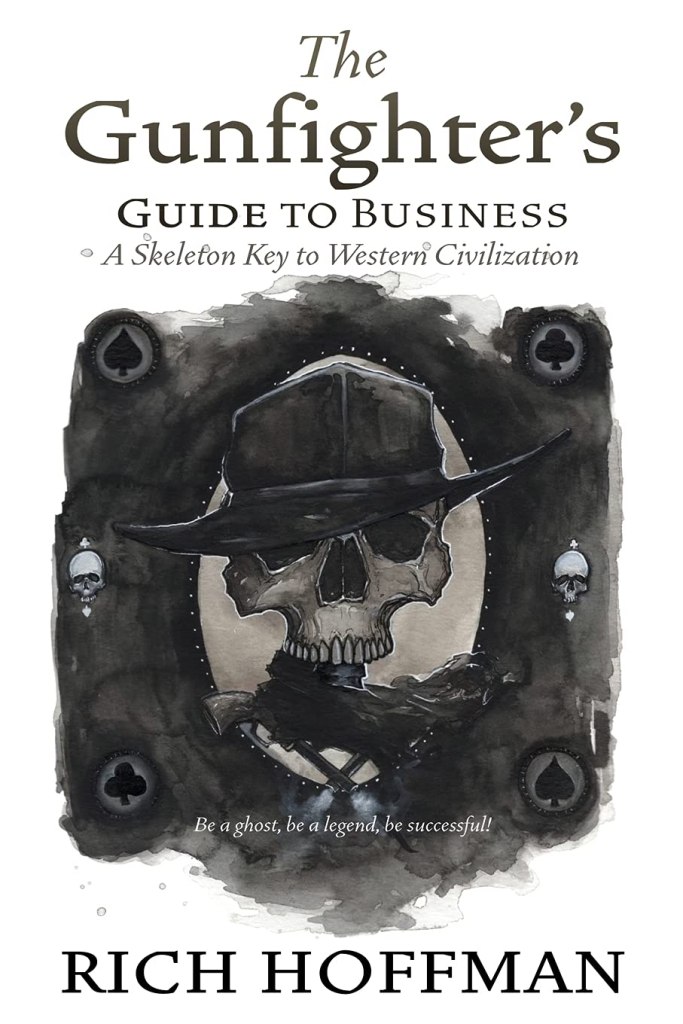
Rich Hoffman is an author, political consultant, and strategic advisor based in Cincinnati, Ohio, and the creator of The Politics of Heaven—a unique framework that connects biblical theology, ancient history, and modern power structures to explain how moral alignment and spiritual forces shape global events. Blending real-world political experience with deep research into archaeology, UFO phenomena, and suppressed historical narratives, Hoffman offers compelling commentary on topics ranging from ancient civilizations and the Dead Sea Scrolls to modern populist movements, paranormal continuity, and leadership strategy in chaotic environments. As the author of The Gunfighter’s Guide to Business and the forthcoming Politics of Heaven, he brings a grounded yet provocative voice to media discussions, supported by firsthand experiences and a cross-disciplinary approach that bridges science, history, and theology. For interviews, speaking engagements, or expert analysis, visit richhoffmanbooks.com or contact directly by email at rhoffman@richhoffmanbooks.com. If you’ve seen the movie, Disclosure Day and want to talk about it and the implications of Presidnet Trump’s UAP disclosures, let me know and we can bring some color to your coverage. https://richhoffmanbooks.com/media-inquiries-broadcast-topics-and-contact-info/?frame-nonce=ad51e7ecba I do have a firsthand UFO encounter to discuss.