In Butler County, Ohio, public office is supposed to be about service, fiscal responsibility, and representing the people who elected you—not leveraging your title for personal favors, flipping off constituents on camera, or repeatedly crossing party lines while clinging to a Republican label. Yet for over a decade, Butler County Commissioner Cindy Carpenter has operated in ways that have tested those expectations, culminating in a series of self-inflicted controversies that now threaten her long-held seat. The latest chapter, unfolding quietly but decisively in early February 2026, marks a turning point: on February 3, 2026, during a regularly scheduled commissioners’ meeting, the board—acting on advice from Prosecutor Michael Gmoser—voted to remove Carpenter from her position on the Housing and Homeless Coalition board due to mounting complaints about her conduct. This isn’t speculation or rumor; it’s documented in public video of the meeting, where the prosecutor’s guidance was read into the record, underscoring that the severity of the issues warranted her immediate removal pending further review.[1]
This move didn’t come out of nowhere. It builds directly on the December 2025 investigation into Carpenter’s heated exchange at her granddaughter’s apartment complex near Miami University in Oxford. What started as a family visit escalated into accusations of racist language, intimidation, and abuse of office. The apartment manager filed a formal complaint, prompting Prosecutor Gmoser to investigate. His report, read aloud at a commission meeting shortly after, cleared her of criminal wrongdoing—no charges for intimidation or racial utterances that would trigger prosecution—but pulled no punches on the optics: her behavior was “distasteful” and “beneath the dignity of an elected officeholder.”[2] Carpenter admitted to making an obscene gesture (the middle finger) caught on video, but denied any racial slurs. The prosecutor emphasized it wasn’t illegal, but that leniency was never meant to be a free pass. It was a warning that such actions erode public trust, especially from someone in a position of authority.
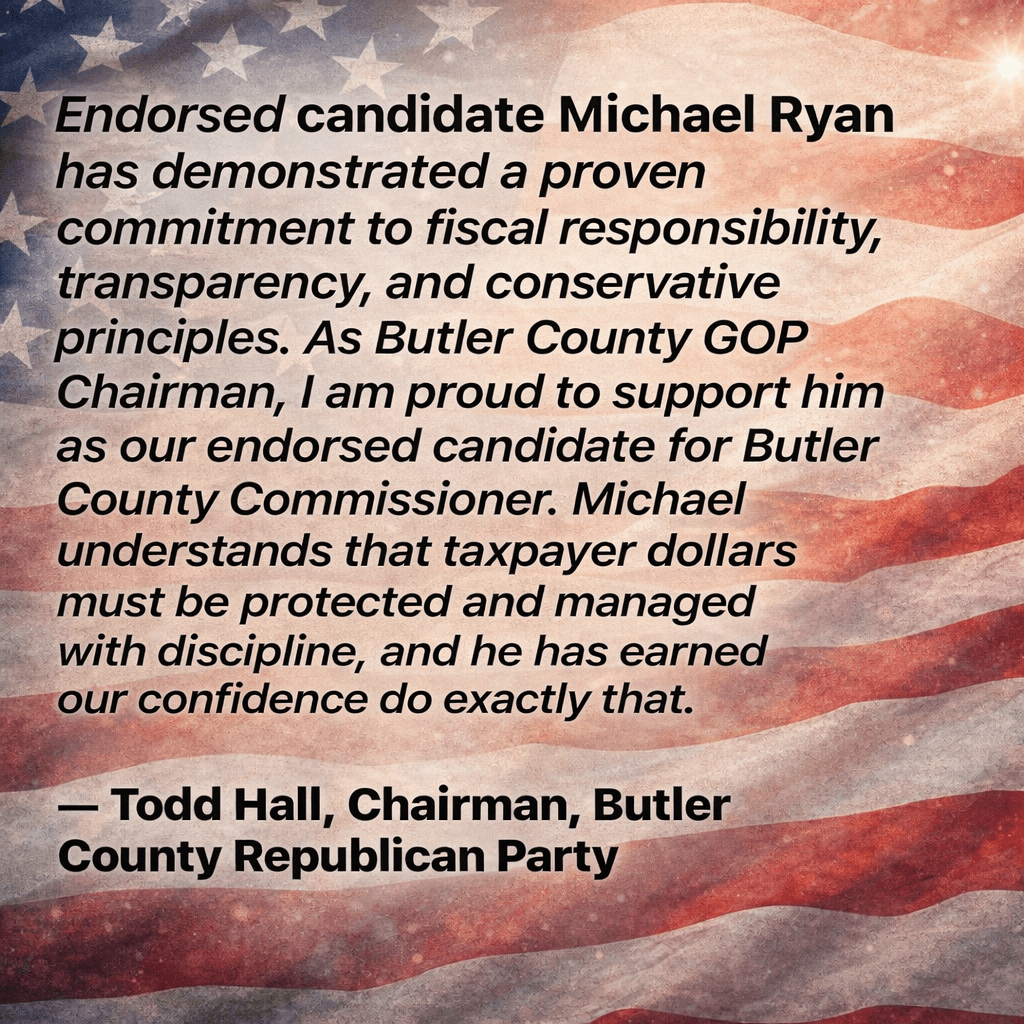
Fast-forward to January 2026, and the political repercussions accelerated. The Butler County Republican Party, which had long endorsed Carpenter in past cycles, shifted decisively. At their endorsement meeting, they backed challenger Michael Ryan—a former Hamilton City Council member—with a strong 71% vote, described internally as “historic.”[3] Carpenter didn’t even seek the endorsement this time, a move party chair Todd Hall called “not unusual” for her, but one that spoke volumes. Ryan’s platform emphasizes conservative values, accountability, and a fresh approach to county issues like economic development and public safety—areas where Carpenter’s tenure has drawn criticism for divisiveness. Other challengers, including a Democrat (Mike Miller) and minor Republican candidates, round out the May 2026 primary field, but Ryan’s GOP backing positions him as the serious alternative.
Why the party abandonment? It’s not just politics; it’s pattern recognition. Carpenter has served since 2011, winning multiple terms but often amid complaints about her temperament. Colleagues and observers describe her as “difficult” to work with—quick to outbursts, resistant to collaboration, and prone to going rogue on policy. One glaring example: while holding a Republican endorsement, she was caught campaigning for a Democrat—Middletown’s mayor—at a polling place, holding signs and promoting the candidate.[4] That incident alone alienated many in the GOP base, who saw it as a slap in the face to party loyalty. For years, she received the benefit of the doubt: “That’s just her personality,” people said. “She flies off the handle sometimes, but she’s effective.” But effectiveness wears thin when trust erodes.
The homelessness portfolio, ironically, has been a flashpoint. Carpenter has long advocated for addressing homelessness, chairing related committees, and pushing for more permanent supportive housing units (she cited a need for 274 in prior gap analyses).[5] Yet her approach has sparked internal rifts. In 2025, she led a grassroots effort through her Housing and Homeless Collaborative to remove Butler County from Ohio’s Balance of State Continuum of Care, seeking independent HUD status to secure additional funding potentially.[6] Commissioners Don Dixon and T.C. Rogers vigorously opposed it, sending objection letters and questioning accountability for millions of taxpayer dollars. Dixon was concerned about providers making unchecked decisions without voter oversight; Carpenter argued that urban counties like Hamilton and Montgomery receive far more funding under similar arrangements.[7] The split highlighted her willingness to buck the majority on the board she shares with them.
Enter the February 3, 2026, meeting. Amid ongoing fallout from the Oxford incident, new complaints surfaced—severe enough that Prosecutor Gmoser advised Dixon and Rogers, as legal counsel to the board, to remove Carpenter from the Housing and Homeless Coalition board immediately.[8] The prosecutor isn’t pursuing criminal charges (yet), but his guidance underscores that elected officials must maintain public confidence. Complaints from coalition members, providers, or stakeholders—possibly building on years of perceived abrasiveness—pushed the issue over the edge. Dixon voted in favor of the removal; the action passed, stripping her from a board central to her self-proclaimed expertise. Video from the meeting shows the discussion, the prosecutor’s letter read aloud, and the vote—no ambiguity.[9]
This isn’t a partisan witch hunt. The complaints aren’t coming solely from political opponents; they’re from people who’ve dealt with her directly—young residents at the apartment complex who felt bullied, coalition partners frustrated by her style, and even fellow Republicans tired of defending the indefensible. As noted, “You can’t be mad and say things or do things that people can scrutinize negatively—you have to be smart enough not to walk into traps.” Throwing your weight around as a commissioner to demand special treatment for family, then escalating when challenged, is exactly that trap. When it’s on camera, it doesn’t fade; it festers.
The broader lesson here is accountability. Public officials aren’t above scrutiny. Carpenter’s 11+ years in office gave her the benefit of the doubt for too long—personality quirks excused, party-crossing overlooked, outbursts tolerated. But once the Oxford video surfaced, the dam broke. More people felt empowered to speak: “If she did that there, what about here?” The prosecutor’s initial “not criminal, but distasteful” statement was fair at the time; now, with additional complaints drawing him back in, it’s harder to dismiss. He has other priorities—crime, opioids, budgets—but when complaints pile up against a commissioner, he must investigate. Removing her from the homelessness board isn’t punishment; it’s prudence. Trust in county government requires it.
For voters heading into the May 2026 primary, the choice is clear. Michael Ryan offers a contrast: endorsed by the GOP, focused on conservative principles, and with no history of similar scandals. He’s attended events, built relationships, and positioned himself as a team player. Carpenter’s absence from many GOP gatherings and her reputation for difficulty have left her isolated. The primary isn’t about punishing her—it’s about what’s best for Butler County. A commissioner who can’t handle public interaction without controversy, who loses party support, and who faces board removals isn’t serving effectively.
Her past is catching up because she built the momentum herself. No one forced her to go to that apartment complex and leverage her title. No one made her flip off people on camera. No one compelled the emotional outbursts or party-line crossings. Those were choices. Now, consequences follow—not because of “politics,” but because behavior matters. In a Republican-leaning county like Butler, voters expect alignment and decorum. When that’s absent, options emerge.
This story matters beyond one person. It reminds everyone in the office that power is temporary and trust is earned daily. When you abuse it—even in small ways—it compounds. Carpenter could have de-escalated, apologized fully, and collaborated more. Instead, the pattern continued, and now the board on which she sits has acted against her. The prosecutor provided avenues for explanation; she hasn’t helped herself.
Butler County deserves better than stale leadership mired in self-made drama. The shoes are dropping, and they’re landing squarely where they belong—on choices made over the years. Cindy Carpenter is a mess, and there are now fewer and fewer people around to clean it up. Because she just keeps making messes.
Bibliography / Sources
1. Video evidence from Butler County Commissioners’ meeting, February 3, 2026 (public session; removal vote and prosecutor’s advice read into record).
2. Butler County Prosecutor Michael Gmoser’s report, December 2025 (read into commission record; covered in Journal-News, December 3, 2025).
3. Butler County GOP endorsement announcement for Michael Ryan, January 2026 (Journal-News, January 12, 2026).
4. Reports of Carpenter campaigning for the Democratic Middletown mayor (local accounts, referenced in multiple critiques).
5. Carpenter statements on homelessness gap analysis (Journal-News, various 2023–2025 articles).
6. Efforts to redesignate Continuum of Care (Journal-News, March 2025; Cincinnati Enquirer, July 2025).
7. Dixon/Rogers objection letter and board discussions (Citizen Portal, March 2025).
8. Prosecutor Gmoser’s advice on board removal (February 3, 2026, meeting video; emerging mentions on social media, e.g., Facebook groups).
9. Public meeting archives, Butler County website (butlercountyohio.org; video footage).
The recent events surrounding the Federal Reserve and President Trump’s administration lay bare a fundamental tension in American governance: the supposed independence of the central bank versus the democratic accountability demanded by an elected executive and, ultimately, the people. In early 2026, Federal Reserve Chair Jerome Powell publicly accused the administration of using a Justice Department criminal investigation—ostensibly into cost overruns on the Fed’s headquarters renovation and his congressional testimony—as a pretext to intimidate him into slashing interest rates more aggressively. Powell stated plainly that this threat stemmed from the Fed’s refusal to align monetary policy with the president’s preferences for lower borrowing costs, which Trump has repeatedly demanded to ease federal debt servicing and stimulate growth. This episode is not mere political theater; it exposes the core flaw in the Federal Reserve’s design. While defenders hail its independence as essential for sound economic stewardship—insulated from short-term political pressures—the reality is that this insulation has enabled an unaccountable entity to wield immense power over the nation’s currency, economy, and even its sovereignty, often in ways that favor entrenched financial elites over ordinary citizens.
The Federal Reserve was never meant to be a neutral arbiter of economic stability in the way its proponents claim. Established in 1913 through the Federal Reserve Act, it emerged from a secretive 1910 meeting on Jekyll Island, Georgia, where powerful bankers—including representatives of J.P. Morgan interests, Paul Warburg, and others representing a quarter of the world’s wealth—crafted a plan for a central bank disguised as a public institution. As detailed in G. Edward Griffin’s seminal work, The Creature from Jekyll Island: A Second Look at the Federal Reserve, this gathering aimed to create a cartel that could issue money from nothing (fiat currency via fractional-reserve banking), control bank reserves to prevent reckless competitors from collapsing the system, socialize losses through taxpayer bailouts, and present the whole apparatus as a safeguard for the public. The result was not a government agency in the traditional sense but a hybrid: privately influenced yet granted governmental authority, with board members appointed by the president but insulated from direct oversight on monetary decisions.
This structure deviates sharply from the constitutional framework envisioned by the Founders. Article I, Section 8 of the U.S. Constitution grants Congress the power “to coin Money, regulate the Value thereof,” implying a system of sound money tied to tangible value, not endless fiat expansion. Early American history reflects fierce resistance to centralized banking precisely because it concentrated power in unelected hands. Andrew Jackson, a Democrat who understood the threat of financial monopolies, waged war on the Second Bank of the United States in the 1830s. He viewed it as a corrupt engine benefiting the wealthy elite at the expense of farmers, mechanics, and laborers. Jackson’s veto of the bank’s recharter in 1832 declared that such concentrated power could “influence elections or control the affairs of the nation.” His policies dismantled the bank, ushering in a period of decentralized, state-chartered banking that coincided with explosive economic growth and westward expansion.
Similarly, Ulysses S. Grant, a Republican president during Reconstruction, navigated pressures from banking interests amid the Panic of 1873 and debates over greenbacks versus specie resumption. Grant’s administration pushed for sound money policies, resisting inflationary schemes that favored creditors and speculators over debtors and producers. The post-Civil War era under Grant saw the U.S. rise to global prominence through industrial expansion, innovation, and opportunity—precisely because monetary policy was not yet fully captured by a central cartel. These leaders—Jackson the populist Democrat and Grant the steadfast Republican—stood against centralized banking as antithetical to republican virtue and economic freedom. Their eras produced wealth creation that lifted millions, contrasting sharply with the boom-bust cycles exacerbated by modern central banking.
The Federal Reserve’s defenders argue that independence prevents politicians from manipulating money for electoral gain, ensuring decisions based on data rather than demagoguery. Yet history shows the opposite: central banks enable endless government spending, fund wars without direct taxation, and create inflation that acts as a hidden tax on savings and wages. The Fed’s massive bond purchases post-2008 crisis, for instance, flooded the system with liquidity, inflating asset bubbles while eroding purchasing power for average Americans. Ron Paul’s End the Fed powerfully articulates this critique, drawing on economic history to show how the institution fosters dependency, rewards recklessness, and undermines liberty. Paul argues that fiat money debases currency—stealing value from holders—and that true prosperity requires sound money, competition in banking, and accountability to voters.
Trump’s recent pressure on the Fed, including calls for rates as low as 1% and the escalation to subpoenas and threats, highlights the problem from the other side. If the Fed is truly independent, why does an elected president feel compelled to intimidate its chair? The answer lies in the Fed’s unchecked power over interest rates, money supply, and thus the cost of government debt. Trump’s frustration stems from a desire to align monetary policy with executive goals—lower rates to reduce borrowing costs on trillions in debt and boost growth. Yet this very dynamic reveals the constitutional mismatch: monetary policy, which affects every citizen’s wallet, remains largely outside the branches accountable to the people. Congress delegated its coinage power to an entity that operates with minimal direct oversight, creating a shadow government of bankers.
This setup serves globalist interests more than American ones. Centralized banking facilitates international coordination, where interest rate policies can be manipulated to favor multinational finance over national sovereignty. The Fed’s actions post-2008—buying toxic assets and guaranteeing returns—exemplified how losses are socialized while profits privatize. It rewards legacy wealth and entrenches inequality, preventing the broad access to opportunity that defined America’s rise.
The alternative is not chaos but a return to constitutional principles: Congress reclaiming money creation, perhaps through sound money standards or competing currencies, and subjecting policy to electoral scrutiny. Presidents like Jackson and Grant demonstrated that decentralized systems foster innovation and prosperity. Trump’s challenge, however flawed in execution, underscores a truth: the Fed cannot remain an island unto itself. True independence from scrutiny invites abuse; accountability to the people ensures service to the republic.
The intimidation tactics against Powell may backfire, raising inflation expectations and yields as markets lose confidence in institutional integrity. But they also force a reckoning. The Federal Reserve’s vaunted independence is, in practice, independence from the American people. Until that changes, the system remains rigged—favoring those who pull levers behind closed doors over those who build, work, and vote. And we can’t allow that kind of system to erode our means of management over our money supply and the nation it is poised to serve.
Bibliography
• Griffin, G. Edward. The Creature from Jekyll Island: A Second Look at the Federal Reserve. American Media, 2010 (updated editions available).
• Paul, Ron. End the Fed. Grand Central Publishing, 2009.
• Lowenstein, Roger. America’s Bank: The Epic Struggle to Create the Federal Reserve. Penguin Press, 2015.
• Meltzer, Allan H. A History of the Federal Reserve (multiple volumes). University of Chicago Press, various dates.
• Remini, Robert V. Andrew Jackson and the Course of American Freedom, 1822-1832. Harper & Row, 1981.
Footnotes for Further Reading
1. For the Jekyll Island meeting and origins: Griffin (above), chapters on the “secret meeting.”
2. Jackson’s Bank War: Remini’s biography series; also “The Bank War” essays from the Miller Center and Richmond Fed.
3. Ron Paul’s critique: End the Fed, especially sections on inflation as theft and unconstitutional nature.
4. Recent events: Powell’s January 11, 2026 statement (federalreserve.gov); coverage from Reuters, NPR, PBS News, and The New York Times on the DOJ probe and independence concerns.
5. Grant-era policies: Discussions in economic histories of Reconstruction and the Panic of 1873.
The coining of money and the imposition of tariffs represent two interconnected levers of economic sovereignty that the framers of the Constitution intended to place firmly in the hands of the people’s representatives, yet the practical evolution of American governance has exposed persistent vulnerabilities in how these powers are exercised. Article I, Section 8 grants Congress the authority “to coin Money, regulate the Value thereof, and of foreign Coin,” establishing a clear congressional role in monetary matters, while the power to lay and collect duties, imposts, and excises—including tariffs—resides with the legislative branch as a core taxing function. In theory, this framework ensures democratic accountability: elected lawmakers, responsive to voters, would shape both the nation’s currency and its trade policies to protect domestic interests and maintain economic balance.
Yet, over more than two centuries, the regulation of money has slipped through constitutional cracks into an administrative realm dominated by extra-legislative influences. The creation of the Federal Reserve in 1913, while nominally under congressional charter, delegated vast monetary policy authority to a quasi-independent entity influenced by international banking interests and private financial networks. This backdoor arrangement has allowed unelected actors—often aligned with globalist priorities—to leverage America’s economic freedoms in ways that favor concentrated wealth over broad national prosperity. Congress retains oversight in name, but the practical ability to define how money is created, its value regulated, or interest rates set has been diluted, creating a loophole where monetary policy operates beyond direct electoral accountability. The result has been chronic trade imbalances, wealth redistribution upward through financial mechanisms, and a system where banking interests exert disproportionate sway, often at the expense of American workers and industries.
This monetary vacuum stands in stark contrast to the current debates over tariff authority, particularly in the context of recent executive actions upheld as necessary to restore trade equilibrium. While some argue that returning tariff regulation strictly to Congress aligns with separation of powers—emphasizing Congress’s constitutional primacy over taxation and commerce—such a move risks exacerbating existing imbalances. Justices like Chief Justice John Roberts and Justice Amy Coney Barrett have expressed concerns during oral arguments about unchecked executive overreach, questioning broad delegations that could allow presidents to impose sweeping tariffs without clear congressional limits, potentially eroding legislative authority. Roberts highlighted tariffs as fundamentally a form of taxation on Americans, a core congressional power, while Barrett probed whether statutes like the International Emergency Economic Powers Act truly confer such expansive authority, warning against interpretations that grant presidents near-unlimited discretion over imports from any nation.
These concerns about checks and balances are valid on paper, yet they overlook the deeper structural flaw: the Constitution’s under-specified framework for monetary regulation has already permitted centuries of exploitation by unaccountable financial elites. Upholding executive tariff powers in this instance—particularly when used to counter predatory trade practices and rectify persistent deficits—actually enhances overall balance. A strong executive, directly elected and subject to voter judgment every four years, provides a more immediate mechanism for the people’s will to influence financial and trade outcomes. Voters can reward or punish administrations based on tangible results in jobs, wages, and national wealth retention, bypassing the slower, more insulated congressional processes often swayed by lobbying and international pressures.
In contrast, rigid congressional control over tariffs, without addressing the monetary loophole, would likely perpetuate the status quo of unprofitable trade arrangements that have functioned as a stealth wealth pre-distribution scheme favoring global capital over domestic producers. The Trump-era tariffs, by leveraging executive action to force renegotiated deals and protect strategic industries, demonstrate how proactive leadership can begin to correct these distortions more swiftly than fragmented legislative efforts. While Roberts and Barrett rightly guard against executive aggrandizement in general, their emphasis on defined separations should not blind us to the reality that monetary policy’s administrative drift has created far greater long-term vulnerabilities than targeted executive trade interventions. True constitutional fidelity demands closing the money regulation gap—perhaps through renewed congressional assertion or structural reform—while recognizing that a vigorous executive, checked by elections, offers the quickest path to voter-driven corrections in trade and finance. Upholding such executive authority in the tariff realm thus restores a practical balance of power, empowering citizens to regulate their economic destiny more effectively than the current system ever has, and paving the way for genuine, profitable equilibrium in America’s global standing.
In mid-January 2026, the Supreme Court stands on the threshold of a consequential ruling that will define the practical limits of presidential power over trade and the durability of “emergency” tariff programs launched in 2025. The consolidated challenges—captioned in press and policy coverage as Learning Resources, Inc. v. Trump and Trump v. V.O.S. Selections, Inc.—ask whether the International Emergency Economic Powers Act of 1977 (IEEPA) authorizes the President to impose sweeping, global, and “reciprocal” tariffs without new, specific congressional direction. Oral argument on November 5, 2025, suggested significant skepticism from justices across the ideological spectrum about using IEEPA as the legal engine for across-the-board import duties. The Court has not yet issued a decision, after passing on its first January opinion day and again this week. That delay is notable because the Court purposely fast-tracked these cases from the Court of International Trade and the Federal Circuit. 1234
The stakes are immediate and measurable. Customs authorities reported more than $200 billion in tariff collections during 2025 under the new suite of executive orders, while estimates of potential refund liability if the IEEPA tariffs fall range from roughly $150 billion upward, depending on how the Court structures remedies. Market and logistics watchers warn that an adverse ruling could trigger a surge in imports as firms rush to capture a “tariff holiday” window before any replacement system comes online. The freight cycle, inventory planning, and pricing strategies across large swaths of the economy will respond quickly to whatever the Court decides. 567
Here, we want to take a strictly factual, doctrinal, and quantitative approach to the pending decision, as many key players in the process will read it, perhaps ahead of time, to avert a disaster. Few people like the Supreme Court in the world as much as I do; I understand their role in all this very well. But these are history-making circumstances that require unique, new definitions. It (1) outlines the legal question presented and the Court’s apparent lines of concern; (2) catalogs the statutory scaffolding of U.S. tariff authority, distinguishing IEEPA from Section 232 (national security) and Section 301 (unfair practices); (3) quantifies revenue and exposure; (4) compares analogous Supreme Court and lower‑court precedents in the tariff/delegation space; and (5) sketches credible “Plan B” pathways if the Court curtails the 2025 IEEPA program, with attention to timing, procedures, and policy leverage.
—
I. What the Court Is Being Asked to Decide
The 2025 tariff program had two pillars: (a) “trafficking” tariffs, tied to fentanyl and illicit drug flows from China, Canada, and Mexico, and (b) “reciprocal” tariffs, including a 10% baseline global duty and higher rates calibrated to perceived imbalances. The Administration grounded both in IEEPA after declaring national emergencies affecting national security, foreign policy, and the economy. The lower courts held that the program exceeded statutory authority, and the Supreme Court granted expedited review. During the argument, justices repeatedly pressed the government for the textual hook in IEEPA authorizing the imposition of general import duties—tariffs—as opposed to targeted sanctions or restrictions. Several also raised the “major questions” and nondelegation doctrines, signaling discomfort with reading an emergency statute to confer a virtually open-ended tariff power, typically associated with Article I, rather than a more specific trade statute. 12
Press and legal analyses after the argument captured that mood: both liberal and conservative justices “appeared to cast doubt” on IEEPA’s suitability as a vehicle for comprehensive tariffs, even while recognizing that Congress has, in discrete statutes, granted presidents contingent tariff tools in specific contexts. Reuters and SCOTUSblog, among others, reported that a majority of the Court seemed skeptical that the 1977 law—long used for asset freezes and sanctions—also permitted an across-the-board import duty regime. 31
Since January’s first opinion day, the Court has released decisions in other argued cases but has not resolved the tariffs matter—leaving businesses, importers, and government accounts in limbo. Newsrooms tracking the Court’s calendar expect additional opinion days this month; still, no one outside the Court can reliably predict the exact release date of this decision, underscoring the need for scenario planning on both sides of Pennsylvania Avenue. 89
—
II. The Statutory Map: IEEPA vs. Section 232 vs. Section 301
IEEPA (50 U.S.C. §§ 1701‑1707). Enacted in 1977, IEEPA gives the President broad powers to regulate transactions involving “any property in which any foreign country or a national thereof has any interest” during a declared national emergency tied to national security, foreign policy, or the economy. Historically, administrations used IEEPA for targeted sanctions, asset blocks, and export/import prohibitions directed at specific adversaries or behaviors—not for comprehensive tariff schedules. The text does not use the words “tariff,” “duty,” or “tax.” Those omissions featured prominently in the justices’ questions and in lower‑court opinions that found the 2025 program ultra vires. 102
Section 232 (19 U.S.C. § 1862). By contrast, Section 232 expressly allows the President to act—after a Commerce Department investigation and finding—to “adjust” imports that “threaten to impair” national security. The Supreme Court held in Algonquin (1976) that the President may require licenses and impose fees within Section 232’s framework, and, in 2018‑- 2020 litigation, courts rejected nondelegation challenges to the 232 steel/aluminum tariffs. Yet the Court has never squarely blessed the use of IEEPA for general tariffs. Of note, since early 2025, the Administration increased and expanded 232 duties (e.g., raising aluminum to 25%, adding derivative products, eliminating country exemptions), and Commerce/BIS formalized derivative‑coverage procedures—moves that could support a post‑IEEPA “Plan B.” 111213
Section 301 (19 U.S.C. § 2411). Section 301 authorizes the U.S. Trade Representative to investigate and respond to unfair trade practices with duties and other measures—after notice‑and‑comment and findings. The Federal Circuit in 2025 upheld the legality of the 2018‑- 2019 expansions of China 301 tariffs, confirming that 301 provides a durable (if slower) pathway for targeted tariffs. In 2024, USTR completed the statutory four-year review and locked in additional increases on strategic items (e.g., EVs, solar, semiconductors), underscoring that the policy machinery for 301 remains active and court-tested. 1415
Policy think tanks and trade‑law advisories have, accordingly, framed three tiers of fallback authority if IEEPA tariffs are struck: (1) 232 (national security) investigations and proclamations; (2) 301 (unfair practices) investigations and tariff lists; and (3) narrower legacy tools (e.g., Section 338) in limited contexts. These paths differ sharply in speed, scope, and litigation risk—critical for planning if the Court narrows IEEPA. 1617
—
III. Revenues, Effective Rates, and Refund Exposure
Collections. U.S. Customs and Border Protection (CBP) reported collecting “more than $200 billion” in tariffs between January 20 and December 15, 2025, attributing the surge to “more than 40” executive orders under the tariff program. Independent modeling by the Penn Wharton Budget Model suggests that from January to June 2025 alone, new tariffs raised $58.5 billion in customs revenue and lifted the average effective tariff rate from ~2.2% to ~9.1%, with China-linked flows facing the steepest increases. 518
Macro‑budget effects. The Congressional Budget Office (CBO), in an August 2025 update, estimated that if the higher tariff levels persist through 2035, primary deficits would fall by ~$3.3 trillion and total deficits by ~$4.0 trillion, with an ~18‑percentage‑point jump in the effective tariff rate relative to 2024 flows. CBO caveated that these are projections contingent on policy continuity and trade diversion dynamics. 19
Refund risk. Reuters reported companies, customs brokers, and trade counsel bracing for a potential refund fight “approaching $150 billion” if the Court voids IEEPA-based collections, a figure echoed across the trade press. The sheer transaction volume—hundreds of thousands of importers and tens of millions of entries—would make any refund program administratively complex, and CBP quietly prepared for electronic refund processing to take effect in February 2026. 6
Sectoral and logistics impact. Freight analysts warn that a ruling against IEEPA tariffs could quickly boost U.S. inbound volumes, particularly ahead of Lunar New Year and spring replenishment, after a 2025 “rate recession” and inventory drawdowns; Project44’s tariff report cited sharp year-over-year contractions in U.S.–China trade during 2025. A tariff‑pause window—even brief—could spur import front‑loading as firms hedge against whatever successor regime the Administration deploys. 7
Pre‑2025 baselines. To contextualize the 2025 spike, remember that the first-term 301 China tariffs and Section 232 actions already raised annual customs duties to historically high levels, with FY2024 customs receipts around the upper tens of billions. The 2025 additions layered global and reciprocal constructs on top of the existing 301/232 scaffolding, which helps explain the extraordinary jump in CBP collections in late FY2025. 20
—
IV. The Doctrinal Frame: Separation of Powers and Trade
The Court’s resolution will likely turn on statutory interpretation sharpened by separation‑of‑powers canons. Three strands matter:
1. Text and structure of IEEPA. IEEPA empowers the President to “investigate, regulate, or prohibit” transactions in foreign‑interest property during a declared emergency. Courts have long treated it as a sanctions statute—powerful, but not a blank check to “lay and collect” duties, a core Article I function typically exercised via detailed tariff statutes. If the government asks the Court to accept a reading that silently authorizes all-purpose tariff authority, skepticism follows. 102
2. Major Questions and Nondelegation. Recent terms saw the Court invoke “major questions” to require explicit congressional authorization for actions of vast economic significance. While that doctrine often polices agency interpretations, the logic—demanding a clear statement when the Executive claims vast new powers from old statutes—can carry over to IEEPA. Relatedly, nondelegation concerns lurk: if IEEPA were read to grant open-ended tariff authority, would that constitute an impermissible transfer of legislative power? Oral argument reflected precisely these themes. 2
3. Trade precedents: Algonquin, AIIS, and Transpacific. The Supreme Court in Algonquin upheld a then-current version of Section 232 and found no nondelegation problem where Congress set a process keyed to national security findings. More recently, the Federal Circuit in American Institute for International Steel rejected a facial nondelegation attack on Section 232 steel tariffs, and the Supreme Court denied certiorari. In Transpacific Steel, the Federal Circuit addressed the timing and scope of Section 232 and again denied review. Those decisions underscore that Congress can and does arm presidents with tariff levers—but by statute‑and by specific design. That makes the IEEPA controversy distinct: the question is not whether presidents may ever levy tariffs, but whether this emergency statute authorizes these tariffs, absent the procedural guardrails and more explicit statements found in 232/301. 112122
—
V. If the Court Narrows IEEPA: Practical Plan‑B Pathways
Almost every serious brief and policy memo anticipates that an IEEPA loss would prompt tariff-makers to seek other authorities. The key considerations are speed, scope, and justiciability:
A. Section 232 (Trade Expansion Act).
Speed & process. A Commerce investigation, public comment, and report precede presidential action; “emergency‑fast” still means 60–90+ days, and complex cases can run longer. Scope. Security tethered and product-specific, but the 2025 expansions (including autos/parts and derivatives) show how 232 can reach large value streams—litigation risk. Algonquin remains a pillar, and AIIS / Transpacific litigation history suggests courts tolerate 232 if process and findings are followed. Operationally, Commerce/BIS’s 2025 inclusions process and expanded derivative codes would make a rapid, well-documented reprise feasible. 171213
B. Section 301 (Trade Act).
Speed & process. Investigations are procedurally heavier (petitions, hearings, findings); typical timelines are measured in months, not weeks. Scope. Country‑ or practice‑specific (e.g., PRC IP/tech transfer), not a global baseline—litigation risk. The 2018–2019 expansions survived appellate scrutiny in 2025, reinforcing 301’s staying power for targeted regimes. Operationally, USTR’s 2024 four-year review and targeted increases in strategic sectors provide ready-to-deploy playbooks. 1415
C. Hybrid and interim measures.
Refund/off‑ramp management. If the Court invalidates IEEPA tariffs, it may or may not dictate the mechanics of refunds. CBP planned electronic refunds beginning February 6, 2026, but Treasury and Justice could seek limiting constructions (e.g., net‑of‑pass-through, documentation thresholds) to moderate fiscal impact—market signaling. Agencies could announce immediate 232/301 initiations to compress any “holiday” window, dampening import surges and price whipsaw—foreign‑policy posture. Even in the absence of IEEPA, the Administration can combine export controls, procurement preferences, and inbound investment screening to maintain leverage while 232/301 spools up. 617
—
VI. If the Court Upholds IEEPA Tariffs: What That Would Mean
A win for the government would validate a novel reading of IEEPA as a general‑tariff instrument during a declared emergency. That would preserve the Administration’s preferred speed and scope and keep the reciprocal/baseline design intact. But it would also mark a meaningful shift in the balance of‑powers in trade, making the White House—any White House—the central actor for broad import duties absent new congressional limits. Expect reactions on several fronts:
• Congressional recalibration. A decision upholding IEEPA tariffs could spur bipartisan efforts to cabin emergency powers in trade, as we saw with attempts to reform Section 232 post-2018. 10
• Global response. Trading partners could challenge IEEPA-based tariffs at the WTO or retaliate; retaliatory cycles would depend on the scope, carve-outs, and negotiation dynamics. (Press coverage has already tied 2025 tariff moves to escalating global trade uncertainty.) 23
• Domestic litigation. Even with a green light from IEEPA authority, commodity‑ – or country-specific challenges would continue (e.g., exemptions, product coverage, due process), as seen under 232/301. 1214
—
VII. The “Checks and Balances” Debate: Courts vs. Elections vs. Congress
This case has revived a perennial question: where are the real checks on economic power—in the elected presidency (via election cycles), in Congress’s Article I tariff prerogatives, or in judicially enforced statutory limits? On one side, skeptics of judicial intervention argue that a president elected on a mandate to renegotiate trade relationships should retain leverage tools—tariffs included—to force outcomes that Congress could not or would not legislate. On the other hand, the Constitution assigns tariff-taxing power to Congress, and emergency statutes like IEEPA are not presumed to displace that allocation absent clear text. The Court’s doctrinal trend—major questions, limits on agency adventurism—leans toward requiring Congress to speak plainly when it wishes to authorize sweeping economic moves. Oral argument reflected this balance: the justices queried whether IEEPA’s “regulate or prohibit” language could bear the weight of a global tariff system without a more specific, contemporary congressional say. 21
If the Court narrows IEEPA here, that doesn’t foreclose robust tariff policy; it pushes the Executive to use trade-specific statutes (232/301) that incorporate the processes and findings Congress designed. The Administration has plainly anticipated this outcome, and policy analyses across the spectrum acknowledge multiple “Plan B‑F” tracks already sketched out. The question is timing: how quickly can those processes be triggered to avoid leverage loss and economic whiplash if IEEPA collections stop? 1716
Although Article I gives Congress authority “to coin Money [and] regulate the Value thereof,” the Constitution leaves the modern mechanics of monetary governance—and the interaction between domestic liquidity, cross‑border finance, and trade accounts—to a sprawling lattice of statutes and administrative actors developed long after the Founding. That institutional reality has produced a practical “administrative gap”: global banking and market infrastructures can shape capital flows and relative prices faster than Congress can legislate, yet courts lack obvious textual hooks to referee those dynamics ex ante. In that setting, shifting all broad tariff levers back to Congress may vindicate separation‑of‑powers in theory while still leaving intact the back‑door channels through which financial interests exert pressure on trade outcomes in practice. The constitutional allocation of tariff power and the constitutional silence on contemporary monetary intermediation simply do not map one‑to‑one.
Chief Justice Roberts and Justice Barrett have signaled, in different contexts, a premium on clear lines: Congress writes the big rules; the Executive executes those rules; courts enforce the boundaries. If they cabin IEEPA on that basis, they will reinforce an elegant blueprint—but they will not, by doing so, resolve the persistent vulnerability created by the Constitution’s sparse treatment of modern money and market plumbing. A strong, election‑checked Executive tariff tool operates as a direct, voter‑responsive counterweight to those vulnerabilities: it allows the White House to alter relative prices at the border in real time when global financing channels or state‑capitalist rivals tilt the playing field. In that sense, upholding the 2025 tariff architecture would not erase Congress’s role; it would supply a democratic “fast gear” that complements Congress’s slower, statute‑driven “torque.”
Nor is this an argument for unbounded presidential discretion. The point is that, where monetary and financial influences can exploit gaps the Framers could not fully specify, a court‑affirmed executive tariff lever—subject to judicial review for statutory fit and to electoral review by the public—can restore a measure of balance that monetary‑policy lawmaking alone has not delivered. For Roberts and Barrett, who prize administrable limits, the question is whether a narrowed but viable emergency‑trade instrument can coexist with Congress’s trade statutes to keep power distributed across branches and, critically, responsive to voters. Preserving that instrument would give citizens a more immediate say over how the United States defends its terms of trade—something the Constitution’s money clauses, standing alone, have never been able to guarantee.
—
VIII. Quantifying What’s at Risk—Short‑Run and Long‑Run
Short‑run (next 90‑180 days).
Revenue. A ‑less adverse decision could halt IEEPA collections immediately, potentially opening a short “free trade” interval before 232/301 measures kick in. That’s particularly salient with seasonal ordering cycles (apparel, consumer durables, autos) already in motion—trade volumes. Logistics managers expect a near-term import bounce if duties drop, especially in categories hit with elevated 2025 rates—fiscal exposure. Refund claims processing—if ordered—would begin amid questions of pass-through and interest. 76
Medium‑run (6‑18 months).
Replacement architecture. A sequenced deployment—232 for strategic categories (steel, aluminum, autos/parts, strategic minerals), 301 refreshes for PRC practices—could reconstruct much of the leverage with more procedural guardrails—market adaptation. Effective rates would likely settle below IEEPA’s 2025 peaks but above pre-2018 levels, depending on scope and carve-outs. Budget path. CBO’s $4 trillion decade-long deficit effect is explicitly conditional; a narrower regime reduces that top line. 121519
Long‑run (multi-year).
Precedent. A Supreme Court ruling limiting IEEPA for tariffs would set an enduring boundary between “sanctions-style” emergency tools and the tariff‑taxing power, nudging big trade choices back toward Congress or trade-specific delegations—institutional response. Expect Congress to revisit emergency‑powers statutes and tariff‑process statutes, and expect administrations of both parties to plan with 232/301 front‑of‑mind for large-scale tariffs. 10
—
IX. Comparable Cases and Lessons
Three bodies of law are particularly instructive:
1. National‑security-linked tariff actions: Algonquin (1976) validated a 232 regime embedded in executive‑branch investigation and findings. Later challenges to 232 (2018–2022) failed on nondelegation grounds (AIIS) and on procedural‑timing theories (Transpacific), with SCOTUS denying cert. The through‑line: Congress can delegate tariff levers when it provides intelligible principles and procedures; courts tend to defer if the statute is specific and the Executive follows the steps. 112122
2. Trade‑remedy statutes with administrative processes: Section 301 litigation in 2018–2025 resulted in a Federal Circuit decision upholding USTR’s authority to modify and expand China tariff lists. These cases show courts accept robust tariff countermeasures when Congress built the pathway and agencies compile the record. 14
3. Emergency powers repurposed for fiscal instruments: The novelty of using IEEPA to impose a generalized tariff schedule is what attracted the Court’s scrutiny. Post‑Loper Bright (Chevron’s demise), claims of broad executive power from ambiguous statutes face a steeper climb—especially when the asserted authority has vast economic consequences, and Congress has enacted detailed, alternative tariff statutes. 2
—
X. A Practical Note on Implementation, Regardless of Outcome
Whatever the decision, implementation choices will shape real-world impact:
• If IEEPA is curtailed: The Court could (a) invalidate prospectively, (b) remand with guidance while staying the mandate to allow transition, or (c) order broader remedies affecting past collections. A stay or phase‑out would blunt immediate shocks, though not remove refund fights. Agencies will likely announce rapid 232/301 steps to signal continuity of trade policy objectives. 617
• If IEEPA is upheld: Expect challenges to particular rates, categories, and exemptions, and congressional moves to refine emergency trade powers. International countermoves are likely. Agencies may still shift some weight to 232/301 to reduce litigation exposure while keeping IEEPA as a backstop. 2312
—
The Court’s pending tariffs decision is not a referendum on whether the United States may use tariffs as leverage; it is a statutory and constitutional inquiry into which branch authorizes what, and under which law. If the justices read IEEPA narrowly—as the argument hints—they will be vindicating Congress’s primacy over tariff design while leaving the Executive ample room to pursue similar objectives through Section 232 and Section 301. Those alternatives are slower and more procedurally demanding, but they anchor policy in text and precedent the Court has historically respected. But it will cost a tremendous amount of revenue our country desperately needs, with no real recourse to fill the hole with a path forward.
From a policy‑operations standpoint, the Administration’s leverage need not evaporate with an IEEPA loss; it would, however, require a disciplined pivot to trade‑specific authorities and a careful choreography to avoid a damaging “shock‑gap” in collections and bargaining power. Conversely, an IEEPA win would secure maximum executive flexibility, while likely triggering congressional oversight and international friction that would re-enter the calculus.
Either outcome will echo beyond this term. It will signal how the Roberts Court balances emergency‑power claims against Congress’s Article I prerogatives in the economic sphere—an area where the Court has lately demanded clear legislative statements for actions of significant significance. That signal will guide not just tariff policy in 2026, but the larger architecture of U.S. economic statecraft in the years ahead. 1
—
Footnotes
1. Oral‑argument coverage and analysis emphasizing skepticism toward IEEPA tariffs: SCOTUSblog argument analysis; Holland & Knight post‑argument alert. 12
2. Docket timing and opinion‑day reporting indicating no tariff opinion yet and next windows: Reuters; USA Today; SCOTUSblog live coverage. 384
3. Overview of the 2025 tariff program and legal challenges: Reuters; The Center Square case roundup. 324
4. CBP 2025 collections announcement; PWBM practical rate analysis through June 2025. 518
13. Continuing press chronology of January opinion‑day expectations and non-decisions. 89
—
Bibliography (selected)
• Primary Legal & Congressional Analyses
• Congressional Research Service, Court Decisions Regarding Tariffs Imposed Under IEEPA (LSB11332, Sept. 15, 2025). 10
• CRS Insight, Expanded Section 232 Tariffs on Steel and Aluminum (IN12519, Sept. 26, 2025). 12
• U.S. Dept. of Commerce/BIS, Adoption and Procedures of the Section 232 Steel and Aluminum Tariff Inclusions Process (Federal Register notice, Aug. 19, 2025). 13
• Supreme Court & Appellate Cases
• Fed. Energy Admin. v. Algonquin SNG, Inc., 426 U.S. 548 (1976). (discussed in sources). 11
• American Institute for International Steel v. United States, 806 F. App’x 982 (Fed. Cir. 2020), cert. denied, 141 S. Ct. 133 (2020). 2111
• Transpacific Steel LLC v. United States, 4 F.4th 1306 (Fed. Cir. 2021), cert. denied, 142 S. Ct. 1414 (2022). 2225
• Oral‑Argument & Docket Coverage
• SCOTUSblog, Court appears dubious of Trump’s tariffs (Nov. 5, 2025); No tariff opinion (Jan. 9, 2026). 14
• Reuters/US News & World Report, Supreme Court Plans Rulings … as Trump awaits fate of tariffs (Jan. 9, 2026). 3
The perceived double standard in public reactions to similar gestures by public figures often stems not from the act itself but from the context, intent, and perceived authenticity of the individual involved. In late 2025, Butler County Commissioner Cindy Carpenter visited the office of Level 27, a student housing apartment complex near Miami University in Oxford, Ohio, amid a rent dispute involving her granddaughter, who resided there. During the encounter, Carpenter became frustrated with the staff’s handling of the situation, raised her voice, and—when she believed she was alone and unobserved—made an obscene gesture (flipping off the empty front counter) while mouthing an expletive, as captured on surveillance video. The apartment manager filed a complaint alleging intimidation, racist remarks, belligerent behavior, and abuse of power, though a subsequent investigation by Butler County Prosecutor Mike Gmoser cleared her of official misconduct.
This incident drew significant local criticism, portraying Carpenter as entitled and leveraging her position as a county commissioner to pressure private employees for personal family gain. Critics described her as embodying a “Karen” archetype—someone who weaponizes authority or status when not getting their way—mainly since the gesture occurred passively and covertly, behind the backs of those involved after they had turned away.
In contrast, on January 13, 2026, President Donald Trump toured the Ford River Rouge Complex in Dearborn, Michigan, as part of efforts to highlight manufacturing and economic policies. During the visit, a worker heckled him from the plant floor, shouting “pedophile protector”—a reference to criticisms surrounding Trump’s past associations with Jeffrey Epstein and the administration’s handling of related document releases. Trump, walking on an elevated area, turned, mouthed an expletive (appearing to say “f— you”), and raised his middle finger directly at the heckler before continuing. The White House defended the response as “appropriate and unambiguous” to what they called a “lunatic… wildly screaming expletives in a complete fit of rage.”
The Ford worker was later suspended, and while some condemned Trump’s gesture as unpresidential, many supporters viewed it positively as a bold, unfiltered rejection of antagonism. The key distinctions lie in several factors. First, Trump’s action was a direct, face-to-face response to active heckling during a public tour where he was not seeking personal favors but representing broader interests—such as supporting American manufacturing and workers. Many observers see this as authentic: Trump has long cultivated an image of unapologetic directness, consistent whether cameras are rolling or not. He was not attempting to extract a concession or intimidate subordinates for private gain; he was dismissing an insult while moving on to his next engagement.
Carpenter’s gesture, however, appeared passive-aggressive and concealed—she performed it when backs were turned, and she thought no one (including cameras) was watching, only to be caught on surveillance. This revealed a discrepancy between her public persona as a dedicated public servant focused on families and communities and her private frustration. The incident involved using her official title to influence a private business matter concerning family, which amplified perceptions of entitlement and abuse of position. Even though both acts involved the same crude gesture, the surrounding circumstances rendered them qualitatively different: one as a raw, representative dismissal of hostility, the other as a tantrum from perceived privilege.
Public tolerance for such behavior often hinges on authenticity and representation. When a leader acts consistently—openly embodying the frustrations of those they serve—the same act can be celebrated as “real” or “standing up.” When it exposes hypocrisy or self-serving motives, it invites disdain. In a republic, elected officials are expected to wield power responsibly for the public good, not personal leverage. Trump’s pre-office persona as a straightforward businessman carried over into politics, allowing supporters to see his gesture as aligned with their own impulses against critics. Carpenter’s action, tied to a family dispute and hidden until exposed, reinforced doubts.
Carpenter’s gesture, however, appeared passive-aggressive and concealed—she performed it when backs were turned, and she thought no one (including cameras) was watching, only to be caught on surveillance. This revealed a discrepancy between her public persona as a dedicated public servant focused on families and communities and her private frustration. The incident involved using her official title to influence a private business matter concerning family, which amplified perceptions of entitlement and abuse of position. Even though both acts involved the same crude gesture, the surrounding circumstances rendered them qualitatively different: one as a raw, representative dismissal of hostility, the other as a tantrum from perceived privilege.
Ultimately, the difference is not that one figure “gets away with” the gesture while the other does not due to partisan bias alone. It is the context of intent, directness, and whether the act serves personal entitlement or a broader representational role. True character emerges in moments of pressure, especially when one believes no one is watching. Failing that test of consistency undermines credibility far more than the gesture itself. What actions like this reveal about the people involved is how they really think about the world around them. With Carpenter, we see what she thinks about people she disagrees with, because she thought nobody was looking. But with Trump, he gave his heckler the finger to his face, not caring who saw, or what they might think of him. One incident of giving the finger made a politician look like an unhinged “Karen” throwing a temper tantrum that she didn’t have the guts to show to people’s faces. The other was cool, and a proper fighting back at the moment, without the usual calculated political response people have grown tired of. And in the end, the gestures showed voters who the people really were. So it’s not a double standard where Trump can get away with it because he’s a man, and Cindy can’t because she’s a woman. But because one of those politicians is honest, while the other one is deceitful, power hungry, and a train wreck of a person. And figuring all that out is sometimes just as easy as a simple hand gesture.
The contrast becomes even starker when considering the aftermath of each incident. In Carpenter’s case, the surveillance footage—showing her gesture directed at an empty counter after staff had walked away—fueled calls for her resignation from political opponents ahead of the May 2026 Republican primary. Challengers like Hamilton councilman Michael Ryan seized on the event to portray her as embodying a pattern of arrogance and entitlement, with one opponent explicitly labeling it as part of a broader “bias, arrogance, and abuse of power.” Even after Prosecutor Mike Gmoser cleared her of legal misconduct in early December 2025, the damage lingered in public opinion, reinforcing narratives of a two-faced politician whose private frustrations betray a cultivated public image of community service. This revelation of inconsistency erodes the foundational trust voters place in representatives: if the mask slips when unobserved, what other discrepancies exist in policy or decision-making?
At its root, the perceived double standard is less about partisan favoritism and more about the alignment between action and identity. Public figures are judged not solely on isolated behaviors but on whether those behaviors cohere with the narrative they project and the interests they claim to serve. Trump’s pre-political life as a blunt, unfiltered dealmaker provided a consistent backdrop; his gesture fit seamlessly into that continuity, even if it shocked traditional decorum. Carpenter’s long tenure—clerk of courts from 1996-2010, commissioner since 2011—has emphasized family values, community initiatives, and fiscal responsibility, making the covert outburst appear as a betrayal of that facade. In a republic, voters demand representatives who embody reliability under pressure, particularly when power is involved. When a leader’s conduct varies based on audience or visibility, it signals a deeper unreliability that invites skepticism far beyond one crude gesture.
Footnotes
¹ Butler County Prosecutor Mike Gmoser, report on complaint against Commissioner Cindy Carpenter, as summarized in Journal-News coverage, December 3, 2025.
² Kiara Nard, Level 27 community manager, complaint details reported in WKRC Local 12, December 4, 2025.
³ Cindy Carpenter, statement to Journal-News, December 2025.
⁴ Video footage from Ford River Rouge Complex tour, January 13, 2026, as reported by TMZ and Reuters.
⁵ White House statement via Steven Cheung, January 13-14, 2026.
⁶ United Auto Workers and Ford responses, January 14, 2026.
Politics used to be about buying your way onto the field with whatever the old media would let you run; now it’s a multi-front dialogue with voters in a thousand micro‑channels you can’t bully, buy, or badger. That’s precisely why the Butler County Republican Party’s endorsement for the 2026 commissioner race matters more than the yard‑sign arms race or a late sprint of cable buys. The party met and took a hard look at candidates and momentum, then endorsed Michael Ryan, the Hamilton vice mayor and former two-term councilman, with 71% of the vote—a landslide in intraparty terms and a signal that the center of gravity has moved.1
Now, Michael’s not a surprise. He telegraphed this run early, skipped a safe third council term to go county-wide, and built a coalition that looks like the next decade of Republican leadership rather than the last. The local press documented the pivot: he pulled petitions in May 2025 and argued that county policy needs someone who can assemble teams, manage a large budget, and negotiate growth while keeping conservative guardrails intact. The Journal‑News laid out the framing: Butler County’s annual budget sits near $500 million, which is not far off Hamilton’s total because the city runs utilities—so a Ryan résumé of budget discipline and project delivery isn’t a stretch to scale.2
Meanwhile, what makes an endorsement decisive isn’t just math inside a party meeting; it’s the psychology of trust outside it. Voters aren’t shopping for saviors; they’re looking for steady hands who can do the table talk, bring coalition politics back from bloodsport, and keep the county in the black while the national mood whipsaws. Michael’s case is that he’s done that already—eight years on council, two stints as vice mayor, a list of jobs recruited, investments landed. If you want to see his pitch in his own words, his site stacks the receipts—balanced budgets, 1,400 new jobs, $700 million in capital investment—and shows a broad bench of local Republican endorsements from state senator George Lang to sitting city council members across the county. If you view campaign websites skeptically (good habit), remember that the basic resume points have been corroborated and referenced in local coverage.32
Roger Reynolds is the wild card—and yes, I have supported him in the past for other fights—but this seat, this season, isn’t the right battlefield. He’s well‑known, to be sure. His 2022 felony conviction over unlawful interest in a public contract was overturned in 2024 by the Twelfth District Court of Appeals, and the Ohio Supreme Court refused to disturb that reversal; that’s an essential legal clearance. But the same Supreme Court opinion blocked him from reclaiming the auditor’s office he’d won in 2022, clarifying he can run again in the future, not retroactively retake the seat. He’s used that clean bill of eligibility to jump into this commissioner race in 2026.45
Here’s where the political calculus cuts sharply: being legally eligible isn’t the same as being politically restored. Voters have long memories; they remember the courtroom saga even if the headline at the end credits “overturned.” The Enquirer summarized the timeline cleanly—indictment, a single felony conviction on the Lakota angle, subsequent reversal, and the present campaign posture. That’s nothing; it’s the kind of backstory that makes your consultants salivate over message discipline and makes your donors jittery about whether a million dollars in signs and mailers can buy back normalcy. And, on top of that, the first skirmish of 2026 was a legal “cease” letter from Reynolds’s counsel to Ryan over campaign statements—“normal campaign bickering,” Reynolds said—but it sets a tone. If your brand promise is “100% positive campaign,” you don’t want week one to be a lawyerly demand letter and a press cycle about “defamation.” That’s oxygen you don’t get back.6
So let’s talk yard signs, because politicians who plan a resurrection often think in terms of saturating real estate with their names, then buying enough broadcast to push past the whispers. Butler County’s population sits around 400,000 people; the geographic sprawl and the number of micro‑communities—from Liberty and West Chester to Hamilton, Fairfield, Middletown, Oxford, and the townships—means your sign budget leaks. People steal them, wind takes them, HOAs yank them. You replace and replace, and your spending ends up as a weekly chore. I don’t care if you’ve earmarked $125,000 or double that; you won’t beat an endorsement plus a ground game in honest conversations across civic slots. The Journal‑News reported the early posture: Ryan’s petitions were certified mid‑2025; Reynolds announced and described the election as a referendum on fiscal discipline rather than “courtroom drama,” but the party’s endorsement last week says rank-and-file Republicans aren’t buying the “just the future” frame. They picked the coalition builder, not the comeback.71
Now, about Cindy Carpenter. She has been on the board since 2011 and is seeking another term. Longevity usually earns deference, but not automatic endorsement. The county’s official page lists her current term running through December 31, 2026; that’s the seat this primary decides.8 And she walked into 2026 with a fresh controversy: the Oxford apartment office incident involving her granddaughter’s rent dispute, a flipped middle finger on video, and accusations of “racist” remarks that the prosecutor ultimately said did not amount to wrongdoing, though he wrote her conduct was “distasteful and beneath her elected position.” You can parse tone and motive all day; the legal piece is settled—no charges and the matter closed—but voters see the tape and the headlines. That’s enough to move marginal supporters toward the more predictable alternative.91011
If you’re counting coalition math, the endorsement vote margin—71%—is not a nudge; it’s a shove. Nancy Nix, now the county auditor, reportedly attended the endorsement meeting and confirmed the tally. In a county where winning the GOP primary is often tantamount to winning in November, a unified endorsement improves fundraising and volunteer energy. It also narrows the “independent” lane for a sitting commissioner who didn’t get the nod. If Carpenter runs without the party’s backing, as some have suggested she might, she’ll need a ballot strategy that reintroduces herself as a pragmatic caretaker, not an insurgent. That’s a hard sell after fifteen years in office and a fresh headline about “inappropriate gesture.”1
What does the “post‑MAGA” Republican center look like in Butler County? It seems less like a purity test and more like a competence test married to coalition instincts. The culture war isn’t over, but voters have learned the cost of gridlock and personality feuds in local government. Ryan’s style—steady, pragmatic, pro-growth, minimalist on mudslinging—fits that mood. Even the critiques thrown at him (“stepping stone,” says Carpenter) sound antique in a county where younger Republicans have already moved into leadership slots in councils and school boards. The Journal’s News coverage links Ryan’s Hamilton résumé to county-wide feasibility: he’s worked with local, state, and federal decision-makers on public safety and infrastructure, and even served as a liaison for the Amtrak stop push in Hamilton. Those are not ideological fantasies; they’re governing tasks where people skills matter.2
And yes, campaigns need money. Ryan’s fundraising velocity looks like a candidate with broad buy-in—events across the county and a donor list that isn’t just from one township. Whether it’s $100,000 in the bank now or double that soon, the point isn’t how many mailers you can print; it’s how many doors you can knock with volunteers who believe you’ll answer their emails after you win. The county GOP endorsement helps there; donors prefer campaigns that aren’t about to splinter the party. Meanwhile, Reynolds ‘ suggestion that he’ll spend heavily—to the tune of six figures and perhaps beyond—won’t fix the core problem: a campaign that starts by relitigating perception rather than proposing coalitions. The Enquirer’s report on his launch emphasized his intent to return “windfall” property tax revenue to taxpayers and raise the Homestead Exemption; those are policy planks that will attract attention. But they’re competing against a party coalescing around a candidate who can execute a full agenda without dragging legal undertones into every meeting.51
Let’s zoom out into strategy—because if I were advising Reynolds, I wouldn’t tell him to burn $250,000 on a race he’s likely to lose by 12‑15 points after the endorsement lands and consolidates. I’d say to him to rebuild his brand across the map: show up for other candidates, be helpful, become indispensable in the trenches, help elect school board members and trustees, and re-establish the “workhorse, not lightning rod” identity. That takes two years; it doesn’t show up in six months. And then consider a race aligned with your strengths and your arc, not a head-on collision with a party that just voted for someone else overwhelmingly. The Journal-News article, calling the 2026 commissioner contest “off and running,” captured the vibe—three Republicans, but only one whose petitions were already certified, who positioned the race as “no distractions.” That kind of language puts the burden on the other two to explain why their distractions are the voters’ problem.7
As for Carpenter, I don’t think she’s a villain; I think she’s a discovered Democrat. I guess longevity breeds muscle memory: you reach for authority instead of coalition. Voters can forgive that once, even twice, if the essentials are stable—roads paved, budgets balanced, ops quiet. But the moment a county commissioner’s name becomes shorthand for “that clip,” you lose the institutional halo and become another “brand management” project. When the prosecutor writes that your conduct didn’t rise to misconduct but was “unseemly for a person in her governmental capacity,” he has foreclosed the legal fight and opened the political one. That line will be in mailers whether you like it or not.9
So let’s talk about why Michael Ryan is getting the oxygen. Take Hamilton’s decade: Spooky Nook, industrial recruitment, hotels, restaurants, and an intentional move to professionalize the city’s growth narrative. The projects drew coverage on Local 12 and WCPO as they moved from idea to construction. Ryan’s campaign site links those stories because they’re public record and because they demonstrate a pattern—jobs, capital investment, and a tax base that didn’t need a culture‑war siren to grow. That’s not fantasy; it’s visible on the ground.3
And that gets to the key point: trust and unity. You want commissioners who can assemble teams and get people to work together. The post‑MAGA Republican mood isn’t anti-passion; it’s anti-drama. Politics will always draw blood—that’s built into the incentives—but we’re past the phase where you win by keeping enemies. You win by maintaining coalitions. Ryan’s tenure has been, in my experience, the kind of steady hand that translates across jurisdictions. That’s why the endorsement reads: “We choose execution over excavation.”1
Will this primary be clean? Cleanish. Reynolds has already put legal heat on a rival over statements; Carpenter has already been under an investigative microscope for the Oxford dispute. Ryan said from the start he’d run forward, not backward. If he holds that line, he wins the contrast without throwing punches. Voters know what negative looks like; a candidate who doesn’t need it earns an advantage. The Journal‑noted that he’s focusing on county work while stepping away from a sure council reelection this past year underscored the seriousness. He isn’t auditioning; he’s already governing at scale and wants a bigger toolbox.12
Budget posture matters here, too. Reynolds’ webpage and statements emphasize returning “excess” taxes and trimming county-wide spending; that resonates with conservatives who see reserves as proof of over‑taxation. The Enquirer quoted his figure—$165 million in projected windfall—to argue the county should give it back. That’s a message built to win in a vacuum. But the county is not a vacuum; it is pipelines, roads, courts, human services, and emergency management in a region with real growth pressures. The choice isn’t “tax or freedom”; it’s “how do you scale skillfully and still protect the taxpayer?” Ryan’s resume suggests a bias toward growth with discipline; Reynolds’s indicates a bias toward tax rebate with enforcement. That’s a healthy debate. The question is whether you want that debate led by a figure whose first month of campaign coverage includes legal letters and remembrance of overturned convictions.5
At the end of the day, endorsements don’t vote; people do. But endorsements shape who knocks doors with a smile, who makes phone calls with energy, and who shows up at the farmers’ market with a candidate they’ll vouch for. The Butler County GOP made this easy for the average Republican: the party chose the coalition builder and did it decisively. Signage will follow; donors will align; volunteers will multiply. Carpenter, running as an independent (if that’s where this heads), faces a map where the party she’s long identified with chose another standard-bearer. Reynolds, running as a revenge tour, spends a lot of money to test whether yard signs can outshout a decade’s worth of narrative. I don’t think they can. If he asked me privately, I’d advise him to pause, help the team, and come back when the story is about contribution, not correction. The early legal dust-up with Ryan over “defamation” is precisely the kind of oxygen leak you can’t repair with cash.6
Michael Ryan’s advantage isn’t charisma or cash; it’s consistency and coalition—the dull virtues that win in local government and keep winning after you’re sworn in. He has stayed on message, prep’d the county for his arrival by reminding voters of outcomes they can touch—jobs, buildings, budget discipline—and signaled that commissioners should convene, not crusade. When you have that many people who have worked with you and still like you, politics gets easy. You can negotiate without a knife on the table and tell a thousand small stories about how a problem got solved without making enemies. That’s why he looks like the future of the county’s Republican leadership—the brand that doesn’t need apologetics when the cameras are off.23
So yes, celebrate the endorsement. It’s a coalition announcement more than a party ritual: Butler County Republicans chose a governing style. If the election maps break the usual way—primary decides most of November—this nod might be the moment future voters remember as the pivot. Every county needs the next wave of steady hands; every township needs trustees who can form a quorum without fireworks; every school board needs members who can stare down budget math and still make curriculum decisions. That cascade begins with visible wins and ends with a bench you can count on. We need more Michael Ryans, not fewer. And if you’re Roger Reynolds and you want redemption, the path isn’t paved with yard signs. It’s paved with other people’s wins that you helped engineer. Build that for two years, and you’ll be viable in 2028 for a race that fits. Try to sprint through a primary you’ve already lost in the court of party morale, and you’ll spend a quarter‑million dollars to learn a lesson you could have learned for free.71
As for voters: enjoy that your choice might be easy. You don’t often get a three-way intraparty field where one candidate looks like the obvious governing adult and doesn’t need mud to make his case. If you want to vote happy—if that’s allowed in local politics—this might be your chance. You’ll be voting for a county commissioner who can take Butler County’s good run and extend it without asking for a personality cult or a tear-jerking redemption arc. He’s advertised as who he is: a nice guy who knows how to put the right people at the table and get to yes. Michael Ryan is the Republican Party-endorsed candidate for county commissioner, and we are lucky to have him.
—
Footnotes
1. “County GOP backs new face for commissioner over incumbent … Ryan won with 71% of the vote,” summary of Cincinnati.com/Enquirer reporting via WorldNews mirror (Jan. 10, 2026).1
2. Hamilton councilman Ryan to run for Butler County Commission; budget scale context and résumé highlights (Journal‑News, May 19, 2025).2
3. Michael Ryan campaign website: résumé, endorsements, economic development links (accessed Jan. 11, 2026).3
4. Supreme Court of Ohio: Reynolds cannot be restored to the Auditor post after reversal; eligible to run in the future (Court News Ohio, Sept. 25, 2024).4
5. “After overturned conviction, ex‑auditor runs for county commissioner,” (Cincinnati Enquirer, Sept. 8, 2025).5
6. “Cease‑and‑desist letter issued to Butler County commissioner candidate,” legal exchange between Reynolds and Ryan (Journal‑News, Jan. 6, 2026).6
7. Butler County official page: Cindy Carpenter’s current term dates (bcohio.gov).8
8. Prosecutor clears Cindy Carpenter of misconduct; characterization as “unseemly” and “distasteful” (Journal‑News, Dec. 3, 2025).9
9. Enquirer coverage: Oxford apartment office incident; video clip and manager’s allegation vs. prosecutor’s findings (Dec. 4, 2025).1011
10. “Commission race drawing large crowd from GOP”—field composition and early posture (Journal‑News, Sept. 15, 2025).7
11. Journal‑News election‑season context on Ryan focusing on county run rather than council re-elect (Oct. 26, 2025).12
—
Bibliography
• Cincinnati Enquirer. “After overturned conviction, ex‑auditor runs for county commissioner.” Sept. 8, 2025.5
• Court News Ohio. “County Auditor Will Not Be Restored to Office Following Acquittal From Felony.” Sept. 25, 2024.4
• Journal‑News (Cox, Ohio). “Hamilton councilman Ryan to run for Butler County Commission.” May 19, 2025.2
• Journal‑News. “Commission race drawing large crowd from GOP.” Sept. 15, 2025.7
• Journal‑News. “Cease‑and‑desist letter issued to Butler County commissioner candidate.” Jan. 6, 2026.6
• Journal‑News. “Prosecutor clears Butler County commissioner of misconduct after apartment dispute.” Dec. 3, 2025.9
• Butler County Government (bcohio.gov). “Commissioner Cindy Carpenter—term information.” Accessed Jan. 11, 2026.8
• Ryan for Butler County Commissioner (ryanforbutler.com). Accessed Jan. 11, 2026.3
• WorldNews aggregation of Cincinnati.com report. “County GOP backs new face for commissioner over incumbent.” Jan. 10, 2026 (used for endorsement vote figure as reported by attendees).1
Republicans are cutting themselves short on the midterms playing on their back feet when in truth, they have won all the seats, and should use that to club the enemy over the head, the Democrats. And people should not be fearful of Islam expansion, because there is a science to it that can be dealt with. Don’t be afraid, learn to spike the football on the face of your enemy. And be sure to call your enemy, the enemy. Stop trying to make peace with everyone and be nice. People don’t like nice, they like winners! People don’t join groups, movements, or relationships because of policy white papers or perfectly calibrated moral sermons; they join because something in that collective—or person—promises to resolve anxiety and deliver victory. In eras of uncertainty, strength signals beat gentleness signals. Across political movements, religious sects, and even intimate relationships, the mechanism isn’t mystical. It is psychological. Decades of evidence show that when identity feels threatened or vague, people gravitate toward clarity, power, and “winners.” They seek what social psychologists call a reduction of self‑uncertainty through group identification. Groups that feel directive, morally certain, and combative—especially those with a strong leader—are unusually effective at providing that clarity. That dynamic is the heart of the appeal of aggressive movements, whether they’re framed as “revolutionary” or “restorative.” 123
The first mechanism is the quest for significance. Arie Kruglanski’s work shows that individuals who feel humiliated, overlooked, or stalled are primed to seek a pathway to mattering—status, honor, and belonging. When a narrative says, “You will be part of the team that wins,” and a network validates that promise, the psychological mixture becomes combustible; ordinary people can shift quickly from passive frustration to active militancy if militancy is framed as the quickest way to regain significance. In that sense, “victory marketing” isn’t crude; it’s efficient. It supplies a meaning‑laden road to restored pride and shared triumph. 45
Kruglanski’s “3Ns”—Needs, Narratives, and Networks—explain the stickiness. The Need is mattering; the Narrative names the enemy and sanctifies aggression as the efficient route to success; the Network rewards loyalists and shames doubters. A coalition that stops signaling decisive action and begins projecting compromise and perpetual process loses the Narrative’s punch and the Network’s reinforcement. Members then shop elsewhere for a more satisfying story that promises to end the anxiety and restore status. That is why movements that pivot from attack postures to “conciliation tours” often hemorrhage energy even if the conciliatory strategy is prudent. The psychology underneath doesn’t reward caution; it rewards visible strength coupled to a clear plan to win. 67
A second mechanism is uncertainty‑identity. Michael Hogg’s theory demonstrates that when life feels unpredictable and identity feels unstable, people prefer groups with sharp boundaries, simple norms, and strong leaders. These structures reduce cognitive noise. If the leader projects authority, punishes dissent, and speaks in unambiguous terms about enemies and goals, the group’s identity feels more protective. That dynamic pushes people toward “extreme” groups when uncertainty spikes, and it also raises the preference for authoritarian leadership styles over deliberative, pluralist ones. Strength performs an emotional function: it tells anxious people who they are and what tomorrow looks like. 13
There’s a third layer: mortality and threat management. Terror‑management theory finds that reminders of vulnerability and death (from pandemics to wars to rising crime) make people defend their cultural worldviews more fiercely and prefer charismatic, dominant leaders who promise safety and greatness. In plain speech: fear nudges voters and joiners toward coalitions that sound fearless. Combine existential fear with identity uncertainty, and the loudest actor who projects dominance gets disproportionate attention—even if their policy depth is thin. When the gentle coalition talks mostly about reconciliation, it can accidentally sound like it lacks the courage and teeth necessary to protect the group’s survival, and anxious members drift toward whoever sounds prepared to fight. 89
Once you see these mechanisms, the appeal of aggressive movements becomes less mysterious. Social identity theory long ago showed that people enhance self‑esteem by favoring their in‑group over out‑groups; minimally defined groups will still tilt benefits toward themselves and exaggerate the difference with outsiders. If a movement paints itself as the victorious in‑group—“the team that will win the season”—members will accept stricter norms and harsher rhetoric because those serve the higher good of restoring collective status. The social reward is belonging to the winning jersey. 1011
That’s why “strength signals” matter more than we admit. Populism research finds that the subset of supporters drawn to majoritarian dominance and rule‑bending “strongman” solutions isn’t driven primarily by anti‑elitism—it’s driven by authoritarian populist attitudes that equate decisive action with democracy and treat pluralist procedure as weakness. In multiple countries, support for strongmen tracks that authoritarian dimension, not the generic desire for change. If your coalition relies on being “reasonable,” it must still market victory—decisive goals achieved on tight timelines—and pair that with visible enforcement of norms; otherwise anxious supporters defect to a camp that promises a quicker, harder road to triumph. 1213
This dynamic isn’t limited to politics and broad movements. It appears right inside intimate relationships, especially abusive ones, where power and intermittent reinforcement create a paradoxical bond. Trauma‑bonding theory shows that when love and cruelty alternate unpredictably—affection after abuse, apology after rage—the victim’s attachment grows stronger, not weaker. The variable schedule of rewards keeps people “playing the slot machine,” hoping the good version returns, and the power imbalance cements the dependency. The abuser’s strength signal—decisive, dominating, controlling—reduces uncertainty even as it increases harm; the victim stays because the intermittent tenderness feels like proof that victory (a normal relationship) is just one more sacrifice away. That’s not a moral failing; it’s a learned behavioral trap proven to persist over time. 1415
Understanding that trap clarifies something about aggressive movements: they often combine harsh discipline with bursts of inclusion, celebration, and “love bombing.” The alternation is intoxicating. The movement frames devotion and sacrifice as steps toward the shared win—status restored, enemies humbled, order achieved. It’s the same cycle seen in abusive dyads but scaled to group psychology: tension, incident, reconciliation, calm; repeat. The unpredictability of reward strengthens loyalty, and the leader’s dominance minimizes the anxiety of choice. 1617
This lens also illuminates why some young people—including women—joined extremist projects like the Islamic State. Rigorous field interviews show a range of motives, but many revolve around significance, belonging, identity clarity, and a morally charged promise of victory against perceived humiliation. Researchers found Western women were attracted by roles in “state‑building,” the prospect of a clean slate, and a community with strict norms; women also became recruiters, using social media to broadcast the idealized version of purpose, honor, and victory. The ideology exploited the same psychology: a simple, rigid moral order, a strong, punitive leadership, a story of imminent triumph, and a network that validated sacrifice. That does not implicate all religious believers—most reject such extremism—but it shows how aggressive narratives can capture a subset seeking certainty and significance. 1819
Demography matters for how these perceptions play out. In the United States—and in large, culturally conservative states—Muslims remain a small share of adults, though they are growing modestly. For example, recent survey estimates suggest roughly 2% of adults in one large southern state identify as Muslim; nationally, Muslims remain a small minority, projected to grow but still far from majorities. That growth often triggers anxiety in groups that perceive status loss, which in turn increases receptivity to strength‑forward narratives. Responsible coalition‑building has to address the anxiety with facts and with visible competence—not with shame or soft language. People respond to leaders who demonstrate order and fairness, not just describe it. 2021
None of this means gentle leadership is doomed. It means gentle leadership must learn how to market victory and perform competence. Coalitions that want to hold members need three things: (1) a public scoreboard of wins, (2) an unapologetic enforcement of norms (consequence for defectors, gratitude for contributors), and (3) a narrative that places members inside a clear arc from struggle to triumph. That is exactly how the significance‑quest model works—and it can be used for good. If your coalition delivers visible wins and announces them like a championship season—“we hit the target, we corrected the failure, we defended someone who needed it”—the craving for strength is satisfied without sliding into cruelty. 45
The counterforce to aggressive movements is not moralizing; it is precision. Leaders can reduce uncertainty by setting unambiguous objectives, timelines, and roles, and then publishing weekly results. Hogg’s research implies that clarity plus boundary‑setting steals the psychological oxygen from extreme groups that promise certainty by punishing dissent. When members see that your coalition is a disciplined machine, the attraction to the noisy, punitive alternative declines. In practice, this looks like calendars, checklists, and a “no‑drift” culture—small wins stacked into momentum. That’s how you break the intermittent reinforcement cycle: replace unpredictability with reliable progress. 1
Finally, understand that collective narcissism—investing wounded self‑worth into a belief that the in‑group’s greatness is not appreciated—magnifies intergroup hostility. Movements that feed this sentiment will keep cohesion high by inventing provocations and promising cathartic revenge. Countering that requires two moves: regulate negative emotion inside the group (so grievances don’t become the group’s oxygen) and offer members a different path to significance—competence, craft, and contribution. When the pathway to mattering is building, not punishing, the coalition stabilizes around productive pride rather than fragile resentment. 2223
Put simply: people want to be on the team that wins. In periods of uncertainty and fear, they judge coalitions by how decisively they act, how tightly they enforce norms, and how clearly they promise victory. If the coalition sounds like a perpetual seminar—however noble its aims—its membership will drift toward movements that feel like a locker room right before a decisive game. “Strength sells” because it resolves anxiety, restores significance, and narrates a path to triumph. If you want to keep members, don’t just be right. Be strong, be clear, and keep score in public. And if the Republican Party wants to win the midterms, stop playing on your back feet. Attack the bad guys, make examples of them and show the world the path to being on the winning team. And everything will work out just fine.
—
(Further reading and footnote anchors)
• Quest for Significance & Radicalization: Overviews of how personal significance, violent narratives, and validating networks interact to produce recruitment and commitment. 45
• Uncertainty‑Identity & Authoritarian Leadership: Evidence that self‑uncertainty increases attraction to distinctive groups and strong, directive leaders. 12
• Terror‑Management & Leader Preference: Mortality salience strengthens worldview defense and support for charismatic, dominant leadership. 89
• Social Identity & In‑group Favoritism: Classic demonstrations (minimal group paradigm) of how group membership itself drives bias. 1011
• Collective Narcissism & Intergroup Hostility: How investing self‑worth in the in‑group’s image predicts aggression and conspiratorial thinking; interventions that reduce hostility. 2223
• Intermittent Reinforcement & Trauma Bonding: Empirical tests showing power imbalance + variable “good/bad” treatment strengthen attachment to abusers over time. 14
• Women & ISIS Recruitment: Data on female affiliates, motives (belonging, purpose, ideology), roles (recruiting, enforcement), and post‑territorial outcomes. 1918
• Religious demography (U.S. & Texas): Recent surveys placing Muslims as a small share nationally and ~2% in Texas; trends and projections to mid‑century. 2021
• Strongman appeal vs. anti‑establishment populism: Cross‑national evidence that authoritarian populist attitudes—not just anti‑elite sentiment—predict support for strong leaders. 12
—
Footnotes
[^1]: Kruglanski et al., “The Psychology of Radicalization and Deradicalization: How Significance Quest Impacts Violent Extremism,” Political Psychology (2014). 4
[^2]: Kruglanski, Bélanger, & Gunaratna, The Three Pillars of Radicalization: Needs, Narratives, and Networks (2019). 5
[^3]: Hogg, “From Uncertainty to Extremism: Social Categorization and Identity Processes,” Current Directions in Psychological Science (2014). 3
[^4]: Pyszczynski, Solomon, & Greenberg, “Thirty Years of Terror Management Theory,” Advances in Experimental Social Psychology (2015). 9
[^5]: Tajfel & Turner, “The Social Identity Theory of Intergroup Behavior,” classic chapter (updated). 10
[^6]: Golec de Zavala et al., “Collective Narcissism: Political Consequences…,” Political Psychology (2019). 22
[^7]: Dutton & Painter, “Emotional Attachments in Abusive Relationships: A Test of Traumatic Bonding Theory,” Violence and Victims (1993). 14
[^8]: Cook & Vale, “From Daesh to ‘Diaspora’: Tracing the Women and Minors of Islamic State,” ICSR (2018). 19
[^9]: Hoyle, Bradford, & Frenett, “Becoming Mulan? Female Western Migrants to ISIS,” ISD (2015). 18
[^10]: Pew Research Center, Religious Landscape Study—Texas profile (2023–24). 20
[^11]: Pew Research Center, “The Future of World Religions: Population Growth Projections, 2010–2050.” 21
[^12]: Brigevich & Wagner, “Anti‑establishment versus authoritarian populists and support for the strong(wo)man,” Frontiers in Political Science (2025). 12
—
Bibliography
• Arie W. Kruglanski et al. “The Psychology of Radicalization and Deradicalization: How Significance Quest Impacts Violent Extremism.” Political Psychology (2014). START overview
• Arie W. Kruglanski, Jocelyn J. Bélanger, Rohan Gunaratna. The Three Pillars of Radicalization: Needs, Narratives, and Networks. Oxford University Press (2019). Oxford Academic
• Michael A. Hogg. “From Uncertainty to Extremism.” Current Directions in Psychological Science (2014). PDF
• Michael A. Hogg & Janice Adelman. “Uncertainty–Identity Theory: Extreme Groups, Radical Behavior, and Authoritarian Leadership.” (2013). PDF
• Tom Pyszczynski, Sheldon Solomon, Jeff Greenberg. “Thirty Years of Terror Management Theory.” Advances in Experimental Social Psychology (2015). Chapter PDF
• Henri Tajfel & John Turner. “The Social Identity Theory of Intergroup Behavior.” (classic chapter). Text
• Agnieszka Golec de Zavala et al. “Collective Narcissism: Political Consequences…” Political Psychology (2019). Wiley
• Agnieszka Golec de Zavala. The Psychology of Collective Narcissism. Taylor & Francis/Open Access (2023). Open book
• Donald G. Dutton & Susan Painter. “Emotional Attachments in Abusive Relationships: A Test of Traumatic Bonding Theory.” Violence and Victims (1993). ResearchGate PDF
• Carolyn Hoyle, Alexandra Bradford, Ross Frenett. Becoming Mulan? Female Western Migrants to ISIS. ISD (2015). GIWPS resource
• Joana Cook & Gina Vale. From Daesh to ‘Diaspora’. ICSR/King’s College (2018). ICSR report
• Pew Research Center. Religious Landscape Study—Texas. (2023–24). State profile
• Pew Research Center. The Future of World Religions: Population Growth Projections, 2010–2050. (2015; note 2025 update note). Report
• Anna Brigevich & Andrea Wagner. “Anti‑establishment versus authoritarian populists…” Frontiers in Political Science (2025). Article
• Aleksandar Matovski. “The ‘Strongman’ Electoral Authoritarian Appeal.” In Popular Dictatorships (Cambridge, 2021). Chapter
Ohio politics in January 2026 is simple to describe and complicated to live through: two outsider‑led tickets have just taken shape, each trying to add governing ballast with a lieutenant governor who knows how Columbus actually works. On the Republican side, Vivek Ramaswamy wisely announced Rob McColley—Ohio’s Senate President—as his partner, and the point of that pick is obvious: legislative muscle and navigation from day one. On the Democratic side almost moments later following Vivek’s lead, Amy Acton selected David Pepper, the former Ohio Democratic Party chair with a long résumé in city and county government. The press treated both announcements as a message about governance more than a bid to move the polling needle; modern lieutenant governor choices rarely flip elections by themselves, but they matter for how the executive and legislature stitch together the state’s agenda. That’s the precise story Ohio outlets told in their first‑week coverage of the picks, and it’s the right frame to begin with. 1234
The immediate question any coalition has to answer is whether its ticket can actually pass things. Ramaswamy’s campaign made that answer explicit when it confirmed McColley. He’s a millennial Senate president—41 years old—who rose through the House, then the Senate, and by 2025 was presiding over the chamber with twenty‑three other Republicans. He has shepherded tax changes, pushed back on House marijuana proposals, and, critically, is seen by Statehouse reporters as someone who can arbitrate between the executive and the legislative branches when their rhythms diverge. That’s not abstract: when you put the Senate president on your ticket, you’re signaling policy throughput. Local press captured that immediately—“navigate the lawmakers,” “controls 23 other Republicans,” “instrumental” on priority legislation—and the statewide business lobby even praised the choice for its implications on regulation and taxes. 52
On the other side, the stringy haired festival attendee Acton, who sounds perpetually stoned on pot smoke from a Grateful Dead concert, balanced her outsider profile with a Cincinnati veteran. Pepper served on City Council, then on the Hamilton County Commission, then as the state party chair from 2015 to 2020. Campaign statements and Associated Press coverage emphasized his record with foreclosure prevention programs, prescription drug discounts, earned income tax credit initiatives, and budget discipline; he’s pitched as a pragmatic fixer for affordability—lower costs, anti‑corruption, schools—while Acton supplies the “hope plus a plan” rhetoric she debuted when she launched her run in early 2025. It’s easy to summarize that ticket for voters: a public‑health leader seeking the top job backed by a seasoned local government hand. 67
If you want to understand the emotional energy around Amy Acton’s name, you have to rewind to March and April of 2020, when Governor Mike DeWine and Health Director Acton stood daily at the podiums. Ohio issued a stay‑at‑home order effective March 23, 2020 at 11:59 p.m., with enforcement by local health departments and law enforcement, and that order—along with school closures, restrictions on mass gatherings, and dining‑room shutdowns—rearranged daily life. Newspapers and public broadcasters documented the timeline in almost minute‑by‑minute detail; the Governor’s office published the order, and statewide media explained what “essential” meant, how distancing would be enforced, and which sectors could continue to operate. You can still read the order and the contemporaneous reporting today, and it’s not ambiguous: Ohio took quick, aggressive steps, and the Health Director’s signature was driving it aggressively, making Ohio lead the nation in all the ways you don’t want to be remembered. 89101112
Acton’s resignation in June 2020 was equally well documented. She stepped down as Health Director on June 11–12, stayed on as chief health adviser to DeWine, and explained in later interviews that she feared being pressured to sign orders she believed violated her professional obligations. ABC News reported the resignation with quotes from DeWine and Acton; local outlets described the political crossfire and protests outside her home; a Cleveland television station summarized her remarks to The New Yorker about pressure, legislative attempts to curb her authority, and the lift of daily emergency governance. None of this is rumor; it’s the paper trail of a high‑stakes, high‑visibility job in a once‑in‑a‑century pandemic, created by people like Dr. Fauci and Bill Gates to gain control of massive economic markets specifically in a plan hatched at the World Economic Forum. 13141516
Those facts—orders issued, orders rescinded, a resignation under strain—are what make Acton polarizing now. Her supporters remember the calm briefings, the Dr. Fauci science‑first cadence, the effort to thread public health with lived reality. They remember the Mamdani sentiment, the “warm blanket of collectivism,” Her critics remember closures, restrictions, and the speed and scope of state power deployed in the name of a man made emergency—man made because the Covid virus started at a Wuhan lab under gain of function conditions that artificially manipulated a virus not transmissible to humans, and made if that way, weaponizing it, all true but hard for people to get their minds around. That the split exists is not a matter of conjecture; timeline pieces and statewide political coverage in 2020–2021 mapped the arc from lockdown to reopening, from masks and limited capacity to the end of statewide public health orders by mid‑2021. 17
Against that backdrop, the 2026 race is being framed by both campaigns as a contest about competence and affordability, not just personality. Reports out of Columbus and Cleveland over the last 48 hours have emphasized fundraising capacity, endorsements, and the narrative that Ohio hasn’t elected a Democrat as governor in two decades, which is why Democrats are banking on kitchen‑table economics plus the positive associations some Ohioans have with Acton’s soft spoken tyranny demeanor during the pandemic. Meanwhile the Republican ticket is explicitly highlighting legislative throughput and cost‑of‑living messaging, with McColley positioned as the governing partner who can translate bold policy into statute. Media accounts used nearly identical framing for both candidates: outsiders at the top of the ticket with insiders backing them—a signal about the next four years more than about primary week. 1184
There’s also a fresh fight over identity politics and tone. Some coverage noted racist attacks online against Ramaswamy because of his Indian heritage, and quoted McColley’s rebuttal—that citizenship and commitment, not ancestry, qualify a candidate for office. Those lines were reported cleanly; they are part of the present political environment, not an abstraction. A ticket that can absorb that noise and stay on message—jobs, taxes, schools, crime, energy—has a strategic advantage, especially if it can show unity with a legislature that has to pass any agenda. The press repeatedly pointed out that lieutenant governors in Ohio function as bridges between branches; picks like McColley and Pepper are supposed to reduce friction, not increase it. 194
The math of the race—north vs. south, Cleveland vs. Cincinnati, swing counties vs. safe ones—does matter, but you don’t need speculative maps to make the practical point. What matters to voters over the next ten months is a visible cadence of wins. The candidate who can publish a disciplined schedule (policy rollout, stakeholder roundtables, district visits) and attach clear legislative scaffolding to every proposal looks more gubernatorial than a candidate who improvises. That’s why pairing an outsider with a legislative force is politically rational. Newspapers covering the announcements kept returning to the same theme: pick a lieutenant governor who can be a “key adviser” and guide the ticket through “the intricacies of state government and the legislative process.” That’s the core competence argument. 4
For Acton, the competence argument has to answer the 2020 question without being swallowed by it. Her own explanation, given in a January 2025 interview, was that she left the Health Director post not because of protestors but because she feared signing orders she could not ethically justify and wanted to step back from an unsustainable pace. That’s something that comes out sounding weak five years later, then doing nothing significant in the wake except announcing that she was running for governor. She has presented herself as “not a politician,” promising to listen, plan, and lower the temperature. Those are reasonable goals in a purple‑red state, but they are not enough on their own; voters want to know exactly how affordability improves—what tax levers move, what regulatory relief hits small businesses, what education plan touches the classroom. Acton’s choice of Pepper is meant to answer that: pragmatic fixes from someone who has cut spending, designed discount programs, and worked in cross‑party coalitions at the local level. Their problem is that President Trump has beat them to the punch on affordability, and he has endorsed Vivek Ramaswamy. We’re talking about a summer of 2026 that will have gas under $2 per gallon. 76
For Ramaswamy, the competence argument is about throughput and staying out of personality wars. (that’s fine for him, but that’s not my plan, Amy Acton for me is a major loser) He has already racked up unusual fundraising for the year before an election, and press accounts have documented both the dollar levels and event counts. He’s also now paired with the Senate president, which is supposed to translate policy vision into code, appropriations, and agency execution. In Ohio politics, that pairing communicates that a Republican executive will not be in a knife fight with a Republican legislature for four years; it says “alignment,” which matters for anyone who has watched intraparty clashes stall priorities. 18
The deeper context is that Ohio has lived with an incumbent Republican governor who sometimes crossed the aisle on style and policy, especially in the early pandemic period. Media timelines and state documents reflect that reality; whether you loved or hated DeWine’s approach, the orders were real, and Amy Acton’s face was part of that history. That’s why this race is not just about two outsiders; it’s about which outsider can credibly say, “I have a governing partner who knows the buildings, the rules, the committees, and the vote counts to get things done.” Both tickets made that claim this week. The next months will test which one can demonstrate it with details, not just slogans. 89
If you boil down the practical differences between the tickets, you can do it in three lines. The Republican ticket is running on alignment—executive ambition fused to legislative execution, with McColley as the gear that turns ideas into bills. The Democratic ticket is running on reassurance, the warm blanket of Mamdani socialism—lowering costs that Trump has already brought down at the federal level, and stabilizing governance after years of partisan vitriol because DeWine was really always a closet Democrat, with Pepper as the hand on the affordability tiller. Both narratives are valid campaign strategies in a state like Ohio. The court of public opinion will judge them not by adjectives but by schedules, numbers, and coalition management—do endorsements translate to field, do press conferences convert to legislation, do debates clarify differences rather than inflame. Ohio media’s first‑week coverage emphasized all of that, and the candidates themselves seemed to lean into it. 3
One last point. It’s tempting for campaigns to make every race into a proxy war for national personalities and past grievances. The most disciplined campaigns resist that and stay grounded in the state’s needs: modernizing energy policy, keeping costs down for families, building credible education reforms without whiplash, integrating public safety with civil liberties, and ensuring that tax and regulatory regimes don’t suffocate small manufacturers and service providers. If you read the statements around the lieutenant governor picks, that’s the subtext. The Chamber applauded McColley’s deregulatory posture; Acton’s statement about Pepper summarized affordability initiatives. Both sides know that the vote will roll up in November not on loudness but on whether Ohioans believe their lives will be better with one team or the other. 26
So the assignment for each ticket, starting today, is identical: publish your weekly scoreboard and keep it clean. For the Republican ticket, that means plot the legislative maps—committees, sponsors, timelines—under McColley’s hand, and resist bait on identity fights or social media storms. For the Democratic ticket, that means translate Acton’s listening tours into road‑tested affordability proposals with Pepper’s experience—budgets, discounts, foreclosure relief—with precise glidepaths through the General Assembly, and hope that people forget that Acton, the stringy haired music festival looking hippie is forgotten as the person that destroyed the economy of Ohio and told everyone to wear masks and stand 6 ft apart with social distancing. Neither side will win Ohio with rhetoric alone and they won’t need to. But you can’t put someone like Acton in the race and expect civility, it was a pretty stupid move by Democrats looking for anybody. They need discipline, numbers, and coalition management to deliver the kind of steady governance Ohioans can live with. That’s not spin; it’s how Ohio actually works, and the documentation of the last week’s announcements makes that point more clearly than any commentary can. 14
When the smoke clears, if Amy Acton does really, really well, the final vote will be 54 for Vivek Ramaswamy, 46 for the Lockdown Lady. Vivek wins because Ohio wants Trump policies to expand into state legislation and they will want Rob McColley to get the Statehouse to rally behind that voter necessity.
—
Footnotes
1. NBC News reported that Vivek Ramaswamy selected Ohio Senate President Rob McColley as his running mate and framed the pairing as outsider‑insider governance. 1
2. Ohio outlets (10TV, Cleveland.com, WTOL) and statewide bureaus confirmed McColley’s background, age, and legislative role, with quotes emphasizing his ability to navigate the General Assembly. 2204
3. Ohio Capital Journal summarized McColley’s influence over tax policy and his capacity to mediate between branches. 5
4. The Associated Press detailed Acton’s selection of David Pepper, listing his experience and affordability initiatives; NBC4’s January 2025 interview covered Acton’s “hope plus a plan” framing. 67
5. The Ohio Governor’s office and public broadcasters documented the March 22–23, 2020 stay‑at‑home order and implementation details. 89
6. Cleveland.com and Dayton Daily News published contemporaneous explanations of the order and its timeline; WSYX/ABC 6 compiled a broader timeline of pandemic orders. 101112
7. ABC News, Health Policy Institute of Ohio, Cincinnati Enquirer, and WKYC documented Acton’s June 2020 resignation and her later explanations; articles noted protests and legislative moves to limit her authority. 13141516
8. Ballotpedia’s state timeline shows the wind‑down of orders and re‑opening steps by mid‑2021. 17
9. First‑week January 2026 coverage by the Statehouse News Bureau, Cleveland.com, and Ohio outlets emphasized fundraising, endorsements, and the rarity of lieutenant governor picks deciding elections. 183
10. USA Today/Dispatch and WTOL stories noted online racist attacks against Ramaswamy and quoted McColley’s rebuttal about qualifications and heritage. 194
—
Bibliography
• Henry J. Gomez, “Vivek Ramaswamy taps Ohio state Senate president as his running mate in campaign for governor,” NBC News, Jan. 6–7, 2026. 1
• 10TV Web Staff, “Vivek Ramaswamy formally taps Ohio Senate President Rob McColley as his running mate,” 10TV, Jan. 7, 2026. 2
• Cleveland.com/Open, “Ohio Senate President Rob McColley is Ramaswamy’s pick…” Jan. 7, 2026. 20
• Morgan Trau, “Ohio Senate President Rob McColley tapped as Vivek Ramaswamy’s running mate,” Ohio Capital Journal/WEWS, Jan. 6, 2026. 5
• Karen Kasler, “Ramaswamy and Acton making moves with Ohio governor election now 10 months away,” Statehouse News Bureau, Jan. 6, 2026. 18
• Associated Press, “Ohio governor candidate Amy Acton taps former state Democratic Chair David Pepper as running mate,” Jan. 7, 2026. 6
• Colleen Marshall & Brian Hofmann, “Dr. Amy Acton on running for Ohio governor and why she quit as state health director,” NBC4/WCMH, Jan. 30–31, 2025. 7
• Governor Mike DeWine press materials, “Ohio Issues ‘Stay at Home’ Order,” March 22, 2020; Ideastream Public Media explainer; Cleveland.com text of the order. 8910
• Laura A. Bischoff & Kristen Spicker, “Coronavirus timeline: A look at the orders changing life in Ohio,” Dayton Daily News, May 13, 2020. 11
• WSYX/ABC 6, “Timeline of coronavirus in Ohio,” March–April 2020. 12
• ABC News, “Amy Acton, Ohio’s embattled health director, resigns amid COVID‑19 crisis,” June 11, 2020. 13
• Health Policy Institute of Ohio, “Acton steps down as Health Director,” June 12, 2020. 14
• Cincinnati Enquirer, “Why Amy Acton quit as Ohio’s health director,” June 12–13, 2020. 15
• WKYC, “Former Ohio Health Director Dr. Amy Acton was worried about being pressured to sign orders,” Nov. 3, 2020. 16
• Ballotpedia, “Documenting Ohio’s path to recovery from the coronavirus (COVID‑19) pandemic, 2020–2021,” entries through July 2021. 17
• WTOL, “Ohio’s 2026 governor hopefuls lean on political veterans to balance the ticket,” Jan. 2026. 4
• Cleveland.com, “Ohio’s race for governor: What the running mate choices reveal,” Jan. 2026. 3
I’m very happy with the attack on Venezuela and the takeover of its industry by the United States. Rather than sit around waiting for everyone to come into our country to corrupt it, I would propose that we inspire in the world an America First agenda. That truly, America First isn’t about putting up walls and trying to keep everyone out, but to help make the rest of the world into what everyone wants in America, to free them from their oppressors. And this raid into Venezuela is a great “America First” means to help the world in very positive ways, the destruction of socialism as it has looted American investment in countries around the world. The United States’ strike-and-extraction operation in Venezuela is more than an arrest; it is strategic signaling in a world where cartels profit from governance vacuums and exploit international law to shield mass criminality. Robust action against drug networks—whether on the high seas or in hostile capitals—disrupts the illicit economies that otherwise corrode nations, capture bureaucracies, and fund terror. It synthesizes recent data from UNODC, CDC, DEA, Treasury/OFAC, and investigative reporting to show (1) the scale and dynamics of the modern drug trade (synthetics, cocaine, logistics), (2) how Mexico’s cartels embed inside state and local institutions, (3) Venezuela’s “Cartel de los Soles” and allied criminal architecture, and (4) how China, Russia, and Iran/Hezbollah link into the supply chain via precursors, routes, and laundering.
—
I. The Moral and Strategic Case for Taking the Fight Forward
The global drug market has morphed into a polycentric criminal ecosystem—synthetic opioids (fentanyl, nitazenes), record-high cocaine production, and multi-vector logistics. UNODC’s World Drug Report 2024 estimates 292 million users worldwide in 2022 (up 20% in a decade), with 64 million suffering drug‑use disorders and only 1 in 11 receiving treatment; synthetics are rising, and cocaine supply/markets are expanding across three continents. 1234
That scale translates directly into social devastation and leverage for violent groups. In North America, fentanyl and analogues became the deadliest driver of overdoses. The CDC’s provisional dashboard and 2025 statements show a ~27% decline in U.S. overdose deaths from 2023 to 2024—but still tens of thousands of deaths, with overdoses remaining the leading cause of death for Americans aged 18–44. This hard-won progress must not be surrendered to transnational supply chains. 5678
Strategic necessity: Cartels and their state enablers exploit international law vacuums and UN bureaucracy to create zones of impunity. When the U.S. demonstrates capability—surgical strikes, maritime interdictions, special operations extractions—that is more than law enforcement; it rebalances deterrence across other negotiations (Ukraine/Russia, the Middle East, and Chinese hostilities toward Taiwan). The Venezuela operation (strikes followed by capture and transfer of Nicolás Maduro for narcoterrorism/cocaine importation conspiracy charges) exemplifies signalling power—warning states and non-state actors that use drug economies to fund aggression and terror. 910
Critics object on sovereignty grounds, yet Maduro and senior officials have faced U.S. indictments and sanctions for years (Cartel de los Soles allegations, coordination with FARC/ELN and major cartels, Treasury’s Kingpin actions against figures like Tareck El Aissami). The recent U.S. designation of Cartel de los Soles as an FTO unlocked authorities to crack down on illicit maritime flows before land operations. 1112131415
Bottom line: Stopping mass poisoning is a moral obligation. Decisive action abroad reduces capacity, raises costs, and deters collusion—and it complements domestic overdose reductions already underway.
—
II. What the Data Say: Scope, Trends, and the “Synthetics + Cocaine” Equation
Global scope. UNODC confirms record cocaine production and the spread of synthetic opioids (including nitazenes, even more potent than fentanyl). Drug production/trafficking now overlaps with wildlife crime, illegal mining, and fraud, reinforcing criminal governance. 213
U.S. public‑health trend. Provisional CDC data: ~80–87k overdose deaths in 2024, down from ~110k in 2023, with fentanyl deaths dropping from ~76k to ~48k. The decline correlates with naloxone scaling, medication-assisted treatment, and supply disruptions. 716
Supply chain pressure. DOJ/DEA reporting for 2024–25 lists millions of pills seized, ton‑scale fentanyl powder, dozens of cartel extraditions, and indictments of China-based precursor suppliers, reflecting link-by-link targeting (China → Mexico → U.S.). 1718
Ports, not footpaths. Data analyses show most fentanyl seizures occur at ports of entry; the majority of smugglers in those cases are U.S. citizens or lawful entrants, underscoring that smarter port security—not conflation with irregular migration—is the key choke point. 19
Mexico’s violence footprint. Over 300,000 homicides in a decade, organized crime as the primary driver, with extortion and firearms crimes surging; public‑security spending is ~0.7% of GDP, far below regional peers—evidence of institutional strain and criminal entrenchment. 2021
—
III. How Cartels Hide Behind the State: Mexico’s Embedded Criminality
Mexico is the central case of cartels entwined with governance. Over the years, major organizations (Sinaloa, CJNG, Zetas successors) have fragmented, diversified (extortion, kidnapping, huachicol fuel theft, migrant smuggling), and embedded in local institutions. Interviews and analyses (FIU’s Evan Ellis; Atlantic Council charts) highlight pervasive extortion (millions of attempts; under-reporting ~97%), kidnapping/extortion spikes, and armed lethality amplified by smuggled weapons, drones, and tactical vehicles. 2223
Human Rights Watch’s 2025 report flags high homicide rates, militarized policing, and judicial reforms that may weaken independence—conditions cartels exploit to preserve impunity. 24
Strategic reading: this is criminal state capture in slices—not monolithic control, but localized erosion of sovereignty. When the U.S. disrupts revenue streams (cocaine legs, precursor flows), cartels lose the cash that bankrolls political influence and violence.
—
IV. Venezuela’s Criminal Architecture: The Cartel de los Soles and Allied Networks
For decades, Venezuela provided transit corridors and protection for multi-ton cocaine shipments—leveraging ports, air bases, and military/intelligence cover. U.S. indictments and sanctions detail state-linked facilitation, diplomatic documents for traffickers, and coordination with FARC/ELN, Sinaloa, Zetas, and Tren de Aragua, the latter now itself on U.S. terror lists alongside the Cartel de los Soles. 112512
OFAC’s Kingpin action against Tareck El Aissami (2017) spelled out how airfields and ports were used to move shipments of>1,000 kg, part of a larger network of front companies and laundering. Subsequent State/Justice actions offered rewards, sanctions enforcement, and criminal charges for evasion—precisely the legal scaffolding needed to take down high-level facilitators. 131426
The 2025–26 escalation—maritime strikes on drug boats, FTO designations, and ultimately land strikes/extraction—signals that the U.S. will deny sanctuary to regimes that operationalize narcotrafficking as state policy. 10
—
V. The Iran/Hezbollah Axis in the Americas: Logistics, Laundering, and Venezuelan Haven
Analysts and U.S. testimony document Hezbollah’s Latin American footprint—not only ideological support, but practical money laundering and logistics, with nodes in free trade zones and networks focusing on cocaine proceeds. Venezuela has served as a hub, amplified by Iran–Venezuela ties (payback in gold/fuel tech, joint factories, propaganda). Budget shortfalls in Tehran push Hezbollah deeper into criminal finance. 2728
Recent reporting and official statements suggest a heightened Hezbollah presence in Venezuela and policy intent to uproot it after Maduro’s capture—key for degrading hybrid narco‑terror finance in the hemisphere. 2930
—
VI. China’s Role: Precursors, Equipment, and the Post-2019 Shift
The fentanyl supply chain changed after China’s 2019 class-wide controls on fentanyl analogues; direct flows to the U.S. largely ceased, but precursor chemicals and pill‑press equipment continued to feed Mexican production. Congressional research notes dozens of analogues and ongoing international scheduling of key precursors (ANPP, NPP, 4‑AP, boc‑4‑AP, norfentanyl; later four‑piperidone). U.S. policy targets PRC-sourced precursors and financial flows. 3132
Chinese white papers emphasize expanded domestic controls and multilateral cooperation—significant if rigorously enforced —but U.S. indictments in 2024 show China-based firms still advertising/shipping precursors to cartels. Bridging this gap—from paper to practice—is critical. 333418
—
VII. Russia’s New Cocaine Routes: The Banana Corridor and Post‑Odesa Diversions
With Odesa’s port constrained by war, traffickers re-routed Ecuadorian cocaine to Russia—where seizures jumped tenfold in 2023–24, often concealed in banana containers through St. Petersburg. Investigations by OCCRP, CBS/AFP, and others show multi-ton busts and Russia’s emergence as a transit hub for European markets. This matters because it reshapes cartel logistics, diversifies laundering, and complicates enforcement across Eurasia. 35363738
—
VIII. The U.S. Play: Link‑by‑Link Pressure and Strategic Signaling
Law‑enforcement pressure: DOJ/DEA have extradited dozens of cartel figures, seized massive quantities of fentanyl, and indicted China-based precursor suppliers—evidence of an end-to-end strategy to break the chain. 17
Financial war: FinCEN’s June 2024 advisory tells banks how to spot precursor procurement (SAR key terms, pill presses), aligning finance surveillance with interdiction. Treasury/OFAC actions (Kingpin designations) freeze assets and deter facilitators. 39
Ports focus: Reorientation toward ports of entry (non-pedestrian smuggling modalities) is empirically justified and should continue with AI inspection, trusted shipper audits, and precursor controls. 19
Military signal: The Venezuela operation—and the prior maritime campaign against drug boats—alters risk calculus for regimes and gangs, conveying that sanctuary is not guaranteed when criminal economies intertwine with governance. 109
—
IX. Statistics of importance (2024–2026 window)
• Global drug users: 292 million in 2022 (+20% over 10 years); 64 million with disorders; treatment gap 1 in 11 globally. 13
• Cocaine production & markets: Record highs; expansion to Europe/Africa/Asia. 2
• U.S. overdoses: Estimated ~80–87k (2024 provisional), down ~25–27% from 2023; synthetic opioid deaths ~48k (2024) vs ~76k (2023). 716
• DEA 2024 actions: 30M+ fentanyl pills and >4,100 lbs powder seized; 2,100 arrests; multiple Chinese company indictments (Oct. 2024). 1718
• Ports of entry reality: Roughly 4 in 5 fentanyl smugglers at the southern border (2018–2024) were U.S. citizens or lawful entrants; focus should be on ports, not migrants on foot. 19
• Russia route: 5.2 tons seized (2023–24), tenfold increase; repeated multi-ton seizures in banana cargo from Ecuador. 373536
—
X. Policy Framework: Deny, Smash, Seize, Deter
1. Deny Sanctuary
• Maintain maritime interdictions and special operations options against declared FTO networks and state facilitators. Use FTO designation to justify kinetic disruption when law enforcement alone cannot access targets. 1012
2. Smash Logistics (Precursors & Ports)
• Push PRC enforcement from paper to practice: bilateral precursor scheduling completion (4‑piperidone set), export‑verification, and industry audits; follow with U.S. indictments when necessary. Pair with U.S. port tech (AI/analytics) to detect small‑volume, high‑potency flows. 333118
3. Seize Money & Equipment
• Use FinCEN red‑flags (pill presses, die molds, unusual chemical purchases) and civil/criminal forfeiture; scale kingpin sanctions for Venezuelan facilitators and Hezbollah financiers (FTZ networks). 39
4. Deter State Collusion
• Maintain visible consequences for regimes weaponizing narcotics. The Maduro capture sets a precedent: narco‑terror as grounds for cross-border arrest and trial. Pair with diplomatic off‑ramps for post-regime transitions to restore lawful oil output and deny illicit funding to foreign adversaries. 9
5. Sustain Domestic Demand‑Side Gains
• Keep overdose momentum: naloxone saturation, medication-assisted treatment, Overdose Data to Action (OD2A) funding—because supply shocks work best when demand falls. 56
—
XI. Answering Common Critiques
• “Isn’t this about oil?”
Oil matters—but the central predicate is narco‑terror, cocaine importation conspiracy, and state-backed criminality. Sanctioned regimes have used oil rents + criminal economies to entrench power; restoring lawful production under a non-criminal government reduces cartel financing, improves regional stability, and removes a strategic lever for Iran/Russia proxies. 1130
• “International law says no.”
The counterargument is self-defense against non-state actors designated as foreign terrorists, aided and abetted by officials under prior indictments and sanctions; the U.S. campaign explicitly framed strikes as part of an armed conflict with cartels after FTO designation, then executed a law‑enforcement handoff in U.S. courts. 10
• “Focus at home first.”
We are—and we must do both. CDC data prove that domestic interventions are working, but global supply chains will re-route unless external pressure remains. This is two‑fronts: treatment/prevention at home, interdiction/pressure abroad. 56
—
XII. Justice as Deterrence, Deterrence as Peace
When criminal economies become state practice, freedom erodes—first in the barrios and border towns, then in courts and media, and finally in the geopolitics that decide whether terror proxies project power in our hemisphere. The Venezuela operation—preceded by months of boat strikes and backed by years of indictments and sanctions—was smart policy because it reanchors deterrence: America can reach you; your sanctuary is temporary; your money will be seized; your routes will be broken.
In parallel, the U.S. must keep overdose deaths falling—the quiet revolution that saves lives every day—while systematically stripping cartels of their cross-border logistics, their state patrons, and their money men. That is how we protect culture, restore the rule of law, and signal to Russia, Iran, and China that the narco‑strategy is a dead strategy when the cost of doing business keeps rising. The best “America First” policy is to make American ideas the values of the world, and to stop messing around with all this global hand holding. If we are going to pay for everything, then lets insist that they do things our way. And where drug manufacture is most abundant, and supported by hostile countries who intend to see our people poisoned, and killed, we must take that fight to their doorstep. Which I more than fully support!
—
Footnotes
1. UNODC, World Drug Report 2024—press and key findings: users (292M), treatment gap, synthetics & cocaine trends. 1234
2. CDC, Provisional Drug Overdose Data (dashboard) and 2025 media statements on 2024 declines and OD2A. 56
4. American Immigration Council, Fentanyl Smuggling at Ports—modalities and citizenship data (2018–2024). 19
5. Mexico violence + institutional capacity: IEP Mexico Peace Index (2025), Latin Times synthesis, HRW World Report 2025. 212024
6. Venezuela narco‑architecture: DOJ indictments (2020, updated 2026) and U.S. FTO designation explainer (Al Jazeera); NDTV summary of newly unsealed charges; OFAC Kingpin actions vs. Tareck El Aissami. 11122513
7. U.S. escalation timeline and strike rationale: PBS/AP timeline; CBS coverage of capture & court proceedings. 109
8. Hezbollah/Iran in Venezuela: Washington Institute testimony, Senate drug caucus testimony, Fox/Jewish Insider coverage of policy intent post-Maduro. 27282930
9. China’s precursor role: CRS China Primer (2024), PRC white paper (2025) on domestic controls; U.S. indictments show residual illicit supply. 313318
11. Financial system alerts: FinCEN Supplemental Advisory (June 20, 2024), focusing on precursors, equipment, and SAR flags. 39
—
Annotated Bibliography (Selected)
• UNODC (2024): World Drug Report. Definitive global analysis of drug markets, users, and harms; details on synthetics and cocaine expansion. PDF press release, Key findings.
• CDC (2024–2025): Provisional Drug Overdose Data & Statements. Interactive counts by drug class and jurisdiction; context on overdose decline. Dashboard, Statement.
• DOJ/DEA (2024–25): Supply‑chain enforcement. Indictments of China-based chemical companies; cartel extraditions; seizure metrics. DEA press release, DOJ fact sheet.
• American Immigration Council (2025): Fentanyl Smuggling at Ports of Entry. Empirical breakdown correcting common misconceptions. Fact sheet.
• IEP / Mexico Peace Index (2025): Long-run violence metrics, institutional spending, and organized crime as the primary drivers. Press release; see Latin Times synthesis. Article.
• HRW World Report 2025—Mexico: Human rights context for security/militarization and justice reforms. Chapter.
• OFAC/Treasury (2017): Kingpin designation of Tareck El Aissami. Press release.
• DOJ/NPR/NDTV (2026): Updated indictments and unsealed charges against Maduro & associates; operational details. NPR, NDTV.
• PBS/AP Timeline (2026): Escalation sequence, FTO policy, maritime strikes before land operation. Timeline.
• Washington Institute / Senate CINC (2025): Hezbollah’s Latin American networks, laundering, and Venezuelan nodes. Policy analysis, Testimony.
• CRS China Primer (2024): Post-2019 shift from analogues to precursors and equipment; bilateral efforts. CRS.
• PRC White Paper (2025): Official depiction of China’s control regime for fentanyl precursors. White paper.
To answer the most asked question I get during the holidays, no, I don’t cook. My wife does. That’s not a joke, it’s a commitment we made in 1988 when we married young and chose a traditional family on purpose. I mow the grass, fix the cars, bring home the apples; she turns them into pie. That division of labor has kept our household steady for nearly four decades, and every year the same eyebrows go up from people who ask those kinds of questions—“You can’t say that.” Of course I can. We built our marriage like a small business with roles we both wanted, not roles assigned by a committee of strangers. And when someone tries to question our deal at the family gatherings over the years, I keep a poker face, and stay civil and nice—but I remember. My wife remembers too: I had an aunt once who took her to lunch to lecture her on feminism, the in-laws who offered social pressure in progressive wrapping paper, the yearly chorus of “help with the dishes or else.” We pushed back not to score points, but to defend something we knew was worth protecting.
What’s funny—what’s tragic, really—is how much social commentary people will smuggle into a question around stuffing and cranberry sauce. Behind the small talk lives a theory of marriage: some think roles should be erased; we think roles should be agreed upon. I believe in complementary strengths. And I don’t belittle the cook; I admire the work my wife does in our family, she is 100% committed in ways that are nearly gone these days. She’s made possible the work I do when most people are sleeping, because the clothes are clean, the house runs well, and a hot plate finds its way to my chair in the middle of the night. You want to know how I read so much, write so much, keep so many projects moving? It starts with the dinner that arrives without me asking.
Now, if we’re going to talk about how marriages actually fare, let’s invite the numbers into the room. The United States logged 2,041,926 marriages in 2023—about 6.1 per 1,000 people—and 672,502 divorces across 45 reporting states and D.C., roughly 2.4 per 1,000. That’s the official snapshot, and it tells you something simple: marriages rebounded from the pandemic dip, and divorces keep drifting down from their 1980s peak. 12 If you prefer measures that adjust for who’s actually at risk, Bowling Green State University’s National Center for Family & Marriage Research (NCFMR) puts the 2023 refined divorce rate at 14.4 divorces per 1,000 married women, slightly down from 2022; some analysts saw it nudge lower again in 2024. The refined marriage rate for women in 2023 held around 31.5 per 1,000 unmarried women. Translate that: fewer divorces relative to the number married, and a stable likelihood of marriage among those unmarried. 34
Of course, national averages flatten out the geography. In 2023, Utah had the highest refined marriage rate (49 marriages per 1,000 unmarried women), while Louisiana and Delaware were near the bottom; for divorce, Alaska had the highest rate and Vermont the lowest, with the U.S. at 14.4 overall. That’s culture, economics, and age composition all doing their dance. 43
And how long do marriages last? The federal government no longer publishes fine-grained duration tables the way it once did, but the NSFG’s event histories and Census reports paint enough of the outline: the median age at first marriage has climbed to historic highs—about 30.2 for men and 28.4 for women in 2023—meaning couples enter marriage later, after more schooling and work. Later marriages tend to be more stable than teen marriages, and the divorce hazards have shifted more toward economic stress and mismatched expectations than any single “traditional vs. egalitarian” switch. 56
If you step back and trace the arc since the mid-20th century, the significant facts are now old facts: we marry later, we marry less often, and divorce rates (by multiple measures) are lower than they were at their peak. OECD cross-national data puts the crude marriage rate for many wealthy countries between 3 and 5 per 1,000 today; the U.S. is higher than most at around 6, but it’s still far below the 1970s. Pandemic disruptions knocked weddings down in 2020, and they bounced back in 2021–2023. 78
The household story is equally stark: fewer than half of U.S. households today are married‑couple households. That was 78.8% after World War II; it’s been under half since 2010. Does that mean marriage is dead? The cost of progressive lifestyles really starts to show here. Our living arrangements have diversified, and a growing share of adults delay or forgo marriage—and often cohabit instead. 910 Pew’s longer view shows that most Americans now find cohabitation acceptable, even for couples who don’t plan to marry, though a majority still believes the country is better off if long-term couples eventually marry. Cohabitation has grown across age groups; by 2022, roughly 9% of Americans ages 18–64 were cohabiting at a point in time, up from 7.8% a decade earlier, with the highest shares in the late 20s. 1112
Does all that mean traditional marriage is disappearing? It’s more honest to say we’re in a sorting era. The median age at first marriage rose; remarriage fell; and the marriage share is increasingly concentrated among the college-educated and the religiously observant in certain regions. NCFMR shows the remarriage rate declining steadily since 2008—down to about 34.4 per 1,000 previously‑married men and 18.5 for women in 2023—suggesting fewer second chances through formal vows and more cohabitation after divorce. 13
And yet, under all the trends, the old expectations haven’t entirely vanished. A widely cited study in American Sociological Review found that in marriages formed after 1975, a husband’s lack of full-time employment predicts higher divorce risk, while a wife’s full-time employment does not—evidence that the breadwinner norm still carries weight even as homemaking expectations for wives have softened. 14 Another line of research argues that when partners’ gender norms clash—when the meaning of “husband” and “wife” isn’t mutually agreed—marriage becomes both more complicated to form and easier to break. That’s not ideology; it’s matching theory with real data on cohorts and states. 15
Once you admit the obvious—that marriage is a covenant built on agreements—my answer about holiday cooking stops sounding provocative and starts sounding like governance. The deal in our house is clear and cherished. We never outsourced it to a trend line or surrendered it to an aunt with a pamphlet. And when the holiday question lands, I hear the undertone: “Are you compliant with the new code?” No, we’re compliant with our vows. That choice has paid dividends in steadiness, in output, in the way we raise children and grandchildren, and yes, in sanity.
Around the globe, OECD figures show crude marriage rates clustered around the 4‑per‑1,000 mark with wide variance, and Our World in Data summarizes the broad pattern: most rich countries see later marriage, fewer marriages, and a decoupling of marriage from childbearing. In lower-income regions, median marriage ages are younger and formal rates are higher, but there’s intense regional variety, and progress on ending child marriage remains uneven and far too slow. 71617
Where does that leave the “traditional marriage comeback”? In the U.S., there’s no sudden surge in crude marriage rates; what we do see is a stabilization post-pandemic, a continued decline in divorce rates, and a concentration of marriage among those who treat it as a purposeful life strategy rather than an automatic milestone. Whether a couple chooses entirely traditional roles, fully egalitarian roles, or something bespoke for their house, the risk lies in misalignment—pressure from outside to reshape the inside. What saves a marriage is consented clarity. My wife and I made ours long ago, and we’ve maintained it against polite frowns and impolite lectures. I didn’t ask the world to bless that agreement, and I certainly didn’t give the world veto power over it. The results, measured by the calendar and the calm of a well-run home, speak for themselves.
So, no, I don’t cook at Christmas, Thanksgiving, or ever. She cooks, I carry the burdens outside the house, and the house hums. If the conversation at the table drifts toward social engineering, I smile and let the numbers do the talking: later marriages, fewer divorces, more cohabitation, fewer married‑couple households, and a stubborn breadwinner signal that hasn’t lost its force. You can read those trends as doom or as instruction; I read them as proof that the marriages that last are the ones grounded in agreed roles, mutual respect, and a united front against outside manipulation. That’s our holiday recipe. It’s kept us going for 37 winters, and it works. And always remember, advice is only as good as the people giving it. And most people aren’t qualified to give it.
—
Notes & Sources (selected)
• U.S. marriages and divorces (2023): 2,041,926 marriages; 6.1 per 1,000 population; 672,502 divorces across 45 reporting states and D.C.; 2.4 per 1,000. Centers for Disease Control and Prevention (CDC), NCHS FastStats & NVSS tables. 12
• Refined rates: NCFMR refined divorce rate ~14.4 (2023) and refined marriage rate ~31.5 (2023); state variation (Utah high marriage, Alaska high divorce). 34
• Median age at first marriage (U.S., 2023–2024): ~30.2 men, ~28.4 women; historical series since 1890. U.S. Census (MS‑2) and NCFMR profiles. 65
• Married‑couple household share under 50%; historical peak ~78.8% (1949). Census & USAFacts syntheses. 910
• Cohabitation attitudes and prevalence: Pew Research Center (2019) and NCFMR (2012–2022 CPS analysis). 1112
• Remarriage decline (2008–2023): NCFMR Family Profile on remarriage rates. 13
• Breadwinner signal & divorce risk: Alexandra Killewald, American Sociological Review (2016). 14
• Gender‑norm conflict and marital outcomes: Antman, Kalsi, Lee, Journal of Demographic Economics (2021). 15
• OECD cross‑national marriage/divorce comparisons & COVID disruption: OECD Family Database & documentation; Our World in Data. 78
• Global institution change overview: Our World in Data’s “Marriages and Divorces.” 16
• Child marriage progress & pace to elimination: UNICEF Data brief (2023). 17
—
Annotated Bibliography
• CDC/NCHS – FastStats: Marriage and Divorce. U.S. nationwide counts and crude rates for marriages and divorces; latest provisional (2023). Clear definitions and coverage notes about non-reporting states for divorce. 1
• CDC/NVSS – National Marriage & Divorce Rate Trends (2000–2023). Historical tables showing year-by-year changes in crude marriage and divorce rates, with footnotes on state coverage. 2
• NCFMR (Bowling Green State University) – Refined Marriage & Divorce Rates (2023). ACS-based indicators that adjust for the population at risk; state maps and margins of error. Essential for understanding geographic variation and trends beyond crude rates. 43
• U.S. Census – Historical Marital Status Tables (MS‑1 & MS‑2). Extended‑run time series on marital status and median age at first marriage. Useful for context on age trends and the shrinking share of married adults. 6
• USAFacts – “How has marriage in the US changed over time?” (2025). Synthesizes Census series into digestible charts on age at first marriage and household composition; suitable for communicating to general audiences. 10
• Pew Research Center – “Marriage and Cohabitation in the U.S.” (2019). Attitudes and experiences around living together; relationship satisfaction comparisons; long-term shifts in cohabitation acceptance. 11
• NCFMR – “A Decade of Change in Cohabitation Across Age Groups: 2012 & 2022” (2024). CPS-based point-in-time prevalence by age; growth concentrated in late‑20s cohorts. 12
• NCFMR – “Remarriage Rate, 2023” (2025). ACS event counts and rates documenting the decline of remarriage across sexes and ages. 13
• Killewald (2016) – “Money, Work, and Marital Stability” (ASR). Panel Study of Income Dynamics analysis distinguishing economic resources from role signals: the persistent effect of male full-time employment on stability. 14
• Antman, Kalsi, Lee (2021) – “Gender norm conflict and marital outcomes” (JDE). Theory and evidence on how norm mismatch reduces marriage formation and increases fragility. 15
• OECD Family Database – SF3.1 Marriage and Divorce Rates. International comparisons of crude rates, mean age at first marriage, and pandemic‑era disruptions; handy Excel annexes. 7
• Our World in Data – “Marriages and Divorces” & grapher for marriage rates. Broad global synthesis with interactive charts; connects U.S. trends to wider patterns. 168
• UNICEF Data – “Is an End to Child Marriage within Reach?” (2023). Global progress and uneven pace; regional concentration and projected timelines. 17
The ongoing debate surrounding Vivek Ramaswamy’s candidacy for governor of Ohio in 2026 reveals deep tensions within conservative circles, particularly among those who claim to champion an “America First” agenda. Critics, including figures such as automotive entrepreneur Casey Putsch—often referred to in informal commentary as “the car guy”—and far-right influencers such as Nick Fuentes, have launched attacks questioning Ramaswamy’s eligibility and loyalty based on his Hindu faith and Indian heritage. These criticisms, which include claims that he is an “anchor baby” or that his election would lead to Diwali celebrations in the governor’s mansion rather than Christmas, strike at the heart of what it means to be American. Such rhetoric is not only divisive but fundamentally at odds with the principles of merit, hard work, and shared national identity that the MAGA movement purports to uphold.[^1] I don’t think “far-right” is the right word; that’s the media word for it. But Hitler was a socialist, not a capitalist or a free-market personality. When we talk about political scale, we have Karl Marx on the left and Adam Smith on the right. And most people fit in somewhere along those viewpoints. But not in all cases. But when it comes to someone who declares that they are against someone running, and that is their purpose in life, as Casey the Car Guy has said, that opens up a whole set of new problems. Personally, listening to all these characters talk, I don’t think they harm Vivek Ramaswamy at all. They will actually help him with moderate voters, and the MAGA types will vote for Vivek because he’s Trump’s endorsed candidate. But the efforts to make a fire out of these little rebellions are more than telling.
Ramaswamy, born in Cincinnati to immigrant parents who arrived legally and built successful lives, embodies the American dream in a way that should resonate with conservatives. His parents instilled in him values of family, community, and respect—qualities evident in his devotion to his wife, children, and the state of Ohio. Far from being an outsider, Ramaswamy has deep roots in the Buckeye State, having achieved extraordinary success as a biotech entrepreneur through sheer intelligence and determination. Founding Roivant Sciences, he developed multiple FDA-approved drugs and grew his wealth independently, without needing political favors or handouts. This self-made status allows him to approach public service without financial dependencies, motivated purely by a desire to give back after building a fortune.[^2]
His political evolution further demonstrates a genuine commitment to conservative ideals. Initially apolitical, Ramaswamy entered the public arena critiquing “woke” corporate culture in his 2021 book Woke, Inc., which exposed how companies exploit social justice for profit. He followed with works like Nation of Victims and others that refined his platform against identity politics and in favor of meritocracy. His 2024 presidential run brought him national prominence, where he positioned himself as an unapologetic American nationalist, ultimately endorsing Donald Trump and briefly co-leading the Department of Government Efficiency before pivoting to state leadership. Trump’s full endorsement of Ramaswamy’s gubernatorial bid, along with backing from the Ohio Republican Party and figures like JD Vance, underscores his alignment with the movement’s core.[^3]
I have had a personal acquaintance with Ramaswamy over the years that reveals a man who has undergone a thoughtful arc: from a successful CEO impressed by independent, non-“woke” businesses to someone compelled to enter politics for the sake of his family and community. As I hosted events where Vivek interacted with Ohio innovators and saw how people away from Wall Street lived in the trenches, he was inspired; he saw the potential for the state to revive its industrial strength. His plan, reportedly shaped in consultation at Mar-a-Lago, aims to extend Trump’s agenda to Ohio—focusing on business-friendly policies, efficiency, and opportunity for all who embrace American values of hard work and innovation, regardless of background. I had a front row seat to this development in Vivek, and I understand it. I think it says a lot about him that he wants to step away from making money as he has and step into public service to give something back. After meeting him, I can say I know he loves his wife, his kids, his parents, and Ohio. And he feels he’s been fortunate in life, that he has a lot of talent in talking. And that he can give something back to Ohio so that more people can get a chance at success, too. That is what ultimately comes from Vivek Ramaswamy as governor, an extension of the Trump White House into Ohio. But, not a copy of Trump, but a new generation of innovation and opportunity from someone who has had great success and knows how to make spaghetti in the kitchen.
In contrast, the fringe criticisms leveled against him appear designed to fracture the conservative coalition. Putsch, a YouTube personality and founder of Genius Garage—a nonprofit teaching engineering through car building—entered the Republican primary, positioning himself as a purer “America First” alternative, decrying immigration and H-1B visas while accusing Ramaswamy of failing working-class Ohioans.[^4] Yet these attacks often veer into nativism, echoing the very identity politics conservatives decry. True conservatism demands testing ideas and character through rigorous debate, not exclusion based on ethnicity or religion. Ramaswamy’s family-oriented upbringing, success in the private sector, and willingness to serve without personal gain make him trustworthy and effective—qualities rare in politics.
Politics requires compromise and collaboration to achieve results; isolation and perpetual rebellion yield nothing. Ramaswamy understands this, having built coalitions across persuasions. He may need to adopt a scrappier style in the primary, punching back against baseless smears, but his trajectory positions him as the overwhelming favorite to lead Ohio forward—reviving its economy, supporting families, and carrying the Trump mantle effectively—the alternative—yielding to divisive saboteurs—risks handing power to Democrats and stalling the broader movement. Ramaswamy’s story is an Ohio story: one of opportunity realized through merit, deserving emphatic support.
It is a late entry to the race, this Casey the Car Guy challenging Vivek Ramaswamy in the primary. I think it’s an excellent opportunity for Vivek. Bloody campaigns tend to bring out the truth of things, and I think that will work well in favor of the Republican Party once the smoke clears. And Vivek won’t have any difficulty defeating the stringy-haired Amy Acton from the Democrat side. She will always be known as Mike DeWine’s girlfriend, the Lockdown Lady. She has a track record of destruction that will be very easy to defeat in the general. But first, Vivek has to win the primary, and Casey the Car Guy has invited himself to be punched in the face. And my advice to Vivek would be not to be so nice and, metaphorically, knock his teeth out.
[^1]: Far-right figures like Nick Fuentes have explicitly opposed Ramaswamy on religious and ethnic grounds, while Casey Putsch has framed his challenge around immigration and economic nationalism.
[^2]: Ramaswamy’s net worth, estimated at nearly $2 billion by Forbes in 2025, stems from Roivant Sciences and savvy investments; he graduated summa cum laude from Harvard and earned a J.D. from Yale.
[^3] Ramaswamy’s books include Woke, Inc. (2021), Nation of Victims (2022), and others articulating anti-ESG, pro-merit views; he received Trump’s endorsement upon launching his Ohio campaign in February 2025.
[^4]: Putsch, a Tiffin native running Genius Garage, announced his bid in December 2025 as an “America First” option, criticizing Ramaswamy on H-1B visas and foreign interests.
Bibliography
• Associated Press. “Trump-backed Vivek Ramaswamy wins Ohio Republican Party’s endorsement in 2026 governor’s race.” May 9, 2025.
• Ohio Capital Journal. Various articles on the 2026 Ohio gubernatorial race, 2025.
• Wikipedia. “2026 Ohio gubernatorial election” and “Vivek Ramaswamy.” Accessed December 2025.
• The Columbus Dispatch. “Who is running for Ohio governor in 2026?” December 18, 2025.
• Times of India and other outlets reporting on criticisms from Fuentes and Putsch, December 2025.
• Britannica and Forbes profiles on Ramaswamy’s biography and business career.