‘Pirate Money’ in Ohio: The way to fight back against a failed Federal Reserve and inflation-based big government economy

The question that often arises in discussions about state-issued currencies is whether such initiatives, like those proposed in Kentucky or Ohio, are constitutional. They function as a form of currency that could serve as a pillar of stability for our nation, especially in an era where federal monetary policy has led to rampant inflation and economic uncertainty. I found myself pondering this deeply during a recent visit to the Ohio Statehouse, where I reconnected with old friends who work there. It was a serendipitous encounter that led me straight into the office of Senator George Lang, a man I’ve always admired for his sharp intellect and unwavering commitment to conservative principles. Lang and I have shared many conversations over the years, often diving into the world of books—recommendations that challenge the status quo and inspire action. On this particular day, as we caught up, the discussion turned to a topic that has been gaining traction among legislators and economic thinkers alike: a return to sound money through a state-level gold standard.
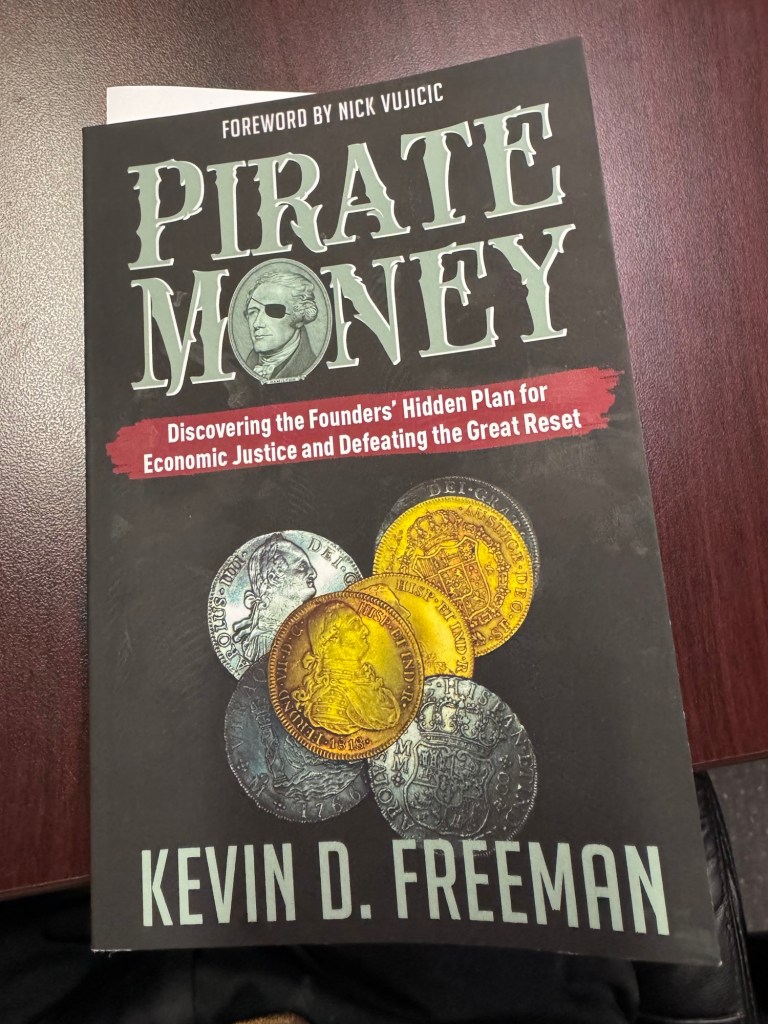
Lang handed me a copy of a relatively new book by Kevin Freeman, titled Pirate Money. The Blaze publishes it, and Freeman, whom I’ve followed through his economic commentary on that platform, draws from his extensive background advising the Pentagon and military leaders on financial warfare. I’ve known people at The Blaze over the years, and Freeman’s insights into global economics have always struck me as prescient. This book isn’t just another treatise on monetary policy; it’s a call to action, proposing an innovative way for states to reclaim control over their currencies using gold and silver, bypassing the Federal Reserve’s failures. As Lang and I talked, he mentioned that he’s been encouraging his colleagues in the legislature to read it by passing out copies from his office. The concept resonated with me immediately, especially after my own harrowing experiences with banks in 2025—a year that exposed the ugly underbelly of the financial industry in ways I hadn’t fully appreciated before.

You see, I’m not inherently anti-bank; they’ve served a purpose in facilitating commerce. But last year, I encountered the kind of predatory behavior that makes you question the entire system. Hidden fees, arbitrary account freezes, and a lack of transparency revealed the “ugly people” behind the polished facades—executives and regulators who prioritize control over service. This isn’t isolated; it’s symptomatic of a broader issue tied to the Federal Reserve and its monopoly on money creation. Freeman’s book delves into this, explaining how the Fed’s policies have enabled entities like BlackRock to amass unprecedented power, launder printed money through Wall Street, and impose agendas such as ESG (Environmental, Social, and Governance) criteria on corporations. If a CEO steps out of line, they risk deplatforming or worse—losing access to banking services based on social media profiles or political affiliations. I’ve seen this firsthand; banks now scrutinize applicants’ online presence, denying services to those deemed “undesirable.” This social credit system, imported from communist China, has infiltrated American finance, and it’s out of control.

My conversation with Lang covered a lot of ground, but the gold standard idea stood out. Freeman argues for a “constitutional backdoor” via Article 1, Section 10 of the U.S. Constitution, which prohibits states from coining money or emitting bills of credit but explicitly allows them to make “nothing but gold and silver coin a tender in payment of debts.”  This clause, rooted in the Founders’ distrust of fiat currency following the inflationary disasters of the Continental Dollar during the Revolutionary War, grants states the authority to establish gold and silver as legal tender. Freeman’s proposal builds on this: states could create vaults where citizens deposit gold, which is then used as backing for a digital debit card system. You’d buy gold with dollars, store it in the state vault, and spend it via a card that deducts the equivalent value in real time, adjusted for market prices. No need to carry physical coins; it’s as convenient as swiping a credit card, but insulated from inflation.

A new kind of gold card

This isn’t a pie-in-the-sky theory. Texas has already paved the way with its Texas Bullion Depository, established in 2015, a state-run facility for storing precious metals.  In 2025, Texas advanced further with House Bill 1056, enabling gold and silver deposits to be spent via debit-style cards, creating a digital payments platform backed by physical bullion.  By January 2026, the Texas Comptroller was seeking industry input on this system, aiming to implement it by May 2027 without state funding, relying instead on service fees.  Ohio is following suit. In April 2025, Representatives Brian Lorenz, Mark Johnson, and Josh Williams sponsored House Bill 208 (though some records refer to similar legislation as HB 206, sponsored by Representative Jennifer Gross), which aims to establish a transactional currency based on gold and silver.  The bill has been circulating but is currently stuck in the Judiciary Committee, needing leadership to push it forward. Lang and Gross are key supporters, with Lang distributing Freeman’s book to build momentum. This isn’t just for the wealthy; it’s a democratizing force that allows everyday people to protect their savings from erosion.

To understand why this is urgent, we must revisit the history of America’s monetary system—a tale of stability lost to central planning. In colonial America, currency was scarce and chaotic. The British Crown restricted silver and gold inflows to the colonies, forcing settlers to rely on foreign coins, barter, or makeshift scrip. The most common was the Spanish “piece of eight,” or eight-reales silver coin, minted in the New World and prized for its consistent value.  Pirates played a surprising role here; they plundered Spanish galleons, circulating these coins throughout the Atlantic world. Freeman draws the title Pirate Money from this era, noting that “pirate money”—looted Spanish silver—fueled early American commerce by evading royal monopolies.  These coins were often cut into “bits” for change—a one-reale bit equaled 12.5 cents, hence “two bits” for a quarter.  This decentralized, metal-backed system contrasted sharply with the inflationary paper-money experiments, such as Massachusetts’ pine-tree shillings or the Continental Congress’s fiat notes, which collapsed under overprinting.

The Founders, scarred by hyperinflation during the Revolution—where “not worth a Continental” became a proverb—enshrined sound money in the Constitution. Congress was granted the power to “coin money” and regulate its value, while states were barred from issuing fiat currency but were allowed to accept gold and silver tender.  The U.S. adopted a bimetallic standard in 1792, with the dollar defined as a specific weight of silver or gold. This stability propelled economic growth until the 20th century. But cracks appeared with the Civil War’s greenbacks, fiat notes that depreciated rapidly. Post-war, the U.S. returned to gold in 1879, enjoying decades of low inflation and prosperity.

The turning point came in 1913 with the Federal Reserve’s creation, ostensibly to stabilize banking, but it granted a private cartel monopoly over the money supply. Critics, including Freeman, argue this enabled endless printing, detached from real assets. Then, in 1933, amid the Great Depression, President Franklin D. Roosevelt issued Executive Order 6102, confiscating private gold holdings at $20.67 per ounce, only to revalue it at $35 shortly after via the Gold Reserve Act of 1934—a 69% devaluation that transferred wealth to the government.   This severed the dollar’s domestic full gold backing, though international convertibility persisted under Bretton Woods.

The final blow was the “Nixon Shock” in 1971. Facing gold outflows and inflation from Vietnam War spending, President Richard Nixon suspended dollar-to-gold convertibility on August 15, 1971, effectively ending the gold standard.   This unleashed fiat money, where dollars are backed only by faith in the government. The results? Catastrophic inflation. In the 1970s, prices soared, with annual rates peaking at 15% in 1980.  A dollar from 1970 buys just 13 cents worth of goods today—an 87% erosion.  Over the last century, the dollar has lost over 96% of its purchasing power since 1913.  From 1925 to 2025, it’s declined 95%, with stark generational impacts: $100 in 1975 is worth $16.40 today. 

This inflation isn’t accidental; it’s baked into the system. The Fed targets 2% annual inflation, but real rates often exceed that target, especially post-2020, with COVID stimulus flooding trillions into the economy. Homes, once affordable on a single income, now price out young families. Everything’s too expensive because money loses value yearly. Freeman highlights the shift from a production economy—making stuff—to a finance economy, where wealth comes from trading paper assets, interest rates, and debt manipulation. BlackRock exemplifies this: managing trillions, it influences CEOs via asset control, pushing agendas that prioritize globalism over American interests.  During the pandemic, the Fed hired BlackRock to manage bond purchases, raising conflict-of-interest concerns by blurring the lines between public policy and private profit.  

Compounding this domestic rot are external threats. President Trump understood this, cracking down on Iran, Venezuela, Mexico, and Canada to protect the dollar from attacks. Why Greenland? Strategic resources. But the real adversary is China, propped up since Nixon’s 1972 visit, which opened the door to currency manipulation and intellectual property theft.  Freeman, an expert in economic warfare, warns that wars today are fought through finance, not just bombs. China has been waging a stealth assault on the dollar: dumping U.S. Treasuries, stockpiling gold, and promoting the renminbi as a reserve currency.   In 2026, Beijing issued directives for financial institutions to divest Treasuries en masse, spiking yields and straining U.S. debt financing.  Allies like the BRICS nations follow suit, accelerating de-dollarization. If the dollar falls, America’s global clout crumbles—exactly China’s aim.

Trump provided a reprieve from 2017 to 2021, stabilizing the dollar amid these assaults. But with Democrats pushing centralized planning and Republicans sometimes complicit, the direction is toward more control. The Great Reset, championed by globalists, envisions a world where you “own nothing and be happy,” with currencies digitized for surveillance. Freeman’s Pirate Money counters this: states like Ohio and Texas can rebel by creating gold-backed systems, using the cashless infrastructure against the centralizers.

Imagine: You deposit your paycheck into an Ohio vault, converting it to gold at current prices. Your “black card” deducts value for purchases—gas, groceries, PlayStation—without inflation’s bite. Gold appreciates, so savings grow. No more losing 2-5% per year; your money retains value. This forces the Fed to compete, curbing excesses. It’s not Bitcoin’s volatility; it’s stable, tangible gold, recognized worldwide since antiquity.

Critics say it’s for the rich, but Freeman argues otherwise. Centralized bankers thrive on monopoly, leveraging inflation to steal value. By decentralizing, more people retain wealth, reducing inequality. In Ohio, HB 208 needs champions. Knock on Lang’s door; he’ll give you the book. Gross is sponsoring related efforts. With Vivek Ramaswamy as governor in Ohio and in partnership with a Trump administration, support could surge.

This isn’t radical; it’s constitutional. States have the right, and the time is now, while Trump stabilizes the dollar. Democrats should back it too—protecting value benefits all. If we wait, inflation will devour more. As Freeman notes, pirates used gold to win independence; we can too.

In conclusion, Kentucky’s notes—or any state’s gold tender—are constitutional under Article 1, Section 10. They stabilize our nation against Fed failures, BlackRock’s influence, and China’s attacks. Ohio, lead the way with HB 208. I’ll be one of the first to sign up. 

Footnotes

1.  U.S. Constitution, Article 1, Section 10: “No State shall… coin Money; emit Bills of Credit; make any Thing but gold and silver Coin a Tender in Payment of Debts…” 

2.  Kevin D. Freeman, Pirate Money (The Blaze, 2025), pp. 45-67, discussing colonial use of Spanish coins.

3.  Executive Order 6102, April 5, 1933, by Franklin D. Roosevelt, requiring the surrender of gold at below-market rates. 

4.  Gold Reserve Act of 1934, revaluing gold from $20.67 to $35 per ounce.

5.  Nixon Shock: Suspension of gold convertibility, August 15, 1971. 

6.  Inflation statistics: Dollar lost 87% value since the 1970s; peaked at 15% in 1980. 

7.  BlackRock’s role in Fed bond programs, 2020. 

8.  China’s Treasury divestment, 2026 directives. 

9.  Texas Bullion Depository, established 2015; HB 1056, 2025. 

10.  Ohio HB 206 (or 208 variant): Gold and silver transactional currency. 

Bibliography

•  Freeman, Kevin D. Pirate Money: The Constitutional Path to Sound Money. The Blaze, 2025.

•  Griffin, G. Edward. The Creature from Jekyll Island: A Second Look at the Federal Reserve. American Media, 1994.

•  Rothbard, Murray N. What Has Government Done to Our Money? Ludwig von Mises Institute, 1963.

•  Eichengreen, Barry. Golden Fetters: The Gold Standard and the Great Depression, 1919-1939. Oxford University Press, 1992.

•  Lowenstein, Roger. “The Nixon Shock.” Bloomberg Businessweek, August 4, 2011.

•  U.S. Constitution, Annotated Edition. Library of Congress.

•  Federal Reserve Economic Data (FRED). “Purchasing Power of the Consumer Dollar.”

•  Texas Comptroller of Public Accounts. “Request for Information: Digital Payment System Backed by Bullion,” January 2026.

•  Ohio House of Representatives. “H.B. No. 206: Establish a Transactional Currency Based on Gold and Silver.”

•  Freeman, Kevin D. Advisory Reports to Pentagon on Economic Warfare, Various Dates.

Rich Hoffman

More about me

Click Here to Protect Yourself with Second Call Defense https://www.secondcalldefense.org/?affiliate=20707
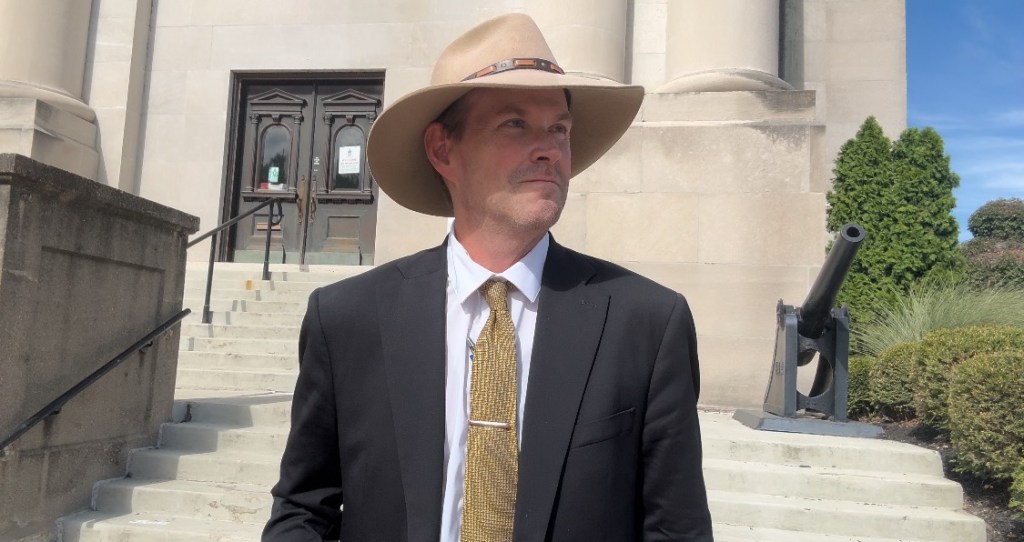
About the Author: Rich Hoffman

Rich Hoffman is an independent writer, philosopher, political advisor, and strategist based in the Cincinnati/Middletown, Ohio area. Born in Hamilton, Ohio, he has worked professionally since age 12 in various roles, from manual labor to high-level executive positions in aerospace and related industries. Known as “The Tax-killer” for his activism against tax increases, Hoffman has authored books including The Symposium of Justice, The Gunfighter’s Guide to Business, and Tail of the Dragon, often exploring themes of freedom, individual will, and societal structures through a lens influenced by philosophy (e.g., Nietzschean overman concepts) and current events.

He publishes the blog The Overmanwarrior (overmanwarrior.wordpress.com), where he shares insights on politics, culture, history, and personal stories. Active on X as @overmanwarrior, Instagram, and YouTube, Hoffman frequently discusses space exploration, family values, and human potential. An avid fast-draw artist and family man, he emphasizes passing practical skills and intellectual curiosity to younger generations.

The Bad Guys Deserve Punishment: Destroying Iran to free people from tyranny

I’ve been watching everything unfold in real time. It feels good to see some real aggression from the top, finally. Everybody’s talking about how Trump’s inspiration is driving this new level of toughness—hitting Iran hard, taking out Maduro in Venezuela, and setting up hemispheric shielding through Kristi Noem’s new gig as Special Envoy for the Shield of the Americas. It’s exactly what we needed. We’ve lived through a very dangerous time, and we had to have justice for what was done to us. So when people whine, “Why are you being so aggressive? Why treat Venezuela like this? Why talk so tough on Iran, China, the cartels?”—I point to the big picture. We tried playing nice when we could, making deals, but the bad actors never stopped scheming in the background. Iran’s always been problematic, bragging about nuclear warheads and funding terrorists. Trump couldn’t walk away from negotiations with them, thumbing their nose at honest attempts at peace in the Middle East. If they’re going to keep sponsoring terror, you cut the head off the snake. That’s what’s happening now, and it had to happen.

Obviously, the Democrats support that kind of insurrection—they want the downfall of the United States. Peel back the layers, and you see China behind so much of it: property acquisitions here, buying up media companies to steer narratives their way. It’s been ugly, nasty, nasty, nasty. After what they did with COVID, the lockdowns, the global economic sabotage—Bill Gates, the whole crew—people get mad if they’re not in jail or tied up somewhere. They have too much money; they buy courts, buy freedom. They don’t get in trouble. And yeah, I still think Jeffrey Epstein’s alive out there. He’s too rich to die that way. Body double, bought-off guards, elements of law enforcement—it’s not hard with that kind of cash.

Trump doesn’t have the constitutional power to round them all up and jail them—he can’t do it directly—but he can attack their mechanisms of evil. The way bad guys use countries like Iran, Venezuela, Mexican drug cartels, North Korea, and even Russia, stirring up Ukraine—they hustle agents, cause chaos, turn everybody in the wrong direction. But Trump’s clear: no boots on the ground for forever wars. We never should’ve been doing that. I joke about it half-seriously, but what was the Iraq war really about? Oil? Securing prices and American interests? Weapons of mass destruction, they never found? Or was it about raiding the Baghdad Museum right after the invasion, grabbing ancient DNA or artifacts from Gilgamesh’s era to mess with human genetics, or hide giants like in Kandahar? Those conspiracy theories floated around podcasts after retirees started talking. People have lost faith in institutions, in the nightly news narrative: “We’re going to war to save people from communism,” or whatever. Yet the bad guys propped up maniacs for decades—Fidel Castro, the Iranian Revolution in the late ’70s as a Marxist movement hidden behind religion, so you couldn’t criticize it without attacking Islam. That’s how they sold it here: don’t criticize our communities, even as they shuffled in socialism, lined people up for food stamps and welfare, turning dependency into modern slavery to the government instead of plantations.

The same thing’s happening with radical Islam—thorny alliances everywhere, causing needless harm—cartels in Mexico, Venezuelan aggression, and China behind it all. China was built by the deep state; they never would’ve had the money without investment firms funneling stolen Federal Reserve wealth, Wall Street manipulations, modern monetary theory tricks at Jackson Hole conferences. It sounds wild because the media calls it crazy, but listen to those talks—it’s out there.

That’s why everybody’s upset about these moves. Iran’s economy is a dying fallout on the couch—they can’t fight a real war. No ships, no missiles, no planes of any worth. They’ve been de-industrialized by sanctions. Trump bombed them because they poked the bear with radical Islam and ideology issues tied to the Democrat party, which clearly represents America’s destruction in so many ways. Obama gave them billions to keep their economy afloat so they could buy terrorist toys; now Trump’s taking it all away. As an elected official, we put him in office to do this job; he’s doing it. We don’t want radical losers causing trouble worldwide. We don’t want cartels running Mexico—pulling people over for bribes, corruption everywhere. We want to vacation or do business there without fear. We don’t want Venezuela screwing our energy markets. We don’t want Iran sponsoring terrorism. We want peace in the Middle East—Jews, Christians, everybody getting along, building lives.

This is what Kristi Noem’s Shield of the Americas is about—stabilization in the hemisphere. She’s moved from DHS to Special Envoy, focusing on dismantling cartels, securing the Western Hemisphere, working with Rubio and Hegseth. It’s hemispheric shielding: choke off the bad guys economically and militarily without endless occupations. Trump’s not putting boots everywhere; he sends precision strikes, missiles as compliments of capitalism—paid for by the best system in the world. That’s how you win now.

All these characters in the background—COVID planners, great reset pushers, China feeders—they used distractions like Iran to usher agendas through while we fought shadows. Peel back the onion: destroy the disguises, pull off the masks. That’s happening in Iran right now, Venezuela (Maduro captured in January, U.S. overseeing oil rebuild), and Mexico (cartel disruptions). It’s great. I highly support what Trump’s doing—I want to see a whole lot more. He’s actually being too nice in some ways. The world deserves this reckoning for 2020: stolen elections, COVID as a weapon, great reset leashed to lockdowns, all attached to global control plots. Epstein, Gates, Russian honeypots, Chinese labs—it’s out there.

If you think that’s all a conspiracy, it’s in the open now. The people crying loudest about Iran are the ones who used these characters to cause trouble. Forget the courts, UN nonsense, and treaties that neutralized America so bad guys could thrive. Time for punishment. Show the world it happens. Use capitalism for upper mobility, freedom in Hong Kong, Venezuela, Mexico, England, and Europe. Lead by example: take away the hostiles causing trouble. Iran had no other intention but trouble since the late ’70s Marxist infusion feeding communism, China, Russia, socialist Latin America—all anti-American, anti-capitalist, anti-upward mobility. They played their part in lockdowns, freedom theft, and using COVID to destroy economies into a great reset.

This isn’t theory anymore; it’s action. Trump’s crushing them economically, stripping them of their covers, exposing them. The attacks on Iran neutralize them as a threat—they tried rational peace, but they’re hostile. Venezuela’s aggression, Mexico’s cartels—all choked off. No more hiding. Democrats and the media cry because Iran was their Marxist disguise, a haven, a proxy to break America down. Now excuses stripped away, masks off—nowhere to hide. They don’t like it, but too bad. It’s great, the bad guys needed to be punished.  And now they are.

Footnotes

1.  On Operation Epic Fury and Khamenei’s death: Strikes targeted nuclear sites, missiles, navy; civilian casualties reported (e.g., girls’ school in Minab). Trump urged regime change without full occupation.

2.  Maduro capture in January 2026: U.S. raid framed as anti-narco-terrorism; plans for long-term oil oversight and revenue split.

3.  Kristi Noem’s role: Appointed Special Envoy for the Shield of the Americas (Western Hemisphere) in March 2026, focusing on cartel dismantlement and border security partnerships.

4.  Iran’s 1979 Revolution: Marxist influences blended with Shia Islamism to avoid direct criticism of leftist elements.

5.  Iraq Museum looting: Over 15,000 artifacts stolen post-invasion; fringe theories link to ancient DNA/Gilgamesh,/giants myths.

6.  Kandahar giants: Persistent online legend from alleged U.S. military encounters; widely debunked but symbolic of institutional distrust.

7.  China-media investments: Documented stakes in U.S. outlets; fentanyl precursor supply to Mexican cartels well-reported.

8.  Obama’s Iran payment: $1.7 billion settlement for pre-1979 arms deal, not direct “terror funding” per official accounts.

9.  COVID/Great Reset conspiracies: WEF initiative twisted into global control narratives; Gates-Epstein links fueled speculation.

10.  Epstein “alive” theories: Persistent despite official ruling; tied to elite protections.

Bibliography

•  White House Fact Sheet on Iran (2026). https://www.whitehouse.gov/fact-sheets/2026/02/fact-sheet-president-donald-j-trump-addresses-threats-to-the-united-states-by-the-government-of-iran

•  DHS Announcement on Noem’s Role (March 5, 2026). https://www.dhs.gov/news/2026/03/05/thanks-president-trump-and-secretary-noem-america-safer

•  TIME on Shield of the Americas (2026). https://time.com/7382975/kristi-noem-new-job-shield-of-americas

•  Marxist.com on the Iranian Revolution (historical analysis).

•  Various: Axios, Politico, The Hill, CNN reports on 2026 operations in Iran/Venezuela.

•  Reuters Institute on Chinese media influence.

•  BBC on Great Reset conspiracies.

•  Brookings on Obama-Iran cash transfer.

•  CSIS/NBC on China-cartel connections.

Rich Hoffman

More about me

Click Here to Protect Yourself with Second Call Defense https://www.secondcalldefense.org/?affiliate=20707

The Wonderful Dinosaur Store on the Space Coast: What good economies produce

The Dinosaur Store in Cocoa Beach, Florida, stands as a remarkable testament to personal passion, entrepreneurial spirit, and the enduring human fascination with the ancient world. Nestled at 250 West Cocoa Beach Causeway, just a short distance—literally a football’s throw—from the iconic Ron Jon Surf Shop, this family-run establishment has evolved from a modest fossil and mineral shop into one of the Space Coast’s most captivating attractions. For decades, it has drawn families, tourists, and enthusiasts alike, blending commerce with education in a way that feels refreshingly authentic in an era often dominated by corporate chains.

The story begins in November 1996, when the store first opened its doors as a small retail space focused on fossils, minerals, geodes, and related curiosities. Founded by Steve and Donna Cayer, it capitalized on a surge of interest in prehistoric life sparked by cultural phenomena like the 1993 blockbuster Jurassic Park. Visitors flocking to Cocoa Beach for sun, surf, and the nearby Ron Jon Surf Shop—a massive complex synonymous with Florida beach culture—would often wander over to pick up unique souvenirs: polished ammonites, shark teeth, or perhaps a necklace strung with genuine dinosaur bone fragments. The location was ideal, perched in a high-traffic tourist corridor along State Road 520, where beachgoers and space enthusiasts from nearby Cape Canaveral mingled.

What set the Dinosaur Store apart from typical souvenir shops was its authenticity. The family didn’t merely resell imported trinkets; they traveled extensively during the off-season, when summer crowds thinned and families headed to Disney World or other attractions. Steve and Donna ventured to fossil-rich sites across the globe, including the badlands of Montana, where heavy rains routinely erode sedimentary rock and expose new specimens. They collected ethically, often from permitted digs, and brought back high-quality pieces: Spinosaurus teeth, Allosaurus claws, brachiopods, and meteorites. These items formed the backbone of their inventory, supplemented by jewelry crafted from dinosaur fossils—pendants, earrings, and rings that turned ancient remnants into wearable history. Customers could purchase a Spinosaurus tooth or a slice of petrified wood table, items that carried a tangible connection to deep time.

Over the years, the store thrived. The post-Jurassic Park boom turned it into a lucrative family business, profitable enough to support not just daily operations but ambitious dreams. Rather than resting on success—perhaps buying a condo, a boat, or indulging in lavish vacations—the Cayers channeled their earnings into something far more enduring. They acquired property and constructed a multi-story building dedicated to their passions. What began as a single-floor operation in a strip mall setting expanded into a three-story edifice, transforming the ground level into a sprawling gift shop and adventure zone while reserving the upper floors for something extraordinary: the Museum of Dinosaurs and Ancient Cultures.

The museum opened to the public in April 2017 (on Earth Day) after roughly eight years of planning and development, following the store and Adventure Zone’s launch on the first floor in March 2009. It occupies approximately 20,000 to 26,000 square feet across the second and third floors (sources vary slightly on exact footage, but the scale is immense for a private venture). It operates as a nonprofit entity, with proceeds supporting preservation, education, and ongoing exhibits. Entry requires a ticket purchased downstairs (around $16 for adults, with discounts and combo options including the Adventure Zone downstairs), and last admissions are timed to ensure a full experience before closing.

The museum’s design is ingeniously immersive. Upon taking the elevator up, visitors enter a vast, open space where the second floor soars to the ceiling, allowing for life-sized dinosaur skeletons and models that dominate the view. A standout is the 46-foot Giganotosaurus skeleton, one of the largest theropod displays in a private setting. Floor-to-ceiling mounts include roaring recreations, fleshed-out models, and over 60 dinosaur skeletons alongside more than 80 taxidermy specimens spanning 200 million years of natural history. The layout encourages looking upward, with necks and heads stretching toward the rafters, creating a sense of awe akin to standing beneath towering Jurassic giants. Authentic fossils abound—real bones, claws, and teeth sourced from the family’s expeditions—blended seamlessly with high-quality replicas for educational impact. Additional features include a Mineral Cave with ultraviolet-reactive crystals and a Dawn of Man section with paleolithic tools and hominid skull casts.

The third floor adds a mezzanine-like platform that zigzags through the space, offering elevated views of the dinosaur exhibits below while transitioning into human history. Here, the focus shifts to ancient cultures, bridging paleontology with anthropology and archaeology. Dedicated galleries showcase regions worldwide: ancient Egypt features a detailed replication of King Tutankhamun’s tomb, complete with replicas of artifacts and mummified animals; China includes a diorama of Terracotta Army soldiers; Mesoamerica highlights Aztec and Mayan elements, such as Chichen Itza-inspired structures; and additional sections cover tribal Africa and New Guinea. Authentic artifacts—pottery, tools, jewelry—sit alongside taxidermy from relevant regions, creating a narrative that connects prehistoric life to the rise of human civilizations. The exhibits emphasize how cultures emerged over millennia, often in relation to the natural world preserved in the fossil record.

This integration is what makes the museum unique. While major institutions like the Field Museum in Chicago, the Smithsonian, or the British Museum boast world-class collections, they are often vast, bureaucratic, and spread across enormous campuses. The Dinosaur Store’s museum achieves comparable quality on a more intimate, privately funded scale. It feels personal—born from passion rather than institutional mandate. The Cayers’ love for digging, collecting, and sharing shines through: they didn’t stop at selling fossils; they built a bridge between dinosaurs and the ancient peoples who might have encountered similar wonders in myth or reality. In doing so, they’ve created a place where visitors can ponder the history of life on Earth—from extinct megafauna to the ingenuity of pyramid-builders and terra-cotta warriors.

For many families, including my own, the Dinosaur Store has been a recurring touchstone. Over the years, trips to the Space Coast—often tied to Kennedy Space Center visits or beach days—included obligatory stops here. My daughter once bought me a Spinosaurus tooth as a gift, a small but meaningful token that still sits on my shelf, evoking memories of laughter, wonder, and the simple joy of discovery. We’d browse the shop, admire the geodes and meteorites, then head out with a new trinket: a dinosaur bone necklace or a polished fossil slab. Those visits built family traditions, turning a roadside attraction into something heartfelt.

A decade passed without a return—life shifted to other pursuits, including following developments in the space program during periods of stagnation. But with renewed activity under recent administrations, the pull of the Space Coast returned in 2026. Stepping back into the store felt like greeting old friends. The family behind the counter remembered familiar faces, sharing stories of their travels and the museum’s growth. Ascending to the upper floors revealed the jaw-dropping evolution: the towering skeletons, the meticulous cultural dioramas, the seamless flow between prehistory and antiquity. It surpassed expectations—better than many celebrated exhibits elsewhere, achieved through private ambition and capitalist ingenuity.

This success story underscores a broader point about passion in free economies. In places like the Space Coast, with its vibrant tourism, surf culture, and proximity to high-tech endeavors, individuals can turn hobbies into legacies. The Cayers could have cashed out comfortably, but they invested in education and wonder. Their museum doesn’t just display bones and artifacts; it invites reflection on deep time, cultural continuity, and humanity’s place in the cosmos. In a world where many pursuits prioritize profit alone, here is a rare example of going above and beyond—creating something magnificent not for acclaim, but because the topic demands it. The project reportedly cost around $3.7 million to develop, with an estimated $3 million in artifacts at opening, underscoring the scale of their commitment.

If you find yourself near Disney, the beaches, or Cape Canaveral, make the detour. Park (free, conveniently located), grab a Ron Jon T-shirt if you like, then step into the Dinosaur Store. Browse the ground-floor treasures—perhaps snag a Spinosaurus tooth or a fossil necklace—then head upstairs. The museum awaits: a private passion project that rivals global institutions in ambition and execution. You’ll leave with a renewed appreciation for the ancient past, the power of dedication, and the simple thrill of discovery.

For those eager to explore further, the official website offers details on hours, tickets, and exhibits. Reviews on platforms like TripAdvisor and Google (consistently 4.4+ stars from thousands) echo the sentiment: it’s a hidden gem worth the trip. Academic resources on paleontology provide deeper context on fossils, while studies on ancient cultures offer complementary reading. The museum itself serves as an accessible gateway, proving that wonder can thrive in unexpected places when fueled by genuine enthusiasm.

Footnotes

¹ The Museum of Dinosaurs and Ancient Cultures opened in April 2017.¹

² The museum spans 20,000–26,000 square feet, with variations in reported size across sources.²

³ Development took approximately eight years, following the first-floor openings in 2009.³

⁴ Estimated cost of $3.7 million, with $3 million in artifacts at opening.⁴

⁵ Founders Steve and Donna Cayer.⁵

⁶ Giganotosaurus skeleton measures 46 feet.⁶

⁷ Over 60 dinosaur skeletons and 80+ taxidermy specimens.⁷

⁸ Nonprofit status supports preservation and education.⁸

⁹ Google rating of 4.4 stars from over 2,300 reviews.⁹

Bibliography

•  The Dinosaur Store. “Home.” Accessed March 2026. https://dinosaurstore.com/.

•  The Dinosaur Store. “Museum of Dinosaurs & Ancient Cultures.” Accessed March 2026. https://dinosaurstore.com/museum.

•  The Dinosaur Store. “About Us.” Accessed March 2026. https://dinosaurstore.com/about-us.

•  Wikipedia. “Museum of Dinosaurs and Ancient Cultures.” Accessed March 2026. https://en.wikipedia.org/wiki/Museum_of_Dinosaurs_and_Ancient_Cultures.

•  TripAdvisor. “The Dinosaur Store (2026).” Accessed March 2026. https://www.tripadvisor.com/Attraction_Review-g34145-d2285722-Reviews-The_Dinosaur_Store-Cocoa_Beach_Brevard_County_Florida.html.

•  Visit Space Coast. “Museum of Dinosaurs & Ancient Cultures.” Accessed March 2026. https://www.visitspacecoast.com/profile/cocoa-beach/things-to-do/museum-of-dinosaurs-ancient-cultures.

•  Florida Today. “This Cocoa Beach spot pays tribute to dinosaurs, ancient cultures.” October 9, 2025. https://www.floridatoday.com/story/news/hidden-gems/2025/10/09/beachside-brevard-building-houses-massive-ancient-cultures-dino-exhibit/86170682007.

•  USA Today. “Museum of Dinosaurs and Ancient Cultures opening in Cocoa Beach.” April 20, 2017. (Referenced in Wikipedia citation).

Rich Hoffman

More about me

Click Here to Protect Yourself with Second Call Defense https://www.secondcalldefense.org/?affiliate=20707

The Jaw-dropping Impact of David Flynn’s Work: Uncovering a lost history of Mars and the migration of people to Earth

I’ve talked about Cydonia: The Secret Chronicles of Mars by David E. Flynn before, but after diving into the newly republished edition, I felt compelled to share my thoughts in depth. This book, originally self-published around 2002 by End Time Thunder Publishers, was ahead of its time—a dense, brilliant exploration that ties ancient mythology, biblical narratives, and apparent anomalies on Mars into a cohesive narrative about humanity’s origins. Thanks to Timothy Alberino’s advocacy, including his foreword in the new edition released in early 2026 by Sunteleia Press (with contributions from Mark Flynn), it’s now more accessible in hardcover, paperback, and digital formats, reaching a broader audience ready for these ideas.

I wouldn’t have picked it up without Alberino’s influence. I’ve followed his work since Birthright in 2020, appreciating how he bridges scriptural truth with adventurous inquiry into giants, Nephilim, and posthuman themes. He’s a genuine explorer with a scriptural backbone, not the stereotypical “New Age” figure some might dismiss. His promotion of Flynn’s work—calling it one of the most consequential books ever written—sparked my interest. I grabbed the new edition as soon as it dropped, read it multiple times to let the concepts sink in, and recorded my podcast thoughts because this material deserves serious consideration.

Flynn was a high-IQ thinker who operated outside mainstream channels. Through his Watcher website in the 1990s and early 2000s, he delved into biblical ufology, eschatology, sacred geometry, and the implications of structures photographed in Mars’ Cydonia region—like the so-called “Face on Mars” from the 1976 Viking images and nearby pyramid-like formations. He argued these weren’t mere pareidolia but encoded remnants of a civilization that fled Mars after catastrophe, bringing knowledge to Earth. Myths from Sumer, Egypt, the Indus Valley, Greece, Rome, and even indigenous Americas trace back to this diffusion, centered in the Near East near Mount Hermon—the biblical entry point for fallen angels (Watchers) in the Book of Enoch.

In Flynn’s view, these “sons of God” descended, fathered giants (Nephilim), taught forbidden arts, and corrupted humanity, leading to the Flood. Post-flood, survivors or their cultural echoes rebuilt civilizations, with megalithic sites worldwide aligning on geometric grids—pentagrams anchored at Giza and the Prime Meridian. This “As Above, So Below” principle suggests Mars’ Cydonia as a template for earthly monuments, from Stonehenge to Ohio’s Serpent Mound. Flynn connected this to ley lines, occult symbolism (serpents, hyperborean origins), and mystery schools preserving elite knowledge while suppressing it from the masses.

I’ve long collected accounts of giants in Ohio mounds—newspaper clippings from the 19th and early 20th centuries reporting oversized skeletons unearthed during excavations, often dismissed or “lost” by institutions like the Smithsonian. Many researchers chase these leads, get excited, then fade when mainstream scrutiny hits. Flynn escaped that cycle by grounding his work in scripture and comparative mythology rather than pure speculation. He wasn’t chasing kooks; he was synthesizing evidence that scripture and emerging science increasingly align.

This shift—from fringe “New Age” shelves (Graham Hancock, Zecharia Sitchin, Erich von Däniken) to respectable inquiry—began with thinkers like Flynn and accelerated with Michael Heiser’s The Unseen Realm and Reversing Hermon. Heiser, a Semitic languages scholar, unpacked Genesis 6 without extraterrestrial leaps, focusing on divine council and supernatural rebellion. Alberino builds on this, applying it to modern threats like transhumanism. Reading Flynn after Heiser and Alberino feels like puzzle pieces clicking: ancient myths aren’t fiction but distorted memories of real events, possibly involving ultra-terrestrial and/or extraterrestrial contact preserved in Enochian texts and global lore.

Critics point to NASA’s higher-resolution images (Mars Global Surveyor 1998 onward) showing the “Face” as a natural mesa eroded by wind, with no artificial symmetry. Pareidolia explains much—humans see faces in rocks, just as in clouds or toast. Yet Flynn’s geometric arguments persist intriguingly: if alignments predict undiscovered sites, why not consider cosmic origins? Hallucinogens like ayahuasca induce shared visions across cultures, echoing cave art from Lascaux to remote tribes, suggesting subconscious or spiritual exchanges. UFO phenomena add layers—disclosure talks under recent administrations hint at deeper truths.

I want to go to Mars not to abandon Earth but to verify. SpaceX and commercial efforts make it inevitable; we’ll build habitats, explore, and likely find preserved ruins—pyramids, mounds, architectural echoes—on a stripped world. No thick atmosphere or active society buries evidence there. If we discover ancient civilization remnants 10,000, 100,000, or millions of years old, it redefines history: humanity as refugees or engineered arrivals, not isolated evolution. Myths become chronicles; scripture’s miracles include survival of truth through millennia.

Power structures suppress this—China buries pyramids to control narrative; mystery schools hoard knowledge for dominance. Flynn exposed that, self-publishing because no mainstream house would touch it. Early internet allowed geniuses like him to connect, compare notes at 3 a.m., and build followings organically. Alberino, inspired, helped republish it, giving it legitimacy. His podcasts dissecting it (dozens in his community) make it digestible.

This book shatters illusions but in a good way. As disclosure ramps up—political, technological, archaeological—we must prepare. Root-cause analysis demands we question origins beyond Darwin or uniformitarianism. Mars may have been part of our past, not just future. Stories of tragedy, survival, and migration from the asteroid belt (Phobos/Deimos as remnants?) to Earth explain gods’ names and shared archetypes.

I’ve read extensively—Heiser, Sitchin (for contrast), Enoch translations, Hoagland’s Monuments of Mars—and Flynn stands out as genius-level synthesis. It’s dense, requires rereading, but rewards with awe at God’s design amid cosmic drama. Humanity’s dominion over Earth includes exploring to reclaim lost truth, bringing heaven here as representatives.

In these times, with information exploding and institutions failing, books like this empower us. Read it on your terms before media forces the conversation. It prepares for paradigm shifts—good ones, shattering control for freedom.

Bibliography

•  Flynn, David E. Cydonia: The Secret Chronicles of Mars. End Time Thunder Publishers, 2002 (original); Sunteleia Press edition with forewords by Timothy Alberino and Mark Flynn, 2026.

•  Alberino, Timothy. Birthright: The Coming Posthuman Apocalypse and the Usurpation of Adam’s Dominion on Planet Earth. Self-published, 2020.

•  Heiser, Michael S. The Unseen Realm: Recovering the Supernatural Worldview of the Bible. Lexham Press, 2015.

•  Heiser, Michael S. Reversing Hermon: Enoch, the Watchers & the Forgotten Mission of Jesus Christ. Defender Publishing, 2017.

•  The Book of Enoch (R.H. Charles translation, 1917; various modern editions).

•  Hoagland, Richard C. The Monuments of Mars: A City on the Edge of Forever. North Atlantic Books, 5th ed., 2001.

•  Sitchin, Zecharia. The 12th Planet. Bear & Company, 2004 reprint.

•  Hancock, Graham. Fingerprints of the Gods. Crown, 1995 (for comparative ancient mysteries context).

•  NASA Mars mission archives (Viking 1976, Mars Global Surveyor 1998–2006, etc.).

•  Flynn’s Watcher website (archived materials via secondary sources).

Footnotes for Further Reading

1.  On Cydonia anomalies and pareidolia: NASA press releases post-1998; Carl Sagan, The Demon-Haunted World: Science as a Candle in the Dark (1995).

2.  Nephilim and divine council: Genesis 6; Deuteronomy 32; Job 1–2; Heiser’s works above.

3.  Alberino’s role: His X posts and The Alberino Analysis community podcasts on Cydonia.

4.  Giant mound reports: 19th-century newspapers (e.g., New York Times archives); critiques in mainstream anthropology.

5.  Sacred geometry/ley lines: Alfred Watkins, The Old Straight Track (1925); Flynn’s pentagram grid discussions.

6.  Disclosure context: 2020s UAP Task Force reports; SpaceX Starship/Mars plans.

7.  Myth diffusion: Joseph Campbell, The Hero with a Thousand Faces (1949).

8.  Mystery schools/esotericism: Manly P. Hall, The Secret Teachings of All Ages (1928).

9.  Enochian influences: Dead Sea Scrolls fragments; 1 Enoch translations.

10.  Mars exploration potential: Recent Perseverance rover findings; astrobiology papers on ancient habitability.

Rich Hoffman

More about me

Click Here to Protect Yourself with Second Call Defense https://www.secondcalldefense.org/?affiliate=20707

Dirty Hands at the Dinner Table: How Authority Conceals the Temple Mount Secrets

I find the stories of the Temple Mount in Israel infinitely fascinating.  The way authority figures hide things—whether it’s a father at the dinner table deflecting his daughter’s question in the movie Fire Walk with Me or entire systems built around keeping eyes off what’s buried—keeps echoing louder in the news and in the air. That scene isn’t just cinema; it’s a blueprint for how power protects itself. Laura asks the direct, impossible-to-ignore question—“Why were you in my room?”—and the response isn’t denial or apology. It’s inversion: Leland grabs her hand, inspects it closely, and declares, “Your hands are filthy… look, there is dirt way under this fingernail.” Suddenly, the spotlight shifts, the original inquiry evaporates, and the hierarchy snaps back into place. The abuser stays safe behind the façade of parental authority, and the victim is left doubting her own reality. I see that exact mechanism repeating at every scale, from family secrets to the kind of institutional cover that goes on at the Temple Mount.

What makes it so gripping is how deliberate it can feel when you zoom out. After the 1967 war, Israel had the Mount in hand—full military control, the keys to the gates, the ability to reshape everything. Yet the Waqf keeps running the show day to day. The official line has always been peace preservation: don’t inflame the Muslim world, avoid a wider religious war, and show tolerance as the new custodian of holy sites for all faiths. It sounded pragmatic at the time, almost noble. But layer on the archaeology angle, and it starts looking like genius-level deflection. Create a permanent tension zone where any serious dig—any probe into the tunnels, chambers, ancient wells, or pre-Davidic features—gets framed as an assault on Islam’s third-holiest site. The Waqf has a motive to block it (preserving their narrative overlay), the world has a motive to pressure Israel against escalation, and nothing changes underground. No permits for neutral international teams, no comprehensive mapping with modern tech without diplomatic blowback, no accidental exposure of whatever Solomon’s people might have sealed away before the Babylonians arrived. Hostility becomes the perfect guard dog: it barks at intruders, keeps the curious at bay, and nobody has to admit they’re hiding something.

The red heifer push keeps underscoring how serious this feels on the ground. Preparations haven’t stopped; they’ve accelerated in ways that are hard to ignore. The Temple Institute has been at it for over a decade, educating, crafting vessels, training priests, and monitoring candidates. Those five from Texas back in 2022 got a lot of attention—flown in, raised under strict conditions in Shiloh. Some were disqualified over time for developing imperfections (a single white hair can disqualify under halachic rules). There was that big July 1, 2025, event in the Samarian hills: a full simulation of the ritual burning with a disqualified animal, complete with priests in garments, ashes collected. The Institute clarified it was practice only, non-kosher because the heifer wasn’t perfect, and the setup wasn’t fully consecrated. Still, four candidates remain under observation there as of early 2026. Ministers have visited the site; photos circulate, and the message is clear: when a truly flawless one is ready, and everything else aligns, purification of the ashes becomes possible. That’s the biblical prerequisite for resuming Temple-level purity and service. No ashes, no Third Temple activity. With record numbers of Jewish visitors to the Mount lately—over 76,000 in 2025, shattering previous highs—and quiet shifts like police allowing limited prayer pages or sheets on site (a crack in the old status quo since late 2025 into this year), the momentum builds.

Those tunnels are key to the story. Explorers like Josh Gates have documented what they can—ancient passages, some possibly water systems from way back, others sealed or restricted. In episodes of Expedition Unknown, he rappels into shafts beneath Jerusalem, navigating cramped, centuries-sealed tunnels that hint at connections to the Mount area, though collapses and restrictions halt full exploration. Rabbis and Orthodox groups have long held traditions that the Ark never left Jerusalem: hidden by Solomon in purpose-built chambers, or by Josiah, or Jeremiah, or someone in that chain before the First Temple fell. A few bold digs happened quietly decades ago—1981 efforts by rabbis like Yehuda Getz chiseling into bedrock passages under the Mount, rumors of cleared rooms but no public Ark reveal. Modern statements from some rabbis lean hard on “it’s here, well hidden, we know where.” If it’s in those under-Mount networks—pre-David threshing-floor caves, Solomon-era vaults—the current setup is an ideal lock. Islamic administration means no Jewish-led archaeology without crisis. Muslim sensitivities mean no validation of biblical claims through digs. Politics means endless stalemate. And yet the pressure cooker is heating: October 7 still looms as a possible reaction to perceived Temple threats, red heifer talk fuels messianic expectations across lines, and post-COVID distrust means fewer people accept the old “don’t ask, don’t dig” deflection.

Whether it’s unaccountable governments sitting on restricted zones (Afghanistan caves, Chinese pyramids, Iraqi museums), or mystery-school oral traditions guarding knowledge, or straight gaslighting at the family level, the playbook is the same: manufacture antagonism or taboo to keep inquiry radioactive. But the erosion of blind trust changes everything. People aren’t swallowing “your hands are dirty” as an answer anymore. They’re asking why the room was entered in the first place. That’s why this feels like disclosure season—UFO files crack open, ancient anomalies get debated publicly, and the Temple Mount simmers closer to a boil. If the Ark surfaces, or a red heifer ritual goes live, or the status quo finally snaps, the cascade could rewrite maps, faiths, and power structures overnight.

Footnotes

1.  The dinner table scene in Twin Peaks: Fire Walk with Me, where Leland inspects Laura’s hands and says, “Your hands are filthy… look, there is dirt way under this fingernail,” is from the screenplay by David Lynch and Bob Engels (1991 shooting draft).

2.  Moshe Dayan’s decision to maintain the status quo on the Temple Mount, granting the Waqf administrative control while Israel handles external security, was made shortly after the Six-Day War in June 1967, without formal cabinet ratification.

3.  The Waqf’s role and the ban on Jewish prayer have been key elements of the status quo, though recent reports indicate limited allowances for Jewish prayer pages or sheets as of early 2026.

4.  Jewish visitor numbers to the Temple Mount reached record highs, with over 76,000 in 2025, according to activist groups.

5.  The Temple Institute conducted a practice red heifer ritual simulation on July 1, 2025, in the Samarian hills using a disqualified heifer; four candidates remain under monitoring in Shiloh as of early 2026.

6.  Explorations of tunnels beneath Jerusalem, including potential links to the Temple Mount, feature in Expedition Unknown episodes with Josh Gates, showing sealed passages and historical signatures but no conclusive Ark discovery due to restrictions.

7.  Jewish tradition and rabbinic statements often hold that the Ark was hidden in underground chambers beneath the Temple Mount before the Babylonian destruction, with some rabbis claiming knowledge of its location.

Bibliography

•  Lynch, David, and Bob Engels. Twin Peaks: Fire Walk with Me screenplay (shooting draft). Lynch/Frost Productions, August 8, 1991.

•  Shragai, Nadav. “The ‘Status Quo’ on the Temple Mount.” Jerusalem Center for Public Affairs, November-December 2014.

•  “What is the Temple Mount ‘status quo’?” JNS.org, June 19, 2022.

•  “Jewish prayer signals Temple Mount’s shifting status quo.” The Jerusalem Post, 2026.

•  “UPDATE AND CLARIFICATION REGARDING THE RED HEIFER.” The Temple Institute official website and Instagram, November 2025.

•  “Record Temple Mount Visits and Red Heifers Signal Prophetic Momentum in Israel.” MyCharisma.com, February 4, 2026.

•  “Josh Gates Searches For The Lost Ark Of The Covenant In Jerusalem.” Expedition Unknown, Discovery Channel.

•  “The Ark of the Covenant.” Associates for Biblical Research.

•  Moskoff, Harry H. “The Enigma of the Lost Ark of the Covenant.” The Times of Israel Blogs, September 10, 2017.

Rich Hoffman

More about me

Click Here to Protect Yourself with Second Call Defense https://www.secondcalldefense.org/?affiliate=20707

The Wounded Deer Strategy: When banks seek to destroy business for politically strategic reasons

The practice of financial institutions abruptly severing relationships with clients—often termed “debanking”—has emerged as a serious threat to American businesses, particularly those in politically sensitive sectors like defense contracting. This phenomenon is not merely a business decision; it can resemble a calculated impairment strategy, where a bank or lender deliberately wounds a company financially, leaving it vulnerable to acquisition or collapse by opportunistic players, such as private equity firms. I refer to this as the “wounded deer strategy,” drawing from a vivid analogy: imagine a majestic buck, seasoned and resilient, evading hunters for years. One day, lured by trusted advice toward greener pastures across a road, it is struck by a vehicle, breaking its legs and leaving it helpless on the roadside. The driver speeds away, and soon a truck full of opportunists arrives, claiming the easy prize as a trophy without the risk or skill of a true hunt.

In the business world, the “trusted advisor” is often the bank that has provided liquidity and guidance for years. When ideological or political divergences arise—perhaps a lender’s leadership shifts toward progressive priorities incompatible with supporting defense suppliers under a particular administration—the institution can withdraw credit lines, demand accelerated repayments, or impose punitive terms. The company, suddenly cash-strapped and unable to meet obligations, becomes the wounded deer: limping, exposed, and prime for plunder by private equity firms eager to acquire distressed assets at fire-sale prices.

This is not hypothetical. Reports have highlighted cases where companies face account closures or service denials seemingly tied to political affiliations or industries disfavored by regulators or bank leadership. For instance, defense contractors and suppliers aligned with certain administrations have encountered scrutiny, with some executives and observers pointing to “politicized debanking” as a tactic to undermine supply chains indirectly. While direct evidence of widespread ideological targeting in defense remains anecdotal in public discourse, the broader pattern of debanking—often justified under vague “reputational risk” guidelines—has affected industries from cryptocurrency to politically active individuals and businesses. In one high-profile context, executive actions have sought to curb such practices by requiring risk-based, individualized assessments rather than blanket political exclusions.

The vulnerability stems from the absence of strong guardrails. Banks hold immense power over liquidity, and without legislative protections, they can exit relationships with minimal recourse for the client. A clean “divorce”—mutual termination of lending without malice or destruction—should be possible, but too often, the exit inflicts maximum damage: frozen accounts, called loans, or reputational smears that cascade into further isolation. This leaves companies unable to pivot to new lenders quickly, especially in capital-intensive fields like aerospace or defense, where contracts demand stability.

Compounding this is the explosive growth of private equity, which thrives on distressed opportunities. Private equity firms manage trillions in assets; global private equity deal value rebounded sharply in recent years, reaching $2.6 trillion in 2025, with buyouts alone nearing $1.8 trillion. Assets under management in the sector have ballooned, with estimates placing private equity-held companies at record levels and dry powder (uninvested capital) fueling aggressive acquisitions. Firms often use leveraged buyouts—acquiring targets with borrowed money loaded onto the acquired company itself—leading to high failure rates: roughly one in five large leveraged buyouts results in bankruptcy within a decade.

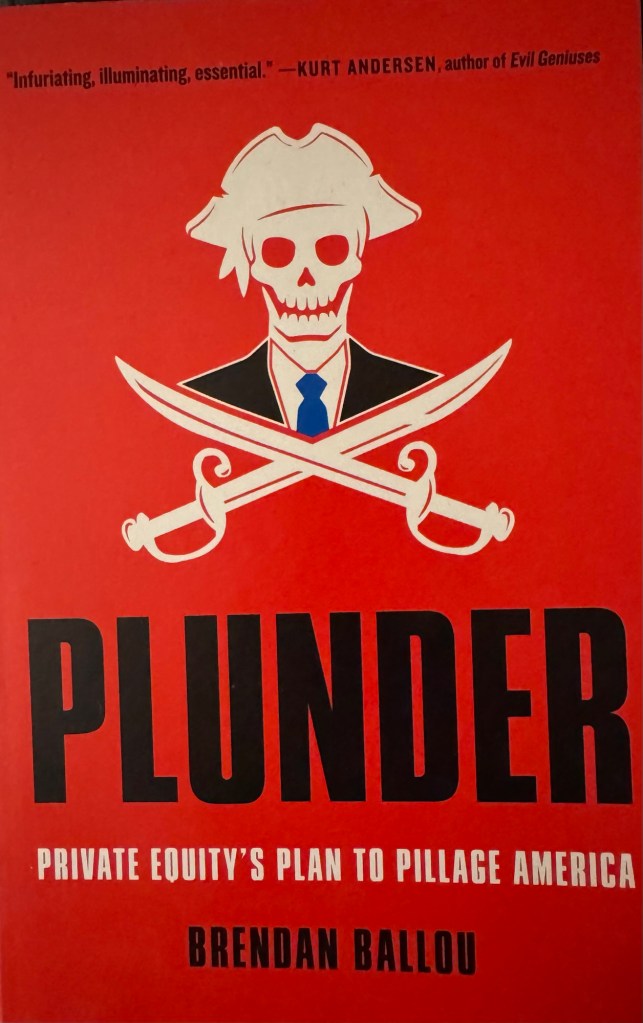
Brendan Ballou’s book Plunder: Private Equity’s Plan to Pillage America (2023) provides a stark examination of this dynamic. Ballou, a former federal prosecutor and special counsel for private equity at the Justice Department, details how firms acquire businesses—often retailers, medical practices, nursing homes, or other essential services—using minimal equity while saddling them with debt. Profits are extracted through fee structures, cost-cutting (including job reductions), price hikes, and quality reductions, shifting resources from productive enterprise to financial engineering. The result: higher costs for consumers, lost jobs, and weakened companies. Reviews describe the book as “infuriating” and “essential,” highlighting how private equity has reshaped the economy by prioritizing extraction over long-term value creation.

A parallel Ohio example illustrates how regulatory pressure can wound companies, creating openings for corruption and plunder. FirstEnergy, facing challenges from Obama-era policies promoting renewables over traditional nuclear and coal, sought bailouts amid financial strain. This culminated in the House Bill 6 scandal—the largest corruption case in Ohio history—involving $60 million in bribes funneled through dark money groups to secure legislation subsidizing failing nuclear plants. FirstEnergy admitted involvement, paying $230 million in penalties, while executives and politicians faced charges. The scandal exposed how wounded utilities, pressured by federal regulations, turned to political influence rather than market adaptation—ultimately harming ratepayers and eroding trust.

Private equity’s role in housing offers another cautionary tale. Firms like Blackstone (often confused with BlackRock) pioneered large-scale single-family home purchases post-2008 crisis, converting them to rentals. While institutional ownership remains a small fraction nationally, concentrated in certain markets, it has driven up prices and rents in hotspots by outbidding families with cash offers and low borrowing costs. Tenants face added fees, and communities lose owner-occupied stability. This mirrors the “plunder” pattern: acquire undervalued or distressed assets, extract value, and leave diminished foundations.

These examples underscore a systemic issue: without regulatory constraints, financial institutions can act as activists against disfavored sectors or politics. Large international banks, with global priorities over domestic patriotism, pose particular risks. They fund diverse causes, yet behind the scenes may undercut supply chains supporting certain administrations—eroding American infrastructure indirectly. Fiduciary responsibility demands impartiality, but temptations arise when no guardrails exist. Ethics alone fails; self-discipline yields to pettiness or ideology.

Ohio can lead by enacting legislation to protect businesses. Proposals could include:

•  Mandating civil, non-destructive terminations of financial relationships, with notice periods and transition assistance.

•  Prohibiting impairment tactics driven by political or ideological motives, with penalties for violations.

•  Strengthening fiduciary standards to prevent malicious wounding.

•  Requiring transparency in debanking decisions, allowing appeals or independent reviews.

Such measures would encourage local and regional banks—more rooted in community values—over distant giants. Entrepreneurs deserve protection to innovate without fear of becoming roadkill for ideological or opportunistic predators.

The stakes are high. A thriving economy relies on confident investment and job creation. When private equity controls trillions, often through plunder rather than creation, and banks enable impairment without consequence, the foundation weakens. Ohio, with its manufacturing and defense ties, must act to install guardrails before irreversible damage. Reading Plunder and examining cases like FirstEnergy provides the intellectual foundation; legislative action provides the solution.

Bibliography

•  Ballou, Brendan. Plunder: Private Equity’s Plan to Pillage America. PublicAffairs, 2023.

•  Morgenson, Gretchen, and Joshua Rosner. These Are the Plunderers: How Private Equity Runs—and Wrecks—America. Simon & Schuster, 2023.

•  McKinsey & Company. “Global Private Markets Report 2026.” McKinsey, 2026.

•  Preqin and iCapital. “Alternatives Decoded,” with data to February 2026.

•  U.S. Department of Justice and Securities and Exchange Commission filings on FirstEnergy/Ohio nuclear bribery scandal (various, 2020–2025).

•  Ohio Public Utilities Commission decisions on FirstEnergy penalties (2025).

•  Various reports on debanking, including executive orders and congressional investigations (2025–2026).

•  PitchBook and KPMG analyses of private equity trends (2025–2026).

Footnotes

¹ Ballou, Plunder, on leveraged buyout bankruptcy rates.

² McKinsey Global Private Markets Report 2026, deal value statistics.

³ Preqin/iCapital data on private equity AUM growth to $7 trillion by end-2025.

⁴ Wikipedia and AP News summaries of Ohio nuclear bribery scandal involving FirstEnergy and HB 6.

⁵ Reports on institutional single-family rental ownership (e.g., Blackstone/Invitation Homes strategies).

Rich Hoffman

More about me

Click Here to Protect Yourself with Second Call Defense https://www.secondcalldefense.org/?affiliate=20707

Why Executive Leadership is the Key to a Successful Society: And why it is so incredibly rare

True executive leadership is not something taught in classrooms through textbooks or lectures on management theory. It is forged in the crucible of real-world challenges, where fear, uncertainty, and the need for decisive action collide. I learned this early, during an unusually formative childhood that exposed me to high-stakes environments far beyond typical teenage experiences. As a young teen, I participated in the High Adventure Explorer Post, a program that graduated from Boy Scouts and emphasized rigorous outdoor challenges. This led to my involvement in Project COPE—Challenging Outdoor Personal Experience—a Scouting initiative designed to build confidence, trust, leadership, and teamwork through group games, trust falls, low-course elements, and high-course obstacles such as climbing walls, rope swings, and balance challenges.

In one memorable weekend seminar, around age 13 or 14, about 20 strangers were thrown together to solve impossible-seeming problems. We had to transport everyone across a field using only a few 2×4 boards, balancing on pegs where touching the ground meant starting over. We climbed a 20-foot wall without ropes, stacking bodies to create human ladders, pivoting people into position, and hauling others up from vantage points. The trust fall was particularly vivid: standing on a 6-foot stump, falling backward unthinkingly, relying on the group below to catch you. These weren’t games; they demanded communication under pressure, overcoming personal fears, setting aside differences, and articulating a clear plan that everyone could execute. Success required a narrative—a story that unified the group around a shared vision. Failures taught the team what not to do: hesitation, poor coordination, and ego-driven decisions doomed the team. Those who emerged as natural leaders could rally perfect strangers, build trust quickly, and guide them through duress to victory.

This experience wasn’t isolated. I rose to become vice president of the Dan Beard Council, a significant Boy Scouts organization in the Cincinnati area, under somewhat controversial circumstances that provided invaluable lessons in organizational dynamics and influence. At 14, I was invited to speak at GE’s Evendale facility—a massive engine manufacturing site—where I delivered a pitch on leadership drawn from these adventures. Standing before seasoned professionals as a kid, articulating principles of vision, trust, and collective action, cemented my path. It wasn’t credentials that carried the day; it was the ability to communicate a compelling story and inspire follow-through.

These early trials shaped my understanding of executive leadership, a skill rare even among those who hold C-suite titles. Many executives excel at spreadsheets, regulations, data analysis, and compliance—tasks that engineers and administrators handle well. But leadership transcends that. It is the art of creating a vision that others buy into, communicating it clearly enough that diverse groups align, and leading from the front to pull everyone through obstacles they couldn’t surmount alone. True leaders don’t micromanage every detail; they don’t need to know how to code the software, assemble the product, or balance every ledger line. They orchestrate the team, provide the overarching narrative, and empower others to execute. Think of a kitchen: the chef doesn’t wash dishes or make noodles from scratch, but ensures the entire operation runs smoothly so spaghetti arrives hot and customers return. Leadership is that orchestration under fire.

This truth stands in stark contrast to prevailing misconceptions. Schools rarely teach it properly; corporate retreats often superficially mimic it with trust falls and ropes courses, checking boxes without the depth of real hardship. Many in leadership positions mimic “mob rule”—placating safety concerns, enforcing endless administrative loops, or prioritizing equality over merit. They hide behind regulations, consensus-building, and democratic processes that dilute accountability. The result? Stagnation. When organizations are mired in bureaucracy, innovation slows, and potential leaders get sidelined.

Consider recent local examples in West Chester Township, Butler County, Ohio, where I’ve lived most of my 58 years. It’s a prosperous, conservative community built on business-friendly policies and strong leadership. Yet newcomers like Amanda Ortiz, who relocated here in 2016 with her husband and now serves as a trustee (elected in 2025), bring perspectives shaped by different environments. As a veterinarian focused on animal welfare, she campaigns on “people over business,” critiquing development and emphasizing resident input over economic growth. While well-intentioned, this risks importing anti-business sentiments—such as higher taxes on enterprises and wealth-redistribution rhetoric—that clash with what has made the area thrive. It’s the same mindset seen in broader progressive movements: viewing successful CEOs as “greedy” and advocating for shared wealth without acknowledging the rare skill of value creation.

This echoes larger ideological battles. Socialism and communism promise equality through state control or democratic redistribution, suppressing individual leadership. They assume administrators can orchestrate prosperity through rules alone, without the visionary drive of a single, accountable leader. History shows otherwise: state-run economies falter because they penalize autonomy, stifle innovation, and equalize performance at mediocrity. No one climbs the wall if everyone’s voice is equal and no one leads decisively. Remote work trends exacerbate this—employees scattered, communication fractured, approval loops endless. You can’t build trust or rally a team when half are at home; the COPE lessons prove that interaction under pressure forges bonds that Zoom can’t.

Contrast that with proven leaders like Jack Welch at GE (who transformed it into a powerhouse through bold vision), Steve Jobs (who articulated Apple’s future and pulled teams to it), or Elon Musk (who leads from the front on audacious goals). They don’t consult committees for every decision; they communicate big concepts, inspire buy-in, and drive execution. Donald Trump exemplifies this politically—articulating massive ideas that mobilize millions without micromanaging details. He leads the metaphorical train, helping people over walls they couldn’t scale alone.

America’s success—its unmatched GDP, entrepreneurial spirit, and job creation—stems from empowering such leaders. Capitalism rewards those who develop the rare skill of pulling others forward through narrative, trust, and action. Boy Scouts programs like COPE and Explorer Posts cultivate this through sweat, cold nights, cut fingers, and mud—trials that separate natural leaders from followers. Most participants become capable followers, which is fine; society needs both. But the few who rise, who can get strangers over obstacles and keep harmony afterward, become CEOs, founders, and visionaries who employ millions.

The fantasy that mobs or committees can replace this ignores reality. Numbers don’t vote on facts; gravity doesn’t bend to consensus. Leadership isn’t democratic—it’s directional. Empower leaders with autonomy, and organizations soar. Suppress them with equality mandates or administrative burdens, and decline follows. This is why communist models fail: they suppress leadership, fearing individual excellence threatens the collective illusion.

In my book, The Gunfighter’s Guide to Business: A Skeleton Key to Western Civilization, I explore these themes deeply—strategy drawn from hardship, the primacy of vision over bureaucracy, and how true leadership saves companies, communities, and civilizations. It’s not theory; it’s lessons from the school of hard knocks, much like those COPE weekends or speaking at GE as a teen.

We need more such leaders, not fewer. Penalizing success through spiteful policies—resenting wealth creators, demanding redistribution—creates injustice and stagnation. Gratitude for effective leaders, who lift everyone, builds prosperity. Civilization learns this slowly, but the path is clear: identify, empower, and follow those who can get us over the wall. Without them, we stay grounded.

Bibliography and Footnotes

1.  Scouting.org, “Program Feature: COPE,” detailing Challenging Outdoor Personal Experience as group initiatives, trust events, and high/low challenges for leadership and teamwork.¹

2.  Wikipedia, “COPE (Boy Scouts of America),” overview of the program focusing on strength, agility, and personal growth through outdoor tests.²

3.  Grand Canyon Council BSA, “COPE,” emphasizing confidence, self-esteem, trust, and leadership via mental/physical challenges.³

4.  West Chester Township official site, “Board of Trustees,” bio of Amanda Ortiz, resident since 2016, veterinarian, elected trustee term 2026–2029.⁴

5.  Amanda Ortiz for Trustee campaign site, platform stressing “people over business” and resident-focused leadership.⁵

6.  Journal-News, “Longtime West Chester Twp. trustee unseated in election,” Nov. 6, 2025, coverage of Ortiz’s 2025 win unseating incumbent.⁶

7.  Rich Hoffman, The Gunfighter’s Guide to Business: A Skeleton Key to Western Civilization (Liberty Hill Publishing, 2021), core text on strategy, leadership, and capitalism.⁷

8.  Overmanwarrior.wordpress.com, author bio and book commentary, linking personal experiences to leadership philosophy.⁸

9.  Various Scouting resources on high-adventure programs, including Explorer Posts and leadership training via challenges.⁹

¹ https://troopleader.scouting.org/program-features/cope

² https://en.wikipedia.org/wiki/COPE_(Boy_Scouts_of_America)

³ https://support.scoutingaz.org/main/cope

⁴ https://www.westchesteroh.org/government/general-government/west-chester-board-of-trustees

⁵ https://www.amandaortizfortrustee.com/

⁶ https://www.journal-news.com/news/longtime-west-chester-twp-trustee-unseated-in-election/CD2ADHRUKVC2JOIQSCMINM3MWE

⁷ Liberty Hill Publishing / Amazon listings for the book.

⁸ https://overmanwarrior.wordpress.com/author-bio-for-rich-hoffman

⁹ Multiple Scouting America sites on COPE and high-adventure bases.

Additional references include historical accounts of Boy Scout leadership development, economic analyses contrasting capitalism and socialism (e.g., works on Jack Welch and Steve Jobs biographies), and local Ohio political coverage.

Rich Hoffman

More about me

Click Here to Protect Yourself with Second Call Defense https://www.secondcalldefense.org/?affiliate=20707

The Anti-Business Amanda Ortiz: A socialist experiment people will quickly regret

The recent election in West Chester Township, Ohio, marked a significant shift in local governance when political newcomer Amanda Ortiz unseated longtime incumbent Trustee Mark Welch in the November 4, 2025, general election. West Chester Township, located in Butler County and known for its strong economic growth, low tax burden, and high quality of life, has long been a model of conservative-leaning, business-friendly administration in a largely Republican-leaning area. The township’s success stems from a deliberate balance between residential appeal and commercial/industrial development, which generates substantial tax revenue to fund services without heavy reliance on property taxes from homeowners. This model has positioned West Chester as one of the most desirable places to live in the United States, attracting families and businesses alike.

The 2025 trustee race involved four candidates vying for two at-large seats on what they call a nonpartisan Board of Trustees, but there is no such thing. Incumbent Lee Wong retained his position with 26.1% of the vote, while Amanda Ortiz emerged as the top vote-getter at 27.1%. Mark Welch, who had served for 12 years and was widely credited with contributing to the township’s prosperity through pro-growth policies, finished third with 24.3%. Alyssa Louagie received 22.5%. Ortiz’s victory was narrow but decisive, reflecting voter turnout and a desire among some residents for fresh perspectives focused on “resident-first” priorities.

Amanda Ortiz, a veterinarian, has lived in West Chester since 2016, not very long, with her husband, Matt, and their two young daughters. She holds a Doctor of Veterinary Medicine from The Ohio State University (earned in 2010) and has worked in private practice and at a local cat shelter, focusing on animal welfare, rehabilitation, and placement for abused or neglected animals. Her campaign emphasized shifting township decisions away from developer priorities toward residents’ needs, including better roads, safer intersections, more walkable communities, improved parks, bike lanes, sidewalks, and collaboration with local schools. Her platform slogan, “People over Business,” highlighted concerns about overdevelopment and the impact of rapid commercial growth on quality of life.

Ortiz campaigned as a community-oriented candidate and mother, stressing resident-focused governance. She received support from groups such as Matriots Ohio, an organization that promotes women in local politics. While the trustee race is officially non-partisan under Ohio law for township positions, questions arose post-election about her political leanings. Some residents and observers noted endorsements or alignments that suggested Democrat sympathies, though her campaign materials did not prominently feature party affiliation. Her website and social media focused on practical, family-centric issues such as pedestrian safety and parks, rather than overtly partisan rhetoric. Critics, including some who felt misled, pointed to her as embodying a “concerned mom” archetype common in suburban Democrat circles—prioritizing protective measures for children, such as traffic calming, bike paths, and limits on aggressive development that might increase truck traffic or visual impacts near homes.

Mark Welch, by contrast, represented continuity with the township’s established pro-business approach. During his tenure, West Chester maintained a healthy mix of residential and commercial properties, with industrial and warehouse developments along corridors like State Route 747 contributing significant tax revenue. These developments help keep residential property taxes low, fund schools and services, and allow the township to operate in the black without excessive burdens on homeowners. Welch and similar trustees have supported strategic growth that attracts jobs and revenue while preserving the residential character that draws families to the area.

This highlights a common tension in growing suburbs: rapid commercial expansion, particularly warehouses and logistics facilities near major roads like I-75 and SR 747, can bring economic benefits but also drawbacks. Residents on the western side of the township, or near these corridors, have expressed dissatisfaction with the volume of such developments, citing increased traffic, noise, and landscape changes. Some developments in the area predate Ortiz’s election and involvement, but her campaign rhetoric about prioritizing residents over developers resonated with those wary of unchecked growth. Post-election, discussions have included concerns that her third vote on the board could tilt decisions toward more restrictive policies on commercial projects, potentially disrupting the revenue balance that has kept taxes low.

This dynamic reflects broader patterns in American suburbs. Many high-growth areas in Ohio and elsewhere attract newcomers fleeing high-tax, heavily regulated blue states or cities, seeking lower taxes, safer streets, and better schools. Yet once settled, some voters support candidates who advocate for “quality of life” measures—slower growth, stricter development regulations, and enhanced safety features like bike lanes and stop signs—that can inadvertently strain the economic engine sustaining low taxes. Democrats or left-leaning independents often emphasize resident protections, environmental concerns, and family safety, sometimes at the expense of pro-business policies. In conservative-leaning townships like West Chester, non-partisan races can obscure these differences until after the vote, leading to feelings of deception when post-election actions or affiliations emerge.

The “protective mother” instinct is a real phenomenon, rooted in biology and amplified by modern parenting culture. Mothers of young children often prioritize risk aversion—slowing traffic, adding buffers near roads, enforcing helmet laws, or limiting perceived hazards—which can translate into policy preferences for greater government intervention in everyday life. While sympathetic in personal contexts, these instincts in elected office can lead to overregulation that stifles growth or unfairly shifts costs. In West Chester’s case, the township’s success relies on commercial tax contributions offsetting residential demands. If policies tilt too far toward restricting warehouses and industrial sites in favor of purely residential zoning, revenue could decline, leading to higher property taxes or service cuts—precisely what many residents moved to Butler County to escape.

Economic literacy plays a key role here. Conservative trustees like Welch understand that a balanced tax base—residential charm paired with commercial vitality—is essential to fiscal health. Democrats or progressive-leaning officials sometimes focus on spending priorities (schools, parks, social services) without grasping how revenue is generated. Ohio’s ongoing property tax debates, school funding challenges, and shifting revenue streams make this balance even more critical.

Ortiz was sworn in on January 13, 2026, alongside returning Trustee Lee Wong, with Butler County Common Pleas Court Judge Erik Niehaus administering the oath. Her term runs through December 31, 2029. Early actions include participation in township initiatives, such as updates to development moratoriums along corridors like Cincinnati-Dayton Road and SR 747, to support planning studies. These steps suggest ongoing attention to growth management, which could align with her campaign promises but test the board’s commitment to economic balance.

The election outcome serves as a cautionary tale about voter complacency in non-partisan races. Longtime incumbents like Welch can be taken for granted, especially after years of success. Voters seeking “something new” may overlook underlying differences until policies shift. In West Chester, a community that has thrived under pro-growth leadership, the addition of a trustee who prioritizes resident protections over business expansion could lead to noticeable changes—higher scrutiny of developments, greater emphasis on walkability and safety, or resistance to certain commercial projects. If these alter the tax base or growth trajectory, residents may face the hard lessons of ideological shifts in local government.

West Chester’s story is not unique; similar dynamics play out in suburbs nationwide, where prosperity breeds experimentation with new ideas, sometimes at the risk of eroding what made the place attractive. The coming years will reveal whether Ortiz’s approach enhances or undermines the township’s model. For those who supported continuity, it underscores the importance of vetting candidates beyond surface appeal. For others, it represents a chance to test resident-focused governance in a high-performing community.

Ultimately, local elections matter profoundly because they directly shape daily life—taxes, services, development, and community character. West Chester’s trajectory under its new board will offer valuable insights into balancing growth, resident concerns, and fiscal responsibility in modern America.  And I would bet that people will regret voting for this liberal experiment quickly.

Bibliography and Further Reading

•  Journal-News article: “Longtime West Chester Twp. trustee unseated in election” (November 6, 2025) – Primary source on election results and candidate statements.

•  West Chester Township official website: Board of Trustees page and news releases (e.g., swearing-in on January 13, 2026).

•  Amanda Ortiz campaign website: amandaortizfortrustee.com – Platform details and priorities.

•  Ballotpedia: Entries for Amanda Ortiz and Mark Welch (2025 candidate profiles).

•  Butler County Board of Elections: Official 2025 general election results.

•  Additional context on Ohio township governance and non-partisan races from Ohio.gov election resources.

Rich Hoffman

More about me

Click Here to Protect Yourself with Second Call Defense https://www.secondcalldefense.org/?affiliate=20707

Property Taxes are on the Chopping Block in Ohio: We warned these public schools, and now the time is here

The push to eliminate property taxes represents one of the most significant challenges to longstanding fiscal structures in the United States, particularly in states like Ohio, where a citizen-led movement has gained substantial momentum. This effort is not merely a local grievance but part of a broader national conversation about taxation, homeownership, government dependence, and economic freedom. In Ohio, a proposed initiated constitutional amendment known as the Ohio Eliminate and Prohibit Taxes on Real Property Initiative has been cleared for signature gathering and targets the November 3, 2026, ballot. If successful, it would permanently prohibit taxes on real property, defined to include land, growing crops, and permanently attached buildings (though public utilities might still face some taxation under specific interpretations).

To qualify, proponents need 413,488 valid signatures (10% of votes cast in the preceding gubernatorial election), with signatures required from at least 5% of voters in 44 of Ohio’s 88 counties. Groups such as the Committee to Abolish Ohio Property Taxes and Citizens for Property Tax Reform have been actively collecting signatures, with reports indicating progress well in excess of 100,000 signatures as of late 2025 and early 2026, alongside widespread deployment of petitioners. The movement is explicitly citizen-driven, emerging from frustration with rising tax burdens rather than legislative initiative. Legislative allies and local officials express sympathy for taxpayer concerns but highlight the practical difficulties of abruptly replacing the revenue stream.

Property taxes in Ohio fund a substantial portion of local government operations, with estimates indicating they account for roughly 65% of regional revenue. For public schools, which receive over three-fifths of real property tax collections (approximately $13.6 billion for tax year 2024, payable in 2025), this is the largest single funding source—surpassing state aid and supporting the education of nearly 1.5 million students. Counties, townships, libraries, parks, fire districts, and other special districts also rely heavily on these funds for services ranging from emergency response and road maintenance to mental health, addiction treatment, developmental disabilities support, elderly services, and children’s protective services. In many townships, property taxes are the primary revenue source because they lack the authority to levy income or sales taxes.

Opponents of abolition, including local officials, school districts, and organizations like the Ohio Municipal League, warn that elimination would be “disastrous,” potentially forcing sharp increases in sales taxes (possibly to 18-20% in some areas) or income taxes (doubling or tripling rates) to fill the gap. Schools could face severe disruptions, including cuts to programs, staff, or facilities, amid already escalating costs from collective bargaining agreements and professional salaries. Now, where was all this concern when DeWine shut down schools for Covid protocols?  Talk about disruptions, how would any of this be different regarding a disruptive culture?  Recent legislative reforms—such as bills signed by Governor Mike DeWine in late 2025 that limit inflation-linked increases, expand homestead exemptions, and provide rollbacks—aim to provide relief without complete abolition, capping certain levies, and redirecting funds to homeowners. These measures offer partial mitigation but have been dismissed by advocates as insufficient, fueling continued signature drives.

This Ohio initiative aligns with similar debates in other states, where post-World War II rising home values have increased tax bills, eroding a sense of ownership. In North Dakota, proposals leverage oil revenues to phase out homeowner property taxes over a decade. Florida’s Governor Ron DeSantis has advocated phasing out non-school property taxes on homesteads, with multiple joint resolutions under consideration for gradual exemptions. Texas seeks to eliminate school-related property taxes, while Georgia, Indiana, Wyoming, and others are exploring offsets through sales tax expansions or state funds. These efforts reflect taxpayer discontent with “rent to the government” models, where perpetual payments undermine actual private ownership.

Historically, property taxes trace back to early American systems, evolving from feudal obligations and colonial practices. In Ohio, taxation of land began under territorial rule in the 1790s, with classifications by fertility until 1825, when an ad valorem system emerged. The 1851 Ohio Constitution mandated uniform taxation of real and personal property (with limited exemptions), and significant reforms followed, including the 1930s caps on unvoted levies (1% of actual value) and the shift away from state-level property taxes by 1932. The modern system solidified as local governments increasingly relied on property taxes for schools and services, especially after state income taxes (introduced in 1971) and other revenues reduced direct state dependence.

Critics frame property taxes as a “socialist enterprise,” enabling expansive government growth by treating property as a shared resource rather than a private asset. People like me argue that painless extraction—via escrow in mortgages or withholding—masks the burden, allowing unchecked expansion of services, union-driven salaries, and inefficiencies. High taxes, combined with stagnant or declining home values in some areas, risk forcing sales to corporate buyers such as private equity firms, thereby eroding individual wealth and control. This echoes broader concerns about progressive taxation funding “Great Society” programs, where expectations for government services outpace sustainable revenue.

Proponents of abolition envision a shift toward true market capitalism: lower utility costs, energy exports, improved deportation efficiency, and economic expansion that generates revenue through productivity and voluntary mechanisms such as sales taxes. Education could shift to competitive models—private, charter, homeschooling, or online—where families direct funds to preferred providers rather than relying on zip-code monopolies. This aligns with calls for accountability, in which services compete for “business” and excessive spending (e.g., inflated administrative costs or underperforming outcomes) is subject to market discipline.

Yet the transition poses risks. Abrupt revenue loss could destabilize essential services, exacerbate inequalities if alternatives favor the wealthy, or lead to regressive shifts toward consumption taxes. Historical precedents, such as the New Deal era’s expansion of government through property-based funding, suggest that entrenched interests resist change. Even sympathetic legislators face constraints from revenue dependencies and collective bargaining.

Ultimately, this debate transcends Ohio, reflecting a national reckoning with post-war fiscal models. Rising awareness that home ownership should confer security—not perpetual rent—fuels momentum. Whether through the 2026 ballot success or gradual reforms in the coming years (2027-2028), property taxes face severe scrutiny. The gravy train of unchecked expansion may indeed conclude, pushing society toward enterprise-driven wealth creation and limited government. Failure to adapt risks further alienation, while thoughtful restructuring could foster genuine prosperity.  I warned public schools, especially, for many years that they had built their entire foundation on this socialist property tax model, where government grows on the back of property ownership and, as an irresponsible action, grows too big.  In our family, all my grandchildren are being homeschooled because the product of public education is garbage.  And as it was for my own children when they were in school, I had to do most of the work of teaching anyway.  They traditionally attended public school for about two-thirds of their school days, and I had to unteach them all the material they learned in school.  So this day was long coming, and now, it’s here.  And people are seeing what they got for all that money that was wasted, and they don’t like it.

Bibliography for Further Reading

•  Ballotpedia: Ohio Eliminate and Prohibit Taxes on Real Property Initiative (2026). https://ballotpedia.org/Ohio_Eliminate_and_Prohibit_Taxes_on_Real_Property_Initiative_(2026)

•  Ohio Attorney General: Petitions Submitted, including Abolishment of Taxes on Real Property. https://www.ohioattorneygeneral.gov/Legal/Ballot-Initiatives

•  Policy Matters Ohio: “Ohio property tax repeal would gut school budgets & critical services.” https://policymattersohio.org/research/ohio-property-tax-repeal-would-gut-school-budgets-critical-services

•  Tax Foundation: “Property Tax Relief & Reform in 2025.” https://taxfoundation.org/research/state-tax/property-tax-relief

•  Ohio Department of Education: Overview of School Funding. https://education.ohio.gov/Topics/Finance-and-Funding/Overview-of-School-Funding

•  EH.net: “History of Property Taxes in the United States.” https://eh.net/encyclopedia/history-of-property-taxes-in-the-united-states

•  Ohio Capital Journal and Cleveland.com articles on 2025-2026 property tax reforms and initiatives.

Footnotes

¹ Ballotpedia, 2026 Ohio Initiative details.

² Policy Matters Ohio, funding allocation estimates.

³ Ohio Legislative Service Commission fiscal notes on recent bills.

⁴ Tax Foundation reports on multi-state proposals.

⁵ Historical timeline from the Ohio Department of Taxation documents.

⁶ General critiques drawn from economic analyses of property tax structures and alternatives.

Rich Hoffman

Click Here to Protect Yourself with Second Call Defense https://www.secondcalldefense.org/?affiliate=20707

Restoring Trust in American Elections: The Case for Reform in Light of Persistent 2020 Questions and the Path Forward

For millions of Americans, the 2020 presidential election left an indelible mark—not just because of its outcome, but because of the questions that have lingered ever since. Joe Biden received over 81 million votes, a record at the time, yet four years later, Kamala Harris garnered roughly 75 million in a similar political landscape with population growth and comparable partisan divides. This drop of more than 6 million votes, combined with Donald Trump’s increase from 74 million to around 77 million, has fueled widespread skepticism. Many see it not as natural voter shifts, but as evidence that 2020’s totals were artificially inflated through lax rules, mail-in ballot chaos, and vulnerabilities in electronic systems—especially under the cover of COVID-19 policies that expanded unmonitored voting.

These concerns are not fringe theories whispered in corners; they have driven national policy debates, legal actions, and now federal interventions. In late January 2026, FBI agents executed a search warrant at Fulton County’s election facility in Georgia, seizing hundreds of boxes containing 2020 ballots, tabulator tapes, electronic images, and voter rolls.<sup>1</sup> Fulton County, the epicenter of Georgia’s 11,779-vote margin favoring Biden, has long been a focal point for allegations of irregularities—misinterpreted surveillance video at State Farm Arena, disputed absentee ballot handling, and chain-of-custody questions. County officials promptly challenged the seizure in federal court, seeking the return of the materials and the unsealing of the warrant affidavit, arguing that it constituted overreach.<sup>2</sup> Yet for those convinced of fraud, this move signals accountability finally arriving under a Trump-led Justice Department.

We’ll examine these claims in the context of historical developments, empirical comparisons, and current developments. I would argue that, while courts and audits in 2020 found no widespread fraud sufficient to overturn the results, the system’s vulnerabilities—loose voter eligibility verification, the absence of universal ID requirements in key states, and reliance on potentially manipulable technology—created opportunities for abuse. And the authorities didn’t find fraud because they either didn’t want to look, or they deliberately looked in the wrong place to hide their complicity in the radicalism that did not want to honor voters in a self-governing government. Genuine self-governance requires secure elections in which every vote is verifiable, and every citizen’s voice counts equally. Reforms such as the Safeguard American Voters Eligibility (SAVE) Act offer a practical path forward, ensuring that only eligible citizens participate without disenfranchising legitimate voters.

A Brief History of Voting Technology and Fraud Concerns

America’s voting systems have always balanced innovation with risk. Paper ballots gave way to mechanical lever machines in the late 1800s to reduce intimidation and speed counting. Optical scanners emerged in the 1960s, followed by direct-recording electronic (DRE) machines in the 1990s. The 2000 Florida recount debacle led to the Help America Vote Act (HAVA) of 2002, which pushed states toward more modern systems but also highlighted persistent issues: punch-card errors, hanging chads, and questions about machine accuracy.

By 2020, many jurisdictions used touchscreen DREs or ballot-marking devices with paper trails, while others relied on hand-marked paper ballots scanned optically. Critics point to shared origins with machines used in countries such as Venezuela and to concerns about the security of Dominion and ES&S systems. High-profile lawsuits against companies making fraud claims (e.g., Mike Lindell’s defamation losses) have chilled some discussion, but audits consistently show machines perform accurately when properly maintained and paper records are available for verification.<sup>3</sup>  The evidence is there in most cases with the paper backup to match the vote count.  However, this manual check often doesn’t occur, creating opportunities for discrepancies to affect results.

Fraud itself has historically been rare. The Heritage Foundation has tracked and documented cases since 1982, totaling approximately 1,500, which is insignificant relative to the billions of votes.<sup>4</sup> Yet rarity does not equal impossibility, especially in high-stakes, loosely regulated environments. The 2020 expansion of mail-in voting, drop boxes, and relaxed signature-matching requirements—often justified as a pandemic necessity—amplified risks in states without strict safeguards.

Fulton County in Focus: From 2020 Allegations to 2026 Federal Action

Georgia’s narrow 2020 margin made Fulton County a lightning rod. Biden’s considerable urban advantage there offset rural Trump’s strength statewide. Allegations included “suitcase” ballots retrieved from beneath tables (later explained as standard procedure), water main breaks that delayed counting, and discrepancies in absentee ballot processing. Multiple recounts, including a hand audit, confirmed results, and courts rejected challenges.<sup>5</sup>

Fast-forward to 2026: The FBI’s seizure of roughly 700 boxes has reignited debate. Agents sought physical ballots, scanner tapes, digital images, and voter rolls from 2020.<sup>6</sup> Body camera footage shows tense interactions, with county staff expressing confusion over the warrant.<sup>7</sup> Fulton leaders, including Chair Robb Pitts, received warnings of potential arrests and filed for return of materials, citing state sovereignty and lack of transparency.<sup>8</sup>

Proponents view this as evidence that emerging issues—chain-of-custody breaches, unauthorized votes, or tampering — could surface. Critics call it political retribution, noting Trump’s repeated claims and the administration’s push to “nationalize” elections in Democratic areas.<sup>9</sup> Regardless, the action underscores why many demand reforms: if doubts persist after years of scrutiny, prevention through stricter rules is essential.

Vote Total Discrepancies: What the Numbers Really Tell Us

The stark contrast between 2020 and 2024 Democratic performance is central to skepticism. Biden’s 81.3 million votes dwarfed Obama’s 2012 total (65.9 million) and Harris’s ~75 million. In states with loose rules—no voter ID, universal mail ballots, minimal verification—Democrat margins often aligned with these patterns.

Turnout in 2020 hit 66.6%, driven by pandemic expansions and polarization. By 2024, fatigue, reduced mail voting, and demographic shifts (e.g., Harris underperforming among nonwhite voters) explain much of the decline.<sup>10</sup> Yet the gap—over 6 million fewer Democrat votes despite population growth—raises legitimate questions about 2020 inflation.

Comparisons with prior elections indicate that Democrats gained ~15 million votes from Obama to Biden, then lost most of them back to Harris. If electronic flipping, non-citizen voting, or dead voters on the rolls contributed even modestly, the numbers could align more closely with a natural ~55-60 million Democratic base in clean elections. States with strict ID and in-person emphasis showed more stable patterns.

The SAVE Act: A Common-Sense Safeguard

Introduced as H.R. 22 in the 119th Congress, the SAVE Act requires documentary proof of citizenship (passport, birth certificate, naturalization papers) for federal voter registration, ending reliance on sworn statements.<sup>11</sup> The House passed it in April 2025; it remains stalled in the Senate amid opposition from groups like the League of Women Voters and Brennan Center, who argue it could disenfranchise millions lacking easy access to documents.<sup>12</sup>

Supporters counter that non-citizen voting, though rare, occurs in lax systems and that proof requirements mirror those for passport or employment verification. Recent efforts urge Senate action before the 2026 midterm elections.<sup>13</sup> For Ohio—already requiring non-strict photo ID—the Act could complement existing rules without significant disruption, ensuring federal elections reflect citizens only.

Voter ID and Security: Protecting Access While Closing Loopholes

Thirty-six states require some voter ID; 23 mandate strict photo ID. Ohio’s non-strict system permits alternatives such as utility bills. Evidence indicates that ID laws deter negligible fraud but can slightly suppress turnout among low-income or minority voters.<sup>14</sup> Free IDs, expanded provisional ballots, and affidavits mitigate this.

States without strict ID requirements (e.g., California) have not documented widespread fraud, yet critics argue that loose rules enable abuse. A balanced approach—universal ID with accommodations—enhances security without barriers.

Electronic Systems, Audits, and Accountability

Machines face hacking fears, but paper trails and post-election audits (risk-limiting or full) verify accuracy. Cases such as Tina Peters’ ruthless conviction for unauthorized access highlight the risks of not having proper security in all elections with federal consequences.  To that point, all indications point to Arizona where Kari Lake should be the governor if election security had been properly utilized.<sup>15</sup> Robust audits, not bans, address concerns.

Conclusion: Toward a More Accountable Republic

The 2020 election exposed vulnerabilities that eroded trust. Courts dismissed widespread fraud claims, but anomalies and lax regulations raise doubts. The Fulton seizure may reveal more—or reaffirm prior findings—but prevention is preferable to reaction.

The SAVE Act, voter ID mandates, and improved audits offer solutions. Ohio legislators and federal counterparts can lead by prioritizing citizenship verification and transparency. Secure elections ensure the government reflects the people, not manipulation. Restoring faith requires action now—before doubts harden into division, which I would argue has already occurred.  Stealing elections by any means is a serious crime and we need to understand who has done what, and what impact that has had on a free republic for which the people rule over themselves.   And without secure elections, that just can’t happen.  And it must happen.  Which is why the SAVE Act is absolutely necessary.

Footnotes

1.  CBS News, “Body camera footage captures confusion as FBI agents seize election records in Fulton County,” 2026.

2.  PBS News, “Fulton County asks court to return 2020 election documents seized by the FBI,” Feb. 2026.

3.  Various court rulings and audits (e.g., Georgia hand recount).

4.  Heritage Foundation Election Fraud Database.

5.  Georgia Secretary of State audits and court dismissals.

6.  Reuters, “Georgia’s Fulton County challenges seizure of election records,” Feb. 2026.

7.  GPB News, “Footage released of FBI search and seizure,” Feb. 2026.

8.  The Guardian, “Fulton County leader says he was warned he faced arrest,” Feb. 2026.

9.  Brennan Center analysis, Feb. 2026.

10.  Election turnout data from U.S. Census and AP analyses.

11.  Congress.gov, H.R.22 – SAVE Act.

12.  League of Women Voters and Brennan Center statements.

13.  Rep. Bean press release, Feb. 2026.

14.  NCSL Voter ID overview.

15.  Heritage Foundation case summaries.

Bibliography for Further Reading

•  Congress.gov: H.R.22 – SAVE Act (119th Congress).

•  Brennan Center for Justice: Reports on voter ID and SAVE Act impacts.

•  Heritage Foundation: Election Fraud Database and related analyses.

•  CBS News, PBS News, The New York Times, Reuters: Coverage of the 2026 Fulton County FBI seizure.

•  Georgia Public Broadcasting and Atlanta Journal-Constitution: Local reporting on Fulton developments.

•  National Conference of State Legislatures: Voter ID laws by state.

•  U.S. Election Assistance Commission: Voting system guidelines and audits.

Rich Hoffman

Click Here to Protect Yourself with Second Call Defense https://www.secondcalldefense.org/?affiliate=20707