
UFO Over West Chester, Ohio: Needing to know what we need to know

Witness statements indicated, “I was driving the northbound lanes of I-75 before Thanksgiving—just the steady crawl of rush hour through West Chester—when a shape where no shape should be caught my eye. Not a streak, not a flare, not the lazy oval of a blimp dragging an ad across the horizon, but a blue-gray rectangle that looked like someone had taken the idea of a stadium banner and carved it into geometry: thin, wide, and impossibly still against the evening sky. The first reaction was mundane: a banner tow. You see them every summer drifting over ballparks, or on fair weekends when traffic is thick, and attention is cheap. But banners have parents—a plane, a line, a sound. This object had none. It hung there, maybe five miles out over the Tylersville exit, tilted at roughly forty-five degrees of elevation, its edges too crisp to be cloud and too steady to be balloon. Ten minutes passed in that ordinary twenty-mile-per-hour way West Chester makes you count time. Then it vanished, not like a fade into haze or a slip behind trees, but like a television cut to black.”¹ ²
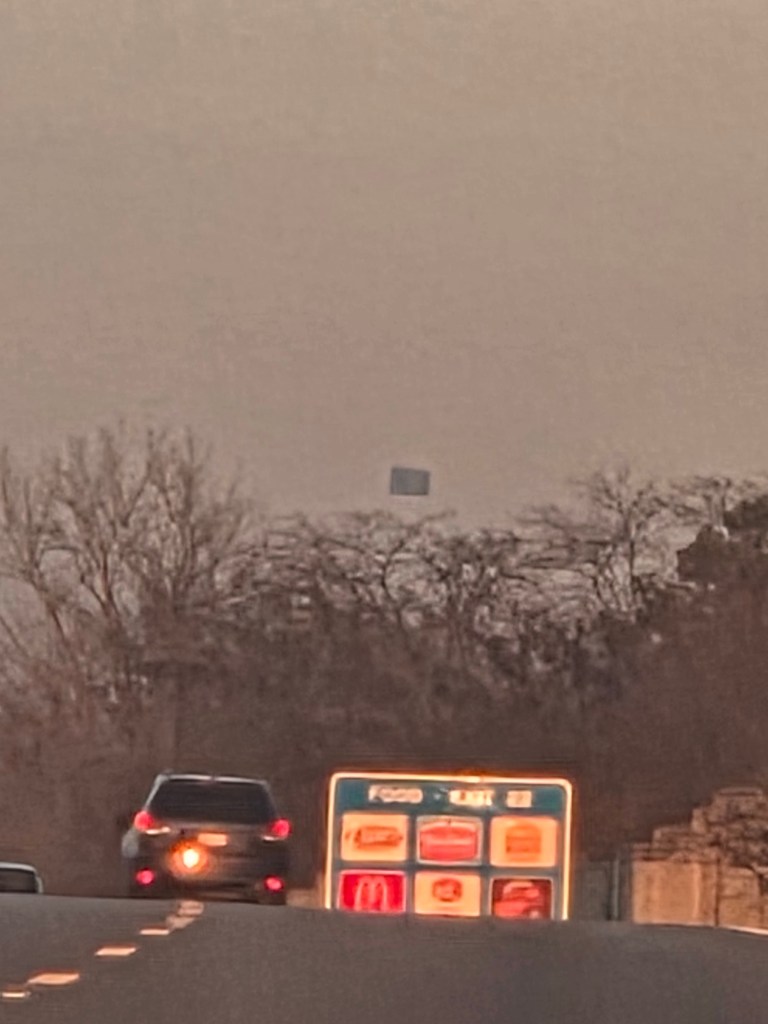
Dash cams make you honest in moments like that. One recorded the rectangle; a passenger kept describing it like a sign with no tether, and when the driver pulled up a tracking app, there was no aircraft to match the sightline or altitude. The account went into the National UFO Reporting Center—the place witnesses still go when something refuses easy categorization—as Report #194307, timestamped 5:02 PM local on November 22, 2025, with the witnesses noting “blue/gray,” “thinner than it was wide,” “not rising or descending,” and then the sudden “just vanished.” The details are banal enough to feel reliable—half a football field long, twenty-five yards tall, two observers—and they were posted publicly two days later, preserved among Ohio’s week of strange lights, triangles, and orbs, a familiar drumbeat to anyone who watches the sky and the database alike.³ ⁴

If you live between Cincinnati and Dayton, you learn two parallel languages for this kind of thing. One is the folklore of Wright-Patterson—the base up the road near Dayton, where Project Blue Book once lived. That’s the part of the Ohio myth that keeps a Blue Room and a Hangar 18 in the popular imagination, a Cold War apology of sorts, where pancakes analyzed as “terrestrial origin” and brake drums mistaken for meteors share archival space with seven hundred reports that stubbornly remain “unidentified.” The Air Force ended Blue Book in 1969, insisting they had found no threat and no proof of vehicles beyond current scientific knowledge, which is a bureaucratic way of saying: we saw a lot, we explained most, we couldn’t prove the rest. The legends survived anyway—Magruder’s alleged living alien, Goldwater denied access—and in every new sighting, the old echoes are never far.⁵ ⁶

The other language is more modern, even prosaic. Over the last few years, drone displays have taught us just how convincingly geometry can be painted onto the night. We’ve watched swarms draw logos and lattices, and we’ve seen how quickly human eyes—trained for jets and contrails—misread the choreography of coordinated LEDs. The Pentagon’s shift from “UFO” to “UAP” was meant to widen the frame and cool the fever, and some saner voices remind us that restricted airspace near bases and airports breeds both genuine hazards and exaggerated anxiety. In the more careful telling, many anomalies flatten into drones, balloons, or satellites—but not all of them, and the residue is where our curiosity lives.⁷ ⁸

So what do we do with a rectangle the size of half a football field, floating at a fixed altitude over one of Ohio’s densest corridors, unconnected to any tow, present for ten minutes, then gone? The instinct is to sort it into bins. First, the explainable: balloons can look rectangular when they present edge-on and when the light is low; banners misperceived from certain angles can hide their tow behind line‑of‑sight obstacles; even a drone swarm can, briefly, make you see a plane of light where none exists. NUFORC itself asks reporters to eliminate common misidentifications—such as Starlink trains, planetary brightness, and lens artifacts—before they submit, precisely because the database works best when the obvious is stripped away.³ ⁹ ¹⁰

Second, the engineered: a test article or a proof‑of‑concept flown where human attention is not just likely but guaranteed. There’s a plausible logic to public‑reaction tests—dense traffic, a holiday week, a shape that defies aerodynamics because lift, in a world of new propulsion methods, may no longer require wings, and then an exit, instant and clean, like a cloak or a switch. This is the territory where speculation about “anti-gravity” migrates from sci-fi to serious skepticism. Physicists will tell you—with justification—that gravity control would require overturning or bridging gaps in general relativity and quantum theory in ways that leave fingerprints in supply chains, training pipelines, and infrastructure long before you ever see a box in the sky. No such fingerprints exist in the open literature. But classified programs do not publish literature, and aerospace history is full of moments where rumors covered for stealth experiments—the F-117 era taught us that shadows can be policy.¹¹ ¹² ⁵ ²

Third, the truly anomalous: objects that violate expectations in ways that not only resist quick explanation but survive careful review. Congress has held hearings; videos have appeared of spheres surviving missile strikes; arguments rage between those who see proof of something nonhuman and those who see adversarial drones or doctored footage. In this climate, a rectangle over West Chester is a datapoint, not a revelation—proof only that ordinary observers can still capture experiences that are both specific and strange.¹³ ¹⁴

I keep returning to the witnesses’ matter-of-fact tone. They thought it was a banner. They looked for the plane. They checked a tracker. They watched ten minutes of banality turn into a cut‑to‑black. When you read enough reports, you learn to distrust melodrama and treasure the grocery‑list clarity: location, angle, size, color, duration, exit. And you notice patterns. The Middletown area has had its share—green lights, rotating clusters, sudden movements—sometimes later suspected as hoaxes, sometimes left open, but always recorded against the backdrop of a region that knows its sky is watched, both by enthusiasts and by institutions.¹⁵ ¹⁶ ⁴

West Chester isn’t a small place; nearly 67,000 people live there, more when you count commuters stacked north and south along the highway. Two reported this event publicly. You might read that as stigma or inattention or simply as the mathematics of surprise—most eyes look down in traffic, and most minds file anomalies under “not my problem.” I read it as exactly the reaction a test designer would want, if a test designer were the cause: enough witnesses to produce a credible record, not enough to produce a panic; a durable description; a fleeting presence. But I also read it as the kind of event that keeps the UAP conversation grounded in observation rather than theology. It happened; it was seen; it was logged; it remains unexplained.¹ ³ ¹⁷ ¹⁸

What I think—what I can responsibly think—is that the West Chester rectangle belongs in the small pile of structured, time-bound events with physical witnesses and minimal narrative inflation. It is not a banner because it lacked a tow; it is not a blimp because it lacked the telltale volume and motion; it is not a satellite or planet because it was near‑horizon, large, and dynamic; it might be a balloon if we can imagine a rectangular skin presenting edge‑on; it might be a projection if we can imagine sufficient power and stability in twilight air; it might be a test article if we can imagine the operational risk tolerance for flying a box over a suburban corridor. None of those conditionals settles into certainty. That’s the point.³ ⁹ ¹¹ ⁷

If you ask whether I think little green men took a leisurely hover over Butler County, I don’t. I think human curiosity and human capability—military, commercial, or hobbyist—explain most of what we see, and that the remainder is the frontier where we measure our assumptions. Project Blue Book concluded with the triad that has aged well: no threat proven, no extraordinary technology proven, no extraterrestrial vehicles proven. That’s not a denial; it’s an honest boundary. The rectangle over West Chester sits at that boundary, crisp against a November sky, now a record in a database, now a short local video, now a story told between rush‑hour brake lights, the kind of thing that keeps us looking up because for ten minutes—and then no minutes—it was there.⁶ ³ ⁵

And somewhere north on I-75, past the malls and office parks, a place that once housed America’s best cataloguers of aerial oddities bears the weight of our speculations. The myths around its hangars probably say more about us than about anything kept behind a badge line. But they remind us that Ohio has always been a stage for this theater: everyday people, skyward glances, reports written after kids are fed and dishes done, patience in the face of ambiguity. If the rectangle turns out, in five or ten years, to have been a test of optics or propulsion, we’ll nod and add a footnote. If it remains a rectangle without a parent, we’ll add a different footnote: seen, recorded, unexplained. That’s enough to warrant a paragraph in the ever-growing chronicle of UAP over America’s heartland, but not enough to satisfy the urges of curiosity and the need to know what we need to know.⁵ ⁶ ³

When you start connecting the dots across Butler County, the story becomes harder to dismiss. The West Chester sighting in November 2025 wasn’t an isolated anomaly—it echoes an almost identical event seven or eight years earlier over Monroe. That earlier case, often referred to as the “Middletown UFO,” even has video evidence circulating on YouTube. Two sightings, separated by years but sharing the same geometry and behavior, suggest a pattern rather than coincidence.

The Monroe incident carried an extra layer of irony for me. Just days before, I had recorded commentary criticizing the CIA, arguing that an unaccountable government agency posed a greater threat to society than any hypothetical alien landing at the old Lesourdsville Lake amusement park. Then, as if on cue, a highly defined UFO appeared in the sky over Monroe—right above the road, visible to anyone passing through. Was it occult synchronicity, a manifestation triggered by calling it out? Or was it a projection, seeded into the narrative to reinforce assumptions and steer public perception? Either explanation underscores a truth: the skies are not always what they seem, and the mechanisms behind what we witness may be far more psychological and technological than extraterrestrial.

In the case of West Chester, my view remains pragmatic. If you were an engineer testing cloaking or anti-gravity technology, you’d want real-world conditions—dense holiday traffic, a populated corridor, and proximity to a major Air Force base. You’d want to measure public reaction without announcing the test. And judging by the sparse reporting—two witnesses out of thousands—the experiment likely achieved its goal. That ratio is common in paranormal phenomena: many see, few speak. Stigma silences disclosure, and silence is the perfect cloak for those who prefer their work to remain invisible. In a society that should demand transparency, these events remind us how easily concealment thrives in plain sight.

—

Footnotes

1. NUFORC – West Chester Report #194307, details on date, shape, duration, and description (posted Nov. 24, 2025).

2. NUFORC – Ohio Index, showing the West Chester entry and contemporaneous Ohio reports on 11/22/2025. 1

3. NUFORC Databank (About/Indexes/Disclaimers) explains grading, common misidentifications, and posting practice. 2

4. YouTube: “UFO over West Chester, Ohio” (local upload summarizing the event and public interest). 3

5. HISTORY.com – “Does Hangar 18, Legendary Alien Warehouse, Exist?”, Wright‑Patterson lore, Roswell connections. 4

6. U.S. Air Force Fact Sheet – Project Blue Book (conclusions; 12,618 reports, 701 unidentified). 5

7. Scientific American – “The U.S. Drone Panic Mirrors UFO Overreactions,” context on drone/UAP misreads near restricted airspace. 6

8. Florida Today Op‑Ed – UAP video debate (sphere struck by Hellfire; interpretations vary). 7

9. NUFORC – “File a Report” guidance, checklist to avoid common misidentifications (Starlink, planets, lens artifacts). 8

10. NUFORC Homepage (Recent Highlights), public transparency, and investigation notes. 9

11. Freethink – “The search for anti-gravity propulsion,” survey of claims and physics constraints. 10

12. Flying Penguin analysis – “Gravitic Drones…”, skepticism about gravity‑control claims and the absence of supporting infrastructure. 11

13. USA Today – “UFO hearing video shows Hellfire missile fired at mysterious orb,” congressional UAP context. 12

14. Enigma Labs – Ohio sightings dashboard, trends, and regional density (Cincinnati/Dayton corridor). 13

15. WCPO – “Strange lights captured… appear to be a hoax” (Middletown, June 2023), local precedent and cautionary notes. 14

16. Knewz – “UFO in Ohio? Several Residents Report Seeing Strange Green Lights”, summary of the Middletown event and official reactions. 15

17. West Chester population profiles (CityPopulation/WorldPopulationReview), confirming township scale and density. 1617

18. UFO Index – Ohio (latest reports incl. Middletown references), shows regional cadence of events.

—

Bibliography

• National UFO Reporting Center (NUFORC). “Sighting Report #194307 – West Chester, OH.” https://nuforc.org/sighting/?id=194307; “Reports for State OH.” https://nuforc.org/subndx/?id=lOH; “Databank.” https://nuforc.org/databank/; “File a Report.” https://nuforc.org/report-a-ufo/

• HISTORY.com. “Does Hangar 18, Legendary Alien Warehouse, Exist?” (updated June 30, 2025). https://www.history.com/articles/hangar-18-ufos-aliens-wright-patterson

• U.S. Air Force. “Unidentified Flying Objects and Air Force Project Blue Book – Fact Sheet.” https://www.af.mil/About-Us/Fact-Sheets/Display/Article/104590/unidentified-flying-objects-and-air-force-project-blue-book/

• Scientific American. “The U.S. Drone Panic Mirrors UFO Overreactions.” https://www.scientificamerican.com/article/the-u-s-drone-panic-mirrors-ufo-overreactions/

• USA Today. “UFO hearing video shows Hellfire missile fired at mysterious orb.” https://www.usatoday.com/story/news/nation/2025/09/10/ufo-hearing-video-hellfire-missile/86073340007/

• Florida Today. “UAP video: Alien tech, drone test or military cover-up?” https://www.floridatoday.com/story/opinion/2025/09/14/uap-video-alien-tech-drone-test-or-military-cover-up/86076327007/

• Freethink. “The search for anti-gravity propulsion.” https://www.freethink.com/space/anti-gravity-propulsion

• FlyingPenguin. “Gravitic Drones From China: Classic Counterintelligence Pattern…” https://www.flyingpenguin.com/?p=64204

• WCPO‑TV. “Strange lights… appear to be a hoax” (Middletown, June 2023). https://www.wcpo.com/news/local-news/butler-county/middletown/ufo-sighting-in-middletown-strange-lights-captured-on-video-late-wednesday-night

• Knewz. “UFO in Ohio? Several Residents Report Seeing Strange Green Lights in the Night Sky.” https://knewz.com/ohio-residents-report-seeing-ufo-night-sky/

• CityPopulation.de / WorldPopulationReview. West Chester Township profiles. https://www.citypopulation.de/en/usa/ohio/admin/butler/3901783150__west_chester/ ; https://worldpopulationreview.com/us-cities/ohio/west-chester-township

• UFO Index. “Ohio UFO Reports.” https://www.ufoindex.com/ohio

• YouTube. “UFO over West Chester, Ohio.” https://www.youtube.com/watch?v=PG0Nv8NVfzI

Rich Hoffman
Click Here to Protect Yourself with Second Call Defense https://www.secondcalldefense.org/?affiliate=20707
Building the Third Temple: The cause of most trouble in the world

For those who want to know why tensions these days feel so elevated—why headlines keep circling Jewish identity, Islamic claims, Christian end‑times talk—the short answer is that Jerusalem’s Temple Mount sits at the junction of theology and sovereignty, where small shifts can echo like earthquakes and often do more and more these days. Since 1967, Israel has retained overall security control in East Jerusalem while delegating day-to-day religious administration of the Mount to the Jordanian-backed Islamic Waqf—the long-standing “status quo” under which Jews may visit but overt Jewish prayer has been restricted, and Al‑Aqsa Mosque and the Dome of the Rock remain under Waqf management. That arrangement has been incrementally eroded and repeatedly contested, with some Israeli politicians openly praying on the Mount and advocacy groups pressing for expanded Jewish worship, while Jordan, the Palestinian Authority, and others warn that changes risk broader violence.  Over time, there has been so much violence involved with that piece of real estate that, regardless of the threats, the Jewish people are preparing to retake the Temple. 1234  This isn’t just some fringe group in Jerusalem making these plans; it has operated in the background for hundreds of years.  Everyone in Masonic circles knows about Hiram Abiff, the architect of the first Temple, and that Sykes-Picot was always behind this story, and that the creation of the state of Israel after World War II was this intention to rebuild the Temple and get back into the sacrifice cycle that the Temple performed for over a thousand years.  There is a lot of effort behind this momentum that is colliding at this particular moment in history, and there really isn’t anything Muslims can do to stop it.  The Jewish people are the oldest known people in the world to have remained intact, and they believe that to be close to God, they must restore his house so he can literally reside on Earth in his home, and must be fed through sacrifice the contents of a voracious appetite of animal blood. 

Within parts of Orthodox and evangelical circles, preparatory efforts linked to a future Third Temple—from crafting ritual vessels to interest in the red heifer purification rite described in Numbers 19—regularly attract media attention.  Most people in the media, in politics, and even in theology don’t understand the scope of this situation and how it translates into the United States.  When the Jewish people are accused of all that they are, and for being in control of so much of our modern world, especially economically, the end goal for them is the rebuilding of the Temple.  And a partnership with the United States gives them the scale and weight to execute their long-term plans.  In 2025, organizers publicized a practice run of a red‑heifer burning (not the formal rite required by traditional rabbinic standards), and there have been conflicting claims about whether any heifers currently meet halakhic criteria; some religious institutions have trained would-be priests and reconstructed implements, while others emphasize the legal, halakhic, and geopolitical barriers. The ritual itself—rare, exacting, and historically attested in rabbinic sources—remains halakhically complex and politically explosive given the Mount’s Islamic sanctuaries.  Right now, out of five red heifers bred in Texas, Jewish authorities believe they have two. 5678910

On the militant front, Hamas has explicitly framed the October 7, 2023, attack (“Al‑Aqsa Flood”) in religious‑national terms, repeatedly declaring Jerusalem and Al‑Aqsa as the conflict’s core. Its official documents claim the assault was a “necessary step,” emphasize Al‑Aqsa’s Muslim sanctity, and deny intentional targeting of civilians—statements contradicted by extensive evidence and casualty counts; the movement continues to cast any shift on the Mount as existential. Whatever one’s view of prophecy or politics, the practical reality is that any perceived move toward “Jewish sovereignty” on the Mount—whether expanded prayer or talk of Temple reconstruction—triggers immediate backlash from Hamas, the PA, Jordan, and others, with regional and global reverberations. 111213  What all this means is that there is no scenario in which Islam maintains control over the Temple Mount, and the time is very near when the Jewish people are planning to move back onto it, which means everything that is there now will be erased away.  So the spill-over conflicts, such as the hostile terrorist attacks in the United States, and the efforts to build mosques in Texas for Islam, are to erode what they think of as the Big Satan, by supplying Israel with the military power to defend itself from further attacks.  A lot of people are saying that Trump is the anti-Christ who is ushering in peace in the Middle East, and is taking away the leverage that Hamas has through fear over the region.  By making peace, they lose the Temple Mount because it only emboldens the Jewish people to reclaim their sovereignty over it.  It has only been the threat of violence that has kept the Jewish people from rebuilding the Temple up to this point.  So there is no scenario where there is peace for all parties involved.  Regulating the Jewish people to only pray at the Wailing Wall has been ridiculous and was always poised to a spillover point. 

Historically, even emperors were singed by this terrain—Julian’s 363 CE attempt to rebuild the Temple is recorded in both pagan and Christian sources, with reports that fires erupted near the foundations, halting the works. Whether natural phenomena or theological messaging, those accounts underline how fiercely charged the site has been for centuries. Today, polling on a Third Temple is fragmentary and politically inflected, but the legal and diplomatic constraints—from status-quo understandings to security controls and international reactions—are heavy. Any durable path forward will be less about end-times scripts and more about clear legal frameworks, de-escalation mechanisms, and credible guarantees of access for all faiths—because the place where prophecy meets police lines is where small changes become significant crises. 1415

Many would even go so far to say, in Masonic circles, that the creation of the United States, the New Jerusalem was made to enable all this to happen, the re-creation of the State of Israel, the acquisition of the greatest military in the world, so that war in the Middle East could efficiently be utilized to fight the Islamic forces practicing their caliphate over the region.  Everyone has played nicely together for over a thousand years, but the Crusades never stopped, and there are very dedicated efforts behind finance, politics, and religion to make a move for Temple restoration once and for all.  So this debate that we are having, this anti-Israel position, the anti-Jew talk, the utterings of anti-Christ emergence, it all falls on deaf ears because the momentum is moving in the direction of rebuilding the Temple for the third time, and even Jesus was reluctant to say when and where.  But to fulfill the Messianic promise, the Temple has to be rebuilt, and it is the story, behind the story, behind the story of our modern news cycle.  And there is nothing that Islam will be able to do to prevent it from happening.  And that is why all the deterioration is happening now, on every front.  And the fight between Christians and Jews is that the Jewish people refuse to accept Christ as the Messiah because, unless he rebuilds the temple, he cannot be the Messiah.  But for Christ, the body was the Temple, and for that to be true, it ruins thousands of years of carefully constructed plans to feed literal blood to the deity Yahweh and maintain an ancient order rooted in sacrifice.  Yet Jesus, through his acts, took away the need.

—

Sources

Temple Mount status quo/prayer restrictions

• Miami Law review of Israel’s Protection of Holy Places Law and the status‑quo arrangement (overview; prayer limits). 1

• INSS paper on risks of altering the Mount’s status quo; notes gradual changes and political pressure. 2

• Jerusalem Institute study on the erosion of the status quo since 1967. 3

• Times of Israel coverage of a senior minister praying openly on the Mount (Aug. 3, 2025), and regional condemnations. 4

Third Temple and red‑heifer debates

• Religion News Service: practice run of a red‑heifer ritual (July 1, 2025) publicized by organizers; context on Numbers 19 requirements and controversy. 5

• Charisma/Prophecy Watchers reports on disqualification claims and disputes over location and rabbinic standards (Aug. 8, 2025). 6

• Encyclopaedia Britannica, My Jewish Learning, and Sefaria: Numbers 19 and classical sources on the red‑heifer rite and halakhic constraints. 91617

Hamas framing of “Al‑Aqsa Flood” (Oct. 7)

• Al Jazeera coverage of Hamas’s “Our Narrative” document (Jan. 21, 2024) describing motives and denials. 11

• Asharq Al‑Awsat summary of the same Jan. 2024 document and context. 12

• JustTheNews recap of Hamas statements tying the conflict to Jerusalem/Al‑Aqsa. 13

• GlobalSecurity hosts the PDF of Hamas’s “Our Narrative” pamphlet. 18

Late‑antique attempt to rebuild the Temple

• JSTOR/Brill scholarship compiling sources on Julian’s 363 CE project and reported fire phenomena near the foundations. 1419

• BAS Library overview of Julian’s motives and the Christian reaction. 15

Rich Hoffman

Click Here to Protect Yourself with Second Call Defense https://www.secondcalldefense.org/?affiliate=2070

There’s Not a Lot of Compassion for Rob Reiner: Hollywood has made itself the enemy of America

The December 2025 killings of filmmaker Rob Reiner and his wife, photographer and producer Michele Singer Reiner, and the subsequent charging of their son Nick Reiner, ignited polarized reactions across news and social platforms.   The recent tragedy has sparked intense debate—not only about the crime itself but about the cultural backdrop that shaped this family. Critics have noted that President Trump’s response lacked overt compassion, but this reaction must be understood in context. Rob Reiner was not just a filmmaker; he was a leading voice in Hollywood’s anti-Trump activism, often positioning himself against traditional American values. For years, Hollywood has distanced itself from the everyday realities of most Americans, creating a cultural divide that has eroded public sympathy for its employees.  Hollywood has made itself the enemy of traditional America, and in that regard, Rob Reiner was considered an immoral slob that nobody should feel sorry for. 

The contrast between Trump’s family values and Hollywood’s permissive lifestyle is stark. Trump famously raised his children with strict rules—no drugs, no drinking, no tattoos—reinforcing accountability and discipline. Hollywood, by contrast, often fosters environments where excess and indulgence are normalized. This permissiveness has consequences: many children of Hollywood figures struggle with addiction and instability. In Nick Reiner’s case, reports of substance abuse and personal turmoil underscore a broader pattern—liberal culture rarely emphasizes personal responsibility, and the fallout can be devastating.

Examples abound. From Sean “Diddy” Combs’ recent court revelations of grotesque excess to Charlie Sheen’s own admissions of destructive behavior, the Hollywood lifestyle often spirals into dysfunction. These stories are not isolated—they reflect an industry that glamorizes extremes while neglecting the foundations of family and morality. When tragedy strikes in such a context, the expectation of widespread public compassion becomes complicated. Americans increasingly view these outcomes as the predictable result of choices and values that run counter to the principles most families hold dear.

This is not about piling on during a tragedy; it is about recognizing the cultural divide. Rob Reiner championed a worldview that sought to undermine traditional norms, and the consequences of that worldview are now painfully evident. While no one justifies violence, the reality is that Hollywood’s broken culture produces broken lives. When those lives implode, the public’s reaction—muted sympathy at best—reflects a growing rejection of the values Hollywood promotes.

The timeline:

• Discovery and identification: On December 14, 2025, Los Angeles authorities found Rob Reiner (78) and Michele Singer Reiner (70) dead in their Brentwood home. The L.A. County Medical Examiner later listed the cause of death as “multiple sharp force injuries,” manner: homicide. 123

• Arrest and charges: Police arrested Nick Reiner (32) hours later, and he was charged with two counts of first-degree murder, with special‑circumstance allegations that could carry life without parole or the death penalty; he is being held without bail. 456

• Court appearances and schedule: Nick appeared in court on Dec. 17; his arraignment was set for Jan. 7, 2026, after his counsel waived speedy arraignment. 789

• Family statements: Siblings Jake and Romy Reiner issued a statement calling the loss “horrific and devastating” and asking for privacy and compassion. 710

Medical Examiner determinations and arrest/charging information are consistent across CBS News, Deadline, USA TODAY, and ABC reports. The dates (Dec. 14–17, 2025) and charging language (“first‑degree murder” with exceptional circumstances) appear verbatim or in close paraphrase across those outlets. 1254 

• In contrast, documented coverage after the killings focused on President Trump’s own posts, in which he mocked Reiner and attributed the deaths to “Trump Derangement Syndrome.” Mainstream outlets, not fabricated screenshots, reported these remarks. 1415

Snopes (Dec. 17 & 19) and Lead Stories (Dec. 17) show no record of Reiner endorsing political violence; USA TODAY and Axios document Trump’s remarks following the homicide. 1211131415

• Nick Reiner’s publicly discussed struggles with addiction date back to his teens, including multiple rehab stints, homelessness, and collaborative work with his father on Being Charlie (2015/16), a film loosely inspired by those experiences. 1617

• After the killings, reporting highlighted Nick’s longstanding challenges, with sources and past interviews noting volatility and non-linear recovery—common in chronic substance‑use disorders. None of these reports. 185

USA TODAY and PEOPLE provide direct quotations from earlier interviews/podcasts, situating addiction history in a verifiable record while avoiding speculative causation. 1617

—

1. Celebrity activism and partisanship: Rob Reiner’s role as a high-profile critic of Trump and supporter of Democratic causes shaped how political audiences perceived him—before and after his death. 1415

2. Media dynamics: The Reiner case drew wall-to-wall coverage, but notable outlets also ran fact‑checks to counter false claims (e.g., fabricated posts, conspiracy theories about “secret tunnels”). The effect: a fractured information environment in which audiences pick narratives that fit their priors. 20

USA TODAY/Axios frames Reiner’s political profile; Snopes/AFP/AllSides documents rumor‑correction cycles that coexist with breaking news coverage. 1415111920

• Responsible inferences: It is fair to conclude that political identity and celebrity status influence public reaction, that false quotes altered perceptions of Reiner’s character, and that addiction history was part of Nick’s public narrative before 2025.  Those quotes that were attributed to Reiner were in the spirit of the way he projected himself, leading people to draw their own conclusions past the clean public relations efforts that actors often use to hide their true feelings which they utter to other people in private. 121417

• Where we should not refrain: this family’s tragedy is a sweeping indictment of entire political or cultural communities in regard to Hollywood as a culture.  And we must make claims of definitive causation without court findings because the courts as we have seen recently no longer represent the kind of justice Americans expect, and we don’t have time to wait on them. Nick Reiner’s case is ongoing; presumption of innocence applies even as the blood drips from the weapons he used to conduct the killings. 5

While in the past a story like this might have sparked weeks of discussion and reflection on Rob Reiner’s life, as an artist most people knew something about.  But in the wake of his political statements and his attempts to steer people away from supporting Trump, he has essentially angered most of the country.  And when something bad happens in Hollywood culture now, people have much less compassion and are ready to move on from the story much more quickly.  Forgiveness of these terrible Hollywood families and the lifestyles they live, and produce children out of, is not on the table any longer.  And Trump represents that evolution in his comments after the murders.  Because it’s not Trump that leads the nation, it’s Trump who is a creation of that nation and their sentiments.  And Hollywood, clearly, didn’t respect that process, and they took advantage of the power they did have within the entertainment desires of American culture.

Footnotes

1. L.A. County Medical Examiner cause of death: “multiple sharp force injuries,” homicide; Dec. 17, 2025. 12

2. LAPD and DA timeline; arrest, charges, special‑circumstance allegations. 45

3. Court appearance and arraignment scheduling. 78

4. Family statements requesting compassion and privacy. 710

5. Debunked quotes attributed to Reiner about the Trump shooting attempt. 1112

6. Documented coverage of President Trump’s remarks after Reiner’s death. 1415

7. Nick Reiner’s publicly discussed addiction history; Being Charlie context. 1716

8. Rumor‑correction cycle (fabricated posts; conspiracy content). 1920

—

Bibliography & Further Reading

• CBS News — “L.A. County medical examiner releases Rob and Michele Reiner’s causes of death.” Link

• Deadline — “Rob Reiner’s Official Cause Of Death Revealed By LA Medical Examiner.” Link

• ABC News — “Rob Reiner’s son, Nick Reiner, charged with 1st‑degree murder with special circumstances.” Link

• USA TODAY — “Rob Reiner’s son Nick charged with murder in parents’ deaths.” Link

• CBS News — “Nick Reiner, Rob and Michele Reiner’s son, appears in court; arraignment set for Jan. 7.” Link

• Snopes — “Rumor claiming Rob Reiner said he wished would‑be Trump assassin ‘hadn’t missed’ is unfounded.” Link

• Snopes — “Did Rob Reiner say ‘too bad he turned his head’ about Trump assassination attempt? There’s no proof.” Link

• USA TODAY — “What did Rob Reiner say about Trump? POTUS called it ‘derangement.” Link

• Axios — “Trump mocks Rob Reiner after death. Here’s what Reiner said about Trump and Charlie Kirk.” Link

• PEOPLE — “Rob Reiner’s Son Nick Previously Spoke About His Struggles with Drug Addiction and Homelessness.” Link

• USA TODAY — “Rob Reiner’s son Nick once ‘wrecked’ his parents’ guest house” (podcast recollections). Link

• AllSides (Snopes reprint) — “False claim of secret tunnels beneath Rob Reiner’s home spreads online.”

Rich Hoffman

Click Here to Protect Yourself with Second Call Defense https://www.secondcalldefense.org/?affiliate=2070

Ohio is Not Moving Away From Trump: People who buy lottery tickets aren’t going to flip a Red State

(I wrote this before Trump signed that stupid pot executive order. I won’t write any more support for Trump, or speak favourably of him in any more videos. This article is still true, and is the case with Ohio in general. People can do what they want. For me, this is where I step off the Trump train. It was fun while it lasted.  He said people from my side didn’t call him to warn him away from making that really dumb decision.  Well, I warned him, and he did it anyway.  So I’ve cooled off a lot on Trump and don’t feel like defending him any longer, as it’s a waste of my time.  With that said, the facts of this article still hold.  The Democrats are offering worse people, with even dumber ideas about pot and civilization in general.  So the facts are the facts.  But because of Trump’s all talk and no action on the essential things, and his alignment with pot, I am done with his administration.  I took down all my Trump signs and got rid of all my Trump collectibles.  I didn’t throw them away; I put them away and out of sight.  They are part of history.  But I am no longer as proud of Trump as I have been for 10 years.  Needless to say, between him and the Democrats, Ohio will still pick him.) 

Ohio didn’t suddenly sour on Trump because one online poll said so, and the breathless headlines that tried to turn a three-month, opt-in web survey into a pronouncement on the Buckeye State’s political soul tell you more about the media’s incentives than about voters. The story making the rounds came from Morning Consult’s December state-level approval tracker, which rolled up interviews from September through November and reported Ohio at 49% disapprove, 48% approve, 2% don’t know—net −1, same as Iowa. That is the entire basis for the “Ohio flips negative” narrative. It’s wafer-thin, within the plausible margin for any nonprobability sample, and it relies on online panel responses that are later weighted to look representative. If you know how Ohio votes, and who actually shows up on Election Day, the “flip” reads like a media convenience, not a signal. 12

Start with what the poll is, not what people pretend it is. Morning Consult’s state approval series is an online, quota‑- and sample-tracking program; they interview registered voters every day via a network of web panels, then weight those respondents to government benchmarks and past vote, and publish a three-month rolling average for each state. They’re transparent about it: a July 2025 methodology primer spells out the quota sampling, ranking, and the +/-1 to +/-6 point state-level margins, depending on population. In other words, these are not random samples drawn from a known frame of all Ohio voters; they are scaled, modeled estimates built from opt-in online interviews, aggregated across a quarter. That matters when the “movement” being hyped is a one-point net change. 34

If you want to understand why these numbers gyrate month to month, look at how they’re constructed. Nonprobability online panels can be excellent for speed and topic tracking; they also introduce two significant vulnerabilities in politics: coverage and self-selection. Every serious polling standards body has wrestled with this. AAPOR’s task force reports—one classic from 2013 and another extensive update in 2022—explain that opt-in online samples don’t give you known selection probabilities for respondents, so you rely on weighting and modeling to back into representativeness. That’s defensible for many uses, but it’s also where nonresponse and selection biases can sneak in, mainly when partisan participation differs across modes. The reports also catalog quality metrics to diagnose panel drift and response attentiveness; the punchline is that online panels can be made useful, but you must keep their inferential limits in mind. None of that supports turning a −1 net in a rolling average into “Ohio abandons Trump.” 56

It’s not just theory. The lived reality in Ohio has been three straight presidential cycles of double-digit rightward lean relative to the country and consistent Trump wins. In 2024, Trump carried Ohio by about eleven points—roughly 55% to 44%—adding more raw votes than he had in 2020, even as total turnout dipped slightly. That outcome reinforced the long glide from swing‑state status to reliable red terrain, with the GOP broadening margins across most counties. Anyone living here saw the on-the-ground coalition: working-age voters in exurbs and small industrial towns whose politics are shaped by affordability, energy, and cultural stability—not by who answers online surveys on their phone during lunch. That’s the fundamental disconnect between online approval tracking and honest Ohio elections. 789

Media framed the December tracker as a “flip” because it fits a larger storyline about Trump underwater in swing states and a blue wave threat in 2026, but step back and you see the core fact the headlines buried: even Morning Consult’s own map shows Trump net‑positive in 22 states, with Ohio and Iowa moving to net −1 inside an error band. When your method can swing a couple of points on panel composition changes or weighting updates, you don’t declare reversals—you caution readers. The Cincinnati Enquirer piece, which repeats the 49/48/2 figures, at least notes that margins vary by state and are derived from a three-month roll-up; it still presented the “flip” as a dramatic change without grappling with how fragile a one-point net is on an online panel. That’s precisely how suppression narratives work: take noisy readings, build a doom arc, hope the mood sticks. 110

Iowa and Ohio were singled out, but notice how the same tracker had Florida at 50/46 approval for Trump—net positive—and Pennsylvania at 47 approve/50 disapprove—basically what you would expect from a purple state. If you are trying to tell the story of collapsing support in former GOP strongholds, Florida’s numbers don’t help that narrative, so they get footnoted, while the two net −1 states get the spotlight. That’s selection by headline, not by method. And again, we’re talking about slim differences inside modeled margins: it’s a map designed for trend reading, not knife-edge pronouncements. 11

Now, to the core critique: online panels systematically underrepresent the kind of “silent majority” MAGA voters most common in Ohio. You can hear it in any shop floor breakroom: people who work fifty or sixty hours a week aren’t clicking survey invites, and they’re not keen on sharing opinions with strangers for points or coupons. AAPOR’s work on nonprobability sampling and online panels acknowledges the coverage problem and the dependence on weighting to correct for it. Pollsters like YouGov defend their panels as high‑quality with strong fraud detection and advanced weighting; they also admit that recruitment tilts toward the more digitally connected. Even when you calibrate to census and voter file benchmarks, you’re still correcting a nonrandom, volunteer sample. When the political signal you’re measuring is heavily driven by turnout and preference intensity among people who aren’t panel joiners, you can miss a lot of real-world support until ballots are counted. 12136

There’s also the “shy” question. In 2016 and 2020, analysts argued about social desirability creating a hidden Trump vote. The academic record is mixed: a Yale list experiment found no evidence that Trump support was under-reported; FiveThirtyEight suggested shy voters weren’t the main driver of error. On the other hand, the USC Dornsife team showed systematic differences across modes, with self-administered polls showing higher Trump support than live interviewer surveys, consistent with a discomfort effect. The newest work on social pressure finds cross-pressured partisans on both sides, with the aggregate bias likely dampened. Put all that together, and I’d call the shy effect situational, not universal—more relevant where stigma is high, less relevant in places where Trump is a social norm. In Ohio, especially outside a handful of urban neighborhoods, there’s not much stigma in saying you’re for Trump. The bigger bias here is availability: who answers at all—online, by phone, or at the door. 14151617

When the media reach for “approval” to make a case about electoral strength, they also conflate two different animals. Approval is a temperature check about job performance; elections are about choice under constraints—issues, opponents, down-ballot dynamics, mobilization, and rules. Look at Emerson’s December 2025 Ohio survey: it used mixed mode (cellphone text/IVR plus an online panel), and found Trump approval 46/48 among Ohio voters—again a slight net negative—, but in the same poll, Democrats gained some ground in governor and Senate horse races as women consolidated for Amy Acton while men stayed with Vivek Ramaswamy. That’s not a collapse; it’s issue sorting. It tells you that campaign narratives and mobilization matter more than a two-point swing in approval. And even Emerson’s series acknowledged that, since August, Trump’s approval fell by three points while disapproval rose by six—but the economy remained the top issue (44%), immigration (8%), and education (7%)—a profile that has historically favored Republicans in Ohio. 1819

There’s an additional wrinkle: turnout validation. When researchers link surveys to voter files, they consistently find that self-reported voting overstates actual turnout, and that this bias is disproportionately among the more educated and politically attentive—precisely the groups who are more likely to complete online polls. Harvard’s Kosuke Imai and UNC’s Ted Enamorado showed that once you validate against the voter file, inflated turnout claims drop, and the sample’s voting behavior looks more like the real electorate. If your online panel tilts toward habitual survey‑takers who also overreport civic activity, no amount of ranking thoroughly fixes the difference between “people who like to answer surveys” and “people who actually vote.” This is one reason approval and intention measures in opt-in panels can underperform in high‑salience elections—turnout composition swamps neat demographic weights. 2021

So what can you actually learn from the Ohio “flip” month? Two things: first, the national mood in late fall 2025 went sour around affordability and government dysfunction; national aggregates showed Trump underwater at the end of the shutdown, with Gallup at 36% approve, NBC/YouGov, and Quinnipiac similarly negative. That atmospheric dip can tint state panels—even red ones—for a few weeks. Second, you should watch trajectories across methods, not a single three-month roll-up. Emerson’s Ohio series put Trump’s approval in the mid-40s; Morning Consult’s national tracker had him in the mid-40s, too; RealClear’s compilation showed a spread across outlets from the high 30s to the mid-40s. All consistent with a choppy environment, not with Ohio turning blue. 2223

The media hook—“Ohio flips negative”—also ignores a simple, durable counter‑fact: elections here continue to break for Republicans, even when national approval wobbles. The 2024 map showed GOP dominance across nearly all counties, and state certification confirmed that Trump netted more votes than his 2020 Ohio total despite slightly lower turnout. That doesn’t happen in a state “flipping away”; it occurs in a state consolidating. 89

Let’s talk method faults more directly, because that’s the part that actually teaches you something worthwhile. Nonprobability online polling faces four recurring problems in U.S. electoral work:

First, coverage error. Not all likely voters are reachable or inclined to join web panels. Internet access is high, but panel participation has its own skews: time availability, digital comfort, and willingness to trade opinions for incentives. AAPOR’s reports and YouGov’s own methodology notes acknowledge this and lean on active sampling and propensity scoring to compensate. In practice, compensation helps; it does not erase differences in contactability. The working-age, shift-based voters who anchor Ohio’s GOP strength are precisely under-covered by panel culture. 125

Second, selection and nonresponse. Even if you invite a demographically balanced slice of your panel, the people who respond to political surveys at a given moment are not random. During periods of partisan enthusiasm, one side may “show up” more in surveys; during periods of disgust or cynicism, response rates fall unevenly. AAPOR’s 2022 task force walks through how response quality metrics can improve detection, but it doesn’t change the fact that in high‑polarization cycles, panel response is a mood-weighted sample. When affordability becomes the top issue—as it did in late 2025—people irritated with politics may be less inclined to answer; that alone can shift approval by 2 points without any underlying change in vote intent. 6

Third, mode effects. In political polling, live‑caller phone, IVR, text‑to‑web, and online panel surveys can produce different distributions, especially on sensitive questions. USC’s 2016 work showed online self-administered surveys yielded higher Trump support than interviewer-administered phone polls, consistent with social comfort patterns. In Ohio, where “Trump talk” is everyday in many communities, the mode effect probably flattens, but nationally, when media storms frame a narrative of controversy, online samples can absorb more activism from the left—people who like surveys and like being heard. That can tilt a short‑window tracker. 16

Fourth, translating approval to a vote. Approval is not a ballot. Ohio voters have repeatedly separated “job rating” judgments from vote choice, prioritizing affordability, energy prices, border policy, and cultural guardrails. Emerson’s December Ohio poll confirmed the issue stack: economy at 44%, then “threats to democracy” at 13%, healthcare at 11%, housing at 9%, immigration at 8%. That landscape, coupled with historic vote margins, suggests Republicans will remain favored unless they become complacent. A one-point net approval drift in a web panel doesn’t rewrite that reality. 18

Now, some readers will push back with other online trackers. Civiqs, for instance, had Ohio at 51% disapprove/44% approve of Trump in early December after the shutdown, and local coverage highlighted the dip among younger voters and college-educated respondents. That’s a data point; it shows how shifts in subgroup composition can affect approval. But even that report noted the split by age—50+ approve, 18–49 disapprove—and the gender gap. Translate that to turnout and geographic distribution—older voters vote more, and Ohio’s GOP strength is outside the big metros—and the electoral consequences look less dire than the topline suggests. 22

If you want Ohio-specific reassurance that the fundamentals haven’t changed, look at actual 2024 results and how they mapped across counties: red strength intensified almost everywhere; Democrats tightened only in a few suburban counties like Union, Clermont, and Delaware. The new coalition here is anchored in places the media rarely visits, and it shows up when it matters—not in online panels, but on paper ballots. That’s the silent majority phenomenon people talk about—not “shy,” just disinterested in surveys. 24

Two practical lessons for reading polls as we head into 2026:

First, weigh the method, not the headline. An online three-month tracker is useful for trend sense; don’t treat a one-point net as a regime change. Check whether other modes—mixed IVR/text, live‑caller statewide polls—show the same movement. In December, Emerson’s mixed-mode Ohio survey clocked Trump at 46/48 approval, consistent with Morning Consult’s national mid-40s; RealClear’s national batteries ranged from 39–46 approve, depending on the house effects. That triangulation tells you the mood was softer, not collapsing. 1823

Second, remember the reality of turnout and election timing. Polls measure talking; elections measure doing. Pew’s “validated voter” work makes this plain: the people who say they vote are not always the ones who do, and compositional differences matter more in midterms. The Ohio electorate that shows up in 2026 will look more like 2024 Ohio voters than like a national online panel. That means more weight on the working class and the 50+ cohort, less on the disengaged younger respondents who fill out online surveys between classes. 25

Gas will be under $2 going into the next election cycle.   What matters politically: perceived affordability. Voters judge by weekly spend—fuel, utilities, groceries—and by whether they feel their community is stabilizing or fraying. Trump’s rallies have leaned hard into affordability and border policy precisely because those resonate in Ohio. Even the USA Today roundups that touted the “flip” acknowledged that Florida remains net‑positive on Trump and that national averages ticked up slightly after the November low. If energy stays cheaper and wages steady, approval will follow—but more importantly, votes will hold. 11

Is the left trying to plant suppression narratives through poll headlines? Of course, that’s politics. The tactic is as old as Gallup: shape mood, depress the other side’s excitement, declare inevitability. The antidote is local reality: county maps, early vote patterns, precinct work, and actual field operations. Ohio Republicans have a structural advantage here; if they keep “same‑day, paper, ID” as a rallying cry and focus on precinct captains instead of Twitter fights, they’ll out-organize online sentiment. The 2024 map already proved the coalition is resilient. 8

For readers who want receipts—the footnotes that help you judge the robustness—here’s a compact reference set you can use whenever the following “flip” headline drops:

• Morning Consult’s tracker and its state-level methodology primer, detailing the three-month roll-up and weighting to CPS benchmarks. 23

• The Cincinnati Enquirer and USA Today write-ups that summarized the December update (the 49/48/2 Ohio figure and the context of 22 net‑positive states) are useful to see how reporters framed the same dataset. 111

• Emerson College Polling’s December 2025 Ohio survey, showing mixed‑mode data for gubernatorial and Senate matchups and Trump approval at 46/48 with issue salience led by the economy. Local TV and NBC4 coverage of that same poll adds clarity on sample size (n≈850, MOE ±3.3). 1819

• Civiqs-based local coverage indicating a post-shutdown approval dip (Ohio 51 disapprove / 44 approve), with subgroup splits by age and education—worth reading but always weighed against turnout patterns. 22

• The election result confirmations: NBC News Ohio 2024 live results (55–44), county breakdowns from NBC4, and certification notes from Cleveland.com on turnout and vote totals. These ground everything. 789

• AAPOR’s nonprobability sampling reports (2013; updated task force on online panels and data quality metrics in 2022/2023). These are the “how the sausage is made” documents for opt-in online surveys. 5626

• Mode‑effect and shy‑vote literature: Yale’s list experiment (no shy effect), FiveThirtyEight’s skeptical analysis, USC’s 2016 mode comparison, and recent work on social pressure showing cross-pressured partisans on both sides. Use these to push back when someone waves “shy voters” as either a cure-all or a fantasy. 14151617

• Turnout validation studies: linking surveys to voter files to debias self-reported voting, which underscores why online samples overrepresent habitual survey‑takers. 20

If you collect those sources, you’ll see how flimsy the “Ohio flips negative on Trump” headline is in methodological terms. It’s a cautious tracker’s small net move during a rough national month, not a realignment. And even inside the tracker’s own series, Florida and other GOP states remained net‑positive, with the number of above-water states still exceeding similar points in Trump’s first term. The narrative breaks under its own weight. 11

What should Ohio Republicans do with this? Treat it as a lesson in media jujitsu. When a web panel drifts two points, smile and keep organizing. Push precinct-level turnout plans, show up in the workplaces and churches where surveys don’t go, and keep beating the drum on affordability with receipts: local gas averages, utility bills, grocery basket comparisons over six months. You don’t need a poll to tell you what the checkout line tells you. And if you want a poll, prefer mixed‑mode, registration-based samples connected to the voter file (SSRS’s Voter Poll methods statement is a good model). Those designs reduce the self-selection bias of pure opt-in panels and tend to track the actual electorate more accurately. 27

Ohio didn’t flip. It yawned while national pundits tried to turn a rounding error into prophecy. The people who will decide 2026 are not filling out online “approval” pulse checks; they’re making shifts, fixing machines, and then voting. And when you look past the headlines to the county maps and the validation studies and the complex math of turnout, the story is the same one you’ve seen for three cycles: Ohio is MAGA country, not a trending blue lab experiment. Polls will keep trying to tell a different story because it sells. But the ballots—paper, same day, with ID—are what count. Those who have told the truth about Ohio for years now will continue to do so. 7  Ohio won’t turn away from Trump in exchange for the kind of people who buy lottery tickets and fill out online polls.

—

Sources for further reading (a handy set to clip under the essay body for footnoted context):

• Morning Consult state tracker and methodology: “Tracking Trump” and “Methodology Primer—State‑Level Tracking (July 2025).” 23

• Local coverage of the December Ohio/Iowa net‑one reading: Cincinnati Enquirer; USA Today overview. 111

• Emerson College Polling—Ohio (Dec. 6–8, 2025) plus NBC4/WLWT write-ups. 181928

• Civiqs/Ohio coverage (Canton Repository). 22

• Ohio 2024: NBC News live results; county breakdown (NBC4); certification (Cleveland.com). 789

• AAPOR reports on nonprobability sampling & online panel quality. 56

• Mode effect & shy voter literature: Yale list experiment; FiveThirtyEight; USC Dornsife; Acta Politica social pressure paper. 14151617

• Turnout validation: Imai & Enamorado on linking surveys to voter files. 20

• SSRS Voter Poll methodology as an example of multi-frame, verified voter sampling. 27

Rich Hoffman

Click Here to Protect Yourself with Second Call Defense https://www.secondcalldefense.org/?affiliate=2070

Trump’s Marijuana Reclassification: Why It’s a Deal-Breaker

Trump did what he should not have done, and I can no longer support him the way I have for ten years.  It’s time for me to move on to other things and people. To put it mildly, we’re talking about a Tree of Knowledge of Eternal Life issue, where pot is the snake in the garden, trying to push humanity to eat from the Tree of Knowledge of Good and Evil.  God puts all these trees in the garden, but wants human beings to make free choices about what is best.  And this is one of those kinds of issues.   Can a plant be evil?  Sure, it can; the snakes of the world will, of course, say no.  

Donald Trump’s decision to reclassify marijuana from Schedule I to Schedule III is, in my view, a catastrophic mistake. It’s not just a technical change—it’s an open door for the cannabis lobby and progressive forces that have been pushing for mass legalization under the guise of “medical necessity.” This move mirrors the same vulnerability Trump showed during COVID: trusting white-coat experts who present themselves as saviors while advancing agendas that weaken society.

Cannabis is not harmless. It’s a gateway drug, a cognitive depressant, and a cultural detriment. Studies link marijuana use to lower IQ, impaired memory, psychosis, and increased risk of schizophrenia. Emergency room visits and traffic fatalities spike in states after legalization. THC potency has skyrocketed, amplifying addiction and mental health crises. These aren’t fringe claims—they’re documented realities.

The argument that marijuana is needed for pain relief is a false choice. We should be solving cancer and chronic pain at the root, not normalizing an intoxicant tied to decades of social decay and, yes, deeper occult influences that seek to compromise human clarity and autonomy. Legalization advocates have always framed this as compassion, but the real goal is control: a dulled, compliant population.

Trump thinks this is an 85% approval issue. He sees polls, not principles. But leadership isn’t about chasing popularity—it’s about protecting civilization from corrosive forces. On this issue, he failed. For me, it’s a deal-killer. I’ve supported Trump for a decade, but endorsing marijuana—even under the medical banner—is embracing evil. Ohio’s recent rollback of legalization shows the right path: resist the progressive push, restore sanity. Donald Trump’s decision to reclassify marijuana isn’t just bad policy—it’s political deceit. He waited until the Christmas season to slide this under the door, the same way Obama did with Obamacare, hoping conservatives would be distracted. He announced it right after addressing the nation and during the release of the Epstein findings, burying the story behind bigger headlines. That’s not leadership; that’s manipulation.

Why? To appease his new left-leaning allies—the Kennedy health crowd and cannabis advocates who’ve been pushing this agenda for decades. Trump gave them a bone, thinking it would broaden his coalition. But in doing so, he embraced a cultural Trojan horse. And the enemies of our nation are hidden inside, clapping because they see in Trump a sucker they easily manipulated and turned into their weapon of doom.

This isn’t about being rigid; it’s about survival. Drugs erode minds, and compromised minds are easy to control. Trump got played, and America will pay the price if we don’t fight back. What follows may be heavy on the legal terminology and statistics. But the evidence is quite extensive, and for those who need further proof, well beyond just opinion, well, here it is:

On December 18, 2025, President Donald J. Trump signed an executive order directing federal agencies to expedite the rescheduling of marijuana from Schedule I to Schedule III under the Controlled Substances Act (CSA), the most consequential U.S. cannabis policy shift in over half a century (White House Fact Sheet, 2025; POLITICO, 2025). The action accelerates a process begun after the Department of Health and Human Services (HHS) recommended Schedule III in August 2023 and the Drug Enforcement Administration (DEA) issued a Notice of Proposed Rulemaking in May 2024 (CRS, 2023; DEA, 2024). While rescheduling may ease research constraints and alter tax treatment, it does not legalize recreational use nor eliminate associated public-health risks (POLITICO, 2025; All About Lawyer, 2025). But it is an open door to the pot advocates which is trying to ignore the evidence on neurocognitive outcomes, addiction epidemiology, psychosis risk, pediatric exposures and emergency presentations, and traffic safety to assess ethical and policy implications—using Ohio’s late-2025 legislative retrenchment as a case example (Ohio Capital Journal, 2025; Cincinnati Enquirer/USA Today, 2025).

President Trump’s order directs the Attorney General to complete rescheduling to Schedule III, aligning with HHS’s 2023 scientific review that recognized currently accepted medical uses for marijuana (White House Fact Sheet, 2025; CRS, 2023). Media and legal analyses concur that the order expedites but does not itself finalize DEA rulemaking—and thus does not legalize adult-use marijuana at the federal level (POLITICO, 2025; All About Lawyer, 2025). The DEA’s 2024 proposed rule explicitly states that even if marijuana moves to Schedule III, manufacture, distribution, and possession remain subject to applicable controls, and FDA drug-approval requirements still apply (DEA, 2024). At the same time, the executive order frames rescheduling as a research- and access-facilitating initiative (White House Fact Sheet, 2025).  Which I propose is a declining state of any nation, once that path is opened to public acceptance.

2.1 Longitudinal Evidence of Cognitive Decline, the Dunedin cohort (n≈1,037) provides prospective evidence: persistent cannabis use beginning in adolescence was associated with an average drop of ~8 IQ points between ages 13 and 38, with broad impairments in memory and executive functions; reductions were not fully reversed by cessation (Meier et al., 2012; Nature News, 2012).

2.2 Methodological Challenges and Confounding, critics argue that socioeconomic and familial confounders may explain part or all of the observed IQ decline, warning against strong causal claims from observational data (Rogeberg, 2012).

2.3 Consensus Reviews. Authoritative reviews conclude that regular adolescent use is associated with deficits in learning, attention, and memory, with stronger evidence for harms among youths (Volkow et al., 2014 NEJM).

Cannabis can lead to clinically significant use disorders. Classic estimates report ~9% dependence among experimenters, rising to ~17% for adolescent initiators and 25–50% for daily users (Volkow et al., 2014). JAMA Psychiatry analyses found that past-year marijuana use doubled from 4.1% (2001–2002) to 9.5% (2012–2013), and nearly 3 in 10 users met criteria for a marijuana use disorder; overall past-year cannabis use disorder prevalence reached ~2.8% of U.S. adults (Hasin et al., 2015; Columbia Mailman School release, 2015). Prospective U.S. data link baseline cannabis use to elevated odds of subsequent alcohol, cannabis, other drug use disorders, and nicotine dependence, even when adjusting for extensive confounders (Blanco et al., 2016).

Case-control and multicenter studies associate daily use—especially of high-potency cannabis—with substantially higher odds of first-episode psychosis (adjusted OR ≈3.2 for daily use; ≈4.8 for daily high-potency), and estimate population-attributable fractions up to ~30% in London and ~50% in Amsterdam under high-potency exposure scenarios (Di Forti et al., 2019; King’s College London, 2019). Danish nationwide registry analyses (n>7 million) report that the fraction of schizophrenia cases attributable to cannabis use disorder rose from ~2% (mid-1990s) to ~6–8% since 2010; among young males, PARF estimates reach ~15% by 2021 (Hjorthøj et al., 2021; Hjorthøj et al., 2023). Critiques caution that genetic and environmental confounding may inflate causal interpretations; however, registry time-trend analyses and sensitivity checks strengthen the case that rising potency and heavy use contribute materially (Gillespie et al., 2019; ESPE Yearbook summary, 2022).

Following legalization in Colorado, pediatric poison-center calls and hospital visits for marijuana exposures increased, with edibles frequently implicated; rates roughly doubled in hospital data and quintupled in poison-center reports from 2009 to 2015 (Wang et al., 2016 JAMA Pediatrics; ScienceDaily, 2016). Subsequent analyses through 2017 confirmed continued increases despite packaging reforms (Clinical Pediatrics, 2019). Recent U.S. pediatric hospital-system data (2016–2023) show sharp rises in adolescent cannabinoid hyperemesis syndrome (CHS) emergency-department encounters, with higher rates in recreational-legal states, though increases occur in both legal and non-legal settings (Toce et al., 2025).

Meta-analyses indicate that acute cannabis use is associated with increased motor-vehicle crash risk—approximately 1.2–1.9 times higher odds overall, with stronger associations in fatal collisions and case-control designs; combined alcohol and THC further magnifies risk (Asbridge et al., 2012 BMJ; Rogeberg & Elvik, 2016 Addiction). Updated reviews summarize impairments in reaction time, attention, and lane keeping, and recommend conservative post-use waiting windows (≈6–8 hours inhaled; ≈8–12 hours oral) (Cannabis Evidence, 2025).

In December 2025, Ohio enacted SB 56, banning most intoxicating hemp outside licensed dispensaries, vetoing THC beverages, lowering THC caps, criminalizing possession of products purchased in other states, and tightening public-use rules—changes framed as child-safety and regulatory harmonization (Ohio Capital Journal, 2025; Cincinnati Enquirer/USA Today, 2025). Reporting notes that the law rolls back portions of the voter-approved 2023 statute (Issue 2) and may trigger legal and political challenges (WLWT, 2025; NORML, 2025). Ohio’s trajectory exemplifies how states recalibrate post-legalization to address pediatric exposures, product potency, interstate transport, and community norms (Statehouse News Bureau, 2025; APA Ohio summary of Issue 2, 2023).

Respect for autonomy is constrained by predictable harms to minors, vulnerable populations, and public safety. The empirical record—rising adolescent CHS encounters, increased unintentional pediatric ingestions, measurable crash-risk elevations, and signals linking heavy/high-potency use to psychosis—supports precautionary regulation even as research into therapeutic cannabinoids proceeds (Toce et al., 2025; Wang et al., 2016; Asbridge et al., 2012; Di Forti et al., 2019).

• Age-targeted prevention and potency controls: Restrict high-potency products for adolescents and young adults; fund longitudinal potency-exposure surveillance (Di Forti et al., 2019; Hjorthøj et al., 2023).

• Packaging, retail, and home-storage safeguards: Enforce child-resistant, opaque packaging; limit candy-like edibles; and conduct statewide campaigns on home storage (Wang et al., 2016; Clinical Pediatrics, 2019).

• Clinical readiness for CHS and psychosis: Resource EDs with CHS protocols; ensure early detection and treatment pathways for cannabis-associated psychosis, especially for young males (Toce et al., 2025; Hjorthøj et al., 2023).

• Impaired-driving enforcement and guidance: Invest in drug-recognition training, public messaging on waiting windows post-use, and integrated alcohol-THC deterrence strategies (Asbridge et al., 2012; Rogeberg & Elvik, 2016).

• Research integrity post-rescheduling: Use Schedule III easing to fund randomized trials and mechanistic studies; maintain transparency about limitations of observational data (White House Fact Sheet, 2025; CRS, 2023).

Rescheduling marijuana to Schedule III is a structural change that may boost research and alter industry economics—but epidemiologic signals argue for a prudential approach prioritizing youth protection, potency regulation, impaired-driving prevention, and clinical readiness for CHS and psychosis. The Ohio experience demonstrates that, after initial liberalization, states often recalibrate to safeguard public health. Policymakers should balance putative benefits against quantifiable risks, keeping protection of the vulnerable at the center of cannabis governance (Ohio Capital Journal, 2025).

The data piles on: youth brain changes from cannabis are lasting, altering connectivity in executive networks and reducing hippocampal volume.[11] Gateway effects, though debated, show associations where cannabis precedes harder drugs in sequences, with some studies finding fivefold increases in likelihood.[12] Societal costs mount—emergency visits for hyperemesis and psychoses rise, impaired driving fatalities involving THC climb post-legalization, and cognitive deficits compound into lifelong disadvantages.  So, in many ways, marijuana is a gateway drug, in whatever form it’s presented, to a declining civilization, and a condition of individual integrity.  The medical profession should be ending cancer, not yielding to it with pain relief.  The goal should be to correct sickness, not bend the knee to pain and suffering.  We should be eating from the Tree of Eternal Life.  Trump got bit by the snake of deception here, and for me, it’s the off-ramp to continued support.  I’ve stood by Trump on everything for over ten years, and more.  But now, it’s time for all that to come to an end, over this issue.  Because for me, there is no compromise with evil.  Under any form that it presents itself.  And marijuana under any form that its presented is evil.  There are no blurred lines of consideration.  Trump got suckered by the same kind of people in the medical profession who suckered him on Covid.  And that isn’t forgivable.

Appendix: Cannabis Impact Metrics (Selected)

MetricFindingPopulation/StudyKey Citation
IQ decline (adolescent-onset, persistent)~8 points from 13 to 38; broad deficitsDunedin cohort (n≈1,037)Meier et al., 2012; Nature News, 2012
Cannabis use disorder prevalence≈2.8% past-year adults; ~30% of users with CUDNESARC 2012–2013; national surveysHasin et al., 2015; Volkow et al., 2014
Psychosis risk (daily, high-potency)Adj. OR ≈4.8; PAF up to 30–50% in some citiesEU-GEI multicenter case-controlDi Forti et al., 2019
Schizophrenia PARF (young males)~15% in 2021; rising since 1990sDenmark registry >7MHjorthøj et al., 2023; 2021
Pediatric exposures (Colorado)Hospital rate ~2×; RPC calls ~5× increaseColorado 2009–2015Wang et al., 2016; ScienceDaily, 2016
Adolescent CHS ED encountersRates rose sharply 2016–2023PHIS database, adolescentsToce et al., 2025
Driving crash risk (acute use)OR ≈1.2–1.9; higher with alcohol co-useMeta-analyses 1982–2015Asbridge et al., 2012; Rogeberg & Elvik, 2016

References

Asbridge, M., et al. (2012). Acute cannabis consumption and motor vehicle collision risk: systematic review and meta-analysis. BMJ, 344:e536. https://doi.org/10.1136/bmj.e536

Blanco, C., Hasin, D. S., Wall, M. M., et al. (2016). Cannabis Use and Risk of Psychiatric Disorders: Prospective Evidence. JAMA Psychiatry, 73(4), 388–395. https://doi.org/10.1001/jamapsychiatry.2015.3229

CRS (2023). HHS Recommendation to Reschedule Marijuana. IN12240. https://www.congress.gov/crs_external_products/IN/PDF/IN12240/IN12240.1.pdf

DEA (2024). Schedules of Controlled Substances: Rescheduling of Marijuana (NPRM). https://www.dea.gov/sites/default/files/2024-05/Scheduling%20NPRM%20508.pdf

Di Forti, M., et al. (2019). Contribution of cannabis use to variation in psychotic disorder incidence across Europe. The Lancet Psychiatry, 6(5), 427–436. https://doi.org/10.1016/S2215-0366(19)30048-3

ESPE Yearbook (2022). Development over time of PARF for CUD in schizophrenia in Denmark. https://www.espeyearbook.org/ey/0019/ey0019.14-8

Gillespie, N. A., et al. (2019). High-potency cannabis and incident psychosis: correcting the causal assumption. The Lancet Psychiatry, 6(6), 464–465.

Hjorthøj, C., et al. (2021). Development Over Time of PARF for CUD in Schizophrenia in Denmark. JAMA Psychiatry, 78(9), 1013–1019. https://doi.org/10.1001/jamapsychiatry.2021.1471

Hjorthøj, C., et al. (2023). Association between CUD and schizophrenia stronger in young males. Psychological Medicine. https://www.cambridge.org/core/journals/psychological-medicine/article/association-between-cannabis-use-disorder-and-schizophrenia-stronger-in-young-males-than-in-females/E1F8F0E09C6541CB8529A326C3641A68

King’s College London (2019). High potency cannabis linked to higher rates of psychosis. https://www.kcl.ac.uk/archive/news/ioppn/records/2019/march/high-potency-cannabis-linked-to-higher-rates-of-psychosis

Meier, M. H., et al. (2012). Persistent cannabis users show neuropsychological decline from childhood to midlife. PNAS, 109(40), E2657–E2664. https://doi.org/10.1073/pnas.1206820109

Nature News (2012). Drop in IQ linked to heavy teenage cannabis use. https://www.nature.com/articles/nature.2012.11278.pdf

Ohio Capital Journal (2025). Ohio Gov. Mike DeWine signs intoxicating hemp ban, new marijuana regulations into law. https://ohiocapitaljournal.com/2025/12/19/ohio-gov-mike-dewine-signs-intoxicating-hemp-ban-new-marijuana-regulations-into-law/

POLITICO (2025). Trump signs executive order to ease marijuana restrictions. https://www.politico.com/news/2025/12/18/trump-signs-executive-order-to-ease-marijuana-restrictions-00698021

Rogeberg, O. (2012). Correlations between cannabis use and IQ change in the Dunedin cohort are consistent with confounding. PNAS, 109(40), E2657–E2664. https://doi.org/10.1073/pnas.1215678110

Rogeberg, O., & Elvik, R. (2016). The effects of cannabis intoxication on motor vehicle collision revisited. Addiction, 111(8), 1348–1359. https://doi.org/10.1111/add.13347

Statehouse News Bureau (2025). Cannabis law changes, hemp beverage ban heads to Gov. DeWine. https://www.statenews.org/government-politics/2025-12-09/cannabis-law-changes-hemp-beverage-ban-heads-to-ohio-gov-dewine

Toce, M. S., et al. (2025). Emergency Department Visits for Cannabis Hyperemesis Syndrome Among Adolescents. JAMA Network Open, 8(7), e2520492. https://doi.org/10.1001/jamanetworkopen.2025.20492

USA Today/Cincinnati Enquirer (2025). Gov. Mike DeWine bans THC-infused drinks and products in Ohio. https://www.cincinnati.com/story/news/politics/2025/12/19/gov-mike-dewine-bans-thc-infused-drinks-and-products-in-ohio/87850131007/

Volkow, N. D., et al. (2014). Adverse Health Effects of Marijuana Use. NEJM, 370(23), 2219–2227. https://doi.org/10.1056/NEJMra1402309

Wang, G. S., Roosevelt, G., & Heard, K. (2016). Unintentional pediatric exposures to marijuana in Colorado, 2009–2015. JAMA Pediatrics, 170(9):e160971. https://doi.org/10.1001/jamapediatrics.2016.0971

Clinical Pediatrics (2019). The Continued Impact of Marijuana Legalization on Unintentional Pediatric Exposures in Colorado. https://doi.org/10.1177/0009922818805206

All About Lawyer (2025). Breaking Update: Federal Rescheduling to Schedule III. https://allaboutlawyer.com/is-marijuana-federally-legal-breaking-december-2025-update-on-federal-rescheduling-to-schedule-iii/

WLWT (2025). Ohio Gov. DeWine signs bill with line-item veto on marijuana/hemp changes. https://www.wlwt.com/article/ohio-gov-mike-dewine-hemp-marijuana-laws-line-item-veto/69823362

APA Ohio (2023). Summary of Ohio Issue 2 (Adult Use Cannabis). https://www.ohioplanning.org/aws/APAOH/asset_manager/get_file/883288

Rich Hoffman

Click Here to Protect Yourself with Second Call Defense https://www.secondcalldefense.org/?affiliate=20707

Thank Goodness for the Predator Poachers: The world needs more people like Alex Rosen

The December 2025 arrest of a Christ Hospital scheduler in Cincinnati, following a filmed confrontation by the citizen group Predator Poachers, has become a focal case for debating how modern communities should respond to the immense scale and evolving dynamics of child sexual exploitation online and offline. In the incident, local coverage documented that a 31‑year‑old employee, Benjamin Naylor, was charged with three counts of pandering sexually oriented material involving a minor and one count of illegal use of a minor in a nudity‑oriented performance after police intervened following a videotaped encounter outside a hospital facility; the hospital confirmed immediate termination and cooperation with law enforcement. 1 In companion reporting, Predator Poachers’ founder, Alex Rosen, described how his team tracked online activity, confronted Naylor at the workplace, elicited admissions on camera, and then contacted police; local court documents referenced the regional electronics investigations unit, underscoring the role of formal multi‑agency coordination once a citizen tip triggers official action. 23

The case illustrates the messy frontier where citizen “predator‑hunting” content intersects professional criminal investigations. On the one hand, watchdog groups can function as high‑visibility tip generators, producing leads that law enforcement may otherwise not receive as quickly; on the other hand, police departments have repeatedly warned that unsanctioned stings can create safety risks, contaminate evidentiary chains, and imperil prosecutions. This tension was evident in the 2025 Branson, Missouri episode, where Rosen himself was arrested during a restaurant confrontation and later received probation for a disturbance; police emphasized the primacy of trained investigators, lawful procedures, and prosecutable evidence, even while acknowledging that some private groups are dedicated to protecting victims. 45 There is nothing less safe than in letting predators get away with the crimes even if the professionals paid to do the job can’t get to the cases in time to save kids.  If not for people like Rosen, how many kids would have been saved because he and his organization do the work that the professionals don’t have time for?  The Cincinnati arrest thus points to a practical equilibrium: citizen content may catalyze attention and yield tips, but sustainable enforcement rests on institutional capacity, formal task forces, and prosecutorial standards that will withstand judicial scrutiny. 3  And that may not be the desired outcome, because based on my own grand jury experience on these matters, we don’t have time to wait for professional institutions to expand their capacity to the enormity of the problem.  We need more Rosens in the world, for sure.

To understand the enforcement backbone, it helps to map the architecture that operates primarily out of public view. The Internet Crimes Against Children (ICAC) Task Force Program—funded and coordinated by the Office of Juvenile Justice and Delinquency Prevention—supports 61 task forces and more than 5,000 federal, state, local, and Tribal agencies nationwide. In fiscal year 2024 alone, ICAC task forces helped conduct approximately 203,467 investigations, led to more than 12,600 arrests, and trained roughly 46,000 criminal justice professionals. 6 These numbers, staggering as they are, capture the organizational scale needed to process the torrent of digital evidence and to convert leads into lawful warrants, forensic examinations, and prosecutable cases. They also suggest why any model that relies only on citizen stings, rather than specialized units, will be outmatched by the complexity of technology‑facilitated offending.

Parallel infrastructure operates on the reporting side. The National Center for Missing & Exploited Children’s (NCMEC) CyberTipline received 20.5 million reports in 2024—adjusted to about 29.2 million distinct incident submissions once bundled events were de‑duplicated—and these figures remain deeply concerning given recent statutory expansions of mandatory reporting to cover online enticement and child sex trafficking. 7 Such volume escalations reflect how offenders adapt to encrypted platforms, decentralized networks, and rapidly advancing generative tools; they are precisely the kind of workload for which systematized triage, investigative handoffs, and specialized forensics are essential. Enforcement outputs, such as the Department of Justice’s Operation Restore Justice—an FBI‑led nationwide crackdown conducted over five days in May 2025 that resulted in 205 arrests and 115 rescues—show what concentrated, interagency campaigns can achieve when intelligence, victim services, and prosecutorial resources are aligned. 89

Sentencing data illuminate the gravity of production‑ and distribution‑related offenses and the judicial response. According to the U.S. Sentencing Commission’s FY 2024 Quick Facts, sexual‑abuse offenses have increased by 62.5% since FY 2020, with an average sentence of 221 months; production of child pornography cases averaged 273 months, and those involving mandatory minimum penalties averaged 305 months of imprisonment. 10 Beyond the raw years, these figures communicate policy priorities: that federal courts treat the creation and dissemination of child sexual abuse material (CSAM) as among the most severe crimes short of direct contact offenses. The scale, technology, and interstate elements common to such cases make them well-suited to federal prosecution, reinforcing why lasting outcomes depend on the rigor of official investigative processes rather than the drama of public confrontations.  But the problem remains: there are not enough jails to hold all these offenders, and their cost to society is enormous, given the prison terms provided.  And we aren’t coming close to catching them all, not by a long shot.  There aren’t enough law enforcement officers available to perform the task to match the enormity of the problem.

Still, enforcement statistics do not occur in a vacuum. The geography of victimization and offending has long been associated with socioeconomic conditions, a link that modern data reiterate and refine. Bureau of Justice Statistics analysis of the National Crime Victimization Survey (2008–2012) shows that individuals in poor households experienced more than double the rate of nonfatal violent victimization compared to those in high‑income households; firearm‑involved violence was also higher among the poor. 11 A foundational meta‑analysis by Hsieh and Pugh pooled 34 aggregate studies and found that 97% of the zero‑order correlations between violent crime and either poverty or income conditions were positive, with homicide and assault more closely associated than rape or robbery. At the same time, the precise effect sizes vary by covariates, the overall pattern confirms the persistence of the relationship. 12 Complementing that, Pratt and Cullen’s macro‑level meta‑analysis concluded that indicators of concentrated disadvantage (poverty, family disruption, heterogeneity) are among the strongest and most stable predictors of area‑level crime. At the same time, get‑tough variables have comparatively weak and inconsistent effects once structural conditions are considered. 13

The time‑series evidence adds nuance. A review of 17 studies by Rufrancos and colleagues indicates that property crime tends to increase with rising income variation, and specific violent crimes such as homicide and robbery display sensitivity to social standards over time; aggregated violent‑crime measures show inconsistencies likely driven by reporting differences, but the signal remains strongest for offense types with clearer opportunity structures. 14 Policy‑oriented synthesis by Brookings similarly argues that public safety and economic opportunity are intertwined across urban, suburban, and rural America, recommending investment in youth, family supports, and neighborhood revitalization alongside law enforcement. 15 Critics have cautioned against deterministic readings of poverty‑crime relationships by pointing to heterogeneity across demographic groups and cultures, yet the caution itself supports a more granular philosophy: crime does not rise because a single variable shifts but because a constellation of social and situational conditions permits opportunities and reduces guardianship. 16

Situational criminology offers a complementary lens. Routine Activity Theory (RAT), first articulated by Cohen and Felson, proposes that crime occurs when three elements converge in time and space: a motivated offender, a suitable target, and the absence of capable guardianship. In their seminal 1979 analysis, the authors linked postwar social change to increased dispersion of daily activities away from the home, thereby increasing opportunities (targets) while reducing guardianship, even as many socioeconomic indicators improved—a sociological paradox. 17 Contemporary crime‑science research emphasizes spatio‑temporal rhythms—hours of day, seasons, school days versus non‑school days—as crucial dimensions for understanding and preventing offenses, urging analysts to disaggregate crime by time and place to identify high‑risk windows where motivated offenders and unguarded targets are most likely to coincide. 18 Recent empirical work indicates that unstructured spare time, particularly out of home, is a robust predictor of adolescent offending—often rivaling or exceeding traditional predictors—while structured activities and effective place‑management reduce opportunities. 1920  I would add that substantial income paired with too much leisure time is a significant contributor to the problem and is why we find so many sexual perversion cases common among high-income earners with shorter worker hours per week. 

Against this secular framework, many communities also appeal to moral, religious, and cultural narratives to motivate vigilance and civic responsibility. The biblical tradition contains several motifs relevant to civic idleness and social decay without resorting to graphic description. Ezekiel’s diagnosis of Sodom faults the city for pride, excess of food, and prosperous ease, coupled with neglect of the poor—an image of complacent affluence that tracks closely with modern concerns about idle time, conspicuous consumption, and weakened neighborly care. 23 The wisdom literature warns of the slow ruin that flows from idleness: Proverbs exhorts the sluggard to observe the ant who prepares in season, while Ecclesiastes observes that negligence leads to a sagging roof and leaking house; in the New Testament, Paul admonishes early Christian communities not to enable chronic idleness, insisting that others should not subsidize those unwilling to work. 242526

Situating the Cincinnati case within this dual framework—professional enforcement and civic guardianship—points toward practical synthesis. First, jurisdictions should continue strengthening the official channels for reporting and triage, including the CyberTipline and ICAC Task Forces, since the sheer torrent of suspected exploitation demands coordinated investigative capacity and rigorous evidentiary standards. 67 The episodic spectacle of citizen stings may momentarily galvanize public outrage, but without chain‑of‑custody integrity, digital forensics, and lawful interviews, outcomes may falter in court; even advocates of citizen engagement concede that lawful interviews and case construction are non‑negotiable. 4 Second, prosecutors and judges should continue deploying sentence lengths proportionate to the harm involved in production and distribution, endorsing the pattern seen in federal data as a deterrent and as an expression of seriousness aligned with victim rights. 10 Third, city governments and school systems can translate situational theory into design and schedule: expand structured evening and weekend programming for adolescents, target guardianship to high‑risk time blocks, and apply place‑management strategies to venues where exposure and anonymity co‑exist. 18 Fourth, civic leaders should recognize the empirical linkage between disadvantage and victimization without succumbing to fatalism or simplistic causation; invest in youth, family supports, and neighborhood revitalization as partners to enforcement, since both reduced opportunity and strengthened social ties weaken the conditions that exploitation preys upon. 1513

None of this precludes a role for citizen vigilance, but that role must be channeled wisely. The Cincinnati episode demonstrates how citizen video can surface a lead and prompt police response; yet it equally explains why the decisive act—the arrest, charges, and eventual adjudication—belongs to sworn officers and courts. 13 As police advisories note, confrontations can escalate unpredictably, bystanders may be endangered, and suspects may be alerted prematurely; even when the target is arrested, procedural missteps can weaken a case. 4 A safer ethic encourages watchers to collect publicly accessible information, preserve it carefully, and deliver it to authorities, then allow specialized units to conduct interviews, obtain warrants, and secure devices for forensic examination. Such collaboration honors both the community’s desire to protect children and the criminal justice system’s duty to prosecute with integrity.  But even with those legal statements to consider in prosecutions of cases, there is nothing more dangerous than inaction.

The broader crime environment provides context for urgency and hope. Multi‑city analyses indicate violent crime declined across many U.S. cities through mid‑2025, with homicides down about 17% compared to the first half of 2024 in the Council on Criminal Justice sample, and key property offenses also falling; trends are not uniform, and some places remain above 2019 baselines, but the direction suggests that sustained policing and community strategies can move the needle. 2122 The implication for exploitation cases is twofold: first, neither victory nor defeat is foregone, and second, the most effective strategies weave together many threads—rapid interagency action, prevention programs, civic vigilance, and economic opportunity. 15

If one reads Ezekiel’s admonition against prosperous ease alongside Routine Activity Theory’s emphasis on guardianship, a striking consonance emerges. The ancient critique is not a rejection of prosperity or leisure per se, but of complacency that neglects the vulnerable and allows the roof to sag. 2325 The modern theory similarly warns that unstructured spare time and poorly managed spaces constitute opportunity structures that invite harm. 1719 In concrete terms, this means that while we rightly prioritize arresting and sentencing those who produce, trade, or consume CSAM, we also need to rebuild the social and temporal architecture of guardianship: parents, mentors, teachers, coaches, community workers, and place‑managers who ensure that the hours and places where children move are watched, equipped, and purpose‑filled. The Cincinnati case, unsettling as it is, can therefore be read as a summons to strengthen both the formal machinery of justice and the informal networks of neighborly care.

Turning citizen outrage into lasting protection requires reframing the debate. The drama of a cell‑phone confrontation is not the whole of justice, just the start; the hard work of forensic analysis, interagency coordination, and courtroom proof is. 8 The moral energy that motivates citizens is not wasted; it is most helpful when directed through lawful channels that enable the ICAC network and prosecutors to do what they are designed to do at scale. 6 The correlations between disadvantage and victimization are not destiny; they are instructions to policymakers to counteract concentrated risk through economic opportunity and structured guardianship, especially at specific times and places where routine activities and reduced supervision coincide. 1318 And the theological warnings against idleness are not antiquated; they are invitations to cultivate diligence, hospitality, and care for people experiencing poverty, which, in civic practice, look like programming, mentorship, and watchfulness over those who are most exposed. 2426 The lessons reach beyond one hospital’s perimeter and one city’s court docket. They teach that when a community aligns citizen vigilance with professionalized enforcement, when it pairs strategy against opportunity structures with investment in families and neighborhoods, and when it roots its energy in a moral vision that rejects complacency, exploitation becomes harder to commit and easier to prosecute. The path forward is not glamorous, but it is clear: keep the tips flowing to the CyberTipline and local task forces; sustain interagency actions like Operation Restore Justice; maintain sentencing severity for production and distribution; expand structured leisure and guardianship; and attend to the economic and cultural conditions that alter daily routines.  Socialism makes more poor people for instance.  Capitalism builds more wealth, which gives society as a whole more upward mobility and expectations of good conduct. 78101915 If Cincinnati’s unsettling episode is to yield anything more than outrage, it should be this disciplined integration—one that honors both the call to protect children and the rule of law that ultimately secures them.  But ultimately, if it hadn’t been for the Predator Poachers extra work, this child predator case in Cincinnati would have gone unpunished. 13

Footnotes:

1. Cincinnati Enquirer: Predator Poachers says sting led to arrest of Christ Hospital worker (Dec. 9, 2025). https://www.cincinnati.com/story/news/crime/2025/12/09/predator-poachers-says-sting-led-to-arrest-of-christ-hospital-worker/87686900007/

2. WCPO: Court docs—Cincinnati man charged after child sexual abuse material allegedly found on phone (Dec. 9, 2025). https://www.wcpo.com/news/local-news/hamilton-county/cincinnati/court-docs-cincinnati-man-charged-after-child-sexual-abuse-material-allegedly-found-on-phone

3. WCPO: National predator-catching group says it helped lead police to Cincinnati man arrested on child porn charges (Dec. 10–11, 2025). https://www.wcpo.com/news/crime/national-predator-catching-group-says-it-helped-lead-police-to-cincinnati-man-arrested-on-child-porn-charges

4. Police1 / Merced Sun-Star: Online vigilante group leader arrested; Branson PD statement on risks (Mar. 30, 2025). https://www.police1.com/arrests-sentencing/articles/online-vigilante-group-leader-arrested-trying-to-take-down-alleged-pedophile-mo-officers-say-XcWQJz8z0qXGTS3f/

5. OzarksFirst: ‘Predator Poachers’ leader sentenced for Branson disturbance (Aug. 26, 2025). https://www.ozarksfirst.com/news/predator-poachers-branson-court/

6. OJJDP ICAC Task Force Program (FY 2024 overview, training, and investigations). https://ojjdp.ojp.gov/programs/internet-crimes-against-children-task-force-program

7. NCMEC CyberTipline Data (2024 report). https://www.missingkids.org/gethelpnow/cybertipline/cybertiplinedata

8. DOJ Press Release: Operation Restore Justice (May 7, 2025). https://www.justice.gov/opa/pr/justice-department-announces-results-operation-restore-justice-205-child-sex-abuse-offenders

9. USA TODAY: Over 200 alleged child sex offenders arrested nationwide after 5-day FBI crackdown (May 7–8, 2025). https://www.usatoday.com/story/news/nation/2025/05/07/child-sex-offenders-arrests-fbi/83504362007/

10. U.S. Sentencing Commission: FY24 Quick Facts—Sexual Abuse Offenses. https://www.ussc.gov/sites/default/files/pdf/research-and-publications/quick-facts/Sexual_Abuse_FY24.pdf

11. BJS Special Report: Household Poverty and Nonfatal Violent Victimization, 2008–2012 (Nov. 2014). https://bjs.ojp.gov/content/pub/pdf/hpnvv0812.pdf

12. Hsieh & Pugh (1993): Poverty, income inequality, and violent crime—meta-analysis (Criminal Justice Review). https://psycnet.apa.org/record/1994-33910-001

13. Pratt & Cullen (2005): Assessing macro-level predictors and theories of crime—meta-analysis (Crime and Justice). https://www.jstor.org/stable/3488363

14. Rufrancos et al. (2013): Income Inequality and Crime—time-series review. https://rufrancos.org/1.pdf

15. Brookings Metro (Mar. 11, 2025): The path to public safety requires economic opportunity. https://www.brookings.edu/articles/the-path-to-public-safety-requires-economic-opportunity/

16. City Journal (Feb. 21, 2025): A critique of poverty-crime explanations. https://www.city-journal.org/article/brookings-institution-crime-report-poverty-race-violence

17. Cohen & Felson (1979): Social Change and Crime Rate Trends (American Sociological Review). https://www.jstor.org/stable/2094589

18. Crime Science editorial (2015): Crime patterns in time and space—Newton & Felson. https://link.springer.com/article/10.1186/s40163-015-0025-6

19. Buil-Gil (2025): The Structure of Unstructured Time and Crime (British Journal of Criminology). https://academic.oup.com/bjc/advance-article/doi/10.1093/bjc/azaf035/8128661

20. CrimRxiv preprint (2025): Unstructured Spare Time as an International Predictor of Adolescent Crime. https://www.crimrxiv.com/pub/13s4t4td

21. Council on Criminal Justice: Crime Trends in U.S. Cities—Mid-Year 2025 update. https://counciloncj.org/crime-trends-in-u-s-cities-mid-year-2025-update/

22. Stateline (July 24, 2025): Violent crime continues to drop across U.S. cities (summary of CCJ). https://stateline.org/2025/07/24/violent-crime-continues-to-drop-across-us-cities-report-shows/

23. Ezekiel 16:49 (OpenBible topical). https://www.openbible.info/topics/idleness

24. Proverbs 6:6–11 (ESV—BibleGateway). https://www.biblegateway.com/passage/?search=Proverbs%206:6-11&version=ESV

25. Ecclesiastes 10:18 (BibleHub). https://biblehub.com/ecclesiastes/10-18.htm 26. 2 Thessalonians 3:10 (ESV—BibleGateway). https://www.biblegateway.com/passage/?search=2%20Thessalonians%203:10&version

Rich Hoffman

Click Here to Protect Yourself with Second Call Defense https://www.secondcalldefense.org/?affiliate=20707
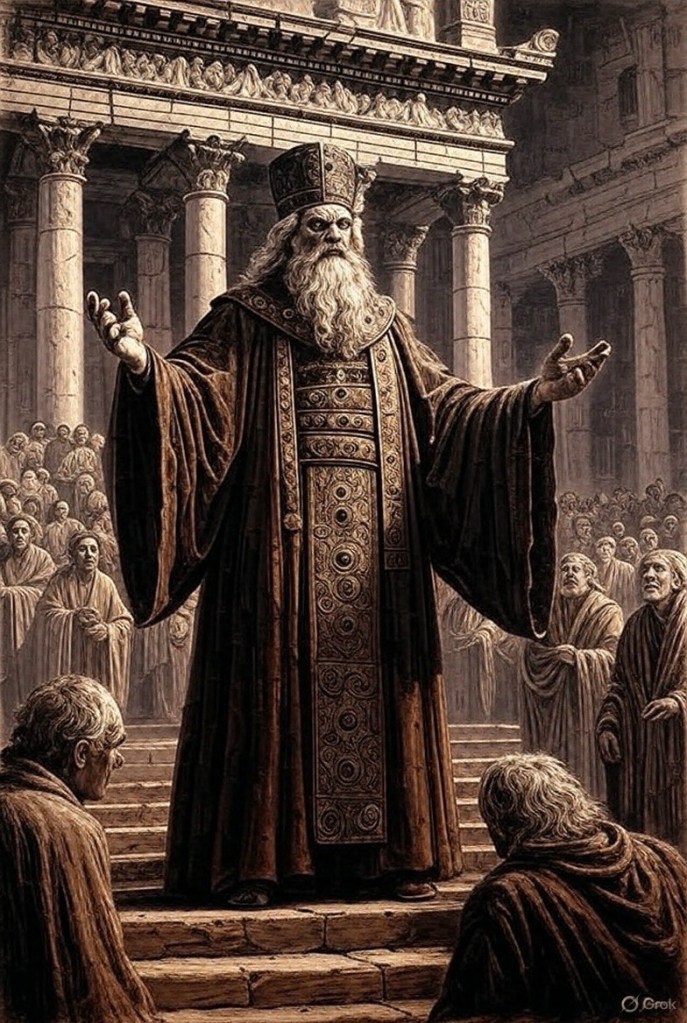
The Cannibals of China and their Democrat Party Friends: Collectivists literally want to eat the living

The recent shooting of National Guardsmen in Washington, D.C., allegedly by an Afghan national with ties to intelligence networks, underscores a profound ideological divide in American politics. The incident was not merely an act of violence; it became a prism through which competing visions of governance and societal order were revealed. While some sought to frame the tragedy as a consequence of deploying the National Guard—a measure implemented to restore law and order—others attempted to deflect responsibility by invoking narratives of provocation and systemic grievance. This rhetorical maneuver, blaming the presence of security forces for inciting violence, reflects a deeper philosophical orientation rooted in collectivist ideologies that have historically justified chaos as a means to consolidate power.  Democrats, like Mark Kelly, who have recently found themselves in a lot of trouble due to attempts at seditious behavior against President Trump’s administration, are showing a much deeper problem with their entire political ideology that traces to ideological roots from the home country of their movement, Chinese communism.  And the cannibalistic nature of that country and its general philosophy of life, compared to the West. 

Empirical evidence demonstrates that the deployment of the National Guard in Washington, D.C., during periods of heightened unrest significantly reduced crime rates. Under Trump’s administration, violent crime in the District fell by approximately 35% between 2023 and 2024, with homicides declining from a peak of 274—the highest since 2005—to markedly lower levels in subsequent years. Even in 2025, violent crime decreased by an additional 26% compared to the previous year, signaling the deterrent effect of a visible security presence.¹ These figures stand in stark contrast to earlier trends under Democratic leadership, where policy emphasis on police defunding and social work interventions coincided with escalating urban violence.²

The paradox of Democrat lawmakers advocating stringent gun control while privately securing concealed carry permits further illustrates the inconsistency of their position. Representative Anna Paulina Luna recently highlighted that numerous members of Congress, including those who champion restrictive firearm legislation, have obtained permits to carry weapons in the District.³ This duality—publicly opposing individual self-defense while privately embracing it—reveals a pragmatic concession to the realities of urban crime, even as ideological commitments demand the perpetuation of vulnerability among the populace.

To comprehend this contradiction, one must examine the intellectual lineage of collectivist thought. Marxist theory, which informs much of the progressive agenda, posits that individual identity is subordinate to the collective good.⁴ Within this framework, personal sacrifice is valorized as a moral imperative, and systemic inequities are construed as justifications for redistributive violence. The logic underpinning such views is evident in the rhetorical claim that the Afghan assailant’s actions were provoked by the presence of the National Guard—a formulation that shifts culpability from the perpetrator to the state apparatus tasked with maintaining order. This inversion of responsibility is not incidental; it is symptomatic of a worldview that privileges structural explanations over individual accountability.

Historical analogues amplify the gravity of this ideological orientation. During the Great Chinese Famine (1959–1961), precipitated by Mao Zedong’s collectivist policies, an estimated 15 to 55 million people perished.⁵ The obliteration of market mechanisms and private property rights engendered conditions so dire that cannibalism became a widespread survival strategy.⁶ Archival records and eyewitness testimonies recount instances where families consumed the flesh of deceased relatives, and concubines reportedly volunteered for slaughter to sustain their households.⁷ These macabre episodes were not aberrations; they were logical extensions of a system that negated individual sanctity in favor of an abstract communal ideal. The psychological residue of such practices persists in cultural norms that valorize self-abnegation, reinforcing the collectivist axiom that the organism of society supersedes the autonomy of its constituent cells.

The resonance of these historical patterns in contemporary American discourse is disquieting. When policymakers suggest that victims of crime should acquiesce to dispossession for the sake of social harmony, they echo the same moral calculus that sanctioned atrocities under communist regimes. The proposition that one’s property—or even life—may be forfeited to appease the grievances of the marginalized is not merely a policy stance; it is a philosophical commitment to the erasure of individuality. In this schema, the Afghan shooter is transfigured from a culpable agent into a symptom of systemic dysfunction, and the act of violence becomes an indictment of order rather than chaos.

Such reasoning is inimical to the principles of a constitutional republic. The sanctity of individual rights, enshrined in the American political tradition, is antithetical to the collectivist dogma that animates these apologetics. To capitulate to narratives that rationalize violence as a byproduct of structural inequity is to invite the dissolution of civil society. The deployment of the National Guard, far from constituting a provocation, represented an affirmation of the state’s obligation to safeguard its citizens—a function that cannot be abdicated without imperiling the very foundations of governance.

The Afghan shooter incident is not an isolated tragedy; it is a harbinger of the ideological contest that will define the trajectory of American democracy. The attempt to reframe culpability, the oscillation between public disarmament and private armament, and the invocation of systemic grievance as exculpation—all bespeak a worldview that esteems the collective over the individual. History admonishes us that such a worldview, when operationalized, engenders not utopia but barbarism. The cannibalistic horrors of Maoist China are not relics of a distant past; they are cautionary tales inscribed in the ledger of human folly. To ignore these lessons is to court a future in which the logic of sacrifice metastasizes from metaphor to corporeal reality.  And that is what Democrats are proposing for our society when they speak of defunding the police, or yielding to crime with chaos, and in suggesting that gun control should be a priority when crime is used to perpetuate their power through fear by the ruthless and aggressive.  They want the crime because they literally feed off it. 

I was eating with some friends the other day at a nice Chinese restaurant buffet in West Chester, Ohio, that had a lot of great options.  I reminded everyone that all this nice food would not be typical in China.  In China, they actually eat just about anything that moves: dogs, cats, turtles, moms and dads, and body parts.  In most places in the world, where collectivist politics reside, the food is not as sanitized from the violence behind death as you will find in Chinese restaurants in the United States.  The standard of individualized thought is enough to affect how we eat.  Let alone process government functions.  But make no mistake about it, if it were up to the Mark Kellys of the world and their seditious function as communist insurgents, they would drive a society into cannibalism because that is the unspoken party platform.  They represent in America the Great Leap Forward that all academic leftists in the world, and especially in America, have been yearning for.  They aren’t trying to preserve society.  They are trying to eat it and gain the power of their enemies from the literal consumption of flesh and the destruction of the living.  And the Afghan terrorist, Rahmanullah Lakanwal, who shot the two D.C. National Guard members just a block away from the White House, serves their aims at the destruction of society for the consumption of its contents, just as their home country of China would be very proud of.

—

Footnotes

1. Metropolitan Police Department, “Annual Crime Report,” Washington, D.C., 2024–2025.

2. U.S. Department of Justice, “Crime Trends in Urban Centers,” 2023.

3. Luna, A.P., Congressional Briefing on Security Measures, 2025.

4. Marx, K., Critique of the Gotha Program, 1875.

5. Dikötter, F., Mao’s Great Famine: The History of China’s Most Devastating Catastrophe, 2010.

6. Yang, Jisheng, Tombstone: The Great Chinese Famine, 1958–1962, 2012.

7. Chinese State Archives, Oral Histories of the Great Leap Forward, 1961.

Rich Hoffman

Click Here to Protect Yourself with Second Call Defense https://www.secondcalldefense.org/?affiliate=20707

Justice Deferred: Why Prosecutions Under Trump’s Second Term Remain Slow—and What Global Parallels Reveal

Donald Trump’s second term reignited expectations of sweeping accountability for political corruption. Yet, despite strong rhetoric and high-profile promises, major prosecutions remain elusive.  One year into Trump’s second term, the question persists: Why haven’t the big names gone to jail? Hillary Clinton remains free, despite years of allegations. The Clintons’ ties to corruption, Epstein’s network, and the weaponization of law enforcement against Trump allies have fueled public frustration. From Rudy Giuliani to Peter Navarro, loyalists have faced bankruptcy and imprisonment for defending election integrity. Meanwhile, figures like Letitia James and James Comey—central to prosecutorial misconduct—walk free after cases were dismissed due to procedural irregularities, not innocence.

This paradox underscores a deeper truth: prosecutions are not merely legal acts—they are political acts requiring stability, mandate, and timing. In a polarized nation, aggressive prosecutions without securing legislative dominance risk triggering retaliatory cycles, undermining the very agenda they aim to protect.

The dismissal of cases against Letitia James and James Comey illustrates the fragility of prosecutorial authority. A federal judge recently threw out charges citing the unlawful appointment of Lindsey Halligan as interim U.S. attorney, despite clear evidence of misconduct. The crime was procedural, not substantive—a loophole exploited to shield political elites from accountability1.

This is not unique. DOJ statistics reveal that high-profile political cases often span 3–7 years from indictment to resolution, with declination rates exceeding 39% when political volatility threatens institutional legitimacy2. Prosecutors, like any actors, weigh personal risk: firebomb threats, reputational ruin, and career destruction loom large when partisan control can flip overnight.

Trump’s own experience reinforces this caution. His first term saw relentless lawfare—Mueller investigations, impeachment trials, and civil suits—weaponized to cripple his agenda. The lesson? Without a stable mandate, prosecutions become pyrrhic victories, inviting reciprocal vengeance when power shifts.

The human toll of this legal warfare is staggering. Rudy Giuliani, once America’s Mayor, now faces $1.36 million in unpaid legal fees, with bankruptcy looming3. Mike Lindell, the MyPillow CEO, has liquidated assets to fund election integrity lawsuits, burning through millions4. Tina Peters, a Colorado clerk, sits in jail for investigating election fraud—a chilling precedent for dissent5.

These cases illustrate the asymmetry of lawfare: defending truth costs fortunes, while weaponizing law costs taxpayers. The financial attrition of Trump allies serves as a deterrent, signaling to future operatives that loyalty carries existential risk.

Enter the Epstein files—a political gambit disguised as transparency. Democrats, desperate to derail Trump ahead of midterms, embraced Epstein disclosures as a “gotcha” strategy, betting on salacious ties to tarnish MAGA credibility6. What they miscalculated was Trump’s counterplay: full release of the files, exposing a Democratic nexus of sexual trafficking, influence peddling, and elite corruption7.

This maneuver exemplifies asymmetric warfare: bait the opposition into overreach, then detonate the trap. As Trump played it, “rat poison in the nest”—a tactic to implode the colony from within. The fallout promises to be seismic, not for Trump, but for the progressive aristocracy entangled in Epstein’s web.

Brazil offers a cautionary mirror. Jair Bolsonaro, ousted after contesting election fraud, now faces 27 years in prison for an alleged coup attempt8. His successor, Lula da Silva—himself a convict released to reclaim power—embodies the cyclical weaponization of law. The message is clear: in politicized systems, justice is not blind; it is partisan.

For MAGA strategists, Bolsonaro’s fate underscores the imperative of institutional entrenchment. Without securing Congress and insulating the judiciary, Trump’s prosecutions risk reversal under a Democratic resurgence.

According to the Bureau of Justice Statistics, U.S. attorneys prosecuted 61% of suspects in matters concluded in FY 2023, with political cases often delayed beyond five years due to appeals and procedural challenges2. The median time from investigation to decision: 61 days, but high-profile cases involving political figures skew far longer, often requiring special counsel oversight.

Public impatience for “perp walks” is understandable. Yet, in the calculus of power, timing trumps theatrics. Immediate arrests may gratify the base but jeopardize the agenda if Democrats reclaim legislative control. Trump’s restraint is not weakness—it is war by other means.

The Epstein gambit, midterm positioning, and structural reforms signal a long game: secure the mandate, then strike decisively. Until then, justice remains deferred—not denied.  I would say to all who are seeking justice, defend Trump for the midterms, keep the Democrats running for the hills.  And sweep them up once the rat nest is poisoned and they can no longer do any harm.  But don’t play nice with them.  They would never give you the same benefit. 

References

NBC News. Judge dismisses cases against James Comey and Letitia James after finding prosecutor was unlawfully appointed. Nov. 24, 2025.1

Bureau of Justice Statistics. Federal Justice Statistics, 2023. March 2025.2

USA Today. Rudy Giuliani must pay his defense lawyers $1.36 million. Sept. 17, 2025.3

CBS News. Convicted Colorado election clerk Tina Peters transfer controversy. Nov. 23, 2025.4

PBS News. Trump signs bill to release Jeffrey Epstein case files. Nov. 20, 2025.7

CBS News. Jair Bolsonaro arrested before serving 27-year sentence for coup attempt. Nov. 22, 2025.8


To understand why prosecutions under Trump’s second term remain slow, we must situate this phenomenon within a broader historical and theoretical context. Lawfare—the strategic use of legal systems as instruments of political warfare—is not an American invention. It is a global sport, played with Machiavellian finesse and Foucauldian precision

Consider South Korea: former presidents Park Geun-hye and Lee Myung-bak were imprisoned for corruption, only to be pardoned later in a theatrical display of political mercy. This oscillation between punishment and absolution mirrors Michel Foucault’s thesis on power as a dynamic, relational force rather than a static possession [1]. In Israel, Benjamin Netanyahu’s corruption trials have dragged on for years, punctuated by coalition collapses and judicial reforms—a case study in how legal timing intersects with political survival [2].

Historical parallels abound. Watergate, often romanticized as a triumph of accountability, was in fact a slow burn. The scandal erupted in 1972, yet Nixon resigned only in 1974 after exhaustive hearings and strategic delays. Roman legal systems offer an even older template: prosecutions were frequently deferred until political winds shifted, illustrating Cicero’s dictum that law is the servant of politics, not its master [3].

Theoretical frameworks enrich this analysis. Machiavelli, in The Prince, counseled rulers to appear just while wielding power ruthlessly—a maxim evident in Trump’s calibrated restraint. Foucault’s Discipline and Punish reminds us that law is a technology of control, deployed to normalize behavior and consolidate authority [4]. When Trump delays prosecutions, he is not abdicating justice; he is performing sovereignty, signaling that timing—not immediacy—defines true dominion.

Global data corroborates this thesis. Transparency International reports that high-profile political prosecutions in democracies average 4–6 years from indictment to resolution, with delays often justified as procedural safeguards [5]. In Brazil, Lula da Silva’s conviction and subsequent resurgence exemplify lawfare’s cyclical nature: today’s convict is tomorrow’s kingmaker [6].

This expanded lens reframes Trump’s strategy as part of a transnational pattern: justice deferred is not justice denied—it is justice weaponized. The playful irony? While pundits clamor for perp walks, seasoned strategists know that the real game is chess, not checkers. Arrests gratify the mob; timing secures the throne.

Footnotes:
[1] Foucault, M. (1977). Discipline and Punish: The Birth of the Prison. Vintage Books.
[2] Peleg, I. (2023). Judicial Politics in Israel: Between Law and Power. Israel Studies Review.
[3] Cicero, M.T. (54 BCE). De Legibus.
[4] Machiavelli, N. (1532). The Prince.
[5] Transparency International. Global Corruption Report, 2024.
[6] Hunter, W. (2020). The Politics of Corruption in Brazil. Journal of Democracy.

Bibliography

Foucault, M. (1977). Discipline and Punish: The Birth of the Prison. Vintage Books.

Machiavelli, N. (1532). The Prince.

Cicero, M.T. (54 BCE). De Legibus.

Peleg, I. (2023). Judicial Politics in Israel: Between Law and Power. Israel Studies Review.

Transparency International. Global Corruption Report, 2024.

Hunter, W. (2020). The Politics of Corruption in Brazil. Journal of Democracy.

Rich Hoffman

Click Here to Protect Yourself with Second Call Defense https://www.secondcalldefense.org/?affiliate=20707

Armageddon as Process: From the Teacher of Righteousness to Modern Political Movements

For centuries, people have imagined the Battle of Armageddon as a climactic showdown—a single day when good finally triumphs over evil. But what if Armageddon is not a moment in time, but a perpetual struggle? What if the battle has been raging for thousands of years, manifesting in different eras, cultures, and movements? Today, as millions rally behind reformist causes like the MAGA movement, many wonder why evil seems so entrenched, why corruption persists even when righteousness gains ground. The answer lies in history: the fight against systemic evil is not episodic—it is eternal.

To understand this, we must look back to the crucible of Western civilization: the Holy Land during the turbulent centuries before and after Christ. There, in the shadow of empires, a small sect called the Essenes waged a spiritual and cultural rebellion against corruption. Their writings—the Dead Sea Scrolls—reveal a figure known as the Teacher of Righteousness, a man who defied the “Wicked Priest” and inspired generations of resistance. From Qumran to Megiddo, from the Copper Scroll to the mosaic affirming Jesus in a Roman garrison, the story of righteousness versus evil is a continuum that stretches into our own time.

Around 150 BCE, as Judea reeled under Hellenistic influence after Alexander the Great, a separatist sect emerged—the Essenes. Disillusioned by Jewish priests who compromised with Greek rulers, the Essenes withdrew to the desert near Qumran. They lived by strict purity laws, followed a solar calendar, and anticipated an apocalyptic showdown between the “Sons of Light” and the “Sons of Darkness.” Their writings—the Community Rule, War Scroll, and Damascus Document—outline a worldview obsessed with righteousness and divine justice.

Central to these texts is the enigmatic Teacher of Righteousness, a leader who clashed with the “Wicked Priest,” likely a Hasmonean high priest aligned with foreign powers. The Teacher’s mission was clear: restore covenantal purity and resist systemic corruption. His life foreshadows later figures like John the Baptist and Jesus, who also confronted entrenched elites. Without the Dead Sea Scrolls, we would never know this man existed—yet his influence rippled through history, shaping the moral architecture of Western thought.

Discovered in 1952 in Qumran Cave 3, the Copper Scroll stands apart from other Dead Sea texts. Unlike parchment manuscripts, it was etched on metal—suggesting permanence. Its contents? A list of 64 treasure caches, possibly Temple wealth hidden during Roman incursions. This reveals a critical truth: rebellion was not merely spiritual; it had economic dimensions. Control of resources meant survival for communities resisting imperial domination. The Copper Scroll is a silent witness to the material stakes of righteousness—a reminder that corruption thrives not only in temples but in treasuries.

Megiddo, perched at the crossroads of ancient trade routes, was more than a city—it was a symbol. From Canaanite stronghold to Israelite fortress, from Greek outpost to Roman garrison, Megiddo embodied the clash of civilizations. By the second century CE, it housed Legio VI Ferrata, a Roman legionary camp with 5,000 soldiers. Roads, amphitheaters, and barracks testify to imperial might. Yet Revelation would immortalize Megiddo as Armageddon—the stage for the ultimate battle between good and evil. In truth, that battle was already underway, fought not with swords alone but with ideas, faith, and sacrifice.

Among the most stunning finds at Megiddo is a mosaic floor dated to around 230 CE, discovered in a Roman military compound. Its inscription dedicates worship to “God Jesus Christ”—the earliest archaeological evidence of Jesus’ divinity. This predates Constantine’s Edict of Milan by nearly a century, proving that Christianity was infiltrating the Roman world long before it became state-sanctioned. The mosaic, displayed at the Museum of the Bible, marks a turning point: the empire that crucified Christ was slowly bowing to His name. This was not an overnight revolution but a gradual transformation—a testament to the endurance of righteousness.

Before Rome embraced the cross, it worshipped a pantheon of gods—Jupiter, Mars, Venus—and demanded emperor worship. Greek deities like Zeus and Athena lingered in cultural memory. Against this backdrop, Christianity’s rise was nothing short of miraculous. Persecuted believers faced martyrdom, yet their faith spread from catacombs to palaces. By 313 CE, Constantine legalized Christianity; by 380 CE, Theodosius made it the official religion. But the seeds of this revolution were sown centuries earlier—by rebels like the Essenes, prophets like John, and visionaries like the Teacher of Righteousness.

What does this mean for us today? The struggle between righteousness and corruption did not end with Constantine—or with the crucifixion. It is a permanent condition of human society. Modern movements like the Tea Party, the Reform Party, and MAGA echo the same impulse: to resist entrenched elites and restore moral order. Just as the Essenes defied the Wicked Priest, today’s reformers challenge systems that profit from decay. The hostility they face—from media vilification to legal persecution—mirrors the fate of ancient rebels. Why? Because evil never surrenders quietly.

History teaches a sobering truth: fighting evil is hard, slow, and often bloody—but it works. The Teacher of Righteousness did not live to see Rome fall, yet his stand against corruption helped ignite a movement that reshaped the world. The Essenes’ scrolls lay hidden for two millennia, only to inspire us today. The Megiddo mosaic whispers across centuries: righteousness wins—not in a day, but in the long arc of history. So when despair creeps in, remember: Armageddon is not ahead of us—it is all around us. And every act of courage, every stand for truth, moves the battle forward.

— Additional notes and reference —

Abstract:

This work examines Armageddon as a historical continuum rather than a singular event, tracing its roots from the Essenes and the Teacher of Righteousness through Greek and Roman occupations, Jewish revolts, and the rise of Christianity. It integrates archaeological evidence from Megiddo, textual analysis of the Dead Sea Scrolls, and modern political parallels to argue that the struggle between righteousness and corruption is an enduring condition of human society.

1. Introduction

Armageddon is often imagined as an apocalyptic climax, yet history reveals it as a recurring process. From Qumran to Washington, the battle between systemic evil and reformist zeal persists. [Footnote: Collins, 2010]

2. Historical Timeline

– 332 BCE: Alexander the Great conquers Judea, introducing Hellenistic culture. [Footnote: Josephus, Antiquities]

– 140–37 BCE: Hasmonean dynasty asserts Jewish autonomy but succumbs to corruption. [Footnote: Schiffman, 1994]

– 63 BCE: Pompey annexes Judea; Roman rule begins. [Footnote: Goodman, 2007]

– 66–73 CE: First Jewish Revolt ends with destruction of the Second Temple. [Footnote: Josephus, Wars]

– 313 CE: Constantine legalizes Christianity; 380 CE: Theodosius makes it official. [Footnote: Brown, 1989]

3. The Essenes and Teacher of Righteousness

The Essenes, a separatist sect, withdrew to Qumran to resist priestly corruption. Their texts—the Community Rule, War Scroll, Damascus Document—reveal a dualistic worldview: Sons of Light vs. Sons of Darkness. The Teacher of Righteousness emerges as a prophetic figure opposing the Wicked Priest. [Footnote: Vermes, 2011]

4. Megiddo and Armageddon

Megiddo’s strategic location made it a stage for imperial clashes. Excavations reveal layers from Canaanite to Roman eras. Revelation’s Armageddon draws on this geography as a metaphor for ultimate conflict. [Footnote: BAR, 2015]

5. Dead Sea Scrolls and Copper Scroll

The Copper Scroll lists 64 treasure caches, underscoring the economic stakes of rebellion. Resistance was not merely spiritual but material. [Footnote: Allegro, 1960]

6. Greek and Roman Context

Greek philosophy and Roman law reshaped Judea’s cultural landscape. Emperor worship and Hellenistic syncretism clashed with Jewish monotheism, fueling sectarian movements. [Footnote: Hengel, 1974]

7. Modern Parallels

Reform Party → Tea Party → MAGA echo ancient insurgencies. Each arose to combat perceived corruption, facing vilification and systemic pushback. [Footnote: Skocpol & Williamson, 2012]

8. Conclusion

Armageddon is not a prophecy deferred but a pattern repeated. From the Teacher of Righteousness to modern populists, the fight against entrenched power endures.

References:

– Allegro, J. (1960). The Treasure of the Copper Scroll.

– BAR (Biblical Archaeology Review), various issues.

– Brown, P. (1989). The Rise of Western Christendom.

– Collins, J. (2010). Apocalypticism in the Dead Sea Scrolls.

– Goodman, M. (2007). Rome and Jerusalem.

– Hengel, M. (1974). Judaism and Hellenism.

– Josephus. Antiquities and Wars of the Jews.

– Schiffman, L. (1994). Reclaiming the Dead Sea Scrolls.

– Skocpol, T., & Williamson, V. (2012). The Tea Party and the Remaking of Republican Conservatism.

– Vermes, G. (2011). The Complete Dead Sea Scrolls in English.

Rich Hoffman

Click Here to Protect Yourself with Second Call Defense https://www.secondcalldefense.org/?affiliate=20707

Thanksgiving, Family, and the Weight of Choices: Why Generations Rise or Fall Together

Thanksgiving is one of those rare moments in American life where everything slows down just enough for us to notice what really matters. The smell of turkey fills the house, football hums in the background, and for a few hours, the world’s chaos takes a back seat to mashed potatoes and pumpkin pie. I love this time of year. I love the family gatherings, the laughter, the jokes that only make sense to people who share your last name. But, Thanksgiving is also a fascinating study in human nature. You sit around that table and, without saying a word, you can see the weight of another year on everyone’s face—the triumphs, the mistakes, the quiet regrets.

What is family, really? People say it’s blood, but I think it’s more complicated than that. Family is biology, sure, but it’s also choices—every choice we make and every choice our kids make. And those choices stack up like bricks over time, building the life we live. Some people build palaces; others build prisons. Thanksgiving is where you see the architecture of those choices on full display.

When you’re born, you don’t get to pick your family. You’re handed a set of people and told, “These are yours.” But as life goes on, family becomes less about biology and more about decisions. Who you marry, how you raise your kids, what values you teach them—those choices ripple through generations. I’ve raised kids and now grandkids, and I can tell you this: the quality of a family gathering isn’t determined by the turkey on the table; it’s determined by the choices everyone made to get there.

I’ve seen families where bitterness hangs in the air like smoke because bad decisions piled up—wrong marriages, financial disasters, grudges that never healed. And I’ve seen families where people genuinely enjoy each other’s company because they made better choices. It’s not luck. It’s not fate. It’s choices.

I’ve always said this—and sometimes people look at me funny when I do—but I treat kids differently than I treat adults. Why? Because kids still have options. They haven’t stacked up a lifetime of mistakes yet. They’re like a blank canvas with endless possibilities. Adults, on the other hand, well… by the time you hit your 40s or 50s, the mistakes start showing. You can see it in their faces, in their posture, in the way they talk about life. Every bad decision leaves a mark.

I’ve sat at Thanksgiving tables and watched this play out. You see the cousin who married the wrong person, and now every conversation is about how hard life is. You see the uncle who spent his 20s chasing quick thrills and now looks like a relic of his former self. And then you look at the kids—bright-eyed, full of energy, thinking they’re invincible. They don’t know yet that life is a marathon, not a sprint.

That’s why I invest in kids. I talk to them differently. I try to steer them away from the mistakes that everyone else seems determined to make. Because if you can help a kid avoid even half the bad choices their peers make, you’ve given them a head start that will pay off for decades.

Life is like a marathon. At the starting line, everyone looks the same—bunched up, full of energy, ready to run. But five miles in, the pack starts to spread out. Some people are way ahead, others are falling behind, and the gap keeps growing. That’s what choices do.

And the stats prove it. By middle age, the spread is enormous:

• 41% of first marriages end in divorce, and the odds get worse with each attempt.

• The average U.S. household carries $105,056 in debt, with mortgage debt alone averaging $268,060.

• Over 40% of adults are obese, and the highest rates are among people in their 40s and 50s.

These aren’t random outcomes. They’re the result of choices stacked up over decades. The people who finish strong aren’t the ones who sprint early—they’re the ones who pace themselves, make smart decisions, and stay disciplined when everyone else is falling apart.

Here’s something I’ve noticed over the years: misery loves company. People who make bad choices don’t just suffer quietly—they want everyone else to make the same mistakes. Why? Because it makes them feel less alone. If you’ve wrecked your finances, married the wrong person, and let your health go, it’s comforting to see the next generation do the same. It’s almost like a twisted form of validation: “See? It’s not just me. This is how life works.”

But let’s be honest—it’s not “how life works.” It’s how bad decisions impact outcomes. And the numbers back this up. Divorce, debt, obesity—they’re all connected. Stress from debt leads to overeating. Relationship breakdowns lead to depression. Depression leads to bad health habits. It’s a cycle, and once you’re in it, climbing out feels impossible.

I’ve seen this at family gatherings. You hear the stories—another year of bills piling up, another kid in trouble, another health scare. And everyone nods like it’s normal. But it’s not normal. It’s the result of choices. And the sad part? People cling to the idea that something magical will fix it—a lottery win, a miracle from God, a quick fix that wipes the slate clean. But most of the time, that fix never comes.

Here’s the good news: the cycle can be broken. It’s not easy, but it’s possible—and it starts with the next generation. The key isn’t to make kids perfect. The key is to help them avoid the big mistakes—the ones that derail lives. Teach them that life isn’t about following the crowd. Because the crowd? The crowd is headed straight for debt, divorce, and diabolical outcomes.

So what do you do? You teach kids to think long-term. You teach them that every choice is a brick in the house they’re building. Pick the wrong bricks, and the house collapses. Pick the right ones, and you’ve got a fortress.

I tell my grandkids, “Don’t chase what everyone else is chasing. Most people are running toward misery and calling it fun.” I remind them that life is a marathon, and the people who finish strong aren’t the ones who sprint early—they’re the ones who pace themselves, make smart decisions, and stay disciplined when everyone else is falling apart.

And here’s the beautiful part: when you do this, you don’t just change one life. You change a family. You change a legacy. Because good choices ripple forward just like bad ones do. Imagine a Thanksgiving table where everyone is healthy, happy, and financially secure—not because they got lucky, but because they made choices that built that reality. That’s possible. I’ve seen glimpses of it in my own family, and it’s worth every ounce of effort.

Thanksgiving is more than turkey and football—it’s a mirror. Every year, when the family gathers, you can see the story of choices written on people’s faces. Some look vibrant, full of life, laughing easily. Others look worn down, carrying the weight of years of bad decisions. And it’s not just physical—it’s in the conversations. You hear who’s struggling with debt, who’s on their third marriage, who’s battling health problems.

But here’s the thing: Thanksgiving also gives us hope. It’s a chance to reset, to remind ourselves what matters. For a few hours, the bills and the stress fade away, and we just enjoy being together. And if we use that time wisely—not just to eat, but to inspire—we can plant seeds that change the next generation.

Family is a gift, but it’s also a responsibility. It’s not just about biology—it’s about choices. Every choice we make ripples through generations, shaping the lives of people who haven’t even been born yet. That’s heavy, but it’s also empowering. Because if bad choices can create misery, good choices can create joy.

So this Thanksgiving, as you sit around the table, look at the faces you care about and ask yourself: What legacy are we building? Are we passing down wisdom, or just repeating the same mistakes? Because the truth is, the cycle doesn’t have to continue. We can break it. We can teach our kids to run the marathon wisely, to pace themselves, to make decisions that lead to health, happiness, and freedom.

And if we do that—if we choose better and inspire better—then maybe, just maybe, the next Thanksgiving will feel different. The laughter will be louder, the smiles will be brighter, and the weight of bad choices will be replaced by the joy of good ones. That’s something worth being thankful for.

Rich Hoffman

Click Here to Protect Yourself with Second Call Defense https://www.secondcalldefense.org/?affiliate=20707