The NFL’s Miscalculated Globalist Push: The Bad Bunny Halftime Show and the Perils of Prioritizing Foreign Markets Over Domestic Loyalty

The NFL’s Miscalculated Globalist Push: The Bad Bunny Halftime Show and the Perils of Prioritizing Foreign Markets Over Domestic Loyalty serves as a stark warning about the dangers of corporate strategies that chase international appeal at the expense of core domestic audiences. In the wake of Super Bowl LX (played February 8, 2026, concluding the 2025 NFL season), the decision to feature Puerto Rican superstar Bad Bunny as the halftime headliner ignited widespread discussion. While the performance celebrated Puerto Rican heritage through vibrant choreography, family-themed elements (including a live on-stage wedding), and Spanish-language hits, it coincided with a measurable dip in traditional U.S. viewership during the slot—highlighting tensions between global expansion ambitions and the league’s foundational American fanbase.

Official Nielsen data confirms the Super Bowl averaged 124.9 million viewers across NBC, Peacock, Telemundo, NBC Sports Digital, and NFL+ platforms—a solid but slightly declining figure from the prior year’s record of 127.7 million. The game’s peak reached an all-time high of 137.8 million in the second quarter (7:45–8:00 p.m. ET). However, Bad Bunny’s halftime show (8:15–8:30 p.m. ET) averaged 128.2 million viewers, ranking it fourth all-time behind Kendrick Lamar (133.5 million in 2025), Michael Jackson (133.4 million in 1993), and Usher (129.3 million in 2024). Quarter-hour breakdowns reveal the issue: viewership fell approximately 7% from the game’s peak (to around 128.2 million from 137.9 million in the prior high quarter), with a 5.7% drop from the immediate pre-halftime segment. This translated to an estimated loss of 9–10 million viewers in some windows compared to game highs, particularly among non-Latino English-speaking audiences, as Telemundo’s share surged during the set.

The performance’s entirely Spanish-language format boosted international and Hispanic viewership—Telemundo hit record levels, and social media clips amassed over 4 billion views in 24 hours (with more than 55% from overseas markets, per NFL and Ripple Analytics). Yet domestically, the shift prompted channel changes, as evidenced by the drop-off. Critics argued this reflected Roger Goodell’s broader strategy: using the halftime platform as cultural promotion for Latin American growth, akin to a televised showcase for Puerto Rican vibrancy, family structures, and resilience amid issues like power outages.

In direct response, Turning Point USA (TPUSA) mounted the All-American Halftime Show, featuring patriotic performances by Kid Rock, Brantley Gilbert, Lee Brice, Gabby Barrett, and others. Streamed on YouTube, Rumble, and allied platforms, it peaked at around 6.1 million concurrent viewers during overlap (with live estimates of 5–6.4 million across carriers). Post-event, the YouTube upload surpassed 21 million total views (some reports cited 19–25 million including Rumble). While dwarfed by the official show’s scale, it symbolized a bold conservative counter-narrative, drawing those alienated by perceived progressive undertones (e.g., immigration-related themes some interpreted in Bad Bunny’s presentation). TPUSA’s event amplified Charlie Kirk’s reach and positioned the group as a cultural alternative at a moment of peak visibility.

The real stakes lie in advertising revenue, where the Super Bowl’s value hinges on sustained high engagement. Thirty-second spots fetched $7–10 million in 2026, with advertisers expecting minimal churn during premium slots like halftime. The documented 7% drop during Bad Bunny’s set likely reduced effective impressions for those ads, potentially leading to under-delivery on promised audiences. Networks and the NFL may have faced pressure to justify rates amid the dip, even as overall game averages remained strong. The league’s bet on Bad Bunny—Spotify’s most-streamed artist in 2025—prioritized Latin market penetration over retaining every domestic viewer, but the cost showed in softer traditional metrics.

This mirrors the NFL’s aggressive international expansion. The league announced a record nine international games for 2026 across four continents, seven countries, and eight cities—including returns to Mexico City (at Estadio Banorte, with the San Francisco 49ers as a designated home team for a multiyear run), plus debuts or returns in Paris, Madrid, Rio de Janeiro, Melbourne, Munich, and London. Mexico and Brazil rank among the NFL’s largest overseas fanbases (tens of millions each), and Goodell has openly discussed future possibilities like dedicated international teams or further Latin ties, including deeper Puerto Rico involvement. Bad Bunny’s show aligned perfectly as soft-power outreach, highlighting cultural affinity to build loyalty in these markets.

Yet American football’s appeal—strategic individualism, decisive big plays—contrasts sharply with soccer’s more fluid, defense-heavy style, which some parallel to collectivist systems. Exporting the product risks dilution when overly customized for foreign preferences, potentially alienating the tailgating, weather-defying U.S. core that sustains the league financially.

Hollywood’s trajectory offers the clearest cautionary parallel. In the 2000s–2010s, studios chased China’s exploding box office, often prioritizing global totals in announcements and altering content to appease censors (e.g., removing sensitive themes). Blockbusters drew $100–200 million+ from China, sometimes rivaling or exceeding domestic hauls, offsetting ballooning U.S. union production costs. But over-reliance eroded trust: audiences sensed “watered-down” American essence, “woke” shifts alienated segments, and China’s domestic films surged to dominate 80–90% of its market. Hollywood’s U.S. theatrical revenue declined, theaters closed, streaming fragmented the model, and independents (e.g., Angel Studios) rose to fill voids. The pivot neglected the domestic foundation that once made global appeal possible.

The NFL treads similar ground. By assuming domestic loyalty while expanding abroad, it risks betraying advertisers targeting that base. Progressive framing in the show—perceived accommodations to immigration debates—further polarized, turning off viewers and dollars. Sustainable growth strengthens the home market first; overextension without it invites erosion.

Weeks after the event, data confirms the patterns: strong but not record-breaking U.S. numbers, explosive international/social metrics, yet a clear domestic halftime dip. Future Super Bowls could see trend lines worsen if bad choices persist. The league must recalibrate—honor the American essence that built its empire—or face permanent damage akin to Hollywood’s decline.  While I watched both shows to see how the stories would unfold, and Bad Bunny stayed on good behavior during the halftime show, the damage was done before the show ever started.  It was a bad decision to have Bad Bunny sell family values when advertisers bought viewer appeal, not a progressive rebellion.  And picking Bad Bunny with all the baggage was a letdown to the advertisers, and it will hurt the NFL product going into next year.  The betting problem of rigged games is already having an impact.  And this whole problem certainly didn’t help. 

Footnotes

1.  Nielsen, “Super Bowl LX Delivers 125.6 Million Viewers,” February 10, 2026. (Official averages and halftime figures.)

2.  ESPN, “Super Bowl LX, Bad Bunny’s halftime fall shy of ratings records,” February 10, 2026. (Peak and ranking details.)

3.  Front Office Sports, “Bad Bunny Halftime Viewership Fell 7% From Super Bowl Peak,” February 11, 2026. (Quarter-hour drop analysis.)

4.  The Athletic / New York Times, “Super Bowl LX draws 124.9 million viewers, Bad Bunny 128.2 million,” February 11, 2026. (Comparative declines.)

5.  Fox News / various outlets, coverage of TPUSA All-American Halftime Show (e.g., peaks at 6.1 million concurrent, 21+ million total views on YouTube).

6.  NFL.com announcements on 2026 international schedule (nine games, Mexico City return, etc.).

7.  Reuters / The Guardian, reports on Hollywood’s China market shift and subsequent domestic erosion (contextual parallels from industry analyses).

8.  Launchmetrics / Forbes, media impact value tied to Bad Bunny’s performance (e.g., $942M+ MIV for the event, heavy international skew).

Bibliography / Further Reading

•  Nielsen Big Data + Panel reports (February 2026).

•  ESPN, The Athletic, Front Office Sports, and Variety articles on ratings (February 10–13, 2026).

•  NFL.com international games announcements (February 2026).

•  Historical Hollywood analyses (e.g., Reuters, The Economist on China box office dynamics).

•  TPUSA and YouTube metrics for All-American Halftime Show.

Rich Hoffman

More about me

Click Here to Protect Yourself with Second Call Defense https://www.secondcalldefense.org/?affiliate=20707
The Conspiracies of Erika Kirk: In a lot of ways, its all too much too fast

The recent assassination of Charlie Kirk on September 10, 2025, at Utah Valley University in Orem, Utah, has left a profound void in the conservative movement, particularly among young people drawn to his message through Turning Point USA (TPUSA). Charlie, at just 31 years old, was gunned down by a single shot to the neck from a rooftop sniper during an outdoor campus event. The accused, 22-year-old Tyler James Robinson from Washington, Utah, surrendered the next day and now faces charges including aggravated murder, with prosecutors seeking the death penalty. Robinson reportedly stated he acted because Kirk “spreads too much hate,” highlighting the toxic polarization that can turn ideological differences into deadly violence.

In the aftermath, Erika Kirk—Charlie’s wife of four years (they married in 2021)—stepped into the immense role of CEO and chairwoman of TPUSA. The organization’s board unanimously elected her shortly after the tragedy, and she has since vowed to carry on her husband’s legacy, emphasizing faith, family, and conservative values for the next generation. Erika, now in her late 30s and raising their two young children alone, delivered an emotional speech at Charlie’s memorial service held on September 21, 2025, at State Farm Stadium in Glendale, Arizona. Thousands attended, including President Donald Trump and Vice President JD Vance. Her address was heavy with grief; she recounted the hospital moment seeing her husband’s wound, paused in prayer, and called on attendees to “choose Christ” while pledging the movement would endure. She received a prolonged standing ovation.

At the close of the event, President Trump concluded his own remarks hailing Charlie as a “giant of his generation” and called Erika back to the stage for a supportive hug. This moment, captured in videos and widely shared, drew attention—some viewers noted her composure amid sorrow, while others speculated on body language or attire in ways that fueled online commentary. Grief manifests differently for everyone, especially under public scrutiny. Erika has spoken of putting on a “brave face” while managing profound loss, motherhood, and leadership of a major organization. The pressure is enormous: stepping from private family life into heading a high-profile entity built on her husband’s vision, all while mourning a brutal, public tragedy.

Recent events, like TPUSA’s “All-American Halftime Show” during Super Bowl LX in February 2026, underscore ongoing cultural divides. As an alternative to the official halftime performance featuring Bad Bunny—which some conservatives criticized for its pro-immigration themes and global market appeal—TPUSA’s event featured artists like Kid Rock, Brantley Gilbert, Lee Brice, and Gabby Barrett. It emphasized patriotism, faith, and family values, with tributes to Charlie. Erika did not appear in person but praised it afterward on social media, saying it was “incredible,” that “Charlie would’ve absolutely loved it,” and framing it as a way to “make Heaven crowded” while honoring God and country. The contrast highlighted philosophical tensions: an America First stance rooted in sovereignty and traditional values versus broader global outreach.

Criticism of Erika has surfaced in some corners—accusations of inauthenticity, questions about her past (including pre-marriage photos from college years showing a more carefree side), or even internal TPUSA drama like staff departures and leaked audio discussions. Some speculate wildly, turning personal grief into conspiracy narratives about TPUSA shifting directions or hidden motives. Others project unmet expectations onto her, wanting a saint-like figure perpetually in mourning, perhaps akin to a “Mother Mary” archetype, rather than a young widow navigating real-life changes: biological motherhood pressures, responsibility for children without their father, and the emotional toll of sudden leadership.

Yet this overlooks the human element. Erika and Charlie’s marriage was relatively short but appeared strong and faith-centered. They built a life together in their 30s, raising kids while advancing a movement that offered young conservatives an alternative to cultural despair—replacing lost optimism in institutions like housing markets, Social Security, or generational compounding with faith-based activism. Charlie’s work, alongside figures like Steve Bannon, Jack Posobiec, John Solomon, and others in election coverage, provided reliable, in-depth analysis that resonated deeply. His generation, much like my own kids’ peers, grew up amid disappointments from prior ones—broken promises of endless prosperity—and found redemption in characters like him (or even Candace Owens from related circles, despite fluctuations).

Assassination often elevates figures posthumously, much like Martin Luther King Jr., whose impact and Bible sales surged after his death, turning him into a larger-than-life symbol. Charlie’s killing has sparked similar dynamics: grief transfers emotions onto survivors, creating pressure for Erika to embody perfection. But she’s human—37 or 38, still finding her way, dealing with survival instincts, public-facing duties, and private sorrow. Expecting her to cry constantly, wear only somber clothes, or become a nun-like figure ignores reality. People grieve variably; some compartmentalize to function, especially with kids to raise and a legacy to steward.

The controversies often stem from hurt feelings—people who admired Charlie deeply, perhaps invested emotionally in him as a proxy for missing stability in their lives. When Erika doesn’t match idealized projections (a stable front every day, no “phony” moments under stress), it breeds speculation. But there’s no evidence of underlying plots to subvert TPUSA or counter the current political order. The movement Charlie built—youth mobilization for conservative principles, Christian values, and American exceptionalism—transcends the immediacy of momentary movements. If Erika carries it forward admirably, great; if she needs time to heal (perhaps stepping back for family), someone else will rise. The ideas endure because they’re bigger situationally.

Erika deserves grace. She’s bravely taken on a massive role amid unimaginable loss. TPUSA remains one of the strongest vehicles for young people seeking faith-based alternatives in a divided culture. Supporting her means recognizing the toll: the “layers of hurt” beneath any public facade, the difficulty of sounding grounded when everything’s shattered.  Personally, I think she needs to take a few years off, for her own good.  And let things settle in her own head.  Because people are going to read into everything she does and embed their own emotions into what they expect from her as the head of Turning Point.  It’s too much to ask her to replace Charlie Kirk, and that is what a lot of people want.  What everyone forgets is that the assassination itself was a devastating event that requires action, and a lot of that action hasn’t happened.  In a Christian sense, the emphasis has been forgiveness which leaves everyone feeling empty as a result, and wanting to replace that action with sainthood.  Then when Erika can’t present herself as a saint, people are angry with her.  And that just isn’t fair to her, her family, or the relationship she had with Charlie Kirk. 

The controversy surrounding Erika Kirk and Turning Point USA’s (TPUSA) “All-American Halftime Show” during Super Bowl LX in February 2026 often misses a deeper, more redemptive truth about human transformation and the nature of movements built on faith. Critics have seized on the event—headlined by Kid Rock, who sang a song at the halftime event about prostitutes and strippers—as somehow incompatible with Christian values, particularly given Kid Rock’s rock ‘n’ roll persona and past lyrics that embrace rebellion, excess, and a gritty, unpolished lifestyle. Some question the wisdom of placing the “mantle of Christ” on such figures, or see it as a dilution of purity in a faith-based youth organization now led by a grieving widow.

Yet this overlooks the biblical pattern of redemption itself. The original disciples of Jesus were hardly paragons of institutionalized holiness. Fishermen, tax collectors, zealots—many were societal outcasts, rough around the edges, and far from “pure” before their calling. Peter denied Christ three times; Paul persecuted believers before his dramatic conversion. Mary Magdalene, often cited as a key follower, had a troubled past marked by affliction and societal judgment before encountering Jesus. These were “down and out” people who didn’t fit neatly into polite society, yet they carried the Christian message forward, transforming it into the global force we know today. Institutions later tried to claim and sanitize that legacy, but its origins were raw, human, and imperfect.

In the same way, the MAGA movement—and TPUSA’s cultural push—draws from individuals who’ve lived messy lives, fallen into temptations, made mistakes, and only later turned toward something bigger and better. President Trump himself, Kid Rock, and countless others in this space embody that late-in-life redirection: shaking off past errors, learning from them, and dedicating energy to positive, faith-aligned efforts like patriotism, family values, and American sovereignty. The halftime show wasn’t about perfection; it was about offering an alternative to what many saw as the NFL’s push toward a global, pro-immigration narrative via Bad Bunny’s performance. By contrast, TPUSA’s event celebrated pro-America themes, faith, and family—drawing millions of viewers (with reports of over 19 million YouTube views) and reportedly pulling attention and revenue away from the official show. Whether Roger Goodell missed an opportunity to unify rather than divide is beside the point; the response resonated because it spoke to people seeking authentic, unapologetic expressions of belief.

Erika Kirk doesn’t have to be the flawless vessel for this. She’s a young widow in her late 30s, raising two children alone after her husband’s brutal assassination in September 2025, while stepping into the immense role of CEO at TPUSA. She praised the halftime show on social media as “incredible,” noting Charlie “would’ve absolutely loved it,” and framed it as a way to “make Heaven crowded” while honoring God and country. She wasn’t even present at the event, yet she supported it fully. If she’s not the one to carry the mantle forward long-term, someone else will—the movement transcends any single person. Charlie built TPUSA as a vehicle for young conservatives to find purpose amid cultural despair, replacing broken promises of endless prosperity with faith-based activism.

Criticism often stems from unrealistic expectations: that leaders must always have been holy, never stumbled, or fit a saintly mold. But humans rarely arrive at conviction without a process—mistakes, detours, and all. The healthy thing is seeing people dedicate themselves to something greater, as we see in the MAGA-aligned push and TPUSA’s efforts. Erika deserves grace as she navigates grief, leadership, and legacy. The halftime show, controversies aside, aligns with that redemptive arc: imperfect messengers pointing toward enduring values. The movement will continue, one way or another, because the ideas—faith, freedom, and national pride—aren’t dependent on flawless execution. They’re carried by those willing to step up, bumps and all.

For continued reading and research:

•  Wikipedia entry on the Assassination of Charlie Kirk (en.wikipedia.org/wiki/Assassination_of_Charlie_Kirk) – Detailed timeline, charges, and aftermath.

•  Erika Kirk’s Wikipedia page (en.wikipedia.org/wiki/Erika_Kirk) – Background, role at TPUSA, and post-assassination leadership.

•  Coverage of the memorial service, including Trump’s remarks and the hug moment (e.g., NBC News, BBC reports from September 2025).

•  TPUSA’s official statements and Erika’s social media (@mrserikakirk on Instagram/X) for direct insights into her perspective.

•  Articles on the Super Bowl halftime alternative (e.g., Taste of Country, Times of India) for context on cultural divides.

This isn’t about conspiracy—it’s about empathy for a young woman thrust into extraordinary circumstances, trying to honor a legacy while healing. The movement won’t stop; it evolves through people like her, or those who follow. She deserves a fair shake to find her footing.

Rich Hoffman

More about me

Click Here to Protect Yourself with Second Call Defense https://www.secondcalldefense.org/?affiliate=20707

The Hidden Game: How Sports Betting is Giving Power to the Mob and the NFL

This is a story that quickly disappeared: the NBA gambling scandal.  However, one of the great things about money is that it reveals a lot about the people who want it. In the gambling world, where easy money is a prospect for those who are lazy, the character of all endeavors is relatively easy to reveal.  And it’s not just the NBA; I would say the rigged games in favor of betting odds are much worse in the NFL.  In the age of legalized sports betting, the question isn’t just who will win the game—it’s whether the game itself is being played fairly. As billions of dollars flow through betting platforms and fantasy leagues, the integrity of professional sports is under more scrutiny than ever. Recent scandals in the NBA and questionable officiating in the NFL have reignited concerns that games may be influenced not just by athletic performance, but by money, power, and even organized crime.

The NBA was rocked by a recent FBI investigation led by Kash Patel, which exposed a network of players and insiders allegedly involved in illegal gambling activities. The scandal implicated figures like Chauncey Billups, Terry Rozier, and Damon Jones, who were accused of sharing confidential injury information to manipulate betting outcomes. The scheme reportedly involved rigged poker games backed by mafia families and the use of cheating technologies like altered shuffling machines and hidden cameras.

This wasn’t just a case of players making side bets—it resembled insider trading. Athletes and coaches acted as “tippers,” passing non-public information to bettors who profited from the edge. The FBI’s involvement underscores the seriousness of the issue and suggests that this may be just the beginning of a broader crackdown.

The idea that sports can be rigged isn’t new. The infamous 1919 Black Sox scandal involved eight Chicago White Sox players who were accused of throwing the World Series in exchange for money from gamblers. Pete Rose, one of baseball’s greatest hitters, was banned for betting on games while managing the Cincinnati Reds, even back then.  These days, it can only be thought to be much, much worse.

In the NBA, referee Tim Donaghy admitted to betting on games he officiated and providing inside information to mob-connected bookies. His case revealed how easily a single official could influence the outcome of a match through foul calls, clock management, and momentum shifts.

Organized crime families like the Genovese, Gambino, Lucchese, and Bonanno have long used sports betting as a tool for money laundering and manipulation. With the legalization of sports betting in many states, the opportunities for corruption have only grown.  And would a referee be inclined to rig a game through penalties to cover a margin?  I would think the answer is an emphatic yes, and that it’s a problem that the NFL itself has very little control over.  Players aren’t welcomingly encouraged to criticize the referees.  They may disagree with the calls, but if they want to play the game, they have to honor the game within the game—the sports betting that is the real fuel for the industry. 

While basketball and baseball have their own vulnerabilities, the NFL may be the most susceptible sport to manipulation. Why? Because of the nature of clock management and the subjective power of referees.

In football, a single penalty can stop the clock, reverse a touchdown, or shift field position dramatically. Referees have enormous discretion in calling holding, pass interference, and roughing the passer—penalties that can change the momentum of a game in seconds.

A recent study from the University of Texas at El Paso found that referees disproportionately favor teams with large fan bases, such as the Dallas Cowboys and Kansas City Chiefs. This bias isn’t necessarily intentional, but it reflects the subtle pressures officials face in high-stakes environments.

One of the most glaring examples of potential manipulation came during the Tampa Bay Buccaneers’ matchup against the Detroit Lions. Tampa Bay, a team that had been gaining momentum and sitting at 4-1, faced a Detroit team also vying for NFC dominance.

The game was riddled with controversial calls:

• A missed tripping penalty on Baker Mayfield, who was clearly impeded while scrambling.

• A fourth-down catch by Cade Otton that was reviewed twice—despite NFL rules prohibiting double reviews.

• A reversal of a completed catch into a turnover on downs.

• Multiple missed defensive holding calls and phantom illegal contact penalties.

Mayfield, known for his competitive fire, publicly criticized the officiating, saying, “I work my ass off… when things I don’t deem are fair, I’m going to let somebody know.”

These calls didn’t just affect the scoreboard—they disrupted Tampa Bay’s rhythm, shifted momentum, and arguably changed the outcome of the game. For fans who know their team well, the inconsistencies were glaring.

The NFL is a multi-billion-dollar entertainment empire. When one team dominates the standings early in the season, it can lead to reduced viewer engagement and betting activity. A close, competitive playoff race keeps fans watching, betting, and spending.

If Tampa Bay had continued its winning streak, it could have created a lopsided picture in the NFC. By slowing their momentum—intentionally or not—the league maintains parity and keeps the narrative exciting. This benefits advertisers, sportsbooks, and the league itself.

Legalized betting has created a new layer of influence. Referees, who earn significantly less than star players, may be more susceptible to corruption. Even if the league itself isn’t orchestrating outcomes, individual officials could be incentivized to make calls that favor betting interests.

At some point, fans must ask: Is the NFL a sport or a scripted entertainment product?

Like professional wrestling, where outcomes are predetermined to maximize drama, the NFL may be leaning into narrative manipulation. Injuries, rivalries, and comeback stories make for compelling television—but when officiating inconsistencies align too neatly with betting odds, it raises eyebrows.

This doesn’t mean every game is rigged. Players still compete fiercely, and many games are decided by skill and strategy. However, the influence of money, media, and betting creates an environment where manipulation is not only possible but also profitable.

Legal sportsbooks have helped uncover scandals, such as the lifetime ban of NBA player Jontay Porter for betting violations. But they also create conflicts of interest. Integrity monitors like Sportradar and Genius Sports are financially tied to the leagues they’re supposed to oversee.

Betting is now embedded in broadcasts, apps, and team partnerships. Fans are encouraged to wager on everything from coin tosses to player stats. This normalization of gambling makes it increasingly difficult to distinguish between sport and speculation.

Despite these challenges, some teams still manage to win. Tampa Bay, led by Baker Mayfield and a strong coaching staff, has shown resilience. Even when calls go against them, they find ways to compete.

But it’s harder. When referees disrupt momentum, call phantom penalties, or ignore obvious infractions, it forces teams to play not just against their opponents—but against the system itself.

Professional sports are no longer just games—they’re entertainment products shaped by money, media, and betting interests. Fans must approach them with a critical eye, understanding that while the athleticism is real, the forces behind the scenes may not be.

The NBA scandal is a wake-up call. The NFL’s officiating inconsistencies are a warning. And the rise of legalized betting is a game-changer.

Enjoy the games. Cheer for your team. But remember: the real game is always happening off the field.

Rich Hoffman

Click Here to Protect Yourself with Second Call Defense https://www.secondcalldefense.org/?affiliate=20707

Getting Woke Politics out of the NFL: Jon Gruden introduces the Buccaneers schedule

There is a good reason for me to talk about the Tampa Bay Buccaneers, as several interesting things have happened regarding them.  I haven’t changed my mind about the NFL product being prone to rigging games to cover betting odds.  The referees have problems, and it’s pretty evident that they give the Kansas City Chiefs a lot of help in winning the games they do.  So wherever there is money, there are temptations for corruption.  But I enjoy the NFL product, and out of all the teams, the Tampa Bay Buccaneers are my favorite.  And Raymond James Stadium is my favorite place to watch NFL football games.  The Cincinnati Bengals are my local team, but I am not crazy about the Brown Family ownership.  I like the Glazer Family and how they try hard every year to create a winning product.  It might not always work out, but they do try.  And I was very impressed with the coaching staff’s picks in the NFL draft this year.  There were several positions that Tampa Bay went out to get unique players for, most notably and most exciting for me, was Desmon Watson, the biggest NFL player ever drafted at 6’6” and 464 pounds.  I like what the Bucs are doing and looking at their schedule, where they have to play teams with running quarterbacks, like Josh Allen, who are big, and teams that like to go for a fourth down if they are under two yards, Tampa Bay invested in being disruptive of this emerging trend.  Almost every game is a playoff game this year because Tampa has won its division for five straight years.  And it could be expected that they would move to the bottom of the pile, the way the NFL leverages things.  But getting Desmon Watson to play next to Vita Vea at the DT position is a run-stopping combination that could be the most exciting and effective in the NFL.

With teams like the Detroit Lions, the Eagles, San Francisco, Buffalo, and many other teams known for their aggressive ground game, having Vita Vea on the Bucs team has been very effective.  To put the largest person ever to be in the NFL right next to him is an excellent strategy by the Bucs coaching staff, and it certainly shows me a commitment to win.  And I like that.  But I’m not just interested in football or this year’s draft class, but something that shocked me this past week, as the Bucs released their 2025 schedule.  Remember a few years ago when I made comments about the Buccaneer organization removing their old coach Jon Gruden off the Ring of Honor that was in the stadium at Raymond James because the woke NFL did not like that the Raiders coach got caught by email sending pictures of cheerleaders to his brother who was coach of the Washington Football Team.  This was the ridiculous woke nonsense that China was trying to implement in our society, and Gruden was treated terribly for essentially making comments about NFL cheerleaders that were very natural.  As punishment, Gruden was removed from the NFL in a lot of the same ways that Pete Rose was removed from baseball, and it was all over woke garbage.  I was unhappy that the Glazer Family played into the Biden administration’s woke censorship of people and removed Gruden from his history with the Buccaneers.  Gruden was a Super Bowl-winning coach, and pulling his statue from the lobby of One Buc Place was horrible in many ways and very hard on the fans.  But if you’ll remember, I said this whole thing would blow up and that the Gruden decision was a mistake. 

Given where he was then and where he is now, it was remarkable that the Buccaneers had Jon Gruden release their 2025 schedule on the official website.  So this was Gruden talking about the Bucs, not as a fan of the NFL product, but as an official spokesman for the Buccaneers organization.  After Trump won the presidency, it didn’t take long for everyone to realize that the woke stuff was garbage and the American people weren’t going to buy into it.  That was a communist China strategy, and people weren’t adopting it in America.  So, within a very short time of being essentially banned from NFL football, Jon Gruden was invited to talk about the Bucs’ schedule as the Glazer Family wanted to heal the damage done and restore their relationship with their old coach.  And it was good to see that Gruden was willing to do so.  That makes the video he did talking about the Buccaneers’ schedule remarkable. Even if people aren’t fans of the Buccaneers, it indicates a trend we see worldwide—the Trump effect of breaking old strategies for a much more optimistic future.  And when the Glazer Family, who were Biden supporters, are moving in the healthy direction of restoring their relationship with Jon Gruden, you know the same thing is happening in every industry in every country worldwide.  This gives a lot more perspective, for instance, on Trump’s recent visit to Saudi Arabia and his very popular reception there.  People in the world like winners, not woke politics.  And Trump is a winner.  And so is Jon Gruden. 

So much more than about NFL football, there is a lot of news coming out of the Tampa Bay Buccaneers that is highly significant.  Most importantly, they recognized that their support of woke policies was driving a wedge in their fan base, and they backed off their wrong position, even to the point of putting their arm around Gruden again, and he gracefully accepted their outreach.  And as a result, the Tampa Bay Buccaneers product is much better and a lot more fun.  And this is a trend we will see everywhere now with Trump in office.  It’s a good measure of the pressure to step away from woke corporate policy and to make decisions based on market viability.   This makes this year’s draft picks even more critical because the Glazer Family is aware that they want to win at all phases of public relations, including winning another championship to make their city of Tampa proud.  The woke values of progressivism are the kind of things people who go to NFL games are trying to get away from.  And the NFL itself has been slow to realize that.  However, the Bucs organization quickly corrected its mistakes, a sign of many things to come under the new Trump White House.  It didn’t take long for the Bucs to go from a complete ban of Jon Gruden and their past with him, to a full-throated supporter, which I thought may never happen, as bad as it was.  But it was good to see, and fun.  Woke politics has no place in our entertainment culture; it’s a communist strategy that should have never been introduced to anything in America.  From CEOs to NFL head coaches, woke politics has been horrible.  And I am thrilled to see my favorite NFL team step away from it noticeably and to repair their relationship with Jon Gruden, one of the best coaches ever to be in the game.  And like most men, if he wants to talk about the boobies of NFL cheerleaders, that’s perfectly OK with me.  That’s why the NFL has cheerleaders.  People like to look at them, which certainly makes the game a little more fun. 

Rich Hoffman

Click Here to Protect Yourself with Second Call Defense https://www.secondcalldefense.org/?affiliate=20707
Trump is Pardoning Pete Rose: Rewarding risk takers in our society is part of Making America Great Again

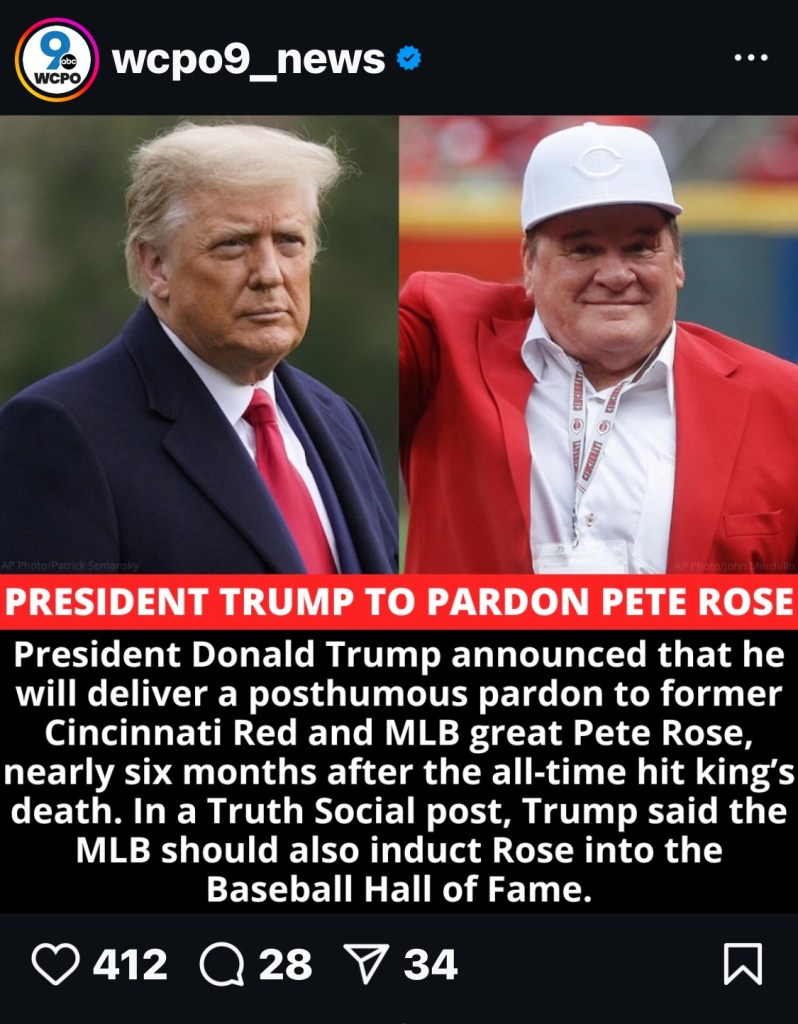
Making America Great Again is about more than President Trump waving a magic wand and suddenly making everything better.  It’s about an attitude and how Americans should feel about themselves that matters most, and breaking this terrible spell given to the world through the administrative state through woke policy making.  To that point, there has been a very silent killer lurking in the background of all our lives that has been looming over the fine line between success and failure, and that is the management of risk and rewards in a society and understanding how important those things are to a healthy culture.  So, for me, especially living in Cincinnati, I was not surprised by President Trump’s statements about Pete Rose and how he planned to pardon him ahead of the 2025 baseball season.  Pete Rose died in the fall of 2024, just ahead of the Trump election, ending a long battle with Major League Baseball, who had banned him for life for breaking a few laws the commissioners thought were important.  Rose had been caught betting on baseball games and had some tax problems with the IRS. The combination of those things effectively pushed out of the game the most popular player, and certainly one of the best, the hit king, out of the MLB and out of the Hall of Fame.  But the problem is, if Rose wasn’t in the Hall of Fame, then who should be?  Over the last forty years, it has been argued that banning Rose from the Hall of Fame of baseball cheapened it for everyone because if the best players weren’t there, why even have it?  Of course, there is more to the story, which is why Trump is getting involved.

Pete Rose isn’t the only sports figure to have something like this happen to them.  One of my favorite all time coaches for the NFL was Jon Gruden, who was kicked out of the NFL because some leaked emails about him talking disparagingly about the commissioner and other people got out to the public and with the new woke rules that administrative minded people everywhere thought would protect them from critical analysis, the NFL and my favorite football team, the Tampa Bay Buccaneers took Gruden down off the Ring of Honor at Raymond James Stadium and the world was looking pretty grim.  Only this past week, at the start of March 2025, did the Buccaneers start to rethink things and put Gruden’s name back up.  I personally like the Glazers; they run a good football organization.  You can find head coaches and position coaches all over the NFL who got their start in Tampa Bay because they have a winning culture.  But they have been anti-Trump and pro-Joe Biden much like the Murdoch family at Fox News has been, and they thought they understood where the world was going when they jumped all over the commissioner’s desires to remove Gruden from the NFL as punishment for violating unsaid woke rules limiting free speech dramatically.  The same traits that made Jon Gruden a great coach, full of risk-taking and passion, were also the same kind of thing that was harming him off the football field among polite society where the incompetent were protected from critical judgments by unsaid rules of conduct that protected Roger Goodell from opposing opinions.  Gruden had called the commissioner a homosexual reference, and Goodell didn’t like it, so he used woke rules to punish the Superbowl-winning coach, and the Tampa Bay Buccaneers followed like cowardly sheep, licking the boots of a corrupt shepherd. 

This is nearly identical to what happened to Pete Rose, the hit king of MLB Baseball.  It takes a unique mindset to be a great player like Rose, to take the kind of risks he did to stand in front of a crowd and hit a ball the pitcher is trying to keep you from making contact with.  Or stealing a base under pressure to score a run and diving into third base headfirst, as Pete Rose did, often obtaining the nickname, Charlie Hustle.  Pete Rose was rewarded for his risk-taking antics in sports, which is how people with such personalities are usually rewarded.  Fans love people like that in sports. It’s one of the best parts of cheering on a sports franchise because most audience members don’t have the guts to take big risks like we see in sports themselves.  So they enjoy watching sports heroes do it.  In the MLB, Pete Rose was getting old and was a manager of several teams, and he was fading, and it was hard for him not to be a player all the time.  So he transferred that energy into gambling, and he bet on himself when he did place bets.  It was a way for him to keep his player instincts alive and be an aggressive manager of his teams.  But that set up a revenge tour for the jealous administrators who had been watching Rose for years and looking for an opportunity to knock him down to size once his name was no longer filling the stands with fans.  So they used an early version of the woke rules to destroy Rose and throw away the key as a message to other players about who the King of Baseball was.

It was a mystery to many why commissioners like Bart Giamatti, Fay Vincent, Bud Selig, and Rob Manfred were so against Pete Rose when other players did far worse over their careers.  It all comes down to capitalism essentially and the goals of an administrative state to use Marxism to limit competitive enterprise.  Pete Rose had all the hot women, fame, and fortune and was celebrated wherever he went.  And administrators like the old and crusty Bart Giamatti could write and enforce rules to show that he has power over such characters which to his mind might bleed off some of that power and influence and get people to lick his boots the way many in a position like his hope for.  They hate people like Pete Rose and Jon Gruden, and I would even put Warren Sapp in there for good measure because of their risk-taking attitudes, which administrators like those mentioned commissioners don’t have.  How do you get the hot chicks to like you if you are afraid of risk?  Show them you have power over the people they like more, so that they’ll like you.  Administrative types adhere to rules to hide their timid natures and their lack of personal courage from the world.  So, they used the rules to destroy Pete Rose because they were jealous of him.  That is one prominent example of why regulations made by an administrative state have been, and are, so dangerous to society, even if we are talking about sports.  That same attitude could be said to be holding back significant industries in America right now, and Trump sees it from the front of the train.  And one way to break that spell is to reward Rose, even if he isn’t around anymore to see it.  Because the world sees it, we want to reward our risk takers in American society.  Even if it is just a baseball game, or stealing a base for just one game of the season that took a lot of guts and pain to attempt, risk takers are the key to Making America Great Again and taking away the power of the administrative state that might regulate them out of existence is a key part to our future success.  And now that times are changing, because we have another big risk taker in the White House that understands these things, worthless administrators who are timid of personal risk are losing power, and people who are good at risk, even addicted to it, are regaining respect.  This is the key to the future of our nation and a great sign of many good things to come.

Rich Hoffman

Click Here to Protect Yourself with Second Call Defense https://www.secondcalldefense.org/?affiliate=20707

Let the Bengals Leave: They cost too much, lose all the time, and they aren’t worth the money in Cincinnati

I enjoy the NFL product more than most do from the perspective of the premium seats.  Several times a year, I get a chance to watch a football game from the Club section or a private box, and I do like it.  I like the Club Seats at Bengals games, from Paycor Stadium, as they call it today.  I like having the Cincinnati Bengals in town and think it’s great for Ohio to have two NFL teams.  But let’s not forget who does what and for whom here.  Both Ohio NFL teams are complaining about their stadium accommodations.  The Cleveland Browns want to move from their current waterfront Dog Pound and out into the suburbs which seems like a really dumb idea.  Their stadium is right on the Lake Erie waterfront and is really nice.  Most NFL teams have received new stadiums that are exotic domes, such as the new ones in Las Angeles and Las Vegas.  Or they are complaining about getting one.  My favorite team, the Tampa Bay Buccaneers, has a very nice stadium I’ve visited several times. I think they do a really nice job in their community, tying everything together, engaging in community activity, and providing entertainment through sports.  I was never happy with how Raymond James Stadium was publicly funded, as they all are.  But with the Glazer family in Tampa, they built a nice stadium with a big Disney-like pirate ship in it, and it gave fans something fun to enjoy.  And there are events at Raymond James Stadium that go on all year.  They don’t just play NFL football there.  Compared to the Bengals, the Bucs go to the playoffs a lot, and they have won a few Super Bowls.  But the Bengals just don’t win much.  Their season is usually over by December, and they have lost when they have had a chance at the big game.  So, the Brown family in Cincinnati have not been nearly as good of owners as the Glazers in Tampa.  All things have not been equal regarding the NFL experience and the owners who run them.

It was very contentious for taxpayers when the Bengals pushed to get the current stadium they play in, what was called Paul Brown Stadium for a while.  It was not that long ago that it was built; Paycor Stadium is very nice and is one of the big features of the Cincinnati skyline.  And as I said, I attend several games yearly as part of the Club experience.  I’m not a stand-in-line kind of person.  If I can’t get out of my car and go straight into the stadium security and to my seat with a private food service option, I will probably not go to a professional sports venue.  And I’ve been to Paycor stadium in the nice summer months and in the snowy cold days of winter.  And I think it’s great.  But it’s not worth infinite amounts of money.   The Bengals are coming up on the last year of their lease agreement with the county of Hamilton, and they want a better deal.  They threaten to move to a different city if the Hamilton County commissioners don’t lay down and cave to their every demand.  Currently, the Bengals want the taxpayers of Hamilton County to pay $150 million in 2024 and another $150 million in 2025 on stadium repairs, with the team contributing $50 million in exchange for a five-year extension through 2030. However, the county has only committed to $39 million in renovations for 2024 going into 2025 with a sort of blank check mentality. 

So here’s where I’m at with the whole thing: let the Bengals go.  See if another city wants to deal with their crybaby NFL antics.  I’d say the same thing to the Cleveland Browns, too.  While I like the NFL experience, it is a nice thing to have, but Cincinnati, Cleveland, and the state of Ohio generally do more for the NFL than the professional football teams do for those cities.  Good luck, Bengals. Have fun moving to Chattanooga or some other secondary city.  It wouldn’t take long for them to regret the move.  We all remember what happened in Cleveland when Art Modell moved the Cleveland Browns to Baltimore only to call them the Ravens.  Then Bernie Kosar, who used to be a quarterback, lobbied with others to bring an expansion team to Cleveland to become the new Browns, named after the Bengals’ owners.  In the end, the NFL, which is more the way I think of the product than I used to, is an entertainment option closer to big-time wrestling.  It’s something for people to talk about on Monday morning around the water cooler.  But not good for much else.  I think the referees tip the scales to favor betting odds, and they do it through play calls at critical times to get one team to win over another in a close game.  (Buffalo clearly converted that 4th down over the Chiefs in that recent big game)  There is too much money involved for the NFL not to be rigged in some fashion, so the whole product’s value is purely entertainment.  And there is a limit to how much money anybody should spend on entertainment.  I think these NFL teams should pay their own way, especially in the Bengals’ case; they should pay Cincinnati for the privilege to play.  It should not fall on the county to pay the expenses of a private enterprise.  The NFL everywhere has a broken financial model that double dips the taxpayers.  But when teams don’t win now and then, a team like the Bengals abuses their relationship with the public.

Considering the size of the payrolls, some of these repairs that the Bengals want to be made at the stadium, whether it’s 30 million for some new paint or 300 million for structural improvements and general maintenance, the money should come out of the Bengals, and they should be happy to pay it to be treated as well as they are in the city of Cincinnati.  Instead, and this is expected in all NFL cities, the expectation is that the public pays once in taxes to build stadiums for these entertainment options, and then they have to pay again to go to the stadium.  And it costs a lot of money.  Nothing is cheap at an NFL game.   So, the NFL product is a pretty bad financial model, and they treat the cities they play in as if they are doing everyone a favor by watching them play football.  As I said, I think the Glazer family in Tampa does a good job building a relationship with the community that pays taxes for a stadium that is much more friendly to the community than what the Bengals do.  Or the Browns.  And the Bengals, for all the trouble and cost they impose on the community, can’t win enough even to justify themselves.  Everyone knew at the start of the 2024 season that the Bengals were in trouble.  Sure, they had a great quarterback and some great receivers.  But the coaching staff was lazy, disengaged, and lackluster.  And the defense was horrendous.  And that was game one of the season.  Going to games during that entire season was like buying an expensive hot dog so the grandkids could listen to loud music and watch losers lose.  The Bengals have not been good owners; they take, take, take from the community, and they don’t know how to win or give the community something to be proud of.  And my advice to the county of Hamilton would be just to let them go.  Call their bluff and let them leave.  One or two playoff games could have generated more than enough money to pay for the stadium repairs.  When you have several players with multi-million dollar contracts in the hundreds of millions, this money they want from the county is chump change.  The Bengals should pay for everything.  And they should pay for the right to play in Cincinnati.  If they’re going to leave, let them.  See how they like the next place they go.  Cincinnati would do just fine without them and their losing ways.

Rich Hoffman

Click Here to Protect Yourself with Second Call Defense https://www.secondcalldefense.org/?affiliate=20707

Yes, The NFL is Rigged: Travis Kelce and Taylor Swift are in a fake relationship Meant to sell globalism

Yes, I think the NFL is rigged, and I don’t believe that most players and coaches know about it.  I think the game is a lot like a poker table in a casino where the illusion of winning is provided, but any wise person knows that the game is rigged so that the House always wins, at least by average.  The NFL is a registered entertainment company; they are not legally obligated to be anything other than entertainment, much like a gambling house, and the referees, at least the top ones, are great at what they do.  You can call or not call any number of penalties in a game to steer the outcome where the betting odds want them.  Some referees are better than others; not all are part of that club.  They have to give the illusion of self-fulfillment without giving away the secret; otherwise, the players and some of the lower-ranking referees would not commit themselves to the task just as the gambler has the illusion of winning to drive them to recklessly throw away their money to the House.  The illusion of winning makes gambling behavior so pervasive, whether it’s a casino or an NFL game.  But there is too much money at stake to allow outcomes on a field to be determined by twenty-something kids throwing around a little ball.  I think many of the coaches know the game is rigged, but they play along hoping to win anyway in the same way that gamblers do.  The House has to let some people win sometimes to keep everyone playing, and they hope to play well enough to be selected in the betting odds and eventually get to play in a Super Bowl and achieve great fame and fortune.  But otherwise, NFL football is no different than big-time wrestling; the outcomes are pre-determined, and the game is rigged to make the most money for the people who sit in the boxes and beyond, to drain money from the unknowing and fill up the pockets of the maniacal, sinister, hustlers.

Mr Pfizer

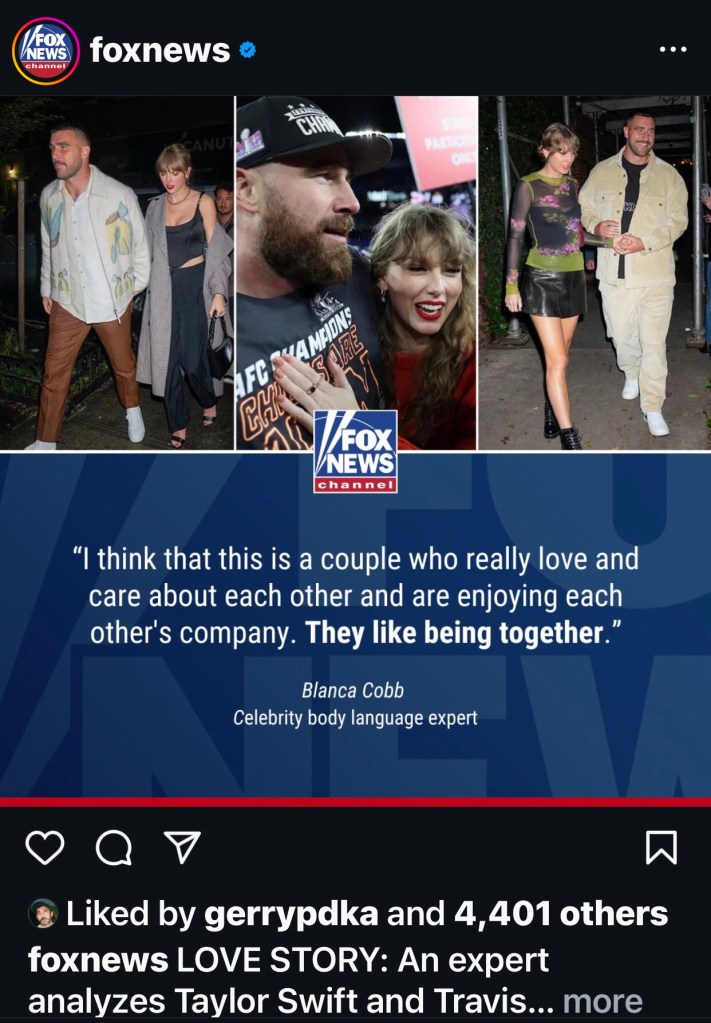
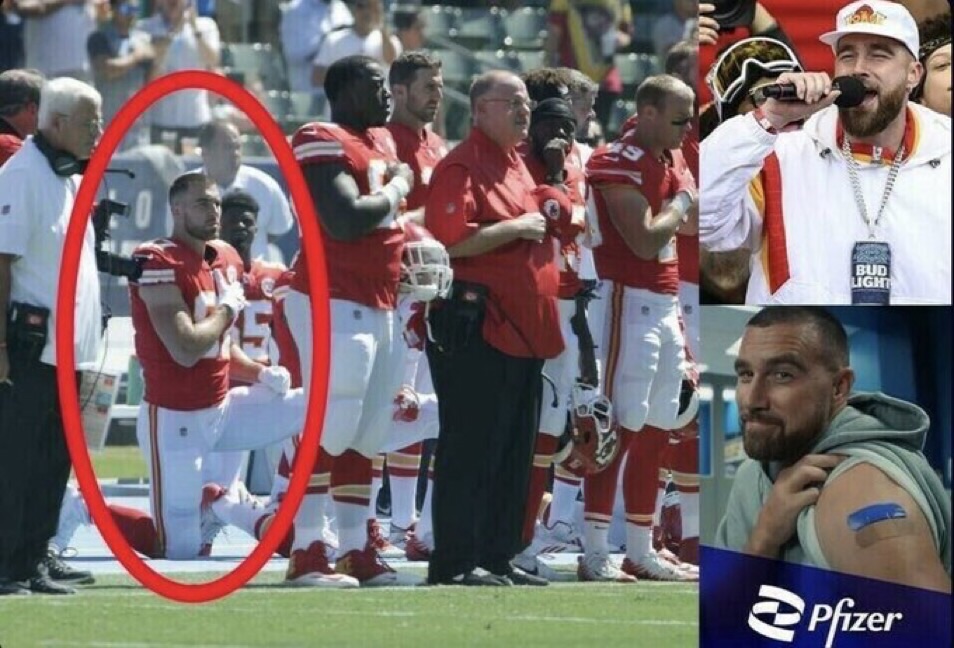
And to that point, of course, the Travis Kelce relationship with Taylor Swift is a fake corporate monstrosity meant to pull in new viewers to the NFL product, which hasn’t yet recovered to its previous status after kneeling for the National Anthem was a thing players were encouraged to do by these exact shadowy figures. Never forget that Kelce is Mr. Pfizer and was the first to kneel to protest American patriotism. He is a Biden supporter and has been one of the leading voices to vaccine mandates, which is why Aaron Rogers gave him that name, justifiably. Of course, some players figure all this out, like Rogers and a few other people, and once they do, like gamblers in the casino, they are fast-tracked into retirement and lose their access to the limelight. If they hang around too long, they are disgraced in the media, much like Brett Farve was, even today. Whoever controls the money, controls the courts and the prosecution of rule enforcement. Much like the NFL itself, the same could be said about life in general. But to keep people coming to the casino, there are always people like Travis Kelce, the tight end for the Kansas City Chiefs. Notice how there hasn’t been any controversy in the NFL about the name of the Chiefs while the Washington Redskins had to change their name? The rules, just like in life, are controlled to force an outcome that makes the House the most money. It has nothing to do with fairness, it has everything to do with slavery to a shadowy group of malcontents. And people like Travis Kelce are always ready to use their natural talents to boot-lick their way into a good and easy life. Kelce has made it clear that he’s willing to sell the illusion and to appease his masters, which is how he has gained so much fame and fortune. In reality, he isn’t much more than a prostitute who will do anything for a few bucks while he still has the body to do it.

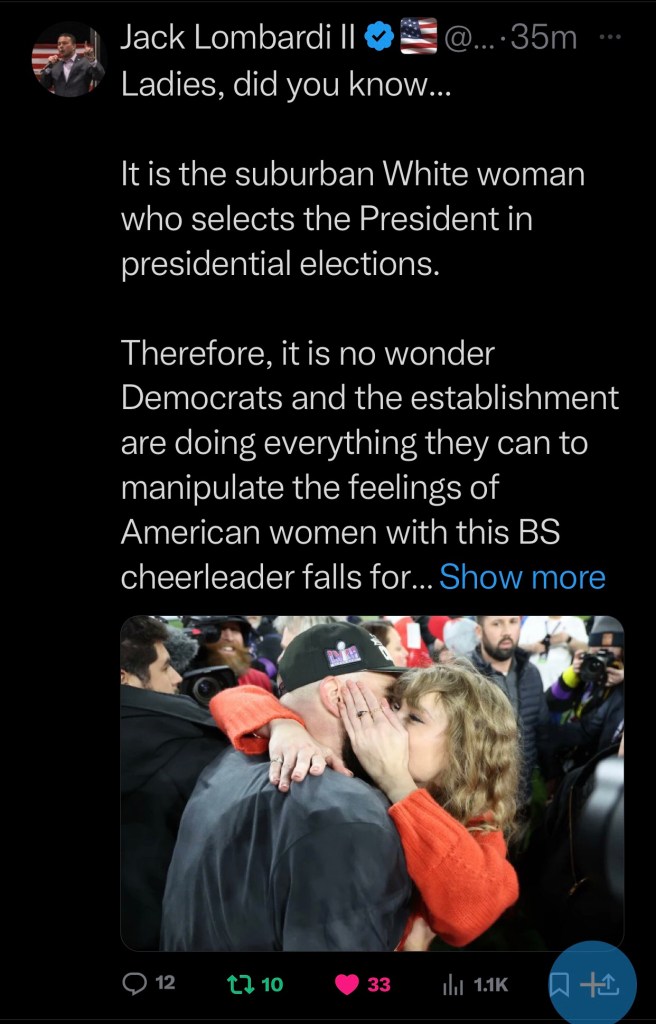
And just like a big-time wrestling storyline, Taylor Swift, the most famous pop star in the world, started mysteriously dating Travis Kelce at the start of the season, and by the championship game, ahead of the Super Bowl, she was in the center of the field kissing her boyfriend as if she was his wife of many years. And it drove the media narrative like a pack of hungry wolves devouring a carcass. Yet there wasn’t something quite right about it all. Kelce, who has access to some of the most beautiful and experienced women in the world, was kissing this milk-dud pop star like it was his sister or his mom. He even kissed her nose at one point. Neither of them, young thirty-somethings, seemed very attracted to each other. They seemed like actors carrying out a plot that they didn’t write. An arranged marriage between two corporate entities, the NFL and the World Economic Forum, was meant to distract the masses away from the populism of the world and to keep them at the gambling table running like hamsters on a meaningless plot for which they were being exploited.

Kelce’s brother was recently seen at a game walking shirtless and drinking more than 30 beers as he held up children in the stands. It is as if he were a king granting the people an audience.  He was being shown as a man’s man, yet only selling an image and driving a plot.  The whole name of the game for the image building was to drive a narrative that provoked the flow of money with betting.  To win that game, you have to make that House happy.  And that House isn’t in America; it’s a group of globalist bankers who use the governments of the world to do their dirty work while they hide in the shadows and use money flow to control millions of people like Travis Kelce and Taylor Swift.  Why would Taylor Swift even play?  Well, she is nothing without her music rights, her value worthless because, on paper, she may be a billionaire, but the money is tied to all these same people.  So she doesn’t have any money.  She has talent that these same people want to exploit to sell their narrative to the hardy fools of civilization.  And she is allowed to have money and make music as long as she sells their rigged game.  And if she is told or “inspired” to kiss Travis Kelce in a big NFL game, she will do it, even if her heart isn’t in it.  And if she is told to support Joe Biden, to steer the youth vote toward the old puppet for the New World Order, she will do it as any whore would do.  She may not like it, but she will do it the same way a dealer at a casino plays their cards.  Let the public win a few games, but always make sure the House always wins, and drain the pockets of the participants to keep them coming back after their next paycheck.  Like the NFL, many corporate alliances do not salute the National Anthem but serve globalism hidden behind finance institutions.  Yes, the game is rigged. 

Rich Hoffman

Click Here to Protect Yourself with Second Call Defense https://www.secondcalldefense.org/?affiliate=20707
What the 2023 Macy’s Parade Tells us About the Economy: It’s Back to the 80s

I watch the Macy’s Parade from New York on Thanksgiving Day as a measuring device for our public health every year.  I usually comment on the kind of balloons they have on the parade route and what type of music they feature creatively.  And also, what is the tone of the broadcasts, and the commercials?  There is usually a lot going on to report that provides a good indicator of other economic factors that say a lot about us as a culture.  And sure enough, the 2023 Macy’s Day Parade had a lot to say.  If I had to pick a theme that was decidedly a major part of the decision-making process in putting the parade on this year, it was “Remember the 80s.”  Because most of the musical acts and creative selections were attempting to rub off the magic and music of the 80s to bring happiness back to the consumer culture, in the past, it was always common to exhibit very progressive themes, like “gays teaching class,” “drag queens make a cake,” or some similar social intrusion.  But I’m telling you, and Disney is a great example of this; going woke has made a lot of corporations go broke.  And that’s more than a catchy tagline.  You can see in the behavior of most corporations that they are reeling from terrible advice from Larry Fink and the gang at BlackRock and, ultimately, the intruders at the World Economic Forum.  By this point in the global insurrection process, we were supposed to be on another currency controlled by the centralized banks, digitally, China was to have surpassed America as the dominant economy, and President Trump was supposed to be in jail, and have all his political capital removed.  So there is a lot of soul-searching going on that many people who thought they controlled the world are embarking on, and it’s not a pleasant experience for them.  And all that shows in the creative decisions at this year’s Macy’s Day Parade. 

I’ll go even further than that, this Taylor Swift lunacy with the NFL and the Kansas City Chiefs is part of the story.  It’s a constructed monstrosity from a corporate brand that needs something to spark interest in the product, and predictably, because Taylor Swift is suddenly at NFL games dating a famous player, women are watching football.  European soccer has been appealing to this younger generation, and the NFL had to do something, so there is nothing better than a romance between the most popular “anti-Trump” pop star on the planet now, where they play her music during NFL games abundantly, and one of the premier players in Travis Kelce.  I noticed that this romance didn’t start until shortly after Taylor Swift played her concert series in Cincinnati, which is a kind of melting pot of heartland sentiment.  It just so happens that Travis used to be a Cincinnati Bearcat football player, so there is something of a connection with Cincinnati that they both have, in some ways, they are wholesome products of one of America’s most wholesome cities.  Some people measure such things as obsessions.  I believe the matchmakers who put these two together, such as Erin Andrews, played a role in understanding corporate politics through such imaging.  “Hey, you guys should date, it would be great for the game and for your careers.”  Taylor Swift and Kelce go on a few dates, talk about how great Cincinnati is, and pretty soon, they are swapping spit in the shower and sharing a towel.  A new corporate romance is born, meant to carry public sentiment positively.

The musical selections at the Macy’s Parade were along the same lines.  They had Cher, references to Back to the Future, and many Broadway plays with people in cowboy hats, as if they were trying to appeal hard to mainstream America but weren’t sure they knew what it was.  What they didn’t talk a lot about was progressive politics, to the point where it was avoided by everyone involved in the presentation.  At the beginning of the parade, a bunch of Palestinian protestors were blocking the route, and they were disposed of quickly so as not to impact the show, which I thought was great.  The show must always go on.  And if you were watching it on television, you never would have known.  It was interesting to watch Cher perform because she is one of the biggest Never Trumpers out there and would generally be one who would throw support to Palestinian supporters, but here was a 70-year-old all dressed up singing sexy songs from the 80s.  Later that day, I might add, Dolly Parton dressed up like a Dallas Cowboys Cheerleader in her 70s, trying to show that age and sexiness were not lost during the Thanksgiving Day tradition of the Cowboys playing football during a halftime show.  The NFL could have picked thousands of other people.  Entertainment had millions of different options, but they decided on Cher, Dolly, and the safe music of Taylor Swift to sell their corporate image.  There were no Black Lives Matter references, no bending the knee at the National Anthem.  There was almost a desperate hope that these corporate images might politely be invited into the public trust again by giving audiences everything they sought and more. 

As I have been saying for a long time now, the BlackRock stakeholder capitalism idea was never going to work, all that goofy stuff they have been yacking about at Davos was never going to be accepted by the American public, and it is there that world cultures trend.  European rock bands and entertainment must export their art to America to make money.  Not China, as the entertainment industry used to think it was possible to sell to the public.  Not Africa, Russia, or Europe.  If you can’t tap into the greatest economy in the world, the one that every economist everywhere should be studying instead of trying to change into a socialist utopia, then there is no market.  And the ultimate feature of that art is the Mainstreet options seen in features like the Macy’s Day Parade.  This year, it was all about an olive branch to the MAGA voters.  Over the last three years of Biden, it’s evident that the public wasn’t seduced into the World Economic Forum monstrosities cooked up under their economic view.  And people wanted optimism in their art again, in their music, movies, and Broadway plays.  It wasn’t that long ago when Broadway was utterly shut down due to COVID-19.  Well, people moved on to other interests, and getting a ticket to a Broadway play isn’t so hard now, just like Disney Parks, where attendance is low.  People didn’t need the corporations.  They don’t need NFL football; all the progressive activism has hurt their brand.  They are turning to Taylor Swift to help them recapture the magic, but it looks like there is permanent damage to the NFL because of their anti-Trump activism that will never come back.  The Macy’s Parade of 2023 clearly states that significant changes were on the horizon, not the kind they politically support.  Yet that is the world of tomorrow, and they are trying to embrace it today.  Their actions are an admission of good things to come that they aren’t all that happy about, but if they want to be in business, they had better embrace it.

Rich Hoffman

The Return of Masculinity by Mike Lindell and Corporate Culture: What to know about that is important about Travis Kelce and Taylor Swift

You might have noticed that Klaus Schwab has a bit more authoritarian to his voice these days, a kind of panic a parent has over a child that isn’t listening, and they are about to reach for their belt to threaten swats of violence if the children don’t mind their betters.  You must understand why we feel things, why beliefs come to us in the first place, and by whom.  Why did this concept of toxic masculinity even occur?  Well, just trace it back just a little bit. In that case, you’ll find that it’s a European thing, a specific European Union kind of thing spawning from the World Economic Forum with the clear intention to destroy the American economy so that world domination by unelected bureaucrats could transform the world into communism.  They couldn’t pull off such a heist if American men were full of macho testosterone-driven diatribes of truth, justice, and the American way.  They needed friendly little compliant drones of social construct crying about the wind blowing on their face and blaming their parents for every sad day of their existence.  The Europeans invented the concept of a “beta male” to fulfill their communist desires by destroying their enemies before they were even born with policies that would be compliant to authority, not resistant.  So, this long march toward the destruction of masculinity has been a purposely manipulative one, and it exists for the same reason that their type is an advocate for the removal of gun rights.  It has been a bad social policy that has gone on too long, and people are tired of it.  It has not had the social results a healthy society would enjoy; even women are complaining about these modern beta males.  They want masculinity back in every way they can get it. 

That’s how you deal with these people

It’s something I have been thinking about for a long time. I get a chance to talk to many people, and women specifically have been not so happy with this modern version of what a “man” is supposed to be.  And an overt confirmation emerged recently while released video of Mike Lindell giving a deposition for an upcoming Dominion voting machine case.  There was a classic American CEO getting very upset at the passive-aggressive antics of the rival presenting an attack on MyPillow products through the backdoor of courtroom submissions, hoping that Lindell would be passive in his acceptance of such an intrusion.  But Lindell caught the episode for what it was and became very upset, and let the young fellow know it, and this is the point of removing masculinity from society all along.  But American businesspeople like Mike Lindell and President Trump are supposed to have been removed from society by now and replaced with guilt-driven CEOs who would allow globalism to rule their corporations for the easy kill of communist intention.  Mike Lindell was supposed to be submissive to authority and to cringe with fear at the incredible power of the Administrative State and the command that the beta males and their sissy-slapping undercurrents could impose on such unprepared aggressions.  Instead, Mike Lindell was letting the little punk know that he wouldn’t get away with the jab at his company, and he was prepared to fight for it then and there.  That is one of the reasons that out of all the pillows in the world, Mike Lindell’s MyPillow is so good; they have the personality of the CEO himself, so when people buy one, they know they are getting a quality product that the CEO will fight for over other products, and it shows in what people put their heads on. 

Like most things created out of a push for globalist communist control, removing masculinity from culture has not given people happiness. Instead, the quality of our entire society has been diminished, and women are not happy about it.  We aren’t talking about destroying masculinity so women can have more opportunities.  I have a wife I have been married to for a long time and children who are women.  Everyone wants women to have the best personal growth and freedom options.  But destroying the idea of a man has not been what women have liked, and society has become less valued.  Deep resentments toward the removal of men from society have emerged over the last several decades; the utopia that global communists were promising has not come true.  The replacement of a strong husband by a strong centralized government has not been fulfilling, and now that the damage is done, people of both sexes are unhappy about the results.  And support for Mike Lindell has emerged in a positive way that is inspiring people back toward traditional understandings of the role of masculinity in leadership and standing by their employees with the kind of reverence that quality is often represented with the concept of pride that is directly attached to the idea of a job well done.  These ideas of quality are exactly what the World Economic Forum was trying to get rid of so that global uniformity by a compliant public could best be achieved.  One pillow was supposed to be just as good as any other, and Mike Lindell was supposed to be too stupid and concerned about not offending his rival that he didn’t notice the sly remark tossed into the deposition to be read in court and have his company slandered by the authority of the Administrative State. 

Because of the massive failures of the woke agenda and the tampering of the human race by these global insurgents, the swing back to masculinity in our modern culture will be radical and even violent toward the advocates who created the problem.  The social trends will favor the strong leader, man or woman.  But precisely, the man, the intense alpha man as classically understood, will become the standard of the day.  You can see it already emerging in the relationship between Taylor Swift and the Kansas City tight end, Travis Kelce, with the football player showing all the classic signs of masculinity and advertisers wanting to benefit from them.  The entertainment industry wants to show the pop culture icon Taylor Swift embracing that masculinity in the traditional feminine reception without being disingenuous to women themselves.  Even a few months ago, such a relationship would have been ignored by the media, but now, as part of a global trend growing out of failure, a market recovery is deeply desired, and the world is steering toward masculinity as it has been classically defined.  And the architects of all this destruction, like Klaus Schwab, are very angry about it.  They can’t put the genie back in the bottle; it’s out for good, and they have been unable to stop it.  The public wants it, so suddenly, a relationship between Swift and Kelce is desired by the entire entertainment industry.  A tough guy and the feminine acceptance of it within a traditional family context, the representation of femininity sitting next to the mom of a Super Bowl champion gladiator.  Whether it’s Mike Lindell, President Trump, or a much younger man in Travis Kelce, masculinity is making a comeback, and tomorrow’s business climate will embrace it even more so than it has in the past.  Because the future is hungry for masculinity due to the failures of globalism and the sad loss of value left in its wake, society is looking to forget as quickly as possible the mistakes of the past and the suppression of masculinity that were part of it.

Rich Hoffman

The NFL Experience: There are things more valuable than safety and security

The very next game after the Bengals had the Monday Night Football game canceled, I had a chance to go and see them in Cincinnati play the Baltimore Ravens for the last game of the season. It had been a busy year where literally every weekend was spoken for. But knowing that the Bengals were going to be in the playoffs and that, especially during this time of the year right after Christmas, this is when I like the NFL experience the most, I wanted to go to a game and enjoy what that product did for the entire city on a cold winter afternoon. It’s hard to experience the NFL product fully; it involves more than just watching the game for three hours out of your day like you do when you watch the games on television. Even that is hard for me and is often difficult. I get pretty mad when the team I’m cheering on doesn’t win because I feel that I wasted my time on them only to end up feeling not encouraged. So attending sports events for me is a lot like gambling. With my life so carefully managed from one moment to the next, investing in an experience where I don’t control the outcome is a lot of risk. But once the Christmas lights come down and we enter the full clutches of winter, I love that our culture produces the NFL playoffs to edge us through the hardest winter months. By the time the NFL playoffs are finished, and we have the Super Bowl, which I consider a great American holiday, we are almost ready for spring. The maple syrup starts flowing, and we know the days of extreme cold are ending. So the NFL experience is very valuable for all kinds of reasons, and they are best viewed from the Club Seats in Cincinnati. 

I was not supportive of the NFL calling off the game against the Bills literally just a few nights earlier because the game itself means so much more to people than just the events of a player who happened to get hurt. The NFL is a very progressive corporation, what many call the No Fun League, putting on the field a uniquely American product. So the NFL is always in an interesting tug of war between appeasing their fan base and marching to the beat that comes out of the World Economic Forum’s strategic intentions for world domination. And, of course, the attack comes from where nobody really understands the direction. While fans watch the military flyovers during NFL games, which are quite spectacular in their own way, and complete the National Anthem with hats over hearts, the tide of the game, which is entirely out of the NFL’s control, takes on a life of its own. And it’s something you can only ever really see in person by experiencing firsthand. During this particular game, I had a very personal relationship with the military craft that was used, and they flew over very low, so low and slow that you could see the pilots. With all the fireworks, I had my grandson with me, which was quite a ceremony. Clearly, he was having a moment with the whole stadium, and patriotism was fully in the air. The haters of American culture might have the ear of the NFL and are pushing for its destruction through woke policies, but the current of American society itself was on full display all around us, and I found it very refreshing, worth its own currency in those cold January months.   

Ultimately, the NFL is like a pioneer trying to cross the current of a raging river. They started something that Americans genuinely love, and that made them happy until their masters of finance leveled an attack against our culture, trying to use that love as a device of hate, to destroy that very culture by luring innocent people near it, then to influence them with extortion to social behavior changes that were controlled by the Desecrators of Davos as I call them, the Bond villains who are a part of the World Economic Forum. And those types of people called off that game against the Bills to remind people that safety and security were more important than the results of a game, which I will always argue are oppositely true. The result of a game, or an event in life of any matter, is far more important than safety and security. American football, represented by what the NFL puts on the field, is a dangerous sport that represents capitalism at its finest. It is different from European soccer in many ways that are critically important to our culture. Soccer is a kind of pinball game where skilled players get a random chance to kick a ball into a goal uniquely. American football is all about planning and precision. You get four downs to get 10-yard increments. Every play is like a business plan, and success is the end zone of all that planning and coordination paying off. The offense on the field is all of us. The defense is life itself, trying to keep you from scoring. Football in America has much more going on than most sports. People have an unconscious understanding of it, even if their conscious reality manifests into too much beer drinking and dancing to booming music. Football in America has a unique relationship with capitalism, and we have a perceptual understanding of that value, which is why globalist forces are attacking the game the way they are. If you want to bring down America, which many forces in the world do, then American football is the way to do so. That leaves the owners of NFL teams in a strange place. Do they follow the rules of wokism from the World Economic Forum, or do they listen to the fans who continue to make them rich and allow the currents of capitalism to wash over them in a way they enjoy and can thrive in? 

I tend to be very free with the wallet at these kinds of events; I like my children and grandchildren to know how vital NFL games are to Americana itself. I don’t complain about the expensive drinks or hot dogs. I like the very expensive jerseys and hats. I like to tip the guys out front of the east entrance who are playing the drums. I love the energy and the celebration of life that is obvious at all NFL games. And I wish everyone could win every time. It is much like gambling to investing so much time and money into the NFL experience, but I see it as nothing but positive. And after going, I was reminded how dumb it was to cancel that game just because a player was injured. When bad things happen, we want to take time to see them taken care of. But there was more going on with the Bills player who suffered a heart attack on the field during Monday Night Football during the first game of 2023. Likely the heart attack was brought on by the NFL’s push for untested government vaccines, playing their role in the Great Reset by Klaus Schwab and the gang of destroyers who gather every year in Davos about this very same period. There are a lot of hostile forces in the world, and fans at NFL games are uniquely prominent in their effects, which is obviously frustrating for those forces. That’s why games should never be canceled, no matter what. The show itself has a value that transcends the way antagonistic forces shape logic, and the rebellion against their wrath is very much the core of the NFL experience, an unintended consequence. It’s what people cheer for during the game and why going to the games is such a cherished activity. And it’s why we must fight to keep our corporate products out of the hands of global politics intent to rule us all behind bureaucratic rules and regulations centered on safety and compliance. Those are the real enemies, and we love to cheer when our football teams score, regardless of what defense is set up to stop us. In the end, that’s what people celebrate, and it’s certainly worth doing.

Rich Hoffman

Click to buy The Gunfighter’s Guide to Business