
How Crimes Are Committed in the Modern Age by Governments: The Boggle Threshold and the advantage it gives the criminal class

Everyone is wondering how so many crimes committed by government, such as Covid and the vaccine mandates, the theft of wealth through inflation, and the sell-out of America through privileged political hacks like Hunter Biden, can go unpunished. They see the crimes committed but nothing being done about it. Well, the political left has already provided the answer; the classic Cloward–Piven strategy is meant to overwhelm systems, then collapse them into a change state favorable to the attacker. Then there is John Kotter from the Harvard Business School, who will tell leaders to create a crisis, even if there isn’t one, so you can unify efforts to your direction. It’s a standard trick, and by now, especially among the college-educated, they have seen it done to them over and over through many years, and now as adults of their own, they unconsciously do the same thing to people they are supposed to lead. It’s the classic lie a parent tells a child, don’t go outside during a storm because you’ll be struck by lightning, with the intent to keep children safe in the house and under control by fear of what might happen to them. Many grow up and become terrified of several irrational fears because of such methods employed on them over a long period. And believe it, the governments of the world, the global criminals know this, and many of the crimes we are seeing now are happening because of their understanding of this modern problem of interconnectivity across political influence. They continuously seek to exploit the conditions to their advantage. 

Yet, the strategies mentioned, whether it’s Cloward-Piven or Kotter’s Eight Stage Process of Creating Major Change, have a more technical term for the conditions those strategies expose, and that’s the Boggle Threshold. When we talk about something “boggleing the mind,” we are talking about people reaching their Boggle Threshold, which is the saturation point where a mind rejects new information upon receiving it. The information might be perfectly valid, but the mind witnessing the information might be too consumed with other information to accommodate it into a change state reality. The Boggle Threshold is typically associated with paranormal phenomena, so it doesn’t generally get used to express political matters and everyday concerns. When the question comes up about ghosts, UFOs, or Big Foot, ordinary people are worried about gas prices, love lives, and whether their neighbor cut the lawn and don’t have room in their minds for contemplation about information outside their everyday experience. The criminal class, which was first most successfully used under the mob in Chicago and later captured by the favorite book of the left, Rules for Radicals, knew this about people and often hid their crimes behind it. They might murder people in the streets of Chicago. Yet, with all the other crimes going on and the rebellious nature of Prohibition in general, Al Capone knew he could exploit the Boggle Threshold in people to hide the mob’s many crimes behind his magnetic personality. People could relate to his charisma. But they couldn’t see the monster behind his façade because their Boggle Threshold just couldn’t contemplate such things. That’s why he was never convicted of the actual crimes he committed but was only found guilty of tax evasion because it was there that a conceptual idea of a crime could be conceived within the rules of tax policy—rules that everyone can generally understand within their Boggle Threshold. 

An example of the Boggle Threshold would be if you were walking along and found a dead body, then next to that body, there was a bloody knife; any rational person would conclude that that murder weapon had killed the deceased person. But, if the person who discovered the body was encumbered past their saturation point within their Boggle Threshold, then they might not see the crime scene so clearly. Perhaps they were in a fight with their spouse over who was going to drive which car to work that day, or maybe they were trying to find the money for the mortgage. Perhaps they were worried about something with their kids or some other series of details on their minds before discovering the dead body. How many people who witness a crash on the side of the road would stop to help, and how many would just drive on because they had a million other things to do and couldn’t afford the chaos of something out of their routine? When people are at their Boggle Threshold, they don’t have room for new information, such as election fraud, the origins of Covid, or that the President’s son is on hours and hours of video recordings of himself naked smoking crack out of a pipe. All those things are happening outside of people’s Boggle Threshold. People might observe those conditions but are paralyzed to pass judgment because they are past their saturation point for new information to influence their behavior. 

Just like Al Capone, but on a vast scale these days, and across the entire world, crimes are committed knowing that in democracies, most people won’t have the intellectual capacity to maintain a Boggle Threshold that can actually see the crimes being committed. This Boggle Threshold is hard-wired into our media culture and our public education, where one sets where that threshold is for everyday people. The other works to saturate people’s minds with so much useless information that they never have room for new information that may be much more important, such as the Wisconsin Supreme Court making a decision that none of Joe Biden’s votes counted from drop boxes were legal, and must be subtracted from the overall number, which would mean that President Trump actually won the state. People are worried about a recession, gas prices, and increases at the grocery store. My family ordered a pizza the other day, and the driver reported to us that the delivery charge was $4 now instead of just $2 because of gas prices. When you can’t even order a pizza these days without it breaking the bank, nobody has room to contemplate global election fraud that has put in place radical communists who want to take over the world. It might be accurate, but it’s beyond the Boggle Threshold of most, so the crimes go unnoticed and unpunished. A Boggle Threshold can be increased through intellect, but if people don’t know they should be expanding their personal limits, they aren’t going to make the conscious effort to do so. And knowing that, the criminals of our society are perpetuating their crimes with the understanding that ordinary people don’t have the time or mental capacity to deal with the ramifications of their crimes committed, so long as the crimes are hidden by a barrage of nonsense that fills up people’s minds and saturates their Boggle Threshold. However, the weakness of this strategy can always be uncovered by “intent,” the intent to commit a crime, which is evident to all, even those stressed out by the events of our day. Once you simplify matters into observing intent, then the Boggle Threshold gives way a bit, and people can understand the circumstantial evidence. But taken at face value, until “intent” is obvious, the crimes continue to be committed without the fear of prosecution or a society that will take a stand against them. 

Rich Hoffman

Click to buy The Gunfighter’s Guide to Business

Vote for Thomas Hall for the 46th House District in Ohio: Setting the bar high, too high for political rivals

It’s never been an option from my perspective; after the remapping of the Ohio House Rep districts, Thomas Hall has always been the clear favorite. That’s not because Matt King, who is running against him in the primary that voters will decide on August 2nd of 2022, is a bad candidate. But just that Thomas Hall is that good. He checks all the boxes you’d want for a Representative seat in the new 46th district, which now includes Liberty Township, Ohio, and traditional districts from the north, such as Middletown.   Recently at a West Chester Tea Party meeting, Thomas and Matt spoke to the audience to make their pitch as to why voters should vote for them, and I present those videos here, which comes down to one key attribute that decides the issue. In Thomas Hall’s case, he has a lot of experience and has been very successful during his first term in Columbus. He has done all the right things, including passing blockbuster legislation across Governor DeWine’s desk for H.B. 99, which makes schools safer in the case of a mass shooting. Matt King just doesn’t have the experience, and it showed as he presented himself. Both are nice young men, but in the case of Thomas Hall, he’s just an exceptional political representative who has done such a good job that no challenger would do well against. 

To Matt’s point, he did the best he could, and he’s right about the Founding Fathers being very young when they were involved in the revolutionary business of starting a new country. He’s been a guy from the business world, not a politician like Thomas Hall, who has two terms as a trustee in Madison Township to add to his resume even as young as he is. And typically, we might say that not being in politics is more attractive than voting for the incumbent. In most races, that would be true. But Thomas Hall is such an exceptional young man who has faced the hottest fires of controversy and done so with great poise; you get the feeling from him that he’s just getting started. Thomas Hall has already shown that he can go up to Columbus and work with people who do not agree with him and work on legislation in a productive way to get their support. And he knows how to navigate the rough waters of politics without being a sell-out to his district. Of course, that has made Thomas Hall a target for those jealous of his success. For instance, Sheriff Jones has endorsed Matt King because the Sheriff is on the record being angry at legislation Thomas sponsored, like H.B. 99. But Thomas has managed to pick up the enthusiastic endorsement of Butler County Sheriff’s Office Police Union, which Sheriff Jones is a member. He also has the support of the NRA, Buckeye Firearms, Ohio Right to Life, and the Middletown Police Union. Sometimes when you are too good, you do make enemies. In my opinion, Thomas Hall has made the right kind of enemies and he made those enemies because he had done his job too well. 

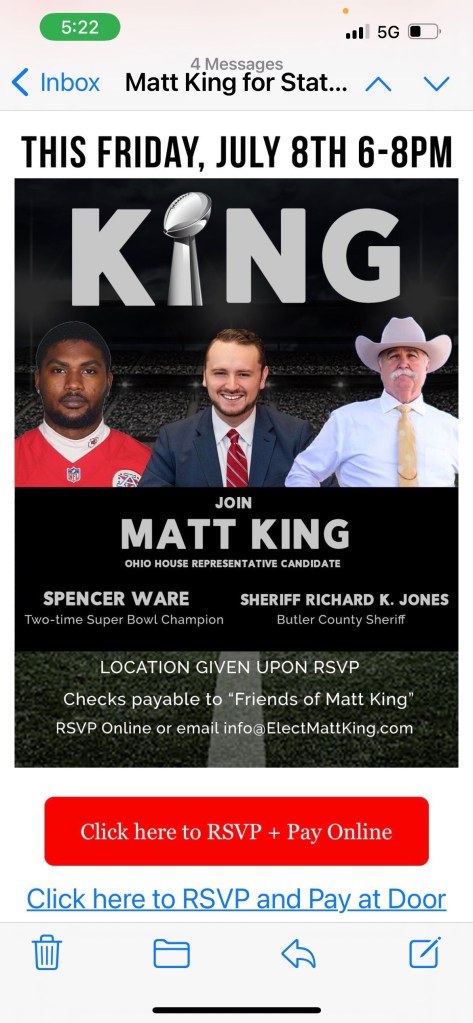
Some of those jealous forces have thrown their support behind Matt King simply because they don’t want to live up to the high bar that Thomas has set for them. Matt is a blank sheet of paper, making it much easier to live up to. The hope that a fresh set of eyes as a House Rep might turn out well is the same kind of reasonable hope that someone who purchases a lottery ticket might expect. You can’t win if you don’t buy one. But in buying one, you accept that the outcome is uncertain. In my experience, a person with a business background like Matt has will have a tough time because when you run a business, you can hire who you want, and if you need money, you just go to the bank and make your pitch. The tricky thing about Columbus is that it already has people there whom you have to work with who have their own ideas about things, so it is difficult at best to get anything done and to do so with your authenticity intact—and even saying that of course Democrats who enter the Republican Party as Trojan Horses would like to see an end to Thomas Hall. You can see that clearly in the upcoming fundraiser mysteriously sponsored by the Republican Party of Butler County that has the Super Bowl trophy of Spencer Ware on it. They even put the trophy in Matt’s name. When you see this kind of thing, its always an indication that the candidate doesn’t have their own record to stand on, so they try to evoke the records of other people, like the Super Bowl exploits of a person who was on Super Bowl-winning teams, or Sheriffs with a long history of service, but a history of wanting to be a kingmaker and knock off political rivals at the party level.  

But the most convincing case for Thomas Hall came when he was pressed during the meeting by a critic of H.B. 218, which was a reaction to the impositions of the vaccine mandates. The critic in the audience was pressing Thomas for his support of the bill, which she did not feel went far enough in protecting employees from their employers during Covid. Thomas was front and center with all that activity, so he has a track record to criticize. But I think he handled that emotional question very well, which shows how much grace under fire he can handle, so I offer it here. Many political personalities would have stumbled through this kind of criticism, but Thomas did all he could at the time, so he could confidently answer the question.   There was undoubtedly a time limit being imposed on H.B. 218, and Thomas wanted to get something done, even if it didn’t go as far as the person asking the question wanted it to go, which was complete protection from mandatory vaccines. When the Biden administration put forth their Executive Order in September of 2021, it was essentially a race against time, putting politicians like Thomas Hall between a rock and a hard place on purpose. There is a fine line between individual rights and the rights of a company to require employees to comply with the needs of a workplace. That caused a lot of trouble for Columbus in reacting to the pressure; Thomas showed outstanding leadership during this challenging situation and was very respectful to his critic when asked the question. Of course, many of the Biden mandates have been found unconstitutional, as many thought would be the case all along. H.B. 218 tried to do something in a really tough time, so there wasn’t much more Thomas could do, but his reaction to the criticism is telling because it shows how he can handle pressure, even when it’s critical. Matt King couldn’t be asked any questions because he didn’t have a record to defend. And ultimately, that’s what this race comes down to; one of the candidates for the newly created 46th District in Ohio has a lot of experience and has been very successful. The other guy is hoping to use other people’s reputations to knock off a political rival who has set the bar too high for other politicians to live up to. That makes it a pretty clear case. Ultimately it’s up to voters, but the logic favors Thomas Hall greatly. 

Rich Hoffman

Click to buy The Gunfighter’s Guide to Business

One of the Biggest Challenges in Politics: Political groupies

I’m not the guy to talk to about cooking meat on the grill or sports statistics. Small talk to me is like getting stuck in the mud, and I hate it. And every time there is a holiday where typically there is a lot of small talk, I’m miserable in those circumstances. Normal stuff is the most boring kind of stuff to how I think about things. I appreciate it for the “life stuff” that it is, but I personally don’t like doing it.   What I do like talking about is how to save the world. If it’s a big all-encompassing topic, well, then I do like to talk about it. And because of that trait, I tend to know many people who are trying to save the world from their own particular view of it. That puts me in contact with many people who spend their time in leadership positions, especially in politics. As people who know me most understand, I have very specific rules for leadership that I apply to the world 24 hours a day, seven days a week for everything. There isn’t a minute in any day where I’m not thinking about leadership and how it can be used to make the world a better place, professionally, politically, or privately. Each week I speak to many hundreds of people, all of them in some leadership role. And there is a particular problem that they all have that never really gets talked about, no matter if the position is a political one or a professional capacity. The issues are always the same. I call their specific problem the “political groupies” that often loom in the background and seek to live through a leader because, for whatever reasons, they don’t feel comfortable in those roles themselves. Still, they want the prestige of such roles for lots of personal reasons. 

One of the hardest things for a politician to do is make that transition from an ordinary person to a public persona. To move from campaign mode into an actual leadership role without tossing away all the promises that were made to the public. Many political figures assume that they are two different things and that what goes on in campaigns isn’t practical for the actual leadership once the work begins. They end up split in many ways between campaign mode, which includes fundraising, and the business of consensus building to get votes. What ends up giving politicians a bad name is when they find that transition impossible to negotiate.

On the one hand, they have to put on a show for their donors, the people who actually go to the polls to vote, and the daily grind of whatever job they are doing. It reminds me a lot of a rock band where the sexy stuff is on stage where all the action happens, but most of the time, the business of writing music, getting good at performing on stage, and life between the gigs can be monotonous. Rock bands that are most famous often turn to drugs and other forms of personal abuse to reconcile their emotional swings. Politics is a lot of the same kind of challenge, but it usually doesn’t get viewed that way, which maybe it should. Building up the brand of a public persona is part of political life. And not losing yourself in that role is very difficult for most people. At best, it’s hard. Especially when there are people who come along with the political figures, and they help with the campaigns, they put out yard signs, donate money, and work behind the scenes in ways that may be helpful, but the emotional aspects of those friendships are often like an anchor to the public official. Anchors are great if you want to stand still in the middle of the ocean. But they aren’t so good if you need to move fast and dynamically react to the world. 

In all forms of leadership, I have a policy of hands-off. I will seek out leaders, but once they are in a position to lead, I give them full autonomy. The worst thing that could be done to such people is to undermine them with micromanagement. They need to think for themselves. For instance, out of those hundreds of people who I speak to every week, I do not give them my opinion on what I think they should or should not be doing. I will offer advice if they want it, but part of the reason you want to help put leaders in place is so they can lead. And micromanaging is not leading. Micromanaging is trying to live through other people because there is something in the micromanager that wants the glory of leadership without the responsibility of actually doing it. I call those types of people political groupies. They are like the groupies that you find in rock bands; they like to tell people in the audience that they are with the band, that they know what song they will play next, and in that way, they might get to be famous too, without the burden of actually being on stage and the pressure that comes with it. Many political figures have to learn that interacting with people in the audience is different. They don’t want someone who will respond to social media; they expect some representation of the brand that was created during the campaign to represent their interests at all times and having too personal of a relationship with the world violates the unsaid aspects of leadership that are so important. Being too accessible destroys the illusions of leadership that most people want to have. And what the groupies often do that is unintentional is that they act as a bridge between the theatrical role of the leadership position and the normal meat grilling audience who are always looking for leadership in everything they do in life. 

I personally like to help leadership birth its way into existence through people. If there are doctors out there who want to deliver babies into the world, I would best see myself who is the doctor who delivers leadership. But once they are born, I do not make it my mission to tell those lives how to live. To tell them how to be leaders. To do so is to erode away the validity of their own existence and rob them of the joys that do come from leadership. Often it’s not the various lobbyists who end up causing so much corruption among political figures; it’s the friends and tag-alongs who come with a candidate who holds back the fruits of leadership most because its impossible to take them on the complete journey, especially when it comes to building up the personal brand of the leader and maintaining that brand through all public interactions. It’s a balancing act that doesn’t get a lot of attention under any psychological scrutiny, but it is one of the most common frustrations that occur in political leadership roles. It’s a manageable condition, and there are ways that everyone can come away as part of the success story. And it’s worth doing when it all comes together. But it isn’t easy by a long shot. 

Rich Hoffman

Click to buy The Gunfighter’s Guide to Business

How To Bring Down Big Organizations: The United Nations and China have already lost

The Way to Bring Down Large Organizations, like China

One thing I don’t want to see is a bunch of people being scared.  When I wrote The Gunfighter’s Guide to Business, I did it to help people who may want the help of understanding a strategy that could help them through the scariest circumstances.  After all, that is my experience, I’ve seen all the scary stuff any person should ever have to see in a lifetime, and I still have a lot of lifetime to live.  But I’ve never woken up afraid of anything in my life, even under paralyzing circumstances.  And with things being the way they are in the world, it’s a good time to share some of the knowledge with other people who may be so inclined to provide leadership for themselves toward the aim of making a better life.  So increasingly, now that the Biden administration is doing its thing and the global forces against us have shown their intentions, I want those who have a mind for it to rest at ease and think clearly about the matters at hand.  It is essential to understand the true nature of power and how to defeat overwhelming forces because those are the problems of our current time, and I offer in my book a guide on how to get there.  But I’m not just selling the information in a book; I’m happy to tell and teach anybody who wants to learn.  The book puts it all in one place, but I offer openly much of what is in the book because I want to see people win at life, especially when it comes to the MAGA movement and the threat of China and the United Nations in general.  Sure, they are big organizations with many resources behind them. Still, as I point out in the video above, they are easy to bring down, just as most large organizations are for all the reasons discussed in this article. 

The big falsehood that many of us have been taught, and China affirms it during each Olympic season, is that large groups of people who show they can do exactly what they are told are the most critical element of strategy.  China enjoys showing the world at military displays and Olympic events how they can get thousands of people to coordinate perfectly in complicated ways with mass obedience.  Big companies like to teach how “compliant” their workforce is to company memos and compliance audits where instructions are followed to the letter and never strayed from.  Too much of the world and the long span of human history, compliance to orders is the primary concern and measure success.  That is, after all, the fear of most military affairs. “Sir, I was just following orders.” Soldiers are not expected to think; they are expected to comply.  In our schools, we are to follow a teacher’s instructions to do what we are told.  So it should never be a surprise to anybody that when America was attacked by global forces, throughout the last several decades, especially in the previous couple of years, we would be assaulted through our natural compliance to instructions provided to us by centralized authorities.

In many cases, we have been taught this method of value assessing our entire lives.  The dog whistle is something most of us hear when a Covid health official tells us to wear a saliva-covered mask in public and not to take hydroxychloroquine to fight off a bioweapon virus produced in a lab in China to take over the economies of the world under the flag of communism.  We comply because we were taught to, even if we think the concept is stupid.  Most people in the world do.  Likely much of China believes its authority figures are fools, but they follow their instructions because of the way they have been taught to think about their roles in the schemes of things. 

Yet leadership is not in following instructions because the centralized authority issuing the instructions might get it wrong. In so doing, it will put the lives of hundreds, thousands, and millions of people at risk in their error.  I often tell the story of how I worked at five large companies before I ever turned 30 and could never cut a break by any of them staying open.    In spite of any hard work I did, they all managed to close due to bad leadership, bad because they were too centralized in their approach to problem-solving.  I watched many brilliant people destroy great companies. They put all their strategic efforts into the wrong priorities, believing that organizations were great because people followed directions.  Well, at a certain point, I gained the ability to be a leader myself, and my method has always been to teach people how to think so that if a centralized authority gets a strategy wrong, then the people closest to the problem can make a correction and solve the problem right then and there.  I often like to use the football metaphor of calling an audible at the line of scrimmage.  The game plan might be acceptable until you see that the other team has adapted to what you’re doing and you need to make a change.  If a plan isn’t working, players need to change a play to adapt to what works. 

In The Gunfighter’s Guide to Business, I point out that one of the great strengths of the American way of doing things is our ability to think outside the box, to “shoot from the hip” when needed to approach problems less formalized.   It’s OK to have a plan and a strategy, but decentralizing the problem-solving process is the key to success in any culture, whether it be a company or a country.  Leadership is all about thinking on your feet rather than coming up with a game plan then forcing everyone to stick to it, even if it proves to be the wrong plan.  And that is the dirty little secret that China doesn’t want anybody to know about them.  The United Nations, too, are all too rigid, and even if they were to happen to read this, I have people from China who read here every day, likely censors, they could not correct course because their culture is not flexible enough.  What they value in a good society are all the wrong things.  They can only hide that fault if they can eliminate all their competition from revealing it to the world under pressure. 

This is why I said, especially to some compelling people in Washington D.C. when I first published my book, that The Gunfighter’s Guide to Business could bring down China without destroying the assets and people of the country.  China will lose whenever forced to play the gunfighter game, “shooting from the hip,” decentralizing authority in organizations and governments.  All the socialists that are running the United Nations are in the same condition.  They are compliance-driven, and any centralized authority issuing orders, such as the CDC has now made itself known for, will make mistakes. When they do, they are too slow to adapt to a victory position.  So in that way, prominent centralized authorities will always lead to failure, which is why history tells the stories of communism that they do.  Big companies go out of business for the same reasons.  But success comes not from relying on centralized processes but in teaching people to think as individuals toward a common cause but to make decisions about strategy at the point where the problems present themselves.  Not in the office of some far removed bureaucrat who doesn’t understand all the conditions involved.  And knowing that and the threats in front of us now, perhaps they will look less scary if viewed in this way.  It’s not about compliance; it’s about resolution and performance 100% of the time.  Those who don’t understand these types of things will eventually always lose. 

Rich Hoffman

Click to buy The Gunfighter’s Guide to Business

How to Find a Leader: Joe Biden is not one

It is one of the most misunderstood concepts of our society.  I am going through the editorial process with a publisher on a book on this topic called The Gunfighter’s Guide to Business. Still, we need to address the difference between a leader and a politician for our case here today.  Because obviously, most people don’t know the difference.  Every day in the news, somebody talks about Joe Biden as if he’s our “leader,” even Tucker Carlson on Fox News.  There is a treacherous psychological mind trick going on here that is costing us a lot of national bandwidth that we need to straighten out because we are different in America than other places globally, and we need to understand why.  We don’t elect leaders into office in the United States.  We don’t make an effort to be led by titles.  Remember, unlike what everyone tells us, we are not a Democracy; we are a Republic.  And we elect people to represent our views in America.  Not to lead us, leadership is scarce, and when we find them, we like them.  But we can’t limit our scope to always waiting for some leader to emerge before leaving the campfire and exploring the nearest cave the way leader-driven cultures tend to do.  We built our country to assume that leadership would be hard to find and was very rare, so leadership wasn’t needed in the political class.  We just needed representatives to carry out the interests of the people who elected them, which is a vast difference from what we are told. 

As I talk about in my upcoming book, leadership is forged like gold from the massive pressures of the universe.  Not everyone has the stomach or the heart to be a leader.  Typically we don’t see leaders emerging in our political circles because the conditions for making a leader do not exist there.  We see them come about in military life to some extent, we see them in sports, but most of our leadership in America comes about in the business world.  The percentage of authentic leadership is noticeably low; it’s a fraction of the total percentage of an overall population.  For example, Tom Brady is a prominent leader in sports.  He makes his coaching staff better with his leadership and teammates no matter what team he’s on.  Tom Brady manages always to find success.  You can see that type of leadership in CEOs, such as Steve Jobs.  Modern-day Elon Musk has excellent leadership.  It’s not the money he has which exhibits it, but it’s in his long string of successes and how he can communicate complicated vision to many people.  Of course, when we think of leadership, we think of General Patton.  I think of Claire Lee Chennault, who created the great Flying Tigers.  But these are all names unique to the history and within our populations.  They are far from commonplace. 

The health of any culture should always be measured by the number of leaders it produces.  But for that to occur, you have to understand what a leader is, and by calling politicians leaders by their titles, or worthless CEOs who expect to lead by title, then we are kidding ourselves toward the objectives of success, in a healthy culture that proportionally, America is the best globally. We have our Tom Brady types coming out of leisure activities and our Elon Musks in science and industry.  Other countries don’t have those people.  It’s not because the skills aren’t in the population.  But those cultures do not have a means of emerging them from obscurity into change state contributors, just as Indians of the Wild West spent much of their lives walking over gold but having no means to bring it out of the ground. And even if they did get to it, what would they have done with it?  They had no economy to make money.  They had no concept of money, so they never extracted gold for sociological use.  There needs to be a means to bring about the treasures of existence, and if that culture does not develop those means, you will never get to the prize. That is what leadership is; it’s a treasure of human endeavor that can advance a society when it is found and utilized.  But it is not created by silly titles, which is the prevailing belief by those too lazy and ill-equipped to develop a culture that produces leadership.

If we recognized that simple leadership trait, we would eliminate much of the corruption we see in politics currently and in the past and future.  Because we have by default given out leadership designations to people by title and not merit, we have prevented authentic leadership from emerging and improving our lives and circumstances.  Back to Tom Brady, think of all the professional football players we have seen over the years.  But not until Tom Brady came along was the whole leadership package developed into a guy who had taken his football teams to so many Super Bowls and won when the surrounding players were all different, and even the teams were different.  Tom Brady is proof that it’s not teams that win big games; it’s one individual who is a true leader.  Socialist and Communist countries always fail because they have no interest in finding leadership.  They have built their entire societies around collective consensus instead of leadership.  That is undoubtedly the case of our institutions of learning and our government of today in general.  They think leadership comes out of group behavior when it is forged from the pressure of success and failure—through much pain and turmoil and a refusal to take the loss as an answer to living. 

By calling any political person a leader, we are cheapening the word for its true meaning and use.  It is worse than all that it is a general punt by a declining society to be so quick to call worthless people leaders because the culture desires to shift away responsibility for leadership to people with titles instead of hashing out the problems themselves.  They might fail in the task if they did try, but by not trying and giving the responsibility over to a titled person who does not have leadership, but is like Mitch McConnell, a politician in a high office, then a failure shouldn’t come as a surprise.  Mitch McConnell will never be a leader of anybody.  Joe Biden will never be a leader, nor is Vice President Commie Harris.  Skin color can’t make a person a leader.  Bootlicking doesn’t make a leader.  Diversity training won’t make a leader, so globalism will ultimately fail because they seek to suppress leaders in favor of a system that makes politicians by title into positions of authority without earning the right through the pressures of living and becoming the best, thus creating leadership. 

Not understanding leadership has led to many of the problems we see today and destroys the lives of those unable to see leadership for the value it brings.  But make no mistake, just because someone wins an election, it does not make them a leader.  Just because someone gets a promotion, it does not make them magically a leader.  Not even a Super Bowl can do it; in the case of Tom Brady, he has shown that you must win many Super Bowls under many different conditions to show the power of leadership.  But without these tests and high expectations, you get sorry performance and a culture destined for failure.  And that is the danger of calling worthless politicians leaders when they are only haphazard politicians who represent us in politics at best.

Cliffhanger the Overmanwarrior


Share, subscribe, and see you later,


Sign up for Second Call Defense at the link below. Use my name to get added benefits.
http://www.secondcalldefense.org/?affiliate=20707

Understanding Leadership: The difference between success and failure

Compared to most everyone else I have some bizarre ideals about leadership that certainly don’t travel well with the currents of civilization. Yet I am so certain of them that I no longer entertain opinions to the contrary because I recognize it as a special gift that is of great benefit not only to myself, but everyone I happen to know. Of course this leads to many matters of conflict which part of me strategically avoids while at the same time seeking it out. Leadership is one of the least understood attributes to modern society even though it should be easily plotted through history. Our best modern attempts is to believe that somehow West Point makes leaders through the military and that somehow the armed services through the concept of sacrifice makes great people. The other belief is that somehow in the classrooms of our colleges a teacher touches the life of a student and magic happens and a leader is born. So the mystical belief is that if society wants leaders, they need more procedures and rules to create an environment for a leader to evolve into the role of a savior willing to sacrifice themselves for a common good—so most schools of thought travel down that path. Yet, that grasp is likely the most ardent enemy of leadership that there is, and ends up crushing such opportunities for such people to emerge leaving in the wake chaos and process driven bureaucracy where everything just grinds to a halt with inaction.

Many times while dealing with a political system from local government to a business of some kind, what is found there is a process driven commitment to a rigid line of thought mystically protecting them from the scandal of inefficiency. The belief is actually as stupid as a group of head hunters from a South Pacific island refusing to allow their picture to be taken because they believe that their soul will be captured in the process. The belief in processes and procedures comes directly from a lack of leadership—it doesn’t act as a substitute. Where it gets really confusing is that some sense of order is needed for mankind to act with one another but to have real leadership it often requires visionaries to break those rules so that leadership can occur.

Readers here know of my thoughts on the work of Robert Pirsig who developed the Metaphysics of Quality and specifically captured the essence of leadership in his contemplations on philosophy. I often refer to his train motif to explain leadership—who is always the character at the front of a long train spotting things at the cutting edge of travel along the tracks. Process driven analysis is usually at the back of the train—away from the leader—as far as possible in most organizations. They are never in a position to make decisions at the cutting edge because by the time the problem gets to their part of the train at the back, decisions are long passed the point of no return. The only way that decisions can be made at the back of a train is for the train to go very slow or to stop all together—so that communication from the front can get to the back of the train in time for decision makers to consider the information and then project it back up to where the engineer is, and the train can turn, stop, or go faster depending on what is needed. It takes courage to be at the front of the train, and when decisions are made there, they can be immediately applied allowing for more swiftness in movement. Most modern organizations, the American military included, function from the back of a train of thought.

The back of the train is safe. It covers up the great mystery as to why some people are naturally better than others at the task of leadership. In fact, it avoids the entire question when process driven analysis can just keep everyone busy giving the illusion of productivity. But frustration often emerges that the train just doesn’t move fast enough—and that is because there isn’t anybody competent at the front of the train because everyone is stuck in the back. Those most able to be great leaders get bored and just step off in frustration leaving an organization even more befuddled than they were before. This is essentially why Apple fired Steve Jobs the first time—before hiring him again to save their company. Steve Jobs was always at the front of the train—and was happy no place else. Most great companies with the most innovation coming out of them have a leader at the front of the train who is most comfortable being there. There are of course people in the back who collect data to analyze, but the train is not driven from there. It is given to the leader to create a history to learn from so that decisions can most fluidly be made at the very front of the train as the future progresses.

I would never make it in todays military. Even while watching American Sniper I kept thinking how stifling the military is on a human mind, and that is for a good reason. When you become a soldier, you become part of a system and surrender your individuality to process driven goals. I could never do that, and I never have been able to. Yet great individuals in the military like Chris Kyle, Chuck Yeager, General Claire Lee Chennault, and General Patton all had a strong streak of individuality in them that sometimes defied orders and acted on their own merit from the front of whatever train they were on. All those characters found life at the back of the train boring and stifling desiring instead to be at the cutting edge of action. For those characters, the orders were less process driven because they were literally on the front lines of combat. However, especially in Chennault’s case when General Stillwell became U.S. Army commander in China during World War II Chennault was much less effective as a leader because the jealous Stillwell insisted on running the war from the back of the train, instead of the front where Chennault resided. This caused constant feuding between the two generals and cost the lives of many soldiers as the end result. Patton was much the same kind of man, and if reading the book Killing Patton is studied, it was likely that someone killed the general because nobody wanted to deal with him in peace time.   Likely it was Stalin who ordered the assassination, and at the time they were supposedly allies with the United States-but Stalin just didn’t want to deal with Patton in a future war—so they killed him—likely. And many in the U.S.—including the White House—secretly breathed a sigh of relief. But why? Because, Patton insisted not only at being at the front of the train, he wanted to be on the sweep at the front—the closest to the tracks as he could get. He was a real, natural-born leader and he often defied orders to do what he thought was best. If not for Patton, it is likely that the Germans would have beat America to the bomb—and the Allies would have lost.

So given all this historical data—why are organizations still insistent on back of the train analysis designed to stifle leadership? Well, it is the same vile human emotion that desires communism over capitalism—the jealous refusal to accept that some people have leadership, and some people don’t. Those that don’t desire process driven rules and regulations to protect them from their own inadequacies—and that pretty much sums it up. They hover like ghosts behind a leader in the back of the train and look for ways to take the credit for decisions made at the front once they think the situation is safe for them to do so. In Patton’s case they of course waited for a few days after the war ended to kill Patton. Authorities did something similar in China with Chennault sending him quickly to pasture once the conflict ended trying quickly to silence the petulant general. Instead Chennault wrote a great book The Way of the Fighter which revealed all his contentious exchanges between FDR, General Stillwell, and Truman up until the publication of the book in 1949. Chennault was irate with frustration saying that the conflict in China was not against the Japanese, but with the encroaching communists from the North. The authorities at the back of the train laughed it off and pulled out the United States surrendering all the hard-fought gains to the communists to become our future enemy. If Truman had listened to Chennault instead of Stillwell, there wouldn’t have been a Korean War, and there wouldn’t have been a Vietnam. And China would to this day be a capitalist country and friend to the United States instead of the holder of its debts and leveraging itself for a fiscal take-over of the American economy. And for a modern context, Chris Kyle would have likely had many less killings if he had always done what he was told. It’s part of the American way to think on ones feet and to make judgment calls from the front of the train. But first someone has to have the courage to reside there—and that is what’s short in most organizations. If they can find someone who wants to be at the front of the train, they are lucky. Those types of leaders are rare, but they are the key to making an endeavor successful or a failure. In classrooms look at the kids in the back of the class as opposed to those who voluntarily sit in the front—and you will see the difference between potential leaders and slugs who want to hide in the masses.

The failure to recognize such people is the problem, and they are often concealed behind jealousy, inflated egos, and overly educated process driven knuckle-draggers. Even the best leaders were hated even when they were loved. People love the results, but they hate that they can’t emulate a leader through processes, graphs, and structural definitions. There isn’t a class at West Point that can properly teach leadership and there isn’t a single course anywhere that can teach the proper behavior. It comes to some people naturally who love to stand in the fire at the front of the train. Leadership takes a natural courage that is vacant from most people, and if a society wants more leaders—it has to create an environment that produces more of them. But more often than when potential leaders are discovered within government schools they are beat into submission before they get out of the fifth grade and destroyed like baby seals surrounded by sharks that just want a meal. Most leaders are destroyed before they ever make it to adulthood. Today’s real leaders are taught early and often to stand at the back of the train and to shut up. So, not knowing any better, they do—and live desperate lives unfulfilled quietly screaming in silence to words that can’t be articulated.

For more on this topic read my article “Making Omelets: The essence of leadership” which features several videos of Gordon Ramsay the popular chef and television personality who is famous for fixing failed restaurants. There are millions upon millions of people who can cook, and there are hundreds of others who have made successful television careers out of cooking. But Ramsay is different. It’s because he makes decisions at the front of the train instead of the back—and that skill is one of the most unusual in the world—the culinary world is much, much better off.   Whether its food, war, or just aspects of manufacturing, real leaders are hard to come by, but when they are found, they are more precious than a treasure trove of wealth discovered.   They have the ability to see and guide others through dangers not yet seen and can create what’s needed before anybody even understands why. But before one can be a leader they must have courage—because the front of the train is scary. And that is why organizations without good leadership languish in bureaucracy. Because they have to go slow enough for the cowards in the back to make a decision—and that is a promise of inevitable failure—because the competition out there will likely happen across a leader—and they won’t be moving slowly—they’ll travel fast because they have a leader at the front of the train. It’s not the size of an organization that makes it successful; it’s about the quality of their leadership. And to understand that, quality has to be understood—which is the topic of a whole new article.

Rich Hoffman

CLIIFFHANGER RESEARCH & DEVELOPMENT