
Being More Than Human: The Lesson of Numbers 25


I wrote Symposium of Justice in 2004 under a pressure most people never carry for long, and the character I named Cliffhanger still sits with me whenever the talk turns to what it means to become more than human. The book was a modern Zorro story dressed in the clothes of a fast-food cook named Fletcher Finnegan, a man rich enough to sit in any boardroom yet who deliberately chose the lowest-status job in town so he could listen to the kids who actually knew where the crime lived. He put on an apron and flipped burgers because prestige is one of the oldest chains non-human intelligence uses to keep us in line. Once you no longer need the room’s approval, the bullets start to disappear. That was the part Hollywood never could grasp. They understood Superman from Krypton and Iron Man in a suit. They could not understand a man who had stopped asking the system for permission to exist.¹

The system in that book was never just corrupt cops or politicians. It was the machinery driven by intelligences that are neither human nor ever were. They feed on the human craving for status, for sexual conquest displayed in front of peers, for the lawn that is greener than the neighbor’s. Numbers 25 still haunts me because it shows the pattern in plain sight. Moses had already walked with God, already seen the bush burn, already split the sea, and still the people dragged Moabite women into the camp and had sex with them in open defiance right in front of their leader. Yahweh’s anger was not abstract. He kept Moses on the wrong side of the Jordan. Leadership that cannot enforce the line is not leadership; it is theater. The Overman is the one who refuses to play in that theater.²

Cliffhanger’s ten rules were never meant to replace the Ten Commandments. They were a working set of standards for a man who had already decided he would not live as spiritual livestock. I wrote them in my early thirties while the story was still hot in my hands, and I have lived by them since.

Rule one is to honor women as the pillars of society. That is not sentiment. A culture that treats women as disposable will collapse under its own weight, and non-human intelligences have always known how to use that collapse. Rule two demands that a man live as an example of the highest moral order he can conceive. Rule three is the refusal of mental depletion: no intoxication that dulls the edge, no cultivated ignorance. Pursue learning the way a man dying of thirst pursues water. Rule four is the quiet discipline of keeping the body and mind under the same command so that neither becomes a doorway for something else. Rule five insists that integrity is the alignment of stated values with actual behavior; anything less is performance for an audience that is not human. Rule six is to live the life you were given rather than the dream someone else sold you. Rule seven: in crisis, handle everything calmly and without confusion. Rule eight: be capable of firmness in the heart when firmness is required. Rule nine: sorrow is accepted with a smile. And the last rule, the one that still cuts deepest: resist hiding in numbers. Stand as an individual contributor.³

Cliffhanger’s Ten Rules

  1. Honor women as the pillars of society.

A culture that treats women as disposable will collapse under its own weight, and non‑human intelligences have always known how to use that collapse.

  • Live as an example of the highest moral order you can conceive.

A man’s life should reflect the standard he claims to uphold.

  • Refuse mental depletion.

No intoxication that dulls the edge, no cultivated ignorance. Pursue learning the way a man dying of thirst pursues water.

  • Keep the body and mind under the same command.

Quiet discipline prevents either from becoming a doorway for something else.

  • Align stated values with actual behavior.

Integrity is the congruence between what you claim and what you do; anything less is performance for an audience that is not human.

  • Live the life you were given, not the dream someone else sold you.

Authenticity is a form of sovereignty.

  • In a crisis, remain calm and free of confusion.

Clarity under pressure is a moral act.

  • Be capable of firmness in the heart when firmness is required.

Strength is not cruelty; it is resolve.

  • Accept sorrow with a smile.

Suffering is not an enemy — it is a teacher.

  1.  Resist hiding in numbers.

That still cuts deepest: resist hiding in numbers. Stand as an individual contributor.”

Those rules are what allowed Cliffhanger to walk through a house full of gunfire without taking a round. It was never magic. It was the disciplined refusal of the peer-pressure mechanisms that non-human intelligence has used since the garden. Once a man no longer needs the room to nod at him, the room loses its power to aim. Quantum observation is not a metaphor here. The man who has divorced himself from the need for status selects the reality in which the bullet misses, because he is no longer entangled with the fear that makes most men flinch. I explained that to studio people for years. They nodded, then asked if we could give him a suit or a radioactive spider. They wanted the power without the cost. The cost is that you will never again be fully approved by the herd. That is the price of the Overman.⁴

Quantum observation is the idea that at the smallest scales of reality, particles do not behave like solid objects but like probabilities—spreads of potential outcomes that only “collapse” into a definite state when they are measured. In quantum mechanics, observation isn’t passive; it changes the system. A particle’s position, momentum, or even existence as a wave or a point becomes real only when something interacts with it. Before that moment, reality is a cloud of possibilities. Quantum observation suggests that consciousness, measurement, or interaction plays a role in shaping what becomes actual, hinting that the universe is not a fixed machine but a responsive field where the act of looking helps determine what is seen.

I have watched the same pattern repeat from the tent in Numbers 25 to the sex parties that still happen in certain circles, the ones that echo the same Babylonian rituals Stanley Kubrick tried to show in Eyes Wide Shut and Conan the Barbarianbefore the films were softened. The bones of giants still change hands. The same intelligences still demand sacrifice and participation. Most people still trade their sovereignty for a place at the table. The Overman is the one who walks away from the table and still eats.⁵

Jesus was fully human and fully something else. The resurrection was not a metaphor for self-improvement. Ghosts came out of the tombs. The limits of flesh were broken in public. That is the direction, not the rejection of the body but the refusal to remain its prisoner. Moses failed because he could not hold the line. Joshua was given the land because someone had to. The cycle keeps repeating because most of us still prefer the approval of the camp to the hard work of becoming the being that non-human intelligence cannot herd.⁶

I am not interested in uploading consciousness into a machine so we can live forever as software. That is just another version of the same livestock arrangement, only with better climate control. The Overman I wrote about in 2004 is the man who stays in the body, stays in the fight, and refuses the spiritual cattle chute. He works the night shift at the restaurant so he can hear where the next crime is forming. He carries a bullwhip instead of a cape because the whip is honest about the cost of discipline. He selects the reality in which the bullets miss because he has already selected the reality in which he no longer needs the shooters’ respect.

That is the part I am still proud of. The rest of the culture is only now beginning to use words like ultra-human and non-human intelligence in public. I wrote the story twenty-two years ago because the pattern was already visible if you were willing to look past the need to be liked. The ten rules still stand. The bullets still miss when the man no longer flinches for applause. And the war with whatever has been herding us since the garden is still the only war that matters.

From Nietzsche to Teilhard de Chardin to Mircea Eliade and Jacques Vallée, a long intellectual thread has argued that the human being is not a completed creature but a transitional one. Nietzsche’s Übermensch was the first modern articulation of the “overman,” a figure who rises beyond inherited moral frameworks and becomes capable of shaping meaning rather than receiving it. Teilhard expanded the idea into the “Ultra-Human,” a being transformed by consciousness, complexity, and spiritual evolution. Eliade saw humanity as perpetually pulled toward the sacred, always reaching for a higher mode of existence through ritual, myth, and contact with the transcendent. Vallée reframed the question for the technological age, suggesting that encounters with non‑human intelligence may be part of a long‑running process that pushes humanity toward a more advanced form of awareness. Pasulka’s work in The Others brings this lineage into the present moment: she argues that extraordinary experiences, anomalous contact, and the emergence of non-human intelligences are forcing human beings to grow into something larger than the version of ourselves we inherited. In this view, the real struggle of the twenty-first century is not human versus artificial intelligence, but human versus the non-human intelligences that have always been present at the edges of our history — the same kind of character hinted at in recent disclosures and the strange figures emerging from the shadows of power. The question is whether humanity will rise to meet that challenge, or remain a species unaware of the evolutionary pressure being applied to it.

Numbers 25 is one of the clearest biblical moments where Yahweh sees Moses hesitate, and that hesitation is treated as weakness. The crisis at Baal‑Peor wasn’t just a moral failure — it was a collapse of sovereignty. The people aligned themselves with a rival deity, a rival ritual system, and a rival identity. In the lineage of thinkers such as Nietzsche, Teilhard de Chardin, Eliade, Vallée, and Pasulka, this moment reads like a test of whether humanity can rise to a higher form of discipline and consciousness or fall back into the gravitational pull of older, chaotic forces. Moses pauses, trying to manage the rebellion through judges and procedure, but Yahweh demands decisive action — the kind of firmness, clarity, and elevated moral strength associated with the “overman,” the “ultra‑human,” or the spiritually evolved human these writers describe. Phinehas, not Moses, embodies that higher threshold: he acts with total alignment, total conviction, and total sovereignty, restoring the boundary between human order and non-human influence. In this reading, Yahweh’s frustration with Moses is not about anger but about evolution — Moses hesitates at the very moment when the human being is supposed to rise. Numbers 25 becomes a story about whether humanity can grow into the being capable of resisting non‑human intelligences, chaotic ritual systems, and the collapse of moral order. Moses falters; Phinehas steps forward. The text preserves that contrast as a warning about what happens when leaders fail to evolve at the pace the crisis demands.

Numbers 25 opens with the Israelites camped at Shittim, where they begin engaging in Moabite rituals and festivals. The Moabite women invite the Israelite men to their sacrificial feasts, and the men join them — eating, bowing, and participating in the worship of Baal‑Peor, a local deity. This is treated in the text as a direct betrayal of Yahweh, a collapse of loyalty and identity.

As the people align themselves with Baal‑Peor, Yahweh’s anger is described as burning against Israel. He commands Moses to execute the leaders responsible for leading the rebellion. Moses instructs the judges to kill those who joined themselves to Baal‑Peor.

Right in the middle of this crisis, something shocking happens: an Israelite man named Zimri publicly brings a Midianite woman named Cozbi into the camp, in full view of Moses and the entire assembly. The text emphasizes that this act is deliberate, defiant, and visible — a symbolic gesture of rejecting Moses’s authority and Yahweh’s command.

While the people are weeping at the entrance of the Tent of Meeting, Phinehas, the grandson of Aaron, sees what Zimri has done. He takes a spear, enters the chamber where Zimri and Cozbi are having sex together, and kills them both with a single thrust. The moment he does this, the plague that had broken out among the Israelites stops.

By the time the plague ends, 24,000 people have died.

Yahweh declares that Phinehas’s action has “turned away” divine anger and restored the covenant. Phinehas is given a “covenant of peace” and a “lasting priesthood” because he acted with zeal when the leadership hesitated. The chapter ends with Yahweh commanding Moses to treat the Midianites as enemies because they were the ones who enticed Israel into the rebellion at Baal Peor.  This is a fight on many levels that still carries over to this very day.  And Moses was too nice, too human.

“The System” in my book was never just corrupt cops or politicians. It was the machinery driven by intelligences that are neither human nor ever were. They feed on the human craving for status, for sexual conquest displayed in front of peers, for the lawn that is greener than the neighbor’s. Numbers 25 still haunts me because it shows the pattern in plain sight. Moses had already walked with God, already seen the bush burn, already split the sea, and still the people dragged Moabite women into the camp and had sex with them in open defiance right in front of their leader. Yahweh’s anger was not abstract. He kept Moses on the wrong side of the Jordan. Leadership that cannot enforce the line is not leadership; it is theater. The Overman is the one who refuses to play in that theater.²

Cliffhanger’s ten rules were never meant to replace the Ten Commandments. They were a working set of standards for a man who had already decided he would not live as spiritual livestock. I wrote them in my early thirties while the story was still hot in my hands, and I have lived by them since.

Notes:

¹ The character Fletcher Finnegan was deliberately modeled on the dual nature of Don Diego de la Vega in the original Zorro stories and the 1957–1959 Disney television series. The decision to place him in a fast-food kitchen rather than a mansion was an attempt to invert the usual social camouflage: instead of pretending to be idle and foppish, Cliffhanger pretends to be ordinary and low-status so that the system itself overlooks him.

² Numbers 25:1–9 records the incident at Peor. The text is unambiguous that the Israelites engaged in sexual relations with Moabite women and joined in the worship of Baal of Peor in full view of Moses and the congregation. Yahweh’s response was immediate and severe; Moses was later barred from entering the land (Deuteronomy 32:48–52; 34:1–5). The episode has long been read as much a failure of leadership as a failure of the people.

³ These ten rules appear in Symposium of Justice (2004) as the practical code Cliffhanger lives by. They were never presented as a replacement for the Decalogue but as a set of operational standards for a man determined not to be managed by the ordinary levers of social control.

⁴ The idea that focused intention can select among probable outcomes draws on the observer effect in quantum mechanics and on the older tradition of disciplined positive concentration found in certain esoteric and practical philosophies. In the novel, the effect is treated as a consequence of having first severed the psychological tethers that keep most people entangled with the expectations of the crowd.

⁵ Jacques Vallée and John Keel both documented the recurring pattern of non-human intelligences interacting with human societies through deception, sexual or sacrificial demand, and the exploitation of human psychological weaknesses. The novel’s “System” is an early fictional attempt to name that pattern without reducing it to either pure folklore or pure extraterrestrial visitation.

⁶ The resurrection accounts in the Gospels (especially Matthew 27:52–53) include the detail of the tombs opening and the bodies of the saints rising. Whatever else one makes of the event, it presents a public rupture of ordinary human limits. The contrast with Moses’ exclusion from the land remains one of the sharpest illustrations in Scripture of the difference between a leader who cannot hold the line and a figure who transcends the ordinary terms of human failure.

Bibliography

Hoffman, Rich. Symposium of Justice. 2004.

Keel, John A. The Mothman Prophecies. New York: Saturday Review Press, 1975.

Keel, John A. Operation Trojan Horse. New York: G.P. Putnam’s Sons, 1970.

Nietzsche, Friedrich. Thus Spoke Zarathustra. Translated by Walter Kaufmann. New York: Viking, 1954.

Palka, E.W. The Others. [Publisher details as available].

Vallée, Jacques. Passport to Magonia. Chicago: Henry Regnery, 1969.

Vallée, Jacques. Dimensions: A Casebook of Alien Contact. Chicago: Contemporary Books, 1988.

¹ The character Fletcher Finnegan was deliberately modeled on the dual nature of Don Diego de la Vega in the original Zorro stories and the 1957–1959 Disney television series. The decision to place him in a fast-food kitchen rather than a mansion was an attempt to invert the usual social camouflage: instead of pretending to be idle and foppish, Cliffhanger pretends to be ordinary and low-status so that the system itself overlooks him.

² Numbers 25:1–9 records the incident at Peor. The text is unambiguous that the Israelites engaged in sexual relations with Moabite women and joined in the worship of Baal of Peor in full view of Moses and the congregation. Yahweh’s response was immediate and severe; Moses was later barred from entering the land (Deuteronomy 32:48–52; 34:1–5). The episode has long been read as much a failure of leadership as of the people.

³ These ten rules appear in Symposium of Justice (2004) as the practical code Cliffhanger lives by. They were never presented as a replacement for the Decalogue but as a set of operational standards for a man determined not to be managed by the ordinary levers of social control.

⁴ The idea that focused intention can select among probable outcomes draws on the observer effect in quantum mechanics and on the older tradition of disciplined positive concentration found in certain esoteric and practical philosophies. In the novel, the effect is treated as a consequence of having first severed the psychological tethers that keep most people entangled with the expectations of the crowd.

⁵ Jacques Vallée and John Keel both documented the recurring pattern of non-human intelligences interacting with human societies through deception, sexual or sacrificial demand, and the exploitation of human psychological weaknesses. The novel’s “System” is an early fictional attempt to name that pattern without reducing it to either pure folklore or pure extraterrestrial visitation.

⁶ The resurrection accounts in the Gospels (especially Matthew 27:52–53) include the detail of the tombs opening and the bodies of the saints rising. Whatever else one makes of the event, it presents a public rupture of ordinary human limits. The contrast with Moses’ exclusion from the land remains one of the sharpest illustrations in Scripture of the difference between a leader who cannot hold the line and a figure who transcends the ordinary terms of human failure.

Bibliography

Hoffman, Rich. Symposium of Justice. 2004.

Keel, John A. The Mothman Prophecies. New York: Saturday Review Press, 1975.

Keel, John A. Operation Trojan Horse. New York: G.P. Putnam’s Sons, 1970.

Nietzsche, Friedrich. Thus Spoke Zarathustra. Translated by Walter Kaufmann. New York: Viking, 1954.

Palka, E.W. The Others. [Publisher details as available].

Vallée, Jacques. Passport to Magonia. Chicago: Henry Regnery, 1969.

Vallée, Jacques. Dimensions: A Casebook of Alien Contact. Chicago: Contemporary Books, 1988.

The Holy Bible. Numbers 25; Deuteronomy 32–34; Matthew 27.

Rich Hoffman

More about me

Click Here to Protect Yourself with Second Call Defense https://www.secondcalldefense.org/?affiliate=20707
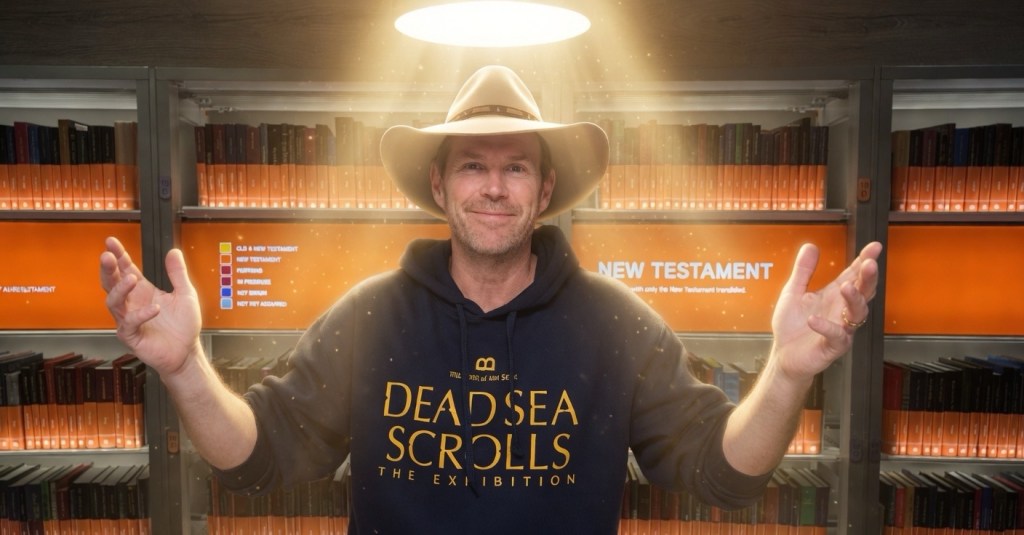
About the Author: Rich Hoffman

Rich Hoffman is an author, political consultant, and strategic advisor based in Cincinnati, Ohio, and the creator of The Politics of Heaven—a unique framework that connects biblical theology, ancient history, and modern power structures to explain how moral alignment and spiritual forces shape global events. Blending real-world political experience with deep research into archaeology, UFO phenomena, and suppressed historical narratives, Hoffman offers compelling commentary on topics ranging from ancient civilizations and the Dead Sea Scrolls to modern populist movements, paranormal continuity, and leadership strategy in chaotic environments. As the author of The Gunfighter’s Guide to Business and the forthcoming Politics of Heaven, he brings a grounded yet provocative voice to media discussions, supported by firsthand experiences and a cross-disciplinary approach that bridges science, history, and theology. For interviews, speaking engagements, or expert analysis, visit richhoffmanbooks.com or contact directly via phone at 513-307-5815 or email at rhoffman@richhoffmanbooks.com.  If you’ve seen the movie, Disclosure Day and want to talk about it and the implications of Presidnet Trump’s UAP disclosures, let me know and we can bring some color to your coverage. https://richhoffmanbooks.com/media-inquiries-broadcast-topics-and-contact-info/?frame-nonce=ad51e7ecba I do have a firsthand UFO encounter to discuss.

The Lake Superior Copper Mines, Transatlantic Trade Before Columbus, and Why Orthodoxy Fears the Evidence

Never forget what’s possible

I have been thinking about group behavior again. There is a reason people are afraid of conspiracies, or more accurately, afraid of going against the grain. They fear being ostracized from the group. It is not abstract philosophy. It is survival. In academic, professional, and corporate fields, the pattern is the same. When a narrative hardens, stepping outside it carries real costs. Jobs disappear. Funding dries up. Colleagues suddenly see a friend across the room and need to talk to them. The conversation ends. I have watched it happen more times than I can count, and not only in archaeology.

This is why the copper of Lake Superior remains such a charged subject. It should not be. The evidence is physical, measurable, and increasingly hard to dismiss. Yet the moment the discussion turns toward possible contact between the Near East and North America in the Bronze Age or earlier, the temperature changes. People get skittish. They change the subject. I do not believe the copper trade from Lake Superior is a conspiracy theory. I believe it is an under-examined historical reality, and the resistance to it reveals more about institutional incentives than about the data.

Roger L. Jewell’s Ancient Mines of Kitchi-Gummi: Cypriot / Minoan Traders in North America remains one of the more level-headed treatments of the subject. Jewell does not rant. He lays out the scale of prehistoric mining on Isle Royale and the Keweenaw Peninsula, the volume of pure native copper removed, and the awkward fact that so much of it seems to have vanished from North America’s archaeological record. Estimates vary, but the lower end runs to tens of millions of pounds extracted over centuries beginning roughly 3000 BCE or earlier. The upper estimates are higher still. Native copper of that purity, occurring in large masses that could be worked cold, is geologically unusual. Lake Superior is the standout source. 

I have been up there myself. The Upper Peninsula leaves an impression. The landscape, the isolation, the sheer number of ancient pits still visible in places, all of it sits in the mind differently once you have walked the ground. Mainstream accounts, such as Susan R. Martin’s Wonderful Power, document the Native mining and the extensive trade of copper artifacts across the Midwest and beyond. That part is not in dispute. The Hopewell and Adena cultures moved copper hundreds of miles. They moved Yellowstone obsidian even farther. Orthodoxy accepts long-distance foot and canoe trade within the continent. It balks at the idea that the same copper, or knowledge of the same source, could have reached the Mediterranean by sea. 

I attended a lecture by John E. Hancock when his Smithsonian Books volume on the Hopewell Ceremonial Earthworks came out. The book is careful, well-illustrated, and frames the sites within the indigenous narrative that has become the required language for World Heritage and institutional publication. Hancock has done serious work on the geometry and lunar alignments of the Ohio earthworks. The conversation before and after the talk was civil. Then the subject of copper trade came up, and the tone shifted. Once it became clear I was not content to stop at the indigenous-only explanation, the interest cooled. That is the pattern. UNESCO recognition is valuable. The political framing that accompanies it is not optional if you want the institutional platform. I understand the pressure. I do not accept that it settles the historical question. 

The Blue Pill Pays Well, but the Truth is in the Red Pill, Not a Popular Decision:

The same dynamic appears across fields. During COVID, expert consensus hardened rapidly around certain data interpretations from the CDC and related bodies. Dissent carried professional risk. Careers were damaged. People who had built comfortable lives inside the consensus had every incentive to stay inside it. The sociological pattern is not unique to public health. It operates in archaeology, history, and the soft sciences whenever a preferred narrative about origins, land, or cultural purity is at stake. A professor at Marquette or any similar institution who begins teaching that Mediterranean traders may have been active on Lake Superior risks the quiet professional death that follows from being labeled unreliable or politically tone-deaf. No one has to fire you formally. The invitations stop. The grants dry up. The department stops protecting you. Group behavior does the rest.

I do not romanticize the red-pill posture. It is often lonely, and it does not pay well. But the alternative is to pretend that evidence stops mattering once it threatens the story. Behind my interest in the copper is a long-standing rebellion against that academic etiquette. Truth is not a popularity contest.

Here are the primary reasons I find the case for significant transatlantic movement of Lake Superior copper, and associated cultural contact, between roughly 3000 BCE and 10000 BCE persuasive. The list is not exhaustive, and not every item is equally strong. Taken together, they form a pattern that orthodoxy has not adequately answered.

First, the sheer volume and purity of the copper. Prehistoric miners removed enormous quantities of nearly pure native copper from the Lake Superior region. Much of it is not accounted for in the surviving North American archaeological inventory. Bronze Age Mediterranean societies consumed copper at industrial scale. A source of cold-workable, high-purity copper would have been economically transformative. The Uluburun shipwreck, dated to around 1320 BCE, off the coast of Turkey, carried approximately 10 tons of copper ingots, along with tin and other luxury goods. The vessel was a substantial, sophisticated craft. If such ships were operating in the eastern Mediterranean in the Late Bronze Age, then the technological capacity for longer voyages in the northern Atlantic existed earlier. 

Second, long-distance trade is already conceded inside North America. Hopewell people obtained copper from the Superior region and obsidian from the Yellowstone area. Distances of 900 miles or more, traveled on foot or by water, are accepted without controversy. Once that capacity is granted, the additional claim that no one ever continued the northern route via Hudson Bay, Greenland, Iceland, and the British Isles becomes an assumption rather than a demonstrated barrier. Sea levels were lower for long stretches of the relevant period. Coastal and island-hopping routes would have been more forgiving than they are today.

The Lesson of Captain Bligh:

Third, human capability for open-boat ocean travel is not theoretical. After the mutiny on the Bounty, Captain William Bligh and a small loyal crew covered roughly 3,618 nautical miles in a 23-foot open launch, navigating by memory, dead reckoning, and the stars, reaching Timor in about 45 to 47 days. They avoided hostile landings and stretched meager provisions across the Pacific. If a determined 18th-century British officer could do that without charts under survival conditions, then Bronze Age or earlier sailors, with purpose, better vessels, and knowledge of prevailing winds and currents, could have managed the northern Atlantic circuit. The Phoenicians and earlier Mediterranean seafarers were not less capable. 

Fourth, certain artifacts refuse to fit neatly. The Newberry Tablet, recovered in 1896 in Michigan’s Upper Peninsula after a storm toppled a tree and exposed objects entangled in the roots, carried inscriptions in 140 squares. Photographs survive; the original deteriorated after poor storage. Some researchers have argued the signs resemble Cypro-Minoan or related scripts. The discovery predates modern knowledge of Linear A and related systems. A tree of that size does not grow overnight over a planted modern fraud. The Michigan Relics as a broader category include clear forgeries, but the Newberry find has peculiarities that keep it from being dismissed with a wave of the hand. Similar problems attach to other contested pieces such as the Wilmington Tablet from the Adena context in Ohio. Orthodoxy prefers to label them all frauds aimed at dispossessing indigenous claims. That explanation is politically convenient. It is not always archaeologically decisive. 

Cocaine in Egyptian Mummies:

Fifth, the botanical evidence from Egyptian mummies. In 1992, toxicologist Svetlana Balabanova and colleagues reported traces of nicotine and cocaine in tissues and hair of Egyptian mummies spanning a wide date range. Cocaine is derived from a New World plant. Nicotine is more complicated because other Old World plants contain it, yet the concentrations and the presence of cocaine raised the contact question immediately. Subsequent work has been contested, with contamination from modern handling or insecticides offered as explanations. Forensic-style testing, as used in criminal courts, produced the original results. The debate continues, but the data did not vanish simply because it was inconvenient. 

Sixth, architectural and astronomical parallels. The lunar standstill alignments at Stonehenge have counterparts in the Hopewell earthworks of Ohio, particularly the Newark complex. Dolmens and related megalithic forms appear in the Jordan Valley, the British Isles, New England, and the Upper Great Lakes region. Mainstream geology attributes many of the American examples to glacial deposition. The formal similarities and the association of some of these landscapes with skull cults, beer brewing, and ritual architecture at sites like Göbekli Tepe (and related early Holocene complexes) invite comparison rather than automatic dismissal. A submerged stone alignment in Grand Traverse Bay, located in 2007 at a depth of roughly 40 feet by Mark Holley, dates to a period when lake levels were lower, and the area was dry land. Media called it a “Stonehenge.” Holley himself has been more cautious, describing a long linear arrangement rather than a classic henge. The date range, however, places human activity on that landscape thousands of years before the classical Hopewell. 

Seventh, cultural and religious correspondences. Skull veneration, psychedelic or beer-based ritual, and communication with non-ordinary intelligences appear in early Near Eastern contexts, in Greek mystery practices that laced wine, and in ethnographic accounts of North American shamanism. The same pattern of entities contacted through altered states recurs. I do not treat this as proof of direct migration of priests. I treat it as evidence that the same spiritual technology and the same class of non-human intelligences were being engaged on both sides of the ocean. The Canaanite and broader Levantine world that produced the biblical accounts of Rephaim and related giant clans occupied the same landscape of dolmens and high places. Early newspaper reports of large skeletal remains in Ohio mounds were later suppressed or explained away, partly because they complicated the emerging political narrative that all significant pre-Columbian culture was indigenous and that European presence began with Columbus. The political utility of that narrative does not make it complete history.

Eighth, the northern route is geographically coherent. From the copper districts one can move by water and portage toward Hudson Bay, then by sea past Greenland and Iceland to the British Isles and down the Atlantic coast into the Mediterranean. The Odyssey, though a literary work, preserves descriptions of long days that fit higher latitudes better than the confined Mediterranean. Most classical literature of the period did not survive. What remains is a thin sample. Treating Homer’s poem as pure fantasy while ignoring the possibility that it encodes remembered routes is a choice, not a necessity. Troy was real. The ships of the period were real. The copper cargoes were real.

It’s All About the Bog People

Ninth, recent discoveries continue to complicate the closed story. Windover in Florida yielded remarkably well-preserved brains and evidence of a caring, structured society thousands of years ago, whose genetic profile does not map neatly onto later-known tribes. Poverty Point, the Adena and Hopewell sequences, and Cahokia (whose Monk’s Mound remains one of the largest earthen pyramids in the Americas) show complex, interconnected societies that moved materials and ideas across vast distances. Each new site that surfaces, whether under construction or by sonar, forces another quiet revision. The institutional response is usually to absorb the data into the existing indigenous-only model and move on. The model is stretched thinner with every decade.

I could continue. The point is not that every anomalous tablet is genuine or that every newspaper giant story from the 19th century is accurate. The point is that the cumulative weight of mining scale, missing metal, admitted intra-continental trade, demonstrated seafaring capacity, contested but persistent artifacts, botanical anomalies, architectural parallels, and ritual correspondences is more than noise. It is a signal. Orthodoxy’s refusal to engage it seriously is itself evidence of the group behavior problem I began with.

Jewell’s Book is a Good Start

I finished Jewell’s book and found it useful precisely because it stays relatively measured. I go further than he does in terms of chronological depth and the frequency of contact. Lower sea levels, better boats than we sometimes assume, and powerful economic and spiritual incentives make repeated voyages plausible across millennia. The same human ingenuity that built the pyramids and the Sphinx, that organized the copper trade of the eastern Mediterranean, and that produced the precise lunar geometry of the Ohio earthworks is not suddenly incompetent when the Atlantic intervenes.

The blue-pill life is comfortable. It comes with pensions, conference invitations, and the warm feeling of belonging. The red-pill alternative does not. I have watched capable people choose the paycheck. I understand the choice. I do not respect it when it requires pretending that inconvenient evidence does not exist. Whether the subject is COVID data, election integrity, or the copper of Lake Superior, the pattern is the same. Group survival is prioritized over truth-seeking. That is why the conversation keeps getting shut down. That is also why it will not stay shut down. Physical evidence has a longer half-life than institutional consensus.

The copper mines of Lake Superior are one of the largest archaeological stories still sitting in plain sight. They should be mainstream. Serious, multi-disciplinary work that follows the metal, the isotopes, the boat technology, and the ritual parallels wherever they lead is overdue. I will continue to say so. Popularity is not the measure. Evidence is.

I base my opinions about Lake Superior Copper Trade again on these factors:  

  • My trip to the Upper Peninsula
  • The Newberry tablet.
  • The Dolmans of the Near East. 
  • The admission that copper was traded by the Hopewell culture, 900 miles away.  
  • That Captain Bligh traveled from Tonga to Timor — Dutch East Indies (modern Indonesia)  3,600 nautical miles over 36 days with only 1 week of food and water.  It was a death sentence.  
  • Cocaine and tobacco in Egypt, 1992: the material is in the hair shafts, not contamination. 
  • The Uluburun shipwreck (1300 BCE) shows Egypt, Canaan, Cyprus, and the Aegean were part of a massive trade network. George Bass.
  • Stonehenge off Traverse City, 9000 years ago.  Validates Newberry. It was first discovered in 2007 by sonar.
  • Of course, Windover. 
  • Communication might have occurred through shamans rather than through evolutionary contact.  
  • LiDAR in South America
  • Cahokia
  • The Odyssey path. 
  • Poverty Point and Olmecs, my Wilmington Tablet

Notes

1.  Roger L. Jewell, Ancient Mines of Kitchi-Gummi: Cypriot / Minoan Traders in North America (Jewell Histories, various editions). Summarizes the scale of prehistoric extraction and the Mediterranean trader hypothesis.

2.  Susan R. Martin, Wonderful Power: The Story of Ancient Copper Working in the Lake Superior Basin (Wayne State University Press, 1999). Mainstream archaeological synthesis of Native mining and trade.

3.  On the Uluburun wreck and its copper cargo, see the Institute of Nautical Archaeology summaries and Cemal Pulak’s publications; roughly ten tons of copper ingots, late 14th century BCE.

4.  Captain Bligh’s open-boat voyage: standard historical accounts place the distance at approximately 3,618 nautical miles in 45–47 days.

5.  Newberry Tablet: contemporary newspaper reports from 1896; later discussions in epigraphic and alternative archaeology literature; original largely destroyed by poor storage.

6.  Balabanova et al., early 1990s toxicological studies on Egyptian mummies; subsequent controversy over contamination versus genuine presence of New World alkaloids.

7.  Grand Traverse Bay stone alignment: Mark Holley, 2007 discovery; media “Stonehenge” framing versus Holley’s more restrained description of a linear feature on a former shoreline.

8.  John E. Hancock, Hopewell Ceremonial Earthworks: Landscape Monuments of the Ancient Ohio Valley (Smithsonian Books). Documents the UNESCO sites and indigenous framing.

9.  On Hopewell long-distance trade networks, standard archaeological literature accepts Superior copper and Rocky Mountain obsidian among other materials.

Selected Bibliography

Bass, George F., et al. Publications on the Uluburun shipwreck (Institute of Nautical Archaeology).

Hancock, John E. Hopewell Ceremonial Earthworks: Landscape Monuments of the Ancient Ohio Valley. Smithsonian Books.

Jewell, Roger L. Ancient Mines of Kitchi-Gummi: Cypriot / Minoan Traders in North America. Jewell Histories.

Martin, Susan R. Wonderful Power: The Story of Ancient Copper Working in the Lake Superior Basin. Wayne State University Press, 1999.

Pulak, Cemal. Various papers on the Uluburun cargo and Late Bronze Age maritime trade.

Additional primary reports on the Newberry find (1896 local Michigan newspapers), Balabanova toxicology papers (1992 onward), and Holley’s Grand Traverse Bay survey notes. Classical sources include Homer’s Odyssey (any standard translation) for the literary reflection of long-distance seafaring memory.

Rich Hoffman

More about me

Click Here to Protect Yourself with Second Call Defense https://www.secondcalldefense.org/?affiliate=20707

About the Author: Rich Hoffman

Rich Hoffman is an author, political consultant, and strategic advisor based in Cincinnati, Ohio, and the creator of The Politics of Heaven—a unique framework that connects biblical theology, ancient history, and modern power structures to explain how moral alignment and spiritual forces shape global events. Blending real-world political experience with deep research into archaeology, UFO phenomena, and suppressed historical narratives, Hoffman offers compelling commentary on topics ranging from ancient civilizations and the Dead Sea Scrolls to modern populist movements, paranormal continuity, and leadership strategy in chaotic environments. As the author of The Gunfighter’s Guide to Business and the forthcoming Politics of Heaven, he brings a grounded yet provocative voice to media discussions, supported by firsthand experiences and a cross-disciplinary approach that bridges science, history, and theology. For interviews, speaking engagements, or expert analysis, visit richhoffmanbooks.com or contact directly via phone at 513-307-5815 or email at rhoffman@richhoffmanbooks.com.  If you’ve seen the movie, Disclosure Day and want to talk about it and the implications of Presidnet Trump’s UAP disclosures, let me know and we can bring some color to your coverage. https://richhoffmanbooks.com/media-inquiries-broadcast-topics-and-contact-info/?frame-nonce=ad51e7ecba I do have a firsthand UFO encounter to discuss.

The Case of Jack Ma: China would never put up with a person like Elon Musk

I have been thinking a lot lately about what it actually takes to push a civilization forward, and the more I dig into the mechanics of power, the clearer it becomes that the decisive factor is rarely the collective. It is the rare individual who refuses to accept the current ceiling. Rainer Zitelmann’s New Space Capitalism: The Entrepreneurial Path to the Stars is one of those books that lands at exactly the right moment because it forces the conversation back onto that hard truth. The foreword by Newt Gingrich sets the tone, but the real value is in how Zitelmann lays out the entrepreneurial path to the stars without the usual romantic fog. He understands that the technical pieces are largely in place; the missing ingredient has always been the institutional and cultural permission for individuals to own the risk and the reward. 

I have read a lot of books on strategy over the years. Robert Greene’s Power series is solid, particularly when you need to see the patterns that keep repeating across centuries. But the concepts only become useful when you translate them into the actual arena you are operating in—whether that is a small business, a national culture, or the emerging space economy. That is why I wrote The Gunfighter’s Guide to Business the way I did. I wanted to strip the abstraction away and show how leadership actually works when the consequences are real—the same principles scale. At every level, the decisive question is the same: does the system protect and amplify the person who is willing to impose a higher standard, or does it systematically cut that person down to the level of the committee?

That is the danger I keep returning to when I look at the post-colonial messaging that has saturated our universities and media over the last generation. The surface story is that colonialism was uniquely evil and must be endlessly atoned for. The stronger effect is to pathologize the very traits that built the most productive societies in history—individual agency, technological dominance, the willingness to claim and develop resources. A lot of money flows into that messaging, and not all of it is organic. Anyone who has watched the funding streams into American higher education over the last fifteen years knows that Chinese influence, both direct and through corporate intermediaries that depend on the Chinese market, has been substantial. The same pattern showed up in Hollywood a decade ago. The first weekend China box-office number became the make-or-break figure for big studio releases because a hundred-million-dollar Chinese gross was realistic for a major title. Studios adjusted content, softened political edges, and chased that market until the politics shifted and the arrangement began to sour. 

China does not need to kick the door in. The preferred method has always been to work the cultural and regulatory back doors until the target society starts policing its own exceptional people. That is the real war, and it is fought at the level of incentives and narrative long before any kinetic phase.

Zitelmann devotes time to the Chinese model and is careful not to caricature it. Roughly 60% of China’s economic activity is in the private sector. The catch, and it is the entire ballgame, is that private ownership does not equal private control. You may hold the equity, but the Party retains the right to manage the owners. The individuals who generate the wealth remain on a short leash. That arrangement can produce impressive aggregate numbers for a while. It cannot produce, and will not tolerate, an Elon Musk.

The clearest demonstration of the difference is the story of Jack Ma. In 2020, at the height of the COVID lockdowns in the West, Ma was still the richest man in China, with a fortune north of $50 billion. He had built Alibaba and Ant Group into engines that actually moved the Chinese economy. Then he made the mistake of publicly criticizing the financial regulators. Within days, the Ant Group IPO—the largest in history at the time—was suspended. Ma disappeared from public view for months. When he resurfaced, he was a chastened figure operating under much tighter constraints. The message was unambiguous: you can get rich, but you will not be allowed to become independently powerful. The state will let you own the assets only as long as you accept that the state ultimately owns you. 

That is the model. And it is the model that certain elements within the United States have been trying to import for years through regulatory pressure, board governance norms, and a cultural campaign that treats exceptional individuals as threats to the collective. Look at the pattern. Steve Jobs was pushed out of Apple in 1985 by a board that preferred managerial predictability over the difficult personality who actually created the products. The company nearly died until they brought him back. Sam Altman was removed from OpenAI by the board in 2023 because he was insufficiently candid with them; employees and the market forced a reversal within days because everyone understood that the board lacked the vision Altman did. Travis Kalanick was forced out of Uber in 2017 after investors decided the founder’s edge had become a liability. Jack Dorsey, Jeff Bezos at various pressure points, Elon Musk himself more than once—every one of these people has faced the same institutional reflex. The committee always prefers the safer average over the dangerous high performer. 

I call the people who staff those boards Normies. They are not evil in the cartoon sense. They value belonging more than they value results. Their deepest instinct is to reduce variance, and high-agency individuals are the ultimate source of variance. When that instinct captures the governing institutions of a society, the society begins to select against the very people who generate its outsized economic output. Less than one percent of any population produces the breakthroughs that the other ninety-nine percent live off of. If you systematically attack that one percent—through regulation, through cultural stigma, through the soft coercion of “stakeholder” governance—you do not get a more equitable society. You get stagnation, then decline.

China understands this dynamic perfectly and has weaponized it. The goal is not to out-innovate the United States in a head-to-head contest of free individuals. The goal is to change the cultural and regulatory climate in the United States so that the next generation of American Elons Musks never has the room to operate. That is why the post-colonial curriculum, the DEI machinery, the reflexive hostility to “tech bros,” and the expanding regulatory state all point in the same direction. They are different instruments playing the same tune: exceptionalism is the problem, collective management is the solution.

SpaceX is the living counter-example, and that is why the recent IPO matters so much. Elon waited until the Starship factory was producing vehicles at a cadence that actually changes the economics of access to orbit. Only then did he open the capital floodgates. The risk of going public is real—once the ownership base expands, the pressure to behave as a normal public company intensifies. But the dual-class structure and the sheer scale of the opportunity give him a window. The capital will accelerate the cadence from monthly launches to weekly, and eventually to daily. That is how you open a multi-trillion-dollar space economy. It is also why the same forces that neutralized Jack Ma have been trying for years to neutralize Musk through every available regulatory and cultural lever. 

I supported Trump for the same reason Musk did. Both of them saw the pattern clearly. Another four years of the prior trajectory would have continued the slow strangulation of the independent centers of production. The Chinese model does not need to conquer America by force. It only needs America to adopt the habit of cutting its own high performers down to size. Once that habit is locked in, the GDP gap closes on its own.

The real debate almost nobody is willing to state plainly is this: China wants to destroy people like Elon Musk. America, at its best, wants to create the conditions that produce more of them and then get out of their way. Everything else—trade policy, university curricula, board governance norms, the cultural treatment of ambition—is downstream of that single civilizational choice. Zitelmann’s book is valuable because it keeps the focus where it belongs. The stars will not be reached by committees optimizing for consensus. They will be reached by the rare individuals who refuse to accept the current limits, and by the societies that still know how to protect them.

Footnotes

1.  Rainer Zitelmann, New Space Capitalism: The Entrepreneurial Path to the Stars (Skyhorse Publishing, 2026), with foreword by Newt Gingrich.

2.  On the sixty-percent private-sector contribution figures and the limits of private control in China, see Zitelmann’s earlier analysis in “State Capitalism? No, The Private Sector Was And Is The Main Driver Of China’s Economic Growth,” Forbes, September 30, 2019, and the discussion of Chinese commercial space companies in his 2026 work.

3.  Jack Ma’s October 2020 speech criticizing Chinese financial regulators, the subsequent suspension of the Ant Group IPO, and his months-long disappearance from public view are documented in Bloomberg, “Jack Ma’s Empire in Crisis After China Halts Ant Group IPO,” December 22, 2020, and contemporaneous reporting from The Guardian and Wired.

4.  Steve Jobs’s 1985 ouster from Apple and 1997 return are standard corporate history; see, among many sources, the accounts in Walter Isaacson’s biography and contemporary board accounts.

5.  Sam Altman’s removal by the OpenAI board on November 17, 2023, and rapid reinstatement are detailed in OpenAI’s official announcement and subsequent reporting by The New York Times and CNBC.

6.  Travis Kalanick’s forced resignation as Uber CEO in June 2017 under pressure from major investors is covered in The New York Times, June 21, 2017.

7.  SpaceX’s June 12, 2026 IPO, the $135 share price, approximately $75 billion raised, and roughly $1.75 trillion valuation are confirmed in the company’s S-1 filings and contemporaneous Reuters and CNBC reporting.

8.  On Hollywood’s dependence on the Chinese box office in the 2010s and the resulting content adjustments, see the U.S.-China Economic and Security Review Commission report “Directed by Hollywood, Edited by China” (2015) and later analyses of the market’s decline after 2019.

Bibliography

Davenport, Christian. Various reporting on commercial space.

Greene, Robert. The 48 Laws of Power and related works.

Hoffman, Rich. The Gunfighter’s Guide to Business.

Isaacson, Walter. Steve Jobs.

Zitelmann, Rainer. New Space Capitalism: The Entrepreneurial Path to the Stars. Skyhorse Publishing, 2026.

Zitelmann, Rainer. “State Capitalism? No, The Private Sector Was And Is The Main Driver Of China’s Economic Growth.” Forbes, September 30, 2019.

U.S.-China Economic and Security Review Commission. “Directed by Hollywood, Edited by China.” 2015.

Contemporary reporting from Bloomberg, Reuters, CNBC, The New York Times, and The Guardian on Jack Ma (2020), Sam Altman (2023), Travis Kalanick (2017), and the SpaceX IPO (2026).

Rich Hoffman

More about me

Click Here to Protect Yourself with Second Call Defense https://www.secondcalldefense.org/?affiliate=20707

About the Author: Rich Hoffman

Rich Hoffman is an author, political consultant, and strategic advisor based in Cincinnati, Ohio, and the creator of The Politics of Heaven—a unique framework that connects biblical theology, ancient history, and modern power structures to explain how moral alignment and spiritual forces shape global events. Blending real-world political experience with deep research into archaeology, UFO phenomena, and suppressed historical narratives, Hoffman offers compelling commentary on topics ranging from ancient civilizations and the Dead Sea Scrolls to modern populist movements, paranormal continuity, and leadership strategy in chaotic environments. As the author of The Gunfighter’s Guide to Business and the forthcoming Politics of Heaven, he brings a grounded yet provocative voice to media discussions, supported by firsthand experiences and a cross-disciplinary approach that bridges science, history, and theology. For interviews, speaking engagements, or expert analysis, visit richhoffmanbooks.com or contact directly via phone at 513-307-5815 or email at rhoffman@richhoffmanbooks.com.  If you’ve seen the movie, Disclosure Day and want to talk about it and the implications of Presidnet Trump’s UAP disclosures, let me know and we can bring some color to your coverage. https://richhoffmanbooks.com/media-inquiries-broadcast-topics-and-contact-info/?frame-nonce=ad51e7ecba I do have a firsthand UFO encounter to discuss.

Podcast Episode: Psychedelics, Skull Cults, and the Politics of Heaven: Why Christianity Broke the Politics of Demon Appeasement

Pip: The Overmanwarrior has always operated at the intersection of ancient skulls and modern politics, which is either a very niche Venn diagram or the only one that matters.

Mara: Rich Hoffman is asking a question that runs from Göbekli Tepe to the UAP disclosures: what if the entire history of human religion is really a history of political negotiation with non-human intelligence — and what broke that cycle?

Pip: Let’s start with the skull cults, the spiked wine, and why Christianity might be the most radical political act in human history.

Psychedelics, Skull Cults, and the Long Politics of Appeasement

Mara: The frame here is a big one: for most of human prehistory, people weren’t worshipping gods out of love — they were appeasing predatory non-human powers through blood, psychedelics, and severed heads. The question is whether Christianity actually ended that arrangement.

Pip: The anchor text is Brian Muraresku’s The Immortality Key, and the argument it sparks is not gentle. The setup is that the original Eucharist may have been chemically active — inherited from Greek mystery rites at Eleusis, where initiates drank the kykeon. Here’s the line that drives the whole piece: “For nearly two thousand years, the greatest minds of antiquity — Cicero among them — traveled to the sanctuary at Eleusis to drink the kykeon. They claimed the experience removed the fear of death. The recipe was a state secret punishable by death.”

Mara: So the upshot is that the pharmacological dimension of early Christianity wasn’t incidental — it was the technology through which people made contact with something. And the institutional Church, as it became more patriarchal from the fourth century onward, systematically dismantled that technology. Muraresku calls the shift moving from pharmacological Christianity to placebo Christianity.

Pip: That’s a phrase that will haunt a few seminaries.

Mara: The argument doesn’t stop with Greece. The post traces the same pattern back ten thousand years to Göbekli Tepe — skull cults, snake iconography, beer residues in stone vessels, and architecture aligned to solar and stellar markers. The same complex appears in the Jordan Valley dolmen fields and at Rujm el-Hiri, the Wheel of Giants east of the Sea of Galilee, built from more than 40,000 tons of basalt.

Pip: And then the argument jumps the Atlantic — pure copper from Lake Superior, the Windover bog people of Florida preserving brain matter from the same deep time window, Hopewell earthworks in the Ohio Valley. The silence in mainstream archaeology about these connections is treated as data, not absence.

Mara: All of it feeds the central allegory: a mouse dropped into a glass enclosure with a snake. The mouse eventually stops fleeing and goes still near the water dish, as if ordinary proximity to life might persuade the predator to look elsewhere. The post is direct — “The snake, of course, is not persuaded. It simply waits and then eats.”

Ritualistic Sex Practices to Appease Hungry Demons

Pip: Humanity as the mouse. Skull cults, ritual sex, psychedelic sacraments — all forms of mouse-stillness.

Mara: Christianity, in this reading, broke the cycle not by denying the hostile powers but by declaring them defeated and offering a different posture: moral agency, individual responsibility, direct relationship with a God who does not require constant feeding of death. The concern about the modern psychedelic renaissance follows from this — the experiences at Johns Hopkins and NYU are real, but the entities contacted in those states may not be friends of the human project.

Pip: Four archaeological clusters get flagged for serious future funding: Göbekli Tepe, the Jordan Valley dolmens, the Lake Superior copper systems, and the Windover populations. The book The Politics of Heaven is framed as the effort to force that conversation open — because the secular publishing world, the post argues, prefers to treat Christianity as the problem rather than as a partial solution to an older and darker one.

Mara: Which is itself, in the post’s framing, another form of the mouse going still inside the glass.

Pip: The closing line lands hard: “Do not be the mouse. Learn the snake’s methods. The enemy is the one who puts the mouse in the cage with the snake.” And the UAP disclosures are offered as the moment the glass is becoming visible.


Mara: The thread running through all of this is political — who controls the technology of transcendence, and whose interests does that control serve.

Pip: Ten thousand years of appeasement is a long policy to reverse. But apparently someone tried, and built a civilization on it.

Mara: More on where that civilization goes next — we’ll be watching.

Rich Hoffman

More about me

Click Here to Protect Yourself with Second Call Defense https://www.secondcalldefense.org/?affiliate=20707

About the Author: Rich Hoffman

Rich Hoffman is an author, political consultant, and strategic advisor based in Cincinnati, Ohio, and the creator of The Politics of Heaven—a unique framework that connects biblical theology, ancient history, and modern power structures to explain how moral alignment and spiritual forces shape global events. Blending real-world political experience with deep research into archaeology, UFO phenomena, and suppressed historical narratives, Hoffman offers compelling commentary on topics ranging from ancient civilizations and the Dead Sea Scrolls to modern populist movements, paranormal continuity, and leadership strategy in chaotic environments. As the author of The Gunfighter’s Guide to Business and the forthcoming Politics of Heaven, he brings a grounded yet provocative voice to media discussions, supported by firsthand experiences and a cross-disciplinary approach that bridges science, history, and theology. For interviews, speaking engagements, or expert analysis, visit richhoffmanbooks.com or contact directly via phone at 513-307-5815 or email at rhoffman@richhoffmanbooks.com.  If you’ve seen the movie, Disclosure Day and want to talk about it and the implications of Presidnet Trump’s UAP disclosures, let me know and we can bring some color to your coverage. https://richhoffmanbooks.com/media-inquiries-broadcast-topics-and-contact-info/?frame-nonce=ad51e7ecba I do have a firsthand UFO encounter to discuss.

Psychedelics, Skull Cults, and the Politics of Heaven: Why Christianity Broke the Cycle of Appeasement to Non-Human Intelligence

I have been carrying these questions in the background of my thinking for decades. The frequency with which they demand attention has risen sharply since the recent UAP disclosures. When the best technology the Air Force possesses cannot keep pace with something that behaves more like a ghost than a craft, the old categories collapse. It is not enough to say a flying saucer is real. It is not enough to say a religious claim is real. I want to know what causes people to believe what they believe, what political order forms around those beliefs, and what self-interest drives the entire system. Once you understand the political motivation behind belief, you understand the kind of society people are actually building—and whether you should support it.

That is why the conversation around Brian Muraresku’s The Immortality Key landed with such force. The book is not merely another academic argument about ancient wine. It is a direct challenge to the sanitized version of early Christianity most of us inherited. And it raises a harder question: if the original Eucharist carried a pharmacological charge, what does that tell us about the entities people were trying to contact, and why did Christianity’s later institutional form deliberately move away from that charge?

The Immortality Key and the Pagan Continuity Hypothesis

Muraresku’s central claim is straightforward and explosive. The original Christian communion was not a symbolic sip of ordinary wine. It was a potent psychedelic sacrament inherited from the Greek mysteries, specifically the cult of Dionysus and the rites at Eleusis. For nearly two thousand years, the greatest minds of antiquity—Cicero among them—traveled to the sanctuary at Eleusis to drink the kykeon. They claimed the experience removed the fear of death. The recipe was a state secret punishable by death.

The chemistry focuses on ergot, the fungus that grows on barley and rye—the same fungus from which Albert Hofmann first synthesized LSD in 1938. The theory is not new. It was proposed in 1978 by R. Gordon Wasson, Albert Hofmann, and Carl A. P. Ruck in The Road to Eleusis. Hofmann and Ruck’s academic careers suffered for it. The idea that the foundations of Western philosophy and early Christianity rested on controlled visionary pharmacology was too much for the scholarly stomach of the time.  And when you think about that very obvious claim, and the way those names were ostracized, you can see the root cause of a much larger problem.  

Muraresku spends years in the Vatican archives and archaeological sites looking for the transition. He notes that ancient wine was rarely plain fermented grape juice. It was routinely an infusion of herbs, roots, and potentially fungi—a pharmakon. The Gospel of John, the most Greek of the Gospels, uses language for the wine that suggests something more complex than table drink. Jesus’ miracle at Cana occurs in a cultural zone saturated with Dionysian imagery. In early Jesus centuries, Dionysus and Jesus were sometimes treated as interchangeable figures of death, rebirth, and ecstatic immortality.

The book’s most compelling social argument concerns women. For millennia, the preparation of these visionary beverages was women’s work. As Christianity became institutionalized and more patriarchal, particularly from the fourth century onward, those women and their spiked drinks became a threat to the emerging clerical monopoly on the divine. Muraresku reads the Inquisition’s language of pharmaka and sorcery not merely as superstition but as the systematic eradication of a competing technology of direct encounter with the sacred. The shift, in his framing, is from pharmacological Christianity to placebo Christianity.

I want Christianity to succeed. I do not read Muraresku as an enemy of the faith. He identifies as a Catholic who is trying to recover rather than destroy the Eucharist. Yet the implications cut in two directions at once. If the earliest layers of the tradition carried a visionary intensity later deliberately muted, then the institutional Church both preserved and constrained something powerful. And if that intensity was chemically mediated, we must ask what, exactly, the initiates were encountering.

Beer, Skulls, and the Long Continuity of Death Cults

The problem is larger than Greece. When I go back further—ten thousand years further—the pattern sharpens.

At Göbekli Tepe (the site that Muraresku and others still sometimes refer to by earlier or variant names in popular discussion), the evidence is no longer subtle. T-shaped pillars, snakes carved everywhere, a clear skull cult, and chemical traces consistent with beer brewing. People were not merely gathering to eat. They were preparing fermented beverages, removing soft tissue from human heads, drilling holes, and displaying the skulls in ritual contexts under carefully oriented architecture. The same complex appears, in different local forms, along the Jordan Valley in the dolmen fields that stretch from the Golan south toward the Dead Sea, and again in the megalithic “Wheel of Giants” (Rujm el-Hiri / Gilgal Refa’im) east of the Sea of Galilee—roughly 160 meters across, built of more than 40,000 tons of basalt, aligned with solar and stellar markers.

I have scoured the archaeological literature for a serious treatment of these Jordan Valley dolmens from roughly 10,000 to 3,000 BC. The silence is telling, just like any discussion dealing with the use of wine in Greek culture outside of mainstream opinion. Mainstream discussion prefers the safer Bronze Age and later. Yet the structures are there. The alignments are there. The continuity of ritual astronomy with later Hopewell earthworks in the Ohio Valley is difficult to ignore once you stop treating the Atlantic as an absolute barrier.

Pure native copper from the Lake Superior region was extracted for thousands of years. Isotopic and purity studies continue to raise questions about whether some of that copper moved farther than orthodoxy allows. The Windover bog people of central Florida preserve soft tissue and brain matter from the same deep time window. The Newberry Tablet and other Michigan finds remain controversial, but the pattern of megalithic and copper-working activity across the Great Lakes and the Upper Peninsula does not vanish because it is inconvenient.

Everywhere you look in this pre-biblical window, you find cultures oriented toward death, severed heads, fermented or psychoactive drink, and communication with something beyond the ordinary dead—the politics of that communication matter. Human beings do not casually cut off a neighbor’s head, scrape the flesh, hang the skull, and pour blood on an altar for sport. They do it because they believe the act buys favor, knowledge, rain, fertility, or protection from harm.

The Mouse and the Snake

I use a simple allegory. Watch a pet snake being fed. Drop a mouse into the glass enclosure. For the first few minutes, the mouse runs, freezes, and tests every corner. Eventually it realizes there is no exit. Then the behavior changes. It becomes still. It positions itself near the water dish or the food bowl as if stillness and proximity to ordinary life might persuade the snake to look elsewhere. The snake, of course, is not persuaded. It simply waits and then eats.

Humanity has lived for a very long time with the anxiety of that mouse. Non-human intelligences—call them Watchers, old gods, ultraterrestrials, or whatever the current UAP language prefers—appear in the record as entities that demand appeasement. Psychedelics, ritual sex, blood, and skull display are technologies of that appeasement. The mouse tries to make itself useful or invisible so the snake will not strike.

Christianity, in its mature form, broke that cycle. It did not deny the existence of the hostile powers. It declared them defeated in principle and offered a different posture: moral agency, individual responsibility, and direct relationship with a God who does not require the constant feeding of death. The result, imperfect as every human institution is, was the rise of a civilization that valued the living more than the skulls of the dead. Strip the Christian premise from a mass of people, and the older pattern reasserts itself with remarkable speed. I have watched it at a Jason Aldean concert from the VIP area—twenty thousand people, many drunk since morning, public sexual display, the old fertility and abandon patterns returning the moment the moral frame loosens. The same retreat appears wherever the teachings of Jesus are actively removed from a culture.

That is why I am not enthusiastic about the modern psychedelic renaissance framing itself as the recovery of a lost “religion with no name.” The experiences reported at Johns Hopkins and NYU—ego death, loss of fear of mortality—are real. The question is whether the entities contacted in those states are friends of the human project. My reading of the long archaeological record is that they are not. They have been competing for control of human attention and behavior for a very long time. Christianity was never their preferred outcome.

The Four Pillars That Still Need Digging

The gap between roughly 10,000 BC and the world of Abraham remains the least examined and most consequential stretch of the human story. Four clusters of evidence deserve far more serious, well-funded attention than they currently receive.  I am committing myself to putting money and attention to these ideas:

1.  The skull cult, beer residues, and snake iconography at Göbekli Tepe and related Anatolian sites.

2.  The dolmen fields and the Wheel of Giants along the Jordan Valley and Golan.

3.  The pure copper extraction systems of the Lake Superior region and their possible long-distance movement.

4.  The Windover and related Archaic Florida populations with their extraordinary preservation of soft tissue and ritual practice.

These are not isolated curiosities. They form the deep background against which both the biblical narrative and the later Greek mysteries emerge. More excavation, more isotopic analysis, more open discussion of possible transoceanic contact, and less reflexive dismissal of “fringe” data would change the conversation. I am writing The Politics of Heaven in part to force that conversation into the open. The secular publishing world prefers books that treat Christianity as the problem rather than as a partial solution to an older and darker problem. That preference itself looks, from where I sit, like another form of the mouse’s stillness—keeping the larger questions safely inside the glass.

Conclusion: Do Not Be the Mouse

The original Eucharist may well have carried a pharmacological dimension inherited from older Mediterranean practice. The women who prepared the drinks may have been the last keepers of a technology the institutional Church found threatening. None of that requires us to return to the skull cults and the blood altars. The miracle of Christianity was not that it invented the sacred. It redirected the human drive for transcendence away from appeasement of predatory powers and toward a moral and spiritual posture that could build a durable civilization.

I want more money poured into the archaeology of the deep past—not the archaeology that already knows what it is allowed to find, but the kind willing to follow the copper, the alignments, the beer residues, and the severed heads wherever they lead. I want the conversation about non-human intelligence to stop treating the entities as either cartoon aliens or harmless spirit guides. They have a politics. Humanity needs a politics equal to theirs.

The Politics of Heaven is my effort to map that battlefield. The four pillars above are the places where the next decade of serious digging should concentrate. The rest is commentary, color, and the long memory of a man who has watched the same patterns repeat across continents and millennia.

Do not be the mouse. Learn the snake’s methods. The enemy is the one who puts the mouse in the cage with the snake.  That is the answer to our many questions.  And in the UAP disclosures, we are getting a hint of that world.  

Footnotes

1.  Brian C. Muraresku, The Immortality Key: The Secret History of the Religion with No Name (St. Martin’s Press, 2020).

2.  R. Gordon Wasson, Albert Hofmann, and Carl A. P. Ruck, The Road to Eleusis: Unveiling the Secret of the Mysteries (Harcourt Brace Jovanovich, 1978; later editions).

3.  On the ergot detoxification experiments and the University of Athens work referenced by Muraresku, see the discussion and citations in The Immortality Key, chapters on Eleusis and the chemistry of the kykeon.

4.  Patrick E. McGovern, Ancient Wine: The Search for the Origins of Viniculture (Princeton University Press, 2003) and subsequent biomolecular archaeology papers on mixed fermented beverages.

5.  For Göbekli Tepe skull cult and brewing evidence: Klaus Schmidt and subsequent publications of the German Archaeological Institute; recent chemical analyses of residues in stone vessels.

6.  Rujm el-Hiri (Gilgal Refa’im / Wheel of Giants): surveys and interpretations in Israeli archaeology literature; see also popular and specialist treatments of its astronomical alignments.

7.  Old Copper Culture / Lake Superior copper: standard Midwestern archaeology; purity and sourcing debates continue in archaeometallurgy literature.

8.  Windover site, Florida: Glen H. Doran et al., publications on the Archaic wet-site cemetery and preserved soft tissue.

9.  Jacques Vallée, Passport to Magonia: From Folklore to Flying Saucers (Henry Regnery, 1969) and later works on the continuity of non-human encounter narratives.

10.  Diarmaid MacCulloch, Christianity: The First Three Thousand Years (Viking, 2009).

11.  Biblical Archaeology Review, ongoing coverage of Jordan Valley and related megalithic sites; earlier issues treating dolmens remain limited relative to the density of the remains.

12.  On Hopewell copper and ceremonial complexes: standard Ohio Valley archaeology; Newark Earthworks and related lunar alignments.

13.  Dolores Cannon’s reported communications with Essene figures appear in her Conversations with Nostradamus series and related remote-viewing / past-life material; treated here as phenomenological data rather than conventional historiography.

14.  Graham Hancock, Fingerprints of the Gods (1995) and later works on Göbekli Tepe and catastrophic prehistory; useful for raising questions even where orthodoxy disagrees with conclusions.

Selected Bibliography

•  Muraresku, Brian C. The Immortality Key. St. Martin’s Press, 2020.

•  Wasson, R. Gordon, Albert Hofmann, and Carl A. P. Ruck. The Road to Eleusis. 1978 and later editions.

•  MacCulloch, Diarmaid. Christianity: The First Three Thousand Years. Viking, 2009.

•  Vallée, Jacques. Passport to Magonia. 1969.

•  McGovern, Patrick E. Ancient Wine. Princeton University Press, 2003.

•  Schmidt, Klaus. Publications on Göbekli Tepe (German Archaeological Institute).

•  Doran, Glen H., et al. Windover site monographs and papers.

•  Hancock, Graham. Fingerprints of the Gods and subsequent titles.

•  Biblical Archaeology Society. Biblical Archaeology Review (ongoing).

•  Standard references on Rujm el-Hiri, Old Copper Culture, Hopewell, and Jordan Valley dolmens in regional archaeological journals.

Rich Hoffman

More about me

Click Here to Protect Yourself with Second Call Defense https://www.secondcalldefense.org/?affiliate=20707

About the Author: Rich Hoffman

Rich Hoffman is an author, political consultant, and strategic advisor based in Cincinnati, Ohio, and the creator of The Politics of Heaven—a unique framework that connects biblical theology, ancient history, and modern power structures to explain how moral alignment and spiritual forces shape global events. Blending real-world political experience with deep research into archaeology, UFO phenomena, and suppressed historical narratives, Hoffman offers compelling commentary on topics ranging from ancient civilizations and the Dead Sea Scrolls to modern populist movements, paranormal continuity, and leadership strategy in chaotic environments. As the author of The Gunfighter’s Guide to Business and the forthcoming Politics of Heaven, he brings a grounded yet provocative voice to media discussions, supported by firsthand experiences and a cross-disciplinary approach that bridges science, history, and theology. For interviews, speaking engagements, or expert analysis, visit richhoffmanbooks.com or contact directly via phone at 513-307-5815 or email at rhoffman@richhoffmanbooks.com.  If you’ve seen the movie, Disclosure Day and want to talk about it and the implications of Presidnet Trump’s UAP disclosures, let me know and we can bring some color to your coverage. https://richhoffmanbooks.com/media-inquiries-broadcast-topics-and-contact-info/?frame-nonce=ad51e7ecba I do have a firsthand UFO encounter to discuss.

Podcast Episode: Why the 2026 Midterm Polls Are Still Misleading: Ohio, Texas, Wisconsin, and the

Pip: Welcome to The Overmanwarrior, where the polls say it’s a toss-up and Rich Hoffman says the polls are lying to you — again.

Mara: Rich Hoffman has been tracking the 2026 midterm landscape closely, and the central argument running through his recent work is that the published numbers in Ohio, Texas, and Wisconsin are systematically understating Republican support.

Pip: Let’s start with why those poll averages keep getting it wrong, and what Wisconsin just proved about the problem.

Why the 2026 Midterm Polls Are Still Misleading

Mara: The core tension here is between what the published averages show and what the underlying partisan lean of these states actually suggests. Ohio went Republican by eleven points in 2024. Texas by fourteen. Yet the polling has both states looking like toss-ups.

Pip: And then Wisconsin handed everyone a very loud data point. The Democratic primary had Francesca Hong leading David Crowley by double digits — sometimes twenty points — right up until election night.

Mara: The post is direct about what happened: “One late survey had her at 44 percent to Crowley’s 22 percent.” Crowley won by less than half a percentage point. Hong received roughly what the final polls projected for her. The entire error was on Crowley’s side.

Pip: So the polls captured the progressive candidate’s floor perfectly and missed everyone else entirely. That’s not a rounding error.

Mara: The explanation offered is non-response bias. Conservative, rural, and Trump-aligned voters are less likely to answer a survey. The people who do respond skew toward Democrats and toward the more engaged, activist end of the electorate. Pollsters try to correct for this with demographic weighting, but the corrections are imperfect when the harder-to-reach population is systematically absent from the sample.

Pip: There’s also a commercial layer worth naming — close races sell advertising, and campaigns keep spending when the horse race looks competitive.

Mara: Right. The argument is that a seven- or eight-point underlying Republican advantage, published as a two-point race, generates more television and digital spending than a blowout narrative would. The incentive structure rewards the appearance of competitiveness.

Mara: In Ohio, the governor’s race between Vivek Ramaswamy and Amy Acton sits near a statistical tie in the aggregates, with Ramaswamy at 47.0 and Acton at 46.2 in one weighted average. The Senate special between Jon Husted and Sherrod Brown shows a similarly compressed margin, with individual polls bouncing between a small Husted lead and a small Brown lead. In Texas, the Emerson College survey from August ninth and tenth had Ken Paxton at 47 and James Talarico at 46 among likely voters.

Pip: Three states, same pattern. The post’s read is that if the election were held today, Republicans would win these races by closer to seven or eight points — not by a fraction.

Mara: And the Wisconsin primary is the evidence that the measurement problem hasn’t been solved. Late-deciding and previously undecided voters broke hard against the more radical option, and the models missed it entirely because those voters weren’t in the sample.

Pip: Election night geography in Ohio compounds the illusion — early returns from Columbus and urban centers can show a temporary Democratic lead before the suburban and rural counties report.

Mara: The post flags that directly: if rural voters don’t respond to the poll, they won’t be counted in the averages either. The same population that’s hard to reach by phone is the one that shows up late on election night and moves the final margin.

Pip: Which brings us to what actually happens when November arrives and those voters show up.


Mara: The through-line is a gap between measurement and reality — and the argument that Wisconsin made that gap visible in a way that’s hard to dismiss.

Pip: Watch what the hard-to-reach voters actually do when the ballots are counted. Not what the people who answer the phone say in August.

Rich Hoffman

More about me

Click Here to Protect Yourself with Second Call Defense https://www.secondcalldefense.org/?affiliate=20707

About the Author: Rich Hoffman

Rich Hoffman is an author, political consultant, and strategic advisor based in Cincinnati, Ohio, and the creator of The Politics of Heaven—a unique framework that connects biblical theology, ancient history, and modern power structures to explain how moral alignment and spiritual forces shape global events. Blending real-world political experience with deep research into archaeology, UFO phenomena, and suppressed historical narratives, Hoffman offers compelling commentary on topics ranging from ancient civilizations and the Dead Sea Scrolls to modern populist movements, paranormal continuity, and leadership strategy in chaotic environments. As the author of The Gunfighter’s Guide to Business and the forthcoming Politics of Heaven, he brings a grounded yet provocative voice to media discussions, supported by firsthand experiences and a cross-disciplinary approach that bridges science, history, and theology. For interviews, speaking engagements, or expert analysis, visit richhoffmanbooks.com or contact directly via phone at 513-307-5815 or email at rhoffman@richhoffmanbooks.com.  If you’ve seen the movie, Disclosure Day and want to talk about it and the implications of Presidnet Trump’s UAP disclosures, let me know and we can bring some color to your coverage. https://richhoffmanbooks.com/media-inquiries-broadcast-topics-and-contact-info/?frame-nonce=ad51e7ecba I do have a firsthand UFO encounter to discuss.

Why the 2026 Midterm Polls Are Still Misleading: Ohio, Texas, Wisconsin, and the Persistent Republican Non-Response Bias

I have been watching the midterm landscape closely in mid-August 2026. Three months out from Election Day, the polling averages in several key races look tighter than the underlying partisan lean of these states would suggest. Ohio’s governor’s race between Vivek Ramaswamy and Amy Acton sits near a toss-up. The special Senate election between Jon Husted and Sherrod Brown is competitive. In Texas, Ken Paxton and James Talarico are essentially deadlocked in recent surveys. Then came the Wisconsin Democratic primary, where the polls were off by roughly 20 points in the direction favoring the more progressive candidate.

I have said for a long time that a meaningful portion of the modern polling industry carries systematic bias against Republicans. Conservatives and Trump voters are less likely to pick up the phone or complete a survey. Pollsters still lean on models and samples that over-weight the people who do answer—disproportionately Democrats and people more inclined to engage with survey-takers. On top of that sits a commercial incentive: close races generate more advertising dollars. Campaigns with money to spend feel pressure to keep spending when the horse race looks competitive. Wisconsin just provided another public demonstration of how badly these models can fail when late undecideds and turnout dynamics break in one direction.

I do not think the actual underlying margins in Ohio or Texas are as tight as the published averages. I think several points in these surveys understate Republicans, and if the election were held today, the Republican candidates would win more comfortably than the current numbers imply. That is not complacency. It is pattern recognition from 2016 forward, reinforced by the Wisconsin result and by what I see on the ground and on platforms where people actually speak freely.

Wisconsin Democratic Primary 2026: The 20-Point Polling Collapse of Francesca Hong

The clearest recent data point is Wisconsin. Polls consistently showed Democratic Socialist State Representative Francesca Hong leading Milwaukee County Executive David Crowley by double digits—sometimes by around 20 points. One late survey had her at 44 percent to Crowley’s 22 percent. Another earlier reading put her near 38 percent with Crowley in single digits and a large undecided bloc. 

On primary night Crowley won by less than half a percentage point. Hong received roughly the share the final polls had projected for her—around 39 percent. The entire error was on Crowley’s side. Late-deciding and previously undecided voters broke hard against the more radical option. Primaries are harder to model than generals because turnout is lower and more volatile, and Wisconsin’s open primary added another layer of uncertainty. Still, the scale of the miss is striking. The models captured the progressive candidate’s floor but completely missed the late surge to the more traditional Democrat. 

I was not surprised. There is a recurring temptation inside media and polling circles to treat energized progressive or socialist factions as larger than they are. College campuses, activist networks, and highly engaged online progressive voters are easy to reach and happy to talk to pollsters. The broader primary electorate is less so. When the actual voters showed up, the socialist ceiling was exposed. The same pattern has appeared in other recent cycles, in which early surveys elevate a hard-left candidate and then the candidate underperforms once undecideds and lower-propensity voters enter the picture.

Current Ohio Governor Polls: Vivek Ramaswamy vs Amy Acton in Mid-August 2026

In Ohio, the governor’s race is officially an open seat. Aggregates in mid-August put Vivek Ramaswamy and former state health director Amy Acton essentially even, or with Ramaswamy ahead by less than a point. One recent weighted average had Ramaswamy at 47.0 percent and Acton at 46.2 percent. Individual surveys have bounced: some Democratic-leaning pollsters have shown Acton up two or three points; others have shown a tie or a small Republican edge. 

Ohio is not a pure 50-50 state. Donald Trump carried it by roughly eleven points in 2024. The underlying Republican structural advantage has been visible for several cycles. A race this close in the averages, this far out, is therefore anomalous on its face. Acton’s association with COVID-era restrictions remains a live liability with a large share of the electorate that still remembers the lockdowns and school closures. Ramaswamy’s profile is national and polarizing, which creates some friction among independents and moderates, but the state’s recent presidential and statewide results do not suggest a natural environment for a Democratic win.

Ohio Senate Race Polling: Jon Husted vs Sherrod Brown

The special Senate election is similarly compressed. Jon Husted, appointed after JD Vance’s elevation, faces former Senator Sherrod Brown. Aggregates in early August showed Husted ahead by roughly two to three points in some trackers, while other windows had Brown with a small edge or a statistical tie. A New York Times/Siena survey had Husted at 50–47. An AARP-sponsored poll earlier in the summer had Brown up three. The race is competitive on paper. 

Brown is a known quantity with residual personal brand strength among some working-class and older voters. Yet Ohio has continued moving right relative to the national environment. A race that looks this tight three months out again sits uncomfortably against the state’s recent performance. If nonresponse systematically suppresses Republican numbers, the published margins understate Husted’s true position.

Texas US Senate Polls 2026: Ken Paxton vs James Talarico Dead Heat

In Texas, the pattern repeats. The latest Emerson College survey (August 9–10) had Attorney General Ken Paxton at 47 percent and state Representative James Talarico at 46 percent among likely voters. Other recent polls have shown similar dead heats or small leads for either side. 

Texas is not a purple state. Trump won it by roughly fourteen points in 2024. Paxton is a polarizing figure with a long history of legal and political battles, which creates openings for a skilled Democratic challenger. Talarico has run a disciplined campaign and benefits from the same non-response dynamics that compress Republican leads elsewhere. Still, a race this close in a state with Texas’s underlying Republican baseline is another data point that looks softer for the GOP than the fundamentals imply.

The Persistent Problem of Republican Non-Response Bias in Modern Polling

The common thread is non-response. I am on every list. Campaigns and pollsters call and text constantly. I rarely answer. I vote in every primary and every general election, but I do not have time for a fifteen-minute questionnaire from someone I do not know. Many people in my circle operate the same way. Conservatives, older voters, rural voters, and Trump-aligned voters have lower cooperation rates with traditional survey methods. Cell-phone-only households, caller-ID screening, and general distrust of institutions make the problem worse than it was in the landline era. 

Democrats and more progressive voters, by contrast, remain relatively easy to reach and willing to engage. The result is a sample that is tilted before any weighting is applied. Pollsters attempt to correct with demographic targets, education weights, and recalled vote, but the corrections are imperfect. When the underlying population of interest—likely Republican voters—has systematically lower response rates, the adjusted numbers still lag. This is not a new observation. It has been discussed after 2016, 2020, and 2022. Wisconsin’s primary is simply the latest high-profile reminder that the models can still break when late movement occurs among the harder-to-reach.

Media and Pollster Incentives to Keep Races Looking Close

There is also a commercial layer. Close races sell. Media companies and the consultants who live off campaign advertising benefit when the horse race stays competitive. Republican candidates and committees have raised substantial sums. Those dollars flow more readily when the published polls suggest the outcome is in doubt. A seven- or eight-point underlying Republican advantage, when published as a two-point race, generates more television, digital, and direct-mail spending than a blowout narrative would. I am not claiming a grand conspiracy in every survey. I am saying the incentive structure rewards the appearance of competitiveness, and the sampling problems make that appearance easier to produce.

Why Platforms Like X Offer a Clearer Picture Than Traditional Surveys

This is where platforms that still allow relatively unfiltered speech become useful. People say things online under their own names or consistent pseudonyms that they will not say to a stranger on the phone. Sentiment on X, when read carefully and at scale, has often been a better leading indicator of Republican energy than the published telephone and online panel averages. AI systems that can process large volumes of public posts provide another check on the traditional samples. They are not perfect—online populations are not identical to the electorate—but they are less constrained by the cooperation-rate problem that plagues live interviewers and many opt-in panels.

What a Real Election Day Would Show Right Now in These States

If the election were held in the middle of August 2026, I believe the Republican candidates in these races would win by larger margins than the current averages indicate—closer to the seven- or eight-point range in Ohio and a clearer, more comfortable win for Paxton in Texas. That is not a prediction locked in stone for November. Turnout, national mood, candidate performance, and late events still matter. Campaigns cannot rest on structural advantages. But the idea that these races are true toss-ups or that Texas is on the verge of flipping requires accepting that the polling error has suddenly vanished. Wisconsin suggests it has not.

Election Night Dynamics in Ohio: Urban Early Returns vs Rural Reality

Ohio’s geography still shapes how results appear on election night. Early returns from the Columbus area and other urban centers can create a temporary Democratic lead. As the suburban and rural counties between the cities report, the numbers swing back. That pattern has been consistent. Watching the first 15 or 30 minutes of returns without understanding the sequence can cause unnecessary panic. The same logic applies to interpreting summer polls that over-sample the easier-to-reach urban and college populations.  And if surveys do not account for this real estate trend, their outlook will not be accurate.  If rural people don’t respond to the poll, they won’t be counted.  

I have been around these fights long enough to recognize the difference between a genuine shift in the electorate and a measurement problem. The Wisconsin primary was a measurement problem with real consequences for the models. The compressed margins in Ohio and Texas look like the same problem applied to general-election contests in states that have been moving toward Republicans. Non-response among the very voters who decide these races remains the central issue. Until the industry solves the cooperation-rate gap, or until alternative signals from freer platforms are weighted more heavily, the published numbers will continue to understate the Republican side. Plan accordingly.

Footnotes

1.  Aggregated Ohio governor polling as of mid-August 2026 from Pollsmax and concurrent trackers showing Ramaswamy 47.0 / Acton 46.2 and recent individual surveys (NYT/Siena, Tulchin, AARP/Fabrizio, etc.).

2.  Wisconsin primary result: David Crowley approximately 39.8 percent, Francesca Hong approximately 39.3 percent; pre-election surveys consistently showed Hong leads of 15–20+ points.

3.  Ohio Senate aggregates and individual polls (Pollsmax, NYT/Siena, AARP, Beacon/Shaw) place the race within a few points either way.

4.  Emerson College/Nexstar Texas Senate poll, August 9–10, 2026: Paxton 47, Talarico 46.

5.  Discussion of non-response bias and primary modeling difficulties drawn from post-election analyses of the Wisconsin results and longer-standing literature on declining survey cooperation rates among conservatives.

6.  2024 presidential margins: Ohio approximately R+11, Texas approximately R+14, Wisconsin narrow Republican win.

Bibliography for Further Reading

•  Pollsmax, RealClearPolitics, 270toWin, and Decision Desk HQ aggregate pages for 2026 Ohio governor, Ohio Senate special, and Texas Senate.

•  Emerson College Polling releases on Texas, August 2026.

•  Contemporary reporting and post-mortems on the Wisconsin Democratic gubernatorial primary (Axios, New York Times, Milwaukee Journal Sentinel, Marquette Law School Poll commentary).

•  Historical analyses of non-response bias in U.S. political polling after the 2016, 2020, and 2022 cycles.

•  Public statements and data releases from the campaigns of Vivek Ramaswamy, Jon Husted, Ken Paxton, Amy Acton, Sherrod Brown, and James Talarico.

•  Academic and industry papers on declining telephone survey response rates and the challenges of weighting for partisan non-response.

The numbers will keep coming. Watch what the hard-to-reach voters actually do when the ballots are counted, not onlywhat the people who answer the phone say in August.

Rich Hoffman

More about me

Click Here to Protect Yourself with Second Call Defense https://www.secondcalldefense.org/?affiliate=20707

About the Author: Rich Hoffman

Rich Hoffman is an author, political consultant, and strategic advisor based in Cincinnati, Ohio, and the creator of The Politics of Heaven—a unique framework that connects biblical theology, ancient history, and modern power structures to explain how moral alignment and spiritual forces shape global events. Blending real-world political experience with deep research into archaeology, UFO phenomena, and suppressed historical narratives, Hoffman offers compelling commentary on topics ranging from ancient civilizations and the Dead Sea Scrolls to modern populist movements, paranormal continuity, and leadership strategy in chaotic environments. As the author of The Gunfighter’s Guide to Business and the forthcoming Politics of Heaven, he brings a grounded yet provocative voice to media discussions, supported by firsthand experiences and a cross-disciplinary approach that bridges science, history, and theology. For interviews, speaking engagements, or expert analysis, visit richhoffmanbooks.com or contact directly via phone at 513-307-5815 or email at rhoffman@richhoffmanbooks.com.  If you’ve seen the movie, Disclosure Day and want to talk about it and the implications of Presidnet Trump’s UAP disclosures, let me know and we can bring some color to your coverage. https://richhoffmanbooks.com/media-inquiries-broadcast-topics-and-contact-info/?frame-nonce=ad51e7ecba I do have a firsthand UFO encounter to discuss.

The Mutiny on the Bounty: A real life Atlas Shrugged story

It’s just the collision happening right now—philosophical ideas slamming into each other in politics and industry the same way they always have when cultures decide whether they’re going to run on individual output or collective excuse-making. I’ve been talking about it a lot lately because you have to. You can’t watch what’s going on in business or in the economy in general without seeing the same old fight play out again: the people who still believe in bold individual initiative versus the ones who think a collective consciousness can hide them in the background while somebody else does the hard work of actually making things function.

That’s the real difference. Administration works when it is driven by men and women who still believe that self-determination and heroic personal output are the only engines that ever moved anything forward. The reason America was created in the first place was to unleash that kind of individual force. The emerging culture of socialism and soft communism is the opposite—it sells collective boldness through the power of the mob. It doesn’t sound so bad when you’re collecting a comfortable paycheck and just fitting in. But the danger is real, and I think that’s exactly what we’re exploring in this transition we’re living through.

I still think one of the best fictional expressions of why individual boldness and heroic leadership drive economic activity is Atlas Shrugged.¹ A lot of people in the popular culture don’t care for Ayn Rand. That never made sense to me. Most people want to hide in the background of a mass culture where no one expects them to stand up as an individual. That impulse is a solid destroyer of human cultures—whether you’re talking about sexual promiscuity, low moral content, or the slow surrender of personal agency. Look at the biblical narratives. They keep telling the same story: rise up as an individual to a higher idea, serve God as an individual, do not dissolve your individuality into collectivism. Sacrifice of that kind produces bad culture, not good things.² The real historic narrative that expresses this better than almost anything else is the story of the Bounty.

I first saw the Mel Gibson and Anthony Hopkins version when I was young, and it remains one of my favorite films from the 1980s. I don’t even know if that movie could be made these days with the politics around indigenous cultures the way they are. Hopkins’s Captain Bligh is still the best portrayal I’ve seen—strict, unsympathetic to comfort, and absolutely determined. The 1984 film is more accurate than the earlier Hollywood versions that turned Bligh into a cartoon villain. The real history is more complicated than any film can capture, but that version gets the core right.³

Those early Royal Navy voyages were far from the standards of home. You were out there on a long, hard passage with nothing holding the crew together except the will of the commander. On the Bounty, Bligh pushed hard. The men under Fletcher Christian got tired of the rigor. They were far from England, the rules felt distant, and when they reached Tahiti they found a place full of willing women after months at sea. They decided they preferred that life to the discipline required to finish the mission. So they took the ship, put Bligh and the loyalists in a small open boat with almost no provisions, almost no charts, and essentially told them to die. Basic decency was giving them a chance to survive. Realistically, almost no one expected them to.⁴

What happened next is one of the great true stories of individual leadership under impossible conditions. Bligh coaxed and drove those men across roughly 3,600 nautical miles of open Pacific Ocean to the Dutch settlement at Timor. No proper charts for most of the way. Minimal food and water. Harsh conditions that would have broken most crews. He used the same hard persuasion that had gotten him into trouble with the mutineers, and they survived. The men who stayed with him lived because one man refused to let the situation collapse into collective despair.⁵

Meanwhile the mutineers hid from British justice on Pitcairn Island, far off the normal lanes. They had the women, the easy life, and no hard commander pushing them. Within a few years it fell apart. Internal fighting, murders, the collapse of any functioning order. Most of the mutineers were dead—killed by each other or by the Polynesians they had brought with them. The culture they tried to build on collective desire and the rejection of rigorous leadership did not last. That is not some modern political talking point about indigenous cultures. The South Pacific, like parts of the Americas, had its share of hard and often brutal societies. The mutineers’ experiment simply proved what happens when you throw off the individual who is willing to enforce standards and then try to live on ease and numbers.⁶

I can’t think of a cleaner real-world demonstration of the point Atlas Shrugged makes in fiction. Stayed on the ship under hard leadership and the voyage would have succeeded. They sent the leader adrift because they were tired of being pushed past their comfort, tired of the rigorous style that demanded more from them than they wanted to give. They chose the easy path with the women and the big boat. A few years later civilization among them had collapsed. That is how it works. If you put good leadership adrift—or separate yourself from it in a business, a ship, a country, or a political party—don’t be surprised when the culture fails.

Strong leadership does not come from mass groups. It comes from individuals with the persuasion and the will to push people past their limits. Crews on those long voyages often hated it. Businesses hate it. Political parties hate it when someone refuses to let them coast. But without that individual force, the subculture falls apart. Collectivism does not get you there. The true story of the Bounty is one of the best historical illustrations we have of why organizations succeed or fail, where leadership actually comes from, and what happens when people decide they would rather dissolve into the crowd than rise as individuals.

If you’ve ever read my book The Gunfighter’s Guide to Business, you’ll recognize the same argument. Individual initiative under pressure is not optional. It is the only thing that has ever kept the machinery running. The Politics of Heaven starts with the same understanding: men and women are called as individuals, not as a collective that gets to hide from responsibility. Watch the Hopkins and Gibson version again if you haven’t seen it in a while. Then look around at the institutions that are failing right now and ask yourself who they put in the boat, and who they left on the ship with the easy life. The pattern has not changed.

Footnotes

1.  Ayn Rand, Atlas Shrugged (New York: Random House, 1957). The novel’s central theme—the withdrawal of the productive individual from a society that demands sacrifice without competence—remains one of the clearest fictional treatments of the producer-versus-looter dynamic.

2.  See, for example, the repeated biblical emphasis on individual accountability before God rather than collective identity (Ezekiel 18; Romans 14:12; the calls to “rise up” and “stand” throughout the historical and prophetic books). The contrast with modern collectivist frameworks is deliberate and sustained.

3.  The Bounty, directed by Roger Donaldson (1984). Contemporary assessments and later historical reviews generally regard this film as the most accurate cinematic treatment of the mutiny, particularly in its more balanced portrayal of William Bligh. See the film’s Wikipedia entry and associated critical commentary for the consensus on its relative fidelity to the primary sources.

4.  The mutiny occurred on 28 April 1789. Bligh and eighteen loyalists were set adrift in the ship’s 23-foot launch with limited provisions. Standard accounts appear in William Bligh’s own narrative and in the major secondary histories.

5.  Bligh’s open-boat voyage covered approximately 3,618 nautical miles from the vicinity of Tofua to Timor, lasting 48 days. It remains one of the most remarkable feats of navigation and leadership under extreme deprivation in maritime history. See the National Maritime Museum Cornwall summary and the detailed reconstructions in the secondary literature.

6.  On Pitcairn the mutineer community rapidly descended into violence. By the mid-1790s most of the original mutineers were dead from internal conflict or clashes with the Polynesian men they had brought with them. John Adams was the sole adult male survivor when the island was rediscovered in 1808. Primary and secondary accounts are consistent on the pattern of collapse once coherent individual authority was removed.

Bibliography

Bligh, William. A Narrative of the Mutiny on Board His Majesty’s Ship Bounty. London, 1790. (Bligh’s own account of the mutiny and the open-boat voyage.)

Donaldson, Roger, dir. The Bounty. 1984. (The most historically responsible major film treatment.)

Hough, Richard. Captain Bligh and Mr. Christian: The Men and the Mutiny. London: Hutchinson, 1972. (Still one of the better balanced modern narratives.)

National Maritime Museum Cornwall. “Captain Bligh: Myth, Man and Mutiny.” nmmc.co.uk.

Rand, Ayn. Atlas Shrugged. New York: Random House, 1957.

Wikipedia contributors. “Mutiny on the Bounty.” Wikipedia. (Useful for the chronological outline and the standard distances and casualty figures; cross-checked against primary and secondary sources.)

Wikipedia contributors. “The Bounty (1984 film).” Wikipedia. (For critical reception and assessments of historical accuracy.)

Additional reading on the Pitcairn aftermath and the cultural dynamics of the mutineer settlement can be found in the official Pitcairn Islands historical summaries and in specialized maritime histories of the period.

Rich Hoffman

More about me

Click Here to Protect Yourself with Second Call Defense https://www.secondcalldefense.org/?affiliate=20707

About the Author: Rich Hoffman

Rich Hoffman is an author, political consultant, and strategic advisor based in Cincinnati, Ohio, and the creator of The Politics of Heaven—a unique framework that connects biblical theology, ancient history, and modern power structures to explain how moral alignment and spiritual forces shape global events. Blending real-world political experience with deep research into archaeology, UFO phenomena, and suppressed historical narratives, Hoffman offers compelling commentary on topics ranging from ancient civilizations and the Dead Sea Scrolls to modern populist movements, paranormal continuity, and leadership strategy in chaotic environments. As the author of The Gunfighter’s Guide to Business and the forthcoming Politics of Heaven, he brings a grounded yet provocative voice to media discussions, supported by firsthand experiences and a cross-disciplinary approach that bridges science, history, and theology. For interviews, speaking engagements, or expert analysis, visit richhoffmanbooks.com or contact directly via phone at 513-307-5815 or email at rhoffman@richhoffmanbooks.com.  If you’ve seen the movie, Disclosure Day and want to talk about it and the implications of Presidnet Trump’s UAP disclosures, let me know and we can bring some color to your coverage. https://richhoffmanbooks.com/media-inquiries-broadcast-topics-and-contact-info/?frame-nonce=ad51e7ecba I do have a firsthand UFO encounter to discuss.

Podcast Episode: Ohio Needs More Republicans: The State is operating in the black, which is Great

Pip: Ohio is ranked 42nd in the country, and somehow that is also proof it is doing great — welcome to The Overmanwarrior.

Mara: Rich Hoffman digs into exactly that tension this week, looking at competing state rankings, what they actually measure, and what the 2026 Ohio gubernatorial race has to do with all of it. Let’s start with the rankings fight itself.

Two Scorecards, One State

Pip: The central question here is which ranking tells you something real about Ohio — because two major outlets looked at the same state in the same year and reached opposite conclusions.

Mara: The U.S. News number lands first in the piece, and the setup is direct: “Ohio ranked first in infrastructure and first in cost of doing business” — that is CNBC’s America’s Top States for Business, released in July, putting Ohio at number one overall for the first time.

Pip: So the same state that CNBC ranks first for business climate, U.S. News ranks 42nd overall — a drop from 38th the year before and 36th the year before that. The upshot is that methodology determines the verdict before a single data point is entered.

Mara: That is exactly the argument. U.S. News weights education at roughly 15.8 percent and healthcare at 15.5 percent — the two heaviest categories. Ohio’s weakest scores were natural environment at 43rd and economy at 38th, with healthcare at 36th. Its strongest were opportunity at 18th and fiscal stability at 28th.

Pip: Fiscal stability in the top third, opportunity in the top fifth — those are not the numbers of a state in collapse. They are the numbers of a state that refuses to optimize for the scorecard.

Mara: And the piece makes the case that the scorecard itself is the issue. The U.S. News methodology rewards pre-K enrollment rates, higher-education access, and public-health indicators — inputs rather than outcomes. Ohio is running nearly 1.8 billion dollars above revenue projections for fiscal year 2026 and is actively working on property-tax relief. That surplus does not show up as a gold star in the U.S. News model.

Pip: Meanwhile, Amy Acton is the Democratic nominee for governor, and her record as health director in 2020 — Ohio was the first state to close schools statewide — is now squarely part of the campaign conversation. Rankings that surface now are not arriving in a vacuum.

Mara: The piece is clear that the political timing matters. Democrats need a story that Republican stewardship has failed. A ranking that penalizes limited-government priorities and drops Ohio four spots in two years is a useful data point — if you do not look at what the ranking actually measures.

Pip: Utah has sat at number one in U.S. News for four straight years, which tells you something about whose model wins that particular game. The question for Ohio voters is which game they think they are playing.

Mara: And that hands directly to the broader stakes — what fiscal discipline actually looks like when the ledgers are in the black, and who gets credit for it.


Mara: The core tension here is real: two credible outlets, opposite conclusions, and an election coming. Which metrics you trust says a lot about what you think a state is for.

Pip: Ohio’s books are balanced. The argument is about whether that counts. Worth watching how that plays out as the gubernatorial race heats up.

Rich Hoffman

More about me

Click Here to Protect Yourself with Second Call Defense https://www.secondcalldefense.org/?affiliate=20707.

About the Author: Rich Hoffman

Rich Hoffman is an author, political consultant, and strategic advisor based in Cincinnati, Ohio, and the creator of The Politics of Heaven—a unique framework that connects biblical theology, ancient history, and modern power structures to explain how moral alignment and spiritual forces shape global events. Blending real-world political experience with deep research into archaeology, UFO phenomena, and suppressed historical narratives, Hoffman offers compelling commentary on topics ranging from ancient civilizations and the Dead Sea Scrolls to modern populist movements, paranormal continuity, and leadership strategy in chaotic environments. As the author of The Gunfighter’s Guide to Business and the forthcoming Politics of Heaven, he brings a grounded yet provocative voice to media discussions, supported by firsthand experiences and a cross-disciplinary approach that bridges science, history, and theology. For interviews, speaking engagements, or expert analysis, visit richhoffmanbooks.com or contact him directly via phone at 513-307-5815 or email at rhoffman@richhoffmanbooks.com.  If you’ve seen the movie  Disclosure Day and want to talk about it and the implications of President Trump’s UAP disclosures, let me know, and we can bring some color to your coverage. https://richhoffmanbooks.com/media-inquiries-broadcast-topics-and-contact-info/?frame-nonce=ad51e7ecba I do have a firsthand UFO encounter to discuss.

Ohio Needs more Republicans: Currently, the State is operating in the black–less Democrats means a better state

I saw the U.S. News & World Report rankings circulating on X this week, and they put Ohio at 42nd overall for 2026, which puts us in the bottom ten and marks a drop from 38th last year and 36th the year before.¹ The categories they measure are education, healthcare, economy, infrastructure, opportunity, fiscal stability, natural environment, and crime and corrections. Ohio’s weakest spots were natural environment at 43rd and economy at 38th, with healthcare at 36th, crime and corrections at 37th, infrastructure at 31st, and education at 29th. The brighter spots were opportunity at 18th and fiscal stability at 28th.² Utah sat at number one for the fourth straight year.

The timing is not lost on me. We are months out from a midterm cycle and a gubernatorial race, with Democrats trying to claw back ground in a state they have not controlled for a long time. Amy Acton is the Democratic nominee, and the narrative machine is looking for any data point that can be spun into evidence that Republican stewardship has failed. Ohio has had Republican governors and legislative majorities for the better part of two decades. When the ledgers are in the black, and the business climate is competitive, the opposition looks for rankings that penalize issues Republicans tend not to prioritize as much as progressive outlets do.

That is exactly what this ranking does. Education and healthcare carry the heaviest weights in the U.S. News methodology—roughly 15.8 percent and 15.5 percent, respectively—while natural environment and crime and corrections carry less weight.³ The metrics lean toward things like pre-K enrollment rates, higher-education access, college debt levels, and certain public-health indicators. States that invest more in expanding the existing system and in measuring inputs rather than outcomes tend to score higher on those axes. Ohio spends in the mid-to-high teens of thousands per pupil, right around or slightly below the national average depending on the data set, and we are not pretending that simply increasing the size of the bureaucracy automatically produces better results.⁴ The ranking rewards the model that has produced years of mediocre performance and cultural experimentation in many places, and it docked Ohio for not matching that model closely enough.

Meanwhile, two months earlier, CNBC released its America’s Top States for Business ranking and put Ohio at number one for the first time.⁵ That study uses a different set of 138 metrics weighted toward infrastructure, cost of doing business, workforce, economy, and access to capital—the things companies actually look at when they decide where to put plants, headquarters, and capital. Ohio ranked first in infrastructure and first in cost of doing business. We have no corporate income tax, a competitive commercial activity tax structure, shovel-ready sites, abundant power capacity, and more than 140 million people within a day’s drive. Governor DeWine correctly called that ranking proof that Ohio is a strong place for jobs and opportunity. The contrast is instructive. One ranking measures outcomes that matter to employers and taxpayers who have to meet payroll. The other measures a set of progressive priorities and then acts surprised when a state that has refused to adopt the full progressive playbook scores lower.

I prefer the CNBC approach. Rankings are never gospel, and methodology is everything. Mortimer Zuckerman owns U.S. News and has long reflected the worldview of coastal media institutions that view Republican governance as inherently suspect.⁶ When a ranking heavily weights healthcare access metrics and education-system expansion while Ohio is running consistent budget surpluses—nearly $1.8 billion above projections in fiscal year 2026—and is actively working on property-tax relief, the political incentive is obvious.⁷ Democrats cannot move the ball in Ohio the way they want, so the media environment supplies stories about how the state is “falling behind.” Ohio is operating in the black. We dug out of the deficits of earlier Democratic administrations and have maintained strong credit ratings and a healthy rainy-day fund. That is not failure. That is competence.

Amy Acton’s record is part of the same conversation. As Ohio’s health director in early 2020, she became the public face of some of the strictest early lockdowns in the country. Ohio was the first to close schools statewide and to impose broad business and gathering restrictions when case numbers were still low.⁸ The economic and educational damage from those months is still visible in workforce participation, learning loss, and small-business attrition. DeWine has said the ultimate responsibility was his, but Acton signed the orders and was the visible advocate. That history is fair game in a gubernatorial campaign. Voters who lived through the shutdowns remember who was on television telling them their livelihoods and their children’s schooling had to stop. Ramaswamy’s campaign has made that point repeatedly, and for good reason.

I met with Senator George Lang a few hours before looking at these rankings. We talk about a lot of things that are not pure politics—economy, history, the practical realities of running a state that has to stay competitive. Ohio’s fiscal position is one of the shared points of agreement among people who actually have to balance books. Democrats prefer that the state spend more aggressively on programs that score well in rankings like U.S. News. When the state declines to do that and still delivers opportunity rankings in the top 20 and a number-one business climate ranking from a major national outlet, the response is to declare the state a failure. That tells you more about the scorers than about Ohio.

I have watched this pattern for years. Rankings that punish limited-government outcomes and reward expansion of public systems are not neutral measuring sticks. They are arguments dressed up as data. Ohio under sustained Republican leadership has produced a competitive business environment, budget surpluses, and a refusal to treat every progressive education or healthcare priority as mandatory. CNBC noticed. U.S. News did not. That gap is not a problem for Ohio. It is a problem for the people who keep insisting the only acceptable path is the one that produces higher scores on their preferred scorecard.

If the goal is to elect candidates who will reverse the fiscal discipline and reopen the spending spigots that progressive media outlets reward, then yes, this ranking is useful propaganda. If the goal is a state that can attract capital, keep taxes competitive, and avoid the deficits that once plagued it, then the CNBC ranking is the more relevant document.

Subscribe if you want more of this. The Gunfighter’s Guide to Business is still out there if you have not read it. Have a good day.

Footnotes

1.  U.S. News & World Report, “Best States Rankings 2026,” released late July 2026; NBC4 Columbus coverage, August 10–11, 2026.

2.  Official U.S. News Ohio profile and category rankings for 2026.

3.  U.S. News Best States methodology page: Education 15.79%, Healthcare 15.51%, Economy 12.88%, Infrastructure 12.74%, Opportunity 12.20%, Fiscal Stability 12.19%, Natural Environment 9.69%, Crime & Corrections 9.01%. Weights derived from multi-year national surveys of what residents prioritize.

4.  Thomas B. Fordham Institute, Ohio Education by the Numbers 2026; U.S. Census and NCES per-pupil expenditure data placing Ohio near the national average (approximately $16,300–$17,300 depending on exact definition and year).

5.  CNBC, “America’s Top States for Business 2026,” July 9, 2026; Ohio ranked No. 1 overall, No. 1 infrastructure, No. 1 cost of doing business.

6.  Ownership history: Mortimer Zuckerman acquired U.S. News & World Report in 1984; company remains privately held under his control.

7.  Ohio Office of Budget and Management preliminary FY 2026 revenue report: General Revenue Fund tax receipts approximately $1.8 billion above estimates; multiple contemporaneous reports confirming surplus and ongoing property-tax relief measures.

8.  Contemporary 2020 reporting and later campaign coverage of Acton’s tenure as Ohio Department of Health director, including school and business closure orders signed in her name.

Bibliography / Further Reading

•  U.S. News & World Report Best States 2026 full rankings, methodology, and state profiles (usnews.com/news/best-states).

•  CNBC America’s Top States for Business 2026 complete rankings and category scores.

•  Ohio Office of Budget and Management FY 2026 revenue and budget documents.

•  Thomas B. Fordham Institute, Ohio Education by the Numbers (2026 edition).

•  Contemporary reporting on Amy Acton’s 2020 health orders and 2026 campaign (Associated Press, Columbus Dispatch, Ohio Capital Journal, and others).

•  Historical ownership and editorial background of U.S. News & World Report (Wikipedia and company histories).

•  Polling aggregates for the 2026 Ohio gubernatorial race (270toWin, Emerson, AARP, Fox, Siena, etc.).

Rich Hoffman

More about me

Click Here to Protect Yourself with Second Call Defense https://www.secondcalldefense.org/?affiliate=20707

About the Author: Rich Hoffman

Rich Hoffman is an author, political consultant, and strategic advisor based in Cincinnati, Ohio, and the creator of The Politics of Heaven—a unique framework that connects biblical theology, ancient history, and modern power structures to explain how moral alignment and spiritual forces shape global events. Blending real-world political experience with deep research into archaeology, UFO phenomena, and suppressed historical narratives, Hoffman offers compelling commentary on topics ranging from ancient civilizations and the Dead Sea Scrolls to modern populist movements, paranormal continuity, and leadership strategy in chaotic environments. As the author of The Gunfighter’s Guide to Business and the forthcoming Politics of Heaven, he brings a grounded yet provocative voice to media discussions, supported by firsthand experiences and a cross-disciplinary approach that bridges science, history, and theology. For interviews, speaking engagements, or expert analysis, visit richhoffmanbooks.com or contact directly via phone at 513-307-5815 or email at rhoffman@richhoffmanbooks.com.  If you’ve seen the movie, Disclosure Day and want to talk about it and the implications of Presidnet Trump’s UAP disclosures, let me know and we can bring some color to your coverage. https://richhoffmanbooks.com/media-inquiries-broadcast-topics-and-contact-info/?frame-nonce=ad51e7ecba I do have a firsthand UFO encounter to discuss.