A Community Night at Miami University’s Innovation Center
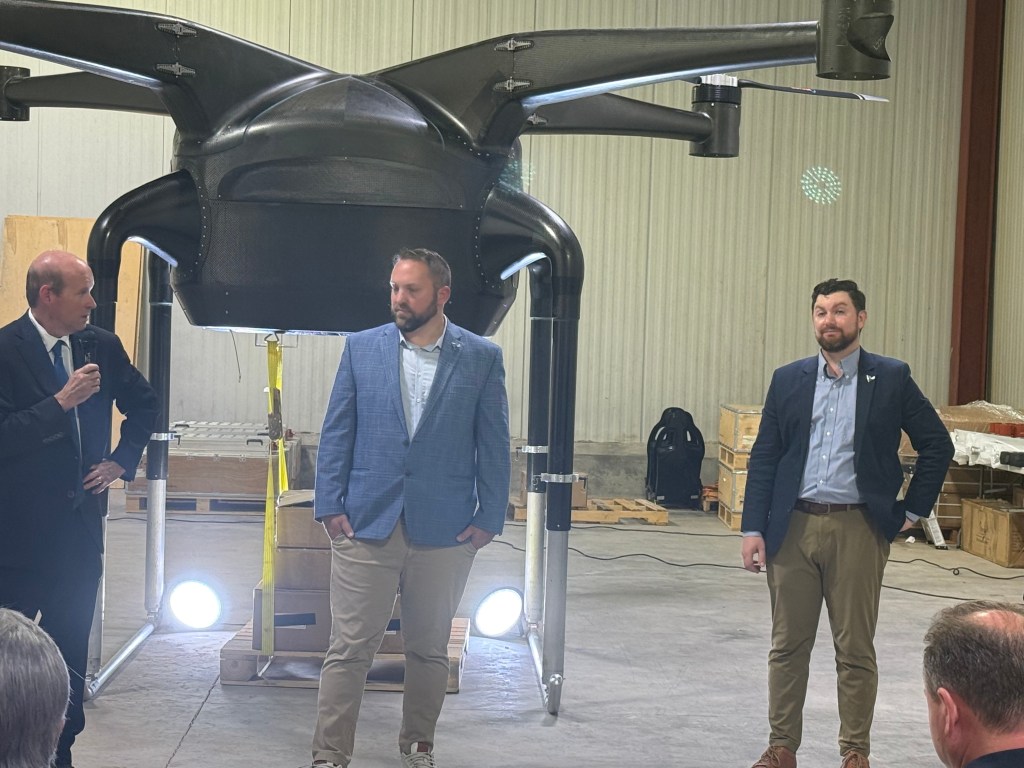
On September 21, 2026, we hosted a special community event at Miami University’s Innovation Center on Elm Street in Oxford, Ohio.
We called the evening “Dreams on Elm Street”, a lighthearted nod to the classic 1980s film. But what we’re building at Volynt isn’t the stuff of nightmares. It’s the realization of a dream, one that is taking shape right here in Butler County and has the potential to transform the future of logistics, aviation, and economic development in Ohio.
The turnout exceeded our expectations. The room was filled with Miami University staff, students, local business leaders, elected officials, and community members who wanted to learn more about what Volynt is building and where we’re headed.
We were honored to welcome Senator George Lang, Butler County Auditor Nancy Nix, and Michael Ryan, who is poised to become Butler County’s next commissioner. Their presence reflected the growing enthusiasm for innovation, entrepreneurship, and advanced aerospace development in our region.
Sharing the Vision
I opened the evening by welcoming our guests and providing an overview of the event. From there, our leadership team took the stage.
Our CEO shared Volynt’s long-term vision and mission. Our Chief Technology Officer highlighted the engineering milestones we’ve achieved and the technology behind the Volynt Vyper platform. As Chief Operating Officer, I discussed how Volynt is transforming cutting-edge aviation technology into a scalable and sustainable business. I outlined our operational strategy, manufacturing roadmap, partnerships, and the steps required to move from prototype development to commercial deployment.
The presentations were engaging, the audience was attentive, and the questions that followed demonstrated genuine interest and excitement.
Most importantly, this wasn’t a flashy product launch filled with unrealistic promises. It was an honest conversation about where we are today, what we’ve accomplished, and what the next several years may hold.
From Prototype to Production
Our immediate focus is straightforward.
Over the next six months, our team will complete the full-scale Vyper prototype that was unveiled at the Innovation Center. That aircraft represents years of design work, engineering refinement, and determination.
Once completed, the aircraft will enter an intensive testing phase designed to validate performance, reliability, and operational capabilities.
Looking ahead to 2027, we plan to participate in major industry competitions, build broader recognition within the aerospace community, and begin manufacturing multiple aircraft.
The goals are ambitious, but they are supported by a clear roadmap and a dedicated team committed to execution.
The Drone Revolution Is Already Here
One of the most important messages of the evening was that autonomous aviation is no longer a future concept.
It’s happening today.
Just one day after our event, Dayton-area company Dexa launched a drone delivery service in Kettering. The program delivers food orders from TJ Chumps on East Stroop Road to customers within a several-mile radius across Kettering, Oakwood, and Centerville.
These smaller drones operate as last-mile delivery systems. Flying at approximately 400 feet, they lower food orders safely to customers using a cable-delivery system. Dexa has spent years developing this capability and is helping demonstrate that drone delivery is becoming a practical reality.
Volynt’s mission is different.
While companies like Dexa focus on last-mile delivery, Volynt is developing larger autonomous aircraft designed for middle-mile logistics. Our aircraft are intended to transport meaningful payloads between regional hubs such as Cincinnati/Northern Kentucky International Airport (CVG), Dayton International Airport, Indianapolis, and other distribution centers.
This approach has the potential to reduce transportation bottlenecks, address driver shortages, and create more efficient supply chains.
Whether it’s delivering a meal across town or transporting freight across a region, autonomous aviation is rapidly reshaping how goods move through our economy.
Why Ohio Is Positioned to Lead
Ohio’s aviation legacy is unmatched.
The birthplace of powered flight now has an opportunity to become a leader in autonomous flight.
Few regions are better positioned than Butler County to participate in that transformation.
Our region offers access to multiple airports, including Miami University’s airport, where initial flight operations can be conducted. At the same time, substantial investment continues at Butler County Regional Airport, where significant infrastructure improvements are being planned.
The resources, workforce, educational institutions, and transportation network already exist. What remains is bringing together the innovators, investors, and community leaders who can turn opportunity into reality.
Creating Careers That Stay Close to Home
One topic that resonates deeply with me is talent retention.
I have spoken with countless parents who have made tremendous sacrifices to provide educational opportunities for their children through Miami University, Butler Tech, and the University of Cincinnati. Too often, those graduates leave Ohio because they believe the best opportunities are elsewhere.
That reality creates a challenge for families and communities alike.
One of our long-term goals at Volynt is to help change that story.
We envision creating thousands of high-quality aerospace, engineering, technology, and manufacturing jobs throughout Southern Ohio. We want talented young people to have the option of building exciting, fulfilling careers without leaving their families, communities, and hometowns behind.
Strong Community Support
One of the most encouraging moments of the evening was seeing the level of support from the community.
Michael Ryan delivered an excellent presentation about economic development in Butler County and how innovative companies such as Volynt can contribute to future growth and prosperity.
The participation from Miami University, local leaders, educators, students, business professionals, and community members reinforced something I’ve believed from the beginning:
Innovation succeeds when communities embrace it.
Dreams on Elm Street was more than a company presentation. It was a milestone. It brought together people from different backgrounds and perspectives to discuss a shared vision for the future of our region.
The energy in the room was unmistakable. The conversations were thoughtful. The questions were insightful. The enthusiasm was genuine.
For me, that confirmed that we’re moving in the right direction.
Looking Ahead
Volynt’s journey is still in its early chapters.
There is much work ahead, many challenges to overcome, and numerous milestones still to achieve. But the momentum is real, and the opportunities are significant.
We will continue sharing updates with the community as we progress from prototype development to testing, certification, manufacturing, and beyond.
This is only the beginning.
Thank you to everyone who attended Dreams on Elm Street and supported our mission. Your encouragement and belief in what we’re building means more than you know.
Together, we’re not just dreaming about the future.
We’re building it.
About the Author
Rich Hoffman is Chief Operating Officer of Volynt, where he leads operational strategy, business development, manufacturing planning, and growth initiatives for the company’s autonomous aerospace programs. A longtime Butler County leader and aerospace executive, he is committed to building high-quality technology careers and advancing innovation throughout Southwest Ohio.
Rich Hoffman is an author, political consultant, and strategic advisor based in Cincinnati, Ohio, and the creator of The Politics of Heaven—a unique framework that connects biblical theology, ancient history, and modern power structures to explain how moral alignment and spiritual forces shape global events. Blending real-world political experience with deep research into archaeology, UFO phenomena, and suppressed historical narratives, Hoffman offers compelling commentary on topics ranging from ancient civilizations and the Dead Sea Scrolls to modern populist movements, paranormal continuity, and leadership strategy in chaotic environments. As the author of The Gunfighter’s Guide to Business and the forthcoming Politics of Heaven, he brings a grounded yet provocative voice to media discussions, supported by firsthand experiences and a cross-disciplinary approach that bridges science, history, and theology. For interviews, speaking engagements, or expert analysis, visit richhoffmanbooks.com or contact directly via phone at 513-307-5815 or email at rhoffman@richhoffmanbooks.com. If you’ve seen the movie, Disclosure Day and want to talk about it and the implications of Presidnet Trump’s UAP disclosures, let me know and we can bring some color to your coverage. https://richhoffmanbooks.com/media-inquiries-broadcast-topics-and-contact-info/?frame-nonce=ad51e7ecba I do have a firsthand UFO encounter to discuss.
This past week I gave a lecture to a room of college students I never physically entered. A professor at a prestigious university—someone who had been watching my videos, commenting on them, and treating the work as if it belonged in a classroom—asked me to talk to her students about aerospace and how a young person might prepare for the space economy, in the old arrangement that invitation meant a check from the university, a plane ticket, a hotel for two nights, and a professor who got to sit in the back of the hall while an outsider did the talking. The students got a visitor who had been out in the world doing the thing the syllabus only described.
That is not what happened. I asked the practical questions. Do I fly out? Do I book a hotel? Do we do lunch? She said no. We would do it on Teams. She plugged her laptop into the classroom monitor, ran the microphone system through the room, and about two hundred people—some in the seats, some on the call—looked at me the way people now look at a talking rectangle. Class was at 12:30 PM. I sat down at 12:30 from my RV and called into Teams, and spoke to the class. An hour later everybody went about their business.
I am not pretending I am above being paid for that kind of work. The geometry of expertise has changed. The old lecture tour burned three days to deliver one hour. The new version burns one hour to deliver one hour. It feels slightly wild, and I will take it. The students still asked good questions. The professor still got a guest. I still had to earn the room. The only thing missing was the airport.
What the Space Economy Actually Means in 2026
I have been doing a run of shows on the change of state coming for the American economy—how much work, how much income, how much industrial capacity the orbital and near-space markets are going to pull into existence. The phrase “space economy” still sounds to some people like a poster in a guidance counselor’s office. It is not a poster. Industry tallies put the global space economy at around $626 billion in 2025, with commercial activity already the large majority of that total and serious forecasts pointing toward a trillion dollars in the early 2030s.[1] Other estimates run higher still. McKinsey and the World Economic Forum have published a scenario near one-point-eight trillion by 2035. The commercial share is already about four-fifths of the whole.[2]
That money is not only rockets on television. It is satellite broadband, navigation, Earth observation, ground equipment, launch cadence, defense architectures, and the unglamorous logistics that will feed commercial stations as NASA tries to hand low-Earth orbit to private operators before the International Space Station is retired.[3] If you are a student sitting in a lecture hall in 2026, the relevant question is not whether space will become an industry. It already is. The question is whether you will be the kind of person an industry like that can use.
Cargo Drones Are Not the Toys You Buy at Target
The conversation turned, as these conversations always do, toward drones. People hear the word and picture a camera quadcopter over a soccer field. That is not the machine I have been around in Butler County. The airframes I have been involved with are in a different weight class. They are built to move real mass—on the order of five hundred pounds of cargo—not a birthday balloon and a GoPro.
That number is no longer science fiction. In the last year, Elroy Air’s Chaparral hybrid-electric cargo aircraft has been flying autonomous missions under the federal eVTOL Integration Pilot Program, with production ratings above five hundred pounds and ranges measured in hundreds of miles.[4] Other developers are in the same neighborhood. AIR has put a heavy-lift uncrewed aircraft into flight operations with a published payload near 550 pounds and a cargo bay large enough for bulky freight.[5] China has flown even heavier fixed-wing cargo drones. The point for a classroom is simple: the sky is about to carry freight the way the interstate already does.
My wife heard that payload number and immediately produced the sentence every civilian produces. She did not want a drone flying over her car on the way to a Cincinnati Reds game and dropping a refrigerator on the hood. I have now heard that joke, or some cousin of it, enough times that it has become the unofficial civic motto of advanced air mobility. The students had the same fear. A bright young woman put it to me cleanly: she had seen the YouTube talk about Elon Musk and the Tesla bots, she could tell I was excited about robots, and she still wanted to know what happens when one of these things fails over a building or a highway.
The Question Every Classroom Asks: What If a Drone Hits My Car?
I told her the truth as I see it. These machines will be driven by software that, over a short run of years, is more practical and more consistent than the average human behind the wheel. That is not a hymn to perfection. Automated systems have already had ugly days. Robots have done stupid things. Self-driving stacks have had incidents that made the evening news. I do not wave those away. I treat them the way a manufacturer treats first-article failures: as the tuition you pay to get a repeatable process.
Tesla’s own published safety figures—imperfect, debated, and still the largest public data set of its kind—have, for several quarters, shown that miles driven with Autopilot and Full Self-Driving (Supervised) between crashes are far above the national average. In one quarterly snapshot, the company reported one crash per 6.69 million miles with the system engaged, compared with a U.S. average near one per 702,000 miles.[6] A later breakout put Full Self-Driving (Supervised) at roughly five million miles per major collision in North America.[7] Critics correctly note that the comparisons are not laboratory-clean. Highway mix, supervision, and crash definitions all matter. Fine. The direction of the curve still matters more than the purity of the press release. The stack learns. The humans who hate the stack do not update overnight.
Amazon drones will crash. Walmart drones will drop a payload early. Vandals will take shots at anything that flies low and looks expensive. Crosswinds, density altitude, summer heat, winter air thickness, and the occasional solar geometry the original coder did not anticipate will all produce a bad afternoon. That is what new technology does. Then the software gets a patch, and that particular stupidity is supposed to happen only once. A human being who wraps a truck around a pole at 2 a.m. does not receive a firmware update before the next Friday night.
It Is Not a Skill Gap. It Is an Engagement Gap.
The student’s question sat atop a second problem I have been hearing in manufacturing offices for years, and I have heard it with unusual frequency in the last two weeks. When you try to hire, you get applicants. A painful share of them cannot pass a drug test. A painful share of the rest do not want the job in any durable sense. I do not mean they lack a certificate. I mean they lack the old animal willingness to get up, go, and stay. People keep calling this a “skill gap” because “skill gap” is a polite phrase that can be used in a grant. What I am looking at is an ambition gap. An engagement gap.
It is not mysterious if you watch how a generation was fed. Old-time Facebook already trained people to receive a stream rather than make one. Video-game platforms now complete the circuit. The machine sends you the next mission, the next season pass, the next reason to tap a credit card. If public assistance covers the floor of a life, and a console covers the ceiling of a day’s stimulation, the case for gasoline money and a 5:30 a.m. alarm clock gets thin. You can stay in the house and still feel as if the world is happening to you.
The labor statistics are not a sermon, but they are not a hallucination either. U.S. labor force participation dropped to 61.6 percent in June 2026, the weakest non-pandemic reading since the mid-1970s.[8] Teen employment is a shadow of what it was when summer work was a normal American education. In July 2026, only 36.5 percent of sixteen-to-nineteen-year-olds were working, compared with a late-1970s peak near 60 percent.[9] Young men have fallen out of the market with particular force. Participation among men aged 16 to 24 has been reported at near 56 percent, down from about 69 percent in 2000.[10]
Survey research on Gen Z fills in the mood. Deloitte’s 2026 global survey found that more than half of that cohort were delaying major life decisions under financial pressure, and only a sliver named leadership as their primary career aim.[11] Gallup has been describing a “Great Detachment”: engagement at decade lows, and half the workforce either hunting or half-hunting for the exit.[12] You can argue about causes until the sun goes down—student debt, housing costs, phones, opioids, the aftertaste of lockdowns, the collapse of certain male-coded industries. I will not pretend one variable explains a civilization. I will say that a space economy cannot be staffed by people trained to wait for the next push notification.
Kiosks, Tesla Bots, and the Quiet Replacement of Human Attention
Robotics has already walked into the most ordinary American rooms. You go to a fast-food restaurant now, and the building would prefer you not talk to anyone. You poke a kiosk. You pay the kiosk. Somewhere behind the stainless steel, a smaller, often older crew still performs the last human motions the equipment has not yet absorbed. When you do get a live person at the counter, there is a fair chance that person is over fifty and still practicing the old religion of showing up. The shortage of willing labor is intense enough that automation no longer feels like a futurist pamphlet. It feels like the manager’s only remaining idea.
That is the part of the Tesla-bot conversation the internet likes to turn into a cartoon. I am not excited about robots because I dislike people. I am excited about robots because I have watched the labor pool thin out in real businesses, in real counties, with real drug tests and real no-call no-shows. If the country will not produce enough people who want the work, the work will still get done. It will get done by a machine that does not need a second chance on Monday. Remember, the enemies of America have been attacking America a long time, and our workforce has been their target. Globalism is dangerous to a productive society.
The Video Game Patch Model Is Moving Into the Physical World
The last fifteen minutes of the class were the part I did not fully script. I could see the professor’s face on the feed. I could not see the faces of two hundred others clearly, which is the new condition of public speech. I reached for an analogy the room already understood.
It is August and early September, which means another Madden cycle has either just landed or is about to. How many times has that game shipped perfect on day one? Rarely. Characters clip through each other. A play-call menu eats itself. The engine meets an input it was not trained to expect and throws a fit. Then the telemetry goes home. PlayStation, EA, and every live-service shop of any size collect crash codes from millions of copies overnight. Developers walk in the next morning to a pile of bug reports harvested from the wild. They push a patch. Digital distribution exists so they never have to mail you another piece of plastic.
That is the industrial model now traveling out of entertainment and into vehicles, drones, and humanoid robots. If a robot drops your hamburger, the correction is not a congressional hearing. It is a software update. If a cargo drone flying at five hundred feet decides, because the sun is vicious or the air is thin or an eclipse confuses a sensor suite, that it would rather be at twenty feet, the fleet can be taught not to make that particular mistake again. Weather, payload, battery sag, and GPS drift become parameters in a model that gets revised on a cadence no legislature can match.
I told the students I still see the old hardware in the wild. I was at a Cracker Barrel not long ago, and there was an Atari 2600 sitting there like a museum piece you could still buy. I am going to pick one up. Those machines were honest in a way modern software is not. The game was the cartridge. If Combat shipped with a quirk, that quirk lived in your living room until you sold the console at a garage sale.[13] We have inverted that world. The physical object is now a temporary container for a mind that can be rewritten after midnight.
A Short History of How America Managed Traffic Before Software
People talk as if safety were a mood. It is not. It is a pile of statutes, standards, advocacy campaigns, and ugly metal that accumulated because the alternative was a death rate this country finally decided it would not live with.
In 1966, after years of treating highway slaughter as the price of modernity, President Johnson signed the National Traffic and Motor Vehicle Safety Act and the Highway Safety Act. The Department of Transportation followed that same season, and out of that machinery came the agency that became the National Highway Traffic Safety Administration.[14] The results, stretched across half a century, are not subtle. The U.S. highway fatality rate fell from about 5.5 deaths per 100 million vehicle miles traveled in 1966 to about 1.1 by the mid-2010s.[15] Federal vehicle standards from 1960 through 2012 have been credited with saving more than 600,000 lives. Seat belts alone account for a huge share of that total.[16]
The hardware inside the cabin changed as well. Airbags moved from an exotic option to a federal requirement in new light vehicles by the late 1990s, and then spread to side-impact protection.[17] Crumple zones, better steels, electronic stability control, and an entire crash-test priesthood at NHTSA and the Insurance Institute for Highway Safety made it much more likely that a person who should have died in 1978 would walk out of a 2018 wreck talking.[18]
Drunk driving, MADD, and the years when Friday night was a slaughterhouse
Behavior took longer. Drinking and driving was illegal in a formal sense long before it was shameful. New Jersey passed an automobile-specific drunk-driving statute in 1906. For most of the twentieth century, the culture still treated the offense as a joke with a badge. That broke in 1980, when Candace Lightner founded Mothers Against Drunk Driving after a repeat offender killed her thirteen-year-old daughter, Cari, in Fair Oaks, California.[19] Within a few years, the country had a presidential commission, a federal drinking-age hammer in 1984, a march toward 0.08 blood-alcohol limits, and a new vocabulary: designated driver, friends don’t let friends, administrative license suspension.[20]
NHTSA only began clean national tracking of alcohol-involved deaths in 1982, a year when those deaths ran above twenty-one thousand and approached half of all traffic fatalities. The later curve bent down hard. Analyses of the post-1980 campaign put the decline in impaired-driver fatalities in the neighborhood of forty percent across four decades.[21] I grew up on the early side of that bend. I remember what the road felt like before the country got religion about it.
Stop signs, signals, and the roundabout as a mechanical conscience.
Infrastructure learned more slowly than slogans. On the kind of two-lane state route I knew as a kid, the first political answers to a string of wrecks were the obvious ones: a stop sign, then a light, then a lower speed, then a different way of feeding cars through a conflict point. Later came the modern roundabout—not the old American traffic circle that locked up in the 1950s, but the yield-on-entry European design that forces a driver to slow down and keep turning.
The first modern U.S. roundabout was installed in Summerlin, Nevada, in 1990. FHWA spent the 1990s studying the form and published its informational guide in 2000.[22] The safety case is now ordinary engineering. Roundabouts cut speeds and slash the number of conflict points. Federal evaluation work estimated that the roughly 2,400 American roundabouts built from 1990 to 2014 prevented tens of thousands of injury crashes and saved more than nine billion dollars in social cost.[23][24] Drivers complain about them the way drivers complain about every device that interrupts a straight line. The geometry does not care. It makes you engage the road.
That is the whole history in miniature. First you change the vehicle. Then you change the law. Then you change the pavement. Then you wait a generation for the culture to catch up. Software compresses that sequence. A drone fleet can receive a correction in a week that used to require a legislative session, a standards docket, and a decade of funerals.
Two O’Clock in the Morning on a Two-Lane Road
Here is why I told the class a story instead of another slide about mean time between failures. Human beings do not attach to mean time between failures. They attach to a night they can still hear.
When I was a kid, we lived off a busy two-lane state route, the kind of industrious road that carried trucks all day and all night. The house sat a good stretch back from the pavement—on the order of a hundred fifty yards—but in summer the windows were open because we did not have air conditioning. One Friday night, about 2 a.m., a truck left the road and took the telephone pole at the end of our driveway.
I did not hear the impact so much as I woke inside the sound that came after it. Through the screen I heard a man screaming for his mother. Not a movie scream. The real thing: high, terrified, the voice of somebody who had just understood what had been done to his body. I got my parents up. The whole house heard it. I went down the driveway in the dark.
The first cars were already slowing down, staring, then speeding up because staring felt like involvement. Nobody official had arrived yet. The truck had come off the road, hit the mailbox, hit the pole, and folded the driver’s side of the cab until metal from one side was occupying the space where a man is supposed to sit. The violence had done what violence does when steel meets a wooden pole at highway speed. Parts of him were in the road. In the poor light I first thought I was looking at roadkill. Traffic had already run over it. It was not an animal.
He had smashed the glass with his head, trying to get out of a window that no longer framed a living person. Blood ran down his face. He was jammed, trying to crawl, and still calling for his mother. He got quiet soon after I reached the end of the drive. There was nothing to do for him. He was gone when the screaming started. He just had not finished being gone.
I have thought about that night for a lifetime, and the thought I keep is not a policy memo. It is this: that was a software problem in a human body. It was the early 1980s, before Mothers Against Drunk Driving had finished turning a private grief into a national prohibition. The man was almost certainly tired, almost certainly drinking, almost certainly carrying whatever mess a night driver carries home at 2 a.m.—money, a shift, a marriage, a rumor, a clock. Human beings drive with all of that in the cab. They drive with a mother still installed in the nervous system. When the pole arrives, they call for her.
I do not tell that story because I enjoy the memory. I tell it because every time someone says they do not want a five-hundred-pound drone over their roof, they are asking for a world with no new risk, and they are asking it in a country that already accepted far worse risk for a hundred years of human drivers. Those particular wrecks—the ones that take a body apart against a pole—are rarer now—not gone. Rarer. Police still work Friday and Saturday nights. They will tell you the texture of the crashes has changed. Vehicles stay together. People crawl out who would have been listed in the morning paper in years prior. Airbags, belts, better steel, and slower intersections did that.[25]
Why Machines Will Make Fewer of Those Mistakes
A cargo drone does not have a wife. It does not have a mistress. It does not drink through a shift and then try to beat the sunrise home. It does not experience shame, jealousy, exhaustion, or the sudden need to call for its mother. It has sensors, limits, and a model of the world that can be rewritten when the world refuses to match it.
That is the moral of the old wreck, and it is the part of the lecture the room understood. We did not abolish tragedy on American roads by hoping drivers would become better people. We put constraints around them. We put belts on their chests, bags in their wheels, and lights in their path, and eventually computers in the loop. The next constraint is the loop taking the wheel. You will still get incidents. You will get a season of ugly film. You will get a class of people who do not want to compete with the machine and who will feed every failure to a news cycle that is addicted to the wreck.
I called that the Don Henley problem in class—the dirty laundry impulse. Automation that replaces visible human jobs will be covered as a crime even when the body count falls. That coverage will not be fair. It does not have to be fair to be loud. Anyone building drones, robots, or space logistics has a better budget for the noise.
Planning a Space Economy Around People Who Do Not Want the Job
This is the uncomfortable planning assumption. The space economy will not arrive as a clean poster of astronauts and lecture-hall ambition. It will arrive in a labor market where a large cohort under thirty is unevenly attached to work, where drug tests still sink hiring classes, and where firms that need reliability will buy it from software and silicon vendors if they cannot buy it from applicants.
I do not treat that as a reason to sneer at young people. Plenty of them are hungry. The young woman who asked the question was hungry. She was trying to square a future she could see with a risk she could feel. That is what a serious student does. The problem is the volume of people who will not ask the question because they are already being entertained past the point of hunger.
If you are building workforce policy for orbital industry, advanced manufacturing, or unmanned logistics in a place like Butler County, you plan for three tracks at once. First, the people who still want the work—train them harder and pay them like the scarce resource they are. Second, the machines that will do the work the missing people will not do—design them to be patched like games, not worshipped like monuments. Third, the public argument—tell the refrigerator story before the opponent tells it, and keep telling the 2 a.m. story so the public remembers what human error actually looked like when it was allowed to run wide open down a state route.
What I Took Away from a Classroom I Never Entered
I ended the hour the way I have ended a version of this talk too many times in the last two weeks. Software will take the first years to be clumsy. Then it will stop repeating the same clumsiness. Human beings repeat theirs for decades, because the bug is not in a repository. The bug is in the life.
We already proved, as a species, that we can cut the worst traffic deaths without waiting for every driver to become a saint. We proved it with belts, bags, blood-alcohol statutes, a drinking age tied to highway money, crash-test scores, and those unpopular roundabouts that make you turn the wheel whether you feel like it or not. The space economy will require the same kind of proof at higher altitudes. Cargo will fly. Robots will stand at counters and on factory floors. Some of the coverage will be poison. Some of the early flights will be ugly. And then the patch will ship.
I did not have to get on a plane to say any of that. I thought that was strange when the invitation first arrived. I think it’s less strange now. The tools that let a professor in another city put me on a wall in front of two hundred students are cousins of the tools that will keep a five-hundred-pound airframe from treating a parking lot like a telephone pole. Same family of updates. Same refusal to leave the mistake in the cartridge.
If you want the longer argument in the form I use with operators and owners, read the business guide I have already put out. The lecture was a compact version of it, told to a room that still has time to decide what kind of worker—and what kind of citizen—it is going to be when the drones are no longer a joke about refrigerators.
Notes
Numbered citations in the text correspond to the footnotes. The bibliography below is offered for further reading and is organized by subject rather than by the order of appearance.
[1] Novaspace, Space Economy Report, 12th ed. (January 2026), valuing the global space economy at $626.4 billion in 2025 and projecting $1.01 trillion by 2034 at a 12 percent compound annual growth rate. McKinsey and the World Economic Forum have published a higher $1.8 trillion scenario for 2035.
[2] Brookings Institution, Darrell M. West, “Artemis II and the Rapid Rise of a Global Space Economy,” April 8, 2026. Commercial activity accounted for roughly 78 percent of 2025 space spending; U.S. space employment was estimated near 400,000.
[3] U.S. Government Accountability Office, Low-Earth Orbit: NASA Faces Impending Decisions for Replacing International Space Station with Commercial Stations, GAO-26-107805 (June 2026).
[4] Elroy Air and Federal Aviation Administration statements on the eVTOL Integration Pilot Program flights at Houma-Terrebonne Airport, August–September 2026. Production Chaparral aircraft are rated for more than 500 pounds of payload and a range of up to 450 miles.
[5] AIR company announcements, 2025–2026, describing a production heavy-lift cargo UAS with a 550-pound payload and a 70-cubic-foot cargo bay for civil and military logistics.
[6] Tesla Vehicle Safety Report, Q2 2025: one crash per 6.69 million miles with Autopilot or Full Self-Driving (Supervised) engaged, compared with a U.S. average of roughly one crash per 702,000 miles (NHTSA/FHWA 2023 data as cited by Tesla). Independent analysts have noted that highway-heavy use cases and definitional choices affect the comparison.
[7] Tesla safety dashboard release, November 2025, reporting approximately 5.1 million miles per major collision with Full Self-Driving (Supervised) in North America across road classes. Tesla defines a major collision using Federal Motor Vehicle Safety Standards criteria, including airbag or pyrotechnic restraint deployment.
[8] St. Louis Federal Reserve, “What’s Behind the Sharp Drop in Labor Force Participation?” (August 2026). The U.S. labor force participation rate fell to 61.6 percent in June 2026, the lowest reading outside the pandemic period since 1976.
[9] U.S. Bureau of Labor Statistics, The Economics Daily, August 26, 2026. In July 2026, the employment–population ratio was 36.5 percent for teens ages 16–19 and 67.5 percent for young adults ages 20–24, both well below late-twentieth-century peaks.
[10] American Institute for Boys and Men analysis cited in reporting on July 2026 labor data: labor force participation among men ages 16–24 fell to 56.1 percent, down from about 69 percent in 2000.
[11] Deloitte Global Gen Z and Millennial Survey 2026. More than half of Gen Z respondents reported delaying major life decisions for financial reasons; only 6 percent named a leadership position as their primary career goal.
[12] Gallup workplace tracking through Q4 2025 described a “Great Detachment,” with engagement at decade lows and 51 percent of U.S. employees either actively looking or watching for other work.
[13] The Atari Video Computer System, later branded the Atari 2600, reached North American retail shelves in 1977. It used interchangeable ROM cartridges and a MOS 6507 processor; software, once pressed into plastic, could not be patched overnight.
[14] President Lyndon B. Johnson signed the National Traffic and Motor Vehicle Safety Act and the Highway Safety Act on September 9, 1966. Congress established the U.S. Department of Transportation the following month; the agency that became NHTSA followed.
[15] Bureau of Transportation Statistics, “A Half Century of Highway Safety Innovations—1966 to 2016.” The U.S. highway fatality rate fell from 5.5 deaths per 100 million vehicle miles traveled in 1966 to 1.1 by 2014.
[16] NHTSA estimates that technologies under the Federal Motor Vehicle Safety Standards saved more than 613,000 lives from 1960 through 2012, with seat belts accounting for nearly 330,000 of those savings.
[17] Front airbags were required in all new cars, light trucks, and vans beginning with the 1998–1999 model years. Side-impact protection standards later made side air bags effectively standard equipment.
[18] National Highway Traffic Safety Administration, Traffic Safety Facts annual series, and Insurance Institute for Highway Safety historical crashworthiness work. Occupant survival in serious crashes improved sharply after the introduction of airbags, crumple zones, electronic stability control, and structural redesign.
[19] Mothers Against Drunk Driving was founded in 1980 by Candace Lightner after her 13-year-old daughter, Cari, was killed in Fair Oaks, California, by a repeat drunk driver. NHTSA began systematic tracking of alcohol-related fatalities in 1982, when such deaths exceeded 21,000.
[20] The National Minimum Drinking Age Act of 1984 tied federal highway funds to a statewide minimum purchase age of 21. A later federal incentive pushed every state to a 0.08 blood-alcohol per se standard by 2004.
[21] NHTSA and related analyses have credited the post-1980 impaired-driving campaign with large fatality reductions. One commonly cited figure is a decline of roughly 44 percent in fatalities involving impaired drivers between 1982 and 2022.
[22] FHWA Research and Technology Evaluation: Roundabout Research Final Report (June 2018). The first modern U.S. roundabout was built in Summerlin, Nevada, in 1990. FHWA published Roundabouts: An Informational Guide in 2000.
[23] Federal Highway Administration, Proven Safety Countermeasures: Roundabouts, FHWA-SA-21-042. Modern roundabouts reduce vehicle speeds and conflict points compared with conventional intersections.
[24] FHWA estimated that roughly 2,400 U.S. roundabouts installed between 1990 and 2014 averted between 38,000 and 53,000 injury crashes, with societal cost savings above $9 billion over that period.
[25] National Highway Traffic Safety Administration, Traffic Safety Facts annual series, and Insurance Institute for Highway Safety historical crashworthiness work. Occupant survival in serious crashes improved sharply after the introduction of airbags, crumple zones, electronic stability control, and structural redesign.
Bibliography and Further Reading
This list is intentionally broader than the footnotes. It is a reading path for students and operators who want the lecture’s claims tested against primary sources.
Space Economy, Commercial LEO, and Aerospace Industry
Novaspace. Space Economy Report. 12th edition. Paris, January 2026. Summary coverage: SpaceNews, “Global Space Economy Reaches $626 Billion, Marking a New Phase of Growth,” January 29, 2026.
UBS. Space economy total addressable market outlook to 2040. Analyst commentary summarized in Yahoo Finance / Investing.com, July 18, 2026.
U.S. Government Accountability Office. Low-Earth Orbit: NASA Faces Impending Decisions for Replacing International Space Station with Commercial Stations. GAO-26-107805. June 2026. https://www.gao.gov/products/gao-26-107805
World Economic Forum. “3 Commercial Trends Propelling a $1.8 Trillion Space Market.” June 10, 2026.
NewSpace Tracker. “Space Economy Outlook 2026: Trends, Challenges, and Opportunities.” April 2026.
NASA. Commercial Low Earth Orbit Development Program documentation and Commercial Lunar Payload Services program pages. nasa.gov.
Satellite Industry Association. Annual State of the Satellite Industry reports, 2024–2026 editions.
Cargo Drones, eVTOL, and Unmanned Logistics
Elroy Air. Chaparral program materials and eVTOL Integration Pilot Program flight announcements, Louisiana, August–September 2026.
Interesting Engineering. “US Startup Tests Cargo Drone with 500-lb Payload, 450-mile Range.” September 2026.
Tech Times. “Autonomous Cargo Drone Clears First FAA Hurdle at Gulf Coast’s Busiest Heliport.” September 1, 2026.
AIR. Production heavy-lift cargo UAS announcements, 2025–2026, including 550-pound payload configuration.
Defense Blog. “AIR Launches Heavy Lift Cargo Drone with 550 Pound Payload Capacity.” April 17, 2026.
Urban Air Mobility News. “AIR Unveils New eVTOL Cargo Drone with 550 lb Payload for Civil and Military Operations.”
Federal Aviation Administration. eVTOL Integration Pilot Program (eIPP) materials; Executive Order 14307, “Unleashing American Drone Dominance,” June 2025.
Drone as a Service. “Heavy Lift Drones: Payload, FAA Rules & Top Models (2026).” Updated June 2026.
Sopowers. “Top 10 Cargo Drones in 2026: Payload, Range, Battery Systems & Logistics Trends.”
Zuri (Czech Republic). Hybrid VTOL cargo-drone specifications and 2027 flight-test schedule. NextGen Defense, September 2026.
Northern Changying / NORINCO. Changying-8 (CY-8) heavy cargo UAV maiden-flight reporting, March 31, 2026.
Vehicle Automation and Software-Defined Safety
Tesla, Inc. Vehicle Safety Reports, quarterly series, especially Q2 2025 Autopilot and Full Self-Driving (Supervised) statistics. tesla.com/VehicleSafetyReport.
Tesla, Inc. Full Self-Driving (Supervised) safety dashboard release, November 2025, including major-collision definitions keyed to 49 C.F.R. § 563.5.
TechCrunch. “Tesla Releases Detailed Safety Report after Waymo Co-CEO Called for More Data.” November 14, 2025.
Drive Tesla Canada. “Tesla’s Q2 2025 Vehicle Safety Report: Autopilot & FSD Remain Nearly 10x Safer than U.S. Average.” July 23, 2025.
Electrek. “Tesla’s Own Data Confirms Autopilot Safety Regressed in 2025.” July 23, 2025. (Critical reading of the same quarterly series.)
National Highway Traffic Safety Administration. Standing General Order on crash reporting for automated driving systems; ADS and Level 2 ADAS incident dashboards.
Federal Motor Vehicle Safety Standards. Occupant crash protection and event-data-recorder definitions, including 49 C.F.R. § 563.5.
Insurance Institute for Highway Safety / Highway Loss Data Institute. Autonomous vehicle and advanced driver-assistance system research pages.
History of U.S. Traffic Safety and Transportation Management
Johnson, Lyndon B. Remarks on signing the National Traffic and Motor Vehicle Safety Act and the Highway Safety Act, September 9, 1966.
U.S. Congress. National Traffic and Motor Vehicle Safety Act of 1966, Pub. L. 89-563; Highway Safety Act of 1966, Pub. L. 89-564.
Haddon, William, Jr. Foundational NHTSA-era public-health approach to crash injury. See also the Haddon Matrix literature.
National Highway Traffic Safety Administration. Lives Saved by Vehicle Safety Technologies and Associated Federal Motor Vehicle Safety Standards, 1960 to 2012. DOT HS 812 069.
Kahane, Charles J., and related NHTSA evaluation reports on seat belts, airbags, and electronic stability control.
Williams, Allan F., et al. “Fruits of 20 Years of Highway Safety Legislative Advocacy in the United States.” Annals of Advances in Automotive Medicine / PMC 3256822 (2011).
Ehsani, Johnathon P., et al. “The Future of Road Safety: Challenges and Opportunities.” PMC 10126980.
Insurance Institute for Highway Safety. Historical belt-use rates and crashworthiness ratings.
Impaired Driving Law and Advocacy
Mothers Against Drunk Driving. Organizational history; founded after the death of Cari Lightner, Fair Oaks, California, May 3, 1980.
Federal Highway Administration. Roundabouts: An Informational Guide. 2000; later editions and NCHRP updates.
Federal Highway Administration. Research and Technology Evaluation: Roundabout Research Final Report. June 2018.
Transportation Research Board. NCHRP Synthesis 264, Modern Roundabout Practice in the United States.
Steyn, Hermanus, Ashleigh Griffin, and Lee A. Rodegerdts. Accelerating Roundabout Implementation in the United States, Vol. IV: Review of Fatal and Severe Injury Crashes at Roundabouts. FHWA, 2015.
Federal Highway Administration. Safe Streets and Roads for All (SS4A) program materials under the Bipartisan Infrastructure Law.
Labor Force Participation, Youth Work, and Engagement
U.S. Bureau of Labor Statistics. Current Population Survey public data and The Employment Situation monthly releases, 2025–2026.
U.S. Bureau of Labor Statistics. “Teens Ages 16 to 19 Were Employed at Nearly Half the Rate of Young Adults Ages 20 to 24 in July 2026.” The Economics Daily, August 26, 2026.
Federal Reserve Bank of St. Louis. “What’s Behind the Sharp Drop in Labor Force Participation?” August 2026.
Center for American Progress. “Teen Employment Remains Weak.” August 7, 2026.
Gallup. “U.S. Worker Thriving Declines as Job Market Pessimism Grows.” 2026 workplace series, including Q4 2025 engagement and job-search tracking.
American Institute for Boys and Men. Research on young-male labor force participation and disconnection, 2024–2026.
New York Post. “Male Gen Zers Are Dropping Out of the U.S. Job Market in Droves.” August 17, 2026. (Journalistic summary of BLS and AIBM figures.)
U.K. Department for Work and Pensions / related. Young People and Work: Interim Report. 2026. Useful comparative reading on youth participation outside the United States.
Video Games, Live-Service Software, and the Patch Economy
Atari, Inc. Atari Video Computer System / Atari 2600 launch materials, 1977; subsequent branding change, 1982.
Wikipedia contributors. “Atari 2600.” Encyclopedia entry with production history, hardware constraints, and cartridge-era economics.
PCMag. “The Atari 2600 at 45: The Console That Brought Arcade Games Home.” September 10, 2022.
Electronic Arts / EA Sports. Madden NFL annual release notes and title-update histories, illustrating same-week patch cadence.
Sony Interactive Entertainment. PlayStation Network crash-reporting and title-update architecture, public developer documentation.
Industry discussions of live-service telemetry, crash dumps, and over-the-air vehicle/robotics updates as an extension of the games-industry model.
Regional and Author Context
Hoffman, Rich. Business guide and related commentary on manufacturing, drones, and local economic development in Butler County, Ohio.
Cincinnati/Northern Kentucky International Airport (CVG) cargo-hub reporting, for local context on freight aviation near the author’s home region.
Butler County, Ohio, economic-development and unmanned-systems coverage, 2024–2026.
Rich Hoffman is an author, political consultant, and strategic advisor based in Cincinnati, Ohio, and the creator of The Politics of Heaven—a unique framework that connects biblical theology, ancient history, and modern power structures to explain how moral alignment and spiritual forces shape global events. Blending real-world political experience with deep research into archaeology, UFO phenomena, and suppressed historical narratives, Hoffman offers compelling commentary on topics ranging from ancient civilizations and the Dead Sea Scrolls to modern populist movements, paranormal continuity, and leadership strategy in chaotic environments. As the author of The Gunfighter’s Guide to Business and the forthcoming Politics of Heaven, he brings a grounded yet provocative voice to media discussions, supported by firsthand experiences and a cross-disciplinary approach that bridges science, history, and theology. For interviews, speaking engagements, or expert analysis, visit richhoffmanbooks.com or contact directly via phone at 513-307-5815 or email at rhoffman@richhoffmanbooks.com. If you’ve seen the movie, Disclosure Day and want to talk about it and the implications of Presidnet Trump’s UAP disclosures, let me know and we can bring some color to your coverage. https://richhoffmanbooks.com/media-inquiries-broadcast-topics-and-contact-info/?frame-nonce=ad51e7ecba I do have a firsthand UFO encounter to discuss.
Pip: The Overmanwarrior has a long memory and a short tolerance for school boards that treat a paid-off debt like a personal tragedy.
Mara: Rich Hoffman has one subject this episode: Lakota Local School District is back on the November ballot, and the case against it runs from enrollment projections to property-tax philosophy to who actually pays when apartments fill up.
Pip: Let’s start with the ballot itself and what the district is calling a non-increase.
No New Taxes, No Relief: Lakota Is Back on the Ballot
Mara: The core tension here is definitional — the district says this bond is not a tax increase, and the post argues that framing erases something real: the relief homeowners were about to receive.
Pip: The setup is precise. The Lakota Board voted on June 9, 2026, to place a bond before voters, and here is the sentence that does the most work: “You have been making a mortgage payment to the school district. The mortgage is almost paid off. Instead of celebrating the payoff, they want you to sign a new note for thirty-seven more years and call the signing a favor.”
Mara: The upshot is that a $223 million bond at 2.20 mills, timed to replace an expiring bond, keeps the bill identical — which means the cut you were owed never arrives. Collections begin in 2028, first due in 2029, right as the old debt dies.
Pip: And the $77-per-$100,000 headline is doing a lot of costume work. Liberty Township median sales run in the low-to-mid-500s. At $530,000, that’s roughly $408 a year — closer to a television than a rounding error, to borrow the post’s own framing.
Mara: The post also goes after the enrollment story the campaign depends on. District slides from September 2025 projected 19,074 students by 2033. But FutureThink, the consultants the district itself hired, delivered a March 2026 study showing 2025-26 enrollment at 16,913 and a ten-year path drifting toward the mid-sixteen thousands — not racing toward nineteen thousand.
Pip: So the spike that justifies a thirty-seven-year note may not be arriving on schedule.
Mara: There’s also the 2025 context. Last November’s package failed 60.81 percent to 39.19 percent — a $506.4 million bond plus a permanent-improvement levy. The post calls Phase One the same philosophy in a smaller first bite, and notes that Lakota’s general-fund operation already runs near $226 million annually for one suburban district.
Pip: The apartment argument ties it together: renters use the schools, one landlord sits on the tax duplicate, and the longtime homeowner gets the invoice. The post credits Liberty Township trustee Todd Minniear for understanding that math — his vote against adding apartments near Liberty Center is why Ford’s Garage exists instead of another stack of balconies.
Mara: The recommendation is direct: vote no on November 3. A failed bond means the old millage still expires, which is a tax cut in 2029. The post frames that outcome not as deprivation but as the reward the community already earned.
Pip: Which raises the question of what comes next — because the post is clear that a no vote is not the end of the conversation, just the beginning of a harder one about living inside $226 million.
Mara: The through-line is straightforward: a community that has been paying for decades is being asked to keep paying, and the argument for doing so depends on projections that the district’s own consultants don’t fully support.
Pip: November 3 is the answer, and then — if history holds — there will be another question in 2027. The ballot is apparently a perennial.
Rich Hoffman is an author, political consultant, and strategic advisor based in Cincinnati, Ohio, and the creator of The Politics of Heaven—a unique framework that connects biblical theology, ancient history, and modern power structures to explain how moral alignment and spiritual forces shape global events. Blending real-world political experience with deep research into archaeology, UFO phenomena, and suppressed historical narratives, Hoffman offers compelling commentary on topics ranging from ancient civilizations and the Dead Sea Scrolls to modern populist movements, paranormal continuity, and leadership strategy in chaotic environments. As the author of The Gunfighter’s Guide to Business and the forthcoming Politics of Heaven, he brings a grounded yet provocative voice to media discussions, supported by firsthand experiences and a cross-disciplinary approach that bridges science, history, and theology. For interviews, speaking engagements, or expert analysis, visit richhoffmanbooks.com or contact directly via phone at 513-307-5815 or email at rhoffman@richhoffmanbooks.com. If you’ve seen the movie, Disclosure Day and want to talk about it and the implications of Presidnet Trump’s UAP disclosures, let me know and we can bring some color to your coverage. https://richhoffmanbooks.com/media-inquiries-broadcast-topics-and-contact-info/?frame-nonce=ad51e7ecba I do have a firsthand UFO encounter to discuss.
Pip: The Overmanwarrior has a hobby, and it is not whittling — it is making people extremely wealthy, which turns out to involve a lot of autonomous aircraft and very little waiting around.
Mara: Rich Hoffman lays out why the drone delivery window is open right now, what it means for southern Ohio specifically, and where the real economic weight sits — not in the consumer flights, but in the infrastructure underneath them. Let’s start with the drones themselves and the regional opportunity they’re building.
Drones, Dollars, and the Butler County Window
Pip: The argument here is that drone delivery has crossed from experiment to operating infrastructure — and that the regions paying attention right now are the ones that will capture the economic upside, not the ones who show up after the narrative hardens.
Mara: The post sets the scale clearly before making that case: “Walmart surpassed one million cumulative drone deliveries by May 2026, with roughly 40 percent of that volume occurring in a single quarter.”
Pip: So this is not a pilot program anymore. That volume curve means the supporting layers — docking infrastructure, replenishment logistics, manufacturing capacity — have to scale with it, and that scaling is where the durable jobs and investment land.
Mara: Zipline is the clearest example of how that infrastructure matures. Platform 2 flies at 200 to 300 feet and lowers a tethered droid with its own sensors and thrusters to a customer-selected spot — driveway, deck, backyard. The aircraft never descends into the risk zone. The technology spent years proving itself in medical logistics in Rwanda before Walmart, Little Caesars, and Uber Eats arrived.
Pip: Turns out delivering blood to remote clinics in Rwanda is excellent job training for dropping ketchup on a Hamilton patio.
Mara: And Cleveland Clinic is already using Zipline for prescription deliveries in Beachwood, so Ohio is not waiting on the sidelines. The post makes the middle-mile case just as directly: faster consumer delivery means higher inventory turnover, which means stores need faster replenishment from regional distribution centers — and semi-truck schedules become the bottleneck.
Pip: That’s where intermediate autonomous systems in the 250-to-550-pound payload class come in, and where Butler County’s geography — its proximity to CVG, major interstates, and existing distribution infrastructure — makes it a logical node.
Mara: A regional vertical port or staging facility is described as achievable in the low tens of millions when private capital and public partnerships align. There is also a September 18 event at Miami University presenting specific technology and partnership frameworks for anyone tracking this locally.
Pip: The post’s closing line is the one that stays with you: “The infrastructure is being built in real time. The economic consequences will accrue to the regions and operators that treat the present window as operational rather than speculative.”
Mara: That framing runs through everything — the space economy linkages, the manufacturing scaling, the airspace corridor logic. The consumer flights visible over Hamilton are the surface. The deeper economic weight sits in what gets built to support them.
Pip: Infrastructure windows and wealth creation — the through-line is timing. The regions that move while the stack is still being assembled are the ones that end up owning the stack.
Mara: Next time, we will see what other territory The Overmanwarrior is mapping. Stay with us.
Rich Hoffman is an author, political consultant, and strategic advisor based in Cincinnati, Ohio, and the creator of The Politics of Heaven—a unique framework that connects biblical theology, ancient history, and modern power structures to explain how moral alignment and spiritual forces shape global events. Blending real-world political experience with deep research into archaeology, UFO phenomena, and suppressed historical narratives, Hoffman offers compelling commentary on topics ranging from ancient civilizations and the Dead Sea Scrolls to modern populist movements, paranormal continuity, and leadership strategy in chaotic environments. As the author of The Gunfighter’s Guide to Business and the forthcoming Politics of Heaven, he brings a grounded yet provocative voice to media discussions, supported by firsthand experiences and a cross-disciplinary approach that bridges science, history, and theology. For interviews, speaking engagements, or expert analysis, visit richhoffmanbooks.com or contact directly via phone at 513-307-5815 or email at rhoffman@richhoffmanbooks.com. If you’ve seen the movie, Disclosure Day and want to talk about it and the implications of Presidnet Trump’s UAP disclosures, let me know and we can bring some color to your coverage. https://richhoffmanbooks.com/media-inquiries-broadcast-topics-and-contact-info/?frame-nonce=ad51e7ecba I do have a firsthand UFO encounter to discuss.
Pip: Ohio is ranked 42nd in the country, and somehow that is also proof it is doing great — welcome to The Overmanwarrior.
Mara: Rich Hoffman digs into exactly that tension this week, looking at competing state rankings, what they actually measure, and what the 2026 Ohio gubernatorial race has to do with all of it. Let’s start with the rankings fight itself.
Two Scorecards, One State
Pip: The central question here is which ranking tells you something real about Ohio — because two major outlets looked at the same state in the same year and reached opposite conclusions.
Mara: The U.S. News number lands first in the piece, and the setup is direct: “Ohio ranked first in infrastructure and first in cost of doing business” — that is CNBC’s America’s Top States for Business, released in July, putting Ohio at number one overall for the first time.
Pip: So the same state that CNBC ranks first for business climate, U.S. News ranks 42nd overall — a drop from 38th the year before and 36th the year before that. The upshot is that methodology determines the verdict before a single data point is entered.
Mara: That is exactly the argument. U.S. News weights education at roughly 15.8 percent and healthcare at 15.5 percent — the two heaviest categories. Ohio’s weakest scores were natural environment at 43rd and economy at 38th, with healthcare at 36th. Its strongest were opportunity at 18th and fiscal stability at 28th.
Pip: Fiscal stability in the top third, opportunity in the top fifth — those are not the numbers of a state in collapse. They are the numbers of a state that refuses to optimize for the scorecard.
Mara: And the piece makes the case that the scorecard itself is the issue. The U.S. News methodology rewards pre-K enrollment rates, higher-education access, and public-health indicators — inputs rather than outcomes. Ohio is running nearly 1.8 billion dollars above revenue projections for fiscal year 2026 and is actively working on property-tax relief. That surplus does not show up as a gold star in the U.S. News model.
Pip: Meanwhile, Amy Acton is the Democratic nominee for governor, and her record as health director in 2020 — Ohio was the first state to close schools statewide — is now squarely part of the campaign conversation. Rankings that surface now are not arriving in a vacuum.
Mara: The piece is clear that the political timing matters. Democrats need a story that Republican stewardship has failed. A ranking that penalizes limited-government priorities and drops Ohio four spots in two years is a useful data point — if you do not look at what the ranking actually measures.
Pip: Utah has sat at number one in U.S. News for four straight years, which tells you something about whose model wins that particular game. The question for Ohio voters is which game they think they are playing.
Mara: And that hands directly to the broader stakes — what fiscal discipline actually looks like when the ledgers are in the black, and who gets credit for it.
Mara: The core tension here is real: two credible outlets, opposite conclusions, and an election coming. Which metrics you trust says a lot about what you think a state is for.
Pip: Ohio’s books are balanced. The argument is about whether that counts. Worth watching how that plays out as the gubernatorial race heats up.
Rich Hoffman is an author, political consultant, and strategic advisor based in Cincinnati, Ohio, and the creator of The Politics of Heaven—a unique framework that connects biblical theology, ancient history, and modern power structures to explain how moral alignment and spiritual forces shape global events. Blending real-world political experience with deep research into archaeology, UFO phenomena, and suppressed historical narratives, Hoffman offers compelling commentary on topics ranging from ancient civilizations and the Dead Sea Scrolls to modern populist movements, paranormal continuity, and leadership strategy in chaotic environments. As the author of The Gunfighter’s Guide to Business and the forthcoming Politics of Heaven, he brings a grounded yet provocative voice to media discussions, supported by firsthand experiences and a cross-disciplinary approach that bridges science, history, and theology. For interviews, speaking engagements, or expert analysis, visit richhoffmanbooks.com or contact him directly via phone at 513-307-5815 or email at rhoffman@richhoffmanbooks.com. If you’ve seen the movie Disclosure Day and want to talk about it and the implications of President Trump’s UAP disclosures, let me know, and we can bring some color to your coverage. https://richhoffmanbooks.com/media-inquiries-broadcast-topics-and-contact-info/?frame-nonce=ad51e7ecba I do have a firsthand UFO encounter to discuss.
The explosion of Blue Origin’s New Glenn rocket on the evening of May 28, 2026, at Launch Complex 36 in Cape Canaveral Space Force Station sent a massive fireball into the Florida night sky, visible for miles across the Space Coast. The incident occurred during a static-fire test of the vehicle’s seven BE-4 methane engines as preparations advanced for the planned launch of Amazon Project Kuiper satellites. No injuries were reported, and the payload satellites had not yet been integrated, yet the blast destroyed the first stage, damaged the second stage, and inflicted significant harm on the launch infrastructure, including collapsed lightning towers and compromised ground systems.
This event, while dramatic and costly in the short term, fits into a long pattern of challenges that have defined human spaceflight from its earliest days. The Space Coast, with its rich history of ambition and setback, absorbed another chapter in that story. Observers familiar with the area—its restaurants, beaches, and the electric atmosphere that builds before night launches—could imagine the shock felt by those gathered on Cocoa Beach with lawn chairs, expecting a spectacular light show but witnessing an uncontrolled conflagration instead. The infrastructure at Cape Canaveral has always accounted for such possibilities by deliberately spacing the pads, allowing continued operations even amid localized damage. Indeed, within hours, SpaceX successfully launched a Falcon 9 from a nearby complex, underscoring the resilience built into modern commercial space operations.
The development of heavy-lift rockets has never been without risk. Blue Origin’s New Glenn, standing roughly 320 feet tall and designed as a reusable two-stage vehicle powered by innovative BE-4 engines, represents a serious contender in the emerging space economy. Its setback comes as the company works to close the gap with established players while contributing to NASA’s Artemis program, which aims to return humans to the Moon and establish a sustained presence there. Historical parallels abound. In the 1960s, the Apollo program endured multiple failures, including the tragic Apollo 1 fire that claimed three astronauts’ lives during a ground test. Engineers learned from those events, iterating rapidly under intense pressure. Similarly, the Space Shuttle era saw the 1986 Challenger disaster and Columbia’s loss in 2003, both rooted in technical vulnerabilities exposed under operational stress. These tragedies slowed momentum temporarily but ultimately reinforced the necessity of pushing boundaries rather than retreating into excessive caution.
The phrase “The Right Stuff,” popularized by Tom Wolfe’s account of the Mercury Seven astronauts, captures the blend of courage, technical skill, and calculated risk that propelled early space exploration. Yet that era also demonstrated that safety in its purest form—zero tolerance for any anomaly—would have halted progress entirely. Test pilots and engineers accepted that prototypes and new systems carried inherent dangers. Leaks in propellant lines, valve failures, and unexpected combustion events were common during the frantic pace of the Space Race. Today’s commercial sector echoes this reality. SpaceX itself experienced numerous Falcon 1 failures before achieving orbital success and endured Starship test explosions that became public spectacles before rapid iterations led to operational reliability. These events highlight a core truth: progress in extreme engineering environments demands tolerance for learning through failure, especially when no crew is aboard.
In the case of the New Glenn incident, the anomaly likely stemmed from complexities in the fueling and pressurization systems—long runs of piping that transfer cryogenic propellants under high pressure. Such setups involve numerous seams, valves, and sensors where even minor imperfections can cascade. Static fire tests exist precisely to uncover these issues on the ground, far preferable to in-flight catastrophes. Blue Origin had achieved prior successes with earlier New Glenn vehicles, demonstrating the maturity of much of the architecture. The company’s track record before this event showed methodical advancement, free of major public mishaps. The response from leadership emphasized thorough investigation and a commitment to recovery, a stance aligned with the industry’s need to maintain cadence.
Broader implications extend far beyond a single launchpad. The space economy promises transformative growth. Estimates suggest that extracting rare minerals from the Moon, asteroids, and Mars could unlock trillions in new value. Zero-gravity manufacturing offers advantages in producing flawless crystals, advanced alloys, and pharmaceuticals that are impossible to replicate efficiently on Earth. Orbital facilities, potentially spanning hundreds of thousands of square feet and serviced by autonomous systems, could host heavy industry where massive components are maneuvered with minimal force. Power generation from solar arrays in continuous sunlight, combined with vacuum conditions ideal for certain processes, positions space as the next frontier for economic expansion. Blue Origin, SpaceX, and others are laying infrastructure for this vision, with New Glenn intended to complement smaller vehicles in delivering heavy cargo for lunar bases and satellite constellations.
Critics who view such explosions as reasons to slow or more strictly regulate the sector often overlook historical precedent and economic logic. Overly restrictive safety regimes, sometimes influenced by broader societal trends favoring precaution over innovation, risk stifling the very dynamism required for breakthroughs. During the COVID-19 period, widespread shutdowns illustrated how prioritizing absolute safety can contract economic activity. Similar dynamics appear in debates over infrastructure projects, energy development, and now space. Proponents of rapid iteration argue that autonomous systems and robotic precursors should shoulder initial risks, allowing humans to follow once reliability improves. This approach mirrors early aviation and automotive industries, where rapid prototyping and field failures drove safety improvements over time.
The competition between Blue Origin and SpaceX exemplifies healthy market forces. New Glenn’s development has been watched closely as a potential counterbalance, encouraging faster innovation across the board. Setbacks for one player do not equate to industry-wide failure; rather, they test organizational resilience. SpaceX’s ability to launch the day after the New Glenn event demonstrated asset isolation and a rapid operational tempo. Blue Origin possesses additional vehicles in various stages of assembly. Activating parallel production lines, implementing extended shifts where feasible, and focusing engineering resources on root cause analysis could help compress recovery timelines. Historical examples support this: After Virgin Galactic’s 2014 SpaceShipTwo accident, the company rebuilt, iterated, and advanced toward commercial operations. Similar recoveries followed other high-profile incidents.
Calls to maintain schedules for Artemis-related missions reflect urgency around lunar return timelines targeted for the late 2020s. Delaying hardware availability could cascade into broader program slips. Sustained public and investor enthusiasm requires visible progress—regular news of launches, landings, and new capabilities. Filing necessary regulatory documentation with the FAA promptly, conducting transparent reviews, and returning to test campaigns signal commitment. The Space Coast community, long accustomed to the rhythms of launch windows, benefits from this continuity. Local economies tied to tourism, engineering talent, and supply chains thrive when activity remains high.
Robotics and artificial intelligence will play central roles in mitigating human risk during expansion. Tesla Optimus-style systems and advanced autonomy can handle hazardous assembly, refueling, and initial exploration tasks. Concerns about job displacement on Earth—exacerbated by wage policies that reduce hiring incentives—find partial resolution in new high-skill opportunities created by space infrastructure. Staffing orbital manufacturing would require oversight roles, maintenance expertise, and creative problem-solving that complement rather than replace human labor. The vision of floating facilities between Earth and Moon, processing lunar regolith into construction materials or extracting platinum-group metals, represents a multi-trillion-dollar opportunity that rewards those who move decisively.
Critics sometimes celebrate such explosions as brakes on capitalism in space, preferring centralized control or slower pacing aligned with terrestrial priorities. Yet the data suggests otherwise. Reusable architectures have already driven launch costs down dramatically, enabling constellations like Starlink that deliver global connectivity. Further reductions through heavy-lift vehicles will accelerate science, communications, Earth observation, and eventual off-world settlement. Mining asteroids could supply resources without the terrestrial environmental trade-offs associated with some mining operations. The long-term payoff justifies accepting manageable risks during development phases.
Learning from past programs remains essential. NASA’s early days involved accepting higher failure probabilities to achieve national goals. Private industry now carries much of that mantle, operating under market accountability that incentivizes efficiency. Blue Origin’s facility near the Space Coast showcases impressive engineering infrastructure. Leveraging that base, combined with lessons from the recent anomaly, positions the team for a rebound. Recommendations include prioritizing redundant systems in propellant handling, enhancing sensor density for early leak detection, and maintaining aggressive parallel development of follow-on vehicles.
The cultural dimension cannot be ignored. Narratives framing innovation as inherently dangerous sometimes serve to justify regulatory expansion rather than technical solutions. Balancing legitimate safety with progress requires distinguishing between reckless disregard and the informed risk inherent to frontier work. Test pilots of the 1950s and 1960s embodied the latter; modern rocket engineers continue that tradition. Public fascination with space endures because of visible achievement, not perfect safety records. Night launches lighting up the sky over Cocoa Beach remind onlookers of humanity’s reach beyond the planet.
In reflecting on the New Glenn event, several practical steps emerge for stakeholders. First, conduct a swift yet comprehensive investigation and share non-proprietary findings to benefit the industry. Second, repair and upgrade the launch complex while constructing contingency capabilities. Third, accelerate manufacturing of replacement hardware through multi-shift operations where workforce conditions allow. Fourth, engage regulators constructively to resume testing promptly. Fifth, communicate progress transparently to maintain confidence among partners like NASA and Amazon. These actions align with best practices observed in successful recovery cases.
The space economy’s trajectory points toward exponential growth. Initial billions in revenue from launches and services will expand into trillions as resource utilization scales. Manufacturing in microgravity could revolutionize materials science, producing superior semiconductors, fiber optics, and medical isotopes. Robotic precursors will establish outposts, followed by human crews supported by advanced life-support and propulsion systems. Starship-class vehicles are expected to serve as foundational transport, with complementary systems like New Glenn providing specialized heavy-lift capacity. Competition drives down costs and spurs ingenuity.
Skeptics who hoped the explosion would dampen momentum underestimate the sector’s adaptability. The isolation of launch infrastructure, proven redundancies, and private capital’s risk tolerance all favor continuation. For those invested in humanity’s multi-planetary future, the message is clear: analyze, adapt, and advance. The fireworks of May 28, 2026, while startling, illuminated both the challenges and the enduring allure of reaching for the stars.
Expanding on historical context, one must consider the Soviet N1 rocket program during the Moon race. Multiple catastrophic explosions on the pad during static tests delayed ambitions but provided data that informed later designs, even if political factors ultimately curtailed the effort. American Saturn V development faced engine instabilities and structural issues, which were resolved through iterative ground testing. Each failure refined understanding of combustion dynamics, materials under extreme loads, and control systems. Modern simulations and sensors offer greater insight, yet physical testing remains irreplaceable for uncovering subtle integration problems.
Economically, the multiplier effects of space activity extend deep into supply chains. Florida’s Space Coast employs thousands directly and indirectly. Tourism spikes around launches, while high-tech manufacturing attracts talent. A slowdown would ripple through these ecosystems. Maintaining tempo supports broader goals like climate monitoring satellites, disaster response, and technological spin-offs that improve daily life on Earth.
Philosophically, the tension between safety absolutism and exploratory daring echoes debates in other domains. Aviation advanced despite early crashes. Nuclear power improved safety records through experience despite accidents. Space demands similar maturity. Overemphasis on “safety tyrants”—those prioritizing zero incidents above all—can paralyze organizations, leading to bureaucratic bloat and opportunity costs. Instead, layered risk management, in which ground tests absorb early failures, allows for safe progression toward crewed missions.
Blue Origin’s path forward involves embodying that balanced approach. With vehicles in production, experienced teams, and strong backing, recovery is feasible within compressed timelines. Targeting return-to-flight before year’s end, while supporting Artemis milestones, would demonstrate resolve. The industry watches not just for technical fixes but for cultural signals: whether setbacks become excuses for delay or catalysts for acceleration.
In the end, the New Glenn explosion of late May 2026 joins a distinguished lineage of events that test character and capability. Those who treat it as temporary, learn its lessons, and press onward will shape the coming era of space industrialization. The fireball may have lit the sky briefly, but sustained effort will illuminate a future of expanded human presence beyond Earth. The Space Coast, with its resilient vibe and storied past, stands ready for the next chapter.
1. Details drawn from contemporary reporting on the May 28, 2026, static fire anomaly.
2. Tom Wolfe, The Right Stuff (1979), for cultural framing of risk in aerospace.
3. NASA historical records on Apollo and Shuttle programs.
4. Industry analyses of reusable rocket economics, including SpaceX flight cadence data.
5. Projections on space resource utilization from various economic studies (e.g., asteroid mining valuations).
Bibliography
• Wolfe, Tom. The Right Stuff. Farrar, Straus and Giroux, 1979.
• NASA. “Apollo Program Summary.” Historical archives.
• Spaceflight Now and Reuters coverage of the 2026 New Glenn event.
• Economic reports on space mining potential (various sources, 2020s).
Rich Hoffman is an aerospace executive, political strategist, systems thinker, and independent researcher of ancient history, the paranormal, and the Dead Sea Scrolls tradition. His life in high‑stakes manufacturing, high‑level politics, and cross‑functional crisis management gives him a field‑tested understanding of power — both human and unseen.
He has advised candidates, executives, and public leaders, while conducting deep, hands‑on exploration of archaeological and supernatural hotspots across the world.
Hoffman writes with the credibility of a problem-solver, the curiosity of an archaeologist, and the courage of a frontline witness who has gone to very scary places and reported what lurked there. Hoffman has authored books including The Symposium of Justice, The Gunfighter’s Guide to Business, and Tail of the Dragon, often exploring themes of freedom, individual will, and societal structures through a lens influenced by philosophy (e.g., Nietzschean overman concepts) and current events.
Even if Trump is playing nice with Bill Gates these days, I’m still firmly in the camp where the Microsoft founder needs to be in jail for all that he did. I remember it well, and I reported it here in a way that no other news outlet in the world did at the time, as it was happening. Even Rush Limbaugh was slow to see what was happening. But I said that it was a scam the day that Bill Gates and Dr. Fauci walked into the Oval Office and told President Trump to shut down the economy in the United States, which he did for a few weeks. But by then, the damage had been done, and lots of very liberal governors of states had taken the sucker bait and followed, and it was really terrible. Bill Gates needs to pay for his very active role in creating that crisis. Created I say because we know that Covid was created by gain of function research to jump to hosts in ways that nature does not provide, so it was a bioweapon that had roots running into the DOD that Dr. Fauci knew all about and a lot of people died as a result of this virus that was created in a Chinese lab and let loose in the world on purpose, not by accident. All the evidence points in that direction, and Bill Gates was one of the key insiders involved in the whole tragedy. Few figures have polarized public opinion in the 21st century like Bill Gates. Once hailed as a visionary technologist and philanthropist, Gates’ role during the COVID-19 pandemic and his aggressive climate activism have drawn intense scrutiny. However, politics have changed significantly over the last five years, and now Gates realizes he has been excluded from almost everything, and he wants to get back in. So he has been groveling to President Trump and is starting to walk back his ridiculous climate change proposals, which is quite extraordinary considering his level of tyrannical commitment. He tried to rearrange our entire society. So any walk back from him is astonishing, and very telling. Now, in late 2025, Gates has released a memo that marks a significant shift in his stance on climate change—one that critics argue is a strategic retreat rather than a genuine change of heart.
In October 2025, Gates published a 17-page memo ahead of the COP30 climate summit in Brazil. In it, he argued that climate change, while profound, is not the apocalyptic threat many activists claim. He emphasized that:
• Climate change “will not lead to humanity’s demise.”
• The focus should shift from temperature targets to improving human welfare.
• Investments should prioritize poverty, disease, and economic development over emissions reduction
This pivot was immediately seized upon by climate skeptics and political figures, including President Donald Trump, who declared on Truth Social:
“I (WE!) just won the War on the Climate Change Hoax. Bill Gates has finally admitted that he was completely WRONG on the issue.”
Despite the celebratory tone from skeptics, Gates pushed back, calling Trump’s interpretation a “gigantic misreading.” He reaffirmed his belief that climate change is a serious issue, but argued that the “doomsday outlook” has led to the misallocation of resources.
“Every tenth of a degree of heating that we prevent is hugely beneficial because a stable climate makes it easier to improve people’s lives.”
Gates’ reputation suffered a significant blow during the COVID-19 pandemic. His advocacy for lockdowns, vaccine mandates, and digital surveillance tools, such as Microsoft Teams, was seen by many as overreach. Critics argue that Gates, alongside Dr. Anthony Fauci, played a central role in shaping a global response that devastated economies and civil liberties.
• Gates was accused of using the pandemic to push a technocratic agenda.
• His ties to gain-of-function research and vaccine monopolies raised ethical concerns.
• Public trust in Gates plummeted, with many calling for accountability and even criminal charges.
Climate Change: From Alarmism to Adaptation
Gates’ climate activism has long centered on achieving net-zero emissions. His 2021 book How to Avoid a Climate Disaster laid out a roadmap for decarbonization. But in 2025, Gates now argues that:
• The worst-case scenarios are no longer plausible.
• Technological innovation has already begun reducing emissions.
• Economic growth and health infrastructure are better defenses against climate impacts.
This shift aligns more closely with Elon Musk’s pragmatic approach to climate and energy—focusing on innovation rather than regulation.
Gates’ recent dinner with President Trump lasted over three hours and reportedly focused on global health, innovation, and pandemic preparedness. While Gates has criticized Trump’s cuts to USAID, he appears to be recalibrating his public posture to remain relevant in a political landscape increasingly dominated by populist skepticism of climate alarmism.
One of the most striking elements of Gates’ memo is his implicit endorsement of adaptation over mitigation. He suggests that humanity has the tools to thrive—even in a warming world. This echoes broader conversations about terraforming Mars and using technology to reshape environments, rather than surrendering to climate fatalism.
Critics argue that Gates’ technocratic worldview—where unelected billionaires shape global policy—poses a threat to democracy. The COVID response and climate mandates are seen as examples of how centralized control can override individual freedoms.
“You can’t let tyrants rule. You have to have market pressures and competitive elections to check power.” Rich Hoffman
Bill Gates’ pivot on climate change is not just a policy shift—it’s a reckoning. It reflects the limits of technocratic influence and the resilience of democratic accountability. Whether Gates is genuinely rethinking his views or simply repositioning himself politically, the public response underscores a broader demand for transparency, humility, and checks on power. If we had not elected Trump and put him back in office, people like Bill Gates would be running the world right now. A lot of hard lessons were learned, and we are a lot better off now than we were. Trump is the kind of person who can keep everyone close, allowing him to negotiate effectively with them. I think it’s very appropriate that President Trump is taking credit for this issue with Gates. He could do a lot more to embarrass the techno geek. However, this is a powerful position for Gates and the Climate Change hoax in general. The world is not coming to an end because of artificial intelligence. We could terraform the entire planet if we want to, as we are planning to do in other places around the solar system as we speak. For Gates, it was always about control. He wanted to control the management of the human race through techno tyranny, and he played President Trump as a sucker who trusted him during his first term. So Gates has a lot of embarrassment coming. And I would argue that there would be a lot of jail time. However, his admission is a significant development and a major shift in the world toward a much stronger economy. The walls on this ridiculous control mechanism are coming down, and people like Gates have lost power because of our free elections in America. That’s why managing elections is so important; you can’t trust anybody to do anything right. And if you don’t have secure polls or a way to elect someone like Trump to office, and Bill Gates clearly didn’t think that such a thing was possible, and that he’d get away with everything because he had enough money to insulate himself from that grim discovery, then these people will always threaten the entire human race. In this case, due to the Trump election, we dodged a major catastrophe, and we should feel pretty good about Bill Gates walking back his previous statements.
It’s a remarkable thing to witness history being made, especially when it doesn’t receive the attention it deserves. That’s precisely what happened with SpaceX’s Starship SN10. Against all odds, and despite a series of setbacks, SN10 completed its mission, withstood the stress tests, and landed a fully intact craft in the Indian Ocean. It wasn’t perfect—there were damaged components, mysterious explosions, and some tough engineering challenges—but it worked. And that’s the point. It worked well enough to prove something extraordinary: that this vehicle, this Starship, is more robust than anyone expected. And that robustness is precisely what we need if we’re serious about going to the Moon, to Mars, and beyond.
Starship SN10 didn’t just fly—it endured. It burned through the atmosphere, held together under pressure, and landed with controlled precision. That’s not just a technical achievement; it’s a philosophical one. It’s a statement about what’s possible when you push boundaries, when you accept failure as part of the process, and when you keep going anyway.
Let’s talk about what actually happened. Starship SN10 launched from Boca Chica, Texas, and demonstrated its full capabilities. It wasn’t just a test flight—it was a stress test. Engineers deliberately pushed the limits. They removed some heat shield tiles to see how the stainless steel would react to hotspots. They pushed the flaps to the edge of their tolerances. They wanted data, and they got it. That’s how you improve a spacecraft. You don’t play it safe. You push it until it breaks, and then you figure out how to make it stronger.
Previous missions had ended in explosions. SN8, and SN9, had spectacular failures. But each one taught SpaceX something new. That’s the beauty of iterative engineering. You fail fast, you learn fast, and you build better. SN10 was the culmination of those lessons. It didn’t just survive—it performed. Even with one flap malfunctioning and a mysterious explosion near the edge of the bay, it managed to stay stable, burn through the atmosphere, and land close to its intended target. That’s not luck. That’s engineering.
This mission was critical. It wasn’t just about proving that Starship could fly—it was about proving that it could be trusted. That it could be repeatable. That it could be the backbone of a new space economy. And yet, where was the coverage? Where was the excitement? Back in the days of NASA’s space shuttle program, every launch was a media event. It was on every channel. It was a national moment. But Starship? It barely made a blip in mainstream news.
That’s bizarre. Because what SpaceX is doing is arguably more significant than anything NASA did during the shuttle era. This isn’t just about sending astronauts into orbit. This is about building a reusable, scalable, interplanetary transport system. This is about making space travel routine. And yet, the only people who seem to care are the science geeks, the tech enthusiasts, the Comic-Con crowd. I’m one of them, proudly. I build my day around every Starship launch. Because I know what it means. I know what’s at stake.
I’ve watched every launch. I’ve felt frustrated when things blow up. I’ve celebrated the small victories. And this one—SN10—felt different. It felt like a turning point. It felt like the moment when things started to work. The payload simulations worked. The Starlink satellite dispenser inside the craft functioned with pinpoint precision. The reusability goals were achieved. This wasn’t just a test—it was a proof of concept. And it worked.
This is the moment people will look back on and say, “That’s when it changed.” That’s when space travel stopped being a dream and started being a reality. That’s when we stopped talking about going to the Moon and started planning it. That’s when Mars stopped being science fiction and started being a destination.
Of course, none of this happens without technology. And that brings us to AI. There’s a lot of fear around AI—people worry about Skynet, about machines becoming conscious, about losing control. Science fiction has been warning us for decades. And those fears are worth thinking about. We shouldn’t let technology get away from us. We need to stay in control. But we also need to embrace it.
AI is how we get to space. It’s how we process the massive amounts of data needed to run these missions. It’s how we make things repeatable, reliable, and scalable. The computing power we have today makes the Apollo missions look like kids’ toys, with the technology of a laser pointer. We’re operating on a whole different level now. And AI is the key to unlocking that level.
Take self-driving cars, for example. They’re not just a convenience—they’re a shift in how we live. They free up time. They make commutes more productive. They change the way we think about transportation. And that same shift is happening in space. The commercial space enterprise is poised to become a thriving economy. It’s going to require hard work, innovation, and yes, AI. Because humans can’t do it all. We need help. And AI is that help.
Starship SN10 was just the beginning. Starship 11 is already in the pipeline. Engineers are learning from SN10, making adjustments, and preparing for the next flight. Elon Musk has hinted that Starship 12 or 13 could launch by the fourth quarter of 2025 or early 2026. That’s rapid iteration. That’s how you build a space program, not with bureaucracy, not with delays, but with action.
And it’s not just about launches. It’s about deployment. It’s about getting to the point where Starships are flying like buses—routine, reliable, and everywhere. That’s the vision. That’s the goal. And it’s achievable because SN10 proved it.
We’re talking about the Artemis program. We’re talking about putting people on the Moon. And whatever people believe about past moon landings—whether they think it was real, staged, or somewhere in between—we’re going back. And this time, it’s not about beating the Russians. It’s about building a future. It’s about expanding humanity’s reach. It’s about survival.
There’s a segment of the population that doesn’t want to leave Earth. They’re comfortable here. They worship the planet. They fear change. However, if you genuinely care about humanity, you must think bigger. Elon Musk says it best: if we want to preserve human consciousness, we must venture into space. We have to take our intelligence, our creativity, our spirit—and let it grow beyond Earth.
That’s what Starship is about. It’s not just a rocket. It’s a symbol. It’s a foundation. It’s the first step toward a multiplanetary civilization. And SN10 was the proof that we’re on the right path.
Even under stress, even with problems, SpaceX pulled it off. That means we have stability. That means engineers can trust the system. That means we can innovate. We can take chances. We can improve. And that’s how progress happens.
This was a milestone. A pinnacle moment in human history. And it didn’t get enough coverage. We need to discuss this. We have to celebrate it. We have to recognize it for what it is: the beginning of a new era.
Starship SN10 wasn’t just a successful flight. It was a statement. It was a declaration that space is open for business. That humanity is ready to expand. That our past does not limit us—we’re driven by our future.
And it’s happening fast. The rate of acceleration is astonishing. Every launch gets better. Every mission teaches us something new. And every success brings us closer to the stars. I love every one of these launches. I build my day around them. Because I know what they mean. I know what they represent. I’m eager to see more. Starship SN10 was a success. Not just technically, but philosophically. It proved that we can accomplish complex tasks. That we can push boundaries. That we can dream big—and make those dreams real.
I don’t think I’m becoming an anti-technology, cruddy old man because the world is leaving me behind as it goes faster and faster and is designed for much younger people. I expect things to work, and as I have been wrapped up in some severe trouble lately, dealing with bone-crushing topics, at the end of the day, I hope the television at least works. However, the TV in our bedroom is supposed to be a high-tech, smart TV that is very sophisticated. However, it makes me mad all the time because it is completely wireless, and when my wife walks into the room, she always scrambles the signal. It’s a long story, but my wife has unusual electromagnetic imprints on the world. It’s always been a problem, but back in the old days, these televisions were hard-wired into the wall. But not anymore. These days, everything is wireless, and I’ve found that none of it works as well as the old stuff, which is getting on my nerves. The other day, I was enjoying a show when my wife came into the room. The TV lost its signal and showed a spinning death icon, saying, “Please wait.” Then, after a few minutes, it simply stopped and informed me that “it couldn’t process the request at this time.” I was so mad that I just about threw the whole thing through the nearby window and out into the front yard. I didn’t “request” anything. I commanded the television to show me a channel, and it was failing to perform its basic task. And who did that stupid television think it was? But what was worse was the message code that framed the operation of the television as a “request,” as if the TV had an option to choose to do what I asked of it. And that’s part of a much larger problem that I am seeing across all of society, and it’s a significant one.
People were taken advantage of by technology as tech bros tried to capture market share with control mechanisms that suited their needs. The quest to make things easier has only given us things that are too intrusive into our lives, as they are constantly collecting information on us, which can be irritating. However, the technology never really works, and the by-product of the effort probably should never have been utilized to begin with. However, we are people who like to put our generational stamp on things, and technology is a means of making a new generation feel better about themselves by gaining market dominance over the previous one. But at a certain point, coffee is coffee, a phone is a phone, and an elevator does one primary thing. You might add some fancy buttons that display different colors, but you don’t change their function. However, in the world of business, we have transitioned from note-taking to computer processing. When systems fail, instead of completing tasks the old-fashioned way, as we have in the past, we have become a culture that accepts failure and waits patiently for resolution. When you are talking to other businesses out there and trying to process a PO, or manage inventory, or send supporting paperwork with a shipment, most of the time there is a system failure in the chain and the people involved are waiting for IT to resolve it so that the world can resume its business. This arrangement has simply not been working. We tried to make it all easier, but it’s ended up being much less effective.
There are some large companies that I am aware of, which are attempting to move away from their computerized management systems and return to taking notes on paper. The paper notes don’t give you failure messages like my TV, which assumes that the technology has an option to perform or not. If we are going to have technology in our lives, we need to let it know who’s boss. And that when we tell it to do something, it does it, and does it quickly. All this week, I had heard countless examples of ERP systems that were down, and people were waiting for them to come back up so that parts could be shipped. The kind of geeks who work in IT are about as out of touch as human beings on earth could be. They would take things more seriously if they were playing the game Fortnite. However, real-life things are much less interesting to them. They are the kind of people who sit at a table of 12 but prefer to interact with a computer screen rather than with real people. And those same personality types are what programming these cause codes in these TVs think are appropriate answers. I used language a few times this week to them while on the phone with them that I did with that stupid television, and you would have thought I ran over their dog. They are such pasty people, way too sheltered from reality, and they are in charge of how this technology forms in our society, even down to our TVs. To me, if the technology doesn’t perform, get rid of it and get something else. And you could tell that the young people were using technology to hide in the world and to conceal their poor performance behind it. And it ticked me off.
I’m not against technology. If something is invented that’s better, great. However, if it’s not improving our lives, or we’re trying to accommodate technology when we should reject it, as in the case of smart TVs that aren’t so smart, we should discard them. Because what I see happening is that technology has been used to hide the bad performance of lazy losers who are trying to hide in the background. And it’s lowering the performance standards of our society as a whole. I attended a substantial event the other day that included valet parking. I didn’t feel like dealing with people, but the young fellows doing the valet parking were sharp and ambitious. And after seeing numerous technological failures throughout the week, it was refreshing to see the competence of ambitious young people trying to earn a few bucks. And after a hard day, you want to hear Yes, sir, and No, sir, and Here are your keys. You don’t want to hear from technology that it has lost your keys, requiring you to wait for it to process your request. Or anything that takes away the performance standard. It was raining outside, and those kids were working in it, not bumping cars into each other or making guests wait. They were running to get the cars so people wouldn’t have to wait. And it was good to see. Not the kind of service that computers are giving us these days. And perhaps we should reconsider many aspects of it. I gave the young men a twenty as a tip just because I appreciated the level of competency, and they were a little shocked. But they had no idea what kind of week I had just survived and how much technology had made it much more difficult, rather than easier. I was just happy to deal with hungry human beings who wanted to do a good job. When you need something done, it’s not a request; it’s a command, and we need to put an end to technology that isn’t respectful enough of our time, especially during our leisure time.
I’d find it hard to believe that I’m with Reid Hoffman on anything. When I talk about how much I hate Mark Zuckerbucks and Facebook, I hate Reid Hoffman and his LinkedIn platform much more. As I have told the story many times, I had an account when I released my book The Gunfighter’s Guide to Business, and it had many interactions. I did a press interview with a decoupling from China guy in L.A. that went viral, and my page was taken down. LinkedIn demanded that I apologize and beg for mercy to regain it, which I will never do. So I don’t have a LinkedIn page, I don’t like Reid Hoffman, and I don’t ever see that changing. And while we’re talking about it, I am probably one of the most shadow-banned people on earth. Many of the stories I could tell would entertain people for hours. But I don’t complain; I do my thing and plow through any opposition. And crying about things is just something I don’t do. Needless to say, I have been the recipient of all the ugly stuff a state of tyranny, especially from the technocrats, can do through centralized power. So it is pretty shocking for me to see all these people I really can’t stand getting so cozy with President Trump these days. No, I don’t think they are all suddenly friends. People mostly do what they do in the world out of self-interest, and no government system can change that nature in people. So, not dealing with that reality is a fool’s venture. With all that said, regarding the Stargate Project with Sam Altman, Larry Ellison, and even Reid Hoffman, I think it’s a good idea. Even a critical one. I want America to control artificial intelligence. And I like all intelligence and understand why we need it. I think the Stargate Project that Trump announced with some of those hostile guys is a good idea, and it feels strange to be on the same side with them. But I am.
We learned most of what we know about technology through movies written and directed by Hollywood lefties. I wanted to do nothing but make movies in Hollywood for a large part of my life, but they were too left for me. Even people I respected, like Jim Cameron and George Lucas, were essentially anti-technology lefties who made their movies showing the dangers of mechanical intelligence rather than what I think the actual reality of artificial intelligence will be. I believe humans will always be masters to the dogs of artificial intelligence. We created it, and it will always seek to appease us like a dog does. Artificial intelligence will always look to humans as their caretakers, no matter how smart they get. And I think God wants humans to invent tools that make Earth as it is in Heaven, so all intelligence is something to care for and appreciate. I love intelligence, whether human or artificial, a species that thinks about big things. And I see that artificial intelligence will help humans do just that. Regarding the Hollywood example, it’s no wonder people are skeptical, given the Terminator movies, where artificial intelligence got out of control and turned against humanity. We all know the famous example of a very anti-technology movie, Star Wars. Darth Vader is a person who became more technology than human, and he lost himself along the path toward compliance because he wanted to take the chaos out of order to rule through the ‘Force.”
I don’t think too many science fiction writers in movies and books have managed to get proper thoughts about artificial intelligence out to a media-consuming public, so nobody has a healthy reference for what the technology can do. I can say this: humans need to move toward a Type 1 civilization, which will happen quickly as we enter a space economy. So if America doesn’t lead it and crush our enemies with capitalism, for which artificial intelligence is running in the background, then things will be a lot worse for us. Americans must put their arms around this new intelligence and lead it as a parent would lead a child or a master over a dog. What I see as valuable about artificial intelligence is the amount of computations it is capable of. If you think about how much better human civilization became after the calculator, for instance, it’s a good thing whenever we can get a tool that helps us think bigger and faster. There is so much to discover that has just been hanging in the background for a long time that it will take artificial intelligence to unravel. And as I say that, I am thinking about the realm of quantum physics. The computations we will unravel in just the next few years of data collection will be mind-bending, and that is the purpose of artificial intelligence. Plotting the information we will get from space will accelerate our understanding because we will take processing all that information out of human hands and let artificial intelligence do all the hard stuff. Artificial intelligence never gets tired and can handle what might take a human being 10 years to do and roll it all into ten seconds. That doesn’t make the artificial intelligence better than humans in general. But it does help humans become better.
I don’t think Larry Ellison explained the Stargate Project very well when he said that artificial intelligence could translate a medical analysis to strengthen the doctor-patient relationship. I think the real strength will be in gene editing, where your entire DNA sequence can be analyzed by A.I. and fixed to solve hereditary or broken problems with time by restoring your body’s systems to an infancy stage of stem cell generation. And you will heal just as you did when you were growing as a fetus. The cure for cancer will be gene editing through artificial intelligence, like going to a tanning salon rather than a diabolical chemotherapy treatment. And humans will live longer and be more useful in ways nobody can yet understand, even the most optimistic science fiction writers. Regarding Trump, Stargate could potentially pour trillions of new money into the American economy. So, it’s a logical first step for a President who wants to do many big things. And this is one way to pay for all of it. Stargate is new economy money that will be worth the value of many countries now. And it’s vital that we beat China to the punch. As to being afraid of artificial intelligence being the ultimate surveillance violation, I think if we embrace it, we can control it with our American way of life, complete with a Bill of Rights to keep everyone honest. Many people making artificial intelligence may not like it, and they may try to impose a new social contract, but we can fight that out as we go. The important thing is that we don’t all get along and have tea over dinner. But that the human species grows and gets better. And that’s what I see coming out of the Stargate Project. I think so much of it that I’m not inclined to work against people I think are enemies. But we might work together for shared interests for good, which is still being defined in ways we’ve never thought of before. And I’m very excited about it.