Lake America and the Copper That Built the Ancient World: Why the Indigenous-People Argument Cannot Survive 

I did not build this media form to talk about local personalities and small topics of no consequence. That is the easy road. Local talk gets hits. Local talk gets popular. I am not interested in it. I am interested in a format that lets a person go down a rabbit hole and stay there long enough to think a thought they would not have thought if the show had been engineered for an audience. Years ago, the question that started the whole habit was simple: Are we getting what we want from the education of children for the money we spend on it? The answer, then and now, was no. The same question can be asked of budgets, housing policy, the relationship between business and politics, and the names we place on large bodies of water. The method does not change. Ask the question at the level it deserves. Invite people along. Do not pander.

Anyone watching consistently knows the season we are in. Trump is in the White House. People are looking around at midterms, the price of gas, the word socialism used as if it were weather. I cover business and politics because that is where the American system is supposed to work, and because the relationship between the two is not what a civics textbook pretends it is. I enjoy the hard half of the map. You will not turn on a typical podcast and get the information nobody wants to handle in the way it should be handled. If I am not performing for more viewers, that is the approach. I am trying to encourage people to come down the rabbit hole and take whatever treasure they can carry back out.

President Trump, as a manager of the executive branch, expects people like me to fill in the blanks when he throws something controversial on the table. He renamed Lake Ontario. He called it Lake America.[1] I have said before that the emphasis was not cartography. The emphasis was provocation. Change the name. Force the discussion. What does the fight actually mean? I do not want to be the man whose entire contribution is a seminar on indigenous grievance. I also will not pretend the fight is about courtesy to a lake. The fight is about whether the United States is allowed to name its own waters without first kneeling to a political story about 1492.

Commentary — on the executive order itself: The August 27, 2026 order changes how the United States government refers to the lake. USGS electronic products were updated within hours. Canada’s prime minister, Mark Carney, answered that the lake is called Ontario “today and forever.” New York’s governor said the state would not use the new name. About half the surface sits on the Canadian side. The legal reality is narrower than the cultural explosion: Washington can rename what Washington prints. It cannot rename what Toronto says. That gap is exactly why a name becomes a weapon. If the gesture were only petty trade-war theater, it would have died in a news cycle. It did not, because names are how institutions catechize a public.

Are We Getting What We Want from the Names We Spend Our Authority On?

I wish academia were designed for American designs. I wish a lot of our institutions had not been captured long ago. The day Trump got on the plane after his first term, I describe that departure as exile because that is what it felt like to millions of people who watched a system treat their vote as a problem to be managed. I am not going to relitigate every precinct here. I am going to say what the naming fight is downstream of: an institutional habit of treating the creation of the United States as the original sin of the continent, and of treating every pre-Columbian name as a sacrament that cannot be touched.

My first real teacher in the long-form sense was Joseph Campbell. I have lived in those lectures. Campbell understood something our public schools will not admit out loud. A great deal of a human life is spent trying to locate a place in an order—am I toward the top of the pyramid or the bottom, boss or subordinate, the person who leads the meeting or the person who cuts the grass on the side of the road? Schools are bult to establish that sorting. They are much worse at asking whether the order itself is true.[2] The same instinct that makes a teenager measure himself by house, spouse, and income is the instinct that makes a grown population easy to herd. If you were an enemy of the human race—and I will argue, as I will argue in The Politics of Heaven, that there is a non-human intelligence, call it the spirit world, call it the counsel that set itself against God—you would not need a tank. You would need the human craving to fit in. You would use names. You would use the way a culture is taught to value things. You would make some words untouchable and other words shameful. Then you would watch decent people police each other in a destructive fashion.

That is why I do not treat the indigenous-people argument as a seminar in ethnography. Ethnography is welcome. Cultures are fascinating. Their stories, legends, and rituals offer a glimpse into another time, and there is still a great deal to learn. I want archaeologists extremely well funded, even rich. I want them in the dirt. I want to spend evenings with Biblical Archaeology Review and with site reports from the Upper Peninsula. What I will not do is let a political Smithsonian wrap a living tribal present around the entire deep past of the continent and then use that wrapping to undo the United States.

The Indigenous People Argument Is a Political Machine

The academic embrace I am talking about is not “study the Haudenosaunee.” Study them. Learn the language families. Read the longhouse constitution if that is your work. The embrace I mean is the 1619-shaped habit: Europe arrives, and the story of the continent becomes death, theft, and a fall from an innocent world.[3] You can hear the same structure in other theaters. I have read papers that treat the biblical conquest of Canaan as an original crime and the modern Jewish state as its sequel, as if Yahweh were a late ethnic mascot and the land had a single rightful pagan landlord. Pagan preference is not a conspiracy in the cheap sense. It is a religious preference with political teeth. Hollywood has been more honest about its Canaanite sympathies than universities have been about theirs.

If you are going to say “indigenous people of North America” and mean it as an academic sentence rather than a chant, you do not get to start the clock in 1492, or 1619, or even 1000 CE. You have to accommodate the Windover people of Florida. You have to accommodate the copper miners of Lake Superior. You have to accommodate the drowned stone lines in the Great Lakes. You have to accept that “the Indians Columbus met” were not a timeless essence. They were people who had already replaced other people, because that is what human beings do on every continent God made.

Windover: Florida, seven to eight thousand years ago

In a pond near Titusville, not far from where rockets now leave the coast, a housing-development backhoe in 1982 lifted human bone out of peat. The police were called. Then the dates came back. The Windover pond held the dead of an Archaic people who used that water as a cemetery for a thousand years. Something like 168 individuals. Brain tissue. Woven fiber. A last meal still readable in a woman’s gut. Seven to eight thousand years before the present.[4] That is not a footnote to 1492. That is a civilization of burial custom, craft, and landscape memory standing on this peninsula while the Near East was still learning the habits that would become Egypt and Canaan.

I do not want that site used as a club against living tribes, and I do not want living tribes used as a club against that site. I want the sentence said out loud: the people of Windover are part of the indigenous story of North America, and any politics that cannot find room for them is not a politics of the past. It is a politics of the present.

The Old Copper Complex: Lake Superior and the oldest metalworking on the continent

Lake Superior is one of the wonders of the world. I do not hide that. Put-in-Bay, Mackinac, the Upper Peninsula—I love the Great Lakes the way some people love mountains. Superior also contains one of the sharpest mysteries we have. The Keweenaw and Isle Royale hold native copper of a purity that still startles metallurgists. Prehistoric pits pock the trap rock. Hammerstones lie in the fill. Organic scraps caught in copper tools have been dated into the ninth millennium before the present. Sediment cores beside the old workings have been read as mining signatures even earlier. This is the Old Copper Complex: hunter-gatherers who learned to beat, float, and vein copper into points, knives, and ornaments long before the Mediterranean named a Bronze Age.[5]

Thousands of pits. Not a weekend hobby. Not a single village knocking a nugget into a bead. An industry measured in centuries.[6] And here is the part that detonates the pamphlet version of “indigenous people”: the pamphlet wants a single moral cast—timeless tribal nations, then Columbus. The copper will not sit still for that cast. The people who opened those pits are real indigenous people of this continent. Later nations of the Great Lakes are also real. They are not the same photograph. If genetics and archaeology cannot staple the miners of 7000 BCE to the specific tribes who met the French, then an honest academy says so. A political academy changes the subject.

Commentary — what is firm, and what is a leap? Two facts are no longer eccentric. First, Archaic people of the Upper Great Lakes worked native copper very early; some dates now rival the oldest copper work in the Old World. Second, the metal is so pure it can be hammered without the smelting regimes of Cyprus or Timna. The leap—and it is a leap—is to walk that copper across the Atlantic into Solomon’s Temple or the Copper Scroll. Isotope maps of Bronze Age Europe keep finding Cyprus, the Alps, Iberia, Wales, the Arabah. They have not found Keweenaw so far. My question is still the right kind of question: given the volume of metal the ancient Near East burned through, are we sure we have inventoried every source? Asking is scholarship. Treating the crossing as proven is not. The force of this argument does not require the crossing. It only requires that “indigenous” be a timeline, not a verdict.

Stone under Grand Traverse Bay

Off Traverse City, in about forty feet of water, there is a line of stone that should have ended the slogan version of prehistory by itself. Mark Holley was looking for a shipwreck and found an arrangement that the press, lazy as ever, called a Stonehenge. Holley does not like the word, and he is right not to. What he has is a long alignment on a lakebed that was dry when the lakes stood lower, with at least one boulder that some eyes read as a mastodon. Mastodons were gone from this country early. If that mark is a mark, the calendar drops into the same deep water as the copper pits.[7] Lake Huron has a cleaner case: a caribou drive-lane on a drowned hunting ground, dated to the same general world. The lakes keep the memory the textbooks compress.

When lake levels were lower, people walked landscapes we now boat over. When the English Channel was a valley, people walked to France.[8] We know migration at continental scale is not a fantasy; the first peopling of the Americas is itself a migration argument that still shifts every decade. The silly statement is not “people moved.” The silly statement is “nobody crossed open water until a Genoese sailor on a Spanish payroll made it official.” If you can keep a craft on water for forty days, you can cross an ocean. Genesis is not a Coast Guard manual, but it is a reminder that the ancient imagination did not think of the sea the way a modern tenure committee does.

The Moon-eyed people and the honesty of replacement

The Cherokee have a grievance against Andrew Jackson that American history already knows how to spell. Trail of Tears is not a rumor. Before that road west, though, Cherokee memory—or the memory settlers wrote down as Cherokee—said something else. When they came into the Smokies and the southern Appalachians, they found people already there. The printed versions call them moon-eyed: pale, light-shy, night-working, driven out when the moon was too bright for their eyes.[9] I am not asking a jury to convict a ghost. I am asking for a simple courtesy with the word “indigenous”. If the Cherokee displaced someone, then the Cherokee, in that hour, were not the first people of that ridge. They were the latest people of that ridge. That is not an insult. That is the human story from the Levant to the Andes. The political use of “indigenous” is an attempt to freeze one frame and call it eternity.

Lake Ontario was named from an Iroquoian language for the beauty of its waters. That is a good name. It is also a name that belongs to the people who happened to be in the neighborhood when the French and the English arrived.[10] They were not the copper miners of Superior. They were not the pond people of Windover. They were not a moral veto on the United States. Trump’s point in calling the water Lake America is not that Iroquoian speech never touched the shoreline. His point is that the lake is part of the American system and that the American system is allowed to say so.

What Lake America Is Actually For

Canada to the north and Mexico to the south are not mysterious to anyone who leaves their living room. The pressure on this country does not arrive only as an army. It arrives as policy language, corporate structure, United Nations furniture, and a habit of treating American particularity as an embarrassment. You see it when you get out of your comfort zone and talk to people who have memorized the indigenous-people argument the way an earlier generation memorized a catechism. The argument is doing work. The work is not respect. The work is to loosen the country’s name from the land.

So Trump changes the name. He did it with the Gulf.[11] He did it with the lake. He knows what happens next. People like me have to pick up the bone and worry about it. Museums will say he is contaminating their dialogue. Activists will say a lake is off-limits because an Iroquoian word was spoken over it four centuries ago. Fine. That reaction is the evidence. If the goal were respect for living nations, there are a hundred quieter instruments. The volume of the outrage is the tell. The goal, in the political use of the word, is to make the United States feel like a squatter in its own house.

I live in a state that still has to fight over Columbus. Columbus, Ohio, spends a remarkable amount of official energy trying to apologize for its very existence. I think that is a dumb way to run a civic conversation. Study every culture. Steal nothing sacred to a living people. Do not, as a substitute for thought, declare an entire European arrival illegitimate and then act surprised when the country loses the will to name a lake.

The Copper Scroll: Stop Asking Only Where It Went

I love the Dead Sea Scrolls. If I were not already married, I would marry them. I do not even think of that period as very ancient. The men of Qumran look, to my eyes, like a reform party inside a tired establishment—less temple museum, more faction. Call the comparison reckless. I will live with it. The Essenes against the institutions of their day; a populist temper against a collaborationist temper; Greek and Roman state-theory pressing from the outside. The names change. The pattern does not.[12]

Among those texts is the one I cannot leave alone: the Copper Scroll. Hershel Shanks, who did as much as any American to bring the Scrolls to light, wrote the book I keep on my desk.[13] It is a treasure inventory beaten into metal so it would not rot. Gold. Silver. Vessels. Caches. A map with the patience of a bookkeeper and the nerves of a man who thinks the Temple is about to die. People have hunted the deposits for seventy years. The holes come up empty, or they come up as someone else’s cellar.

The question everyone asks is: where did the treasure go? That is a fair question. I want a different one sitting beside it: where did the metal economy that made such a list thinkable come from? Copper is the quiet member of the family. The Temple accounts shine with gold, but the older world runs on copper. Bronze is copper that learned a second metal. The floor, the fittings, and the industry behind a sanctuary are not gilding. They are tonnage.

Nelson Glueck pointed at Timna and the Arabah and said, Solomon. The next generation of archaeologists rolled their eyes and gave the shafts to New Kingdom Egypt and to Midian. Then the radiocarbon clocks were wound again, and the tenth century—the horizon of David and Solomon—came back into the slag heaps.[14] I am glad of that. Local ore matters. I do not need to steal Timna from the map to ask whether Timna is the whole map. The ancient Mediterranean and the Levant were hungry for metal for a very long time. Cyprus, Sinai, the Arabah, the Alps, later Spain: these are the names the textbooks allow. Lake Superior is the name they treat as a category error.

I am going to keep treating it as a question. Native copper you can pluck, and hammer is a different proposition from sulfide ore you must smelt in a desert with ten thousand trees. If there was a way to move Superior metal, there was a reason to try. People in the Ohio country walked hundreds of miles for obsidian. We do not call them insane. We call them traders. Stretch the same instinct across a colder ocean, in an age when the shelves were wider, and the boats were not as primitive as our pride requires, and you have a hypothesis. Hypotheses are what academies are for, when academies remember.

Commentary — the Copper Scroll’s date, and the temptation of a single pipeline. Almost every specialist dates the Copper Scroll to the first century CE, as a list of Temple or sectarian deposits hidden against Rome. It is not a Bronze Age shipping manifesto. I treat the scroll as proof that ancient people recorded metal the way a state records oil, and then he asks whether the earlier, much larger copper hunger of the third and second millennia had sources we have undercounted. That is a legitimate historical appetite. What does not follow is a closed circuit: Superior pit to Solomonic floor to Qumran roll to later Islamic treasuries financing 1948. Each arrow in that circuit needs its own evidence. The first arrow is the one archaeology can actually test—with isotopes, with wreck cargoes, with smelting slag. Until those tests speak, the circuit is a storyboard. Storyboards are how books begin. They are not how cases close.

I will treat the speculative part as speculation, not a sermon dressed as a lab report. I think some of the metal listed in later memory, and some of the metal that built earlier sanctuaries, is easier to explain if the Superior district is allowed onto the trade map. I think caches get found by the wrong people over centuries. I think private holdings are a perfectly ordinary grave for a public treasure. I have even said, in the talk that became this essay, that old metal can become seed money for later politics, including politics aimed at a Jewish state. That sentence will get me blocked from rooms I wasn’t already invited to. So be it. I would rather over-ask than pretend the copper only ever moved as far as a museum caption allowed.

Copper, Lightning, and What We Forgot How to Say about Power

The Temple stories are not shy. Glory fills the house. Fire answers a prophet. A presence is described as having weight.[15] Copper is a conductor. Gold is a conductor. If you were going to build a room in which a people expected God to arrive the way a storm arrives, you would not build it out of wool. I do not need a YouTube priest of “Egyptian lightbulbs” to notice that. I also do not need to turn Yahweh into a battery. The Bible’s own language is already more interesting than the gadget version. The point is that the builders were not decorating. They were making a place that could bear a presence. Metal was part of that theology, not an afterthought from the gift shop.

Plato’s orichalcum—copper with a second metal in it, a gleam the Greeks could not quite leave alone—belongs to the same family of memories.[16] Ayn Rand, who is not an archaeologist and did not mean to be, wrote a little book about a city that forgot electricity so completely that it had to reinvent the lamp and the word “I”. That is Anthem. I point people to it because it is a moral picture of technical amnesia, not because I think Atlantis filed a patent.[17] We have forgotten more than we know. That sentence is not a license to claim every glyph is a circuit diagram. It is a license to stay humble about the inventory.

Göbekli Tepe, Hopewell earthworks, British alignments, the drowned lines under our lakes: I do not stitch them into one empire. I notice that ritual landscapes rhyme more often than chance should allow, and I notice that people under intoxication and under prayer have always claimed they were not alone in the room.[18]. The Politics of Heaven is my effort to take that claim seriously as politics—not as mood, not as metaphor. If there are wills other than human wills, they will not confine themselves to Sunday school. They will show up in the naming of lakes.

What I Want from Academia, and What I Will Do Without It

I want American archaeology. Not a European import of Marx with better maps. Not a campus that treats Columbus as a contaminant and the United States as a mistake that can be renamed out of existence. I want papers. I want dates. I want some graduate student with a better spectrometer than my opinions to take the Superior question and either kill it or keep it alive on evidence. I will read the kill-shot if it is a real one. I will not accept a sneer in place of a date.

I cover politics and business and Iran and the rest of the board because that is the world in which these arguments cash out. Trump throws a ball. Commentators pick it up. Other shows lift a line while I am asleep at two in the morning. That is the only revenue I actually care about: the advance of the idea. Fortune and glory are enjoyable when you can get it.  But, the real wage is that someone eating Fritos in a dark kitchen looks out the window and realizes the indigenous-people argument he was handed in school cannot survive contact with a copper pit that is older than the pyramids’ reputation.

My wife says I am blacklisted again. I am blacklisted everywhere, on everything, by everybody who needs the story to stay simple. I am used to it. This forum exists so that truth has a place to sit when the institutions are otherwise occupied.

The Name on the Water

Call it Lake America. Not because the Iroquois never saw it. Because the Iroquois were not the beginning of the story, and they are not the end of the American claim. The copper miners of Superior, the burial people of Windover, the builders who stacked stone on a dry bay floor—those are indigenous facts. The political slogan that uses “indigenous” to unmake the United States is not a fact. It is a maneuver.

Trump understood the maneuver well enough to answer it with a Sharpie and a map. He can do that from the Resolute Desk. The rest of the work is ours. Follow the copper. Follow the names. Follow the will that taught a nation to be ashamed of its own reflection in a lake. That will is not only human.  And if we really want to say “indigenous people,” shouldn’t we point to the Moon-eyed people and give them the credit?

NOTES

[1] Donald J. Trump, Executive Order renaming Lake Ontario as Lake America for U.S. federal usage, signed August 27, 2026. Coverage: Reuters; BBC News; CNN Politics; New York Times, August 27–28, 2026. The order directs the Department of the Interior and the Board on Geographic Names to update the Geographic Names Information System within 30 days. It binds U.S. federal maps and communications; it does not bind Canada, New York State, or international bodies.

[2] Joseph Campbell, The Hero with a Thousand Faces (Princeton: Princeton University Press, 1949); The Power of Myth, with Bill Moyers (New York: Doubleday, 1988). Campbell’s recurring concern is not career-ladder ranking but the inner work of finding a vocation larger than the self—“follow your bliss”—against a society that sorts people into stations.

[3] 1619 Project, New York Times Magazine (August 2019), Nikole Hannah-Jones et al. The Project’s framing of 1619 as the nation’s “true founding” produced a large scholarly rebuttal literature (see the later bibliography). It is cited here as the type of academic-political narrative the speaker is arguing against, not as a monograph on Great Lakes prehistory.

[4] Windover Archaeological Site, Brevard County, Florida. National Historic Landmark. Radiocarbon dates on the pond burials cluster roughly 8,000–7,000 years before present (Early/Middle Archaic). At least 168 individuals were recovered, with exceptional preservation of brain tissue, textiles, and wooden artifacts. See Glen H. Doran, ed., Windover: Multidisciplinary Investigations of an Early Archaic Florida Cemetery (Gainesville: University Press of Florida, 2002).

[5] Old Copper Complex / Old Copper Culture of the western Great Lakes. Reliable dates on organic material embedded in copper artifacts run from roughly 8500 to 3580 cal BP; sediment-geochemistry work around Isle Royale and the Keweenaw Peninsula has been used to argue mining signatures as early as ~9500 years ago, with a peak often placed between ~7000 and 5000 cal BP. See Pompeani et al., Radiocarbon (2021); Pompeani et al., The Holocene (2015); Milwaukee Public Museum, Old Copper Culture collections.

[6] Isle Royale and Keweenaw native copper. The Lake Superior district contains the world’s largest concentration of native (nearly pure) copper. More than a thousand prehistoric pits have been recorded on Isle Royale alone. See National Park Service, “Archaeological History of Isle Royale and Ancient Copper Mining.”

[7] Grand Traverse Bay stone alignment, Lake Michigan, identified in 2007 by underwater archaeologist Mark Holley during sonar survey. Stones lie about 40 feet down. Popular press labeled the site “Michigan’s Stonehenge”; Holley has repeatedly objected to that label and described a long linear arrangement rather than a henge. A possible mastodon image on one boulder remains unverified by a broad scholarly consensus. A better-documented submerged hunting structure of similar age is the Drop 45 Drive Lane in Lake Huron.

[8] Post-glacial sea level and Doggerland. During the early Holocene the English Channel and much of the southern North Sea were dry or marshy land (Doggerland), allowing pedestrian movement between Britain and the Continent until progressive inundation through the Mesolithic. This is mainstream Quaternary geology. Transatlantic crossings in that same era are a separate, and far more contested, claim.

[9] Cherokee “moon-eyed people.” Early printed versions appear in Benjamin Smith Barton, New Views of the Origin of the Tribes and Nations of America (1797), reporting that the Cherokee said they found and expelled a “moon-eyed” people who could not see well by day. Later treatments include John Haywood (1823) and James Mooney, Myths of the Cherokee (1900). Modern Cherokee cultural authorities often treat the tale as minor or as settler-amplified folklore rather than a central tribal history. No archaeological culture has been securely identified with the legend.

[10] The name Ontario is widely derived from a Wendat (Huron) / Iroquoian form, often given as Ontari’io, commonly glossed “beautiful lake,” “great lake,” or “lake of shining waters.” European mapmakers used the name in the seventeenth century, well before Canadian Confederation (1867) or the Declaration of Independence (1776). See Canadian Prime Minister Mark Carney’s August 2026 statement and standard Great Lakes toponymy.

[11] Gulf of America: Trump proclamation renaming the Gulf of Mexico for U.S. federal usage in 2025, the immediate precedent for the 2026 Lake America order.

[12] Essenes and Qumran. The consensus that the Dead Sea Scrolls community was Essene remains the majority view, with vigorous dissent. Comparing them to a modern populist reform movement is analogy, not identity. The “RINO / tyrant” mapping in the source talk is rhetorical, not a claim that second-temple parties were American parties.

[13] Copper Scroll (3Q15), Cave 3, Qumran, discovered 1952. Two oxidized copper rolls, later cut into strips at Manchester (1955–56). The text lists dozens of hiding places and large quantities of gold, silver, and vessels—commonly read as a Temple-treasure inventory from the late Second Temple period, not a Bronze Age document. See Hershel Shanks, The Copper Scroll and the Search for the Temple Treasure (Washington, DC: Biblical Archaeology Society, 2007); Judah K. Lefkovits, The Copper Scroll—3Q15: A Reevaluation (Leiden: Brill, 2000); John M. Allegro, The Treasure of the Copper Scroll (1960).

[14] Timna Valley and Wadi Arabah copper. Nelson Glueck popularized “King Solomon’s Mines” in the 1930s–40s. Later work showed major Late Bronze Egyptian-Midianite activity; more recent radiocarbon work by Erez Ben-Yosef and colleagues has restored a significant 10th-century BCE (United Monarchy-era) industrial peak at Timna, with large slag heaps and evidence of export. Glueck’s romantic label outran the first generation of evidence; the newer dates put industrial copper back on the table for the Solomonic horizon—without requiring a Great Lakes source. Lead-isotope work on Bronze Age metal in Europe and the Near East has so far pointed to Cyprus, the Alps, Iberia, the British Isles, the Arabah, and other Old World sources, not to Keweenaw.

[15] Biblical theophanies associated with fire and storm: Exodus 19; 1 Kings 8 (the glory filling Solomon’s Temple); 1 Kings 18 (Elijah and the prophets of Baal); Ezekiel 1. Copper and gold are specified in the Tabernacle and Temple building accounts (Exodus 25–40; 1 Kings 6–7). Ancient recognition that metals conduct and gleam is not the same thing as a reconstructed electrical grid.

[16] Plato, Timaeus and Critias. Orichalcum is described as a metal second only to gold in the Atlantis story. A 2015 shipwreck off Gela, Sicily, yielded ingots some researchers identified as an alloy consistent with classical descriptions of orichalcum (primarily copper with zinc). That find, even if the alloy identification holds, does not locate Atlantis in the Azores or prove a Great Lakes connection.

[17] Ayn Rand, Anthem (1938). The novella imagines a collectivist future that has forgotten electricity and the word “I.” The “Anthem” YouTube adaptations mentioned in the source talk are fan and classroom dramatizations, not a Disney property.

[18] Hopewell Interaction Sphere (approx. 100 BCE–500 CE) is millennia later than the Old Copper peak and Göbekli Tepe (c. 9600–8000 BCE). Formal similarity of earthworks or ritual geometry across such distances in time is a prompt for research, not proof of a single whispering “spiritual entity” or a single people.

BIBLIOGRAPHY FOR FURTHER READING

Naming, the executive order, and the Great Lakes BBC News. “Trump Signs Order to Rename Lake Ontario as Lake America.” August 27, 2026. CNN Politics. “Trump Signs Executive Order to Change Lake Ontario to ‘Lake America.’” August 27, 2026. Reuters. “Trump Renames Lake Ontario as ‘Lake America’ amid Canada Trade War.” August 27, 2026. The New York Times. “Lake Ontario Didn’t Ask for Trump to Rename It.” August 27, 2026. Hough, Jack L. Geology of the Great Lakes. Urbana: University of Illinois Press, 1958. Vogel, Virgil J. Indian Names on Wisconsin’s Map. Madison: University of Wisconsin Press, 1991. White, Richard. The Middle Ground: Indians, Empires, and Republics in the Great Lakes Region, 1650–1815. Cambridge: Cambridge University Press, 1991.

Windover and the deep Archaic South Doran, Glen H., ed. Windover: Multidisciplinary Investigations of an Early Archaic Florida Cemetery. Gainesville: University Press of Florida, 2002. Doran, Glen H., and David N. Dickel. “Multidisciplinary Investigations at the Windover Site.” In Wet Site Archaeology, edited by Barbara A. Purdy. Caldwell, N.J.: Telford Press, 1988. Milanich, Jerald T. Archaeology of Precolumbian Florida. Gainesville: University Press of Florida, 1994. Purdy, Barbara A. The Art and Archaeology of Florida’s Wetlands. Boca Raton: CRC Press, 1991.

Old Copper Complex, Isle Royale, and Keweenaw Bebber, Michelle R., and Alastair J. M. Key. “Optimal Linear Estimation Modeling Supports Early Holocene Copper Tool Production in North America.” American Antiquity 87 (2022). Martin, Susan R. Wonderful Power: The Story of Ancient Copper Working in the Lake Superior Basin. Detroit: Wayne State University Press, 1999. Pleger, Thomas C., and James B. Stoltman. “The Archaic Tradition in Wisconsin.” In Archaic Societies, edited by Thomas E. Emerson et al. Albany: SUNY Press, 2009. Pompeani, David P., et al. “Copper Mining on Isle Royale 6500–5400 Years Ago Identified Using Sediment Geochemistry.” The Holocene 25 (2015). Pompeani, David P., et al. “On the Timing of the Old Copper Complex in North America.” Radiocarbon 63 (2021). Ritzenthaler, Robert E. “The Old Copper Culture of Wisconsin.” The Wisconsin Archeologist 38 (1957). National Park Service. “Archaeological History of Isle Royale and Ancient Copper Mining.” nps.gov. Milwaukee Public Museum. “Old Copper Culture.” mpm.edu.

Drowned landscapes of the Great Lakes Holley, Mark. Field reports and public notes on the Grand Traverse Bay alignment. Northwestern Michigan College. O’Shea, John M., and Guy A. Meadows. “Evidence for Early Hunters beneath the Great Lakes.” Proceedings of the National Academy of Sciences 106 (2009). O’Shea, John M., et al. “A 9,000-Year-Old Caribou Hunting Structure beneath Lake Huron.” Proceedings of the National Academy of Sciences 111 (2014). Lewis, C. F. M., and T. W. Anderson. Papers on post-glacial lake levels in the Huron and Michigan basins. Geological Survey of Canada.

Cherokee memory, Appalachia, and the moon-eyed people Barton, Benjamin Smith. New Views of the Origin of the Tribes and Nations of America. Philadelphia, 1797. Haywood, John. The Natural and Aboriginal History of Tennessee. Nashville, 1823. Mooney, James. Myths of the Cherokee. Washington: Bureau of American Ethnology, 1900. Mooney, James. Historical Sketch of the Cherokee. Chicago: Aldine, 1975 [1900]. Perdue, Theda, and Michael D. Green. The Cherokee Nation and the Trail of Tears. New York: Viking, 2007. Wilkins, Thurman. Cherokee Tragedy: The Ridge Family and the Decimation of a People. 2nd ed. Norman: University of Oklahoma Press, 1986.

Dead Sea Scrolls and the Copper Scroll Allegro, John M. The Treasure of the Copper Scroll. London: Routledge & Kegan Paul, 1960. Lefkovits, Judah K. The Copper Scroll—3Q15: A Reevaluation. Leiden: Brill, 2000. Puech, Émile. The Copper Scroll Revisited. Leiden: Brill, 2015. Shanks, Hershel. The Copper Scroll and the Search for the Temple Treasure. Washington, D.C.: Biblical Archaeology Society, 2007. Shanks, Hershel. The Mystery and Meaning of the Dead Sea Scrolls. New York: Random House, 1998. VanderKam, James C., and Peter Flint. The Meaning of the Dead Sea Scrolls. San Francisco: HarperSanFrancisco, 2002. Wise, Michael, Martin Abegg Jr., and Edward Cook. The Dead Sea Scrolls: A New Translation. San Francisco: HarperSanFrancisco, 2005.

Timna, Arabah, Solomon, and Near Eastern copper Ben-Yosef, Erez, et al. “A New Chronological Framework for Iron Age Copper Production at Timna.” Bulletin of the American Schools of Oriental Research 366 (2012). Glueck, Nelson. “On the Trail of King Solomon’s Mines.” National Geographic, February 1944. Levy, Thomas E., Russell B. Adams, and Mohammad Najjar. Studies of Iron Age copper production at Faynan / Wadi Arabah. Rothenberg, Beno. Timna: Valley of the Biblical Copper Mines. London: Thames and Hudson, 1972. Yahalom-Mack, Naama, et al. Lead-isotope sourcing studies of Levantine copper.

Bronze Age metal provenance — the brake on a quiet Atlantic pipeline Ling, Johan, et al. “Moving Metals II: Provenancing Scandinavian Bronze Age Artefacts by Lead Isotope and Elemental Analyses.” Journal of Archaeological Science 41 (2014). Melheim, Lene, et al. “Shifting Networks and Mixing Metals.” PLOS ONE (2021). Pernicka, Ernst. Foundational papers on lead-isotope provenancing in the Aegean and Balkans. Williams, R. Alan. Studies of Great Orme copper and Atlantic Bronze Age distribution. Hauptmann, Andreas. The Archaeometallurgy of Copper. Berlin: Springer, 2007.

Alternative and contested Atlantic theses — read with the grain, and against it Fell, Barry. America B.C. New York: Quadrangle, 1976. The book that made a generation of amateurs certain and a generation of epigraphers furious. Jett, Stephen C. Ancient Ocean Crossings: Reconsidering the Case for Contacts with the Pre-Columbian Americas. Tuscaloosa: University of Alabama Press, 2017. Kehoe, Alice Beck. Traveling Prehistoric Seas. Walnut Creek: Left Coast Press, 2016. McGhee, Robert. Critical essays on transoceanic contact claims; useful as a brake.

Temple, metal, and the language of presence The Holy Bible. Especially Exodus 19 and 25–40; 1 Kings 6–8 and 18; Ezekiel 1. Hurowitz, Victor Avigdor. I Have Built You an Exalted House. Sheffield: JSOT Press, 1992. Kitchen, Kenneth A. On the Reliability of the Old Testament. Grand Rapids: Eerdmans, 2003. Milgrom, Jacob. Leviticus. Anchor Bible. New York: Doubleday, 1991–2001. Van Seters, John. The Pentateuch: A Social-Science Commentary. Sheffield: Sheffield Academic Press, 1999. Read as the academy’s counter-voice.

Atlantis, orichalcum, and technical amnesia as literature Plato. Timaeus and Critias. Rand, Ayn. Anthem. 1938. Reports on the 2015 Gela wreck ingots and the orichalcum identification debate. Forsyth, Phyllis Young. Atlantis: The Making of Myth. Montreal: McGill-Queen’s University Press, 1980.

Campbell, order, and the inner politics of fitting in Campbell, Joseph. The Hero with a Thousand Faces. Princeton: Princeton University Press, 1949. Campbell, Joseph, with Bill Moyers. The Power of Myth. New York: Doubleday, 1988. Eliade, Mircea. The Sacred and the Profane. New York: Harcourt, 1959. Girard, René. Violence and the Sacred. Baltimore: Johns Hopkins University Press, 1977.

The political fight over founding stories Hannah-Jones, Nikole, et al. “The 1619 Project.” The New York Times Magazine, August 18, 2019. Wood, Gordon S., Sean Wilentz, James McPherson, Victoria Bynum, and James Oakes. Letter of objection to the 1619 Project. The New York Times, December 2019. McClay, Wilfred M. Land of Hope: An Invitation to the Great American Story. New York: Encounter, 2019. Gordon-Reed, Annette. The Hemingses of Monticello. New York: Norton, 2008. Allen, Danielle. Our Declaration. New York: Liveright, 2014.

Hopewell, Göbekli Tepe, and the problem of rhyme across millennia Byers, A. Martin. The Ohio Hopewell Episode. Akron: University of Akron Press, 2004. Carr, Christopher, and D. Troy Case, eds. Gathering Hopewell. New York: Springer, 2005. Schmidt, Klaus. Göbekli Tepe: A Stone Age Sanctuary in South-Eastern Anatolia. Berlin: Ex Oriente, 2012. Mann, Charles C. 1491: New Revelations of the Americas before Columbus. New York: Knopf, 2005.

Rich Hoffman

More about me

Click Here to Protect Yourself with Second Call Defense https://www.secondcalldefense.org/?affiliate=20707

About the Author: Rich Hoffman

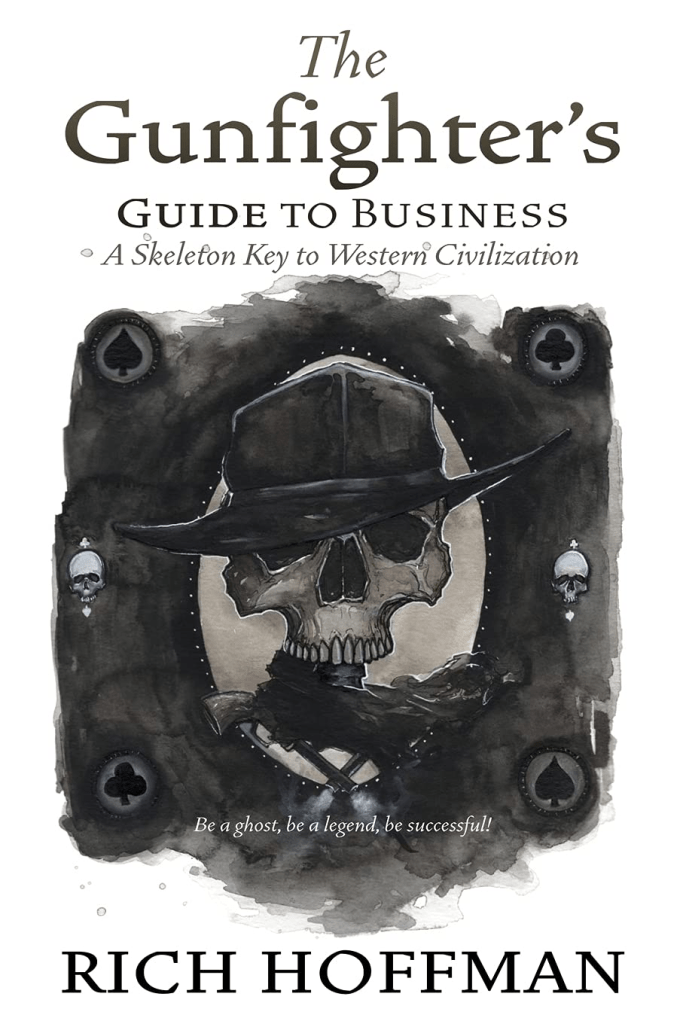
Rich Hoffman is an author, political consultant, and strategic advisor based in Cincinnati, Ohio, and the creator of The Politics of Heaven—a unique framework that connects biblical theology, ancient history, and modern power structures to explain how moral alignment and spiritual forces shape global events. Blending real-world political experience with deep research into archaeology, UFO phenomena, and suppressed historical narratives, Hoffman offers compelling commentary on topics ranging from ancient civilizations and the Dead Sea Scrolls to modern populist movements, paranormal continuity, and leadership strategy in chaotic environments. As the author of The Gunfighter’s Guide to Business and the forthcoming Politics of Heaven, he brings a grounded yet provocative voice to media discussions, supported by firsthand experiences and a cross-disciplinary approach that bridges science, history, and theology. For interviews, speaking engagements, or expert analysis, visit richhoffmanbooks.com or contact directly via phone at 513-307-5815 or email at rhoffman@richhoffmanbooks.com.  If you’ve seen the movie, Disclosure Day and want to talk about it and the implications of Presidnet Trump’s UAP disclosures, let me know and we can bring some color to your coverage. https://richhoffmanbooks.com/media-inquiries-broadcast-topics-and-contact-info/?frame-nonce=ad51e7ecba I do have a firsthand UFO encounter to discuss.

Some of my Jaw Dropping Statements about History: Serpent Mound, Ancient Mysteries, Disclosure, and the Politics of Heaven

I was really impressed with a recent piece by Donna D’Errico. She produces YouTube videos as part of the Myth Bound series, and I completely understand her approach. In an era when everyone can have their own media platform, people like Donna are stepping up to explore Earth’s mysteries afresh. She’s doing a kind of modern Josh Gates-style investigation—traveling to sites, talking to experts, and digging into legends with genuine curiosity. Her episode on Serpent Mound struck me as particularly strong. 

Before I dive deeper, I have to acknowledge that this discussion probably won’t win me many friends—especially as my book The Politics of Heaven nears publication during a time when Spielberg’s Disclosure Day and waves of official UAP releases are forcing people to reconsider long-dismissed ideas. My reference point here is one of deep respect for the field: I love archaeologists. I admire the dedication it takes to spend years in the dirt, uncovering artifacts so the rest of us can wrestle with their meaning. But like any institutional endeavor, grooves form. Assumptions harden into orthodoxy. Human nature resists relearning, especially when funding, careers, and political narratives are at stake. Once a framework is set, new evidence is often shoehorned to fit rather than allowed to challenge the foundation.

Serpent Mound, in Adams County, Ohio, is far more mysterious than mainstream accounts typically allow. The default narrative attributes it to “Indigenous people,” specifically linking it to the Adena (circa 800 BC–AD 100) or Fort Ancient (AD 1000–1650) cultures, which then folds neatly into broader political claims about “stolen land.” This framing, I believe, serves agendas that seek to undermine America’s founding legitimacy in favor of collectivist remaking—an echo of old European resentments toward the prosperous republic born from the Louisiana Purchase, Florida acquisition, and western expansion. 

Donna’s episode respectfully features archaeologists discussing the site’s astronomical alignments, particularly its alignment with the summer solstice sunset, which was important to Fort Ancient peoples. She highlights how the mound feels profoundly three-dimensional on the ground—coiling serpent body undulating with the terrain—unlike the flattened maps most people see. That experiential quality is key. The site was meant to be walked, felt, and understood in context. 

Serpent Mound itself is the largest known serpent effigy in the world, stretching approximately 1,348 feet in an uncoiling form with a curled tail. It sits atop a plateau within the Serpent Mound crater (also called the Serpent Mound Disturbance), an eroded meteorite impact structure roughly 8 km (5 miles) in diameter (estimates up to 14 km), formed less than 320 million years ago (likely around 300 million years ago).  The builders chose this precise location on the rim of an ancient scar invisible to casual observation. Radiocarbon dating has shifted: earlier assumptions pointed to Adena; a 1991 study suggested Fort Ancient around AD 900–1200; and a 2014 analysis (later corroborated) supports Adena construction around 300 BC, with rebuilding in the Fort Ancient period. Multiple layers of use are evident. 

Why build the world’s largest serpent effigy on the edge of a 300-million-year-old impact crater with sophisticated celestial alignments? The mathematics encoded here—solstice and equinox orientations—suggest knowledge far beyond simple hunting calendars.  I’ve visited the site for decades, often reflecting on these questions while overlooking the Brush Creek Valley. It is one of three key locations I explore in The Politics of Heaven as evidence of non-human technological and spiritual interaction.

The second is Windover in central Florida, near the modern Kennedy Space Center. This ~8,000-year-old Middle Archaic cemetery (roughly 7,000–8,000 years BP) yielded 168 burials in a peat pond, many with remarkably preserved brain tissue, woven textiles of advanced complexity (multiple weaves, including non-heddle loom examples), and deliberate ritual orientation (often flexed, on left side facing west, anchored with stakes).  At the time, sea levels were far lower; the coastline extended miles farther out. Submerged sites likely await discovery. These people practiced sophisticated mortuary rites predating biblical timelines by millennia, challenging simplistic post-Ice Age migration models from Beringia. Their genetics and practices don’t align neatly with those of later tribal groups, opening the door to deeper questions about origins and external influence.

The third is Flag Fen in England, masterfully excavated by Francis Pryor. This Bronze Age site (around 1000 BC, contemporaneous with the First Temple period) features complex timber platforms, votive weapon offerings in wetlands, and evidence of sophisticated beliefs about the afterlife. Pryor’s work—detailed in books like Flag Fen: Life and Death of a Prehistoric Landscape—reveals a ritual landscape of remarkable engineering. 

These sites, alongside markers such as the London Stone, Paris’s origin stone, and Washington, D.C.’s Masonic layout, suggest coordinated knowledge across continents and eras. Native American legends—Iroquois, Shawnee, and Aztec migrations from the north (echoed at Three Rivers Petroglyphs in New Mexico)—feature descending “gods,” giants, and supernatural beings that are remarkably consistent with global mythologies. The uniformity points to real encounters rather than independent invention.

Near my home in the Great Miami River valley (Liberty Township / Middletown area, Ohio), the Middletown Mound and Miamisburg Mound stand as testaments. Miamisburg is one of the largest conical mounds in eastern North America—65 feet high, 800 feet in circumference, built by Adena peoples in stages, containing vast amounts of earth and visible for miles.  My daughter has taken a great interest in the Middletown site. These should be premier attractions, yet NAGPRA and institutional caution limit new excavations. Cultures routinely built atop older complexes—Cahokia, Baalbek, Jerusalem, Christian churches over pagan temples. Why assume otherwise here?

Archaeologists I respect operate under real constraints. Funding flows through institutions influenced by political and financial interests historically at odds with figures like Andrew Jackson. The “Mound Builder” myth was once weaponized for removal policies (Indian Removal Act, 1830), but today continuity narratives sometimes sideline anomalous evidence. I want these professionals to be better funded for open inquiry.

Post-disclosure, the picture sharpens. UAP whistleblower testimony on non-human biologics and reverse-engineering (with local ties to Wright-Patterson) makes ancient interaction plausible. Disclosure Day shifts the Overton window.

This leads to time—interdimensional or ultra-terrestrial beings likely master relativity. Time dilation is a physics fact. Travelers could experience days while centuries pass on Earth. Sites like Serpent Mound may serve as temporal anchors—celestial markers to recalibrate “when” upon return. Mythic “gods” gifting knowledge then vanishing aligns with this. Cryptids fit as echoes.

I’ve visited these regions and studied the works extensively. These inform The Politics of Heaven, my exploration of spiritual warfare, giants/Nephilim, divine rebellion, and humanity’s interactions. Nineteen of twenty-one chapters tackle controversial ground because they prioritize evidence over control narratives.

Donna D’Errico embodies the right spirit. Archaeologists deserve support for deeper digs. The great serpent on its ancient crater is no random effigy. It testifies to encounters with star-faring knowledge-bearers.

We stand at the threshold of new understanding. The dance continues. The serpent watches. Truth uncoils into the light.

Footnotes

¹ Donna D’Errico, Myth Bound YouTube series (episodes on Serpent Mound and related mysteries). 

² Ohio History Connection, Serpent Mound official site details and history. 

³ Wikipedia / scientific sources on Serpent Mound crater: ~8 km diameter, <320 million years old (est. ~300 Ma). 

⁴ Radiocarbon dating summaries: 2014 Adena ~300 BC with Fort Ancient repairs. 

⁵ Astronomical alignments (solstices/equinoxes). 

⁶ Windover site reports: ~8,000 BP burials, textiles, rituals (Glen Doran et al.). 

⁷ Francis Pryor, Flag Fen: Life and Death of a Prehistoric Landscape (2005). 

⁸ Miamisburg Mound: Ohio History Connection / National Register details. 

⁹ Broader context: Graham Hancock, Ross Hamilton (Serpent Mound), UAP disclosures, and Pryor’s Time Team work

Rich Hoffman

More about me

Click Here to Protect Yourself with Second Call Defense https://www.secondcalldefense.org/?affiliate=20707

About the Author: Rich Hoffman

Rich Hoffman is an author, political consultant, and strategic advisor based in Cincinnati, Ohio, and the creator of The Politics of Heaven—a unique framework that connects biblical theology, ancient history, and modern power structures to explain how moral alignment and spiritual forces shape global events. Blending real-world political experience with deep research into archaeology, UFO phenomena, and suppressed historical narratives, Hoffman offers compelling commentary on topics ranging from ancient civilizations and the Dead Sea Scrolls to modern populist movements, paranormal continuity, and leadership strategy in chaotic environments. As the author of The Gunfighter’s Guide to Business and the forthcoming Politics of Heaven, he brings a grounded yet provocative voice to media discussions, supported by firsthand experiences and a cross-disciplinary approach that bridges science, history, and theology. For interviews, speaking engagements, or expert analysis, visit richhoffmanbooks.com or contact directly via phone at 513-307-5815 or email at rhoffman@richhoffmanbooks.com.  If you’ve seen the movie, Disclosure Day and want to talk about it and the implications of Presidnet Trump’s UAP disclosures, let me know and we can bring some color to your coverage. https://richhoffmanbooks.com/media-inquiries-broadcast-topics-and-contact-info/?frame-nonce=ad51e7ecba I do have a firsthand UFO encounter to discuss.

The Attack Vector of Globalism: Immigration and drugs are their strategy to destroy America and make a ‘global citizen’

Of course, we have been at war for a long time, but not in the conventional sense.  Most of the wars, if not all of them, in the last century, even going back to the Civil War, were concoctions of finance, the tampering of globalism to destroy the concept of sovereign nations and create “united nations.”  The delivery method has been propaganda, not overt domination with ground troops the way wars have been traditionally fought and defined.  And when you understand the political leanings of finance, where the wives traditionally leaned far left and dabbled in the occult, the men followed their wives socially and lent themselves to progressive causes.  This is to say, there is some degree of global socialism as designed by Karl Marx baked into high finance societies.  And in high society, they contemplated what they thought people were or weren’t.  And when they turned their gaze to America, to destroy all concepts of nationalism in favor of global identity, they studied what had been done to the American Indian as the method to kill those who became members of the greatest nation on earth.  This is very obvious when the point of reference is westerns, such as Kevin Costner’s newest Western, Horizon, which is very good.  The Indians were hostile savages who were in the way of Manifest Destiny, and the Christian notion of destiny and rule-based fate are ideas that global communists chide against even today, including what they think they learned from Westward Expansion.  It’s important to understand that what these globalists are doing to America is purposeful and an act of war once you place yourself in their shoes and see the world somewhat as they do.  They do not like Americans.  They do like primitive people from all over the world because they make good subjects to rule over, so they tend to embrace societies that are tribal as opposed to inventive. 

They see how Americans flooded the West with immigrants after wave after wave of migrants continued to perpetually come.  No matter how fast the Indians killed off the settlers, they just kept coming until it wasn’t long before the Indians were gone, and the immigrants replaced an entire race of indigenous people.  That’s not how I see it, but it is how global communists (progressives) in high finance see it from their limited understanding of life in general.  The open border policies of globalists are only to be understood one way: as an attack on sovereign nations to change their country from one thing to another.  The open borders in America, for instance, is a military exercise meant to reverse what happened to the Indians by the Americans.  In the circles of high finance and the movement of the many sophists in the wives clubs of the early last century, permeating today into the various feminist movements and communist offshoots, the belief is that the way to beat America for its sins of the past, for its society built on slavery, is to kill them off the way they killed off the Indian, with wave after wave of immigration, until they are all outvoted, or gone by interbreeding.  Of course, there are lots of holes in this understanding of the world, and it’s very limited, but if you sit in most dinner conversations of high society, they think this is the objective view of history and the way to destroy those pesky American capitalists once and for all.  For what they did to the American Indians, they will have then turned back on them, and within a few generations, they will be destroyed from the face of the earth, forgotten by history.

The other thing that occurred during western expansion was that trade with Indians introduced them to alcohol, a poison that utterly ruined them.  Indians couldn’t deal with the requirements of their culture, leading to the very rapid demise of their men and, therefore, the ability to continue reproducing as heads of a family.  So, as Indians were killed off in battles and range wars, they could not replace their populations with a new generation because they were ruined and drunk. After years of casual study by a lot of communist-oriented history professors, they have analyzed the destruction of the American Indian down to these two objectives, and they have rolled those sentiments into this modern strategy of creating a global citizen, using what worked against the American Indian and applying it to the contemporary American and European.  You don’t see mass migration, for instance, going into China or Japan.  It’s only in areas of the world where finance is sponsoring social change for a military incursion, designed by the desire and need to create a United Nations global citizen.  The drugs flooding our border and culture, even down to the persistent trap to make marijuana legalized and normalized, are attempts to poison our youth culture outright and destroy any notion of a work ethic.  The amount and desire to use drugs and intoxicants of all kinds is a military objective that has been cast upon American society not as a pleasure but as a destructive element of chaos meant to destroy all traces of the Anglo-Saxon influence and Bible thumpers of Western civilization.  To see it, you must understand the people behind the bioweapon COVID-19, a proven fact with plenty of evidence.  But the evil intention is well beyond the scope of most trusting people.  The same desire to kill off entire races of people is behind permissive drug use, and they are using the fate of what was witnessed with the American Indian and alcoholism as their model for destruction presently.

The new movie Horizon captures the sentiment perfectly.  I’ve watched every Western movie made many times.  I’ve read books and studied history, and that film reminds me a lot of Teddy Roosevelt’s Winning the West books and Alen Eckert’s Frontiersman novels, which are some of my favorites ever written.  But you can see the impact of high finance in these modern stories, where Indians previously would have been referred to as “savages” because, compared to the immigrants of Western Expansion, they were hostile and vicious.  But in Horizon, they are always, at worst, referred to as “indigenous people.”  Politically, they would dare go no further because the globalist citizen movement behind all financial frontiers would not put up with any reference to “savages” when talking about Indians.  That’s how new wars are fought, and it happens over a long time.  But when you see films like Horizon and what ends up being cut together into a finished form and released to the public by a product of Hollywood like Kevin Costner, you get a good insight into the way that Hollywood lefties think about the matter and what they think ruined the Indians at the cruel hands of incoming immigrants. And you can almost hear the wine glasses banging at a dinner with George Soros and his little boy Alex as they fund the destruction of America with such thoughts about how the Indians were treated and how the white Anglo-Saxon deserves the same fate, and worse.  For anybody to just take it as anything but an act of war is criminal at this point.  The strategy is obvious: globalism is at war with the American citizens, and our government has not done its job in protecting our culture.  They have sponsored illegal immigration, hoping to replace our entire population with immigrants out of revenge for how America was settled to begin with.  Part of that strategy is to poison our culture with drugs and alcohol so that there is nothing left in a few decades to defend America but brain-dead slugs looking for their next hit of drugs to savor intoxication over the benefits of accomplishment.  It all started with an attack, not by tradition but by point of reference from a progressive culture that has as its objective global domination and a one-world rule.  These are the weapons of war from their minds of mayhem, as history has taught them, and they are utilizing them aggressively to this day.

Rich Hoffman

Click Here to Protect Yourself with Second Call Defense https://www.secondcalldefense.org/?affiliate=20707

‘Horizon: An American Saga,’ a movie that is magnificent for all who want to Make America Great Again

It’s a great movie that deserves to be seen in a movie theater, but most of what you have heard about the new film Horizon: An American Saga is wrong regarding the negative stuff.  It’s a big, bold movie that tries to put its arms around American westward expansion and can almost touch its fingers on the other side.  But it does do what many Westerns since the early days of cinema have done, and that captures the vast expanses of the West and American opportunity along the way that is simply magnificent.  This was a western on the scope of How the West Was Won, made by a guy in Kevin Costner, who loves westerns and has built the best parts of his career by making them.  It reminded me of an Alan Ekert novel from the Frontiersman series.  Now, this will not win the Academy Awards.  They will hate Costner for making this movie, so don’t expect any respect from the Hollywood machine for this Western series, which is the first of a projected four.  They are filming the third installment as of the summer of 2024.  The second part comes out in the middle of August.  And I hope they complete part four.  This is not a traditional way of making movies; you watch the first part in a movie theater for over three hours.  Then, once all the primary characters are introduced, you have to return a few months later to see what happens next.  At the end of Horizon: An American Saga Part One, we are just getting started on an epic story about the creation of America as a country, which is vastly ambitious.  I would say, from Kevin Costner’s point of view, this is a love letter to all the blood it took to make America and to make a point about why it was worth it. 

As a business decision, this is not built on the model Hollywood is built on today.  Not all standard measures can be applied.  This movie is made, I think, to try to save movie theaters from becoming the modern version of drive-ins.  There are economic forces out there that are very consciously trying to destroy various American industries through woke politics, and Hollywood has fallen for the trap in many ways, willingly.  The communist left has an agenda, and they have been attacking American Westerns for decades now.  This movie, Horizon: An American Saga, is a purposeful rebellion against that trend.  It is exceptionally well made by the same guy who directed Dances with Wolves.  It has all that size and scope and then some.  The problem with a movie like this is that the union labor costs are so outrageous now that it’s nearly impossible to make any large production without exceeding a 100 million dollar budget.   As I watched the credits until the end, this is a big Hollywood movie with all the big labor that comes with such a production, so the financing doesn’t add up in a traditional way, as measured by The Hollywood Reporter.  When John Ford made westerns like this, the budgets with unionized labor weren’t nearly so out of control.  So they could afford to tell stories like this without all the fast-paced action of a summer blockbuster.  This movie was designed to be presented significantly and for people to go to the theater to see it as opposed to streaming it at home.  It’s so long that it keeps people in the movie theater for a long time buying snacks.  And it could and should be seen several times.  And that people will keep coming back for future installments to see the next parts.  It’s an almost unheard-of financial model where Costner uses his personal money to help get the films out. 

It doesn’t surprise me that the film only made 10 million dollars in its opening weekend.  I mean, who is going to see it? It’s long, and they talk a lot.  There aren’t many action scenes.  It is filmed with traditional pacing; it reminded me of Little House on the Prairie or Gunsmoke in most of the movie.  The camera angles are broad but set, and the actors do a lot of work talking.  That’s not to say that everything isn’t interesting, but this isn’t a Marvel movie designed to be a billion-dollar box office generator.  They aren’t trying to thrill you with a spectacular action scene every ten minutes.  This is a plodding and deliberate movie made in the classic way to return to theaters after COVID-19, a Hollywood product that puts people back in their seats, not just for one event, but several times.  It was an extraordinarily bold throwback to when Hollywood told these kinds of stories often, and for people looking for their country back after years of political turmoil, this movie is a stake in the ground to inspire people to deal with the enormity of creating the greatest country on the face of the earth, and not to apologize for it.  Given the political situation we are all experiencing now, this is a movie for Trump supporters who want to Make America Great Again.  While Hollywood does love Kevin Costner, they certainly won’t be happy with him making this movie; The industry has attacked him for it in every negative reporting avenue they could.  But this is a project that Kevin Costner loves, and it shows.  And it is worth sharing, for sure.

A lot has been made about how Indians are portrayed in this movie.  Although they were brutal, I didn’t think they were shown in too harsh of a light.  People thought of them as savages.  It is the communist left who has told us that we were supposed to be in love with them and to think of them as indigenous people who were here first and that we took their land from them.  I have a very different view of Indian life, and I do not see them as a superior culture who had a right to be in North America and that we took something from them.  This movie, Horizon: An American Saga, gives the Indians more credit than I think they deserve.  In history, they were migrants just like everyone else, looking for a life for themselves.  But this living with nature crap is very much a globalist communist sentiment meant to control human behavior, not to do what humans were born to do, and that is to create.  Horizon is a movie about the need for American expansion and the collision of those forces on one of the last free places on Earth.  And as violent and challenging as it was, why did people do it?  It’s a movie that explains to us through all the lenses a movie can provide.  The effect is simply magnificent and different from any other movie experience that I’ve ever seen in my lifetime.  I hope it works.  It’s a massive gamble by Kevin Costner to put his life’s work into a movie like this and a series meant exclusively to be seen in a movie theater.  Movie theaters need movies like this to stay open, and Costner is trying to start a trend.  But the timing of it couldn’t have come at a better time.  This is a movie for all of us, no matter what your political background.  And America deserves this story to be told for its benefit.  Because ultimately, it’s the main character and the point of the entire enterprise.

Rich Hoffman

Click Here to Protect Yourself with Second Call Defense https://www.secondcalldefense.org/?affiliate=20707

The Great Westerns of Taylor Sheridan: From a perspective of the world, something very unique is going on in America

As of recently, in 2024, it’s true. I had never watched Yellowstone or any of the spinoff shows featured on Paramount Plus but has now been moved onto the Peacock streaming services and NBC as a primetime option.  Yellowstone is one of our current time’s most popular television shows, and I was curious about it.  But my wife and I have not had the time to watch it.  From what I saw of Kevin Costner, who is one of the stars, is that he’s too lefty for me.  And with Taylor Sheridan being a Hollywood actor, I wasn’t interested in watching those types of people make a modern western.  So I put it on hold.  After watching it recently and catching up on many of the shows and spinoffs, especially the Western series 1883, 1923, and Bass Reeves, I can say that there are liberalisms in them I don’t like at all, such as language and sex.  The families are too dysfunctional even though they crave not to be, which naturally comes from the messed up minds of Democrats, who then grow up to be actors, writers, and directors.  One thing that turned me off was that during the production of the show a few years ago, while Yellowstone was at its height of power, as everyone knew what kind of show it was at all levels of production, especially from financing, Kevin Costner showed support for Liz Cheney over President Trump.  So I blew off the whole effort as just another work by a bunch of lefty Hollywood types and did other things.  However, so many people have been talking to me about it and wondering if I dressed the way I do because of the show, that I finally decided to catch up to everything. I can say that it is an excellent show.  A lot is going on.  But as a work of art, our culture is screaming out for attention and respect in so many exciting ways that I think Taylor Sheridan has stumbled onto something significant, and he can’t make enough shows fast enough to fill the need out there. 

Uniquely, I travel a lot and often find myself on the other side of the world watching Asian television.  And all through Europe, they love on television American westerns.  It’s only in America these days that Westerners have been looked down on because there is a genuine Marxist push to destroy our culture, starting with the things we enjoy about it.  But I’m not saying what I do about Westerns because it’s only a regional perspective.  I’ve seen what the rest of the world does in art, entertainment, and literature.  For instance, on television in Japan currently, there is a series called The Tale of Genji, a trendy book from Kyoto about a lady waiting during the 11th century.  I watched some of it in my hotel rooms and what I could stream from referrals by friends.  I enjoyed it enough to grab and read the book while traveling through airports on some of those long layovers.  So when I say that Yellowstone is great, it’s within the context of the world, not just from an American perspective.  Some significant themes are being explored in these Taylor Sheridan shows that are important to the perpetuation of the human race, and some real soul-searching is going on in them that can’t be overlooked.  And I think they are just fantastic and reflect something I have considered since Joe Biden was put in office in 2021. 

Westerns can save America, which I discuss in my book, The Gunfighter’s Guide to Business.  Classic American Westerns, whom I had been referring to, would do just fine if America had ever lost its way, which we are in an age where that has actually happened.  I talk about often that after that horrendous election, my wife and I many times, sometimes with our entire family, packed up and traveled all over the Wild West to reacquaint ourselves with America because it was obviously under attack, and I needed to understand what the heck we were fighting for.  I have a few souvenir cups I use around the house, one from Wall Drug out in South Dakota, one of my favorite places on earth, and another from The Big Texan, from Amarillo, Texas, and my grandkids like seeing them and thinking about their travels with us to those places.  And maybe the Yellowstone show means more to us because we have been to the places where the show talks about, from the Yellowstone park itself to the vast areas of West Texas.  I finished writing my book while on the road in Roswell, New Mexico, and we traveled a lot around West Texas while the rest of the country was on lockdown due to COVID-19.  I also gained an appreciation for the backbone of America, especially when compared to my experience around the world.  My opinions about these things didn’t just come out of nowhere but were formed from experience; by the way, Taylor Sheridan moved from Hollywood, bought a ranch in Texas, and started thinking about the contents of these television shows.  His work is uniquely American and timely, and there is a genuine love in his work for the discussion.  I wouldn’t say that these shows are making the MAGA movement for which President Trump is the spokesman.  However, all of them spawn from the same concerns of American citizens, and these shows capture that sentiment perfectly.  Probably unintentionally, but they are all part of a process of Americans working out what has happened to them over the last hundred years. 

I watched a recent podcast with Joe Rogan and Taylor Sheridan talking about one of the spinoff shows, 1883, and how good it was.  People forget a lot about why the West had to be won, and I think Taylor Sheridan is a lot more sympathetic to the American Indian than I am.  But he tells good, honest stories about the natural history of the American West and how the American government wanted immigrants to populate Western expansion to fulfill the idea of Manifest Destiny.  It’s interesting; most of the world was so oppressed by old-world rules and regulations that they would have done about anything for the prospect of free land in the vast spans of the American West.  They didn’t always know they were going to have to fight Indians for that free land, but it says a lot about human beings that they were willing to fight just for the opportunity to be free of corrupt governments always in their daily lives, the kind of communism we see in Europe and Asia to this day, or the aristocratic kingdoms of that western expansion period.  The story is not about how the Indians were killed for their land as much as it is about why people wanted to flee every corner of the world, and still do to this day, to get away from micromanaging governments and to have a chance to be free.  At the core of the modern Taylor Sheridan westerns is the theme of all his shows, and the conflict that happens along the way is compelling and exciting to all human beings.  But we are waking up to honesty about everything that always needed to happen and wasn’t talked about enough in previous westerns that are unique to these Taylor Sheridan projects, where they are coming from a Democrat perspective and migrating to a classic Republican platform politically.  And I see a lot of hope for the future because of these creative efforts and the way people yearn for them with great fanfare.  And they are certainly worth watching!

Rich Hoffman

Click Here to Protect Yourself with Second Call Defense https://www.secondcalldefense.org/?affiliate=20707

The Chinese Communism of Godzilla X Kong: Their anti-capitalist messages are obvious and dangerous to our youth

I was happy to have the chance to take my family to the new movie Godzilla X Kong: The New Empire.  That’s what movies are all about, that film.  Fun, adventurous, made for a big screen with the lights turned out and lots of popcorn to eat.  For my grandkids, they’ll say that this new Godzilla movie was their favorite movie ever.  And why not, from their perspective?  For what it was, this new Godzilla movie with King Kong was a classic, fun film, and to have an experience like that with my family is a treasure beyond average measures.  However, I am not at all happy with the Chinese ownership of Legendary Studios because there is a lot more behind the scenes that indicates a pro-communist message that cannot be ignored.  I’ve discussed it before, returning to an early entry in these Godzilla/Kong movies with Skull Island.  Under the Chinese owners, they took the raw and crazy primitive humans from Skull Island and turned them into wise natives living in harmony with nature.  A strategy that the Chinese have utilized on many fronts to promote anti-capitalist sentiment and advance their brand of communism to the rest of the world by attaching that message to young people who would grow up to accept such notions.  So, over time, the way that the native inhabitants of Skull Island have been viewed has changed from a Western position to a far Eastern one.  And under Legendary Studios, there was undoubtedly politics behind the message.  Was it too much for a movie like this?  I don’t think it ruins it completely.  But it is undoubtedly something to notice and understand what and why it’s happening.  It’s always great to watch giant monsters destroy significant human landmarks.  But, under Chinese ownership of Hollywood studios, we can’t ignore what they are trying to do under the soft sell of a monster movie intended for children. 

Featured in this movie, and introduced in the first Godzilla v. Kong movie, is the last of her race, a little girl from the Iwi tribe who can talk to the giant ape with sign language because she is also deaf.  She’s a friendly kid and a likable character, and taking it alone isn’t a big deal of conspiracy. But, the way the Iwi are portrayed in Godzilla X Kong is pretty ridiculous, tapping into this notion that I see quite often in the markets of mysticism and New Age mentality, where ancient cultures like Atlantis and Lemuria had it all together and were far superior to modern humans because they lived in harmony with nature, and now we have lost all that to our detriment.  And that lost in the core of the Earth is the lost tribe of the Iwi, this little girl’s ancestors who keep all these things balanced with nature as if nature had a logic far superior to the human race.   They even went so far in this movie to indicate that this lost wisdom allowed the descendants of the Iwi to make the giant pyramids we see on earth today by moving rocks around through gravity manipulation by working with nature, not against it.  The science presented in Godzilla X Kong is essentially the agenda for any climate summit of progressive radicalism seen anywhere in the world, from Dubai to Rio and all fancy vacation destinations in general, and is grotesquely out of step with reality.   But they figure that in a world where education is so poor and people so gullible to the truth, why not present such things as facts?

I like the old versions of Skull Island, not just in the 1933 original King Kong movie but also in Peter Jackson’s 2005 movie with the same title.  The way the West sees natives is great.  But the way communists see natives is not.  There is a political agenda to indicate that the collective notions of complete submission to authority rule are superior.  In the case of the communists, and as shown in Godzilla X Kong, there is a kind of queen of the tribe that represents complete submission of individual will toward the collective group as the ideal society.  Whereas in the classic versions of the Skull Island inhabitants, they were shown to be cannibals and primitive beyond help.  It was a tragedy in those films to sacrifice a pretty woman to the beast to appease their god, hoping to leave them alone.  Such ignorance was looked down upon.  But not in these modern Legendary Studios monster movies.  Complete irreverence to individuality is their goal, not a matter of terror.  Of course, the message is not hidden; communist governments want to sell to the public the benefit of being submissive toward centralized government at the cost of all individuality.  In the end, the message of these modern monster movies is that all the great things humans have built, like the city of Rome and the pyramids at Giza, can quickly be brought down by these giant monsters.  And they are acts of nature meant to be submitted to, not fought against.  So why bother?  The human race’s efforts are discouraged in these movies, and we discover that even with all our technology, we were never in charge, so most of our efforts were wasted from the start.  The Iwi tribe always had it right. 

Of course, that is all wrong, and so long as we look at these things with the kind of reverence that we would a show like Gilligan’s Island, this is harmless entertainment.  But never mistake the Chinese government’s purposeful intentions in buying Hollywood studios and their desire to capture the message given to us in a darkened theater and kids too young to know any better.  We should not have allowed the Chinese to buy up so much of our American assets, especially in entertainment.  If ancient cultures had it all together, they wouldn’t have gone extinct, such as Atlantis, and other societies would have long been wiped away.  I think there was a lot lost in the past, but politically, the cause wasn’t more collectivist behavior but in less of it.  In any society that turns toward centralized government to alleviate their fears of the unknown.  That looks to be the cause of much of the trouble in the past and in what has been lost and found again time and time over.  It is not the reverse, as presented in these Legendary Studio movies.  In truth, there is a lot of archaeology that needs to be done in China, but under their closed system of communist tyranny, that isn’t even on the table.  So who are they to say anything about ancient cultures but to feed the pot-smoking belief that the hippies of history knew more than our greedy capitalists of the modern world about how to live within its rules and regulations?  But they say it anyway to poison our youth with ideas of ideal society run by communist governments, even as those communist governments sit on some of the most fascinating ancient monuments in the history of the world. It is concealed behind a veil of communism to analyze the outside world.  And the understanding only free people can interpret.  But that’s a story for another day. 

Rich Hoffman

Click Here to Protect Yourself with Second Call Defense https://www.secondcalldefense.org/?affiliate=20707

The Indians Were Not Indigenous to North America, Aliens Were: What we have learned about the giants found around the world

It’s not hard to see how it happened; if you understand politics, you know that mass populations are easily controlled by a political system that can capture a narrative, and humans, by nature, are best communicated with through story. So, if you own the story, you control the population, the primary focus of religions, and the politics that have spawned from them since recorded time. But this line of questions for me started in 2009 while at the Mothman Festival in Point Pleasant, West Virginia, and I picked up a map that had known burial sites of giants, people of gigantic stature. I thought that was interesting, so I have kept my ears open since then for evidence as it has come in. And as that evidence has been collected, it is pretty evident that in the Ohio River Valley and across the world, just about everywhere, especially in mound-building cultures, are the remains of giant people. That is why there isn’t better archaeology looking into the contents of these mounds, even in China and Japan and all over the Near East, specifically the many mounds of Israel that are essentially of the same construction and design. It came alive for me after visiting Stonehenge that something was strange because I saw the same features that I saw at home in Southern Ohio. And once you learn that the mounds weren’t burial in their orientation as much as they were intended to be celestial clocks, then suddenly things start making a lot more sense, which is the case of a massive earthwork near my home at Fort Hill, in downtown Hamilton, Ohio, and Serpent Mound about an hour and a half to the east.

Knowing what I do now, I am very comfortable calling it; the earth was settled by life from other places in space, likely many different species, and they have probably been interacting with us all along.  But they come and go, and when they arrive on earth to settle or for visits, they need to know when they are.  And that is the purpose of things like Stonehenge, the features at Göbekli Tepe, and even the mysterious Keyhole tombs in Japan.  We are dealing with a culture that lived quite well and vibrantly in what we call the Archaic Period, from the age of Leo and Tauras, and dying out around the age of Aries, only to emerge into what we now call Biblical ancient.  We know that because once you stop trying to look at history through what you find lying around the ground, which decays and erodes rather quickly, and start understanding that you measure activity in celestial time, which is the purpose of inventing the zodiac always was, relevant to stable ground features described, then you start to get the picture.  And the people doing all this were huge, called giants.  And that the Bible refers to as the Nephilim.  Only they were a global culture that understood how to navigate across the oceans, and they did so frequently.  Our assumption that hunters and gatherers rubbed sticks together and migrated across a land bridge into North America during an Ice Age period is, by now, just ridiculous.

But, the world’s politics has wanted us to think of them as gods and to worship them and their time of rule on earth.  So, they have been working to conceal this information behind the mechanisms of institutionalism.  To maintain that story, they have been trying to sell us all on this idea of indigenous people and that America should never have been settled by Christopher Columbus in 1492 because we interrupted the harmony of a nature-loving group of nomads with capitalism.  But that was all a lie; the Indians were not indigenous to North America.  Aliens were.  The Indians were the latest visitors migrating around the earth for thousands of years.  The way things look, we are dealing with at least 400,000 years of human history.  Probably longer.  We only see what hasn’t eroded yet, but there has been a lot of intelligent life on Earth over a long period.  That doesn’t mean there weren’t hunters and gatherers doing their thing, just as we can find such people worldwide today.  There were always homeless people not living within a structured society.  But our assumptions about life and how we arrived where we are, based on abundant evidence, are entirely wrong.  I think today, if we had reasonable archaeology into the many mounds of the world, we would find in them skeletons, like have been found at the Miamisburg Mound just south of Dayton, Ohio, lots of 8- to 10-foot-tall people.  The fact that nobody is seriously studying this matter tells you everything you need to know.  The social narrative of the exploitation of so-called indigenous people is far more valuable to the current political order of global communism than the truth of scientific discovery.  The evidence is so abundant, mainly by private investigations, not science funded by government grants committed to a political narrative, that there is no longer a question. 

I was always weary of this kind of alien settlement thinking until I watched the world’s governments lie to our faces about COVID-19.  We all know that the virus was artificially made in China and released to the public in a way that the world’s governments knew about.  They had even role-played the response, which Bill Gates led the effort.  They were so arrogant about their ability to lie to the public through controlled narratives that they essentially painted themselves in a corner and had to tip-toe through that wet paint to reveal their guilt.  Part of the reason for the arrogance, a big part of it, was their success in manipulating religious and scientific narratives to the public, such as they have gotten away with the indigenous people’s history, arbitrarily picking a habitation date of 1600 AD to 1800 AD, and saying that they were the indigenous people of North America and that all migration was evil so that the greatness of America can be delegitimized to the world and they would clamor for Chinese style communism because of their associated guilt.  People didn’t question the narrative much, which inflated the egos of those who seek to control narratives in the world so they can easily control masses of people.  So now that we know that aliens, or rather, our ancestors, came here from other planets, do we call them the indigenous people?  Or were they the invaders of what was here before?  But we know there was a global civilization that dates back all over the world into times during and even before the last ice age.  And that what was left behind were fragments of their previous cultures that were quite advanced, as we can see in all these ground-based celestial clocks that still have crop circles appearing next to them all the time as if someone were writing notes on the ground to figure out when they were in time and space.  Since time doesn’t move the same everywhere in the solar system, the galaxy, or the universe, which is the giveaway, they were concerned with time and the way we would wear a watch to measure our rotation to the sun.  These very tall people and others needed to know relative to their orientations in space when they arrived on Earth.  Was it 100 years later, or many thousands?  And that is the way we must look at history in the future.  Not in the way we have been.  Or allow governments and institutions to lie to us to control a narrative that benefits them politically when science says otherwise.

Rich Hoffman

Vote No on Recreational Marijuana in Ohio on November 7th: The world needs more shepherds, not more dope smoking sheep

There are few things I hate in the world as much as pot, so now that recreational marijuana will be on the ballot for the November 7th election, 2023, I will be an emphatic NO.  I’m against marijuana use in every way possible, especially recreationally.  I don’t care if you can make a rope out of it or clothes.  Marijuana is a horrendous drug.  I have about a third of my family members who either have used it or are using it.  Some for medical reasons because they have chronic pain, and my answer to them is all the same.  My relationship ends with them once they use it, which has been the case no matter who they were.  There are many things I can overlook, personal failures that I can sympathize with.  But the purposeful destruction of a mind is not one of them.  I have always been in the camp of capital punishment for drug dealers, even if small quantities might end up in the hands of kids.  But even further than that, I also feel that way about users.  Marijuana is a poison intended to decrease how a brain works and is detrimental to the human race.  I don’t care how natural it is. I’ve heard all the excuses about it making people “mellow.”  That the Indians used it and that its nature’s way of chilling out the world.  No thanks.  It didn’t help the Indians very much, and for what it did to them, bad people today want to do to the United States, which is the ultimate goal behind the mass destruction of America by its enemies.  The drug culture was a purposeful poison introduced to our country because nobody wanted to fight us on the battlefield after World War II.  So they plotted to ruin the minds of the youth, and the results are what we see today, several generations of people compromised by the drug.

I’ve never been a “libertarian,” a do-what-you-want-at-all-cost kind of guy.  I’ve always been a slave-destroying Republican promoting capitalist economies and an intellectual society smart enough to vote.  This live-and-let-live crap is for the birds.  If I smell marijuana, I get furious, even if it’s in my backyard.  I have gone to war, which is well chronicled in many courtrooms, police reports, and mayor’s offices over the last thirty years, and my thoughts on pot have never wavered.  I suppose my hatred of marijuana started in school as I watched kids in the back of the bus pass joints around.  It made them look stupid, and they were glad of it.  Then I saw a few Cheech and Chong movies which they seemed to want to copy, and I didn’t think they were funny in the slightest.  My earliest thoughts on pot are that it was a weapon given to American culture to poison it, and my observations have proven this to be the case over time.   I’m not unrealistic about marijuana; trying to find people who feel the same way I do about it is about as realistic as looking for a virgin in a whorehouse.  Just about everyone has at least tried it once or used it at a time in their lives.  Depending on what’s going on with people, they may come and go in their use of it.  The result is that most people don’t have strong opinions against it because they can’t afford to.  Well, I can.  I’ve never used it.  I have been in many bloody fights over it and was successful.  And I’m not changing my opinion about it now.  Once I find out that someone uses pot, they are dead to me, no matter who they are.

Marijuana is a poison meant to rob people of their intellect, and I would go as far as to say that it has no redeeming value.  Humans are supposed to be thinking creatures with dominion over nature.  Not a bunch of slack-jawed hippies stoned at a music festival.  Recreational marijuana use is an appalling concept.  If it doesn’t pass this time, it likely will in the future because many people out there are too weak to stand up to its temptations.  But there is nothing good about intoxication, not even with alcohol or prescription drugs.   And as I told a family member a few weeks ago, you don’t take marijuana under any circumstances; I don’t care how much pain you are in.  You fight through the pain and preserve your intellect.  I don’t care if marijuana is in a vaping condition or a little pill; you never take it.  It is a weapon of war against human civilization and was always meant to be that way.  I have lost many friends over my opinions about marijuana and am glad to have lost them.  I had some really close friends with whom I had gone through a lot when I was younger.  I went out to a movie, and when I returned to my apartment, I smelled pot in my bedroom, where I had a little parakeet bird.  While I was gone, they had tried to get the little bird stoned.  I moved out and never spoke to any of them ever again.  That is just one example.  Many similar situations go back to my essential hatred as a kid in watching how stupid people behaved when they used it and how it was a celebration of a lack of intellect.

I don’t care if Shakesphere smoked dope or Albert Einstein.  It doesn’t matter who it is; if they smoke dope and advocate for marijuana in any way, medicinally, recreationally, or historically, they are dead to me.  I have been let down by just about everyone in my life at some point over pot, and I’ve heard it often; maybe the problem is me.  Do you want to be the only one with such strong opinions?  Well, the answer is yes.  I would rather have nobody in my life and keep a strong intellect completely marijuana free than accept such a device to have a few worthless friends and family members.  Marijuana is the weapon of choice of people who want to control us, and they understand that using the drug lowers society’s IQ in general.  It slows down people and their thinking and makes them dumber.  And for me, that is the worst attribute any community could embrace.  So, I am a very emphatic no on recreational marijuana in Ohio.  I’m okay with that if I’m the only one who votes against it.  I will never accept pot in my culture and will work against it constantly.  Legalizing drugs, especially marijuana, is a race to the bottom by dumb people who want to hide their timidity in the collectivism of mass culture.  The more stoned people, the less guilty they feel for being diabolical losers.  That’s why they say, “Don’t judge.”  Well, I say, judge and judge often.  And don’t be a loser.  And the recreational use of marijuana is a choice to be dumb and to turn off your mind when the goal of existence is to think and create.  Marijuana is the opposite of those things, and once a state accepts it as a part of its culture, everything goes downhill. That is certainly the case for states that have already legalized it.  You can tell the moment you cross over their borders.  It would be terrible for Ohio, especially when companies have to deal with brain-dead employees who miss work too much and feel that they don’t have to pass a drug test to maintain employment.  Marijuana causes nothing but problems and should never be legalized in any way, shape, or form.  Anyone who advocates for marijuana consumption as a country, a state, or a personal right is attempting to destroy the consumer. The world needs more shepherds, not more sheep. And marijuana is for the sheep, those who would be herded to the slaughterhouse, which is just what the enemy wants.

Rich Hoffman

Atlantis Giants in Butler County Ohio: The Hilltop Earthwork of the Constellation Aries at Pyramid Hill, from 5000 years ago

I can’t tell you how happy I was to walk into the office at Pyramid Hill as I was asking about the status of the project that has been going on for a few years now and to get the look of concealment that I did. The workers that day were young people who weren’t sure how to answer the question, so they referred me to the Ancient Sculpture Museum, which is concealed deep in the woods down a large hill in a place that feels like it’s not even on this earth. It’s one of those little secrets in Butler County, Ohio, and is a treasure within a treasure. Noticing their cryptic reference, my wife and I proceeded to the museum and stepped into the first room and noticed immediately that finally, since 1836, when the site was first surveyed, finally the Butler County Hilltop Work was getting the attention it has always deserved. I’ve looked at that strange mound, which is around 250 ft tall and sits across from Joe Nuxhall Way on the west side of the Great Miami River, about 3 miles from downtown Hamilton, and always marveled at it. The museum staff already had an excellent display set up for an early 2023 opening that will connect the Pyramid Hill complex to this new massive ancient mound they plan to call the Fortified Hill. Sounds better than Butler County Hilltop Work. The staff person on hand that day told my wife and me that they were planning to open everything in January of 2023 if everything went well, which explained the cryptic looks at the main office when I mentioned it. There are very few people in the world who even know that the strange hill that looms large in Butler County, with thousands and thousands of people living around it, and driving by it every day, that it’s one of the most mysterious lost, ancient works of an advanced culture on earth. And yet, it’s been there before Christ was born as if dated celestially; it’s around 5000 years old. 

What makes it so exceptional in the world is that it essentially is dedicated to the constellation Aries that through stellar precession, shows a specific movement from the constellation Taurus through the Pleiades and into the age of Aries at a time when we have previously thought only of Indians marching in a steady stream toward civilization from hunters and gatherers and into city dwelling humans. I’m not one to disparage scientists, even the bureaucratic nonsense that often trails behind academia like the tail of a doomsday comet, because if not for them, there wouldn’t have been an attempt to preserve the Butler County Hilltop Work and opening it as a park would never have been possible. But science has been slow to acknowledge who these people really were who settled in Ohio as the center of a very advanced culture, who had an obsession with the stars and built all over southwestern Ohio many copies of earthworks that mimicked the constellations in the heavens on earth. These works are every bit as mysterious as the Nazca lines from Peru or even the Pyramids of Giza. Primarily, the reason for the big mystery is that they didn’t just build one of these sites that so accurately reflects an advanced knowledge of astrology. Still, the evidence is pointing increasingly to this same region, and that specific mound location, along with Serpent Mound off to the east, as the basket of an advanced culture that was eradicated likely during the Younger Dryas cataclysm, around 11,600 years ago. And what was left of these people who were interacting globally with all countries before the cataclysm is what we see during this late archaic presence in the Ohio Valley, which ended up a larger part of the Mississippi culture. These were the survivors of that cataclysm, and they marked the ground with a star map of the heavens with these massive depictions of, in this case, a wild boar, which they associated with the Aries constellation. 

Further, on top of the hill is where things get really interesting because the entrance to the effigy, to the north, has a maze that forces the participant to navigate it much the way that the spring equinox had to navigate the Pleiades constellation on its journey from the constellation Taurus into Aries. While on top of the earthwork, which you can see for miles in every direction, it becomes very obvious how difficult it was to shape that natural hill into the shape of a boar to match their celestial observations of the zodiac character of Aries. This was no small effort by any means. It was a massive undertaking, and for what purpose? Well, as I say a lot, remember Plato’s references to Atlantis, where the first god/king of their land was Atlas. And we all know from myth and mystery that Atlas was the creator of Astrology. And here was an obviously advanced culture that had enough leisure time not just to hunt, gather, and reproduce but to build all these magnificent earthworks all over Ohio. They seemed to connect into one grand mythology meant to be seen from the sky. A society obsessed with astrology, obsessed with an equatorial procession along the heavenly zodiacal belt where ages move by overhead every 2,160 years for a total zodiac year of 25,920 years. Society would have to be around for a long time to understand those kinds of time movements of the stars in a reliable way, to understand that their movements were not just coincidental, but over that length of time, were as reliable as a clock. These people did not spend their entire day trying to hunt a deer so they could eat by dinner time.  We have all had an image given to us by Hollywood and the progressive history of what an Indian is, a Native American or even an “indigenous person.” In truth, the reality is far more complicated, and by referencing the many books on Atlantis by Lewis Spence, a respected commentator on such things, or Giambittisto Vico of the great Vico Cycle, or the Bible, we know that very large people that smaller people called giants roamed the earth everywhere. We know Norse mythology had them, the Greeks called them Titans, the Bible referenced to them often living in the land of Canaan, and large people were everywhere dating back to the precise period of the earthworks in Ohio, precisely the one in Butler County formerly known as the Butler County Hilltop Works. Burial mounds all up and down the Great Miami River have reported the bones of people from 7 feet tall up to 10 feet many times, which can be found in Ross Hamilton’s outstanding academic paper called A Tradition of Giants: The Elite Social Hierarchy of American Prehistory which is available for free online. Just look up that title and print it out for yourself. It’s well researched and corresponds to the reports mentioned above about large people buried in the earthworks of Ohio, not just occasionally, but abundantly. I know of a case of a 7-foot person buried in a mound in downtown Hamilton as it was being built. It has been said in many of Spence’s reports on Atlantis that they were a large people and that once the Greeks and Egyptians inherited many of the myths of the lost Atlantis, their concept of the gods was forged in their cultures. Yet, those myths also talk of the Atlanteans coming from the west, and with them, they brought the pagan gods of astrology. There are mounds on the Butler County Hilltop Work site, just off from the top. In them, indeed, just as there is in the Middletown Mound up the river a few miles, then again at Miamisburg, even a few miles more up the same river, there are giant skeletons in them, and science has had a tough time dealing with the knowledge. Because it doesn’t fit our perceptions of who lived in America before America was what it is today. Instead, it looks like those who did live here moved all over the earth and took with them a massive religion of astrology to the far corners of the planet. And they did so long before Europeans were even thinking about building boats. And the natives of America that we call them today were likely global citizens 10,000 years ago, and the proof of their culture is there looming over Butler County like a ghost that is no longer invisible to the casual spectator, thanks to the great scientists and volunteer efforts to open it to the public with a great spectacle finally. 

Rich Hoffman

Click to buy The Gunfighter’s Guide to Business

The Sons of the Law of One: A solar panel cult to force all civilizations to appease the sun as the supreme god

Well, of course, we have to talk about the ancient sun-worshipping cult, the Sons of the Law of One, and that it predates many of our current religions and political orders. But it gets scary when bad things come up, such as child pedophilia cases in my hometown of Butler County, Ohio, involving hundreds and thousands of well-known people. And if you don’t have a reference for the vast evil on display, you wouldn’t have an explanation for Masons who go into mysterious chants hoping to put a curse on somebody to destroy them or consider that abortion is the political left’s blood cult to appease the gods of ancient pagan religions. When you look to understand modern politics and the reasons people believe what they believe, you usually find out that there is occult worship behind the thin veil in almost every case, including the deep suspicions that the Clintons were involved in the Jeffery Epstein child sex cult, along with Bill Gates and many celebrities. The recent pictures from Halloween of Machine Gun Kelly and Megan Fox only feed this curiosity, as well as Katy Perry and her broken eye. We live in a polite society that doesn’t talk about the real issues that cause the effects which drive our politics, and once you learn what does drive those issues, things make a lot more sense. But for them to make sense, you must reach into society’s occult practices to understand their politics. This is why I have been talking about Atlantis a lot more lately because that is a society that predates our written history and is denied by the established order for all the very reasons talked about, to conceal the occult practices that various groups of people participate in, and drive political policy to mysterious items of worship. In this case, the reason the political left is so obsessed with solar panels. 

We know about Atlantis because Plato, a well-known and accepted Greek philosopher, recorded that society in one of his works. And over time, Atlantis looks to have influenced early English mythology, Ireland, the Vikings, all of Europe, and especially Africa creating Egyptian and Sumerian societies from the outset. Atlantis was ancient when those societies were new. But then there are the Indian mythologies and the mythologies of the white-skinned ones with the Aztecs, Mayas, and Incas. And there are thousands of societies that rose and fell in between these historical events and the mythologies that people ended up remembering of them. So there are multiple variations to those old stories that have created many occult beliefs that have been followed with sacrifices to unknown gods, which can almost always be found working their influence in the political policies of our modern day. So also with the various Indian legends, since we are told by modern progressives that the Indians were so wise and that we should listen to them regarding all things, many of them believe that 250,000 years ago, Star People came to earth from the planet Sirius and settled 12 planets, of which earth was only one, and a minor one at that. The wisdom of these Star People made up what we know today in various cultures, especially Atlantis, which we know the first king was Atlas, who invented all that we know about astrology. And when you know what the high-order Masons believe, much of their action is driven by astrology, just as Egypt and many other cultures that we consider advanced. That is also why most of them revere the planet Sirius as substantial to their functional mythologies. For instance, in the Bible, Sirius is considered the Star of Bethlehem. And when we talk about the 12 Tribes of Israel, the 12 Disciples of Jesus, the 12 months of a year, or the 12 constellations of the zodiac, or the Twelve Tables appointed in 451 BC which led to Roman society from its primitive roots, this is where we get the origin beliefs. 

And from ancient Atlantis and the Indian mythology of the Star People from Sirius, who settled the 12 planets, is the concept of the Sons of the Law of One. It’s a sun-worshipping cult that identifies the sun of our earth’s solar system as the life giver and the ultimate god to appease. The Law of One then migrated into many of the cultures we currently recognize, and they all had a reverence for sun worship. Many of the human sacrifices that the Aztecs made were to appease the sun. Many of the myths that formed around the world, as a result, were sun god worship that in the absence of a Christian religion, all of society migrates back to this notion of the Law of One, the one sun, the life giver of everything, and for which we are all dependent. When you see that the political left is upset with space travel, it’s because mankind proposes to leave behind the control of the sun and essentially divorce ourselves from these ancient beliefs with self-fulfilling innovation and technology. But then again, many are using technology as a means to chain mankind to continued worship of the Law of One. We have seen that in the tech companies specifically and their infatuation with pagan gods from the distant past. And we certainly see it in the bizarre push for solar panels.

The only way to understand the insanity of the liberal push to chain mankind to the limited energy available from the sun with solar panels is to understand the ancient ideas of the Sons of the Law of One and the astrology invented by the Atlantean god Atlas and the knowledge he revealed from the Star People from Sirius. The push for all-electric cars and a society that destroys fossil fuels and forces everyone to essentially worship the sun as the primary means of living life is obviously a sacrifice of innovation to force compliance to the sun and its role at the center of our solar system. But when people are looking for logic as to why our political society would do such a dumb thing, they will not find the answer in the logic of scholarly debate or the rule of law in congress. They have to go back to the Sons of the Law of One, to the culture of Atlantis, to the horoscope cultures of the world, including the one you might have looked at today in the Farmer’s Almanac. Once you understand the occult logic behind the political maneuver, you can understand how stupid it really is. We are in an age of science and reason, not a society that must bend itself to the limits of ancient superstitions. We have rational minds who can invent our own means of power. But to those who worship other gods besides the Christian concept of commanding nature and instead yielding to it as all ancient cultures had to, especially Atlantis, then it should never be a surprise to see those cultures fail, just as we will fail if we follow the same dumb laws and appease the spirits of ancient hokey religions. But lazy people, they want an easy way to live life, and appeasing some ancient god or trying to appease the sun is a lot easier than inventing a thorium reactor or bolding blasting into space to create our own origin stories; not one started 250,000 years ago, or millions of years ago. But now, with America driving innovation and creativity to an unknown but exciting tomorrow. The clash essentially comes down to the brave and innovative instead of the lazy and superstitious. And the battle for tomorrow will depend on who wins that many generational wars.

Rich Hoffman

Click to buy The Gunfighter’s Guide to Business