The Illusion of Media Kingmakers: Why Donald Trump Represents the American Voter, Not Celebrity Endorsers – A Personal Reflection on Fox News, Tucker Carlson, and the Essence of Representative Government

I have long maintained that Fox News performs better when Donald Trump occupies the White House, and recent events have only reinforced that view. The network’s success has never hinged on any single personality but on delivering timely, relevant content to working Americans who tune in after a long day. Yet the story of Tucker Carlson’s rise, departure, and subsequent evolution reveals deeper truths about media power, celebrity egos, and the limits of influence in American politics. As someone who has observed these dynamics closely from Ohio, I have always believed that media tycoons like Rupert Murdoch crave control over the executive branch—and when they cannot exert it, they push back. Trump proved uncontrollable, leading to internal shifts at Fox, including the ousting of Carlson. What followed was a tale of inflated celebrity status untethered from corporate structure, celebrity endorsements during the 2024 campaign, and now, in year two of the Trump administration, profound regret over foreign policy, particularly the Israel-Iran conflict. 

To understand this fully, we must start with a background on Fox News itself. Launched in 1996 by Rupert Murdoch and Roger Ailes, Fox News Channel revolutionized cable news by targeting an underserved audience: conservative viewers seeking alternatives to what they perceived as liberal bias in mainstream networks. Bill O’Reilly’s The O’Reilly Factor, which debuted in 1996 and dominated the 8 p.m. slot for decades, epitomized this model. O’Reilly drew massive audiences—often exceeding three million viewers nightly—by blending straight reporting with opinionated commentary that resonated with working-class Republicans who returned home from jobs around 6 or 7 p.m., ate dinner, and wanted a digest of the day’s events. His show was not just entertainment; it was appointment viewing for an audience that worked hard during the day and valued straightforward analysis without the corporate polish of other networks. 

I always respected O’Reilly’s style, even if I did not agree with every nuance. When Tucker Carlson assumed the 8 p.m. slot in 2017 following O’Reilly’s departure amid sexual harassment allegations, many wondered if the audience would follow. Carlson had been a frequent contributor to The O’Reilly Factor, bringing a sharper, more polemical edge honed from his time at CNN and MSNBC. His show quickly captured the same demographic, maintaining strong ratings—averaging around 3.2 million viewers in early 2023—by focusing on cultural issues, immigration, and skepticism of establishment narratives. Jesse Watters, who later inherited the slot, has done a solid job continuing that tradition, often drawing competitive numbers, though initial post-Carlson viewership dipped slightly as loyalists adjusted. The point remains: Fox’s success stemmed from understanding its audience’s schedule and delivering content they craved at the precise hour they could consume it, not from any individual star’s charisma alone. 

Rupert Murdoch, the media mogul often misspoken as “Myrtle” in casual conversation but known to all as the force behind News Corp and Fox, has had a complex, transactional relationship with Donald Trump that has spanned decades. Back in the 1970s and 1980s, as Murdoch built his American empire with the New York Post, Trump was a brash New York real estate developer who fed scoops to the tabloid’s Page Six. Their alliance was mutually beneficial: Trump gained publicity, Murdoch gained insider access. Yet tensions arose when Trump ran for president in 2015-2016. Murdoch initially viewed him skeptically as a “phony” and publicly criticized his immigration stance. Once Trump won, however, the relationship deepened; they spoke frequently, and Fox became a platform amplifying Trump’s message. Still, Murdoch’s empire has always prioritized control. When Trump proved resistant to influence—particularly during his first term and after the 2020 election—frictions emerged. Murdoch reportedly wanted Trump sidelined as a “nonperson” after January 6, 2021, and backed alternatives like Ron DeSantis in the 2024 primaries. The Murdoch family’s discomfort with uncontrollable figures like Trump led to strategic moves at the network. 

Carlson’s departure from Fox in April 2023 exemplified this dynamic. Officially announced as a mutual parting, the reality involved deeper issues tied to the Dominion Voting Systems lawsuit, in which Fox settled for $787.5 million over 2020 election coverage. Internal texts revealed Carlson’s private frustrations and inflammatory language, alienating executives. Critics inside Fox described him as having grown “too big for his boots,” with racially charged comments and misogynistic undertones surfacing in discovery. Murdoch himself reportedly ordered the firing, viewing Carlson’s toxicity as a liability amid mounting legal and reputational risks. I always thought Carlson did a decent job as a reporter—grounded enough to challenge narratives effectively—but he was never as consistently anchored as O’Reilly. His style appealed to the same audience, yet the corporate structure eventually constrained him. 

Once freed from Fox, Carlson found a massive platform on X (formerly Twitter), bolstered by support from Elon Musk and others. Celebrity status untethered from corporate oversight can be intoxicating. I have observed this pattern repeatedly: individuals discover fame independent of the old guard, and their heads swell. Carlson’s post-Fox trajectory followed this path. He campaigned vigorously for Trump in 2024, headlining events, interviewing the candidate, and even influencing discussions about the VP selection, including J.D. Vance. Many Democrats and independents joined the “Trump bandwagon” too—Joe Rogan, Alex Jones, and others—uniting behind a shared vision. I was invited to several VIP package events in Ohio where Carlson was set to headline during the election cycle. These were high-profile gatherings with figures like Bernie Moreno and J.D. Vance, promising networking and insight. As someone deeply involved in Ohio politics and conservative circles, I enjoy such environments. Yet I declined. My calendar was full, but more importantly, I sensed something off with Carlson—a growing ego, a detachment from the grassroots he once claimed to represent. I had a feeling this might eventually reveal itself, and it has. 

In the 2024 election, Trump secured victory with approximately 73.5 million popular votes and 312 electoral votes, compared with Kamala Harris’s roughly 69 million popular votes. Turnout was solid but lower than 2020 in many areas, with Trump maintaining or slightly improving margins in key demographics. Claims of widespread fraud persisted on both sides post-election, echoing 2020 debates, but the results held under scrutiny in states with voter ID requirements and robust audits. I have long argued that election integrity matters profoundly; where voter ID is absent, or mail-in processes lack safeguards, problems arise—as seen in 2020. Yet the core truth is this: Trump did not win because of celebrity endorsements. Tucker Carlson, Elon Musk, Joe Rogan, or any podcaster did not deliver the one or two percentage points that carried him across the finish line. Voters did. Trump positioned himself as their representative—listening, adapting, and embodying frustrations with the status quo. Without any of those high-profile backers, the numbers would not have changed meaningfully. People vote for whoever they believe represents them, not for whoever a media figure tells them to support. 

This brings us to the present, year two of the second Trump administration. Carlson has fallen dramatically out of alignment with the Trump agenda, particularly over U.S. involvement in the Israel-Iran conflict. He has publicly expressed regret for campaigning for Trump, apologizing on his podcast for “misleading people” and admitting he will be “tormented” by his role. He has accused Trump of becoming a “slave” to Israel, claiming external pressures from donors and influencers pushed the administration into war despite America First promises. Carlson argues the conflict serves Israeli interests over American ones, a stance that has alienated him from many former supporters. I find this preposterous and ego-driven. No single commentator, no matter how influential on X or in podcasts, possesses the power to “make” a president or dictate foreign policy outcomes. Carlson never had that kind of sway at Fox, nor does he now. His regret stems from a fantasy that his endorsement was pivotal—when, in reality, it was the voters who chose Trump as their representative. 

I have seen this celebrity bubble up close. During the campaign, many high-profile figures climbed aboard the Trump train after initial skepticism. Musk poured resources and personal endorsement into the effort; Rogan hosted landmark interviews. It was a unifying moment for the right and some disaffected left-leaning voices. Yet as I have written in my own work, including The Gunfighter’s Guide to Business, true leadership and strategy come from understanding systems, not inflating personal myths. Trump adapted to the people’s will—he listened to their concerns on the economy, borders, and cultural erosion. If elections were held again today under fair conditions (no Covid-era irregularities, full voter ID enforcement), the outcome would likely mirror 2024. Democrats traded Biden for Harris, knowing the 2020 fraud playbook could not be replicated without backlash. People ultimately vote for their representative, not the podcast host’s narrative.

The hard lesson for Carlson—and anyone tempted by similar hubris—is that loyalty to the movement and its representative endures. Trump voters are not abandoning him over foreign policy disagreements; they see the bigger picture of domestic priorities. Fox News knew this audience intimately: Republicans who clock in early, work hard, and catch news at 8 p.m. after dinner and a shower. The network thrived by reliably filling that slot, whether with O’Reilly, Carlson, or now Watters. When Fox pushed Carlson amid tensions with Trump and the Murdoch family’s unease, a segment of the audience followed him to X, but that loyalty fractured when he turned against the agenda voters had endorsed. Rebels who break from the core movement find themselves on the outside looking in.

This is not unique to Carlson. Media personalities often overestimate their role. I did not attend those Ohio events, not out of disdain but intuition: something in Carlson’s independence felt unmoored, destined to clash with the representative nature of Trump’s coalition. I have met Vance, Moreno, and others in collaborative settings focused on political tasks, and those environments succeed because they prioritize the people’s will over individual egos. Tucker’s current path—anti-Trump rhetoric on Iran—illustrates the peril of believing one “made” the president. It is preposterous, ego-driven, and disconnected from electoral reality.

In the end, the true essence of politics lies in representation. Trump offered himself as that vessel, adapting to voters’ intentions without needing celebrity validation. Media figures report what busy Americans lack time to discover; they do not create presidents. Celebrities like Carlson, Musk, or Rogan provided support and enjoyed the ride, but Trump’s victories—past and future—stem from the courage of ordinary voters rejecting the status quo. Election fraud debates aside, when the system functions with integrity, the people’s choice prevails.

The Murdoch family’s Trump skepticism, Carlson’s bubble, and the 2024 bandwagon all underscore one fact: no media tycoon or podcaster controls the executive branch. Voters do. And that will remain the case.

Footnotes

¹ Rupert Murdoch and Donald Trump’s relationship has been documented extensively as transactional yet fraught; see sources below.

² Tucker Carlson’s firing and internal dynamics are detailed in contemporaneous reporting.

³ Viewership data from Nielsen via industry analyses.

⁴ 2024 election tallies from Associated Press and state certifications.

⁵ Carlson’s 2026 statements on Iran from interviews and podcasts.

Bibliography

•  “The Intertwined Legacies of Rupert Murdoch and Donald Trump.” The New Yorker, September 12, 2025.

•  “Tucker Carlson’s Ugly Exit From Fox News.” Vanity Fair, October 31, 2023.

•  “Tucker Carlson Fired by Fox News.” The Guardian, October 31, 2023.

•  “Tucker Carlson Apologizes for Backing Trump.” KOMO News, April 21, 2026.

•  “Tucker Carlson Says He Is ‘Tormented’ by His Past Support.” The New York Times, April 21, 2026.

•  “Jesse Watters Ratings Compared to Tucker Carlson.” Newsweek, July 19, 2023.

•  2024 U.S. Election Results. Associated Press, November 2024.

•  Hoffman, Rich. The Gunfighter’s Guide to Business.

•  Additional reporting from NPR, BBC, and Fox News internal analyses on ratings and programming.

Rich Hoffman

More about me

Click Here to Protect Yourself with Second Call Defense https://www.secondcalldefense.org/?affiliate=20707
About the Author: Rich Hoffman

Rich Hoffman is an aerospace executive, political strategist, systems thinker, and independent researcher of ancient history, the paranormal, and the Dead Sea Scrolls tradition. His life in high‑stakes manufacturing, high‑level politics, and cross‑functional crisis management gives him a field‑tested understanding of power — both human and unseen.

He has advised candidates, executives, and public leaders, while conducting deep, hands‑on exploration of archaeological and supernatural hotspots across the world.

Hoffman writes with the credibility of a problem-solver, the curiosity of an archaeologist, and the courage of a frontline witness who has gone to very scary places and reported what lurked there. Hoffman has authored books including The Symposium of JusticeThe Gunfighter’s Guide to Business, and Tail of the Dragon, often exploring themes of freedom, individual will, and societal structures through a lens influenced by philosophy (e.g., Nietzschean overman concepts) and current events.

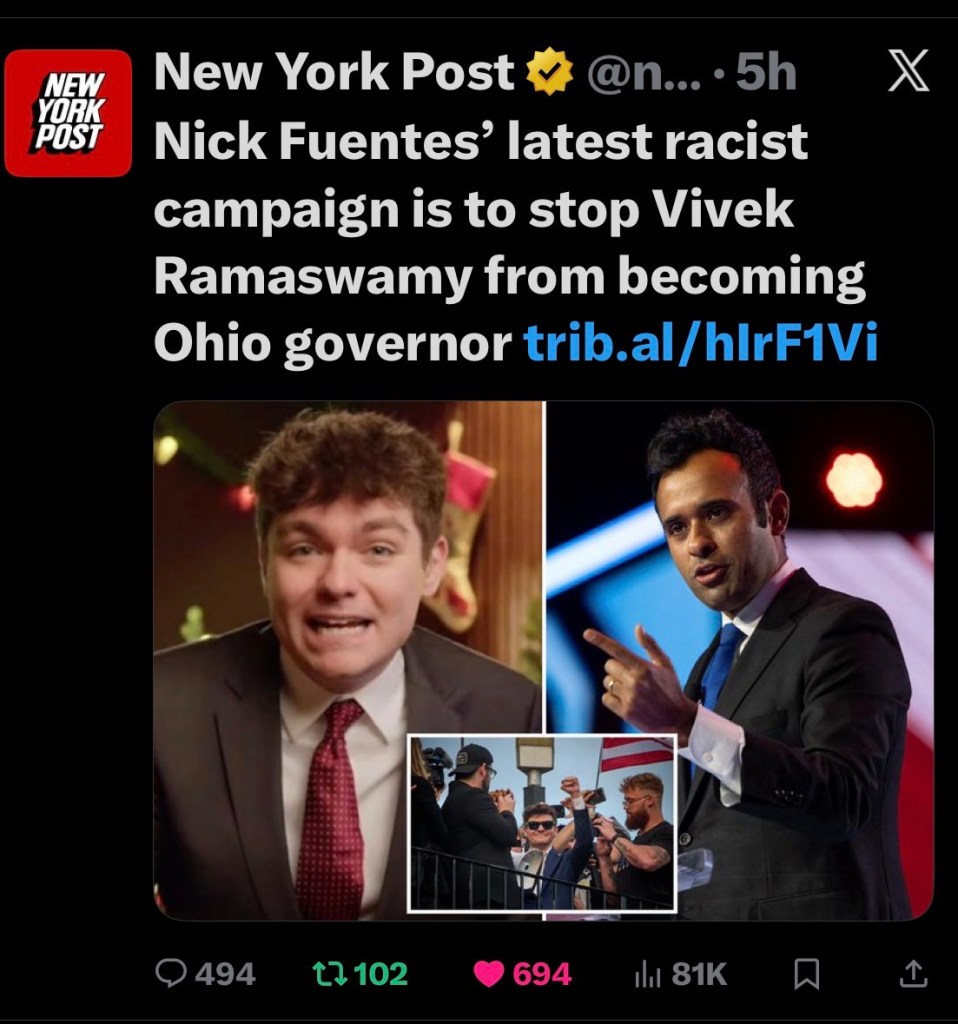
The Left’s Trojan Horse: Nick Fuentes and Tucker Carlson–fallen angels who are trying to stop Vivek Ramaswamy in Ohio

The left-leaning media strategy is obvious: platform a disruptive young firebrand, inject anti-Jewish chatter, agitate through YouTube and podcasts, then aim the shrapnel at Trump and at Trump-aligned picks like Vivek Ramaswamy in Ohio to destroy the MAGA movement in ways that have not previously been successful under any condition.  Suddenly, a kid I’d barely heard of—Nick Fuentes—gets catapulted into mainstream attention. He was the tag-along at Ye’s (Kanye West’s) dinner with Trump in 2022 at Mar-a-Lago; the former president later said he didn’t know who Fuentes was when he sat down, but the meeting still drew bipartisan condemnation because Fuentes is a white nationalist and Holocaust denier.  Not the kind of guy the media would typically embrace, but under these conditions, where nothing to take down Trump has worked, this is the strategy of the left, to promote these fallen stars from the MAGA movement in one last Hail Mary, no matter who gets hurt in the process.  I’m certainly not one who would be calling for censorship.  But it is surprising how quickly everyone forgot about some basic rules of decency in these political fights, which have changed the landscape of debate forever. 123

Ordinarily, a guy with that track record wouldn’t touch mainstream platforms; they would be pushed off into obscurity, and they certainly never would have been on the Piers Morgan show or any other form of media.  Newspapers would have gone on a crusade of personal destruction, much the way they did with Marge Schott back when she owned the Reds and made similar comments, and had her life utterly destroyed for it.  Nick has been banned by YouTube and other majors for hate‑speech violations, with intermittent reinstatements elsewhere and then more removals; even Rumble has suspended his streams for “incitement to violence” after an antisemitic rally—so historically, gatekeepers did act. 45 But now, post‑Musk’s changes to X, he’s back on high‑visibility rails, popping up in interviews and friendly chats that launder his extremism for broader audiences. When you see that kind of boost—especially in late-cycle political windows—it looks less like “free speech flourishing” and more like a tactical Hail Mary to fracture the coalition right before decisive races. 67

Layer onto that Tucker Carlson’s recent, sharp pivot into anti-Israel rhetoric and repeated platforming of figures accused of antisemitism. Multiple watchdogs and Jewish outlets have documented the shift and the blowback—Shapiro blasting him at Heritage, Newsmax siding against him, and even StopAntisemitism labeling Carlson “Antisemite of the Year” in December 2025. I don’t endorse that label; I’m noting the documentation and the political consequence: it’s a wedge inside MAGA world, precisely when unity matters, but don’t cry about it, all is fair in love and war, with war being the point of emphasis. 8910

The script is predictable: amplify anti-Jewish frames, set up a fight between “America First” isolationists and pro-Israel conservatives, then bait Republicans into intramural brawls—Ben Shapiro versus Tucker Carlson, Heritage under strain, Turning Point USA’s AmericaFest turning into a civil‑war stage after Charlie Kirk’s assassination and the conspiracy storms that followed. The result isn’t persuasion; it’s erosion—energy wasted on policing purity rather than winning seats. 11129

My stance is well defined: antisemitism is not appropriate. Praising Hitler is evil. That isn’t “edgy” speech; it’s a moral rot that corrodes any serious movement. Fuentes has a documented record of white nationalist and Holocaust‑denying rhetoric; platforming him in chum-style interviews mainstreams what should remain radioactive. If the goal is to split MAGA and sandbag Trump-aligned candidates, this is the fastest path—smuggle in bigotry so the whole tent gets smeared. Don’t take the bait. 113

Ohio is the case study. Vivek Ramaswamy launched his 2026 gubernatorial run in February 2025, attracted heavy attention, and is now the clear GOP frontrunner in most coverage. Democrats have rallied around Amy Acton; early polling varies by sponsor, but the race is competitive at the surface level. None of that changes the fundamentals: if you let provocateurs redefine “America First” as a race-based or anti-Jewish crusade, you’re handing your opponent a cudgel. Stay on economic delivery, state competence, and merit-driven reform—the stuff that wins governors’ races. 141516

So the advice to Vivek—and by extension to Trump’s slate—is steady and aggressive: do what got you here. Don’t chase the troll theater or appease the grievance‑economy influencers. Use your success arc as a shield and spear: wealth built ethically, businesses scaled, a vision for schools, safety, and jobs—make that the daily drumbeat. When the attack line is “he’s a globalist” or “he’s Hindu,” swat it down as the unserious bigotry it is; it’s not Ohio’s problem set. Ohio’s problem set is growth, crime, schools, and affordability, not the color of Vivek’s skin or whether he wears shoes on stage. 17

In past examples, American society—especially institutions and mainstream media—moved swiftly to suppress voices veering into anti-Semitic or extremist territory. Take, for instance, the post-WWII era: the “Columbians,” an openly pro-Hitler group in Atlanta circa 1946, were acting out Nazi salutes and rhetoric in public. Their organizational charter was revoked and leaders were arrested within months—demonstrating how clear the lines were once drawn against fascist ideologies 1. Likewise, throughout much of the 20th century, publishers, broadcasters, and even churches regularly screened out Holocaust denial, pro-Hitler propaganda, or conspiracies about Rothschilds or “Jewish control.” These ideologies were actively repressed, not platformed.

Fast forward to just a few years ago in Ohio: when the West Chester Tea Party hosted Harald Zieger, who promoted conspiratorial tropes of “Jews control the media, economy, government, even child sacrifice,” it sparked immediate backlash 23. The local Jewish Community Relations Council publicly condemned the event, and the church hosting them was effectively “cancelled,” cutting off their meeting space within weeks 4. It was a classic case of communal and media accountability shutting down extremist speech—without hesitation.

Contrast that with today’s landscape: figures like Nick Fuentes—an avowed white supremacist who praises Hitler, espouses Holocaust denial, and rails against minorities—are not only finding platforms but being endorsed by mainstream media (e.g., Tucker Carlson, Piers Morgan) and embraced by major tech alike 567. Fuentes’s X account, once deplatformed for hate speech, was restored by Elon Musk; he now commands millions of followers, with his extremist rhetoric once erased now normalized—even cheered—on major platforms 68.

This dramatic shift—the difference between swift cancellation and open platforming—highlights a deeper cultural realignment. What was once unthinkable and renounced without hesitation is now acceptable if it serves the political objective of undermining Trump-endorsed candidates. It’s as if the old moral guard has crumbled: conspiratorial tropes against Jews, previously banished, are now resurfacing with institutional backing. The West Chester Tea Party’s fate—banished from public space for a single speaker’s conspiracies—is emblematic of a past where community standards mattered. Today, those same standards are reversed: bigoted voices are amplified if they align with the current political winds. The irony is stark and unsettling.

The broader conservative movement also needs line‑drawing without self-sabotage: condemn antisemitism unequivocally, refuse to sugarcoat Nazi apologetics, and stop platforming it as “debate.” That doesn’t mean gagging policy critique of Israel; it means rejecting conspiratorial claims about “organized Jewry” and dual‑loyalty smears that historically precede violence. When Ben Shapiro calls that out, he’s not gatekeeping taste; he’s trying to keep the movement morally sane. And when Tucker frames it as “just asking questions,” the net effect is still mainstreaming. The cycle is well documented across Jewish and mainstream outlets.  This is a new element to these kinds of games that has never succeeded before, under any circumstances.  But free speech works both ways; success is the best voice for a vote, and these critics have done nothing in their lives except say things.  Vivek has a long track record of great success, and that is his calling card for this election. If that is made clear, there is nothing any of these verbal attackers can do to move the mark.  And as hurtful as all that might be, success heals a lot of wounds, and that is where the focus in Ohio needs to remain.  Vote for Vivek Ramaswamy for governor in 2026 and take politics to a place it’s never been before as a representative republic that will do great things for a very optimistic future. 818

Supplemental material (footnoted):

• Mar-a-Lago dinner (Nov. 2022): Trump dined with Ye and Nick Fuentes; Trump said he didn’t know Fuentes; bipartisan condemnation followed because Fuentes is a white nationalist/Holocaust denier. 123

• Fuentes’ platform status: Banned by YouTube (2020) for hate speech; Spotify removed his podcast for hate‑speech violations; Meta/Twitch/Reddit bans noted; Rumble suspended streams after “holy war” rhetoric; X reinstated him under Musk, boosting reach. 456

• Carlson’s anti-Israel turn & intra-right backlash: Watchdogs charted rising harmful Israel content; Shapiro publicly denounced Carlson at Heritage; Newsmax echoed criticism; “Antisemite of the Year” label amplified controversy. 1881910

• TPUSA/AmericaFest fracture: After Charlie Kirk’s assassination, AmericaFest showcased rifts (Owens/Fuentes/Israel); JD Vance urged unity; Shapiro attacked “frauds and grifters”; coverage across CBS/USA Today/Deseret. 92011

• Ohio 2026 governor landscape: Ramaswamy announced run (Feb. 24, 2025) with platform on education/safety/regulation; media note Trump endorsement and competitive polling vs. Amy Acton. 14171516

Bibliography / Further reading:

1. ABC News, “Trump hosts Kanye West, Nick Fuentes at Mar‑a‑Lago dinner.” 1

2. NBC News, “Inside story of Trump’s explosive dinner with Ye and Nick Fuentes.” 2

3. USA Today, “Donald Trump dined with Holocaust denier Nick Fuentes… at Mar‑a‑Lago.” 3

4. Global Project Against Hate & Extremism, “The Sanitization of Antisemite Nick Fuentes.” 13

5. Media Matters, “Rumble removed Nick Fuentes’ antisemitic rally; far‑right figures turned on Rumble.” 5

6. JTA, “Conservative influencers Tucker Carlson and Candace Owens sharply increased anti-Israel rhetoric in 2025.” 18

7. Times of Israel, “Ben Shapiro blasts Tucker Carlson at Heritage.” 8

8. CBS News, “AmericaFest puts conservative rift on display.” 9

9. USA Today, “Tucker Carlson, Ben Shapiro clash over Candace Owens in Phoenix.” 20

10. Ohio Capital Journal, “Vivek Ramaswamy officially launches bid for Ohio governor in 2026.” 14

11. Deseret News, “Ramaswamy announces Ohio governor run, outlines platform.” 17

12. Fox News, “Ramaswamy announces 2026 bid for Ohio governor.” 15

13. Newsweek, “Polls on Amy Acton vs. Vivek Ramaswamy.” 16

Rich Hoffman

Click Here to Protect Yourself with Second Call Defense https://www.secondcalldefense.org/?affiliate=20707

Nick Fuentes Picked a Fight with the Heavyweight, Vivek Ramaswamy: And he’ll get his teeth knocked out and his jaw broke, just like Jake Paul–but he’ll be rich

Jake Paul’s recent fight with Anthony Joshua is the perfect illustration of what happens when spectacle replaces substance. Paul, a YouTube celebrity with millions of followers, stepped into the ring against a world-class heavyweight—a man with Olympic gold and years of professional dominance. The pre-fight theatrics were designed to sell the drama, but anyone who understood boxing knew the outcome was inevitable. Paul fought briefly, suffered a broken jaw in two places, and left the arena humiliated in front of tens of millions of viewers. Yet, for him, the payday—reportedly $92 million—made the beating worthwhile. It was never about winning; it was about monetizing attention, even at the cost of personal dignity.

In many ways, that’s exactly what Nick Fuentes is doing with his attacks on Vivek Ramaswamy and, by extension, the MAGA movement. Vivek is the Trump-endorsed candidate for Ohio governor, a heavyweight in political terms, and Nick is trying to build his brand by picking a fight he cannot win. The goal isn’t policy or principle—it’s clicks, donations, and notoriety. Like Paul, Fuentes is willing to take a beating if it means short-term gains. But compromising integrity for a few bucks is a dangerous trade. Real influence comes from credibility, not shock-jock theatrics, and when the dust settles, Vivek will be fine. Nick, on the other hand, risks being remembered as the guy who sold his future for a viral moment.

Before we get lost in the weeds on Nick and the “war” he’s trying to gin up against Vivek Ramaswamy in Ohio, the first thing to understand is that this is a publicity grab, a brand‑building exercise in the attention economy dressed up as a crusade. Tucker Carlson’s long sit‑down with Nick dropped late October 2025 and lit up the right for weeks—not because Nick said anything new, but because platforming him without hard pushback sparked a visible fracture among conservatives: Shapiro condemned the interview as “normalizing” a Hitler apologist, Heritage’s president defended Tucker as a free‑speech stand, and even Senate Republicans openly rebuked the tone and content. That intra‑movement rift is real, it’s documented, and it tells you what lane Nick is driving in: controversy converts to cash. 12345

When Nick went on Piers Morgan Uncensored in December 2025, he doubled down—“Hitler was very f***ing cool,” he said, shrugging off historical atrocity with aesthetic fanboy talk about uniforms and parades. That wasn’t clipped speculation; it aired, it was challenged in real time, and it produced the predictable outrage cycle. He also conceded “at least six million” Jews were killed, but framed Holocaust memory as a mechanism to browbeat white Christians—a rhetorical move that’s been part of his pattern: push past decency, trivialize mass murder, court the shock. The point isn’t whether he “means” it; the point is that publicly saying it pays in a donor‑driven creator market. 678

And sure, people will ask how a 27‑ or 28‑year‑old ends up with this microphone. There’s a timeline: Unite the Right 2017, Groyper wars harassing mainstream conservative events in 2019, deplatforming cycles from YouTube for hate speech, and then re‑ascendance on platforms willing to host him; he even turned up at Mar‑a‑Lago in November 2022 when Ye (Kanye) brought him to dinner with Trump—a fiasco the former president later said he didn’t foresee. That dinner is a hinge in the public memory; it proved how oxygen flows to extremism when spectacle meets lax vetting. 910111213

Now, does Nick hurt Vivek in Ohio? No—he helps him by contrast. Ohio 2026 is shaping up as Ramaswamy vs. Acton, and the fundamentals are what they are: Vivek’s cash advantage, statewide endorsements, and consolidated GOP backing set the terrain; Acton’s own story is COVID‑era and compassion‑branded, but even Gov. DeWine has publicly said those shutdown decisions were his, not hers—undercutting the “Lockdown Lady” moniker his party uses.  Because, DeWine is really a Democrat, and Amy was his girl.  On balance, the race is competitive in public polling but leans Republican in a red‑trending Ohio; when the smoke clears, voters will choose jobs, affordability, and competence over influencer theatrics. That’s why a shock‑jock swipe from Nick won’t move the needle—it hardens a tiny niche while most Ohioans tune out the performative nihilism. 141516171819

And here’s the part nobody wants to say out loud: this is a business model. The pundit economy rewards dopamine spikes—outrage, taboo, transgression—because creator monetization has shifted from legacy ad rails to direct fan funding. Platforms like Rumble now integrate Bitcoin tipping (with Tether) so audiences can spray micro‑payments across controversial content in seconds. You don’t need brand safety; you need attention. That’s why “Hitler is cool” becomes an economic lever: it draws fire, it drives views, it pulls in tips from an aggrieved subculture that feels ignored by institutions. In this incentive structure, “being unhinged” is not a bug; it’s a feature. 202122

So, the math here is straightforward. Nick’s short‑term revenue maximizes by attacking Trump‑aligned figures like Vivek; it creates a pseudo‑rebellion narrative (“I speak the truths your gatekeepers won’t”), harvests donations, and inflates his standing with under‑30 males who see no path in a culture saturated with porn, atomized dating markets, and collapsing family formation—all frustrations he riffs on. But that same strategy destroys long‑term trust and any real governing coalition. Tucker’s interview gave Nick oxygen; Shapiro’s response—and the broader backlash—marked the boundary lines of mainstream conservatism. Vivek will do well to stay above it, keep on policy‑first, and connect with Ohio’s economy and families, and let the theatrics burn themselves out. That contrast, in the end, will decide everything. 3235

I’ll add one more note because I’ve lived this choice set: taking money and chasing the algorithm means someone else owns your argument. Independent voices who refuse the pay‑to‑play goose—whether that’s bot‑inflated follower counts or crypto tip farms—give up the easy ego pop in exchange for credibility with serious people who need facts, not theatrics. In Ohio, facts look like campaign filings, union endorsements crossing over, county‑by‑county organizing, and policy planks about taxes, education, and industry. That’s where Vivek is playing. That’s where this race will be decided. 1516

 While Vivek Ramaswamy will be fine in Ohio—his strategy is solid, his Trump endorsement is strong—he could easily swat away Nick Fuentes by pointing to the Jake Paul fight as a metaphor. Picking a fight with a heavyweight when you’re clearly outmatched is reckless, and Nick’s attempt to derail Vivek’s campaign is no different. It’s a stunt, not a strategy, and it will fail.

But here’s the deeper truth Nick is tapping into: the rise of a disenfranchised generation. Under‑30 men are angry, disconnected, and increasingly unwilling to pursue marriage or family because they see the culture as broken—porn saturation, hookup norms, and progressive narratives have eroded trust. Nick speaks to that frustration, and that’s why his voice resonates even when his tactics are self‑destructive. This is the future of media and politics: decentralized, unfiltered, and without institutional guardrails. Legacy platforms can’t contain it, and the genie isn’t going back in the bottle. Even when Vivek wins and MAGA thrives for now, the next wave will be shaped by these angry young men who feel robbed of a normal life—and commentators like Nick will only grow louder in that vacuum.

Footnotes

1. Tucker Carlson’s interview with Nick Fuentes published Oct. 27, 2025; episode listings and YouTube analytics confirm timing and reach. 12

2. Coverage of the interview’s fallout and intra‑GOP rift (Heritage defense; Shapiro’s critique; Senate Republicans’ reactions). 345

3. Piers Morgan interview (Dec. 8–9, 2025) where Fuentes said “Hitler was very f***ing cool”; additional reportage on his Holocaust remarks. 687

4. Fuentes background and extremism timeline: Unite the Right, Groyper wars, deplatforming, ideological positions. 9

5. Mar‑a‑Lago dinner (Nov. 22–25, 2022) with Ye and Fuentes; Trump’s later statements on not recognizing Fuentes. 10111213

6. Ohio 2026 overview: Ramaswamy’s fundraising and endorsements; Acton’s profile; DeWine clarifying COVID decisions. 141516171819

7. Creator‑economy monetization and Rumble’s Bitcoin tipping integration (Tether partnership; rollout timing). 202122

8. Shapiro’s extended takedown of Tucker/Fuentes; the boundary between mainstream conservatism and the groyper fringe. 235

Selected Bibliography

• Tucker Carlson x Nick Fuentes: “Tucker Carlson Interviews Nick Fuentes” (Podchaser listing, Oct. 27, 2025); “Tucker Carlson Interviews Nick Fuentes” (YouTube). 12

• Intra‑movement rift: USA TODAY analysis of interview fallout; POLITICO on Shapiro’s critique and Heritage backlash; Fox News coverage of the AmericaFest sparring. 345

• Piers Morgan interview: The Independent, Jewish Telegraphic Agency, and The Forward reports on Fuentes’ Hitler comments and Holocaust remarks (Dec. 2025). 687

• Mar‑a‑Lago dinner (2022): USA TODAY, NBC News, ABC News, POLITICO accounts and Trump’s statement. 10111213

• Ohio 2026: Cleveland Scene and Columbus Underground on fundraising and endorsements; Acton campaign site; NBC4 on DeWine’s COVID responsibility remarks; Ohio Capital Journal profile. 1415241718

• Creator monetization: Cointelegraph and industry reports on Rumble’s Bitcoin tipping rollout and Tether partnership. 20

Rich Hoffman

Click Here to Protect Yourself with Second Call Defense https://www.secondcalldefense.org/?affiliate=2070

Trump’s Relationship with Qatar: Tucker’s interview with Sheikh Mohammed

There’s a difference between people who hold a line because it feels righteous and those who keep asking questions because they know reality changes with every new fact. Reporters live—or should live—on that second path. The more evidence you collect, the more you grow, and growth tends to look messy from the outside. Tucker Carlson’s evolution has had plenty of critics, but what deserves attention is the basic craft: go to the places other media avoid, ask the blunt questions, publish the exchange, and let the audience judge. His recent interview in Doha with Qatar’s prime minister, Sheikh Mohammed bin Abdulrahman Al Thani, landed exactly in that territory: controversial, necessary, and clarifying—especially if your goal is to understand how diplomacy actually works in the Middle East, where U.S. forces rely on Al Udeid Air Base and where back‑channels with difficult actors are the price of getting hostages out and guns silenced, even temporarily.[^1][^2]

If you’re serious about peace, you talk. You talk to adversaries, to intermediaries, to people whose ideology makes your skin crawl, because the alternative is to guess their motives and fire at shadows. Qatar sits at the nexus of two realities that make Americans uncomfortable: it’s a major non‑NATO ally hosting the largest U.S. base in the region, and it has, for years, served as a conduit to Hamas and other hard actors—often at Washington’s request.[^3][^4] That dual role draws fire. Critics say, with reason, that Doha has tolerated extremist financiers and given political oxygen to movements we reject.[^5][^6] Defenders point out that Doha’s mediation has repeatedly produced outcomes Washington needed—hostage exchanges, ceasefire windows, and channels to groups we won’t meet directly.[^7][^8] Both can be true at once; the practical question is whether engagement through Qatar, under U.S. conditions, yields more stability than posturing in its absence.

Carlson’s Doha exchange turned the subtext into text. He put the prime minister on the hook: why host Hamas, and what money goes where? Al Thani’s answer was pointed—that Hamas’s presence in Doha began as a U.S. and Israeli‑approved channel, with transfers to civilians in Gaza coordinated transparently.[^9][^10] Believe that fully or not, the claim is now on record. As viewers, we got posture, context, and accountability: a mediator stating publicly the rationale and process. From there the discussion veered to an even sharper controversy—reports of Israeli operations striking in Doha during mediation, and the unusual moment when President Trump pushed Prime Minister Netanyahu to issue a formal apology to Qatar for violating a mediator’s “safe space.”[^11][^12] That detail matters, because it shows business‑style leadership doing something Washington rarely does: pressing a close ally to respect a process that serves U.S. interests, not just alliance optics. If you want ceasefires and hostages home, you protect your channels, even when doing so costs political points with familiar audiences.

Now, you don’t have to be a “fan” of Carlson to see the utility of the interview. The point is the reporting: ask hard questions, surface contradictions, let the audience trace the through‑line to policy. Media that refuses to platform controversial interlocutors substitutes judgment for evidence; the audience gets a filtered picture that flatters ideology. The record—on readiness at Al Udeid, on the scale of Qatari lobbying in Washington, on LNG leverage and sovereign wealth—demands more than slogans.[^13][^14][^15] Qatar isn’t a sidebar; it’s a strategic keystone in the current security architecture. U.S. operations across the region depend on basing and overflight, and since 2003 Qatar has pumped billions into infrastructure that CENTCOM, AFCENT, and Special Operations rely on every day.[^3][^16] When the U.S. chooses to engage through Doha to reach groups like Hamas or Taliban political offices, it’s choosing the least bad path to outcomes other channels can’t deliver. That’s not romance; it’s logistics.

Enter Ted Cruz. His criticism of Carlson for interviewing Doha’s head of government—and later jabbing at Carlson’s announcement that he would buy property in Qatar—reads as a continuation of a summer feud that began with Cruz’s hawkish case for regime change in Iran and ran aground on basic facts.[^17][^18][^19] In the viral exchange, Carlson pressed Cruz for the population size and ethnic composition of the country he was urging the U.S. to help topple. Cruz couldn’t answer, then pivoted to accusation. The clip went everywhere because it reduced a complex policy argument to one essential question: if you want to kill a government, do you know the country you’re about to break?[^20][^21] It wasn’t a debating trick; it was a reporter asking for the minimal knowledge that makes an intervention policy serious. The broader MAGA family split between business‑first pragmatists and maximalist hawks was already visible; this spat simply made the line brighter. Months later in Doha, Cruz lashed publicly, accusing Carlson of shilling for a “terror state” and posting taunts that did more to inflame than to persuade.[^22][^23][^24] The problem with this style of critique isn’t passion; it’s shallow framing. If Carlson’s interview put facts on the table about mediation, basing, and aid, then the appropriate counter is data: track transfers, cite Treasury designations, show where Doha violates commitments, and argue for remedies that preserve U.S. interests while constraining Qatar’s worst habits.

So let’s put those numbers down. Economically, Qatar is small in headcount and huge in energy. It has the world’s third‑largest proven gas reserves, sits among the top LNG exporters, and is moving through a multi‑year North Field expansion intended to nearly double LNG capacity by 2030.[^25][^26] Marketed natural gas output held steady at ~170 bcm in 2024, with domestic consumption around 42 bcm.[^27] Hydrocarbon revenues fell with global prices from 2022 to 2023, but hydrocarbons still accounted for a dominant share of government income.[^26] Real GDP growth hovered near 2% in 2024 by IMF estimates, with non‑hydrocarbon sectors advancing under the Third National Development Strategy (NDS‑3) and Vision 2030.[^28][^29] The sovereign wealth footprint—Qatar Investment Authority—sits in the hundreds of billions and projects soft‑power reach through high‑profile stakes and global partnerships.[^29] The upshot is leverage: Doha can fund influence, absorb reputational bruises, and keep playing mediator because LNG cash cushions the risk.

Security ties with the United States are institutional, not episodic. The State Department fact sheets lay it out: access, basing, and overflight privileges facilitate operations against al‑Qa’ida affiliates and ISIS; Al Udeid hosts forward headquarters for multiple U.S. commands; and Foreign Military Sales with Qatar exceed $26 billion, including F‑15QA fighters and advanced air defense.[^3] The Trump White House readouts in 2017 and 2018 acknowledged the need to resolve the GCC rift while recognizing Qatar’s counterterrorism MOU progress; they also leaned into trade, investment, and defense procurement as stabilizers in the relationship.[^30][^31][^32] In 2025, Trump’s visit to Al Udeid produced headlines about Qatari investment in the base and defense purchases—exactly the business‑style diplomacy that critics deride and practitioners call reality.[^33] Even during acute tensions, like Iran’s missile attack on Al Udeid in June 2025 following U.S. strikes in Iran, Doha maintained posture as a U.S. ally condemning the attack and signaling response rights.[^34] That’s not a trivial point; basing partnerships show their character under fire.

On the other side of the ledger, accusations of terror financing and extremist hospitality have shadowed Doha for years. Treasury officials, analysts, and NGOs have documented permissive environments for designated financiers, support for Islamist movements, and Doha’s long encouragement of Hamas’s political bureau.[^5][^6][^35] Critics in Israel and the U.S. point to the billions in transfers to Gaza since 2018 and argue that aid inevitably strengthens Hamas’s governance.[^36][^37] Qatar’s counter is always two‑part: (1) mediation requires contact, and (2) funds for civilians were coordinated and monitored, with Israel’s participation.[^10][^36] Washington’s posture has waxed and waned. In late 2024, amid stalemates in hostage talks, reports surfaced that the U.S. asked Doha to expel Hamas’s political leadership and that Qatar temporarily suspended mediation out of frustration with both sides.[^38][^39][^40] Yet by January 2025, Doha helped broker a new ceasefire and hostage exchange with U.S. and Egyptian negotiators, underscoring the bipartisan reality: when talks matter, you want the mediator who knows the rooms and the personalities.[^41][^42] You can hate that arrangement and still need it.

This is where business leadership in public office makes a difference. A dealmaker’s instinct is to preserve optionality and keep lines open long enough to test whether interests can align. It looks ambiguous because it is. Trump’s approach to Qatar—leaning into investment, leveraging basing ties, and pushing allies privately to respect mediation—fits that mold.[^30][^33][^12] Purists will say ambiguity equals moral compromise. Practitioners will say ambiguity equals leverage. In the Middle East, leverage is often the only bridge between bad choices and less‑bad outcomes. You can meet Kim Jong Un, Xi Jinping, Vladimir Putin, or Sheikh Mohammed Al Thani without endorsing their systems; you do it because future decisions are better when today’s signals are clearer. And yes, sometimes you compliment the counterpart in public to keep a channel from collapsing while your team demands changes behind the door. That isn’t lying; it’s sequencing.

Critics like Ted Cruz would cast this as disingenuous—insisting that any public warmth is complicity with terror sponsors. But that framing misses the mechanics of influence. You don’t get ceasefires by humiliating mediators; you get them by constraining their worst incentives and rewarding their best. If Qatar wants legitimacy in Washington—as the Quincy Institute tallied, Doha spent nearly $250 million on registered lobbying and PR since 2016 to cultivate precisely that—it will pay reputational costs for any backsliding on financing or hospitality for extremists.[^15] The same pressure campaign that plastered Times Square with anti‑Qatar billboards in 2024 can push Congress toward tighter conditions on aid monitoring and final‑mile disbursement in Gaza.[^41] But the hard question for hawks is: when Doha is out, who replaces them? Egypt will mediate; so will other Gulf states in narrower rooms. None has Qatar’s combination of access, money, and U.S. basing ties. Kicking Doha out satisfies anger but reduces your toolset.

In the Carlson–Cruz feud, the impulse to turn a complex policy dispute into a loyalty test shortchanges the audience. Carlson’s insistence on basic knowledge before regime‑change rhetoric isn’t anti‑hawk; it’s anti‑reckless. Cruz’s insistence that engagement equals endorsement ignores decades of U.S. practice using adversarial channels for adversarial needs. Consider Qatar’s role with the Taliban: Washington leveraged Doha for talks that led to prisoner exchanges and the exit framework from Afghanistan.[^60][^56] Consider hostage mediation in Russia or the Middle East: Doha helped facilitate discussions for detainees like Evan Gershkovich and served as a neutral space in otherwise impossible dialogues.[^1][^8] These aren’t fairy tales; they’re messy, partial wins, and they depend on TVs and microphones bringing the people in charge into public view. That’s what interviews like Carlson’s accomplish when they’re done right. He asked, the PM answered, and viewers can now calibrate their own assessment with specific claims to confirm or reject.

The economic overlay matters too. A state as energy‑rich as Qatar will always try to convert LNG revenue into geopolitical insulation. The IMF and EIA numbers make clear that hydrocarbon cash dominates fiscal capacity even as NDS‑3 pushes diversification.[^28][^26][^23] That has two effects. First, Doha can bankroll long mediations and PR campaigns without bleeding out; second, Western capitals keep incentives to tolerate the mediator they dislike because they want supply security and logistics continuity. If you want Europe warm in winter and U.S. aircraft running in theater, you do not casually sever the relationship with the Gulf’s gas giant. The grown‑up move is to bind Doha to verifiable conditions—Treasury enforcement, intelligence coordination, and staged monitoring of any humanitarian flows—while protecting Al Udeid as a strategic asset. Business practice calls this creating a “win set”: align enough interests that cooperation beats non‑cooperation for all critical actors.

Which brings us back to interviewing controversial leaders. The point is not to canonize the interviewer; it’s to normalize the discipline. Serious journalism is adversarial but curious. You ask the uncomfortable question about hosting Hamas. You press the claim about transfers. You challenge the narrative on strikes and apologies. Then you publish—and the audience gets data points to test. Telling reporters they can’t sit down with a prime minister because online factions see treachery in the flight itinerary is a recipe for self‑inflicted ignorance. If free speech means anything, it means we hear answers from the source and decide. That’s healthier than relying on curated outrage.

None of this excuses Qatar’s poorest choices. Treasury, intelligence, and independent watchdogs should keep the heat on permissive financing networks and hospitality for designated actors.[^5][^6][^16] Congress should scrutinize any extravagant “gifts” to U.S. administrations—the 747‑8 controversy raised legitimate espionage concerns that deserve rigorous technical vetting, not partisan shrugs.[^43][^44] And U.S. policymakers should keep footing Qatar’s mediation inside clear boundaries: verifiable aid channels, explicit non‑funding of militant reconstruction, and sunset clauses on offices for organizations that reject compromise.[^1][^10][^41] But we also keep talking. Because talking—especially via mediators we can pressure—beats bombing channels into rubble and then wondering why prisoners don’t come home.

In the movement space, there’s a temptation to equate criticism of allies with betrayal. That assumption wrecks coalitions. If Trump does something worthy of critique, critique it. If a reporter catches a senator flat‑footed on basic facts, don’t convert hurt pride into a campaign against engagement. Carlson’s Iran exchange exposed a habit among some hawks of treating intervention as a posture rather than a plan. Plans begin with numbers—population, composition, economic throughput—and follow with a theory of change. That’s not softness; it’s competence. When a prime minister in Doha says the quiet part out loud—about who asked for Hamas’s office and how transfers were overseen—the competent response is to document, verify, and adjust policy steps accordingly. It is not to shoot the messenger for doing a job.

The Middle East will not reward purity tests. It rewards leverage and consistency. Qatar fits awkwardly in that frame: ally to the U.S., conduit to groups we oppose, and energy engine with a long bank account. You can push Doha toward better behavior, and you should. But you should also use interviews—especially tense ones—to educate a public hungry for unfiltered answers. Carlson is not a savior figure, and he would probably laugh at the suggestion. He’s a reporter who, in this case, asked the right questions in the right room. If ten years from now you want a record that shows how we got hostages back and froze fires long enough to move aid trucks, you’ll need the transcript.

In business, the rule is simple: find one thing you can build on, even when you dislike nine others. That’s how families stay intact; it’s how companies close deals; and it’s how countries avoid wars they can’t win. The Doha interview, and the larger debate over Qatar’s role, is exactly that kind of test. We should be sophisticated enough to take it.

Footnotes / Sources

[^1]: U.S. Department of State, U.S. Security Cooperation With Qatar (Jan. 20, 2025), detailing Al Udeid basing, U.S. command presence, and defense cooperation.

[^2]: Gulf News, “Qatar’s Al Udeid Air Base explained” (June 24, 2025), overview of base history and strategic role.

[^3]: U.S. Department of State fact sheet; see also EIU note on Qatar’s “major non-NATO ally” status and mediation role.

[^4]: NPR / NBC reporting on Qatar’s mediation, including suspension and later resumption in 2024–2025.

[^5]: Counter Extremism Project, “Qatar, Money, and Terror” (overview of financing allegations).

[^6]: Wikipedia summary with citations, “Qatar and state-sponsored terrorism,” noting Treasury concerns (David S. Cohen, 2014) and legislative changes.

[^7]: TIME100 profile, Karl Vick (Apr. 17, 2024), on Al Thani’s mediation in Gaza; Wilson Center bio.

[^8]: The Economist Intelligence Unit (Jan. 31, 2025) on Qatar’s role in brokering the Jan. 2025 ceasefire/hostage deal.

[^9]: RealClearPolitics video brief and transcript excerpts: Qatari PM to Carlson—Hamas in Doha “at the request of the U.S.”; transfers coordinated with Israel (Dec. 7, 2025).

[^10]: TheWrap / The New Arab coverage of the interview, including Carlson’s on‑stage claims and Al Thani’s responses about aid transparency.

[^11]: DRM News / Singju Post transcription discussing Israeli strike in Doha and Trump’s push for apology (Dec. 7–8, 2025).

[^12]: VOR News analysis on Trump pressing Netanyahu to apologize post‑strike (Dec. 9, 2025).

[^13]: EIA Country Analysis Brief: Qatar (Oct. 20, 2025), revenue composition, LNG status.

[^14]: PwC Qatar Economy Watch 2024; NPC statistical release on 2024 GDP and diversification.

[^15]: Quincy Institute Brief 83 (Sept. 8, 2025), “Soft Power, Hard Influence,” tallying ~$250M in FARA‑registered spending since 2016.

[^16]: State Department basing and FMS; see also Gulf News for Al Udeid investment ($8B).

[^17]: NBC News (June 18, 2025), viral Carlson–Cruz exchange on Iran basics.

[^18]: The Independent coverage of the full interview and subsequent accusations.

[^19]: PEOPLE / TMZ / Chron local coverage corroborating the exchange details and Cruz’s posture.

[^20]: Firstpost explainer on why the clash went viral and its policy split implications (June 20, 2025).

[^21]: NBC / PEOPLE clips—Cruz admitting lack of population figure while advocating regime change.

[^22]: Mediaite (Dec. 5, 2025) and Algemeiner (Dec. 8, 2025) on Cruz’s #QatarFirst jab and later explicit taunts after Carlson’s property announcement.

[^23]: Yahoo/Mediaite recap of Carlson’s announcement and Cruz’s “terror state” criticism (Dec. 7–8, 2025).

[^24]: Economic Times / YouTube clip of the “No one can stop me” segment responding to Cruz (Dec. 8, 2025).

[^25]: EIA brief: gas production, export status, GTL facilities; LNG capacity trajectory.

[^26]: EIA table on hydrocarbon revenue and production composition; IMF revenue shares cited.

[^27]: Gulf Times citing GECF statistical bulletin (Dec. 13, 2025), marketed gas ~170 bcm, domestic ~41.9 bcm.

[^28]: New Zealand MFAT country report (Aug. 2024) and IMF projections: real GDP ~2% in 2024; LNG expansion growth wave post‑2025/26.

[^29]: PwC Economy Watch on NDS‑3, diversification; QIA scale; CEO optimism.

[^30]: Trump White House readout (Sept. 20, 2017) on meeting with Emir Tamim—counterterrorism MOU, GCC dispute resolution.

[^31]: Doha Institute analysis of April 2018 summit and U.S. repositioning on the GCC rift.

[^32]: GovInfo transcript of Sept. 19, 2017 remarks—trade and dispute resolution themes.

[^33]: Economic Times / CNBC TV18 coverage of Trump’s 2025 Gulf tour and Qatari investment/purchases (May 15, 2025).

[^34]: CNBC breaking news report (June 23, 2025) on Iran’s missile strike on Al Udeid and Qatar’s response.

[^35]: FDD analysis (July 13, 2025) on Qatar–Hamas ties over decades.

[^36]: Times of Israel analysis (Jan. 13, 2024) on Qatar’s dual role as Hamas sponsor and Western ally; Gaza transfers.

[^37]: Mediaite / Algemeiner cite estimates of ~$1.8B support; EIU notes monitored civilian transfers.

[^38]: NBC News (Nov. 9, 2024) reporting on Qatar halting mediation and U.S. pressure to expel Hamas political bureau.

[^39]: NPR (Nov. 9–10, 2024) on Qatar’s suspension and conditions for resumption.

[^40]: BBC / policy blogs reflecting the “withdrawal then return” mediation arc.

[^41]: Times of Israel (Jan. 16, 2025) analysis: “How Qatar gambled on mediating a Gaza truce, and won.”

[^42]: EIU (Jan. 31, 2025): Qatar’s key role, U.S.–Egypt partnership in brokering January ceasefire.

[^43]: The Hill (May 13, 2025) and CNBC video on Cruz warning about Qatari 747‑8 gift to Trump—espionage/surveillance concerns.

[^44]: Yahoo/NYSun recap of conservative backlash to Carlson buying property in Qatar—authoritarian critiques and free‑expression arguments.

[^60]: Ministry of Foreign Affairs (Qatar) / Wilson Center bios: Al Thani’s role in multiple regional mediations including Afghanistan.

Rich Hoffman

Click Here to Protect Yourself with Second Call Defense https://www.secondcalldefense.org/?affiliate=2070

Anna Paulina Luna and Her Interdimensional Beings: Understanding the politcs of creatures beyond time and space

I think it’s time to discuss the politics of interdimensional beings and their impact on our terrestrial existence.  And she’s certainly not a whack job, U.S. Representative from Florida, Anna Paulina Luna, who recently appeared on The Joe Rogan Experience podcast and discussed interdimensional beings that can operate through the time and spaces that we currently have.  Moving outside of time and space, and she said all this based on classified photos, documents, and witness testimonies she reviewed as a member of the House Committee on Oversight and Reform, which investigates Unidentified Anomalous Phenomena (UAPs).  Those witness testimonies include Air Force pilots who reported phenomena defying current physics, suggesting the presence of non-human technology.  Anna Paulina Luna is interested in a wide range of subjects and is very logical.  As a U.S. Air Force airfield management specialist, she had posed for Maxim as a Hometown Hottie and was a semi-finalist for Fort Walton Beach, Florida.  And now, as a member of Congress, she is always interested in several topics on which she has opinions.  What she isn’t is a tin-hatted conspiracy theorist.  It was pretty remarkable that she would go on to one of the most popular podcasts in the world and talk about the impact interdimensional beings have on our existence as a person who has observed vast amounts of evidence pointing in that direction.  And it’s interesting timing, because recently Tucker Carlson, a reporter whom many people find credible,  He’s not a crazy lunatic.  However, he has recently stated, just a few weeks before Anna Paulina Luna made her comments, that he believes supernatural forces are controlling many members of our government, who are deeply invested in appeasing those forces for various reasons.  And he has reached a point where he no longer wants to know any more.  There is too much evidence pointing in that direction and the ramifications of that possibility are overwhelmingly ominous.  These kinds of stories are also why I am working on a new book called The Politics of Heaven.  These forces have always been with us, and we need to understand their motivations and political ambitions from their perspective to understand the impact they have on our lives. 

One of the best things I have done for myself was to go to the Mothman Museum with my family in Point Pleasant, West Virginia, this year.  That is an exciting place where people are starting to put together all the pieces, and as intelligent creatures ourselves, we want to understand these interdimensional characters.  We discuss them in many of our religions.  I can report from personal experience how Japan goes to extraordinary measures to appease the creatures it calls the kami.  In Islam, it’s gin.  In Christianity, we refer to them as demons, angels, and gods.  However, their movement has been chronicled over vast amounts of time, and sacrifices to them have been made from temples as long as time has been recorded, to appease them.  When you visit the Mothman Museum, you gain a unique insight into the mystery of one of the most significant events in which a Mothman-like creature terrorized the town during the 1960s, ultimately leading to a catastrophic outcome.  Wrestling with this mystery has become a pastime for many people, and the work of the reporter and writer John Keel, who has since passed away, has involved earnest investigation into these topics. The museum reflects that effort.  I love to read John Keel books, which ask more questions than they answer, but the trend points toward a lot of smoke coming from a raging interdimensional fire that is very interested in our lives from their perspective of wants and needs. 

However, my experience with these kinds of things doesn’t lead me to believe that any of them are more intelligent than we are.  Just because they can operate outside our dimensional space does not mean they have developed an intellect superior to our own.  I think the Bible addresses this issue very effectively in Ephesians 6:12, and that the phrase and contemplations accurately describe the problem.  Just because something has better technology, or that they seem older, or operate in dimensional space beyond our four dimensions, that doesn’t make them smarter than we are.  From my own experience, I think of them more as animals with technology, and not very wise.  If we think of time as just one dimension, what is it to them to operate in the 5th dimension, or the 11th?  Time is just a unit of measure that is different relative to the relation gravity has on it.  Time dilation is common when dealing with elements in space, so time is not the same; it’s relative to where it is experienced.  And that could easily be the case with the interdimensional beings Anna Paulina Luna is talking about, or the appeasement of big government types to supernatural entities that they seek to placate through sacrifice and ritual, which is as old as time itself.  Eternity as we think of it would exist outside of the measurement of time, and may be more real than just a hopeful idea.  And with that in mind, we have to deal with the part of ourselves that is connected to eternity, and not the limited measurements of our dimensional space.  We should not assume that reality is all that we can see, but instead that it is determined by the behaviors we observe and how much of that is a result of the world we live in, or from a world that is not in our dimensional reality but only interacts with us as a sliver of that impasse, such as the flatland metaphors used to describe the life of a 2-dimensional being witnessing a 3-dimensional being. 

But we are not as helpless as we have been led to believe.  I don’t question why Anna Paulina Luna is discussing this topic now, as are Tucker Carlson and Joe Rogan, along with many others.  Or why there is even a Mothman Museum that people can visit and think about these mysteries.  Or why right now there are Harvard scientists who are claiming we are going to be attacked by aliens from another planet in November of 2025.  I believe all of these sources.  But considering the motivations of these interdimensional beings, what is it about this time in the human race that has timeless beings so concerned?  Why now?  Because it is evident that the story is spiraling out of control very quickly, our ability to discuss this topic freely on the open internet for the first time in history has a purposeful political element that has a payoff beyond our measure of time and space.  And understanding that is something we should endeavor to embrace.  We’re not debating whether Anna Paulina Luna is correct in her observations, based on testimony that suggests the existence of interdimensional beings.  Our need to know is what they intend and how their political needs compete with our own.  Just because we are a four-dimensional being, should we assume that they are superior because they live in higher dimensions?  Or are they dumber than we are, and need to feed off our lives for their very sustenance.  Which is what I am inclined to believe.  These are the questions that matter, and, interestingly, we are discussing these topics now as the world is shifting in a populist direction.  I would say that, as Tucker Carlson pointed out, the temptation for governments worldwide to engage in supernatural worship is to appease those unseen forces in all kinds of diabolical ways.  And that much of our misery on earth and during our lifetimes is self-inflicted to appease those forces.  But is that necessary?  And, or, should we turn those tables, and perhaps have, which is why all the desperation now?  I think perhaps so.  And as we untangle all this, I think there are a lot of opportunities that have previously been concealed.  And I’m looking forward to the results.  In a political fight with these interdimensional forces, I think we can win the great elections of cosmic concern.

Rich Hoffman

Click Here to Protect Yourself with Second Call Defense https://www.secondcalldefense.org/?affiliate=20707

The Three Wise Men, The Elohim, and UFOs: What the heck was Tucker Carlson talking about

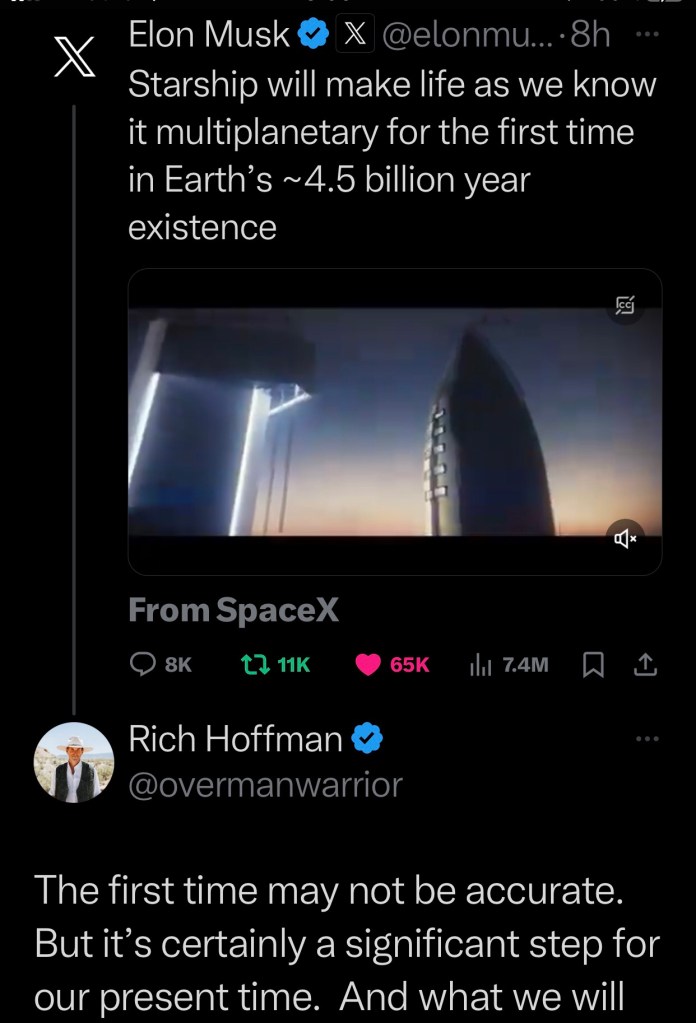
Tucker Carlson always did reports on UFOs, as he was interested in the subject when he was on the mainstream news. But now that he’s on X as a news platform, he has the freedom to cover subjects I knew would make him a much more powerful voice. And UFO subjects come with a kind of stigma where just mentioning them throws the conversation into a conspiracy territory that abandons rationality from the outset. It’s then that you know that many people have been up to no good because UFOs are probably the most significant story worth discussing. They undoubtedly exist; we can see them and often do. Yet for Elon Musk to say that humans will become an interplanetary species for the first time in 4.5 billion years invites scrutiny. How could a person like him not know, who has spent so much time looking into space, studying the surface of Mars and the Moon, and listening to every story from every astronaut who has talked openly about UFO encounters, especially Buzz Aldrin’s descriptions of what they found on the moon? Undoubtedly, much of the anxiety of our times is that these long-held secrets are getting out. Mass media and decentralized discussions have made it so, probably not part of the plan. And now, the world forces are scrambling to keep themselves concealed. Because in concealment comes power, people are always terrified of what they can’t see. Once they realize what something is, they are much more prone not to be afraid of it. So, the UFO stories have a natural inclination toward authoritarian rule by those who can broker such information. And that power has a lot of desire to be maintained. So what did Tucker Carlson, newly freed from Fox News, mean when he said that UFO stories had a spiritual element to them that he found terrifying?

Time and definitions are often shaped by tyranny

I read an excellent book over the 2023 Holiday season called The Magi, which was about the Three Wise Men, or instead, the people who brought three gifts to baby Jesus, and what the nature of the star that led them there was all about, and even how translations over time and various cultures, and languages can undoubtedly create a haze of folklore that means different things to different people.  Tucker Carlson is a good and serious reporter who has been doing investigative journalism for a long time now, so when he admits that his view of UFOs is that they aren’t necessarily coming from Mars and are very ancient, what could he mean?  This is a good reason why we should talk more about the Jewish word for God called Elohim rather than the other words we have misused.  The word “god” does not give us all the information we need to know about Divine Council politics, their motivations, and how they interact with humanity.  It even further gets interesting when you take the reports of ayahuasca users and apply their experiences to UFO abductees.  They have remarkably similar stories to tell, and I find it quite stunning that Peruvian shamans from remote villages high in the mountains paint descriptions of UFOs visiting them under the influence of psychedelics because they have no point of reference to draw from.  All this opens up a discussion I think we all need to have about what we know about these things and how long we have known it, particularly in how power has ruled over humanity, and the cost of that power toward human intellect.

I think there is enough compelling evidence to discuss the Bible as a chronicle of UFO stories during a time when nobody had a stigma about what they were, including the Three Wise Men story of Christmas.  We have defined what they are to keep humanity under control.  But if we are looking for the little Martian from Bugs Bunny cartoons, we will likely be very disappointed, and Elon Musk may be right about humanity with some wordplay added in.  What you see isn’t necessarily what something is if you have been convinced it is something else.  For me, the more proper way to talk about UFOs is to discuss the role that the Elohim have played in Jewish culture and to consider that supernatural events aren’t so unusual but have been expected.  It has been our experience that was limited and our vision suppressed so that what we did see and when we saw it and reported it through literature, art, or entertainment, skepticism followed so that those who wanted to maintain power, either through the spirit world, or the material world, could remain in power and pull their strings to make humanity dance at their whims, maliciously as has often been the case.  The first step in unraveling this story is to treat UFOs not as unusual but as standard and not recent but ancient.  And they may not be “something else” from “somewhere else,” but they are us as we have always been and continue to be everywhere.  It has been our wrong definitions, not our observations.  And they were unfit to control us and for no other reason.

As I said in Elon Musk’s statement on space, we will deal with these problems now. Going to space is the right thing to do.  With the freedom of speech that the X platform gives him, reporters like Tucker Carlson will be able to report these UFO stories in new and unusual ways.  Ultimately, we will discover that they are very ancient and that we have a past connected to the rest of the universe in very complex ways that all our mythologies and religions have failed to capture correctly.  When we get into space, we will learn what all these astronauts have been seeing, and we will have to deal with it from an archaeological perspective.  And it’s not something for us to fear because it was us all along, and we have been interacting with these Elohim since humanity could write things down to remember later.  The desire to continue to fear visits from outer space by aliens is a lust that governments have to grow and protect us from.  But the more we learn, the less there is to fear.  And the more we realize that all along, the powers of the world have been lying to us and having us worship ancient pagan gods and maniacal political figures from the Elohim who do not have our best interest in mind.  And they are losing their cover story of deceit, which has always been part of their interactions.  So what will happen then?  We will find out, as Elon Musk said, about Starship’s role in taking humans into space.  We’re going, and we need to.  And what we learn is what we should have known all along.  Our ancient past isn’t well understood, and the ramifications of that purposeful ignorance will undoubtedly play a role in the future of politics on Earth as it is in Heaven.  Heaven isn’t necessarily somewhere else far away on a cloud somewhere, but in our backyard, and it was always there, as Jesus said, that mankind did not see it because they weren’t looking at it correctly.

Rich Hoffman

Click Here to Protect Yourself with Second Call Defense https://www.secondcalldefense.org/?affiliate=20707

The Alex Jones Interview with Tucker Carlson: Freedom from the Octogone that Elon Musk is providing, purposefully

I’ve watched what is happening to Elon Musk happen to a lot of people over the years.  I watched it happen to Trump during the last half of his many seasons at The Apprentice television show.  It’s where financial security gives people freedom from public opinion.  Because most of the tyranny of our modern age comes from the peer pressure controls of peer pressure mechanisms, the kind of stuff they have been teaching in public schools since the late 1970s.  Usually, for people like Elon Musk, who happens to be the richest person in the world, it takes them time to realize what that wealth really means.  What does it mean to have so much money, and to flaunt it to the public?  Well, the answer is that wealth audacity means independence from the heard, and to get the flaunting of that wealth to show other people that they do not have control over you is usually a lifelong passion that few people ever get to experience, let alone, develop themselves beyond that desire to earn the respect of their peers by making them jealous with the kind of wife you have, the car you drive, or the amount of wealth you have acquired.  At this point, a new type of wealth becomes much more important, and only a few people who have ever lived gain the ability, and that is the luxury to measure wealth not in dollars but in independence from social norms.  Trump acquired that kind of wealth shortly after he married his third wife, Melania, after hitting the heights of his success with that television show, The Apprentice.  I could see it in the books he wrote, the transition.  And it’s why he can run and do so well as President now.  He has an independence in his life that he wants to share with others, especially his family. He doesn’t want to see an oppressive government rob people of that chance. 

I know what has happened to Elon Musk, he has sought to acquire wealth for an entirely different reason: to move civilization into space.  So much of his life has been dedicated to that cause, including the acquisition of money to perform the task.  But to balance himself out, he has purposely sabotaged his public appeal to be the opposite of someone like President Trump.  He doesn’t like to be associated with wealth. Instead, he’d prefer to be viewed as the cool dad video gamer who looks like he can barely dress himself.  That is to show himself, and the world, that money has not corrupted him.  Maybe someday I will get a chance to talk to him directly about this need, but it’s essential to our present situation in many ways.  But I understand it because I have been in a similar place for most of my life.  Money is necessary to pay for lawyers and put tires on your car.  Making sure everyone has Christmas presents—the tools of living life.  But as I have said before, I see myself as one of the wealthiest people in the world not by financial measures but by my independence from the mechanisms of society, and their opinions of me.  In that regard, I earned my freedom from the peer pressure society back in my twenties, under enormously hostile pressure that would have and should have killed anybody with just a fraction of what I experienced.  But in that process, I acquired a different kind of wealth that put me where many of these billionaire rebels are now enjoying and acting upon to make the world a much better place. 

The final straw for Elon Musk wasn’t just to be a pitchman for the World Economic Forum so that he could soothe people over to the dark side in exchange for the way he became wealthy in the first place, through government subsidies and relationships with communist China. To get where he wants to go in life, and that is to make Mars one of the neighborhoods of Earth, is a change in the state of world priorities. So he acquired Twitter, knowing it would be a loss. And he has sought to use his power and independence to unleash the same in others. So he gave Tucker Carlson his show on the newly renamed Twitter platform now called “X.” And one of the first things that Tucker did was something that Fox News would never have let him do, which was to interview Alex Jones, the wild conspiracy theory guy who had just been de-platformed by everyone, especially YouTube, and was ordered to pay the victims of the Sandy Hook shooting over a billion dollars in damages. By putting Alex Jones on the air, Tucker, Elon Musk, and even the Warroom with Steve Bannan, an official Trump White House strategist, they made Alex Jones “mainstream.” And they did it with this power of independence new to Musk and Trump and something I have experienced over the last thirty years. And moving into the back half of the 2020s into 2025, these types of people aim to make the world more accessible to this kind of wealth. Not so much the full bank account, which is undoubtedly part of it, but it’s the social judgment that drives capitalists to overcome their circumstances and become independent of social controls.

The greatest, and most precious freedom in the world is to not be tied to the clutches of collective based social norms controlled by these losers

When you understand this fundamental concept of independence, you can see how important this one thing that Elon Musk did, by putting Alex Jones back on X after he had been banned from every media platform that there was, that declaration of independence was much more potent than what created America in the first place. And the radicals of Marxism know it. They had built their entire society around the control of people through social pressures; it started at the front of the progressive movement itself and involved Carl Jung and Sigmond Freud, who helped the vile despots learn to control the mass population not through superior firepower, but through social sentiment, to the point where they could gain control of the kinds of conversations that occurred at Thanksgiving Dinner. Peer pressure had been weaponized in society, and people who wanted to be free of it would do anything, including making deals with the devils they created, to acquire wealth so they could show their freedom in the process. But few ever acquire the personal wealth to become a President Trump or an Elon Musk. I would put Vivek Ramaswamy and J.D. Vance in that category as well. I’ve met them both more than once, and I can see it in their eyes; they are still very young men. And watching these various people come together toward the building of the same kind of wealth, not the bank account kind that feeds the power of the World Economic Forum radicals and their global insurgents, but the type of wealth that makes people free of those clutches so they can indeed have something that is the most valuable element in the universe. And develop the ability for others to feel it, too, for the benefit of all civilization. When Elon Musk put Alex Jones back on a big social media platform, it was out of more than compassion. It was a military attack going the other way to destroy the controls that very tyrannical people have over social systems. And to set Alex Jones loose when all intents were to kill him and those like him completely and utterly. And saving Alex Jones, Elon Musk essentially saves the world in a way only a truly free person understands. And as a result, millions and millions of people will gain the same result. It was quite an extraordinary moment in human history, the Tucker Carlson/Alex Jones interview on the social media platform that Elon Musk bought to make happen. Boy, the Octogone has lost its power, and as a result, those many mafias of social collectivism, most of which reside in the shadows, are losing their power in ways they are not prepared for. And as a result, absolute freedom has an opportunity to grow in ways nobody has ever thought possible.

They are everywhere, including your local police. Unified by the need for human affirmation, one of the greatest tyrannies the world has ever experienced

Rich Hoffman

Freedom is More Important than Money: Fox News and Corporate Communism will lose as history remembers

There continues to be an almost cult-like reverence at the firing of Tucker Carlson from Fox News, as if controlling a person’s employment reassured the Liberal World Order that they could control what people thought and did. After all, that is precisely how the system is designed under the new China rules for global communism. There is an institutional assurance to themselves that they are in control and can punish people of contrary thought by controlling them economically. If they can’t control people literally with their means of making a living, then through digital currency, they hope to shut people off from participating. Then, of course, they fantasize that they will control the entire world as a small minority by essentially controlling the means of making a living. If the goal of Karl Marx, which is the inherited system the Chinese adopted, and the World Economic Forum is seeking to implement it through every corporation by controlling finance through companies like BlackRock was to control the means of production, then this newer method of centralized control of people’s incomes takes that goal to a much different level. So there was much celebrating when Fox News listened to criticisms and finally fired Tucker Carlson from the number one-rated television show on cable prime time after a settlement with Dominion. They thought they had silenced Tucker and punished all critics of this Liberal World Order almost as if it were a sensual delight. Tucker was gone from Fox News, and the bad guys out there thought they had done something to protect themselves from people like Tucker and the MAGA movement’s growth. But I had a very different opinion and one that is worth perspective. 

The first thing I said about the Tucker Carlson firing at Fox News was that I was happy for him because it must have been frustrating to bend his show around Rupert Murdoch’s and his family’s obvious philosophy. Fox News has always been politics-lite, going back to Bill O’Reilly. It was more conservative than the other stations, which had been trending toward the communist left since the 90s. But it was never representative of mainstream America. There has always been this fantasy that is at the core strategy of this corporate communism movement, which Fox News has obviously bought into, which believes that the content providers create culture and not the market demand of the public. This is a fundamental difference between communism and capitalism. For instance, I think the most recent John Wick movie is one of the best movies ever made. I didn’t see one trace of Woke behavior in it; fans have rewarded it with great box office numbers. However, the belief is that if the communist mind takes over the entire entertainment industry and that people will not have any choice but to go and see their offerings that are filled with all kinds of government propaganda and liberal utterances, that the public will still show up and consume their product because they are bored and will do anything no matter what the quality of the product is. Which, of course, is blowing up in their face. This problem of there always being some kind of John Wick hitting the market need of the public is something that the controllers of the World Economic Forum who want open Chinese-style communism don’t understand. And that is why they were perplexed at the tremendous support that Tucker Carlson had when he announced he was going to continue his show on Twitter. They thought that if they controlled the platform for speech, they could control what people thought and consumed. They are not prepared for competition.

And yet that is the key to a moral society; it’s one that has competition in it for the attention of the masses. I realized this up close and personal several times in my life. Well before Tucker Carlson had a very high-profile de-platforming strategy utilized against him, I have been through it several times. I’ve been doing these kinds of things for a long time, writing, speaking, and undercutting government centralized authority systems, and I’ve seen every kind of attempt to deplatform me hoping to change my behavior. And what I discovered, even if I always knew it in the back of my mind, was that people like options, especially options in thinking. And given a choice, they will always explore those choices. This has been the problem with communism from the start. It’s one thing to impose communism on a suppressed culture of poor people, which is undoubtedly the case in China. The Chinese people have always been more compliant, and to their own defense, they don’t know any better than what the current communist government is offering them. The ability to have an air conditioner and a car is an amazing concept, so a very authoritarian government is not something they would know to question. But in America, that’s a different story. Choice is the key to culture and to economic power. Choice is expected, even demanded. So controls over the supply chain, entertainment options, and even news feeds are failing dramatically, and much of that desperation can be seen in Fox News firing their number one personality, as if sacrificing something very valuable to them would win them appeasement in the circles of this Liberal World Order. 

With his new Twitter show, Tucker Carlson will be free and gain a much larger audience than this modern cord-cutting public would otherwise give him. And if there was one primary thing that was driving the MAGA movement in general, it has been the decentralizing of news. That has certainly been the case with me. I’ve had offers from everywhere to run my own radio show. I used to do a lot of work with Clear Channel in Cincinnati and Michigan as a spot filler. And to host shows that were already known in established markets. But I have found running my own media is much more valuable. Not having the limits imposed by some dimwit corporate pinhead is worth more than the wages otherwise earned.

There are many ways to make money, especially for a person like me, and there are always people willing to pay because when you are a valuable personality, there is always someone who wants that value. And that is certainly the case with Tucker Carlson, who would be lucky to see 4 million viewers on a good night. He will be able to reach more people than that with his own news show, so I’m sure he’s happy about it. He will find he can do more and talk about more without trying to stay in the lines of what Fox News established for its employees. I was surprised that Tucker stayed with it as long as he did. I suppose the paycheck was good, but for people like him, he can make 20 million dollars anywhere. The limits were otherwise too frustrating to him, and you can see this last year he has almost been daring Fox News to fire him, to free him from his confines. Which I fully understand. Freedom is often much more valuable than money if all things are otherwise equal. And that is where this corporate communism model will ultimately fail and be laughed at in the memory of history. 

Rich Hoffman

Click to buy The Gunfighter’s Guide to Business

Fox News Cutting Tucker Carlson: Corporate structures failing everywhere and trying to hide why

It was no surprise to me that Tucker Carlson was removed from Fox News, even as the number one guy. I’ve been saying it for weeks; it’s almost as if Tucker was trying to get them to fire him so that he could be free of that corporate structure. We are all getting ready to go through a highly unusual period in world history that was a long time coming. There is a belief, especially among the communist-minded, that they could be as rulers, the center of all thought and activity. And that if only they captured the corporate structure, they would always capture economic flow. But the truth was that corporations existed to fulfill market needs and that invention was only part of that discovery. The condition always existed; people needed food, recreation, security, and social and intellectual advancement, so it was the problem of corporate structure to fulfill those market needs as they presented themselves through the measurements of money. Money, particularly capitalism, was the best measure of this incentive-based economy, so corporations would rise to meet those needs and attempt to make a profit from those efforts. Since America had the capitalist system, it obviously made more money than the rest of the world, leaving other economies struggling to figure it all out. But there was a problem; it was getting harder and more complicated year by year for CEOs to stand before shareholders and explain a lack of quarter-to-quarter increases. Because if an economy doesn’t continue to expand, such as in America, where our 19 trillion dollar GDP continues along an upward spike, then CEOs can’t tell shareholders where those subsequent profits will come from. 

Over the last several years, CEOs and corporations, in general, have turned toward globalism to reach new global markets and continue to expand that upward trajectory of profit-based reporting. But the problem was, the rest of the world didn’t think like America. They were struggling with some balance between outright communism, complete centralized control of their governments, and socialism, where the “state,” a collection of mindless bureaucrats who have yet to prove anywhere in the world that they can do anything right, is going to control the means of all production. So there has been a collision that most in America haven’t noticed too much because they only really care that they can get a Happy Meal from McDonald’s at will when they want it. So long as they could do that, they didn’t care much about globalism, communism, the World Economic Forum, or what John Kerry said latest about worshipping his long lost mother, Earth, with a sacrifice of our capitalist economy to the gods of communism. And along this process grew the belief among corporate circles that they controlled social fulfillment and not the other way around, where market forces were determined by social need. Communists have always gotten it wrong. Yet more and more, our colleges, our board rooms, and our CEOs have read all the wrong books, listened to all the wrong people, and have turned more and more inward to share the belief that it was corporations that decided the fate of economies. Not something they had to work with to find their place in it. And that’s what has happened to Fox News. They started their organization as an alternative to corporate media, dominated by CNN and the mainstream outlets that leaned politically left at the time. Fox offered a center-right option that Americans were hungry for. They put on some attractive news anchors and turned loose a market need that was much in demand, and they had success until they tried to change that formula. 

That formula really began to change when Glenn Beck was removed from his 5-6 slot over ten years ago, mainly because the billionaire tycoon George Soros was tired of Beck doing stories that showed what he was trying to do to America through finance. Fellow billionaire and progressive pal Rupert Murdoch listened to Soros and the New York Society of upset progressives sent Beck packing. A few years later, they would do the same to Bill O’Reilly, another number one talent that they removed essentially because they felt that Bill legitimized Donald Trump by allowing him to announce his presidential campaign on his show. Then from there, the ball really started rolling, whether it was Dan Bongino, Rudi Guiliani, Kimberly Guilfoyle, Ed Henry, the list goes on and on. The more effective the MAGA movement was, the more desperate progressive radicals who always intended to spread communism worldwide and into corporate structures became. Like self-centered children who believe the world centers around them, they thought that Fox News had created Donald Trump, and it was Trump’s sales of capitalism that were interrupting the plans of globalism most, and they had to destroy that means of communication. 

That government beast serving globalism is very attractive to the American intelligence agencies who were caught allowing election fraud in the 2020 election, so they had to do something to attempt to bury their complicity in that massive crime, so they blew on the mind of Ray Epps to provoke an insurrection on January 6th. But people saw it for what it was, and Epps has been well hidden from the public since that January 6th event in 2021. After Tucker Carlson did some excellent reporting on Ray Epps and the general condition of government activism around January 6th, it was evident that Fox News would cut him too. They didn’t care if he had the number one show. They had fallen into the belief that they “Fox News” had made Tucker Carlson. Not that Tucker—and those like him—made Fox News as is usually the case of market-driving influencers. Then Fox News had to settle the Dominion lawsuit because they were actually all complicit in the election narrative, which would have been exposed in court, so they settled a massive payout to keep the case private and not released under the lens of public exposure. Remember when Fox News called Arizona for Biden when people were still in line voting for Trump in 2020? Yeah, there’s that and much more. So 60 Minutes doing the work of the Deep State, globalists who are terrified that Trump will win the Republican nomination played their part in resurrecting the Ray Epps story so to set up the next lawsuit against Fox News, which showed itself to be willing to settle lawsuits making it a prime target for everyone who has an ax to grind to get a little money in their pockets, so the rest was history.

The next day after the 60 Minutes story, Tucker was released, and the political left cheered, thinking they had done something substantial. They had eliminated the voice of the MAGA movement, and now they would be one step closer to keeping Donald Trump from winning the nomination. But that only shows how stupid they all really are. I’ve said it and said it over and over for many months now; Fox News was holding back Tucker Carlson. Tucker would be better off away from Fox. Fox was lucky to have a guy like that. But Murdoch knows he’s not going to live very much longer. His kids are radical New York lefties who will destroy Fox anyway. So now is a chance to sell off Fox News before they screw it all up. Likely Murdoch has in mind Larry Fink’s group at BlackRock because through Fed activism, BlackRock, Vanguard, and StateStreet own most of all the corporate boards that are out there, and they are all equally failing to meet market trends versus the imposed ESG measures. So Fox is ripe for buying, primarily if they can protect themselves from another lawsuit, this one coming from Ray Epps, and sell the company while it still has value before the kids destroy it anyway. And the progressive radicals, like Larry Fink, can hang the head of Fox News over their fireplace. And they all think they will have then stopped the MAGA movement. Yet, in reality, all they will have done is decentralize that MAGA movement, which will then make it much more powerful and less restricted. 

Rich Hoffman

Click to buy The Gunfighter’s Guide to Business

Self Government Starts by Being a Good Person: Politicians are not leaders as Tucker Carlson says, they are representatives

You Need to Be a Good Person to Have a Good Government

It’s not enough to just talk about it or make names for it.  The real problem is a fundamental one of philosophy and not recognizing the basics of human nature.  What is self-government?  Then, how do you fund it, this something that nobody really understands?  For me, it’s about the difference between a republic and a democracy.  It’s about breaking the Vico Cycle.  In a republic, our politicians are our representatives, extensions of ourselves that buy us time to do other productive things in the world. At the same time, they manage the affairs of our country, states, and counties.  We do need government, but what does that mean for people.  Some, especially those who aren’t so bright and are timid about spiders and other bugs, don’t want the responsibility of self-government. They’d rather have a “leader” running things so they can complain about the results, one way or another.  For self-government to work, all individuals must be empowered to understand how to maintain a republic as opposed to democracy and to spend their lives productively, not worshipping others in the process because they fear personal responsibility.  So the key to everything past and future, including the present, is to define responsible living and how that translates into responsible government.  You can’t expect politicians to behave if the people who put them in decision-making positions truly represent the people who voted for them.  If you want a good government, you first need to be a good person. 

These are the thoughts I had while watching a local school board meeting.  I don’t mean to pick on Brad Lovell, whom I have covered in other articles about the politics of changing our school board from a liberal body of government to a more conservative one. He’s a local guy; every school district has its own version of him.  There are many people like Brad Lovell in government at all levels most of the time.  They are little power-hungry attention seekers and are easily corruptible.  Electing people like that and turning them loose, thinking they are leaders, is one of the most dangerous things society could do to itself.  To be mad at Brad for being what he is isn’t really fair.  We elected him at some point in time because we were suckered as a society into what he said he would do, which was bring big government to our community by wasting endless amounts of money in the process.  When I heard Brad talk this past week, it was just as dumb as what we hear from our own congress over budget considerations revolving around Build Back Better.  This article is not the one to talk about the communist intentions of Build Back Better.  It’s about how weak people spend money and are lazy and too unmotivated to manage money given to them as taxpayers properly. They essentially don’t understand their roles as politicians, and the people who voted for them don’t either.  Even Tucker Carlson gets it wrong all the time.   We do not elect our “leaders,” we elect our “representatives.” No politician is a god to be worshipped.  None of them can be elected and turned loose to do all the hard work while we sit around watching reality television. 

Based on my experience in life, especially in a corporate setting, I would say that half the money we spend on taxes at the federal, state, and local level could be cut in half right now.   If we use the same methods used to approve basic overtime in a corporation, we could reduce the tax burden by at least half by asking our political class basic questions.  Now, where I live, and this is not by accident.  People call me the Tax Killer for a reason.  I would say that I’m a pretty nice guy.   My family loves me.  I think people respect me tremendously.  But when I walk into a room, I would not say that people like it.  Everywhere I go, I am called the “tax killer,” which is a nickname that people who don’t like what I do have persisted to call me because I do question our taxes, especially at the local level.  I think everyone should do what I do; it is the primary responsibility of self-government to elect representatives and ask those reps to be responsible in the same way I would.   When I get mad at Brad Lovell, the local school board tax and spend liberal, it’s not that I don’t like the guy as a person. I’m sure his wife loves him and his kids, and that’s fine.  People care about him out in the world, but we are talking about management here, and being liked is not a value; it’s a lazy retreat and a shift of responsibility for those afraid of it.  I would say that I am known as the tax killer locally because I ask questions the same way I would in a business.  I don’t get invited to many Christmas parties because the goal is to get drunk and act like idiots, and I am also known as a buzz kill.  Sometimes you have to pick being liked to being right, and to my mind, being right is all that matters.  If many managers brought me the overtime needs for over 100 employees who needed to work 10 hour days and 8 hours on a Saturday, I would challenge them.  I would ask them why they weren’t getting the production they needed in an 8-hour day.  Are you short headcount?  I would then ask why Saturday was necessary because it’s a lot more expensive to operate on a weekend than during the week.  Now everyone who knows me understands that productivity always trumps comfort.  I expect people to do whatever they must do in life to be productive, even crawling through broken glass naked.  I ask people to do what I would do in life, and it’s my job to set the parameters to define success.  Most of the time, those managers retreat from their overtime requests and figure out how to get the work done without overtime.  Why? Because the overtime requests were lazy and driven by chaos, not logic. 

I could write books and books and books on this topic of self-management and the values of a republic, and over time, I just may do that.  But for now, understand that the areas I live in, the school district, the townships, and my county all are operating at a surplus, meaning they take in more money than they spend because the money they spend is challenged.  Just think of what a nice world it would be if people everywhere challenged their politicians in such a similar way.  The goal is not to elect a leader then go to sleep playing video games.  It’s also not to be liked. “Oh, here comes that person who will ask us all kinds of uncomfortable questions.” But once we manage to understand our role in a republic and not a democracy, we can begin to improve lots of things for the better.  I don’t think it’s difficult at all, but people go wrong in the world when they’d rather be liked than to be respected.  And in that basic function, so many evils in the world are conducted.  What needs to happen often doesn’t because people, including voters, would rather be loved than to be right.  It doesn’t matter if we have term limits or an R next to a name or a D.  If we elected idiots to office, then stop asking them to represent us, allowing them just to lead us, no wonder costs run out of control, and a government develops a bottomless pit attitude about taxation and its worth to society.  The way to fix it isn’t to complain; it’s to demand answers for the spending, then to watch them flail when they can’t explain it, and in that way, the conditions of our republic improve dramatically, and for a fraction of the cost. 

Rich Hoffman

Click to buy The Gunfighter’s Guide to Business