A Warrior’s Heart: Warren Davidson and Vivek Ramaswamy are the center of the political universe

It was an intriguing week in Ohio politics, one that began with the State of the State address at the Statehouse in Columbus, where I had the opportunity to engage with Governor Mike DeWine and several legislators deeply invested in the direction of our state and nation. These conversations unfolded in a setting that felt both historic and intimate, surrounded by the echoes of decisions that shape lives far beyond the marble halls. As someone who’s been navigating the blurry lines between business, authorship, and political commentary for years, I find these moments invaluable—they peel back the layers of headlines and reveal the human elements driving policy and principle. The air was thick with concern over Congressman Warren Davidson’s recent vote against President Trump’s war powers in the context of the Iran situation, a decision that aligned him with Democrats like Thomas Massie and sparked alarm among some Republicans. I spoke with several people in the legislature who expressed real unease about this, viewing it as a potential fracture in party unity at a time when the margins are razor-thin. Yet, after spending at least ten minutes talking directly with Warren about it, I came away with a deeper appreciation for his stance. I like Warren a lot; he’s a principled man, and his position makes sense when you consider the broader implications for executive power. [1]

The vote in question stemmed from the recent escalation with Iran, where decisive action was taken and not yet resolved within 24 hours, but it reignited debates about the boundaries of presidential authority. Warren’s point, as he explained it to me, is that while we all appreciate a strong leader like Trump who can act swiftly in defense of the nation, we don’t want unchecked executive powers that could drag us into prolonged conflicts without congressional oversight. Congress alone has the constitutional mandate to declare war and authorize sustained military engagements; the president can respond defensively, but perpetual conquests à la Napoleon aren’t the American way. I get that—it’s about trusting the process, not just the person. With Trump in the White House, everyone might agree with Warren’s caution because we’ve seen how he handles power responsibly, but what about future administrations? That’s the crux of it. Warren is aligned with Trump on nearly everything else; if you look at his record, it’s a testament to conservative values. For instance, there was that illuminating hearing where he went toe-to-toe with Maxine Waters over her attempts to label ICE as a terrorist organization. He defended ICE vigorously, emphasizing its role in maintaining national security under the Trump administration. It was a moment of clarity amid partisan noise, underscoring Warren’s commitment to border integrity and law enforcement.[2]

I recall Warren’s “warrior heart” speech when he announced his vote—it was poignant and well-articulated, echoing his military background as a West Point graduate and Army veteran. He’s done this before on issues like the debt ceiling, standing firm even when it means bucking party lines. Representing Ohio’s 8th Congressional District, which includes much of the Butler County region—a stronghold of Trump support—he knows his constituents value the Constitution above all. Behind closed doors, I’m sure Trump would affirm that honest checks on power are essential, much like in any executive role in business or governance. Sometimes you leverage friendships, positive thinking, or even brokered terminations to achieve consensus, but the assumption is always that representatives should adhere tightly to foundational principles. Up in Columbus, I heard similar sentiments from people in the know, those who deal with these tightropes daily. It’s a balance: following what you believe your constituents want while resisting peer pressure from either side. Most of us want Republicans to support the Trump administration fully, given the slim majorities, to tackle threats like Venezuela, Mexican cartels, Iran’s aggressions, and China’s economic maneuvers against the dollar. Yet, after listening to Warren, I can say he’s every bit the Trump supporter, but he stands by his principles, and that’s what we elect representatives for.[3]

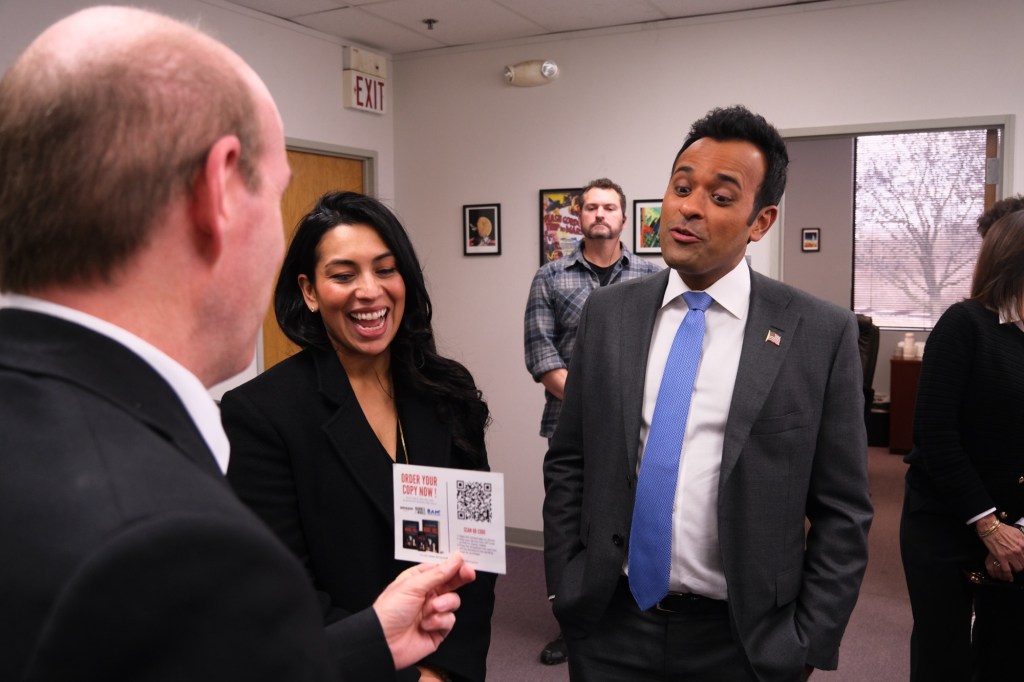
At the time of his vote, it was clear the measure would pass in the House and head to the Senate, so his stance wasn’t going to derail Trump’s initiatives. Instead, it was a principled record-setter, emphasizing that this administration—and future ones—must operate within constitutional bounds. When the lights are off, and it’s one-on-one, no doubt Trump would agree with Warren on the need for debate. That’s healthy; cross-purposes foster better governance. I also had a substantial conversation with Vivek Ramaswamy during the same timeframe, overlapping with discussions involving the governor and others. The question on many minds was what happens now that DeWine’s term is winding down at the end of this year. It’s shaping up to be a Vivek-led Republican era, with Democrats like Amy Acton—the so-called “lockdown lady” from the COVID days—vying to upend that. I chatted with DeWine about his Lockdown legacy or whatever remnants of those policies linger, but it was light, just folks talking. He seemed a bit sad; politics has been his life, from prosecutor to senator to governor, and this is the final chapter. He’ll likely hang around in some meaningful way, but the Republicans in Columbus are eagerly awaiting the new governor.[4] 

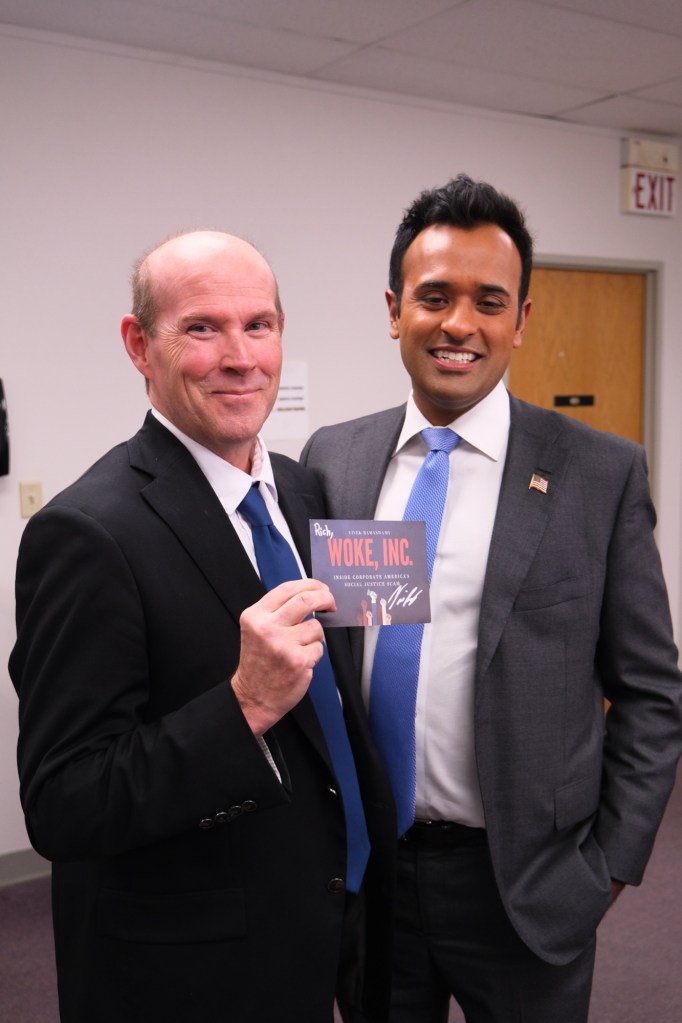
Vivek and I delved into a lot, from his transition from CEO of biotech firms like Roivant Sciences to politics, to the mood post-State of the State. His question to me was about the governor’s mindset, and my take was simple: everyone’s waiting for the new era. Vivek has great ideas; he needs gubernatorial support to implement them. It was an intimate gathering, not a broad spectacle, allowing for real one-on-one talks. These smaller venues let you gauge what people are truly about, beyond the surface. Media often isn’t equipped for that—they skim the headlines without understanding the nuts and bolts. With Vivek facing scrutiny, primary challengers like Casey Putsch, and rhetoric from radical Democrats, getting to the deeper level reveals his genuine intent. As for Warren, many wonder why he went against Trump, but he’s been stellar on other fronts. He wants to ensure that in two years, or ten, or fifteen, we don’t have rubber-stamp wars. Even with a strong CEO like Trump making executive decisions on Iran—a radical ideology threatening economic dominance—we need constitutional fidelity first. More discussion, healthy debate—that’s key in any government endeavor.[5] 

I love Warren Davidson; every time I talk to him and his wife, Lisa, they’re just sweet, nice people in it for the right reasons. He walks that fine line between pressure and principle, drawing from his “warrior heart” ethos. In one-on-one settings, you see he’s the real deal—a good guy through and through. Even amid anger from some over his vote, he redeems himself not by owing anyone, but by being authentic. People at the steakhouse in Columbus were disappointed that he wasn’t fully on the Republican bandwagon at that moment, but he’s a strong conservative who’ll defend the Constitution fiercely, even against a powerhouse president like Trump. It’s not anti-Trump; it’s pro-debate. Shifting to Vivek, all these threads centered around the Statehouse. I told everyone, including Vivek, that he’s got the right attention for this. He’s very wealthy and young, and could retire to a beach in Rhode Island and vanish happily. Instead, he wants to apply his success to lead Ohio beneficially. Ahead of the primaries on May 5, he’s poised to do great things. As I said to him, echoing my chats with others: everyone’s waiting for DeWine to step aside. DeWine isn’t bad—he’s been decent on business, not obstructing the Business First Caucus or investments like Intel’s chip plant—but many Republicans like me feel he’s leaned too Democrat, especially on COVID lockdowns that hammered the economy. We’re still recovering.[6] 

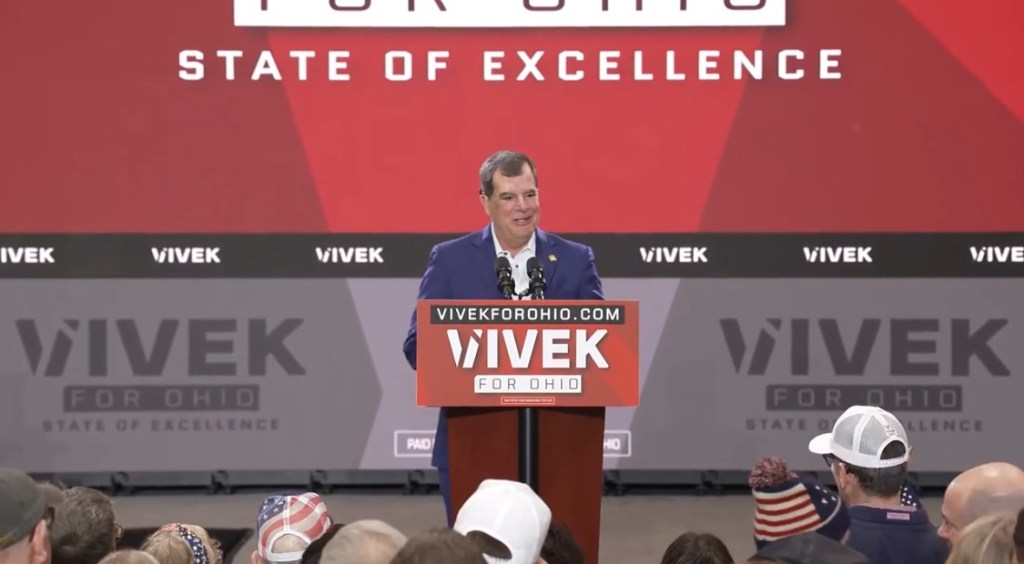
Vivek’s been good at uniting people; the Republican Party endorsed him, and we discussed that. It’s great seeing coalescence. When Vivek becomes governor, it’ll be a solid period—Warren finishing his term, Trump advancing his agenda, but with healthy checks in place. On war powers, it’s constitutional: Congress declares war, manages finances. Nothing wrong with reminding everyone of that. It was refreshing getting context directly from these guys. We’re better off with them in office, representing us well. I told both to their faces how proud I am; it was sincere, just people connecting. They’re willing to tackle the hard stuff, and that’s not easy.

To delve deeper, let’s consider the historical underpinnings of these discussions. The War Powers Resolution of 1973, passed over President Nixon’s veto, was designed precisely to prevent unchecked executive military actions following the Vietnam War. It requires the president to notify Congress within 48 hours of committing forces and withdraw them within 60 days without authorization.[7] In the recent flare-up in Iran, Trump’s swift response mirrored the 2020 Soleimani strike, but Warren’s vote echoes past bipartisan efforts to reclaim congressional prerogative. Think of Libya in 2011 under Obama or Syria under Trump—debates raged then, too. Warren’s consistency here aligns with libertarians like Massie, who often prioritize constitutional limits over party loyalty. His district, encompassing Butler, Darke, Miami, Preble, and parts of Hamilton and Warren counties, is a microcosm of Ohio’s conservative heartland, where Trump won big in 2024, yet values like fiscal responsibility and limited government resonate deeply.[8]

My interaction with Warren reminded me of why I admire him: he’s not swayed by theater. In that Maxine Waters exchange, he dismantled her narrative point by point, highlighting ICE’s role in combating human trafficking and drug cartels—issues hitting Ohio hard with the fentanyl crisis. Statistics show Ohio’s overdose deaths peaked during the pandemic, underscoring the need for strong borders.[9] Warren’s “warrior heart” isn’t rhetoric; it’s rooted in his Ranger service, where decisions meant life or death. As for the peer pressure, it’s real—in thin-majority Congresses, every vote counts, but representatives like him embody the Founders’ intent: a deliberative body, not a monolith.

Turning to DeWine, our chat was poignant. His term ends January 11, 2027, after two terms limited by Ohio’s constitution.[10]  He’s been in politics since the 1970s—Greene County prosecutor, state senator, congressman, lieutenant governor, U.S. senator, attorney general, governor. A lifetime, really. He seemed reflective, perhaps melancholic, about wrapping up. But Republicans are chomping at the bit for a more conservative shift. DeWine’s handled business influx well—think Honda’s EV investments or Amazon’s expansions—but his COVID policies, with Acton’s guidance, locked down too hard for many. The economy took a hit; unemployment spiked to 16.4% in April 2020, and the recovery has been uneven.[11] Vivek aims to dismantle that legacy by promising tax cuts, deregulation, and a revival of innovation. His biotech background—founding Roivant, worth billions—positions him uniquely.[12] 

Talking to Vivek, I sensed his authenticity. He’s endorsed by Trump and the Ohio GOP, leading polls against Putsch and Hill.[13]  His running mate, Senate President Rob McColley, adds legislative heft. We discussed the primaries—not even close, in my view. Republicans can’t wait for Vivek in the mansion. He’s stepping down from ivory towers; governing’s harder than CEO-ing, balancing disagreeing factions. But his heart’s in it—genuine, like Warren’s. These personal convos, eye-to-eye, reveal good people wanting to do well. For those curious about headlines—Davidson’s “betrayal,” Vivek’s “outsider” status, DeWine’s heritage (his family’s from Ireland, actually, but he’s Ohio-born)—it’s about job performance. I’m happy to have these talks amid speculation about Iran’s duration or primaries.  It’s a tricky world, but when everything is founded in sincerity, which it is, the direction of the future is much clearer. 

[1] For more on Warren Davidson’s military background and voting rationale, see his official congressional biography.

[2] Reference to the 2019 House Financial Services Committee hearing, where Davidson challenged Waters on ICE labeling.

[3] Ohio’s 8th District demographics from the U.S. Census Bureau data.

[4] Details on DeWine’s term limits per the Ohio Constitution, Article III, Section 2.

[5] Historical context from the War Powers Resolution, 50 U.S.C. §§ 1541-1548.

[6] Ohio unemployment data from the Bureau of Labor Statistics.

[7] Nixon veto overridden November 7, 1973; see Congressional Record.

[8] 2024 election results in Ohio districts from the Ohio Secretary of State.

[9] Ohio Department of Health overdose statistics, 2020-2025.

[10] DeWine’s political timeline from Ballotpedia.

[11] BLS data on Ohio’s pandemic economic impact.

[12] Roivant Sciences’ founding and valuation from Forbes profiles.

[13] Recent polling from Emerson College and others on the 2026 Ohio gubernatorial race.

Bibliography

1.  “How one House Republican voted to buck Trump on Iran.” CNN, March 5, 2026. https://www.cnn.com/2026/03/05/politics/warren-davidson-house-republican-war-powers-iran

2.  “House fails to adopt Iran war powers resolution.” ABC News, March 5, 2026. https://abcnews.com/Politics/house-primed-vote-iran-war-powers-resolution/story?id=130788637

3.  “Here are the candidates running for Ohio statewide office in 2026.” Ohio Capital Journal, February 6, 2026. https://ohiocapitaljournal.com/2026/02/06/here-are-the-candidates-running-for-ohio-statewide-office-in-2026

4.  “Ohio gubernatorial and lieutenant gubernatorial election, 2026.” Ballotpedia. https://ballotpedia.org/Ohio_gubernatorial_and_lieutenant_gubernatorial_election,_2026

5.  “2026 Ohio gubernatorial election.” Wikipedia. https://en.wikipedia.org/wiki/2026_Ohio_gubernatorial_election

6.  “Vivek for Ohio.” Campaign website. https://vivekforohio.com/

7.  “Vivek Ramaswamy – Ballotpedia.” https://ballotpedia.org/Vivek_Ramaswamy

8.  “Mike DeWine – Ballotpedia.” https://ballotpedia.org/Mike_DeWine

9.  “Mike DeWine.” Wikipedia. https://en.wikipedia.org/wiki/Mike_DeWine

10.  “Vision for the Future – Governor Mike DeWine.” Ohio.gov. https://governor.ohio.gov/administration/governor

11.  Additional sources: U.S. Census Bureau, Bureau of Labor Statistics, Ohio Secretary of State election archives, Forbes business profiles.     

Rich Hoffman

More about me

Click Here to Protect Yourself with Second Call Defense https://www.secondcalldefense.org/?affiliate=20707
About the Author: Rich Hoffman

Rich Hoffman is an independent writer, philosopher, political advisor, and strategist based in the Cincinnati/Middletown, Ohio area. Born in Hamilton, Ohio, he has worked professionally since age 12 in various roles, from manual labor to high-level executive positions in aerospace and related industries. Known as “The Tax-killer” for his activism against tax increases, Hoffman has authored books including The Symposium of JusticeThe Gunfighter’s Guide to Business, and Tail of the Dragon, often exploring themes of freedom, individual will, and societal structures through a lens influenced by philosophy (e.g., Nietzschean overman concepts) and current events.

He publishes the blog The Overmanwarrior (overmanwarrior.wordpress.com), where he shares insights on politics, culture, history, and personal stories. Active on X as @overmanwarrior, Instagram, and YouTube, Hoffman frequently discusses space exploration, family values, and human potential. An avid fast-draw artist and family man, he emphasizes passing practical skills and intellectual curiosity to younger generations.

The Invincible Mind: Navigating Human Relationships, Politics, and the Pursuit of Truth

Human beings interact in countless ways, layered with psychological complexities that often obscure simple truths. Friendships form, alliances shift, and conflicts arise—not always from malice, but from differing visions of what is right. In politics especially, these dynamics intensify: tides turn, candidates rise and fall, and people find themselves on opposite sides of debates. Yet, amid the noise, some relationships endure. Observers sometimes question loyalties: “How can you be so friendly with someone you disagree with politically?”

I’ve had some very public disagreements with people. But I can never think of a time that I wouldn’t ever talk to someone again

This question has arisen repeatedly in my interactions with Butler County Sheriff Richard K. Jones and many others. We’ve shared public moments of warmth and camaraderie, even as political winds have blown in conflicting directions. The same applies to recent encounters with Ohio Governor Mike DeWine. After years of sharp criticism—particularly over his administration’s handling of COVID policies and other matters—I shook his hand following his final State of the State address. We discussed areas of agreement, such as Second Amendment rights and efforts to combat AI-generated child exploitation. These moments highlight a core principle: genuine regard for individuals ‘ needs need not hinge on perfect alignment. Relationships built on authenticity withstand disagreement; those rooted in manipulation crumble.

We were talking about his wife’s great cookies. The second amendment during his administration. Taxes. And his endorsement of Vivek Ramaswamy.

This perspective stems from a life shaped by diverse encounters. Growing up in Ohio, I navigated rough characters and “celebrity” figures in my early adult years—individuals carrying heavy psychological burdens and disappointments. These experiences, often intense and sleepless, taught navigation of human darkness. I awoke each day intent on being the “good guy,” never contemplating villainy. This innate drive toward justice, perhaps divinely guided, clashed with destructive forces, leading through ominous courtrooms and rigorous trials.

The lofty expectations of public office. Few people ever live up to those expectations. But the building was built with the expectation of exceptionalism.

These trials instilled resilience. I’ve seen the worst of human behavior: betrayal, manipulation, and raw conflict. Yet, they clarified priorities. Nothing since has felt catastrophic by comparison. This foundation allows aloof observation—staying “lofty” amid chaos—while engaging directly when needed.

I love to see the future, in the here and now. Great young people!

Professionally, I’ve channeled this into commentary via platforms like The Overmanwarrior blog, podcasts, and writings (including books like The Symposium of Justice and business guides). As a fast-draw enthusiast and strategist, I’ve advised on local and state issues. Public friendships, like with Sheriff Jones, stem from shared values on law, order, and community—despite occasional political divergences. These are not performative; they’re authentic.

Most relationships reduce to two levers of control. The first is friendship as leverage: people offer smiles, hugs, or inclusion to gain compliance. When denied, they withdraw—“I’m not your friend anymore unless you…” This mirrors childhood games (stickers on lockers) and adult dynamics (passive-aggression in marriages, where affection is withheld until demands are met). In politics, it’s “endorse my candidate or lose my support.” Women and men alike use emotional coziness as currency; it’s learned early and persists.

The second is the threat of violence or intimidation. When friendship fails, escalation follows: harassment, protests, spiritual “warfare,” or physical threats—“Do what I say or face consequences.” Authoritarian regimes amplify this; bullies in parking lots embody it personally. Both aim at submission through fear.

I’ve rejected both. Secure in my positions, I express them openly—here, on podcasts, in writing—without needing validation. Disagreement doesn’t prompt cliff-jumping; it invites dialogue or indifference. If someone withdraws friendship over opinions, that’s their choice. If intimidation arises, I handle it unflinchingly, drawing from early lessons in facing rough characters.

This stance echoes timeless wisdom, like Sun Tzu’s The Art of War: become invincible by rendering tactics ineffective. Control what you can—your actions, values, responses—and influence outcomes without direct domination.

Sheriff Jones exemplifies this. We’ve agreed on much: law enforcement, border security, deportations, and community protection. His office’s work with ICE and unapologetic stance on illegal immigration align with my views. Publicly, we’re friendly—podcasts, events, and genuine conversations about his brand and duties.

Yet, political motivations diverge at times. Endorsements or strategies might differ. Critics note our chumminess amid such gaps, confused by loyalty despite opposition. The answer: I like him authentically. His character, spine, and public service earn respect. If we clash, we may not talk for a while—that’s fine. Friendship isn’t conditional on perfect alignment. I won’t manipulate him (or allow manipulation) to force agreement. Truth emerges through pressure and process, not emotional blackmail.

This extends broadly. I like many who’ve opposed me politically, and I reserve the right to value people independently. Indifference to reciprocity preserves freedom.

A recent addition underscores this: Governor DeWine’s final State of the State address. His administration faced criticism—over COVID handling and other policies—creating opposition, which I had been very critical of, rightfully so. Yet, post-speech, we shook hands and spoke cordially.

We aligned on key issues: Second Amendment defense, and crucially, combating AI-generated child sexual abuse material (often called “simulated” or “AI child porn”). DeWine and Attorney General Dave Yost highlighted predators using AI to create exploitative images of children, urging legislation to criminalize creation, possession, and distribution. This addresses a growing threat where legal gaps allow evasion of traditional child pornography laws. I expressed support, noting agreement despite past differences, such as when Yost was running against my supported candidate, Vivek Ramaswamy for governor.

This exchange wasn’t leverage-seeking. It prioritized common ground—protecting children—over grudges. Putting differences aside when opportunities arise fosters the emergence of truth, not manipulation through fear of lost friendship.

Politics amplifies these dynamics: RINOs vs. traditional conservatives, reform movements, religious clashes. Belief systems collide; scores settle. Yet, values about people shouldn’t depend on outcomes. I like or dislike based on character, not scoreboard.

Pursuing righteousness means respecting all sides, allowing truth to reveal itself through conflict’s “fog of war.” Hot tempers subside; smoke clears; good emerges. Manipulation—friendship withdrawal or intimidation—crowds ideas into small-mindedness. Independence enables macro focus: immortal existence over micro squabbles (marriages, divorces, family disputes).

A good friend of mine gave me some homework to do

I’ve built a life affording this luxury: secure positions, no fear of loss. Many seek friendship; time limits interactions. Some engage strategically to advance balls—purely functional, not manipulative.

It’s okay to like those who hate you, to be friendly with opponents, and to shake hands after battles. Truth often surfaces in conflict; observation reveals positions. By staying outside manipulation’s reach, one accomplishes greatly where others falter.

In the end, righteousness is rooted in truth, not personal desires or leverage. Respect others’ thoughts—even wrong ones. Good people come around; disputes fade. We shake hands, share hot dogs at picnics, and discuss lofty things as emotions drift.

George Lang is a great guy in all aspects, what a lot of people don’t know about him is he loves books. Something we share beyond the immediacy of politics

 Bibliography

Overmanwarrior blog (overmanwarrior.wordpress.com) – Primary source for writings on politics, philosophy, and personal insights. Butler County Sheriff’s Office interactions – Public podcasts and events with Sheriff Jones (e.g., discussions on immigration, law enforcement). Ohio Governor Mike DeWine’s State of the State address (2026) – Focused on AI restrictions, including child exploitation; references from news coverage (e.g., Toledo Blade, ABC6). Attorney General Dave Yost’s efforts – Collaboration on bills like SB 217/SB 163 targeting AI-generated CSAM. The Art of War by Sun Tzu – Concept of invincibility through non-engagement with opponent strengths. Personal books: The Symposium of Justice, business guides – Available via Overmanwarrior platforms.

This framework allows engagement without compromise, advancing righteousness amid human complexity.

1.  Hoffman, Rich. The Symposium of Justice. iUniverse, 2004.

A novel blending fiction with philosophical themes of justice, freedom, and confronting sinister forces—written as a counterpoint to real-world political and personal battles. Available on Amazon: https://www.amazon.com/Symposium-Justice-Rich-Hoffman/dp/1412020158.

2.  Hoffman, Rich. Tail of the Dragon. CreateSpace Independent Publishing Platform, 2012.

Explores themes of freedom, law, and high-stakes conflict through a narrative rooted in real altercations and political activism and often described as “faction” (fact-based fiction).

3.  Hoffman, Rich. The Gunfighter’s Guide to Business: A Skeleton Key to Western Civilization. Liberty Hill Publishing, 2021.

A practical and philosophical guide that draws parallels among gunfighting strategy, business, and life—offering a Western counterpoint to Eastern classics like The Art of War. Emphasizes invincibility through preparation and independence. Available on Amazon and referenced in Hoffman’s bio.

4.  Hoffman, Rich. “The Overmanwarrior” (blog). WordPress.com, ongoing since ~2010. Primary URL: https://overmanwarrior.wordpress.com/.

Daily posts on politics, culture, philosophy, personal stories, and current events in Ohio (e.g., Butler County issues, tax fights, and human dynamics). Includes author bio, reflections on early life, and discussions of books like The Symposium of Justice.

5.  Sun Tzu. The Art of War. Translated by Lionel Giles (1910 edition) or modern versions (e.g., Everyman’s Library). Original ~5th century BCE.

Key concept from Chapter 4 (“Formation”): “Invincibility lies in oneself; vulnerability lies in the enemy.” The skilled make themselves invincible through self-preparation, rendering opponent tactics ineffective—directly echoed in the essay’s rejection of manipulation levers.

6.  “DeWine calls for new AI regs, parental control rules in 2026 State of the State.” Cleveland.com (via various outlets, including Facebook reposts and Toledo Blade coverage), March 2026.

Covers Governor Mike DeWine’s final State of the State address, urging legislation on AI guardrails, including outlawing the creation, possession, and distribution of AI-generated child sexual abuse material (CSAM). Aligns with the essay’s mention of agreement on child protection despite past differences.

7.  “Ohio struggles to combat AI-generated child porn amid legal gaps.” ABC6 On Your Side, January 29, 2026.

Details legislative efforts (involving DeWine and Attorney General Dave Yost) to close gaps in prosecuting AI-simulated child exploitation, highlighting the growing threat and push for criminalization.

8.  Butler County Sheriff’s Office. “In The Saddle With Sheriff Richard K. Jones” (podcast series). Apple Podcasts and related platforms, ongoing.

Episodes featuring Sheriff Richard K. Jones on law enforcement, immigration (e.g., 287(g) agreements), and community issues. Includes collaborations and discussions with Rich Hoffman (e.g., Rumble episodes on ICE detainees and related topics).

9.  Various public interactions: Butler County Sheriff’s Office Facebook posts and YouTube videos (e.g., “Ohio 287(g) with Butler County Sheriff Richard Jones,” November 2025).

Document friendly exchanges, podcasts, and joint appearances between Sheriff Jones and Rich Hoffman on topics like border security and prisoner handling.

Top Notes for Further Reading

•  Start with Hoffman’s blog (The Overmanwarrior) for the most direct, unfiltered context—search archives for terms like “Sheriff Jones,” “DeWine,” “friendship,” “manipulation,” or “invincibility” to find raw reflections mirroring the essay’s monologue.

•  For philosophical grounding on invincibility and non-manipulative strategy, read The Art of War Chapter 4 alongside The Gunfighter’s Guide to Business—Hoffman explicitly positions his work as a Western response to Sun Tzu.

•  On Ohio politics and the examples: Follow coverage from Cleveland.com, Toledo Blade, and ABC6 for updates on AI/CSAM bills (e.g., potential SB 217/SB 163 analogs) and DeWine’s 2026 address. Sheriff’s Office social media provides real-time context on Jones’ work and public persona.

•  For broader insights into human relationships and power dynamics: Explore related classics like Machiavelli’s The Prince (on manipulation) or Nietzsche’s ideas on the “overman” (influencing the blog’s name), though Hoffman’s approach emphasizes righteousness over conquest.

Rich Hoffman

More about me

Click Here to Protect Yourself with Second Call Defense https://www.secondcalldefense.org/?affiliate=20707

About the Author: Rich Hoffman

Rich Hoffman is an independent writer, philosopher, political advisor, and strategist based in the Cincinnati/Middletown, Ohio area. Born in Hamilton, Ohio, he has worked professionally since age 12 in various roles, from manual labor to high-level executive positions in aerospace and related industries. Known as “The Tax-killer” for his activism against tax increases, Hoffman has authored books including The Symposium of JusticeThe Gunfighter’s Guide to Business, and Tail of the Dragon, often exploring themes of freedom, individual will, and societal structures through a lens influenced by philosophy (e.g., Nietzschean overman concepts) and current events.

He publishes the blog The Overmanwarrior (overmanwarrior.wordpress.com), where he shares insights on politics, culture, history, and personal stories. Active on X as @overmanwarrior, Instagram, and YouTube, Hoffman frequently discusses space exploration, family values, and human potential. An avid fast-draw artist and family man, he emphasizes passing practical skills and intellectual curiosity to younger generations.

The Bad Guys Deserve Punishment: Destroying Iran to free people from tyranny

I’ve been watching everything unfold in real time. It feels good to see some real aggression from the top, finally. Everybody’s talking about how Trump’s inspiration is driving this new level of toughness—hitting Iran hard, taking out Maduro in Venezuela, and setting up hemispheric shielding through Kristi Noem’s new gig as Special Envoy for the Shield of the Americas. It’s exactly what we needed. We’ve lived through a very dangerous time, and we had to have justice for what was done to us. So when people whine, “Why are you being so aggressive? Why treat Venezuela like this? Why talk so tough on Iran, China, the cartels?”—I point to the big picture. We tried playing nice when we could, making deals, but the bad actors never stopped scheming in the background. Iran’s always been problematic, bragging about nuclear warheads and funding terrorists. Trump couldn’t walk away from negotiations with them, thumbing their nose at honest attempts at peace in the Middle East. If they’re going to keep sponsoring terror, you cut the head off the snake. That’s what’s happening now, and it had to happen.

Obviously, the Democrats support that kind of insurrection—they want the downfall of the United States. Peel back the layers, and you see China behind so much of it: property acquisitions here, buying up media companies to steer narratives their way. It’s been ugly, nasty, nasty, nasty. After what they did with COVID, the lockdowns, the global economic sabotage—Bill Gates, the whole crew—people get mad if they’re not in jail or tied up somewhere. They have too much money; they buy courts, buy freedom. They don’t get in trouble. And yeah, I still think Jeffrey Epstein’s alive out there. He’s too rich to die that way. Body double, bought-off guards, elements of law enforcement—it’s not hard with that kind of cash.

Trump doesn’t have the constitutional power to round them all up and jail them—he can’t do it directly—but he can attack their mechanisms of evil. The way bad guys use countries like Iran, Venezuela, Mexican drug cartels, North Korea, and even Russia, stirring up Ukraine—they hustle agents, cause chaos, turn everybody in the wrong direction. But Trump’s clear: no boots on the ground for forever wars. We never should’ve been doing that. I joke about it half-seriously, but what was the Iraq war really about? Oil? Securing prices and American interests? Weapons of mass destruction, they never found? Or was it about raiding the Baghdad Museum right after the invasion, grabbing ancient DNA or artifacts from Gilgamesh’s era to mess with human genetics, or hide giants like in Kandahar? Those conspiracy theories floated around podcasts after retirees started talking. People have lost faith in institutions, in the nightly news narrative: “We’re going to war to save people from communism,” or whatever. Yet the bad guys propped up maniacs for decades—Fidel Castro, the Iranian Revolution in the late ’70s as a Marxist movement hidden behind religion, so you couldn’t criticize it without attacking Islam. That’s how they sold it here: don’t criticize our communities, even as they shuffled in socialism, lined people up for food stamps and welfare, turning dependency into modern slavery to the government instead of plantations.

The same thing’s happening with radical Islam—thorny alliances everywhere, causing needless harm—cartels in Mexico, Venezuelan aggression, and China behind it all. China was built by the deep state; they never would’ve had the money without investment firms funneling stolen Federal Reserve wealth, Wall Street manipulations, modern monetary theory tricks at Jackson Hole conferences. It sounds wild because the media calls it crazy, but listen to those talks—it’s out there.

That’s why everybody’s upset about these moves. Iran’s economy is a dying fallout on the couch—they can’t fight a real war. No ships, no missiles, no planes of any worth. They’ve been de-industrialized by sanctions. Trump bombed them because they poked the bear with radical Islam and ideology issues tied to the Democrat party, which clearly represents America’s destruction in so many ways. Obama gave them billions to keep their economy afloat so they could buy terrorist toys; now Trump’s taking it all away. As an elected official, we put him in office to do this job; he’s doing it. We don’t want radical losers causing trouble worldwide. We don’t want cartels running Mexico—pulling people over for bribes, corruption everywhere. We want to vacation or do business there without fear. We don’t want Venezuela screwing our energy markets. We don’t want Iran sponsoring terrorism. We want peace in the Middle East—Jews, Christians, everybody getting along, building lives.

This is what Kristi Noem’s Shield of the Americas is about—stabilization in the hemisphere. She’s moved from DHS to Special Envoy, focusing on dismantling cartels, securing the Western Hemisphere, working with Rubio and Hegseth. It’s hemispheric shielding: choke off the bad guys economically and militarily without endless occupations. Trump’s not putting boots everywhere; he sends precision strikes, missiles as compliments of capitalism—paid for by the best system in the world. That’s how you win now.

All these characters in the background—COVID planners, great reset pushers, China feeders—they used distractions like Iran to usher agendas through while we fought shadows. Peel back the onion: destroy the disguises, pull off the masks. That’s happening in Iran right now, Venezuela (Maduro captured in January, U.S. overseeing oil rebuild), and Mexico (cartel disruptions). It’s great. I highly support what Trump’s doing—I want to see a whole lot more. He’s actually being too nice in some ways. The world deserves this reckoning for 2020: stolen elections, COVID as a weapon, great reset leashed to lockdowns, all attached to global control plots. Epstein, Gates, Russian honeypots, Chinese labs—it’s out there.

If you think that’s all a conspiracy, it’s in the open now. The people crying loudest about Iran are the ones who used these characters to cause trouble. Forget the courts, UN nonsense, and treaties that neutralized America so bad guys could thrive. Time for punishment. Show the world it happens. Use capitalism for upper mobility, freedom in Hong Kong, Venezuela, Mexico, England, and Europe. Lead by example: take away the hostiles causing trouble. Iran had no other intention but trouble since the late ’70s Marxist infusion feeding communism, China, Russia, socialist Latin America—all anti-American, anti-capitalist, anti-upward mobility. They played their part in lockdowns, freedom theft, and using COVID to destroy economies into a great reset.

This isn’t theory anymore; it’s action. Trump’s crushing them economically, stripping them of their covers, exposing them. The attacks on Iran neutralize them as a threat—they tried rational peace, but they’re hostile. Venezuela’s aggression, Mexico’s cartels—all choked off. No more hiding. Democrats and the media cry because Iran was their Marxist disguise, a haven, a proxy to break America down. Now excuses stripped away, masks off—nowhere to hide. They don’t like it, but too bad. It’s great, the bad guys needed to be punished.  And now they are.

Footnotes

1.  On Operation Epic Fury and Khamenei’s death: Strikes targeted nuclear sites, missiles, navy; civilian casualties reported (e.g., girls’ school in Minab). Trump urged regime change without full occupation.

2.  Maduro capture in January 2026: U.S. raid framed as anti-narco-terrorism; plans for long-term oil oversight and revenue split.

3.  Kristi Noem’s role: Appointed Special Envoy for the Shield of the Americas (Western Hemisphere) in March 2026, focusing on cartel dismantlement and border security partnerships.

4.  Iran’s 1979 Revolution: Marxist influences blended with Shia Islamism to avoid direct criticism of leftist elements.

5.  Iraq Museum looting: Over 15,000 artifacts stolen post-invasion; fringe theories link to ancient DNA/Gilgamesh,/giants myths.

6.  Kandahar giants: Persistent online legend from alleged U.S. military encounters; widely debunked but symbolic of institutional distrust.

7.  China-media investments: Documented stakes in U.S. outlets; fentanyl precursor supply to Mexican cartels well-reported.

8.  Obama’s Iran payment: $1.7 billion settlement for pre-1979 arms deal, not direct “terror funding” per official accounts.

9.  COVID/Great Reset conspiracies: WEF initiative twisted into global control narratives; Gates-Epstein links fueled speculation.

10.  Epstein “alive” theories: Persistent despite official ruling; tied to elite protections.

Bibliography

•  White House Fact Sheet on Iran (2026). https://www.whitehouse.gov/fact-sheets/2026/02/fact-sheet-president-donald-j-trump-addresses-threats-to-the-united-states-by-the-government-of-iran

•  DHS Announcement on Noem’s Role (March 5, 2026). https://www.dhs.gov/news/2026/03/05/thanks-president-trump-and-secretary-noem-america-safer

•  TIME on Shield of the Americas (2026). https://time.com/7382975/kristi-noem-new-job-shield-of-americas

•  Marxist.com on the Iranian Revolution (historical analysis).

•  Various: Axios, Politico, The Hill, CNN reports on 2026 operations in Iran/Venezuela.

•  Reuters Institute on Chinese media influence.

•  BBC on Great Reset conspiracies.

•  Brookings on Obama-Iran cash transfer.

•  CSIS/NBC on China-cartel connections.

Rich Hoffman

More about me

Click Here to Protect Yourself with Second Call Defense https://www.secondcalldefense.org/?affiliate=20707

The Shoe on the Other Foot: Reflections on ‘Tail of the Dragon,’ Prophecy, and the Triumph of Liberty Over Tyranny

The book Tail of the Dragon, which I wrote and published in 2012, remains one of the most personal and enduring statements I’ve ever made. At the time, I was deeply immersed in the political currents of the late 2000s and early 2010s—active in the Reform Party since the Ross Perot days, a supporter of Pat Buchanan’s ideas, an early Tea Party participant (even earning the nickname “Tax Killer” in my community for fighting tax increases), and someone who had long advocated for limited government against what I saw as growing tyranny. I began writing the novel around 2010, finishing it in 2012, during Barack Obama’s presidency, when frustrations with federal overreach, economic policies, and foreign entanglements were boiling over.

The story is framed as a high-octane action tale—a car chase thriller set on the real-life Tail of the Dragon, the legendary 11-mile stretch of U.S. Highway 129 straddling the Tennessee-North Carolina border in the Great Smoky Mountains. This road, with its 318 curves, has a storied history dating back centuries: originally a buffalo trail and Cherokee path, later used by hunters, trappers, and settlers in the 1700s and 1800s, it was paved in the 1930s and became a mecca for motorcyclists and sports car enthusiasts in the late 20th century.

I drew from my own experiences riding motorcycles across the U.S., immersing myself in the culture of independence and the open road—the raw desire for freedom unburdened by overbearing authority. The protagonist, Rick Stevens, a rebellious everyman whose NASCAR dreams have faded, becomes entangled in a high-stakes pursuit that pits individual liberty against a corrupt, tyrannical system. It’s packed with action, comedy in places, romance, and high-speed drama, inspired by classics like Smokey and the Bandit or The Dukes of Hazzard, but with a much darker, more serious edge. Unlike those lighthearted films where characters evade consequences, my story reflects real-world stakes: government overreach, loss of personal freedoms, and the moral cost of resistance.

Officially categorized as “philosophy in action” because that’s where my mind was—blending thrilling narrative with deep ideas about governance, justice, and human nature. I didn’t write it for quick sales or mass-market appeal; books, for me, are vehicles for ideas meant to endure for centuries, not fleeting articles or videos. They provide a framework—a complete world—to explore concepts that demand sustained thought.

At the time, the book puzzled people. Some saw it as just a car-chase novel; others recognized the anti-government manifesto woven in. It critiqued a system that enabled corruption, foreign meddling, and domestic tyranny. I distributed hundreds of copies to tourist spots near the Tail of the Dragon, where motor geeks and road warriors embraced it. The motorcycle community—fiercely independent—loved the authenticity. Online, it sold modestly, but it found a niche among Tea Party leaders, libertarians (though I’m not strictly one), and those disillusioned with the status quo.

The reception was mixed in mainstream circles. My connections—friends close to Glenn Beck, entertainment figures—hinted at potential for film adaptation, given the era’s boom in car-chase movies grossing billions. But Hollywood was shifting leftward, and my conservative, liberty-focused message was too explosive. Pre-Trump, pre-MAGA, it was taboo to openly challenge the Obama-era government so aggressively.

The ending is what many readers called “perfect”—and it’s the core of why the book feels prophetic today. Without spoiling it fully, the resolution isn’t a simple outlaw victory or easy escape. It grapples with justice, consequences, and optimism: even in chaos, there’s a path to something better. I am an optimist at heart; I see potential for good even amid fire. The characters face dire situations far beyond Bonnie and Clyde-style tragedy or Smokey and the Bandit hijinks, reflecting my real experiences with law, order, and government reform efforts.

Fast-forward to now, in 2026, and the world has caught up. People who read it years ago—Tea Party activists, early MAGA supporters, grassroots leaders—revisit it and say the arguments aged well. They ask: “You were anti-government then—why support crackdowns now on protesters, immigration enforcement, or actions against regimes like Iran?” The answer lies in that ending and the philosophy behind it.

In 2012, the government I opposed funded adversaries abroad while undermining constitutional principles at home. The Obama administration pursued policies toward Iran that included sanctions but also controversial elements—like the eventual JCPOA nuclear deal (finalized later in 2015) and cash transfers critics labeled as enabling terrorism.

It allowed influence from regimes in places like Venezuela, where China and others gained footholds through oil and alliances. Drug cartels and thugs thrived in hemispheric politics, enabled by weak borders and foreign policy that prioritized appeasement over strength.

My book was a call to fight back—violently, if necessary—against such tyranny. It was rough, angry, explosive. Mainstream folks shied away; motorcycle warriors and liberty-minded readers took it to heart.

Today, the shoe is on the other foot. A government aligned with the values I championed—freedom, upward mobility for the majority, cracking down on threats—holds power. Actions against violent protesters (like those in Minnesota scenarios), strong immigration enforcement, and decisive moves on Iran and Venezuela aren’t hypocrisy; they’re the fulfillment of what I advocated. A freedom-fighting government represents the people’s interests, not the old tyrannical one.

Recent developments illustrate this: U.S. operations targeting Iran’s nuclear sites and influence, combined with efforts in Venezuela to remove leaders like Nicolás Maduro, curb Chinese, Russian, and Iranian footholds in the hemisphere, and secure strategic resources like oil.

These are chess moves in a high-level game—eradicating threats that once thrived under the prior order, reducing adversarial footprints, and restoring American dominance in our sphere.

The difference isn’t anti-government absolutism (that’s libertarian territory, which I don’t claim). It’s defining tyranny versus legitimate authority. When “our side” wins, we fly the flag proudly, ensuring government serves freedom, not suppresses it. The former rulers now protest violently—borrowing our playbook but twisting it with force—because they’re on the outside.

Tail of the Dragon helped shape thinking among key influencers years ahead of the curve. It wasn’t a bestseller, but it has a cult following: people still seek copies, discuss it at rallies, reference it in conversations. It provided a philosophical framework for building a movement—one that took time (through Tea Party to MAGA, through investigations, COVID, and elections) but prevailed.

I’m proud of it. Books like this aren’t for immediate gain; they’re for longevity. The message endures: resist tyranny, but recognize when victory arrives and authority aligns with liberty. The world caught up, and that’s a good thing.

Bibliography

•  Hoffman, Rich. Tail of the Dragon. Self-published/iUniverse, 2012. (Primary source; available on Amazon and Goodreads.)

•  Tail of the Dragon official site. “History.” tailofthedragon.com/history. Accessed March 2026.

•  U.S. Department of State archives. “Iran–United States Relations During the Obama Administration.” Wikipedia summary drawing from primary sources, 2010–2016.

•  FactCheck.org. “Obama Didn’t Give Iran ‘150 Billion in Cash’.” March 1, 2019 (updated context).

•  Politico. “Obama’s Hidden Iran Deal Giveaway.” April 24, 2017.

•  Foreign Affairs. “Trump’s Way of War: Iran, Venezuela, and the End of the Powell Doctrine.” Recent analysis, 2026.

•  ABC News. “Trump Demands Venezuela Kick Out China and Russia.” January 6, 2026.

•  Various Goodreads and Amazon reviews of Tail of the Dragon by Rich Hoffman, 2012–present.

Footnotes

1.  Tail of the Dragon route history drawn from tailofthedragon.com and related sources.

2.  Book details from Amazon and Goodreads listings.

3.  Iran policy critiques based on archived Obama-era fact sheets and subsequent analyses.

4.  Current geopolitical actions referenced from 2026 news reports on U.S. operations in Iran and Venezuela.

Rich Hoffman

More about me

Click Here to Protect Yourself with Second Call Defense https://www.secondcalldefense.org/?affiliate=20707

The Clear Choice of Michael Ryan: Having the guts to be successful

The last day of February 2026 marked a pivotal moment in Butler County politics with the official launch of Michael Ryan’s “Boots on the Ground” campaign for Butler County Commissioner. Held amid enthusiastic support from local Republicans, the event drew a strong turnout of volunteers, elected officials, and community members ready to canvass neighborhoods, distribute materials, and build momentum ahead of the May 5 primary and the November general election. This gathering was more than a routine campaign kickoff; it represented a broader call for generational renewal in conservative leadership, fiscal responsibility, and unapologetic advocacy for free-market principles in one of Ohio’s key counties.

Butler County, encompassing cities like Hamilton, Middletown, Fairfield, and Oxford, has long been a Republican stronghold in southwest Ohio, though not without its internal tensions and occasional Democratic inroads through local races. The county commissioners oversee a budget in the hundreds of millions, managing everything from infrastructure and economic development to public safety and social services. The position demands not just administrative competence but the ability to unite diverse stakeholders—townships, cities, businesses, and residents—while resisting the temptations of prolonged incumbency that can lead to complacency or overreach.

The current dynamics in the 2026 race stem from dissatisfaction with the status quo. Incumbent Commissioner Cindy Carpenter, who has held the office since her first election around 2011 and has been re-elected multiple times, faced mounting criticism for her tenure. Critics pointed to a perceived lack of strong fiscal oversight, strained relationships with constituents and colleagues, and a series of personal and professional controversies. Notably, in November 2025, Carpenter was involved in a heated incident at Level 27, an apartment complex near Miami University in Oxford, where her granddaughter resided. The complex manager accused her of using inappropriate and allegedly racist language, leveraging her political position for intimidation, and making an obscene gesture during a dispute over rent and eviction matters. Video footage captured parts of the exchange, prompting a formal complaint and an investigation by Butler County Prosecutor Michael Gmoser. In December 2025, the prosecutor cleared Carpenter of criminal misconduct, stating that her behavior did not rise to that level and questioning the complainant’s credibility. While no charges resulted, the episode fueled perceptions of poor judgment and an inability to handle pressure gracefully under public scrutiny.<sup>1</sup>

Another contender in the race, Roger Reynolds, brought his own baggage. A longtime political figure who served as Butler County Auditor from 2008 until his removal following legal issues, Reynolds was convicted in December 2022 on a felony count of unlawful interest in a public contract related to corruption allegations. He was sentenced to community control, a fine, and jail time (stayed pending appeal). The conviction was overturned by an appeals court in 2024, restoring his eligibility to hold office, but the Ohio Supreme Court declined to restore him to the auditor position in a related quo warranto case in September 2024. The episode cast a long shadow over his reputation, with legal battles, public scrutiny, and associations with controversy making him a polarizing figure, even among some Republicans who preferred fresher leadership unencumbered by such history.<sup>2</sup>

Into this landscape stepped Michael Ryan, a 40-year-old lifelong Butler County resident and former Hamilton City Council member. Born and raised in Hamilton, Ohio—the county seat—Ryan graduated from Stephen T. Badin High School in 2003. He earned a B.A. from Wright State University and an Associate of Applied Sciences from the Cincinnati College of Mortuary Science. Following in his father’s footsteps—his father, Don Ryan, served as former Hamilton Mayor—Michael entered public service by winning a seat on Hamilton City Council in 2017, where he was the top vote-getter and subsequently selected as Vice Mayor for two years under the city’s charter. He repeated this success in 2021, again topping the ticket and serving another term as Vice Mayor. During his eight years on council (he opted not to seek a third term in 2025 to pursue the commissioner race), Ryan was credited with supporting initiatives that fostered job creation, economic revitalization in Hamilton—a city historically challenged by manufacturing decline—and collaboration with businesses and residents. He played a key role in taxpayer advocacy efforts, including opposition to certain aspects of the Miami Conservancy District that threatened assessment increases, and contributed to projects like historical preservation (e.g., the train depot) and potential infrastructure improvements such as Amtrak stops.<sup>3</sup>

Professionally, Ryan has worked full-time for over a decade as a life insurance underwriter for Western & Southern Financial Group. He is married to his wife Amanda, with whom he has been together for seven years at the time of the campaign launch; the couple resides in Hamilton with their two pugs, Piper and Jackson. Ryan’s family-oriented life, stable career, and emphasis on faith and conservative values have been highlighted as reflective of his character and leadership style.<sup>4</sup>

In May 2025, Ryan announced his candidacy for the Butler County Commissioner seat held by Carpenter. In January 2026, the Butler County Republican Party delivered a resounding endorsement to Ryan, with 71% of the central committee vote (118-42 over Reynolds, with some abstentions), a margin described as “historic” by party leaders. This overwhelming support, including backing from figures such as Auditor Nancy Nix, State Representative Thomas Hall, State Senator George Lang, U.S. Congressman Warren Davidson (who endorsed him in February 2026), and others like Treasurer Michael McNamara, signaled a clear preference for new leadership over incumbency or past controversies. The endorsement eliminated ambiguity: Ryan was the official Republican choice heading into the primary.<sup>5</sup>

The February 28, 2026, launch event exemplified this momentum. Attendees included Ryan’s wife Amanda, his brother Chris, his boss from Western & Southern, and elected officials like Thomas Hall, Nancy Nix, and others. The day began with a prayer for protection and peace, particularly for U.S. soldiers amid global tensions, followed by a moment of silence to honor service members. Speakers emphasized themes of inevitable, beneficial change—drawing analogies from nature where stagnation gives way to resilient growth—and applied them to politics. One introducer highlighted Ryan’s composure, integrity, and proven track record in defending against unjust policies, noting how he mentored others in collaborative advocacy. The event stressed grassroots activation: door-knocking, sign placement, and voter conversations focused on simple questions like “Are you ready for change?” or “Are you okay with the status quo?”

Ryan himself spoke directly, thanking supporters and outlining his vision. He called for engagement to place someone in office who would fight for core values—fiscal responsibility, strong communities, and a voice for every corner of Butler County. He framed the race as preparation for 2050 and beyond, building a winning team that delivers results rather than perpetuating old patterns. With early voting starting April 5 and the primary on May 5, he urged activation to build momentum against Democrats already organizing. The speech closed with gratitude, a call for volunteers, and patriotic blessings.

The enthusiasm at the event was palpable. Volunteers rallied not just for a candidate but for a shift in Republican identity: away from apologetic or conciliatory postures toward Democrats and toward confident, unapologetic advocacy for success rooted in hard work, family values, church involvement, and economic freedom. Ryan embodies this next generation—articulate, family-oriented (with a supportive wife and stable home life signaling character), and tied to practical successes in Hamilton. Unlike predecessors who plateaued in interpersonal skills or succumbed to power’s pitfalls, Ryan appears equipped to unite rather than divide, recruit moderates through ideas rather than coercion, and extend Butler County’s economic strengths.

This campaign reflects larger national trends in the post-Trump Republican Party, often termed MAGA conservatism. Ohio has seen figures like JD Vance rise nationally, with speculation about future leaders like Vivek Ramaswamy in statewide roles. Locally, Ryan’s approach rejects the old unspoken accommodations where Republicans “play nice” to avoid seeming mean or greedy. Instead, it embraces capitalism without apology, viewing success—decent homes, stable families, business ownership—as virtues to celebrate, not excuses to atone for. Democrats, facing demographic and ideological shifts, have lost ground; even some like Pennsylvania’s John Fetterman have moderated to survive. In Butler County, any Democratic gains (as in certain trustee races) often relied on obfuscating party labels, tactics unlikely to work against a well-endorsed, visible conservative like Ryan, especially with potential high-profile support from Trump in midterms.

The commissioner’s role, managing vast resources, requires someone who avoids scandals, handles relationships deftly, and prioritizes growth. Long tenures can breed entitlement; Ryan’s relative youth and fresh perspective promise renewal without inexperience. His association with successes in Hamilton—economic rebirth, taxpayer advocacy—suggests he can sharpen county-wide efforts.

As volunteers fan out in the coming weeks, the race tests whether Butler County voters embrace this change: from ambiguity to clarity, from incumbency’s risks to new leadership’s promise. Michael Ryan stands as the embodiment of that shift—a conservative not afraid to win, rooted in community, and ready to lead Butler County toward a more prosperous, principled future. In an era demanding bold stewardship, his campaign offers a compelling case that the best is yet to come.

Footnotes

1.  See coverage of the November 2025 incident and December 2025 clearance: “Butler County commissioner cleared of misconduct despite heated exchange caught on camera,” WKRC (Dec. 4, 2025); “Prosecutor clears Butler County commissioner of misconduct after apartment dispute,” Journal-News (Dec. 3, 2025); prosecutor’s letter via local media.

2.  On Reynolds’ conviction, overturn, and related cases: “After overturned conviction, Roger Reynolds is running for commissioner,” Cincinnati Enquirer (Sep. 8, 2025); Ohio Supreme Court decision in State ex rel. Reynolds v. Nix (Sep. 25, 2024); Attorney General sentencing release (Mar. 31, 2023).

3.  Ryan’s council service and achievements: “Hamilton councilman Ryan to run for Butler County Commission,” Journal-News (May 19, 2025); campaign site ryanforbutler.com; announcements crediting work on economic projects and Miami Conservancy opposition.

4.  Personal biography: From official campaign website ryanforbutler.com (“Faith and Family” section); family ties noted in “Newcomer Michael Ryan becomes Hamilton’s vice mayor,” Journal-News (Dec. 28, 2017).

5.  Endorsement details: “County GOP backs new face for commissioner over incumbent,” Cincinnati Enquirer (Jan. 10, 2026); “Butler County GOP puts support behind county commission candidate Ryan,” Journal-News (Jan. 12, 2026); Warren Davidson endorsement release (Feb. 23, 2026) via campaign Facebook.

Rich Hoffman

More about me

Click Here to Protect Yourself with Second Call Defense https://www.secondcalldefense.org/?affiliate=20707

Fortune Favors the Bold: Attacking Iran had to happen

To answer the question of whether these events will hurt—or were worth the cost—the answer is uncomfortable but clear: this confrontation with Iran was inevitable. The threat was never theoretical. It was already present, already embedded, already metastasizing beneath the surface of polite society. What decisive action does is not create violence; it exposes where it has been hiding. When hostile regimes and their ideological proxies are allowed to operate unchallenged, they do not become peaceful—they become bolder. The choice is never between peace and conflict; it is between managed confrontation now or uncontrolled destruction later. What we are witnessing is the surfacing of a danger that already existed, and that visibility matters because it allows societies to identify, isolate, and ultimately dismantle networks that thrive only in darkness.

The regime change operation in Iran, which began with joint U.S.-Israeli strikes on February 28, 2026, has escalated dramatically into a full-scale conflict with profound implications for global security, domestic U.S. politics, and the broader fight against masked authoritarianism. President Donald Trump’s decision to target not just nuclear and military infrastructure but also key leadership—culminating in the confirmed death of Supreme Leader Ayatollah Ali Khamenei—marks a decisive break from decades of containment and diplomacy. This action, framed by Trump as the “single greatest chance for the Iranian people to take back their Country,” aligns with his executive approach: rapid, results-driven intervention over endless negotiations.

Intelligence from the CIA, shared with Israeli partners over months, enabled precise strikes that eliminated Khamenei along with approximately 48 senior leaders, including IRGC commanders and other officials, in the initial wave. U.S. forces have sunk at least nine Iranian warships, destroyed naval headquarters, and hit over 1,000 targets, including ballistic missile sites with B-2 stealth bombers armed with 2,000-pound bombs. Trump has described operations as “ahead of schedule” and “moving along very rapidly,” with potential continuation for weeks if needed. He has expressed openness to talks with Iran’s interim leadership council—comprising figures like President Masoud Pezeshkian and judiciary chief Gholamhossein Mohseni Ejehi—but warned of overwhelming force against further escalation.

Iran’s retaliation has been swift and widespread: missile and drone barrages on Israel, U.S. bases in Bahrain, Qatar, UAE, Kuwait, Jordan, Saudi Arabia, and others, killing three U.S. service members and wounding five seriously. Civilian casualties include reports of over 100 girls killed near a military site in one strike (per Iranian claims), blasts in Tehran, and disruptions to oil shipments and airports like Dubai. Israel has countered with new waves targeting Tehran and the internal security apparatus, such as Basij bases, involved in suppressing recent protests.

This exposes the regime’s true nature: a theocratic facade over Marxist-statist control since 1979, blending radical Islamism with centralized economic repression and proxy terrorism via the Axis of Resistance (Hezbollah, Houthis, Hamas). Long appeased to avoid violence, these elements are now lashing out openly. In the U.S., heightened alerts follow, with warnings of potential proxy activations like Hezbollah or Iraqi militias. Isolated incidents—stabbings, assaults—linked to radical Islamist actors have emerged post-strikes, reflecting latent threats provoked into visibility. This mirrors the “beast within” dynamic: when leadership is decapitated, desperate reactions expose networks for confrontation in wartime conditions.

Parallel events reinforce the pattern. In Mexico, the February 22-23, 2026, killing of CJNG leader Nemesio “El Mencho” Oseguera Cervantes—via a U.S.-aided Mexican raid—sparked unprecedented violence: road blockades, arson, attacks killing 25 National Guard members across 20+ states, stranding tourists, and disrupting infrastructure. Cartel reprisals, including 85+ burning blockades, highlight criminal-socialist entanglements exploiting weak governance. Trump’s pressure compelled Mexican action, weakening narco-influence tied to broader destabilization.

Venezuela’s reforms, under similar pressure, dismantle socialist structures that serve as Chinese leverage points in the hemisphere. These interconnected victories target the global Marxist push—hidden behind religion (Iran), race/feminism (West), or “fairness” rhetoric—responsible for millions dead and stifled prosperity since the 1970s.

Capitalism remains the counter: hard work yields upward mobility—no central planners ban “ice cream shops” or micromanage lives. Dubai and Abu Dhabi thrive despite Islamic roots when free from tyranny, proving compatibility with enterprise.

Politically, this bolsters Republicans. Voters reward bold winners delivering resolutions over complacency or UN globalism. Regime change in Iran, cartel disruptions in Mexico, and Venezuelan reforms project strength; people favor progress amid occasional downsides. Strong Trump-aligned Republicans will gain in the 2026 midterms; indecisiveness loses. Domestically, Democrats defend these ideologies, but freedom-seekers back opportunity.

The trajectory favors self-rule and honest elections, inspiring emulation in Hong Kong or elsewhere, weakening China’s proxies. Trump’s short-window decisiveness delivers what voters elected: America leading freedom’s advance.

The timing of recent domestic attacks underscores this reality. In Washington State, a brutal multiple‑fatality stabbing incident shocked the public, reminding Americans how fragile civil order can be when violent ideologies or psychological radicalization go unchecked—regardless of the specific motive still under investigation 1. More strikingly, in Austin, Texas, a mass shooting on March 1 left three people dead and at least fourteen wounded, prompting the FBI’s Joint Terrorism Task Force to investigate a potential nexus to terrorism. Federal authorities have stated there were “indicators” associated with the suspect and his vehicle suggesting ideological motivation, though the investigation remains ongoing and conclusions have not yet been finalized 23. These events did not occur in a vacuum. They occurred amid heightened global tensions and reflect the reality that ideological violence does not respect borders. When regimes built on terror feel pressure abroad, their sympathizers and offshoots often react domestically—not because they are newly inspired, but because they are newly threatened.

Politically, this will not punish decisive leadership—it will reward it. History shows that voters do not rally around hesitation; they rally around clarity and resolve. The Trump administration’s actions project strength at a moment when ambiguity would invite chaos. Yes, it is tragic that innocent people suffer—but innocent people have been suffering all along. The difference now is not the presence of violence, but the presence of attention. What was once ignored or reframed is now visible, named, and confronted. This is the hard truth of peace: it is not achieved by accommodation with evil, but by facing it directly, exposing its mechanisms, and denying it safe harbor. That is the path being taken now, and it is the only one that leads anywhere other than decline.

Footnotes

1.  Supreme Leader Ayatollah Ali Khamenei was confirmed killed in U.S.-Israeli strikes on February 28, 2026, per Iranian state media and U.S. sources.<sup>1</sup>

2.  Trump described operations as “ahead of schedule” in a CNBC interview, March 1, 2026.<sup>2</sup>

3.  U.S. forces sank nine Iranian warships and hit over 1,000 targets, including ballistic missile sites.<sup>3</sup>

4.  Three U.S. service members killed, five wounded in Iranian retaliatory strikes on regional bases.<sup>4</sup>

5.  Iran launched barrages on Israel and U.S. allies in Bahrain, Qatar, UAE, etc.<sup>5</sup>

6.  Mexico: El Mencho was killed on February 22-23, 2026; cartel violence killed 25 National Guard members, and there were widespread blockades.<sup>6</sup>

7.  CIA intelligence enabled Khamenei strike targeting a senior leaders’ meeting.<sup>7</sup>

8.  Interim Iranian leadership council formed amid power vacuum.<sup>8</sup>

9.  Protests and violence in Pakistan, India (Kashmir), etc., following Khamenei’s death.<sup>9</sup>

10.  Trump’s call for Iranian uprising and regime change in Truth Social posts and addresses.<sup>10</sup>

Bibliography

•  CNN. “February 28, 2026 — US-Israeli strikes on Iran.” Live updates. https://www.cnn.com/world/live-news/israel-iran-attack-02-28-26-hnk-intl

•  CNBC. “Live updates: Trump tells CNBC that Iran military operations are ‘ahead of schedule’.” March 1, 2026. https://www.cnbc.com/2026/03/01/us-iran-live-updates-khamenei-death-trump-gulf-strikes.html

•  CBS News. “U.S. confirms 3 troops killed in Iran war as Trump says operation is ‘ahead of schedule’.” March 1, 2026. https://www.cbsnews.com/live-updates/us-iran-war-israel-supreme-leader-khamenei-funeral-day-2

•  NPR. “Trump warns Iran not to retaliate after Ayatollah Ali Khamenei is killed.” March 1, 2026. https://www.npr.org/2026/03/01/nx-s1-5731333/iran-us-israel-strikes

•  The New York Times. “Iran Says Supreme Leader Killed in U.S.-Israeli Strikes.” February 28-March 1, 2026. https://www.nytimes.com/live/2026/02/28/world/iran-strikes-trump

•  Reuters. “US-Israeli strikes kill Khamenei, and Iranian retaliation shakes the Gulf.” February 28-March 1, 2026. https://www.reuters.com/world/iran-crisis-live-explosions-tehran-israel-announces-strike-2026-02-28

•  Understanding War (ISW). “Iran Update Morning Special Report: March 1, 2026.” https://understandingwar.org/research/middle-east/iran-update-morning-special-report-march-1-2026

•  CNN. “February 23, 2026 – Mexico cartel leader ‘El Mencho’ killing sparks chaos.” https://www.cnn.com/world/live-news/mexico-el-mencho-killed-travel-chaos-02-23-26-intl-hnk

•  CSIS. “Criminal Kingpin ‘El Mencho’ Is Dead, What Comes Next?” February 26, 2026. https://www.csis.org/analysis/criminal-kingpin-el-mencho-dead-what-comes-next

•  Wikipedia. “2026 Jalisco operation.” (Timeline overview). https://en.wikipedia.org/wiki/2026_Jalisco_operation

Rich Hoffman

More about me

Click Here to Protect Yourself with Second Call Defense https://www.secondcalldefense.org/?affiliate=20707

Teachers Making Zombies in Lakota Schools: The ICE protests reveal a deeper, darker problem

The recent student protests against Immigration and Customs Enforcement (ICE) at Lakota Local Schools in Butler County, Ohio, exemplify a broader and deeply troubling pattern in American public education. On February 12, 2026, students at Lakota East and Lakota West high schools walked out of classes during school hours, marching and carrying signs in opposition to ICE’s immigration enforcement actions and the treatment of immigrants. Reports indicate that at Lakota East, the walkout began around 1 p.m., with students leaving classrooms to demonstrate. These events were part of a wave of similar student-led demonstrations across the Tri-State area and nationwide, often framed by media and school officials as spontaneous expressions of youthful concern over federal policies.

Yet a closer examination reveals questions that demand answers: If these were truly student-initiated movements driven by genuine adolescent passion for immigration issues, how did high schoolers—many too young to vote or fully grasp complex policy debates—come to adopt such uniformly radical left-wing positions? Where did they acquire the ideological framework to view ICE enforcement as inherently unjust, to chant against law enforcement, or to equate border security with oppression? The evidence points overwhelmingly not to parental influence or organic self-education, but to a systemic infusion of progressive ideology within the public school environment itself, facilitated and encouraged by teachers, administrators, and union-aligned staff.

Public schools, funded by taxpayer dollars, are legally and ethically obligated to remain politically neutral. School boards are intended to be non-partisan, and classrooms should present balanced perspectives on history, government, and current events. Instead, what we observe in districts like Lakota is a pattern where left-leaning views dominate. Teachers, often represented by powerful unions with progressive platforms, shape curricula, discussions, and even extracurricular activities to emphasize one side of the political spectrum. Students hear repeated narratives praising figures like Barack Obama, Alexandria Ocasio-Cortez, or Bernie Sanders, while conservative viewpoints—rooted in rule of law, national sovereignty, or traditional values—are marginalized or absent. History classes may highlight speeches from Democrat leaders but rarely balance them with opposing arguments from figures emphasizing constitutional limits on federal power or the importance of secure borders.

This ideological imbalance is not accidental. It reflects broader trends in teacher preparation programs, hiring practices, and professional development, where progressive ideologies are normalized. Administrators, to advance in their careers, often align with these prevailing views; dissenting voices risk being labeled as disruptive or “right-wing.” In such an environment, vulnerable adolescents—navigating identity formation, peer pressure, family conflicts, or rebellion against authority—become receptive to messages that position teachers as enlightened alternatives to “strict” or “outdated” parental guidance. A student grounded at home for misbehavior, resentful of church attendance, or frustrated with family rules finds validation in a classroom where authority figures affirm that systemic injustices (like immigration enforcement) justify defiance.

The Lakota ICE protests illustrate this dynamic starkly. Students carried pre-made signs and marched during school hours, actions that typically require coordination and tacit approval. Reports suggest teachers permitted or even facilitated sign-making in classrooms, despite principal statements denying involvement. No widespread punishments followed for truancy or disruption—administrators cited free speech protections under Supreme Court precedents like Tinker v. Des Moines (1969), which allows student expression unless it substantially disrupts the educational process. Yet the absence of meaningful consequences speaks volumes: it signals endorsement or at least tolerance from a workforce insulated from accountability. When students feel entitled to leave class for political activism without repercussions, it reveals a culture where progressive causes trump academic priorities.

This is not isolated to Lakota. Nationwide, similar anti-ICE walkouts have occurred, with varying degrees of adult facilitation. In some districts, teachers openly encouraged participation; in others, parents or organizers aided logistics. The pattern echoes historical efforts to use youth as proxies for ideological agendas, from the KGB-influenced campus protests of the 1960s hippie movement to color revolution tactics employing young activists as shields. Adults—particularly those in positions of influence over impressionable minds—hide behind “student-led” rhetoric to advance views they cannot openly espouse without professional risk.

Compounding this is the erosion of trust in the teacher-student relationship. Public schools have seen too many cases of boundary violations, including sexual misconduct. In Lakota itself, a former Lakota East teacher, Justin Daniel Dennis, pleaded guilty in early 2026 to attempted sexual battery after an inappropriate relationship with a 17-year-old student during the 2021-22 school year. Such incidents, while prosecuted when reported, occur with disturbing frequency across districts—often underreported or quietly resolved. If a teacher can manipulate a vulnerable student into a sexual relationship through grooming and authority, it is not a stretch to see parallel manipulation in the political realm: filling ideological voids with radical views, turning students into unwitting advocates for defunding ICE, police reform, or other left-wing priorities.

These vulnerabilities stem from broader societal and familial factors. Many students come from homes with inconsistent structure, where parents may lack confidence in imparting values or face their own stresses. Progressive teachers exploit this void, presenting themselves as allies against “oppressive” conservative norms. The result: a minority of activated students become mouthpieces for adult agendas, protesting on behalf of causes like open borders or sanctuary policies—issues far removed from typical teenage concerns like sports, dating, or social media.

Critics may argue that youth naturally gravitate toward idealism and social justice. Yet the uniformity of the messaging—always left-leaning, rarely balanced—suggests curation rather than spontaneity. True education equips students with facts from all sides: the economic costs of unchecked immigration, the rule of law’s role in sovereignty, historical precedents of secure borders benefiting societies. Instead, one-sided exposure fosters entitlement and division, pitting children against parents, communities, and lawful institutions.

This dynamic mirrors historical socialist movements. Adolf Hitler’s National Socialist German Workers’ Party (Nazis) and Benito Mussolini’s fascism drew from left-wing collectivism, emphasizing state control over individual rights—far removed from classical liberalism, Christianity, or Bill of Rights conservatism. Modern equivalents appear in calls to “defund” agencies like ICE or police, echoing Bernie Sanders or AOC-style democratic socialism. Teachers aligned with these views use public institutions to propagate them, often at odds with the conservative-leaning communities funding them, such as Butler County’s Republican-leaning voters.

Parents who entrust their children to public schools expect neutral education, not indoctrination. When students return home echoing radical slogans, it signals a betrayal: taxpayer-funded employees turning children against family values and community standards. The media, often left-leaning itself, amplifies these “organic” protests while downplaying adult involvement or lack of consequences.

Change requires accountability: transparent curricula audits, balanced instruction mandates, consequences for unauthorized activism, and greater parental oversight. Without it, public education risks becoming a vehicle for ideological capture, eroding trust and fueling the very divisions it claims to heal. Students may one day reflect on these experiences as youthful folly, crediting strong family foundations for pulling them back. But for those without such anchors, the damage lingers—zombified into perpetual activism, detached from reality.

The Lakota protests are a microcosm of this crisis. They were not child-led revolutions but symptoms of adult manipulation in a system that has strayed far from its mission. Until we confront this, public schools will continue losing credibility, funding, and purpose.

Bibliography and Footnotes

1.  WKRC Local 12, “Students at 2 Tri-State schools protest against ICE, treatment of immigrants,” February 12, 2026. Details the walkouts at Lakota East and West during school hours.

2.  Journal-News, “Some local students are organizing protests, campus discussions about ICE enforcement,” February 12, 2026. Covers student emails and planning.

3.  WLWT Cincinnati, “Ex-Lakota East teacher accused of having sexual relationship with student pleads guilty,” January 29, 2026. Covers Justin Dennis case.

4.  Tinker v. Des Moines Independent Community School District, 393 U.S. 503 (1969). Supreme Court ruling on student free speech.

5.  Butler County Sheriff’s Office reports on Dennis case (2025-2026 filings).

6.  Historical references to Nazi and fascist socialism drawn from standard sources like William L. Shirer, The Rise and Fall of the Third Reich (1960), and Jonah Goldberg, Liberal Fascism (2008).

7.  Various reports on nationwide anti-ICE student walkouts (e.g., Guardian, EdSource, 2026 coverage).

Rich Hoffman

More about me

Click Here to Protect Yourself with Second Call Defense https://www.secondcalldefense.org/?affiliate=20707

The Warm Blanket of Socialism: Hiding the tattoos and body piercings of millions of bad personal decisions with progressive crusades

The mirror doesn’t lie.  What looks back is the result of millions and millions of decisions, and most people don’t like what they see.  So they construct social engagements accordingly.  If they lean toward liberal politics, it is likely because they are ashamed of their decisions in life and look for social order to hide them from the realities of those bad decisions with a warm blanket of socialism to hide under.  And the last thing they want to do is have some conservative come into their room and rip away that protection from even themselves, let alone the judgments of the world. But beyond the personal, the reflection prompts deeper contemplation about the state of the nation—particularly the visible unraveling among those who champion a progressive, collectivist vision for society. What some call the “warm blanket of socialism” provides comfort to those less inclined toward self-reliance, a psychological shelter against the uncertainties of individual responsibility and the harsh light of personal accountability.

Self-reliance has long been a cornerstone of the American ethos, embodied in figures who tie their own shoes at a young age, change their own tires, perform their own brake jobs, cook their own meals, and build their lives through initiative. Such individuals tend to align with Republican values, emphasizing limited government, free markets, and personal merit. In contrast, those who feel lost or overwhelmed often seek refuge in collective structures—government programs, social safety nets, group identities—where shared burdens mitigate individual risk. This isn’t mere preference; it’s a response to upbringing and circumstance. If early life lacked lessons in independence, if family structures fractured through divorce, remarriage, or instability, the world can feel perpetually threatening. The “blanket” becomes essential, and any policy pulling it away—lower taxes reducing social services, pro-capitalist reforms favoring entrepreneurs, immigration enforcement, or school choice—evokes terror, like yanking covers off a frightened child in the dark.

This dynamic explains much of the current unrest. With policies under the Trump administration prioritizing capitalism, family stability, homeschooling, and distrust of public education, and reducing dependence on public aid, those accustomed to collective coverage feel exposed. Fewer people relying on the system means less communal “blanket” to hide behind. Protests erupt not only from policy disagreements but also from existential fear: the loss of a parental government that shields from consequences. This mirrors historical patterns—East Berlin walls, Soviet barriers—designed to prevent defection from collectivism to individual freedom, lest the illusion of security crumble.

Psychological research illuminates these divides. Conservatives often exhibit higher self-control, greater emphasis on personal responsibility, and stronger physiological responses to threats in ways that reinforce stability-seeking behaviors. Liberals, by contrast, prioritize harm avoidance, fairness as equality, and openness to change, sometimes at the expense of binding structures like authority or tradition. One study found that conservatives outperform liberals in self-control tasks, particularly when free will is framed positively, suggesting that ideology shapes not only beliefs but also behavioral resilience. Happiness gaps also appear: conservatives report higher life satisfaction, potentially attributable to attitudes that value personal agency over systemic solutions.

Family structure plays a pivotal role. Decades of rising divorce, blended families, absent parents, and serial partners disrupt trust in foundational institutions. Children navigating weekends between homes—with new spouses, girlfriends, boyfriends—often internalize instability, leading to victimhood narratives and reliance on external support. Data show complex patterns: conservatives are slightly more likely to have ever divorced in some age groups, but remarry more readily and report happier marriages overall. Marriage rates have declined sharply among Democrats compared to Republicans since the 1980s, with liberals increasingly forgoing marriage altogether, viewing it as less essential for happiness. Conservative women tend to marry younger and desire more children, sustaining family-oriented values. In red states, higher teen birth rates historically contrast with lower divorce rates in blue states like Massachusetts, highlighting how cultural norms around family influence outcomes.

Public education, infused with progressive ideologies over generations, amplifies this. Marxist influences in curricula—from high school to university—promote collectivism over individual merit, framing society as oppressive rather than opportunity-rich. Turning away from this requires reclaiming education rooted in self-reliance and traditional values.

Visible markers often signal these divides. Protesters against conservative policies frequently display extensive tattoos, piercings (nose rings, large earlobe gauges), and other body modifications—symbols of rebellion against norms and a return to “primitive” or indigenous aesthetics that reject Western civilization’s emphasis on restraint. Biblically, Leviticus 19:28 prohibits cuttings or marks for the dead, often interpreted as rejecting pagan mourning rituals or idolatry rather than all body art. Many Christian scholars argue that the New Testament shifts focus to heart intentions and body stewardship (1 Corinthians 6:19-20), not absolute bans. The verse targeted cultural compromise with false gods, not modern self-expression. Still, some view extreme modifications as desecration of the “temple,” opening doors to parasitic influences—spiritual or psychological—that erode personal sanctity. This ties to anti-civilizational trends: embracing perversions destructive to family, promoting LGBTQ+ agendas that undermine traditional bonds, and feeding primal urges over ordered happiness.

Yet statistics nuance perceptions. A 2023 Pew Research Center survey found that 32% of U.S. adults have at least one tattoo (22% have more than one), with roughly equal rates: 33% among Democrats/Democratic leaners and 32% among Republicans/Republican leaners. No major partisan divide exists; differences vary more by age (higher among under-50s), gender (38% women vs. 27% men), and race/ethnicity. Visible, extreme modifications may cluster more among vocal progressive activists, creating a perceptual association, but broader data indicate that tattoos are mainstream across ideologies.

The anger on display—protests that block highways, defend open borders, and resist enforcement—stems from poor personal decisions compounded by cultural shifts. Tattoos and piercings become outward signs of inner chaos, a rejection of self-care mirroring societal rejection of meritocracy. When self-reliance prevails, those who hide behind collectivism feel judged; their resentment manifests as demands for “fairness” that serve as cover for mistakes. We can’t restructure society around resentment—help those open to change, but not at civilization’s expense.

This isn’t hatred of people but a critique of ideology: understanding roots—broken families, poor teachings, fear—fosters empathy without capitulation. Promote self-reliance, stable families, capitalist opportunity; rebuild through virtue, not mandates. Policies favoring doers—business starters, home maintainers, homeschoolers—create prosperity for all willing to participate.  But what people believe politically, and act out socially, such as in the Minnesota riots, are reflections of their many bad decisions in life, and a transferance to society in general that they can pass off those mistakes through moral crusades that are always too little too late.  And usually, the body piercings and tattoos are a clear reflection of a fragmented mind hiding behind social causes because they have wrecked their lives personally, and can only get redemption through collectivist enterprise. 

Footnotes

1.  Pew Research Center, “32% of Americans have a tattoo, including 22% who have more than one,” August 15, 2023. https://www.pewresearch.org/short-reads/2023/08/15/32-of-americans-have-a-tattoo-including-22-who-have-more-than-one/

2.  Institute for Family Studies, “The Growing Link Between Marriage, Fertility, and Partisanship,” September 18, 2025.

3.  Gallup, “When and Why Marriage Became Partisan,” July 11, 2024.

4.  American Enterprise Institute, “The Republican Marriage Advantage: Partisanship, Marriage, and Family Stability in the Trump Era,” October 31, 2024.

5.  Desiring God, “Tattoos in Biblical Perspective,” December 19, 2013. https://www.desiringgod.org/interviews/tattoos-in-biblical-perspective

6.  Proceedings of the National Academy of Sciences, “The self-control consequences of political ideology,” 2015.

7.  Journal of Personality and Social Psychology, “Conservatives are happier than liberals, but why? Political ideology, personality, and life satisfaction,” 2012.

8.  PLOS ONE, studies on moral foundations and psychological motivations in liberalism vs. conservatism, 2020.

Rich Hoffman

More about me

Click Here to Protect Yourself with Second Call Defense https://www.secondcalldefense.org/?affiliate=20707

The Conspiracies of Erika Kirk: In a lot of ways, its all too much too fast

The recent assassination of Charlie Kirk on September 10, 2025, at Utah Valley University in Orem, Utah, has left a profound void in the conservative movement, particularly among young people drawn to his message through Turning Point USA (TPUSA). Charlie, at just 31 years old, was gunned down by a single shot to the neck from a rooftop sniper during an outdoor campus event. The accused, 22-year-old Tyler James Robinson from Washington, Utah, surrendered the next day and now faces charges including aggravated murder, with prosecutors seeking the death penalty. Robinson reportedly stated he acted because Kirk “spreads too much hate,” highlighting the toxic polarization that can turn ideological differences into deadly violence.

In the aftermath, Erika Kirk—Charlie’s wife of four years (they married in 2021)—stepped into the immense role of CEO and chairwoman of TPUSA. The organization’s board unanimously elected her shortly after the tragedy, and she has since vowed to carry on her husband’s legacy, emphasizing faith, family, and conservative values for the next generation. Erika, now in her late 30s and raising their two young children alone, delivered an emotional speech at Charlie’s memorial service held on September 21, 2025, at State Farm Stadium in Glendale, Arizona. Thousands attended, including President Donald Trump and Vice President JD Vance. Her address was heavy with grief; she recounted the hospital moment seeing her husband’s wound, paused in prayer, and called on attendees to “choose Christ” while pledging the movement would endure. She received a prolonged standing ovation.

At the close of the event, President Trump concluded his own remarks hailing Charlie as a “giant of his generation” and called Erika back to the stage for a supportive hug. This moment, captured in videos and widely shared, drew attention—some viewers noted her composure amid sorrow, while others speculated on body language or attire in ways that fueled online commentary. Grief manifests differently for everyone, especially under public scrutiny. Erika has spoken of putting on a “brave face” while managing profound loss, motherhood, and leadership of a major organization. The pressure is enormous: stepping from private family life into heading a high-profile entity built on her husband’s vision, all while mourning a brutal, public tragedy.

Recent events, like TPUSA’s “All-American Halftime Show” during Super Bowl LX in February 2026, underscore ongoing cultural divides. As an alternative to the official halftime performance featuring Bad Bunny—which some conservatives criticized for its pro-immigration themes and global market appeal—TPUSA’s event featured artists like Kid Rock, Brantley Gilbert, Lee Brice, and Gabby Barrett. It emphasized patriotism, faith, and family values, with tributes to Charlie. Erika did not appear in person but praised it afterward on social media, saying it was “incredible,” that “Charlie would’ve absolutely loved it,” and framing it as a way to “make Heaven crowded” while honoring God and country. The contrast highlighted philosophical tensions: an America First stance rooted in sovereignty and traditional values versus broader global outreach.

Criticism of Erika has surfaced in some corners—accusations of inauthenticity, questions about her past (including pre-marriage photos from college years showing a more carefree side), or even internal TPUSA drama like staff departures and leaked audio discussions. Some speculate wildly, turning personal grief into conspiracy narratives about TPUSA shifting directions or hidden motives. Others project unmet expectations onto her, wanting a saint-like figure perpetually in mourning, perhaps akin to a “Mother Mary” archetype, rather than a young widow navigating real-life changes: biological motherhood pressures, responsibility for children without their father, and the emotional toll of sudden leadership.

Yet this overlooks the human element. Erika and Charlie’s marriage was relatively short but appeared strong and faith-centered. They built a life together in their 30s, raising kids while advancing a movement that offered young conservatives an alternative to cultural despair—replacing lost optimism in institutions like housing markets, Social Security, or generational compounding with faith-based activism. Charlie’s work, alongside figures like Steve Bannon, Jack Posobiec, John Solomon, and others in election coverage, provided reliable, in-depth analysis that resonated deeply. His generation, much like my own kids’ peers, grew up amid disappointments from prior ones—broken promises of endless prosperity—and found redemption in characters like him (or even Candace Owens from related circles, despite fluctuations).

Assassination often elevates figures posthumously, much like Martin Luther King Jr., whose impact and Bible sales surged after his death, turning him into a larger-than-life symbol. Charlie’s killing has sparked similar dynamics: grief transfers emotions onto survivors, creating pressure for Erika to embody perfection. But she’s human—37 or 38, still finding her way, dealing with survival instincts, public-facing duties, and private sorrow. Expecting her to cry constantly, wear only somber clothes, or become a nun-like figure ignores reality. People grieve variably; some compartmentalize to function, especially with kids to raise and a legacy to steward.

The controversies often stem from hurt feelings—people who admired Charlie deeply, perhaps invested emotionally in him as a proxy for missing stability in their lives. When Erika doesn’t match idealized projections (a stable front every day, no “phony” moments under stress), it breeds speculation. But there’s no evidence of underlying plots to subvert TPUSA or counter the current political order. The movement Charlie built—youth mobilization for conservative principles, Christian values, and American exceptionalism—transcends the immediacy of momentary movements. If Erika carries it forward admirably, great; if she needs time to heal (perhaps stepping back for family), someone else will rise. The ideas endure because they’re bigger situationally.

Erika deserves grace. She’s bravely taken on a massive role amid unimaginable loss. TPUSA remains one of the strongest vehicles for young people seeking faith-based alternatives in a divided culture. Supporting her means recognizing the toll: the “layers of hurt” beneath any public facade, the difficulty of sounding grounded when everything’s shattered.  Personally, I think she needs to take a few years off, for her own good.  And let things settle in her own head.  Because people are going to read into everything she does and embed their own emotions into what they expect from her as the head of Turning Point.  It’s too much to ask her to replace Charlie Kirk, and that is what a lot of people want.  What everyone forgets is that the assassination itself was a devastating event that requires action, and a lot of that action hasn’t happened.  In a Christian sense, the emphasis has been forgiveness which leaves everyone feeling empty as a result, and wanting to replace that action with sainthood.  Then when Erika can’t present herself as a saint, people are angry with her.  And that just isn’t fair to her, her family, or the relationship she had with Charlie Kirk. 

The controversy surrounding Erika Kirk and Turning Point USA’s (TPUSA) “All-American Halftime Show” during Super Bowl LX in February 2026 often misses a deeper, more redemptive truth about human transformation and the nature of movements built on faith. Critics have seized on the event—headlined by Kid Rock, who sang a song at the halftime event about prostitutes and strippers—as somehow incompatible with Christian values, particularly given Kid Rock’s rock ‘n’ roll persona and past lyrics that embrace rebellion, excess, and a gritty, unpolished lifestyle. Some question the wisdom of placing the “mantle of Christ” on such figures, or see it as a dilution of purity in a faith-based youth organization now led by a grieving widow.

Yet this overlooks the biblical pattern of redemption itself. The original disciples of Jesus were hardly paragons of institutionalized holiness. Fishermen, tax collectors, zealots—many were societal outcasts, rough around the edges, and far from “pure” before their calling. Peter denied Christ three times; Paul persecuted believers before his dramatic conversion. Mary Magdalene, often cited as a key follower, had a troubled past marked by affliction and societal judgment before encountering Jesus. These were “down and out” people who didn’t fit neatly into polite society, yet they carried the Christian message forward, transforming it into the global force we know today. Institutions later tried to claim and sanitize that legacy, but its origins were raw, human, and imperfect.

In the same way, the MAGA movement—and TPUSA’s cultural push—draws from individuals who’ve lived messy lives, fallen into temptations, made mistakes, and only later turned toward something bigger and better. President Trump himself, Kid Rock, and countless others in this space embody that late-in-life redirection: shaking off past errors, learning from them, and dedicating energy to positive, faith-aligned efforts like patriotism, family values, and American sovereignty. The halftime show wasn’t about perfection; it was about offering an alternative to what many saw as the NFL’s push toward a global, pro-immigration narrative via Bad Bunny’s performance. By contrast, TPUSA’s event celebrated pro-America themes, faith, and family—drawing millions of viewers (with reports of over 19 million YouTube views) and reportedly pulling attention and revenue away from the official show. Whether Roger Goodell missed an opportunity to unify rather than divide is beside the point; the response resonated because it spoke to people seeking authentic, unapologetic expressions of belief.

Erika Kirk doesn’t have to be the flawless vessel for this. She’s a young widow in her late 30s, raising two children alone after her husband’s brutal assassination in September 2025, while stepping into the immense role of CEO at TPUSA. She praised the halftime show on social media as “incredible,” noting Charlie “would’ve absolutely loved it,” and framed it as a way to “make Heaven crowded” while honoring God and country. She wasn’t even present at the event, yet she supported it fully. If she’s not the one to carry the mantle forward long-term, someone else will—the movement transcends any single person. Charlie built TPUSA as a vehicle for young conservatives to find purpose amid cultural despair, replacing broken promises of endless prosperity with faith-based activism.

Criticism often stems from unrealistic expectations: that leaders must always have been holy, never stumbled, or fit a saintly mold. But humans rarely arrive at conviction without a process—mistakes, detours, and all. The healthy thing is seeing people dedicate themselves to something greater, as we see in the MAGA-aligned push and TPUSA’s efforts. Erika deserves grace as she navigates grief, leadership, and legacy. The halftime show, controversies aside, aligns with that redemptive arc: imperfect messengers pointing toward enduring values. The movement will continue, one way or another, because the ideas—faith, freedom, and national pride—aren’t dependent on flawless execution. They’re carried by those willing to step up, bumps and all.

For continued reading and research:

•  Wikipedia entry on the Assassination of Charlie Kirk (en.wikipedia.org/wiki/Assassination_of_Charlie_Kirk) – Detailed timeline, charges, and aftermath.

•  Erika Kirk’s Wikipedia page (en.wikipedia.org/wiki/Erika_Kirk) – Background, role at TPUSA, and post-assassination leadership.

•  Coverage of the memorial service, including Trump’s remarks and the hug moment (e.g., NBC News, BBC reports from September 2025).

•  TPUSA’s official statements and Erika’s social media (@mrserikakirk on Instagram/X) for direct insights into her perspective.

•  Articles on the Super Bowl halftime alternative (e.g., Taste of Country, Times of India) for context on cultural divides.

This isn’t about conspiracy—it’s about empathy for a young woman thrust into extraordinary circumstances, trying to honor a legacy while healing. The movement won’t stop; it evolves through people like her, or those who follow. She deserves a fair shake to find her footing.

Rich Hoffman

More about me

Click Here to Protect Yourself with Second Call Defense https://www.secondcalldefense.org/?affiliate=20707

Restoring Trust in American Elections: The Case for Reform in Light of Persistent 2020 Questions and the Path Forward

For millions of Americans, the 2020 presidential election left an indelible mark—not just because of its outcome, but because of the questions that have lingered ever since. Joe Biden received over 81 million votes, a record at the time, yet four years later, Kamala Harris garnered roughly 75 million in a similar political landscape with population growth and comparable partisan divides. This drop of more than 6 million votes, combined with Donald Trump’s increase from 74 million to around 77 million, has fueled widespread skepticism. Many see it not as natural voter shifts, but as evidence that 2020’s totals were artificially inflated through lax rules, mail-in ballot chaos, and vulnerabilities in electronic systems—especially under the cover of COVID-19 policies that expanded unmonitored voting.

These concerns are not fringe theories whispered in corners; they have driven national policy debates, legal actions, and now federal interventions. In late January 2026, FBI agents executed a search warrant at Fulton County’s election facility in Georgia, seizing hundreds of boxes containing 2020 ballots, tabulator tapes, electronic images, and voter rolls.<sup>1</sup> Fulton County, the epicenter of Georgia’s 11,779-vote margin favoring Biden, has long been a focal point for allegations of irregularities—misinterpreted surveillance video at State Farm Arena, disputed absentee ballot handling, and chain-of-custody questions. County officials promptly challenged the seizure in federal court, seeking the return of the materials and the unsealing of the warrant affidavit, arguing that it constituted overreach.<sup>2</sup> Yet for those convinced of fraud, this move signals accountability finally arriving under a Trump-led Justice Department.

We’ll examine these claims in the context of historical developments, empirical comparisons, and current developments. I would argue that, while courts and audits in 2020 found no widespread fraud sufficient to overturn the results, the system’s vulnerabilities—loose voter eligibility verification, the absence of universal ID requirements in key states, and reliance on potentially manipulable technology—created opportunities for abuse. And the authorities didn’t find fraud because they either didn’t want to look, or they deliberately looked in the wrong place to hide their complicity in the radicalism that did not want to honor voters in a self-governing government. Genuine self-governance requires secure elections in which every vote is verifiable, and every citizen’s voice counts equally. Reforms such as the Safeguard American Voters Eligibility (SAVE) Act offer a practical path forward, ensuring that only eligible citizens participate without disenfranchising legitimate voters.

A Brief History of Voting Technology and Fraud Concerns

America’s voting systems have always balanced innovation with risk. Paper ballots gave way to mechanical lever machines in the late 1800s to reduce intimidation and speed counting. Optical scanners emerged in the 1960s, followed by direct-recording electronic (DRE) machines in the 1990s. The 2000 Florida recount debacle led to the Help America Vote Act (HAVA) of 2002, which pushed states toward more modern systems but also highlighted persistent issues: punch-card errors, hanging chads, and questions about machine accuracy.

By 2020, many jurisdictions used touchscreen DREs or ballot-marking devices with paper trails, while others relied on hand-marked paper ballots scanned optically. Critics point to shared origins with machines used in countries such as Venezuela and to concerns about the security of Dominion and ES&S systems. High-profile lawsuits against companies making fraud claims (e.g., Mike Lindell’s defamation losses) have chilled some discussion, but audits consistently show machines perform accurately when properly maintained and paper records are available for verification.<sup>3</sup>  The evidence is there in most cases with the paper backup to match the vote count.  However, this manual check often doesn’t occur, creating opportunities for discrepancies to affect results.

Fraud itself has historically been rare. The Heritage Foundation has tracked and documented cases since 1982, totaling approximately 1,500, which is insignificant relative to the billions of votes.<sup>4</sup> Yet rarity does not equal impossibility, especially in high-stakes, loosely regulated environments. The 2020 expansion of mail-in voting, drop boxes, and relaxed signature-matching requirements—often justified as a pandemic necessity—amplified risks in states without strict safeguards.

Fulton County in Focus: From 2020 Allegations to 2026 Federal Action

Georgia’s narrow 2020 margin made Fulton County a lightning rod. Biden’s considerable urban advantage there offset rural Trump’s strength statewide. Allegations included “suitcase” ballots retrieved from beneath tables (later explained as standard procedure), water main breaks that delayed counting, and discrepancies in absentee ballot processing. Multiple recounts, including a hand audit, confirmed results, and courts rejected challenges.<sup>5</sup>

Fast-forward to 2026: The FBI’s seizure of roughly 700 boxes has reignited debate. Agents sought physical ballots, scanner tapes, digital images, and voter rolls from 2020.<sup>6</sup> Body camera footage shows tense interactions, with county staff expressing confusion over the warrant.<sup>7</sup> Fulton leaders, including Chair Robb Pitts, received warnings of potential arrests and filed for return of materials, citing state sovereignty and lack of transparency.<sup>8</sup>

Proponents view this as evidence that emerging issues—chain-of-custody breaches, unauthorized votes, or tampering — could surface. Critics call it political retribution, noting Trump’s repeated claims and the administration’s push to “nationalize” elections in Democratic areas.<sup>9</sup> Regardless, the action underscores why many demand reforms: if doubts persist after years of scrutiny, prevention through stricter rules is essential.

Vote Total Discrepancies: What the Numbers Really Tell Us

The stark contrast between 2020 and 2024 Democratic performance is central to skepticism. Biden’s 81.3 million votes dwarfed Obama’s 2012 total (65.9 million) and Harris’s ~75 million. In states with loose rules—no voter ID, universal mail ballots, minimal verification—Democrat margins often aligned with these patterns.

Turnout in 2020 hit 66.6%, driven by pandemic expansions and polarization. By 2024, fatigue, reduced mail voting, and demographic shifts (e.g., Harris underperforming among nonwhite voters) explain much of the decline.<sup>10</sup> Yet the gap—over 6 million fewer Democrat votes despite population growth—raises legitimate questions about 2020 inflation.

Comparisons with prior elections indicate that Democrats gained ~15 million votes from Obama to Biden, then lost most of them back to Harris. If electronic flipping, non-citizen voting, or dead voters on the rolls contributed even modestly, the numbers could align more closely with a natural ~55-60 million Democratic base in clean elections. States with strict ID and in-person emphasis showed more stable patterns.

The SAVE Act: A Common-Sense Safeguard

Introduced as H.R. 22 in the 119th Congress, the SAVE Act requires documentary proof of citizenship (passport, birth certificate, naturalization papers) for federal voter registration, ending reliance on sworn statements.<sup>11</sup> The House passed it in April 2025; it remains stalled in the Senate amid opposition from groups like the League of Women Voters and Brennan Center, who argue it could disenfranchise millions lacking easy access to documents.<sup>12</sup>

Supporters counter that non-citizen voting, though rare, occurs in lax systems and that proof requirements mirror those for passport or employment verification. Recent efforts urge Senate action before the 2026 midterm elections.<sup>13</sup> For Ohio—already requiring non-strict photo ID—the Act could complement existing rules without significant disruption, ensuring federal elections reflect citizens only.

Voter ID and Security: Protecting Access While Closing Loopholes

Thirty-six states require some voter ID; 23 mandate strict photo ID. Ohio’s non-strict system permits alternatives such as utility bills. Evidence indicates that ID laws deter negligible fraud but can slightly suppress turnout among low-income or minority voters.<sup>14</sup> Free IDs, expanded provisional ballots, and affidavits mitigate this.

States without strict ID requirements (e.g., California) have not documented widespread fraud, yet critics argue that loose rules enable abuse. A balanced approach—universal ID with accommodations—enhances security without barriers.

Electronic Systems, Audits, and Accountability

Machines face hacking fears, but paper trails and post-election audits (risk-limiting or full) verify accuracy. Cases such as Tina Peters’ ruthless conviction for unauthorized access highlight the risks of not having proper security in all elections with federal consequences.  To that point, all indications point to Arizona where Kari Lake should be the governor if election security had been properly utilized.<sup>15</sup> Robust audits, not bans, address concerns.

Conclusion: Toward a More Accountable Republic

The 2020 election exposed vulnerabilities that eroded trust. Courts dismissed widespread fraud claims, but anomalies and lax regulations raise doubts. The Fulton seizure may reveal more—or reaffirm prior findings—but prevention is preferable to reaction.

The SAVE Act, voter ID mandates, and improved audits offer solutions. Ohio legislators and federal counterparts can lead by prioritizing citizenship verification and transparency. Secure elections ensure the government reflects the people, not manipulation. Restoring faith requires action now—before doubts harden into division, which I would argue has already occurred.  Stealing elections by any means is a serious crime and we need to understand who has done what, and what impact that has had on a free republic for which the people rule over themselves.   And without secure elections, that just can’t happen.  And it must happen.  Which is why the SAVE Act is absolutely necessary.

Footnotes

1.  CBS News, “Body camera footage captures confusion as FBI agents seize election records in Fulton County,” 2026.

2.  PBS News, “Fulton County asks court to return 2020 election documents seized by the FBI,” Feb. 2026.

3.  Various court rulings and audits (e.g., Georgia hand recount).

4.  Heritage Foundation Election Fraud Database.

5.  Georgia Secretary of State audits and court dismissals.

6.  Reuters, “Georgia’s Fulton County challenges seizure of election records,” Feb. 2026.

7.  GPB News, “Footage released of FBI search and seizure,” Feb. 2026.

8.  The Guardian, “Fulton County leader says he was warned he faced arrest,” Feb. 2026.

9.  Brennan Center analysis, Feb. 2026.

10.  Election turnout data from U.S. Census and AP analyses.

11.  Congress.gov, H.R.22 – SAVE Act.

12.  League of Women Voters and Brennan Center statements.

13.  Rep. Bean press release, Feb. 2026.

14.  NCSL Voter ID overview.

15.  Heritage Foundation case summaries.

Bibliography for Further Reading

•  Congress.gov: H.R.22 – SAVE Act (119th Congress).

•  Brennan Center for Justice: Reports on voter ID and SAVE Act impacts.

•  Heritage Foundation: Election Fraud Database and related analyses.

•  CBS News, PBS News, The New York Times, Reuters: Coverage of the 2026 Fulton County FBI seizure.

•  Georgia Public Broadcasting and Atlanta Journal-Constitution: Local reporting on Fulton developments.

•  National Conference of State Legislatures: Voter ID laws by state.

•  U.S. Election Assistance Commission: Voting system guidelines and audits.

Rich Hoffman

Click Here to Protect Yourself with Second Call Defense https://www.secondcalldefense.org/?affiliate=20707