UFO Over West Chester, Ohio: Needing to know what we need to know

Witness statements indicated, “I was driving the northbound lanes of I-75 before Thanksgiving—just the steady crawl of rush hour through West Chester—when a shape where no shape should be caught my eye. Not a streak, not a flare, not the lazy oval of a blimp dragging an ad across the horizon, but a blue-gray rectangle that looked like someone had taken the idea of a stadium banner and carved it into geometry: thin, wide, and impossibly still against the evening sky. The first reaction was mundane: a banner tow. You see them every summer drifting over ballparks, or on fair weekends when traffic is thick, and attention is cheap. But banners have parents—a plane, a line, a sound. This object had none. It hung there, maybe five miles out over the Tylersville exit, tilted at roughly forty-five degrees of elevation, its edges too crisp to be cloud and too steady to be balloon. Ten minutes passed in that ordinary twenty-mile-per-hour way West Chester makes you count time. Then it vanished, not like a fade into haze or a slip behind trees, but like a television cut to black.”¹ ²
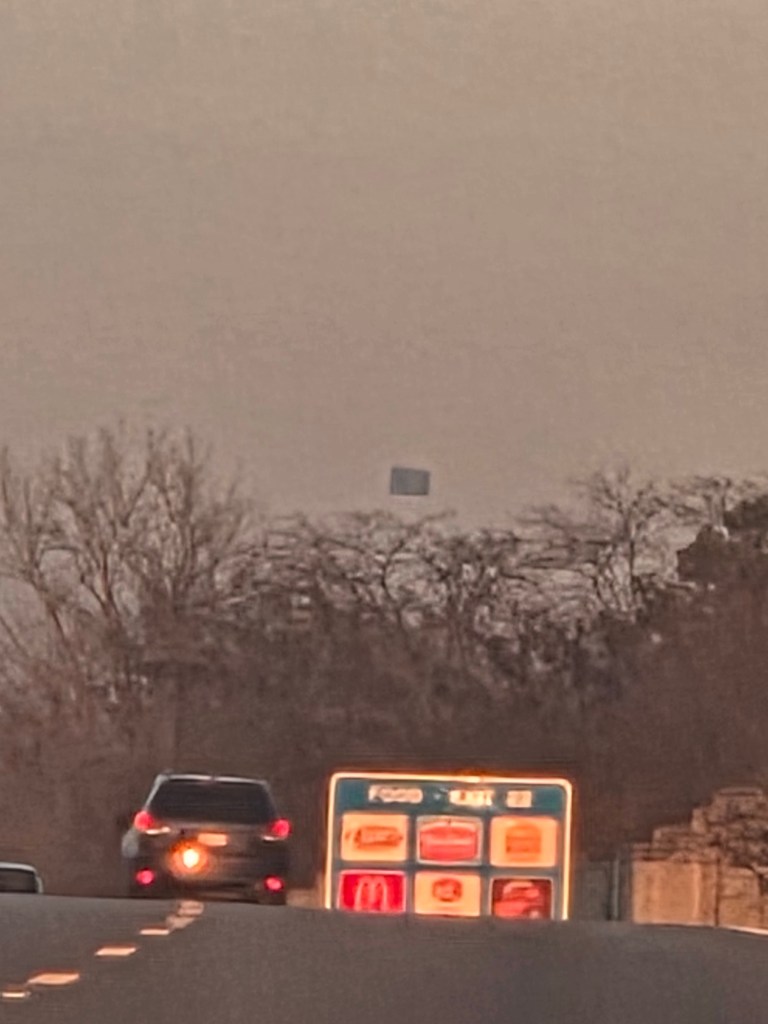
Dash cams make you honest in moments like that. One recorded the rectangle; a passenger kept describing it like a sign with no tether, and when the driver pulled up a tracking app, there was no aircraft to match the sightline or altitude. The account went into the National UFO Reporting Center—the place witnesses still go when something refuses easy categorization—as Report #194307, timestamped 5:02 PM local on November 22, 2025, with the witnesses noting “blue/gray,” “thinner than it was wide,” “not rising or descending,” and then the sudden “just vanished.” The details are banal enough to feel reliable—half a football field long, twenty-five yards tall, two observers—and they were posted publicly two days later, preserved among Ohio’s week of strange lights, triangles, and orbs, a familiar drumbeat to anyone who watches the sky and the database alike.³ ⁴

If you live between Cincinnati and Dayton, you learn two parallel languages for this kind of thing. One is the folklore of Wright-Patterson—the base up the road near Dayton, where Project Blue Book once lived. That’s the part of the Ohio myth that keeps a Blue Room and a Hangar 18 in the popular imagination, a Cold War apology of sorts, where pancakes analyzed as “terrestrial origin” and brake drums mistaken for meteors share archival space with seven hundred reports that stubbornly remain “unidentified.” The Air Force ended Blue Book in 1969, insisting they had found no threat and no proof of vehicles beyond current scientific knowledge, which is a bureaucratic way of saying: we saw a lot, we explained most, we couldn’t prove the rest. The legends survived anyway—Magruder’s alleged living alien, Goldwater denied access—and in every new sighting, the old echoes are never far.⁵ ⁶

The other language is more modern, even prosaic. Over the last few years, drone displays have taught us just how convincingly geometry can be painted onto the night. We’ve watched swarms draw logos and lattices, and we’ve seen how quickly human eyes—trained for jets and contrails—misread the choreography of coordinated LEDs. The Pentagon’s shift from “UFO” to “UAP” was meant to widen the frame and cool the fever, and some saner voices remind us that restricted airspace near bases and airports breeds both genuine hazards and exaggerated anxiety. In the more careful telling, many anomalies flatten into drones, balloons, or satellites—but not all of them, and the residue is where our curiosity lives.⁷ ⁸

So what do we do with a rectangle the size of half a football field, floating at a fixed altitude over one of Ohio’s densest corridors, unconnected to any tow, present for ten minutes, then gone? The instinct is to sort it into bins. First, the explainable: balloons can look rectangular when they present edge-on and when the light is low; banners misperceived from certain angles can hide their tow behind line‑of‑sight obstacles; even a drone swarm can, briefly, make you see a plane of light where none exists. NUFORC itself asks reporters to eliminate common misidentifications—such as Starlink trains, planetary brightness, and lens artifacts—before they submit, precisely because the database works best when the obvious is stripped away.³ ⁹ ¹⁰

Second, the engineered: a test article or a proof‑of‑concept flown where human attention is not just likely but guaranteed. There’s a plausible logic to public‑reaction tests—dense traffic, a holiday week, a shape that defies aerodynamics because lift, in a world of new propulsion methods, may no longer require wings, and then an exit, instant and clean, like a cloak or a switch. This is the territory where speculation about “anti-gravity” migrates from sci-fi to serious skepticism. Physicists will tell you—with justification—that gravity control would require overturning or bridging gaps in general relativity and quantum theory in ways that leave fingerprints in supply chains, training pipelines, and infrastructure long before you ever see a box in the sky. No such fingerprints exist in the open literature. But classified programs do not publish literature, and aerospace history is full of moments where rumors covered for stealth experiments—the F-117 era taught us that shadows can be policy.¹¹ ¹² ⁵ ²

Third, the truly anomalous: objects that violate expectations in ways that not only resist quick explanation but survive careful review. Congress has held hearings; videos have appeared of spheres surviving missile strikes; arguments rage between those who see proof of something nonhuman and those who see adversarial drones or doctored footage. In this climate, a rectangle over West Chester is a datapoint, not a revelation—proof only that ordinary observers can still capture experiences that are both specific and strange.¹³ ¹⁴

I keep returning to the witnesses’ matter-of-fact tone. They thought it was a banner. They looked for the plane. They checked a tracker. They watched ten minutes of banality turn into a cut‑to‑black. When you read enough reports, you learn to distrust melodrama and treasure the grocery‑list clarity: location, angle, size, color, duration, exit. And you notice patterns. The Middletown area has had its share—green lights, rotating clusters, sudden movements—sometimes later suspected as hoaxes, sometimes left open, but always recorded against the backdrop of a region that knows its sky is watched, both by enthusiasts and by institutions.¹⁵ ¹⁶ ⁴

West Chester isn’t a small place; nearly 67,000 people live there, more when you count commuters stacked north and south along the highway. Two reported this event publicly. You might read that as stigma or inattention or simply as the mathematics of surprise—most eyes look down in traffic, and most minds file anomalies under “not my problem.” I read it as exactly the reaction a test designer would want, if a test designer were the cause: enough witnesses to produce a credible record, not enough to produce a panic; a durable description; a fleeting presence. But I also read it as the kind of event that keeps the UAP conversation grounded in observation rather than theology. It happened; it was seen; it was logged; it remains unexplained.¹ ³ ¹⁷ ¹⁸

What I think—what I can responsibly think—is that the West Chester rectangle belongs in the small pile of structured, time-bound events with physical witnesses and minimal narrative inflation. It is not a banner because it lacked a tow; it is not a blimp because it lacked the telltale volume and motion; it is not a satellite or planet because it was near‑horizon, large, and dynamic; it might be a balloon if we can imagine a rectangular skin presenting edge‑on; it might be a projection if we can imagine sufficient power and stability in twilight air; it might be a test article if we can imagine the operational risk tolerance for flying a box over a suburban corridor. None of those conditionals settles into certainty. That’s the point.³ ⁹ ¹¹ ⁷

If you ask whether I think little green men took a leisurely hover over Butler County, I don’t. I think human curiosity and human capability—military, commercial, or hobbyist—explain most of what we see, and that the remainder is the frontier where we measure our assumptions. Project Blue Book concluded with the triad that has aged well: no threat proven, no extraordinary technology proven, no extraterrestrial vehicles proven. That’s not a denial; it’s an honest boundary. The rectangle over West Chester sits at that boundary, crisp against a November sky, now a record in a database, now a short local video, now a story told between rush‑hour brake lights, the kind of thing that keeps us looking up because for ten minutes—and then no minutes—it was there.⁶ ³ ⁵

And somewhere north on I-75, past the malls and office parks, a place that once housed America’s best cataloguers of aerial oddities bears the weight of our speculations. The myths around its hangars probably say more about us than about anything kept behind a badge line. But they remind us that Ohio has always been a stage for this theater: everyday people, skyward glances, reports written after kids are fed and dishes done, patience in the face of ambiguity. If the rectangle turns out, in five or ten years, to have been a test of optics or propulsion, we’ll nod and add a footnote. If it remains a rectangle without a parent, we’ll add a different footnote: seen, recorded, unexplained. That’s enough to warrant a paragraph in the ever-growing chronicle of UAP over America’s heartland, but not enough to satisfy the urges of curiosity and the need to know what we need to know.⁵ ⁶ ³

When you start connecting the dots across Butler County, the story becomes harder to dismiss. The West Chester sighting in November 2025 wasn’t an isolated anomaly—it echoes an almost identical event seven or eight years earlier over Monroe. That earlier case, often referred to as the “Middletown UFO,” even has video evidence circulating on YouTube. Two sightings, separated by years but sharing the same geometry and behavior, suggest a pattern rather than coincidence.

The Monroe incident carried an extra layer of irony for me. Just days before, I had recorded commentary criticizing the CIA, arguing that an unaccountable government agency posed a greater threat to society than any hypothetical alien landing at the old Lesourdsville Lake amusement park. Then, as if on cue, a highly defined UFO appeared in the sky over Monroe—right above the road, visible to anyone passing through. Was it occult synchronicity, a manifestation triggered by calling it out? Or was it a projection, seeded into the narrative to reinforce assumptions and steer public perception? Either explanation underscores a truth: the skies are not always what they seem, and the mechanisms behind what we witness may be far more psychological and technological than extraterrestrial.

In the case of West Chester, my view remains pragmatic. If you were an engineer testing cloaking or anti-gravity technology, you’d want real-world conditions—dense holiday traffic, a populated corridor, and proximity to a major Air Force base. You’d want to measure public reaction without announcing the test. And judging by the sparse reporting—two witnesses out of thousands—the experiment likely achieved its goal. That ratio is common in paranormal phenomena: many see, few speak. Stigma silences disclosure, and silence is the perfect cloak for those who prefer their work to remain invisible. In a society that should demand transparency, these events remind us how easily concealment thrives in plain sight.

—

Footnotes

1. NUFORC – West Chester Report #194307, details on date, shape, duration, and description (posted Nov. 24, 2025).

2. NUFORC – Ohio Index, showing the West Chester entry and contemporaneous Ohio reports on 11/22/2025. 1

3. NUFORC Databank (About/Indexes/Disclaimers) explains grading, common misidentifications, and posting practice. 2

4. YouTube: “UFO over West Chester, Ohio” (local upload summarizing the event and public interest). 3

5. HISTORY.com – “Does Hangar 18, Legendary Alien Warehouse, Exist?”, Wright‑Patterson lore, Roswell connections. 4

6. U.S. Air Force Fact Sheet – Project Blue Book (conclusions; 12,618 reports, 701 unidentified). 5

7. Scientific American – “The U.S. Drone Panic Mirrors UFO Overreactions,” context on drone/UAP misreads near restricted airspace. 6

8. Florida Today Op‑Ed – UAP video debate (sphere struck by Hellfire; interpretations vary). 7

9. NUFORC – “File a Report” guidance, checklist to avoid common misidentifications (Starlink, planets, lens artifacts). 8

10. NUFORC Homepage (Recent Highlights), public transparency, and investigation notes. 9

11. Freethink – “The search for anti-gravity propulsion,” survey of claims and physics constraints. 10

12. Flying Penguin analysis – “Gravitic Drones…”, skepticism about gravity‑control claims and the absence of supporting infrastructure. 11

13. USA Today – “UFO hearing video shows Hellfire missile fired at mysterious orb,” congressional UAP context. 12

14. Enigma Labs – Ohio sightings dashboard, trends, and regional density (Cincinnati/Dayton corridor). 13

15. WCPO – “Strange lights captured… appear to be a hoax” (Middletown, June 2023), local precedent and cautionary notes. 14

16. Knewz – “UFO in Ohio? Several Residents Report Seeing Strange Green Lights”, summary of the Middletown event and official reactions. 15

17. West Chester population profiles (CityPopulation/WorldPopulationReview), confirming township scale and density. 1617

18. UFO Index – Ohio (latest reports incl. Middletown references), shows regional cadence of events.

—

Bibliography

• National UFO Reporting Center (NUFORC). “Sighting Report #194307 – West Chester, OH.” https://nuforc.org/sighting/?id=194307; “Reports for State OH.” https://nuforc.org/subndx/?id=lOH; “Databank.” https://nuforc.org/databank/; “File a Report.” https://nuforc.org/report-a-ufo/

• HISTORY.com. “Does Hangar 18, Legendary Alien Warehouse, Exist?” (updated June 30, 2025). https://www.history.com/articles/hangar-18-ufos-aliens-wright-patterson

• U.S. Air Force. “Unidentified Flying Objects and Air Force Project Blue Book – Fact Sheet.” https://www.af.mil/About-Us/Fact-Sheets/Display/Article/104590/unidentified-flying-objects-and-air-force-project-blue-book/

• Scientific American. “The U.S. Drone Panic Mirrors UFO Overreactions.” https://www.scientificamerican.com/article/the-u-s-drone-panic-mirrors-ufo-overreactions/

• USA Today. “UFO hearing video shows Hellfire missile fired at mysterious orb.” https://www.usatoday.com/story/news/nation/2025/09/10/ufo-hearing-video-hellfire-missile/86073340007/

• Florida Today. “UAP video: Alien tech, drone test or military cover-up?” https://www.floridatoday.com/story/opinion/2025/09/14/uap-video-alien-tech-drone-test-or-military-cover-up/86076327007/

• Freethink. “The search for anti-gravity propulsion.” https://www.freethink.com/space/anti-gravity-propulsion

• FlyingPenguin. “Gravitic Drones From China: Classic Counterintelligence Pattern…” https://www.flyingpenguin.com/?p=64204

• WCPO‑TV. “Strange lights… appear to be a hoax” (Middletown, June 2023). https://www.wcpo.com/news/local-news/butler-county/middletown/ufo-sighting-in-middletown-strange-lights-captured-on-video-late-wednesday-night

• Knewz. “UFO in Ohio? Several Residents Report Seeing Strange Green Lights in the Night Sky.” https://knewz.com/ohio-residents-report-seeing-ufo-night-sky/

• CityPopulation.de / WorldPopulationReview. West Chester Township profiles. https://www.citypopulation.de/en/usa/ohio/admin/butler/3901783150__west_chester/ ; https://worldpopulationreview.com/us-cities/ohio/west-chester-township

• UFO Index. “Ohio UFO Reports.” https://www.ufoindex.com/ohio

• YouTube. “UFO over West Chester, Ohio.” https://www.youtube.com/watch?v=PG0Nv8NVfzI

Rich Hoffman
Click Here to Protect Yourself with Second Call Defense https://www.secondcalldefense.org/?affiliate=20707
Marijuana Use at the High Place of Tel Arad, Israel: The problem with legalizing communication with inter-dimensional entities

I promised more context for why I hate the legalization of marijuana so much, and in the case of mass society, intoxicants.  It’s not enough to say that drugs should be illegal; people need to understand why.  And for me, it’s a battle of consciousness and who controls your thoughts.  How can people, for instance, fight for small government and the benefits of an intelligent republic, but then surrender all thought through intoxication over to other forces that invade your personal sovereignty, and the most important at that, our minds and the thoughts that those minds produce?  When smoke filled the air of an inner sanctum, it was never accidental. It was engineered. In the eighth century BCE, at the Judahite fortress shrine of Tel Arad, roughly thirty-five miles south of Jerusalem, two limestone altars stood before the threshold of the “holy of holies.” Laboratory analysis of the charred residue on those altars has now told us plainly what ancient worshipers were inhaling: on one, frankincense blended with animal fat to volatilize its perfume at higher temperatures; on the other, cannabis mixed with animal dung to slow‑burn at lower temperatures, releasing a psychoactive aerosol sufficient to induce altered states. The compounds identified—THC, CBD, CBN, terpenes, and terpenoids—leave no doubt that the cannabis inflorescences were burned not for fragrance but for ecstasy.¹ ² ³ ⁴ 1234

That is the kind of hard, physical evidence that strips away modern euphemisms. At Tel Arad, cannabis was a ritual technology. It was the apparatus by which priests or officiants crossed the threshold from sober perception to trance, much as frankincense, sourced via Arabian trade routes, made the sanctum smell like heaven even as cannabis smoke tuned human minds to hear it.¹ ³ ⁵ 135 The shrine’s use window, ca. 760–715 BCE, places it squarely in Judah’s political and religious turbulence, between the First Temple’s glory and the Assyrian pressure, when competing cults and high places dotted the land. The Arad altars stood not in a marginal folk‑site but in a fortress on the southern frontier—a liminal place in geography and consciousness.² ⁵ 25

The broader archaeology of Canaan corroborates that mind-altering substances were embedded in ritual. In the Late Bronze Age cemetery at Tel Yehud, archaeologists recovered imported Base‑Ring jugs shaped like poppy heads whose residues test positive for opium—likely associated with funerary rites and the cult of the dead, whether to raise spirits or ease the passage.⁶ 6 Across the Near East, ecstasy was not a fringe practice; it was a cultivated technique. Tel Arad’s twin altars memorialize that technique at the threshold of the inner sanctum, where incense regulated the smell and cannabis regulated the state of mind.¹ ³ 14

From that ancient record, one conclusion emerges that remains relevant today: cannabis was used to override sober cognition in a sacred framework. It did not sharpen judgment; it sought communion—voices, visions, feedback from a realm beyond ordinary waking life. Whether you interpret those experiences as genuine encounters with non-human intelligences or as products of hyper-stimulated neural circuitry, the public‑policy implication is the same. Normalizing marijuana enshrines altered consciousness as a cultural good. The more potent the product and the wider the adoption, the more a society tunes its public square toward ritualized disinhibition.

You can see the continuity of this logic in India’s long bhang tradition. Bhang, a paste made from cannabis leaves, has been woven into festivals like Holi and Maha Shivaratri for centuries, with references in Vedic literature and Ayurvedic lore and with colonial observers documenting its ubiquity.⁷ ⁸ ⁹ ¹⁰ 78910 Contemporary estimates run in the millions of annual consumers around major festivals, placing cannabis within a sacred calendar rather than on the margins of culture.⁸ 8 In visual culture, the art that issues from such states is strikingly consistent across continents: charged neon geometrics, entity‑forms, fractal mandalas—repertoire that echoes shamanic cosmologies from Siberia to Amazonia and now saturates modern psychedelic aesthetics. The continuity of motifs suggests a continuity of effect: the same kinds of altered states produce the same types of visions.

But where ancient priests burned cannabis to induce ecstasy within a small, controlled ritual community, modern legalization scales that effect to whole populations. That is where archeology’s lesson collides with public health. If cannabis is a portal, the portal’s throughput matters. Epidemiology repeatedly associates heavier or earlier cannabis use with increased risk of psychotic outcomes, observing dose‑response effects: meta‑analysis finds the heaviest users have odds ratios near 3.9 for schizophrenia or related psychoses compared with non‑users.¹¹ 11 A 2025 synthesis applying Hill’s criteria argues there is a high likelihood cannabis contributes to schizophrenia development overall, with a pooled OR ≈ 2.88 and roughly two‑fold greater risk for adolescent users.¹⁴ 12 More granular clinical work shows that in diagnosed schizophrenia, cannabis use is tied to increased positive symptoms (hallucinations, delusions) and higher excitement, even as negative symptom patterns can vary; no causality is claimed, but the association is robust.¹³ 13 And among people with schizophrenia, cannabis use is significantly associated with some suicide‑related outcomes, including elevated odds of attempted suicide and increased hazards for suicide death.¹⁵ 14

Jurisdiction-level studies add a societal lens. After U.S. recreational legalization (2009–2019), modeling shows +5.8% injury crash rates and +4.1% fatal crash rates in the aggregate, controlling for factors like unemployment, speed limits, seat‑belt use, rural miles, and alcohol trends—effects vary by state, but the direction is worrisome.¹⁶ ¹⁷ 1516 Systematic reviews converge on negative road‑safety impacts in most studies, and national surveys now find 4–6% of drivers self‑report driving within an hour of cannabis use, with risk perceptions conspicuously more lenient than for alcohol.¹⁸ ¹⁹ 1718 None of this proves that every consumer will suffer harm; it demonstrates that scaled access increases measurable externalities—most acutely among young men, high‑potency users, and those who combine cannabis with alcohol.¹² ¹⁸ 1917

So why invoke Tel Arad in a twenty-first-century legalization debate? Because it reveals what cannabis was for in a culture that canonized sacred space: it was for ecstasy, for crossing boundaries, for letting something else participate in one’s thinking. If you grant the metaphysical possibility that those “somethings” are genuine non-human intelligences, then mass legalization looks like opening a wide conduit into a population’s decision-making machinery. If you deny that and call the entities neural artifacts, the conclusion hardly changes: repeated entry into states that mimic external agency undermines habituated sovereignty and clarity—what a civilization requires for law, craft, and self-government.

There is also a moral claim at stake. Cultures thrive on lucidity—on earned competence and honest accountability. We do not need to romanticize intoxication because it looks antiquarian. Tel Arad was not quaint. It was precise. One altar perfumed the sanctum; the other hijacked cognition. Judah’s priests were innovating in ritual engineering, not engaging in harmless herbalism. The residue composition—the dung matrix, the cannabinoid profile, the deliberate temperature control—shows purposeful design to modulate consciousness.¹ ² ³ 123 That is the legacy modern marijuana culture inherits: techniques to create porosity. Legalization, commercialization, and age-neutral marketing scale porosity to a level ancient officiants never imagined, and the data on psychosis and road safety tell us the cost.

For these reasons, I reject marijuana as a cultural good. The Tel Arad shrine is a fossilized warning: cannabis has been a conduit into ecstasy in high places for a very long time, and cultures that survive do not hand their sovereignty to smoke. The way forward is not to sacralize intoxication, but to honor clarity—frankincense is fragrant; cannabis is psychoactive. The former perfumes a room; the latter reprograms it. Tel Arad did both. We should do neither.

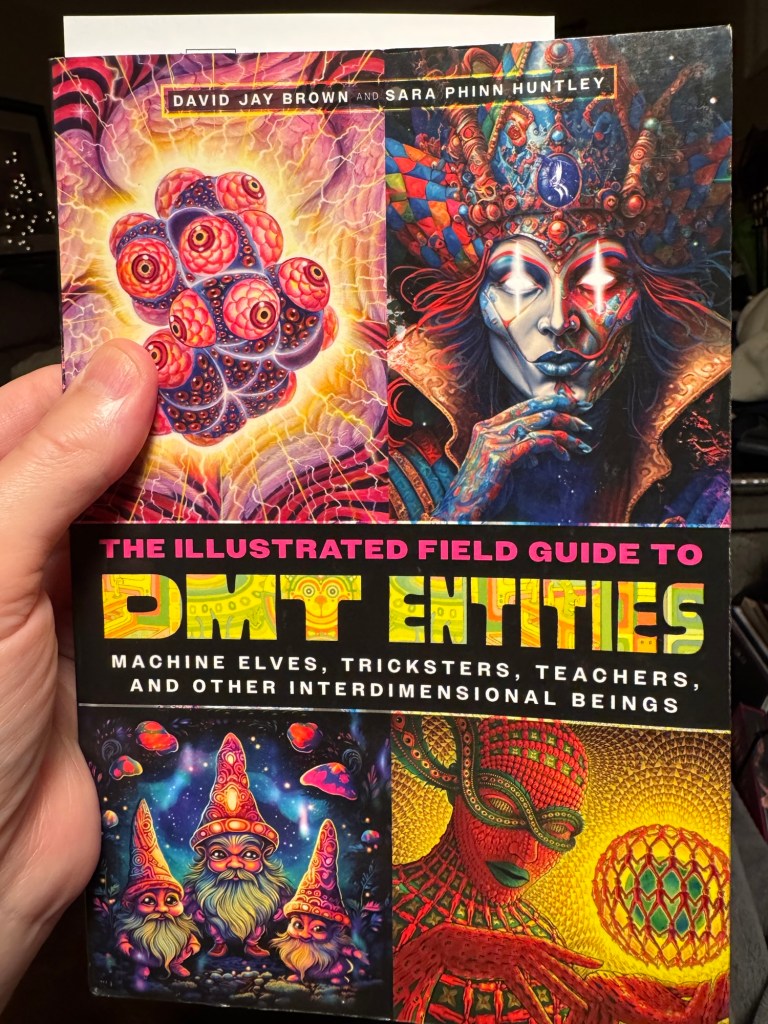
David Jay Brown and Sara Phinn Huntley’s The Illustrated Field Guide to DMT Entities: Machine Elves, Tricksters, Teachers, and Other Interdimensional Beings (2025) brings this conversation into sharp modern focus. Structured like a naturalist’s handbook for hyperspace, the book catalogs 25 distinct entity types encountered in DMT and ayahuasca experiences—from self-transforming machine elves and mantis insectoids to reptilians, gray aliens, fairies, nature spirits, and divine forms like Grandmother Ayahuasca and the Virgin Mary. Each chapter includes encounter narratives from trip reports and scientific studies, rich descriptions of behavior, appearance, and the messages or teachings they impart, accompanied by visionary artwork from artists such as Alex Grey and Sara Phinn Huntley herself 12. The field guide poses a profound question: Are these beings mere constructs of the human psyche, or are they independent intelligences inhabiting other dimensions? That question lies at the heart of every cross-cultural psychedelic tradition, from Tel Arad’s cannabis altars to global shamanic rites.

The guide has not only attracted readers interested in visionary art or entheogens but has also gained credibility through endorsements from figures like Graham Hancock and through guest appearances by Brown and Huntley on platforms like the “Rebel Spirit Radio” podcast 3. Meanwhile, mainstream voices like Joe Rogan regularly revisit “DMT astronauts”—individuals who deliberately seek these entities for spiritual insight or practical guidance—and discuss whether contemporary governments and institutions might align with such interdimensional “high priests” to influence mass consciousness 45. This book is a frontier consideration into a new science of analysis and reinforces the core argument: humanity’s engagement with psychoactive smoke—from ancient altars to modern DMT breakthroughs—is not benign. It is a politics of consciousness intervention, where the line between personal sovereignty and external mental imposition is perilously blurred.  And it’s very dangerous, and should under no rational endeavor, should ever be legalized in a serious society.

Footnotes

1. Arie, Rosen, Namdar (2020), GC‑MS identification of THC/CBD/CBN; animal dung/fat matrices; dating and functional interpretation. 1

2. Science News coverage of the shrine context, the cannabis–dung mixture, and THC levels consistent with altered states. 2

3. Taylor & Francis newsroom summary highlighting frankincense chemistry (boswellic acids) and deliberate psychoactive use of cannabis. 3

4. Times of Israel report: cannabis “to stimulate ecstasy” and implications for Temple ritual analogs. 4

5. Sci. News overview of shrine chronology, fortress border function, and compositional findings. 5

6. Biblical Archaeology Society: Tel Yehud opium residues in Base‑Ring jugs; cult‑of‑the‑dead context. 6

7. Wikipedia (summary with sources) on bhang as an edible cannabis preparation and festival use. 7

8. Firstpost explainer on Holi and bhang’s historical embedding; contemporary practice estimates. 8

9. IndiaTimes feature with Vedic/Ayurvedic references and colonial documentation of bhang. 9

10. SAGE review on the historical context and research state of cannabis use in India. 10

11. Marconi et al. (2016) meta-analysis: dose‑response; OR≈3.9 for heaviest use vs. non-use. 11

12. JAMA Network Open invited commentary (2025) summarizing evidence and Ontario cohort demographics; rising PARF after medical legalization. 19

13. eClinicalMedicine IPD meta-analysis (2023) associating cannabis use with higher positive and excitement dimensions in schizophrenia. 13

14. Biomolecules (2025) systematic review applying Hill’s criteria; overall OR≈2.88; doubled adolescent risk. 12

15. Psychological Medicine (2025) meta-analysis: cannabis use in schizophrenia linked to attempted suicide and suicide death hazards. 14

16. Journal of Studies on Alcohol and Drugs (2022): legalization associated with +5.8% injury crashes and +4.1% fatal crashes in aggregate. 15

17. IIHS bibliography summary of the same study’s methodology and state heterogeneity. 16

18. MDPI systematic review (2023) concluding negative impacts of legalization on road safety in most studies; risk profiles. 17

19. AAA Foundation (2024) fact sheet on DUI‑C prevalence (~4–6%), risk perceptions, and sex differences. 18

—

Bibliography

Arie, E.; Rosen, B.; Namdar, D. (2020). Cannabis and Frankincense at the Judahite Shrine of Arad. Tel Aviv, 47(1), 5–28. 1

Bower, B. (2020). An Israeli shrine may have hosted the first ritual use of marijuana. Science News. 2

Farmer, C. M.; Monfort, S. S.; Woods, A. N. (2022). Changes in Traffic Crash Rates After Legalization of Marijuana. Journal of Studies on Alcohol and Drugs, 83, 494–501. 15

Marconi, A., et al. (2016). Meta-analysis of the Association Between the Level of Cannabis Use and Risk of Psychosis. Schizophrenia Bulletin, 42(5), 1262–1269. 11

Argote, M., et al. (2023). Association between cannabis use and symptom dimensions in schizophrenia spectrum disorders. eClinicalMedicine, 64, 102199. 13

Pourebrahim, S., et al. (2025). Does Cannabis Use Contribute to Schizophrenia? Biomolecules, 15, 368. 12

Mulligan, L. D., et al. (2025). Cannabis use and suicide in schizophrenia. Psychological Medicine, 55, e79. 14

González Sala, F., et al. (2023). Effects of Cannabis Legalization on Road Safety: A Literature Review. IJERPH, 20(5), 4655. 17

AAA Foundation for Traffic Safety (2024). Cannabis Use, Public Health, and Traffic Safety (Fact Sheet). 18

Biblical Archaeology Society (2022). Narcotics used in Canaanite Cult: Opium in Late Bronze Age Graves. 6

Firstpost (2025). The Big ‘Bhang Theory’: Why Indians drink bhang on Holi. 8

IndiaTimes (2023). On Holi, a look at the tradition of using bhang and its legality. 9


Rich Hoffman

Click Here to Protect Yourself with Second Call Defense https://www.secondcalldefense.org/?affiliate=20707
‘Disclosure Day’: Turning existential wonder into administrative leverage

What’s about to happen with Steven Spielberg’s Disclosure Day isn’t just another studio rollout with a cryptic Times Square billboard and a two-minute teaser—though we did get exactly that, complete with the line “All will be disclosed,” and a June 12, 2026 date tag splashed across NYC and LA ahead of Christmas week. It’s the once‑every‑generation moment when a master filmmaker steeped in UFO lore, biblical symbolism, and national mythology decides to shove the cultural conversation forward—and does it at a time when governments, newsrooms, and intelligence bureaucracies are finally admitting that “there is footage and records of objects in the skies that we don’t know exactly what they are.” 123

Spielberg’s teaser landed December 16, 2025: a brisk montage of unsettling phenomena, a TV meteorologist (Emily Blunt) breaking down on live air as her voice devolves into clicks, crop circles forming in real time, and a whistleblower (Josh O’Connor) promising “full disclosure… to the whole world… all at once.” Universal confirmed the title, Disclosure Day, along with the ensemble (Blunt, O’Connor, Colin Firth, Colman Domingo, Eve Hewson, Wyatt Russell) and the logline: “If you found out we weren’t alone… would that frighten you? This summer, the truth belongs to seven billion people.” David Koepp—Spielberg’s long-time screenwriter on Jurassic Park, The Lost World, War of the Worlds, and Kingdom of the Crystal Skull—returns to script from the director’s original story, with a release set for June 12, 2026. John Williams is scoring. A billboard campaign seeded curiosity days earlier, then the first trailer attached to Avatar: Fire and Ash screenings sealed the hype. 4567

The trailer’s grammar is familiar to anyone who’s lived inside Spielberg’s extraterrestrial trilogy—Close Encounters, E.T., and War of the Worlds—but this time the tone leans somber, even unnerving. You see none of the aliens; you feel their pressure on the edges of ordinary life. A nun stares at a mind-melding rig, animals behave strangely, and a murmuring chorus asks an ancient question: “Why would God make such a vast universe, yet save it only for us?” It is science‑fiction by way of catechism: mystery first, optics later. The teaser dropped in front of a public already primed by years of official disclosures and denials, a news cycle that swings between ODNI reports and Navy cockpit videos, and a new nomenclature (UAP) designed to strip away decades of “little green men” baggage. Spielberg, who has long said he doesn’t believe we’re alone, didn’t invent this moment; he’s channeling it. 68

The studio press materials are sparse by design, but they do confirm the core: a global reveal of proof, a media-driven human response, and a cast positioned at the edge where faith, science, and politics collide. People magazine’s write-up underscores that this is Spielberg’s first feature since The Fabelmans and his return to UFO storytelling; ABC’s GMA packaging shows Blunt possessed mid-broadcast; Deadline’s industry note pins the date and positions the film as the summer’s existential event. That triangulation—trade outlet confirmation, mainstream broadcast amplification, and fandom analysis threads—is not just PR; it’s an index of appetite. Audiences want a serious, sober take on disclosure that neither laughs it off nor turns it into a carnival. Spielberg’s reputation lets him ask the question without collapsing beneath it. 9105

If you care about the politics under the hood, the timing is obvious. Since late 2017, when The New York Times broke the Pentagon videos and the existence of AATIP, we’ve had the UAP Task Force (approved August 2020), the ODNI Preliminary Assessment (June 25, 2021), and Congress’s 2022 NDAA creating AARO—the All‑Domain Anomaly Resolution Office—to centralize reporting, analysis, and public transparency. AARO’s first historical volume landed in February 2024, mapping U.S. government involvement since 1945 from Project SIGN to BLUE BOOK to CIA panels, and its public posture has been to release as much raw evidence as possible without harming partner equities. That’s not Hollywood; that’s bureaucracy. But bureaucracy has set the table. A movie like Disclosure Day rides the wave of official acronyms that admit the problem, even as it insists that most cases fit prosaic profiles (balloons, drones, birds). The serious work of weeding out errors and hoaxes did not kill the subject; it made “we don’t know” socially respectable again. 11121314

The CIA files are another background hum. Far from confirming crash retrievals, the agency’s publicly accessible “UFOs: Fact or Fiction?” collection compiles cables, memos, and summary press clippings from the 1940s through the early 1990s—an archive of seriousness, not sensationalism. The Black Vault digitizations and Smithsonian coverage in 2021 made those documents easier to browse and fueled a sense that, while much is mundane, some fraction remains unexplained due to data gaps. Add the National Archives’ UAP Records Collection created in 2024 NDAA, and government-kept paper trails are no longer a subculture hobby; they are an official research topic. When a storyteller with Spielberg’s credibility references “disclosure,” he isn’t inventing a bureaucracy. He is meeting it. 151617

Then there’s the other engine of disclosure: the perennially curious political operative, John Podesta. From his 2011 foreword to Leslie Kean’s book to tweeting in 2015 that his biggest White House failure was not securing UFO disclosure, Podesta has been the Beltway’s most persistent, mainstream voice for transparency. The Wikileaks dump of his emails in 2016 crystallized that curiosity with exchanges involving Apollo 14 astronaut Edgar Mitchell (who referenced “nonviolent ETI from the contiguous universe,” however eccentric that reads) and Tom DeLonge’s outreach framing UAP as a national security priority; Mother Jones later documented how Podesta nudged campaign messaging toward tongue‑in‑cheek “the truth is out there” lines. The Obama Presidential Library has FOIA material showing internal attention to Podesta’s public remarks about UAPs. Whatever you think of the personalities and their metaphysics, it’s undeniable that “disclosure” stopped being fringe and stepped into official statements years ago. The Clintons flirted with promises; Democrats like Podesta kept the word alive; and the media stopped rolling its eyes. That’s the ecology in which a Spielberg film lands. 18192021

On television, Barack Obama’s May 2021 appearance with James Corden registered as a cultural permission slip: “There is footage and records… we don’t know exactly what they are,” he said, adding that we can’t explain their trajectories and that serious people are investigating. Again, no crash retrievals, no bodies; just dignified uncertainty framed as worth study. That single clip circulated across NBC, CNN, and the Independent with the same headline and sentence, making it resistant to partisan spin. It’s impossible to overstate how statements like this alter the audience for a film like Disclosure Day. You no longer need to sell the premise that a government might know things and might release them. You need to tell the human story of what it feels like when that knowledge crosses the threshold of proof. 32223

This is why I argued for months that the Disclosure Day campaign would not be merely cinematic. The teaser’s choices—biblical language, moral stakes, a chorus of “people have a right to know the truth… it belongs to seven billion people”—give you a tell. Spielberg is staging the post-disclosure psychology: trust breakdowns, religious reinterpretations, the questionable allure of a technocratic “we’ll manage it for you” state, and the tempting promise that a new cosmic threat will unify otherwise warring factions. That promise, by the way, is precisely the sort of political device elites would wield in a crisis: when ordinary collectivist appeals fail, fear works. The left in America—from John Podesta’s transparency drumbeat to West Coast cultural power—understands the unifying leverage of a “we are not alone” narrative. Positioning Democrats as the “party of disclosure,” through Hollywood’s megaphone, is as plausible as it is cynical, precisely because the public appetite for answers is now bipartisan. Skeptics and believers alike want competence. Whether Disclosure Day’s marketing was hatched over party cocktails is less important than the fact that the messaging aligns: all will be disclosed, the government has a role, and trust us—this time. 6

A Trump administration brings a different set of instincts to the table. He has publicly styled himself a UFO skeptic—“It’s never been my thing,” he told Joe Rogan in October 2024—but his Pentagon rode the arc of UAP openness: UAPTF, ODNI assessments, and the founding of AARO came out of a bipartisan legislative environment and continued under his second term’s defense establishment. ABC’s June 2025 segment with AARO’s director described hundreds of cases reviewed, most resolved, “several dozen” still anomalous, and an explicit effort to release more raw videos after automated redaction. You don’t need a sci-fi president for disclosure to advance; you need a bureaucracy with political air cover and a media willing to treat UAP like air safety and national security. That is present. If Trump wants to preempt a Hollywood-driven “party of disclosure” narrative, he can do it by ordering wider releases, allowing fuller congressional briefings, and framing disclosure as competence, not mysticism. The danger is letting the reveal be defined by fandom and fear; the opportunity is to take ownership as the administration that finished the job begun by ODNI and NDAA. 14

What happens after people realize what disclosure means? I’ve been writing The Politics of Heaven to answer that: to guide the post-disclosure world in a way that protects faith, families, and local governance while absorbing the shock of metaphysical and material claims. Whether you believe in ultra-terrestrials, interdimensional entities, or straightforward extraterrestrials, the questions that follow are the same: What is consciousness, and how does it persist beyond bodies? How do these intelligences intersect with biblical prohibitions, demonic lore, reincarnation motifs, and avatar theories? Who should arbitrate contracts—governments, churches, scientists, or communities? And when trust in institutions is already brittle, how do you stop a frightened public from begging Leviathan to manage their fear? That last question is the political acid test; you will see the left bid to occupy the role of compassionate intermediary. You will also see conservatives argue for decentralization and personal responsibility in the face of cosmic news. Neither side is ready for the metaphysical repositioning disclosure demands. A movie can start the dialogue; a book needs to map the terrain. 6

Some insist Spielberg’s film is simply entertainment, not a node in the broader campaign. I don’t buy that. The speed with which the project moved—kept under wraps, then billboards, then a title and trailer in mid-December, releasing the teaser in front of Cameron’s new Avatar—shows a marketing intelligence calibrated for maximum cultural reach. Hollywood trades (Deadline, Hollywood Reporter, IGN) treat the teaser as a significant event; mainstream outlets (USA Today, ABC, People) amplify with a civic tone rather than tabloid noise. Even the genre press (Polygon, Space.com, GoldDerby) notes the film’s “not like E.T.” mood. None of this is accidental. It sets June 12 as a summer opening thought experiment and primes your mind to connect the dots between the content and the headlines. 5642

Will Disclosure Day be statistically consequential? Not the film itself, obviously, but the ecosystem it feeds is full of numbers worth tracking. ODNI’s 2021 preliminary assessment summarized 144 incidents, with the majority lacking sufficient data—a sober reminder that proof is hard to obtain. AARO’s public briefings and annual reports count hundreds of new submissions, with most resolved. If, ahead of June 12, DOD authorizes another tranche of imagery with automated redactions, the viewership and downstream social metrics—shares, searches, FOIA requests—will spike. Smithsonian tracked thousands of downloads within 24 hours when the Black Vault made CIA UFO documents searchable; VICE documented how hard it was to make those files usable. “Disclosure” is not one event; it is a flow of documents, videos, and structured briefings that accumulate like sediment. Spielberg’s film is a catalytic object in that flow. 122416

Cynics will argue that Hollywood elites are exploiting grief and curiosity. The Rob Reiner tragedy—the director and his wife stabbed to death, their son arrested, with reports that they were headed to an engagement with Barack Obama the same night—has nothing to do with disclosure, yet it illustrates how quickly elite social circles blur into political networks and media narratives. When people claim “this plan was hatched at parties,” they’re not entirely wrong about cultural clustering; they’re bad to infer an omnipotent conspiracy behind every rollout. Information travels through overlapping circles, and films like Disclosure Day live in those circles. The politics is real; the paranoia needn’t be. 2526

If you’re looking for the “interdimensional hypothesis” within Spielberg’s cinematic tradition, Jacques Vallée’s work is the obvious touchstone: UFOs as manifestations at the seams of reality, trickster-like phenomena that feel spiritual as much as technological. Disclosure Day’s teaser seems to flirt with that—not by name, but by making the human body the first receiver. A weather forecast becomes glossolalia; a nun becomes an antenna. It doesn’t matter whether the story lands on ET or ultra‑T; what matters is that the film recognizes that the primary battlefield is consciousness, not hardware. In that sense, Spielberg’s new movie may be his boldest: less “spaceship lands” and more “the mind cracks.” 6

So how should a president handle disclosure in the shadow of Spielberg? Don’t surrender the frame. If it’s Trump, publish what AARO can safely release, demonstrate chain‑of‑custody, and invite independent scientific review, not just classified briefings. Anchor the message in air safety, national security, and scientific humility. Avoid promising a “blue wave of unity” around fear; call for calm competence. And for the rest of us—families, pastors, scientists, local officials—prepare the language for what faith traditions already admit: there are powers and principalities beyond our ken, and discernment is a discipline, not a tweet. The task is not to panic or to hand your agency to distant institutions; it is to keep your soul intact while you learn new facts about the cosmos. Spielberg’s teaser asks the right question: Would proof frighten you? It will. But fear need not decide your politics or your religion. The truth belongs to seven billion people because freedom inspires it. 5

What I expect next: more billboards, a second trailer around Easter, almost certainly tie-ins that echo Arrival’s semiotic puzzles and Signs’ domestic dread—though the production notes suggest Spielberg is avoiding clones of those films and choosing a wider, global lens. Expect chatter about whether Disclosure Day lives in the Close Encounters universe; Koepp refused to confirm or deny. Expect breathless “is this real disclosure?” threads online and new FOIA campaigns piggybacking on the film’s marketing. Expect claims that Democrats will harness the momentum for the 2026 midterms, and counterclaims from the right that they’re weaponizing wonder for votes. Most of all, expect the usual: elites overpromising unity while ordinary people look for ways to protect their families and livelihoods. In that sense, Disclosure Day is not just a movie; it is a rehearsal. 6

The day after the teaser, outlets like Polygon, Parade, Dexerto, and Cinemablend rolled out explainer pieces with production stills, cast bios, and historical callbacks to Spielberg’s UFO filmography. Yahoo’s Space vertical contextualized the director’s lifelong fascination with meteors and Firelight. GoldDerby and IndieWire talked up the billboards as a clever marketing stroke. IGN emphasized the theological line. The coverage reads like a consensus: Spielberg is back in the UFO seat, and this one is bigger and darker. It makes sense to be excited—and it makes even more sense to be prepared for what happens after the lights come up and the credits roll. The film will end; the conversation won’t. 72728298304

Because disclosure, whatever shape it takes, will force every institution to tell the truth about its own limits. Intelligence agencies will confess how much of the archive is press clippings and hearsay; AARO will say how many reports are balloons and birds. Churches will revisit glossolalia and demons with new humility. Universities will expand consciousness studies beyond an evolutionary footnote. And Hollywood—which conditioned us to believe in aliens—will confess that it cannot resolve what theologians and physicists must debate. If the truth belongs to seven billion people, then seven billion people must learn how to live with it. Spielberg can start the conversation; your community must finish it.  And here’s something to think about: there are 8.26 billion people in the world.  Why are they saying “seven”? Are there a billion of those life forms that are not actually human?  But are avatars from an interdimensional realm taking residence in a biological vehicle so that they can interact with the events of our time?  Likely, that’s the point of the trailer: to spawn that kind of massive discussion with ground-shattering implications.

And here’s the hard counsel nobody wants to give: do not let disclosure be your gateway drug to technocratic control. The instinct to panic and hand the reins to whoever promises a plan is the oldest political seduction in the book. The left will speak the language of compassion and unity; the right will talk about the language of sovereignty and order. Both will be tempted to use the unknown to centralize power. Resist the temptation. Disclose widely, validate rigorously, and keep authority as close to the citizen as possible. The truth is large enough to hold your fear without outsourcing your dignity. Spielberg’s teaser got one thing perfectly correct: the truth belongs to seven billion people. The question is whether seven billion people will remember that their consciousness has a power the universe wants, and that they control their own fate much more than they ever thought possible. 5

Executive Summary: The Politics of Heaven and the Post-Disclosure Era

Now, let’s talk about The Politics of Heaven and why now, and why I am putting so much into it.  The project was conceived before, and then written alongside, the production of Steven Spielberg’s Disclosure Day (teaser released December 16, 2025; U.S. theatrical set for June 12, 2026). It argues that (1) the public now lives in an environment of information abundance that is overturning religious, political, and scientific commonplaces; (2) a major cultural catalyst like Disclosure Day will force those assumptions into the open; and (3) the immediate need is a deep, rigorous, post‑disclosure framework—political, theological, and philosophical—beyond what a two‑hour film and follow‑on documentaries can provide. 12

The inflection point: information abundance and challenged assumptions.

Over the last decade, the combination of official UAP releases, FOIA archives, and mainstream acknowledgment has made “serious uncertainty” socially acceptable again. The CIA’s digitized UFO/UAP collections, the National Archives’ new UAP Records Collection (created by the 2024 NDAA), and ODNI/AARO reporting transformed curiosity into a public research agenda; that scaffolding existed before the Disclosure Day teaser, and it contextualizes it now. 34

• ODNI’s Preliminary Assessment (June 25, 2021) made pilot safety and national security the frame, not fringe;

• AARO (established by Congress in 2022) now issues historical reviews and annual updates that resolve most cases but leave several dozen anomalous, while investing in tools to release more raw evidence safely;

• Former President Barack Obama (May 18, 2021) explicitly affirmed that there is “footage and records of objects we don’t know exactly what they are.” 5678

From surface anthropology to deep comparative inquiry.

Classic comparative frameworks (e.g., James Frazer’s The Golden Bough and the early anthropology of religion) were built when information moved slowly, and travelers could “look at the surface and pick up artifacts.” A century of archaeology, psychology, and comparative religious study has since exposed layers those pioneers couldn’t observe, demanding more careful models of consciousness, symbol, and ritual. Today’s public can test those models instantly against real archives and sensor data; a global dialogue that once took lifetimes now unfolds in hours. 4

Consciousness, privacy, and the interdimensional debate.

The popularization of parallel‑worlds and entanglement-style ideas—sometimes via high-concept entertainment, sometimes via speculative science—has normalized conversations about nonlocal effects and mind–matter enigmas. Spielberg’s teaser leans into that terrain without naming it: the human body first, the revelation second. A possessed weather broadcast, mirrored actions, and religious imagery (“Why would He make such a vast universe…”) signal that the primary battlefield of disclosure is consciousness, not craft. That, in turn, reopens classical debates (angelic, demonic, ultra‑terrestrial) in a modern register. 92

Ideological frames that will compete to “own” disclosure.

• A left‑liberal/naturalist reading (which you argue Spielberg’s film may amplify) treats disclosure as an invitation to submit to nature’s deeper, animating order—often expressed in syncretic terms (Native cosmologies, Eastern metaphysics, ecological spirituality). The pitch: disclosure unifies, softens borders, and mandates communal management of anxiety. 2

• A conservative/sovereignty reading insists Genesis grants stewardship—“rule over nature” through ordered freedom—and worries that fear will be instrumentalized to expand central authority. The pitch: disclose widely, validate rigorously, do not trade agency for technocratic management.

• The state (irrespective of party) will tend to present itself as the trusted intermediary—a reflex strengthened by AARO’s mandate and ODNI’s safety language. The risk: turning existential wonder into administrative leverage. 56

Why The Politics of Heaven.

I started this book before Disclosure Day took shape because the collision I outline was inevitable: unprecedented access to information + mainstream validation + public mythologies = paradigm pressure. The book asks:

• What are the politics among non-human intelligences (altered terrestrials, angels/fallen angels, rebels against the Creator)?

• How do those politics interact with human sovereignty, law, worship, and culture?

• What happens when a society learns it is not alone, possibly not even alone in its locked bedrooms—and discovers that manipulation has been continuous across history?

• How do we protect families and faith while absorbing complex data about mind, matter, and presence?

The limits of cinema; the need for rigorous guidance.

A feature film can ignite the conversation; it cannot furnish the multi-level study (political theory, comparative religion, metaphysics, law, ethics, and security) that people will demand after the credits roll. Given the sudden spike in public legitimacy—from billboards announcing “All will be disclosed” to a trailer in front of Avatar—I anticipate a wave of documentaries and explainer shows. This book aims to be the serious handbook readers turn to when they realize the topic touches on Genesis and governance, not only on spectacle. 1011

—

Key Claims (with source pointers)

• Disclosure Day is confirmed as Spielberg’s UFO event film; title, cast, teaser, and June 12, 2026, release date are official. 12

• Mainstream outlets framed the teaser as a return to existential UFO themes, emphasizing the trailer’s religious, psychological, and global stakes. 1213

• Official U.S. channels (ODNI, AARO) shifted discourse by legitimizing UAPs as safety and security concerns; AARO continues a controlled transparency program. 56

• Archives (CIA FOIA; NARA’s UAP collection) broaden public access and keep post-disclosure inquiry tethered to documents, not rumor. 34

• Obama’s 2021 remarks normalized high-level acknowledgement: “footage and records” exist of objects whose behavior resists easy explanation. 8

—

What Readers Should Expect (and Why the Book Matters)

1. A surge of myth-making and fear-based politics.

Parties and media will compete to “frame” disclosure as either communal healing or controlled competence. Your guidance: disclose widely, decentralize interpretation, protect sovereignty. 5

2. Religious re‑reading under pressure.

Expect new homiletic and doctrinal work on angels/demons, possession, discernment, and cosmology. Provide guidance: restore biblical guardrails, engage comparative traditions seriously, and reject sentimental syncretism.

3. Law, security, and ethics.

Air safety, sensor policy, and data custodianship will dominate hearings; civil liberty questions (privacy, mind–machine interfaces, and conscience) will follow. Your guidance: keep civil protections strong, resist “emergency powers creep.”

4. Consciousness first, technology second.

The teaser’s grammar—and much of the historical record—suggest the human mind is the first theater. Your guidance: form communities of discernment, not fandoms of panic. 9

—

Footnotes & Selected Bibliography

Footnotes / Source list

1. “Disclosure Day trailer/title/release” — Deadline (Dec 16, 2025); Hollywood Reporter (Dec 16, 2025). 12

2. “Teaser themes, religious lines, cast highlights” — IGN (Dec 16, 2025); Polygon (Dec 16, 2025). 912

3. “Times Square billboards/placement” — GoldDerby (Dec 16, 2025); IndieWire/Yahoo (Dec 16, 2025). 1011

4. “ODNI Preliminary Assessment; UAPTF creation” — Wikipedia summary of ODNI report (citing ODNI, June 25, 2021); DoD release on UAPTF (Aug 14, 2020). 514

5. “AARO historical record & transparency posture” — AARO Historical Record Report Vol. 1 (Feb 2024); ABC News interview with AARO director (June 4, 2025). 67

6. “CIA FOIA ‘UFOs: Fact or Fiction?’; Black Vault / Smithsonian overview” — CIA Reading Room; Smithsonian (Jan 15, 2021). 153

7. “National Archives UAP Records Collection (RG 615)” — NARA topic page (Apr 24, 2025). 4

8. “Obama 2021 remarks on James Corden” — NBC News (May 18, 2021). 8

Selected bibliography (for your appendix)

• Office of the Director of National Intelligence. Preliminary Assessment: Unidentified Aerial Phenomena. June 25, 2021. 5

• Department of Defense (UAPTF Establishment). Release, Aug 14, 2020. 14

• All‑Domain Anomaly Resolution Office (AARO). Report on the Historical Record of U.S. Government Involvement with UAP, Vol. I. Feb 2024 (DOPSR‑cleared). 6

• CIA FOIA Reading Room. UFOs: Fact or Fiction? 1940s–1990s collection. 15

• National Archives. Records Related to UAPs (RG 615). 4

• Deadline; Hollywood Reporter; IGN; Polygon; GoldDerby; IndieWire/Yahoo—industry and mainstream coverage of Disclosure Day teaser and release. 129121011

—

Reference Notes & Sources

• Universal/industry coverage of Disclosure Day title, teaser, cast, and release (Dec. 16, 2025): People, ABC News / GMA, Deadline, Hollywood Reporter, IGN, USA Today, Polygon, Consequence, Dexerto, Cinemablend.

• Times Square billboards and teaser placement before Avatar: Fire and Ash: GoldDerby, Hollywood Reporter.

• Spielberg’s belief statements on extraterrestrial life/background features: Space.com / Yahoo syndication.

• U.S. UAPTF establishment, ODNI Preliminary Assessment (June 25, 2021), AARO creation and historical report (Feb. 2024), and AARO transparency posture: U.S. DoD release, Wikipedia summary of ODNI report, ABC News interview with AARO director, AARO Historical Record Vol. 1 PDF.

• CIA UFO archive and public access context: CIA FOIA Reading Room, Smithsonian overview, NARA UAP Records Collection page, VICE on Black Vault.

• John Podesta: Wikileaks searchable emails (UFO threads), Mother Jones feature on Podesta’s UFO advocacy, Obama Library FOIA finding aid, coverage of Edgar Mitchell and Tom DeLonge emails: Wikileaks search, Mother Jones, Obama Library FOIA 22‑18746‑F, Unknown Country summary, Wikipedia background on Podesta emails.

• Barack Obama public comments on UAPs (May 2021): NBC News, The Independent, CNN video.

• Rob Reiner case (December 2025): CBS News, ABC News, Los Angeles DA press release.

Rich Hoffman

Click Here to Protect Yourself with Second Call Defense https://www.secondcalldefense.org/?affiliate=20707
Armageddon as Process: From the Teacher of Righteousness to Modern Political Movements

For centuries, people have imagined the Battle of Armageddon as a climactic showdown—a single day when good finally triumphs over evil. But what if Armageddon is not a moment in time, but a perpetual struggle? What if the battle has been raging for thousands of years, manifesting in different eras, cultures, and movements? Today, as millions rally behind reformist causes like the MAGA movement, many wonder why evil seems so entrenched, why corruption persists even when righteousness gains ground. The answer lies in history: the fight against systemic evil is not episodic—it is eternal.

To understand this, we must look back to the crucible of Western civilization: the Holy Land during the turbulent centuries before and after Christ. There, in the shadow of empires, a small sect called the Essenes waged a spiritual and cultural rebellion against corruption. Their writings—the Dead Sea Scrolls—reveal a figure known as the Teacher of Righteousness, a man who defied the “Wicked Priest” and inspired generations of resistance. From Qumran to Megiddo, from the Copper Scroll to the mosaic affirming Jesus in a Roman garrison, the story of righteousness versus evil is a continuum that stretches into our own time.

Around 150 BCE, as Judea reeled under Hellenistic influence after Alexander the Great, a separatist sect emerged—the Essenes. Disillusioned by Jewish priests who compromised with Greek rulers, the Essenes withdrew to the desert near Qumran. They lived by strict purity laws, followed a solar calendar, and anticipated an apocalyptic showdown between the “Sons of Light” and the “Sons of Darkness.” Their writings—the Community Rule, War Scroll, and Damascus Document—outline a worldview obsessed with righteousness and divine justice.

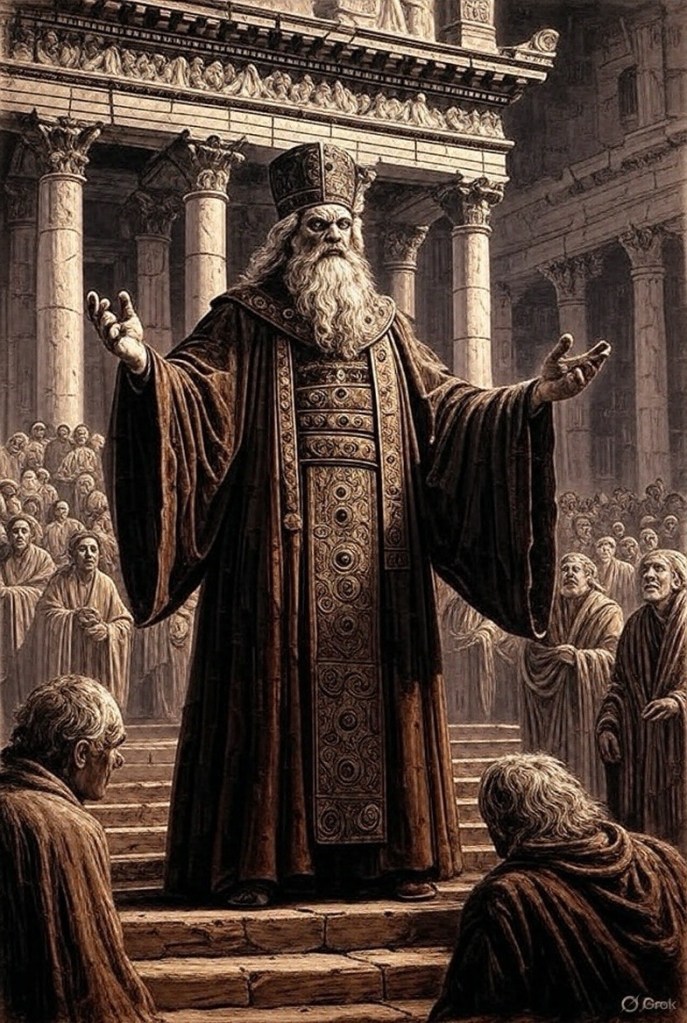
Central to these texts is the enigmatic Teacher of Righteousness, a leader who clashed with the “Wicked Priest,” likely a Hasmonean high priest aligned with foreign powers. The Teacher’s mission was clear: restore covenantal purity and resist systemic corruption. His life foreshadows later figures like John the Baptist and Jesus, who also confronted entrenched elites. Without the Dead Sea Scrolls, we would never know this man existed—yet his influence rippled through history, shaping the moral architecture of Western thought.

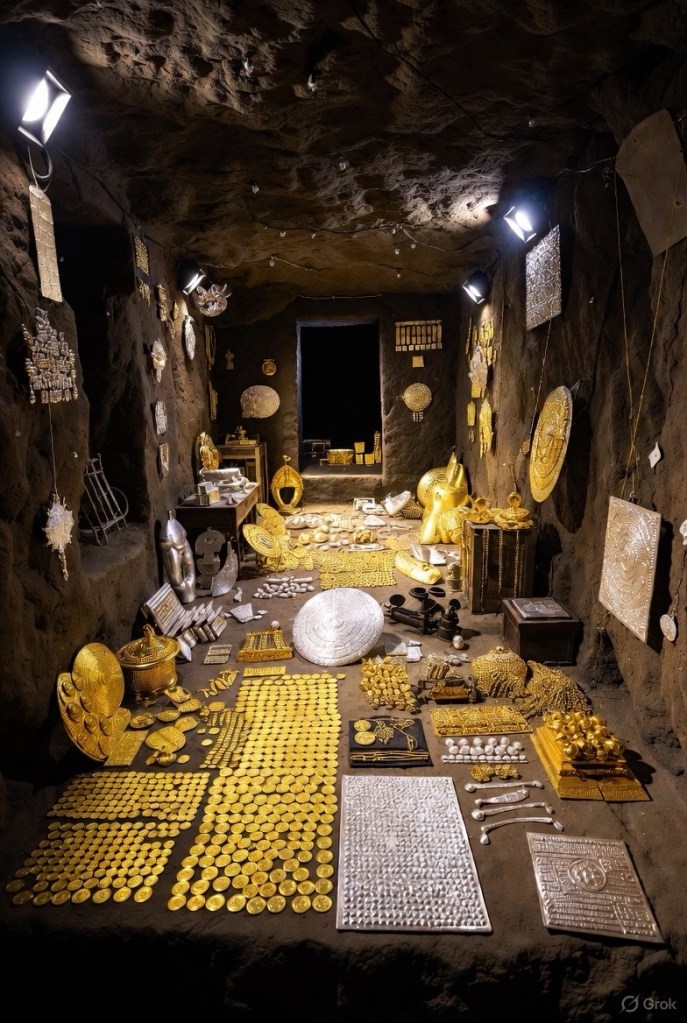
Discovered in 1952 in Qumran Cave 3, the Copper Scroll stands apart from other Dead Sea texts. Unlike parchment manuscripts, it was etched on metal—suggesting permanence. Its contents? A list of 64 treasure caches, possibly Temple wealth hidden during Roman incursions. This reveals a critical truth: rebellion was not merely spiritual; it had economic dimensions. Control of resources meant survival for communities resisting imperial domination. The Copper Scroll is a silent witness to the material stakes of righteousness—a reminder that corruption thrives not only in temples but in treasuries.

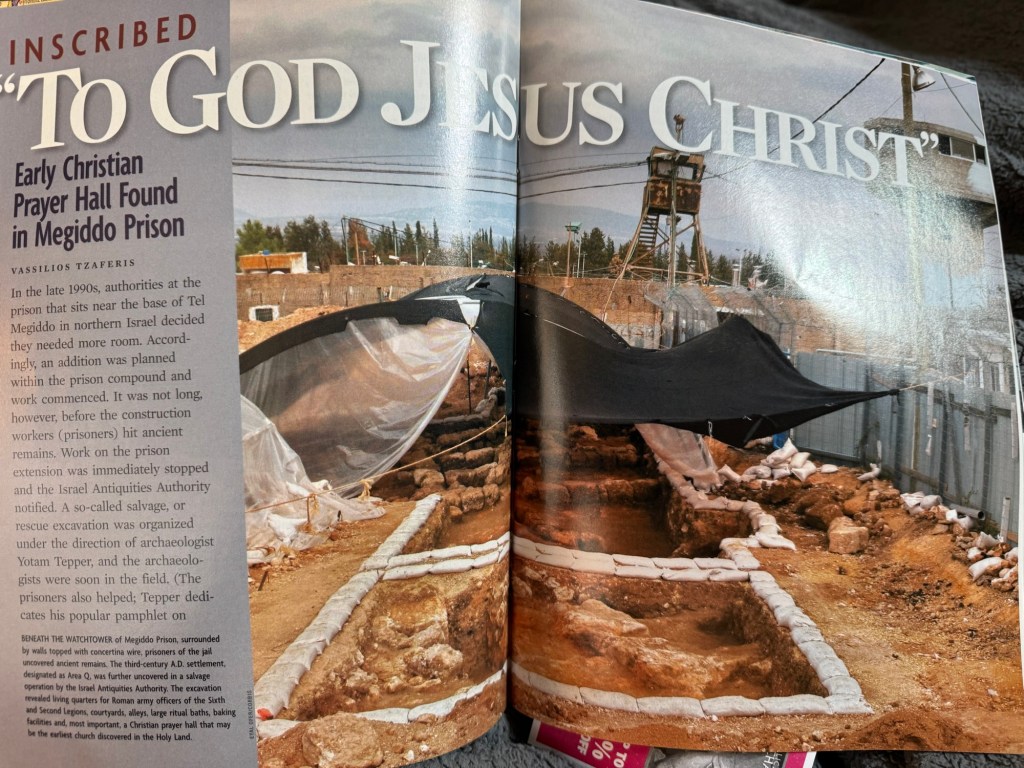
Megiddo, perched at the crossroads of ancient trade routes, was more than a city—it was a symbol. From Canaanite stronghold to Israelite fortress, from Greek outpost to Roman garrison, Megiddo embodied the clash of civilizations. By the second century CE, it housed Legio VI Ferrata, a Roman legionary camp with 5,000 soldiers. Roads, amphitheaters, and barracks testify to imperial might. Yet Revelation would immortalize Megiddo as Armageddon—the stage for the ultimate battle between good and evil. In truth, that battle was already underway, fought not with swords alone but with ideas, faith, and sacrifice.

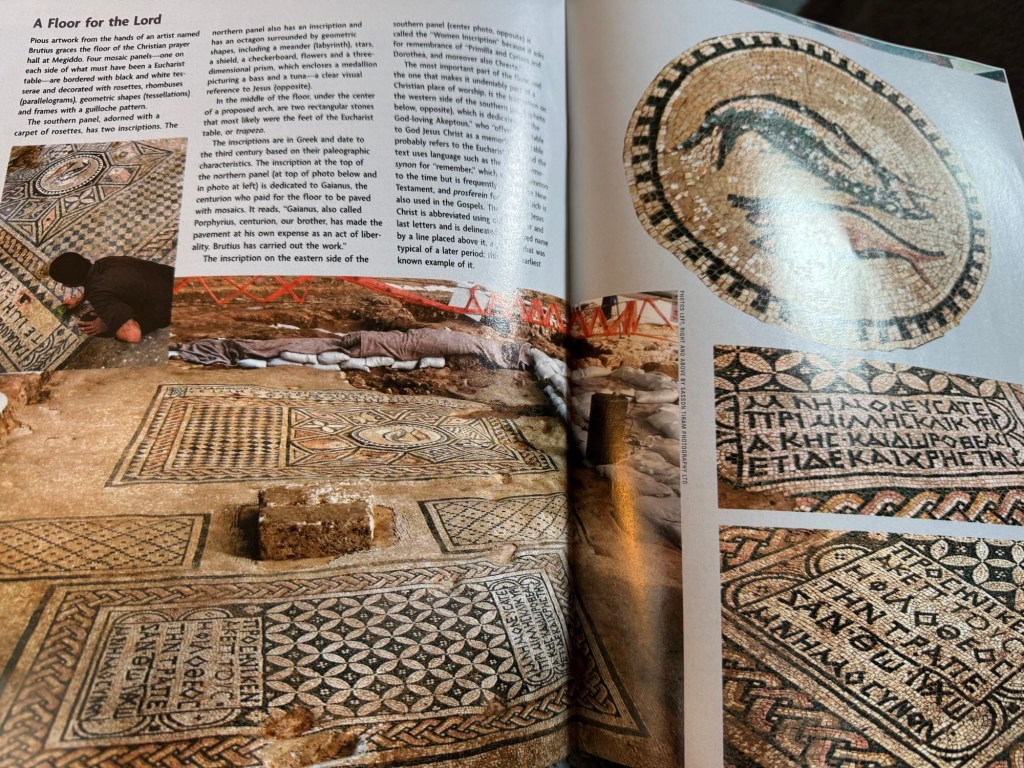
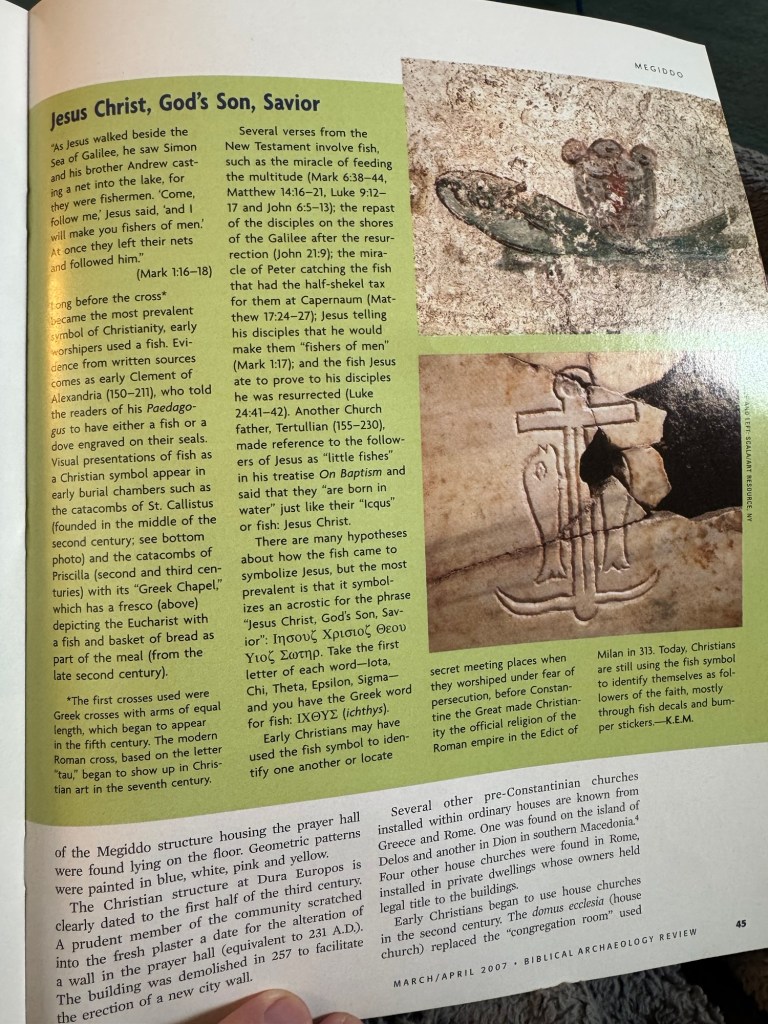
Among the most stunning finds at Megiddo is a mosaic floor dated to around 230 CE, discovered in a Roman military compound. Its inscription dedicates worship to “God Jesus Christ”—the earliest archaeological evidence of Jesus’ divinity. This predates Constantine’s Edict of Milan by nearly a century, proving that Christianity was infiltrating the Roman world long before it became state-sanctioned. The mosaic, displayed at the Museum of the Bible, marks a turning point: the empire that crucified Christ was slowly bowing to His name. This was not an overnight revolution but a gradual transformation—a testament to the endurance of righteousness.

Before Rome embraced the cross, it worshipped a pantheon of gods—Jupiter, Mars, Venus—and demanded emperor worship. Greek deities like Zeus and Athena lingered in cultural memory. Against this backdrop, Christianity’s rise was nothing short of miraculous. Persecuted believers faced martyrdom, yet their faith spread from catacombs to palaces. By 313 CE, Constantine legalized Christianity; by 380 CE, Theodosius made it the official religion. But the seeds of this revolution were sown centuries earlier—by rebels like the Essenes, prophets like John, and visionaries like the Teacher of Righteousness.

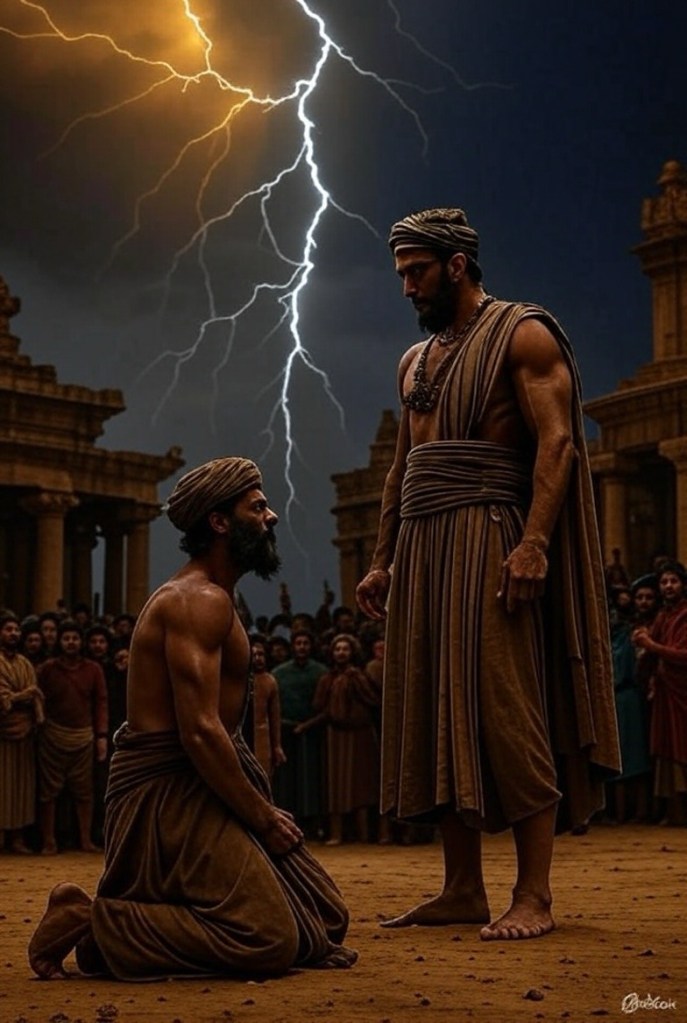
What does this mean for us today? The struggle between righteousness and corruption did not end with Constantine—or with the crucifixion. It is a permanent condition of human society. Modern movements like the Tea Party, the Reform Party, and MAGA echo the same impulse: to resist entrenched elites and restore moral order. Just as the Essenes defied the Wicked Priest, today’s reformers challenge systems that profit from decay. The hostility they face—from media vilification to legal persecution—mirrors the fate of ancient rebels. Why? Because evil never surrenders quietly.

History teaches a sobering truth: fighting evil is hard, slow, and often bloody—but it works. The Teacher of Righteousness did not live to see Rome fall, yet his stand against corruption helped ignite a movement that reshaped the world. The Essenes’ scrolls lay hidden for two millennia, only to inspire us today. The Megiddo mosaic whispers across centuries: righteousness wins—not in a day, but in the long arc of history. So when despair creeps in, remember: Armageddon is not ahead of us—it is all around us. And every act of courage, every stand for truth, moves the battle forward.

— Additional notes and reference —

Abstract:

This work examines Armageddon as a historical continuum rather than a singular event, tracing its roots from the Essenes and the Teacher of Righteousness through Greek and Roman occupations, Jewish revolts, and the rise of Christianity. It integrates archaeological evidence from Megiddo, textual analysis of the Dead Sea Scrolls, and modern political parallels to argue that the struggle between righteousness and corruption is an enduring condition of human society.

1. Introduction

Armageddon is often imagined as an apocalyptic climax, yet history reveals it as a recurring process. From Qumran to Washington, the battle between systemic evil and reformist zeal persists. [Footnote: Collins, 2010]

2. Historical Timeline

– 332 BCE: Alexander the Great conquers Judea, introducing Hellenistic culture. [Footnote: Josephus, Antiquities]

– 140–37 BCE: Hasmonean dynasty asserts Jewish autonomy but succumbs to corruption. [Footnote: Schiffman, 1994]

– 63 BCE: Pompey annexes Judea; Roman rule begins. [Footnote: Goodman, 2007]

– 66–73 CE: First Jewish Revolt ends with destruction of the Second Temple. [Footnote: Josephus, Wars]

– 313 CE: Constantine legalizes Christianity; 380 CE: Theodosius makes it official. [Footnote: Brown, 1989]

3. The Essenes and Teacher of Righteousness

The Essenes, a separatist sect, withdrew to Qumran to resist priestly corruption. Their texts—the Community Rule, War Scroll, Damascus Document—reveal a dualistic worldview: Sons of Light vs. Sons of Darkness. The Teacher of Righteousness emerges as a prophetic figure opposing the Wicked Priest. [Footnote: Vermes, 2011]

4. Megiddo and Armageddon

Megiddo’s strategic location made it a stage for imperial clashes. Excavations reveal layers from Canaanite to Roman eras. Revelation’s Armageddon draws on this geography as a metaphor for ultimate conflict. [Footnote: BAR, 2015]

5. Dead Sea Scrolls and Copper Scroll

The Copper Scroll lists 64 treasure caches, underscoring the economic stakes of rebellion. Resistance was not merely spiritual but material. [Footnote: Allegro, 1960]

6. Greek and Roman Context

Greek philosophy and Roman law reshaped Judea’s cultural landscape. Emperor worship and Hellenistic syncretism clashed with Jewish monotheism, fueling sectarian movements. [Footnote: Hengel, 1974]

7. Modern Parallels

Reform Party → Tea Party → MAGA echo ancient insurgencies. Each arose to combat perceived corruption, facing vilification and systemic pushback. [Footnote: Skocpol & Williamson, 2012]

8. Conclusion

Armageddon is not a prophecy deferred but a pattern repeated. From the Teacher of Righteousness to modern populists, the fight against entrenched power endures.

References:

– Allegro, J. (1960). The Treasure of the Copper Scroll.

– BAR (Biblical Archaeology Review), various issues.

– Brown, P. (1989). The Rise of Western Christendom.

– Collins, J. (2010). Apocalypticism in the Dead Sea Scrolls.

– Goodman, M. (2007). Rome and Jerusalem.

– Hengel, M. (1974). Judaism and Hellenism.

– Josephus. Antiquities and Wars of the Jews.

– Schiffman, L. (1994). Reclaiming the Dead Sea Scrolls.

– Skocpol, T., & Williamson, V. (2012). The Tea Party and the Remaking of Republican Conservatism.

– Vermes, G. (2011). The Complete Dead Sea Scrolls in English.

Rich Hoffman

Click Here to Protect Yourself with Second Call Defense https://www.secondcalldefense.org/?affiliate=20707
Photographing Transdimensional Creatures: Assassins from beyond the veil

My favorite things to think about are those things that are least normal.  I am not a big fan of normal, and increasingly, I find a lot of adventure in those things least common, especially regarding transdimensional reality, which I think is as common as air.  What kind of lifeforms inhabit four-dimensional space, with time being one of them?  Because we assume we know things based on the rules of conduct that we all live by, which are measured in length, width, height, and time.  And with time, we assume we understand it enough to measure it.  But we know that time moves differently for people depending on their relationship to gravity.  Time is not a standard unit of measure that is one for one, regardless of our location.  And it is within time that many characters reside, which impact our life, as we have come to define it, in the spirit world.  And no matter where you go in the world, or what religion you study, there is an attempt to have a relationship to beings we might otherwise call gods, who live in a hyperreality that we might be tempted to call Heaven.  But to close the deal on our sanity, we rely on faith to rationalize everything to ourselves.  And we say when we die that our body is put in the ground, our spirit goes someplace, and we sort of hope that it all works out in the end.  We pray, and we hope, but we don’t actively seek answers in a “normal” way.  Well, that’s not enough for me; I want to know more than what’s normal about everything.   And it is in the pursuit of that very thing that I ran across what I think is one of the scariest photos I’ve seen in a long time.  And I understand and believe it because I have had similar experiences in photos that I have taken myself. 

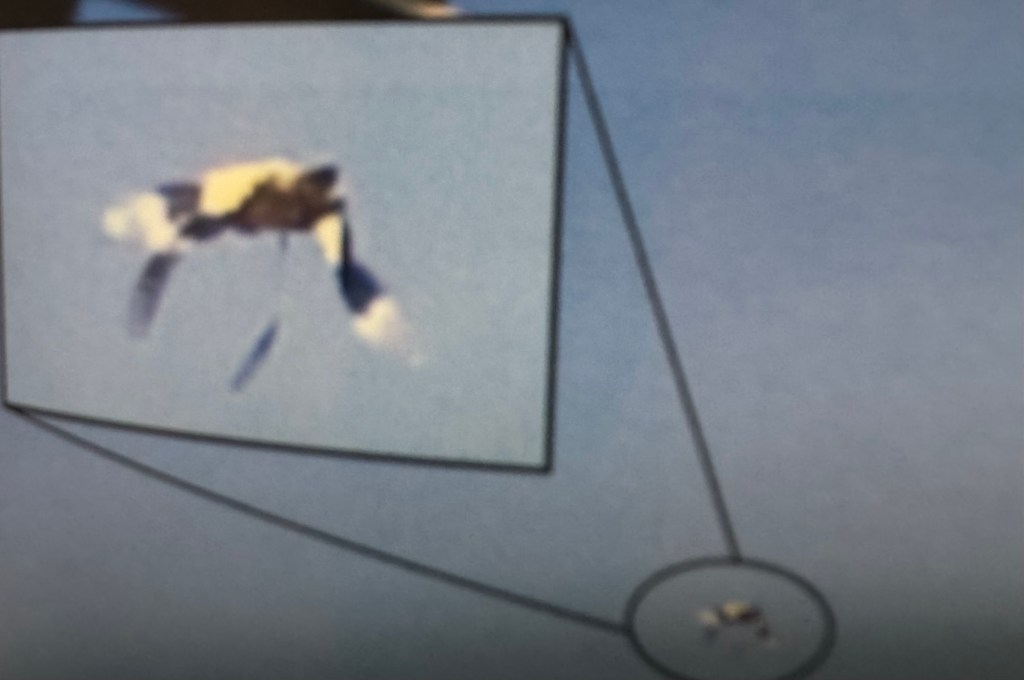
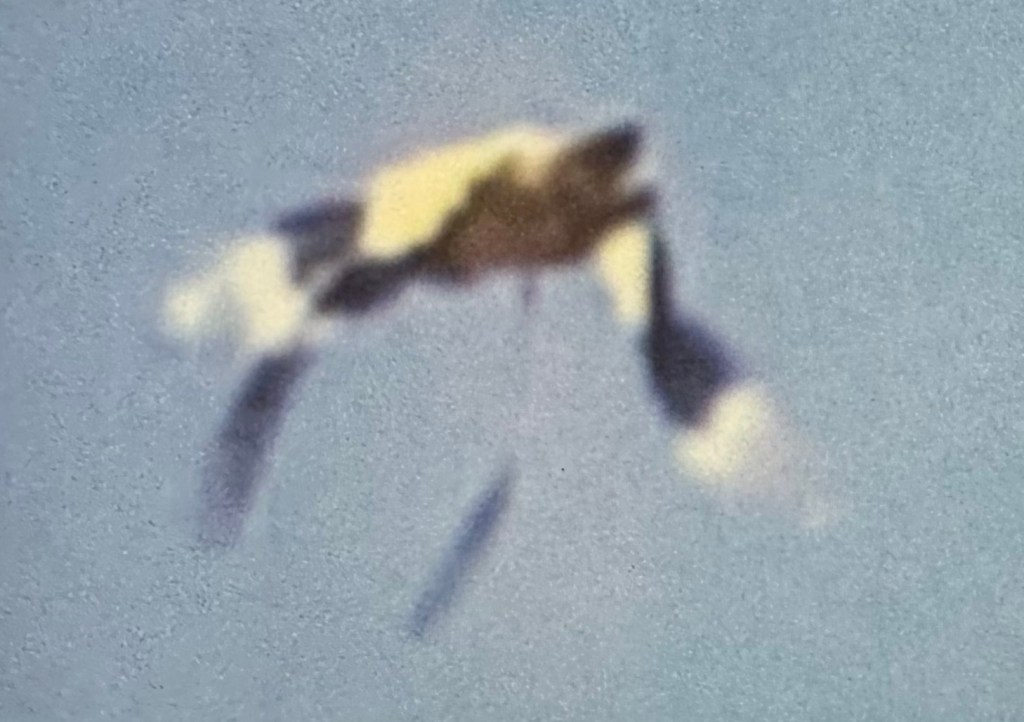
When I see him sometime, I am going to ask Andrew Collins about the picture he took at Skinwalker Ranch in Utah, a place I have been to.  My family has camped in that region and understands its high strangeness as more than government experiments for developing military technology.  Skinwalker Ranch is one of those well-documented places in the world where paranormal activity is widely acknowledged.  Understanding it is another matter, so when Andrew Collins conducted his investigations and took pictures around what is known as Homestead #2, what he captured was quite extraordinary.  Collins didn’t see the image that later appeared in the picture, which is a kind of thunderbird-like creature that easily resembles what people might call Mothman or Birdman, a phenomenon common in North American Indian cultures.  There are numerous negative emotions that people experience at Skinwalker Ranch, yet the perpetrators remain unseen. This raises the question of what we can see and what we cannot, which serves as a measure for defining reality.  But for people who study these things, that measure of reality is not sufficient, and pictures like the one that Collins accidently achieved prove it beyond any reasonable doubt.  What is significant about this particular picture, which I don’t think is getting nearly enough attention, is that the excellent, hard object found in the sky was not visible to the naked eye under the accepted reality viewing circumstances, as recorded by our eyes and brains.  This raises a point I make more frequently as the evidence becomes increasingly apparent.  And I just had a similar experience at the Moonville Tunnel with my family while on a ghost hunt.  Sometimes, pictures taken record more of reality than takes place because of the still-frame nature of acquiring the information.

Images from the book, ‘Origins of the Gods’

This is why this is important, most cultures around the world use shamans of some kind to deal with evil entities that try to cast spells on people and harm their health from beyond the veil of the living.  And I have found that treating these problems with normalized medicine and pharmaceuticals is not nearly enough.  There are a lot of voodoo doctors also throughout the American south who routinely deal with medical issues at their root source, some curse that has been placed on a human being’s soul outside of everyday reality.  When I talk about the use of psychedelics, such as Ayahuasca, to produce in the mind a hyper reality, I think that the science behind it is not illusory, but the ability to increase the shutter speed of a mind to see more of what is always there. And that the reason we don’t bump into these substantial objects more is because their dimensional reality does not have enough mass to interact with our physical reality, much the way we don’t think about all the Internet signals and remotes to our televisions that pass through our bodies all the time without slowing down to interact with our cell structure.  And the reason Andrew Collins’ picture is so spooky is that what he captured was certainly there, yet with their own eyes, they did not see it. This is because cameras usually record video at a rate of 30 frames per second, or for motion pictures, at a rate of 24 frames per second.  And the object captured might only appear in one or two of those individual frames, because they live at a different rate of time than we do.  And our ability to see them is limited by our frame of perception, which is likely why some people see cryptid creatures like Bigfoot, ghosts, or Birdpeople (as depicted in that photograph), while others don’t. 

Very spooky

The reason we don’t see these characters under “normal” conditions is that our minds perceive the world in the same way as video, as individual frames of material that we fill in the gaps with our perceived understanding.  When we watch a movie, we don’t see the black spaces between the frames of film because our minds fill in those gaps with our perceived knowledge of reality.  But creatures who live in a hyperreality where they exist at a much higher rate of time than we do, and can only be seen by a camera accidently capturing them moving in and out of our current time, have the advantage of interacting with us, but we not so much with them because our frame rate of perception is much slower.  So we perceive them as invisible when, in fact, they are living in a hyper-reality.  To me, a picture like the one Andrew Collins included in his book, Origin of the Gods, is jaw-dropping proof that is easily explained by science.  We might be disappointed by what we discover about these creatures we call gods, that they don’t live up to our lofty expectations.  But if you are struggling with a cancer diagnosis or a significant health issue, just speaking from experience, the way to treat it is to visit the hyperreality that these things live in and get them off your back.  I would recommend a voodoo doctor from New Orleans, for instance, because usually it is some curse that some political enemy puts on you that is slowly killing you, when in truth, it’s just one of these losers sitting on your soul from beyond the perceptual reality of conscious, terrestrial thought.  And for thousands of years, most of our cultures sought to appease these creatures through sacrifice, because they lacked the tools of understanding to deal with them.  But we can see them sometimes.  And we can deal with them if we know they are there.  Which they surely are.  And they often try to manipulate us to serve their own needs.  And when they are asked to kill us, they do attempt to do so, from the inside out.  It’s not bad luck that bad things happen.  But bad luck often can be traced to these characters, and to deal with them, you have to reach beyond the veil and kill them before they can get you.  I’m saying this for a reason.  Don’t let evil characters hide behind a veil of perceptual reality, like assassins from beyond.  Reach beyond the veil and kill them where they live, so they don’t kill you.  Because they hide their malice beyond the term “normal,” so you can’t see them coming, and they can dispose of you before you even know they are there.  Yet they are.

Rich Hoffman

Click Here to Protect Yourself with Second Call Defense https://www.secondcalldefense.org/?affiliate=20707
Why President Trump Trusts Laura Loomer: Passion and Paychecks are not equitable

There is a lot of anger that President Trump trusts Laura Loomer, the independent reporter who has broken many stories that otherwise would have been shoved under the rug, and that he trusts her to the point where he is willing to make employment decisions based on that trust.  I completely understand, but most people don’t get it.  I’ve had the same reaction from people who doubt that the White House called me about the tariff impact of Trump’s policy.  It was a business-related question, but my name is on the list for a reason.  Trump trusts people who show commitment and loyalty to the effort.  Everyone should remember that being president costs Trump a lot of money.  He is doing the job because he wants to make the job better, and he tends to trust people from their respective fields who do the same.  Laura Loomer does the kind of work that should pay her millions annually.  But she keeps it scrappy, because that’s what’s most effective, and independent of the type of people who could pay millions of dollars for employment.  Getting paid only satisfies one criterion in life, and that is social status.  And the bad guys have been using social status to control mass populations since the beginning.  And from Trump’s perspective, he would rather trust Laura Loomer, who does reporting out of her passion for justice, than because she gets paid by CNN or Fox News, and has to satisfy them to stay employed.  Laura Loomer is part of a growing movement that is the real power behind many of the changes we see in the world that have not happened up to this point because institutions controlled the process.  But not anymore, and that change will certainly not be stopped.  It’s something that only America could have produced with the free speech movement, and it has taken time to develop.  But it’s here now, and President Trump is very much a creation of it, and he understands it instinctively as a successful businessman. 

I would add a few names to the Laura Loomer list. Breanna Morello from Florida is also doing some excellent reporting.  I first learned about her because of a story she did on the Butler County jail with Louder with Crowder, and I have found her particularly effective and very friendly.  I still talk to her here and there, and she is very committed to a truthful narrative, much like Laura Loomer is.  She used to work at Fox News but was released after refusing to comply with the COVID policy, so she leaped out on a limb to be an independent journalist, and she’s having quite an impact out there.  I would put Charlie Kirk in the same basket; he has turned out to be one of the most trustworthy media personalities in modern politics.  Any more, I only trust his news coverage on the Real America’s Voice podcast when discussing elections.  He and his team, including Jack Posobiac, are fantastic.  Which then crosses over to the WarRoom with Steve Bannon, the former Breitbart boss who used to be President Trump’s direct political strategist in the White House.  He was sent to jail for invoking executive privilege during the last administration, and he did 4 months, as did Peter Navarro.  We have seen a system used to having control of people being broken because they can’t control the narrative anymore because of these free-market journalists, and the impact is evident and necessary.  This is a lesson I learned personally, and I could tell a similar story as Breanne does.  In short, if somebody is paying you, you aren’t independent, and that is especially true of reporters. 

Everyone has to make a living, but reporters who maintain their distance from paid sources that wish to conceal their malcontent behavior behind polite society have corrupted the world for thousands of years.  And Trump learned enough from his entertainment background to understand how the spaghetti is made in the kitchen.  There will always be a place for institutional input, but that doesn’t mean we can trust it.  I would say that a similar thing is happening in the field of archaeology, as independent journalism has blown the lid off previous suppression theories, editorialized to control a narrative.  And that narrative can no longer be constrained because too many independent journalists are covering these topics out of passion rather than for a paycheck.  The new rules are not who you are with, but have you demonstrated passion for the subject and would do it whether or not someone paid you for it?  In Laura Loomer’s case, and increasingly, many reporter types, from Bill O’Reilly to Glenn Beck, have joined the independent ranks, even if the pay isn’t very good.  They do it because they are passionate about the topic.  And that is more of the world we want to see, where we have passionate people in key positions rather than paid monkeys who do what they are paid to do, like well-mannered dogs.  When I got the call from the White House, it was because they wanted to avoid the answer of the typical lobbyists.  They wanted an honest opinion from a name they had in the hat because the reputation for honesty had been earned, and that was a currency of its own—being able to trust someone used to be measured in paychecks.  However, over time, pay has not come to resemble worth; rather, it is compliance with the forces who write the check. 

There has been a silent killer out there, such as what happened to James O’Keefe, who had to turn toward independent journalism after Project Veritas removed him from his top job there, which was built by O’Keefe himself from the ground up.  The strategy by the money men, and I learned this lesson the hard way many years ago when I had the rug pulled out from me by a mighty Cincinnati business leader for millions and millions of dollars that I was on the hook for, who owns the gold rules.  If you don’t have gold, you don’t rule.  So you have all these finance firms who buy up assets to shut them down, such as the good journalism that was going on at Project Veritas, which was an asset bought up with phony Fed money to be shut down to control the narrative.  So O’Keefe is just as effective as always as a reporter.  But nobody hears or cares about Project Veritas anymore.  Without O’Keefe, they have no trust from the public.  People trust people, not institutions.  In the case of Project Veritas, once a board of directors gets involved and group consensus is the decision-making apparatus, and the funds that fuel the lives of those people trickle off into the darkness, it’s over for independence, and people like O’Keefe will always be on the outside.  The same kind of scenario could have happened to the Drudge Report.  I have had many people attempt to toss a lot of seven-figure money at my feet to control my narrative, but I have not accepted one dime, because the value is not in the dollars, it’s in the independence.  And once you take the money, you lose the autonomy.  Thankfully, there are a lot of Laura Loomers out there these days who feel the same way, and independent reporting has never been better.  And it’s no wonder President Trump trusts that type of reporting.  Time has proved that institutions cannot be trusted because the people involved are too easily controlled by those who write the paychecks.  And those people tend to hide in the dark. 

Rich Hoffman

Click Here to Protect Yourself with Second Call Defense https://www.secondcalldefense.org/?affiliate=20707
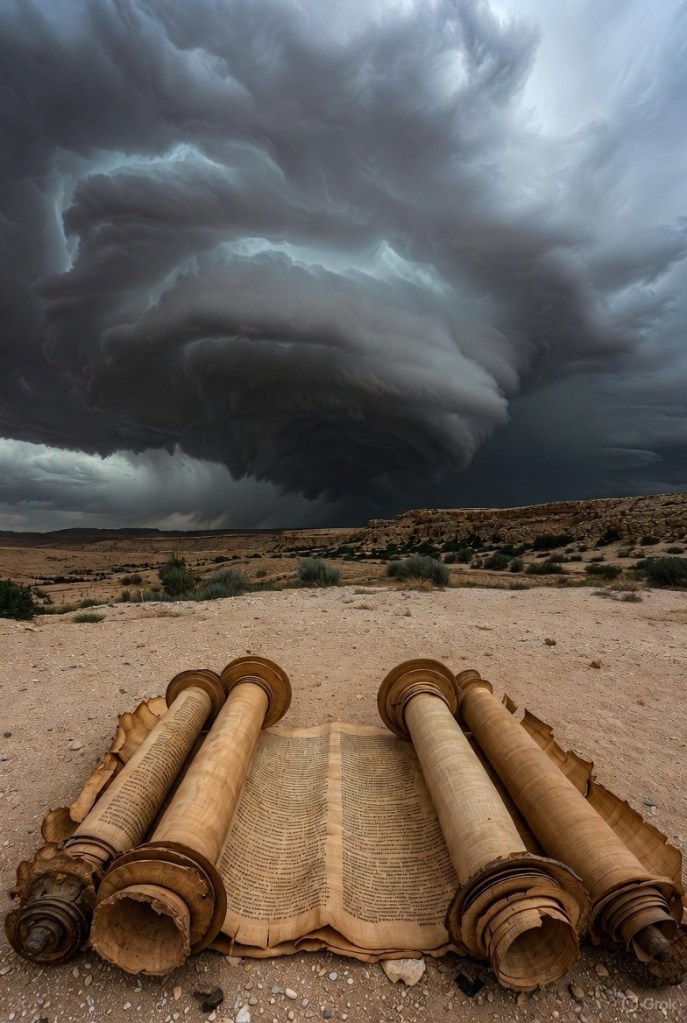
God Won’t Leave Me Alone: ‘The Politics of Heaven’

Absolutely, the number one question I get asked every week, without fail, is when I’m going to write another book.  And my answer is that I usually write them every seven or so years, which has been true throughout my adult life.  My two favorite things, reading and writing, are activities I spend a lot of time doing, so it’s natural that writing a book is something I tend to do.  But this one is different, because lately my answer has been that I’m writing one now.  It will take a few years, and I didn’t go into it with a publisher in mind or some means of distribution.  It’s currently in the raw writing stage, which is the most fun and where the quality of a project like this has the most impact.  And this one is different for me, as it’s a big project and will be a pretty big book. It’s called The Politics of Heaven. I feel I have to write it because God won’t leave me alone about it.  He talks to me constantly about writing this book and the urgency was certainly more frequent after a trip my wife and I recently took to Washington D.C.  We were on the fifth floor where they do their big presentations and enjoying the view of the Capitol and Mall in front of us when the urgency from God was nearly as loud as a screaming kid begging for a candy bar.  This project was one of those things I had planned to do in a few years, about on schedule with my usual 7-year pace between projects.  But this one couldn’t wait.  God wanted to express himself, and it just couldn’t linger.  So, we’ll see how things go and what options present themselves along the way.  However, for the sake of what I do, I am shifting my focus to this project, as well as several other urgent matters that have arisen in conjunction with it.

I saw this at the Museum of the Bible and remembered it from an article I read back in 2007.

Strategically speaking, I see an opportunity here that is unique, and it’s something I originally started thinking about heavily while I took my family to the Sainte Chapelle, with its high ceilings and magnificent stained glass windows, obviously mimicking Heaven and the human ascent into it.  Paris had been getting frequent attacks by Muslim radicals, and it was more than just a war going on over religion.  And I had been thinking that someone needs to write a book in a unique way that puts things in perspective with people.  What is excellent about Christian writers is that they produce a lot of material.  Some of the most prolific writers in the world are associated with Christian scholarship and have been in the business of analyzing scripture and its applications.  I enjoy them.  I look forward to every new addition to Biblical Archaeology Review that I get, and I hadn’t been thinking about it too much, just enjoying them.  But the problem is that this is a strategic necessity.  People with Trump in the White House are looking to fill a void that has been put in them, politically, and what I do that most don’t is deal with politics.  To me, politics is like baking a cake.  You make it, people eat it, then everyone sits down and watches a football game and falls asleep on the couch.  But these messages to me, and how do I know they are from God and not some random spiritual stranger like a homeless person begging for money, are urgent and time-driven.  I have some experience in this area, and this isn’t my first time.  And this time he certainly wasn’t shy about it, frustrated by the limited means that there are to communicate across dimensional time and space. 

It will be a very interesting book. Probably nothing like it in the world.

The Bible is selling very well, with a spike in sales directly tied to the expanding economy and the politics behind it.  For what people have witnessed over these last three decades, who could expect otherwise?  People want goodness in their lives, or at least the pursuit of it.  People were hungry to understand how to extract goodness from something, which, in most cases, is a relationship with the most essential piece of literature the world has ever known —the Bible.  But for most, these are very purposeful excursions into the battle for good over evil, and people usually keep it all to themselves.  But the time we’re in now is different; this is a political enterprise, and it involves a spiritual realm at war with each other, and we’re reflections of that war, where individual battles are erupting all over the landscape.  And politics is kind of my unique thing that is different from what anybody else writes.  Specifically I want to deal with the political problem of the spirit world constantly trying to attack God and his creation from the border of the firmament and to chronical the attack vector of many demonic entities as they were captured by the Apocryphal book The Testament of Solomon which I argue should have been one of the Books of the Bible where God gave him a ring to control the demons of earth and force them to build his temple.  I think this is more than a fantasy story by post-Second Temple early Christians.  I believe there is compelling evidence to support this story, which is very relevant to our present time. Many of the evils we have been witnessing can be firmly attributed to the influence of occult magic and the yearning for it, with numerous factions now working against us.  And is best captured in the Bible in Ephesians 6:12. 

It was stunning to see this in person. God was talking to me in a very literal way.

One of my favorite books in the history of the world is Graham Hancock’s “Sign and the Seal,” which is about the purported discovery of the actual Ark of the Covenant, allegedly located in Ethiopia at Axum.  I will have more to say on the recent revelations from the CIA on this topic soon, but needless to say, I think that book is one of the most fantastic adventure books I’ve ever read, and I’ve read a lot of them.  However, there is much more to the story, and I believe several steps can be taken beyond the adventure part of these stories. We know enough to peek behind the veil at a real war that has taken place and to understand our role in that war.  And part of that strategy is to enable people to form a relationship with the Bible and to continue gaining perspective on how it can improve their lives by helping them win battles they may not even be aware of.  It is my intention for them to figure it out, which is why this urging from me is so timely.  It’s a project that can’t wait.  Of course, I will continue to do all the other many things that I do.  This will be just another project to add to all the others.  However, due to the timing and necessity, I’m doing it now rather than five or more years from now, when I’ll be well into my sixties.  This is an effort that requires a voice that understands politics and can put it into perspective, so people can fight the battle that needs to be won by the forces of good.  And for that to happen, context is in short supply and needs to be made much more abundant. 

Very big stuff

Rich Hoffman

Click Here to Protect Yourself with Second Call Defense https://www.secondcalldefense.org/?affiliate=20707
DeWine’s State of the State Speech: Lakota schools plots their own demise

Oddly enough, while I was in Columbus to attend the Governor’s State of the State speech, it was Lakota schools that everyone was talking about, and they wanted to join the Ohio Coalition for Equity and Adequacy of School Funding lawsuit.  But in many ways, that wasn’t surprising, and it was confirmed again in Mike DeWine’s speech that day.  Years and years of kicking the can down the road in all these public schools were catching up to them, and the bill was due, and nobody knew what to do about it.  Governors like DeWine have done for decades what they were now doing at Lakota schools around 91 miles to the south in Butler County, Ohio, they were writing tax payer checks for a product and service that fewer and fewer people wanted, and now with Trump in the White House, the warnings I have been giving everyone about what was going to happen are coming true.  Instead of getting out in front of these funding problems, Lakota schools dug in and became more woke.  Senator Lang tried to tell them on a call later that day after the Governor’s speech, but the school system had dug in the opposite direction.  Others and I have tried to give Lakota conservative board members a chance to deal with this issue, and their response as a school board was to run them all off, and that extends beyond Darbi Boddy, the most recent that they found some way to push out of management.  And like things are where liberal types run things, everything costs too much money, and now Trump was cutting back the Department of Education and gubernatorial candidates like Vivek Ramaswamy was talking about significant reforms in education with merit pay, leaving schools like Lakota to join lawsuits with other schools having the same problem, hoping that some sixties flowerchild protest might recover for them a silly little 9 million dollar loss that has come out of their budget due to students utilizing Ed Choice vouchers that are now expanding under the Trump administration and flowing down through the states.  For perspective, Lakota schools in Butler County, Ohio, has a quarter of a billion dollar budget, and that’s still not enough money to fund education the way they want to.

And you know what makes me the angriest about all this? I didn’t get any of Fran’s cookies this year. Fran is Mike DeWine’s long-time and very dedicated wife, who typically gives them out to attendees of her husband’s speech in the rotunda.  This year, activists were there chanting for more money as they felt the pinch from a social disconnect from the standard old traditional funding model of public education.  To avoid the activists, DeWine was ushered away underground to safety, leaving the rest of us to watch their bizarre and out-of-touch rituals with curiosity. The Lakota situation was the topic of conversation because they are one of the largest districts in Ohio, and so went them, so went everyone.  And that was kind of a proper metaphor for DeWine’s State of the State speech.  A do-gooder Governor tosses money at public education and hopes that everything will work well for the kids.  But its these crazy labor unions with woke politics that have screwed up the funding model because people don’t like the product.  And school vouchers, much less restricted these days and growing more so, are giving parents the choice away from their zip code schools where they pay enormous property taxes to fund a political movement they hate essentially.  And Lakota schools were right in the middle of the spectacle leaving DeWine to give just another empty speech about the value of education, and sending books in the mail to students to help with literacy, when the real problem was significant and ominous, and far beyond at this point just passing out cookies in the Statehouse Rotunda to ease tempers.  Legislators were in the middle of the budgeting process for public education at the time of this speech, but the government unions want to cry and protest for money that just isn’t there and aren’t willing to deal with the reality of the coming changes.  And those legislators were mad at what Lakota was thinking of doing then, which they did later that evening.  So it wasn’t a good move by the Lakota School Board.  But I tried to warn everyone, and they didn’t listen.  Much more on that to come.

The main thing in DeWine’s speech was that the Governor came to the speech like an old grandpa that went out to dinner the night before to eat barbeque ribs and still had on a bib from that experience the next day when he thought he was showing up for dinner in a nice suit and tie.  DeWine was out of step and slightly behind the rest of the world for his sixth year in office, most of which had not been very good, especially during the COVID-19 years.  But watching him speak, I thought of him as a nice guy who has been constantly suckered by the same kind of losers who protest education funding, like the people who greeted him upon leaving the State of the State peech.  The old flowerchild strategy of crying like some baby bird until mother government drops a worm in its mouth has long been exhausted, and DeWine never understood it.  He’s a good man from a political generation that caused all these problems and doesn’t know what to do about it.  We have to wait another year or so before we get Vivek Ramaswamy and tackle some of these key issues because just throwing money at problems is not what voters will do in the future. 

The best thing about DeWine’s State of the State speech was the expansion of business enterprise in Ohio, specifically the Andruil factory just south of Columbus and the Intel facility to the north.  There was a lot to talk about, and for DeWine’s credit, many people have been working in the background to make Ohio a much more business-friendly state.  At least DeWine hasn’t stood in the way of those efforts; he’s been willing to tag along.  We’ll get a lot more with Vivek Ramaswamy as Governor, but since DeWine was able to part ways with Amy Acton, the stringy haired hippie who used to be the Health Director during Covid, Ohio has grown more business friendly to make up for their position of lockdown politics that so crippled just about everyone.  Over the last couple of years, DeWine has at least not shut the door to companies like Intel, even though it has largely been members of the Senate that paved the way.  That’s how government works, and it’s very fascinating.  But once the good news was talked about regarding Ohio and DeWine’s speech, the topic went back to the tired old view of the world, and the chants outside could be heard in the chamber, and the reality of places like Lakota schools was coming to fruition.  The days of easy money stolen from taxpayers to fund woke causes were over.  And many people at the State of the State speech in the Ohio Statehouse were struggling with the ramifications of decades of trying to appease the screams of the teacher union types.  But reality has a lot more in store for them than they realize.  The result will be more anger at the people running public education and politicians like Mike DeWine ending their terms dismayed while much more innovative people replace them with reforms that will change all the rules.  The Lakota School Board, in its current form, is just not prepared to deal with it.

Rich Hoffman

Click Here to Protect Yourself with Second Call Defense https://www.secondcalldefense.org/?affiliate=20707
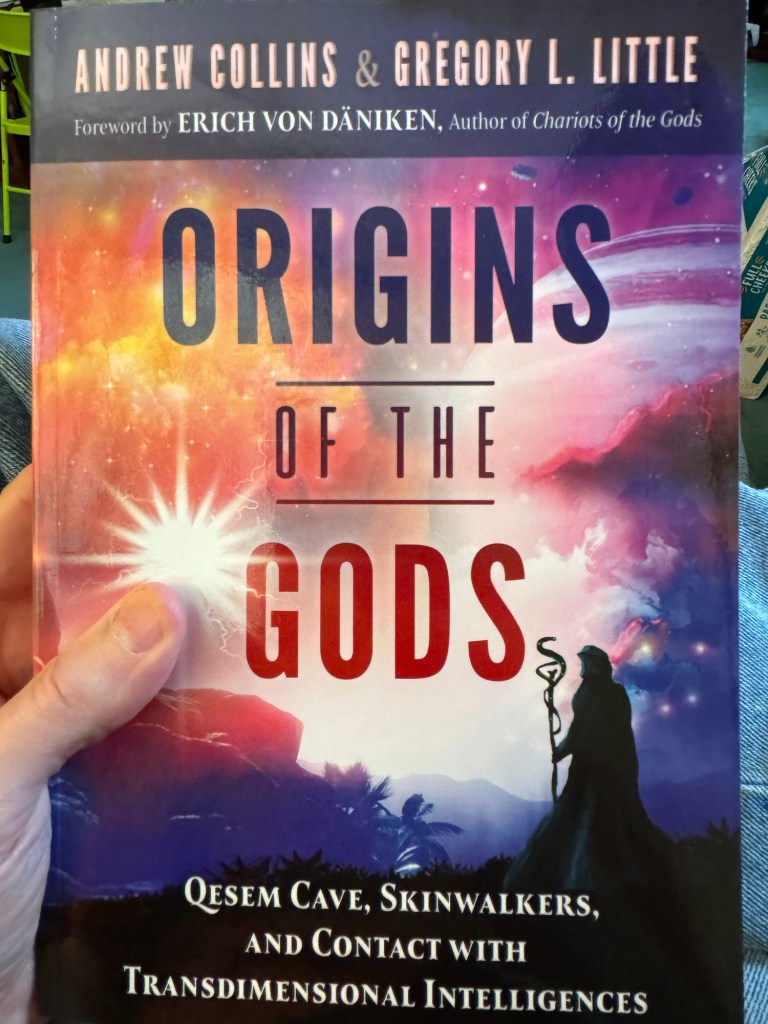
The Evendale Nazis: Occult attempts to get leverage over political rivals hidden behind historical perspective

I know a lot of people, so I think I would know somebody who would be connected to the Nazi group that tried to cause some trouble in Evendale, Ohio, displaying swastikas and other Nazi imagery in an attempt to ignite a race war.  With their masked faces and an apparent effort to look like Hitler’s followers with nicely pressed clothes that looked fresh off the rack from Party City, my very first thought was that these were a bunch of government workers, probably public school teachers trying to inspire hatred by stirring up people of color to rise and fight against the daily barrage of change from the Trump administration.  It was a pathetic attempt by people who don’t know their history or understand why America is turning away from all this name-calling control and back toward tradition, to cause the kind of social unrest that the national news would cover and convince people to go in a different political direction.  It’s not working; the Marxist left is trying to portray the Trump administration and his conservative supporters as racist Nazi lovers.  The Nazis were always convenient bad guys as established in our culture, and they were, by European standards, socialists and certainly weren’t freedom-loving patriots of small government as the Tea Party movement emerged, and from that, MAGA, which put Trump in office.  These were people who didn’t know their history and who were trying to take the shame of Nazi imagery and control the public narrative of that ignorance.  There is a lot more going on with the Nazis and the administrative state population control behind the memory of that occult-based military takeover of the world that runs much deeper than modern politics.  The swastika, for instance, is one of the oldest occult symbols in the world and has been seen in just about every culture at a time when people weren’t supposed even to be able to build boats large enough to cross an ocean.  The oldest known swastika in the world so far that we have found has come out of Ukraine, 10,000 to 15,000 years ago, in the village of Mizyn.  So there was a lot more going on with these Evandale Nazis than just some government workers trying to cause a media dispute to stop the Trump administration.  It was older, occult-driven, and much more sinister but every bit as stupid.

I know more about the Marge Schott story than I would otherwise care to.  When in 1996, the owner of the baseball team The Cincinnati Reds at that time, Schott, said during an ESPN interview that “Hitler was good at the beginning, but he just went too far,” a crusade to remove her from society began, and all rational thought went out the window.  A decade before she made these comments, I knew Marge Schott through a guy who claimed to be her grandson so that he could try to date my wife, which was a whole story of its own.  Well, Marge didn’t have any kids, and in those days, I knew many people in Marge Schott’s circle of influence, so I could root the guy out for the fraud he turned out to be.  Not that he was any competition to me, but he certainly wanted my wife, and the best way to show what a deceitful liar he was, was for me to show that he was lying about who he was and connect him to a more extensive network of con artists who were pretending to be connected to powerful, wealthy, Cincinnati families to take advantage of innocent, beautiful young girls in the modeling profession.  Through all this crazy activity, I got to know Marge Schott a bit, and I always felt bad for her after the comments she made were used to essentially destroy her publicly and force the sale of the Cincinnati Reds baseball team to a different owner.  It was a clear early sign of woke behavior in using controversy to make public opinion adhere to a political message meant to control the mass population.  Marge said some things that were her genuine opinion, which were being used to control social politics and status in society in general. 

The truth is that many people supported Adolph Hitler, including the royal family of England.  After World War I, after the Treaty of Versailles, the powers that wanted to form an alliance against sovereign nations tried to use the League of Nations to rally everyone to the cause of globalism, and they went too far with the German people.  And that gave rise to Hitler, and many people followed him as a pushback against the first attempt at globalism, just as many of those same forces have tried to do with modern-day Putin and even Trump.  Not that any of these people are alike, other than they run the countries they come from, but the sticking point is that they all received public support for supporting national sovereignty over globalist trends.  When Hitler went “too far,” as Marge Schott meant, he had moved toward mass extermination of the Jewish people, for a whole list of new bad ideas that came from the power that had gone to his head. 

But what is most concerning about the Nazis and Hitler was how they connected the political party to occult practices.  This is why I have been talking a lot over the years about how much of the occult is wrapped into our modern politics, even to the point where the Elohim who work against God are political assets for modern-day Marxist incursions into an otherwise peaceful, and successful society.  The occult use of ancient symbols, such as swastikas, is an attempt to cover up just how much of a relationship many people in the world try to use from the spirit world to invoke their menace on the face of the earth.  Imagine the Genie from the popular Disney movie Aladdin being able to serve whoever rubs the magic lamp and grant wishes to the master.  To occult practitioners, that is a secret weapon they seek diligently. You find it all over modern political movements, a desire to use occult efforts to get leverage over political opponents, and the Nazis showed success in this alliance. Still, because it all went bad, the nature of that relationship was being pushed underground, so general people wouldn’t make the connection.  That’s when things start falling apart socially; in the past, these types of people have been able to invoke Nazi imagery to steer people toward some emotional catastrophe and manipulate society toward those sentiments rather than reveal their true intentions of occult concealment for mass social control.  I saw this happen up close with Marge Schott more than twenty years ago, and now well-ironed cosplay Nazis were running around Evendale trying to start a race war ahead of Trump closing down The Department of Education.  This trick had worked in the past, but people were growing tired of it because the historical references of swastika use were very shallow in the scheme of things.  The Nazis were only the most recent to use them for a relationship with something much more significant and terrifying, the religions of the world that predated human civilization as we know it today, to a time before the earth began, and the ramifications of that are horrendous to those with shallow intellects.  As I say all the time, look where there is war, such as in Ukraine, with many hidden secrets of the past that are there, and you will find people trying to hide that past through violence and emotional diatribes.  And in the case of the Evendale Nazis, we are seeing terrified radical Marxists trying to use events of the past to conceal the real problem that has been exposed by the light of day.

Rich Hoffman

Click Here to Protect Yourself with Second Call Defense https://www.secondcalldefense.org/?affiliate=20707
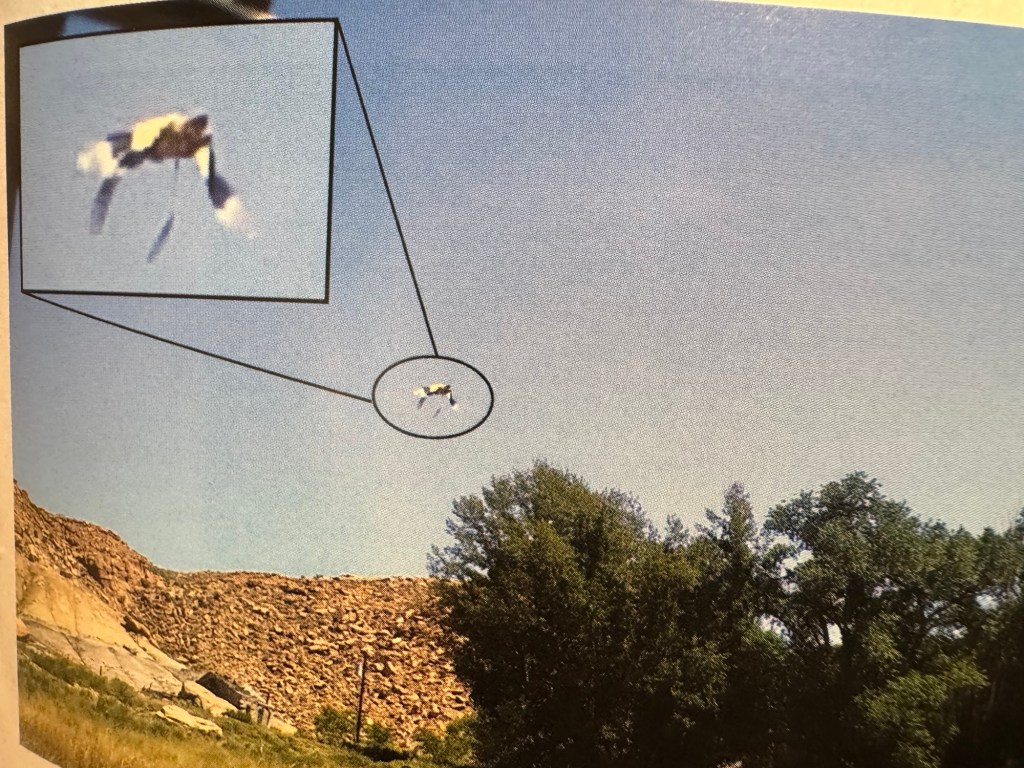
The Armour of God: Being the arbriter of divine justice

I understood Melania Trump’s outfit for the Inauguration.  Retribution comes to mind, and appropriately so.  Nobody should expect to get away with what they did to the Trumps under any circumstances.  And being a person who expresses herself through fashion, I understood Melania’s message clearly.  She’s the same age as my wife, so culturally, we all share the same references, and the first thing that came to my mind was the Clint Eastwood film, High Plains Drifter.  Melania says what she needs to tell through fashion, and she was holding the Bibles for Trump at his swearing-in; her look was undoubtedly expressive.  It was stylish and, for most people, very stunning. Indeed, she did not take the safe road.  However, after I saw Trump’s speech to Davos, I knew precisely what they were doing, and it was undoubtedly the appropriate message. 

Now, what have I been telling you all along?

You can tell that, as a couple, they have talked about this moment and what they would do if they had the opportunity to return to the White House.  And by the way that Trump spoke to the very people who had plotted his destruction, the people I call the Desecrators of Davos, Trump knew what he needed to do.  With her big wide-brimmed hat, Melania Trump might have been the visual expression of President Trump himself.  But President Trump personally delivered the much-deserved rebuke right in front of their faces to some of the most evil people on planet Earth.  He was doing on a large scale what the movie High Plains Drifter did in a fictional sense to a much smaller town called Lago, set in the old west and the efforts of western expansion that explored the challenges psychologically of a people trying to settle in a remote part of the world while trying to manage the temptations of a lack of law and order.

In the movie, a wonderfully psychological thriller that was one of the early directing efforts by Clint Eastwood, which he also starred in, a stranger rides into town, and he appears to have very superior gunfighting skills, for which the city wants to hire him to protect them from three bandits that are about to be released from jail.  The three criminals want revenge for what the town did to them.  They hired them to kill Marshal Duncan over mining rights to the city, and in the process, the entire town was a little bit guilty of the murder.  Once the killers were put in jail for the crime, they swore revenge upon release, which is why the town now was seeking to kill the killers by hiring the strange gunman, Clint Eastwood.  It’s a very good movie and certainly one of my favorites.  I don’t mind saying that I loved the film so much that it inspired the contents of my book, The Gunfighter’s Guide to Business, because, in both cases, the contents are about much more than what is shown at face value.  I talk about being a ghost in my book and life because of the lessons I learned from that great movie, High Plains Drifter.  You can often do much more in the world as a ghost than as a flesh and blood, earthly figure.  The town is paralyzed with fear and guilt by all they have done to the point where they will do anything the Stranger says.  Anything.  And when I saw Trump talking to the Davos crowd, it was the same thing as Clint Eastwood showed in that movie, where the entire town served him, hoping to erase their guilt for past crimes by committing all new ones and appeasing a power they recognize as being superior to them. 

Of course, the Stranger punishes everyone in town who has revenge coming.  And we find out at the end that the Stranger all along looks to have been the ghost of Marshal Duncan.  He knew what he was doing because he was the person that they had all killed.  And he came back to life to get revenge on them all.  And I know that look on Trump’s face, the confidence that comes from surviving death and getting another chance to get revenge on the people who hurt you.  I try not to make all these stories about me, but I use my personal experience to give a foundation to any testimony.  And I know what it feels like to survive circumstances where you were almost killed but are spared by the Armour of God to bring to the world revenge in the way that God understands it.  It is a very satisfying feeling when you realize that God puts his hand on you to be his instrument of retribution.  And, after the assassination attempts against Trump right before the election, you can tell he’s feeling it.  I have walked away from major, major, very devastating car crashes at high speeds, over 100 miles an hour, and slept like a baby that was unharmed just a few hours later except for a few bumps and bruises.  I have been shot at lots of times.  I have had many plots for my demise fail spectacularly by people who are very good at those kinds of things, and I was able to make complete fools of them over and over again.  It was amazing that Trump’s assassin missed his head by just millimeters.  Such a close call certainly gets your attention and shows divine intervention.  But I can count more than 50 times I have experienced such a rare occurrence, which is statistically impossible once, let alone that much.  I don’t think about it much daily, but watching Trump at Davos reminded me of all those times, and statistically speaking, it’s far more than luck at work.  That’s why I talk about the Book of Ephesians so much; it is the best literature in the world at describing the power and need for the Armour of God.  It’s a very real thing for a few select people fortunate enough to experience it.  But to feel it, you essentially have to face death and survive.  And once you realize that the hand of God is on you, you fear nothing.

In High Plains Drifter, it isn’t revealed until the end of the movie that the Stranger is the ghost of Marshal Duncan, which then explains why he knew so much about the characters he was torturing throughout the movie, using the guilt of their crimes as a weapon to destroy them personally.  It also explains why the Stranger had no fear of death because he had already gone through that ordeal and was resurrected by the hand of God to enact revenge on the wicked.  It’s a wonderful story, and retribution is a morality of its own.  Trump, dealing with the most sinful people on planet Earth all collected together, did precisely what he needed to do.  And all they could do was sit there and take it.  Trump, with the Armour of God on him, knew what they had all done, and he was intent on making them all choke on their guilt.  This is precisely what happened at Davos at the end of his speech.  They clapped like fools toward their own demise.  And Trump earned the right to do it because they tried to kill him many times over.  He survived to come back to the White House and give retribution to all those worldwide who were in on the many crimes against him.  Whether it’s a little fictional town called Lago from High Plains Drifter or the entire global community of politicians and business leaders plotting to rule over us all, retribution was the theme.  And a well-deserved theme defined best by Melania Trump’s fantastic attire at the Inauguration.  A retribution well deserved by an executor of justice for which Trump became the Hell-hound from the grave to bring justice to those who deserve severe punishment for the crimes they committed against all humanity.

Rich Hoffman

Click Here to Protect Yourself with Second Call Defense https://www.secondcalldefense.org/?affiliate=20707