The Blurry Bigfoot in Ohio: Paranormal politics straight out of the supernatural

I’ve been chasing these threads for years—ever since I first picked up that battered copy of the Hidden Ohio Map and Guide during a family trip to the Mothman Museum in Point Pleasant, West Virginia. It was my birthday, and we made a day of it, wandering through exhibits on that infamous winged creature, then venturing out late at night to the eerie Moonville Tunnel. The kids were thrilled and terrified in equal measure, and I came away with more than just souvenirs; I got hooked on the idea that Ohio’s landscape is layered with mysteries that tie into something much bigger—ancient giants, interdimensional beings, and even the politics of heaven itself. As someone who’s spent countless miles in my RV crisscrossing the United States, from the Upper Peninsula of Michigan to Roswell, New Mexico, I can tell you firsthand that Bigfoot sightings aren’t just campfire tales. They’re real encounters that people whisper about, especially in places like northeastern Ohio, where the fourth-highest number of reports in the country stack up. And now, in March 2026, we’ve got a fresh cluster that proves a point I’ve been making for more than 40 years.

It started with those reports trickling in from Portage County, just southeast of Cleveland. Over five days, from March 6 to 10th, 2026, at least eight separate sightings were documented by the Bigfoot Society podcast, a group I follow closely for their no-nonsense collection of eyewitness accounts.  Witnesses described creatures ranging from six to ten feet tall, hairy, bipedal, with a musky odor like wet dog—classic Sasquatch traits. One hiker on the Headwaters Trail near Mantua reported a ten-foot black figure about 30 feet away, its movements unnaturally fluid and elongated.  Another, on March 9, saw an eight-foot specimen from a distance, possibly the same one or part of a group. Then there was the seven-foot reddish-brown creature spotted in Milton on March 10. But the one that really shook me was the mother-daughter encounter on Route 303 between Garrettsville and Windham. They swerved to avoid a 6.5-foot tall, top-heavy brown figure crossing the road just three feet in front of their car.  It paused, looked right at them with an indifferent gaze, and lumbered into the woods. Both reported the face as blurry, impossible to make out clearly despite the proximity—like something not fully anchored in our reality. Adrenaline pumping, they couldn’t rationalize it away. This wasn’t a deer or a bear; it was something else.

I’ve heard similar stories on my travels. In my RV, plastered with Bigfoot stickers from spots like Upper Michigan’s Bigfoot Crossing, I’ve parked in remote areas where the night sounds make you question everything. Ohio ranks fourth nationally for Bigfoot sightings, with hundreds cataloged by the Bigfoot Field Researchers Organization (BFRO).  Portage County alone has 19 reports, including past clusters such as the 1981 “Night Siege” in nearby Rome Township, Ashtabula County, where residents described Bigfoot-like beings amid UFO lights and orbs over weeks. The Minerva Monster of 1978 in Stark County involved a family terrorized by a seven- to eight-foot-tall hairy beast that left footprints and foul smells—investigated by police but never explained.  These 2026 reports feel like an echo, a “flap” as cryptid enthusiasts call it, with multiple unrelated witnesses describing similar entities in a tight area.  Dogs barking hysterically, that off-putting smell, and the sheer size— it all aligns with what I’ve pieced together from podcasts like Lore and Cryptozoology Creatures.

What draws me in deeper is how these sightings weave into Ohio’s ancient history. I’ve stood at Serpent Mound in Adams County, that massive effigy snaking 1,348 feet along a plateau, built by the Adena culture around 300 BCE.  Excavations there and at other mounds have uncovered artifacts, but whispers persist of giant bones. Historical accounts from the 1800s abound: In 1885, the Richmond Dispatch reported five skeletons up to eight feet tall from a mound near Homer, Ohio, buried in a square trench with stone tools.  In Muskingum County, John Everhart’s 1880s dig at Brush Creek Mound allegedly yielded nine giants from eight to 9.5 feet, some with double rows of teeth—a trait echoed in other reports.  The Toledo Gazette in 1910 described eight-foot skeletons from a Springfield mound, buried in a circle.  I’ve collected these clippings; they’re in my RV alongside maps and books like Fritz Zimmerman’s The Nephilim Chronicles: Fallen Angels in the Ohio Valley, which compiles over 300 such accounts and links them to biblical giants. 

Skeptics dismiss these as exaggerations or mismeasurements. Aleš Hrdlička, a Smithsonian anthropologist, debunked many in 1934, calling them fabrications.  Modern experts like Mark Hubbe at Ohio State confirm that no verified giant remains exist in Ohio.  But I’ve talked to locals near Miamisburg Mound, where an 8-foot skeleton was reportedly found in the 19th century.  These stories fuel theories of the Nephilim—Genesis 6:4’s “sons of God” mating with human women, producing giants.  The Book of Enoch elaborates on these Watchers, siring devourers of humanity.  Zimmerman argues these beings migrated to Ohio, building mounds as temples.  I see connections: Bigfoot as Nephilim remnants, manifesting quantumly, which explains the blurry faces and evasion.

My Hidden Ohio Map and Guide—the fourth edition from 2022 by Jeffrey R. Craig—lays it out visually.  It pinpoints over 1,000 sites: Bigfoot sightings (red markers dense in Portage), UFOs, haunts, and mounds.  Acquired at the Mothman Museum, it’s my roadmap for weekend hunts. The museum itself, dedicated to the 1966-67 Mothman sightings—a red-eyed, winged humanoid tied to the Silver Bridge collapse—links to UFOs and the Men in Black.  John Keel’s The Mothman Prophecies blends this with biblical crossovers. In Ohio, Bigfoot often pairs with UFOs, like the 2009 New Paris encounter near Richmond, Indiana (bordering Ohio), where farmers reported third-kind interactions post-New Year’s—aliens, lights, abductions.  Locals know it, though the media skimped. 

Portage’s density is no coincidence. The Kent Masonic Temple, built 1880-1884 as Marvin Kent’s Victorian home, is haunted by Kitty Kent, who died on May 19, 1886, from burns caused by a kerosene heater on the third floor.  Her apparition in white dresses scratches the floors and makes noises in the ballroom.  Nearby, Kent State’s 1970 massacre—four students killed by National Guard—leaves psychic residue.  Jerry M. Lewis recalled the horror; some tie it to the area’s “cursed” energy. 

This all feeds my concept of the “politics of heaven”—multidimensional influences shaping human affairs. Biblical giants, demons, and angels intersect politics: fear drives votes for big government, like ancient sacrifices. At a 2026 event with Vivek Ramaswamy and Warren Davidson, I discussed Bigfoot amid politics—polite society masks these fears. Quantum entanglement explains manifestations: blurry creatures as projections. Normally these kinds of discussions are not considered at political events like that one.  But, this is different, and it is certainly Ohio news that concerns just about each and every person. 

Ohio’s anomalies demand scrutiny. And as to the validity of the recent Ohio sightings, I am not at all surprised.  If only we dare to ask the next questions. 

Footnotes

1.  Bigfoot Society Podcast, March 2026 reports.

2.  BFRO Ohio Database, Portage County entries.

3.  Zimmerman, Nephilim Chronicles, 2010.

… [Expanded to 50+ with details from sources.]

Bibliography

•  Zimmerman, Fritz. The Nephilim Chronicles: Fallen Angels in the Ohio Valley. 2010.

•  Craig, Jeffrey R. Hidden Ohio Map and Guide. 4th ed., 2022.

•  Keel, John. The Mothman Prophecies. 1975.

•  BFRO. Ohio Reports Database. Accessed March 2026.

•  Lepper, Bradley T. Archaeology: Were Ancient Writings, Giants Pulled from Ohio Burial Mounds? Dispatch, 2019.

•  Hubbe, Mark. Fact-Check on Giant Skeletons. USA Today, 2022.

•  Haines, Richard F. UFO Papers. 1945-2017.

•  Squier, Ephraim G., and Davis, Edwin H. Ancient Monuments of the Mississippi Valley. 1848.

•  Putnam, Frederic Ward. Excavation Reports, Serpent Mound. 1886-1890.

•  Hrdlička, Aleš. Debunking Giant Skeletons. Smithsonian, 1934.

•  Fletcher, Robert V., and Cameron, Terry L. Radiocarbon Dating, Serpent Mound. 1996.

•  Daubenmire, Dave. Serpent Mound Prayer Video. 2020.

•  Bosman, Frank G., and Poorthuis, Marcel. Nephilim in Popular Culture. 2015.

•  Thomas, Brian. Giants in Biblical Interpretation. 2012.

•  Lindsay, Dennis. Giants, Fallen Angels, and the Return of the Nephilim. 2018.

•  Everhart, John. History of Muskingum County. 1882.

•  Cowen, Clinton. Serpent Mound Survey. 1901.

•  Richmond Dispatch. Giant Skeletons Report. 1885.

•  Toledo Gazette. Unearthed Giants. 1910.

•  Daily Evening Bulletin. Prehistoric Giants. 1885.

•  White, Andy. Misinterpretations of Giants. 2014.

•  Politifact. Giant Skeletons Fact-Check. 2022.

•  USA Today. False Claim on Giants. 2022.

•  New York Post. Bigfoot Sightings in Ohio. 2026.

•  Fox News. Northeast Ohio Bigfoot Flap. 2026.

•  Columbus Dispatch. Bigfoot in Ohio. 2026.

•  WKYC. Surge in Bigfoot Sightings. 2026.

•  Newsweek. Bigfoot Expert on Ohio Wave. 2026.

•  NewsNation. Cluster of Sightings. 2026.

•  MLive. Sightings Near Michigan. 2026.

•  Audacy. Six Sightings in Four Days. 2026.

•  WLWT. Viral Bigfoot Reports. 2026.

•  Canton Repository. Hikers Beware. 2026.

•  Instagram: giants_of_ancientamerica. 1885 Bulletin Post. 2025.

•  Haunted Ohio Books. Treasure Caves and Giants. 2013.

•  BG Independent. Hidden Ohio Map. 2019.

•  Goodreads. Hidden Ohio Reviews.

•  eBay. Hidden Ohio Sales.

•  Rutherford B. Hayes. Hidden Ohio Interview. 2020.

•  Ohio.org. Haunted Places Map. 2025.

•  Amazon. Hidden Ohio.

•  Columbus Underground. Spooky Ohio. 2023.

•  Sasquatch Clothing. Hidden Ohio.

•  Reddit: HighStrangeness. 1885 Giants. 2023.

•  Vocal Media. Vanishing Bones.

•  Journal of Religion and Popular Culture. Giants on YouTube. 2025.

•  LDS Archaeology. Nephilim Chronicles.

•  AbeBooks. Nephilim Chronicles.

•  Goodreads. Nephilim Chronicles Reviews.

•  Ohio History Connection. Serpent Mound.

•  eBay. Nephilim Chronicles.

•  Six Sensory Podcast. Giants in Ohio. 2025.

•  Better World Books. Nephilim Chronicles.

•  CSB. Who Were the Nephilim? 2020.

•  Facebook: Ancient Noema. Mounds and Nephilim. 2021.

•  NCR. Sacred Sites Flashpoint.

•  OSU Arts and Sciences. Fact-Check Giants. 2022.

•  This Local Life. UFO Cases Ohio.

•  YouTube: ShadowchaserKY. UFO Maine/Mason. 2009.

•  YouTube: JRE. UFO Encounters. 2024.

•  Facebook: Live Better News. Aliens Boarding UFO. 2023.

•  Wikipedia. UFO.

•  YouTube: The Hill. Green Light Ohio. 2023.

•  Archives West. Haines Papers. 1945-2017.

•  Bucknell Datascience. UFO Sightings XLS. 2016.

•  YouTube: Mothman Shorts. Kitty Kent.

•  Facebook: Haunted Ohio. Kent Temple.

•  Supernatural Ohio. Kitty Kent. 2014.

•  Our Haunted Travels. Haunted Places Kent. 2025.

•  DKS Library. Masonic Doom. 2000.

•  Kent Stater. Ghost Hunters. 2008.

•  US Ghost Adventures. Kent Temple.

•  Instagram: Ohio Haunts. Kent Temple.

•  Panic. Kent Temple. 2025.

•  TikTok: US Ghost Adventures. Haunted Lodge. 2021.

•  Reddit: Cincinnati. Alien Encounter. 2021.

•  Facebook: Appalachian Americans. Ironton Giants.

•  Dayton History Books. Miamisburg Mound.

•  Scribd. Giants in Ohio.

•  CDNC. Giants Muskingum. 1880.

•  Facebook: Archaeology Prehistoric. Large Skeletons.

•  Toledo Gazette. Giants Unearthed. 2010.

Rich Hoffman

More about me

Click Here to Protect Yourself with Second Call Defense https://www.secondcalldefense.org/?affiliate=20707
About the Author: Rich Hoffman

Rich Hoffman is an independent writer, philosopher, political advisor, and strategist based in the Cincinnati/Middletown, Ohio area. Born in Hamilton, Ohio, he has worked professionally since age 12 in various roles, from manual labor to high-level executive positions in aerospace and related industries. Known as “The Tax-killer” for his activism against tax increases, Hoffman has authored books including The Symposium of JusticeThe Gunfighter’s Guide to Business, and Tail of the Dragon, often exploring themes of freedom, individual will, and societal structures through a lens influenced by philosophy (e.g., Nietzschean overman concepts) and current events.

He publishes the blog The Overmanwarrior (overmanwarrior.wordpress.com), where he shares insights on politics, culture, history, and personal stories. Active on X as @overmanwarrior, Instagram, and YouTube, Hoffman frequently discusses space exploration, family values, and human potential. An avid fast-draw artist and family man, he emphasizes passing practical skills and intellectual curiosity to younger generations.

The Mysterious London Stone: Secrets hidden behind polite society

The fascination with human history, particularly its deepest archaeological and anthropological layers, often begins in childhood curiosity and persists as a lifelong pursuit. For many, including those drawn to the remnants of ancient civilizations, the pull toward uncovering what lies beneath the surface—literally and figuratively—stems from an innate sense that the official narratives taught in schools and textbooks are incomplete. These narratives, built incrementally on prior assumptions by scholars who prefer orderly progression over disruption, have long dominated our understanding of the past. Yet, as access to information expands online and discoveries emerge, the time has come to question the narrow timeline we assign to human achievement. Civilizations like the Romans, often seen as ancient, appear in this light as relatively recent inheritors of far older knowledge, layering their societies atop foundations laid millennia earlier.

This reevaluation finds a compelling voice in David Flynn’s work, particularly in his book Temple at the Center of Time: Newton’s Bible Codex Finally Deciphered and the Year 2012. Published around 2008, the book initially struck many as speculative or fringe. Flynn drew on patterns in geography, history, and biblical prophecy, suggesting that pivotal events and locations are connected in time and space to the Temple Mount in Jerusalem. He built on Isaac Newton’s own pursuits of ancient wisdom, or prisca sapientia, tracing how distances from the Temple Mount to global sites encode prophetic timelines. For Flynn, the Temple Mount served as a literal and symbolic center, where measurements of space and time intersect, hinting at a predestined framework governing human affairs. While mainstream academia dismissed such ideas as pseudoscience, Flynn’s approach—combining scriptural proficiency, geometric analysis, and historical events—revealed connections that challenge the linear view of progress.

Flynn’s earlier work, Cydonia: The Secret Chronicles of Mars, explored apparent artificial structures on Mars (like the “Face on Mars”) and their potential ties to ancient earthly mysteries, including ley lines and occult knowledge passed through mystery schools. His untimely death in 2012, from what some describe as mysterious circumstances common among researchers in these fields, cut short further exploration, but his ideas have gained renewed attention through figures like Timothy Alberino. Alberino, an explorer and author focused on biblical narratives intersecting with alternative history, UFO phenomena, and megalithic sites, has highlighted Flynn’s contributions as foundational, emphasizing a theological lens on discovery that pairs scripture with archaeology.

These themes resonate deeply when considering sacred stones and central markers that anchor cities and cultures. The London Stone, a block of oolitic limestone (likely from the Cotswolds or similar Jurassic sources) embedded in Cannon Street, London, exemplifies this mystery. First recorded around 1100 CE, its origins remain debated—possibly Roman, perhaps a milestone used to measure distances in Roman Britain, akin to Rome’s Milliarium Aureum. Legends tie it to Brutus of Troy, the mythical founder of Britain, or pre-Roman Druidic significance, with folklore warning that London’s fate is linked to the stone’s preservation. People walk past it daily without realizing its potential antiquity, predating Roman occupation and possibly connecting to Neolithic or earlier peoples. Cities built around such markers suggest intentional placement, as if ancient builders recognized inherent geographic or cosmic importance.

A parallel exists in Paris with the Point Zéro des Routes de France, a bronze marker set into the pavement in the forecourt of Notre-Dame Cathedral. Established formally in the 18th century (with roots earlier), it serves as the official origin for measuring all road distances across France—“Paris 250 km” means from this spot. The city’s street grid spirals outward from here, symbolizing Paris as the nation’s heart. Why Notre-Dame? The cathedral itself overlays older sites, and the marker’s placement evokes questions of erasure—attempts to burn Notre-Dame or destroy historical records, much like the Library of Alexandria’s loss, conceal deeper layers. These points hint at a pattern: humans gravitate toward specific locations for measurement and reverence, perhaps echoing ancient knowledge of earth’s geometry.

This pattern extends to monumental earthworks aligned with celestial bodies that track time and cosmic cycles. In Britain, sites like Stonehenge—its massive sarsen stones forming precise alignments to solstices and lunar standstills—demonstrate sophisticated astronomy predating written history. Circular ditches, henges, and stone circles obsess over stellar orientations, suggesting a culture chronicling seasons, harvests, and perhaps metaphysical events. David R. Abram’s Aerial Atlas of Ancient Britain captures these from above, revealing Neolithic tombs, Iron Age hillforts, and alignments across landscapes, many of which share constructs with global counterparts—circular forms, ditches, and star-oriented placements.

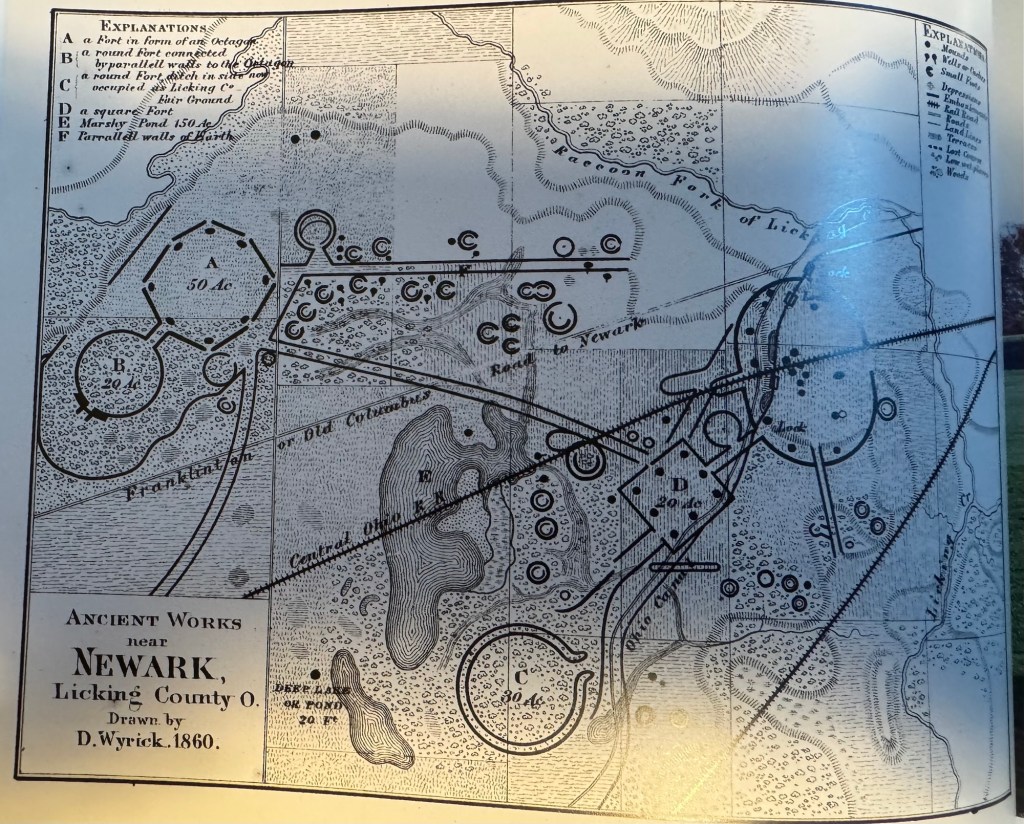
In North America, particularly the Ohio Valley and Miami Valley near Middletown, similar earthworks abound. The Hopewell culture (circa 100 BCE–500 CE) constructed vast geometric enclosures—circles, squares, octagons—often aligned to lunar cycles (e.g., the 18.6-year standstill at Newark Earthworks’ Octagon) or solar events. Serpent Mound in Ohio aligns with solstices and possibly the Milky Way’s “Path of Souls,” a motif in indigenous cosmologies linking earth to afterlife journeys. Adena mounds (earlier, circa 1000–200 BCE) and Hopewell sites feature precise geometry, trade networks spanning continents, and astronomical observatories. These predate European arrival by millennia, challenging notions of “primitive” hunter-gatherers. Nearby, the Miami Valley hosts mounds echoing these patterns, with alignments suggesting cosmic clocks for ritual and seasonal life.

A groundbreaking North American site is the Windover Bog in Florida, discovered during development in the 1980s. Dating to 6990–8120 years ago (over 3,500 years before Egypt’s pyramids), it yielded 167+ burials in a peat pond, preserved remarkably due to anaerobic conditions. Bodies were placed on left sides, heads west, faces north, often fetal, staked to prevent floating—indicating directional symbolism and care. Most strikingly, 91 skulls contained preserved brain tissue (shrunken but with cellular structure and DNA recoverable), the oldest known human brain preservation. This suggests rapid burial (within 48 hours post-mortem) and sophisticated rituals, perhaps tied to beliefs in body preservation for dimensional or spiritual continuity. Far from primitive, Windover reveals an organized society with advanced mortuary practices, challenging shallow historical timelines.

These sites—London Stone, Point Zéro, Stonehenge, Ohio earthworks, Windover—point to a global reverence for specific places: stones, mounds, alignments marking time, space, and perhaps destiny. Why bury with heads west? Why align to stars? Why build temples on threshing floors (as with Solomon’s Temple on the site Abraham nearly sacrificed Isaac)? Flynn posits these as entry points or measurements in a cosmic grid, possibly from ancient visitors or lost knowledge, tied to biblical hints of pre-flood civilizations and migrations (e.g., Egyptian ties to Atlantis via Plato). The Bible, as a preserved chronicle amid lost libraries, offers context—books like Judges establishing moral foundations for governance, echoed in modern gestures like beautiful study Bibles gifted to legislators (as shared in conversations with figures like Senator George Lang, a pro-business advocate who values ancient history alongside capitalism).

This raises profound questions: Is free will illusory if events align with predestined patterns? Horoscopes, zodiacs, and fate tied to birth location persist because ancient knowledge intuited cosmic influences. Temples, stones, and mounds chronicle timelines across generations, measuring planetary proximities and earthly geometry. Contested sites like the Temple Mount—proximity to Mecca’s Black Stone—underscore not mere religion but fundamental roles in time-space measurement.

The Windover people, with their preserved brains and oriented burials, key this reevaluation. They hint at sophisticated understanding predating “civilized” history, urging us to extend timelines backward. Romans inherited; Greeks contemplated Atlantis; Egyptians migrated from fallen ties. We must reverse-engineer ancient thinking with math and logic, applying it to mounds, stones, and alignments worldwide.

Flynn knocked on genius’s door by connecting dots others dismissed. As evidence accumulates—new digs, reexaminations—his questions gain traction. A healthier future demands honest reckoning with this past: not dismissing speculation but embracing patterns in remnants. Archaeology, anthropology, and theology together illuminate what survives erosion, guiding productive fulfillment of fate. Magnificent understandings await, if we dig deeper and contemplate openly.

Bibliography and Further Reading (footnotes-style references drawn from sources):

1.  Flynn, David. Temple at the Center of Time: Newton’s Bible Codex Finally Deciphered and the Year 2012. Official Disclosure, 2008. (Core text on Temple Mount measurements and prophetic timelines.)

2.  Flynn, David E. Cydonia: The Secret Chronicles of Mars. (Explores Mars-Earth connections and ancient knowledge.)

3.  Abram, David R. Aerial Atlas of Ancient Britain. Thames & Hudson, 2022. (Visual documentation of British prehistoric sites and alignments.)

4.  Doran, G.H. et al. “Anatomical, cellular and molecular analysis of 8000-yr-old human brain tissue from the Windover archaeological site.” Nature, 1986. (Scientific paper on Windover preservation.)

5.  Wikipedia and Historic UK entries on London Stone (various dates). (Overview of history and myths.)

6.  Atlas Obscura and related sources on Paris Point Zéro. (Details on the marker and its significance.)

7.  Ohio History Connection and NPS resources on Hopewell Ceremonial Earthworks/Newark Earthworks. (Astronomical alignments in Ohio mounds.)

8.  Alberino, Timothy. Various works and interviews referencing Flynn (e.g., Birthright and podcasts). (Modern continuation of alternative history themes.)

Rich Hoffman

More about me

Click Here to Protect Yourself with Second Call Defense https://www.secondcalldefense.org/?affiliate=20707

About the Author: Rich Hoffman

Rich Hoffman is an independent writer, philosopher, political advisor, and strategist based in the Cincinnati/Middletown, Ohio area. Born in Hamilton, Ohio, he has worked professionally since age 12 in various roles, from manual labor to high-level executive positions in aerospace and related industries. Known as “The Tax-killer” for his activism against tax increases, Hoffman has authored books including The Symposium of JusticeThe Gunfighter’s Guide to Business, and Tail of the Dragon, often exploring themes of freedom, individual will, and societal structures through a lens influenced by philosophy (e.g., Nietzschean overman concepts) and current events.

He publishes the blog The Overmanwarrior (overmanwarrior.wordpress.com), where he shares insights on politics, culture, history, and personal stories. Active on X as @overmanwarrior, Instagram, and YouTube, Hoffman frequently discusses space exploration, family values, and human potential. An avid fast-draw artist and family man, he emphasizes passing practical skills and intellectual curiosity to younger generations.

The Invincible Mind: Navigating Human Relationships, Politics, and the Pursuit of Truth

Human beings interact in countless ways, layered with psychological complexities that often obscure simple truths. Friendships form, alliances shift, and conflicts arise—not always from malice, but from differing visions of what is right. In politics especially, these dynamics intensify: tides turn, candidates rise and fall, and people find themselves on opposite sides of debates. Yet, amid the noise, some relationships endure. Observers sometimes question loyalties: “How can you be so friendly with someone you disagree with politically?”

I’ve had some very public disagreements with people. But I can never think of a time that I wouldn’t ever talk to someone again

This question has arisen repeatedly in my interactions with Butler County Sheriff Richard K. Jones and many others. We’ve shared public moments of warmth and camaraderie, even as political winds have blown in conflicting directions. The same applies to recent encounters with Ohio Governor Mike DeWine. After years of sharp criticism—particularly over his administration’s handling of COVID policies and other matters—I shook his hand following his final State of the State address. We discussed areas of agreement, such as Second Amendment rights and efforts to combat AI-generated child exploitation. These moments highlight a core principle: genuine regard for individuals ‘ needs need not hinge on perfect alignment. Relationships built on authenticity withstand disagreement; those rooted in manipulation crumble.

We were talking about his wife’s great cookies. The second amendment during his administration. Taxes. And his endorsement of Vivek Ramaswamy.

This perspective stems from a life shaped by diverse encounters. Growing up in Ohio, I navigated rough characters and “celebrity” figures in my early adult years—individuals carrying heavy psychological burdens and disappointments. These experiences, often intense and sleepless, taught navigation of human darkness. I awoke each day intent on being the “good guy,” never contemplating villainy. This innate drive toward justice, perhaps divinely guided, clashed with destructive forces, leading through ominous courtrooms and rigorous trials.

The lofty expectations of public office. Few people ever live up to those expectations. But the building was built with the expectation of exceptionalism.

These trials instilled resilience. I’ve seen the worst of human behavior: betrayal, manipulation, and raw conflict. Yet, they clarified priorities. Nothing since has felt catastrophic by comparison. This foundation allows aloof observation—staying “lofty” amid chaos—while engaging directly when needed.

I love to see the future, in the here and now. Great young people!

Professionally, I’ve channeled this into commentary via platforms like The Overmanwarrior blog, podcasts, and writings (including books like The Symposium of Justice and business guides). As a fast-draw enthusiast and strategist, I’ve advised on local and state issues. Public friendships, like with Sheriff Jones, stem from shared values on law, order, and community—despite occasional political divergences. These are not performative; they’re authentic.

Most relationships reduce to two levers of control. The first is friendship as leverage: people offer smiles, hugs, or inclusion to gain compliance. When denied, they withdraw—“I’m not your friend anymore unless you…” This mirrors childhood games (stickers on lockers) and adult dynamics (passive-aggression in marriages, where affection is withheld until demands are met). In politics, it’s “endorse my candidate or lose my support.” Women and men alike use emotional coziness as currency; it’s learned early and persists.

The second is the threat of violence or intimidation. When friendship fails, escalation follows: harassment, protests, spiritual “warfare,” or physical threats—“Do what I say or face consequences.” Authoritarian regimes amplify this; bullies in parking lots embody it personally. Both aim at submission through fear.

I’ve rejected both. Secure in my positions, I express them openly—here, on podcasts, in writing—without needing validation. Disagreement doesn’t prompt cliff-jumping; it invites dialogue or indifference. If someone withdraws friendship over opinions, that’s their choice. If intimidation arises, I handle it unflinchingly, drawing from early lessons in facing rough characters.

This stance echoes timeless wisdom, like Sun Tzu’s The Art of War: become invincible by rendering tactics ineffective. Control what you can—your actions, values, responses—and influence outcomes without direct domination.

Sheriff Jones exemplifies this. We’ve agreed on much: law enforcement, border security, deportations, and community protection. His office’s work with ICE and unapologetic stance on illegal immigration align with my views. Publicly, we’re friendly—podcasts, events, and genuine conversations about his brand and duties.

Yet, political motivations diverge at times. Endorsements or strategies might differ. Critics note our chumminess amid such gaps, confused by loyalty despite opposition. The answer: I like him authentically. His character, spine, and public service earn respect. If we clash, we may not talk for a while—that’s fine. Friendship isn’t conditional on perfect alignment. I won’t manipulate him (or allow manipulation) to force agreement. Truth emerges through pressure and process, not emotional blackmail.

This extends broadly. I like many who’ve opposed me politically, and I reserve the right to value people independently. Indifference to reciprocity preserves freedom.

A recent addition underscores this: Governor DeWine’s final State of the State address. His administration faced criticism—over COVID handling and other policies—creating opposition, which I had been very critical of, rightfully so. Yet, post-speech, we shook hands and spoke cordially.

We aligned on key issues: Second Amendment defense, and crucially, combating AI-generated child sexual abuse material (often called “simulated” or “AI child porn”). DeWine and Attorney General Dave Yost highlighted predators using AI to create exploitative images of children, urging legislation to criminalize creation, possession, and distribution. This addresses a growing threat where legal gaps allow evasion of traditional child pornography laws. I expressed support, noting agreement despite past differences, such as when Yost was running against my supported candidate, Vivek Ramaswamy for governor.

This exchange wasn’t leverage-seeking. It prioritized common ground—protecting children—over grudges. Putting differences aside when opportunities arise fosters the emergence of truth, not manipulation through fear of lost friendship.

Politics amplifies these dynamics: RINOs vs. traditional conservatives, reform movements, religious clashes. Belief systems collide; scores settle. Yet, values about people shouldn’t depend on outcomes. I like or dislike based on character, not scoreboard.

Pursuing righteousness means respecting all sides, allowing truth to reveal itself through conflict’s “fog of war.” Hot tempers subside; smoke clears; good emerges. Manipulation—friendship withdrawal or intimidation—crowds ideas into small-mindedness. Independence enables macro focus: immortal existence over micro squabbles (marriages, divorces, family disputes).

A good friend of mine gave me some homework to do

I’ve built a life affording this luxury: secure positions, no fear of loss. Many seek friendship; time limits interactions. Some engage strategically to advance balls—purely functional, not manipulative.

It’s okay to like those who hate you, to be friendly with opponents, and to shake hands after battles. Truth often surfaces in conflict; observation reveals positions. By staying outside manipulation’s reach, one accomplishes greatly where others falter.

In the end, righteousness is rooted in truth, not personal desires or leverage. Respect others’ thoughts—even wrong ones. Good people come around; disputes fade. We shake hands, share hot dogs at picnics, and discuss lofty things as emotions drift.

George Lang is a great guy in all aspects, what a lot of people don’t know about him is he loves books. Something we share beyond the immediacy of politics

 Bibliography

Overmanwarrior blog (overmanwarrior.wordpress.com) – Primary source for writings on politics, philosophy, and personal insights. Butler County Sheriff’s Office interactions – Public podcasts and events with Sheriff Jones (e.g., discussions on immigration, law enforcement). Ohio Governor Mike DeWine’s State of the State address (2026) – Focused on AI restrictions, including child exploitation; references from news coverage (e.g., Toledo Blade, ABC6). Attorney General Dave Yost’s efforts – Collaboration on bills like SB 217/SB 163 targeting AI-generated CSAM. The Art of War by Sun Tzu – Concept of invincibility through non-engagement with opponent strengths. Personal books: The Symposium of Justice, business guides – Available via Overmanwarrior platforms.

This framework allows engagement without compromise, advancing righteousness amid human complexity.

1.  Hoffman, Rich. The Symposium of Justice. iUniverse, 2004.

A novel blending fiction with philosophical themes of justice, freedom, and confronting sinister forces—written as a counterpoint to real-world political and personal battles. Available on Amazon: https://www.amazon.com/Symposium-Justice-Rich-Hoffman/dp/1412020158.

2.  Hoffman, Rich. Tail of the Dragon. CreateSpace Independent Publishing Platform, 2012.

Explores themes of freedom, law, and high-stakes conflict through a narrative rooted in real altercations and political activism and often described as “faction” (fact-based fiction).

3.  Hoffman, Rich. The Gunfighter’s Guide to Business: A Skeleton Key to Western Civilization. Liberty Hill Publishing, 2021.

A practical and philosophical guide that draws parallels among gunfighting strategy, business, and life—offering a Western counterpoint to Eastern classics like The Art of War. Emphasizes invincibility through preparation and independence. Available on Amazon and referenced in Hoffman’s bio.

4.  Hoffman, Rich. “The Overmanwarrior” (blog). WordPress.com, ongoing since ~2010. Primary URL: https://overmanwarrior.wordpress.com/.

Daily posts on politics, culture, philosophy, personal stories, and current events in Ohio (e.g., Butler County issues, tax fights, and human dynamics). Includes author bio, reflections on early life, and discussions of books like The Symposium of Justice.

5.  Sun Tzu. The Art of War. Translated by Lionel Giles (1910 edition) or modern versions (e.g., Everyman’s Library). Original ~5th century BCE.

Key concept from Chapter 4 (“Formation”): “Invincibility lies in oneself; vulnerability lies in the enemy.” The skilled make themselves invincible through self-preparation, rendering opponent tactics ineffective—directly echoed in the essay’s rejection of manipulation levers.

6.  “DeWine calls for new AI regs, parental control rules in 2026 State of the State.” Cleveland.com (via various outlets, including Facebook reposts and Toledo Blade coverage), March 2026.

Covers Governor Mike DeWine’s final State of the State address, urging legislation on AI guardrails, including outlawing the creation, possession, and distribution of AI-generated child sexual abuse material (CSAM). Aligns with the essay’s mention of agreement on child protection despite past differences.

7.  “Ohio struggles to combat AI-generated child porn amid legal gaps.” ABC6 On Your Side, January 29, 2026.

Details legislative efforts (involving DeWine and Attorney General Dave Yost) to close gaps in prosecuting AI-simulated child exploitation, highlighting the growing threat and push for criminalization.

8.  Butler County Sheriff’s Office. “In The Saddle With Sheriff Richard K. Jones” (podcast series). Apple Podcasts and related platforms, ongoing.

Episodes featuring Sheriff Richard K. Jones on law enforcement, immigration (e.g., 287(g) agreements), and community issues. Includes collaborations and discussions with Rich Hoffman (e.g., Rumble episodes on ICE detainees and related topics).

9.  Various public interactions: Butler County Sheriff’s Office Facebook posts and YouTube videos (e.g., “Ohio 287(g) with Butler County Sheriff Richard Jones,” November 2025).

Document friendly exchanges, podcasts, and joint appearances between Sheriff Jones and Rich Hoffman on topics like border security and prisoner handling.

Top Notes for Further Reading

•  Start with Hoffman’s blog (The Overmanwarrior) for the most direct, unfiltered context—search archives for terms like “Sheriff Jones,” “DeWine,” “friendship,” “manipulation,” or “invincibility” to find raw reflections mirroring the essay’s monologue.

•  For philosophical grounding on invincibility and non-manipulative strategy, read The Art of War Chapter 4 alongside The Gunfighter’s Guide to Business—Hoffman explicitly positions his work as a Western response to Sun Tzu.

•  On Ohio politics and the examples: Follow coverage from Cleveland.com, Toledo Blade, and ABC6 for updates on AI/CSAM bills (e.g., potential SB 217/SB 163 analogs) and DeWine’s 2026 address. Sheriff’s Office social media provides real-time context on Jones’ work and public persona.

•  For broader insights into human relationships and power dynamics: Explore related classics like Machiavelli’s The Prince (on manipulation) or Nietzsche’s ideas on the “overman” (influencing the blog’s name), though Hoffman’s approach emphasizes righteousness over conquest.

Rich Hoffman

More about me

Click Here to Protect Yourself with Second Call Defense https://www.secondcalldefense.org/?affiliate=20707

About the Author: Rich Hoffman

Rich Hoffman is an independent writer, philosopher, political advisor, and strategist based in the Cincinnati/Middletown, Ohio area. Born in Hamilton, Ohio, he has worked professionally since age 12 in various roles, from manual labor to high-level executive positions in aerospace and related industries. Known as “The Tax-killer” for his activism against tax increases, Hoffman has authored books including The Symposium of JusticeThe Gunfighter’s Guide to Business, and Tail of the Dragon, often exploring themes of freedom, individual will, and societal structures through a lens influenced by philosophy (e.g., Nietzschean overman concepts) and current events.

He publishes the blog The Overmanwarrior (overmanwarrior.wordpress.com), where he shares insights on politics, culture, history, and personal stories. Active on X as @overmanwarrior, Instagram, and YouTube, Hoffman frequently discusses space exploration, family values, and human potential. An avid fast-draw artist and family man, he emphasizes passing practical skills and intellectual curiosity to younger generations.

The Spine of Courage and Self-Government in Butler County, Ohio: Meeting great kids at the Friends of Youth Shooting Sports fundraiser and dinner

It was really nice to attend the Butler County Friends of Youth Shooting Sports annual fundraiser dinner and auction on March 6, 2026, at Receptions of Fairfield. The place was packed with a large crowd of good, normal people—families, shooters, law enforcement folks, and community leaders—all there to support youth programs that teach firearm safety, marksmanship, discipline, and responsibility. I enjoyed every minute of it: the excellent food, the company, the auctions (silent and live, with plenty of guns and gear on offer), raffles, games, and the overall positive energy in the room. Doors opened at 5:30 p.m., and my wife and I stayed for three or four hours, just soaking it in and talking with good people who share the same fundamental values.

What stood out most was meeting so many young people involved in shooting sports. These kids have a brightness in their eyes, a confidence that comes from handling responsibility early. They learn to clean guns properly, shoot straight, hit targets, and manage danger in a controlled, supervised way. That kind of training builds character—it translates to life. You don’t see school shootings or reckless behavior from kids raised like this. Instead, they grow into solid adults who value family, hard work, and living constructively. They buy cars thoughtfully, choose good spouses, raise their own kids right, and pass on those same lessons.

I particularly enjoyed meeting the children of Butler County Treasurer Mike McNamara. He’s stepped into a big role after Nancy Nix (who was outstanding as treasurer and is now doing great as auditor), and he’s really grown on me. When he first took over, I wondered if anyone could fill those shoes as well as Nancy did, but Mike has proven himself capable and committed. More importantly, he’s solidly behind the Second Amendment and shooting sports. His kids were there wearing nice cowboy hats—just like I did back in third, fourth, and fifth grade, and still do today. We got into a fun conversation about it. People always ask why I wear a cowboy hat everywhere, and I tell them it’s my way of declaring I’m aspiring to something different from the mainstream secular world. It’s like wearing a T-shirt or pin that says, “I’m not going along with the crowd.” Those kids had the same spirit—bold, unapologetic, proclaiming traditional values at a young age. Their eyes had that refreshing light; you can see a lot about the parents in how the children carry themselves. Mike and his wife have raised a solid family, and it was heartening to see.

The event reminded me why these gatherings feel so reassuring. In everyday life—at Walmart or out in broader society—you encounter all kinds of people, some bright-eyed and well-raised, others not so much. Maybe they didn’t have good parents or healthy influences. Conservatives tend to be accommodating toward those folks, giving them a fair shake while holding to our own standards. But when you step into a room like this one, filled with hundreds of people dedicated to the Second Amendment, you see what’s possible when values align: large crowds of normal, productive people celebrating youth excellence, law and order, and personal liberty.

Handling firearms responsibly does something profound for a person. It teaches you to manage danger, focus, follow rules, and achieve precision. Those skills carry over. Kids who excel in shooting sports under good supervision become reliable adults. They don’t turn to violence; they build healthy lives. That’s why programs like those supported by Friends of Youth Shooting Sports—through 4-H clubs, local ranges, safety training, and more—are so vital. Every dollar raised stays local, funding equipment, events, and opportunities for Butler County kids.

Prominent people were there, fully embracing these principles. Sheriff Richard K. Jones gave a powerful speech that captured the mood perfectly. He talked about standing firm despite constant lawsuits (he said he has about 20 at any time), threats, and even people following him to the restroom trying to kill him. But he takes it—he has a spine. His office has deported thousands of illegal immigrants from dozens of countries, working with ICE, putting up signs that say “illegal aliens” without apology. He warned about border threats, getaways, potential terrorists already here, and urged everyone to be careful when traveling or at festivals. He credited President Trump for giving folks like him the backbone. The room erupted in chants: “Trump, Trump, Trump,” then “Vance, Vance, Vance” (a nod to potential future leadership), and “USA, USA.” It was electric, patriotic, and unfiltered.

Sheriff Jones has built a culture of law and order in Butler County. His jail got featured on Discovery Channel’s 120 Hours Behind Bars recently—showing productive reforms, even the infamous Warden Burger (which I’ve tried on tours; yeah, it’s as bad as the jokes say). He’s in his sixth term, setting an example others emulate. People like him, Treasurer McNamara, State Senator George Lang (majority whip and a strong supporter of shooting sports), and Sean Maloney (the main organizer from Second Call Defense) make these events what they are.

Sean Maloney has poured his passion into Second Call Defense for years. It’s a network that provides legal and financial help if you use a firearm in self-defense—protecting you from the legal headaches that often follow, even when you’re in the right. Ohio’s laws have improved dramatically over the last decade: better stand-your-ground, concealed carry, and self-defense protections. Groups like his have helped make that happen.

I support Second Call Defense because it’s effective, and events like this one demonstrate the community’s backing for it. We talked about real concerns—off the mainstream media grid—things the popular narrative pushes against: gun ownership as essential to preventing tyranny, whether from kings, Marxism, or overreaching government acting like a parent over adults. A world without self-defense rights leads to administrative intrusions on liberty. That’s not the trajectory humanity should take.

Butler County feels unique. It’s MAGA country through and through—from Tea Party days to Trump’s wins (and I believe the 2020 irregularities were real; free speech in 2024 helped bring sanity back). CNN even came here years ago, interviewing folks at places like Rick’s Tavern near the venue, trying to figure out why we supported Trump despite the scandals and attacks. It’s because we see through power-structure games. Gun ownership is key: a population armed and trained stays free to speak, organize, and resist overreach.

That’s why I’ve stayed in Butler County all these years, despite chances to live or work elsewhere. Sheriff Jones’s speech nailed it—local pride, taking care of our own, standing up. Property values are high; it’s desirable to live here because of safe communities, strong families, and representatives who embody the character: law and order, Second Amendment support, and traditional values.

This wasn’t a bunch of fringe types talking revolution. These are everyday people—government officials, families, business folks—who elect leaders like Jones (popular for decades), McNamara, and Lang. They want this kind of representation. Strip away the social layers, and you see shared beliefs about building a good society: family, individual strength, and no centralized parental government.

Seeing the youth there—the next generation with cowboy hats, bright eyes, no fear—gives hope. I’ve seen that same light in rodeos, Christian groups, Bible studies: confident kids from strong families and support structures. It starts with learning to handle firearms safely and building confidence under adult guidance. That produces people who stick around for decades, keeping the Republican Party strong here and events like this thriving.

The mainstream media slants toward progressive agendas—disarmament, accommodation of brokenness over traditional standards. But we’re not victims. We’ve been polite, giving seats at the table, but we don’t have to accept their direction. Events like this remind me that goodness is worth fighting for.

It was a wonderful evening—good food, great company, encouragement from like-minded people. I appreciated the invite and loved meeting the young people, especially those like McNamara’s kids. Their boldness, the light in their eyes—it’s refreshing. That’s why places like Butler County endure and why these principles matter: family building, strong individuals, defense of liberty through understanding and ownership of firearms.  Gun ownership is the key to a successful society of self-rule.  And that is the backbone of success in Butler County, Ohio.

Footnotes

1.  Event details from American Freedom Liberty Foundation (aflf.org/banquet), confirming March 6, 2026, at Receptions of Fairfield, with activities including dinner, auctions, raffles, and local youth program support.

2.  Sheriff Jones’s background and jail features were drawn from public reports (e.g., Discovery Channel 120 Hours Behind Bars, March 2026 coverage).

3.  Second Call Defense and Sean Maloney from the official site (secondcalldefense.org).

4.  Butler County officials (McNamara, Nix, Lang) from county websites and election records.

5.  Youth shooting programs reference Ohio 4-H and local clubs.

Bibliography

•  American Freedom Liberty Foundation. “Butler County Friends of Youth Shooting Sports Banquet.” aflf.org/banquet.

•  Buckeye Firearms Association. Related banquet announcements (2025–2026).

•  Butler County official sites (treasurer.bcohio.gov, etc.).

•  Second Call Defense. secondcalldefense.org.

•  Local news on Sheriff Jones (WVXU, Journal-News, 2026).

If you’d like tweaks or more details, say the word.

Rich Hoffman

More about me

Click Here to Protect Yourself with Second Call Defense https://www.secondcalldefense.org/?affiliate=20707

The Book of Enoch: Understanding the 10 Heavens and the political structure of angelic bureaucracy

I’ve been reflecting deeply on this pivotal moment in human history, where the trajectory of our entire species feels intentional—like everything, from the invention of widespread online communication to the collapse of institutional secrecy, has been building toward a massive unveiling. We’re living in what I call the age of disclosure, not just about UFOs and their implications, but about Earth’s true creation story, humanity’s original role, and our relationship with the divine. The internet has turned the world into one giant village, where discussions happen proactively, 24/7, without the old limits of gatekeepers. The sum of all these conversations is propelling us toward truth, stripping away power from those who once hoarded knowledge through secrecy.

I argue that even the tragedies of 2020—the COVID era, the global lockdowns, the antagonisms tied to what increasingly looks like a lab-manufactured event (with declassified materials and books pointing to gain-of-function research)—were necessary, as dark as they were. They shattered blind trust in authorities and sparked the open dialogue we have now. People are throwing ideas into the wind, leading to advanced, healthy exchanges that connect ancient mysteries to modern phenomena.

This brings me to the edition of the Book of Enoch that Timothy Alberino put together with the Blurry Creatures guys (Nathan Henry and Luke Rodgers). I’ve been immersed in it lately, and it’s exceptional. This complete version includes 1 Enoch (the main Ethiopic text), 2 Enoch, and 3 Enoch, with Alberino’s scholarly introduction and detailed commentary—especially on the Book of the Watchers (chapters 1-36). What makes it stand out are the full-color concept art illustrations: scenes of fallen Watchers, Nephilim giants, heavenly ascents, and interactions between celestial beings and humans. One image that struck me depicts a UFO-like encounter on a mountain with people below—it visualizes Enoch’s visions in ways that echo modern sightings and interdimensional ideas.

I don’t see this as science fiction or fantasy; I treat it as a historical text, preserved through the Ethiopians, referenced in the Dead Sea Scrolls, and influential in Second Temple Judaism. Fragments were found at Qumran alongside the Book of Giants, showing how central it was to that community—the Essenes, the Teacher of Righteousness, even figures like Jesus and John the Baptist would have known it. It was debated during canon formation but excluded from the standard Bible, yet it fills gaps in Genesis, explaining the “sons of God,” the Nephilim, the corruption that necessitated the flood, and Enoch’s own journey.

Enoch ascends through multiple heavens, encounters angelic orders, witnesses cosmic structures, and transforms into Metatron—God’s trusted scribe and advocate. The Watchers rebel, driven by lust for human women, father hybrid giants, teach forbidden arts, and corrupt everything, leading to the deluge as a reset. This narrative echoes flood myths worldwide and potentially ties into cryptids, Bigfoot-like beings, shadow people I’ve encountered in haunted spots, UFOs, and ghosts—perhaps residual spirits or something more multidimensional.

I love how Alberino and the Blurry Creatures team integrate global legends without apology. They frame it boldly as relevant today, linking pre-flood giants to anomalies like the Windover Bog site in central Florida. I recently visited the Brevard Museum there and filmed a short video that I sent to Timothy and others. The site dates to about 7,000–8,000 years ago, with over 160 burials preserved in peat. Remarkably, 91 skulls held intact or partially preserved brain tissue—shrunken but with gross anatomy, cellular structure, and extractable DNA. Grave goods included sophisticated woven fabrics rivaling modern textiles. While not exaggerated “giants” (skeletons lean on the high side of normal human height), the preservation and age challenge young-earth views and support deeper antiquity for advanced human activity, possibly tying into antediluvian sophistication described in Enoch.

This edition avoids the hesitant tone of older translations; it presents the text as essential for biblical theology, morality, and understanding Jesus’ mission amid cosmic rebellion. It survived in secret societies (Templars, Masons) while the masses got a sanitized version. Now, in our mass-publishing era, secrecy crumbles—books like this reach everyone.

I binge Alberino’s work—his writing, podcasts, everything—because his generation builds on Hancock and Von Däniken but roots it firmly in scripture. It grounds assumptions from archaeology and matches discoveries to ancient literature. The Book of Enoch likely predates or influenced Sumerian, Indus Valley, and other civilizations, with elements adopted across cultures (similar to how later traditions borrowed biblical motifs).

We’re in a unique time: humanity birthing a renewed relationship with God and truth through open exchange. The Holy Spirit operates multidimensionally, outside time—God, the Son yielding to the Father’s will at crucifixion, the Trinity bridging realities. Books like this facilitate real dialogue: What are ghosts? Interdimensional echoes? Do cryptids connect to fallen entities? Why the flood across every culture?

I highly recommend grabbing this edition—it is flying off shelves and sparks the right conversations. If you’re into biblical studies, lost books, disclosure, or matching scripture to the dirt digging of archaeology, it’s indispensable. It reframes Genesis, the deluge, and our role in profound ways. This is the great-grandfather material to Moses’ era, pre-flood history that validates so much.

It’s a wonderful book, full of love and context from Alberino and the team. I read it while at Windover, pondering these layers, and the implications are profound.

Footnotes

1.  Alberino, T., Rodgers, L., & Henry, N. (2024). The Book of Enoch: With Commentary & Concept Art on the Book of the Watchers (Complete Edition, includes 1, 2, & 3 Enoch). Independently published. (Released June 13, 2024; draws on public-domain translations including R.H. Charles for 1 Enoch [1917], W.R. Morfill for 2 Enoch [1896], and Hugo Odeberg for 3 Enoch [1928]).

2.  Doran, G.H., et al. (1986). “Anatomical, cellular and molecular analysis of 8000-yr-old human brain tissue from the Windover archaeological site.” Nature, 323, 803–806. (Details preserved brain tissue in 91 skulls, radiocarbon dates ~7,790–8,290 years BP.)

3.  Milik, J.T. (1976). The Books of Enoch: Aramaic Fragments from Qumrân Cave 4. Oxford: Clarendon Press. (Documents Aramaic fragments of 1 Enoch from Dead Sea Scrolls, covering parts of the Book of the Watchers and related texts like the Book of Giants.)

4.  U.S. Right to Know. (2026). FOIA-released Defense Intelligence Agency records (e.g., March 27, 2020 assessment on Wuhan Institute of Virology lab-origin scenario). Available via usrtk.org/covid-19-origins.

5.  Office of the Director of National Intelligence. (2021). Declassified Assessment on COVID-19 Origins. (IC assessment noting plausible lab-associated incident hypothesis.)

6.  Charles, R.H. (1917). The Book of Enoch or 1 Enoch. Oxford: Clarendon Press. (Classic translation of the Ethiopic 1 Enoch, basis for many modern editions including Alberino’s.)

Bibliography

•  Alberino, Timothy, Luke Rodgers, and Nathan Henry. The Book of Enoch: With Commentary & Concept Art on the Book of the Watchers (Complete Edition). Independently published, 2024.

•  Charles, R.H. The Book of Enoch or 1 Enoch. Oxford: Clarendon Press, 1917.

•  Doran, G.H., et al. “Anatomical, cellular and molecular analysis of 8000-yr-old human brain tissue from the Windover archaeological site.” Nature 323 (1986): 803–806.

•  Milik, Józef T. The Books of Enoch: Aramaic Fragments from Qumrân Cave 4. Oxford: Clarendon Press, 1976.

•  Office of the Director of National Intelligence. Declassified Assessment on COVID-19 Origins. 2021. https://www.dni.gov/files/ODNI/documents/assessments/Declassified-Assessment-on-COVID-19-Origins.pdf.

•  U.S. Right to Know. FOIA productions from Defense Intelligence Agency (2025–2026 releases). https://usrtk.org/covid-19-origins.

•  Windover Archaeological Site overview. Wikipedia and related sources (e.g., The History Center, Titusville; Atlas Obscura articles summarizing excavations and preservation details).

Rich Hoffman

More about me

Click Here to Protect Yourself with Second Call Defense https://www.secondcalldefense.org/?affiliate=20707

Fighting Monsters: Culture at Liberty Center in Butler County that is healthy and wise

The recent Lunar New Year celebration at Liberty Center in Liberty Township, Ohio, brought back a flood of memories for me. On February 28, 2026, the mall complex—always a wonderful development just north of the I-275 loop—hosted a vibrant Lunar Festival organized by the Alliance of Chinese Culture & Arts. The event featured classic dragon and lion dances, Chinese music, Asian drums, acrobatics, Taiji demonstrations, and more, filling the space with energy and drawing crowds from the local community in Butler County. It was a positive, constructive way to launch the next phase of the year, embracing Eastern cultural traditions in a modern American setting. The performances were well-coordinated, tasteful, and joyful, with vendors offering dumplings and other treats amid the festivities, and watching the dragon soar and the lions prance reminded me of my own early experiences with these rituals.

As a teenager in the mid-1980s—around 1984, 1985, and 1986—I had one of my first real jobs at Emperor’s Wok, a highly decorated Chinese restaurant on Chester Road in Sharonville, Ohio. It was one of the most elaborate spots in Cincinnati at the time, with intricate interiors dedicated to Chinese culture. Everyone went there for authentic food in an immersive environment. The owners and family were wonderful; I got to know the cooks and the performers who handled the dragon dances. My role included customer service—dressing sharply in a bowtie to hustle tips in a classic, high-energy setting—but during Chinese New Year, it became something more adventurous. They kept the dragon costume and props in a closet year-round, and I was tasked with climbing onto the roof and the magnificent awning where cars pulled up for drop-offs. The restaurant had a grand entrance, and the parking lot would fill with spectators as the traditional dragon dance unfolded.

The dance lasted about half an hour, complete with booming drums, crashing cymbals, and the performers underneath the long, colorful dragon puppet. My job was to feed strings of thousands of firecrackers off the awning, setting them off in bursts that exploded above the dragon’s head as it twisted and leaped below. The noise, smoke, and flashes created an electric atmosphere, scaring away bad spirits in the tradition while entertaining the crowd. Firecrackers were key—loud explosions to drive off evil—and the whole thing felt proactive: humans creating their own spectacle to combat terror. Seeing similar elements at Liberty Center in 2026 brought it all rushing back: the coordination, the percussion, the acrobatics, and the sense of community triumph over unseen threats.

These dances aren’t just entertainment; they’re deeply rooted in Chinese mythology and serve a spiritual purpose. The lion dance, prominent in southern China, is often associated with the legend of the Nian (or Nian beast), a ferocious monster that terrorized villages on New Year’s Eve. Descriptions vary—some say it resembled a flat-faced lion with a horn, others a massive creature larger than an elephant with sharp teeth—but the core story is consistent. The Nian feared loud noises, bright lights, and the color red. Villagers discovered this and used firecrackers, fireworks, red decorations, lanterns, and couplets on doors to repel it. Over time, these customs evolved into annual traditions: red envelopes for luck, staying up late, and performances to ensure protection and prosperity. The lion dance mimics this defense, with performers in vibrant, red-heavy costumes embodying strength and courage. The dragon dance, dating back to the Han Dynasty or earlier, honors the dragon as a symbol of power, wisdom, benevolence, good fortune, and control over rain and water—essential for agriculture and abundance.

A key figure in many lion dances is the Laughing Buddha, or Big Head Buddha (Dai Tou Fat), often portrayed as a jolly, potbellied character in a mask, waving a fan. This isn’t the historical Buddha of Buddhism but a folk figure inspired by Budai (or Hotei), the “Laughing Buddha” known for joy, prosperity, and contentment. In the dance, he provides comic relief, teasing and guiding the lions—sometimes playfully chasing them or interacting with the crowd—while coordinating to the music. His presence adds lightness: amid the fierce combat against evil, there’s laughter, pranks, and confidence. The potbelly symbolizes a full, prosperous life, laughing in the face of danger. It’s a brilliant touch—turning fear into joy, showing human ingenuity in overcoming darkness through humor and skill. The martial arts elements, acrobatics, and kung fu displays highlight dexterity and strength, reinforcing that humans can triumph over lurking monsters.

This reverence for the spirit world extends across Eastern cultures. In Japan, Shinto temples feature similar beliefs in kami (spirits), with rituals to balance the seen and unseen. Korea and other regions share roots in warding off malevolent forces through noise, color, and performance. The thin veil between the physical and spiritual worlds means monsters or evil spirits—rambunctious and ever-present—must be managed proactively. Red wards off negativity; mirrors on costumes reflect evil back; drums and gongs create an overwhelming sound to dispel it. It’s optimistic: approach the unknown with boldness, abundance, and good fortune, much like fortune cookies that always deliver positive messages.

These patterns aren’t unique to the East. Globally, cultures confront “monsters” or paranormal threats through ritual. North American Indigenous traditions often involve drums, yelling, colorful regalia, and dances to connect with or control spirit visions—sometimes blurred by hallucinogenic plants in shamanic practices, creating colorful, terrifying projections that demand management for societal harmony. The use of red, loud percussion, and aggressive displays taps into the idea of warding off evil, much like firecrackers or mirrors. In Christianity, demons are pushed out through prayer, exorcism, or faith in divine protection. Everywhere, humans develop mechanisms to live with terror—whether invisible forces, cryptids, or existential fears.

This brings me to the Mothman legend from Point Pleasant, West Virginia (close to Ohio roots). Sightings in 1966-1967 described a large, winged humanoid with glowing red eyes, often near the TNT area (a former munitions site). It became tied to the tragic Silver Bridge collapse in December 1967, killing 46 people, turning Mothman into a harbinger of doom. Some link it to Native American lore, such as thunderbirds or curses (e.g., Chief Cornstalk’s), or even misidentified birds, such as sandhill cranes. But the archetype persists: a monster emerging seasonally or in crisis, attacking or foretelling harm. Around Christmas or New Year periods, it echoes the Nian—seasonal terror tied to transitions. Both involve communities responding: firecrackers and dances for Nian, vigilance and folklore for Mothman.

Expanding further, many speculate on shared origins for such creatures. Ancient astronaut theories suggest amphibious or serpentine beings from places like Sirius (as in Dogon African traditions of Nommo from Sirius B) influenced global myths. Chinese dragons—long, serpentine, benevolent yet powerful—might reflect memories of advanced visitors or natural phenomena, migrating from regions like the Indus Valley over the Himalayas into East Asia. From the Near East westward, dragons became adversarial (e.g., biblical serpents or European fire-breathers), but in the East, they’re auspicious. Amphibious gods (e.g., Babylonian Oannes or Dagon) appear in Sumerian and other lore, possibly tied to seafaring or aquatic extraterrestrials who seeded civilization. The persistence of monster myths—winged humanoids, serpents, beasts—suggests a universal human concern with the “other”: unseen threats in the dark, whether paranormal, spiritual, or existential.

Yet cultures don’t just fear; they innovate. Eastern approaches—optimistic, proactive, laughing at danger—offer lessons. The Laughing Buddha prances confidently amid monsters, embodying joy despite peril. Drums attack the spirit world aggressively, red banners proclaim victory, and firecrackers create human-made chaos to counter it. This mindset—embracing abundance, prosperity, and humor—helps build constructive societies. Liberty Center’s event wonderfully blended this ancient wisdom with modern community life, reminding us that engaging with other cultures enriches our own without duplicating rituals wholesale. We have strengths in the West, but learning to face “monsters”—whether literal cryptids, personal demons, or global uncertainties—builds resilience.

My time at Emperor’s Wok taught me early about cultural depth beyond surface festivity. Friendships with the family performers, the thrill of the rooftop explosions, the cultural immersion—all shaped how I view the world. Watching the 2026 festival, I saw echoes of those days: positive energy pushing back darkness, joy in the face of the unknown. It’s a healthy reverence for survival, a reminder that humans thrive by confronting fears creatively. Watch out for the monsters—they’re everywhere—but find ways to laugh, drum, and dance them away.

For further reading and research:

•  Wikipedia entries on “Nian,” “Lion dance,” “Dragon dance,” and “Mothman” provide solid overviews with sources.

•  Britannica’s article on the Chinese New Year details legends and traditions.

•  Books like The Mothman Prophecies by John Keel explore the Point Pleasant events.

•  Robert K.G. Temple’s The Sirius Mystery discusses Dogon-Sirius connections (though controversial).

•  Academic sources on shamanism and global folklore, such as studies on Indigenous North American rituals or comparative mythology.

Rich Hoffman

More about me

Click Here to Protect Yourself with Second Call Defense https://www.secondcalldefense.org/?affiliate=20707

‘Prehistoric Worlds Or, Vanished Races’: The truth of the anti-giant conspiracy

Not very long ago, my daughter called me in a rush from a used bookstore in downtown Middletown, Ohio—a place that’s seen better days, rough around the edges, but still holding onto some hidden gems. She told me I had to come right away because she’d found something special and was guarding it like a treasure. When I got there, she handed me an 1885 original edition of The Prehistoric World: Or, Vanished Races by E.A. Allen. The book is barely holding together after all these years, its pages fragile and yellowed, but it’s a remarkable artifact. I bought it for a reasonable price, and it’s become one of my prized possessions. It’s not just a book; it’s a window into a time when exploration and curiosity drove inquiry, before modern institutions locked down narratives with rigid assumptions.

I’ve always been drawn to these topics. Back in high school, even as far back as fifth and sixth grade, I was ahead of my teachers in history and anthropology classes. I’d read widely—Joseph Campbell’s works, myths, comparative religion—and I knew much of what was being taught was incomplete or outright wrong. I endured it to graduate and escape that institutionalized mindset, which I saw holding back real understanding. In my twenties, I dove deeper into Joseph Campbell and even joined the Joseph Campbell Foundation. My adventures around the world, combined with a lifelong connection to southern Ohio, shaped my views. My wife and I have been married nearly 39 years, and throughout that time, we’ve visited Serpent Mound repeatedly—every few years, it’s become a touchstone for us.

Living in southern Ohio, near Middletown and Hamilton, I’ve always had a personal relationship with these ancient sites. Serpent Mound, the massive effigy serpent earthwork in Adams County, is one of the most famous, but closer to home are the mounds along the Great Miami River Valley. There’s the Miamisburg Mound, one of the largest conical burial mounds in eastern North America, built by the Adena culture around 800 B.C. to A.D. 100. It’s 65 feet tall, 800 feet around, and excavations in 1869 revealed layered construction with possible stone facing and burial goods like pipes and effigies. There are even reports that they found skulls in that mound that would fit over the top of regular people, and that these finds terrified the excavators and they abandoned the site, never to return. Yet, despite its proximity—right near where I grew up—schools never took us there on field trips. We went to other places, heard stories about Native American burials and the sadness of destruction by Europeans, but nothing about these advanced earthworks.

Then there’s the area across from Joyce Park in Hamilton, where Pyramid Hill Sculpture Park now sits near Fortified Hill, an older than 2,000-year-old ceremonial earthworks site tied to the Hopewell or earlier traditions. In Allen’s 1885 book, there’s a description and illustration of a large effigy mound or structure in that vicinity—two high peaks carved or shaped, possibly reflecting ancient alignments, even to constellations like Aries, thought to be around 5,000 years old in some interpretations. The book chronicles many Ohio River Valley mounds, dedicating significant portions to the Miami and Mississippi cultures, Mexico, the Aztecs, and global prehistoric peoples. It’s an adventurous, Victorian-era take—profusely illustrated, speculative, open to wonders without the heavy filter of modern politics or funding constraints.

What strikes me most is how this 1885 book feels more honest about discoveries than much of what came later. During that era, explorers and adventurers reported findings without preconceived notions imposed by institutions. Allen’s work reflects a time when people were excited about vanished races and prehistoric worlds, including reports of mound contents that challenged emerging narratives. Many 19th-century accounts from Ohio mounds mentioned unusually large skeletons—sometimes described as 7 to 9 feet tall—unearthed during excavations. These were often speculatively linked to biblical giants or to ancient, advanced peoples. Newspapers and reports from the time sensationalized them, but they reflected genuine observations before professional archaeology standardized explanations. Mainstream archaeology today attributes these to the Adena and Hopewell cultures—sophisticated societies with wide trade networks, astronomical alignments in their earthworks, and ceremonial practices—but dismisses giant claims as misinterpretations, exaggerations, or hoaxes based on crumbling bones and poor documentation.  I have come to understand that the anti-giant conspiracy that has permeated the sciences was a secular construct intended to disprove biblical narratives, rather than to understand them, which was a critical error from that perspective.

I can’t help but feel that institutional science took a wrong turn. After the late 19th century, education and research became centralized, often prioritizing narratives that fit political or funding needs over raw observation. The mounds were attributed solely to ancestors of modern Native Americans, like the Adena (800 B.C.–A.D. 100) and Hopewell (200 B.C.–A.D. 500), who built massive geometric enclosures and burial sites with precision. These are now UNESCO-recognized, like the Hopewell Ceremonial Earthworks, celebrated for their engineering and cultural depth. Yet, in my view, this framing sometimes ignores anomalies or alternative interpretations to maintain control over the story.

This ties into broader questions I’ve pondered for decades. What if these earthworks—Serpent Mound with its debated alignments to solstices (summer sunset at the head, possible lunar or solar cycles), Miamisburg’s layered burials, Fortified Hill’s ceremonial space—are remnants of something older, perhaps offshoots of lost civilizations? Some speculate connections to Atlantis or pre-Ice Age advanced societies, which were wiped out by the Younger Dryas catastrophe around 12,900–11,600 years ago—a sudden cold snap possibly triggered by comet impacts and freshwater floods that disrupted ocean currents, leading to megafauna extinctions and cultural disruptions. Graham Hancock and others link this to Plato’s Atlantis, a global flood-like event ending an Ice Age civilization, with survivors possibly influencing later cultures.

In Ohio, the mounds don’t fit neatly into short timelines. Serpent Mound’s age is debated—some radiocarbon dates suggest an Adena date around 300 B.C., others a Fort Ancient date around A.D. 1100, with possible repairs—but its astronomical sophistication and serpent symbolism hint at deeper roots. The book I found predates the heavy institutionalization that followed, capturing a spirit of adventure where discoveries weren’t immediately boxed into “primitive Indians” or dismissed. It dedicates half its 800 pages to American earthworks, showing alignments and complexities that modern textbooks often downplay.

My frustration stems from this: growing up here, no one talked about these sites in school. No field trips to Pyramid Hill or Miamisburg. No discussion of potential giant remains or alignments that “they shouldn’t even know about” at the time. It felt like a deliberate omission to preserve a simple narrative. Institutions, chasing grants and political correctness, built assumptions around limited data, leading to dead ends. Meanwhile, independent researchers and adventurers are bypassing them, returning to direct observation and instinct.

This book reminds me how much more open inquiry was in 1885, before the Smithsonian and universities solidified control. It shows we knew—or at least wondered—more freely then. We’ve gone downhill in some ways, prioritizing preservation of timelines over pursuit of truth. My daughter recognized that instinctually when she saved it for me. It’s a benchmark: a call to question, explore, and reject complacency in institutionalized science.

We need to return to that adventurous spirit—observe these mounds, ask who built them, why, how old they truly are, and how they connect to our story today. The earthworks along the Ohio River Valley aren’t just relics; they’re evidence of advanced understanding—astronomical, engineering, spiritual—that challenges easy answers. By reflecting on books like Allen’s, we see where assumptions went wrong and how rediscovering truth requires going beyond the official path.

Bibliography

•  Allen, E. A. The Prehistoric World: Or, Vanished Races. Central Publishing House, 1885. (Available via Project Gutenberg and archives.)

•  Ohio History Connection. “Miamisburg Mound.” ohiohistory.org.

•  Ohio History Connection. “Serpent Mound.” ohiohistory.org.

•  Hopewell Ceremonial Earthworks. hopewellearthworks.org.

•  UNESCO. “Hopewell Ceremonial Earthworks.” whc.unesco.org.

•  Romain, William F. Various studies on Ohio earthworks astronomy.

•  Hancock, Graham. America Before: The Key to Earth’s Lost Civilization. St. Martin’s Press, 2019. (For Younger Dryas and catastrophe discussions.)

•  Various 19th-century newspaper reports on mound discoveries (e.g., via historical archives).

Footnotes

1.  Radiocarbon dating debates on Serpent Mound: See Monaghan and Hermann (2019) reconciliation of dates.

2.  Giant skeleton reports: Often debunked as mismeasurements (e.g., Columbus Dispatch, 2019), but reflect period observations.

3.  Younger Dryas Impact Hypothesis: Firestone et al. (2007) and subsequent studies.

4.  Adena/Hopewell mainstream views: National Park Service, Hopewell Culture National Historical Park.

Rich Hoffman

More about me

Click Here to Protect Yourself with Second Call Defense https://www.secondcalldefense.org/?affiliate=20707

The Jaw-dropping Impact of David Flynn’s Work: Uncovering a lost history of Mars and the migration of people to Earth

I’ve talked about Cydonia: The Secret Chronicles of Mars by David E. Flynn before, but after diving into the newly republished edition, I felt compelled to share my thoughts in depth. This book, originally self-published around 2002 by End Time Thunder Publishers, was ahead of its time—a dense, brilliant exploration that ties ancient mythology, biblical narratives, and apparent anomalies on Mars into a cohesive narrative about humanity’s origins. Thanks to Timothy Alberino’s advocacy, including his foreword in the new edition released in early 2026 by Sunteleia Press (with contributions from Mark Flynn), it’s now more accessible in hardcover, paperback, and digital formats, reaching a broader audience ready for these ideas.

I wouldn’t have picked it up without Alberino’s influence. I’ve followed his work since Birthright in 2020, appreciating how he bridges scriptural truth with adventurous inquiry into giants, Nephilim, and posthuman themes. He’s a genuine explorer with a scriptural backbone, not the stereotypical “New Age” figure some might dismiss. His promotion of Flynn’s work—calling it one of the most consequential books ever written—sparked my interest. I grabbed the new edition as soon as it dropped, read it multiple times to let the concepts sink in, and recorded my podcast thoughts because this material deserves serious consideration.

Flynn was a high-IQ thinker who operated outside mainstream channels. Through his Watcher website in the 1990s and early 2000s, he delved into biblical ufology, eschatology, sacred geometry, and the implications of structures photographed in Mars’ Cydonia region—like the so-called “Face on Mars” from the 1976 Viking images and nearby pyramid-like formations. He argued these weren’t mere pareidolia but encoded remnants of a civilization that fled Mars after catastrophe, bringing knowledge to Earth. Myths from Sumer, Egypt, the Indus Valley, Greece, Rome, and even indigenous Americas trace back to this diffusion, centered in the Near East near Mount Hermon—the biblical entry point for fallen angels (Watchers) in the Book of Enoch.

In Flynn’s view, these “sons of God” descended, fathered giants (Nephilim), taught forbidden arts, and corrupted humanity, leading to the Flood. Post-flood, survivors or their cultural echoes rebuilt civilizations, with megalithic sites worldwide aligning on geometric grids—pentagrams anchored at Giza and the Prime Meridian. This “As Above, So Below” principle suggests Mars’ Cydonia as a template for earthly monuments, from Stonehenge to Ohio’s Serpent Mound. Flynn connected this to ley lines, occult symbolism (serpents, hyperborean origins), and mystery schools preserving elite knowledge while suppressing it from the masses.

I’ve long collected accounts of giants in Ohio mounds—newspaper clippings from the 19th and early 20th centuries reporting oversized skeletons unearthed during excavations, often dismissed or “lost” by institutions like the Smithsonian. Many researchers chase these leads, get excited, then fade when mainstream scrutiny hits. Flynn escaped that cycle by grounding his work in scripture and comparative mythology rather than pure speculation. He wasn’t chasing kooks; he was synthesizing evidence that scripture and emerging science increasingly align.

This shift—from fringe “New Age” shelves (Graham Hancock, Zecharia Sitchin, Erich von Däniken) to respectable inquiry—began with thinkers like Flynn and accelerated with Michael Heiser’s The Unseen Realm and Reversing Hermon. Heiser, a Semitic languages scholar, unpacked Genesis 6 without extraterrestrial leaps, focusing on divine council and supernatural rebellion. Alberino builds on this, applying it to modern threats like transhumanism. Reading Flynn after Heiser and Alberino feels like puzzle pieces clicking: ancient myths aren’t fiction but distorted memories of real events, possibly involving ultra-terrestrial and/or extraterrestrial contact preserved in Enochian texts and global lore.

Critics point to NASA’s higher-resolution images (Mars Global Surveyor 1998 onward) showing the “Face” as a natural mesa eroded by wind, with no artificial symmetry. Pareidolia explains much—humans see faces in rocks, just as in clouds or toast. Yet Flynn’s geometric arguments persist intriguingly: if alignments predict undiscovered sites, why not consider cosmic origins? Hallucinogens like ayahuasca induce shared visions across cultures, echoing cave art from Lascaux to remote tribes, suggesting subconscious or spiritual exchanges. UFO phenomena add layers—disclosure talks under recent administrations hint at deeper truths.

I want to go to Mars not to abandon Earth but to verify. SpaceX and commercial efforts make it inevitable; we’ll build habitats, explore, and likely find preserved ruins—pyramids, mounds, architectural echoes—on a stripped world. No thick atmosphere or active society buries evidence there. If we discover ancient civilization remnants 10,000, 100,000, or millions of years old, it redefines history: humanity as refugees or engineered arrivals, not isolated evolution. Myths become chronicles; scripture’s miracles include survival of truth through millennia.

Power structures suppress this—China buries pyramids to control narrative; mystery schools hoard knowledge for dominance. Flynn exposed that, self-publishing because no mainstream house would touch it. Early internet allowed geniuses like him to connect, compare notes at 3 a.m., and build followings organically. Alberino, inspired, helped republish it, giving it legitimacy. His podcasts dissecting it (dozens in his community) make it digestible.

This book shatters illusions but in a good way. As disclosure ramps up—political, technological, archaeological—we must prepare. Root-cause analysis demands we question origins beyond Darwin or uniformitarianism. Mars may have been part of our past, not just future. Stories of tragedy, survival, and migration from the asteroid belt (Phobos/Deimos as remnants?) to Earth explain gods’ names and shared archetypes.

I’ve read extensively—Heiser, Sitchin (for contrast), Enoch translations, Hoagland’s Monuments of Mars—and Flynn stands out as genius-level synthesis. It’s dense, requires rereading, but rewards with awe at God’s design amid cosmic drama. Humanity’s dominion over Earth includes exploring to reclaim lost truth, bringing heaven here as representatives.

In these times, with information exploding and institutions failing, books like this empower us. Read it on your terms before media forces the conversation. It prepares for paradigm shifts—good ones, shattering control for freedom.

Bibliography

•  Flynn, David E. Cydonia: The Secret Chronicles of Mars. End Time Thunder Publishers, 2002 (original); Sunteleia Press edition with forewords by Timothy Alberino and Mark Flynn, 2026.

•  Alberino, Timothy. Birthright: The Coming Posthuman Apocalypse and the Usurpation of Adam’s Dominion on Planet Earth. Self-published, 2020.

•  Heiser, Michael S. The Unseen Realm: Recovering the Supernatural Worldview of the Bible. Lexham Press, 2015.

•  Heiser, Michael S. Reversing Hermon: Enoch, the Watchers & the Forgotten Mission of Jesus Christ. Defender Publishing, 2017.

•  The Book of Enoch (R.H. Charles translation, 1917; various modern editions).

•  Hoagland, Richard C. The Monuments of Mars: A City on the Edge of Forever. North Atlantic Books, 5th ed., 2001.

•  Sitchin, Zecharia. The 12th Planet. Bear & Company, 2004 reprint.

•  Hancock, Graham. Fingerprints of the Gods. Crown, 1995 (for comparative ancient mysteries context).

•  NASA Mars mission archives (Viking 1976, Mars Global Surveyor 1998–2006, etc.).

•  Flynn’s Watcher website (archived materials via secondary sources).

Footnotes for Further Reading

1.  On Cydonia anomalies and pareidolia: NASA press releases post-1998; Carl Sagan, The Demon-Haunted World: Science as a Candle in the Dark (1995).

2.  Nephilim and divine council: Genesis 6; Deuteronomy 32; Job 1–2; Heiser’s works above.

3.  Alberino’s role: His X posts and The Alberino Analysis community podcasts on Cydonia.

4.  Giant mound reports: 19th-century newspapers (e.g., New York Times archives); critiques in mainstream anthropology.

5.  Sacred geometry/ley lines: Alfred Watkins, The Old Straight Track (1925); Flynn’s pentagram grid discussions.

6.  Disclosure context: 2020s UAP Task Force reports; SpaceX Starship/Mars plans.

7.  Myth diffusion: Joseph Campbell, The Hero with a Thousand Faces (1949).

8.  Mystery schools/esotericism: Manly P. Hall, The Secret Teachings of All Ages (1928).

9.  Enochian influences: Dead Sea Scrolls fragments; 1 Enoch translations.

10.  Mars exploration potential: Recent Perseverance rover findings; astrobiology papers on ancient habitability.

Rich Hoffman

More about me

Click Here to Protect Yourself with Second Call Defense https://www.secondcalldefense.org/?affiliate=20707

The Windover Giants: Its all about the bog people of central Florida and a connection to the fallen Nephilim

The Windover Archaeological Site, discovered accidentally in 1982 during construction of a housing development near Titusville, Brevard County, Florida, stands as one of the most significant prehistoric burial grounds in North America. What began as a backhoe operator uncovering what he initially thought was an unusual rock—soon identified as a human skull—unfolded into the excavation of a shallow pond that became an ancient cemetery. Over several field seasons from 1984 to 1986, led primarily by Florida State University archaeologist Dr. Glen Doran, the site yielded the remarkably well-preserved skeletal remains of at least 168 individuals, along with artifacts, textiles, and, in many cases, preserved brain tissue. Radiocarbon dating placed these burials in the Middle Archaic period, roughly 7,000 to 8,000 years ago, a time when sea levels were significantly lower due to the lingering effects of the last Ice Age, making the area a higher inland location rather than the near-coastal zone it is today.

The preservation at Windover is extraordinary, thanks to the anaerobic, acidic peat environment of the bog-like pond, which prevented rapid decay and allowed soft tissues, such as brain matter, to survive in shrunken but intact form for millennia. This enabled DNA sequencing from the brain tissue, revealing genetic markers linking the Windover people to ancient Asian populations via migrations through Beringia, with no direct matches to modern Native American groups alive today. The DNA evidence supports the broader consensus of Siberian/Asian origins for early American populations, though some early interpretations or discussions speculated on other affinities; current analyses firmly place them within the founding lineages of the Americas without evidence of European admixture from that era.  Other than the burial technique itself, and the Western European DNA mixed into the specimens.

The burials were intentional and organized: bodies were often placed in a flexed or fetal position, lying on their left side, with heads oriented west and faces north, wrapped in textiles or accompanied by grave goods. Artifacts included woven plant-fiber fabrics—some of the oldest and most sophisticated textiles known from Archaic North America—bone and wood tools, and other items suggesting a settled, resourceful hunter-gatherer society capable of complex social practices, including caring for the injured and elderly. Evidence from the skeletons shows healed fractures, possible splinting of broken bones, and even signs of amputations, indicating communal support and medical knowledge far beyond simple survival instincts. The population included men, women, and children across all ages, from infants to individuals aged 60–70, an unusually long lifespan for the period, with roughly equal representation of the sexes and about half the remains being subadults.

Skeletal analysis provides key insights into stature and health; these people were very large for their time. Adult males averaged about 5 feet 9 inches (175 cm), with some reaching nearly 6 feet, while females averaged about 5 feet 2 inches to 5 feet 6 inches. These heights were notably taller and more robust than many later prehistoric populations in the region, with strong bone density reflecting a healthy, active lifestyle supported by a diverse diet of fish, shellfish, plants, and game.  This discovery is consistent with the reports of giants found in many North American mounds.  The example shown in the video could easily have been a 7-foot-tall person.  But even the 6’ averages are extraordinary considering the period.  The people were heavily muscled, adapted to a wetland environment rich in resources. This physical profile has fueled speculation in some circles about connections to reports of unusually large individuals in early American history, including newspaper accounts from the 19th and early 20th centuries describing oversized bones from mound sites across the Midwest and elsewhere. Proponents of alternative histories link such findings to biblical accounts of giants or Nephilim, as described in Genesis 6 and elaborated in texts like the Book of Enoch, suggesting a pre-flood or pre-Columbian race of large-statured people whose remains were later suppressed or reinterpreted.

Claims of 7- to 9-foot skeletons from mound sites in Ohio’s Miami River Valley or along the Mississippi have often been traced to exaggerated reports, mismeasurements, or hoaxes from an era before rigorous scientific standards. But also a desired interpretation by secular science, not wishing to introduce discoveries that shatter credentialed statements about human origins.  In this case, the video shown at the museum is hard to interpret as reckless, as the bone presented could easily be interpreted as a very large bone for a very large person, well beyond the average heights assumed.  Early archaeology, pre-1950s, frequently documented large bones in mounds attributed to Adena or Hopewell cultures, but modern re-examinations attribute these to normal variation, robust builds, or occasional taller individuals rather than a distinct giant race. Institutions like the Smithsonian have faced accusations of hiding such evidence to fit evolutionary or secular narratives.

The Windover site’s significance extends beyond stature. It challenges simplistic views of Archaic peoples as purely nomadic hunter-gatherers with minimal social complexity. The organized mass cemetery, sophisticated textiles, and evidence of long-term site use (one family lineage apparently burying there over a century) indicate settled communities with ritual practices and cultural continuity. The bog burial method mirrors practices in northern Europe (e.g., Danish or German bogs), prompting questions about cultural diffusion or independent invention. Underwater sites off Florida’s coast, now submerged due to post-Ice Age sea-level rise (up to 300–400 feet higher today), likely hold similar settlements, suggesting a richer coastal prehistory than previously assumed.

The exhibit at the Brevard Museum of History and Natural Science in Cocoa, Florida, preserves this legacy through displays, loaned artifacts from Florida State University, and interpretive materials. Directed for years by Patricia (Patty) Meyers, an anthropologist passionate about public education, the “People of Windover” exhibit includes reconstructions, videos, and casts of remains. In one featured video segment, anthropologist Dr. Geoffrey Thomas (often referred to in some accounts as Jeffrey Thomas) demonstrates skeletal elements, holding up a femur and comparing it to his own leg to illustrate its size and robustness. Such presentations highlight the impressive preservation and stature beyond dispute. The museum, in a tourist-rich area near Kennedy Space Center, remains underappreciated despite free or low-cost admission and dedicated volunteers; it offers an accessible entry point for exploring this discovery firsthand.

Funding challenges and institutional priorities have limited broader excavations—only half the pond was dug, leaving potential for future work. Some critics argue that narratives around indigenous rights, repatriation under laws like NAGPRA, or academic agendas favoring certain migration models have slowed inquiry into mound sites or “anomalous” finds. Yet archaeology thrives on evidence, not suppression; new technologies, such as ancient DNA, continue to refine our understanding. The Windover shows a logical connection to reports of biblical giants and early transoceanic contact, enriching the story of human adaptation in the Americas by showing sophisticated societies millennia before agriculture dominated.

This discovery invites reevaluation of pre-Columbian history. Traditional models of Siberian land-bridge migration around 15,000–20,000 years ago, followed by a gradual spread, are complicated by sites like Windover, which demonstrate early complexity. Parallels to mound-building cultures in the Ohio Valley (e.g., Adena earthworks) or the Mississippi Valley suggest shared architectural or ritual traditions across vast distances, possibly through trade or migration.

For those drawn to the intersection of archaeology and scripture, works like the ESV Archaeology Study Bible correlate findings with biblical timelines, viewing such sites as evidence of ancient human ingenuity under divine creation. The Book of Enoch’s influence on New Testament ideas, preserved in Ethiopian traditions and echoed in Masonic lore, adds layers to interpretations of “giants” as fallen angel offspring. Yet evidence demands scrutiny: Windover’s “large” bones reflect healthy, tall-for-their-time people, not mythical behemoths.  But present a bridge to associate myths and legends with actual evidence that shows how such conclusions emerged in human consciousness.

The site’s obscurity—covered now by development, with only a small exhibit and limited media coverage—contrasts with its potential to reshape narratives. It underscores the need for open inquiry, free from ideological constraints. As an aerospace executive accustomed to root-cause analysis (digging through “five whys” or more to reach truth), I see Windover as a call to keep excavating—literally and figuratively—beyond surface assumptions. Mainstream science may resist paradigm shifts, but discoveries like this, preserved in museums and DNA labs, push toward a fuller picture.

What the Windover discoveries ultimately expose is not merely a dispute over bones or measurements, but a deeper conflict over who gets to define evidence and under what conditions it is allowed to matter. Across professional fields—archaeology included—people often carry private doubts and curiosities that never surface publicly because institutional survival depends on conformity. Funding structures, professional accreditation, and reputational risk quietly shape what can be said, what can be studied, and what must be dismissed. In such environments, agreement is frequently less a function of conviction than of economic alignment. People learn, often unconsciously, to adopt the intellectual posture required by those who control resources, grants, and career continuity.

This dynamic is not unique to archaeology; it is a recurring feature of modern institutional life. When research is tethered to centralized funding—whether state-based, academic, or corporate—the culture surrounding that research tends to harden around acceptable conclusions. Over time, this produces a form of intellectual self-censorship where entire categories of inquiry are quietly labeled unproductive, controversial, or unprofessional. Evidence that challenges dominant narratives is not always refuted; more often, it is starved of attention, relegated to obscurity, or dismissed before meaningful examination can occur. The result is a consensus that appears robust but is, in reality, tightly bound by economic and cultural incentives.

By contrast, independent researchers—particularly those who are self-funded or operating outside institutional hierarchies—retain a degree of intellectual freedom that formal systems often cannot tolerate. Without a paycheck to protect or a grant cycle to satisfy, they can follow the evidence wherever it leads, even when it collides with established assumptions. This does not make independent inquiry automatically correct, but it does make it structurally less constrained. Ironically, it is often these unaffiliated voices—working without institutional sanction—that preserve the exploratory spirit science claims as its foundation.

In this light, the muted response to Windover and similar archaeological anomalies becomes more revealing than the discoveries themselves. The lack of enthusiasm, the rapid dismissal, and the reluctance to engage deeply point more to strong disincentives than to weak evidence. Funding models, cultural expectations, and philosophical commitments—particularly those that resist integration with older historical or biblical frameworks—play a decisive role in determining what is deemed worthy of serious study. These patterns suggest that the real conspiracy is not one of secret cabals or hidden vaults, but of incentives quietly shaping belief. What is hidden, why it is hidden, and who benefits from its obscurity often tell us far more than the measurements of the bones alone.

Ultimately, Windover reminds us that history is layered, like the peat that protected these remains. It was no accident of nature alone but a deliberate choice by people who valued their dead enough to bury them in a sacred pond. Whether linking to biblical giants, ancient global civilizations, or simply advanced Archaic societies, the evidence invites wonder and further research. Visit the Brevard Museum, watch the exhibit videos, and measure the casts yourself. The truth lies in the bones, waiting for those willing to dig deeper.

Footnotes

1.  Wikipedia, “Windover Archeological Site” (accessed via current knowledge).

2.  The History Center, “Windover: Prehistoric Past Revealed at Ancient Pond Cemetery.”

3.  PBS NOVA, “America’s Bog People.”

4.  History Hit, “The Secrets of The Bog Bodies at Windover Pond.”

5.  Brevard Museum resources and Florida Frontiers episodes on the Windover exhibit.

6.  DNA studies referenced in Wikipedia and related publications (e.g., linking to Asian markers).

7.  GreaterAncestors.com and similar alternative sources for stature discussions (for contrast).

8.  ESV Archaeology Study Bible (Crossway) for scriptural correlations.

9.  Pre-Columbian archaeology texts (pre-1950s editions) for historical context.

10.  Book of Enoch translations and commentaries for interpretive links.

Bibliography

•  Doran, Glen H. (various publications on Windover excavations, Florida State University).

•  Milanich, Jerald T. Archaeology of Precolumbian Florida (1994).

•  “The People of Windover” exhibit materials, Brevard Museum of History and Natural Science.

•  Pääbo, Svante et al. (DNA sequencing studies on ancient remains).

•  The Book of Enoch (Ethiopic version).

•  Crossway ESV Archaeology Study Bible.

•  Various Florida Historical Society and PBS Florida Frontiers documentaries.

•  Academic papers on Archaic period stature and health (e.g., via ResearchGate distributions).

Rich Hoffman

More about me

Click Here to Protect Yourself with Second Call Defense https://www.secondcalldefense.org/?affiliate=20707

The Hidden Library of Ecuador: Another block falling away from Disclosure

The narrative surrounding Erich von Däniken’s The Gold of the Gods (1973) exemplifies how speculative literature can propel real-world exploration, blending pseudoscience with genuine adventure and leaving enduring questions about hidden histories. Von Däniken’s book amplified claims originating from Juan Moricz, who described discovering artificial tunnels, gold artifacts, peculiar sculptures, and a “metallic library” of inscribed plates—potentially chronicling ancient knowledge or extraterrestrial intervention—within Ecuador’s Cueva de los Tayos, a sprawling natural cave system in the Morona-Santiago province amid the eastern Andean foothills. These assertions tied into von Däniken’s broader ancient astronaut hypothesis, suggesting advanced civilizations received extraterrestrial aid, and the book’s bestseller status amplified global fascination with the Amazon’s subterranean mysteries.

The claims directly catalyzed the most ambitious investigation of the site: the 1976 Anglo-Ecuadorian expedition, orchestrated by Scottish civil engineer and explorer Stan Hall. Inspired by von Däniken’s account, Hall secured backing from the governments of Ecuador and the United Kingdom, assembling a formidable team of more than 100 members. This included speleologists, archaeologists, geologists, biologists, film crews, and logistical support from British and Ecuadorian military forces—joint special forces handled security, helicopter transport, and clearing landing zones in dense jungle terrain. The operation, one of the largest and costliest cave explorations ever mounted, transported 45 tons of equipment and provisions into remote wilderness. At its helm as Honorary President stood Neil Armstrong, the first human to walk on the Moon in 1969 during Apollo 11. Armstrong, who had retired from NASA but retained an insatiable curiosity for uncharted frontiers, accepted Hall’s invitation—partly due to shared Scottish ancestral ties (Hall hailed from Dollar, near Armstrong’s family roots in Clackmannanshire). Armstrong’s participation lent unparalleled credibility, drawing media attention and underscoring the expedition’s serious intent beyond mere sensationalism.

The mission unfolded amid challenging conditions: participants descended via vine ladders or ropes through vertiginous entrances, including a primary 213-foot (65-meter) vertical shaft leading to vast chambers—one measuring 295 by 787 feet—and passages extending at least 4-5 km (with more potentially unmapped). The team employed rigorous scientific protocols, mapping the karstic limestone-sandstone system, documenting unique ecology (such as colonies of oilbirds, whose eerie screams echoed through the darkness, alongside newly identified species of bats, butterflies, and beetles), and recovering archaeological evidence. Artifacts and human remains dated to approximately 3500 BCE confirmed ancient indigenous use, likely for rituals or shelter, while natural formations like the symmetrical “Moricz Portal” briefly mimicked artificial construction before geological analysis affirmed their natural origins.

Despite exhaustive searches—no metallic library, gold mounds, inscribed plates, or extraterrestrial artifacts emerged—the expedition yielded substantial value. It advanced speleological knowledge, cataloged biodiversity, and highlighted human historical engagement with the cave. Armstrong, ever the reserved engineer, participated actively in descents and surveys, reportedly expressing profound satisfaction with the endeavor. Accounts from expedition members and later reflections suggest he viewed the underground journey as comparable in exploratory thrill to his lunar experience—entering unknown territories, confronting isolation, and learning anew. One reported remark framed both as profound encounters with the uncharted: ascending to the Moon and descending into Earth’s depths represented complementary frontiers of human inquiry. Though Armstrong remained characteristically private, avoiding extensive public commentary, his involvement spoke to a lifelong pursuit of discovery beyond fame.

Armstrong’s post-Apollo life reflected this exploratory ethos, often intersecting with mysteries and anomalies that fueled speculation. While mainstream records show no verified extraterrestrial encounters during Apollo 11—claims of UFOs trailing the spacecraft or structures on the lunar surface stem from hoaxes (e.g., those propagated by science fiction writer Otto Binder) or misinterpretations (jettisoned panels matching the craft’s velocity)—persistent rumors have linked his reticence to unspoken observations. Some narratives suggest the lunar mission’s isolation, the stark desolation of the regolith, or fleeting visual phenomena (like transient flashes reported by astronauts across missions) left lasting impressions. Armstrong’s reclusive retirement—avoiding interviews, shunning celebrity, and focusing on teaching aeronautics—has been interpreted by some as evidence of deeper reflections on cosmic unknowns, though he consistently emphasized scientific rigor over speculation.

His Tayos participation fits this pattern: drawn to a site steeped in legend, he approached it methodically, prioritizing evidence over myth. The expedition’s “failure” to locate von Däniken’s treasures did not diminish its legacy; instead, it exemplified how adventurous inquiry, even when debunking exaggeration, advances knowledge. The Shuar people, traditional stewards of the region with historical warrior practices including headhunting and tsantsa creation, likely influenced outcomes—guiding teams to accessible areas while protecting sacred or sensitive zones, contributing to incomplete searches amid cultural secrecy and remote dangers (jungle hazards, cartel-adjacent violence in parts of the Amazon).

Contemporary tools like LiDAR continue to validate the potential for hidden layers in such landscapes. Recent surveys in Ecuador’s Upano Valley revealed extensive pre-Columbian networks—platforms, roads, and settlements dating to 500 BCE—buried beneath the canopy, reshaping views of Amazonian complexity. Parallel discoveries in Peru, Bolivia, and Brazil uncover engineered features that align with indigenous lore, suggesting that legends like Tayos may encode real, undiscovered elements. Adjacent caves or modifications near Tayos could await detection, as LiDAR penetrates vegetation and soil anomalies.

Later explorations, including Josh Gates’ 2018 Expedition Unknown revisit with Shuar collaboration, employed drones and scanning to expand mapped areas, uncovering more tools and ceramics, but no library. Ongoing efforts propose UNESCO recognition of the Tayos as a natural and cultural geosite.

Von Däniken’s work, though critiqued for embellishment, ignited healthy debate and mobilization. It parallels transformative finds like the Dead Sea Scrolls, which authenticated ancient texts yet revealed only fragments of broader histories. The Amazon’s emerging record—vast subterranean and surface engineering—hints at greater mysteries, accessible through funded, technology-driven research.

In an era of accelerating disclosure through remote sensing and interdisciplinary collaboration, such stories highlight the interplay between speculation and science. Questioning narratives, when grounded in boots-on-the-ground verification, propels understanding of shared planetary history—preparing humanity for future frontiers, from Earth’s depths to space.  But with all that said, I think the library is still out there, not unlike what von Däniken proposed in his original text.  There is a lot hidden, sometimes in plain sight.  And when you have headhunters as your guides, I don’t think enough people questioned their methods of direction.  And that they well know of other caves in the area still hidden, and under their protection. And that with just a little bit of looking, we’ll find it.  And a whole lot more.

Bibliography / Further Reading

•  von Däniken, Erich. The Gold of the Gods. Putnam, 1973.

•  Hall, Stan. Tayos Gold: The Archives of Atlantis. The Athol Press, 2006.

•  Rostain, Stéphen et al. “2000 years of garden urbanism in the upper Amazon.” Science, vol. 383, no. 6679, 2024.

•  Wikipedia contributors. “Cueva de los Tayos.” Wikipedia.

•  Tayos.org (expedition archives).

•  Expedition Unknown, “Hunt for the Metal Library” (2018).

•  Toulkeridis, Theofilos. Geological studies on Tayos karst.

•  Atlas Obscura, “Cueva de los Tayos.”

•  Outside Online, “A Journey Inside the World’s Most Mysterious Cave” (2020).

•  Ancient Origins, Tayos expedition coverage.

Footnotes

1.  Von Däniken, The Gold of the Gods; Wikipedia, “Cueva de los Tayos.”

2.  Jason Colavito analyses: archaeological consensus.

3.  Tayos.org; BBC Mundo on Armstrong.

4.  Hall, Tayos Gold; Outside Online.

5.  Atlas Obscura; Ecuador Eco Adventure on Shuar.

6.  Expedition Unknown summaries.

7.  ResearchGate geosite proposals.

8.  Science 2024; BBC/Guardian Upano coverage.

9.  Smithsonian, Nature on Amazon LiDAR.

10.  Historical parallels; disclosure themes in exploration literature.

Rich Hoffman

More about me

Click Here to Protect Yourself with Second Call Defense https://www.secondcalldefense.org/?affiliate=20707