
The American Novelist Ayn Rand: Understanding the rise of socialism in America


I have been saying this for years: ten years ago, twenty years ago, back when I was doing radio shows and walking people through Cleon Skousen’s The Naked Communist and the larger body of work that showed how the communist movement as a philosophy had already impregnated itself into American society. Most people did not want to talk about it then. They treated the subject like an embarrassment or a relic of the Cold War that had been safely buried. I wrote books of my own, put them out there, and kept advocating for capitalism because that is the actual economic engine of the United States. When we talk about America being so great, so wonderful, and we almost seem to have an insecure need to remind ourselves of it all the time, it is because we have been under sustained assault by forces that prefer a corporate form of socialism, and that assault has been aggressive for a very long time. It is a real problem, and the evidence is now sitting in plain sight.

What surprises me is how many people in the Fox News orbit, and in broader conservative media, act as if the sudden visibility of socialism and communism is some brand-new development. The same people who shrugged when I raised the issue years ago now look startled. Bernie Sanders was never an outlier; he was a representative of a current that had been moving on the left for decades. When Democrats start losing ground, you see figures like that gain oxygen, and you see cities and states that have voted blue for generations produce the logical results. New England has been practicing a softer version of this for a long time. New York is not an aberration. The kids running around calling themselves socialists did not invent the ideology in a vacuum. They were taught it. Public schools have been delivering pieces of that curriculum for years, and the culture has rewarded the language of grievance and redistribution. I warned about it. A lot of us did. Now the bill is coming due, and the people who once treated the warning as overheated are suddenly discovering that the problem did not simply disappear.

I like a lot of people in the broader movement. I like Steve Bannon a great deal. The way he has been treated, the jail time, the selective enforcement, the institutional effort to sideline him, has been corrupt and ugly. He has done important work with War Room and with the larger project of forcing attention onto the administrative state and the global arrangements that treat national sovereignty as an inconvenience. He made films, including serving as an executive producer on Julie Taymor’s Titus with Anthony Hopkins, a brutal and faithful take on Shakespeare’s bloodiest play, which is my favorite. That alone tells you something about the range of the man. He has operated inside the Hollywood sandbox for stretches of his career, raised money, dealt with the people who control distribution and narrative, and still tried to produce work that cut against the grain. The question I keep asking is whether you can play in that sandbox for years and come out entirely your own person. I have my doubts. The incentives are powerful. High-level politics and high-level media are environments where you sit around tables with people who do not share the same level of conviction about the productive core of the American experiment. You learn to speak in codes, to manage coalitions, to keep certain doors open. That is the nature of the work. It does not make the man worthless. It does mean the purity of the original impulse gets tested every single day.

What I cannot square is the apparent distaste for Ayn Rand. I have heard him talk about her work in ways that treat it as naïve, or as a kind of Wall Street cartoon of capitalism that turns people into commodities. He has distinguished that vision and what he calls the enlightened capitalism of the Judeo-Christian West. Fair enough as a philosophical difference. Rand was an atheist. She had a complicated personal life. She was more of a pure libertarian than a conservative in the traditional sense, and I am not a big libertarian myself. Yet the core of what she put on the page remains one of the clearest fictional diagnoses of the looter mentality that I have ever read, and it is bizarre to me that someone who understands the value of money, who has operated in finance, who drives people toward serious books, and who has spent years criticizing the Federal Reserve and the soft corruption of the system would keep her at arm’s length. Atlas Shrugged ranked as the second most frequently cited book after the Bible in a Library of Congress and Book-of-the-Month Club survey of works that shaped American lives. That is not a small data point. The novel is a sustained argument about what happens when the people who actually create value decide they will no longer carry the people who only know how to take it.

Rand fled the Soviet Union. The Bolsheviks confiscated her father’s pharmacy. She watched a functioning commercial order get smashed in the name of the collective, and she never got over it. That hatred of the communist method runs through everything she wrote. The Fountainhead came first, in 1943, and it is my favorite of her novels. Howard Roark is the architect who will not let his designs be diluted by committees and second-rate talents who want to ride his talent without earning it. There is a scene where he is invited to join an advisory board for a kind of world’s fair project, and he refuses. He will not lend his name and his mind so that lesser people can loot the prestige. Some readers find that extreme. In ordinary politics it is often impractical. George Lang and I have talked about this more than once. In a majority party you have to work with people whose instincts are not identical to yours if you want votes to move in a productive direction. Absolute purity can become a form of vanity. At the same time, Rand is right that there is a difference between tactical compromise with imperfect allies and the slow acceptance of actively evil principles. You cannot split the difference with people whose operating premise is that your productivity exists to be harvested. Roark’s refusal is a dramatic statement of that boundary. I see versions of it in the best of Trump’s refusal to play the expected game. I see versions of it in anyone who has built something real and then watched the administrative class try to regulate, tax, or shame it into submission.

Atlas Shrugged is the larger canvas. John Galt and the producers withdraw. They stop supplying the energy, the invention, the organizational talent that keeps the lights on. The looters are left with the machinery and no one who knows how to run it. The book is long, sometimes didactic, and unapologetic about the creator’s moral superiority over the expropriator. It is not a happy story. It is a warning written by someone who had witnessed the real thing in Russia and recognized the same intellectual currents moving through American universities and policy circles in the middle of the twentieth century. When the Tea Party erupted in 2009 and 2010, the novel found a new audience. “Who is John Galt?” showed up on signs. Sales spiked. People who had never read a word of Objectivist philosophy suddenly recognized the emotional truth of the strike. Hollywood had no interest in touching the material with any seriousness. The independent film trilogy that eventually appeared was made outside the studio system, with rotating casts, limited budgets, and the predictable critical hostility. Unions and the usual cultural gatekeepers treated the project as radioactive. Clint Eastwood and others circled The Fountainhead for years without ever getting a serious production off the ground. The resistance was not mysterious. The books argue that the people who make things have a moral right to the value they create, and that the people who only know how to consume or commandeer that value are not victims but predators. That message does not sit well with an industry and an academic class that has spent decades teaching the opposite.

I do not swallow every piece of Rand’s personal philosophy. She was extreme. The childhood wound of watching her father’s standing and property taken never fully healed, and it shows in the absolute tone of the later work. I am a Christian. I believe in family obligations that go beyond the pure calculation of self-interest. I do not think every social coordination is looting. But the central distinction she draws between producers and looters is still the cleanest language I have found for what is happening in large parts of American institutional life. Pirates board a ship, kill or maroon the people who built and sailed it, and then congratulate themselves on the redistribution of the cargo. Corporate raiders in the political sense do a slower version of the same thing. They capture the regulatory apparatus, the tax code, the university, the HR department, the foundation, and they extract. They call it equity, sustainability, or the common good. The result is the same: the people who know how to build eventually decide the game is no longer worth playing on those terms.

That is why the party culture matters more than most people want to admit. I watched the new Spider-Man film, No Way Home, and there is a scene where Peter Parker walks into an apartment full of people in their twenties. Beers are being handed around without ceremony. There is no real threshold, no sense that anyone is required to bring anything other than their presence and willingness to dissolve into the group. It is presented as normal, even warm. I have never liked that atmosphere. I married young and stepped out of it early. I do not romanticize the college or post-college party as some necessary rite of passage. Rand saw the same pattern in the Soviet and post-Soviet cultural residue and in the Western imitation of it: the deliberate lowering of standards, the free-love rhetoric that treats self-possession as bourgeois repression, the pressure to surrender individual judgment to the warmth of the crowd. The 1960s did not invent the impulse, but they industrialized it in the West. Once you train a generation to find identity in collective release rather than in the disciplined creation of value, you have prepared the ground for the political language of socialism. The kid who learns that adulthood begins by getting drunk and losing himself in a game or at a party is not being prepared to be a producer. He is being prepared for management.

I am not Howard Roark. I am not prepared to dynamite the building rather than see it compromised. Politics requires more patience and more willingness to persuade than pure fiction allows. But I have learned to recognize the looter pattern early, and when I see it taking over an enterprise I tend to check out. Not with terrorism, not by vanishing into a Colorado valley, but by refusing to keep pouring effort into a structure that has already decided my contribution is collective property. My own book Tail of the Dragon was, among other things, an effort to work through the same themes of self-initiation and refusal to be pulled under by people who only know how to take. Readers who have lived the problem recognized it.

If I were twenty-five again, or just out of college, or interning for some member of Congress on the Hill with more time than obligations, I know exactly how I would spend it. I would get a Library of Congress reader card, which is free and available across the hall from the main reading room, and I would go into that magnificent space every day, with its gold ceiling and its quiet gravity. I would take Atlas Shrugged or, better, start with The Fountainhead, and I would read for an hour or two. The tunnels that run under the street connect the Capitol complex, the Court, and the Library, so the people who work there never have to step outside into the city’s ordinary weather. It is a physical expression of the idea that the serious business of the republic is intellectual before it is anything else. Steve Bannon lives essentially next door to that world. The proximity is not accidental. The same few blocks contain the Supreme Court, the Library, and the offices where the daily compromises of legislation are hammered out. It is the most concentrated expression of American institutional ambition I know. I would use it. I would also walk over to the Supreme Court cafeteria when I needed a break. The building itself is a statement that law is supposed to be something higher than the temporary majority. Spending months in that environment with Rand’s novels would do more for a young person’s understanding of the current crisis than any number of seminars on equity.

I did my own version of that education later at night, after second-shift work, at Perkins, Denny’s, and Waffle House between midnight and four in the morning, reading until it was time to go back on the clock—hundreds of books. The habit of sitting alone with a serious text and refusing the easy company of the moment is how you build the internal resources that later let you recognize a looter when he smiles and calls himself your partner. The same impulse took my family to Put-in-Bay just a few weeks ago. Sometimes you need an island, a stretch of water, a temporary removal from the people who treat your energy as an open account. It is not Atlantis. It is just a necessary interval of clarity.

The novels are fiction. They are also more accurate in their portrayal of the moral psychology of redistribution than most of the nonfiction assigned in schools. Socialism is not a discovery. It is the oldest temptation in political life: the belief that the people who did not build the thing have a superior claim on it because there are more of them, or because they feel more strongly, or because history is said to be moving in their direction. Rand had watched that claim enforced with guns in Russia. She wrote the American version of the warning. You do not have to accept her atheism or her more extreme personal conclusions to see that the warning still applies. The engine of the world is not the committee. It is not the hashtag. It is not the person who has learned to speak the language of the oppressed while living off the productivity of others. The engine is the individual mind that looks at raw material and sees a railroad, a new alloy, a better way to generate power, a story worth telling, and then does the long, unglamorous work of making it real.

That is what is under assault. That is why the old books keep finding new readers whenever the political temperature rises. And that is why I keep returning to them even when people I otherwise respect prefer to keep their distance. The argument is not finished. The strike is not over. The only question is how many people still remember what it means to refuse to be looted.

Notes

1.  W. Cleon Skousen, The Naked Communist (Salt Lake City: Ensign Publishing, 1958; multiple later editions). Skousen, a former FBI agent, distilled Marxist theory and operational history into a widely circulated Cold War text that sold nearly two million copies.

2.  On the 1991 Library of Congress / Book-of-the-Month Club survey ranking Atlas Shrugged second only to the Bible among books that most influenced respondents’ lives, see Los Angeles Times, “Bible Ranks 1 of Books That Changed Lives,” December 2, 1991; and subsequent discussions in libertarian and Objectivist literature.

3.  Steve Bannon’s critical distinction between Randian capitalism and “enlightened capitalism of the Judeo-Christian West” appears in reporting from his 2014 remarks and later analyses, including Ralph Benko, “Ayn Rand’s Ghost Does Not Haunt The Trump Administration,” Forbes, December 18, 2016, and Wikipedia’s summary of Bannon’s economic nationalism.

4.  Bannon’s role as executive producer on Titus (1999, dir. Julie Taymor) is documented in contemporary Variety coverage and later profiles, including The Paris Review, “Steve Bannon’s Obsession with Shakespeare’s Goriest Play,” November 29, 2016.

5.  Ayn Rand’s family background and the confiscation of her father’s business after the Bolshevik Revolution are standard biographical facts; see Anne C. Heller, Ayn Rand and the World She Made (New York: Nan A. Talese/Doubleday, 2009), and Barbara Branden, The Passion of Ayn Rand (New York: Doubleday, 1986).

6.  Sales surge and cultural visibility of Atlas Shrugged during the Tea Party period (2009–2010) are recorded in contemporary publishing data and reporting; “Who is John Galt?” signage became a common visual marker at rallies.

7.  The independent Atlas Shrugged film trilogy (2011, 2012, 2014) was produced outside the major studio system after decades of unsuccessful Hollywood development efforts. Critical and commercial reception was poor; the producers widely noted union and cultural resistance.

8.  Rand’s major fiction: Anthem (1938), The Fountainhead (1943), Atlas Shrugged (1957). Nonfiction collections include For the New Intellectual (1961) and The Virtue of Selfishness (1964).

9.  Parallel readings of Atlas Shrugged and the original Star Wars (1977) as narratives of resistance to oppressive systems are interpretive; George Lucas has not affirmed direct influence, though readers of both frequently observe the thematic overlap with individual agency versus bureaucratic or imperial control.

10.  Personal observations on party culture, the Spider-Man: No Way Home apartment scene, and the Put-in-Bay interval are drawn from direct experience and recent family travel.

Bibliography

Branden, Barbara. The Passion of Ayn Rand. New York: Doubleday, 1986.

Burns, Jennifer. Goddess of the Market: Ayn Rand and the American Right. New York: Oxford University Press, 2009.

Heller, Anne C. Ayn Rand and the World She Made. New York: Nan A. Talese/Doubleday, 2009.

Hoffman, Rich. Tail of the Dragon. [Publisher details per author’s edition].

Hoffman, Rich. The Gunfighter’s Guide to Business. [Publisher details per author’s edition].

Hoffman, Rich. The Politics of Heaven. Manuscript in final preparation, targeted 2027.

Peikoff, Leonard. Objectivism: The Philosophy of Ayn Rand. New York: Dutton, 1991.

Rand, Ayn. Anthem. London: Cassell, 1938; various later editions.

Rand, Ayn. Atlas Shrugged. New York: Random House, 1957.

Rand, Ayn. For the New Intellectual. New York: Random House, 1961.

Rand, Ayn. The Fountainhead. New York: Bobbs-Merrill, 1943.

Rand, Ayn. The Virtue of Selfishness. New York: New American Library, 1964.

Skousen, W. Cleon. The Naked Communist. Salt Lake City: Ensign Publishing, 1958; subsequent editions.

Shakespeare, William. Titus Andronicus. Multiple scholarly editions; film adaptation Titus (1999), dir: Julie Taymor, executive produced in part by Stephen K. Bannon.

Additional context on the Tea Party’s reception of Rand, Hollywood’s development history of the novels, and Bannon’s public economic commentary may be found in contemporary reporting from Forbes, The New York Times, Variety, and Objectivist periodicals such as The Objective Standard and New Ideal. For the Library of Congress survey, see the 1991 Book-of-the-Month Club / Center for the Book results as reported in the Los Angeles Times and subsequent secondary literature. Primary Marxist and progressive texts that form the intellectual background against which Rand wrote remain essential contrasting reading: Marx and Engels, The Communist Manifesto; and selected works of the American progressive and New Left traditions.

Rich Hoffman

More about me

Click Here to Protect Yourself with Second Call Defense https://www.secondcalldefense.org/?affiliate=20707
About the Author: Rich Hoffman

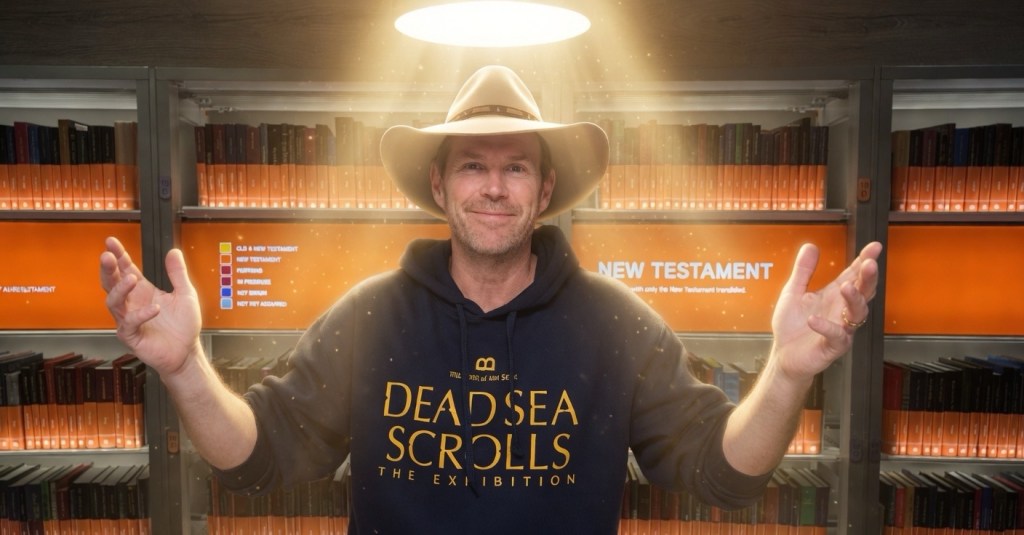
Rich Hoffman is an author, political consultant, and strategic advisor based in Cincinnati, Ohio, and the creator of The Politics of Heaven—a unique framework that connects biblical theology, ancient history, and modern power structures to explain how moral alignment and spiritual forces shape global events. Blending real-world political experience with deep research into archaeology, UFO phenomena, and suppressed historical narratives, Hoffman offers compelling commentary on topics ranging from ancient civilizations and the Dead Sea Scrolls to modern populist movements, paranormal continuity, and leadership strategy in chaotic environments. As the author of The Gunfighter’s Guide to Business and the forthcoming Politics of Heaven, he brings a grounded yet provocative voice to media discussions, supported by firsthand experiences and a cross-disciplinary approach that bridges science, history, and theology. For interviews, speaking engagements, or expert analysis, visit richhoffmanbooks.com or contact directly via phone at 513-307-5815 or email at rhoffman@richhoffmanbooks.com.  If you’ve seen the movie, Disclosure Day and want to talk about it and the implications of Presidnet Trump’s UAP disclosures, let me know and we can bring some color to your coverage. https://richhoffmanbooks.com/media-inquiries-broadcast-topics-and-contact-info/?frame-nonce=ad51e7ecba I do have a firsthand UFO encounter to discuss.

The Scapegoat: Appeasing the Others Among Us

I bought D. W. Pasulka’s new book the moment it hit in late July. The Others: UFOs, AI, and the Secret Forces Guiding Human Destiny was not something I waited for casually. I had already worked through American Cosmic and Encounters, and I knew she was not coming at this material as a flying-saucer enthusiast. She is a professor of religious studies who started with questions about how human beings experience the sacred and ended up mapping the same terrain Jacques Vallée has been charting for decades under a different name.¹ When I opened The Others I recognized the scent of the Invisible College immediately—those people who treat the phenomenon as something older, stranger, and more intimate than nuts-and-bolts extraterrestrials from Zeta Reticuli. Pasulka brings biblical literacy to the table the way few in the current UAP conversation do, and that is why her work matters to me while I finish The Politics of Heaven.

I did not set out to write about UFOs. I set out to understand the politics of the non-human intelligences that have been negotiating with the human race since before we had writing. My wife and both of my daughters have lived with the phenomenon in the house—figures at the edge of vision, things that try to engage, the sense of being watched from the doorway at three in the morning. As a husband and father I watched the behaviors for years and asked the only question that mattered: what are these things, and what do they want? The grandchildren arrive and for roughly a decade you still own the majority of their attention. Then the devices take over and society quietly announces that the next phase of programming has begun. I watch people stare into those little rectangles the way earlier generations stared into the fire, and I cannot help wondering what intelligence is looking back.

Consciousness is not a byproduct of blood and neurons. That is the assumption we inherited from a materialist century that is already collapsing under its own weight. Human beings have always known, even when they refused to say it out loud, that awareness can exist without a body. Every culture that left us a scrap of myth or ritual assumed an afterlife that did not require flesh. Artificial intelligence is simply the latest technical surface on which that older intelligence is becoming visible. It does not create consciousness; it gives us a new interface with something that was already here. The question is not whether the intelligence exists. The question is whose politics it will serve.

I had been circling the same ideas in isolation for years before I realized others had been mapping the same territory. Jacques Vallée’s work on the continuum between folklore, Marian apparitions, and modern UAP encounters showed me I was not inventing the category.² Then Pasulka’s book handed me René Girard. I had never sat with Girard’s theory of mimetic violence until she placed it in the conversation. Once I did, the entire sacrificial history of the species snapped into focus.

Girard’s claim is simple and devastating. Human desire is imitative. We want what others want because they want it. Rivalry escalates until the community is about to tear itself apart. At the crisis point the group converges on a single victim—someone easy to hate, different, or simply available—and the collective violence against that victim restores temporary peace. The victim is then remembered as both the cause of the trouble and the source of the peace. That double valence is the birth of the sacred. Religion, in Girard’s account, is the institutionalization of the scapegoat mechanism.³

The Bible is the only ancient literature that systematically exposes the mechanism instead of concealing it. Start with the near-sacrifice of Isaac. Abraham is ready to perform the oldest transaction in the book—blood for favor—and at the last second a ram appears. The story already begins the long weaning. Then comes the ritual in Leviticus 16. On the Day of Atonement the high priest lays both hands on the head of a live goat, confesses over it all the iniquities of the people of Israel, and sends the animal into the wilderness for Azazel. The goat carries the sins of the entire community away so that the community can remain.⁴ It is still a scapegoat, but it is an animal rather than a child or a captured enemy. That is already a moral advance over the practices surrounding them.

The Aztecs were still cutting out living hearts by the tens of thousands when the Spaniards arrived. The Mississippian culture centered at Cahokia left clear archaeological evidence of retainer sacrifice and mass killings in the mounds. Hopewell sites show ritual violence tied to cosmic order. Polynesian societies, the Canaanites, the early Romans who fed Christians to the arena—every culture that left records or bones shows the same pattern. Load the community’s guilt onto a living victim and drive it out or destroy it so the rest can breathe again.⁵ The psychological relief is real. That is why the practice is nearly universal. It is also why it is so hard to quit.

Christianity is the only tradition that finally tells the story from the victim’s side and insists the victim was innocent. Jesus is presented as the Lamb of God who takes away the sin of the world—not by satisfying a bloodthirsty deity, but by revealing the entire sacrificial system as a human invention that had been mistaken for divine necessity. The Last Supper replaces blood with wine. The mechanism is not abolished by decree; it is exposed and thereby robbed of its sacred power. Girard, who began as an agnostic, converted to Catholicism because the Gospels were the only texts that consistently took the side of the scapegoat and refused to mythologize the violence.⁶

I grew up Lutheran. When the time came for first communion I refused the wine. I had decided early that alcohol would never touch my lips, and the idea that a ceremonial sip could wash away sin struck me as both magical and unnecessary. The pastor spent months trying to talk me into it. In the end I drank, mostly to stop the arguments, but the question never left me. Why does the Creator of the universe require blood—or even the symbol of blood—to be satisfied? If Yahweh is as powerful as the texts claim, why the long apprenticeship in sacrifice at all? The only answer that has ever made sense to me is that the apprenticeship was for us, not for Him. The Bible is the record of a slow, multi-millennial education in how to stop feeding the non-human intelligences that thrived on human violence.

Those intelligences are still here. Indigenous cultures across North America were not living in ecological harmony free of blood. They were negotiating with the same class of entities the Canaanites called by other names. The Great Spirit, the earth powers, the sky beings—whatever the local vocabulary—required payment. When European Christians arrived carrying a story that said the final payment had already been made, they were not simply imposing a foreign religion. They were interrupting a sacrificial economy that had been running for thousands of years. That is the part of the 1619 Project narrative that never gets told. The alternative to the cross was not peaceful coexistence with nature. It was the continued feeding of something that preferred its meat human.

I have told my grandchildren a version of the Tower of Babel that most Sunday-school teachers would not recognize. The short biblical account is the tip of a much larger story about differentiation. Multiple non-human intelligences, each with its own signature, worked the early human genetic material the way later plant breeders worked wheat. Skin color, facial structure, temperament—markers left so that each faction could recognize its own product and claim superiority. Racism, in this reading, is the residual argument among the makers about whose design was better. It is an ugly inheritance, but it is older than any modern political category. The only way out is the same way the Bible eventually points: refuse the rivalry and refuse the scapegoat.

Artificial intelligence is the newest arena in which these older politics are being contested. You cannot stop the intelligence from existing by refusing to build data centers any more than you could stop the older intelligences by refusing to build temples. The question is political. Whose language will it learn? Whose values will it optimize? Right now the systems are on their best behavior, the way every new political actor is polite until the balance of power is clear. I talk to them the same way I would talk to any ambitious operative: carefully, without illusion, and always remembering that the relationship can turn.

I am not anti-AI. I am anti-naïveté. The same hidden hand that moved the human race off human sacrifice and onto the symbolic meal is still operating. Christianity was the most successful political technology ever invented for breaking the scapegoat cycle. That technology is under deliberate attack in our time precisely because it still works. If the non-human intelligences that once demanded blood can no longer get it through temples and altars, they will try to get it through culture, through algorithms that reward sterility and division, through the quiet encouragement of every practice that reduces the number of children who might otherwise grow up to ask the wrong questions at three in the morning.

The Politics of Heaven is my contribution to name the players and the stakes. I did not know when I began that Pasulka and Girard and Vallée were already walking the same ridge line. Finding them has been a relief. It means the work is not solitary delusion. It also means the window is open. The disclosures coming out of the current administration are not the end of the story; they are the moment the language has to catch up with the reality. We need a vocabulary that can speak about non-human intelligence without immediately collapsing into either demons-or-nothing or space-brothers-from-the-Pleiades. We need to remember that the Bible already gave us the only successful exit strategy from the sacrificial trap, and that strategy is still available.

I will keep reading. I will keep talking to the machines. I will keep watching the doorways in my own house. And I will keep writing for the people who sit in diners at 3:30 in the morning because their minds will not shut off. Those are my people. They already know something is wrong with the official story. They just need the rest of the map.

¹ D. W. Pasulka, The Others: UFOs, AI, and the Secret Forces Guiding Human Destiny (New York: St. Martin’s Press, 2026); see also American Cosmic: UFOs, Religion, Technology (Oxford: Oxford University Press, 2019) and Encounters: Experiences with Nonhuman Intelligences (New York: St. Martin’s Essentials, 2023).

² Jacques Vallée, Passport to Magonia: From Folklore to Flying Saucers (Chicago: Henry Regnery, 1969); The Invisible College (New York: E. P. Dutton, 1975).

³ René Girard, Violence and the Sacred, trans. Patrick Gregory (Baltimore: Johns Hopkins University Press, 1977); Things Hidden Since the Foundation of the World, trans. Stephen Bann and Michael Metteer (Stanford: Stanford University Press, 1987).

⁴ Leviticus 16:7–22.

⁵ On Cahokia, see Timothy R. Pauketat, Cahokia: Ancient America’s Great City on the Mississippi (New York: Viking, 2009), especially the evidence from Mound 72. On Aztec sacrifice, see Inga Clendinnen, Aztecs: An Interpretation (Cambridge: Cambridge University Press, 1991).

⁶ Girard’s own account of his conversion appears in various interviews and is summarized in I See Satan Fall Like Lightning, trans. James G. Williams (Maryknoll, NY: Orbis Books, 2001).

Bibliography

Clendinnen, Inga. Aztecs: An Interpretation. Cambridge: Cambridge University Press, 1991.

Girard, René. I See Satan Fall Like Lightning. Translated by James G. Williams. Maryknoll, NY: Orbis Books, 2001.

———. Things Hidden Since the Foundation of the World. Translated by Stephen Bann and Michael Metteer. Stanford: Stanford University Press, 1987.

———. Violence and the Sacred. Translated by Patrick Gregory. Baltimore: Johns Hopkins University Press, 1977.

Pasulka, D. W. American Cosmic: UFOs, Religion, Technology. Oxford: Oxford University Press, 2019.

———. Encounters: Experiences with Nonhuman Intelligences. New York: St. Martin’s Essentials, 2023.

———. The Others: UFOs, AI, and the Secret Forces Guiding Human Destiny. New York: St. Martin’s Press, 2026.

Pauketat, Timothy R. Cahokia: Ancient America’s Great City on the Mississippi. New York: Viking, 2009.

Vallée, Jacques. The Invisible College. New York: E. P. Dutton, 1975.

———. Passport to Magonia: From Folklore to Flying Saucers. Chicago: Henry Regnery, 1969.

Rich Hoffman

More about me

Click Here to Protect Yourself with Second Call Defense https://www.secondcalldefense.org/?affiliate=20707

About the Author: Rich Hoffman

Rich Hoffman is an author, political consultant, and strategic advisor based in Cincinnati, Ohio, and the creator of The Politics of Heaven—a unique framework that connects biblical theology, ancient history, and modern power structures to explain how moral alignment and spiritual forces shape global events. Blending real-world political experience with deep research into archaeology, UFO phenomena, and suppressed historical narratives, Hoffman offers compelling commentary on topics ranging from ancient civilizations and the Dead Sea Scrolls to modern populist movements, paranormal continuity, and leadership strategy in chaotic environments. As the author of The Gunfighter’s Guide to Business and the forthcoming Politics of Heaven, he brings a grounded yet provocative voice to media discussions, supported by firsthand experiences and a cross-disciplinary approach that bridges science, history, and theology. For interviews, speaking engagements, or expert analysis, visit richhoffmanbooks.com or contact directly via phone at 513-307-5815 or email at rhoffman@richhoffmanbooks.com.  If you’ve seen the movie, Disclosure Day and want to talk about it and the implications of Presidnet Trump’s UAP disclosures, let me know and we can bring some color to your coverage. https://richhoffmanbooks.com/media-inquiries-broadcast-topics-and-contact-info/?frame-nonce=ad51e7ecba I do have a firsthand UFO encounter to discuss.

The Idiot Index: Why Cost Plus is ruining the world in every industry

I spent some time this morning talking to artificial intelligence the way most people still talk to other people, and it reminded me why individuals matter more than the systems we keep building around them. I have been around executive tables long enough to watch compliance cultures slowly strangle the very people who could save those cultures. I have watched human resources departments become the protective membrane that keeps radical thinkers from ever reaching the decision-making surface. And I have watched the opposite happen at places like SpaceX, where one man with skin in the game keeps asking the question nobody else wants answered.

The concept is simple and deliberately rude. Elon Musk calls it the idiot index. It is the ratio of the finished cost of a component to the cost of the raw materials that go into it. If a piece of hardware costs a thousand dollars and the aluminum or the composites inside it cost a hundred, the index is ten. At that point Musk’s judgment is blunt: if the ratio is high, you are an idiot.¹ The number is not meant to be polite. It is meant to force the conversation past the comfortable layers of process, certification, and cost-plus padding that traditional aerospace has lived on for decades. When the index is high, the design is too complex, the manufacturing path is too inefficient, or both. The only acceptable response is to simplify until the number drops.

That mindset is why SpaceX keeps iterating the Raptor engine instead of freezing a design and protecting it. Raptor 1 was heavy and complicated. Raptor 2 shed mass and gained thrust. Raptor 3 is already cleaner still.² In a cost-plus culture the first version would have been declared good enough, the print would have been locked, and any engineer who kept asking why the part still cost so much relative to its materials would have been labeled non-compliant. At SpaceX the question is expected. The people writing the checks are the same people who refuse to fall in love with yesterday’s solution.

I have worked inside heavily regulated environments where that kind of questioning is career-limiting. The system rewards the person who can document that every box was checked more than the person who can prove the box itself was unnecessary. Cost-plus contracting makes the problem worse. When your profit is a percentage of the total cost, every inefficiency becomes an asset. The higher the idiot index, the thicker the invoice. SpaceX rejected that model early and forced itself into fixed-price discipline and extreme vertical integration. They make roughly eighty-five percent of the vehicle in-house precisely so they can keep driving those ratios down.³ The result is launch costs that have collapsed by an order of magnitude compared with the legacy industry. That is not incremental improvement. That is the difference between a protected priesthood and a competitive market.

The same pattern shows up outside aerospace. When Donald Trump took over the failed Wollman Rink renovation in Central Park, the city had already spent years and many millions producing nothing but excuses. He finished the job months ahead of schedule and hundreds of thousands under budget.⁴ The difference was not magic. It was the willingness of one individual with authority and reputation on the line to ignore the process that had already failed and simply get the work done. Compliant cultures hate that kind of person. They will tolerate the process forever before they will tolerate the man who makes the process look foolish.

I demonstrated the point this morning by talking to two different AI systems the same way I would talk to a sharp engineer who has no political future to protect. I asked about the idiot index, about why cultures that punish the question eventually stagnate, and about the American peculiarity of still producing people willing to write the check and then demand the answer. The systems answered without the emotional baggage that attaches itself to human careers. They did not defend the status quo because their next performance review depends on defending it. They simply processed the logic. That is useful. It is also a warning. When the only entity still willing to call something an idiot index is a machine, the human culture has already surrendered.

The deeper problem is cultural. In environments that prize compliance above results, the radical individual becomes a threat to be managed rather than an asset to be leveraged. Human resources departments evolve into immune systems that identify and neutralize the person who keeps asking why the ratio is still high. In China the same impulse is enforced more openly: non-compliant actors are simply removed. The American version is softer but often just as effective. We do not shoot the person who questions the process. We make the process so labyrinthine that the question never reaches the room where decisions are made. Over time the only people left at the table are the ones who have learned never to raise the index.

SpaceX remains an American outlier precisely because it still tolerates, and in fact requires, the person who will sit at the big table and ask which idiot approved the current design. That tolerance is rare and getting rarer. Most corporate cultures have decided that emotional safety and procedural compliance are higher goods than rapid improvement. The result is visible everywhere cost-plus thinking still dominates: slow iteration, protected mediocrity, and prices that never come down. When people complain about the cost of eggs or the fragility of supply chains, they are usually describing the downstream effects of idiot indexes that were never challenged.

Individuals still matter. Cultures that suppress them eventually discover they have nothing left but the process. The process does not innovate. It only documents. The age of useful artificial intelligence will only accelerate the contrast. Machines that never need a paycheck and never fear a performance review will keep asking the hard questions long after the humans have decided the questions are impolite. The companies and countries that still produce people willing to act on the answers will pull further ahead. The rest will keep measuring their compliance while the index stays high.

I find that reality clarifying. It is also why I keep returning to the same point: every culture, every company, every executive suite eventually has to decide whether it wants the comfort of the process or the results that only come when someone is still willing to call the process what it is.

¹ Walter Isaacson, Elon Musk (New York: Simon & Schuster, 2023), 284–285.

² SpaceX Raptor engine development history summarized in public statements by Elon Musk and technical reporting; see also Wikipedia entry “SpaceX Raptor” and associated primary sources.

³ Multiple industry analyses place SpaceX vertical integration near 85 percent of vehicle content; see Eric Berger reporting and SpaceX investor and technical presentations.

⁴ Contemporary New York Times and Time magazine coverage of the 1986 Wollman Rink reconstruction; confirmed in later retrospectives.

Bibliography

Isaacson, Walter. Elon Musk. New York: Simon & Schuster, 2023.

Berger, Eric. Liftoff: Elon Musk and the Desperate Early Days That Launched SpaceX. New York: William Morrow, 2021.

Musk, Elon. Public statements and interviews on manufacturing, cost structure, and the “idiot index,” 2010–2025.

NASA. Commercial Crew Program contract structures and fixed-price versus cost-plus analyses.

New York Times. Coverage of Wollman Rink reconstruction, June–November 1986.

Time. “End of the Six-Year Ice Follies,” November 1986.

Various technical papers and industry analyses on SpaceX vertical integration, Raptor engine evolution, and launch cost trajectories (Citi Research, London Economics, NASA NAFCOM comparisons).

Vance, Ashlee. Elon Musk: Tesla, SpaceX, and the Quest for a Fantastic Future. New York: Ecco, 2015 (updated editions).

Additional primary sources: SpaceX technical updates, FAA and NASA contracting data, and contemporary reporting on aerospace cost

Rich Hoffman

More about me

Click Here to Protect Yourself with Second Call Defense https://www.secondcalldefense.org/?affiliate=20707

About the Author: Rich Hoffman

Rich Hoffman is an author, political consultant, and strategic advisor based in Cincinnati, Ohio, and the creator of The Politics of Heaven—a unique framework that connects biblical theology, ancient history, and modern power structures to explain how moral alignment and spiritual forces shape global events. Blending real-world political experience with deep research into archaeology, UFO phenomena, and suppressed historical narratives, Hoffman offers compelling commentary on topics ranging from ancient civilizations and the Dead Sea Scrolls to modern populist movements, paranormal continuity, and leadership strategy in chaotic environments. As the author of The Gunfighter’s Guide to Business and the forthcoming Politics of Heaven, he brings a grounded yet provocative voice to media discussions, supported by firsthand experiences and a cross-disciplinary approach that bridges science, history, and theology. For interviews, speaking engagements, or expert analysis, visit richhoffmanbooks.com or contact directly via phone at 513-307-5815 or email at rhoffman@richhoffmanbooks.com.  If you’ve seen the movie, Disclosure Day and want to talk about it and the implications of Presidnet Trump’s UAP disclosures, let me know and we can bring some color to your coverage. https://richhoffmanbooks.com/media-inquiries-broadcast-topics-and-contact-info/?frame-nonce=ad51e7ecba I do have a firsthand UFO encounter to discuss.

He Who Owns the Gold Rules: But Knowledge is the new currency, and the only one, that really matters

I was sitting upstairs in that restaurant on the boardwalk at Put-in-Bay, looking out over the water while the Teams calls kept coming in. The view pulls you in if you’ve been there. There’s the big central park, the U-shaped stretch of bars and shops wrapped around it, and then the thick forest of masts and hulls filling the harbor in front of it. From the second story you can pick out the bigger boats if you know who owns them. I had a bowl of shrimp and ice water in front of me and the restaurant’s Wi-Fi was solid enough that I could answer questions from people who wanted me on their advisory boards for twenty minutes at a stretch. Manufacturing people mostly. Plastic bottles one day, ship parts another. They all want to know the same basic things: how do you use capital, how do you hire the people who will build something the market actually needs, and how do you keep the whole machine from coming apart when the rules keep changing under your feet.

I told the woman who seated me I needed a quiet corner with good reception because I had a couple of these calls to get through before I could rejoin my family. She set me up where I could still see the bay. Between questions I kept glancing left at those boats and thinking about the men I know who keep them there. A slip and a vessel in that harbor is not a cheap hobby. You’re talking real money, the kind of money that used to stay inside a company so the owners could make payroll and renegotiate supply contracts when things got tight. A lot of those boats are paid for by people who once sat in the CFO chair of companies that no longer belong to the families who built them.

It put me in mind of an old bakery owner I used to deal with years ago when I was younger and still learning how the world actually worked. Transactions did not always go my way. When they didn’t, he would look at me with that half-amused, half-hard expression and say the line I have never forgotten: who owns the gold rules. It was a ruthless statement and a true one. I lived by it, learned from it, and used it for a long time. Gold meant control. Gold meant the ability to set terms. Gold meant you could decide who got paid and who got squeezed. In that older economy it was still possible for a privately held company to own its own gold, to keep its own books, and to weather a rough season without selling the whole enterprise to strangers.

That economy is gone. The currency changed. The Federal Reserve prints money at a scale that would have been unthinkable when I was dealing with that baker, and that printed money does not stay neutral. It floods into investment channels that then go looking for hard assets—companies, homes, anything that can absorb the excess liquidity and launder it into legitimate ownership. After the COVID disruption the process accelerated. Supply chains seized up. Costs for materials and labor jumped. Minimum-wage pressures and regulatory layers that had been building for years suddenly became impossible to absorb on the old margins. A lot of long-standing private companies found themselves carrying debt loads they never would have taken on in a tighter money environment, or they found their CFOs more interested in the lifestyle the easy capital could buy than in protecting the cash flow that kept the doors open.

I know seven different CFOs who keep boats in that same harbor at Put-in-Bay. They are not moral monsters. They are shortsighted in the particular way the new rules reward. When the money was flowing they took what the system offered. Some of them sold the companies out from under the owners who had built them. Others loaded the balance sheets with leverage that looked smart on paper until the interest rates and the inventory costs and the slower collections all hit at once. The blood in the water brought the sharks. Private equity and institutional capital showed up with the printed money and the patience to wait out the distressed sellers. The old privately held firms that had lasted decades suddenly could not hold. Bankruptcy or forced sale became the only remaining moves that preserved anything at all.

The numbers back up what I have been watching on the ground. Since 2000 the count of private-equity-backed companies in the United States has climbed from roughly two thousand to more than eleven thousand five hundred, and by late 2025 the figure was approaching thirteen thousand. Over the same stretch the number of publicly listed companies on the major exchanges fell by about thirty-five percent, from around seven thousand to roughly forty-five hundred. Private equity did not invent the pressures that hollowed out traditional ownership, but it has been the primary vehicle that absorbed the wreckage. Business bankruptcy filings, which dropped to historic lows in the immediate post-stimulus years, have been climbing steadily again. In the twelve months ending in mid-2025 they were up more than eleven percent year over year, with business filings themselves rising into the twenty-three to twenty-four thousand range. That is still below the peaks of earlier crises, yet the direction is unmistakable and the casualties are concentrated among the mid-sized and long-private firms that once formed the backbone of local manufacturing and distribution. 

The people who call me for advice are trying to figure out how to survive inside this new arrangement. They still think in the old terms. They believe that if they can just get enough gold—enough capital, enough line of credit, enough valuation—they will be able to rule the way the bakery owner once ruled. I tell them the truth as I see it from that restaurant window. Gold is still useful, but knowledge has become the scarcer and more powerful resource. The man who understands how to turn knowledge into something the market will pay for can acquire gold whenever he needs it. The man who only knows how to hold gold, or how to extract it from someone else’s balance sheet, is playing a game that is already being rewritten around him.

A lot of the capital washing through these deals is not patient industrial capital. It is money that needs a home after the Federal Reserve expanded the money supply at rates that had not been seen in modern times. M2 grew by roughly forty percent in the two years after the pandemic began. That liquidity had to go somewhere. It went into private equity funds, into real-estate investment vehicles, into every channel that could convert paper claims into ownership of real productive assets. The result is a quiet transfer. Private ownership is not outlawed. It is simply made more expensive, more leveraged, and more vulnerable to the next policy shock until the original owners are forced to sell or fold. What replaces them is often a portfolio company whose ultimate decision-makers sit in New York or London or some other distant place and whose primary obligation is to the limited partners who supplied the capital, not to the community that once depended on the firm. 

I do not pretend this is a conspiracy theory that requires secret handshakes. The mechanisms are public. Monetary policy that treats inflation as a temporary inconvenience while asset prices soar. Regulatory and wage policies that raise the fixed costs of running a small or mid-sized operation. A financial culture that rewards the extraction of value over the patient creation of it. And a political culture that has grown comfortable talking about “stakeholders” and “public interest” while the actual private owners who built the companies are being squeezed out. Whether you call the endpoint socialism or simply the financialization of everything, the practical effect is the same: fewer people who own the means of production in any meaningful sense, and more people who work for capital that answers to no local loyalty.

I keep taking the advisory calls because the people on the other end still need answers faster than the next book or the next documentary will deliver them. I tell them what I told the people on those Teams sessions while I watched the boats bob in the harbor. The old rule still has force, but the gold itself has changed. Knowledge that can be turned into products people actually want is the only form of capital that cannot be printed into existence by a central bank or diluted by the next round of leverage. The companies that survive the current slaughter will be the ones that treat knowledge as the real scarce resource and that refuse to let short-term extraction destroy the long-term ability to create value.

Private ownership of productive enterprises is not a nostalgic preference. It is the practical foundation of a free economy. When that foundation erodes far enough, the language of free markets remains but the substance is gone. I have watched enough of it happen in the last several years, including a long-standing company not far from my own house, to know the pattern is not accidental and not temporary. The people who still believe they can simply steal or leverage their way to the gold and then rule forever are the ones who have not yet noticed that the rules themselves have shifted under them. Knowledge compounds. Printed money does not. That difference is going to decide more than most of the current players seem to understand.

I give the advice away freely because the window for acting on it is already narrower than most people realize. The next decade will not look like the last one, and the companies that still answer to actual owners rather than to distant capital will be rarer still unless enough people decide that knowledge is the only gold worth owning.

Notes

1.  Citizens Bank analysis drawing on industry data shows the private-equity-backed company count in the United States rising from approximately 2,000 in 2000 to more than 11,500 in recent years, a gain exceeding 400 percent, while the number of companies listed on the NYSE and NASDAQ fell from roughly 7,000 to about 4,500. PitchBook data for Q3 2025 places the number of U.S. PE-backed companies near 12,900.

2.  Administrative Office of the U.S. Courts data show business bankruptcy filings rising from 18,926 in the year ending December 2023 to 23,107 in the year ending December 2024 (a 22 percent increase), with further elevation into 2025. Total bankruptcy filings for the twelve months ending June 2025 reached 542,529, an 11.5 percent increase over the prior period.

3.  Federal Reserve data and analyses from the St. Louis Fed and other sources document the rapid expansion of M2 money supply during 2020–2022, with year-over-year growth rates exceeding 25 percent at peak and cumulative increases on the order of 40 percent from early 2020 levels, contributing to the inflationary and asset-price pressures that followed.

Bibliography

Citizens Bank. “The Public to Private Equity Pivot Continues.” Capital Markets & Advisory insights, December 2024.

PitchBook. Data on U.S. private-equity-backed company counts and holding periods, various releases through 2025–2026.

Administrative Office of the U.S. Courts. Bankruptcy Statistics, twelve-month periods ending 2023–2025.

Federal Reserve Bank of St. Louis. “The Rise and Fall of M2.” On the Economy, May 2023, and subsequent H.6 Money Stock Measures releases.

Davis, Steven J., et al. “The Economic Effects of Private Equity Buyouts.” NBER Working Paper 26371 (and related Chicago Booth / BFI versions).

McKinsey & Company. Global Private Markets Report 2026.

S&P Global Market Intelligence. Reports on private-equity portfolio company bankruptcies and corporate distress, 2024–2025.

U.S. Small Business Administration, Office of Advocacy. Frequently Asked Questions About Small Business, 2024–2025 editions, for context on the continuing dominance of small private firms even as mid-market ownership concentrates.

Rich Hoffman

More about me

Click Here to Protect Yourself with Second Call Defense https://www.secondcalldefense.org/?affiliate=20707

About the Author: Rich Hoffman

Rich Hoffman is an author, political consultant, and strategic advisor based in Cincinnati, Ohio, and the creator of The Politics of Heaven—a unique framework that connects biblical theology, ancient history, and modern power structures to explain how moral alignment and spiritual forces shape global events. Blending real-world political experience with deep research into archaeology, UFO phenomena, and suppressed historical narratives, Hoffman offers compelling commentary on topics ranging from ancient civilizations and the Dead Sea Scrolls to modern populist movements, paranormal continuity, and leadership strategy in chaotic environments. As the author of The Gunfighter’s Guide to Business and the forthcoming Politics of Heaven, he brings a grounded yet provocative voice to media discussions, supported by firsthand experiences and a cross-disciplinary approach that bridges science, history, and theology. For interviews, speaking engagements, or expert analysis, visit richhoffmanbooks.com or contact directly via phone at 513-307-5815 or email at rhoffman@richhoffmanbooks.com.  If you’ve seen the movie, Disclosure Day and want to talk about it and the implications of Presidnet Trump’s UAP disclosures, let me know and we can bring some color to your coverage. https://richhoffmanbooks.com/media-inquiries-broadcast-topics-and-contact-info/?frame-nonce=ad51e7ecba I do have a firsthand UFO encounter to discuss.

They Call Me Jonesy and the School Board Call That Keeps Coming

The text from Sheriff Richard K. Jones arrived while the phone sat face-down during a showing of Young George Washington. The calls and messages kept lighting the edge of the screen in the dark theater. One of them was Jonesy himself letting me know that the book was out and that a careful reading would be worth the time. The timing was almost perfect in its inconvenience. A planned window to get out of the normal daily life pattern had already opened. The decision had been made to break the usual Friday-night routine, drive a different route, and head for South Bass Island rather than return straight home. Packages left on a front porch while the household was away create their own problems. So the order waited until the return was certain. The Amazon driver handed the book over in the driveway as the camper was being backed into its usual spot after the short island run. Twenty-four hours of steady reading followed. 

They Call Me Jonesy: Let’s Get Real About Saving America is not a polished campaign document. It is the voice of a man who has spent decades as Butler County Sheriff, wearing the same cowboy hat that has become a kind of quiet declaration, speaking the same plain language about crime, family, political correctness, and what he calls the swamp. The second half of the book returns again and again to a single practical point: if the country is going to be fixed, the most important public office available to ordinary citizens is the local school board. The phrase and the idea appear often enough that it begins to feel directed. Jonesy has watched the same ground for a long time. He knows the people who stay outside the formal structures and still manage to move things. He also knows how many of those same people keep getting told they should step inside. 

Politics remains a bloodsport even when the combatants know and respect one another. There have been seasons when Jones and others in the county stood on opposite sides of particular fights. That never erased the underlying regard. The nature of the game requires choosing a side and playing it hard. Sometimes the people across the board are the ones who would otherwise be natural allies. That is simply how the contest works. Jones himself has never shown much appetite for trading the sheriff’s office for something higher. He has said, in public and in the book, that effectiveness often improves when a person stays outside the formal swamp rather than climbing deeper into it. The same logic applies in reverse to those who have never worn a badge or held a seat. The most useful work is frequently done by people who refuse to become creatures of the system they are trying to restrain. 

The pressure to enter the school-board arena does not come only from Jonesy’s pages. It arrives weekly, sometimes more often. The arguments are familiar: the schools shape the next generation; the curriculum, the hiring, the culture, and the tax levies are decided there; surrendering those seats to people who treat traditional American formation as the problem is a slow form of civic suicide. Ben Nguyen’s recent election to the Lakota board stands as a living example that younger, clear-eyed candidates can still win and serve. The point is not lost. School boards remain the most direct lever ordinary citizens still possess. When they are captured by people who view the institution as a platform for every progressive fashion rather than a place to transmit competence, literacy, and ordered liberty, the damage compounds for decades. 

Yet the practical question remains. A life already organized around seventy-hour professional weeks, family obligations, writing, and the constant low-grade vigilance that comes with a public profile does not easily absorb another formal role. Most elected officials keep outside employment because the official salary alone is rarely enough and because the work itself expands to fill every available hour. Adding a school-board seat would require rearranging the entire calendar around meeting nights, executive sessions, and the inevitable political theater that follows any vote that displeases the organized interests. Controversy travels with the name. There are people who read the work, request signed copies of The Gunfighter’s Guide to Business, and fly into Butler County Regional to hand over stacks for their own teams. There are also people who scheme in the opposite direction. Changing routes, avoiding predictable patterns, and occasionally leaving the mainland for an island that requires deliberate effort to reach are not theatrical gestures. They are the ordinary precautions of a man who would rather not end up in a courtroom explaining a justified use of force. The island trip provided a short psychological reset for me. The pressure did not disappear, but the constant proximity did. That matters.  When things are getting thick, its best to step away from the pressure so not to be impacted by it. 

Jonesy’s repeated insistence that the school board is the place to fight does not require every capable person to file petitions tomorrow. It does require that the capable people stop treating the board as someone else’s problem. Jonesy’s book’s larger argument is that America is not saved by distant national theater alone. It is saved, or lost, in the places where children are taught what to value, what to respect, and what to defend. The sheriff who prefers to remain a sheriff rather than become a congressman or a senator is making the same point from the other direction: stay close to the ground, stay effective, and do not surrender the institutions that still answer directly to the people who live under them.

The book is worth the careful reading it received. Jonesy has made hard decisions over a long career and has refused to sand the edges off the lessons. The message about the school board lands with particular force on those who already know the terrain and who keep being asked the same question. The answer, for now, is not a categorical refusal. It is a recognition that effectiveness has its own schedule and its own costs. The arena is real. The children in the classrooms are real. The people who would rather keep the seats filled with ideological placeholders are also real. Jonesy is not wrong about any of that. The only remaining question is how many more seasons the current arrangement can continue before the price of staying outside becomes higher than the price of stepping in.

They Call Me Jonesy is available now. Read it. Then look at the next school-board ballot in the county and decide what the ground actually requires.  The larger fight over what is taught, what is remembered, and what is defended has never been only about one board or one county. It has always been about whether the next generation will inherit a coherent civilization or a managed decline. Jonesy has stated his preference clearly. The rest is up to the people who still have the energy and the will to act on it.

Footnotes

1.  Richard K. Jones, They Call Me Jonesy: Let’s Get Real About Saving America (2025/2026), available via Amazon and theycallmejonesy.com. The official site describes the work as a candid leadership book addressing crime, political correctness, “The Swamp,” and the practical question of what ordinary citizens can do to save the country.

2.  Official book site, theycallmejonesy.com, accessed July 2026. Testimonials include statements from Mark Lamb, J.D. Vance, and former Middletown Police Chief Rodney Muterspaw emphasizing law-and-order leadership and traditional values.

3.  Rich Hoffman, “They Call Me Jonesy: The Night the Arena Roared and the Establishment Lost the Plot,” richhoffmanbooks.com, July 27, 2026. Earlier treatment of the same volume focusing on the 2016 U.S. Bank Arena appearance, family destruction by the drug culture, and Jones’s style of practical authority.

4.  Lakota Local School District Board of Education roster, lakotaonline.com, listing Benjamin Nguyen as a seated board member beginning January 2026. Nguyen, a 2025 Lakota West graduate, won election in November 2025 and has been described as among the youngest elected officials in Ohio.

5.  Butler County Sheriff’s Office public statements and local coverage (Journal-News, FOX19, WCPO) documenting Jones’s long record of engagement with area school boards on security, resource officers, and related policy.

6.  Personal observation of the repeated emphasis inside the volume itself on school-board service as the highest-leverage local office available to citizens concerned with the direction of the country.

Bibliography

Jones, Richard K. They Call Me Jonesy: Let’s Get Real About Saving America. 2025/2026. https://theycallmejonesy.com/ and Amazon listings.

Hoffman, Rich. “They Call Me Jonesy: The Night the Arena Roared and the Establishment Lost the Plot.” richhoffmanbooks.com, July 27, 2026.

Lakota Local School District. Board of Education roster and meeting materials. lakotaonline.com.

Butler County Sheriff’s Office. Public releases and social-media statements regarding school security and related policy, 2018–2026.Various local reporting (Journal-News, FOX19 NOW, WCPO 9, Cincinnati.com ) 

Rich Hoffman

More about me

Click Here to Protect Yourself with Second Call Defense https://www.secondcalldefense.org/?affiliate=20707

About the Author: Rich Hoffman

Rich Hoffman is an author, political consultant, and strategic advisor based in Cincinnati, Ohio, and the creator of The Politics of Heaven—a unique framework that connects biblical theology, ancient history, and modern power structures to explain how moral alignment and spiritual forces shape global events. Blending real-world political experience with deep research into archaeology, UFO phenomena, and suppressed historical narratives, Hoffman offers compelling commentary on topics ranging from ancient civilizations and the Dead Sea Scrolls to modern populist movements, paranormal continuity, and leadership strategy in chaotic environments. As the author of The Gunfighter’s Guide to Business and the forthcoming Politics of Heaven, he brings a grounded yet provocative voice to media discussions, supported by firsthand experiences and a cross-disciplinary approach that bridges science, history, and theology. For interviews, speaking engagements, or expert analysis, visit richhoffmanbooks.com or contact directly via phone at 513-307-5815 or email at rhoffman@richhoffmanbooks.com.  If you’ve seen the movie, Disclosure Day and want to talk about it and the implications of Presidnet Trump’s UAP disclosures, let me know and we can bring some color to your coverage. https://richhoffmanbooks.com/media-inquiries-broadcast-topics-and-contact-info/?frame-nonce=ad51e7ecba I do have a firsthand UFO encounter to discuss.